



Archive for on-farm processing

$20 Milk, $19.14 Costs, 15.9¢ of the Food Dollar: Should You Chase Thunder CoffeeMilk-Style Value-Added?

At roughly $20/cwt milk against $19.14 in full costs and just 15.9¢ of the food dollar, Thunder’s $40–50K months show both what’s possible — and how fast value-added can blow a hole in your cash flow.

Executive Summary: Two Florida dairy farmers built Thunder CoffeeMilk into $40,000–$50,000 a month — starting in a kitchen, driving 15 hours to a Michigan lab, and watching their first shelf-stable batch come out as a solid brick. The reason it matters to you has nothing to do with coffee: you get just 15.9¢ of every food dollar, and the dairy farm share has slid from 52¢ in 1980 to 25¢ today. At an all-milk price around $20/cwt against $19.14 in full costs, a lot of herds are running on fumes, and value-added looks like the way into the other 84¢. But the math is brutal — Thunder ran negative cash flow for two to three years, and if you’re bankrolling a brand off the same balance sheet that feeds your cows, a $1/cwt price dip is another $125,000 to absorb on a 500-cow herd. The piece lays out four real paths past 15.9¢ — branded CPG, on-farm processing, commodity optimization, and carbon/data monetization — and exactly where each one breaks. Read it if you’ve ever wondered whether your operation is built to capture value or just produce it. The 30-day move is the cheapest one: spend half a day auditing your hauling and co-op product mix before you fantasize about cans.
value-added dairy

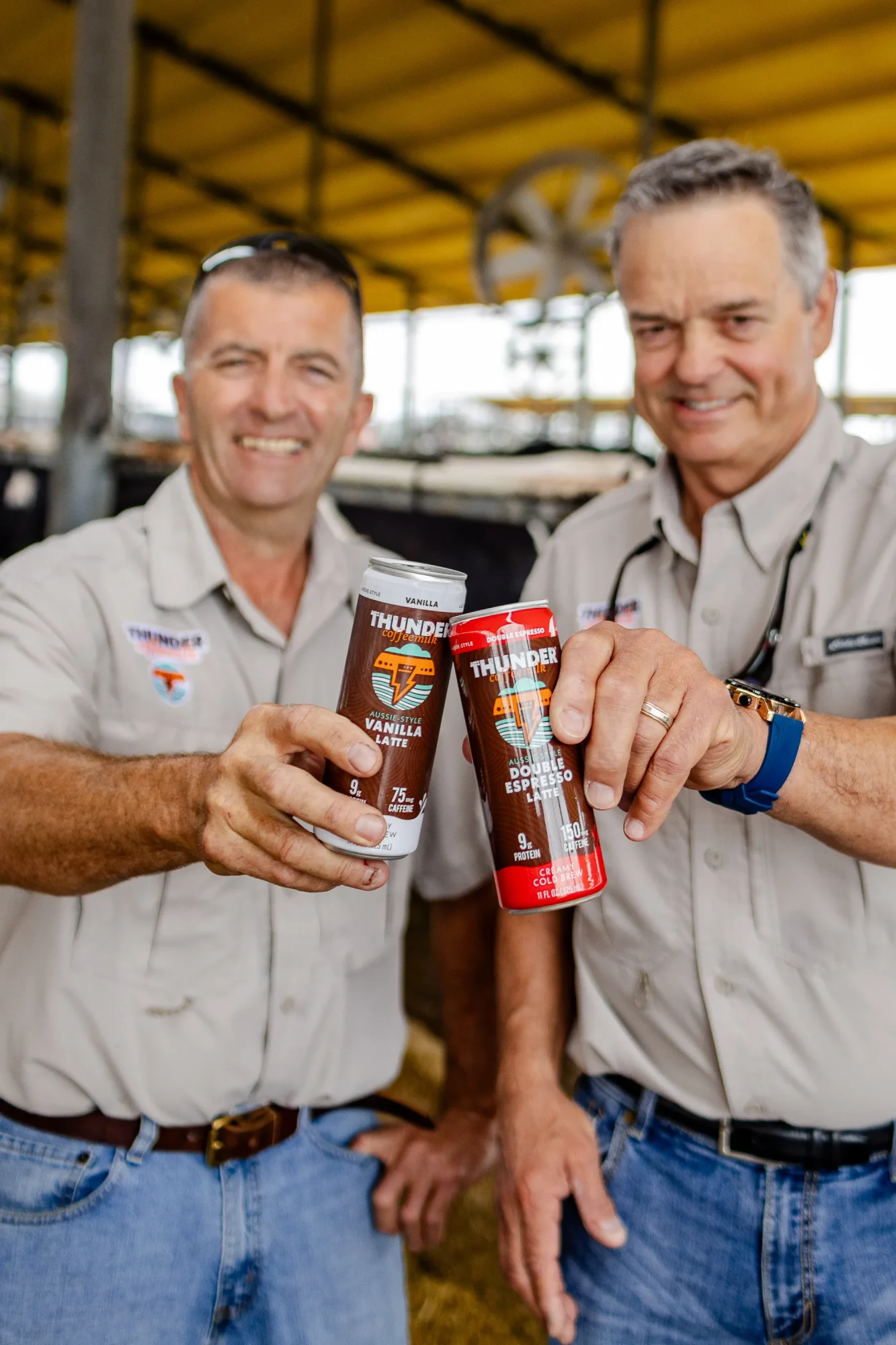
Dave Temple grew up on a dairy farm in Queensland, Australia, where milk-brewed iced coffee is the drink you grab without thinking about it. He moved to Florida, started his own farm, and went looking for that coffee on American shelves. It wasn’t there. So he and fellow multigenerational dairy farmer Ed Henderson decided to build it themselves, starting eight years ago in Ed’s kitchen (Entrepreneur, June 15, 2026).
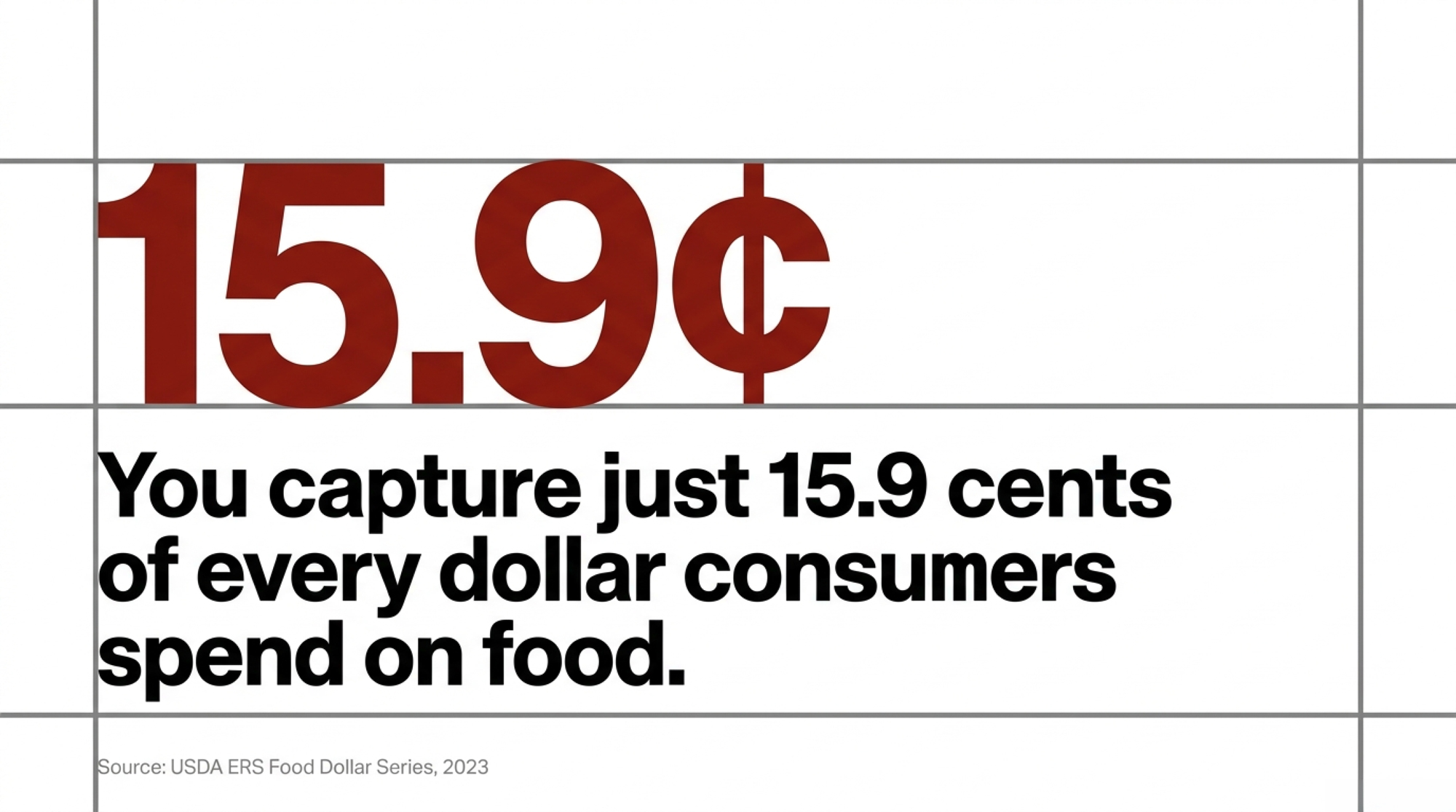
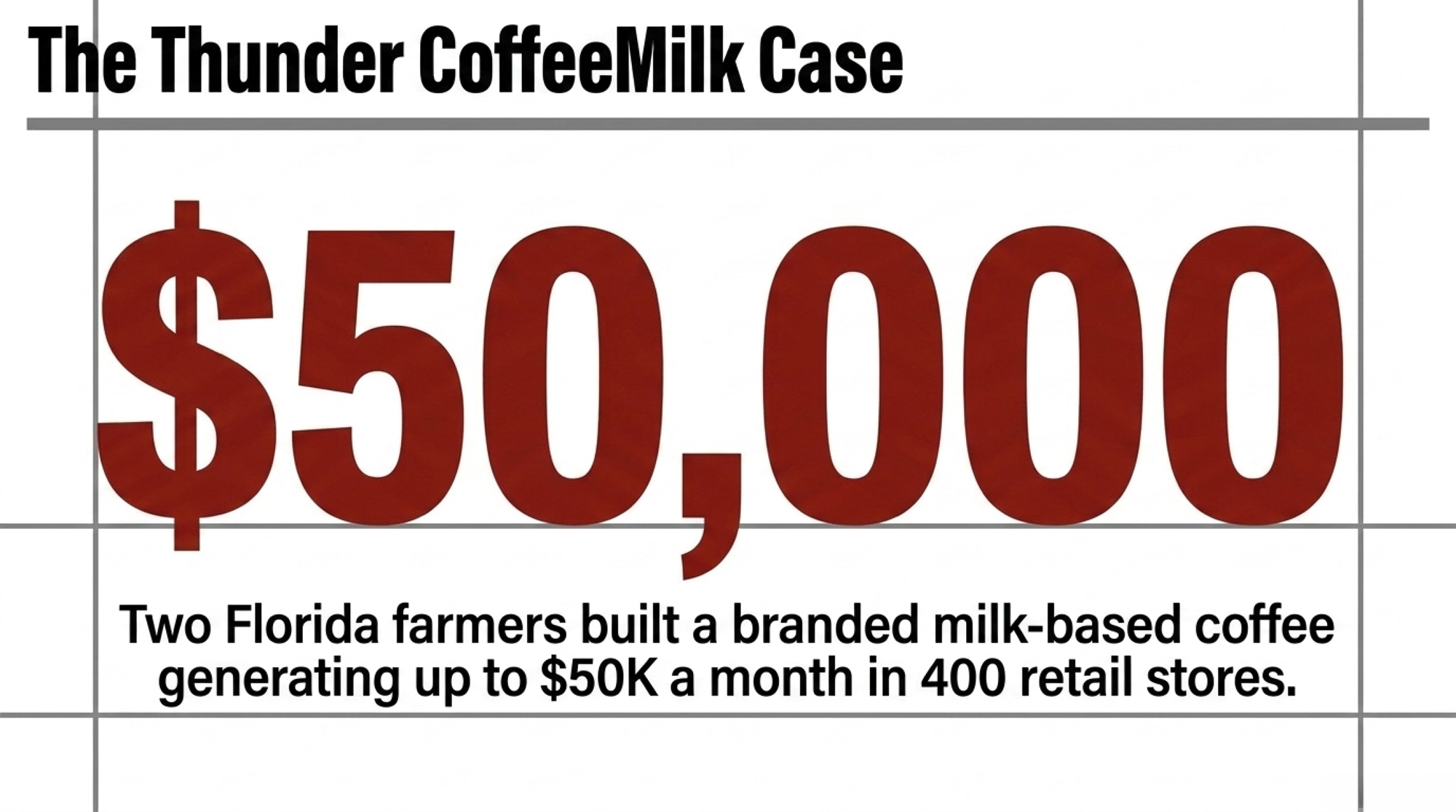
Their brand, Thunder CoffeeMilk, now moves $40,000 to $50,000 a month and rolled out across more than 400 select 7-Eleven stores in Florida when it launched. The numbers sound impressive until you stack them against what USDA says you get from the average food dollar. In 2023, U.S. farmers captured just 15.9 cents of every dollar consumers spent on domestically produced food (USDA ERS Food Dollar Series, 2023 data). That ceiling is the backdrop for what Temple and Henderson built — a value-added product that captures more of the retail dollar than raw milk ever will, one 11-ounce can at a time.
What’s Actually Squeezing the Farm Share
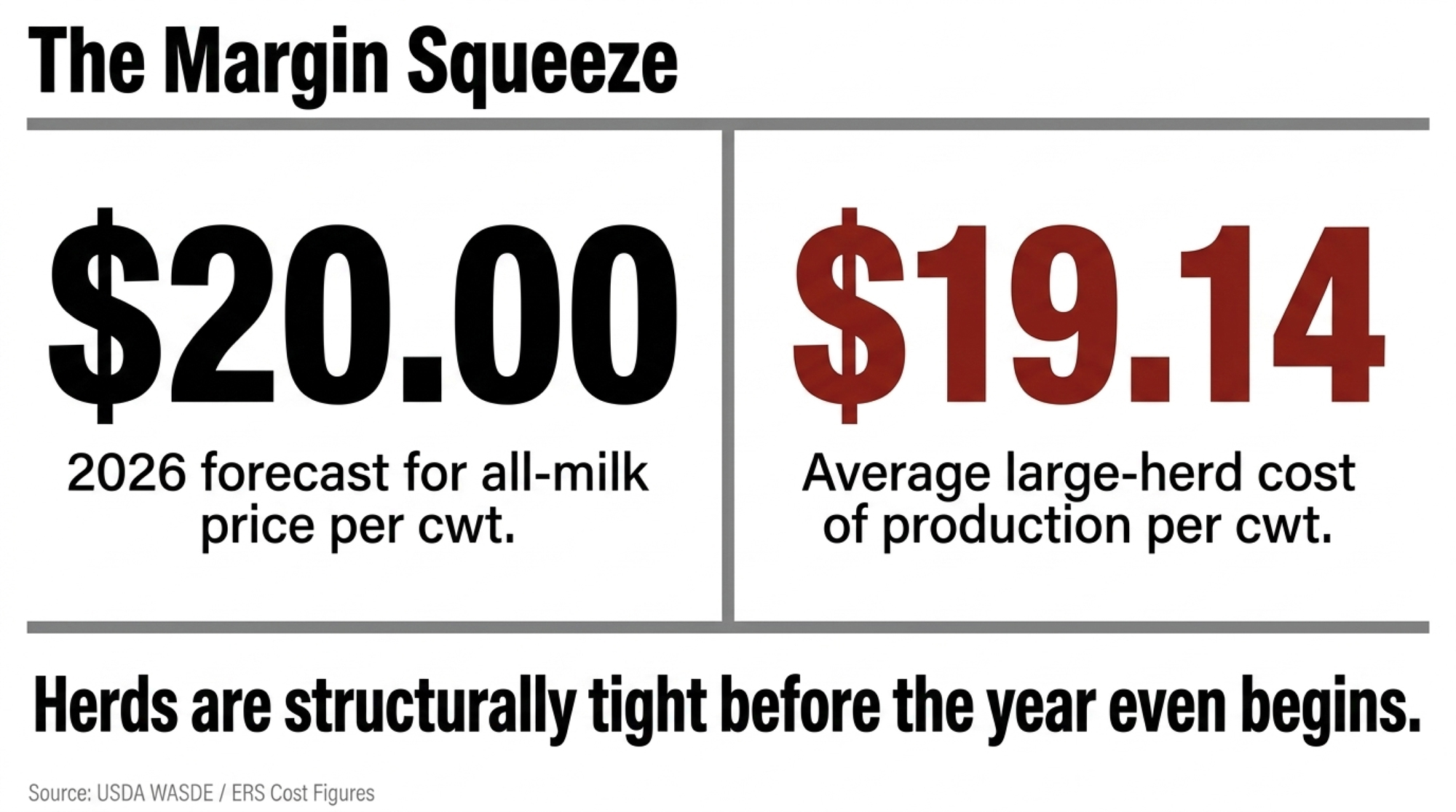
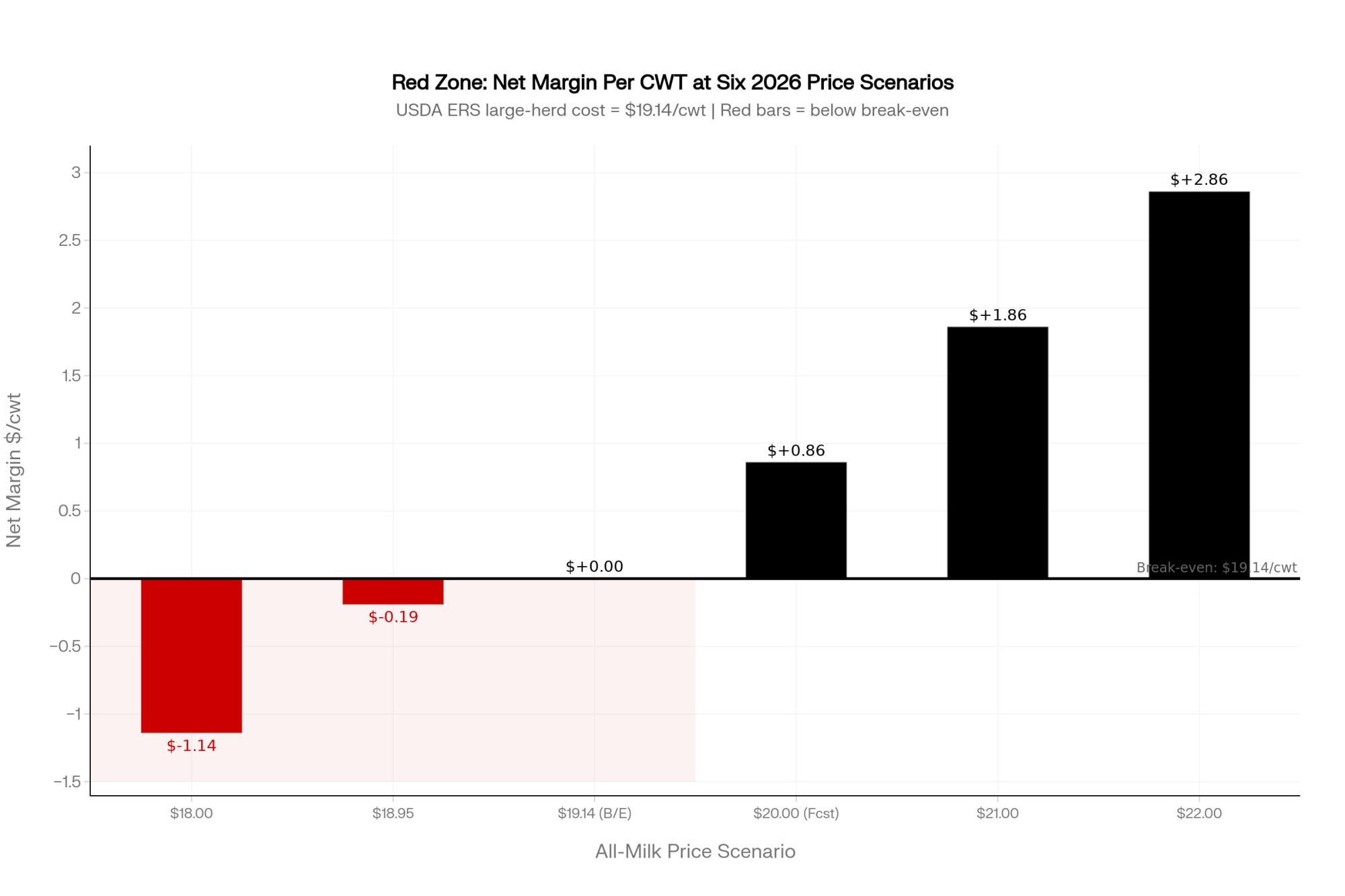
The old playbook was simple. Milk more cows, milk them cheaper, ship to the co-op, and pray the mailbox price covered your cost of production. In 2026, that math is harder to make work. USDA’s latest WASDE outlook has 2026 all-milk hovering around the $20/cwt mark, with 2027 pegged lower. ERS cost figures put average large-herd cost near $19.14/cwt, and the smallest herds run far higher — which is why plenty of dairies start the year structurally tight even when the price looks decent (The Bullvine, “$18.95 Milk, $19.14 Costs,” Feb 10, 2026).
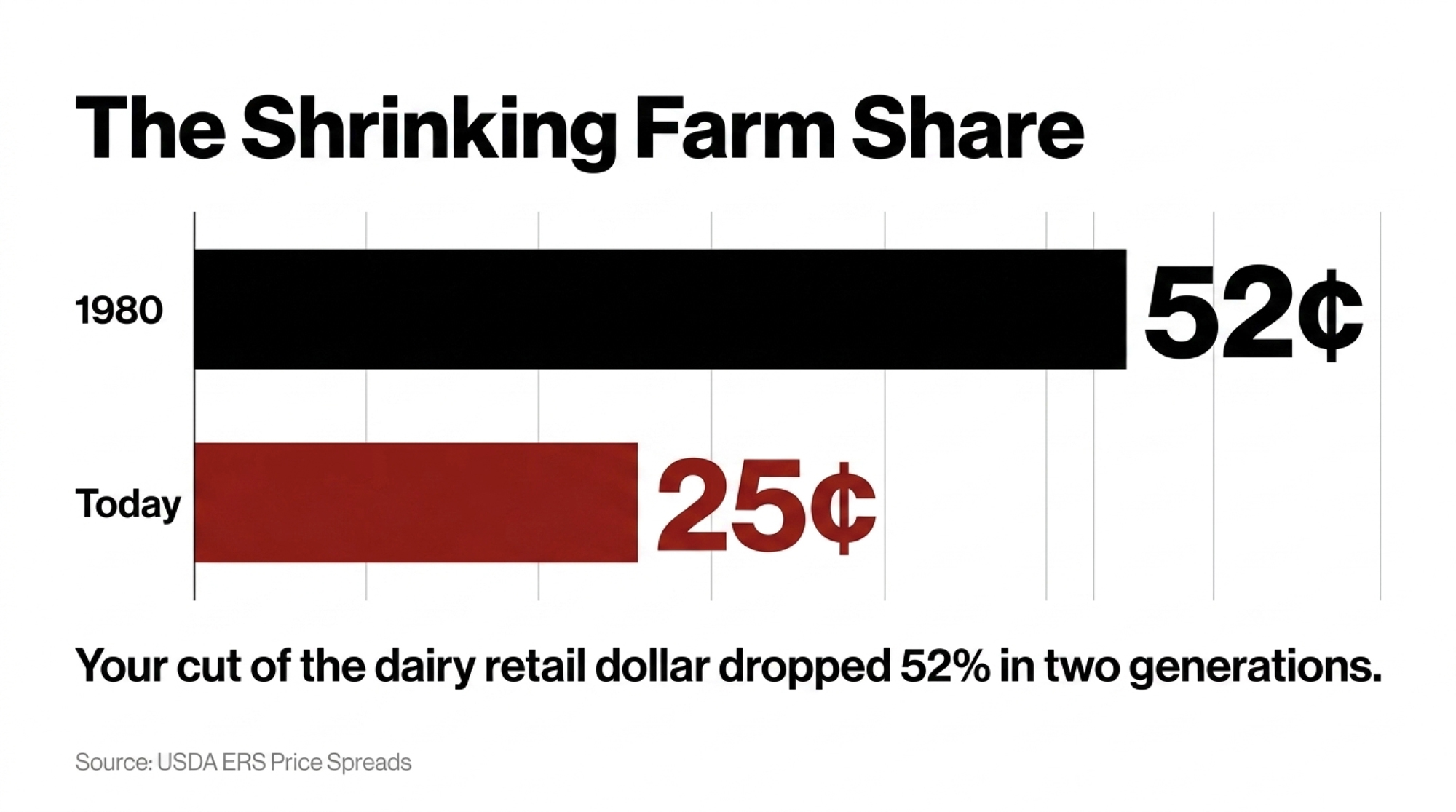
The farm’s slice of the dairy retail dollar has been eroding for two generations. It sat near 52 cents in 1980. USDA’s most recent price-spread data puts it around 25 cents today — the full decline from 52¢ to 25¢ is roughly a 52% drop over that span (The Bullvine, Dec 30, 2025, citing USDA ERS Price Spreads). Same cows. Same barn. A much thinner cut of the same gallon.
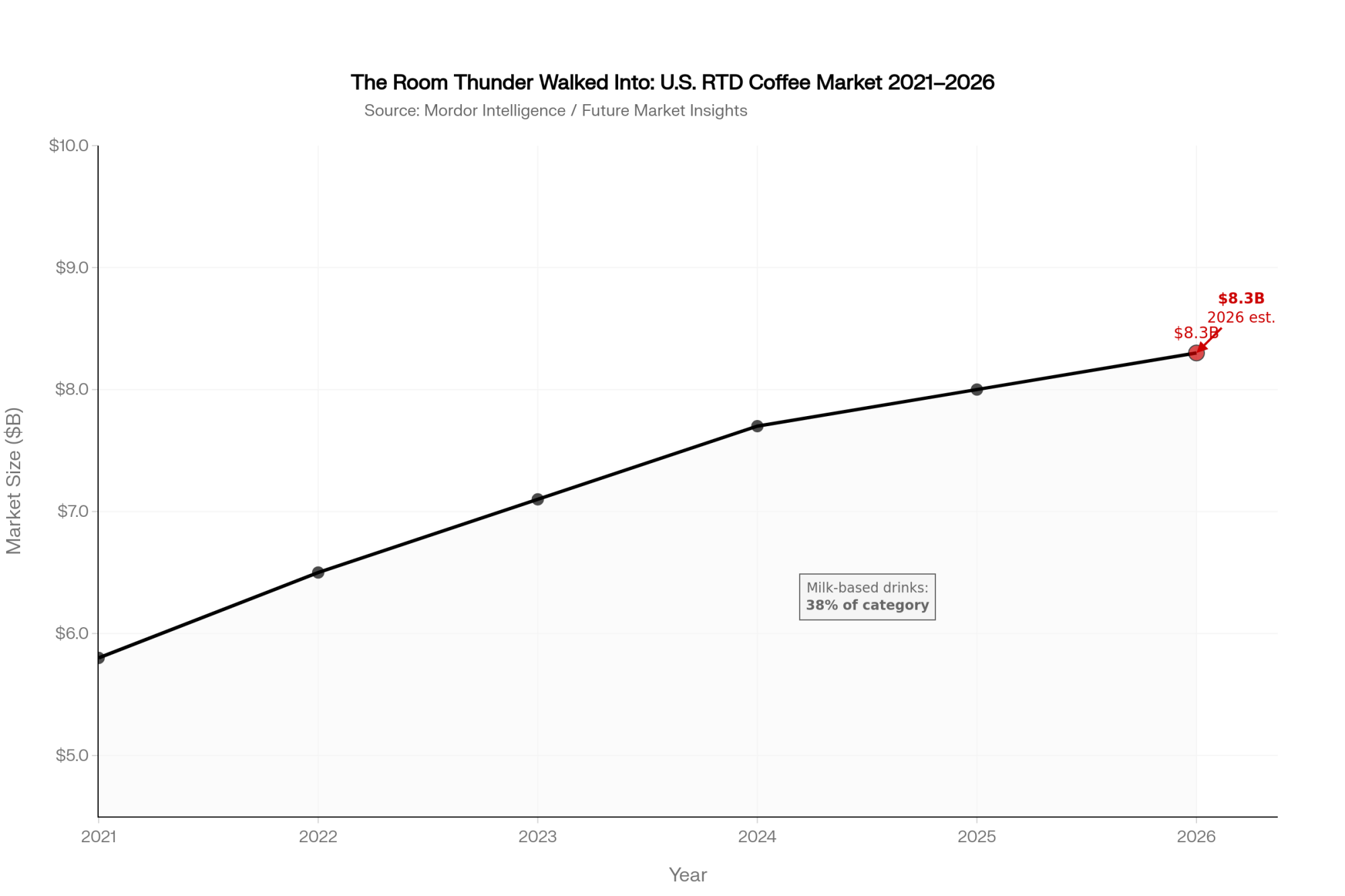
That’s the pressure pushing more farmers to look past the tank. Bullvine’s own analysis puts value-added dairy growth near 12% a year while commodity fluid milk stays roughly flat (Nov 24, 2025). And ready-to-drink coffee is one of the hottest rooms in that house — Mordor Intelligence pegs the U.S. RTD coffee market at about $8.3 billion in 2026, and Future Market Insights has milk-based drinks leading the category at 38% (May 2026). Temple and Henderson didn’t chase a fad. They walked into a growing category and noticed most canned coffee is brewed in water, with milk added as an afterthought. Their whole thesis was to flip that — brew the coffee in real milk from the start.
The Solid Block: What It Costs to Cross the Fence

Picture it: two dairy farmers, fifteen hours from home, standing in a food-processing lab at Michigan State University’s Food Processing Innovation Center, watching their first shelf-stable run come out of the machine. Except it didn’t pour. It thudded. The whole batch had seized into a solid block — not a drink, a brick (Entrepreneur, June 15, 2026). That brick is the whole story of value-added dairy in one image.

They spent two days on-site reworking the recipe before they could move forward. And here’s the honest part they’ll tell you themselves: neither had a background in sales, marketing, or distribution. Just decades of farming and a willingness to keep asking questions until they found the right people.

That solid block is worth more than a laugh. It’s the tuition receipt for crossing from commodity supplier to manufacturer. Inside the fence, these two can diagnose a sick cow or a broken ration in seconds. Step outside it into protein chemistry and shelf-life validation, and none of that instinct transfers. You’re back at square one. The failure wasn’t a fluke — it’s what the leap actually feels like. A 2024 Tarleton State University review names limited business and technical expertise, plus thin access to processing infrastructure, as core barriers stopping small U.S. dairy farms from making exactly this kind of move (Tarleton State University, Dec 22, 2024).

How This Plays Out on a Real Balance Sheet
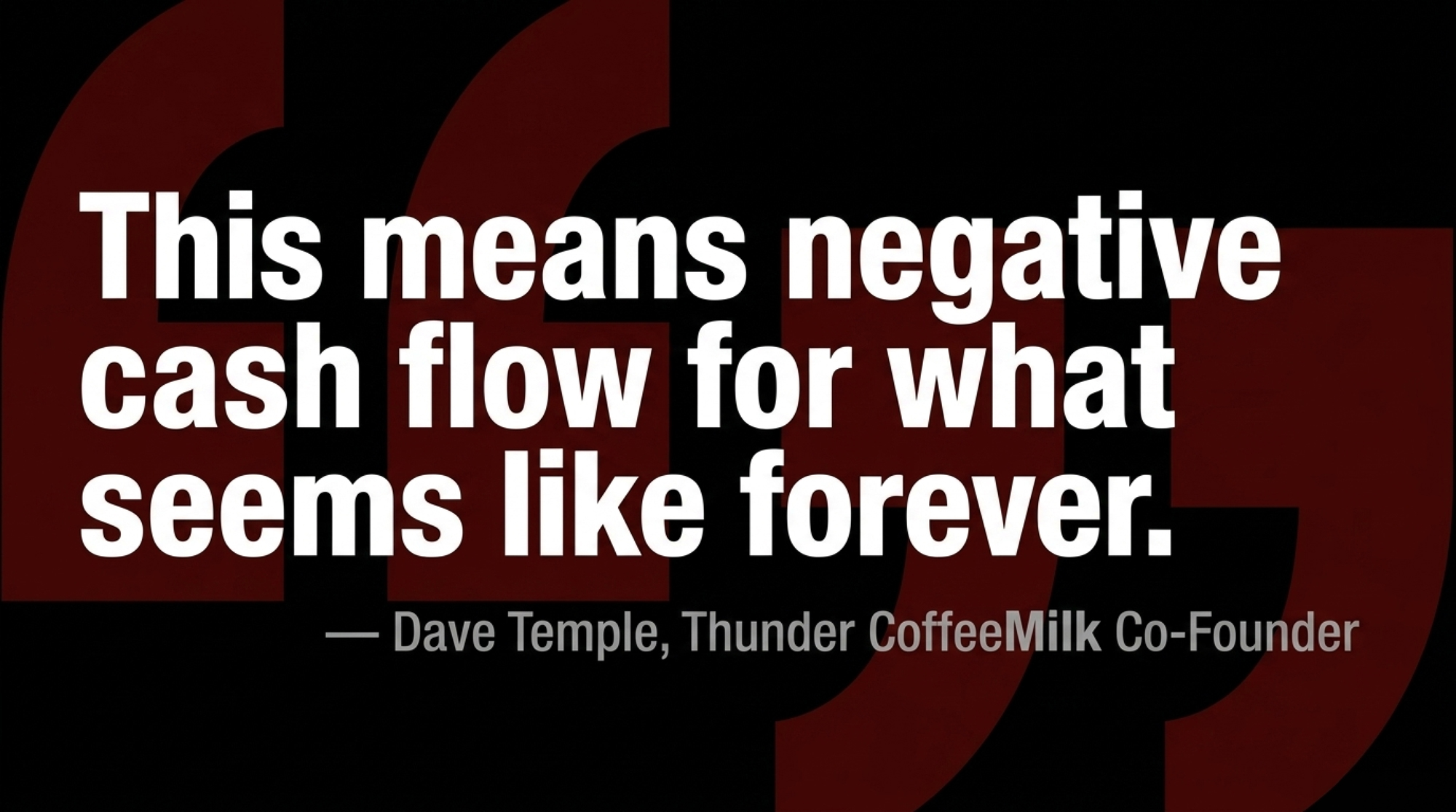
The line from Dave that should stop any producer cold is about retail, not chemistry. “For us to get our toe in the door, it has cost a large amount of money to effectively buy space to get our product in stores,” he told Entrepreneur. “This means negative cash flow for what seems like forever.” That’s not a Silicon Valley runway story with venture money padding the fall. That’s an operating line feeding cows and buying shelf space at the same time.
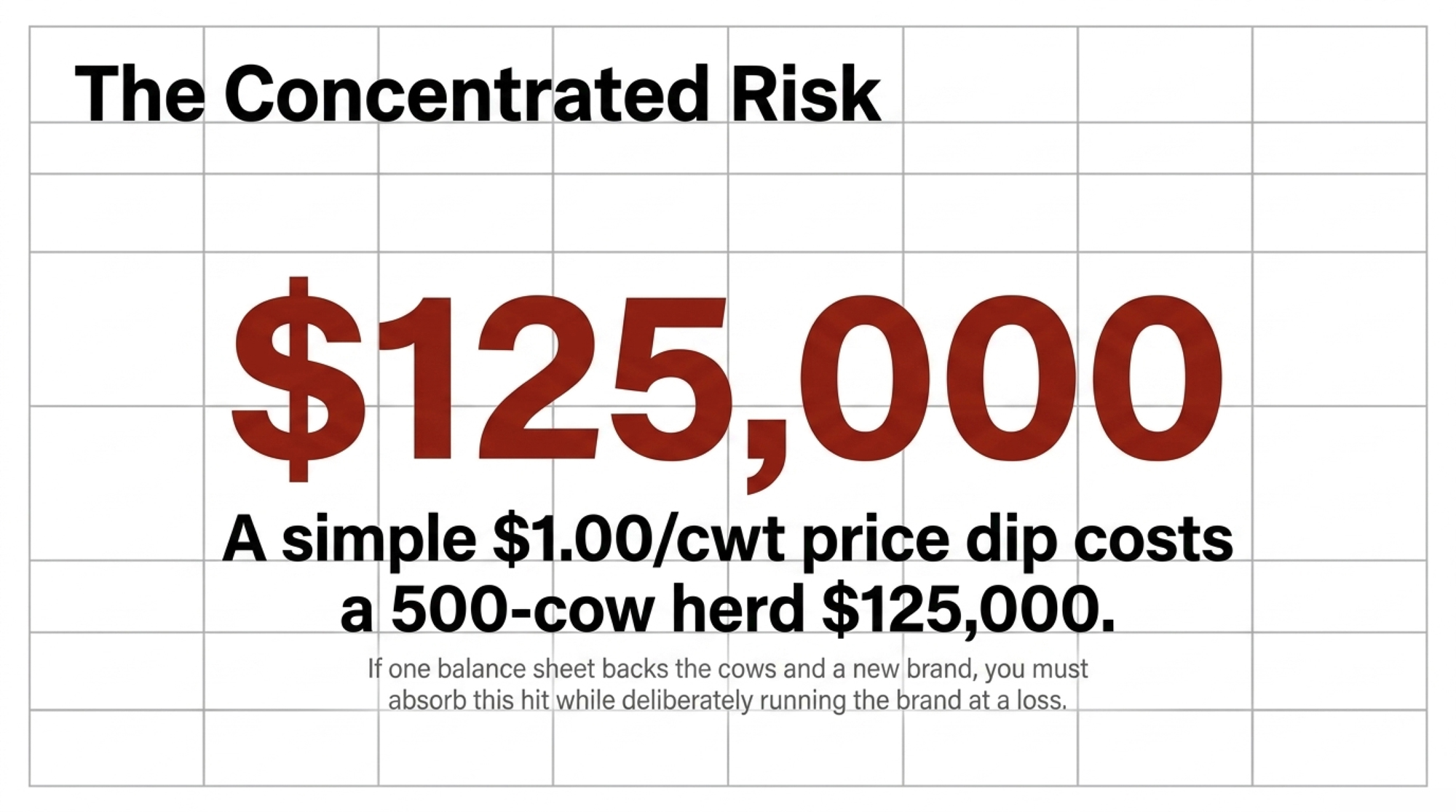
Put real numbers on the milk side first, because that’s the floor this whole bet stands on. Take a 500-cow herd averaging around 25,000 lb per cow — call it 125,000 cwt a year. A $1.00/cwt swing in your mailbox price — well within the range USDA has moved its 2026 forecast this year alone (from $18.95 in February toward the low $20s by mid-year) — is $125,000 in cash flow, up or down, across twelve months. Run lighter cows at 22,000 lb, and you’re closer to $110,000, but the point holds either way. That’s the sensitivity before you add a thing — then you stack a second business on top, one you’re deliberately running at a loss to hold a cooler slot.

Herd SizeAvg Production (lbs/cow)Annual CWT ProducedImpact of $1/cwt SwingImpact of $2/cwt SwingMargin Note
100 cows25,000 lbs25,000 cwt$25,000$50,000Modest swing — still can’t absorb brand losses
250 cows25,000 lbs62,500 cwt$62,500$125,000One bad year = value-added runway gone
500 cows25,000 lbs125,000 cwt🔴 $125,000$250,000Article benchmark — two ventures, one balance sheet
750 cows25,000 lbs187,500 cwt$187,500$375,000Enough scale to potentially isolate ventures
1,000 cows25,000 lbs250,000 cwt$250,000$500,000Scale helps but concentrated risk remains high
1,500 cows22,000 lbs330,000 cwt$330,000$660,000🔴 Large exposure — separate entity structure essential

Here’s the retail side in plain barn terms. For example, say you sell a can wholesale for around a dollar and it costs you 70 cents to make and ship — that’s 30 cents of gross margin per can. Slotting fees, demos, and marketing to hold shelf space in a category run by recognized brands can eat into five figures per chain, per year. At 30 cents per can, you’re moving tens of thousands of units just to cover the cost of being on the shelf — before you clear a dime. That’s the arithmetic hiding inside “negative cash flow for what seems like forever,” and it’s why it took Thunder two to three years to reach consistent monthly revenue. (Those per-can figures are illustrative; Thunder hasn’t published its unit economics.)

Why Is the Farm’s Slice So Thin to Begin With?

Most of the value in food gets built after the product leaves the farm gate. USDA’s Food Dollar data assigns more than 88 cents of every consumer food dollar to the “marketing bill” — processing, packaging, transportation, retail, and food service. A farmer selling raw milk into that system is, by design, holding the smallest slice on the table. In 2024, the all-food farm share slipped to 11.8 cents, with only about 5.8 cents representing true farm-level value added (American Farm Bureau, citing USDA ERS, 2024).

Ed Henderson framed the real barrier better than any economist could. Marketing, he said, is “a feeling. I’m not a feeling kind of guy.” That’s the whole problem in one sentence. Deep expertise inside the fence can turn into a blind spot outside it — you don’t know what you can’t see.

But that same trap cut in their favor once. Not knowing the “proper” RTD formulation rulebook, they built the simplest version that survived the science: cold brew, real milk, a short ingredient list, no artificial sweeteners. Their one stated regret is not bringing a food scientist in earlier. Yet that clean label — the thing shoppers now reward — may exist precisely because two farmers didn’t over-engineer a product they were still learning to make.

Which Path Actually Fits Your Balance Sheet?

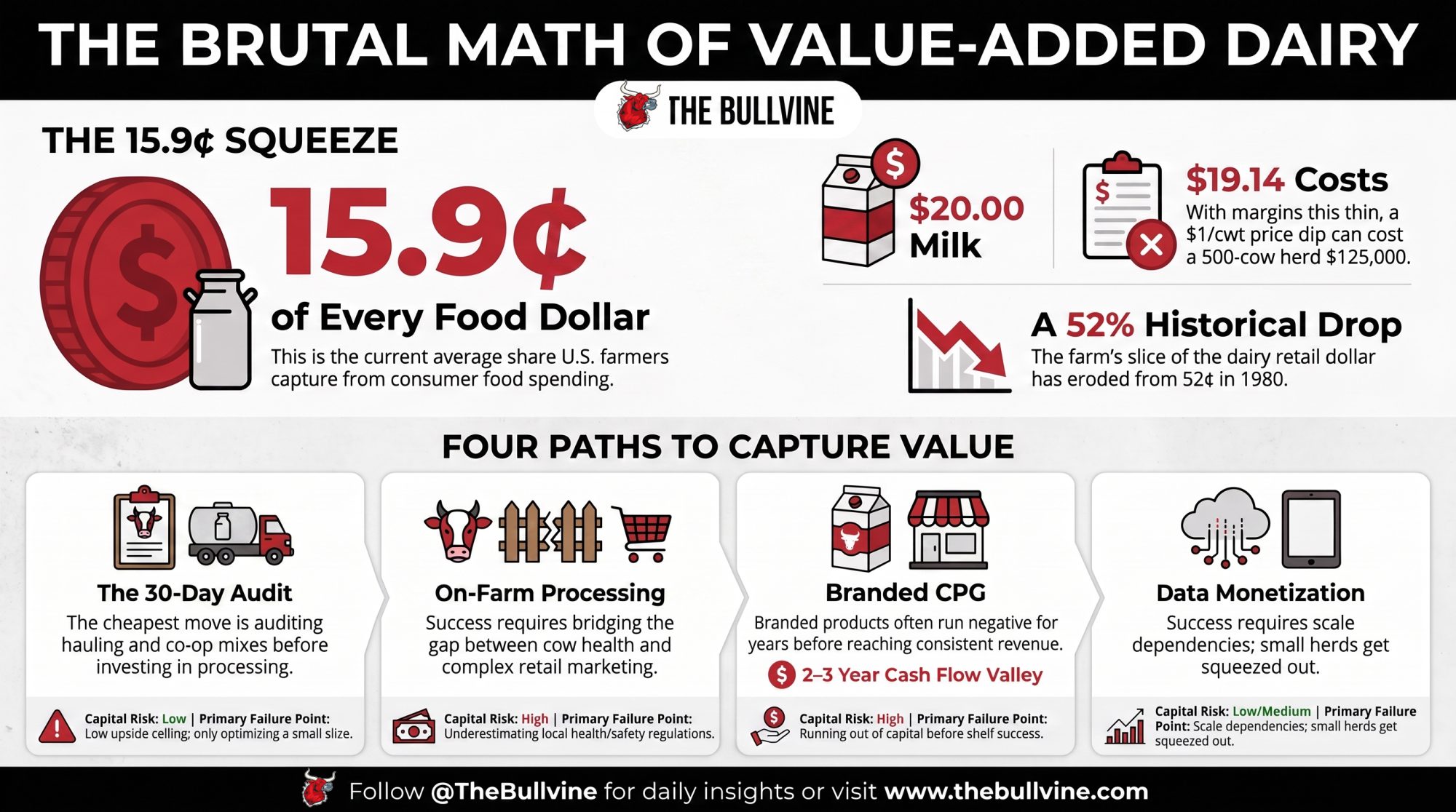
Thunder isn’t a template you can photocopy. It’s proof the staircase exists. There are four real paths producers are using to reach past 15.9 cents — and each one breaks in a different, predictable place. Find yours before you commit a dollar.

Strategy PathCapital RiskTime to Positive Cash FlowPrimary Skill GapPrimary Failure PointBest Fit Herd Size
Branded CPG(Thunder path)🔴 High — multi-year negative cash flow2–3 yearsMarketing, slotting, CPG brokersRunning out of capital before shelf velocity covers feesAny — if balance sheet is isolated from farm
On-Farm Processing(cheese/bottled)🔴 High — infrastructure upfront3–5 yearsRegulatory compliance, local salesUnderestimating health/safety compliance cost100–500 cows with local market access
Commodity Optimization(hauling/co-op audit)✅ Low — no new entity30–90 daysInternal ops, premium program knowledgeLow ceiling; optimizing a small sliceAll herd sizes — start here
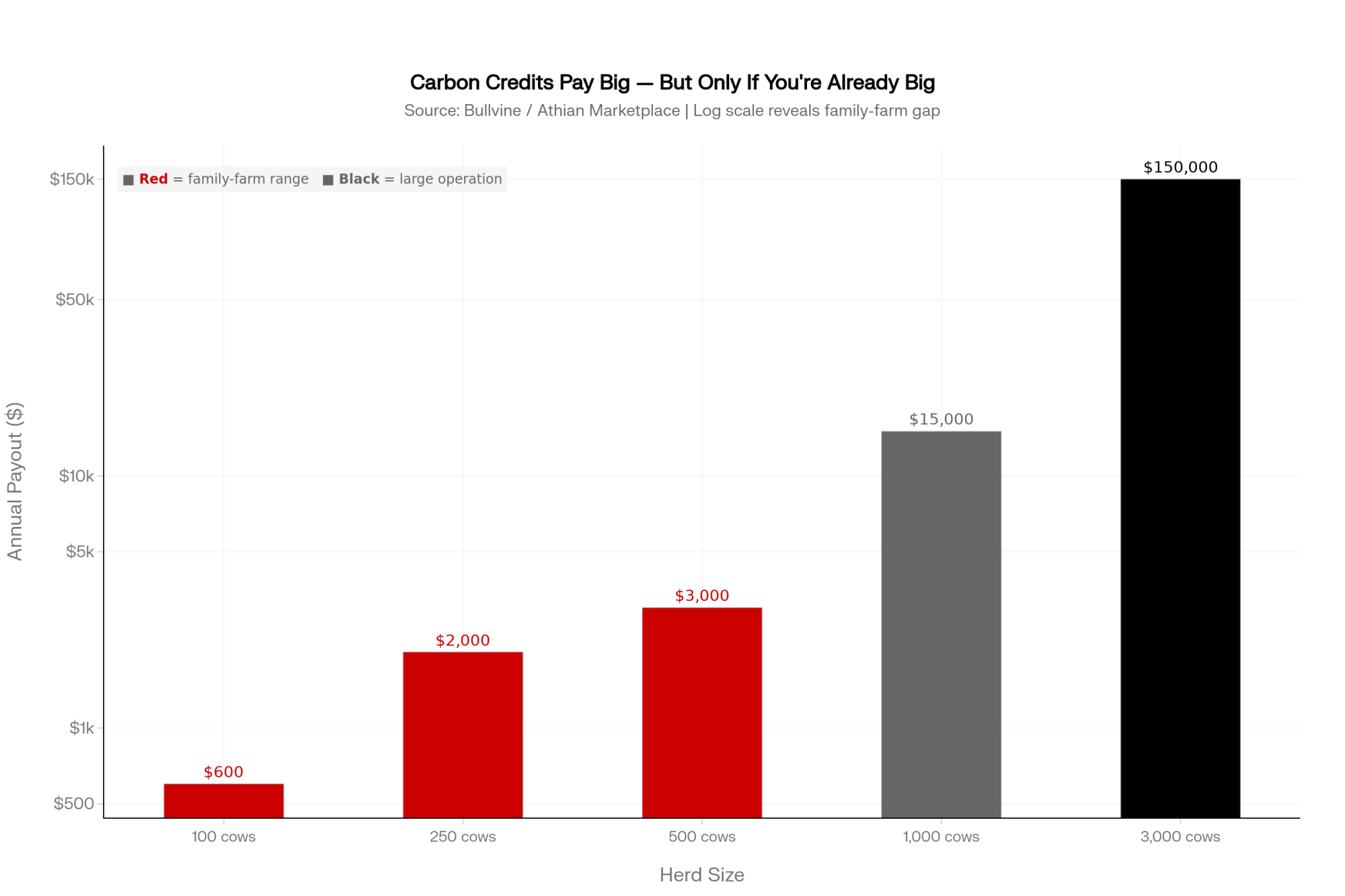
Carbon/Data Monetization🟡 Low–Medium — verification cost1–2 yearsDisciplined record-keeping🔴 Scale dependency: 500-cow farm ≈ $3,000/yr vs 3,000-cow ≈ $150,000/yr1,000+ cows to make verification overhead worthwhile

¹ Entrepreneur, June 15, 2026 · ² Nuffield Scholar report, 2016 · ³ The Bullvine, “You Only Get 15.9¢ of the Food Dollar” · ⁴ The Bullvine, “Data That Pays”

The branded-product path — Thunder’s — makes sense when you’ve got capital tolerance, a genuine market gap, and someone willing to learn the outside-the-fence game. And retail is no safe harbor: 7-Eleven’s parent, Seven & i, disclosed in its Q4 earnings documents that it expects to close or convert roughly 645 North American stores in fiscal 2026, per cstoredive (April 12, 2026) — even the shelf you fought to reach can move under you.

On-farm processing is the more traveled road, the one most research treats as the default value-added move (Nuffield Scholar report, 2016, Ireland/EU). The limit shows up early: regulatory complexity and capital cost stop most farms before they start. Only a small fraction of Irish farms are formally diversified, per Nuffield’s data — a useful signal for how steep the on-ramp is.

Then there’s the move you can actually start this month, no new company required. Capture more inside the commodity system — audit your hauling routes, question your co-op’s product mix, and press on component and premium programs, the cents-per-cwt kind of work that doesn’t require you to build a thing (The Bullvine, Jan 21, 2026). The ceiling is lower, but the risk is low and the payback is fast.

The fourth path is younger and worth watching: monetizing data and verified sustainability. Bullvine’s reporting found the Athian Marketplace has paid between $15 and $35 per metric ton of CO₂ equivalent for certified U.S. livestock emission reductions (The Bullvine, “Data That Pays,” Oct 22, 2025). It requires verification infrastructure and disciplined record-keeping. The catch is scale — payouts skew hard toward large operations, with 3,000-cow dairies capturing around $150,000 a year while family farms see closer to $3,000 (The Bullvine, Nov 23, 2025).
How Much Does “Buying Your Way In” Really Cost?

More than the slotting fees, honestly. The real cost is concentrated risk. When one family balance sheet backs both the farm and the new venture, a milk-price dip or a feed-cost spike hits both businesses on the same day. Bullvine’s robotic-milking case study describes the same shape of pain — Iowa State’s Larry Tranel found a typical two-robot install can run roughly $8,776 a year in the red for seven years before the payoff arrives (The Bullvine, “Robotic Milking Labor Math,” Apr 10, 2026). If your 500-cow herd hits a $1/cwt price drop in the middle of that valley, that’s another $125,000 you have to absorb. Thunder lived a beverage version of the same thing: two to three years before steady revenue, shelf space bought on borrowed patience. Before you chase any value-added play, the real question isn’t “can I make the product.” It’s “can my balance sheet survive the years before it pays.”

Is Your Operation Built to Capture Value, or to Produce It?

This is the shift worth sitting with, and it has nothing to do with coffee. Most dairies are built — financially and mentally — as commodity producers: fill the tank, ship the milk, take whatever price the system hands back. Temple and Henderson took the other route — a producer-owned brand that signs its own co-packer contracts and holds a piece of the story beyond the farm gate. You don’t need to launch canned coffee to make that shift. But it does mean asking, honestly, whether your operation is set up only to produce milk — or to capture some of what your milk becomes. Australian value-adding scholar Fiona Aveyard put it plainly in her 2023 Nuffield report: farmers “often have more control over their product than they realise” (Nuffield Australia, “Beyond the Farm Gate,” Aug 13, 2025).
Key Takeaways

  • If your net runs below full economic cost — check your real number against the ERS large-herd benchmark near $19.14/cwt against an all-milk forecast around $20/cwt — you’re in the same squeeze pushing farmers toward value-added plays. Nail down your breakeven before you consider one.
  • Before launching any branded product, model a two-to-three-year negative cash-flow window and stress-test whether your balance sheet absorbs it while milk prices swing.
  • Too big a leap? This month, set aside half a day to audit hauling costs and your co-op’s product mix for the cents-per-cwt you’re leaving on the table.
  • Name your outside-the-fence skills gap out loud. If you can’t spot what’s broken in marketing the way you can in the parlor, budget for the expertise you don’t have.
  • Don’t over-engineer the product. Thunder’s clean, short-ingredient label came from building the simplest version that worked.
  • Treat data and sustainability programs as a real but young value stream — and check where a herd your size actually lands, since a 3,000-cow dairy can bank roughly $150,000 while a 500-cow family farm might see around $3,000.

Where does your operation sit on that staircase right now — still shipping into the 15.9 cents, or reaching for a piece of the other 84? You don’t have to answer with a product launch. You do have to answer with your own numbers, because at an all-milk forecast around $20/cwt against $19.14 costs, ERS math says a lot of herds are running on a razor-thin full-cost margin.

Run Your Numbers

Dairy Profit Projector — Before you chase the other 84¢, find out if your core business even pencils. Drop in your herd size, milk price, and ration to see your breakeven milk price, IOFC, and 12-month margin — then stress-test what a $1/cwt swing does to your bottom line before you bet a second business on it.

Complete references and supporting documentation are available upon request by contacting the editorial team at editor@thebullvine.com.

Learn More

The Sunday Read Dairy Professionals Don’t Skip.

Every week, thousands of producers, breeders, and industry insiders open Bullvine Weekly for genetics insights, market shifts, and profit strategies they won’t find anywhere else. One email. Five minutes. Smarter decisions all week.
NewsSubscribe
First
Last
Consent

$112K Grant. $2M Creamery. The DBI Math That Decides Who’s Still Standing.

420 dairy businesses, $28.6 million frozen—and why USDA’s Dairy Business Innovation grants still only cover 4–7% of a real creamery build.

Executive Summary: The average DBI grant is $112,600. The average creamery costs $1.5–2.5 million. That gap—grants covering just 4–7% of real project costs—is why the February 2025 funding freeze hit so hard: 420 dairy businesses with $28.6 million in pending reimbursements suddenly learned whether their plans could survive without the money they’d been counting on. The projects that weathered it shared a pattern: solid base dairy economics, committed buyers before pouring concrete, and business cases that penciled without grants. Farms like Hill Valley Dairy in Wisconsin and Nash Family Creamery in Tennessee fit that profile—DBI helped them move faster, but it wasn’t the reason their businesses existed. For producers weighing value-added processing, the deciding question isn’t whether to apply—it’s whether your project survives the zero-grant scenario when your cost of production already pushes $40/cwt or higher. DBI is an accelerator for viable businesses, not a rescue for struggling ones.

dairy business innovation grants

You know the story. A grant program comes along, the brochures look shiny, and suddenly everyone’s talking about building a creamery.

If you’re milking somewhere in the 80–300 cow range and thinking about value-added processing in 2025 or 2026, you’ve probably heard about USDA’s Dairy Business Innovation grants. The pitch sounds great: federal money to help you build a plant, bottle your own milk, make cheese, escape the commodity trap. What you don’t hear as often is that the average DBI award covers roughly 4–7% of a realistic project budget—and that 420 dairy businesses learned the hard way in early 2025 just how quickly “sure thing” grant money can freeze up.

This is the conversation we’d be having over coffee: what DBI actually is, what it costs to build a real plant, who wins with this program, and how to figure out if it makes sense for your operation.

What DBI Actually Covers—And What It Doesn’t

Let’s start with the basics, because a lot of producers overestimate what DBI can do.

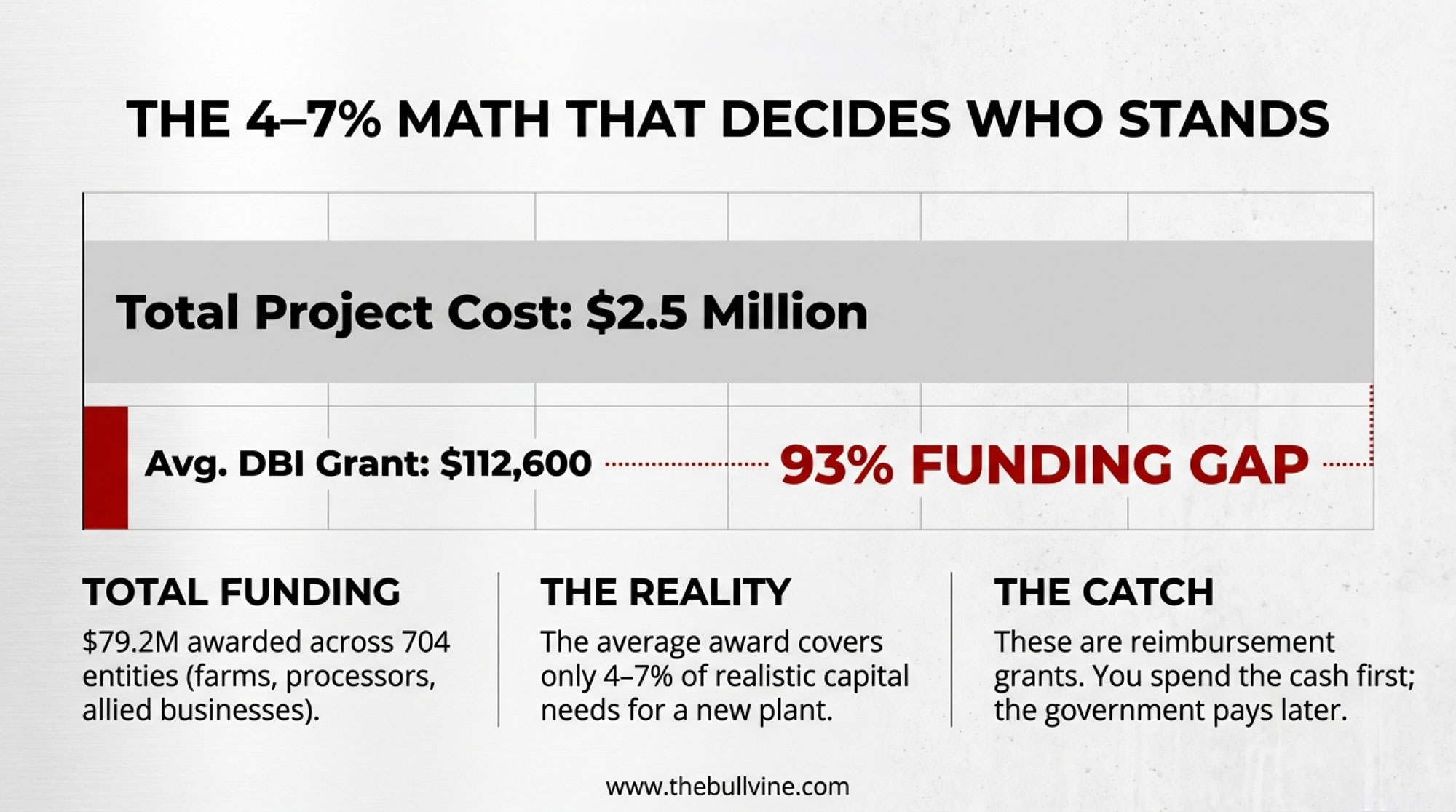
USDA’s Dairy Business Innovation Initiatives came out of the 2018 Farm Bill. Since 2019, the four regional DBI centers have together awarded just over $79.2 million in competitive funds to 704 unique entities—farms, processors, and allied dairy businesses—across 40 states and Puerto Rico, according to the DBII Combined Impact Report published in September 2025. That averages out to roughly $112,600 per funded entity, nationwide.

Those four centers are the Dairy Business Innovation Alliance (DBIA) in the upper Midwest, the Northeast Dairy Business Innovation Center (NE-DBIC) based in Vermont, the Southeast Dairy Business Innovation Initiative (SDBII) run by the University of Tennessee, and the Pacific Coast Coalition coordinated by Fresno State.

USDA has kept money flowing. By late 2024, DBI had invested more than $64 million across about 600 projects, and another $11-plus million went out to the four centers. In January 2026, USDA announced another round—again over $11 million—to keep DBI grants going into processing, market expansion, and workforce projects.

Here’s the part that changes the conversation when you’re sitting with your banker.

DBI grants are reimbursement-based. NC State Extension, the University of Tennessee folks, and the Wisconsin Cheese Makers Association all make that clear. You pay out of your own pocket or on your line of credit first, then submit the paperwork and get reimbursed. At least half of all DBI funds must be awarded as subawards to farms and processors, and some programs—like SDBII’s farm grants—require a 25% cash match for certain infrastructure projects.

In plain terms: DBI is designed to share risk on projects that already make sense. It was never free money to turn a weak idea into a strong business.

[Read more: Decide or Decline: 2025 and the Future of Mid-Size Dairies]

When $28.6 Million Got Frozen: The Stress Test Nobody Asked For

In early 2025, every DBI recipient in the country got a sharp reminder of that reality.

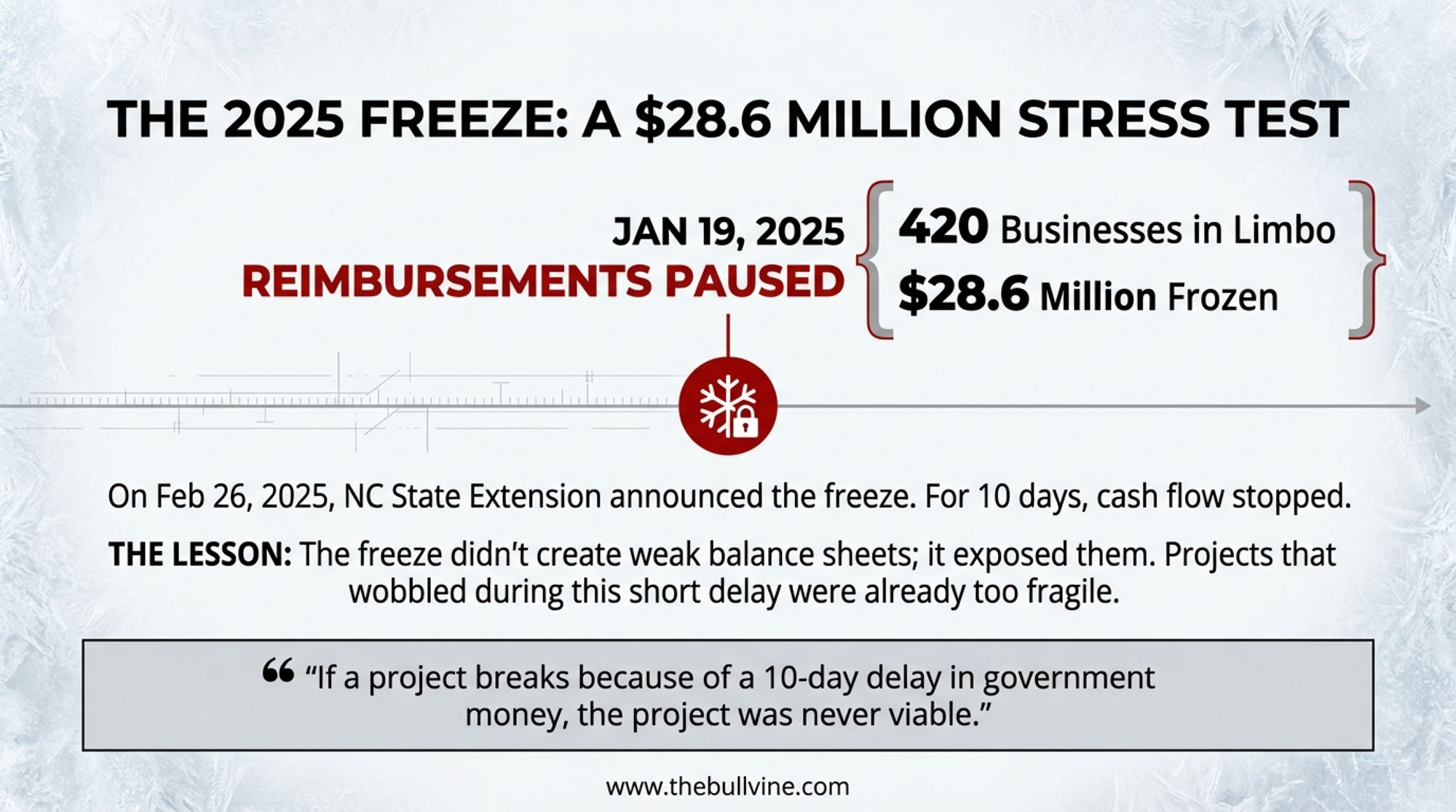
On February 26, 2025, NC State’s dairy extension team posted a notice titled “SDBII 2025 Funds Frozen.” USDA had told all four DBI centers to pause reimbursements on grant expenses, effective January 19, 2025. Any DBI-eligible costs after that date wouldn’t be reimbursed until further notice.

Roughly 420 dairy businesses across the four centers had projects underway, and about $28.6 million in reimbursements were suddenly in limbo. The Wisconsin Cheese Makers Association provided more detail: 88 businesses in the DBIA region alone were waiting on nearly $6.5 million.

The freeze lasted about a week and a half before pressure from cheesemakers, WCMA, and lawmakers—including Wisconsin Senator Tammy Baldwin—got USDA to reverse course. Brownfield reported on March 6, 2025, that the freeze had been lifted and reimbursements were back on track.

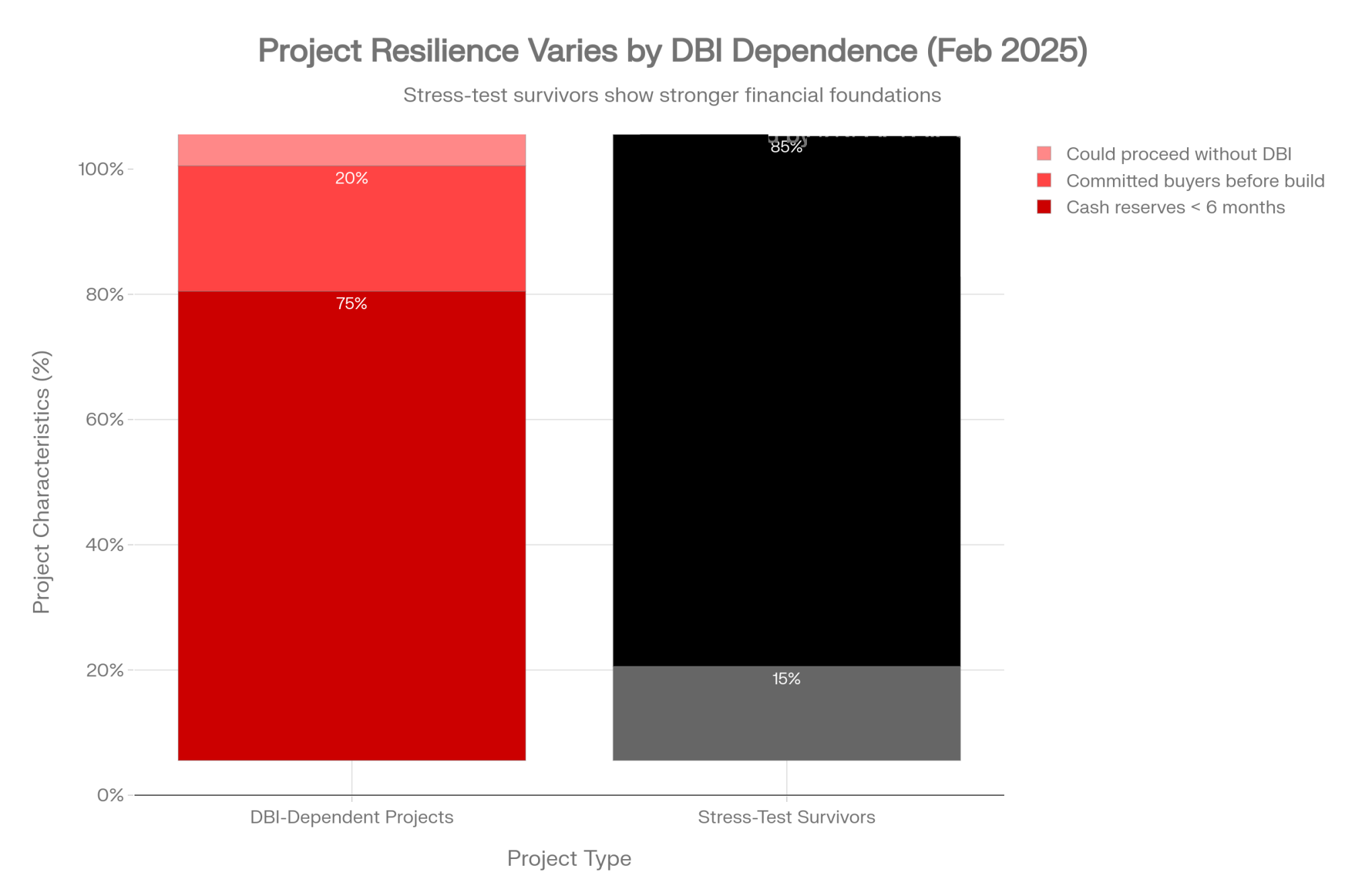
Here’s what matters: the freeze acted like a stress test. It didn’t create weak balance sheets—it exposed how fragile some projects already were, something lenders and industry groups pointed out as they watched which projects wobbled when reimbursements paused. WCMA noted in its communications that some smaller operations had structured their entire cashflow around those expected reimbursements. When the money stopped, mid-project builds got shaky fast. The businesses that weathered it were the ones that could have survived without it.

That’s not a knock on any individual operation. It’s a lesson in what happens when you build a plan that depends entirely on money you don’t control.

A lot of lenders looked at that situation and asked a simple question: “If this project only works with DBI plugged into the spreadsheet, should we really be doing it?”

The Real Start-Up Bill: Why “We’ll Just Build a Creamery” Means Seven Figures

So let’s talk about the check you’re actually writing.

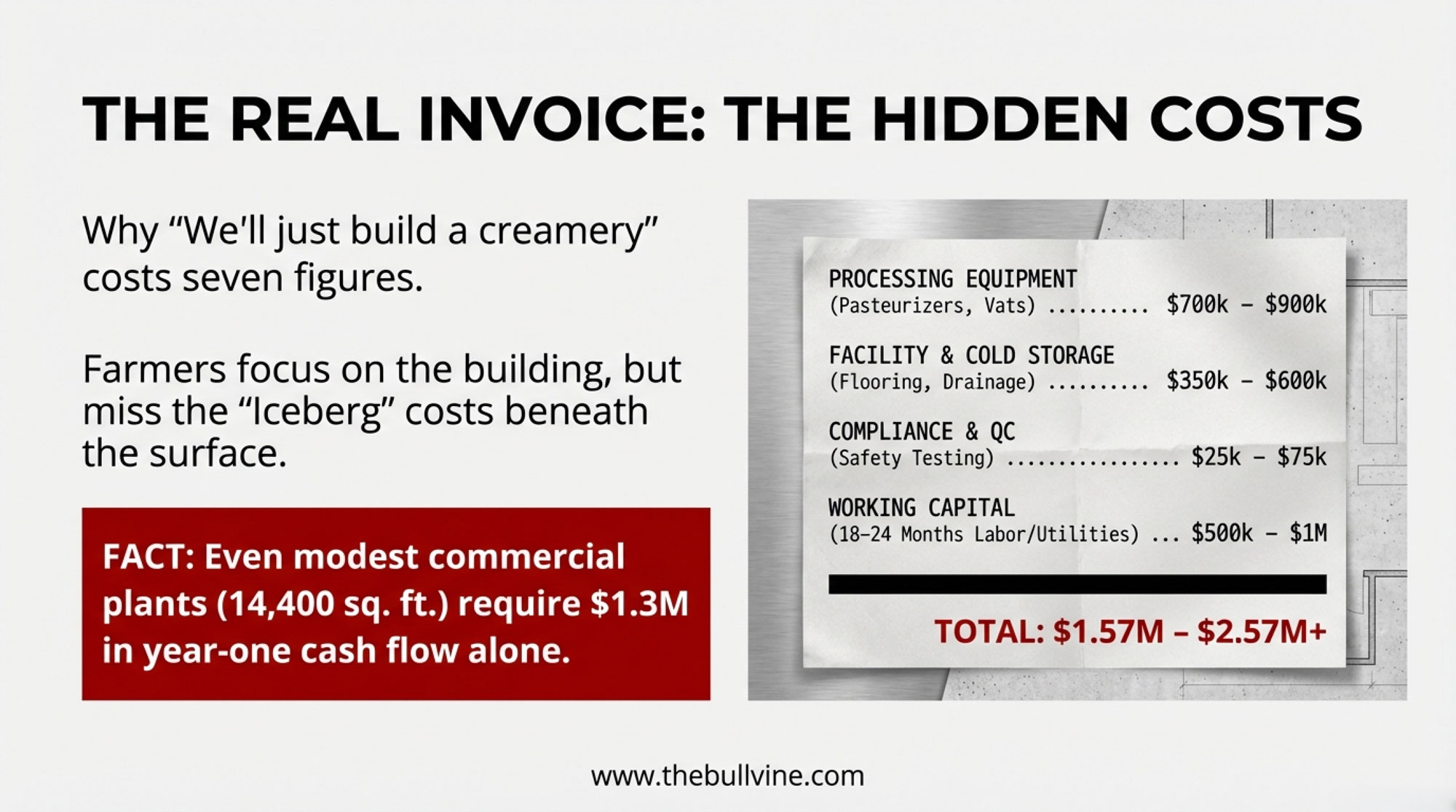
University of Tennessee’s on-farm processing work is a good place to start. One of their scenarios looks at building a cow-milk processing plant of about 14,400 square feet—not a boutique hobby, but a modest commercial plant with room to grow.

The estimates in that example break down like this:

  • Roughly $1.5 million for the facility
  • Just over $1 million for processing equipment
  • More than $1.3 million in year-one cashflow needs for labour, utilities, ingredients, and loan payments

Cornell’s research on farmstead cheese companies tells a similar story. When you tally up a new building, stainless steel, and the operating money you need to get through the first year or two, total start-up needs can easily push into the $2.5 to $3 million range, especially if you’re doing aged cheeses or a wide product mix.

If you’re renovating an existing space and picking up some used equipment, your costs can come down. But not nearly as much as the back-of-the-napkin plans usually assume.

Pulling from those University of Tennessee, Cornell, and Penn State examples, here’s what a realistic range often looks like for a small-to-mid processing project:

CategoryIllustrative RangeWhy It Sneaks Up on You
Processing Equipment$700,000–$900,000Pasteurizers, vats, and the “stainless steel tax.”
Facility & Cold Storage$350,000–$600,000Flooring, drainage, and refrigeration are non-negotiable.
Compliance & QC$25,000–$75,000The cost of proving your milk is safe every single day.
Working Capital (24 mo)$500,000–$1,000,000Carrying inventory while waiting for retailers to pay.
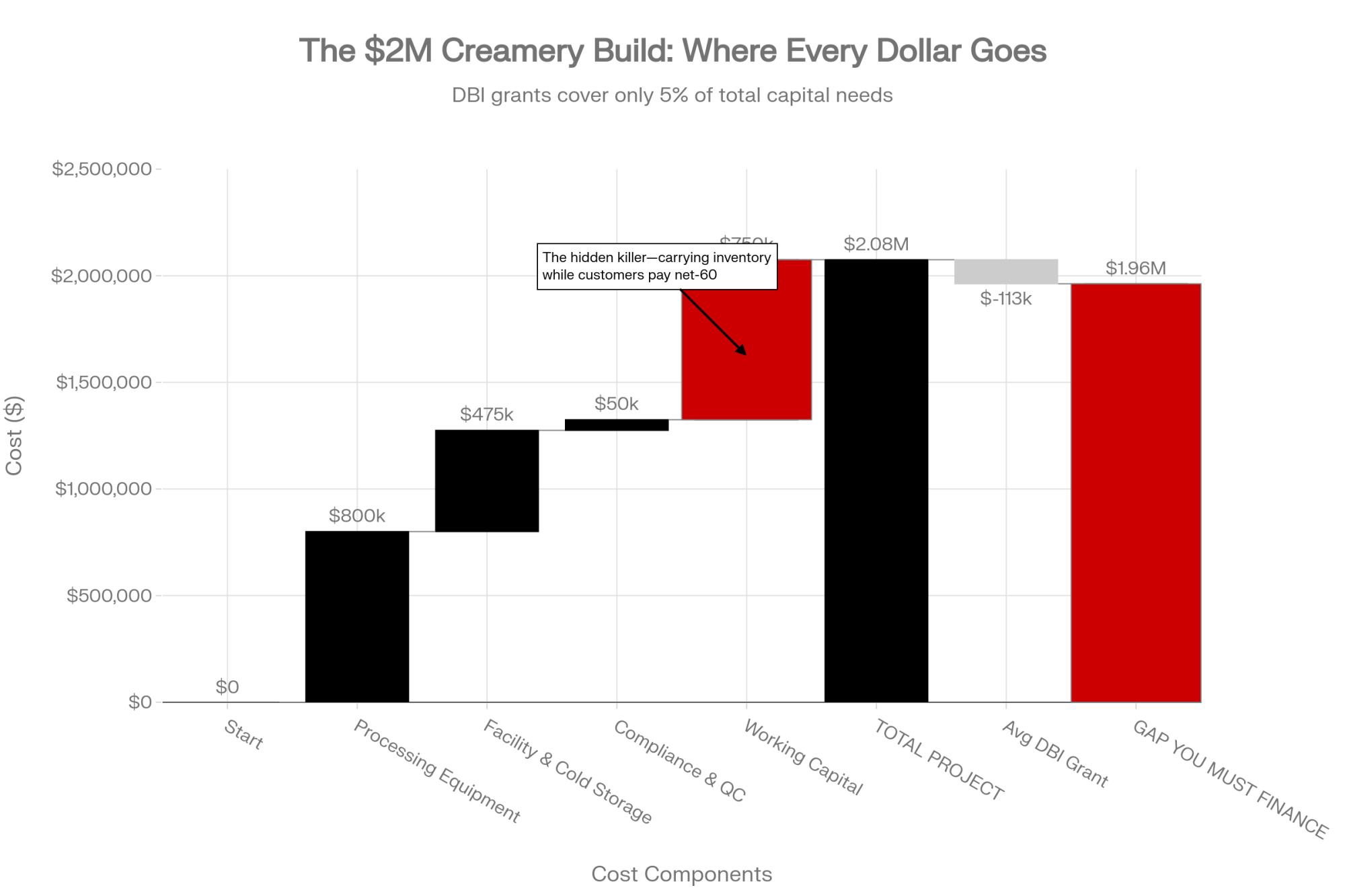
TOTAL PROJECT$1.57M–$2.57M+The average DBI grant (~$112K) covers roughly 4–7%.

Stress Test Question: Could your project survive for 6 months without DBI reimbursements?

This isn’t pulled line-for-line from one single budget, but those bands are right in line with what university models and real farms end up with once the last invoice comes in. Even when you scale down and use some sweat equity, “we’ll just build a creamery” still usually means a total project somewhere in the $1.5 to $2.5 million neighbourhood.

Now, place DBI into that picture.

If DBI has awarded about $79.2 million across 704 unique entities, that’s an average of roughly $112,600 per recipient. Against a $1.57-$2.57 million project, that average award works out to roughly 4–7% of total capital—useful, but nowhere near a full funding solution.

Cost CategoryLow RangeHigh RangeAvg. DBI GrantCoverage %
Processing Equipment$700,000$900,000$112,60012.5–16%
Facility & Cold Storage$350,000$600,000$112,60018.8–32%
Compliance & QC$25,000$75,000$112,600Exceeds cost
Working Capital (18–24 mo)$500,000$1,000,000$112,60011.3–22.5%
TOTAL PROJECT$1,575,000$2,575,000$112,6004.4–7.1%

The Cost Gap: Why Some Herds Start Behind Before They Process a Litre

You probably know this from your own balance sheet, but USDA’s Economic Research Service spells it out clearly.

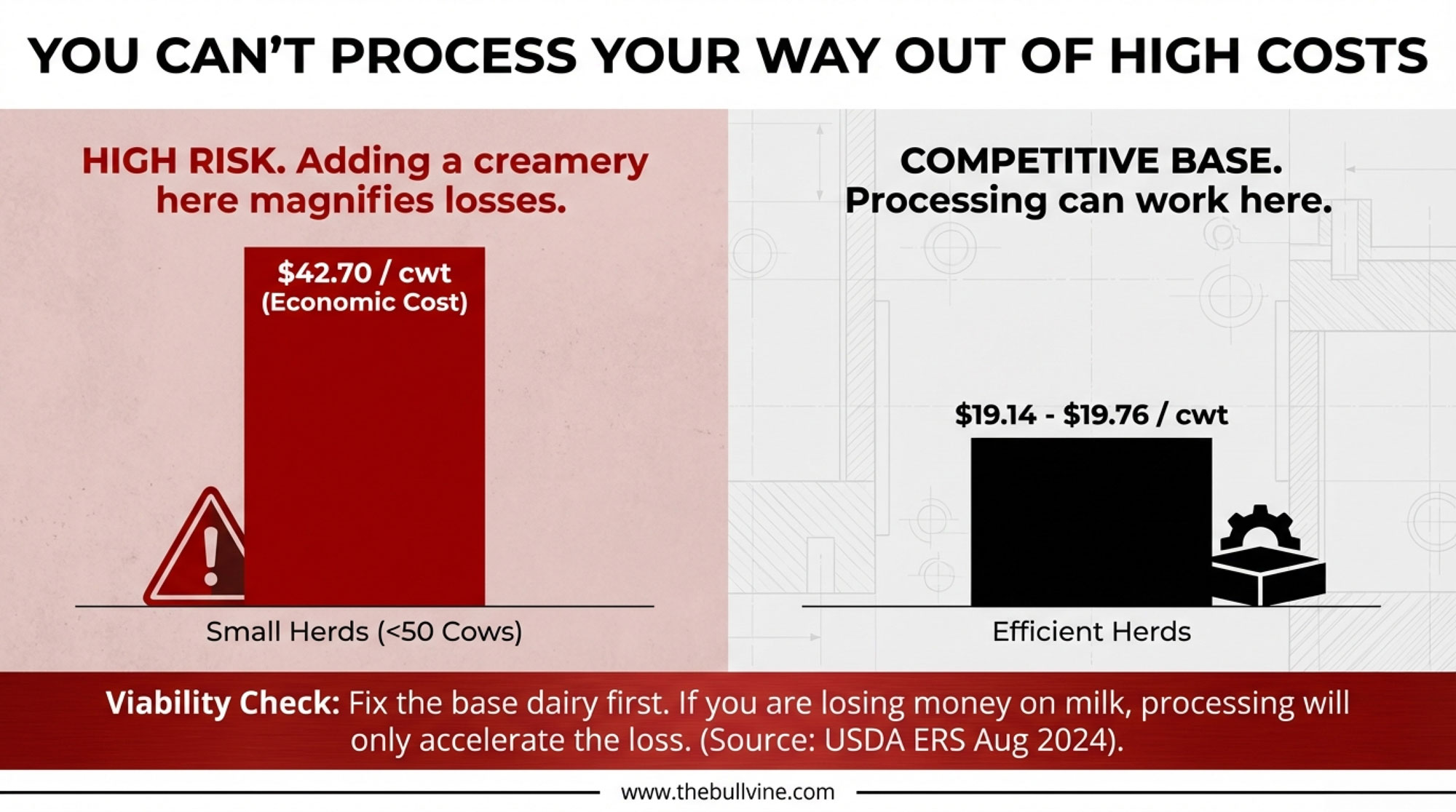
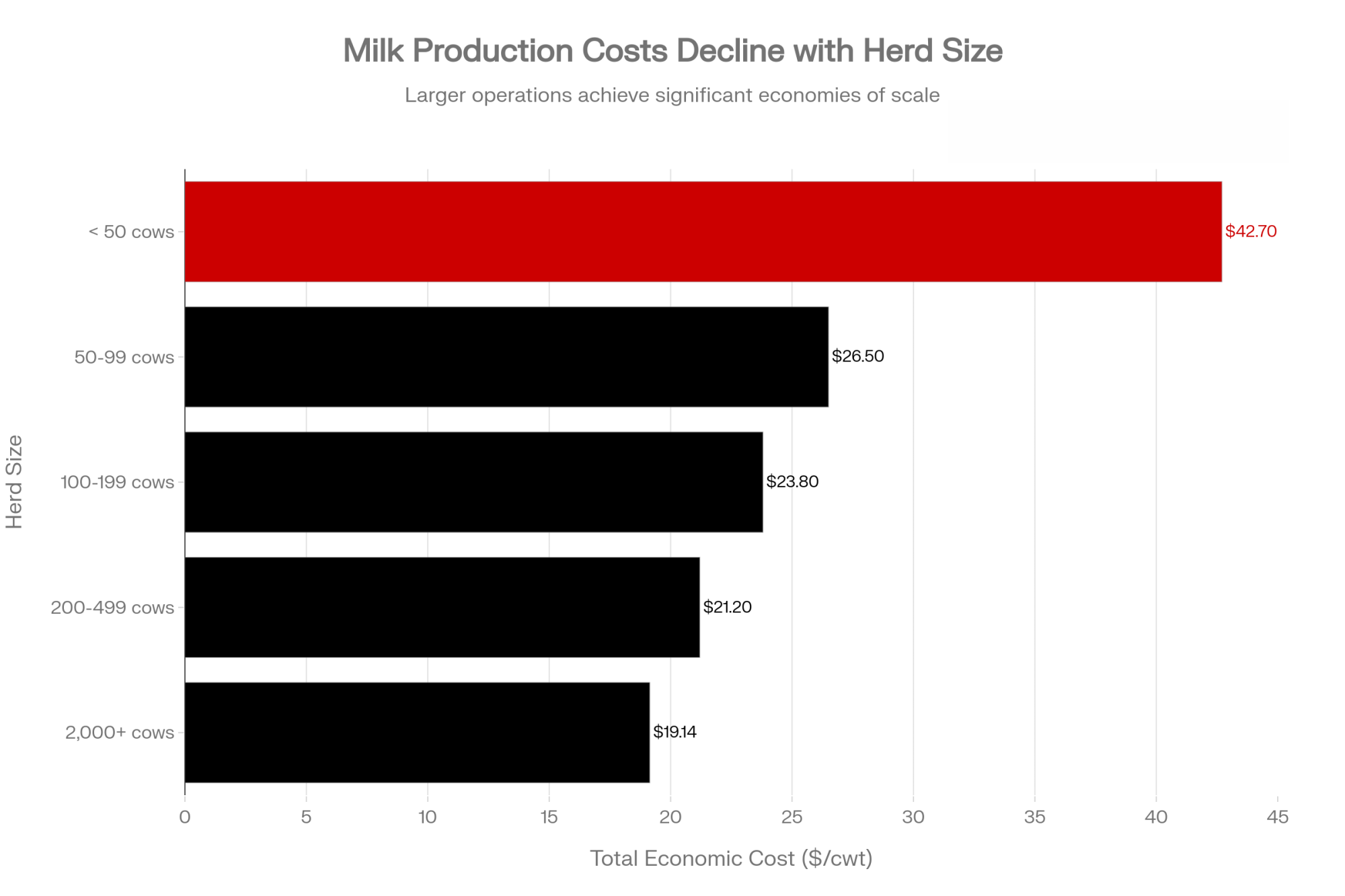
In an August 28, 2024, Chart of Note, ERS looked at 2021 cost-of-production data by herd size (ERS national averages). When they added up both operating costs—feed, vet, supplies—and allocated overhead—buildings, equipment, land, and unpaid family labour—they found:

  • Farms with fewer than 50 cows had total economic costs around $42.70 per hundredweight.
  • Farms with 2,000 cows or more came in around $19.14 per hundredweight.

ERS notes that larger herds are generally better able to spread fixed costs and invest in labour-saving technology, thereby reducing their cost per cwt.

What does that mean in practical terms?

Some of the lowest-cost herds in the 100–199 cow bracket can get total economic costs down near $19.76 per hundredweight—competitive with or better than some high-cost 2,000-cow herds. So small doesn’t automatically mean uncompetitive. But on average, smaller herds start higher on the cost curve and have less room to make mistakes.

If your cost of production for milk alone is already at the high end—closer to that $40 range—it’s going to be a steep climb to make money once you add processing risk. If you’re in that $20-something band with good butterfat levels and tight fresh cow management, your odds of making a creamery pencil out improve a lot, as long as you’re disciplined.

[Read more: Same Milk, Different Payday: How Your Processor’s Product Mix Shapes Your Future]

Who Actually Thrives With DBI Support

The DBI projects that still look smart five or ten years out share a handful of traits. These patterns show up across case studies from the Midwest, Northeast, Southeast, and Pacific Coast regions.

The dairy was solid before any stainless steel showed up. These herds know their cost of production per cwt and how it compares to other farms of their size. Their fresh cow management during the transition period is under control, reproduction is consistent, SCC is competitive, and butterfat and protein levels support both the milk check and the planned product line. Research from the University of Guelph on resilient dairy farms has shown that operations that lean into innovation and value-added are usually already strong in basic management and efficiency, not the other way around.

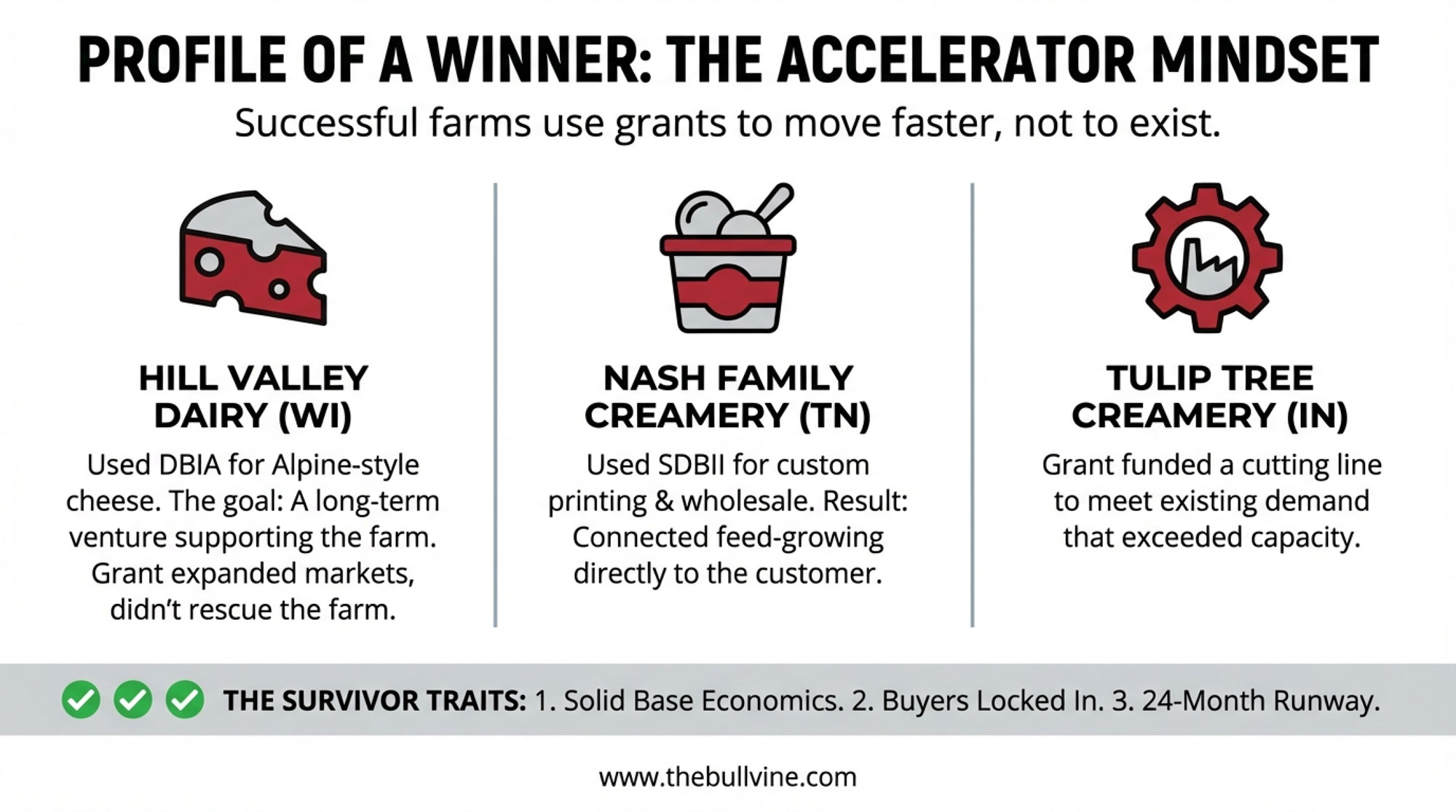
They treat DBI as an accelerator, not the engine. If the DBI money disappeared, they’d still go ahead—maybe with more used equipment or slower expansion—but the business case stands on its own. Penn State’s value-added cashflow guidance comes back to this point over and over again: you want the core farm business to be viable before you start layering in grants and loans.

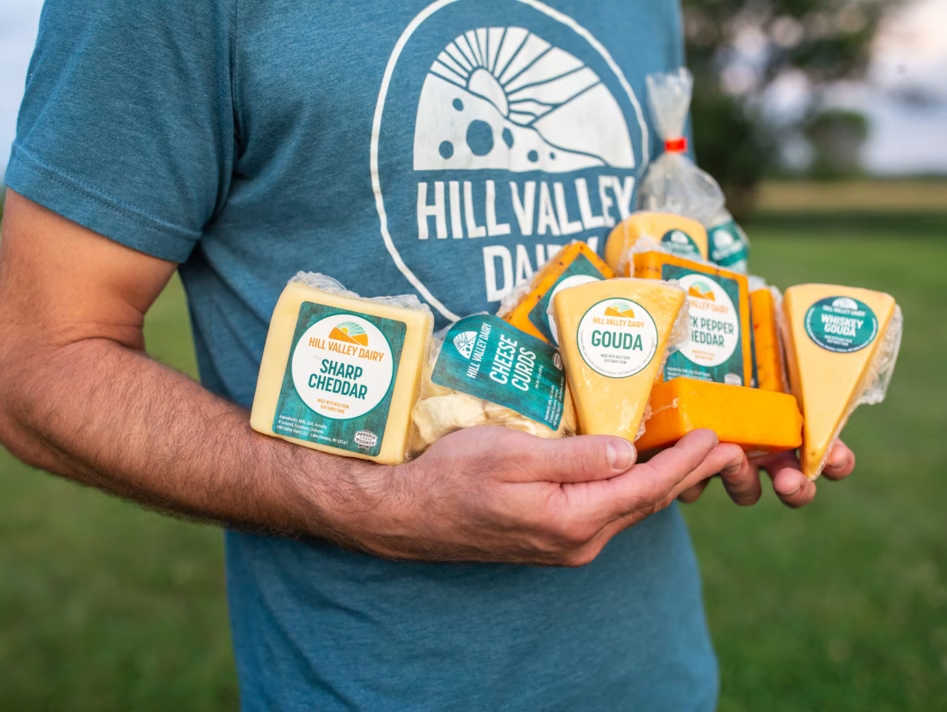
Take Hill Valley Dairy in Wisconsin. It’s a third-generation family farm that started making artisan cheese in 2015. They received a DBIA grant to purchase equipment for a new alpine-style cheese line—helping them use more of their own milk and expand into new markets. But as Hill Valley puts it: “We are building a long-term venture that supports both the small dairy farm and cheesemaking businesses.” The grant helped them move faster; it wasn’t the reason the business existed.

Or look at Nash Family Creamery in Tennessee. They received SDBII grants in 2021, 2022, and 2023 for operational improvements—including custom printing for new containers to begin selling ice cream wholesale. When asked how processing has impacted the family business, Cody Nash said: “It’s been really great adding that extra revenue stream and to have that extra interaction with the public to where we’re not just a dairy that’s off the road, that’s making raw milk that people are kind of disconnected from. We’ve been able to tie everything from growing feed to making ice cream back to the customer.”

They plan for 18–24 months of ugly cashflow. On-farm cheese plants that age product—and even bottled milk plants building new accounts—often burn cash for a year or two. The Tennessee examples show year-one cash needs exceeding $1 million when you include wages, inputs, and loan payments. The farms that survive have committed operating lines and reserves that cover 18–24 months, not just a few lean weeks.

They lock in customers before they pour concrete. Cornell and Penn State both hammer on this. Successful processors are already having serious conversations with grocery buyers, distributors, and restaurants before they build. They get letters of intent, pilot-scale commitments, or at least emails spelling out what volume and price range a buyer is willing to try.

They grow into processing instead of flipping everything at once. Many healthier projects start by processing maybe 10–20% of the farm’s own milk, leaving the rest under a co-op or processor contract. They might bottle whole milk and cream, do one or two cheeses, and test the waters. Only when that side of the business has proven it can move volume and support its own cashflow do they talk about scaling up.

Three Situations Where DBI Actually Fits Well

So where does DBI make sense?

You’re already selling product, and capacity is your bottleneck. Maybe you’ve been bottling a small share of your own milk for years. Maybe you’ve got a few cheeses that consistently sell out. Butterfat levels are good, your SCC is steady, and the question isn’t “will anyone buy this?” but “how do we keep up?” In that case, a DBI grant can help you step up to a larger pasteurizer, vat, or filler that you already know you can keep busy with.

That’s exactly the situation Tulip Tree Creamery in Indianapolis found itself in. In 2024, they received a $74,000 DBIA grant to install a cheese cutting and packing line. Co-owner and CEO Fons Smits told Brownfield Ag News: “Right now, our capacity is very limited. We make some really good artisan hard aged cheeses, but we can only [cut and pack] so much.” The grant didn’t create the demand—it helped them meet demand they’d already built.

You’re diversifying a healthy dairy, not escaping a sinking one. Your cost of production is reasonably close to regional averages for your herd size, and you’re steadily tightening feed efficiency, labour, and repro. You decide to put 10–20% of your milk into a simple product line and keep the rest on your co-op contract. If the value-added side doesn’t take off, you still have a core dairy that pays its way.

You’re building something the next generation—or a buyer—would actually want. Some families are looking at modest processing as a way to add a branded revenue stream that boosts overall sale or succession value, or to create roles for kids more interested in marketing and product development than in scraping stalls. A DBI-backed project can help get a moderate plant off the ground with less strain on retirement timing, as long as the economics work without assuming endless grant support.

[Read more: David vs. Goliath: Strategies for Small Dairy Farmers to Challenge Large Processors]

When “Not This Round” Is the Smartest Move

On the other side, there are situations where the bravest move is to step back from the grant opportunity.

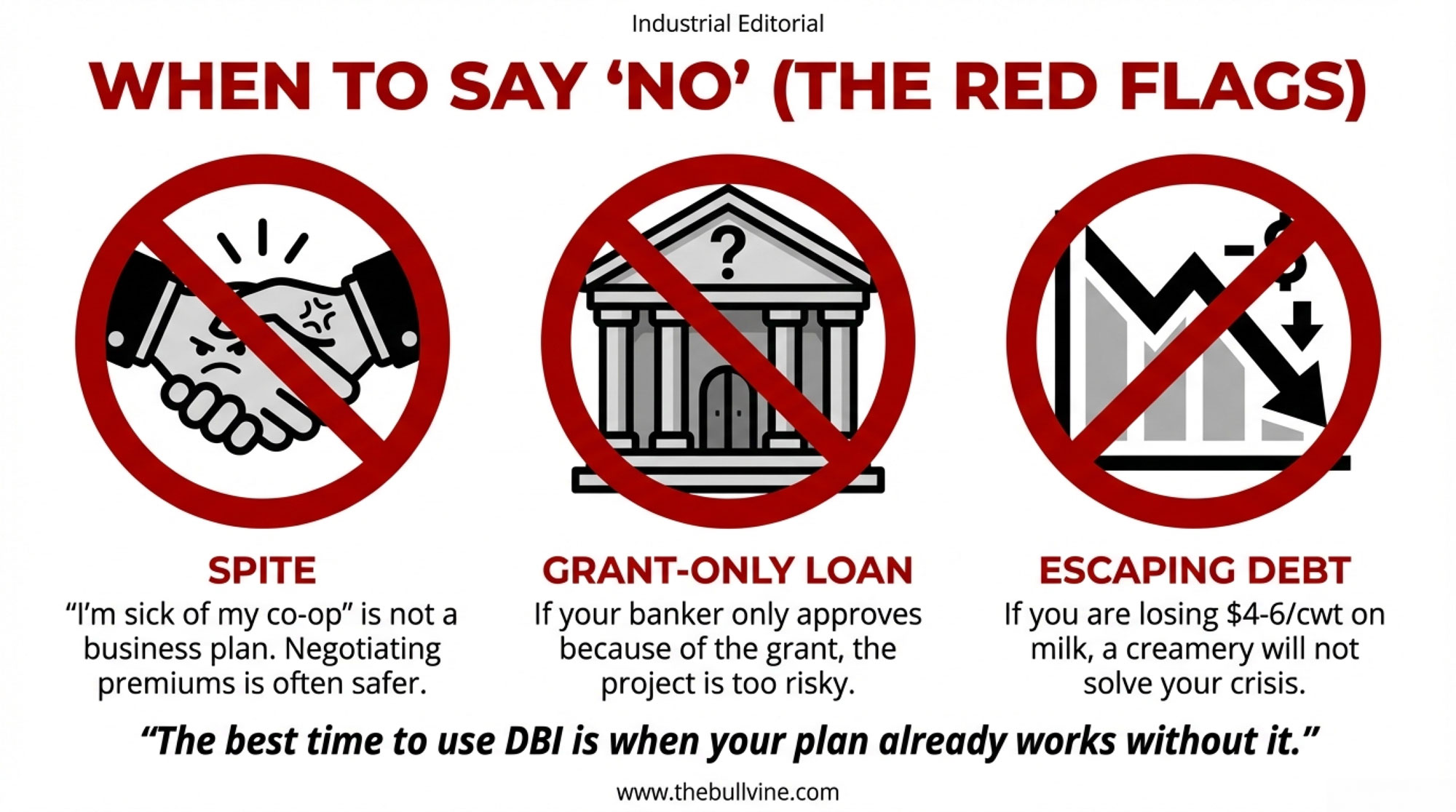
You’re already losing money on milk. If your cost of production is running several dollars per cwt above your pay price—think roughly in the $4–6 range for more than a few months—your first priority probably isn’t a plant. It’s tightening that gap. Adding a high-risk venture on top of that is more likely to magnify the pain than solve it.

Your banker only likes the plan with DBI on the spreadsheet. If the project goes from “tight but OK” to “no way” when you remove the grant, that’s a sign of how dependent it really is on something you don’t control. Treat that as a red flag and have your lender walk through the zero-grant version with you before you commit.

You’ve never lived through lumpy cashflow. If your entire experience is steady co-op checks and relatively smooth bills, jumping straight into a seven-figure plant with slow-pay wholesale accounts and seasonal retail swings is a big leap.

Your main fuel is frustration with your current processor. Being angry about component pricing, basis adjustments, or hauling charges is understandable. But “I’m sick of my co-op” isn’t the same thing as “I’ve got committed buyers and a business plan that works.” Many of us have watched producers pour money into projects mainly to “show the co-op who’s boss,” only to end up in a tougher spot. Spite is a terrible basis for a business plan. For some herds, pushing harder on component premiums, quality bonuses, or contract terms may deliver better risk-adjusted returns than building a plant out of frustration.

“Not this round” doesn’t mean “never.” It means fix the base dairy first, then revisit the plant once the math works without grants.

A Note for Canadian Producers

If you’re operating under quota in Canada, your starting point is different—and in some ways, harder.

You’ve got stable base revenue thanks to supply management and provincial boards that oversee pricing and the allocation of processing capacity. You’re more likely looking at provincial grants, co-op investments, or local funds than U.S.-style DBI dollars.

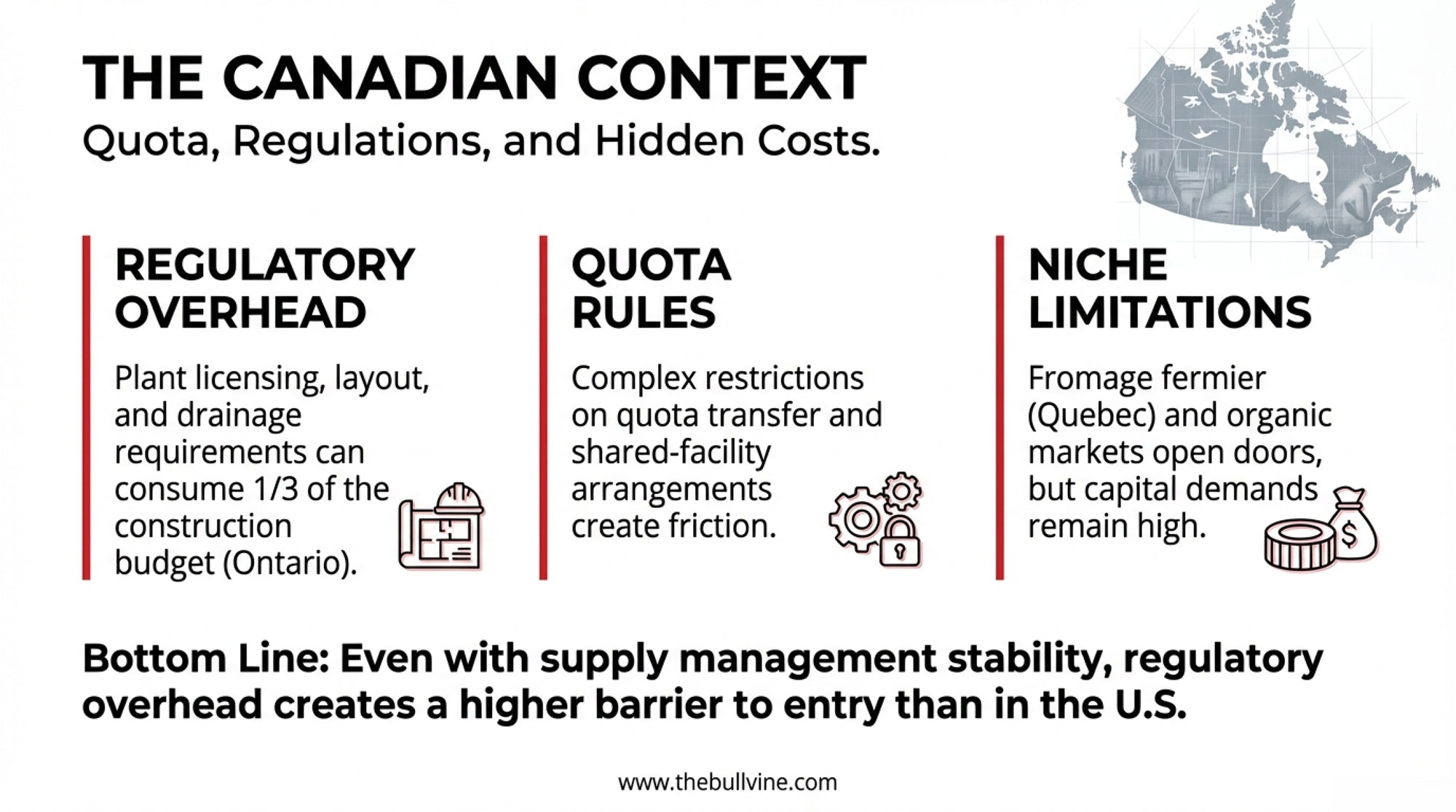
But here’s what many producers don’t factor in: the entry cost into on-farm processing can be higher in Canada due to regulatory and quota complexities. A 2018 Ontario government release on proposed Milk Act changes noted that small dairy processors, such as artisan cheesemakers, can spend up to one-third of their construction budget on building requirements under current regulations—especially for layout, drainage, and food-safety requirements for plant licensing. And that’s before you get into the maze of quota transfer rules.

Dairy Farmers of Ontario’s policies include restrictions on moving quota purchased through ongoing farm purchases for 5 years, limits on shared-facility arrangements, and complex approval processes for any unconventional setups. Quebec has its own layers of regulation around artisan processing and the “fromage fermier” designation. None of this is impossible to navigate, but it adds time, cost, and uncertainty that doesn’t show up in the brochure math.

Research from the University of Guelph, Agriculture and Agri-Food Canada, and the Canadian Dairy Commission on regional and on-farm processing shows that niche markets—grass-fed, A2A2, organic, farmstead cheese—can open doors, but these projects still entail significant capital and labour demands.

Picture a typical Ontario quota farm deciding between joining a local co-op plant expansion or building a very small on-farm processing plant. Even with a quota underpinning milk revenue, the plant has to stand on its own economics—and the regulatory overhead can eat into margins faster than you’d expect.

The core questions look a lot like the U.S. version: Does the plant work on its own numbers without assuming permanent program support or sky-high premiums? Do you have the working capital and management bandwidth to handle inventory and receivables, in addition to quota payments, feed bills, and labour? Are the buyers and volumes real enough—ideally in writing—to justify the risk?

What This Means for Your Operation

Before you sign anything, here are the questions and thresholds that matter:

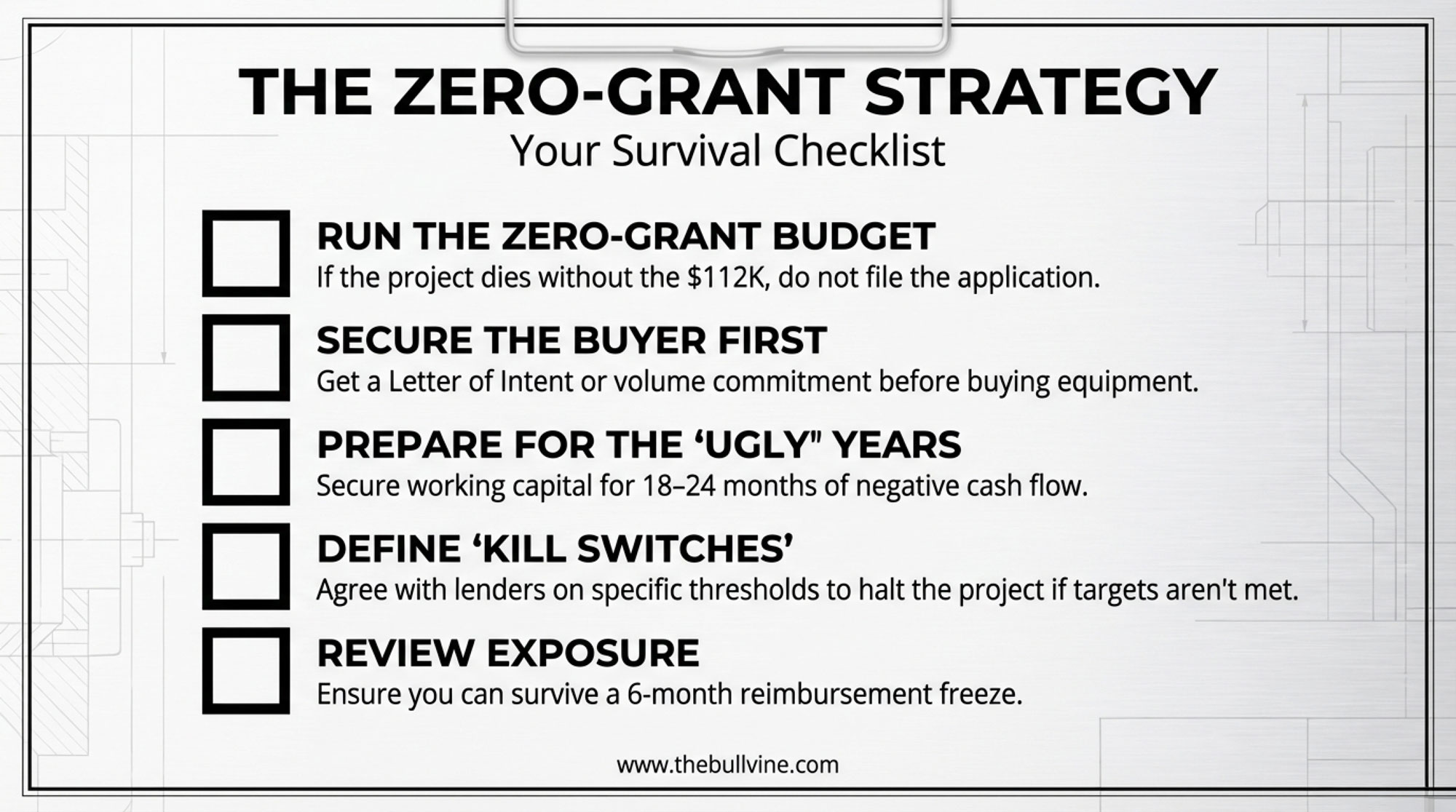
  • Run the zero-grant scenario. Create a version of your budget that assumes you receive no DBI funds. If the project flips from “tight but doable” to “dead in the water,” you’ve learned how fragile it really is. That’s not a green light—it’s a red flag.
  • Build the full capital budget. Include everything: buildings, equipment, regulatory work, inventory, and at least 18–24 months of operating capital. Then sit that total beside university models from Tennessee and Cornell. If your number is dramatically lower, figure out what you’re assuming that they aren’t.
  • Know your cost of production. If you’re closer to that $40/cwt ERS number than the low-$20s, a creamery adds risk on top of an already thin margin. Get the base dairy tighter first.
  • Lock in at least one serious buyer before you lock in the loan. Talk to the grocery chain, distributor, or foodservice customer you’re counting on. Ask for something concrete: volume ranges, a trial period, and a realistic price band.
  • Agree on your kill switches up front. Sit down with your family and your lender and write down your thresholds: how much extra capital you’re willing to inject, how long you’ll give it to reach break-even, minimum volume, or margin targets by certain dates.
  • Consider the alternatives. For some operations, negotiating harder on processor premiums, quality bonuses, or contract terms may deliver better risk-adjusted returns than building a plant.
  • Review your DBI exposure with your lender before applying. Walk through the capital plan, the reimbursement timeline, and what happens if funds are delayed. If your banker can’t get comfortable with the zero-grant scenario, that’s important information.
  • Ask the operations in your county that built plants five or ten years ago what they’d do differently if DBI disappeared tomorrow. Their answers might surprise you.

Key Takeaways

  • DBI covers 4–7% of a typical $1.5–2.5 million processing project. It’s an accelerator for viable businesses, not a rescue for struggling ones.
  • The 2025 freeze was a stress test. It didn’t create fragile projects—it exposed them. If your plan can’t survive a short-term reimbursement delay, it’s too dependent on money you don’t control.
  • Cost of production matters before you add stainless. Herds with milk costs near the high end of ERS benchmarks face steeper odds on processing.
  • The winners share a pattern: solid base dairy, committed buyers, 18–24 months of cash flow runway, and DBI treated as a bonus rather than a foundation.
  • “Not this round” can be the smartest strategy if your core dairy needs work first, or your plan only pencils with the grant included.

The Bottom Line

The best time to use a program like DBI is when your plan already works without it. The worst time is when you need the grant to rescue numbers that are already telling you “no.”

Where does your operation sit on that spectrum? That’s the question worth answering before you pour a yard of concrete.

Complete references and supporting documentation are available upon request by contacting the editorial team at editor@thebullvine.com.

Learn More

The Sunday Read Dairy Professionals Don’t Skip.

Every week, thousands of producers, breeders, and industry insiders open Bullvine Weekly for genetics insights, market shifts, and profit strategies they won’t find anywhere else. One email. Five minutes. Smarter decisions all week.
NewsSubscribe
First
Last
Consent
Send this to a friend