Archive for genetic progress

Did Genomics Really Deliver What We Think It Did? $238,000 Says Yes – If You Steer It Right

Did genomics really deliver what you think it did—or is that extra $238,000 in profit still stuck in your semen tank?

Let’s sit with a big number for a minute: a couple thousand dollars more lifetime profit per cow. That’s the kind of difference Lactanet uses in its Pro$ examples when it compares daughters of today’s high‑Pro$ sires to daughters of a decade older, lower‑ranking bulls, because Pro$ is built to reflect expected lifetime profit per cow based on real Canadian revenue and cost data up to six years of age or disposal.

If you spread that kind of genetic advantage across a few hundred cows over several breeding seasons, you’re quickly into tens of thousands of dollars in extra lifetime profit per year, the result of breeding decisions—assuming your fresh cow management, herd reproduction, and culling strategy actually lets those genetics show up in the tank.
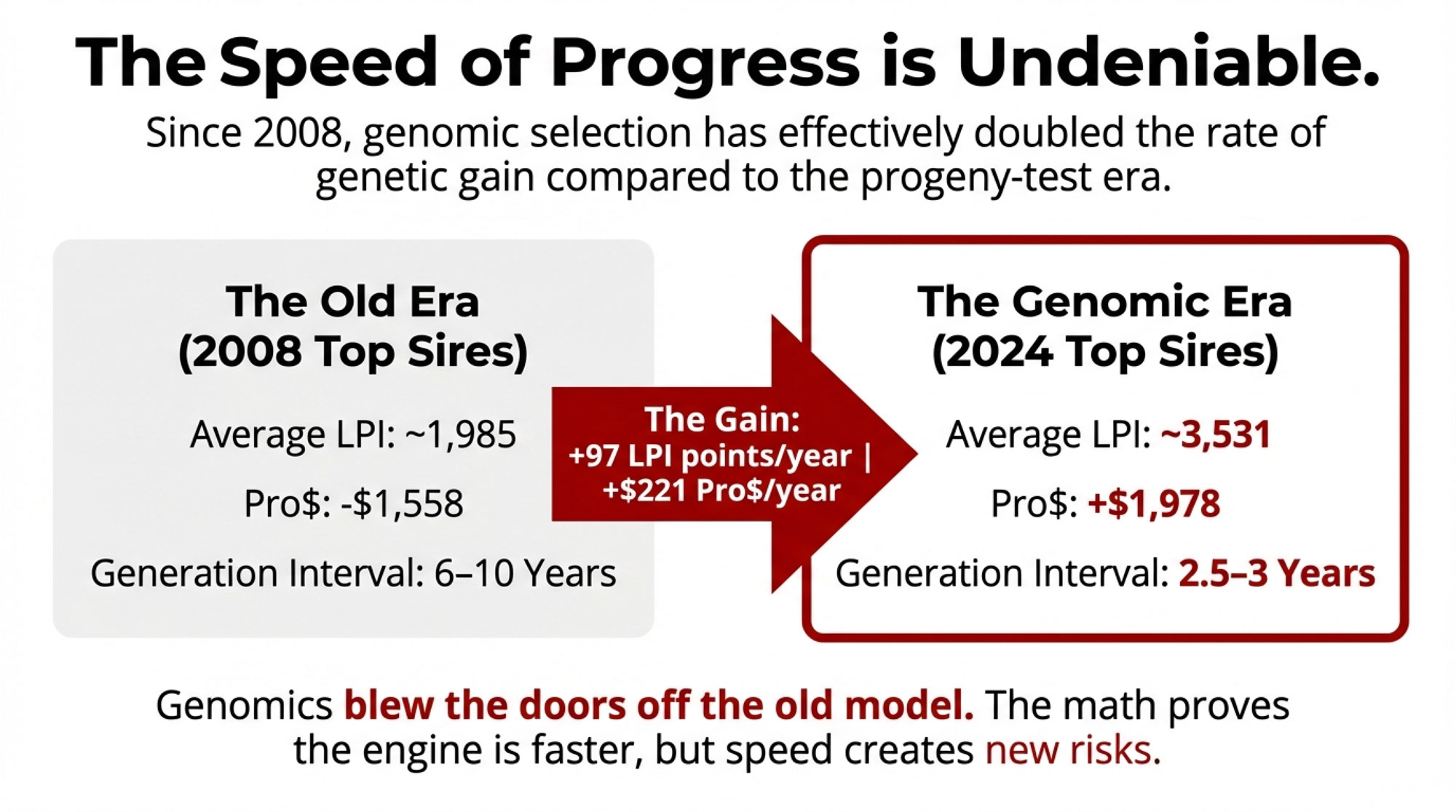
That’s not hype. That’s the math behind Pro$, and it aligns with what genomic selection has achieved globally, where genetic progress in milk, fat, protein, health, and longevity has accelerated by 50–100% compared with the pre‑genomic era.

What’s interesting, though, is that when you start peeling back the layers on how we got here, you see both huge wins and some red flashing lights—especially around diversity, fertility, and hidden genetic risks.

That’s what this conversation is really about.

When Banners Steered the Breeding Bus

If you look back 15–20 years, you can probably still picture the late‑2000s bull lists. In Canada, Holstein Canada sire‑usage data from that era show a relatively tight group of sires—Goldwyn, Buckeye, Dolman, and their close relatives—accounting for a significant share of registrations.

In 2008, just three bulls (Dolman, Goldwyn, Buckeye) accounted for about 12% of all registered Holstein females in Canada, and the top five sires together made up roughly 15.7% of registrations. That kind of concentration perfectly reflected the breeding philosophy of the time: moderate yield, “true type” conformation, and pedigrees that lit up both classifier sheets and show‑ring banners, but not always the enterprise balance sheet.

On many commercial freestall and tie‑stall farms, those cows were often the ones that:

  • Struggled harder through the transition period
  • Needed more care of their feet and legs
  • Didn’t routinely make it to that profitable fourth or fifth lactation

That isn’t just coffee‑shop talk. Work from the University of Guelph and Agriculture and Agri‑Food Canada has consistently shown that lifetime profitability is closely tied to lifetime milk revenue, length of productive life, days dry, age at first calving, and reproductive-related interventions. Cows that leave early, spend more time open, racking up vet bills, and simply don’t deliver their potential lifetime profit—even if they look great and milk well in first lactation.

Producers like Don Bennink at North Florida Holsteins have been lightning rods on this topic for years. He’s been very blunt that high production, strong health traits, and feed efficiency are the bywords for breeding profitable cows—not show ribbons—and that genomics has “increased our progress at a rate we could never have dreamed of previously,” creating a huge profitability gap between herds that use genomic information and those that don’t.

So even before we talk about SNP chips and genomic proofs, there was already a clear split between what wins banners and what pays bills in freestalls, robots, parlors, and dry‑lot systems.

From Pedigree and Type to Profit and Function

The Canadian Holstein breeding landscape has gone through one of the most profound shifts in its history since about 2008. Over 16 years, selection has moved from pedigree‑driven, visually focused decisions to a much more complete “facts‑first” approach that prioritizes profitability, health, and functionality based on accurate animal and herd data.

You can see this change clearly in which sires actually sired the most daughters in Canada. In 2008, the most‑used 20 sires accounted for about 33.5% of all registered females, and the average “top‑sire” had over 4,300 daughters. By 2024, that share dropped to around 22.6%, and the average daughters per top sire fell to roughly 2,984. At the same time, the top five sires in 2024 (Pursuit, Alcove, Lambda, Fuel, Zoar) represented only about 9.1% of registrations—down from that 15.7% level in 2008.
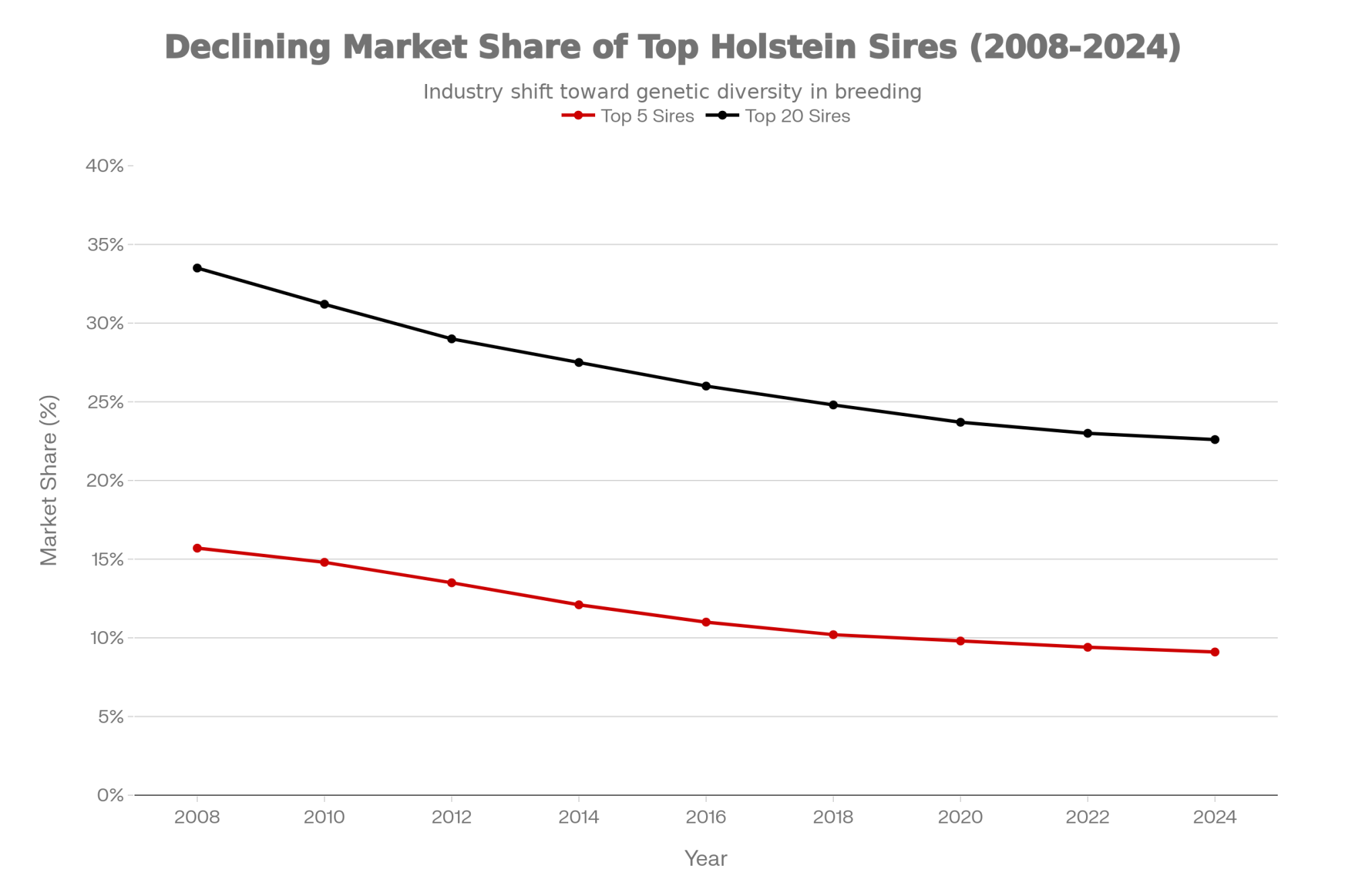
Overview of Top Sires of Canadian Holstein Female Registrations

Category20082012201620202024
Total Female Registrations257,040272,264273,785297,192263,149
Five Sires with Most DaughtersDolmanWindbrookImpressionLautrustPursuit
GoldwynFeverSuperpowerImpressionAlcove
BuckeyeSteadyJett AirAlcoveLambda
FrostyLauthorityDempseyBardoFuel
Sept StormJordanUnoUnixZoar
Percent of Registrations
– Top Five Sires15.70%14.80%7.30%7.50%9.10%
– Top Ten Sires23.70%22.20%13.50%12.60%14.90%
– Top Twenty Sires33.50%30.10%22.20%20.20%22.60%
– Top Thirty Sires39.90%34.70%28.10%25.90%28.70%
Top Twenty Sires – avg # Daus4,3094,0933,0353,0012,984
Highest Ranking Genomic Sire30th27th8th6th5th
No. Genomic Sires in Top Ten00145
Percent of Sires – A2A220%25%35%50%60%

That’s not a “bull of the month” world anymore. That’s breeders intentionally spreading genetic risk, targeting specific trait profiles, and using more bulls per herd for shorter periods, while still driving genetic gain.

The underlying philosophy has evolved from two narrow extremes—high‑conformation or high‑milk two‑lactation cows that were often culled early—to a more complete target: four‑plus‑lactation, healthy, fertile, self‑sufficient, high‑solids cows that can survive modern housing, automation, and economic pressure.

What Genomics Actually Changed

When genomic evaluations hit around 2008–2009, they blew the doors off the old progeny‑testing model. Researchers like Adriana García‑Ruiz and Paul VanRaden, working with US national Holstein data at USDA‑AGIL, showed that once genomics was adopted, sire‑of‑sons generation intervals were effectively cut in half, dropping from roughly 6–10 years down to around 2.5–3 years. Canadian data tracked the same pattern.

That shorter generation interval, combined with higher selection intensity and more accurate young‑animal evaluations, is exactly why genetic gains picked up speed. Analyses of Holstein breeding programs published in the Journal of Dairy Science and the Proceedings of the National Academy of Sciences report:

  • 50–100% higher rates of genetic gain for milk, fat, and protein in the genomic era
  • 3–4x higher genetic progress in some health and productive‑life traits between 2008 and 2014
Metric2008 (Progeny-Testing Era)2024 (Genomic Era)
Average LPI (Top 20 Sires)1,9853,531
Average Pro$ (Top 20 Sires)-$1,558+$1,978
Milk Proof (kg)-578+860
Fat Proof (kg)-33 (-0.10%)+85 (+0.31%)
Protein Proof (kg)-27 (-0.07%)+50 (+0.15%)
Top 5 Sires’ Market Share15.7%9.1%
Daughters per Top Sire4,3002,984
Top 20 Sires’ Market Share33.5%22.6%
Inbreeding (Top Sires’ Daughters)~9.5%11.5%

Canada’s own data comparing bull April 2025 indexes on the 20 most‑used sires, 2008 vs 2024, makes this very real:

  • The average LPI of those bulls climbed from about 1,985 in 2008 to around 3,531 in 2024—roughly +97 LPI points per year.
  • Pro$ swung from about –$1,558 in 2008 to about +$1,978 in 2024—roughly +$221 per year in predicted daughter lifetime profit.
  • Average proofs for those sires went from roughly –578 kg milk, –33 kg fat (–0.10%F), and –27 kg protein (–0.07%P) in 2008 to about +860 kg milk, +85 kg fat (+0.31%F), and +50 kg protein (+0.15%P) by 2024.

That works out to about +90 kg of milk, +7.4 kg of fat, and +4.8 kg of protein in genetic improvement per year in the bulls that Canadian Holstein breeders actually used the most.
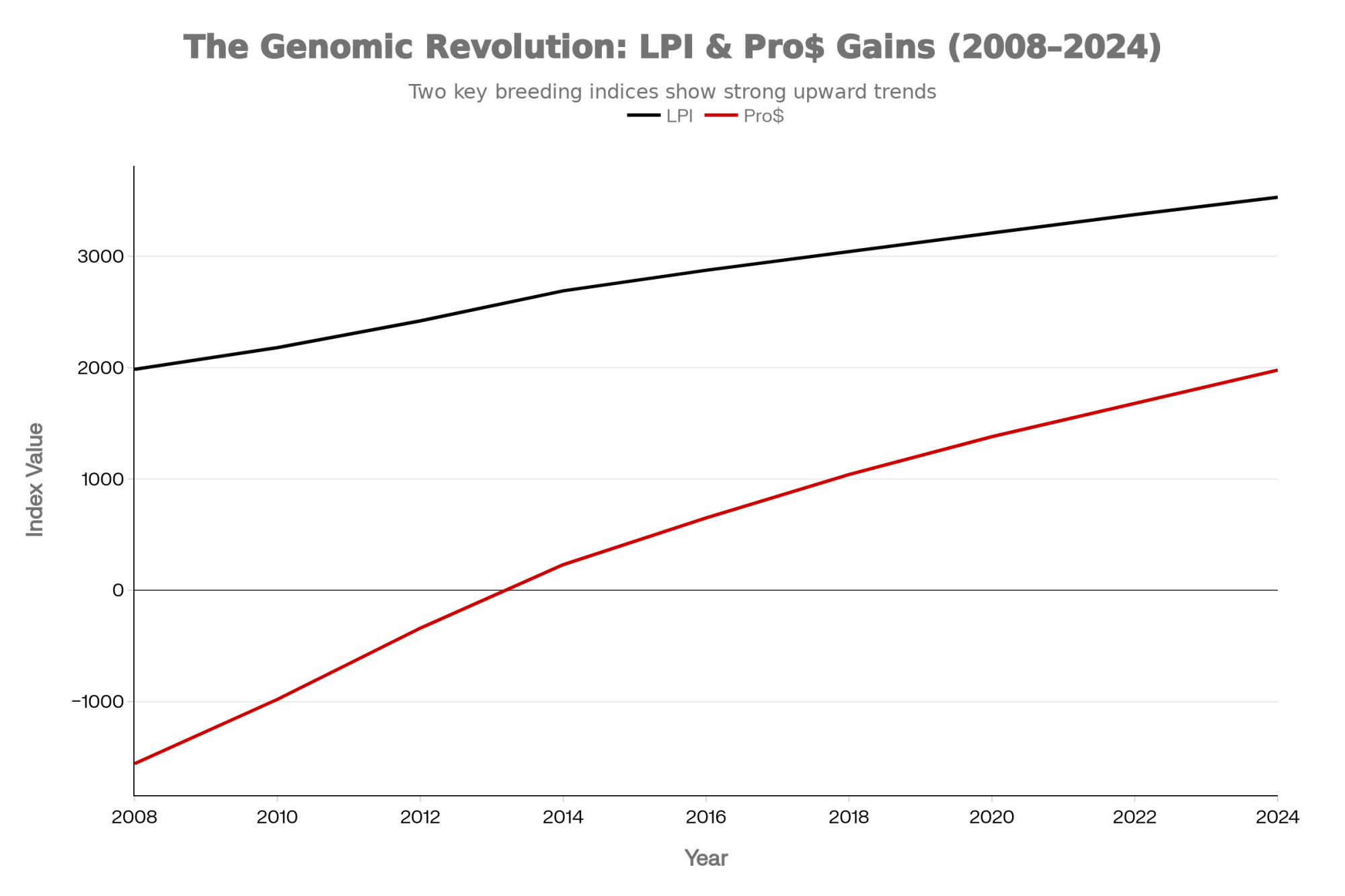
YearLPIPro$
20081,985-$1,558
20102,180-$980
20122,420-$340
20142,690+$230
20162,875+$650
20183,045+$1,040
20203,210+$1,380
20223,375+$1,680
20243,531+$1,978

Put simply: genomics, combined with LPI and Pro$, did exactly what it was supposed to do in Canada—faster genetic gain for production and overall profit.

Indexes for Twenty Sires with the Most Registered Daughters

YearLPIPro$MilkFat / %FProtein / %PCONFMammaryFeet & LegsD StrengthRump
20081985-1558-578-33 / -.10%-27 / -.07%-6-6-410
20122378-728-415-14 / .01%-17 / -.02%1-1043
201626801731306 / .00%2 / -.05%10123
20203054101655545 / .21%25 / .04%53344
20243531197886085 / .31%50 / .15%86875
Change/Year97221907.44.80.880.750.750.380.31

*Lactanet Indexes Published in April 2025

Where biology pushes back is on which traits move fastest. Higher‑heritability traits like milk, fat, and protein, as well as major type traits, make faster genetic progress than lower‑heritability traits like fertility, health, and productive life. Genomics improves accuracy across the board, but when semen catalogs and marketing materials still lead with production and type, it’s easy for those traits to keep outrunning fertility and health on the genetic trend lines.

That’s how we end up with a proof landscape that shows: extreme strength in production and conformation, modest but improving gains in fertility and health, and some nagging functional issues that still frustrate producers.

The Diversity Question: Are We Painting Ourselves Into a Corner?

One major concern that doesn’t appear directly on a proof sheet is genetic diversity.
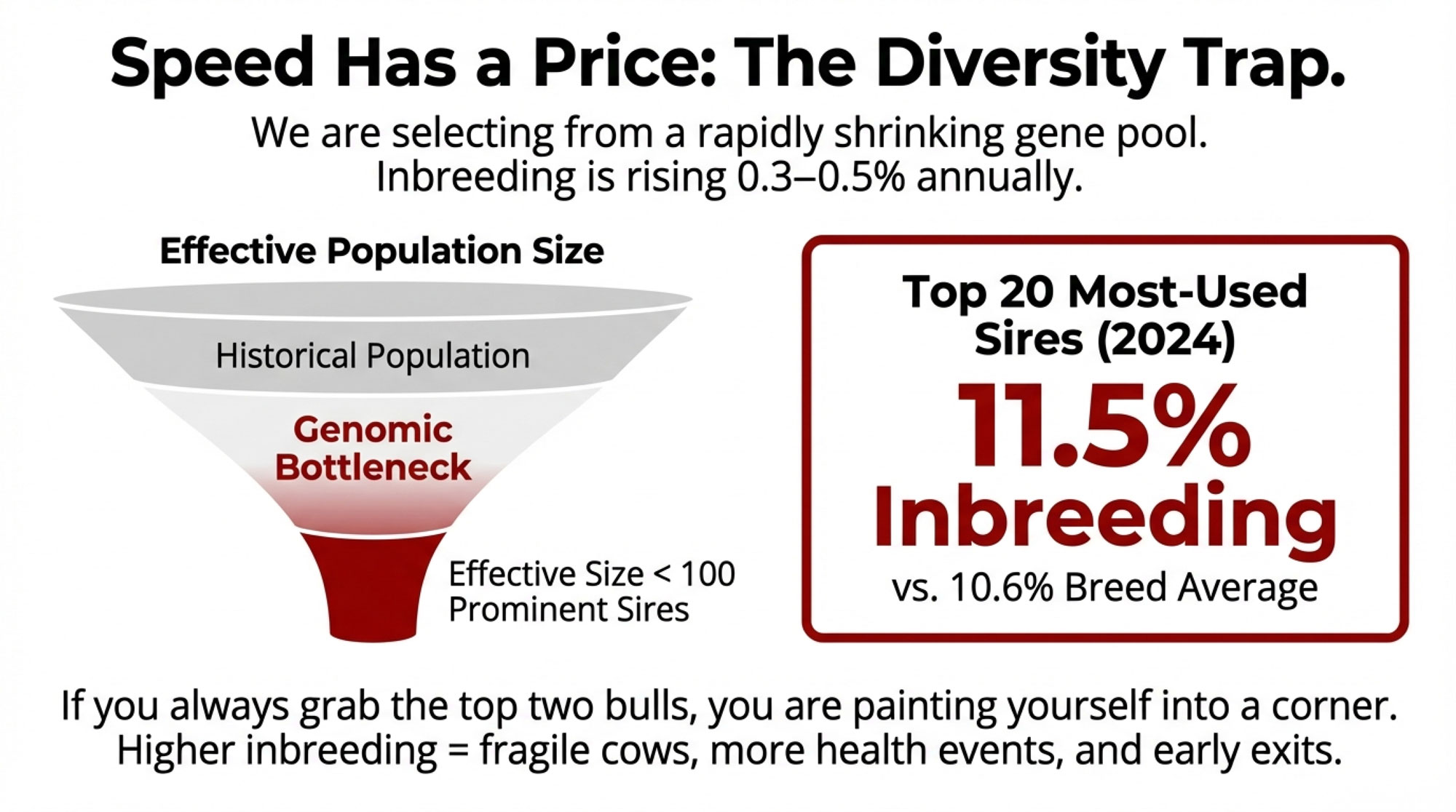
Geneticists talk about effective population size—the number of prominent sires contributing progeny, especially genomic sires entering AI programs and daughters being used as bull dams. Dutch and Italian Holstein genomic studies have examined this closely. In one well‑cited Dutch‑Flemish analysis, effective population size in AI bulls born between 1986 and 2015 ranged from about 50 to 115 prominent sires at different periods, with lower values during times of intense selection. Italian and Nordic Holstein work using both pedigree and SNP data has reported similar patterns—effective population sizes are often below 100, with prominent sires trending downward in the genomic era.

International guidelines from the FAO and genetic diversity experts generally suggest that an effective population size of 100 or more prominent sires is acceptable. Values below about 50 for prominent sires raise concerns about inbreeding depression and lost adaptability.

At the same time, genomic and pedigree analyses across multiple countries have shown that inbreeding is rising faster each year in the genomic era—often increasing by 0.3–0.5 percentage points annually. At current generation intervals, that can mean 1.5–2.5% per generation. Pedigree studies summarized by Chad Dechow at Penn State and reported in Hoard’s Dairyman have also highlighted how a disproportionate share of modern Holstein ancestry traces back to just a handful of bulls (Chief, Elevation, Ivanhoe), underlining how concentrated the global gene pool has become.

In the Canadian context, that broader story plays out in very practical ways. The 20 most‑used sires in 2024 have daughters with an average inbreeding coefficient of about 11.5%—above a Holstein breed average already considered uncomfortably high at around 10.6%. That means the bulls delivering the most genetic progress on paper are also nudging herds further into undesirable inbreeding territory.

Practically, if you always grab the top two or three bulls on the list:

  • You’ll quickly improve your herd’s genetic level.
  • While you’ll also make your heifers more closely related to each other, especially if those bulls also share cow families.

On farm, that’s when inbreeding starts to show up in ways you feel: more fertility trouble, more health events, and cows that don’t seem as robust as the previous generation—even while milk solids and type keep improving.

Hidden Passengers: Haplotype and Recessive Stories

Another layer that genomics exposed is fertility haplotypes and single‑gene defects.
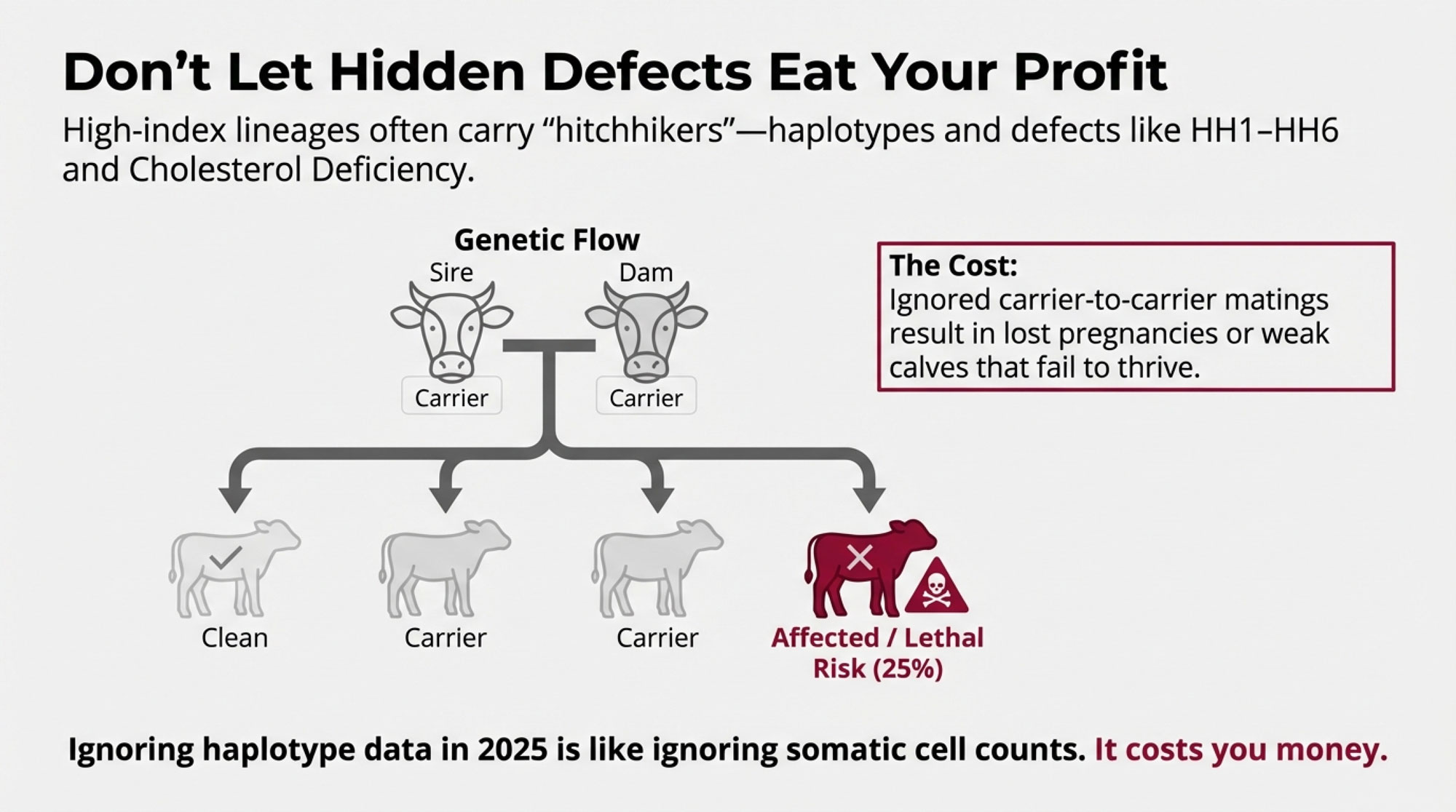
Over the past decade, collaborations between the USDA’s Animal Genomics and Improvement Lab, European institutes, and AI organizations have identified several Holstein haplotypes—HH1, HH2, HH3, HH4, HH5, HH6—and defects like cholesterol deficiency (CD/HCD) that are tied to embryonic loss or weak calves.

The pattern is pretty straightforward:

  • These haplotypes are stretches of DNA where homozygous calves (same version from sire and dam) often die early in gestation or are born weak and fail to thrive.
  • Carrier frequencies in many national populations sit in the low single digits but can reach 5–10% for some haplotypes in certain birth years and cow families.

The cholesterol deficiency story is a good cautionary tale. CD traces back to lines including Maughlin Storm and involves a mutation affecting fat metabolism; affected calves often die within weeks due to diarrhea and failure to thrive, while carriers look normal and can be high‑index animals.

The good news:

  • Major AI studs routinely test their bulls for these defects, and they, their breeds, and genetic evaluation centers publish the carrier status of animals.
  • Mating programs can automatically avoid carrier × carrier matings once herd and sire statuses are known.

If you don’t use those tools, the math can quietly bite you. Even a few percent of pregnancies lost to lethal combinations in a 400–500 cow herd can mean thousands of dollars in dead calves, extra breedings, and longer calving intervals each year—losses that are largely avoidable with the data breeders already have access to.

The 2025 Modernized LPI: A Better Dashboard

All of this—faster genetic gain, tighter diversity, more trait data, and new environmental pressure—is why genetic evaluation systems are updating how they calculate and present information.
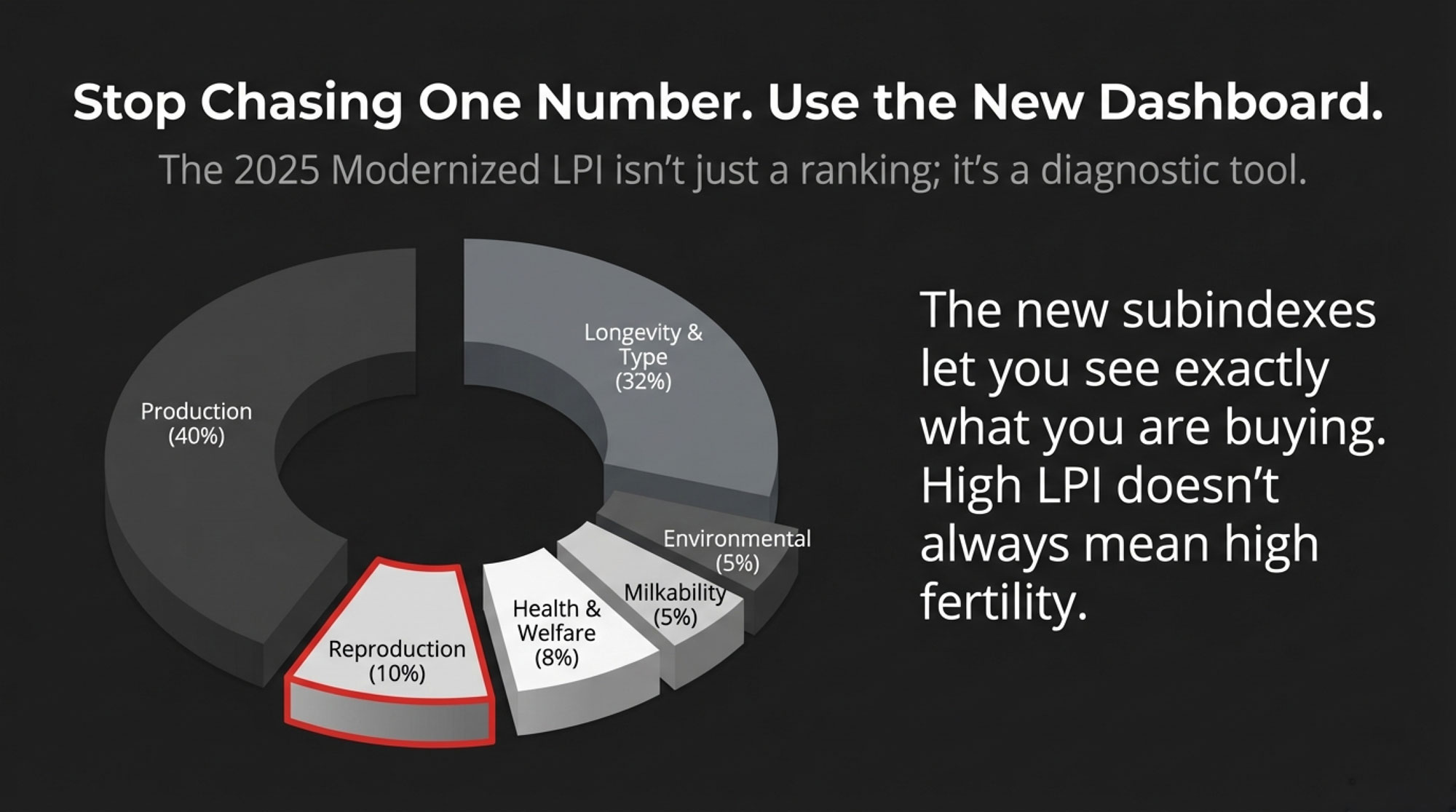
In Canada, Lactanet launched a modernized Lifetime Performance Index (LPI) framework in April 2025. The old three‑group structure (Production, Durability, Health & Fertility) was replaced with six subindexes for Holsteins and five subindexes for the other breeds:

  • Production Index (PI)
  • Longevity & Type Index (LTI)
  • Health & Welfare Index (HWI)
  • Reproduction Index (RI)
  • Milkability Index (MI)
  • Environmental Impact Index (EII)

For Holsteins, these subindexes carry specific weightings in the new LPI formula: about 40% on Production, 32% on Longevity & Type, 8% on Health & Welfare, 10% on Reproduction, 5% on Milkability, and 5% on Environmental Impact. As well, Lactanet has an online routine where breeders can rank bulls by assigning their own weightings for the subindexes.

Two important comfort points from Lactanet:

  • The correlation between the current and modernized LPI is expected to be around 0.98, so the bulls you like don’t suddenly become “bad”—their strengths and weaknesses just become more visible.
  • Splitting Health & Fertility into Health & Welfare and Reproduction, plus the creation of a separate Milkability subindex, allows new traits such as calving ability, daughter calving ability, milking speed, temperament, and environmental traits (such as feed and methane‑related efficiencies) to be properly handled in the indexing.

For a lot of producers, the practical value is this: you can now see at a glance where a bull stands not only on overall LPI or Pro$, but on:

  • Reproduction
  • Health & Welfare
  • Environmental footprint

On separate scales, without having to decode 20 individual trait proofs.

What the Top 2024 Sires Miss—and What That Means for 2026 Matings

Here’s where the Canadian sire usage data really tells a story.

April ’25 Indexes for Twenty 2024 Sires with Most Registered Daughters

CategoryAvg IndexIndex%RKRange in %RK% Sires Below AVG
Lifetime Performance Index (LPI)353198%RK81 – 99 %RK0%
Production Subindex (PI)65993%RK70 – 99 %RK0%
Longevity & Type Subindex (LTI)67898%RK57 – 99 %RK0%
Health & Welfare Subindex (HWI)50050%RK02 – 93 %RK60%
Reproduction Subindex (RI)45029%RK01 – 65 %RK75%
Milkability Subindex (MI)51652%RK10 – 92 %RK45%
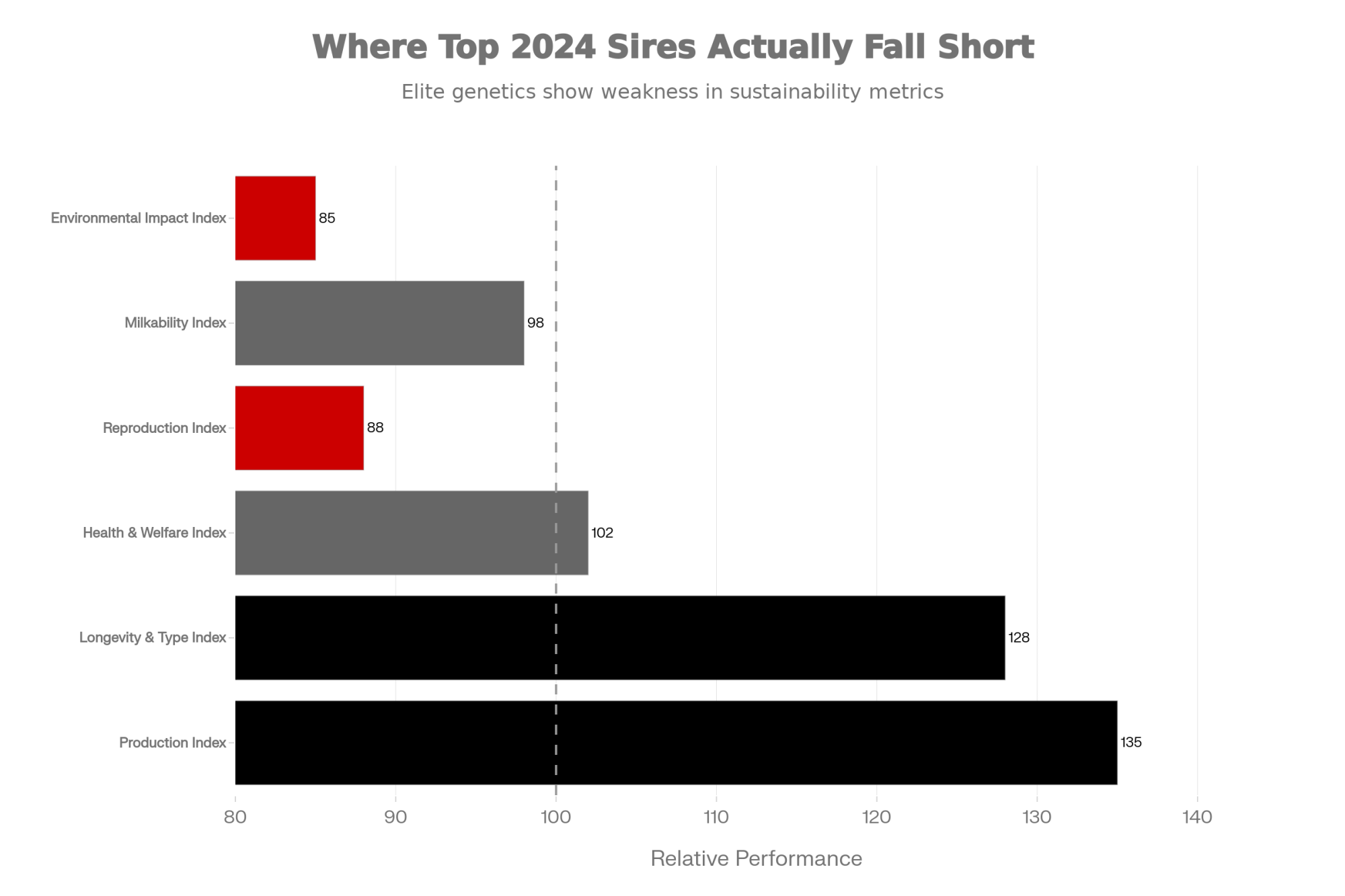
Environmental Impact Subindex (EII)47540%RK02 – 96 %RK75%

When you line up the 20 sires with the most registered daughters in 2024 and score them on the new subindexes, you get a clear pattern:

  • They’re elite for LPI, Pro$, the Production, and the combined Longevity & Type subindexes.
  • They’re roughly breed average for Health & Welfare and Milkability subindexes.
  • They’re significantly below the breed average for Reproduction and Environmental Impact subindexes.
  • Their daughters are running about 11.5% inbreeding vs a breed average of 10.6%.

In plain language:

  • We’ve done an excellent job selecting bulls that lead the pack in production, type, and overall profit indexes.
  • We’ve been less aggressive on fertility, cow survival under stress, and environmental footprint.
  • The bulls that did the most “work” in Canadian herds in 2024 also nudged inbreeding higher.
That sets up the key question for 2026: What are you going to do when you breed those daughters?

If you continue stacking similar high‑production, below‑average‑fertility, high‑relationship sires on top of them, you’ll keep moving LPI and Pro$ up—but you may also:

  • Push inbreeding higher.
  • Put more strain on reproduction and transition‑cow programs.
  • Lag on traits processors and regulators are starting to reward, like feed efficiency and methane‑related performance.

The alternative is to stay aggressive on genetic gain where it matters most for your herd, while using the new LPI subindexes and genomic tools to protect functional traits and diversity.

It’s worth noting that many AI companies are now actively promoting outcross or lower‑relationship bulls and subindex “balanced” sires to help address future genetic needs. Those options are on the semen delivery truck—it just comes down to whether we actually use them.

What Progressive Herds Are Doing Differently

Across Canadian Lactanet‑profiled herds, US herds highlighted in Hoard’s and Dairy Herd, and European setups facing tight environmental rules, the most progressive operations tend to do four things with their breeding programs.

1. They Don’t Stop at the Top Line Index

Most of us have, at some point, just circled the top two or three bulls on our preferred total merit index list—LPI, Pro$, Net Merit, etc.—and then called it a breeding plan. It’s quick—and to be fair, it used to work “well enough.”

The herds that are pulling ahead now ask:

  • What are my top three herd problems right now—reproduction, mastitis, lameness, culling age, transition disease?
  • How do those problems line up with the Reproduction, Health & Welfare, Longevity & Type, and Milkability subindexes?

Then they pick bulls that are high enough on LPI/Pro$/Net Merit and are very strong where their herd is weakest.

Examples:

  • A Western Canadian quota herd shipping into a butterfat‑heavy market may load more weight on fat %, reproductive efficiency, and Environmental Impact (feed efficiency, methane efficiency), because contract and policy pressures are moving in that direction.
  • A robot barn in Ontario may rank bulls first on Milkability (speed, temperament, udder/teat traits compatible with robots), then on LPI/Pro$, because slow‑milkers drag down box throughput.

The point is: the overall index gets you in the right ballpark; the subindexes and trait profiles decide whether you actually fix the problems that cost you money.

2. They Set Clear Inbreeding and Relationship Limits

Modern mating programs—whether through AI company software or integrated herd tools—let you set an expected inbreeding ceiling per mating.

A common approach:

  • Target: keeping individual matings under about 8% expected inbreeding (roughly “cousin‑level” or less).
  • Cap: avoid using any one sire providing more than 5–10% of replacements in a given year, so you don’t wake up in five years and realize half the herd traces back to only two bulls.

Genomic relationship data give much sharper views of how closely related bulls actually are, so herds and advisors are using it to:

  • Avoid stacking very closely related sires on the same cow families.
  • Balance high‑index sires across different lines to keep the gene pool wider.

This isn’t about avoiding genomics—it’s about using genomics to capture speed without painting yourself into a corner.

3. They Treat Haplotypes and Recessives as Standard Inputs

In 2026, ignoring fertility haplotype and genetic defect data is a bit like ignoring somatic cell counts. You can do it, but it will cost you.

The practical rule of thumb:

  • Carrier sires are okay if they bring needed strengths.
  • Carrier × carrier matings are not made.

On the farm, that means:

  • Genomically test all replacement heifers.
  • Make sure genomic testing and AI reports clearly identify carrier cows and bulls for known Holstein defects (HH1–HH6, CD/HCD, and others tracked by your provider).
  • Turn on “block carrier × carrier” in mating programs.
  • Review your herd’s carrier percentages; if a high proportion of heifers carry a given defect, re‑balance the sire lineup to avoid stacking that issue deeper.

Preventing even a handful of lost pregnancies or weak calves per year more than pays for the time it takes to configure those filters.

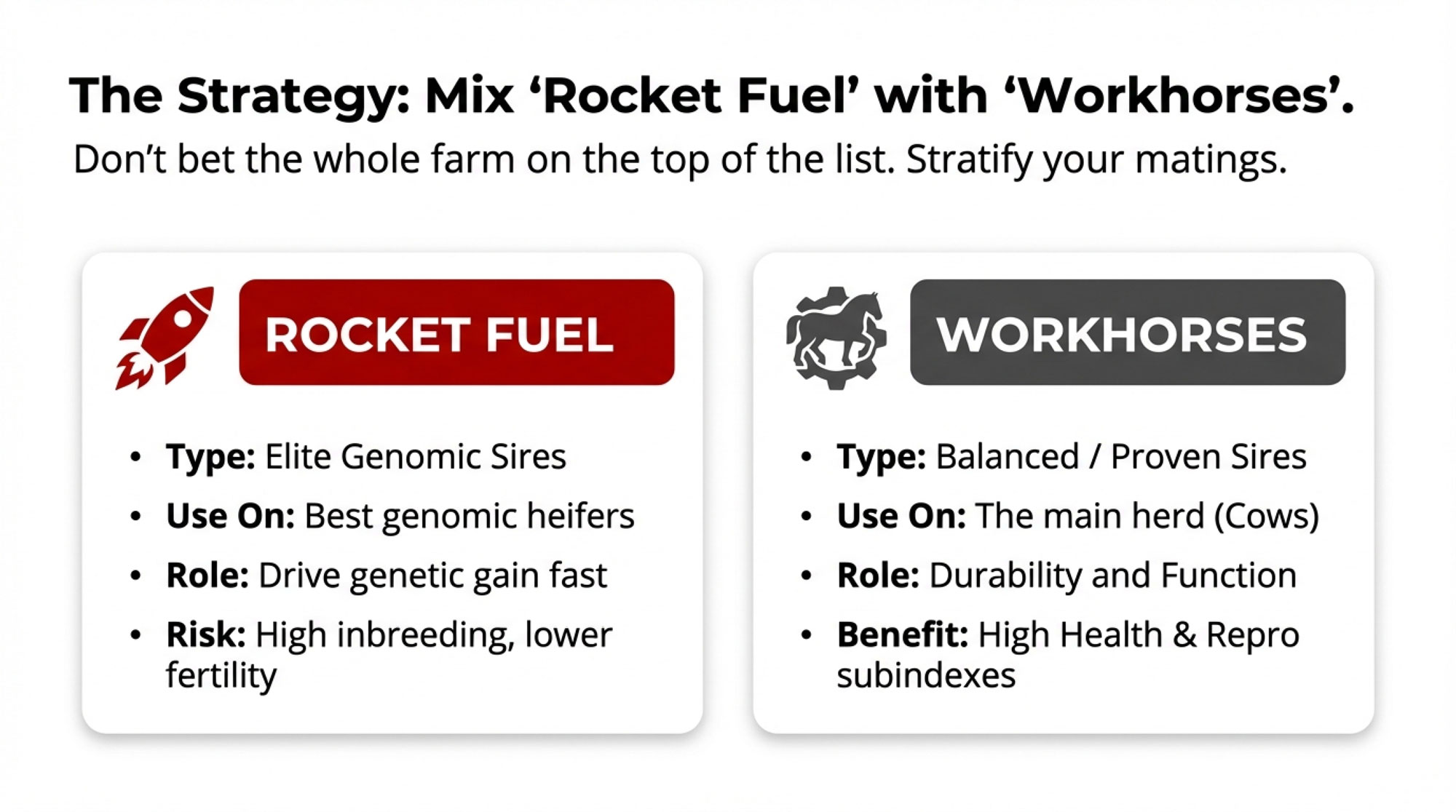
4. They Mix “Rocket Fuel” and “Workhorse” Genetics on Purpose

A pattern that shows up in data‑driven herds is deliberate stratification of matings.
For example:

  • Use a select group of very high‑index “rocket fuel” sires (top LPI/Pro$/Net Merit) on the very best genomic heifers and cow families to keep the top of the herd pushing forward fast.
  • Use a broader group of balanced “workhorse” sires—above average for Reproduction and Health & Welfare, solid for Longevity & Type—on the rest of the herd, especially family lines that have given you trouble on fertility or health.

That way, you:

  • Capture the upside of genomics where it pays the most.
  • Build a herd that isn’t full of fragile “one‑and‑done” cows that leave before third lactation.

A Quick Ontario Illustration

Imagine a 400‑cow Holstein herd.

The numbers say:

  • Too many cows are leaving before their fourth lactation.
  • Reproduction is “okay” but not great.
  • The current sire used list is heavy on very high LPI/Pro$ bulls that are below breed average for Reproduction Index and only average for Health & Welfare, with some matings up around 12–14% expected inbreeding.

A revised 3–4 year strategy might look like this:

  • Keep one or two of those elite genomic or proven sires for your best genomic heifers and highest‑index cows.
  • Add three to four “workhorse” genomic or proven less inbred bulls that are at or above breed average for Reproduction Index and Health & Welfare Index, and still have solid LPI/Pro$ numbers, even if they’re 200–300 points lower than the “rocket fuel” bulls.
  • Set an inbreeding ceiling goal of around 8% in the mating program.
  • Turn on avoidance for key haplotypes and genetic defects.

Over the next few years, you’re likely to see:

  • Modest improvement in pregnancy rate and fewer days open.
  • More cows are making it into fourth and fifth lactation without a parade of health or welfare events.
  • Slightly slower LPI/Pro$ progress on paper, but higher actual milk shipped per cow over a lifetime, because more cows stick around long enough to exceed paying back their rearing cost and reach peak productivity.
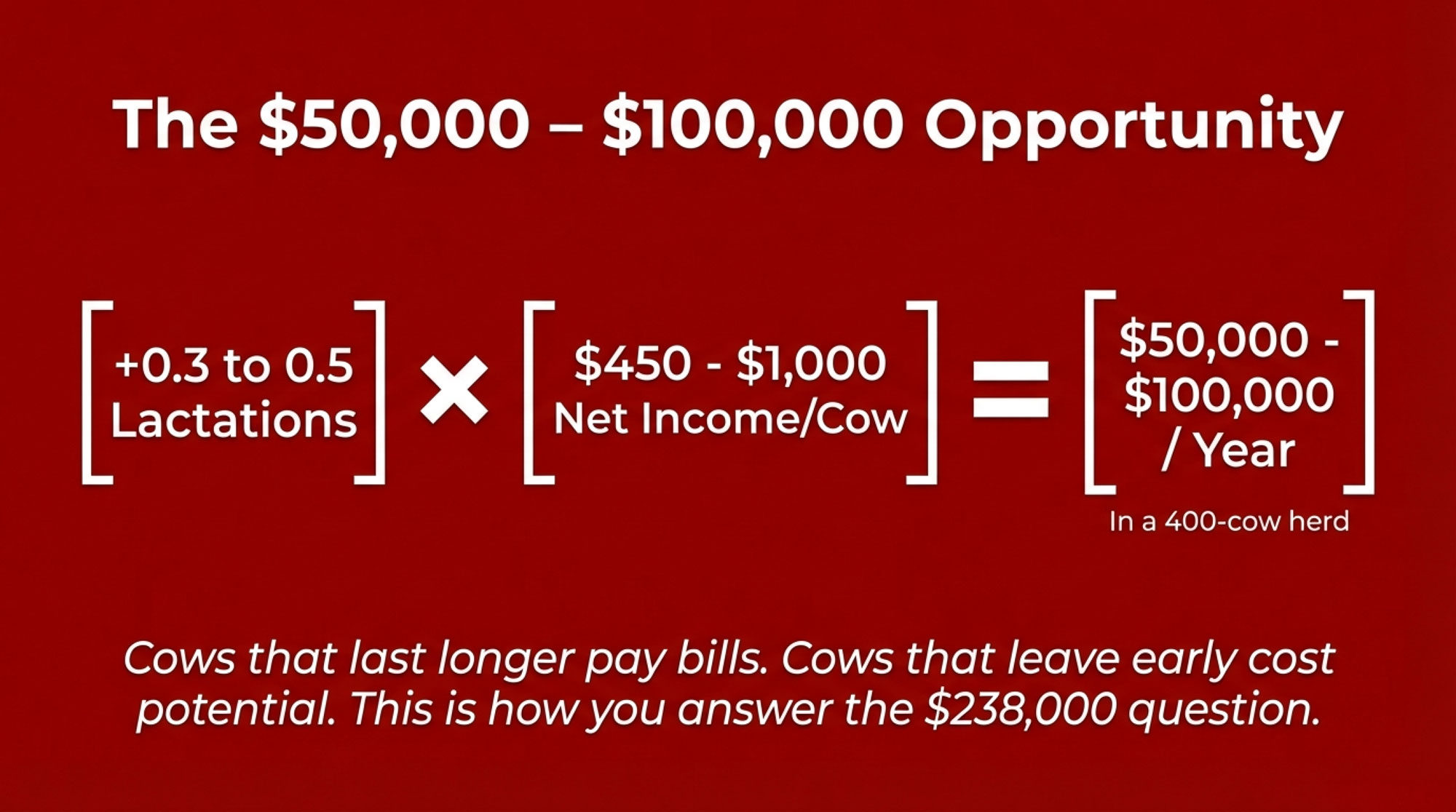
Here’s the rough math on that last point. If shifting your sire mix means an average cow stays an extra 0.3–0.5 lactations, and each additional lactation is worth roughly $1,500–$2,000 in net margin after feed and overhead, you’re looking at $450–$1,000 extra net income per cow over her lifetime. In a 400‑cow herd turning over 30–35% of cows per year, that trade‑off can easily be worth $50,000–$100,000+ per year on the income side—money that more than offsets a slightly slower climb on paper index.

Metric“Rocket Fuel Only” StrategyBalanced “Rocket + Workhorse” StrategyDifference
Avg LPI/Pro$ Annual Gain+110 LPI / +240PRO$+85 LPI / +190PRO$-25 LPI / -50PRO$
Avg Productive Life (Lactations)2.83.3+0.5 lactations
% Cows Reaching 4th Lactation32%48%+16 percentage points
Avg Inbreeding (%)12.8%9.2%-3.6 percentage points
Pregnancy Rate (21-day)18.5%22.0%+3.5 points
Extra Net Income per Cow (Lifetime)Baseline+$650–$900+$650–$900
400-Cow Herd (Annual Impact)Baseline+$65,000–$90,000/year+$65,000–$90,000/year
3–5 Year Cumulative ROIBaseline$195,000–$450,000$195,000–$450,000

That trade‑off—slightly less “flash” for more “cows that work longer and require less individual care”—is where the real money often sits.

Three Questions to Ask Your AI Rep This Spring

If you’re not sure where to start, these questions cut through the catalog noise fast:

  1. “Which bulls in your lineup are above breed average for both Reproduction and Health & Welfare subindexes, and still strong on LPI/Pro$?”
    This forces the conversation beyond the very top LPI or Net Merit names.
  2. “Can you run a report showing my herd’s average expected inbreeding and carrier status for major Holstein haplotypes and genetic defects?”
    This gives you a baseline for both diversity and hidden risk.
  3. “If I wanted to balance my sire lineup between a few elite ‘rocket fuel’ bulls and more ‘workhorse’ functional sires, what would that look like for my herd?”
    This turns a product pitch into a strategy discussion tailored to your data.

A Straightforward Pre‑Order Checklist

Before your next semen order or breeding push, a simple checklist ties all of this together:

  • Pull the last 2 years of herd data.
    • Look at culling reasons and ages; how many cows leave before fourth lactation?
    • Check key KPIs: pregnancy rate, days open, mastitis/health events, SCC trends.
  • Review your current sire lineup by subindex.
    • For each bull, jot down Production, Longevity & Type, Reproduction, Health & Welfare, Milkability, and Environmental Impact scores under the new LPI structure.
    • Flag bulls that are strong for Production but clearly below breed average for Reproduction or Health & Welfare.
  • Decide on an inbreeding ceiling and diversity plan.
    • Work with your advisor to set a mating target (e.g., an expected inbreeding level below 8%).
    • Consider setting limits on how much any single bull can contribute to replacements over the next 1–2 years.
  • Make sure haplotype and recessive filters are turned on.
    • Confirm your mating software blocks carrier × carrier matings for known Holstein haplotypes and genetic defects.
    • Ask for a herd‑level carrier summary so you know your starting point.
  • Balance your sire list.
    • Keep a select group of elite “rocket fuel” sires for the very top females.
    • Add at least one or two “workhorse” sires that are clearly strong for Reproduction and Health & Welfare to shore up your everyday cows.

If you remember nothing else, remember those three pillars: protect functional traits, manage diversity, and balance elite and workhorse genetics. Together, they do more for long‑term profitability than chasing any single proof list.

So, Did Genomics Deliver? The $238,000 Answer

If we’re honest, the answer is “yes—and.”

Yes, genomics delivered faster progress and more precise selection. Studies from the US, Canada, and Europe are very clear: genetic gains in production, health, fertility, and longevity traits are higher now than in the old progeny‑testing era.

And at the same time, genomics amplified both the strengths and the weak spots in our breeding goals:

  • We pushed production and type forward fast.
  • We made positive strides in some health and fertility traits, but they still lag behind production in terms of genetic gain rate.
  • We leaned hard on a relatively small set of sire and cow families, tightening the gene pool and increasing inbreeding.
  • We uncovered haplotypes and genetic defects hitchhiking on high‑index lineages, reminding us that progress always comes with complexity.

The good news is that the tools to manage those trade‑offs—modernized LPI, Pro$, genomic testing, mating software, and herd analytics—are better than ever.

The Bottom Line

Here’s the critical point: without genomics, there is no measurable ROI on genetic improvement. In the pre‑genomic era, you couldn’t reliably capture this kind of return because you couldn’t accurately identify high‑profit genetics early enough or fast enough. Today you can—and the math works out. A 400‑cow herd making smarter breeding decisions with genomic tools can realistically capture $50,000–$100,000+ per year in additional lifetime profit from cows that stay longer, breed back faster, and require less intervention. Over a typical planning horizon of three to five years, that’s the $238,000 question answered: genomics delivered the tools; your breeding decisions determine whether you actually capture that ROI.

Most of us aren’t in this to win a banner once and sell the herd. The goal is herds we actually like milking: cows that calve in with ease, handle transition without a parade of treatments, breed back on a reasonable schedule, stay sound on their feet, and survive long enough to make heifer raising pencil out positively.

The bulls you choose this year will still have daughters freshening in your barn in 2032. The closer those daughters are to the cows you actually want in your parlor—on reproduction records, on health reports, and on your balance sheet—the more of genomics’ promise you’ll actually capture.

Genomics gave us the speed. Now the job is making sure we’re steering it in the right direction for our own future dairy enterprise.

Key Takeaways

  • Genomics delivered: Genetic gains for milk, fat, protein, health, and longevity have roughly doubled since 2008—faster than progeny testing ever achieved.
  • But there’s a catch: Intense selection on a small elite group has pushed inbreeding past 11% and narrowed the gene pool, quietly eroding fertility and robustness.
  • New tools help you see the trade-offs: Lactanet’s six LPI subindexes show exactly where a bull stands on Reproduction, Health & Welfare, Milkability, and Environmental Impact—not just total merit.
  • Progressive herds are steering, not chasing: They mix “rocket fuel” and “workhorse” sires, cap inbreeding under 8%, and block carrier × carrier matings for haplotypes and defects.
  • The payoff is real: A 400-cow herd using these strategies can capture $50,000–$100,000+ per year in extra lifetime profit—that’s the $238,000 answer over 3–5 years.

Executive Summary: 

Genomic selection has roughly doubled the rate of genetic gain for milk, fat, and protein, while also improving health and longevity traits compared with the old progeny‑testing era. Canadian data on the 20 most‑used Holstein sires show LPI and Pro$ values rising so fast since 2008 that daughters now generate several thousand dollars more lifetime profit per cow, adding up to $50,000–$100,000 or more per year in a well‑run 400‑cow herd. The flip side is that heavy reliance on a small group of elite families has increased inbreeding and reduced effective population size, which can chip away at fertility, health, and robustness if it’s ignored. Lactanet’s modernized LPI, with subindexes for Reproduction, Health & Welfare, Milkability, and Environmental Impact, gives breeders the dashboard they need to see those trade‑offs instead of just chasing one total merit number. Leading herds are using genomics to cap inbreeding, avoid carrier‑to‑carrier matings for haplotypes and defects, and deliberately mix a few high‑index “rocket fuel” sires with more balanced “workhorse” bulls that protect functional traits. In that context, the “$238,000 question” has a clear answer: genomics really can deliver that level of return over a few years, but only for farms that actively steer their breeding programs rather than letting the proof list do the driving.

Complete references and supporting documentation are available upon request by contacting the editorial team at editor@thebullvine.com.

Learn More

Join the Revolution!

Join over 30,000 successful dairy professionals who rely on Bullvine Weekly for their competitive edge. Delivered directly to your inbox each week, our exclusive industry insights help you make smarter decisions while saving precious hours every week. Never miss critical updates on milk production trends, breakthrough technologies, and profit-boosting strategies that top producers are already implementing. Subscribe now to transform your dairy operation’s efficiency and profitability—your future success is just one click away.
NewsSubscribe
First
Last
Consent

The Traits That Should Disqualify Bulls- But Often Don’t: How Genomic Selection Changed the Rules of Knockout Traits

What dairy breeders are discovering about the gap between traits that theoretically eliminate bulls and the ones that actually prevent collection and sale

EXECUTIVE SUMMARY: The traits that should disqualify bulls increasingly don’t—and that gap is costing commercial producers real money. While genomic screening has driven lethal haplotype carriers below 2% according to Lactanet data, problematic traits like elevated SCS and marginal udders now get marketed with management caveats rather than screened out. Operations ranging from small tie-stalls to 20,000-cow multi-state enterprises share a striking philosophical alignment: cow families and validation matter more than catalog numbers alone. GenoSource tracks cow families across generations—their matriarch, Miss OCD Robust Delicious, Holstein International Cow of the Year in 2018, still contributes embryos today. McCarty Family Farms discovered that roughly a quarter of their parentage records were incorrect before implementing systematic tracking that now achieves compliance in the mid-to-high 90s. Canadian operations like Walnutlawn, Lovholm, and Bosdale have bred World Dairy Expo champions while focusing on cow families rather than chasing the latest rankings. Their shared conviction: genomics tells you what genes an animal carries, but pedigree analysis reveals whether families actually transmit predictably. Commercial producers can close this gap through greater sire diversification, realistic expectations about young genomic predictions, and systematic tracking of what actually works in their own herds.

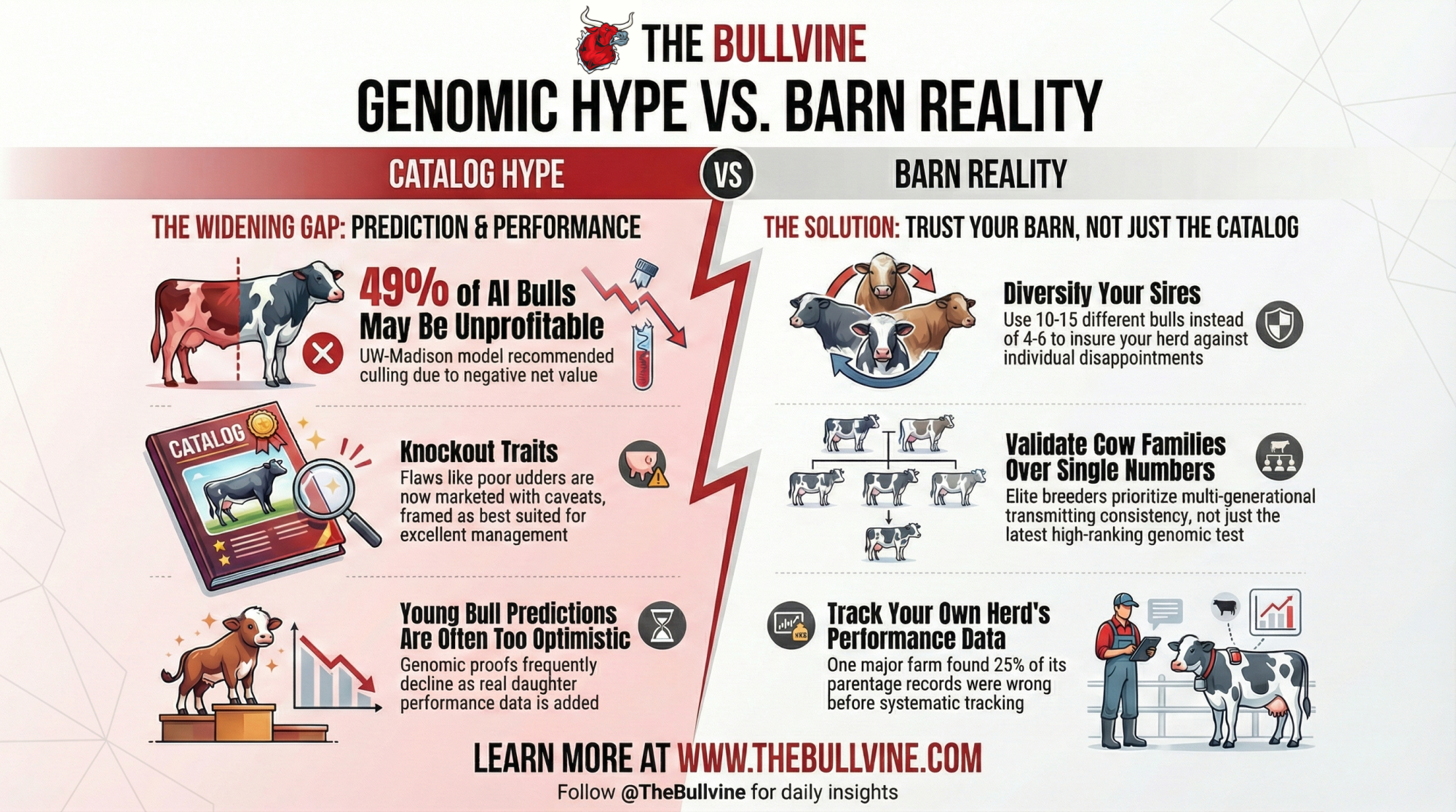
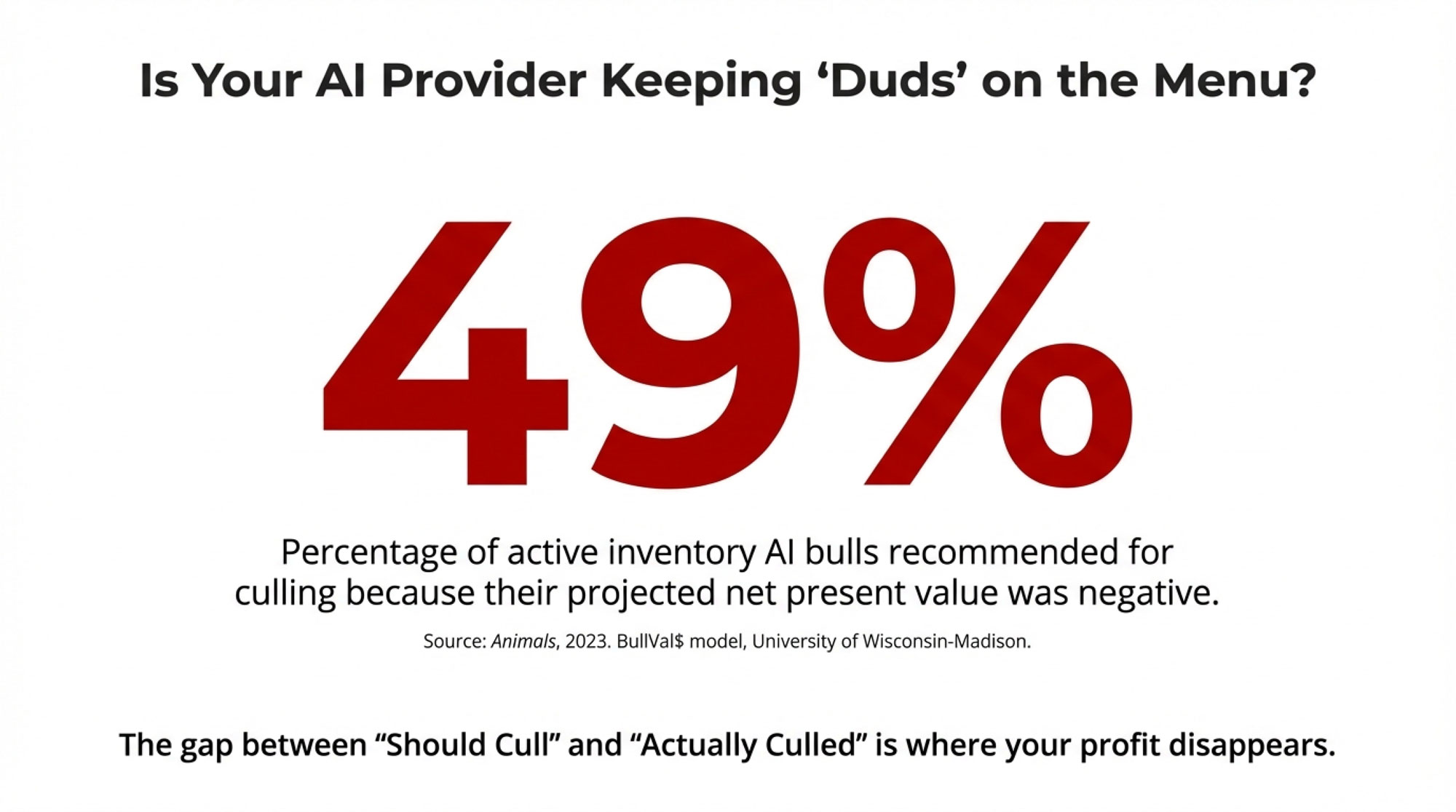
Here’s a number that caught my attention when I first saw it: according to a 2023 paper in Animals describing the BullVal$ decision-support model developed at the University of Wisconsin-Madison, when researchers applied their economic framework to actual AI company inventory, they recommended culling 49% of bulls because their projected net present value was negative.

Nearly half. That’s not a typo.

Whether those bulls were actually removed from service? The paper doesn’t say. And honestly, that gap between “should cull” and “actually culled” tells you a lot about how knockout traits really work today.

For decades, the industry operated on a pretty straightforward premise: certain genetic weaknesses could render an otherwise elite bull unmarketable. Terrible udders on a high-production bull? Knockout. Daughters that couldn’t get pregnant despite great indexes? Knockout. These single-trait failures were supposed to disqualify bulls regardless of their other merits.

But the reality has gotten more nuanced. The traits that actually prevent bull collection have narrowed considerably, while the traits that probably deserve more scrutiny often get marketed around rather than screened out. With component prices holding strong and butterfat premiums rewarding production efficiency, the economic stakes of genetic decisions have rarely been higher. Understanding this dynamic matters whether you’re running 200 cows in Vermont or 5,000 in the Central Valley.

What Actually Constitutes a Knockout Trait Today

Let’s start with what genuinely prevents a bull from being collected and marketed. Based on industry data and published research, true knockouts fall into surprisingly narrow categories.

Physical impossibilities remain absolute barriers. Bulls that can’t produce viable semen, have poor libido, or produce semen that doesn’t survive freezing simply can’t generate revenue. Studies on breeding bull disposal consistently show that subfertility issues—especially poor semen quality, inadequate libido, and poor semen freezability—are among the leading reasons bulls get culled from AI programs. These physical limitations account for the vast majority of young bull removals, not genetic trait concerns.

Genomically verifiable defects create binary decisions. Haplotypes like HH1 through HH6, which cause embryonic loss or calf mortality, are now routinely screened via genomic testing. Genetic evaluation centers like CDCB publish carrier status for these defects on most bulls marketed in North America—it’s become standard practice.

The screening has been effective. Lactanet reports that for Canadian Holsteins born between 2020 and 2023, carrier frequencies for HH1 through HH4 are now below the 2% level. HH5 carriers have dropped to close to 5%, and HH6—discovered only in 2019—has reached nearly 2% for 2023 births. The newer concern is Early Onset Muscle Weakness Syndrome (MW), which Lactanet added to its routinely published evaluations in 2024. Because it’s a more recent addition to screening panels, carrier frequency remains higher and warrants continued attention. But for the established haplotypes, genomic testing has largely solved the problem before bulls ever reach collection—exactly what the technology was supposed to do.

Trait CategoryIndustry PerformanceCurrent StatusFeedback Loop SpeedFarmer Action Needed
Lethal Haplotypes (HH1-HH4)✓ SolvedBelow 2% carriersImmediate (genomic test)Trust genomic screening
HH5 Haplotype⚠ Improving~5% carriersImmediate (genomic test)Verify carrier status
Somatic Cell Score (SCS)⚠ UnresolvedBulls >3.00 SCS still marketed1-2 lactationsApply personal cutoffs
Inbreeding Accumulation✗ WorseningDoubling annually vs. pre-genomic era3-5+ generationsDiversify bloodlines now
Young Bull Prediction Accuracy✗ OverstatedCommon 100+ NM$ downward drift5-6 years (daughter proof)Mentally discount 10-15%
Stature Extremes✓ Self-correctedMarket shifted to moderate1-2 lactationsSelect <+2.0 stature

You either carry the mutation, or you don’t. There’s simply no gray zone to work around.

Market-specific requirements have emerged as conditional knockouts—and they vary more by geography than most North American producers realize.

For Jersey programs in some regions, sexed semen production capability has become nearly essential. In VikingJersey herds, sexed semen usage reached 72% of all dairy inseminations by March 2021, according to VikingGenetics. In Norway, 99% of VikingJersey semen sales are sexed. In the United States, the trend is growing but less dramatic—Journal of Dairy Science data shows Jersey sexed semen usage increased from 24.5% to 32.1% between 2019 and 2021. Still, a Jersey bull that can only produce conventional semen faces a shrinking market regardless of his genetic merit.

Market/RegionBreedSexed Semen Usage (%)Implication for Bulls
NorwayJersey99%Cannot produce sexed = unmarketable
VikingJersey Herds (Mar 2021)Jersey72%Sexed capability near-essential
United States (2019)Jersey24.5%Conventional bulls still viable
United States (2021)Jersey32.1%Growing pressure for sexed capability

A2A2 status has become essential for producers targeting A2 milk premiums—a consideration that barely existed ten years ago.

In Dutch and Flemish markets, the NVI total merit index places substantially more weight on functional traits—longevity, health, udder health, fertility, and claw health—than on production, according to CRV documentation. That’s a fundamentally different emphasis than TPI’s production-heavy weighting. Buyers in these markets apply stricter thresholds for feet and legs, udder health, and milking speed than typical US selection criteria.

What does that fragmentation mean practically? A bull that ranks elite on TPI may look mediocre on NVI or RZG because those indexes weigh traits so differently. Getting a sire that fits all systems requires more, not less, due diligence, as genomic selection has expanded internationally.

The Gray Zone: Traits That Deserve Attention But Don’t Stop Collection

Experienced breeders often report similar patterns when it comes to somatic cell score. Bulls with SCS predictions around 3.00 or higher tend to leave daughters with noticeable cell count issues. The correlation isn’t perfect, but it’s consistent enough that many elite operations treat elevated SCS as a serious concern regardless of other merits.

You’ve probably noticed this in your own cows. Genetic evaluations consistently show that higher SCS breeding values are associated with a higher genetic predisposition to mastitis, which is why many breeders treat elevated SCS as a red-flag trait when choosing sires.

But here’s the market reality—elite genetics operations represent a small fraction of total semen purchases. When a breeder decides not to use a bull because of concerning SCS, the AI company’s sales numbers barely register the difference. They’ve already moved thousands of units to commercial operations that evaluated the NM$ ranking and placed orders.

Regional Threshold Differences

What constitutes a knockout varies substantially by market—and understanding those differences matters if you’re selling genetics internationally or evaluating bulls developed for other markets.

European buyers, particularly in the Netherlands and Belgium, tend to apply harder cutoffs on functional traits than North American selectors. The Dutch-Flemish NVI devotes substantial weighting to health, fertility, longevity, and conformation, with claw health and saved feed costs explicitly included since 2018. A bull borderline on udder health or feet and legs might move thousands of units in Wisconsin but struggle to gain traction in the Dutch-Flemish market. Conversely, some international markets still use raw milk volume as a primary screening threshold—which might seem outdated to producers focused on fat-plus-protein economics, but reflects local pricing structures.

The practical implication: when evaluating an imported bull or one heavily marketed for “global” appeal, check how he actually ranks in his home market’s index system. Elite TPI doesn’t guarantee elite LPI, RZG, or NVI performance—and the gaps can be substantial.

Industry geneticists at major AI companies acknowledge that severely negative mammary scores effectively disqualify bulls in most international markets. That sounds like a knockout trait. But what actually happens when an elite genomic bull tests at + with a slightly negative udder composite?

In practice, the marketing materials emphasize his exceptional production genetics and outstanding feet and legs. The udder concern gets mentioned—but perhaps framed as “best suited for herds with excellent management protocols.” Let me be direct about what that language means: when a catalog says a bull is “best suited for excellent management,” it’s a signal that his daughters will need him. The bull gets collected. The semen gets sold. And to be fair, in many well-managed operations, those daughters may perform just fine.

This isn’t meant as criticism of AI companies—they’re responding to market signals and customer demand. But it does mean commercial producers benefit from understanding that “knockout trait” and “marketed with management caveats” represent different categories.

The Stature Correction: How Trait Priorities Actually Shift

Perhaps no trait better illustrates how genetic priorities evolve—and why some corrections happen faster than others—than stature.

For decades, the dairy industry selected for taller cows. Show rings rewarded height. Classification systems scored it positively. The prevailing assumption was that a bigger frame meant bigger capacity for high production.

That’s changed. Tall bulls that would have commanded premiums a decade ago now face resistance in many markets—a change driven largely by commercial producer feedback rather than show ring preferences.

What changed wasn’t the underlying biology. What changed was that commercial producers—particularly those with freestall facilities—accumulated enough direct experience to question the institutional preference for height. Many breeders with freestall operations learned the same lesson independently: their tallest cows didn’t hold up as well in the stalls, often ending up moved to alternative housing or culled earlier than expected.

Research eventually caught up to what farmers were observing. A Canadian Dairy Network analysis found that stature had essentially no meaningful correlation with herd life compared with other functional traits—despite decades of positive selection for tall cows. European research has similarly shown that very heavy cows are often less efficient than moderate-weight animals, producing less milk per unit of feed intake at the extremes of body size.

Why did the stature correction actually work? A few key characteristics made the difference:

The problem was visible within individual herds. Farmers could see their tall cows go lame, struggle with stall fit, and get culled earlier. Attribution was relatively clear—tall cows had specific, observable problems that were harder to blame on nutrition or management alone. The solution was straightforward: select for moderate stature. And crucially, there was no competitive penalty—shorter bulls still carried high genetic merit for production.

This last point matters enormously. When you can address a problem without sacrificing production, the market tends to self-correct. When fixing a problem means accepting lower genetic merit… those corrections stall. Sometimes for decades.

The Problems That May Not Self-Correct

Here’s where the conversation gets more complicated—and more important for long-term planning.

Inbreeding rates are increasing. A 2022 study in Frontiers in Veterinary Science analyzing Italian Holstein populations found that genomic inbreeding has been increasing measurably since the adoption of genomic selection, with annual genomic inbreeding growth roughly doubling compared to the pre-genomic era. Studies in Dutch-Flemish, French, and North American populations show broadly similar patterns.

Why doesn’t this trigger a market correction like stature did? Probably because inbreeding depression manifests through diffuse symptoms—slightly lower fertility here, slightly higher disease incidence there, somewhat shorter productive life. No individual producer can easily identify inbreeding as the specific cause of their herd’s challenges. The effect appears real, but it’s invisible primarily at the individual farm level.

Genomic predictions for young bulls tend to be optimistic. Canadian and US evaluation centers have documented that daughter proofs for genomically preselected sires often drift downward relative to their original genomic predictions. The mechanism makes sense: when you genomically test millions of animals and select the absolute best fraction of a percent as bull mothers, you’re selecting from an already pre-selected population. The genomic model assumes something closer to random sampling. Reality works differently.

We’ve seen this pattern play out as daughter data accumulates. Several heavily-used young sires from 2021-2022 have come in meaningfully below their original predictions—in some cases by 100 points or more on NM$. The pattern isn’t universal—some bulls hold or even improve—but the downward drift is common enough that mentally discounting those catalog numbers reflects reality better than taking them at face value.

What does this mean practically? Consider this scenario: if you’re selecting bulls at +900NM$ expecting +$900 performance, but reality delivers something closer to +$720, that’s a meaningful gap in genetic merit you’re not capturing. Across 100 replacement heifers per year, that kind of shortfall adds up to real money—potentially tens of thousands of dollars annually in genetic value you expected but didn’t receive. That’s not a published industry average; it’s a realistic scenario producers should be prepared for when relying heavily on young genomic bulls.

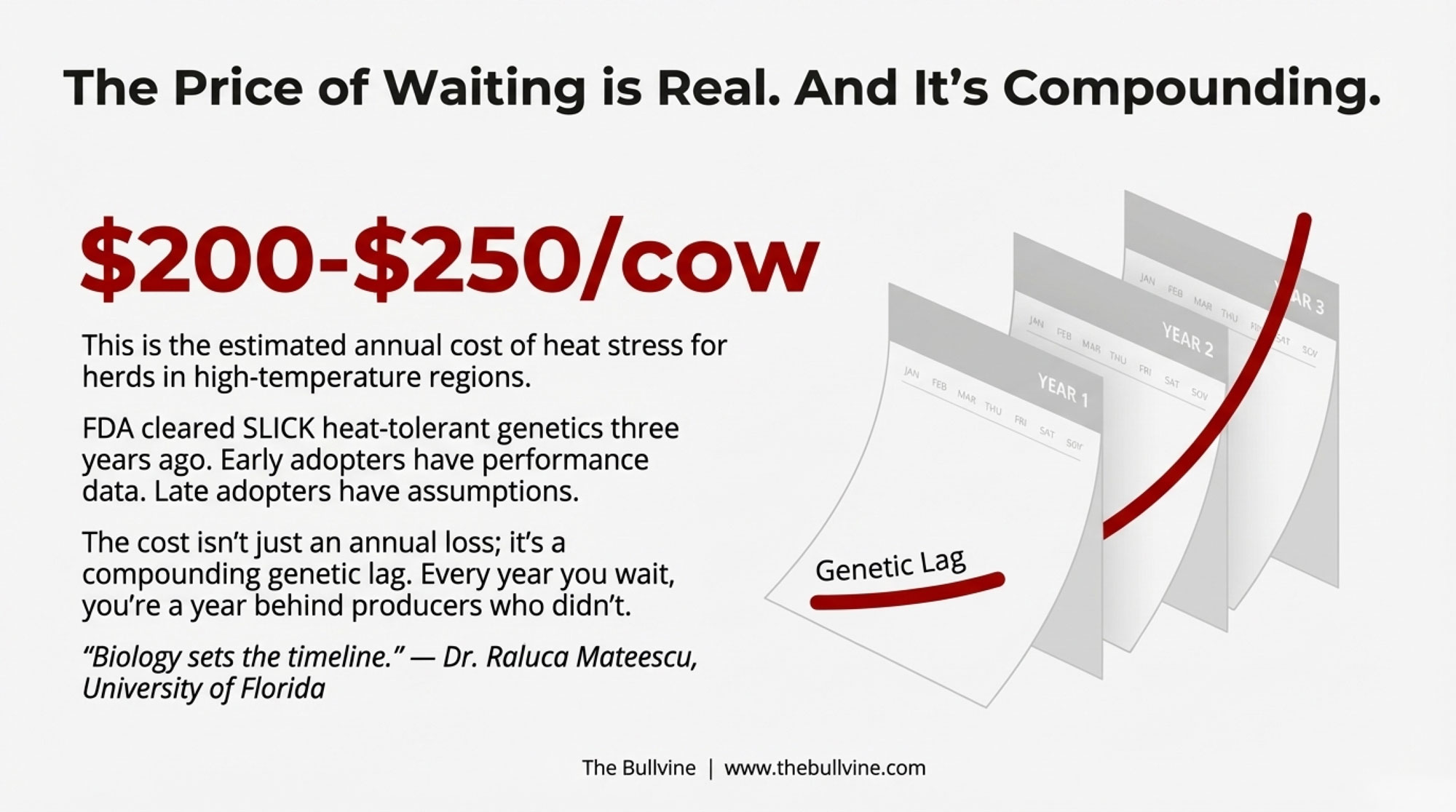
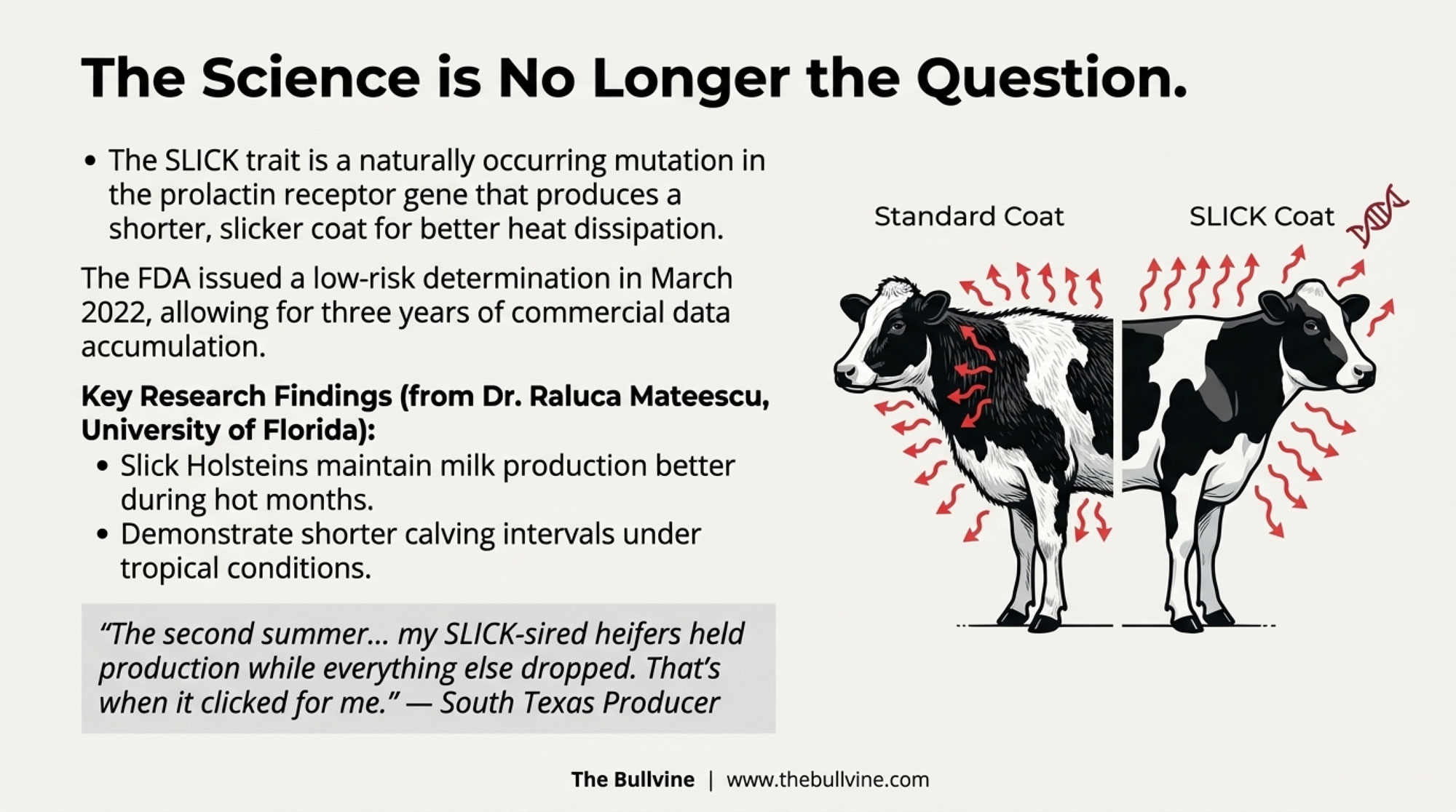
Heat tolerance is becoming increasingly relevant. Genetic and management research has highlighted a tension between high production and heat tolerance. Higher-producing cows generate more metabolic heat, making them more vulnerable to heat stress in hot, humid conditions—a relationship that Lactanet and other organizations have flagged in their heat-tolerance extension materials.

This tension between genetic selection and climate adaptation may not self-correct through normal market mechanisms. The feedback is slow, attribution is difficult, and any producer who prioritizes heat tolerance typically accepts some trade-offs in production metrics. For operations in the Southeast or Southwest, this is already pressing. Upper Midwest operations have more runway, but increasingly intense summer heat events are changing that calculus.

The Feedback Loop Challenge

What really distinguishes problems that get market correction from problems that persist?

Stature got corrected because problems became visible in 1-2 lactations, cause-and-effect was reasonably clear, solutions didn’t require sacrificing production, and individual farmer decisions aggregated into a market signal.

Challenges like inbreeding accumulation, genomic prediction bias, and heat tolerance adaptation may persist because problems emerge gradually across 3-5+ lactations, attribution is genuinely difficult at the individual herd level, solutions often involve trade-offs against genetic merit, and there’s no clear mechanism for individual observations to aggregate into market pressure.

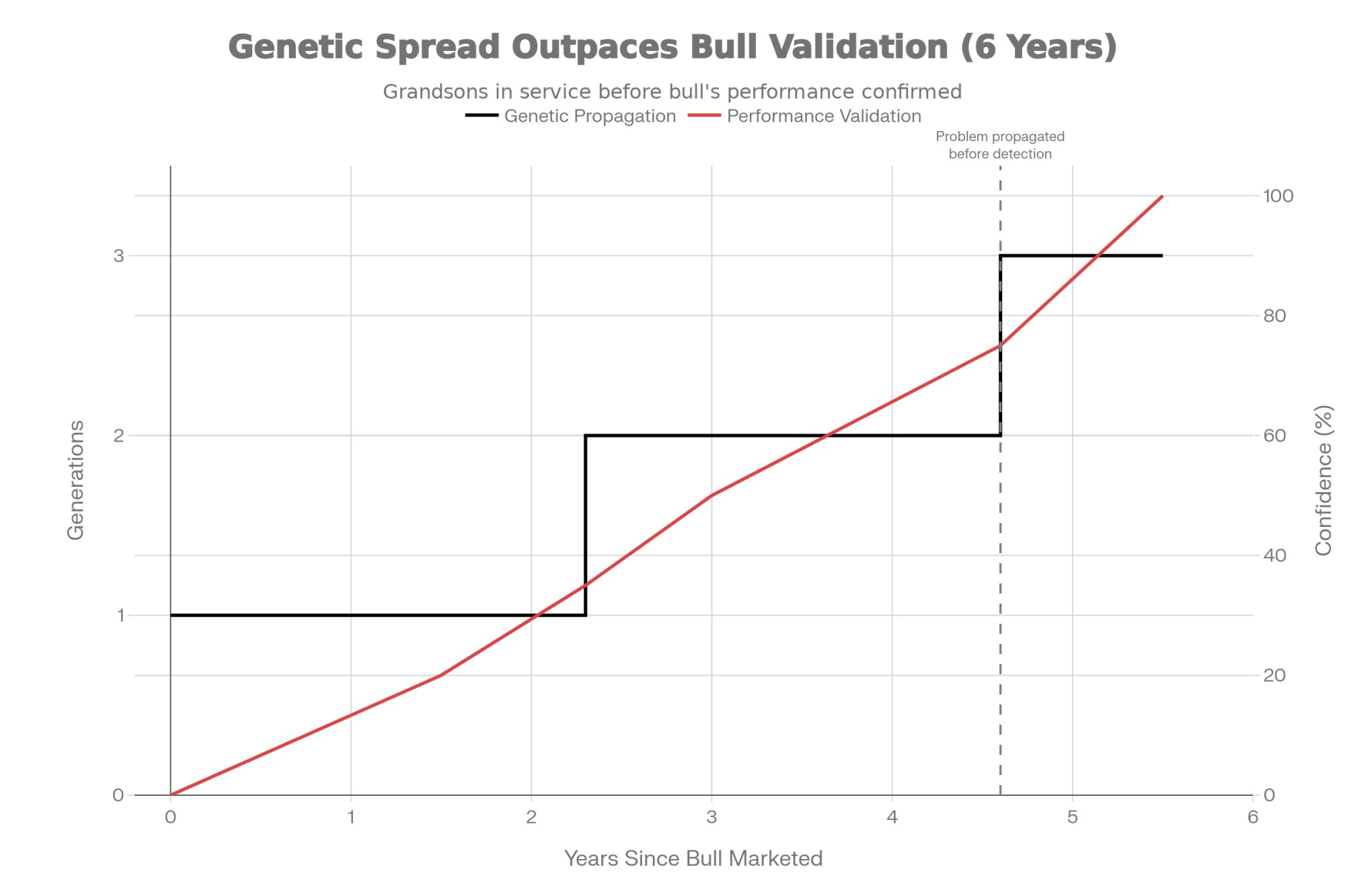
Here’s a concrete timeline that illustrates the problem: A bull marketed heavily in early 2021 produces daughters that start calving in late 2022. You get meaningful first-lactation performance data by mid-2024. By the time you have enough information to evaluate whether he delivered on his genomic promise—late 2025—you’ve already bred to his sons and grandsons for two or three generations. If there’s a problem, it’s already propagated through your herd before you knew it existed.

Genomic selection compressed generation intervals to 2.3 years—bulls have grandsons breeding before their daughters even finish first lactation. Meaningful validation requires 5-6 years, creating a catastrophic timing mismatch

Genomic selection now proceeds in 2-3 year cycles—generation intervals have dropped from around 5 years pre-genomic to as low as 2.3 years for some selection pathways. But daughter performance feedback still takes 5-6 years to accumulate. The math doesn’t work in the producer’s favor.

To be fair, genomics has delivered substantial progress on many traits—something AI company geneticists rightly point to when defending the system. US data from CDCB and Holstein USA show that rates of severe calving difficulty have dropped substantially over the past few decades as breeders have consistently selected for calving ease. But calving ease had characteristics that enabled rapid correction: immediate feedback, clear attribution, and universal agreement that it was worth addressing.

The traits that concern forward-thinking breeders today often lack those same characteristics.

What Elite Operations Do Differently

Two operations—one placing around 200 bulls into AI annually from a large Iowa herd, the other managing the largest registered Holstein herd in the United States across multiple states—share a striking philosophical alignment with smaller, elite breeders: cow families and validation matter more than catalog numbers alone.

The Genomic Validators

“We’re not afraid to mate apparent opposites. Progress requires calculated risks,” says Kyle Demmer, COO of GenoSource, a family-owned Iowa operation that’s become a global genetics powerhouse since eight families combined their herds in 2014. But those calculated risks aren’t blind bets on genomic numbers—they’re grounded in cow-family evaluation spanning generations.

When GenoSource CEO Tim Rauen discusses his favorite cow, the answer isn’t their highest-testing heifer. It’s T-Spruce Jaela 47718 VG-87. As Rauen explained in The Bullvine’s profile of the operation: “Out of her, already more than 50 sons, grandsons, and great-grandsons have left for AI, so she will truly have a lot of influence.” That’s not a genomic prediction—that’s multi-generational transmitting consistency you can actually verify.

Their legendary Miss OCD Robust Delicious proves the point even more dramatically. Named Holstein International Cow of the Year in 2018, this bovine matriarch still contributes valuable embryos to their program today. Her genetic fingerprint is evident across their top GTPI sires. Rauen notes that Delicious combines high genetic merit with strong mammary traits and efficiency, which is why her influence shows up in so many of GenoSource’s highest-ranking bulls. In an industry where youth often reigns supreme, Delicious demonstrates that longevity and productivity can validate genomic promise—but only if you’re tracking results long enough to see it.

GenoSource’s approach to show cattle reinforces this philosophy. Their three-time World Dairy Expo champion Ladyrose Caught Your Eye-ET isn’t just a show animal—sixteen of her daughters score VG-87 or higher and are productive members of working herds, according to The Bullvine’s coverage. That’s the kind of validation genomics alone can’t provide.

The operation tests a large number of bull candidates annually, placing around 200 in AI programs with companies such as Select Sires, Semex, ABS, and others. But what separates GenoSource from operations that simply chase genomic numbers is their insistence on tracking cow families across generations—verifying whether genomic promise translates into barn performance.

The Data-Driven Approach at Scale

At McCarty Family Farms—2025 World Dairy Expo Dairy Producers of the Year, operating the largest herd of registered Holsteins in the United States across Kansas, Nebraska, and Ohio—the approach scales differently, but the principle holds.

“Unlike managing by feel, we allow the data to drive many of our decisions,” Ken McCarty has explained. But critically, that data isn’t just genomic predictions—it’s actual performance systematically tracked across their operation.

When the McCartys first implemented comprehensive genomic testing, they discovered something sobering: roughly a quarter of recorded parentage in their herd was incorrect. As Ken reflected in interviews, how can you drive appropriate genetic progress or make the breeding decisions that will propel your business forward with that kind of foundational error? Today, after overhauling data capture and mating systems, their monthly compliance reports for mating recommendations consistently reach the mid-to-high 90% range.

McCarty’s standardization approach offers a template for commercial operations. Each farm operates the same synchronization protocols, treatment protocols, breeding strategies, and vaccination strategies. This consistency across their multi-site operation creates the statistical power to identify which sire families actually deliver—and which disappoint.

Since the early 2010s, they’ve increased both milk yield and overall output per cow substantially as the operation expanded, reflecting the combined impact of genetics, nutrition, and management changes. Their focus on genetic enhancement of milk protein content, which is notably harder to improve via diet than butterfat, serves both customer demand and sustainability goals.

Ken acknowledges they haven’t abandoned traditional cow sense—they’ve augmented it with technology and analytics. Being able to sharpen the focus on traits where the herd may be deficient has been transformational, he notes. Their newest facility in Rexford, Kansas, completed in 2023, reflects this commitment to both scale and precision management.

The Common Thread

What GenoSource and McCarty share with smaller elite breeders isn’t rejection of genomics—both operations embrace genomic testing extensively. What they share is a conviction that validation matters.

GenoSource tracks cow families across generations. Jaela’s 50+ descendants to AI, Delicious still producing and contributing embryos, Captain’s daughters showing up in global herds while his grandsons continue the legacy. McCarty standardizes protocols specifically to enable performance comparison—consistent data entry, identical definitions across locations, real-time feedback on what’s actually working. Both prioritize multi-generational transmitting consistency over single-point genomic tests.

Rauen captures the philosophy when discussing their flagship bull GenoSource Captain: “Captain’s consistency across generations is unprecedented. His daughters dominate global herds while his grandsons, like Garza, continue the legacy.” Consistency—that’s what genomic predictions alone can’t guarantee.

The practical application for commercial producers is clear: when evaluating bulls, verify how the cow family has performed across multiple generations and multiple environments. Check if daughters from that line actually delivered on the genomic promise in similar operations to yours. Elite operations at every scale don’t trust catalog numbers alone.

Proof of Concept From Small Herds

While operations like GenoSource and McCarty demonstrate these principles at commercial scale, it’s worth noting what smaller operations have accomplished. Recent Bullvine profiles have highlighted Canadian herds such as Walnutlawn, Lovholm, and Bosdale, which have bred World Dairy Expo champions and amassed impressive numbers of Excellent-classified cows relative to their herd sizes.

“Cow families are probably number one,” says Michael Lovich of Lovholm Holsteins. “If I don’t like the cow family the bull comes from, we won’t use him. When I see bulls that are out of three unscored dams, I don’t care what the numbers are.”

Their cows average considerably longer productive lives than the industry norm. When you can keep cows productive that much longer than average, your entire economic model shifts.

The common thread across all these operations—whether 72 cows or approaching 20,000—is disciplined focus on cow families and consistent transmission, not just chasing the latest bull rankings.

Practical Strategies for Commercial Operations

Given these market realities, what can commercial producers actually do? You can’t completely insulate yourself from system-wide dynamics—but you can meaningfully reduce your exposure.

StrategyBulls UsedAvg. Genetic MeritRisk if 2 Bulls DisappointAnnual Cost/CowVerdict
Concentrated “Elite”4-6 bullsTop rankings (+NM$)$20,000-$40,000 lossacross 3-4 years(40-50% of breedings affected)$0 genetic trade-off+ high disappointment riskHigh risk
Diversified Insurance10-15 bulls85th-95th percentile(20-30 NM$ lower)$4,000-$8,000 lossacross 3-4 years(15-20% of breedings affected)$8-15/cow(~50 lbs milk/lactation)genetic trade-offInsurance wins
Proven Bull Hedge10-15 bulls(30% proven)Similar to diversified+ reliability premium$2,000-$5,000 lossacross 3-4 years(proven bulls anchor herd)$12-20/cow(proven semen premium+ moderate genetic lag)Best risk-adjusted

Diversify more than conventional wisdom suggests. If you’re currently using 4-6 bulls, consider spreading across 10-15. The genetic merit trade-off is real—you might average 20-30 NM$ lower across breedings compared to concentrating in your top picks. On a 500-cow herd, that’s foregone genetic potential.

But here’s the math that matters: if two of your concentrated bulls disappoint significantly—which happens more often than catalog marketing suggests—you’ve absorbed that loss across a large portion of your herd. When you spread breedings across more sires, individual disappointments hurt less. The insurance usually wins.

Recognize which predictions deserve more confidence. Production traits (milk, fat, protein) and linear type traits have relatively strong genomic prediction accuracy—reliability often above 70%—because they’re highly heritable and measured on enormous reference populations.

Trait CategoryReliability(%)Confidence Level
Milk production75%High – Trust prediction
Fat production75%High – Trust prediction
Protein production73%High – Trust prediction
Linear type traits68%High – Trust prediction
Somatic cell score40%Medium – Moderate confidence
Longevity15%Low – Skepticism warranted
Metabolic resilience8%Low – Skepticism warranted
Daughter fertility (DPR)4%Very Low – Near guesswork

Daughter fertility (heritability around 4%), metabolic resilience, and longevity have substantially lower prediction accuracy. When choosing between bulls with similar production indexes, consider breaking the tie based on proven functional traits from older bulls in the pedigree.

Develop your own red flag checklist:

  • SCS above +2.8 (potential mastitis pressure—could cost $100-200/cow annually based on university extension estimates)
  • Stature above +2.0 (mobility and facility-fit considerations)
  • DPR below -1.5 (reproduction concerns worth investigating)
  • Extreme production combined with a negative udder composite (potential antagonism)
  • Heavy concentration of single bloodlines in recent generations (inbreeding risk)

Consider the 85th-95th percentile rather than chasing top rankings. Bulls in the 85th-95th percentile typically deliver strong genetic gain without the extreme trait combinations that sometimes accompany absolute top rankings. You might sacrifice 50-100 pounds of milk per lactation—call it $8-15 per cow annually at current component prices—but potentially avoid antagonisms that accompany extreme selection.

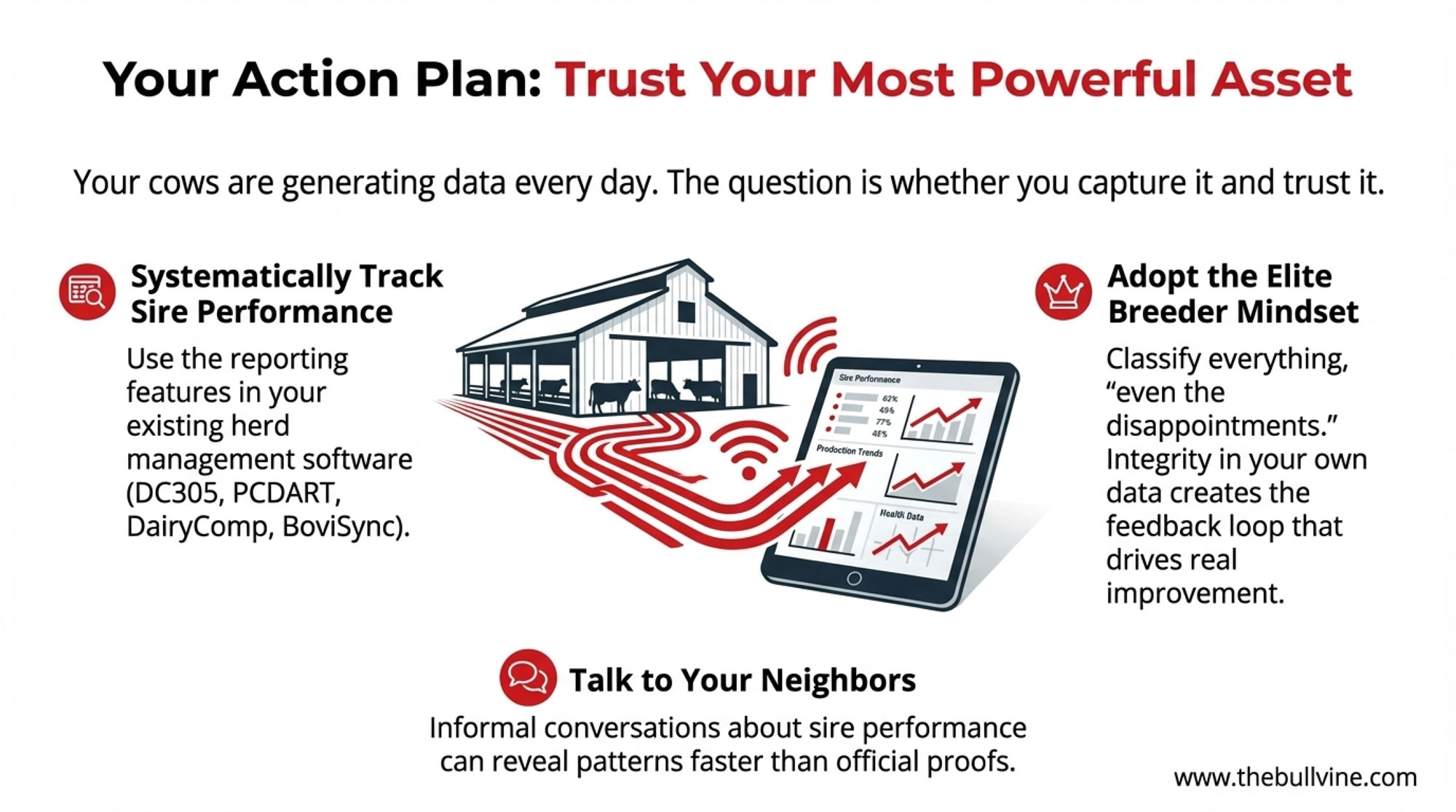
Track performance systematically in your own herd. Most modern DHI programs and herd management software—DC305, PCDART, DairyComp, BoviSync—can generate sire-based performance reports when appropriately configured. After 3-4 years, you’ll start seeing patterns emerge. When three consecutive bulls from the same bloodline show similar problems in your operation, that’s a signal worth acting on.

Learn from operations that actually track results. McCarty’s discovery that roughly a quarter of their parentage records were incorrect before implementing systematic tracking should concern every producer who hasn’t verified their own data quality. Their subsequent improvement to compliance in the mid-to-high 90s shows what’s possible when you take data integrity seriously.

Use proven bulls strategically. You can’t use daughter-proven bulls exclusively without falling behind on genetic progress. But for your best cow families, your older cows that have already proven their value, and animals with reproductive challenges? The predictability of proven genetics has genuine worth.

What This Means for Your 2026 Breeding Decisions

With the spring breeding season approaching and proof updates coming in April and August, here’s how to put this analysis to work.

  • Before your next semen order: Pull your current bull lineup and honestly assess concentration. How many distinct sire lines are you actually using? If fewer than 8-10, you’re probably overconcentrated.
  • Apply realistic expectations. When evaluating young genomic bulls, remember that daughter proofs often come in below initial predictions. If a bull is still attractive, assuming some regression from his current numbers, proceed. If your enthusiasm depends entirely on that top-end number being accurate, that’s a warning sign.
  • Ask better questions of your AI rep. Instead of “who’s your hottest young bull,” try: “Which bulls have you seen daughters from, and how are they holding up?” Good reps appreciate being treated as consultants rather than order-takers.
  • For Southeast and Southwest operations: Heat tolerance should already be a significant factor in your bull selection. Don’t wait for more data—the direction is clear.
  • For Upper Midwest and Northeast operations: You have more runway on heat tolerance, but start tracking summer performance by sire now. The data you collect this year will inform decisions in 2027-2028.
  • For Canadian producers: The same principles apply to LPI—the prediction mechanics and preselection dynamics work the same way, even if the index construction differs.

Looking Ahead

Heat tolerance is transitioning from academic interest to practical necessity. Lactanet and other organizations are beginning to publish heat tolerance metrics worth monitoring.

Feed efficiency selection is entering mainstream genetic programs, which introduces complexity. French national research has highlighted the importance of preserving robustness and reproductive performance while pursuing efficiency gains—flagging concerns about excessive body condition loss during the transition period when cows are genetically selected for extreme efficiency.

Early data on residual feed intake shows it’s heritable (estimates generally range from 0.12 to 0.38), which means we can select for it. Whether aggressive selection before we fully understand the reproductive and health implications makes sense is worth careful consideration.

Regional data-sharing cooperatives represent one mechanism that could strengthen market feedback. If 10-15 commercial dairies in your area agreed to pool anonymized daughter performance data by sire, you’d collectively have enough statistical power to identify performance patterns years before official evaluations reflect them. Your local DHI cooperative or breed association can tell you what’s available in your region.

Six Things to Do This Breeding Season

The system won’t protect you from genetic disappointment. AI companies are doing their job: selling semen. Your job is the hard part—living with the results. A 72-cow tie-stall operation has bred World Dairy Expo champions by trusting cow families. A 20,000-cow operation discovered that a quarter of its parentage records were incorrect before fixing them. Your job is to find your own version of that balance: diversify against the bulls that won’t deliver, be realistic about predictions that may be optimistic, and track what actually works in your barn. That’s not cynicism. That’s what people who breed elite cattle have been doing all along.

  1. This week: Pull your current bull lineup. Count distinct sire lines—if you’re under 8-10, start planning to diversify.
  2. Before your next order: Be realistic about young bull predictions. If he’s still your pick, assuming some regression from catalog numbers, proceed with confidence.
  3. This breeding season: Reserve your proven bulls for your top 20% cow families and any animals with reproduction challenges.
  4. Within 90 days: Set up sire-based reporting in your herd management software. The capability is probably there—you just haven’t configured it yet.
  5. This season: Verify your parentage data before trusting it for your genetic decisions. What McCarty found wasn’t unique; it’s what they found when they actually looked.
  6. This year: Start a conversation with 3-4 neighboring operations about comparing sire performance informally. Shared observations over coffee can reveal patterns that help everyone.

Your cows are generating information about which genetics actually work in your operation. The question is whether you’re capturing that information systematically—and whether you trust it as much as you trust the marketing materials.

Key Takeaways

  • True knockouts have shrunk to physical impossibilities and verified genetic defects. Lactanet data shows haplotype carriers HH1-HH4 are now below 2% in recent Holstein births. Meanwhile, traits like elevated SCS and marginal udders get marketed with “best suited for excellent management” caveats—translation: his daughters will need it.
  • Be realistic about young bull predictions. Canadian and US evaluation centers have documented that genomic proofs for heavily preselected sires often decline when daughters are added. That gap between expectation and reality can cost you meaningful genetic progress over time.
  • Validation beats prediction at every scale. GenoSource tracks cow families across generations—Delicious is still contributing embryos after being named the 2018 Cow of the Year. McCarty discovered roughly a quarter of their parentage records were wrong before implementing mid-to-high 90s mating compliance. Canadian operations have bred WDE champions by focusing on cow families rather than catalog rankings. The common thread: multi-generational transmitting consistency.
  • Diversify harder than you think you should. Use 10-15 bulls, not 4-6. When concentrated bulls disappoint, you’ve absorbed that loss across a large portion of your herd. Spreading breedings means individual disappointments hurt less. The insurance math usually wins.
  • Your cows are generating data—use it. Elite operations from small tie-stalls to multi-state enterprises track sire performance systematically. The question isn’t whether that information exists; it’s whether you trust your barn data as much as the marketing materials.

Complete references and supporting documentation are available upon request by contacting the editorial team at editor@thebullvine.com.

Learn More

Join the Revolution!

Join over 30,000 successful dairy professionals who rely on Bullvine Weekly for their competitive edge. Delivered directly to your inbox each week, our exclusive industry insights help you make smarter decisions while saving precious hours every week. Never miss critical updates on milk production trends, breakthrough technologies, and profit-boosting strategies that top producers are already implementing. Subscribe now to transform your dairy operation’s efficiency and profitability—your future success is just one click away.
NewsSubscribe
First
Last
Consent

Editor’s Choice 2025: 10 Articles Your Competitors Already Read Twice

Every breeding decision you’ll make next year connects to lessons buried in this year’s best journalism. A $260,000 gamble from 1926 that critics called insanity. A bankruptcy that produced three generations of World Dairy Expo champions. A bull whose daughters added $6,500 per head in today’s dollars, while his modern genomic evaluation shows negative Net Merit—a $2,117 swing from December 2025’s top bull. These aren’t just stories – they’re the strategic frameworks top breeders reference when everyone else is guessing.

Look, we published over 300 feature articles this year. Breeder profiles, sire spotlights, donor stories, industry investigations. When our editorial team sat down to identify which ones actually mattered—not which got the most clicks, but which ones readers bookmarked, shared with their herd managers, or referenced in breeding meetings—ten articles kept coming up.

These pieces combined a strong readership with lasting impact. Our Elevation story generated over 340 comments and was shared more than 2,800 times across platforms. The Blackrose piece prompted eight separate emails from readers who’d reconsidered their approach to dispersal auctions. The “Death of Get Big” article? At least a dozen producers told us they’d shared it with their lenders.

That’s the standard we used. Months after publication, readers were still emailing about these stories, arguing about them, applying them.

If you’re planning your 2026 breeding strategy, reviewing dispersal auction opportunities, or just trying to understand why certain genetic decisions matter more than others, these articles deserve your attention. Your competitors have probably already read them twice.

Four Bets, Five Legends: The Holstein Visionaries Who Built Everything You’re Breeding Today

Here’s the thing about Holstein history—most of us think we know it. We can name the big bulls, recite a few famous prefixes. But this article did something different. It traced four distinct breeding philosophies through five legendary figures and showed how each remains valid today.

Take T.B. Macaulay’s gamble on Johanna Rag Apple Pabst in 1926. According to Bank of Canada inflation calculations, that $15,000 purchase represents roughly $260,000 in today’s dollars—for one animal, in a post-WWI economy when farmers were still digging out from agricultural depression. The critics thought he’d lost his mind.

And here’s what makes this relevant to your operation right now: Holstein Canada pedigree records confirm that virtually every registered Holstein walking the planet today carries that bull’s blood.

Why Macaulay’s Math Still Works

What made Macaulay different? He came from actuarial science, not cattle breeding. He was doing progeny testing—evaluating bulls by their daughters’ actual performance—decades before Holstein Association formalized the practice in the 1930s. The man treated genetic improvement like a math problem while everyone else bred on gut instinct and show-ring appearance.

The article pairs Macaulay’s data-driven approach against Stephen Roman’s empire-building through marketing muscle, Roy Ormiston’s patient cow-family development, and Heffering and Trevena’s paradigm-shifting partnership at Hanover Hill.

The question worth asking yourself: Are you breeding like Macaulay (data-first), Roman (marketing-first), Ormiston (cow-family-first), or some combination? Your answer shapes every semen purchase you’ll make in 2026. Knowing your bias reveals your blind spots.

Round Oak Rag Apple Elevation: The Bull That Changed Everything

You can’t have a serious conversation about Holstein breeding without talking about Elevation. But this article went beyond the usual tribute piece—it interrogated his legacy while respecting it. That tension is exactly what makes it Editor’s Choice material.

Born in 1965 on a modest Virginia farm from what the article calls “a questionable mating,” this unassuming black-and-white calf became the most significant genetic influencer Holstein breeding has ever seen. His bloodline now runs through nearly 9 million descendants. Almost every glass of milk you’ve ever enjoyed likely came from a cow with some connection to this sire.

His numbers were off the charts for the era: daughters averaging 29,500 pounds of milk during their first lactations—beating their peers by 15%—while sporting picture-perfect udders described by Charlie Will of Select Sires as having “high and wide rear udders with exceptional shape and symmetry”.

Here’s where it gets interesting for your bottom line. Those udders stayed attached for 2-3 lactations longer than average, translating into an extra $1,200 in profit per cow in 1970s dollars. Adjusted for inflation, that’s roughly $6,500 per cow today—the difference between a profitable and breakeven herd on longevity alone.

The Paradox Every Breeder Should Understand

What sets this piece apart is how it handles the tension between Elevation’s historical importance and his modern genomic evaluation. His current CDCB summary shows a Net Merit of -$821. Compare that to December 2025’s #1 Net Merit bull, Genosource Retrospect-ET, sitting at +$1,296 NM. That’s a $2,117 swing—representing six decades of genetic progress built on Elevation’s foundation.

That seems damning until you understand—as the article carefully explains—that these numbers compare him to a modern Holstein population he helped create. As Will put it: “Elevation’s genes form the baseline against which we measure progress—you can’t delete the foundation of a skyscraper and expect it to stand”.

Six decades after his birth, his DNA still runs through 14.5% of active proven Holstein sires. Understanding why matters when your genetics rep is pushing the latest trendy lineup. Foundation sires created the genetic architecture you’re building on. Ignoring that context leads to concentration mistakes.

READER ACTION: Before your next mating batch, review CDCB’s relationship tools to understand how heavily your current herd relies on Elevation and Chief genetics. Concentration you don’t see is concentration you can’t manage.

When Financial Disaster Breeds Genetic Gold: The Blackrose Story

This is the kind of story conventional dairy media won’t touch—financial ruin, bankruptcy, bull calves sent to slaughter just to keep the electricity on. But it’s also a story about vision, opportunity recognition, and the staying power of superior genetics.

Picture it: mid-80s, brutal January morning. Jack Stookey—once a larger-than-life figure who owned some of North America’s most elite cattle—can’t scrape together payroll. Decades of careful breeding sitting in legal limbo. And Louis Prange looks at that situation and sees a buying opportunity where everyone else sees disaster.

Prange worked out a deal with the bankruptcy trustee: lease the best cows, flush embryos, split proceeds three ways. His vision was what breeders call a “corrective cross”—mating two animals whose strengths perfectly complement each other’s weaknesses. He wanted to breed the red-and-white champion Nandette TT Speckle to To-Mar Blackstar, a production powerhouse who needed help on the structural side.

On March 24, 1990, Stookey Elm Park Blackrose came into this world.

From $4,500 Purchase to Dynasty

Sold as an 18-month-old for $4,500—about $10,400 in today’s money—she grew into a commanding presence that dominated wherever she went. Her numbers: 42,229 pounds of milk at five years old, 4.6% butterfat, 3.4% protein, EX-96 classification. She won All-American honors as both a junior two-year-old and a junior three-year-old, then captured the Grand Champion title at the Royal Winter Fair in 1995, joining an exclusive club of U.S. cows to win Canada’s most prestigious show.

But what really earns this story Editor’s Choice status is tracing Blackrose’s influence forward. Her descendants include Lavender Ruby Redrose-Red, who in 2005 became the first and only Red & White cow ever named Supreme Champion over all breeds at World Dairy Expo. And Ladyrose Caught Your Eye—a Unix daughter born in 2019 who’s won World Dairy Expo three consecutive years (2021-2023) with 16 milking daughters classified VG-87 or higher.

Financial disaster. Genetic gold. Same story, same cow family. If you’re not looking at dispersal auctions and bankruptcy sales as potential genetic opportunities, this article might change your mind.

READER ACTION: Before your next dispersal auction, ask: what second-chance genetics might be available that well-funded operations are overlooking? The Blackrose story suggests financial distress creates buying opportunities—if you know what you’re looking for.

When Giants Fall Silent: The Shore Dynasty’s Century of Excellence

“Have you ever gotten one of those calls that just stops you cold? Mine came the day after Christmas, 2013. Hardy Shore Jr. was gone.”

That opening line sets the tone for something different—not just a breeder profile, but a meditation on legacy, creative genius, and the personal costs of relentless pursuit of excellence.

The Shore story spans four generations, from William H. Shore’s leap into purebreds in 1910 (when most thought he’d lost his mind) to Hardy Jr.’s embryo exports in the genomic era. It’s a century of dairy evolution through one family’s decisions.

Why This History Matters Right Now

What really struck me, rereading this article, is how it mirrors challenges producers face today. Consider William’s decision to buy those first purebred Holsteins from Herman Bollert when mixed farming was safe, predictable, and profitable. Sound familiar? How many of us are weighing similar pivots right now with robotic milking systems, precision nutrition protocols, or carbon-neutral initiatives?

The genetic throughline is extraordinary. Follow it from Hardy Sr.’s twin bulls Rockwood Rag Apple Romulus and Remus, through Shore Royal Duke, to Fairlea Royal Mark—described as “possibly the best bull to come out of Western Ontario”—and you’ll find it leads directly to Braedale Goldwyn. Breeding decisions made in the 1940s shaped the breed through to the 2000s and beyond.

The article doesn’t shy away from Hardy Jr.’s personal struggles either. “The same creative fire that produced breakthrough genetics also fueled personal demons that few understood”. The industry’s response—celebrating his contributions while acknowledging his difficulties—showed the best of our community.

That’s nuanced, human storytelling. The dairy industry deserves more of it.

The $4,300 Gamble That Reshaped Global Dairy: The Pawnee Farm Arlinda Chief Story

If Elevation changed everything, Chief changed it alongside him. According to CDCB data cited in this article, up to 99% of AI bulls born after 2010 can be traced back to either Round Oak Rag Apple Elevation or Pawnee Farm Arlinda Chief. That’s not influence—that’s near-total genetic dominance of the modern Holstein population.

This piece opens with a pregnant cow traveling 1,152 miles by train from Nebraska to California in 1962, then traces how her calf would revolutionize milk production worldwide. Chief contributed nearly 15% to the entire Holstein genome—a level of genetic concentration unprecedented in livestock breeding.

The Question That Makes This Essential Reading

What earns this story Editor’s Choice status isn’t just the historical account—though that’s compelling. It’s the article’s willingness to honestly interrogate the legacy.

Chief transmitted tremendous production, yes. But he also passed along udder conformation challenges that breeders spent decades managing. The piece asks a provocative question: would Chief still have become the most influential Holstein sire in history if today’s genomic tools had been available? Would we have managed his genetics differently if we’d known what we know now from the start?

That’s not second-guessing history. That’s learning from it. And it’s exactly the kind of uncomfortable question we exist to ask.

READER ACTION: Run your herd through CDCB’s haplotype and relationship tools. Understanding your concentration on foundation sires like Chief helps you make smarter outcross decisions—and avoid repeating mistakes the breed made when we couldn’t see what we were building.

Death of ‘Get Big or Get Out’: Why Tech-Savvy 500-Cow Dairies Are Outperforming Mega-Farms

For years, the industry’s biggest voices told mid-size dairies to expand or exit. This article asked: what if that conventional wisdom was incomplete—and what if the data revealed something more nuanced?

Every decade has its orthodoxy. For the past fifty years, dairy’s orthodoxy has been scale. This piece challenged it directly, examining how mid-size operations leveraging precision technology achieve profitability metrics that compete with operations several times their size in specific market conditions.

Now, to be clear: scale advantages are real. Recent USDA data shows larger operations generally achieve lower per-unit costs, and the correlation between size and overall profitability remains strong in aggregate. The article didn’t dispute that.

What the Article Actually Found

What it documented was more specific: certain 500-cow operations in the Upper Midwest using robotic milking, precision feeding, and intensive management protocols were achieving component yields and margin-per-cwt figures that challenged the assumption that they were simply waiting to be consolidated out of existence.

The key variable wasn’t size—it was technology adoption intensity and management focus. Operations that couldn’t compete on scale were competing on precision.

That’s a different argument than “small is better.” It’s an argument that technology can substitute for some—not all—of the scale advantages when management intensity matches the investment.

The response from readers was telling. At least a dozen producers emailed us about sharing this article with their lenders when justifying technology investments over expansion. One Wisconsin producer credited the piece with helping secure $180,000 in automation financing instead of a $2.4M expansion loan that would have stretched his operation thin.

If you’re running a mid-size operation and feeling pressure to “grow or go,” this article offers a more nuanced framework for evaluating your options.

The Human Stories: Hearts, Tragedy, and Triumph

Not every Editor’s Choice selection centers on breeding decisions and production records. Two articles this year reminded us why the human element matters—and earned their place through reader impact rather than genetic analysis.

Hearts of the Heartland

This Youth Profile documented young dairy farm girls battling extraordinary health challenges while their families remained committed to dairying. What struck readers wasn’t just the adversity—it was the community response. The article traced how neighboring operations stepped in during medical crises, how 4-H networks mobilized support, and how the fabric of rural dairy communities showed its strength when tested.

The piece generated more reader emails than any other youth profile we’ve published. Several readers mentioned sharing it with family members who questioned why they stayed in dairy when the economics got tough. It captured something data can’t measure—the emotional core of agricultural life, the values that keep operations running when spreadsheets say they shouldn’t.

From Tragedy to Triumph: Nico Bons

This profile showed how setbacks can catalyze the kind of focused intensity that produces greatness. Bons’s trajectory—tragedy, rebuilding, excellence—provided both inspiration and a practical framework for breeders facing their own obstacles.

The article documented specific decisions Bons made during his lowest points that positioned him for later success: doubling down on cow families he believed in when others suggested selling, maintaining classification standards when cutting corners would have been easier, and building relationships that paid dividends years later.

For anyone dealing with challenges right now—and honestly, between labor pressures, feed costs, and processor consolidation, who isn’t?—this piece offers more than motivation. It offers a model.

The Holstein Genetics War: What Every Producer Needs to Know

Some topics require going beyond surface-level reporting. The competing visions for Holstein breeding’s direction—the economic forces, policy implications, and philosophical tensions shaping the breed’s future—demanded exactly that treatment.

This article examined the battle lines between different approaches to genetic improvement: index-driven selection versus holistic breeding programs; concentration of elite genetics versus diversity; and short-term gains versus long-term sustainability. It named the tensions other publications dance around—including specific industry voices pushing concentration and the researchers warning against it.

Whether you’re navigating US component pricing shifts, EU Green Deal compliance costs, Canadian quota considerations, or NZ emissions regulations, the strategic questions this article raises apply across markets. The breed’s direction isn’t being set in a vacuum. Policy, economics, and genetic decisions interact in ways this piece helped readers understand.

The article generated exactly the kind of productive disagreement we aim for—readers with strong opinions engaging substantively rather than nodding along. When industry professionals argue thoughtfully about something we’ve written, that tells us we hit a nerve worth hitting.

If your genetics rep is pushing hard for one approach, this article gives you a framework for asking better questions and evaluating whether their recommendations align with your operation’s long-term interests.

The Controversial Canadian System That Could Save American Dairy

Trade policy isn’t sexy. We made it essential reading anyway.

By connecting Canada’s supply management debate to real-world implications for American producers, this article transformed dry policy discussion into a story about survival, fairness, and the future of family farming. It examined the evidence honestly—acknowledging both legitimate criticisms of supply management and the genuine problems it addresses that free-market systems struggle with.

The response was polarized. Some readers sent passionate disagreements, arguing that any government intervention distorts markets and punishes efficiency. Others thanked us for finally explaining a system they’d heard criticized but never understood—and pointed to the stability Canadian producers enjoy while American operations ride brutal price cycles.

Both responses tell us the same thing: this was journalism that mattered to people trying to understand their competitive environment.

Whether you think Canadian dairy policy is a model worth studying or a cautionary tale about protectionism, understanding how it actually works—rather than relying on political talking points from either side—makes you a better-informed decision maker.

Articles That Almost Made the List

A few pieces came close and deserve mention for readers looking to go deeper:

Bell’s Paradox: The Worst Best Bull in Holstein History examined a bull who excelled in production traits while transmitting significant type faults—challenging comfortable assumptions about what “best” even means in genetic evaluation. Strong engagement, genuine controversy, but slightly narrower application than our final selections.

The Robot Truth: 86% Satisfaction, 28% Profitability—Who’s Really Winning? found that robotic milking adopters reported high satisfaction rates, but far fewer achieved projected profitability targets within expected timeframes. If you’re considering automation investments, add this to your reading list before signing anything.

The Silent Genetic Squeeze documented inbreeding coefficients in the Holstein population rising steadily over recent decades, with specific data on haplotype frequency changes that affect fertility and calf survival. Important reading for anyone concerned about where genomic selection’s concentration is taking the breed.

The Bottom Line: Your 2026 Reading List

Looking at this collection, patterns emerge. We gravitate toward stories that challenge assumptions rather than reinforce them, connect historical decisions to present-day implications, humanize the industry without losing analytical rigor, and tackle uncomfortable topics when the evidence demands it.

You can read publications that confirm what you already believe, or you can read the ones that make you uncomfortable enough to improve. These ten articles fall in the second category. That’s why they earned Editor’s Choice.

The conversations these articles started aren’t finished. Genomic selection keeps evolving—as the December 2025 proofs showed, with Genosource capturing 22 of the top 30 Net Merit positions and reshaping the competitive landscape overnight. The tension between consolidation and resilience intensifies. Component pricing shifts and processor relationships tighten. And the human stories—the triumphs, the setbacks, the stubborn persistence of people who believe in this industry—keep unfolding.

We’ll be here to cover them. Starting in January with our deep-dive into what the December 2025 proof run means for your spring matings—and why three bulls everyone’s talking about might not deserve the hype.

With data. With nuance. And with the same commitment to making you think rather than just nod along.

That’s what these ten articles delivered in 2025. That’s what we’re aiming for in 2026.

EXECUTIVE SUMMARY: 

‘We published 300 articles in 2025—these ten are the ones readers bookmarked, argued about, and shared with lenders and genetics reps months later. Inside: the $260,000 gamble that put one bull’s blood in every registered Holstein alive today, a bankruptcy that spawned three consecutive World Dairy Expo champions, and data showing tech-savvy 500-cow dairies beating mega-farms on margin-per-cwt. You’ll find Elevation’s $6,500/cow longevity advantage explained against his -$821 Net Merit—a $2,117 swing from today’s #1 bull representing sixty years of progress built on his foundation. Each piece delivers actionable breeding frameworks for 2026, not just history. One Wisconsin producer used our scale article to secure $180,000 in automation financing instead of a $2.4M expansion loan. Your competitors already read these twice—have you?

Join the Revolution!

Join over 30,000 successful dairy professionals who rely on Bullvine Weekly for their competitive edge. Delivered directly to your inbox each week, our exclusive industry insights help you make smarter decisions while saving precious hours every week. Never miss critical updates on milk production trends, breakthrough technologies, and profit-boosting strategies that top producers are already implementing. Subscribe now to transform your dairy operation’s efficiency and profitability—your future success is just one click away.
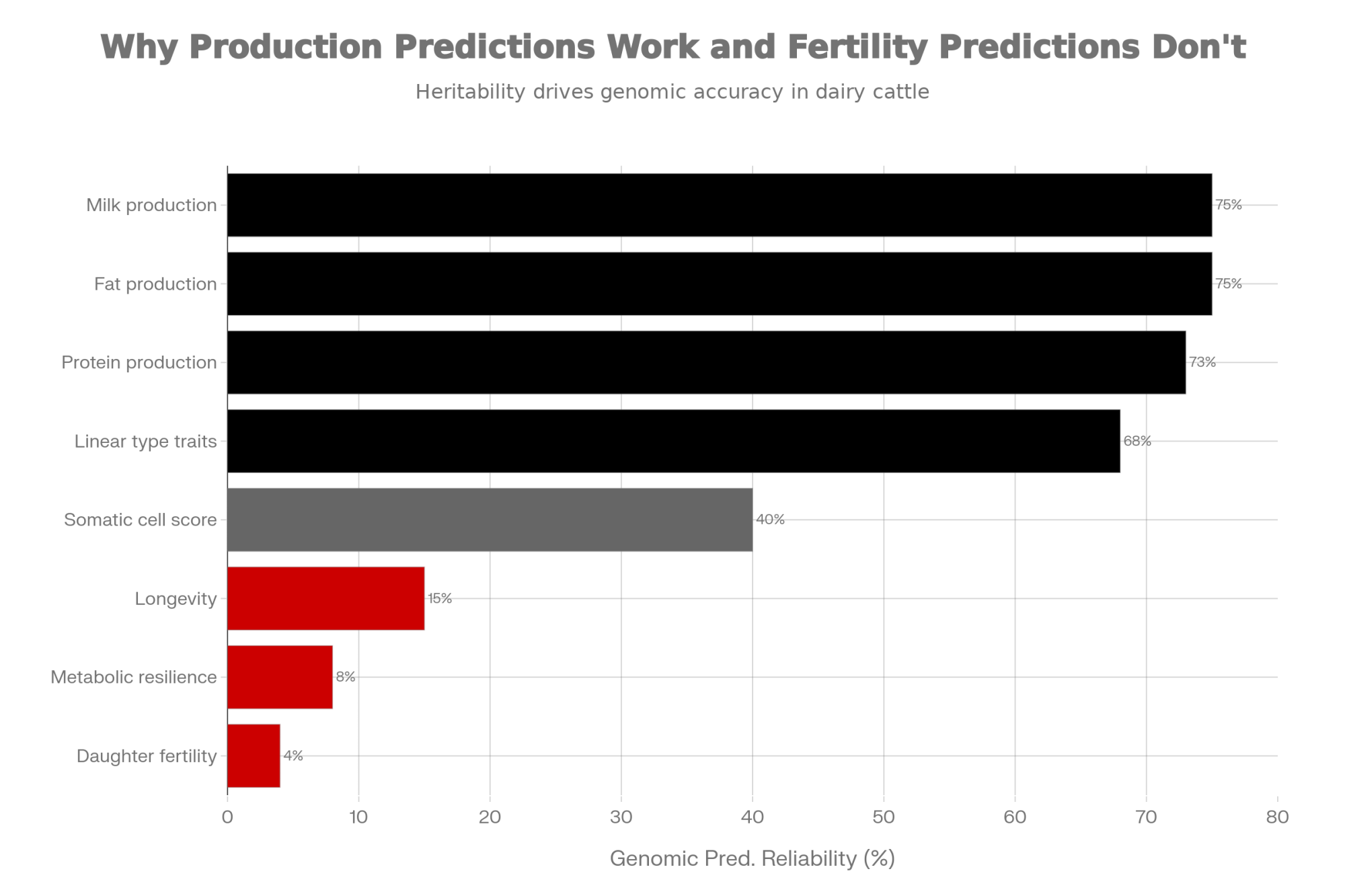
NewsSubscribe
First
Last
Consent

Farmers Think 60% Reject Gene Editing. Research Says 18%. Here’s What That Gap Costs You.

Three years ago, the FDA cleared gene-edited cattle. Today, early adopters have data. Late adopters have… assumptions. Which are you betting your genetics program on?

EXECUTIVE SUMMARY: Dairy farmers estimate 60% of consumers reject gene-edited products. Research shows only 18% are firmly opposed. That perception gap may be the most expensive blind spot in your genetics program. Three years after the FDA cleared SLICK heat-tolerant cattle, early adopters have data—late adopters have assumptions. For heat-stressed herds, the cost of waiting runs $200-250/cow annually, with genetic improvements compounding each generation you delay. But the math isn’t universal: California operations losing $275/cow face a different decision than Wisconsin herds at $75-80. Meanwhile, Indonesia and Pakistan are now importing heat-tolerant genetics—positioning matters. This analysis delivers the research, the regional economics, and a threshold framework to help you decide: adopt, wait, or pass. Your answer depends on your numbers, not industry noise.

Three years and potentially $200-250/cow in heat-stress savings later, North American dairy producers are weighing a decision that’s less about the science itself and more about competitive timing. Here’s what the emerging data suggests—and why the assumptions driving most producers’ hesitation may be years out of date.

Mark Thompson (name changed at his request) runs 650 Holsteins outside Fresno, California, where summer temperatures routinely top 105°F. Last July, he watched his herd’s conception rates drop to 18%—down from 42% in the cooler months. His cooling infrastructure costs nearly $85,000 in electricity alone annually.

“I’ve been following the SLICK genetics conversation for two years now,” Thompson told me when we spoke in early December. “My AI rep keeps bringing it up. But every time I think about pulling the trigger, something holds me back. It still feels like we’re early on this.”

You know, Thompson’s hesitation reflects what I’m hearing from producers across the country—a reasonable caution about adopting new technology balanced against growing questions about what waiting might cost. That push-and-pull is worth unpacking.

Quick Math: Thompson’s Operation

  • Estimated heat stress losses: ~$275/cow × 650 cows = ~$179,000/year
  • Semen premium at current pricing: ~$60/breeding × 200 breedings = ~$12,000/year
  • Net potential benefit: ~$167,000/year (before accounting for multi-year genetic lag)

Your numbers will be different. That’s exactly the point.

RegionAnnual Heat Stress Cost per CowTypical THI Days >72SLICK Break-Even at $60 Semen PremiumAdoption Priority
California (Central Valley)$250-27590-120Year 1High
Texas (South)$220-24085-110Year 1High
Arizona$260-28095-125Year 1High
Wisconsin$75-8025-35MarginalEvaluate
Minnesota$60-7020-30NoLow
Pacific Northwest$50-6515-25NoLow

What European Regulatory Shifts Signal for You

European regulatory shifts on gene-edited crops signal where livestock rules may eventually head—but if you’re tracking this space, don’t expect quick clarity. The EU has been moving toward a more permissive framework for new plant genomic techniques, though several member states, including Germany and Austria, remain cautious. Livestock-specific regulations are still being worked out, and Germany’s retail sector may create de facto barriers regardless of what Brussels decides.

Here’s what matters for your planning: A 2024 survey commissioned by the German Association for Food without Genetic Engineering (VLOG) and conducted by the Civey polling institute with over 5,000 respondents found that 84% of German voters want mandatory labeling for new genetic engineering in food. That’s a significant number, and it creates real tension between regulatory permission and actual market acceptance.

German retailers have shown they’re willing to go beyond what regulations require. Back in 2022, ALDI’s German chains committed to shifting their private-label fresh milk to higher Haltungsform animal welfare tiers, and since then, they’ve steadily moved away from lower-tier sourcing—using welfare labeling as a competitive signal to consumers. Industry observers expect similar dynamics could develop around gene-edited dairy, where regulation might eventually permit it, but major retailers will continue to differentiate based on production methods.

In practice, this probably means Europe’s gene-edited dairy market—whenever it materializes—will develop as a two-speed structure. Denmark, the Netherlands, and parts of France appear more receptive to the technology. Germany and Austria may maintain de facto barriers through retail positioning, regardless of what Brussels ultimately permits. For North American producers thinking about export opportunities down the road, this regional variation matters.

Canadian producers face additional considerations given Health Canada’s separate regulatory process for novel foods and animal products—another variable for cross-border operations to track.

The Performance Data That’s Accumulating

While European regulators deliberate, North American genetics companies have been building a meaningful head start. SLICK genetics—the naturally occurring mutation in the prolactin receptor gene that produces a shorter, slicker coat for better heat dissipation—have been commercially available in beef cattle since the FDA issued its low-risk determination and chose enforcement discretion in March 2022. That’s three years of real-world performance data.

Dr. Raluca Mateescu, professor of quantitative genetics at the University of Florida and one of the lead researchers on SLICK cattle, has documented the performance differences in studies published in the Journal of Dairy Science and Journal of Heredity. Research from her team and collaborators in Puerto Rico has shown that slick Holsteins hold milk production better during hot months and demonstrate shorter calving intervals under tropical conditions compared with their herd-mates—indicating measurable advantages for both production and fertility in heat-stress environments.

I spoke with a producer in south Texas who adopted SLICK genetics two years ago. “The first summer, I wasn’t sure I was seeing much difference,” he told me. “The second summer, when we had that brutal August, my SLICK-sired heifers held production while everything else dropped. That’s when it clicked for me.” His experience isn’t universal—results vary by operation and climate—but it reflects the pattern researchers are documenting.

What’s particularly worth considering is how genetic advantages compound over generations. Producers implementing SLICK genetics in 2026 will have daughters producing by 2028. Those daughters provide lactation data that refines selection for subsequent generations. A producer starting in 2030 enters four years behind operations that have already completed multiple breeding cycles.

Dr. Mateescu framed it this way: “The genetics that go into your herd this year produce daughters that lactate in 2027-2028. Every year you wait, you’re a year behind the producers who didn’t wait. And unlike other management decisions, you can’t accelerate genetics. Biology sets the timeline.”

That’s a consideration worth weighing—though it needs to be balanced against the legitimate questions some producers have about technology maturity and market acceptance.

The Case for Deliberate Waiting

Not everyone is convinced the timing pressure is as urgent as some suggest, and those perspectives deserve serious consideration.

I spoke with a third-generation dairy operator in central Wisconsin who has deliberately decided to hold off. “My heat stress losses run maybe $75-80 per cow in a bad year,” he told me. “Most years it’s less. At current semen premiums, the math just doesn’t work for my operation. I’m not opposed to the technology—I’m just not going to pay a premium for a problem I don’t really have.”

His point is worth sitting with. A Wisconsin producer at $80/cow heat losses and a Fresno producer at $280/cow are facing fundamentally different math. For Upper Midwest, Northeast, and Pacific Northwest operations, where heat-stress events are less frequent and less severe, the economic case looks fundamentally different.

There’s also a reasonable argument for letting early adopters work through the learning curve. “Someone has to be first,” another producer in Minnesota mentioned. “But that doesn’t have to be me. I’d rather see three or four more years of commercial data before I commit my breeding program.”

That’s not resistance to technology—it’s rational risk management.

Beyond Heat Stress: The Broader Genetic Shift Coming

Heat tolerance represents the first commercially available application of gene editing in cattle, but it’s not the only trait in development. The same precision editing techniques are being applied experimentally to other welfare-relevant traits—and this broader shift may reshape how consumers and producers think about genetic technology altogether.

Gene editing has already been used experimentally to produce polled dairy calves—born without horn buds—which, if commercialized at scale, could eliminate the need for traditional dehorning. According to USDA’s 2014 NAHMS Dairy study and related welfare research, roughly 94% of U.S. dairy operations disbud or dehorn heifer calves. No commercial timeline for polled gene-edited dairy cattle has been announced, but the research is progressing.

As these alternatives approach availability, an interesting question arises: How will consumers view operations that continue traditional procedures when genetic alternatives exist? I don’t think anyone knows the answer yet, but it’s worth considering.

Work from Dr. Candace Croney’s team at Purdue University’s Center for Animal Welfare Science suggests that when gene editing is explicitly tied to animal welfare benefits—such as reduced pain or better heat comfort—consumer acceptance rises noticeably, and a substantial share of consumers report they’d be willing to pay more for those products.

Consumer SegmentNo Context (%)Heat Comfort Benefit (%)Polled Benefit (%)
Firmly Opposed22%18%15%
Skeptical but Persuadable28%20%18%
Neutral30%25%22%
Supportive15%24%28%
Strong Supporters5%13%17%

The Perception Gap You Should Know About

This brings me to something genuinely surprising from the research—and it’s worth paying attention to.

European consumer research, including work from the University of Copenhagen published in peer-reviewed journals, has found that when benefits are clearly explained, only about one in five consumers express firm opposition to gene-edited dairy products—substantially lower than most farmers estimate.

When farmers in those same studies estimated consumer response to gene-edited dairy, most thought only 30-40% would accept it. The research suggests acceptance runs considerably higher than that.

Think about that: most of us have been making breeding decisions based on consumer resistance assumptions that the research says are roughly twice the actual level. That’s a meaningful blind spot.

Why might this be? Anti-GMO messaging is organized, visible, and gets significant media coverage. But across multiple consumer studies on GM and gene-edited foods, researchers commonly find a relatively small but vocal minority who are strongly opposed, while a much larger middle group is either neutral or open to these technologies once they understand the benefits—particularly when those benefits relate to animal welfare.

There’s also loss aversion to consider. Behavioral economics research consistently finds people weight perceived losses roughly twice as heavily as perceived gains when evaluating new decisions—a pattern that applies to technology adoption in agriculture. The immediate $50-75 premium for gene-edited semen feels more significant than a delayed annual benefit per cow—even when the math clearly favors adoption over time.

Dr. Nicole Olynk Widmar at Purdue, who’s done extensive published work on agricultural technology perceptions, put it to me this way: “Producers are making rational decisions based on the information environment they’re in. But that information environment is heavily weighted toward vocal opposition. The silent majority of consumers who are neutral or positive just don’t show up in the same way.”

Consumer attitudes can shift, and survey responses don’t always predict purchasing behavior. But the size of this perception gap suggests many producers may be working with assumptions that are years out of date.

The Global Picture—And Why It Matters for Your Genetics

For those of you tracking export genetics opportunities, here’s the global context in brief.

Indonesia has set a target of importing around 1 million dairy cattle by 2029 under their Fresh Milk Supply Road Map, according to Agung Suganda, director general of livestock and animal health at Indonesia’s Ministry of Agriculture. The opportunity isn’t selling commodity milk—it’s supplying heat-tolerant genetics that make tropical dairy production viable.

In May 2025, University of Florida researchers shipped the first SLICK Holstein genetics to Pakistan, working with a commercial operation called DayZee Farms in Bahawalpur, Punjab province, where temperatures routinely exceed 115°F in summer. Traditional Holstein genetics struggle in those conditions—this is exactly the kind of market where heat-adapted genetics could become essential.

China is building domestic breeding capabilities rather than remaining dependent on Western genetics. And recent trade actions—China imposed provisional duties of up to 42.7% on EU dairy products effective December 23, 2025, according to multiple news sources, including Reuters and ABC News—suggest the country views dairy increasingly through a strategic lens.

Operations building heat-adapted genetics now are positioning for export markets that may become significant—but that window may not stay open indefinitely.

Running Your Numbers: A Decision Framework

So what does this mean for your operation? Here’s how to think through it:

  • As a rough threshold: Operations seeing heat-stress losses above $150/cow annually in an average year are likely candidates for serious evaluation. Those below $75/cow may find the current semen premium harder to justify. Between those numbers? That’s where your specific circumstances—facilities, climate trajectory, breeding goals—really matter.
  • Understand your actual heat stress economics. Pull DHI records from the last three summers. Identify days when your Temperature-Humidity Index exceeded 68-72. Calculate the production drop compared to your spring and fall baseline. When Thompson dug into his records, he estimated that heat stress was costing him about $250-300 per cow annually. The Wisconsin producer pegged his at $75-80. Those aren’t national benchmarks—they’re individual calculations that show how sharply the economics diverge by region.
  • Have the availability conversation. SLICK genetics are commercially available through university programs and select AI providers, with availability expanding. Ask your rep about current sire offerings and pricing in your market, and whether they can connect you with producers in your region who’ve made the switch.
  • Factor genetics into infrastructure decisions. If you’re planning significant upgrades to cooling infrastructure, consider model genetics as a partial alternative. SLICK genetics won’t eliminate cooling needs in serious heat-stress environments, but they may deliver a meaningful portion of the benefit at lower cost.
  • Document your baseline. Whatever you decide, keep detailed records. If you adopt, you’ll want data showing improvement. If you wait, you’ll want to understand what that decision cost—or saved—you.
Heat Stress Loss ($/cow/year)Years to Break EvenAnnual ROIEconomic VerdictTypical Regions
$50-755-7 yearsLow (10-15%)Hold – Wait for cost declinePNW, Upper Midwest
$75-1253-4 yearsModerate (20-30%)Marginal – Evaluate closelyWisconsin, N. Minnesota
$125-1752-3 yearsStrong (35-50%)Favorable – Consider adoptionIowa, S. Wisconsin, N.Y.
$175-2501-2 yearsVery Strong (60-80%)Strong – Adopt strategicallyMissouri, S. Texas
$250+<1 yearExceptional (90%+)Compelling – Delay costs moneyCA, AZ, S. TX

Your Next 30 Days

  1. Pull DHI records for the last three summers—calculate your actual heat stress cost per cow
  2. Call your AI rep and ask specifically about SLICK sire availability and current pricing
  3. If cooling infrastructure investment is on your horizon, model genetics as a partial alternative
  4. Watch for processor/retailer sustainability messaging shifts in your market
  5. Document your 2025 baseline so you can measure whatever you decide

Finding the Right Path for Your Operation

The gene-editing question isn’t really about whether the science works—the accumulating data from the University of Florida and commercial operations suggest it does. And it’s increasingly less about whether consumers will accept it—the research shows most will when benefits are explained, though some uncertainty remains.

The question is about timing, risk tolerance, and competitive positioning. And reasonable people can reach different conclusions.

Thompson called me last week with an update. He’s planning to breed 30% of his heifers to SLICK sires starting this spring. “I’m not going all-in,” he said. “But I’m done waiting for perfect certainty. The cost of being wrong looks a lot smaller than the cost of being late.”

That’s one framework—partial adoption that builds experience while maintaining flexibility. The Wisconsin producer is taking a different approach, deliberately waiting until the economics make more sense for his climate. The Minnesota dairyman wants more commercial data before committing.

Each of these can be the right decision depending on circumstances.

What’s clear is this decision deserves fresh evaluation—not because adoption is right for everyone, but because the assumptions driving most producers’ hesitation may be three years out of date. The landscape has evolved. In a global market, you’re either the one setting the pace or the one wondering where the margin went. Your 2026 breeding list is the first signal of which one you intend to be. Choose based on your math, not your neighbor’s comfort zone.

Key Considerations for Your Decision

  • Your heat stress threshold matters most. Above $150/cow in annual heat losses? Serious evaluation warranted. Below $75/cow? Current premiums may not pencil. Know your number before deciding.
  • Consumer resistance is lower than you probably think. European research consistently shows that only about one in five consumers firmly oppose gene-edited dairy when benefits are explained. Most farmers estimate roughly half that acceptance level—a meaningful blind spot worth correcting.
  • The welfare narrative is shifting. When gene editing is framed around animal welfare benefits, consumer acceptance increases substantially. Watch for shifts in processor messaging in your market.
  • Genetic improvement compounds. Decisions made in 2026 produce results in 2028; subsequent generations build on that. Biology sets the timeline—you can’t accelerate later.
  • European markets are fragmenting. German retail dynamics may create barriers even with EU regulations in place. Factor this into export genetics calculations.
  • Deliberate waiting can be rational. For cooler climates with minimal heat stress, or operations wanting more commercial data, waiting may be appropriate. The right answer depends on your math, not industry hype.

The Bottom Line

Here’s my take: Gene editing in dairy isn’t a question of if anymore—it’s a question of when and whether it fits your operation. The producers I respect most aren’t rushing in or digging in their heels; they’re running their own numbers, watching the early data, and making decisions based on their specific circumstances rather than industry hype or outdated fears. 

KEY TAKEAWAYS 

  • You’re likely 3X wrong on consumer rejection. Farmers estimate 60% oppose gene editing. European research shows 18%. That gap may be the most expensive assumption in your genetics program.
  • Your threshold: $150/cow in heat-stress losses. Above that annually? Gene editing math likely works. Below $75? It probably doesn’t. In between? Your specific numbers decide.
  • Genetics compound. Delay doesn’t. 2026 semen → 2028 daughters → 2030 granddaughters. Wait until 2030 to start, and you’re four years behind the herds that moved now.
  • Same technology, 4X different economics. A Fresno operation losing $275/cow and a Wisconsin herd at $75/cow aren’t facing the same decision—even when the pitch sounds identical.
  • Deliberate waiting is thoughtful. Defaulting to “not yet” isn’t. If you’re holding off based on your climate and math, that’s a strategy. If you’re holding off based on 2019 assumptions, that’s a blind spot.

Complete references and supporting documentation are available upon request by contacting the editorial team at editor@thebullvine.com.

Learn More

Join the Revolution!

Join over 30,000 successful dairy professionals who rely on Bullvine Weekly for their competitive edge. Delivered directly to your inbox each week, our exclusive industry insights help you make smarter decisions while saving precious hours every week. Never miss critical updates on milk production trends, breakthrough technologies, and profit-boosting strategies that top producers are already implementing. Subscribe now to transform your dairy operation’s efficiency and profitability—your future success is just one click away.
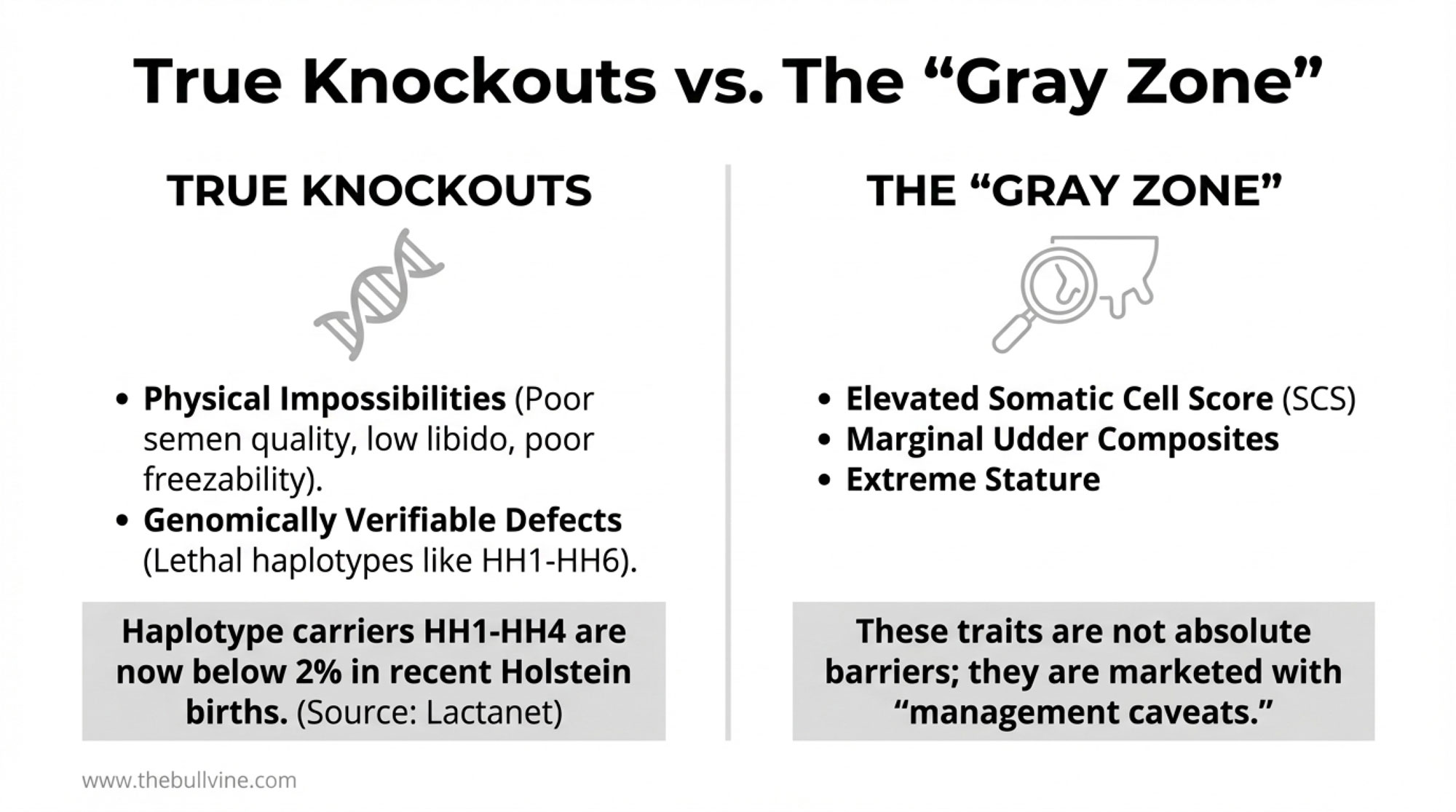
NewsSubscribe
First
Last
Consent

The Room Went Quiet. Everyone Left. Then an $8,100 Phone Call Changed Holstein History Forever.

The untold stories of Rudy Missy, Blackrose, and the stockmen who saw what the experts couldn’t

It was early October in Madison, Wisconsin, and World Dairy Expo week had arrived.

For the Genosource team back in Iowa, this year carried extra weight, this year carried extra weight. Ladyrose Caught Your Eye—the Unix daughter they’d acquired immediately after Madison in 2021—had already achieved EX-95, cementing her place among the breed’s elite. Now she was back on the colored shavings, a three-time class winner, an All-American, an All-Canadian, representing a bloodline that had defied the odds for three decades.

Ladyrose Caught Your Eye on the colored shavings at World Dairy Expo—a three-time class winner whose EX-96 mammary system tells only part of the story. The real story is the three decades of setbacks, second chances, and stubborn belief that put her there.

“She is one of those rare cows that combines cow family, show-winning type, and high genomics,” Tim Rauen of Genosource recalls. Standing in that ring in October, she was living proof.

I’ve covered many Expos over the years I’ve been writing about this industry. But what keeps bringing me back to this cow isn’t the banners or the scores—it’s knowing the decades of setbacks, second chances, and stubborn belief that led to her standing in that ring.

Because here’s what most people watching that week didn’t fully understand: they weren’t just witnessing one cow’s achievement. They were seeing the living proof of stories that began with barn fires, bankruptcy courts, rock stars investing in Holsteins, and phone calls that changed everything.

And those stories—the ones behind the cow in front of them—are what this is really about.

The Call That Changed Everything

Twenty-one years earlier, on a February afternoon in 2003, snow was falling sideways outside the Wisconsin Holstein Convention Sweetheart Sale.

The room was emptying. Experienced breeders—men who had driven through farm country slush and missed morning milking to be there—were already heading for the exits. A five-year-old Holstein named Wesswood-HC Rudy Missy stood in the ring, and the bidding had stalled at a price that felt almost insulting.

Her rump “wasn’t entirely balanced.” That’s what they were saying. And in the unforgiving world of elite cattle auctions, that phrase might as well be a death sentence.

Steve Hayes watched another bidder shake his head and walk away, and felt that familiar mix of disappointment and creeping doubt that every breeder knows—the voice that whispers whether you’ve been fooling yourself all along. This cow he’d helped develop, believed in, poured years into. Was she really going to slip through the cracks like this?

Then the phone rang in the back office.

Matt Steiner’s voice crackled through from Pine-Tree Dairy down in Ohio. The man had never even laid eyes on this cow in person. But something about her—maybe thirty years of studying what makes genetics tick, maybe an instinct honed through decades of disappointment and triumph—told him everything he needed to know.

His $8,100 bid secured what would become the  2014 Global Cow of the Year.

Seagull-Bay Supersire-ET stands proudly at Select Sires, representing the commercial pinnacle of the Wesswood-HC Rudy Missy genetic legacy. From a cow that couldn't attract buyers at $7,000 to a bull achieving millionaire status in AI sales, Supersire embodies how exceptional maternal genetics can reshape an entire industry. His success validates what Matt Steiner saw in that 2003 phone bid—sometimes the most transformative genetics come in

Seagull-Bay Supersire-ET stands proudly at Select Sires, representing the commercial pinnacle of the Wesswood-HC Rudy Missy genetic legacy. From a cow that couldn’t attract buyers at $7,000 to a bull achieving millionaire status in AI sales, Supersire embodies how exceptional maternal genetics can reshape an entire industry. His success validates what Matt Steiner saw in that 2003 phone bid—sometimes the most transformative genetics come in unexpected packages.

I keep thinking about that moment. A roomful of experts walking away from a cow that would reshape the breed, and one man on a phone line three states away who saw what they couldn’t. Today, her descendants include Seagull-Bay Supersire—with over 100,000 daughters worldwide—and Genosource Captain, who held the #1 TPI position for seven consecutive proof runs through December 2024 and remains among the breed’s most influential sires. The genetic value flowing from that single $8,100 phone bid has generated hundreds of millions in semen sales.

But here’s what I keep coming back to when I think about this story. It’s something Steve Wessing, Missy’s original co-breeder, said when reflecting on her journey: “I don’t think she would’ve ever scored EX-92 at our place.”

That’s the kind of honesty you don’t hear often enough—recognizing that cattle reach their potential in different environments, under different management systems. Matt Steiner didn’t just buy a cow that day. He gave her a stage where she could finally perform.

Of course, Steiner didn’t know that’s what he was doing. Nobody did. That certainty only comes later, when you’re telling the story. Living it is different.

The Two Steves: A Friendship Built Across a Fence Line

To understand how Rudy Missy even existed, you have to go back to a different Wisconsin pasture in the early 1990s.

Steve Wessing had started with eighteen registered Holsteins from the Milkstein herd—animals that came with warnings. “There wasn’t a lot of type in that herd,” the industry veterans told him and his wife, Cheryl. And honestly? The experts weren’t wrong. When those first cows got classified, only one scored Very Good: Milkstein Citation Della.

Nothing about Della screamed “genetic goldmine.” She was just a cow that showed up every day, did her job, and kept producing. The kind of cow you don’t think twice about.

But Steve Wessing trusted his eyes over other people’s opinions. And his neighbor, Steve Hayes, was paying attention.

Here’s what I love about this part of the story. Hayes walked past that fence line between their places every morning. He’d pause and study those young cows—the depth through their hearts, how they moved around the feed bunks. That quality you recognize when you see it, even if you can’t quite name it yet.

When Della’s granddaughter Wesswood Elton Mimi came along, both Steves knew they were looking at something special.

“She was a treasure of a cow, very low maintenance, easy to work with,” they’d later recall. “When new feed was delivered, she made sure she had her own place at the front of the line.”

I can picture her so clearly from that description. The kind of cow with personality. The kind you remember long after she’s gone.

Then the fire came.

The Night Everything Almost Ended

Anyone who’s been through it knows that a barn fire is the nightmare that never fully leaves you. The smell of smoke mixing with the panicked bellowing of cattle. The helplessness of watching years of work potentially disappear into the night air. The questions that come later—what could I have done differently, was there something I missed, why us?

Devastating flames tore through the Wisconsin barn one night, and thirteen-year-old Claudette—Mimi’s grandmother, who had already pumped out a quarter million pounds of milk for the Wessings—stood among the smoke and chaos. She survived, thank God. But hip problems from the trauma meant her production career was effectively over. She would have easily hit 300,000 pounds.

Steve Wessing stood in that ash-covered milking parlor afterward, doing the math that nobody wants to do. Adding up what was lost. Subtracting what insurance might cover. Trying to figure out if there was a path forward, or if this was the ending he’d never planned for.

By December 1994, he made the call that went against every farming instinct he had: dispersal sale.

Anyone who’s ever had to let go of something they built knows what that decision costs. It’s not just business. It’s admitting that sometimes the thing you poured yourself into doesn’t get to continue the way you planned. It’s signing the paperwork and then going home to a barn that feels different. Quieter. Wrong.

But then—and this is the part that still gets me—something happened that only happens when people genuinely care about each other.

Steve Hayes had worked out an understanding with his neighbor before the auction: if Hayes bid highest on Mimi, they’d own her together.

Think about that for a moment. A neighbor, watching another neighbor face the unthinkable, steps in instead of standing back. Not to buy cheap—to share the burden. To make sure the genetics survive. To keep his friend connected to something worth saving.

Watching Hayes keep raising his hand as the price climbed past what made most breeders squirm was something those present never forgot. When the gavel fell, two friends from rural Wisconsin suddenly owned what would become one of the most valuable cows in Holstein history.

Neither of them had any clue what they’d just bought.

The Heifer Calf Nobody Expected

When Mimi was bred to Startmore Rudolph—a breeding the AI stud specifically wanted because they expected a bull calf—the two Steves stood in that pasture together, both knowing this decision would either validate their partnership or haunt them for decades.

In 1997, a heifer calf was born: Wesswood-HC Rudy Missy.

At the time, a heifer when you wanted a bull just feels like the universe not cooperating. Again. You do the math on what you were hoping to sell, and you adjust. You move on. It’s only looking back that you can see how the thing that frustrated you became the thing that mattered most.

But that’s cold comfort when you’re standing in the barn wondering what went wrong.

As a cow, though, Missy became what geneticists call a “genetic multiplier”—ultimately producing eighteen sons in AI service and forty-two daughters classified Excellent or Very Good.

What nobody talks about is the waiting. You make a breeding decision, and you won’t really know if it worked for years, sometimes longer. You’re betting a piece of your future on outcomes you can’t see yet. Every one of these breeders lived through stretches where they just had to trust the process and keep showing up—not knowing whether they were building something or wasting their time.

Today, the Steiner family at Pine-Tree Dairy still welcomes Holstein enthusiasts during Ohio Holstein Convention tours. The legacy Matt Steiner’s phone call started continues through his sons, who initially had their doubts about Missy’s curved legs and long teats but learned to trust their father’s eye.

“We acquired her immediately after Madison in 2021,” Tim Rauen of Genosource recalls about Caught Your Eye, another cow woven into this genetic tapestry. “She is one of those rare cows that combines cow family, show-winning type, and high genomics.”

You see the same thing happening, over and over: stockmen seeing what others miss, trusting instinct over auction-day consensus, waiting to find out if they were right.

Breeding Gold from the Ashes of Financial Disaster

While Rudy Missy’s story unfolded in Wisconsin, another drama was playing out that would prove equally consequential—this one born from complete financial collapse.

The 1980s Investor Era had transformed dairy breeding into a playground for tax-bracket-chasing bankers. Section 46 of the Internal Revenue Code allowed wealthy outsiders to write off cattle purchases against their personal income, and prices went absolutely insane. Bulls that should have commanded $50,000 were selling for ten times that.

This was the era when John Lennon of The Beatles invested through George Morgan’s Dreamstreet operation—”threw so much money in the pot that they had to get rid of some of it very quickly,” as industry insiders recalled. Spring Farm Fond Rose, purchased for $56,000 with Lennon’s investment, sold for $250,000 just a few years later. Even rock royalty couldn’t predict which bloodlines would endure—but the money flowing into Holstein genetics signaled something extraordinary was happening in American agriculture.

Jack Stookey was the perfect man for that era—smooth as silk, could charm anyone. He built an empire on other people’s money, snapping up champions and dominating shows.

But bubbles always burst. They always do.

When the IRS started challenging these tax schemes, the money dried up overnight. What followed is hard to tell, even now.

On a Saturday afternoon in winter 1985, Stookey couldn’t pay his hired help, so he instructed them to load a trailer with bull calves destined for slaughter—animals he had previously planned to sell for breeding purposes. Among them were three sons of Continental Scarlet. An AI stud had already spoken for one of the bulls, but Jack couldn’t wait. The bills couldn’t wait.

I think about the hired hands who had to load those calves, knowing what was coming. About Jack making that call because there was no other call to make. About genetics that could have shaped the breed for generations, gone because the bills couldn’t wait another week.

There’s no clean way to tell that story. It’s just loss, compounded.

The Man Who Saw Something in the Wreckage

But where most people saw only the ashes of Stookey’s empire, Louis Prange saw something else entirely.

While everyone else was running from the mess, Prange looked at that barn full of world-class cattle sitting in legal limbo and recognized what nobody else could see. Decades of careful breeding don’t just vanish because someone files for bankruptcy, right? The genetics are still there. The potential is still there.

Prange worked out a deal with the bankruptcy trustee to lease the best cows, flush embryos, and split the proceeds. Among those salvaged genetics was Nandette TT Speckle-Red—the same red-and-white cow that had been dominating shows just years before.

What Prange did next still strikes me as quietly brilliant.

He planned what’s called a “corrective cross”—mating two animals whose strengths perfectly complement each other’s weaknesses. He wanted to breed Speckle to To-Mar Blackstar, a production powerhouse who could pump out incredible milk volumes but needed help on the structural side.

Jack, even in bankruptcy, was still trying to call shots, pushing for different bulls. When it came time to deliver the semen: “My tank ran dry,” he told Prange during that famous phone call.

So Prange went with his gut.

On March 24, 1990, Stookey Elm Park Blackrose came into this world—born in the shadow of bankruptcy court, conceived through a vision of what could be rather than what was.

Of course, standing in that barn in March 1990, nobody knew any of this. Prange had a calf. That’s all. Whether she’d amount to anything—whether any of them would—was still just hope and guesswork. The certainty only comes later, when you’re telling the story. Living it means showing up every day, not knowing if the bet will pay off.

First and Only: The Red Revolution That Changed Everything

The legendary Stookey Elm Park Blackrose, a cow whose massive frame and amazing udder, captured here, hinted at the genetic revolution she would unleash.

When Blackrose hit the auction block in December 1991, she was just an 18-month-old Blackstar daughter selling for $4,500.

Mark Rueth was fitting cattle at that sale, and he had this feeling about her. He told his buddy Mark VanMersbergen: “This heifer’s got something special. Deep-ribbed, wide-rumped… you just know.”

They partnered with the Schaufs from Indianhead Holsteins on what turned out to be one of the most significant cattle purchases in Holstein history.

Blackrose grew into a massive, commanding presence that dominated wherever she went. Her numbers were off the charts: 42,229 pounds of milk at five years old, with 4.6% butterfat and 3.4% protein. That EX-96 classification put her in conversation with the most structurally perfect cows ever evaluated.

But the real magic was what she produced.

The culmination of a dynasty: Lavender Ruby Redrose-Red (EX-96). In 2005, she achieved the impossible, becoming the first Red & White cow ever named Supreme Champion at World Dairy Expo, proving the enduring magic of the Blackrose line.

Her lineage eventually led to Lavender Ruby Redrose-Red, who in 2005 did something that still stops me when I think about it— first Red & White cow ever named Supreme Champion over all breeds at World Dairy Expo.

First and only. Let me tell you what that moment meant.

For decades, breeders working with red genetics had been told—sometimes subtly, sometimes not—that their cattle were “second tier.” Beautiful, sure. Competitive within their color class, absolutely. But Supreme Champion material? The conventional wisdom said no.

When Redrose-Red stood alone in that Coliseum at the Alliant Energy Center in Madison, above every black and white champion in the building, it wasn’t just a win. It was permission. Permission to finally exhale. To stop defending what they’d chosen to love. To know, just once, that the doubters had been wrong all along.

For people who had spent their careers hearing “not quite good enough,” watching that cow take her place in history meant something that went bone-deep. The kind of vindication you wait a lifetime for and aren’t sure will ever come.

From bankruptcy to the history books in fifteen years.

And now, two decades later, that same bloodline flows through Ladyrose Caught Your Eye—the EX-95 cow who dominated the colored shavings at World Dairy Expo 2024 and proved the dynasty is far from finished.

What the Industry Still Gets Wrong

Here’s the uncomfortable truth that these stories reveal, and it’s something most people in our business don’t want to admit:

We are systematically terrible at recognizing genetic value when it stands right in front of us.

Rudy Missy’s “unbalanced rump” had breeders heading for the exits. Designer Miss sold for $2,100—the lowest price at the legendary 1985 Hanover Hill dispersal—while Brookview Tony Charity commanded $1.45 million at the same sale. Blackrose went for $4,500 at a bankruptcy auction. Even Lennon’s money couldn’t predict which Dreamstreet genetics would endure and which would fade.

Every single one of these so-called “rejects” outperformed the million-dollar sure bets.

The conventional wisdom of their eras dismissed them. The data available couldn’t fully capture what made them special. And yet, stockmen like Matt Steiner, Louis Prange, and the two Steves saw something—felt something—that the catalogs and classification scores couldn’t quantify. (For more on influential maternal lines, see The 7 Most Influential Holstein Brood Cows of the Modern Era.)

Today’s genomic tools are powerful. They tell us more than we’ve ever known. But even now, in December 2025, with all our technology, the fundamental challenge remains the same: the biggest mistake in dairy genetics isn’t buying the wrong cow—it’s walking away from the right one because she doesn’t look perfect on paper.

The Living Proof

As I write this, the legacies of these matriarchs aren’t historical footnotes—they’re actively shaping breeding decisions on farms from Wisconsin to New Zealand.

Genosource Captain—who held the #1 TPI position for seven consecutive proof runs through December 2024 and remains among the breed’s elite sires—traces directly back to Rudy Missy. The cow everyone walked away from at that Wisconsin sale barn is now the grandmother of one of the most influential bulls of his generation.

Ladyrose Caught Your Eye has produced four high-type sons by Lambda—currently one of the breed’s most sought-after sires for type—while continuing to dominate show rings. Her lineage traces directly back to Blackrose, the bankruptcy-born cow that rewrote what was possible for Red Holsteins.

And here’s something that keeps me thinking: Rudy Missy’s great-granddaughter, Ammon-Peachy Shauna-ET, was named 2015 Global Cow of the Year—making grandmother and great-granddaughter back-to-back Global Cow winners. That kind of consistency across generations isn’t luck. It’s something deeper.

Ammon-Peachy Shauna-ET in front of the milkhouse at Seagull Bay Dairy.

The Steiner family at Pine-Tree Dairy continues hosting tours for Holstein enthusiasts, passing on the philosophy that maternal lines matter more than we ever thought.

I’d be lying if I said these outcomes were inevitable. Good decisions help. But so does timing you can’t control, and breaks that could easily have gone the other way. The two Steves were skilled, but they were also lucky—lucky the fire didn’t take more, lucky Hayes had the cash to bid, lucky that heifer calf had the genetics she had. Skill positions you. Luck decides.

What This Means for All of Us

I’ve spent months with these stories, and what strikes me most isn’t the scale of the achievement—it’s how human the whole thing is.

These aren’t tales of corporate breeding programs with unlimited resources. They’re stories of neighbors becoming partners across fence lines. Of a man betting his career on a phone call to buy a cow he’d never seen. Of someone salvaging genetics from a bankruptcy court when everyone else had given up. Of friendships that turned into dynasties.

What drove all of them forward wasn’t just data or dollars. It was observation, intuition, and the willingness to trust what they saw when everyone else was walking away.

What I don’t want to do is make this sound easy—like all you need is good instincts, and everything works out. For every Rudy Missy, there are cows that didn’t pan out. Partnerships that didn’t survive. Bets that cost people money they couldn’t afford to lose. The stockmen in these stories weren’t right every time. They were right often enough, and they kept going anyway. That’s the part that’s harder to teach.

The lessons these matriarchs leave us are simple to say, harder to live:

  • Trust your eyes over conventional wisdom. Steve Wessing bought cattle that others warned him about. Matt Steiner bid on a cow he’d never seen. Louis Prange invested in genetics that everyone else had abandoned.
  • Build partnerships with people who share your vision. The two Steves created more together than either could have alone. Great genetics need great teams.
  • Focus on transmission, not just individual performance. The cows that built empires weren’t always the flashiest—they were the ones who consistently passed their best traits to the next generation, regardless of the environment.
  • Be patient through adversity. Fires, bankruptcies, dismissive auctions—these setbacks became stepping stones for those who kept going when quitting would have been easier. And quieter. And probably smarter, on paper.

The Question That Matters

The next time you’re at a sale—or walking through your own barn before dawn, studying a heifer that doesn’t quite fit the mold—I hope you’ll think about these stories.

That heifer in the back pen, the one with the slightly off topline your neighbor dismissed last week. Maybe she’s nothing special. Or maybe she’s carrying something you can’t see yet—something that won’t show up for another generation or two.

Somewhere right now, a cow that nobody’s paying attention to is quietly carrying the genetics that will reshape our industry for the next fifty years. The question isn’t whether she exists.

The phone’s ringing. The room’s going quiet. The experts are walking away.

And somewhere in that ring—or in your own barn tomorrow morning—there’s a cow nobody’s fighting for.

Maybe that’s the one.

KEY TAKEAWAYS:

  • $8,100 built a genetic empire. Matt Steiner bought Rudy Missy by phone while experts walked away. She became the 2014 Global Cow of the Year—her descendants are worth hundreds of millions.
  • The cheap cow won. Designer Miss: $2,100. Brookview Tony Charity: $1.45 million. Same 1985 sale. The “reject” outperformed the record-breaker.
  • Friendship outlasts disaster. When fire forced Steve Wessing’s dispersal, his neighbor bid to share the loss—not profit from it. That partnership built a dynasty.
  • Bankruptcy can’t kill great genetics. Louis Prange salvaged Blackrose from court chaos. Fifteen years later: the first and only R&W Supreme Champion in World Dairy Expo history.
  • The cow nobody’s fighting for might be the one. Every empire here started with an animal that the industry dismissed. The next Rudy Missy is in someone’s barn right now. Maybe yours.

Learn More

Join the Revolution!

Join over 30,000 successful dairy professionals who rely on Bullvine Weekly for their competitive edge. Delivered directly to your inbox each week, our exclusive industry insights help you make smarter decisions while saving precious hours every week. Never miss critical updates on milk production trends, breakthrough technologies, and profit-boosting strategies that top producers are already implementing. Subscribe now to transform your dairy operation’s efficiency and profitability—your future success is just one click away.

NewsSubscribe
First
Last
Consent

How Genetic Innovations Have Reversed Declining Fertility in U.S. Holstein Cows

Discover how genetic innovations have reversed declining fertility in U.S. Holstein cows. Can improved breeding and management boost both productivity and sustainability?

For years leading up to 2000, U.S. Holsteins grappled with a critical issue. As milk production surged, fertility rates saw a discernible decline. This concerning trend stemmed from the inherently negative correlation between production and fertility in dairy cows. The genetic traits that facilitated increased milk yields also predisposed these cows to diminished reproductive efficiency. As milk production soared, reproductive performance faltered—a biological trade-off rooted in dairy cattle genetics.

The Year 2000 Marked a Significant Turning Point for U.S. Holstein Fertility 

The turn of the millennium initiated a pivotal shift in breeding strategies, pivoting towards a more holistic approach emphasizing long-term health and productivity beyond mere milk yields. Previously caught in a downward spiral due to an exclusive focus on production, dairy cow fertility began to experience a much-needed resurgence. 

What catalyzed this change? The cornerstone was the broadening of genetic ambitions. Until the turn of the century, breeding initiatives were singularly geared toward maximizing milk production, often at the expense of crucial traits such as fertility. However, starting in the late 1990s, the industry began recognizing the importance of herd longevity and overall fitness. 

In particular, 1994 marked a watershed moment by including the ‘Productive Life’ trait in the Net Merit index. This move indirectly promoted better fertility rates through extended productive lifespans. By integrating longevity and its beneficial link to fertility, breeders indirectly enhanced fertility within herds. 

The early 2000s heralded the advent of direct fertility metrics in selection indexes. With the introduction of the Daughter Pregnancy Rate (DPR) in 2003, the dynamics of dairy genetics underwent a transformative change. For the first time, dairy producers could target fertility directly without compromising milk production. 

These strategic adjustments fostered a balanced approach to genetic selection, resulting in favorable milk yield and fertility trends. This dual focus arrested the decline in fertility and spurred ongoing improvements. It exemplifies the synergistic power of cutting-edge genetic tools and strategic breeding objectives.

DPR Introduction (2003): Impact of Directly Selecting for Cow Fertility 

Introducing the Daughter Pregnancy Rate (DPR) into the Net Merit Index 2003 catalyzed a paradigm shift in dairy breeding strategies. By directly targeting cow fertility, dairy producers gained a valuable tool to enhance reproductive performance with precision. This strategic emphasis on fertility bolstered pregnancy rates and significantly advanced herd health and sustainability.  

Before DPR’s inclusion, fertility was frequently marginalized in dairy cow breeding, overshadowed by the relentless focus on milk yield. The incorporation of DPR empowered breeders to select bulls whose daughters exhibited superior reproductive efficiency, thereby directly confronting fertility challenges. This resulted in marked gains in pregnancy rates and decreased inseminations required per conception.  

Moreover, selecting for DPR extends well beyond fertility improvement; it enhances herd longevity. Cows with higher conception rates typically experience fewer health issues, leading to extended productive lifespans. This improves animal welfare and translates into substantial economic advantages for dairy producers, such as decreased veterinary expenses, reduced involuntary culling rates, and streamlined herd management.  

Environmental gains are also significant. Increased fertility and prolonged productive lifespans of cows mean fewer resources are needed to sustain the herd, thereby decreasing the environmental footprint of dairy farming. Enhanced pregnancy rates are critical in lowering greenhouse gas (GHG) emissions, leading to more sustainable dairy production practices.  

Integrating the Daughter Pregnancy Rate within the Net Merit index has redefined the dairy cattle breeding landscape. Dairy producers have successfully pursued holistic and sustainable genetic progress by balancing fertility with production traits. This strategic evolution highlights the essential nature of a comprehensive breeding approach—one that equally prioritizes production efficiency, animal health, and environmental responsibility.

National Database Contributions: Establishment of Sire, Cow, and Heifer Conception Rates (2006 and 2009) 

When the Council on Dairy Cattle Breeding (CDCB) introduced the national cooperator database, it marked a seminal development in dairy genetic evaluation. Initiated between 2006 and 2009, this comprehensive database encompassed vital traits such as Sire Conception Rate, Cow Conception Rate, and Heifer Conception Rate. By leveraging millions of phenotypic records, the database enabled more nuanced and precise genetic evaluations, refining the selection process for enhanced fertility. This pivotal innovation empowered dairy producers to manage their herds with unprecedented precision, ultimately propelling productivity and sustainability to new heights. 

The emphasis on phenotypic data facilitated an exceptional breadth of analysis, unearthing insights previously beyond reach. This treasure trove of data has informed more sophisticated decision-making and laid the groundwork for continuous improvement. Through the evaluation of observed data from millions of dairy cows, breeders have been able to discern patterns and correlations that are instrumental in shaping future breeding strategies. The granularity of these genetic evaluations has translated into tangible, on-farm benefits, optimizing herd performance and driving real-time improvements. 

Integrating traits such as Sire Conception RateCow Conception Rate, and Heifer Conception Rate has profound implications. These metrics serve as critical indicators of reproductive efficiency, highlighting areas where improvements are needed and celebrating successes. By monitoring these traits closely, producers can implement targeted management practices to overcome specific bottlenecks in reproduction, thereby enhancing the overall health and productivity of the herd. 

The national cooperator database also spotlighted the efficacy of collaborative efforts. With contributions from dairy producers, geneticists, veterinarians, and advisors, the database has evolved into a formidable knowledge repository, driving the evolution of breeding strategies. This collective approach expanded the genetic tools available to producers. It propagated best practices across the industry, ensuring that advancements were comprehensive and widely adopted. 

The ripple effects of this initiative are far-reaching. These extensive datasets have facilitated enhanced accuracy in genetic evaluations, leading to the development of more effective breeding programs. Dairy producers are now equipped to breed cows that are not only more productive but also exhibit greater resilience, improved health, and better adaptability to modern dairy farm conditions. 

The national cooperator database has been a transformative force in U.S. dairy cattle breeding. It has provided a vital infrastructure supporting ongoing genetic advancements, resulting in higher fertility rates and enhanced overall productivity for cows. This progress is not merely theoretical; it manifests in improvements in dairy operation efficiency, economic profitability, and environmental sustainability. The integration of fertility traits within this framework has set the stage for a future where genetic and management practices coalesce to produce more robust and productive dairy herds.

Evolution of Selection Indexes: How Selection Indexes Define Breeding Goals 

Selection indexes have long been integral to cattle breeding by summarizing multiple traits into a single numerical value. This composite score drives genetic progress, ranks animals, and simplifies management decisions for producers. Each trait in the index is weighted according to its genetic contribution toward farm profitability

  • Weighting of Fertility Traits in Net Merit Formula
  • In the modern Net Merit formula, fertility traits have been given significant importance. For example, the daughter’s Pregnancy Rate (DPR) is weighted at 5%. Additionally, Cow and Heifer Conception Rates collectively account for 1.7%. These weightings ensure a balanced selection approach that prioritizes both productivity and reproductive efficiency.
  • Incorporation of More Health and Fitness Traits
  • Over the years, the Net Merit index has evolved to include an array of health and fitness traits beyond fertility. Including traits like cow and heifer livability, disease resistance, and feed efficiency has resulted in a more holistic and sustainable breeding strategy. This balanced approach recognizes that a cow’s overall health and lifespan directly impact her contribution to the farm’s profitability.

Genetics and Management Synergy: Improvement in Dairy Management Practices Alongside Genetic Progress 

While genetic tools are the foundation for enhancing cow fertility, the critical influence of progressive dairy management practices cannot be understated. By refining reproduction protocols, adjusting rations, optimizing cow housing, and improving environmental conditions, dairy producers have cultivated an environment conducive to realizing the full potential of genetic improvements. 

A tangible testament to this synergy between genetics and management is the notable reduction of insemination attempts required for successful pregnancies. Among U.S. Holsteins, the average number of inseminations per conception has decreased from 2.5 in 2010 to 2.0 in 2020. This trend is similarly reflected in U.S. Jerseys, where breedings per conception have declined from 2.2 to 1.9 during the same timeframe. 

This decreased need for insemination underscores dairy operations’ financial savings and efficiency gains, emphasizing the necessity of a comprehensive strategy that integrates advanced genetic insights with meticulous management practices.

Fertility and Stewardship: Impact on Dairy Operation Efficiency and Profitability 

Dairy producers are keenly aware of the benefits of improved reproductive practices—fewer days open, quicker return to calving, reduced involuntary culling, and substantial savings in insemination, veterinary care, and other operational expenses. These advances are vital for enhancing operational efficiency. Furthermore, shorter calving intervals and improved reproductive efficiency expedite genetic improvements, leading to permanent and cumulative gains.

Often overlooked, however, are the profound sustainability benefits. Today’s consumers demand responsible production practices, particularly concerning animal welfare and environmental impact. Healthier cows with better fertility exhibit a longer productive life—a critical factor in sustainable dairy operations.

Enhanced reproductive efficiency reduces the need for replacements and lessens resource consumption to maintain herd size, subsequently lowering emissions. For example, improving pregnancy rates significantly diminishes the U.S. dairy greenhouse gas (GHG) footprint; a 10% reduction in herd methane equates to a $49 per cow per year profit increase.

Additionally, reducing the age at first calving in heifers by two months (when bred at optimal weight) cuts the heifer’s carbon footprint by 30%, translating to a $150 saving per heifer.

Sustainability encompasses three crucial dimensions: social, economic, and environmental. Socially, healthier cows mean reduced hormone use and less involuntary culling. Economically, better reproduction results in animal-specific savings and increased profitability. Environmentally, fewer replacements and inputs are necessary, which reduces emissions.

Dairy geneticists, producers, veterinarians, and other industry experts have united to enhance U.S. dairy cow fertility. A persistent focus on improved reproduction is evidently beneficial—it promotes animal welfare, advances dairy farm profitability, and ensures sustainability.

Sustainability Aspects: Social Benefits of Animal Health and Reduced Hormone Usage, Economic Savings and Profitability Enhancements, Environmental Improvements Through Reduced Resources and Emissions 

Examining the broader spectrum, enhancing cow fertility is pivotal for sustainability across multiple dimensions. Socially, healthier cows necessitate fewer interventions, minimizing stress and reducing hormone usage. Consequently, the rates of involuntary culling drop significantly. This benefit is advantageous for the cows and enhances herd dynamics, alleviating ethical and practical challenges associated with animal health management

Economically, the advantages are equally profound. Improved reproductive efficiency translates into cost savings by lowering insemination, veterinary care, and feed expenses. Shorter calving intervals further drive genetic progress, significantly bolstering long-term profitability for dairy operations. Every phase of a fertile cow’s lifecycle is fine-tuned to deliver maximal returns in milk production and breeding outcomes. 

Perhaps the most compelling argument for prioritizing fertility improvement lies in its environmental impact. Fertile cows are more resource-efficient, requiring less feed and water to maintain herd size, thus leading to reduced emissions. Enhanced pregnancy rates can markedly decrease U.S. dairy farms’ greenhouse gas (GHG) footprint. For example, boosting pregnancy rates can significantly cut methane emissions, benefiting the environment. Additionally, reducing the age at first calving decreases the environmental footprint associated with heifer rearing. 

Advancing fertility in dairy cows yields extensive social, economic, and environmental benefits. By concentrating on these facets, you not only enhance your profitability but also contribute to a more sustainable and ethically responsible dairy industry.

The Bottom Line

It is manifest that the once-prevailing narrative of declining fertility in U.S. Holsteins has been fundamentally altered. Dairy producers have successfully reversed this trend through deliberate modifications in genetic selection protocols and an integrated strategy that merges advanced data analytics with enhanced management methodologies. Presently, the industry witnesses tangible benefits in elevated pregnancy rates and diminished insemination attempts, coupled with significant advancements in sustainability and profitability. This comprehensive emphasis on genetic advancement and bovine welfare delineates an optimistic outlook for dairy farming, evidencing that enhanced production and bolstered fertility are compatible objectives.

Key Takeaways:

  • Strategic changes in genetic selection have reversed the decline in U.S. Holstein fertility.
  • Advanced data tracking and improved management practices play crucial roles in this positive trend.
  • Improved pregnancy rates and fewer insemination attempts reflect the success of these efforts.
  • Enhanced fertility in dairy cows contributes significantly to sustainability and farm profitability.
  • Holistic genetic progress that includes cow welfare heralds a promising future for dairy farming.
  • Increased milk production and improved fertility can coexist successfully.

As you navigate the path toward achieving optimal dairy cow fertility, staying informed about the latest genetic and management advancements is crucial. Implement these strategic changes in your breeding program to improve your herd’s reproductive efficiency and boost profitability and sustainability. Take the step today: consult with your veterinarian or a dairy geneticist to explore how you can incorporate these tools and practices into your operation. Your herd’s future productivity and health depend on it.

Summary: 

In the past, U.S. Holsteins experienced a decline in fertility rates while milk production soared due to a negative correlation between production and fertility in dairy cows. Genetic traits that enabled cows to produce more milk but predisposed them to lower reproductive efficiency led to this decline. In 1994, the Net Merit index was expanded to include traits beyond just production, such as Productive Life and Somatic Cell Score, laying the groundwork for a more holistic approach to dairy cow breeding. The introduction of the Daughter Pregnancy Rate (DPR) in 2003 marked a turning point in dairy breeding strategies, enabling more accurate and effective selection for cow fertility. The Council on Dairy Cattle Breeding (CDCB) introduced the national cooperator database between 2006 and 2009, enabling comprehensive genetic evaluations and refining selection for fertility. Selection indexes have long been integral to cattle breeding by summarizing multiple traits into a single numerical value, driving genetic progress, ranking animals, and simplifying management decisions for producers. Modern Net Merit formulas have evolved to include health and fitness traits beyond fertility, such as cow and heifer livability, disease resistance, and feed efficiency.

Learn More:

Understanding Conformation and PTAT: Key Differences in Dairy Cattle Genetic Evaluations in Canada and the USA

Uncover the critical variations in dairy cattle genetic assessments for conformation and PTAT between Canada and the USA. What implications do these standards hold for breeding practices?

For breeders aiming to produce the next World Dairy Expo Champion or an EX-97 cow, utilizing the American PTAT or the Canadian Conformation index is not just an option—they are essential tools in your breeding arsenal. While both PTAT and Conformation indices are invaluable, they are not interchangeable. This article will explore the distinctions between Canadian and American genetic evaluations for conformation and PTAT, shedding light on how each system functions and what sets them apart.

The Evolution of Genetic Evaluation Systems in Dairy Cattle: A Tale of Two Nations 

The historical trajectory of genetic evaluation systems in dairy cattle within Canada and the USA signifies an evolution of both countries’ dairy industries. Originally hinging on fundamental pedigree analysis, these systems have dramatically advanced with cutting-edge genetic technology and data analytics. Canada launched its first formal genetic evaluation for dairy cattle in the mid-20th century, focusing on production traits. By the 1970s, Canadian dairy scientists incorporated type traits, utilizing linear classification systems to quantify conformation characteristics. This method allowed breeders to objectively evaluate and select superior dairy cattle based on body and udder traits. 

In parallel, the USA advanced from essential herd records to sophisticated evaluations, incorporating production and type traits by the 1980s. A key milestone was the establishment of Predicted Transmitting Ability (PTAT), revolutionizing how type traits were genetically assessed. PTAT provided a standardized measure allowing breeders to predict genetic merit regarding conformation, facilitating more informed breeding decisions. 

The 1990s and early 2000s marked a crucial phase with genomic evaluations. Canada and the USA swiftly integrated genomic data, increasing accuracy and efficiency. Genomic selection enabled early identification of desirable traits, accelerating genetic progress and enhancing herd quality. Collaborative efforts between Canadian and American dairy geneticists have recently refined methodologies, incorporating advanced statistical models and extensive phenotype databases. 

Today, the genetic evaluation systems in both nations reflect a blend of historical advancements and modern innovations. Conformation and PTAT assessments are entrenched in a framework valuing genetic merit for production, longevity, health, and robustness, ensuring dairy cattle improvement remains responsive to the industry’s evolving demands.

Dairy Cattle Conformation in Canada: An Intricate Evaluation Framework 

Genetic evaluations for dairy cattle conformation in Canada meticulously examine a comprehensive set of traits. Key characteristics like stature, chest width, body depth, angularity, rump angle, and leg traits are assessed to ensure aesthetic appeal and functional efficiency, particularly for durability and productivity.  

Mammary system traits, including udder depth, teat length, and placement, are critical for milking efficiency and udder health. Feet and leg conformation, which is vital for mobility and longevity, is also evaluated.  

In Canada, conformation blends individual traits like udder attachment and teat placement into a single index. Each trait is scored meticulously, providing a detailed evaluation of an animal’s overall conformation. This approach helps breeders make informed decisions, improving dairy cattle’s genetic quality and functional efficiency. Integrating these traits into one index highlights the importance of a balanced dairy cow. Traits such as udder conformation, feet, leg health, and overall robustness work together to enhance performance and longevity in a herd.

The Canadian Dairy Network (CDN) spearheads this complex evaluation process. Utilizing advanced genetic methodologies, the CDN integrates phenotypic data with genetic models to offer accurate breeding values. This scientific approach strengthens the genetic quality of the Canadian dairy herd.  

Supporting organizations, such as Lactanet and Holstein Canada, play crucial roles. Lactanet provides comprehensive herd management services, including conformation assessments. Holstein Canada sets standards and trains classifiers for consistent on-farm evaluations.   These organizations form a network dedicated to enhancing the genetic standards of dairy cattle through diligent conformation evaluations, supporting breeders in informed selection decisions, and maintaining Canada’s reputation for producing world-class dairy cattle.

PTAT and Comprehensive Type Evaluation in the United States: A Framework for Genetic Excellence 

In the United States, dairy cattle conformation evaluation hinges on the Predicted Transmitting Ability for Type (PTAT) and a detailed type evaluation system. Unlike Canada, where conformation is a composite index of individual traits, PTAT in the United States is calculated based on the final classification score about herd mates. PTAT assesses an animal’s genetic potential to pass on type traits to its offspring, focusing on various aspects of physical structure, such as stature, body depth, and udder conformation. Critical traits include:

  • Stature: The height of the animal at the shoulders and hips.
  • Udder Depth: The distance from the udder floor to the hock affects milk production efficiency.
  • Body Depth: The depth of the ribcage, indicating overall body capacity.
  • Foot Angle: The angle and structure of the foot influence mobility and longevity.
  • Rear Leg Side View: The curvature of the rear legs when viewed from the side.

These traits are meticulously recorded and analyzed for a robust genetic evaluation. Under the USDA, the Council on Dairy Cattle Breeding (CDCB) leads the effort in collecting, analyzing, and sharing genetic and genomic evaluations. Their extensive nationwide database, sourced from dairy farms, provides comprehensive genetic insights. 

Breed-specific organizations like the Holstein Association USA and the American Jersey Cattle Association (AJCA) refine evaluations for specific breeds. They collaborate with the CDCB to ensure accurate and relevant assessments, offer educational resources to breeders, and promote best practices in genetic selection. This collaborative framework ensures that U.S. dairy farmers have access to cutting-edge genetic information, enhancing the genetic merit of dairy herds and advancing dairy cattle breeding nationwide.

Unified Yet Diverse: Genetic Indices Shaping Dairy Excellence in North America 

For decades, significant efforts have been undertaken to harmonize the evaluation of type traits and the classification programs generating the requisite data for genetic evaluations on an international scale. While substantial progress has been achieved, occasional surprises still emerge. These unforeseen developments typically pertain not to production traits but to type and management traits. 

In Canada, Conformation is quantified on a scale where each standard deviation equals five points. Conversely, the United States expresses PTAT in standard deviations. Consequently, a confirmation score of 5 in Canada generally corresponds to a PTAT score of 1 in the U.S. However, assuming a direct equivalence between a PTAT of 1 and a Conformation score of 5 can be misleading. Lactanet in Canada recently conducted an extensive study comparing over 4,000 bulls with daughters and genetic proofs in both countries to elucidate this. The correlation between the TPI and LPI was notably high at 0.93.
Interestingly, the correlation between Canada’s Pro$ and the TPI was even higher, reaching 0.95. As anticipated, production traits demonstrated strong correlations, with Milk at 0.93, Fat at 0.97, and Protein at 0.95, given that production can be measured objectively. However, the variations were more pronounced when evaluating the type of health and management traits.

Type Indexes

The correlation between PTAT in the United States and Conformation in Canada is 0.76. In the United States, the direct contribution of type to the Total Performance Index (TPI) emerges from three primary sources: the PTAT (8%), the udder composite (11%), and the feet & leg composite (6%). In Canada, these components are called Conformation, Mammary System, and Feet & Legs, respectively. A crucial point to understand is that these are composite indices composed of various individual traits within each category, and each nation applies a distinctive formula to weight these traits. Consequently, the differing weightings lead to modestly lower correlations for udders (0.80) and feet & legs (0.65). It’s also essential to recognize that both composites are adjusted in each country to be independent of stature. This adjustment allows for the specific selection of udder or leg improvements without inadvertently promoting increased stature.

Mammary System

Among the mammary system traits, evaluations of Udder Depth (0.95), Teat Length (0.94), Rear Teat Placement (0.90), Fore Teat Placement (0.87), and Fore Attachment (0.93) exhibit remarkable consistency between Canada and the United States. Nevertheless, a divergent perspective emerges with Median Suspensory (0.73), Rear Udder Height (0.78), and Rear Udder Width (0.66), which display significantly lower correlations. This disparity suggests that traits such as rear udder height, rear udder width, and suspensory ligament are appraised with varying degrees of emphasis and interpretation in each country.

Feet and Legs

Feet and legs exhibit a moderate correlation of 0.65 between Canada and the United States. Examining specific traits within this category, the rear leg side view reveals a high correlation of 0.91, indicating substantial similarity between the countries. However, the rear leg rear view (0.76) and foot angle (0.73) diverge more significantly. A noteworthy distinction lies in the traits recorded: while foot angle is commonly observed globally, Canada also measures heel depth. The rationale behind this difference stems from the susceptibility of foot angle to recent hoof trimming, a variable that does not affect heel depth. 

The overarching objective of selecting for superior feet and legs is to mitigate lameness and enhance longevity. In Canada, the mammary system exhibits a 0.25 correlation with herd life, slightly higher than the composite feet and legs score of 0.22. Yet, individual traits within this composite tell a different story. Foot angle shows a negative correlation with longevity at -0.16, whereas heel depth, boasting a positive correlation of +0.20, stands out prominently. This raises a pertinent question: why is heel depth not universally recorded over foot angle? 

Further analysis of specific traits reveals minimal impact on longevity. The rear leg side view holds a correlation of -0.08, the rear leg rear view is 0.03, locomotion is 0.05, and bone quality is a mere -0.01. Given these negligible impacts, particularly bone quality in its current linear measurement, it might be worth exploring its assessment as a medial optimum trait, balancing frailty and coarseness. 

Additionally, Canada uniquely records front legs, correlating with her life at 0.18, second only to heel depth. In the broader context of overall frame traits, stature maintains a high concordance at 0.97 between both countries. In contrast, body depth (0.71) and chest width (expressed as strength in US evaluations, 0.69) have lower correlations, highlighting regional differences in evaluation emphasis.

The Bottom Line

Examining genetic evaluations for dairy cattle conformation and type in Canada and the USA reveals distinctive approaches and converging goals, underlining the importance of tailored yet comprehensive systems. We’ve explored the evolution of genetic frameworks in both nations, highlighting Canada’s detailed evaluations and the USA’s focus on PTAT and holistic type assessment. From composite traits to specific evaluations of mammary systems and feet and legs, each country aims to boost genetic excellence in dairy cattle.  

As these systems continue to adapt to scientific advancements and industry needs, the goal remains to develop a robust, genetically superior dairy cattle population capable of thriving in diverse environments. This endeavor highlights the critical intersection of genetic science, industry priorities, and animal welfare, shaping the future of dairy cattle breeding. While methods may differ, the objective is shared: achieving dairy excellence through rigorous and innovative genetic evaluations that benefit producers, consumers, and cattle. Collaborations and continual improvements ensure  North America stays at the forefront of dairy cattle genetics, leading global dairy production

Key Takeaways:

  • The genetic evaluation systems for dairy cattle conformation in Canada and the USA have evolved with distinct methodologies, reflecting different priorities and breeding goals.
  • Canada emphasizes an intricate evaluation framework that assesses a variety of composite traits, ensuring a comprehensive understanding of a cow’s overall physical attributes.
  • In the USA, PTAT (Predicted Transmitting Ability for Type) serves as a crucial metric, further supported by detailed evaluations of specific type traits to drive genetic excellence.
  • Both nations utilize genetic indices that consider multiple aspects of conformation, significantly contributing to the genetic advancement and overall quality of dairy cattle.
  • Feet and legs, as well as mammary systems, are critical areas of focus in both Canadian and American evaluation systems, reflecting their importance in dairy cattle productivity and longevity.
  • The integration of scientific research and technological advancements has been instrumental in refining genetic evaluations, as referenced by numerous studies and scholarly articles.

Summary:

Genetic evaluation systems in dairy cattle in Canada and the USA have evolved through historical advancements and modern innovations. Canada introduced its first formal genetic evaluation in the mid-20th century, focusing on production traits. By the 1970s, Canadian dairy scientists integrated type traits and linear classification systems to quantify conformation characteristics, allowing breeders to objectively evaluate and select superior cattle. The USA advanced from essential herd records to sophisticated evaluations by the 1980s, with the establishment of Predicted Transmitting Ability (PTAT). The 1990s and early 2000s saw a crucial phase with genomic evaluations, integrating genomic data to increase accuracy and efficiency. Today, genetic evaluation systems in both countries value genetic merit for production, longevity, health, and robustness. Supporting organizations like Lactanet and Holstein Canada play crucial roles in enhancing genetic standards and maintaining Canada’s reputation for producing world-class dairy cattle.

Learn more:

Wham! Bam! Thank You, Ma’am…Why breeding decisions require more thought and consideration

Unlock the secrets to successful dairy cattle breeding. Are your decisions thoughtful enough to ensure optimal results? Discover why careful planning is essential.

Understanding the intricacies of dairy cattle breeding is not a task to be taken lightly. It’s a complex art that requires thoughtful decisions, which serve as the bedrock of a sustainable farm. These decisions, whether immediate or long-term, have a profound impact on your herd’s vitality and the economic success of your dairy farming. 

Today’s decisions will affect your herd’s sustainability, health, and output for future generations. Breeding dairy cattle means choosing animals that enhance the genetic pool, guaranteeing better and more plentiful progeny. The variety of elements involved in these choices, from illness resistance to genetic diversity, cannot be overestimated.

This article is designed to empower you to make informed breeding choices. It emphasizes the importance of balancing short-term needs with long-term goals and the role of technology in modern breeding methods. 

The Critical Role of Thoughtful Decisions in Dairy Cattle Breeding

Think about how closely environment, managerial techniques, and genetics interact. Your herd’s future is shaped via deliberate breeding aims. It’s not just about selecting the best-yielding bull; it’s also about matching selections with long-term goals like improving features like milk production, fertility, and health while appreciating genetic links impacting temperament and other characteristics.

Genetic enhancement in dairy breeding is a blend of science and art. It requires a deep understanding of your business’s beneficial traits. This involves a continuous commitment to change, particularly in understanding the genetic links between variables like milk production or health and temperament. The choice of sire must be intelligent and comprehensive, considering all these factors.

Including temperamental qualities in breeding plans highlights the difficulty of these choices. Environmental factors across different production systems affect trait expression, so precise data collection is essential. Informed judgments, well-defined breeding goals, and coordinated efforts toward particular goals depend on milk yield data, health records, and pedigrees.

Decisions on thoughtful breeding are vital. They call for strategy, knowledge, and awareness. By concentrating on controllable variables and employing thorough herd data, dairy farmers may guide their operations toward sustainable, lucrative results, ensuring future success.

Understanding Genetic Selection for Optimal Dairy Cattle Breeding

Choosing bulls for certain features shows the mix of science and art in dairy cow breeding. Apart from increasing output, the objectives include guaranteeing sustainability, health, and behavior and focusing on excellent productivity, health, and good behavior. Positive assortative mating, which is breeding individuals with similar traits, helps raise milk output and herd quality.

A well-organized breeding program must include explicit selection criteria and control of genetic variety to avoid inbreeding. Crucially, genomic testing finds animals with excellent genetic potential for milk output, illness resistance, and temperament. Friedrich et al.’s 2016 work underlines the relevance of genetic variations influencing milk production and behavior.

Genomic discoveries in Canada have improved milking temperament and shown the genetic linkages between temperament and other essential characteristics. Breeders must provide sires with proven genetic value as the priority, confirmed by thorough assessments so that genetic advancement fits production targets and sustainable health.

The Long-Term Benefits of Strategic Breeding Decisions

Strategic breeding decisions are not just about immediate gains; they shape your herd’s future resilience and output. By emphasizing the long-term benefits, we aim to foster a sense of foresight and future planning, ensuring sustainability and enhancing genetic development. Choosing sires with high health qualities helps save veterinary expenses and boost overall herd vitality, enabling the herd to withstand environmental challenges and diseases. This forward-thinking strategy prepares your dairy business for a prosperous future.

Genetic variety also lessens vulnerability to genetic illnesses. It improves a breeding program’s flexibility to market needs, climatic change, or newly developing diseases. While preserving conformation and fertility, setting breeding objectives such as increasing milk supply calls for careful balance but produces consistent genetic progress.

The evolution of genetic testing is revolutionizing dairy cow breeding. This method allows for precisely identifying superior animals, empowering farmers to make informed breeding choices and accelerate genetic gains. The assurance of resource optimization ensures that only the most significant genetic material is utilized, guaranteeing the best herd health and production outcome. This reassurance about the effectiveness of modern techniques aims to inspire confidence and trust in these methods.

Performance-based evaluation of breeding programs guarantees they change with the herd’s demands and industry changes. This means that your breeding program should be flexible and adaptable, responding to the needs of your herd and industry changes. Using sexed semen and implanted embryos gives more control over genetic results, enabling strategic herd growth.

Well-considered breeding choices produce a high-producing, well-rounded herd in health, fertility, and lifespan. Balancing production, sustainability, and animal welfare, this all-encompassing strategy prepares dairy farms for long-term success.

Tools and Techniques for Making Informed Breeding Decisions

Although running a successful dairy cow breeding program is a diverse task, you are not alone. Genetic testing is a method for identifying early animals with excellent illness resistance and milk output. This scientific breeding method improves genetic potential, promoting profitability and sustainability. Having such instruments helps you know that you have the means to make wise breeding selections. This section will delve into the various tools and techniques available as a breeder or dairy farmer and how they can help you make informed breeding decisions.

One cannot stress the importance of herd statistics in guiding wise breeding choices. Correct data on milk output, health, and pedigree let breeders make wise decisions. This data-centric strategy lowers negative traits by spotting and enhancing desired genetic features, producing a more robust and healthy herd.

Retaining genetic variety is also vital. Strictly concentrating on top achievers might cause inbreeding, compromising herd health. A balanced breeding program with well-defined requirements and variety guarantees a solid and efficient herd.

For guiding the gender ratio towards female calves, sexed semen technology is becoming more and more common, hence improving milk production capacities. Similarly, intentionally improving herd genetics by implanting embryos from elite donors utilizing top indexing sires enhances.

Fundamentals are regular examinations and changes in breeding strategies. Examining historical results, present performance, and new scientific discoveries helps to keep the breeding program in line.

Avoiding Common Pitfalls in Dairy Cattle Breeding 

None of even the most incredible instruments can prevent all breeding hazards. One often-common error is depending too much on pedigree data without current performance records. Although pedigrees provide background, they need to be matched with current statistics.

Another problem is ignoring concerns about inbreeding. While this may draw attention to positive qualities, it can also cause genetic problems and lower fertility. Tracking inbreeding and promoting genetic variety is crucial.

Ignoring health in favor of more than simply production characteristics like milk output costs money. A balanced strategy values udder health and disease resistance and guarantees long-term herd sustainability.

Ignoring animal temperament is as troublesome. Choosing excellent temperaments helps handler safety and herd well-being as stress lowers output.

Adaptation and ongoing education are very vital. As welfare standards and genetics improve, the dairy sector changes. Maintaining the success of breeding programs depends on being informed by studies and professional assistance.

Avoiding these traps calls for coordinated approaches overall. Maintaining genetic variety, prioritizing health features, and pledging continuous learning help dairy herds be long-term successful and healthy using historical and modern data.

The Economics of Thoughtful Breeding: Cost vs. Benefit

CostBenefit
Initial Investment in High-Quality GeneticsHigher Lifetime Milk Production
Use of Genomic TestingImproved Disease Resistance and Longevity
Training and Education for Breeding TechniquesEnhanced Breeding Efficiency and Reduced Errors
Advanced Reproductive TechnologiesAccelerated Genetic Gains and Shortened Generation Intervals
Regular Health Monitoring and Veterinary CareDecreased Mortality and Morbidity Rates
Optimized Nutritional ProgramsImproved Milk Yield and Reproductive Performance

Although the first expenses of starting a strategic breeding program might appear overwhelming, the long-term financial gains often exceed these outlay. Modern methods like genetic testing, which, while expensive initially, may significantly minimize the time needed to choose the finest animals for breeding, are included in a well-considered breeding strategy. This guarantees that only the best indexing sires help produce future generations and simplifies choosing.

Furthermore, employing sexed semen and implanted embryos helps regulate the herd’s genetic direction more precisely, thus maybe increasing milk output, enhancing general productivity, and improving health. Such improvements immediately result in lower expenses on veterinarian treatments and other health-related costs and more milk production income.

One must also consider the financial consequences of juggling lifespan and health with production characteristics. Although sound milk output is crucial, neglecting elements like temperament and general health might result in more expenses for handling complex animals. Including a comprehensive breeding strategy guarantees a more resilient and productive herd, providing superior returns over time.

Furthermore, ongoing assessment and program modification of breeding initiatives enables the best use of resources. By carefully documenting economically important characteristics, dairy producers may maximize efficiency and production and make wise judgments. This data-driven strategy also helps identify areas for development, guaranteeing that the breeding program develops in line with the herd’s and the market’s requirements.

Ultimately, knowledge and use of these long-term advantages determine the financial success of a deliberate breeding plan. Although the initial outlay might be significant, the benefits—shown in a better, more efficient herd—may guarantee and even improve the financial sustainability of a dairy running for years to come.

The Future of Dairy Cattle Breeding: Trends and Innovations

YearExpected Improvement in Milk Yield (liters/year)Expected Increase in Longevity (months)Projected Genetic Gains in Health Traits
2025200310%
2030350515%
2035500720%

As the dairy sector develops, new trends and ideas change cow breeding. Genomic technology has transformed genetic selection, making it possible to identify desired features such as milk production and disease resistance. This speeds up genetic advancement and increases the precision of breeding choices.

Furthermore, data analytics and machine learning are increasing, which enable breeders to examine vast performance and genetic data. These instruments allow individualized breeding techniques to fit particular herd objectives and environmental variables and, more precisely, estimate breeding results. This data-driven strategy guarantees that every choice is measured toward long-term sustainability and output.

Additionally, holistic breeding goals, including environmental sustainability and animal welfare, are increasingly stressed. These days, breeders prioritize milking temperament, lifespan, and feed efficiency. Studies like Friedrich et al. (2016) show the genetic connections between specific characteristics and general agricultural profitability.

Reproductive technologies like in vitro fertilization (IVF) and embryo transfer (ET) powerfully shape dairy cow breeding. These techniques improve herd quality via the fast multiplication of superior genetics. Combined with genetic selection, these technologies provide unheard-of possibilities to fulfill farmers’ particular needs, from increasing milk output to enhancing disease resistance.

The sector is nevertheless driven forward by combining biotechnology with sophisticated breeding techniques. Precision genetic changes made possible by gene editing technologies such as CRISpen introduce desired phenotypes. From improving efficiency to reducing the environmental effects of cattle production, these developments solve essential problems in dairy farming.

Finally, the complex interaction of genetics, data analytics, reproductive technologies, and biotech developments defines the direction of dairy cow breeding. Using these instruments helps dairy farmers make wise, strategic breeding choices that guarantee their herds flourish in a changing agricultural environment.

The Bottom Line

In essence, wise decision-making determines the success of your dairy cattle production program. Understanding genetic selection, matching production features with health, and using modern methods can help you improve herd performance. A sustained business depends on avoiding typical mistakes and prioritizing economic issues.

Investing in careful breeding plans can help you turn your attention from transient profits to long-term rewards. Give characteristics that increase income priority and reduce costs. One benefits greatly from a comprehensive strategy involving efficient feed cost control and consideration of herd wellbeing.

Thinking about the long-term consequences of your breeding decisions results in a solid and profitable herd. Maintaining knowledge and initiative in breeding choices is crucial as the sector changes with fresh ideas and trends. Commit to deliberate, strategic breeding today and see how your herd performs and how your bottom line changes.

Key Takeaways:

  • Thoughtful breeding decisions are vital for the long-term health and productivity of dairy herds.
  • The selection of genetic traits should be backed by comprehensive data and rigorous analysis.
  • Strategic breeding can enhance milk production, disease resistance, and herd quality over generations.
  • Investing in high-quality genetics upfront leads to significant economic benefits over time.
  • Modern tools and technologies, such as genomic testing, play a crucial role in informed breeding decisions.

Summary

Dairy cattle breeding is a complex process that requires strategic decision-making and careful selection of animals to ensure healthier and more productive offspring. Genetic improvement in dairy breeding is both science and art, requiring a deep understanding of beneficial traits. Sire selection must be comprehensive and strategic, involving accurate data collection from milk yield, health records, and pedigrees. Positive assortative mating, which focuses on high productivity, health, and favorable behaviors, significantly improves milk production and herd quality. A well-structured breeding program requires clear selection criteria and genetic diversity management to prevent inbreeding. Genomic testing is critical for identifying animals with top genetic potential for milk yield, disease resistance, and temperament. Breeders must prioritize sires with proven genetic merit, validated through rigorous evaluations, to align genetic progress with sustainable health and productivity goals. The economics of thoughtful breeding include cost vs. benefit, with initial investment in high-quality genetics leading to higher lifetime milk production, improved disease resistance, enhanced breeding efficiency, reduced errors, advanced reproductive technologies, regular health monitoring, veterinary care, and optimized nutritional programs.

Learn More

In the realm of dairy cattle breeding, knowledge is power. To make informed decisions that will lead to healthier, more productive herds, it’s essential to stay updated on the latest strategies and techniques. Here are some valuable resources to deepen your understanding: 

Semex Celebrates 50 Years with Bull Parade and Tribute to Rich History

Join Semex’s 50th anniversary celebration with a grand bull parade and tributes to its founding fathers. Curious about the legacy and festivities? Discover more here.

Celebrating a milestone like a 50th anniversary is a big deal. For Semex, it marks 50 years of significant impact in the agricultural and livestock industry. Since its start, Semex has been known for innovation, quality, and excellence, continually setting new standards and pushing the industry forward. This success wouldn’t have been possible without the dedication and hard work of the Semex staff from around the world and industry partners. To celebrate this special occasion this past week, staff from and partners gathered at their offices in Guelph for an impressive bull parade followed by a recap of their rich history.

Reflecting on this milestone, Robert Chicone, former CEO  of Semex, remarks, ‘Has it been 50 years already?’ Having been part of the industry when Semex was founded, I now have the privilege of witnessing its vibrant 50th birthday. The time has truly flown by! If I were to summarize my thoughts in one paragraph, I would say this: Semex’s 50th anniversary is not just a celebration of a company, but a testament to the resilience and innovation of the Canadian genetics industry, which continues to lead despite a relatively small population of dairy animals. The company’s longevity results from its innovation, research, leadership, service excellence, and collaboration among various industry stakeholders. 

Semex’s Rich 50-Year History

The 1940s marked a turning point for bovine artificial insemination in Canada. Dairy producers began using fresh semen but faced challenges due to its short shelf life. Many local centers, often co-ops, started to emerge. In the 1950s, frozen semen trials began. In 1954, a significant breakthrough occurred at the co-op in Waterloo, near Guelph, Ontario. Thanks to the University of Guelph, Waterloo became the first to use only frozen semen. This technology allowed for long-term storage of semen, making it possible to make the best use of top bulls and to combine small centers despite geographical distances.


Frozen semen also made inter-provincial and international trade easier. In 1955, Ontario centers started trading semen across provinces, and by 1959, Canadian semen reached the University of Munich in Germany. This milestone was highlighted in Roy G. Snyder’s book, “Fifty Years of Artificial Insemination in Canada.” The 1960s saw the development of progeny testing programs for young dairy bulls, which sped up genetic improvements. Ontario also led global frozen semen exports through the Ontario Association of Animal Breeders (OAAB) under Roy G. Snyder’s leadership. 

As interest from abroad grew, so did OAAB’s business strategies, resulting in partnerships with other Canadian centers. By 1974, recognizing the need for a name reflecting national supply, ‘Semen Exports Canada’ became ‘Semex Canada.’ The 1970s and 1980s were golden years for Semex as Canadian genetics gained global prominence. Semex played a pivotal role in this transition, with north American Holstein genetics replacing European black-and-white Friesians, which was helped by favorable health regulations, giving Semex a leading role in international trade. 

During this period, promotional events and technological advances, primarily through Boviteq, highlighted Semex’s leadership. However, increased competition from Europe and the U.S. in the 1990s posed challenges, leading to the creation of the Semex Alliance in 1997. This was a testament to their resilience and adaptability, as they unified Canadian resources to adapt to changing market demands under leaders like Paul Larmer. This spirit of resilience and adaptability continues to guide them as they look towards the future. 

In the following years, Semex successfully navigated international regulations and diversified its revenue streams, preparing for the genomics era and ensuring Canada’s continued leadership in bovine genetics. Semex’s journey spans the Atlantic to the Pacific, showcasing the team’s collaboration and dedication. 

Semex’s 50-year journey is a powerful story of innovation, perseverance, and community.

To explore the profound impact of Semex’s commitment to genetic progress and technological innovation on the AI industry, we invite you to read more in Celebrating 50 Years of Semex: A Symbol of Genetic Progress and Technological Innovation. We hope this content will inspire you and deepen your understanding of their journey.

Summary: Semex celebrates its 50th anniversary in the agricultural and livestock industry, marking a significant milestone in the industry’s history. The company has been known for innovation, quality, and excellence, setting new standards and pushing the industry forward. The company’s longevity is a testament to the resilience and innovation of the Canadian genetics industry, which continues to lead despite a relatively small population of dairy animals. The company’s rich 50-year history began in the 1940s with the introduction of frozen semen trials, which allowed for long-term storage of semen and improved inter-provincial and international trade. The 1960s saw the development of progeny testing programs for young dairy bulls, and the Ontario Association of Animal Breeders (OAAB) led global frozen semen exports. Semex played a pivotal role in the transition to north American Holstein genetics, replacing European black-and-white Friesians. The creation of the Semex Alliance in 1997 reflects the company’s resilience and adaptability in navigating international regulations and diversified revenue streams.

Send this to a friend