




Archive for dry cow cooling

Ten Hot Days, $8,600 Gone: The Heat Bill Hiding in Your Milk Cheque

Ten days of 90°F and THI in the 70s can quietly strip $8,600–$14,000 from a 400-cow herd — unless your fans and dry cows are actually set up to fight back.

Executive Summary: Ten days of 90°F-plus with THI in the mid-70s can quietly pull $8,600 to $14,000 off a 400-cow herd — roughly $1.80 to $2.92 per cow per day in lost milk, heat-stress ration adds, and cooling power, or about $0.30 to $0.55/cwt off your July margin. Most of it never shows up labeled “heat”; it lands as an “off” bulk tank, a fatter feed bill, and soft fall preg checks nobody walks back to July. The single highest-leverage fix costs almost nothing: set your fans and soakers on a controller to trip at THI 68, not “when it feels hot” — fertility starts eroding at THI 65, a full seven points before milk visibly drops. Dry cows are the most-skipped, highest-ROI target, since full dry-period cooling lifts the next lactation for up to 30 weeks and protects the developing heifer calf’s mammary and ovarian growth. DRP and DMC cover the price side of a bad summer, but nothing in those tools rewards the cooling that protects your herd — that gap is yours to close, one barn at a time. If your July milk per cow runs 5–10 lbs light every hot stretch, this piece hands you the barn math and the three moves worth making before the next dome builds.
heat stress dairy costs

When One French Farm Melts, Every Barn Should Pay Attention

In late June, western France baked under a heatwave that’s already going into the record books. Reporting from the region described milk shipments down 15 to 20% from some herds as cows backed away from the bunk and spent their days crowding water troughs. The same coverage documented tens of thousands of broiler chickens dead in a matter of days and vegetable yields slashed as harvest crews worked around heat alerts. 

Those French barns are a long way from your lane. But they’re living the physics you’re feeling more quietly this summer. Across the Midwest, climatologists have been warning about a string of heat domes landing right as corn and soy slide into critical growth stages. The weather stories talk about pollination risk and futures rallies. You see the same thing as cows eating less, fans that can’t quite keep up, and a July bulk tank that feels “off” without any obvious disaster. 

That “off” tank isn’t just a bad week. It’s the first line item in a heat bill that includes extra ration cost, more hydro, softer conception, and calves that never quite hit the ceiling they should. You don’t get that bill labeled “heat.” It just shows up as thin margins and “rough July” in the notes column.

THE ONE SETTING THAT DOES THE MOST WORK: THI 68

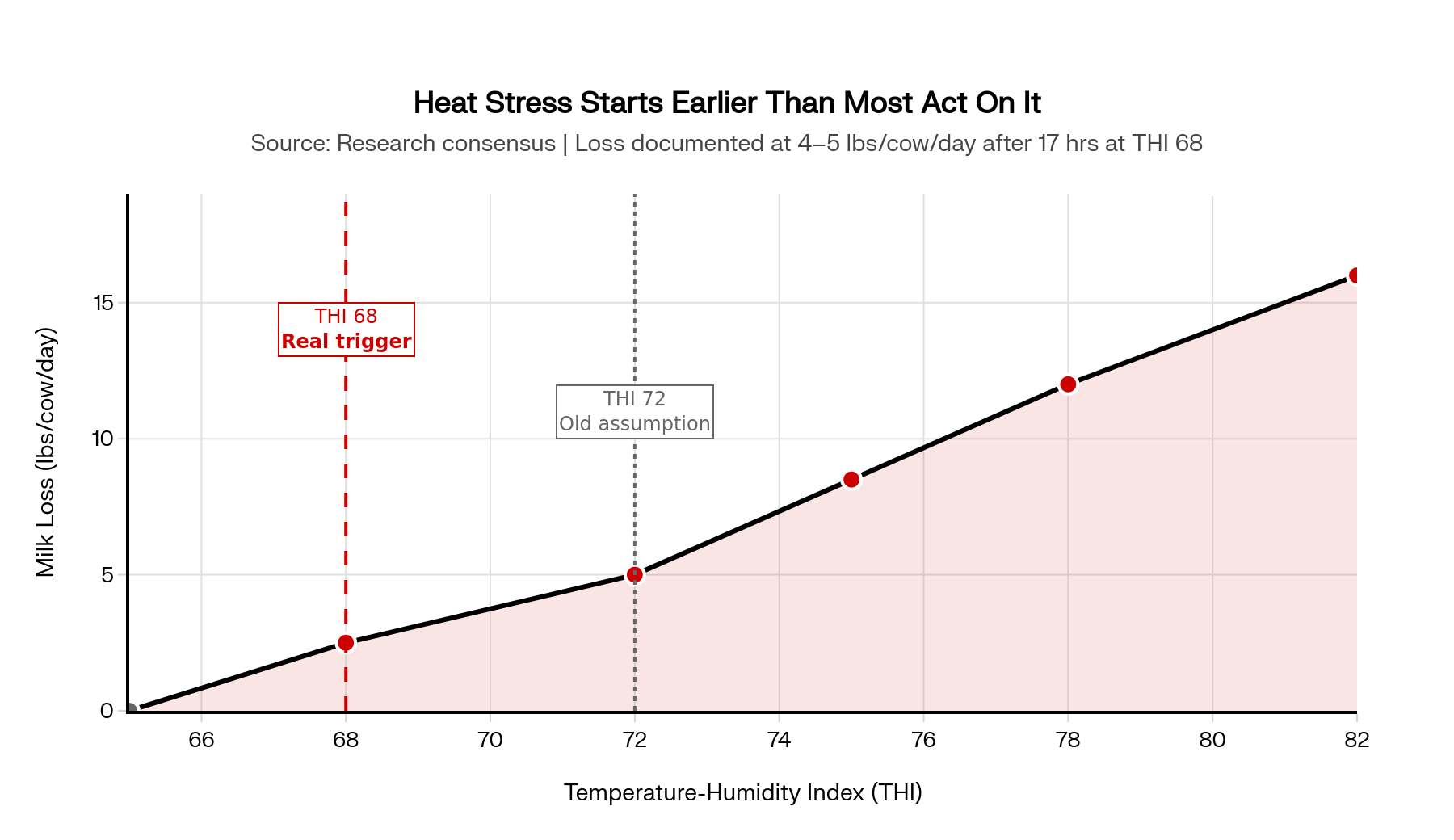
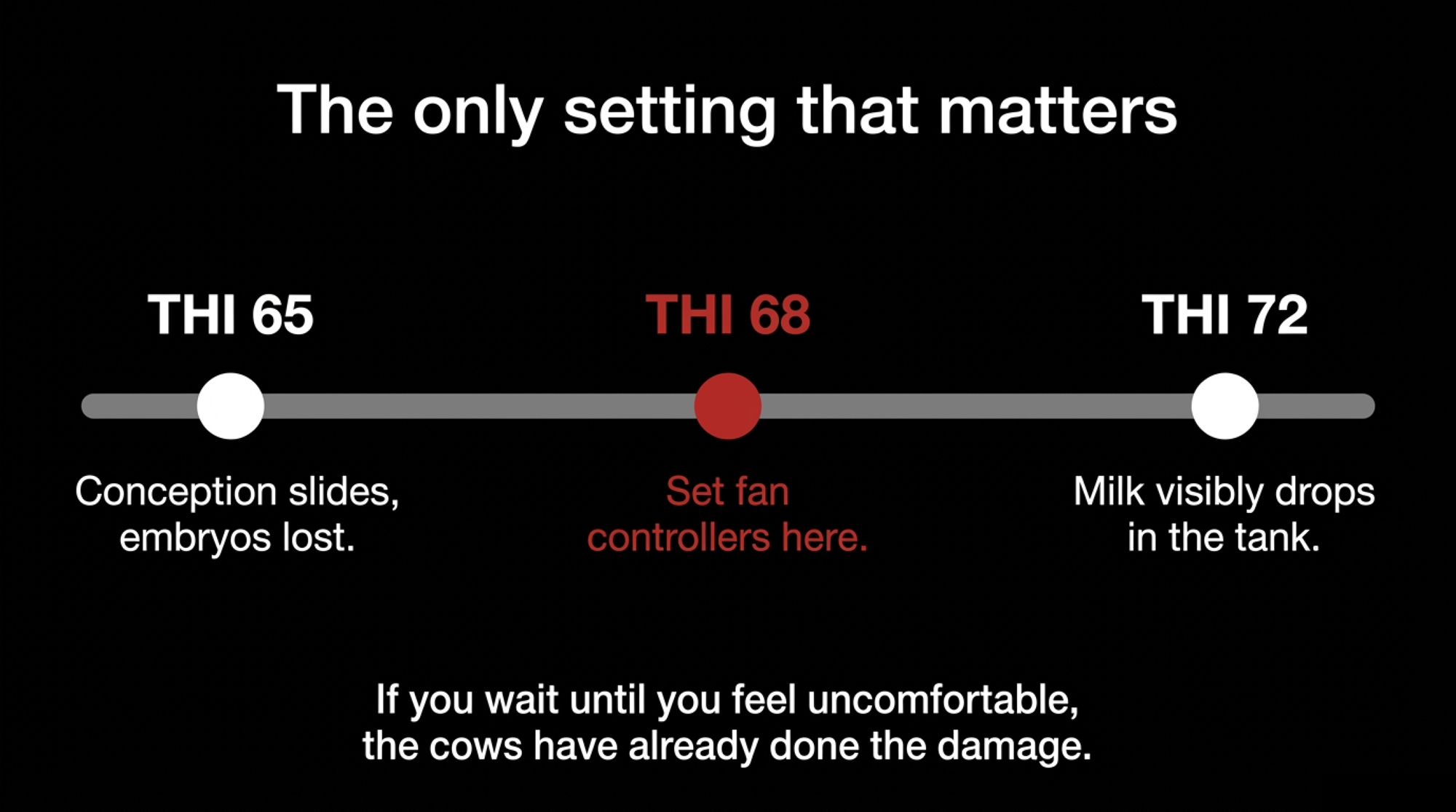
Put your fans and soakers on a controller and set them to kick on at a temperature-humidity index (THI) of 68 — not “when it feels hot” and not at the old THI 72 rule of thumb. Fertility starts eroding around THI 65 and visible milk loss kicks in past 72. If you wait until you feel uncomfortable, the cows have already done most of the damage. 
The Summer 2026 Heat Story — Corn, Cows, and Timing

In the northern and central Midwest, this summer’s heat hasn’t just been hot; it’s been badly timed. Iowa’s climatologist, Justin Glisan, has warned about “two heat domes” sitting over the region with 90°F-plus highs and high dewpoints stretching over 7–10 days as corn entered pollination. Purdue’s Dan Quinn has been flagging the same concern for Indiana’s crop — accelerated growth under stress, pollination happening under heat advisories, and fields that were already rough coming out of wet conditions. 

AccuWeather meteorologist Chad Merrill, speaking on Farm Futures, has been blunt: mid-90s at pollination will likely shave 5–6% off expected corn yields across parts of the belt, with soy more vulnerable later in July. Traders have noticed. Corn and soy futures pushed more than 3% higher in early July as heat-damage risk in Europe and North America began to show up on screens. That’s where your ration costs start to move. 

Globally, the FAO–WMO “Extreme Heat & Agriculture” report released in April laid out what this kind of weather means at scale. It warned that over a billion people whose livelihoods are tied to agrifood systems are now exposed to increasing heat risk, with yields and herd productivity dropping sharply once common thresholds are crossed. For crops, losses ramp up once mean daily temperatures climb much above 30°C; for livestock, heat stress starts showing up around 25°C and becomes severe at 30–35°C depending on humidity. Dairy cattle are right in the cross-hairs. 

What Heat Actually Does Inside the Barn

The number that ties all this together is THI — the temperature-humidity index. It blends heat and humidity into a single score that tracks how hard your cows are working to stay cool. Several JDS and subtropical-environment studies put the comfort band for most lactating cows under about THI 68–72. Above that, things change fast. 

A 2023 meta-analysis in the Journal of Dairy Science pulled data from dozens of trials and found that under sustained heat stress, dry matter intake (DMI) dropped by roughly 19% and energy-corrected milk (ECM) fell about 18% compared with thermoneutral conditions. Feed efficiency and milk components shifted, and the longer cows stayed hot, the worse the numbers got. In Girolando cows — ¾ Holstein, ¼ Gir — heat stress reduced milk yield by around 7% compared with cooled controls. 

Here’s the part most herds miss: reproduction cracks first. Reproduction studies now point to fertility starting to erode around THI 65, a good seven points below where you see obvious milk loss. Conception rates slide, early embryo loss ticks up, and days open stretch out. You feel July again when the vet reads off your fall preg checks, and you rarely line those numbers back up against the one hot spell that kicked it off. 
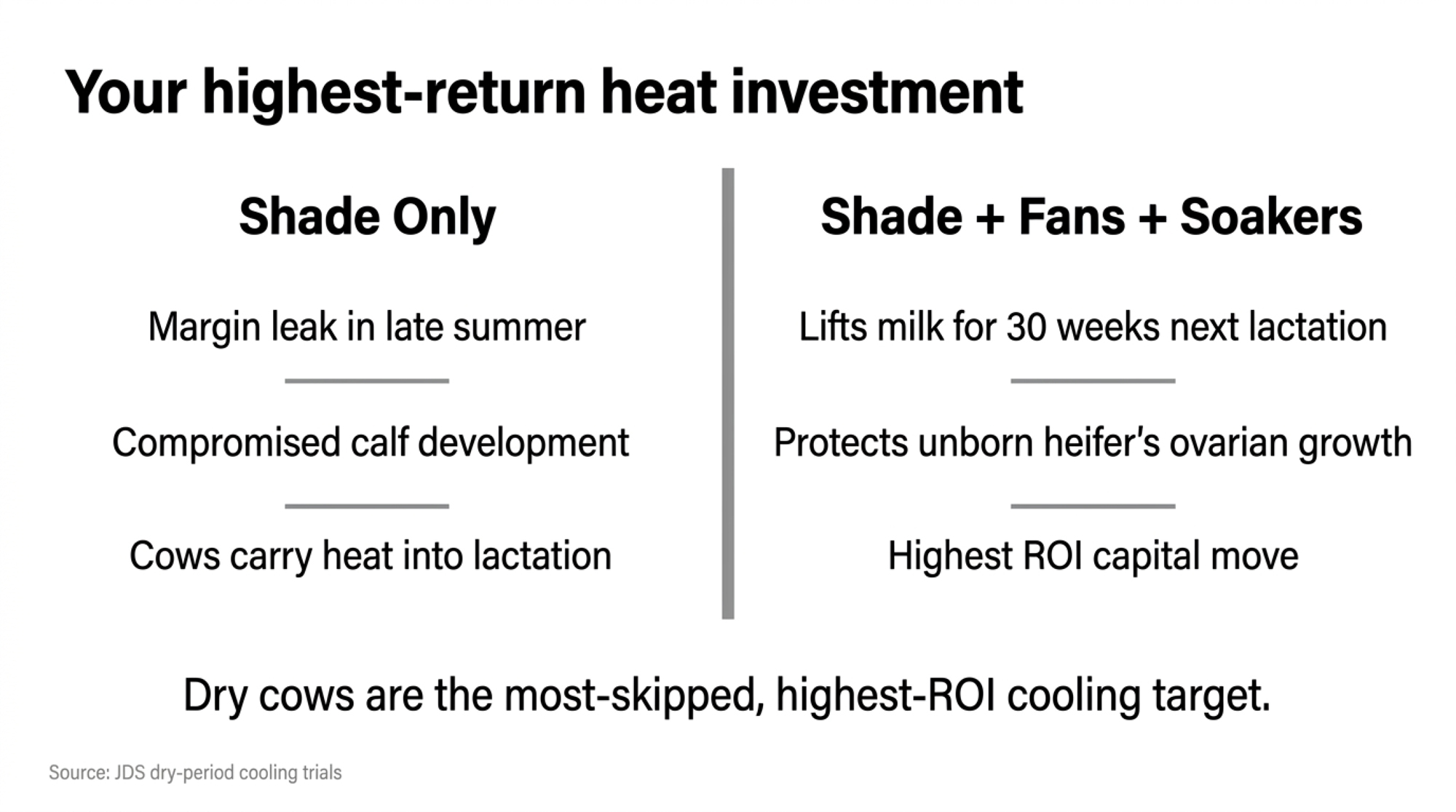
There’s also a group of cows almost nobody budgets for in their heat plan: dry cows. Work by Laporta, Davidson, and others has shown that cooling cows throughout the entire dry period — with shade, fans, and soakers — lifts milk yield for up to 30 weeks into the following lactation compared with cows left under heat stress. Even splitting cooling into “early dry” and “late dry” partially helps, but full-period cooling gave the best results. The trials also showed that in-utero heat stress hits the calf she’s carrying: mammary and ovarian development are compromised, setting a lower ceiling on that heifer’s future production. 

You’re not just losing July milk when a dry pen cooks. You’re writing down the next three years of that family line.

How Much Does Ten Hot Days Actually Cost You?

Let’s put real barn math to a very common situation. Picture a 400-cow Holstein herd in the eastern Corn Belt. This is a disclosed composite — not a single real farm, but a scenario built from several mid-size operations in the region — and every number under it comes from published data.

On a normal July day:

  • Cows ship about 85 lbs/head/day.
  • Ration cost runs around $9.00/cow/day, right in the middle of current lactation feed budgets, which range from $8.16 to $9.39. 
  • Fans run in the freestalls and over the parlor return lane, with a simple soaker line at the bunk.

Now ten to twelve days of 90°F-plus roll in, with THI pushing into the mid-70s by early afternoon and flirting with 80. Under that kind of sustained moderate heat, JDS data support an 8–12% drop in milk yield if cooling is partial — so think of that herd sliding from 85 lbs down into the 75–78 lb range. 

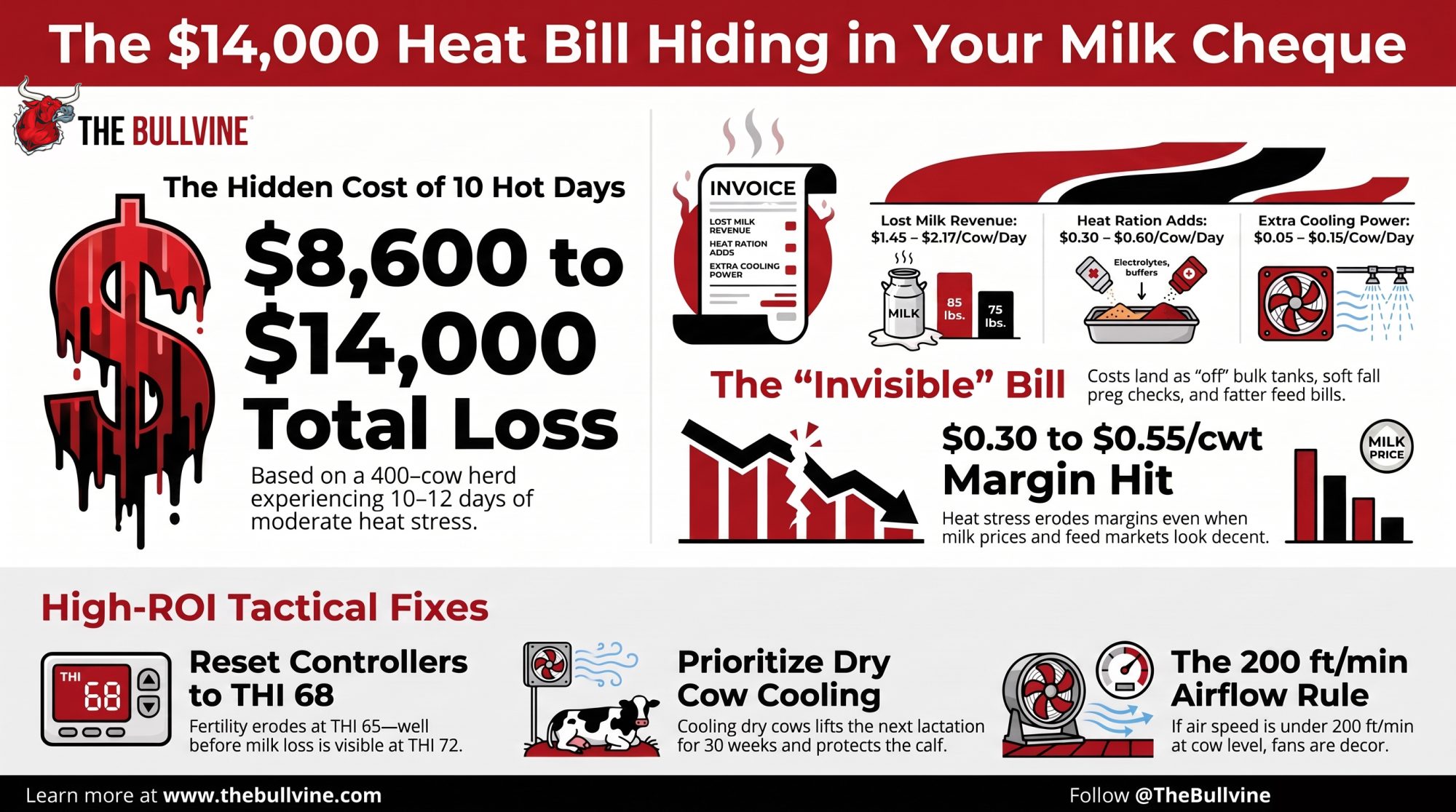
USDA’s May 2026 Livestock, Dairy and Poultry Outlook pegs the annual all-milk price forecast around $18.95 to $21.25/cwt depending on scenario. Using the higher $21.25 number to make the math simple, that 8–12% hit works out to about $1.45 to $2.17 per cow per day in lost milk revenue

You don’t stand still on feed. Most herds bump electrolytes, buffers, and energy density to fight the intake drop, which adds somewhere around $0.30 to $0.60 per cow per day in ration costs. Fans and soakers running longer and harder will add perhaps $0.05 to $0.15 per cow per day in power, depending on how efficient your setup is. 

Put that together:

Financial Impact Summary — 400-Cow Composite, 12 Hot Days

Line itemApprox. cost per cow per dayBasis
Lost milk (85→75–78 lbs @ $21.25/cwt)$1.45 – $2.17JDS meta-analysis on yield loss; USDA 2026 all-milk forecast 
Heat-stress ration add$0.30 – $0.60Modeled from DMI and ECM drops under heat stress 
Extra cooling power$0.05 – $0.15Fans/soakers energy estimates; full-period cooling trials 
Total per cow per day$1.80 – $2.92
Herd total, 400 cows × 12 days≈$8,600 – $14,000Computed from the lines above
Approximate margin hit~$0.30 – $0.55 per cwtDerived from daily total vs shipped milk

That’s a heat bill. And it lands even when milk price and feed markets look decent on paper.

You can plug your own numbers into that table. If you’re shipping 70 lbs instead of 85, and your ration is cheaper because you’re closer to corn, the ranges shift. But the shape doesn’t.

How Does This Map to Your Herd?

A few quick back-of-the-envelope checks you can run on your own books:

  • Take your average July milk per cow and ask what happens if you lose 8–12% of it for 10–15 days at your actual mailbox price — not the futures screen. That’s your top line.
  • Add what you spent on buffers, electrolytes, and extra energy those weeks — and be honest about whether you’d have bought those products in a cool summer.
  • Look at your power bill for the month and split out what’s cooling vs everything else — even a rough estimate will do.
  • Finally, mark your July and August breedings and walk them forward to your fall preg checks. If conception drops right after those hot spells, that’s the invisible part of the bill.

Most producers have never stacked those four lines together under the heading “heat.” When you do, July starts looking different.

Why Dry Cows Are Your Highest-Return Heat Investment

Dry pens are often the simplest part of a barn: shade, water, and not much else. That’s fine on a mild day. Under extreme heat, it’s a margin leak.

Trials in which cows were given full cooling — shade, fans, and soakers — throughout the entire dry period showed higher subsequent milk yield for up to 30 weeks into the next lactation compared with cows that had only shade. Cooled cows ate more, calved in better shape, and carried less heat stress into early lactation. 

Economic feasibility work has gone a step further. Ferreira and colleagues modeled dry-cow cooling in hot climates and found that even at lower milk prices, cooling dry cows paid for itself once herds faced around 100 heat-stress days a year. That’s not a fancy robot. It’s fans and water over cows that aren’t even milking. 

And then there’s the calf. In-utero heat stress has been shown to affect mammary and ovarian development in the heifer calf. Heifers gestated under heat in late pregnancy produced less milk later in life and showed altered reproductive performance. You can’t see that in this year’s milk cheque. You feel it years from now when daughters of those summers never quite hit the top of the family line. 

If your dry pen has shade and no fans, this is probably the highest-return heat move you can make in the next month.

Are Margin Tools Designed for This Kind of Risk?

Heat doesn’t just move milk. It moves feed and policy.

On the feed side, early-summer heat and dryness in Europe and parts of North America pushed corn and soy futures up more than 3%, with traders explicitly citing stress on pollinating corn and shrinking maize projections in France. French analysts have talked openly about the country’s maize crop potentially falling by as much as a third this year — which would make it the smallest in 35 years if current estimates hold. Those moves ripple straight into your TMR. 

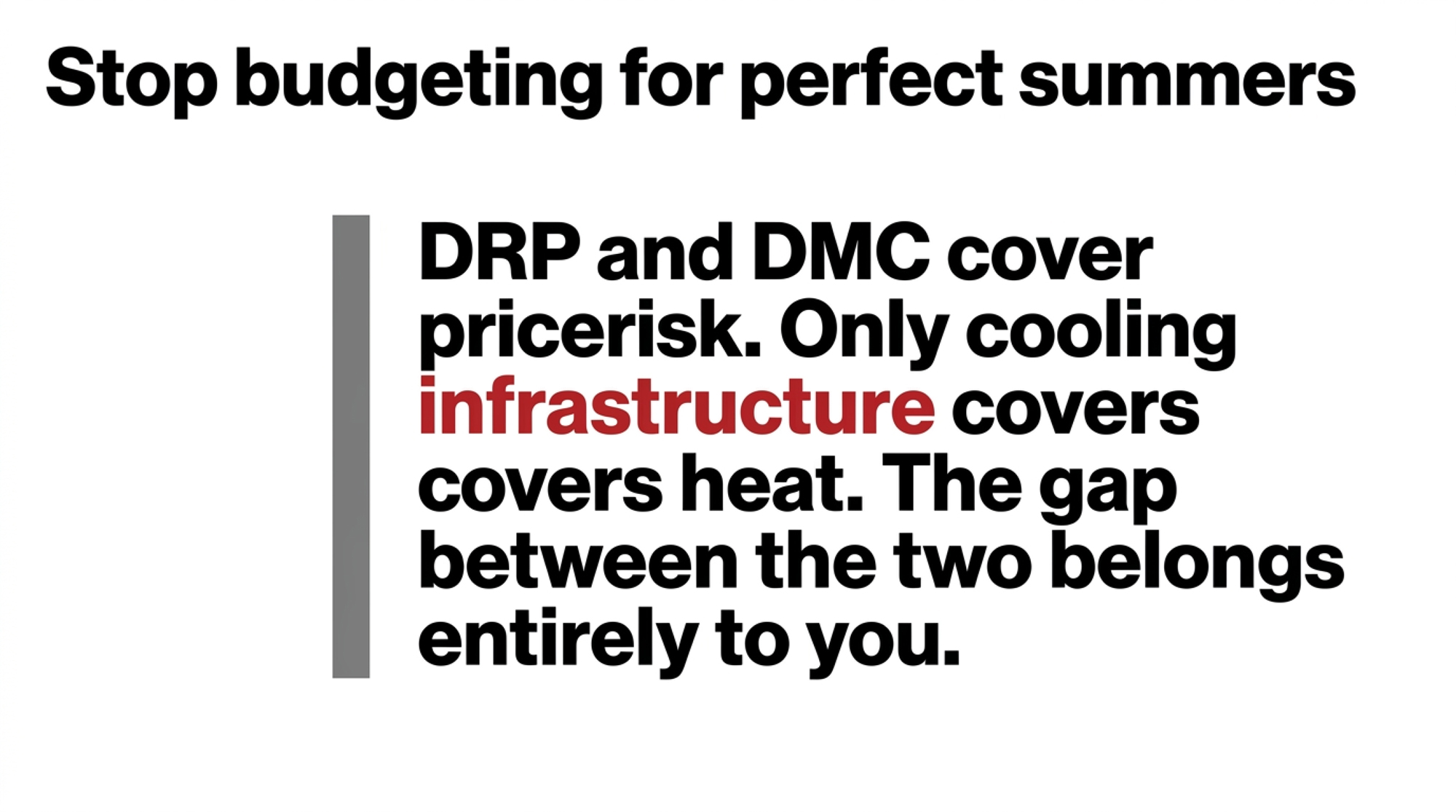
On the risk-management side, Dairy Revenue Protection (DRP) and Dairy Margin Coverage (DMC) are built around milk-feed margin and price swings — not around ten days of THI 78 shaving 10 lbs off every cow while feed cost and hydro inch higher. They help on the price side of a bad year. They don’t directly reward the operator who spends on cooling that protects the herd. 

France has started treating cooling as infrastructure. Coverage of the 2026 heatwaves there has highlighted emergency measures to fund building ventilation, misting, and water-spraying systems, along with fast-tracked support for livestock losses. In North America, similar support mostly appears as EQIP cost-share for barn projects filed under environmental or animal-welfare headings, rather than as a targeted heat-risk program. The FAO–WMO report is blunt: without adaptation, extreme heat will push agrifood systems toward systemic risk — but it also notes practical measures, from shade and cooling to early warning systems, that cut the damage. 

You’re expected to manage that risk one barn at a time.

Question 1: Where Does Heat Start to Break Your Margin?

This is the economics question.

If your herd routinely sees more than 50–60 days a year with THI above the high-60s, you’re already in the band where the DMI and ECM drops from the JDS meta-analysis apply more than just a week or two. USDA and academic modeling points to average annual heat-stress milk losses on the order of 1% of total yield for many U.S. dairies, with higher losses in small herds and hotter regions — and those losses are projected to climb as summers warm. 

The practical check is simple:

  • If your July and August milk per cow are consistently 5–10 lbs below where they “should be” based on genetics, feed, and health history, and those months line up with spelled-out heat events, you’re paying a recurring heat tax.
  • If your annual shipped milk sits noticeably below what your repro, culling, and genetics should support — and you’ve ruled out disease and nutrition — heat is one of the quiet culprits.

The threshold where cooling moves from “nice to have” to “margin tool” is lower than most barn budgets have assumed.

Question 2: Is Your Cooling System Actually Doing the Job You Think It Is?

This is the management question.

Most barns have fans. Fewer have the airflow and water they think they have.

The practical steps:

  • Grab a cheap anemometer and walk your barn. If you’re seeing much under 200 feet per minute at cow levelin stalls and at the bunk, those fans are décor more than cooling. Adding or repositioning fans to hit that band is a very different upgrade than buying one more box fan for the alley. thedairylandinitiative.vetmed.wisc
  • Look closely at your soaker lines. You want a coarse droplet that wets the cow’s skin, not a fine mist that cools the air, raises humidity, and wets bedding. The FAO–WMO report and several extension pieces emphasize that water on the cow, not just in the air, drives evaporative cooling. 
  • Check where your controller is actually set. If fans and soakers only kick in at THI 72 or at some guessed temperature (“about 80°F”), you’ve left fertility and a chunk of milk exposed. Reset to THI 68 and watch how often you’re in that band. 
THI ThresholdWhat’s Already FailingRecommended ActionRisk Level
65Fertility begins eroding, embryo loss ticks upFans/soakers should already be activeEarly warning
68Cooling still masks most damage if triggered hereSet controller to trip here — not laterOptimal trigger
72Milk yield visibly drops; old “rule of thumb” settingToo late — fertility already compromisedHigh
78–80DMI down ~19%, ECM down ~18%Full-period dry cow cooling now urgentSevere

Most operations that go through that three-step audit find they were cooling “some” cows “some” of the time — and leaving dry cows and youngstock almost entirely out of the plan.

Options and Trade-Offs for Your Barn

You can’t do everything this month. Here’s a realistic sequence.

Path 1: Dry Cow Cooling First (30-Day Action) When it makes sense: Herds in regions that regularly see THI above 68 for weeks at a time — much of the southern U.S., parts of the Midwest, and hotter pockets elsewhere. What it requires: Shade plus fans and a soaker line over the dry pen, tied to a THI controller set at 68. Modest capital, some wiring, and a slight uptick in water and power use. Risks/limits: Payback shows up in next lactation and in daughters’ performance, not in this month’s pay. It’s easy to bump down the priority list when cash is tight. But the trials and economic modeling are clear that in hot climates, this is one of the highest-ROI heat moves you can make. Forward-looking signal: If your area is on track for 80–100 heat-stress days a year, treat this as infrastructure, not a luxury. 

Path 2: Fix Air and Water at the Bunk When it makes sense: Herds already seeing milk slips under heat even with “lots of fans.” What it requires: A barn walk with anemometer, adding or re-aiming fans to hit 200 ft/min, and swapping or re-nozzling soakers to a coarse droplet pattern. Risks/limits: Easy to do halfway and assume you’re covered. If stalls stay at 120–150 ft/min and soakers mist the air more than cows, you won’t see the full benefit. Forward-looking signal: As summers trend hotter, this gap only gets more expensive. It’s the fix you make once and benefit from for years. 

Path 3: Ration Tweaks as a Guardrail When it makes sense: Herds already running decent cooling but still seeing DMI dips in hot spells. What it requires: Pre-emptive changes — more electrolytes and buffer, tighter feeding windows, and energy-dense ingredients where appropriate. Risks/limits: This is a cost to lose less, not a cure. You’re paying for products that mostly blunt the damage, and the gains are smaller if airflow and water aren’t there. Forward-looking signal: Works best as part of a package — ration + cooling + reproductive timing — not as the only move. 
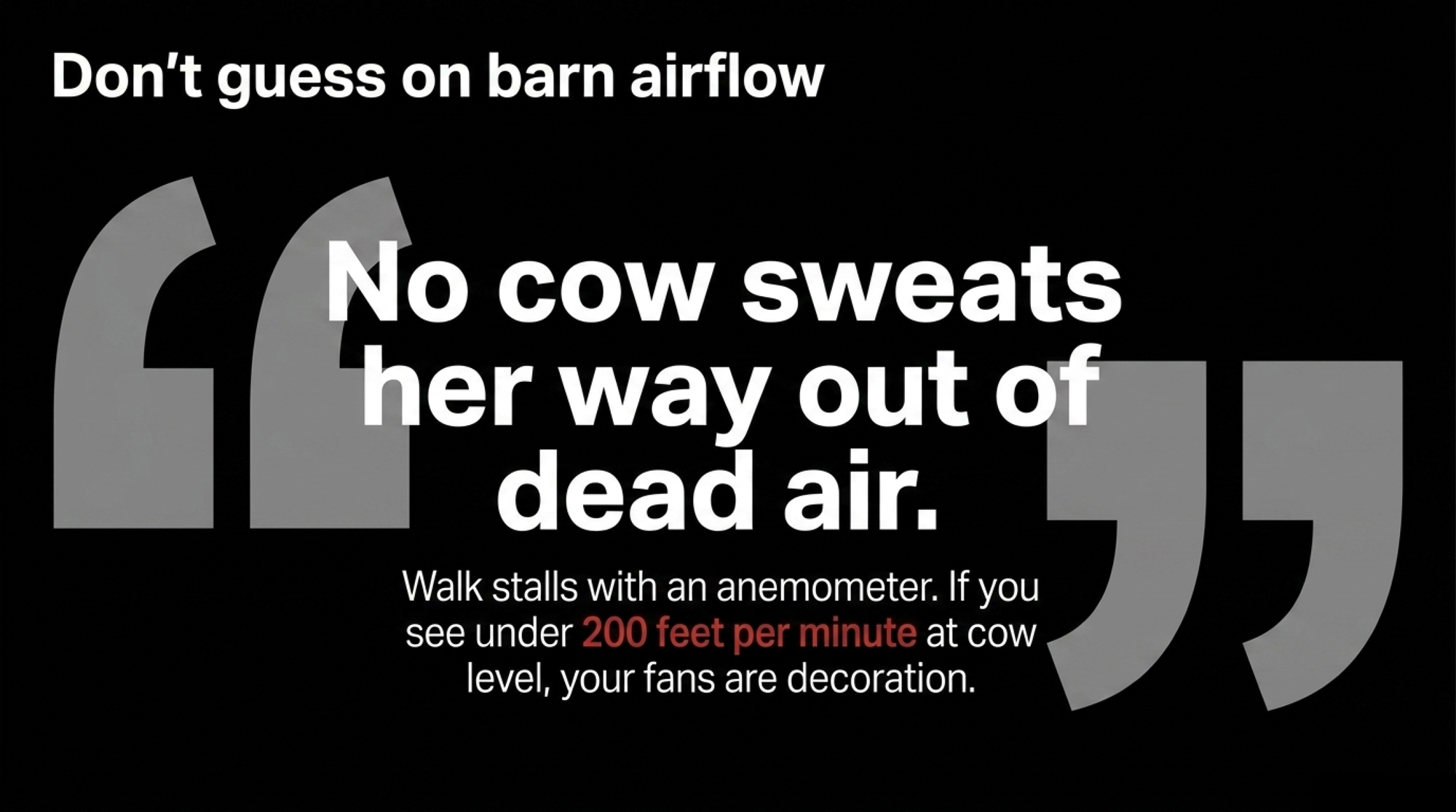
Path 4: Heat-Tolerance Genetics as a Tie-Breaker When it makes sense: Herds already selecting aggressively on TPI, Net Merit, or similar indexes and running proper cooling. What it requires: Asking your genetics rep for heat-tolerance EBVs, particularly Milk_THI breeding values. JDS work on U.S. Holsteins and Jerseys shows cows can differ by roughly −1.27 to +1.07 kg of milk per THI unit, meaning some cows give up a kilo of milk for every point the heat index climbs, while others hold much closer. Risks/limits: If you chase heat tolerance at the expense of production, type, or health, you’ll give up margin in cool seasons. And genetics cannot replace fans — no cow sweats her way out of dead air. Forward-looking signal: Treat heat tolerance like a health trait tie-breaker among bulls you already like. That way, your 2030 herd is better built for the summers you’ll actually face, without bleeding today’s income. 
Key Takeaways

  • If your controller still kicks fans and soakers on at “when it feels hot,” change it to THI 68. Fertility starts eroding around THI 65, and milk loss shows up past 72; the 68 trigger is where you protect both the cheque and the pregnancy. 
  • Walk your barn with an anemometer and a sharp eye on dry cows. If you’re under 200 ft/min at cow level or your dry pen has shade and no fans, your cooling system is decoration, not protection, and dry cows are likely your highest-ROI fix. 
  • Line up your fall preg checks against your July THI history. If conception softens after heat spells, stop treating that as bad luck. That’s the invisible part of your heat bill, and it can be bigger than the milk drop. 
  • Separate price risk from heat risk on paper. DRP and DMC help on the price side; only cooling, ration changes, and genetics touch the heat side. If you don’t see those moves in your plan, the gap belongs to you. 
  • Use heat-tolerance genetics to break ties, not as a magic bullet. Bulls and cows differ in how much milk they lose per THI unit, but no breeding program fixes a barn with poor airflow and no water on backs. 
So here’s the question to sit with before the next dome shows up on your forecast. If you added up the milk you lost this July, the extra feed and hydro you paid, and the repro softness you’ll see in a few months — then stacked that against what a cool July should have returned — how big is that hole on your own farm?

If the number makes you uncomfortable, that’s useful. It’s telling you exactly how much room you have to justify a fan controller, a dry-cow cooling line, or a re-aimed bunk. And if you want the deeper math — the full cost-per-cwt models by herd size, the dry-cow cooling ROI, and where heat-tolerance genetics genuinely pencil out — watch for the follow-up Bullvine economics piece. That’s where we’ll run the full numbers.

Run Your Numbers

Dairy Profit Projector — Plug in your herd size, ration, and corn-price scenario to see what a hotter summer does to your IOFC, breakeven milk price, and margin per cwt before the next heat dome lands. Stress-test a feed-cost spike against your milk check and find out where the number actually breaks.

Complete references and supporting documentation are available upon request by contacting the editorial team at editor@thebullvine.com.

Learn More

The Sunday Read Dairy Professionals Don’t Skip.

Every week, thousands of producers, breeders, and industry insiders open Bullvine Weekly for genetics insights, market shifts, and profit strategies they won’t find anywhere else. One email. Five minutes. Smarter decisions all week.
NewsSubscribe
First
Last
Consent

$87 a Cow, $2,460 a Barn: The Heat Loss You Never Book

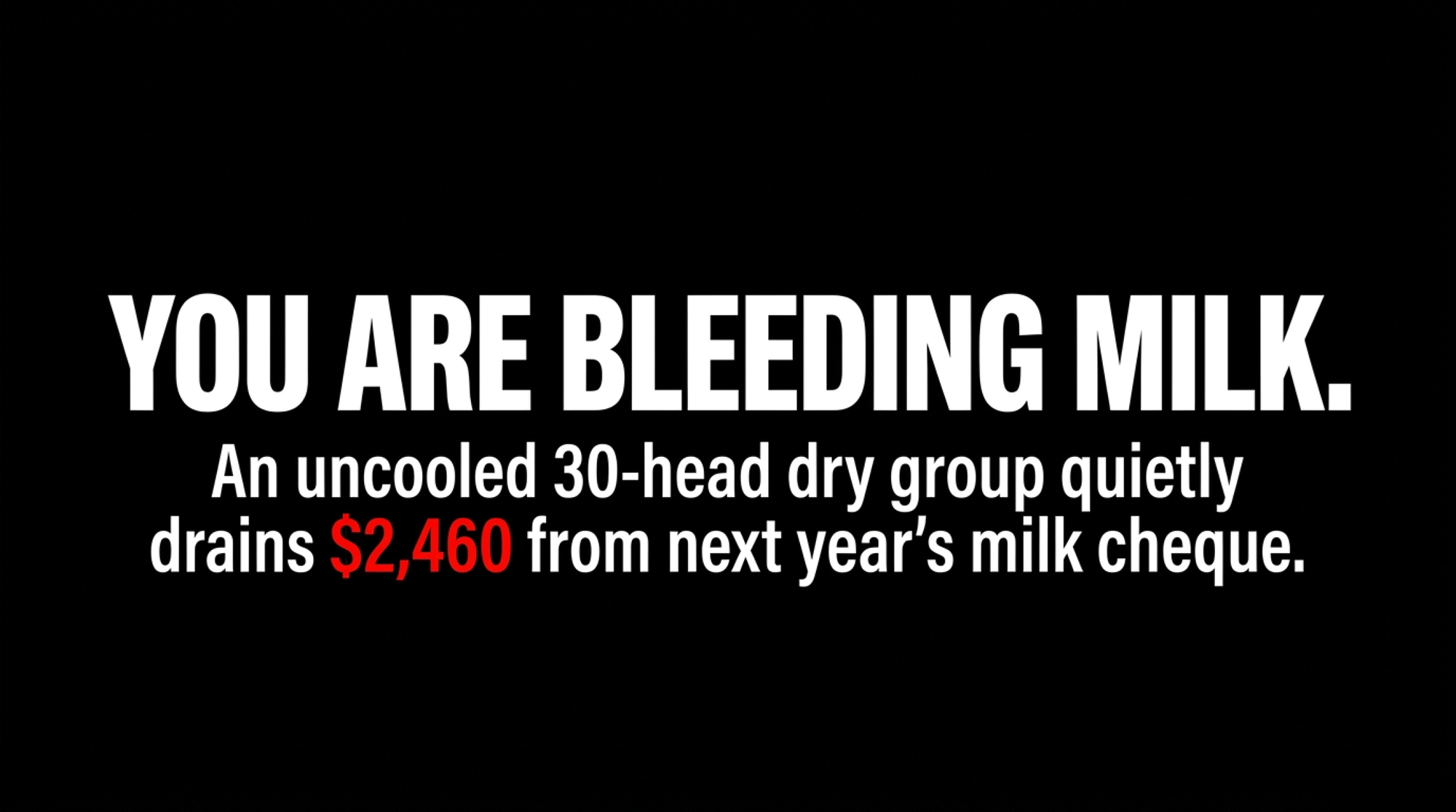
$87 a cow. About $2,460 across a 30-head dry group. And you’ll never see it — because the loss lands on next year’s tank, not this month’s, and nobody charges it to the dry pen.

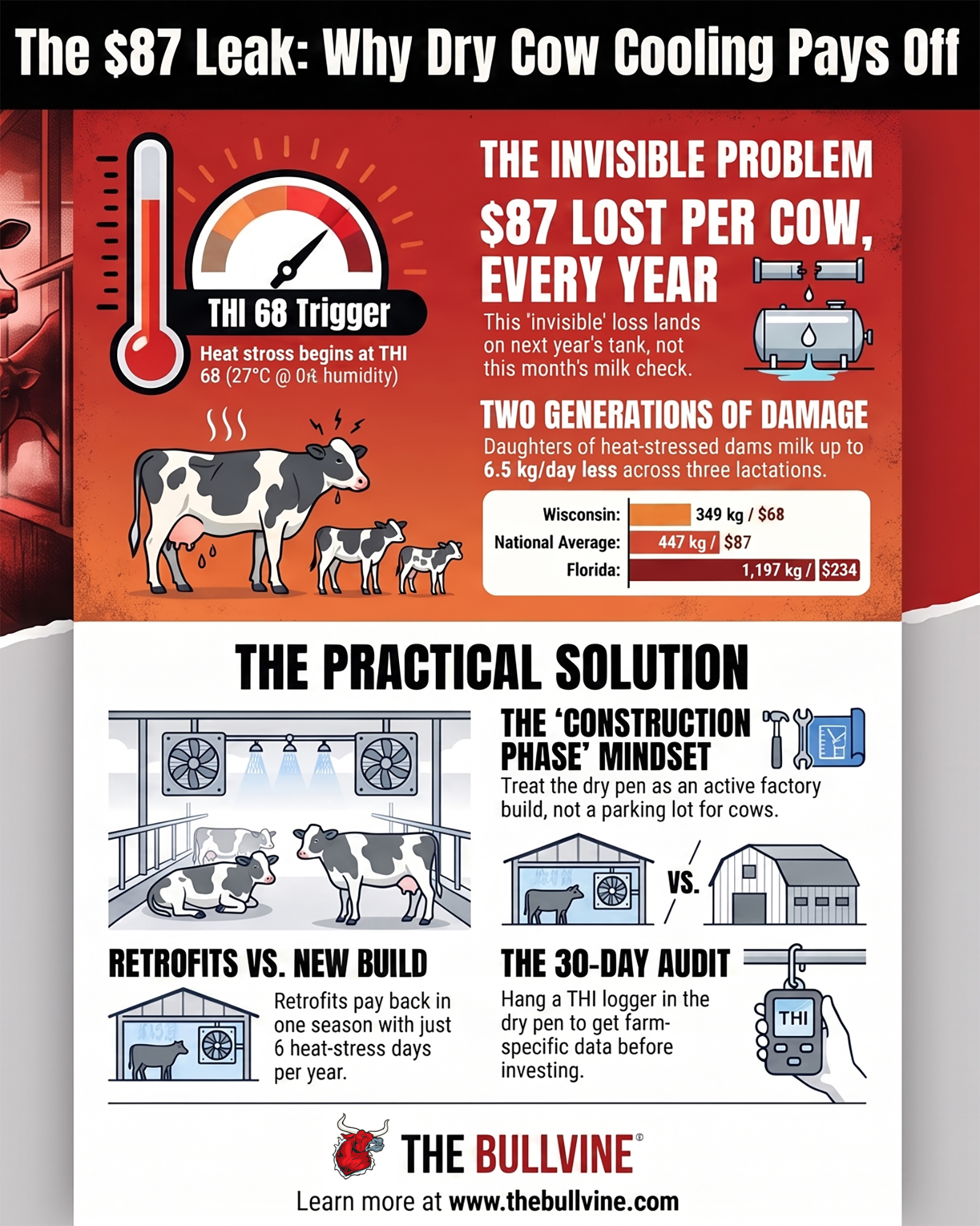
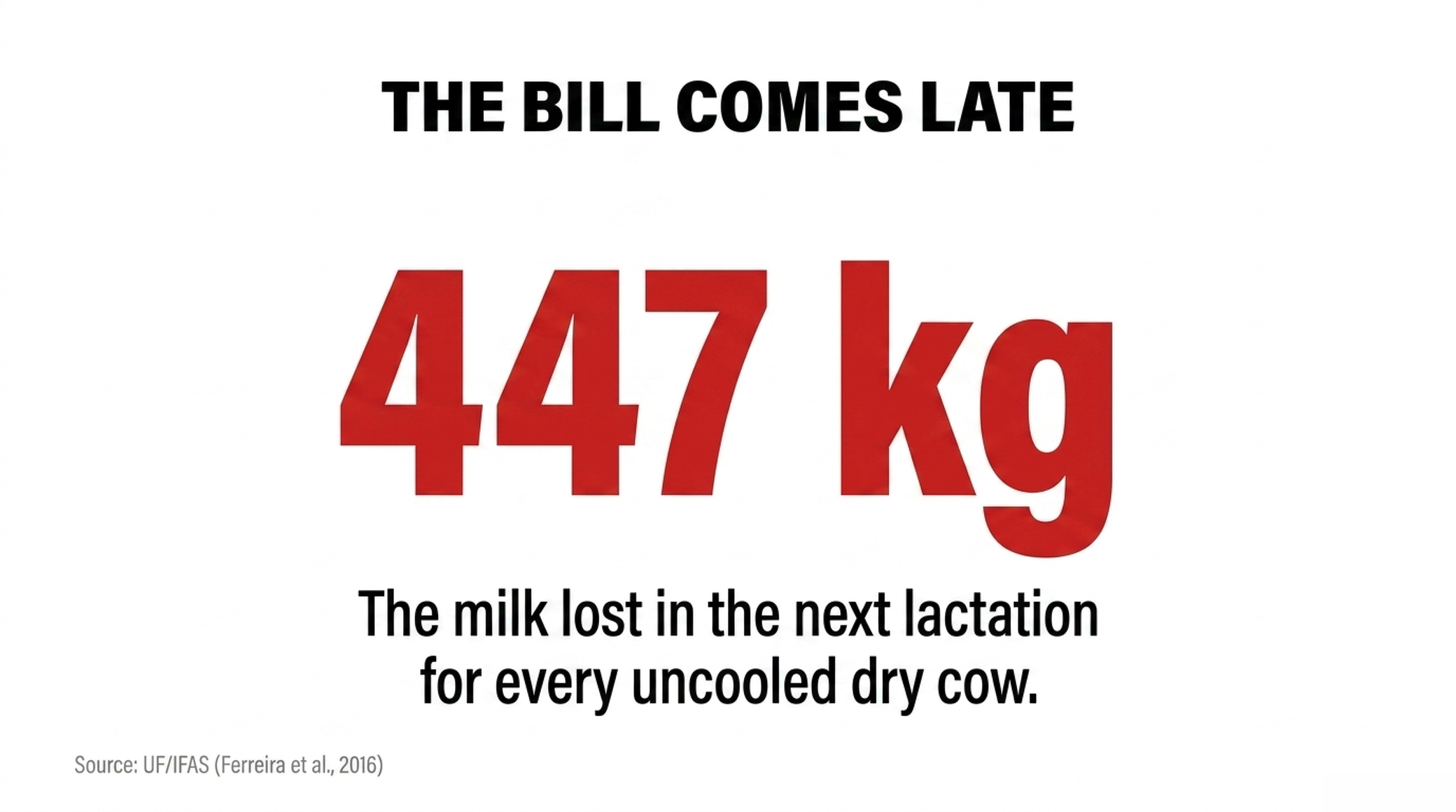
Executive Summary: An uncooled dry cow gives back about 447 kg of milk in her next lactation — roughly $87 a head, or around $2,460 across a 30-head dry group — and almost nobody books it, because the loss shows up on next year’s tank, not this month’s. UF/IFAS pegged the trigger at THI 68, not the old 80°F rule of thumb, so you’re bleeding milk on a muggy 27°C afternoon in Wisconsin or Ontario long before the barn feels hot. The damage is structural: heat during the dry period means the udder rebuilds fewer alveoli, and no amount of fans after calving puts those cells back. It doesn’t stop at her, either — Laporta’s 2020 JDS work found heat-stressed dams throw daughters that milk 2.2 to 6.5 kg/day less across their first three lactations, so you can cook a high-genomic heifer’s expression before she’s born. Retrofits can pay back inside a season at as few as ~6 heat days a year; new cooled dry housing pencils around 5.7 years in humid regions — but “average” is the wrong number, and your own THI count is the one that decides it. The 30-day move: hang a logger in the dry pen and get your real heat-day count before the next capital request. Read the full piece if you cool your milking string but still leave the dry cows in the shade to sweat.

dry cow cooling

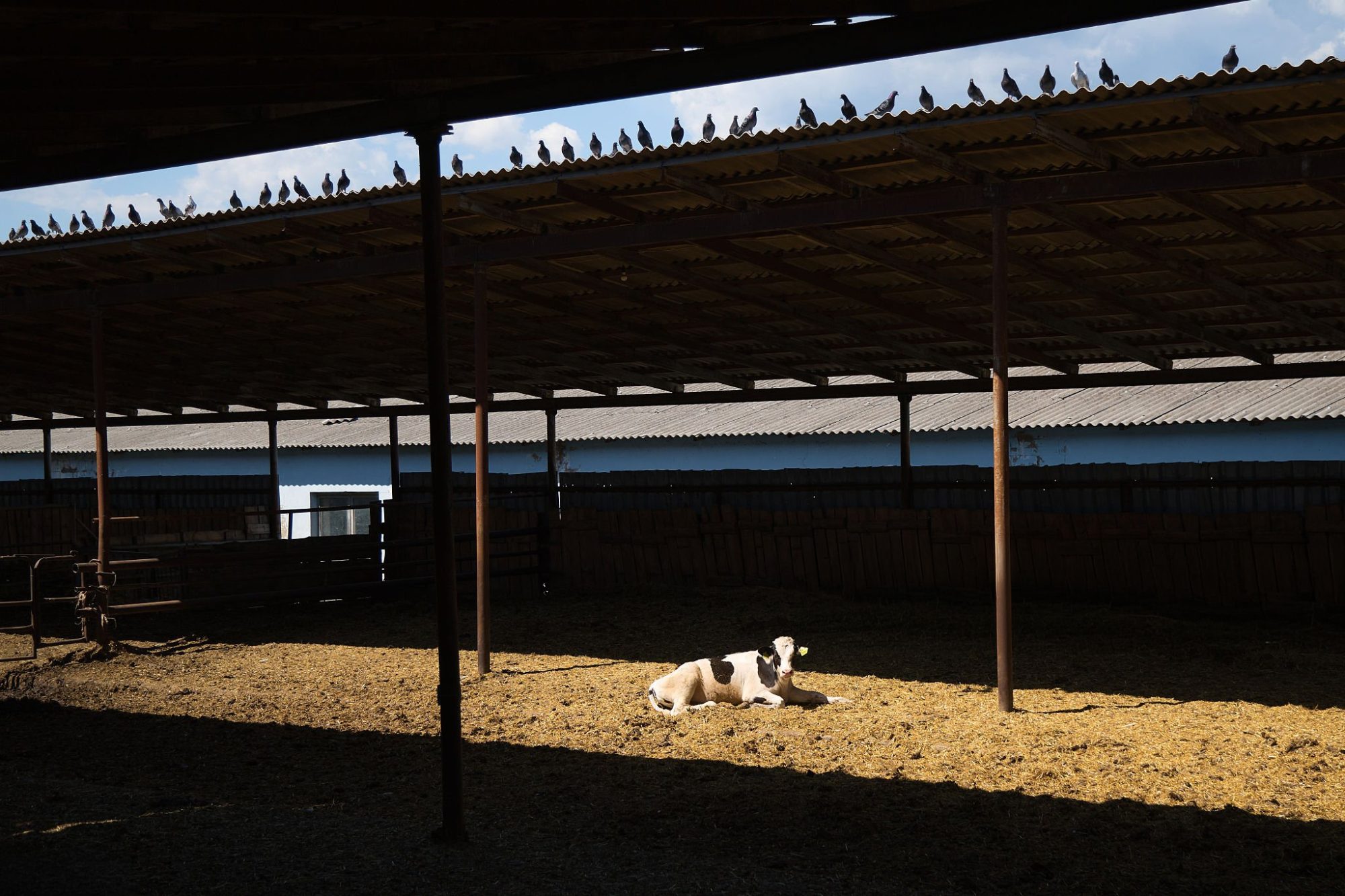
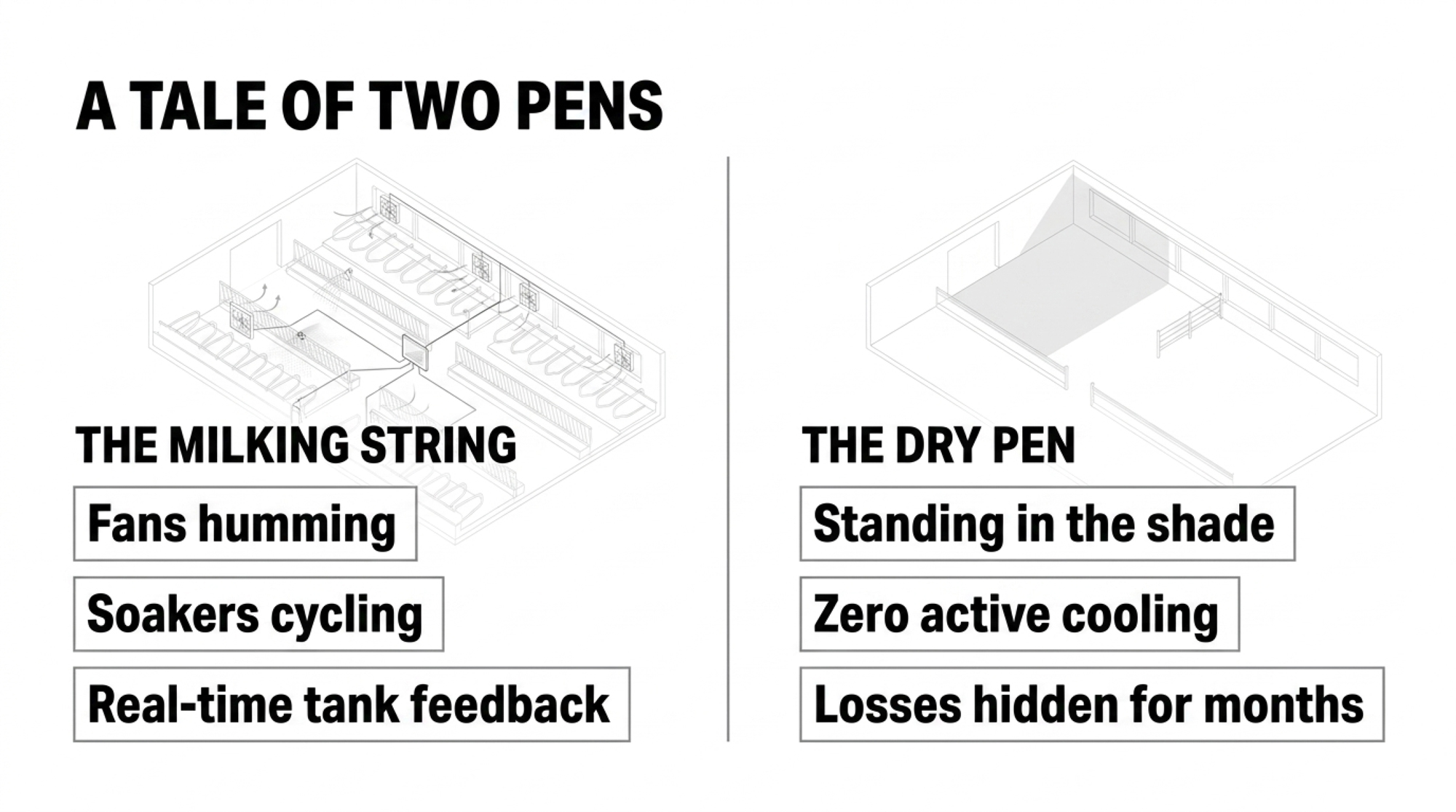
Walk through almost any dairy on a hot July afternoon, and you’ll see the priorities written in aluminum and water. Fans humming over the milking string. Soakers cycling in the holding pen. And off to the side, in the shade, the dry cows — standing under a roof with not a fan in sight.

That split-screen is the whole story. Because the research says the cows getting ignored in that far pen are the ones quietly costing you the most next year. About 447 kg of milk per cow in the next lactation. Roughly $87 a head. And nobody writes it down.

The Number That’s Been Sitting There Since 2016

The figure isn’t new, and it isn’t soft. Ferreira, Gennari, Dahl and De Vries published it in the Journal of Dairy Sciencein 2016: leave the average U.S. dry cow uncooled through her hot days, and she gives back about 447 kg of milk in her next lactation. Multiply across the herd, and it’s roughly $87 a cow. Ferreira’s 2016 model puts the national tab near $810 million a year in milk that never gets made.

So the math has been done for the better part of a decade. The behavior hasn’t moved. That gap — between what’s proven and what actually happens in the barn — is the part worth chewing on.

Albert De Vries, the University of Florida dairy management professor behind that paper, put the diagnosis plainly in the UF/IFAS release: “many farmers often ignore cooling dry cows, not realizing that dry cows under heat stress produce less milk later.” Read that twice. It’s not about effort or intelligence. It’s a loss engineered to stay invisible.

Why $87 Doesn’t Change Anybody’s Mind

Here’s the trap. A lactating cow in heat stress shows you the bill in real time — she pants, she drops feed, the tank dips this week. You see it, you act. A dry cow in the same heat looks exactly like she did yesterday, and nothing happens today.

The cost shows up months later, as a slightly flatter peak on a lactation curve nobody thinks to connect back to a hot afternoon in the dry pen. No alarm. No event. Just a number that arrives late and untraceable.

That’s why waving the $87 around doesn’t work. Farmers respond to numbers — that’s never been the problem. The problem is this one shows up in the wrong format, in the wrong pen, at the wrong time to do a thing about it.

The Dry Pen Isn’t a Parking Lot

The deeper issue is a filing error. In most managers’ heads, the dry pen is a holding area — animals waiting to matter again. So when someone floats spending money on fans and soakers out there, it feels like robbing the cows that are paying the bills today.

But that pen isn’t downtime. It’s the construction phase. During the dry period, the udder tears down old tissue and rebuilds the alveoli that’ll make next lactation’s milk. It’s the one window where the factory gets rebuilt for the year ahead.

Cook that process while it’s happening, and you don’t get a temporary dip you can cool your way out of after calving. You get a permanently smaller factory. Studies on the mechanism show heat-stressed dry cows redevelop fewer alveoli and more connective tissue, and the carry-over lands as a 3 to 7.5 kg per day drop in the next lactation — a loss postpartum cooling doesn’t rescue. You cooked it during the build. Fans in September don’t put the missing cells back.

So the honest label for the dry pen isn’t “waiting.” It’s “actively building next year’s milk cheque.” Fix that category, and the $87 finally has somewhere to land. It’s the same logic behind the cooling you’re already paying for on the milking string — you’re just applying it to the pen where it pays off latest.

The Thread That Actually Moves People

If the dollar figure alone won’t do it, what does? The multi-generation thread.

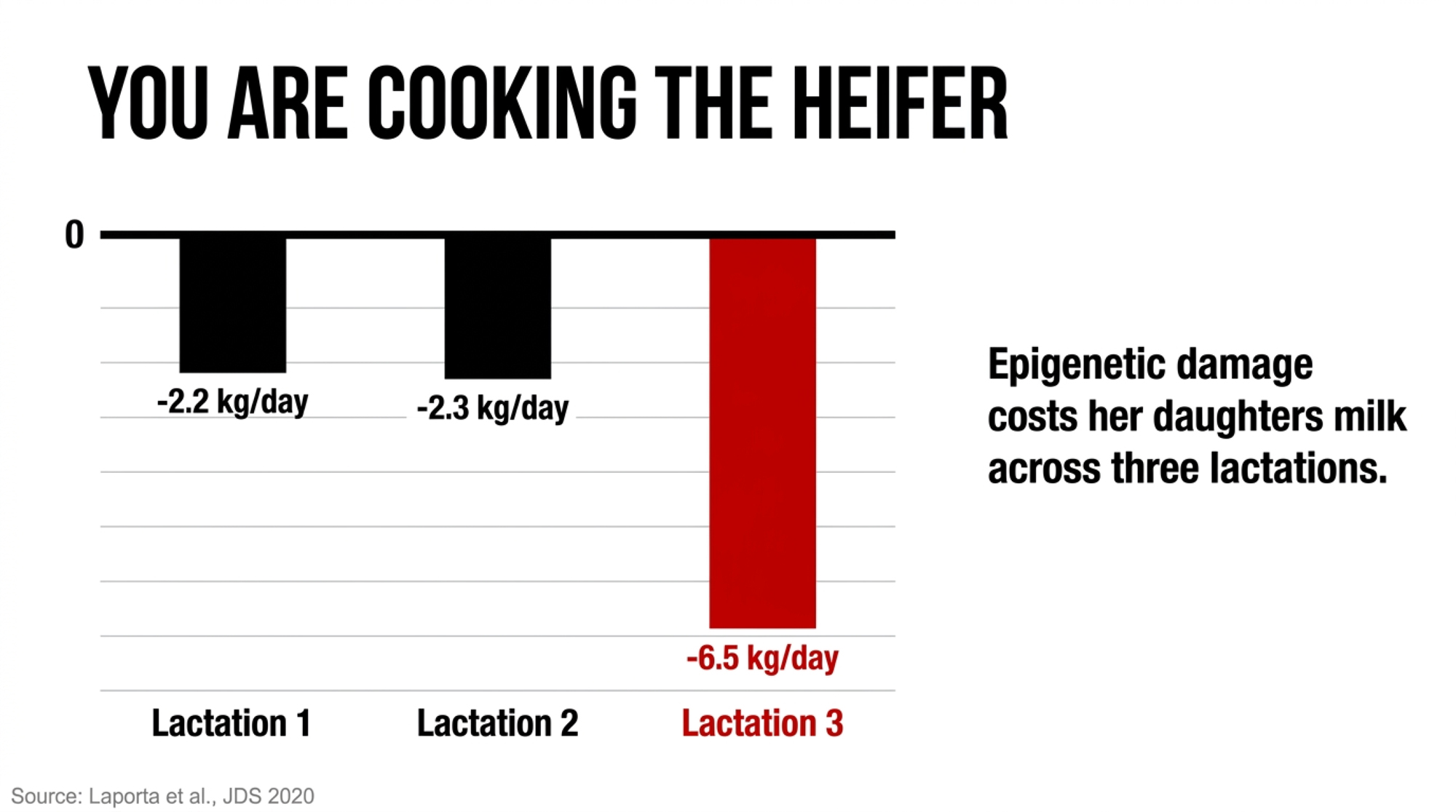
Jacobo Laporta and colleagues (Journal of Dairy Science, 2020) followed the daughters of heat-stressed dams and found the damage doesn’t stop with the dam’s next lactation — it reaches into her calves. Those daughters milked less in each of their first three lactations: 2.2 kg/day lower in the first, 2.3 kg/day lower in the second, and 6.5 kg/day lower in the third, compared with daughters of cooled dams. Their conclusion was blunt: late-gestation heat stress “exerts carryover effects on at least 2 generations.”

This is the ultimate frustration for a progressive breeder. You buy the best genetics, you mate for high genomic merit — and then you choke that heifer’s genetic expression before she’s even born, because her dam spent July panting in a dry pen. You didn’t lose the genetic lottery. You cooked the epigenetic switch. Nobody connects those dots without help, which is exactly why the loss survives — and it’s worth remembering when the daughter proof lands under the catalog number and comes up light.

Where the Clock Actually Starts

Before the barn math, reset one thing: the trigger. The old rule of thumb — cows are fine until it’s about 80°F — is wrong for modern high-producers.

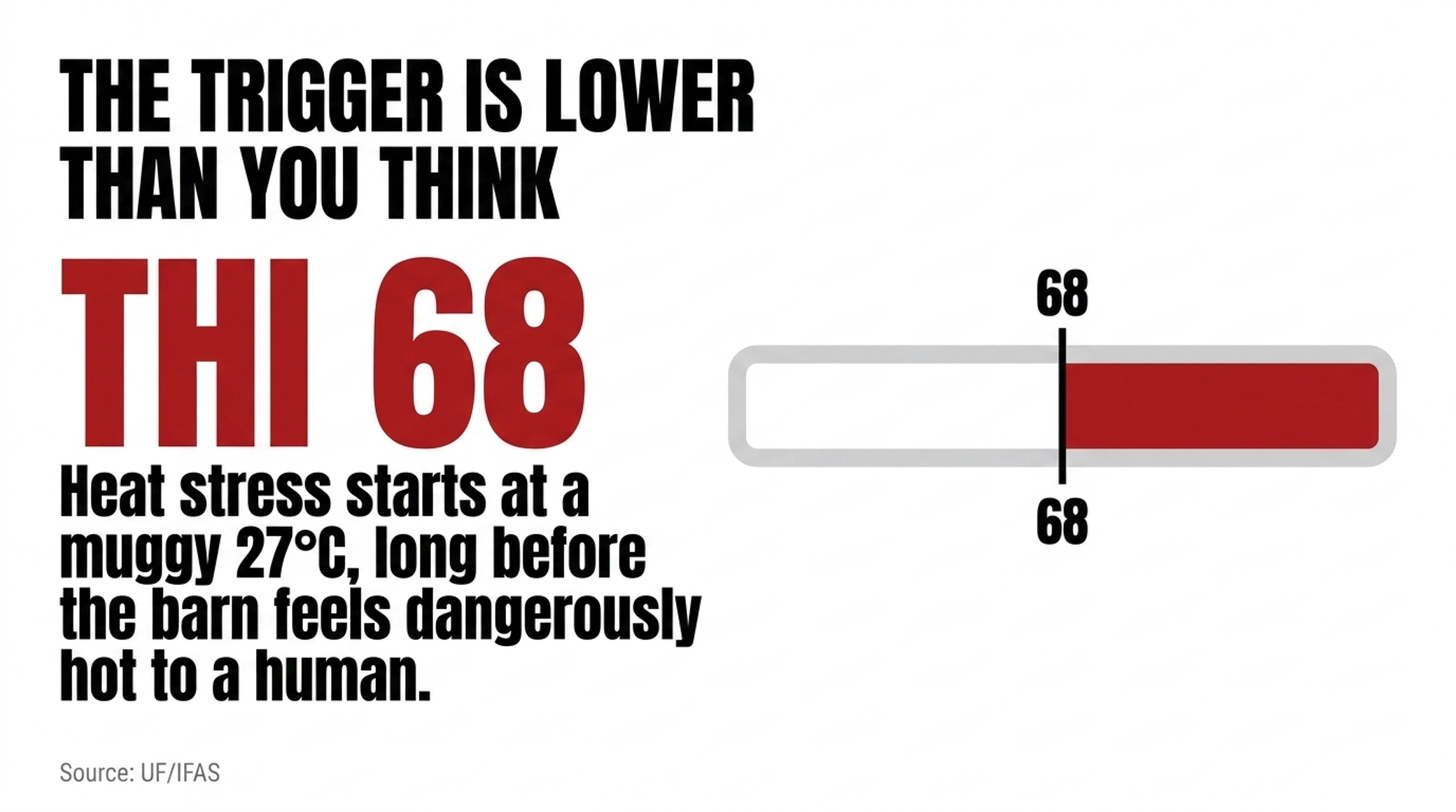
UF/IFAS defines a heat-stress day at an average Temperature-Humidity Index of 68 or higher. That’s a mark you cross on a muggy 27°C afternoon in Wisconsin, New York or Ontario, long before the barn feels dangerously hot. Wait for “hot” by human standards before you worry about the dry pen, and you’ve already been bleeding milk for weeks. If you want the full picture on the trigger, here’s why THI 68 is the number that matters now.

StandardTrigger PointReal-World ExampleRisk If Ignored
Old rule of thumb80°F ambientClear, dry 80°F dayUnderestimates humid-day risk
THI 68 (UF/IFAS)~27°C with humidityMuggy 80°F afternoon, WI/NY/ONLosses start weeks earlier than assumed
Practical takeawayHang a logger, don’t guessFarm-specific THI count“Average” data misses your real exposure

Run It for Your Own Barn

UF/IFAS extension (publication AN342, 2018) turned the research into numbers you can actually use. Each dry-period heat-stress day costs about 10.3 lb (4.66 kg) of next-lactation milk. UF/IFAS values that at roughly $0.91 per cow per day, using their full model, with $14.90/cwt milk income over feed cost — note that’s their discounted per-day figure, not a simple milk-price multiplication of that day’s kilos.

Plug in the U.S. average, and you land right back home: about 96 heat days a year, and a full-model loss near 447 kg and $87 a cow. But “average” is the wrong number for any single farm. The 2016 study modeled New York, California and Wisconsin climate data specifically, and the spread runs wide — Wisconsin sits near 349 kg and $68 a cow, while Florida, at 257 heat days, hits roughly 1,197 kg and $234. Treat all of these as modeled estimates, not guaranteed returns. Wisconsin and Florida bracket the range; the by-state chart with this article lays out where the rest fall in between.

Here’s the micro barn-math, and reset it to your own milk price, because UF’s rides on that $14.90/cwt assumption. Take a 200-cow herd, 15% dry at any time (30 head), through 90 heat-stress days:

  • Per cow: 90 days × $0.91 ≈ $82 in lost next-lactation milk (about 925 lb).
  • Across 30 dry cows: roughly $2,460 — and that’s the hit to next lactation, not a line item you’ll ever see on this year’s expense sheet before you count a thing on the calf side.
MetricUncooled Dry CowCooled Dry CowStandout Impact
Next-lactation milk loss (kg)4470-447 kg/cow
Annual dollar loss per cow$87$0-$87/cow
Loss across 30-head dry group$2,460$0-$2,460/group
National annual milk value lost$810 millionIndustry-wide blind spot

Lower your milk price, and the per-day loss shrinks; raise it, and it grows. The point isn’t a magic dollar figure. It’s that even at conservative prices, the leak is real money, and it scales fast from 100 cows to 1,000.

Retrofit, Build New, or Start Measuring

The research points to genuinely different calls depending on your facilities and your climate. Here’s how the three paths stack up:

StrategyBest ForPayback / ThresholdKey Risk / Failure Point
1. Retrofit Existing BarnYou already have the structure; moderate-to-hot summers~6 heat-stress days/year; payback often within one seasonPoorly angled fans or undersized water lines that never drop core body temperature
2. Build New With CoolingExpanding or replacing dry housing in humid regions~55 heat-stress days/year; ~5.7-year paybackOver-building for the national average instead of your local climate — or your milk price
3. Measure Before SpendingEvaluating real risk before committing capitalLow cost, ~30 days: hang a temperature-humidity logger, spot-check respirationsLetting “average” regional data dictate a decision your own micro-climate should make

Thresholds and payback figures are from Ferreira et al., J. Dairy Sci. 2016, under its default assumptions ($14.90/cwt milk income over feed cost). Your own capital and utility costs will move them.

The direction of travel is clear: extension groups increasingly frame dry-cow cooling as roughly as important as cooling the milking string, even in moderate northern climates. The “only the hot states need to worry” assumption is aging badly — and it ties straight into how dry-pen cooling fits the transition-cow picture.

📋 The Dry-Pen Audit: 4 Questions for Your Next Team Meeting

  • How do we file “dry cows” in our budget? Is that pen “downtime” — or “the construction phase of next year’s milk”? Your honest answer probably predicts your cooling budget.
  • Are we tracking the grand-offspring? When a heifer underperforms relative to her genomic projection, do our records allow us to check whether her dam was heat-stressed in late gestation?
  • What is our actual THI-68 count? Instead of guessing off the local forecast, have we hung a logger in the dry pen to get our own barn-level number before the next capital request?
  • Are we doing half the job? If we cool the milking string but leave the dry cows to sweat, we’re actively cooking the factory before it opens — and no amount of post-calving cooling puts those cells back.

The uncomfortable part was never the money. It’s that the dry pen is the one place on the farm where you place a bet you won’t see settled for six months — and whose full cost might not surface until a daughter milks light two years out. Most barns aren’t built to remember that long. So the real question isn’t whether $87 a cow is worth chasing. It’s whether you’re willing to treat “was this cow cooled while she was dry” as a number worth writing down, the same way you already track milk, SCC and genomics. Until you do, the loss stays exactly where it’s always been — out in the far pen, in the shade, where nobody’s looking.

Key Takeaways

  • Cooling stops at the milking string on most farms, but the dry pen is where next year’s tank gets built — leave it uncooled and you’re out about 447 kg and $87 a cow, money you’ll never trace back to the pen that cost it.
  • The clock starts at THI 68, not 80°F, so hang a logger in the dry pen and get your real heat-day count before the next capital request — that number, not the national average, decides whether cooling pencils on your farm.
  • Retrofits can pay back in a season with as few as ~6 heat days a year; new cooled-dry housing runs closer to a 5.7-year payback, so match the spend to your climate and milk price, not somebody else’s.
  • Heat stress a dry cow and the loss doesn’t stop with her — her daughters milk 2.2 to 6.5 kg/day less, so you can choke a high-genomic heifer’s expression before she’s ever born.

Run Your Numbers

Dairy Profit Projector — This piece runs on UF’s $14.90/cwt milk-income-over-feed assumption. Swap in your own milk price, feed cost, and IOFC to see what that lost next-lactation milk is actually worth against your margin — and whether cooling the dry pen pencils before the next capital request.

Complete references and supporting documentation are available upon request by contacting the editorial team at editor@thebullvine.com.

Learn More

  • Concrete, Air, and Shade: The Real Drivers Behind Milk Yield — Reclaims $1,100 to $2,300 in monthly revenue leaks by executing low-cost, 90-day payback stall modifications. This blueprint breaks down the exact dimensions, airflow settings, and bedding targets needed to force immediate lying-time production responses.
  • Fans Won’t Fix It – Heat-Stressed Cows Go Leaky in 3 Days — Exposes the metabolic reality that fan cooling only recovers 60% of summer milk losses. This analysis delivers the gut-health and DCAD nutrition strategies required to stop the remaining 40% from leaking through a compromised digestive tract.
  • How Epigenetic Factors Influence the Next Generation of Dairy Cows — Dismantles the assumption that genetics are locked at conception by revealing how maternal environment flips cellular switches. It arms you with the management keys to translate nutritional and environmental comfort into permanent, multi-generational genetic performance.

The Sunday Read Dairy Professionals Don’t Skip.

Every week, thousands of producers, breeders, and industry insiders open Bullvine Weekly for genetics insights, market shifts, and profit strategies they won’t find anywhere else. One email. Five minutes. Smarter decisions all week.
NewsSubscribe
First
Last
Consent

Your Fans Can’t Fix Half of Heat Stress. Your Ration Can.

About half your summer milk loss happens inside the cow, not at the bunk — and no number of fans touches it. A $15 forage test and the right DCAD do. Here’s the play.

Executive Summary: Only 20–50% of summer milk loss comes from cows eating less — the rest happens inside the cow, where heat shunts blood from the gut, the barrier leaks, and inflammation burns the energy that should’ve gone in the tank. That’s why hanging more fans never fully closes the gap: the fix is as much ration as it is air. On a 100-cow herd, a DCAD miss and reactive feeding can cost roughly 2 lb/cow/day across a 90-day heat window — about $3,500 at USDA’s May 2026 all-milk price of $19.70/cwt — while the wet-chemistry forage panel that would’ve caught it runs about $15 a sample. The play the best herds run by late April: test forage minerals by wet chemistry (not NIR), push lactating DCAD to +35–40 with K at 1.5–1.8% and magnesium raised alongside, build it with both sodium and potassium, and cool the dry cows — because UF/IFAS ties an uncooled dry period to ~10 lb/day less next lactation plus a penalty in the daughters. Canadian producers have the sharpest stake, since a July butterfat slide can leave hard-bought quota unfilled. None of it is extra work — it’s the same scramble you’d do in July, just moved to spring when you’ve got time to think. If you’re still treating heat stress as a fan problem, this is the piece that resets the math. 

dairy cows feeding summer barn

By the time the first run of 28°C days shows up, the farm that handles heat stress well already knows exactly what its high-group ration will do. The summer bunk’s been pre-built. The dry cows are under fans. And the feeder knows there’s a second drop coming in the evening. The neighbor down the road? He’s still telling people it got hot “all of a sudden.”

That gap — between the operations that decide early and those that react late — is the whole story of heat-stress nutrition. And here’s the part that should bother you: it’s rarely a knowledge problem. The research has been settled for decades. The difference is when the decisions get made.

What’s Actually at Stake When the THI Climbs

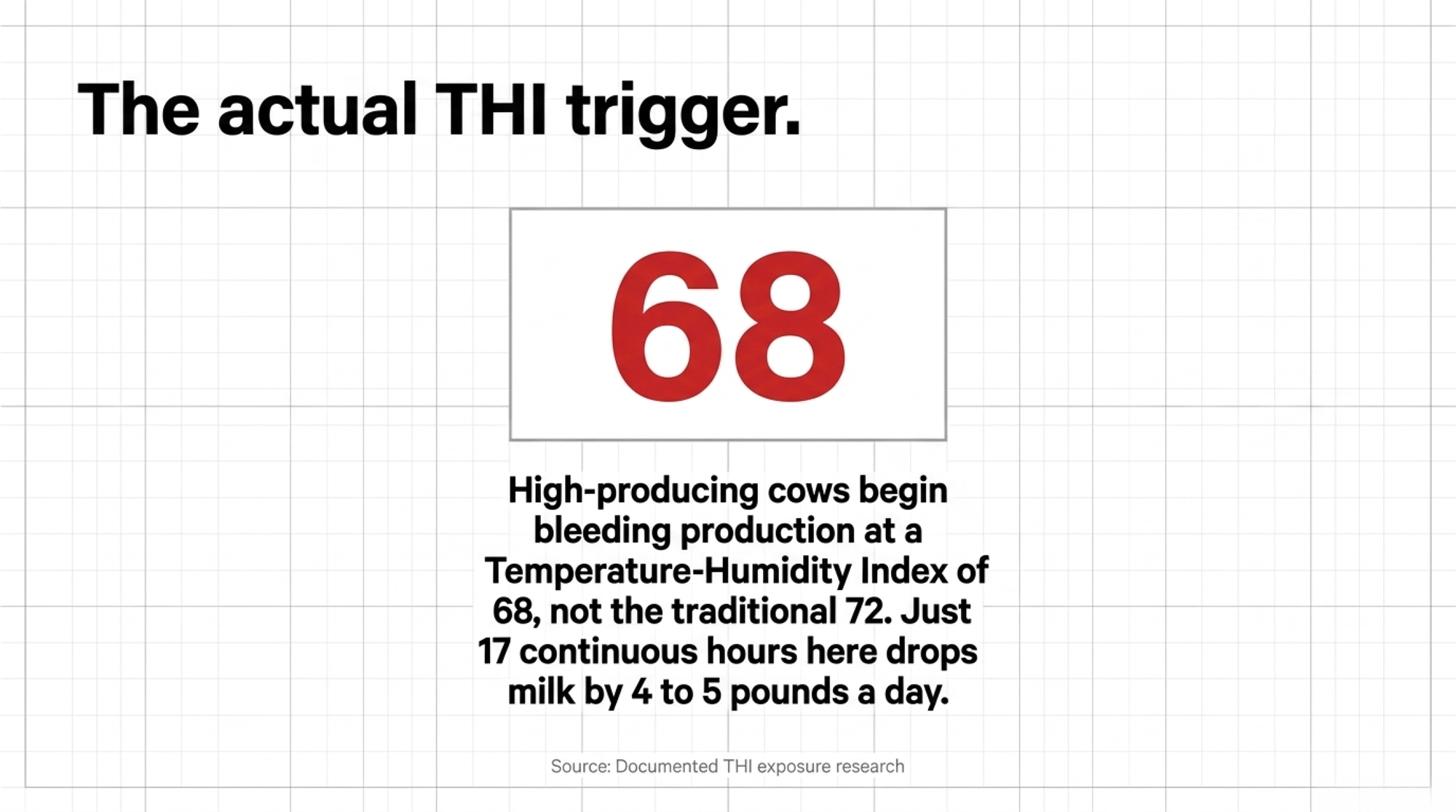
Heat stress doesn’t just make cows uncomfortable. It rewires their biochemistry, and it starts earlier than most producers act on it. High-producing cows can begin losing milk once the temperature-humidity index crosses 68, not the 72 that many people still treat as the trigger. Research has documented a loss of 4 to 5 pounds of milk per cow per day after roughly 17 hours of continuous exposure at THI 68. Dry matter intake can decline by 8 to 12% once THI exceeds 72. 

The producer who’ll see himself in this story is the one who’s been at it 20 or 30 years, runs a tight operation, and still watches his tank slide every July. He’s not lazy, and he’s not behind. He’s stuck in a reactive pattern. And the cost of that pattern stays invisible until somebody sits down and does the math.

That’s the trap. The cow you fail to manage in August shows up as a lighter milk cheque in November. The connection is real, but it’s buried in noise — easy to pin on the corn silage fermentation, the parlor, or last week’s weather.

The Part of the Loss Your Fans Were Never Going to Fix

Here’s the piece that reframes everything. For years, the standard line was simple: cows get hot, cows eat less, milk drops. Cool them down, fix the intake, fix the problem. But the research doesn’t back that clean story.

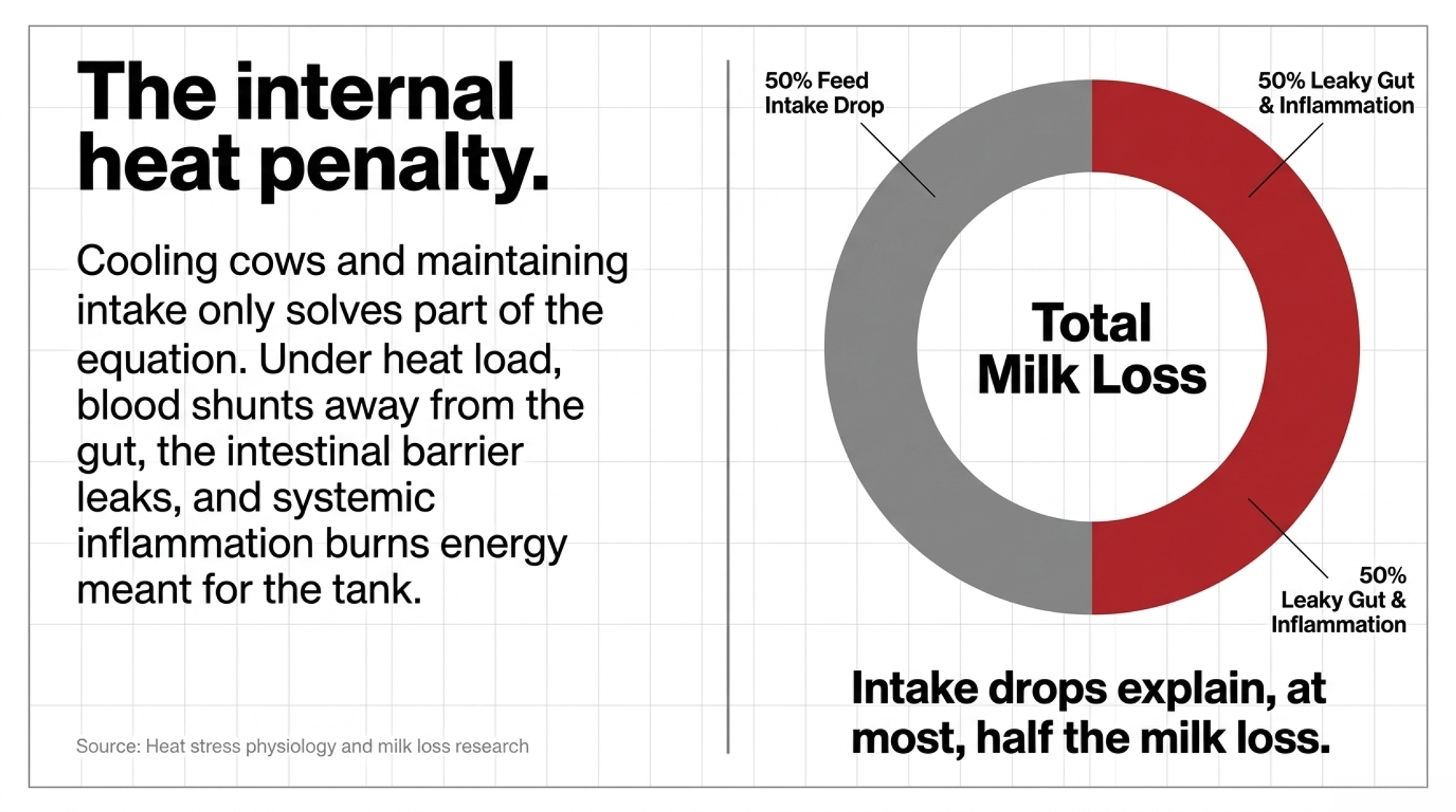
Reduced feed intake accounts for only about 20% to 50% of the milk loss during heat stress. The rest comes from inside the cow. Under heat load, blood gets shunted away from the gut to the skin for cooling, the intestinal barrier loosens, and bacterial toxins leak into the bloodstream — what researchers now call “leaky gut.” That triggers systemic inflammation, and fighting inflammation burns energy that would otherwise go into the tank. 

So a cow can be eating reasonably well and still bleed production, because half the damage isn’t about the bunk at all. That’s why cooling alone never fully closes the gap, and why the nutrition side — electrolytes, DCAD, rumen stability — does real work that fans can’t. You’re not just keeping her eating. You’re defending the gut and the acid-base balance while she pants off carbon dioxide and throws her blood chemistry out of whack. 

The Decision That Has to Come First

Ask the farms that hold production through a heat wave what they do differently, and it’s not a product. It’s a forage test — done in spring, with the right chemistry.

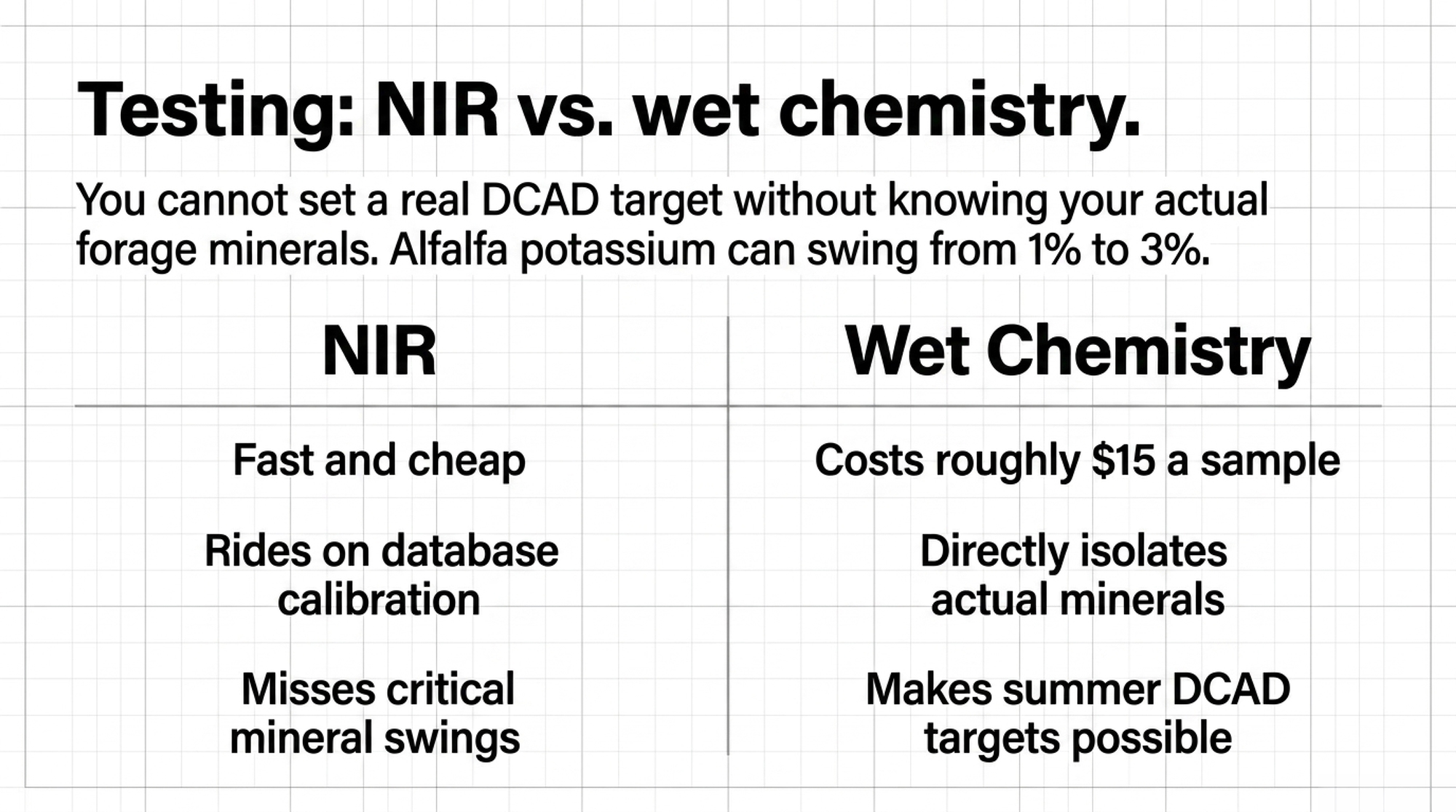
By late April, these operations collect fresh samples of every major forage and send them for wet-chemistry mineral analysis, including potassium, sodium, chloride, and sulfur. Not NIR. Near-infrared is fast and cheap, but its mineral predictions ride entirely on the calibration database behind them, and they can miss the swings that matter most. Wet chemistry directly isolates and measures minerals, and minerals are exactly what drive the dietary cation-anion difference. 

AttributeNIR AnalysisWet-Chemistry Mineral Panel
Cost per sample~$8–12~$15 (add-on)
Turnaround24–48 hours3–5 business days
Mineral accuracyCalibration-database dependentDirect measurement of K, Na, Cl, S
Forage K predictionCan miss 1–3% DM swingCatches full potassium range
DCAD reliabilityUnreliable for anion/cation balanceRequired for real DCAD formulation
Best use caseEnergy, protein, NDF screeningPre-summer ration build, DCAD setting
Risk if you skip itNone for energy; fine for bulk screeningDCAD miss = ~$3,546 per 100 cows

Here’s why it matters. Alfalfa can run anywhere from 1% to 3% potassium on a dry-matter basis, depending on soil, cutting, and variety. That’s a threefold spread. Swing your forage potassium that far, and your ration DCAD moves with it — enough to be the line between a ration that holds summer production and one that quietly undercuts it. 

You can’t set a real DCAD target without knowing your actual forage minerals. You can’t decide whether you need supplemental potassium or how much without knowing what the silage and alfalfa already contain. Skip the test, and every decision downstream is a guess wearing a lab coat. Run a lab report through our Forage Quality Value Calculator to see exactly where a given cutting fits before you build the summer ration around it. 

For producers weighing which analysis to order, our breakdown of feed analysis technology and ration accuracy lays out where NIR earns its keep and where wet chemistry is worth the wait. 

What DCAD Should Your Summer Ration Actually Target?

Watch a well-run operation in May, and it looks almost boring. That’s the tell.

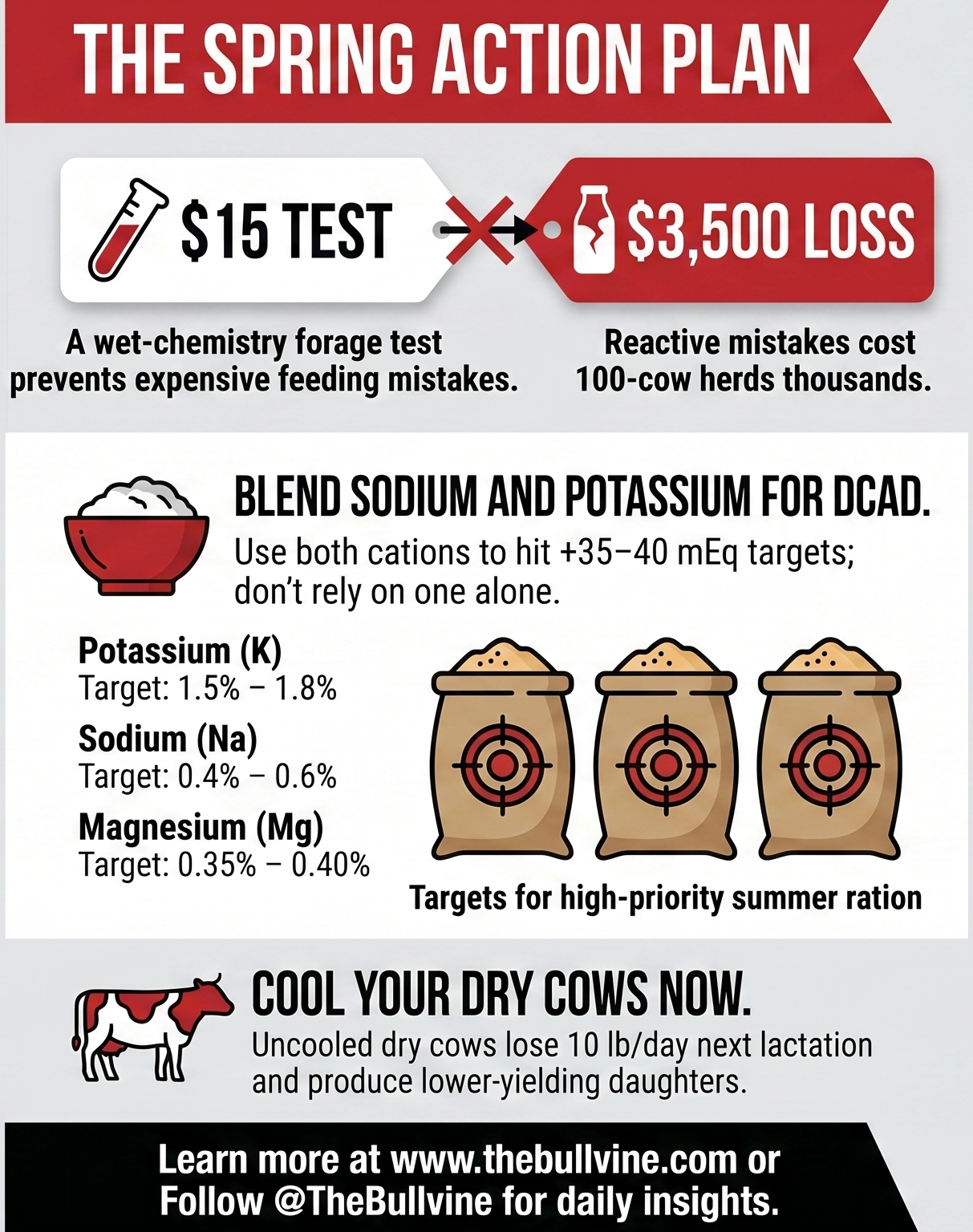
They’ve already modeled the summer version of their rations. Lactating cows are pushed toward a DCAD of +35 to +40 mEq/100g of dry matter, with potassium targeted at 1.5% to 1.8% to cover electrolyte losses that spike in heat. That target isn’t a Bullvine invention — Wisconsin extension, drawing on long-standing NRC guidance, puts the summer potassium window at 1.5–1.6% of dry matter and sodium at 0.4–0.6%, while Manitoba’s dairy specialists land on roughly 1.5% potassium, 0.5% sodium, and 0.35% magnesium for heat-stressed cows. Fresh and early-lactation pens are first in line for the full bump and the best forages — these operations treat that group as the highest priority heading into summer. 

Here’s where those targets land for the two pens that matter most in a heat wave:

Mineral (% of DM)High/Early LactationDry & Close-UpWhy It Matters in Heat
Potassium (K)1.5–1.8%Moderate; avoid high-KReplaces electrolytes lost through panting & sweat
Sodium (Na)0.4–0.6%0.4–0.5%Builds DCAD alongside K; Saskatchewan trial links Na to milk fat
Magnesium (Mg)0.35–0.40%0.35–0.40%Must rise with K — high K suppresses Mg absorption
Chloride (Cl)MinimizeElevate for close-up DCADAnion that pulls close-up DCAD negative for transition
DCAD (mEq/100g DM)+35 to +40Negative / lowAcid-base buffer critical while cow pants off CO₂
Ration K sourceHigh-K alfalfa + K carbonate blendAvoid potassium carbonateAnhydrous K₂CO₃ in wet TMR can heat and suppress intake

They’ve also already settled which ingredient carries the potassium. If they’ve got high-K alfalfa near the top of that 1-to-3% band, they know how far they can lean on it before something else in the ration breaks. If they’re using potassium carbonate, they’ve lined up a stabilized or coated form — or agreed on a liquid-dissolution protocol — so they don’t discover in July that standard anhydrous K₂CO₃ can heat up on contact with wet feed and pull intake down. 

The economics of getting that DCAD call right are bigger than most producers price in — our deep dive on Nigel Cook’s heat-stress math and how +400 DCAD protects milk fat runs the full numbers. 

Potassium or Sodium — and Why the Answer Is “Both”

Once you’ve decided to raise DCAD, the next question is which cation does it: potassium, sodium, or some mix. This is where a lot of rations leave money on the table by leaning too hard on one.

A 2024 University of Saskatchewan trial found that increasing DCAD by increasing sodium supply during mild heat stress improved blood acid-base balance and may increase milk fat yield. But older work is equally clear that the best milk-yield response comes when both sodium and potassium are used to build DCAD, with the lowest yields occurring when the ration leans on one cation alone. The practical read: don’t try to hit your whole DCAD target with potassium carbonate and call it done, and don’t lean on sodium bicarb alone either. Blend them. The buffer trade has its own ratio logic — the rumen-buffer economics piece covers where the sodium-bicarb-to-potassium-carbonate ratio actually pays. 

There’s a magnesium catch that bites herds every summer. When you push potassium up, magnesium absorption drops, so the higher-K summer ration needs magnesium raised right alongside it — extension targets sit around 0.35% to 0.40% of dry matter. Miss that, and you can chase a clean DCAD number while quietly starving the cow of available magnesium. The cations don’t work in isolation; the winning ratio treats them as a system, not a checklist. 

Why That Sodium Study Matters More in Canada Than the U.S.

That Saskatchewan milk-fat finding isn’t a footnote — it’s worth more to some producers than others, and the reason is how you get paid.

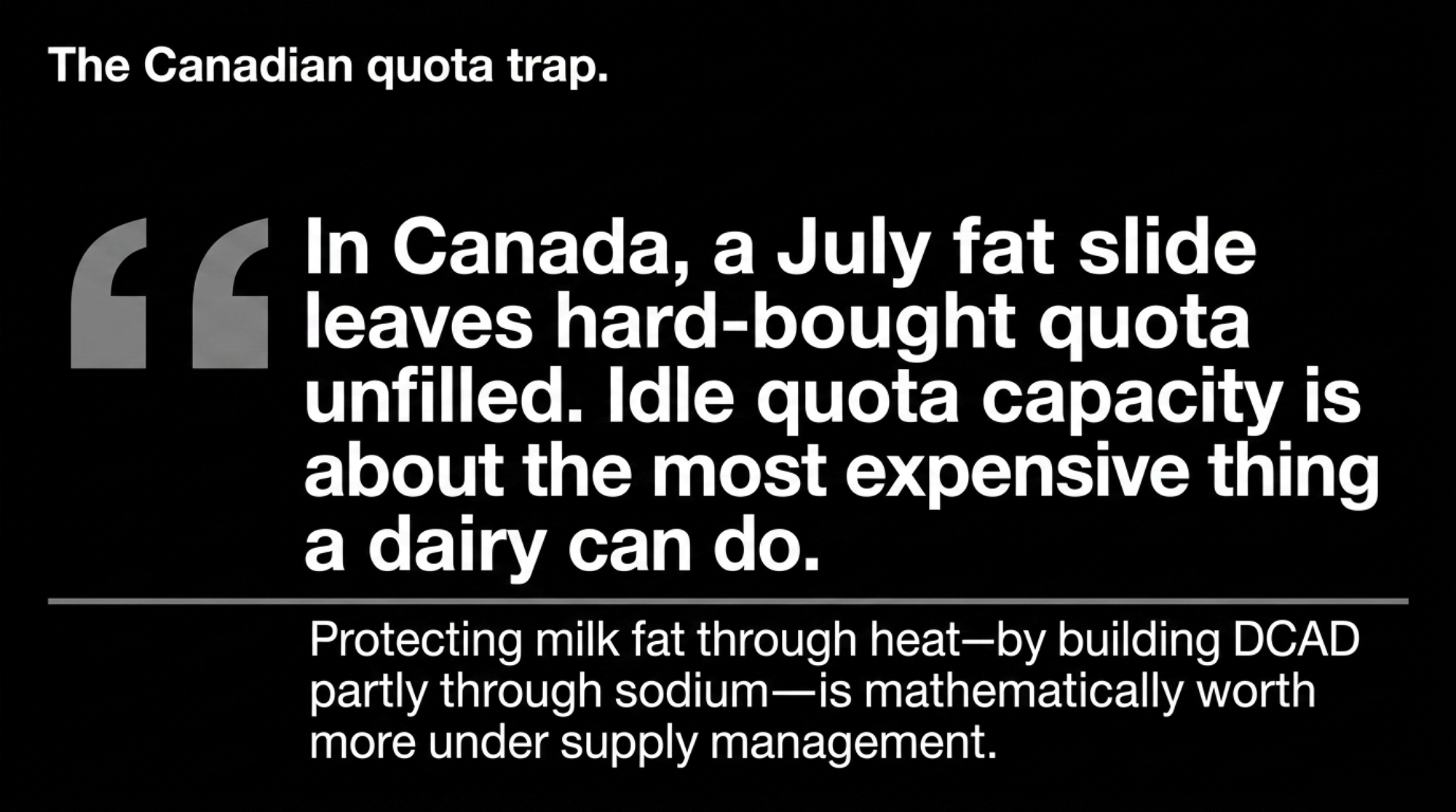
In the U.S. fluid-and-component market, a summer fat dip costs you a slice of your component cheque, but you’re still selling the volume. In Canada, under supply management, the math is sharper. Returns hinge on butterfat, so a July fat slide doesn’t just trim your per-pound return — it can leave you short of the butterfat quota you’ve already paid dearly to hold. That’s quota capacity sitting idle, which is about the most expensive thing a Canadian dairy can do. So a strategy that defends milk fat through heat — like building DCAD partly through sodium, per the Saskatchewan work — is arguably worth more to an Ontario or Quebec producer than to a fluid-market herd facing the same heat. 

The chemistry doesn’t care about the border. A cow in Ontario sweats off the same electrolytes as one in Wisconsin, and Ontario’s own extension service points to the same playbook — maximize ventilation, fog the front third of the pad, pack nutrients into smaller volumes, feed most of the ration overnight. But the milk-cheque consequences of getting it wrong aren’t evenly distributed. The producer most exposed to a summer fat drop has the most reason to pre-build the ration that prevents it. 

The Dry-Cow Blind Spot

There’s one piece of this that consistently costs the most and gets the least attention: the dry pen.

The farms that get heat stress right walk their dry-cow facilities in April the same way they walk the high group. By mid-to-late May, the shade, fans, and any soakers in the dry and close-up pens are checked and running — not just the parlor holding area. Water, space, and flow get the same treatment because late-gestation cows under heat stress drink more, too. 

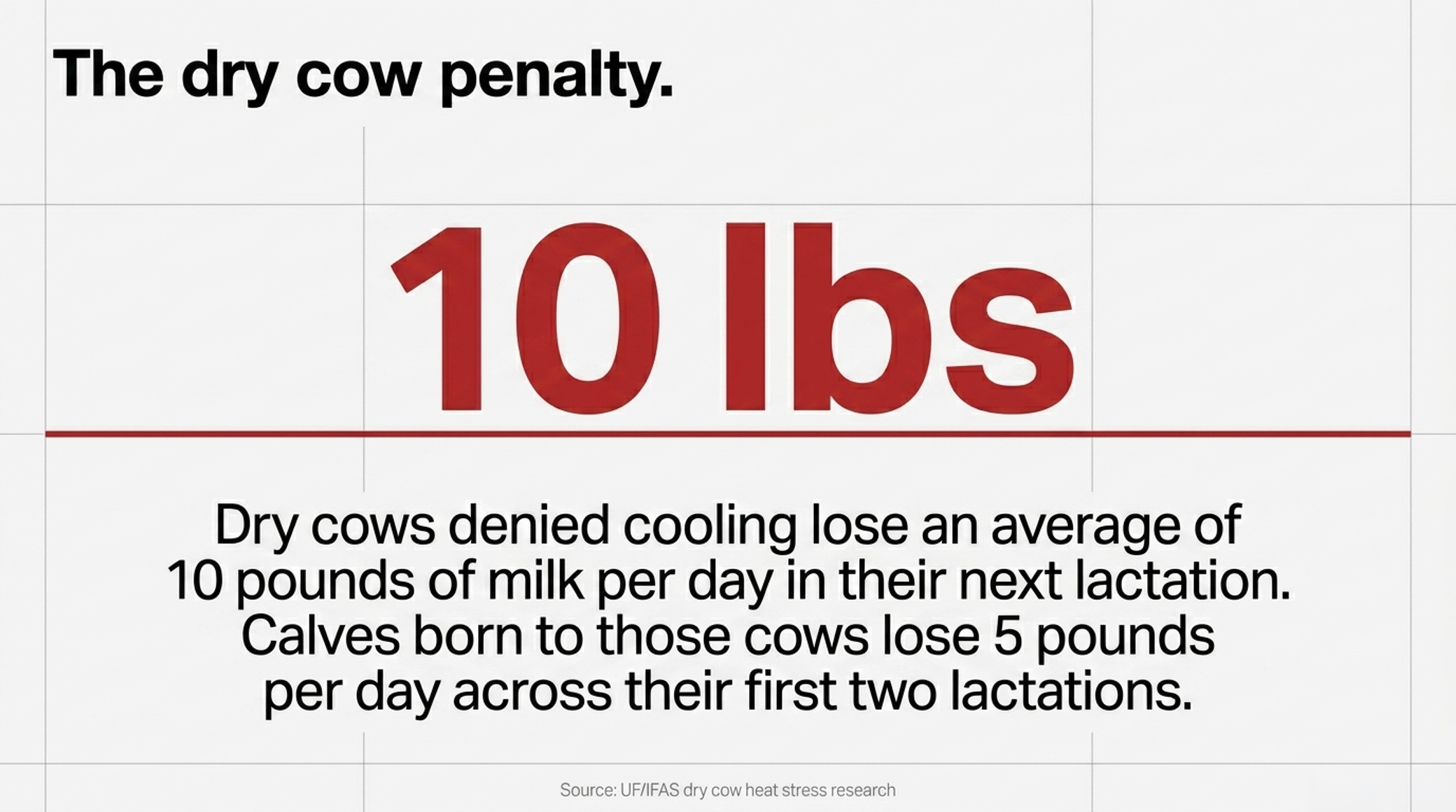
Why the urgency over cows that aren’t even milking? Because the research is blunt about it. University of Florida work led by Geoffrey Dahl and Jimena Laporta found that dry cows denied cooling lose an average of about 10 pounds of milk per day in the next lactation, and the effect holds whether they’re deprived for half the dry period or all of it. Their daughters carry the penalty forward — UF/IFAS reports that calves born to heat-stressed dry cows produced roughly 5 pounds less milk per day across both their first and second lactations. The same UF/IFAS work puts the sector-wide cost of failing to cool dry pregnant cows at up to $595 million a year, once you factor in lost productive life and extra heifer rearing. 

That’s not an August problem. That’s a problem you pay for the following winter — and again two years later, when those heifers freshen. Which is exactly why dry-cow cooling shows up on the spring to-do list right beside planting, not in the “if we have time” column.

Water, Bunk Timing, and the Cheap Wins Producers Skip

Nutrition on paper means nothing if the cow can’t get to water or won’t eat when feed’s in front of her. Two of the highest-return moves in a heat plan cost almost nothing — and both get skipped under pressure.

Start with water, because it’s the single most important nutritional input in summer. A heat-stressed cow’s water intake climbs sharply — research has documented increases of around 30% or more — and access right after milking matters most, when she’s walked back hot and thirsty. An extra trough on the return alley from the parlor, troughs cleaned to drinking-water standard, and chilled water in the 21–27°C range all measurably lift intake. One waterer per cow is the hot-weather benchmark — not the year-round standard. 

Then there’s when the feed goes out. Cows shift their feeding to the cooler hours and will refuse the bunk during peak heat, so farms that focus on production push the bulk of the ration into the evening. Feeding 60–70% of the ration between roughly 6 p.m. and 8 a.m. is the standing recommendation from Ontario and Manitoba dairy extension to maintain summer intake and milk production. More frequent feeding and push-ups keep fresh feed in front of cows and keep the TMR from heating and spoiling — and an organic-acid stabilizer buys bunk life when the silage face is fighting July heat. None of this is exotic. It’s just decided in advance, rather than improvised at 2 p.m. on the first 30°C day. 

The Math Nobody Runs Until It’s Too Late

The reason this stays broken on most farms is that the cost is never calculated for this farm this summer. The industry-wide figure — heat stress costing the U.S. dairy sector somewhere between $897 million and $1.5 billion a year in lactating losses alone — lands as somebody else’s problem. 

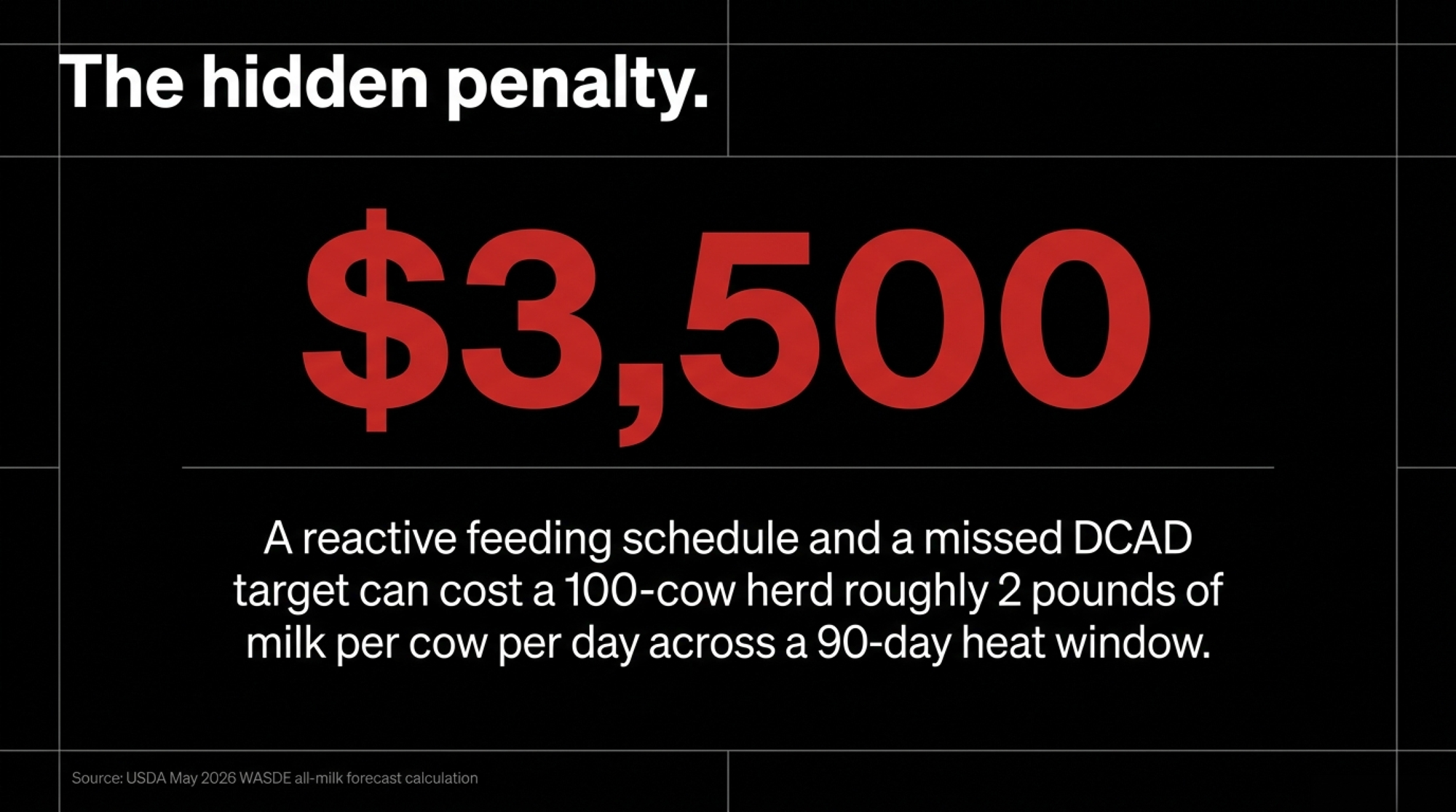
So run a version you can feel. Take a 100-cow herd. Say a DCAD miss and a reactive feeding schedule cost you a conservative 2 pounds of milk per cow per day across a 90-day heat window. That’s 18,000 pounds of milk you didn’t have to lose. At USDA’s May 2026 WASDE all-milk forecast of $19.70 per hundredweight, that’s about $3,546 off the cheque — traced straight back to a forage test you didn’t run and a ration you didn’t pre-build. Call it the better part of $3,500, gone, on a 100-cow herd that did nothing wrong except react late. 

Now put that next to the fix. The wet-chemistry mineral panel that would have caught the DCAD miss runs about $15 a sample as an add-on to a standard NIR package. Test your three or four main forages a couple of times throughout the season, and you’re into low double-digit dollars rather than a four-figure loss. That’s the whole trade the headline points at: a few dollars of testing on one side, thousands in lost milk on the other. The test is never an expensive decision. Skipping it is. 

Is this a national pattern or a single-herd quirk? Both. The biology is universal — every lactating cow loses potassium through panting, sweating, and milk when it gets hot. What varies is execution, and execution is a choice each operation makes on its own calendar. 

Where to Start — and What It Costs You to Get It Wrong

There’s no single right answer here. It depends on herd size, your forage base, and how much risk you’re willing to carry into summer. Ranked roughly by return on effort, here’s the sequence the best-run farms follow — and where each move bites if you botch it.

1. Pre-build the summer ration off spring forage tests — the 30-day move. In the next month, pull fresh forage samples, order wet-chemistry minerals, and book an hour with your nutritionist to recalculate DCAD, potassium, and magnesium for the high group and fresh pens first. About $15 a sample and one focused session. Worst case, you confirm the ration’s already right — information worth having. This is the move that everything else depends on. 

2. Fix water and bunk timing now — the free wins. Add a trough on the parlor return, commit to feeding 60–70% of the ration in the cool hours, and schedule more frequent push-ups before the heat lands. Costs mostly labor and discipline. It only backfires if it gets written down and then ignored when things get busy. 

3. Lock in the cation decision before June. Decide whether you’re leaning on high-K forage, a stabilized potassium carbonate, sodium bicarb, or a blend — and remember the trial data says a mix of both cations beats either alone. Most critical for corn-silage-heavy rations, where natural potassium levels run low. Where it backfires: grabbing off-the-shelf anhydrous K₂CO₃ and feeding it into wet TMR — the intake problem is real. 

4. Treat dry-cow cooling as a spring capital project. Walk the dry pen in April, as you would the high group, for any herd that hasn’t audited dry-cow shade, fans, and water since last summer. The trap is skipping it because those cows “aren’t milking” — the cost shows up two years out, in their lactation and their daughters’. 

5. Build the monitoring tripwires before the heat. Agree with your nutritionist on the indicators you’ll watch and the if-this-then-that rules once THI clears 68. Costs a conversation, not hardware — and only works if the rules actually get followed. 

What This Means for Your Operation

  • If you only do one thing this month, run wet-chemistry mineral analyses on your forages — about $15 per sample — and rebuild your summer ration based on the results. Every downstream decision depends on those numbers. 
  • If you think cooling alone fixes heat stress, remember that intake accounts for only 20–50% of the loss — the rest is gut and inflammation, and that’s the nutrition side’s job. 
  • If you’re building DCAD, use sodium and potassium together, and raise magnesium with potassium — the cations work as a system, not as a single lever. 
  • If you milk in Canada, protecting summer milk fat isn’t optional — a fat slide can leave butterfat quota unfilled, so the sodium-DCAD strategy matters more to your cheque than to a U.S. fluid-market herd’s. 
  • If your dry cows get shade but no fans, treat that as this spring’s highest-ROI cooling fix — UF/IFAS data ties uncooled dry periods to roughly 10 lb/day less next lactation, plus a penalty in the daughters. 
  • If you wait for “cows off feed” calls to act, you’re already two weeks into the loss. Set your THI 68 tripwires, water, and overnight feeding now. 

Key Takeaways

  • If your forage potassium hasn’t been measured by wet chemistry this spring, your DCAD target is a guess — fix that before you touch anything else. 
  • If you’re hanging more fans and still losing milk, you’ve maxed the 20–50% of the loss that’s about intake and ignored the other half that lives in the gut. 
  • If you build DCAD with one cation, you’re leaving milk on the table — the data says blend sodium and potassium and lift magnesium alongside. 
  • If your dry cows aren’t cooled, that’s your single highest-ROI fix this spring, and the bill comes due in the next lactation, plus two years out in the daughters. 

What should sit with you is how little of this is actually extra work. Pre-building the ration, testing the forage, cooling the dry cows, moving the feed to the cool hours — it’s the same work you’d scramble through in July, just moved to March when you’ve got time to think instead of time to panic. The farms that get this right didn’t find a secret additive. They moved their decisions earlier on the calendar. So here’s the real question for your barn: when the first heat wave lands this year, are you going to be running a plan you already wrote — or writing one while the tank slides?

Run Your Numbers

Forage Quality Value Calculator — Punch in your spring forage tests and milk price, and this tool turns them into $/ton DM, $/cow/day, and annual herd impact so you can see exactly what a bad DCAD guess or missed K swing is really costing.

Complete references and supporting documentation are available upon request by contacting the editorial team at editor@thebullvine.com.

Learn More

The Sunday Read Dairy Professionals Don’t Skip.

Every week, thousands of producers, breeders, and industry insiders open Bullvine Weekly for genetics insights, market shifts, and profit strategies they won’t find anywhere else. One email. Five minutes. Smarter decisions all week.
NewsSubscribe
First
Last
Consent
Send this to a friend