



Archive for dairy processing expansion

The $333M Processor Rush: Why Rod Hissong Wins While Pool Farms Get the 30-to-1 Gap

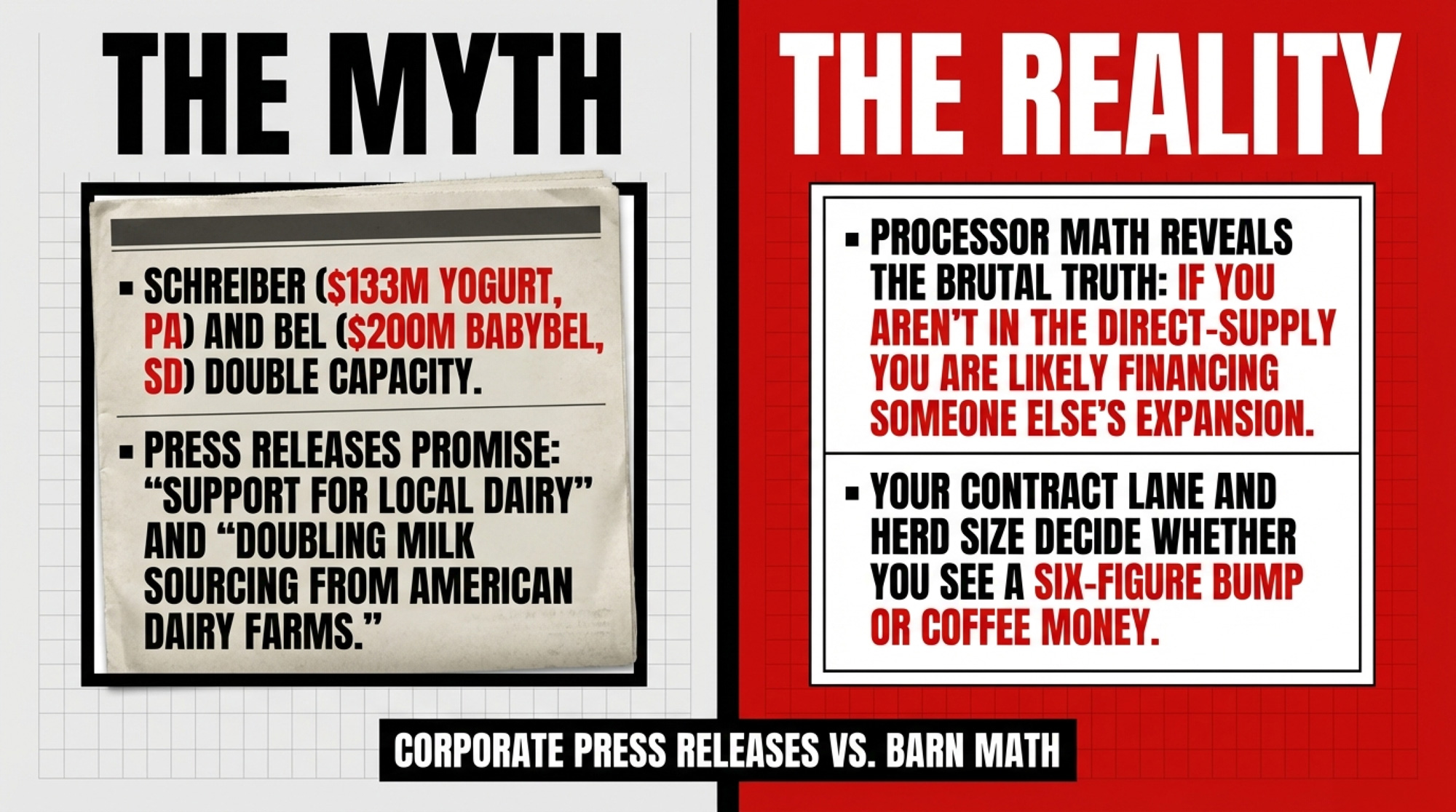
Processor math reveals the brutal truth: If you aren’t in the direct-supply lane, you’re likely financing someone else’s expansion.

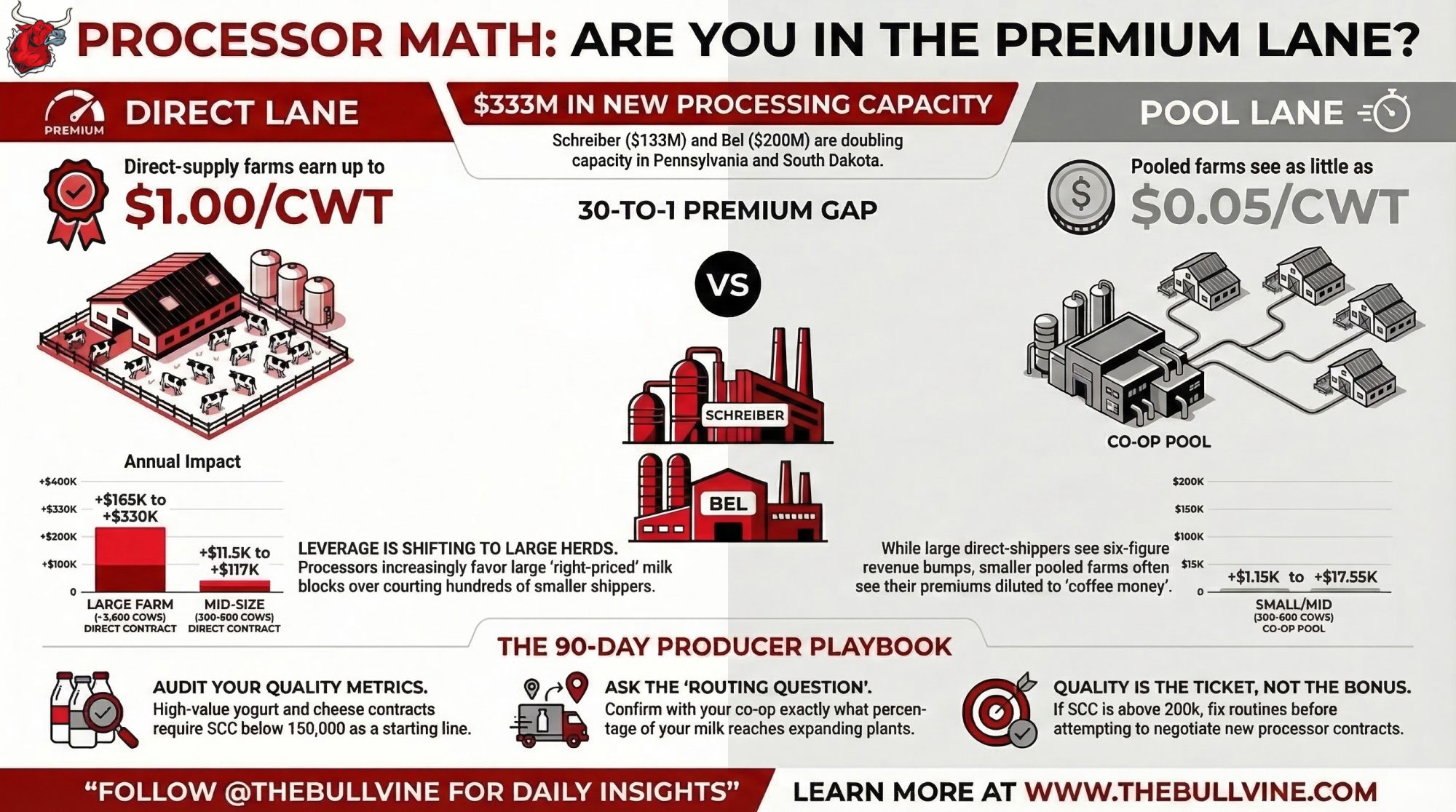
Executive Summary: $333M processor rush: Schreiber ($133M yogurt) and Bel ($200M Babybel) double capacity in PA/SD. Rod Hissong’s $5M Schreiber contract gains $165K–$330K/year. 200‑cow pool farms get $1K–$7K. 30‑to‑1 premium gap. PA’s 490 farm exits flip leverage to herds like Mercer Vu. FO30 down $5.42/cwt. Run your numbers: co‑op routing % + SCC <150K? +$0.50/cwt floor to switch lanes. Processor Math asks: where’s your share?”
dairy processing expansion

Rod Hissong ships 33 million pounds of milk a year to Schreiber Foods’ Shippensburg, Pennsylvania, plant — at least .06 million in annual revenue from that one relationship, using the Federal Order Class II minimum of .34/cwt(USDA, February 2026) as a floor. When Schreiber’s new yogurt line hits full stride, that same expansion could add $165,000–$330,000/year to his milk check, while a 200‑cow co‑op farm in the same sourcing zone might only see $1,150–$6,900 from the same announcement — depending on how premiums wash through the pool.

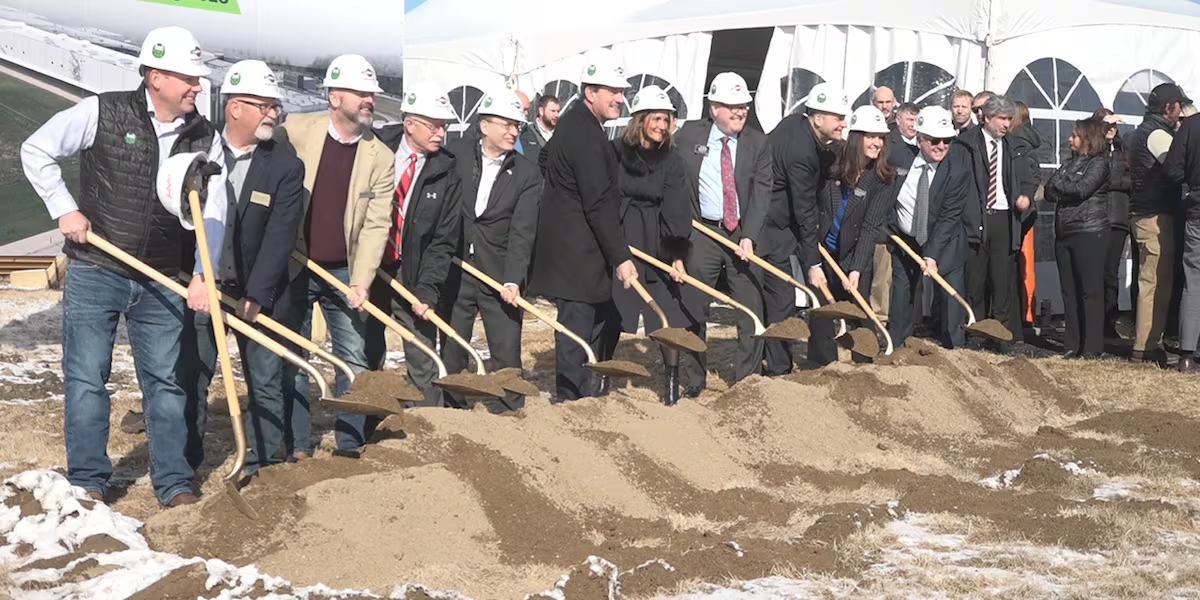
Two days after that Schreiber news, Bel Group broke ground on a 0 million expansion in Brookings, South Dakota, to double Babybel production from 10,000 to 20,000 tons per year and double its milk intake from American farms, primarily in South Dakota and neighboring states. Together, those two projects add 3 million in dairy processing capacity to regions where milk is already concentrating into fewer, larger herds — and where contract structure quietly decides who actually gets paid.
The Massive Premium Dilution Nobody Mentions

Press releases promise “support for local dairy.” The barn math says your contract lane and herd size decide whether you see a six‑figure bump or coffee money.

Mercer Vu Farms — Hissong’s operation in Mercersburg, PA — milks about 3,600 mature cows, farms 5,500 acres, and produces roughly 100 million pounds annually. Glenn and Mae Hissong started that herd with 7 cows in 1949; today, about one‑third of Mercer Vu’s production, around 33 million lbs/year, goes straight to Schreiber. The rest moves through Land O’Lakes.

The “average” Schreiber‑zone producer looks very different. The Center for Dairy Excellence’s 2025 survey pegs average responding herd size at 152 cows, while the USDA puts the statewide Pennsylvania average closer to 106 cows. Even using 152, that’s roughly 3.5 million lbs/year per farm — about a tenth of Mercer Vu’s Schreiber volume.

Schreiber’s 109,000 lbs/day: Same Expansion, Very Different Milk Checks

Governor Shapiro’s office says Schreiber’s Shippensburg project will add 109,000 lbs of raw milk processing per day, or about 39.8 million lbs/year, across 165 farms in 11 counties. Under realistic premium scenarios, that looks like this:

Farm ProfileAnnual Schreiber VolumePremium ScenarioAnnual Impact (barn math)
Mercer Vu (~3,600 cows, direct)~33M lbs+$0.50/cwt+$165,000 (33,000 cwt × $0.50)
+$1.00/cwt+$330,000 (33,000 cwt × $1.00)
200‑cow farm (direct, 50% to Schreiber)~2.3M lbs+$0.50/cwt+$11,500 (23,000 cwt × $0.50)
+$1.00/cwt+$23,000 (23,000 cwt × $1.00)
200‑cow farm (co‑op pool, indirect)Pooled+$0.05–$0.15/cwt (diluted)+$1,150–$3,450 (23,000 cwt × $0.05–$0.15)
+$0.10–$0.30/cwt (diluted)+$2,300–$6,900 (23,000 cwt × $0.10–$0.30)

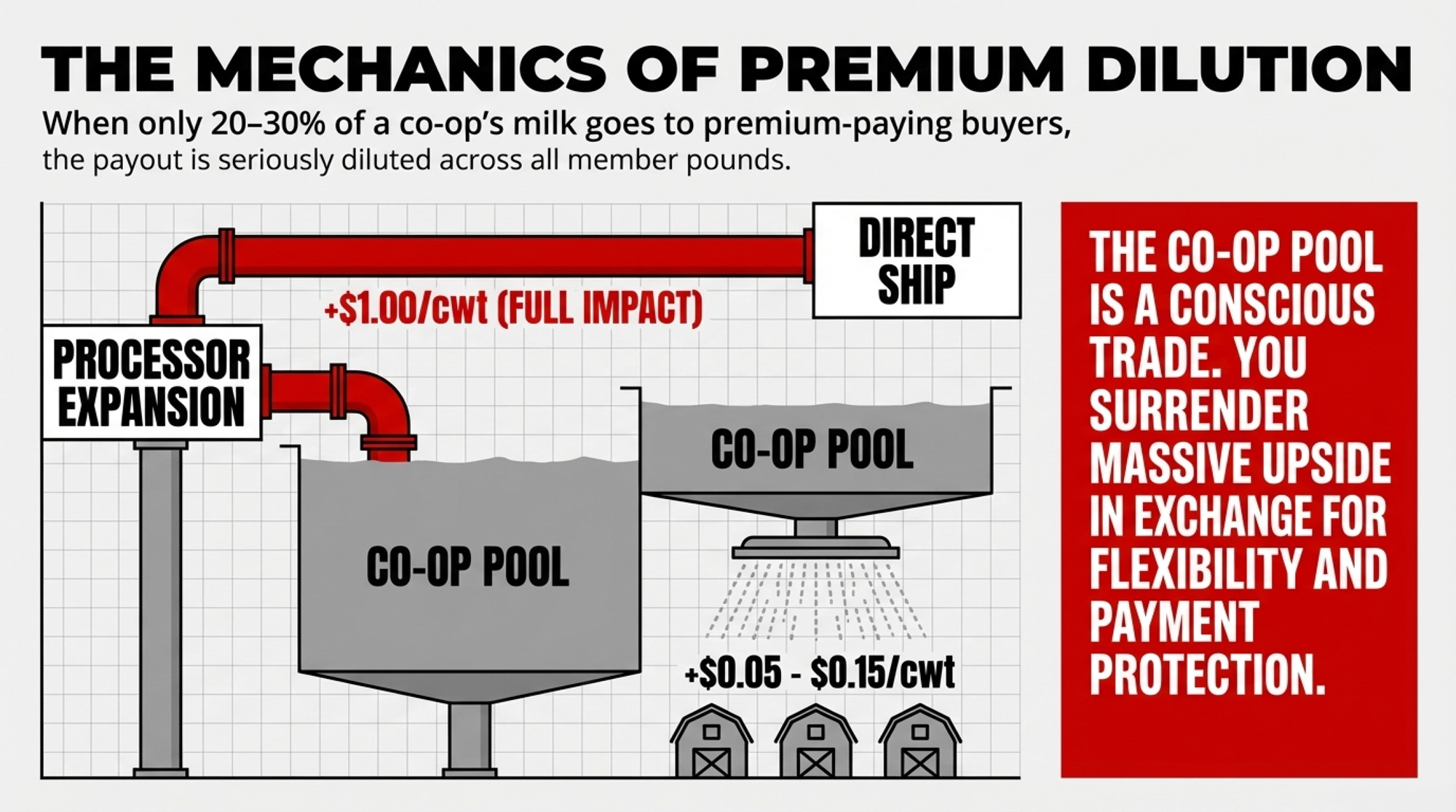
Those premium bands line up with historical $0.25–$1.00/cwt over‑order and contract premiums discussed by agricultural economist John Janzen in Progressive Dairy, and with the pooling math laid out by Mark Stephenson and Andrew Novakovic for the Center for Dairy Excellence. Their work shows that when only 20–30% of a co‑op’s milk goes to premium‑paying buyers, those premiums are “seriously diluted” across all member pounds.

Same expansion. Same counties. A difference that can approach 30‑to‑1 between the top and bottom rows.
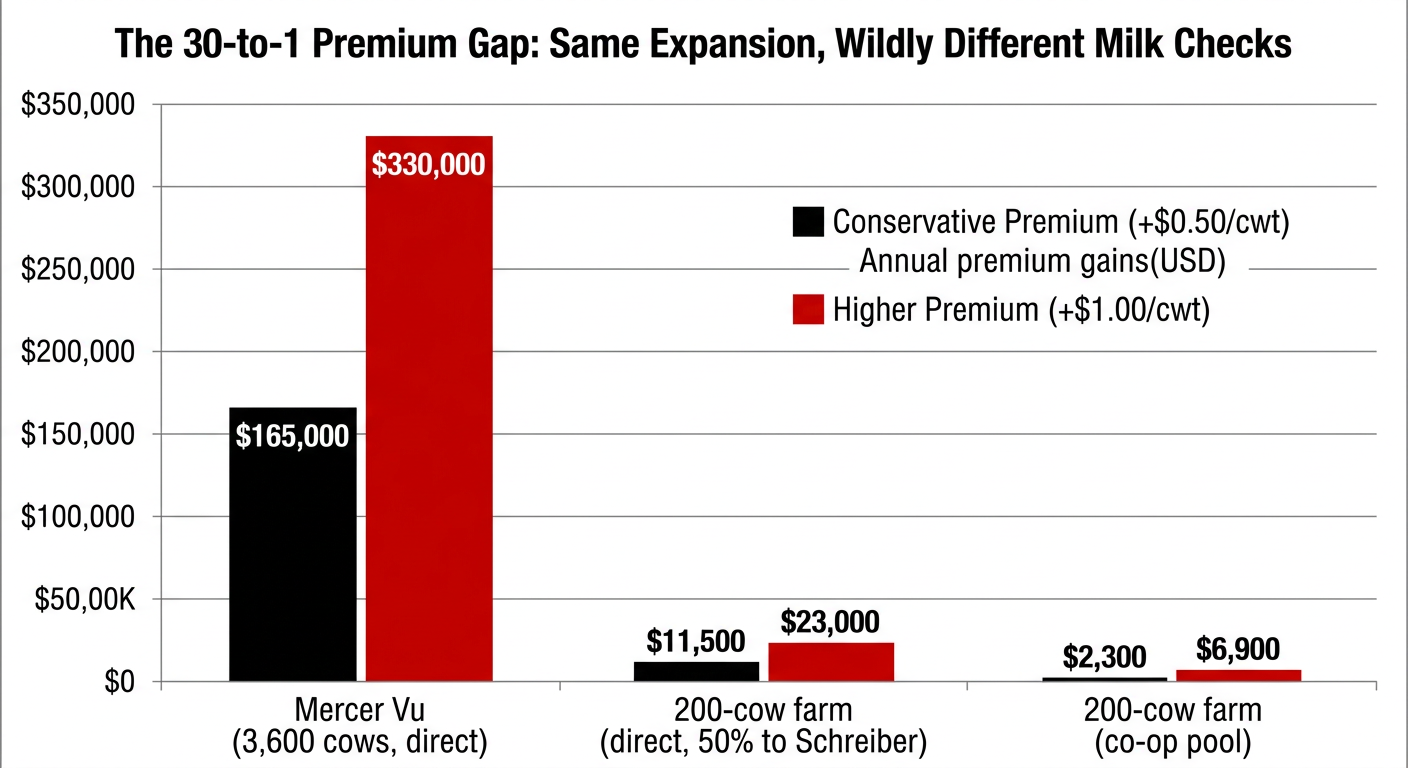
Farm ProfileConservative Premium (+$0.50 or +$0.10 pooled)Higher Premium (+$1.00 or +$0.30 pooled)
Mercer Vu (3,600 cows, direct)$165,000$330,000
200-cow farm (direct, 50% to Schreiber)$11,500$23,000
200-cow farm (co-op pool)$2,300$6,900

If your milk only reaches an expanding plant through a pool, you’re living in that bottom row — even if the press release name‑checks your state.

Concentration Gravity: From Shippensburg to Brookings
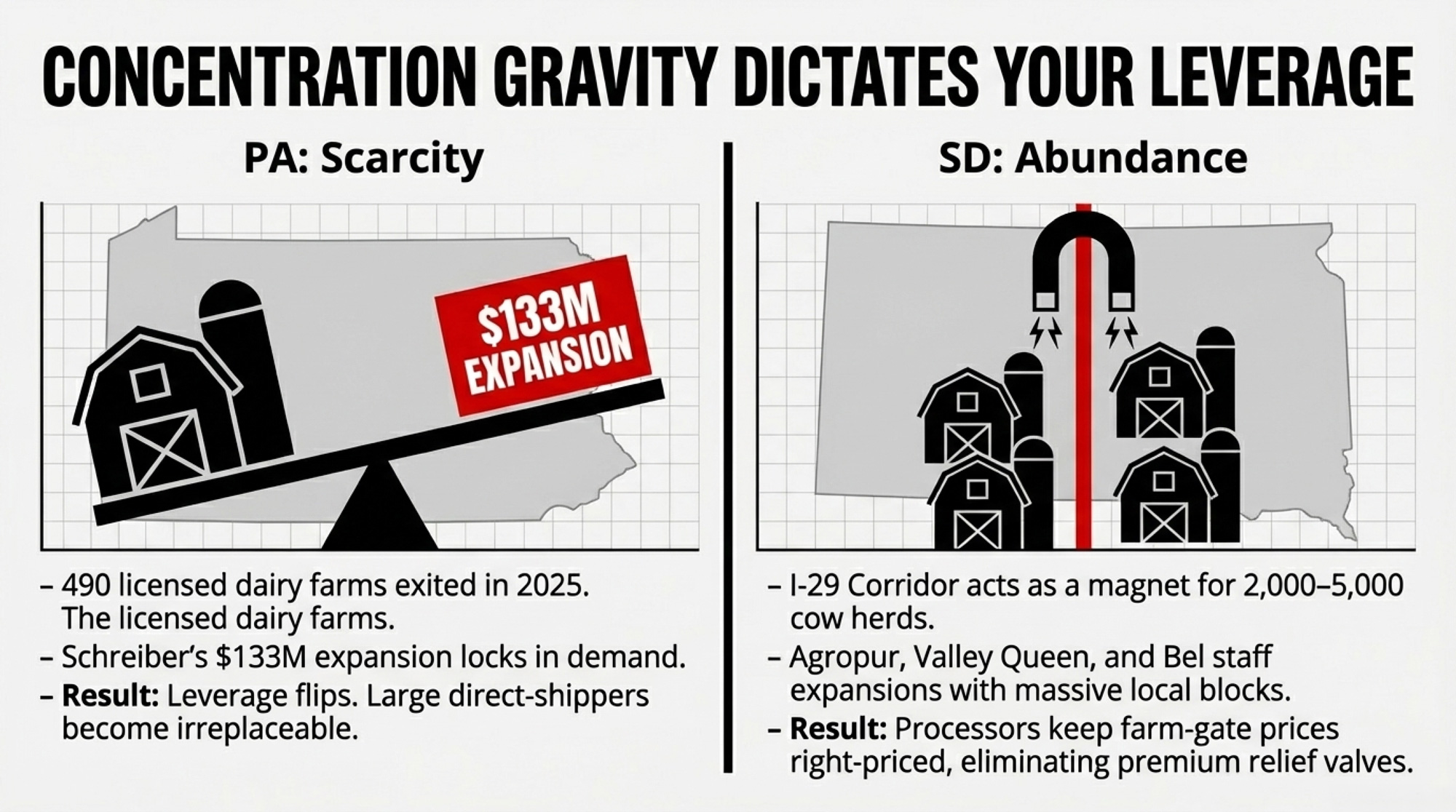
What’s happening in south‑central Pennsylvania is part of a broader concentration gravity: processor capital chasing large, “right‑priced” milk blocks.

On the PA side, Schreiber can pick up its extra 39.8 million lbs/year largely by deepening commitments with a handful of big direct shippers like Mercer Vu and adding a smaller number of mid‑size farms that can meet yogurt‑grade quality. Janzen’s line — “it’s much easier to sign up 10 2,000‑cow farms than 100 200‑cow farms” — is the procurement cheat code.

On the SD side, that same gravity is even stronger:

  • Valley Queen’s 2025 profile highlights 39 farms milking around 95,000 cows — about 2,400 cows per farm, all within reasonable hauling distance. 
  • South Dakota has been one of the fastest‑growing milk states in the U.S., while national herd numbers slowly shrink. 
  • Agropur (Lake Norden), Valley Queen (Milbank), and Bel (Brookings) now form a cheese/snack corridor that can staff expansions with local 2,000‑ to 5,000‑cow herds instead of courting hundreds of smaller shippers. 

Bel’s press release says Brookings currently produces 10,000 tons/year of Babybel and will double to 20,000 tons, “doubling milk sourcing from American dairy farms, primarily in South Dakota and neighboring states.” Earlier coverage around the original Brookings plant pegged its draw at about 15,000 cows; doubling production implies a similar additional draw.

The more easily Bel, Agropur, and Valley Queen can fill new vats with I‑29 corridor milk, the fewer basis‑premium “relief valves” remain for smaller herds shipping in from border states. That shows up later as weaker premiums and fewer calls when plants are short.

What Does Bel’s Expansion Really Mean for a 500‑Cow SD Herd?

South Dakota’s starting price floor is very different from Pennsylvania’s.

Federal Order 30 data show an Upper Midwest Statistical Uniform Price of $15.05/cwt in January 2026, down $5.42 from $20.47/cwt in January 2025, and among the lowest uniform prices across the FMMOs at that point. American Farm Bureau’s analysis of the June 2025 FMMO changes estimates that, in the first three months, higher allowances alone will result in about $64 million in lost revenue to the Upper Midwest pool.

A 500‑cow SD herd producing roughly 11.7 million lbs/year sits at about $1.76 million of gross milk revenue at $15.05/cwt.

Bel’s expansion doubles Babybeladd’s output to 20,000 tons and puts another $200 million into the Brookings site. Translate that into barn‑math scenarios for a 500‑cow herd:
FactorDirect ContractCo-op Pool
Premium Potential (500-cow herd, SD example)+$58,500–$117,000/year ($0.50–$1.00/cwt over FMMO)+$5,850–$17,550/year (diluted +$0.05–$0.15/cwt across all pool lbs)
Quality ThresholdSCC <150K (target <100K); strict bacteria/temp audits; failures can trigger terminationMore flexibility on month-to-month quality variance; still need to meet minimum FMMO standards
Volume Commitment3–5 year agreement typical; specified daily/monthly minimums; limited flexibility to expand/shrink without renegotiationShip what you produce; flexibility to grow/contract herd size without contract amendments
Payment ProtectionTermination risk if plant closes, finds cheaper supply, or cites quality “for cause”Federal Order payment security; pool guarantees you get paid even if processor fails
Upside CaptureYou get full premium when processor wins (e.g., +$0.50–$1.00/cwt for specialty cheese/yogurt)Premium dilution: your milk subsidizes pool members farther from premium plants

Exact over‑order numbers are contract‑specific and not public, but these ranges reflect real SD “right‑price” conversations and are consistent with historical premium levels along the corridor.

ScenarioVolume & PriceAnnual Impact (barn math)
Base case (pool only)11.7M lbs at $15.05/cwt$1.76M (117,000 cwt × $15.05)
Direct lane, +$0.50/cwt11.7M lbs at $15.55/cwt+$58,500 (117,000 cwt × $0.50)
Direct lane, +$1.00/cwt11.7M lbs at $16.05/cwt+$117,000 (117,000 cwt × $1.00)
Pool farm, diluted +$0.05–$0.15/cwt corridor lift11.7M lbs at $15.10–$15.20/cwt+$5,850–$17,550 (117,000 cwt × $0.05–$0.15)

Lynn Boadwine — who milks more than 2,000 cows near Baltic and has been a visible voice for SD dairy recruitment — summed up the processor logic bluntly: “You don’t want to have the highest price raw material for those folks, so they’re not going to move here. We’ve got to be right-priced to attract a processor.”

When a region can keep landing plants and keep farm‑gate prices “right‑priced” for processors, it’s not just growing local capacity. It’s slowly shifting where processors feel comfortable cutting bigger checks.

490 Pennsylvania Farms Gone — and Why That Flips the Leverage

Now flip back to Pennsylvania, because Hissong’s leverage sits on top of a changing supply base.
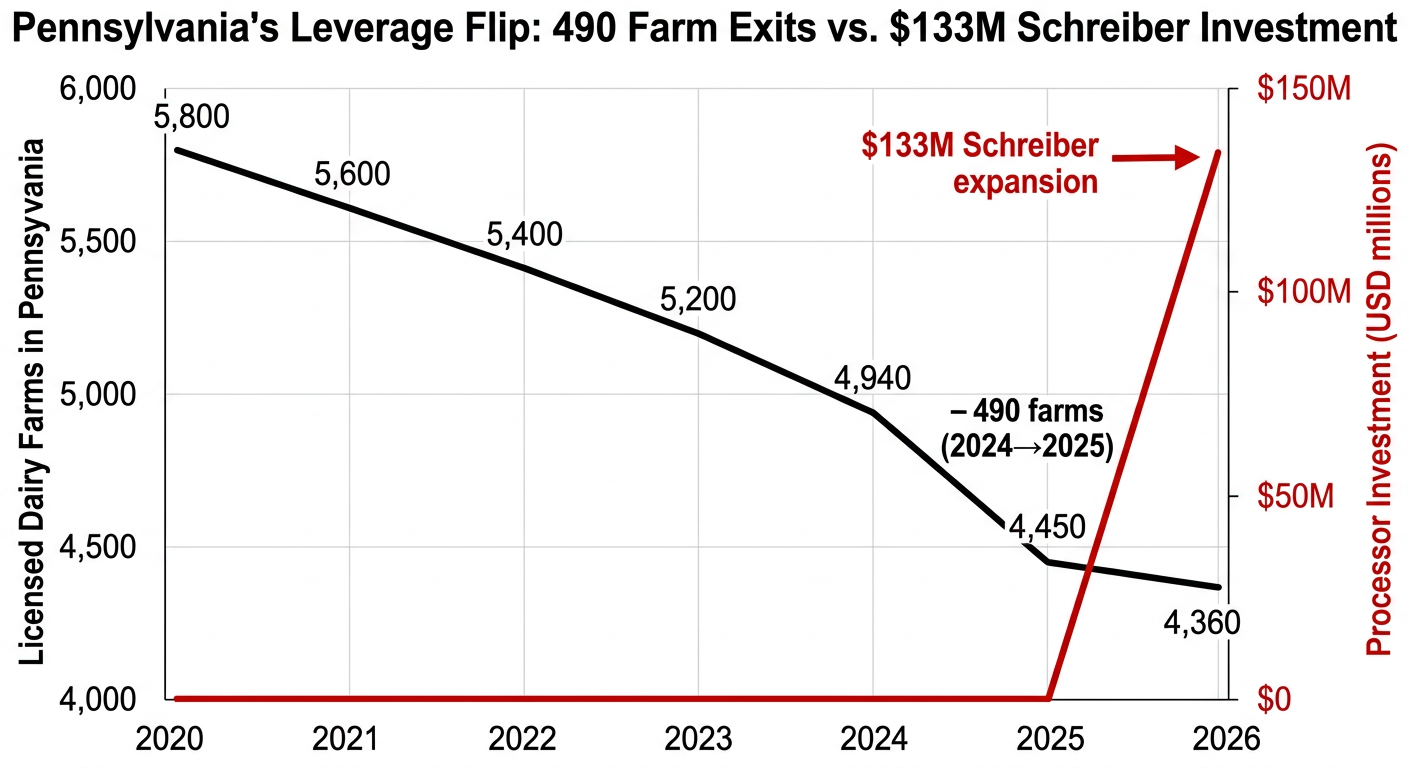
Looking at the USDA’s Milk Production report, notes that Pennsylvania lost 490 licensed dairy farms in 2025, dropping from 4,940 to 4,360 dairies — an 11.7% decline and about 41% of all U.S. dairy farm exits that year. Cow numbers fell by around 4,000 head to roughly 465,000, and state milk volume slipped 0.5% while national production rose 3.4%.

Schreiber has operated its Shippensburg plant since 2002. By locking in a $132.9 million expansion and 47 new jobs there, the company is effectively tethering more of its future yogurt strategy to south‑central PA.

Put that together:

  • Fewer herds.
  • Slightly fewer cows.
  • More processing demand backed by fresh capital.

For a large, proven direct‑ship supplier like Mercer Vu, that’s the moment the math flips. He’s no longer just one more shipper in a crowded market; he’s one of the relatively few large herds Schreiber can’t easily replace.

For a 200‑cow farm shipping into a co‑op pool, it raises the stakes on whether your co‑op is at the Schreiber table or repositioning milk into lower‑value outlets.

When Hissong said it’s “exciting and commendable for Schreiber Foods to continue investing in this plant” rather than chasing expansion “in West Texas, New York and other areas,” he was also naming the alternative: that $133 million could’ve gone somewhere else. pa

Trevor Farrell, Schreiber’s president, underlined that intent: “This expansion reinforces our long-term commitment to this area.”

Big capital decisions like this lock in procurement patterns and premium maps for years. If your region isn’t seeing those announcements — or if you’re not inside the sourcing radius — you’re playing a different premium game than your peers in PA or SD.

The 90‑Day Playbook Before the Premium Window Closes

Processors usually build their supply base 12–18 months before an expansion line hits full utilization. After that, they mostly manage what they’ve signed.

If you’re anywhere near Brookings or Shippensburg, the next 90 days matter.

If You’re a 500‑Cow SD Herd in the Pool

In the next 30 days:

  • Pull your last 12 months of DHIA records. Write down the average SCC, bacteria count, fat %, and protein %.
  • If SCC is over 200,000 or SPC/bacteria over 20,000 cfu/mL, fix that first. That kind of quality noise kills a procurement conversation before it starts.
  • Call your co‑op field rep and ask three precise questions:
    • “Do we currently supply Bel Brookings, Agropur Lake Norden, or Valley Queen Milbank?”
    • “Roughly what share of my milk routes to each?”
    • “Are there any volume commitments tied to those plants I should know about?”

By 90 days out:

  • Ask SDSU Extension or SD dairy groups for named contacts in Bel, Agropur, and Valley Queen procurement. Don’t sit back and hope they find you. 
  • Fix any bulk tank cooling problems — recorded temps above 40°F at two hours are a red flag for most audits.
  • Decide your minimum acceptable premium before you sit down. If Bel or a handler can’t clear your current blend by at least +$0.50/cwt on all lbs, your default assumption should be that staying in the pool is the safer play.

If You’re a 200‑Cow PA Farm in Schreiber’s Zone

This month:

  • Pull DHIA and tighten your own bar: for Class II yogurt, aim for SCC below 150,000, with <100,000 as the “best shot at premiums” goal.
  • If you’re at 180,000, that’s a 60–90 day barn‑level fix (dry‑cow program, milking routine, towels, prep).
  • Ask your co‑op explicitly: “Do we have a direct supply agreement with Schreiber Shippensburg? If yes, how much of that volume comes from farms my size?”

Then set your walk‑away number:

  • If your current blend is $15.05–$15.34/cwt, you probably need at least +$0.35–$0.50/cwt to justify a direct contract with tighter QA and termination clauses.
  • On 2.3M lbs, that’s about $8,050–$11,500/year. A +$0.25/cwt offer (~$5,750) may not be worth the extra risk when you can often find similar gains by tightening components and SCC inside the pool.

If You’re a 400–600‑Cow Herd Stuck in “We Should Talk.”

This week:

  • Call your actual processor contact — not the plant’s main line. If you don’t have a name and a number, that’s job one.
  • Prepare a one‑page supply proposal:
    • Average daily lbs.
    • 12‑month quality stats.
    • Hauling logistics.
    • A specific offer like: “We can deliver 8 million lbs/year on a 3‑year agreement with 6‑month mutual termination.”

Then get a contract review. Janzen’s work on milk contracts points to “market conditions,” “quality failures,” and “termination for cause” clauses that quietly shift risk to the producer. A $500 legal review on a $2M/year contract is inexpensive risk insurance.

If you don’t have at least a term sheet by fall 2026, assume this specific Bel/Schreiber expansion wave is largely spoken for. You’ll still move milk. You may not be in the first row of premium seats.

What This Means for Your Operation

  • Your contract lane matters more than your ZIP code. A 500‑cow herd inside Bel’s or Schreiber’s direct‑supply lane can see $58,500–$117,000/year from a $0.50–$1.00/cwt premium. A similar herd shipping through a pool might see $5,850–$17,550 — or nothing direct.
  • Quality is the ticket, not the bonus. For higher‑value Class II and branded cheese, <150,000 SCC is the starting line, and <100,000 is the target for serious premium conversations. If you’re above that, your first processor‑math project is fixing cows and routines, not chasing contracts.
  • The co‑op pool is a conscious trade, not a default. You give up some upside — maybe $29,000–$58,500/yearon a 500‑cow SD herd — in exchange for flexibility and regulatory payment protections. For small and mid‑size herds, that can be the smart play if you’re choosing it with eyes open.
  • Expansion somewhere shifts leverage everywhere. When corridor states like SD keep landing plants and keeping milk “right‑priced” for processors, it slowly nudges leverage away from regions that aren’t seeing those investments. That shows up later as weaker over‑order premiums and tighter contract terms.
  • 30‑day homework: Print your last 12 milk checks and DHIA summary. On one page, answer:
    • What % of your milk currently routes to a plant with announced expansion?
    • How many $/cwt above FMMO minimum are you actually getting?
    • How much of that spread is due to components/quality vs. processor premiums?

If you can’t answer those three without making a call, that’s your signal that the real story isn’t in Bel’s or Schreiber’s press release — it’s in the fine print of your own milk check.
Key Takeaways

  • If more than half your milk already ships to an expanding plant, you’re in the leverage band this article describes. Your decisions over the next 12–18 months are about terms and floors, not just having a home for your milk.
  • If all of your milk is pooled and none of it routes to an expanding plant, you’re probably subsidizing someone else’s premium. Your paths are: get into a sourcing radius, get into a different pool, or squeeze more out of components and costs where you are.
  • If you’re in that 300–500‑cow middle, you’re big enough that a good contract moves the needle, but small enough that you’re not the first call. Your edge is quality plus relationships — not waiting by the phone.

The Bottom Line

Whether you’re sitting in Franklin County or three states away, the practical question is simple: are you close enough — on paper and on quality — to be inside a processor’s premium lane, or are you quietly financing someone else’s expansion?

Complete references and supporting documentation are available upon request by contacting the editorial team at editor@thebullvine.com.

Learn More

The Sunday Read Dairy Professionals Don’t Skip.

Every week, thousands of producers, breeders, and industry insiders open Bullvine Weekly for genetics insights, market shifts, and profit strategies they won’t find anywhere else. One email. Five minutes. Smarter decisions all week.
NewsSubscribe
First
Last
Consent

The $11 Billion Dairy Rush: Your 18-Month Window to Lock in Processor Premiums

Processors building 50 new plants need YOUR milk—but only if you move in the next 18 months. After that, you’re just another supplier.

EXECUTIVE SUMMARY: The U.S. dairy industry is betting $11 billion on 50 new processing plants that need milk from 100,000 cows that don’t exist yet—creating a massive opportunity for positioned farms. Operations within 75 miles of new facilities are already locking in $1.50/cwt premiums worth $150,000+ annually for a 500-cow dairy. But geography isn’t everything: farms anywhere can capture premiums by moving protein from today’s 3.2% average to the 3.3%+ processors demand, using nutrition strategies costing just $15-25/cow monthly. Mid-size dairies (500-1,500 cows) face the defining choice of this generation: invest $2M in robotics, transition to organic for $6-8/cwt premiums, or exit strategically while asset values hold. The clock is ticking—processors typically lock 70-80% of milk supply within 12 months of facility announcements, with early movers securing 20-30% better terms than those who wait. The next 18 months will determine the structure of American dairy for the next decade. Your decisions in the next 90 days matter more than everything you’ll do in the next five years.

dairy processor premiums

You know what’s remarkable about driving through dairy country right now? The construction. I’m seeing it everywhere—California’s Central Valley, Wisconsin’s rolling countryside, Pennsylvania’s traditional dairy regions. Based on what Dairy Processing magazine and state economic development offices have been tracking, we’re witnessing one of the most significant waves of dairy infrastructure investment in recent memory, with substantial new capacity being developed between now and 2028.

The timing raises questions, doesn’t it? The USDA’s Economic Research Service data from their 2023 release showed annual cheese consumption per capita growing just 0.3% to 0.5% over the previous five years—not exactly a demand surge. But then you look at exports. USDEC reports from late 2024 showed cheese exports up 12% to 16% year-over-year, with Mexico consistently taking 30% to 35% of those shipments. That’s what’s driving this expansion, and it makes you wonder about the risks we’re taking.

I was talking with a Texas producer recently who captured what many of us are feeling: “We’re definitely seeing more processor interest than we have in years. But I keep wondering if everyone’s building for the same milk that doesn’t exist yet.” And that’s the tension—between processor ambitions and what’s actually happening on farms.

Quick Decision Checklist: Where Do You Stand?

Before diving deeper, ask yourself these questions:

  • Is your operation within 75 miles of new or expanding processing?
  • Are your protein levels consistently above 3.3%?
  • Do you have 6-9 months of operating expenses in reserve?
  • Is your current milk contract up for renewal before 2027?
  • Could you invest $15-25/cow monthly for component improvement?

If you answered yes to three or more, you’re positioned to capture opportunity. Less than three? Focus on the defensive strategies we’ll discuss.

Understanding Your Position: Where You Fit in This Changing Landscape

What I’ve noticed over the years is that expansion cycles affect different sized operations in distinct ways. Let me share what producers across various scales are experiencing.

Small Operations (Under 500 cows): A Wisconsin producer I know who milks about 380 cows recently shared her approach with me. “We can’t compete on volume,” she said, “so we’re getting really good at what we can control—our components.” Working with her nutritionist to fine-tune rations, she’s moved her protein from 3.15% to 3.28% over six months. Based on current component pricing in Federal Milk Marketing Orders, that improvement brings in an extra $2,500 to $3,000 monthly. Not life-changing money, but it definitely helps with cash flow.

Mid-Size Operations (500-1,500 cows): This group faces perhaps the toughest decisions. A Minnesota family operation I’m familiar with—third generation, about 900 cows—they’re running the numbers on two completely different futures, and the complexity is really something.

Here’s what they’re wrestling with: The robotics path would require about $2.25 million based on current manufacturer specs—figure 15 robots for their herd size, each handling 60 cows or so. Extension economic models suggest they’d save around $180,000 annually in labor costs, maybe more when you factor in the challenge of finding workers these days. Add in better milking frequency, improved cow health monitoring, and they’re looking at a 10-12 year payback. Not bad, but it’s a big commitment.

The organic transition? That’s a whole different calculation. You’ve got your three-year conversion period required by USDA, and during that time, you’re selling conventional milk while following organic protocols. But once certified, Agricultural Marketing Service data shows organic premiums running $6 to $8 per hundredweight above conventional prices. For their 900 cows producing 70 pounds daily, we’re talking roughly $340,000 additional annual revenue once they’re through transition.

Of course, it’s not all upside. They’d likely see production drop during conversion—maybe 10% based on what other farms have experienced. And there’s about $150,000 in infrastructure changes and certification costs. New feed storage, separate handling equipment, the whole nine yards.

As one family member put it, “Both paths could work financially, but they lead to completely different operations five years out. Robots mean we stay commodity-focused but more efficient. Organic means entering a specialty market with its own risks and rewards.”

Large Operations (1,500+ cows): Geographic positioning becomes everything at this scale. If you’re within reasonable hauling distance of new capacity—generally 75 to 100 miles based on transportation economics—you’ve got real negotiating power. Beyond that distance? The economics shift dramatically.

Geographic proximity to new processing facilities creates dramatic revenue differences—operations within 75 miles earn $120,000+ more annually than distant competitors. Your location determines your negotiating power in the $11 billion processor expansion.

The Processing Wave: Understanding What’s Actually Being Built

Looking at announced projects reveals processor priorities. Texas, New York, California, and Wisconsin are leading in publicly announced investments, which makes sense given their dairy infrastructure. But Michigan, Kansas, and Minnesota are seeing significant activity too—places that might surprise you.

What’s particularly significant about these new facilities is that they’re not just bigger versions of old plants. During a recent industry conference, a plant operations manager explained: “These plants are engineered around specific milk characteristics. Give us consistent 3.5% protein and 4.2% butterfat, and we can achieve efficiency levels that weren’t possible five years ago.”

The University of Wisconsin’s Center for Dairy Research has been documenting this shift—modern plants can achieve cheese yields 8% to 12% higher when milk components are optimized. That’s producing substantially more cheese from the same milk volume compared to a decade ago. Transformational stuff.

Part 1 Summary: Setting the Stage

The dairy processing expansion represents both opportunity and challenge. Your position depends on size, location, and component quality. Understanding where you fit helps determine your strategy.

Key Takeaways So Far:

  • New processing capacity is substantial but export-dependent
  • Component quality increasingly trumps volume
  • Geographic proximity creates real advantages
  • Different sized operations face distinct decisions

Part 2: Navigating Market Dynamics and Making Strategic Decisions

Supply and Demand: The Mathematics We Need to Consider

This development becomes especially significant when you look at the utilization math. Cornell’s dairy extension work shows processors typically need 85% to 90% utilization for profitability. If these new facilities hit those targets while existing plants maintain production, cheese production capacity could increase meaningfully. Meanwhile, domestic consumption? Still growing at that modest 0.3% to 0.5% annually, according to USDA data.

The export market is carrying us right now. USDA Foreign Agricultural Service data confirms Mexico takes 30% to 35% of our cheese exports. But trade relationships can shift—we’ve all lived through that uncertainty. And China? Rabobank’s recent reports show Chinese dairy imports down significantly from their 2021 peak. Is this a temporary adjustment or a structural change? That’s the question keeping economists up at night.

U.S. dairy export markets show explosive growth led by Mexico’s 107% increase in cheese purchases over 5 years—this global demand directly funds the $11 billion processing expansion securing your premiums. When processors say they ‘need more milk,’ they mean they need YOUR high-component milk to capture export market share from New Zealand and the EU. Your milk check increasingly depends on families in Mexico City, not just domestic demand.

As dairy economists at our land-grant universities keep pointing out, we’re betting on continued export growth at levels that historically don’t sustain long-term. It might work beautifully. But acknowledging the risk helps us plan better.

What Processors Actually Want (And What They’ll Pay For)

The conversation about milk quality has shifted dramatically. Volume used to be everything. Today? Components rule.

Federal Milk Marketing Order statistical reports paint a clear picture. Farms consistently delivering protein above 3.3% earn meaningful premiums. Hit 3.5% or higher? You’re writing your own ticket in many markets. Butterfat at 4.0% or above works well for cheese, though some processors now consider butterfat above 4.5% excessive and require costly separation.

Strategic protein optimization delivers dramatic ROI—$15 monthly investment per cow generates $45,750 annual return at the 3.3% processor target. The math works: spend $7,500/year on better nutrition, earn $45,750 in component premiums. That’s how smart operations capture value from the $11 billion processing wave.

What’s worth noting is component consistency. Processors want daily variation under 2%—basically, they need to know that Tuesday’s milk will be pretty much the same as Friday’s for their standardization processes. And for export? Most programs require somatic cell counts below 200,000 cells/ml.

Council on Dairy Cattle Breeding data shows national average butterfat increased from 3.66% in 2010 to over 4.1% by 2024. Protein moved from 3.05% to about 3.25%. These improvements translate directly to cheese yield—and that’s what processors care about.

Looking at your milk check, the Federal Order data shows that farms with superior components earn premiums of $0.50 to $1.50 per hundredweight above base. Take a 500-cow operation producing 85 pounds per cow daily—even a $1.00 premium generates over $150,000 additional annual revenue. Same cows, better milk, significantly more money.

Real Progress: Component Improvement in Practice

I recently visited a Pennsylvania operation that impressed me with its systematic approach. Working with their nutritionist on targeted ration adjustments—nothing revolutionary—they moved protein from 3.12% to 3.31% over eight months.

The herd manager explained their philosophy: “The biggest change wasn’t expensive additives. We improved forage quality, tightened feeding consistency, and paid attention to cow comfort during heat stress.” Feed costs increased by about $15 to $20 per cow per month, but component premiums more than offset it. They’re netting an additional $4,500 to $5,500 monthly profit.

This reinforces what successful operations keep demonstrating—you don’t need revolution. You need systematic attention to details that matter.

Windows of Opportunity: Timing Your Decisions

Processor behavior follows predictable patterns I’ve observed across multiple expansion cycles. Understanding these helps you negotiate effectively.

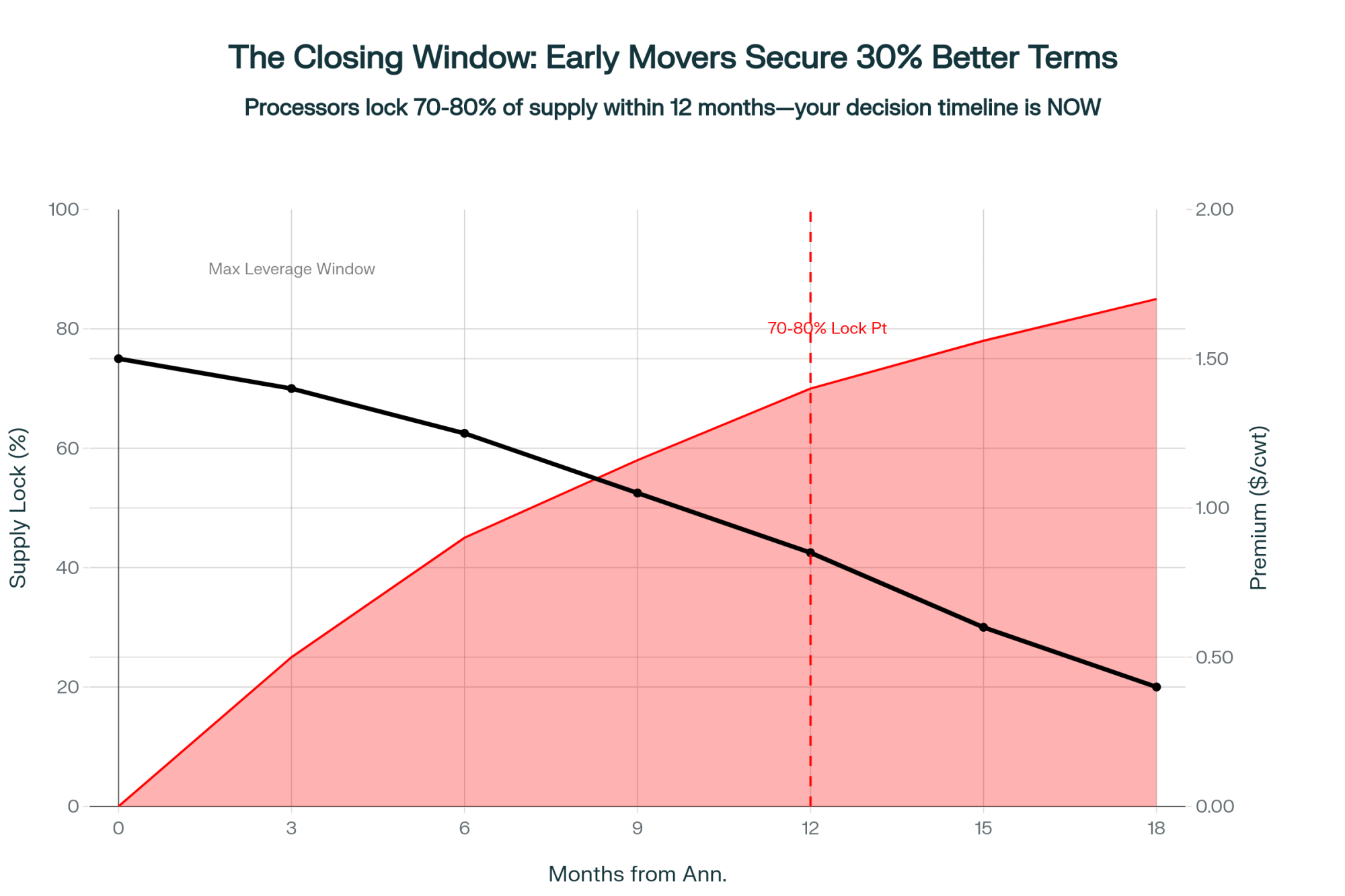
The early months after facility announcements represent the maximum leverage. Processors actively court milk supply, offering signing bonuses, favorable terms, and quality premiums. Looking back at the 2011-2014 expansion period documented by CoBank, farms that committed early captured terms 20% to 30% better than those who waited.

Once processors secure 70% to 80% of target capacity—remarkably consistent across regions—urgency drops. The welcome mat stays out, but that red carpet gets rolled up. Terms shift from generous to acceptable.

Why does this matter now? If your current marketing agreement expires in 2026, start conversations immediately. Waiting until processors have met their needs means negotiating from a position of weakness.

Processor supply contracts follow predictable patterns—early movers within 6 months secure premiums 200%+ higher than late signers. This chart shows why October 2025 is a critical decision point: most announced facilities are 6-12 months into their supplier commitment phase. The window doesn’t stay open. History shows 70-80% of supply gets locked by month 12, and premium rates collapse by 60-75% for late signers.

Labor and Heifer Constraints: Structural Challenges

Two constraints keep reshaping our industry, with no quick resolution in sight.

Labor remains challenging everywhere. Research from Texas A&M and agricultural labor studies indicates that immigrant workers comprise over half of the dairy workforce nationwide. With H-2A visa programs poorly suited to dairy’s year-round needs, and USDA Economic Research Service data showing that rural agricultural counties lost 1.6% to 2.2% of their population from 2020 to 2023, finding and keeping good people remains difficult.

The heifer situation compounds challenges. USDA’s January 2024 Cattle Report showed 3.9 million dairy replacement heifers—down 17% from 2018, the lowest since tracking began. Agricultural Marketing Service auction reports show heifer prices are up by more than 140% from 2020 lows in many regions.

Yet production per cow keeps climbing. USDA data shows average production in major dairy states increased about 1.5% annually over the past five years. Genetic progress documented by the Council on Dairy Cattle Breeding continues accelerating.

This creates an interesting dynamic. We can’t easily expand cow numbers, but we’re getting more milk from existing cows. It’s forcing everyone to rethink growth strategies.

Regional Perspectives: Geography Shapes Options

The Upper Midwest faces unique pressures. Wisconsin’s roughly 5,000 dairy farms, averaging around 200 cows, according to USDA census data, feel pressure from processors to deliver larger, more consistent volumes. Yet many have advantages—established land bases, multi-generational knowledge, strong communities.

One Wisconsin producer explained his strategy: “We’re not competing with 5,000-cow dairies. We’re producing high-component milk efficiently with family labor.” That resonates across the Midwest.

The Northeast shows contrasts. Proximity to major population centers—Boston to DC—creates opportunities that western operations can’t access. Local food movements, agritourism, and direct marketing provide alternatives to commodity production. Yet farms distant from new processing face real challenges.

Western states continue evolving. California’s trajectory seems clear from state data—fewer farms, larger herds, and increasing environmental and water constraints. But innovative, smaller operations find niches serving coastal populations with specialty products.

The Southeast presents overlooked possibilities. Georgia, Tennessee, and Virginia have growing populations, limited local production, and increasing consumer interest in regional foods. A Virginia producer recently told me they’re getting an extra $2 per hundredweight just for being within 100 miles of their processor. Proximity has value in underserved markets.

Making Strategic Decisions: Practical Frameworks

Strategic investment comparison reveals component optimization delivers fastest payback (4 months) while organic transition provides highest long-term returns ($340K annually) for mid-size operations. Robotics requires patient capital but solves labor constraints. Your choice depends on capital access, risk tolerance, and 5-year goals—not on what your neighbor chose.

After countless conversations with producers navigating these changes, consistent principles emerge.

For smaller operations: Component optimization offers your clearest path. University extension research shows moving protein from 3.2% to 3.3% can add $30,000 to $40,000 annually for a 400-cow herd. Investing in nutrition programs—typically $15 to $25 per cow per month—often pays back within months.

Risk management matters too. FSA’s Dairy Margin Coverage at higher levels provides meaningful protection for modest premiums. Those who had coverage during previous squeezes sleep better.

Mid-size operations face directional choices. Automation requires major investment—manufacturer data shows robotic systems at $150,000 to $250,000 per unit, handling 50 to 70 cows each. But labor savings and lifestyle improvements justify it for many.

Specialty markets offer another path. USDA Agricultural Marketing Service shows organic premiums averaging $5 to $8 per hundredweight above conventional through 2024. Limited market—about 5% of production—but margins remain attractive for committed producers.

Larger operations should focus on geographic positioning and component excellence. Being within 75 miles of processing creates real advantages. Beyond that, challenges mount regardless of other strengths.

Understanding Consolidation: The Bigger Picture

Industry consolidation isn’t new, but understanding the scope helps planning. The USDA Census of Agriculture documents a decline from 65,000 dairy farms in 2002 to fewer than 30,000 by 2022. This reflects economics and generational preferences.

What encourages me is the diversity of successful models. We see 10,000-cow operations achieving remarkable efficiency. We also see 100-cow grass-based operations thriving with direct marketing. The industry needs both.

A young Vermont producer shared wisdom recently: “My parents had one success model—get bigger. My generation has options. We can get bigger, better, different, or exit gracefully. Having choices is powerful.”

Planning All Scenarios: Including Transition

Strategic planning means considering all possibilities, including transition. This deserves honest discussion without judgment.

For some operations, market conditions, family dynamics, or personal preferences make the transition right. Universities offer confidential planning through extension services. Organizations like the Farm Financial Standards Council provide evaluation frameworks.

An Iowa dairyman preparing to retire shared his perspective: “Recognizing when to transition is as important as knowing how to grow. I’m proud of what we built and leaving on our terms.” Real wisdom there.

Your Decision Point: Making Choices That Matter

As we navigate this expansion period, the path forward becomes clearer when we focus on what we can control. Processing expansion will reshape our industry—that’s certain. How it affects your operation depends on the decisions you’re making right now.

Component quality, geographic positioning, and financial resilience determine who captures opportunity versus who faces challenges. These aren’t abstract concepts—they’re measurable factors you can influence today.

The critical element remains timing. Markets evolve, opportunities shift, windows close. Understanding these dynamics while you have options matters more than any prescribed path. Because ultimately, you know your operation, your capabilities, and your goals better than any outsider.

This processing wave will create winners and losers—that’s market reality. But there’s more than one way to win, and strategic exit on good terms beats forced liquidation every time. Choose thoughtfully, act decisively, and remember—successful dairy farming has always meant matching resources with opportunities.

There always has been more than one path to success in dairy. And regardless of what the next few years bring, there always will be.

KEY TAKEAWAYS 

  • $150K Location Bonus: Farms within 75 miles of new plants are locking in premiums worth $150,000+ annually—but smart nutrition can close the geographic gap
  • The 5X Protein Play: Invest $15/cow monthly in nutrition → boost protein 0.1% → earn $75/cow annually (4-month payback)
  • Your 18-Month Shot: Processors lock 70-80% of milk supply in Year 1 after announcements—early contracts earning 30% premiums over late signers
  • Pick Your Lane by 2026: Scale up (robots: $2M), specialize (organic: $300K/year after transition), or sell strategically (before 40% of peers flood market)

Complete references and supporting documentation are available upon request by contacting the editorial team at editor@thebullvine.com.

Learn More:

The Sunday Read Dairy Professionals Don’t Skip.

Every week, thousands of producers, breeders, and industry insiders open Bullvine Weekly for genetics insights, market shifts, and profit strategies they won’t find anywhere else. One email. Five minutes. Smarter decisions all week.

NewsSubscribe
First
Last
Consent
Send this to a friend