








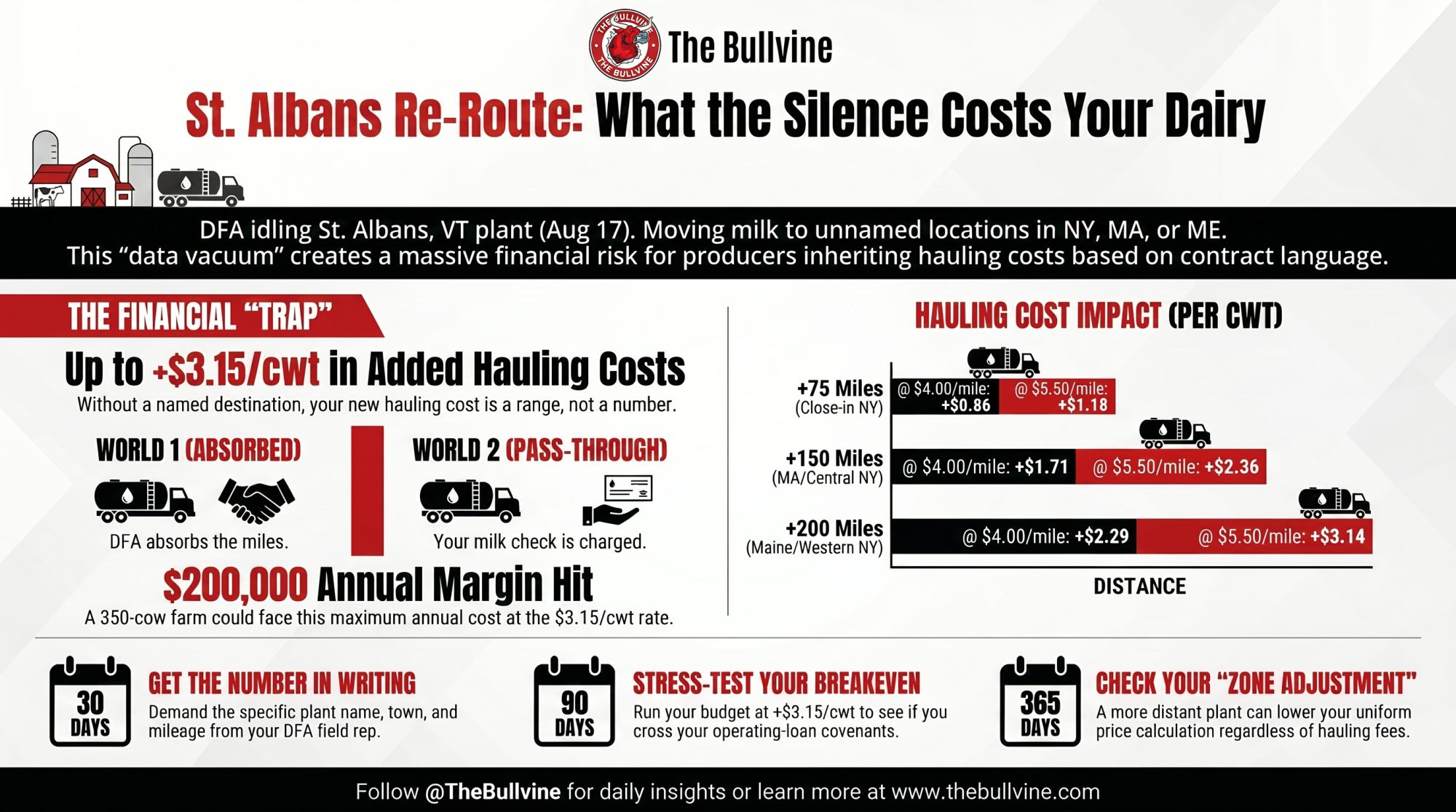
DFA idles St. Albans Aug 17 and sends the milk to “New York, Massachusetts, and Maine” — no plant named. That vagueness is worth up to $3.15/cwt on your check. Here’s the math.
Executive Summary: DFA idles its St. Albans, Vermont plant on August 17, and the wire’s “80 jobs lost” headline buried the part that hits your milk check: the milk still has to move, and DFA has named three states — New York, Massachusetts, and Maine — but not a single receiving plant. Until they name it, your added haul is a range, not a number, running +$0.85 to $3.15/cwt depending on where the milk lands. Here’s the trap: DFA owns the trucking company too, so whether those miles hit your deduction or get absorbed as network efficiency comes down to language in your producer agreement — not the press release. With Class I utilization in Order 1 at just 20.4%, this is manufacturing milk chasing the cheapest plant, not the closest one, and St. Albans lost that math. You’ve got about eight weeks to get a plant name, a per-cwt deduction, and a zone-adjustment answer out of your field rep in writing before the plant goes dark.
A 350-cow Franklin County dairy could be looking at between $40,000 and $200,000 a year in added hauling costs starting August 18, 2026 — and right now, producers are operating in a data vacuum because Dairy Farmers of America has named three states for the milk but not a single plant.
That’s the trap under the milk-hauling cost-per-hundredweight question every St. Albans patron is sitting with this summer. DFA confirmed on June 17, 2026, that it will “idle” its St. Albans, Vermont, plant effective Monday, August 17, in a decision the co-op said “reflects broader operational and network changes needed to best serve our farmer-owners and customers.” The wire ran the headline — roughly 80 jobs lost — and moved on. But the milk that fed that plant still exists on August 18. It has to go somewhere. And the farms that supplied it are about to learn what every extra mile costs, on their milk check, not DFA’s.
What DFA Said, and the Four Numbers It Skipped
| Data point DFA skipped | Why it matters to your check | What you should ask for | Risk if you never get it |
| Which farms ship to St. Albans | Tells you how many neighbours share the route and leverage | Full patron list or at least your route cluster | You negotiate alone while DFA optimizes the network |
| Daily pounds through the plant | Determines how much volume has to be re-routed and at what scale | Average daily lbs shipped from St. Albans | You can’t sanity-check DFA’s “network efficiency” story |
| One-way miles to new plant | Every extra mile feeds directly into $/cwt haul cost | Exact plant name, town, and one-way miles from your farm | You price 2026 in the dark until the first milk check lands |
| Added haul cost per cwt | This is the number that moves breakeven and loan covenants | Written $/cwt deduction and zone/location adjustment | Hauling pass-through with no cap blows up margins overnight |
“Idle” is a chosen word. A DFA spokesperson told VTDigger that idling means day-to-day production ends, but the co-op retains ownership of the facility and a “small team” on site — “Keeping the facility gives us flexibility as we evaluate what makes the most sense for the future.” Good for the real estate. It does nothing for the cow that was milked this morning.
Here’s what the announcement skipped: which farms ship to St. Albans, how many pounds move through it a day, the one-way mileage to wherever the milk lands, and what that re-route adds per hundredweight. Four questions, all of them on a balance sheet. None of them is in the statement.
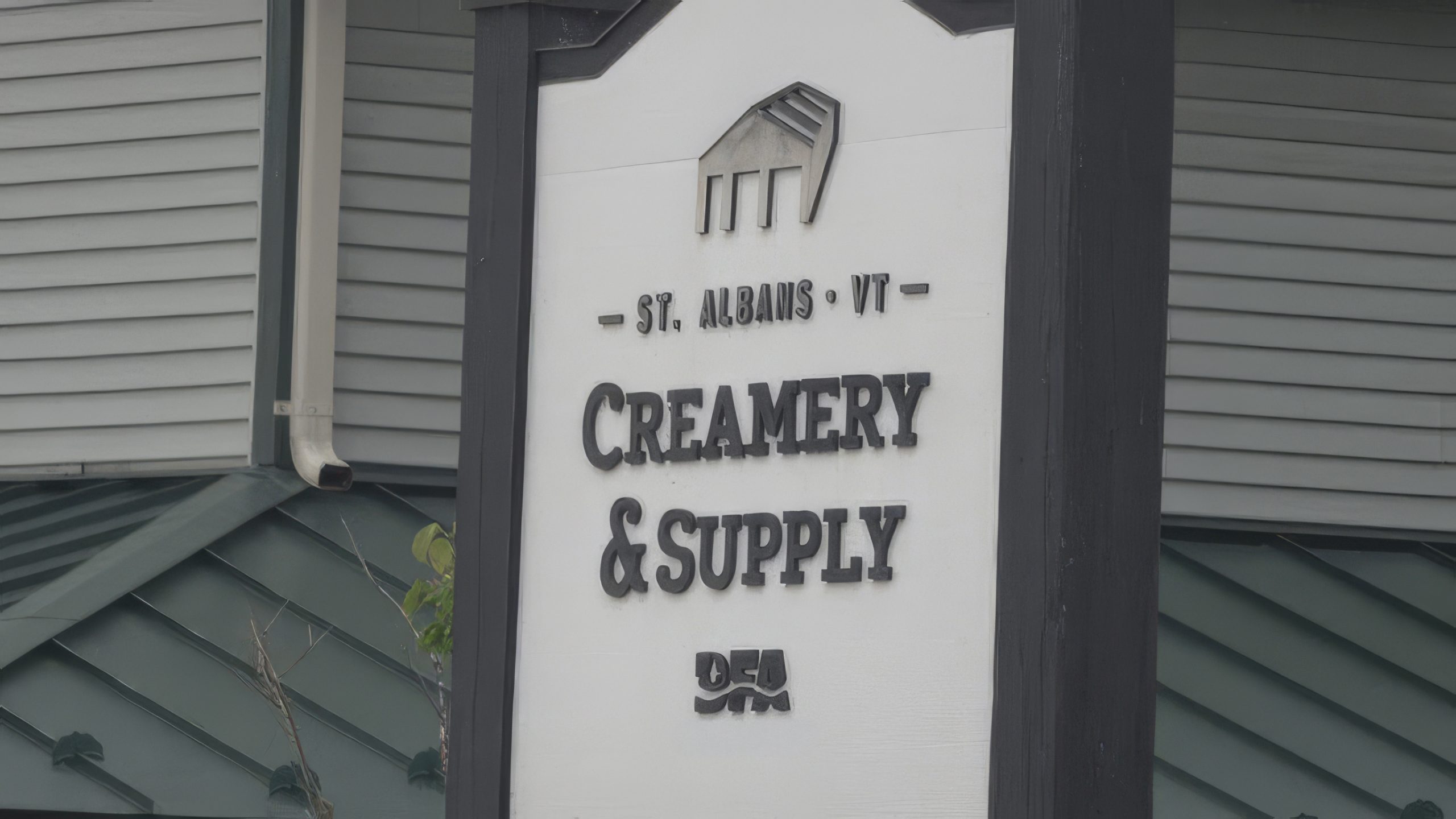
The plant produced dairy for Vermont vendors, including Ben & Jerry’s and Cabot Creamery, and the adjoining St. Albans Creamery & Supply closes the same day after dropping its co-op grocery store last summer to go retail-only. This is manufacturing milk, not fluid milk chasing a Class I premium. And manufacturing milk follows the cheapest plant to run, not the closest one to the barn.
A Regional Read While the Patron Voices Stay Quiet
No Franklin County farm currently shipping to St. Albans has put its haul distance on the record yet. The voices that have surfaced come from the wider New England dairy community, and they’re already pointing at the survival math.
Matthew Staebner, a Connecticut dairy farmer whose family used to farm in Franklin County, told VTDigger the closure is “going to negatively affect all the dairy farmers in New England,” and argued it’s “time that a lot of the dairy farmers look to… marketing their own products.” That’s a producer telling other producers to stop assuming the co-op will always carry the milk to market. Hold that thought — it’s the whole tension in this story.
This story will be updated with named patron haul figures as St. Albans suppliers come forward. If you ship to St. Albans and are willing to talk numbers, the byline contact is at the foot of this page.
The Co-op That Voted Itself Into DFA
St. Albans wasn’t born a DFA plant. The St. Albans Cooperative Creamery ran farmer-owned before its members voted 99-9 to merge with DFA in 2019, folding the co-op, the store, and its trucking company into the national organization as wholly owned subsidiaries. The two sides had run a marketing partnership since 2003, and as local membership shrank, they moved toward combining.
Franklin County farmers told Seven Days in 2019 that the merger was the only way to compete amid low milk prices, deteriorating finances, and consolidation. That year, DFA pledged to invest $30 million in the St. Albans plant, plus another $5 million in its trucking company.
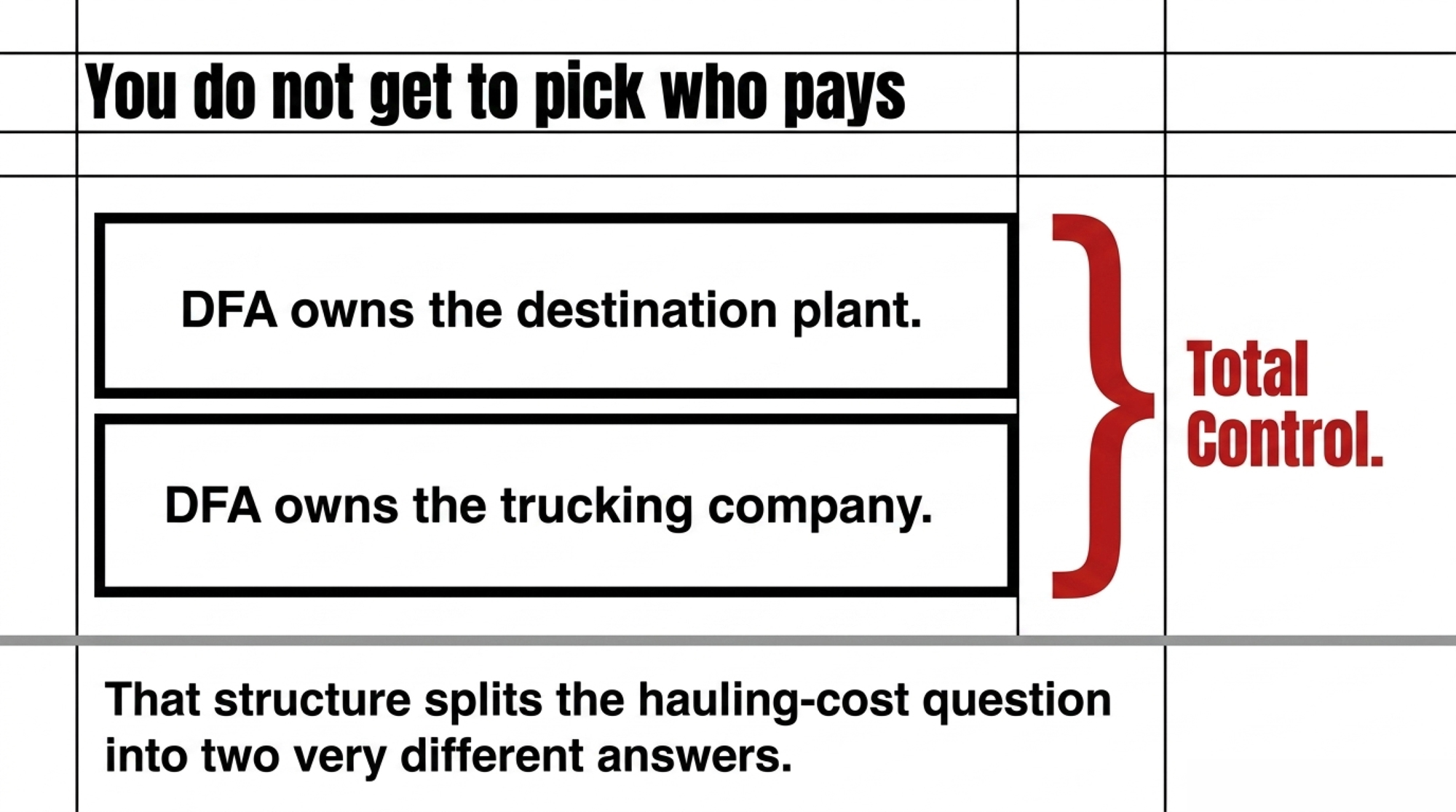
That structure is the whole point. The company deciding where your milk goes is the same company that owns the plant, the brand, the store, and the trucks. That splits the hauling-cost question into two very different answers — and you don’t get to pick which one lands on your check.
Where Does the Milk Actually Go on August 18?
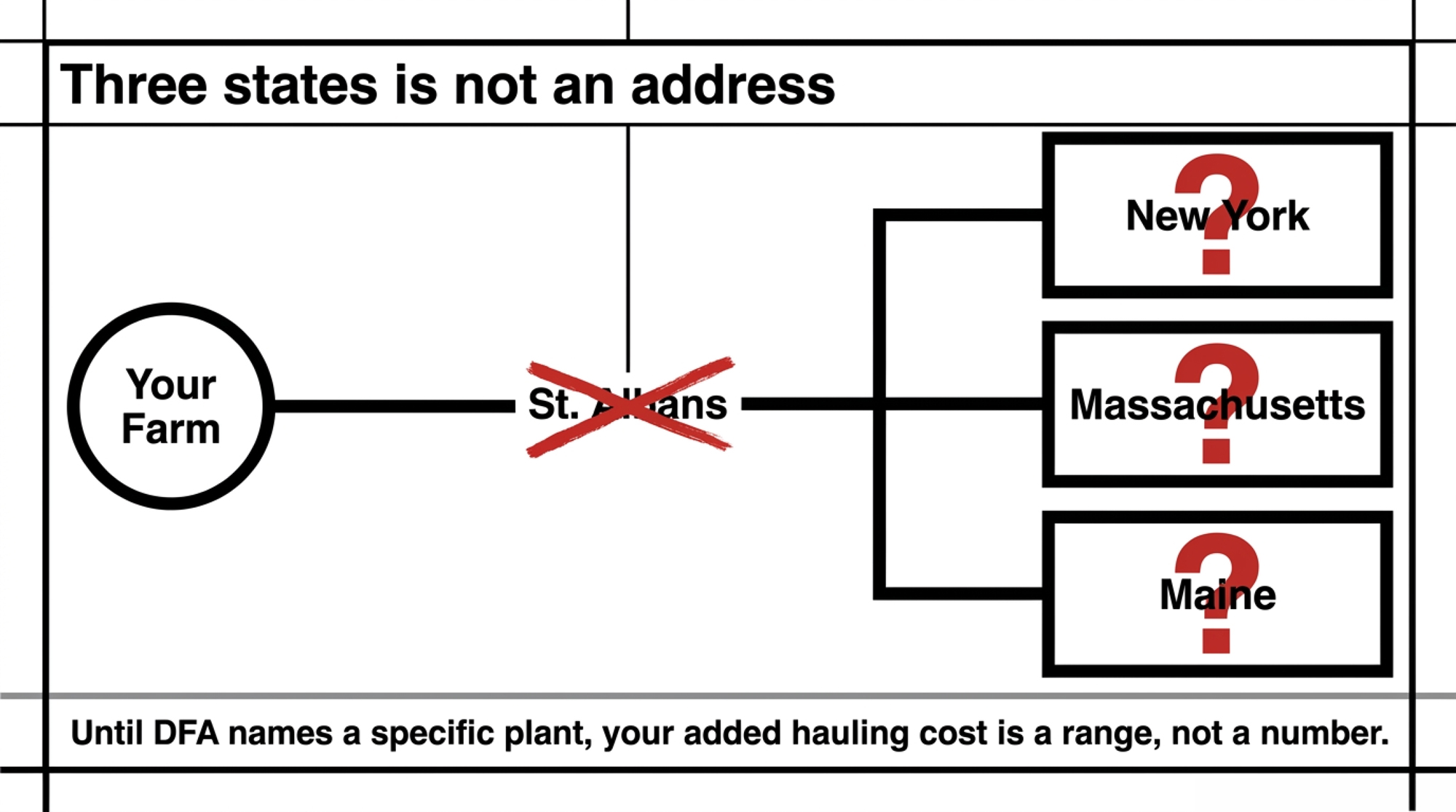
DFA has named the states, not the plants. Milk currently received at St. Albans will be processed within DFA’s network at facilities across New York, Massachusetts, and Maine, the co-op told Seven Days. DFA said the move ensures “a market for regional dairy farmers and continued service to customers without disruption.”
Three states is a destination region, not an address.
That spread covers everything from a North Country New York plant an hour west to a Maine powder facility several hours east. The re-route mileage — and the cost — depends entirely on which plant DFA designates for your route. Until they put a name and a town on it, your added mileage is a range, not a number. So let’s bracket that range honestly, using published rates instead of a guess.
Running the Numbers: What Every Re-Routed Mile Costs
The arithmetic is simple. The honesty lives in the inputs, so here they are in the open — plug in your own.
The formula
ΔHauling cost per cwt=cwt per loadAdded one-way miles×Rate per loaded mile
The inputs
- Tanker load: about 350 cwt (~35,000 lbs) — standard industry assumption, not a St. Albans-specific figure.
- Loaded-mile rate: $4.00–$5.50, anchored to USDA AMS agricultural refrigerated-truck spot-rate reporting for 2025 (2025 rates; 2026 may differ). A market band, not a DFA-disclosed figure.
- Current one-way haul to St. Albans: 15–40 miles — representative Franklin County range.
- Added one-way re-route distance: 75–200+ miles — scenario range across the NY/MA/ME footprint DFA named.
Added cost per cwt, by scenario (illustrative)
| Added one-way miles | $4.00/mile | $5.00/mile | $5.50/mile |
| +75 (close-in NY plant) | +$0.86 | +$1.07 | +$1.18 |
| +125 (mid-range) | +$1.43 | +$1.79 | +$1.96 |
| +150 (central NY / MA) | +$1.71 | +$2.14 | +$2.36 |
| +200 (western NY or ME) | +$2.29 | +$2.86 | +$3.14 |
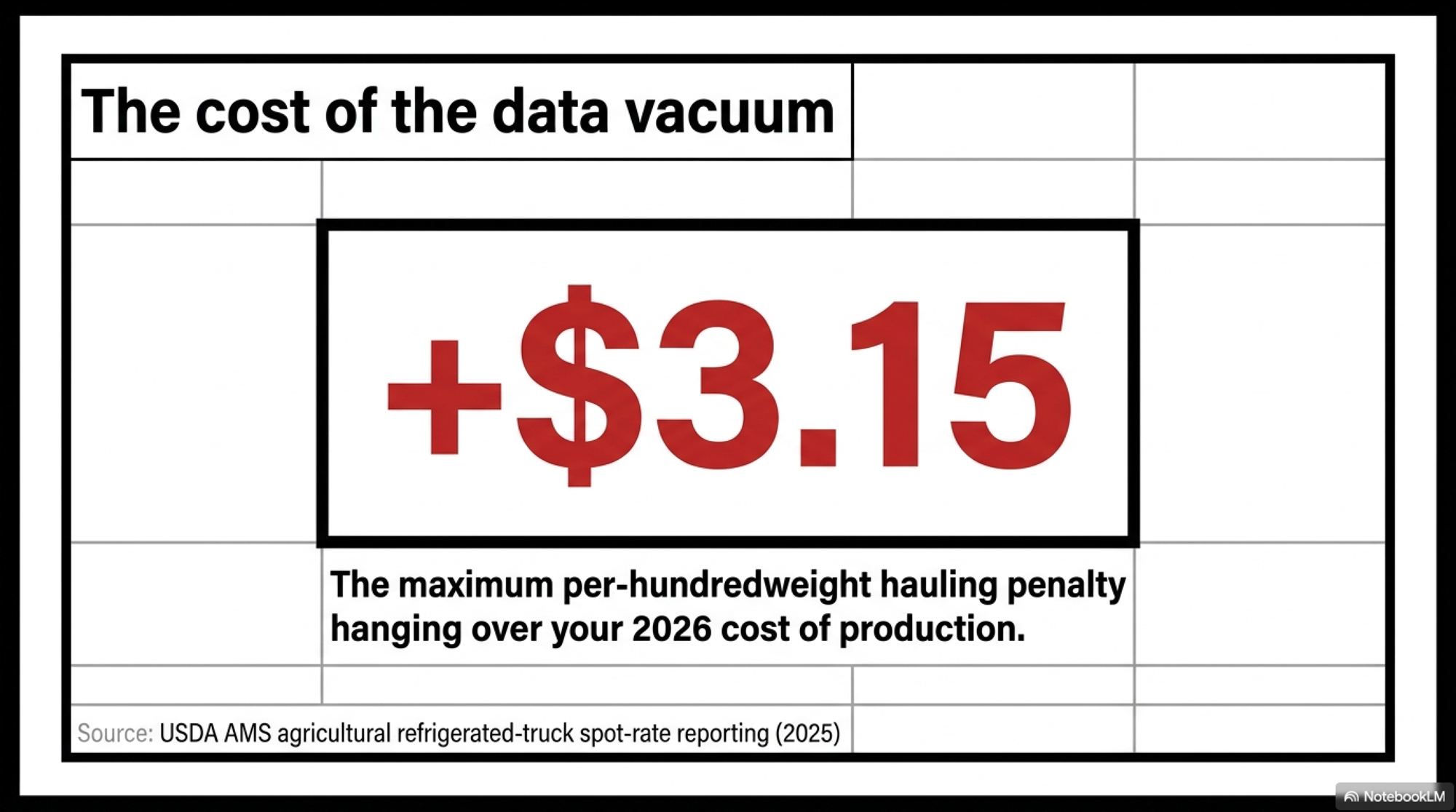
Working range: roughly +$0.85 to +$3.15/cwt. That spread isn’t sloppiness. It’s the honest width of three states and no named plant. Low end assumes a North Country New York facility; high end assumes a haul to western New York or Maine.
Run your own numbers: the interactive Hauling-Delta Calculator below takes your herd size, added miles, and rate, and returns your added cost per cwt and per year.
St. Albans Re-Route Cost Calculator
Estimate your farm’s custom hauling exposure based on potential NY/MA/ME re-routes.
What Does That Range Do to a 350-Cow Herd?
Take a 350-cow Franklin County operation. Run it at roughly 230 cwt/cow/year — an illustrative production proxy, not a sourced herd figure — and you’re shipping about 80,500 cwt a year (rounded to 80,000 below).
Now stretch the delta across that volume:
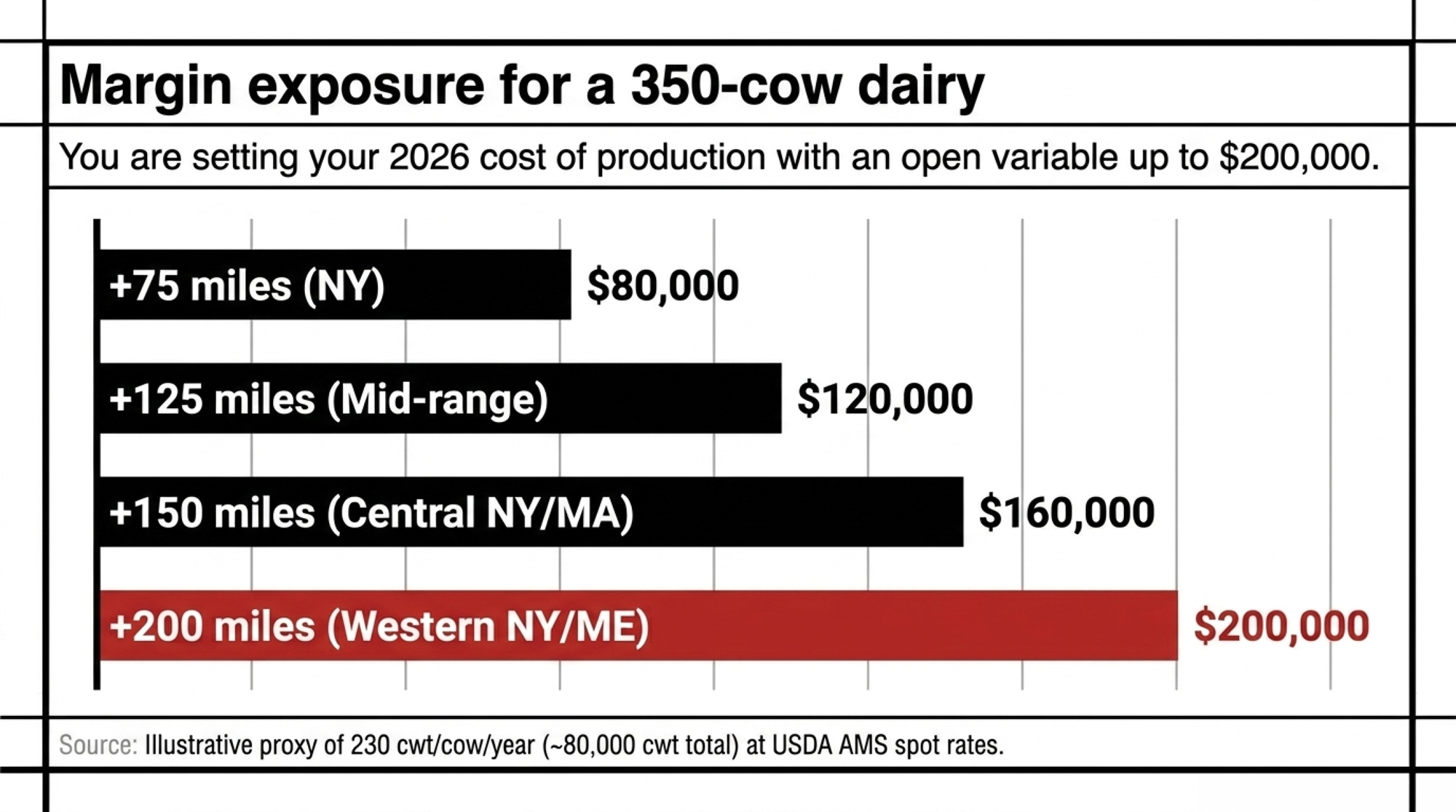
| Hauling delta | Annual cost, 350-cow herd (~80,000 cwt) |
| +$1.00/cwt | +$80,000 |
| +$1.50/cwt | +$120,000 |
| +$2.00/cwt | +$160,000 |
| +$2.50/cwt | +$200,000 |
A 175-cow herd at the same proxy ships about 40,000 cwt, so halve those — roughly $40,000 to $100,000 a year, depending on where the delta lands.
These are estimates, scoped to the assumptions above. Not a bill anyone has mailed yet. But here’s the uncomfortable part: you’re setting your 2026 cost of production right now, and one of your largest variable costs has no confirmed value. Your lender already understands that. The open question is whether you’ve run it yourself.
Will the Mileage Even Hit Your Milk Check?
This is the turn, and it’s the piece nobody at the announcement explained.
Because the hauling and the plant sit within the same cooperative — DFA owns the trucking company too — the added distance can land in two different places, depending on what your agreement allows. You’re in one of these worlds, and the contract decides which.
World one. DFA folds the extra miles into a bigger, consolidated network and absorbs most of the difference as route efficiency. Your deduction holds roughly flat. The tables above become a worst case you dodged.
World two. Your agreement allows pass-through, and the mileage shows up as a higher charge effective with your August or September settlement. The tables stop being a scenario. They’re your new breakeven.
| Scenario | How DFA handles extra miles | What your milk check shows | Red-flag clauses to look for |
| World One – network absorbs | Extra miles blended into system routing and internal cost | Hauling line stays roughly flat per cwt | Vague “network efficiency” language but no explicit pass-through |
| World Two – pass-through hauling | Miles billed back to patrons on a per-cwt or per-stop basis | Sudden jump in hauling deduction after August settlement | “Hauling charges may be adjusted to reflect actual transportation cost” |
| Zone / location change | Milk reclassified into a different Order 1 zone | Uniform price shifts even if haul line looks similar | Language letting handler reset zone or location adjustment unilaterally |
| Field / plant assessments | New or higher per-cwt assessments to fund “plant changes” | New line item or higher per-cwt assessment appears | Open-ended assessment authority tied to “operational changes” |
Here’s exactly where to look on the statement. The mechanical levers that execute World Two are your hauling and stop-charge deductions, your zone or location adjustment, and any field-to-plant assessment line. A more distant receiving plant in a different location-adjustment zone under Federal Order 1 can move your uniform price calculation on its own, separate from the hauling deduction — two different lines, same root cause. Hauling assessments are commonly charged per hundredweight and can carry a monthly cap, depending on the handler. The language that decides which world you’re in is in your producer agreement, not on VTDigger. You get it out of your field rep — and the cleanest time to put the question on the record is now, while the plant’s still running.
The 30/90/365-Day Playbook for St. Albans Patrons
Roughly eight weeks separate today from the August 17 idle date. Don’t wait for the August check to answer the question for you.
30-Day Actions — get the number in writing
- Call your DFA field rep and ask for the specific re-route destination: plant name, town, and one-way miles from your pickup point — not “New York, Massachusetts, and Maine.” Requires: one call and your farm location. Trigger: if they won’t name the plant, escalate in writing to your district rep.
- Get your August hauling deduction in writing, per cwt, and ask directly whether your zone or location adjustment changes. Where it backfires: a verbal “shouldn’t change much” isn’t a contract term — get it in writing, or assume World Two.
- Pull your last three milk checks and isolate your current hauling deduction and location adjustment per cwt, so you’ve got a clean baseline. Trigger: if you can’t find those line items, that’s your first phone call.
90-Day Actions — stress-test the structure
- Have a farm lender or ag attorney read your producer agreement for a material-change clause tied to facility closure. Requires: the signed agreement and a couple of billable hours. Where it backfires: exit clauses carry notice windows and volume commitments — know the penalty before you reach for the door.
- Re-run your breakeven at the high end of the range (+$2.00 to +$3.15/cwt) against your forward-contracted price and your operating-loan covenants. Trigger: if that breakeven crosses your forward price, you’ve got a margin problem, not a hauling annoyance.
- Confirm whether your current carrier keeps your route or a new hauler takes over. Where it backfires: a carrier swap can quietly reset pickup timing and quality-premium logistics, not just price.
365-Day Moves — reposition before the next plant decision
- Map your realistic secondary-market options by geography, and have a real conversation with a competing field rep — not feed-store rumor. Requires: time and a willingness to be told no. Where it backfires: in a consolidating region, “options” can be thinner than they look on paper.
- Build a standing “haul exposure” line into your annual budget so the next consolidation move doesn’t catch you flat. Opportunity signal: if DFA designates a close-in New York plant and your delta lands near the +$0.85 low end while your margin over feed holds, you’re in a defensible spot — document it and stop losing sleep over the high-end rows.
- Take Staebner’s point seriously and price out a direct-to-market or independent-processor option for at least part of your volume. Requires: real capital, label and food-safety work, and demand you can actually sell into. Where it backfires: self-marketing trades the co-op’s guaranteed home for margin you have to earn every month — flexibility you gain on price, risk you take on volume.
Why This Isn’t Just St. Albans’ Problem
For co-op directors and lenders reading from outside Vermont, the plant is a data point, not a one-off.
DFA’s antitrust record is public, and it cuts both ways. The co-op settled price-fixing and market-conduct cases in the Southeast ($140 million, 2013) and the Southwest ($34.4 million, 2025), both without admitting liability. A separate 2022 Northeast monopsony suit — alleging DFA suppressed raw milk prices and boxed out farmers’ ability to market milk independently — was dismissed when a federal judge sided with DFA in an October 2023 ruling. Settlements without admission, and a dismissal, don’t prove present-day conduct. But the structural friction those cases circled hasn’t gone anywhere.
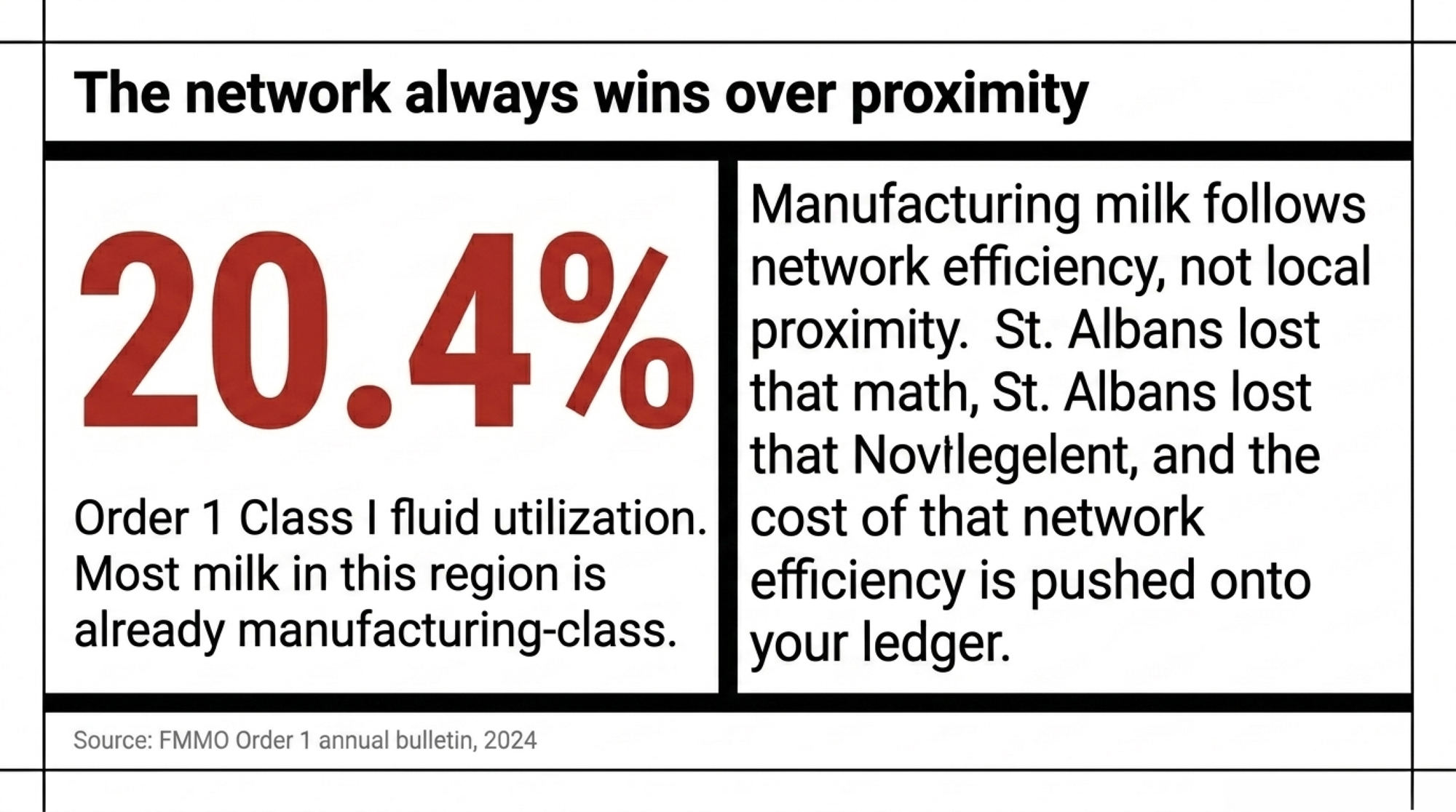
The engine underneath is plainer than any filing. In Northeast Order 1, Class I fluid utilization averaged just 20.4% of pooled milk in 2024, per the FMMO Order 1 annual bulletin. Most of that milk is already manufacturing-class. Once milk lives there, network efficiency tends to beat local proximity. In our read, a plant like St. Albans competes on network economics — and on June 17, DFA came down on the side of the network, not the location. Every extra mile that decision adds shows up on your side of the ledger, not theirs.
Is This Retaliation for the 2025 Strike?
It’s the question everyone in Franklin County is asking, so let’s take it head-on. The plant’s unionized workers reached a contract with DFA in October 2025 after alleging “brutal” conditions, including mandatory overtime stretching shifts to 12-hour workdays. Eight months later, the plant is idled.
DFA said the closure is not a reflection of workers’ performance. Union organizer Curtis Clough — who helped lead the contract fight — told VTDigger he does not think the shuttering is tied to union activity, but that it “relates more to the fact that the dairy industry is in freefall in Vermont.” Clough still called the decision a surprise, citing the plant’s notable customers like Ben & Jerry’s.
The closure also lands in a brutal stretch for the county’s processing base. HP Hood confirmed its Barre plant closure in September 2025, affecting about 50 workers; Franklin Foods — in the county for more than a century — announced its closure earlier this month, laying off nearly 100; and Perrigo said in May it would lay off 161 as it moves to close its Georgia, Vermont facility. Every plant that goes dark thins the local labor pool, the municipal utility base, and your leverage at contract-renewal time. The people closest to the strike don’t read this as payback — and either way, the milk still has to move.
What to Watch, and the One Question That Decides It
The day DFA names the plant, this whole range collapses into a single number, and every supplying farm learns which world it’s living in. That’s the follow-up worth waiting for. Until then, you’re pricing 2026 in the dark, and the clock runs out on August 17.
You gain certainty by getting the destination and the deduction in writing now. You lose negotiating room once the plant goes dark and the call’s already made. So pull the agreement, make the phone call, and put the question on the record while the plant’s still running.
One question tells you whether the tables above are a scare or a forecast: what does your producer agreement actually say about who pays for the miles when the plant you ship to disappears — and have you read that clause since the co-op signed itself over in 2019?
Key Takeaways
- DFA hasn’t named the receiving plant, so your added haul sits in a +$0.85 to $3.15/cwt range — about $40,000 to $200,000 a year on a 350-cow herd until you get a real number.
- Because DFA owns the trucks too, whether those miles hit your deduction or get absorbed depends on your producer agreement — pull the contract and check the hauling, zone, and location-adjustment lines.
- You’ve got until August 17 to get a plant name, a per-cwt deduction, and a zone answer out of your field rep in writing — don’t let the August milk check be the first time you find out.
- With Class I utilization in Order 1 at 20.4%, this milk competes on network cost, not proximity — assume the next closure works the same way and budget a standing haul-exposure line now.
Ship milk to St. Albans? The Bullvine is tracking where the milk lands and what the re-route costs. Reach the reporter at the byline contact to share your haul miles for the follow-up.
Complete references and supporting documentation are available upon request by contacting the editorial team at editor@thebullvine.com.
Learn More
- A CA$686M Co-op Just Sent Maritime Farmers the Hauling Bill — Arms you with a step-by-step verification method and baseline check parameters to quantify individual farm-gate transport liability when a regional processor consolidates and shifts routing mileage directly onto your milk check.
- The Rules Changed and Nobody Told You: Three Paths Left for the 300-Cow Dairy — Exposes the long-term structural collision between mid-sized herds and massive processing expansions, delivering concrete equity survival thresholds and an explicit 18-month timeline to reposition, transition, or exit before capital evaporates.
- You Only Get 15.9¢ of the Food Dollar: A Dairy Farmer’s Playbook for Hauling, Co‑ops, and Premium Milk — Dismantles the illusion of cooperative-driven supply protection, revealing a 10–20¢/cwt margin advantage gained through local route synchronization, strict notice-period clauses, and specific premium-program qualification hurdles.
The Sunday Read Dairy Professionals Don’t Skip.

Every week, thousands of producers, breeders, and industry insiders open Bullvine Weekly for genetics insights, market shifts, and profit strategies they won’t find anywhere else. One email. Five minutes. Smarter decisions all week.




