




Archive for milk component values

Dairy Markets: Behind The Numbers of April’s Milk Production Report

Despite adding thousands of cows, America’s dairies struggled to boost production. What’s really happening in your milk check?

EXECUTIVE SUMMARY: The USDA’s March 2025 Milk Production report reveals a dairy sector caught in transition, with national output rising just 0.9% year-over-year despite farmers adding 9,000 more cows between February and March. This modest volume growth masks a remarkable 2.7% surge in component-adjusted production as fat and protein levels significantly outpace fluid metrics. Regional performance varies dramatically – from Texas’s explosive 9.4% growth to California’s continued HPAI recovery (-2.1%) and Washington’s steep 4.3% decline amid low milk prices forcing farm exits. The persistent paradox of expanding herds (+72,000 head YoY) paired with stagnant productivity (just +0.2% per cow) signals deeper structural challenges that aren’t solved by simply milking more cows. Meanwhile, new HPAI cases in Idaho and emerging viral strains in Nevada and Arizona demonstrate the disease threat remains very real heading into summer.

KEY TAKEAWAYS

  • Component value now trumps volume metrics – With component-adjusted production (2.7%) nearly tripling volume growth (0.9%), farms focusing solely on milk quantity are missing significant profit opportunities in butterfat ($2.62/lb) and protein ($2.46/lb).
  • Geography determines your dairy’s destiny – The stark performance gap between states (Texas +9.4% vs. Washington -4.3%) shows local market conditions and disease pressures create fundamentally different operating environments that require region-specific strategies.
  • Biosecurity isn’t a choice, it’s survival insurance – New HPAI cases in Idaho (9 in 30 days) and emerging viral strains prove this disease isn’t going away; operations with robust protocols gain resilience against both current and future biological threats.
  • The productivity paradox demands fresh thinking – Despite adding 72,000 more cows (+0.8%) YoY, productivity per cow remains nearly flat (+0.2%), signaling deeply rooted efficiency challenges that expansion alone can’t solve.
  • Strategic agility beats raw production capacity – In today’s complex market, success depends on your ability to adapt to contradictory signals and position your operation at the intersection of component optimization, disease prevention, and regional advantage.
Dairy productivity paradox, U.S. milk production report, milk component values, HPAI impact on dairy, regional dairy production, expanding dairy herds
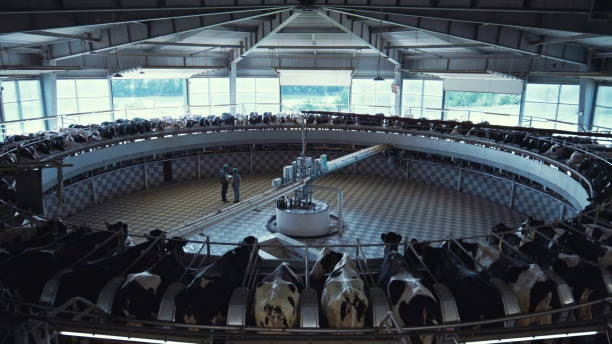
Automatic milking carousel modern dairy farm facility. Modern parlour interior. Unknown managers livestock shed workers check inspect automatic line process. Holstein cows at milk production factory.

Let’s cut to the chase: USDA’s March 2025 milk production report reveals a growing sector but not exactly firing on all cylinders. Production is up 0.9% year-over-year, lagging the 1.2% analysts expected. So, what’s going on under the hood?

We’re Adding Cows, but Where’s The Milk?

You’ve heard the puzzle – more cows should mean more milk, right? Well, the March data tells a different story. Farmers added 9,000 cows between February and March, pushing the national herd up 72,000 head (+0.8%) from last year. But here’s the kicker: production per cow barely budged, climbing just 0.2% from March 2024.

What gives? Despite adding all these cows, we’re seeing production outside California grow only 1.5% – well below the 2.0% experts predicted. Haven’t we been taught that expanding herds drives production growth?

Let’s face it – something’s holding back these cows from reaching their potential. The lingering effects of HPAI certainly play a role, but there’s more to this story than just bird flu.

California’s Long Road Back

California’s still feeling the sting from HPAI, with production down 2.1% year-over-year. But don’t miss the silver lining – that’s better than February’s 2.7% decline. The Golden State’s recovery is happening, just not overnight.

Nearly 80% of California’s infected herds have been virus-free for at least 30 days, with only eight new infections in the past month. That’s progress you can’t ignore.

But have you noticed how dramatically different the story is across state lines? While California limps toward recovery, Texas is crushing it with a 9.4% production jump. They’re milking 25,000 more cows than last year! Meanwhile, Washington’s farmers are heading for the exits, with production plummeting 4.3% as rock-bottom milk checks force tough decisions.

Bird Flu: The Unwelcome Guest That Won’t Leave

Think we’ve seen the last of avian influenza? Think again. While we’re not seeing the explosive spread from last year, this virus isn’t done with us yet. New cases are popping up in Idaho – 9 in the previous month alone – and a new genotype called D1.1 has emerged in Nevada and Arizona.

When HPAI hits a herd, it’s not just a minor inconvenience. We’re talking milk production drops of 15-25% in affected cows. That’s a massive hit to your bottom line, not to mention the increased culling many operations face due to persistent issues post-infection.

Haven’t we learned enough about biosecurity in the past year? You’d think so, but this virus keeps finding ways to surprise us. The question isn’t if your operation will face a disease challenge – it’s when and how prepared you’ll be.

Component Values: The Hidden Goldmine

Here’s where things get interesting. While volume growth disappointed at just 1.0%, component-adjusted production surged by 2.7%. That’s not just good news – it’s a fundamental shift in measuring success in dairy.

Your cows aren’t just producing more milk solids and delivering substantially higher economic value. March butterfat prices hit $2.6242 per pound, with protein at $2.4606. Those aren’t just numbers – they’re profit opportunities for farms focusing on components.

Are you still chasing volume when you should be optimizing for components? Let’s face it: the gap between volume metrics and component value is widening, and smart producers are already shifting their strategies.

What’s Driving the Numbers?

Ever wonder why adding more cows doesn’t translate to proportional milk increases? Several factors are at play here. HPAI’s lingering effects are dragging down productivity in recovering herds. Meanwhile, tight replacement heifer supplies and sky-high costs force many of you to keep older, less productive cows in the herd longer than you’d like.

The result? Despite improved genetics, an aging national herd naturally produces less milk per cow. Add variable feed quality and cautious feeding strategies amid economic uncertainty, and you have a recipe for stalled productivity.

Isn’t it ironic that we’re simultaneously growing the herd while watching per-cow output struggle? This contradiction raises serious questions about future productivity if these older cows eventually leave without sufficient replacements in the pipeline.

Mixed Signals for Markets

The markets have been recovering recently, but don’t get too comfortable. This bounce has more to do with easing trade tensions than fundamental supply shifts.

Have you noticed how wildly the USDA’s forecasts have swung lately? In March, they slashed the 2025 all-milk price forecast by a whole dollar to $21.60/cwt. Then April’s reports cut it to .10/cwt while raising production forecasts! If the experts can’t decide, how are you supposed to plan?

We’re still in expansion mode, and year-over-year growth numbers should improve as the herd grows, and we lap last year’s bird flu outbreaks. But don’t miss the forest for the trees – this expansion faces significant headwinds that could limit its potential.

What This Means for Your Operation

If you’re still focusing solely on milk volume, you’re fighting yesterday’s battle. The real opportunity lies in components as the gap between volume and component-adjusted value widens. Isn’t it time to evaluate your genetic selection, nutrition programs, and management practices to enhance fat and protein production?

Biosecurity investments aren’t just expenses – they’re insurance. With HPAI showing remarkable persistence and evolving strains, robust disease protocols protect against current and future threats. Can you afford to cut corners here?

Don’t ignore the stark performance differences between states. Local market conditions, processing capacity, and disease pressure create varying operating environments. What works in Texas might sink you in Washington.

Let’s face it – the decisions you make today about culling, replacement, and genetic selection will shape your productivity potential for years to come. Are you considering the long-term implications of keeping that older cow versus bringing in fresh genetics?

The U.S. dairy sector is expanding, but the path forward isn’t straightforward. Those who understand the complex interplay of herd demographics, component values, regional dynamics, and disease pressures will navigate this landscape more successfully than those still operating by old rules.

In today’s environment, strategic agility trumps raw production capacity every time. The future belongs to producers who can adapt to these complex, sometimes contradictory signals and position their operations accordingly. Isn’t it time you took a fresh look at your strategy?

Learn more:

Join the Revolution!

Join over 30,000 successful dairy professionals who rely on Bullvine Daily for their competitive edge. Delivered directly to your inbox each week, our exclusive industry insights help you make smarter decisions while saving precious hours every week. Never miss critical updates on milk production trends, breakthrough technologies, and profit-boosting strategies that top producers are already implementing. Subscribe now to transform your dairy operation’s efficiency and profitability—your future success is just one click away.


NewsSubscribe
First
Last
Consent

Fat Rules While Protein Drools: Global Dairy Markets Split Along Regional Lines

Fat outpacing protein: Global dairy markets fracture as European SMP plunges while Asian futures soar – component ratios reshaping the industry.

EXECUTIVE SUMMARY: The global dairy market for the week ending April 22, 2025, revealed critical divergences with fat-based products strengthening while protein markets splintered along regional lines. European and Asian dairy futures told dramatically different stories, with European SMP futures sliding 1.4% while Asian-focused contracts surged 3.4%, creating unprecedented regional price gaps. This market split occurs as European milk undergoes a fundamental transformation – fluid volume decreased 0.9% year-on-year, but milk solids increased 0.6%, driven entirely by higher fat content while protein remained flat. German processors have decisively responded by boosting butter production 10.9% at the expense of cheese output, exemplifying a strategic pivot toward capitalizing on the fat premium. Despite various regional pressures, most dairy commodities maintain substantial premiums over last year’s levels (butter +25.2%, whey +33.6%, WMP +21.8%), supporting generally positive margin outlooks for producers.

KEY TAKEAWAYS:

  • Component value trumps volume production: The EU data shows milk solids, particularly fat, driving returns despite lower fluid volume. Feeding strategies that optimize components rather than simply maximizing production volume will deliver superior margins in today’s market.
  • Regional market access increasingly critical: The stark divergence between European and Asian market sentiment for SMP and WMP highlights the importance of processor relationships. Producers selling into export-oriented plants may see completely different signals than those focused on domestic markets.
  • German manufacturing shift creating local pressure: The dramatic 10.9% increase in German butter production is creating temporary European spot price weakness despite strong global signals. This demonstrates how regional processing decisions can temporarily override broader market fundamentals.
  • Mozzarella reveals global-European disconnect: While European mozzarella prices fell 0.9%, GDT auction prices surged 5.4% – signaling booming international demand not reflected in European internal pricing. This creates premium opportunities for export-oriented producers.
  • Long-term butterfat premium persists: Despite some weekly softness, butter maintains a substantial 25.2% premium over last year, suggesting the fat-focused production strategy remains economically advantageous through at least mid-2025.
Global dairy market trends, butterfat price premium, milk component values, European dairy production, regional market divergence

European butterfat values soared to record highs while protein markets struggled in this week’s dairy trading. German processors have dramatically shifted production toward butter (+10.9%) and away from cheese as higher milkfat components reshape the manufacturing landscape.

Fat is king in today’s global dairy markets. That’s the unmistakable message from this week’s trading activity, which saw butter futures climb while SMP markets diverged sharply between regions. European milk production is undergoing a fundamental transformation – while total volume dropped 0.9%, farmers produce milk with significantly more fat content.

The resulting market impacts are creating unprecedented opportunities – and risks – for dairy producers worldwide, depending on which products their milk ultimately becomes.

THE NUMBERS TELL THE STORY

EEX dairy futures saw moderate activity, with 3,440 tonnes traded last week. Butter futures showed notable strength, gaining 1.4% to reach €7,292/tonne alongside expanding open interest – signaling traders are betting on continued butter strength.

Meanwhile, European SMP futures dropped 1.4% to €2,454/tonne despite increased open interest. When prices fall while bets increase, traders are positioning for further declines.

SGX trading volumes were substantially higher at 10,975 tonnes. The contradiction in SGX SMP sentiment was most striking, which gained 3.4% to $2,905/tonne, directly opposing the European outlook.

“We’re essentially seeing two completely different dairy worlds developing,” market analyst Thomas Weber explains. “European traders are bearish on protein while Asian buyers remain aggressively bullish.”

PROCESSORS FOLLOW THE MONEY

German dairy processors have responded decisively to these market signals. February butter production jumped 10.9% year-on-year (adjusted for leap year), while cheese output declined 0.8%.

This manufacturing pivot helps explain current market dynamics. The flood of German butter likely tempers European spot prices despite strong global demand signals from futures and GDT auction results.

European spot markets showed mostly declining prices as of April 16. The EU butter index dipped slightly (-0.2%) to €7,452/tonne, though French butter bucked the trend by rising 1.2% to €7,740/tonne.

SMP showed more pronounced weakness, with the EU index falling 1.9% to €2,385/tonne – consistent with the negative sentiment in EEX futures.

GLOBAL AUCTION SHOWS STRENGTH OUTSIDE EUROPE

The Global Dairy Trade auction painted a more optimistic picture, with the overall price index increasing 1.6% to $4,385/tonne. A substantial volume of 16,718 tonnes changed hands with strong participation from 181 bidders.

WMP made gains among major commodities, climbing 2.8% to $4,171/tonne. European-origin products commanded substantial premiums, with Solarec’s Belgian WMP selling at $4,800 compared to Fonterra’s $4,105 for the same contract period.

The most dramatic price movement came from lactose, which skyrocketed 22.0% to $1,376/tonne, signaling significant supply disruption or sudden demand surge likely related to infant formula production.

MOZZARELLA MARKETS REVEAL GLOBAL-EUROPEAN DISCONNECT

One of the most striking market divergences appeared in mozzarella. While European EEX Mozzarella dropped 0.9% to €4,225/tonne, the GDT Mozzarella index surged 5.4% to $4,763/tonne.

This dramatic contradiction points to booming international demand for pizza cheese that isn’t reflected in European internal pricing. Asian food service growth drives this export demand while domestic European consumption lags.

Most European cheese indices continued declining, with Cheddar Curd and Mild Cheddar down 0.9% and 0.8%, respectively. Only Young Gouda showed resilience with minimal gain.

MILK COMPOSITION DRIVING MARKET DYNAMICS

The February 2025 milk production data reveal a transformative shift affecting the dairy complex. While overall EU-27+UK fluid milk decreased by 0.9%, the composition improved significantly, with average fat content reaching 4.26% and protein 3.48%.

This compositional change increased total milk solids by 0.6% year-on-year despite lower fluid volume. Breaking down the components shows the increase was driven entirely by fat (+1.0%), while protein remained completely flat.

Denmark exemplifies this trend even more dramatically. Despite fluid milk falling 1.4%, Danish milk solids jumped 1.7% due to significantly higher fat content (4.65% vs. 4.46% last February).

This fundamental shift towards higher fat content provides a biological explanation for the relative price strength of butter versus SMP. There’s more fat and no additional protein entering the market than last year.

WHAT THIS MEANS FOR YOUR FARM

For dairy producers, these market signals suggest several key strategies:

Focus on fat production for maximum returns. With European butterfat values remaining 25.2% above last year despite recent softness, the economic signals favor optimizing for fat over volume.

Watch your market exposure. Processors with strong export connections to Asia are seeing dramatically different demand signals than those focused solely on European markets, particularly for products like SMP and mozzarella.

Understand your milk price formula. The growing divergence between fat and protein values means your pay formula’s component weighting will dramatically impact your bottom line this year.

Consider feed strategies that boost butterfat. With EU butter spot prices 25.2% higher than last year, feed additives and ration adjustments that enhance fat production will likely deliver strong ROI.

THE BOTTOM LINE

The global dairy market is experiencing a fundamental restructuring of relative values between fat and protein. This isn’t just a temporary price fluctuation – it reflects changing consumer preferences and biological shifts in milk composition.

Smart producers are already adapting their breeding and feeding programs to capitalize on this new reality. With fat components driving returns despite lower fluid volume, the old model of chasing maximum milk production looks increasingly outdated.

“We’re seeing a once-in-a-generation shift in how milk value is created,” notes dairy economist Maria Gonzalez. “Farmers who understand this component revolution will thrive, while those stuck in a volume mindset may struggle despite producing more milk.”

Learn More:

Join the Revolution!

Join over 30,000 successful dairy professionals who rely on Bullvine Daily for their competitive edge. Delivered directly to your inbox each week, our exclusive industry insights help you make smarter decisions while saving precious hours every week. Never miss critical updates on milk production trends, breakthrough technologies, and profit-boosting strategies that top producers are already implementing. Subscribe now to transform your dairy operation’s efficiency and profitability—your future success is just one click away.

NewsSubscribe
First
Last
Consent

Send this to a friend