Archive for income over feed cost

One Acre, One Cow, $0.65 a Day: MSU’s High‑Oleic Soybean Playbook for 5‑ to 6‑Figure Dairy Margin Gains in 2026

$18 milk in 2026. T&H Dairy hit $0.65/cow/day with high-oleic soy—$118K/year on 500 cows. One acre feeds one cow. How does your fat spend compare?

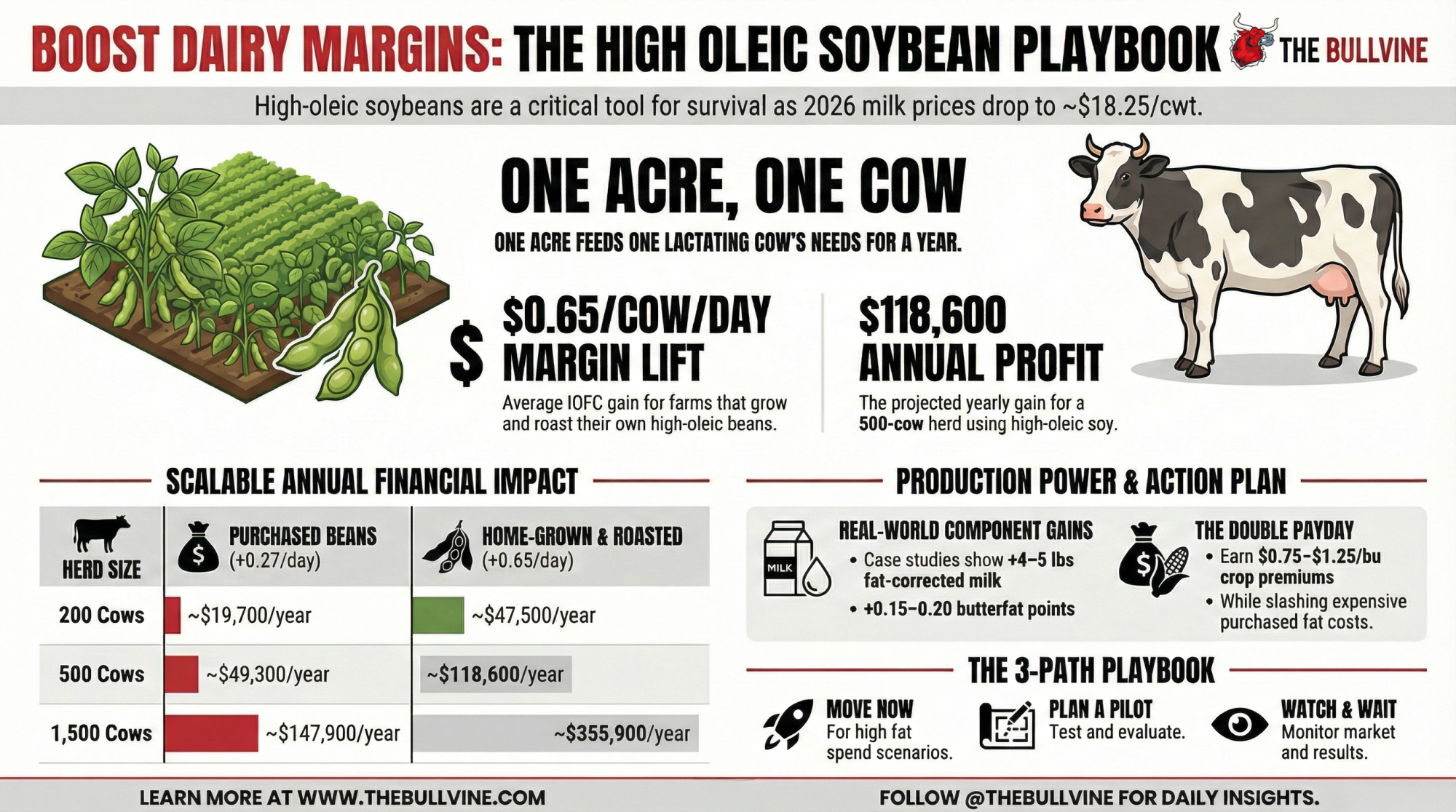
Executive Summary: USDA’s January 2026 outlook drops the U.S. all‑milk price forecast to about $18.25/cwt, which makes every extra $0.30–$0.60/cow/day in margin a survival number, not a bonus. New Michigan State University research shows high‑oleic soybeans can deliver that kind of lift, with modeled IOFC gains of $0.27/cow/day when purchased roasted and about $0.65/cow/day when farms grow and roast their own beans, and roughly one acre of high‑oleic soy feeding one lactating cow for a year. T&H Dairy in Michigan is already seeing 4–5 pounds more fat‑corrected milk, 0.15–0.20 points more butterfat, and about $0.65/cow/day in IOFC at 7.5–8 pounds of roasted beans, which works out to around $118,600 a year on 500 cows and well into six figures on larger herds. United Soybean Board data adds crop‑side upside, with high‑oleic contracts across 16 states paying $0.75–$1.25/bu (and in some cases around $2.20/bu) over commodity beans—roughly $40–70/acre extra at typical yields before those beans ever hit the bunk. The article makes the case that high‑oleic soybeans are a serious 2026 fat tool—not a magic bullet—and walks owners and managers through a three‑path playbook (move now, plan a pilot, or watch and wait) plus a simple checklist to decide whether their acres, bins, and fat bill justify turning high‑oleic into part of their long‑term margin strategy.
Here’s what’s really going on. USDA’s January 2026 Livestock, Dairy, and Poultry Outlook pegs the 2026 U.S. all‑milk price at about $18.25 per hundredweight, down from a forecast of over $21 for 2025.  At the same time, Class III futures are sitting down in the mid‑$16s, which is exactly the gap The Bullvine flagged earlier this month as a $150,000‑plus budgeting problem for a 300‑cow herd if you bet on the wrong number. 

On paper, that 2026 downgrade doesn’t look dramatic. In the real world—spread across 200, 500, or 1,500 cows—it’s the difference between sleeping at night and explaining to your lender why your cash flow projections missed by six figures.
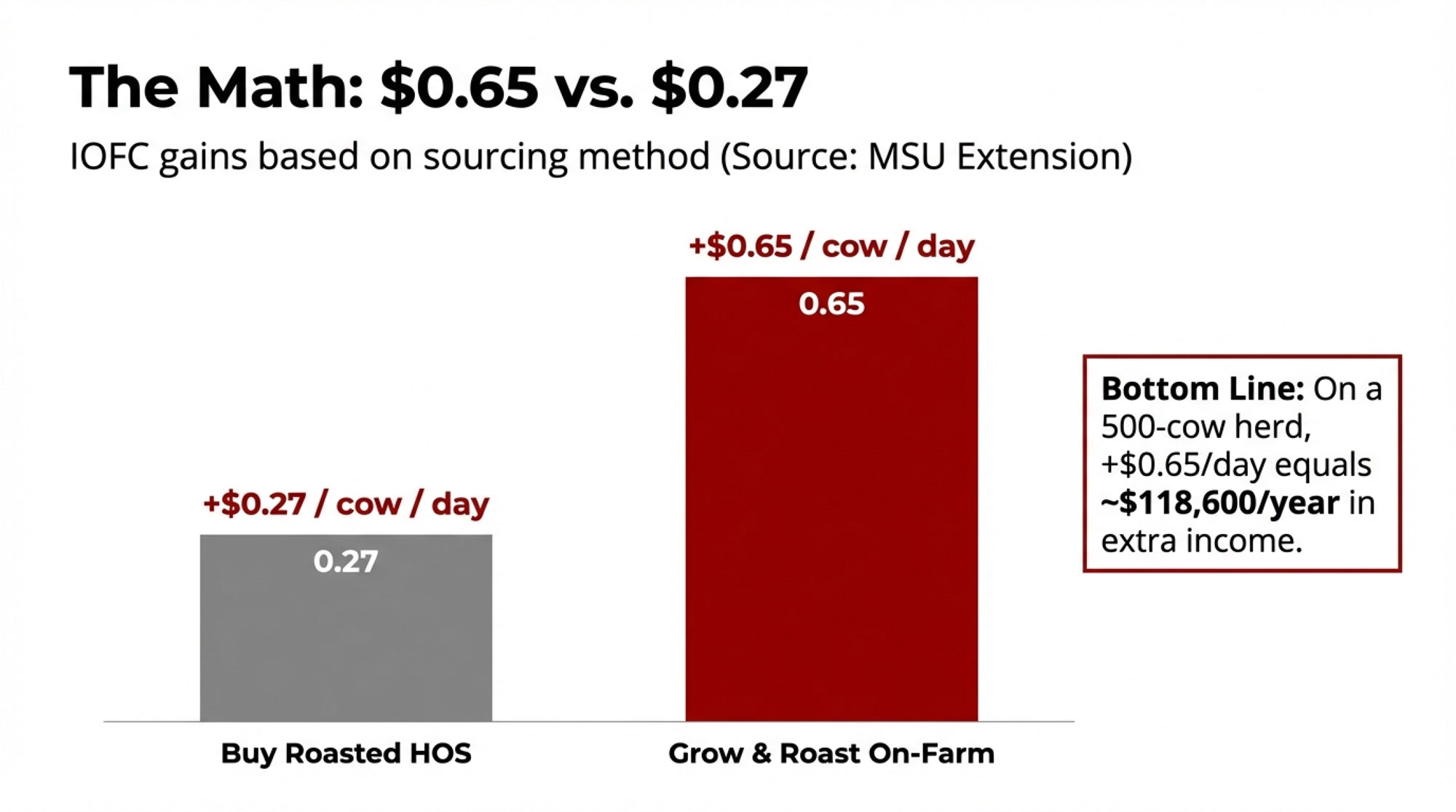
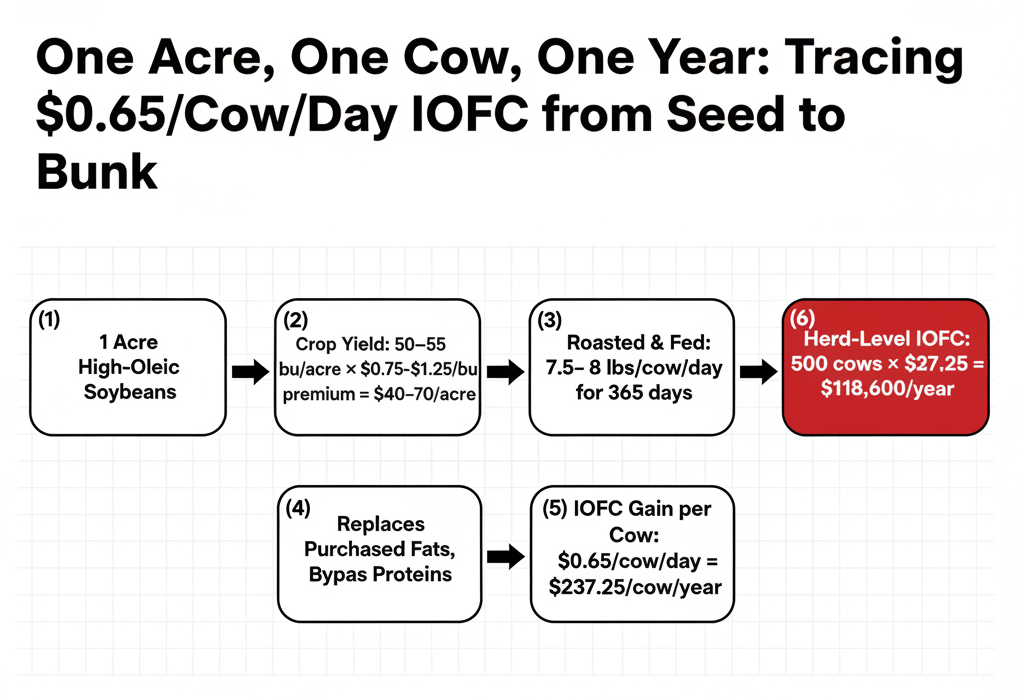
What’s interesting right now is that Michigan State University’s work with high‑oleic soybeans says farms that grow and roast their own beans are seeing about $0.65 per cow per day in extra income over feed cost, while farms buying roasted beans are still picking up around $0.27 per cow per day.  At the feeding rates MSU is using, one acre of high‑oleic soybeans can cover one lactating cow’s needs for a full year, which suddenly makes your soybean acres feel a lot closer to your milk cheque than they did five years ago. 

The real question isn’t “Are high‑oleic soybeans magic?” It’s whether your acres, your ration, and your infrastructure give you a realistic shot at turning this into repeatable dollars instead of one more “great idea” that never quite pencils out on your farm.

Looking at This Trend: What’s Actually Different in the Fat?

Let’s start where your nutritionist will start: the fat profile.
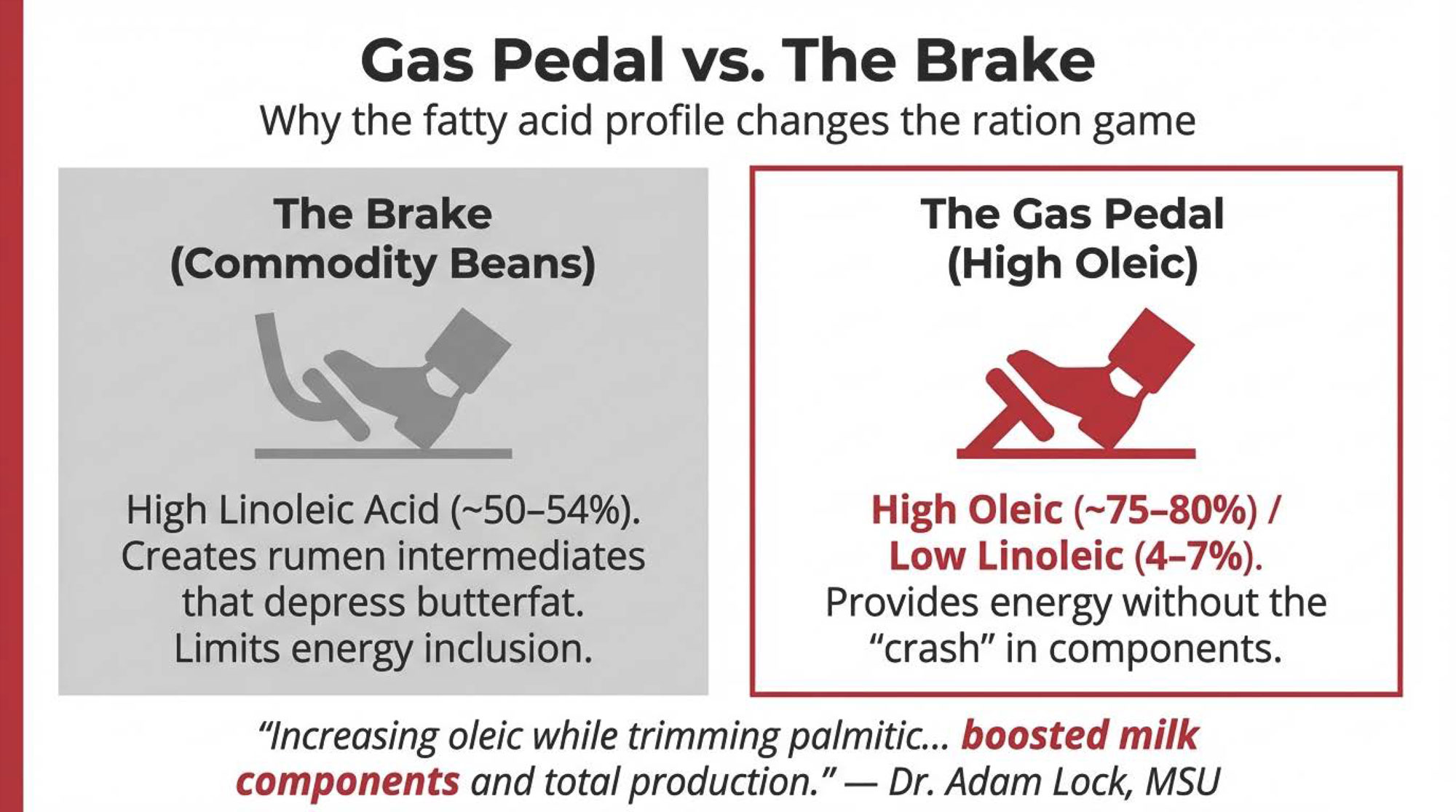
According to Michigan State University Extension’s 2025 “High‑oleic, high reward” analysis, typical commodity soybean oil is about 23% oleic acid and 50–54% linoleic acid.  That big linoleic fraction is exactly why most nutritionists start putting on the brakes when they see a lot of whole beans show up in the diet—linoleic is more prone to producing rumen biohydrogenation intermediates that can chip away at butterfat performance when you push too hard. 
Fatty Acid ComponentCommodity Soybeans (%)Plenish® High-Oleic (%)SOYLEIC® Non-GMO (%)
Oleic Acid2375–8078–84
Linoleic Acid50–544–76–8
Crude Fat (approx.)~20~21~20–21
Crude Protein (approx.)~38~38–39~38–39

High‑oleic soybeans flip that around. MSU Extension reports that Plenish® high‑oleic soybeans usually test about 75–80% oleic acid and only 4–7% linoleic acid, while non‑GMO SOYLEIC® lines often run 78–84% oleic and 6–8% linoleic.  The crude fat and protein values still look like soybean values. What’s changed is the fatty acid mix. 

That shift matters because it changes how the cow sees the ration. With more oleic and less linoleic in the diet, you can bring more energy in through soybeans without taking the same butterfat punch you’d expect from piling on commodity beans or other high‑linoleic fats—if you actually rebalance starch and fiber instead of just “adding a little more.”

Dr. Adam Lock, professor of dairy nutrition at MSU and head of the Dairy Lipids Nutrition Program, has spent much of his career looking at how different fatty acids—palmitic, oleic, and others—shift milk yield, component percentages, body condition, and income over feed cost.  A 2025 summary of his high‑oleic work noted that increasing oleic while trimming palmitic in fat supplements boosted milk components and total production, especially in high‑producing cows, when the rest of the ration was in good shape. 

Penn State research led by Dr. Alexander Hristov found that feeding Plenish high‑oleic soybeans and extruded high‑oleic soybean meal increased milk fat percentage by about 0.2 points with minimal change in milk volume or dry matter intake.  MSU’s more recent trials with roasted high‑oleic soybeans, highlighted by Extension in 2025, saw milk yield climb at inclusion rates around 16% of ration dry matter while holding milk fat steady—as long as starch and fiber were managed sensibly. 

From a fresh cow and whole‑herd ration standpoint, that’s a very different lever than just writing another cheque for bypass fat and hoping your butterfat hangs on.

Inside MSU’s New Dairy: Where the Big Questions Are Being Tested

Looking at this trend from the research side, MSU didn’t just tweak a few diets on a small research herd and call it a day. They built a full‑scale commercial‑style test dairy to figure out what happens when you really lean into high‑oleic and related changes.

The new MSU Dairy Cattle Teaching and Research Center is a roughly $70 million facility, with about 40% of that funding provided by the State of Michigan.  The barn is set up to house about 680–688 cows—more than triple the old MSU dairy—and uses tunnel‑ventilated freestall housing that looks a lot like the modern freestall and dry lot systems you see across the Upper Midwest. 

Dr. Barry Bradford, Chair of Dairy Management at MSU, has been pretty blunt about the main question they’re chasing: if more of your diet’s energy comes from high‑oleic soybeans and other targeted fats, what does that do to the “right” level of starch that many herds locked in 15–20 years ago in the corn‑silage‑plus‑commodity‑co‑products era?  In a January 2026 Brownfield interview, he talked about going back to first principles on starch levels instead of assuming yesterday’s numbers automatically fit tomorrow’s fatty acid profiles. 

To do that, MSU invested about $1 million in individual robotic feeding stations that record dry matter intake cow‑by‑cow, rather than relying on pen averages.  The new dairy and its connected greenhouse complex are expected to host around 10,000 visitors a year—students, industry, and consumers—so people can see what a data‑heavy, commercially styled research herd actually looks like. 

Producers tend to trust research more when the barn in the photos looks like theirs. In this case, we’re not talking about 40 cows in tie‑stalls; we’re talking hundreds of cows in group housing on rations that wouldn’t look out of place on a 500‑ or 1,500‑cow operation. That makes MSU’s high‑oleic work a lot easier to take seriously when you’re sitting down with your own feed sheets.

What Producers Are Actually Seeing: From “Trial” to “System” on a Michigan Dairy

Research is great. Cash flow is better. Let’s talk about what’s happening on the ground.

T&H Dairy: Turning Beans into Butterfat and IOFC

T&H Dairy, run by Mike Halfman and his family near Fowler, Michigan, milks roughly 1,600 cows and farms about 4,400 acres of corn, alfalfa, wheat, and soybeans.  For a long time, soybeans were just another cash crop disappearing into the commodity stream. 

In 2024, they changed gears. T&H planted about 900 acres of high‑oleic soybeans and contracted another 300 acreswith a neighbour, with the specific goal of roasting the beans and feeding them to their high‑producing cows.  According to MSU Extension’s 2025 profile, they started cautiously at around 3 pounds of roasted high‑oleic soybeans per cow per day. At that level, they saw 2–3 pounds more milk per cow per day, but butterfat percentage stayed pretty flat. 

Once they installed on‑farm roasting and pushed inclusion to roughly 7.5–8 pounds of roasted high‑oleic soybeans per cow per day in their top groups, the response shifted. Halfman reports that fat‑corrected milk jumped by more than 4–5 pounds per cow per day, and butterfat percentage improved by around 0.15–0.20 points.  That lines up almost exactly with the 0.2‑point milk fat increase Hristov documented at Penn State with high‑oleic diets. 

On the economics, MSU’s modeling across several case farms—including operations like T&H—found that dairies producing and roasting their own high‑oleic soybeans saw an average income‑over‑feed‑cost (IOFC) advantage of about $0.65 per cow per day.  Farms that didn’t grow beans but bought roasted high‑oleic product still saw modeled IOFC advantages around $0.27 per cow per day

The Michigan Alliance for Animal Agriculture (M‑AAA), which is co‑funding this work, points to a southwest Michigan dairy that pulled out expensive bypass fats and proteins as they ramped up high‑oleic beans and ended up north of $1.00–1.20 per cow per day in IOFC improvement.  One of the owners told MSU that they normally celebrate 5–6 cents per cow per day, so they called this “a once‑in‑a‑generation change.” 

Let’s be honest: not every herd is going to hit $1.20. But when multiple well‑documented farms consistently land in the $0.27–$0.65 range—and a few blow past that when they really redesign the ration—that’s not just coffee‑shop talk anymore.
Where the Acres and Premiums Actually Are

All that IOFC talk falls apart if the crop piece doesn’t hold.

The United Soybean Board’s May 2025 high‑oleic briefing reports that farmers in 16 U.S. states planted more than 1.1 million acres of high‑oleic soybeans in 2023 and around 800,000 acres in 2024.  That 2024 drop wasn’t because crushers lost interest; USB and MSU both point to seed availability and contracting capacity as the main bottlenecks. 

USB notes that in 2024, growers had access to 21 high‑oleic varieties across the Plenish® and SOYLEIC® programs, covering maturity groups 1.9-4.8.  That covers a big chunk of the traditional soybean belt, with new maturities being developed for shorter‑season northern regions. 

On pricing, USB says high‑oleic growers typically earn premiums of $0.75–1.25 per bushel over commodity beans, depending on contract and delivery terms.  Brownfield Ag News and USB farmer‑leaders have highlighted cases like Indiana farmer Kevin Wilson, a USB director, who’s reported cash premiums around $2.20 per bushel on his high‑oleic contracts with ADM for recent crops. 

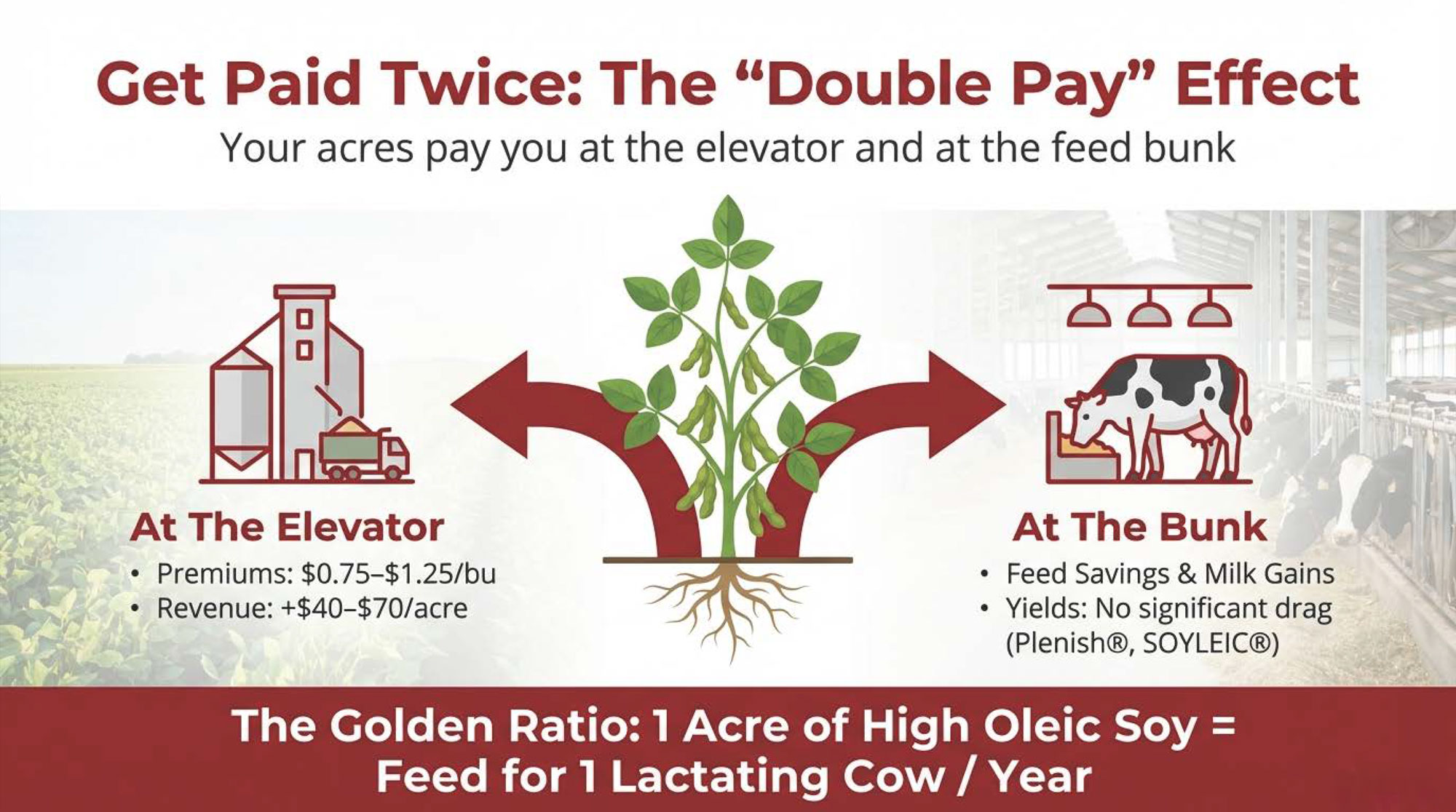
If you match those premiums with USDA‑reported average U.S. soybean yields around 50–55 bushels per acre, you’re realistically talking about $40–70 per acre in extra crop revenue before you feed anything.  Then, if those beans roll through your roaster and displace purchased fats and proteins in the ration at a profit, that same acre is effectively getting paid twice: once at the elevator and once at the bunk. 

Brownfield’s 2025 coverage quoted USB treasurer Matt Gast saying roughly 35% of high‑oleic beans are now heading into dairy rations, about 60% into food, and the remaining 5% into industrial uses.  So dairy isn’t an afterthought in this market. We’re a major end user. 

Agronomics and Defensive Traits: Are You Sacrificing Yield?

Whenever somebody says “specialty crop,” most growers quietly translate that to “yield drag” unless they see evidence otherwise.

USB and partner organizations have been clear that high‑oleic traits are being stacked on elite yield and defensive backgrounds, not on leftover genetics.  Corteva’s Plenish® beans, for example, commonly carry soybean cyst nematode resistance, Phytophthora tolerance, and the Enlist E3 herbicide trait, giving you access to modern weed control and disease packages you’d expect from top‑end commercial beans.  On the non‑GMO side, SOYLEIC® varieties developed by Missouri Soybeans and programs in states like Georgia are being stacked with resistance to SCN, root‑knot nematode, and frogeye leaf spot. 

MSU Extension points out that from an agronomy standpoint, the day‑to‑day management of high‑oleic beans looks a whole lot like conventional soybeans, aside from the identity‑preserved handling and any herbicide restrictions tied to specific trait packages.  You still have to match maturity, disease package, and herbicide system to your fields—the same homework you should already be doing with commodity beans. 

From yield reports and field experience shared through USB and state soybean groups, high‑oleic beans can run with strong commodity lines when you put them on appropriate ground and treat them like serious production varieties rather than side projects.  Are there weak performers out there? Of course. But “high‑oleic” does not automatically mean “yield anchor”

The Catch: Identity Preservation and the Work Between the Drill and the Roaster

Here’s the part that looks great on slides and then blows up in the yard if you’re not careful: identity preservation.
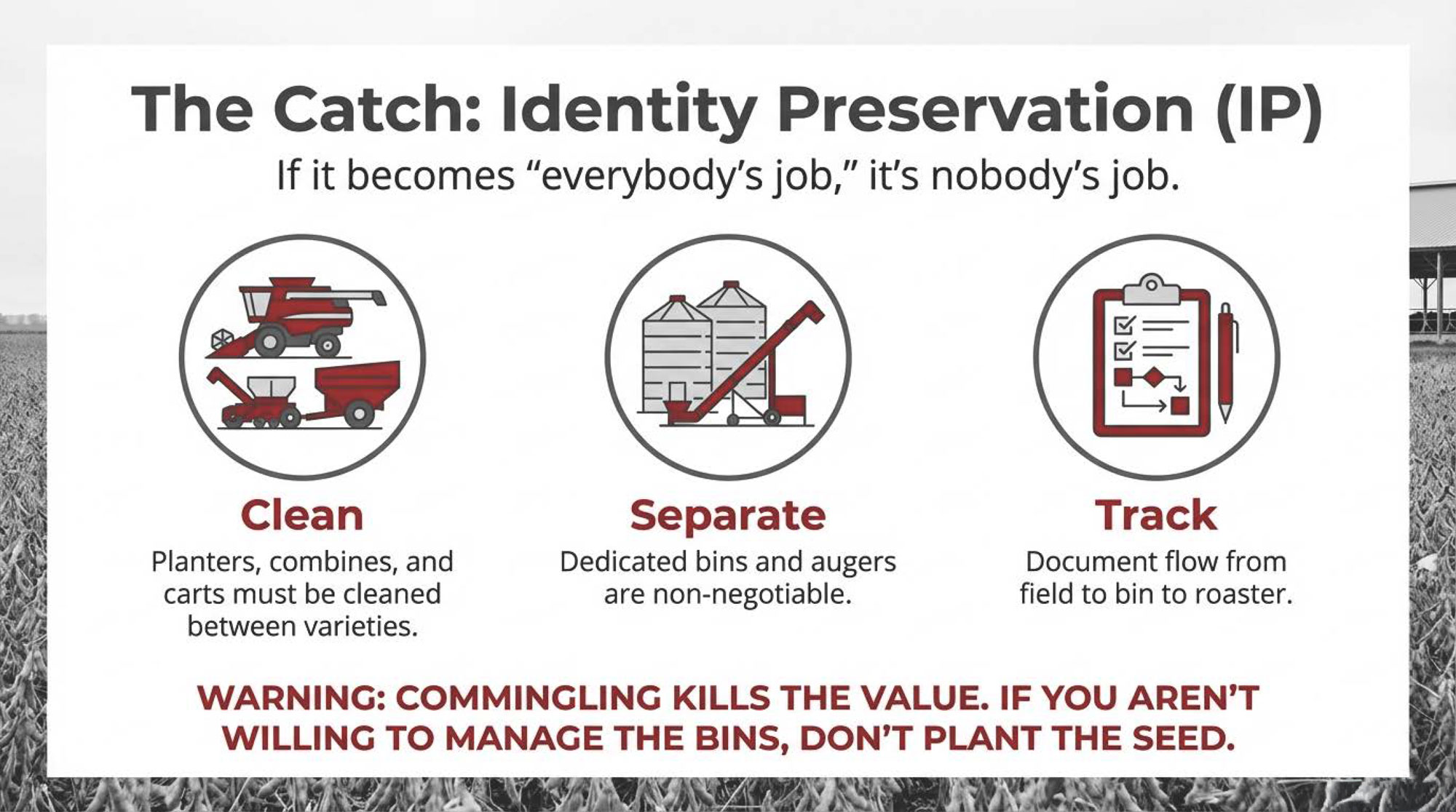
High‑oleic beans are almost always grown under identity‑preserved (IP) contracts, because crushers and end users have to know they’re actually getting the fatty acid profile they’re paying for, not a blend of whatever fell into the bin.  That makes your planting, harvesting, hauling, and storage plan part of the value chain, not an afterthought. 

USSEC’s High Oleic Sourcing Guide lays out the basics: clean planters, combines, grain carts, augers, and bins thoroughly when you switch between commodity and high‑oleic beans; keep high‑oleic lots segregated; and track beans from field to bin to delivery.  Soy Canada’s identity preservation resources add the same themes—clear bin labeling, separate handling lines, and documented flows—based on decades of non‑GMO and food‑grade experience. 

Wisconsin Extension adds a very practical farm‑gate layer: mark high‑oleic fields clearly, make sure custom operators know which fields are IP and what herbicide system they’re in, and don’t send a combine into those fields with commodity beans still in the hopper from yesterday’s job. 

If your plan is to “sprinkle on a few beans” and call it good, you’re not going to see MSU‑level responses. If nobody on your team owns the IP details—bins, augers, cleaning, record‑keeping—high‑oleic will be a headache long before it becomes a margin tool.

On the flip side, if you’re already handling non‑GMO or food‑grade grain streams, most of this will feel like structured discipline you already understand, with a different premium and trait stack attached. Even if your primary goal is feeding your own cows, commingling still matters. If your nutritionist is formulating around high‑oleic fatty acid profiles but the bin is half commodity beans, you can’t expect butterfat performance or IOFC to match the research.

The High‑Oleic Math: From Acres to Cows to IOFC

Now for the part you can actually plug into your budget.

MSU’s 2025 Extension work, supported by the Michigan Alliance for Animal Agriculture, modeled two main scenarios using real farm performance data and realistic feed costs: 

  • Farms producing and roasting their own high‑oleic soybeans saw an average IOFC advantage of about $0.65 per cow per day.
  • Farms purchasing roasted high‑oleic soybeans saw an average IOFC advantage of about $0.27 per cow per day.

At the inclusion rates and yields MSU is working with, one acre of high‑oleic soybeans can supply enough beans to feed one lactating cow for a full year, assuming on‑farm roasting and feeding patterns similar to the case farms. 
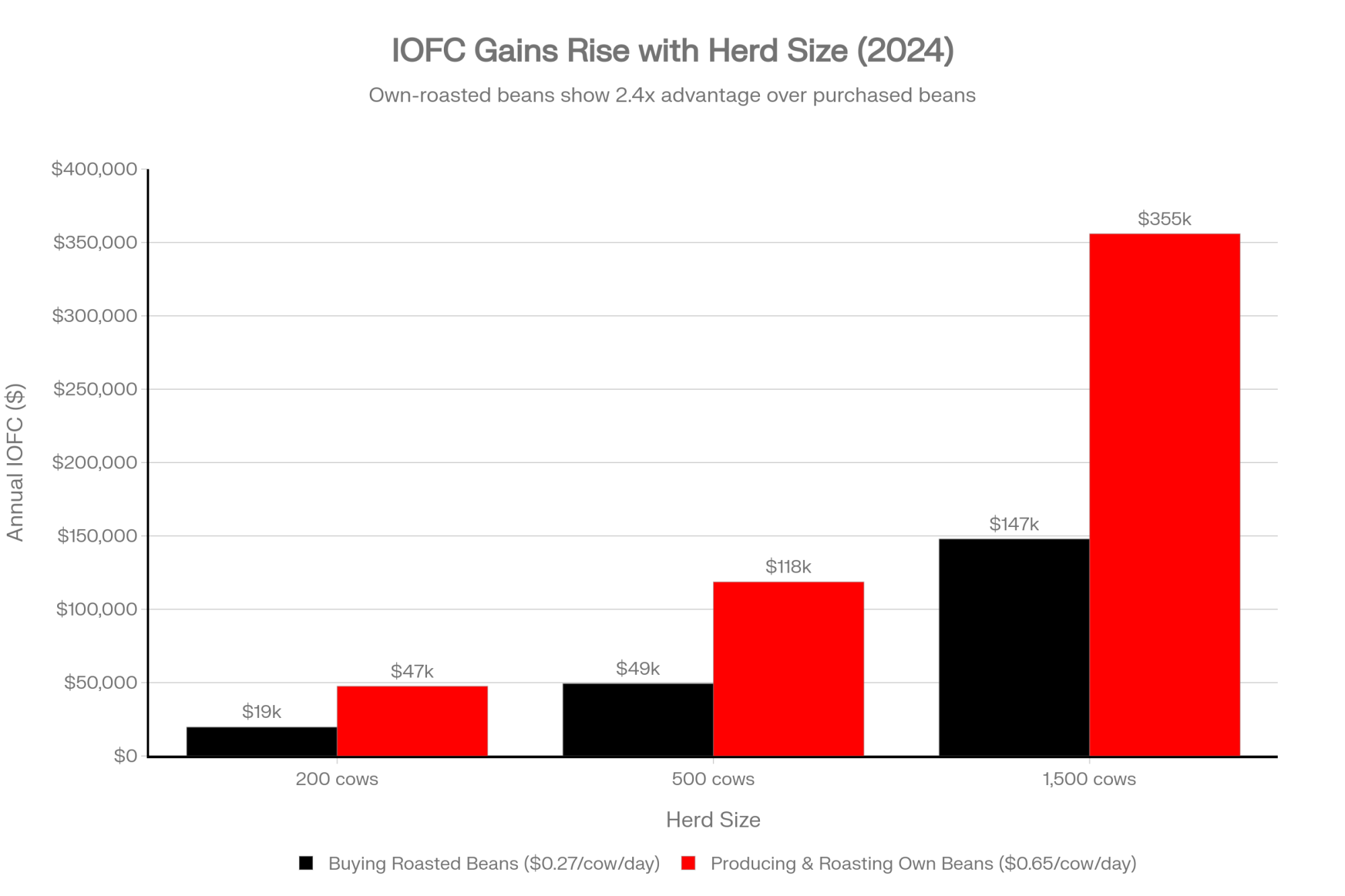
Here’s how that IOFC advantage plays out across different herd sizes:

Herd sizeIOFC +$0.27/cow/dayIOFC +$0.65/cow/day
200 cows≈ $19,700/year≈ $47,500/year
500 cows≈ $49,300/year≈ $118,600/year
1,500 cows≈ $147,900/year≈ $355,900/year

Those are straight annualizations of MSU’s IOFC averages, not “best barn at the meeting” numbers. 

On the crop side, USB’s premium range of $0.75–1.25 per bushel, combined with 50–55 bushel per acre yields, points to around $40–70 per acre extra crop revenue before you feed anything.  In some contracts, like the ADM deals highlighted by Brownfield and USB farmer‑leaders, premiums up near $2.20 per bushel have been reported, which pushes those crop‑side gains higher when conditions line up. 

What producers are finding is that the biggest wins show up when:

  • High‑oleic acres are reasonably close to the dairy, keeping transport sane.
  • The ration has a meaningful purchased fat and “fancy ingredient” line item that you can actually replace.
  • There are enough cows to spread roasting and IP overhead, so it doesn’t feel like a science fair project.

If your purchased fat and specialty ingredient line is already north of about $0.40 per cow per day, and you can realistically commit 0.5–1 acre of soybeans per cow into high‑oleic over the next couple of years, you’re in the zone where this deserves serious, numbers‑on‑paper attention. 

Three Paths: Move Now, Plan a Pilot, or Watch and Wait
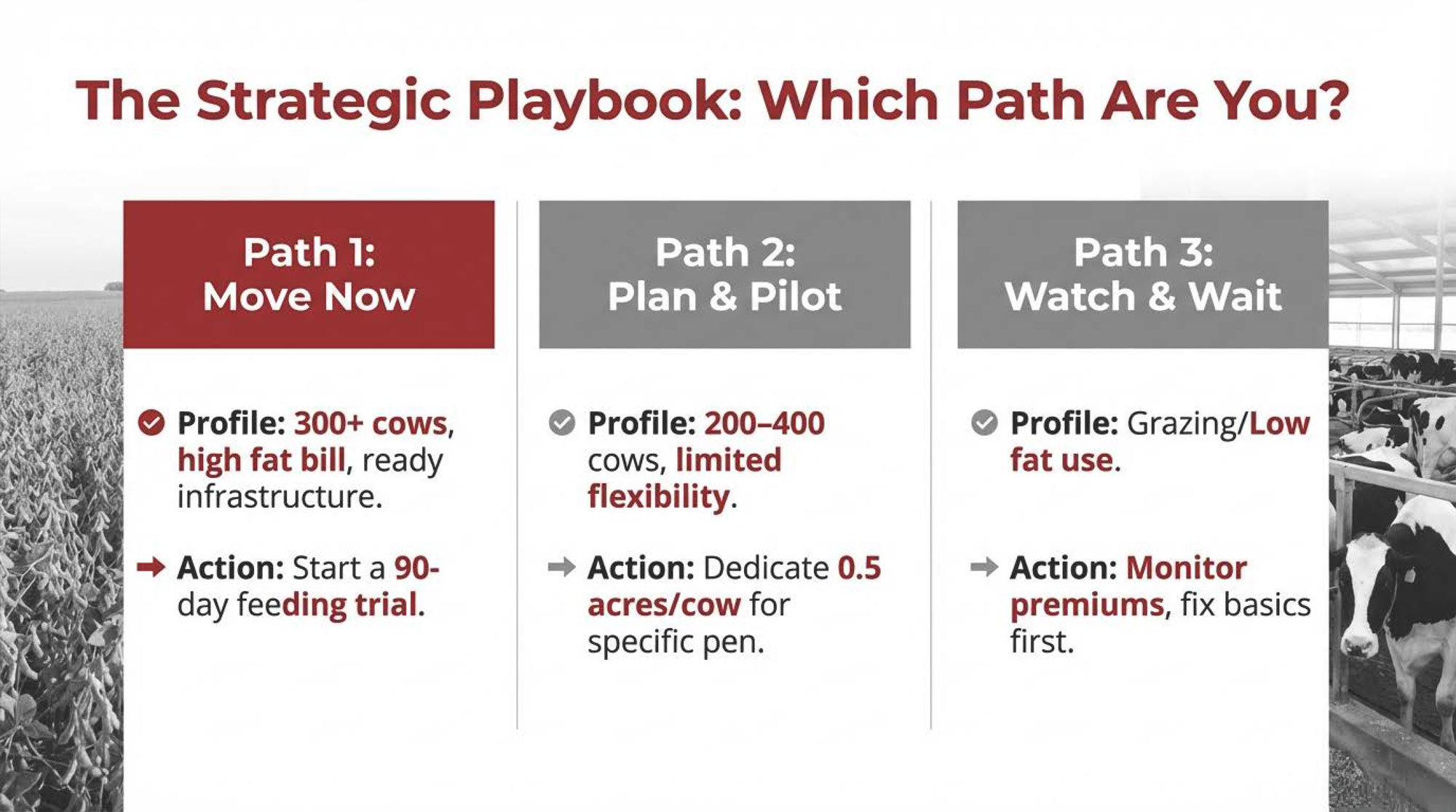
Decision FactorMove Now FarmsPlan & Pilot FarmsWatch & Wait Farms
Herd Size300+ cows, or 200+ with flexibility200–400 cows, moderate flexibility<200 cows, or grazing-dominant systems
Soybean Acreage & Fat SpendGrow soybeans; >$0.40/cow/day purchased fat spendSome soybean acres; modest fat spendLittle to no soybean acres; minimal purchased fat
InfrastructureBins, augers for IP handling; access to roasterBins/augers with planning; may need upgradesNo grain infrastructure or not scalable for IP
2026 ActionSit with nutritionist on IOFC scenarios; contract high-oleic; pilot 90 daysCommit 0.3–0.5 acres/cow to pilot; run “what-if” scenarios; track pilot resultsMonitor university work, regional Extension updates, co-op messaging; revisit in 2027–2028
Expected IOFC Gain$0.27–$0.65/cow/day (basis: buy vs. produce)$0.15–$0.50/cow/day (conservative, pilot-stage)Deferred; focus on other margin levers now
Next StepSchedule call with nutritionist + elevator; list candidate fats to displaceDesign a small-group pilot on fresh pen or high group; define tracking metricsAssess forage, fresh cow transition, SCC; revisit high-oleic in 2027

Looking at this trend with both optimism and a bit of healthy skepticism, most herds fall into one of three buckets.

1. “Move in the Next 12 Months” Farms

You’re probably in this group if:

  • You milk 300+ cows and already grow soybeans, or could easily partner to hit 0.5–1 acre per cow in high‑oleic.
  • Your ration includes purchased bypass fat, palm fat, or other high‑priced energy sources you’d love to cut back on.
  • You have—or could add—storage and handling to keep an identity‑preserved stream separate.
  • You either have reliable access to a custom roaster or can justify investing in on‑farm roasting equipment.

For you, the next moves aren’t “order some seed and see what happens.” They’re:

  • Sit down with your nutritionist and list exactly which fats and supplements you’d pull at 3–4 pounds and then at 7–8 pounds of roasted high‑oleic soybeans per cow per day.
  • Have them show you IOFC projections on paper using MSU’s $0.27 and $0.65 per cow per day ranges as bookends, plugged into your component prices and ingredient costs. 
  • Call your elevators or processors and get specific: which high‑oleic contracts exist, their maturities, premiums, delivery windows, and the penalties if loads miss specs. 
  • Walk your grain system and decide which bins and augers will actually carry the high‑oleic stream, who cleans them, and who signs off.

If your nutritionist can’t show you, in numbers, how high‑oleic beans would displace existing fats and supplements in a way that adds up, you’re not ready to shift acres. If they can, you’re a strong candidate for a 90‑day high‑oleic feeding trial as soon as beans and roasting are lined up.

2. “Plan and Pilot” Farms

You’re in this lane if:

  • You milk 200–400 cows and have some soybean acres, but you don’t have endless flexibility.
  • Your ration uses some supplemental fat, but you’re not chasing 100‑lb tanks.
  • You have bins and handling that could manage an IP stream, but only with planning and maybe a couple of modest upgrades.

For you, 2026–2027 probably looks like:

  • Committing a modest amount of high‑oleic acres—say 0.3–0.5 acres per cow—aimed at a specific high group or fresh pen, rather than the whole herd.
  • Using MSU’s IOFC estimates as realistic boundaries: $0.27 per cow per day if you’re buying roasted product, $0.65 if you end up producing and roasting your own. 
  • Running “what‑if” scenarios with your advisor: what happens if butterfat price softens from today’s levels? What if you only capture half the modeled IOFC bump, or if premiums slide toward the low end of USB’s range? 
  • Treating year one as a structured pilot with defined rations, groups, and tracking, not a casual “we tried some beans one month and didn’t see anything dramatic.”

Your goal isn’t to redesign your entire feed system overnight. It’s to get your own data—on your cows, your acres, and your premiums—so if margins tighten more, you’re making decisions with real numbers instead of guesses.

3. “Watch and Wait” Farms

You’re probably here if:

  • You run a grazing‑dominant or seasonal system with relatively low concentrate feeding.
  • You don’t grow soybeans and don’t have bins or grain handling set up for IP crops.
  • Your current ration uses little to no purchased fat, so there’s not much displacement value to capture.

For you, the smartest move may be to stay informed rather than jump in. That can look like:

  • Keeping an eye on MSU and other university work on fatty acids and high‑oleic, plus your regional Extension updates on feed costs and butterfat premiums. 
  • Hammering out lower‑cost wins closer to home—fresh cow transitions, forage quality, milking routine, SCC—before you commit to a specialty ingredient with IP requirements.
  • Watching how your co‑op or processors evolve component pricing and whether they start hinting at “diet‑friendly” fat programs or call out high‑oleic in their own messaging. 
  • Re‑evaluating high‑oleic in a couple of years, when seed availability, contract options, and case studies will all be deeper.

You don’t lose ground by waiting thoughtfully if your system doesn’t have the acres, bins, or fat spend to make this pay right now.

A Quick “What This Means for Your Operation” Checklist

Before you sign anything—or blow it off—run through this with your team:

  • Crops: How many acres can we realistically move into high‑oleic without starving our corn silage and forage program?
  • Fat spend: What did we actually spend last year on bypass fats, palm products, and other specialty energy sources on a $/cow/day basis?
  • Contracts: What specific high‑oleic contracts exist in our trucking radius—premiums, maturities, delivery windows, quality specs, and penalties if we miss them? 
  • Infrastructure: Do we have bins and augers that can be dedicated to an identity‑preserved stream, and what would it cost—in time and money—to properly clean and separate? 
  • Ownership: Who on our team is going to “own” the high‑oleic/IP system day‑to‑day so it doesn’t become everybody’s job and therefore nobody’s job?

If you can’t answer those questions yet, that’s your next step. Not ordering seed. Not pricing roasters. Clarity.

Stepping Back: A New Fat Tool in a Tough 2026 World

Stepping back from all the charts and quotes, high‑oleic soybeans are best viewed as a new fat tool, not a magic button. They give you a way to bring more energy—and a more butterfat‑friendly fatty acid profile—into the ration from your own acres, especially if you’re already cutting big cheques for purchased fats.

The combination of:

  • USDA’s 2026 price outlook is pointing to tighter margins, 
  • MSU’s full‑scale dairy research with individual intake data, 
  • USB’s long‑term investment in high‑oleic traits and premiums, 
  • And real‑farm experience from herds like T&H and other Michigan dairies, 

means this is not just a shiny idea in a conference slide deck.

At the same time, the IP discipline, seed and contract access, storage needs, and scale realities mean high‑oleic beans won’t be the right play for every operation in 2026. Canadian quota and butterfat pool rules, EU Green Deal pressures, and pasture‑based systems in places like New Zealand all shape different price signals and contract structures, even if the underlying IOFC and fatty acid logic stay the same. 

So what should you actually do with this?

  • First, pull last year’s fat and supplement bills and run the IOFC scenarios—$0.27 and $0.65 per cow per day—on your actual herd size. 
  • Second, ask your nutritionist to design a 90‑day high‑oleic trial that truly replaces purchased fats and proteins, not just sprinkles beans on top of an unchanged ration. 
  • Third, talk to your elevator or processor about real, not hypothetical, high‑oleic contracts—what’s on offer, what they expect, and how they fit with your harvest and storage realities. 

You don’t have to chase every new trait or every new feed idea that shows up in a slide deck. But if your acres, ration, and fat bill line up with what MSU and USB are seeing, ignoring high‑oleic soybeans completely could mean leaving serious five‑ or even six‑figure money on the table every year. In a world where USDA is talking $18‑milk, and some regional Class III projections are hovering near $16, that’s not a side note.  That’s a strategic decision. 
Key Takeaways

  • 2026 margins leave no room for fluff. USDA’s $18.25/cwt all-milk forecast means a $0.30–$0.65/cow/day IOFC gain isn’t a bonus—it’s survival math.
  • One acre of high-oleic soy feeds one cow for a year. MSU’s modeling shows $0.65/cow/day IOFC gains for farms that grow and roast their own beans—roughly $118,600/year on 500 cows.
  • T&H Dairy in Michigan is already banking results: 4–5 lbs more fat-corrected milk and 0.15–0.20 points higher butterfat at 7.5–8 lbs of roasted high-oleic beans per cow per day. ​
  • Your soybean acres can pay you twice. High-oleic contracts add $0.75–$1.25/bu over commodity beans ($40–70/acre extra at typical yields)—then those same beans boost IOFC in the bunk.
  • High-oleic is a system, not a sprinkle. It only works with IP handling, dedicated bins, roasting, and real ration changes. The article’s three-path playbook (move now, plan a pilot, or watch and wait) helps you decide if your farm is ready.

Complete references and supporting documentation are available upon request by contacting the editorial team at editor@thebullvine.com.

Learn More

Join the Revolution!

Join over 30,000 successful dairy professionals who rely on Bullvine Weekly for their competitive edge. Delivered directly to your inbox each week, our exclusive industry insights help you make smarter decisions while saving precious hours every week. Never miss critical updates on milk production trends, breakthrough technologies, and profit-boosting strategies that top producers are already implementing. Subscribe now to transform your dairy operation’s efficiency and profitability—your future success is just one click away.

NewsSubscribe
First
Last
Consent

The One-Dollar Margin: A Global Wake-Up Call from New Zealand’s Dairy Squeeze

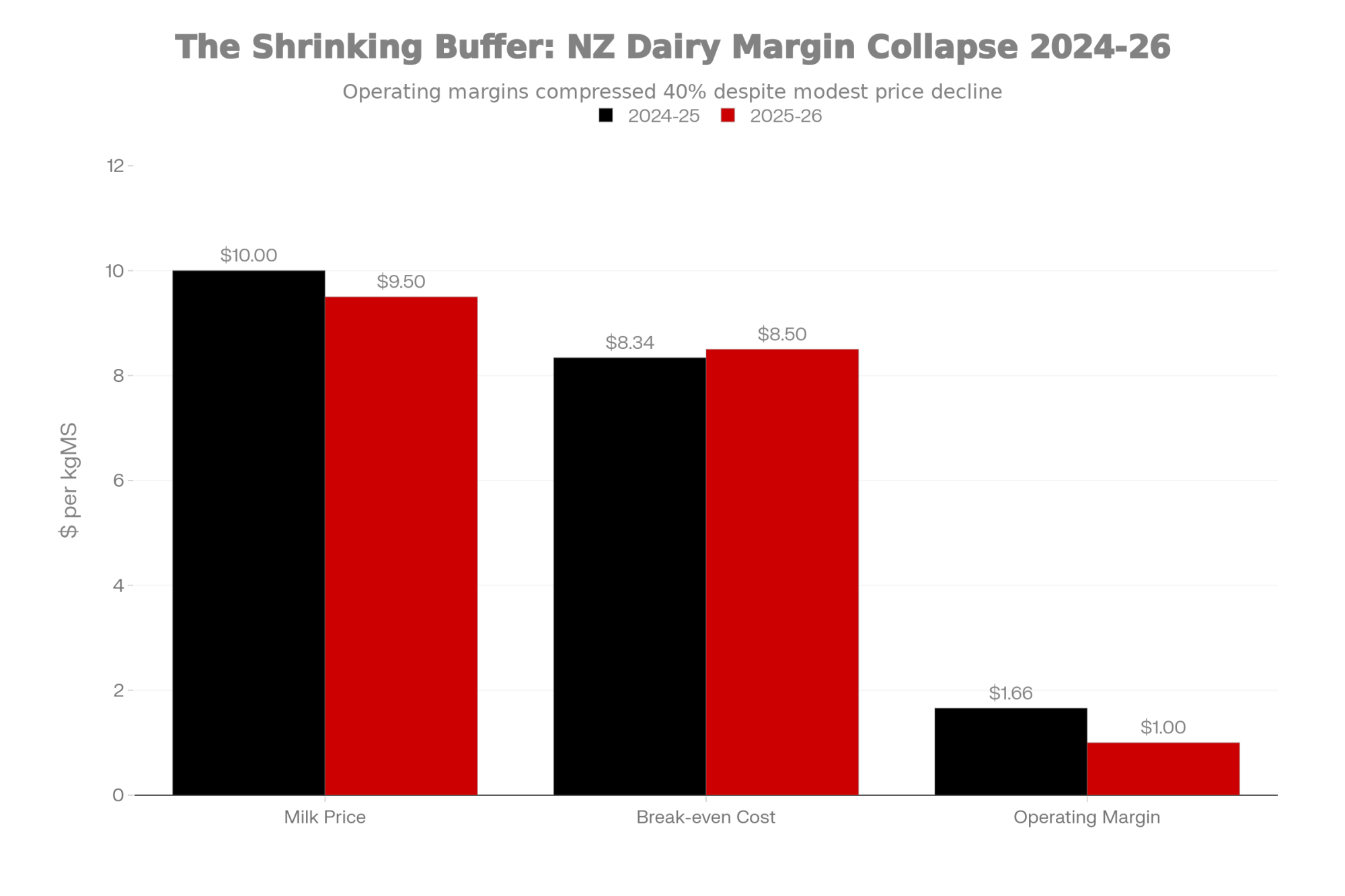
A $9.50 milk price sounds great—until you see the $8.50 break-even. NZ’s one-dollar margin is a wake-up call for dairy farmers everywhere.

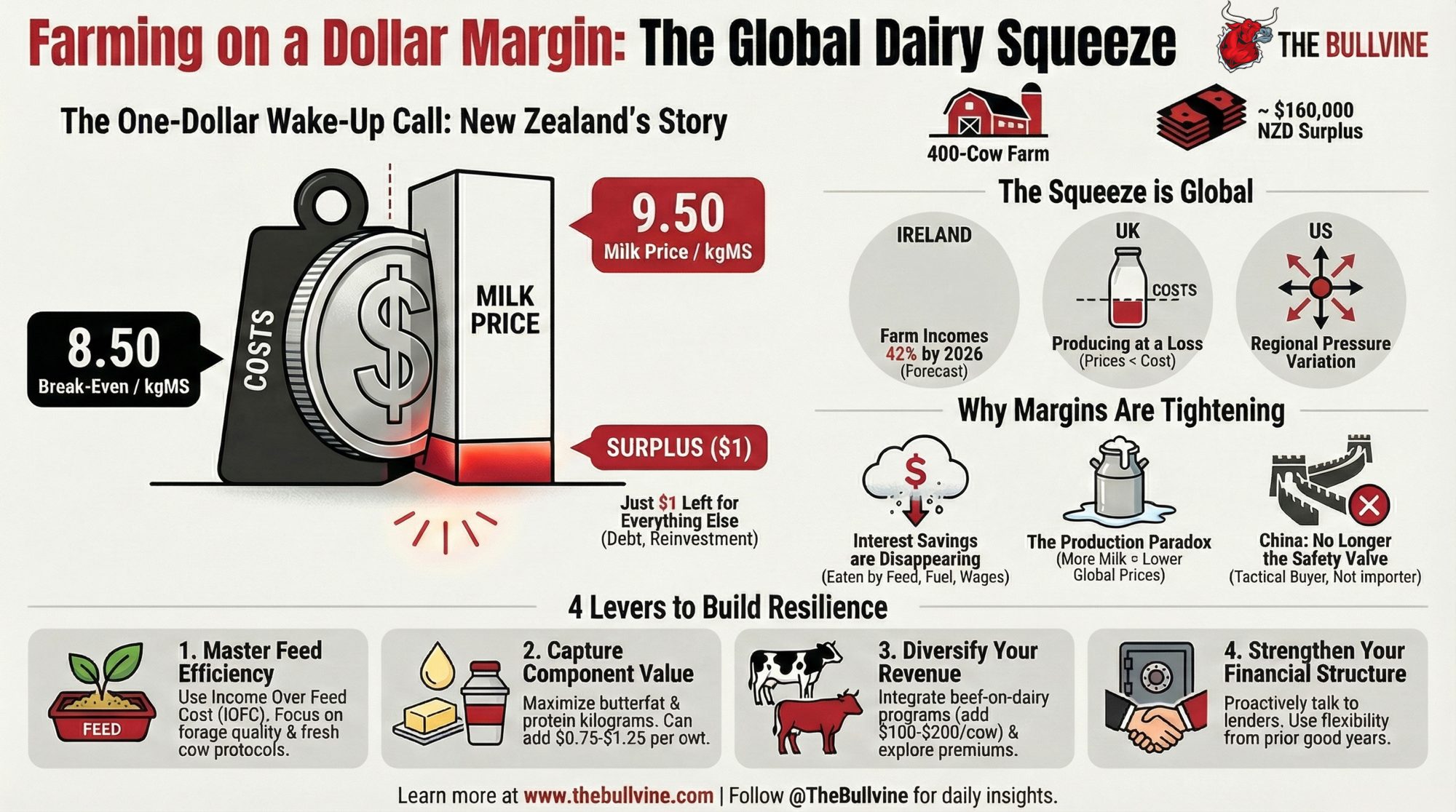
Executive Summary: When the world’s lowest-cost milk producers are farming on a dollar of margin, that’s a wake-up call for dairy everywhere. New Zealand’s December 2025 numbers: $9.50/kgMS milk price, $8.50 break-even, one dollar left for debt, drawings, and reinvestment. They’re not alone. Teagasc projects Irish dairy incomes dropping 42% in 2026. UK farmgate prices have fallen below production costs. Rabobank calls global output growth ‘stunning’—the very oversupply compressing margins worldwide. And China’s shift from aggressive importer to tactical buyer has removed the demand safety valve the industry once counted on. The old formula—high prices equal comfortable margins—no longer holds. The farms that make it through will be those building resilience now: feed efficiency, component focus, diversified revenue, right-sized debt. Not growth for growth’s sake. Strategic survival.

When the world’s lowest-cost milk producers are working on about one dollar of operating margin per kilogram of milk solids, that’s worth every dairy farmer’s attention.

That’s exactly where New Zealand finds itself heading into 2026.

Here’s what makes this relevant beyond the Pacific: it’s essentially a real-time stress-test of the global dairy model. From Wisconsin freestalls to Irish grass paddocks to Canterbury’s irrigated pastures, the underlying question is the same.

If New Zealand’s efficient pasture systems can’t maintain comfortable margins at these milk prices, what does that mean for the rest of us?

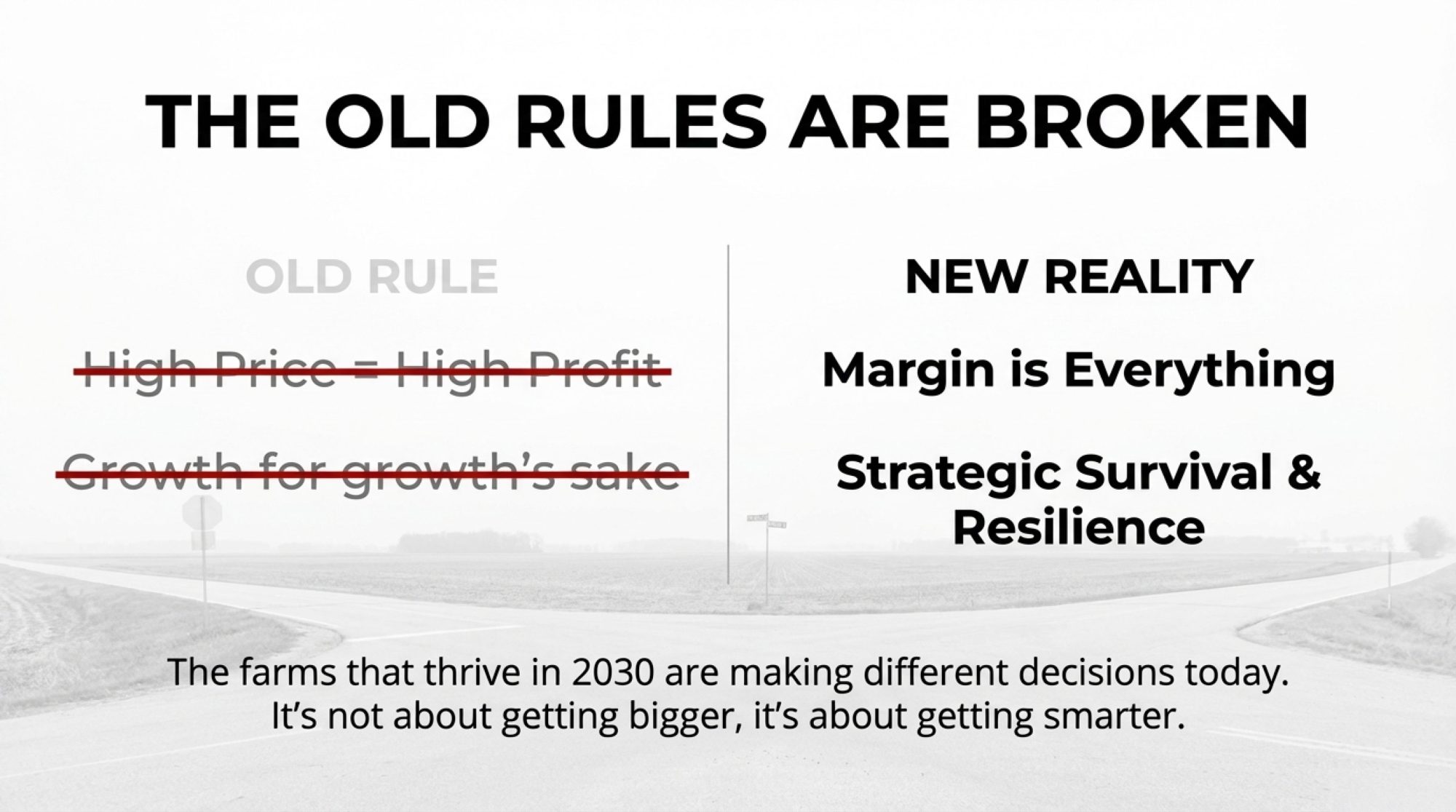
The narrative has shifted. It’s less about waiting for the next price spike and more about adapting to a new reality—one defined by persistent cost pressure, cautious global buyers, and markets that recover more slowly than they used to.

Understanding the One-Dollar Margin

DairyNZ’s December 2025 Economic Update paints a clear picture.

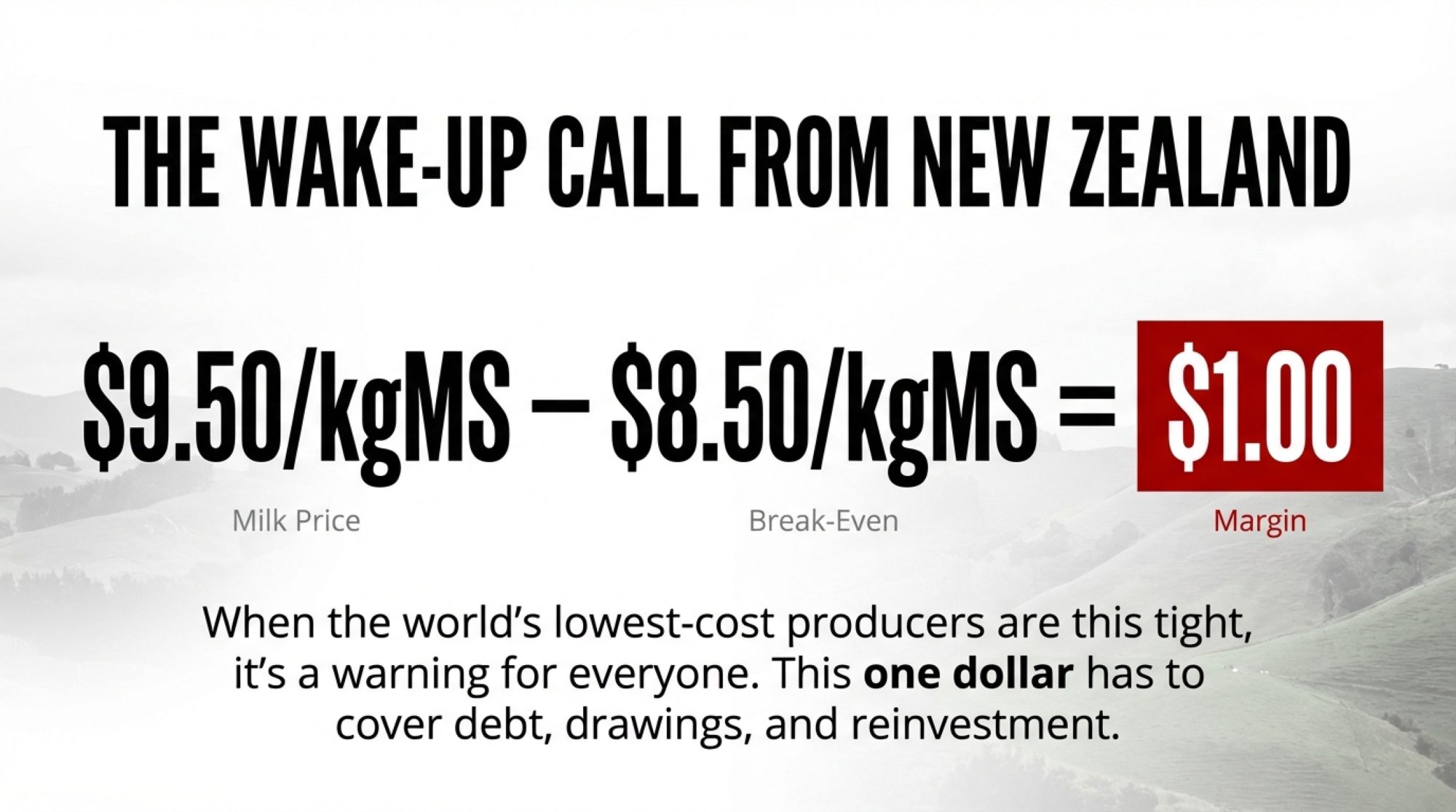
Farm working expenses have climbed 16 cents to $5.83 per kgMS. Meanwhile, Fonterra revised its 2025-26 farmgate milk price forecast down to a midpoint of $9.50 per kgMS—a notable drop from the earlier $10.00 projection.

DairyNZ puts the break-even milk price for an average reference farm at around $8.50 per kgMS.

That leaves roughly a dollar per kgMS as operating surplus. And that’s before capital repayments, family drawings, or any reinvestment.

Metric2024-25 Season2025-26 SeasonChange
Milk Price ($/kgMS)$10.00$9.50-$0.50
Break-even Cost ($/kgMS)$8.34$8.50+$0.16
Operating Margin ($/kgMS)$1.66$1.00-$0.66
Farm Working Expenses ($/kgMS)$5.67$5.83+$0.16
Interest Costs ($/kgMS)$1.46$1.11-$0.35

Tracy Brown, DairyNZ’s chair and herself a Waikato dairy farmer, offered some measured perspective in their December update: “Profit is still on the table, but the margin gap has clearly tightened, and that means every spending decision on farm needs a harder look.”

That’s a statement worth sitting with.

What This Looks Like on a Real Farm

Think about a fairly typical New Zealand herd—400 cows producing 400 kgMS each. That gives you 160,000 kgMS for the season.

At $9.50 per kgMS, gross milk revenue comes to about $1.52 million NZD. With a break-even point of around $8.50, core operating costs consume roughly $1.36 million.

That leaves approximately $160,000 NZD of operating surplus.

On paper, that’s profit. But reality includes broken gates, aging tractors, and family obligations. The buffer is much thinner than the headline suggests.

I recently spoke with a consultant who works across both New Zealand and Australian operations. His observation: for a 200-cow farm, that surplus might only be $80,000 NZD before tax and drawings. For a 2,000-cow operation, you’re looking at roughly $800,000—but spread across substantially higher fixed costs and larger teams.

Farm SizeProduction (kgMS)Gross RevenueOperating CostsOperating SurplusMargin Per Cow
200 cows80,000$760,000$680,000$80,000$400
400 cows160,000$1,520,000$1,360,000$160,000$400
2,000 cows800,000$7,600,000$6,800,000$800,000$400

The ratio matters more than the headline number. Whether you’re milking 200 or 2,000, everyone’s working with a narrower buffer.

The Takeaway: A $9.50 milk price sounds strong. But with $8.50 break-evens, you’re farming on a dollar of margin—and that dollar has to cover everything else.

Tracing the Cost Increases

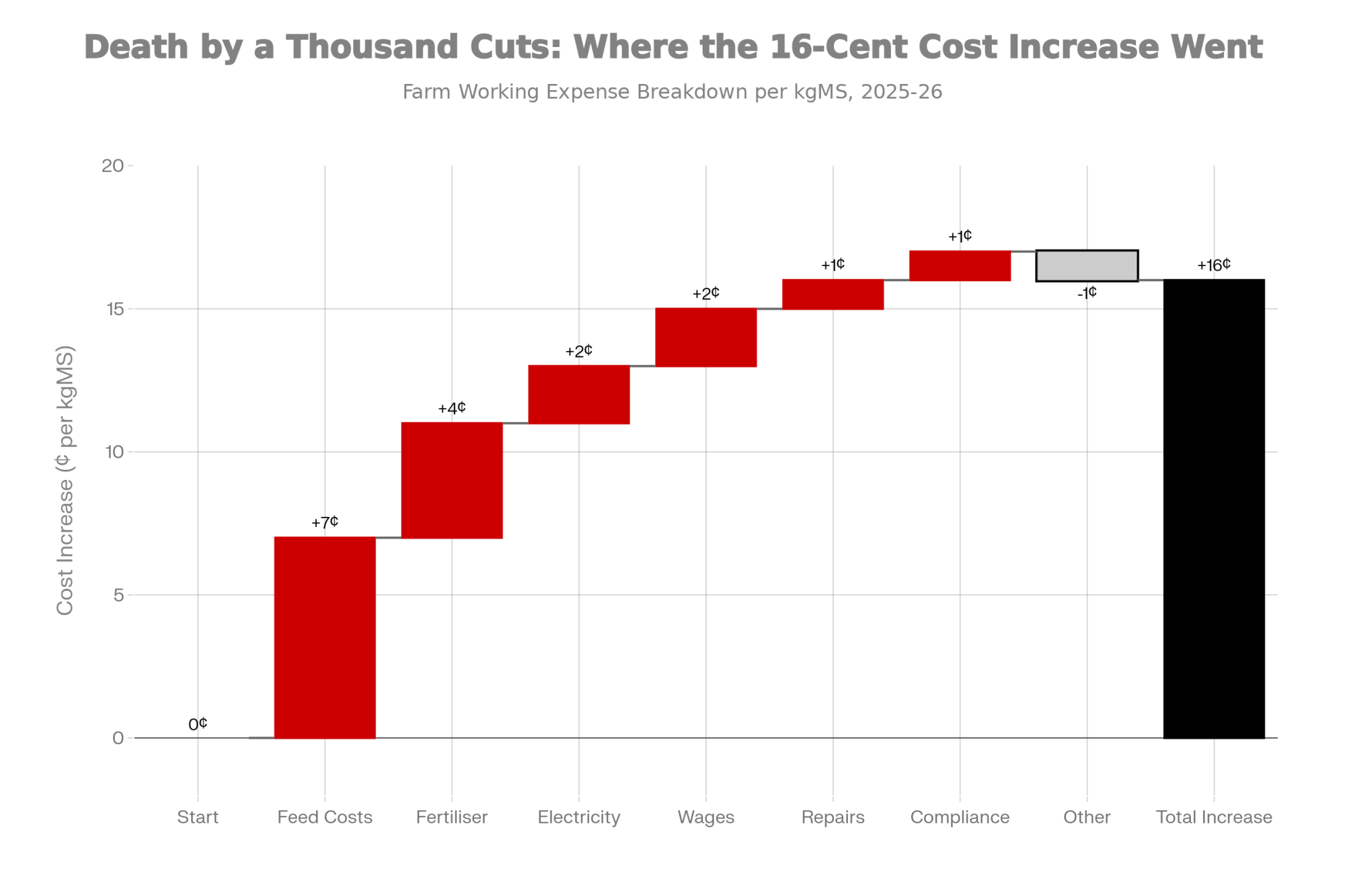
Where exactly did those 16 cents go? Understanding the drivers makes them easier to address.

DairyNZ’s Econ Tracker identifies three primary contributors.

Cost CategoryIncrease (¢/kgMS)400-Cow Farm ImpactControllability
Feed Costs+7¢+$11,200Medium – Nutrition strategy
Fertiliser+4¢+$6,400Low – Global commodity
Electricity/Irrigation+2¢+$3,200Low – Fixed infrastructure
Wages+2¢+$3,200Low – Labour market
Repairs/Maintenance+1¢+$1,600Medium – Defer vs invest
Compliance+1¢+$1,600None – Regulatory
Other Operating-1¢-$1,600Variable
TOTAL+16¢+$25,600

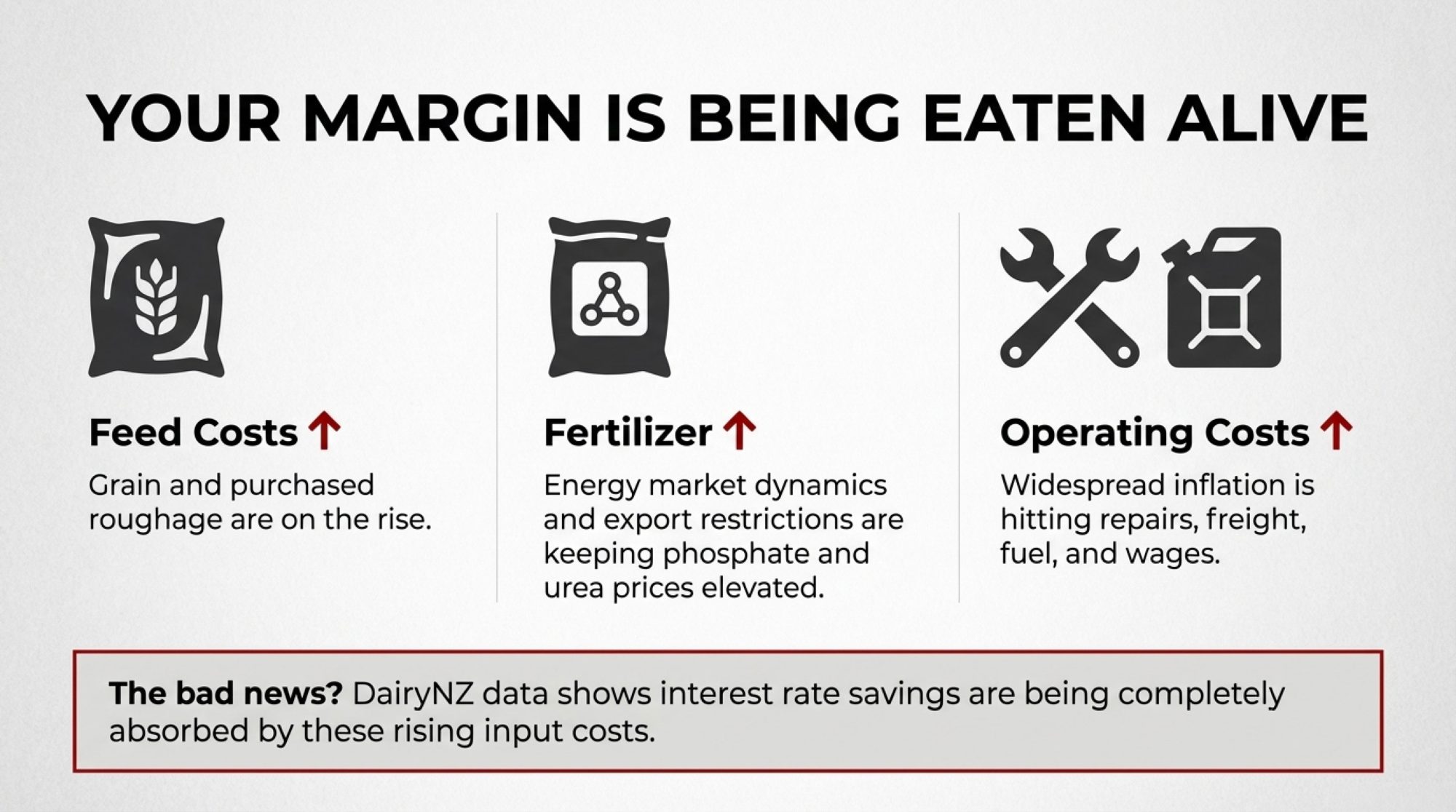
Feed costs have risen meaningfully year-on-year across most categories. Palm kernel has been somewhat more stable, but grain and purchased roughage have risen noticeably.

Fertiliser continues to pressure budgets. Phosphate and urea prices remain elevated, driven by energy market dynamics and export restrictions from major suppliers. Teagasc’s Outlook 2026 suggests costs will climb further as the EU Carbon Border Adjustment Mechanism takes effect.

Other operating costs—repairs, freight, wages, fuel, compliance—have all experienced inflation.

The encouraging news? DairyNZ reports that interest costs are easing. Payments are forecast to drop about 35 cents to $1.11 per kgMS for 2025-26.

The catch? Those interest savings are largely offset by increases elsewhere. The budget might show relief on one line, but feed, fertiliser, and operating costs are absorbing it.

For a 200-cow farm, this might mean choosing between replacing an ageing parlour component or making do with repairs. On a 2,000-cow dry-lot operation, it could be the difference between upgrading a feed mixer or deferring that decision another year.

The Takeaway: Feed and fertiliser are eating your interest rate savings before you ever see them.

The Production Paradox

This is where the situation becomes counterintuitive.

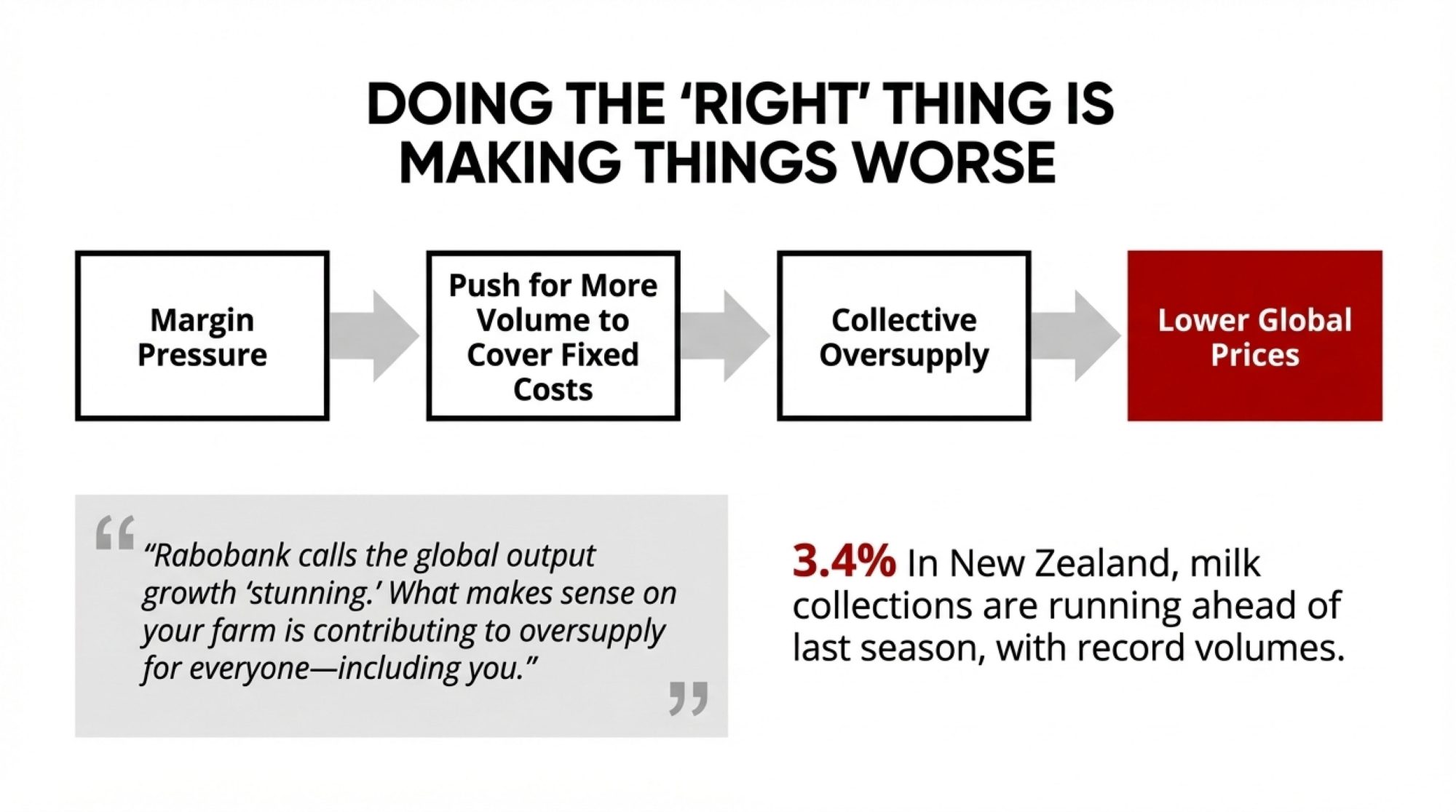
New Zealand is currently in its spring flush. DairyNZ reports national milk collections running about 3.4% ahead of last season, with August and October 2025 volumes among the highest on record.

South Island production in October was up 5.7% year-on-year. Customs data shows palm kernel imports are up significantly—a clear indicator that farmers leaned into purchased feed to boost production.

Why does this matter? Because the same pattern is playing out across multiple dairy regions simultaneously.

I’ve been following similar trends in US and European coverage. Where corn or by-products are relatively affordable, there’s considerable temptation to push cows harder to maintain cashflow. Especially when fixed obligations don’t adjust downward just because your milk price does.

At the individual farm level, this appears entirely rational. If you’ve already invested in the parlour, the effluent system, and the bank financing, pushing a few more kilograms through spreads those fixed costs.

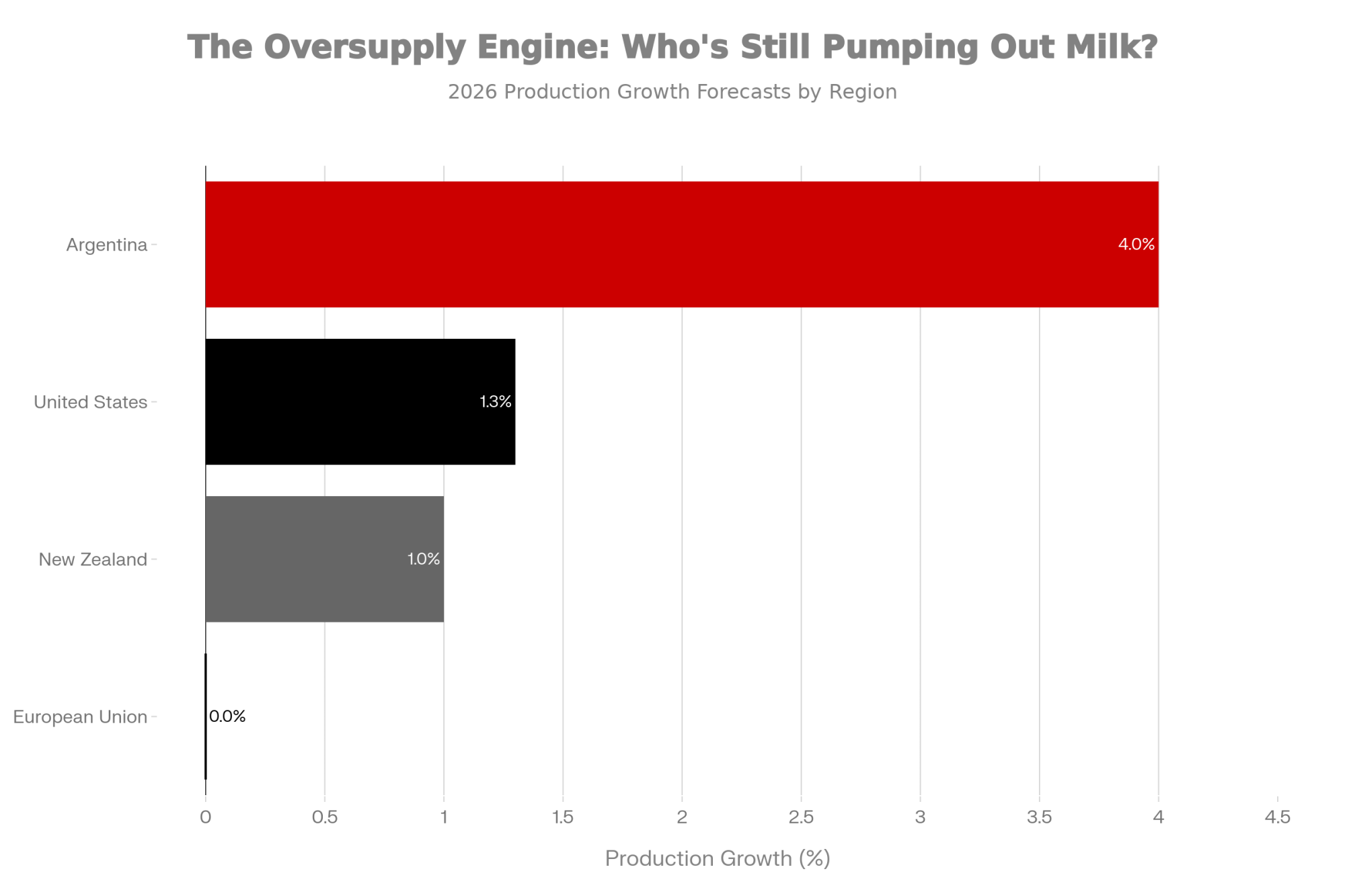
But collectively? When New Zealand, the US, Ireland, and parts of Europe all make that same calculation simultaneously, you end up with what Rabobank’s December 2025 commentary described as “stunning” global output growth.

Region2026 Growth ForecastImpact on Global Supply
Argentina+4.0%Aggressive expansion continues
United States+1.3%Steady growth despite tight margins
New Zealand+1.0%Spring flush pushing volumes
European Union0.0%Only major exporter hitting brakes

That additional milk is precisely why price forecasts have moderated.

A Midwest producer I spoke with recently put it simply: “We’re not trying to grow anymore—we’re trying to survive long enough to see the other side.”

The Takeaway: What makes sense on your farm might be making things worse for everyone—including you.

Regional Perspectives

New Zealand’s experience offers the clearest current signal. But similar pressures are emerging across other major dairy regions.

RegionCurrent Margin (2025)2026 ForecastKey Pressure PointCompetitiveness
New Zealand+$1.00/kgMSTight ($0.80-1.00)Feed & fert eating savingsHigh — Pasture based
Ireland€0.115/LSevere (-45%)Butter price collapseMedium — Scale challenges
United KingdomBelow cost (38.5p/L)Further pressureCommodity liquid pricingLow — High costs
United States (DMC)Above $9.50/cwtStable (low feed)Production growthVariable — Regional
European UnionSqueezed — variedContraction likelyChina probe uncertaintyMedium — Policy support

Ireland: Preparing for a Correction

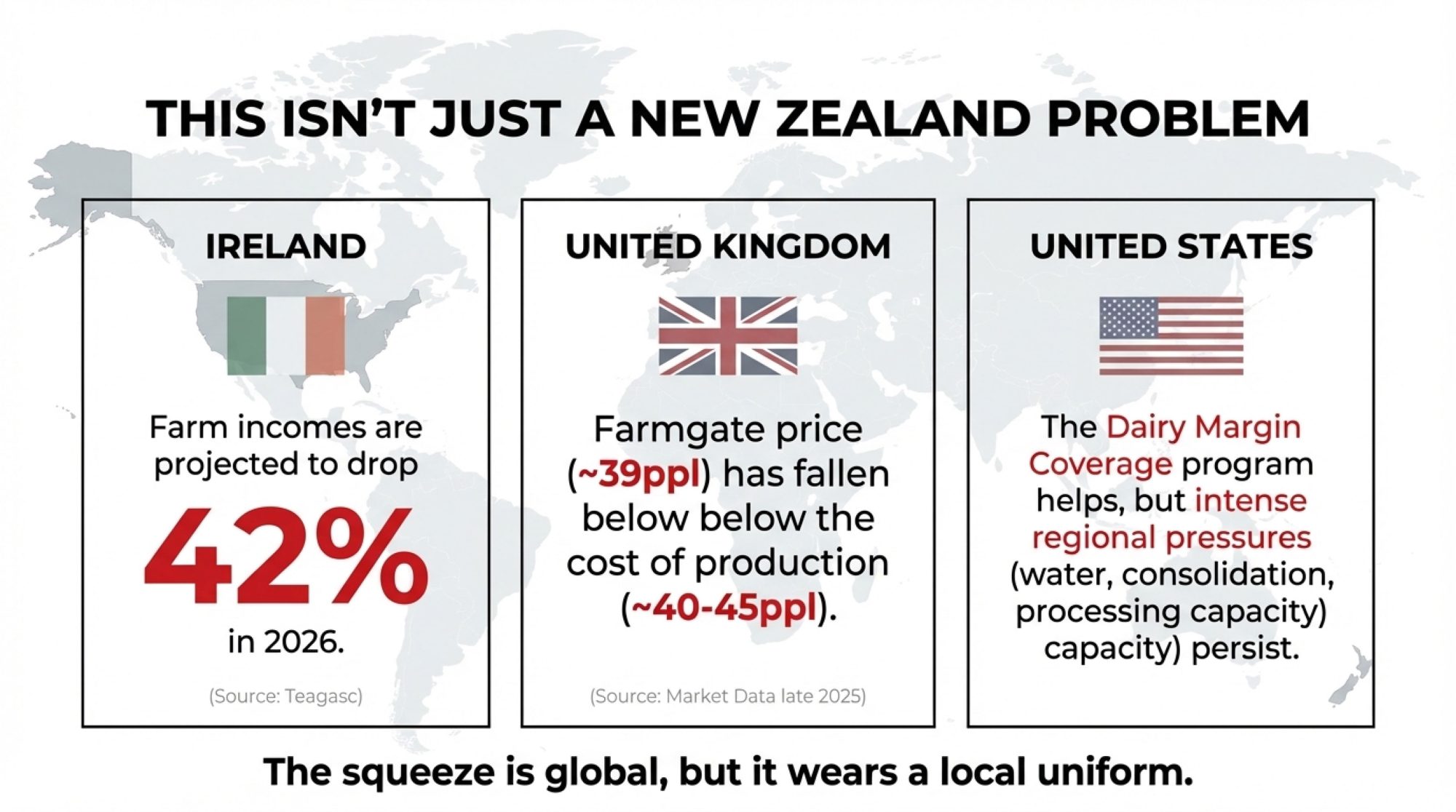
Teagasc’s Outlook 2026 projects that average Irish dairy farm incomes could decline by approximately 42% in 2026. That would take the average income from an estimated €137,000 this year to around €80,000.

Their baseline anticipates milk prices moderating from the high-40s cent per litre range back toward approximately 42 cents.

At 11.5 cents per litre, the average dairy net margin in 2026 is forecast to be down 45% from 2025 levels.

For a 70-hectare, 100-cow family farm, cash surplus after drawings and loan repayments could drop from around €80,000 to closer to €45,000.

That’s manageable if the debt is moderate. For operations that expanded aggressively, the adjustment will be sharper.

The UK: Below-Cost Production

Recent market data shows that farmgate milk prices have fallen below full production costs for many operations.

As of late 2025, Arla’s conventional price sits around 39.21 pence per litre. Müller’s Advantage price drops to 38.5ppl from January 2026.

Industry estimates place all-in production costs closer to the 40-45ppl range.

The picture varies by contract type. Producers on cheese or retailer-aligned arrangements often fare better. But in the commodity liquid segment, some operations are producing milk at a level below full economic cost.

Processors have responded by shifting toward component-based and fixed-volume contracts. Retailers continue to prioritise competitive shelf prices, putting pressure on producers’ margins.

The US: Regional Variations

The American experience differs due to policy structure—and substantial regional variation.

The Dairy Margin Coverage programme has provided meaningful support. The University of Wisconsin Extension reports that through the first ten months of 2023, DMC distributed over $1.27 billion in indemnity payments. That averaged approximately $74,453 per enrolled operation, with around 17,059 dairy operations participating.

But the experience varies dramatically by region.

In California, water costs and environmental compliance add layers of expense that Midwest operations don’t face. Wisconsin operations are navigating processor consolidation and volatility in the cheese market. Northeast producers face declining fluid milk demand and processing capacity constraints.

Larger US herds—1,000 cows and above—are increasingly relying on scale economies and diversified revenue streams. Beef-on-dairy programmes, heifer development, and energy projects are becoming standard.

The Takeaway: The squeeze is global, but every region has its own version. Know your local dynamics.

The China Factor

For two decades, much of dairy’s long-term optimism rested on a straightforward assumption: China would continue buying more.

That assumption deserves recalibration.

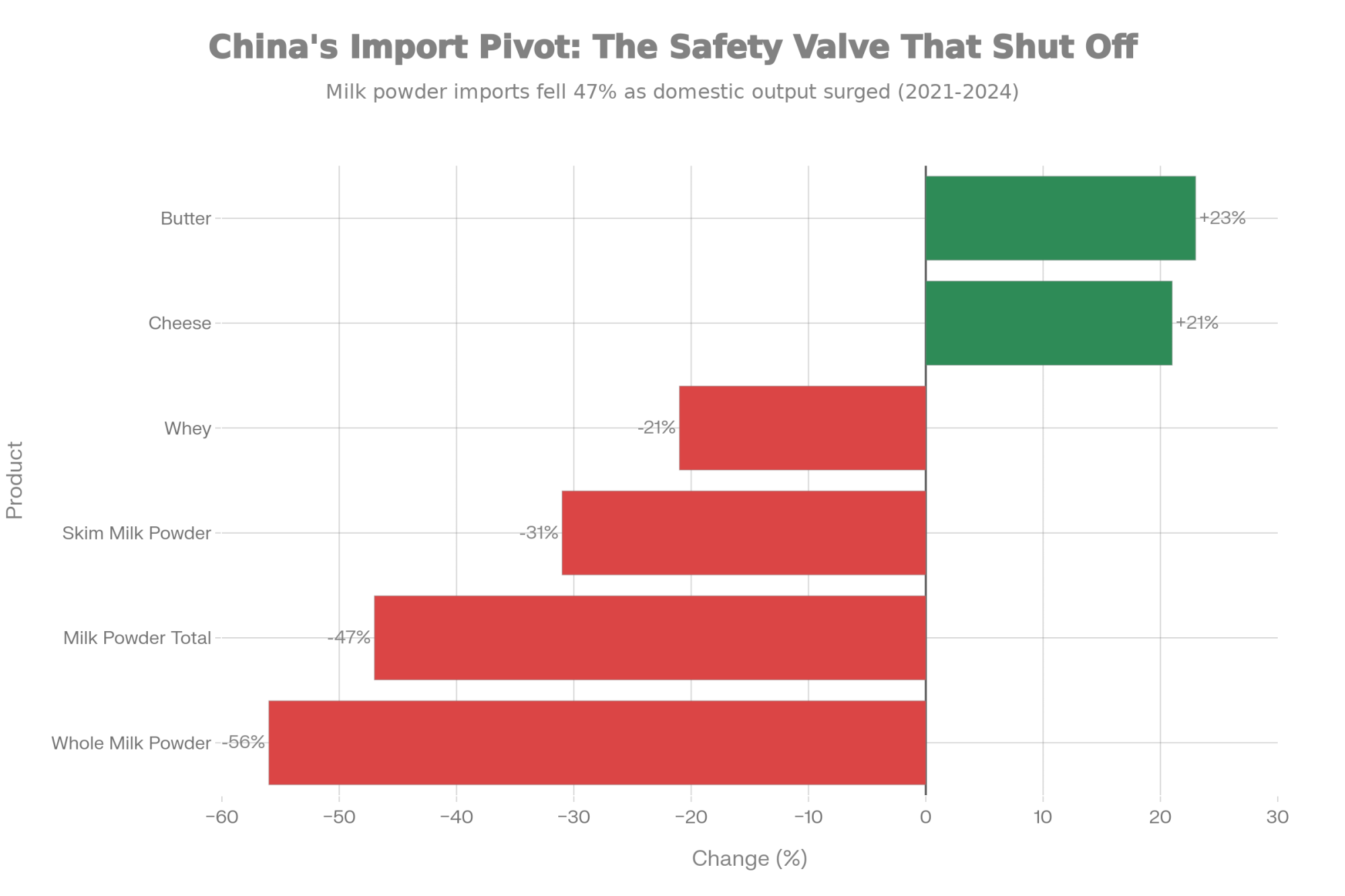
New Zealand Treasury’s 2024 dairy exports analysis, Rabobank’s global outlooks, and trade reports identify three meaningful shifts.

Product Category2021 Imports (MT)2024 Imports (MT)ChangeTrend
Whole Milk Powder1,680,000740,000-56%Domestic production surge
Milk Powder (Total)2,580,0001,360,000-47%Structural decline
Skim Milk Powder900,000620,000-31%Domestic substitution
Whey480,000380,000-21%US tariff impact
Cheese140,000170,000+21%Foodservice growth
Butter110,000135,000+23%Bakery sector expansion

Domestic production has expanded substantially. China has invested heavily in large-scale dairy operations. This is structural import substitution, not a temporary measure.

Per-capita consumption growth has moderated. Dairy consumption continues trending upward, but at slower rates than during the expansion years. The steepest part of the adoption curve appears behind us.

Purchasing behaviour has become tactical. Chinese buyers now step back when prices strengthen and increase purchases when value emerges—rather than consistently supporting auctions.

China remains a vital market. But it’s no longer the automatic release valve that absorbs surplus production.

The Takeaway: Don’t count on China to bail out oversupply anymore. That era is over.

What Farmers Are Actually Doing

When margin discussions move from conferences to kitchen tables, what are producers actually changing?

Managing Through Feed

In New Zealand, palm kernel imports are up significantly. Many farmers chose to push production while payout expectations remained near $10/kg MS.

Similar decisions are playing out in US operations where corn and by-products remain relatively affordable.

The logic is straightforward: when principal payments and family expenses don’t flex with milk price, spreading fixed costs across more production can appear to be the only short-term lever.

Strengthening Balance Sheets

New Zealand’s Ministry for Primary Industries notes that some farmers used the strong 2021-2023 payouts to reduce debt rather than adding infrastructure.

That decision is looking increasingly prudent.

On a 200-cow farm, this might translate to directing an extra $20,000 annually toward debt reduction rather than equipment upgrades. On a 2,000-cow operation, it could mean restructuring short-term facilities into longer-term arrangements.

Diversifying Revenue

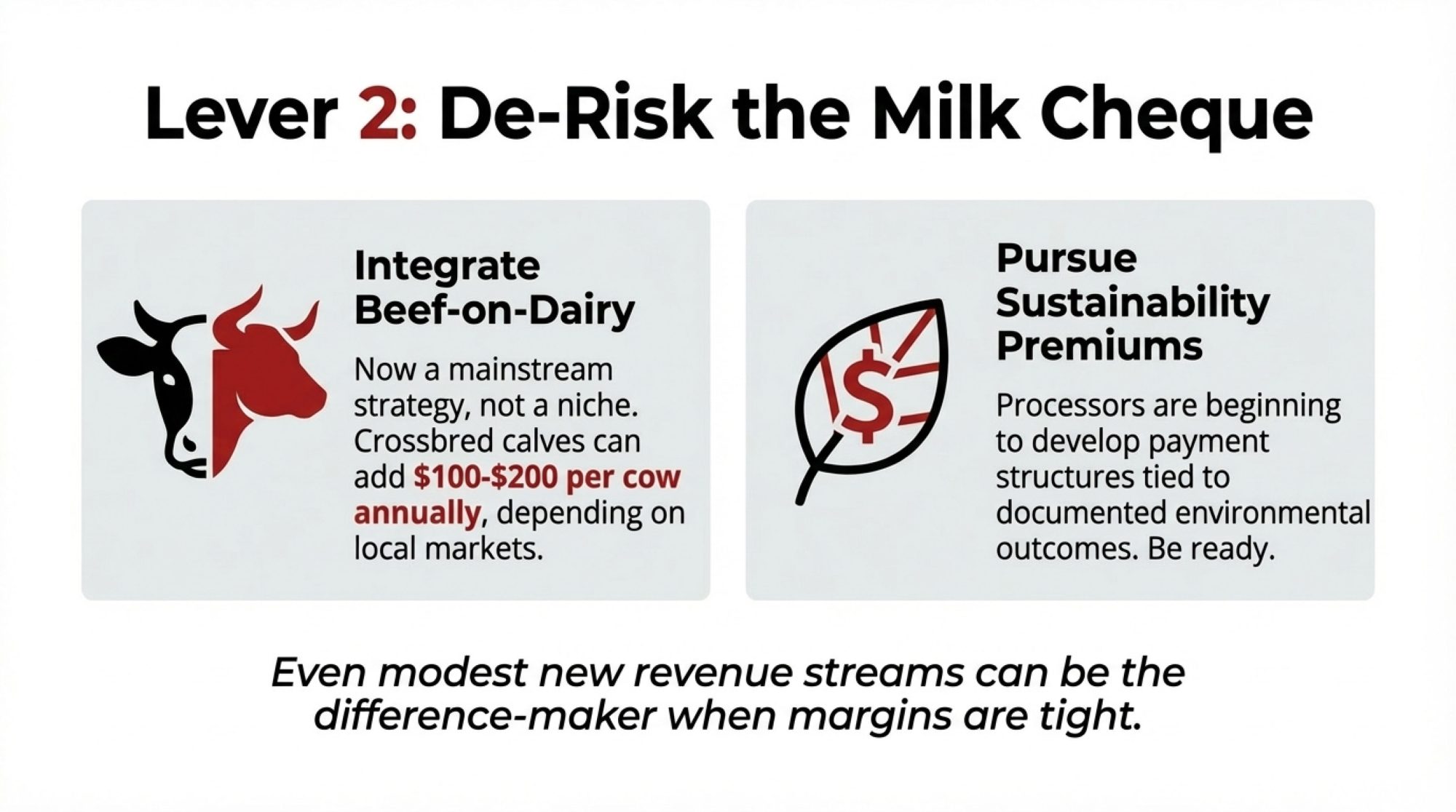
Beef-on-dairy has become mainstream. Industry analyses suggest crossbred calves can add $100-200 per cow annually, depending on local markets.

Sustainability-linked premiums are emerging as processors develop payment structures tied to documented environmental outcomes.

Even modest additional revenue streams—$50,000-$100,000 annually on a mid-sized operation—can make a meaningful difference when the milk cheque alone isn’t covering the spread.

The Takeaway: Smart operators aren’t just cutting costs. They’re restructuring debt and finding new revenue.

StrategyShort-Term CashflowMargin ImpactRisk LevelBest For
Push Production (Palm Kernel)Improved$0.85/kgMSHigh — Adds to oversupplyHigh debt, large scale
Cut Costs AggressivelyPreserved$1.15/kgMSMedium — Quality risksMedium farms, low debt
Maintain Status QuoSqueezed$1.00/kgMSHigh — Thin bufferNo flexibility
Reduce Debt FirstReduced$1.00/kgMSLow — Future flexibilityStrong balance sheet

Strategic Levers by Scale

Even in challenging margin environments, individual operations retain meaningful levers. They won’t shift global prices, but they determine which side of the margin line you occupy.

Feed Efficiency and IOFC

Research consistently documents substantial variation in feed efficiency—both between herds and within individual herds.

Progress typically comes from:

  • Forage quality management—harvest timing, processing, storage, feedout
  • Fresh cow protocols that establish strong intake patterns during those critical first 30-60 days
  • Active use of income over feed cost metrics as management tools, not retrospective reports

Getting started: On smaller operations, work with a nutritionist to develop simple IOFC reporting by production group. On larger TMR operations, establish monthly review rhythms to identify underperforming groups.

Component Value Capture

As payment systems emphasise solids over volume, butterfat and protein percentages deserve strategic attention.

The value ranges from 75 cents to $1.25 per hundredweight in many component-based systems, even at equivalent volume.

Getting started: Talk with your AI representative about reorienting sire selection toward fat and protein kilograms. Pair that with a nutritionist input on optimising rumen health, not just energy delivery.

Beef-on-Dairy Integration

This has evolved from a niche strategy to standard practice.

Getting started: Begin with market research. Talk with calf buyers about which terminal breeds and calving ease profiles actually command premiums in your area.

Financial Structure

What research keeps showing—across EU and Latin American farms alike—is that how you structure debt often matters as much as how efficiently you produce.

Getting started: Have proactive lender conversations before cash flow challenges emerge. Walk through three-year projections under multiple price scenarios.

The Takeaway: You can’t control global milk prices. But you can control feed efficiency, component focus, revenue diversity, and debt structure.

StrategyImmediate Impact1-Year Margin GainResilienceCapital Required
Feed Efficiency FocusModerate — Slow gains+$0.10-0.20/kgMSHigh — PermanentLow — Nutrition/management
Component OptimizationModerate — Genetic lag+$0.15-0.25/kgMSHigh — PermanentLow — Semen/consulting
Beef-on-Dairy IntegrationHigh — Instant revenue+$0.08-0.15/kgMSMedium — Market dependentLow — Contract only
Aggressive Debt ReductionLow — Reduces cashflow$0/kgMSVery High — Future flexibilityHigh — Requires surplus
Volume Push (Status Quo)High — Spreads fixed costs-$0.05 to +$0.05/kgMSLow — Worsens oversupplyModerate — Feed purchases

What Could Actually Change Things?

If current margin pressure is structural, what developments might shift the trajectory?

Genuine supply contraction would require sustained exits that actually reduce production capacity. We’re seeing accelerating consolidation in parts of Europe, the UK, and Australia. It’s unclear whether the pace is sufficient.

Emerging market demand growth offers longer-term potential in Southeast Asia, Africa, and Latin America. But developing those markets takes time.

Policy and structural changes—such as transition support, improved risk-sharing between processors and producers, and trade agreements—could shift the environment. But political processes move slowly.

None of these are quick fixes. But understanding the possibilities helps inform longer-term positioning decisions.

Key Takeaways

Price levels don’t ensure margin. A $9.50 per kgMS payout with $8.50 break-evens means strong prices can coexist with tight margins.

Volume gains require margin verification. More production can support cashflow while contributing to oversupply. Check IOFC, not just output.

Input decisions carry strategic weight. Feed and fertiliser now warrant careful analysis, not routine repetition.

Revenue diversification has moved mainstream. Beef-on-dairy and sustainability premiums are standard elements, not experiments.

Financial structure shapes survival. Operations that reduced debt during good years enter this period with more flexibility.

Opportunity persists, but looks different. More competition, more selective buying, more scrutiny. Adapt or get squeezed.

The Bottom Line

No individual farm can resolve global oversupply. No policy will quickly restore previous comfort levels.

But careful attention to what New Zealand’s numbers reveal—and thoughtful application regardless of region or scale—can improve the odds of staying on the right side of that one-dollar margin line.

The farms that thrive in 2030 are making decisions right now. Not necessarily to get bigger. But to get more resilient, more diversified, more intentional about where margin actually comes from.

Complete references and supporting documentation are available upon request by contacting the editorial team at editor@thebullvine.com.

Learn More:

Join the Revolution!

Join over 30,000 successful dairy professionals who rely on Bullvine Weekly for their competitive edge. Delivered directly to your inbox each week, our exclusive industry insights help you make smarter decisions while saving precious hours every week. Never miss critical updates on milk production trends, breakthrough technologies, and profit-boosting strategies that top producers are already implementing. Subscribe now to transform your dairy operation’s efficiency and profitability—your future success is just one click away.

NewsSubscribe
First
Last
Consent

4.3% Butterfat and a Shrinking Check: The 90-Day Window to Reposition Your Operation

Record butterfat. Shrinking checks. The industry’s 25-year breeding strategy just ate itself.

Dairy Farm Profitability 2026

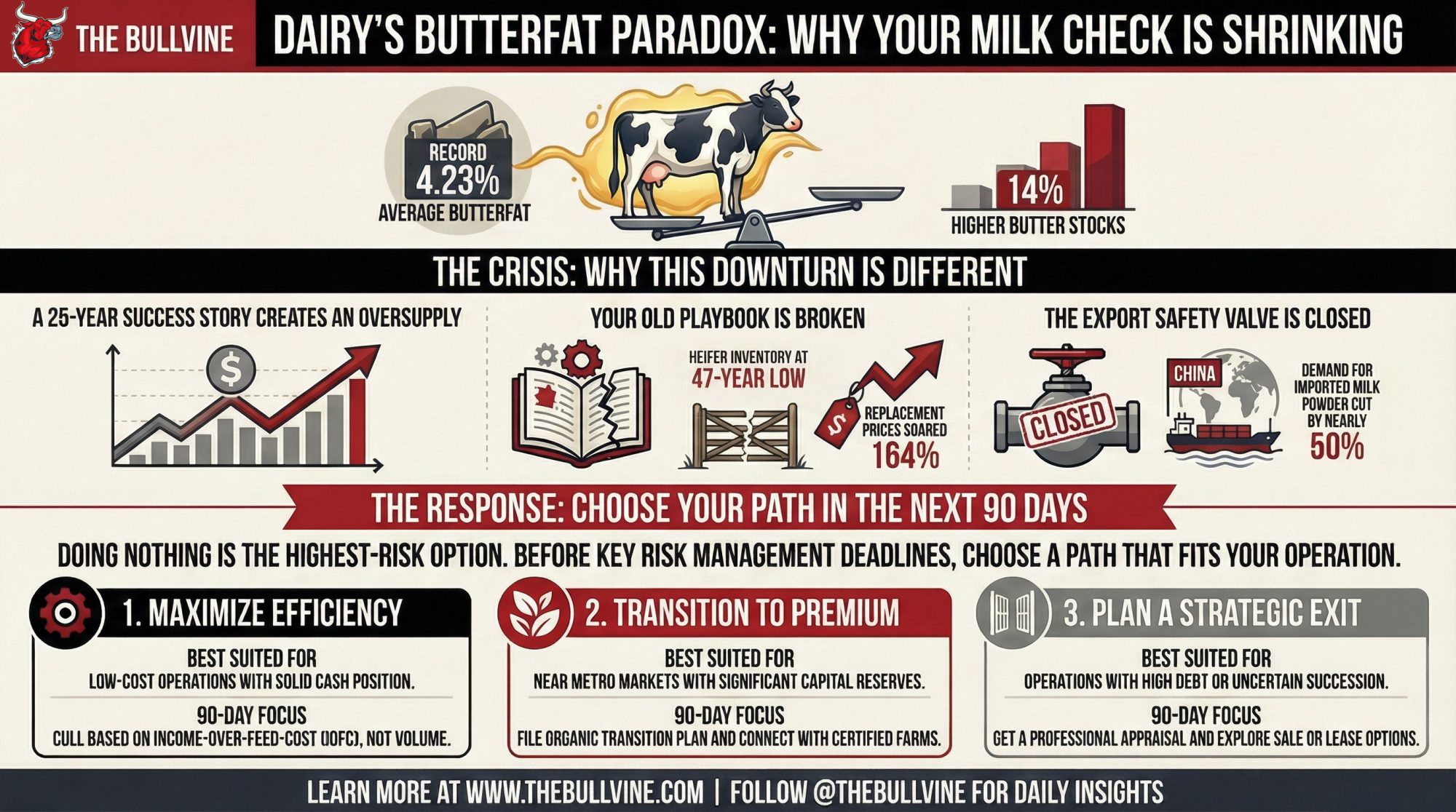
Executive Summary: Here’s the paradox: U.S. dairy herds are testing 4.23% butterfat—an all-time record—yet milk checks are running $3-5/cwt below last year. The genetic industry’s 25-year push for components worked perfectly, and now everyone’s drowning in the success. Butter stocks are up 14%, Class IV prices hit $13.89/cwt in November (lowest since 2020), and the traditional cull-and-restock response is off the table with springers at $3,000+ and heifer inventory at a 47-year low. For operations in the 500-1,500 cow range carrying moderate debt, the next 90 days are decisive—DMC enrollment closes in February, DRP in March, and the choices made before spring will separate farms that reposition from those that get squeezed. Three viable paths exist: optimize for efficiency, transition to premium markets, or exit strategically while equity remains. Standing still isn’t on the list.

I’ve been talking with farmers across the Midwest and Northeast over the past few weeks, and there’s a common thread running through those conversations. A producer will mention their herd’s butterfat at 4.3%—exactly what they spent a decade breeding for—and then pause. Because that same milk is now flowing into a market where the cream premiums just don’t look like they used to.

It’s a strange place to be. You made sound breeding decisions. The genetics are performing. The components are there. And yet the check doesn’t quite reflect it.

So what’s actually going on here? And more importantly, what can we realistically do about it in the next 90 days?

[Image: Side-by-side comparison of a milk check from 2023 vs. 2025 showing component premiums shrinking despite higher butterfat test]

After reviewing the latest market data and speaking with lender advisors, farm management consultants, and producers who’ve been through similar cycles, a clearer picture emerges. This isn’t simply a temporary dip that’ll correct by spring flush. It’s a structural shift that’s been building for years—and the farms that come through it successfully will be those that understand both what’s driving it and which decisions actually move the needle.

The Component Trap: How 25 Years of Smart Breeding Created Today’s Problem

Here’s something that needs to be said plainly, even if it’s uncomfortable: the genetic industry—breeders, AI companies, genomic providers—collectively steered the entire U.S. dairy herd in one direction, and now we’re all standing here wondering what comes next.

That’s not an accusation. Everyone was following the economic signals. But the result is undeniable.

You probably know the broad outlines already, but it’s worth walking through the numbers because they’re pretty striking when you see them together. None of this happened by accident. It’s the result of pricing signals that consistently rewarded butterfat production across two and a half decades.

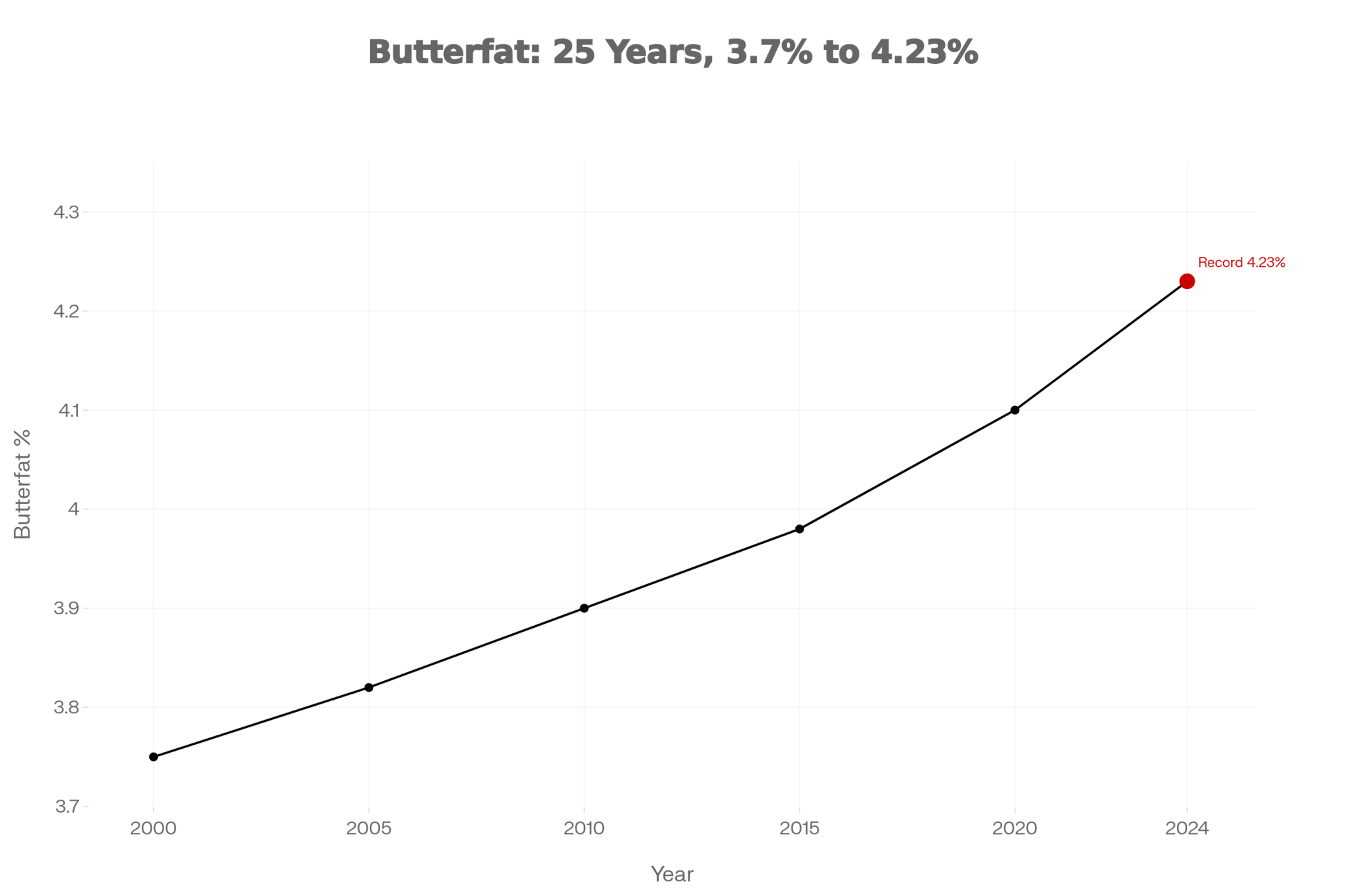
Consider the trajectory. The average Holstein was testing around 3.7-3.8% butterfat back in 2000, according to Council on Dairy Cattle Breeding historical data. By 2024, that figure had climbed to a record 4.23%—a substantial jump in component concentration. CoBank’s lead dairy economist, Corey Geiger, noted in his analysis last year that milkfat, on both a percentage and per-pound basis, reached an all-time high. In high-genetics herds, 4.3-4.5% is now pretty common.

U.S. Holstein herds have steadily climbed from roughly 3.7% to over 4.2% butterfat in just two and a half decades

This wasn’t a failure of individual breeding decisions. It was a success—of everyone doing the exact same thing at the exact same time.

[Image: Line graph showing U.S. average butterfat percentage climbing from 3.7% in 2000 to 4.23% in 2024]

Federal Milk Marketing Order formulas rewarded butterfat with premium pricing, and the industry responded accordingly. Then, genomic selection tools, which really gained traction around 2009, accelerated genetic progress dramatically. What once took 15-20 years of conventional breeding can now be achieved in roughly half that time. The April 2025 CDCB genetic base reset tells the story—it rolled back butterfat by 45 pounds for Holsteins, nearly double any previous adjustment. That’s how much progress has accumulated in the genetic pipeline.

The economics seemed compelling at the time. A farm producing 4.2% butterfat milk versus 3.8% butterfat earned roughly $0.80-1.20/cwt more on the same volume, based on component pricing formulas. For a 1,000-cow herd producing 25,000 lbs/cow annually, that translated to $200,000-300,000 in additional annual revenue. The incentives pointed clearly in one direction.

And here’s where it gets tricky.

When an entire industry simultaneously optimizes for the same trait, supply eventually outpaces demand. U.S. butter production has grown substantially over the past decade, according to USDA Agricultural Marketing Service data. Cold storage butter inventories showed elevated stocks throughout late 2024, with USDA Cold Storage data reporting September levels at approximately 303 million pounds—up about 14% from year-earlier figures.

Class IV milk futures, which price butter and powder, have reflected this pressure. USDA announced the November 2025 Class IV price at $13.89/cwt—levels we haven’t seen since 2020.

The question nobody in the genetic industry is asking publicly: Should we have seen this coming? And what does it mean for how we select sires going forward?

The Heifer Crisis: Why Your Normal Playbook Won’t Work This Time

What makes this particular cycle tricky is that some of the standard farm-level responses to low prices just aren’t available anymore. I’ve watched this play out in conversations with producers who are working through every option—and finding that familiar levers don’t pull the way they expect.

[Image: Infographic showing dairy heifer inventory decline from 4.5 million in 2018 to 3.914 million in 2025]

The Numbers That Should Keep You Up at Night

The logical response to component oversupply would be culling toward different genetics and restocking. But there’s a significant constraint worth understanding.

Replacement heifers simply aren’t available in the numbers many operations need—and the available ones have gotten expensive. The widespread adoption of beef-on-dairy breeding, which made excellent economic sense when beef prices surged, has reduced dairy heifer inventories to approximately 3.914 million head according to the January 2025 USDA cattle inventory report. That’s the lowest level since 1978.

Replacement heifer numbers have dropped by roughly 600,000 head since 2018, driving springer prices above $3,000

Here’s where the math gets painful. CoBank reported these figures in their August 2025 analysis:

  • National average springer price (July 2025): $3,010 per head
  • Wisconsin average: $3,290 per head
  • California/Minnesota top auction prices: $4,000+ per head
  • April 2019 low point: $1,140 per head
  • Price increase since then: 164%

Let that sink in. If you want to cull your bottom 50 cows and replace them, you’re looking at $150,000-$225,000 just in replacement costs—before you account for the production lag while those heifers freshen and ramp up.

This creates real tension. Operations that would like to cull more aggressively face either limited availability or elevated replacement costs. It’s a completely different calculation than we’ve seen in past downturns.

There’s also a timing consideration that’s easy to overlook. The replacement heifers entering milking strings in 2025-2026 were born and selected 2-3 years ago, when butterfat premiums were still paying handsomely. That genetic pipeline takes time to shift—meaningful changes in herd composition typically require 5-7 years, even with aggressive selection, according to dairy geneticists at the University of Wisconsin-Madison Extension.

The practical takeaway: Even if you start selecting differently today, you won’t see the results in your tank until 2030.

The Ration Workaround That Doesn’t Actually Work

Some producers have explored nutritional adjustments to modify butterfat percentage. I’ve heard this come up in several conversations, and it’s worth addressing directly.

Here’s the challenge—the rumen chemistry driving fat synthesis is interconnected with overall milk production in ways that make targeted adjustments difficult. Dairy nutritionists at Penn State and other land-grant universities have studied this extensively: adjustments that reduce butterfat typically also reduce total milk yield by 3-8%. The feed cost savings, maybe $0.30-0.50/cow/day depending on your ration costs, are often outweighed by lost milk revenue of $1.00-2.00/cow/day at current prices.

In most scenarios, ration manipulation doesn’t improve the overall financial picture. Counterintuitive, but the numbers generally bear it out.

The China Factor: The Export Valve That Closed

One element that’s amplified the current situation—and this deserves more attention in domestic discussions—is the shift in Chinese dairy import patterns.

[Image: Bar chart comparing China whole milk powder imports: approximately 800,000-850,000 MT peak around 2021 vs. approximately 430,000 MT in 2024]

For roughly two decades, China served as a significant outlet for global dairy surplus. When exporting regions overproduced, Chinese buyers absorbed much of the excess. That dynamic has evolved considerably.

China’s domestic milk production has grown substantially over the past several years, reaching over 41 million tonnesaccording to USDA Foreign Agricultural Service data. Self-sufficiency has risen from roughly 70% to around 85%, thereby reducing import demand.

The import trends tell the story clearly. Whole milk powder imports peaked at approximately 800,000-850,000 metric tonnes around 2021, according to Chinese customs data compiled by Rabobank. By 2024, that figure had declined to around 430,000 metric tonnes—a reduction of roughly 50%.

China’s demand for imported whole milk powder has fallen by roughly 50% since its 2021 peak, closing a major export outlet

Here’s what that means at the farm level: when 400,000 metric tonnes of powder that used to go to Shanghai starts competing for space in domestic and alternative export markets, that’s pressure that eventually shows up in your component check. Global dairy markets are interconnected in ways that weren’t true 20 years ago.

Rabobank senior dairy analyst Michael Harvey noted in their Q4 2024 Global Dairy Quarterly that Chinese imports could surprise to the upside if domestic production disappoints and consumer confidence improves. That’s a reasonable alternative scenario to consider.

Honestly? Nobody knows exactly where China goes from here. But planning as if that export outlet will suddenly reopen at 2021 levels seems optimistic at this point.

The Consolidation Accelerator

Dairy farming has been consolidating for decades—that’s well understood by anyone who’s watched their neighbor’s barn go quiet. What’s different about this period is the potential for that trend to accelerate under sustained margin pressure.

According to U.S. Courts data reported by Farm Policy News, 361 Chapter 12 farm bankruptcy filings occurred in the first half of 2025—a 13% increase over the same period last year.

Here’s an important nuance, though: milk production isn’t expected to decline in proportion to the number of farms. The operations most likely to exit tend to be smaller ones that represent a modest share of total volume. USDA projects national milk output at 231.3 billion pounds in 2026—essentially flat—even as the number of operations continues to decrease.

What this means for price recovery: Supply adjustments through consolidation happen more gradually than we might hope.

Three Directions for the Coming Months

For farmers operating in that 500-1,500 cow range—moderate scale, moderate debt, positioned to continue but facing real pressure—the next 90 days present some important decisions.

What’s been striking in conversations with experienced advisors is how consistently they point to the same priorities. The focus isn’t on finding some novel solution. It’s about executing fundamentals with careful attention during a demanding period.

[Image: Calendar graphic highlighting key deadlines: February 2026 (DMC), March 15 (DRP), March 31 (SARE grants)]

Key Dates Worth Tracking

  • December 31, 2025: Target for completing financial position analysis
  • February 2026: DMC enrollment deadline (confirm with your FSA office)
  • March 15, 2026: DRP enrollment deadline for Q2 coverage
  • March 31, 2026: SARE grant application deadline for organic transition support
  • Q2 2026: Period when margin pressure may be most pronounced

Priority 1: Knowing Exactly Where You Stand (Weeks 1-2)

Here’s what farm management consultants consistently emphasize: many operations lack precise clarity about their actual cost of production by component. They know their budgeted figures, but actual costs in the current environment often run $2-4/cwt higher than estimates suggest.

Consider a professional cost analysis through your lender or an independent agricultural accountant. Costs typically run $1,500-3,000, depending on scope and region—but the analysis frequently reveals $50,000-100,000 in costs that weren’t clearly showing up in standard bookkeeping. Your actual investment depends on your operation’s complexity.

Model three price scenarios for 2026:

ScenarioClass IIIClass IV
Base Case$17/cwt$14/cwt
Stressed$15/cwt$12/cwt
Severe$13/cwt

The key benchmark: if your debt service coverage ratio falls below 1.25x in the base case, you’re facing primarily a financing challenge rather than a production management challenge. That distinction shapes everything that follows.

Priority 2: Securing Protection Before Deadlines (Weeks 2-3)

DMC triggered payouts in August-September 2025 when milk margins compressed below coverage thresholds, according to USDA Farm Service Agency payment data. For operations that had enrolled, those payments provided meaningful cash flow support. For those that hadn’t… well, that opportunity has passed.

For a 700-cow operation, margin protection typically costs $35,000-40,000 in premiums based on standard coverage levels—though actual costs vary by operation size and coverage choices. What matters is the asymmetric protection: coverage that could preserve $200,000-300,000 in margin under severe scenarios.

[Related: Understanding DMC Enrollment for 2026 — A step-by-step walkthrough of coverage options and deadlines]

Priority 3: Choosing a Direction (Weeks 3-4)

 Efficiency FocusPremium MarketsStrategic Transition
Best suited forSub-$15/cwt cost structure, solid cash positionWithin 50 miles of metro market, $300K+ reserveAge 55+, elevated debt, uncertain direction
90-day focusIOFC-based culling, Feed Saved geneticsFile organic transition, apply for SARE grantsProfessional appraisal, explore sale/lease
Timeline12-18 months36-48 months6-12 months
Capital requiredLow to moderate$200K-400KLow (advisory fees)

[Image: Decision tree flowchart helping farmers identify which of the three paths fits their situation]

Path A: Efficiency Focus

The core approach remains culling the bottom 15-20% of cows ranked by income-over-feed-cost, not by volume alone. Your 50 lowest-margin cows likely cost $300-400/month more than your top 50 to produce milk. Addressing that can improve annual cash flow by $180,000-240,000.

What I keep hearing from producers who went through aggressive IOFC-based culling during 2015-2016 is pretty consistent: it felt counterintuitive at first. Some of those cows were producing 90 pounds a day. But when they ran the actual economics, those high-volume cows were undermining their cost structure. Taking them out changed everything. Many came out of that period in better shape than they went in.

Producers running large dry lot operations in the West report similar experiences. The temptation is always to keep milking cows. But when you run the numbers, the bottom 10-15% of the herd is often break-even in a good month and loses money in a bad one. Letting them go without immediately restocking—just accepting a smaller herd—can actually improve your average component check per cow. Sometimes, smaller really is more profitable.

On the genetics side, it’s worth looking at “Feed Saved” as a selection trait. CDCB introduced this in December 2020, specifically to identify animals that are more efficient at converting feed to milk. The trait’s weight in Net Merit increased to 17.8% in the 2025 update, which tells you how seriously the industry is taking feed efficiency now. The potential savings vary by herd, but for operations where feed accounts for 50-60% of costs, even modest efficiency gains can translate into meaningful dollars. Talk to your AI rep about what realistic expectations might look like for your specific situation.

Path B: Premium Market Transition

For operations within a reasonable distance of major metro markets and with capital reserves to absorb transition costs, organic conversion or specialty milk contracts offer an alternative direction.

This path involves more complexity than it might initially appear. Organic transition typically means 3-year yield reductions of 10-15% according to data from the Organic Dairy Research Institute, followed by meaningful price premiums once certified. The economics can work—eventually—but the transition period requires substantial financial runway.

What I hear consistently from producers who’ve made this transition: the middle years are harder than expected. You’re essentially getting conventional prices while operating organically. But once you reach certification, the price difference is real. NODPA and USDA Organic Dairy Market News report certified operations receiving farmgate prices ranging from the mid-$20s to $30s per cwt for conventional organic, with grass-fed premiums often running significantly higher—sometimes into the $40s or above depending on your processor and region.

If this direction fits your situation, the 90-day priorities include:

Connect with certified organic dairies in your region through your state organic association—NOFA chapters in the Northeast, MOSA in the Upper Midwest, or similar organizations in your area. Request 2-3 farm visits to understand actual transition costs and challenges. The real-world experience matters more than marketing materials.

Explore SARE grants before the March 31, 2026, deadline. These grants may provide significant cost-sharing support for organic transition—contact your regional SARE coordinator for current funding levels and application requirements, since program specifics change annually.

If you’re committed, file your transition plan with your certifier by March 1, 2026, to start the 3-year clock. Earlier starts mean earlier access to premium pricing.

[Related: Organic Transition Economics: What the Numbers Actually Look Like — Real producer case studies and financial breakdowns]

Important consideration: This path makes most sense if you have substantial equity reserves and you’re genuinely within reach of organic market demand. Not every region has processors paying meaningful organic premiums. Market research should come before commitment—talk to Organic Valley, HP Hood, or whoever handles organic milk in your region about their current intake and premium structure.

Path C: Strategic Transition

This is the path that’s hardest to discuss, but for operators over 55, carrying elevated debt, or genuinely uncertain about long-term direction, a strategic exit while equity remains may represent sound financial planning.

Here’s what farm transition specialists consistently emphasize: a farm with a 45% debt-to-asset ratio that transitions strategically today typically retains significantly more family wealth than the same farm forced to exit in 2027-2028 after extended margin erosion. The difference can easily be $300,000-500,000, depending on circumstances.

That’s not failure. That’s recognizing circumstances and making a thoughtful decision.

University of Wisconsin Extension farm transition advisors make this point regularly in producer workshops: the families who come through in the best financial shape are almost always the ones who made the call themselves, not the ones who waited until circumstances forced their hand. There’s real value in choosing your path.

The 90-day approach for this path:

Obtain a professional appraisal ($2,500-4,000 depending on operation complexity) covering real estate, equipment, herd genetics, and any production contracts.

Explore multiple options—they’re not mutually exclusive:

  • Direct sale to a larger operation (typically a 12-18 month process)
  • Lease arrangement retaining land equity
  • Solar lease opportunities—rates vary significantly by region, but can provide meaningful annual income on 20-30+ acres depending on your location and utility contracts
  • Custom heifer rearing using your existing facilities—particularly relevant given the shortage we discussed earlier

Consult with a farm transition tax advisor. How you structure an exit matters enormously for what you ultimately retain—installment sales versus lump sum, 1031 exchanges, charitable remainder trusts, and other tools can make six-figure differences in after-tax proceeds.

Regional Realities: One Market, Many Situations

One pattern that emerges from these conversations is how differently the same market dynamics play out depending on where you’re farming. The fundamentals we’ve discussed apply broadly, but the specific numbers vary considerably by region.

In Idaho and the Southwest, large-scale operations with export-oriented processing face one set of calculations. These are often dry lot systems with 3,000+ cows, lower land costs, and direct relationships with major cheese manufacturers. When Glanbia or Leprino adjusts their intake, the regional implications differ from what you’d see in Wisconsin. The scale efficiencies are real, but so is the commodity price exposure. Producers in the Magic Valley are watching Class III futures more closely than component premiums—their economics are tied to cheese demand in ways that Upper Midwest producers selling to smaller plants simply aren’t.

In Wisconsin and the Upper Midwest, you’re more likely to encounter diversified operations—500-1,200 cows, often family-owned across generations, with a mix of cheese plant contracts and cooperative relationships. The smaller average herd size means fixed costs per hundredweight run higher, but there’s also more flexibility to adapt. I’ve talked with Wisconsin producers seriously exploring farmstead cheese or agritourism as margin supplements—approaches that wouldn’t make sense at 5,000 cows but can work at 400.

In the Northeast, higher land costs and proximity to population centers create yet another calculation. Fluid milk markets still matter more here than in most regions, even as fluid consumption continues its long decline. The premium path—organic, grass-fed, local branding—tends to be more viable in Vermont or upstate New York than in the Texas Panhandle simply because the customer base is closer and the logistics work better.

Here’s the bottom line on regional differences: Conversations with farmers and advisors who know your specific market really matter. Your cooperative field staff, extension dairy specialist, or lender can help translate these broader trends into your local context. The three-path framework applies everywhere, but the details of execution—which processors are actively buying, what premiums are realistically available, how constrained the local heifer market is—vary enough to influence decisions.

The Bottom Line

The farms that navigate this period most successfully won’t be those that discovered some novel solution—there isn’t one waiting to be found. They’ll be operations that understood the dynamics early, made honest assessments of their own position, and moved decisively while flexibility remained.

The window for making these decisions is now.

For additional resources on margin protection enrollment and strategic planning, contact your local FSA office, cooperative field representative, agricultural lender, or university extension dairy specialist.

Editor’s Note: Production cost data comes from the USDA Economic Research Service 2024 reports. Heifer pricing reflects USDA NASS data through July 2025. Bankruptcy statistics are from U.S. Courts data reported by Farm Policy News. Genetic progress figures reference the CDCB April 2025 genetic base reset. Cold storage and production data are from the USDA Agricultural Marketing Service. International trade figures come from the USDA Foreign Agricultural Service and Rabobank Global Dairy Quarterly. National and regional averages may not reflect your specific operation, market access, or management system. We welcome producer feedback for future reporting.

Key Takeaways:

  • Record butterfat, weaker checks: U.S. herds are averaging 4.23% butterfat, but Class IV has slipped to $13.89/cwt, and butter stocks are up 14%, so the component bonuses many bred for are no longer rescuing the milk check.
  • Heifer math has flipped: Dairy heifer inventory is at a 47-year low (3.914 million head), and quality springers are $3,000+ per head, which means the traditional “cull hard and restock” playbook often destroys equity instead of saving it.
  • This is a structural shift, not a blip: Twenty-five years of selecting for butterfat, China’s reduced powder imports, and slow-moving U.S. consolidation are combining into a multi-year margin squeeze, not just another bad winter of prices.
  • Your next 90 days are critical: Before DMC and DRP deadlines hit in February and March, farms in the 500–1,500 cow range need a clear cost-of-production picture, stress-tested cash-flow scenarios, and margin protection in place.
  • You have three realistic paths: Use this window to either tighten efficiency and genetics around IOFC and Feed Saved, transition into premium/organic markets where they truly exist, or plan a strategic exit while there’s still equity to protect—doing nothing is the highest‑risk option.

Complete references and supporting documentation are available upon request by contacting the editorial team at editor@thebullvine.com.

Learn More:

  • Is Beef-on-Dairy Causing America’s Heifer Shortage? – Reveals the structural mechanics behind today’s replacement crisis, detailing how the aggressive industry-wide shift to beef genetics created the specific inventory gap that is now driving heifer prices to record highs.
  • Cracking the Code: Behavioral Traits and Feed Efficiency – Provides the tactical “how-to” for the Efficiency Focus path, explaining how wearable sensors and behavioral data (rumination/lying time) can identify the most feed-efficient cows to retain when you can’t afford to restock.
  • How Rising Interest Rates Are Shaking Up Dairy Farm Finances – Delivers critical financial context for the Strategic Transition path, analyzing how the increased cost of capital is compressing margins and why debt servicing capacity—not just milk price—must drive your 2026 decision-making.

Join the Revolution!

Join over 30,000 successful dairy professionals who rely on Bullvine Weekly for their competitive edge. Delivered directly to your inbox each week, our exclusive industry insights help you make smarter decisions while saving precious hours every week. Never miss critical updates on milk production trends, breakthrough technologies, and profit-boosting strategies that top producers are already implementing. Subscribe now to transform your dairy operation’s efficiency and profitability—your future success is just one click away.

NewsSubscribe
First
Last
Consent

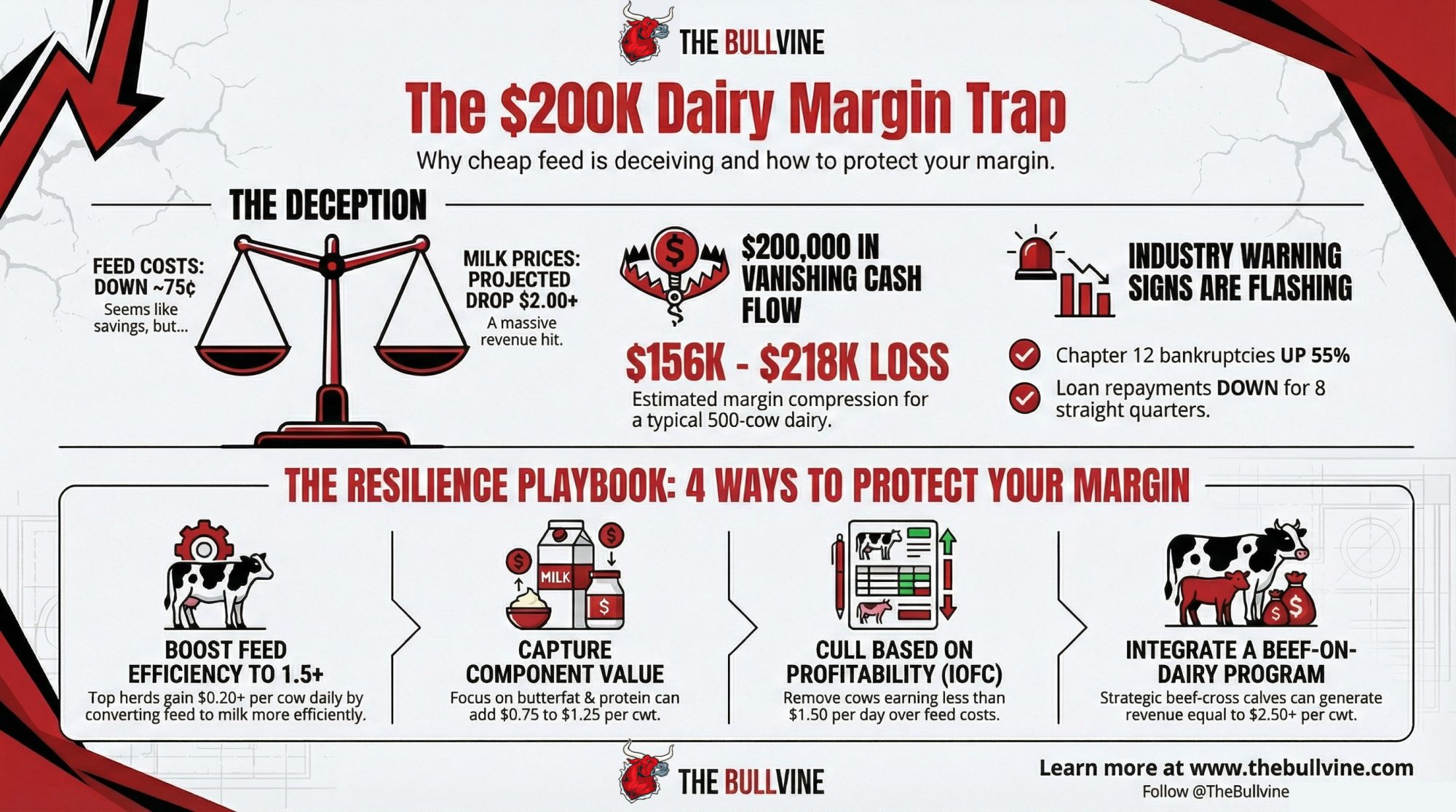
The $200K Dairy Margin Trap: What Cheap Feed Won’t Tell You About 2026

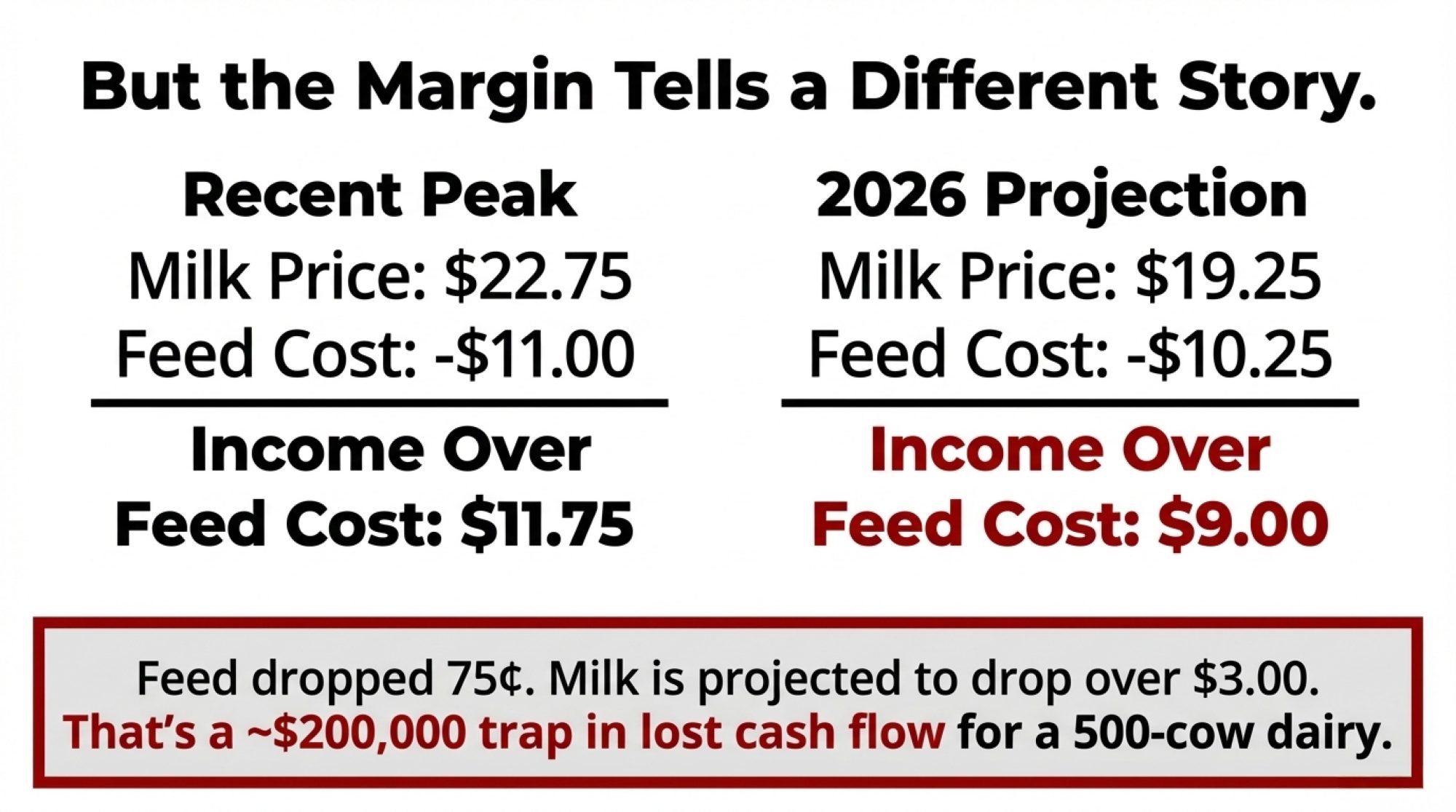
Feed dropped 75¢. Milk dropped $2. That’s not savings—that’s a $200K trap.

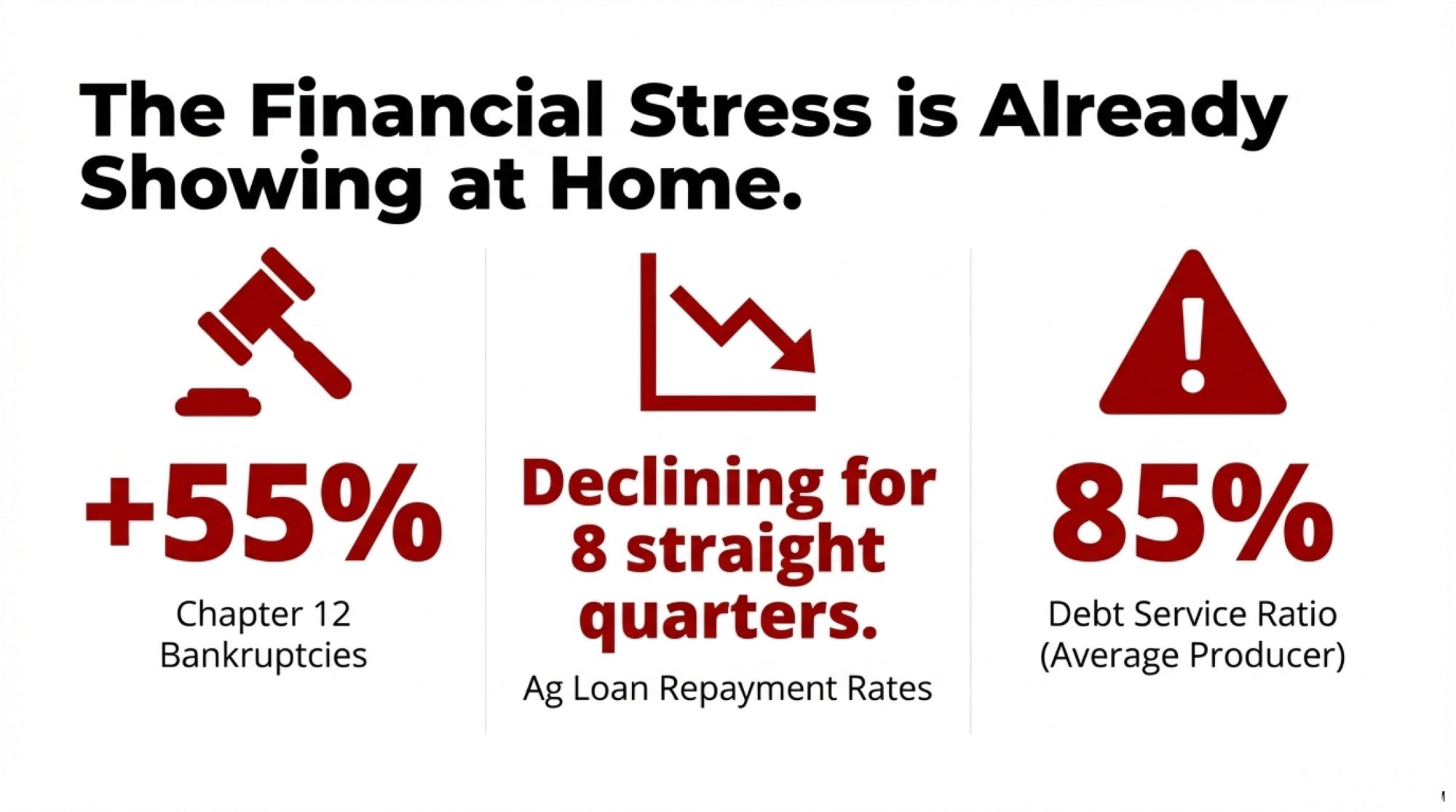
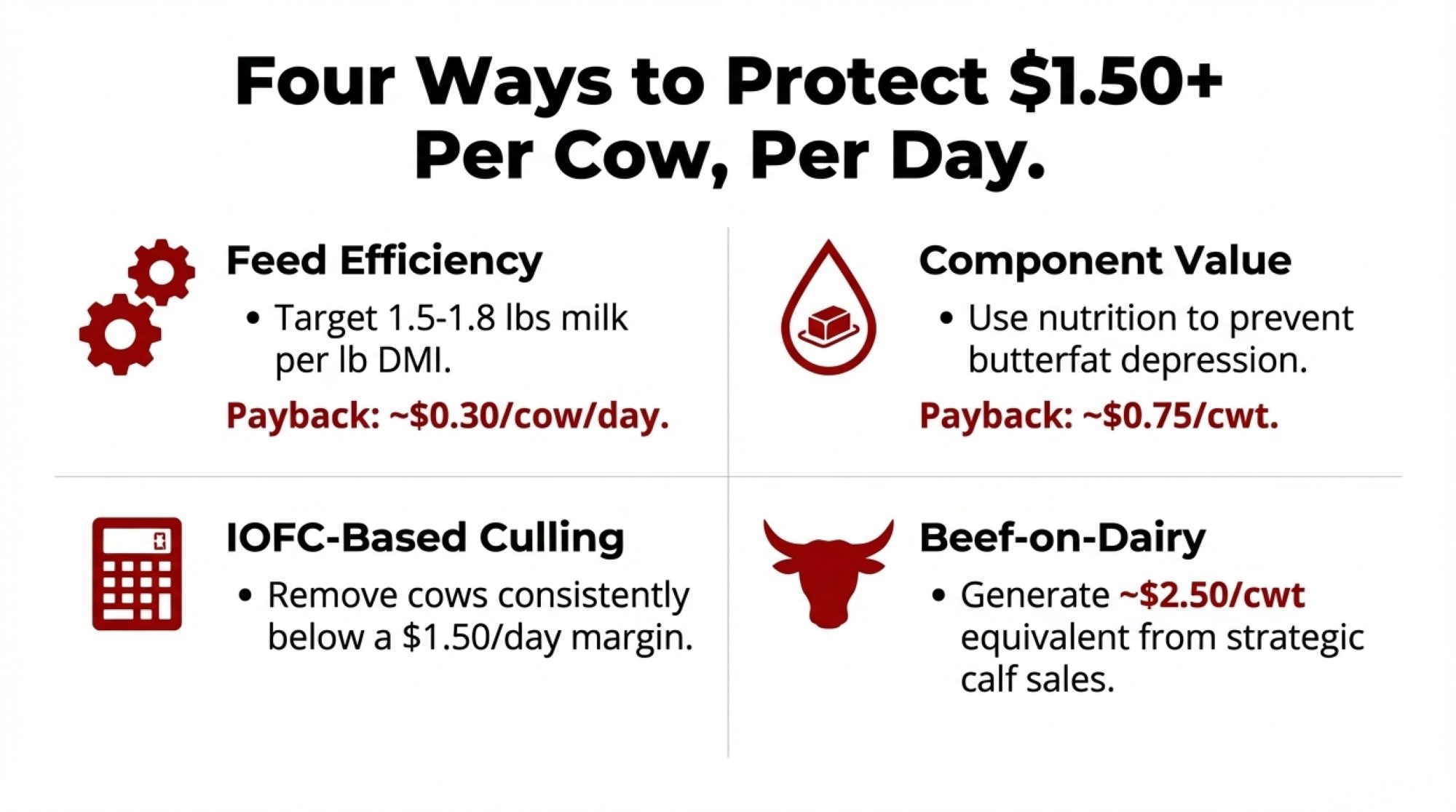
EXECUTIVE SUMMARY: Everyone’s celebrating cheap corn—but the math tells a different story. USDA projects 2026 milk at $19.25/cwt while feed costs have dropped only modestly, creating net margin compression of $1.25-1.75/cwt—that’s $156,000 to $218,000 in lost cash flow for a 500-cow dairy. New Zealand’s lowest-cost producers see what’s coming: they paid down $1.7 billion in debt this year rather than expand. Top U.S. operators are responding with feed efficiency gains, component optimization, IOFC-based culling, and beef-on-dairy programs that can protect $1.50+ per cow daily. With Chapter 12 bankruptcies up 55% and ag lenders reporting eight straight quarters of declining repayment rates, the window for strategic positioning is narrowing. The question isn’t whether margins compress in 2026—it’s whether you’ll position your operation before they do.

You know that feeling when everything looks fine on paper, but something in your gut says otherwise?

It’s the kind of conversation happening at kitchen tables across dairy country right now. The milk check looks okay—maybe even decent by recent standards. Feed costs have come down. The cows are milking well.

And yet something feels off.

That instinct isn’t wrong.

The FAO has been tracking global food prices for decades, and its November numbers tell an interesting story. The overall Food Price Index has dropped for three consecutive months, and the dairy sub-index has declined for five straight months.

New Zealand just posted a 17.8% production surge in their early season, according to their Dairy Companies Association data. U.S. milk output keeps climbing, too.

What’s worth understanding—and this is something many of us tend to underestimate—is the timeline between when these global signals show up and when they hit our milk checks.

Generally speaking, we’re looking at about six to eight months.

So the softening that started this fall? It’s likely showing up in Q2 and Q3 2026 checks.

Mark Stephenson, who spent years as Director of Dairy Policy Analysis at the University of Wisconsin-Madison before his recent retirement, studied these price transmission patterns extensively throughout his career. His research documented this lag across multiple market cycles.

The movement in international powder and butter prices isn’t really a question of whether it affects domestic markets—it’s more about when and how much.

USDA’s November World Agricultural Supply and Demand Estimates projects the all-milk price at $19.25 per hundredweight for 2026. That’s a meaningful change from the $22-24 range that many operations built their budgets around during stronger periods.

So what are the producers who’ve navigated these cycles before actually doing about it?

The Feed Cost Conversation That’s Missing Something

Walk into any farm supply store or dairy meeting right now, and you’ll hear some version of the same reassurance: “At least feed costs are down.”

And that’s true.

Corn is trading around $4.37 per bushel on the Chicago Board of Trade as of early December. Soybean meal is running around $310-$315 per ton. The DMC feed cost calculation is in a favorable territory compared to recent years—no question about that.

But here’s what that conversation often leaves out.

When milk prices were $22.75, and feed costs were about $11.00 per hundredweight, producers captured roughly $11.75 in income over feed costs.

Run the same math with 2026 projections—$19.25 milk and lower feed costs—and that margin still compresses to around $9.00.

Feed improved by maybe seventy-five cents. Milk dropped by more than two dollars.

The net effect is still a $1.25 to $1.75 per hundredweight margin compression for most operations.

On a 500-cow dairy producing 125,000 hundredweight annually, that’s $156,000 to $218,000 in reduced cash flow. Real money that has to come from somewhere—whether that’s reduced family living, deferred maintenance, or tighter input decisions.

Michael Dykes, who leads the International Dairy Foods Association as their President and CEO, put it well in a recent industry briefing. Lower feed costs are helpful, no question, but they’re best understood as breathing room to make strategic moves—not as a solution to margin pressure.

I recently spoke with an Upper Midwest nutritionist who put it more directly:

“I’ve got producers telling me they’re holding off on decisions because corn is cheap. That’s exactly backwards. Cheap corn is the opportunity to lock in favorable feed contracts and build some cushion—not permission to wait and see what happens.”

The timing matters here.

Producers who lock in Q1 and Q2 2026 feed contracts now, while basis levels remain favorable, capture that advantage regardless of what happens to spot markets later. Those who wait may find the window has closed.

It’s worth running the numbers with your feed supplier at a minimum.

What’s Actually Happening in Export Markets

The China situation deserves more attention than it typically gets in domestic dairy discussions, even for producers who don’t think of themselves as export-dependent.

Why does this matter to all of us? The economics tell the story.

The current reality is pretty stark.

U.S. dairy products face total tariffs of 84 to 125 percent in China following the trade escalation that peaked in April 2025—China’s Ministry of Finance and Reuters covered this extensively at the time.

New Zealand, by contrast, completed their Free Trade Agreement phase-in on January 1, 2024, and now ships dairy to China at zero percent tariff.

The market share shift has been significant.

While exact percentages shift quarter to quarter, the direction is clear: New Zealand has captured the lion’s share of China’s powder imports while U.S. product faces what amounts to a prohibitive tariff wall.

That displaced volume didn’t disappear—it backed up into domestic markets.

Even producers selling exclusively to domestic processors feel this effect, as Mary Ledman at Rabobank has pointed out in her global dairy market analysis. She’s been tracking these patterns as their Global Dairy Strategist for years now.

When export channels close, that milk has to go somewhere. It adds supply pressure that affects everyone, even if indirectly.

The regional effects aren’t uniform, though.

California and Idaho operations—traditionally more export-oriented through Pacific Rim trade—feel this more acutely than Upper Midwest producers whose milk flows primarily into domestic cheese markets.

I spoke with a Wisconsin cheesemaker recently who said his plant’s order book looks fine through mid-2026, but he’s watching West Coast capacity closely because displaced milk eventually tends to find its way east.

What’s particularly noteworthy is how New Zealand producers are responding to their advantageous position.

Despite favorable prices and strong production conditions, Kiwi farmers repaid NZ$1.7 billion in debt in the six months through March 2025 rather than expanding. ANZ Bank and New Zealand’s rural news outlets have been tracking this closely.

When the world’s lowest-cost producers choose balance sheet repair over growth during historically good times… well, it suggests they’re preparing for extended market softness.

That’s a signal worth paying attention to.

Reading the Financial Signals

Several data points help distinguish what’s happening now from typical cyclical patterns.

Chapter 12 farm bankruptcy filings—the specialized bankruptcy provision for family farmers—hit 216 cases in 2024, up 55 percent from the prior year. The American Farm Bureau Federation has been tracking federal court records on this, and the first half of 2025 saw additional filings running well ahead of 2024’s pace.

Context matters here. Bankruptcy filings alone don’t tell the whole story—they can reflect access to legal resources, regional legal practices, and individual circumstances as much as broad economic conditions.

But the trend is notable.

Geographic patterns show particular stress in California, Iowa, Michigan, Kansas, and Wisconsin—a mix of traditional dairy regions and areas affected by specific challenges, such as avian influenza and water constraints.

Debt service coverage ratios tell a related story.

Farm Progress recently reported on data from the Minnesota FINBIN farm financial database showing that the average producer had a concerning coverage ratio of around 85 percent in 2024—meaning operations were generating only 85 cents for every dollar of debt service obligation.

The remaining gap has to come from equity drawdown, off-farm income, or loan restructuring.

What concerns many lenders is the compounding effect.

Interest costs have roughly doubled over the past three years as rates have reset. An operation that was comfortable at 3.5 percent interest faces a completely different equation at 7.5 percent—as many of us have experienced firsthand.

The Federal Reserve Bank of Chicago’s Q3 2025 agricultural credit survey found 38 percent of banks reporting lower repayment rates—the eighth consecutive quarter of deterioration. More than two-thirds of lenders expect farmland values to flatten or decline in 2026.

None of this predicts any individual operation’s future—every farm has its own circumstances, strengths, and challenges.

But it does suggest the industry overall is experiencing stress levels that reward careful financial planning over optimistic assumptions.

The Expansion Paradox

One of the more counterintuitive aspects of current markets—and something I find genuinely interesting to think through—is why production keeps growing despite weakening price signals.

The biological reality is that dairy expansion decisions made two to three years ago are just now showing up in production numbers.

Heifers conceived in early 2023 are entering milking strings in late 2025. Facilities that broke ground during strong margins in 2023 and 2024 are now completing and being populated.

Once those commitments are made—once the cows are bred, raised, and the facilities built—the production is essentially locked in.

Debt service creates similar momentum.

Operations carrying expansion loans need to maintain production to meet their obligations. Reducing herd size often costs more than continuing to milk at marginal profitability, especially when the alternative is triggering loan covenant violations.

Christopher Wolf, the E.V. Baker Professor of Agricultural Economics at Cornell, has written thoughtfully about this dynamic. The economics of stopping are often worse than the economics of continuing.

That’s not irrational behavior—it’s responding logically to the debt structure and fixed-cost reality that exist in most operations.

Processing capacity investment adds another layer.

More than $11 billion in new U.S. dairy processing capacity is under construction or recently completed—IDFA released a detailed report in October covering 50-plus projects across 19 states.

That processing investment creates a regional demand pull that can support local expansion even when broader markets are oversupplied. A producer within hauling distance of a new plant in Dodge City or along the I-29 corridor faces different economics than one in a region without recent processing investment.

I’ve been hearing about this regional divide increasingly this season.

In Texas and New Mexico, where several major cheese and powder facilities have opened or expanded, local producers report being actively recruited with multi-year contracts.

Meanwhile, some Northeast producers describe tighter relationships with their cooperatives—fewer premium opportunities and more pressure on base pricing.

Same industry, very different regional realities.

What Successful Producers Are Doing Differently

Conversations with producers navigating current conditions successfully reveal consistent patterns. These aren’t revolutionary changes requiring massive capital—they’re an intensified focus on fundamentals.

1. Feed Efficiency Optimization

Top-performing herds are achieving feed efficiency ratios of 1.5 to 1.8 pounds of milk per pound of dry matter intake. The industry average sits around 1.4.

The Impact: Each tenth of a point improvement translates to roughly $0.20 to $0.30 per cow/day in margin enhancement.

The Tactic: Weekly NIR analysis on forages (~$15/sample) allows for immediate ration adjustments, rather than guessing between monthly tests.

I recently spoke with a Wisconsin producer who started as a custom heifer raiser before transitioning to his own milking herd. He described implementing weekly NIR testing on every forage load.

“The payback is maybe ten to one in ration accuracy,” he said. “We were basically guessing before.”

Most producers I’ve talked with see measurable results within 45 to 60 days—though individual results vary based on starting point and forage variability.

2. Component Value Capture

Producers focusing on butterfat performance and protein levels report capturing an additional $0.75 to $1.25 per hundredweight compared to volume-focused approaches.

The Tactic: Using rumen-protected choline during transition periods and summer heat stress (~$0.08/cow/day) to prevent butterfat depression.

The genetic piece is a longer-term play—daughters of high-component sires won’t hit the milking string for two-plus years—but the nutritional interventions can show results within a milk test cycle or two.

Worth having a conversation with your nutritionist about current ration fatty acid profiles and where component optimization opportunities might exist for your herd.

3. Strategic Culling Based on IOFC

Rather than culling primarily based on age, reproduction metrics, or production levels, progressive operations calculate income over feed cost for each cow and move out animals that are consistently below $1.50 per cow daily.

The Shift: “A seven-year-old cow giving 60 pounds might look fine on paper,” one herd manager at a 1,200-cow Minnesota dairy told me. “But when you run her actual IOFC with her feed intake and health costs, she’s sometimes underwater. We’re making decisions on math now, not sentiment.”

For operations without individual cow feed intake data (which is most of us), pen-level IOFC calculations still identify which groups are carrying the herd versus dragging it down.

Most herd management software can generate these reports with minimal setup.

4. Beef-on-Dairy Integration

Producers systematically breeding bottom-tier genetics to beef sires report equivalent revenue of $2.50+ per hundredweight from crossbred calf sales.

The Math: A straight Holstein bull calf might bring $150. A beef-cross brings $1,000 or more based on current USDA feeder cattle reports.

The Genetics Play: Use genomic testing or breeding values to identify the bottom 20-30% of your herd’s genetic merit. Breed those animals to proven beef sires with good calving ease scores, and establish buyer relationships before calves hit the ground.

This is where your genomic data becomes a direct revenue driver—not just a breeding tool.

Operations that treat beef-on-dairy as an afterthought leave money on the table compared to those who plan the program strategically.

The Emerging Structure: Two Viable Paths

Looking at where the industry appears headed over the next three to five years, a structural pattern is emerging that’s worth understanding—even if it raises uncomfortable questions.

The data increasingly suggests two economically viable models:

Large-scale efficiency operations—generally 1,500 cows and above—achieving production costs in the $14 to $17 per hundredweight range through scale economics, technology adoption, and processing relationships.

USDA’s Economic Research Service cost-of-production data confirms that this scale advantage has widened over the past decade. Many of these operations use dry-lot systems or hybrid facilities to maximize throughput efficiency.

Premium-differentiated operations—typically 50 to 500 cows—capturing $4 to $8 per hundredweight premiums through organic certification, grass-fed positioning, or direct-to-consumer channels.

These require proximity to metro markets and significant transition investment, but create a margin cushion independent of commodity prices.

Operations in the middle face the most challenging economics under the current market structure.

This isn’t a judgment about the value of family-scale dairy farming or the communities these farms anchor. It’s an observation about where the current market structure creates clearer paths forward.

Regional variation matters significantly.

A 300-cow dairy in Vermont with Boston market access faces different options than a similar-sized operation in central Wisconsin without nearby premium channels.

A Framework for Evaluation

For producers working through these questions—and most of us are—several considerations help clarify the path forward.

For operations considering expansion:

  • Is there processing capacity within 200-300 miles actively seeking suppliers?
  • Is replacement heifer availability realistic? National inventory sits at roughly 3.9 million dairy replacement heifers 500 pounds and over—the lowest absolute level since 1978, according to USDA’s January 2025 Cattle report. The heifer-to-cow ratio of 41.9% is the lowest since 1991.
  • Can production costs realistically reach sub-$17 per hundredweight at expanded scale?
  • What do debt service requirements look like at current interest rates, not 2021 rates?

For operations considering premium positioning:

  • Is there a metro market within a reasonable distance with demonstrated premium demand?
  • What’s the realistic timeline? Organic certification alone typically takes three years under USDA National Organic Program rules.
  • Does the land base and climate support pasture-based systems?
  • Is there family interest in direct marketing relationships?

For operations evaluating the current position:

  • What’s the actual debt service coverage ratio at projected 2026 milk prices?
  • When do loans mature, and at what interest rate reset?
  • Has the processor offered multi-year supply contracts?
  • What’s the true breakeven with full cost accounting—including family labor and reasonable return on equity?

These aren’t comfortable questions.

But they’re better asked now than answered by circumstances later.

The Timing Reality

One thread runs through conversations with producers, lenders, and analysts who’ve navigated previous downturns: timing matters more than most people acknowledge.

Producers who assess their position and make strategic decisions during 2025 and early 2026—while milk prices are still serviceable, while cull cow prices remain historically strong—retain meaningfully more options than those who wait.

December through February: Run your real numbers. Calculate the actual DSCR at $19.25 milk. Have the honest conversation with your lender—most good lenders appreciate proactive communication.

This is also the window for DMC enrollment decisions. If you haven’t reviewed your coverage levels against projected margins, now’s the time. LGM-Dairy is worth a conversation with your insurance agent, too, especially for operations wanting more flexible coverage options.

February through April: Make feed decisions. Lock contracts if the math works. Implement efficiency improvements that deliver results by summer.

Spring 2026: Evaluate first-quarter performance against projections. Adjust culling strategy based on actual margins. Make the bigger strategic calls with real data rather than hope.

The Bottom Line

The dairy industry has navigated challenging transitions before, and it will again.

The producers who came through previous cycles strongest were generally those who saw conditions clearly, made decisions based on their specific circumstances, and acted while they still had choices.

That window is open now.

The question is what each of us does with it.

The Bullvine provides market analysis and industry perspective for dairy producers worldwide. This article reflects conditions and data available as of early December 2025. Individuals should consult their own financial advisors, lenders, and Extension specialists when making significant business decisions. Every farm’s situation is unique, and the right path forward depends on factors only you and your advisors can fully evaluate.

KEY TAKEAWAYS

  • The Trap: Feed dropped 75¢. Milk dropped $2. That’s not savings—that’s $200K in vanishing cash flow for a 500-cow dairy.
  • The Global Signal: NZ farmers paid down $1.7 billion in debt instead of expanding. The world’s lowest-cost producers expect extended softness.
  • The Warning Signs: Chapter 12 bankruptcies up 55%. Ag loan repayments have been declining for 8 quarters straight. Financial stress is accelerating.
  • What Top Producers Are Doing: Capturing $1.50+/cow/day through feed efficiency, component optimization, IOFC-based culling, and beef-on-dairy integration.
  • The Window Is Now: Cull values are strong. Milk checks are still serviceable. Lenders are still flexible. Make strategic decisions while you still have options.

Complete references and supporting documentation are available upon request by contacting the editorial team at editor@thebullvine.com.

Learn More:

  • The $700 Truth: Your Best Milkers Are Your Worst Investment – Reveals why high-volume cows often lose $3/day in actual margin and demonstrates how to use Residual Feed Intake (RFI) data to identify the true profit-drivers in your herd.
  • The $228,000 Exit Strategy Reshaping Dairy – Uncovers the “Section 1232” tax provision behind the recent surge in Chapter 12 filings, explaining how strategic bankruptcy is helping retiring producers preserve equity rather than losing it in traditional sales.
  • Robot Revolution: Why Smart Dairy Farmers Are Winning – Analyzes the 2025 ROI of automated milking systems beyond simple labor savings, providing a blueprint for the “efficiency-at-scale” model that allows family operations to compete with larger consolidators.

Join the Revolution!

Join over 30,000 successful dairy professionals who rely on Bullvine Weekly for their competitive edge. Delivered directly to your inbox each week, our exclusive industry insights help you make smarter decisions while saving precious hours every week. Never miss critical updates on milk production trends, breakthrough technologies, and profit-boosting strategies that top producers are already implementing. Subscribe now to transform your dairy operation’s efficiency and profitability—your future success is just one click away.

NewsSubscribe
First
Last
Consent

The Wall of Milk: Making Sense of 2025’s Global Dairy Crunch

This downturn feels different because it is. Four major exporters expanded at once, and $15 milk is testing every assumption. Here’s what the resilient dairies know.

EXECUTIVE SUMMARY: When producers say this downturn feels different, they’re right. For the first time, the U.S., EU, New Zealand, and Argentina all expanded production within the same window—creating a “wall of milk” that pushed July 2025 output to 19.0 billion pounds while Class III dropped from the $20s to around $15. Here’s what makes it unusual: exports are at record levels, confirming this is a supply squeeze, not a demand collapse. Dairy’s 24-month biological timeline means decisions that made complete sense at $22 milk are now delivering into a $15 market, with no quick reversal possible. Beef-on-dairy has added real value but also reduced the number of replacement heifers to 3.9 million head—the lowest since 1978—limiting culling flexibility when some operations need it most. The dairies navigating this effectively share common strategies: precision culling using income-over-feed-cost data, margin protection through DMC and Dairy Revenue Protection, and breeding for feed efficiency using traits like Feed Saved. This cycle will accelerate consolidation, but producers who know their numbers and deploy available tools will emerge stronger when markets rebalance.

As milk checks tightened through 2025, I kept hearing the same thing from producers across the country: “We’ve seen low prices before, but this one feels different.” And as many of you have probably sensed on your own operations, they’re right. This isn’t just one region working through a rough patch. The U.S., the European Union, New Zealand, and key South American exporters all pushed production higher within a fairly tight window. A lot of that milk is now competing for the same buyers at the same time.

The 24‑month lag exposed: production peaks just as prices crash, proving this downturn is about too much milk, not weak demand

What makes this cycle particularly challenging is that feed, labor, interest, and environmental compliance costs haven’t returned to the levels we saw a decade ago. That’s especially true in higher-cost regions like California and parts of Western Europe. So you’ve got more milk hitting the market, softer world prices, and cost structures that remain stubbornly elevated. That combination is creating what many are calling the “wall of milk.”

In this piece, we’ll walk through what farmers and analysts are learning about this cycle: how the 24-month expansion lag plays out in practice, how beef-on-dairy has delivered real benefits while also creating some unexpected ripple effects, why lenders and processors kept supporting growth even as signals shifted, how different regions are experiencing this downturn in very different ways, and what the operations navigating this well seem to have in common. The goal is to offer a clearer view of the bigger picture so the decisions you’re making—about cows, facilities, or risk management—are grounded in how this system actually works.

Why This Cycle Really Does Feel Different

Let’s start with the production numbers and work back toward the parlor.

USDA’s Milk Production reports paint a stark picture:

  • July 2025 Output (24 major states): 18.8 billion pounds initially, revised to 19.0 billion
  • Year-Over-Year Growth: +4.2%—the strongest since 2021
  • Total National Production: 19.6 billion pounds
  • Cow Numbers: Approaching the highest levels seen in decades

On the infrastructure side, the industry has been busy. More than 50 new or expanded dairy plants—particularly cheese and powder facilities in the Upper Midwest, Texas, and the High Plains—have come online, representing roughly $8 billion in capital investment over the past several years.

Leonard Polzin, the Dairy Economist and Farm Management Outreach Specialist at UW-Madison Division of Extension, framed it well at the 2025 Wisconsin Agricultural Outlook Forum. He noted that the industry is seeing “a substantial increase in processing capacity,” with an estimated $8 billion in gross investment creating new demand for milk. The challenge, as he pointed out, is that policy uncertainties—including potential tariffs and questions about labor availability—could affect prices before that demand fully materializes.
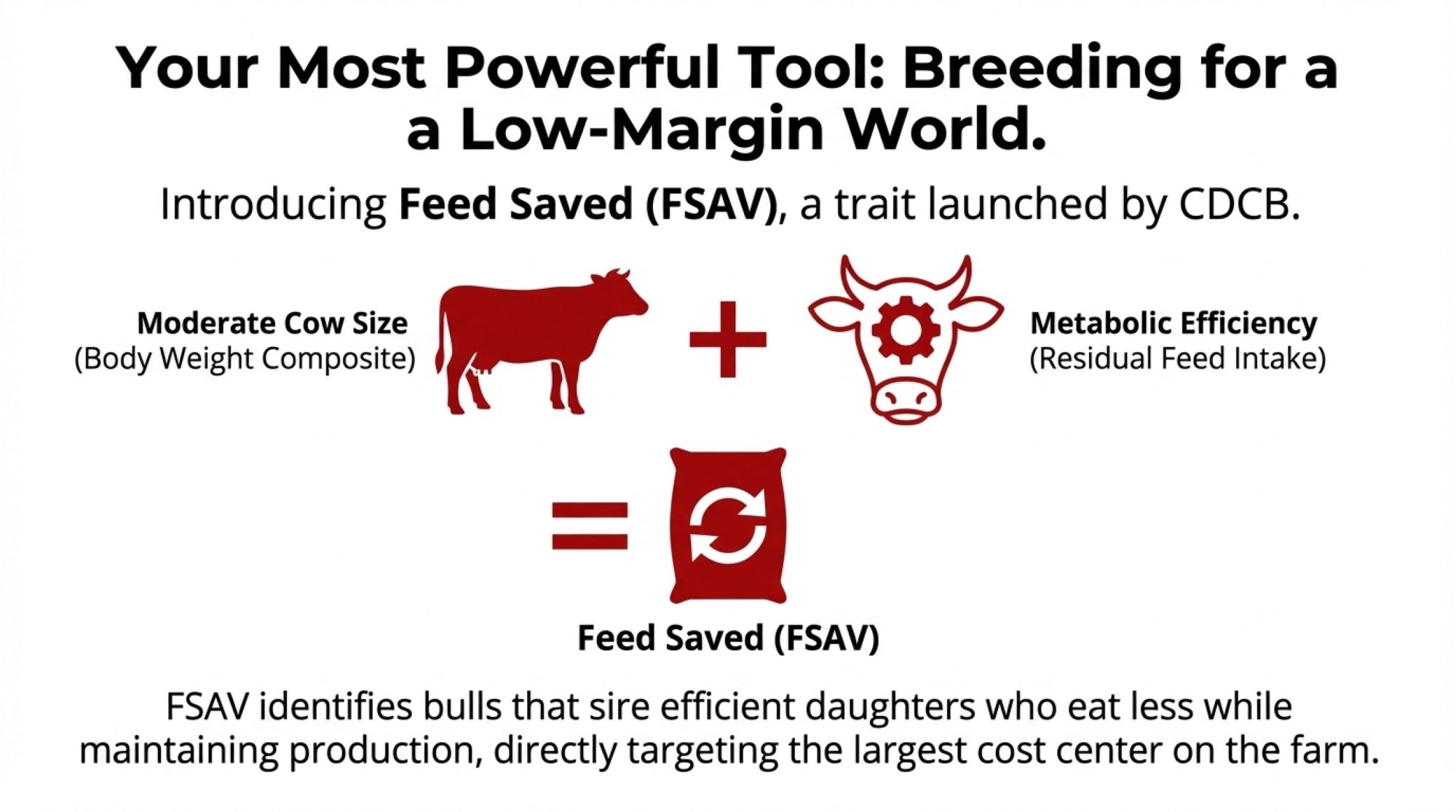
The picture looks similar in other major producing regions:

  • European Union: EU Milk Market Observatory data show deliveries climbing modestly in 2024, with product stocks building in early 2025 as cheese, butter, and powder production outpaced demand growth
  • New Zealand: Fonterra’s 2025/26 season forecast shows milk solids volumes running several percent ahead of the prior year, with farmgate payouts around NZ$10 per kg of milksolids
  • Argentina: Ministry data and Tridge reports show national milk output in early 2025 running 10.9% above the same period in 2024, with March posting gains of 15.9% year-over-year

Here’s where it gets interesting on the demand side. Exports have actually performed well:

  • July 2025 U.S. Exports: 1.6 billion pounds (milk-fat basis)
  • Year-Over-Year Export Growth: +53%—a record for any single month
  • Yet Class III/IV Futures: Trading in the mid-teens through much of 2025, below full-cost breakeven for many conventional operations
July 2025 was the strongest export month in U.S. history, with shipments up 53% year‑over‑year—yet total production still outran demand by another 4.2%. That’s not a demand collapse; it’s too much milk from too many exporters at once.

The takeaway? World demand hasn’t collapsed. Exports are actually quite strong. But supply from multiple major exporting regions has grown faster than demand can absorb in the near term. That’s what makes this feel different from the regional downturns many of us have worked through before.

The 24-Month Expansion Timeline: When Biology Meets Economics

One of the lessons this cycle keeps reinforcing is how much dairy expansion is a commitment you can’t easily unwind. The biology and capital requirements simply don’t move on futures-market time.

Think back to 2023 and early 2024. Milk prices were strong, butterfat levels were excellent across many herds, and balance sheets looked healthier than they had in years. In that environment, deciding to add a pen, upgrade the parlor, or build out the dry cow facilities made a lot of sense. The numbers supported it.

Land-grant extension economists who model these decisions describe a fairly predictable timeline. In those first few months, you’re signing contracts, ordering equipment, and closing on financing. As one University of Wisconsin farm management publication notes, by the time the ink is dry, most of the financial risk is already committed—even though no extra milk has shipped yet.

Through months four to twelve, the facility goes up while you’re either buying bred heifers or ramping up your own replacement program with sexed semen. Cash is flowing out, but the additional milk revenue hasn’t started. Then in months thirteen through twenty-four, those heifers freshen, pens fill, and milk per stall climbs. The challenge is that the broader market—running on that same 18-24 month biological timeline—may have shifted considerably since you started.

Peter Vitaliano, who served as Vice President of Economic Policy and Market Research at the National Milk Producers Federation before retiring at the end of 2024, was already flagging concerns back in February 2024. He noted that “due to a number of factors, we’ll probably see a larger drop than usual” in dairy farm numbers, partly because USDA counts were likely collected before additional farms closed at the end of 2023 due to margin pressure. He added that any margin improvement wouldn’t “constitute anywhere near a full recovery from the financial stress that dairy farms, pretty much of all sizes, are experiencing.”

The 24-Month Trap in Action

I’ve been hearing about situations like this from lenders and consultants: a 900-cow Wisconsin operation signed expansion contracts in early 2024 for 300 additional stalls, with heifers due to freshen by mid-2025. By the time that barn was full, Class III had dropped from the low $20s to around $15.

The extra milk revenue is real, but so is the debt service. Over six months, the gap between projected and actual margins consumed roughly $180,000 in working capital that had been earmarked for feed prepays and equipment upgrades.

The family isn’t in crisis, but there’s no cushion left. They’re working with their lender on revised cash-flow projections and tightening culling criteria to protect equity.

Decisions that made complete sense at $22 milk are now playing out in a $15 world.

Beef-on-Dairy: Real Benefits with Some Unexpected Effects

Beef-on-dairy has been one of the more significant developments in recent years, and it’s delivered genuine value to many operations. At the same time, as it’s scaled across the industry, it’s also changed some dynamics that historically helped balance supply. What I’ve noticed talking with producers is that most understand the benefits clearly—but the systemic effects are only now becoming apparent.

Where the Value Has Been Clear

The research and market data are consistent on this: well-managed beef-on-dairy programs substantially increase calf value compared to straight dairy bull calves. Day-old beef-cross calves often fetch several hundred dollars more, and in program relationships where carcass performance is documented, they can approach native beef calf values.

With milk prices softening in the first half of 2025, beef has become a driver of dairy farm profitability through both cull cows and dairy-beef calves. For many operations, this revenue stream has made a meaningful difference in a tight-margin year.

Some Effects Worth Understanding

What’s become clearer over the past year is how beef-on-dairy interacts with culling decisions and replacement availability when prices fall.

Consider the culling dynamic. A few years ago, that seven- or eight-year-old cow with middling production and some foot issues—bred to a dairy bull and carrying a $50-100 calf—was an easier decision when milk prices dropped. Today, if she’s carrying a beef pregnancy that could bring four figures at calving, the economics pull toward keeping her “one more lactation.” Across a larger herd, those decisions on the bottom 15-20 percent of cows can add meaningful volume that wouldn’t have been in the tank in previous downturns.

Culling DecisionDaily Milk RevenueDaily Direct CostsDaily Net MarginStrategic Action
Keep Low Performer$9.00$8.00$1.00Deferred culling
Replace with High Performer$13.00$9.00$4.00Aggressive culling
Daily Margin Difference+$4.00+$1.00+$3.00Per stall advantage
Impact Over 6 Months$540Single cow (180 days)
Scale: 30 Cows in 600-Cow Herd$16,20030 decisions

On the replacement side, the numbers tell a striking story:

  • January 2025 USDA Cattle Report: Dairy replacement heifers over 500 pounds dropped to just 3.914 million head—the lowest since 1978
  • Heifer-to-Cow Ratio: 41.9%, the smallest since 1991 (per CoBank lead dairy economist Corey Geiger)
  • Primary Driver: More matings going to beef semen, fewer dairy heifer calves being raised

That pruning made sense when heifer-raising costs were high, and beef calves commanded strong premiums. But it also means some operations that would like to cull more aggressively now don’t have the springers available to maintain stall utilization.

From windfall to choke point:” day‑old beef‑cross calves jumped from roughly $650 to $1,400, replacement heifers surged past $3,000, and heifer inventories fell nearly 20%. The same strategy that rescued margins is now what’s limiting culling options in a $15 milk world.

And there’s a productivity element worth noting. Because the heifers that are raised tend to come from the top of the genetic pool—identified through genomic testing—they often bring stronger milk and component performance than the animals they replace. Leonard Polzin noted at the 2025 Wisconsin Ag Forum that “despite a 0.35 percent year-to-date decline in total milk production, calculated milk solids production increased by 1.35 percent.” The industry is meeting demand “more quickly than in the past,” even with somewhat fewer total gallons.

None of this suggests beef-on-dairy is problematic. It’s been valuable for many operations. The consideration is managing it as part of an overall herd and business strategy rather than simply as a breeding decision.

Understanding Why Growth Continued

A reasonable question producers ask is why banks, co-ops, and processors kept supporting expansion even as supply signals shifted. You know, it’s easy to look back and wonder what everyone was thinking. But looking at the incentive structures helps explain the pattern—and honestly, it makes more sense than it might first appear.

The Lender Perspective

Ag lenders work within risk models and regulatory frameworks that emphasize historical cash flow, current balance sheet strength, and collateral values. In 2022-2023, many dairy clients showed multiple years of positive returns and improved equity. Land values in dairy regions were firm. Cull cow and breeding stock values had recovered.

Farm finance research consistently shows that lenders lean heavily on these historical and collateral metrics rather than attempting to time commodity cycles. Add competitive pressure—banks and farm credit systems competing for the same well-run operations—and you can see how turning down an expansion with strong historical numbers often meant losing that relationship to a lender willing to proceed.

From the credit committee’s perspective at the time, financing expansion with their strongest clients appeared reasonable and well-supported by the available data. The depth of the 2025 correction wasn’t yet visible in those metrics.

The Processor View

For processors, the math centers on fixed costs and throughput. Depreciation, labor, and energy don’t decline proportionally when a plant runs below capacity. With billions invested in new cheese, powder, and specialty facilities over the past decade, plant managers face pressure to run at high utilization, spread fixed costs effectively, and maintain market share.

That creates incentives to encourage volume growth from existing shippers, sign new suppliers, and move cautiously on base-excess programs that might push producers toward competitors. Some buyers have implemented tiered pricing systems that discount over-base milk, but these tools are often adopted late in the cycle and rarely coordinate across an entire region.

The result is a system in which internal metrics rewarded growth and utilization, even as external data pointed to a building supply. That’s not a criticism—it’s recognizing how institutional incentives shape behavior.

Regional Variations: Same Prices, Different Realities

One aspect that gets lost in national averages is how differently the same price environment affects operations across locations. As many of us have seen firsthand, cost structure, regulatory environment, and market access all matter enormously.

California: Navigating Significant Headwinds

California operations face several overlapping pressures this cycle.

Water constraints continue tightening. Implementation of the Sustainable Groundwater Management Act and new dairy waste discharge requirements from the State Water Resources Control Board are limiting groundwater pumping and establishing stricter nitrate standards in parts of the Central Valley. Environmental compliance costs—for covered lagoons, digesters, and monitoring systems—continue adding capital and operating expenses. And labor costs, housing prices, and land values remain substantially higher than in most other dairy regions.

When Class IV prices are in the low teens and world butter and powder prices are soft, those structural costs make breakeven difficult, particularly for operations that recently invested in facility upgrades. Understandably, some families are evaluating whether another 20-year investment cycle makes sense in that regulatory and cost environment.

Upper Midwest: Cost Structure Advantages

Wisconsin and neighboring states present a different picture.

A November 2024 University of Wisconsin-Madison study found that dairy contributes about $52.8 billion annually to Wisconsin’s economy, with substantial value coming through processing rather than just farm-level milk sales. The region’s processing network has grown considerably, with cheese plant expansions and new facilities drawing milk from an expanding geography. Feed costs benefit from local production, and land and labor costs, while rising, remain below coastal levels.

Low Class III prices continue to pressure margins, and smaller operations face ongoing consolidation. But many Upper Midwest producers describe having a cost structure that provides a path through this downturn with good management, even if it’s not comfortable.

New Zealand: Low Costs, High Exposure

New Zealand’s pasture-based system delivers meaningful cost advantages—solids produced with less purchased feed and lower energy use in favorable seasons. The 2025/26 forecast payout around NZ$10 per kgMS suggests many operations are maintaining positive margins, though narrower than recent years.

The trade-off is exposure. New Zealand sells the vast majority of its production into export markets. Shifts in Chinese demand, Southeast Asian buying patterns, or currency movements translate quickly into payout adjustments. Low production costs provide resilience, but global market volatility is a constant factor.

Europe and South America: Policy and Economic Dynamics

EU production has edged modestly higher overall, but policy pressure to limit cow numbers in high-density areas for environmental reasons is influencing regional patterns. The bloc appears to be shifting toward cheese and higher-value products while moderating output of commodity powders and butter.

Argentina’s production surge—that 10.9 percent first-quarter increase—reflects improved weather and on-farm economics. But Argentine producers also navigate inflation, policy uncertainty, and volatile input costs that can shift margins dramatically in short periods.

The point is that $15 milk creates very different situations in Tulare, Green County, Canterbury, and Santa Fe. Regional context matters enormously.

The Breeding Solution: Selecting for Feed Efficiency in a Low-Margin World

Here’s something that deserves more attention in these conversations: your genetic decisions today are one of the most powerful tools you have for navigating tight margins over the next decade. And there are now specific, measurable traits designed exactly for this environment.

Feed Saved: A Trait Built for This Moment

The Council on Dairy Cattle Breeding (CDCB) launched Feed Saved (FSAV) back in December 2020, and it’s become increasingly relevant as margins compress. The trait combines two components:

  • Body Weight Composite (BWC): Selecting for moderate-sized cows that require less feed for maintenance
  • Residual Feed Intake (RFI): Identifying cows that are metabolically more efficient—eating less than expected based on their production and body weight

According to Holstein USA’s April 2025 TPI formula update, every pound of feed saved returns approximately $0.13 per cow per lactation. That might sound modest, but across a 500-cow herd over multiple generations, the cumulative impact is substantial.

What’s particularly interesting is the research backing this. A November 2024 study published in Frontiers in Geneticsexamining genomic evaluation of RFI in U.S. Holsteins found that the difference between the most and least efficient first-lactation cows averaged 4.6 kg of dry matter intake per day—while producing similar amounts of milk. Over a 305-day lactation, that’s a significant difference in feed costs. The same study found even larger spreads in second-lactation animals.

How the Industry Is Weighting Efficiency

The April 2025 Net Merit update from CDCB reflects this shift. As Holstein Association USA’s TPI formula now shows:

  • Production (including Feed Efficiency): 46% of total index weight
  • Feed Efficiency $ Index: Combines production efficiency, lower maintenance costs from moderate body weight, and better feed conversion (RFI)

What’s encouraging is that research shows meaningful genetic variation in feed efficiency—the November 2024 Frontiers in Genetics study found RFI heritability in lactating U.S. Holsteins at approximately 0.43 (43%), indicating substantial potential for genetic progress through selection. That’s higher than many health and fertility traits, which means you can actually move the needle on this.

Efficiency MetricDaily Feed (lbs DM)Annual Feed Cost @ $0.12/lbMilk Production (lbs/day)Breeding Strategy Impact
Standard Efficiency Cow55$2,40985Baseline
High Efficiency Cow (Feed Saved)50$2,19085RFI + Feed Saved traits
Annual Advantage per Cow-5 lbs/day$219 savedSame outputImmediate selection
500-Cow Herd Annual Impact$109,500Same outputHerd-wide savings
10-Year Genetic Improvement$1,095,000Same outputCompound benefits

Practical Application

For producers looking to incorporate feed efficiency into their breeding programs:

  • Look for bulls with positive Feed Saved (FSAV) values in their genomic evaluations
  • Consider Body Weight Composite alongside production traits—extreme frame size increases maintenance costs
  • Balance feed efficiency with health and fertility traits; the most efficient cow isn’t profitable if she doesn’t breed back or stay healthy
  • Work with your AI representative or genetics consultant to model how different selection emphases might affect your herd’s economics over 5-10 years

This isn’t about abandoning production goals. It’s about recognizing that in a low-margin environment, the cow that produces 85 pounds while eating 10% less feed may be more profitable than the cow producing 90 pounds at average efficiency.

What the More Resilient Operations Have in Common

Every downturn separates operations that preserve equity and position well for the recovery from those that don’t. Several patterns are emerging among farms navigating this cycle effectively—and what’s encouraging is that most of these are things within a producer’s control.

Making Culling Decisions with Better Data

Operations that are doing well are generally bringing greater precision to culling. That means tracking income over feed cost by pen or individual cow, using parlor data and feed records to identify animals that are not covering their direct costs, plus a reasonable share of overhead. It means using genomic information and reproductive performance to spot heifers and cows unlikely to generate positive returns. And it means connecting culling plans to realistic replacement availability rather than culling until pens feel empty and then scrambling for springers.

The math consultants’ walk-through is straightforward: a cow generating $9 in milk revenue and consuming $7 in feed, plus $1 in bedding, breeding, and health costs, clears $1 in labor, debt, and margin costs. Replace her with a fresher or higher-producing animal netting $4 daily above direct costs, and over six months, that stall contributes $720 more. Scale that to 30 similar decisions in a 600-cow herd, and the difference exceeds $20,000 in half a year. That kind of analysis is making some producers more willing to make uncomfortable culling decisions earlier.

Managing Margins Rather Than Guessing Prices

Another pattern is shifting from attempting to call price tops to protecting survivable margin ranges.

Dairy Margin Coverage continues providing value for eligible operations, particularly smaller herds. A 2025 Government Accountability Office review noted that USDA paid out nearly $2.7 billion more to DMC participants than it collected in premiums from 2019 through 2024—significant catastrophic protection.

More operations are using Dairy Revenue Protection to establish floors on portions of future production, sometimes combined with feed contracts that define at least a rough margin band. The approach isn’t about optimizing returns; it’s about narrowing the range of outcomes to avoid truly damaging quarters.

Suppose you haven’t explored these tools recently. In that case, your local FSA office or an extension dairy specialist can walk you through current enrollment options and help you model how different coverage levels might fit your operation’s risk profile.

Treating Beef-on-Dairy as a Managed Program

Operations that consistently achieve value from beef-on-dairy tend to approach it systematically rather than opportunistically. That means selecting sires with documented growth, feed efficiency, and carcass data—often aligned with specific feedlot or packer programs. It means coordinating with buyers on calving timing, health protocols, and genetics to capture available premiums. And it means maintaining enough high-merit dairy genetics to ensure replacement availability as conditions change.

This program approach doesn’t eliminate beef market volatility, but it improves the odds of consistent returns and preserves flexibility on the dairy side. If you’re looking to establish these relationships, many breed associations and AI companies now maintain lists of feedlots and packers actively seeking dairy-beef partnerships.

Continuous Focus on Feed Efficiency

Feed remains the largest expense for most operations, and in low-margin periods, every pound of dry matter needs to perform. The farms that manage well keep returning to fundamentals: grouping by lactation stage so rations match requirements, reducing shrink through bunker management and feed-handling practices, and monitoring feed efficiency as a core metric.

Relatively modest improvements—a tenth or two-tenths improvement in feed efficiency, a few percentage points less silage waste—can represent $0.50-1.00 per hundredweight in income over feed cost. Across millions of pounds of annual production, that compounds into meaningful dollars.

Looking Toward 2027-2028: Reasonable Expectations

Forecasting specific prices years out isn’t realistic, but we can identify directions based on current trends and policy trajectories. These are scenarios, not predictions—individual outcomes will vary considerably.

The consolidation pattern is well-documented. Lucas Fuess, Senior Dairy Analyst at Rabobank, noted in his analysis of the 2022 Census of Agriculture that the U.S. lost nearly 40 percent of its dairy farms between 2017 and 2022—from about 39,300 to around 24,000—while total production rose because “larger farms show lower production costs.” This downturn will likely accelerate that trend.

By the late 2020s, several developments seem probable:

The total number of licensed U.S. dairies may fall below 20,000, with an increasing share of national volume coming from herds milking several hundred to several thousand cows. Regional patterns may sharpen, with lower-cost areas—much of the Upper Midwest and Central Plains—holding or gaining share, while higher-cost, more regulated regions see gradual declines in cow numbers as families choose not to reinvest. Beef-on-dairy will likely remain prevalent but may stratify further between well-structured programs that capture consistent premiums and undifferentiated approaches that face greater volatility.

Globally, New Zealand will remain important in the powder and butterfat markets, while the EU continues to shift toward cheese and value-added products within environmental constraints.

The Bottom Line

These are the conversations I’m hearing producers have with their teams, advisers, and families. Every operation faces unique circumstances, and general advice only goes so far—but these questions seem to be helping people think through their situation:

  • Where are you in your own expansion timeline? How many heifers are scheduled to freshen over the next 18-24 months? Do those numbers align with what your facilities, labor, feed base, and market access can profitably support at current price levels?
  • Do you have clear visibility on cow-level economics? Which animals are covering feed plus a reasonable share of labor, debt, and overhead—and which aren’t? What would tightening culling criteria by 5-10 percent look like, and is your replacement pipeline ready for that?
  • How much of your margin is protected versus hoped for? What portion of the next 12-24 months could you realistically put under DMC, DRP, or forward contracts? Have you had direct conversations with your lender about your risk management approach?
  • Is your beef-on-dairy program intentional? Do you know what your calf buyers specifically want, and are you breeding to those specifications? Are you confident that your current approach will leave enough high-quality dairy replacements for the herd you want to be running in three years?
  • Are your genetic criteria aligned with a low-margin reality? Are you selecting strictly for high production, or are you also prioritizing Feed Saved, moderate frame size through Body Weight Composite, and Residual Feed Intake to lower lifetime maintenance costs? In an environment where feed represents 50-60% of production costs, breeding decisions made today will shape your cost structure for the next decade.
  • Are you making decisions for this week or for the next several years? Culling, breeding, feeding, capital allocation, and even family succession—are these being decided tactically or within a longer-term framework?

This cycle is demonstrating that individually sensible decisions—expanding when returns were strong, adding beef value to calves, filling new processing capacity—can produce collective oversupply when everyone responds to the same signals simultaneously. None of us individually controls global supply and demand. What each operation can control is understanding its position within the bigger picture, knowing its own numbers thoroughly, and using available tools—biological, genetic, and financial—to improve the odds of still being here, on your own terms, when conditions improve.

KEY TAKEAWAYS 

  • This is a global supply collision, not a demand problem. The U.S., EU, New Zealand, and Argentina all expanded at once—yet exports hit record highs. Pure oversupply.
  • The 24-month trap is unforgiving. Decisions that made sense at $22 milk are now delivering into a $15 market. Biology doesn’t wait for prices to recover.
  • Beef-on-dairy reshaped the culling equation. Replacement heifers dropped to 3.9 million—the lowest since 1978—limiting flexibility exactly when operations need it most.
  • Resilient dairies share three priorities: precision culling based on income over feed cost, margin protection through DMC and DRP, and breeding for feed efficiency traits.
  • Consolidation will accelerate—preparation separates outcomes. Producers who know their numbers and deploy available tools now will emerge stronger when markets turn.

Complete references and supporting documentation are available upon request by contacting the editorial team at editor@thebullvine.com.

Learn More:

Join the Revolution!

Join over 30,000 successful dairy professionals who rely on Bullvine Weekly for their competitive edge. Delivered directly to your inbox each week, our exclusive industry insights help you make smarter decisions while saving precious hours every week. Never miss critical updates on milk production trends, breakthrough technologies, and profit-boosting strategies that top producers are already implementing. Subscribe now to transform your dairy operation’s efficiency and profitability—your future success is just one click away.

NewsSubscribe
First
Last
Consent

The €27,000 Question 80% of Dairy Farmers Can’t Answer (This Winter, You Will)

80% of dairy farmers can’t answer a €27,000 question. After this winter, you won’t be one of them.

EXECUTIVE SUMMARY: There’s a €27,000 (~$29,000 USD) question that 80% of dairy farmers can’t answer: What’s your feed efficiency ratio? That single number determines whether your operation’s biggest expense—50-70% of costs according to USDA data—generates profit or disappears into the manure pit. The math is compelling: improving from 1.4 to 1.6 efficiency captures €281 per cow annually without new genetics, additional cows, or capital investment. Research from Iowa State’s Dr. Lance Baumgard, Cornell’s transition cow program, and Penn State Extension reveals three proven strategies: systematic measurement, silage preservation, and metabolic optimization. Winter 2025-2026 is your measurement window—housed cattle, stable rations, no heat stress confounding your baseline. All you need: seven days, a bathroom scale, and a moisture tester. The bottom line is simple: you can’t deposit milk production; you deposit margin.

Growing numbers of progressive dairy operations are discovering that a single metric—feed efficiency—holds the key to capturing thousands in additional profit without producing more milk. Here’s what the industry’s efficiency pioneers are finding, and how your operation can benefit from their insights.

The question caught the experienced dairy farmer off guard during a routine consultation last winter: “What’s your current feed efficiency ratio?” After successfully managing 100 cows for 15 years, producing a respectable 35 kilograms of milk per cow daily, he couldn’t answer. Like many in the industry, he knew total feed costs and milk production, but not the critical ratio connecting them.

What happened next transformed his operation. Within twelve months of implementing systematic efficiency measurement, his farm captured over €15,000 (~$16,200 USD) in additional profit—without buying a single additional cow or increasing milk production. His story reflects a broader awakening across the dairy industry: improvements in feed efficiency from 1.4 to 1.6 generate approximately €270 (~$290 USD) per cow annually, based on current commodity prices of €0.25 per kilogram dry matter and €0.40 per kilogram milk. For a typical 100-cow operation, we’re talking about €27,000 (~$29,000 USD) in potential improvement.

This builds on what we’ve seen in operations worldwide. Farms implementing comprehensive efficiency strategies report remarkably consistent results. With feed costs accounting for 50-70% of operational expenses, according to USDA Economic Research Service data, understanding this metric has become fundamental to sustainable dairy farming.

Understanding the Industry’s Relationship with Efficiency Data

What’s particularly noteworthy is how sophisticated we’ve become in certain areas—genomic testing, milk component analysis, reproductive protocols—while feed efficiency remains a blind spot for many successful operations. I find this fascinating, actually.

Industry consultants Jacques Bernard and Christine Massfeller regularly encounter this pattern. When they ask fundamental questions about dry matter consumption or cost per kilogram of energy-corrected milk, even experienced producers often pause. This isn’t about capability—it reflects how our industry has traditionally measured success.

Recent industry observations suggest that while most farms diligently track milk production and components, regular efficiency calculation remains less common. The gap between what we measure and what drives profitability deserves our attention.

THE GOLDEN RATIOS: Know Your Efficiency Targets

GroupTarget
Whole Herd> 1.5
High-Producing Group> 1.7
First-Lactation Heifers> 1.6
Late Lactation> 1.2

⚠️ WARNING: Fresh Cows (First 21 Days) Above 1.5 = Metabolic Danger Zone

Fresh cows with efficiency above 1.5 are actually experiencing a dangerous negative energy balance, mobilizing body reserves at an unsustainable rate despite appearing to be top producers. Cornell University’s transition cow management resources indicate that these animals face a substantially higher risk of metabolic disease.

The Economics Behind Efficiency Improvement

Let me walk through some practical mathematics that illustrates why this matters so much to your bottom line. Consider a standard scenario with 35 kg of daily milk production at a milk price of €0.40 per kilogram and a dry matter feed cost of €0.25 per kilogram.

Metric1.4 Efficiency1.6 EfficiencyDaily Difference
Dry Matter Intake25.0 kg21.9 kg-3.1 kg
Feed Cost (€0.25/kg)€6.25€5.48€0.77 Saved
Income Over Feed Cost€7.75€8.52+€0.77 Profit
Annual Impact (100 Cows)+€28,100 (~$30,350 USD)

The difference—€0.77 per cow daily—accumulates to €281 annually per animal. Scale that across 100 cows, and you understand why progressive producers are prioritizing this metric.

I recently spoke with a Wisconsin producer who shared an interesting perspective. His cows are producing 2 kg less milk than three years ago, yet his operation is significantly more profitable because feed costs dropped by double digits through efficiency improvement. Sometimes the path to profitability isn’t about maximum production—it’s about optimal conversion.

Learning from Poultry and Swine: A Different Approach

The contrast between dairy and monogastric operations offers valuable lessons. Poultry and swine producers monitor feed conversion with remarkable precision, whereas dairy producers have traditionally focused elsewhere. Why this difference?

Part of it comes down to the simplicity of measurement. Tracking tissue growth in a broiler is straightforward compared to partitioning nutrients across milk components, body condition, and reproduction in dairy cattle. Their shorter production cycles provide rapid feedback, and integrated technology has become standard infrastructure.

Modern broiler facilities employ AI-powered systems, achieving impressive precision in automated monitoring. Swine operations use real-time tracking for weight, growth, and intake patterns. This isn’t futuristic—it’s current standard practice enabling continuous optimization.

What’s encouraging is dairy’s technological evolution. The Cattle Feed Intake System developed at the University of Wisconsin-Madison uses 3D cameras and deep learning for individual cow monitoring. Early adopters report payback within 18 months through efficiency gains alone. We’re catching up, and the results are promising.

Recognizing Efficiency Problems: Key Indicators

If you’re observing these signs, it’s time for closer examination:

  • Consistent whole corn kernels in manure—beyond occasional presence
  • Warm silage face—noticeably above ambient temperature, sometimes steaming
  • Severe TMR sorting—refusals predominantly long stems while grain disappears
  • Variable manure consistency within pens—suggesting diet variation
  • Body condition variance exceeding 0.75 points within groups
  • Reduced cud chewing—below the target 7-10 hours daily
  • Long particle predominance in refusals—above 19mm

Penn State Extension’s feed management resources indicate that multiple symptoms typically correlate with efficiency below 1.3.

Three Complementary Strategies for Efficiency Improvement

The evolution of nutrition strategies over the past decade has been remarkable. What started as competing philosophies has matured into complementary systems addressing different efficiency aspects.

Strategy 1: The Measurement Foundation (Data > Assumptions)

Improvement starts with accurate data. German-based AHRHOFF GmbH, operating across multiple countries since 1996, exemplifies this approach. Feed advisor Rainer Kossmann describes their priority as helping clients develop an intuitive understanding of herd consumption through systematic measurement.

The systematic approach incorporates digital tracking for precise dry matter intake, Penn State Particle Separator analysis for sorting behavior, manure evaluation for passage rate assessment, and regular moisture testing for ration accuracy. This foundation reveals the actual difference between assumed and actual intake—often a 10-15% gap worth thousands of dollars annually.

Strategy 2: Preserving Feed Value (The Hidden Rumen Driver)

Forage quality determines rumen function potential—and this is where many operations unknowingly leak profit. Luis Queiros from Lallemand Animal Nutrition explains how energy preservation during storage and feedout represents an often-overlooked opportunity.

Quality inoculant technology, incorporating specific bacterial strains like Lactobacillus buchneri and L. hilgardii, delivers measurable benefits. Research consistently demonstrates typical responses of 1.5 kg additional dry matter intake and nearly 2 kg increased fat-corrected milk. Properly treated silage maintains stability for over two weeks after opening, compared to just days for untreated material. The investment math is compelling: €4,500 (~$4,860 USD) in inoculant typically returns €12,600 (~$13,600 USD) in preserved feed value, before accounting for production benefits.

Strategy 3: Metabolic Optimization (The Stress-Efficiency Connection)

Research from Iowa State University’s animal science department, led by Dr. Lance Baumgard and published in the Journal of Dairy Science, demonstrates how metabolic stress fundamentally compromises efficiency. When cows experience heat stress, transition challenges, or subclinical acidosis, gut barrier function deteriorates. This “leaky gut” response triggers immune activation, consuming glucose equivalent to 25-30 liters of milk—energy that could otherwise support milk synthesis.

University of Florida’s dairy science team has quantified the opportunity through heat abatement studies. Operations implementing comprehensive cooling protocols during summer months recovered 8-12% of heat-stress-related efficiency losses. The key insight: stress management isn’t separate from nutrition—it’s foundational to feed conversion.

Cornell University’s transition cow program reinforces this connection. Their research shows that cows experiencing inflammation during the transition period allocate more nutrients to immune function and less to milk production. Targeted interventions—proper close-up nutrition, minimizing social stress, optimizing stocking density—can shift this balance back toward production. Some operations implementing comprehensive transition protocols report efficiency improvements of 0.1-0.2 points within the first 60 days in milk.

Strategic Timing: Why Winter Matters for Measurement

Over years of consulting, I’ve observed that operations that begin efficiency programs in winter consistently achieve superior results compared to those that start in summer. The science supports this pattern.

Winter provides measurement advantages that summer simply can’t match. Housed cattle consuming consistent TMR eliminate the variables inherent in grazing systems. Research from the University of Minnesota demonstrates that TMR-to-pasture transitions can initially reduce intake by nearly 30%, making accurate efficiency calculations challenging during grazing seasons.

Temperature effects matter enormously. When the Temperature Humidity Index exceeds 72, production impacts begin. USDA data from southwestern operations shows average decreases of around 12%, with severe heat causing dramatic drops. Winter measurement reveals true biological capacity rather than heat adaptation.

By mid-winter, silage has stabilized post-fermentation but hasn’t deteriorated. Moisture content remains consistent week to week—essential for calculation accuracy. Plus, without fieldwork pressure, you have bandwidth for careful measurement and analysis. As Dr. Jane Sayers from Northern Ireland’s CAFRE observes, winter provides an opportunity to focus on intake monitoring, which is often overlooked during busier seasons.

Regional Considerations and Operational Realities

Different systems require different approaches—what works for California’s Central Valley operations won’t necessarily translate to Irish grazing systems or Wisconsin tie-stalls.

Pasture-based operations in Ireland, New Zealand, and parts of the Netherlands face unique measurement challenges. Daily efficiency can swing 0.2-0.3 points based on grass quality and weather. These farms benefit from establishing winter baselines during housing, then using those benchmarks to evaluate grazing performance.

Large confined operations in California, Arizona, and emerging markets have measurement consistency advantages but face greater heat stress challenges. These systems often achieve dramatic efficiency gains from metabolic support strategies, particularly during the summer months.

Smaller operations sometimes question whether efficiency improvement justifies investment. The percentage gains remain consistent regardless of scale—a 30-cow herd capturing €8,100 (~$8,750 USD) annually still achieves excellent returns. The key is appropriate implementation: perhaps weekly rather than daily measurement, creative use of existing equipment, and acceptance that progress beats perfection.

Organic producers face intervention restrictions but consistently achieve respectable efficiency through careful forage management and natural fermentation optimization. Several Northeast organic operations report 1.55+ efficiency using approved methods exclusively.

Your 7-Day Efficiency Startup Checklist

Starting efficiency measurement doesn’t require sophisticated infrastructure. Here’s a practical approach using equipment most farms already have:

Day 1: The Weigh-In. Establish your weighing system—a bathroom scale with a bucket works initially. Conduct your first dry matter test using microwave methods validated by extension services. Record pen populations and milk production with components. This is your baseline moment.

Days 2-6: The Data Gather. Continue recording delivered feed from your mixer display, weigh refusals, and test moisture. Calculate daily intake and efficiency while watching for patterns. Don’t chase perfection here—consistency matters more than precision initially. You’re building a habit, not writing a research paper.

Day 7: The Reckoning. Calculate weekly averages by group. Fresh cow efficiency above 1.5 or a herd average below 1.3 warrants immediate consultation with a nutritionist—these indicate intervention needs. This is the number that tells you whether you’re leaving money on the table.

The calculations are straightforward: Dry matter intake equals delivered feed times dry matter percentage, minus refusals times their dry matter percentage, divided by cow count. Energy-corrected milk calculators from Cornell or Penn State handle standardization. Efficiency equals ECM divided by DMI.

Investment Reality and Return Expectations

Transparency about costs builds trust. Based on current market conditions, here’s the realistic investment requirements:

Measurement systems require approximately €3,500 (~$3,780 USD) initially, €2,200 (~$2,375 USD) annually for feed management software, moisture testing equipment, particle separation tools, and scales.

Silage preservation runs €4,500 (~$4,860 USD) annually for inoculant at typical application rates. This investment consistently returns triple value in feed preservation alone, before production benefits.

Transition and metabolic support through quality mineral programs and stress mitigation protocols costs around €3,500 (~$3,780 USD) annually for 100 cows. University research suggests that even modest improvements in transition cow health can recover this investment within the first lactation.

Investment CategoryYear 1Ongoing
Measurement Systems€3,500 (~$3,780)€2,200 (~$2,375)
Silage Preservation€4,500 (~$4,860)€4,500 (~$4,860)
Transition & Metabolic Support€3,500 (~$3,780)€3,500 (~$3,780)
Total€11,500 (~$12,420)€10,200 (~$11,015)
Conservative Benefit€20,000-27,000 (~$21,600-29,160)
Typical Payback5-7 months

Industry Evolution and Future Considerations

The dairy industry faces an interesting crossroads in measuring and reporting efficiency.

Major processors across Europe—Danone, Arla, FrieslandCampina—are incorporating efficiency metrics into sustainability programs and payment structures. While specific program details continue evolving, the direction is clear: efficiency measurement is transitioning from optional to essential.

Carbon market developments offer additional opportunity. Regulatory frameworks in California and Europe are beginning to assign value to efficiency improvements as methane reduction strategies. Operations achieving 1.6+ efficiency may access substantial additional revenue through emerging carbon credit markets.

Within several years, industry observers expect efficiency reporting will become standard for premium market access, sustainability program participation, and competitive financing. Progressive lenders already incorporate these metrics into risk assessment.

Practical Takeaways for Your Operation

The €27,000 annual opportunity exists within your current genetics through management improvement. Unlike genetic selection, requiring years, management delivers returns within months. Each month’s delay represents approximately €2,250 (~$2,430 USD) in foregone benefit.

Starting simple with consistent measurement beats waiting for perfect systems. Basic tools—scale, moisture tester, spreadsheet—combined with two hours weekly effort can generate substantial efficiency gains.

Winter timing provides optimal measurement conditions. January through March offers stable feeding without heat stress or grazing variables, establishing accurate baselines for year-round improvement.

Sequential implementation maximizes success. Begin with a measurement to understand current performance. Address forage quality to secure your input foundation. Then optimize metabolic health through evidence-based transition protocols. Each phase builds on previous improvements.

The 1.5 efficiency threshold separates sustainable from struggling operations. Below 1.3 indicates a crisis requiring immediate attention. Above 1.5 provides a foundation for optimization toward 1.6+ targets where premium opportunities emerge.

As one experienced consultant observed: “Weekly efficiency calculation drives profitable decisions. Annual calculation generates excuses. Never calculating ensures slow decline without understanding why.”

KEY TAKEAWAYS

  • €281 per cow. €27,000 per herd. Every year. Moving from 1.4 to 1.6 efficiency captures this without new genetics, additional cows, or capital investment. It’s management money—yours to take or leave.
  • Fresh cows above 1.5 efficiency aren’t stars—they’re sirens. High early efficiency signals dangerous mobilization of body reserves, not superior genetics. These cows are heading for ketosis. Monitor them; don’t celebrate them.
  • Three strategies. One system. No shortcuts. Measurement reveals your baseline. Silage preservation protects your inputs. Metabolic optimization unlocks conversion. Skip one, and the others underdeliver.
  • Winter 2025-2026 is your measurement window—use it. Housed cattle, stable rations, no heat stress skewing numbers. January through March gives you the cleanest baseline you’ll get all year.
  • The barrier to €27,000? Seven days and a bathroom scale. Add a microwave for moisture testing and a spreadsheet. That’s it. Start this week. Stop guessing. Start weighing.

The Bullvine Bottom Line

You can’t deposit milk production; you deposit margin. Genetic potential means nothing if your conversion is poor. For the cost of a bathroom scale and a moisture tester, you can unlock €27,000 (~$29,000 USD) in hidden value this winter. Stop guessing and start weighing.

Complete references and supporting documentation are available upon request by contacting the editorial team at editor@thebullvine.com.

Complete references and supporting documentation are available upon request by contacting the editorial team at editor@thebullvine.com.

Learn More:

Join the Revolution!

Join over 30,000 successful dairy professionals who rely on Bullvine Weekly for their competitive edge. Delivered directly to your inbox each week, our exclusive industry insights help you make smarter decisions while saving precious hours every week. Never miss critical updates on milk production trends, breakthrough technologies, and profit-boosting strategies that top producers are already implementing. Subscribe now to transform your dairy operation’s efficiency and profitability—your future success is just one click away.

NewsSubscribe
First
Last
Consent

This Isn’t Your Normal Dairy Downturn – Here’s Your 60-Day Action Plan

What current structural changes mean for dairy operations, plus proven strategies successful producers are using right now

EXECUTIVE SUMMARY: Wisconsin dairyman, 10:30 PM, spreadsheet still open: ‘These numbers can’t be right.’ They were. Five permanent shifts are reshaping dairy: China’s 36% import cut (they’re self-sufficient), $8 billion in plants needing milk regardless of demand, aging populations abandoning fluid milk, currency math you can’t beat, and $4,000 springers versus $2,800 cull cows. But here’s what’s working: organic premiums at $32/cwt, three-family partnerships each clearing $200K+, and component focus adding $820K yearly without expansion. The math is brutal but clear—if you’re within $2/cwt of breakeven, optimize hard. If you’re $3-5 away, something fundamental must change. Beyond $5? Every 60 days of waiting costs you serious equity. This weekend, run your real numbers and make the call.

Dairy Action Plan

Here’s something that stopped me cold last week. A Wisconsin dairyman called at 10:30 PM, spreadsheet still open on his computer. “I’ve run these numbers twelve different ways,” he said, managing 450 cows like his family has for generations. “They keep telling me the same thing, and I don’t like what I’m hearing.”

You know what? He’s not alone. I’ve had variations of that conversation with producers from Tulare to Lancaster County these past few weeks. Even down in Georgia and the Carolinas, where heat stress adds another layer of complexity, folks are wrestling with the same fundamental questions.

The latest FAO Dairy Price Index dropped again, for the fourth month straight, down 3.4% in October to 142.2 points. And the Global Dairy Trade auction keeps sliding, too. Six consecutive drops through November 4th. Whole milk powder’s sitting at $3,503 per tonne. Butter’s off 4.3%. Even cheddar dropped 6.6%, which caught a lot of us off guard.

But what’s really got me thinking is how different this feels from 2009, different from 2015. After talking with producers, looking at what’s happening globally, and honestly, lying awake at night thinking about my own operation, I’m convinced we’re seeing something more fundamental than just another price cycle.

China’s Not Coming Back (And We Built Everything Assuming They Would)

China’s self-sufficiency surge eliminated 36% of milk powder imports in just 5 years, wiping out demand that American dairy expansion plans were built around

So let’s have the conversation nobody wants to have. Remember five years ago when every dairy meeting, every expansion plan, every processing investment was built around Chinese import growth? Made sense at the time, right?

Well, here’s where we are now. China’s domestic production increased by 11 million metric tons between 2018 and 2023—that’s according to USDA’s latest Foreign Agricultural Service data. They’re hitting 85% self-sufficiency now. Up from 70% just five years back.

And their whole milk powder imports? Down from averaging 670,000 metric tons during 2018-2022 to about 430,000 tons in 2023. That’s not a blip, folks. That’s a 36% structural change that Rabobank and other analysts are calling permanent.

I’ve been talking with producers who built their entire business models around Chinese demand. One guy told me, “We retooled everything—bred for higher components, invested in new equipment, built our five-year plan around powder exports. Now what?”

What makes it worse—and I don’t think many people are connecting these dots yet—is the demographics. China’s birth rate fell from 12.43 per thousand in 2017 to 6.39 in 2023. That’s their National Bureau of Statistics, not speculation. Fewer babies means less formula. Aging population means less fluid milk, more medical nutrition products. It’s a completely different market.

These New Plants Need Milk, Whether the Market Wants It or Not

With $8-11 billion in new processing capacity carrying $24-30M annual fixed costs per plant, processors will pay premium prices to hit 85-90% utilization rather than explain idle capacity to their boards

Now, let’s talk about something that’s creating real pressure right now. Between 2023 and 2027, our industry’s building $8-11 billion in new processing capacity. I’ve walked through some of these facilities. They’re incredible. Leprino’s billion-dollar cheese plant in East Lubbock. Fairlife’s $650 million facility in Rochester. Great Lakes Cheese is putting over half a billion into Franklinville, New York.

What’s crucial here—and this is what keeps plant managers up at night—is that these facilities need to run at 85-90% capacity just to break even. CoBank’s analysis shows that clearly. Drop below 75%? You’re hemorrhaging money.

Think about it. A $300 million cheese plant carries maybe $25-30 million in annual fixed costs. Debt service, insurance, baseline staffing—those bills come due whether you’re running one shift or three.

What’s interesting here is what plant managers are telling me. When you’ve got $2 million in monthly debt payments, you’ll pay whatever premium it takes to keep milk coming in the door. Running at breakeven beats explaining to your board why the plant’s sitting idle. Kind of puts you between a rock and a hard place, doesn’t it?

So what happens? Plants keep bidding for milk to hit utilization targets. We see those premiums and keep producing. The oversupply continues. Prices stay low longer than anybody expects. It’s a cycle that feeds itself.

The University of Wisconsin’s dairy program has highlighted something crucial—most of this capacity was planned when we were seeing 1-2% annual production growth. Now we’re actually seeing slight declines. Somebody’s going to end up with very expensive, very empty stainless steel.

The Customer Base Is Aging Out (And Nobody Wants to Talk About It)

Youth aged 6-19 who drive bulk dairy consumption are shrinking from 18% to 13% of the population while low-consuming seniors 70+ explode from 6% to 17% by 2050—a customer base transformation few producers have factored into long-term planning

Here’s a demographic reality that caught me completely off guard. Two-thirds of the world’s population now lives in countries where birth rates are below replacement level. UN Population Division data, not opinion.

By 2050, people aged 70 and older will make up 11% of the global population. Today it’s 6%. By 2100? We’re looking at 17%. These aren’t people buying gallons for the kids anymore. They’re buying high-protein shakes, maybe some yogurt, portion-controlled products.

What really drives this home? Cornell’s extension folks have shared data showing that about 25% of all U.S. cheese consumption happens through pizza. Guess who’s eating that pizza? Mostly 6-to-19-year-olds. That age group is shrinking while the over-60 crowd—who eat maybe a slice a month—is exploding.

The analysis suggests the only real growth market for traditional dairy consumption is sub-Saharan Africa. And let’s be honest, that’s not exactly where we’re set up to compete.

What’s interesting is that we’re seeing different dynamics across regions. India’s consumption is still growing, but their production’s growing faster. The EU’s dealing with aging farmers, tighter environmental rules, and the same consolidation pressures we have. Out in the Mountain West, producers tell me water rights are becoming as valuable as the cows themselves. Up in the Pacific Northwest, organic operations are finding their niche markets getting crowded as more producers make the transition. Nobody’s immune to these shifts.

Currency Is Killing Us, And There’s Nothing We Can Do About It

Alright, let’s talk about something we have zero control over but affects everything—currency.

When New Zealand’s dollar weakens by 10%, their milk powder gets 10% cheaper for international buyers overnight. Doesn’t matter if you’re the most efficient producer in Wisconsin or Idaho. You can’t compete with currency math.

Argentina eliminated their dairy export taxes last year. Their peso’s weak. Production jumped 11% in just Q1 2025. Meanwhile, we’re looking at Chinese tariffs of 84% to 125% on various dairy products, plus a strong dollar that makes our stuff expensive before those tariffs even kick in.

The Europeans? Same game, different currency. Plus, they get government support we can only dream about.

I heard someone from the International Dairy Foods Association talking about “market diversification opportunities.” Come on. That’s just fancy talk for “our traditional customers found cheaper suppliers and we’re scrambling.”

The Heifer Shortage That’s Creating a One-Way Door

This situation with replacement heifers—man, this is brutal. We’ve been breeding beef-on-dairy pretty heavy, right? Made sense with those calf prices. But now, the dairy heifer inventory over 500 pounds is at its lowest since the 1970s. USDA says 3.914 million head.

You know what’s happening at auctions across Wisconsin? Recent sales show springers going for $3,000-3,500. Really nice ones are hitting $4,000. Meanwhile, cull cows are bringing $2,800-3,100 because beef prices are still strong.

As one producer put it to me: “I can ship my bottom 20% tomorrow for $2,800 each. But if I want to buy replacements next spring? That’s $3,500 minimum, probably four grand for anything decent. So either I shrink forever or I keep milking marginal cows and hope something changes.”

That’s the trap. Easy to exit—back the trailer up, load them out. But getting back in? Most guys can’t afford it. Used to be you could cull hard, rebuild when prices recovered. Not anymore.

Who’s Actually Making This Work (And how)

Three proven strategies generating $280K to $820K in additional annual income—component optimization, family partnerships, and organic premiums all deliver measurable results without adding a single cow

Despite all this doom and gloom, I’m seeing operations that are absolutely thriving. Their approaches are worth paying attention to.

There’s an organic operation in Lancaster County, Pennsylvania—about 280 cows, family-run. They transitioned five years ago. Yeah, it cost them around $150,000 and three years of lower production during transition. But they’re getting $32.69 per hundredweight through their organic cooperative right now, while their neighbors are looking at $19.50 per hundredweight for conventional.

The owner told me straight up: “We quit trying to compete with New Zealand on price. We’re selling to people who want to know the cows’ names and see our pastures on Instagram. Currency rates don’t matter when you’re selling a story.” The hardest part? Learning to market themselves, not just their milk. They had to become storytellers, photographers, social media managers—skills they never thought they’d need.

Here’s another interesting model. Three farm families in Wisconsin merged their operations a few years back. They were running 350, 400, and 425 cows separately. Combined everything into one 1,175-cow setup with robots. Took about eighteen months of planning, lots of lawyer fees, and some serious family meetings—including one that almost ended the whole thing over whose barn to use as headquarters.

But listen to this—they went from around $17.80 per hundredweight when operating separately to $16.20 when operating together. Each family’s clearing $200,000 to $250,000 now. One of the partners told me, “The Hardest part was giving up being my own boss. But the reality is, I took my first real vacation in fifteen years last month. My partners covered everything.”

What’s also working for some folks is getting laser-focused on components. Jim Ostrom at HighGround Dairy has been working with producers who’ve moved their income-over-feed-cost from $7.50 to $10 per cow per day. Just better rations, tighter fresh-cow management, and pushing butterfat when the premiums are there. That’s $820,000 more per year on 900 cows without adding a single animal.

Down in the Southeast, where summer heat stress can knock 15-20 pounds off daily production, I’m seeing producers invest in cooling systems that pay for themselves through maintained components even when volume drops. One Florida dairyman told me, “I stopped chasing gallons and started chasing butterfat. Changed everything.”

The Risk Management Tools We’re Not Using (But Should Be)

Here’s what drives me crazy. We’ve got better risk management tools than ever, but most of us—myself included—don’t use them properly.

Dairy Margin Coverage at that $9.50 tier? Farms that enrolled got close to $150,000 in payments last year. If you’re under 5 million pounds annually, it’s dirt cheap. But I talk to guys who won’t sign up because “it’s a government program.” Meanwhile, they’re losing two bucks a hundredweight and burning through equity that DMC would’ve protected.

Dairy Revenue Protection paid out over $500 million in 2023. Phil Plourd at Ever.Ag calls it subsidized insurance, and he’s right. You’re protecting your downside while keeping upside potential. But we still think of it as gambling rather than management.

And futures markets—Ohio State’s research shows it takes 6-9 months for margins to recover after a big shock. That means you need to be positioning that far out. Companies like StoneX offer programs tailored for smaller operations, but most of us wait until we’re already underwater before we consider them.

What I’ve noticed talking to bankers lately—they’re actually looking more favorably at operations with risk management in place. As one lender put it, “I’d rather finance someone with DMC and DRP than someone with 200 more cows.” Several banks are even offering slightly better rates to operations that demonstrate comprehensive risk management. Makes sense when you think about it—they’re protecting their loans too.

KEY NUMBERS TO TRACK

  • Your true break-even cost (including family living)
  • Debt-to-asset ratio compared to last year
  • Working capital months at current burn rate
  • Income-over-feed-cost daily average
  • Cull cow value vs. replacement cost spread

Decisions You Need to Make in the Next 60 Days

Three distinct pathways based on your true breakeven gap—within $2/cwt means optimize through it, $3-5/cwt demands fundamental transformation, beyond $5/cwt requires hard conversations before equity evaporates in the next 60-90 days

Let’s get practical here. If you’re sitting there wondering what to actually do, here’s what I’m seeing for the next couple of months.

Cull cow prices right now—November 2025—are running $2.00 to $2.24 per pound. Good fleshy cow weighing 1,400 pounds? That’s $2,800 to $3,100. But here’s what’s worth considering. Historical patterns suggest—and this is just based on past cycles—these could drop 15-25% by February if Brazilian beef tariffs change or everybody starts culling at once.

A producer recently ran this math for me. His bottom 40 cows shipped now generate $112,000. Wait until February, if prices drop to $1.70? That’s $95,200. The $16,800 difference might be the difference between making it and not making it.

But you’ve got to know your real breakeven. Not the one you tell the neighbors. The real one. With family living, debt service, and all that maintenance you’ve been putting off.

Three Paths Forward (Based on Where You Really Stand)

After all these conversations, here’s the framework I’m using:

If you’re within $2 of breakeven: You can optimize through this. Cull hard, focus on components, tighten everything up. Markets will give you room eventually.

If you’re $3-5 away from breakeven: Something fundamental has to change. Maybe that’s finding partners, maybe it’s transitioning to a premium market, maybe it’s restructuring debt. But status quo ain’t gonna cut it.

If you’re more than $5 from breakeven: Time for the hard conversation. And I mean really hard. But saving $400,000 in equity beats losing everything in six months.

Where This Is All Heading

Look, I don’t have a crystal ball. But if current consolidation trends continue—and we lost 39% of dairy farms between 2017 and 2022—we could potentially see another significant reduction by 2030.

What’s emerging are three models that seem to work: The 5,000-plus-cow operations that run like factories. The 50-to-300-cow premium operations selling stories and values. And these multi-family partnerships running 800-2,000 cows together.

Is that traditional 300-to-600-cow family dairy competing on commodity milk? That’s getting harder and harder to pencil out. Not because those folks aren’t working hard—they’re working harder than ever. The economics just aren’t there anymore.

Though the reality is, there’s always room for creative thinking. I’ve heard about young producers buying smaller dairies at auction, converting to specialty genetics like A2, and selling everything at a premium to regional processors. They’re not getting rich, but they’re making it work through pure creativity and willingness to adapt.

The Bottom Line

The conversation that matters most is the one you have with yourself and your family about where you really stand. I’ve talked to too many people who waited six months hoping things would improve, only to watch significant equity disappear.

This weekend, run your real numbers. All of them. Family living, debt service, everything. Compare that to realistic milk prices, not wishful thinking.

Then have the conversation those numbers demand. With your spouse, your kids, your banker, potential partners—whoever needs to be part of it. Because the difference between choosing your path and having it chosen for you is usually about 90 days and a whole lot of family wealth.

These structural shifts—China going self-sufficient, too much processing capacity, aging populations, currency games, heifer shortages—they’re not going away. The industry that emerges from this won’t look like the one we grew up in.

But here’s what I know after decades of watching this industry evolve. The operations that’ll thrive in 2030 won’t necessarily be the biggest or have the most capital. They’ll be the ones that saw reality clearly, made hard decisions early, and adapted to what is rather than wishing for what was.

We’re all in this together, navigating waters none of us have seen before. The data’s telling us something important. Question is, are we ready to listen? And more importantly, are we ready to act on what we’re hearing?

Remember, every crisis creates opportunity for those willing to see it and seize it. This one’s no different. The dairy farmers who make it through this will be stronger, smarter, and more resilient than ever.

KEY TAKEAWAYS:

  • This downturn breaks all the rules: Five permanent forces (China self-sufficient, plants needing milk, customers aging, currency killing us, heifers gone) mean waiting for “normal” is a losing strategy
  • The $16,800 decision can’t wait: Culling 40 cows today nets $112,000. By February? Maybe $95,200. That difference could determine whether you’re still farming in 2026
  • Three strategies actually work: Get premium prices like that $32/cwt organic farm, share costs like those Wisconsin partners each banking $200K+, or maximize components for $820K more without adding cows
  • Your breakeven tells you everything: Less than $2/cwt away? You’ll make it with adjustments. $3-5 gap? Time for radical change. Over $5? Every month you wait costs serious family wealth
  • The survivors aren’t the biggest—they’re the ones deciding NOW: This weekend, calculate your true all-in costs, pick your path, and act. The difference between choosing and being forced is about 90 days

Complete references and supporting documentation are available upon request by contacting the editorial team at editor@thebullvine.com.

Learn More:

Join the Revolution!

Join over 30,000 successful dairy professionals who rely on Bullvine Weekly for their competitive edge. Delivered directly to your inbox each week, our exclusive industry insights help you make smarter decisions while saving precious hours every week. Never miss critical updates on milk production trends, breakthrough technologies, and profit-boosting strategies that top producers are already implementing. Subscribe now to transform your dairy operation’s efficiency and profitability—your future success is just one click away.

NewsSubscribe
First
Last
Consent

The Feed Squeeze: Why Rising Milk Numbers Hide the Real Crisis on Dairy Farms

Feed costs now eat 65% of your milk check — time to panic or adapt?

EXECUTIVE SUMMARY: Here’s what’s really happening out there — feed costs are devouring up to 65% of what we’re making on milk, and it’s not getting better anytime soon. I’m talking Texas producers paying $380 a ton for hay while Wisconsin guys paid $165 — same year, same quality. When your feed costs hit 60% of milk income, Penn State says you’re in “critical financial territory,” and honestly, I’m seeing too many smaller operations bleeding red ink while the big herds keep banking profits. Australia and New Zealand used to laugh at our high costs, but their labor costs jumped 50% and now they’re sweating too. The brutal truth? This isn’t temporary market volatility — it’s the new normal. Smart producers are already cutting costs by 12% with alternative proteins and boosting efficiency by 25% with precision feeding technology. Don’t wait for relief that isn’t coming.

KEY TAKEAWAYS

  • Slash protein costs up to 12% by swapping soybean meal for field peas — UC Davis proved it works without hurting production, so call your nutritionist tomorrow
  • Boost feed efficiency 15-25% with precision feeding tech within 18 months — Idaho producers are seeing real gains with data-driven ration adjustments instead of guesswork
  • Track your Income Over Feed Cost monthly — if you’re above 60%, you’re in the danger zone, and farms using monthly IOFC tracking are finding money they didn’t know they were losing
  • Factor in labor cost gaps — California wages run $6.50+ higher per hour than Wisconsin, meaning a 1,500-cow operation pays $300,000 more annually just for milking
  • Face the consolidation reality — 39% fewer U.S. farms since 2017, but milk production up 5%, proving bigger operations are capturing the margins smaller ones can’t touch
dairy feed costs, income over feed cost, dairy farm profitability, precision feeding dairy, dairy cost reduction

If you’ve been to the feed store lately, you know what I’m talking about. Feed costs are eating up as much as 65% of what we’re making on milk — yet the official production numbers make everything look just fine. But those of us actually milking cows? We know better.

I was talking with Ray last month — fourth-generation Wisconsin dairy guy — and he put it plain: “That feed bill last winter about did us in. My granddad never saw numbers like this, not even in the worst times we heard stories about. How we’re still here, I honestly don’t know.” (University of Wisconsin Extension documented similar producer concerns, 2024)

Ray’s not alone. From the Texas Panhandle to Maine, producers are feeling this squeeze, and it’s changing everything about how we run dairies.

Where You Farm Changes Everything

Here’s what’s wild — location determines your survival more than management these days. Take this Texas producer I know. Drought pushed his hay costs to $380 a ton last year. Drive north to Wisconsin, and guys were paying $165 for the same quality hay. Same timeframe, completely different economics. (NOAA Drought Monitor, 2023)

Gets even crazier when you look at corn. Minnesota producers faced a basis that was 35% over Chicago futures because of drought stress, while Iowa farmers right next door saw normal pricing. Mother Nature’s picking winners and losers now. (Midwest Extension Reports, 2023)

RegionFeed % of CostsWhat’s Driving ItCurrent Trend
Texas62%Drought, hay shortagesSlowly improving
Wisconsin47%Transport costsSteady
California53%Water, regulationsGetting better
China64%Import dependencyCritical
Australia30%Rising labor costsStable

Sources: NOAA/USDA (2023-2024), State Extension Services, AHDB/Rabobank (2025)

When Your Feed Bill Decides Your Future

Penn State Extension doesn’t sugarcoat it — once your feed costs hit 60% of milk income, you’re walking a tightrope. Their research shows that’s where farms enter what they call “critical financial territory.”

The Dairy Margin Coverage numbers tell the whole story. We saw margins crater below $4 per hundredweight multiple times in 2023 — that’s catastrophic coverage territory where everybody gets paid out regardless of their coverage level. (USDA Farm Service Agency, 2023)

I know a guy running 3,000 cows in Iowa, projecting $250 profit per head this year. Not bad. But I also know of three smaller operations with fewer than 200 cows that’ve been bleeding red ink for years straight. The math’s just brutal at a smaller scale. (USDA Agricultural Resource Management Survey, 2024)

“You get above 60% feed costs, and you’re in the red zone fast. That’s where operations start making friends with their banker more often than they’d like.” — Pennsylvania State Extension researcher

Labor Costs: The Silent Killer Nobody Talks About

RegionAverage Hourly WageAnnual Impact (1,500-cow farm)Competitive Advantage
California$21.50+$300,000 vs. WisconsinLowest
Wisconsin$15.00BaselineModerate
Texas$16.25+$26,000 vs. WisconsinHigh
AustraliaAU$28 (US$19.50)+$117,000 vs. WisconsinDeclining

Based on 2024 industry wage surveys and assuming 24/7 operation staffing needs

Here’s something that doesn’t get enough attention — labor cost differences between regions are crushing some operations. California dairy workers average around $21.50 an hour these days, while Wisconsin operations pay closer to $15. That’s still a $6.50 difference that adds up fast. (ZipRecruiter, 2024; Cornell Agricultural Labor Studies, 2024)

Jennifer runs a dairy outside Fresno. She told me, “We were planning to expand to 1,500 cows, but labor costs and availability killed that dream real quick. Had to rethink our growth plans completely.”

The numbers work out to hundreds of thousands annually in extra payroll for larger operations. That’s before you factor in benefits, housing, or any of the other costs that come with employees.

What’s Actually Working Out There

The good news? Some folks are finding ways to fight back, and we’ve been tracking what actually delivers results.

Feed StrategyCost ReductionImplementation RequirementsTimeframeBest For
Field Peas (vs. Soybean Meal)8-12% protein costsNutritionist consultation30-60 daysAll regions
Wet Distillers Grains$30-50/cow/monthWithin 50 miles of ethanol plantImmediateCorn Belt
Precision Feeding Tech15-25% feed efficiency$25K-100K initial investment12-18 monthsLarge operations (500+ cows)
Alternative Forages5-15% total feed costsLocal availability dependentSeasonalRegional specific

Sources: UC Davis, Iowa State Extension, University of Idaho research

California dairies switching from soybean meal to field peas are seeing protein costs drop 8-12% without hurting milk production. UC Davis research backs this up — it seems like protein balancing at 16.5% instead of traditional 18% crude protein makes the math work. (UC Davis Animal Science, 2024)

Midwest operations near ethanol plants are using wet distillers grains to save $30-50 per cow monthly, according to Iowa State Extension work. But here’s the catch — transportation kills that advantage if you’re more than 50 miles from the plant. (Iowa State Extension, 2024)

Idaho’s precision feeding programs are showing 15-25% efficiency improvements within 18 months. It’s all about real-time ration adjustments based on actual milk components, not just hoping your TMR’s right. (University of Idaho Extension, 2024)

The key is getting your feed cost calculations right in the first place. Too many operations are flying blind on their real costs, underestimating by $3.50 per hundredweight or more. That’s serious money walking out the barn door when margins are this tight.

The Global Picture’s Not Pretty Either

RegionFeed Cost RankLabor Cost TrendOverall Competitiveness2025 Outlook
Australia/NZ#1 (Lowest)↗️ Rising sharplyStrong but decliningCaution
Wisconsin/Iowa#2↗️ Moderate increaseStablePositive
California#3↗️ High but stabilizingChallengedMixed
Texas#4↗️ Weather dependentVolatileImproving
China#5 (Highest)↗️ Structural issuesCriticalNegative

Australia and New Zealand have been the low-cost champions forever thanks to pasture-based systems. However, their labor costs have jumped over 50% since 2021, threatening to erode that advantage. Australian milking parlor operators now command AU$28 an hour versus AU$18 just three years back. (AHDB/Rabobank, 2025)

China’s dairy sector? It’s basically collapsing. With 64% of feed imported and over 90% of farms losing money, many operations are downsizing or shutting down completely. (Dairy Global, 2025)

The Consolidation Nobody Wants to Talk About

YearUS Dairy FarmsMilk Production (billion lbs)Average Herd Size
201740,219215.5234 cows
201934,187218.4279 cows
202224,470226.3337 cows
Change-39% farms+5% production+44% herd size

Source: USDA Census of Agriculture, NASS reports

Here’s the number that should worry every mid-sized producer: We lost 39% of U.S. dairy farms from 2017 to 2022, but milk production still grew 5%. Do that math — fewer farms, more milk. (USDA Census of Agriculture, 2022)

Canada’s seeing the same thing. Farms dropped from 12,007 in 2014 to 9,256 in 2024. That’s a steady 2.6% annual decline. (Agriculture and Agri-Food Canada, 2024)

I visited a farm last year that got bought out by a regional operation. Walking through those empty barns… there’s a sadness there you can’t shake. It’s not just business — it’s the end of something that built these communities.

This consolidation is accelerating, and the coming margin pressures will hit smaller operations hardest. The hard truth is that larger dairy operations consistently demonstrate lower average production costs, particularly in non-feed costs like labor and overhead.

Five Moves You Need to Make Now

  • Track your numbers religiously. If feed costs hit 60% of milk income, you’re in the danger zone. Start calculating Income Over Feed Cost ratios monthly, not annually. Most operations are underestimating their real feed costs by serious money.
  • Find local alternatives. Field peas, canola meal, whatever your co-op offers. Sample and test everything with your nutritionist — this isn’t the time for assumptions. Strategic feed management can save $470 per cow annually when done right.
  • Get serious about risk management. Forward contracting, Livestock Gross Margin insurance, and strategic hedging. The old “hope and pray” method no longer works.
  • Start small with technology. Precision feeding pilots, automated systems — whatever fits your operation and budget. University research shows these systems deliver results within 18 months.
  • Make the hard choice. Scale up aggressively, find your profitable niche, or exit strategically while you still can. The middle ground’s disappearing.

Bottom Line: Choose Your Future Fast

You’ve got three roads ahead, and the math supports only these options:

  • Scale up aggressively — partnerships, acquisitions, whatever it takes to capture economies of scale that now determine survival.
  • Find your profitable niche — organic, grass-fed, local premium markets that pay enough to justify smaller-scale economics.
  • Exit strategically — while asset values remain strong and before margins crush your equity completely.

The middle ground’s disappearing faster than morning fog. This industry’s changing whether we like it or not, and producers who recognize that reality will write the next chapter of dairy farming.

The numbers don’t just speak — they whisper warnings to those smart enough to listen. Time to tune in and make your move.

Bottom line? The middle ground’s disappearing fast. Time to scale up, find your niche, or make your exit while you still can.

Complete references and supporting documentation are available upon request by contacting the editorial team at editor@thebullvine.com.

Learn More:

Join the Revolution!

Join over 30,000 successful dairy professionals who rely on Bullvine Weekly for their competitive edge. Delivered directly to your inbox each week, our exclusive industry insights help you make smarter decisions while saving precious hours every week. Never miss critical updates on milk production trends, breakthrough technologies, and profit-boosting strategies that top producers are already implementing. Subscribe now to transform your dairy operation’s efficiency and profitability—your future success is just one click away.

NewsSubscribe
First
Last
Consent

CME Daily Dairy Market Report for August 28th, 2025: Butter Surges 3.5¢, But Corn Explosion Cuts Margins $1.91/Cow/Day

Your milk check received some help today, but your feed bill has just become critical.

EXECUTIVE SUMMARY: Alright, here’s the deal—feed costs just sucker-punched your milk check, and fancy butter rallies can’t hide it. Butter prices jumped 3.5¢ to $2.0850/lb, and cheddar blocks weren’t far behind, but September corn futures blew up by 62¢ to $4.45/bushel. That results in a $1.91 loss of margin per cow, per day, just like that. Margins? The milk-to-feed ratio plunged from 2.28 to 1.14—basically, we’re teetering on breakeven (or worse). Meanwhile, Europe and New Zealand are hustling hard—U.S. butter’s still a global bargain, but powder and cheese face tough competition. Global demand’s heating up, but your local profitability could freeze if you don’t hedge those feed costs now. Bottom line: The smart money’s already checking their coverage and running cash-flow stress tests. You should too—don’t wait for next week’s volatility to lock in anything you can on feed and milk.

KEY TAKEAWAYS

  • Corn’s 62¢ spike just slammed margins by $1.91/cow/day.
    Immediate play: Run your margin worksheet tonight. Figure out exactly what that does to your bottom line before you feed up tomorrow morning.
  • Margins are down—milk-to-feed ratio is 1.14, near 2008 crisis levels.
    Smart move: Don’t just read about coverages and puts—call your broker or co-op feed guy before the market jumps again.
  • Butter’s 3.5¢ rally sounds sweet, but feed inflation eats it up.
    Reset: Forward-contract fepossibleou can, and overlookignore lockian some floor on milk prices (those put options aren’t just for the risk-averse).
  • Global competition’s fierce—U.S. butter’s got the edge, but powder and cheese don’t.
    Translation: Your local pricing power disappear quicklyh faglobal world buyers shop elsewhere.
  • Big gaps between blocks and barrels are signaling retail cheese demand, not foodservice strength.
    Heads up: Realign your production mix if you can pivot fast—’tis the season for block-heavy orders.
dairy profitability, income over feed cost, dairy market analysis, corn prices, dairy risk management

Butter prices rallied a solid 3.5 cents to $2.0850/lb while cheese blocks gained 1.5 cents, providing much-needed support for dairy futures. However, September corn futures exploded 62 cents higher to $4.45/bushel in a single session – a move that slashes our calculated milk-to-feed ratio from 2.28 to just 1.14, dangerously close to breakeven territory.

Bottom line: Today’s corn spike just became the most critical number affecting your profitability. Our margin worksheet indicates that this corn move incurs an additional $1.91 per day in feed costs for the average operation per cow.

Today’s Price Action & Class Impact

ProductPriceDaily MoveWeekly Δ30-Day Avg Trades*Class Price Impact
Butter$2.0850/lb+3.50¢-14.3¢8.2 tradesClass IV: +$0.12/cwt
Cheddar Blocks$1.7750/lb+1.50¢-3.1¢6.8 tradesClass III: +$0.16/cwt
Cheddar Barrels$1.7800/lb-0.50¢-2.0¢2.1 tradesClass III: -$0.05/cwt
NDM Grade A$1.2600/lb+0.50¢-0.6¢12.4 tradesClass IV: +$0.05/cwt
Dry Whey$0.5550/lb+0.50¢-1.6¢4.7 tradesClass III: +$0.05/cwt

Net Class Impact: Class III equivalent: +$0.16/cwt | Class IV equivalent: +$0.17/cwt

*Source: CME Group Spot Call Data, 30-session rolling average

Class III/IV Equivalency Note: Calculations use standard CME formulas: Cheese = 9.87x + 0.0968, Butter = 1.2199x – 0.0179, NDM = 9.0675x – 0.0756, Whey = 1.17x.

Market Commentary

The ddemonstratedomplex showed genuine resilience today, despite being overshachaos in the dowed by the market chaos. Butter’s 3.5-cent rally represents a technical bounce off oversold conditions after this week’s brutal slide from $2.24. The move found support around $2.05—a level that has been held twice in the past month.

Cheese dynamics were telling. Blocks outperformed barrels by 2 cents, widening the spread to 5 cents – the largest gap in three weeks. This typically signals stronger retail demand (blocks) versus food service (barrels), which makes sense heading into the Labor Day weekend, when stockpiling is expected.

The real story was in the order flow. Dry whey closed with nine bids and zero offers—the strongest demand signal we’ve seen in weeks. Meanwhile, butter had no actual trades at the highs, despite the rally, suggesting that sellers weren’t panic-dumping, but buyers weren’t aggressively chasing either.

Critical Margin Math: The Feed Cost Crisis

Daily Feed Cost Impact Per Cow

Calculation Method: 16.5 lb milk/day, 24 lb corn/day, 5 lb SBM/day

  • Corn cost: $1.91/cow/day (24 lb × $4.45 ÷ 56 lb/bu)
  • Soybean meal: $0.71/cow/day (5 lb × $284.90 ÷ 2000 lb/ton)
  • Total feed cost: $2.62/cow/day

Milk-to-Feed Ratio Analysis

  • Previous ratio: 2.28 (acceptable range)
  • Today’s ratio: 1.14 (critical – under 2.0 signals trouble)
  • IOFC impact: -$66/cow/month

For a 500-cow operation, this represents a $33,000 monthly cash flow reduction if these feed levels hold.

Global Market Competitiveness

USD/lb equivalent, EUR/USD: 1.08, NZD/USD: 0.59

ProductU.S. PriceEU Equivalent*NZ Equivalent**Export Edge
Butter$2.08$3.25$3.12Strong advantage
SMP/NDM$1.26$1.16$1.24Slight EU advantage
Cheese$1.78$2.45N/AHighly competitive

*EU prices converted from EEX futures at €2398/MT SMP, €6700/MT butter
**NZ prices from NZX futures are already quoted in USD/MT

Export Parity Summary: U.S. butter clears Middle East/North Africa with freight. NDM faces headwinds against the EU in Southeast Asia. Cheese dominates Mexico’s trade.

USDA Forecast Variance Analysis

Current vs Official Projections

USDA August 2025 Baseline (Published 8/11/25):

  • 2025 milk production: 229.2 billion lbs (+900M from July forecast)
  • Q4 2025 all-milk price: $22.00/cwt
  • December Class III: $18.50/cwt forecast

Current Market Reality:

  • December Class III futures: $17.75/cwt
  • Gap: -$0.75/cwt (futures trading below USDA)

Feed Cost Reality Check: The USDA’s August forecast assumed an average corn price of $3.85 for Q4 2025. Today’s corn close at $4.45 represents a 60-cent premium to that assumption – enough to pressure USDA’s milk price forecasts lower in their September update.

Trading Floor Intelligence

Bid/Ask Analysis vs 30-Day Averages:

  • Butter: 2 bids, three offers (avg: 1.8 bids, 2.1 offers) – above-average interest
  • Whey: 9 bids, zero offers (avg: 4.2 bids, 1.8 offers) – exceptional demand
  • Blocks: 3 bids, one offer (avg: 2.1 bids, 1.9 offers) – strong buyer interest

Volume Context: Today’s combined 16 trades across all products match the recent daily average, lending credibility to price moves. The complete absence of barrel trading (0 trades) alongside three trades in blocks suggests a clear preference for retail-focused products.

Late-Day Action: Butter’s gains accelerated in the final 10 minutes, often signaling that commercial end-users were covering weekend needs before the holiday.

What’s Really Driving These Markets

Domestic Demand: Retail cheese and butter loading ahead of Labor Day weekend is providing solid support. Food service demand remains steady but unspectacular – reflected in the block-barrel price divergence.

Export Pipeline:

  • Mexico: Steady 15,000 MT/month cheese pace continues
  • Southeast Asia: Strong NDM demand, particularly from the Philippines
  • Middle East: Increasing butter interest due to competitive U.S. pricing

The Corn Market Shock: The 62-cent explosion likely stems from updated weather forecasts showing stress in key Iowa and Illinois growing regions. Early harvest reports are confirming yields below trend in several counties.

Regional Market Spotlight: Upper Midwest Under Pressure

Wisconsin/Minnesota producers face an immediate cash crunch. With corn harvest 2-3 weeks away, the futures explosion creates tough decisions: lock in expected crop at these elevated prices or gamble on a harvest-time retreat?

Local milk pricing: Processing plants report ample supplies as cooler late-August weather improves cow comfort. This abundance is preventing any significant local premiums despite the stronger cheese complex.

Immediate concerns: Many operations were counting on $3.80-$4.00 corn through the end of the year. Today’s move to $4.45 could force early culling decisions if sustained.

Actionable Intelligence: What to Do Right Now

Immediate Actions (Next 48 Hours):

  1. Feed Coverage Assessment: Calculate your uncovered corn needs for the period from March 2026 to March 2027. Consider pricing 25-50% of the remaining 2025 needs if you’re completely unhedged
  2. Milk Pricing Review: With Class III holding above $18.00, consider buying $17.50 put options for October-December to protect downside
  3. Cash Flow Stress Test: Model your operation with sustained $4.40+ corn using our worksheet below

Feed Cost Management Worksheet

Your Operation: _____ cows

  • Daily corn cost: _____ lb/cow × $4.45 ÷ 56 = $_____ /cow/day
  • Daily SBM cost: _____ lb/cow × $284.90 ÷ 2000 = $_____ /cow/day
  • Total daily feed cost: $_____ /cow/day
  • Monthly impact: $_____ × 30 × _____ cows = $_____ /month

Strategic Positioning by Region:

Wisconsin/Minnesota Operations:

  • The soybean meal weakness (-$7.50) offers an opportunity to lock in protein costs
  • Consider corn basis contracts if you’re growing your own feed
  • Evaluate switching to higher-forage rations with your nutritionist

California Operations:

  • Your higher baseline costs make you more vulnerable to this feed spike
  • Focus on maximizing components – butterfat premiums are strong
  • Consider forward-contracting more aggressively given tighter margins

Industry Intelligence & Regulatory Watch

Processing Capacity: Great Lakes Cooperative confirms their Michigan cheese expansion remains on schedule for Q2 2026, adding 180 million pounds of annual capacity to the region.

Trade Developments: USMCA review discussions continue with Mexico, our largest cheese customer, at 15,000 MT per month. No immediate concerns, but worth monitoring.

Regulatory Update: The FDA’s plant-based labeling guidance, expected before Thanksgiving, could impact dairy demand dynamics in 2026.

Tomorrow’s Watch List

  • Weather: Updated crop condition reports due Tuesday could extend corn’s volatility
  • International: New Zealand’s production update on Thursday will impact the global powder outlook
  • Domestic: Weekly cold storage numbers on Friday will show if the butter rally has fundamental support

Bottom Line: Navigation Strategy

Today marks a significant shift from cautious optimism to proactive risk management. The dairy complex has proven its resilience, but the sudden surge in feed costs changes everything for producer profitability.

The mathematics are stark: Every $0.50 increase in corn per bushel cuts dairy margins by roughly $1.50-$2.00 per cow per day. Today’s 62-cent corn move effectively erased 2-3 months of improved milk pricing.

Your immediate focus must shift to:

  • Securing feed cost protection for the next 6-9 months
  • Establishing milk price floors using options rather than outright futures
  • Stress-testing cash flows under sustained high-cost scenarios

The dairy markets have demonstrated their resilience when demand fundamentals remain solid. Your job now is to ensure your operation can weather the input cost storm until this feed price shock normalizes.

Let’s face it—waiting this out isn’t a strategy, it’s a gamble. Lock in what matters, test your cash flows, and stay nimble. Like always, the folks who move early are the ones who make it through the storm.

Learn More:

Join the Revolution!

Join over 30,000 successful dairy professionals who rely on Bullvine Weekly for their competitive edge. Delivered directly to your inbox each week, our exclusive industry insights help you make smarter decisions while saving precious hours every week. Never miss critical updates on milk production trends, breakthrough technologies, and profit-boosting strategies that top producers are already implementing. Subscribe now to transform your dairy operation’s efficiency and profitability—your future success is just one click away.

NewsSubscribe
First
Last
Consent

Collision Course: Navigating the 2025 U.S. Dairy and Grain Markets

July milk per-cow jumped to 2,081 lb in the 24 big states—while corn’s pegged at a record 188.8 bpa. Margins? Tight… unless planned.

Executive Summary: Here’s the quick read over coffee. Milk output is running hot—per-cow hit 2,081 lb in July across the 24 major states—while butter’s been slipping on the board even though cold storage isn’t bloated. USDA’s August WASDE prints a record 188.8 bpa corn yield and a 16.7-billion-bu crop, which screams “cheap feed”… if it holds. But field scouts aren’t buying it—Pro Farmer’s final at 182.7 bpa points to disease shaving kernel weight, and that’s exactly the kind of shift that can add 20–40 cents/bu fast on a short-covering pop. Meanwhile, the butter spot around $2.235/lb and a firmer whey tone keep Class III steadier than Class IV—so checks tied to butter/powder feel more pressure. The big move right now isn’t fancy: lock about two‑thirds of feed through early 2026 while the curve is friendly, and set a reasonable floor on milk revenue—then lean into butterfat and protein to keep IOFC intact. Plants coming online in Dodge City and Lubbock will help basis, but not in time to save September spot loads—so plan hedges around the plant’s utilization, not a national average. The bottom line is to get coverage on the books while there’s room, and don’t wait for the market to force the hand.

Key Takeaways

  • Lock feed while it’s offered: with USDA at 188.8 bpa vs. Pro Farmer 182.7, pre‑commit ~66% of Q4’25–H1’26 rations; that cushions a 20–40c/bu corn jump that could hit IOFC $0.20–$0.40/cwt.
  • Use DRP as a true hedge tool: quote it in real time with an agent—the premium and coverage change daily with futures; set a floor that matches the plant’s utilization mix.
  • Aim components for ROI: pushing ~4.2% butterfat and ~3.3–3.4% true protein typically offsets Class IV weakness and stabilizes income-over-feed when whey props Class III.
  • Watch butter vs. stocks: butter around $2.235/lb despite July stocks down ~6% YOY says the market’s pricing future cream; don’t overbuild inventory if processing.
  • Expect basis relief later, not now: Dodge City is online and Lubbock ramps in 2026—help is coming, but September milk still travels; hedge the haul and basis accordingly.
dairy market analysis, feed cost management, income over feed cost, dairy profitability, milk price forecast

The U.S. dairy industry is heading for a collision. That isn’t hyperbole. July data shows milk production is running significantly higher year over year, while feed market risk is anything but settled, setting up a classic margin squeeze if timing goes the wrong way for producers selling milk daily and buying feed in chunks. USDA NASS Milk Production | USDA ERS LDP Outlook

More Than a Milk Price: Why Supply and Basis Are Driving Your Check

What’s striking this summer is a tricky mix for producers planning Q4 coverage and cash flow: stronger per‑cow output in key dairy states combined with unusually wide spreads in feed market signals that amplify basis and logistics risk on the ground. USDA Dairy Market News

ScopePer‑cow (lb)Notes
24 major states (July)2,081+36 lb YoY; higher output corridor
National (July)2,063Lower than 24‑state average

According to the USDA’s July Milk Production report, production per cow in the 24 major states averaged 2,081 pounds, up 36 pounds year over year; the national July average was 2,063 pounds, and that difference matters when estimating loads and component tons per month under tight plant schedules.

The growth corridors across the South‑Central and Plains keep adding milk and steel, but line time and trucking don’t appear out of thin air—when plants prioritize nearby milk, basis penalties can hit loads that have to move farther even if headline prices look fine. USDA Dairy Market News

Butter, Classes, and Why Inventory Isn’t the Whole Story

Butter told the market story in August as spot Grade AA settled around $2.2350 per pound on August 22, looking cheap versus global values but largely discounting what’s coming more than what’s currently in storage. CME butter prices

Cold Storage shows July butter stocks down about 6% year over year—tight enough today—yet prices softened anyway, signaling traders are pricing future cream flows and churn time rather than present availability. USDA Cold Storage – July 2025

This development has a fascinating effect on Class dynamics. When butter and powder soften while whey holds firm, Class III can look relatively better than Class IV. In certain months, this translates into weaker Producer Price Differentials (PPDs) in markets with a butter/powder‑heavy utilization mix. Class spreads and pricing context

Feed Risk: Why the USDA and Field Scouts Disagree on Your Corn Bill

According to the August WASDE, the first survey‑based national corn yield printed a record 188.8 bushels per acre with production at 16.7 billion bushels if realized—an undeniably feed‑friendly deck if it stands. DTN/Progressive Farmer summary

But the view from the field tells a different story: Pro Farmer’s final tour estimate pegs yield at 182.7 and flags widespread late‑season disease pressure across parts of the Belt, which is big enough to tighten carryout and nudge basis and futures higher into winter.

Positioning raises the stakes—CFTC data show managed money carrying sizable net shorts in corn ahead of harvest, the exact fuel that can power a fast short‑covering rally if the crop underperforms.

What to Do Now (Before the Market Makes the Choice for You)

ActionWhat to do nowWhy it pays
Lock feed (~66% Q4–H1’26)Pre‑commit while USDA’s high yield is pricedCushions a 20–40c/bu corn pop; protects IOFC $0.20–$0.40/cwt
Price DRP in real timeQuote with an agent; align to plant utilization mixSets floor against Class IV softness, matches actual pooling
Push components (BF/TP)Aim ~4.2% butterfat; ~3.3–3.4% true proteinLifts pay price when cheese/whey support Class III

Based on market signals and risk calendars, producers should consider these three strategic actions now:

  • Lock In Feed Costs: Pre‑commit to roughly two‑thirds of feed needs for Q4 2025 and early 2026 while the forward curve still reflects the USDA’s high yield scenario, leaving room to average if field‑driven numbers prevail and basis firms. USDA WASDE
  • Evaluate Dairy Revenue Protection (DRP): Work with an agent to price DRP in real time—premiums and terms change daily with futures and endorsements, so it’s a tool to manage actively, not guess at. USDA RMA DRP policy
  • Maximize Component Pay: For component‑based pay, push butterfat toward 4.2% and true protein into the 3.3–3.4% range to lift IOFC even when class prices wobble—especially if feed conversion efficiency holds under current diets. Milk check and pooling dynamics

Capacity and Basis: Help Is on the Way, Just Not for September

Capacity growth is real but won’t solve September’s milk; it matters for anyone with spot loads and a long haul to a dryer or churn while plants juggle maintenance, staffing, and qualifications. USDA ERS LDP Outlook

Hilmar’s new Dodge City facility—an investment north of $600 million—anchors the emerging milk map from western Kansas into the Panhandle and should help rebalance line time and haul distance over the next 12–18 months.

Leprino’s Lubbock facility is staged toward early 2026 for a full ramp, so relief is coming, but not fast enough to erase basis pressure for milk still looking for a closer home this fall and winter.

Global Pull and Why U.S. Butterfat Still Matters

U.S. butterfat remained globally competitive in early 2025, and USDEC highlighted strong mid‑year export momentum that helped keep domestic butter stocks tighter even as milk rose—one reason current weakness is more about forward cream supplies than a freezer problem.

For operators reading the tea leaves, watch the spread between U.S. and EU/NZ butter values alongside Cold Storage—if the U.S. discount narrows as milk stays high, export pull can fade and leave more butterfat at home right into seasonal cream recovery. USDA ERS LDP Outlook

If exports hold, inventories won’t spike quickly; if they wobble, Class IV bears the brunt first, and it shows up in the milk check. Class IV and utilization context

Your Milk Check Explained: How Class Spreads and PPDs Impact Your Bottom Line

When whey resilience props up Class III while butter/powder softness drags Class IV, checks in cheese‑heavy utilization areas can look materially different than those tied more heavily to churns and dryers, and that matters for how DRP or options are layered over already‑contracted milk. Class spreads and pricing context

Weak Class IV tends to pull PPDs lower and reduce the final pay price in orders where Class IV utilization spikes, so re‑read the plant’s pay formula and align hedges with the utilization reality—not a national average that won’t match the load on the truck. Milk check and pooling dynamics

The cheapest penny is the one not lost to a mismatch between pooling math and hedges, especially in a fall when spreads can move faster than loads can be re‑routed. USDA Dairy Market News

Bottom Line: Before the Collision, Not After

If USDA’s big yield verifies, feed stays friendly and margin math gets breathing room, but if Pro Farmer is closer to right and disease pulled kernel weight, the short‑covering bid can meet softening milk and turn the screws on IOFC unless protections are already in place. USDA WASDE | Pro Farmer final

The smartest move is the one made before the market forces your hand—lock in feed and revenue floors while the opportunity exists, don’t wait for the market to dictate terms, and let new capacity in Dodge City and Lubbock ease basis and haul pressure as it ramps over the next few quarters. Hilmar Dodge City | Leprino Lubbock

Complete references and supporting documentation are available upon request by contacting the editorial team at editor@thebullvine.com.

Learn More:

Join the Revolution!

Join over 30,000 successful dairy professionals who rely on Bullvine Weekly for their competitive edge. Delivered directly to your inbox each week, our exclusive industry insights help you make smarter decisions while saving precious hours every week. Never miss critical updates on milk production trends, breakthrough technologies, and profit-boosting strategies that top producers are already implementing. Subscribe now to transform your dairy operation’s efficiency and profitability—your future success is just one click away.

NewsSubscribe
First
Last
Consent

CME Dairy Report – July 31st: The Quiet Day That Actually Matters

Here’s what caught my attention today: Cheese barely budged, but the margin window just cracked wide open

EXECUTIVE SUMMARY: Look, I’ve been watching these markets for years, and the margin spread we’re seeing right now between feed costs and forward milk prices is absolutely historic. While everyone’s fixated on that penny move in block cheese today, December corn just dropped below $4.15 while Q4 Class III futures are trading over $19 – that’s your signal to act. The milk-to-feed ratio jumped from 1.8 to 2.05, putting income over feed cost near $10 per hundredweight… numbers like that don’t stick around long.Here’s the thing – Europe’s cutting production by 0.2%, Australia’s battling a perfect storm of drought and high costs, but we’ve got $8 billion in new processing capacity coming online that needs to be fed. The smart money isn’t waiting for cheese to rally another nickel. They’re locking in feed prices now and hedging 25-30% of their fall milk production while this window’s open.

KEY TAKEAWAYS

  • Lock in your feed costs immediately – December corn at $4.13/bu and soybean meal at $274/ton won’t last with this harvest uncertainty. Midwest producers already getting 10-20¢ under futures on their corn basis… that’s real money saved.
  • Price 25-30% of Q4 and Q1 production now – December Class III trading $2+ over August futures means the market’s paying you to think ahead. Forward contracts or CME options, doesn’t matter – just get some coverage before this contango flattens.
  • Your butterfat is worth more globally than ever – U.S. butter trading $2,400/MT cheaper than European, $1,844/MT under New Zealand. Export demand from MENA and Southeast Asia is pulling our fat premiums higher.
  • Regional heat stress = spot milk premiums – Processors paying up to $2 over Class in the Central region right now. If you’re in a cooler microclimate keeping production steady, leverage that advantage.
  • Processing demand is structural, not cyclical – These new Hilmar, Leprino, and Fairlife plants need 55 million pounds of milk daily by 2026. Build those relationships now because this demand floor isn’t going anywhere.

Look, if you’re focusing on today’s penny move in block cheese, you’re missing the forest for the trees. Sure, blocks ticked up a cent to $1.6825 on zero trades, but that’s not the most significant development. The game-changer is the bullish gap between declining feed costs and firm milk futures – December corn sitting under $4.15 while Q4 Class III futures trade at a hefty premium to cash. This kind of spread doesn’t come around every day.

Today’s Numbers – And What They Actually Mean for Your Operation

ProductPrice ($/lb)Daily MoveMonthly TrendWhat This Means for You
Cheese Blocks$1.6825+1¢+3.4%Slight Class III support, but volume needed to confirm
Cheese Barrels$1.6800Unchanged+3.4%Holding gains, but flat close shows buyer hesitation
Butter$2.4725Unchanged-1.1%Class IV steady, butterfat still soft
NDM$1.2900Unchanged-0.2%Export demand cautious, not driving Class IV higher
Dry Whey$0.5325Unchanged-1.4%Continues to drag on Class III protein markets

After yesterday’s explosive session with 15 block trades and barrels jumping 4.5 cents, today felt like the market catching its breath. Zero trades in butter or cheese, just two NDM loads changing hands.

What’s particularly interesting is how the order book closed. We had four unfilled bids in blocks at $1.6825 with zero offers. That’s quietly bullish – buyers were still there at the close, but sellers weren’t willing to meet them.

The Global Picture – Where We Stand Against the Competition

I’ve been watching our international competitive position closely, and the current situation is remarkable.

ProductU.S. Price (USD/MT)EU Price (USD/MT)NZ Price (USD/MT)U.S. Price Advantage/(Disadvantage)
Butter~$5,451~$7,856 (€7,205)~$7,295+$2,405 vs EU, +$1,844 vs NZ
SMP/NDM$2,844~$2,657 (€2,437)~$2,835($187) vs EU, ($9) vs NZ
Cheese~$3,710N/AN/ACompetitive advantage

Key Takeaway: This puts U.S. powders at a slight price disadvantage to our competitors—explaining why NDM exports face headwinds when this premium widens.

Comparison of US, EU, and New Zealand dairy product prices (Butter, SMP/NDM, Cheese) as of July 31, 2025

European Union: According to recent USDA analysis, they’re looking at a 0.2% decline in milk deliveries for 2025. Shrinking herds in Germany and France, plus all those EU Green Deal regulations. European processors are shifting focus to high-value cheese over butter and powders.

New Zealand: Industry reports suggest their production is off to a strong start this season. Early production trends look positive with that $10.00/kgMS opening price. If weather cooperates, current indicators point to potential growth, which will weigh on global powder prices.

Australia: Recent USDA projections show production declining to 8.6 million metric tons – they’re navigating what industry folks call a “perfect storm” of drought, flooding, and high input costs.

Feed Costs – The Story Everyone Should Be Watching

Here’s what’s really driving the margin opportunity:

Feed ComponentCurrent PriceTrendImpact on Margins
Corn (Dec ’25)$4.1375/buDownLower feed costs for fall/winter
Soybean Meal (Dec ’25)$276.30/tonDownEasing protein costs
Alfalfa Hay (WI Prime)~$290/tonStableForage costs remain significant
Milk-to-Feed Ratio~2.05ImprovingProfitability turning positive
Income Over Feed Cost~$9.95/cwtStrengtheningStrong margins to lock in

What strikes me about this setup is the timing. December corn settled at $4.1375 today, significantly below the $4.43 we saw in the expired September 2024 contract. That milk-to-feed ratio of 2.05 is a marked improvement from the 1.8 we saw recently – which is considered tight margin territory.

Production Reality – The National vs Regional Story

According to recent USDA data, we had 18.5 billion pounds in June from the 24 major dairy states, up 3.4% from last year. The dairy herd is expanding – 9.47 million head as of June, up from last year.

But here’s what’s fascinating… for a producer dealing with summer heat stress, that “Milk Production Up 3.4%” headline can feel completely disconnected from reality. Processors in the Central region are actively hunting for spot loads, paying up to $2 over Class. This dichotomy is crucial – national supply provides a ceiling on prices, while regional weather-driven tightness creates a floor.

What’s Really Moving These Markets

Consumer demand? Steady but uninspired. Recent quarterly reports from major pizza chains indicate year-over-year declines in same-store sales – a key cheese demand indicator. This lackluster consumer pull is capping cheese prices.

Processing demand? According to recent industry analysis, the U.S. dairy industry is in the middle of a massive capital investment cycle exceeding $8 billion. These new plants are already pulling milk from the market, running at two-thirds capacity or more.

Export markets continue telling that component story. Mexico remains our most reliable partner. Industry trends suggest butterfat exports have been strengthening. The MENA region has shown substantial growth in demand for U.S. butterfat – industry reports indicate significant increases in early 2025.

Forward Curve – The Opportunity Staring Us in the Face

Contract MonthPrice ($/cwt)Premium to AugustProfit Opportunity
August ’25$17.12Current market
September ’25$17.79+$0.67Lock in 4% premium
October ’25$18.78+$1.66Lock in 10% premium
December ’25$19.15+$2.03Lock in 12% premium

USDA’s latest WASDE forecasts all-milk price for 2025 averaging $21.60/cwt. But the futures market shows clear contango:

  • August ’25: $17.12
  • September ’25: ~$17.79
  • October ’25: ~$18.78
  • December ’25: ~$19.15

For producers, this transforms abstract market concepts into concrete business opportunities. The market is explicitly offering higher prices for future milk than today’s cash price.

Regional Spotlight: Upper Midwest Dynamics

Regional trends suggest Wisconsin and Minnesota production showed growth patterns consistent with national data. Cool overnight temperatures are mitigating daytime heat impacts, keeping volumes relatively steady.

Feed cost advantage for Midwest producers is significant. Local corn basis trades at a discount to CME futures. Wisconsin hay reports show Prime Alfalfa small squares averaging ~$290/ton.

What Producers Should Actually Do Right Now

Pricing & Risk Management: Seriously consider pricing 25-30% of Q4 2025 and Q1 2026 projected production. December Class III trading over $2.00/cwt above August protects excellent current margins.

Feed Procurement: Contact suppliers immediately for firm quotes on corn and soybean meal through end of 2025. Corn and meal futures are soft due to large harvest expectations.

Cash Flow Planning: Strong margins projected for second half of 2025 make this ideal for detailed planning. Model expected cash flow based on locked-in prices for strategic debt reduction or capital improvements.

Industry Intelligence You Should Know

The processing expansion wave is fundamentally reshaping our landscape. Hilmar Cheese in Dodge City, Kansas; Leprino Foods in Lubbock, Texas; Fairlife in Webster, New York – they’re part of an expansion exceeding $8 billion creating massive, long-term milk demand.

June 2025 brought significant FMMO pricing formula changes. New “make allowances” for manufactured products reflect rising processing costs. Net impact varies by region depending on local milk utilization mix.

DestinationKey ProductsGrowth TrendPrice Driver
MexicoCheese, NDM, ButterfatStrong, reliableAll components
Southeast AsiaCheddar cheeseGrowing demandCompetitive pricing
MENA RegionButterfat+770% in early 2025Massive price advantage
Overall ImpactFat & proteinExport strength$2,400/MT butter advantage

Putting Today in Perspective

Today’s quiet session was consolidation – a pause following this week’s significant, volume-driven cheese rally. Despite the flat close, spot block and barrel cheese prices are still up over 3% for the week.

The most significant story isn’t the silent CME screen. It’s that powerful, actionable margin opportunity opening up for producers. The divergence between falling new-crop feed costs and strong forward milk prices has created historically favorable profitability windows.

Producers who recognize this opportunity and take strategic action managing both input costs and milk price risk will position their operations for success through the second half of 2025 and beyond.

And honestly? That opportunity might not stay open forever.

Complete references and supporting documentation are available upon request by contacting the editorial team at editor@thebullvine.com.

Learn More:

  • Dairy Feed Costs: Top 10 Ways To Tame The Feed Bill Beast – This article reveals 10 practical strategies for cutting on-farm feed expenses. It provides the tactical know-how to actively lower your cost of production and fully capitalize on the margin opportunity identified in today’s report.
  • The 5 Unbreakable Rules for Profitable Dairy Farming – To complement the report’s market tactics, this piece outlines the core strategic principles for long-term success. It demonstrates how to build a resilient, low-cost operation that can consistently thrive through any market cycle, not just the current one.
  • Genomics: The Secret Weapon for Accelerated Genetic Progress – The report highlights new processing plants demanding high-quality milk. This article provides a blueprint for using genomic testing to breed healthier, more efficient cows specifically tailored to deliver the high-component milk these new facilities require.

Join the Revolution!

Join over 30,000 successful dairy professionals who rely on Bullvine Weekly for their competitive edge. Delivered directly to your inbox each week, our exclusive industry insights help you make smarter decisions while saving precious hours every week. Never miss critical updates on milk production trends, breakthrough technologies, and profit-boosting strategies that top producers are already implementing. Subscribe now to transform your dairy operation’s efficiency and profitability—your future success is just one click away.

NewsSubscribe
First
Last
Consent

Your Nutritionist Calculates the Ration. But Who Calculates Your Real Profit?

Whoa! Feed errors cost you $1,200+ per cow yearly—that’s serious cash walking out your barn door. Time for real talk.

You know that feeling when you’re walking past the feed bunk on a busy Tuesday morning, watching the TMR get pushed up, and something just doesn’t sit right? Like there’s money walking out the door that never shows up on your milk check?

Well, here’s the uncomfortable truth nobody wants to talk about at the co-op meetings: if you’re calculating feed costs the way most dairies do, you’re probably underestimating your true costs by more than $3.50 per hundredweight.

Think about that for a minute. On a 200-cow dairy averaging 85 pounds per cow daily, that’s over $50,000 annually, that’s just… gone. Not stolen, not lost to market volatility—just miscalculated into thin air while you’re focused on everything else.

I’ve been digging into this across operations from Wisconsin to California, and what I’m seeing is pretty sobering. These aren’t isolated bookkeeping errors we’re talking about. They’re systematic blind spots that have become so commonplace that most producers don’t even realize they’re happening.

Here’s what really gets me fired up about this: The market volatility we’ve all been living through has made these calculation errors absolutely brutal. Income Over Feed Cost swung a staggering $12.05 per hundredweight from the depths of 2023 to early 2024—and farms flying blind with bad baseline numbers got hammered twice as hard.

The Thing About Feed Costs That Keeps Me Up at Night

Feed is the ultimate financial lever on your operation. Period. We’re talking about 50-60% of your total production costs in most systems, sometimes exceeding 70%. When you’re looking at numbers like Illinois farms reporting nearly $3,000 per cow annually on feed, even small calculation errors get magnified fast.

What strikes me about visiting different operations is how the same fundamental mistakes keep showing up, regardless of herd size or management philosophy. It’s as if we’ve collectively agreed to overlook basic economic principles when it comes to the largest expense line on our balance sheets.

Here’s the brutal math: when feed represents 60% of your costs, a 5% calculation error doesn’t just ding your margins—it can wipe out your entire profit for the year. I’ve seen operations that looked profitable on paper discover they’d been operating at a loss once we corrected their feed costing methodology.

The “As-Fed” Trap That’s Killing Your Numbers

Let me paint you a picture I see way too often. You’ve got two trucks of corn silage arriving, both quoted at $60 per ton as-fed. Your first instinct? They’re the same deal.

Wrong.

The first load tests were at 30% dry matter, the second at 40%. When you run the actual numbers on a dry matter basis, that first load is costing you $200 per ton of nutrients, while the second is $150. That’s not a rounding error—that’s a 33% difference in value sitting right there in plain sight.

Yet I still walk onto farms where buying decisions are made on as-fed weights. New Mexico State Extension puts it bluntly: “The water component contains no nutrients,” yet we continue to pay for it as if it did.

This is especially painful when you’re dealing with wet byproducts or variable-moisture silages. I was on a farm in central Wisconsin where they were consistently overpaying for wet distillers grains because nobody was converting to a dry matter basis. Once we fixed that calculation method, they saved over $15,000 in the first four months.

Your “Free” Forage Isn’t Free (And You Know it)

Here’s where even experienced producers trip themselves up: treating homegrown forage as if it were free or pricing it at last year’s production costs. Look, I get the psychology. You grew it, chopped it, stored it—it feels like it shouldn’t cost anything extra to feed it.

But economically? Every ton of silage going into those bunks is a ton you’re not selling. The USDA Economic Research Service prices homegrown feeds at current market values for exactly this reason. That “free” corn silage has a very real opportunity cost.

I was working with a farm in southern Minnesota where the owner was convinced his dairy was highly profitable. Milk production appeared to be good, the cows were healthy, and the cash flow seemed positive. Then we repriced his homegrown feeds at market rates and discovered his crop enterprise was essentially subsidizing a marginally profitable dairy operation.

Without accurate costing, he couldn’t make informed decisions about land use, expansion, or even whether he should be in the dairy business at all. That’s not just bad accounting—that’s strategic blindness.

The Invisible Herd Costing You Big

Now here’s where even sharp managers stumble: calculating feed costs only for the milking string while completely ignoring dry cows and replacement heifers.

This is huge. Industry analysis reveals that this omission underestimates true feed costs by approximately 38%. You’re looking at a $3.16 per hundredweight error just from calculation scope alone.

Think about the math here—if you’ve got 200 milking cows, you’re probably feeding another 40-50 dry cows and maybe 180-200 replacement animals of various ages. All eating, none producing milk that hits your bulk tank. Factor that into your cost per hundredweight, and suddenly those feed costs look very different.

I see this error constantly, even from operations that are sophisticated in other areas. They’ll invest in genomic testing and precision breeding, but calculate feed costs as if it were 1985. The disconnect is jarring.

Feed Shrink: The Silent Profit Killer Nobody Talks About

Let’s dive into something that doesn’t get nearly enough attention—shrink. That’s the feed you paid for that never actually reaches a cow’s mouth.

Research from Hubbard Feeds indicates an average shrinkage of 5.42% for purchased feeds, with losses reaching 8.06% for commodities in open storage. However, what really concerns me is that I’ve documented shrink rates exceeding 12% on farms with inadequate storage and handling protocols.

I visited a 1,000-cow operation that tracked its shrink losses and found it was losing $5,733 over just 47 days. That’s nearly $45,000 annually vanishing into thin air—or more accurately, into bird bellies and blowing away with the wind.

The economics are staggering. Move from an open commodity shed to proper enclosed storage, and you’re looking at potential savings of $135,000+ annually for a 1,000-cow dairy. Often, that saves enough to pay for the new building through feed cost reduction alone.

However, what really bothers me about shrinkage it’s not just volume loss. You’re losing the lightest, most nutrient-dense particles first. The expensive stuff. So you pay twice: once for the lost feed, again through the imbalanced ration that’s left behind.

When Good Metrics Go Bad: The Feed Efficiency Trap

Even when costs are calculated correctly, they can be applied wrong, leading to terrible management decisions. I frequently observe this with feed efficiency metrics.

The classic mistake? Using average feed conversion rates to predict responses from additional feeding. The biologically correct metric is the marginal response—what you actually get from that next increment of feed.

I worked with a producer who was convinced that adding two pounds of concentrate would generate six additional pounds of milk based on his average conversion rate. Reality? He obtained perhaps two extra pounds of milk, which increased the marginal feed rate to three times his average rate. Instead of the profitable margin he calculated, he was barely breaking even.

Some operations push this even further, chasing feed efficiency numbers in isolation without considering the economic implications. I’ve seen cows pushed so hard they start milking off their backs—sacrificing body condition and future fertility for short-term efficiency gains.

The Real Cost: Adding It All Up

When you combine all these errors—as-fed pricing, “free” forage, incomplete herd costing, unaccounted shrink—you could be miscalculating costs by $1,200+ per cow annually.

Hidden Feed Cost Calculation Errors: Annual Impact per 100 Cows

On a 200-cow dairy, that’s a quarter-million-dollar blind spot. But here’s the opportunity: every one of these errors is fixable.

I’ve documented case studies where correcting these calculation methods delivered dramatic returns:

Technology: The Great Divide

What’s particularly striking is how the adoption of technology is creating two distinct dairy industries. Progressive operations are implementing AI-driven feed optimization, real-time monitoring systems, and precision feeding platforms to enhance efficiency.

Precision Dairy Technology: Documented Performance Improvements

Research shows these systems deliver 7-12% reductions in feed costs while actually improving production. One study I reviewed found that AI-driven feed optimization could save $31 per cow annually by fine-tuning diets with precision that is impossible for humans to achieve.

However, here’s the problem: this technology isn’t inexpensive, and it requires expertise that many smaller operations lack. We’re seeing a widening gap where larger farms capture these efficiencies while smaller operations compete with higher cost structures.

This isn’t just about efficiency anymore—it’s about survival. Farms that get feed costing right have accurate baselines for risk management, better decision-making data, and a foundation for sustainable profitability.

The Global Context We Can’t Ignore

While we’ve been focused on domestic markets, global trends are reshaping feed costs that most U.S. producers aren’t tracking closely enough.

China’s dairy expansion is fundamentally altering global feed demand. With feed representing 64% of production costs in Chinese systems, their procurement strategies are affecting commodity prices worldwide.

Comparison of feed cost percentage of total production costs among four regions

European producers are facing environmental regulations that are driving diverse approaches to feed efficiency and waste management. Their focus on precision feeding and nutrient management isn’t just about costs—it’s about compliance with increasingly strict environmental standards.

These global pressures are coming to North America. We’re already seeing early discussions about carbon pricing and environmental compliance that could dramatically affect feed sourcing and cost structures.

Your 90-Day Implementation Roadmap

Based on what I’ve seen work across different operations, here’s a practical approach to fixing these calculation errors:

Days 1-30: Foundation Building

  • Audit your current method: Calculate feed costs using only lactating cows, then recalculate including the entire herd plus shrink adjustments
  • Implement dry matter testing: Start testing all forages and wet byproducts weekly
  • Price homegrown feeds at market rates: Use current commodity prices, not historical production costs
  • Measure actual shrink: Start simple—track deliveries versus consumption

Days 31-60: System Integration

  • Switch to comprehensive costing: Include all animals and shrink in your cost per hundredweight calculations
  • Benchmark against industry standards: Compare your numbers to University of Minnesota FINBIN data showing average feed costs of $10.38 per hundredweight
  • Evaluate technology needs: Assess whether your scale justifies feed management software
  • Train your team: Ensure everyone understands the new calculation methods

Days 61-90: Strategic Optimization

  • Implement precision feeding: Consider nutritional grouping if herd size warrants it
  • Assess infrastructure needs: Calculate ROI for feed center improvements
  • Develop risk management strategies: Use accurate cost baselines for forward contracting and insurance decisions
  • Create monitoring protocols: Establish regular reviews and adjustment procedures

The Uncomfortable Questions

Here are the questions every dairy producer needs to ask themselves:

When was the last time your feed cost calculations were really audited? Not just checked for arithmetic, but examined for methodology, scope, and assumptions?

Are you making major business decisions based on incomplete cost data? Expansion plans, equipment purchases, land acquisitions—all depend on accurate profitability calculations.

How do your feed costs compare to industry benchmarks? University of Minnesota FINBIN data indicate an average feed cost of $10.38 per hundredweight. If you’re significantly higher, these calculation errors may be the reason.

What Progressive Operations Are Doing Differently

The operations that are thriving in this volatile environment share some common characteristics:

They treat feed costing like genetic evaluation—data-driven, regularly updated, and fundamental to every major decision.

They invest in accurate measurement systems—whether that’s precision feeding technology, improved storage infrastructure, or just better protocols for tracking shrink.

They understand the difference between cost and value—focusing on Income Over Feed Cost rather than just minimizing feed expenses.

They benchmark religiously—knowing exactly where they stand relative to industry standards and top performers.

Looking Ahead: Industry Disruption

The dairy industry is heading toward a fundamental split. Operations that master precision cost management will capture increasing market share, while those stuck with outdated methods will find themselves squeezed out during market downturns.

This isn’t just about technology adoption—it’s about management philosophy. The old approach of “close enough” cost calculations worked when margins were wider and markets were more stable. Today’s environment demands precision.

Climate change is adding another layer of complexity. Variable weather patterns are affecting forage quality and availability, making accurate costing even more critical for risk management.

Regulatory pressure is increasing. Environmental compliance will likely require more detailed tracking of feed efficiency and waste, making sophisticated cost management systems essential for regulatory reporting.

The Bottom Line Reality Check

This isn’t just about better accounting—it’s about survival in an industry where margins are thin and volatility is the norm. Farms that get feed costing right have accurate baselines for risk management, better decision-making data, and the foundation for sustainable profitability.

The ones that don’t? They’re the operations getting squeezed out when markets turn tough, often without understanding why their seemingly profitable enterprises suddenly can’t pay the bills.

Here’s my challenge to you: Calculate your feed costs using the comprehensive method I’ve outlined. Include the entire herd, account for shrink, price everything on a dry matter basis, and value homegrown feeds at market rates. Then compare that number to what you’ve been using for business decisions.

I’m willing to bet the difference will shock you. More importantly, it will give you the accurate baseline needed to build a truly resilient operation in an increasingly challenging industry.

The question isn’t whether you can afford to make these changes—it’s whether you can afford not to. Because while you’re debating the value of precision cost management, your more sophisticated competitors are already capturing the profits you’re leaving on the table.

Your Turn

What’s been your experience with feed cost accuracy? Have you caught any of these calculation errors on your operation? More importantly, what’s holding back widespread adoption of more precise methods?

Drop your thoughts in the comments below. This is exactly the kind of discussion that moves the industry forward—and helps all of us avoid the costly mistakes that are quietly bankrupting operations across North America.

The data is clear, the methods are proven, and the technology exists to fix these problems. The only question left is: will you be among the operations that act decisively on this information, or will you let market forces decide for you?

KEY TAKEAWAYS:

  • Pocket $444 per cow annually by switching to nutritional grouping—separate your high producers from your low producers and watch feed efficiency skyrocket while costs plummet.
  • Slash feed shrink losses from 8% to 3% through better storage and handling—one farm saved over $100,000 yearly just by upgrading their feed center design. That’s real ROI.
  • Boost cost accuracy by 40% by switching to dry matter basis and including your entire herd (yes, those dry cows and heifers count too!)—no more profitability illusions.
  • Leverage AI-powered feed management to squeeze out 3-5% efficiency gains—in today’s volatile market, that margin improvement could be the difference between thriving and just surviving.
  • Use your accurate baseline for smart risk management—when you know your true breakeven, tools like Dairy Revenue Protection and forward contracting actually work instead of just burning cash.

EXECUTIVE SUMMARY:

Here’s the deal—most dairy operations are underestimating their true feed costs by over $1,200 per cow every single year. That’s not pocket change… that’s mortgage payment money. The culprits? Simple stuff like using as-fed weights instead of dry matter, treating homegrown forage as “free,” and forgetting to count dry cows and heifers in your calculations. With feed representing 50-60% of your total costs and recent market swings pushing Income Over Feed Cost by a jaw-dropping $12+ per hundredweight, you can’t afford sloppy math anymore. Sure, your genomic testing and milk yields look great on paper, but if your feed cost foundation is shaky, your profitability might be pure illusion. The farms that get this right aren’t just saving money—they’re building bulletproof businesses that can weather the extreme volatility we’re seeing in 2025. Bottom line: fix your feed calculations now, or watch your competitors pull ahead while you’re wondering where the profit went.

Sources & Further Reading:

This analysis represents a synthesis of industry observations and research. Individual results may vary based on specific operational factors, market conditions, and implementation approaches.

Join the Revolution!

Join over 30,000 successful dairy professionals who rely on Bullvine Weekly for their competitive edge. Delivered directly to your inbox each week, our exclusive industry insights help you make smarter decisions while saving precious hours every week. Never miss critical updates on milk production trends, breakthrough technologies, and profit-boosting strategies that top producers are already implementing. Subscribe now to transform your dairy operation’s efficiency and profitability—your future success is just one click away.

NewsSubscribe
First
Last
Consent

CME Dairy Market Report – July 30, 2025: Cheese Surge Slams Prices Higher, Adding $1.00+ to Your August Milk Check

Cheese barrels just jumped 4.5¢ with zero offers left – your August milk check could be $1.20 fatter than you think.

EXECUTIVE SUMMARY: Look, I’ve been watching these markets for years, and today’s cheese action wasn’t your typical speculative nonsense – this was processors with real money chasing real product. Barrels shot up 4.5¢ to $1.6800 with six bids and zero offers at close, which translates to about $1.00+ boost in your August milk check.Here’s what caught my eye: fifteen actual trades in blocks, not paper shuffling. Feed costs are finally working in your favor too – corn’s down to $3.93, soybean meal at $264.40, giving you roughly 30-50¢/cwt breathing room. The global picture’s helping us out, with the euro stuck in neutral, keeping our cheese competitive overseas while Mexico continues to buy steadily.Bottom line? With Class III hitting $17.36 and feed costs easing, you’re looking at margins around $8.50/cwt over feed costs. Time to think about locking in some of that fall production.

KEY TAKEAWAYS

  • Lock in 25-30% of your fall milk now – Class III futures at $16.80-$17.20 protect your margins while keeping upside if this rally extends. With processors bidding aggressively, this isn’t just a flash in the pan.
  • Your August check jumps $0.75-$1.00/cwt higher than expected. Use that cash flow bump to pay down operating loans or pre-buy feed while corn’s showing backwardation (no big price spikes are expected).
  • Regional supply tightness is real, despite national production being up 1.6%. Wisconsin’s holding steady with better cooling, but Midwest heat stress is creating pockets of tight milk that processors are paying a premium for.
  • Global factors are finally working in our favor – the euro’s weakness keeps our cheese competitive, Mexico’s taking 25% of its cheese needs from us, and even China’s dairy imports are rebounding by 2% despite those crazy tariffs.
dairy market analysis, Class III futures, income over feed cost, dairy risk management, farm profitability

Want the full breakdown? Today’s report digs into the order book mechanics, global trade flows, and exactly where these margins are headed through the fall. Sometimes the best opportunities hide in plain sight.

Today’s dairy markets were all about one thing: the cheese complex caught fire. Barrels soared 4.5¢ and blocks edged up 0.5¢, driven by serious hustle from processors scrambling to cover needs. Translate that to your farm’s bottom line, and you’re looking at a $1.00+ boost to your August milk check. Additionally, as feed costs finally ease, this presents a prime opportunity to lock in margins for the fall.

Today’s Market Snapshot: July 30, 2025

ProductPriceChangeWeekly TrendWhat it Means for You
Cheese Blocks$1.6725/lb+0.50¢+1.67%Your Class III check rises
Cheese Barrels$1.6800/lb+4.50¢+2.77%Processors chase barrels aggressively
Butter$2.4725/lb-3.00¢-0.69%Class IV holds its ground, insulating you from butter’s dip
NDM$1.2900/lb+0.50¢-0.85%Export demand cautious but steady
Dry Whey$0.5325/lb-0.75¢-1.85%Protein markets remain weak

What really stood out was the volume—fifteen trades in blocks giving real weight to this rally. Processors were stepping up big, leaving six bids for barrels at close with no offers. That’s a clean break above the $1.67 level that had capped prices all month.

Meanwhile, butter took a small dip, but its impact on Class IV remains minimal—exactly what you want when you’re focused on protecting milk check stability.

Behind the Move: Deep Dive into Market Mechanics

Here’s where the order book gets interesting… The barrel bid stack was loaded deep—I’m talking bids at $1.6775, $1.6750, and $1.6725 before the market even opened, and those offers got snapped up fast. By close, six bids remained with zero offers, signaling serious conviction from commercial buyers.

Volume-weighted average price patterns tell the real story. Blocks traded around a $1.6710 VWAP versus the $1.6725 close, showing late-session strength rather than early-morning hype that fades. The bid-ask spreads narrowed from about 0.75¢ early morning to just 0.25¢ by close—that’s processors showing real confidence.

However, butter is testing support around $2.47, and if that breaks, we could see a move toward $2.40-2.42.

Market participants suggest cheese prices may have additional upside potential if current demand patterns continue, with some eyeing the $1.75-$1.80 range.

Production Reality Check: The Numbers Don’t Lie

While the market signals a tight supply, let’s discuss what’s actually happening on farms. Recent USDA data shows May milk production up 1.6% year-over-year to 19.93 billion pounds—the third straight month of gains. Cow numbers climbed by 114,000 head since May 2024.

That tight supply narrative? It’s regional, not national. Wisconsin farms are holding production steady thanks to improved cooling systems (those tunnel ventilation investments from the past few years are really paying off now). Some Midwest areas show typical summer production dips due to heat stress, but nothing catastrophic.

Industry observations suggest measured caution in the heifer market—quality bred animals are moving steadily around $2,800-3,200, but there’s no panic buying for expansion.

How Global Markets Are Actually Boosting Your Price

Key insight: The euro has remained around 1.08-1.11 against the dollar, keeping our cheese competitively priced for export. That’s actually working in our favor right now.

The challenge: Freight costs keep climbing—adding roughly 3-4¢ per pound to delivered powder prices in Asian markets.

The ace in the hole: Mexico continues steady cheese imports, covering about 25% of their consumption, and they’re not backing away from current price levels.

Fonterra forecasts 1,490 million kg of milk solids for 2025/26—that’s our biggest powder competitor. EU output is expected to slip slightly to 149.4 million metric tons.

China’s the wildcard. Dairy imports are projected to grow 2% in 2025, after three years of decline, but hefty tariffs still make U.S. products a tough sell, despite a growing appetite.

Feed Markets Finally Working in Your Favor

Feed prices have finally cooled off—September corn hovers at $3.9275, soybean meal at $264.40, putting producers about 30-50¢/cwt better off compared to seasonal averages.

Here’s how it breaks down regionally:

  • Upper Midwest: Corn basis runs 10-15¢ under futures—practically free money
  • California: Higher transport costs but hay prices finally steadied around $280-300/ton
  • Southeast: Managing soybean meal tightness from port delays, but it’s workable

The mild backwardation in corn futures (current prices higher than future prices) suggests stable or easing feed costs ahead.

Bottom line: Feed costs for efficient operations are around $8.50-$ 9.00/cwt. With Class III at $17.36, that gives you roughly $8.36-8.86/cwt margin over feed costs.

Your Action Plan: What to Do in the Next 72 Hours

Pricing Strategy: Lock in 25-30% of your September-November milk at current Class III futures ($16.80-$17.20) to protect margins while maintaining upside potential if this rally extends.

Feed Purchasing: Consider prebuying feed at current prices to avoid winter supply volatility and lock in these favorable levels.

Cash Flow Moves: Use anticipated $0.75-$1.00 higher August milk checks to pay down operating debt or build cash reserves for future opportunities.

Breeding & Herd Management: Industry sentiment remains cautious. Quality heifers are moving steadily, but there’s no rush toward expansion—hold steady unless you’ve got compelling reasons to adjust.

The Road Ahead: August and Beyond

August is expected to be constructive, with momentum likely to push Class III prices into the $17.00-$17.50 range. Butter should hold around $2.47 as seasonal demand picks up, and Class IV futures remain steady at $19.28.

Fall becomes interesting with typical post-heat production increases in September and October. If cheese demand holds at current levels through that seasonal bump, Q4 Class III could hover around $16.50-$17.00.

Risk factors? Weather events, trade policy shifts, and export demand volatility remain wildcards—especially in an election year.

What’s encouraging? Real commercial buying—not just speculative chatter. When processors bid aggressively for spot cheese and pay a premium for it, that suggests supply-demand fundamentals still support price strength.

Feed costs finally easing after months of pressure adds further optimism for margin recovery. After the squeeze we’ve seen this year, that’s something worth getting excited about.

Questions about locking in fall margins or how basis levels affect your operation? That’s exactly what TheBullVine.com is here for. Use our margin calculators or connect with our analysts to build a pricing strategy that protects your bottom line while positioning you for whatever comes next.

Complete references and supporting documentation are available upon request by contacting the editorial team at editor@thebullvine.com.

Learn More:

  • 7 Sires That Will Add Pounds of Fat to Your Herd – This tactical guide reveals specific sires that can boost milk components. It offers a practical way to increase your milk check’s value through genetic selection, directly complementing the market report’s focus on maximizing revenue from current prices.
  • Dairy Farmers of Canada’s 2024 Outlook: A Blend of Optimism and Caution – This strategic overview provides a big-picture look at the economic forces shaping the Canadian dairy industry. It adds a crucial layer of long-term context to the daily market fluctuations, helping you better position your operation for future trends.
  • The Future of Dairy Farming: How Technology is Revolutionizing the Industry – Explore how innovations like automation and data analytics are creating more resilient and profitable farms. This forward-looking piece shows how to leverage technology to control costs and buffer against the market volatility discussed in the main report.

Join the Revolution!

Join over 30,000 successful dairy professionals who rely on Bullvine Weekly for their competitive edge. Delivered directly to your inbox each week, our exclusive industry insights help you make smarter decisions while saving precious hours every week. Never miss critical updates on milk production trends, breakthrough technologies, and profit-boosting strategies that top producers are already implementing. Subscribe now to transform your dairy operation’s efficiency and profitability—your future success is just one click away.

NewsSubscribe
First
Last
Consent
Send this to a friend