Archive for heifer shortage

October’s 6,000-Cow Reality Check: Why the Smart Money Is Culling at Record Prices

October data: Production ↑3.7%, Herd ↓6,000 cows. First reduction of 2025. What smart producers know that you might not.

EXECUTIVE SUMMARY: October revealed dairy’s inflection point: producers culled 6,000 cows while production rose 3.7%, proving that margin math now trumps expansion momentum. At $16.91 milk and $165 cull values, keeping a cow losing $45/month means refusing $1,950 in immediate cash—a calculation thousands of farm families have already made. The heifer shortage (the lowest since 1978) has pushed replacements to $4,200, effectively locking the industry into its current size regardless of dreams of price recovery. Geography has become destiny, with new processing plants creating permanent $1.50/cwt advantages that no amount of good management can overcome. While some wait for $22 milk to return, successful operations are already adapting through component optimization, forward pricing, and even geographic relocation. October’s 6,000-head reduction isn’t a statistic—it’s 6,000 individual decisions that collectively signal dairy’s new reality: adapt to $17-19 milk or exit.

Dairy Culling Strategies

This caught my attention because it suggests we’re witnessing a pivotal moment where operational economics are beginning to override expansion momentum. After spending the week talking with producers and economists across Wisconsin, Texas, Idaho, and New York, what struck me is how this single data point reflects deeper strategic shifts happening across the industry.

Looking at the USDA’s October milk production report released this afternoon, total production reached 19.47 billion pounds, continuing the growth trend we’ve seen all year. But that 6,000-cow reduction? That’s producers voting with their culling decisions, signaling that margin pressures are finally forcing hard choices.

The economic calculation forcing dairy producers to choose between $1,950 immediate cash or continued monthly losses of $45 per marginal cow—explaining October’s historic 6,000-head reduction.

Dr. Marin Bozic, who tracks dairy economics at the University of Minnesota, offered an interesting perspective during our discussion. He noted that these patterns remind him of previous structural adjustments in commodity markets—times when the industry had to recalibrate expectations.

“What we’re observing isn’t just price pressure—it’s the convergence of biological lags from past breeding decisions meeting current economic realities. The industry is essentially paying for decisions made three years ago.”
— Dr. Andrew Novakovic, E.V. Baker Professor of Agricultural Economics, Cornell University

Here’s what’s particularly interesting—industry perspectives vary considerably on what this means. Some analysts I’ve spoken with suggest we’re seeing a temporary oversupply that could resolve with strong export demand or weather-related production disruptions by late 2026. Others see signs of more fundamental market restructuring.

And honestly? Both camps make compelling arguments.

Let me walk you through what the data tells us, and you can draw your own conclusions…

October 2025: The Numbers Behind the Decision

MetricValueSource
National Herd Size9.35 million headUSDA Milk Production Report
Year-over-Year Change+12,000 headUSDA NASS
October Adjustment-6,000 headUSDA NASS
Milk Production19.47 billion lbs (+3.7% YoY)USDA NASS
Class III Milk Price$16.91/cwtUSDA-AMS
Cull Cow Value$165/cwt (Southern Plains avg)USDA Direct Cattle Report
Replacement Heifer Cost$3,010 (July avg)USDA-AMS Auctions
Daily Feed Investment$8.50/cowUW Extension

The Math Behind October’s Culling Decisions

Here’s what struck me as particularly revealing: the national herd stands at 9.35 million head—essentially flat with only 12,000 more cows than in October 2024. Given all the processing capacity that’s come online recently, you’d expect more aggressive expansion. But that’s not what we’re seeing.

I spent time this week with a Wisconsin dairy operator managing 2,100 cows who walked me through their October decision-making. With Class III milk at $16.91 and feed costs around $8.50 daily, their bottom-quartile cows—those averaging 65 pounds versus the herd average of 85—were generating negative margins of about $45 monthly.

Meanwhile, cull values in the Southern Plains were hitting $165 per hundredweight.

Think about that calculation for a moment: $1,950 in immediate cash versus continued negative margins. It’s not an easy decision, but it’s becoming increasingly common.

What made October particularly significant was this convergence of pressures:

  • Milk prices are settling at $16.91, well below the $20-23 range that justified 2023-2024 expansion plans
  • Feed costs are stabilizing around $8.50 per cow daily (University of Wisconsin Extension’s November data)
  • Cull cow values are reaching near-historic levels at $165/cwt in the Southern Plains
  • Replacement heifers averaging $3,010, up from $1,720 in April 2023
  • December Class III futures are showing $17.21 on the CME—not exactly a recovery signal
  • Processing facilities are dealing with utilization challenges despite $10 billion in recent investments (CoBank’s August assessment)

An Idaho producer I spoke with, managing 450 cows near Twin Falls, described it this way: “We’re evaluating every animal’s contribution to cash flow. It’s about making data-driven decisions, not emotional ones.”

The Heifer Shortage Nobody Saw Coming (Except Everyone Should Have)

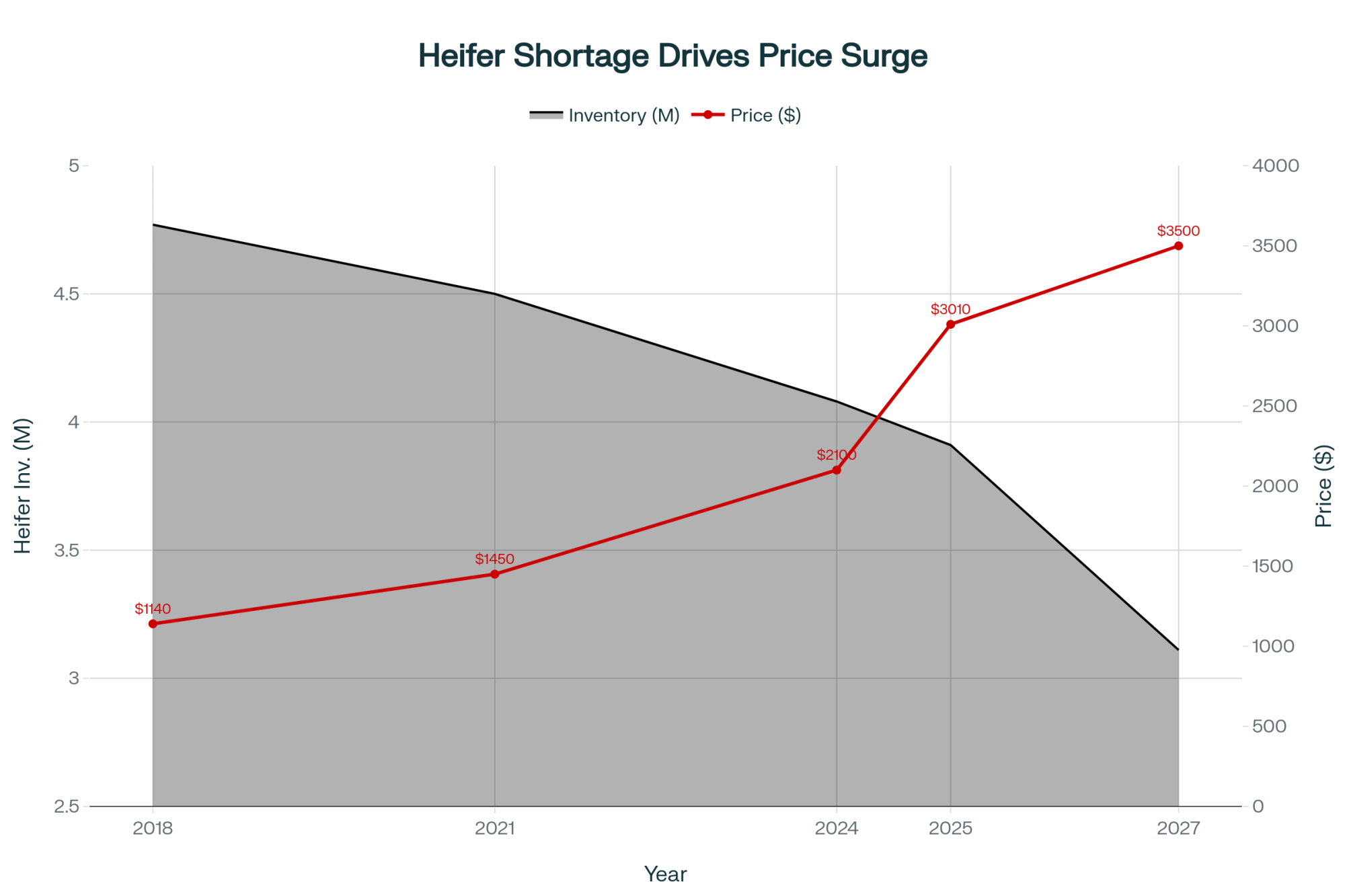
Replacement heifer prices exploded 144% from $1,720 to $4,200 between April 2023 and November 2025, creating an unprecedented shortage that locks the industry into its current size until 2027.

What’s fascinating—and honestly, a bit frustrating—is how predictable the current heifer shortage was, yet how unprepared we seem to be for it.

The price explosion from $1,720 to over $4,000 isn’t inflation; it’s the bill coming due for decisions made years ago.

According to USDA data, dairy heifer inventory hit 3.914 million head in January 2025—the lowest since 1978. I had to double-check that number because it seemed impossible. But it’s real, and it stems from entirely rational decisions made during the challenging price environment of 2015-2021.

When milk prices stayed in that $12-14 range for years, producers did what made economic sense: they bred with beef semen instead of raising dairy replacements. The National Association of Animal Breeders reports beef semen sales to dairy operations nearly tripled from 2017 to 2020.

We essentially removed 800,000 dairy heifers from the pipeline—about 130,000 per year.

Here’s the kicker that keeps me up at night: those breeding decisions from 2019-2021? Those missing heifers would be entering herds right now. Instead, we’ve got producers competing fiercely for the limited genetics available.

A procurement specialist for a large Texas Panhandle operation shared something revealing: “We locked in heifer contracts in early 2023 at $1,900, thinking we were being conservative. Those same genetics are $4,200 today. If we’d modeled $16.91 milk instead of $21, our entire expansion strategy would’ve been different.”

There’s a glimmer of hope, though. Gender-sorted semen sales jumped 17.9 percent from 2023 to 2024—1.5 million additional units, according to the National Association of Animal Breeders.

But meaningful relief? We’re probably looking at 2027.

Regional Realities: Why Your Zip Code Matters More Than Ever

Regional production growth reveals how new processing investments in Idaho (7.0%) and California (6.9%) create permanent $1.50/cwt advantages that no amount of management can overcome in lagging regions.

Looking at the October state-by-state data, what jumped out at me was how dramatically different the dairy economy looks depending on where you’re standing.

The growth stories:

  • California: Up 6.9 percent (though comparing against last year’s bird flu challenges)
  • Idaho: Up 7 percent (that new Glanbia cheese plant in Twin Falls is pulling everything)
  • Texas: Added 26,000 cows despite yield challenges
  • Michigan: Up 4.3 percent
  • New York: Up 4 percent

But here’s where it gets interesting. A Pacific Northwest producer managing 1,800 cows near Lynden, Washington, shared their reality: “We’re getting $16.16 per hundredweight while Idaho producers see $17.66. That $1.50 difference? It’s because we’re shipping to powder plants while they’re shipping to cheese plants.”

This illustrates something I’ve been tracking for a while—the growing divide between regions with new processing investments and those without. The Federal Milk Marketing Order system, despite updates in 2024, still creates these regional disparities based on fluid demand assumptions from another era.

Processing investments are reshaping the geography of dairy: Leprino Foods’ $870 million Lubbock facility, Fairlife’s $650 million New York expansion, and Great Lakes Cheese in Abilene.

These aren’t just plants; they’re creating new centers of gravity for milk production.

Success Stories: Adaptation in Action

While challenges dominate headlines, I’ve encountered several operations that have successfully navigated current conditions through strategic adaptation.

A 1,200-cow operation in central New York completely restructured their approach this summer. They shifted focus from volume to components, reformulated rations to optimize butterfat (accepting a 4 percent volume decrease in exchange for a 0.35 percent butterfat improvement), and locked in 70 percent of their 2026 production through forward contracts.

The result? They’re projecting positive margins even at $17.50 milk.

Another success story comes from a Wisconsin cooperative that pooled resources among five family farms to negotiate better component premiums directly with their processor. By guaranteeing consistent high-component milk, they secured an additional $0.85/cwt premium above standard pricing.

In Pennsylvania, a 600-cow operation near Lancaster took a different approach entirely. They invested in on-farm processing, launching a farmstead cheese operation that now processes 30 percent of their production.

“We realized we couldn’t compete on commodity milk,” the owner explained. “But we could capture more value through differentiation. Our cheese sales are covering the losses on our fluid milk.”

What these operations share is a willingness to challenge traditional approaches and adapt to new realities rather than waiting for old conditions to return.

The Export Paradox and What It Really Means

Here’s something that initially puzzled me: September exports were phenomenal—cheese up 28 percent, butterfat exports nearly tripled according to the USDA.

Yet farm-level milk prices remain depressed. How does that math work?

The answer reveals an uncomfortable truth about global competitiveness. CME cheese at $1.56 per pound versus European cheese at approximately $1.90 (converted from euros) gives us an 18 percent price advantage.

We’re competitive precisely because our prices have fallen.

After processing and logistics, that $1.56 cheese price translates to farm-level milk values around $12.40 per hundredweight. That’s below breakeven for most operations.

So yes, exports are strong, but they’re preventing collapse, not driving recovery.

Mexico accounts for about 30 percent of our exports, according to the U.S. Dairy Export Council. But Rabobank’s November analysis flags something concerning: Mexico is actively building domestic production capacity with government support.

If they reduce imports by even 20 percent, that would be a significant demand shock.

Risk Scenarios: What Could Change Everything

While I’ve focused on current trends continuing, it’s worth considering what could dramatically shift the market:

Disease outbreak: An H5N1 resurgence affecting 5-10 percent of the national herd would immediately tighten supply and drive prices higher. Nobody wants this scenario, but it remains a possibility.

Weather extremes: A severe drought across the Midwest in summer 2026 could quickly reduce production by 3-4 percent. Combined with current tight heifer supplies, this could push milk prices back above $20.

Trade disruptions: New tariffs or trade agreements could fundamentally alter export dynamics. A comprehensive trade deal with Southeast Asian nations could open significant new demand.

Processing consolidation: If one or two major processors face financial stress and close facilities, regional oversupply could quickly become undersupply.

These aren’t predictions—they’re reminders that dairy markets can shift rapidly when unexpected events occur.

Practical Strategies for Navigating Current Conditions

Based on conversations with producers successfully adapting to current conditions, several strategies deserve consideration:

Margin-Based Management

Evaluating individual cow contributions monthly provides objective retention criteria. Several producers mentioned using $40 monthly contribution as their threshold, though your specific number will depend on your cost structure.

Component Optimization

With butterfat premiums at $0.50-1.50/cwt above base (varying by cooperative), optimizing for components rather than volume can improve margins. This might mean accepting lower production for higher component percentages.

Geographic Assessment

Honestly evaluating your regional competitive position matters more than ever. If you’re in a structurally disadvantaged region, consider whether repositioning—through relocation, market channel changes, or value-added production—makes sense.

Risk Management Tools

Forward pricing isn’t about predicting markets; it’s about creating certainty. Several producers described securing 50-70 percent of future production at known prices, allowing them to plan with confidence.

Collaborative Approaches

Producer cooperation—whether through joint marketing, shared resources, or collective bargaining with processors—is gaining traction as a strategy for improving positioning.

Looking Ahead: Key Indicators to Watch

The November and December production reports will reveal whether October’s 6,000-head reduction was an isolated adjustment or the beginning of something bigger.

Here’s what I’ll be watching:

Herd trajectory: Another 5,000+ reduction would signal systematic adjustment. Stabilization suggests October was an anomaly.

Per-cow production: Changes exceeding seasonal norms could indicate compositional shifts in the national herd—are we keeping the best and culling the rest?

Regional divergence: Continued growth in Texas/Idaho, while other regions contract, would confirm geographic consolidation.

Component trends: Rising butterfat with declining volume would indicate a strategic focus on quality over quantity.

The Bottom Line: Adaptation, Not Capitulation

October’s 6,000-head culling amid production growth tells us something important: the industry is beginning to self-correct, with individual producers making rational decisions based on economic reality rather than expansion momentum.

This isn’t about doom and gloom—it’s about adaptation. The operations that recognize current conditions as a new reality rather than a temporary disruption are positioning themselves for long-term success.

They’re not waiting for $22 milk to return; they’re building businesses that work at $17-19.

What’s becoming clear from my conversations across the industry is that successful navigation requires three things: an honest assessment of your specific situation, a willingness to challenge traditional approaches, and the courage to make difficult decisions based on data rather than hope.

The dairy industry has weathered massive transitions before—the shift from small diversified farms to specialized operations, the technology revolution, and multiple trade upheavals. Each time, those who adapted thrived while those who resisted struggled.

Current conditions represent another such transition. How individual operations choose to respond will determine not just their immediate survival but their long-term positioning in whatever structure emerges.

As we await the next production reports, remember that behind every data point are real farming families making real decisions about their futures. The 6,000-head reduction isn’t just a statistic—it represents thousands of individual choices, each reflecting unique circumstances and strategic calculations.

The market is speaking. The question isn’t whether to listen, but how to respond thoughtfully and strategically to what it’s telling us.

Resources for Further Information:

  • USDA Milk Production Reports: www.nass.usda.gov
  • University Extension Dairy Programs: Contact your state extension service
  • Federal Milk Marketing Order Administrators: www.ams.usda.gov/about-ams/programs-offices/federal-milk-marketing-orders
  • Risk Management Tools: Contact your milk cooperative or CME Group Agriculture
  • Dr. Andrew Novakovic’s market analysis: Charles H. Dyson School of Applied Economics, Cornell University
  • Component Premium Information: Contact your regional cooperative

Key Takeaways: 

  • The October Calculation: Keeping a marginal cow means refusing $1,950 cash today to lose $45/month tomorrow—that’s why 6,000 left the herd despite record milk production
  • The 2027 Reality: With heifers at $4,200 and inventory at 45-year lows, the industry is locked into current size until 2027, regardless of price recovery
  • Location Determines Survival: Processing investments have created permanent $1.50/cwt regional pricing advantages that no amount of good management can overcome
  • Three Paths Forward: Optimize for components (butterfat premiums worth $0.50-1.50/cwt), lock in 50-70% of production at $17-19, or relocate to advantaged regions
  • Bottom Line: October proved the market has fundamentally shifted—build a business that works at $17-19 milk or become a statistic

Complete references and supporting documentation are available upon request by contacting the editorial team at editor@thebullvine.com.

Learn More:

Join the Revolution!

Join over 30,000 successful dairy professionals who rely on Bullvine Weekly for their competitive edge. Delivered directly to your inbox each week, our exclusive industry insights help you make smarter decisions while saving precious hours every week. Never miss critical updates on milk production trends, breakthrough technologies, and profit-boosting strategies that top producers are already implementing. Subscribe now to transform your dairy operation’s efficiency and profitability—your future success is just one click away.

NewsSubscribe
First
Last
Consent

Record Dairy Exports Hide a Brutal Truth: You’re Selling at a Loss

Your co-op newsletter: ‘RECORD EXPORTS!’ Your milk check: -$2/cwt. Your banker: ‘We need to talk.’ The disconnect has never been wider.

EXECUTIVE SUMMARY: The U.S. dairy industry’s record cheese exports are actually distress sales, with producers losing $2/cwt as milk prices sit at $16.91 against $19 production costs. Mexico—buying 29% of our exports—is spending $4.1 billion to become self-sufficient, while China’s 125% tariffs have already destroyed our powder markets. The Class III-IV price spread has exploded to $4.06/cwt, the widest since 2011, forcing all production toward cheese that’s selling below profitability. Mid-size farms (500-1,500 cows) face extinction-level losses of $400,000+ annually, with survival limited to mega-dairies with 50% or less debt or premium operations near cities. Producers have 90 days to make irreversible decisions: scale massively, find niche markets, or exit before equity evaporates. The 800,000-head heifer shortage guarantees milk production will contract 3-5% through forced exits, but recovery won’t arrive until mid-2027—and only for the operations structured to survive.

dairy farm profitability 2025

On the surface, the numbers look fantastic. We exported 119.3 million pounds of cheese in August 2025—up 28% from last year, according to the Dairy Export Council. Butter exports nearly tripled. Processing plants are announcing $11 billion in new investments.

But check your bank account. The milk checks aren’t matching the celebration. The headlines say “Record Exports,” but the market reality says “Distress Sale.”

I’ve been talking with producers from Wisconsin down to Texas, and what I’m hearing doesn’t line up with these export headlines. Understanding this disconnect could be the difference between successfully navigating the next 18 months or becoming another casualty of industry restructuring.

The “record export” headlines your co-op newsletter celebrates tell only half the story. Yes, August 2025 cheese exports jumped 28% to 119.3 million pounds—but prices collapsed 13% to $1.82/lb. This is classic distress sale economics: moving volume at any price to avoid even bigger losses. When production costs sit at $18-19/cwt and you’re selling below $2/lb equivalent, every shipment deepens the red ink.

When Being the Cheapest Isn’t Actually Winning

The US dairy industry’s “record exports” mask a brutal reality: American cheese trades at $1.82/lb while European producers command $2.35/lb—a 45-60 cent disadvantage that signals desperation rather than competitive strength. When you’re underselling New Zealand butter by a full dollar per pound, you’re not winning global markets; you’re liquidating inventory below cost.

Here’s what’s bothering me about these export records. Global Dairy Trade auction results from November show American butter trading at $1.57 a pound. New Zealand? They’re getting $2.57. Our cheese is moving at $1.82 while Europeans fetch $2.27 to $2.42.

That 45 to 60 cent spread on cheese isn’t a competitive advantage. It’s desperation.

Penn State Extension’s 2025 dairy outlook shows that a typical 500-cow operation in Wisconsin or Minnesota has production costs running $18 to $19 per hundredweight. But milk prices? We’re at $16.91 for Class III according to CME October data. That’s annual losses of $32,000 to $62,000 for operations that size.

These record exports everyone’s celebrating are happening because we’re willing to sell at prices that don’t cover our costs. South Korean and Japanese buyers see cheap American dairy, and they’re stocking up. Can’t blame them. But volume at a loss isn’t success.

The Time Lag Trap We’re All Stuck In

The breeding decisions you made two years ago—when milk was over $20 per hundredweight—those heifers are just entering the milking herd now.

According to USDA’s latest milk production reports, we’ve added 200,000 cows to U.S. herds over the past 18 months. Every one of those additions made sense when the decision was made. But September production jumped 4.2% year-over-year, and we’re producing 18.3 billion pounds of milk at exactly the moment when global markets are saturated.

Your operation has maybe $300,000 to $500,000 in annual fixed costs—infrastructure doesn’t get cheaper just because milk prices drop. Equipment auction data from Machinery Pete shows you’re looking at 30 to 50% discounts from what things were worth two years ago if you try to sell now.

So we keep producing. We try to spread those fixed costs over more volume. It’s rational for each of us individually, but when everyone does it, oversupply drives prices even lower.

The Mexico Situation Nobody Wants to Talk About

While you’re focused on tariff headlines, Mexico is spending $4.1 billion to eliminate $1+ billion in US dairy imports by 2030. They’re not negotiating—they’re building processing plants in Campeche and Michoacán with 600,000-liter daily capacity and importing Holstein heifers from Australia. Mexico takes 29% of US dairy exports; losing even half that market erases profits for thousands of farms overnight.

While we’re celebrating that Mexico takes 29% of our dairy exports according to USDA Foreign Ag Service data, they announced last July that they’re spending $4.1 billion to become 80% self-sufficient in dairy by 2030.

They’re building processing facilities in Campeche and Michoacán that’ll handle 600,000 liters a day. They’ve imported 8,000 Holstein heifers from Australia—Dairy Australia confirmed that shipment. The Mexican government is guaranteeing their producers 12 pesos per liter.

Mexico buys 51.5% of all our nonfat dry milk exports, according to Export Council trade data. If they achieve even half their plan, we’re talking about losing a billion dollars or more in annual exports. This isn’t a trade dispute that’ll blow over. They’re building the infrastructure right now.

Why Powder Is Collapsing While Cheese Keeps Moving

Class III-IV pricing spread explodes to $4.06/cwt—matching 2011’s record gap and exposing dairy’s new geography of pain. Same cows, same work, but if your milk goes to butter and powder plants instead of cheese, you’re losing $15,000 monthly on a 500-cow operation. This isn’t market volatility; it’s structural divergence that’s rewriting the profitability map.

August export data shows cheese exports up 28%, but powder exports down 17.6%—the lowest August volume since 2019.

The October CME Spread tells the story:

  • Class III (Cheese): $17.81/cwt
  • Class IV (Powder/Butter): $13.75/cwt
  • Spread: $4.06/cwt—widest since 2011

For a 500-cow dairy, that’s a $50,000 swing in annual income depending purely on which plant takes your milk.

China put 125% tariffs on our dairy products back in March. We used to send them 70-85% of our whey exports. That market disappeared overnight. Processors are pushing every pound they can toward cheese because at least there’s still some margin there. Powder production? They’re running the minimum.

Different Operations, Different Realities

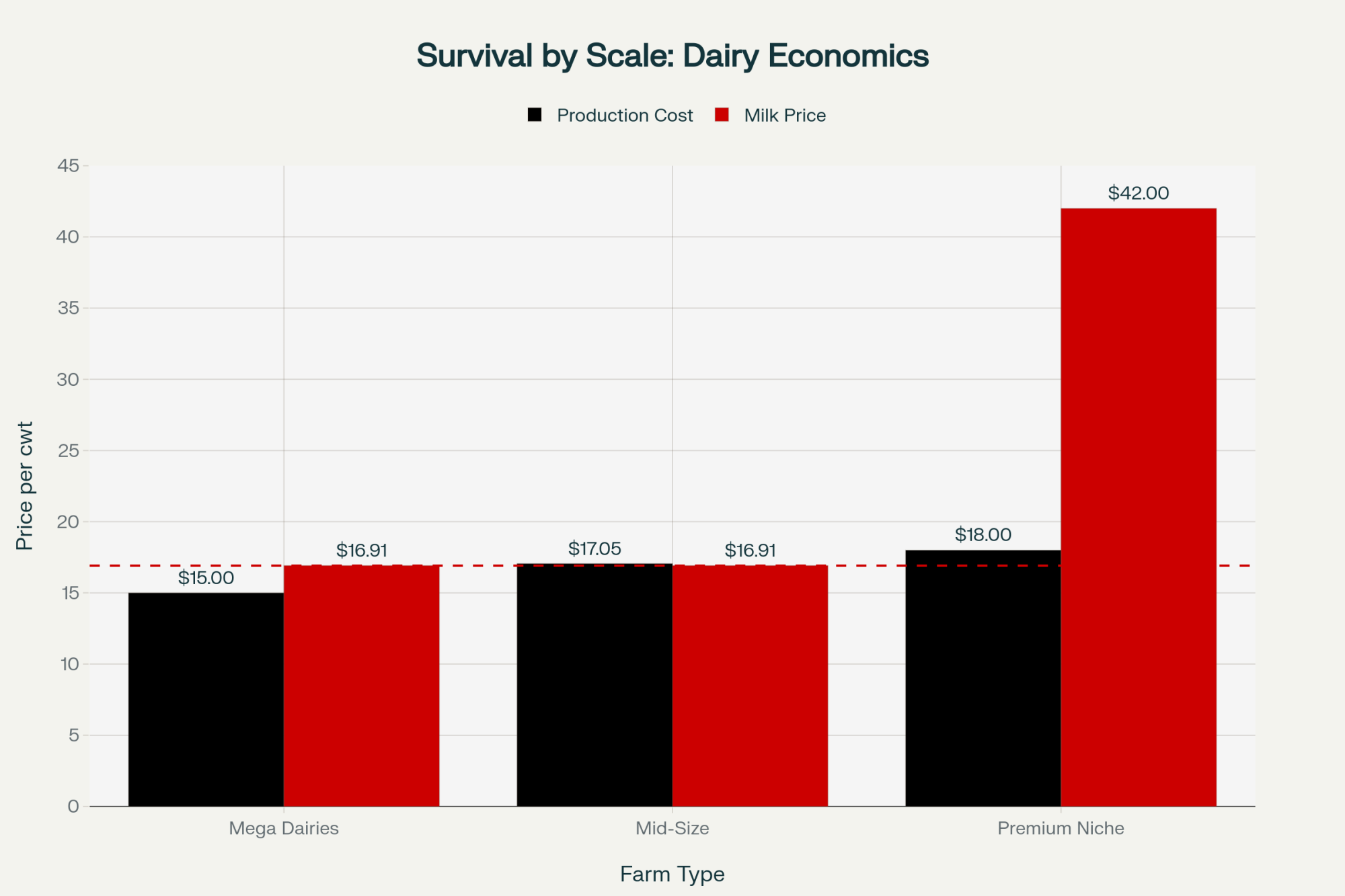
The dairy industry’s brutal bifurcation in one chart: mega-dairies break even at scale, mid-size operations hemorrhage $62K annually, while premium niche players bank $120K. If you’re running 500-1,500 conventional cows, you’re in the kill zone—producing milk at $17.05/cwt and selling it at $16.91. The math doesn’t work, and hoping for better prices won’t save you.

Based on the Center for Dairy Profitability at Madison and the Farm Credit System data:

Mega-dairies (3,500+ cows): Costs around $14.20 to $15.80/cwt thanks to automation and efficiency, according to Michigan State’s benchmarking study. If debt’s under 50% of equity, they can weather this storm. Some are buying out struggling neighbors at 30 to 50 cents on the dollar.

Mid-size operations (500-1,500 cows): The toughest spot. Production costs $16.30 to $17.80 based on Kansas State farm management data. With current milk prices, annual losses could exceed $400,000. Without a path to massive scale or premium markets, options are limited.

Premium niche (organic/grass-fed): Capturing $36 to $50/cwt through outfits like CROPP Cooperative are doing okay. But you need established customers near a city. Operations that went organic without premium market access are worse off than conventional farms due to higher feed costs.

Decision Time: The Next 90 Days Matter


Decision Path
Capital RequiredTimelineEquity RetainedSuccess RateKey Requirements
Exit Now (Controlled)$090-120 days85-95%95% (preserve wealth)Act before March 2026
Scale to Mega (3500+ cows)$8-15 million18-36 months20-40% (high debt)60% (if debt <50%)Low debt + expansion capital
Pivot to Premium Niche$500K-1.2M36 months (organic)70-85%70% (w/ city proximity)Within 50-100mi of major city
Status Quo / Wait & Hope$0Indefinite bleeding0-50% (forced exit by 2027)15-20% (statistically)Hope for market recovery

Based on Purdue’s Commercial Ag projections and USDA’s long-term outlook, you’ve got critical decisions to make in the next three to six months.

Considering expansion? Interest rates are 7.5 to 9% according to the Fed, ag credit conditions. Kansas State data shows that expanding when prices are falling rarely works. Maybe pay down debt instead.

Considering exit? Asset values today versus 18 months from now could be the difference between keeping most of your equity or losing it all. Equipment markets have declined for 25 straight months, according to Equipment Manufacturers data.

Considering organic/grass-fed? It’s a three-year conversion with negative cash flow. You need to be within 50 to 100 miles of a major city, based on consumer research. Penn State Extension says you need off-farm income during transition.

The Heifer Shortage Silver Lining

Here’s your silver lining in a crisis: an 800,000-head heifer shortage over two years mathematically guarantees milk production will contract 3-5% by 2027. Replacement inventory sits at 20-year lows while heifer prices exploded from $1,140 to $3,010—a 164% jump that makes expansion impossible. This forced contraction is exactly what balances supply-demand and triggers recovery. The question: will you survive to see it?

CoBank’s latest report shows we’re at 20-year lows for dairy replacement heifers. We’re short about 800,000 replacements over the next two years.

When you can get $3,500 to $4,500 for a beef-cross calf versus keeping a dairy heifer worth $800 to $1,200 in this market, the math is obvious. Progressive Dairy’s breeding survey shows most producers are making that same decision.

The dairy herd has to shrink—probably 3 to 5% by 2027, according to USDA projections. That might balance supply and demand. Rabobank and CoBank project stabilization by mid-2027, with gradual improvement into 2028.

How Geography Changes Everything

California’s Central Valley faces water costs up 40% according to UC Davis Cost Studies. Meanwhile, South Dakota State University Extension’s 2025 Feed Cost Analysis shows operations there seeing feed costs $1.50 to $2.00/cwtbelow the national average.

Texas added 50,000 cows while Wisconsin stayed flat. That’s economics playing out in real time.

What This All Means for You

Those record export numbers? They don’t mean what the headlines suggest. Moving volume at a loss is a distress sale on a national scale.

The decisions you make in the next 90 days are more important than what you do over the next year. By March 2026, many options available today won’t exist.

Mexico’s self-sufficiency plan is real. We need to plan for our biggest customer becoming a competitor. The Export Council knows it, but I’m not seeing contingency planning at the farm level.

Scale alone won’t save anyone. I’ve seen big operations with too much debt go under, and small operations with good positioning thrive. It’s about your total situation—debt levels, geographic location, market access.

The bifurcation—where you’re either huge or niche—is accelerating. If you’re in that middle range, especially 200 to 1,000 conventional cows, you need to decide which direction you’re heading.

Recovery is coming through contraction. The heifer shortage guarantees that. The question is whether you’ll be around to see it.

Looking Down the Road

By 2028, based on projections from Texas A&M and Cornell, we’ll have fewer, larger operations handling commodity production and smaller, specialized operations serving premium markets. That middle ground where many of us operated for generations is disappearing.

This isn’t random volatility. It’s industry restructuring in response to global competition, changing consumer preferences, as the Innovation Center for U.S. Dairy has tracked, and the reality of 2025 production costs.

When you see export headlines in your co-op newsletter and wonder why your milk check keeps shrinking, remember—it’s not about volume. It’s about margins. The difference between acting strategically now versus hoping things improve could be the difference between preserving or losing your family’s equity.

The herd is heading off a cliff. The record exports are just the dust they’re kicking up. Don’t follow the volume—follow the margin. The next 90 days will decide if you’re a casualty of the restructuring or one of the few left standing to see the recovery.

KEY TAKEAWAYS

  • Your daily reality: At current prices, a 500-cow dairy loses $175/day ($62,000/year). The Class III-IV spread of $4.06/cwt means the same milk yields $50,000 in different income based purely on plant destination.
  • The export trap: Record volumes are happening BECAUSE we’re desperate—selling cheese at $1.82/lb while New Zealand gets $2.42/lb isn’t winning, it’s liquidation.
  • 90-day decision window: By March 2026, you must choose—scale to 3,500+ cows, secure premium markets at $36+/cwt, or exit, preserving 85% equity (vs 0-40% if forced out later).
  • Geographic survival map: Texas/South Dakota operations save $1.50-2.00/cwt on feed. California faces +40% water costs. Location now determines viability as much as management.
  • The guarantee: 800,000-heifer shortage forces 3-5% production cut by 2027, ensuring recovery for survivors—but 40-50% of current operations won’t make it.

Complete references and supporting documentation are available upon request by contacting the editorial team at editor@thebullvine.com.

Learn More:

Join the Revolution!

Join over 30,000 successful dairy professionals who rely on Bullvine Weekly for their competitive edge. Delivered directly to your inbox each week, our exclusive industry insights help you make smarter decisions while saving precious hours every week. Never miss critical updates on milk production trends, breakthrough technologies, and profit-boosting strategies that top producers are already implementing. Subscribe now to transform your dairy operation’s efficiency and profitability—your future success is just one click away.

NewsSubscribe
First
Last
Consent

When Global Dairy Markets Start Talking Different Languages

Kansas farms crushing 19% milk growth while butter stocks crash 10M lbs—the component revolution is separating winners from losers

EXECUTIVE SUMMARY: The dairy industry’s obsession with milk volume over components is leaving serious money on the table while smart producers capitalize on the biggest shift in decades. Despite total U.S. milk production climbing just 3.3%, calculated milk solids surged 1.65% through 2025, with butterfat tests hitting 4.36%—nearly 9 basis points above last year. Kansas farmers are absolutely crushing it with 19% growth while butter inventories dropped from 364.6 to 354.4 million pounds in just one month, creating supply tightness that’s driving premiums higher. Meanwhile, genomic testing is delivering $70 additional value per cow annually, and feed efficiency improvements can save $470 per cow per year on well-managed operations. Global trade tensions—especially China’s dairy import challenges and potential Mexico tariffs—are reshuffling traditional export patterns, creating both risks and opportunities for forward-thinking producers. The bottom line? Producers who pivot from volume thinking to component optimization, leverage genomic selection, and implement strategic risk management are positioning themselves to capture the premiums while their competitors chase outdated metrics.

KEY TAKEAWAYS

  • Component Focus Delivers Immediate Returns: Recent data shows butterfat production jumped 5.3% and protein climbed 4.9% year-over-year, with component-rich milk commanding premium pricing in tightening markets—implement targeted nutrition programs focusing on 16:0 fatty acid supplementation and amino acid optimization to boost component tests within 4-6 weeks.
  • Genomic Testing ROI Pays Off Fast: Genomic selection delivers $70 additional value per cow annually compared to traditional breeding methods, with 65-70% breeding value reliability versus just 20-25% from parent averages—test heifer calves early to identify low-genetic-merit animals before investing $1,400-$2,000 in feed costs per head.
  • Feed Efficiency Gains Cut Major Costs: Improvements in herd feed efficiency from 1.55 to 1.75 equate to savings of $470 per cow per year, contributing about $1.2 million to a 2,500-cow dairy’s bottom line—focus on precision nutrition, waste reduction, and intake optimization to achieve 5-15% efficiency gains that directly impact your largest variable cost.
  • Strategic Culling Captures High Beef Values: With cull cow prices at $145+/cwt and beef-on-dairy crossbreds commanding $900 for day-old calves, strategic herd management decisions can generate significant cash flow—evaluate bottom-performing animals using income-over-feed-cost metrics and leverage current high prices for immediate capital injection.
  • Risk Management Is Non-Negotiable: Class III futures pricing milk at $17.21/cwt through Q3 with feed costs rising and trade uncertainties mounting—lock in 60-70% of winter feed needs now at favorable corn ($4.19/bushel) and implement Dairy Revenue Protection coverage to protect against margin compression in volatile markets.

The week ending July 28th delivered some market signals that honestly have me scratching my head – and I think a lot of producers are feeling the same way.

Two Completely Different Stories Playing Out

Here’s what’s got me thinking about where this industry is headed. While European traders seemed to take a collective breather – moving relatively modest volumes across butter and skim milk powder – Asian markets were going absolutely crazy. I mean, when you’re seeing Singapore exchange activity that massive (we’re talking serious tonnage here), something fundamental is shifting.

The price action tells you everything you need to know. European butter futures drifted lower – nothing dramatic, maybe 0.3% or so – while skim milk powder dropped a bit more. But over in Singapore? Traders were bidding up whole milk powder by nearly 2% and butter climbed close to that same level.

That’s not random market noise, folks. That’s Asian demand meeting supply constraints, and it’s a pattern I’m seeing more of when I talk to guys in the export business.

Production Numbers That Make You Think We’re in a New Era

Get ready for this – and I had to double-check these numbers because they seemed almost too good to be true. New Zealand just posted a 14.5% jump in milk collections compared to last June, according to USDA’s latest international production data. After everything they’ve been through – drought, regulations, you name it – Kiwi farmers are back with milk solids production up nearly 18%.

I was talking to a consultant who works down there, and he says the combination of better weather and that opening milk price signal at $10.00 per kgMS has farmers really motivated again. When you’ve got good feed under your feet and prices that work, producers respond quickly.

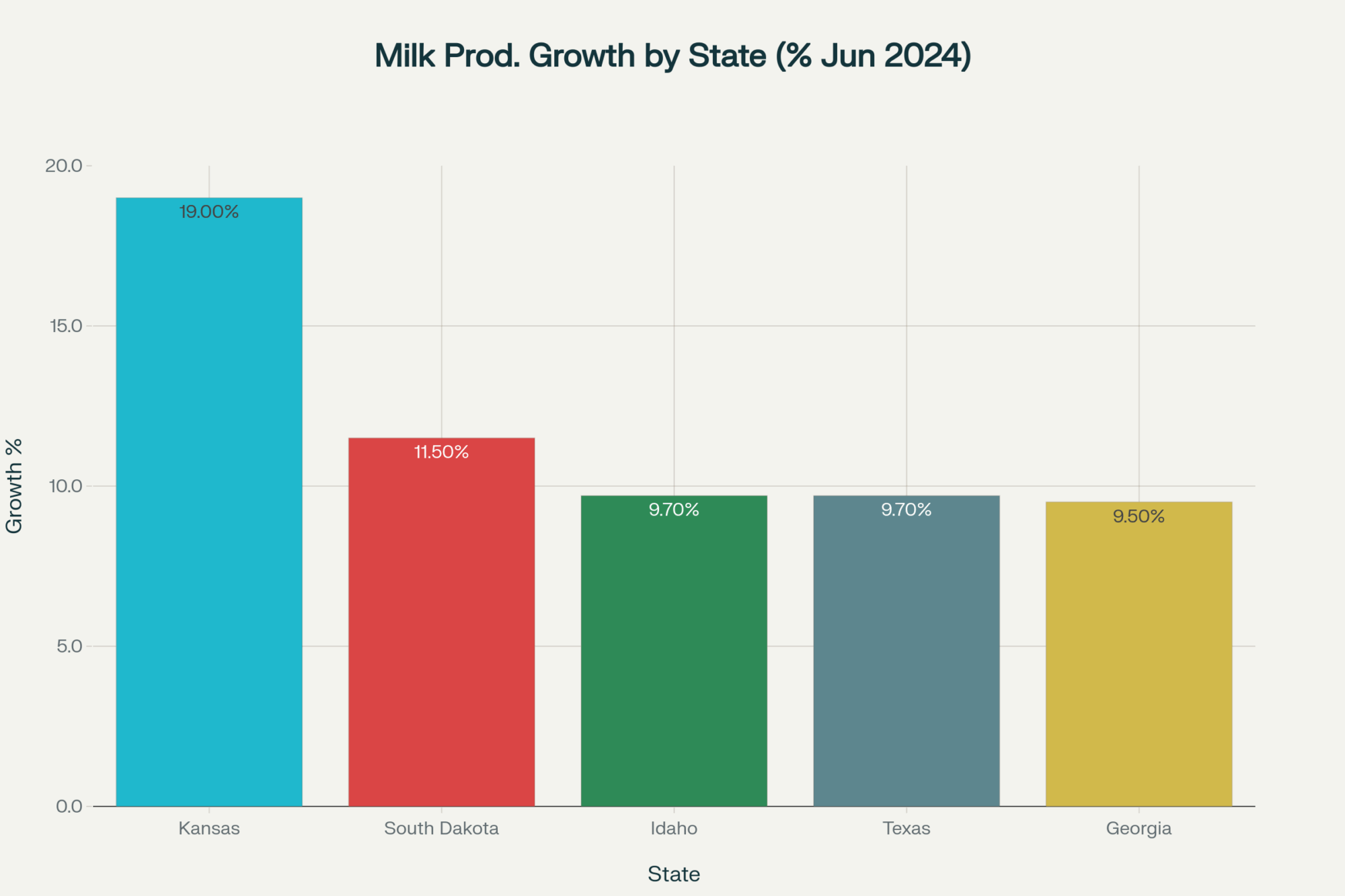
But here’s the number that really caught my attention: USDA’s monthly milk production report shows U.S. output surged 3.3% year-over-year in June – the biggest annual increase since May 2021. Kansas farmers are absolutely crushing it with 19% growth. South Dakota’s up 11.5%, Idaho’s climbing 9.7%.

When you see numbers like that, you know there’s serious infrastructure investment paying off.

What’s fascinating is how regional this is becoming. I know guys in Colorado who are struggling to find homes for extra milk because there’s no new processing capacity, while Kansas producers are basically printing money with all that new cheese-making ability coming online.

Regional Milk Production Growth Percentages for Selected U.S. States (June 2025 vs June 2024)

The component story might be even more important, though. American dairy farmers aren’t just making more milk – they’re making richer milk. Recent USDA data shows butterfat production jumped 5.3%, protein climbed 4.9%, and nonfat solids rose 3.8%.

Dr. Mike Hutjens at Illinois always said the real money is in components when margins get tight, and boy, is he being proven right.

The Heifer Problem Nobody Wants to Talk About

Here’s something that should keep every dairy producer awake at night – and I’m seeing this pattern everywhere I travel. The latest cattle inventory data suggests U.S. dairy farmers are culling significantly fewer cows than historical averages. We’re looking at the lowest cull rates since 2008, and we all remember how that expansion story ended… not well.

Why? Simple math – there just aren’t enough replacement heifers. USDA’s July 1 inventory shows dairy heifer numbers essentially flat, but that’s only after they made some pretty significant revisions to their 2023 estimates. Translation: we’re running short on the next generation, so farmers are keeping older cows longer.

I was at a producer meeting in Wisconsin last month, and a guy who’s been milking for 30 years said something that stuck with me: “I’ve got cows in fourth lactation that I’d normally ship, but I can’t replace them.” That’s happening everywhere, and it’s not sustainable.

Butter Markets Flash Some Serious Warning Signals

CME spot butter took a beating this week, dropping to around $2.465 per pound– testing two-month lows. But here’s where it gets interesting. USDA’s Cold Storage report showed butter inventories actually dropped to 354 million pounds from May to June, which is faster than the typical seasonal drawdown.

What really caught my eye, though, is what’s happening with exports. Industry sources suggest U.S. butter has been showing improved competitiveness in global markets recently. When you’re among the cheapest butter globally and quality is solid, international buyers notice. A trader I know in California says they’re moving more butter overseas than they have in years.

China’s Whey Situation – and What It Means for Everyone

The trade war casualties keep piling up, and this one hits close to home for a lot of Midwest producers. From what industry observers are seeing, Chinese whey imports took a significant hit in June after those mid-May tariffs kicked in.

CME spot whey powder dropped to around 54¢ per pound, and that’s real money out of producer pockets. A guy I know who’s been in the whey business for 20 years told me, “When your biggest customer goes shopping elsewhere, you feel it immediately.”

That’s exactly what’s happening, and it’s a tough lesson in supply chain diversification that maybe we should have learned earlier.

Futures Markets Price in the New Reality

August Class III milk futures fell 56¢ to $17.21 per cwt** this week. The market’s basically telling us to expect $17 milk through Q3, with maybe a modest recovery to just north of $18 in Q4.

Look, these aren’t disaster prices – especially with corn futures at $4.19 and soybean meal at $281.70 per short ton. But they’re a far cry from where we were earlier this year, and margins are definitely tighter.

Class IV settled around $18.95 for nearby contracts, with the back months in the low $19s. A nutrition consultant I work with says these price levels still work for well-managed operations, but there’s not much room for error.

What Argentina’s Telling Us About Global Dynamics

Here’s something that doesn’t get enough attention – Argentina’s dairy sector showed strong recovery during early 2025, with production up 12.4% in the January-May period according to recent industry reports. After the economic chaos they went through last year, that recovery is pretty remarkable.

What’s particularly noteworthy is how quickly producers there responded to better margins. When milk prices moved up and feed costs stabilized, production followed. It’s a reminder that dairy farmers everywhere react to the same economic signals – they just need them to work in their favor.

Bottom Line: What This Means for Your Operation

Here’s what I’m taking away from all this, and what I think matters most for producers making decisions right now:

The heifer shortage is real and it’s going to bite us. If you’re thinking about expansion, replacement heifer costs are only going higher. The guys who locked in bred heifers six months ago are looking pretty smart right now.

Feed cost advantages won’t last forever. With corn at $4.19 and soy meal under $282, this is the time to lock in Q4 and early 2026 feed needs. Every nutritionist I talk to says the same thing – book 60-70% of your winter needs now.

Regional differences are getting bigger. If you’re in an area with new processing capacity, you’re sitting pretty. If you’re not… well, basis is going to be a problem. Transportation costs are already up 12% year-over-year in some regions.

Risk management isn’t optional anymore. With Class III futures pricing in the $17 range through fall, spending a buck or two per cwt on Dairy Revenue Protection beats taking a $3-4 hit on unprotected milk. Do the math on 75 pounds per cow per day – it adds up fast.

Components are where the money is. Every tenth of a percent improvement in milk fat is worth about 30¢ per cwt when margins are this tight. Nutrition programs that boost butterfat are paying for themselves quickly.

The thing that strikes me most about all this is how quickly the landscape is changing. We’ve got production surging in some regions while others struggle with infrastructure constraints. Trade tensions are reshuffling traditional patterns in real time. And underneath it all, we’re running short on the next generation of milk cows.

The producers who adapt fastest to these new realities – who lock in feed costs, manage risk properly, and focus on components – those are the ones who’ll come out ahead. Because if there’s one thing this industry has taught us over the years, it’s that change is the only constant. And right now, we’re seeing more change than most of us have dealt with in a long time.

Complete references and supporting documentation are available upon request by contacting the editorial team at editor@thebullvine.com.

Learn More:

  • DAIRY PRODUCER’S GUIDE To Getting More From Your Feed – The main report highlights shrinking margins and the value of components. This guide provides practical strategies to maximize feed efficiency, helping you boost butterfat and protein production to immediately improve your milk check.
  • The Ultimate Guide to Dairy Sire Selection – With the heifer shortage becoming a critical issue, this article offers a long-term strategic solution. Learn how to refine your breeding program to create more profitable, resilient, and efficient cows from the ground up.
  • Unlocking Dairy Profits: The Untapped Potential of Automation – The market report notes that new infrastructure is creating regional winners. This piece explores how to leverage automation and technology on your own farm to gain a competitive edge and drive profitability when traditional margins are tight.

Join the Revolution!

Join over 30,000 successful dairy professionals who rely on Bullvine Weekly for their competitive edge. Delivered directly to your inbox each week, our exclusive industry insights help you make smarter decisions while saving precious hours every week. Never miss critical updates on milk production trends, breakthrough technologies, and profit-boosting strategies that top producers are already implementing. Subscribe now to transform your dairy operation’s efficiency and profitability—your future success is just one click away.

NewsSubscribe
First
Last
Consent

Where Will Tomorrow’s Dairy Herds Come From? U.S. Farmers Navigate Historic Heifer Crisis

U.S. dairy faces a perfect storm: 47-year low heifer counts, $4,000 springers, and beef-cross mania. Will farmers pivot fast enough to avoid milking herd collapse, or will the next decade’s dairy aisles dry? Dive into the crisis and the fightback strategies.

The numbers don’t lie: America’s dairy farms run on fumes. With heifer inventories cratering to 1978 levels and beef-cross calves now outselling some used Teslas at $1,200 a pop, dairy producers face a brutal ultimatum—cash in on today’s beef gold rush or gamble tomorrow’s milking herds into oblivion. The USDA’s January bombshell? Just 3.914 million heifers remain nationwide, down nearly 1% in a year, while springing heifers fetch $4,000+ a head in desperate bidding wars. ‘We’re burning through generations of genetics to pay the feed bill,’ admits Sarah Klecker, a Wisconsin dairywoman now buying replacements at triple what she sold them for. This isn’t just a shortage—it’s a high-stakes reshuffle of an entire industry’s future. Will farmers pivot fast enough to avoid milking herd collapse, or will the next decade’s dairy aisles dry? Grab your boots. We’re diving into the trenches.

Walking the Beef-Dairy Tightrope—Don’t Look Down!

Alright, let’s cut through the BS. You’ve seen the headlines—“Beef-cross calves outsell used cars!”—but what’s happening in your breeding barn? Why is every farmer and their neighbor suddenly obsessed with Angus bulls? Let’s break it down like we’re leaning on the feed bunk, coffee in hand.

“Profit Today, Regret Tomorrow?” – The Beef-Dairy Dilemma

Look, I get it. When beef-cross calves hit $1,200 a pop at Turlock last January, even my tractor-driving dog sat up and took notice. But here’s the kicker—while breeding your lower-tier girls to beef bulls pays the feed bill today, it’s like robbing Peter to pay Paul. Ask Sarah Klecker up in Wisconsin. She sold 80% of her calves to Angus bulls last year, cleared her debts, and then got sucker-punched buying back springers at $3,800 a head. “Felt like trading my pickup for a bicycle,” she told me.

Wait, scratch that—it’s not just about the money. This ain’t your grandpa’s dairy game. We’re talking 70% of U.S. dairies now playing this high-stakes breeding roulette. But why? Let’s crunch numbers even your accountant would high-five:

  • Sexed semen: 63% of significant operations use it on their cream-of-the-crop cows (think top 25%). Translation? More heifers from your best milkers. Smart, right?
  • Beef bulls for the B-team: The rest get Wagyu or Angus dates—cha-ching – $300–$1,000 more per calf than plain-Jane Holsteins.
  • Retention roulette: Nationwide, we keep only 28% of heifers compared to 52% a decade ago. That’s like betting half your poker chips every hand.

But hold up – where’s the trapdoor here? “What happens when I need replacements and my heifer pipeline’s bone dry?” Exactly.

“So… Do I Starve Now or Later?” – Balancing Acts

Let’s get tactical. You’re not stuck choosing between bankruptcy and herd collapse. Take Ohio’s HeiferTech – for $75 a pop, they’ll genomic test your heifers with 92% accuracy. Translation? You’ll know by week two if that calf’s future is the milk tank or the feedlot.

Or peek at Kansas’ playbook: Feedlots are bulking up heifers at 2.5 lbs/day for just $2.75 daily. That’s cheaper than my morning latte habit. “But what if I can’t afford contracts?” I hear ya. That’s where…

The “Don’t Be a Statistic” Checklist

  1. Genomics or bust: Test early and cull hard. That $75 test could save you $3,800 in springer costs later.
  2. Tier your herd: Sexed semen for your MVPs, beef bulls for the benchwarmers.
  3. Watch your rearview: If retention drops below 30%, you’re flirting with a cliff edge.

Bottom line? This beef-dairy tango can pay – but trip over your feet, and you’ll faceplant into a heifer shortage. Next time we chat, I’ll show you how to dodge HPAI’s sucker punches.

HPAI’s Fertility Sucker Punch – What They’re Not Telling You

Alright, let’s get honest about HPAI. Did you think bird flu was just a chicken problem? Think again. This bugger’s been moonlighting as a heifer wrecking ball—and folks, the damage ain’t pretty. Grab your gloves; we’re diving into the barnyard gut punch nobody saw coming.

“Wait, My Heifers Too?!” – How HPAI Hijacked Herd Math

Yeah, we all saw the headlines—“Bird Flu Jumps to Cattle!”—but here’s what the clickbait won’t tell you: HPAI didn’t just knock cows sideways. It sucker-punched your future milkers right in the ovaries. Let me spell it out:

Texas A&M tracked heifers that survived last year’s outbreak. The kicker? Even the “recovered” ones churned out 18% less milk in their first lactation. Eighteen percent! That’s like buying a new tractor and finding out it plows 18% slower.

But wait, scratch that—it’s worse. Dr. Emily Torres, the sharp mind behind the study, dropped this bomb: “9% of exposed heifers have ovarian scarring. They’re walking infertility time bombs.”

Regional Rundown – Who Got Hit Worst?

HPAI didn’t play fair. Check how your area fared (and grab a stiff drink if you’re in California):

  • California: Took a 15% conception rate nosedive. Heifers hit puberty 22 days later? That’s three extra weeks of feed bills, folks.
  • Midwest: “Only” 8% fewer pregnancies. But hey, those heifers still showed up 14 days late to the breeding party.
  • Southwest: Split the difference with 12% fewer conceptions and 18-day delays. Oh, and 19% more cows got the boot.

Source: USDA’s February gut-punch report

“But my herd tested clean!” I hear you yell. Here’s the kicker: Even exposed heifers who fought off the virus are limping into lactation. Think of it like COVID long-haulers… but for cows.

The Silent Budget Killer – Milk Loss You Can’t Afford

Let’s talk cash. That 18% milk drop? On a 100-cow herd averaging 24,000 lbs/cow, that’s 432,000 lbs of milk gone poof. At $23/cwt? $99,360 evaporated. Yikes.

“How do I even test for this?” Easy. Torres’ team says to run PCR tests on replacement candidates and look for viral residues in blood or milk. It costs about $12/test, but that’s cheaper than raising a dud heifer for two years.

Your HPAI Game Plan – No BS

  1. Test, don’t guess: Screen every replacement for viral leftovers. No exceptions.
  2. Cull hard: Ovarian scarring? Send her to the burger line. Harsh? Maybe. Smart? Absolutely.
  3. Pad your numbers: If HPAI clipped your conception rates, bump your breeding targets by 10-15%.

Bottom line? HPAI didn’t just cost you sick days—it mortgaged your herd’s future. Next time we chat, I’ll show you how Midwest dairies are fighting back with UV barns and immune boosters. For now? Test those heifers. Your 2026 self will thank you.

Regional Roulette – Where’s Your Dairy’s Sweet Spot?

Let’s play a game. Grab a map, close your eyes, and point. Where you land could mean the difference between bankruptcy and boom times. Wild, right? From California’s H2-Oh-No crisis to Texas’ cowboy capitalism, America’s dairy regions are playing by wildly different rulebooks. Buckle up—we’re taking a road trip.

California: Where Water Costs More Than Heifers (No Joke)

Scene: Central Valley, 2025. Dust swirls around a “For Sale” sign on a dried-up alfalfa field. California dairies aren’t just battling HPAI—they’re fighting $1,200/acre-foot water bills (up 30% since ‘23). Result?

  • Milk production: Down 6.8% last year
  • Cows culled: 62,000 (thanks, bird flu)
  • Desperation move: Hauling in Idaho heifers at $3,500/head

Wait—Idaho?? Yep. MilkyWay Farms near Fresno swapped 200 homegrown heifers for 150 Idaho imports. “Cheaper than drilling another well,” the manager shrugged. But here’s the kicker: Those Idaho girls aren’t bred for 110° heat. “We’re running a bovine sauna experiment,” he admits.

“Why stick around?” Good question. Tax breaks? Nostalgia? Stockton cheese plant loyalty? Your guess beats mine.

Texas: Go Big or Go Home (But Maybe Go Home?)

Meanwhile, Texas dairies are expanding like they’ve got a death wish—or +7.5% herd growth in 2024, depending on who you ask. Their secret?

  1. Jersey crosses: 40% of new calves because Holsteins melt like ice cream in August.
  2. Mexico exports: 72% of beef-cross calves head south… for now
  3. Living dangerously: Ignoring Mexico’s 25% tariff threat on $480M of beef

Hold up—tariffs? Oh yeah. Texas dairies could bleed $120M overnight if Mexico pulls that trigger. “We’re bettin’ on AMLO getting voted out,” drawls Amarillo’s biggest producer. Famous last words? Maybe. But hey, everything’s bigger in Texas—including the brass ones.

Midwest: Geriatric Cows & Co-op Hustles

Now, let’s talk about the Midwest’s 3.2 lactation average. Translation? Your grandma’s favorite milk cow is still pumping out butterfat. But here’s the rub: Older cows mean slower rebounds. Enter DairyHeard MN—a co-op sharing 500 springers across 12 farms like a bovine timeshare.

How does that work? Simple:

  • Farm A needs 50 heifers now for expansion
  • Farm B has 60 extras after culling
  • Co-op brokers the swap for $35/day per head

“It’s like Tinder for heifers,” quips a Wisconsin participant. Swipe right on that productivity!

Bottom Line? Your zip code dictates your dairy destiny these days. California’s playing survivalist, Texas is gambling on geopolitics, and the Midwest’s out here inventing cow collectives. Wherever you are, one truth holds: Adapt or get milked dry.

The Genetic Elephant in the Parlor – Are We Breeding Ourselves Into a Corner?

Let’s get uncomfortable for a minute. Sure, beef-cross calves are fattening wallets now—but what happens when your real moneymakers (the ones making milk) start backsliding genetically? Spoiler: It ain’t pretty. Grab a seat. We’re diving into dairy’s dirty little secret.

“Wait, My Cows Are Getting Dumber?!” – The Milk EPD Crash

Here’s the kicker: While we’ve been playing matchmaker between Holsteins and Angus, milk genetics have snoozed. Pre-2020, we boosted milk EPDs by 87 lbs/year. Now? A pathetic 43 lbs/year. That’s like swapping your GPS for a compass. Purdue economists crunched the numbers: Every 10% drop in replacements slashes U.S. milk output by 2.3B lbs in five years.

“But I’m still hitting production targets!” Yeah, for now. Projections show 2030 yields tanking to 26,900 lbs/cow—4% below where we should be. That’s $920 lost annually per 100 cows at today’s prices. Ouch.

Your Genetic Survival Kit—No Lab Coat Required

  1. Audit your EPDs: Sound the alarms if your herd’s milk gains lag behind +50 lbs/year.
  2. Diversify breeding: Allocate at least 30% of cows to dairy-only matings. Yes, even that B-tier cow.
  3. Join a gene bank: Your breed association’s freezer might save your bacon (er, milk) in 2030.

Bottom line? We’re at a crossroads—chase quick beef bucks or invest in the udders that built this industry—your call. But remember: once. Those milk genes fade, and they’re hell to resurrect.

Policy Wars & Trade Tinderboxes—Your Survival Cheat Sheet

Let’s cut through the red tape, folks. While you’re busy calving heifers and dodging HPAI, Uncle Sam and our neighbors are playing chess with your livelihood. Want to know how to avoid getting checked? Let’s decode the madness.

Uncle Sam’s Safety Net (With Strings Attached)

Meet the USDA Heifer Insurance Pilot—the closest thing to a government hug you’ll ever get. Here’s the skinny:

  • Covers 60% of rearing costs if springers tank below $2,800/head (aka ”the oh-crap threshold”)
  • Catch? You heifers— keep ≥30% heifers—no beef bonanzas allowed
  • 2025 signups: 8,100 farms (12% of you) rolled the dice

“Why should I care?” Imagine feed prices spike, springers crash to $2,500, and Uncle Sam cuts you a check for $1,680/heifer (60% of $2,800). That’s the difference between folding and fighting another day.

But wait“What if I’m at 29% retention?” Tough luck, partner. Rules are rules. It’s time to audit those heifer counts like your subsidy depends on them… because it does.

Mexico & Canada: Frenemies With Benefits

Now let’s cross the border—where $1.5B in dairy-beef trade hangs by a thread:

CountryThreatFinancial HitYour Risk
Mexico25% tariff on U.S. dairy-beef$480M in exportsTexas/West screwed
CanadaHemoglobin tests on crosses40% carcass rejectsUpper Midwest woes

Dairy lobbyist Mitch Davis (yes, that guy in the fancy boots) drops truth bombs:

“We’re begging for a ‘dual-use’ loophole. No deal? Say goodbye to 10¢/lb on your culls.”

Translation: If Canada’s new test sticks, your beef-cross calves could get turned back at the border like expired passports.

The “Don’t Get Played” Checklist

  1. Run your retention numbers. If you’re at 28%, work to reach 30% before the USDA deadline.
  2. Diversify exports – Got contacts in Vietnam? Now’s the time to slide into their DMs.
  3. Lobby Smarter – Your state dairy group’s Zoom call? Log in.

Bottom line? Policy ain’t just for suits in D.C. anymore. Whether it’s hedging bets with USDA insurance or dodging tariff shrapnel, your moves this season will echo for years.

From Crisis to Comeback – How One Dairy Turned Desperation Into Genius

Ever feel like your heifer math just isn’t adding up? Take a page from Klecker Dairy in Wisconsin. Last year, they needed 120 springers… and came up 60 short. Instead of panicking, they threw four Hail Mary passes that’d make Aaron Rodgers proud. Let’s break down their playbook.

“We Were 50% Screwed” – The Klecker Wake-Up Call.

Picture this: You’ve got barns ready, feed lined up, and… half the heifers you need. “Felt like showing up to harvest with half a combine,” admits Sarah Klecker. But here’s how they clawed back:

The Klecker Blueprint – Four Moves That Saved Their Bacon

  1. Sexed Semen Smackdown
    1. Target: Top 30% cows
    1. Result: 90% heifer calves (vs. 45% with conventional semen)
    1. “Why waste beef bulls on your MVPs?” Sarah says.
  2. Genomic Guillotine
    1. Spent: $75/heifer testing
    1. Saved: $3,200/heifer by culling low-EPD calves at 2 weeks
    1. Pro tip: “We nixed 30% of calves early. Ruthless? Yes. Profitable? Hell, yes.”
  3. Beef-Bottom 50%
    1. Strategy: Angus bulls on lower-tier cows
    1. Profit: $82,000 (enough to buy 24 springers outright)
  4. Heifer Time-Sharing
    1. Deal: Leased 60 springers at $35/day through DairyCoop WI
    1. “Like Uber for heifers—why own when you can rent?”

The Scoreboard – Did It Work?

MetricBeforeAfter
Herd Renewal Rate50%95%
Cost/Springer$3,800$2,964
Stress-Induced Bald Spots30

Source: Klecker’s 2024 Financials (and Sarah’s hairdresser)

“But what about long-term costs?” Smart question. Those leased heifers? They went back post-calving. But Klecker’s now raising 40 extra homegrown replacements as insurance.

Your Turn – Steal These Moves

  1. Triage your herd: Sexed semen on elites, beef bulls on the rest.
  2. Test early, cull hard: Genomics pay for themselves in 3 calves.
  3. Share the pain: Co-ops aren’t just for hippies anymore.

Bottom line? Klecker didn’t reinvent the wheel—they just spun it more brilliantly. Your move, coach.

Milk Math Meltdown – Can You Even Break Even Anymore?

Let’s play a game. Grab your calculator, your last milk check, and a stiff drink. We’re crunching numbers that’ll make you cheer or chuck your coffee through the barn window. Spoiler: $23.05/cwt milk ain’t what it used to be.

The ”Are You Kidding Me?” Price-Cost Tug-of-War

Here’s the cold, hard truth for 2025:

Metric2025 ForecastChange vs 2024What It Means For Your 100-Cow Herd
All-milk price$23.05/cwt+$0.50”Cool, an extra $5,200/year… right?”
Corn$4.85/bushel+$0.74”There goes $11,100 more in feed”
Diesel$4.10/gallon+$0.90”Add $6,300 in fuel bills”
Avg heifer cost$3,200+$440”Replacing 20 cows? That’s $8,800 extra”

Source: USDA & AAA – because even tractors aren’t immune to inflation

Wait, let’s do REAL math:
$23.05 milk sounds sweet until you subtract $4.85 corn, $4.10 diesel, and heifer costs, eating 14% of your revenue. Suddenly, that +50¢ feels like Monopoly money.

Jed’s Jaw-Dropper: “85% Pregnancy Rates or Bust”

Wisconsin’s Jed Collins drops the mic:

“At $23 milk, I need 85% pregnancies just to break even. We’re stuck at 78%. Something’s gotta give.”

Let that sink in.

  • 78% pregnancies = 78 replacements
  • 85% needed = 7 more heifers you DON’T HAVE
  • Cost to buy seven springers: $22,400 (at $3,200/head)

“But Jed, why not just get better at breeding?” Tell that to the HPAI-infected heifers and $4 diesel.

Your ”What Now?” Cheat Sheet

  1. Run YOUR break-even:
    (Milk price x cwt) – (Feed + Fuel + Labor) = Prayers Required
  2. Lock input prices: Contract next year’s corn at $4.85 before it hits $5.
  3. Hoard heifers: If you’ve got ‘em, keep ‘em. Your neighbor will pay triple in 6 months.

Bottom line? The math’s rigged, but you’re not out yet. Next time we talk, I’ll show you how to squeeze 8% more pregnancies from the same old cows. For now? Hug your accountant.

The Road Ahead – Your Game Plan to Dodge Disaster

So you’ve survived the HPAI outbreaks, navigated beef-cross mania, and kept the milk checks coming. Now what? Let’s map out your next moves—because sitting still ain’t an option.

“What Do I Do TODAY?” – Immediate Fire Drills

  1. EPD Audits: Cull Like a Chef
    Grab your genomic reports. If you’re not axing the bottom 25% of heifers, you’re wasting $3,200/head on future culls. “But they’re already born!” Yeah, and? Sell ’em as bottle calves now or lose $10k later. Ruthless beats bankrupt.
  2. Lock In Springer Contracts – Like, NOW
    June’s coming, and with it, $4,000+/head panic prices. Today’s “ouch” price is tomorrow’s bargain. Pro tip: Midwest auctions are already seeing 18% pre-summer spikes.
  3. USDA Insurance: Your March 31 Alarm Clock
    That 60% cost coverage if springers crash? It’s free money—if you enroll in time. “But paperwork sucks!” So does losing $1,680/heifer—your call.

“What About 2026?” – Long-Game Hail Marys

  1. CRISPR Embryos: $2,500/Dose of Future-Proof
    UC Davis is editing mastitis resistance into embryos right now. “Too sci-fi?” Tell that to the dairies already freezing 2025’s genetics. At $2,500 a pop, it’s cheaper than raising four dud heifers.
  2. Lobby Like Your Herd Depends on It (It Does)
    California’s begging for HPAI disaster relief—$120M in federal aid hangs in limbo. Your state’s turn next. Not a phone person? Fine. Don’t bitch when Canada slaps tariffs on your culls.
  3. Dairy-Only Breeding: The 15% Rule
    If beef-cross bred 85% of your herd last year, flip 15% back to dairy bulls. “But that’s leaving money on the table!” Yeah—to build a life raft.

Your “No-BS” Checklist

TimelineActionCost/Benefit
This WeekCull low-EPD heifersSave $3k+/head in future losses
Next 30 DaysSign USDA insuranceHedge against springer market crashes
By JuneSecure fall springer contractsAvoid $800+/head premiums
2026Buy 5 CRISPR embryosSlash mastitis costs by 40% long-term

Bottom line? The road ahead’s got potholes, but you’ve got the map. Now floor it.

Conclusion: The Heifer Crossroads – Choose Your Legacy

Let’s cut to the chase: America’s dairy industry isn’t just at a crossroads—it’s balancing on a razor’s edge. 3.914 million heifers. $4,000 springers. 18% milk loss from HPAI. The numbers scream one truth: What got us here won’t get us there.

You’ve got two paths:

PATH A: Double down on beef-cross mania, cash those $1,200 checks, and pray your grandkids inherit a herd of beefalo curiosities.
PATH B: Play the long game—reserve 25% of your cows for dairy’s future, lobby like your subsidies depend on it (they do), and bet big on CRISPR, co-ops, and cold-hard genomic culling.

This isn’t just about surviving 2025. It’s about whether there’s a dairy industry left in 2035.

Your Move, Dairy Mavericks:

  • This week: Audit heifers. Cull the bottom 25%. Lock in springer contracts before summer’s price tsunami.
  • This month: Enroll in USDA insurance. Call your congressman. Beg, borrow, or CRISPR your way to better genetics.
  • This year: Shift 15% of your breeding back to dairy. Yes, it’ll hurt. Do it anyway.

The clock’s ticking. The milk tank’s draining. And the world’s watching—will you fade into beef history or fight for dairy’s future?

Look, I’m not selling sunshine. It’s gonna suck. Feed costs will bite. Tariffs will sting. But somewhere between today’s chaos and tomorrow’s empty parlors, there’s a chance to rewrite the rules.

So grab your breeding charts, genomic reports, and lobbyist’s number. The next generation of dairy doesn’t need heroes—it needs fighters who’ll plant trees knowing they’ll never taste the fruit.

Your legacy starts now. Act like it.

Key Takeaways

  • Heifer inventory at 47-year low: 3.914 million head, with only 2.5 million expected to calve in 2025.
  • Springer prices soaring past $4,000/head due to scarcity.
  • Beef crossbreeding boom: 70% of dairy reproduction, offering $1,000+ premiums per calf.
  • Regional challenges: California faces water crises, Texas gambles on expansion, Midwest deals with aging herds.
  • HPAI outbreak impacts: 18% lower first-lactation yields in recovered heifers.
  • Genetic risks: Milk EPDs stagnating, projected 4% yield loss by 2030.
  • USDA Heifer Insurance Pilot offers 60% cost coverage if springer prices drop below $2,800.
  • Tariff threats: 25% duty from Mexico on U.S. dairy-beef, affecting $1.5B trade.
  • Innovative solutions: Sexed semen, genomic testing, CRISPR trials, collaborative heifer pools.
  • Critical decisions in 2025 will shape the industry’s future for decades.

Summary

The U.S. dairy industry faces an unprecedented crisis as heifer inventories plummet to a 47-year low of 3.914 million head, with only 2.5 million expected to calve in 2025. This shortage, driven by aggressive beef crossbreeding, disease pressures, and economic constraints, has sent springer prices soaring past $4,000. Farmers grapple with conflicting priorities: cashing in on high-value beef-cross calves or maintaining their dairy genetic base. The article explores regional disparities, from California’s water woes to Texas’ expansion gamble, and outlines survival strategies. These include precision genomics, USDA insurance programs, and emerging technologies like CRISPR. With milk production stagnating and genetic progress at risk, the industry stands at a crossroads, balancing short-term profits against long-term sustainability. The decisions made in 2025 will shape dairy’s landscape for decades to come.

Learn more

Join the Revolution!

Join over 30,000 successful dairy professionals who rely on Bullvine Daily for their competitive edge. Delivered directly to your inbox each week, our exclusive industry insights help you make smarter decisions while saving precious hours every week. Never miss critical updates on milk production trends, breakthrough technologies, and profit-boosting strategies that top producers are already implementing. Subscribe now to transform your dairy operation’s efficiency and profitability—your future success is just one click away.

NewsSubscribe
First
Last
Consent

US Milk Output Drops Yet Again: Heifer Shortage and Bird Flu Impact Supply and Prices

US milk output has dropped for the 14th straight month. How are heifer shortages and bird flu driving this decline and impacting prices? Please read our latest analysis.

Summary:

U.S. milk production continues to face a challenging landscape, with output falling for the 14th consecutive month in August 2024 due to a shortage of heifers, the ongoing impact of bird flu, and an aging cow population. While component levels like butterfat and protein have improved, overall fluid milk output remains below expectations. These issues drive up premiums and reshape market dynamics for Cheddar cheese, whey powder, nonfat dry milk, and butter. Heifer scarcity limits production growth, and avian flu impacts feed availability and farm operations, leading to tighter milk supply. Older cows contribute to lower efficiency, further challenging dairy producers. Despite these hurdles, there is a silver lining in the improved quality of milk components. The industry faces a paradox of high demand and low supply, necessitating strategic shifts and innovative solutions to navigate market trends and consumer demands.

Key Takeaways:

  • U.S. milk output fell for the 14th consecutive month in August, with a slight decrease of 0.1% compared to August 2023.
  • The heifer shortage significantly impacts dairy productivity, exacerbated by bird flu and an aging herd.
  • Tighter milk supplies have led to increased premiums on spot milk and a notable rise in Cheddar barrel prices.
  • Other dairy products like whey powder, nonfat dry milk (NDM), and butter have also experienced price fluctuations.
  • Despite high prices, dairy markets remain robust, although the limit on price increases without reducing demand has been reached for now.
  • Feed prices have decreased, with a giant corn and soybean harvest anticipated, possibly stabilizing input costs for dairy farmers.
dairy industry decline, milk output reduction, heifer shortage, avian flu impact, aging cow herd, milk prices increase, feed costs challenges, quality milk components, dairy supply chain issues, genetic profiles demand

Have you observed a steady decline in U.S. milk output? August witnessed another fall for the 14th month, a sharp reminder of our industry’s critical issues. Dairy farmers are dealing with a heifer scarcity, a chronic avian flu outbreak, and an aging cow herd. These interrelated concerns are more than simply blips on the radar; they alter the dairy farming environment.

Why does this matter to you? As a dairy farmer or industry professional, your livelihood and operations depend on understanding and managing these changes.  Declining milk production affects everything from milk prices to feed costs and even the long-term sustainability of dairy farming. Here are the critical issues at play: 

  • Heifer Shortage: Fewer young cows entering the dairy herd limit production growth.
  • Bird Flu: The avian influenza has impacted feed availability and farm operations.
  • Aging Cows: Older cows are less productive, contributing to lower milk yields.

These variables combine to produce a perfect storm, resulting in tighter milk supply and higher premiums. However, increasing costs cannot deter the ongoing need for dairy. The industry is at a crucial crossroads, necessitating immediate action, strategic shifts, and innovative solutions. Are you ready to sail these problematic waters and steer the industry towards a more sustainable future?

MonthMilk Output (Million Pounds)Number of Cows (Million)Milk Yield per Cow (Pounds)Cheddar Production (Million Pounds)
August 202318,2009.3651,943325
September 202317,9009.3551,913320
October 202318,1009.3501,936328
November 202317,8009.3401,904315
December 202318,0009.3351,926322
January 202418,2009.3301,948330
February 202417,6009.3201,887305
March 202418,0009.3151,930318
April 202417,9009.3101,922316
May 202418,1009.3051,946325
June 202417,9009.3001,924320
July 202418,0009.2951,936322
August 202418,1809.3251,949312

Quality Over Quantity: The Silver Lining in Declining U.S. Milk Output 

It’s time to shift our focus from quantity to quality. The silver lining in declining U.S. milk output allows us to reevaluate our priorities and concentrate on producing high-quality dairy products. Milk output in the United States has decreased somewhat, falling by 0.1% from August 2023. While this may seem insignificant, it is the 14th month of lower milk quantities. Despite the decline, important milk components like butterfat and protein have improved significantly.

Why are these components important? Butterfat and protein are critical to the dairy industry’s profitability and product quality. A higher butterfat percentage increases the richness of goods such as butter and cream, making them more marketable and lucrative. Similarly, increasing protein levels are required to produce high-quality cheese and other dairy products that customers want.

So, although total fluid milk flow has decreased, increases in butterfat and protein help offset some of the losses. These growing components show that dairy producers are concentrating on quality and maximizing the value of their products. The industry responds to problems by enhancing milk components and keeping dairy products competitive and profitable.

The Heifer Shortage: A Looming Crisis for Dairy Farmers 

The heifer scarcity is not just a challenge; it’s a looming crisis for the dairy industry. Various sources, including disease outbreaks such as avian flu and bluetongue, are causing this shortfall. Dairy farmers have sent considerably fewer cows to slaughter over the last year—43,900 less in August alone than the previous year—resulting in steady but aging herds. Today, 40,000 fewer cows are actively producing milk than a year ago. This is a situation that demands immediate attention and action.

Low call rates may seem a winning strategy initially, but they have long-term consequences. An aged dairy herd implies that cows with inferior genetic potential stay in production, reducing efficiency. Aging cows often produce fewer and lower-quality milk components than their younger counterparts. For example, in June, July, and August, national average milk outputs dropped below the levels of two years earlier. Typically, we predict a 2% rise in yields over two years. Still, current data indicate stasis or reduction, underscoring the negative consequences of an aged herd.

Farmers attempt everything to keep barns filled and milk production up, but diminishing yields repeatedly undercut their efforts. The combination of aged cows and a scarcity of heifers ready to step in has delayed growth in milk component levels. This is crucial because although increasing butterfat and protein content in milk is desired, the existing situation is unsustainable for fulfilling long-term production targets. This downward trend in productivity, combined with increased demand, puts further strain on dairy farmers, leading the sector into a problematic phase ahead.

Bird Flu: It’s Not Just About Poultry Anymore 

When we hear about avian flu, we often think of its immediate effect on poultry. However, this illness has spread across the agricultural community, including the dairy industry. Despite its name, the avian influenza virus infects more than simply birds. It affects the supply chain, affecting dairy producers in unanticipated ways.

Let’s break it down. Bird flu has further aggravated the heifer scarcity by polluting feed supplies. When avian flu hits, quarantine procedures take effect; these precautions may impede or even halt the passage of animal feed. Less feed results in slower development rates for heifers, which delays their arrival into the milking herd. This results in a backlog that dairy producers need help to overcome.

Furthermore, the disease’s effect on chickens financially strains the agricultural industry. As the poultry business deals with widespread bird flu epidemics, financial and logistical resources are redirected to tackle these problems. As a result, the dairy sector, which is already struggling to replace heifers, will have fewer resources.

The bird flu epidemic has added another layer of complexity to an already strained dairy supply chain.  We’re experiencing delayed heifer maturity and a considerable decrease in milk output. This rippling impact is challenging to control rapidly.

Statistics support this pessimistic perspective. According to the USDA, feed delays and greater culling due to avian flu have resulted in a 5% decline in total heifer replacements this year [USDA Agricultural Statistics, 2024]. This has led to the continued fall in milk output, worsening an already limited supply situation.

So, the next time you think about bird flu, realize it isn’t only a poultry issue. It is a complicated agricultural problem affecting the whole supply chain, particularly our dairy farmers.

Ripple Effect: How Tight Milk Supplies Are Reshaping Cheddar Prices

Tighter milk supply has considerably impacted market pricing and spot milk premiums. When milk is abundant and affordable, cheesemakers capitalize by scaling up Cheddar barrel production—a very efficient procedure for increasing output. However, this year’s reality is different: spot milk shortage and high cost have decreased Cheddar barrel production.

According to the most recent figures, U.S. cheddar output has decreased by 7.2% compared to the previous year’s quantities. This significant decline has led to a notable scarcity, with CME spot Cheddar barrels reaching an all-time high of $2.6225 per pound as of last Wednesday. To put this into perspective, this price is [X times] higher than the average price over the past [X years]. The premium for Cheddar blocks has reached an all-time high of 37.75˼ [source], indicating strong market demand despite limited availability.

This premium on spot milk and the following decline in Cheddar barrel output demonstrates the delicate balance between supply and demand and how even tiny swings may have far-reaching consequences across the dairy supply chain.

Milk Supply Squeeze: Ripple Effects on Whey Powder, Nonfat Dry Milk, and Butter 

Milk supply constraints have also influenced other vital dairy products, such as whey powder, nonfat dry milk (NDM), and butter. Let’s examine how these markets have responded.

  • Whey Powder: The market for whey powder has declined in recent weeks. Spot whey powder prices fell 1.75 cents to 58.75 cents per pound, showing a lack of solid demand despite a limited milk supply. One possible explanation is that dairy processors have shifted their emphasis to other profitable products, neglecting whey powder manufacturing.
  • Nonfat Dry Milk: Despite increases in milk powder costs at worldwide auctions, the price of nonfat dry milk has fallen by 1.25 cents. This price decline might indicate manufacturers’ deliberate initiatives to balance supply and demand better. With milk supplies limited, producers may prioritize other products, resulting in a modest excess of NDM.
  • Butter: Butter prices fell significantly, down 15.75 cents to $2.9725 per pound. This is the first time since May that spot butter prices have fallen below $3. Butter. Makers have planned ahead of time for the Christmas baking season to prevent harsh price increases in 2022 and 2023. This week’s sharp selloff indicates that their efforts may have effectively ensured enough stockpiles, perhaps stabilizing prices as the holidays approach.

Butter’s price decrease reflects a more significant trend of dairy product pricing adapting to the constrained milk supply scenario. As dairy farmers and producers face these issues, the market reaction will remain crucial to monitor in the coming months.

Forecasting the Future: Navigating Long-Term Effects on Milk Production 

The long-term consequences of the heifer crisis, avian flu, and other supply chain disruptions will continue to pose severe difficulties to milk production and dairy product availability. With the heifer scarcity alone, dairy producers struggle to maintain herd levels and maximize output. Industry experts foresee a continued impact on milk output due to an older, less efficient dairy herd. This inefficiency may lead to decreased production levels, requiring manufacturers to emphasize quality above quantity.

Avian flu, once seen as a poultry issue, has had repercussions across the dairy business. Potential cross-species transmission and the overall effect on cattle health generate uncertainty, which farmers must carefully handle. When combined with illnesses like bluetongue, the impact on milk output might be more significant than any one cause.

What about price increases? Limits to price increases are becoming more apparent. While tighter milk supply has pushed up premiums, there is a limit to how high prices may go before stifling demand. According to a recent study conducted by the International Dairy Foods Association (IDFA), “sustained high prices could lead to demand destruction, where consumers turn to alternative products or reduce consumption altogether” [source: IDFA report]. This behavior may cause a market downturn sooner rather than later.

Recent market movements demonstrate a complicated terrain. Despite rising prices, some dairy farmers take comfort in the resilience of milk components such as butterfat and protein, which remain strong. However, the issue remains: Can increased component strength compensate for the total fluid milk output loss?

Industry analysts also warn about the possibility of heightened volatility. The balancing act between production limits and market demand may result in price fluctuations, which impact everything from farm gate revenues to retail pricing. As a result, producers and individuals in the supply chain must stay adaptable to changing circumstances while prioritizing sustainability and long-term survival.

The dairy industry’s collective resilience will be challenged as we traverse these difficult times. Strategies based on innovation, efficiency, and quality will be critical in navigating this moment of uncertainty. The path ahead is not without hurdles but opportunities for those prepared to adapt and progress.

The Paradox of High Demand and Low Supply: Navigating the Price Squeeze 

The interaction between diminishing milk yield and rising foreign demand generates an intriguing contradiction. While dairy products such as Cheddar barrels and Mozzarella continue in great demand, supply restrictions drive higher costs. This dynamic puts dairy producers in a promising position. Are you feeling the strain, or have you successfully used pricing increases to balance your books?

It’s critical to recall the key variables. The heifer scarcity and the effect of avian flu aren’t just transitory setbacks; they have the potential to influence the market in ways we don’t yet fully comprehend. As prices rise yet stable, the crucial issue is: How will your approach adapt? Will you invest in newer genetic profiles to replace elderly cows, and how will you protect your herd from illnesses such as avian influenza?

Furthermore, the ripple effects extend beyond dairy farms—the increased cost of milk seeps down to cheese manufacturers, complicating their operations. When spot milk prices rise, producers may shift production to Mozzarella to suit export requests, reducing Cheddar barrel output. This complex network of supply chain responses demonstrates the interconnectivity of global and local economies.

These market trends provide obstacles and opportunities for those who sell to dairy producers. Is there an increase in demand for specific genetic profiles or disease-resistant breeds? And how will fluctuations in feed costs influence the items you offer to increase milk yields? The continuing discussion among farmers, suppliers, and markets is critical for navigating these challenging times.

The more considerable economic repercussions cannot be overlooked. Dairy producers may get respite as feed costs fluctuate due to a favorable U.S. crop and export demand. Reducing feed prices may help alleviate some of the operational challenges generated by the milk supply bottleneck. It’s a delicate balance, but with careful preparation and innovative collaborations, there’s cause for hope.

Ultimately, the emphasis remains on resilience and flexibility. Staying aware and responsive to new developments will be crucial as the dairy industry evolves under these pressure factors. What tactics are you using to guarantee that your dairy company survives in this volatile environment? Please share your thoughts and join the discussion as we all navigate the future of dairy farming.

Feed Price Drop: A Ray of Hope Amid Dairy Challenges 

This week, feed costs plummeted as farmers began blending corn and soybeans. Early data indicate that there will be a large crop, and prices have already fallen low enough to attract new export sales and increase local demand. This is excellent news for dairy producers, who confront various issues, including heifer shortages and avian influenza.

Lower feed prices significantly assist dairy producers by lowering one of their most significant operational expenditures. The prognosis for feed costs continues to be encouraging, with corn futures ending today at $4.015 per bushel (down 12.25 cents from last Friday) and soybean meal closing at $320.20 per ton (down a couple of dollars on the week). This drop in feed costs may help balance the challenges of reduced milk yields and tighter milk supply, bringing much-needed financial respite.

Furthermore, the whole market dynamics are altered. Lower feed prices often mean lower production costs for dairy producers. This may help them maintain or even enhance milk production despite their difficulties. Increased output may assist in maintaining or lowering milk costs, benefitting consumers and increasing demand.

Market estimates indicate cautious optimism. Concerns about a dry start to the South American crop year and a recent decrease in the U.S. currency index have enhanced export expectations, pointing to a balanced market. As usual, the interaction of large harvests and increased demand will keep the market volatile, but the trend toward decreasing feed prices provides some relief for the time being.

So, what does this imply for you as a dairy farmer? It’s a chance to review your feed plans and financial estimates for the following months. While the overall problems of milk production are significant, decreased feed costs give a strategic benefit that should be considered.

The Bottom Line

U.S. milk production has encountered its fair share of obstacles, including a 14-month straight fall caused by heifer shortages, an aging cow herd, and external causes such as avian flu. Despite the drop in total yield, improvements in milk components provide some optimism. However, producers should recognize the need for strategic preparation in navigating these uncertain times.

The link between restricted milk supplies and rising spot milk prices emphasizes the need for a supply-demand balance. The effects are extensive, affecting not just fluid milk but also cheese, whey powder, nonfat dry milk, and butter. These market dynamics demonstrate the complex interaction of different forces, which requires continual monitoring and flexibility.

Looking forward, the dairy business must be prepared for continuing volatility. Effective resource management and keeping informed will be critical for navigating the obstacles and exploiting the possibilities that lie ahead. As the environment changes, dairy producers who remain forward-thinking will be able to prosper in the face of uncertainty.

Learn more: 

Join the Revolution!

Bullvine Daily is your essential e-zine for staying ahead in the dairy industry. With over 30,000 subscribers, we bring you the week’s top news, helping you manage tasks efficiently. Stay informed about milk production, tech adoption, and more, so you can concentrate on your dairy operations. 

NewsSubscribe
First
Last
Consent

Heifer Shortage Crisis: Why Dairy Farmers Are Struggling Despite Soaring Milk Prices

Uncover the surprising reasons behind the heifer shortage hitting dairy farmers hard, even as milk prices soar. Will they be able to solve this issue and expand their herds? Find out more.

Milk prices are at their highest in years, but dairy producers face an unanticipated catastrophe. It feels like a contradiction. Despite good on-farm margins and lower feed costs, dairy farmers face a huge challenge: a severe shortage of heifers and young cows for future milk production. This shortfall is more than a mere inconvenience; it alters dairy producers’ plans and choices throughout the country. The market has been delivering a clear message: produce more milk. But what can farmers do when the appropriate livestock are not available? In the following parts, we’ll examine the causes of the heifer scarcity, its influence on the dairy business, and whether current high prices can reverse the situation.

MonthHeifers Sent to Beef Packinghouses (thousands)Average Price per Heifer ($)Milk Yield Trend (compared to previous year)
September 202328.62,950Stable
December 202325.43,000Stable
March 202423.13,200Slight Decrease
June 202421.13,300Decrease
July 202420.73,350Decrease

Economic Highs and the Surprising Heifer Dilemma: What’s Holding Dairy Farmers Back?

Dairy producers are enjoying some of the most favorable economic circumstances in years. Lower feed costs and predictable milk profits enable farmers to pay off debt and save for the future. This stability has arrived at a critical moment, providing a much-needed cushion against previous financial strains.

But it does not end there. The market is indicating that it’s time to increase the milk supply. The temptation to produce more milk is straightforward, with prices hovering around $20 per hundredweight. Farmers are prepared and eager to satisfy this demand, but a significant impediment is the heifer scarcity.

Scarcity Strikes: How the Heifer Shortage is Undermining Dairy’s Economic Boom

The heifer shortage has struck the dairy sector hard, challenging the momentum of recent economic highs. This shortfall has worsened since September when dairy companies looking to increase their herds encountered a shortage of heifers. The shortage caused them to rethink their strategy: fewer cows were transferred to beef packinghouses, and less productive milk cows were retained longer than usual.

This shift is evident in the stark numbers: from September 2023 to June 2024, dairy farmers sent 286,100 fewer milk cows to beef packinghouses than the previous year. Initially, this technique seemed practical since U.S. milk output stayed consistent throughout the autumn and winter. However, the consequences have now become apparent.

The most recent Milk Production report reveals milk yields at or below year-ago levels in two-thirds of the 24 central dairy states, including areas unaffected by exceptional weather circumstances. This pattern highlights heifers’ crucial role in maintaining and increasing milk output. The lack of heifers and the dependence on less productive cows are already noticeably lowering milk output, posing a challenge for farmers looking to capitalize on good economic circumstances.

Rising Heifer Prices Aren’t Just a Headline: The Operational Burden for Dairy Farmers

YearHeifer Price (per head)
2018$1,500
2019$1,750
2020$2,000
2021$2,200
2022$2,500
2023$2,800
2024$3,075

Rising heifer prices are more than just a headline; they are a significant issue for many in the dairy business. Last week, the top 25 springers sold for between $3,000 and $3,300 per head at the monthly auction in Pipestone, Minnesota. It wasn’t simply a regional increase; top-quality Holstein springers averaged $3,075 at the monthly video auction in Turlock, California. These statistics are startling when considering how they will affect your operation’s finances.

Imagine planning a herd expansion only to discover that heifers suddenly cost thousands more than expected. The financial hardship is confirmed. Higher heifer prices raise starting expenses, forcing many companies to reconsider their breeding strategy or postpone growth plans entirely. Although milk sales remain stable, rising expenditures make it difficult to invest for the future or pay off debt.

With beef prices high, many people turn to hybrid dairy-beef calves for a more immediate cash source. This technique provides a faster financial return but needs to address the long-term need of keeping a healthy milking herd. It’s a difficult decision: spend substantially now with uncertain future profits or capitalize on the present meat market for faster gains.

The problem is more than statistics; it is about planning for sustainability in a volatile business. Your ability to handle these complex dynamics will influence the future of your operations, so it is vital to be aware and adaptive.

Why Are Dairy Producers Leaning Towards Crossbred Dairy-Beef Calves? 

Why do dairy farmers choose crossbred beef calves over conventional dairy heifer ones? The solution rests in irresistible economic incentives. Crossbred calves may provide more immediate cash, frequently commanding $200 to $400 more than purebred Holsteins. This quick income is a game changer for dairy producers wanting to secure their finances in an ever-changing market.

However, the value of dairy heifers remains variable. Investing resources in growing replacement calves is a long-term risk, with no certainty that these heifers will be worth the high price when ready to join the milking herds. In contrast, revenue from beef calves is immediate and guaranteed, making it a less hazardous and more tempting choice for farmers. The quick financial gain from beef calves helps dairy producers navigate a volatile sector, maintaining a consistent revenue stream even when prices move.

Traditional Breeding Battles Modern Economics: A Minority’s Approach to Sustaining Heifer Supplies

Surprisingly, a small number of dairy farmers are adopting a more conventional strategy for breeding, focused on maintaining appropriate heifer headcounts to support their herds. These farmers recognize the long-term importance of a consistent supply of replacement heifers, even if it means preceding some immediate revenue from crossbred dairy beef calves. However, these changes are minor enough to reduce the overall heifer shortfall significantly. The financial incentives for generating crossbred calves are too appealing, causing most dairy producers to prefer quick, consistent revenue above long-term profits. As a result, even those who return to conventional breeding need to produce more heifers to alter total heifer availability. This circumstance exacerbates the current shortage, highlighting the intricate economic calculations dairy farmers must make in a volatile business.

Future Focus: Will Short-Term Gains Trump Long-Term Stability in Dairy Farming? 

The present breeding practices and prolonged heifer deficit are expected to have long-term consequences for the dairy business. These trends pose severe concerns regarding the sustainability and efficiency of dairy production. Will the quick profitability from crossbred dairy-beef calves balance the long-term advantages of ensuring enough heifer supplies? This problem has the potential to influence breeding methods significantly.

Due to present economic incentives, dairy farmers progressively leaning toward crossbreeding may see their choice becoming a standard practice. The guaranteed income from cattle calves offers a lifeline in an unstable industry. However, this change may accidentally diminish the total dairy cow herd, reducing milk production capacity and increasing reliance on shifting market circumstances for beef.

Suppose heifer prices remain low to encourage a return to conventional breeding. In that case, the business may progressively migrate toward farms specializing in beef-dairy hybrids. This trend may cause dairy farm operations to prioritize short-term profitability over long-term herd growth, thereby changing the farming environment.

Furthermore, dairy producers that oppose this tendency and continue with conventional breeding may find themselves in a unique situation. If heifer prices finally line with the risks and expenditures connected with their growth, these farmers might reap significant benefits. They may become major competitors in a market desperate for high-quality dairy cows, resulting in a competitive but more stable economic climate.

Finally, the endurance of these present breeding tendencies may signal substantial changes in dairy farming operations. Whether this results in a widespread move toward crossbred beef-dairy herds or a return to conventional breeding, today’s actions will influence the industry’s future. Dairy producers must balance immediate financial rewards and long-term herd viability when analyzing breeding options.

The Bottom Line

As we handle increasing heifer pricing and the transition to hybrid dairy-beef calves, it’s clear that dairy producers have a distinct set of issues. Despite having the highest on-farm margins in years, the heifer scarcity threatens long-term viability. While some ranchers continue to use conventional breeding techniques, most find the instant money from beef calves too appealing. This delicate balance between short-term profits and long-term stability will dictate dairy farming’s future. Will the heifer scarcity cause a significant shift in dairy production practices?

Key Takeaways:

  • Feed costs have decreased, and milk revenues remain stable, improving on-farm margins.
  • There is a significant shortage of heifers, driving prices to between $3,000 and $3,300 per head.
  • High beef prices incentivize dairy farmers to produce crossbred dairy-beef calves instead of purebred heifers.
  • From September 2023 to June 2024, 286,100 fewer milk cows were sent to beef packinghouses than the previous year.
  • Milk production has decreased in 16 of the 24 largest dairy states, affecting long-term herd management.

Summary:

Dairy farmers enjoy unprecedented on-farm margins thanks to reduced feed costs and stable milk revenues, but a significant heifer shortage hinders increased milk production. With heifer prices soaring—last week, the top 25 springers ranged from $3,000 to $3,300 per head at the monthly sale in Pipestone, Minnesota—and beef prices at record highs, many farmers are opting for crossbred dairy-beef calves, which offer a more immediate and reliable revenue stream. From September 2023 to June 2024, 286,100 fewer milk cows were sent to beef packinghouses, while milk yields are below year-ago levels in 16 of the 24 largest dairy states, complicating long-term herd management strategies.


Download “The Ultimate Dairy Breeders Guide to Beef on Dairy Integration” Now!

Are you eager to discover the benefits of integrating beef genetics into your dairy herd? “The Ultimate Dairy Breeders Guide to Beef on Dairy Integration” is your key to enhancing productivity and profitability.  This guide is explicitly designed for progressive dairy breeders, from choosing the best beef breeds for dairy integration to advanced genetic selection tips. Get practical management practices to elevate your breeding program.  Understand the use of proven beef sires, from selection to offspring performance. Gain actionable insights through expert advice and real-world case studies. Learn about marketing, financial planning, and market assessment to maximize profitability.  Dive into the world of beef-on-dairy integration. Leverage the latest genetic tools and technologies to enhance your livestock quality. By the end of this guide, you’ll make informed decisions, boost farm efficiency, and effectively diversify your business.  Embark on this journey with us and unlock the full potential of your dairy herd with beef-on-dairy integration. Get Started!

Learn more: 

Dairy Market Mania: How Heatwaves, Bird Flu, and Heifer Shortages are Shaking Up Milk Production and Prices

Heatwaves, avian influenza, and skyrocketing heifer costs are wreaking havoc on milk production and driving up prices. Are you ready for the mounting challenges in the dairy industry?

Summary:  The dairy markets surged this week, fueled by an unprecedented heatwave, avian influenza, and a heifer shortage, tightening milk supplies. U.S. milk production hit 18.8 billion pounds in June, down 1% from the previous year, continuing a trend of lower output. While higher components like milk solids and butterfat offer some relief, they fall short of meeting demand. Key states saw sharp production declines due to heat and avian flu, amplifying scarcity. This has driven up prices for whey powder, cheese, and butter, presenting mixed outcomes for the industry. Producers are retaining older, less productive cows to sidestep high heifer costs, deteriorating herd productivity and long-term viability. Despite these hurdles, increased milk solids and butterfat output somewhat offset reduced milk production.

Key Takeaways:

  • The dairy markets are heating up as summer sets in, exacerbated by factors like the hot weather, avian influenza, and a shortage of heifers.
  • Milk output in the U.S. was 18.8 billion pounds in June, down 1% from the previous year, marking the lowest first-half production since 2020.
  • High temperatures, particularly in Arizona, California, and New Mexico, have significantly impacted milk production.
  • Avian influenza has further strained production, especially in states like Colorado, Idaho, and Michigan.
  • The trend of keeping older, less productive cows to avoid buying expensive heifers is resulting in reduced milk yields.
  • Increased demand for bottled milk has contributed to tighter supplies, even with higher component levels in milk.
  • Commodity prices, especially for whey powder and cheese, are on the rise due to stronger domestic demand and limited supply.
  • Class III and Class IV milk futures have seen significant gains, reflecting the market’s response to these supply challenges.
  • Political uncertainties, particularly regarding trade relations with China, have temporarily affected feed markets, causing a rally in soybean and corn futures.

As the summer heats up, so do dairy markets. However, the rising concerns, driven by intense heatwaves in critical areas, avian influenza outbreaks, and a persistent heifer shortage, are leading to a significant drop in milk output and profoundly impacting the dairy industry. Arizona and New Mexico experienced the highest temperatures in June, while Colorado and California’s Central Valley saw record-breaking nighttime lows. U.S. milk output in June was 18.8 billion pounds, down 1% from the previous year and the lowest first-half production since 2020. While higher components have kept U.S. milk solids and butterfat production slightly ahead of last year, more is needed to meet the needs of dairy processors. Despite these challenges, the adaptability and resilience of farm managers and industry experts are evident as they manage operations under adverse conditions, necessitating essential modifications effectively.

Heatwaves Hammer U.S. Dairy Industry

StateJune Average Temperature (°F)June Record High Temperature (°F)June Overnight Low Temperature (°F)
Arizona85.6120.075.2
New Mexico79.1110.062.4
Colorado65.7105.050.1
California’s Central Valley82.3115.072.6

Despite Record Temperatures and Aging Herds, the Dairy Industry Remains ResilientThe recent heatwaves’ severity and persistence have set new temperature records in crucial dairy-producing regions like Arizona, New Mexico, Colorado, and California’s Central Valley. This extreme heat has significantly impacted milk output and the health of dairy herds, underlining the severity of the situation.

Arizona and New Mexico experienced the highest temperatures in June, while Colorado and the Central Valley endured record nightly lows. These extreme heat conditions have stressed dairy cows significantly, leading to declining milk production. For instance, Arizona saw a staggering 3.9% reduction in milk output, while New Mexico experienced an even more drastic 12.5% drop. The heatwaves have affected milk production and the dairy herd’s health and productivity, exacerbating the milk supply shortage.

The heatwaves have also changed the mix of dairy cows. Producers are likelier to keep older, less productive cows than invest in more expensive heifers, decreasing the total herd size. This choice, prompted by severe weather, has resulted in an older and less productive dairy herd, worsening the milk supply shortage. Even if the weather fades, the long-term consequences on milk output may linger, putting production levels below the previous year’s standards.

Bird Flu Blunders: Avian Influenza Intensifies the Dairy Dilemma in Key States

Avian influenza has complicated the difficulties confronting the dairy business, notably in Colorado, Idaho, and Michigan. In Colorado, dairy farmers have been hit by harsh heat and avian influenza outbreaks. This twofold danger has compounded the problem, reducing milk supply and affecting overall herd health.

Idaho and Michigan have also seen the effects of avian flu. Milk output in Idaho fell by 1%, while Michigan had a 0.9% decline. The avian influenza outbreaks have increased biosecurity measures and operating expenditures, increasing demand for available resources. Producers in these states are attempting to preserve herd output while limiting the danger of the virus spreading.

Compounding these difficulties, the illness has distracted attention and resources that might have been directed toward other vital concerns, including heifer scarcity and market demands to improve milk supply. Consequently, dairy farmers in these areas face a challenging environment in which every action influences their enterprises’ short—and long-term survival.

Heifer Havoc: Skyrocketing Costs and Aging Cows Threaten Dairy Industry’s Future

YearHeifer Shortage (%)Average Heifer Cost ($)
20205%1400
20217%1600
202210%1800
202313%2000
2024 (Projected)15%2200

One of the major issues currently plaguing the dairy sector is the significant scarcity of heifers. This shortage is primarily driven by the high expenses of purchasing young heifers, which makes dairy farmers more unwilling to renew their herds. The heifer market has seen an inflationary spiral driven by extraordinary feed expenses, veterinary care, and general maintenance, all contributing to increased financial pressures on farm management.

Consequently, many producers choose to keep older cows, which, although cost-effective in the near term, has its own set of issues. These older cows are often less productive than their younger counterparts, decreasing milk output. Keeping these older cows in production results in a less efficient herd, which is bad news for future milk production.

The ramifications of an aging herd are numerous. Reduced milk yields restrict current production capacities and jeopardize the long-term viability of dairy farms. Lower productivity implies that the dairy business may need help to satisfy market demands, especially during peak consumption or export periods. Furthermore, older cows have longer calving intervals and more significant health risks, which may increase veterinary expenditures and a shorter productive lifetime.

The ongoing heifer shortfall may limit the industry’s capacity to recover from recent output slumps. However, with a consistent supply of young, productive heifers, the chances of reversing the downward trend in milk output are high. This situation underscores the need for deliberate investment in herd management and breeding programs to maintain a balanced and profitable dairy herd.

Sweltering Heat and Avian Attacks: U.S. Dairy Industry Faces Production Dip, But High Components Offer Hope

MonthMilk Production (in billion pounds)Change from Previous Year
January19.2-0.5%
February17.8-0.7%
March19.1-0.8%
April18.5-1.2%
May19.0-1.0%
June18.8-1.0%

This summer’s heat has certainly impacted U.S. milk production, which reached 18.8 billion pounds in June, a 1% decrease from the previous year—the first half of this year had a 0.9% decrease in output, the lowest since 2020. While some areas saw record-high temperatures, others were hit by avian influenza, which exacerbated the slump. Compared to previous years, these numbers highlight a disturbing trend compounded by the persistent heifer scarcity and aged herds. Despite these obstacles, there is a bright line: more excellent components imply that U.S. milk solids and butterfat production has continued to exceed prior year levels. This increase is crucial for dairy processors looking to fulfill market demand and sustain production levels despite decreased fluid milk yields. The increased butterfat and solid content mitigate the impact of reduced milk output, ensuring that dairy products remain rich in essential nutritious components.

Scorching Heat and Bird Flu: Regional Milk Production Tanks with Double-Digit Declines

StateProduction Change (%)Factors
Arizona-3.9%Record High Temperatures
California-1.8%Heat Wave
Colorado-1.1%Heat Wave, Avian Influenza
New Mexico-12.5%Record High Temperatures
Idaho-1.0%Avian Influenza
Michigan-0.9%Avian Influenza

Milk production has fallen significantly in states dealing with heatwaves and avian influenza. Arizona’s output fell by a stunning 3.9%, while California saw a 1.8% drop. Colorado was not spared, with a 1.1% decline in production. However, New Mexico had the most severe consequences, dropping milk output by 12.5%. These significant decreases emphasize the negative impact of harsh weather and illness on regional dairy operations, emphasizing the critical need for adaptable measures.

Tight Supply Chain Strains: High Component Levels Can’t Offset Milk Scarcity in Dairy Production 

Tighter milk supplies are having a noticeable impact on dairy product production. The shortage limits production capacity despite greater component levels, such as increased milk solids and butterfat. This bottleneck is visible across many dairy products, resulting in limited supply and price increases.

Notably, fluid milk sales have shown an unusual increase. Sales increased by 0.6% from January to May, adjusted for leap day, compared to the same period in 2023. This is a tiny but meaningful triumph for a sector experiencing falling revenues for decades. Increased bottling demand has put further pressure on milk supply, making it even more difficult for dairy processors to satisfy the industry’s requirements. As a result, although the increase in fluid milk sales is a welcome development, it also exacerbates the scarcity of other dairy products.

Milk Market Madness: Prices Skyrocket as Whey, Cheese, and Butter React to Tight Supplies

MonthClass III Milk Price ($/cwt)Class IV Milk Price ($/cwt)Cheese Price ($/lb)Butter Price ($/lbth)Whey Price ($/lb)Milk Powder Price ($/lb)
April$17.52$18.11$1.85$2.97$0.52$1.20
May$18.25$18.47$1.87$3.04$0.54$1.22
June$19.10$19.03$1.89$3.06$0.55$1.22
July$20.37$20.12$1.91$3.07$0.56$1.24
August$21.42$21.24$1.93$3.09$0.57$1.23
September$21.89$21.55$1.95$3.11$0.58 

The confirmation of decreasing milk output and the likelihood of more decreases has shaken the market. Prices rose, especially in the CME spot market. Whey powder prices skyrocketed from 5.25 to 57 cents per pound, reaching a two-year peak. Strong domestic demand for high-protein whey products and limited milk supply in cheese-producing areas drive significant growth.

Cheese prices have followed suit, rising considerably. CME spot Cheddar barrels increased by 5.75 percent to $1.93, while blocks increased by 6.5 percent at the same price. U.S. cheese production has been defined as “steady to lighter,” cheese stocks have declined, notably with a 5.8% reduction in cold storage warehouses as of June 30, compared to mid-year 2023. This reduced stockpile and record-breaking exports have resulted in tighter U.S. cheese supply and higher pricing. However, potential supply shortages will have a more significant impact in the future.

Butter had a modest gain, inching ahead by 1.5 percent to settle at $3.09. Although there is still a significant supply of butter in storage (6.8% more than in June 2023), concerns about availability as the year develops have affected the price.

During these price increases, the futures market responded strongly. Class III futures increased by 84 percent to $21.42 in September. Class IV futures increased by almost 20% and settled above $21, demonstrating strong market confidence amid tighter supplies and rising demand.

Whey Powder Bonanza: Prices Hit Two-Year High, Boost Class III Values, and Drive Market Dynamics

The whey powder industry has experienced a startling jump, with prices increasing from 5.25 to 57 cents per pound—a more than 10% increase. This is the highest price in two years, indicating a positive trend supported by strong local demand for high-protein whey products. Furthermore, tighter milk supply in cheese-producing areas has contributed to the rising trend. The whey market’s strength is a big boost for Class III values, as each penny gains in the whey price adds around 6˼ to neighboring Class III futures. Spot whey prices increased by about 7% in June and July compared to the first half of the year, resulting in a 40% increase in Class III pricing. Dairy experts should actively follow these changes since they substantially impact profitability and market dynamics.

Cheese Market Surge: Soaring Prices and Shrinking Inventories Signal Major Shifts

The cheese market is undergoing a significant transition, with prices constantly rising. CME spot Cheddar barrels surged considerably, reaching $1.93 per barrel, while blocks followed suit, reaching $1.93 per pound. Several variables contribute to these price changes, as does the present position of low cheese supplies.

For starters, cheese production in the United States has been defined as “steady to lighter,” which necessarily reduces the available supply. Cheese stocks fell in June as yearly, but this year’s drop was magnified by counter-seasonal falls from March to May. This condition resulted in 5.8% less cheese in cold storage on June 30 compared to mid-year 2023.

The dairy sector has also profited from record-breaking exports, which have helped to constrain the U.S. cheese supply. However, this phenomenon has a double edge. Although export demand has boosted prices and decreased local stockpiles, its long-term viability is still being determined. Export sales have begun to decline, and although local demand remains solid, it is unlikely that it will be strong enough to propel cheese prices beyond $2.

Butter Market Alert: Holiday Shortages Loom Despite Stock Increases and Rising Prices

The butter market saw a slight stock drop in June, indicating more considerable supply restrictions in the dairy industry. Despite a 6.8% increase in storage since June 2023, butter merchants are concerned about probable shortages in supermarket stores as we approach the holiday season in November. Butter prices have increased by 1.5 percent this week to $3.09, indicating a cautious outlook. The sector is prepared for a challenging quarter owing to strong demand and tight supply constraints.

Milk Powder Market Movement: Prices Surge to Five-Month High Amid Tight Supplies and Global Competition 

After months of sluggish pricing, the spot milk powder market has finally stirred, rising into the mid-$1.20s and finishing at a five-month high of $1.2325. This considerable increase is attributable to a combination of causes, the most prominent of which is dramatically reduced U.S. milk powder stocks due to continuous decreased production levels. Dairy managers and industry experts should be aware that competition for export markets is becoming more severe, a situation aggravated by China’s lack of considerable purchase activity. While New Zealand’s milk production season has started slowly, Europe’s milk output has progressively increased, topping year-ago levels by 0.4% in April and 0.6% in May. This increase in European manufacturing may soon lead to more robust milk powder offers, possibly weakening U.S. export competitiveness. Farm managers must be diligent about market signals and inventory management to negotiate a tighter supply chain.

Future Shock: Spot Market Gains Propel Class III & IV Milk Contracts to New Heights

The recent increase in spot markets has caused significant volatility in the futures market, notably for Class III and IV milk products. Futures prices have risen dramatically due to increasing spot prices for dairy commodities such as whey powder and cheese. The September Class III futures contract increased by 84 percent to $21.42, while Class IV futures climbed roughly 20 percent to remain over $21.

These price increases are primarily due to U.S. milk production growth limits. Record-breaking heatwaves have drastically reduced milk output in dairy cattle. The avian influenza has further exacerbated these losses by lowering herd size in important dairy states. An aged herd, compounded by the high expense of procuring replacement heifers, further impedes production advances. Despite greater component levels contributing to production, total milk supply remains constrained, driving up market prices.

Finally, more robust spot markets and the twin hurdles of heat-induced production losses and avian flu effects have resulted in an optimistic forecast for the futures market. Dairy farmers and market analysts should pay careful attention to these trends as they negotiate the complexity of a business experiencing unprecedented pressure.

Political Jitters Jolt Feed Markets: Potential Trade War with China Spurs Soybean and Corn Futures Rally

This week, political uncertainty has placed a pall over the feed markets. The main issue is the possibility of a fresh trade war with China, fueled by the changing political situation in the United States. As talk grows about a potential second term for Trump, battling against Vice President Harris rather than an aged President Biden, financial experts are concerned that trade dynamics may alter substantially. Tightening ties between the U.S. and China might significantly affect U.S. soybean exports, the world’s largest market.

In reaction to this uncertainty, the market saw a brief respite in feed price reductions early in the week. November soybean futures increased by more than 40%, while December corn futures increased by 16%. Traders assessed political concerns against crop quantities yet to be harvested and stored. However, by the end of the week, emphasis had returned to the immediate plenty of grain, resulting in price stability.

Today, December corn ended at $4.10 a bushel, up a cent from last Friday. November soybeans finished at $10.46, while December soybean meal was $324 a ton, up $19 from the previous week’s multi-year low. Despite short-term political uncertainty, the overall prognosis indicates that grain will remain plentiful and reasonably affordable shortly.

The Bottom Line

As we confront an extraordinary summer challenge, excessive heat, avian influenza, and heifer shortages have significantly reduced milk supply, dramatically dropping U.S. milk output. These gains have scarcely compensated for the shortages despite increased product components such as milk solids and butterfat. Extreme heatwaves in important dairy states such as Arizona, California, Colorado, and New Mexico and avian influenza outbreaks in Colorado, Idaho, and Michigan have substantially reduced production. Furthermore, the unwillingness to invest in pricey heifers has resulted in an aged, less productive dairy herd, impeding future expansion. These factors and a minor increase in fluid milk demand have pushed prices up, particularly for whey powder, cheese, and butter, severely hurting consumer costs and industry profits. The present status of the dairy business in the United States highlights the critical need for adaptive methods, such as improved herd management and investments in younger cows, to mitigate the consequences of climate change and disease outbreaks. How will your business adjust to strengthen resilience and ensure future output in these challenging times?

Learn more: 

Big Milk Checks and Low Feed Costs: A Profitable Summer for Dairy Producers

Learn how dairy producers are earning big milk checks and benefiting from low feed costs this summer. Will this profitable trend last despite challenges like heifer shortages?

Dairy farmers are reaping substantial milk checks while benefitting from decreased feed prices. This unusual position provides a tremendous opportunity for everyone in the dairy business, including farmers and analysts. The present very favorable economic climate enables dairy producers to expand their businesses. A boom like this typically results in more milk supply and cheaper pricing. Still, problems like heifer scarcity and external factors limit expansion. Understanding how to handle these moments may help dairy producers achieve immediate and long-term success. The dairy sector environment is reshaped by fundamental market factors, such as decreasing feed prices and increased meat income.

Unprecedented Financial Prosperity: Dairy Producers Enjoy Robust Revenue Streams and Low Feed Costs

MonthCorn ($/bushel)Soybeans ($/bushel)Soybean Meal ($/ton)
April4.2011.00325.00
May4.1010.75320.00
June4.0010.50310.00
July3.9010.35307.40

The present financial picture for dairy farmers is powerful. Substantial milk checks and increased money from cattle sales have greatly improved the bottom line. Low feed costs boost financial wealth. Beneficial weather in the maize Belt has caused the USDA to rank 68% of maize and soybeans in outstanding condition, providing dairy farmers an ideal opportunity to lock in feed prices at multi-year lows. This attractive mix of high revenues and minimal inputs opens up untapped opportunities for financial stability and future challenge preparedness.

Converging Challenges: Factors Constraining Dairy Production Growth

The present market dynamics in the dairy business are heavily driven by variables that limit milk production growth. The heifer scarcity is a significant barrier, restricting herd growth and driving prices to $3,300 per head. Higher interest rates hamper dairy investment by increasing financing costs. Hot summer temperatures diminish milk output and impair herd health, necessitating extra attention. Furthermore, avian flu disrupts feed supply systems. Despite reduced feed prices, interruptions due to health problems in associated industries increase unpredictability. These issues, taken together, create a harsh climate for dairy farmers. While they provide good profits, their potential to increase milk output is restricted, limiting oversupply and stabilizing milk prices in the near run.

Soaring Heifer Prices Reflect Unprecedented Demand Amid a Heifer Shortage 

DateLocationAverage Price per HeiferPrice RangeRemarks
Last WeekTurlock Livestock Auction Yard$3,075$2,850 – $3,300Record price range indicating high demand
This WeekPipestone, Minnesota$3,150Top 25 AverageSustained high prices despite limited supply

Heifer prices are skyrocketing, indicating a significant demand for dairy farmers to fill their barns. At the Turlock Livestock Auction Yard’s monthly video auction, Holstein springers recently sold for $2,850 to $3,300 each. Similarly, the top 25 springers averaged $3,150 each in the Pipestone, Minnesota auction. These rates reflect the necessity of securing heifers in the face of scarcity.

Concurrently, cull rates have dropped to record lows. In the week ending July 6, dairy cow slaughter fell to 40,189 head, the lowest level since December 2009 and 20.6% lower than the same week in 2023. This reduction suggests that farmers hold on to cows they could have slaughtered because of high heifer prices and replacement issues.

Consequently, dairy cow numbers are expected to grow, possibly boosting milk production. However, integrating lower-producing cows may decrease the average output per cow, making it challenging to optimize milk quality and efficiency.

Uneven Demand and Supply Dynamics Threaten Dairy Market Stability

CommodityAverage Price (July 2024)Quantity Traded4-Week Trend
Whey$0.50552Up
Cheese Blocks$1.863023Stable
Cheese Barrels$1.898022Stable
Butter$3.114069Up
Non-Fat Dry Milk$1.179510Down

The dairy market’s trajectory is finely balanced between demand and supply dynamics. Despite the present affluence, low demand for dairy products poses a considerable concern. Cheese consumption remains high due to local promotions and increased exports based on previous low pricing. However, it is still being determined if this tendency will continue. While spring’s record exports lowered cheese stocks, this activity is projected to slow, possibly raising inventory levels and increasing prices if fresh demand does not materialize.

Future cheese sales domestically are uncertain. A slowdown may quickly lower prices. The CME spot market shows volatility, with spot Cheddar barrels increasing by 6.25˼ to $1.9125 per pound and Cheddar blocks decreasing by 2.5ͼ to $1.865. These differences highlight cheese demand’s unpredictable nature.

Cheese’s domestic appeal helps to balance the market against shortages. Still, a reduction in demand or underperforming exports might upset this equilibrium. Industry worries are reflected in uneven spot market movements. Elevated pricing and deliberate inventory sell-offs are a balancing act against declining exports and unreliable domestic demand. The dairy industry’s survival depends on managing these uncertainties and reducing risks.

Converging Pressures: Divergent Trends in Whey and Milk Powder Markets Define Dairy Sector’s Future 

The whey industry is increasing due to increased domestic demand, especially for high-protein varieties. This demand has limited dry whey production, raising prices. CME spot whey powder gained by 0.75̼ this week, hitting 51.75̼, its highest level since February. The USDA’s Dairy Market News indicates that supplies are limited, with producers selling out monthly.

In contrast, the milk powder market in the United States has recurrent production deficits and poor export prospects. At the most recent Global Dairy Trade (GDT) auction, prices of skim milk powder (SMP) and whole milk powder fell by 1.1% and 1.6%, respectively. CME spot nonfat dry milk (NDM) initially followed this pattern. Still, it rallied late in the week, closing at $1.1975, up 1.75 percent from the previous Friday.

The effect of these changes is noticeable. Strong domestic demand has reduced whey supply and raised costs. Meanwhile, the milk powder market faces restricted supply and sluggish exports, limiting prospective price increases. These opposing developments show the dairy market’s varied pathways.

Heatwave-Induced Strain: Analyzing the Ripple Effects on Butterfat Levels and Cream Pricing Dynamics

The warmer weather has significantly impacted milk output and butterfat levels. Cream prices rose in the East and West but stayed stable in the Central Region. Butter output has decreased due to the bad weather, particularly in the West. Despite this, butter prices dipped this week due to heavy trade in Chicago. The market’s forecast of stable pricing through October promotes fast sales to prevent storage expenses. The CME spot market saw an astonishing 69 cargoes change hands, the most in over a year. Despite the high costs, buyers remain active, fearing future shortages.

Whey and Cheddar Surge Lifts Class III Futures: Strong Market Dynamics Promise Financial Stability 

The healthy whey and cheddar barrel markets have bolstered 2024 Class III futures. The August contract increased by 28 cents to $19.97 per cwt, while the September and October contracts gained roughly 50 cents, finishing in the mid-$20s. Despite Class IV futures holding high at about $21.50, most contracts lost money. This pricing should cover expenditures and allow for debt repayment or future planning.

Weather-Induced Prosperity: Dairy Producers Benefit from Ideal Crop Conditions Driving Down Feed Costs

The present level of feed prices provides a significant relief for dairy farmers, owing to the healthy condition of the maize and soybean harvests. Favorable weather in the Corn Belt has resulted in extraordinary crop growth, with the USDA rating 68% of corn and soybeans as good to excellent. Cooler-than-normal temperatures have helped maize during its crucial pollination season, resulting in record-high yields. Feed prices have dropped further, with September corn futures reaching $3 and the December contract ending at $4.055 per bushel, a 9 percent decrease from last Friday.

Similarly, increased confidence in soybean supply has pulled November soybean prices down by 30 to $10.355 per bushel, while December soybean meal futures have declined by $6.70 to $307.40 per ton. These patterns enable dairy farmers to lock in feed prices at multi-year lows, allowing them to profit on historically strong dairy margins.

Crafting a Comprehensive Risk Management Strategy for Dairy Producers

Dairy farmers need effective risk management to navigate fluctuating market situations. Locking down feed prices at current lows is an appealing approach. Producers that secure feed contracts today may stabilize input costs, reducing future price concerns and assuring more predictable financial planning. This foresight ensures profitability even if feed markets rise suddenly.

Furthermore, the Dairy Income Protection (DRP) scheme provides a strong safety net, protecting against quarterly milk sales income declines based on pricing and production levels. This protects farmers from market changes and ensures revenue stability. Futures and options also help to control price risk. Hedging future milk sales or feed purchases allows producers to lock in advantageous pricing while reducing market vulnerability. This guarantees that manufacturers may maintain lucrative margins by taking advantage of rising pricing.

Locking low feed costs, participating in the DRP program, and leveraging futures and options contribute to a holistic risk management plan. It enables dairy farmers to control expenses, protect income, and take advantage of favorable market circumstances, resulting in a more predictable and profitable financial future.

The Bottom Line

Dairy farmers face an environment characterized by high milk check income and low feeding expenses. Celebrating their financial success, they also confront a unique set of obstacles and possibilities. High heifer prices, low slaughter rates, and robust demand all point to continued profitability. However, low demand, export uncertainty, and weather changes need a deliberate strategy. Dairy farmers must lock in low feed prices, use risk management techniques such as Dairy Revenue Protection (DRP), and keep alert to market trends. To achieve long-term success, be educated and nimble. Now is the moment to use the economic recovery to increase your farm’s resilience and sustainability.

Key Takeaways:

  • Producers are experiencing significant financial gains, with high milk checks and additional revenue from beef sales.
  • Feed costs are at multi-year lows, providing an opportunity for dairy producers to secure favorable financial terms.
  • Efforts to increase milk production are hampered by a shortage of heifers, along with elevated interest rates, high summer temperatures, and the bird flu.
  • Heifer prices have surged, reflecting heightened demand against a backdrop of scarce supply.
  • Despite reduced cull rates, milk yields may decline as producers hold onto lower-production cows due to heifer shortages.
  • Cheese and whey markets show variable trends, with strong domestic demand driving prices upward, while export volumes appear poised to decrease.
  • The combination of high temperatures and decreased butterfat levels has led to fluctuating butter and cream prices.
  • Class III futures are buoyed by strong whey and Cheddar prices, promising financial stability for dairy producers.
  • Ideal weather conditions in the Corn Belt are contributing to low feed costs, enhancing economic prospects for dairy producers.

Summary:

Dairy farmers are experiencing financial prosperity due to increased milk checks and decreased feed prices, allowing them to expand their businesses and increase milk supply and cheaper pricing. However, problems like heifer scarcity and external factors limit expansion, such as higher interest rates, hot summer temperatures, and avian flu. Heifer scarcity restricts herd growth, driving prices to $3,300 per head. Cull rates have dropped to record lows, and dairy cow slaughter has fallen to 40,189 head, the lowest level since December 2009. Uneven demand and supply dynamics threaten dairy market stability. The dairy industry faces challenges such as increasing domestic demand for high-protein varieties, limited dry whey production, and fluctuating market dynamics. Weather-induced prosperity has provided ideal crop conditions, driving down feed costs. Effective risk management strategies are needed to navigate fluctuating market situations, such as locking down feed prices at current lows and using futures and options to control price risk.

Learn more:

Send this to a friend