Archive for Heifer rearing

The Missing Piece in Genomic Selection: Why the Best Herds Still Walk the Pens

In 2025, you’re spending 2,000–5,000 dollars per heifer. Are those cows really staying long enough to pay you back?

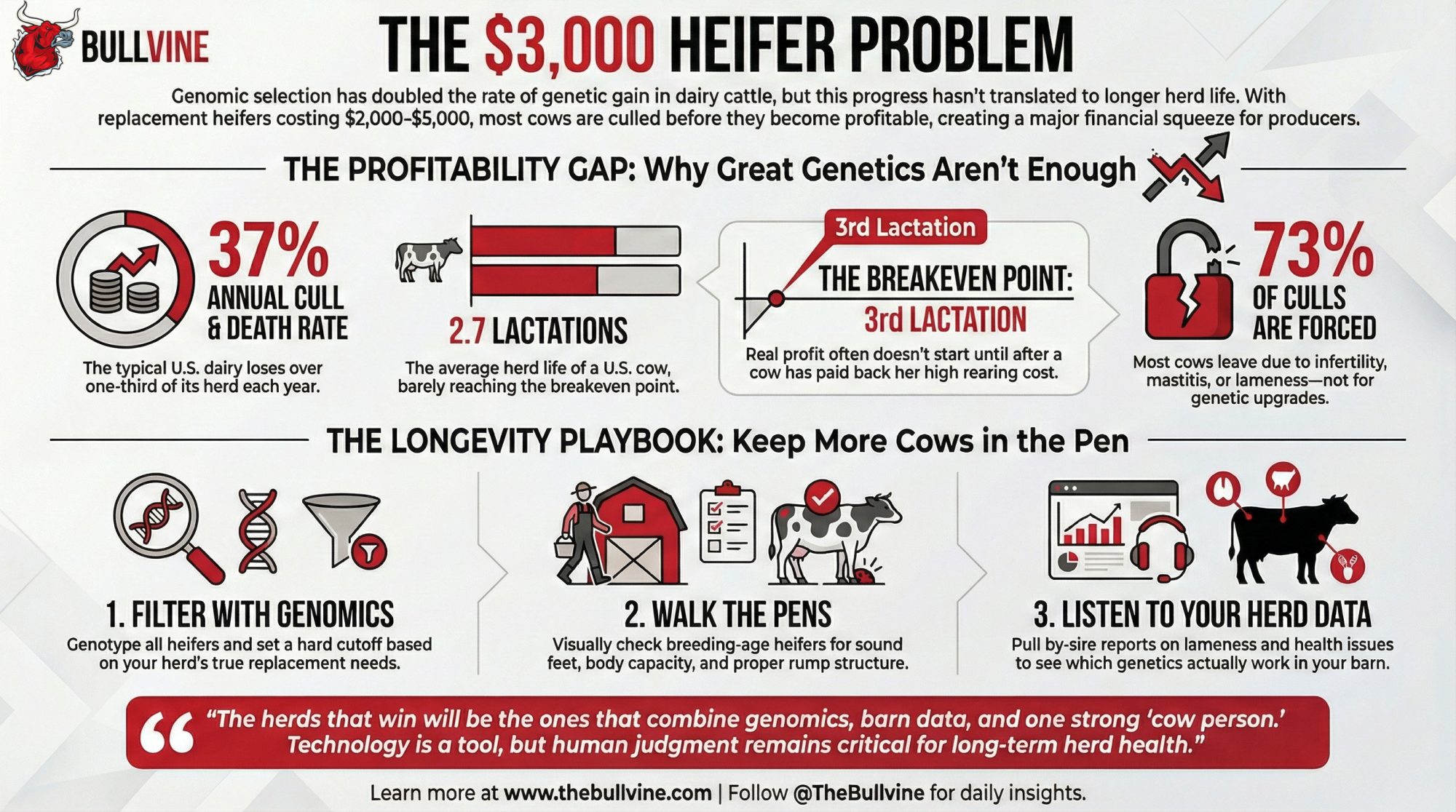
Executive Summary: Right now, genomics has doubled Net Merit genetic gain in U.S. Holsteins—from about 40 to 85 dollars per cow per year—but many herds are still watching cows leave at roughly 2.7 lactations, just as they finally start to repay 2,000–5,000 dollar heifer‑raising costs. NAHMS culling data and Penn State’s longevity work show combined cull‑plus‑death rates near 37 percent and confirm that, with today’s higher rearing costs, real profit often doesn’t begin until third lactation or later. At the same time, UW–Extension, Lactanet, and CoBank document rising heifer‑raising costs, a roughly 15–18 percent drop in U.S. replacement inventories, and 2025 replacement heifer prices that commonly top 3,000 dollars, with top animals over 4,000 dollars in some regions. The article argues that if you keep raising every heifer in that environment, the real problem isn’t your proofs—it’s your replacement strategy—and the missing piece is using genomics as a hard filter on which heifers deserve a stall, backed by a simple breeding‑age structural check on feet, heels, capacity, and calving structure. It then lays out a concrete playbook: genotype and set a clear cutoff tied to your true replacement needs, walk breeding‑age heifers once with structure in mind, use corrective mating only where it removes real structural risk, and pull by‑sire reports on lameness, fresh cow problems, and early culls so you’re not blindly trusting early genomic proofs. Finally, it looks ahead to tools like 3D BCS/weight and AI lameness detection and makes the case that, in 2025’s tight heifer and margin environment, the herds that win will be the ones that combine genomics, barn data, and one strong “cow person” to keep more cows walking the pens into their fourth and fifth lactations.

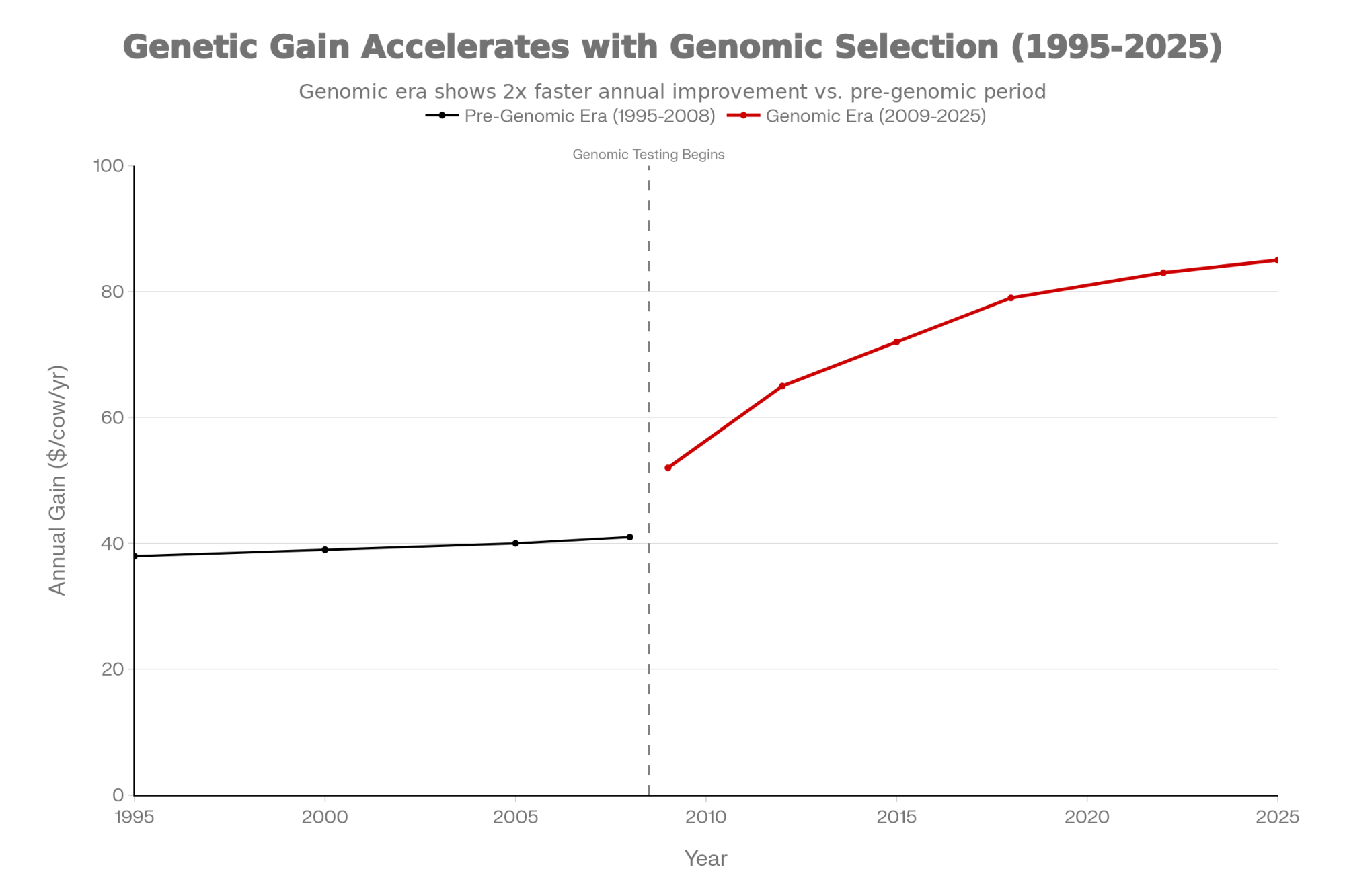
You know, when you look back over the last 15–20 years, it’s pretty wild what we’ve all lived through on the genetics side of dairy. Genomic testing has changed which bulls you pick, which heifers you raise, and how fast your herd moves genetically. Geneticist George Wiggans, PhD, with USDA’s Animal Genomics and Improvement Laboratory, and his co‑authors laid this out in a 2022 Frontiers in Genetics review: once genomic evaluations came in, the average annual increase in Net Merit in U.S. Holsteins essentially doubled—from about 40 dollars per cow per year in the five years before genomics to about 85 dollars per cow per year in the genomic era—and they clearly state that this “doubled the rate of genetic gain” in U.S. dairy cattle based on CDCB trend data across millions of animals.

What’s interesting here is that it wasn’t just more milk. A landmark analysis by Ana García‑Ruiz, PhD, and colleagues in Proceedings of the National Academy of Sciences dug into the U.S. national dairy database. It showed that once genomic selection was implemented, generation intervals for sires shrank from roughly 6.8 years to under 3 years in key sire pathways. The annual genetic gains for low‑heritability traits such as somatic cell score, daughter pregnancy rate, and productive life increased by four‑ to fifteen‑fold compared to the pre‑genomic era. They based that on decades of Holstein pedigree, genomic, and performance data across the national system.

Genomic Selection Doubled Genetic Progress—From $40 to $85 Per Cow Per Year 

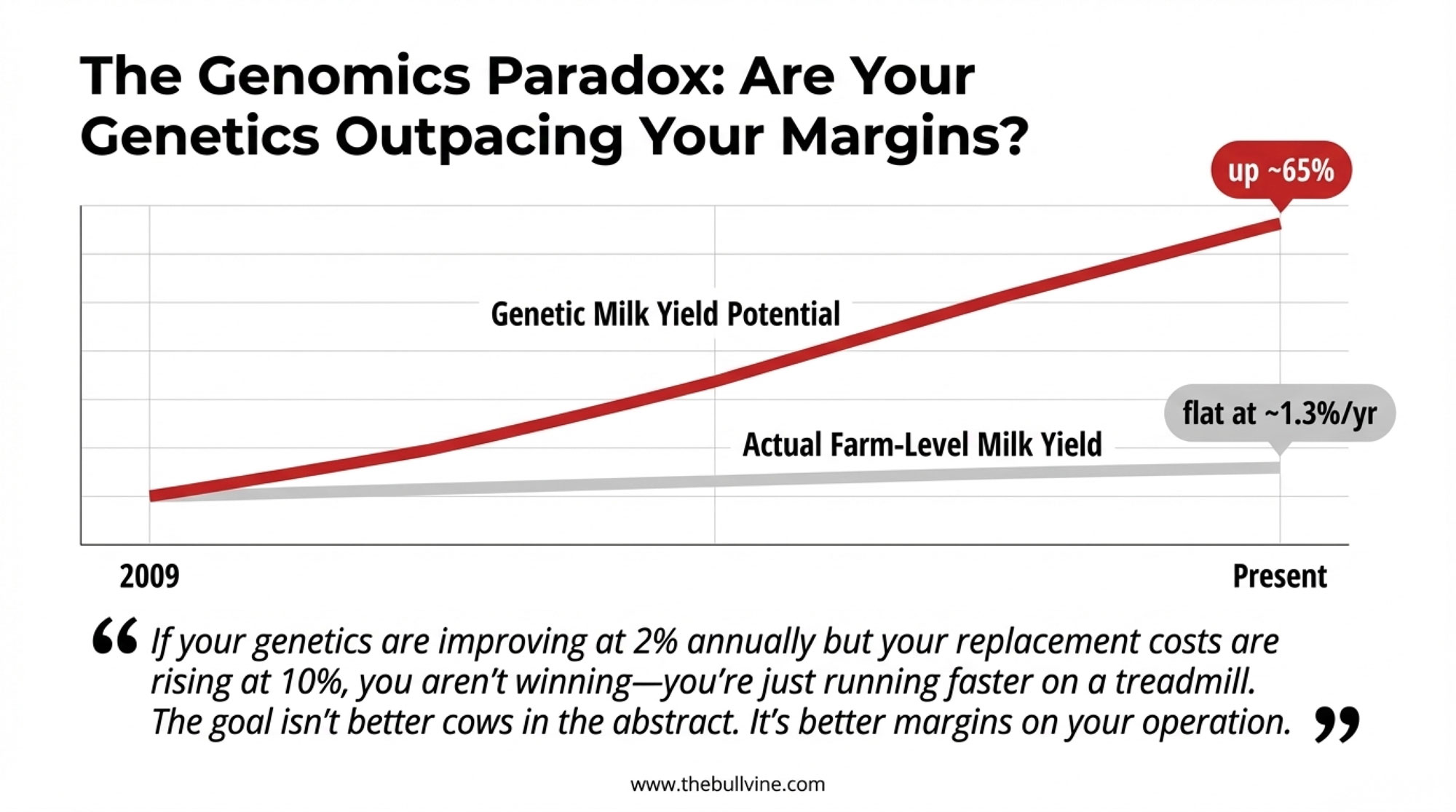
So the data suggest genomics hasn’t just helped you chase production; it’s sped up progress in those “hard‑to‑move” traits many of us thought would take a whole career to shift. The problem is that a lot of that progress is still walking out the cull gate before it’s actually paid you back.

Looking at This Trend: What’s Actually in Net Merit Now?

Looking at this trend a bit closer, it helps to ask a simple question: what exactly are you selecting on today?

USDA’s most recent “Net merit as a measure of lifetime profit” revision, along with the Wiggans genomic selection review, makes it clear that U.S. dairy evaluations are now calculated for over 50 traits across production, fertility, health, calving, conformation, and efficiency. Net Merit pulls a large group of these into a single lifetime profit index using economic weights based on U.S. milk prices, feed costs, and culling patterns. That index includes milk, fat, and protein yields; several fertility traits such as heifer and cow conception rates and daughter pregnancy rate; cow and heifer livability; mastitis and other health traits; calving performance and stillbirth; age at first calving; a body‑weight composite; and feed efficiency via the Feed Saved trait, which uses body‑weight and residual feed intake data.

Over the last decade, USDA and the Council on Dairy Cattle Breeding (CDCB) have deliberately shifted the emphasis in Net Merit. When new health traits and Feed Saved were added, the economic weight on disease resistance and feed efficiency went up, while the weight on large body size was reduced because research showed that heavier cows require more maintenance feed and don’t necessarily return that cost in profit. Net Merit is now driven less by raw milk yield and more by health, fertility, and feed efficiency than it was in the early 2000s.

On the reliability side, invited reviews on genomic prediction in Holsteins report that genomic reliabilities for milk, fat, and protein in young bulls often sit in the 60–80 percent range when backed by a strong reference population, while fertility and health traits have lower reliabilities but are still significantly higher than the 20–30 percent levels typical of parent‑average evaluations. Those figures come from comparisons of genomic vs traditional proofs using large U.S. and Canadian datasets.

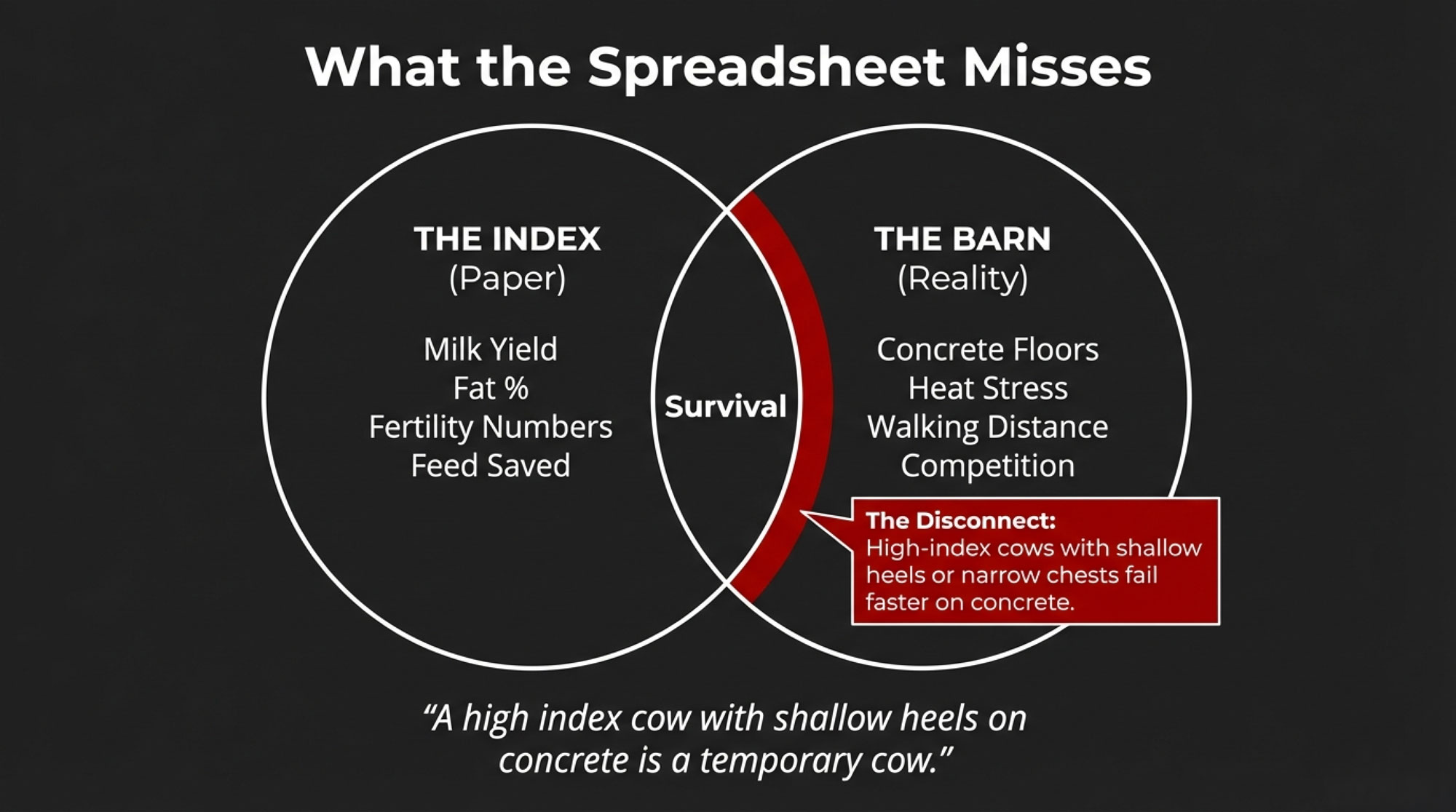
So, on paper, genomics and Net Merit give you a more complete, profit‑focused toolbox than we’ve ever had. And the genetic gains are real. The catch is that not everything you care about shows up on that proof sheet—and 2025 economics are unforgiving if cows don’t stay long enough to pay you back.

What Farmers Are Finding: Culling, Payback, and Short Careers

What farmers are finding, when they move from the proof sheet to the cull list, is that the picture gets uncomfortable pretty fast.

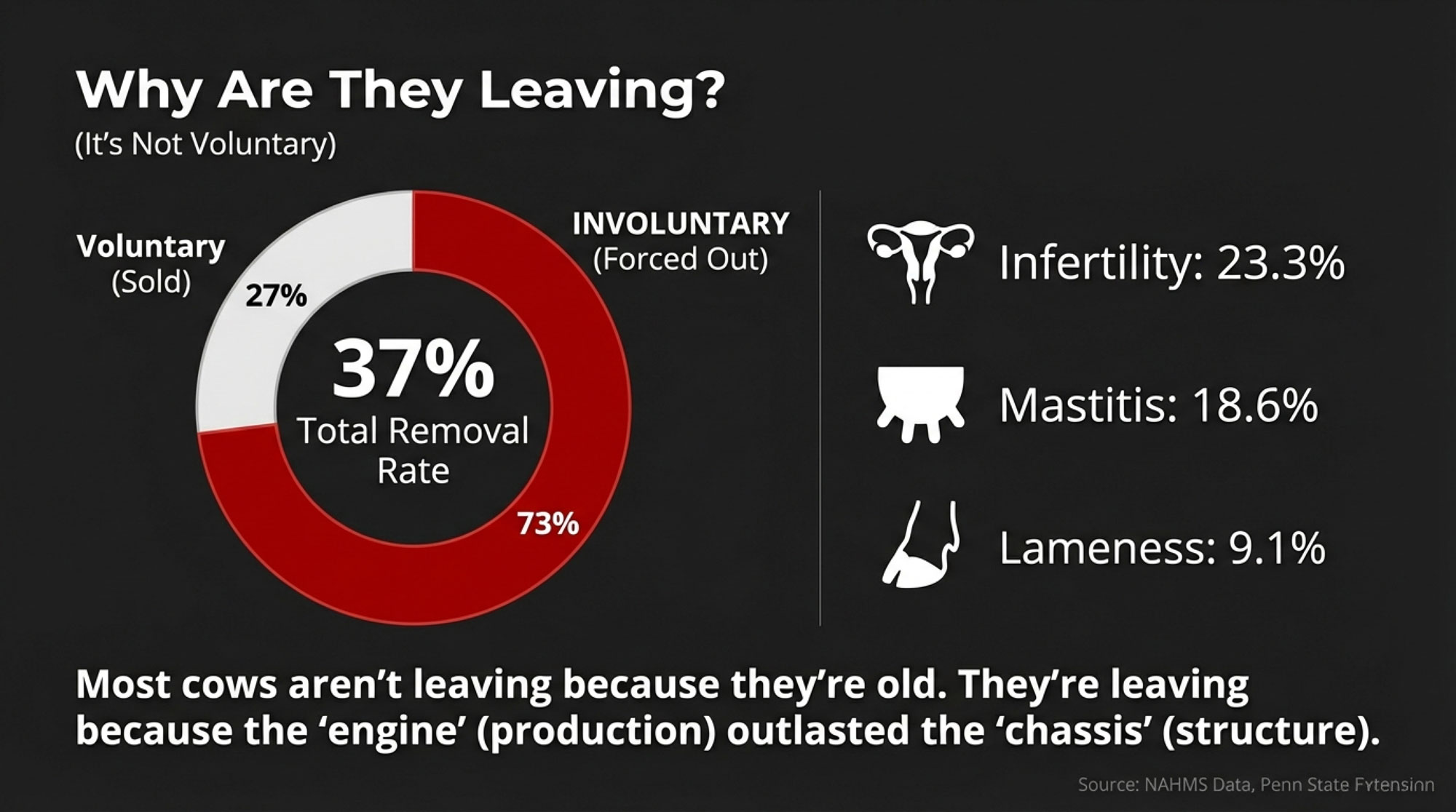
USDA’s National Animal Health Monitoring System (NAHMS) 2024 data reports that the typical overall cull rate for U.S. dairies—counting death losses—is about 37 percent per year. That’s in line with the 2018 NAHMS survey in the Northeastern U.S., which documented an annual cull rate of 31.4 percent plus a 6.2 percent death rate, for a combined 37.6 percent removal rate. Penn State Extension’s “Cull Rates: How is Your Farm Doing?” uses those exact numbers as the benchmark.

When you look at why cows leave, the NAHMS data show that only 26.8 percent of removals in the Northeast were voluntary—cows sold for dairy or lower producers. The other 73.2 percent were involuntary, driven mainly by infertility (23.3 percent of removals), mastitis (18.6 percent), lameness (9.1 percent), and on‑farm deaths (6.2 percent). Penn State highlights these figures to emphasize that reproductive problems, udder health, and lameness remain the big three behind most culls.

Removal CategoryShare of Total Removals (%)What This Means
Combined Annual Removal Rate37.0%Cows + deaths leaving your herd every year (NAHMS, Northeast U.S.)
Voluntary Culls26.8%Low production, dairy sales—you decided
Involuntary Culls73.2%Forced exits—health, fertility, injury
└ Infertility23.3%Cows that won’t rebreed on your timeline
└ Mastitis18.6%Chronic udder health failures
└ Lameness9.1%Foot/leg problems that won’t resolve
└ On-Farm Deaths6.2%Metabolic disease, injury, sudden death

So most cows aren’t leaving because they’re old, paid for, and you’re trading up. They’re leaving because something went wrong—often in the transition period or early in their productive life.

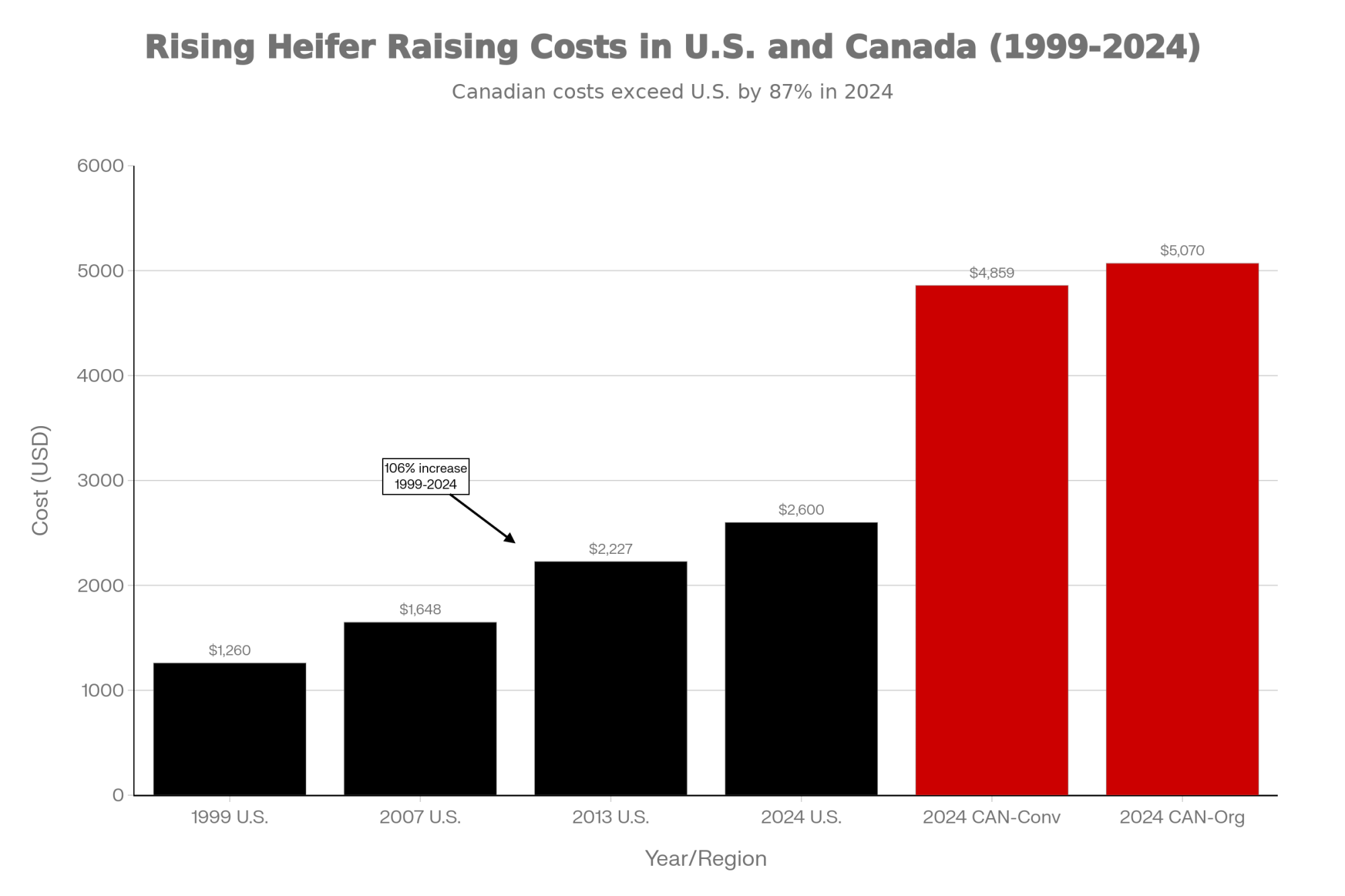
Now put that right next to the cost of raising replacements. A multi‑herd study from the University of Wisconsin–Extension calculated that the total cost to raise a replacement from birth to freshening averaged 2,227 dollars in 2013, not counting the calf’s initial value. That was up from 1,648 dollars in 2007 and 1,260 dollars in 1999, with feed as the largest single expense. The UW fact sheet “Heifer raising costs continue climbing upward” breaks down those costs and shows that feed alone accounted for over half the total.

More recent U.S. work hasn’t shown those costs going down. A 2025 article, drawing on Iowa State University Extension, reported that 2024 heifer‑raising costs in the Midwest were “just over 2,600 dollars” for a 24‑month heifer in many systems once you include feed, labor, housing, bedding, and overhead.

On the Canadian side, Lactanet’s “Analysis of the cost and value of dairy rearing programs” found that average rearing costs per heifer in Quebec were approximately 4,859 dollars for conventional herds and 5,070 dollars for organic herds, with a range from roughly 3,500 to over 7,000 dollars depending on housing, feeding, and management. Their 2023 follow‑up on the cost and profitability of rearing programs reinforces that rearing is a major capital commitment under supply management.

Raising Replacements Now Costs $2,600–$5,000—Up 106% Since 1999

So generally speaking, you’re tying somewhere between 2,000 and 5,000 dollars into each heifer before she ever steps into the parlor, depending on where you are and how you raise them.

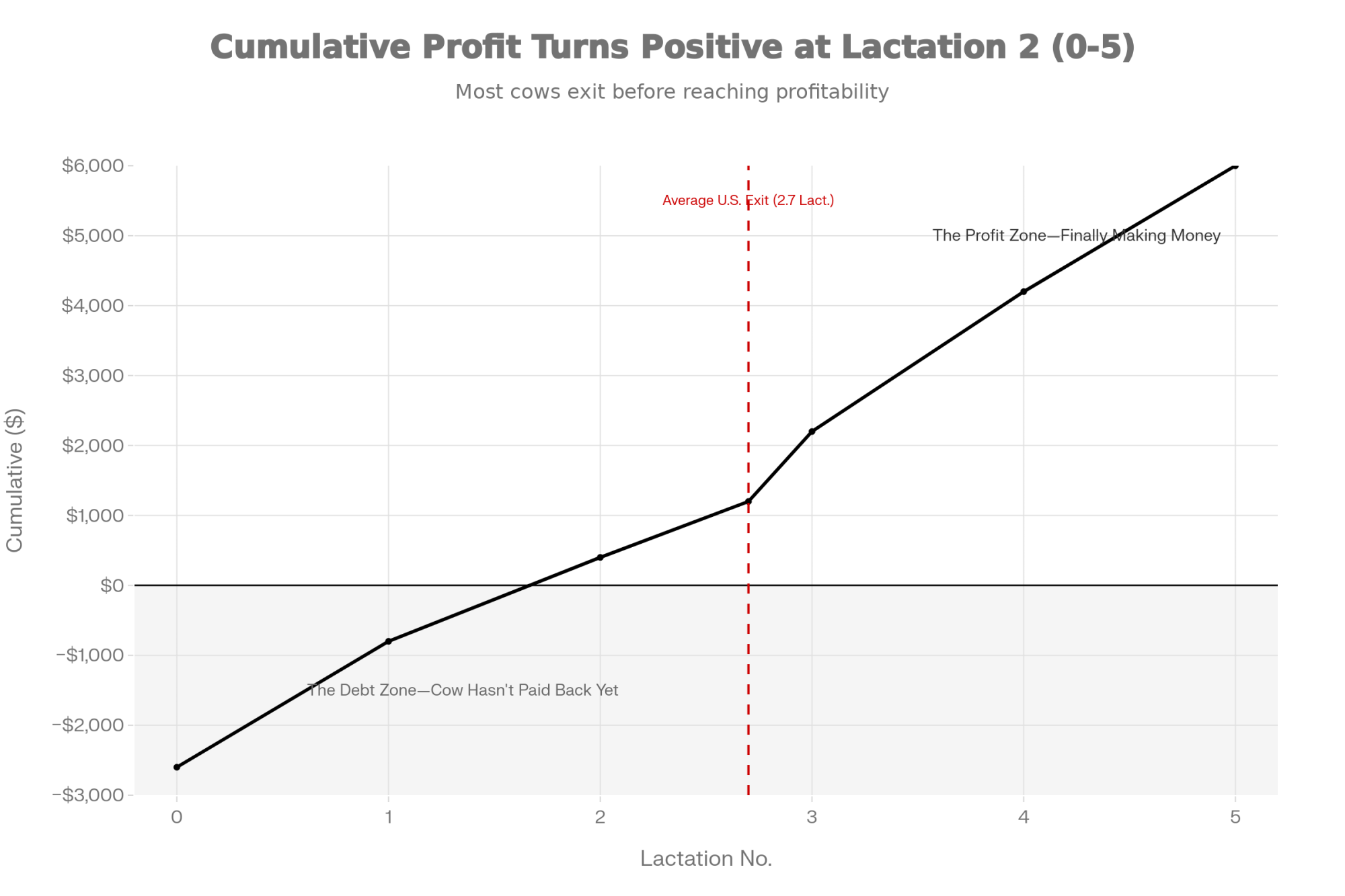
Penn State Extension took those rearing costs and asked a blunt question in their 2025 article “Have Your Cows Repaid Their Debts?” Their analysis, based on NAHMS data and economic modeling, shows that with current heifer‑raising costs, it often takes until at least the third lactation for a cow to repay her development cost. They also point out—citing NAHMS‑based summaries and regional data—that the average U.S. cow only stays in the herd for about 2.7 lactations and that many cows are culled by the end of their third lactation. Morning Ag Clips picked up similar points in a 2024 piece titled “How Long Do Your Cows Stay in the Herd?”, quoting extension specialists who warn that a large share of cows leave before they’ve yielded a strong return.

Most Cows Leave Right As They Start Making Money—The 2.7 Lactation Squeeze 

So the data suggest a tight squeeze: more expensive heifers, a payback point around three lactations, and an average cow productive life just shy of that. In a 2025 margin environment—where feed costs are still elevated, and component pricing is volatile—that’s a rough place to be.

If you run some simple numbers on a 200‑cow herd, the economic impact comes into focus. At a 37 percent cull‑plus‑death rate, you’re replacing roughly 74 cows per year. If you can move that combined rate down to 30 percent, you’re replacing about 60 cows. That’s 14 fewer heifers to raise. Using the documented U.S. cost range of 2,000–2,600 dollars per heifer, that’s 28,000–36,400 dollars per year in avoided heifer‑raising costs, before you even count the extra milk and butterfat performance from a higher proportion of mature cows. In Canadian quota herds, where Lactanet shows average rearing costs near 4,800–5,000 dollars, the same reduction in replacement needs could be worth 67,000–70,000 dollars annually.

MetricBaseline (37% Removal)Improved (30% Removal)Annual Impact
Heifers Raised per Year746014 fewer
U.S. Cost per Heifer$2,600$2,600
U.S. Total Rearing Cost$192,400$156,000Saves $36,400
Canadian Cost per Heifer$5,000$5,000
Canadian Total Rearing Cost$370,000$300,000Saves $70,000

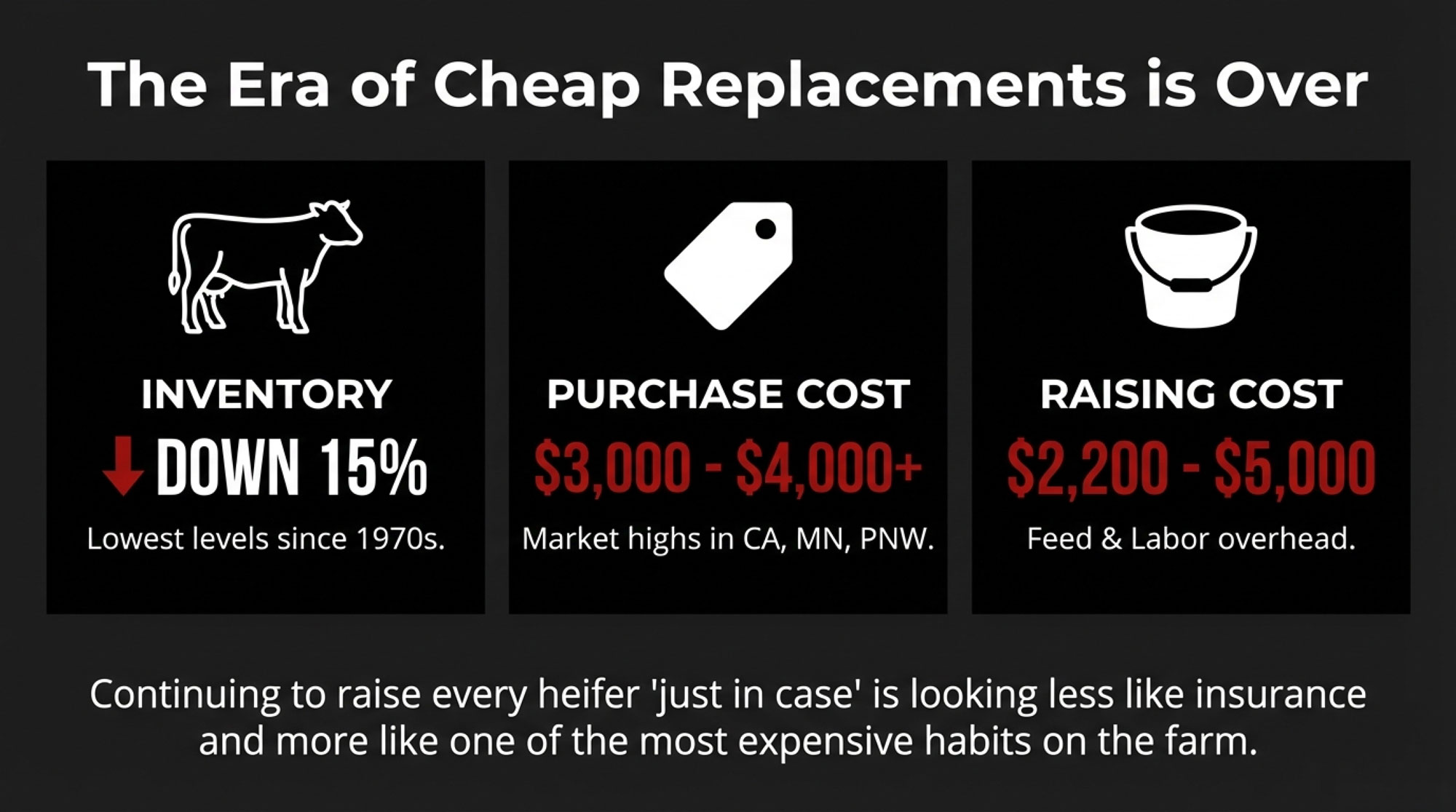
Here’s the thing I’ve noticed: once producers see that math with their own cull rates and rearing costs plugged in, continuing to raise every heifer “just in case” starts to look less like being conservative and more like one of the most expensive habits on the farm.

The Replacement Squeeze: Fewer Heifers, Higher Prices

As if the economics of raising replacements weren’t enough, the broader replacement market has been tightening the screws, too.

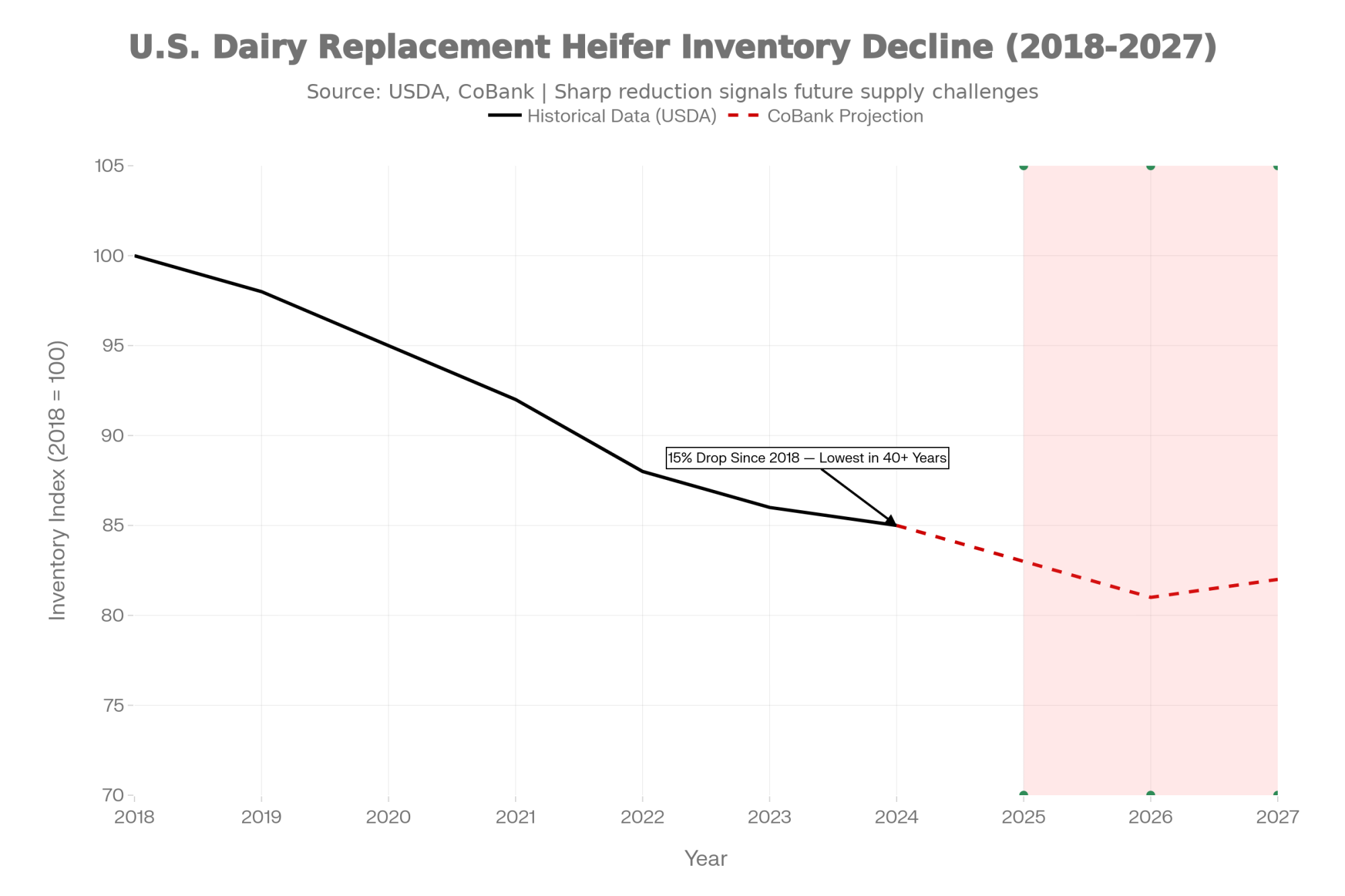
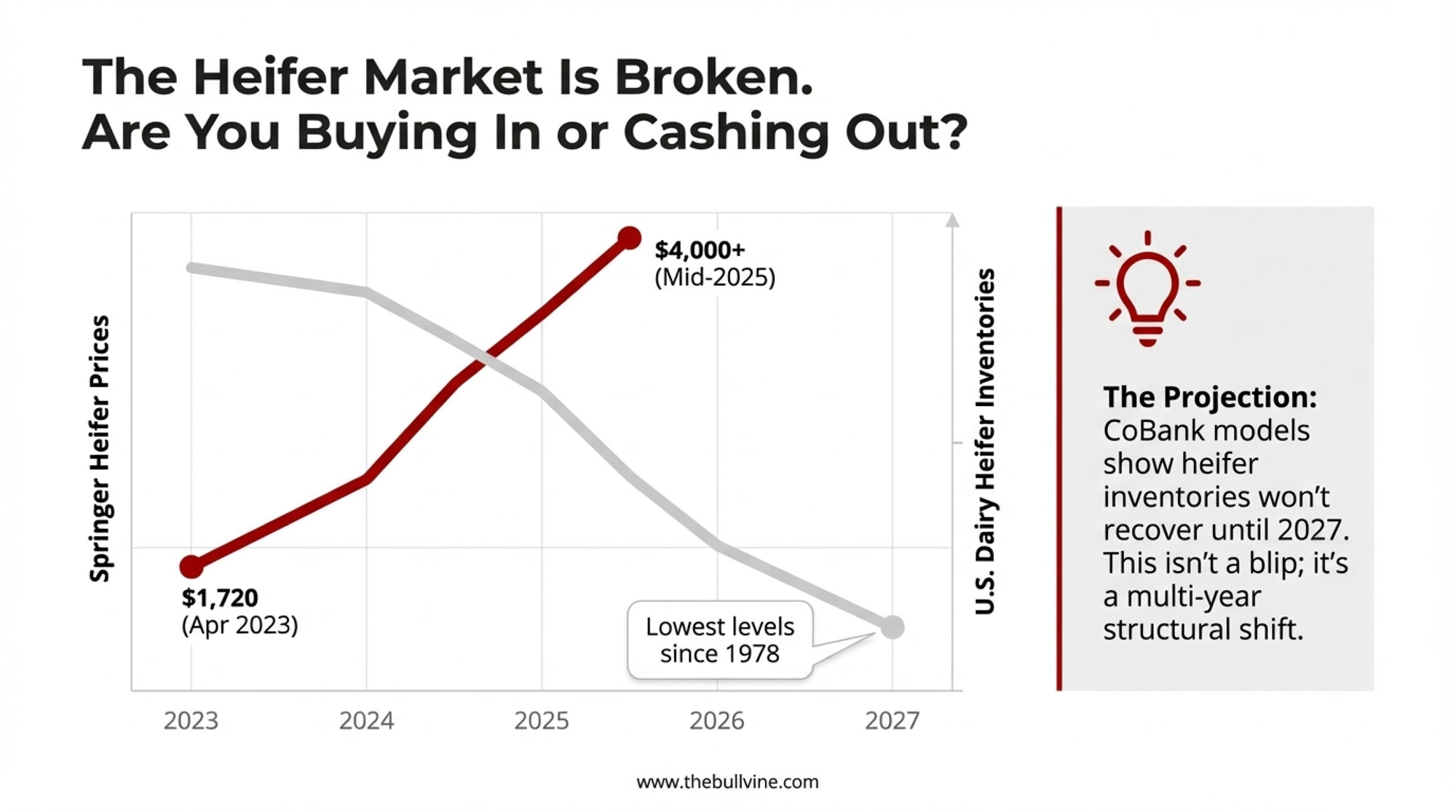
CoBank analysis of USDA cattle inventory reports shows that the number of dairy heifers weighing 500 pounds or more in the U.S. has fallen to its lowest levels in decades. CoBank’s 2025 analysis estimates about a 15 percent decline in dairy replacement heifer numbers over the past six years and notes that current inventories are at their lowest since the late 1970s. Their forecast suggests that heifer numbers will shrink further before beginning to rebound around 2027.

U.S. Dairy Replacement Inventories Down 15%—Lowest Since the Late 1970s

On the price side, market reporting describes multiple 2024–2025 sales where good Holstein replacement heifers routinely brought more than 3,000 dollars, with some top groups selling for over 4,000 dollars per head in California, Minnesota, and the Pacific Northwest. Market analysts have characterized current replacement heifer prices as “vaulting into record territory,” and these numbers align with both rearing costs and the tight national inventories reported.

So the data suggest that both raising and buying heifers are expensive right now, and that the industry as a whole doesn’t have a big surplus of replacements to fall back on. In a year when many herds are still feeling the aftershocks of 2025’s margin squeeze and processor pressure on components and quality, that makes your replacement strategy a high‑stakes business decision, not just a habit.

Structure, Environment, and Why Some Cows Don’t Make It to Third Lactation

Looking at this trend from the barn floor, the piece that doesn’t fully show up in Net Merit or genomic reliabilities is structured cow health in your specific environment.

On the hoof‑health side, multiple studies published in the Journal of Dairy Science and other veterinary journals have shown that cows with shallow heel depth and low foot angle are at greater risk for claw horn lesions and lameness on concrete, especially in freestall systems with higher cow traffic. Those studies link shallow heels, weak rear feet, and poor claw conformation with increased incidence of sole ulcers, white line disease, and chronic lameness—conditions strongly tied to reduced milk production, poorer fertility, and higher culling risk.

On the metabolic side, transition‑cow reviews and field studies emphasize that low body condition score and insufficient dry matter intake around calving increase the risk of negative energy balance, ketosis, and displaced abomasum. That’s particularly true in high‑producing cows fed energy‑dense diets to maximize early‑lactation yield and butterfat performance. Research on late‑gestation heat stress has documented “programming” effects: dry cows exposed to heat during the close‑up period produce less milk and experience more health issues in the subsequent lactation; some studies have even found effects on daughters’ performance. This is especially relevant in dry-lot systems and Southern herds, where late‑gestation cows and heifers are walking longer distances in the heat.

In Wisconsin freestall herds, hoof trimmers and UW–Extension educators have commented—both in extension meetings and in trade articles—that daughters from certain sire lines with flatter feet and thinner heels show up more often in trimming lists and lameness treatments, even when those bulls look acceptable for feet‑and‑legs composites on paper. While those observations are anecdotal, they align closely with the published links between heel depth, foot angle, and the risk of claw lesions on concrete.

In Western dry lot systems in California and parts of the High Plains, producers often report that very tall, angular cows with lighter bone and less body capacity don’t handle long walks between lots and parlors in summer heat as well as medium‑sized, deeper‑bodied cows that hold condition better through the transition period. When you overlay those barn‑floor stories with the heat‑stress and transition‑cow research, the pattern makes sense: cows whose structure and metabolism aren’t well suited to that environment are more likely to end up as early culls, no matter what their genomic index says.

If you swing your attention to pasture‑based seasonal systems, you see a different set of pressures. Ireland’s Economic Breeding Index (EBI) and New Zealand’s national breeding goals have been built around cows that can walk, graze, maintain body condition, and rebreed on a tight seasonal schedule. Research from Teagasc and New Zealand spring‑calving herds shows that higher fertility, genetic merit, and better body condition scores are associated with improved reproductive performance, survival, and profitability in those grazing systems, while very large, high‑output Holsteins bred for North American TMR feeding often struggle to hold condition and pregnancy on grass.

All of that suggests that Net Merit and similar indexes capture part of the story indirectly—through traits like productive life, fertility, health, and body‑weight composite—but they can’t fully see how structure and environment interact in your particular freestall, tie‑stall, parlor, robotic setup, or grazing platform.

And this is where I’d say we run into a quiet myth: that as long as the genomic index is high, the cow will “work” anywhere. The data and the barns both say that’s not always true.

What Farmers Are Finding: How High‑Performing Herds Actually Use Genomics

What farmers are finding, especially those who’ve been in the genomic game for a while, is that the herds quietly pulling ahead tend to follow a three‑part pattern. They use genomics as a strong filter, they add a simple structural check at the right time, and they let their own herd data tell them when a bull isn’t working in their environment—even if his proof still looks good.

1. Let Genomics Decide Who Deserves a Stall

First, they use genomics to decide which heifers even get to compete for a stall.

In many progressive Midwest and Northeast operations, every heifer is genotyped between three and six months of age. CDCB reports that hundreds of thousands of female dairy cattle are genotyped every year, and case studies profile farms that use whole‑herd genotyping to drive their replacement and beef‑on‑dairy strategies.

The pattern in those herds often looks like this:

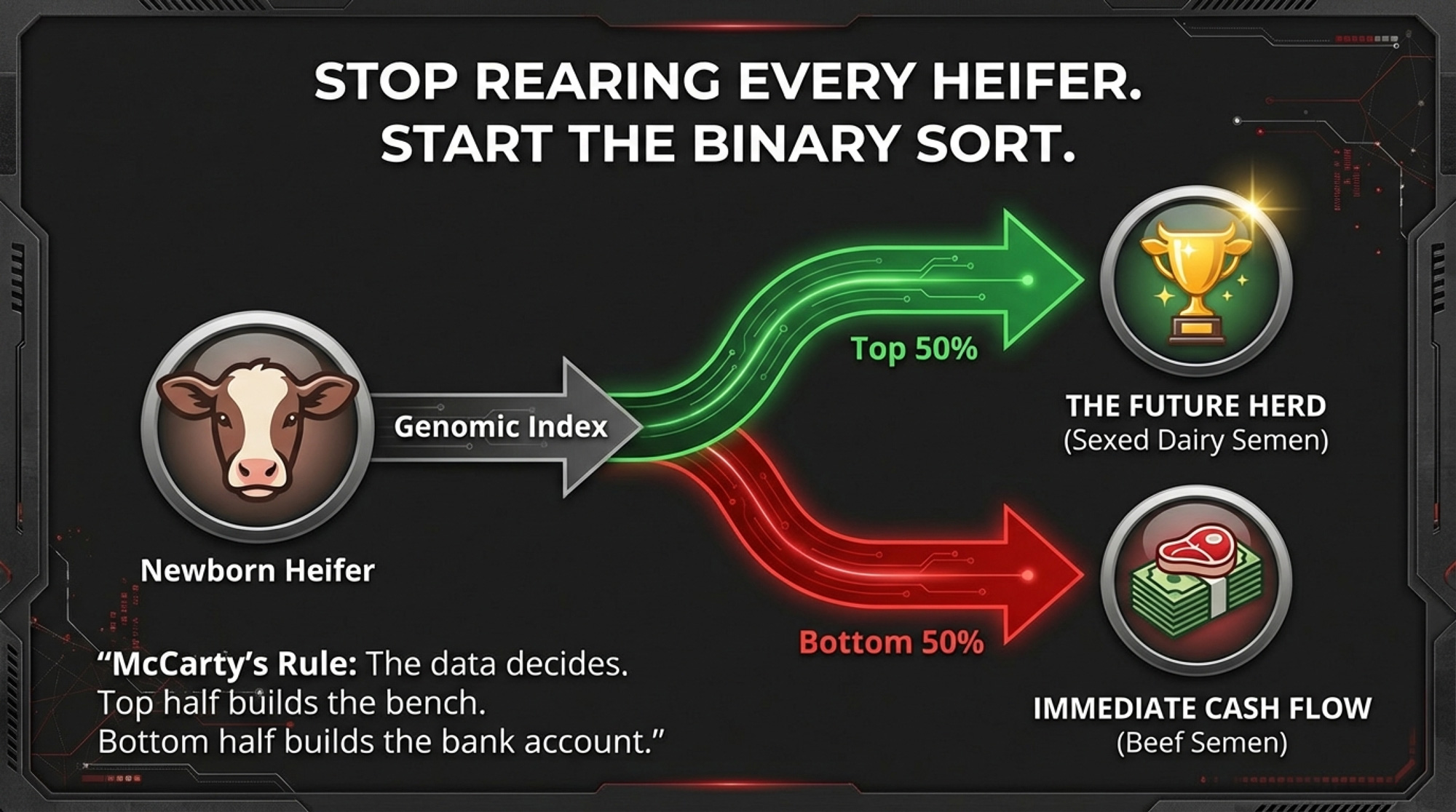
  1. Genotype the heifer group. All heifers—or at least all heifers from core cow families—get tested.
  2. Rank on a profit index. Heifers are ranked on Net Merit in the U.S. or Pro$/LPI in Canada, and key functional traits—daughter fertility, productive life, mastitis resistance, calving traits, body size—are checked against herd goals.
  3. Set a clear cutoff. An internal threshold is set based on how many replacements the herd truly needs annually, not “everything that hits the ground.”
  4. Sort replacements vs beef. Heifers clearly below that line are designated for beef‑on‑dairy matings or other marketing paths instead of being automatically raised as core replacements.

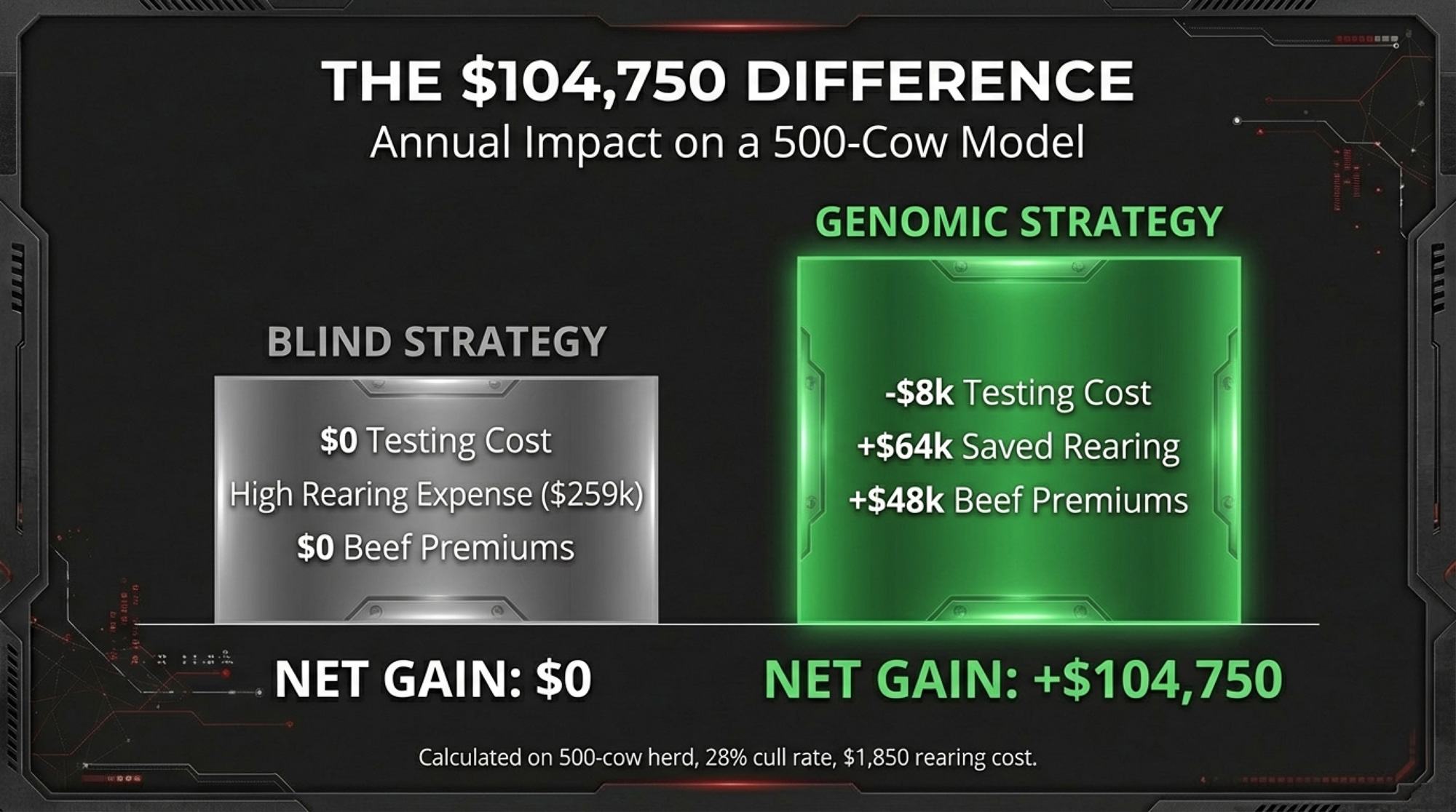
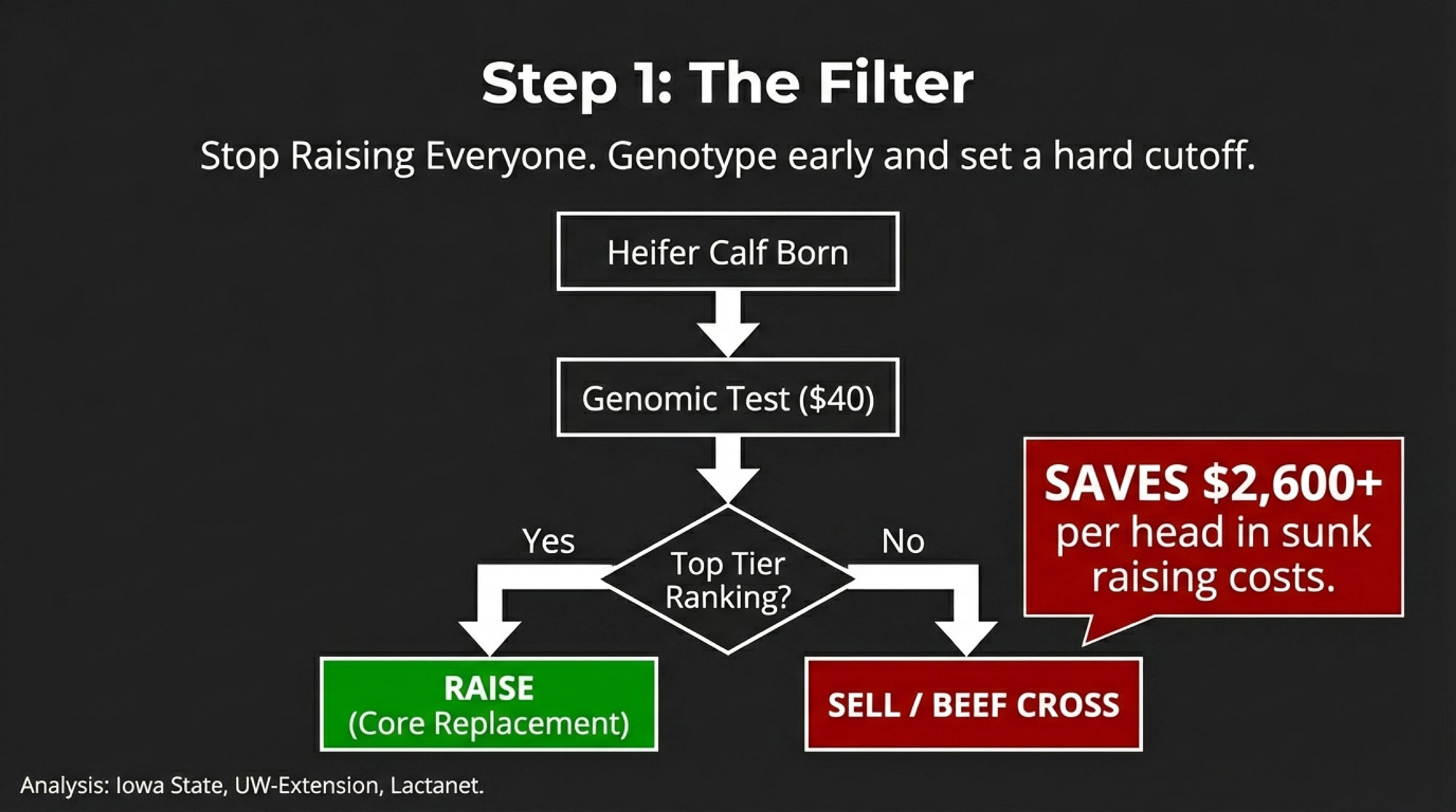
Economic analyses from Iowa State, UW–Extension, and Lactanet all support this kind of triage. If genotyping costs around 40–50 dollars per heifer and the information lets you avoid raising 10–15 low‑merit animals that would each cost 2,000–2,600 dollars in the U.S. or 4,800–5,000 dollars in Canada, you’re avoiding 20,000–75,000 dollars of future rearing costs for a testing investment of maybe 4,000–7,500 dollars. Iowa State’s heifer‑inventory work and Lactanet’s rearing‑cost modeling both illustrate this scale of impact.

A lot of herds then pair this with beef‑on‑dairy. Extension surveys and industry reports from Iowa State, Kansas State, and High Plains fieldwork confirm that using beef semen on lower‑merit dairy cows and heifers has become a common way to add value to non‑replacement pregnancies and concentrate dairy replacements among the top genomic group. ROI analyses show improved calf value and better alignment between replacement supply and milk‑herd needs when this is done with clear genomic cutoffs.

Under the Canadian quota, Lactanet’s rearing‑program analysis and their work on cost and profitability emphasize that cows must stay in the herd long enough to repay higher rearing costs and generate a return on quota. Their numbers show average rearing costs around 4,800–5,000 dollars per heifer and a wide variation in cost per litre associated with heifer inventory, age at first calving, and productive life. Many Canadian advisors use those figures to support the rule of thumb that cows generally need three or more lactations to generate strong returns under quota.

So the first big step that successful herds have taken is to let genomics decide who deserves the chance to become a cow, instead of raising every heifer and hoping it works out. If you’re still raising every heifer in 2025, this development suggests you’re tying a lot of capital up in animals that will never pay you back.

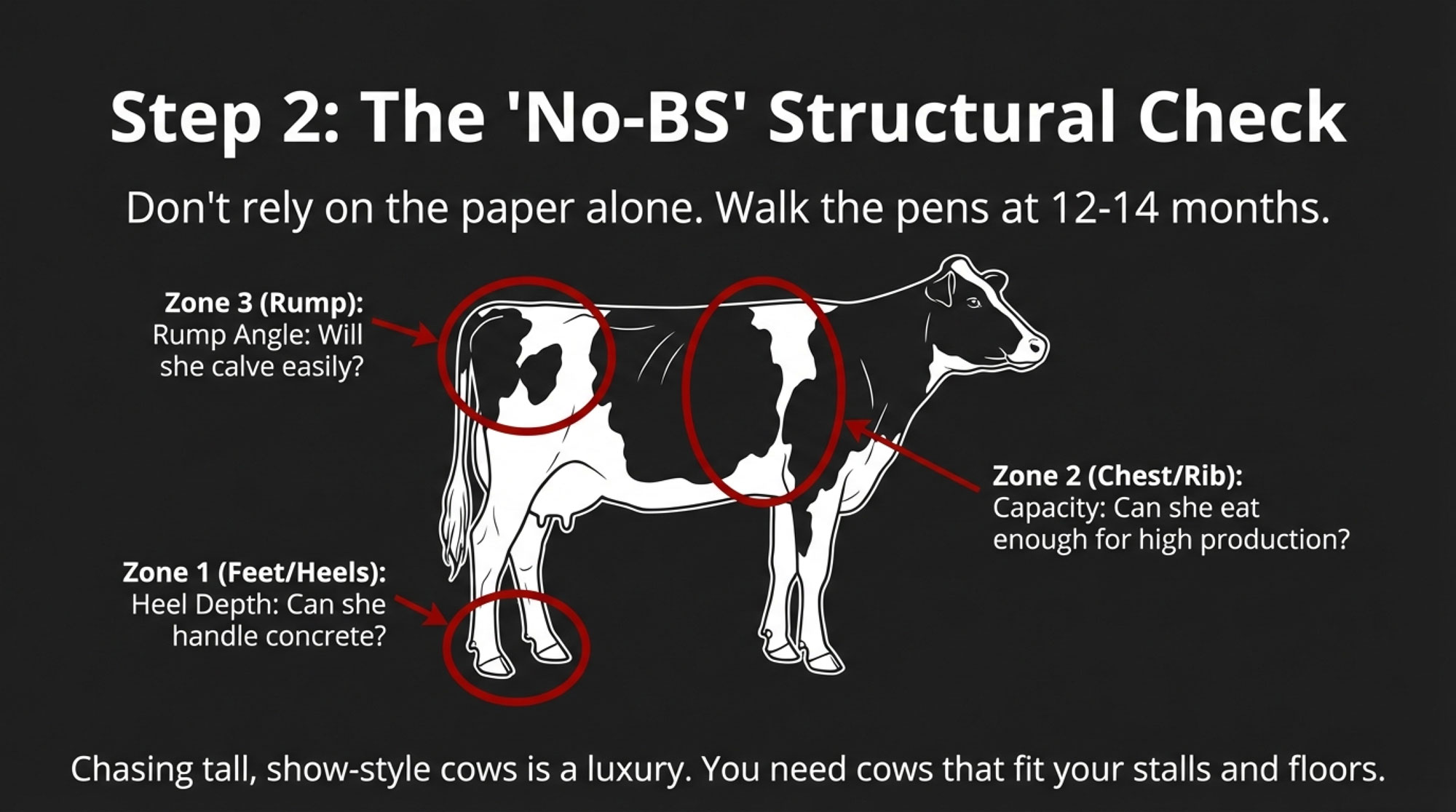
2. Walk the Pens Before First Breeding

Second, the herds that are combining genomics with longevity add a simple structural check at breeding age.

Usually, that’s around 12–14 months for Holstein heifers in freestalls or tie‑stalls, and a bit later for seasonal grazing herds that breed heifers to fit a calving block. Someone—often the breeder, herd manager, or an experienced employee—walks through the breeding‑age pens with a few key questions in mind:

  • Compared to the older cows that come through the transition period well in this herd, does this heifer have enough body depth and chest width to eat what she’ll need on the diets and in the facilities you actually have?
  • Do her feet and heels look comparable to the heifers and cows that stay sound on your floors and paths, or are they noticeably flatter and weaker?
  • Does her rump and hip structure look like it will help or hinder calving and day‑to‑day movement in your barns or on your laneways?

Lameness research has tied shallow heels and low foot angle directly to higher odds of claw lesions and lameness on concrete, and transition‑cow research has linked limited intake and low body condition around calving to higher metabolic disease risk and weaker early‑lactation performance. Those are exactly the kinds of problems that drive early culling and drag down fresh cow management.

In a 70‑cow tie‑stall in Quebec, this might mean flagging just a few heifers as “structural concerns” and thinking about different mating or marketing plans for them. In a 400‑cow freestall in Wisconsin or an 800‑cow dry lot system on the High Plains, some producers have built simple 1‑to‑3 scoring systems and trained staff to mark heifers with clear structural issues during routine handling, then revisit that list when making breeding decisions.

Chasing tall, show‑style cows in freestalls or dry lots can be a costly luxury if they don’t walk and last. The herds that are winning on both banners and bank accounts are the ones that match their type to their environment rather than copying someone else’s ideal.

3. Use Corrective Mating Where It Really Pays

Third, these herds use corrective mating selectively, focusing on the animals where it’s most likely to pay off.

For the majority of cows and heifers—the ones that clear both the genomic filter and the structural walk—they keep breeding plans straightforward. They choose high‑index sires based on Net Merit, Pro$, or LPI that are solid for daughter fertility, livability, mastitis resistance, calving ease, and feet and legs, and they avoid bulls that are extreme for body size, or that carry trait weaknesses that clearly don’t fit their barns. USDA’s Net Merit documentation and our own Bullvine articles on genetic tools both suggest that letting multi‑trait economic indexes handle most of the weighting is a sound base strategy, as long as you pay attention to a few critical traits for your system.

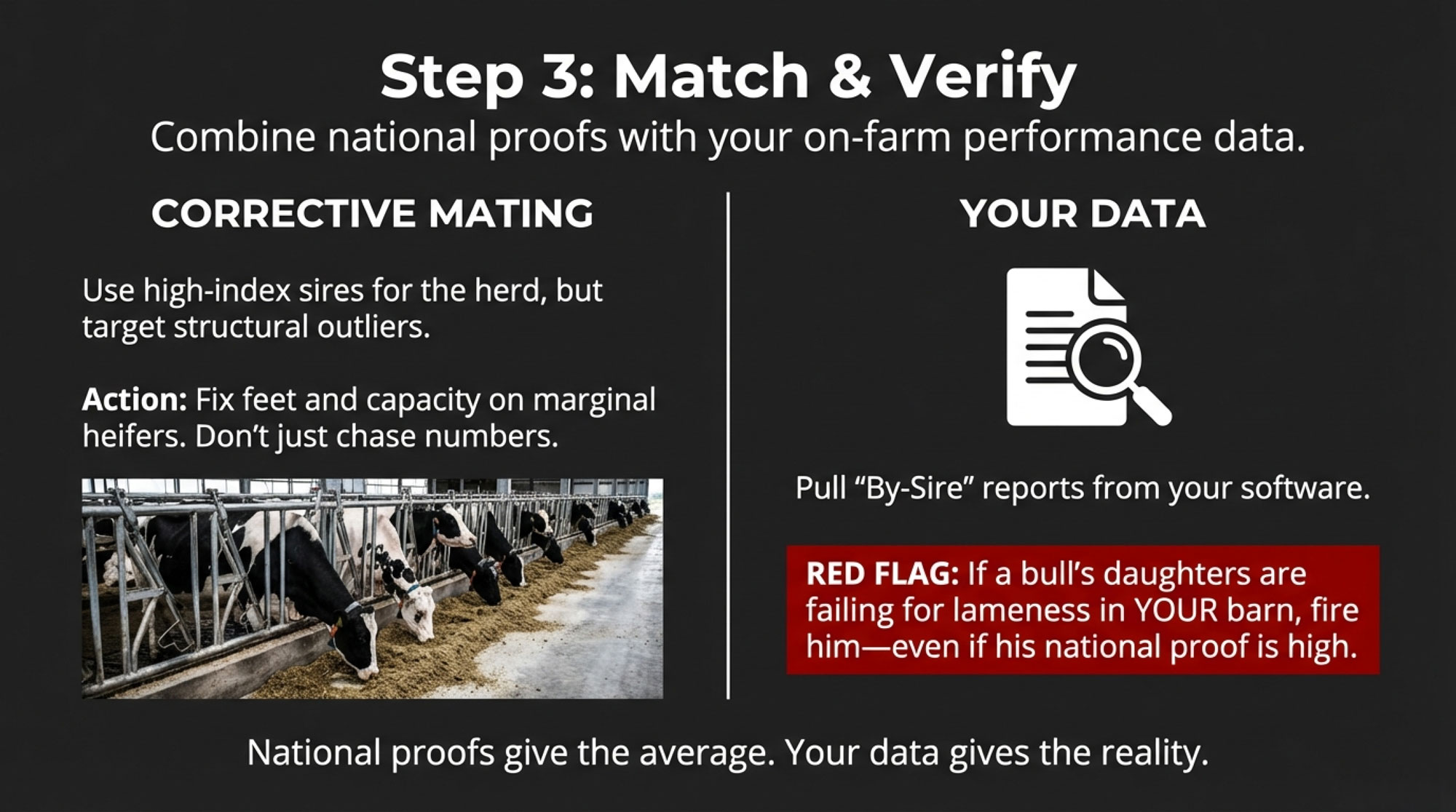
For the smaller group of structurally marginal heifers, they still use good bulls—just more carefully. On narrower, shallow‑bodied heifers, they’ll lean toward bulls that are known to add strength and capacity without giving up too much on profit. On heifers with flat, thin‑heeled feet in concrete or dry lot systems, they’ll favor bulls with strong feet‑and‑legs evaluations and, where available, better claw‑health and locomotion scores. On heifers with awkward rumps, they reach for sires with more functional rumps and better daughter calving ease.

Herd‑level evaluations and extension case studies suggest that trading 50–100 dollars of index on these specific matings can be worthwhile if it reduces early structural culls and improves fresh cow management, especially when you look at lifetime milk and component yield instead of just first‑lactation performance.

Raising every heifer and then breeding them all to the same top‑index bull might feel simple. In 2025, it’s also a good way to waste both semen and stall space.

StepActionFinancial Impact
1. The FilterGenotype and set a hard cutoff.Avoids $2,600+ in costs for “low-merit” calves.
2. The WalkVisual check for feet, capacity, and rump.Reduces involuntary culls in 1st/2nd lactation.
3. The MatchCorrective mating for structural outliers.Ensures the best genetics actually survive to pay back debt.

Looking at This Trend from Your Own Records

There’s one more piece that high‑performing herds have learned to lean on, and that’s their own herd data.

Geneticists working on the U.S. genomic system have been clear that even with high average reliabilities, individual genomic bulls—especially the young, high‑ranking ones—can move once daughters calve across a range of environments. That point appears in Wiggans’ work as well as in invited reviews on breeding goals and selection strategies.

What farmers are finding is that by‑sire reports from their own herd management software are one of the best early warning systems they have. The pattern usually looks like this:

  • Once or twice a year, they pull reports that show lameness events, hoof‑trimmer findings, fresh cow problems (ketosis, DA, metritis), calving difficulty, and early culls by sire.
  • They compare each sire’s daughters to herd baselines: if daughters from one bull show significantly higher rates of lameness, fresh cow treatments, calving issues, or early culls, that bull moves onto a “caution” list.
  • They dial back that sire’s usage, especially in heifers, and watch how his official proofs move in the next couple of evaluation runs.

Extension educators and consultants in the Northeast, Midwest, and West have highlighted farms that do this, and their experiences align with what geneticists recommend: use national proofs for the big picture and your own data for local calibration.

In Western dry lot and Southern herds, some producers are also starting to sort these problem lists by calving season and sire to see whether certain bulls’ daughters struggle more when they calve into heavy heat. Research on late‑gestation heat stress suggests that cows calving after hot, dry periods may be at higher risk of poor performance and health problems. A few herds are using that insight to adjust which bulls they use on cows expected to calve in the hottest windows.

So here’s a fair question: do you know, off the top of your head, which bulls sired your last 20 early culls or your worst fresh cows? If the answer is no, your herd software probably does—and it’s worth asking.

New Tools Coming: 3D Cameras, AI Gait, and Why People Still Matter

Looking out a few years, it’s pretty clear that technology is going to keep adding tools to this mix.

Several recent studies and technical articles have evaluated three‑dimensional camera systems that estimate body weight and body condition score automatically from overhead images. These systems use depth sensors and algorithms to reconstruct the cow’s shape and have shown good agreement with scale weights and experienced BCS scorers in research settings and early commercial trials.

At the same time, dairy tech companies and research groups have been developing automated lameness detection systems that use cameras, accelerometers, or pressure mats with AI‑based gait analysis. Peer‑reviewed studies and industry case reports document systems that can detect subtle gait changes before cows are obviously lame, with high sensitivity and specificity. That kind of early warning can help target hoof trimming and fresh-cow management, and reduce the severity and cost of lameness cases.

Some research teams are already experimenting with combining these high‑frequency phenotypes—weight, BCS, locomotion, rumination—with genomic information to improve predictions for traits like resilience, feed efficiency, and long‑term health that are hard to measure at scale today. A 2024 bibliometric review on genomic selection in animal breeding and recent overviews of bovine genomics highlight this as a major emerging direction.

This development suggests that, in the future, we may be able to quantify and select for “resilience” and “structural soundness” more objectively. That’s exciting, especially for larger herds that need help catching subtle changes in body condition, movement, and fresh cow behavior.

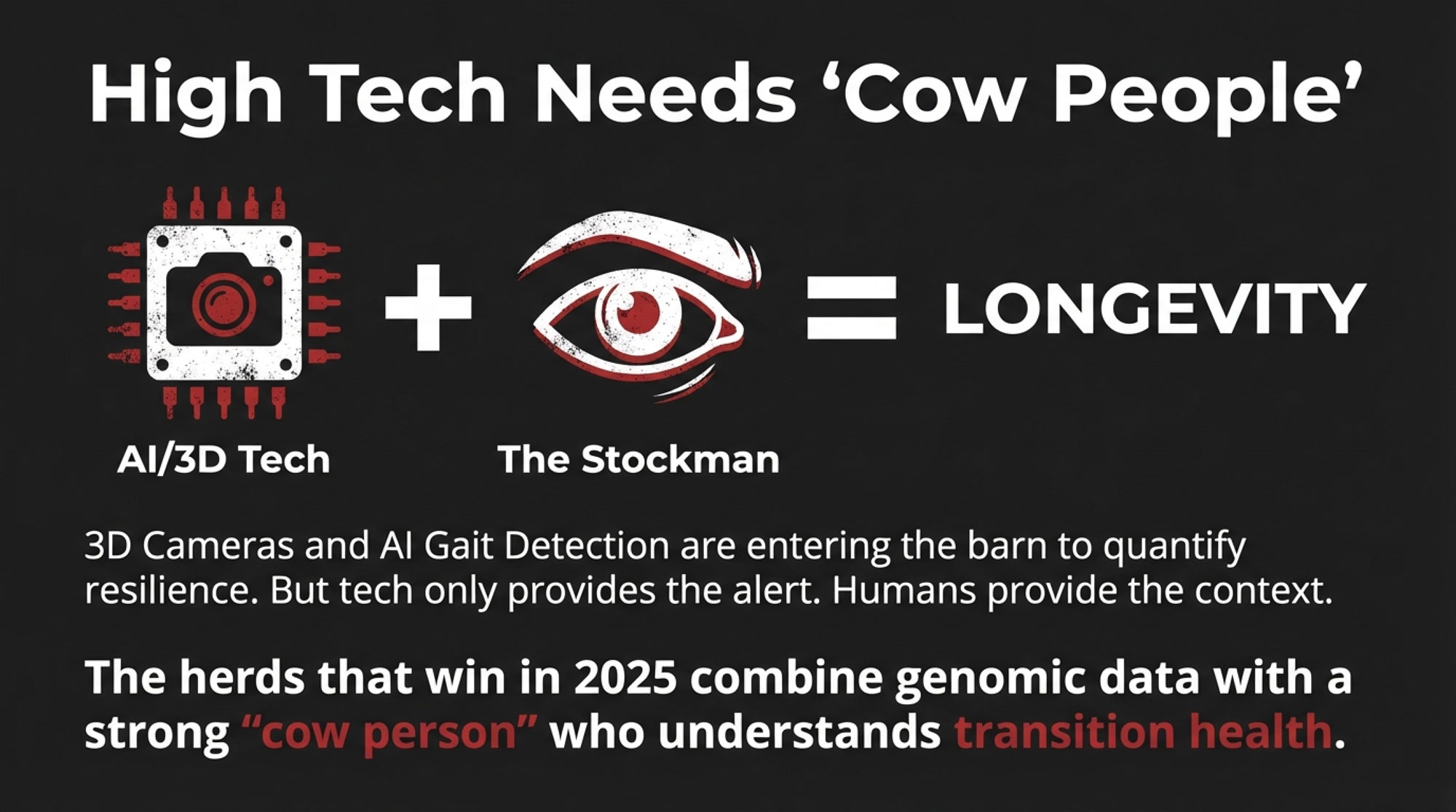
But even as these tools roll out, every one of them still needs a human in the loop. Someone has to review the alert, examine the cow, and decide whether the system’s flags match reality. Judging coaches, classifiers, and long‑time herd managers have been saying for years that as our industry has gotten better at reading proofs and genomic reports, fewer people have had deep training in reading cows—feet, legs, capacity, udders, and how cows handle the transition period in real barns. Workshops and classifier training materials echo that concern.

From what I’ve seen, the herds that are making the most of genomics and new tech are the ones that still have at least one strong “cow person” in the mix. That person can look at a genomic report, look at a heifer, look at the hoof‑trimmer’s notes, and connect those dots. In 2025, when capital is tight and processors are picky, that skill might be as valuable as any piece of hardware you can bolt into the barn.

What To Do This Year: A Short List

If you’re thinking, “Okay, what do I actually do with all this?”, here’s a short, practical list based on the data and what successful herds are doing:

  1. Genotype the heifers you’re serious about and set a real cutoff.
    Test all heifers or at least those from your best cow families. Rank on Net Merit or Pro$/LPI, check fertility, productive life, mastitis, calving traits, and size, then draw a line based on how many replacements you truly need. Heifers below the line become beef‑on‑dairy or are marketed differently, instead of automatically being raised.
  2. Walk your breeding‑age heifers once with structure in mind.
    Before first breeding, take one good look at body capacity, feet and heels, and rump structure, comparing heifers to the cows that last in your herd. Use what we know about lameness and transition‑cow risk to flag structural outliers that are more likely to become expensive early culls.
  3. Use corrective mating where it matters most.
    For structurally marginal heifers, pick high‑merit sires that also bring better feet, legs, capacity, or calving traits—even if it means giving up a bit of index on those matings. For the rest, let multi‑trait indexes do the heavy lifting and avoid extremes that don’t fit your facilities or fresh cow management reality.
  4. Pull one by‑sire problem report this year.
    Use your herd software, vet records, and hoof‑trimmer logs to see which sires’ daughters show up more often in lameness events, fresh cow treatments, calving problems, or early culls. If one bull looks worse than the herd average, dial back his usage and watch how his proof moves in coming runs. Doing nothing with this information is also a strategy—and in 2025, it’s one of the riskiest ones you can pick.
  5. Start planning how you’ll use new tech, but keep people at the center.
    If you’re considering 3D cameras or lameness‑detection systems, think about who on your team will own those alerts and how you’ll use that data alongside genomics and good old‑fashioned pen walking. The tech can sharpen your view, but it won’t replace judgment.

The Bottom Line

So, looking at this trend as a whole, the data and the barns are pointing in the same direction.

The herds that are quietly getting ahead aren’t “all genomics” or “no genomics.” They’re the ones that:

  • Use genomic tests and economic indexes to decide which heifers truly deserve a place in the replacement pipeline, instead of raising every calf and hoping it works out.
  • Bring a straightforward, honest look at structure into the picture at breeding age to make sure those heifers’ bodies fit their stalls, floors, and walking distances.
  • Use corrective mating where it actually pays—on the smaller group of structurally marginal animals—while letting Net Merit or Pro$/LPI guide most matings.
  • Listen to their own herd data on bulls and adjust usage when their cows tell a different story than early proofs suggest.
  • And keep at least one strong “cow person” in the mix to connect what the numbers say with what’s happening in the pens, especially through the transition period and fresh cow management.

You’re already paying for genomics. You’re already paying a lot to raise replacements. Either you use genomics, structure, and herd data together to keep more cows past three, four, or five lactations—or you keep pouring 2,000–5,000 dollars into replacements that walk out just as they reach breakeven.

What’s encouraging is that you don’t need to overhaul everything overnight. Testing a few more heifers, drawing a firmer line on who you raise, walking one heifer group with structure in mind, and pulling one by‑sire problem report this year can start nudging your herd in the direction the data—and the best herds—are already heading. 

Key Takeaways 

  • Genomics doubled genetic gain—but not cow longevity. Net Merit now climbs about 85 dollars per cow per year versus 40 dollars pre‑genomics, yet the average cow still exits around 2.7 lactations—often before paying back her 2,000–5,000 dollar raising cost.
  • Most culls aren’t planned—they’re forced. NAHMS data show a 37 percent combined cull‑plus‑death rate, driven by infertility, mastitis, and lameness. Penn State’s analysis confirms real profit typically doesn’t start until the third lactation or later.
  • Raising every heifer is now a high‑cost gamble. U.S. replacement inventories have dropped roughly 15 percent to multi‑decade lows, and 2025 heifer prices commonly exceed 3,000 dollars. “Just in case,” heifer programs may be your most expensive habit.
  • Top herds treat genomics as a filter, not a trophy. They genotype early, set a hard cutoff tied to true replacement needs, walk heifers at breeding age for structural fit, and use corrective mating only where it actually reduces cull risk.
  • Your own herd data can catch what the proofs miss. Pull by‑sire reports on lameness, fresh cow problems, and early culls at least once a year—bulls whose daughters don’t hold up in your barns will show up there before proofs fully adjust.

Complete references and supporting documentation are available upon request by contacting the editorial team at editor@thebullvine.com.

Learn More

Join the Revolution!

Join over 30,000 successful dairy professionals who rely on Bullvine Weekly for their competitive edge. Delivered directly to your inbox each week, our exclusive industry insights help you make smarter decisions while saving precious hours every week. Never miss critical updates on milk production trends, breakthrough technologies, and profit-boosting strategies that top producers are already implementing. Subscribe now to transform your dairy operation’s efficiency and profitability—your future success is just one click away.
NewsSubscribe
First
Last
Consent

$8.2B Exports, $2,500 Heifers: Why Your Milk Check Is Stuck – and the Beef‑on‑Dairy and Genetics Decisions You Can’t Duck in 2026

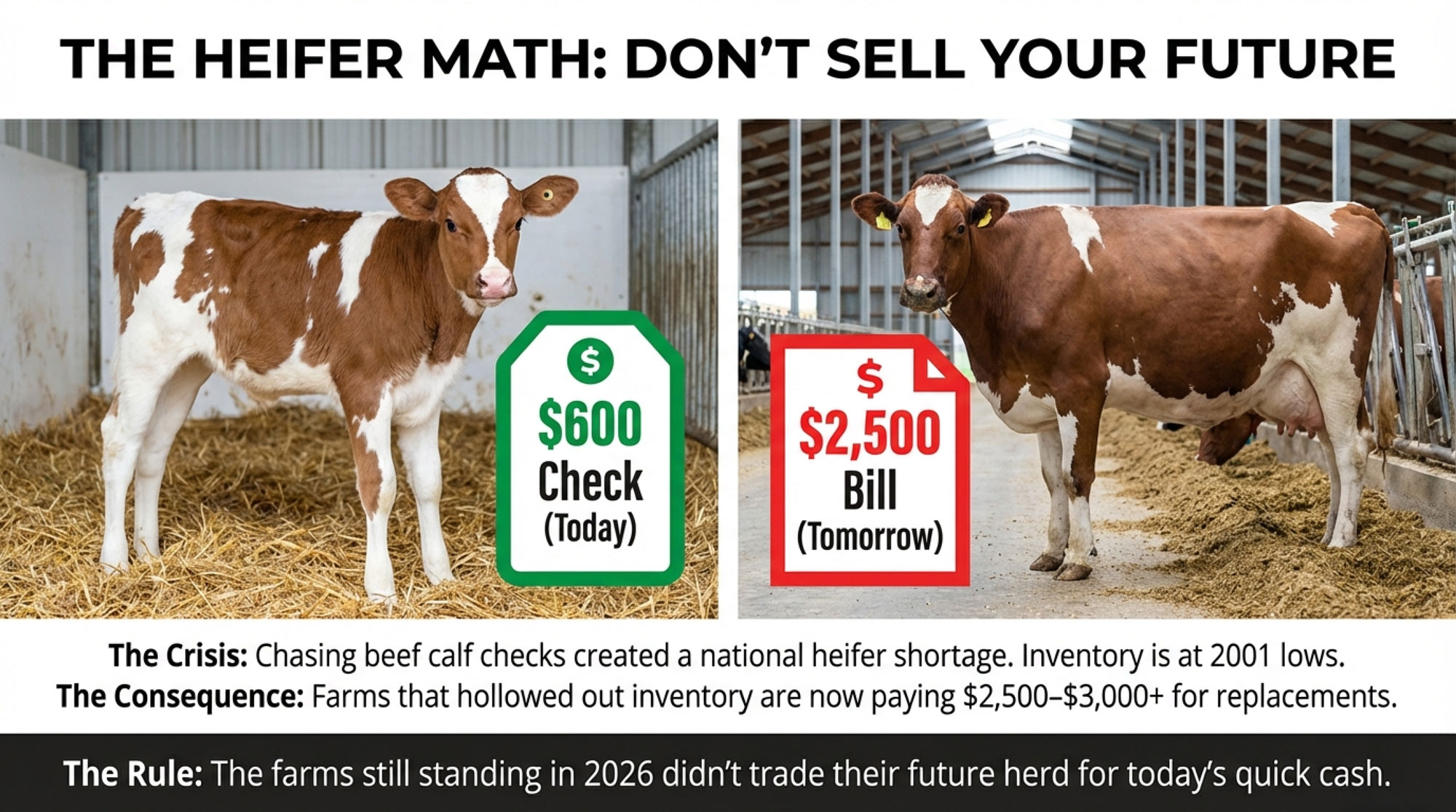
$600 beef calf or $2,500 heifer? The farms still standing in 2026 didn’t trade their future for today’s calf check.

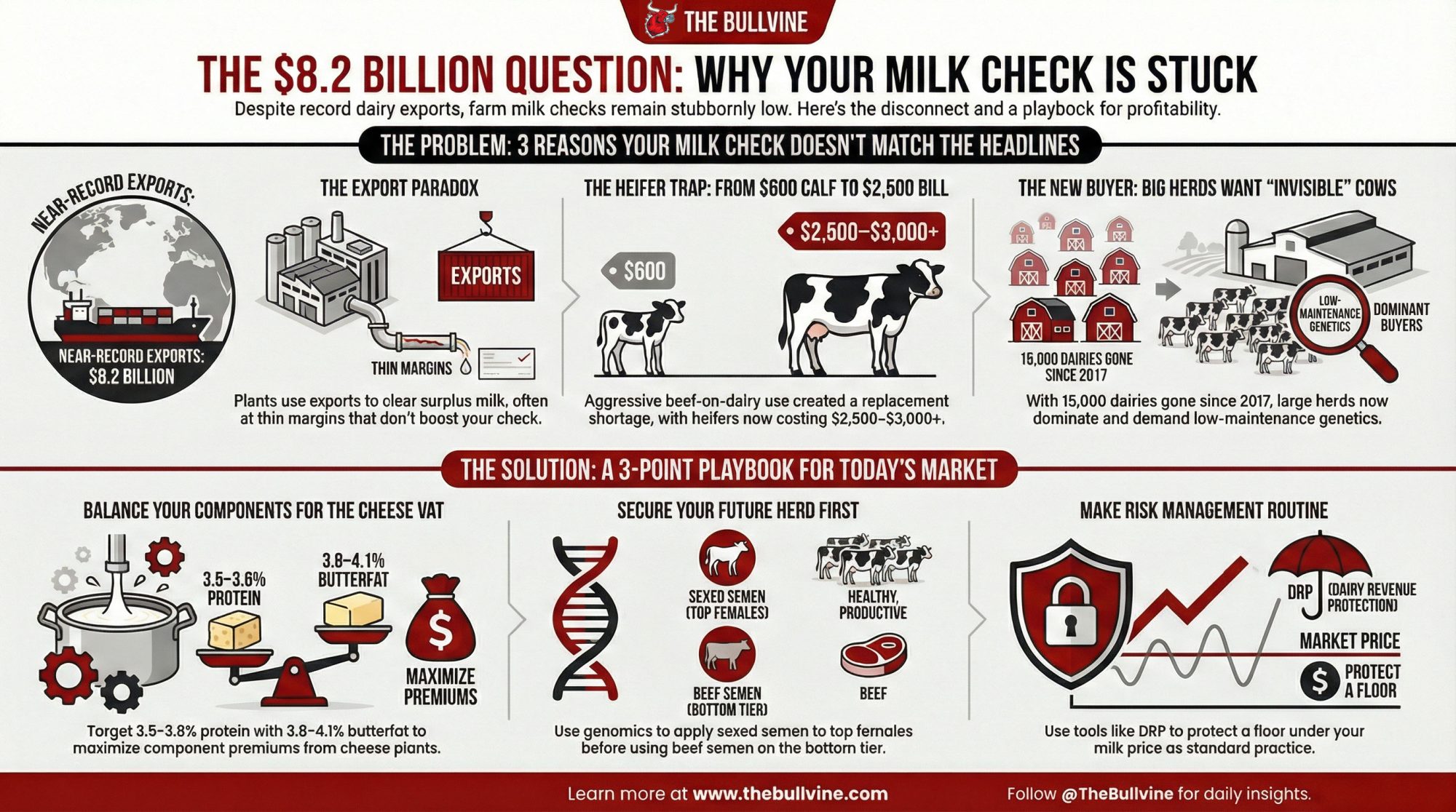
Executive Summary: U.S. dairy exports hit $8.2 billion in 2024, yet milk checks stayed stubbornly flat—and understanding why matters for your next move. The gap comes down to three forces: processing overcapacity that needs export markets to clear marginal pounds, a component shift in which cheese plants now reward protein over extreme butterfat, and a heifer shortage, many herds created by chasing $600 beef calf checks instead of protecting replacements. Today, quality heifers command $2,500–$3,000+, and the math has flipped. Consolidation has reshaped the landscape, too—15,000 dairies exited between 2017 and 2022, with 1,000+ cow herds now producing two-thirds of U.S. milk and demanding “invisible” cows that stay off the treatment list. The operations thriving in this environment share a playbook: components tuned to their plant’s grid, genomics and beef-on-dairy strategies that secure the replacement pipeline, and risk management treated as routine—not a crisis response. The next 12–24 months will separate the farms that planned from the farms that hoped.

You’ve probably lived this. You sit through a winter meeting where someone from the co‑op says, “Exports are strong, global demand looks good, U.S. dairy is well‑positioned.” The slides are full of big numbers. Then you get home, sit down at the kitchen table, open your milk check… and it feels like you’re farming in a different industry than the one they just described.

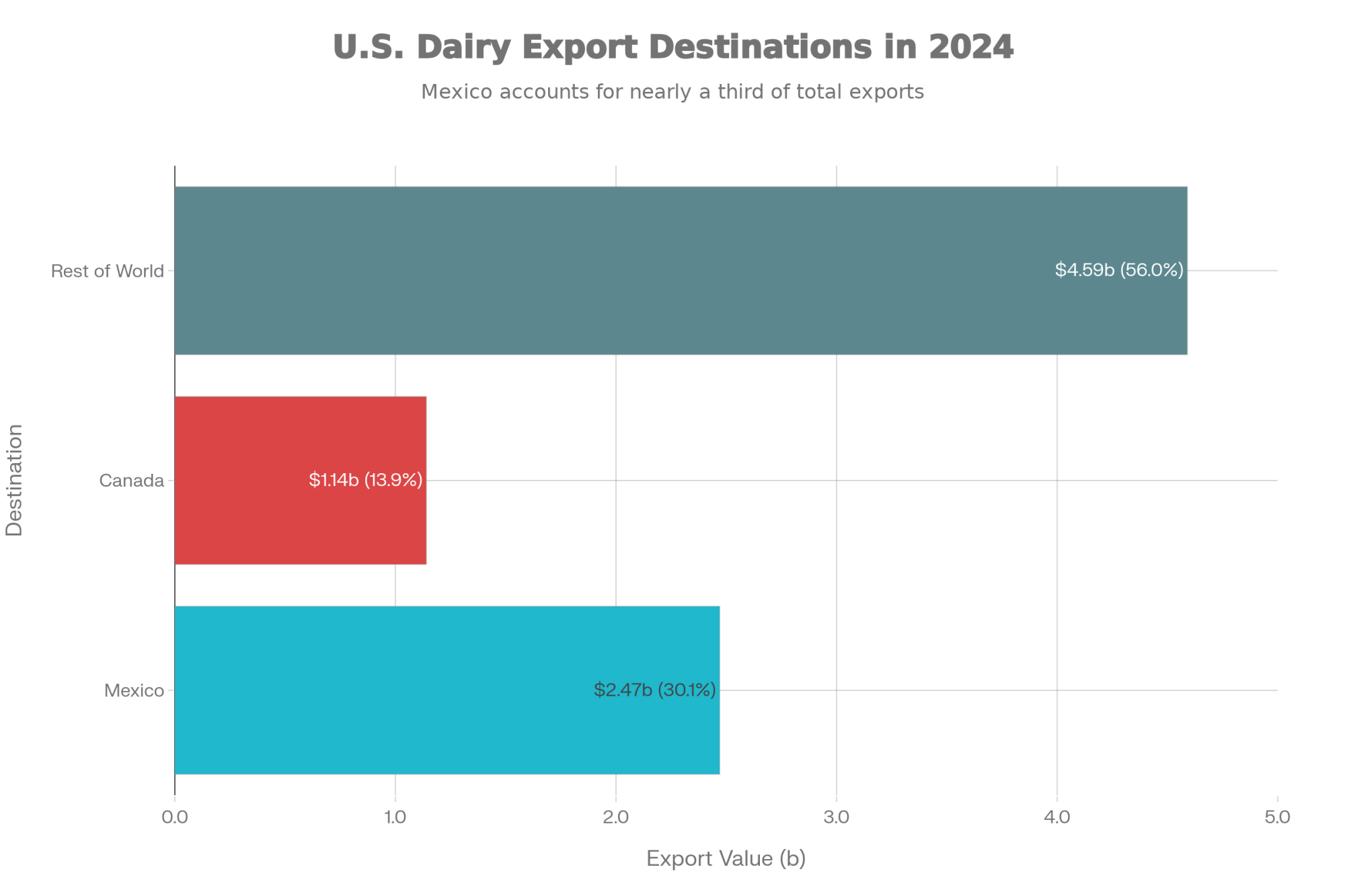
What’s interesting here is that those export numbers really are big. USDA’s Foreign Agricultural Service, in numbers summarized by IDFA, Dairy Processing, Dairy Foods, and Progressive Dairy, put 2024 U.S. dairy exports at about 8.2 billion dollars, the second‑highest export value on record after the 9.5‑billion‑dollar peak in 2022. Mexico took roughly 2.47 billion dollars of that total, and Canada about 1.14 billion, so together those two neighbors account for just over 40 percent of everything the U.S. ships overseas by value. Export coverage from USDEC highlights that Mexico is consistently the top buyer of U.S. cheese and skim milk powder.

Early 2025 commentary from market analysts suggests exports have generally held up reasonably well compared to 2024, with cheese shipments in particular staying firm in several key months. So that “exports are strong” line on the slides isn’t spin.

The question you and a lot of producers are asking is simple: if exports look that good, why doesn’t the milk check feel the same? To get at that, let’s walk through what’s happening at the plant, what’s changed with butterfat performance and protein, why geography still matters, what’s going on in Mexico—and then bring it right back to genetics, beef‑on‑dairy, fresh cow management, and risk decisions on your own farm.

Looking at This Trend from the Plant Side

Looking at this trend from the processor’s side is where the fog starts to clear a bit.

Over the last several years, processors have poured serious money into stainless steel. IDFA and industry analysts have talked about “historic levels” of processing investment, and Hoard’s Dairyman reported that roughly 8 billion dollarsworth of dairy processing projects—new cheese plants, powder facilities, and ingredient expansions—are in the works across the Upper Midwest, Plains, and Southwest. Brownfield Ag News and Dairy Herd have described “widespread growth underway,” citing new or expanded plants in South Dakota, Kansas, Texas, Idaho, and New York.

You see it most clearly along the I‑29 corridor. South Dakota has become one of the fastest‑growing dairy regions in the U.S., as new cheese capacity along I‑29 pulled in cows and capital. Kansas appears in USDA Milk Production reports and Progressive Dairy summaries as another state with steady multi‑year growth, driven by large freestall herds and added processing capacity. In New York, big yogurt and cheese plants—including Chobani’s facility at New Berlin—are regularly flagged in state and federal reports as major buyers anchoring regional milk sheds.

Here’s where the math gets real. Large cheese and powder plants are incredibly capital‑intensive. Dairy economists and plant managers consistently note that these facilities are built to run at high utilization—typically targeting 80 percent or higher—to spread fixed costs over as many cwt as possible. If you build a plant to handle 7 million pounds of milk a day and it only runs at 4 million, your cost per cwt jumps because the debt, labor, utilities, and maintenance don’t shrink just because the milk flow does.

So if the domestic market can only comfortably absorb, say, two‑thirds of what this whole system could produce at profitable prices, the rest has to move somewhere. That “somewhere” is export markets. USDEC summaries show that in 2024, the U.S. shipped record or near‑record volumes of cheese to destinations such as Mexico, South Korea, and Central America, and moved significant quantities of skim milk powder and whey to Asia and Latin America.

From the plant’s point of view, moving that extra product overseas at thin margins is often better than leaving vats idle. From your side of the milk check, those marginal export pounds don’t always create enough added value per cwt—after you factor in global competition, freight, and currency—to show up as a big jump. The plant can spread its fixed costs over a larger volume. You might see a bit better basis at times, but not the windfall “8.2 billion dollars” sounds like on a slide.

That’s the first piece of the export paradox: big export dollars and stubborn milk checks can absolutely coexist.

What Farmers Are Finding About Components

Now let’s bring this back into the parlor, because butterfat levels and protein are doing more of the talking on your milk check than many of us expected a few years ago.

For much of the last decade, butterfat looked like the star. USDA and CME data show U.S. butter prices and per‑capita butter consumption rising, and for many years, Class III and IV values put butterfat at a clear premium over protein on a solids basis. So a lot of us leaned into butterfat—through breeding, rations, and fresh cow management—to capture those butterfat premiums.

As more milk has flowed into cheese vats, though, the balance has shifted. Cheesemakers live on protein. That’s what builds curd. The Federal Milk Marketing Order Class III formulas use cheese, whey, and butter prices to calculate fat and protein values using specific yield factors. The way those formulas are structured creates a kind of see‑saw: when butterfat prices move sharply higher, the implied value of protein tends to get pulled down, and when butterfat softens, protein can carry more of the pay pool.

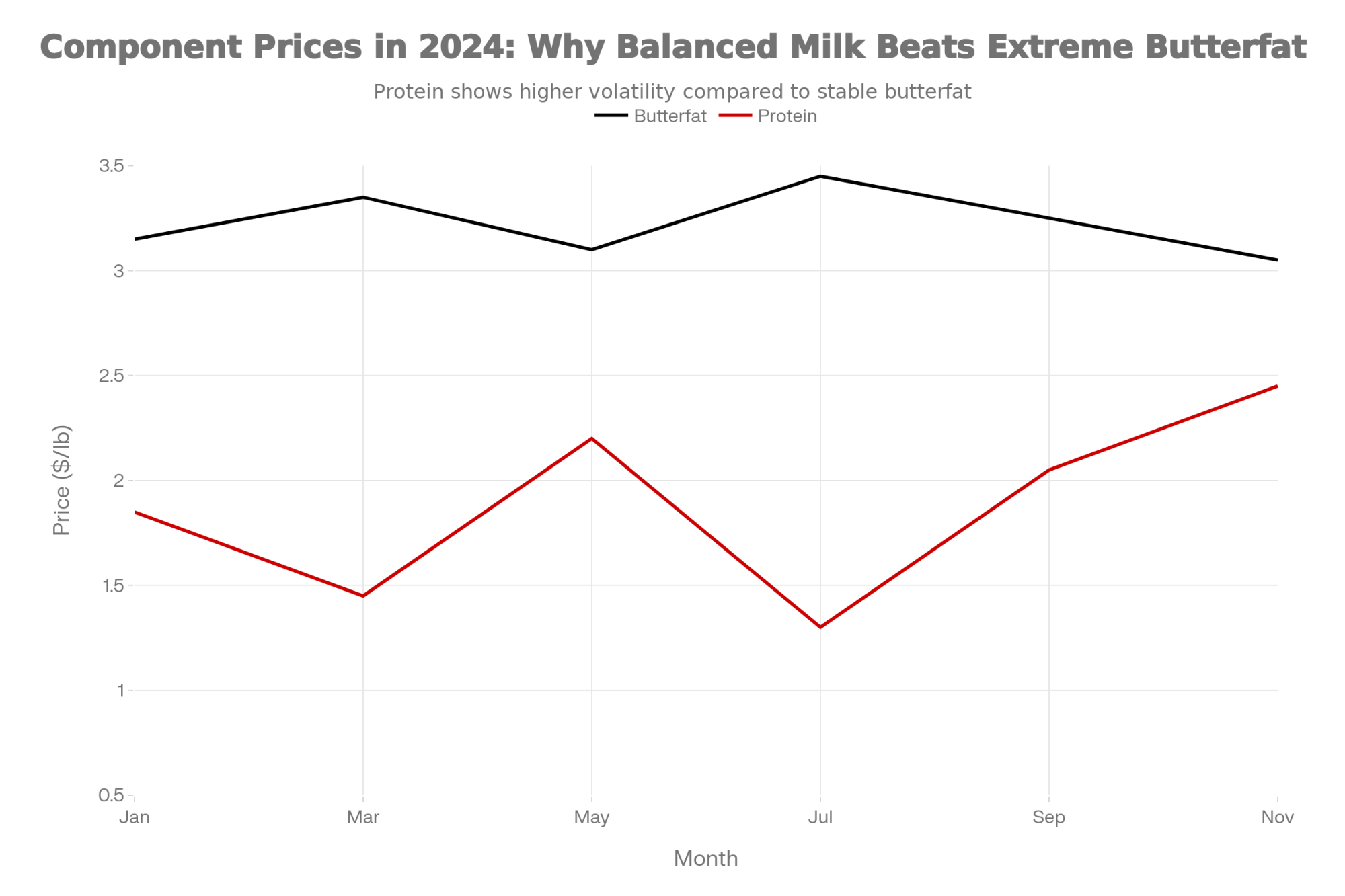
If you look at USDA component price reports across 2024, butterfat values often ran in the 3.00 to 3.50 dollars per pound range, while Class III protein values showed significant volatility—bouncing from around 1.10 to over 2.50 dollars per pound depending on the month. Dairy market updates from MCT Dairies and federal order bulletins highlighted several months where fat was historically strong while protein sagged, reflecting that cheese‑heavy product mix. Analysts like Sarina Sharp with the Daily Dairy Report have talked about co‑ops finding themselves “long on cream” at times, which makes it hard to fully reward sky‑high butterfat tests when protein and cheese demand are really driving the bus.

What farmers are finding—and what a lot of field nutritionists and independent advisers will tell you—is that balancedmilk tends to pay better than extreme milk in this environment. Herds averaging around 3.5–3.8 percent protein and 3.8–4.1 percent butterfat, with solid fresh cow management and a smooth transition period, often see more stable component checks than herds that push butterfat into the mid‑4s while letting protein linger around 3.0–3.1 percent. That profile matches what many cheese plants say they want: strong pounds of solids, but in a ratio that actually fits their vats.

MonthButterfat ($/lb)Protein ($/lb)
Jan3.151.85
Mar3.351.45
May3.102.20
Jul3.451.30
Sep3.252.05
Nov3.052.45

If you haven’t done it recently, it’s worth a quick kitchen‑table exercise:

  • Take a month’s milk statement and write down the total pounds of fat shipped and total pounds of protein shipped.
  • Divide each by the total pounds of milk shipped to confirm your average butterfat and protein tests.
  • Then look up that month’s USDA or co‑op Class III/IV component values and see how many dollars per cwt those pounds are really generating.

A recent review on milk quality and economic sustainability points out that herds with better component performance and milk quality tend to show stronger economic sustainability—so long as they aren’t trading away health and fertility to get there. And Mike Hutjens, Professor Emeritus and extension dairy specialist at the University of Illinois, has hammered the same point for years: it’s pounds of fat and protein shipped per cow and per cwt that drive income, not just pretty percentages on the DHI sheet.

This development suggests something important: chasing maximum butterfat at the expense of protein and cow health doesn’t pay the way it once might have. The money today is in a balanced component profile, backed by good transition‑period management and consistent TMRs.

Why Your ZIP Code Still Matters More Than You’d Like

Looking at this trend across regions, it’s hard to ignore how much your postal code still shapes your milk check.

USDA Milk Production reports make it pretty clear that cows and milk have been shifting into certain regions, especially the interior. South Dakota is one of the clearest examples. The state has become a major growth engine as the I‑29 corridor cheese plants and expansions pulled in herds and investment. Kansas appears in USDA and Progressive Dairy statistics as another state with consistent year‑over‑year growth, driven by large freestall operations and added plant capacity. At the same time, USDA/NASS and state reports often rank Michigan near the top for milk per cow, thanks to strong forage programs, cow comfort, and efficient parlors.

What I’ve noticed, looking at those numbers and listening to producers, is that geography flows directly into basis and hauling. A 1,500‑cow freestall in eastern South Dakota, 20 or 30 miles from a modern cheese plant, is playing a different game than a 200‑cow tie‑stall in a New England valley where there’s limited processing and plants are already full. The close‑in herd may save 30–50 cents per cwt on hauling and pick up stronger over‑order premiums and quality incentives because the plant really needs their milk. The more remote herd often pays more just to get milk to town and has fewer realistic buyers if contracts change.

To put some rough numbers on it, imagine a herd shipping 20,000 cwt per month. If better basis and lower hauling together net 0.75 dollars per cwt more than a herd in a less favored location, that’s 15,000 dollars per month, or roughly 180,000 dollars per year. That’s just an example based on USDA and regional data; every farm will have its own version of that spread. But it shows why two herds can read the same export headlines and feel completely different realities when the milk checks arrive.

FactorHerd A: Close to Growing Plant (SD, KS, TX)Herd B: Remote or Declining Region (VT, Upstate NY, Rural West)
Distance to Plant20–30 miles80–150+ miles
Hauling Cost$0.25–$0.40/cwt$0.60–$1.00/cwt
Over-Order Premium/Basis$0.50–$1.25/cwt$0.00–$0.50/cwt
Quality/Volume IncentivesStrong (plant needs milk)Weak (plant at capacity or shrinking)
Monthly Advantage (20,000 cwt)Baseline−$15,000
Annual ImpactBaseline−$180,000

It’s not about “good” or “bad” states. It’s about plant geography, infrastructure, and policy. Many producers in the Midwest and Plains will tell you their biggest advantage right now is simply being inside the pull radius of expanding cheese plants. Producers in some Northeast or Mountain West pockets, or even parts of Canada, may have very competitive herds but face higher freight and less processor competition, even while exports are booming.

Mexico: Our Best Customer—and a Big Exposure

Now let’s talk about where a lot of those extra cheese and powder pounds actually end up: Mexico.

USDA FAS, IDFA, USDEC, and trade outlets like Dairy Processing are all on the same page here: Mexico is the single largest foreign market for U.S. dairy by value. In 2024, the U.S. shipped roughly $2.47 billion in dairy products to Mexico and about $1.14 billion to Canada. Together, Mexico and Canada account for more than 40 percent of U.S. dairy export value, with Mexico consistently the top buyer for U.S. cheese and skim milk powder.

What’s encouraging in the near term is that Mexico is structurally short on milk. CoBank’s export analysis and USDA FAS reports describe a situation where Mexican dairy demand has outpaced domestic production, leaving a persistent gap that imports—mostly from the U.S.—fill. Per‑capita dairy consumption in Mexico is still lower than in the U.S., which gives some headroom for growth as incomes rise. That combination—structural deficit plus room for per‑capita growth—is a big part of why analysts see Mexico as critical to U.S. dairy’s near‑term export outlook.

But there’s another side that matters for your risk. FAS and industry coverage point out that Mexico is investing in its dairy sector, particularly in northern states, where newer farms are increasingly resembling large freestall and dry-lot systems in the U.S. Southwest, with upgraded genetics, improved feed efficiency, and better milk-handling infrastructure. The goal is to trim back some of that import dependence over time.

So what farmers are finding is that Mexico is both a tremendous asset and a concentration point. Over the next one to three years, it’s hard to imagine a strong U.S. export story that doesn’t lean heavily on Mexico. Over a three‑to‑ten‑year window, if Mexico succeeds in significantly boosting its own production, the growth rate of U.S. exports there could slow, or the mix of products could shift—even if the trading relationship remains strong.

For Canadian readers in Ontario and Quebec, supply management and quota systems buffer your farm‑gate price from a lot of these swings, as multiple analyses of the 2022 Census and Canadian policy have noted. But U.S. export performance and Mexico’s appetite still shape the broader North American environment you’re operating in—especially for processors, trade negotiations, and on‑going USMCA disputes.

One Herd That Fits Today’s Market

Sometimes these big forces are easier to digest when you see how they play out in a real barn.

Top‑Deck Holsteins, a roughly 700‑cow Holstein herd in Iowa, is one of those examples. A recent profile describes Top‑Deck as a freestall operation shipping milk with a rolling herd average around 33,500 pounds per cow per year, built on intentional management and breeding decisions. The exact numbers can move with feed and weather, but the pattern is what matters.

On the cow side, that profile explains that Top‑Deck:

  • Pushes forage quality and ration balance hard to drive dry matter intake and feed efficiency.
  • Treats cow comfort as a core investment—stall design, bedding, ventilation, and milking routines are all tuned for long lying times and low stress.
  • Watches fresh cow management and the transition period closely, with protocols aimed at catching issues early and supporting strong peaks without burning cows out at 30–60 days in milk.

Genetically, Top‑Deck uses genomic testing to rank heifers and cow families, then:

  • Uses sexed Holstein semen on top‑merit animals to generate replacements with strong production, components, fertility, and health traits.
  • Uses beef semen—often Angus—on lower‑merit animals to produce calves that bring better beef value than traditional Holstein bull calves.

Recent genomic and evaluation‑system reviews in the Journal of Dairy Science and related outlets note that millions of dairy animals worldwide have been genotyped, and that using genomic evaluations with economic indexes has significantly improved progress in production, fertility, and health compared with relying on parent averages. Work from the University of Guelph’s “beef on dairy” research program—funded through the Ontario Agri‑Food Innovation Alliance and national beef research groups—shows that beef‑sired dairy calves, when managed and marketed correctly, can deliver clearly higher prices than straight Holstein bull calves, and that optimizing their early‑life management is key to maximizing value.

What’s interesting here is that Top‑Deck’s approach isn’t about chasing one extreme number. It’s about building cows that quietly ship a lot of pounds of fat and protein, stay healthy and fertile, and leave behind replacements that can do the same—while using beef‑on‑dairy to lift calf revenue. That’s exactly the kind of herd that fits a cheese‑heavy, component‑sensitive, export‑connected world.

The Consolidation Reality—and What It Means for Genetics

Now let’s punch in the consolidation piece, because this really matters for breeders and for anyone thinking about where their herd fits.

The 2022 Census of Agriculture shows U.S. dairy farm numbers dropping from 39,303 in 2017 to 24,082 in 2022. That’s roughly a 39 percent decline—about 15,000 dairies gone in five years—even as total U.S. milk production climbed roughly 5 percent, on about 9.4 million milk cows. Rabobank analysis cited in those same reports estimates that herds with more than 1,000 cows now produce around two‑thirds of U.S. milk by value, up from around 60 percent in 2017.

On top of elemental market forces, environmental and labor policies are nudging in the same direction. California, Washington, and other states have tightened manure, water, and methane rules, pushing dairies toward digesters, lagoon covers, and more sophisticated nutrient management systems—investments that are easier to justify on a 2,000‑cow dairy than on an 80‑cow tie‑stall. Labor and immigration constraints also tend to hit smaller farms harder, while larger operations often have more tools to recruit, pay, and house workers.

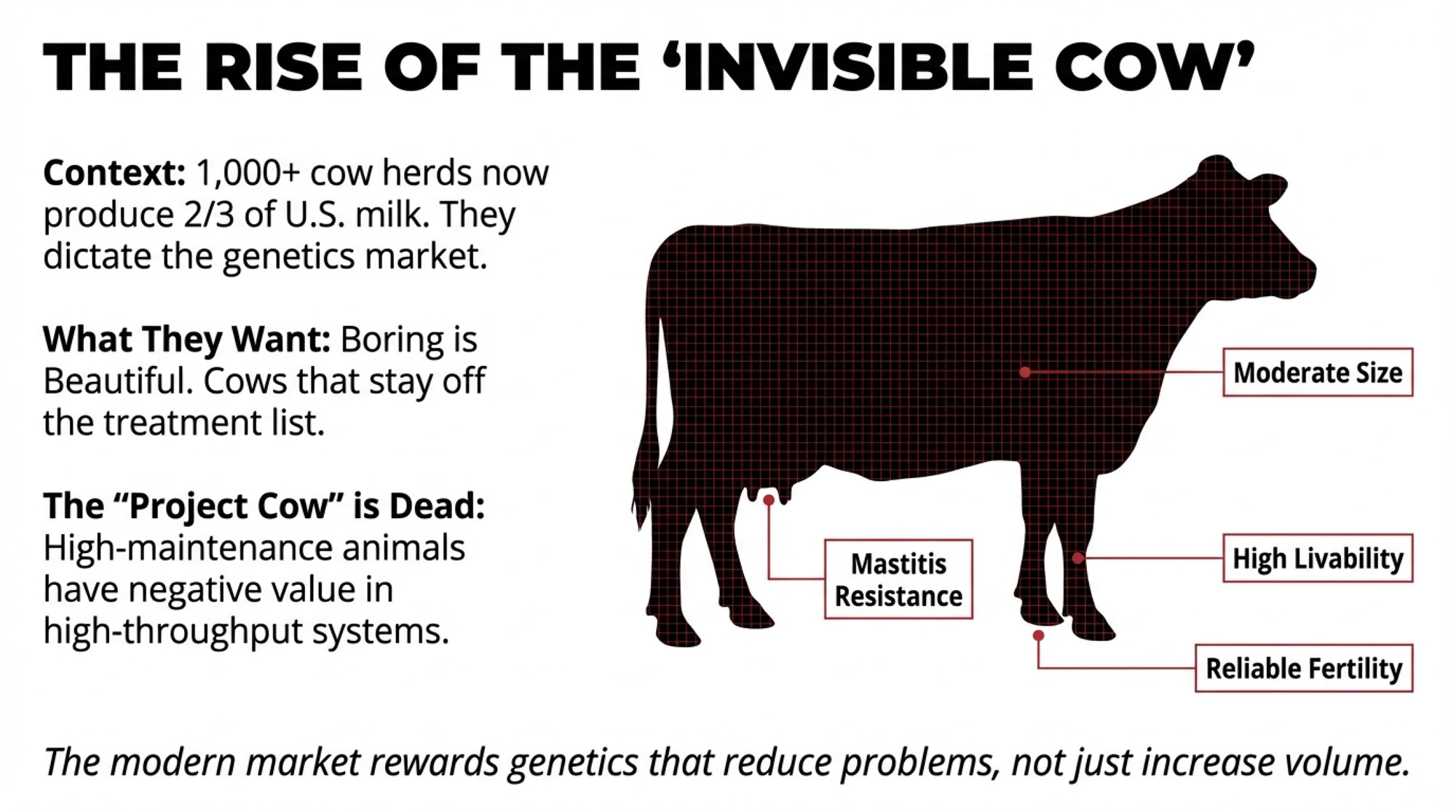
So the center of gravity has shifted. The buyers of genetics and semen are increasingly large freestall and dry-lot herds milking 1,000, 3,000, or 10,000 cows, not just smaller family herds picking bulls at a local sale. And those large herds are demanding a specific type of cow.

European and Scandinavian research has started using the phrase “invisible cows” to describe the ideal animal in large, modern dairy systems: basically trouble‑free, almost boring cows that don’t show up on the treatment list, have few metabolic or hoof problems, calve easily, breed back reliably, and quietly ship components that fit the plant’s grid. U.S. management and genetics advisers are framing similar ideas—focusing on cows that minimize disruptions in high‑throughput, labor‑tight environments.

What I’ve noticed, talking with large‑herd managers and AI folks, is that this is changing the genetic marketplace. Big herds don’t want “project cows” that constantly need special attention. They want cows that are almost invisible day‑to‑day:

  • Strong on productive life and livability.
  • Good mastitis resistance and udder health.
  • Sound feet and legs that keep them moving to the bunk and parlor.
  • Fertility and calving traits that keep fresh cow problems to a minimum.
  • Moderate size with solid feed efficiency.
Trait CategoryOld Priority (Show Ring / Single Trait)2025 Large-Herd Priority (“Invisible Cow”)
ProductionMax milk volume or max butterfat %Balanced pounds of fat + protein shipped per cow/year
HealthTreat problems as they comeMastitis resistance, low SCC, minimal treatments
FertilitySecondary concernStrong heat detection, conception rate, calving interval
CalvingSome assistance acceptableCalving ease (sire & maternal), low stillbirths
LongevityCull and replace as neededProductive life, low cull rate, multiple lactations
StructureExtreme dairy form, show-ring styleSound feet/legs, good locomotion, moderate frame
TemperamentNot formally selectedCalm, easy to handle in high-throughput parlors
Feed EfficiencyRarely consideredModerate intake, strong component output per lb DMI

For breeders, that has two big implications. First, there’s an opportunity for those who can breed and market families that consistently deliver these trouble‑free, “invisible” cows and back it up with real herd performance. Second, there’s risk if a herd or breeding program stays focused only on show‑ring traits or single‑trait extremes without a clear economic story tied to big‑herd, high‑throughput systems.

As herds get larger, the market is slowly but surely rewarding genetics that reduce problems rather than create them.

Beef‑on‑Dairy: Cash Cow or Heifer Trap?

Now let’s lean into beef‑on‑dairy and replacements, because this is where a lot of operations are feeling both opportunity and pain.

Over the last several years, beef semen sales into dairy herds have surged. CoBank analysts and semen company data indicate that beef semen units going into dairy cows have roughly tripled compared to the late 2010s, with estimates that 7–8 million beef units were sold into U.S. dairies in 2024 alone. The attraction is obvious: in many markets, newborn beef‑on‑dairy calves can bring 600 to 900 dollars per head in the first week, while Holstein bull calves often lag well behind that.

At the same time, USDA’s annual Cattle reports and independent analyses have been ringing the bell on dairy replacement inventories. A 2024 Farmdoc Daily review noted that just 2.59 million dairy heifers were expected to calve and enter the herd that year—the lowest since USDA began tracking that series in 2001. More recent updates and CoBank commentary suggest replacement inventories have been revised downward multiple times and remain historically tight.

On the price side, USDA’s Agricultural Prices reports show average dairy replacement heifer values moving into the 2,200 to 2,700 dollar range in many regions over 2023–2024, with springing heifers at auctions commonly bringing 2,500 to 3,000 dollars, and top lots in some Midwest and Western states touching 3,600 to 4,000 dollars. Several economic studies and extension bulletins peg the cost of raising a replacement heifer from birth to calving around 1,700 to 2,400 dollars, depending on the system—confinement, dry lot, or pasture.

So here’s the hard truth many of us are dealing with: a lot of farms leaned into beef‑on‑dairy so aggressively—because that 600–900 dollar beef calf check looked awfully good—that they’re now staring at 2,500‑plus replacement heifer prices when they want to expand or even just maintain herd size. Analysts in Dairy Herd have gone so far as to say that America’s heifer shortage is actively limiting expansion and that the “big money in beef‑on‑dairy” is one of the key drivers.

For a Bullvine reader, the warning needs to be crystal clear:

Don’t sell your future for a 300‑dollar calf check today.

Decision PointToday’s CashCost to RaiseMarket PriceReal Economics
Beef-on-Dairy Calf$600–$900$0 (buyer’s problem)N/AImmediate income, no future cow
Holstein Bull Calf$150–$250$0 (buyer’s problem)N/AMinimal income, no future cow
Keep & Raise Heifer$0 today$1,700–$2,400$2,500–$3,60024-month investment, future production
Annual Impact (100 beef calves)+$60,000–$90,000Clear−$250,000–$360,000 in replacement costsNet position depends on replacement needs

In some markets, the calf check is 600 or 800 dollars, not 300, but the principle is the same. Beef‑on‑dairy is a powerful tool when it’s aimed at the bottom of the herd with a clear replacement plan. Used without a plan, it can hollow out your future cow herd and leave you paying top-of-the-market prices to fill stalls.

The sweet spot, based on both research and what well‑run farms are doing, looks something like this:

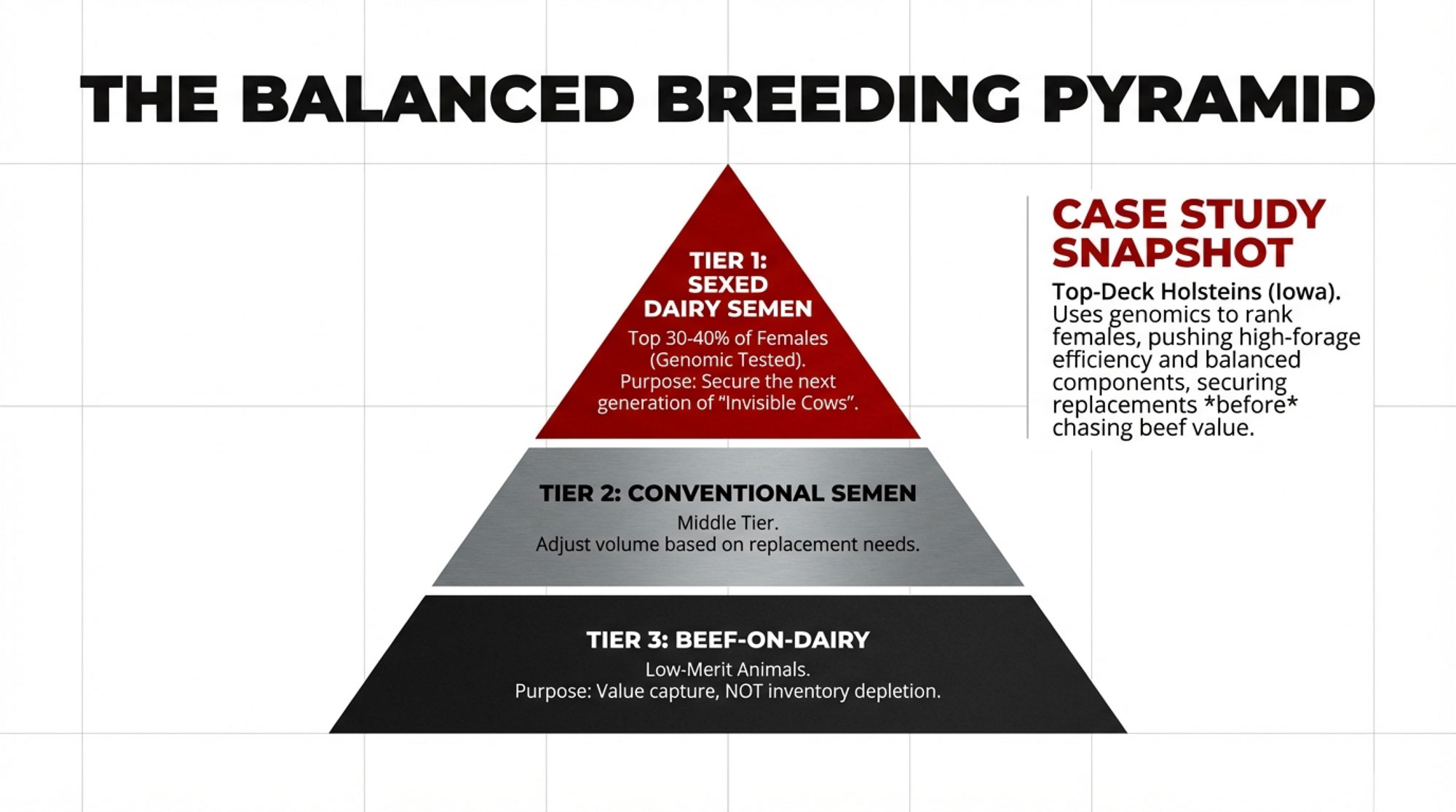
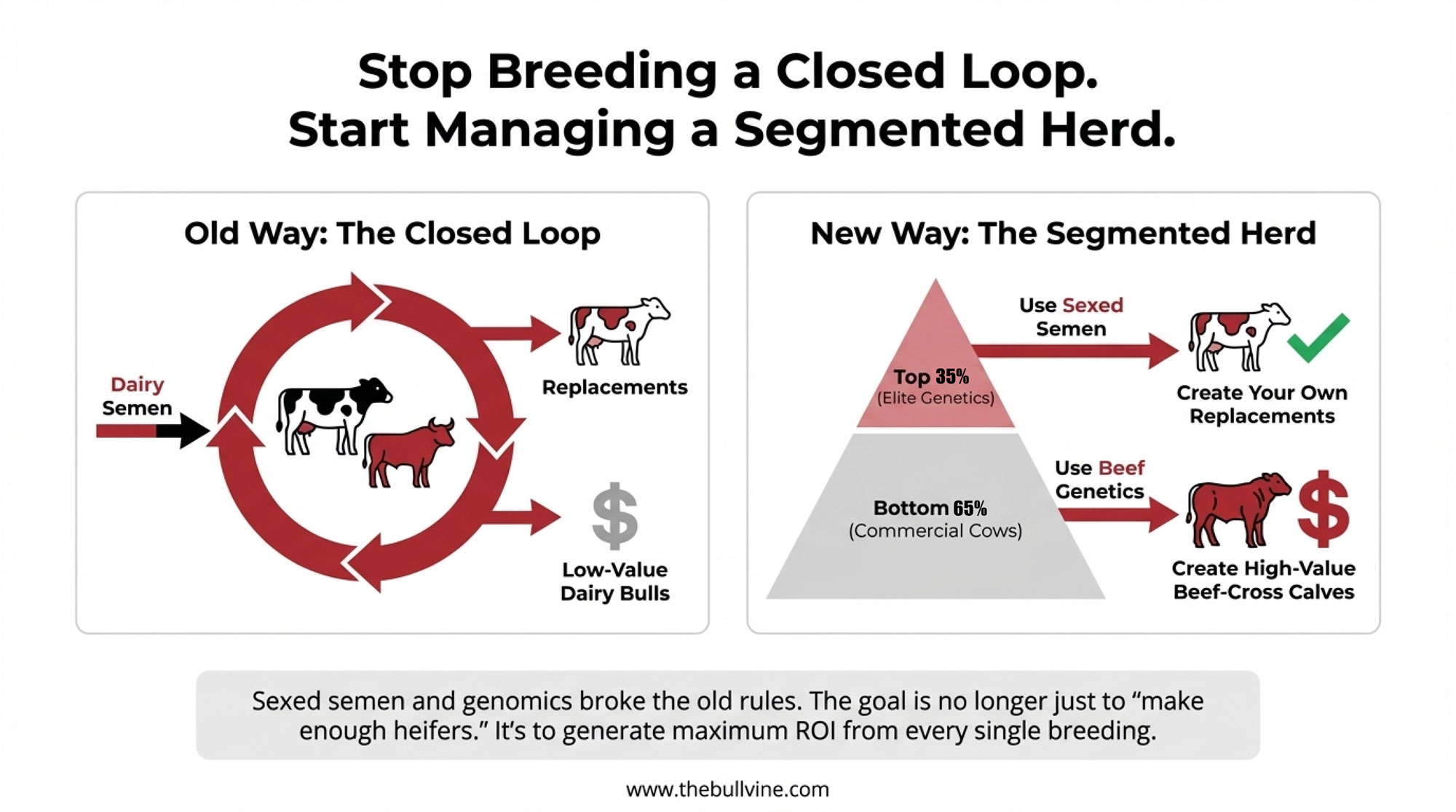
  • Top 30–40 percent of females: Genomic‑tested and top‑merit cows and heifers get sexed dairy semen to generate replacements.
  • Middle group: Conventional dairy semen, adjusted up or down depending on your replacement needs.
  • Bottom end: Clearly identified low‑merit cows and heifers get beef‑on‑dairy semen to turn them into higher‑value calves.

And that plan isn’t static. It gets revisited each year as calf, beef, and replacement markets change. But the order of operations doesn’t change: protect your future herd first; chase beef calf checks second.

What Farmers Are Finding Works Right Now

Talking with producers from Wisconsin to South Dakota, from Idaho to Ontario, three themes keep showing up on farms that seem to be navigating all this better than most.

Breeding for Profit and “Invisible” Cows

Looking at this trend in breeding decisions, the herds that look most resilient aren’t chasing a single extreme trait. They’re using tools like genomic selection, economic indexes, and on‑farm records to build cows that are profitable and low‑drama.

Peer‑reviewed work on dairy genetics and national evaluation systems, summarized by the Council on Dairy Cattle Breeding and others, shows that genomic selection combined with economic indexes like Net Merit (U.S.) and Pro$ or LPI (Canada) can significantly improve progress in production, fertility, and health traits compared to traditional selection. That’s the backbone of how most major AI studs and progressive herds are making mating decisions today.

On the farms I’ve seen, a practical genetics plan often looks like this:

  • Use a profit index (Net Merit, Pro$, LPI) as the main filter rather than picking bulls off a single trait like butterfat or total milk.
  • Inside that pool, favor bulls that nudge both fat and protein percentages modestly upward while maintaining or improving fertility, udder health, and productive life.
  • Put real weight on traits that keep cows in the herd: mastitis resistance, hoof health and locomotion, calving ease, and overall robustness.

In that context, many commodity‑oriented herds are targeting cows with butterfat around 3.8–4.0 percent, protein in the mid‑3s, and reproduction performance that aligns with their culling and replacement plans. That doesn’t win you banners at a show, but it tends to win you more predictable component checks, fewer headaches, and a cow that’s “invisible” in the best way—just quietly doing her job.

Turning Genomics and Beef‑on‑Dairy into Everyday Tools

Genomics and beef‑on‑dairy aren’t fringe ideas anymore—they’re everyday tools for a growing number of herds.

Recent genomic reviews indicate that genomic evaluations can roughly double the accuracy of selecting young animals compared to using parent averages alone, especially for complex traits such as fertility and health. Breeding programs that use sexed semen on the top tier of females and beef semen on the bottom tier to accelerate dairy genetic gain while also lifting calf value.

On many commercial farms, that has turned into a straightforward three‑tier system like the one above. The key shift on farms that are doing it well is that they’ve stopped guessing:

  • They genomic‑test at least a subset of heifers to identify which families deserve replacements.
  • They run replacement‑need projections based on real cull rates, expansion plans, and age at first calving.
  • They adjust the proportion of sexed, conventional, and beef semen to hit those replacement targets rather than just chasing what the calf market looks like this month.

University of Guelph research and beef‑on‑dairy extension materials emphasize that dairy‑beef cross calves can command solid premiums over straight Holstein bull calves when marketed correctly, but they also warn that early‑life management and health are critical to capturing that value. The farms that treat beef‑on‑dairy as a strategic tool—not just a quick cash grab—are the ones turning it into a durable advantage.

Making Risk Management Routine Instead of a Panic Button

The third big shift isn’t genetic or nutritional—it’s in how farms treat price risk.

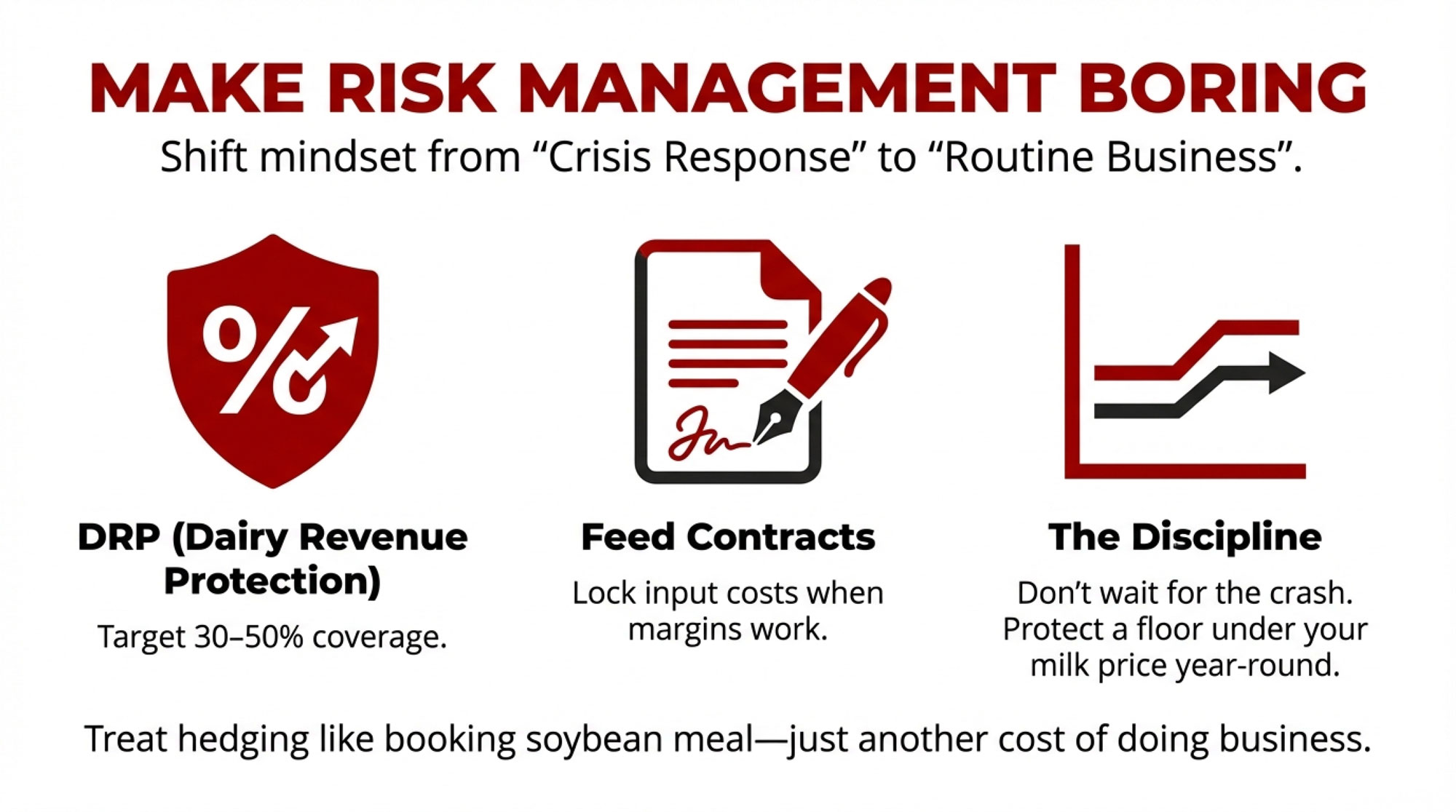
Extension economists and dairy market advisers have been pushing for years now that tools like Dairy Margin Coverage and Dairy Revenue Protection should be part of a routine risk plan, not just something you sign up for when prices crash.  Herds that quietly use DRP or basic options strategies year after year to put a floor under part of their milk price while leaving some upside open.

What many advisers suggest, as a starting point, is that producers consider protecting something like 30–50 percent of their expected milk production with DRP, options, or fixed‑price contracts when forward prices cover their cost of production and debt needs. It’s not a rule; it’s a range that seems to work for a lot of operations. Some herds are comfortable covering more, while others are less comfortable, depending on their balance sheets and risk tolerance.

A simple example might look like this:

  • A 900‑cow herd in Wisconsin, selling mainly into Class III, uses DRP to set a revenue floor under part of its projected spring and summer milk based on its typical butterfat and protein tests and the markets it ships into.
  • At the same time, the herd forward‑contracts a portion of its corn and soybean meal when futures plus local basis give them a feed cost that supports a margin they can live with.

The rest of the milk and feed stays unhedged, leaving room to benefit if markets move higher. The point isn’t that 900 cows in Wisconsin need this exact plan. The point is that treating risk tools as normal business practice—as much a part of the job as booking soybean meal—can turn wild swings into manageable bumps.

From conversations with producers who’ve made that shift, the hardest step usually wasn’t understanding the math. It was deciding to stop waiting for the next crisis to start learning.

Different Starting Points, Different Options

Given all this, the logical question is: “So what does this mean for my farm?” The honest answer depends on your size, your location, and your timeline. But some patterns show up pretty consistently.

Larger Herds Close to Growing Plants

If you’re milking 800–3,000 cows in eastern South Dakota, western Kansas, the Texas Panhandle, southern Idaho, or near growing plants in Wisconsin or New York, you’re in a spot where processors need your milk. That doesn’t solve everything, but it’s a real advantage.

On farms like yours that seem to be in decent shape, you usually see:

  • Sharp focus on components and cow flow. Butterfat and protein targets are tuned to what nearby cheese and ingredient plants actually pay for, and fresh cow management during the transition period is geared to support strong peaks without wrecking cows.
  • Structured breeding and replacement plans. Genomics and sexed semen build replacements from the top of the herd; beef‑on‑dairy is used thoughtfully on the bottom end to boost calf revenue without starving replacements.
  • Habitual risk management. DRP, DMC, options, and feed contracts are used when the math works, not just when the market is already in free fall.
  • Cautious growth decisions. Expansion plans are stress‑tested against lower milk prices and higher costs, often with lender and adviser input, not just modeled on today’s strong basis.

Mid‑Size Herds in Stable Regions

If you’re running 400–800 cows in places like Wisconsin, Michigan, Pennsylvania, Vermont, or Southern Ontario, you’re big enough to feel serious capital pressure but not always big enough to be your plant’s top priority.

Mid‑size herds that look resilient tend to:

  • Drive the cost of production hard. They lean into cow comfort, parlor throughput, and ration consistency to get into the top third of their region’s cost curve, using benchmarks from lenders, extension, and trade media.
  • Make themselves “must‑keep” suppliers. Plants know they can count on them for consistent volume, strong quality, and components that fit the product mix.
  • Explore niches where they truly fit. Some find success with organic, grass‑fed, A2A2, on‑farm processing, or regional branding—especially in the Northeast and Upper Midwest—but only when local demand and the family’s temperament for marketing line up.
  • Treat succession and timing as strategic variables. Major upgrades or expansions are tied to clear family plans for who wants to be there in 5–10 years, not just to what the bank will finance.

Smaller or More Isolated Herds

If you’re milking 50–200 cows in a rural pocket far from growing plants, or in a region losing processing, the export‑driven, capacity‑heavy system frankly isn’t built with you in mind.

Smaller herds in that position that manage to stay in the driver’s seat often:

  • Get brutally honest about cost and equity trends. They know, in numbers, whether they’re gaining ground, treading water, or slowly slipping.
  • Decide what role the dairy plays. For some, the dairy is still the primary economic engine. For others, it’s part of a mix with off‑farm jobs, cash crops, custom work, or direct‑marketing businesses. That choice shapes everything else.
  • Explore niches carefully, not desperately. On‑farm processing, direct‑to‑consumer sales, or agritourism can work—especially near population centers—but only when location, market, and family skills align. They’re not automatic lifelines.
  • Plan early for transitions. The most successful exits or step‑downs start with early, candid conversations with family, lenders, and advisers—before external forces make the decision for them.

A Few Practical First Steps

If you’re looking at your own numbers and wondering where to start, here are a few simple, concrete steps that many producers have found useful:

  • Pull a year’s worth of milk checks and component reports.
    Work out your true average butterfat and protein tests, and—more importantly—your pounds of fat and protein shipped per cow and per cwt. Then talk with your field rep or plant contact about how that profile lines up with what your leading buyer wants and pays best for.
  • Map your replacement needs before you map beef‑on‑dairy.
    Sit down with your records and figure out your real replacement rate and any expansion plans. Estimate how many quality dairy heifers you’ll need calving in over the next two to three years. Use that number to double-check how much beef‑on‑dairy your breeding program can truly support without putting you in the heifer penalty box.
  • Pilot genomic testing on a subset of heifers.
    Work with your AI rep or herd vet to test a group, rank them, and use that ranking to decide who gets sexed dairy semen and who gets beef. Treat this as a learning process, not a one‑off experiment.
  • Schedule an hour with a risk adviser.
    Sit down with someone from your co‑op, a dairy‑focused broker, or an extension economist and ask them to walk you through what it would look like to protect roughly 30–50 percent of your expected milk and some of your feed at prices that cover your costs and debt needs. Then adjust that percentage based on your own risk tolerance and lender expectations.
  • Run a stress‑test budget.
    Put together a simple cash‑flow scenario at a lower milk price—say 13–14 dollars Class III—and slightly higher feed costs. See where the pinch points are. Use that information to decide whether your next move should be to tighten costs, adjust debt, lock in some margins, pursue measured growth, or plan a gradual pivot.

Three Questions Worth Asking Yourself

As you work through all that, three blunt questions keep coming up in good kitchen‑table conversations:

  • Do my components actually fit my buyer’s product mix and pricing grid—or am I leaving money on the table chasing the wrong butterfat/protein profile?
  • Am I using genomic tools and beef‑on‑dairy with a clear replacement strategy—or am I selling my future herd for today’s calf checks?
  • Do I have even a basic risk plan for the next 12–24 months, or am I still gambling that spot markets will treat me kindly?

The Bottom Line

At the end of the day, the export headlines and your milk check are telling different parts of the same story. The export dollars keep plants running and markets open. The milk check reflects how that big system—stainless steel, global competition, butterfat and protein pricing, consolidation, geography, heifer supply, and policy—lines up with your cows, your barn, and your ZIP code.

What I’ve noticed, sitting at a lot of kitchen tables and in a lot of barn offices, is that once you really understand those connections, the whole situation feels a little less random. You won’t control the world price of cheese. But you can control how your herd is bred, how your fresh cows come through the transition period, what your cost of production looks like, and whether you use the genetics, beef‑on‑dairy, and risk tools that are already on the table.

There isn’t one right answer. For some operations, the smart play will be to lean in and grow with the local plant. For others, it’ll be carving out a well‑defined niche that truly fits their region and family. And for some, the bravest and best decision will be planning a thoughtful transition that protects family, equity, and sanity. The key is making that call with clear eyes, honest numbers, and a solid grasp of the forces that are shaping all of us—whether we like them or not.

Key Takeaways 

  • $8.2B exports, stubborn checks: Record dairy shipments didn’t lift every milk check because expanded plant capacity needs export markets to clear marginal pounds—at margins that rarely flow back to producers.
  • Protein now drives the pay grid: Cheese plants reward curd yield, not extreme butterfat. Herds balancing 3.5–3.8% protein with 3.8–4.1% fat are capturing more consistent component premiums than single-trait chasers.
  • Beef-on-dairy created a heifer crisis: Replacement inventories fell to their lowest since 2001. Farms that grabbed $600 beef calf checks now face $2,500–$3,000+ heifer bills—proof that short-term cash can cost long-term cows.
  • Big herds are buying “invisible” cows: 15,000 dairies exited in five years; 1,000+ cow operations now ship two-thirds of U.S. milk. They’re paying for genetics that deliver fertility, health, and components—not project cows that hit the treatment list.
  • Three moves that separate planners from hopers: Tune your component profile to your plant’s grid, use genomics and beef-on-dairy with a locked-in replacement plan, and treat DRP and feed hedges as standard practice—not emergency measures.

Complete references and supporting documentation are available upon request by contacting the editorial team at editor@thebullvine.com.

Learn More

Join the Revolution!

Join over 30,000 successful dairy professionals who rely on Bullvine Weekly for their competitive edge. Delivered directly to your inbox each week, our exclusive industry insights help you make smarter decisions while saving precious hours every week. Never miss critical updates on milk production trends, breakthrough technologies, and profit-boosting strategies that top producers are already implementing. Subscribe now to transform your dairy operation’s efficiency and profitability—your future success is just one click away.
NewsSubscribe
First
Last
Consent

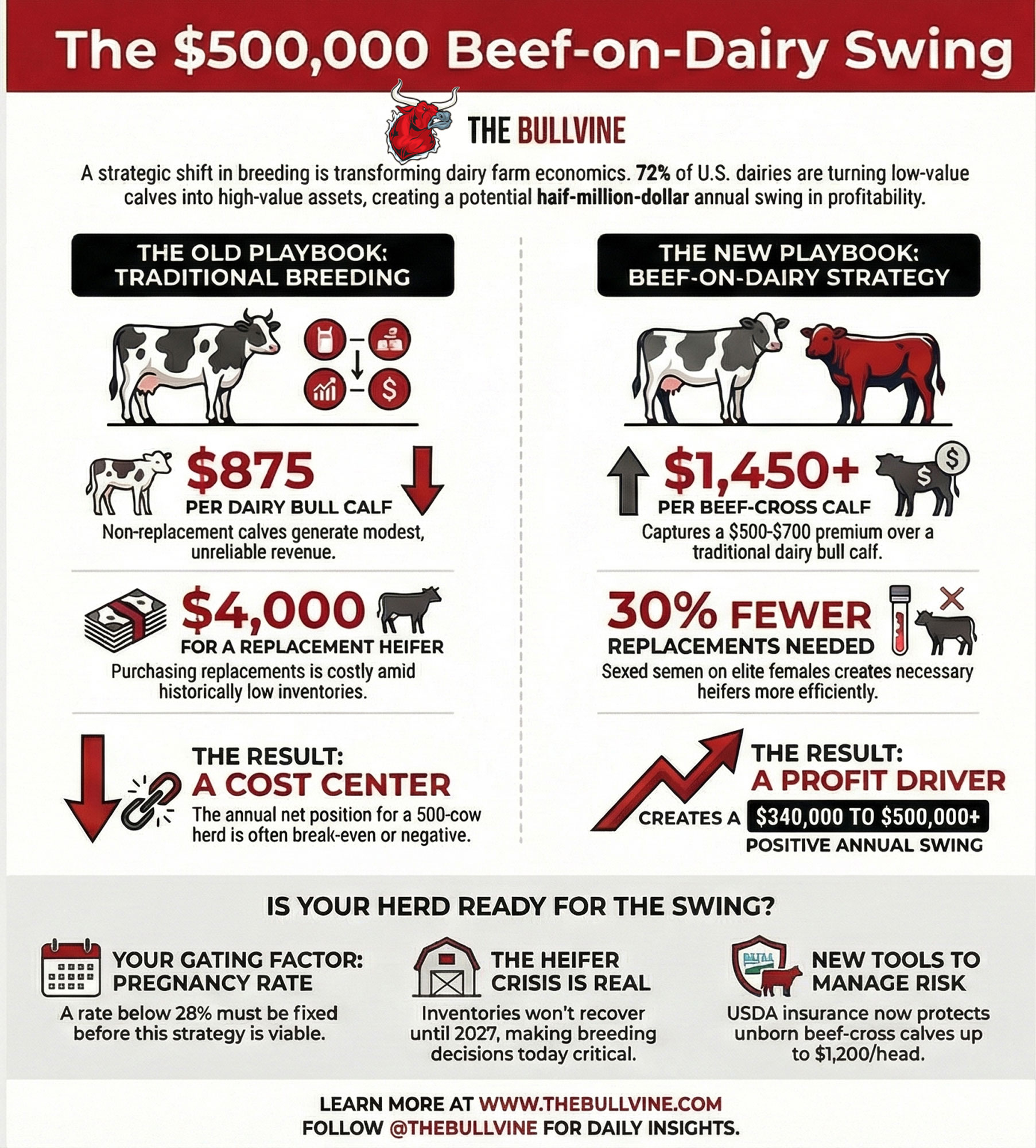
Beef-on-Dairy’s $500,000 Swing: What 72% of Farms Know That’s Costing You $1,000/Cow Every Year

$4,000 for a replacement heifer. $875 for a dairy bull calf. But 72% of farms get up to $1,450 for beef-cross calves, AND cut replacement needs by 30%. The $500K swing isn’t theory—it’s math.

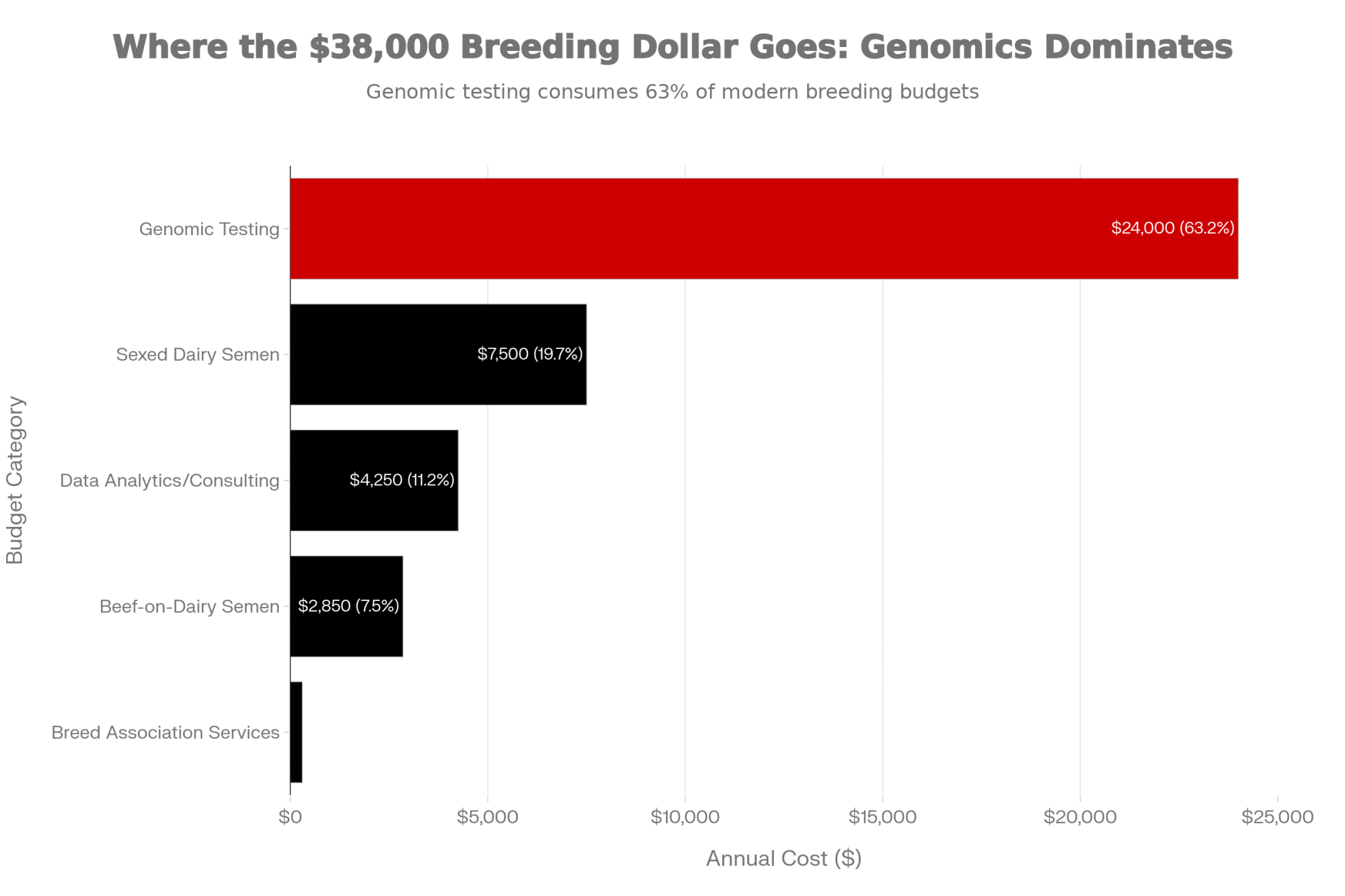
Last spring, I was talking with a Wisconsin dairy producer who described a moment that’s becoming increasingly common across the industry. He’d just finished reviewing his 2024 breeding costs—nearly $38,000 between sexed semen, genomic testing, and beef genetics—and realized he was spending six times what his father had budgeted for the same line item in 2018. The question that kept him up that night wasn’t whether the investment was worthwhile. It was whether he was even measuring the right outcomes anymore.

You know, that producer’s experience captures something significant happening across North American dairy right now. For generations, farmers identified themselves by the breed they milked. Holstein operators pointed to volume records and global market dominance. Jersey advocates countered with components, feed efficiency, and longevity. These conversations shaped industry gatherings, show ring rivalries, and breeding decisions for the better part of a century.

But something’s shifted over the past decade. While traditionalists continued debating which breed was superior, many producers started asking a different question entirely: “What combination of genetics—regardless of color—maximizes my return on investment?”

The answers to that question are reshaping dairy genetics in ways that would have seemed unlikely just 15 years ago.

The Numbers Behind the Shift

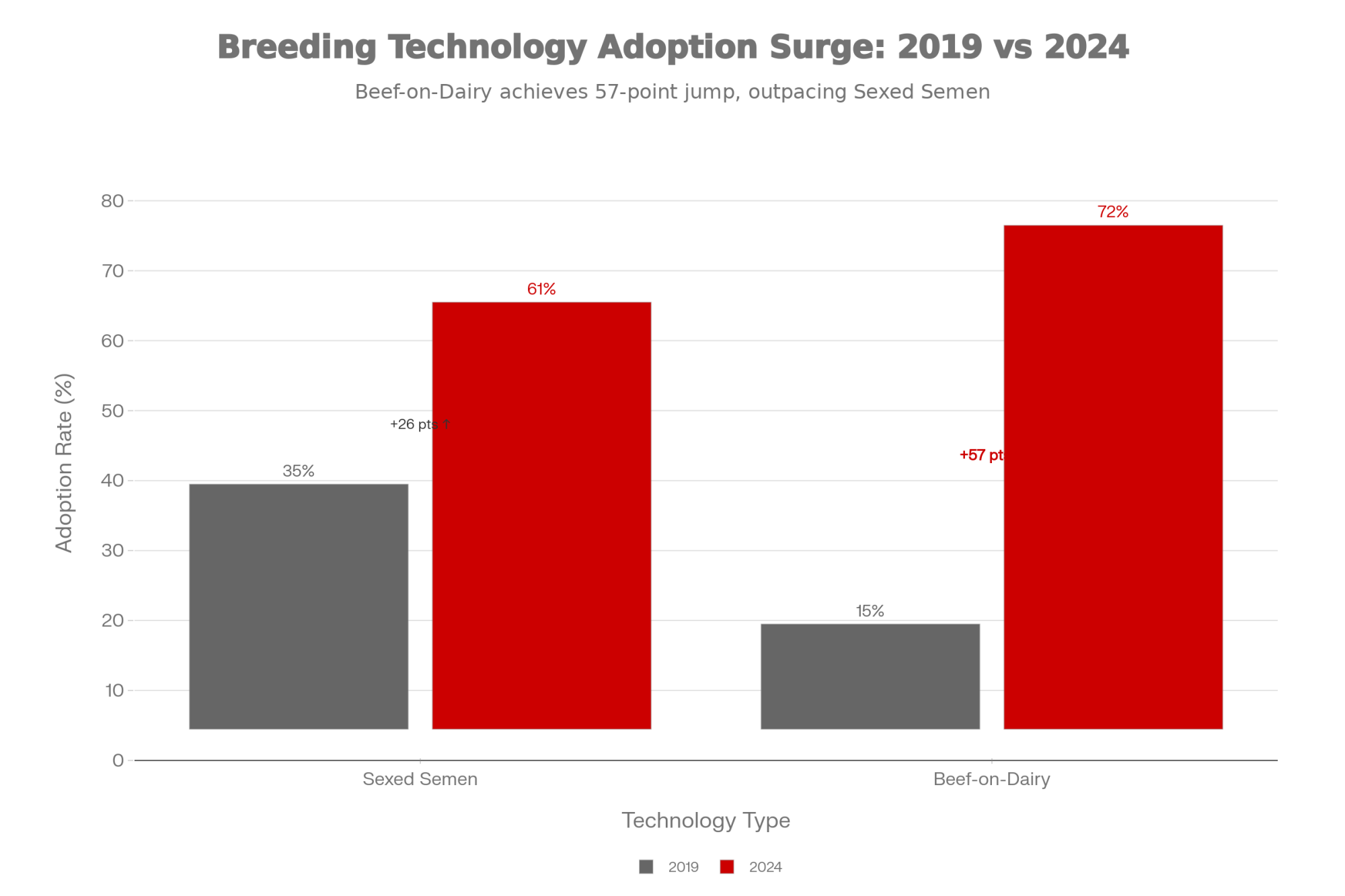
The breeding landscape has changed dramatically in just five years, and the National Association of Animal Breeders’ 2024 year-end report tells the story pretty clearly. Gender-selected semen now accounts for 61% of all dairy breeding decisions in the United States—that’s 9.9 million units out of 16.1 million total domestic dairy units sold. We’ve come a long way from roughly 35% back in 2019.

Technology2019 Rate2024 RateGrowth
Sexed Semen35%61%+26 pts
Beef-on-Dairy15%72%+57 pts

And beef-on-dairy? Those crosses have surged to 7.9 million units annually, making beef genetics the fastest-growing category in dairy barns across the country. According to American Farm Bureau analysis, 72% of dairy farms are now using beef genetics to boost the value of calves from lower-performing cows—a remarkable adoption rate for a strategy that barely existed a decade ago.

Meanwhile, USDA data confirms that replacement heifer inventories have dropped to historic lows. The January 2025 Cattle report shows heifers expected to calve this year at roughly 2.5 million head—the lowest since USDA started tracking this series back in 2001. Total dairy heifers are sitting at levels we haven’t seen since 1978.

YearHeifer Shortage (thousands)Springer Price ($)
202301,720
2024-2002,400
2025-4003,010
2026-4383,800
2027-1534,500

These trends connect in important ways, reshaping how dairy operations think about genetic investment, replacement economics, and long-term profitability.

How Technology Changed the Breeding Playbook

Understanding today’s genetics landscape means recognizing how fundamentally the rules have changed since 2010.

The traditional purebred breeding model rested on a straightforward biological constraint: farmers needed to produce enough replacement heifers from their own herds to maintain herd size. This meant breeding most cows to bulls of their chosen breed, creating an inherent link between breed loyalty and operational necessity.

Gender-selected semen technology changed that equation entirely.

Here’s how to think about it: The old model was essentially a closed loop—every cow bred to a dairy bull, every heifer raised as a potential replacement, every bull calf sold for whatever the market offered. Today’s model is more of a segmented herd approach. Your top 15-20% of cows get sexed dairy semen to produce your replacements. Your bottom tier gets beef genetics to produce premium calves. And your middle tier? That’s where the economic optimization happens—balancing replacement needs against beef calf revenue based on your pregnancy rate and market conditions.

This shift from “closed loop” to “segmented herd” represents a fundamental change in how dairy barns function economically.

When farmers can achieve 90%+ heifer conception rates with sexed semen—something that’s become routine with modern sorting technology—they no longer need to breed their entire herd for replacements. A 500-cow operation that needs 110 replacement heifers annually can now direct its top genetics to dairy sires and point the remaining breedings elsewhere.

For most operations, “elsewhere” increasingly means beef genetics. Research by Dr. Victor Cabrera and his team at the University of Wisconsin-Madison has documented that beef-cross calves command substantial premiums over pure dairy bull calves at auction. Current market data shows beef-cross calves bringing $1,250-$1,700 per head compared to$750-$1,000 for dairy bull calves—a premium of $500-$700 per calf that adds up fast across a herd.

Pregnancy RateBreeding StrategyBeef Breeding %Risk Level
Below 25%FIX REPRODUCTION FIRST0-10%N/A – Focus on fertility
25-28%Limited beef breeding15-25%Moderate
28-30%Balanced approach40-50%Low
Above 30%Aggressive beef program60-70%Very Low

That revenue shift matters. On a 500-cow operation producing 350+ calves from non-replacement breedings, the difference between $875 average for dairy bulls and $1,450 average for beef-crosses represents over $200,000 in additional annual revenue—before you even factor in the replacement heifer math.

The Quiet Crisis at Breed Associations

Here’s where we need to have an honest conversation about what’s happening to breed associations—and whether the current model can adapt.

Holstein Association USA CEO Lindsey Worden acknowledged the situation directly in her 2024 State of the Association address: registrations decreased 8% from 2023, and participation in core programs like Herd Complete dropped 4% in both animals and herds. What’s notable is that Worden attributed the decline directly to fewer Holstein heifers being born as more dairies breed cows to beef.

Industry data shows Holstein’s share of the U.S. dairy herd has declined from around 90% in the early 2010s. Meanwhile, crossbred dairy animals have grown significantly—Council on Dairy Cattle Breeding data shows their numbers increased from fewer than 3,000 in 1990 to over 207,000 by 2018, with continued growth since as crossbreeding programs have expanded.

Budget CategoryAnnual Cost% of Total
Genomic Testing$24,00063.2%
Sexed Dairy Semen$7,50019.7%
Data Analytics/Consulting$4,25011.2%
Beef-on-Dairy Semen$2,8507.5%
Breed Association Services$3000.8%

Breed association fees now represent less than 1% of what commercial operations spend on genetics. When registrations, classification, and breed services capture such a tiny slice of the breeding dollar, you have to ask: Is the current association model serving today’s commercial dairy industry, or is it serving a shrinking segment that values pedigree for its own sake?

The Bullvine has been asking this question for years. As we noted in our analysis, “Are Dairy Cattle Breed Associations Nearing Extinction?” Breed associations face mounting pressure from technological advancements, shifting market demands, and environmental concerns—all while struggling with leadership transitions and declining relevance to commercial producers.

The Case for Associations: A Different Perspective

To be fair, association leaders push back on the “declining relevance” narrative—and they have some data to support their position.

Worden, in a recent interview, offered a direct counter-argument: “Animal identification is the foundation to any genetic program, and that’s our core business. From there, the goal is to make it easy for every herd, large or small, to capture value with the Holstein cow.”

She points to growth in other metrics even as registrations decline. In 2024, Holstein USA officially identified 544,438 Holsteins in the herdbook—up 16% from the prior year. The Basic ID program, which provides official ear tags, sire/dam identification, and birthdate recording at a lower cost than full registration, grew 10%.

“Basic ID is an inexpensive way for herds to get involved,” Worden explained. “With an official ear tag, sire, dam, and birthdate, plus genomic testing, we can start showing the value of having data in the national database, not just in Dairy Comp on the farm.”

She also highlighted breed performance gains: In 2024, Holstein USA’s TriStar 305-day mature equivalent averages surpassed 1,200 pounds of fat for the first time, protein topped 900 pounds, and milk hit 28,443 pounds.

“We still offer all the same programs our longtime members value,” Worden commented in a recent interview. “If someone wants to register a calf with a photo and a paper application, we’ll do that. But we’ve also streamlined programs, invested in I.T., and created automated processes for large herds. We have herds milking 10,000 cows or more, so we’ve made it as efficient and seamless as possible.”

The question isn’t whether breed associations will survive. Some will. The question is whether they can evolve from membership organizations selling breed identity to service organizations selling genetic value—and do so fast enough to remain relevant when the value proposition has fundamentally shifted.

What Crossbreeding Adopters Are Experiencing

The documented results from systematic crossbreeding programs offer useful data points for producers evaluating their options.

The ProCROSS system—a structured rotation of Holstein, VikingRed, and Montbéliarde genetics developed through collaboration between Coopex Montbéliarde in France, VikingGenetics in Scandinavia, and CRV in the Netherlands—has accumulated over a decade of commercial data across multiple countries.

A University of Minnesota study led by Dr. Amy Hazel, Dr. Brad Heins, and Dr. Les Hansen tracked 3,550 cows across seven commercial dairies from first calving through multiple lactations. Their findings, published in the Journal of Dairy Science in 2017, showed ProCROSS crossbreds produced at least as much milk solids, gave birth to more live calves, were more fertile, and returned to peak production sooner than their pure Holstein herdmates.

The economics are worth examining closely. Research published in the Journal of Dairy Science by Clasen and colleagues in 2020 calculated crossbreeding advantages, including:

  • €20-59 higher contribution margin per cow per year compared to pure Holsteins
  • 30.1% replacement rate versus 39.3% for pure Holsteins—roughly 45 fewer replacements needed annually on a 500-cow dairy
  • Improved fertility is driving most of the economic gain, with health cost reductions adding further margin

Ongoing research at the University of Minnesota’s West Central Research and Outreach Center in Morris continues to track these outcomes. According to recent NIMSS project reports, crossbred cows in their studies show daily profit 13% higher for two-breed crossbreds and 9% higher for three-breed crossbreds compared to their Holstein herdmates, with lifetime death loss 4% lower for both crossbred groups.

From Wisconsin to California: U.S. Operations Are Implementing at Scale

It’s one thing to see research data. It’s another to see it work on commercial farms across different scales and regions.

Dornacker Prairies is a 360-cow dairy in Wisconsin run by fifth-generation farmer Allen Dornacker and his wife Nancy, in partnership with Allen’s parents Ralph and Arlene. According to VikingGenetics case study materials, the farm has embraced both crossbreeding and robotic milking as part of their strategy to future-proof the operation.

The Dornackers transitioned to robotic milking in 2018, installing Lely A5 robots, and have built their ProCROSS program alongside the technology investment. Their production runs around 9,200 kg per year, with 4.6% fat and 3.6% protein—strong component levels that align with research findings on crossbred performance. They also rear dairy-cross beef calves, capturing value on both sides of the breeding decision.

What’s notable about the Dornacker operation is how it represents a typical Wisconsin dairy in scale—the state averages around 350 cows per farm—while implementing progressive breeding and technology strategies. They’re 90% self-sufficient in feed, growing their own soybeans, alfalfa, corn, and winter wheat across 405 hectares.

But crossbreeding isn’t just for medium-scale family operations. In California—the nation’s largest milk-producing state—approximately 81% of dairy operations reported using beef semen in a 2020 survey cited in Choices Magazine research by Latack and Carvalho. These include many of the state’s large-scale operations, which run 2,000-5,000+ cows.

The scale of adoption is remarkable. According to The Bullvine’s market analysis, nearly 4 million crossbred calves were born nationally in 2024, with forecasts projecting that number could reach 6 million by 2026. Texas alone saw herd counts increase by 50,000 cows in 2024, complemented by a production spike of over 10% per cow—with beef-on-dairy breeding playing a significant role in the economics.

Tom and Karen Halton converted their 500-cow UK operation to ProCROSS roughly fifteen years ago. According to ProCROSS case study materials, Tom offered a candid perspective: “Without these cows doing what they have done, we wouldn’t still be farming.”

These results are encouraging, though it’s worth noting that crossbreeding success depends heavily on consistent implementation and appropriate genetic selection within the rotation.

When Master Breeders Face Commercial Realities

What’s particularly telling is how even elite breeders—those who’ve achieved the industry’s highest recognition—are adapting to commercial pressures.

Take Cherry Crest Holsteins in Ontario. Don Johnston and Nancy Beerwort, along with their son Kevin and wife Tammy, secured their third Master Breeder shield in 2024—a remarkable achievement made more impressive by the fact that the farm has undergone three complete herd dispersals in its history. Their philosophy prioritizes animal well-being, balanced breeding, and practical, economically sound decisions.

“The Master Breeder shield gives you the satisfaction that you’ve been making some of the right decisions,” Johnston said in an interview.

The ability to achieve elite breeding recognition despite multiple dispersals demonstrates an important point: successful breeding today requires adaptability and economic pragmatism, not just genetic idealism. The Johnstons rebuilt their program three times by consistently applying sound principles—identifying superior genetics, making economically rational decisions, and staying focused on what actually works.

This pragmatic approach is increasingly common among recognized breeders. The 2024 Holstein Canada Master Breeder class included operations running robots alongside tie-stalls, farms that started from scratch and achieved recognition in less than two decades, and multi-generational operations that have evolved their programs significantly to remain competitive.

The message from these elite breeders is clear: genetic excellence and commercial viability aren’t opposing forces. The best breeders find ways to achieve both.

The Case for Focused Purebred Programs

Crossbreeding isn’t the right answer for every operation, and some producers are achieving excellent results with focused purebred programs. This deserves equal attention.

The approach relies on intensive genomic testing of every heifer calf, strategic culling of bottom-tier genetics, and careful bull selection emphasizing productive life and fertility alongside traditional production traits. Producers with strong management systems, good facilities, and the discipline to cull strategically can build highly profitable purebred herds averaging 32,000+ pounds per cow with solid pregnancy rates.

Here’s what’s worth recognizing: the genetic tools that enable crossbreeding—genomic testing, sexed semen, data-driven selection—also enable more sophisticated purebred programs. The key consideration isn’t which approach is universally “better,” but whether a breeding program aligns with an operation’s management capacity, market access, and operational goals.

Jersey producers have seen particularly strong results in recent years. The US Jersey Journal reported in March 2025 that the breed achieved record production levels in 2024: 20,719 lbs milk with 5.08% fat and 3.77% protein on a mature equivalent basis—numbers that would have seemed ambitious a generation ago. For operations selling to processors with strong component premiums, Jersey genetics continue delivering compelling economics.

Why Components Are Driving Breeding Decisions

And those component premiums matter more than ever. According to CoBank’s lead dairy economist, Corey Geiger, multiple component pricing programs now allocate nearly 90% of the milk check value to butterfat and protein.

Here’s what that looks like in practice: Under Federal Milk Marketing Order pricing for December 2025, butterfat is valued at $1.7061 per pound according to the USDA’s Announcement of Class and Component Prices. For a producer shipping 100 pounds of milk, the difference between 3.5% and 4.5% butterfat represents roughly $1.70 per hundredweight—over $17,000 annually on a 1,000-cow dairy shipping 80 pounds per cow per day.

Real dollars at the farm level: According to MilkPay’s June 2025 component analysis, with butterfat valued at $2.66 per pound and protein at $2.48 per pound, increasing butterfat from 3.90% to 4.25% adds $0.93 per hundredweight. Increasing protein from 3.16% to 3.32% adds another $0.40 per hundredweight. Combined, that’s $1.33 per hundredweight of additional revenue—roughly $13,300 annually on a 1,000-cow operation.

Some cooperatives go further with quality incentives. Curtis Gerrits, senior dairy lending specialist at Compeer Financial, noted that Upper Midwest processors work with farmers who consistently deliver high-quality milk, offering approximately $0.85 per hundredweight in quality premiums for consistent volume and good components. That’s enough to make a real difference in margin.

The University of Wisconsin Extension’s February 2025 Dairy Market Update confirmed that U.S. butterfat tests hit 4.218% as of November 2024—up 0.088 percentage points from the prior year. Protein reached 3.29%. Both represent continued genetic progress, and both reward producers who’ve selected for components.

The message is clear: genetics that deliver components are genetics that deliver revenue. Whether that’s Jerseys, crossbreds emphasizing Montbéliarde or VikingRed, or Holsteins selected for component indexes—breeding decisions that ignore component trends are leaving money on the table.

The Genomics Paradox: Worth Understanding

This next point challenges some assumptions about genetic investment.

Genomic selection, introduced commercially in 2008-2009, promised to accelerate dairy breeding by nearly halving generation intervals. And genetic progress on paper has accelerated substantially—bulls are improving at rates that would have seemed unlikely under the old progeny-testing system.

Yet a peer-reviewed analysis by the Agricultural & Applied Economics Association in late 2024 found something worth noting: while genetic milk yield potential increased approximately 60-70% following genomic selection implementation, actual farm-level milk yield growth remained essentially unchanged at approximately 1.3% annually—the same rate as before genomics arrived.

“If your genetics are improving at 2% annually but your replacement costs are rising at 10%, you aren’t winning—you’re just running faster on a treadmill. The goal isn’t better cows in the abstract. It’s better margins on your operation.”

Why the disconnect? Management constraints often matter more than genetics—facilities, nutrition, and labor frequently limit genetic expression. Feed economics have shifted, meaning that higher production doesn’t always translate into higher profit. And inbreeding is accumulating faster under intensive genomic selection, with measurable implications for fertility and health traits.

Recent Canadian research adds another dimension. A study published in the Canadian Journal of Animal Science in December 2025 found that “While milk yield had improved, profitability had shown a negative genetic trend, which means that an exclusive focus on higher milk production is detrimental to long-term economic efficiency.”

This doesn’t mean genomic testing lacks value—for parentage verification, genetic defect screening, and informed culling decisions, it remains genuinely useful. But evaluate genomic investments against realistic expectations rather than theoretical maximums.

What Could Go Wrong: Risks Worth Understanding

Before diving into the economics comparison, let’s be honest about what could derail these strategies. No breeding approach is risk-free.

Beef market volatility is real—and it can move fast. In October 2025, cattle markets experienced a sharp correction. According to The Bullvine’s market analysis, crossbred calf values dropped significantly—an 11.5% decline in just twelve days. Drovers magazine noted that “tight supplies and strong demand could push cattle prices to even higher highs in 2025, but uncertainty is infusing more risk and volatility into the markets.”

Sexed semen isn’t foolproof. While the technology has improved dramatically, conception rates still run below those of conventional semen. According to ICBF data, the relative performance of sexed semen compared to conventional semen is about 92%. Industry data from British Dairying suggests that the current 4M technology achieves roughly 82-84% of conventional conception rates in well-managed herds. Herds that tried sexed semen and stopped reported much lower results—averaging just 37% conception with sexed versus 58% with conventional. Management and timing matter enormously.

Crossbreeding implementation failures happen. Research reviews have documented that crossbreeding programs can fail due to “insufficient funding, low return on investment in biotechnology, poor monitoring and evaluation of breeding programs.” Operations with excellent Holstein management may see less benefit from switching than operations struggling with purebred health and fertility issues.

Managing Beef Market Risk: New Tools Available

The good news? Risk management options have expanded significantly.

As of July 1, 2025, the USDA’s Livestock Risk Protection (LRP) program added a game-changing option: Unborn Calves Coverage specifically designed for beef and beef-on-dairy crossbred calves. According to Farm Credit East, this federally subsidized insurance program now allows dairy producers to lock in price protection for calves before they’re even born.

Here’s how it works: producers can protect calves intended for sale within 14 days of birth, with coverage levels allowing protection of up to $1,200 per calf. The program uses a price adjustment factor (multiplier) so producers can protect values closer to what they’re actually receiving at market.

Other risk mitigation strategies:

  • Forward contracting with calf buyers when prices are favorable
  • Diversifying beef sire selection across multiple breeds (Angus, Limousin, Simmental)
  • Maintaining breeding flexibility by keeping pregnancy rates high enough to shift back toward dairy replacements if beef markets weaken
  • Staggering calf sales throughout the year, rather than selling in large batches

What This Looks Like in Practice

CategoryTraditional ApproachSexed + Beef-on-Dairy
Annual Breeding Budget$12,000$38,000
Calf Revenue (200-350 calves)$150,000 – $200,000$437,500 – $595,000
Replacement Purchases Needed($120,000 – $160,000)($40,000 – $60,000)
Net Annual Position($12,000) to +$28,000+$340,000 to +$495,000
THE SWINGBASELINE+$340K to +$500K

THE ECONOMICS THAT MATTER: A 500-COW COMPARISON

This is the calculation every dairy should run with their own numbers.

Traditional Approach (Conventional + Some Sexed Dairy Semen):

  • Breeding budget: ~$12,000 annually
  • Dairy bull calf value: ~$750-1,000/head × ~200 calves = $150,000-$200,000
  • Replacement heifer purchases needed: 30-40 head at $4,000 = $120,000-$160,000
  • Net breeding/replacement position: -$12,000 to +$28,000

Optimized Sexed + Beef-on-Dairy Approach:

  • Breeding budget: ~$38,000 annually (sexed dairy on top 20%, beef on remainder)
  • Beef-cross calf value: ~$1,250-1,700/head × 350 calves = $437,500-$595,000
  • Replacement heifer purchases needed: 10-15 head at $4,000 = $40,000-$60,000
  • Net breeding/replacement position: +$340,000 to +$495,000

The Swing: $340,000 to $500,000+ difference in annual economics

Here’s the key insight: Dairy bull calves are finally worth real money—$750-$1,000 is nothing to dismiss. But beef-cross calves at $1,250-$1,700 are worth 50-70% MORE. That $500-$700 premium per calf, multiplied across 350 calves, is where the swing comes from.

RUN YOUR OWN NUMBERS

Plug in your operation’s actual figures to see where you stand:

Your VariableYour NumberIndustry Benchmark
Current pregnancy rate___%28-30% minimum for flexibility
Annual replacement rate___%30-35% typical, 25% achievable
Cost to raise a heifer$___$2,800-3,500
Current springer purchase price$___$3,800-4,200 (projected $4,500+ by 2027)
Dairy bull calf sale value$___$750-1,000
Beef-cross calf value (local market)$___$1,250-1,700
Sexed semen conception rate___%82-92% of conventional
Current butterfat test___%4.22% national average
Current protein test___%3.29% national average
Processor component premium$___/cwt$0.85-1.33/cwt typical

If your pregnancy rate is below 28%, focus there first. The best breeding strategy won’t overcome poor reproductive performance.

The Replacement Heifer Challenge Ahead: 2026-2027 Projections

One consequence of widespread beef-on-dairy adoption deserves attention for anyone planning breeding programs through 2027—and the projections are sobering.

With heifer inventories at multi-decade lows and springer prices reaching $4,000 or more in major dairy markets—CoBank reported top dairy heifers in California and Minnesota auction barns bringing upwards of $4,000 per head by mid-2025—replacement economics have fundamentally shifted.

But here’s what’s coming: According to CoBank’s modeling published in August 2025, dairy replacement inventories will not rebound until 2027. The numbers are stark:

  • 2025 and 2026 combined: Nearly 800,000 fewer dairy replacements than needed
  • 2026 specifically: The model predicts 438,844 fewer dairy heifers compared to 2025
  • 2027 outlook: A potential net gain of 285,387 dairy heifers available for replacements compared to 2026—the first positive turn in years

The price trajectory tells the story. According to the USDA’s July 2025 Agricultural Prices report, dairy replacement prices have jumped from $1,720 per head in April 2023 to $3,010 per head—a 75% increase in just over two years.

University of Illinois dairy economist Mike Hutjens, in his 2026 Feed and Forage Outlook, summarized the situation: “The critical heifer shortage is expected to persist, with replacement heifer inventories projected to shrink further before a potential rebound in 2027. Farmers are already ‘hoarding’ older cows and adopting gender-sorted semen to maintain herd sizes.”

What this means for your 2025-2026 breeding decisions: Every heifer you breed to beef today affects your replacement availability in 2028-2029. The 30-month biology of dairy cattle doesn’t negotiate.

Dr. Victor Cabrera at the University of Wisconsin-Madison has modeled this extensively. His research suggests that operations need pregnancy rates of 28-30% to achieve meaningful flexibility in beef-on-dairy programs without compromising replacement availability. Herds below that threshold face harder tradeoffs.

Farmers navigating this environment are employing several strategies:

  • Extended productive life focus: Keeping healthy cows in the herd through 4-5 lactations reduces replacement needs by 20-30%
  • Precision replacement breeding: Using genomic testing to identify the top 15-20% of genetics for heifer production
  • Earlier breeding programs: Achieving first calving at 22-23 months rather than 24-26 months
  • Custom heifer partnerships: Contracting heifer development to manage capital constraints

Regional Realities: Context Matters

Optimal breeding strategies vary significantly by region, scale, and market access. There’s no universal answer.

  • Western mega-dairies in California, Idaho, Texas, and New Mexico, operating 3,000+ cows, often have dedicated reproduction teams and processor relationships that reward consistent volume. With 81% of California dairies already using beef semen and Texas adding 50,000 cows in 2024 alone, the Western region has embraced this shift at scale.
  • Midwest family operations in Wisconsin, Minnesota, Michigan, and Iowa, averaging 200-500 cows, face different considerations. Tighter labor availability and the need for management simplicity often make single-breed programs more practical. Operations like the Dornackers show that medium-scale farms can successfully implement crossbreeding—but it requires commitment and consistent execution.
  • Northeast and Mid-Atlantic producers contend with higher land costs and often-limited expansion options. For these farms, maximizing income per cow frequently drives breeding decisions toward higher-component breeds or crossbreeding systems emphasizing longevity.
  • Grazing-based operations prioritize different traits—moderate body size, strong feet and legs, and fertility under seasonal breeding pressure. These systems have long embraced crossbreeding or alternative breeds that don’t appear prominently in conventional AI catalogs.

The principle that emerges: matching genetic strategy to operational reality matters more than following any single approach.

Your Next 90 Days: Practical Steps

For farmers evaluating breeding strategies heading into 2025-2026, here are specific actions:

In the next 30 days:

  • Calculate your actual cost per replacement heifer—including all raising costs, not just purchase price. Many operations underestimate this by $500-800 per head.
  • Pull your pregnancy rate trend for the last 12 months. Is it above 28%? This single number determines how much flexibility you have.

In the next 60 days:

  • Get current beef-cross calf quotes from your local auction or buyer. Prices vary significantly by region and genetics—current ranges are $1,250- $1,700 for quality beef crosses.
  • Review what your processor is actually paying for. Check your milk statement for actual dollars per pound of butterfat and protein.

In the next 90 days:

  • Run the 500-cow comparison with your own numbers. See where your operation actually stands.
  • Talk to your AI rep about a pilot program. Start with 20% of breedings rather than a wholesale shift.
  • Contact your crop insurance agent about LRP Unborn Calves Coverage. The new coverage could protect up to $1,200 per calf against market downturns.

Questions to discuss with your advisors:

  • Can my management system capture the genetic potential I’m paying for?
  • Do I have the reproductive performance to support aggressive beef-on-dairy programs?
  • What’s my contingency if beef markets drop 15-20%?
  • Given CoBank’s projections of continued heifer tightness through 2026, should I be more conservative on beef breeding this year?

Looking Forward

The breed wars, as traditionally understood, may be evolving into something different. What’s emerging is a dairy genetics landscape where farmers can select from an expanding toolkit of genetic resources—purebred, crossbred, and integrated beef programs—based on what delivers sustainable profit for their specific operation.

This doesn’t mean breed identity disappears. Holstein, Jersey, and other purebred programs will continue serving producers who find success with focused genetic selection. Show rings will still draw interest. Elite breeders will still command premium prices for exceptional genetics. And as Lindsey Worden’s data shows, breed associations are finding new ways to deliver value—even if registrations decline, services like Basic ID and genomic integration are growing.

But for the commercial dairy industry—the operations producing the majority of North America’s milk supply—breeding decisions increasingly follow economic logic rather than breed loyalty alone.

The Bottom Line

That $340,000 to $500,000+ annual swing in breeding economics is real. Dairy bull calves at $750-$1,000 are finally worth something—but beef-crosses at $1,250-$1,700 are worth substantially more. The $500-$700 premium per calf, multiplied across hundreds of breedings, is where fortunes are being made or missed.

Whether that swing works in your favor depends on running the numbers—your numbers, not industry averages—and on making decisions that align with your management capacity, your market access, and your operation’s specific goals.

For producers willing to evaluate their options thoughtfully, that half-million-dollar swing represents a genuine opportunity.

KEY TAKEAWAYS:

  • The $500,000 breeding flip. Optimized operations capture $1,450 beef-cross calves instead of $875 dairy bulls—a $575 premium per head. Traditional approach: Still selling $875 calves when you could be netting $1,700. The annual swing on 500 cows: $340,000-$500,000+.
  • 72% already pivoted. The 28% are leaving money on the table. Three-quarters of U.S. dairies use beef genetics. Haven’t switched? You’re missing $500-$700 per calf while competitors capture it.
  • Pregnancy rate is the gating factor. Below 28%? Fix reproduction—beef-on-dairy won’t save a broken repro program. Above 30%? Every dairy-bred bottom-tier cow costs $500-700 in missed calf premium per year.
  • Today’s breeding decision locks in 2028 economics. CoBank: heifer inventories won’t recover until 2027. Springers: $4,000+. The 30-month biology of cattle means this quarter’s breedings set replacement costs for three years.
  • New hedging tools match the strategy. USDA’s LRP Unborn Calves Coverage (launched July 2025) protects beef-cross calves up to $1,200/head—critical after October 2025’s 11.5% market correction.

EXECUTIVE SUMMARY: 

The $500,000 question every dairy faces: Are you capturing the beef-on-dairy swing, or funding your competitors’ replacement heifers? Seventy-two percent of U.S. farms have already pivoted—using sexed semen on top genetics for replacements while turning bottom-tier breedings into $1,250-$1,700 beef-cross calves instead of $750-$1,000 dairy bull calves. The result: an annual economics flip of $340,000 to $500,000+, transforming breeding from modest revenue to a major profit driver. But timing matters—CoBank projects heifer inventories won’t recover until 2027, springer prices have hit $4,000, and every beef breeding today locks in your 2028 replacement position. This analysis delivers the complete breakdown: the threshold pregnancy rates that determine if beef-on-dairy works for you (hint: below 28%, fix that first), the October 2025 market correction that exposed downside risk, and a concrete 90-day action sequence. The 28% of operations still breeding traditional aren’t just missing upside—they’re leaving $500-$700 per calf on the table while subsidizing the heifer market for everyone else.

Complete references and supporting documentation are available upon request by contacting the editorial team at editor@thebullvine.com.

Learn More

Join the Revolution!

Join over 30,000 successful dairy professionals who rely on Bullvine Weekly for their competitive edge. Delivered directly to your inbox each week, our exclusive industry insights help you make smarter decisions while saving precious hours every week. Never miss critical updates on milk production trends, breakthrough technologies, and profit-boosting strategies that top producers are already implementing. Subscribe now to transform your dairy operation’s efficiency and profitability—your future success is just one click away.
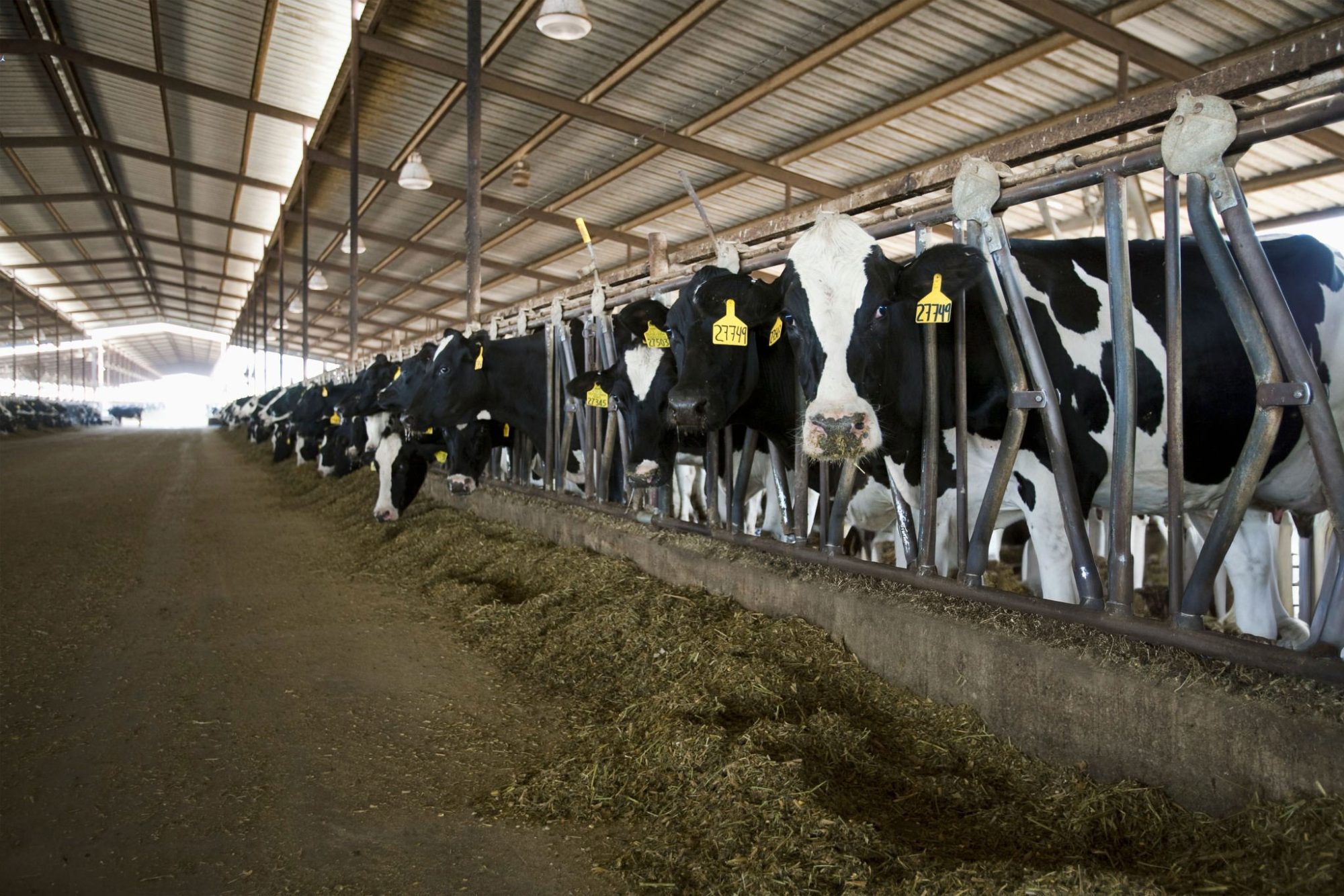
NewsSubscribe
First
Last
Consent

Why you should get rid of the bottom 10%

Before there was Donald Trump, there was Jack Welch, one of America’s greatest business leaders in history. During Jack Welch’s 20-year career as chairman and CEO of General Electric, GE’s company value rose 4000%.  That is a 200% per year growth rate.  More than 50 times that of the average company.  How did Jack do it?  He got rid of the bottom 10% of GE’s employees every year.

Such bold and committed action could also apply in dairy farming. Although most of us are so entrenched in our own operations that we cannot always be objective. But we should be objective. Managers must make the tough decisions. Are you ready to Fire the Bottom 10%?  Management choices or decisions could very well be significantly dragging down your profits.

Random Poll

So The Bullvine polled dairy producers asking them:

“In managing your dairy enterprise, if someone said to you fire the Bottom 10% in order to increase your profits what would you do?”

The following four management areas were the ones the producers identified as their top “fire the bottom” moves.

Heifer Rearing

Producers tell us that the easiest and quickest change they can make is to stop raising all their heifer calves. In the past selling springing bred heifers or recently calved in first calvers was a revenue source. Some long for those days to return. The reality is that those days in North America are not about to reoccur with increased use of sexed semen and producers finding ways to retain still profitable older cows.

One producer in expansion mode dropped his heifer numbers back and used the barn space and feed to milk more cows. He did it using the heifer sized free stalls for a group of 22-26 month old milkers. Another producer changed his program to lower feed costs using a very high forage diet for all milking females thereby needing more cows to fill his daily milk shipments. His plan is that by dropping from 75 to 65 pounds of milk per cow per day he will have less cow turnover, a shorter calving interval and more profit per cow per day of productive life. Profit per cow per day (sometimes referred to as daily return over feed costs) is a term all producers are now using extensively.

Some producers report selling all heifer calves to a heifer raiser with the option of buying back needed replacements at $200 over going market price for any of his own heifers. He is very satisfied with them and he knows their ancestry. The only limiting factor being he must take care not to cause his farm any biosecurity problems with the reintroductions. He is considering testing his reintroduction for common diseases. But still sees that new cost much outweighing the cost for feed, labour or capital costs associated with raising his own replacements.

Reproductive Performance

Producers tell us that reproduction is their biggest thief of profits. Changing reproductive performance is not easy to put in place. Steps being taken include: not breeding back cows or heifers that have a history of poor reproductive performance; milkers requiring a fourth breeding are not rebred;  purchasing heat monitoring systems; creating a group of cows 60 days in milk until confirmed pregnant or a decision is made not to rebreed and using high genomic bulls instead of AI.

Other producers have worked with specialists and redesigned their transition cow program. Many report excellent results relative to calving, no retained placentas or metritis, quick entry into the milking string and high percent of first heats post calving by 50 days in milk. They have found a savings in staff time handling problems and maintaining detailed records.
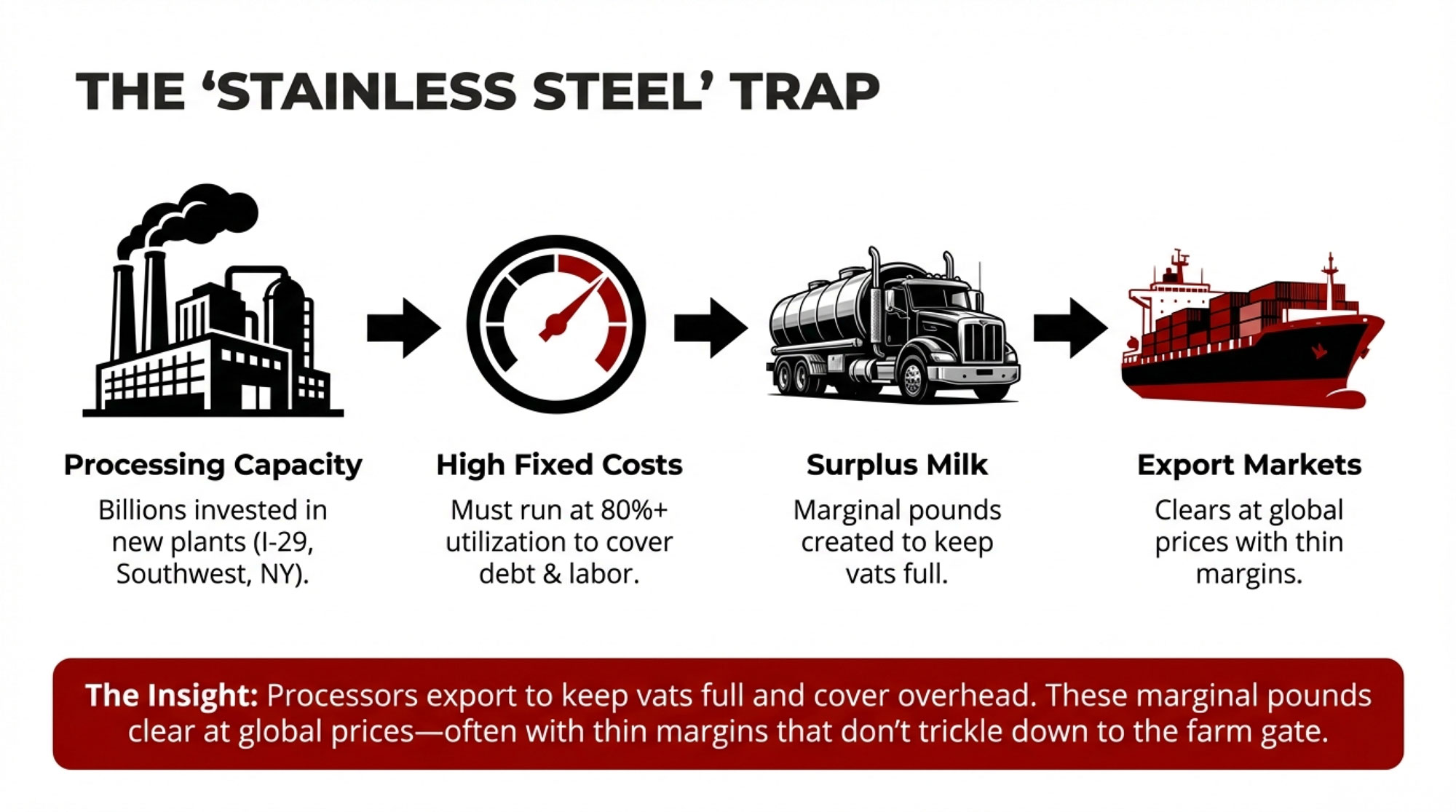
Still other producers have handed off heat checking to their AI technician with very good results. It is one less job for the milkers and animal feeders to do.

Animal Health

Producers share about the frustration with the excessive time required by a sick cow, or a lame cow or a sick calf. ‘If only we did not have to be taking an extra twenty minutes per day to deal with each animal with a health problem, besides the drugs cost  and lost milk’.

One producer shared how he has built an expensive barn and manure handling system only to find that the number of cows with feet problems has exploded. His thinking is that producers are too willing to accept lameness, feet problems, foot trimming, footbaths, loss of milk, treatment costs and other detrimental issues as a cost of doing business. To that he added that in the end he had to spend even more money to re-design his housing system and now he has sand wearing out his equipment.  He actually longed for the good old days when cows could walk on dry natural surfaces.

Few of the producers see a way clear of health problems. This suggests that, as an industry, we need to think – if what we are doing isn’t working for us we definitely need to step back from the problem and find effective approaches to handling animal health.

Technology

Producers have given this topic much consideration and many have implemented changes. The list was quite long but it often does not hurt to repeat what producers are doing. The list includes: install robotics; milking the cows less than 120 days fresh 3x; hiring out the field work to a custom operator thereby eliminating labour and capital cost; capturing more cow information at every milking in both parlour and tie stall barns, (as mentioned above) heat detection systems; training and assigning specialty jobs to staff; purchasing software programs that capture and analyze data so manager can make quick accurate decisions and the list went on. In all cases it appears that dollar cost-benefit criteria were used to base decisions on. Definitely this is an area that producers feel more comfortable with. Which is reassuring given that the average herd size is growing and wage rates are increasing.

The Bullvine Bottom Line

Jack Welch earned a reputation for brutal candor in his meetings with executives. He rewarded those in the top 20% with bonuses and stock options. Sometimes as dairy breeders we are guilty of looking at our operations as a way of life and not as a business.   The hard truth is the dairy business decisions need to be based on dollars. Firing poor performers is not just good for your dairy business, it’s necessary. Where do you draw the firing line?


Not sure how much to spend on that great 2 year old or heifer?
Want to make sure you are investing your money wisely?
Download our Dairy Cow Investment Calculator.


[related-posts-thumbnails]


Why Dairy Farmers Need To Know Their Key Performance Indicators

Having a successful dairy farm enterprise can be achieved in a multitude of ways.  Even though no two farms are exactly alike, where there is success there is a business person with dreams, goals and plans that get put into action.  Invariably there are five key factors that the business manager monitors closely on a continual basis.  These factors are often referred to as Key Performance Indicators.

Choose YOUR Key Indicators

Each farm and farm manager has individual needs and factors that need attention at any given time.  One way to get started on knowing your KPIs is to consider six main areas.

  1. Daily output
  2. Nutrition program
  3. Animal reproduction
  4. Heifer rearing
  5. Animal health and disease
  6. Genetics and Marketing

A good recommendation is to focus on one performance indicator from each of the six areas:

Daily Output

  • Milk yield per cow per dairy
  • Fat plus Protein yield per cow per day
  • Milk revenue per cow per day
  • Daily revenue less feed cost per cow per day
  • Milk sold per worker per year

Nutrition

  • Dry matter intake per cow per day
  • Feed cost per cow per day
  • Cost per ton for feed consumed by the milking herd

Reproduction  

  • AI services per conception
  • Percent of cows detected in heat by 90 days in milk
  • Pregnancy rate
  • Days Open
  • Calving Interval

Heifer Rearing

  • Live heifer calves per hundred milking cows per year
  • Percent of heifer calves ,born live, that enter the milking herd
  • Rearing cost per heifer
  • Age at first calving

Animal Health and Disease

  • Cull rate from the milking herd
  • Average weighted SCC per cow
  • Days between mastitis onsets
  • Vet and medicine costs per cow per year
  • Number of lame cow incidents per 100 cows per year

Genetics, Sales and Marketing

  • Breeding stock revenue per cow per year
  • Average TPI or LPI or Net Merit per pregnancy
  • Average classification score for first calvers
  • Number of farm website hits per month
  • Total annual revenue per worker per year

How To Get Started:

The task of developing a KPI program for a herd can be daunting. Suggestions on getting started include:

  • While relaxing in the evening for a week jot down some areas you feel could be improved on your farm
  • Give your list to your vet, your accountant and your feed advisor and ask them to comment
  • Narrowing the list down to five making sure they are numbers easily obtained from your DHI records, your herd management software or your farm financial software.
  • Start by getting the historical numbers for the past year
  • Set goals you wish to achieve in one year`s time
  • Keep the process dynamic including changing the list annually, if necessary
  • Do not make the list too long.  Five is a good number.

PROFIT is a GOOD WORD:

Dairy cattle breeders tend not to speak in terms of profit per cow per year.  More often their bragging points are in terms of animal records or enterprise performance.  Yet it is profit per cow that covers living costs, provides return on investment, pays for kids’ college educations and keeps the banker happy.  It is strongly recommended that at least one of the five KPIs should be a measure of dollar revenue, feed costs or net returns.

BULLVINE BOTTOM LINE:

Relating genetics to farm management and farm profit is not always an easy twosome to bring together.  However, for success there must be measures that can be continually monitored so that farm managers can make informed decisions or take corrective actions.  Find your key performance indicators and grow your profits.

[related-posts-thumbnails]

Send this to a friend