

Archive for Expected Future Inbreeding

RAGER-RED Passes 1 Million Units — and Half of Them Left the Country

Thirteen years old and still shipping. RAGER-RED just cleared a million units — the first Red & White sire in North America to do it — and more than 500,000 of them went to roughly 50 countries.

The Short Version

  • 7HO12344 Ri-Val-Re RAGER-RED-ET (EX-90) is the first Red & White sire in North American history to pass one million units sold, and Select Sires’ newest Millionaire Club member .
  • More than half those units left the United States, reaching about 50 countries through World Wide Sires.
  • He was Select’s top-selling dairy sire in 2018 and 2019 — and he’s still in the lineup at 13, which almost no genomic-era bull manages.
  • The draw isn’t index. It’s balance, strength, depth, and one of the lowest EFI figures in the breed.
  • The tradeoff is honest: he won’t win a top-of-sheet TPI or NM$ fight, and herds ranking strictly on index will keep passing.
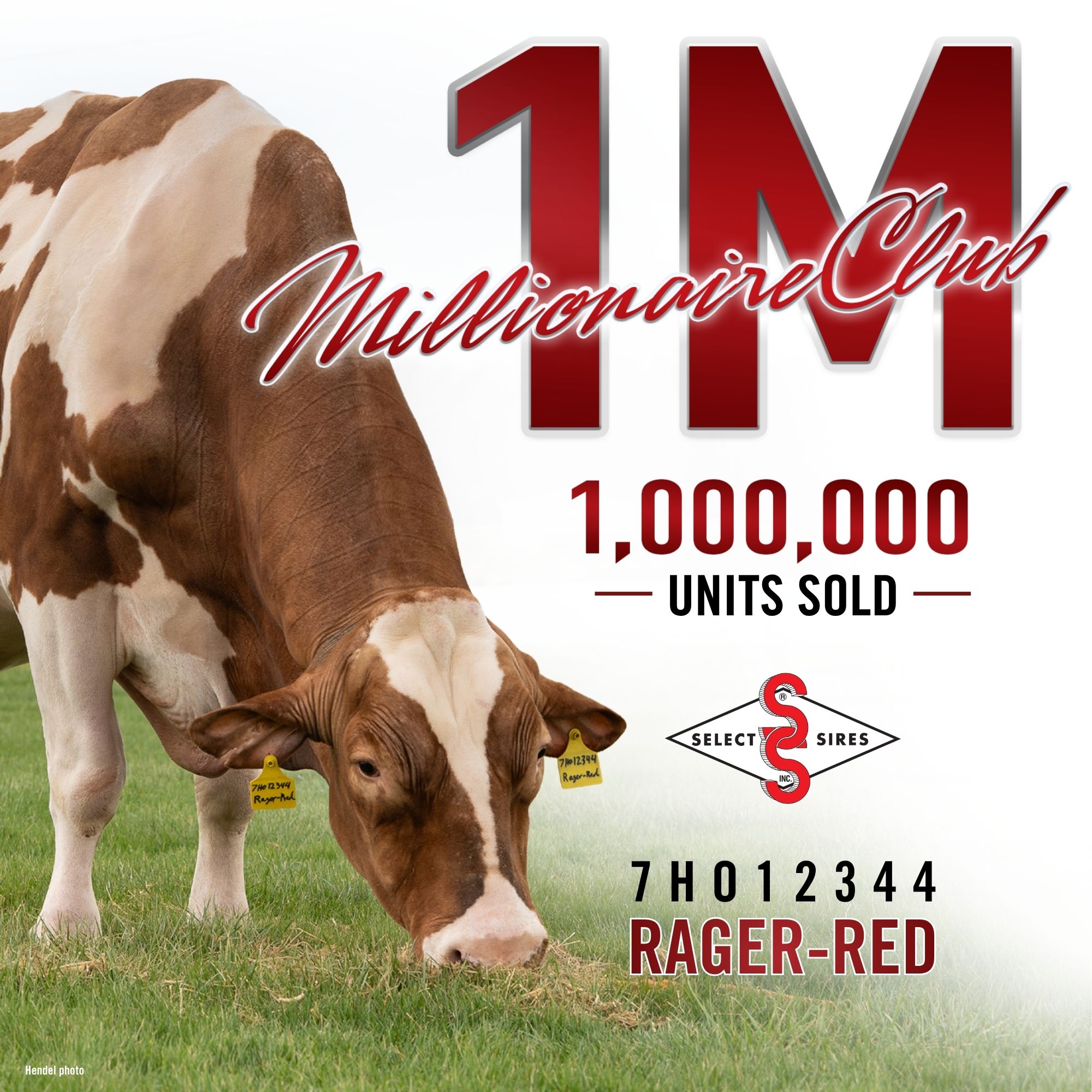
About half a million units of RAGER-RED semen never saw a U.S. barn. That’s the number worth sitting with in Select Sires’ announcement that 7HO12344 Ri-Val-Re RAGER-RED-ET (EX-90) has cleared one million units sold — the first Red & White sire in North American history to get there, and the newest name in the co-op’s Millionaire Club .

Millionaire status at Select is a short list. MILLION cracked it as the seventh sire in company history in 2022, and DOC joined in 2025 as the first Showcase sire to make the mark . RAGER-RED is the first to do it wearing red.

The Pedigree Nobody Would Have Drawn Up

Born March 24, 2013 at Ri-Val-Re Farms in Webberville, Michigan, RAGER-RED came out of a stack that didn’t look like anything else in the barn: Pine-Tree Relief P on a Very Good-88 OBSERVER dam, Ri-Val-Re Obsrvr Salsa-ET, backed by an Excellent-90 ADVENT-RED grandam .

Look harder at the sire side, because it’s the part everyone skips. Relief P is a polled bull — a Dudoc Toubib P son — and he’s a low-type sire himself, sitting at PTAT -0.86 with UDC -1.60 . A short, negative-type polled sire producing the strength-and-depth phenotype that ended up shipping to 50 countries is not a mating anyone would have predicted on paper.

“He had such an outcross pedigree,” said Kevin Jorgensen, Senior Holstein Sire Analyst at Select Sires. “Even today, he’s one of the lowest Expected Future Inbreeding (EFI) bulls in the breed.”

Balance Beat Hype

Three U.S. genetic base changes have come and gone since RAGER-RED entered the lineup. Genomic young-sire slates turned over again and again behind him. He kept selling — positive production, strong components, functional type, daughters that work.

“He was, and continues to be, a customer satisfaction specialist that people lean on as an alternative for overall balance,” Jorgensen said. “He sires cows that have no serious flaws and met the needs of multiple customers across multiple countries.”

The receipts: he sat among Select’s leading unit-sellers for years running and was the organization’s top-selling dairy sire in both 2018 and 2019. He also did what most red bulls never manage — crossed the color line into heavy black-and-white usage, which Holstein International flagged back in 2023 as the thing separating him from every other red sire of his era .

Half the Million Left the Country

More than 50% of those one million units shipped outside the United States, reaching roughly 50 countries through World Wide Sires. His daughters built the reputation in confinement, on grass, in heat, in cold — durability that travels.

“International breeders consistently cite longevity, power, depth and mobility as defining characteristics of RAGER-RED daughters,” said Brian Albertoni, Business Development Director, World Wide Sires Ltd. “When you see fifth- and sixth-lactation daughters still performing at high levels — that’s what helps farmers remain profitable.”

His linear reads exactly like the cows look: +0.71 Stature, +1.36 Strength, +1.68 Body Depth, +0.77 Dairy Form . Big, deep, powerful females that mature into something.

Who Should Still Be Using Him

A million units doesn’t prove performance. It proves a million separate decisions that the color penalty wasn’t real enough to matter — and that’s a different, more interesting claim than the one Red & White breeding has been arguing about for forty years.

So where does he still fit in 2026?

  • Herds fighting inbreeding creep on a narrow Chief-Shottle-Planet base, where a genuinely low-EFI proven sire is worth more than a few points of index.
  • Herds that have chased extreme dairy form for three generations and need strength and depth back in the freestall.
  • Registered and Red & White breeders who want a red option with a real daughter record instead of genomic projection — and a proven history of maturing daughters, not just fresh two-year-olds.
  • Anyone building heifer-safe, low-risk matings on cows they can’t afford to miss on.

Who should skip him: herds selecting strictly on top-of-sheet genomic gain. He won’t win that comparison and never did.

He’s also not finished. At 13, he’s still in the lineup, still shipping, still one of the lowest-EFI options available to breeders trying to outrun a narrowing gene pool.

The Sunday Read Dairy Professionals Don’t Skip.

Every week, thousands of producers, breeders, and industry insiders open Bullvine Weekly for genetics insights, market shifts, and profit strategies they won’t find anywhere else. One email. Five minutes. Smarter decisions all week.
NewsSubscribe
First
Last
Consent

Stop Talking About Inbreeding…

Dairy cattle breeders talk about attempting to keep the level of inbreeding within check in their herds. Poultry, swine and corn breeders talk in terms of inbreeding and producing lines and then crossing the inbred lines to produce the birds, piglets and seeds that are used for commercial production. In beef, breeds have been developed for their specialities and then breeds are crossed to produce the commercial animals. The challenge currently being faced by Holstein breeders is that once again the level of inbreeding is creeping up and that has the potential to be a limiting factor when it comes to on-farm profit. Let’s look at where the level of inbreeding is at and how breeders might address that.

Current Inbreeding Levels

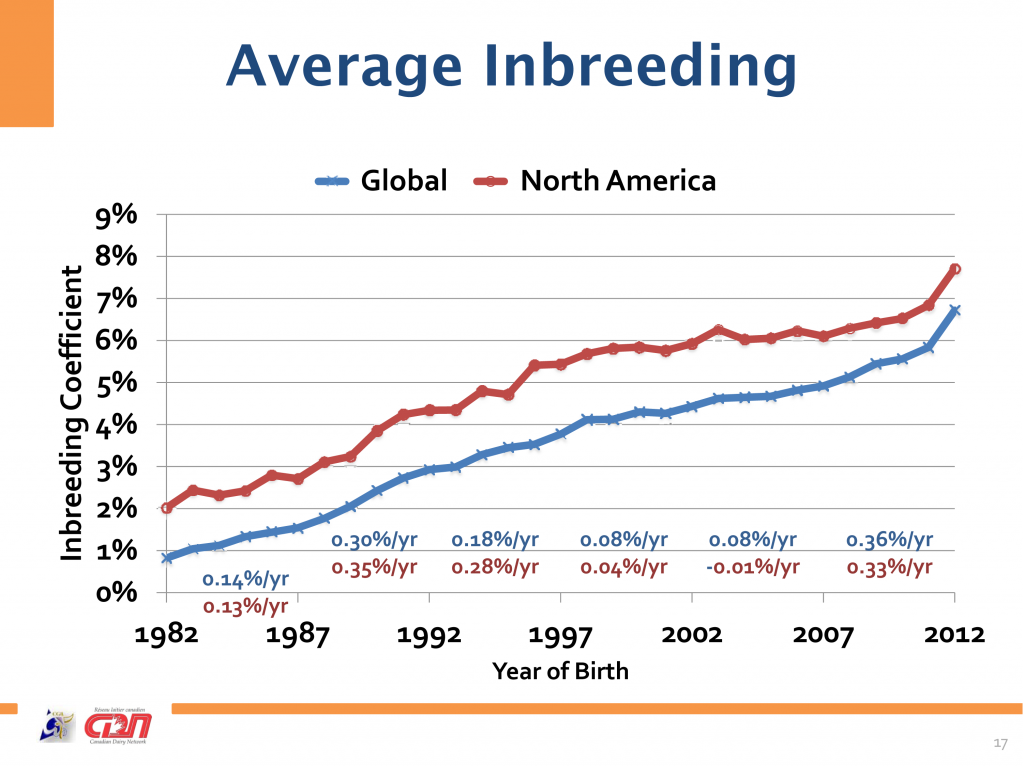
Dr. Filippo Miglior, Canadian Dairy Network, presenting at the February 2014 Advancing Dairy Cattle Genetics Workshop held in Phoenix Arizona,  reported of the state on inbreeding in Holsteins born between 1982 and 2012..

MIGLIOR - Tempe Meeting Feb 2014 - Genetic Diversity and Inbreeding-17

It should be concerning to breeders that over the most recent time period, 2007 to 2012, that the Inbreeding Coefficients for Holsteins everywhere, North America and Global, increased at the rate of 0.36% and 0.33% per year respectively. These levels are the highest in modern Holstein breeding history.  Levels four to almost seven times large in 2012 compared to 1982 should be a wake-up call for our industry. The inbreeding levels from 1987 to 1997 were a concern back then when only a few sires were being used to produce sons for A.I. progeny testing programs. Breeders and A.I. took the warnings seriously and increased the number and diversity of sires of sons entering A.I.

What Has Been Happening?

There are a number of factors that need consideration.

Limited Number of Bloodlines Where once the bloodlines often had country or regional focus, Holstein breeding has gone global with only a few total merit indexes in use and TPI dominating. Diverse breeding resulting from the environmental situation or the cheese produced has disminished.

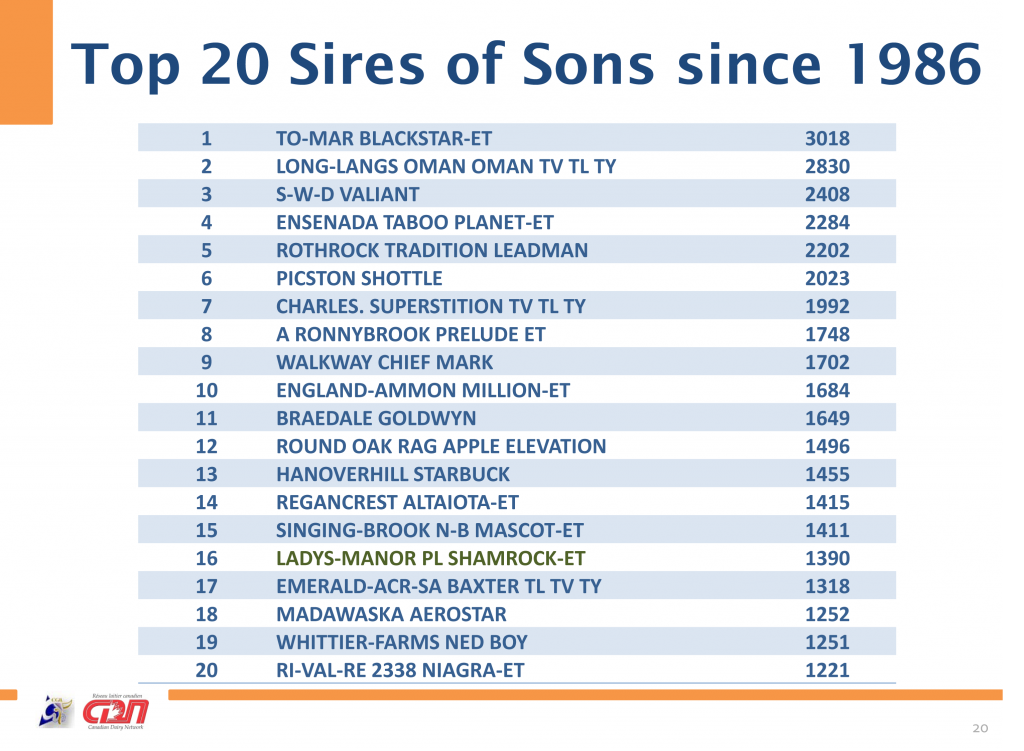
The number of different bloodlines used by A.I. companies has been greatly reduced. The table below is a global report on the Top 20 Sires of Sons since 1986. Half of these sires were born and used prior 2000. However recent sires like Man-O-Man, Planet, Shottle and Superstition are in the top ten. Only one of these sires, Shottle, was first proven outside North America but his pedigree was from North America. The end result is that this extreme use of a limited number of sires of A.I. sons has contributed to the increased inbreeding in the past 25 years.

MIGLIOR - Tempe Meeting Feb 2014 - Genetic Diversity and Inbreeding-20

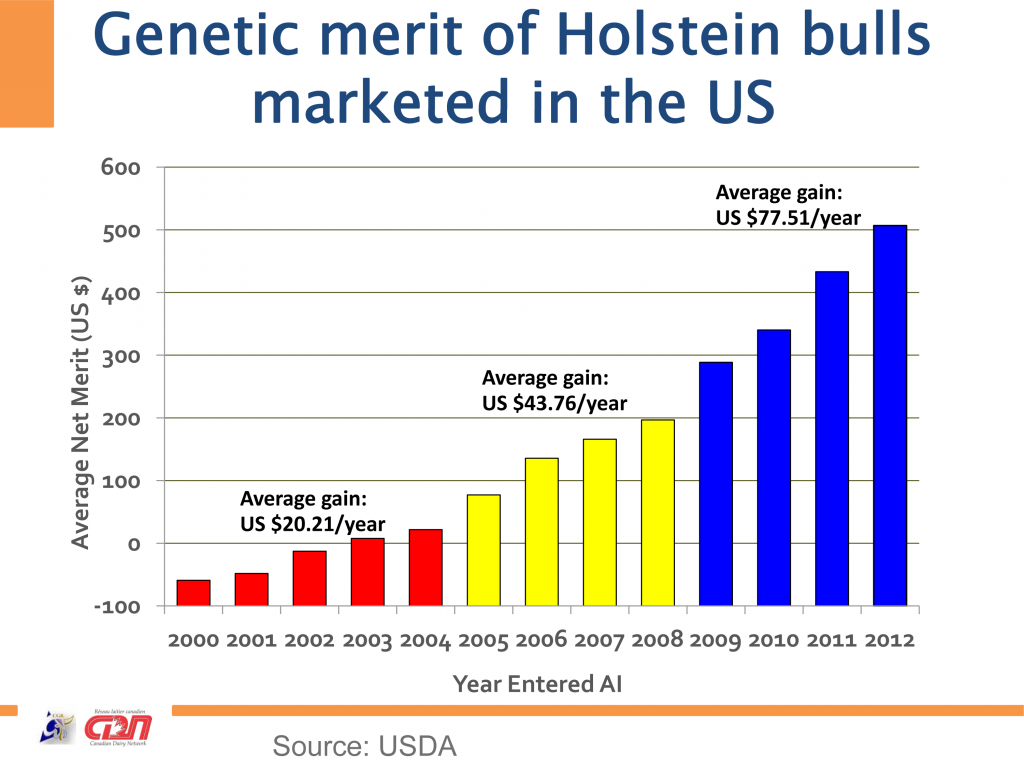
Rapid Genetic Progress The significant increases in inbreeding comes about as a result of the very significant increase in the past decade in the genetic merit of the Holstein breed. The following graph produced by USDA shows the change in the annual rate of genetic improvement for Net Merit. This change was a result of intense selection  and increased accuracy using genomic information. However the fallout from that is the greatly increased inbreeding that we have now.

MIGLIOR - Tempe Meeting Feb 2014 - Genetic Diversity and Inbreeding-4

Adjusting Indexes for InbreedingUSDA/CDCB has produced reports on adjusting US production indexes for level of inbreeding. There is much more work to be done on the effects of inbreeding beyond milk production. The truth is that it will take a long time to determine adjustments for traits relating to health and fertility. Note that the field observations for those areas are likely only available in the Nordic countries.

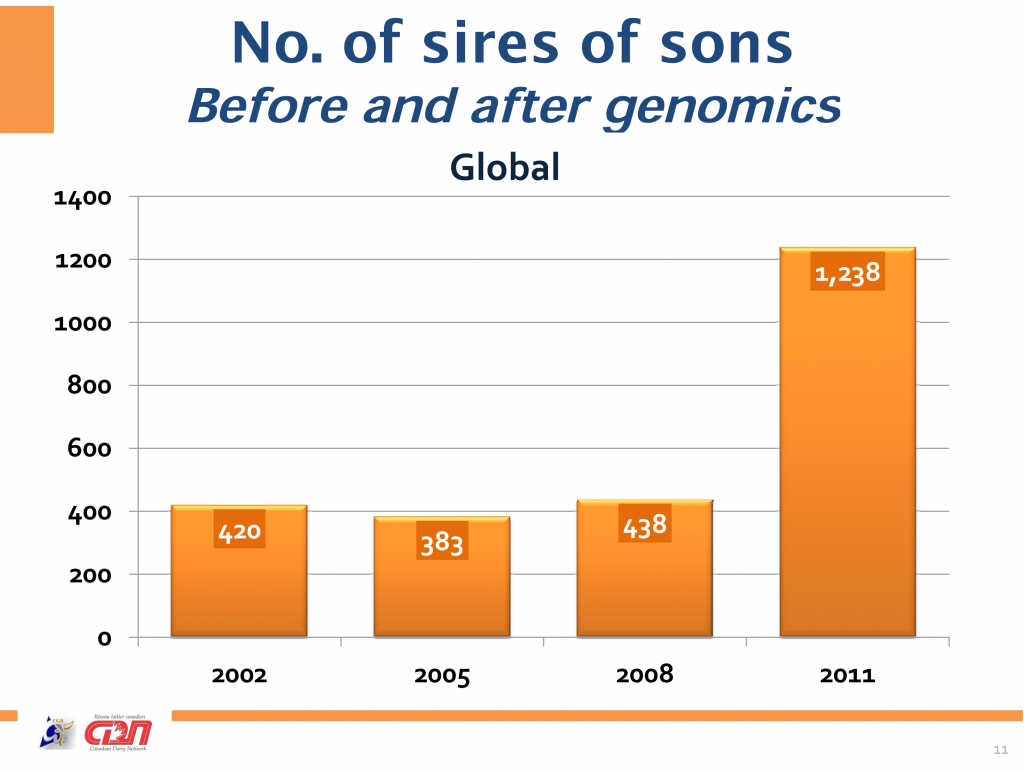
Limited Number of Sires of Sons The two graphs below show just how short the list of sires of sons has become during. Having only 16 to 19 sires producing 50% of the young sires entering A.I. was great for genetic gain but for inbreeding it was a recipe for major problems. Even in 2011 there was still too much focus on too few sires of sons when only 32 produced half the young bulls entering A.I.

MIGLIOR - Tempe Meeting Feb 2014 - Genetic Diversity and Inbreeding-11

MIGLIOR - Tempe Meeting Feb 2014 - Genetic Diversity and Inbreeding-13

Focus is on Top Genomic AnimalsBreeders should be concerned about inbreeding with the extreme focus on only the very top young heifers and bulls. This has also put downward pressure on animal values for high indexing animals that are just outside the top group. Genetic gain for production and type could be almost as good if there was increased selection pressure for other economically important traits. Remember that the very top heifers are full sisters to the young bulls entering A.I. Where is the genetic diversity in that?

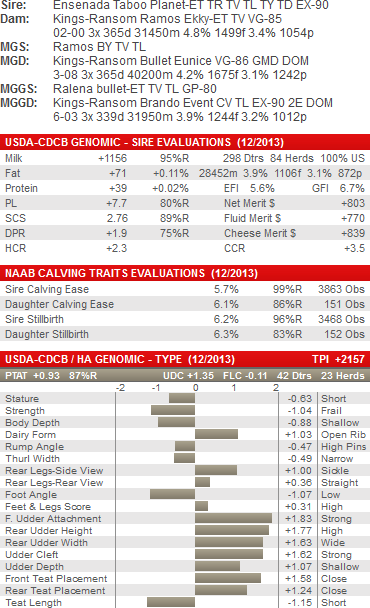
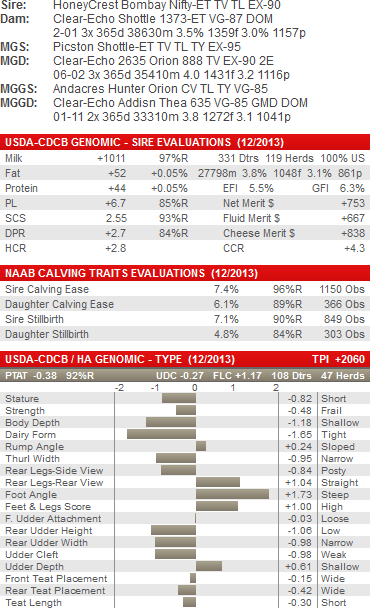
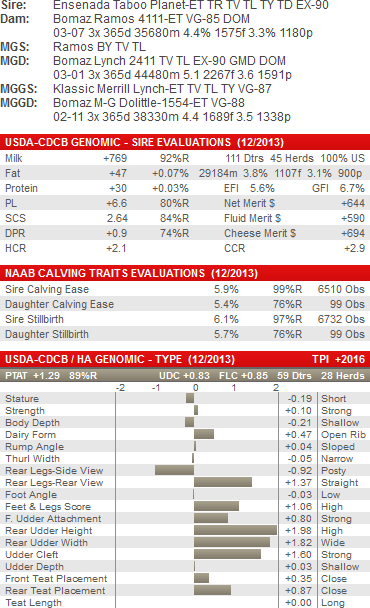
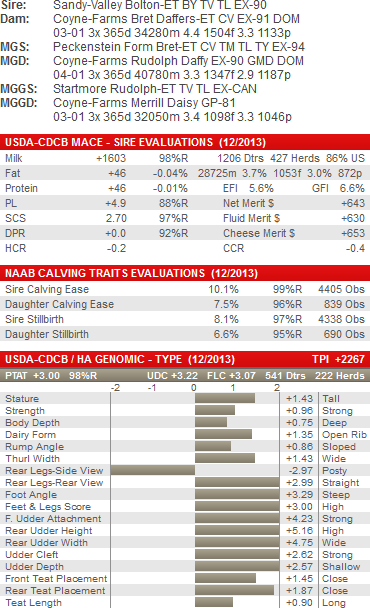
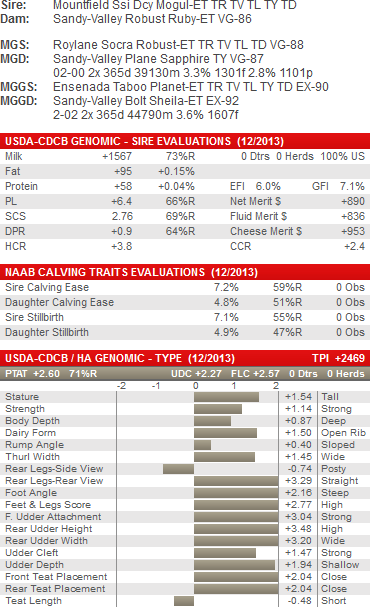
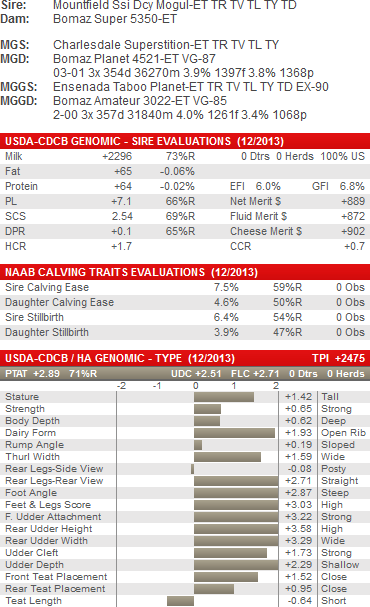
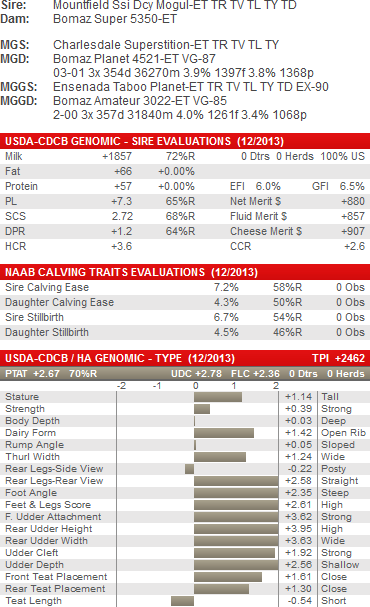
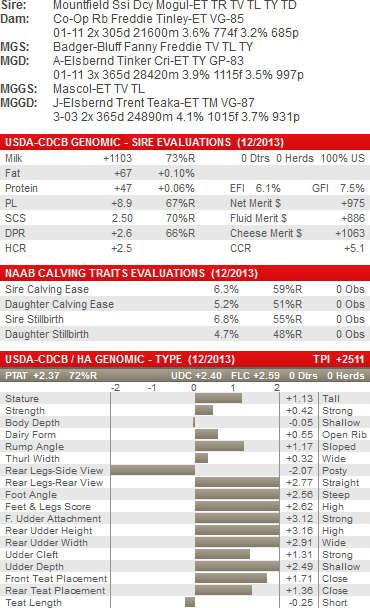
Inbreeding of Sire List ToppersThe Bullvine has studied the Expected Future Inbreeding (EFI) for the top forty Net Merit Dollars ($NM) sires on both the Holstein USA Dec ’13 proven and genomic sire lists. Each 1 percent increase in EFI reduces milk proofs by 65.3 pounds. The published proof on a bull with an EFI of 4 per cent would be reduced by 261 pounds (4 X 65.3 = 261).  The top 40 proven $NM sires have an average EFI 6.4, the genomic test sires also had an average EFI of 6.4 (Note: Had to be active with NAAB).  Sires with O-Man blood all have high EFI’s due to O-Man’s extensive use as a sire of sons.  Interesting to note that while both the top proven sires and genomic test sires average the same, this is a far greater range in the proven sires, the lowest proven sire in the top 40, Twist, has an EFI of 5.5, and the highest EFI proven sire in the top 40, Manifold, has an EFI of 7.  In the genomic test sires, the lowest EFI, (Rubicon, Mr Max and Magoo all tied at 6), and the highest EFI belongs to Dozer at 6.7.

Breeders looking for the sires with the lowest expected future inbreeding should look up:

 Proven Sires

Erdman – Kings-Ransom Erdman Cri-ET – 01HO09800Kings-Ransom Erdman Cri Twist – Clear-Echo Nifty Twist-ET – 029HO14335Clear-Echo Nifty Twist
AltaNetworth – Bomaz AltaNetworth-ET – 011HO10767Bomaz AltaNetworth Dorcy – Coyne-Farms Dorcy-ET – 029HO14142Coyne-Farms Dorcy

Genomic Test Sires

Rubicon – Edg Rubicon-ET 151HO00681Edg Rubicon2 Mr Max – Bomaz Mr Max-ET – 151HO00675Bomaz Mr Max
Magoo – Bomaz Magoo-ET – 151HO00677Bomaz Magoo Troy – River-Bridge Co-Op Troy-ET – 001HO11056River-Bridge Co-Op Troy

Polled not likely to help lower InbreedingWith more breeders breeding for polled animals, some of us may have thought there could be genetic diversity brought into Holsteins by this route. Well that just isn’t so. What is happening is that the same all too frequently used sires in horned are showing up as the sires or maternal grandsires in polled. The only outcrosses in the polled young sire pedigrees are the generation of sires or dams that introduced the polled gene.

What Needs to Happen?

The Bullvine offers the following ideas for how to make progress to reducing or at least holding the inbreeding levels.

Calculate Inbreeding Levels for Every CalfRemember that it is the inbreeding level for the calf that is to be born that needs to be watched. To achieve a reduction in inbreeding, the sire and dam should not be closely related. A good example where the breeder did his homework is Crackholm Fever, 6.35% inbred. His parents are more inbred than he is but they are from quite different lineage. His sire Goldwyn (James x Storm x Aerostar) is 15.17% inbreed while his dam Fashion (Blitz x Mattie G x Rudolph) is 8.17% inbred. Inbreeding can be managed. Most sire mating services have incorporated the minimization of inbreeding into their programs.

New Total Merit Indexes At the present time total merit indexes in the United States (TPI and NM$) and Canada (LPI) are under review for updating to include additional economically important heritable traits for which data is captured. Breeders need to have input into the further development of those indexes. Once those indexes are revised, new males and females will come onto the elite lists. Those animals are likely to bring forward the opportunity for breeders to use them to both generate more on-farm profit and to reduce inbreeding.

Develop Lines within Holsteins A.I. companies have already started to develop lines that place emphasis on traits like health and fertility. No doubt lines will be developed for feed efficiency, once more is known about it. Having such lines available will give breeders the opportunity to specialize the families on their farms or to cross lines to end up with less inbred animals. It could make for the best of both worlds – for the breeders and for the A.I.

More Study of the Genome As more and more animals are genomically tested there will be more accuracy to genomic results. But it does not end there. By studying each animal’s genome, it will be possible to know the exact level of inbreeding instead of what is currently done, which is only an estimation based on parentage. This will provide for yet another way to help tackle the inbreeding issue. Definitely genomically testing all heifers in a herd will, in the future, have a multitude of benefits for breeders (Read more: Herd Health, Management, Genetics and Pilot Projects: A Closer Look at ZOETIS)

The Bullvine Bottom Line

Holstein breeders and the breed cannot afford to fiddle while Rome burns when it comes to inbreeding. It is time to take action to reduce inbreeding levels. It does require collective action by the breed, on behalf of breeders and A.I. companies. It is not too late to act. The time for procrastination has past.


Get original “Bullvine” content sent straight to your email inbox for free.


[related-posts-thumbnails]

Send this to a friend