








At Double Creek in Merced, eight DeLaval V300s milk 500 cows and reportedly save $171K a year pellet-free. Run the same play in a 240-cow free-flow retrofit and the first-year math looks very different.
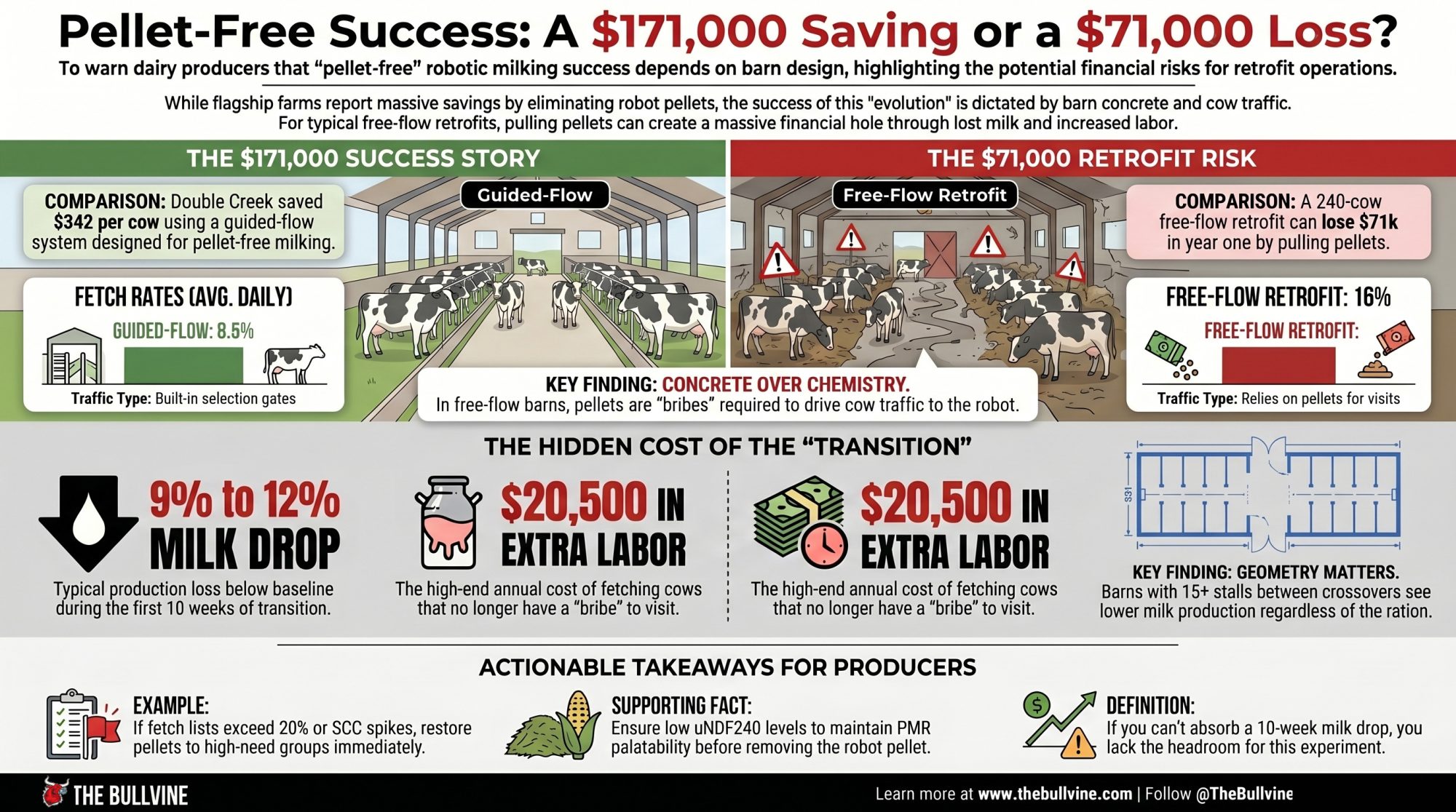
At Double Creek Dairy in Merced, California, eight DeLaval VMS V300s milk roughly 500 cows. In a DeLaval-produced promotional video, operator Matt Strickland reports annual savings of about $171,000 from going nearly pellet-free — only seven of his cows still get any pellet at all. That figure comes from manufacturer marketing material, not an independently audited result, and it reflects the economics of his barn and his transition. Spread across the full herd, it works out to roughly $342 per milking cow per year, based on Bullvine arithmetic, not a figure Strickland or DeLaval has published.
None of what follows is a claim that Strickland’s number is wrong for his operation. The composite scenario later in this piece is a separate illustration of what the same move can cost in a very different barn. That distinction matters because his number is moving fast at spring 2026 dealer meetings, and the barn-design context that makes it work isn’t always moving with it. If your barn doesn’t look anything like Double Creek — and most AMS retrofits don’t — pulling pellets can quietly stack into a mid-five-figure hole inside the first year, before any savings show up on the P&L. The Barn Math Table below shows how.
The AMS Pitch Shifted. The Barns Didn’t.
Three years ago, pellet-free robotic milking was a niche conversation. Now it’s the “next evolution” line in a lot of proposals, backed by a handful of flagship farms and some genuinely useful research. The science is real. What’s getting glossed over is the structural condition that makes it work.
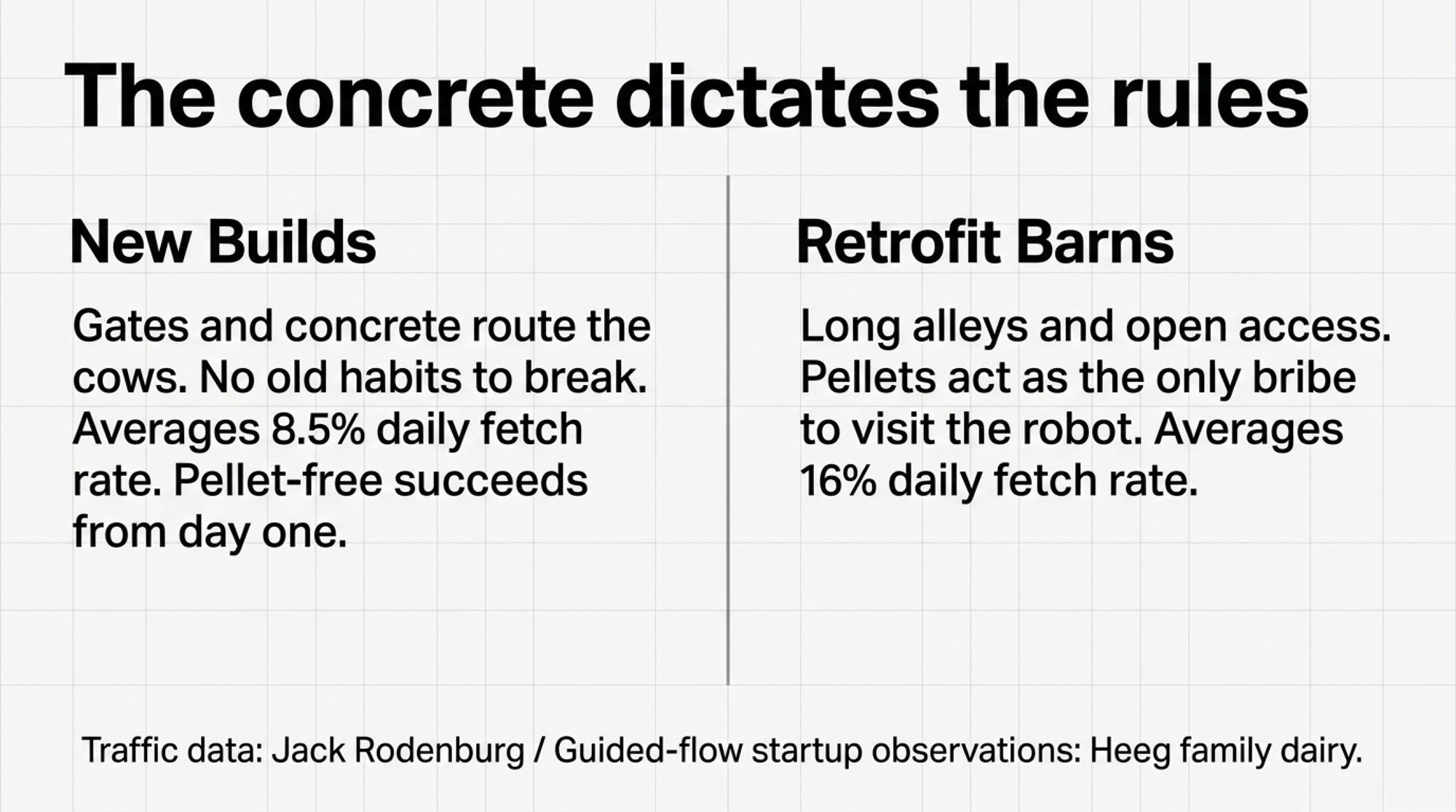
University of Wisconsin Extension says it plainly: in free-flow barns, the primary reason cows voluntarily visit the robot is the pellet dispensed there. Jack Rodenburg’s widely cited traffic data — still the figure most carried through the AMS literature — pegs average fetch rates at roughly 16% of the herd per day in free-flow versus about 8.5% in guided-flow. European AMS research in guided-flow systems has consistently reported lower rates of unproductive visits than free-flow comparisons, though specific figures vary by study.
None of those traffic numbers show up on a typical AMS proposal’s ROI sheet. All of them decide whether a pellet-free move survives contact with your barn. The operators most exposed are mid-size and large producers running existing free-flow retrofit barns — long alleys, one robot at the end of a pen, no selection gate between rest and feed. Industry benchmarks have long placed the majority of U.S. AMS installations in the retrofit free-flow category, and the pitch at spring 2026 dealer meetings is aimed squarely at that population.
Colby, Wisconsin: What a Barn Built for This Looks Like
The Heeg family’s robotic facility near Colby, Wisconsin, came online in late 2023. Eight DeLaval units, tunnel ventilation, guided-flow from day one, no pellets at startup or since. Early-morning return traffic cycles cleanly through the selection gate, and the fetch list sits where you’d hope.
What the Heeg build illustrates is the pattern extension specialists keep describing on guided-flow startups: cows coming out of existing parlors carry habituated behavior that takes weeks to unlearn, while fresh cows and heifers introduced directly into a robot barn adapt faster and hold production better. In the documented guided-flow new-builds, it wasn’t the feed table that made pellet-free possible. It was the concrete, the gates, and a cohort of cows that had no old routine to fall back on.
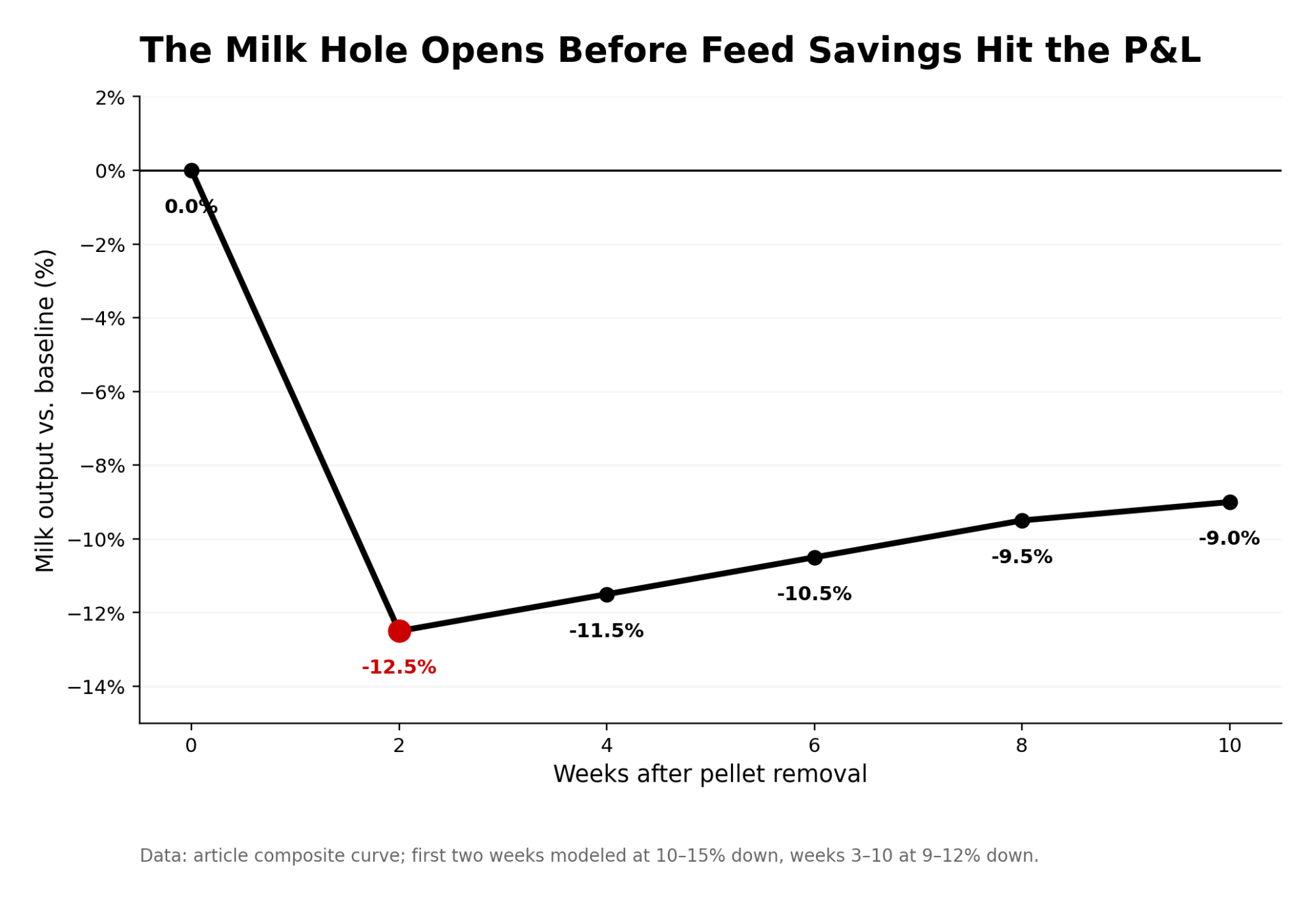
Now sit the new-build story against a more typical one. A 240-cow herd — a composite scenario built from extension field observations, not a single named operation — in an existing free-flow freestall installs two robots, runs pellets for two years, then decides to go pellet-free after hearing the Strickland number at a spring meeting. Bullvine modeling, drawing on extension observations of retrofit transitions, puts the typical adjustment curve at a 10–15% milk drop in the first two weeks, then weeks three through ten running 9–12% below baseline. Picture it at 4 p.m. on a Tuesday in week six: the fetch list is longer than anyone wants to admit, a third-lactation cow who used to walk herself through is parked in a stall, the gate has cycled through an empty approach twice, and the nutritionist’s phone is ringing again.
Barn Math Table
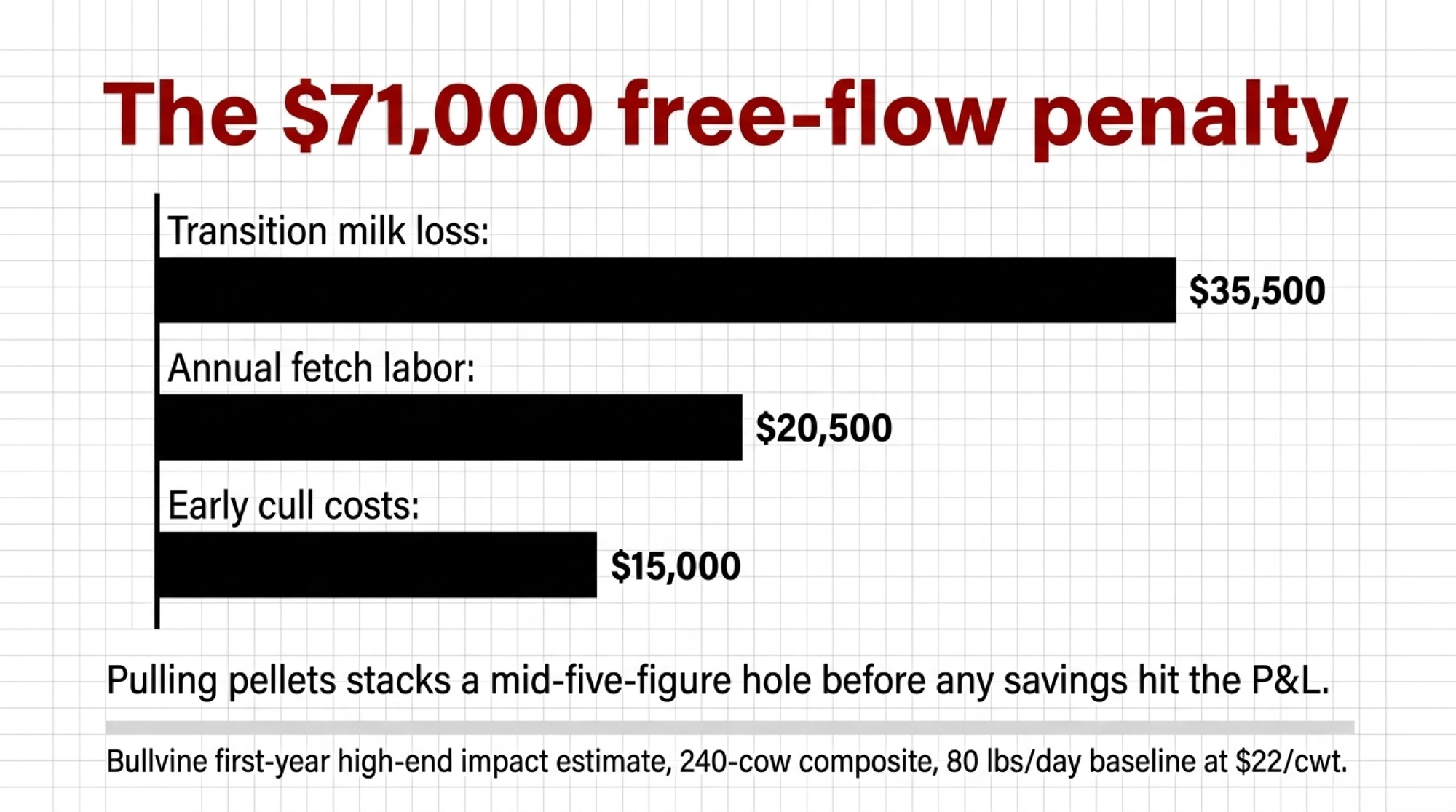
240-cow composite herd, 80 lbs/cow/day baseline. Milk price assumed at $22/cwt (U.S. Class III reference band, spring 2026); if current Class III is running higher, every dollar in the left column moves against you. Skilled farm labor at $22/hour. All figures are Bullvine-composed estimates in USD, not audited operator outcomes.
| Metric | Low-End Impact | High-End Impact | Source / Assumption |
| Transition milk loss | $26,600 | $35,500 | 10-week window, 9–12% drop below baseline, 240 cows at 80 lbs, $22/cwt |
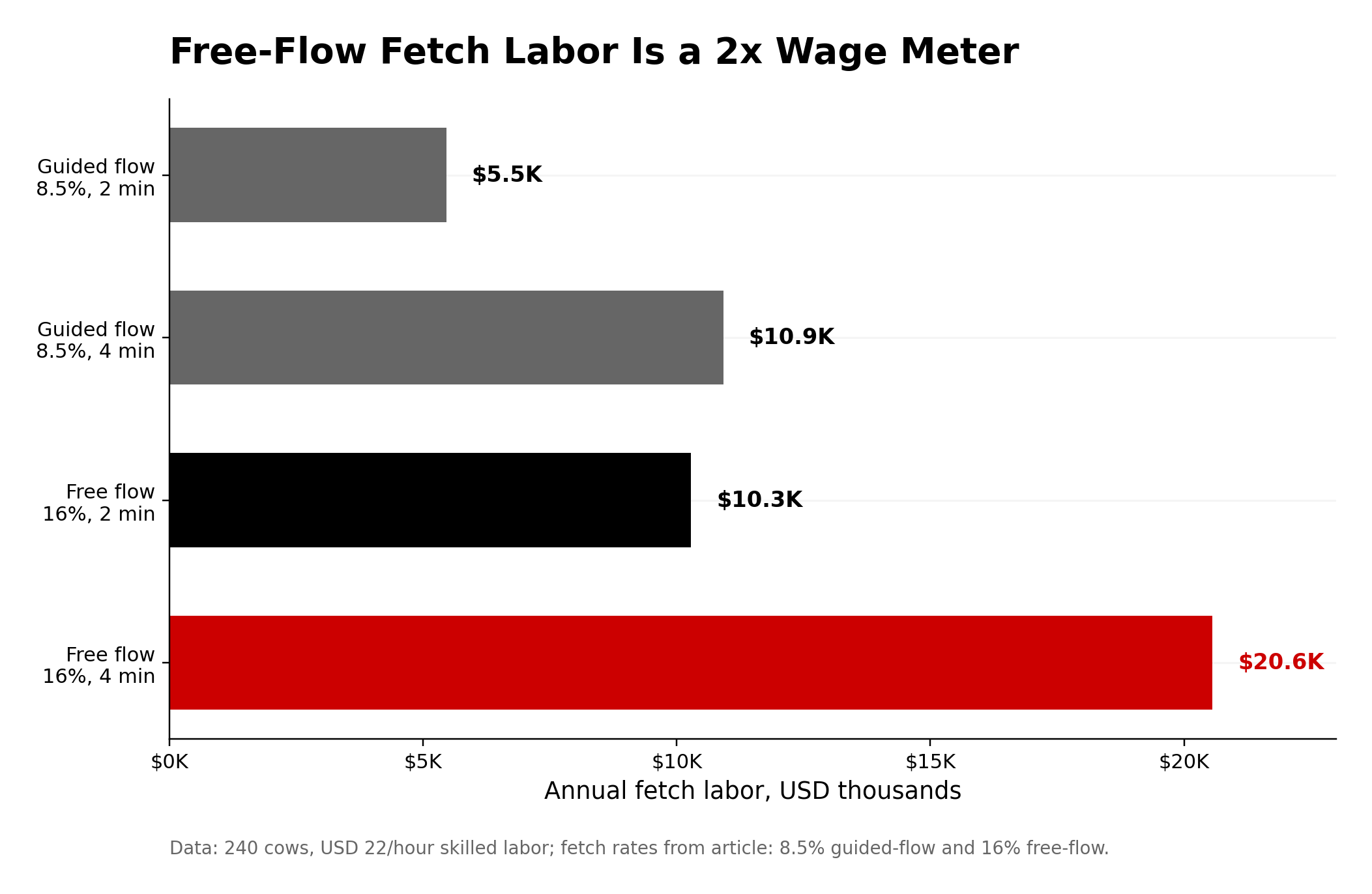
| Annual fetch labor | $10,278 | $20,500 | 16% fetch rate, 2 vs 4 min per cow at $22/hr, 365 days |
| Early cull costs | $8,000 | $15,000 | Low: 4 culls × $2,000/head. High: 8 culls × $1,875/head. Replacement cost band reflects Bullvine editorial estimate based on current regional springing heifer markets. |
| Total first-year drag | $44,878 | $71,000 | Bullvine composite |
The annual fetch labor line runs over a full 12 months. The bottom row reflects compound drag across the first full year, not six months. The low end assumes a barn close to guided-flow functionality and a well-managed transition. The high end assumes a long-alley retrofit, no selection gate, and a nutritionist who wasn’t fully looped in. Most free-flow retrofits sit closer to the right-hand column than the left.
Why Do Pellets Work in Some Barns and Not Others?
The mechanics are less about feed formulation and more about concrete. In a free-flow barn, the pellet isn’t “feed” — it’s a bribe. Pull the bribe without changing the gates, and the only cows you’ll see at the robot are the ones who got lost on the way to the water trough. That’s not a management problem you can nutrition your way out of. It’s a traffic problem poured into the foundation.
Three strands of research converge on the same conclusion. Gregory Penner’s work at the University of Saskatchewan (Western Canadian Dairy Seminar, 2019) and Alex Bach’s 2007 Journal of Dairy Science paper both found that varying pellet allocations in controlled conditions had little to no effect on milk yield, with Bach reporting cow substitution of partial mixed ration for robot feed at ratios between 0.62 and 1.58 kg of PMR per kg of pellet. Commercial data pushes the same direction: a Vita Plus Upper Midwest AMS herd survey reported that robot pellet cost showed a negative relationship with income over feed cost across the sample, and visit frequency itself had no measurable effect on IOFC. Stack those three together and pellets start to look less like a feed input and more like the cost of running a barn that can’t move cows without them.
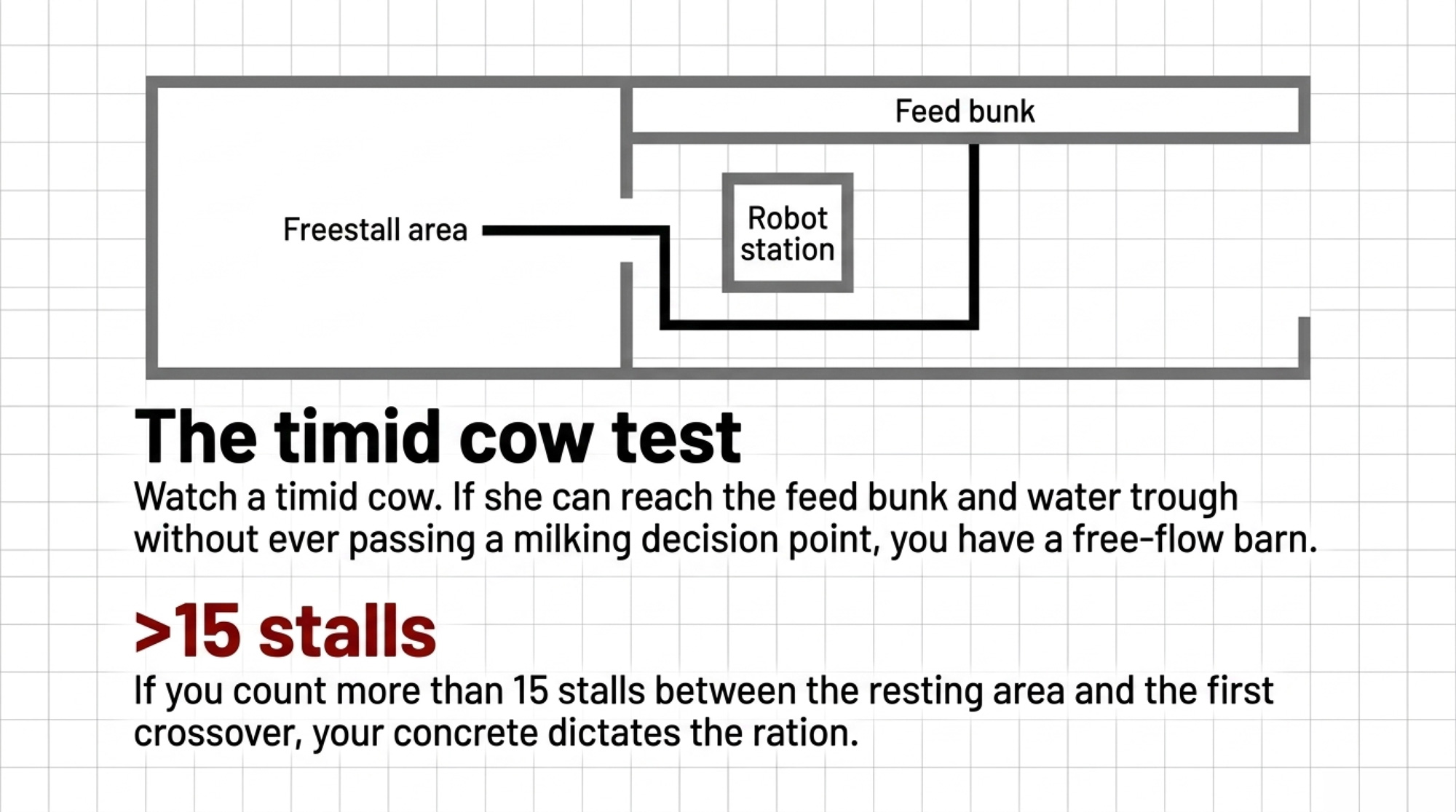
But the science supports pellet reduction only where both the barn and the forage can carry the load. The working principle in published guidance from the Penner lab at Saskatchewan and the DeVries lab at Guelph is straightforward: if your undigested neutral detergent fiber at 240 hours is too high, the PMR isn’t palatable enough to drive the barn on its own, and pulling the pellet pulls the only reason a cow had to walk. Specific uNDF240 thresholds depend on your forage program and herd; the most current figures should come from your nutritionist or the published work of those labs, not from a dealer’s rule of thumb. Published AMS barn-design guidance also shows barns with more than 15 stalls between resting area and the first crossover, or dead-end return alleys, produce measurably less milk per robot regardless of ration.
How Do You Know If Your Barn Is Free-Flow or Guided-Flow?
Walk it. Count the stalls between a cow’s resting area and the nearest crossover alley. Trace her route to the feed bunk — does it force her past the robot, or can she reach feed and water without going near it? Watch what happens to a timid cow at the approach gate when a dominant animal is standing there.
If she can get to feed and water without ever passing a milking decision point, you have a free-flow barn. The published evidence for pellet-free success in that layout, without structural changes, is thin. That’s not an argument against pellet-free milking. It’s an argument for doing it with your eyes open — priced, modeled, and stress-tested against your own operation’s numbers, not on the strength of a $171,000 figure from a different barn in a different state.
How Much Does Waiting Until Year-End Actually Cost?
Here’s the numeric version of procrastination. That same 240-cow composite, four months in, milk still running 8–10% below baseline instead of recovering. Fetch labor up noticeably at current wages. Do nothing for the rest of the year and the compound drag — lost milk, extra fetch labor, early culling — can stack into the $44,000–$71,000 range before you have the hard conversation. That’s before you touch working capital or debt service.
Sustained pressure on debt service coverage triggers lender conversations well before the operating line runs out. Published AMS lending guidance from the major U.S. and Canadian farm lenders gets more specific on the numbers, and your own lender’s current thresholds should be the ones you plan against. USDA’s Economic Research Report 356, released January 2026, pegs robotic milking at higher net return on average than conventional parlor systems — on the other side of a multi-year payback curve.
A pellet-free retrofit that isn’t working stacks a second valley on top of the first.
Options and Trade-Offs for Farmers
There’s no universal right answer. The right path depends on your barn’s bones, your balance sheet, and how long you plan to milk cows in that building.
Path 1 — Stay on pellets, but cut cost per ton. The Vita Plus Upper Midwest AMS survey found pellet costs ranging from $132 to $500 per ton across its herds on functionally similar rations. That spread is real, and it’s worth a hard conversation with your nutritionist before you commit to any structural change. The Bullvine’s earlier look at the true labor math behind robot debt digs into why the cost stack is bigger than a feed-only conversation captures. When it makes sense: free-flow retrofit with limited capital for barn work. Risk: you’re financing the barn-design problem through pellet costs rather than solving it.
Path 2 — Partial reduction by group. Keep pellets for fresh cows, heifers, and the chronic fetch list. Pull them from mature, mid-lactation animals in the pens closest to the robot. Done well with a nutritionist who can build and monitor differential feed tables, you bank most of the available savings without the structural exposure. Done poorly, you’ve added a spreadsheet problem on top of a barn problem. When it makes sense: partially functional barn layout, strong nutritionist relationship, a service tech who isn’t already at capacity on calls. Risk: management complexity and the temptation to expand the pellet-free group faster than the data supports.
Path 3 — Structural changes before pulling pellets. Selection gate between stalls and feed, mid-barn crossover, commitment pen, shorter return lanes. This means tearing out concrete, rerouting lanes, and absorbing real production downtime. Not a weekend project, and the economics vary sharply by barn geometry and regional contractor rates. The Bullvine’s $17,000-per-cow retrofit reality is the companion read here — price any structural path against a current quote before you commit. When it makes sense: five or more years of robot life ahead, equity to invest, a lender who can model the long game. Risk: some retrofit barns won’t accept the gates cleanly, and not all the concrete math works out.
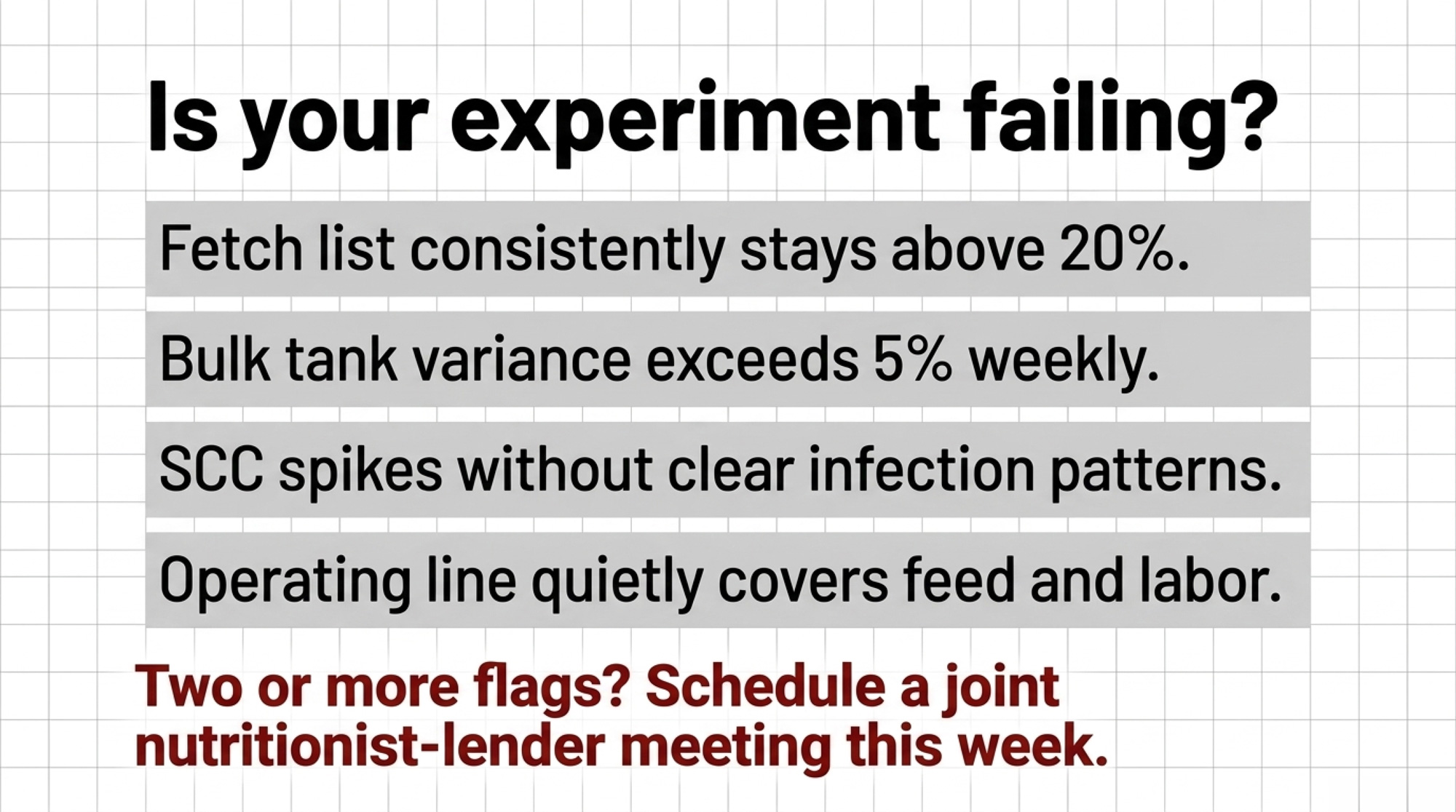
Path 4 — Do this within 30 days if you’re already stuck. If you’ve been pellet-free for four months or more and milk hasn’t returned to within roughly 3% of baseline (an editorial benchmark, not a published standard), stop waiting. Check your own numbers against these red flags — any one should trigger the meeting, and two or more should trigger it this week. These are editorial thresholds drawn from the Rodenburg 16% fetch baseline and common herd-management practice, not published standards:
- Fetch list consistently above 20% of the herd. That’s well north of the free-flow baseline and deep into labor-burn territory.
- Bulk tank variance above 5% week-over-week. Pellet-free herds trying to find their footing often shake the tank before the fetch list tells you why.
- Somatic cell count spikes with no clear infection pattern. Irregular milking intervals from missed robot visits show up in SCC before they show up in the fetch log.
- Operating line quietly absorbing monthly shortfalls. If you’re moving money from operating to cover feed and labor, you don’t have a feed problem. You have a cash problem dressed up as one.
If any of those are live, get three people in a room this month: your nutritionist, your AMS service specialist, and your lender or farm financial adviser. Bring the last 120 days of production data, fetch logs, SCC reports, and cash flow. Decide which path above you’re actually on, or put pellets back in the highest-need groups while you reset the timeline. Then set two checkpoints: day 90 (production recovered or structural path committed) and day 365 (full pellet-free vs. pellets-restored P&L review). Risk of not doing this: another two or three months of drag lands on the operating line before an adviser forces the conversation at a less favorable moment.
Key Takeaways
- If your barn is free-flow with one robot at the end of a long pen and no selection gate, treat any pellet-free pitch as a capital decision, not a feed decision — you’re being asked to accept permanently higher fetch labor or to fund a structural reconfiguration.
- If herd size × current lbs/cow × 9–12% drop × milk price × 10 weeks of transition, plus a full year of elevated fetch labor, exceeds your comfortable draw on your operating line, you don’t have the financial headroom to run the experiment.
- If your fetch list sits above 20%, bulk tank variance runs above 5% week-over-week, or SCC is spiking with no infection source, schedule the joint nutritionist–service–lender meeting inside 30 days.
- If your current pellet cost per ton is anywhere near the high end of the Vita Plus $132–$500 range, you may capture most of the available savings without touching the feed table at all.
- If a proposal you’re reviewing doesn’t include a transition milk-loss line in dollars, a chronic fetch labor line at or above 15% fetch rates, and a value for stranded pellet infrastructure, ask for those lines before you sign. Proposals that leave them out understate the true cost picture.
- If your barn has more than 15 stalls between the resting area and the first crossover, address the geometry before you address the ration. Your nutritionist should be setting the uNDF240 target, not your dealer.
- If sustained pressure on debt service coverage is already forcing the operating line to absorb shortfalls, the course correction is overdue — not early.
- If your forage program is soft on NDF digestibility or TMR moisture consistency, fix that before the feed table.
The Question Worth Taking Into the Barn
Strickland’s $171,000 is real to him and to Double Creek. The Heegs’ barn in Colby is real too — guided-flow, no pellets, and a different kind of decision about how cows move through the building. Neither of those outcomes happened in a retrofit free-flow barn, and neither started with a dealer ROI calculator. So when you’re standing at your own robot tomorrow morning watching who’s on the fetch list, the question isn’t “should I go pellet-free?” It’s “does my concrete, my gates, my forage program, and my working capital look anything like the farms showing up in marketing materials right now?”
If even one of those answers is soft, what you’re looking at isn’t an evolution. It’s an experiment you pay for twice — once in the transition, once more in the barn you should have reconfigured first. For the full economic model — cost-per-cwt by herd size, the five-question lender sidebar, and a side-by-side retrofit vs. new-build cash flow walkthrough — keep an eye on Bullvine Weekly, where the barn-by-barn math runs.
Sources: USDA Economic Research Report 356 (January 2026); University of Wisconsin–Madison Extension AMS publications; Bach, A. et al., Journal of Dairy Science (2007); Penner, G., Western Canadian Dairy Seminar proceedings (2019); DeVries lab, University of Guelph; Vita Plus Upper Midwest AMS herd survey; Rodenburg, J., AMS barn-design and traffic research; published AMS financing guidance from major U.S. and Canadian farm lenders; and publicly available operator materials including a DeLaval-produced promotional video featuring Matt Strickland. Dollar figures are USD unless otherwise noted.
 The Sunday Read Dairy Professionals Don’t Skip.
 The Sunday Read Dairy Professionals Don’t Skip.
Every week, thousands of producers, breeders, and industry insiders open Bullvine Weekly for genetics insights, market shifts, and profit strategies they won’t find anywhere else. One email. Five minutes. Smarter decisions all week.

 Join the Revolution!



