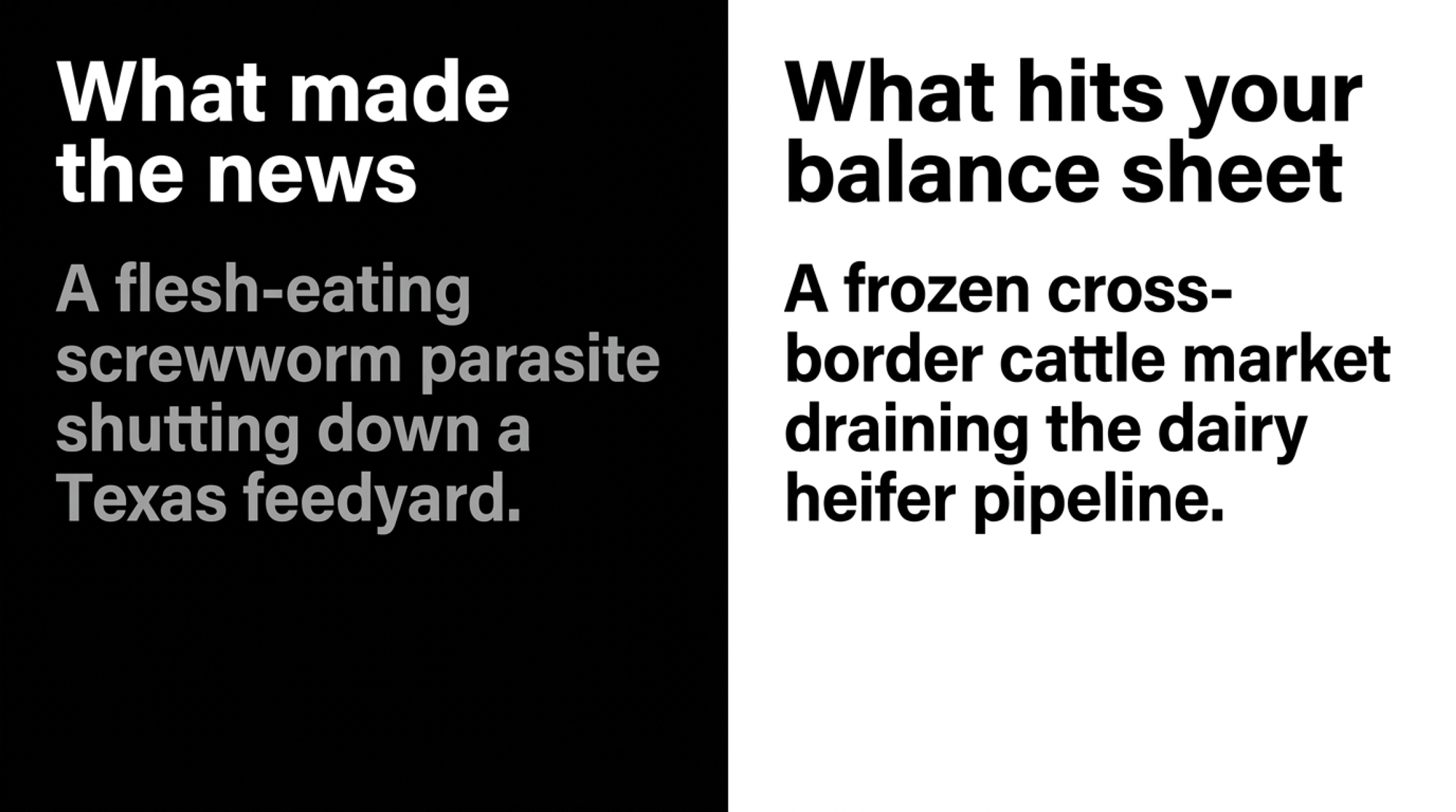





USDA confirmed screwworm in six Texas counties. But the fly won’t gut your cash flow — the 60-day movement freeze will, locking culls, beef-cross calves, and dumped milk in place.
Executive Summary: Screwworm is back on U.S. soil for the first time since 1966, with USDA APHIS confirming cases across six Texas counties — and the real threat to your dairy isn’t the parasite, it’s the 20-km, 60-day movement freeze a single confirmed case triggers. That freeze locks your culls, beef-cross calves, and any treated cows in place: figure close to $60,000 stuck on a 500-cow herd and a quarter-million on a 2,000-cow operation, before a vet bill. The timing’s brutal — replacement heifers sit at 3.914 million head, the fewest since 1978, at roughly $3,010 apiece, so the animals you can’t move are worth more than they’ve been in a generation. Treat lactating cows and the milk math compounds: 19.5 days of dumped milk per cow on the Dectomax-CA1 injectable, 10 days on the F10 topical. Washington’s betting $105 million on sterile flies and drones, but none of that inspects the navel on the calf born in your barn at 3 a.m. Two moves matter now: run your own 60-day freeze number before a zone gets drawn around your county, and turn your wound-check habit into a written, checked protocol — because an untreated infestation can kill in seven days. If a case lands two counties over, the producer who already knows their number and has TAHC (1-800-550-8242) in the herd manager’s phone is the one who isn’t scrambling.
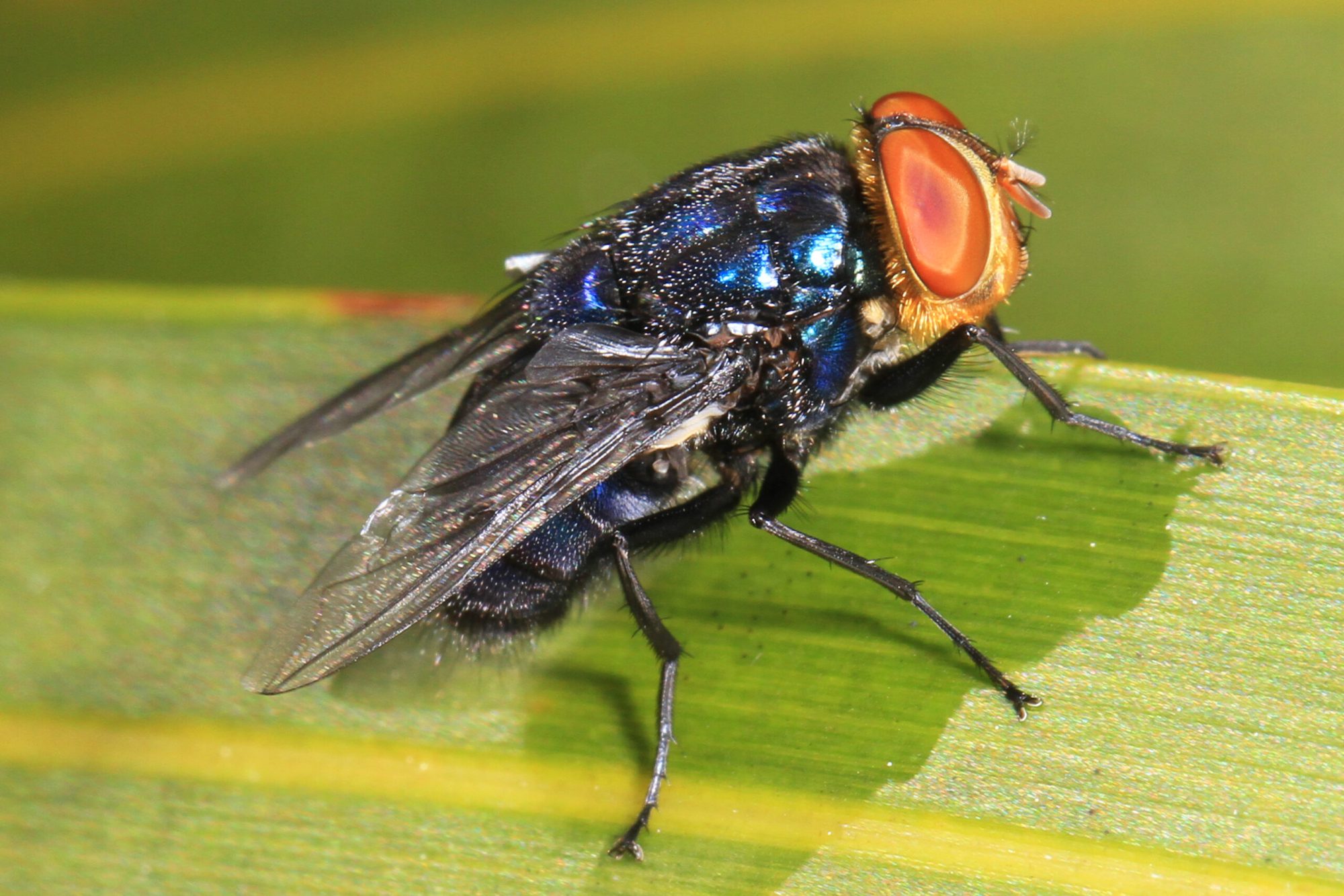
On a South Texas cow-calf operation near La Pryor, in Zavala County, a three-week-old calf became the first U.S. animal in 60 years to test positive for New World screwworm. USDA confirmed it on June 3, 2026, after finding larvae in the calf’s navel. And the cases didn’t stop there. Within days, USDA had confirmed detections spreading across six Texas counties, with one case reclassified into New Mexico — hitting cattle, a goat, and a dog.
The second Zavala case turned up in a one-month-old calf just 5.6 miles from the first. That’s the detail that should stop you cold. Six months earlier, the warning was already there — a 6-day-old calf in Llera, Tamaulipas, with screwworm in its navel, roughly 197 miles from the U.S. border.
Here’s the short version: the buffer zone you thought you had between Central America and your calves is gone. The longer version — what a confirmed case in your region does to your milk check and your farm’s stability — is worth fifteen minutes before the next milking.
| U.S. screwworm detections (per USDA APHIS, as of June 12, 2026) |
| Texas counties with confirmed cases: Zavala, La Salle, Sutton, Tom Green, Edwards, Gillespie |
| New Mexico: 1 case (reclassified from an Andrews County, TX, dog) |
| Animals affected: cattle, a goat, a dog |
| Sources: USDA APHIS confirmed-detections tracker (updated Tuesdays/Thursdays); CAPCOG incident memo, June 15, 2026. Case counts are moving — check screwworm.gov for the current tally. |
What’s Changing and Why
Screwworm isn’t a new bug. We beat it once, with sterile flies, and then mostly forgot it existed. What changed is the map. After escaping the long-standing containment barrier in Panama, the parasite worked north through Central America and into Mexico — closing to within about 52 miles of the border by late May 2026, then crossing onto U.S. soil within days.
The fly itself doesn’t roam far. USDA says adults generally stay within a couple of miles when there are animals to feed on. The long jumps north come from moving infested livestock, which makes this partly a trucking-and-logistics problem, not just a biology one. And logistics problems land squarely on working farms.
Who’s most exposed right now? Cow-calf and dairy operations in South Texas and southern New Mexico sit inside or beside the quarantine zones. But the real risk reaches any herd that produces wounds on a schedule — and every dairy does. Calving. Dehorning. Tagging. The odd surgery. Screwworm feeds on living tissue, and a barn manufactures fresh tissue every single day.
Worth saying plainly: this is an animal-health threat, not a food-safety one. USDA and the CDC have been clear that milk and dairy products remain safe, and that the risk to people stays low. The damage screwworm does to a dairy shows up in the barn and on the balance sheet — not in the bulk tank.
Why We Should Have Seen This Coming
We’ve done this dance before, and the history isn’t ancient. Through the 1960s, screwworm cost U.S. livestock producers more than $100 million a year in the Southwest alone, according to FAO records. The sterile-fly eradication program that finally cleared it by 1966 cost about $32 million — and APHIS later pegged the annual benefit to producers at roughly $796 million in 1996 dollars.
So this isn’t a hypothetical. It’s a re-run with the numbers attached. Texas A&M AgriLife now estimates a serious resurgence could cost Texas cattle producers $2.1 billion and do another $9 billion in wildlife-industry damage. Those are state-level figures, not your barn — but they tell you how hard the regulatory response will come down when a case shows up nearby. The bigger the projected statewide loss, the tighter the movement controls.
How This Plays Out on a Real Operation
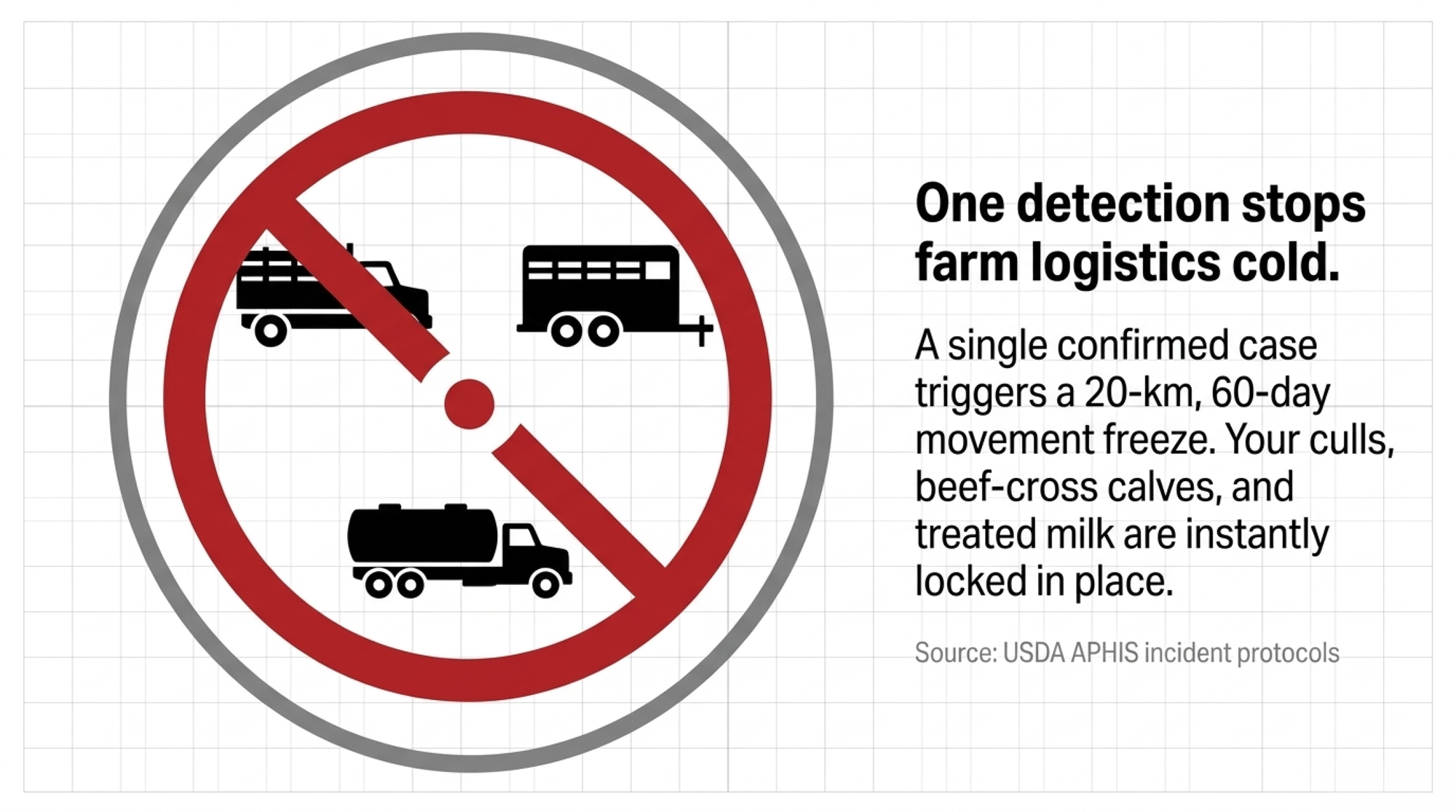
When USDA confirms a case, it locks down animal movement in a 20-kilometer (12.4-mile) infested zone around the detection, stands up a unified command with the state animal-health agency, and layers on quarantines and inspection. Texas State Veterinarian Bud Dinges drew exactly that zone around much of Zavala County and a slice of neighboring Uvalde. That’s the part most producers haven’t put a pencil to. Not the fly. The freeze.
| Trigger Event | Geographic Scope | Movement Restriction | Lead Agency | Timeline |
|---|---|---|---|---|
| Confirmed case | 20-km infested zone | Full animal movement freeze | USDA APHIS + State vet | Immediate on confirmation |
| Larvae found / larvae suspected | County level | Quarantine + inspection | Texas Animal Health Commission (TAHC) | Within 24–48 hrs |
| Case reclassified / spreads to adjacent state | Multi-state zone | Interstate movement controls layered | USDA unified command | Within days (NM precedent: June 2026) |
| Untreated wound detected | Individual animal | Mandatory treatment; case reported within 24 hrs | Producer + accredited vet | 7-day fatality window if untreated |
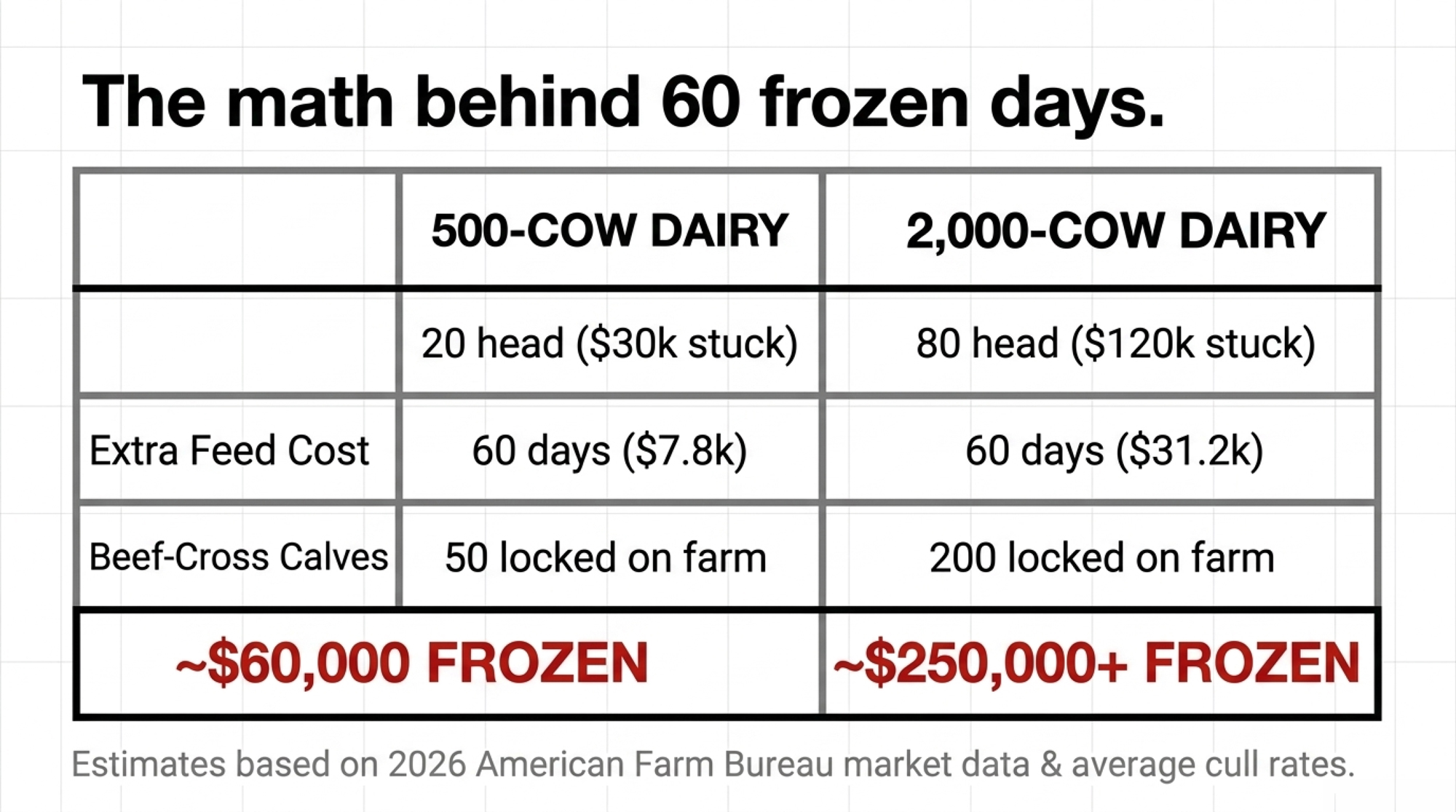
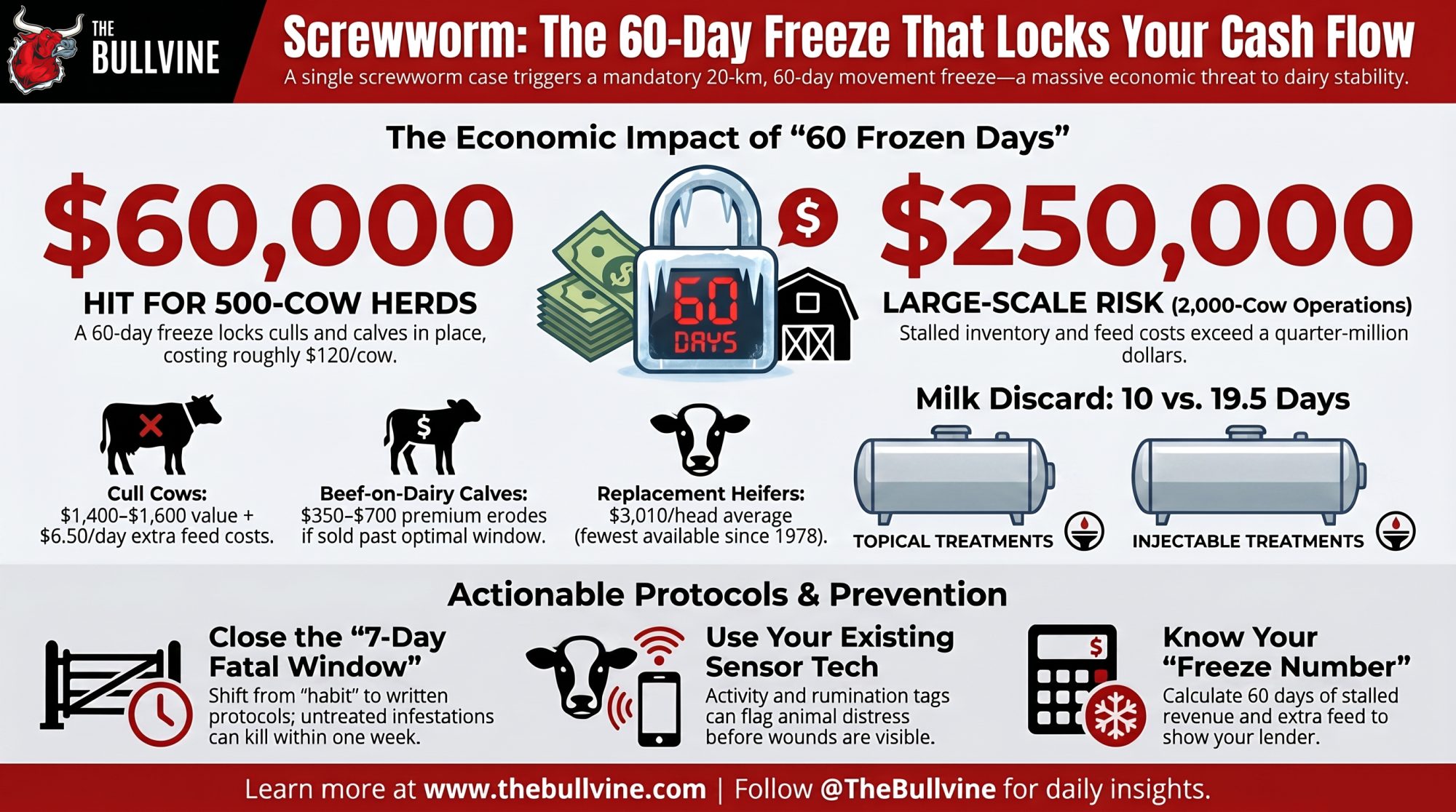
Take a 500-cow dairy in a zone where animal movement stalls for 60 days. Three things hit at once. The cull cows you’d planned to ship can’t leave, so they keep eating while their value sits stuck. The beef-on-dairy calves you normally sell pile up in the hutches. And any treated animals carry milk withdrawals that pull product off your tank.
| Cost Category | 200-Cow Dairy | 500-Cow Dairy | 2,000-Cow Dairy |
|---|---|---|---|
| Cull cows held (est. head) | 8 | 20 | 80 |
| Delayed cull revenue | $12,000 | $30,000 | $120,000 |
| Extra feed cost (60 days @ $6.50/hd/day) | $3,120 | $7,800 | $31,200 |
| Beef-cross calves held (est. head) | 20 | 50 | 200 |
| Tied-up calf premium value | $7,000 | $22,200 | >$100,000 |
| Estimated total freeze exposure | ~$22,000 | ~$60,000 | ~$250,000+ |
| Vet bill / treatment costs | Not included | Not included | Not included |
| Zone-exit animal discount | Not included | Not included | Not included |
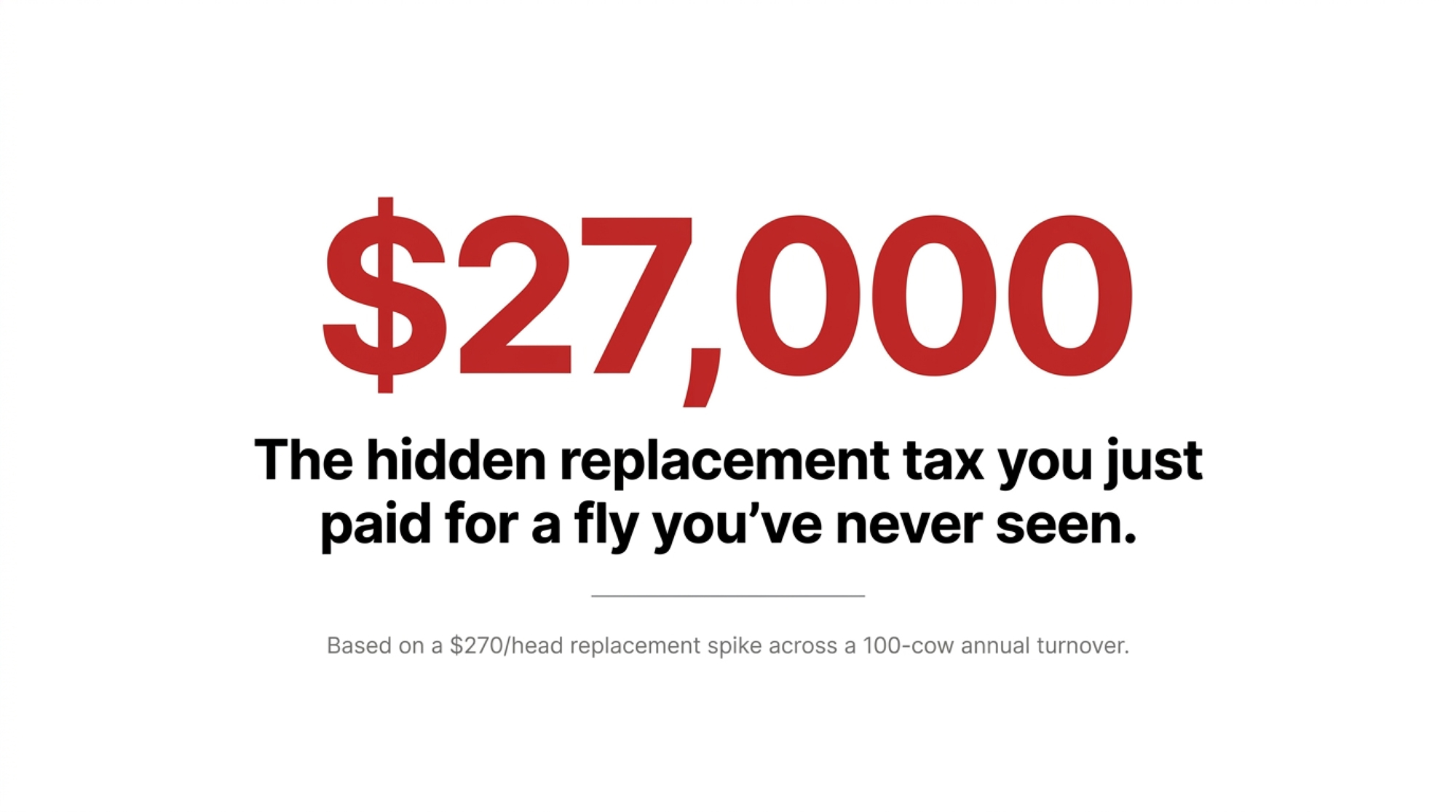
Run the rough math, using 2026 industry-standard estimates rather than a quote for your specific operation. Say 20 cull cows can’t move at $1,400–$1,600 a head — that’s around $30,000 in delayed revenue, plus roughly $7,800 to keep feeding cows you’d already decided to sell (figure about $6.50 a head a day across 60 days, near the low end of the $5.50–$8.50 lactating range most U.S. herds run). Add 50 beef-cross calves stuck on farm. Those crossbreds carry a documented $350–$700 premium over straight dairy bull calves, according to American Farm Bureau market data — so holding 50 of them ties up real money on top of their base value. Add up the delayed cull revenue, the extra feed, and the tied-up calf value, and one 500-cow operation is looking at close to $60,000 frozen in place. That’s before a vet bill. Before any discount on animals leaving a quarantine zone.
Smaller herd? Scale it down and the shape holds. A 200-cow dairy shipping a handful of culls and a dozen beef-cross calves a month still watches real money sit idle for two months — and on a tighter operation, two months of frozen cash flow is the part that keeps you up at night.
Now Run It on a 2,000-Cow Dairy
Scale up and the freeze doesn’t just get bigger — it changes character. A 2,000-cow operation typically moves cull cows weekly, not monthly, and ships beef-cross calves in a steady stream rather than in batches. Stall that for 60 days and the numbers stack fast.
Figure 80 cull cows held at the same $1,400–$1,600 — that’s roughly $120,000 in delayed revenue sitting in your pens. Feeding them runs about $31,200 over the 60 days at $6.50 a head a day. Pile on 200 beef-cross calves carrying that $350–$700 premium, and the held calf value alone climbs past six figures. All in, a large operation can watch a quarter-million dollars or more freeze in place — and unlike the cull check that’s merely delayed, some of that calf premium erodes if the animals grow past their optimal sale window while they’re stuck.
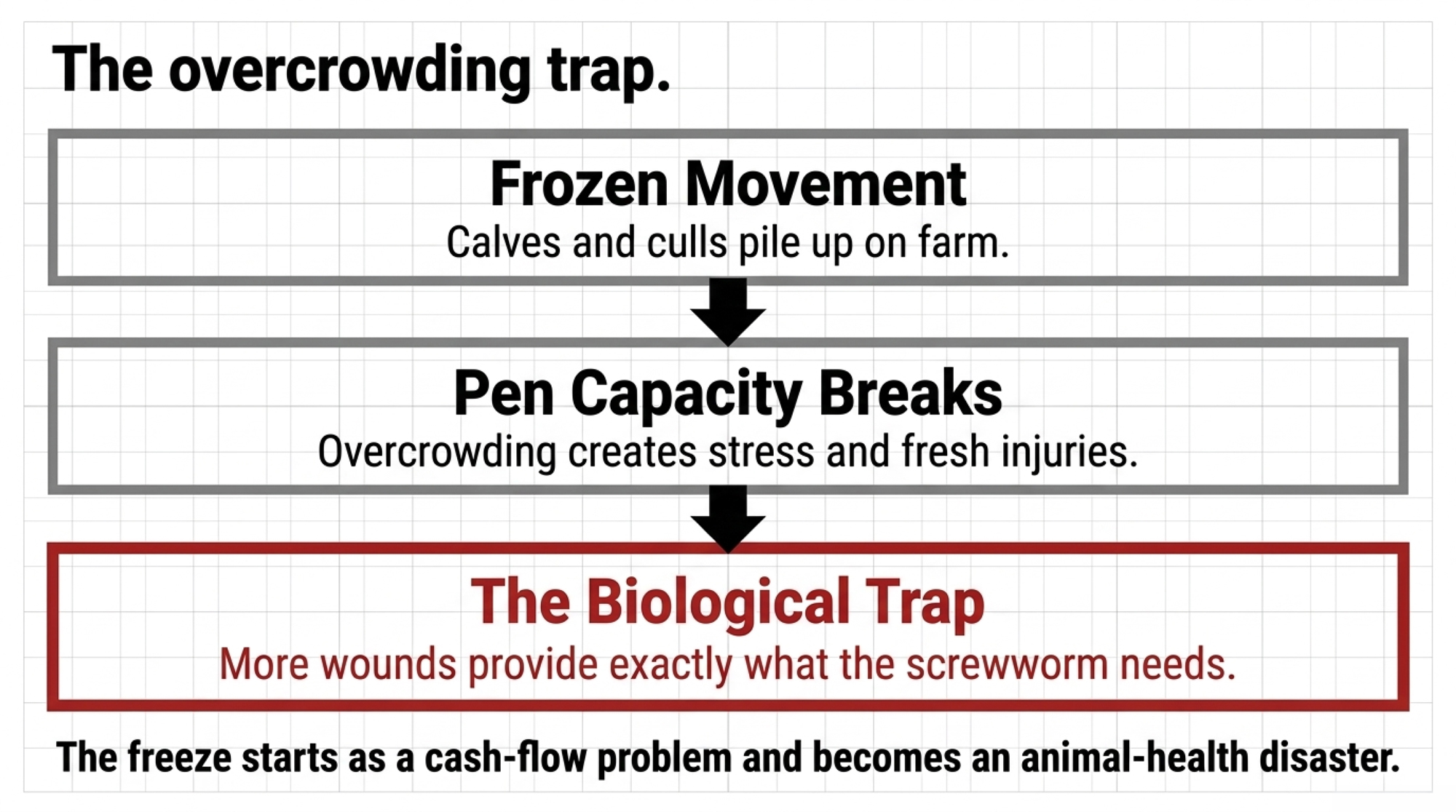
Here’s the part that scales worst: pen space. A 200-cow dairy can usually find somewhere to hold a few extra culls and a dozen calves for two months. A 2,000-cow dairy running at capacity can’t. Overcrowded pens mean more wounds, more stress, and — in a screwworm zone — more of exactly the conditions the parasite is looking for. The freeze that started as a cash-flow problem becomes an animal-health problem feeding right back into the thing that caused it.
The Replacement Squeeze That Makes the Timing Brutal
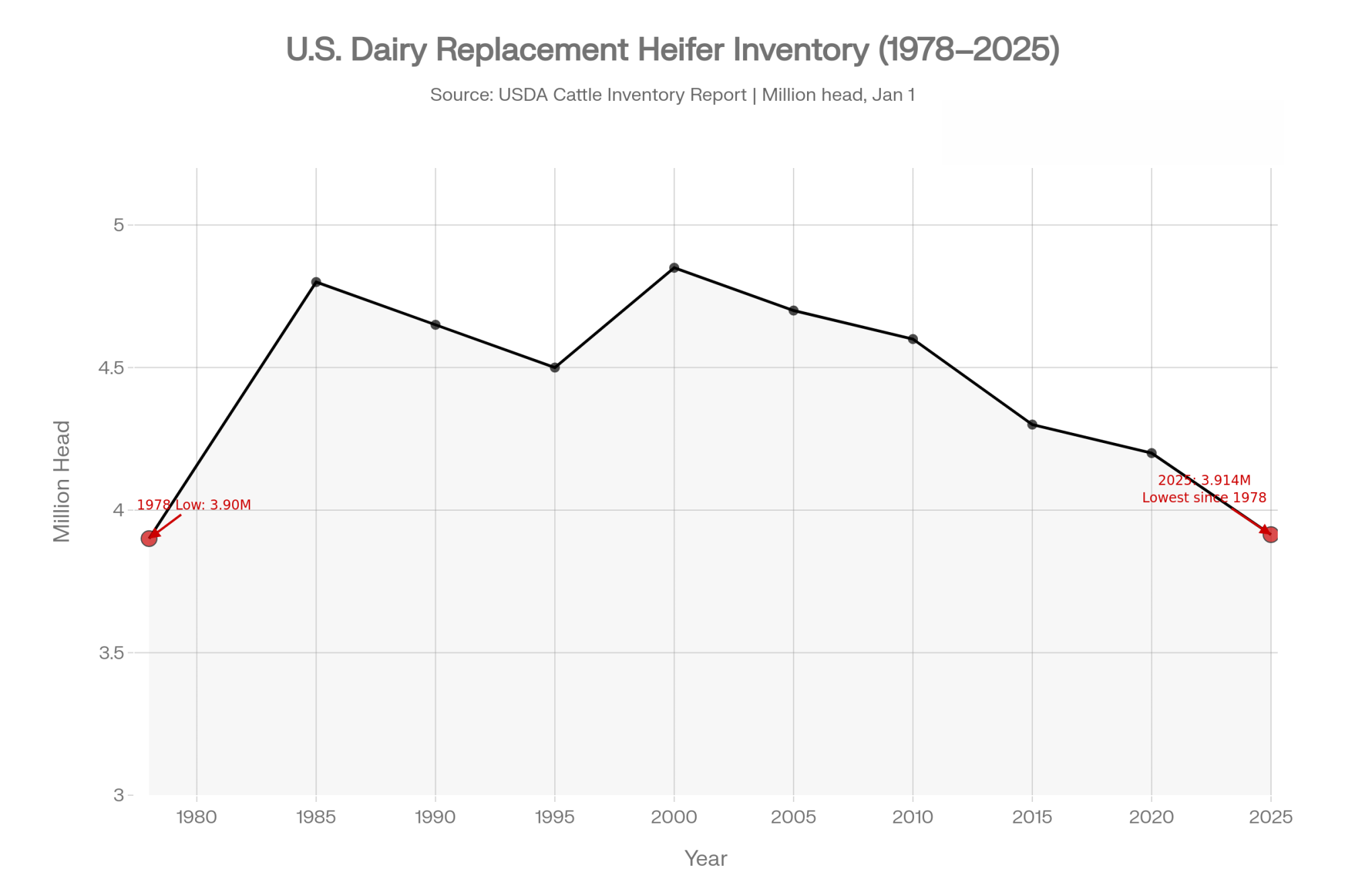
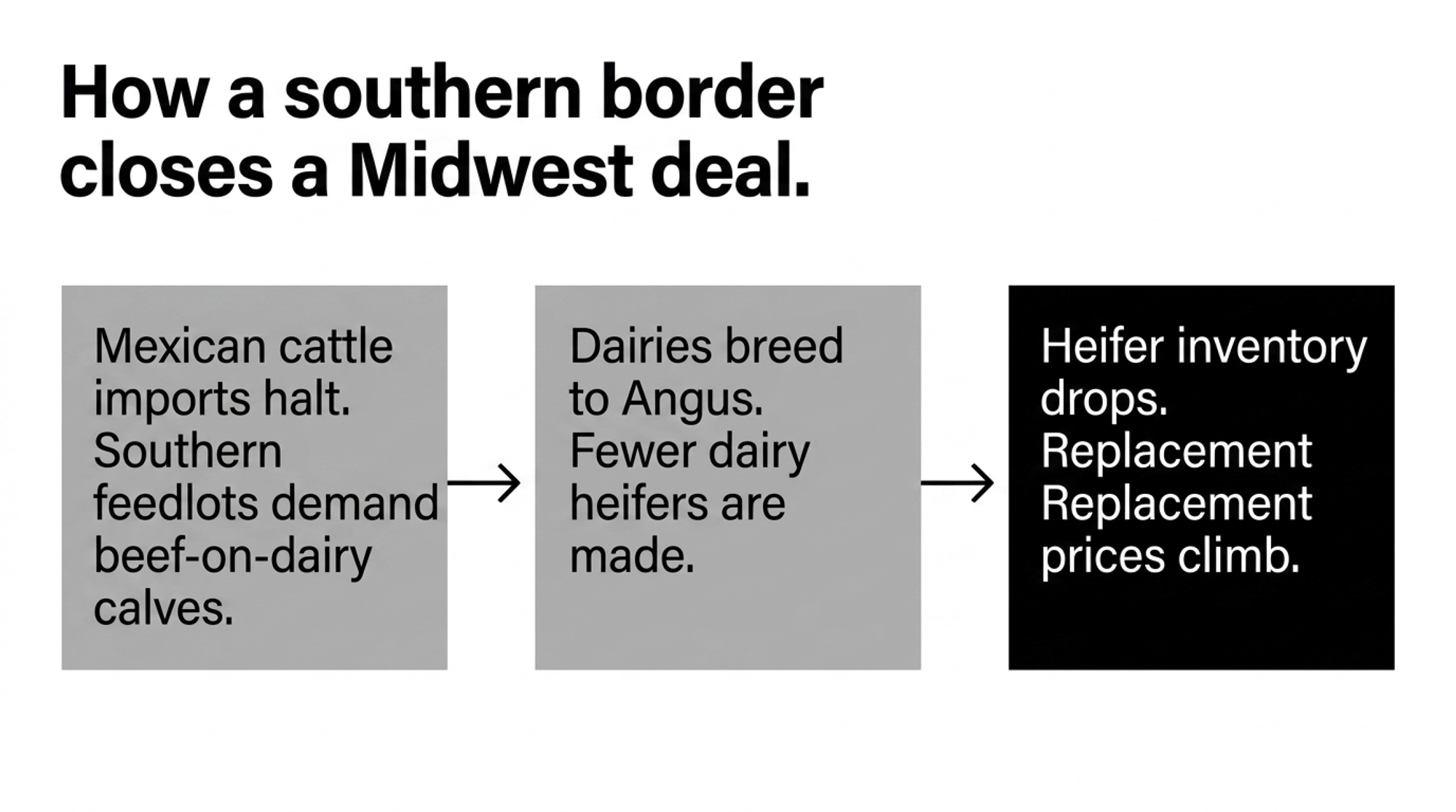
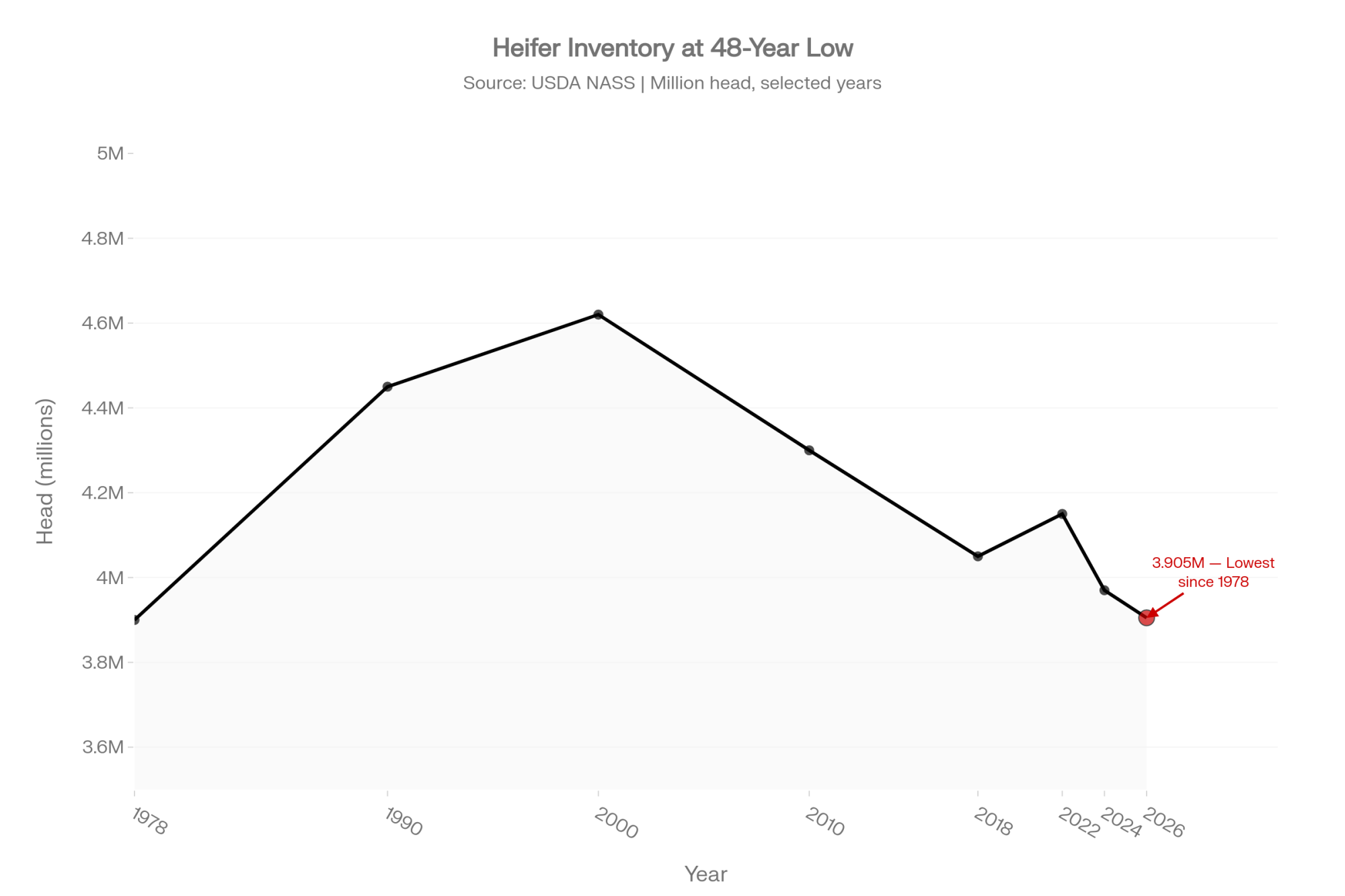
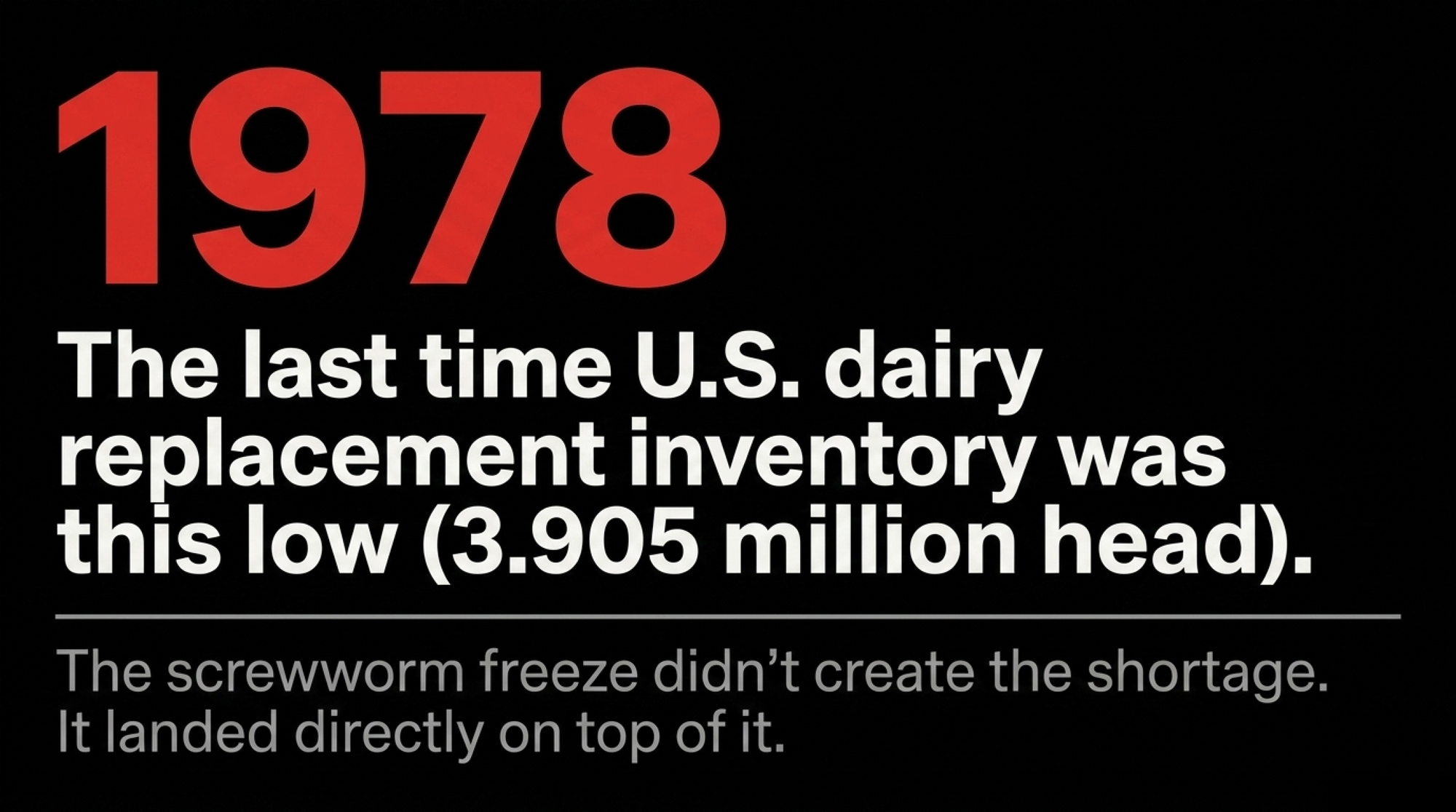
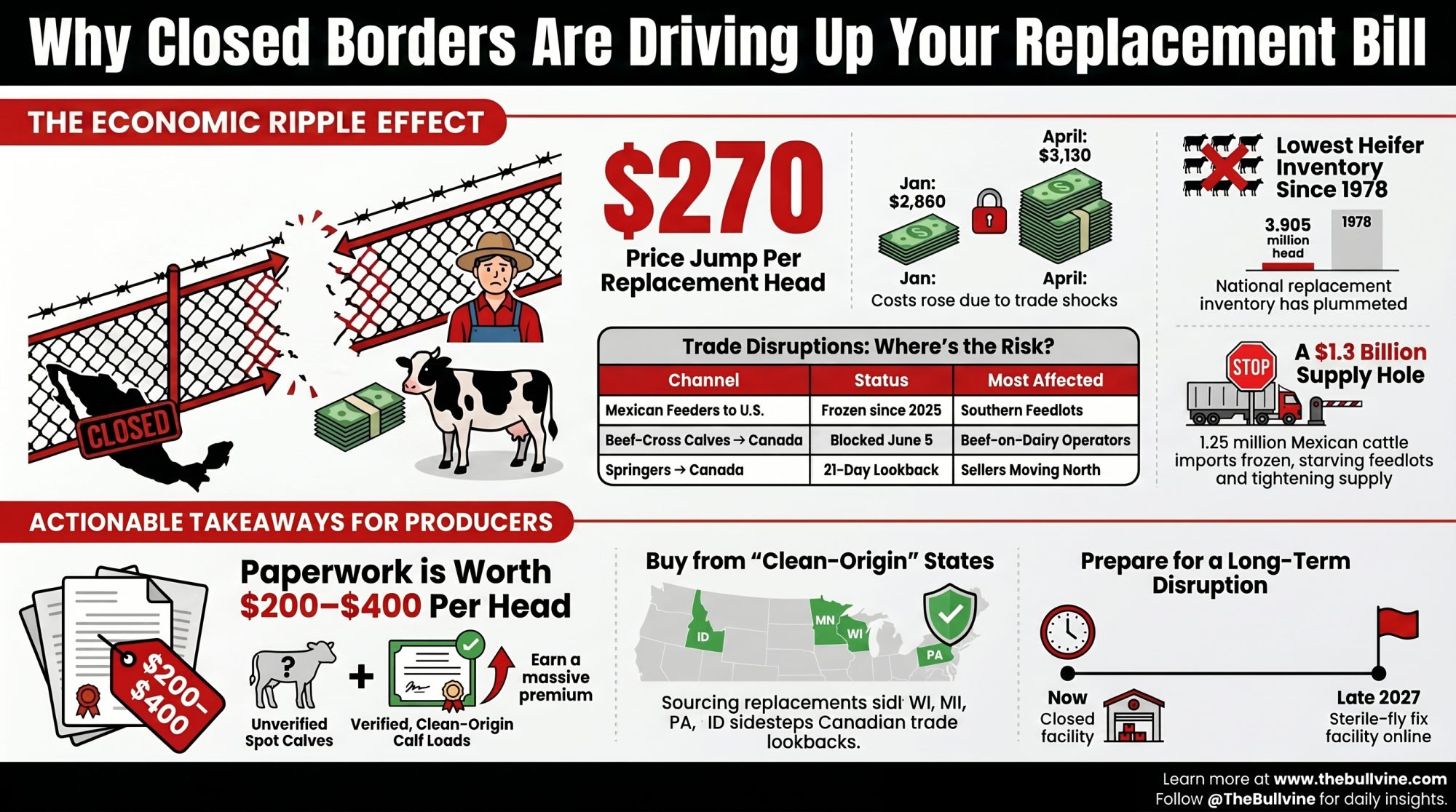
The reason this stings right now is timing. The U.S. dairy replacement pipeline is the tightest it’s been in nearly half a century — down to 3.914 million heifers as of January 1, 2025, the lowest count since 1978, according to USDA’s Cattle inventory report. So you’ve got fewer spare animals in the system than at almost any point in living memory.
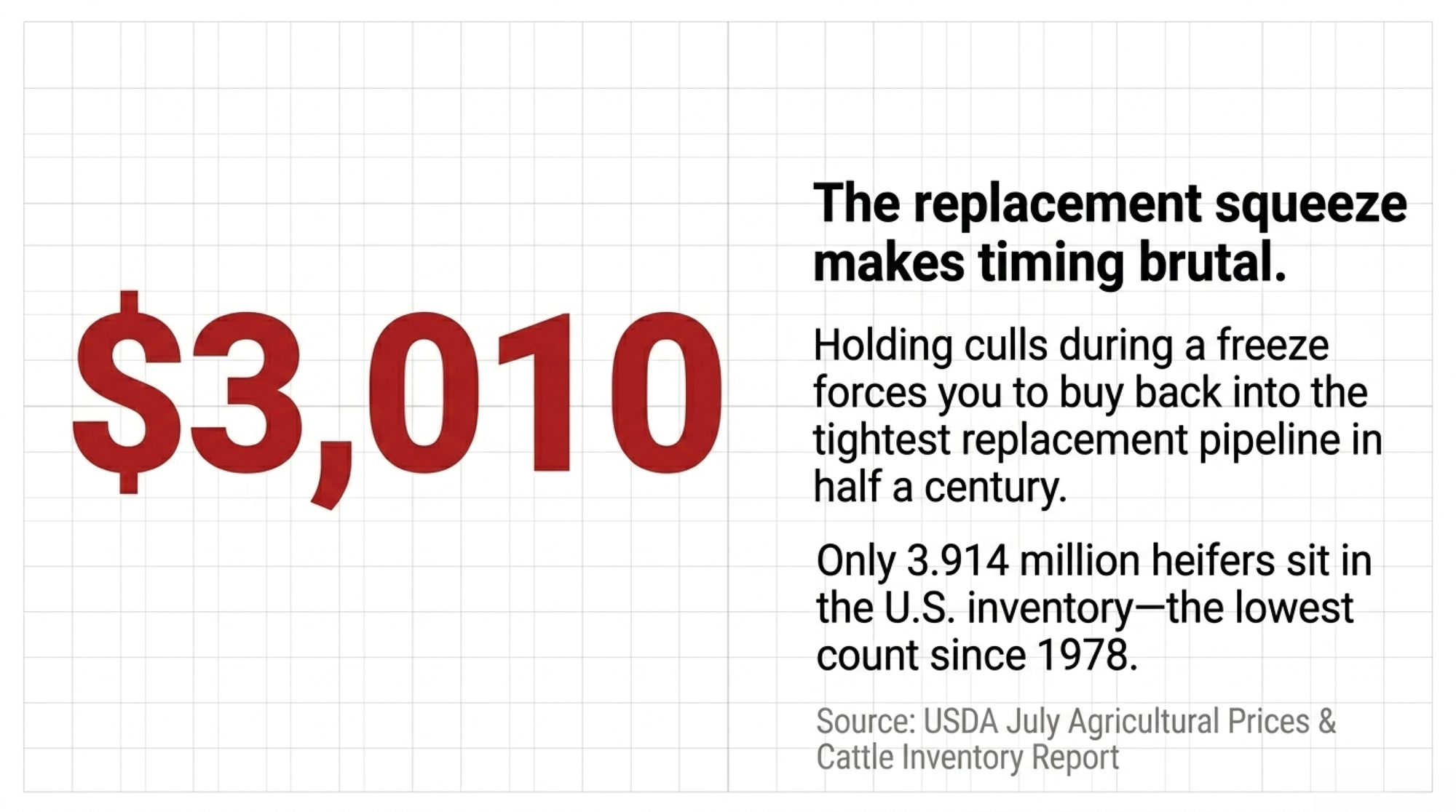
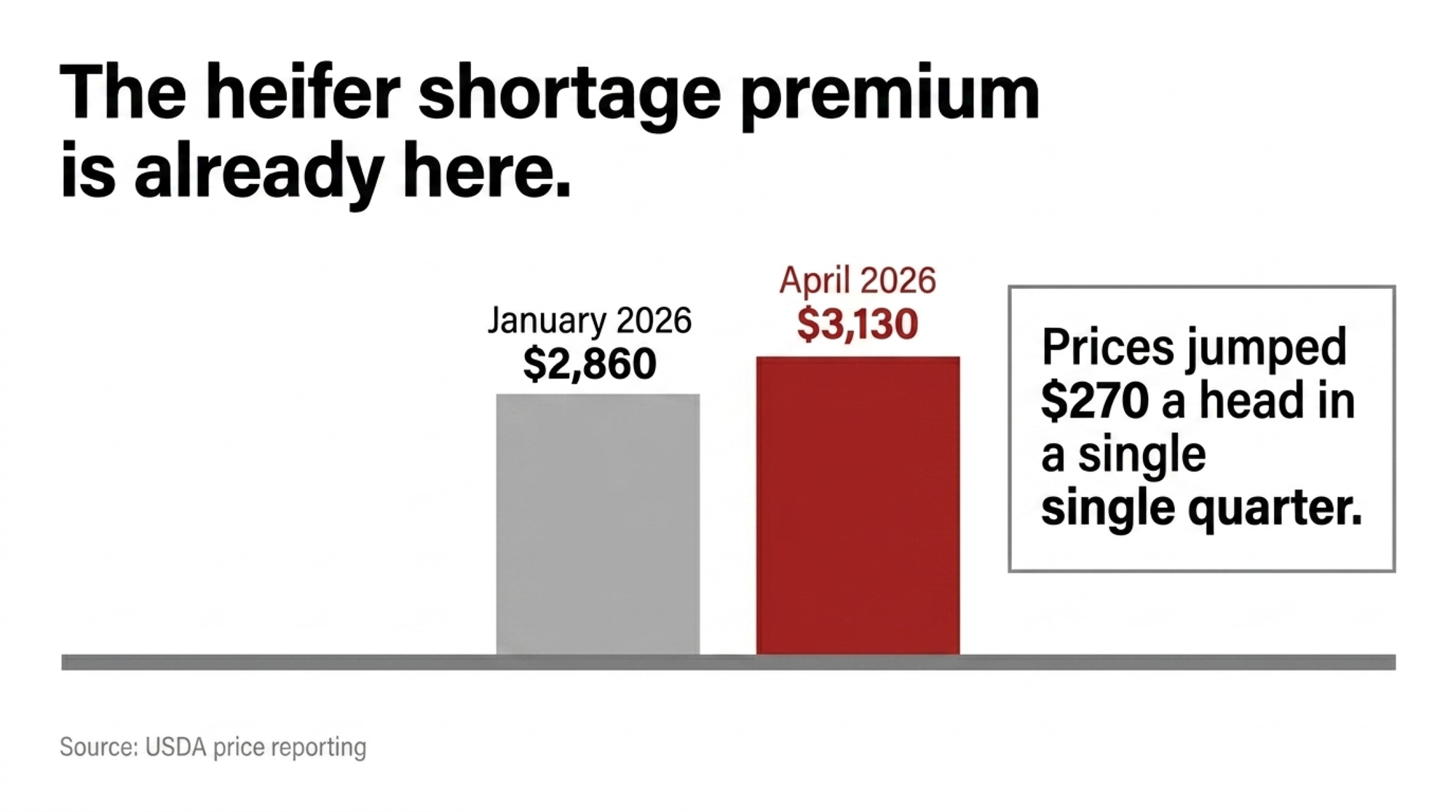
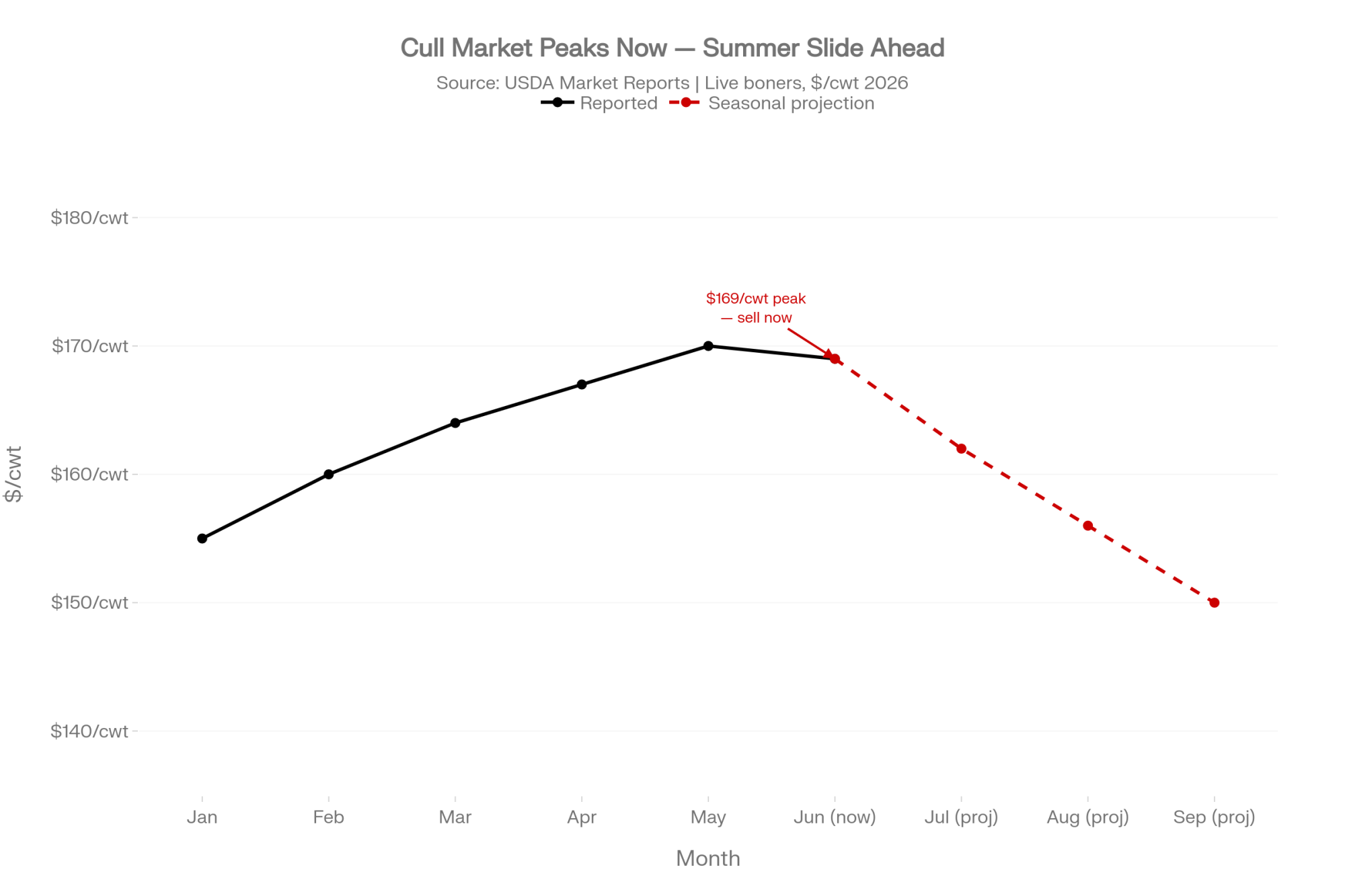
Price tells the same story. Replacement heifers averaged around $3,010 a head nationally in USDA’s July 2025 Agricultural Prices data, with top animals at Texas and California auction barns bringing closer to $4,000 by midyear. That’s not just a number on a market report. It means the animals you can’t move during a freeze are worth more than they’ve been in a generation — and the ones you’d normally buy to backfill are priced out of reach.
Walk that chain forward and the freeze gets worse, not better. If a quarantine forces you to hold culls you’d planned to replace, you’re carrying low-value animals at the exact moment replacements cost the most. If the freeze coincides with your normal heifer-buying window, you either pay top dollar the moment the zone lifts — competing with every other operation in the same boat — or you milk on with a thinner string. Either way, the screwworm freeze doesn’t just dent one month’s cash flow. It can knock your replacement plan sideways for a year.
What About the Milk You Have to Dump?
The cull-and-calf math is the visible cost. The milk math is the one that catches people off guard. Any lactating cow treated for screwworm carries a milk-discard window, and that milk goes down the drain, not into the tank.
| Product | Type | EUA Date | Milk Discard Window | Est. Revenue Lost/Cow | Use Case |
|---|---|---|---|---|---|
| Dectomax-CA1 (doramectin) | Injectable | May 19, 2026 | 468 hrs (19.5 days) | ~$351 | Systemic treatment; lactating cows, dry cows, replacement heifers |
| F10 Antiseptic Wound Spray | Topical | May 2026 | 10 days | ~$180 | Wound-site treatment; lower discard, narrower indication |
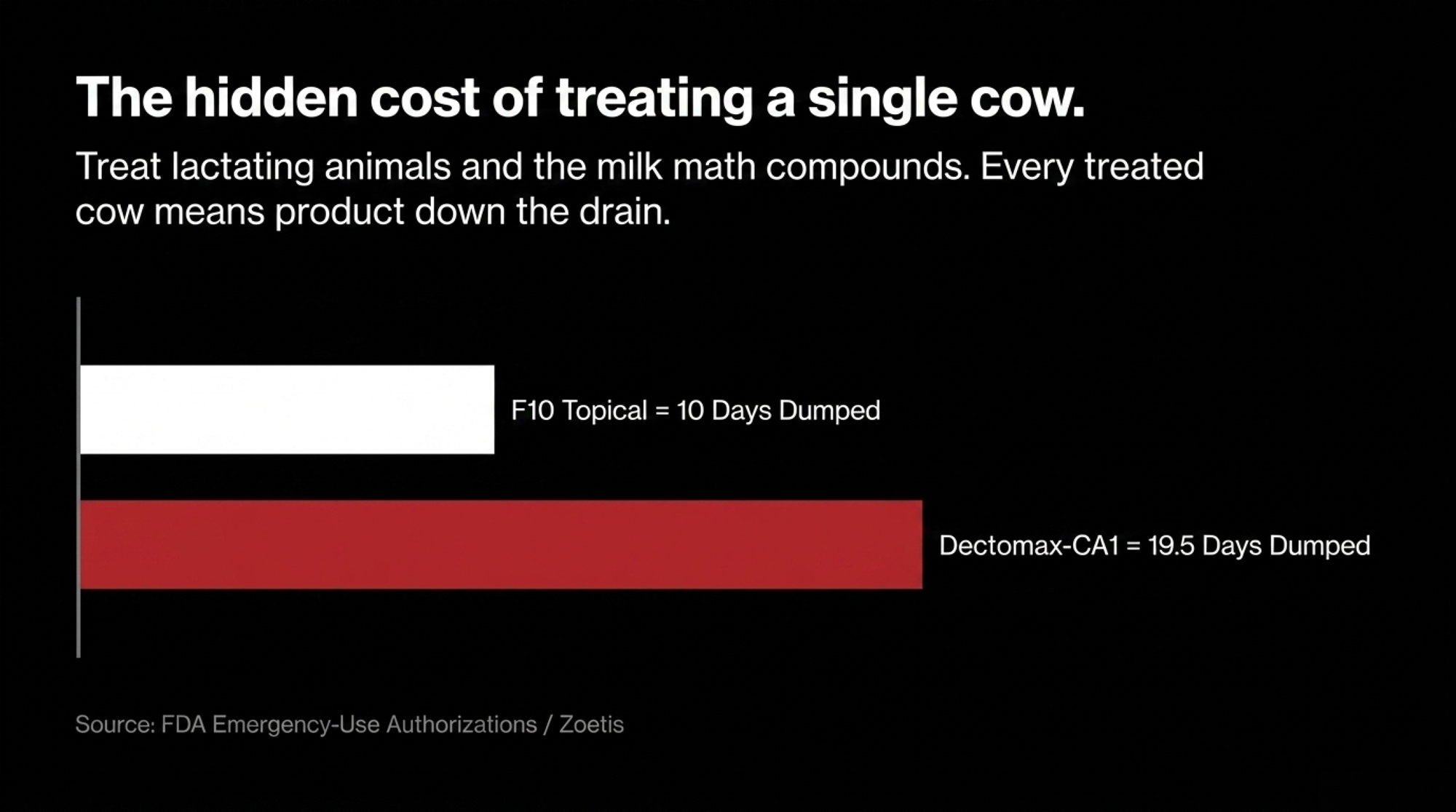
The numbers are now nailed down by FDA emergency-use authorizations. For Dectomax-CA1 (doramectin) — cleared for the milking string under the May 19, 2026 EUA — milk from treated lactating cows, dry cows, and replacement heifers must be discarded during treatment and for 468 hours (19.5 days) afterward, per the FDA and Zoetis. The F10 antiseptic wound spray EUA carries a shorter window: discard during treatment and for 10 days after. So your milk loss per treated cow depends entirely on which product your vet uses — roughly a week and a half of dumped production on the topical, nearly three weeks on the injectable.
Put that against the freeze and it compounds. Treat even ten lactating cows with the injectable and you’re discarding their milk for nearly three weeks each — and at a 2,000-cow scale, a wider outbreak turns “a few cows” into a tank-level number fast. There’s a harder version, too. If a regional quarantine ever interrupts hauling or processing — not because your milk is unsafe, but because trucks can’t move freely through a locked-down zone — a dairy can’t hold product the way a cow-calf outfit holds calves. You milk every day whether the truck comes or not. The Bullvine has walked through that interstate-hauling scenario before, and it’s the part of the screwworm story that hits dairy harder than beef.
The Federal Response, and Why It Doesn’t Walk Your Hutch Row
USDA’s New World Screwworm Grand Challenge put about $105 million into 40 projects — scaling sterile fly production, building better traps and lures, advancing treatments, and even testing AI drones to monitor wildlife. It’s a serious, well-funded effort. It’s also aimed at the ecosystem, not your individual barn.
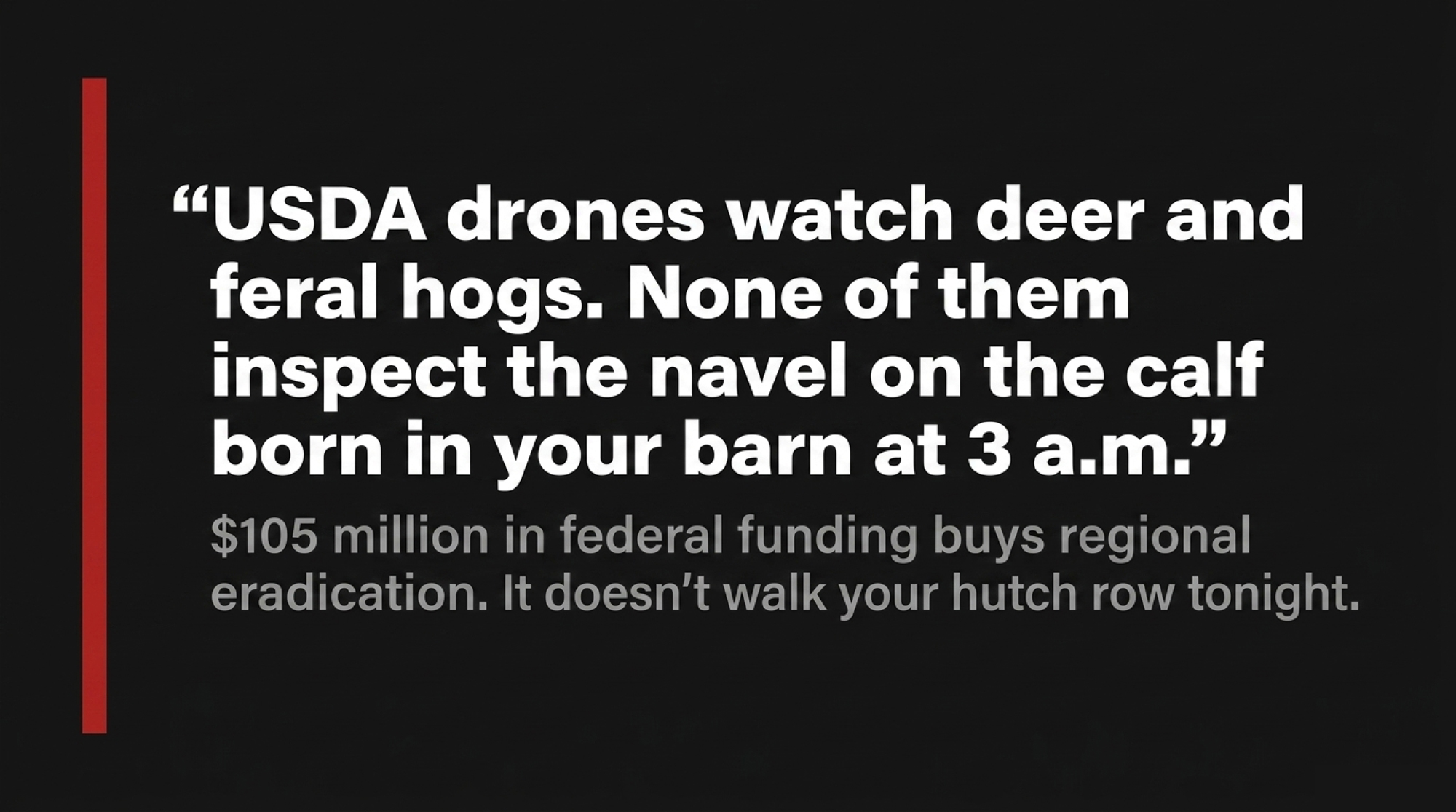
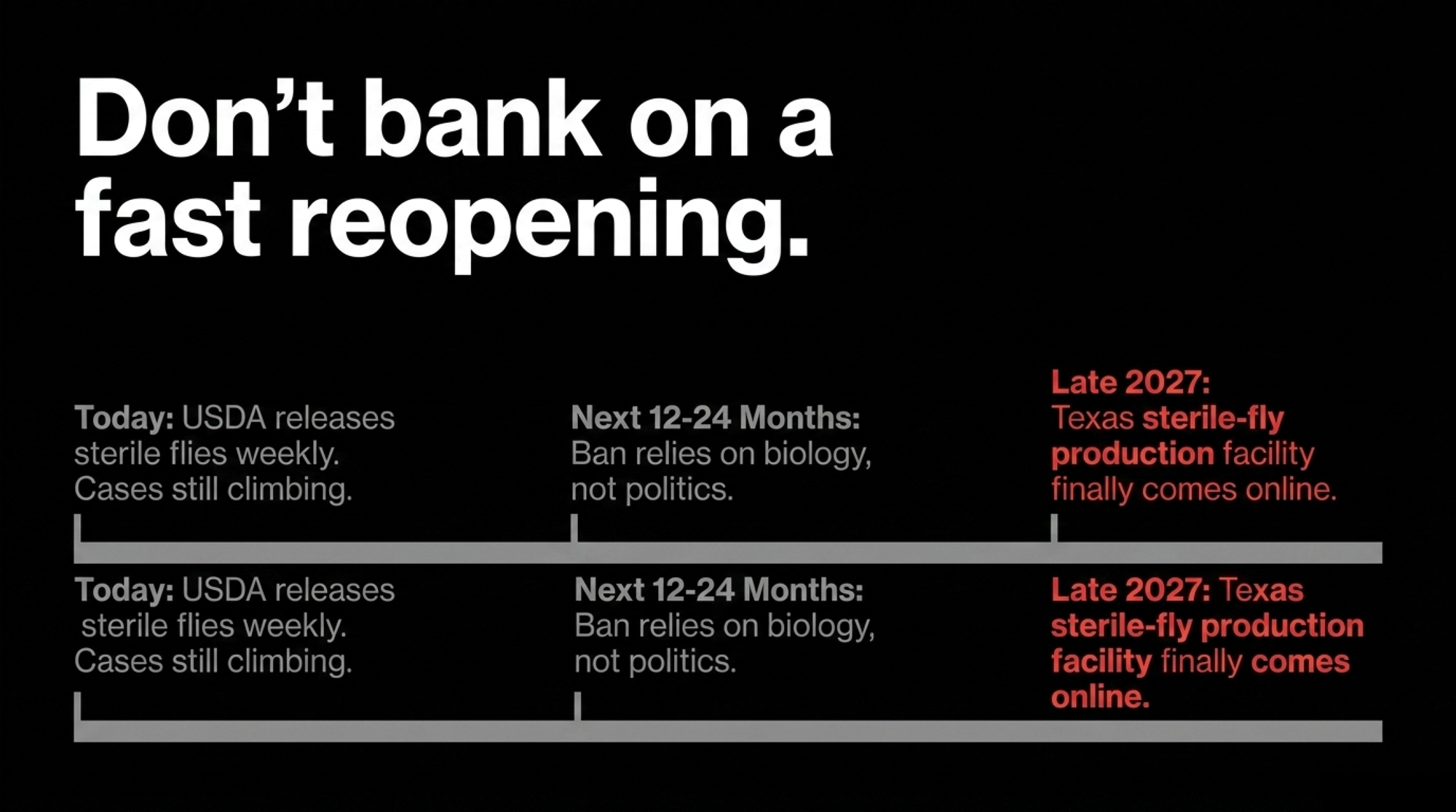
Strip the labels off and the money buys long-term tools: detect faster, control faster, respond faster. None of it walks your hutch row tonight. USDA is already releasing about 4 million sterile flies twice a week over the South Texas zone, plus another 4 million pupae weekly — a regional eradication weapon, not a barn-level one. The drones watch deer and feral hogs across rangeland you don’t own. Both shrink the odds a quarantine lands on your county — and neither one inspects the navel on the calf born in your barn at three in the morning.
How Much Would a 60-Day Freeze Actually Cost You?
The honest answer: it depends on your herd size, your cull schedule, and how hard you’ve leaned into beef-on-dairy. But the pattern is consistent. The bigger your beef-cross program and the tighter your replacement situation, the more a movement freeze hurts — because the animals you can’t move are exactly the ones throwing off cash.
So plug in your own numbers. How many cull cows do you ship in a normal month? How many beef-cross calves leave the farm? Multiply each by 60 days of nothing, then add the feed to carry them and any withdrawal milk you’d lose to treatment. That figure — the one specific to your operation — is worth more than any headline about sterile flies. It’s also the number your lender will want to see if a case shows up two counties over, so it’s better to have it written down now than to scramble for it the week a zone gets drawn around you.
Is Your Wound Routine Actually What You Think It Is?
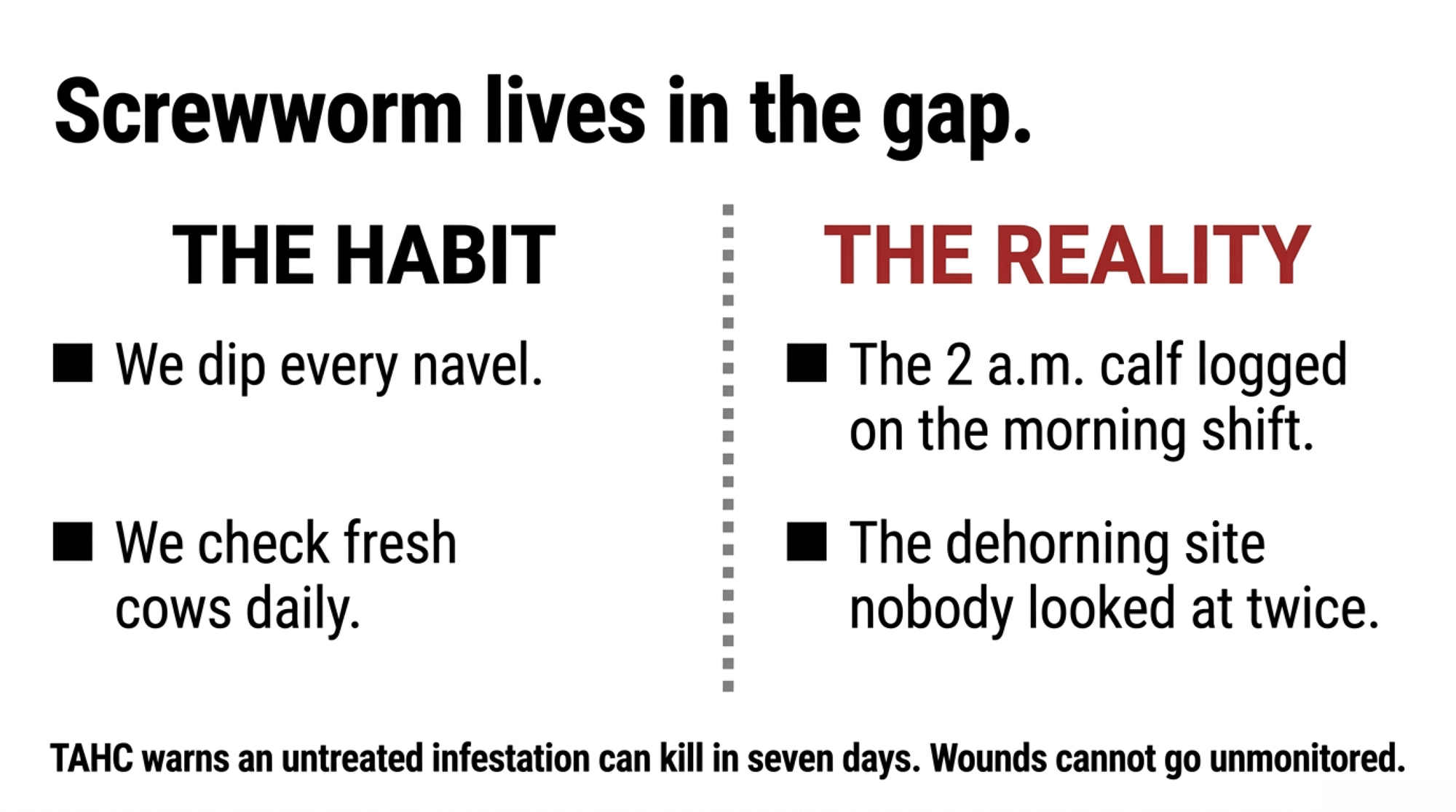
Here’s the uncomfortable part. Most dairies will tell you, honestly, that they dip every navel and check fresh cows daily. But spend a week shadowing the protocol on a typical farm and the gaps tend to show up — a missed dip on a busy calving night, a skipped follow-up when you’re short-handed, a dehorning site nobody’s looked at since the day it was made. It’s not a caring problem. It’s the gap between a habit and a written protocol — and screwworm lives in that gap.
Picture the conditions the parasite actually exploits. It’s the calf born at 2 a.m. that nobody logs until the morning shift. It’s the fly that finds a fresh navel before the dip cup does. It’s the back corner of a packed hutch row on a humid June afternoon, where a wound goes a day and a half without a second look. The Texas Animal Health Commission has put the whole defense in a single sentence: “Laying eyes on your animals is the best thing you can do,” the agency told producers on June 13, 2026, urging daily monitoring of livestock and immediate reporting of suspicious wounds. The parasite doesn’t need your official SOP. It lives in the space between what you believe your crew is doing and what actually happens when you’re not standing there.
APHIS has been specific about what to look for: draining or enlarging wounds, maggot or egg masses, animals acting uncomfortable, and lesions around body openings — nose, ears, genitalia, and the umbilicus. TAHC is just as blunt about the stakes: left untreated, an animal can die within one week of infestation. That’s a tight window. And it closes fastest on the wounds nobody’s watching.
Options and Trade-Offs for Farmers
No single move makes this disappear. But a few paths are open to you, and most cost nothing but attention.
Tighten surveillance now and treat it as your front line. This makes sense for every operation, in or out of a zone, because it’s free and it’s the only step that catches a case before it spreads. What it requires is honesty about your real protocol, not your intended one. The limit: surveillance buys early detection, not immunity — a sharp eye still can’t stop a fly that’s already in your county.
Build a freeze contingency before you need it. This is the move for any herd within a few counties of an active zone, or anyone whose operating line is already tight. It requires running your own 60-day number and walking it to your lender now, while it’s a hypothetical and not an emergency. The risk of skipping it: you find out your borrowing capacity the same week you find out you can’t move a single animal.
Lean on the sensors you already own. Activity, rumination, and temperature tags can flag an animal in distress before your eyes would — often a day or more ahead, depending on the condition. The Bullvine’s independent ROI work has favored modest sensor systems over big-ticket automation on return per dollar, and in an outbreak that lead time helps keep one case from becoming a whole-pen infestation. The catch: sensors flag distress, not screwworm specifically — they buy time, not a diagnosis.
Where’s this heading? If the sterile-fly program holds the line the way it did in 1966, most herds outside the immediate zones may never see a case — but the response posture, and the movement controls that come with it, are likely to stay in place across the South for the rest of the year. That’s the signal worth planning around: not whether your barn gets the parasite, but whether your county gets the quarantine. The contingency path above is the one that pays off either way.
Key Takeaways
- If you ship culls or beef-cross calves on a regular schedule, calculate your exact 60-day freeze number this week — and if that frozen revenue would strain your operating line, take it to your lender before a zone is drawn, not after.
- If you run at or near pen capacity, a freeze is an animal-health risk, not just a cash-flow one — build a holding plan now, because overcrowded pens in a screwworm zone create the exact wounds the parasite needs.
- If your wound protocol is a habit rather than a written, checked routine, fix that within 30 days — walk the fresh pens and hutches yourself and verify every navel is actually dipped, because an untreated infestation can turn fatal in seven days.
- If you’d be treating lactating cows, know your milk-discard math before you start — 19.5 days per cow on the Dectomax-CA1 injectable, 10 days on the F10 topical spray — and factor that dumped milk in when you run your number.
- If you have activity or rumination tags, use the distress alerts as an early-warning layer — just remember they flag a sick animal, not screwworm, so a flag still means eyes and hands on the wound.
- If you’re in Texas, put the TAHC Veterinarian on Call (1-800-550-8242) in every herd manager’s phone today — suspected cases are reportable within 24 hours, and you want the decision about who calls made before you need it.
The federal government just bet $105 million that it can push this parasite back out with sterile flies and smarter surveillance — and history says the bet can pay, since the same tool cleared screwworm in 1966 for about $32 million. But the screwworm that finds your herd won’t be stopped by a drone over a deer pasture. It’ll be stopped by whoever walks your calf hutches tomorrow morning.
So the real question isn’t whether USDA has a plan — it’s whether you know, to the dollar, what 60 frozen days would do to your operation, and whether your wound routine would survive a week of someone actually watching. If you want the deeper math, we’re building the full movement-freeze cost model by herd size — 200, 500, and 2,000 cows, with culls, beef-cross calves, and milk withdrawals broken out line by line — in an upcoming Bullvine Weekly. That’s where the real numbers live.
Run Your Numbers
Dairy Profit Projector — Before a zone gets drawn around your county, run the Dairy Profit Projector to see how 60 days of held culls, stuck beef-cross calves, and dumped milk hit your whole-herd margin, IOFC, and breakeven price. Turn the freeze from a guess into a number your lender will actually look at.
Complete references and supporting documentation are available upon request by contacting the editorial team at editor@thebullvine.com.
Learn More
- Beef-on-Dairy Math: $25200 Rides on Your Semen Order — Protect your future herd size by calculating the exact genetic and financial tipping points before over-breeding to beef. It exposes why high-performing herds must cap beef-cross allocations to prevent buying back replacements at a premium.
- 211000 More Dairy Cows. Bleeding Margins. The 2026 Math That Won’t Wait. — Dissects the structural crisis keeping genetically inferior cows in your stalls just to harvest lucrative day-old calf checks. It arms you with strategies to re-evaluate real break-even margins amidst record-low replacement pipelines.
- Dairy Tech ROI: The Questions That Separate $50K Wins from $200K Mistakes — Delivers an unvarnished audit of automation investments by separating vendor hyperbole from verifiable cash-flow metrics. It reveals how simple monitoring tags outpace flashy robotics on real payback performance for small and medium strings.
The Sunday Read Dairy Professionals Don’t Skip.

Every week, thousands of producers, breeders, and industry insiders open Bullvine Weekly for genetics insights, market shifts, and profit strategies they won’t find anywhere else. One email. Five minutes. Smarter decisions all week.