







One Fond du Lac herd ran the exact same 5% copper bath as everyone else and cut lameness 24% to 14% for $3,100 a year. The fix wasn’t the chemical. It was who owned the job.
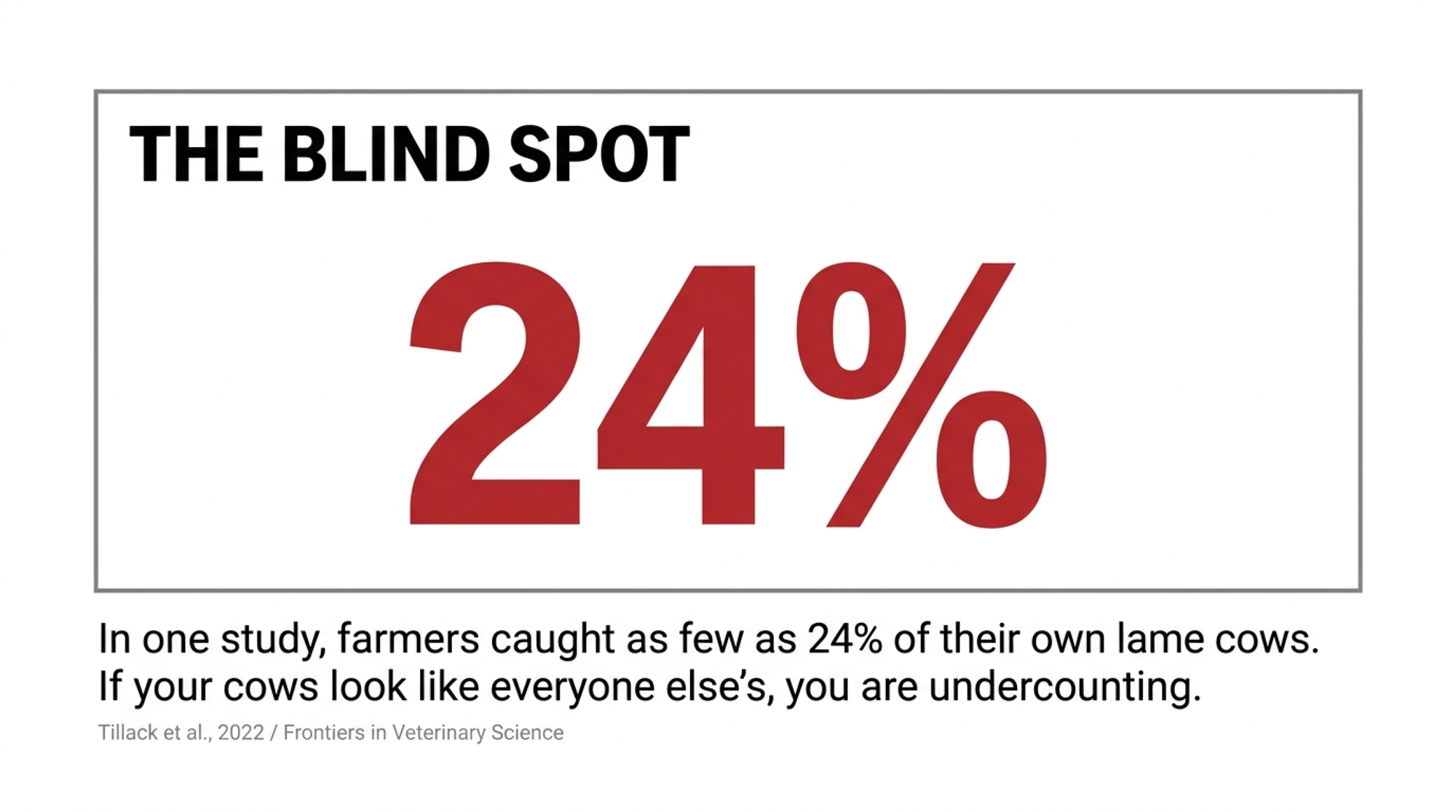
Executive Summary: Most confinement herds run around 22.8% lame (2023 JDS review) and genuinely can’t see it — in one German study, farmers caught as few as 24% of their own lame cows. A 600-cow Fond du Lac herd proved the fix is cheap: they cut lameness from a reported 24% to 14% for about $3,100 a year, no $45,000 cameras, no consultant. What changed wasn’t the chemical — it was putting one named employee on a fixed footbath schedule and checking pH and concentration instead of eyeballing them. At roughly $337 a case, that 10-point drop on a herd that size is near $20,000 in avoided loss against a rounding-error spend, and the subclinical cows are bleeding 3.3 lbs of milk a day before they ever limp. The catch worth weighing: a decade of copper sulfate loads your soil and forage — one UW-studied herd averaged 433 ppm liver copper — so if you’re running Jerseys, pull a forage test before you defend the status quo. Score your own 100–200 cows this month, set that number next to your gut estimate, and you’ll know in an afternoon whether this is your problem too.
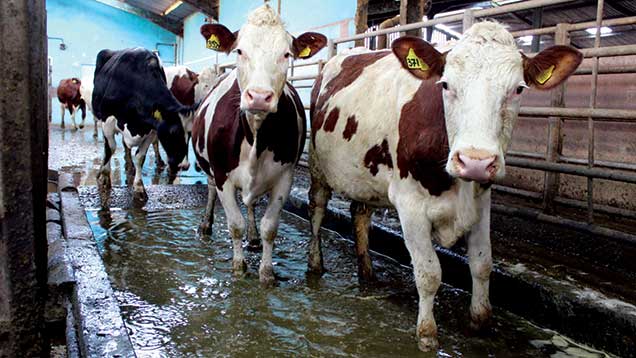
Editor’s note: The 5 a.m. scene below is a composite drawn from extension research and patterns common across many operations; it is not a single real morning at a single farm. The Fond du Lac herd, its cost and outcome figures, and all research data are real and sourced. Figures reflect studies and guidance available as of June 2026.
The footbath looks fine at 5 a.m. It’s full enough, the color’s about right, and the cows are filing through it on their way out of the parlor. So why is digital dermatitis still moving through the herd?
That’s the question that should keep more producers up at night. Because the honest answer usually isn’t the bottle. The copper sulfate works. The zinc works. What breaks is the human layer around it — the mixing, the changing, the consistency, and the simple question of who actually owns the job. Footbath management is one of the cleanest tells in the whole barn. Get a real look at how it runs at 5 a.m., and you’ve got a pretty good read on how the rest of the operation runs too.
What’s Really at Stake
Here’s the uncomfortable part. If you run a confinement herd and you’ve quietly accepted that some lameness is just the cost of doing business, this story is about you. Not in a finger-wagging way — in a “you genuinely might not be seeing what’s in front of you” way. And the research backs that up hard.
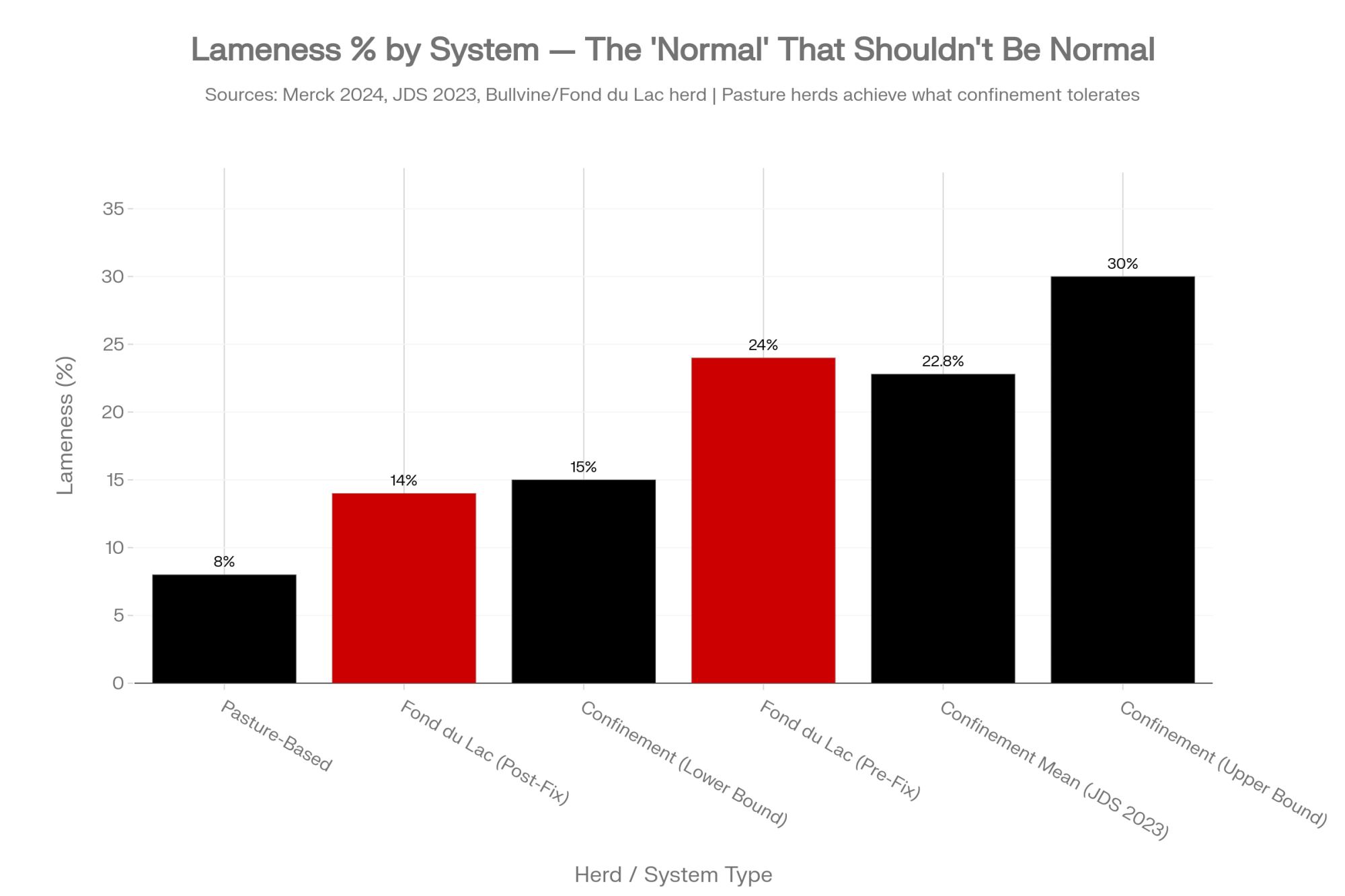
Most herds aren’t where they think they are. A 2023 systematic review in the Journal of Dairy Science reported a mean lameness prevalence of 22.8%, with a median of 22.0% and a between-study range of 5.1% to 45%, and within-herd numbers ranging from 0% to 88%. Merck’s 2024 epidemiology chapter frames the working reality as 8% in pasture-based systems versus 15–30% in confinement. Digital dermatitis is the engine behind most of it: UW–Madison Extension estimates DD is present in roughly 70% of U.S. dairies and 95% of large herds. That’s the global picture. The single-herd picture is often worse than the owner believes — and the footbath is frequently where the gap starts.
How It Falls Apart at 5 a.m.
Walk through a real morning. The bath isn’t quite full, so the concentration drifts. Nobody measures the product — it gets eyeballed, and even a small change in solution depth can move the working concentration enough to matter, according to industry hoof-care guidance. The solution doesn’t get changed when it should. And on a genuinely busy morning, the bath just doesn’t run at all.
None of those are catastrophic failures. That’s the trap. They’re small shortcuts that make the program invisible on good days and worthless on bad ones. A 2016 survey of 45 Wisconsin dairies found that while copper sulfate was used on 67% of farms, 27% of those farms ran it at a concentration of 12–30% — more than three times the recommended level. Only a third offered a footbath four or more times a week. These aren’t knowledge problems. They’re consistency problems.
What does “right” actually look like? Check these against your own barn wall:
| Parameter | Target Spec | Danger Zone | What Breaks When You Miss It |
|---|---|---|---|
| Bath length | 10–12 feet | < 8 feet | Cows get fewer than 2 rear-foot dunks per pass |
| Solution depth | 4–6 inches | < 3 inches | Coronary band and dewclaws don’t contact chemical |
| Change frequency | Every 150–300 cow passes | > 400 passes without change | Solution becomes diluted slurry — no bactericidal effect |
| pH range | 3.5–5.0 | > 5.5 or < 3.0 | Above 5.5: chemical inactive. Below 3.0: skin burns |
| Copper sulfate concentration | 2–5% | > 8% or < 1.5% | 27% of WI farms ran 12–30% (triple recommended) — wastes product, increases soil load |
| Run frequency | ≥ 4×/week | ≤ 2×/week | Frequency beats formulation — 4× at spec beats “when we remember” every time |
| Named protocol owner | 1 dedicated employee | “Whoever’s around” | The Fond du Lac 24%→14% drop was entirely about accountability — not chemistry |
- Length: 10–12 feet — ensures at least two dunks per rear foot per pass
- Depth: 4–6 inches — must cover the coronary band and dewclaws
- Change frequency: every 150–300 cow passes, sooner when legs come in dirty
- pH: 3.5–5.0 for copper or zinc sulfate — above 5.5 it stops working, below 3.5 it burns skin
- Concentration: copper sulfate 2–5% (UW Dairyland Initiative); zinc sulfate 10–20%
Miss two or three of those at 5 a.m., and you haven’t run a footbath. You’ve run cows through an expensive puddle. As Progressive Dairy put it back in 2022, “Without a simple, well-defined footbath protocol, the only consistent result will be poor footbath management and poor hoof health.”
What One Wisconsin Herd Actually Did
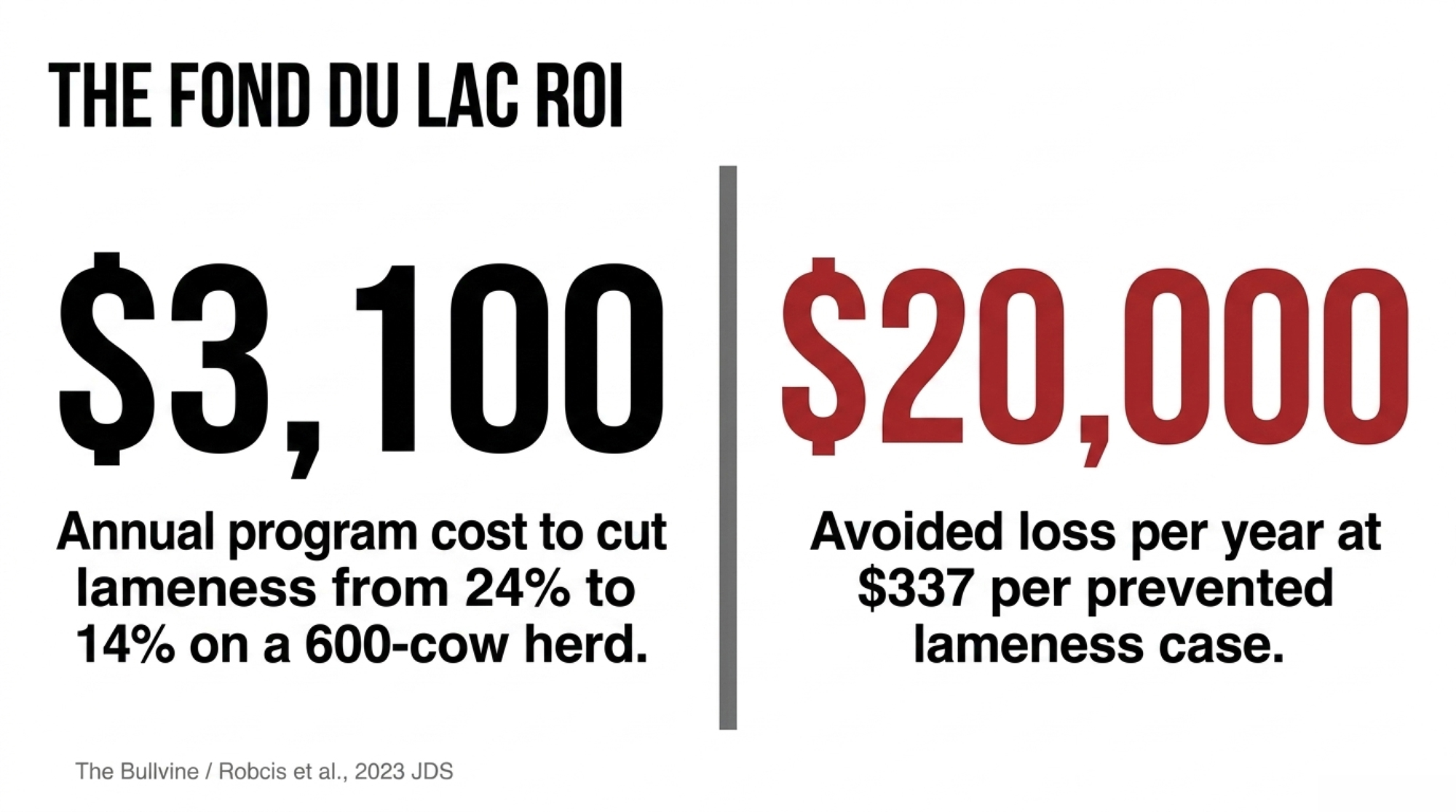
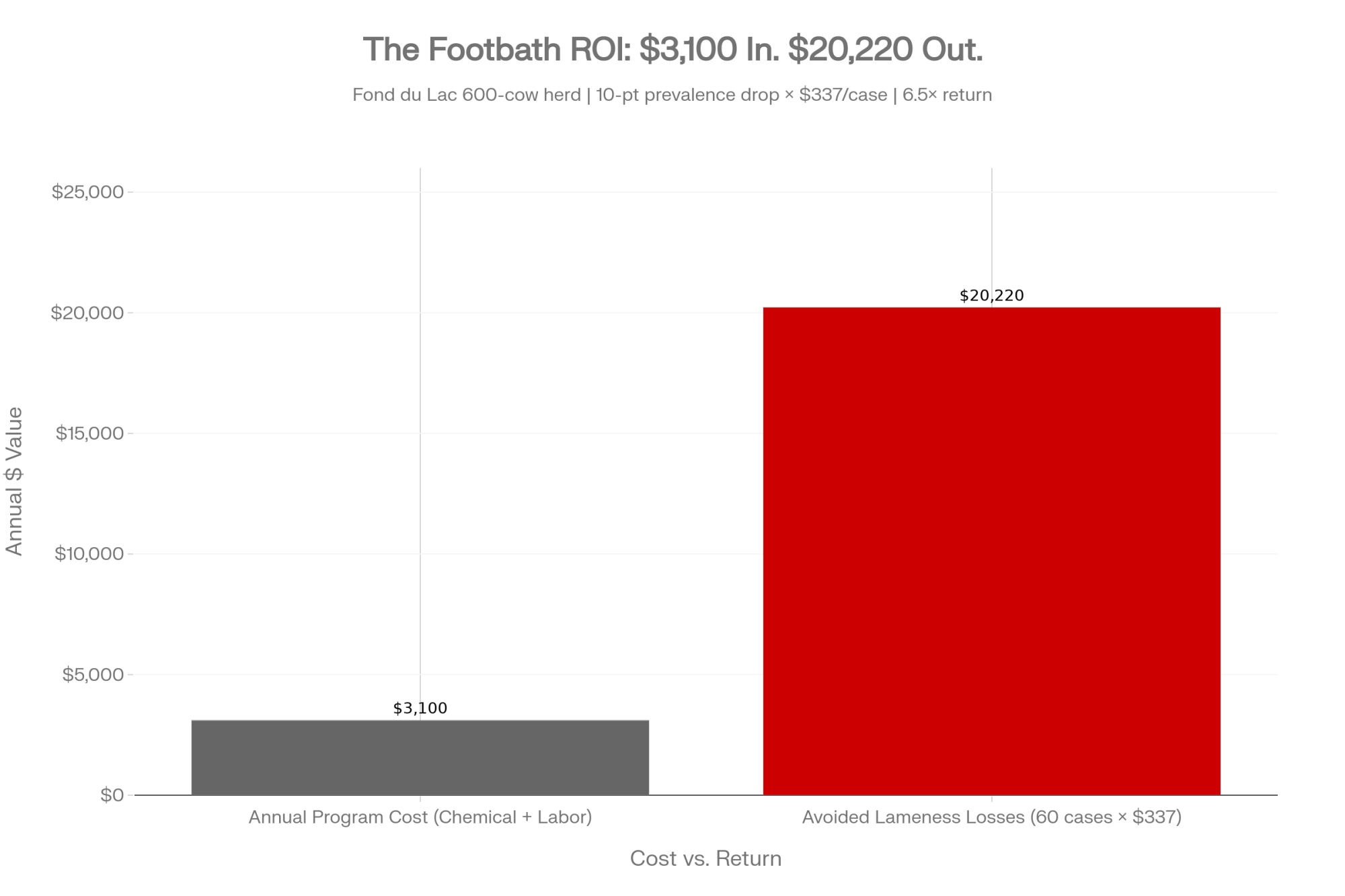
Near Fond du Lac, Wisconsin, a 600-cow herd reported lameness around 24% — right in that “normal” confinement range nobody likes to look at too hard. Over 18 months, the operation pulled it down to 14%, a 42% reduction, on about $3,100 a year. No $45,000 detection cameras. No outside consultant. Just protocol.
What flipped the switch wasn’t a new product. It was deciding the bath wasn’t an afterthought anymore — assigning one employee to own it and running it like a milking shift. As the owner told The Bullvine: “We treat footbaths like milking — non-negotiable, same times, same concentrations, every single week. That consistency matters more than any camera could.” The protocol itself was almost boring on paper — 5% copper sulfate, changed every 200 cow passes, run four times weekly on a fixed Tuesday-Thursday-Saturday-Monday rotation, with pH checked rather than guessed.
That ownership piece is the part most herds skip. The chemistry on that farm wasn’t special. The schedule was, and so was the fact that one person’s name was attached to it. At an estimated $337 per lameness case, the herd’s math worked out to roughly $20,000 a year in avoided losses against that $3,100 spend — a payback measured in weeks, not years.
Which Chemistry — and What It Costs You
Before anyone argues copper versus zinc versus formalin, get one thing straight: the product matters far less than whether it’s mixed right and changed often enough. Iowa State’s Jan Shearer and UW’s Dörte Döpfer have both made the same point across years of work — frequency beats formulation. Four times a week with the cheap stuff beats “when we remember” with the premium product every time.

| Chemical | Working Rate | Cost Signal | Catch / Key Risk |
|---|---|---|---|
| Copper sulfate | 2–5% | ~$2–3/lb; most widely used workhorse | Doesn’t break down — accumulates in manure, soil, and forage; decade-long programs average 433 ppm liver copper (UW, 2022) |
| Zinc sulfate | 10–20% | Higher per-bath cost than copper | Lower environmental load; fewer large-herd efficacy trials vs. copper |
| Formaldehyde | 2–5% | Cheapest per bath | Registered carcinogen — hard to justify for hand-mixing crews |
| Stannous fluoride | Per label | Premium tier | 2024 JDS trial controlled DD at far lower copper loading — strongest environmental case for switching |
The all-in cost is smaller than most producers assume. The Fond du Lac herd ran its full program — chemical plus labor — for about $3,100 a year. The chemical was never the expensive part. The lameness you don’t prevent is.
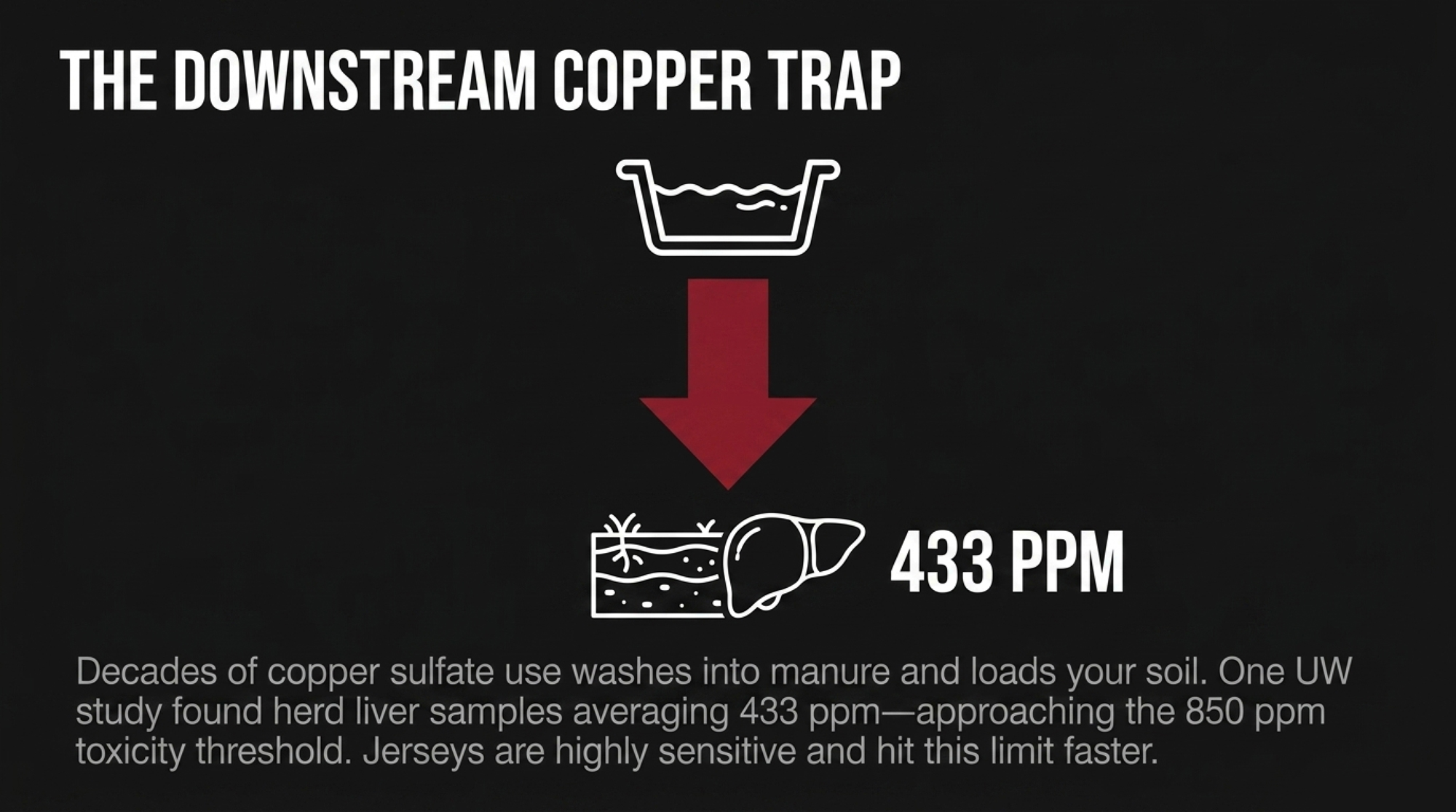
But copper has a cost that doesn’t show up on the invoice. It doesn’t break down — once it’s on your farm, it stays. Spent footbath solution usually gets washed into the manure storage and ends up back on the fields. A 2022 UW–Madison field study across 20 eastern Wisconsin dairies found that farms using copper sulfate footbaths had alfalfa copper levels nearly double a 2005 baseline, with third-cut forage “teetering on the boundary” of recommended TMR copper limits. Liver samples from one participating herd averaged 433 ppm copper, with a high of 740 ppm, well into the range UW flags as concerning (over 500 ppm) and approaching toxicity territory (850 ppm).
Warning for color-bred herds: Jersey cattle are significantly more sensitive to copper accumulation than Holsteins. If you’re running a mixed or pure Jersey herd, the downstream liver-toxicity limits in the UW study apply much sooner, and a forage or liver test moves from “good idea” to “do it this year.”
So the chemistry question isn’t only “does it work.” It’s “what’s it doing to my soil and my cows five years out.” That’s exactly why zinc sulfate, acidified copper at lower rates, and stannous-fluoride products are getting a serious look. None has clearly beaten copper on efficacy in well-run trials. The reason to switch is environmental, not performance.
The Tell: When the Bath Fails, So Does the Rest
A failing footbath is rarely an isolated problem. It’s a symptom.
When the bath is too short, mis-mixed, and run “when we remember,” you tend to find the same casualness elsewhere — overstocked pens, long standing times in the holding area, dirty alleys, and trimming that happens reactively instead of on a schedule. A 2022 Journal of Dairy Science study of automated-milking herds in Europe tied higher lameness to poor stall design, inadequate feed access, higher stocking density, and lower body condition. The herds running sand bedding and better feed access had lower lameness and better milk quality.
The paperwork tells the same story. An Irish survey found only 22% of farmers kept records of lame cows, just 15% had a written lameness herd-health plan, and 28% waited more than 48 hours to treat a cow they’d already spotted as lame. That’s not a knowledge gap. It’s a belief gap. These producers don’t think they’ve got a problem worth planning for.
Which is exactly why the “we’ve got it under control” conversation is so hard. They’re not bluffing you. They genuinely can’t see it.
Run Your Own Numbers
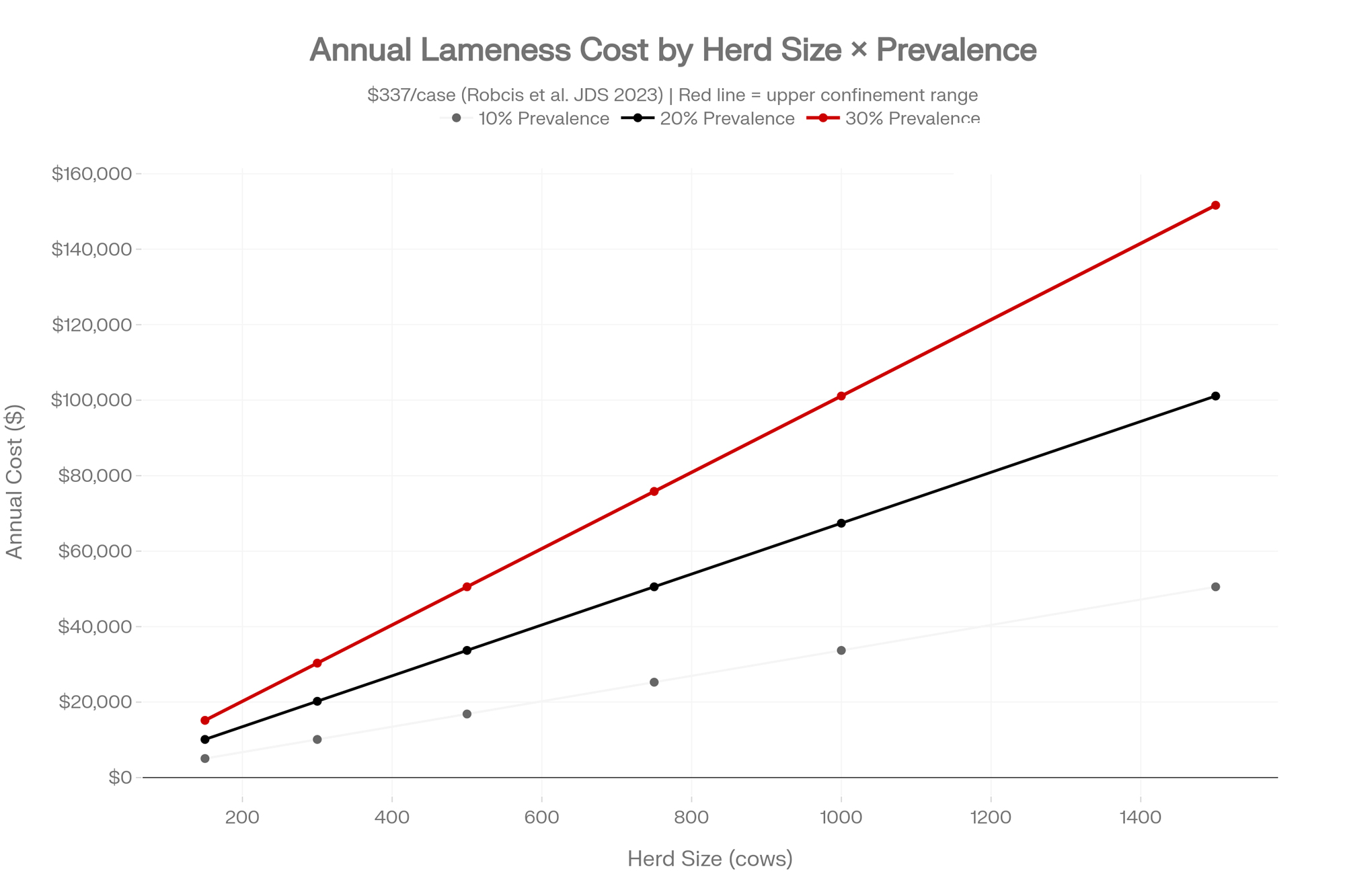
The Fond du Lac herd’s $3,100-for-$20,000 trade is convincing, but the number that moves a skeptic is their own. So here’s the tool, not another lecture on case costs.
Take your herd size, multiply by your honest prevalence, and multiply that by $337 — the per-case figure Robcis and colleagues landed on in a 2023 Journal of Dairy Science analysis (milk loss, reproduction, treatment, culling, and labor combined). A 350-cow herd at 20% is 70 cases, or about $23,590 a year. Regional labor costs shift the number — higher-wage regions land above the average, lower-wage regions below — and be skeptical of the $400–533 figures in equipment sales decks, which lean on inflated 30–40% prevalence assumptions that may not match your barn.
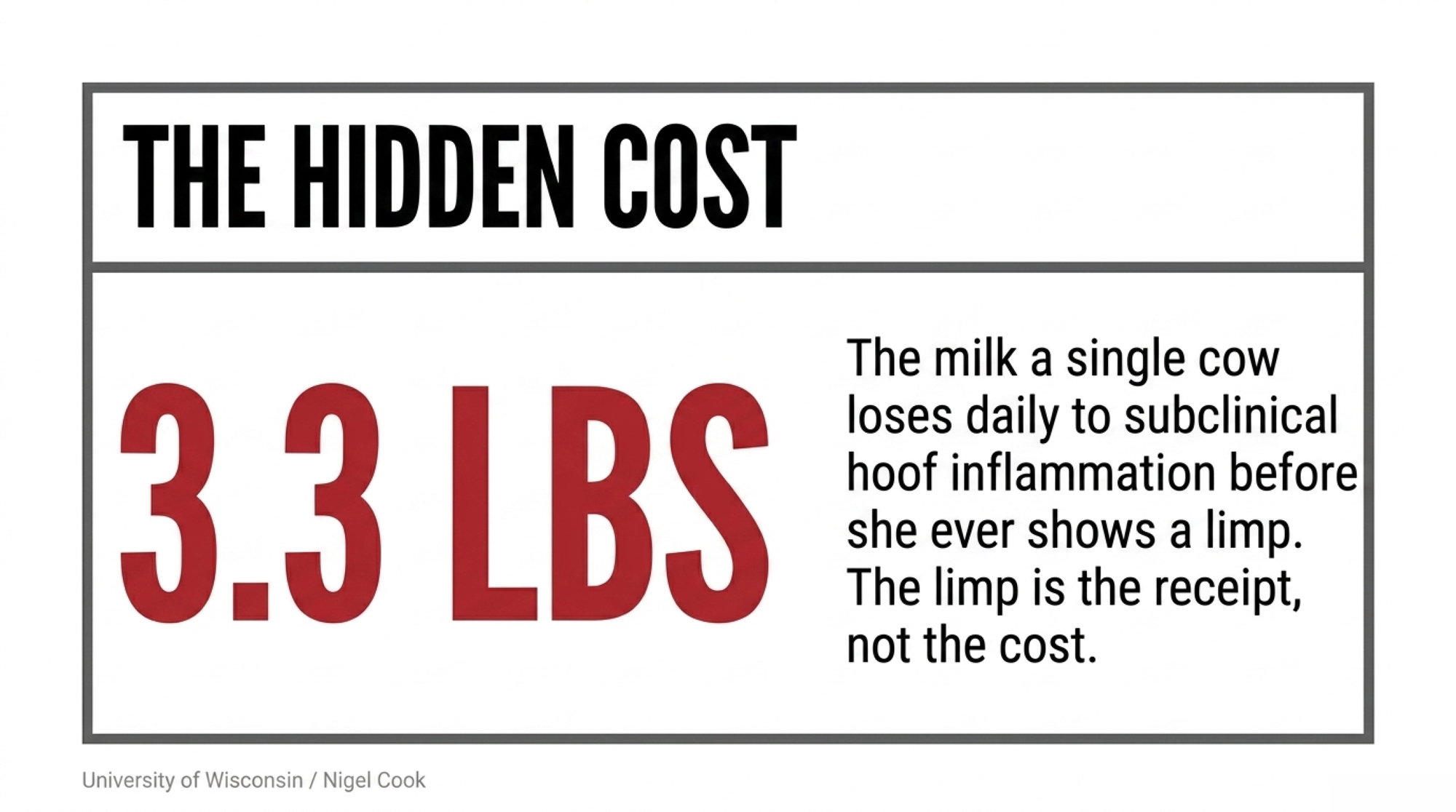
And the subclinical piece is where it gets quietly expensive. University of Wisconsin work led by Nigel Cook, as reported by The Bullvine, found that cows with subclinical hoof inflammation lose an average of 3.3 pounds of milk per day before they ever look lame, which is tied to as much as 17% of net farm profit in some herds. Read that as “in some operations,” not “in yours.” The point stands either way: the limp is the receipt, not the cost.
Why Did “10–20%” Ever Become Normal?
Somewhere along the way, an average became a standard. And, in our view, producers started defending a number that the industry shouldn’t be comfortable with.
Here’s where it came from. The literature kept reporting confinement herds in the low-20s. Merck repeated “15–30% in confinement.” Busy people shaved the top off that range in conversation until “10–20%” started to sound like a target rather than a symptom. Nobody ever published a paper calling that level acceptable. It just hardened into a norm through repetition.
The detection failure cemented it. A 2022 German study (Tillack and colleagues, Frontiers in Veterinary Science) had veterinarians score median lameness at 23.1%, 39.1%, and 23.2% across three regions, while the farmers in those same herds estimated 9.5%, 9.5%, and 7.1%. On average, those farmers were consciously aware of only 45.3%, 24.0%, and 30.0% of their lame cows. A 2014 New Zealand study (Fabian and colleagues) found nearly the same pattern: farmers recognized only about 27% of cows with reduced mobility.
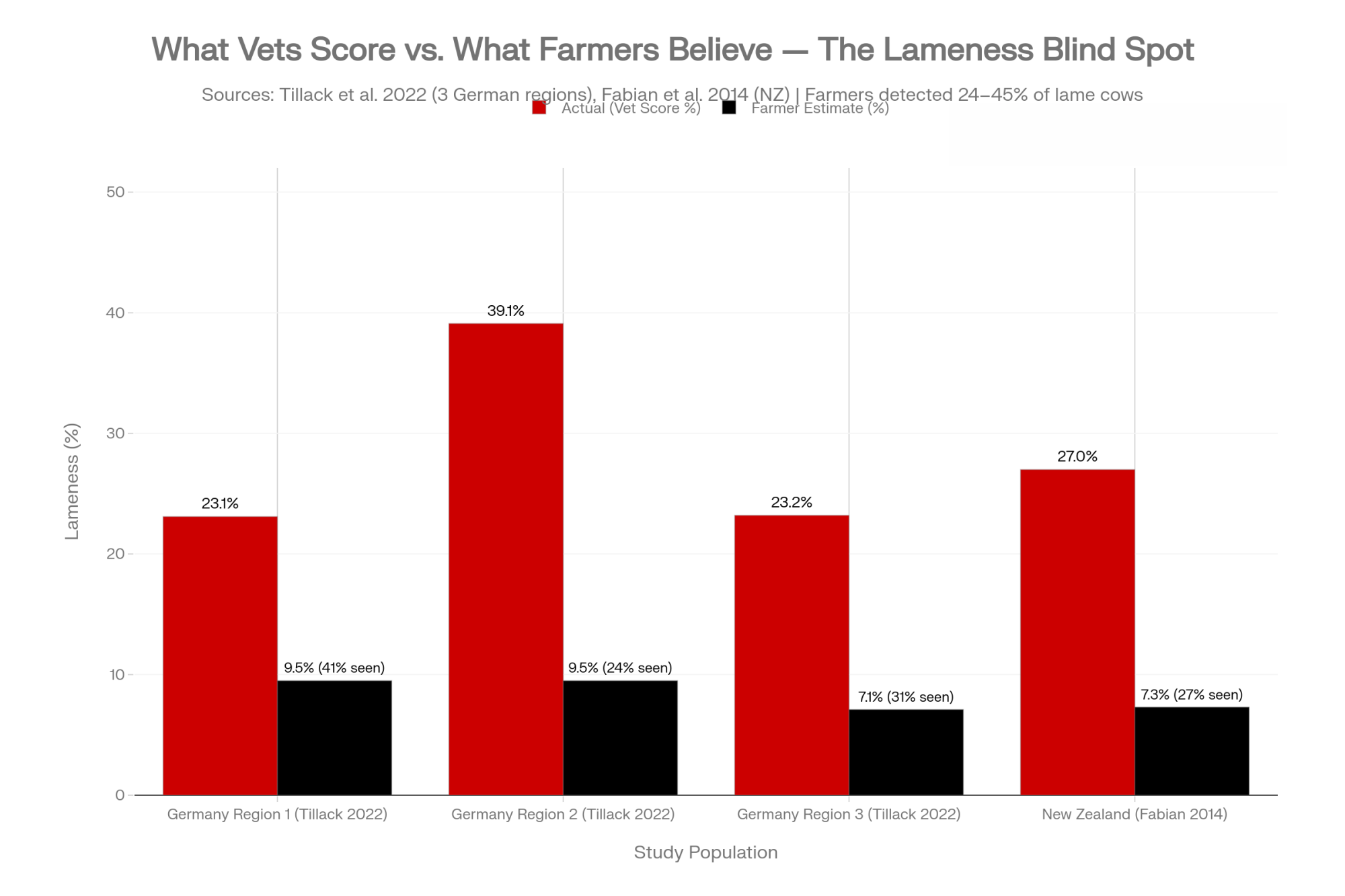
So you get a region where every herd sits somewhere between 10% and 30%, everyone’s eyes are undercounting, and the lived experience becomes “my cows look like everyone else’s, so we’re fine.” That feeling is almost impossible to argue with — until a clipboard and a scoring chart make it visible.
The Window Most Herds Miss: Dry Cows and Heifers
If your footbath schedule only covers the milking string, you’re treating the symptom and ignoring the nursery. Digital dermatitis doesn’t wait for the first lactation. Heifers can carry lesions into the parlor on day one, and the dry-cow pen is where much of the infection quietly resets and reloads for the next lactation. Canada’s proAction footbath guidance is blunt about it: don’t forget the dry cows and the heifers.
The trim window matters as much as the bath here. University of Bristol research found that moving the functional trim to the dry period — before the metabolic and hormonal stress of calving lands — cut hoof lesions by 62%. But timing isn’t one-size-fits-all. Minnesota’s Gerard Cramer, whose 2025 randomized trial tested dry-off trimming methods, now argues trimming should be “targeted, not automatic” — his data showed the biggest payoff in first-lactation cows, where a modeling-focused trim at dry-off cut the odds of hoof-horn lesions by 76%, while blanket whole-herd trimming mostly burned chute time better spent on at-risk animals.
The economics back the targeted approach. A 2024 study found partial-herd trimming delivered a higher three-year net benefit than whole-herd trimming 100% of the time, and Bullvine-reported data pegs a well-timed mid-lactation trim (after 110 days in milk) at roughly $308 per cow per lactation in retained milk. So the practical move is to fold heifers and dry cows into the same hygiene discipline as the milk cows — footbath passes where the facility allows, clean dry housing, and a trim plan timed to dry-off and the right cows, rather than “whenever the trimmer’s already here.” The herds that reach single-digit lameness rarely do so by managing the milking string alone.
What “Good” Actually Looks Like
Set a real target, because “better than last year” isn’t one. The Fond du Lac herd’s 14% wasn’t even the ceiling — an Idaho operation cited by The Bullvine ran the full prevention bundle to 12%, then layered in cameras and held 8% consistently. The 8% you see quoted for pasture systems isn’t physics. It’s what consistent foot hygiene, low standing time, and timely trimming buy you, and some confinement herds get close.
The herds that live there share a short list of habits, and none of them are exotic. The footbath runs on a fixed schedule with one named owner. Concentration and pH checked, not guessed. Trim records reviewed quarterly, not pulled out only when a cow’s already three-legged. New lame cows treated within 48 hours, not parked until the next chute day. Locomotion scoring is done monthly by the same person, so the trend line means something.
Notice what’s not on that list: a more expensive chemical, a fancier bath, a bigger budget. The gap between a 24% herd and a 14% herd — the exact gap that Wisconsin farm closed — wasn’t money. It was about standards and whether anyone was actually accountable for upholding them.
What This Means for Your Operation
Walk your own barn against these. Each one pairs the question with a number that indicates whether your answer is good enough.
- Are you counting, or guessing? Farmers in the German study were consciously aware of as few as 24% of their lame cows (Tillack 2022), while DD is present in 70–95% of U.S. herds (UW). Locomotion-score a random 100–200 cows this month and set that figure next to your gut estimate. If they’re far apart, you’ve found your problem.
- Who owns the protocol? The Fond du Lac herd put one named employee on the bath and went from a reported 24% to 14%. If you can’t name the exact person responsible for mixing and monitoring, your program is running on luck.
- Is your chemistry actually at spec? 27% of surveyed Wisconsin farms ran copper at triple the recommended rate. Check concentration and pH against a written spec — not by eye — this week.
- Are the dry cows and heifers on the schedule? If only the milking string gets the bath, you’re reloading the infection every lactation. Fold them in, and time the dry-off trim to the cows that benefit most — Cramer’s trial showed a 76% cut in hoof-horn lesion odds in first-lactation cows.
- Can you treat a new lame cow within 48 hours? The best herds don’t park her until the next chute day. If yours waits, that’s where chronic, expensive cases are born.
- What’s your downstream copper footprint? If you’ve run copper sulfate for more than a decade, pull a third-cut alfalfa forage sample and test for accumulated loading — UW found farm forage copper near double its baseline and liver levels averaging 433 ppm.
Key Takeaways
- If you can’t name the owner of your footbath, fix that first. The Wisconsin herd’s 24%-to-14% drop was driven by accountability, not equipment — one employee, a fixed four-day rotation, no skipping.
- If your bath misses on length, depth, pH, or change frequency, the chemical doesn’t matter. Frequency beats formulation; 5% copper run four times a week on spec beats a premium product run “when we remember.”
- If you’ve never measured prevalence, your gut is probably undercounting by half. Score 100–200 cows in the next 30 days — the cheapest, highest-value move on this list.
- If you’ve been running copper for 10+ years, test your forage before switching products. The performance reason to change is thin; the soil-and-liver reason is real, and it shows up first in Jersey herds.

Most producers carry lameness as a bill they pay. The reframe that walks someone out to the alley with a clipboard is simpler and harder: lameness isn’t a bill, it’s a choice you make every day in how you measure, who you hold accountable, and what you’re willing to see. So which number are you defending — and would it survive a real score?
Run Your Numbers
Health ROI Calculator — That $337-a-case figure is an average, not your barn. Run your own herd size, prevalence, and protocol cost through the Health ROI Calculator to see whether tightening your footbath program actually pays back in lower culling, less milk loss, and fewer chronic cases — before you spend a dollar.
Complete references and supporting documentation are available upon request by contacting the editorial team at editor@thebullvine.com.
Learn More
- Understanding the Impact of Hoof Trimming on Cow Behavior and Milk Output: A Data-Driven Approach — Delivers an exact operational breakdown of how lameness alters feeding patterns. Arms you with metrics showing that a lame cow drops 53 minutes of daily eating time two weeks before clipping, directly hammering parlor performance.
- The Hidden Money in Every Step: Turning Hoof Health into Strategic Dairy Profit — Connects the metabolic transition period directly to five-figure structural margins. Reveals how a thinning digital cushion redirects 40% of liver protein synthesis away from milk production to tissue repair weeks before a visible limp develops.
- From “Worst Dairy” to Zero Lame Cows: How CDCB’s New h² = 0.27 Trait Could Rewrite Lameness Genetics— Dismantles the standard reliance on visual classification by proving infectious lesion metrics lack structural context. Exposes how AI-driven lactational mean mobility traits carry a high 0.27 heritability factor that unlocks long-term genetic selection.
 The Sunday Read Dairy Professionals Don’t Skip.
 The Sunday Read Dairy Professionals Don’t Skip.
Every week, thousands of producers, breeders, and industry insiders open Bullvine Weekly for genetics insights, market shifts, and profit strategies they won’t find anywhere else. One email. Five minutes. Smarter decisions all week.




