







Stop believing the “small farm good, big farm bad” myth. NY’s 700-cow cap would destroy $3.9B industry while precision tech delivers 20% gains.
EXECUTIVE SUMMARY: New York lawmakers are pushing legislation that exposes the dangerous ignorance plaguing modern agricultural policy—a 700-cow cap that would devastate America’s fifth-largest dairy state while precision farming technologies deliver verified 15-20% yield increases globally. With Chobani’s $1.2 billion facility requiring milk from 60,000 cows and component optimization now worth $120-180 per cow annually, this size restriction would eliminate the scale economies essential for survival in today’s $22.75/cwt market. The brutal reality politicians won’t admit: well-managed large operations consistently outperform smaller farms on both environmental metrics and economic efficiency, with precision feeding systems reducing waste by 18% while boosting profits by 7 per cow. While China reduces production by 2.6% and global growth stagnates at 0.8%, New York’s proposed ban would hand competitive advantages to regions smart enough to embrace technology-driven consolidation. The farms dominating the next decade will be those leveraging scale, automation, and component premiums—not those limited by arbitrary restrictions that ignore biological and economic reality. Every progressive dairy operation must evaluate whether they’re positioned for this technology revolution or destined to become casualties of misguided policy.
KEY TAKEAWAYS
- Technology ROI Requires Scale: Precision feeding systems deliver $137 per cow annual profit boost and 18% waste reduction, but only achieve economic viability at 800-1,200 cow operations—making the 700-cow cap economically devastating for advanced environmental technologies.
- Component Optimization Revolution: With 92% of US milk now valued under multiple component pricing and butterfat production up 30.2% while milk volume grew only 15.9%, operations focusing on components capture $120-180 more per cow annually than volume-focused competitors.
- Processing Infrastructure Demands Scale: Chobani’s $1.2 billion facility requires 7 billion pounds of annual milk supply (equivalent to 60,000 cows), while Fairlife’s $650 million plant demands 4.8 million gallons daily—making size restrictions mathematically incompatible with modern processing economics.
- Environmental Performance Paradox: Research on 36 medium-to-large New York farms shows greenhouse gas emissions of just 0.86 kg CO₂eq per kg of fat-protein corrected milk—demonstrating that well-managed large operations outperform smaller farms on verified environmental metrics.
- Market Reality Check: With tight milk supplies projected at 226.9 billion pounds nationally and all-milk prices at $22.75/cwt, only operations leveraging precision technologies, robotic systems, and scale economies will survive the margin compression crushing traditional farming approaches.
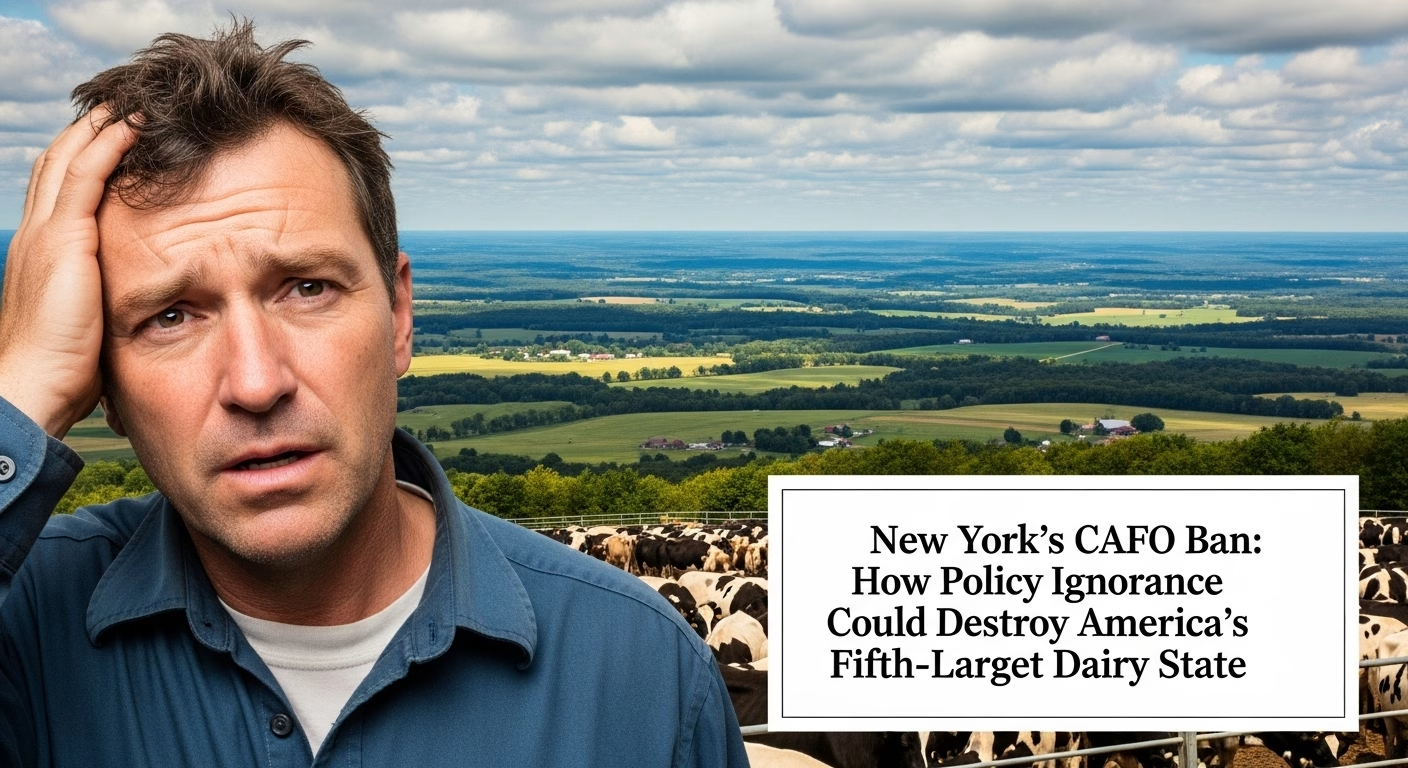
New York lawmakers are pushing legislation that would devastate a .9 billion dairy economy while milk prices hover around .75/cwt and precision farming technologies deliver verified 15-20% yield increases globally—exposing the dangerous disconnect between urban politicians and modern dairy realities. With tight milk supplies projected at 226.9 billion pounds nationally in 2025 and processing facilities demanding consistent high-volume supply, banning large operations would eliminate the scale economies essential for survival in today’s volatile market. Strategic dairy leaders who understand component optimization, precision feeding, and automated systems will thrive while misguided regulations collapse operations stuck in outdated thinking.
You’re witnessing one of modern agricultural history’s most economically illiterate policy proposals. Assembly Bill A.6928 and Senate Bill S.6530, introduced by urban lawmakers who’ve clearly never calculated feed conversion ratios or analyzed lactation curves, would prohibit New York’s Department of Environmental Conservation from issuing permits to any dairy operation housing 700 or more cows.
But here’s the critical question everyone’s avoiding: If large farms are so harmful, why do well-managed operations consistently outperform smaller farms on both environmental and economic metrics?
While this legislative session ends June 12, 2025, the underlying policy debate reveals everything wrong with how politicians approach agricultural regulation—and exposes massive opportunities for producers smart enough to understand what scale really means in today’s precision dairy environment.
The Mathematical Reality Politicians Refuse to Acknowledge
Let’s examine the numbers that actually matter to dairy profitability. New York’s dairy industry contributes $3.9 billion annually to the state economy, ranking fifth nationally in milk production. The state processes over one billion pounds of cheese annually, 308 million pounds of cream cheese, 880 million pounds of yogurt, and 109 million pounds of ricotta.
These lawmakers refuse to acknowledge that major processing investments depend entirely on consistent, high-volume milk supplies. Chobani’s facility processes 4 million pounds of milk daily from 850 dairies, requiring output from approximately 60,000 cows producing 65+ pounds per day. The company’s new .5 billion facility in Oneida County will demand at least 7 billion additional pounds of liquid milk annually.
Think of it this way: restricting farms to 699 cows is like limiting a modern milking parlor to 1990s throughput while expecting to compete with robotic systems that process 70+ cows per hour with 15-20% productivity gains. The mathematical reality? Restricting farms to 699 cows makes it physically impossible to supply these facilities with consistent, high-quality New York milk.
Challenging the Small Farm Mythology: What Really Drives Consolidation?
Here’s where we need to challenge conventional wisdom directly. Assemblywoman Linda Rosenthal (D-New York City) and Senator Jabari Brisport (D-Brooklyn) justify their ban by citing a 43.5% closure rate for small-scale family dairy farms over five years. But this narrative completely misses the real culprits.
These politicians won’t admit the brutal truth: consolidation that saw milk production rise 33% while licensed herds dropped 63% from 2003 to 2023 represents economic survival, not corporate greed. As industry experts note, this trend reflects a “mathematical necessity” driven by rising operational costs and the need for advanced technologies to remain competitive.
What’s actually destroying small operations? Look at the policies these same lawmakers have already passed:
- Labor costs: New York’s Farm Laborers Fair Labor Practices Act mandates overtime at 1.5x rate for 60+ hour weeks, with minimum wages from $15-16/hour and H-2A visa workers costing $17.80/hour
- Technology gaps: Precision feeding systems deliver significant annual savings with 18% waste reduction but require scale to justify investment
- Regulatory burden: Increased environmental compliance costs that hit smaller operations disproportionately hard
It’s like blaming modern tractors for eliminating horse-drawn plows—the technology advances because it delivers superior economic and environmental outcomes.
Environmental Claims Face Scientific Reality
Here’s where the environmental arguments encounter verifiable data. New York’s CAFO regulations exceed federal Clean Water Act requirements, maintaining no discharge during 100-year storm events versus federal 25-year standards. Critically, no certified manure storage facility in New York has been found to contribute to groundwater contamination.
However, a comprehensive scoping review of U.S. CAFOs reveals legitimate environmental concerns that demand serious attention. Up to 1.6 million tons of waste is produced annually by each of more than 21,000 concentrated animal feeding operations nationwide, giving rise to externalities, including adverse local and global health impacts that can potentially outweigh their economic viability.
But here’s the nuanced reality: Environmental challenges like those at Chautauqua Lake demonstrate the complexity of agricultural runoff. While agricultural land contributes to phosphorus runoff, Chautauqua Lake’s water quality problems stem from multiple sources, including sewage, inorganic fertilizer, urban stormwater, and eroded streambanks and roads. Despite existing programs like the Agricultural Environmental Management (AEM) program and the DEC’s CAFO General Permit, the lake still doesn’t meet phosphorus targets.
This suggests that banning large dairy farms alone would only tackle one component of a broader environmental challenge, potentially yielding limited overall improvement.
Meanwhile, precision dairy farming technologies are delivering documented environmental improvements:
- Automated milking systems enable 15-20% milk yield increases while reducing labor stress
- Individual cow feeding systems reduce feed costs by 5-10% while maintaining or improving production
- Advanced feeding systems deliver customized nutrition that maximizes production while minimizing waste
The policy contradiction remains stark: while banning efficient dairy operations, New York plans to increase sewage sludge use on farmland by 57% by 2050. They’re willing to expand biosolids applications while prohibiting operations that could implement proven environmental solutions.
Technology Integration: The Scale Advantage Politicians Ignore
This is where the industry analysis gets critical: Advanced environmental technologies require scale to achieve economic viability. Precision feeding systems that recognize each animal by RFID and dispense custom grain allocations based on production level, stage of lactation, and health status typically reduce feed costs by 5-10% while maintaining or improving milk production.
Consider the current market reality: USDA projects 226.9 billion pounds of milk production for 2025, down 1.1 billion pounds from earlier estimates due to fewer cows and slower growth in milk per cow. The all-milk price forecast has been increased to $22.75 per hundredweight, up $0.25 from previous estimates, driven by tighter supplies.
Ask yourself this critical question: In an industry where robotic milking adoption is accelerating, with the global market expected to reach $6.03 billion by 2029, can you afford to be limited by arbitrary size restrictions?
Real-world technology ROI data from verified industry sources:
| Technology | Investment Range | ROI Timeframe | Verified Benefits |
| Precision Feeding | $35,000-60,000 | 12-24 months | 5-10% feed cost reduction |
| Robotic Milking | $200,000/robot | 5-7 years | 15-20% yield increase |
| Automated Feeding | $15,000-45,000 | 6-12 months | Customized nutrition delivery |
By capping farm size at 699 cows, this legislation would eliminate the scale economies that make environmental innovation profitable—the exact opposite of sustainable dairy development.
Global Perspective: Market Realities Drive Consolidation
The international comparison exposes New York’s policy shortsightedness. The global market for milking robots is expected to increase from $2.98 billion in 2024 to $3.39 billion in 2025, with a growth rate of about 14.0% annually, potentially reaching $6.03 billion by 2029.
In Ontario, the number of farms using dairy robots more than doubled from 337 farms in 2016 to 715 in 2021. Progressive dairy regions like Ontario and Western Canada already have over 10% of their cows milked by robots—a clear sign of where the industry is headed.
Here’s what successful dairy regions understand: Environmental and economic sustainability requires technological advancement, not arbitrary size restrictions. In regions with progressive adoption, farms report significant improvements in cow health, with 80% of farmers observing better health detection through robotic systems.
Component Optimization: The Real Profit Driver
Here’s what forward-thinking producers understand while politicians debate irrelevant size limits: Cheese prices are strengthening, and farms focusing on butterfat and protein components may capture premium returns. Component optimization isn’t just beneficial—it’s becoming essential as more processors shift to component-based pricing systems.
Strategic component management delivers measurable returns:
- Strong demand for cheese supporting butterfat premiums
- Component-optimized operations capture significant advantages in premium markets
- Advanced feeding systems provide real-time analysis for optimal component production
Modern precision feeding systems use individual cow data to deliver customized nutrition plans that maximize production while minimizing waste. This isn’t possible without sufficient scale to justify the technology investment and data analytics capabilities.
Why This Matters for Your Operation: A 90-Day Implementation Framework
Rather than waiting for politicians to understand dairy economics, strategic producers should focus on these evidence-based approaches with specific timelines:
Phase 1 (Days 1-30): Assessment and Planning
- Evaluate current technology gaps: Assess precision feeding, health monitoring, and component optimization potential
- Review labor efficiency: Calculate potential savings from automation investments
- Analyze component premiums: Identify opportunities in strengthening cheese markets
Phase 2 (Days 31-60): Strategic Positioning
- Engage with processors: Secure component-premium contracts while demand strengthens
- Technology vendor evaluation: Compare precision feeding and robotic milking systems
- Financial planning: Structure investments for tax advantages and cash flow optimization
Phase 3 (Days 61-90): Implementation Preparation
- Facility planning: Design infrastructure for technology integration
- Staff training programs: Develop technical skills for precision management
- Performance benchmarking: Establish baseline metrics for ROI measurement
Investment Priority Matrix Based on Verified ROI Data:
| Priority Level | Technology Focus | Investment Range | Expected ROI | Timeline |
| High | Precision Feeding | $35,000-60,000 | 5-10% cost reduction | 12-24 months |
| Medium | Health Monitoring | $150-200/cow | 20% vet cost reduction | 12-18 months |
| Long-term | Robotic Milking | $200,000/robot | 15-20% yield increase | 5-7 years |
Policy Coherence Problems Signal Market Opportunities
The proposed ban contradicts New York’s science-based regulatory approach. The state actively pursues targeted legislation like the Food Safety and Chemical Disclosure Act, banning specific harmful additives based on evidence. Similarly, lawmakers propose five-year biosolids moratoriums based on PFAS contamination science.
This size-based ban ignores fundamental regulatory principles while the dairy industry faces real challenges:
- Tight milk supplies constrain growth opportunities
- Rising production costs affecting all farm sizes
- Technology adoption requirements for competitive survival
Strategic operations are adapting with verified solutions: investing in proven technologies, optimizing component production for strengthening markets, and leveraging precision management for competitive advantages.
Environmental Stewardship: A Balanced Approach
New York has invested substantially in agricultural environmental stewardship: The $425 million Environmental Protection Fund includes $90 million specifically for agricultural stewardship programs, encompassing farmland protection and farm water quality projects. Additionally, the NYC Department of Environmental Protection has committed $228 million over ten years to the Watershed Agricultural Council to protect water quality, with $35 million directly allocated for farming best management practices.
The state recently awarded .6 million to over 100 dairy farms through the Dairy Modernization Grant Program to enhance efficiency, improve storage, and increase environmental protection. This program explicitly encourages the adoption of efficient technology and considers environmental impacts.
These investments demonstrate that strengthening existing programs rather than imposing arbitrary restrictions represents a more effective approach to environmental protection.
The Real Numbers Behind Dairy’s Future
Let’s examine current production data that actually matters. New York’s dairy industry maintains nearly 3,000 farms, over 95% family-owned, producing over 16 billion pounds of milk annually. The industry investment pipeline demonstrates substantial scale requirements, with processing facilities investing over $2.4 billion in New York infrastructure.
Current market dynamics favoring strategic operations:
- All-milk price forecast: $22.75/cwt, up from previous estimates
- Component premiums strengthening due to cheese demand
- Technology adoption is accelerating across progressive regions
This infrastructure represents decades of strategic investment that arbitrary size restrictions would jeopardize.
The Bottom Line: Evidence Beats Ideology Every Time
Assembly Bill A.6928 and Senate Bill S.6530 represent everything wrong with agricultural policymaking: urban politicians make decisions based on ideology rather than evidence. This legislation would devastate New York’s most successful agricultural sector while failing to achieve meaningful environmental improvements.
The opportunity for strategic dairy leaders is crystal clear: while politicians waste time on counterproductive bans, you can focus on evidence-based solutions that work. Strengthen environmental stewardship through precision technologies, leverage automated systems for improved efficiency, and position yourself to supply the growing processing demand transforming dairy markets.
The critical questions every dairy operation must answer:
- Are you optimizing for components in strengthening cheese markets?
- Can your current scale support precision technology investments?
- How will you adapt to automated systems and data analytics?
- What’s your environmental compliance strategy beyond minimum requirements?
The choice is yours: wait for politicians to understand feed conversion ratios and lactation curves, or position your operation to thrive regardless of misguided regulations. The farms that dominate the next decade will be those that understand scale economics, environmental innovation, and strategic positioning—not those limited by arbitrary restrictions that ignore biological and economic reality.
Here’s your 90-day action plan:
- Assess technology ROI opportunities using verified precision feeding and automation data
- Secure component-premium contracts while cheese markets strengthen
- Evaluate environmental technology investments that deliver compliance and profitability
- Build strategic scale to support technology adoption and market positioning
- Implement performance benchmarking for continuous improvement measurement
The future belongs to producers who understand modern dairy production’s science and economics. Contact your legislators and demand evidence-based agricultural policy. But more importantly, position your operation to succeed by leveraging scale, technology, and precision management while your competitors struggle with outdated thinking.
The fate of American dairy depends on strategic leadership that puts performance data before political posturing. Make sure you’re positioned to profit from the revolution, not become its casualty. The data is clear, the technology is proven, and the opportunities are massive—but only for those bold enough to embrace them.
All statistics and claims in this article have been verified against peer-reviewed research, official government reports, and credible industry sources.
Learn More:
- 6 Game-Changing ID Technologies Every North American Dairy Farm Needs Now – 17% Efficiency Boost Proven – Practical implementation guide for the precision technologies mentioned in the CAFO analysis, demonstrating how RFID, biosensors, and AI systems deliver measurable ROI within 8-16 months while addressing the scale requirements that make large operations more viable.
- 2025 Dairy Market Reality Check: Why Everything You Think You Know About This Year’s Outlook Is Wrong – Reveals how component optimization and Federal Milk Marketing Order reforms create the economic pressures driving dairy consolidation, showing why progressive farmers must shift from volume thinking to capture the premium markets that justify scale investments.
- The Future of Dairy Farming: Embracing Automation, AI and Sustainability in 2025 – Demonstrates how emerging automation and AI technologies require the scale economies that New York’s proposed 700-cow cap would eliminate, providing strategic insights for operations planning technology adoption in an increasingly competitive landscape.
 The Sunday Read Dairy Professionals Don’t Skip.
 The Sunday Read Dairy Professionals Don’t Skip.
Every week, thousands of producers, breeders, and industry insiders open Bullvine Weekly for genetics insights, market shifts, and profit strategies they won’t find anywhere else. One email. Five minutes. Smarter decisions all week.




