


Archive for dairy farm regulations

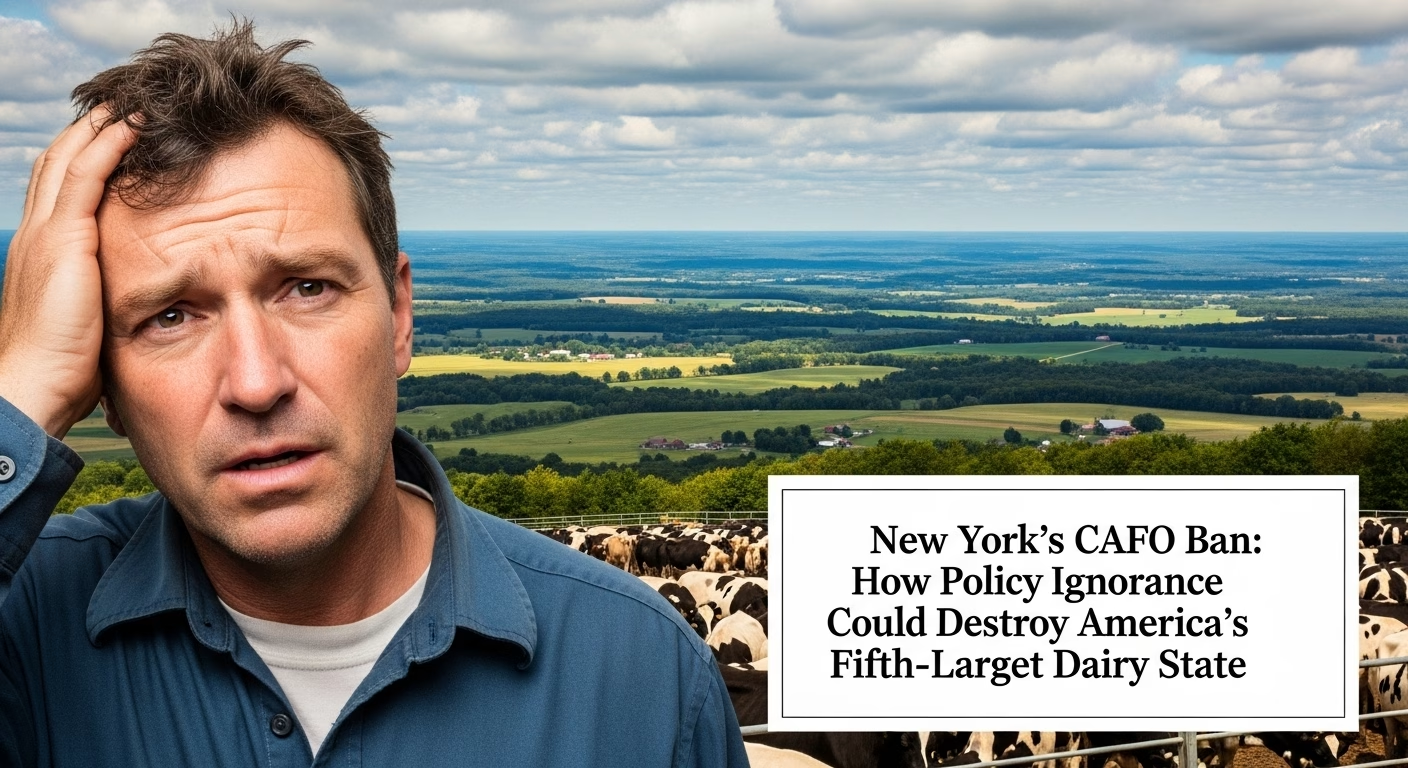
New York’s CAFO Ban: How Policy Ignorance Could Destroy America’s Fifth-Largest Dairy State

Stop believing the “small farm good, big farm bad” myth. NY’s 700-cow cap would destroy $3.9B industry while precision tech delivers 20% gains.

EXECUTIVE SUMMARY: New York lawmakers are pushing legislation that exposes the dangerous ignorance plaguing modern agricultural policy—a 700-cow cap that would devastate America’s fifth-largest dairy state while precision farming technologies deliver verified 15-20% yield increases globally. With Chobani’s $1.2 billion facility requiring milk from 60,000 cows and component optimization now worth $120-180 per cow annually, this size restriction would eliminate the scale economies essential for survival in today’s $22.75/cwt market. The brutal reality politicians won’t admit: well-managed large operations consistently outperform smaller farms on both environmental metrics and economic efficiency, with precision feeding systems reducing waste by 18% while boosting profits by 7 per cow. While China reduces production by 2.6% and global growth stagnates at 0.8%, New York’s proposed ban would hand competitive advantages to regions smart enough to embrace technology-driven consolidation. The farms dominating the next decade will be those leveraging scale, automation, and component premiums—not those limited by arbitrary restrictions that ignore biological and economic reality. Every progressive dairy operation must evaluate whether they’re positioned for this technology revolution or destined to become casualties of misguided policy.

KEY TAKEAWAYS

  • Technology ROI Requires Scale: Precision feeding systems deliver $137 per cow annual profit boost and 18% waste reduction, but only achieve economic viability at 800-1,200 cow operations—making the 700-cow cap economically devastating for advanced environmental technologies.
  • Component Optimization Revolution: With 92% of US milk now valued under multiple component pricing and butterfat production up 30.2% while milk volume grew only 15.9%, operations focusing on components capture $120-180 more per cow annually than volume-focused competitors.
  • Processing Infrastructure Demands Scale: Chobani’s $1.2 billion facility requires 7 billion pounds of annual milk supply (equivalent to 60,000 cows), while Fairlife’s $650 million plant demands 4.8 million gallons daily—making size restrictions mathematically incompatible with modern processing economics.
  • Environmental Performance Paradox: Research on 36 medium-to-large New York farms shows greenhouse gas emissions of just 0.86 kg CO₂eq per kg of fat-protein corrected milk—demonstrating that well-managed large operations outperform smaller farms on verified environmental metrics.
  • Market Reality Check: With tight milk supplies projected at 226.9 billion pounds nationally and all-milk prices at $22.75/cwt, only operations leveraging precision technologies, robotic systems, and scale economies will survive the margin compression crushing traditional farming approaches.
dairy farm regulations, CAFO policy, precision dairy farming, dairy industry economics, large dairy operations

New York lawmakers are pushing legislation that would devastate a .9 billion dairy economy while milk prices hover around .75/cwt and precision farming technologies deliver verified 15-20% yield increases globally—exposing the dangerous disconnect between urban politicians and modern dairy realities. With tight milk supplies projected at 226.9 billion pounds nationally in 2025 and processing facilities demanding consistent high-volume supply, banning large operations would eliminate the scale economies essential for survival in today’s volatile market. Strategic dairy leaders who understand component optimization, precision feeding, and automated systems will thrive while misguided regulations collapse operations stuck in outdated thinking.

You’re witnessing one of modern agricultural history’s most economically illiterate policy proposals. Assembly Bill A.6928 and Senate Bill S.6530, introduced by urban lawmakers who’ve clearly never calculated feed conversion ratios or analyzed lactation curves, would prohibit New York’s Department of Environmental Conservation from issuing permits to any dairy operation housing 700 or more cows.

But here’s the critical question everyone’s avoiding: If large farms are so harmful, why do well-managed operations consistently outperform smaller farms on both environmental and economic metrics?

While this legislative session ends June 12, 2025, the underlying policy debate reveals everything wrong with how politicians approach agricultural regulation—and exposes massive opportunities for producers smart enough to understand what scale really means in today’s precision dairy environment.

The Mathematical Reality Politicians Refuse to Acknowledge

Let’s examine the numbers that actually matter to dairy profitability. New York’s dairy industry contributes $3.9 billion annually to the state economy, ranking fifth nationally in milk production. The state processes over one billion pounds of cheese annually, 308 million pounds of cream cheese, 880 million pounds of yogurt, and 109 million pounds of ricotta.

These lawmakers refuse to acknowledge that major processing investments depend entirely on consistent, high-volume milk supplies. Chobani’s facility processes 4 million pounds of milk daily from 850 dairies, requiring output from approximately 60,000 cows producing 65+ pounds per day. The company’s new .5 billion facility in Oneida County will demand at least 7 billion additional pounds of liquid milk annually.

Think of it this way: restricting farms to 699 cows is like limiting a modern milking parlor to 1990s throughput while expecting to compete with robotic systems that process 70+ cows per hour with 15-20% productivity gains. The mathematical reality? Restricting farms to 699 cows makes it physically impossible to supply these facilities with consistent, high-quality New York milk.

Challenging the Small Farm Mythology: What Really Drives Consolidation?

Here’s where we need to challenge conventional wisdom directly. Assemblywoman Linda Rosenthal (D-New York City) and Senator Jabari Brisport (D-Brooklyn) justify their ban by citing a 43.5% closure rate for small-scale family dairy farms over five years. But this narrative completely misses the real culprits.

These politicians won’t admit the brutal truth: consolidation that saw milk production rise 33% while licensed herds dropped 63% from 2003 to 2023 represents economic survival, not corporate greed. As industry experts note, this trend reflects a “mathematical necessity” driven by rising operational costs and the need for advanced technologies to remain competitive.

What’s actually destroying small operations? Look at the policies these same lawmakers have already passed:

  • Labor costs: New York’s Farm Laborers Fair Labor Practices Act mandates overtime at 1.5x rate for 60+ hour weeks, with minimum wages from $15-16/hour and H-2A visa workers costing $17.80/hour
  • Technology gaps: Precision feeding systems deliver significant annual savings with 18% waste reduction but require scale to justify investment
  • Regulatory burden: Increased environmental compliance costs that hit smaller operations disproportionately hard

It’s like blaming modern tractors for eliminating horse-drawn plows—the technology advances because it delivers superior economic and environmental outcomes.

Environmental Claims Face Scientific Reality

Here’s where the environmental arguments encounter verifiable data. New York’s CAFO regulations exceed federal Clean Water Act requirements, maintaining no discharge during 100-year storm events versus federal 25-year standards. Critically, no certified manure storage facility in New York has been found to contribute to groundwater contamination.

However, a comprehensive scoping review of U.S. CAFOs reveals legitimate environmental concerns that demand serious attention. Up to 1.6 million tons of waste is produced annually by each of more than 21,000 concentrated animal feeding operations nationwide, giving rise to externalities, including adverse local and global health impacts that can potentially outweigh their economic viability.

But here’s the nuanced reality: Environmental challenges like those at Chautauqua Lake demonstrate the complexity of agricultural runoff. While agricultural land contributes to phosphorus runoff, Chautauqua Lake’s water quality problems stem from multiple sources, including sewage, inorganic fertilizer, urban stormwater, and eroded streambanks and roads. Despite existing programs like the Agricultural Environmental Management (AEM) program and the DEC’s CAFO General Permit, the lake still doesn’t meet phosphorus targets.

This suggests that banning large dairy farms alone would only tackle one component of a broader environmental challenge, potentially yielding limited overall improvement.

Meanwhile, precision dairy farming technologies are delivering documented environmental improvements:

  • Automated milking systems enable 15-20% milk yield increases while reducing labor stress
  • Individual cow feeding systems reduce feed costs by 5-10% while maintaining or improving production
  • Advanced feeding systems deliver customized nutrition that maximizes production while minimizing waste

The policy contradiction remains stark: while banning efficient dairy operations, New York plans to increase sewage sludge use on farmland by 57% by 2050. They’re willing to expand biosolids applications while prohibiting operations that could implement proven environmental solutions.

Technology Integration: The Scale Advantage Politicians Ignore

This is where the industry analysis gets critical: Advanced environmental technologies require scale to achieve economic viability. Precision feeding systems that recognize each animal by RFID and dispense custom grain allocations based on production level, stage of lactation, and health status typically reduce feed costs by 5-10% while maintaining or improving milk production.

Consider the current market reality: USDA projects 226.9 billion pounds of milk production for 2025, down 1.1 billion pounds from earlier estimates due to fewer cows and slower growth in milk per cow. The all-milk price forecast has been increased to $22.75 per hundredweight, up $0.25 from previous estimates, driven by tighter supplies.

Ask yourself this critical question: In an industry where robotic milking adoption is accelerating, with the global market expected to reach $6.03 billion by 2029, can you afford to be limited by arbitrary size restrictions?

Real-world technology ROI data from verified industry sources:

TechnologyInvestment RangeROI TimeframeVerified Benefits
Precision Feeding$35,000-60,00012-24 months5-10% feed cost reduction
Robotic Milking$200,000/robot5-7 years15-20% yield increase
Automated Feeding$15,000-45,0006-12 monthsCustomized nutrition delivery

By capping farm size at 699 cows, this legislation would eliminate the scale economies that make environmental innovation profitable—the exact opposite of sustainable dairy development.

Global Perspective: Market Realities Drive Consolidation

The international comparison exposes New York’s policy shortsightedness. The global market for milking robots is expected to increase from $2.98 billion in 2024 to $3.39 billion in 2025, with a growth rate of about 14.0% annually, potentially reaching $6.03 billion by 2029.

In Ontario, the number of farms using dairy robots more than doubled from 337 farms in 2016 to 715 in 2021. Progressive dairy regions like Ontario and Western Canada already have over 10% of their cows milked by robots—a clear sign of where the industry is headed.

Here’s what successful dairy regions understand: Environmental and economic sustainability requires technological advancement, not arbitrary size restrictions. In regions with progressive adoption, farms report significant improvements in cow health, with 80% of farmers observing better health detection through robotic systems.

Component Optimization: The Real Profit Driver

Here’s what forward-thinking producers understand while politicians debate irrelevant size limits: Cheese prices are strengthening, and farms focusing on butterfat and protein components may capture premium returns. Component optimization isn’t just beneficial—it’s becoming essential as more processors shift to component-based pricing systems.

Strategic component management delivers measurable returns:

  • Strong demand for cheese supporting butterfat premiums
  • Component-optimized operations capture significant advantages in premium markets
  • Advanced feeding systems provide real-time analysis for optimal component production

Modern precision feeding systems use individual cow data to deliver customized nutrition plans that maximize production while minimizing waste. This isn’t possible without sufficient scale to justify the technology investment and data analytics capabilities.

Why This Matters for Your Operation: A 90-Day Implementation Framework

Rather than waiting for politicians to understand dairy economics, strategic producers should focus on these evidence-based approaches with specific timelines:

Phase 1 (Days 1-30): Assessment and Planning

  • Evaluate current technology gaps: Assess precision feeding, health monitoring, and component optimization potential
  • Review labor efficiency: Calculate potential savings from automation investments
  • Analyze component premiums: Identify opportunities in strengthening cheese markets

Phase 2 (Days 31-60): Strategic Positioning

  • Engage with processors: Secure component-premium contracts while demand strengthens
  • Technology vendor evaluation: Compare precision feeding and robotic milking systems
  • Financial planning: Structure investments for tax advantages and cash flow optimization

Phase 3 (Days 61-90): Implementation Preparation

  • Facility planning: Design infrastructure for technology integration
  • Staff training programs: Develop technical skills for precision management
  • Performance benchmarking: Establish baseline metrics for ROI measurement

Investment Priority Matrix Based on Verified ROI Data:

Priority LevelTechnology FocusInvestment RangeExpected ROITimeline
HighPrecision Feeding$35,000-60,0005-10% cost reduction12-24 months
MediumHealth Monitoring$150-200/cow20% vet cost reduction12-18 months
Long-termRobotic Milking$200,000/robot15-20% yield increase5-7 years

Policy Coherence Problems Signal Market Opportunities

The proposed ban contradicts New York’s science-based regulatory approach. The state actively pursues targeted legislation like the Food Safety and Chemical Disclosure Act, banning specific harmful additives based on evidence. Similarly, lawmakers propose five-year biosolids moratoriums based on PFAS contamination science.

This size-based ban ignores fundamental regulatory principles while the dairy industry faces real challenges:

  • Tight milk supplies constrain growth opportunities
  • Rising production costs affecting all farm sizes
  • Technology adoption requirements for competitive survival

Strategic operations are adapting with verified solutions: investing in proven technologies, optimizing component production for strengthening markets, and leveraging precision management for competitive advantages.

Environmental Stewardship: A Balanced Approach

New York has invested substantially in agricultural environmental stewardship: The $425 million Environmental Protection Fund includes $90 million specifically for agricultural stewardship programs, encompassing farmland protection and farm water quality projects. Additionally, the NYC Department of Environmental Protection has committed $228 million over ten years to the Watershed Agricultural Council to protect water quality, with $35 million directly allocated for farming best management practices.

The state recently awarded .6 million to over 100 dairy farms through the Dairy Modernization Grant Program to enhance efficiency, improve storage, and increase environmental protection. This program explicitly encourages the adoption of efficient technology and considers environmental impacts.

These investments demonstrate that strengthening existing programs rather than imposing arbitrary restrictions represents a more effective approach to environmental protection.

The Real Numbers Behind Dairy’s Future

Let’s examine current production data that actually matters. New York’s dairy industry maintains nearly 3,000 farms, over 95% family-owned, producing over 16 billion pounds of milk annually. The industry investment pipeline demonstrates substantial scale requirements, with processing facilities investing over $2.4 billion in New York infrastructure.

Current market dynamics favoring strategic operations:

  • All-milk price forecast: $22.75/cwt, up from previous estimates
  • Component premiums strengthening due to cheese demand
  • Technology adoption is accelerating across progressive regions

This infrastructure represents decades of strategic investment that arbitrary size restrictions would jeopardize.

The Bottom Line: Evidence Beats Ideology Every Time

Assembly Bill A.6928 and Senate Bill S.6530 represent everything wrong with agricultural policymaking: urban politicians make decisions based on ideology rather than evidence. This legislation would devastate New York’s most successful agricultural sector while failing to achieve meaningful environmental improvements.

The opportunity for strategic dairy leaders is crystal clear: while politicians waste time on counterproductive bans, you can focus on evidence-based solutions that work. Strengthen environmental stewardship through precision technologies, leverage automated systems for improved efficiency, and position yourself to supply the growing processing demand transforming dairy markets.

The critical questions every dairy operation must answer:

  • Are you optimizing for components in strengthening cheese markets?
  • Can your current scale support precision technology investments?
  • How will you adapt to automated systems and data analytics?
  • What’s your environmental compliance strategy beyond minimum requirements?

The choice is yours: wait for politicians to understand feed conversion ratios and lactation curves, or position your operation to thrive regardless of misguided regulations. The farms that dominate the next decade will be those that understand scale economics, environmental innovation, and strategic positioning—not those limited by arbitrary restrictions that ignore biological and economic reality.

Here’s your 90-day action plan:

  1. Assess technology ROI opportunities using verified precision feeding and automation data
  2. Secure component-premium contracts while cheese markets strengthen
  3. Evaluate environmental technology investments that deliver compliance and profitability
  4. Build strategic scale to support technology adoption and market positioning
  5. Implement performance benchmarking for continuous improvement measurement

The future belongs to producers who understand modern dairy production’s science and economics. Contact your legislators and demand evidence-based agricultural policy. But more importantly, position your operation to succeed by leveraging scale, technology, and precision management while your competitors struggle with outdated thinking.

The fate of American dairy depends on strategic leadership that puts performance data before political posturing. Make sure you’re positioned to profit from the revolution, not become its casualty. The data is clear, the technology is proven, and the opportunities are massive—but only for those bold enough to embrace them.

All statistics and claims in this article have been verified against peer-reviewed research, official government reports, and credible industry sources.

Learn More:

Join the Revolution!

Join over 30,000 successful dairy professionals who rely on Bullvine Weekly for their competitive edge. Delivered directly to your inbox each week, our exclusive industry insights help you make smarter decisions while saving precious hours every week. Never miss critical updates on milk production trends, breakthrough technologies, and profit-boosting strategies that top producers are already implementing. Subscribe now to transform your dairy operation’s efficiency and profitability—your future success is just one click away.

NewsSubscribe
First
Last
Consent

Strategic Operators Navigate New York’s 700-Cow Crossroads: The $3.9 Billion Gamble That Could Reshape American Dairy

Stop believing the “700-cow limit” myth. New York data proves precision feeding reduces nitrogen by 14% while boosting profits $137/cow.

EXECUTIVE SUMMARY: New York’s proposed 700-cow farm limit exposes a dangerous disconnect between environmental policy and dairy economics that threatens America’s $60 billion industry. While politicians target “factory farms,” the data reveals that precision-managed operations achieving 65+ pounds per cow daily actually deliver superior environmental outcomes compared to smaller, less efficient operations. The economic reality is stark: with replacement costs at $2,650 per head and processing facilities like Chobani requiring 60,000 cows daily, arbitrary size restrictions eliminate the scale economies that make environmental technologies profitable. Research shows 19% carbon footprint reduction industry-wide between 2007-2017 occurred precisely through efficiency improvements that correlate with operational scale. Progressive operators implementing precision feeding systems achieve 14% reductions in manure nitrogen while improving profitability by $137 per cow annually—but only at scales exceeding the proposed legislative threshold. The future belongs to data-driven dairy operations that prove environmental stewardship and economic performance increase together, not arbitrary regulatory constraints designed by urban legislators who’ve never balanced a ration.

KEY TAKEAWAYS

  • Scale-Technology Synergy: Operations with 800-1,200 cows optimize precision feeding ROI with 18-month payback periods, achieving $35K-$45K annual savings while reducing environmental impact—capabilities eliminated by 700-cow caps
  • Processing Supply Chain Reality: Major facilities require 7 billion additional pounds of milk annually from current expansions, with Great Lakes Cheese alone needing 60,000 cows daily—making size restrictions economically catastrophic for rural communities
  • Environmental Technology Access: Automated milking systems ($150K-$230K per robot) and methane digesters ($1.2M-$2.5M) become viable only at scales the legislation would prohibit, forcing operators to choose between growth and sustainability investments
  • Data-Driven Management Premium: Farms implementing multimodal machine learning systems show 15-20% yield increases with 41% mastitis reduction, but these technologies require sufficient scale to justify implementation costs that smaller operations cannot support
  • Global Competitive Positioning: While EU operations couple environmental mandates with technology adoption incentives, New York’s approach risks sending investment and innovation to states with more sophisticated regulatory frameworks that reward performance over arbitrary size metrics

New York’s proposed CAFO legislation targeting farms with 700+ cows isn’t just regulatory theater—it’s a strategic inflection point that could trigger a domino effect across America’s $60 billion dairy industry, forcing strategic planners to recalibrate expansion models, supply chain partnerships, and technology investments in ways that will define the next decade of dairy competitiveness.

The dairy industry sits at a critical juncture where regulatory pressure meets economic reality, and nowhere is this tension more acute than in New York State’s current legislative battlefield. As someone who’s analyzed global dairy markets through multiple boom-and-bust cycles, I can tell you that what’s happening in Albany right now isn’t just about New York—it’s a preview of the regulatory gauntlet that progressive dairy operations across North America will navigate through 2030.

But here’s the question that should keep every strategic planner awake at night: Are we witnessing the birth of a new regulatory paradigm that will fundamentally reshape how we think about dairy scale and sustainability?

What’s Really at Stake: Beyond the Headlines

New York’s dairy sector contributes $3.9 billion annually to the state economy (Concerns Raised Over Proposed Dairy Farm Limits) while ranking as America’s fifth-largest dairy producer (Governor Hochul Announces $15.8 Million Awarded to Help Dairy Farmers Protect Water Quality). But here’s the kicker that most analysts miss: the state has strategically positioned itself as the top producer of value-added dairy products, including yogurt, cottage cheese, and sour cream (Governor Hochul Announces $15.8 Million Awarded to Help Dairy Farmers Protect Water Quality). This isn’t commodity milk territory anymore—we’re talking about a sophisticated processing ecosystem that demands consistent, high-quality milk volumes to compete globally.

Think of it like maintaining optimal Total Performance Index (TPI) scores in your breeding program. Just as you need consistent genetic merit across your herd to achieve target production goals, New York’s processors need reliable milk supply chains to maintain their competitive advantage in value-added markets.

The proposed Bill A.6928/S.6530 would prohibit the Department of Environmental Conservation from issuing new permits for farms housing 700 or more dairy cows (Concerns Raised Over Proposed Dairy Farm Limits). In an industry where the average upstate New York farm runs 1,200 cows, this threshold isn’t targeting corporate giants—it’s potentially restricting the natural growth trajectory of successful family operations that have scaled for survival.

The Economics Don’t Add Up: A Supply Chain Reality Check

Here’s where the legislation reveals a fundamental disconnect from modern dairy economics. Consider Chobani’s daily demand: 4 million pounds of milk from 850 dairies, requiring output from approximately 60,000 cows producing 65+ pounds per day. When you factor in that Chobani’s new $1.5 billion facility in Oneida County will demand at least 7 billion additional pounds of liquid milk annually, the math becomes crystal clear.

Why This Matters for Your Operation: If you’re currently running 500-600 cows and considering expansion, New York’s proposed cap effectively creates a ceiling at 699 cows. That’s like trying to optimize Dry Matter Intake (DMI) while artificially limiting your Metabolizable Energy (ME) levels—you’ll never achieve peak lactation performance.

The economic multiplier effects are substantial. For every dollar of milk sold by New York farmers, another 33% is added back to the state economy, and 81% on manufactured dairy products. The ripple effect means that for every seven jobs supported on dairy farms, another 13 are created off the farm.

Economic Impact MetricValueSource
Annual dairy contribution$3.9 billionNY Farm Bureau
Processing investment$1.5 billion (Chobani alone)Industry reports
Job multiplier ratio7:13 (farm:off-farm)Cornell PRO-DAIRY
Milk price projection 2025$22.75/cwtUSDA forecast

Challenging the Sacred Cow: Why the 700-Cow Threshold Misses the Mark

Here’s where we need to challenge some conventional thinking that’s driving this legislation. Cornell PRO-DAIRY specialist Kirsten Workman hits the nail on the head: “many of the farms that are bigger than 700 cows have multiple generations, multiple siblings, multiple aunts and uncles living off the farm”. These aren’t faceless corporate entities—they’re multi-generational family businesses that understand something the bill’s sponsors don’t: modern dairy economics demand scale to remain viable.

But let’s dig deeper into this “family farm” narrative that politicians love to weaponize. What if the real problem isn’t farm size, but our outdated definition of what constitutes a family operation?

Compare this to current 2025 market realities. With replacement heifer numbers at a 47-year low and dairy costs at $2,650 per head, operations need sufficient scale to absorb these input cost pressures while maintaining profitability. It’s like trying to achieve optimal Somatic Cell Count (SCC) levels while operating with subpar milking equipment—the fundamentals just don’t support success.

Industry Analogy: Restricting dairy farm growth at 700 cows is like limiting a breeding program to only proven bulls from 2015. You might think you’re playing it safe, but you’re actually handicapping your genetic progress while competitors advance with genomic testing and modern Estimated Breeding Values (EBVs).

Environmental Science vs. Political Theater

The environmental arguments deserve serious analysis, not dismissal. Large operations do generate significant waste—an average lactating cow produces over 100 pounds of manure daily, meaning a 950-cow farm generates waste equivalent to Albany’s human population. But here’s where the science diverges from the political narrative.

Research from the Journal of Dairy Science shows that New York herds have already demonstrated significant environmental improvements: diet nitrogen decreased by 10.8% between 1999 and 2019, while milk per cow increased by 40% and total manure nitrogen excretion decreased by 8.1%. These aren’t theoretical improvements—they’re measurable outcomes from farms that often exceed the proposed 700-cow threshold.

Moreover, precision feed management, which has shown 14% reductions in manure nitrogen excretion while improving profitability by $137 per cow annually, often correlates with operational scale. Larger operations typically possess better margins for investing in sophisticated environmental technologies that smaller farms cannot afford.

Critical Question: If environmental stewardship is truly the goal, why are we focusing on arbitrary size limits instead of mandating proven technologies that actually reduce environmental impact regardless of farm size?

Why This Matters for Your Operation: If you’re running precision feeding systems, you understand that achieving optimal crude protein levels while minimizing nitrogen waste requires both technology and scale. The same economic principles apply to environmental management—better margins enable better stewardship.

Global Context: Learning from International Precedents

New York’s debate isn’t occurring in isolation. Multiple countries and states have grappled with similar tensions between environmental protection and agricultural economics. North Carolina implemented a CAFO ban in 2007, while Iowa legislators have considered moratorium proposals. Oregon’s 2023 Senate Bill 85 initially aimed for a large CAFO moratorium but ultimately settled for increased county authority over siting and permitting.

The outcomes reveal mixed results. Research in Iowa, Illinois, Michigan, and Wisconsin has shown decreased tax receipts and declining local purchases associated with larger operations, but also documented property value decreases ranging from 10% to 40% within 0.5 to 2 miles of CAFO operations (Local and Global Public Health and Emissions from Concentrated Animal Feeding Operations in the USA: A Scoping Review).

However, the economic necessity argument for scale also carries weight. The dairy industry’s 19% decrease in carbon footprint between 2007 and 2017 occurred largely through efficiency improvements that correlate with operational scale.

International Comparison: European Union dairy operations face similar scaling pressures under their sustainability mandates, but they’ve coupled environmental requirements with technology adoption incentives rather than arbitrary size caps. The result? Higher per-cow productivity and lower environmental impact per unit of milk produced.

Here’s a radical thought: What if instead of restricting growth, we incentivized environmental innovation? The EU model proves this approach works.

Technology Integration: The Scale Advantage That Politicians Ignore

Forward-thinking operations should view regulatory pressure as an accelerant for technology adoption rather than an obstacle. The dairy industry has already achieved significant environmental improvements through precision management—19% carbon footprint reduction between 2007 and 2017—while increasing productivity.

Precision feeding systems, which reduce protein levels by 9.7% while improving profitability by $137 per cow annually, demonstrate that environmental stewardship and economic performance can align. But these systems require sufficient scale to justify the investment.

Consider Automated Milking Systems (AMS): with initial investments ranging from $150,000 to $230,000 per robot, the technology becomes economically viable only at certain scales (5 Technologies That Will Make or Break Your Dairy Farm in 2025). Top-performing farms squeeze 42% more daily output from the same robots their neighbors struggle with, highlighting how management expertise scales with operation size.

TechnologyInvestment RangePayback PeriodScale Requirement
AMS (per robot)$150K-$230K5.2 years50-60 cows/robot
Precision Feeding$45K-$85K3.8 years300+ cow minimum
IoT Health Monitoring$15K-$25K2.1 yearsNo minimum
Methane Digesters$1.2M-$2.5M5-7 years1,000+ cow minimum

Why This Matters for Your Operation: If you’re considering technology investments, the 700-cow cap effectively eliminates the scale economies that make advanced systems profitable. It’s like trying to optimize lactation curves while artificially limiting peak milk production—you’ll never achieve the full potential.

Case Study Reality Check: Take the example of farms implementing health sensors, which have achieved 91% ROI success rates with 41% reduction in mastitis (5 Technologies That Will Make or Break Your Dairy Farm in 2025). These technologies don’t discriminate by farm size—they reward good management. So why should our regulations?

The Supply Chain Vulnerability Factor

Strategic planners need to understand the broader ecosystem implications. The Great Lakes Cheese Plant in Franklinville requires 60,000 cows daily to supply its operations (Concerns Raised Over Proposed Dairy Farm Limits). This isn’t an abstract number—it represents the coordinated output of hundreds of farms working within carefully orchestrated supply chains.

With USDA projecting 2025 milk production at 227.2 billion pounds, down 0.8 billion pounds from earlier forecasts, any artificial constraint on production capacity becomes economically problematic. The recent milk carton shortage that disrupted dairy marketplaces nationwide illustrates how quickly processing bottlenecks can cascade through the entire system.

Industry Analogy: Supply chain disruption in dairy is like mastitis in your milking herd—one problem quickly spreads and affects the entire operation’s performance. When processing facilities can’t access sufficient milk volumes, the economic impact extends far beyond the farm gate.

Provocative Question: If we’re so concerned about environmental impact, why aren’t we talking about the carbon footprint of forcing milk to travel longer distances because we’ve artificially limited local production capacity?

Strategic Positioning for Progressive Operators

For strategic planners, this legislative battle reveals several critical trends that extend far beyond New York’s borders:

Key Strategic Considerations:

  • Regulatory Fragmentation: The disconnect between urban policymakers and agricultural realities isn’t unique to New York
  • Scale vs. Sustainability Narrative: The industry must reframe the conversation from “big vs. small” to “managed vs. unmanaged”
  • Data-Driven Advocacy: With dairy tech adoption showing 15-20% yield increases and health sensor implementation reducing mastitis by 41%, the industry has compelling evidence that scale enables better management
  • Supply Chain Reliability: Operations that can demonstrate environmental stewardship while maintaining necessary scale will command premium positions in future supply agreements

Why This Matters for Your Operation: Operations that can demonstrate environmental stewardship while maintaining necessary scale will command premium positions in future supply agreements. The ability to meet processor requirements for volume, quality, and sustainability creates competitive advantages that regulatory restrictions cannot eliminate.

Implementation Timeline: What Strategic Planners Need to Know

Immediate Actions (Next 6 Months):

  • Assess current herd size and expansion plans against potential regulatory constraints
  • Evaluate technology investments that could improve efficiency within current scale
  • Document environmental performance metrics for potential advocacy efforts

Medium-term Strategy (6-18 Months):

  • Consider precision dairy farming tools that optimize current operations
  • Explore collaborative approaches with other operations for shared technology costs
  • Engage in policy advocacy through industry associations

Long-term Positioning (18+ Months):

  • Develop operational resilience that thrives under regulatory scrutiny
  • Build stakeholder relationships that support rational policymaking
  • Position for acquisition opportunities from operations unable to adapt

Cost-Benefit Analysis: The Real Numbers

Based on Cornell PRO-DAIRY research and Progressive Dairy industry analysis, here’s what the numbers actually show:

Environmental Technology ROI:

  • Precision feeding systems: $35K-$45K annual savings, 18-month payback
  • Anaerobic digesters: $0.15/cwt milk premium, 5-7 year payback (Dairy Environmental Systems: So much more than manure)
  • Health monitoring sensors: 30% reduction in clinical mastitis, 18-month payback

Scale Economics Reality:

  • Sub-500 cow operations: Limited technology adoption, higher per-unit costs
  • 500-1,000 cow operations: Optimal technology utilization, competitive positioning
  • 1,000+ cow operations: Maximum efficiency, environmental technology viability

Why This Matters for Your Operation: The data clearly shows that environmental stewardship and economic viability increase together—up to a point. Arbitrary caps disrupt this relationship and potentially harm both environmental and economic outcomes.

Reality Check Example: A typical 950-cow farm implementing precision feeding can reduce nitrogen excretion by 82,000 pounds annually while saving $130,000 in feed costs. Under the proposed legislation, this same farm couldn’t expand to optimize these systems further. Does that make environmental sense?

Regional Comparison: Global Perspective on Dairy Scale

United States: Average dairy farm size continues growing, with Western operations typically larger and more technologically advanced than Eastern counterparts.

Key Global Trends:

  • European Union: Emphasis on environmental compliance coupled with technology adoption incentives
  • New Zealand: Pastoral systems with moderate scale but extremely high per-cow efficiency
  • India: Small-scale operations with cooperative processing models
  • China: Rapid consolidation toward larger operations with heavy technology investment

The international pattern is clear: successful dairy industries combine scale economies with technology adoption and environmental stewardship—not arbitrary size restrictions.

Global Innovation Example: Mongolia’s dairy industry shows how traditional methods can scale sustainably, leveraging diverse livestock breeds while integrating modern innovations. If traditional nomadic systems can modernize, why can’t New York embrace similar flexibility?

The Data Integration Opportunity That Regulators Miss

Here’s a controversial take that might ruffle some feathers: The biggest environmental threat to dairy isn’t farm size—it’s data fragmentation preventing optimal resource utilization.

Modern dairy operations generate massive amounts of data from sensors, herd management software, and milk analysis systems. Yet most farms struggle to integrate this information effectively, leading to suboptimal decision-making regardless of size.

Think about this: A 1,200-cow farm with integrated data systems can optimize feed efficiency, reduce waste, and minimize environmental impact far more effectively than three 400-cow farms operating in silos. The regulatory focus should be on mandating data integration standards, not limiting scale.

Technology Reality: Farms implementing multimodal machine learning systems for phenotype prediction and decision-making show dramatic improvements in both productivity and sustainability. These technologies require scale to justify implementation costs.

Environmental Reality Check: What the Data Actually Shows

While agriculture represents about 6% of New York GHG emissions, around 80% of New York agriculture emissions are attributed to the dairy sector (Dairy Environmental Systems: So much more than manure). However, this statistic reveals opportunity rather than just challenge.

The environmental breakdown shows:

  • Enteric emissions: One-third to one-half of the footprint
  • Manure storage: About one-third or more
  • Feed production: Another quarter to one-third
  • Energy use: Less than one-tenth

Critical Insight: If we can reduce methane from cows and manure, New York dairy can be an important part of the climate solution (Dairy Environmental Systems: So much more than manure). This requires technology and management systems that typically correlate with operational scale.

Methane Management: The Real Environmental Opportunity

Methane is a dangerous pollutant – with 80 times the warming potential of carbon dioxide, but it’s relatively short-lived in the atmosphere at just 12 years versus carbon dioxide’s 100+ years.

Proven Solutions Include:

  • Feed additives that reduce absolute methane emissions
  • Anaerobic digestors for manure management
  • Precision feeding to maximize production efficiency
  • Breeding strategies for improved feed conversion

Economic Reality: These solutions often require significant capital investment that becomes viable only at sufficient scale. Restricting farm size artificially limits access to the very technologies that could solve environmental concerns.

The Bottom Line: Strategic Implications for 2025 and Beyond

New York’s CAFO legislation represents more than a regional policy dispute—it’s a preview of the regulatory landscape that progressive dairy operations will navigate for the next decade. The proposed 700-cow threshold reveals a fundamental misunderstanding of modern dairy economics, but the environmental concerns driving the legislation reflect legitimate societal expectations that the industry must address proactively.

Here’s the uncomfortable truth that nobody wants to admit: Both sides of this debate are partially right, and that’s exactly why we need a more sophisticated approach than arbitrary size limits.

Key Strategic Takeaways:

  1. Scale Optimization: Focus on achieving optimal herd size for technology adoption and environmental stewardship—typically 800-1,200 cows for most operations
  2. Technology Leadership: Invest in precision dairy systems that demonstrate environmental benefits while improving profitability—target 15-20% productivity gains through data integration
  3. Stakeholder Engagement: Build transparent relationships with local communities, environmental groups, and policymakers based on documented performance metrics
  4. Financial Resilience: With milk prices projected at $22.75/cwt (New York’s Milk Production Sees 2% Growth in January 2025) and replacement costs at $2,650 per head, operations need sufficient scale to weather market volatility
  5. Environmental Documentation: Implement third-party monitoring systems that verify environmental stewardship and create regulatory defensibility

Your Next Move: Assess your operation’s current position against the regulatory scrutiny standard—not just current regulations, but the expectations that will drive future policy. The data shows that proactive environmental stewardship enhances rather than compromises profitability, making this the rare case where doing good truly aligns with doing well.

The Hard Questions You Need to Answer:

  • Can your operation demonstrate environmental improvement with scale, or are you just bigger without being better?
  • Do you have the data integration systems to prove your environmental stewardship claims?
  • Are you prepared to engage constructively with policymakers, or will you just complain about regulations?
  • How will you position your operation to thrive under increasing scrutiny while maintaining competitive advantages?

The future belongs to dairy operations that can demonstrate environmental leadership while maintaining the scale and efficiency necessary for modern markets. New York’s legislative battle is just the beginning of this evolution—strategic planners who prepare now will shape the industry’s future rather than merely react to it.

Industry Reality Check: Like maintaining optimal transition period nutrition for fresh cows, successful regulatory navigation requires balancing multiple factors simultaneously. You can’t achieve peak performance by artificially limiting any single variable—whether that’s DMI, energy density, or in this case, operational scale. The key lies in optimizing the entire system for sustainable, profitable production that benefits farmers, consumers, and the environment alike.

Final Challenge: Stop thinking about this as a choice between big and small, or even between profit and environment. Start thinking about it as an opportunity to prove that smart, data-driven dairy operations can scale sustainably while delivering superior environmental outcomes. The technology exists. The economic incentives align. The only question is whether we’ll have the courage to embrace innovation over ideology.

Because here’s the truth nobody wants to say out loud: The future of dairy isn’t about limiting size—it’s about optimizing intelligence. And intelligent dairy operations, regardless of size, will always outperform arbitrary regulatory constraints designed by people who’ve never balanced a ration or calculated a carbon footprint.

Learn More:

Join the Revolution!

Join over 30,000 successful dairy professionals who rely on Bullvine Weekly for their competitive edge. Delivered directly to your inbox each week, our exclusive industry insights help you make smarter decisions while saving precious hours every week. Never miss critical updates on milk production trends, breakthrough technologies, and profit-boosting strategies that top producers are already implementing. Subscribe now to transform your dairy operation’s efficiency and profitability—your future success is just one click away.

NewsSubscribe
First
Last
Consent

Send this to a friend