






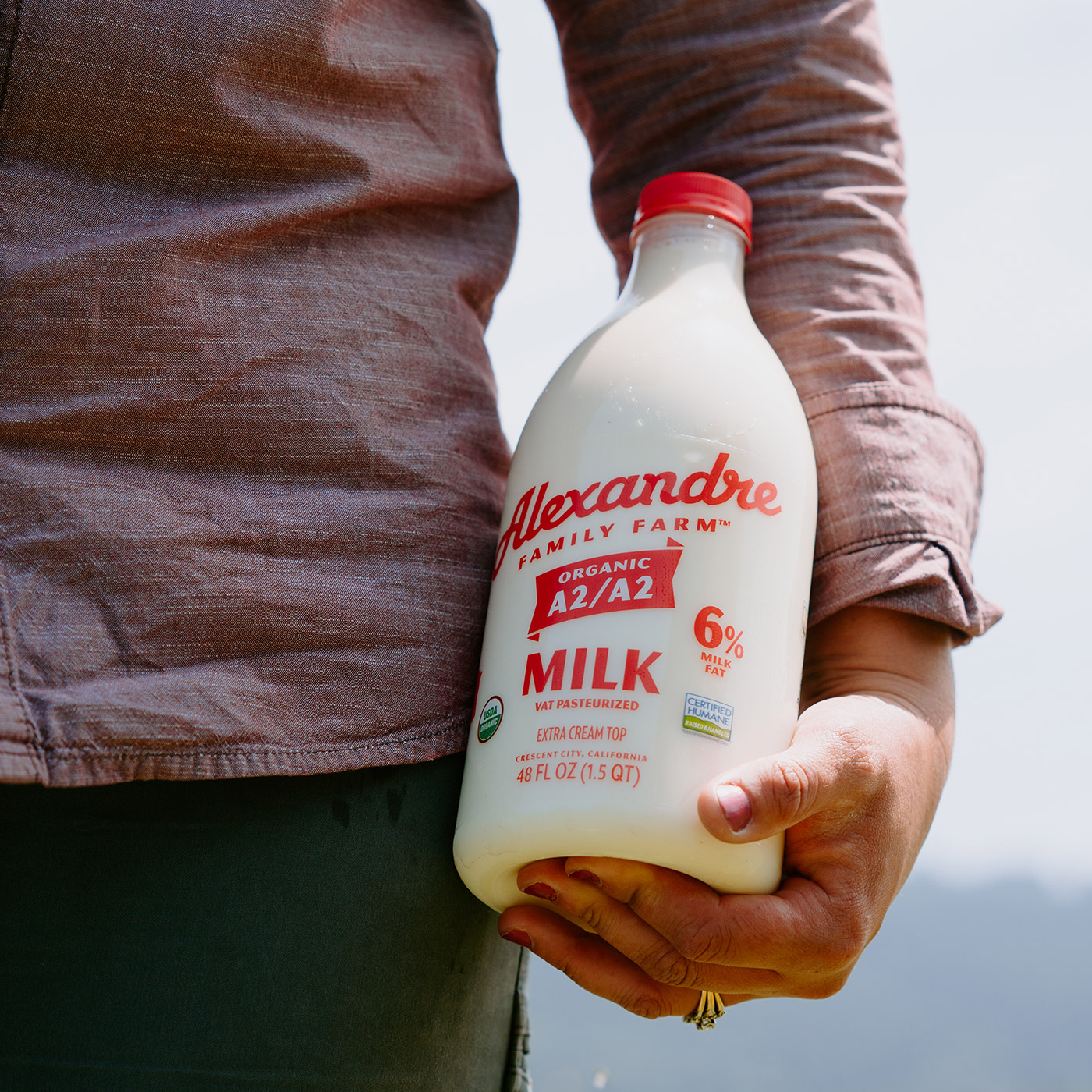
Check the roster. Alexandre took up American Humane Certified in January. Rumiano’s had it since 2020. Organic dairy certification plus welfare and regenerative labels means five separate lists — and on a grass-fed A2A2 regenerative herd, $2.4 million a year riding on which one you can prove.
When Alexandre Family Farm replaced the Certified Humane seal on its cartons with American Humane Certified in January 2026, the move looked like a routine certifier change. A premium label carries $21.82 to $40.15 per hundredweight depending on which band a herd ships into. But cross-referencing American Humane’s producer roster against Alexandre’s federal milk filing shows a supply-chain reality neither document carries alone. Alexandre adopted a program two of its named buyers had already held for years.
American Humane certified Organic West Milk of Ripon in a July 2021 announcement. Rumiano Cheese Company of Crescent City, in Alexandre’s own town, had its organic dairies certified under the program by November 2020, and Rumiano describes its supplier farms as American Humane Certified within a 100-mile radius.
So the label Alexandre picked up in January 2026 was already in its own supply chain, and had been for at least four years. Nobody here did anything improper, and none of this suggests coordination.
Why does a buyer’s certificate matter to a shipper? Rumiano’s own description puts American Humane Certified inside its sourcing standard, which makes the credential part of how that buyer presents its retail claim. The structure is worth understanding before you sign onto a welfare scheme: where a buyer has already built its own claim on a specific certifier, the choice of program may not sit entirely with the farm.
What the Filing and the Roster Each Say
The buyer list comes from Alexandre’s own words to a federal regulator. In its 2023 Federal Milk Marketing Order filing, the farm stated: “We sell our organic milk to: Rumiano Cheese, Humboldt Creamery, Organic West Milk, and our own Alexandre Family Farm creamery.” That filing is dated September 14, 2023, and we could not independently confirm that the three external buyer relationships remain current.
Those three aren’t equivalent businesses. Humboldt Creamery, based in Fortuna, has been a brand of Crystal Creamery, the dairy division of Foster Farms Dairy, since 2009, when the original 1929 cooperative sold its assets in bankruptcy. So Alexandre’s disclosed buyer list runs from a family cheese company in its own town to a conglomerate brand, and the certification picture differs across them.
| Buyer disclosed in Alexandre’s 2023 FMMO filing | Business context cited in article | American Humane evidence in article | Editorial read |
| Rumiano Cheese Company | Crescent City family cheese company; in Alexandre’s town | Organic dairies documented as American Humane Certified by November 2020 | Buyer-side welfare credential predates Alexandre’s January 2026 change |
| Organic West Milk | Ripon, California milk marketer/processor | American Humane announced certification in July 2021 | Buyer-side credential predates Alexandre’s January 2026 change |
| Humboldt Creamery | Fortuna brand of Crystal Creamery/Foster Farms Dairy since 2009 | No American Humane certification for Humboldt or Crystal established | Do not infer certification from Foster Farms’ broiler certification |
| Alexandre Family Farm creamery | Alexandre’s own creamery operation | Alexandre adopted American Humane Certified in January 2026 | Separate from the external-buyer evidence |
American Humane’s roster is public and searchable, and it spans large commercial operations including Butterball alongside smaller family farms. Certified Humane maintains its own separate public list. The two programs share no database, which is the practical point for any shipper carrying more than one welfare label: there is no single place to check what you or your buyers currently hold.
The farm’s website also lists branded partners using its milk, including Serenity Kids toddler formula and Once Upon a Farm organic A2 products.
Why “Certified Regenerative” Is the Hardest Word to Check
Here’s the sequence, which took three exchanges with the farm and a direct inquiry to the certifier to establish, and which we got wrong the first time.
Alexandre’s Regenerative Organic Certified status for the dairy went through three stages, according to the account the farm gave us on July 9 and confirmed on July 10, 2026, through an NSG Global representative writing on its behalf, with co-owner Stephanie Alexandre copied to confirm attribution. The farm says ROC temporarily suspended it, then reinstated it after follow-up inspections and a review of its records. Only after that reinstatement, the farm says, did it elect not to seek renewal. The farm supplied reinstatement documentation, which we reviewed.
We asked the Regenerative Organic Alliance directly on July 9, 2026 whether the certification had been suspended in 2025, on what date and why, and whether it was subsequently reinstated. We received no reply. So the sequence above is the farm’s account, supported by documents we examined, and not independently confirmed by the certifier that issued the certificate.
On the record: the certification that didn’t lapse. Alexandre held a separate regenerative certification throughout. Bullvine reviewed the Land to Market certificate, issued by the Savory Institute, valid November 19, 2025 through November 19, 2026. The farm told us it “continued to have a valid regenerative certification at the time of the news conference” and that “we continue to be certified regenerative to this day.” We published a correction on July 9, 2026, after an earlier version of our reporting said the certification had been “pulled” and that the farm had lost two premium labels. The USDA Report of Investigation findings and the litigation status are separately sourced to federal records and court filings, and those stand.
So a farm can be suspended by one regenerative program, reinstated by it, decline to renew, hold a second regenerative certification the whole time, and have “no longer certified regenerative” and “still certified regenerative” both be defensible statements. That’s not a loophole anyone exploited. It’s what happens when a term carries no federal definition.
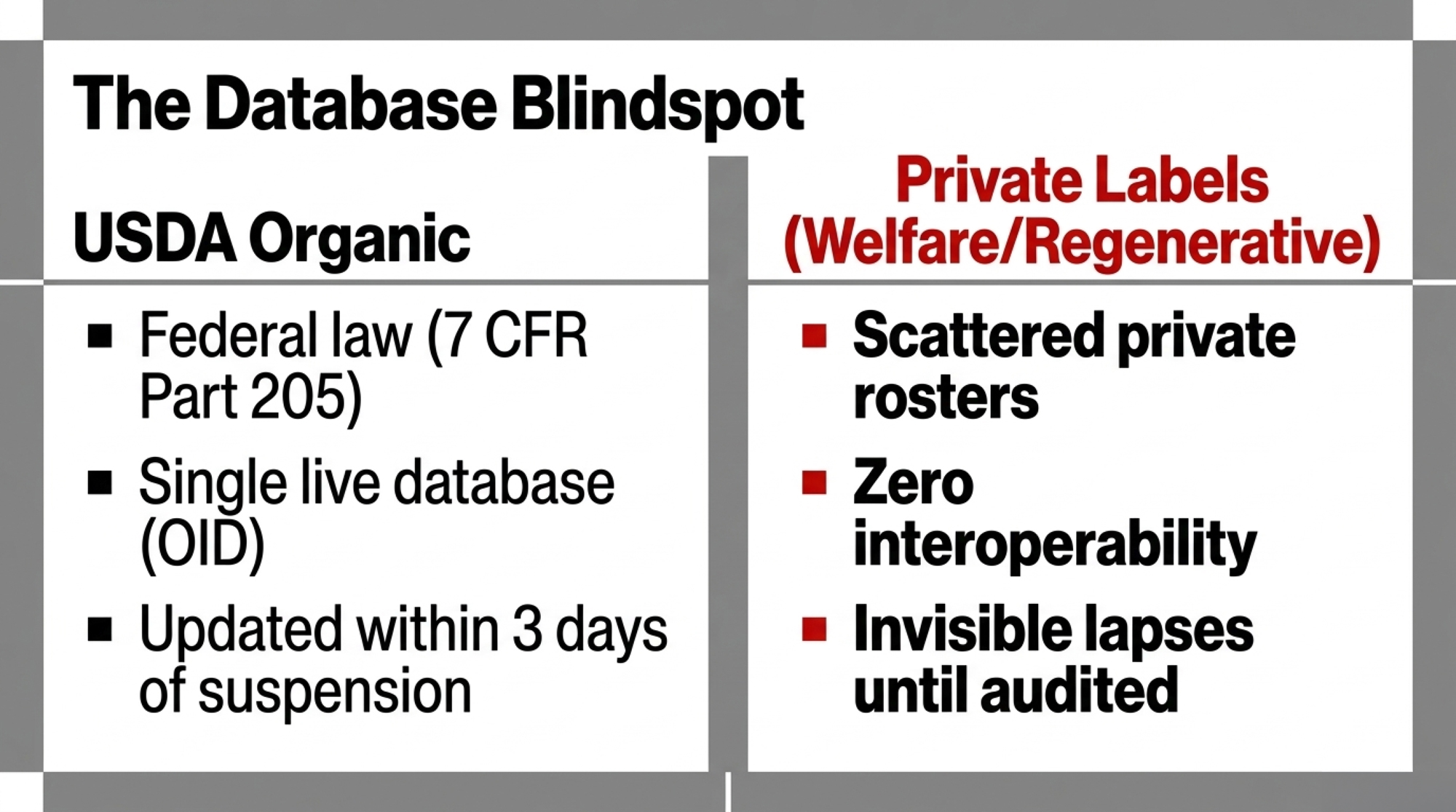
“Organic” is governed under 7 CFR Part 205, with certification, inspection, and enforcement behind it. “Regenerative” has none of that. There is no USDA standard, no federal registry, and no single authority. The Regenerative Organic Alliance administers ROC, and the Savory Institute administers Land to Market; both are private nonprofits. When USDA launched its $700 million Regenerative Pilot Program on December 9–10, 2025, and spotlighted Alexandre as a model regenerative operation, per The New Lede’s December 11, 2025 reporting, it amplified a category it doesn’t define or verify. EQIP and CSP, the two programs carrying that money, are established Farm Bill conservation cost-share vehicles whose eligibility doesn’t turn on a marketing claim at all.
While Alexandre’s record stays contested across a FOIA’d federal file and two civil suits, the systemic vulnerability it exposes applies to every premium shipper carrying a stacked label.
What’s a Welfare or Organic Premium Actually Worth Per Hundredweight?
This is the part that reaches your milk check, and it doesn’t depend on how anyone characterizes Alexandre’s certificates.
Bullvine calculation.
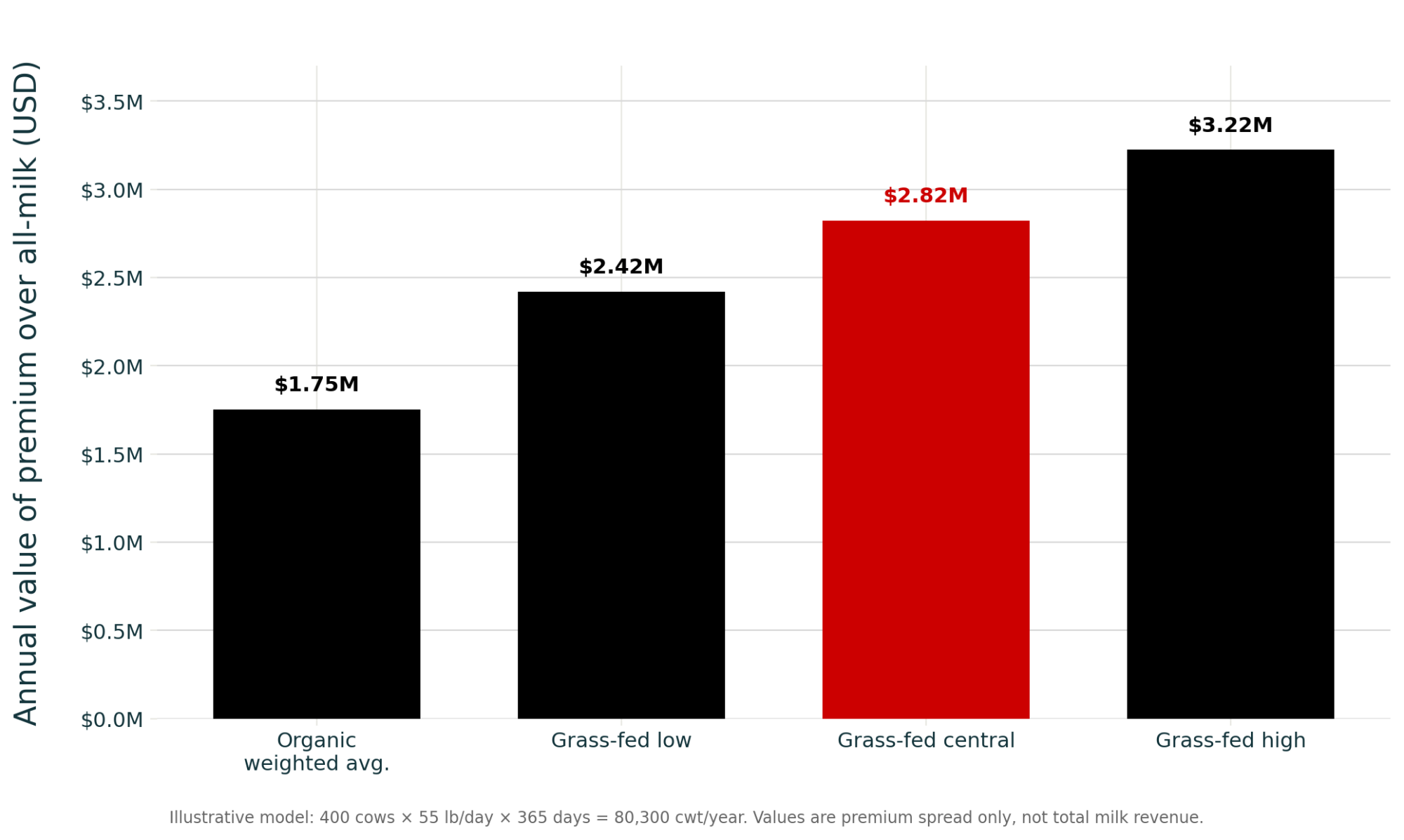
| Certification Level | Benchmark Pay Price | Spread over All-Milk ($19.85/cwt) | Annual Value of the Spread (400 cows / 80,300 cwt) |
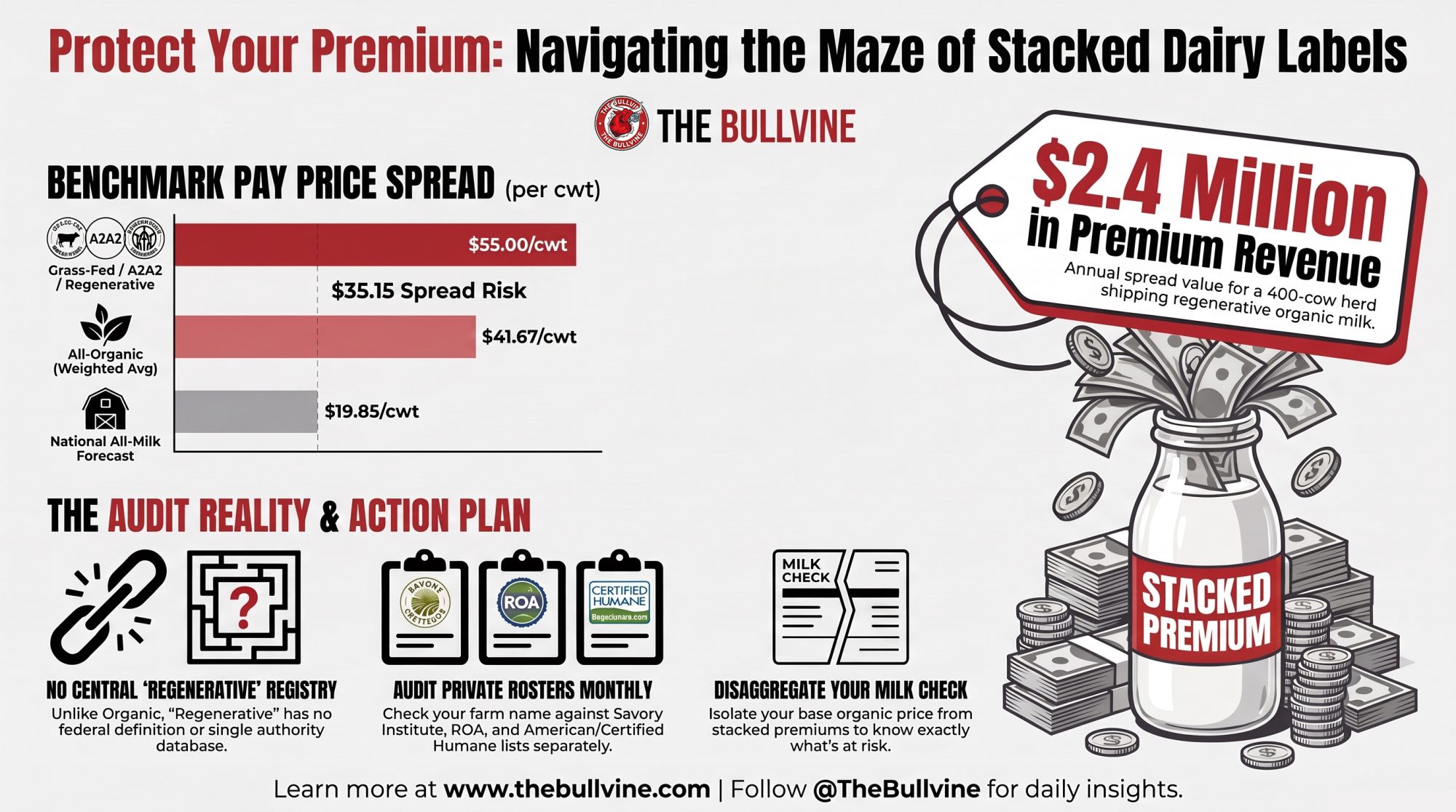
| All-Organic Weighted Avg. | $41.67/cwt | +$21.82/cwt | $1,752,146 |
| Grass-Fed / A2A2 / Regenerative — low | $50.00/cwt | +$30.15/cwt | $2,421,045 |
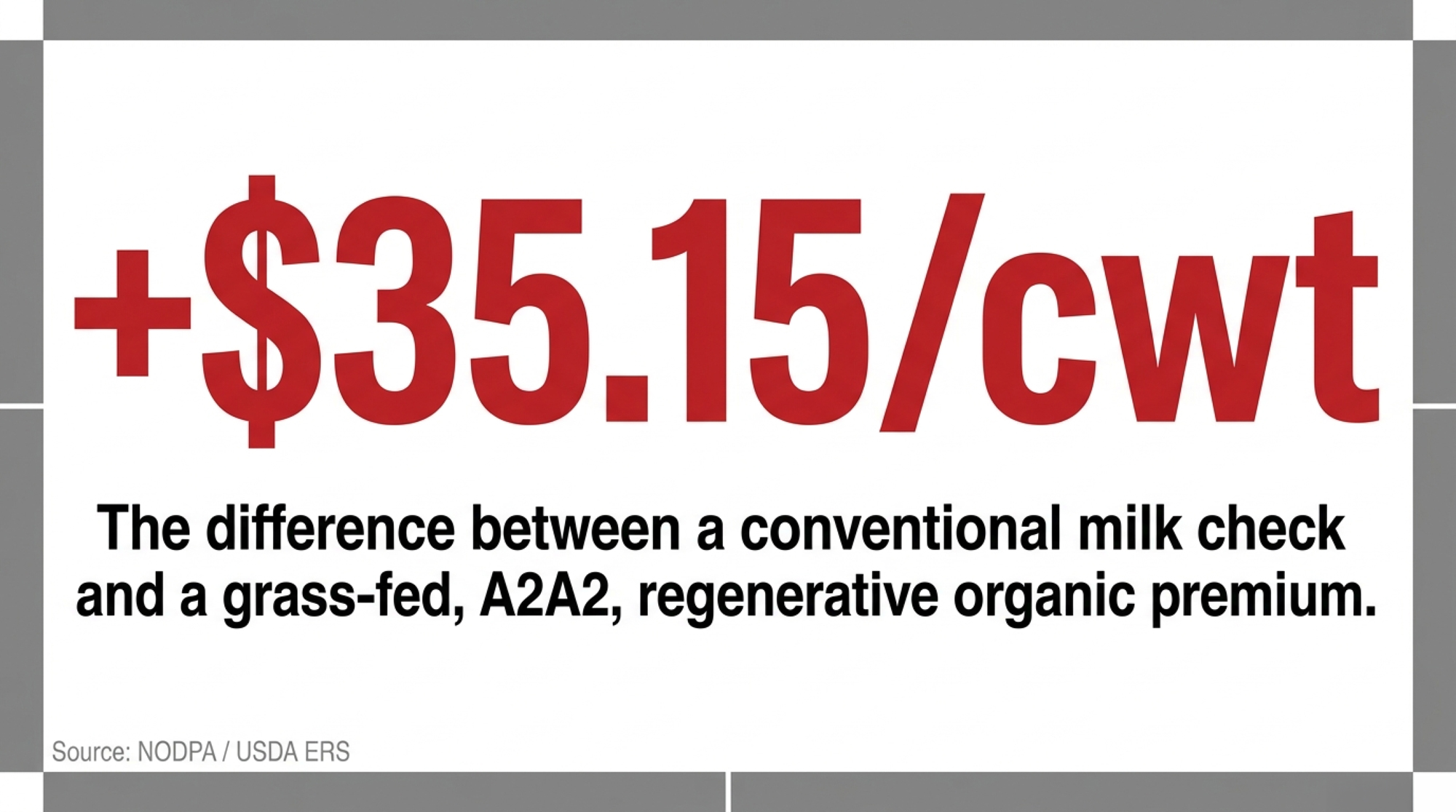
| Grass-Fed / A2A2 / Regenerative — central | $55.00/cwt | +$35.15/cwt | $2,822,545 |
| Grass-Fed / A2A2 / Regenerative — high | $60.00/cwt | +$40.15/cwt | $3,224,045 |
The right-hand column is the value of the premium alone, not the total milk check. At $41.67/cwt, the same 400-cow herd’s gross would run about $3.35 million. The three grass-fed rows apply the same 55 lbs/day assumption as the all-organic row, and grass-fed systems commonly ship less per cow — run those rows on your own shipped volume before treating the totals as comparable.
The herd baseline is an illustrative 400-cow operation at an assumed 55 lbs/day over 365 days, which works out to 80,300 cwt a year. That 55 lbs is our assumption, not a sourced figure.
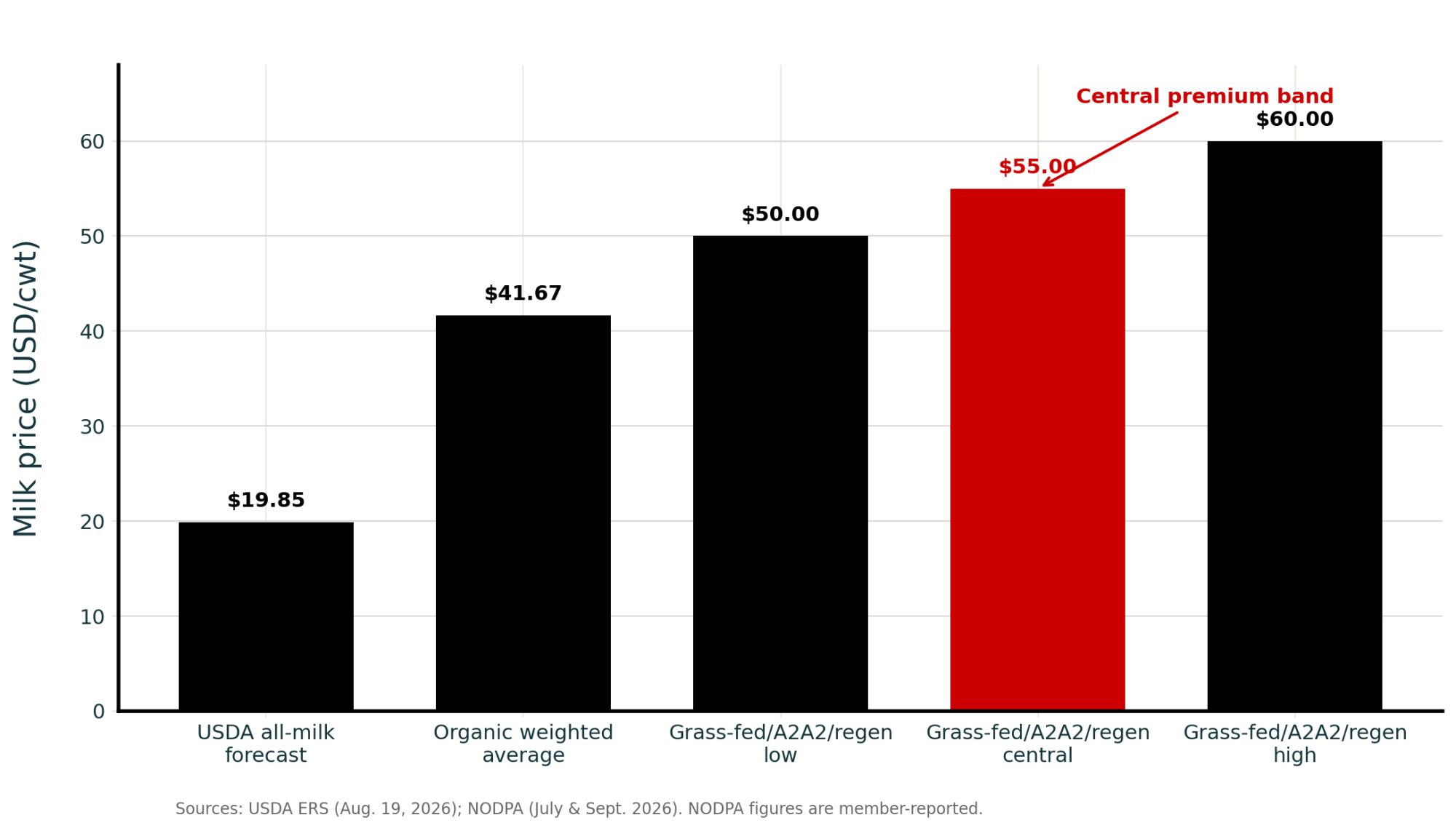
Published evidence: The Northeast Organic Dairy Producers Alliance, a grassroots producer organization whose pay-price figures come from member reporting rather than an audited series, put the weighted-average organic pay price for Q1 2026 at $41.67/cwt, range $40.05 to $42.62, before hauling deductions, in its July 2026 Pay and Feed Prices report. In its September 2026 report, NODPA puts grass-fed, A2A2, regenerative, organic-certified herds at $50 to $60/cwt, and Northeast spot fluid organic at $45–55/cwt, eased from the $60 range reported earlier in the year. USDA’s Economic Research Service revised its 2026 all-milk forecast down to $19.85/cwt on August 19, 2026.
One year on, the gap is wider. NODPA’s full-year 2025 weighted average was $38.39/cwt, which we used to price the $19.89 risk on your farm on May 27, 2026. Its Q1 2026 quarterly average came in $3.28/cwt higher, up 8.5%. That’s one annual average against one quarter rather than a trend line, so treat it as a marker rather than a direction. On the same 400-cow model, $3.28/cwt is roughly $263,000 a year. For how the same math lands on a cheese plate rather than in a tanker, see Jasper Hill gets $22 a wedge.
The Audit Reality: The Live Feed Versus the File Drawer
The USDA Organic Integrity Database is free, public, and searchable by farm name. Federal regulation requires certifiers to update it within three business days of any suspension, revocation, or surrender, under 7 CFR § 205.662(e)(3). CCOF’s own guidance puts it plainly: “Information in OID will be more accurate than any PDF certificate you receive.” A certificate in your file drawer is a photograph. The database is the live feed.
But OID covers federal organic status only. Every private label you carry, whether welfare, regenerative, grass-fed, or breed-specific, lives on a separate roster maintained by whoever issues it, and none of them talk to each other. That lack of interoperability is where the risk sits during a contract audit. A buyer’s compliance team verifying you has to check each issuing body separately, and if one private certificate has lapsed or changed program, nothing surfaces it.
Consider what it took us to establish one farm’s regenerative history: three exchanges with the operation, an unanswered inquiry to the certifier, and a reinstatement document supplied by the subject rather than the issuer. Rumiano’s certification date took two separate sources. Humboldt Creamery’s Foster Farms parentage took three, and none of them was the federal filing that named it. A farm stacking three claims checks three lists, and so does anyone verifying that farm.
| Claim or program | Primary verification route | What the check can establish | Audit vulnerability |
| USDA Organic | USDA Organic Integrity Database | Current federal organic certification status; suspensions, revocations, or surrender updates | OID does not verify private welfare, grass-fed, breed, or regenerative claims |
| American Humane Certified | American Humane producer roster and issuer records | Participation in that specific welfare-certification program | Separate roster; it does not confirm Certified Humane or regenerative status |
| Certified Humane | Certified Humane public list and issuer records | Participation in that distinct welfare-certification program | Separate program and database from American Humane |
| Regenerative Organic Certified | Regenerative Organic Alliance issuer records and farm documentation | Status within ROC’s private program | No federal USDA definition or registry for “regenerative” |
| Land to Market | Savory Institute certificate and issuer records | Status within Land to Market’s distinct regenerative framework | A Land to Market certificate does not establish ROC status, and vice versa |
Status Check: Where Alexandre’s CCOF Settlement Stands Today
Alexandre’s USDA Organic certification remains active. CCOF’s certifier directory, updated May 17, 2026, lists the operation as a member out of Crescent City.
Separately, a two-year CCOF settlement agreement covering the farm reached its term around February 2026. The farm entered that agreement on February 16, 2024, after a Combined Notice of Noncompliance and Proposed Suspension, and it required annual unannounced inspections. As of September 2026, we found no public statement from CCOF or USDA describing what followed it, and no public outcome has been announced.
The underlying investigation file, case NOPI-LS-00240-2024, reviewed 14 animal-welfare allegations. Ten were confirmed by CCOF or acknowledged by Alexandre. Three were denied or not substantiated. One drew no response. A June 2024 unannounced inspection confirmed corrections to substantiated items. Our fuller accounting is in what a pulled label really costs a farm’s balance sheet.
Options and Trade-Offs
Action 1: Audit OID and Private Rosters — do this within 30 days
Action: Run your farm name through the USDA Organic Integrity Database, then check each private roster separately: Savory Institute for Land to Market, the Regenerative Organic Alliance for ROC, Certified Humane and American Humane for welfare. Check your buyers too, and check who owns them.
Constraint: OID updates federal organic status only. A private lapse sits invisible until an audit or a buyer catches it.
Action 2: Disaggregate Your Premium per CWT
Action: Separate your base organic pay price from every stacked claim, whether grass-fed, welfare, or breed-specific, using your last three milk checks and your processor’s price sheet by certification type.
Constraint: If you can’t calculate your exact per-label premium in under an hour, your margin is exposed, and you don’t yet know by how much.
Action 3: Keep Your Own Certification Paper Trail
Action: Hold suspension notices, reinstatement letters, and renewal decisions in one file, with dates. Audit your web copy and carton text against those actual certificates, and be specific about which program a claim rests on. Land to Market and ROC are not interchangeable.
Constraint: “Regenerative” carries no legal USDA definition comparable to organic under 7 CFR Part 205. If a reporter or a buyer ever asks you to reconstruct a certification sequence, the only record that will settle it is yours.
Key Takeaways
- If you carry more than one welfare or regenerative label, you’re checking more than one roster. There is no combined registry, and OID won’t show you the private ones.
- If your buyer already holds a welfare certification, find out which one before you choose yours. Alexandre’s buyers have carried American Humane Certified since 2020 and 2021.
- If you don’t know who owns your buyer, find out. One of the three creameries on Alexandre’s federal filing has been a Foster Farms Dairy brand since 2009.
- If you ship grass-fed A2A2 regenerative organic, you’re in NODPA’s $50–60/cwt band, not the $41.67 weighted average. At a central $55/cwt and your own shipped volume, that’s roughly $2.8 million a year in certification-dependent revenue on 400 cows.
- If your certification status ever changes, keep the suspension notice and the reinstatement letter. A farm’s own paper is often the only record that can reconstruct the sequence.
Pull your last three milk checks and separate what you’re paid for organic status from every welfare or regenerative claim stacked on top. We’re tracking the CCOF settlement’s outcome and both active Alexandre lawsuits as they move.
Methodology Note — Certification dates: Organic West Milk certified by American Humane per the organization’s July 22, 2021 announcement; Rumiano Cheese Company’s organic dairies documented as American Humane Certified Free Farmed in trade press dated November 2020 and confirmed on the Cornucopia Institute’s dairy scorecard, October 2025. Vendor and retailer pages date Rumiano’s certification to 2016; we’ve used the conservative, independently published date. ROC sequence: the suspension, reinstatement, and non-renewal sequence is the account Alexandre Family Farm provided on July 9 and confirmed on July 10, 2026, through a representative of NSG Global, with co-owner Stephanie Alexandre copied to confirm attribution, supported by reinstatement documentation we reviewed. We asked the Regenerative Organic Alliance to confirm the sequence directly on July 9, 2026, and received no reply. Corporate ownership: Humboldt Creamery, founded in 1929 in Fortuna, California, has been a brand of Crystal Creamery, the dairy division of Foster Farms Dairy, since 2009. Foster Farms has held American Humane Certified status for its broiler chicken operations since 2013; we have not established any American Humane certification covering Humboldt Creamery or Crystal Creamery, and readers should not infer one. Premium spread: NODPA Pay and Feed Prices, July 2026 report, Q1 2026 weighted-average producer pay price $41.67/cwt, range $40.05–$42.62, before hauling deductions, USD; $50–60/cwt band from NODPA’s September 2026 report, with the $55/cwt central case ours; 2025 full-year weighted average $38.39/cwt from NODPA’s May 2026 report. NODPA is a Northeast-based grassroots producer organization, and its figures are member-reported, not audited. Conventional comparator: USDA Economic Research Service All Milk Price forecast of $19.85/cwt for 2026, released August 19, 2026, U.S. national. Four caveats. NODPA’s figure is a realized pay price, while USDA’s is a forecast. NODPA’s reporting is Northeast-weighted, while the ERS forecast is national. USDA’s all-milk aggregate includes organic milk. And the grass-fed rows carry the all-organic volume assumption, which grass-fed systems commonly won’t match. Herd model: illustrative 400-cow operation at an assumed 55 lbs/day over 365 days, not a named farm’s books. National and regional averages may not reflect your operation.
Learn More
- What a Pulled Label Really Costs a Farm’s Balance Sheet — Exposes the exact balance-sheet liability when third-party welfare audits fail, arming operators with risk-containment protocols to protect multi-million-dollar organic cash flows before inspectors show up.
- The $19.89 Risk on Your Farm: Why Organic Valley’s FMMO Lawsuit Matters to Every 200-Cow Dairy — Follows the money behind FMMO pricing shifts and organic pooling rules, revealing how shifting processor margins and pooling mandates threaten producer milk checks over the next five years.
- 14% Believe Your Dairy Label. Jasper Hill Gets $22 a Wedge. The Difference Is One Certification. — Dismantles generic marketing claims by contrasting commoditized bulk shipping against high-margin artisan processing, demonstrating how disciplined certification standards capture premium retail shelf pricing.
 The Sunday Read Dairy Professionals Don’t Skip.
 The Sunday Read Dairy Professionals Don’t Skip.
Every week, thousands of producers, breeders, and industry insiders open Bullvine Weekly for genetics insights, market shifts, and profit strategies they won’t find anywhere else. One email. Five minutes. Smarter decisions all week.




