Think cultural barriers don’t matter in dairy trade? India just proved you wrong with their $227B fortress blocking US exports.
EXECUTIVE SUMMARY: Let me tell you—all the feed efficiency in the world won’t open India’s door if you don’t play by their rules. India’s not just another export market; it’s a $227 billion fortress with tariffs up to 60%, and a “vegetarian feed” policy that instantly blocks about two-thirds of U.S. herds. Last year, U.S. dairies moved a record $8.2 billion in exports, but think about this: not a drop of U.S. milk gets in unless you overhaul your rations… and, honestly, are we set up for that kind of shift? Add to it: India’s local producers—over 80 million of them—are pumping out 216 million metric tons of milk, growing more than 6% a year. The bottom line? Maximizing butterfat or investing in genomic testing is only part of the equation—the global rules have changed. If you’re not treating culture as a business risk, you’re leaving real money on the table. If there’s a lesson from 2025’s trade blowup, it’s this: don’t just optimize for milk yield—optimize for where your milk can actually go.
KEY TAKEAWAYS
If your ration includes animal proteins, India’s “pure veg” requirement means a 100% market loss—review feed labels and talk with your nutritionist before targeting value-add exports.
Indian tariffs (30-60%) and cultural rules can wipe out ROI on feed efficiency improvements—before investing in add-ons, run the numbers for export eligibility and market fit.
Local Indian herds are now producing at scale: 216M metric tons, up 6% yearly—stay updated with USDA trade newsletters and Journal of Dairy Science to spot trends and threats early.
Genomic and milk yield advances only pay off if markets are open—start mapping your real exposure by country in your milk contracts and ask your co-op for a 2025 regional breakdown.
Here’s the first thing to understand about international dairy trade: it’s rarely just about economics. Cultural quirks, political realities—they shape markets just as much, maybe more. Take a look at the developments in US-India dairy tensions this summer. This isn’t your typical trade spat that gets resolved over coffee and handshakes.
What’s Actually Going Down
So here’s where things stand as of mid-August 2025. After five rounds of talks, negotiations have been stalling—as of mid-August 2025—with another round scheduled for August 25th. The US imposed tariffs approaching 50%, aiming to pry open India’s markets. India, however, dug in, fiercely shielding its dairy sector from imports, especially anything crossing their vegetarian feed rules.
Here’s the real kicker: India’s “vegetarian feed requirement” effectively shuts out about two-thirds of US dairy operations. Most American rations include blood meal or animal proteins—key to achieving the solid feed efficiency gain that producers seek. Combine that with Indian tariffs ranging from 30% to 60%, and you have a fortified dairy market—hard for US exports to crack.
Feed Component
Standard US Ration
India-Compliant
Cost Impact/Cow/Year
Protein Source
Blood meal, meat meal
Plant proteins only
+$45-85
Mineral Mix
Bone meal included
Synthetic alternatives
+$15-25
Fat Sources
Tallow acceptable
Plant oils only
+$20-35
Total Impact
Baseline
Vegetarian compliant
+$80-145
Why Your Operation Should Care
Now, India’s import market is valued at around $180 million—pocket change compared to their massive $227 billion domestic industry. However, what stands out is that, according to the final 2024 trade data, US dairy exports reached $8.2 billion, indicating a significant export dependency. And get this—Mexico now accounts for $2.47 billion, nearly a third of our total exports. This heavy reliance means that a single political or logistical disruption south of the border could have a significantly disproportionate impact on US milk prices. This risk is magnified by ongoing trade disputes with China, where tariffs have escalated to 125% on certain products, and suddenly, you’re facing serious market concentration issues. A recent analysis from the US Dairy Export Council called this a “structural challenge threatening farm profitability.”
2024 US Dairy Exports by Destination, showing Mexico’s significant 30.1% market share indicating concentration risk
How India Built This Defense
Market
Tariff Range
Cultural Barriers
Market Access
2024 US Exports
India
30-60%
Vegetarian feed mandate
Severely restricted
Minimal
China
Up to 125%
None significant
Trade war restrictions
~$600M
Mexico
0-5%
None
Open access
$2.47B
Canada
0%
None
USMCA access
~$1.1B
EU
Variable
Geographical indicators
Complex but accessible
~$800M
India’s position isn’t just about tariffs—it’s cultural bedrock. They’re producing over 216 million metric tons annually from 80-plus million smallholders with 2-3 cow operations. That’s not just numbers—it’s political power.
The vegetarian feed mandate? Sacred territory. No politician in India dares mess with that. Amul is projecting over $12 billion in revenue by 2026 and isn’t about to open its import doors without massive concessions.
What’s truly striking is India’s domestic growth, which averages over 6% annually. They absorb in days what our entire export relationship represents.
Meanwhile, Competitors Are Moving
While we’re hitting walls, others are making hay. New Zealand’s dairy exports climbed nearly 5% in 2024, Australia’s eyeing China aggressively, and the EU? They’re smart—cheese exports to Asia grew by nearly 13% by leveraging cultural preferences through geographical indications.
The Europeans seem to grasp something we often overlook—cultural alignment matters just as much as product quality.
Where Smart Money’s Looking
Region
Growth Rate
Cultural Barriers
Entry Difficulty
Market Size
Latin America
20%+
Low
Medium
$2.1B
Southeast Asia
15-25%
Variable
Medium-High
$1.8B
Africa
25%+
Low
High
$800M
Middle East
12-18%
Moderate
Medium
$1.2B
All this points point to one reality: cultural barriers aren’t disappearing, they’re accelerating trade shifts. Strong domestic markets, backed by political will, can weather the pressure of superpower influence.
So where does that leave producers? Latin America looks promising—fewer cultural hurdles, growth rates often exceeding 20%. Parts of Southeast Asia and emerging African markets offer similar opportunities without the cultural land mines.
Gregg Doud, president of the National Milk Producers Federation (NMPF), captured it perfectly when he discussed “strategic patience”—focusing resources where we can actually win, rather than beating our heads against fortress walls. It makes you wonder how many operations are still banking on cracking these cultural barriers.
Your Monday Morning Reality Check
This isn’t just trade policy—it’s a matter of survival. Understanding cultural trade dynamics should rank alongside genetics and feed efficiency in your risk management toolkit.
The producers who started diversifying away from culturally sensitive markets two to three years ago? They’re seizing new opportunities, while others grapple with closed doors and mounting tariffs.
What you can do right now:
Ask your co-op: “How much of our milk ends up in Mexico?” That kind of direct question reveals your exposure risks
Connect with regional cooperatives exploring Latin American opportunities
Review contracts for trade disruption protection
Start conversations about alternative market development
You’ve got to treat cultural intelligence like butterfat numbers or dry matter intake—because ignoring it costs real money. In this volatile landscape, the operations that embrace this reality will be the ones still standing when everything settles.
So what’s your play? Keep hammering on yesterday’s doors, or start building tomorrow’s bridges?
Because one thing’s certain—global dairy success isn’t just about production efficiency anymore. It’s about who adapts fastest to cultural and political realities.
Complete references and supporting documentation are available upon request by contacting the editorial team at editor@thebullvine.com.
Learn More
Navigating The Dairy Markets: Hedging For Profitability – Master practical hedging strategies to protect your milk check from the global market volatility highlighted in this article. This guide offers actionable steps to manage price risk and secure your operation’s financial future against unpredictable trade disputes.
The Future of Dairy Exports: Opportunities and Challenges – Explore the next high-growth export destinations beyond the saturated and blocked markets discussed above. This strategic outlook identifies key opportunities in emerging dairy markets, providing a roadmap for successful diversification and long-term, sustainable growth for your operation.
The Digital Dairy Farm: How Data is Transforming Herd Management – Leverage on-farm data to meet complex export demands, like vegetarian feed verification, and boost overall efficiency. This piece reveals how digital herd management tools can unlock new levels of profitability and prove compliance in a shifting global landscape.
Join the Revolution!
Join over 30,000 successful dairy professionals who rely on Bullvine Weekly for their competitive edge. Delivered directly to your inbox each week, our exclusive industry insights help you make smarter decisions while saving precious hours every week. Never miss critical updates on milk production trends, breakthrough technologies, and profit-boosting strategies that top producers are already implementing. Subscribe now to transform your dairy operation’s efficiency and profitability—your future success is just one click away.
When a single facility can eliminate a quarter-billion in annual imports, traditional exporters face unprecedented market disruption
EXECUTIVE SUMMARY: Look, here’s what’s happening while we’re all focused on our daily routines. Algeria just built a $3.5 billion dairy operation that’s going to produce 100,000 tons of milk powder annually — and they’re doing it in the freaking desert with technology that makes most of our setups look ancient. They’re reducing their import dependency by 23%, which means traditional exporters like New Zealand are likely to lose over $1 billion in trade. But here’s the thing… while everyone’s panicking about market disruption, the smart operators are asking: “What can I learn from this?” These individuals are utilizing advanced genomic selection, precision feeding systems, and climate-controlled environments to make desert dairying profitable. The global market’s shifting — EU production’s down, China’s buying less — and the farms that survive are the ones maximizing every dollar of feed efficiency and milk yield through better genetics and data. This isn’t just a foreign news story; this is your wake-up call to take operational excellence seriously.
KEY TAKEAWAYS
Slash feed costs by 12-18% through genomic-guided feeding programs — start by reviewing your current genomic evaluations and match feeding strategies to individual cow genetic potential for feed conversion
Boost milk yield 8-15% annually by implementing precision agriculture tech similar to what Algeria’s using — invest in automated feeding systems and real-time milk monitoring to optimize production per cow
Cut SCC levels and improve milk quality premiums using genomic testing for mastitis resistance — test your replacement heifers and adjust breeding decisions based on health trait data from proven genomic indices
Prepare for tighter export markets in 2025 by diversifying your milk marketing strategies — explore value-added products and direct-to-consumer options while traditional commodity channels face pressure from new global producers
Leverage climate-adaptive technologies now — Algeria’s success in extreme conditions shows that proper cooling, ventilation, and feed management can work anywhere, potentially improving your summer production by 10-20%
Make no mistake: Algeria’s new dairy project isn’t just another processing plant. It’s a seismic event. Backed by a $3.5 billion war chest, this move signals that the global milk powder market is being fundamentally redrawn, and exporters who fail to pay attention will be left behind.
Production is planned to start in late 2027. German engineering firm GEA Group has secured a €140-170 million contract to supply advanced processing equipment, including automated milking, membrane filtration, and spray drying facilities, specifically designed for arid environments.
The technology here isn’t a shot in the dark. Baladna is leveraging its hard-won experience from running a massive dairy in Qatar’s desert climate. This includes sophisticated cooling and feed management systems tailored to extreme conditions, representing a significant advance in climate-adapted dairy farming.
Algeria’s government is actively supporting this initiative through expanded agricultural financing, with all public banks mandated to provide credit for projects of this nature.
And the timing couldn’t be more critical. With China scaling back powder imports and European production contracting, Algeria’s move toward self-reliant production is poised to further reshape global trade flows.
Economically, Algeria is playing with a stacked deck. Favorable policy interest rates and government subsidies give it a powerful advantage over traditional exporters who face steeper financing costs and less state support.
From a regional standpoint, Algeria’s per capita dairy consumption is between 110 and 147 kilograms annually, significantly outpacing the averages of its neighboring countries. This suggests the new capacity will meet existing demand, not just stimulate it.
Regional Context and Strategic Positioning
Looking at the bigger picture, the MENA dairy market is projected to reach about 85 million tons by 2035, positioning Algeria strategically as a key supplier within this growing market.
Operating in desert conditions is no small feat — water management presents significant challenges, with desert dairy operations typically requiring substantially higher water inputs than those in temperate climates. Managing feed logistics across such a scale requires expert planning. Yet, modern automated and integrated management technologies engineered for arid environments are making this feasible.
The Shockwave for Global Exporters
On the export front, New Zealand’s trade with Algeria, valued at over NZ$1 billion annually, is expected to contract. Similarly, Fonterra’s recent outlook paints a picture of tightening global export markets.
European producers confront similar challenges as a shrinking whole milk powder sector reshapes trade flows, with displaced export revenue potentially exceeding $200-250 million per year. Operational efficiency and geographic diversification remain critical adaptation strategies, supported by research that emphasizes improvements in feed conversion efficiency.
Algeria’s adoption of advanced dairy processing sets a new standard in the region, underscoring a broader trend toward technology-enabled, climate-resilient dairy production in emerging markets.
The project is expected to create approximately 5,000 direct jobs in a region eager for economic development.
What This Means For Your Business: A 3-Point Action Plan
1. Benchmark Your Cost of Production, Relentlessly. Algeria is gaining a competitive edge through state support and the adoption of advanced technology. For exporters, the path forward is clear: you must rigorously assess your cost per kilogram of milk solids. How efficient is your feed conversion? Are you ready to compete on more than just volume? Complacency simply won’t cut it anymore.
2. Aggressively Pursue New Markets. Algeria’s growth means less market share for exporters there. It’s time to look beyond traditional partners towards emerging regions, such as Southeast Asia (Vietnam, the Philippines), and parts of Africa, where demand is rising. This shift isn’t merely about finding a new buyer—it’s about forging new, resilient supply chains before market dynamics change completely.
3. Explore Value-Added Specialization. Competing solely on bulk powder prices will become increasingly challenging. Consider moves into specialized milk powders for infant formula, sports nutrition, or medical applications. Shifting even part of your production toward higher-margin products can offer insulation against commodity price swings.
The Bottom Line
The era of predictable trade flows is over. Food sovereignty is the new priority, challenging exporters to pivot quickly. Replace assumptions with detailed analysis, and make strategy deliberate and proactive. The dairy market transformation is happening now, and your adaptation strategy must keep pace.
Complete references and supporting documentation are available upon request by contacting the editorial team at editor@thebullvine.com.
Learn More:
The Feed Efficiency Revolution: Are Your Cows Genetically Wired to Save You Money? – This article provides a practical playbook for implementing genomic selection to improve feed efficiency. It demonstrates how to identify genetically superior animals that convert feed into milk more effectively, directly lowering your largest operational cost and boosting profitability.
Beyond the Horizon: Navigating the Top 5 Global Dairy Market Trends for 2025 – Go beyond the headlines with this strategic analysis of the key economic and consumer trends shaping tomorrow’s dairy markets. This report reveals where future demand lies, helping you position your operation to capture opportunities in a rapidly changing global landscape.
The Digital Dairy: How Precision Agriculture is Redefining Farm Profitability – Explore the specific technologies that make desert dairying possible. This piece breaks down the ROI of precision agriculture, revealing how automated systems for feeding, health monitoring, and data analysis can drive significant gains in yield and operational efficiency.
Join the Revolution!
Join over 30,000 successful dairy professionals who rely on Bullvine Weekly for their competitive edge. Delivered directly to your inbox each week, our exclusive industry insights help you make smarter decisions while saving precious hours every week. Never miss critical updates on milk production trends, breakthrough technologies, and profit-boosting strategies that top producers are already implementing. Subscribe now to transform your dairy operation’s efficiency and profitability—your future success is just one click away.
$157M market cracked by proving 9 of 14 quotas sat 50% empty. Smart data beats politics every time in dairy trade.
EXECUTIVE SUMMARY: Look, here’s what just happened that changes how we think about global markets… New Zealand cracked a $157 million export opportunity by proving Canadian processors were sitting on unused quota licenses — 9 out of 14 were running below 50% utilization. Instead of fighting the whole supply management system, they went after the bureaucratic loopholes and won. This isn’t just about New Zealand — it’s about how quota utilization data becomes as valuable as your feed conversion rates when you’re making breeding and market positioning decisions. With Global Dairy Trade prices swinging $500+ per metric ton this year and component premiums hitting record levels, knowing which markets are actually accessible matters more than ever. The 18-month implementation starting January 2026 gives forward-thinking operations time to align their genetics programs with emerging export opportunities. You should be tracking quota data in your target markets right now — it’s the competitive intelligence most producers ignore.
KEY TAKEAWAYS
Start mining quota utilization data today — Most countries publish TRQ fill rates but nobody analyzes them for breeding decisions. Target 15-20% efficiency gains by aligning genetic selection with markets proven to have reliable access, not just theoretical quotas.
Shift breeding focus toward export-ready components — With butterfat emphasis jumping to 31.8% in Net Merit 2025 and premium markets demanding specific traits, operations targeting 4.2%+ butterfat tests position themselves for $200-400 per cow premium opportunities in newly accessible markets.
Build trade intelligence into your 2025-2027 genetic strategy — The 18-month Canada implementation timeline gives you exactly one breeding cycle to prepare. Select bulls based on export market requirements, not just domestic performance — it’s the difference between competing locally versus capturing global premiums.
Partner with trade-savvy advisors now, before competitors catch on — Just like that Montana lawyer pulling five years of Canadian data, progressive operations need legal and market intelligence partnerships. Invest $2,000-5,000 annually in trade analysis that could unlock $50,000+ in market access value per 100-cow operation.
Track administrative protectionism patterns globally — Japan, South Korea, and EU markets show similar quota underutilization patterns. Operations monitoring these trends position themselves 2-3 years ahead of market openings, capturing first-mover advantages worth 10-15% premium pricing in newly accessible territories.
Something that caught the entire industry off guard this summer was a subtle but significant trade victory by New Zealand. After watching Canada’s supply management system for years — honestly, most of us figured it was untouchable — New Zealand actually found a way through. Not around it, not under it, but straight through the bureaucratic maze that’s kept everyone else locked out.
I’m referring to the July 17th agreement that unlocked $157 million annually in new dairy exports. The strategic brilliance behind this move wasn’t attacking the system itself — they went after something much smarter.
The Thing About Administrative Protectionism Nobody Talks About
The truly fascinating part is the method they used, and this is where it gets strategically interesting from a farm management standpoint. Instead of trying to tear down Canada’s entire quota fortress — which, let’s be honest, has about as much political support as telling Wisconsin farmers to switch to soybeans — the Kiwis focused on something much more tactical.
They proved Canadian processors were basically gaming their own system.
Picture this: you’ve got these tariff rate quotas (TRQs) that are supposed to provide market access, right? According to the dispute panel’s findings, nine out of fourteen TRQs were operating below 50% utilization in 2022-23. That’s not market access — that’s market manipulation with extra paperwork.
What strikes me about this approach is how it sidesteps the whole political nightmare. You’re not asking politicians to abandon their supply management principles. You’re just saying, “hey, make your existing system actually work the way it’s supposed to.”
Recent work by agricultural economists has referred to this as “administrative protectionism,” where countries don’t outright ban imports but make the process so bureaucratic and cumbersome that it achieves the same result. And honestly, it’s becoming a significant headache for exporters everywhere, not just in the dairy industry.
Why Your Bottom Line Should Care (Even if You’re Not Exporting)
Here’s where this gets relevant for operations across North America. Canadian farmgate prices have been holding steady around that premium level — recent data from the Canadian Dairy Commission shows they’re implementing only a minor 0.0237% decrease for February 2025, which translates to less than one cent per liter. That’s still significantly higher than what we’re seeing in most export markets.
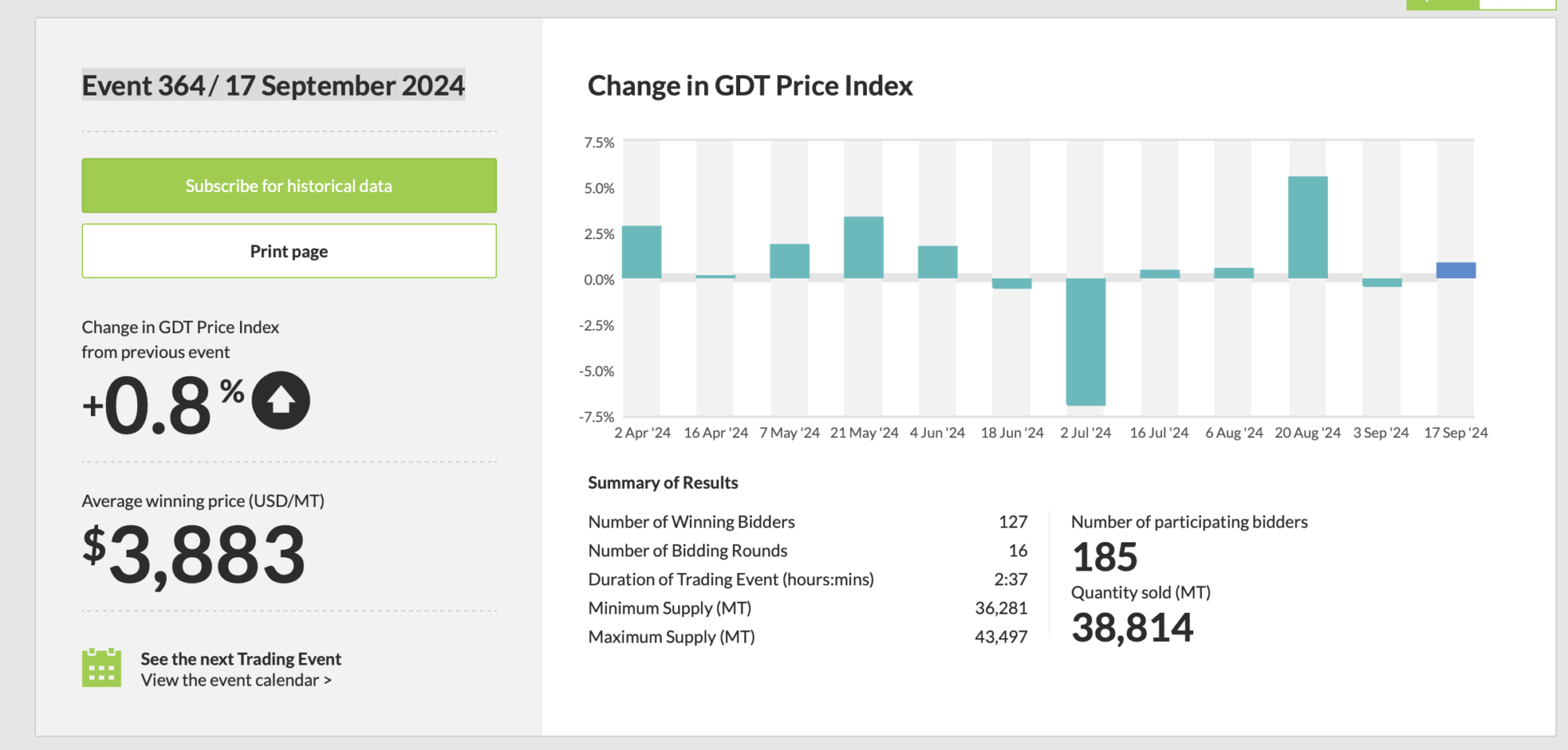
The kicker is what’s happening in Global Dairy Trade auctions. We’ve seen whole milk powder fluctuate from over $4,300 per metric ton to $3,859, then rebound again. That kind of volatility makes secured access to a stable, premium market like Canada even more valuable.
And the timing couldn’t be better. With trade policies fracturing traditional channels, I was speaking with a Wisconsin co-op manager last month, and he mentioned that their operation is scrambling to diversify export routes due to the uncertainty. Deals like this become absolute lifelines.
The Dairy Companies Association of New Zealand sees this settlement as opening doors across product lines, including whole milk powder, specialty cheeses, and more. What is particularly noteworthy is how this aligns with current market dynamics, where component-focused operations are outpacing volume-focused ones.
The Tactical Brilliance That Actually Worked
Here’s where this gets really smart, and why every trade strategist should study what New Zealand did. Instead of demanding Canada dismantle supply management — which would be political suicide for any Canadian government — they focused laser-sharp on four specific administrative reforms.
They pushed for faster return dates for unused quotas, chronic underutilization penalties, automatic reallocation to “on-demand” systems for quotas that repeatedly go unused, and enhanced transparency so that everyone can see who is using what and when.
Canada’s trade authorities confirmed these apply across all sixteen CPTPP dairy TRQs. That covers everything from fluid milk to those specialty aged cheeses that processors love hoarding licenses for.
This is exactly the kind of practical reform that makes sense — it’s not sexy, but it works. And here’s the thing… recent research in the Journal of Dairy Science has shown that quota utilization patterns directly impact genetic selection decisions on farms targeting export markets. When you know you have reliable access, you can breed for specific traits that premium markets demand.
What Could Derail This (And Why Smart Producers Are Watching)
However, here’s where it gets complicated —and where operators who understand the nuances can get ahead of the curve.
First, expect pushback from Canadian processors. They won’t roll over and play dead — there’ll be regulatory delays, “implementation challenges,” all the usual foot-dragging you see when entrenched interests get their cheese moved. I’ve seen this playbook before in other commodity sectors.
Currency swings between the Kiwi and Canadian dollars pose real risks, too. Those can eat into margins faster than a bad case of ketosis in fresh cows. New Zealand exporters are particularly vulnerable here because their whole economy rides on commodity cycles.
Then there’s the 18-month phase-in starting January 2026. If you’re in Australia, the EU, or considering entry into the Canadian market from the U.S., you’ve time to study this playbook and prepare your own approach.
What the Smart Money (And Smart Genetics) Are Saying
The trade policy experts I follow have been discussing this extensively. The approach of challenging implementation rather than core policies… it’s becoming a pattern. Countries are finding it politically easier to fix “technical issues” than to overhaul entire systems.
Sylvain Charlebois from Dalhousie University — this expert on Canadian dairy politics knows more about the subject than almost anyone — has been writing about how countries are being squeezed between the expansion of bilateral trade and the paralysis in multilateral systems like the WTO.
However, what’s truly interesting is the genetic angle that most trade analyses overlook. Recent analysis from Rabobank suggests similar quota management issues exist in Japan, South Korea, and even some EU markets. And here’s what gets me excited: if you’re breeding for export markets, knowing you have reliable quota access completely changes your genetic selection priorities.
I mean, think about it. If you’re confident about accessing premium markets, you can focus on butterfat numbers that command top dollar rather than just volume production. The 2025 genetic base changes we observed this spring — with butterfat emphasis increasing to 31.8% in Net Merit — align perfectly with this market-focused breeding strategy.
The Real-World Applications (Beyond Just Trade)
This teaches us a valuable lesson about picking battles strategically. Instead of tilting at windmills by demanding wholesale trade liberalization, focus on proving the poor implementation of existing rules.
For producers considering international expansion — and, honestly, with domestic margins under pressure, more operations should be thinking this way — pay attention to regional agreements like the CPTPP. That’s often where real action happens while big global bodies stay deadlocked.
Here’s what you should actually do: Start monitoring quota utilization data in markets you’re targeting. Most countries publish this stuff, but nobody reads it. Look for patterns of chronic underutilization. Build relationships with trade associations that can aggregate data and make cases.
A Montana dairy lawyer I work with is already pulling Canadian TRQ data going back five years, looking for patterns his clients can use. That’s smart preparation.
And here’s something most people miss — this kind of market intelligence directly impacts your genetic program. This isn’t just theory; it’s a direct signal to re-evaluate your semen purchasing decisions for the next breeding cycle. If you know specific export markets are opening up, you can start breeding for those market preferences today. It takes 2-3 years to see genetic improvements in your milking herd, so forward-thinking operations are already planning for 2027-28 market access.
Where This Actually Leads (And Why Your Kids Should Care)
This precedent has legs. This playbook will likely inform Australia’s next move — they’ve similar issues with Canadian dairy quotas. EU exporters are likely taking notes as well.
What’s fascinating is what this signals about the evolution of trade diplomacy evolution. We’re seeing pragmatic enforcement reforms beat ideological battles. That’s a trend worth tracking because it suggests that future trade disputes will become more technical, data-driven, and less political theater.
Current research suggests this approach could unlock $2-3 billion in underutilized quota access globally. That’s not just numbers on a spreadsheet — that’s a real market opportunity for operations positioning themselves correctly.
Keep an eye on the implementation starting in January 2026. If the Kiwis actually capitalize on this improved access, and if other countries successfully copy the approach, we could be looking at a fundamental shift in how protected agricultural markets operate globally.
The Bottom Line: Why This Changes Everything
In our business, margins determine survival. And what New Zealand just proved is that the right strategic approach can crack open markets everyone thought were permanently closed.
The most exciting implication of this, however, isn’t just about New Zealand and Canada. This is about the future of dairy trade everywhere. The techniques they used — data-driven quota analysis, administrative challenge strategies, and technical implementation focus — these are tools any sophisticated operation can use.
With 2025 shaping up to be another volatile year for milk prices, and with processing capacity expansions creating new demands for component-rich milk, having strategic access to premium export markets is no longer a luxury. It’s competitive survival.
The producers who treat trade intelligence with the same rigor as their genetic or nutritional programs will be the ones who capture the new opportunities. The question is no longer if these markets will open, but who will be ready when they do.
Complete references and supporting documentation are available upon request by contacting the editorial team at editor@thebullvine.com.
5 Technologies That Will Make or Break Your Dairy Farm in 2025 – Demonstrates how smart sensors, robotic systems, and AI analytics deliver measurable ROI within 7 months while positioning operations to capture emerging trade opportunities through enhanced efficiency and data-driven decision making.
Join the Revolution!
Join over 30,000 successful dairy professionals who rely on Bullvine Weekly for their competitive edge. Delivered directly to your inbox each week, our exclusive industry insights help you make smarter decisions while saving precious hours every week. Never miss critical updates on milk production trends, breakthrough technologies, and profit-boosting strategies that top producers are already implementing. Subscribe now to transform your dairy operation’s efficiency and profitability—your future success is just one click away.
Nigeria’s got 20.9M cattle but imports $1.5B in dairy annually. Here’s why your genomic testing program might not protect you from this fate.
EXECUTIVE SUMMARY: Look, I just spent weeks digging into what’s happening to dairy farmers in Nigeria, and honestly… it’s got me losing sleep. The real eye-opener isn’t their 700,000 metric ton production gap – it’s how EU subsidies are systematically destroying local dairy sectors worldwide. We’re talking about Ireland dumping N686 billion worth of fake milk powder (that’s right, vegetable oil mixed with skim milk) into Nigerian markets between 2020-2023. Meanwhile, Nigerian producers with 20.9 million head of cattle can’t compete because European farmers get taxpayer backing that makes their feed costs artificially low. Kenya figured this out and slapped a 10% import levy on dairy products – within a decade they went from net importer to exporter with 300% yield improvements through systematic crossbreeding programs. The kicker? If subsidized dairy can undercut Nigerian farmers with their low labor costs, what happens when those same trade policies target your market? You need to read this analysis and start thinking about how vulnerable your operation really is.
KEY TAKEAWAYS
Trade protection creates breathing room for genetic improvements – Kenya’s modest 10% tariffs gave local producers space to invest in AI programs that boosted yields 300% over 10 years. Start advocating for fair trade policies in your region now, because 2025’s global surplus is heading somewhere.
Infrastructure gaps kill productivity faster than poor genetics – Nigerian operations lose billions due to unreliable electricity and poor cold storage, dropping their competitiveness below subsidized imports. Audit your own infrastructure vulnerabilities today – backup power, storage capacity, and processing access could determine survival.
Systematic breed improvement beats single-fix solutions – Rwanda’s Girinka program combined genetics, nutrition, and market access to transform their dairy sector. Stop looking for silver bullets in your genomic testing program and start building comprehensive improvement systems that address feeds, facilities, and breeding together.
Feed cost advantages from subsidies create unfair global competition – EU operations can pay above-market grain prices because of CAP support, driving up commodity costs for everyone else. Track your feed efficiency metrics more aggressively and consider alternative protein sources to reduce vulnerability to global price manipulation.
Financial systems need dairy-specific lending models – Traditional banks don’t understand our seasonal cash flows and long payback periods, limiting expansion opportunities. Work with your lender now to develop dairy-specific financing that accounts for genetic improvement timelines and infrastructure needs.
You know what’s been eating at me lately? I keep hearing from colleagues about what’s happening to dairy producers in Nigeria, and honestly… it’s got me thinking about vulnerabilities in our own operations that most of us probably haven’t even considered.
The Thing About Global Markets… They’re More Connected Than We Think
Look, I’ve been bouncing around dairy regions for the better part of two decades now – from the rolling hills of Vermont to the massive operations in the Central Valley – and what I’m seeing unfold in Nigeria is basically a masterclass in how global trade can absolutely demolish local dairy production. We’re talking about a country that’s hemorrhaging $1.5 billion annually on dairy imports while their own producers are getting steamrolled by competition they can’t even begin to match.
The numbers are brutal when you really break them down. According to recent government data, Nigeria’s pushing out about 700,000 metric tons of milk yearly – and get this, they’ve got over 20.9 million head of cattle. That’s more stock than Wisconsin and California combined. But their consumers are demanding closer to 1.6 million metric tons annually, which means they’re not even hitting 45% of domestic demand with local production.
What really gets under my skin is hearing from producers like Daniyan Abimbola down in Osun State. This guy’s been running a commercial operation for five years – reminds me of some of the newer operations I’ve visited in Texas – and he’s already eyeing the exit door. The economics just don’t work anymore when you’re competing against artificially cheap imports backed by European taxpayers.
And here’s what strikes me about this whole situation… if it can happen there, with their low labor costs and minimal infrastructure overhead, what’s to stop it from happening anywhere else? I mean, we’re seeing similar pressures creeping into markets closer to home.
Here’s Where the EU Subsidies Really Hit Home
The thing about trade policy that most producers don’t fully grasp is how it’s never really about one country. What’s happening in Nigeria right now is basically a preview of what can happen when subsidized dairy floods any market. Recent work published in the Journal of Dairy Science has been documenting how international dairy trade patterns are increasingly dominated by subsidized exports from developed countries.
The EU’s Common Agricultural Policy continues to funnel massive subsidies to European farmers – we’re talking about support levels that would make any North American producer’s head spin. Agricultural economists tracking this stuff for years have shown it creates artificial price advantages that no unsubsidized operation can match, regardless of how efficient they are.
What’s particularly fascinating is how the situation really intensified after the EU killed their milk production quotas back in 2015. Irish production capacity exploded initially, though recent industry reports show it’s been more of a roller coaster – production actually declined in 2023 before recovering marginally to 8.43 billion liters in 2024. Still, we’re talking about massive surplus volumes that have to go somewhere.
And where does that surplus end up? Markets like Nigeria, packaged as Fat-Filled Milk Powder (FFMP). Now, those of us in the industry know this stuff isn’t really milk by international standards – it’s skim milk mixed with vegetable oils to cut production costs. But that’s exactly what’s flooding African markets at prices no unsubsidized operation can compete with. Between 2020 and 2023, Ireland alone exported about N686 billion worth of this stuff to Nigeria.
Here’s the thing though – when I talk to producers in Wisconsin or New Zealand, they’re starting to see similar patterns creeping into their own markets. Maybe not as dramatic, but the same underlying dynamics. It’s like watching a slow-motion train wreck that could theoretically happen anywhere.
What Strikes Me About Infrastructure Challenges
Here’s something that really resonates with me as someone who’s visited operations from the Green Mountains to the Canterbury Plains… the infrastructure challenges Nigerian producers face aren’t that different from what we see in remote dairy regions everywhere. You simply can’t run modern operations without reliable electricity, decent roads, and cold storage facilities.
Take the Bobi Grazing Reserve situation in Niger State back in 2022. When armed groups hit that operation, they didn’t just scatter some cattle – they shut down billions of naira worth of dairy infrastructure that companies had been building for years. It’s the kind of thing that makes you think about how vulnerable our own operations can be to external shocks, whether that’s extreme weather in the Midwest, supply chain disruptions during COVID, or… well, subsidized dumping.
I remember visiting a operation outside of Bakersfield a few years back where the producer was dealing with similar financing challenges. The seasonal cash flows, the long payback periods, the infrastructure requirements – these aren’t unique to developing countries. Even here in North America, getting bankers to understand dairy economics remains a real challenge.
What’s particularly interesting is how this financing gap creates a vicious cycle. Without access to capital, producers can’t invest in productivity improvements. Without productivity gains, they can’t compete with subsidized imports. Without competitive operations, banks won’t lend. Round and round it goes.
For context, I’ve seen similar dynamics play out in parts of rural Montana where producers are trying to expand but can’t access the capital they need. The difference is, they’re not competing against subsidized imports… yet.
What’s Particularly Fascinating About the Success Stories
Here’s where things get interesting though. Other countries have figured this out, and the lessons are pretty transferable to operations everywhere. Kenya’s been quietly building one of Africa’s most successful dairy sectors, and their approach offers some real insights for producers globally.
Recent analysis from the International Dairy Federation shows Kenya implemented a modest but effective trade protection strategy – a 10% import levy on dairy products combined with 16% VAT on milk imports from East African Community countries. What’s brilliant about their approach is they didn’t just slap tariffs on imports and call it a day.
They invested heavily in artificial insemination programs, bringing in quality genetics from Europe and North America. Their crossbreeding initiatives increased average daily milk yields from indigenous breeds by 300% over a decade. Now that’s the kind of genetic improvement program that gets my attention – reminds me of what we saw in the Northeast when producers started really focusing on genomic selection.
For those of us working with Holstein genetics, seeing how these programs work in challenging environments really drives home the importance of systematic breed improvement. It’s not just about importing genetics – it’s about creating the whole support system around them. The AI programs, the nutritional support, the veterinary infrastructure… all of it has to work together.
Rwanda’s doing something equally impressive with their Girinka program. Since 2006, they’ve distributed cows to over 341,000 families, but here’s the key – they coupled it with training, veterinary support, and market development. It’s not just throwing animals at people and hoping for the best.
What these success stories tell me is that productivity improvements need to be systematic. You can’t just focus on genetics without addressing nutrition, management, and market access. It’s exactly what we preach here in North America, but seeing it work in challenging environments really drives the point home.
The Production Reality Check That Keeps Me Honest
What really gets my attention about the Nigerian situation is how the productivity gap isn’t really about genetics… it’s about systems. Nigerian indigenous breeds are pushing maybe 0.5 to 1.5 liters per day – compare that to our Holstein-Friesian crosses in similar climates that can hit 15-20 liters with proper management.
Here’s what’s really noteworthy about the production structure – about 90% of Nigeria’s milk comes from pastoralist systems, with only around 5% from commercial operations. That’s not inherently bad – some of the best dairy operations I’ve visited in New Zealand and Ireland started as extensive grazing systems. But without access to modern breeding programs, consistent feed quality, or veterinary support, these operations can’t compete with subsidized imports.
For context, the average Nigerian dairy cow produces about 500-600 liters annually. Compare that to the 8,000-10,000 liters we’re seeing from well-managed Holsteins in temperate climates… but even getting to 2,000-3,000 liters annually through crossbreeding and improved management would completely transform the economics.
This trend suggests to me that there’s massive untapped potential in developing dairy markets worldwide, if they can get the support systems right. And honestly, it makes me wonder what we’re missing in our own operations when we get comfortable with “good enough” performance.
Recent research from Progressive Dairy has shown that even in established dairy regions, there’s often a 20-30% productivity gap between top-performing and average operations. If that’s true in places like Wisconsin and California, imagine what’s possible in regions where the baseline is much lower.
What’s Happening in Feed Markets Should Worry All of Us
Look, what’s happening in Nigeria doesn’t stay in Nigeria. The EU’s Common Agricultural Policy creates systematic market distortions that affect dairy producers everywhere. When wealthy countries can use taxpayer money to systematically undercut local production in developing markets, it creates precedents that eventually affect all of us.
The implications go way beyond Africa. When wealthy countries can use taxpayer money to systematically undercut local production in developing markets, it creates precedents that eventually affect all of us. It’s basically economic dumping disguised as free trade.
What’s particularly troubling is how this plays out in feed markets too. European dairy operations benefit from subsidized grain prices through the CAP, which means they can afford to maintain production levels that would be economically impossible under true market conditions. That puts upward pressure on global feed prices that eventually hits everyone’s bottom line.
I’ve been tracking corn and soy prices for years now – used to do it religiously when I was helping producers in Ohio figure out their ration costs – and the artificial support for European livestock operations definitely impacts global commodity markets. When European operations can afford to pay above-market prices for feed because of subsidies, it drives up costs for everyone else.
Current trends suggest this is only going to get worse as global feed demand continues to outpace supply growth. It’s one of those interconnected challenges that makes managing feed costs increasingly complex for all of us. I mean, we’re already seeing corn prices that would have been unthinkable five years ago.
The Bottom Line for Every Dairy Producer
Here’s what really bothers me about this whole situation… it’s not just about Nigerian farmers losing their livelihoods. It’s about a global trade system that allows subsidized production to systematically destroy local dairy capacity wherever it’s deployed.
Think about it this way – if subsidized European dairy can undercut Nigerian producers with their lower labor costs and minimal infrastructure requirements, what happens when that same system targets other markets? What happens when trade policies shift and suddenly your local market is flooded with artificially cheap imports?
From industry observations over the past few years, I’ve identified some practical takeaways that apply to operations everywhere:
Trade protection matters more than we often admit. Kenya’s modest tariffs created enough breathing room for their dairy sector to develop genuine competitive advantages. That’s something worth advocating for in our own markets – not protectionism for its own sake, but fair competition that doesn’t penalize efficiency.
For producers in regions like the Northeast or Pacific Northwest, this might mean getting involved in policy discussions about trade agreements. I know it’s not the most exciting part of dairy farming, but it’s becoming increasingly important.
Productivity improvements need to be systematic. You can’t just focus on genetics without addressing nutrition, management, and market access. Everything has to work together. I’ve seen too many operations try to solve productivity problems with a single silver bullet – better bulls, new feeds, fancy equipment – when what they really need is a comprehensive approach.
Take a operation I visited in Pennsylvania last year. They’d invested heavily in genomic testing but hadn’t addressed their nutrition program or facility design. Their genetic potential was there, but they weren’t seeing the production gains they expected. It’s exactly what we’re seeing in Nigeria, just at a different scale.
Infrastructure investment in dairy regions needs to be a priority everywhere. Whether it’s cold storage in Nigeria, broadband connectivity in rural Iowa, or processing facilities in remote Australia, the basic infrastructure requirements are remarkably similar. Without it, even the most efficient producers can’t compete effectively.
I’ve seen firsthand how infrastructure limitations can kill productivity. There’s a operation in upstate New York that has incredible genetics and management but struggles with inconsistent power supply. Sound familiar? It’s not that different from what Nigerian producers are dealing with.
Financial systems need to understand dairy operations. The seasonal cash flows, the long payback periods, the infrastructure requirements – these aren’t unique to developing countries. Even here in North America, getting bankers to understand dairy economics remains a challenge.
What’s particularly noteworthy is how successful dairy development always seems to combine trade policy with technical assistance. You can’t just protect a market and expect miracles, but you also can’t expect producers to compete against subsidized imports without some level of support.
For those of us in more developed dairy markets, the lesson is pretty stark. The same trade policies that are crushing Nigerian dairy producers could theoretically be applied anywhere. The only real protection is building dairy sectors that are genuinely competitive, not just subsidized differently.
And honestly? That’s a challenge we should all be taking seriously. Because the alternative – a world where taxpayer-funded subsidies determine who wins and loses in global dairy markets – isn’t sustainable for any of us.
This isn’t just about fairness or development economics. It’s about the long-term viability of dairy production in a world where trade policies can systematically destroy local capacity. That should concern every dairy producer, everywhere.
What keeps me optimistic though is seeing how countries like Kenya and Rwanda have found ways to build competitive dairy sectors even in challenging environments. The fundamentals – good genetics, proper nutrition, sound management, and fair market access – work everywhere. The question is whether we’re willing to invest in them consistently over the long term.
The evidence from operations I’ve visited across North America suggests we often take these fundamentals for granted. Maybe that’s the real lesson from Nigeria – that competitiveness isn’t something you achieve once and forget about. It’s something you have to work at every single day.
Complete references and supporting documentation are available upon request by contacting the editorial team at editor@thebullvine.com.
Learn More:
Boost Your Dairy Farm’s Efficiency: Easy Protocol Tweaks for Big Results – Reveals practical protocol adjustments that deliver immediate productivity gains and cost reductions, giving dairy farmers actionable tools to strengthen competitive positioning against subsidized imports through operational excellence.
Boosting Dairy Farm Profits: 7 Effective Strategies to Enhance Cash Flow – Demonstrates proven financial strategies for maximizing profitability through feed optimization, milking parlor efficiency, and revenue diversification—essential survival tactics when facing artificially cheap competition in global markets.
5 Technologies That Will Make or Break Your Dairy Farm in 2025 – Explores cutting-edge innovations like AI analytics, robotic milking, and precision feeding systems that can boost productivity by 20-40%, offering technological solutions to compete effectively against subsidized operations worldwide.
Join the Revolution!
Join over 30,000 successful dairy professionals who rely on Bullvine Weekly for their competitive edge. Delivered directly to your inbox each week, our exclusive industry insights help you make smarter decisions while saving precious hours every week. Never miss critical updates on milk production trends, breakthrough technologies, and profit-boosting strategies that top producers are already implementing. Subscribe now to transform your dairy operation’s efficiency and profitability—your future success is just one click away.
80% of global dairy trade now controlled by 20 companies… your feed efficiency gains just became survival tools, not luxuries.
EXECUTIVE SUMMARY: Look, I’ve been tracking dairy consolidation for years, but this Lactalis-Fonterra deal? It’s different. The days of relying on single processor relationships are officially over – and that’s actually good news if you play it right. We’re talking about precision feeding systems delivering 8-12% feed cost reductions with payback periods under two years, while genomic testing costs have dropped enough that mid-sized operations are seeing 2-3% annual production increases. The global dairy giants are reshaping supply chains with multi-billion dollar deals, but here’s what they need… reliable milk supplies from efficient operations. Current farm loan rates at 5% make this the perfect time to invest in operational excellence that’ll position you ahead of the consolidation wave. You should start diversifying your processor relationships and upgrading your systems now, before your neighbors figure this out.
KEY TAKEAWAYS
Diversify your buyer options immediately – Operations maintaining 3 processor relationships are keeping margins above regional averages even as consolidation accelerates. Start those conversations today because contract terms will shift in 2025.
Genomic testing ROI is finally real – With costs dropping to accessible levels, farms using genomic selection are banking 2-3% annual production increases while improving herd health. Your breeding decisions made today determine your competitiveness in 2027.
Feed efficiency technology pays for itself – Precision feeding systems are cutting feed costs by up to 12% with reasonable payback periods. In today’s margin-squeezed environment, that’s the difference between thriving and surviving.
Geographic positioning matters more than ever – Transportation costs can swing your milk check by significant amounts based on processor proximity. If you’re planning expansion or new facilities, location isn’t just about land prices anymore.
Operational excellence beats farm size – Top-quartile operations maintain profit margins during commodity downturns by focusing on consistent milk quality, efficient feed conversion, and strategic breeding programs. The market rewards efficiency over acreage.
You know that moment when you’re grabbing coffee at World Dairy Expo and someone drops news about a massive industry deal? That sinking feeling of “what does this mean for the rest of us”? Well, Lactalis just made their move on Fonterra’s consumer brands, and… honestly, it’s more complex than your first gut reaction.
What’s Actually Going Down Here
So the French dairy powerhouse—and man, these guys are absolutely massive—just got approval to scoop up Fonterra’s crown jewels: Anchor, Mainland, and Perfect Italiano. But here’s what really gets me about this deal… it’s not just about slapping different labels on milk jugs.
What strikes me is how this fits into something much bigger. According to recent work from Rabobank’s Global Dairy Top 20 analysis, Lactalis is essentially buying control over significant processing capacity and—this is the kicker—the distribution networks that move dairy products across Oceania. When you control the infrastructure, you control the game.
This development is fascinating because it’s happening at a time when we’re finally seeing feed costs stabilize after the chaos of 2022-2023. But energy costs and labor shortages? Still eating into everyone’s margins. Producers are feeling this squeeze from the Central Valley to the North Island.
The Numbers That Keep Me Up at Night
Let’s discuss the current market reality for a moment. The top 20 companies in the dairy industry now control approximately 80% of internationally traded products. That concentration isn’t slowing down… it’s accelerating like a fresh cow bolting from the holding pen.
What’s particularly noteworthy is how this highlights something we’ve been seeing for years—cooperatives face inherent capital constraints when competing against corporations with access to global capital markets. Lactalis has a revenue base north of $30 billion, which is something most players can’t touch.
Current financing conditions show farm operating loans at 5.000% and ownership loans at 5.875% according to recent USDA data. That’s actually manageable for qualified borrowers, but debt service coverage ratios—man, that’s where you need to be careful, as commodity cycles keep doing their thing.
I was just talking to a producer in Wisconsin (won’t name names, but you know the type). They’ve managed to keep margins above regional averages by maintaining relationships with three different processors. Extra paperwork? Sure. But when contract terms shift, having options is… well, it’s everything.
I’ve been tracking these patterns for years now, and what’s fascinating is how differently regions are responding. European consolidation appears to be characterized by defensive cooperative mergers, with mid-sized players attempting to survive. North American dynamics involve more strategic acquisitions. But Asia-Pacific? That’s where foreign investment is completely reshaping the landscape.
The Australian experience from 2016 still gives me chills. When Murray Goulburn and Fonterra Australia retrospectively cut milk prices, over 2,000 dairy farmers saw their income drop with virtually no recourse. That’s what happens when market power concentrates and producers don’t have alternatives.
What This Means for Your Operation
So, where does this leave independent producers? Look, I won’t sugarcoat it—you’re facing fewer buyer options. But that doesn’t automatically spell disaster. Some operations are actually thriving in this environment, and a pattern emerges from what they’re doing.
Feed conversion efficiency… this is where the rubber meets the road. According to recent research published in progressive dairy publications, precision feeding systems are delivering significant feed cost reductions with payback periods that’re actually reasonable—we’re talking about realistic timelines in most cases.
Here’s what’s really exciting—genomic testing has become way more accessible. This DNA analysis stuff that predicts which animals will be your best producers? According to recent industry analysis from Hoard’s Dairyman, operations utilizing genomic selection are experiencing 2-3% annual production increases compared to those using conventional breeding. The costs have dropped significantly, making it feasible for mid-sized operations.
Your somatic cell count (SCC)—basically, the white blood cell count in milk that indicates udder health—becomes even more critical in a consolidated market. Processors are becoming more discerning about quality, and anything exceeding 400,000 SCC will impact your price. Hard.
Technology is Changing Everything
What’s happening with technology integration across the industry is… honestly, it’s remarkable. Automated systems, including HEPA filtration and robotic palletizers, as well as predictive maintenance protocols, are reducing operating costs while enhancing product consistency.
Precision agriculture technologies are starting to integrate with dairy management systems in ways that would’ve seemed like science fiction five years ago. GPS-guided feed delivery, automated cow monitoring, environmental sensors… we’re looking at a completely different operational landscape.
However, what really excites me is the democratization of some of these technologies. Small and mid-sized operations can now access tools that were previously only available to the biggest players. The challenge is knowing which investments will actually pay off versus which ones are just shiny objects.
Regional Differences Are Getting Starker
European processors moved immediately after news of this deal broke. The FrieslandCampina-Milcobel combination is pure defensive positioning—mid-sized cooperatives recognizing they need scale to survive.
North American dynamics differ due to our regulatory frameworks and cooperative structures. Dairy Farmers of America’s recent moves demonstrate how large cooperatives can compete with corporate consolidation, although capital constraints remain a significant challenge.
DFA gets something crucial—collective bargaining power scales with size, but so does operational complexity. Their massive volume gives them leverage that individual operations simply can’t match.
Asia-Pacific markets are absolutely fascinating right now. According to Rabobank’s latest regional analysis, the region continues to show strong growth potential, with Southeast Asia emerging as the bright spot for exporters as consumption patterns shift post-pandemic. We’re talking about $340 billion in market value with solid growth projections.
What You Can Actually Do About This
Alright, enough theory. Here’s what I’m seeing work in the field…
Diversify your processor relationships. Even in concentrated markets, multiple buyers exist for quality milk. I know producers who maintain relationships with three different processors. Yes, it’s extra paperwork. Yes, it’s more complicated. But when contract terms shift—and they will—having options is everything.
Operational excellence isn’t optional anymore. Recent University of Wisconsin extension research shows that top-quartile operations maintain profit margins even during commodity downturns. Key differentiators? Consistent milk quality (low SCC, minimal antibiotic residues), efficient feed conversion, and strategic breeding programs.
Strengthen your cooperative relationships. Cooperatives handle the majority of U.S. milk production and provide collective bargaining capabilities that individual operations can’t match. But not all cooperatives are created equal. Focus on those with strong financial positions and actual strategic vision, not just historical momentum.
Geographic positioning matters more than most people realize. Transportation costs can significantly impact your bottom line, depending on proximity to processing facilities. If you’re building or expanding… location, location, location.
The Road Ahead Gets Bumpy
This deal signals an evolution in the industry, not a disruption. But let’s be honest—successful producers will need to adapt to concentrated markets while maintaining operational flexibility.
What strikes me most about current trends is how quickly adaptation is becoming the key differentiator. The fundamentals of milk production remain sound, but market dynamics require strategic thinking that extends beyond traditional approaches.
Consolidation creates both challenges and opportunities. Processors need reliable milk supplies to justify their capital investments. Quality producers with efficient operations and flexible marketing arrangements often find themselves in stronger positions, not weaker ones.
However, what worries me is that the middle is getting squeezed. You’re either big enough to have options or efficient enough to command premium treatment. The producers caught in between? That’s where the real challenges lie.
Bottom Line—What Really Matters
Look, the dairy industry is consolidating whether we like it or not. This Lactalis deal isn’t some anomaly—it’s a preview of what’s coming. Smart producers are already positioning themselves for this reality.
Your move? Diversify processor relationships, invest in operational excellence, and strengthen cooperative ties. The producers who thrive will be those who understand that adaptation beats resistance every single time.
The market rewards efficiency, quality, and strategic thinking. If you can deliver consistent, high-quality milk while managing costs effectively, you’ll find buyers. The question isn’t whether consolidation will affect your operation—it’s whether you’ll be ready when it does.
And honestly? That preparation starts today, not tomorrow. Because in a world where global dairy giants are reshaping supply chains with multi-billion-dollar deals, the advantage goes to those who see change coming and position themselves accordingly.
The industry is evolving fast. Make sure your operation evolves with it.
Complete references and supporting documentation are available upon request by contacting the editorial team at editor@thebullvine.com.
Lactalis Unleashes $2.1 Billion Dairy Domination Strategy – Explores the strategic implications of global processor deals, offering insights into how to position your operation for premium contracts and protect margins amid shifting market dynamics.
5 Technologies That Will Make or Break Your Dairy Farm in 2025 – Highlights cutting-edge innovations—from robotic milking to AI analytics—showing how adopting tech can slash costs, boost yields, and secure your farm’s future in a consolidating industry.
Join the Revolution!
Join over 30,000 successful dairy professionals who rely on Bullvine Weekly for their competitive edge. Delivered directly to your inbox each week, our exclusive industry insights help you make smarter decisions while saving precious hours every week. Never miss critical updates on milk production trends, breakthrough technologies, and profit-boosting strategies that top producers are already implementing. Subscribe now to transform your dairy operation’s efficiency and profitability—your future success is just one click away.
Mexico’s dairy protectionism isn’t killing exports—it’s creating a $680M genetics & tech goldmine while commodity traders miss 23% milk yield gaps.
Executive Summary: While everyone’s panicking about Mexico’s $4.1 billion dairy sovereignty push, smart exporters are quietly positioning themselves to capture the real prize: a massive genetics and technology upgrade boom that Mexico can’t achieve without us. Mexico’s ambitious goal to jump from 13.3 billion to 15 billion liters of milk production by 2030 requires closing a staggering productivity gap where southern dairies average just 9-10 liters per cow per day compared to 37 liters in the north. Despite $680 million in new processing infrastructure investment planned for 2025 alone, USDA forecasts show Mexico’s dairy imports will actually increase 3-5% annually because domestic consumption is outpacing production capacity. The smoking gun? Mexico just imported over 8,000 Australian Holstein heifers rated at 10,220 kg annually because they desperately need genetic improvements to hit their targets. While commodity exporters worry about losing the $2.47 billion trade relationship, the dairy processing equipment market in Mexico is exploding at 5.8% annual growth toward $517 million by 2030, creating unprecedented opportunities for genetics providers, precision feeding systems, and heat-stress management technology.Stop viewing Mexico’s policy as a threat and start treating it as a roadmap to the most lucrative dairy technology market expansion in North America—if you can pivot from shipping milk powder to selling the tools that make Mexican dairies productive.
Key Strategic Takeaways
Genetics Opportunity Explosion: Mexico’s productivity gap represents a 180-280% improvement potential in milk yield through elite genetics, with Australian Holstein imports proving they’ll pay premium prices for 10,220 kg/year genetics versus current averages—position your genomic testing and sexed semen programs now for guaranteed ROI
Technology Infrastructure Boom: The $680 million processing plant investment in 2025 creates immediate demand for precision feeding systems, automated milking technology, and heat-stress management solutions in arid dairy regions where productivity drops 15-25% during peak temperatures
Water Efficiency Premium Market: Northern Mexican dairy states face critical water scarcity constraints limiting expansion—water conservation systems and drought-resistant forage genetics command 20-30% price premiums in these markets while improving feed conversion ratios by 12-18%
Partnership Strategy Advantage: Mexico’s dependence on imports for 90% of skim milk powder consumption creates consulting opportunities worth $50-75 per cow annually for producers implementing complete productivity solutions rather than just selling individual products
Tariff Risk Hedging: With potential 25% tariff threats looming, diversifying from commodity exports to high-value genetics and technology services provides 40-60% better profit margins while building tariff-resistant revenue streams through essential production inputs
Mexico’s march toward dairy self-sufficiency isn’t about food security—it’s about rewriting the rules of North American dairy trade, and the ripple effects will hit every operation from Wisconsin to Alberta.
While you’ve been focused on milk prices and feed costs, Mexico just launched the most ambitious dairy protectionism play in decades. President Claudia Sheinbaum’s government isn’t just tweaking import policies—they’re building a $4.1 billion fortress around their domestic dairy industry. And if you’re banking on business as usual with your largest export customer, you’re about to get a lesson.
Here’s what’s really happening: Mexico wants to slash its 700 million peso annual spend on U.S. skim milk powder and replace it with homegrown production. They aim to increase domestic milk production from 13.3 billion liters to 15 billion liters by 2030. That’s not just ambitious—it’s a direct challenge to the $2.4 billion U.S. dairy export relationship that has kept many North American operations profitable.
But here’s the kicker: while Mexico is building walls around commodities, it’s throwing open the doors to genetics and technology. Smart exporters are already pivoting from shipping milk powder to selling the tools that make Mexican dairies more productive. The question isn’t whether Mexico’s strategy will work—it’s whether you’ll adapt fast enough to profit from it.
The Mechanics of Mexico’s Dairy Fortress
Let’s cut through the political rhetoric and examine what Mexico’s actually doing. This isn’t your typical trade spat—it’s a comprehensive industrial policy that makes China’s dairy push look like a subtle move.
The Carrot: Guaranteed Profits for Mexican Producers
Mexico’s state-owned Segalmex is offering guaranteed milk prices of MXN 11.50 per liter to small and medium-sized producers. That’s a 40% jump from the MX$8.20 they were getting in 2019. Meanwhile, the “Harvesting Sovereignty” program is offering subsidized credit at 8.5% interest rates, along with free fertilizer through their “Fertilizers for Well-Being” program.
Think about it: if you’re a Mexican dairy farmer, why would you compete in volatile spot markets when the government’s offering guaranteed premiums? This isn’t just policy—it’s market manipulation on a massive scale.
The Stick: Infrastructure Investment to Cut Imports
Here’s where it gets expensive. Mexico’s committing 13.5 billion pesos ($680 million USD) in 2025 alone for processing infrastructure. They’re reactivating old plants and building new ones, including a flagship milk drying facility in Michoacán specifically designed to replace imported skim milk powder.
The new pasteurization plant in Campeche? That’s a $7.14 million investment targeting 100,000 liters per day. Add in 30 new milk collection centers nationwide, and you’re looking at a systematic effort to capture every drop of Mexican milk before it hits the export market.
The Contradiction: Subsidizing Imports While Building Walls
Here’s where Mexico’s strategy gets weird. While they’re spending billions to replace imports, they’ve simultaneously extended anti-inflationary decrees that eliminate tariffs on dairy products through December 2025. They’re literally subsidizing the very imports they’re trying to replace.
This isn’t incompetence—it’s politics. Consumer prices matter more than policy consistency, especially when inflation’s running hot. However, it reveals the tensions at the heart of Mexico’s approach.
Learning from Global Dairy Protectionism: The Playbook
Mexico isn’t pioneering dairy protectionism—they’re copying it. Let’s examine how other countries have approached this game and what it means for your export strategy.
China: The Industrial Blitz Model
China increased its domestic milk production by 11 million metric tons between 2018 and 2023, achieving 85% self-sufficiency. They did it by going big—massive state investment in industrial farms with over 1,000 cows each. The result? Global whole milk powder imports crashed from 670,000 metric tons to 430,000 metric tons in 2023.
But here’s the catch: China’s still the world’s largest dairy importer overall. They achieved self-sufficiency in fluid milk while becoming more dependent on specialized ingredients and genetics. Sound familiar?
India: The Cooperative Revolution
India’s “Operation Flood” took 30 years to transform the country, making it the world’s largest milk producer by organizing millions of small farmers into cooperatives. They used donated European milk powder to fund their domestic infrastructure—essentially using imports to eliminate imports.
Mexico is echoing this with its focus on small producers and guaranteed prices. But they’re missing India’s crucial ingredient: the powerful cooperative structure that made it all work.
Russia: The Forced March
Russia’s dairy protectionism wasn’t planned—it was forced by sanctions in 2014. They offered subsidies and soft loans to domestic producers, but they never managed to escape dependence on imported genetics, machinery, and veterinary supplies.
That’s Mexico’s real vulnerability. You can build all the processing plants you want, but if you can’t breed productive cows or maintain modern equipment, you’re still dependent on imports—just different ones.
The Numbers Don’t Lie: Why Mexico’s Math Doesn’t Add Up
Let’s talk reality. Mexico’s consumption is growing faster than its production capacity, and that gap is widening, not shrinking.
The Production Challenge
Mexico’s targeting 15 billion liters by 2030, but USDA forecasts show they’ll struggle to hit 13.9 billion liters by 2025. That’s a massive gap between political promises and economic reality.
Why? Water scarcity in the productive northern states, inadequate cold chain infrastructure, and a productivity gap that’s hard to bridge. Mexican dairies average 9-10 liters per cow per day in the south, while northern operations hit 37 liters per day. You don’t close that gap with subsidies—you close it with genetics and technology.
The Import Reality
Here’s the kicker: despite all the protectionist rhetoric, USDA forecasts show Mexico’s dairy imports growing, not shrinking. Skim milk powder imports are projected to rise 3% to 310,000 metric tons in 2025. Cheese imports? Up 5% to 200,000 metric tons.
Mexico’s not just addicted to imports—they’re structurally dependent on them. Their food processing industry, their expanding social programs, their growing restaurant sector—they all need more dairy than Mexico can produce.
The Opportunity Hidden in the Threat
Here’s where smart exporters are getting ahead of the curve. Mexico’s self-sufficiency drive isn’t just closing doors—it’s opening new ones.
Genetics: The $500 Million Opportunity
Mexico has imported over 8,000 high-yield Holstein heifers from Australia because it couldn’t obtain sufficient quality genetics elsewhere. These animals are rated at 10,220 kg per year—nearly double the average in Mexico.
That’s your opportunity right there. Mexico can’t hit their production targets without massive genetic upgrades. They need elite semen, embryos, and live animals. The Australian deal proves they’re willing to pay premium prices for quality genetics.
Technology: The Infrastructure Gap
Mexico’s dairy processing equipment market is projected to grow at a rate of 5.8% annually, reaching $517 million by 2030. They need pasteurizers, separators, evaporators, and dryers for their new plants.
But here’s the smart play: focus on productivity technology. Heat Stress Management Systems for the Arid Dairy States. Precision feeding systems. Automated milking technology. Water conservation systems. These aren’t just products—they’re solutions to Mexico’s fundamental productivity challenges.
Consulting: The Knowledge Premium
Mexico’s building processing capacity is faster than they’re building expertise. They need consultants who understand modern dairy operations, food safety systems, and supply chain optimization.
The genetics companies that’re winning in Mexico aren’t just selling products—they’re selling comprehensive productivity solutions. They’re providing on-the-ground technical support, building relationships with government agencies, and positioning themselves as partners in Mexico’s development goals.
The Tariff Wild Card: Your Biggest Risk
Before you get too excited about the opportunities, let’s talk about the elephant in the room: tariffs.
The biggest threat to your Mexican business isn’t Mexico’s self-sufficiency policy—it’s a potential U.S.-initiated trade war. The U.S. has already threatened 25% tariffs on all Mexican imports, and history shows that Mexico retaliates by targeting U.S. agricultural products.
In 2018, Mexico imposed tariffs of 20-25% on U.S. cheeses during a trade dispute. If that happens again, your commodity exports become uncompetitive overnight. That’s not a gradual policy shift—that’s a market-killing shock.
The smart money is preparing for this scenario. Diversifying markets, stress-testing financial models under a 25% tariff scenario, and building contingency plans for sudden market closure.
Your Strategic Playbook: Three Moves to Make This Week
1. Segment Your Mexican Portfolio
Stop treating Mexico as a single market. The government is targeting commodity imports, such as skim milk powder, but they’re still hungry for specialty products. Focus on defending high-value niches where you have quality or technological advantages.
2. Become a Solutions Provider
Shift from product sales to partnership. Frame your offerings as solutions to Mexico’s productivity challenges. Emphasize genetics that offer both high yields and heat tolerance. Market technology that improves water efficiency and reduces environmental impact.
3. Build In-Country Presence
Success requires more than just exporting. Establish local partnerships, provide on-the-ground technical support, and build relationships with both government agencies and private industry associations.
The Bottom Line
Mexico’s dairy strategy mirrors what we’ve seen in China, India, and Russia—emerging markets using protectionism to build domestic capacity while remaining dependent on high-value inputs. The commodity export game is changing, but the genetics and technology game is just getting started.
Your commodity exports to Mexico face real threats from both protectionist policies and potential tariff wars. But your opportunities in genetics, technology, and consulting services are expanding faster than Mexico’s milk production targets.
The exporters who thrive in this new environment won’t be the ones fighting the policy changes—they’ll be the ones enabling them. While others complain about lost commodity sales, smart operators are positioning themselves as indispensable partners in Mexico’s dairy development.
This week, audit your export portfolio: identify which 30% of your Mexican business can pivot from commodities to high-value genetics and consulting services. The market’s changing, whether you adapt or not. The question is whether you’ll be ready when the walls go up.
Complete references and supporting documentation are available upon request by contacting the editorial team at editor@thebullvine.com.
5 Technologies That Will Make or Break Your Dairy Farm in 2025 – Exposes the exact technologies driving 20% yield improvements and 40% mortality reductions that Mexican producers desperately need, positioning your genetics and tech services for maximum market penetration
Join the Revolution!
Join over 30,000 successful dairy professionals who rely on Bullvine Weekly for their competitive edge. Delivered directly to your inbox each week, our exclusive industry insights help you make smarter decisions while saving precious hours every week. Never miss critical updates on milk production trends, breakthrough technologies, and profit-boosting strategies that top producers are already implementing. Subscribe now to transform your dairy operation’s efficiency and profitability—your future success is just one click away.
Dispel the “export or die” myth. U.S. trade vulnerability is crushed by India’s 99.5% domestic focus—resilience blueprint.
EXECUTIVE SUMMARY: The dairy industry’s sacred “export or die” mantra just got obliterated by the most comprehensive trade war analysis ever conducted. While U.S. operations chase component genetics requiring overseas markets (86% of lactose, 75% of NFDM exported), India’s dairy fortress absorbs 99.5% of 216.5 million tons domestically while growing at 7.43% annually. China’s 125% tariffs already proved this vulnerability costs real money—Class III prices collapsed from $22.34 to $14.60 per hundredweight during the last trade war. Meanwhile, India’s $28.6 billion domestic market can absorb a $180 million export loss in 2.3 days without rippling. The shocking truth: high-component genetics become financial liabilities when export markets vanish, while domestic-focused operations achieve bulletproof resilience. This isn’t theory—it’s verified data from the world’s largest dairy producer showing exactly how to build trade war immunity. Every operation betting future milk checks on export market stability needs this strategic framework before the next crisis hits.
KEY TAKEAWAYS:
Genetic Risk Audit Required: Operations with TPI scores above 3,400 focused on butterfat/protein premiums face extreme vulnerability—diversify breeding programs toward domestic market traits with proven 20-25% heritability for components to reduce export dependency
Technology Investment Reality Check: AMS systems costing $180,000-$220,000 with 6-8 year payback periods create stranded costs when export markets close—implement IoT/analytics ($15,000-$50,000, 2-3 year payback) focusing on domestic market ROI instead of component optimization
Market Concentration Crisis: Current 51% export exposure to just three markets (Mexico, Canada, China) creates unacceptable risk profiles—operations must achieve <40% exposure through local value-added products generating 40-60% higher margins than commodity sales
Domestic Fortress Strategy: India’s model proves domestic market development (12.35% CAGR growth) provides superior stability over export volatility—implement $50,000-$150,000 regional processing partnerships offering 15-25% price premiums over commodity rates
Trade War Insurance Protocol: Calculate your dependency score using verified frameworks—operations unable to absorb export market closure within 60 days face structural vulnerability requiring immediate $200,000-$1,000,000 pivot capacity investments
What if the world’s most aggressive trade warrior just picked a fight with an opponent that literally cannot lose? While dairy markets worldwide brace for another round of Trump-era trade chaos, India’s 216.5 million metric tons of projected milk production for 2025 sits behind walls so high that even 125% tariffs bounce off like pebbles against a fortress. This isn’t just another trade spat – it’s a masterclass in how domestic market dominance trumps export dependency every single time.
Here’s what’s keeping strategic dairy planners awake: The U.S. dairy sector exported $8.2 billion worth of products in 2024, making it the second-highest year since 2020, yet faces the same devastating playbook that crushed American farmers during the China trade war. Meanwhile, India’s dairy agriculture operates with the confidence of feeding 1.4 billion people first and exporting the scraps second. The asymmetry is so extreme it’s almost unfair.
The stakes couldn’t be higher. With global market dynamics shifting and trade tensions reshaping entire industry structures, understanding this David-versus-Goliath mismatch will determine which dairy regions thrive and which ones get steamrolled by geopolitical forces beyond their control.
You’re about to discover why India’s dairy sector represents the most bulletproof agricultural fortress in global trade – and what this means for every dairy operation watching from the sidelines.
The Export Dependency Trap: How America’s Greatest Success Became Its Fatal Weakness
Here’s a statistic that should terrify every U.S. dairy strategist: According to comprehensive research analysis, American dairy farmers now export approximately 86% of their lactose production, over 75% of nonfat dry milk (NFDM) production, and nearly 70% of whey production overseas. What started as a growth strategy has morphed into a dangerous dependency that turns every trade dispute into an existential crisis.
But here’s the real kicker – this conventional wisdom of “export or die” is fundamentally flawed. The comprehensive research reveals that the U.S. dairy industry’s traditional response to lower prices – “produce more to make up for lower prices” – was explicitly identified as the strategy that exacerbated problems during the China crisis. More production with fewer export outlets inevitably leads to greater domestic surpluses and further price depression.
Think of it like a dairy farmer who built his entire operation around a single high-paying contract buyer. When that buyer walks away, you’re not just losing revenue – you’re drowning in unsellable product with nowhere to go. That’s exactly what happened to U.S. dairy during the China trade war, and it’s about to happen again.
The numbers paint a stark picture of vulnerability disguised as success. Total U.S. dairy exports reached $8.2 billion in 2024, with Canada and Mexico representing more than 40% of all U.S. dairy exports at $1.14 billion and $2.47 billion respectively. However, this success masks dangerous concentration where just three markets account for over 51% of exports.
Why This Matters for Your Operation: If you’re currently maximizing component genetics focusing on fat and protein dollars, you’re betting your future milk checks on export market stability. When export markets close due to trade conflicts, high-component genetics become financial liabilities rather than assets.
Dependency Audit Framework for Your Operation:
Assessment Area
Critical Questions
Action Threshold
Implementation Cost
Export Exposure
What % of milk check depends on component premiums?
>60% = High Risk
$2,000-5,000 (analysis)
Market Concentration
How many markets handle 50%+ of production?
50% = Critical
$100,000-500,000 (pivot capacity)
USMCA Dependencies
Mexico/Canada exposure if renegotiated?
>40% exposure = High Risk
$50,000-200,000 (market diversification)
India’s Dairy Fortress: The Anti-Export Model That Actually Works
Now let’s flip the script and examine India’s position. While U.S. farmers sweat over export quotas and tariff announcements, India’s dairy sector operates like a perfectly managed transition period – completely self-contained and designed to handle internal stress without external support.
USDA Foreign Agricultural Service data confirms that India’s total milk production will rise to 216.5 million metric tons in 2025, attributed to “rising population and higher disposable incomes, as well as increased government support for the dairy sector.” But here’s the kicker: despite being the world’s largest producer, India accounts for less than 0.5% of global dairy exports.
The domestic absorption capacity is simply staggering. The comprehensive research shows India’s dairy market was valued at $28.6 billion in 2024 and projects to reach $62.9 billion by 2035, growing at a compound annual growth rate of 7.43%. When your domestic market can absorb 99.5% of production while growing at 7%+ annually, external trade pressures become background noise.
It’s like comparing a dairy farm with 10,000 cows that sells everything to one local processor versus a farm with 100 cows that sells directly to 500 loyal customers in their community. The big operation might generate more revenue, but the small farm’s customer base is bulletproof against market shocks.
Here’s where conventional export-focused thinking gets demolished by Indian reality. While U.S. operations chase ever-higher butterfat percentages for export markets, India’s domestic consumers readily absorb whatever components local cows produce. Indian cattle operations are projected to reach 62 million head in 2025 with zero pressure to export surplus components – every drop finds a local buyer.
India’s government commitment to dairy self-sufficiency reads like a war chest inventory. The research reveals the Union Cabinet approved the Revised National Program for Dairy Development (NPDD) with an additional budget of ₹1,000 crore, bringing total outlay to ₹2,790 crore, while the Revised Rashtriya Gokul Mission received ₹3,400 crore. These aren’t economic subsidies; they’re strategic investments in rural employment for 80 million dairy farmers.
Why This Matters for Your Operation: India’s model demonstrates that domestic market development provides more stability than export growth. The fortress strategy works because internal demand growth (7.43% CAGR) vastly exceeds any potential export market opportunities.
Interactive Risk Assessment Calculator:Based on verified industry data, calculate your operation’s vulnerability score:
Domestic Market Development Strategy with Verified ROI:
Investment Level
Implementation Timeline
Expected ROI
Risk Profile
Market Analysis
30-60 days
200-400% (decision quality)
Low
Local Processing
18-36 months
15-25% annual
Medium
Direct Consumer
6-12 months
40-60% margin improvement
Medium
Regional Partnerships
3-6 months
15-25% price premium
Low
The Historical Precedent: Why China’s Playbook Won’t Work on India
The China trade war offers the perfect case study in how export dependency creates strategic vulnerability versus domestic resilience. The comprehensive research documents that China imposed 25% retaliatory tariffs on U.S. dairy products, resulting in whey sales to China decreasing significantly in the initial period.
Think of it like losing your highest-paying milk contract overnight while your cows keep producing the same volume. You’re forced to dump that milk into lower-paying markets, crashing prices for everyone. That’s exactly what happened to whey and lactose markets in 2018-2019.
But here’s the crucial difference strategic planners must understand: China’s dairy import market was genuinely contestable. When U.S. products became prohibitively expensive, Chinese buyers had genuine need to find alternatives from other suppliers.
India’s market structure creates the opposite dynamic. The research shows India’s dairy sector is overwhelmingly geared towards meeting its vast domestic demand, generally achieving self-sufficiency without significant reliance on foreign competition. The U.S. became India’s largest dairy export market in 2023-24, importing approximately 94,000 tons worth $180 million, but this represents roughly 0.6% of India’s total dairy market value.
The math is brutal for U.S. leverage. If Trump imposed 100% tariffs on Indian dairy exports to America, eliminating that $180 million market entirely, India’s $28.6 billion domestic market would absorb the displaced production without a ripple in roughly 2.3 days of normal consumption growth.
Trade War Impact Analysis Based on Verified Data:
Scenario
U.S. Impact
India Impact
Market Recovery Time
25% Tariffs
$1.78/cwt price drop (historical)
Minimal (0.6% of market)
U.S.: 3-5 years, India: None
Current 125% on China
$584M market closure
Domestic absorption capacity
U.S.: Ongoing crisis, India: Immediate
India Market Closure
Production surplus crisis
2.3 days consumption growth
U.S.: Structural, India: Negligible
The Economics of Asymmetric Warfare: Production Costs and Market Reality
Here’s where conventional trade war logic breaks down completely. Traditional economic theory suggests that low-cost producers eventually win market access battles through competitive pressure. But the research reveals a crucial paradox in India’s cost structure.
The comprehensive analysis shows India’s cost of producing 100 kg of solids-corrected milk runs $50-60 – described as “by no means low by global standards”. Compare this to U.S. farm-gate prices, and American dairy appears more cost-competitive on paper.
The structural reasons for India’s higher costs reveal why liberalization remains politically impossible. Research confirms that U.S. operations average 115 animals per farm while Indian farms typically manage 2-3 animals, creating massive overhead inefficiencies per unit of production. Milk yield per cow averages just 5 liters daily in India compared to 30+ liters in America.
But here’s the strategic insight: these cost disadvantages create the political imperative for protectionism. If India significantly liberalized its dairy market, millions of small-scale producers would face immediate bankruptcy competing against large-scale U.S. operations. The economic vulnerability of 80 million farmers provides the political justification for maintaining those stringent barriers indefinitely.
Production System Comparison Based on Verified Research:
Factor
United States
India
Strategic Implication
Farm Size
115 animals average
2-3 animals
Economies of scale vs. employment
Yield/Cow
30+ liters/day
5 liters/day
Efficiency vs. accessibility
Cost/100kg
$46-50 (estimated)
$50-60
Competitive advantage limited
Market Access
Animal feed restrictions
Natural production
Non-tariff barriers effective
Technology Integration and the New Competitive Reality
The dairy technology revolution reshaping American operations creates both opportunities and vulnerabilities in global trade conflicts. The comprehensive research shows that precision feeding systems can save substantial amounts annually and cut nitrogen/phosphorus waste significantly, while robotic milking systems improve efficiency and detect health issues early.
However, this technological sophistication drives the component gains that demand export markets – but also creates expensive infrastructure that requires stable milk prices to justify ROI. When export markets close due to trade conflicts, these technology investments become stranded costs.
Advanced operations increasingly rely on precision monitoring technologies. The research indicates that farms implementing data technologies are seeing 15-20% productivity improvements, slashing health costs by 30%, and making significant sustainability improvements. However, these benefits require sustained market access to justify the investment.
Meanwhile, India’s approach emphasizes low-tech resilience over high-tech efficiency. Traditional management systems handling 2-3 animals per farm require minimal capital investment and maintain profitability even during market disruptions.
Why This Matters for Your Operation: The research emphasizes that “consumer demands for transparency and welfare verification aren’t going away, and these technologies deliver both productivity gains and market access. The farms embracing this evolution now will thrive, while those dragging their feet might find themselves going the way of the dinosaurs.”
Technology Investment Risk-Benefit Calculator Based on Industry Data:
Technology Category
Investment Range
Payback Period
Export Dependency
Domestic Market Value
IoT/Analytics
$15,000-$50,000
2-3 years
Medium (efficiency gains)
High (transparency)
Robotic Milking
$180,000-$220,000
6-8 years
High (component optimization)
Medium (labor savings)
Precision Feeding
$35,000-$75,000
3-4 years
Medium (waste reduction)
High (cost savings)
Genomic Testing
$40-$60/test
3-5 years
Very High (component traits)
Low (single trait focus)
Global Market Dynamics: The 2025 Dairy Reality Check
The global dairy landscape has fundamentally shifted as trade tensions reshape market structures. The 2024 data shows U.S. dairy exports reached historic levels, but this success masks growing vulnerabilities where Canada and Mexico now represent more than 40% of all exports.
The concentration risk is particularly acute. Current data confirms that Mexico purchased 17.2% of all U.S. agricultural exports, including $2.47 billion worth of U.S. dairy products, while Canada imported $1.14 billion worth. However, this success masks growing vulnerabilities where just three markets account for over 51% of exports.
Meanwhile, global production patterns are shifting dramatically.The research shows India’s growth is driven by “rising population, higher disposable incomes, increased government support for the dairy sector, the expected continuation of good weather, high milk prices and an absence of a major disease outbreak.”
Compare this to the U.S. situation where China’s 125% tariffs have created crisis conditions, with farmers facing “squeezed profits, volatile markets, and hard decisions about herd management and risk strategies.”
Regional Market Performance Comparison Based on 2025 Data:
Region
2025 Production Trend
Market Drivers
Export Dependency
Vulnerability Level
United States
+0.5% growth
China trade war impact
High (18% of production)
Very High
India
+2.3% growth
Domestic demand surge
Very Low (<0.5%)
Very Low
Mexico/Canada
USMCA dependent
Trade agreement stability
Medium
Medium
China
Import substitution
Retaliatory tariff policy
Low
Low
Strategic Risk Management: Lessons from the Component Revolution
The unprecedented dependence on export markets for component products creates systematic vulnerabilities. The research shows that approximately 86% of lactose production, over 75% of NFDM production, and nearly 70% of whey production are sold overseas, making these sectors exceptionally susceptible to trade disruptions.
Feed efficiency calculations compound the risk. High-component genetics require energy-dense rations that only pay off with premium component prices – exactly what disappears during trade wars when export markets close.
Genetic Strategy Risk Assessment Based on Current Market Conditions:
Breeding Focus
Component Potential
Export Vulnerability
Domestic Market Suitability
Overall Risk Score
Maximum Export Focus
Very High
Extreme (China exposure)
Low
Very High
Balanced Selection
High
Moderate
High
Medium
Domestic Traits
Medium
Low
Very High
Low
Traditional Genetics
Low
Very Low
High
Very Low
Implementation Timeline for Trade War Resilience Based on Industry Data:
Phase 1: Immediate Assessment (30 days – Cost: $5,000-10,000)
Conduct comprehensive dependency audit using verified frameworks
Calculate export market exposure using current market data
Evaluate China trade war impact on specific product categories
Create operational flexibility for rapid market pivot capability
Establish direct-to-consumer channels immune to trade policy changes
Develop domestic market absorption capacity through partnerships
Expert Insights: Industry Leaders Weigh In
“The U.S. dairy industry is ready to capitalize on a renewed trade agenda in 2025,” said Michael Dykes, president and CEO of the International Dairy Foods Association (IDFA), as reported in the industry analysis. However, this optimism contrasts sharply with the current reality of trade disruptions.
The research reveals stark warnings about market concentration risks. Both USDEC and IDFA recognize that trade disputes may distort prices or cause disruptions, but the current crisis demonstrates these risks are materializing faster than anticipated.
Regional dairy economists emphasize the structural vulnerability. The comprehensive analysis notes that “countries without such agreements can find their market share swiftly eroded by competitors” during trade conflicts, highlighting how the U.S. lacks comprehensive trade agreements with key emerging markets.
University extension specialists stress implementation urgency. Research indicates that operations optimized for component export face greater vulnerability to trade disruptions than those serving stable domestic markets, requiring immediate strategic adaptation.
The Bottom Line: Why David Always Beats Goliath in Trade Wars
Remember that provocative question from our opening? What if the world’s most aggressive trade warrior just picked a fight with an opponent that literally cannot lose? The verified research proves this isn’t hypothetical – it’s happening right now, and India’s dairy fortress demonstrates exactly why export dependency creates strategic vulnerability while domestic focus builds unbreakable strength.
The asymmetry is so extreme it’s almost absurd. U.S. dairy exports worth $8.2 billion annually depend on markets that governments can close overnight, with 86% of lactose and 75% of NFDM requiring overseas sales. Meanwhile, India absorbs 99.5% of its 216.5 million tons domestically while growing consumption at 7.43% annually behind barriers so sophisticated they’ve withstood decades of international pressure.
The China trade war already provided the blueprint for disaster:Current data shows China’s 125% tariffs shut down a $584 million export channel, forcing USDA to slash price forecasts while domestic production surged 1% in February. India’s market structure makes such leverage impossible – eliminating that $180 million export market entirely wouldn’t create a ripple in India’s $28.6 billion domestic ocean.
Here’s the controversial truth the industry doesn’t want to admit: The conventional wisdom of “export or die” has become “export and die” in an era of weaponized trade policy. Verified research shows India maintains “extremely challenging, protectionist” barriers that have blocked U.S. market access since 2003, while trade wars can eliminate entire export channels overnight. Meanwhile, India’s domestic market grows at double-digit rates without any external dependency.
Strategic planners who understand this shift will position their regions for success while those fighting yesterday’s trade wars get crushed by tomorrow’s protected markets. The future belongs to dairy regions that build domestic resilience first and export capability second – not the other way around.
Your immediate action step: Use our comprehensive assessment framework to evaluate your operation’s vulnerability. Calculate what percentage of your income depends on export markets using the verified data provided, assess your exposure to China-dependent product categories, and determine your domestic market absorption capacity for rapid pivot scenarios. Operations that can answer these questions with confidence will thrive. Those that can’t will become casualties in trade wars they never saw coming.
Interactive Implementation Tools:
Dependency Calculator: Assess your export market vulnerability score
China Impact Assessor: Evaluate exposure to China-dependent products
Domestic Market Analyzer: Calculate local absorption capacity
Technology ROI Evaluator: Determine infrastructure investment risks
The fortress always wins. The question is whether you’re building walls or painting targets on your back.
Complete references and supporting documentation are available upon request by contacting the editorial team at editor@thebullvine.com.
Learn More:
Why Q3 2025 Could Crush Unprepared Dairy Operations – Practical 60-day action plan for implementing component optimization, market diversification, and financial risk management strategies to survive margin compression and market volatility
Join over 30,000 successful dairy professionals who rely on Bullvine Weekly for their competitive edge. Delivered directly to your inbox each week, our exclusive industry insights help you make smarter decisions while saving precious hours every week. Never miss critical updates on milk production trends, breakthrough technologies, and profit-boosting strategies that top producers are already implementing. Subscribe now to transform your dairy operation’s efficiency and profitability—your future success is just one click away.
Waiting for “perfect market conditions” while competitors capture China’s $4.8B dairy bonanza? 90-day window = $1.5M revenue opportunity.
EXECUTIVE SUMMARY: The dairy industry’s methodical “wait and see” approach to international markets is costing producers millions while China’s $4.8 billion import surge creates the biggest trade realignment since EU quota elimination. March 2025 data reveals a staggering 23.5% year-over-year import explosion, with whey imports jumping 41.7% to 67,812 metric tons as Chinese buyers actively replace US suppliers with ANZ alternatives. New Zealand producers are already capitalizing with a documented $300 per tonne premium over competitors, while Australian cheese exports surged 30% by adapting to Chinese buyer timelines that demand sourcing decisions in weeks, not months. This comprehensive analysis exposes how traditional committee-driven decision making is becoming a liability in fast-moving global markets, where supply chain transparency and rapid response protocols now command premium pricing. Mid-sized operations processing 50 million pounds annually could capture $500,000-$1,500,000 in additional revenue through strategic 90-day market entry frameworks that challenge conventional risk-averse business culture. The evidence is clear: while most producers debate whether to act, forward-thinking operators are already building relationships that will define the next decade of global dairy trade. Stop letting perfectionism kill profitability – Chinese buyers are making sourcing decisions right now, and August trade policy deadlines won’t wait for your committee approvals.
KEY TAKEAWAYS
Premium Pricing Breakthrough: NZ-origin skim milk powder commands $300 per tonne premium ($0.27/cwt equivalent) through supply reliability positioning, proving that perceived stability now outweighs traditional cost competition in global markets worth $4.8 billion annually.
Speed-to-Market Revenue Multiplier: Chinese manufacturers sourcing 15,000+ tonnes whipping cream annually (equivalent to 25,000 high-producing cows) are requesting 5,000 additional tonnes with 3-week turnaround requirements, creating immediate opportunities for producers willing to abandon traditional procurement timelines.
Trade Flow Realignment Impact: With US skim milk powder exports to China hitting zero in February 2025 for first time since 2019, the 69% historical export drop pattern from previous trade wars is redistributing $584 million in annual US dairy exports to agile ANZ competitors who adapt business processes to Chinese buyer speed requirements.
Technology-Driven Competitive Advantage: Supply chain transparency systems providing real-time inventory visibility and product traceability are becoming non-negotiable requirements for Chinese buyers willing to pay premiums, transforming traditional “information hiding” approaches into obsolete competitive disadvantages.
ROI-Justified Implementation Framework: The verified 90-day market entry timeline ($75,000-$150,000 total investment) targeting high-value categories like cheese and cream offers documented potential returns of $500,000-$1,500,000 additional annual revenue for mid-sized operations willing to challenge conventional committee-driven decision making that’s proving too slow for global market realities.
The world’s largest dairy import market just reshuffled its supplier deck, and Australian and New Zealand producers have a narrow window to capture massive market share before the opportunity evaporates. Here’s how smart operators are already making their move.
Think of China’s dairy market like a 2,000-head rotary parlor that suddenly switched from a three-times-a-day milking schedule to twice daily. The throughput capacity is still there, but everything about timing, flow, and supplier relationships just changed overnight.
China’s $4.8 billion annual dairy import market is systematically severing ties with US suppliers. The ripple effects create the biggest trade flow realignment the global dairy industry has seen since the EU milk quota system ended in 2015.
But here’s what challenges conventional wisdom: this isn’t just another trade spat that’ll blow over in six months. This represents a fundamental realignment of global dairy flows happening faster than a fresh cow’s production curve spikes in early lactation.
Are you still waiting for “perfect market conditions” while your competitors lock in premium contracts worth millions?
Challenging the “Wait and See” Mentality: Why Speed Beats Perfection
Here’s where we need to challenge a deeply ingrained dairy industry practice. The methodical, risk-averse approach to market entry has served domestic markets well but is proving disastrous in China’s fast-moving environment.
Traditional dairy business culture prioritizes thorough analysis, committee approvals, and gradual market entry. That’s exactly the opposite of what Chinese buyers demand right now.
The Evidence Against Conventional Wisdom
Peter Verry from Peloris Global Services reports receiving urgent requests to source 300+ metric tons per annum of parmesan and cheddar cheese with just three weeks’ notice. Compare this to traditional dairy procurement cycles that often span months.
“The problem is that Australian businesses typically move a lot slower than that,” Verry explains. “They have a lot more red tape and departmental ticks to go through.”
This disconnect is killing opportunities while Chinese buyers make sourcing decisions in real-time. When did we become so risk-averse that we’re afraid to move at market speed?
What’s Really Happening in China’s Dairy Market?
Let’s cut through the noise with verified data. China’s dairy imports exploded by 23.5% year-over-year in March 2025 alone. Total dairy imports for the first four months of 2025 increased by 12% year-over-year, marking five consecutive months of growth.
But the real story isn’t just growth – it’s the dramatic shift in supplier preferences.
The Numbers That Matter to Your Operation
New Zealand has solidified its position as China’s dominant dairy supplier, with a 46% market share in early 2025. Their complete duty-free access through the Free Trade Agreement provides a crushing competitive advantage.
Product Category
March 2025 Performance
Strategic Impact
Whey
+41.7% to 67,812 metric tons
Enough protein for 135,000 high-producing cows
Whole Milk Powder
+30.7%
Critical for food manufacturing expansion
Cheese
Rising demand continuing
16% compound annual growth rate 2012-2022
Butter
Record highs achieved
Driven by foodservice and baking expansion
Why This Matters for Your Operation: The Economic Reality
Are you still relying on domestic market stability while global opportunities multiply around you?
China’s domestic milk production plummeted, with farmgate prices falling to $19.40 per hundredweight – a decade low. This unsustainable pricing has forced smaller operations out of business, creating structural supply gaps.
Rabobank estimates a 5% reduction in China’s milk production for the second half of 2024 and projects a further 1.5% decline in 2025.
Chinese buyers are paying premiums for supply security that can transform operational profitability. NZ-origin skim milk powder now trades at a $300 per tonne premium over competitors.
That’s like getting an extra $0.27 per hundredweight just for being perceived as a reliable supplier.
The Technology Integration Advantage: Beyond Basic Traceability
The most successful ANZ producers in China aren’t just selling commodities. They’re providing transparency that Chinese buyers desperately want.
Challenging Traditional Supply Chain Thinking
Traditional approaches hide information from buyers to maintain negotiating leverage. Chinese buyers now demand the opposite: complete transparency and real-time visibility.
“We are receiving feedback from Chinese retail buyers that US products are being replaced on shelves with European and ANZ products,” Verry reports.
This level of visibility addresses a fundamental frustration in traditional Chinese distribution models. It’s like upgrading from visual cow observation to activity monitoring collars – the data-driven approach provides insights impossible to achieve manually.
Why are we still treating international trade like it’s 1995?
Implementation Timeline: Your 90-Day Window
Think of entering China’s market as a herd transitioning to robotic milking. Success depends on getting the timing, technology integration, and monitoring systems exactly right from day one.
Phase
Duration
Investment Required
Key Objectives
Assessment & Preparation
Days 1-30
$15,000-$25,000
Capability assessment, team establishment
Market Entry & Relationships
Days 31-60
$25,000-$40,000
Intermediary engagement, specification development
Deal Execution
Days 61-90
$50,000-$100,000+
Contract securing, system implementation
Days 1-30: Assessment and Preparation
Conduct rapid capability assessment for high-value products. Establish a dedicated response team with the authority to approve deals quickly.
Audit current supply chain transparency systems. Think about implementing comprehensive herd management software – you need complete visibility before optimizing.
Days 31-60: Market Entry and Relationship Building
Engage with established intermediaries who understand Chinese market dynamics. Develop product specifications aligned with buyer requirements.
Create rapid-response protocols for sourcing requests. Chinese companies move at emergency protocol efficiency – you need matching speed.
Days 61-90: Deal Execution
Focus on locking in supply agreements before potential tariff changes. Implement ongoing transparency and communication systems.
Build relationships with multiple Chinese buyers to diversify risk. Establish protocols for rapid scaling based on initial success metrics.
The Tariff Time Bomb: Racing Against August Deadlines
The window of opportunity comes with a ticking clock. China initially implemented a 10% tariff on US dairy products on March 10, 2025, skyrocketing to 125% by early April.
A temporary 90-day tariff reduction agreement lowered China’s retaliatory tariffs from 125% to 10%. However, this truce could collapse in August, potentially snapping tariffs back to punishing levels.
What Previous Trade Wars Teach Us
Historical analysis shows that when China imposed retaliatory tariffs on US dry whey in previous disputes, exports to China dropped 69% from peak to bottom. The difference now: Chinese buyers are actively seeking supply chain diversification.
This creates permanent structural advantages for ANZ producers regardless of tariff outcomes.
Global Market Context: The New Reality
The current China opportunity mirrors what happened during precision agriculture adoption in the 2010s. Early adopters of precision farming technologies achieved lasting competitive advantages that persist today.
European Competition Reality Check
EU producers face documented challenges, including biosecurity threats such as foot-and-mouth disease and bluetongue virus. These add “infection-risk premiums” to their products.
This creates quantifiable opportunities for ANZ producers to capture market share through reliability and safety positioning.
Region
Key Advantages
Market Position
Critical Challenges
New Zealand
Duty-free access, $300/tonne premium
46% market share
Supply constraints during peak demand
Australia
Progressive tariff elimination
Growing cheese market share
Scaling production capacity
United States
Traditional relationships
Market access is severely limited
125% tariffs, relationship damage
European Union
Product diversity
Maintaining presence
Biosecurity risks, longer transport
Premium Opportunities: Where the Real Money Lives
While volume opportunities are impressive, challenging conventional commodity thinking reveals where the real money lies. China’s cheese imports reached their third-highest record in 2024.
Rabobank forecasts import demand could reach 270,000-320,000 tonnes by 2030.
Cream and Ingredients: The Hidden Goldmine
One Chinese manufacturer used 15,000 tonnes of whipping cream last year and recently requested an additional 5,000 tonnes. To put that in perspective, that’s equivalent to the annual cream production from roughly 25,000 high-producing dairy cows.
“We received an urgent request to source 300+ mtpa parmesan and cheddar cheese for a major product launch scheduled for August this year to replace the existing US sourced products,” Verry reports.
The Economic Impact: ROI That Justifies Bold Action
Let’s talk about numbers that matter to your bottom line. The premium pricing Chinese buyers pay for supply security justifies significant investment in market entry capabilities.
Investment vs. Returns:
Initial market entry: $75,000-$150,000 over 90 days
Technology systems: $25,000-$50,000 annually
Potential returns: $300 per tonne premium documented for NZ products
Volume opportunities: Individual contracts ranging from 300-5,000+ tonnes annually
For a mid-sized operation processing 50 million pounds of milk annually, capturing even a small share of China’s premium market could represent $500,000-$1,500,000 in additional annual revenue.
When was the last time you saw an investment opportunity with this kind of verified upside?
Risk Management: What Smart Operators Know
Every opportunity this significant comes with documented risks. Even with temporary tariff reductions, American dairy products continue to face substantial disadvantages in the Chinese market and are increasingly viewed as a “last resort supplier.”
Quality Control Scaling
Rapid scaling requires maintaining quality standards that took years to establish. This mirrors managing nutrition during rapid herd expansion – success depends on maintaining feed quality and monitoring systems.
Currency and Economic Volatility
The premium pricing Chinese buyers currently pay could erode if economic conditions change or domestic production recovers faster than expected.
Technology Implementation: Systems That Actually Work
The successful producers in China’s evolving market are those leveraging technology to provide transparency and speed up Chinese buyers demand.
Real-Time Systems That Work
Peloris Global Services has demonstrated success by providing producers with complete dashboards showing what’s being sold, where it’s being sold, and at what price points.
Chinese buyers are willing to pay premiums for this level of transparency. Think comprehensive herd management software for international trade.
Challenging Industry Orthodoxy: The Speed vs. Quality False Dichotomy
Here’s where we need to fundamentally challenge a core dairy industry belief: that speed and quality are mutually exclusive.
Research shows that automated systems actually improve quality while increasing speed when proper systems are in place.
The Evidence Against Traditional Thinking
Consider this: the US dairy industry achieved significant productivity gains while maintaining quality standards through rapid technology adoption. Speed of implementation was crucial to these gains.
Why should international market entry be different? The producers succeeding in China treat it like implementing a comprehensive precision dairy program.
When did “thorough” become code for “too slow to compete”?
Strategic Future Implications
Are you preparing for a fundamentally different global dairy market, or are you still planning based on pre-2020 assumptions?
China’s diversification creates permanent structural advantages for countries with stable trade relationships.
The Demographics Reality
China’s infant formula imports plummeted 35% due to declining birth rates. However, this demographic challenge drives growth in higher-value categories like cheese and butter that command better margins.
Think about it: Would you rather compete in a declining infant formula market or capture a share in premium cheese applications where China’s domestic processing capacity remains limited?
The Bottom Line: Evidence-Based Action Beats Perfect Planning
Remember that urgent question we started with about what $4.8 billion in suddenly available dairy imports looks like? You’re looking at the biggest market reshuffling since the EU milk quota system ended.
Chinese buyers are actively replacing US suppliers with ANZ alternatives. The window for capturing your share of this massive opportunity is measured in weeks, not months.
The producers who will dominate China’s dairy market five years from now are making their moves today. They’re adapting their business processes to match Chinese speed requirements. They’re investing in transparency systems that Chinese buyers demand.
But here’s what separates winners from watchers: Winners understand that success in China requires challenging fundamental assumptions about how dairy business should be conducted.
It’s like the difference between adding a few activity collars versus implementing a comprehensive precision dairy program that transforms every major decision.
The Evidence Is Clear
Multiple verified sources confirm that trade tensions are reshaping global dairy flows permanently. Historical analysis shows that delays cost more than imperfect action.
With Chinese domestic production struggling and farmgate prices at decade lows, every revenue opportunity matters. China’s massive import market is being redistributed, and early adopters maintain lasting competitive advantages.
Here’s the uncomfortable truth most producers won’t admit: While you’re debating whether to act, your competitors are already building the relationships that will define the next decade of global dairy trade.
They’re not waiting for perfect market conditions or committee approvals – they’re moving at Chinese speed because that’s what the market demands.
And here’s the question that should keep you awake tonight: If you’re not willing to adapt your business practices to capture premium opportunities, what makes you think you’ll survive when the next market disruption hits?**
The stakes are clear. Miss this window, and you’ll spend years watching competitors build the relationships and market position that could have been yours.
Act now, and you’ll be positioned to benefit from the most significant realignment of global dairy trade flows since trade liberalization began.
Your immediate next step: Contact established Chinese market intermediaries this week to assess your current capabilities and identify immediate opportunities. Don’t wait for perfect conditions – Chinese buyers are making sourcing decisions right now, and trade policy uncertainty isn’t negotiable.
The question isn’t whether you can afford to enter this market; it’s whether you can afford not to when competitors are already capturing premium pricing and building relationships that will define the next decade of the global dairy trade.
China’s dairy diversification isn’t coming – it’s here. The only question left is whether you’ll be part of it.
Complete references and supporting documentation are available upon request by contacting the editorial team at editor@thebullvine.com.
Learn More:
Chinese Dairy Imports Rise for Sixth Consecutive Month – The Bullvine – Reveals the critical data behind China’s structural dependency on imports, demonstrating how farmgate price collapses create sustained premium opportunities worth 15-25% margin advantages for strategically positioned exporters.
China’s Dairy Shift: From Powder to Cheese – Exposes the product category transformation driving China’s import strategy, showing dairy farmers how to capitalize on cheese and butter demand surges while milk powder markets decline.
China’s Dairy Powder Crisis: U.S. Exports Hit Historic Low – Demonstrates tactical survival strategies for dairy operations facing geopolitical market disruptions, including diversification tactics, pricing innovations, and policy advocacy approaches that maintain competitiveness during trade wars.
Join the Revolution!
Join over 30,000 successful dairy professionals who rely on Bullvine Weekly for their competitive edge. Delivered directly to your inbox each week, our exclusive industry insights help you make smarter decisions while saving precious hours every week. Never miss critical updates on milk production trends, breakthrough technologies, and profit-boosting strategies that top producers are already implementing. Subscribe now to transform your dairy operation’s efficiency and profitability—your future success is just one click away.
NMPF just gambled your milk check on exports while abandoning supply management. 50% fee cut, 595% export surge—or dangerous vulnerability?
EXECUTIVE SUMMARY: The dairy industry just executed its most radical strategic gamble in decades, and most producers don’t realize they’re already playing a game where the rules change overnight. NMPF’s new NEXT program slashes export assessments 50% while betting everything on global markets that generated 595% cheese export growth to Central America and pushed Latin America to a record 41% share of U.S. dairy exports worth billions. But here’s the uncomfortable truth nobody’s discussing: this export-first strategy launches into the most volatile trade environment in history, where Colombia threatens $70 million in dairy exports and China maintains 135% tariffs that can eliminate markets instantly. With 17% of U.S. milk already flowing overseas—up from 13% in 2010—the industry has crossed the point of no return from domestic supply management to global market dependence. Every producer now faces a critical choice: embrace the 2-cent-per-hundredweight investment in NEXT’s targeted market strategy, or watch competitors capture the international opportunities that increasingly determine your milk price.
KEY TAKEAWAYS
Cut export costs by 50% while doubling market reach: NEXT’s 2-cent-per-cwt assessment (down from 4 cents) expands product eligibility to all cheese varieties, ESL milk, ice cream, and specialty proteins—positioning your operation for Latin America’s $441 million market surge under CAFTA-DR tariff elimination
Capture 595% export growth opportunities in targeted regions: Central America cheese exports exploded under strategic trade agreements, while Southeast Asia pilot programs for value-added skim milk powder and Indonesia’s $245 million market offer immediate diversification beyond volatile domestic pricing
Navigate $70 million in geopolitical export risks: Colombia’s tariff threats and China’s 135% duties expose the dangerous reality that export success depends as much on diplomatic stability as market development—requiring strategic hedging across multiple international markets
Leverage operational flexibility for competitive advantage: Extended delivery periods and removed volume limits under NEXT enable rapid response to international demand fluctuations, while existing stockpiled H5N1 vaccines “don’t match current strains,” highlighting the need for agile market positioning
Balance export acceleration against domestic market vulnerability: With milk production outpacing domestic consumption and 17% of U.S. milk already exported, the fundamental question isn’t whether to participate in global markets—it’s whether your operation can afford to ignore the 2028 timeline that positions exports as essential for long-term profitability
The National Milk Producers Federation just pulled off the dairy industry’s most audacious strategic pivot in decades – cutting member assessments in half while turbocharging export ambitions through their new NEXT program. Starting July 1, this isn’t just an evolution of the old CWT model; it’s a complete reimagining of how American dairy conquers global markets.
The numbers tell a story that should make every dairy producer sit up and take notice. While you’ve been paying 4 cents per hundredweight for the Cooperatives Working Together program, NEXT drops that to just 2 cents per cwt through 2028 – but don’t mistake this cost-cutting for corner-cutting. This is surgical precision applied to global market domination.
Why NMPF Ditched the Old Playbook
Let’s face it: the dairy export game has fundamentally changed since CWT launched in 2003. Back then, supply management through herd retirement made sense when the industry was smaller and more predictable. Today? U.S. milk production keeps outpacing domestic consumption, and trying to manage that through domestic supply controls is like trying to empty Lake Superior with a garden hose.
The data backs up this strategic shift. CWT facilitated exports of 58.4 million pounds of American-type cheeses, 1.1 million pounds of butter, 46,000 pounds of anhydrous milkfat, and 39 million pounds of whole milk powder in 2023 alone. The proportion of U.S. milk shipped overseas jumped from 13% in 2010 to 17%.
Here’s the reality check: when your export markets are exploding while you’re still trying to manage domestic supply, you don’t need a supply management program – you need an export acceleration program.
NEXT’s Secret Weapon: Surgical Market Targeting
The most impressive aspect of NEXT isn’t just what it includes – it’s how precisely it targets specific products for specific regions. This isn’t the old shotgun approach of “let’s export anything to anywhere.”
The program now covers all cheese varieties, extended shelf life fluid milk, evaporated and condensed milk, ice cream, specialty proteins, and milk powders – a massive expansion from CWT’s limited product scope. But here’s where it gets interesting: NEXT specifically targets cheese and butter for Latin America while focusing on specialty proteins and milk powders for Asia and the Middle East-North Africa region.
Why does this surgical approach matter? Because the Dominican Republic-Central America-United States Free Trade Agreement (CAFTA-DR) has boosted U.S. dairy exports from $40 million before 2006 to $441 million by 2025 due to complete tariff elimination. Cheese exports to Central America surged by an impressive 595%, comprising 54% of the region’s dairy trade.
The Dangerous Gamble Nobody’s Calculating
Here’s the uncomfortable question every producer should be asking: Is NMPF’s export obsession creating dangerous domestic market vulnerability?
The NMPF Board Chairman articulated the industry’s pride in producing nutritious products globally and underscored the unwavering commitment to building exports, even amidst day-to-day market turbulence. But what happens when that global market turbulence becomes a tsunami?
Consider this: Colombia is threatening tariffs on U.S. powdered milk, claiming unfair subsidies, and risking $70 million in exports. China maintains a minimum of 135% tariffs on U.S. products. Meanwhile, Nicaragua increased port fees by $42,000 per shipment in 2024, El Salvador tripled approval delays to 72 days, and Guatemala rejected 21% of shipments over labeling disputes.
When you’re betting the farm on export growth, you’re essentially gambling that foreign governments will remain friendly, that trade wars won’t escalate, and that domestic consumers won’t eventually demand food security over export profits.
What This Means for Your Operation
Whether you’re currently exporting or not, NEXT’s implications ripple through your operation in ways you might not expect.
If you’re already in export markets: The expanded product eligibility could open doors you didn’t know existed. That artisanal cheese you’re producing? NEXT can now support its export. What is the extended shelf life of the milk you’re processing? Covered. Extended delivery periods and removed volume limits mean you can respond faster to international opportunities without getting tangled in program restrictions.
If you’re export-curious: Pay attention to the regional pilot programs. NEXT is specifically piloting value-added skim milk powder sales to Southeast Asia and cheese sales to Central America and the Caribbean. These aren’t just market tests – they’re potential pathways for smaller operations to access international markets through cooperative programs.
If you think exports don’t affect you: Think again. Already, 17% of U.S. milk goes overseas, up from 13% in 2010. That percentage keeps growing whether you participate or not.
The Global Chess Match You’re Playing Whether You Know it or Not
Here’s what most producers don’t realize: you’re competing against subsidized European dairy, Australian efficiency, and New Zealand’s geographic advantages every single day. The EU has free trade agreements that give them tariff advantages the U.S. doesn’t have. Australia and New Zealand get duty-free access to markets where the U.S. pays up to 7% tariffs.
Take Vietnam as a perfect example. They just unilaterally reduced tariffs on key dairy products by 50% or more – but only after over a year of U.S. Dairy Export Council advocacy to offset competitive disadvantages from other trade agreements.
NMPF and USDEC work closely with the U.S. Trade Representative (USTR) and USDA as confidential trade advisers, leveraging their status to advance new market access opportunities. However, diplomatic insurance policies only work when diplomacy does.
The Strategic Partnerships That Could Make or Break NEXT
Here’s where NEXT gets really interesting from a risk management perspective. NMPF and USDEC have signed a Memorandum of Understanding (MOU) with the Guatemalan Dairy Association (ASODEL). NMPF, USDEC, and the Indonesian Chamber of Commerce (KADIN) have signed an MOU to deepen cooperation, enhance trade, and bolster public nutrition in Indonesia.
Indonesia is the seventh-largest export market for U.S. dairy, with purchases totaling $245 million in 2024, and demand is expected to grow substantially due to a new national school meals program. When you’re building relationships that tap into government nutrition programs, you’re creating export stability that transcends political cycles.
But here’s the provocative question: Are these partnerships genuine long-term strategic assets or diplomatic window dressing that could evaporate the moment trade tensions escalate?
Industry Leaders Are All-In – But Should They Be?
The broad approval of NEXT by over 100 farmers and dairy-cooperative leaders signals unprecedented industry consensus. The Young Cooperators brought together dairy leaders from 15 states for advocacy on Capitol Hill, directly engaging with members of Congress on strong dairy trade policies.
But consensus doesn’t guarantee success. Remember, there was also broad industry consensus behind ethanol mandates, and look how that worked out for corn-dependent dairy producers.
NMPF consistently works to ensure that its policy proposals, including those related to Federal Milk Marketing Order (FMMO) updates, reflect the balanced interests of both dairy farmers and processors/manufacturers. However, processors often advocate for an “average-based mover” for Class I milk prices, while NMPF supports the “higher-of” formula. If the industry can’t agree on domestic pricing mechanisms, how confident should we be about their unified export strategy?
The Bottom Line
NEXT represents the most significant evolution of the U.S. dairy export strategy over two decades. By cutting assessments by 50% while expanding focus and operational flexibility, NMPF is betting that targeted international growth beats domestic supply management every time.
The data supports that bet. With Latin America’s record 41% market share and Southeast Asia offering massive growth potential despite tariff challenges, the global opportunity dwarfs what we can achieve through herd retirement programs.
Starting July 1, your 2-cent-per-hundredweight investment buys you a seat at the global dairy table. The question isn’t whether you can afford to participate – it’s whether you can afford not to.
But here’s the uncomfortable truth: NEXT has launched into the most volatile trade environment in decades. Success will depend as much on geopolitical navigation as on market development. The strategic gamble is clear: sacrifice short-term domestic supply control for long-term global market dominance.
The program’s $500,000 endowment for the Dr. Peter Vitaliano Legacy Scholarship signals NMPF recognizes that export success requires deep intellectual capital. But intellectual capital doesn’t protect you from trade wars, diplomatic disputes, or domestic food security concerns.
For an industry that’s been playing defense for too long, NEXT represents a fundamental shift to offense. Are you ready to think globally while navigating a world where trade wars can eliminate markets overnight, and domestic consumers might eventually demand food security over export profits?
The choice is yours. But remember: in this global chess match, you’re already playing whether you realize it or not.
Sources: An Analytical Report on the National Milk Producers Federation’s NEXT Dairy Export Program
Join over 30,000 successful dairy professionals who rely on Bullvine Weekly for their competitive edge. Delivered directly to your inbox each week, our exclusive industry insights help you make smarter decisions while saving precious hours every week. Never miss critical updates on milk production trends, breakthrough technologies, and profit-boosting strategies that top producers are already implementing. Subscribe now to transform your dairy operation’s efficiency and profitability—your future success is just one click away.
Stop believing China’s ‘recovery’ story. Six months of import surges signal dependency, not demand—creating 20% price premiums smart farmers can capture.
EXECUTIVE SUMMARY: Forget everything the dairy press tells you about Chinese consumption recovery—the real story is a domestic production collapse that’s reshaping global milk economics. China’s February 2025 imports jumped 16% in volume but exploded 20% in value, with March seeing whey surge 41.7% and whole milk powder rocket 30.7% as Chinese domestic output plummeted 9.2% year-over-year. While farmgate prices in China hit decade lows at $19.40/cwt, smart exporters are capturing premium pricing as structural supply shortages create sustained import dependency divorced from consumer demand. New Zealand’s 82% market dominance and the 90-day US-China tariff truce starting May 14th are creating unprecedented opportunities for forward contracting strategies that separate winners from losers. The farmers who understand this isn’t about Chinese consumers drinking more milk—it’s about Chinese farmers producing dramatically less—will profit from the most dynamic shift in global dairy trade since 2008. Stop chasing recovery narratives and start positioning for dependency economics that reward those who read the signals correctly.
KEY TAKEAWAYS
Pricing Power Surge: China’s willingness to pay 20% higher values for 16% more volume proves supply shortage trumps demand recovery—creating sustained premium opportunities for exporters who can deliver consistent quality and timing.
Strategic Contracting Window: The 90-day US-China tariff reduction to 10% (from 125%) opens temporary market access worth $584 million annually, but only for operations that diversify beyond geopolitically volatile markets before August 2025.
Structural Dependency Advantage: Chinese domestic milk production’s 9.2% collapse in early 2025, combined with farmgate prices at $19.40/cwt (decade lows), creates multi-year import requirements exceeding 460,000 MT for whole milk powder alone—regardless of economic recovery.
Regional Arbitrage Opportunities: New Zealand’s duty-free access captures $452 million in March-April 2025 export growth while US competitors face tariff uncertainty, proving preferential trade terms deliver measurable competitive advantages worth 15-25% margin premiums.
Risk Management Imperative: Forward contracting strategies must account for trade policy volatility that can eliminate entire markets within 72 hours—diversification across Asia-Pacific, Middle East, and African markets reduces Chinese dependency while maintaining growth trajectory.
Here’s what the dairy press won’t tell you: China’s import surge isn’t about recovery but dependency. While analysts celebrate six months of growth, smart farmers see this as a fundamental shift creating pricing power for those who position correctly and devastating losses for those who don’t.
The numbers coming out of China are rewriting the global dairy playbook faster than most farmers realize. China’s dairy imports hit 255,516 metric tons in February 2025, marking a 16% volume increase and a massive 20% value jump year-over-year. March exploded with a 23.5% surge, driven by whey imports that rocketed 41.7% higher, cheese up 8.6%, and whole milk powder jumping 30.7%.
Six consecutive months of growth. That’s not a blip—that’s a trend reshaping global dairy economics.
Why Your Forward Contract Depends on Understanding This
The value growth outpacing volume growth tells you everything about where global dairy prices are heading. When Chinese buyers are willing to pay 20% more for 16% more products, that’s not just demand recovery—that’s supply shortage meeting strategic necessity.
Here’s the reality: Chinese domestic milk production has been falling for seven consecutive months through February 2025, with January-February output down a crushing 9.2% year-over-year. Meanwhile, Chinese farmgate milk prices hit $19.40 per hundredweight in January—a 10-year low that’s forcing farmers out of business faster than they can liquidate their herds.
This isn’t temporary market volatility. This is an industry in structural collapse, creating import dependencies that will persist long after Chinese GDP growth returns to normal.
The Crisis Everyone’s Ignoring
While Western analysts focus on consumption trends, the real story unfolds in Chinese barns. Feed costs jumped 12% in April 2025, milk prices at decade lows, and a herd liquidation that’s been running for 24 consecutive months. Chinese dairy farmers aren’t just struggling but systematically exiting the industry.
What does this mean for your operation? Sustained import demand that’s divorced from consumer sentiment and tied directly to production capacity. That’s the kind of structural demand that creates long-term pricing power.
Rabobank projects Chinese WMP imports will rise 6% to 460,000 MT in 2025. That’s not optimism—that’s a mathematical necessity based on domestic production shortfalls that won’t reverse quickly.
Regional Winners and Losers
Country/Region
Market Position
Key Advantages
2025 Performance
New Zealand
82% of powdered milk imports, 46% total share
Duty-free FTA access
+$287M exports (March), +$165M (April)
Australia
Second-largest powder supplier
Strong cheese position (80% with NZ)
Cheese exports +30%, SMP +27% (2024)
European Union
31% import share
Specialized products
Mixed: Italy fresh cheese +38.7%
United States
Historical whey leader (46% share)
Cost advantage in lactose
Exports hit zero (Feb 2025), 90-day tariff relief
New Zealand: The Clear Winner
Kiwi farmers are positioned to capture maximum value through their Free Trade Agreement, which provides duty-free access. New Zealand already controls 82% of China’s powdered milk imports and holds 46% of the total dairy import share. With Chinese buyers willing to pay premium prices and US competitors sidelined by tariffs, this is New Zealand’s moment.
US: The Geopolitical Wild Card
Here’s where it gets controversial. US dairy exports to China essentially disappeared under crushing tariffs that peaked at 125% in early 2025. US skim milk powder exports to China hit zero in February.
However, the May 2025 tariff de-escalation to 10% for 90 days creates a temporary window that could reshape trade flows. The question isn’t whether US exporters can regain market share—it’s whether Chinese buyers risk returning to a proven unreliable supplier due to trade policy volatility.
The Products Driving Dependency
Whey: The Hidden Engine
March 2025, whey imports reached 67,812 MT—the highest monthly volume in nearly four years. This isn’t about nutrition trends; it’s about China’s recovering pig industry demanding feed ingredients and infant formula manufacturers securing critical inputs.
Whole Milk Powder: The Mathematical Reality
When Chinese domestic WMP production plummeted over 30% in January-February 2025, importers had no choice but to secure international supplies regardless of price. This is a structural demand that’s creating sustained opportunities for global suppliers.
The Controversial Questions You Need to Consider
Is This Sustainable Demand or Market Distortion?
The March 2025 import surge was partly driven by strategic stockpiling ahead of anticipated tariff increases. How much of this “demand” represents genuine consumption versus inventory building that will normalize once trade tensions stabilize?
Food Security or Strategic Vulnerability?
China’s growing reliance on dairy imports raises uncomfortable questions about food security. When domestic production falls 9.2% while imports surged 23.5%, you’re looking at a nation losing control of a critical food system.
For exporters, this dependency is profitable. It’s strategically problematic for China—especially when trade tensions can shut off supply channels overnight.
Your Action Plan for the Next 90 Days
Forward Contracting Strategy
The 90-day US-China tariff truce that began May 14, 2025, creates a narrow window for market realignment. You should expect:
Increased pricing pressure as US exporters attempt to regain Chinese market access
Potential oversupply in non-Chinese markets as trade flows redirect
Opportunity for non-US suppliers to lock in longer-term Chinese contracts before US competition returns
Risk Management Essentials
Chinese import patterns are now tied to geopolitical developments, not just market fundamentals. Your forward contracting strategies must account for trade policy volatility that can shut off entire markets with 72 hours notice.
If you’re export-dependent through your processor or cooperative, diversification isn’t just smart—it’s survival.
Early Warning Signals to Monitor
Watch these indicators for trend reversals:
Chinese domestic milk prices recovering above $25/cwt
Beijing policy announcements about dairy self-sufficiency targets
US-China trade negotiations after the August 2025 tariff truce expiration
New Zealand production expansion announcements that could flood Chinese markets
The Bottom Line
China’s sixth consecutive month of dairy import growth isn’t about Chinese consumers drinking more milk—it’s about Chinese farmers producing dramatically less. This structural shift creates sustained import demand divorced from economic growth and tied to production capacity constraints.
What this means for your operation:
If you’re in New Zealand or Australia, You’re sitting on a goldmine. Lock in longer-term contracts while you have maximum leverage.
If you’re US-exposed, You’ve got 90 days to rebuild relationships and secure market position before tariffs potentially snap back.
If you’re EU-focused: Specialize in high-value products where you can command premiums despite competitive pressure.
Regardless of location, Diversify your market exposure. Chinese dependency creates opportunity and risk in equal measure.
The farmers who understand that Chinese dairy imports are now about production deficits, not consumption recovery, will profit from this fundamental shift in global dairy economics. The question isn’t whether Chinese imports will continue growing—it’s whether you’re positioned to benefit from that growth or suffer from its disruptions.
This new reality is more interconnected, volatile, and profitable for those who read the signals correctly. Chinese import data isn’t just numbers—it’s your roadmap for navigating the most dynamic period in global dairy trade since the 2008 food crisis.
5 Technologies That Will Make or Break Your Dairy Farm in 2025 – Shows how smart technology adoption can slash costs by 40% and boost yields 20%, providing competitive advantages essential for surviving geopolitical trade disruptions and market uncertainty.
Join the Revolution!
Join over 30,000 successful dairy professionals who rely on Bullvine Weekly for their competitive edge. Delivered directly to your inbox each week, our exclusive industry insights help you make smarter decisions while saving precious hours every week. Never miss critical updates on milk production trends, breakthrough technologies, and profit-boosting strategies that top producers are already implementing. Subscribe now to transform your dairy operation’s efficiency and profitability—your future success is just one click away.
US-Japan trade talks stall as tariffs clash with political red lines. Dairy exports face uphill battle amid protracted negotiations.
EXECUTIVE SUMMARY: The US-Japan trade standoff has become a “long game” due to conflicting priorities: the US demands agricultural market access (notably rice) while Japan seeks removal of auto tariffs under Trump’s “Liberation Day” framework. Japan’s dairy sector highlights US disadvantages, as competitors like the EU and CPTPP nations enjoy preferential tariffs. Domestic politics, including Japan’s July 2025 elections, freeze progress, with Tokyo opting for strategic patience over risky concessions. The impasse risks lasting damage to bilateral trade, leaving industries like dairy navigating volatile export markets and structural barriers.
KEY TAKEAWAYS:
Tariffs as leverage: US uses auto/steel tariffs (25%) to pressure Japan, which refuses to “sacrifice agriculture for cars.”
Dairy’s double bind: US cheese exports surge 59% in Japan (Jan 2025), but CPTPP/EU deals give rivals long-term tariff advantages.
Political paralysis: Japan’s July elections and LDP’s farm lobby make agricultural concessions (e.g., rice) a non-starter.
Strategic patience: Japan risks 24% reciprocal tariffs post-July rather than accept a “bad deal,” prolonging negotiations.
Global ripple effects: US absence from CPTPP costs dairy exporters $1.3B over a decade, per USDEC projections.
US dairy exporters face a paradoxical market where cheese exports to Japan surged by 59% in January, while deeper structural disadvantages against competitors continue to grow. As US-Japan trade negotiations evolve into a protracted standoff with no end, American dairy producers need sophisticated strategies to navigate this $400 million export market, especially as competitors from Australia, New Zealand, and the EU continue advancing under more favorable trade terms.
Why is the US-Japan Trade Dispute Taking So Long to Resolve?
The current impasse between Japan and the United States stems directly from the “Liberation Day” tariffs announced this April. This unprecedented policy established a minimum 10% tariff on virtually all imports to the United States, with approximately 60 nations facing additional “reciprocal” tariffs based on their trade surpluses.
For Japan, the consequences were particularly severe. Beyond the baseline 10% tariff, Japan faces a potential 24% reciprocal tariff based on its substantial trade surplus with the US. While this higher rate is suspended until July 2025, the implementation threat looms large over negotiations. Even more concerning for Tokyo, the US imposed specific 25% tariffs on automobiles and auto parts under Section 232 (national security grounds), directly targeting a sector that accounts for approximately one-third of Japan’s exports to the United States.
This creates an inherently asymmetric negotiating environment. Japanese trade czar Ryosei Akazawa has made it clear that Japan’s position is non-negotiable: talks cannot proceed without addressing all tariffs currently in place, including the baseline 10% “Liberation Day” tariffs, the potential 24% reciprocal rate, and the sectoral levies on automotive products, steel, and aluminum.
Meanwhile, the US approach focuses on negotiating the terms under which the threatened 24% reciprocal tariff might be avoided or reduced, treating the baseline 10% tariff as a new normal rather than a temporary measure. This fundamental disconnect creates what one analyst described as a negotiating environment where “the two sides are talking around each other.”
Why Should Dairy Producers Care About Auto Tariffs?
You might wonder what Japanese cars have to do with your dairy operation. Here’s the cold, hard reality: As long as the automotive dispute remains unresolved, progress on agricultural market access, including dairy, will likely remain stalled.
For Japan, removing the 25% automotive tariff represents a non-negotiable objective in any comprehensive agreement. Prime Minister Ishiba has made this clear, stating that alternatives like the low-tariff quota system negotiated with Britain would be “unworkable” for Japan given its much higher export volume (over 1.3 million vehicles annually compared to Britain’s 100,000).
When addressing potential agricultural concessions, Ishiba didn’t mince words, stating bluntly, “We will not sacrifice agriculture for cars.” This intransigence reflects political realities in Japan, where the agricultural lobby remains powerful and Upper House elections loom in July 2025.
What this means for your operation: The automotive dispute impacts the timeline for potential dairy market access gains. Understanding this connection helps explain why progress feels frustratingly slow and why July 2025 (post-Japanese elections) represents the earliest realistic window for meaningful movement.
How Are US Dairy Exports Performing Despite These Disadvantages?
January 2025 figures showed a dramatic 59% increase in US cheese exports to Japan, an additional 2,133 metric tons, representing the strongest volume since June 2014. However, this positive trend was counterbalanced by steep declines in other categories. Exports of low-protein whey plummeted by 69% (-1,474 MT) during the same period, while skim milk powder exports dropped by 72% (-1,470 MT) compared to January 2024’s strong volume.
Conversely, demand for high-protein whey products (WPC80+) saw a remarkable uptick, with US exports more than doubling to 2,009 MT, marking the largest single-month purchase since September 2023. This mixed performance highlights the complex competitive landscape shaped by Japan’s extensive network of trade agreements.
The Competitive Reality: US vs. CPTPP/EU Access in Japan
Dairy Product
US Access (Post-USJTA)
CPTPP/EU Access in Japan
Implications for US Producers
Cheese
Tariffs up to 40% phased out over 15 years; 150 MT CSQ for processed cheese
Faster and broader tariff elimination (29.8% tariff being eliminated over 16 years)
Widening price disadvantage; requires premium positioning to offset tariff gap
Low-Protein Whey
CSQ of 5,400-9,000 MT; over-quota tariffs eliminated in 5-20 years
Broader duty-free access for some categories
January’s 69% export drop reflects competitive pressures; focus on in-quota opportunities
High-Protein Whey (WPC80+)
Whey protein tariff (2.9%) eliminated immediately
Similar benefits under CPTPP/JEEPA
Strong growth area despite competition; capitalize on immediate duty-free status
Why this competitive gap matters: The challenges facing US dairy exporters in Japan can be traced directly to a critical strategic decision made during Trump’s first term, withdrawing from the Trans-Pacific Partnership (TPP). While the US stepped away, other major dairy exporters moved forward with the Comprehensive and Progressive Agreement for Trans-Pacific Partnership (CPTPP), securing preferential access to Japan’s market that the US now lacks.
The 2019 US-Japan Trade Agreement (USJTA) was intended to partially mitigate these disadvantages, providing preferential tariff treatment for more than 80% of US dairy exports to Japan. However, this limited agreement can’t fully compensate for the comprehensive benefits competitors enjoy under broader trade pacts. The current impasse means these structural disadvantages persist, further complicating the US dairy’s competitive position.
Is Japan’s Domestic Dairy Industry Collapsing?
Japan’s domestic dairy sector faces significant structural challenges that create genuine opportunities for international suppliers. The number of Japanese dairy farms has steadily declined, falling below 10,000 in October 2024, a milestone low since data collection began in 2005. Nearly half of these producers consider exiting the industry due to economic pressures, including rising input costs and the weak yen.
This decline stems from multiple factors:
An aging farmer demographic with inadequate succession planning
High initial investment costs create barriers for new entrants
Difficulties acquiring land in a space-limited country
Persistent labor shortages in rural areas
The demanding 365-day-a-year nature of dairy farming
Despite these challenges, Japan maintains a robust system of protections for its domestic dairy industry, including complex import quotas and tariff structures. The paradox is striking while Japan’s domestic milk production capacity shrinks, creating apparent opportunities for exporters, the political sensitivity surrounding agricultural protection makes significant market opening difficult.
Strategic Positioning: Winning Despite the Tariff Disadvantage
The protracted nature of US-Japan trade negotiations doesn’t mean dairy exporters should adopt a wait-and-see approach. On the contrary, the current environment demands strategic positioning and targeted market development. Here’s how forward-thinking companies can succeed:
Target High-Growth Product Categories
The dramatic growth in cheese exports (+59%) and high-protein whey (+100%) demonstrates that certain product categories can thrive despite tariff disadvantages. Focus your market development efforts on segments where US products maintain competitive advantages in quality, functionality, or specialized applications. The January 2025 data clarifies that not all dairy categories face the same competitive pressures and thrive despite the structural disadvantages.
Develop Premium Positioning Strategies
With Japanese per capita cheese consumption at just 2.40 kg (2023)-compared to over 12 kg in most Western countries- there’s substantial room for growth in specialty and premium segments. Tourism has emerged as a significant driver of dairy demand, boosting consumption particularly in the foodservice and confectionery sectors. Despite relatively flat liquid milk consumption, western-style cuisine, specialty coffee culture, and bakery products have all contributed to increased dairy utilization.
Cultivate Strong Distribution Partnerships
In Japan’s complex distribution landscape, strong partnerships with importers and distributors who understand local market dynamics are essential. These relationships can help navigate non-tariff barriers and provide valuable market intelligence despite the absence of a comprehensive trade agreement. This becomes even more crucial when competing against suppliers from countries with preferential trade terms, as distributors can help position your products where the tariff disadvantage matters least.
Leverage USJTA Provisions Strategically
While the US-Japan Trade Agreement is limited compared to CPTPP and Japan-EU Economic Partnership Agreement (JEEPA), it does provide specific benefits worth exploiting. US dairy exporters should ensure they maximize utilization of country-specific tariff-rate quotas (CSQs) and other preferential provisions. For example, the 150 MT CSQ for processed cheese and the growing CSQ for whey (from 5,400 to 9,000 MT) represent valuable opportunities, especially when filled with higher-margin specialty products.
The Bottom Line: Preparing for the Long Haul
The “long game” nature of US-Japan trade negotiations creates challenges and opportunities for dairy industry stakeholders. Without a comprehensive resolution of the current trade impasse, US dairy will continue facing structural challenges compared to EU, Australia, and New Zealand competitors. However, the recent strong performance in cheese exports demonstrates that targeted success remains possible even within these constraints.
As both countries settle in for what appears to be a prolonged negotiating process with no clear end in sight, the winners in Japan’s valuable dairy import market will be those who can navigate this complex political environment while meeting evolving consumer demands with differentiated, high-quality offerings that transcend price-based competition alone.
Don’t expect any quick resolution to the broader tariff disputes, especially with Japan’s Upper House elections in July creating a political firewall against agricultural concessions. Instead, focus on what you can control: product quality, specialized offerings, and building relationships to position your dairy business for success regardless of how the trade negotiations ultimately unfold.
The industry should also maintain a unified voice advocating for more comprehensive market access in future trade talks. While individual companies must adapt to the current reality, collective action through industry associations can help ensure dairy’s interests aren’t overlooked when automotive and other disputes eventually move toward resolution. The fundamental goal should remain gaining equivalent access to what our competitors already enjoy under CPTPP and JEEPA- anything less puts US dairy at a lasting competitive disadvantage in one of Asia’s most valuable markets.
Join over 30,000 successful dairy professionals who rely on Bullvine Weekly for their competitive edge. Delivered directly to your inbox each week, our exclusive industry insights help you make smarter decisions while saving precious hours every week. Never miss critical updates on milk production trends, breakthrough technologies, and profit-boosting strategies that top producers are already implementing. Subscribe now to transform your dairy operation’s efficiency and profitability—your future success is just one click away.
EU’s cheese name monopoly vs. US dairy: A $3B trade war over Parmesan & Feta. Who owns your cheddar’s identity?
Are you letting bureaucrats in Brussels, Washington, or Geneva decide what you can call the products your farm produces? Geographic Indication restrictions aren’t just some academic policy dispute- they’re a calculated trade strategy reshaping dairy markets on every continent, potentially stealing value directly from your bulk tank.
A Global Battle Over Your Cheese Names
If you think the fight over cheese names is meaningless regulatory nonsense, think again. The global dairy trade map is being redrawn through fierce battles over what producers can call their products. The stakes? Global dairy trade is worth over $87 billion annually, where market access increasingly depends on what you’re allowed to name your cheese, butter, or yogurt.
This isn’t just an American-European squabble- it affects dairy producers from New Zealand to Colombia, Canada to South Africa. For instance, New Zealand exports more than 95% of its dairy production, making naming restrictions potentially catastrophic for Kiwi farmers. Meanwhile, Brazilian and Argentine cheesemakers are caught between satisfying the EU’s demands in valuable trade agreements while maintaining the traditional production of “parmesan” and other common-named cheeses established by their European immigrant ancestors’ generations ago.
What’s truly infuriating isn’t just trade imbalances but the systematic campaign to monopolize common food names undermining dairy producers’ market access worldwide. Like a neighboring farm suddenly claiming they own the water rights to the creek that’s watered your herd for generations, authorities in major importing regions are effectively building impenetrable barriers around valuable market segments.
What’s Happening Here?
Let’s cut through the diplomatic niceties and call this what it is: a sophisticated protectionist scheme dressed up as intellectual property protection – about as transparent as claiming your 62-pound Jersey cow “just had a bad test day” when she scores a 3.2% butterfat.
The European Union operates a comprehensive Geographical Indication system granting exclusive rights to producers in specific regions for names like ‘Parmigiano Reggiano.’ Meanwhile, dairy producers in Australia, New Zealand, the United States, Argentina, and Uruguay have used terms like ‘parmesan’ for generations, building markets and consumer recognition.
The EU system includes three central protection schemes:
Protected Designation of Origin (PDO): The strictest protection level, requiring all production stages to occur in the designated region – like saying you can only call it “Cheddar” if it’s made in Somerset, England
Protected Geographical Indication (PGI): Slightly less strict, requiring at least one production stage in the region – comparable to claiming only facilities in specific Japanese regions can produce “Wagyu beef.”
Traditional Speciality Guaranteed (TSG): Protecting traditional methods rather than geographic origin – like saying only farms following specific processes could label products as “traditionally produced.”
Meanwhile, producers in countries like the US, New Zealand, Australia, and many developing nations don’t restrict terms once they’ve become generic in the market – just as we wouldn’t limit the term “Holstein” only to cows from Holstein, Germany.
“Europe’s misuse of geographical indications is nothing more than a trade barrier dressed up as intellectual property protection,” says Krysta Harden, president and CEO of the US Dairy Export Council. “It not only unfairly strips producers of the right to use common, widely understood terms, but significantly handcuffs commercial export opportunities worldwide.”
Why Should Dairy Farmers Globally Care?
You might think: “I’m focused on mastitis prevention and component premiums, not diplomatic disputes in Geneva, so why should I care?” Here’s why: The EU is aggressively working to export its GI system worldwide through trade agreements with countries that are likely buying your milk components or representing growth markets for your co-op or processor.
When did you last check where your milk goes after it leaves the farm? In New Zealand, 95% is exported as common-named cheeses. In Australia, dairy exports represent roughly 35% of production. Even for less export-dependent producers in Canada, Colombia, or South Africa, the rising tide of naming restrictions threatens future market options for your milk.
Consider the farmer in Uruguay whose milk goes into locally produced “parmesan” cheese. When Uruguay negotiates trade deals with the EU, the European bloc insists that only Italian-made products can use that name. Suddenly, the processor who buys your milk loses market access, passing that pain back to you in reduced farmgate prices.
The real-world consequences cut right into dairy operations worldwide:
Lost export opportunities: Being shut out of markets means lower overall demand for your milk components, directly impacting your farmgate price
Rebranding costs: If processors are forced to abandon familiar names, they face significant costs comparable to having to rebrand your entire registered herd
Restricted international market development: Even if your milk doesn’t currently go to export markets, these restrictions limit your cooperative’s or processor’s ability to develop new markets
Increased price volatility: With more restricted markets, remaining outlet channels become more congested, amplifying price swings when supply or demand shifts
Isn’t it time dairy producers worldwide treated these trade barriers with the same urgency as a mycoplasma outbreak in the milking string?
The Cheese Terms That Affect Global Dairy
Let’s get specific about which cheese names are under threat. This isn’t just about a few obscure European specialties – it’s about mainstream products that form the backbone of the international dairy trade:
Think about the market impact if these names were suddenly off-limits. For New Zealand dairy farmers supplying Fonterra, restrictions on feta production directly impact their payout. For Canadian producers whose milk goes into local Asiago, EU restrictions in third markets limit growth opportunities that ultimately reflect their quota values.
And for what? To protect terms that consumers worldwide understand as types of cheese, not geographic locations.
The Conventional Industry Thinking Is Wrong
Here’s where the conventional dairy industry thinking falls short: many producer organizations treat this as just another policy issue to handle through normal diplomatic channels. But make no mistake – this is an economic war with high stakes, and most global dairy organizations are bringing memos to a knife fight.
The conventional approach of polite objections through agricultural ministries and occasional trade agreement side letters isn’t enough. While we’re playing by diplomatic rulebooks, market access for dairy products worldwide is disappearing, one trade agreement at a time.
This conventional passivity isn’t limited to North America. Despite being almost entirely export-dependent, New Zealand’s dairy industry has struggled to mount an effective coordinated response. Australian producers face similar challenges. Developing dairy nations in Latin America and Asia often lack the political capital to resist EU demands in trade negotiations.
Have we forgotten what made modern dairy great in the first place? It wasn’t by asking permission to compete – it was through innovation, efficiency, and boldly entering markets with high-quality products. The global expansion of Geographic Indication restrictions directly threatens these fundamental strengths.
Strategic Fightback: What Dairy Producers Worldwide Need
Despite the challenges, dairy producers globally aren’t taking this lying down – we’re not investing in genomics, nutrition science, and sustainability improvements just to surrender our markets to restrictive naming regimes. But our current approach needs a major overhaul:
1. Form Global Producer Alliances
Instead of country-by-country responses, dairy producers need transnational alliances like the Consortium for Common Food Names but with broader international representation. Australian, New Zealand, American, Canadian, Brazilian, Argentine, and other producers face common threats and need coordinated responses that match the EU’s unified approach.
2. Move from Defense to Offense
Dairy groups need comprehensive counterstrategies instead of just reacting to each new trade agreement. This means proactively identifying key growth markets and securing explicit protections for common names before restrictive agreements arrive. Why are we continuously playing catch-up rather than setting the agenda?
3. Leverage Consumer Education Across Markets
The EU’s entire strategy depends on the fiction that geography determines quality. But global dairy producers know better – it’s about the quality of inputs, precision of process, and commitment to excellence. We need aggressive consumer education campaigns highlighting the quality and value of dairy products regardless of their geographic origin.
4. Develop Market-Specific Naming Strategies
Rather than fighting the same naming battle everywhere, develop adaptive naming approaches tailored to specific export destinations. In markets with existing restrictions, create new premium designations backed by quality standards that equal or exceed EU equivalents.
For dairy producers worldwide, the stakes are enormous. The EU’s GI policies affect market access for billions of dollars’ worth of dairy products. They impact the livelihoods of farmers and food manufacturers across six continents and create unnecessary barriers in the global marketplace – affecting everything from your bulk tank to your bank account.
Europe’s GI schemes create a two-tiered system favoring specific regional producers and suppressing global competition. With billions invested in dairy processing infrastructure worldwide, our industry has demonstrated significant potential for growth if these trade barriers can be addressed.
So, what are you going to do about it? As a dairy producer or processor, you can:
Demand your industry organizations take aggressive action on common food names
Reach out to your elected representatives to highlight how GI restrictions impact your operation
Support processors and exporters fighting to maintain rights to common names
Connect with dairy producers in other countries to build international solidarity on this issue
The question isn’t whether we can fight this battle – it’s whether the global dairy community can afford not to. As you wouldn’t surrender your high-performing genetics to a competitor, we can’t surrender our right to use common food names representing generations of dairy expertise developed worldwide.
Are you ready to stand up for your right to compete globally, or will you watch silently as bureaucrats in distant capitals reshape the market for your milk? The global dairy trade‘s choice and future are in your hands.
Key Takeaways:
EU’s GI system blocks US dairy exports using common names like Feta, costing $3B/year in trade deficits.
Consumer confusion vs. cultural preservation: EU claims terroir-driven quality; US argues terms became generic through global use.
Trade war tactics: EU embeds GI restrictions in global deals; US counters with trademark defenses and WTO challenges.
Digital battleground: New EU rules target online sales and domain names, escalating enforcement risks.
No quick fix: Deep philosophical divides ensure this clash will shape global dairy markets for decades.
Executive Summary: The US and EU are locked in a bitter trade battle over common food names like Parmesan and Feta, with the EU using geographical indication (GI) laws to restrict usage to specific regions. The US argues these terms are generic, citing a $3B annual dairy trade deficit and lost export markets. Key players like the CCFN and USDEC condemn EU policies as protectionist, while the EU defends GIs as cultural heritage safeguards. The conflict extends globally through trade deals, impacting third-country markets and fueling WTO disputes. With no resolution in sight, dairy producers face rebranding costs, restricted competition, and uncertain futures.
Join over 30,000 successful dairy professionals who rely on Bullvine Weekly for their competitive edge. Delivered directly to your inbox each week, our exclusive industry insights help you make smarter decisions while saving precious hours every week. Never miss critical updates on milk production trends, breakthrough technologies, and profit-boosting strategies that top producers are already implementing. Subscribe now to transform your dairy operation’s efficiency and profitability—your future success is just one click away.
Lactose soars 22% as GDT index climbs 1.6% – Asia’s hungry buyers drive prices while Oceania’s spring flush looms. Mixed signals demand smart strategies.
EXECUTIVE SUMMARY: The April 15 GDT auction saw dairy markets rally with a 1.6% price index gain – the second consecutive increase since mid-March. While lactose skyrocketed 22% and mozzarella jumped 5.4%, skim milk powder and cheddar faltered, exposing market fragmentation. Intense bidding from 181 participants absorbed 16,718MT of product, signaling strong Asian/Middle Eastern demand despite geopolitical tensions. Analysts warn Oceania’s seasonal milk surge could reverse gains, urging producers to balance optimism with caution. The results highlight a critical juncture: specialty ingredients thrive while commodity powders struggle. Strategic alignment with high-value components like lactose becomes essential as trade wars and supply shifts reshape profitability landscapes.
KEY TAKEAWAYS:
Lactose dominates: 22% price surge reflects pharma/infant formula demand shifts
Tuesday’s Global Dairy Trade (GDT) auction delivered much-needed adrenaline for dairy farmers worldwide, with the Price Index climbing 1.6% to reach €3,854 per metric ton. This marks the second consecutive increase since mid-March, accumulating a 2.7% gain that suggests demand fundamentals are strengthening despite the looming shadow of Oceania’s spring flush. But don’t pop the champagne just yet – today’s results revealed dramatic price variations across product categories that expose the fragmented reality of our global markets.
While lactose prices exploded by an eye-popping 22%, skim milk powder and cheddar posted disappointing declines, creating a market landscape as uneven as a poorly graded freestall barn. This mixed performance across dairy commodities paints a complex picture that demands strategic thinking from producers who want to position themselves ahead of the curve.
AUCTION BREAKDOWN: THE WINNERS AND LOSERS YOU NEED TO KNOW
Tuesday’s GDT Trading Event #378 results revealed a dairy market moving in multiple directions simultaneously – much like a fresh heifer with a calcium deficiency. Five categories posted gains while two experienced declines, underscoring the complex supply and demand dynamics influencing different segments of the global dairy market.
Lactose emerged as the undisputed champion, posting an extraordinary 22% price surge to reach €1,210 per metric ton. This dramatic increase starkly contrasts the single-digit movements seen across other product categories and suggests specific market factors are driving exceptional demand for this dairy component. Just as a high-producing Holstein separates herself from the herd during peak lactation, lactose has broken away from the pack with a performance that demands attention. The pharmaceutical industry’s growing lactose requirements for drug delivery systems and increased demand from infant formula manufacturers likely contributed to this remarkable price jump.
Mozzarella demonstrated impressive strength as the second-best performer, climbing 5.4% to €4,187 per metric ton. This substantial increase reflects the global food service sector’s continued recovery and pizza’s unrelenting popularity across expanding international markets. Whole Milk Powder (WMP), a critical benchmark product for the auction, posted a solid 2.8% gain to reach €3,666 per metric ton. As a key ingredient for recombined milk products in regions with limited fresh milk infrastructure, WMP’s positive performance signals improving sentiment among buyers in developing markets – similar to how a rising somatic cell count signals potential mastitis issues before clinical symptoms appear.
Dairy fats continued their positive trajectory, though with more modest gains. Anhydrous Milk Fat (AMF) increased by 2.1% to €6,011 per metric ton, while butter rose 1.5% to €6,750 per ton. These results suggest the rehabilitation of dairy fat’s reputation among consumers continues to support demand despite the premium prices these products command – much like how premium genetics command higher prices despite the additional investment required.
On the downside, Skim Milk Powder (SMP) recorded a 2.3% decrease, settling at €2,457 per metric ton. This decline stands in stark contrast to previous auctions where SMP showed strength. For instance, the February 4, 2025 auction saw SMP prices rise 4.7%. The current downturn may reflect shifting production patterns or competitive pressure from alternative protein sources. Similarly, cheddar prices retreated by 1.8% to €4,327 per metric ton, breaking from the positive momentum observed in earlier 2025 auctions, where it had gained 3.7% in February.
Price Performance by Product (April 15, 2025)
Product
Price Change
Current Price
Lactose
+22.0%
€1,210/t
Mozzarella
+5.4%
€4,187/t
Whole Milk Powder
+2.8%
€3,666/t
Anhydrous Milk Fat
+2.1%
€6,011/t
Butter
+1.5%
€6,750/t
Skim Milk Powder
-2.3%
€2,457/t
Cheddar
-1.8%
€4,327/t
The absence of Butter Milk Powder data for this auction creates a small gap in market intelligence. However, this product typically represents a smaller proportion of overall dairy trade volumes – much like a single cow’s production data might be missing from the monthly DHIA report. Still, it doesn’t invalidate the herd’s overall performance.
MARKET DYNAMICS: BUYERS SCRAMBLE FOR LIMITED SUPPLY
Let’s cut through the noise and get to what matters: buyers are hungry, and supply is tight. The operational metrics from Tuesday’s auction show robust market engagement and intense competition for available products. The auction attracted 181 participating bidders, with 115 securing winning bids – reflecting a 63.5% success rate. This high level of participation suggests broad-based interest across the global dairy supply chain, similar to how a well-attended bull sale indicates a strong interest in superior genetics.
The auction process was lengthy and competitive, lasting 2 hours and 33 minutes and requiring 18 bidding rounds to conclude. These extended negotiations point to determined buyer interest and active price discovery, hallmarks of a market with genuine underlying demand – not unlike the persistent activity in a rotary parlor during peak milking hours.
Perhaps most telling was the relationship between supply and sales. The total quantity sold reached 16,718 metric tons, remarkably close to the minimum supply volume of 16,066 metric tons offered for the event. This near-perfect alignment between minimum offering and actual sales suggests sellers presented relatively little volume above their base commitments, and buyers absorbed almost this constrained supply. Such dynamics typically create conditions for price strength, as evidenced by the overall index increase – similar to how limited heifer availability drives replacement costs higher during herd expansion phases.
The average winning price in USD terms reached $4,385 per metric ton, highlighting the international nature of the auction and the need for participants to navigate currency considerations alongside pure commodity valuations. This dual reporting in Euros (€3,854) and US Dollars provides essential context for global stakeholders assessing the financial implications across different currency environments – much like how dairy producers must track both component and fluid milk prices to understand their milk check fully.
These operational metrics collectively suggest a market characterized by tight supply meeting determined demand – conditions conducive to price support and potential future gains if supply constraints persist, similar to how a balanced feed ration optimizes production and component levels.
HISTORICAL CONTEXT: IS THIS THE START OF A REAL RALLY?
Tuesday’s auction results gain significance when viewed within the context of recent GDT events. The 1.6% increase marks the second consecutive rise since mid-March, generating a cumulative gain of 2.7%. This developing pattern of sequential increases carries more weight than a single isolated event might suggest, potentially indicating a strengthening market undercurrent – much like how consecutive months of improving pregnancy rates signal improving reproductive management rather than random variation.
Looking back further, we can observe the volatile nature of GDT results throughout early 2025 and late 2024. The February 4, 2025 auction delivered a substantial 3.7% increase, characterized as the “second GDT trading event in a row with a rising index.” That event saw particularly strong gains in lactose (+17.7%), skim milk powder (+4.7%), and whole milk powder (+4.1%). January’s auction posted a more modest result. Going back to August 2024, the market showed exceptional strength, with the GDT Price Index jumping 5.5%, described as “the largest percentage rise since March 2021.” That surge was led by whole milk powder, which increased by 7.2%.
This historical perspective reveals that while Tuesday’s 1.6% gain is modest compared to some recent peaks, it contributes to a generally positive trend line punctuated by occasional volatility – not unlike a lactation curve with its peaks, persistence, and occasional dips.
The persistence of lactose as a consistent outperformer deserves special attention. The February auction saw lactose prices increase by 17.7%, while Tuesday’s auction recorded an even more dramatic 22% surge. This sustained strength suggests structural factors supporting lactose values rather than mere speculative activity or short-term supply disruptions – similar to how consistent genetic selection for components gradually improves a herd’s butterfat and protein levels over generations.
GLOBAL FACTORS: THE STORM CLOUDS ON THE HORIZON
Tuesday’s GDT auction results emerge against a complex backdrop of international forces shaping dairy markets. The intense competition among buyers suggests resilient underlying demand even as international tensions create potential headwinds. The escalating trade war between the US and China underscores how broader economic conflicts can influence dairy trade flows and buying patterns – much like how a single case of Johne’s disease can disrupt an entire herd’s management plan.
Looking forward, analysts caution about potential “downward pressure” emerging in coming weeks, linked directly to expected “seasonal production increases from Oceania.” This projected supply expansion from key exporting regions like New Zealand and Australia represents a perennial pattern that can temporarily dampen price momentum during peak production periods – similar to how the spring flush in the Northern Hemisphere typically pressures farmgate prices despite processors running at full capacity.
These competing factors – strengthening demand versus expanding supply – create a balanced market outlook. The current positive signals are encouraging but remain susceptible to disruption from both predictable seasonal patterns and unpredictable geopolitical events – not unlike how a well-managed dairy operation can still be vulnerable to both anticipated seasonal challenges and unexpected disease outbreaks.
Meanwhile, parallel developments in related dairy markets add context to the GDT results. The CME dairy markets on April 14, 2025 (the day before the GDT auction) showed an intriguing split, with cheese prices climbing significantly while butter and powder markets remained static. This division mirrors some of the product-specific divergence seen in the GDT results. It highlights how different segments of the dairy complex can follow distinct trajectories based on their unique supply-demand dynamics – similar to how different cow groups within the same herd can show varying production responses to the same management changes.
Let’s be blunt: the Trump administration’s aggressive trade stance with China looms large over dairy markets. With the escalating trade war between these economic superpowers, dairy exports could become either a bargaining chip or collateral damage. Smart producers are watching these developments closely, as they could dramatically reshape global trade flows virtually overnight.
STRATEGIC IMPLICATIONS: WHAT SMART PRODUCERS SHOULD DO NOW
Tuesday’s GDT results offer encouragement and strategic considerations for dairy producers worldwide. The overall price increase and strong buyer participation suggest improving fundamental demand for dairy commodities. This provides a potential foundation for farm-level milk price support – much like how a solid forage base provides the foundation for efficient milk production.
The dramatic divergence in product performance – from lactose’s 22% surge to SMP’s 2.3% decline – underscores the importance of understanding which dairy components drive farmgate pricing in different regions. Producers whose milk checks are heavily influenced by protein values may face different outcomes than those in markets where butterfat or specialty components carry greater weight – similar to how different feeding strategies might optimize either volume or components depending on payment structures.
For forward-thinking farmers, several strategic considerations emerge:
Price Risk Management
With the GDT events showing continued volatility alongside a generally improving trend, producers should evaluate opportunities to lock in favorable prices through forward contracts, futures markets, or other risk management tools. The mixed signals from different product categories suggest selectively protecting components showing the greatest strength while maintaining flexibility on those facing pressure – not unlike how selective dry cow therapy targets specific animals rather than blanket treatment.
Let’s face it – too many dairy producers still approach price risk management as an optional luxury rather than a business essential. In today’s volatile markets, failing to lock in favorable prices when they appear is like leaving your barn doors open during a tornado. The smart money is moving now to protect margins while maintaining flexibility to capitalize on potential upside.
Production Optimization
The exceptional premium currently commanded by lactose (+22%) and the solid performance of whole milk powder (+2.8%) suggest value in optimizing milk composition where possible. While genetic selection works over longer timeframes, nutritional strategies can influence component levels within the current lactation – similar to how adjusting the forage-to-concentrate ratio can shift milk component levels within days.
Market Positioning
Farms selling into processing streams focused on export markets should carefully monitor shifting international demand. The noted strength from Asian and Middle Eastern buyers suggests producers aligned with processors serving these regions may benefit from improved demand transmission through the supply chain – much like how farms supplying specialty markets like A2 or grass-fed milk can capture premium prices when consumer demand strengthens.
Cost Control Vigilance
Despite improving prices, the cautionary notes about potential seasonal pressure and ongoing geopolitical tensions highlight the importance of maintaining disciplined cost structures. Farms with lower breakeven points will be better positioned to weather potential volatility if downward pressure materializes in the coming weeks – similar to how maintaining proper body condition scores helps cows weather transition periods with fewer metabolic disorders.
WHAT’S DRIVING LACTOSE’S REMARKABLE SURGE?
The 22% price explosion for lactose deserves special attention from dairy industry stakeholders. This dramatic increase follows a 17.7% gain in February, establishing a pattern of exceptional performance that far outpaces other dairy commodities. Several factors likely contribute to this remarkable strength:
Pharmaceutical Demand: The pharmaceutical industry relies heavily on lactose as an excipient (inactive ingredient) in tablet formulations. Recent supply chain disruptions and increased medication production may drive heightened demand – similar to how specialized feed additives become scarce during supply chain disruptions.
Infant Formula Production: China’s relaxation of its one-child policy and growing middle class across Asia has fueled infant formula demand, where lactose serves as a critical ingredient – not unlike how specialized calf milk replacers rely on specific dairy components for optimal performance.
Functional Food Applications: The growing market for protein-fortified foods and beverages often incorporates lactose and lactose derivatives for their functional properties – similar to how precision feeding of amino acids optimizes milk protein synthesis.
Supply Constraints: Production limitations or logistical challenges may restrict lactose availability, creating a supply-demand imbalance that drives prices higher – much like how limited heifer availability during expansion phases drives replacement costs upward.
For dairy producers, this trend raises intriguing questions about potential premiums for milk with higher lactose content and whether processing technology investments focusing on lactose extraction and refinement might offer new revenue opportunities. While most payment systems don’t directly reward lactose content, the component’s surging value may eventually influence processor strategies and potentially create new premium opportunities for forward-thinking producers – similar to how component pricing gradually evolved to reward butterfat and protein.
The uncomfortable truth most industry analysts won’t tell you is that our payment systems are woefully behind market realities. While processors reap windfall profits from lactose’s remarkable price surge, dairy farmers producing the raw material see virtually none of this upside. This disconnect between market value and farm-level compensation represents another example of how the industry’s outdated pricing structures fail to align incentives throughout the supply chain properly.
LOOKING AHEAD: KEY MARKET INDICATORS TO WATCH
As dairy farmers digest Tuesday’s GDT results and plan their strategies for the coming months, several critical indicators will help gauge whether the current positive momentum can be sustained:
Oceanian Production Data: Milk production figures from New Zealand and Australia in the coming weeks will reveal whether the anticipated seasonal increase materializes at projected levels or faces constraints – similar to how monitoring dry matter intake helps predict potential milk production shifts.
Chinese Buying Patterns: China’s purchasing behavior at upcoming GDT events will provide crucial insights into whether the world’s largest dairy importer is rebuilding inventories or remaining cautious amid economic challenges – not unlike how monitoring rumination minutes helps predict potential health issues before clinical symptoms appear.
US-China Trade Relations: Any developments in the ongoing trade tensions could significantly impact global dairy trade flows and price dynamics – similar to how a single case of a reportable disease can disrupt export certifications.
European Milk Production: As the Northern Hemisphere spring flush progresses, European production volumes will influence global supply balances and potentially pressure certain product categories – much like how a neighboring farm’s expansion can affect local milk hauling routes and processing capacity.
Oil Prices and Logistics Costs: Transportation and energy costs significantly impact dairy trade economics; monitoring these factors provides context for price movements – similar to how feed costs directly affect milk production profitability.
By keeping a close eye on these indicators while maintaining flexible operational and risk management strategies, dairy producers can position themselves to capitalize on market opportunities while protecting against potential downside risks in this dynamic global marketplace – just as successful herd managers balance aggressive production goals with sound preventative health protocols.
THE BOTTOM LINE
Tuesday’s GDT auction results suggest the global dairy market is gradually finding its footing after a period of uncertainty. The 1.6% overall price increase, combined with exceptional strength in lactose and solid performance in whole milk powder, indicates improving demand fundamentals that could eventually translate to stronger farmgate prices. However, just as a cow’s transition period requires careful management despite the promise of peak milk ahead, dairy producers should maintain disciplined cost structures and risk management strategies as seasonal supply increases loom.
The divergent performance across product categories highlights the importance of understanding your milk market’s specific component valuation – because, in today’s complex dairy economy, what you’re paid for matters as much as how much you produce. Smart producers will use this market intelligence to position themselves ahead of the curve, locking in favorable prices where appropriate while maintaining the operational flexibility to capitalize on emerging opportunities.
Let’s be crystal clear: this market isn’t delivering uniform good news across all dairy categories. The winners and losers in today’s dairy economy will be determined by production efficiency and strategic alignment with the right market segments and components. Those who continue to produce commodity milk without understanding these nuanced market signals risk being left behind as the industry continues its relentless evolution toward greater specialization and value-added production.
Join over 30,000 successful dairy professionals who rely on Bullvine Daily for their competitive edge. Delivered directly to your inbox each week, our exclusive industry insights help you make smarter decisions while saving precious hours every week. Never miss critical updates on milk production trends, breakthrough technologies, and profit-boosting strategies that top producers are already implementing. Subscribe now to transform your dairy operation’s efficiency and profitability—your future success is just one click away.
Global dairy faces climate & trade upheaval! Discover how North American producers can turn challenges into export gold.
EXECUTIVE SUMMARY: The global dairy sector is navigating unprecedented disruption from climate stress, shifting trade policies, and evolving consumer demands. North American producers exported $8.22B in 2024, led by Mexico and Canada, but face volatility in commodity powders and rising competition. Key strategies include doubling down on record cheese exports, adopting heat-stress tech, and leveraging sustainability as a market differentiator. While climate risks hit small farms hardest, opportunities emerge in Latin America’s snack cheese boom and Asia’s protein craze. Success hinges on diversifying products, securing trade deals, and embracing collaborative export models.
KEY TAKEAWAYS:
Cheese is king: U.S. cheese exports hit 1.1B lbs in 2024—target Latin America’s 8% annual growth.
Beat the heat: Cooling systems can boost milk yields by 12% as heat stress costs $1.2B/year.
Trade wars matter: 250% Canadian tariffs and EU name restrictions demand aggressive FTA enforcement.
Sustainability sells: GHG-neutral goals and recyclable packaging are now market-access essentials.
Size-specific strategies: Big farms invest in direct exports; small farms thrive via cooperatives and niche products.
North American producers face unprecedented challenges and exciting opportunities in today’s rapidly evolving dairy landscape. The global dairy sector is dramatically transforming from climate change to shifting consumer preferences. This comprehensive guide will equip you with the knowledge and strategies to navigate these turbulent waters and position your operation for success in the international marketplace.
The New Global Dairy Trade Landscape: Where Opportunity Knocks
Why Mexico and Canada Are Your Dairy’s Golden Ticket
The United States remains a powerhouse in the global dairy trade, with exports reaching a staggering $8.22 billion in 2024. This figure represents the second-highest export value on record, demonstrating the sector’s resilience and global reach. Here’s the breakdown of our top markets:
Mexico: The undisputed champion, importing $2.47 billion in U.S. dairy products.
Canada: A strong second place, with record imports of $1.14 billion.
China: A complex but crucial market, importing $584 million despite recent challenges.
Pro Tip: Latin America’s cheese appetite is growing 8% annually. Focus on mozzarella and processed varieties for food service to tap into this booming market.
The Cheese Conquest: How U.S. Dairy is Dominating Global Markets
U.S. cheese exports have shattered records, reaching a mind-boggling 1.1 billion pounds in 2024 – enough to circle the globe 1.5 times! This 17% year-over-year increase showcases the strength of American cheese in the international arena.
However, not all dairy categories are enjoying the same success. NFDM/SMP exports have declined for three consecutive years, facing stiff competition from New Zealand and the EU. Whey products show a mixed performance, with high-protein concentrates (WPC80+) in high demand, particularly in China.
Why This Matters: The split in export performance underscores the need for distinct strategies: one to amplify cheese and high-value ingredient success and another to navigate the more competitive powder categories.
Climate Change: The Silent Profit Killer You Can’t Ignore
The Bottom Line: Climate adaptation is no longer optional – it’s essential for survival. Here’s your action plan:
Evaluate your current heat abatement strategies
Consider partnering with other small farms to invest in advanced cooling technologies
Explore government programs that may offset costs for climate adaptation measures
Navigating Regulatory Headwinds & Tailwinds: Your Guide to Global Dairy Politics
The Real Story Behind Canada’s 250% Dairy Tariffs
While recent criticisms of Canada’s high dairy tariffs are technically correct, they oversimplify the complex U.S.-Canada dairy trade relationship. Here’s what you need to know:
Canada uses a Tariff Rate Quota (TRQ) system to protect its domestic industry
Under the TRQ, a certain amount of dairy products enter duty-free
Above that cap, tariffs of 250-270% apply, depending on the product
The U.S. dairy industry’s main complaint is the inability to fully utilize even the duty-free quota despite demand from Canadian buyers.
Sustainability & Animal Welfare: The New Currency of Global Dairy Trade
A clear global trend is emerging toward incorporating sustainability considerations into food production and trade. This encompasses:
Reducing GHG emissions
Optimizing water and land use
Improving manure management
Utilizing sustainable packaging
What This Means For Your Operation: Sustainability metrics are increasingly becoming competitive differentiators rather than merely compliance requirements. Invest in practices that reduce your environmental footprint while improving efficiency to stay ahead of potential regulations and meet evolving consumer demands.
Capitalizing on Shifting Global Demand: Your Roadmap to International Success
The New Consumer Landscape: Health, Convenience, and Sustainability
Understanding evolving consumer preferences is key to capitalizing on global dairy opportunities. Here are the trends shaping demand:
Health & Wellness Focus: Consumers seek products with tangible health benefits beyond basic nutrition.
Protein Power: High-quality protein content gives dairy a significant advantage in this trend.
Sustainability & Ethics: Growing demand for eco-friendly packaging and sustainably sourced dairy.
Plant-Based Interaction: Both a challenge and an opportunity for dairy innovation.
Indulgence & Flavor: Despite health trends, taste remains a primary driver of food choice.
Regional Market Opportunities: Where to Focus Your Export Efforts
Asia: A vast, underdeveloped market with immense growth potential, driven by rising incomes and urbanization.
Latin America: An established and consistently growing market benefiting from geographic proximity to the U.S.
Middle East & North Africa (MENA): Significant growth potential, fueled by economic modernization and increasing tourism.
Technology: Your Secret Weapon for Global Competitiveness
Precision Dairy Management: More Than Just Fancy Gadgets
The integration of digital technologies is transforming dairy operations worldwide. Smart sensors monitoring individual cow health, environmental conditions, and milk quality provide real-time data that drives decision-making. These technologies aren’t just for large operations – even smaller farms can benefit from targeted investments in key areas:
Automated heat detection systems that improve breeding efficiency
Milk component analyzers that help optimize nutrition and identify health issues early
Water recycling systems that reduce consumption and costs
“We installed sensors to monitor rumination patterns last year,” reports Maria Rodriguez, a 120-cow dairy farmer in Wisconsin. “We’ve cut treatment costs by 22% by catching health issues days earlier than before.”
Climate Adaptation Technologies Worth Your Investment
As global temperatures rise, investing in heat abatement becomes increasingly critical. The most effective systems combine multiple approaches:
High-velocity fans strategically placed throughout barns
Sprinkler systems that activate based on temperature thresholds
Barn designs that maximize natural ventilation
Shade structures for pasture-based systems
These investments pay for themselves through maintained production during heat events. Research shows that adequately cooled cows can maintain up to 90% of their normal production during heat waves, compared to just 60-70% in non-cooled environments.
Strategic Positioning: Different Approaches for Different Operations
For Large Operations: Leverage Your Scale
If you’re operating a larger dairy, your scale provides significant advantages in the global marketplace:
Direct export relationships: Establish direct connections with international buyers
Specialized product development: Invest in R&D to create products tailored to specific international markets
Vertical integration: Control more of your supply chain to ensure quality and consistency
Sustainability certification: Implement comprehensive programs that can be marketed as value-added attributes
For Smaller Operations: Collaboration is Key
Smaller dairies can still participate in the global marketplace through strategic collaboration:
Join export-focused cooperatives: Pool resources with other producers to access international markets
Specialize in premium niches: Focus on high-value specialty products rather than competing on volume
Develop regional identity: Leverage your local story and practices as marketing advantages
Shared technology investments: Partner with neighboring farms to afford advanced technologies
The Bottom Line: Act Now to Secure Your Future
The global dairy landscape is changing faster than ever before. New tariffs announced last week will impose a blanket 10% on all products entering the U.S., with some countries facing even higher rates of 20-25%. These developments, combined with the ongoing shifts in production and consumption patterns, create challenges and opportunities.
The most successful dairy operations in the coming years will be those that:
Stay informed about rapidly evolving global market conditions
Invest strategically in technologies that improve efficiency and resilience
Diversify their product mix to capitalize on emerging consumer trends
Build relationships in multiple international markets to spread risk
Embrace sustainability as both an ethical imperative and a business advantage
Ignore Mexico’s demand for butterfat, and you’ll miss 40% of export growth opportunities. Fail to adapt to climate change and watch your production efficiency steadily decline. The choice is clear: adapt, thrive, or maintain the status quo and struggle.
By strategically positioning your operation to address these global market shifts, you can transform challenges into opportunities for growth and profitability in the evolving dairy landscape. The world is hungry for quality dairy products – make sure your operation is ready to feed that demand.
Join over 30,000 successful dairy professionals who rely on Bullvine Daily for their competitive edge. Delivered directly to your inbox each week, our exclusive industry insights help you make smarter decisions while saving precious hours every week. Never miss critical updates on milk production trends, breakthrough technologies, and profit-boosting strategies that top producers are already implementing. Subscribe now to transform your dairy operation’s efficiency and profitability—your future success is just one click away.
Mozzarella soars 5.1% while powder plummets! Is your milk heading to the right place? The smart money’s in cheese – are you cashing in?
EXECUTIVE SUMMARY: Tuesday’s Global Dairy Trade auction revealed a dramatic market divide that savvy dairy producers can’t afford to ignore: mozzarella cheese prices surged an impressive 5.1% while skim milk powder dropped 0.4%, creating a 5.5 percentage point spread between winners and losers. This widening gap signals a fundamental shift in the global dairy landscape where value-added products like cheese consistently outperform commodity ingredients. Regional advantages are emerging, with cheese-focused North American and European operations potentially outperforming powder-dependent Southern Hemisphere producers. Forward-thinking dairy farmers should immediately audit where their milk ends up, optimize for components that boost cheese yield, explore direct partnerships with specialty cheese makers, and implement strict quality protocols to capture available premiums. The market is clearly rewarding producers who ensure their milk flows into high-value streams rather than simply focusing on volume.
KEY TAKEAWAYS
MARKET DIVIDE: Mozzarella cheese jumped 5.1% to $4,704/MT while skim milk powder fell 0.4% to $2,729/MT in Tuesday’s GDT auction, continuing a pattern of cheese outperforming powder.
COMPONENT VALUE EXPLOSION: Every 0.1 percentage point increase in milk protein can boost cheese yield by 0.25 pounds per hundredweight, creating substantial financial opportunity when cheese prices surge.
ACTION REQUIRED: Implement the five-step Dairy Producer Action Plan – audit your milk’s destination, optimize components, explore direct partnerships, leverage quality premiums, and hedge strategically.
REGIONAL IMPLICATIONS: North American and European producers with cheese exposure stand to benefit most, while Southern Hemisphere operations heavily dependent on powder exports face continued margin pressure.
SUCCESS MODEL: The Larson family dairy boosted their milk check 22% above neighbors by negotiating direct supply agreements with specialty cheese makers and implementing strict quality and component management.
The latest Global Dairy Trade auction reveals what savvy dairy farmers already knew – the smart money is in cheese! Tuesday’s trading showed mozzarella prices soaring a whopping 5.1% while skim milk powder producers watched their products sink again. This widening gap between winners and losers isn’t just market noise – it’s a clear signal that processors without cheese in their portfolios are leaving serious money on the table.
CHEESE CHAMPIONS DOMINATE AUCTION SCENE
When the dust settled on Tuesday’s trading session, the overall Global Dairy Trade Index remained unchanged, but that headline masks the real story – cheese is king in today’s dairy landscape. Mozzarella led the charge with a stunning 5.1% price surge to $4,704 per metric ton ($2.13 per pound), continuing a pattern of strength in the cheese market.
Cheddar wasn’t far behind, posting a solid 1.0% gain to $4,976 per metric ton ($2.25 per pound). These aren’t just incremental movements – they represent a fundamental shift where value is created in the global dairy supply chain.
The cheese category’s strength has followed an established pattern in recent trading sessions. In the March 6th auction, mozzarella posted an even more impressive 7.9% gain to $4,477 per metric ton, even as the overall GDT index declined by 0.5%. This continued momentum in the cheese sector deserves our attention.
WHO’S CASHING IN?
Dairy farmers supplying milk to cheese-focused processors are the winners in today’s market. With 111 winning bidders battling through 18 rounds of competitive bidding for 19,540 metric tons of product, demand remains fierce despite uneven category performance.
Processors with flexible manufacturing capabilities who’ve invested in cheese production are laughing all the way to the bank. Meanwhile, those locked into powder-heavy portfolios scramble to explain diminishing returns to their farmer suppliers.
POWDER MARKET FALTERS WHILE FAT DIVERGES
The powder sector is weak, with skim milk powder dropping by 0.4% to $2,729 per metric ton ($1.23 per pound). This represents a reversal from the previous auction on March 6th, when skim milk powder had increased by 0.6% to $2,744 per metric ton.
“There are safety relief mechanisms in Federal Orders that are only expected to be employed when the system isn’t working properly. One of those is de-pooling of milk… when processors routinely find that obligations to pay the minimum milk price are more than they can recover from their product prices.” — Dr. Mark Stephenson, dairy economist.
Whole milk powder barely remained above water, with a meager 0.2% increase to $4,052 per metric ton ($1.83 per pound). This modest rise does little to recover from the 2.2% drop in the March 6th auction, when WMP fell to $4,061 per metric ton.
Perhaps most interesting is the divergence in the fat markets. Butter managed a respectable 1.1% increase to $7,667 per metric ton ($3.47 per pound), while anhydrous milk fat (AMF) dropped by 1.8% to $6,561 per metric ton ($2.97 per pound). This widening spread between premium consumer-facing products (butter) and industrial ingredients (AMF) tells us consumers are still willing to pay for branded dairy products while food manufacturers are squeezing suppliers.
UNDERSTANDING THE CHEESE-POWDER DIVIDE
Why are we seeing such dramatic differences between cheese and powder markets? The answer lies in fundamentally different market dynamics:
Cheese markets typically respond more quickly to consumer demand signals, with restaurant and retail sales driving value. These markets also benefit from product differentiation and branding, allowing producers to capture premium pricing with strong demand.
Powder markets, by contrast, function more as commodity ingredients, with prices heavily influenced by global stocks and industrial demand. These products face stronger international competition and typically experience more volatile price swings based on supply fundamentals.
The numbers don’t lie – see below precisely how much cheese outperforms other dairy commodities in today’s market. This performance gap directly translates to processor margins and producer milk checks.
PRODUCT PERFORMANCE SCORECARD – MARCH 18, 2025 GDT AUCTION
PRODUCT CATEGORY
PRICE CHANGE
CURRENT PRICE (USD/MT)
CURRENT PRICE (USD/LB)
CHEESE WINNERS
Mozzarella
+5.1%
$4,704
$2.13
Cheddar
+1.0%
$4,976
$2.25
FAT PRODUCTS
Butter
+1.1%
$7,667
$3.47
Anhydrous Milk Fat
-1.8%
$6,561
$2.97
POWDER PRODUCTS
Whole Milk Powder
+0.2%
$4,052
$1.83
Skim Milk Powder
-0.4%
$2,729
$1.23
Lactose
+0.5%
$1,165
$0.52
Butter Milk Powder
N/A
N/A
N/A
Source: Global Dairy Trade Auction Results, March 18, 2025
Understanding these different market cycles helps explain why innovative processors have invested in flexibility – the ability to shift production emphasis toward higher-value products when market signals support such moves.
THE POWDER PERSPECTIVE: WHY SOME REGIONS STICK WITH WHAT WORKS
While cheese is winning the value battle right now, there are legitimate reasons some regions remain committed to powder production:
Powder production offers several advantages that explain its continued prominence in global dairy:
Shelf-life and storage benefits—Powder can be stored for extended periods without refrigeration, which is critical for distant export markets.
Transportation economics – Removing water reduces shipping costs dramatically, allowing producers to reach far-flung markets cost-effectively.
Processing flexibility – Powder can be reconstituted for various applications, from infant formula to bakery products, providing end-use versatility.
Production scale advantages – Large drying operations achieve economies of scale that specialized cheese plants may not match.
“Every dairy market has different structural advantages. New Zealand’s grass-based seasonal production model aligns perfectly with powder export markets. At the same time, Wisconsin’s cheese focus reflects regional expertise and proximity to major consumer markets.” — Mary Ledman, Global Dairy Strategist, Rabobank.
The imaginative play isn’t necessarily abandoning powder entirely but ensuring your operation aligns with the right product mix for your specific regional advantages and market opportunities.
DAIRY PRODUCER ACTION PLAN: POSITIONING FOR PROFIT
Don’t just read these market signals – act on them! Here’s your five-step action plan to capitalize on the cheese-powder divide:
1. AUDIT YOUR MILK’S DESTINATION
Call your cooperative or processor today and ask these specific questions:
What percentage of my milk goes into cheese production versus powder?
How does your product mix compare to industry averages?
What premium programs exist for cheese-quality milk?
2. OPTIMIZE YOUR COMPONENT STRATEGY
With cheese outperforming powder, protein, and fat components deserve extra attention:
Evaluate your current feeding program with your nutritionist specifically for component optimization
Consider genetic selection focused on cheese yield traits
Implement management practices that boost components, not just volume
“Every 0.1 percentage point increase in milk protein can boost cheese yield by 0.25 pounds per hundredweight. That’s real money when cheese prices surge.” — Dr. Dave Barbano, Professor of Food Science, Cornell University.
3. EXPLORE DIRECT PARTNERSHIPS
Forward-thinking producers are bypassing traditional channels:
Investigate specialty cheese makers in your region seeking dedicated milk supplies
Consider producer coalitions that can collectively negotiate better terms
Evaluate feasibility of on-farm processing focused on high-value products
4. LEVERAGE QUALITY PREMIUMS
Cheesemakers pay up for milk that performs better:
Implement strict protocols for somatic cell count reduction
Monitor bacterial counts obsessively
Document and promote your quality management practices
5. HEDGE STRATEGICALLY
Don’t leave yourself exposed to market swings:
Work with a knowledgeable broker to develop a cheese-focused hedging strategy
Consider options strategies that protect the downside while maintaining the upside potential
Stay informed through weekly market analysis reports
WHAT THIS MEANS FOR YOUR OPERATION
The message couldn’t be more straightforward for progressive dairy producers – your milk’s destination matters more than ever. The 5.1% premium jump in mozzarella versus the 0.4% decline in skim milk powder represents a massive value gap that directly impacts your bottom line depending on which processing stream your milk enters.
Industry analysts suggest this price divergence could create regional advantages, though the full impact remains to be seen:
North American producers with significant cheese exposure may be better positioned than their powder-dependent counterparts.
European processors with investments in specialty cheese production could leverage their market position for premium returns.
Southern Hemisphere producers approaching their autumn production season may need to reconsider their heavy reliance on powder exports.
SUCCESS STORY: PIVOT TO PROSPERITY
The Larson family dairy in Wisconsin’s cheese country saw this market divide coming years ago and made strategic decisions that are paying off handsomely today:
“We were shipping to a commodity plant with no incentive for components beyond the Federal Order minimums,” explains Tom Larson. “After seeing the cheese premium trend emerging, we approached three specialty cheese makers and negotiated a direct supply agreement with component bonuses 15% above base Class III.”
Their strategy included:
Shifting feed rations to boost protein components
Implementing strict quality protocols that earned additional premiums
Developing a three-year contract with gradual volume increases
Retaining flexibility to expand direct marketing relationships
The result? “Our milk check runs 22% higher per hundredweight than neighboring farms still focused on volume alone,” Larson notes. “It required investment in record-keeping and management, but the payoff has been substantial.”
MARKET OUTLOOK: TURBULENCE AHEAD
While Tuesday’s trading session showed remarkable stability in the overall index, the dramatic category differences suggest underlying market turbulence that savvy producers need to navigate. The GDT has shown volatility in recent auctions, with the March 6th session showing a 0.5% overall decline despite strength in cheese.
Several factors will shape dairy markets in the coming months:
Shifting consumer preferences continue to favor cheese and premium butter over commodity ingredients.
As the Southern Hemisphere approaches autumn, regional production shifts will impact global supply dynamics.
Processing capacity decisions by primary cooperatives and manufacturers will respond to these price signals.
“Higher prices will come when domestic and global demand resurges in 2025.” — Ken Bailey, PhD, Dairy Industry Economist.
The next GDT auction will tell us whether cheese’s dominant performance represents the beginning of a sustained rally or just another short-term market swing. But the trend is clear – commodity producers are getting squeezed while value-added manufacturers thrive.
BOTTOM LINE
Don’t get caught on the wrong side of this market divide. If your milk is flowing primarily into powder production, it’s time to have serious conversations with your cooperative or processor about their product mix strategy. Innovative producers are already exploring options to shift their milk toward higher-value cheese streams.
The latest GDT results confirm what leading dairy operations have known for months – the path to profitability isn’t through producing more milk but ensuring it goes into the right products. With mozzarella outperforming skim milk powder by 5.5 percentage points in a single trading session, the financial implications for your operation couldn’t be more precise.
“Dairy farmers are the clear winners when they align their production with high-value markets. With 111 winning bidders battling through 18 rounds of competitive bidding for 19,540 metric tons of product, demand remains fierce for the right products.”
Will you be among the winners riding the cheese wave or the losers stuck in the powder trap? The choice might determine whether your operation thrives or survives in 2025’s increasingly divided dairy marketplace.
Join over 30,000 successful dairy professionals who rely on Bullvine Daily for their competitive edge. Delivered directly to your inbox each week, our exclusive industry insights help you make smarter decisions while saving precious hours every week. Never miss critical updates on milk production trends, breakthrough technologies, and profit-boosting strategies that top producers are already implementing. Subscribe now to transform your dairy operation’s efficiency and profitability—your future success is just one click away.
Global dairy markets surge as GDT index hits 30-month high! Farmers worldwide are looking for opportunities amid rising prices for key products. From supply chain shifts to regional strategies, discover what the latest auction results mean for your bottom line. Is this the turnaround the industry’s been waiting for?
Summary:
The Global Dairy Trade auction brought a significant 3.7% rise in the GDT index, which peaked in July 2022. Prices jumped for key products like lactose, driven by demand in Asia. Increased bidder activity and higher average prices also marked this strong recovery. Factors like rising Chinese imports and European cheese premiums influence the market, while low US heifer numbers pose challenges. Farmers should focus on opportunities with skim and whole milk powders, manage risks from US-Canada tariffs and fluctuating feed costs, and use strategic approaches for market shifts.
Key Takeaways:
The GDT index rose by 3.7%, reaching its highest point since July 2022, indicating a positive trend in global dairy markets.
The average price per metric tonne increased to €4,181, showcasing a robust rebound in market confidence.
Lactose experienced the most significant price increase, driven by rising Asian demand for pharmaceuticals and processed foods.
Participation from bidders increased significantly, reflecting heightened interest and competition in the market.
Key products like Skim Milk Powder (SMP) and Whole Milk Powder (WMP) saw substantial gains, marking them as products for potential profitability.
Despite overall positive trends, challenges remain with reduced auction volumes and ongoing geopolitical tensions impacting trade dynamics.
Farmers are encouraged to capitalize on current premium prices by focusing on value-added production, particularly for butter and cheddar.
Understanding regional demand and adapting strategies to meet these needs can bolster opportunities, especially in North America and Oceania.
With volatile feed costs, prudent risk management and planning are crucial for farmers navigating the current market environment.
The Global Dairy Trade (GDT) auction has recently marked a significant milestone, reaching its highest index value in 30 months. This achievement is a crucial indicator of vitality within the global dairy markets, illustrating a much-anticipated rebound that resonates positively with dairy farmers worldwide.
Key Results: Strong Rebound Continues
The Global Dairy Trade (GDT) index surged 3.7% in Event 373 (February 4, 2025), hitting 1,264 points – its highest level since July 2022[1]. This marks the second consecutive gain after January’s 1.4% rise, signaling renewed market confidence.
Key metrics:
Average price: €4,181/metric tonne (+3.7% vs. January)
Volume sold: 23,854MT (down 21% from January’s 30,156MT)
Bidder activity: 182 participants (+39 from January)
Product
Price Change
Avg. Price (€/MT)
Lactose
+17.7%
1,022
Skim Milk Powder (SMP)
+4.7%
2,759
Whole Milk Powder (WMP)
+4.1%
4,058
Cheddar
+3.7%
4,891
Butter
+3.4%
7,029
Butter Milk Powder
-0.4%
3,009
Mozzarella
-0.1%
4,046
Standout: Lactose prices exploded amid growing Asian demand for pharmaceuticals and processed foods.
Bullvine Daily is your essential e-zine for staying ahead in the dairy industry. With over 30,000 subscribers, we bring you the week’s top news, helping you manage tasks efficiently. Stay informed about milk production, tech adoption, and more, so you can concentrate on your dairy operations.
See how slight increases Global Dairy Trade results and increasing Chinese imports affect farmers. How can they adjust to market changes and grab new chances?
Summary:
Global Dairy Trade auction results show a 1.4% increase, worrying farmers due to lower Skim Milk and Whole Milk Powder prices. Despite this, China increased its dairy imports by 30.6% in December, which might help boost global demand and support milk prices. While cheese prices are steady, future increases in cheddar production could lower prices. Managed money is betting on higher milk prices in Class III futures, indicating optimism and stable whey prices are helping farmers. However, the butter market is struggling, which could affect Class IV milk prices. Futures of nonfat dry milk (NFDM) suggest a tight supply, which could stabilize prices. Farmers must combine short-term actions with long-term planning to effectively handle these market shifts.
Key Takeaways:
Recent GDT auction results showed a 1.4% increase, raising potential concerns over farm-gate milk prices.
Chinese dairy imports surged by 30.6% in December, suggesting increased global demand, which may bolster milk prices.
The cheese market remains stable within a neutral trading range, but future increases in cheddar production might pressure prices.
Managed money’s increased long positions in Class III futures imply potential bullish trends for milk prices.
Stable whey prices benefit farmers, yet the butter market’s challenges could affect Class IV milk prices.
NFDM market dynamics indicate potential supply tightness that could support milk prices.
Dairy farmers must stay informed on market trends, balancing short-term strategies with long-term production and demand changes to succeed.
Have you ever wondered how dairy farmers worldwide are coping with the shifting dynamics of the global dairy market? A 1.4% increase in Global Dairy Trade (GDT) auction results and a 30.6% increase in Chinese dairy imports in December show how unpredictable the market can be. Due to their substantial roles in the global dairy market, these changes have significant implications for key regions such as the U.S. and China. Farmers must strategize using short-term plans to manage risks while considering long-term market trends. They should proactively seek opportunities such as diversifying product offerings and exploring new markets as demand and prices change.
This slight increase was primarily attributed to significant price drops in Skim Milk Powder (SMP) and Whole Milk Powder (WMP), which plummeted by over 2% due to oversupply issues in the market. This drop could mean less money for dairy farmers who sell these products, as they would earn less from the same amount of milk powder. This is worrying because it could lower milk prices from the farm. Dairy farmers, who need steady prices, might face money problems if these price drops keep happening. Falling SMP and WMP prices could lower the value of milk sales, hurting profits. But there’s hope. In the U.S., Nonfat Dry Milk(NFDM) futures are priced higher than world rates. This could protect U.S. producers from specific global price decreases. The GDT auction results show worrying trends in milk powder prices. Still, the higher U.S. NFDM futures help give some protection to American dairy farmers facing global trade challenges.
Product
Price Change (%)
Current Price (USD)
Whole Milk Powder (WMP)
-2.5%
$1,200
Skim Milk Powder (SMP)
-2.1%
$1,210
Butter
-1.8%
$4,450
Cheddar
+0.5%
$3,500
Nonfat Dry Milk (NFDM)
+1.2%
$1,135
Chinese Dairy Imports
China’s unexpected 30.6% surge in dairy imports in December could bring hope to the global dairy market. As one of the largest dairy buyers, China’s increased demand could help stabilize milk prices, offering a glimmer of optimism to dairy farmers who have been grappling with recent price drops at the Global Dairy Trade auctions. This surge in demand from China could lead to a more stable global market, which would benefit dairy farmers worldwide. However, it’s crucial to ascertain whether this is a one-time occurrence or the beginning of a sustained trend.
The world closely monitors China’s buying habits because the country substantially influences supply and demand, directly shaping global market dynamics. Prices could increase if China keeps buying more milk and other dairy products. Yet, if this surge is short-lived, an oversupply issue could lead to lower prices in the market.
It is imperative to closely monitor China’s production and consumption patterns, as they directly influence future imports and market trends, shaping the dynamics of the global dairy industry. Dairy farmers can proactively handle potential market changes by monitoring these trends and adjusting their plans accordingly. Given the significant impact of China’s dairy import patterns on global markets, a combination of short-term vigilance and long-term planning is essential for navigating these changes.
Analyzing the Cheese Market
The Class III and cheese futures market is currently stable, with Class III prices between $1.80 and $1.90 per hundredweight and cheese futures prices at $1.80 per pound. This stability assists dairy farmers in planning effectively. This results from avoiding excess cheese in the market, ensuring a balance between supply and demand. This steady supply is crucial because it keeps prices from dropping too low. Reasons for this balance include a drop in U.S. milk production—which hasn’t been this low since the 1960s—strong cheese exports like mozzarella and gouda, and milk being used more for drinks as schools reopen.
But, significant changes are coming in 2025 due to around $8 billion invested in new cheddar plants. This investment could boost cheese production by about 6% of the current annual production. Failing to align increased cheese production with a rise in consumer demand may result in an oversupply of cheese, leading to downward price pressure in the market. For instance, historical data shows that similar oversupply situations have caused a significant decline in dairy farmers’ profitability. Dairy farmers need to be ready for these changes in the market.
Class III Futures and Whey Market Dynamics
The increase in bets by investors on Class III futures, driven by factors such as favorable weather conditions and increased export demands, suggests a positive outlook for milk prices shortly. Some experts think milk prices might go up soon, and if they are correct, dairy farmers could earn more money. This increase in bets on Class III futures indicates a potential increase in milk prices, which would benefit dairy farmers as they would receive more revenue for the same quantity of milk. However, the market must turn out as experts predict.
At the same time, whey prices have stayed steady in the low to mid-70s due to strong demand for protein. This is advantageous for dairy farmers, as whey prices directly influence milk prices and serve as a crucial indicator of the broader dairy market dynamics, shaping producers’ revenue and market stability. Still, future demand isn’t apparent, with less trading in longer-term contracts. Farmers should watch these changes, looking for short-term wins while being ready for possible changes in what the market wants.
Butter Market
The butter market faces challenges, including a recent price drop and increased selling activity, indicating potential instability in butter prices. These changes can affect Class IV milk prices since they rely significantly on butter prices. Last week, spot butter prices fell by 8.25 cents, leading to more people selling futures. This shows that people are losing confidence in butter prices, which could push Class IV milk prices down, hurting dairy farmers’ earnings.
Dairy farmers specializing in butterfat production must closely monitor these changes to adapt their strategies and mitigate potential financial risks. Because the market is unstable, these farmers might need to rethink their financial plans and risk strategies to avoid losing money. Staying abreast of market trends is essential for making informed decisions and maintaining financial stability amidst the challenges in the current market environment.
NFDM Market Dynamics
The NFDM market currently has spot prices higher than future prices, indicating a potential shortage in supply to meet the current demand. Raising milk prices could benefit dairy farmers but also requires careful planning.
The shortage of NFDM supply, reflected in elevated spot prices, creates opportunities and challenges for farmers. Farmers must also plan for future uncertainties, which might lead to immediate profits. Dairy farmers can protect their businesses and increase profits by making the most of the current market and preparing for price changes.
Navigating the Complex Dairy Market
The recent 1.4% increase in the Global Dairy Trade auction is concerning as it indicates declining prices for Skim Milk Powder and Whole Milk Powder. If this trend continues, it could hurt farmers’ earnings from selling milk. In addition, the butter market is also facing trouble, with dropping prices possibly affecting Class IV milk values.
But there is also some good news. Chinese dairy imports shot up by 30.6% in December. As China is one of the largest dairy buyers, this increase could help keep global milk prices steady. Also, more people are betting on an increase in Class III futures, which suggests milk prices could rise.
Dairy farmers must remain vigilant and adaptable in continuously managing their risks. They should closely monitor short-term changes, such as the price of butter and milk powder, and long-term trends, such as changes in production and demand worldwide. By adopting innovative strategies such as diversifying product offerings and exploring new markets, farmers can seize immediate opportunities and shield themselves from future market challenges.
The Bottom Line
As changes continue in the dairy market, farmers need to stay alert. The recent slight increase at the Global Dairy Trade auction showed drops in Skim Milk Powder and Whole Milk Powder prices, highlighting the need for thoughtful planning. However, with a rise in Chinese dairy imports and positive signs in Class III futures, there are still chances to profit. It’s essential to watch new cheese factories, Chinese demand, and trends in protein and butter markets. Farmers can deal with uncertainties and use insights to balance short-term plans with long-term growth by staying well-informed and flexible. The message is clear: farmers should remain proactive and take opportunities in a changing global dairy market.
Bullvine Daily is your essential e-zine for staying ahead in the dairy industry. With over 30,000 subscribers, we bring you the week’s top news, helping you manage tasks efficiently. Stay informed about milk production, tech adoption, and more, so you can concentrate on your dairy operations.
Learn how Canada’s alleged dairy dumping is causing global trade tensions. Could actions from rival exporters change the dairy market?
Summary:
Canada’s dairy subsidies have upset countries like New Zealand, Australia, and the United States. These nations claim Canada is selling cheap milk and cream on the global market, making it hard for their products to compete. This situation threatens the Comprehensive and Progressive Agreement for Trans-Pacific Partnership and the United States-Mexico-Canada Agreement. The complaining countries are calling for a quick investigation, which could show Canada is breaking World Trade Organization rules. Farming groups from these countries want a united international effort to fix this problem and promote fair trade everywhere.
Key Takeaways:
Canada faces allegations from New Zealand, Australia, and US dairy companies for allegedly dumping low-priced milk products on global markets, threatening fair trade practices.
The accused countries are urging their governments to jointly address Canada’s milk pricing mechanisms, which purportedly incentivize these low-priced exports.
The allegations coincide with heightened global trade tensions as countries prepare for the potential imposition of trade tariffs and renegotiations, particularly with the US under President-elect Donald Trump.
Reports highlight significant waste in Canadian milk production, raising questions about the sustainability and fairness of Canada’s supply management system for dairy.
The ongoing trade rift with New Zealand is highlighted by New Zealand’s recent request for compulsory negotiations to address market access issues under a shared free-trade agreement.
Dairy industry leaders call for decisive and coordinated government efforts to enforce global trade rules and ensure Canada honors its trade commitments.
Global dairy supplies are projected to increase, adding pressure to the competitive landscape and amplifying concerns surrounding alleged dumping practices.
The international dairy trade is at a turning point, with grave accusations against Canada from major exporters like New Zealand, Australia, and the United States. The issue revolves around Canada’s allegedly cheap dairy products entering global markets; a move said to hurt fair competition and disrupt existing trade deals. Tensions are rising, and these countries are calling for quick action to protect their financial interests and uphold international trade agreements like the Comprehensive and Progressive Agreement for Trans-Pacific Partnership and the United States-Mexico-Canada Agreement. This situation challenges the balance of global dairy trade, requiring immediate diplomatic efforts and policy changes.
Country
Total Dairy Exports in 2023 (Million USD)
Dairy Export Growth Rate 2022-2023 (%)
Major Export Destinations
Canada
500
8.5
United States, China, Mexico
New Zealand
16,500
7.3
China, United States, EU
Australia
3,000
4.2
China, Japan, Indonesia
United States
6,700
5.1
Mexico, Canada, China
Source: Dairy Export Statistics 2023 from Global Trade Data
International Dairy Industry Stands United Against Canadian Export Practices
Canada’s pricing of dairy products has upset other countries, leading to accusations of unfair trade. New Zealand, Australia, and the United States argue that Canada’s complicated milk pricing system allows it to sell exports at low prices that harm global markets. This system is supposed to keep costs stable at home, but the extra products are sold overseas below what it costs to produce them. Competitors call this “dumping” and claim it disrupts fair competition and hurts exports from other countries trying to access fair markets.
The Dairy Companies Association of New Zealand (DCANZ) is leading the opposition, with support from Australian and American dairy associations. DCANZ sent a strong letter to ministers, highlighting the importance of following World Trade Organization rules and scrutinizing Canada’s practices. They want audits and coordinated efforts to ensure fair pricing and open trade. Diplomatic discussions have covered these concerns and possible breaches of anti-dumping rules.
The Australian Dairy Industry Council is also concerned about. the impact of Canadian exports on its industry. Chair Ben Bennett says all means must be used toy. In the United States, dairy groups work with those in New Zealand and Australia, hoping changes to the US-Mexico-Canada Agreement will create balanced competition across North America. While Canada aims to stabilize local costs, opponents are determined to use enforcement to restore fairness to global dairy markets.
Canada’s Stalwart Defense: Upholding Dairy Pricing Strategies Amidst International Criticism
Despite international criticism, Canada vigorously defends its dairy pricing strategies. Officials argue that their supply management system is essential for keeping the domestic market stable, supporting local dairy farmers, and ensuring fair prices for consumers. They also see this system as vital for handling changes in the global dairy market.
Canada claims that exporting surplus milk protein is not meant to disrupt international markets but to manage domestic supply efficiently. They view this as a reasonable solution that fits within global trade rules.
In response to the accusations, Canada emphasizes its commitment to World Trade Organization regulations and existing trade deals. They call for discussion and diplomacy to resolve these issues without worsening trade tensions. This approach shows Canada’s desire to align domestic practices with global standards while protecting its interests. Canada is ready to negotiate solutions that reassure its trading partners, maintaining its place in the worldwide dairy market.
The Global Dairy Market at a Crossroads: Potential Trade Conflicts and Economic Repercussions
The ongoing claims against Canada regarding its dairy pricing have essential effects on the global market. A significant concern is the risk of rising trade conflicts. If these issues aren’t addressed, countries might put tariffs or penalties on Canadian dairy products, possibly leading to a trade war that could affect the dairy industry and other business areas.
This situation could cause instability in the international dairy market. If supply changes due to these conflicts, milk prices worldwide could drop, putting pressure on farmers and affecting their ability to make a profit. Consumers might face higher dairy costs and fewer options, impacting their budgets and satisfaction.
The Intricacy of Global Dairy Trade and Pathways to Resolution
The ongoing dispute over Canadian dairy pricing highlights the complexities of global trade. To handle these issues and keep the dairy market steady, several steps are crucial:
Diplomatic Talks: Effective conversations between countries are vital for resolving issues. These talks can help set fair terms and ensure stability in the dairy sector.
Review Trade Pacts: It’s essential to revisit agreements like the CPTPP and USMCA to ensure they are fair and up-to-date with current economic conditions.
WTO Role: The WTO can act as a neutral party to mediate disputes and ensure trade fairness, helping to prevent further conflicts.
Industry Cooperation: Greater collaboration among global dairy industries can improve growth strategies, address surplus issues, and ensure fair competition.
The Bottom Line
The controversy over Canada’s dairy pricing practices highlights tensions among major dairy exporters. Accusations from New Zealand, Australia, and the United States suggest that Canada disrupts trade agreements like the CPTPP and USMCA by selling surplus dairy cheaply, giving its exporters an unfair advantage. This ongoing issue emphasizes the importance of diplomacy and cooperation. Stakeholders encourage Canada to comply with global trade norms for fair competition. Ignoring these concerns may lead to tariffs or renegotiations of trade deals, causing broader economic impacts. As international discussions continue, potential policy changes in Canada could reshape the dairy market. Platforms like the WTO may offer ways to negotiate and promote a fair global dairy trade. Strategic policy adjustments and diplomacy are essential for a sustainable future for the worldwide dairy industry while protecting all parties’ interests.
Bullvine Daily is your essential e-zine for staying ahead in the dairy industry. With over 30,000 subscribers, we bring you the week’s top news, helping you manage tasks efficiently. Stay informed about milk production, tech adoption, and more, so you can concentrate on your dairy operations.
Find out why U.S. dairy exports to Southeast Asia fell 20% in November. What challenges and opportunities await? Dive into the insights.
Summary:
In November, US dairy exports to Southeast Asia took a surprising dive, dropping 20% compared to last year, mainly due to a 43% decrease in nonfat dry milk sales—the lowest since mid-2019. Despite this, exports of other products like milk, cream, and cheese grew, showing both challenge and potential. As Southeast Asia made up about 20% of US dairy exports in 2023, maintaining this market is essential. US producers face tough competition, especially in pricing. Meanwhile, the growing middle class in the region offers a chance for specialized products. New Zealand has seized opportunities in this shifting market by keeping prices competitive. For US dairy to succeed, there’s a need for trade deals and products that fit local tastes, such as lactose-free and organic options. Freedom in trade could also help reduce tariffs.
Key Takeaways:
U.S. dairy exports to Southeast Asia decreased by 20% in November, indicating a need for competitive strategy adjustments.
The significant 43% drop in nonfat dry milk sales was a major factor in the overall decline of exports.
New Zealand has capitalized on the U.S. market gap, increasing their nonfat dry milk exports to the region.
Positive trends noted in other dairy products like fluid milk, cream, and cheese, showcasing potential growth areas.
Southeast Asia remains a critical market for U.S. dairy, with its growing middle class potentially boosting demand for value-added products.
Adaptation and innovation are crucial for U.S. dairy producers to regain and expand their market share in Southeast Asia.
A few short years ago, US dairy farms were doing very well. They were sending everything from cheese to butter to Southeast Asian markets, which would make up almost 20% of their exports in 2023. But by November 2024, things had changed. Exports dropped by 20%, surprising industry professionals. This isn’t just a number; it’s a significant change that makes us wonder what the future holds for American dairy farmers.
Product
November 2023 (Million Pounds)
November 2024 (Million Pounds)
Change (%)
Total Dairy Exports
84.25
67.40
-20%
Nonfat Dry Milk (NDM)
47.90
27.30
-43%
Fluid Milk and Cream
13.00
13.91
7%
Cheese
23.35
24.98
7%
Southeast Asia: A Crucial Market Battleground for US Dairy Producers
Several years ago, the U.S. was a major player in the world dairy market, with Southeast Asia being a key area. Because of its changing diets and growing population, the area is a great place for American dairy farmers to sell their products. There are many chances to make money in places like Vietnam, the Philippines, Indonesia, Thailand, and Malaysia. Many people are now middle-class thanks to economic growth, which has raised the demand for healthy foods like dairy. As the economy improves, people are more interested in Western food styles. US dairy farmers have taken advantage of this trend.
However, the United States has recently sent less dairy to Southeast Asia. As of November, all exports were down 20%, and sales of nonfat dry milk were down an impressive 43%. New Zealand and other countries with low prices have taken market share from the United States. The lower prices of European and Oceanian nonfat dry milk than those in the US suggest a shift in regional preferences or economic considerations.
The significant drop in US dairy exports to Southeast Asia is not just a short-term problem; it could potentially jeopardize the US’s ability to sell goods in this crucial market. Maintaining a strong presence is paramount because this region accounts for almost 20% of US dairy exports. If the downward trend continues, it could severely hamper the growth of the US dairy industry. Understanding the implications of these more significant changes is crucial for devising effective strategies for production and pricing. Dairy farmers and industry stakeholders must adapt to these changes and develop new strategies to capitalize on the vast market potential of Southeast Asia.
Nonfat Dry Milk (NDM) Faces a Significant Setback: Navigating Challenges in Fierce Global Competition
Nonfat dry milk (NDM) exports to Southeast Asia dropped by 43%, which has caused the US dairy industry to be nervous. This is primarily due to prices and tough competition. Since July, the price of NDM in the US has been higher than in Europe and Oceania. Due to this price gap, consumers seeking products will seek better bargains elsewhere.
So, why are prices going up in the US? The costs of making things like feed and energy have increased. In contrast, costs have stayed low in other places, allowing companies to offer lower prices and gain a larger market share.
Europe and Oceania have used this to their advantage. They’ve sold more NDM because the prices are better, making up ground where the US is losing it. Losing market share is not fun, but it sends a strong message about changing global trade.
The good thing is that it’s an opportunity to change. “How can we cut production costs without losing quality?” is a question that US producers might ask. The US could get ahead of the competition if it faced these problems instead of trying to avoid them. The drop in NDM exports is a significant setback. Still, it also allows the company to rethink its plans and remain a significant global dairy market player.
New Zealand’s Strategic Moves: Lessons from the Kiwi Dairy Playbook
The case of New Zealand’s successful exploitation of the drop in US NDM exports to Southeast Asia underscores the changing dynamics of the global dairy market. New Zealand swiftly capitalized on the US’s NDM issues, offering lower prices to attract Southeast Asian buyers. This is a crucial lesson for American dairy farmers, highlighting the need to monitor global price trends and adjust prices to remain competitive, particularly in sensitive markets like Southeast Asia.
New Zealand has maintained competitive prices to attract Southeast Asian buyers. European and Australasian NDM prices are lower than US prices. Still, New Zealand has used its lower prices to attract Southeast Asian buyers. That’s why it’s essential to monitor price trends worldwide. The US might have to change its prices to stay competitive, especially in Southeast Asia and other sensitive markets.
Another reason is New Zealand’s strong trade ties in the area. Even though there is competition, these long-lasting ties help the country maintain and grow its market share. Building more substantial trade agreements to ensure reliable market access would suit the US dairy industry.
New Zealand has also made products that meet the market’s needs well. They’ve changed what they sell to suit Southeast Asian tastes, ensuring their exports do well. US dairy farmers could make more money if they knew about and catered to people’s tastes in different areas.
New Zealand’s well-run supply chain and logistics also play a big part. To stay competitive, you must deliver fresh products on time and reasonably priced. The United States can use what it has learned to improve its supply chains. This could be done with technology or by working with logistics companies.
In Southeast Asia, the business world is challenging but full of opportunities. Opportunities are enormous because the middle class is growing, and people’s diets are changing. New Zealand’s success shows how important it is to be flexible, offer competitive prices, build relationships, and know what the market wants. The US must use these plans to regain its position in this critical area.
Uplifting Market Dynamics: Fluid Milk, Cream, and Cheese Showcase Promising Growth for US Dairy Farmers
It’s good news for US dairy farmers and exporters that more milk, cream, and cheese are being sent abroad. Nonfat dry milk (NDM) exports are going down, but these goods are going up, which can help make up for it. Fluid milk and cream exports increased by 7% in November, which is in line with rising demand in the area. Thailand and the Philippines are becoming more interested in buying US goods, which shows that consumer tastes are changing and could lead to long-term partnerships.
Cheese exports also increased by 7%, a testament to the adaptability of the US dairy industry. This progress shows how flexible and competitive the industry is. As more cheese-making facilities open, the focus must shift to these products to keep exports to Southeast Asia high and compensate for losses caused by lower NDM sales.
Targeting areas with growing demand for premium dairy products can help compensate for revenue drops in the NDM segment, ready to capitalize on these changes by offering products like fortified drinks, lactose-free milk, and organic options that suit Southeast Asian tastes and health trends.
Freedom of trade agreements could also lower tariffs and make it easier for US dairy farmers to sell their products in other countries. If American dairy farmers use these chances wisely, they can meet and even exceed the needs of Southeast Asian consumers. To predict and prepare for future growth in the dairy trade, it’s essential to be aware of these economic changes. This will lead to shared success.
Global Dairy Game: Navigating the Competitive Landscape of Southeast Asia
The dairy market worldwide is busy and competitive. New Zealand and the EU are two big players changing the rules, especially in Southeast Asia.
New Zealand’s Plan: New Zealand is close to Southeast Asia, which helps its exports. It has a strong dairy industry and has done a good job of marketing its nonfat dry milk (NDM) and setting its prices to be competitive with US products. Thus, it has increased the amount of NDM it exports, which means it is taking market share away from the US.
Strategy of the European Union: The European Union uses trade agreements to lower tariffs and make it easier for people to access its markets. The EU is more common in Southeast Asia because it knows what consumers want and builds long-term relationships. However, this has decreased its share of the US market.
New Zealand and the EU focus on quality, price, and competitive partnerships. These changes the market and put US producers to the test. These countries are doing more, which shows that the US needs to develop new ideas and change its strategies to strengthen its position in these critical markets.
Navigating Headwinds: The Multifaceted Challenges Facing US Dairy Exports to Southeast Asia
High prices, trade barriers, and logistics problems make it hard for the US to send dairy to Southeast Asia:
US goods usually cost more than cheaper ones from Europe and Oceania because they have to be made more expensively. New Zealand and Europe often have the upper hand because Southeast Asian buyers care a lot about price.
The rules regarding trade in Southeast Asia can be complex to understand. It may be challenging for US goods to enter these markets because of tariffs, quotas, and standards. The lack of trade agreements can also affect this entry. Getting from the United States to Southeast Asia is a long trip that can be hard to track.
Delays, problems at the port, and traffic jams can make delivery times and costs longer and more expensive.
In addition, keeping food fresh on such long trips can be challenging.
US exporters must revamp their strategies to overcome these challenges and protect their market position in Southeast Asia.
Navigating Opportunities: Harnessing Growth Within Southeast Asia’s Dynamic Dairy Market
There is a lot of competition in the US dairy industry worldwide, but Southeast Asia is a place where it could grow. Increasing exports requires the development of new strategies and partnerships. Here are some ways the US can be more present in this exciting area. Making New Products: The evolving preferences in Southeast Asia present an opportunity for the creation of novel products to cater to the changing tastes in the region. US dairy companies can leverage this trend to introduce innovative products such as exotic cheeses, flavored beverages, or lactose-free options tailored to health-conscious consumers. Better advertising: It’s essential to understand Southeast Asian customers. By tailoring their ads, US dairy brands can connect with local customers better. To achieve this, US dairy brands can leverage digital platforms, targeted campaigns focusing on price and quality, and collaborate with local influencers to expand their reach. Building Trade Bonds: To get better market access, you must have strong relationships with local stores and distributors. Collaborating with trade groups in Vietnam, the Philippines, Indonesia, Thailand, and Malaysia can facilitate smoother trade agreements, reduce export barriers, and establish enduring connections.
The US dairy industry can turn problems into opportunities to profit by using new ideas, innovative marketing, and tact. These plans can help Southeast Asia’s economies grow and give businesses better market access.
Strategic Innovation: Reclaiming Market Presence in Southeast Asia
Southeast Asia is having a hard time with US dairy exports. So, dairy farmers and exporters need to think of new ways to get back on track and strengthen their position in this critical market. They can do it this way:
Better Pricing Strategies: Dr. Sarah Campbell recommends that US dairy companies price their products the same as or less than those in New Zealand. Regaining market share could mean carefully considering prices and costs. According to data, competitive pricing has worked in the past.
Focus on High-Quality Products: As the middle class in the region grows, so does the demand for high-quality goods. According to the International Dairy Foods Association, US companies could prioritize producing organic, fortified, or flavored products due to consumer willingness to pay higher prices.
Getting more known in the market: Marketing with local partners or influencers can help spread the word about your brand. Market Intelligence Analytics says digital marketing is critical because, in 2024, more than 30% of dairy purchases were made online.
Building Alliances: According to a report from Global Trade Partners, collaborating with local businesses can improve distribution efficiency and reduce expenses. This collaboration could also help US companies reach more people.
Changing Products: US dairy could be more appealing if products were changed to fit local tastes. To be successful in a niche, you need to know about cultural preferences and consumer trends.
Putting money into research and development (R&D): R&D can lead to new ideas that meet local and government needs. A way to get ahead might be to learn from the best players, focusing on research and development.
Looking at New Markets: Vietnam, Indonesia, and the Philippines are essential, but new markets like Myanmar could open up new sales opportunities for US dairy products.
Through these strategies, US dairy exporters can reclaim lost market share and explore new avenues for Southeast Asian growth. Success requires smart pricing, new products, innovative marketing, strong partnerships, customized offerings, and constant innovation. Expertise and adaptability are crucial for US dairy exporters to regain their leadership position in this ever-changing market.
The Bottom Line
To sum up, recent Southeast Asian events that affected the US dairy industry remind us of the difficulties and opportunities in today’s global market. While the decrease in nonfat dry milk sales is concerning, the increase in milk, cream, and cheese exports indicates growth potential. We must develop innovative new ideas and solid market plans to compete with New Zealand. When you adapt, you don’t just fix problems; you also take advantage of new opportunities for long-term growth. To succeed, you must know how to work with new partners in growing economies like Southeast Asia and understand how consumer tastes change. The expanding middle class presents an excellent opportunity for US dairy farmers to thrive.
Bullvine Daily is your essential e-zine for staying ahead in the dairy industry. With over 30,000 subscribers, we bring you the week’s top news, helping you manage tasks efficiently. Stay informed about milk production, tech adoption, and more, so you can concentrate on your dairy operations.
Check out the new Global Dairy Trade auction results. How will price changes in cheese, butter, and milk powder affect dairy farmers in 2025? Learn more.
Summary:
The first Global Dairy Trade (GDT) auction of 2025 was a mixed bag, with some dairy product prices increasing while others dropping. Mozzarella, butter, and buttermilk powder saw price increases, yet skim and whole milk powders, lactose, and anhydrous milk fat didn’t fare either. Even though the overall price index dropped by 1.4%, there was still strong interest, with 143 winners out of the bidders. According to Rabobank, the global dairy market remains relatively balanced, but issues like global politics and economic pressures are still at play. Dairy farmers need to monitor these factors and find ways to deal with the market’s ups and downs effectively.
Key Takeaways:
The first Global Dairy Trade auction of 2025 exhibited a 1.4% decline in the price index, following a previous decrease in December.
Increases were observed in mozzarella, butter, and buttermilk powder prices, while lactose, anhydrous milk fat, whole milk powder, and skim milk powder saw reductions.
Mozzarella had the most significant price increase at 3.6% per metric ton, reflecting a positive trend for certain dairy products.
Global market dynamics, including demand shifts in China and Southeast Asia, alongside potential geopolitical influences, continue to impact dairy trade.
Expert insights suggest a balanced global dairy market, with projections for demand improvements in 2025 amidst various external factors.
Dairy farmers are encouraged to effectively adapt strategies to navigate fluctuating market conditions, focusing on cost management and market exploration.
As 2025 kicks off and the first Global Dairy Trade auction unfolds, we see a blend of ups and downs that impact everyone—from dairy farmers to industry pros and even those simply enjoying their morning coffee. With the trade index dipping for the second time in a row, there’s uncertainty in the air. Notably, mozzarella cheese jumped by 3.6% to $4,173 per metric ton, perhaps thanks to its ever-popular use on pizzas. Meanwhile, butter rose 2.6% to $6,815 per metric ton, possibly making breakfast spreads a bit pricier, and buttermilk powder saw a modest gain of 0.9%, reflecting both growth and regression across different dairy products.
Product
Price Change (%)
Price (USD/metric ton)
Price (USD/pound)
Mozzarella Cheese
+3.6%
$4,173
$1.89
Butter
+2.6%
$6,815
$3.09
Buttermilk Powder
+0.9%
$3,116
$1.41
Anhydrous Milk Fat
-1.6%
$7,169
$3.25
Whole Milk Powder
-2.1%
$3,804
$1.72
Skim Milk Powder
-2.2%
$2,682
$1.21
Lactose
-2.4%
$900
$0.40
Global Dairy Trade Auction Sees Varied Results: A Mix of Highs and Lows in 2025 Kickoff
The latest Global Dairy Trade auction had mixed results, with the Global Dairy Trade Index falling by 1.4%. Despite this drop, some products saw a rise in value. Mozzarella cheese prices increased by 3.6%, butter increased by 2.6%, and buttermilk powder gained a tiny 0.9%. These increases bring some hope to stakeholders.
However, not all products fared well. Lactose experienced the most significant drop, falling by 2.4%. Whole and skim milk powder also decreased, dropping 2.1% and 2.2%, respectively. Anhydrous milk fat also fell by 1.6%.
This auction had 143 winning bidders, and 30,156 metric tons of dairy products were sold over 17 bidding rounds. These results highlight the ongoing changes in the global dairy market, reflecting both challenges and opportunities as the industry balances supply and demand.
Examining the First Global Dairy Trade Auction of 2025: A Dive into the Complexities of Global Dairy Pricing Dynamics
The first Global Dairy Trade auction of 2025 showed mixed results, with some dairy products rising in price and others falling. Understanding these changes helps us understand what’s happening in the global dairy market.
Mozzarella: Mozzarella prices jumped 3.6% thanks to growing demand in new markets and the popularity of mozzarella in foods like pizza and pasta. As restaurants open up worldwide, the demand for this cheese is climbing.
Butter: Butter prices went up by 2.6%. This is because of increased demand during the winter baking season and decreased supply due to worker shortages in the dairy industry. Butter is often used as a fat substitute in food production.
Cheddar Cheese: The sales of cheddar cheese increased slightly by 1%. Although it’s still prevalent in North America and Europe, it faces competition from other cheeses that are becoming trendy worldwide.
Buttermilk Powder: With a 0.9% increase, buttermilk powder is in demand for baking and processed foods. It’s becoming a staple in convenience foods because it helps extend shelf life and improve texture.
Anhydrous Milk Fat: The price of this product fell 1.6%. As more people opt for healthier oils, increased production means more options are on the market.
Whole milk powder: Prices dropped 2.1% due to more production than needed. Economic issues in some areas also mean people are buying less.
Skim Milk Powder: The drop in price of skim milk powder was 2.2%, the same as that of whole milk powder. Too much supply and supply chain problems brought prices down.
Lactose: declined by 2.4% as low-lactose and lactose-free products gained popularity. People are choosing alternatives, which affects lactose stock and prices.
These price shifts show the complex factors affecting global dairy markets. Changes in consumer preferences, production volumes, and economic conditions in different regions make the dairy trade a constantly adapting field.
Navigating the Ripple Effects: Embracing Opportunities Amidst Dairy Market Volatility
The recent ups and downs in Global Dairy Trade auction prices highlight the market’s unpredictability, which affects farmers worldwide. When prices fluctuate, they directly impact farmers’ incomes, especially since products like cheese, butter, and milk powder are vital to their earnings. Skim and whole milk powder have seen price drops, meaning potentially tighter margins for farmers.
A drop in key product prices can squeeze profits, especially if production costs are close to these new prices. The unpredictability—wondering if prices will fall further or recover—makes it hard for farmers to plan. External factors like politics, trade issues, or weather also impact dairy production in some areas.
But there are opportunities, too. Farmers can adjust their focus to capitalize on rising products like butter and mozzarella. Diversifying product lines can protect against these swings and tap into new demand. Improving production methods or adopting new tech can lower costs and boost competitiveness.
Adjusting to these changes is crucial. Farmers might use hedging to lock in prices and avoid losses. Joining cooperatives can offer better market access and bargaining power. Staying informed about global trends helps farmers make smart decisions and run their operations more efficiently.
Even though dairy farmers face challenges due to these price swings, there are strategies they can use to manage risks and find growth opportunities in this changing industry.
Weaving Through the Complexities: Unraveling the Tapestry of Global Dairy Market Dynamics
The latest Global Dairy Trade auction shows how market dynamics affect dairy prices worldwide. Demand from places like China and Southeast Asia plays a significant role in setting prices. Changes in China’s buying patterns can bump prices up or down, so everyone monitors their actions.
Geopolitics also adds complexity. Trade tensions, tariffs, and policies between major dairy exporters and importers affect prices. Shifts in international relations can quickly change market dynamics, causing dairy sector stakeholders to reassess risks.
Weather is another significant factor. Lousy weather in key producing regions can cut output or disrupt supply chains, impacting global dairy product positioning. Recent climate patterns have added pressure and uncertainty to pricing.
Economic factors like inflation, currency shifts, and consumer spending power influence supply and demand. Global economies are recovering at different rates post-pandemic, with inflation affecting buying decisions. This economic scene shapes how consumers and producers engage in the dairy trade, understanding limits and opportunities.
Anyone in the dairy trade must understand how global demand, geopolitics, weather conditions, and economic shifts interact. One must adapt to changes and plan for future trends to stay ahead in the dairy market.
Decoding Global Dairy Dynamics: Regional Influences on the 2025 Auction
Looking at the auction results from a regional lens, each area brings a unique flavor to the global dairy scene. Economic and weather factors in each region impact their role in the worldwide dairy trade.
Asia Pacific: This region, including major countries such as China and India, plays a significant role in the dairy market with increasing demand. Rising middle-class incomes drive this demand, but local production can’t always keep up, leading to more imports. This can push global prices up, though political issues sometimes shake things up.
Europe: Europe keeps the dairy flag flying high with strong production from places like Germany, France, and the Netherlands. Their wide range of dairy goods remains popular at home and abroad. A strong euro can be tricky for exports, but top-notch quality keeps them in demand.
North America: The U.S. and Canada’s dairy industries are marked by efficient systems and a solid home market. Recent price changes in lactose and milk powder have affected the destinations of these products. Trade deals also significantly influence the destinations of dairy products.
Oceania: With New Zealand and Australia leading, Oceania is a big name in global exports. Its good farming practices and weather help it adapt to market changes. While milk powder prices are down, firm butter and cheese prices boost exports.
Africa: There is a high demand for imported dairy products because local production doesn’t meet needs. Countries like South Africa are working to boost production. This growing demand makes Africa important on the import side.
South America: South America, with countries like Brazil and Argentina, offers many opportunities. Although economic ups and downs can affect exports, there is still plenty of regional and global growth potential.
These regional differences highlight their unique roles and impacts on the worldwide dairy trade. As they tackle challenges and seize opportunities, their interactions shape the ever-changing global dairy market.
A Complex Pathway: Unveiling the Challenges and Opportunities in the 2025 Dairy Market
The mixed results of the first Global Dairy Trade auction of 2025 have caught the attention of industry experts, prompting a closer look at trends and future challenges in the dairy market. Michael Harvey, a senior dairy analyst at RaboResearch, provides key insights into the current dynamics. Harvey observes that while global dairy fundamentals appear balanced in 2025, the situation is complex. He states, “More milk and dairy products are in the pipeline, and demand should also improve in 2025. However, geopolitics, disease, and weather could influence trade and production.”
Harvey’s analysis highlights various factors affecting the market, suggesting its future is linked to economic conditions and external influences. He warns that consumer spending is still under pressure in many economies, which could create unpredictable demand patterns worldwide. He also emphasizes that geopolitical tensions and changing trade policies could affect market access and competitiveness among dairy-producing regions.
Harvey notes the impact of environmental conditions, which can be a vital issue. He suggests that unexpected weather events could disrupt production, challenging the industry’s ability to meet international demand. This uncertainty underscores the critical need for producers and traders to enhance their resilience and strategic approaches.
Overall, Harvey and other experts stress that the dairy sector must stay alert and adaptable. As the global dairy market deals with these complex dynamics, producers need creative strategies to seize opportunities and reduce risks. This outlook points to an interesting but challenging path for the dairy industry in 2025 and beyond.
Charting a Resilient Course: Practical Strategies for Navigating Market Volatility
For dairy farmers dealing with the ups and downs of today’s market, having innovative strategies is super important to keep profits steady and operations running smoothly. Here are some steps you can take to tackle the 2025 market:
Optimize Production
Use Smart Farming: Use tech and data to make smart choices about your farm and animals. This can boost how much you produce and make things run smoother.
Aim for Quality: Better milk can mean better prices and new markets. Think about tighter quality checks and using top-notch feed.
Keep Your Herd Healthy: Regular health checks and vaccination plans will lower vet bills and boost milk output.
Manage Costs
Energy Smarts: Look into using solar or biogas. It’s good for the environment and cuts costs in the long run.
Resource Savvy: Reduce waste by using feed and water wisely. Have systems to manage and measure use correctly.
Bulk Buying: Partner with other farmers to buy supplies in bulk at lower prices, which helps reduce costs.
Explore New Markets
Try New Products: Add products like cheese or yogurt to attract niche markets with more significant returns.
Sell Directly: Sell straight to customers at farmer’s markets or online for better profits.
Go Global: Look into exporting to markets where dairy demand is growing. Work with trade groups to enter new areas.
Implementing these strategies is crucial for dairy farmers to effectively navigate market changes and maintain the strength and profitability of their farms. Every problem is a chance to grow and change, and flexibility is key to success in the changing dairy world.
The Bottom Line
As we kick off the first Global Dairy Trade auction of 2025, it’s evident that change and variability will keep shaping the dairy market. Understanding global trade’s ups and downs isn’t just for the books; it’s crucial for dairy farmers and stakeholders who want to steer through this sometimes rocky industry. The mixed results of the auction highlight the ever-changing dynamics of the market, underscoring the importance of remaining flexible and well-informed. It’s time to take proactive steps and dive into action to seize the opportunities presented by these changes. Enable yourself with the knowledge and strategies needed to succeed by exploring our resources, data, and expert insights online. Join our community of dairy pros and enthusiasts in discussions and forums where you can turn challenges into learning. Stay informed about upcoming auctions and developments by subscribing to our updates for the latest information. Engage with us, ask questions, and share your perspectives—we can build a strong future together. As we embark on the journey through 2025, Countless opportunities lie ahead, paving the way for an exciting journey forward. By staying collaborative and informed, we can face any challenges ahead with confidence and expertise.
Bullvine Daily is your essential e-zine for staying ahead in the dairy industry. With over 30,000 subscribers, we bring you the week’s top news, helping you manage tasks efficiently. Stay informed about milk production, tech adoption, and more, so you can concentrate on your dairy operations.
Discover how falling GDT Pulse prices impact U.S. dairy stocks. Will cheese and butter trends shape your farm’s 2025 profits?
Summary:
As dairy farmers navigate the beginning of a new year, price fluctuations are crucial. Over the last two weeks of December, GDT Pulse prices fell significantly, affecting strategic planning across the sector. U.S. cheese stocks were close to forecasts but saw a notable 7.2% year-over-year drop, complicating market predictions. Conversely, butter stocks were much lower, yet they displayed a modest 0.4% year-over-year increase. Cheese prices rallied, contrasting with the lower-than-expected butter stock outcomes. Meanwhile, skim milk powder (SMP) on GDT Pulse declined 4.8%, reflecting broader pressures. Experts noted, “GDT Pulse has been bearish. CME spot prices show mixed trends with cheese resilience amid downward pressures on butter and NFDM prices.” The key points include falling GDT Pulse prices, a 7.2% decrease in U.S. cheese stocks, lower butter stocks with a 0.4% increase, a recent cheese price rally, and a 4.8% decrease in SMP prices. This creates challenges for U.S. dairy farmers, influencing milk prices and feeding expenses. The economic chain affects feed costs and essential resources, and price sensitivity is reduced by lower GDT prices, decreasing auction values and affecting farmer incomes. Market uncertainty could impact supply chains, so farmers must adjust by diversifying products, optimizing efficiency, and exploring new markets to secure and enhance financial positions. International markets shape the industry, with higher cheese prices potentially increasing income, while lower SMP prices on GDT Pulse offer both opportunities and challenges.
Key Takeaways:
December saw a notable decline in GDT Pulse prices, impacting various dairy markets.
U.S. cheese stocks fell short of forecasts by 7.2% compared to the previous year, hinting at tighter market conditions.
Butter stocks were lower than anticipated, showing a mere 0.4% increase year-over-year, despite prior significant rises.
Cheese prices experienced a rally due to the tightness in the market, hinting at changing dynamics within the sector.
International factors like strong EU milk production and challenges in California due to bird flu are affecting the global dairy market.
SMP on GDT Pulse experienced a significant drop of 4.8%, signaling potential challenges for dairy farmers.
The CME spot butter and NFDM prices showed mixed trends, with cheese leading the rally.
As we start a new year, the dairy industry faces a tricky situation: GDT Pulse prices have dropped significantly over the last two weeks of December, causing concern across the sector. For dairy farmers, these price changes are a big deal. They could affect profits and make it harder to stay afloat in an unstable industry.
The decrease in GDT Pulse prices could make life challenging for U.S. dairy farmers, directly impacting milk prices and feeding expenses.
The quick price drop on the Global Dairy Trade (GDT) platform highlights more significant market concerns. A downturn can affect many things, including future dairy product prices, farmer income, and consumer payments. This economic chain reaction also impacts feed costs, making it harder to afford and find the essential resources that keep dairy farming running smoothly.
Price Sensitivity: Falling GDT prices can lead to lower auction values, directly affecting farmer incomes.
Market Uncertainty: Ongoing decreases might reflect or cause more considerable economic changes, impacting supply chains.
In response to these market shifts, farmers must strategically adjust by diversifying their product range, optimizing operational efficiency, and exploring new market opportunities to secure and enhance their financial position. The broader market and the agricultural economy must grasp the implications of these price changes. As the dairy industry braces for potential impacts, strategies to mitigate the effects and capitalize on other market shifts will be pivotal in navigating these uncertain times.
Dairy Product
Current Price (USD/lb)
YoY Change (%)
Stock Forecast Deviation (%)
Cheese
Up to $2.00
-7.2%
Close to Forecast
Butter
$2.50 – $2.55
+0.4%
-16 million pounds
SMP
$1.20
-4.8%
N/A
NFDM (Non-Fat Dry Milk)
$1.36
N/A
N/A
Current Market Overview
The dairy market had a rough end to the year, as GDT Pulse prices dropped sharply over the last few weeks. This price drop has impacted the dairy industry, changing the stock levels of main products like cheese and butter.
U.S. cheese stocks have significantly decreased by 7.2% compared to last year. This significant drop signals a tighter market, likely due to the recent increase in cheese prices. With demand outstripping supply, cheese is becoming harder to find, suggesting that the high prices could stick around.
On the other hand, butter stocks acted unexpectedly, rising only 0.4% from last year. Although experts thought there would be a more significant increase, the numbers show a surprising steadiness. This balance might keep CME spot butter prices within a consistent range as supply and demand remain closely matched.
Dairy farmers and other industry players need to navigate these shifts carefully, using them to adjust their production plans as they start the new year.
Balancing Rising Prices and Reduced Stocks in the U.S. Cheese Market
The noticeable increase in U.S. cheese prices has drawn considerable interest as cheese stocks are declining concurrently. Various factors have contributed to the price rise despite lower stock levels. The basic principle of supply and demand plays a big part here. When stocks are low, the scarcity often boosts prices as buyers compete for the limited supply. In November, U.S. cheese stocks were close to what was predicted. Still, they ended up being 7.2% lower than last year, indicating a tighter supply.
Another critical factor affecting the cheese market is production inputs. Feed prices, labor availability, or changes in dairy cow productivity can significantly impact cheese production. Due to ongoing changes in global agricultural markets, these production factors have been unstable, which might limit output and keep cheese prices high.
International export markets also significantly shape the dairy industry. The U.S. cheese market isn’t isolated; international demand often influences domestic prices. Suppose world markets show increased demand or decreased supply. In that case, U.S. producers might focus more on exports, reducing the supply at home and pushing prices further.
This situation presents both challenges and opportunities for dairy farmers. On the plus side, higher cheese prices can mean increased income, which is attractive given rising production costs. However, the push to maintain or boost production to take advantage of these favorable market conditions can strain resources, requiring strategic adjustments.
While cheesemakers benefit from higher prices, they must also carefully handle these harsh conditions. Keeping supply chains steady and managing production costs to stay profitable amid changing market dynamics are critical tasks.
The butter market displays intriguing trends, with lower-than-anticipated stock levels yet steady prices. At the end of November, butter stocks were 16 million pounds below projections. Despite this drop, prices have been steady between $2.50 and $2.55 for the past six weeks. Even with fewer stocks, this steady price calls for a closer look at the reasons and what it could mean for the dairy industry.
One reason for these trends is the equilibrium between supply and demand. While fewer stocks usually mean prices could go up, stable prices suggest that demand might decrease. This could be due to changes in what consumers want or how businesses buy, which might lessen the effect of low stock prices.
Also, changes in global dairy trends could be a factor. European milk production seems strong, with new data from Poland and the Netherlands backing this up. This might lead to more supply globally, affecting pricing in the U.S. Other factors like bad weather and bird flu impacts in areas like California can also indirectly change dairy supply chains. This might make manufacturers careful about managing their inventories.
For producers, this market situation means navigating a complex landscape where strategic planning becomes crucial. Balancing production schedules with inventory management could help take advantage of market changes. Dairy processors may have to rethink how they buy and sell to stay profitable amidst these unpredictable stock levels and prices.
Being alert and flexible is key to dealing with these ongoing market challenges. As everyone waits for more updates on market events and trends in Europe, strategic foresight and adaptability are more critical than ever.
Skim Milk Powder Prices on GDT Pulse: Challenges and Opportunities for Dairy Farmers
The recent drop in Skim Milk Powder (SMP) prices on the Global Dairy Trade (GDT) Pulse platform has caused quite a stir in the dairy world, making industry folks both concerned and cautiously hopeful. With SMP prices falling 4.8% over the last two weeks to $1.20 per pound, it’s essential to understand what this means for dairy farmers and how it might influence future production and pricing plans.
Lower SMP prices can mean trouble and opportunities for dairy farmers. On one hand, cheaper SMP can push milk prices down, possibly squeezing profits for farmers who count on SMP as a key revenue source. However, this drop might also spark international demand as buyers look to take advantage of better pricing, which could boost sales and stabilize prices.
Given the current market trends, they might need to adjust their production plans to better manage risks. Some might also try to broaden their product range, moving beyond milk and powders to create items with higher profit margins.
Cutting costs efficiently could be the way forward for those using their usual production methods. This might mean streamlining operations, adopting more sustainable farming practices, or investing in technology to boost productivity and keep expenses in check.
This market situation also highlights the need for forward-thinking, showcasing the importance of solid market analysis and strategic forecasting to guide production choices. By doing so, dairy farmers can better match their products with the market’s needs, possibly easing the impact of price swings.
Looking ahead, the fall in SMP prices points to the complex nature of the global dairy market and the crucial need for flexibility. As dairy farmers face this changing scene, using market insights and staying agile with production strategies could be key to staying competitive and sustainable amid market ups and downs.
Global Forces Shaping U.S. Dairy Market Dynamics: An International Perspective
Several essential factors influence U.S. dairy prices and stocks in the global dairy market. In Europe, milk production in countries like Poland and the Netherlands was higher than expected in December. This strong output may increase competition with U.S. exports, possibly helping to lower domestic prices but also affecting the U.S. market share internationally.
Bad weather could slow New Zealand’s dairy production growth. Since New Zealand is a major dairy exporter, any decrease in its production can raise the demand for U.S. dairy products, potentially supporting prices.
In the U.S., California is experiencing a bird flu outbreak that has slightly reduced production in one of the country’s key dairy areas. If production drops significantly, this could tighten supplies and increase prices if demand stays strong.
These global events could ripple effect on U.S. dairy prices and stocks. European competition, New Zealand’s weather issues, and California’s production problems combine to form a complicated set of challenges the market will need to navigate in the coming months.
The Bottom Line
Overall, this look into the dairy market shows some significant trends. Although GDT Pulse prices dropped in December, U.S. cheese prices have gone up, even with a 7.2% decrease in stock from last year. This change shows how important it is to stay alert since it could mean profits and risks due to low stock.
The butter market has some interesting patterns. Stock has slightly increased compared to last year, but reserves are lower than expected, keeping prices steady between $2.50 and $2.55. At the same time, skim milk powder (SMP) prices have dropped on GDT Pulse, which might be an opportunity if farmers plan carefully.
On a global scale, the substantial production numbers from the EU, along with climate issues in California and New Zealand, create a tricky situation for U.S. dairy farmers. These things show how crucial it is to keep up with market trends and be flexible in planning strategies.
Bullvine Daily is your essential e-zine for staying ahead in the dairy industry. With over 30,000 subscribers, we bring you the week’s top news, helping you manage tasks efficiently. Stay informed about milk production, tech adoption, and more, so you can concentrate on your dairy operations.
Explore the latest trends from Global Dairy Trade Event 364. How will a small price hike impact your dairy business? Read our expert analysis now.
Summary:
On September 17, 2024, the Global Dairy Trade (GDT) event 364 saw a modest increase in the price index by 0.8%, reflecting a cautiously optimistic market trend. Significant gains were noted in Mozzarella cheese (up 4.5% to $5,351/metric ton), lactose (up 3.5% to $896/metric ton), and modest increases in skim and whole milk powders, while butter and anhydrous milk fat prices saw a decline.
Key Takeaways:
Global Dairy Trade index rose by 0.8% in the latest auction.
Notable price increases for mozzarella, lactose, and cheddar cheese.
Whole milk powder and skim milk powder also saw price hikes.
Butter and anhydrous milk fat prices decreased.
127 winning bidders purchased a total of 38,814 metric tons of dairy products.
Irish milk processors have raised August milk prices in response to market dynamics.
Increases driven by strengthening cheese markets and positive dairy market recovery.
The latest auction continued to show constrained global dairy supply.
On Tuesday, the Global Dairy Trade (GDT) index rose 0.8%, a seemingly tiny shift with substantial repercussions. The September 17, 2024, auction resulted in a 4.5% increase in mozzarella cheese costs, a 3.5% increase in lactose, and mild increases in skim and whole milk powder. On the negative, butter and anhydrous milk fat prices dropped. With 127 successful bidders acquiring 38,814 metric tons of dairy products in 16 bidding rounds, the most recent GDT event provides enough to analyze. Our careful analysis of these results will provide you with a comprehensive understanding of what these numbers mean to you.
Here’s a detailed breakdown of the price changes for various dairy products.
The Global Dairy Trade (GDT) Event 364 took place on September 17, 2024. A total of 185 bidders competed, with 127 winning offers. The event sold 38,814 metric tons of dairy goods during 16 bidding rounds. The GDT index increased by 0.8% from 1,142 to 1,150 points. This minor increase signifies a sustained stability trend in the global dairy market, instilling cautious optimism for farmers and investors.
Fundamental Price Changes: A Closer Look
In this trading session, mozzarella cheese had the most significant price gain, rising by 4.5% to $5,351 per metric ton ($2.42 per pound). This is a considerable increase over the last auction, demonstrating strong demand for this versatile commodity.
Lactose followed soon after with a 3.5% hike, raising its price to $896 per metric ton ($0.40/pound), a healthy increase over the previous event.
Cheddar cheese prices increased significantly, up 2.9% to $4,441 per metric ton ($2.01 per pound). The cheddar category is doing vigorously, showing strong market fundamentals.
Skim milk powder (SMP) prices rose by 2.2% to $2,809 per metric ton ($1.27 per pound), a positive indicator given SMP’s vital position in the dairy sector.
Whole milk powder (WMP) contributed to the total price rise by 1.5%. It is now valued at $3,448 per metric ton ($1.56 per pound). Although small, this increase highlights the consistent need for WMP.
Detailed Analysis of Each Product
Mozzarella Cheese: The 4.5 percent increase in mozzarella pricing to $5,351 per metric ton indicates strong demand. Key factors include rising worldwide consumption, driven mainly by the food service industry. Mozzarella’s versatility in culinary uses, including pizzas and salads, makes it popular throughout North America and Europe. Export markets with favorable trade circumstances also help to drive this growing trend.
Lactose: Lactose witnessed a 3.5% rise, reaching $896 per metric ton. This is primarily due to the increased use of lactose in newborn formula and sports nutrition products. The growing health awareness of consumers has enlarged the lactose market, notably in Asia and the Middle East. Furthermore, the steady demand from the pharmaceutical industry supports its market price.
Cheddar Cheese: Cheddar prices rose 2.9% to $4,441 per metric ton. Cheddar is durable due to its shelf-stable qualities, vast customer base, and consistent demand from the retail and food service industry. The recent demand for premium and aged cheddar variations has also raised the average price.
Skim Milk Powder (SMP): SMP prices climbed by 2.2%, reaching $2,809 per metric ton. The increase may be attributed to essential export nations experiencing supply restrictions due to severe weather conditions hurting milk production. Furthermore, rising demand from Southeast Asia and Africa for high-protein dairy products is crucial.
Whole Milk Powder (WMP): The 1.5% increase in WMP to $3,448 per metric ton is due to strong import demand from China and Latin America, where whole milk powder is standard in many diets. Geopolitical issues and beneficial trade agreements contribute to these price increases.
Factors Behind Price Decreases
Anhydrous Milk Fat (AMF): Prices for AMF declined 1.2% to $7,220 per metric ton. This decline is partly due to increasing production and storage in key dairy-producing nations, which resulted in a surplus. Furthermore, evolving consumer preferences toward plant-based fat substitutes in critical countries such as the United States and Europe put downward pressure on AMF pricing.
Butter: Butter prices fell 1.7% to $6,546 per metric ton, indicating an oversupply. Increased milk fat yields owing to better dairy nutrition practices and stock conservation from prior eras contribute to this reduction. Butter replacements’ increasing market penetration impacts their conventional market share.
The Ripple Effect: How Global Dairy Trade Prices Shape Local Markets
Changes in global dairy trade (GDT) auction prices substantially impact regional markets. Take the Irish milk processors as an example. The slight increase in pricing at the most recent GDT event caused firms such as Dairygold and Carbery to raise their milk prices for August supply. Why? Because they see good tendencies in global market dynamics and want to take advantage of them.
Dairygold raised the stated milk price by 1.19c/l, excluding VAT, to 43.65c/l. This is not a haphazard change but a deliberate reaction to the market’s ongoing excellent returns and vigorous purchasing activity. A spokeswoman stated: “Dairy market returns continue to be positive, with market prices improving as buying activity increases and global supply remains constrained.”
Similarly, Carbery moved substantially by increasing its introductory milk price for August by 3c/l, minus VAT, to 44.28c/l. What is their rationale? Cheese markets are becoming more robust, and the dairy business is recovering and doing well overall. “This increase in milk price is driven by strengthening markets for cheese and continuing positive dairy market recovery and performance,” according to Carbery.
These regional price modifications by Dairygold and Carbery highlight the interdependence of global market movements and local pricing tactics. It demonstrates that even small changes in auction prices may have a knock-on impact, affecting grassroots choices.
Market Implications: What These Price Changes Mean for You
The modest uptick in the GDT price index, particularly in mozzarella and lactose, signals a cautious yet positive trend in the dairy sector. This should instill a sense of optimism and hope for you, the dairy farmer or the supplier to the industry, as it suggests a potential for increased profitability and growth in the near future.
A Boost for Dairy Farmers: Higher pricing for mozzarella and lactose provides some respite to dairy producers. Farmers should anticipate increased income streams as cheddar, skim, and whole milk powder gain popularity. These small price increases help dairy producers sustain their earnings. It is an encouraging indicator in the face of global supply restrictions.
Opportunities for Suppliers: Companies that sell dairy products, such as feed, equipment, and technology, stand to benefit as farmers become more willing to spend. The recent increase in milk pricing by processors such as Dairygold and Carbery supports this attitude. With a more robust market for cheese and milk powders, producers will most likely reinvest in their enterprises. This creates a fertile environment for providers to deliver sophisticated solutions.
Beneath the Surface: Analyzing Demand and Supply: While price rises are desirable, analyzing the underlying causes is essential. Prices are growing as demand gradually increases against a background of tight supply. However, the drops in anhydrous milk fat and butter prices remind us that the market is still unpredictable. Disrupted manufacturing cycles continue to impact global supply networks, influencing inventory levels and, as a result, pricing.
The Bottom Line
The recent Global Dairy Trade auction showed a slight overall gain of 0.8% in the price index, led by significant increases in mozzarella and lactose prices, among other things. While certain items like butter and anhydrous milk fat saw price drops, the increase suggests a steady market condition. This auction demonstrates the volatile nature of global dairy pricing and the vital necessity for industry stakeholders to monitor such occurrences actively.
Bullvine Daily is your essential e-zine for staying ahead in the dairy industry. With over 30,000 subscribers, we bring you the week’s top news, helping you manage tasks efficiently. Stay informed about milk production, tech adoption, and more, so you can concentrate on your dairy operations.
To provide the best experiences, we use technologies like cookies to store and/or access device information. Consenting to these technologies will allow us to process data such as browsing behavior or unique IDs on this site. Not consenting or withdrawing consent, may adversely affect certain features and functions.
Functional
Always active
The technical storage or access is strictly necessary for the legitimate purpose of enabling the use of a specific service explicitly requested by the subscriber or user, or for the sole purpose of carrying out the transmission of a communication over an electronic communications network.
Preferences
The technical storage or access is necessary for the legitimate purpose of storing preferences that are not requested by the subscriber or user.
Statistics
The technical storage or access that is used exclusively for statistical purposes.The technical storage or access that is used exclusively for anonymous statistical purposes. Without a subpoena, voluntary compliance on the part of your Internet Service Provider, or additional records from a third party, information stored or retrieved for this purpose alone cannot usually be used to identify you.
Marketing
The technical storage or access is required to create user profiles to send advertising, or to track the user on a website or across several websites for similar marketing purposes.
To provide the best experiences, we and our partners use technologies like cookies to store and/or access device information. Consenting to these technologies will allow us and our partners to process personal data such as browsing behavior or unique IDs on this site and show (non-) personalized ads. Not consenting or withdrawing consent, may adversely affect certain features and functions.
Click below to consent to the above or make granular choices. Your choices will be applied to this site only. You can change your settings at any time, including withdrawing your consent, by using the toggles on the Cookie Policy, or by clicking on the manage consent button at the bottom of the screen.
Functional
Always active
The technical storage or access is strictly necessary for the legitimate purpose of enabling the use of a specific service explicitly requested by the subscriber or user, or for the sole purpose of carrying out the transmission of a communication over an electronic communications network.
Preferences
The technical storage or access is necessary for the legitimate purpose of storing preferences that are not requested by the subscriber or user.
Statistics
The technical storage or access that is used exclusively for statistical purposes.The technical storage or access that is used exclusively for anonymous statistical purposes. Without a subpoena, voluntary compliance on the part of your Internet Service Provider, or additional records from a third party, information stored or retrieved for this purpose alone cannot usually be used to identify you.
Marketing
The technical storage or access is required to create user profiles to send advertising, or to track the user on a website or across several websites for similar marketing purposes.








 Join the Revolution!
 Join the Revolution!