
Archive – Page 10

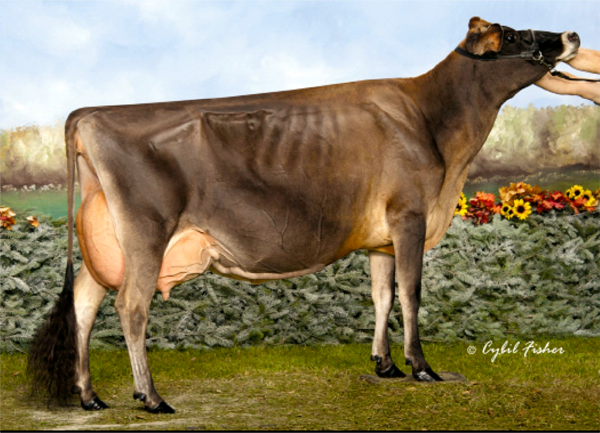
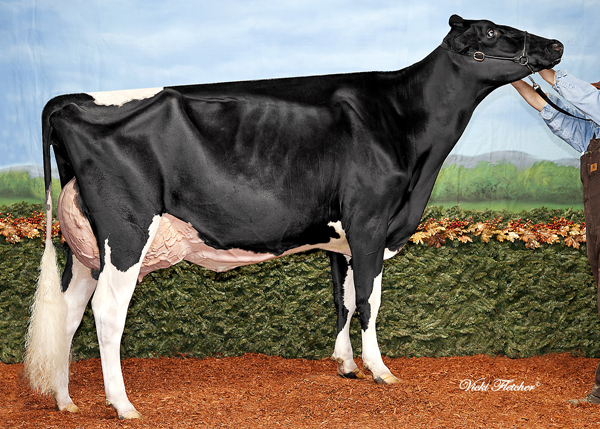
Pine-Tree Monica Planeta Is the New Genomic Super Star Maker

Sandy-Valley Farms, located in central Wisconsin, is owned and operated by three brothers, David, Patrick and Frank Bauer Jr.  A fourth brother, Greg, helps with the breeding and marketing programs.  Frank’s daughter Danae manages the calf program and assists Greg with the breeding and marketing programs. The Bauer family farms 1500 acres and milks 450 Holsteins in a free stall set-up. Embryo transfer and IVF are important tools in their program. We are already familiar with Sandy Valley families which include names like Sandy Valley Bolton, the outstanding sire with top daughters and now sons. It is exciting to talk with Greg about the future they are building toward at Sandy Valley.

Start with Clear Goals and Go Beyond

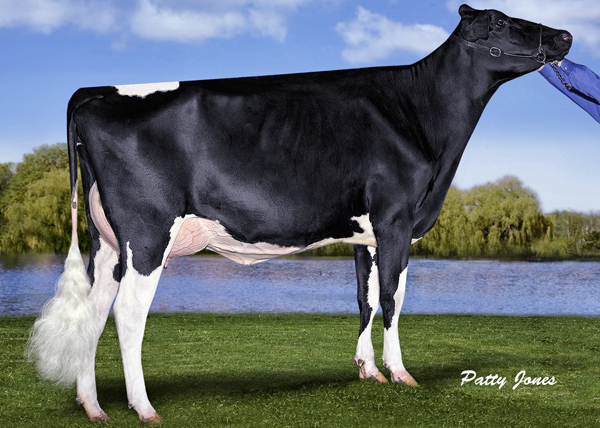
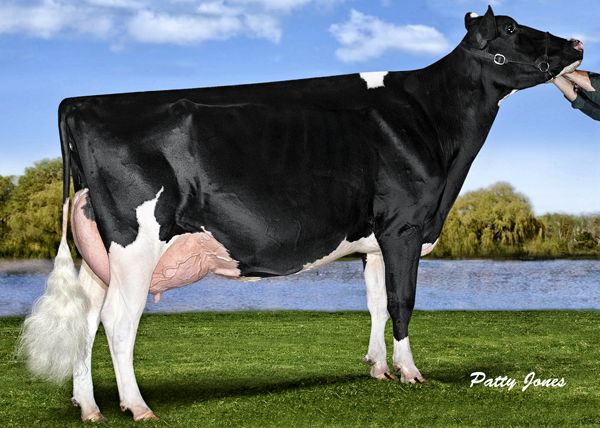
In talking about their success, Greg clarifies the breeding goals that are the basis they build from at Sandy Valley Farms. “We aim to breed a cow that can respected by the commercial dairymen, yet admired by the type enthusiast.” As simple as that sounds Greg acknowledges that it can be complicated. “When you set your breeding goals it is easy to play it safe.  However it is going to take new genetic strategies to meet the needs of the new genetics marketplace.” He says with encouragement knowing that it is only by taking risks that Sandy Valley is making progress. Pine-Tree Monica Planeta-ET is an example of a foundation cow that has the potential to launch superstar generations.
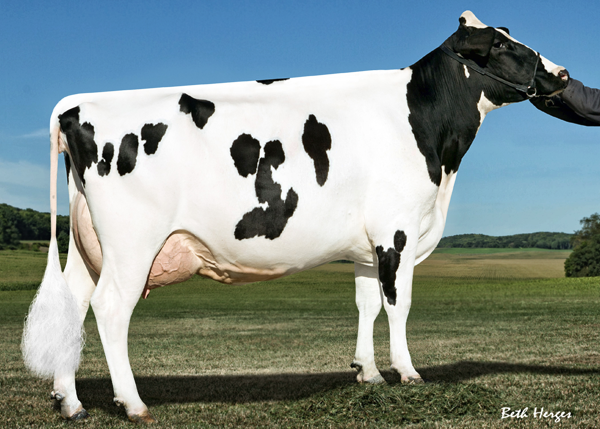
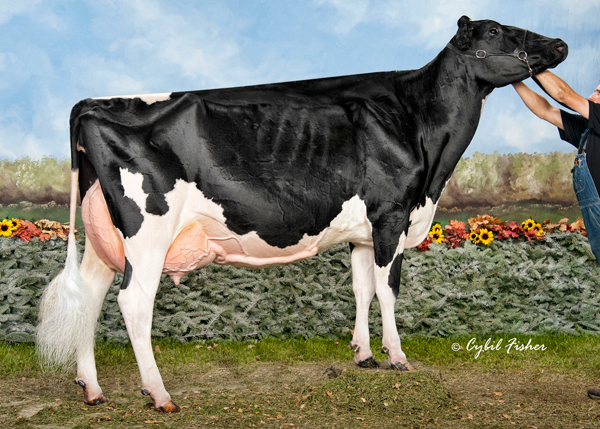
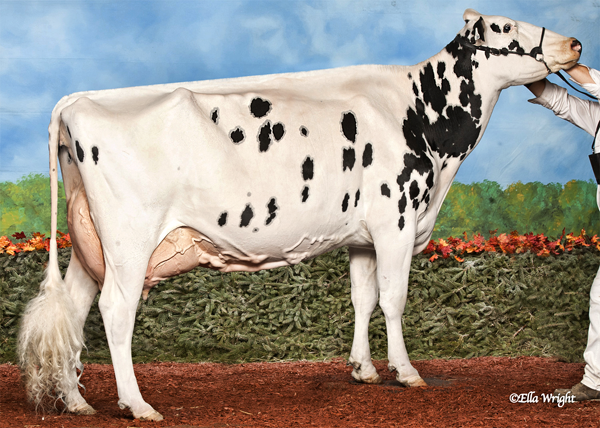
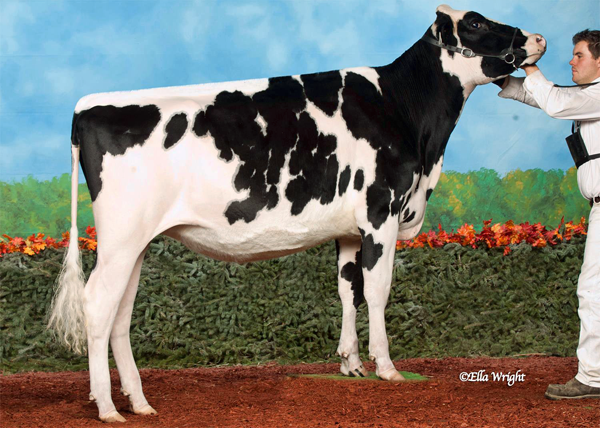
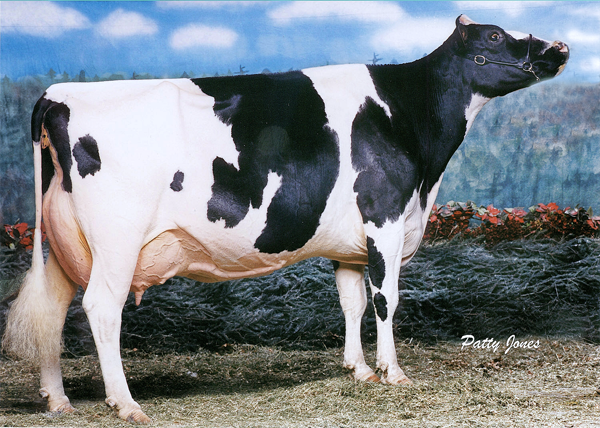
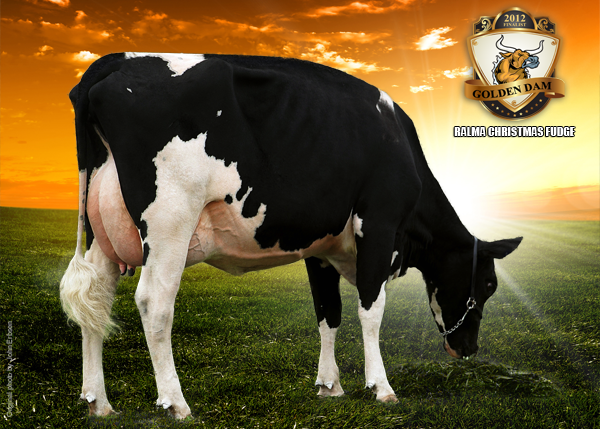
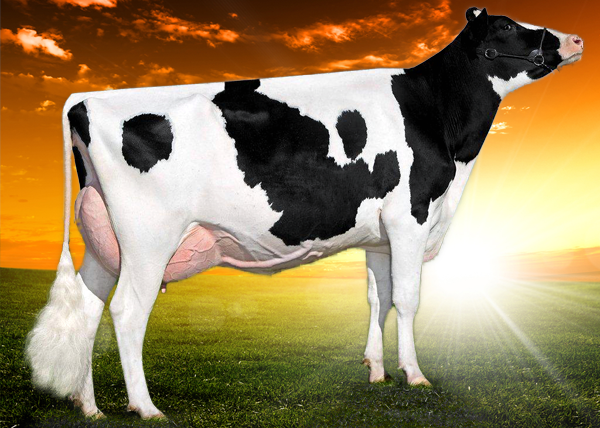
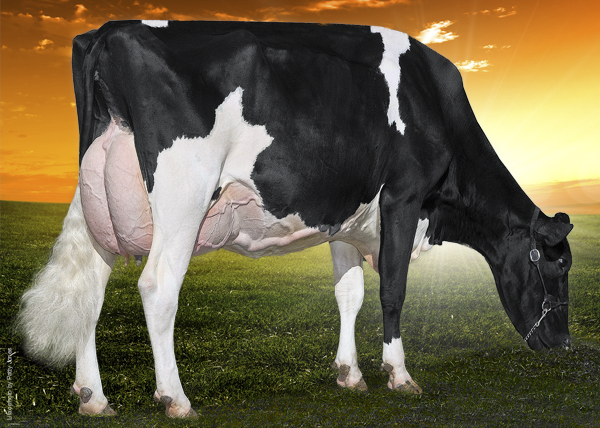
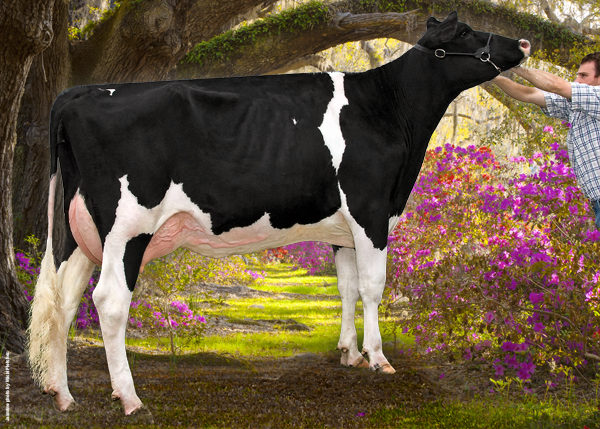
PINE-TREE MONICA PLANETA-ET VG-85-2YR

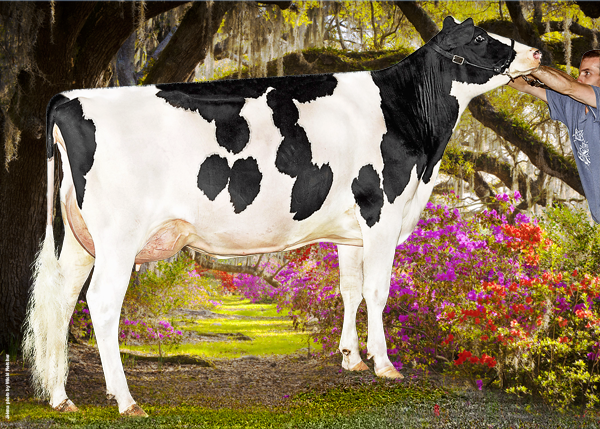
PINE-TREE MONICA PLANETA-ET VG-85-2YR

Attracted by Planetas

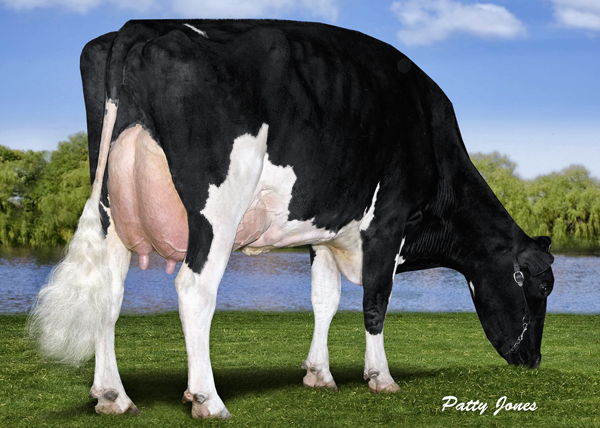
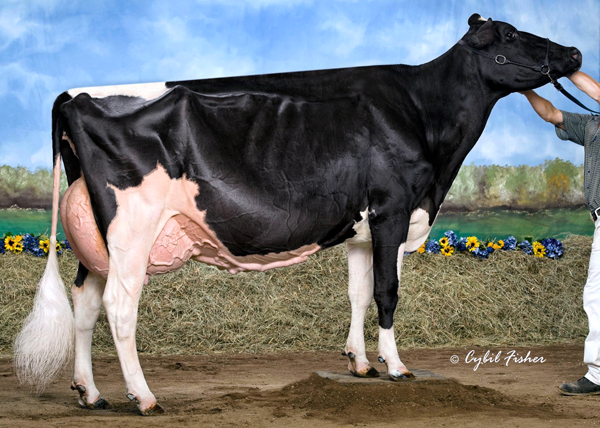
Hindsight is always 20/20.  That’s why it’s great to hear from breeders who have the good fortune to pick a winner. Greg ticks off the points that attracted Sandy Valley to Planeta: “She was from a proven sire;  possessed a high genomic rank in comparison to age-mates and paternal sisters; and she was from a cow family that had has brought us success in the past.”  Greg then describes why she fits so well with the Sandy Valley breeding goals, “Planeta is a modern freestall cow.  Moderate in stature with plenty of strength and width.  She has a nice spring to her rib, a silky hide and an attractive cut to her front end and shoulder.  Her udder is soundly attached with great cleft and teat placement.  She has somewhat more set to her rear leg than optimal but possesses a clean, flat bone.” He saves the best adjectives for last, “Planeta tracks beautifully and almost glides when she walks.”

New Genomic Stars at Sandy Valley Revolve Around Planeta

First let’s take a look at Planeta’s own record:

  • Pine-Tree Monica Planeta
  • Sire: Planet
  • VG-85 VVV+V @ 2-7 DOM
  • 2-01 2x 184 15564 3.8 598 3.3 508 (incomplete)
  • GTPI +2239 gTPI 697 NM$ 2.88 PTAT
  • In August 2012, Planeta was the #12 GTPI cow and dam of the #2 GTPI heifer.  She had 4 daughters over 2400G, a Numero Uno son over +2500 and a Sudan son over +2400 GTPI.
  • The starts in her orbit expanded with the December 2012 Proof Indexes.  She now has 9 daughters over DGV LPI 3000: 5 Numero Unos; 2 Epics; 1 Armitage and 1 Banco daughter. Outstanding!

Planeta Daughters Start Their Own Outstanding Orbits

The numbers definitely proclaim that Numero Uno has been the best cross on Planeta. Looking at those first six daughters, there were three over +2400 gPA TPI.

Penelope (Numero Uno) +2647 gPA TPI +3.50 PTAT  +3716 gPA LPI +4156 DGV LPI
Paxton (Numero Uno) ++2524 gPA TPI +2.64 PTAT +3463 gPA LPI +3713 DGV LPI
Precious (Numero Uno) ++2503 gPA TPI +3.22 PTAT +3509 gPA LPI +3892 DGV LPI
Paisley (Numero Uno) +2447 gPA TPI +3.30 PTAT +3282 gPA LPI +3483 DGV LPI

Planeta & Ammon-Peachey Shauna:  These Genomic Hits are Both “Miss”es

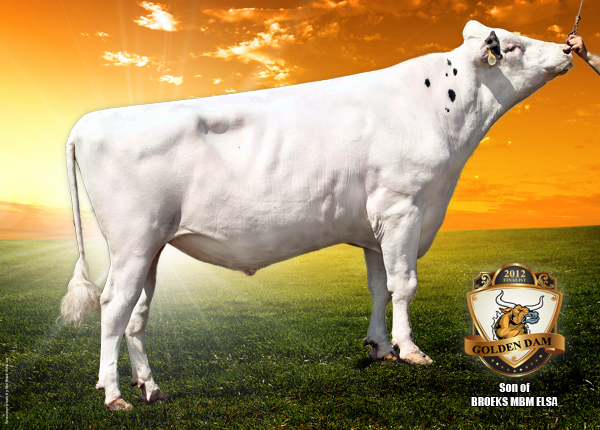
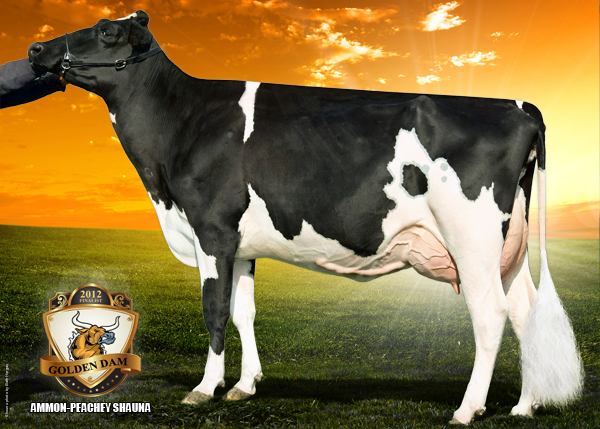
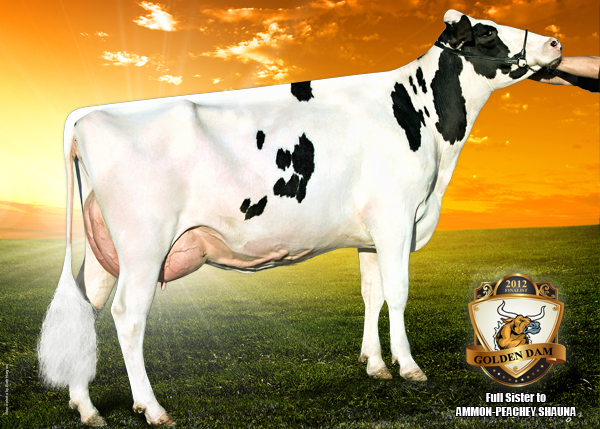
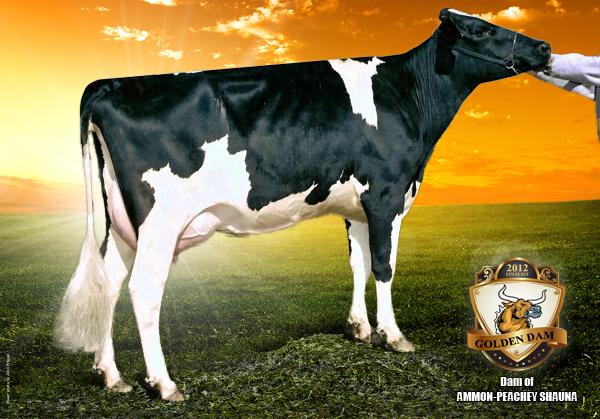
Even while we stand in awe of the offspring of Planeta, research tells us that it really could or should have been expected because of Planeta’s shared lineage with the outstanding Ammon-Peachy Shauna (Read more – AMMON-PEACHEY SHAUNA – 2012 Golden Dam Finalist). Three generations back Shauna and Planeta trace their heritage to Wesswood MH Rudy Missy and her daughters, Miss Martha, in the case of Planeta, and Miss. Monica, for Shauna. They have the exact same sire stack: Planet x Shottle x Oman x Rudolph. Definitely Planeta is a fully functioning contributor to an all-star family.

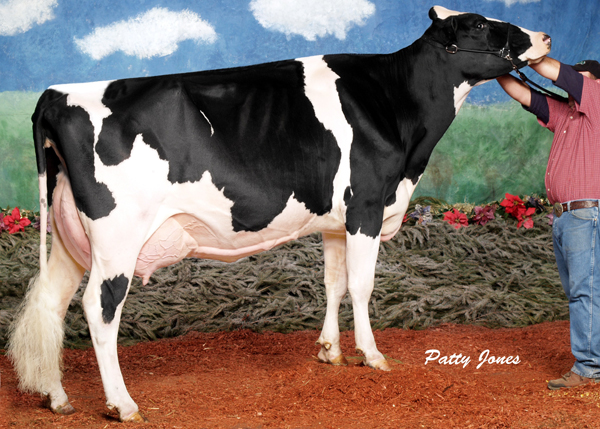
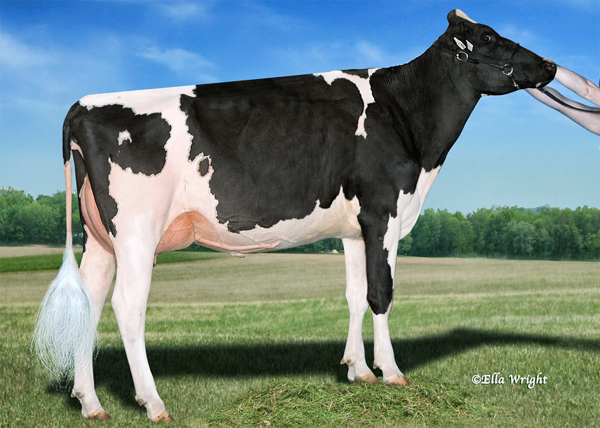
PINE-TREE MONICA PLANETA VG-2YR-USA AMMON-PEACHY SHAUNA VG-87-2YR-USA DOM
PINE-TREE MONICA SUELA VG-87 DOM PINE-TREE MARTHA SHEEN VG-86-3YR-USADOM 1*
PINE-TREE MISSY MONICA VG-85-5YR-USA DOM GMD PINE-TREE MISSY MARTHA VG-86-4YR-USA DOM

WESSWOOD-HC RUDY MISSY EX-92-3E-USA DOM GMD

Other Prominent Cow Families at Sandy Valley

You know that Sandy Valley has high goals in mind that includes establishing other great cow families. Greg lists them for us:  “The Barbies, Dellias, Rudolph Missy, Ravens, Bolton Music, Terry Tory, Juror Faith, Cosmopolitans, and Oman 6121.

Using Genomics to Look Toward the Future

Greg has a simple viewpoint on why you should use young sires on top cow families. “Use young sires to maximize genetic progress.” He states emphatically and then looks into the future realistically, “Granted all high G young sires won’t stay high but then neither do all high proven bulls once their second crop is in the system.” Sandy Valley Farm looks for certain attributes for all young sires they use. “GTPI ranking and overall transmitting pattern are taken into account, as well as the cow family they stem from. We also prefer those out of proven sires such as “Freddie, Man-O-Man, Massey, Snowman and Super.” He notes that  “We are currently using a wide variety of high G young sires and a few of the highest GPTI proven sires.

Advice for Those Seeking Sky High Success

Every great herd starts with a plan and Greg advises everyone to start with this end in mind. “Consider your goals.  If you’re most interested in building a sound, functional herd with few ‘2yr old mistakes’ stay with proven sires, especially those with 2nd crop information.” Greg then goes on to suggest another option. “If you’re interested in working at the cutting edge of genetic improvement, incorporate some of the high G young sires.” Like all other parts of the discussion, he rounds out the advice: “When using young sires, it’s often best to spread your risk and use more than just one.” Cautionary and visionary at the same time.

The Bullvine Bottom Line

It is always wonderful when we can benefit from the insights of great cattle breeding families.  Sandy Valley Farm is building their success on a solid cow family foundation.  We wish them well as they take Planeta and go where genomics has never gone before!


The Dairy Breeders No BS Guide to Genomics


Not sure what all this hype about genomics is all about?

Want to learn what it is and what it means to your breeding program?

Download this free guide.


[related-posts-thumbnails]

EASTSIDE HOLSTEINS – Where Modern Marketing Rises to the Challenge

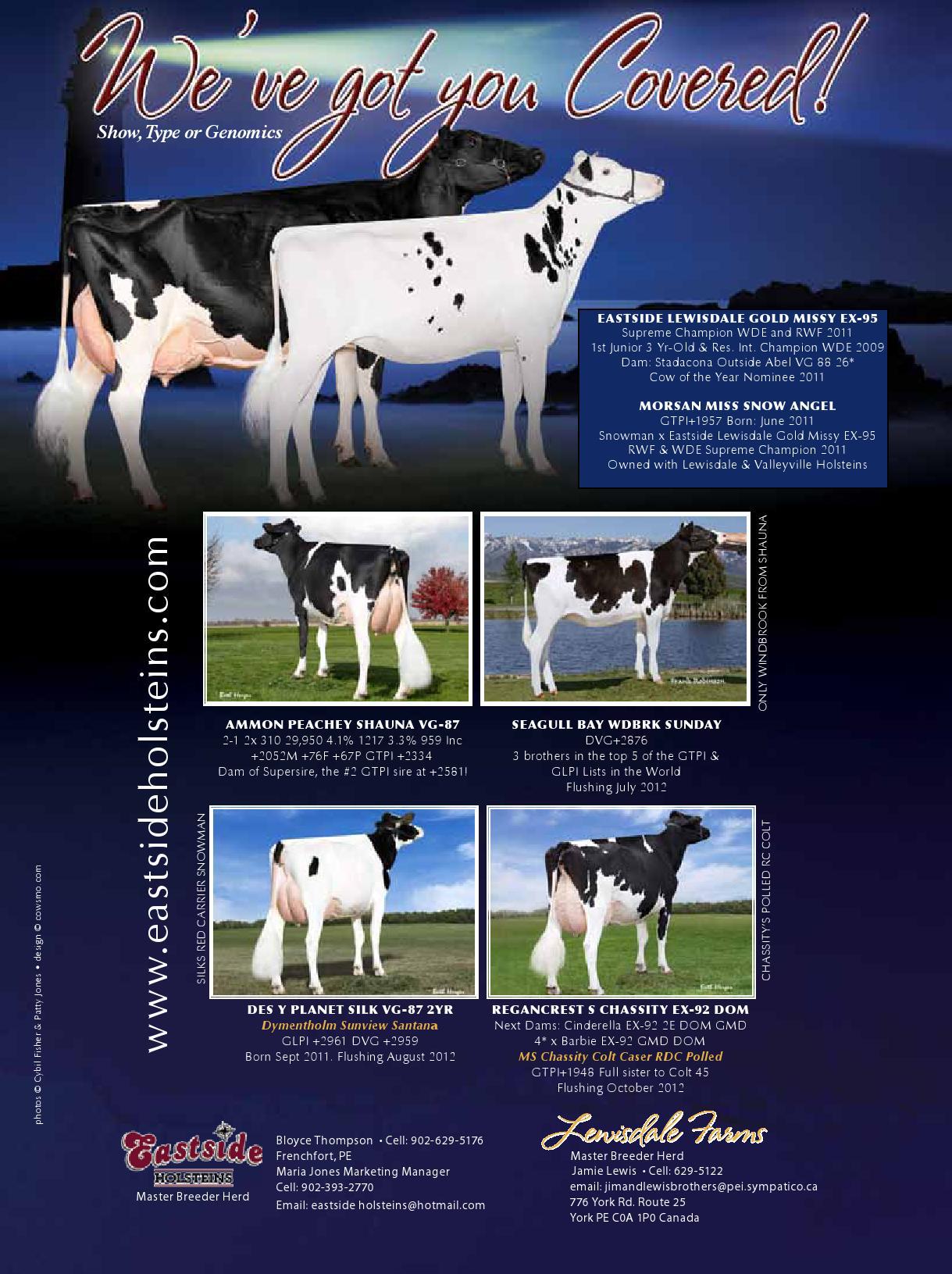
For most of us The Eastside Lewisdale prefix is associated with the fame of “Missy”. Maria Jones, Marketing Manager for Eastside Holsteins modestly summarizes the connection. “Here at Eastside, we were lucky enough to have co-bred Eastside Lewisdale Gold Missy EX 95, Grand & Supreme Champion at World Dairy Expo and the Royal in 2011.  That has really helped our exposure and marketing, not only of the Missy Family, but of other families here at Eastside”. As Bloyce Thompson, owner of Eastside Holsteins, points out, “When Missy took off as a Jr 2 yr old, we needed to be able to capitalize, get on board and go with her success.”  The fact that Missy’s sister Amaze flushed well put even more marketing opportunities in front Eastside and partner Lewisdale (Read More – You Can Bank on Amaze to Pump up the Volume). “Our main focus has been selling embryos from well known families and making sure each customer is very satisfied with their purchase.”

EASTSIDE LEWISDALE GOLD MISSY EX-95-CAN

EASTSIDE LEWISDALE GOLD MISSY EX-95-CAN
Supreme Champion WDE 2011. Grand Champion WDE 2011.
Supreme Champion RAWF 2011. Grand Champion RAWF 2011

Viewing the Future from EASTSIDE Out!

Bloyce and partner Jamie Lewis, of Lewisdale Holsteins, thought over the potential they were facing and decided to set up a new company Eastside-Lewisdale.  They plan to have it underway early in 2013. One of their visions is of an embryo community.  In order to do that, they know that they have to plan not only the financial side but also how to brand their genetic products. “We thought about it and decided we need email a web site” and all of the modern technology that puts PEI fully accessible to the marketplace. Bloyce admits “We knew we wanted someone who had great computer skills.” That’s where Maria Jones came into the picture.

Maria Jones

Maria Jones
Marketing Manager at Eastside Holsteins

MISSY meets MARIA:  Behind Every Super Star There is a Super Marketer!

It wasn’t long before the marketing part of the plan was put into action says Bloyce, with the hiring of Maria Jones. “I knew Maria had computer skills and that she was between jobs.  She lived on PEI and started part time which has grown to almost two-thirds time now.” Maria has demonstrated her technical ability and how comfortable she is with global communication. Bloyce is enthusiastic, “She is a person I can give ideas to and she can take it from there.” Sales numbers are backing up the wisdom of the hiring a marketing person.”Since Maria started embryo sales are up 90%”
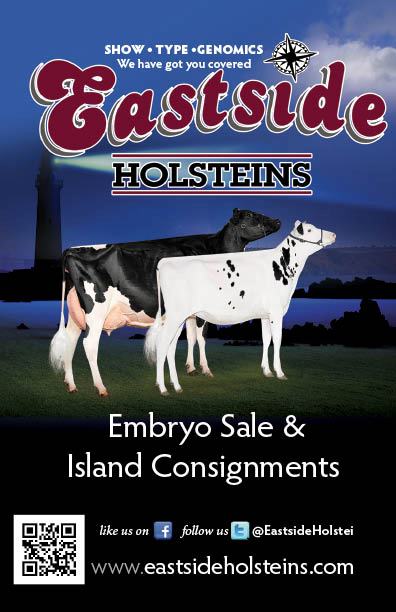
Eastside Ad

New Tools Greatly Enhance Familiar Methods

Modesty is contagious around PEI and Maria points out.”Of course, you have to have the product people want and be ready to roll.” As a marketing manager, she wears many different hats and faces the challenges and logistics of, not only marketing the products but getting them delivered. She notes,” In the cattle business it can be very complex and goes beyond the designing to record keeping, financial and managing the workload.” Time pressure is an added incentive. Bloyce states what he feels is obvious, “Holstein genomics is moving so fast that you must always be developing for the future market.” He gives an example. “Hailey has taken over From Missy so we must adapt to that.” Every tool is analysed and critiqued. “Embryo sales at World Dairy Expo time went well. We will likely try that again another year.”

More Information Sourced and Delivered with New Tools

Maria is well aware of modern tools. “We have been using Facebook and Twitter. It really helps communicate to our customers what is going on at Eastside.  They know about our new purchases and what embryos we have available. We report show results and just about anything else that is happening.” They see the potential of using social media for real time updates. “On a daily basis, we broadcast to our audience around the world what is happening.  It has been a very successful tool for Eastside.” Maria feels this asset also serves another valuable purpose, “It is a great advantage that we have two-way communication with others about what is going on in the industry.”

Good Two-Way Communication = Marketing Progress

Everyone at Eastside agrees that communication is important to their marketing strategy. Maria lists her favorite sources, “The internet, magazines, mixing and communicating with others at Shows and Sales are all great ways to keep up with the industry.” She is always eager to pick up something new. “I just keep an eye on what is going on around me and always notice everyone’s marketing efforts.  I enjoy seeing all the new ideas and try to understand why they thought it was a good idea.  I always keep in mind that they are in the same boat as I am!” She sums up the three L’s of her marketing philosophy, “I am never one to judge but I listen, look and learn!”

The Challenges of Dairy Marketing

In the fast paced world of modern dairy marketing it is important to know your priorities. Bloyce says the challenge is clear.  “You must always plan ahead and have the current product that people want.” There are the usual business pressures to keep costs under control but this team feels that marketing must be able to reach the huge number of potential clients based around the world. Bloyce recalls, “A decade ago, living on PEI was a major disadvantage but, today, with the World Wide Web, location is not a problem.” This opportunity also presents the main challenge, “We are only touching a fraction of the market.” Both Bloyce and Maria recognize that creating interest means constantly facing deadlines. For instance “The website must be updated 3-4 times per week.” Although that might seem simple, it too turns on the speed of responses to email, phone calls and messages. Maria acknowledges,”It can be frustrating.” But admits that “Marketing can be a fun and enjoyable career.”

Eastside Ad 2Walk in Your Buyer’s Boots and Walk Fast

Bloyce repeats business maxims we all know to be true, “The way that you position yourself, how you use words and how you treat customers are all very important.” He sees dairy breeding evolving to produce “a more functional cow with stronger immunity, better female reproduction and requiring minimum labour.”  Maria agrees that the market drives demand, “We have turned to more of what the market will be looking for in the future, namely the polled breed and genomics.” Acknowledging that everyone is not interested in the same thing she feels that “Eastside has got you covered” by providing show cattle, type and genomics.

Develop Marketing Skills Where You Find Them

Drawing on his positive experience, Bloyce sums up the best advice he has for those looking to market their dairy genetics.  First and foremost he feels “It is absolutely necessary that you have a product people want to buy.”  Once you have met that hurdle, he suggests “Get with technology both on the farm and in marketing.”  He points out what he feels is an obvious resource to develop, “Why not bring your children into the business via the marketing side of the farm, instead of just through the labour side.” He sums up his reasoning quite convincingly, “Kids run computers with their eyes closed.”

The Bullvine Bottom Line

At the end of the day, marketing only works if the story moves off the planning page and produces measureable results.  Eastside and Lewisdale are banking on good marketing based on a philosophy of “Listen, Look and Learn” to promote their supply of genetics that the market is asking for.  The future looks ready to shine brightly for Eastside-Lewisdale.


To learn how to get your farm on Facebook download this free guide.


[related-posts-thumbnails]
 

What Happens after She’s Sold?

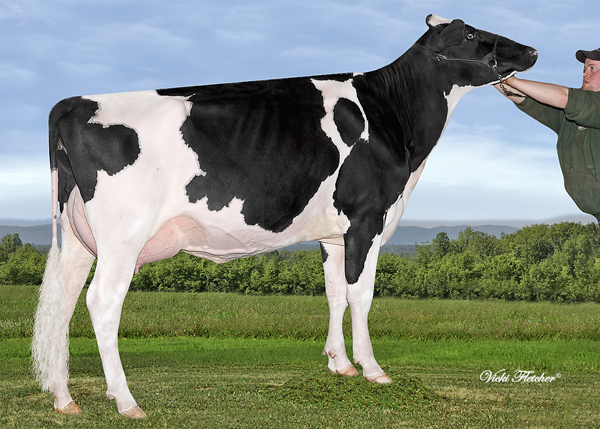
In much the same way that walking down the street with a cute puppy attracts comments and conversation, keeping in touch with your heifers after they sell often brings great exchanges and insights from other dairy breeders.  Three months ago we at The Bullvine started communications with the Crosbie Family of Caron, SK (one hour west of Regina).  Our mutual interest was a Huntsdale bred cow, Shottle Crusade, who had classified EX93.  A mutual friend then emailed us that Crusade had won the 5 yr old class at the 2012 Westerner Show in Red Deer and vouched that he heard “many individuals around the ring say that she could be the nicest Shottle daughter in Canada”.  Biased friendships aside, hearing that she went on to HM Senior Champion inspired us to exchange emails and then talk on the phone to Ian Crosbie. Once again, what starts out on the cattle trail ends up bringing people together too!

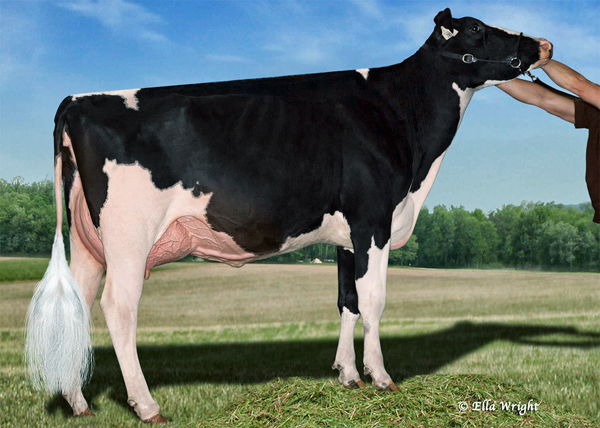
HUNTSDALE SHOTTLE CRUSADE EX-93-CAN

HUNTSDALE SHOTTLE CRUSADE EX-93-CAN

A Boy’s Passion for Cows

At twelve Ian showed a great interest in Holstein breeding, so his parents, Neil and Betty Jean, and his uncle Blaine gave him the responsibility of selecting the sires to be used on the Benbie herd.  Back then the Crosbie’s milked 90 cows through a parlour and housed the cattle in pack barns.  Ian had the challenge of choosing sires for both their commercially oriented operation and also those that he and his siblings would take to 4H shows. Folks we need to remember that Caron SK is not downtown central for the Canadian Holstein breed and believe it when Ian says that he read every book and magazine he could get his hands on and talked cows with Holstein breeders whenever and wherever the opportunity presented itself.


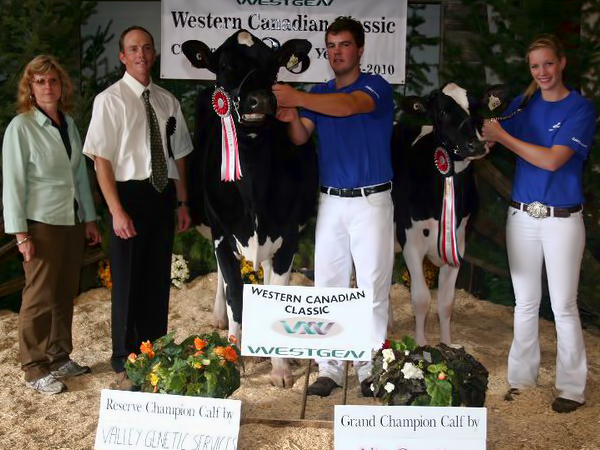
Ian Crosbie (2nd from right) - showing the Reserve Champion calf at the 2010 Western Canadian Classic.

Ian Crosbie (2nd from right) – showing the Reserve Champion calf at the 2010 Western Canadian Classic.

Parents’ Passion for Developing Youth

All the Crosbie children have been encouraged and supported in attending college or university.  For Ian that meant attending Lakeland College in Alberta.  Along the way he helped show herds and took part in every 4H competition that he could.  It was in fact through 4H that he met his future wife, Nicole Hylkema who was from Chilliwack, British Columbia (Hyljon Holsteins Ltd.). What started out as competition at the Western Canadian 4H Classic has developed into a lifelong relationship as Ian and Nicole are now husband and wife. After college Ian spent some time working and showing cattle for other herds, while Nicole got her university degree in Ag Business at the University of Saskatchewan.

Home to the Family Farm

In January of 2012 Ian and Nicole returned to Benbie and joined the farming operation with his parents after his uncle left the dairy farm. Since then, another pack barn has been built, quota has been purchased and the parlour updated and expanded to a double twelve.  Prior to the expansion, the 90 cows were all housed on one bedded pack. Benbie Holsteins are now milking 135 cows and have put up another addition, which includes two more packs.  One of the packs is for first lactation animals and the second pack is large enough for 6-8 head, which will be for show animals.  The remainder of the herd is housed on the original pack. These changes are already results. To answer your question the herd’s diet is the common one for Western Canada: barley silage, alfalfa haylage, some dry hay, rolled barley and supplements fed as TMR.

BENBIE GOLDWYN SADIE VG-86-2YR-CAN

BENBIE GOLDWYN SADIE VG-86-2YR-CAN
Res Int Champ Western Canadian Livestock Expo
Sold to Silvermaple Holsteins B.C.

Benbie Believes in Balanced Breeding

Ian has a clear vision of the Benbie breeding philosophy. He explains, “We are aiming towards a balanced breeding philosophy. We strive to breed a modern cow- high scoring and stylish, yet long living and trouble free.  We look for a cow with a balanced dairy frame, a great udder and a correct set of feet and legs. Production and health traits are also considered when making mating decisions.  We try to use bulls with a minimum of +12 Conformation, <3.00 SCS and positive figures for components and milk.”

Benbie uses 3-4 proven sires at one time and have started using a variety of genomic bulls.  Current daughter proven sires are Fever, Lauthority and Windbrook.  Genomic bulls used over the past year include- Meridian, McCutchen, Gold Chip, Day, Sajac, Numero Uno, Shamrock, Hefty, AltaHaley and Airlift.

Recent Heifer Purchases

WINDY-KNOLL-VIEW PASIAN

WINDY-KNOLL-VIEW PASIAN

Before we return to Crusade who brought us to Benbie Holsteins in the first place, let’s take a quick look at other more recent heifer purchases which include:  Windy-Know-View Pasian (Braxton x Pledge) due in June to Gold Chip; Speek-NJ Chrm Debbie Rae (AltaChairman from the Roxie Family) due to AltaHaley; and Winright Bolton Sugarshack (Bolton from the Splendor Family) who did well at shows in 2012 and is due to Windbrook.

Auction Fever Strikes

So that purchased animals can learn to fit into the Benbie management system and also in order not to expend high dollars, females are purchased as calves or yearlings, sometimes for 4H projects.  In 2007 one of those purchases was Huntsdale Shottle Crusade.  As Ian tells it, “Crusade was purchased as a heifer when my Uncle Blaine could not contain the Crosbie itch at an auction sale.  She was one of 10 head bought that day at the 2007 Rocky Mountain High Sale.  Even though the average price he paid was only $2800, they all had great pedigrees and the chance for a diamond in the rough was there.” We at Huntsdale love the next part. “Crusade was a very raw heifer.  It wasn’t until she freshened as a two year old that she caught your eye.  While she possessed an exceptional mammary system, she lacked power and depth and was scored GP84.”

Crusade Hits the Show Trail

Ian was pretty sure great things were ahead for Crusade. “When Nicole and I arrived home in early January, Crusade was in the close-up pen.  She had grown into quite a cow.  We were excited to calve her in and, a month after freshening, we began to prepare her for the upcoming spring shows. As part of our first full string as Benbie, Crusade did not disappoint. She was named Grand Champion of the Western Canadian Livestock in Saskatoon in April.  Throughout 2012 Crusade won or placed high at four shows.  She is now scored EX93 and continues to develop.  She is completing her third Superior Lactation, with an average 4.2% butterfat and low SCC.  She was flushed twice give 25 good embryos and is now short bred as we are hoping to have her back for the 2013 show season.”  What an incredible first year at Benbie for Ian and Nicole.

WINRIGHT BOLTON SUGARSHACK

WINRIGHT BOLTON SUGARSHACK
2ND JR.1-YR WESTERNER CHAMP. 2012

Where to Look for Advice

It seems quite obvious that this young couple have a vision for where they are going and can offer advice to others who are starting out too. “Being relatively young, we are always looking for more advice on showing and marketing top cattle! Lots of people are willing to give advice and opinions, but the best advice always comes from those that have been successful.” They continually seek out and share with other breeders and Benbie Holsteins can be followed on Facebook (http://www.facebook.com/BenbieHolsteins).

The Bullvine Bottom Line

Sometimes we make our path into the future far too complicated.  Ian suggests that moving forward can be summed up quite simply. “Be open minded.  Don’t be afraid to try new ideas.  The moment you stop progressing you being regressing.” What good advice that is coming from someone who has already launched a Crusade!

[related-posts-thumbnails]
“COLD CALVES” – The Next Drama Coming to a Calf Pen Near You!

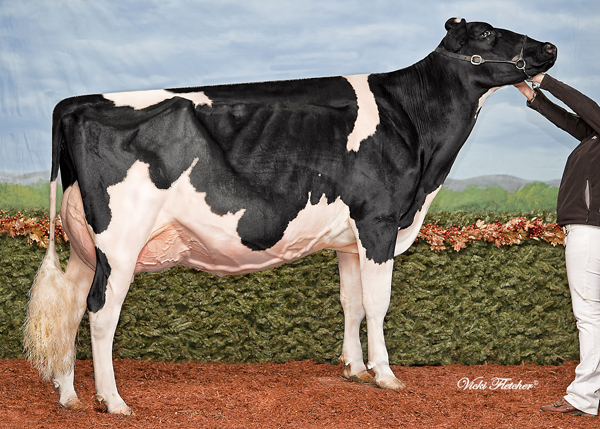
Thanksgiving in the US is the time for many breeders when the weather starts to get a lot colder. Cold weather just like hot weather can have detrimental effects on the health and well-being of your calves. Here are 12 things you can do to prepare your calves for the cold winter months ahead.

Why are they stressed?

Cold stress in calves is caused by the environment surrounding them and includes low temperatures and wind chill factors. Even temperatures that we might consider moderate, like the ones we are experiencing this week, can cause cold stress in newborn and young calves. It is particularly stressful for calves younger than 3 weeks of age.  Newborn calves experience cold stress at just below 60 degrees F. Calves more than 21 days old can be cold stressed at 42 degrees F. They are susceptible to cold stress because they consume very little calf starter and have little or no stored fat to draw extra energy from. By the time the temperature reaches zero, a calf should receive 50 percent more energy (calories) just for maintenance.

Keep in mind that if an 88-pound newborn calf has to start using its own fat storage to stay warm, it has less than one day’s worth of energy and could easily die because energy for growth and developing immune function becomes short or nonexistent.

When to begin?

Start with what you know for sure.  If you feel more comfortable wearing longer sleeves or a warm sweatshirt while doing chores, it’s probably time to consider increasing calf rations.  Even though we’re ready to look after ourselves, research suggests that 67% of dairy producers do NOT make changes to their calf feeding practices in cool weather. It’s definitely too late if you wait until temperatures are consistently below freezing.

Key Management Factors to Limit the effects of Cold Stress

The following options can help reduce the effects of cold on calves.  Work with your nutritionist and veterinarian to determine the best options for your operation.

  1. Monitor the weather
    Monitor temperature and increase feeding in response to cold weather.  At temperatures below 60 degrees F, calves must increase their energy consumption just to maintain their core body temperature.
  2. Protect animals from the Wind
    Wind markedly increases cold stress.  Producers should provide housing that allows a space for calves to have fresh air yet protects them from drafts.
  3. Bed well.
    Providing adequate dry bedding makes a significant difference in the ability of calves to withstand cold stress.  Bedding should be clean, dry and deep enough to completely hide a calf’s legs when they’re lying down.  Proper insulation will help calves stay warm without relying on energy reserves to regulate body temperature.  Calf blankets can also be used to help keep them warm. A deep bed of long-stemmed straw allows caves to burrow in and preserve body heat.  One way to determine proper bedding depth for cold weather is to look at the calf while it is lying down.  If you cannot see the calf’s feet, the bedding is deep enough
  4. Keep bedding clean and Dry
    Wet bedding can cause problems. Also their coats must be dry.  Wet coats have greatly reduced insulating properties and make calves more susceptible to cold stress. Mud-caked coats also reduce the insulating properties of the hair. Calves have much greater heat loss through wet bedding compared with dry bedding.
  5. Keep Calf clean and dry
    The calf’s coat must be clean and dry to provide maximum protection. Dirt or moisture on the coat reduces its insulation value dramatically.
  6. Provide additional Feed
    Feed more hay and grain. If wet feeds are fed, make sure they are not frozen. By implementing a cold weather feeding program that meets increased energy requirements, producers can keep their calves healthy and growing.
    For example, a 100-pound calf at 50 F requires 1.1 pounds of dry matter just for maintenance.  That is equivalent to 8.8 pounds, or about 4.25 quarts, of milk.  In the case of milk replacer, that is about 0.5 pound of powder mixed to make 2 quarts.
    If producers only feed the minimum amount, calves will struggle to keep healthy and there will be a surge in mortality, especially among fall-and winter-born calves.
  7. Feed at least two gallons of liquid nutrition each day.
    Calves fed less than two gallons of milk or milk replacer are more likely to fall behind on weight gain.  They are also more like to get sick.  Feed calves a full potential ration; calves fed a maintenance diet (less than 1.8 lb. Milk replacer daily) are more likely to fall behind on weight gain and become sick.
  8. Add a third feeding of milk or milk replacer
    A third feeding of milk or milk replacer provides extra energy to the calf.  The additional helping, especially during cold weather, preferable late in the evening provides extra energy for young calves.  Calves fed three times a day show improved growth, better starts prior to weaning than calves fed twice daily.
  9. Switch milk replacer for cold weather
    Milk replacers are available that are designed specifically for cooler temperatures.  These calf milk replacers have been developed to deliver optimal combinations of protein, energy and technologies to help during times of cold stress.
  10. Provide Free Choice Water Available at all times
    Provide warm water with morning and afternoon feedings, and consider adding a third watering as well.  By feeding liquids at closer to the calf’s body temperature of 102 degrees F., you can reduce the additional drain on its energy reserve to warm it.  Other practices may include offering warm water two to three times daily to support calf starter intake.  As the rumen develops, the calf’s nutrient intake and ability to grow and develop immune functions improve.
  11. Warming
    If a calf is cold-stressed, it will be more susceptible to disease, so warming the calf may be necessary.  The best method to use depends on your facilities.  Once the calf has been warmed, provide colostrums and maintain body temperature.  When the calf is warm and the situation has stabilised, move it back to its mother.

    1. Warm bath
    2. Warm blankets
    3. Hot box or warming box
  12. Vaccination
    Cold stress leaves calves vulnerable to a host of health problems, including Pasteurella pneumonia, one of the leading causes of bovine respiratory disease. According to bovine veterinary practitioners, the most important diseases to vaccinate against include infectious bovine rhinotracheitis, bovine viral diarrhea, parainfluenza-3 and bovine respiratory syncytial virus.  Many herds will benefit from using a coccidiostat and a vaccine to help prevent Pasteurella pneumonia in calves.  Producers should watch their calves very carefully for the first sign of respiratory disease. Some advise calves be given a coccidiostat labeled for prevention and treatment of coccidiosis.  If not treated 12 to 21 days after infection, coccidiosis causes dramatic clinical signs, such as diarrhea, inability to absorb nutrients, depression, weight loss, secondary infections and sometimes even death. Once signs of coccidiosis appear, much of the damage already has been done and a preventive strategy is best.  Disease can progress quickly and treatment must be done early to be successful.  Waiting too long can lead to irreversible lung damage and chronic or dead calves.

THE BULLVINE BOTTOM LINE:

We can’t control the weather but we can do everything reasonable to reduce the effects of cold on calves. A well managed calf can survive and thrive in cold temperatures.

(See also: “CALF MANAGEMENT: Eight Ways to Ensure Calves Remain Alive and Thrive”)

[related-posts-thumbnails]
Whispers Heard ‘Round the Royal

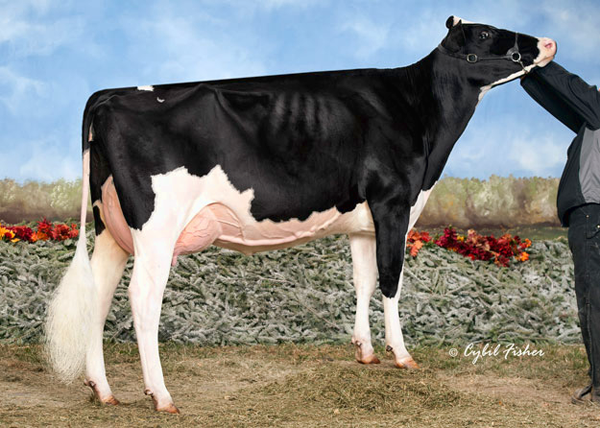
From my ringside perch at the Royal Holstein Show two weeks ago I heard knowledgeable Holstein breeders remarking, “There are seven breeders’ herds lined up out there and they’re all good ones! Wow!” Their amazement was echoed by Judge McKinven. (Read more –  The 2012 Royal Winter Fair Holstein Show – One of the greatest stories ever told) When giving his reasons for his placing he pointed out lack of maturity in some entries or less uniformity in others but he opened with the comment. “It is great to see seven high quality Breeder Herds’” and then he led the crowd in an enthusiastic round of applause.

Wilhelmina’s Herd In the Royal Ring

Watching the exhibitors carefully place their animals, I mused to myself that that it really is quite an achievement to reach this top level with three exceptional animals. No doubt there were seven stories (or more) for each of the seven herds. Wouldn’t you know one of those stories fell on my attentive ears as we were walking back to the cattle barn and Dr David Chalack mentioned that all three of Rocky Mountain’s animals, although young, were daughters and in fact full sisters from Raeland Leduc Wilhelmina. Can you believe it? Not only three from one herd but three from one cow.  Talk about dam good genes (Oops that’s another writer’s byline). For now let’s look back at how Wilhelmina got her start.

Wilhelmina daughters part of the Rocky Mountain breeders herd at the 2012 RAWF

Wilhelmina daughters part of the RockyMountain breeders herd at the 2012 RAWF

Wilhelmina’s (almost) Royal Beginnings

From Rae Stadder we found out that Wilhelmina’s great grand dam came to the Stadder’s because she was too late in gestation to travel as a bred heifer to Ohio. The story as Rae relates it goes like this. “My dad, Blake Stadder, travelled in our area with cattle buyer, Ken Brown from Ohio. One day they bought 4 bred heifers from a dairy farmer in Walpole and when it came time to ship them the Marquis Ned heifer, Wilhelmina’s great grand dam, was too close to calving to take the truck ride to Ohio. Dad agreed to take her for the price Mr Brown had paid for her.” Not headed to the party. Now that’s a Cinderella story for sure!  Especially when you hear that this was not the typical Ned.  “She was dairy and had a super udder – classifying VG and milking well’. Rae continues on with the history behind Wilhelmina “We bred the Ned to Unique, another Marquis son and that double cross to Marquis seemed to put into the family excellent feet & legs, high fat, stature, great udders, great reproduction and more heifers than bulls calves.” The line began and continued. “No matter what bulls were later used on the family all those traits came through”. Eventually, the family developed to comprise 35% of the Raeland Herd, with many family members the prominent cows in the herd in 2012. The Stadders then used Lincoln, Red Marker and Leduc to come up with Wilhelmina.

RAELAND LEDUC WILHELMINA EX-92-2E-CAN 5*

RAELAND LEDUC WILHELMINA EX-92-2E-CAN 5*
RES. ALL-CANADIAN JR.3-YR 2004
GRAND CALGARY SPRING 2005

Wilhelmina Becomes the Wildcard

Wilhelmina was the first family member sold by Rae. In the spring of 2002, Ken Empey and Brent Howe came to Raeland seeking consignments for The Shore Spring Sale and were impressed with Wilhelmina.  By this time, she was a tall dairy, good legged year old, so off to the sale she went. And, unlike her grandmother, she made it all the way there. She was bought and moved to Alberta ownership where she classified VG85 and producer 7602 kg milk 4.0%F and 3.3%P.

Go West and Win Young Wilhelmina

David Chalack - RAWF 2012

David Chalack showing Goldwyn Winnie at the 2012 RAWF

Dr David Chalack relayed the following to us “Wilhelmina was one of the first purchases made by RockyMountain. The year was 2004 and she was the winning Jr 3yr old at the Calgary Spring Show. We bought her that day and she went on to be Res All-Canadian Jr 3 yr old. She returned to the Calgary Spring Show in 2005 and was Grand Champion as a 4 yr old. For RockyMountain she has shown her power as a transmitter of outstanding type and high butterfat. For RockyMountain she has had 2 Superior Lactations, classify EX92-2E and to date she has 26 daughters that carry the RockyMountain prefix. Of those twenty-six, 23 are owned by 23 different breeders. Sound business breeding on RockyMountain’s part – breed great animals and merchandise them to have a revenue center beyond the milk cheque. It was interesting for me to learn that Rocky Mountain is waiting to implant Goldwyn and Braxton embryos in December to produce more heifers to be born in September 2013. Yes more Wilhelmina show heifers will be seen in the future.

Wilhelmina’s Royal Family

ROCKYMOUNTAIN GOLD WISHES VG-89-2YR-CAN

ROCKYMOUNTAIN GOLD WISHES VG-89-2YR-CAN
HM. ALL-QUEBEC JR.2-YR 2011
2ND JR.2-YR QC INTERNATIONAL 2011

Every cow has a best mate and for Wilhelmina that mate is Goldwyn (Read more – Goldwyn first ever to cross 1000 EX daughters in Canada).  To date there are nine Goldwyn daughters with seven in lactation classifying EX94, VG89, VG88 (2 yr), 2 VG86 (2 yr) & 2 GP (2 yr). In first lactation they averaged Mammary VG85, Feet & Legs VG86, Dairy Strength VG86, Rump VG87 and  9252 kg M (305D) 4.0%F & 3.3%P.  Like Dr Chalack says “she never misses producing tall, dairy, good uddered Goldwyns”. No wonder RockyMountain is producing more Goldwyn x Wilhelmina daughters.

Wilhelmina All The Way

ROCKYMOUNTAIN GOLD WINTER EX-94-CAN

ROCKYMOUNTAIN GOLD WINTER EX-94-CAN
NOM. ALL-CANADIAN SR.3-YR 2011
HM. ALL-QUEBEC SR.3-YR 2011

Years of observation and experience, would lead any judicious cattle fan to conclude that one cow cannot produce a winning breeder’s herd all on her own.  Especially, at a show of the quality of The Royal. At least, that’s what you would have said until November 2012. Wilhelmina along with her best mate did it this year. The members of the RockyMountain Breeder’s Herd was 3rd Jr 2 yr old Goldwyn Winnie (VG88 2yr), 3 yr old Golden Winnie (VG86 2yr) and 4 yr old Gold Winter (EX94 4yr).

ROCKYMOUNTAIN GOLDWYN WINNIE VG-88-2YR-CAN

ROCKYMOUNTAIN GOLDWYN WINNIE VG-88-2YR-CAN
HM. ALL-WEST JR.1-YR 2011
3RD JR.2-YR ROYAL 2012

Bullvine Bottom Line

QUESTION: Can one cow make a Breeder’s Herd all on her own?

ANSWER:     Yes! Wilhelmina can.

NEXT QUESTION:  Could an entirely new group of full sisters win at a future Royal?

OBVIOUS ANSWER:  Of course. Where’s there’s a Wilhelmina, there’s a way!


[related-posts-thumbnails]
Who will win the 2012 Jersey Canada Cow of the Year?

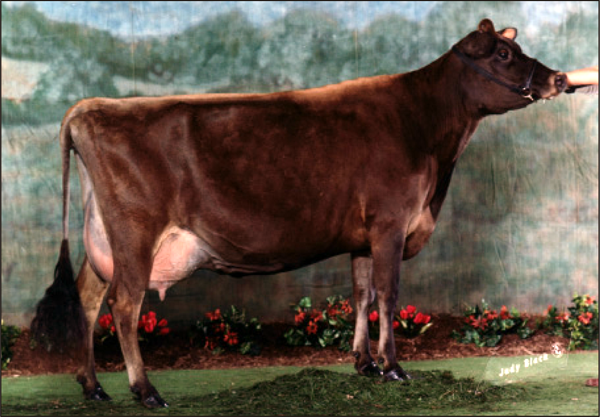
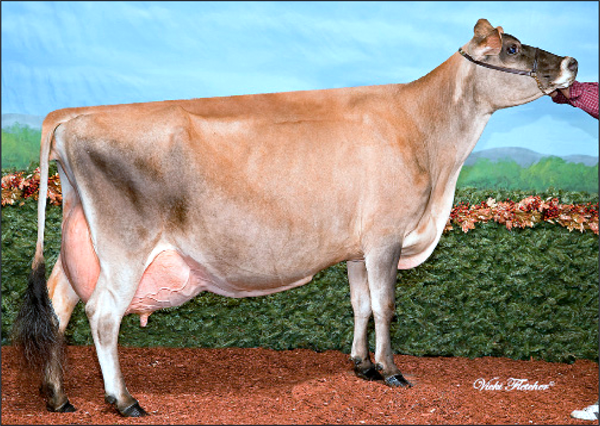
The 2012 Jersey Canada Cow of the Year contest has three outstanding cows whose individual impact will be felt in the years to come.  Sofie (Bri-Lin Ren’s Sofie EX90), Marmie (Pine Haven SSM Marmie EX94) and Becky (RJF Remake Becky SUP EX 96-6E) have received nominations and await the final decision.

Jersey Canada- Criteria

“When selecting the three nominated animals, Jersey Canada took into consideration the performance of the cow herself in milk production, conformation and show ring success. Of high importance as well was the merit of her progeny and the impact that they are having on the breed.”

You Have Until December 1st to Vote

The selection of the 2012 Cow of the Year rests in the hands of Jersey breeders and enthusiasts. Join The Bullvine as we take a look at these exceptional individuals.

BRI-LIN REN`S SOFIE Excellent 90

Her Progeny Excel Especially for Type.

BRI-LIN REN`S SOFIE EX-90

BRI-LIN REN`S SOFIE EX-90

Bred by the Raymer Family, Bri-Lin Farms, Bright, Ontario, Sofie is a Hollylane Renaissance daughter out of Bri-Lin Imperial Snow, 6 Star Brood Cow. Currently she is owned by Tom Breakell, Goshen, Connecticut.

Sofie had show ring success as Reserve Jr Champion at Oxford Parish Show, was 5th at World Dairy Expo as a Sr 2yr old and 1st 4 yr old at the New York Spring Show and the Eastern States Expo.  She has become an outstanding brood cow. To date she has 11 EX and 11 VG daughters.  Her top daughter is EX94 and a three time winner at World Dairy Expo.  Becky`s impact will be through her more than 26 progeny and numerous granddaughters and great granddaughters that are also winning in the show ring.

Classification

  • VG 87 (First Lactation)
  • EX 90 (Third Lactation)

Production Record

  • Best record: 4yr 305d 9,775 kg M  5.2%F  3.8%P
  • Lifetime  (5 lactations) 32,690 kg M  5.4%F  4.0%P

Show winnings include:

  • 1st 4 Year Old, New York Spring Show, 2000
  • 1st 4 Year Old, Eastern States Expo, 2000
  • 5th Senior 2 Year Old, World Dairy Expo, 1998
  • Reserve Junior Champion, Oxford Parish Show, 1997

Progeny

  • 11 Excellent and 11 Very Good daughters


PINE HAVEN SSM MARMIE, Excellent-94

Leading Lady on the Tanbark Trail

PINE HAVEN SSM MARMIE - EX-94

PINE HAVEN SSM MARMIE – EX-94

Bred by the Thompson-Dillman Families, Pine Haven Farm Ltd., Oxford, NS, Marmie is a Select-Scott Minister daughter out of Pine-Haven MBE Kitty. She is currently owned by the Sauder family of River Valley Dairy, Tremont, Illinois.

Marmie has an un-equaled and celebrated record of winning in the Jersey show ring.  She started out by being named the Reserve All Canadian Milking Yearling in 2008 and each year from then until 2011has won her class at World Dairy Expo.  Marmie has the singular accomplishment of being the Intermediate Champion twice and Grand Champion Jersey and Reserve Supreme Champion in 2011. She has also won in milking form at the Royal Agricultural Winter Fair and the All American Jersey Show.  Marmie’s impact on the Jersey breed beyond the show ring will continue with her next generation to be born at River Valley starting in September 2012. Nearly 30 heifer pregnancies are due by: Fire, Tequila, Verbatim, Centurion, Remake, Sambo, Impulse and Response.

Classification Record:

  • EX 91  (First classified in Second Lactation. Maximum score.)
  • EX 94 (Fourth Lactation. Maximum score.)

Production Record:

  • Best Record  3-09 305d 9,122 kg M  5.2%F  3.8%P
  • Lifetime (1.395 days) 36,626 kg M  5.1%F  3.8%P

Show winnings include:

  • Reserve Supreme Champion & Grand Champion, World Dairy Expo, 2011
  • Back-to-Back Intermediate Champion World Dairy Expo, 2009, 2010
  • 1st 4-Year-Old, World Dairy Expo & All American Jersey Show (All-American 4-Year-Old), 2011
  • 1st  Sr 3-Year-Old, World Dairy Expo & Royal Winter Fair (All Can Sr. 3-Year-Old), 2010
  • 1st  Sr 2-Year-Old, World Dairy Expo, 2009
  • Reserve All Canadian Milking Yearling, 2008

Progeny:

  • Marmie’s first ET daughters were born September 2012. 30+ heifer pregnancies are due Dec 2012 to June 2013. Prior to that she had one daughter by Jewels Barbaro.


RJF REMAKE BECKY SUP EX 96-6E

Becky Sets the Bar High for Production

RJF REMAKE BECKY SUP - EX-96-6E

RJF REMAKE BECKY SUP – EX-96-6E

Bred and owned by the Jarrell Family of RJ Farms Inc., Corbyville, Ontario, Becky is a Rock Ella Remake out of RJF Lester Beth.

Becky started out well in both classification and production and improved with each lactation until in 2012 she achieved Supreme EX96-6E.  At 12-01 (305d) she became the All-Time Jersey Production Leader with 17,407 kg milk, 4.3%F, 3.6%P.  In eight lactations she has produced 92,506 kg. milk. In addition, Becky placed 4th at The Royal as a 5 year old and again as a Mature Cow. She has also been the Production Award Mature cow at The Royal.  A 9 Star Brood Cow, Becky now has 5EX and 7VG daughters.  Becky`s impact on the breed is by the example she has set for combining type and production.  It will continue through her daughters and their progeny.

Classification Record

  • VG 85 (First Lactation)
  • Sup EX 96 – 6E (Eighth Lactation)

Production Record

  • Best Record 12-01 (305D) 17,407 kg 4.3%F 3.6%P
  • All-Time Production Leader for Milk, Fat and Protein in a single lactation
  • Lifetime (8 lactations) 92,506 kg M 4.4%F 3.7%P

Show winnings include:

  • 1st Jr 3 yr old & Best Udder Quinte Championship Show 2002
  • 4th 5 yr old RAWF 2004
  • 4th Mature RAWF 2005
  • Production Award Mature Cow, Royal Agricultural Winter Fair 2011

Progeny:

  • 5 EX and 7 VG daughters
  • 9 Star Brood Cow


The Bullvine Bottom Line

There you have it – three great nominees.  Take the opportunity to choose the ideal 2012 Jersey Cow. The Bullvine encourages Jersey Enthusiasts to vote. Go to http://www.jerseycanada.com/pages/cow-of-the-year-contest.html

[related-posts-thumbnails]
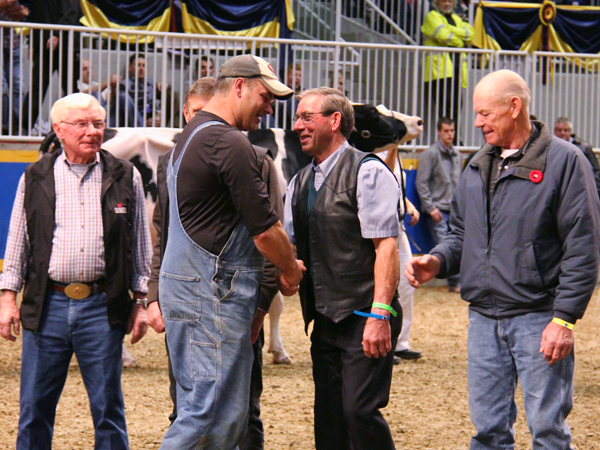
DON SCHWARTZ: “Love what you do and do the best you can!”

Don Schwartz is definitely a gentleman and a quiet one at that.  Don opens up when talking about cows but is very humble when speaking of his own success.  As the 26th recipient of the Curtis Clark Achievement Award he declares quite simply, “This is a wonderful honour.” Like Curtis Clark himself, Don does not seek the spotlight. “It was the last thing I was thinking of.”  Being called to the show ring during the 2 yr old class was both “a surprise” and “a bit of a funny story.”

“It was All a Blur”

Looking back on how he learned of the award Don says, “Apparently Ari told my brother David at nine on show morning and the crew also knew.  The big question was how they would get me to the ring.” Don is definitely most happy to be the guy in the barn. He goes on, “The two year old had gone out and someone called out that she was having trouble and I had to get to the ring. I grabbed an antihistamine and a needle and took off.” It’s been reported that Don could have won the running with the bulls in Pamplona he was moving so fast!” He continues the story. “When I got there I looked at her to see if she was hiving up or reacting.  She seemed okay. I couldn’t understand it!” And then the conspiracy continued. “Ari said, ‘I just wanted you to be here to see her show.’ Still confused, I replied, “I’ll take her back to the barn.’ Ari said, ‘Let Manuel take her, you stay here.’ As the plot thickened, Don was still in the dark, “I thought that was really strange. Then I looked around and Steve Fraser and Gary Vanderpost were nearby.” A light went off. “I asked, ‘I didn’t win that award did I?’ Gary squeezed me so hard I couldn’t believe it! The next thing I knew I was joining that amazing lineup.” Don says he has no idea what they actually said about him over the microphone. With only 4 minutes to prepare himself, he concludes, “The rest is all a blur!”

DON SCHWARTZ Curtis Clark Achievement Winner

Family Role Models and Lifelong Friends

Clearly moved by receiving this recognition from such respected peers, Don says “I never dreamed of such a thing. From day one it has always been about my passion for dairy cattle.” His admiration for his father Jim inspired his lifelong desire to be a farm manager.  “At home we showed a Guernsey Herd. Hank Vanderpost was herdsman there for 15 years.   Tannery Hill Farms earned 23 Breeder and Exhibitor Banners.” In his usual understated style he says, “That was quite a thing.” Indeed, for Don, it laid the foundation for what would lead him to his future career.

“I had the opportunity to be around the best showmen of all breeds.  I learned from the respect that was given to these ‘guys in overalls’ that they were important people. I have always tried to learn from the best.” 

He points to his 23 years with Quality Holsteins and what it means to him. (Read more – Quality Holsteins – Well-Deserved Congratulations)  “The passion and dedication of Paul – the perfectionism for fine detail of Ari – they both reinforce what I believe in.” It has been a wonderful team says this modest man who feels that his role is to fill in the blanks. “I love to see the udders bag up and feed to fill the frame.  I want them to eat as much as they can.” He enthusiastically expands, “I like to develop the cow.  I do all the feet and trim them three or four times before showing – always planning ahead for who will be there on the day and who isn’t quite ready.”

“Keep An Open Mind”

The annual trip to “The Royal” is a never-miss-family-tradition.  Although, it may seem that it’s easy, there is always something to learn.  Don advises those who aspire to winning. “I think the best thing you can do is to keep an open mind.  When you’re working at shows always look back afterwards at what worked and what didn’t.  I model myself after others who are willing to try things.  When you try new ideas some might think it’s crazy but it’s always best to keep an open mind.”

He has coped with many challenges in his years in the trenches of cattle preparation.  You never know what surprises will pop up.  Your window of opportunity may be only 30 days from calving to the show ring as Don reports it was with Valleyville Rae Lynn. No wonder he was pleased that they met the challenge and was second place two year old at the Royal.

Valleyville Rae Lynn VG-89-2YR  2nd Senior 2yr old RAWF 2012

Valleyville Rae Lynn VG-89-2YR
Under Don’s watchful care

“The Goldwyn Factor”

Over the years, Don could have written a veritable how-to book on cattle preparation.  In that time, he has witnessed many changes. He gives one example. “There’s what I call, the Goldwyn Factor.  Udders are so much better. Cows are more dairy.  Commercial breeders can appreciate the cows that are winning in the show ring today.”  This improvement has impacted preparation of cattle. This year’s 2 yr old, Rae Lynn is an example. “I only had 11 hours of milk in that cow.  People walking by were commenting. “They’re not going to have enough milk in the cow.” He chuckles, “They were probably wondering if they should have trusted this guy to get the job done?” The show ring results support the confidence in Don, with a resounding, “Absolutely!”


Valleyville Rae Lynn VG-89-2YR 2nd Senior 2yr old RAWF 2012

Valleyville Rae Lynn VG-89-2YR
2nd Senior 2yr old RAWF 2012
NOM. ALL-CANADIAN MILKING 1-YR 2011
RES.INT. ON SPRING DISCOVERY 2012
2ND SR.2-YR ROYAL 2012
1ST SR.2-YR ON SPRING DISCOVERY 2012
1ST MILKING 1-YR AUTUMN OPP. 2011

Winning Spirit.  Winning Record.

Don points with pride to previous Curtis Clark Award winners, such as Harold Patterson. “I was so honored to be in that lineup and shake his hand.  I’m sad that Milking Shorthorns are out of the Royal! Think of the great ones, you’ll never see!” Like this man whom Don admires, the sheer volume of successes of the Quality show strings sets him apart as exceptional too. “I love to develop each cow.” This hands-on, 24-7 dedication has contributed to 20 Quality Breeder’s Herds and a record setting seven All-Canadian awards.” It’s no surprise to hear that his favorite thing to do on his day off is to “drop in on my neighbours and look at their cows before milking.”

QUALITY B C FRANTISCO EX-96-3E-CAN 18*

QUALITY B C FRANTISCO EX-96-3E-CAN 18*
ALL-CANADIAN MATURE COW, 5-YR, 4-YR, SR.3-YR, MILKING 1-YR
HM. ALL-CANADIAN MATURE COW, SR.2-YR
GRAND ROYAL 2005, 2004
INT.CHAMP ROYAL 2002
HM.GRAND ROYAL 2002

“It’s always all about the cows” 

Don admits that he never considered any other career. “I always admired a good cow, whether it was a good Jersey or Ayrshire.” He affirms his passion for Holsteins and then adds, “I can be happy to see a great Brown Swiss too.  That’s what I love about the Royal. I get the chance to socialize as much with Jerseys as with Holsteins.”  If you want to gets his enthusiasm really overflowing, talk to Don about the many, many cows that are his favourites. “Of course there is Quality BC Frantisco (Ex-96-3E-18*) and Quality Astre Felice (ex-27*). Quality Carlton Pam (Ex-97-6E-3*) and Quality Leadman Lady have also won his permanent affections, although Lady’s life was cut short when she was struck by lightning.

QUALITY CARLTON PAM EX-97-6E-CAN 3*

QUALITY CARLTON PAM EX-97-6E-CAN 3*
NOM. ALL-CANADIAN 5-YR 2003
NOM. ALL-ONTARIO MATURE COW 2010
RES.GRAND AUTUMN OPP. 2002

“Home Bred Makes Me Happy”

Don has seen many changes over his years preparing for the show ring. “I miss that you don’t see as many herds like Spring Farms and Romandale .. the homebred herds.” He respects herds like Ferme Jacob and explains,” That is what I love about Quality Holsteins.  People think of you as a breeder first.”  He is amazed at some aspects of the modern cattle breeding business. “Now days it’s kind of funny.  You read who won Madison and two days later she’s sold to someone else.” This accepting and adaptable guy says, “That’s okay but for me I love taking care of homebred cows. From the day they are born until they are famous, I take pride in the success of our homebred herd.” He would never criticize other’s paths. “It’s great to have a good eye for a cow and I like to make great purchases” but this Curtis Clark winner admits, “I want to look back on the success of the cow and her mother and her grandmother before her. That is the true measure of what success means to me.”  He proudly points out how the offspring from Frantisco and Astre Felice are making their way to the winners circle today.

QUALITY GOLDWYN FLANSCO EX-94-CAN

QUALITY GOLDWYN FLANSCO EX-94-CAN
ALL-ONTARIO SR.3-YR 2010
NOM. ALL-CANADIAN SR.2-YR 2009
GRAND AUTUMN OPP. 2012
INT.CHAMP AUTUMN OPP. 2009
1ST 4-YR ON SPRING DISCOVERY 2011
1ST 5-YR AUTUMN OPP. 2012
Grand daughter of Frantisco

Not Just Show Day But Every Day

Even though Don always sets his personal standards very high, he is humbled to be with the smart business men and cattle men who have preceded him as Curtis Clark winners. “I’m the barn guy 24-7 at the barn. I have no desire to be a leadsman but I take pride in taking show cows home after the show and having them look as good as they did at the show.” Like Gerald Coughlin who Don admires he says, “I’m happy to be in the trenches.” Regardless of what challenges face Don he feels that the cows are a blessing that will see him through. “If I have a tragedy, or people are sick … or when my Dad died when I was thirteen … I always know I can go out to the barn, where the cows are calm, and I will feel their calmness.” Unconditional love works both ways.

Don being presented the 2012 Curtis Clark Achievement Award

Don being presented the 2012 Curtis Clark Achievement Award

Gentle Man. Powerful Example.

Son Randy signed by the Toronto Blue Jays as a non-draft free agent in January 2009.

Son Randy signed by the Toronto Blue Jays as a non-draft free agent in January 2009.

With emotion in his voice, Don shares a family concern that the “Royal” cattle tradition could end with him and his brother David, whom he admires and respects as a mentor too.  It’s been talked about by his son and daughter.  Son Randy had been drafted by The Blue Jays baseball team and is now married and teaching in Florida and daughter Erin manages a marina in Parry Sound.  He talks so proudly of them and concedes that “perhaps” their success is part of that 24-7 gene that he has passed on. “Oh my wife has that too!” he enthuses. “Linda works in the Quality Seed business.  She is a tremendously hard worker.” He pauses to recall how happy Linda was when he came home with his award.”I never saw her cry so much ” he says with modest amazement. “It was an emotional moment for both of us.”  When Don called his mother with the good news her voice was also filled with emotion when she said, “Look what my boys have done!” There may be new places and different careers, but Don and Linda needn’t doubt that the Schwartz family legacy lives on.

The Bullvine Bottom Line.

Following the example of other special men in overalls, Don Schwartz is a very special man himself.  He is a fine example of how far you can go by loving what you do and doing your best every day.

It is a pleasure to extend heartfelt congratulations to Don Schwartz the 2012 Curtis Clark Achievement Award Winner!


[related-posts-thumbnails]
Exciting Times for Butlerview

The dairy cattle business is built by people who have the passion and persistence to bring their dreams to reality such as Butlerview Farm of Chebanse, Illinois. Butlerview, which is owned and operated by Jim and Jeff Butler and their mom Joyce, is a state of the art facility, where brood cows and show animals are on display at all times in one location. It is the realization of a family dream based on their passion for cattle.

Cookview Goldwyn Monique EX-92 EX-95 MS Reserve Grand Champion, Intermediate Champion, 1st Sr 3-Year-Old/Best Udder Owned with Joe & Amber Price

Cookview Goldwyn Monique EX-92 EX-95 MS
Reserve Grand Champion, Intermediate Champion, 1st Sr 3-Year-Old/Best Udder
Owned with Joe & Amber Price

Field of Dreams Facility

The original facility from the 1970s has undergone major renovations, with utmost attention to cow management, comfort and presentation.  From hutches, through the heifer facility, to the box stall barn, every detail has been carefully considered to provide the best environment and allow the animals to reach their full potential.  Separate housing for bulls and complete federally approved flushing facilities round out this field of dreams cattle genetics business.

REGANCREST S CHASSITY  EX-92-4YR-USA DOM

REGANCREST S CHASSITY EX-92-4YR-USA DOM
Dam of Gold Chip GTPI+2450 – #2 Genomic Sire 4/11
Her daughter, Goldwyn Cash GTPI+2324 is the #1 GTPI Goldwyn of the Breed 4/11

Build It and They Will Come

Years of experience in sales and marketing and a passion for cattle have come together in this start to finish home for the production and marketing of elite dairy genetics. Jeff admits that attracting clients can be a two step process. “Type brings the foot traffic to the farm.  But genomics and pedigree get them buying.”

R-E-W Happy Go Lucky-ET HM Intermediate Champion, 1st Milking Yearling/Best Udder WDE 2012

R-E-W Happy Go Lucky-ET
HM Intermediate Champion, 1st Milking Yearling/Best Udder WDE 2012

Growing Pains: Challenges and Opportunities

Jeff acknowledges the challenges they face. “Like most businesses that are going through rapid expansion, there are certainly growing pains along the way.” The logistics alone require constant attention to detail.” We need to turn our animals 2.5 times per year for proper facility utilization.  That means keeping most newborn animals no more than 4-6 months.  This means we have to plan what sales animals are going to, contact people that have purchased 1st choices from us and get them to pick their animals, decide what bulls studs the qualified males will go to and arrange all of the proper testing.”

REGANCREST G BROCADE EX-92 DOM

REGANCREST G BROCADE EX-92 DOM
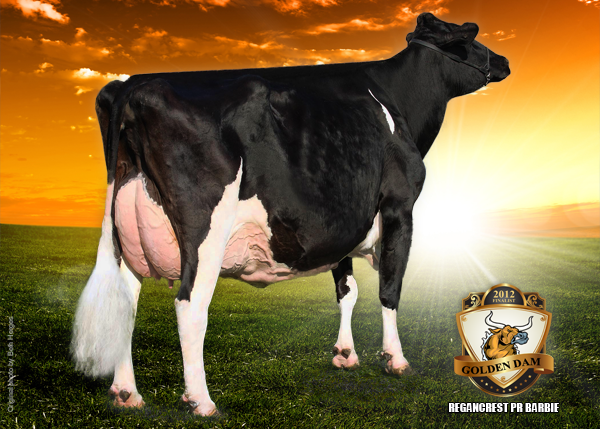
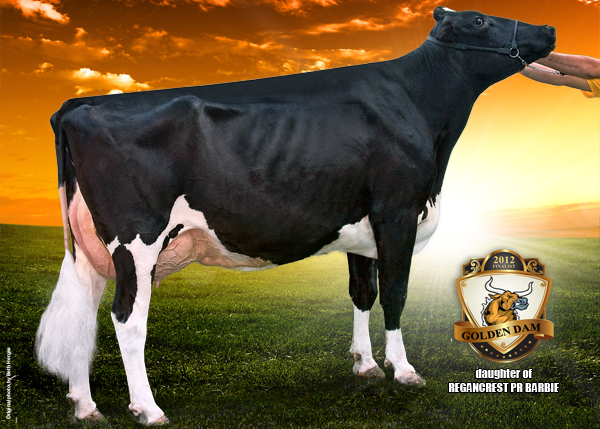
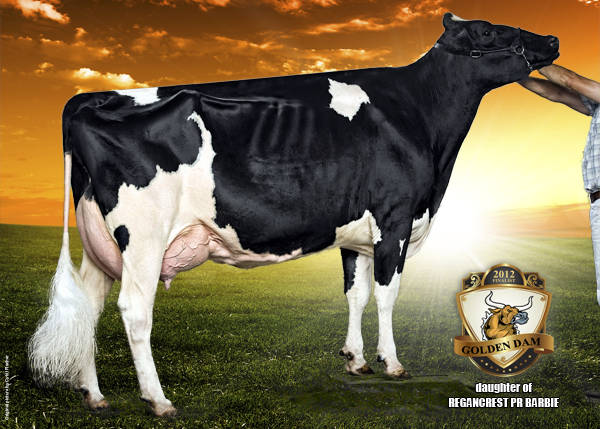
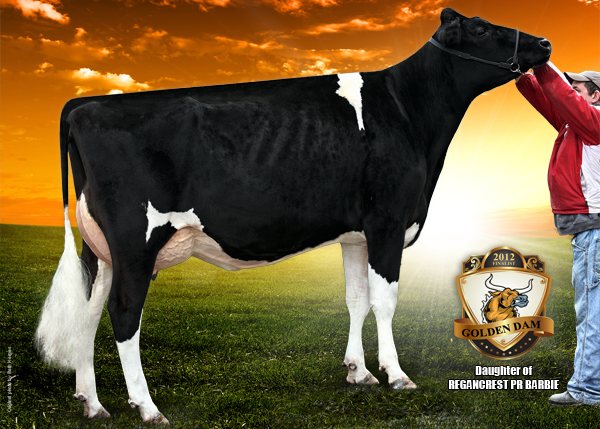
Goldwyn daughter of 2012 Golden Dam Finalist REGANCREST-PR BARBIE
Daughters currently at Butlerview by Supersonic, Bookem, Shamrock (GTPI +2443), Snowman, Greatest (GTPI +2358), Large (PTAT +4.13), Epic & Numero Uno

Butlerview Success Formula: People, Talent and Time Off

Even though the vision is quite large the success formula is quite simple explains Jeff. “We try to have the best employees we can find because they are the most important asset we have. We teach them how we want things done and then let them do their jobs without micromanaging them.” He adds that, “It is important to make sure that employees get some time off to prevent burnout in this type of environment.”

BVK Atwood Arianna-ET VG-89 1st Jr 2-Year-Old/B&O/Best Udder WDE 2012 Owned with Frank & Diane Borba

BVK Atwood Arianna-ET VG-89
1st Jr 2-Year-Old/B&O/Best Udder WDE 2012
Owned with Frank & Diane Borba

Marketing Strategy says “No!” to the Familiar and “Hello Wow Factor!”

The environment Jeff is referring to is the one where every animal and client benefits from the facilities and expertise offered by Butlerview Farm, Jetstream Genetics and Butler Fellers Auctions.  These are the three pillars of success according to Jeff. “I think what helps the success of Butlerview is that there are synergies between having the farm and having the auction company in Butler-Fellers to market the animals.” He points to the advantages. “This allows us to have a pulse and relationships with the buyers and sellers in the marketplace.” Each auction is an event in and of itself but Jeff doesn’t leave out the additional benefit of having the Jetstream bull stud. “This provides another avenue to market some of our bulls.”

Ms Atlees Shottle Aubry VG-88 EX-MS

Ms Atlees Shottle Aubry VG-88 EX-MS
Full sister to AFTERSHOCK

Buyers Come Through the Door for Type but Stay for Genomics and Pedigree 

A keen observer of the marketplace, Jeff homes in on what is most important to clients. “For show cows the most important thing I look for is the udder.  The other things I look for are style and show appeal, width of rump, openness and angularity, functional feet and legs and great front ends, with smooth blending of shoulders and long necks extending upward out of the shoulder. If they have all of that, then I look at size and length of body to make sure they are big enough.”  On the genomic side he has priorities as well. “For genomic animals, I look at three things in order: 1 Cow families and maternal lines; 2. Conformation of the individual; 3. GTPI score. Milk, fat, protein and high Type are the most important numbers that I look at. When trying to market offspring from them, I think those are the most important characteristics that the majority of our customer base looks at.”

RockyMountain Talent Lisorice EX-95 All-Canadian 2012 & 2011 All-American 2011

RockyMountain Talent Lisorice EX-95
All-Canadian 2012 & 2011
All-American 2011

Butlerview Seeks to Provide Exclusive Genetics

The team at Butlerview never loses sight of the fact that the goal is to be a world leader in top-ranked genomic and breed-defining type sires. “For type and show cows, we are using Gold Chip, Atwood, Brokaw, Sid, Colt 45 and Numero Uno because we really like the calves.  We anticipate using Licorice’s 2 sons that will be coming out in early 2013 at Jetstream Genetics: a red Destry son and a RC Goldwyn Son.” He outlines how they are approaching the genomic sires. “For genomic sires we are using Cashcoin, Cashmoney, Colt .45, Numero Uno, Supersire and have also ordered some Liquid Gold semen that we will be using.”

MS ATLEES GOLDWYN ARIEL EX-92

MS ATLEES GOLDWYN ARIEL EX-92
2nd Jr. 2-Yr-Old World Dairy Expo 2009
Res. All-American Jr. 2-Yr-Old 2009
Full Sister to Atwood & maternal sister to Aftershock

World Vision for Butlerview

These are exciting times to be in the dairy breeding business and Jeff offers this opinion. “Probably the two biggest game changers have been the ability to IVF animals which allowed a much quicker and more profitable ROI on the purchase of elite animals and then the invention of genomic testing which provides a tremendous tool for identifying the elite animals.”  He looks ahead to an exciting future with three important developments: “I see the value of high genomic males increasing for farmers as they move closer to 2013, when they will be able to test their own bulls. I see high genomic males topping public auctions much like high genomic females currently do.  I see the price of early semen from the high genomic bulls increasing rapidly in price, which will greatly benefit farmers.”

Ms Dundee Belinda-ET EX-94 EX-94 MS 3rd 5-Year-Old/1st Bred & Owned

Ms Dundee Belinda-ET EX-94 EX-94 MS
3rd 5-Year-Old/1st Bred & Owned at 2012 World Dairy Expo

Butlerview Shares Advice With Young Breeders

Jeff’s passion for the industry extends to everyone who shares his enthusiasm and particularly those just starting out. “When it comes to acquiring animals, I would encourage young breeders to look very closely at the maternal line.” His reason is based on years of experience.” It is much easier to market an animal when people around the world recognize the cow family that you are trying to market from.”

Micheret Alexandra Sid VG-89 5th 4-Year-Old WDE 2012

Micheret Alexandra Sid VG-89
5th 4-Year-Old WDE 2012

Innovation Changes Butlerview. Butlerview Innovates Change

If you stand still as the industry changes, eventually you will be left behind.  Through his new endeavours and keen eye for analysis Jeff talks about how modern marketing is based on engaging with the customer. He advises, “I would use the social media such as Facebook, print media and websites to get your message across to people.” He adds. “Today’s market is truly a global market.  You have to design messages that will reach and appeal to people all around the world.”

Peirstein Goldwyn Frisou EX-94 7th 5-Year-Old WDE 2012 Owned with Frank & Diane Borba

Peirstein Goldwyn Frisou EX-94
7th 5-Year-Old WDE 2012
Owned with Frank & Diane Borba

Bullvine Bottom Line

As Butlerview moves toward an exciting future Jeff is enthusiastic. “There are unlimited possibilities ahead.”  They look forward to working to grow their own business and those of their clients.

[related-posts-thumbnails]
Quality Holsteins – Well-Deserved Congratulations

“Congratulations on winning!” That’s one of the nicest things you can hear when you show cattle.  Congratulations  is fine for winning the lottery or celebrating a birthday, but “well deserved” is reserved for people who put in the effort and the time and took the risk to get somewhere. Today we are looking at why the success of Paul and Ari Ekstein of Quality Farms Ltd. in Woodbridge, Ontario is well-deserved

Quality Shows to Win

QUALITY B C FRANTISCO EX-96-3E-CAN 18*

QUALITY B C FRANTISCO EX-96-3E-CAN 18*

Quality Holsteins is at the forefront of dairy cattle breeding and showing and Ari Ekstein of Quality Farms Ltd. attributes much of that to one cow, QUALITY B C FRANTISCO EX-96-3E-CAN 18*(Read more – The 8 Greatest North American Show Cows of All-Time). “Frantisco is having a great impact on our herd.  There is no doubt that the two years that she was Grand at the Royal the Quality herd became more famous in the world.  Her greatest impact is through her daughters and granddaughters (Read – Great Show Cows Can They Pass It On).  This family is one of the most consistent breeding families in the world.  The success of this family has helped keep Quality in the forefront of the Holstein industry. Both the Grand and Reserve grand cows at this year’s Autumn Opportunity go back to the Frantisco family.” (Read – Autumn Opportunity Holstein Show Results)


QUALITY GOLDWYN FLANSCO EX-94-CAN

QUALITY GOLDWYN FLANSCO EX-94-CAN – GRAND AUTUMN OPP. 2012 – Grand daughter of Frantisco

Quality Winners Don’t Happen by Coincidence

You can’t count on luck or chance in cattle breeding. You have to make a plan and stick to it.  When you breed show cows, you’ve got to prove it with winners at the major shows.  Ari is familiar with analyzing and planning for show success. “There is no doubt that WDE is one of the greatest shows in the world.” However he points out that Quality’s plan was different.  “The last time we exhibited at Madison was with Quality Astro Sheri.  She was second prize three year old in 1988. We are only a half an hour from the Royal and we decided to continuously show there rather than Madison.”  They have had tremendous success at the Royal.  Perhaps this will be doubled in the future as Ari reports “You will see Quality at Madison again in the next few years.” Obviously, the key is to know where you’re showing and how to win there.

Winning today (vs. winning tomorrow)

QUALITY GIBSON FINSCO EX-95-3E-CAN 4*

QUALITY GIBSON FINSCO EX-95-3E-CAN 4* – HM. ALL-ONTARIO 5-YR 2008 – dam of Flansco and daughter of Frantisco

There can be high excitement and frustrating disappointments in the show ring … but everything you do today has an impact on tomorrow’s successes.  Quality’s winners, in the barn and in the show ring, start before each cow is mated. Current stars in their lineup are,Quality Goldwyn Flansco, Quality Gibson Finsco, Quality Gibson Ficoe, Quality Gibson Fantisco, Quality Carlton Pam, Quality Gold Danzi, Pine-Tree Finley Minnie and Valleyville Rae Lynn.

VALLEYVILLE RAE LYNN VG-89-2YR-CAN

VALLEYVILLE RAE LYNN VG-89-2YR-CAN – RES.INT. ON SPRING DISCOVERY 2012 – 1ST SR.2-YR ON SPRING DISCOVERY 2012

The Quality Strategy

“We try to breed the best type cow possible that will milk easy with no health issues.  We are very particular in what bulls we use and we try and make sure we make the best mating every time.  We love great type cows and we will continue to try and breed a “champion” cow every time.” Quality sets the benchmark high.

Change is Part of the Breeding Business

Everyone must find a way to deal with change and usually it starts with recognizing that it is happening. “I am sure everybody involved in this industry will tell you that genomics has had a huge impact in the value of cattle.”

Ari feels it isn’t’t just the sales ring but also the show ring that has seen change. “We have also seen a dramatic change in the style of today’s show winners. Goldwyn has set the new standard in today’s show ring.” says Ari, who then goes on to point out the benefits brought to the dairy industry because of evolving genetics. “Today’s modern dairy genetics have also bred cows that are profitable because they have the ability to milk throughout their lactation.  The days of cows peaking in the first three months and barely milking in their last three months should come to an end.”

QUALITY GOLD DANZI VG-89-3YR-CAN

QUALITY GOLD DANZI VG-89-3YR-CAN – INT.CHAMP, RES.GRAND & 1ST SR.3-YR AUTUMN OPP. 2012

Genomics Is a Quality Tool

Ari reports that Quality Holsteins uses genomics. “We have concentrated more on the bulls that combine the extremely high type with high production and health traits.” This may surprise those who feel genomics and type are mutually exclusive.  The top 10 bulls that Ari lists are: Windbrook, Sid, Goldchip, Fever, Dempsey, Braxton, Atwood, Brokaw, Bradnick, Brawler. When you break down their attributes you see that they are all high type and that there is a 70/30 split between proven and genomic sires.  (Read more – Does Genomics Belong in The Show Ring and 7 Sires to Use in Order to Breed the Next World Dairy Expo Champion)

PINE-TREE FINLEY MINNIE EX-91-CAN DOM   2*

PINE-TREE FINLEY MINNIE EX-91-CAN DOM 2* – Dam of PINE-TREE SID – Owned by Quality Holsteins

Type Leads the Way

Ari points out that even with genomics, he focuses on type. “We believe that type is still very important and we refuse to give up type for the sake of numbers.  Whether you are a commercial breeder or someone who is trying to breed a show cow, the better typed cows are always worth more. When you go to a commercial sale barn the better typed cows always sell for more than the poor typed cows. Needless to say the cow in first is usually worth more than the one in 10th.”

Quality Formula Based on Hard Work

You could be forgiven for assuming that it has been easy for Quality Holsteins to achieve their outstanding show ring success.  After all they are in the winner’s circle year after year.  Sometimes we forget that the hard work really begins long before the ribbon is awarded. There is no book, “The Lazy Man’s Way to Champions!” Ari attributes success to this finely honed formula: “The combination of dedication, hard work and passion from the Ekstein family and some of the best employees in the world has contributed to our success.”

QUALITY CARLTON PAM EX-97-6E-CAN 3*

QUALITY CARLTON PAM EX-97-6E-CAN 3* – NOM. ALL-CANADIAN 5-YR 2003 – NOM. ALL-ONTARIO MATURE COW 2010 – RES.GRAND AUTUMN OPP. 2002

Only Elite Breeding will have Value in the Future

Experienced in the seed industry as well as the dairy industry, Ari knows that all businesses evolve with changing markets. Ari points out where the future is headed. “The farms keep getting bigger and the importance of high producing, healthy typey cows continues.” Rather than fret about this and worry about the impact, Ari analyzes what lies ahead. “As we move forward we will see that only the true elite animals will hold their value.  Anything that is rare will always be valuable. The extremely high genomic animals and the great show cows of the breed will always be valuable.  It is very hard to breed both of these and the cows in between will not increase in value.” Simply put, when all of your competitors are busy increasing value by cutting prices, Ari points out that you can actually increase your returns by breeding only the cows that are valued in the marketplace.

Quality Focuses on Success

Sometimes we assume that if we just copy the bull selection of an elite breeder like Quality Farms Ltd., our herd will rise in the rankings too.  Ari’s advice disproves this simplistic idea. “I think it is important to realize what your goal is as a breeder, and make sure you focus on what your idea of success is.” You have to know your herd, your cow and yourself before you make even one mating decision. Of course, there are some basic rules to follow. “It is very important to try and breed from the most consistent breeding families in the breed.” Ari says. “There are many good cows with good pedigrees but very few have the ability to consistently breed.” The third piece of advice is probably the most important, “Once you realize what family you want to focus on it is equally as important to use the right bulls.  Making the proper mating is very important and do not just use a bull because he has a good proof.  It is important to use the bull that is the best mating for each cow or heifer you are breeding.”

The Bullvine Bottom Line

You might think a breeding discussion with Quality Holsteins would boil down to a choice between genomics or type.  Again, the assumption would be wrong.  The Quality answer is that, based on your own clear goals, there is something of value in the proper use of both tools. The real foundation of success Ari points out is that,”The will to succeed, devotion and hard work will eventually pay off.” That’s when the title “Quality” is well-deserved.

[related-posts-thumbnails]
COW CANCER: Truth or Consequences?

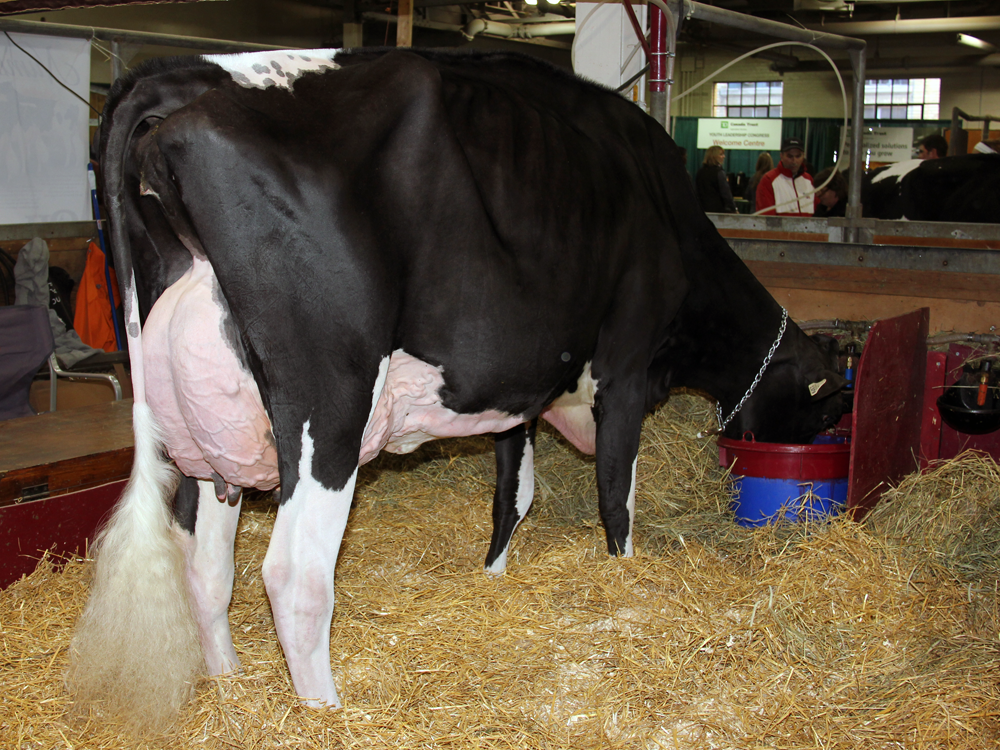
Hopefully we are all beginning to face the fact that health issues in the dairy population have flown under the radar for far too long. Johnes, Leucosis and E Coli are three, all independent of each other, that come to mind easily.  The other day something came across my desk that raised more concern. A recent article out of UK reports that young women having IVF treatment are at ‘higher risk of breast cancer’. It goes on to say that the Australian study has found that , “Women who have IVF in their twenties are up to 50 per cent more likely to develop breast cancer.” The key alarm raised is that “the use of strong hormones to stimulate the ovaries to produce more eggs during fertility treatment as hyperstimulation can be fatal.” Granted this is talking about women in the human population but we have all experienced the parallels between ourselves and the girls in the barn. The article was well balanced and cautioned against making assumptions, concluding that “A lot more work would be needed before we can say definitively whether these results are true or not.” Only good can come from further study.

Now from the bovine side.  It stimulates a series of questions and considerations. Recently the dairy industry has recorded deaths of some high profile cows due to cancer.  Rainyridge Talent Barbara, Shoremar S Alicia, Winterbay Goldwyn Lotto.  When you add to that list others such as Comestar Goldwyn Lilac, dying in her prime, and then consider all the more ordinary cows, both yours and mine, that don’t make headlines, you can begin to think that this could be serious. The first question needs to be asked, “Does IVF increase cancer risk in cows?” Of course, you can’t stop there. My mind is rolling out questions such as these:

  • Is there currently any research being done into cancer in bovines?
  • Could this be a thesis – for a university student?
  •  How could we get a comparable study of cancer deaths in the bovine population?
  • Which age group in the bovine population has the largest number of deaths from cancer?
  • Are younger cattle dying more frequently of cancer?  Is there an association with IVF?
  • How many older cows are dying of cancer? How would we know?
  •  Is there a link between the cancer and the very early age that heifers receive IVF treatment?
  • What age group or sub-section of the bovine population is at the least risk of death due to cancer?

In human medicine it has been reported by Dr Linda Giudice, President-Elect of the American Society of Reproductive Medicine, that: “The development of breast cancer is linked to oestrogen exposure and the longer one is exposed, the greater the risk.” Could this also be true in bovines?

THE BULLVINE BOTTOM LINE

As with any of the issues that face the dairy industry, the first step is recognizing the need. The next step is finding an able and willing leader. Of course, that means you can’t start with denial because that helps no one. It’s okay to say, “This is going to be difficult.” And it’s productive to point out, “We don’t know all, or even any, of the answers yet.” If we tell it like it is, we may not know where we are going  but at least we are not standing still.

Read the original article that sparked these questions.

[related-posts-thumbnails]
A Preview of the 2012 World Dairy Conference Seminars

For Holsten Canada the logistics of organizing a World Conference are huge. The organizers faced this challenge by starting several years in advance to forecast what would be of interest to delegates, where to find the experts and in many ways they had to work in the dark. Then add to that the fact that the Internet and our 24-7 connected economy has turned old methods of sharing information on its head. Now, farmers are not only out-standing in their fields, they are outstanding with a smart phone in their hands. No longer are seminar audiences motivated by overheads and dry paper presentations. Presenters will be using IPADs and even the audience will be “linked up”.

A Fork Full or the Whole Load?

While 18 speakers in 1 ½ days seems like a lot to absorb, in reality it’s a hyper-compressed overview of the issues, challenges and potential facing “Holsteins Today for a Better Tomorrow”. On the one hand, it’s an opportunity to see the future through the eyes of the best in the business. On the other hand, it could be a mind numbing experience. It’s up to you to pick and choose and know what you`re hungry for.

What do you know? What do you need to know?

The social aspect of the conference is a perfectly good reason to attend and develop personal relationships that you can build on later but don’t forget that there is also the opportunity to add dairy business insights and scientific expertise to your resources. Today we will briefly preview the highlights of the sessions.

SESSION 1: It`s a Genomics Talk and Bull Session by The Know it Alls!

After four years of genomics, there is growing data to support or contradict the experts. Entitled The Genomics Revolution, three speakers from France, Australia and Canada will cover the following topics and The Bullvine will pose questions that need to be answered.

Session 2 Impact of Genomics on the Industry

  • How Genomics is changing the Business and Services of Associations – Josef Pott
    This is a hot topic in today’s dairy industry. A recent article in the Bullvine (Select Sires vs Semex: A Contrast In Cooperatives) generated discussion and raised even more questions. From the services side it would be interesting to know if there a cost effective way to include genomic and parentage testing with every registration?
  • Making More Profitable Holsteins (Male Selection) – Marjorie Faust
    There are always lots of questions in this goal setting topic which is of economic interest to every dairy breeder. Here’s a way to get your questions about how to get your bulls in a row and look toward a healthy bottom line (see the Bullvine article Going Off the Map).
  • Using Genotyped Cows to Enhance Reliability of Genomic EBV –Sander de Roos
    This topic stirred the interest of more than one of us at the Bullvine. We look forward to a description of the planned study and would like to know from which countries will the inclusion of cow performance be studied?

We’ve only looked at two of the six sessions and might be forgiven for saying “Wow! Let’s not bite off more than we can chew!” However, here’s a question for you? “When you think back to the last ten years of your dairy business, how much of what you haven’t achieved is due to missed opportunities – the technology you didn’t use, the heats you missed, or the heifers that didn’t make it to the milking string. Missed opportunities often rise out of lack of information, not being prepared or reluctance to try something new. The third session might be the one you need most.

SESSION 3: Improving Reproduction Using New Technologies

Getting our cows to reproduce is the foundation that our dairy businesses are built on. It’s so obvious that sometimes we are distracted by other issues of the moment. But if we are driven to make a positive difference in the business of making milk, reproduction has to go to the top of the priority list. It doesn’t matter how much milk the cows make if we are having problems making cows.

SESSION 4: Improving Our Cow’s Health & Welfare

There have been many who feel their concerns about healthy cattle are falling on deaf ears. We live in denial of the coming health crisis and hope that we will be lucky and miss being put out of business by the next bovine disease. Even if we can practice what I call sand box farming (that`s where you can bury your heads until the problem goes away) the problem is your money goes away too! Health is not just important it`s imperative. And even if the BIG ONE doesn`t get you, the little details of cattle health management could. Remember, on the human side 100,000 North Americans check into a hospital every year … and don`t check out because of infections or other illnesses caused by the system. Barns have systems too. The expectation is that that`s the best place to be. Check out these conference speakers, if you`re ready to shake off the sand.

Where’s YOUR Beaten Path? To the Milkhouse. To the Bank. To Retirement.
Dairy farming isn`t something you take up for the short term. It requires commitment, stamina and money. That said over time we tend to get into familiar routines and the path, or rut, becomes well worn. With our heads hunkered down we may lose sight of the goals we were originally aiming for. If we haven`t planned for the future, we may not have one. The way we use our resources and the products we produce matter to the industry, our customers and our families. What matters to you?

SESSION 5: Ensuring Farm Sustainability

SESSION 6: Getting More Out of Milk

THE BULLVINE BOTTOM LINE

In the business of dairy farming, knowledge is power. Are you milking it for all it’s worth?

(For more information on the 2012 World Holstein Conference go to http://events.holstein.ca/WHC2012/English/Index.html)

[related-posts-thumbnails]
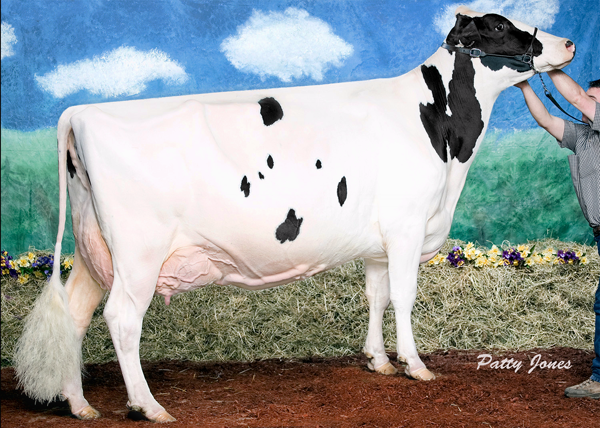
LASTING LEGACY: A Tribute to Rainyridge Talent Barbara

Many Holstein cows have made their mark on history. In October, household name, Rainyridge Talent Barbara joined that list and many were sad to hear of her passing.  Barbara was a great example of show type and production in one great package.  (Read more – Show Cows – All Type and No Action) Her most recent owners, River Valley Dairy, posted this tribute: “We congratulate her breeders and those that have worked over the years to develop her. Her legacy as the foundation of River Valley’s Holstein program will hopefully live on for generations through her Goldwyn daughters that will be born in April.” Join us as we look back at this great cow.

RAINYRIDGE TALENT BARBARA EX-94-CAN EX-95-5YR-USA

RAINYRIDGE TALENT BARBARA EX-94-CAN EX-95-5YR-USA

Talent Barbara’s Pedigree Ranks Excellent for Four Generations

Barbara was bred for strong type from the Rainyridge Tony Beauty family and she was from a strong sire stack: Talent x Outside x Milan x Tony. She is the fourth generation of Excellent. Steven Boerchers of Rainyridge Holsteins and Optimal Genetics, admits to the thrill of  riding the popularity wave of Rainyridge Tony Beauty but adds, “Other than breeding Beauty, we had no direct involvement with her success.” He goes on to note that this changed with the arrival of Barbara. “This time we could really take credit in her achievements.  You never anticipate something like that happening twice.  It is a testament to the family.” (Read more about Beauty – The 8 Greatest North American Show Cows of All-Time)

RAINYRIDGE TONY BEAUTY EX-5E-CAN 9* - 3rd dam of Barbara

RAINYRIDGE TONY BEAUTY EX-5E-CAN 9* – 3rd dam of Barbara

Talent Barbara’s Got Show Appeal

Several owners have shared in the successes of Talent Barbara outlined in the following list.

  • 2011 Honorable Mention All-American Aged Cow
  • 2010 Unanimous, All-American 5-Year-Old
  • 2010 Unanimous All-Canadian 5-Year-Old
  • 2010 First, 5-Year-Old, International Holstein Show, World Dairy Expo
  • 2010 First, 5-Year-Old, 2010 Royal Winter Fair
  • 2008 Nominated, All-American Jr. 3-Year-Old
  • 2008 Nominated All-Canadian Jr. 3-Year-Old

Undoubtedly, there would have been many memorable moments on this tremendous path of achievements.  Steven Boerchers feels that the most memorable experience for Rainyridge Holsteins was not a singular event. ”My greatest achievement with Barbara was after Madison in 2008 and came in two parts.  We were 5th in the Jr. 3-Year-Old class, with me on the halter and came out of nowhere and we got noticed. Anyone will tell you that is a great achievement. Right after Expo we were at the Westerner Championship in Red Deer and we won our class but had to go into Intermediate Champion against Eastside Lewisdale Gold Missy, who at that time was 1st Jr. 2-Year-Old from Madison and had a lot of hype behind her. We beat her for Intermediate Champion that day and we were the crowd favorite too!  That was my proudest moment with Barbara.”

The second part of the story happened two years later. “In 2010 in the Championship class at Madison everybody talked about how great she looked in the ring and suddenly we got sent to the rail. I  remember hearing silence and also sighs of relief from competitors beside me in the ring and gasps of disbelief in the air. After that she was the most talked about cow in the barns but in the best way any cow not in the top 3 of Madison could be talked about. I will never forget that.” A tribute given by the breeder who worked with Barbara and recognized the respect she was earning.

Talent Barbara Has Outstanding Production Power

The following records show that Rainyridge Talent Barbara proved that she was more than just a show winner.

  • 2-05 (298D) 11,213 4.1%F 3.2% P BCA 267-295-268 +65 +94 +66
  • 3-04 (305D) 13,762 3.6% F 3.2% P BCA 308 298 303 +111 +110 +105

Talent Barbara’s Got Great Classification

The following list of classification results for Barbara shows that she just kept getting better with age.  

  • 2-06 VG86
  • 3-01 VG 88
  • 3-09 VG 89
  • 5-01 EX 93
  • 5-04 EX 94
  • 5-07 EX 95

Barbara the Brood Cow is Off to a Great Start

Barbara already has six VG daughters in Canada.  David Jordan, marketing manager at River Valley Dairy gives this update. “We have 6 Goldwyn daughters coming in April and are very excited about the potential of that mating.”

RAVENBROOK SHAQUILLE BUNNY VG-87-2YR-CAN - daughter of Barbara

RAVENBROOK SHAQUILLE BUNNY VG-87-2YR-CAN – daughter of Barbara

Barbara Sets Herself Apart as an Attention Getter

Steven Boercher describes what made Barbara a household name. “Barbara had all the things any marketer wanted in 2008 when she was nominated All-Canadian and All-American as a Jr 3. Her pedigree, RC status, high conventional LPI and nominations both sides of the border made her very easy to market. It was not really until the genomic era came full term that this show cow proved she could produce offspring in both the show and the genomic world. That is what really set her apart from many other cow families. He goes on speaking in cowman terms, “She was such a respected cow because she looked the same day-in and day-out, hair up or hair down in the wash rack or in the pack. She made great looking calves that now are great cows. She was a very strong transmitter of her red gene and she could pass high genomic numbers to offspring that in the end made people from all parts of the industry remember her name.”

RAINYRIDGE RAMPAGE BARB RED VG-86-3YR-CAN - daughter of Barbara

RAINYRIDGE RAMPAGE BARB RED VG-86-3YR-CAN – daughter of Barbara

David Jordan assesses that “It’s no wonder that one of the industry’s most influential cow men, Ernie Kueffner and the type-breeding specialists and marketing guru Tim Abbott at St. Jacobs took such an interest in Barbara. She had it all and hit every market”

Her Impact is What Attracted River Valley Dairy

Jordan goes on to say, “Barbara was a household name and what we refer to as a Cow of Impact™.  Our focus at River Valley is on cows that can make a difference and leave an unforgettable impact on the industry.  Barbara fit that criteria extremely well with her unique ability to hit the Type, Red, and Genomic crossover categories.  It has been astonishing and humbling to witness firsthand the popularity of Barbara – and we feel so privileged for her to have called River Valley home.”

The Story Continues for Talent Barbara

“The day we decided to buy Rainyridge Talent Barbara is a day we’ll never forget.” says David Jordan. He goes on, “But what sticks out more, now, is what the folks at Rainyridge have referred to as ‘Barbara Fever’. The excitement that Barbara created for River Valley was unbelievable. She was a celebrity and we are honored to have been her agent, even for a short time.  The story with Barbara didn’t end the way we hoped it would; but, as with any great novel, there is always a twist and the really great stories often have a sequel. It is the new chapters of the book of iconic Barbara we are excited the write.” He is referring to the philosophy of River Valley Dairy. “At the core of our breeding program we believe in working with Cows of Impact™ that will deliver Genetics to Believe In™.  To us that means understanding the marketplace and what our customers want and delivering something to them that they will be satisfied with and believe in time and time again. In carrying out this breeding philosophy, we have a cell line started on Barbara and we may make the decision to clone her in the future.”

The River Valley Way

Sometimes out of adversity, we get to learn important lessons from great cattle breeders. David explains, “Our experiences are really in the Jersey market, where the show-winning and genomic index sides of the business are very different. We have worked hard to be multi-dimensional in our approach by understanding and developing both sides of the market as we have crafted River Valley’s brand footprint.  We want to buy, breed and develop both show-stopping animals and genetic-powerhouses that will matter to producers around the world. And that is why Barbara made so much sense for our expanding program.”

River Valley was formed in 2006 and Jordan explains how they have been approaching managing their genetics. “In both the show and index sides of our business we want people to know our animals are presented ethically and honestly. Anyone that works with us knows that the cow stands on her own merits. Great cows just need the opportunity to do great things, he notes.  “In our breeding program, we tend to use more proven sires or young bulls from deep, successful cow families on the type side. With high-indexing animals we use more young g-code sires; however, on both sides of the business we always try to balance production and beauty in a good way.  Not every mating you make will produce a show winner or genomic superstar so we have to be able to make it work milking all of them .”

This is great information that is added to when he looks at crossover cows and matings. “It would be great to have genomic-ranking cows that compete well at major shows however that is often the exception to the rule.  However, when it happens, those cows have the ability to bring all sides of the industry together. But on the flip side you have to be very careful that you don’t make something no one wants.  There is a really fine line there.”

AVONLEA IATOLA VICTORIA VG-89-2YR - owned by River Valley Dairy

AVONLEA IATOLA VICTORIA VG-89-2YR – owned by River Valley Dairy
First place, Jr. Two-Year-Old and Honorable Mention Intermediate Champion, 2012 International Jersey Show at World Dairy Expo

Great Cow Families. Great Breeder Families. Great Advice.

Great cow families are the foundation to build great cow herds.  In this business, it is easily recognized that Rainyridge Talent Barbara came from one of the great cow families.

Rainyridge: “You need patience. It won’t happen on the first cross and you have to use well rounded bulls to achieve a cow capable of achieving as much as Barbara.  Talent at that time was not as one sided as the Talent we know today. He was high for production as well as type. It is important to keep both in mind.”

River Valley: “Take your time. Lay out a plan and follow it the best you know how. Be willing to invest – not only dollars, but time and believe in yourself. Recruit the best team that you can and ask others for advice – but always make your own decisions as you are the one that lives with the results in the end. And finally don’t compromise on what you want to achieve – the great thing about the future is you have the opportunity to create it, everyday.”

Undoubtedly with this kind of commitment, planning and vision the legacy of Rainyridge Talent Barbara will live on.

[related-posts-thumbnails]
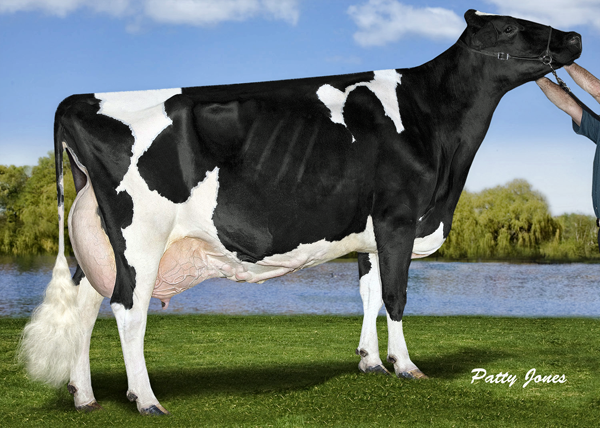
REGANCREST S CHASSITY – 2012 Golden Dam Finalist

When REGANCREST S CHASSITY EX-92-4YR-USA DOM caught the eye of Scott Courtney and he put her on his wish list that`s when this timely story began. As fate would have it, he later was working a sale where she was selling and made the first timely decision to partner on her purchase.  During his ownership he reports that Chassity was not only was a great animal to work with but she flushed well and continued to attract significant attention and new owners Ernie Kueffner and David Dyment.  More flushes followed to such bulls as Million, Alexander, Planet, Sanchez and Atwood.  By the time the International Intrigue Sale came along in August 2009 the foundation for success had been laid.  The Chassity package sold in 2009 for 1.5 million dollars and the timing was exactly right for Chassity to make money and make history.  Her sale price was capturing the headlines the same year that genomics was revolutionizing the breeding scene.  Genomics and Chassity became synonymous with success for Chassity`s current owners The Chassity Syndicate LLC of Illinois.

REGANCREST S CHASSITY EX-92-4YR-USA    DOM

REGANCREST S CHASSITY EX-92-4YR-USA DOM


Chassity Checks Out From Family Line to Topline

Like many great cows Chassity pulls it all together.  Jeff Butler, a member of the Chassity Syndicate, describes her in winning terms,” She’s a big cow standing 63 inches, with a wide rump, hard top, a wide chest, and walks up hill. And of course she has a beautiful udder. “This comes naturally when you consider that Chassity is a sixth generation Excellent from the renowned Barbie family. Looking back there is her Granddam Barbie EX92.  Then her dam Champion Cinderella EX92.  Then Chassity herself EX92.  Chassity has a full sister Celebrity VG89, owned in Canada, who is 2* Brood Cow and a bull dam.

REGANCREST CINDERELLA EX-92-2E-USA DOM GMD 4* - dam of Chassity

REGANCREST CINDERELLA EX-92-2E-USA DOM GMD 4* – dam of Chassity

Chassity’s Records Are First Class

Chassity was VG 88 as a two year old and then went EX 92. She was the number 4 Shottle in the United States and #13 cow with CTPI of 2317. She had another headlining year in 2011, when she tied with Ralma Christmas Fudge for Global Cow of the Year.  She puts up outstanding numbers with 4-00 (305d) 17,513 4.5F 3.2P.

REGANCREST-PR BARBIE EX-92-7YR-USA DOM GMD 3* - 2nd dam of Chassity

REGANCREST-PR BARBIE EX-92-7YR-USA DOM GMD 3* – 2nd dam of Chassity

Chassity Produces in the Pail and at the Bank

Chassity’s list of offspring reads like a healthy bank statement.  From Goldwyn, she produced Gold Chip and Goldwyn Cash. Cash went on to make Cashmoney, Cashcoin, Cash-O, and Casher!  With these offspring, Chassity is definitely in the money and, while she`s unforgettable for the exceptional 1.5 million dollar sale price at Intrigue in Aug. 2009, her financial story didn`t stop there.  In the Destination Vegas Sale, in December of the same year, her daughter Chassity Goldwyn Cash was the world’s top-selling individual, being purchased for $205,000.   At the World Classic sale in Madison a Planet daughter, MS Courtlane UR-S Candy VG85, sold to Regancrest.  Earlier in the summer a Domain granddaughter of Chassity, sold for a high price through the Skyline Holstein sale in Germany. She sold to Koepon. Chassity’s name continues to be a guaranteed bank machine at sales worldwide.

MS CHASSITY GOLDWYN CASH VG-87-2YR-CAN - daugher of Chassity

MS CHASSITY GOLDWYN CASH VG-87-2YR-CAN – daughter of Chassity

Chassity`s Daughters Dominate

As of September 2012 Chassity has 63 daughters from 24 different sires setting new records and earning breed leading numbers of their own, especially for type. For her current owners “the largest demand these days is driven by the progeny of Chassity’s Goldwyn daughter Cash and Chassity`s Snowman Daughters.” Courtlane UR Chassity, the 8th generation EX was Chassity’s first EX daughter! She is the dam of Cameron +2356 GTPI and other sons in A.I. MS Chassity PLN Chaching is Chassity’s Planet daughter  GLPI +2282, VG86 2yrs 2-05 (305D) 14,115kg 3.6F 3.1P. This cow also has sons going into AI. Her daughter MS Chassity Goldwyn Cash VG87 2yr GLPI +2277 has a record of 2-04 (305D) 15,491kg milk, 4.1F and 3.2P.  She has two Observer sons owned by Jetstream Genetics – Cash Money GLPI +3385 and Cash Coin GTPI +2495. In the 2012 World Classic Sale in Madison a first choice female lot from Cash sold for $39,000. Chassity`s four highest genomic tested daughters are sired by Snowman: Snow Carrie DGV +3142 DGV LPI +3142; Snowman Clea GLPI +3021; Snow Caitlyn GLPI +2922 and Snow Corissa GLPI +2811. In cattle breeding, it takes progeny to continue making money and at Butlerview they report that “Chassity is a great embryo producer and so are her daughters”

Chassity’s Sons are Super

Chassity has numerous sons in A.I. In September her 39 sons are sired by 14 different sires. MR Chassity Gold Chip (Goldwyn X Chassity) was the No. 2 genomic sire in the US in 2010. His GTPI was 2414 and his PTAT was +4.47.  There are full brothers Calvin (Select Sires) and Charlie (Semex). MR Chassity Coach with 2312 GTPI and 3.00 PTAT is the highest of Chassity’s Planet sons. Another top son, MR Chassity Carson (Observer x Chassity) has a GTPI +2225 (08/12). In December 2011, MR Chassity GW Casino (Goldwyn X Chassity) GLPI was +2744 and his CONF +14. Colt 45 (Colt P-Red X Chassity) is the result of demand for red and polled, so they got a red carrier polled. Colt’s GTPI is +2364 Dec of 2011. His PTAT is +3.78 and his PL is +5.1.

IMPACT – Chassity Raises Conformation

Chassity shines for her ability to introduce type to the population and is used worldwide. This Golden Dam nomination has proven herself from all angles!  According to the Chassity Syndicate, “She makes high GTPI bulls that make excellent calves.  Along with making high GTPI and great bulls, her daughters and grand-daughters are making a large impact on the breed.  Chassity is from a proven cow family and Chassity herself is a proven transmitter!”

Do you think Chassity deserves to win our 2012 Golden Dam Contest?  Let us know. Your vote counts.


[related-posts-thumbnails]
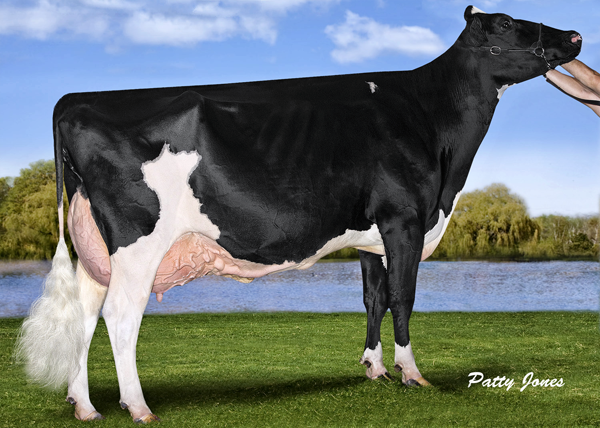
REGANCREST-PR BARBIE – 2012 Golden Dam Finalist

REGANCREST-PR BARBIE is often referred to as the premier brood cow in the Holstein world for type. Barbie and three of her daughters have all topped the USA Cow PTAT list. As a result, many descendants have brought high prices at public auction and in private treaty sales. Barbie spent her entire career under the ownership of her breeder, Regancrest Holsteins in Iowa, but her descendants have traveled the world.

REGANCREST-PR BARBIE EX-92-7YR-USA    DOM GMD   3*

REGANCREST-PR BARBIE EX-92-7YR-USA DOM GMD 3*

Her Pedigree is an Alignment of Stars

Born in 2001, Barbie brought together the two main cow families at Regancrest. Her sire Durham, EX90 and Gold Metal, was known for siring udders and show cows. He was the very best son of the great SNOW-N DENISES DELLIA EX-95-2E-USA GMD DOM 5* that Regancrest also brought to fame. On her dam’s side, Barbie is the eighth generation of Regancrest breeding, which started from the Regan purchased cow ZUBES ORMSBY FAYNE EX90. Barbie’s dam, REGANCREST JUROR BRINA, like Barbie scored EX92 and earned GMD status. In fact Barbie was the fifth generation of Excellents with the Regancrest prefix. Her sire stack is Durham x Juror x Aerostar x Chief Mark x Board Chairman. All well-known and well-respected sires.

Barbie’s dam, Brina, EX92 and GMD, made records to 15,772 kg milk 3.6%F and 3.0%P at 4yrs of age.  As well, Brina had eight other Durham daughters including Bliss VG89 (2yrs), Bianca EX92 3E and Bunny EX93, who crossed extremely well with Goldwyn.

Walkway Chief Mark appears three times in Barbie’s pedigree. Her third dam, REGANCREST MARK CHAIRMAN BEA EX-91-2E-USA GMD DOM, was sired by Chief Mark; her sire’s dam (Dellia) was Chief Mark’s very best daughter; and the dam of her maternal grandsire (Juror) was sired by Chief Mark.  With that much Chief Mark influence, it is relatively easy to see where her width, depth of rear rib, smoothly blending fore udder and boxcar rump came from.

Barbie Shone in Milking Form

Barbie calved at 2-06 and produced (305D) 12,120 kg milk 3.9%F 3.0%P and classified high VG. In 2004 she was nominated All-American Jr 3 Year Old after being Intermediate and Reserve Grand at Minnesota State Fair and 5th at World Dairy Expo. She was raised in score to Ex92 after calving for a second time. In 2010 Global Cow of the Year Competition Barbie was nominated, was the Readers Choice and placed second. Barbie was #1 PTAT Cow. Her indexes were CTPI 2178 and PTAP 4.50. Her star shone brightly.

Barbie’s Progeny Excelled

REGANCREST G BROCADE EX-92-4YR-USA DOM - daughter of Barbie

REGANCREST G BROCADE EX-92-4YR-USA DOM – daughter of Barbie

When looking at Barbie’s progeny, it is not about the performance of Barbie’s more than 27 daughters it is about how many to feature. Shottle followed closely by Goldwyn were her best mates. All but one of her daughters have classified VG in their first lactations. By 2010 she had an unheard of 8 EX and 19 VG daughters. Three of her daughters have held the number one Cow PTAT position and at least eleven have made it to the top twenty-five PTAT Cow ranking.

Barbie’s Dolls Consistently Excel

REGANCREST G BRIZELDA EX-90-4YR-USA DOM - daughter of Barbie

REGANCREST G BRIZELDA EX-90-4YR-USA DOM – daughter of Barbie

REGANCREST G BEDAZZLE EX-91-5YR-USA DOM (Goldwyn) was the first Barbie daughter to be #1 PTAT Cow and was sold to Seimers Holsteins. REGANCREST CINDERELLA EX-92-2E-USA DOM GMD 4* (Champion) is the dam of many top daughters including REGANCREST S CHASSITY  EX-92-4YR-USA DOM the dam of numerous high genomic sons (Chassity is also a Golden Dam Nominee, she will be reported on soon in the Bullvine).  Chassity and her 14 offspring sold for $1.5. REGANCREST BREYA VG-88-3YR-USA DOM 1* (Shottle) was a former #1 PTAT Cow.  REGANCREST G BROCADE EX-92-4YR-USA DOM (Goldwyn), another former #1 PTAT Cow, sold with offspring for $900,000. REGANCREST BARBARA EX-92-4YR-USA DOM GMD (Shottle) made it to #31 CTPI Cow and was first 2yr old and Reserve Intermediate Champion at Iowa State Fair. REGANCREST G BRIZELDA EX-90-4YR-USA DOM (Goldwyn) produced 4-04 (305D) 14,864 kg milk 4.0F 3.4P.  REGANCREST MAC BIKAS VG-87-2YR-USA is the dam of the high genomic type sire MR ATWOOD BROKAW (Read- 7 Sires to Use In Order To Breed the Next World Dairy Expo Champion). Following on from these and other Barbie daughters there are numerous granddaughters that have topped lists and topped sales.

REGANCREST MAC BIKAS VG-87-2YR-USA - daughter of Barbie

REGANCREST MAC BIKAS VG-87-2YR-USA – daughter of Barbie

Barbie’s Sons Line Up Well Too

Five Barbie sons were proven in AI. REGANCREST S BRAXTON EX-95-5YR-USA (Shottle) was returned to active service by Select Sires based on his above average milk yield and superior type (PTAT 3.57) proofs. Baltimor (Shottle), Birk (Toystory) and Bonzai (Dundee) were all proven in Canada and all achieved Superior Type proofs. Mr Blackjack (Dundee) achieved PTAT 2.12 in the USA. There are many grandsons, great grandsons and great great grandsons now being used widely based on their genomic indexes. These sons make another long list of stars for Barbie, which includes Bradnick, Branson, Brokow, Cameron, Carson, Cashcoin, Cashmoney, Circuit, Colt 45, and Gold Chip.

Barbie Breeds True for Type.  She is the Holstein Breed Icon.

High rankings for PTAT are something Barbie and her descendants achieve with ease. With many grand and great granddaughters and grandsons are now receiving high genomic indexes for type, production and functional traits, it appears that Barbie’s legacy of great udders, excellent dairy strength, high classification scores and global demand will continue.

Do you think Barbie deserves to win our 2012 Golden Dam Contest?  Let us know. Your vote counts.


[related-posts-thumbnails]
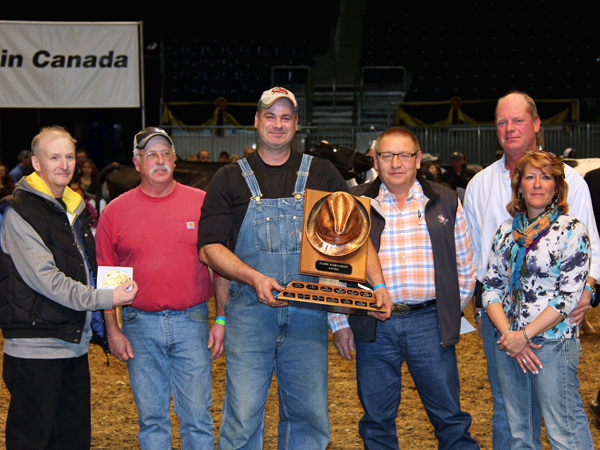
RALMA CHRISTMAS FUDGE – 2012 Golden Dam Finalist

Ralma Christmas Fudge was a special 2001 Christmas Day gift for Ralma Holsteins.  With consistently high indexing progeny and as a 2012 Golden Dam contender is the gift that keeps on giving.

RALMA CHRISTMAS FUDGE VG-88-2YR-USA    DOM GMD

RALMA CHRISTMAS FUDGE VG-88-2YR-USA DOM GMD

Christmas Fudge Starts with Ralma Recipe for Success

The foundation cow behind Fudge, Yendora Jaque Pioneer, was purchased as a heifer in the 1970’s by Mark Schmitt and his father for $890.  The Schmitt family, owners of Ralma Holsteins achieved an EX score on Pioneer and by constructive breeding moved her family into elite status.

RALMA JUROR FAITH EX91 - dam of Fudge

RALMA JUROR FAITH EX91 – dam of Fudge

Christmas Fudge’s dam, RALMA JUROR FAITH EX91, significantly moved the family ahead.  In addition to Christmas Fudge, there were two other Durham daughters, Frisky VG88 2 yrs, 13,109 kg in 305 days, 4.5%F and 3.5%P and Fireball EX92 2yrs 13,032 kg in 305 days, 4.0% F and 3.3 %P. Both of these cows have established strong cow families with progeny selling for high prices and embryos sold globally. Juror Faith is applauded for her dairy frame, sound mammary system and an ability to produce high volumes of milk over 4.3% F.”

Christmas Fudge Shares Great Ingredients

Fudge’s immediate sire stack is Durham x Juror x Leadman x Melwood.  Each of these sires adds their own specialities to the mix that produced Fudge: show type, longevity, high utility and high fat yields. Christmas Fudge classified VG88 in her first lactation and produced 12,433kg in 305 days, 4.1% F and 3.2% P.

Fudge flushed very well for Ralma produced many progeny and embryos were sold to eager buyers wishing to be part of this great cow.  Shema Holsteins have owned Fudge recently and by IVF have produced many daughters yet to be heard from by many popular bulls, including Atwood, Goldwyn, Mac, Alexander and Big Apple-Red.

The Best of Christmas Fudge

To date Fudge has produced seven Excellent daughters.  Quite likely there are more to come because there are some that are VG87 and 88 that are under three years of age.

RALMA CHRISTMAS COOKIE VG-89-3YR-USA DOM - daughter of Fudge

RALMA CHRISTMAS COOKIE VG-89-3YR-USA DOM – daughter of Fudge

One of her daughters, RALMA CHRISTMAS COOKIE VG-89-3YR-USA DOM  is hailed by many as Oman’s best conformation daughter.  Cookie definitely serves up the best of Oman, Fudge and Durham. She scored VG89 in her first lactation and produced 11,0222 kg in 305 days, 4.5%F and 3.3.% P. Cookie has three Goldwyn daughters scored Ex93, VG88 and VG88 in their first lactations they averaged 12,680 kg in 305 days, 4.5% Fand 3.4% P.  As well there three Goldwyn sons were sampled at Select Sires and Alta Genetics.

RALMA-RH MANOMAN BANJO

RALMA-RH MANOMAN BANJO VG-88-2YR-CAN – grand daughter of Fudge

Fudge’s daughter Goldwyn Clarinet is EX90 as a 4 year old produced 15,694 kg in 305 days, 4.4% F and 3.3% P.  Clarinet’s Man-O-Man daughter, RALMA-RH MANOMAN BANJO recently classified VG88 at 2yrs and topped the September 2012 Gillette Visions Sale at $131,000 (Read – Gillette Visions 2012 Sale – Great People, Great Cattle = Great Results).

Fudge’s offspring incorporate another popular genetic variation in the form of her great grandson, Sandy-Valley Colt P-Red, who traces back to Fudge through his Bolton dam Crystal and Sept Storm granddam, Crimson. Fudge’s other Excellent daughters are by Goldwyn, Finley, Sept Storm and Shottle.  One EX Finley daughter produced Shottle Camouflage VG88 who topped a Planet Sale at $101,000.

Male Line from Fudge Gets Sweeter All the Time

Fudge has had many sons enter A.I. Three Oman sons (full brothers to Cookie) are high ranking in the Netherlands (Cricket) and United States (Focus & Crest). In addition her Goldwyn son, Confirm, also ranks well in the United States.

It appears that grandsons of Fudge, from Fudge daughters, are going to make a major impact in the world of Holstein breeding.  Many are ranked high genomically.  Some of these grandsons include Gold Crown, Goldwyn Coach, Shottle Chariot and (Ramos) Cassino.  As mentioned previously, Colt P-Red is getting considerable use as a sire of sons to produce red and polled progeny.

Fudge and Her Daughters Consistently Serve Up the Best

When you look at the numbers you see that Fudge and many of her family, not just one or two of them, are unique in the way that they are consistently high for type, milk yield, components and functional traits. Christmas Fudge is indeed a prolific and gifted contender for the title of 2012 Golden Dam.

Do you think Fudge deserves to win our 2012 Golden Dam Contest?  Let us know. Your vote counts.


[related-posts-thumbnails]
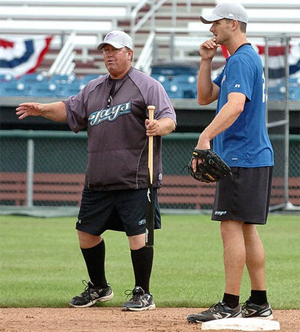
MD DELIGHT DURHAM ATLEE – 2012 Golden Dam Finalist

The first achievement of MD-DELIGHT DURHAM ATLEE EX-92-4YR-USA DOM GMD 2* was when she caught the attention of good cattle men. She was purchased by Fosters (North Carolina) as a young calf at the Maryland Convention Sale.  That is where eventual owner, Mike Heath of Heath Holsteins, first saw her and couldn’t get her out of his mind. He bought her the following year.

The Right Heifer – The Right Pedigree – The Right Partnership

MD-DELIGHT DURHAM ATLEE EX-92-4YR-USA DOM GMD 2*

MD-DELIGHT DURHAM ATLEE EX-92-4YR-USA DOM GMD 2*

For $20,000 Heath was able to work with Atlee.  The first step in the process was taken when she classified Very Good-85 as a two-year old. The partnership of Heath, Jason Lloyd and Rick Allyn got together to see if they could make money marketing and showing Atlee. She didn`t disappoint when she won her class in the Massachusetts State show.  At Madison she placed 15th in the senior two-year-old class and then, less than a week after calving as a three year old, MD-Delight Durham Atlee was named Reserve Intermediate Champion of the 2005 International Holstein Show.

Atlee Makes a Name for Herself with the help of Her Team

It was that great start in the showring that kick-started Atlee to international recognition. Heath, Allyn and Lloyd pulled together and their teamwork saw her through calving, show preparation and the rise to stardom at Madison. It`s not difficult to imagine the enthusiasm these cow men had for this descendant of the Adeen family.

Atlee`s Pedigree is Showy and Productive

MS KINGSTEAD CHIEF ADEEN EX-94-2E-USA DOM 2*

MS KINGSTEAD CHIEF ADEEN EX-94-2E-USA DOM 2* – 2nd dam of Atlee

Show type is written all over Atlee`s pedigree. Her granddam (MS KINGSTEAD CHIEF ADEEN EX-94-2E-USA DOM 2*), great aunt (SHOREMARE S ALICA EX-97-3E-USA 6*) and great granddam (AITKENBRAE STARBUCK ADAEX-94-2E-USA DOM 4*) all have been All-American, All-Canadian or Grand Champion at Major Shows. Her dam was not shown but classified Very Good 88 during her first lactation. Additionally Atlee`s sire stack Goldwyn x Storm x Skychief x Starbuck has very high conformation numbers and above average production.

Atlee’s Stats Add Up

Most notable is that Atlee was Reserve Intermediate Champion at the 2005 International Holstein Show. A great follow up to placing 15th as a Senior Two Year Old in 2004. In her second lactation Atlee scored Excellent-92. That is the maximum score achievable for a second lactation cow. In two lactations she produced 35,265 kgs of milk, 5.0% Fat and 3.3% protein.

Atlee Goes Beyond Pure Gold to Simply Magical 

Lafontaine Aftershock Arrie – Junior Champion World Dairy Expo 2012

Lafontaine AFTERSHOCK Arrie – Junior Champion World Dairy Expo 2012

The magical cross – often referred to as “golden” is the one to Braedale Goldwyn because it resulted in many sons and daughters who are making significant contributions to the breed. That golden Goldwyn flush not only resulted in the current number one proven type sire , Atwood (PTAT 4.16) but also produced Alta Amazing (PTAT 3.77 ), Avalanche (PTAT 3.48) and Atlantic (PTAT 3.02) in the USA. Four sons above 3.0 PTAT.  This is a “first” ever group. In Canada the flush produced Atticus (CONF +14) and Attic (CONF+11) both awarded Superior Type in 2012. Atlee’s Shottle son, Aftershock, is now officially proven in Canada at CONF +16 and he sired the Junior Champion and Reserve Junior Champion at the International Holstein Show 2012. Yet another Goldwyn son, Ridgefield Delete (PTAT 3.52) is superior proven in Spain. Genomic evaluations for type have played a significant role in Atlee’s sons being used extensively. Before being proven, Atwood was the number one genomically tested bull for type.

Atlee’s Daughters Rise to the Top Everywhere

MS ATLEES GOLDWYN ARIEL EX-92 EX-MS - daughter of Atlee

MS ATLEES GOLDWYN ARIEL EX-92 EX-MS – daughter of Atlee

Atlee’s Goldwyn daughters are also outstanding. In the USA Ariel EX92 was Reserve All-American Junior 2 yr old in 2009 and subsequently sold for $1.5 million dollars for her, eleven daughters, six sons and four pregnancies.  Abigail EX91 has had many daughters sell for high prices. Arista VG88 has had daughters top many sales.  Avery VG87 2yr has many daughters and granddaughters near the top of the index lists. Ava VG88 2yr is on an extensive flushing program.  In Canada Albany VG87 2yrs, already has four VG two year olds.  In the UK, Golden Atlee VG87 and Gold Atlee VG88 are the foundation for new cow families in that country.

MS ATLEES SHOTTLE AUBRY VG-88 EX-MS

MS ATLEES SHOTTLE AUBRY VG-88 EX-MS- daughter of Atlee

Other high Atlee daughters include Aubry, her only Shottle daughter, who has many high genomic sons and daughters. Arlene VG86 (Adam) is a foundation for a new family at Reagancrest, Farnear and Siemers. Autumn (Roy) was the winning fall calf at the 2007 International Holstein Show and All-American Fall Calf and in 2008 was the All-American Milking Fall Yearling.

BVK ATWOOD ABRIANNA VG-89-2YR - WDE 2012

BVK ATWOOD ABRIANNA VG-89-2YR – 1st Jr. 2yr WDE 2012

BVK Atwood Ariana VG89-2yr is an Atwood daughter with a double dose of Adeen genetics. Recently she placed first in the Junior 2yr old class at the 2012 International Holstein Show after being Intermediate Champion at the 2012 Illinois State Holstein Show.

Atlee Had A Short Career But is Making A Colossal Impact

Unfortunately cancer claimed Atlee early in life but not before she had been flushed extensively. Her offspring, both sons and daughters, continue to build the outstanding legacy of this Golden Dam Finalist.

Do you think Atlee deserves to win our 2012 Golden Dam Contest?  Let us know. Your vote counts.


[related-posts-thumbnails]
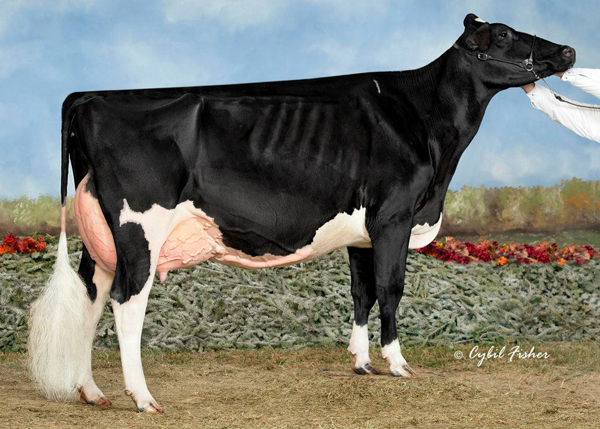
MARKWELL DURHAM DAISY – 2012 Golden Dam Finalist

MARKWELL DURHAM DAISY EX-92 GMD DOM is the 4th generation of Markwell breeding.  The foundation cow was a Tony EX94 4E followed by Chief Mark EX92, 4E, Blackstar (The great MARKWELL BSTAR E RAVEN) EX95, 3E and a EX-92 4E DOM GMD Luke EX92.  This nomination for 2012 Golden Dam got the best from all the parts and that is certainly saying something.  Her sire, Regancrest Elton Durham, was the American Show bull of his time.  Her dam, MARKWELL LUKE RAPTURE EX92, 4E, Gold Medal Dam, 4 Star was one of the top daughters of the Luke bull and had nine excellent daughters, including Daisy.  Daisy’s grand- dam, MARKWELL BLACKSTAR RAVEN, who had 23 Excellent daughters, was one of the most respected Blackstars ever and her name is known around the world.

Daisy Was Hand-Picked From a Well-Known Family of Late Bloomers

Daisy is currently owned by Adolph Langhout of A-L-H Holsteins who wanted to buy into the well-known Raven family.  He did his homework and knew that although the Raven family are not massive cows as two year olds they continue to grow and produce as they get older.  Statistics show that they start out at 22,000 lbs. to 25000 lbs. two year olds and by the time they are mature they`re producing 35,000 plus!  They classify VG as two year olds and EX 92-94 at maturity.  Good things come to those who wait for late bloomers.

Young Daisy is Golden in the Show Ring

MARKWELL DURHAM DAISY  EX-92-6YR-USA    GMD DOM

MARKWELL DURHAM DAISY EX-92-6YR-USA GMD DOM

At World Dairy Expo in 2002, Daisy was named Honorable Mention Intermediate Champion.  She went on to be Honorable Mention All-American Senior 2 YR Old.  However, Daisy is multi-talented with high production, fitness, longevity and outstanding type.  She was Excellent 92 in her second lactation.

Daisy’s Daughters Also Dazzle

A-L-H DESTINY VG-87-3YR-USA DOM GMD  - daugher of Daisy

A-L-H DESTINY VG-87-3YR-USA DOM GMD – daugher of Daisy

Like their mother, Daisy’s daughters also milk, show and reproduce.  Her O Man daughter, A-L-H DESTINY VG-87-3YR-USA DOM GMD, is nominated for International Cow of the Year in 2012.  Obviously Daisy transmits her best.  Her Goldwyn son DANILLO claimed first place in the Netherlands April 2012 proof run with a very balanced proof.  With a full brother, GOLDDAY also making a promising debut based on his genomic tests.  Destiny also produced the sought-after bull dams HEIDENSKIPSTER GOLDWYN DESTINY VG-86, REGAN-ALH G DESTINI VG-88 (By Goldwyn), and REGAN-ALH BLVR DIVINA VG-87 (by Boliver).

 Daisy Has Rising Sons

The best cross for Daisy was O Man.  That produced two daughters that became bull dams in their own right and Daisy has three highly proven Oman sons –  A-L-H DAKOTA in The Netherlands, A-L-H DUKE in Germany and A-L-H OSAKA in Spain.  Initially her sons shone and now her grandsons are shining brighter.  The next great cross was Goldwyn and now her Goldwyn grandson, mentioned earlier, Danillo ranks high in the Netherlands and grandson Goldday ranks near the top in Germany.

Daisy’s Family Grew Genomics

Daisy attracted attention because of her family and sire stack.  With the advent of genomics, it has been shown that the family also possesses very high genomic values.  This has been a plus for owners of sons and daughters and grandsons and granddaughters.

Daisy Continues Sowing the Seeds of Success

MARKWELL BSTAR E RAVEN EX-95-3E-USA GMD DOM 5* - 2nd dam of Daisy

MARKWELL BSTAR E RAVEN EX-95-3E-USA GMD DOM 5* – 2nd dam of Daisy

Daisy’s grand dam Raven came second for International Cow of the Year.  Daisy herself came third in 2011 in a close placing for International Cow of the Year.  Destiny is nominated this year for 2012 International cow of the year.

Daisy Impacts Holstein Field of Dreams

Daisy took the Raven family from well-respected in western USA to international demand for her progeny.  From being recommended as “possibly” having the potential to be as good as Raven herself, Daisy has gone on to do exactly that!  Definitely Daisy is a Golden Dam contender.

Do you think Durham Daisy deserves to win our 2012 Golden Dam Contest?  Let us know. Your vote counts.


[related-posts-thumbnails]
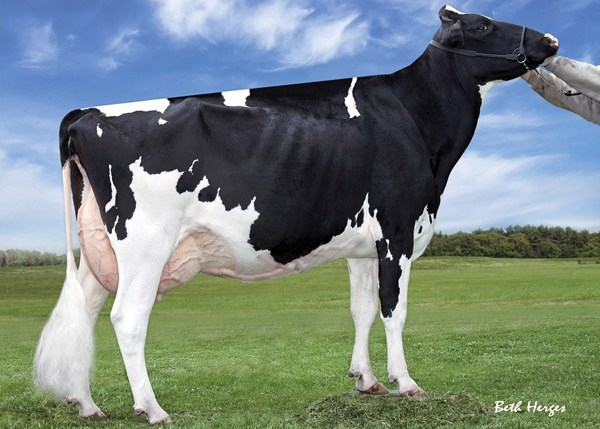
LYLEHAVEN LILA Z – 2012 Golden Dam Finalist

LYLEHAVEN LILA Z comes from a long line of great genetics that have prepared her to be contender for 2012 Golden Dam.  Her grand-dam THIERSANT LILI STARBUCK EX-94 5E has 22 daughters who are high for yield and type. Her dam LYLEHAVEN FORM LAURA Ex-94 3E has 14 high conformation and high production daughters including a remarkable 5 full sisters to Lila Z.

LYLEHAVEN FORM LAURA EX-94-3E-USA GMD DOM 6* - dam of Lila Z

LYLEHAVEN FORM LAURA EX-94-3E-USA GMD DOM 6* – dam of Lila Z
RES. ALL-CANADIAN JR.3-YR 2002
HM. ALL-AMERICAN 4-YR 2003

Lila Z Magnifies Success for Multiple Owners

Lylehaven Lila Z has changed ownership on no less than seven separate occasions. Up to the present time more than thirteen breeders have owned shares in this record breaking cow.  Lila Z is currently owned by Rich Vanderwal, Cedarwal Farms Limited (Abbotsford, BC) and the Donaldson Family, Bradner Farms (Abbotsford, BC). Rich Vanderwal sums up the interest that led to their purchase. He says, “We admired Lila Z as a valuable show cow and a great breed ambassador”  (Read more – Lylehaven Lila Z: Was she really worth $1.15 Million)

Zero in on Lila Z’s Numbers

Those who work with Lila Z find that she impresses in the barn and on the books. Rich Vanderwal points out that “her greatest strengths are her frame, her dairyness and the great mammaries she passes on to on her progeny.”  Lila Z’s numbers clearly support this analysis. She is EX-94 (third lactation) and a fourth generation Ex-94. Lila is a 14 Star Brood Cow. In 3 lactations she produced 75,385 kgs milk 3.9%F 3.4%. She has 1 Super 3 and 3 Superior Lactations. As well, Lila Z was All-Canadian- Junior Yearling & Jr 2 Yr Old and HM All Canadian 4 Yr Old & 5 Yr Old.

Lila Z has a Living Legacy

OCONNORS PLANET LUCIA VG-86-2YR-CAN

OCONNORS PLANET LUCIA VG-86-2YR-CAN – grand daughter of Lila Z
#1 GLPI Cow in Canada -8/12

Obviously Lila Z has what it takes and has become a media sensation but Rich Vanderwal feels she goes well beyond the headlines.  “Lila Z is no longer just a million dollar cow with a nice pedigree and show winnings.  She is the premier brood cow at the top of the Holstein breed.” He elaborates on what makes her unique. “Lila Z is a bull dam in her own right but now her daughters and granddaughters are producing bulls (Lavaman, Lexor and now Let it Snow) that are topping the genomics list for the last 2 years  and an own granddaughter is now #1 GLPI cow in Canada (Lucia – one the sensational 6 top north American genomic Holsteins we would invest in), with high genomic sons on the way.” This has been part of the reason why her progeny and descendants are commanding high prices at sales all over the world. Rich points out, “Lila Z’s influence now extends into most herds in Canada and internationally.”

 53 Desirable Lila Zs

COMESTAR GOLDWYN LILAC VG-89-5YR-CAN - daughter of Lila Z

COMESTAR GOLDWYN LILAC VG-89-5YR-CAN – daughter of Lila Z
ALL-ONTARIO SR.2-YR 2008,
NOM. ALL-CANADIAN SR.2-YR 2008

There are 5 daughters of Lila Z which feature in Canada’s Top 75 GLPI cows. “Goldwyn has been the golden cross on her so far producing daughters that are All Canadian, Star Brood Cows and valuable bull dams” says Vanderwal. The numbers are excellent for them too. Seven of her eight Goldwyn daughters were VG as 2 yr olds with high production. Goldwyn Lilac is nominated for the 2012 International Cow of the Year. Her first EX daughter is by Shottle however over thirty of her daughters are young and have not calved in for the first time. Cederwal and Bradner are using many high genomic sires on Lila Z flushes at this time.

Great Way to Get Some Zzzz’s

Embryos from Lila Z’s descendents are routinely offered for sale, privately or through public auction. Her high genomic grandsons are being used as flush sires by many breeders around the world. Acecroft in the UK have so far produced 93 registered progeny of Goldwyn Zulu.

Lila Z’s Rising Sons

So far Lila Z has 5 Ex and 4 VG sons. One is Class Extra and one is Superior Production. Her sons routinely transmit great length of body and ultra long dairy necks, with tremendous frames that have the balance and style associated with Lila Z.

Lila Z Delivers the Genomics

Lila Z just naturally rises to the top of whatever list breeders measure by.  Rich explains.  “Since we (Cederwal & Bradner) purchased her she has also proven to be a terrific transmitter when evaluated by genomics also.” However he notes that this isn’t the first reason buyers considered the purchase of Lila Z, “She was never bought or sold on genomics. It has been a bonus to the owners of her progeny that the science of genomics later confirmed her true transmitting ability. (Read – Lessons Learned: 6 Dairy Cattle Investment Secrets Revealed)Lila Z and her daughters are now in that very unique group of cows that demand respect as proven transmitters – the package of genomics backed by a truly reputable cow family.” (Read more – Top Three Things To Consider When Investing In High Genomic Heifers)

Lila Z is Ready for Her Close Up

“We are thrilled to be able to be involved with such a famous and significant brood cow” Undoubtedly past owners felt the same way as her growing star power continuously attracted attention.  With a touch of mystery Rich advises, “Look for her to make a cameo appearance at the Genetics by Design Sale in November 2012.”  Obviously the new owners continue to believe that Lila Z’s story is “still beginning”.

The Ongoing Impact of Lylehaven Lila Z

Lila Z`s owners, past and present, love to expand on the major influence of Lila Z and her progeny.  David Eastman notes that “Not since the days of Laurie Sheik, has so much faith and confidence been put in one cow family.”  Rich Vanderwal emphatically concludes, “Lila Z’s contribution to the Holstein breed will rank her as the #1 brood cow of this era.”

Do you think Lila Z deserves to win our 2012 Golden Dam Contest?  Let us know. Your vote counts.


[related-posts-thumbnails]
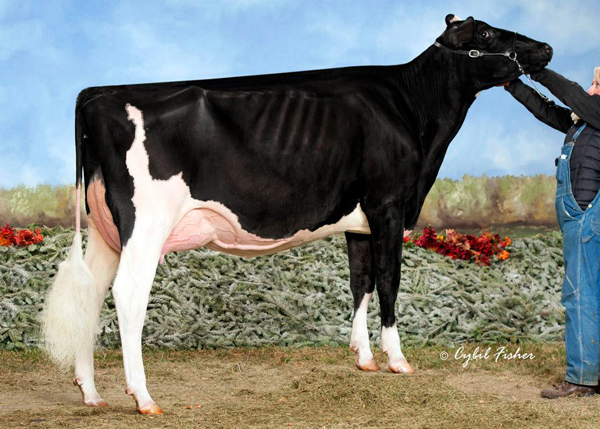
GOLDEN-OAKS PERK RAE – 2012 Golden Dam Finalist

Golden Oaks Farm, former owners, and Adolf Langhout, current owner, are justifiably proud of the achievements of GOLDEN-OAKS PERK RAE – Red-ET EX-90. Perk Rae is an 8thgeneration EX and she is a red Roxy.  She has 7 EX sisters. Her sire, Burket-Falls Perk-Red, is a breeding product of Burket Falls Farms in Pennsylvania where the 270-head herd is 80% polled.  With that family line behind and beside her and strengths that include protein (+16kg) daughter fertility (103), milking speed (107) and temperament (106), it isn’t surprising that she is a contender for 2012 Golden Dam.

GOLDEN-OAKS PERK RAE EX-90-5YR-USA      2*

GOLDEN-OAKS PERK RAE EX-90-5YR-USA 2*

Perk Rae is a Prolific Embryo Producer

Perk is impressive in her own right as a long bodied cow with power and dairy strength. She supports all of that with an excellent udder and outstanding feet and legs. She was on a continual flush program at Golden Oaks, performed by Sunshine Genetics of Whitewater, WI and recently has milking daughters from Alexander, Goldwyn and Shaquille. Perk Rae flushed really well and sold more than 100 of her embryos around the world.  (Read – What Comes First the Chicken or the Egg?) With ten years in their breeding program she had a total of 81 registered direct offspring including 10 VG and one EX-92.

GOLDEN-OAKS DUR RAE1 VG-89-3YR-CAN – daughter of Perk Rae

GOLDEN-OAKS DUR RAE1 VG-89-3YR-CAN – daughter of Perk Rae

Perk’s Imposing Number of Daughters Also Perform on the Plus Side

What is distinctive about Perk Rae is her capacity to transmit her quality to the next generation. Perk Rae has Very Good daughters by Vince, Mr. Burns and Durham.  They all have high production. Her best daughter, by Durham, is Golden-Oaks Dur Rae1.  She earned the maximum score VG89 as a three year old.  Her production at three years was 13,530kg, 3.4% fat and 3.2% protein. Golden Oaks is working with a Goldwyn daughter who as a GTPI of +1910. As well, she has 8 VG daughters in the USA.

Perk Rae’s Sons Considerably Improve the Breed

Perk Rae has numerous sons including Mr Perky at ABS Global, Rocco P at ABC Genetics and Parkson at Trans-World Genetics. Grandsons in AI include Ventur Proxy PP-Red – homozygous polled Red Mitey P x VG Durham x Perk Rae at DairyBullsOnline (Read – They’re Sold on Polled).  In particular there is considerable enthusiasm for the polled and red daughters of Golden Oaks Rocco-Red (Redman x Perk Rae).

Perk Rae Mates Well

Nate Janssen, Dairy Operations Manager of Golden Oaks, reports that the best matings on Perk Rae have been Redman, Durham and Goldwyn.  “A lot of Perks best descendants are from her Redman daughters.”  Durham worked well, as mentioned previously, with a 92 pt daughter by him.  Nate adds, “Goldwyn helped bring a little more angularity and style into the picture.”  He outlines a two-part marketing strategy.

GOLDEN-OAKS PEACH-P-ET VG-85-2YR-CAN - daughter of Perk Rae

GOLDEN-OAKS PEACH-P-ET VG-85-2YR-CAN – daughter of Perk Rae

Perk Rae And Her Family Are In Demand in the Market

“Although we like to keep red in the picture, there is a market for high polled B&W animals, so we are using some of the top B&W as well and protecting for milk and health traits.”  Presently there is large demand. “At our farm we have a PP Colt Daughter that we are currently flushing to fill contracts.  We also have a polled Shamrock daughter that is 2000 GTPI.” There are progeny by over twenty-five different sires registered in North America and Europe.

SCIENTIFIC DEBUTANTE RAE EX-92-4YR-USA DOM GMD 2* – sister to dam of Perk Rae

SCIENTIFIC DEBUTANTE RAE EX-92-4YR-USA DOM GMD 2* – sister to dam of Perk Rae

There are Many Perks to Working with Perk Rae

Perk Rae is also the winner of the 2012 Red Impact Award from Holstein International.  Second in family to win this award.  Her dam’s sister, Scientific Debutant Rae, won it in 2010.  In 2011, going under the hammer for $20,000 Perk Rae was the top seller at the National Red & White Convention Sale. Presently, Perk Raw is owned by Adolf Langhout of the Netherlands who plans to keep Perk Rae-Red at Sunshine Genetics in Wisconsin and export her genetics around the world where her descendants are continuing to garner attention. “It is very interesting that two direct daughters and one granddaughter are selling in the World Classic Sale at World Dairy Expo this year!”

The Perk Rae Advantages.  She’s Polled. She’s Red.

New owner A.L.H Genetics is happy with their purchase. Embryos imported from embryos purchased previously resulted in a VG-86 Lawn Boy heifer in the Netherlands and the popular Lawn Boy son Lewitan PP at Mastrrind in Germany. The unique polled and red qualities of Perk Rae mean that her owners have sold her genetics all over the world. (Read – Polled Genetics: Way of the Future or Passing Fad?) “Since she is red, high type, deep pedigree, and polled, with a unique sire, there are endless markets!”  He happily points out the obvious, “There are not many excellent cows that are red as well as polled.”

Do you think Perk Rae deserves to win our 2012 Golden Dam Contest?  Let us know. Your vote counts.


[related-posts-thumbnails]
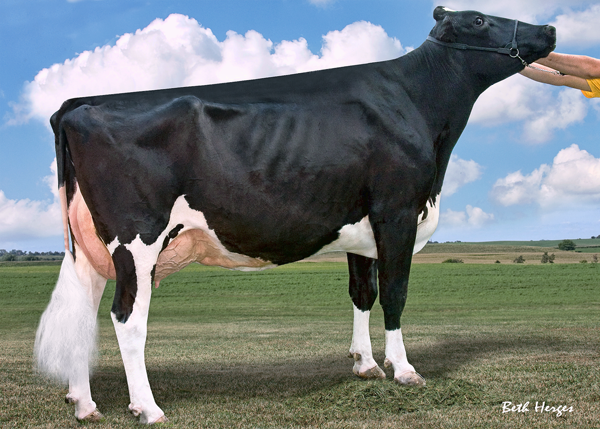
GILLETTE BLITZ 2ND WIND – 2012 Golden Dam Finalist

The race is on and Gillette Blitz 2nd Wind is challenging the competition.  From Ferme Gillette in Embrun Ontario 2nd Wind has claimed worldwide recognition for her winning achievements in every area of the Holstein Breed. With an outstanding list of awards, including 2011 Canadian Holstein Cow of the Year, she now targets the title of 2012 Golden Dam.

2nd Wind Follows the Family Role Model

GILLETTE BLITZ 2ND WIND VG-88-3YR-CAN 35*

GILLETTE BLITZ 2ND WIND VG-88-3YR-CAN 35*

For fans of the amazing Braedale Gypsy Grand Family it is no surprise to see 2nd Wind ready for the competition.  What would you expect from her tremendous pedigree which traces back two generations to the 2003 Cow of the Year Braedale Gypsy Grand (VG-88-5yr 37*).

2nd Wind Shows That She Has Strength in Numbers

For years she 2nd Wind has topped the GLPI/LPI lists no less than five times in a row from 2005 and 2006. She has taken first place on the LPI list a total of six times in all.  In May, August and November of 2006 she was the leader for type. And in a business that is built on milk, her name has been at the top of the milk production list three times.

  • Best 305: 2yr. 15,004 kg M 535 kg F 3.6% 449 kg P 3.0% BCAs 372-354-348 – 50% over herdmates.
  • Lifetime: 2 lacts: 31,317 kg M 1,231 kg F 3.9% 981 kg P 3.1%
  • 1 Superior Lactation.  2nd Jr. 3-Yr.-Old (Best Udder) Québec Spring Show 2005

2nd Wind Goes the Second Mile

But above and beyond all of these conspicuous numbers she impresses in the race to recognition as the Golden Dam of the Holstein Breed. No less than five times she has been the index leading dam of top 1000 GLPI daughters. In the past eight proof rounds she has never had less than nine daughters appear on the list and in 2010 she had fourteen on the list!

2nd Wind Unmatched as Mother of Sons

GILLETTE WINDBROOKEX-95-CAN EXTRA'10

GILLETTE WINDBROOK EX-95-CAN EXTRA’10 son of 2nd Wind

2nd Wind has set the benchmark so high as a mother of Class Extra sons that she is in a class all by herself.  As the dam of no less than five Class Extra sons she has done what has never been done before.  Her Class Extra sons are Gillette Windbrook, Gillette Windhammer, Gillette Stanleycup, Gillette Wildthing, and Gillette Willrock.  These five sires were in the top 30 in the North American LPI list and also in the top 30 in Japan, where 2nd Wind is owned with T-Wave. Holsteins. She has three other active proven sons who are extremely popular among Japanese breeders.  Closer to home, in the December 2011 LPI listing Stanleycup and Windhammer — identical split embryo Bolton sons — ranked as the number one conformation sires at +19.

2nd Wind is A First Rate Mate

Her outstanding achievements are possible because of her exceptional mating history.  Eric Patenaude speaks positively as he highlights this side of her story, “Every mating has worked well.” He goes on to point out that Bolton has been by far the best. “2nd Sleep and 2nd Motivation, two full sisters, are both 89 points and 2ndRain (deceased split sister of Sleep) was 87 and would probably have moved up to 89 as well.” Her Bolton sons are the Class Extra sires, Gillette Windhammer and Gillette Stanley Cup.

GILLETTE BOLTON 2ND MOTIVATION VG-89-4YR-CAN

GILLETTE BOLTON 2ND MOTIVATION VG-89-4YR-CAN – Daughter by Bolton

2nd Wind’s Daughters Can Carry the Torch Too

2nd Wind has been able to pass the genetic torch to her daughter Gillette Bolton 2nd Sleep (VG-89-4yr) and her granddaughter Gillette S Planet 2nd Snooze (Recently Sold in the Gillette Visions 2012 Sale). Sleep was #1 in August 2010 and Snooze (VG-86-2yr) was #2 GLPI in December 2011.  It doesn’t stop there.  2nd Wind has 10 daughters over +2000 GLPI in Canada. Eric has already been quoted regarding these two. “They are just beautiful to look at with big dairy frames, tremendous will to milk and those incredible udders which have become 2nd Wind’s trademark.” No doubt these were the reasons why 2nd Wind was IVF’d to Bolton.  “We now have 5 more beautiful heifers to work with.”

GILLETTE S PLANET 2ND SNOOZE VG-86-2YR-CAN - Grand Daughter by Planet

GILLETTE S PLANET 2ND SNOOZE VG-86-2YR-CAN – Grand Daughter by Planet

2nd Wind has a Winning Strategy

Every opportunity for success is taken by 2nd Wind’s owners. “When it comes to flushing the daughters and granddaughters we try to use the best young sire available, which is either the highest one with numbers, or, if that one doesn’t appeal to us, we use one we truly believe in. At the moment we’re using Galaxy, McCutchen, Supersire, and Brawler.” Other bulls are being used as well. Eric provides the following update. “Also one of R-Z BAXTER CARAMEL’s son by Snowman called Caraminator who’s GPA LPI is 3055 with a DGV of 3211and a Windbrook son from Goldwyn Jenny called Jessic. This bull has a DGV of 2415 with a +21 for type!”

2nd Wind Ready for the Future

2nd Wind does not rest on her laurels and neither do her owners. “Now we’re mostly working with daughters of her two Boltons 2nd Sleep and 2nd Motivation  as well as daughters from her granddaughter 2nd Snooze.  2nd Wind has a couple of sweet daughters by Lauthority that we will probably flush soon.” For now she has come home to Gillette from the IVF station. But there are more plans ahead. “Her progeny from trans-ova are starting to calve out.  So far these are Garrets and Supers and they are calving out with 2nd Wind’s trademark, awesome udders. We have Evolves calving out soon too!”

 2nd Wind Goes Beyond the Finish Line

Many expect that 2nd Wind’s presence will have impact worldwide.  Eric Patenaude sums up 2nd Wind’s ongoing success. “Her genes will have impact for many years to come and her name will appear in the major pedigrees of the world.”  A success story indeed for owners, Gillette and T-Wave.  With 2nd Wind the real story may be that the best is yet to come.

Do you think 2nd Wind deserves to win our 2012 Golden Dam Contest?  Let us know. Your vote counts.


[related-posts-thumbnails]
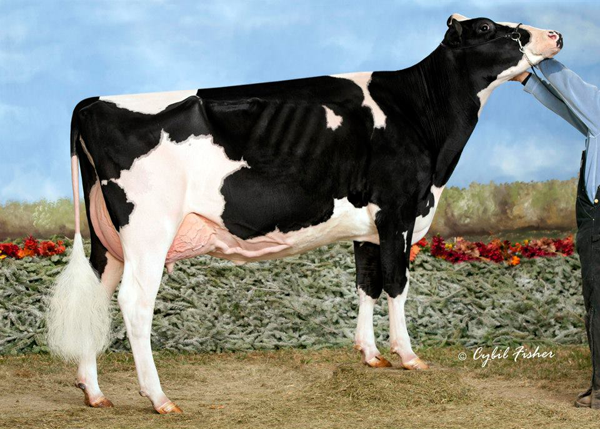
Bonnie Mohr – Science and Art Together Creates a Holstein Love Story

“Okay people, please clap or do something, because this seems very awkward to me” This is how artist, Bonnie Mohr, describes the long pause of silence that was the initial reaction of the large crowd present for the June 29th unveiling of the Ideal True Type Holstein Bull and Cow paintings  at the Holstein USA annual meeting. .”I am much more at ease in my studio or with a small group of people.” Explains the well-known agricultural artist but she needn’t have worried. As with any supreme achievement the first reaction is one of awe. The crowd was initially busy studying the paintings but then broke into enthusiastic and sustained applause.  Still, Bonnie is modest, “I think they were well received…”

Bonnie Mohr -  Ideal True Type Holstein Cow

Ideal True Type Holstein Cow

Bonnie Mohr - Ideal True Type Holstein Bull

Ideal True Type Holstein Bull

 Everyone loves to look at beautiful cattle and, as you would expect, the paintings indeed were well received. As summer slips into fall, we begin looking forward to the show season and parades of beautiful cows to celebrate.  Of course, if you can’t wait for Madison or the Royal Winter Fair, there is an alternative.  At The Bullvine we have celebrated graduations, engagements, new homes and new babies with the beautiful animals painted by Bonnie Mohr. And now with these commissioned paintings, Bonnie turns cow science into cow art for everyone to collect, admire and strive for.

Celebration of Cows

Celebration of Cows

A labour of love.  The paintings were commissioned by Holstein Association USA. Discussions about what the new Model cow and bull would look like began at World Dairy Expo in 2011.  She outlines the process. “The month of December was preliminary painting sketches, and January through June 1st was spent painting the two pieces.  Since they were very large -each painting measures 36” x 48” – and with extreme detail in the animals, it took longer than a normal painting time.  I would guess I averaged 30-40 hours per week of painting time from January 1st to June 1st.”

Bonnie Mohr - Ideal True Type Holstein Cow

Ideal True Type Holstein Cow – The Beginning

Matchmaking. From the outside, it might seem unusual for an artist to work with input from others or, in this case, the True Type Model Panel.  However Bonnie says that was never a problem. “Because of my extensive background in the dairy industry, it seemed as though we were both on the same page from the beginning.  Input from the committee was necessary, so I would have a clear vision of what they wanted.  The more detail and information I could get up front, the better the paintings I would produce.”

Bonnie Mohr - Ideal True Type Holstein Bull

Ideal True Type Holstein Bull – The Beginning

A Brush with Great Expectations. Bonnie does acknowledge that there were some changes from her usual routine. “Normally I would start with some loose background and then get to the main subject.  In this case, I painted the animals each to about a 75% completion point to be sure we could really focus on them against a white background.” There were other differences too. She shares her experience. “I would have to say that the size of these paintings did throw me for a loop.  I have never painted so large, and I did underestimate the amount of time they would take.  Also, any time you are working on a commission, there is a certain level of added stress, because you know in the end, it has to be exactly what the committee is expecting.”

Bonnie Mohr - A love story

Bonnie Mohr – A love story

A love story. Looking back, Bonnie points out that the experience continued to evolve beyond the routine and developed into a very special project.  A highlight of the commissioning came about when she made the decision to name the Bull and Cow, Romeo and Juliet.  “Because I spent so much time with these paintings, they just seemed to come alive the more I worked on them.  They became REAL to me, and it just seemed like the right thing to do…give them names.”  Bonnie isn’t sure what came first: the naming of the subjects or the way the two paintings related, not only to her, but to each other. “They honestly seemed to connect to each other as well, and I think I accomplished my goal of making them seem like a real nice couple – as though they could be married.  And so….thus came the names Romeo & Juliet.”

Bonnie Mohr - Picture Perfect

Picture Perfect

Picture Perfect.    “I did have pictures of both cows and bulls to work from as I created these New Models.  All of the animals I studied from and the pictures that I worked from, had key points of exceptional correctness, and it was very helpful for me to use them in creating the Models.” And so, from part science and part art, models were created for everyone to aspire to.  Of course when we see Romeo and Juliet they appear to be right at home. “The committee and I collectively arrived at an outdoor, ‘anywhere USA’ setting, that resembled summer and a sense of pasture.  We all felt this would be a typical and natural setting for the animals.”

Bonnie Mohr - Romeo and Juliet

Romeo and Juliet

Where there any difficult moments with Romeo and Juliet?  Seeing the twosome in all their glory it is hard to imagine that there were moments that were less than romantic but Bonnie assures us that there were. |” Absolutely.  I have mentioned this before…and I’m not sure why, but Romeo almost seemed to paint himself.  He just came together beautifully and I had very little trouble making him ‘work’.  Juliet was my bigger challenge.  Probably the mammary system and milk well veining is where I struggled the most.  Too much veining, not enough veining, too much length to the fore udder and then too little, too small of a teat – make it bigger, and then a little plumper…..”  Every cattle breeder can relate to Bonnie’s goal.

Bonnie Mohr - Desire for Perfection

Desire for Perfection

Desire for Perfection

“The committee was great in their advice and direction…I personally as an artist just struggled with getting it just right.”  It wasn’t easy.  “When you study cow pictures….they can look a thousand different ways, depending on how closely the udder is shaved, how much sunlight they are photographed in, how much milk they have, etc., etc.  And I wanted to try and paint the universal look, that every dairy farmer would be happy with…milky enough and yet strong in type, and so I would have to say this was definitely my biggest challenge. “In the same way that the total environment affects everyone who raises cattle, this project went beyond simply painting the models themselves. “ Making sure the backgrounds on the two paintings were fairly matched and similar was the other challenge, because they were so large and painted over a 5 month period.  Every time you mix new paint, you have new colors…..so I had to go back and rematch or repaint some things to be sure they had a similar thread all the way through.” A labour of love.

Bonnie Mohr - A Brush with Great Expectations

There’s love behind the Scenes Too!

There’s love behind the Scenes Too!

“My husband John has been the biggest influence in my career.” says Bonnie as she looks back on the inspiration for her successful vocation. “He has supported and believed in me from day 1.  He believed in me more than I believed in myself some days.  He is the reason I kept painting, even when I really wasn’t sure this whole ‘painting thing’ would work out.  Other than that, I give God the thanks and credit for the skills I have been blessed with and the determination to know that hard work can pay off.”

THE BULLVINE BOTTOM LINE

And so, in painting the True Type Models, Bonnie crosses an item off of her Bucket List. “No doubt she will face her next goals with the same enthusiasm, “I will always love cows and will continue to think of new ways to paint them!”  A Holstein Love Story continues ……..

Be sure to check out Bonnie Mohr studio’s Facebook page where you can help them reach 3,000 likes and be entered in a draw for a framed print valued at $200, as well as check out their website for more extraordinary fine art from rural America .


[related-posts-thumbnails]
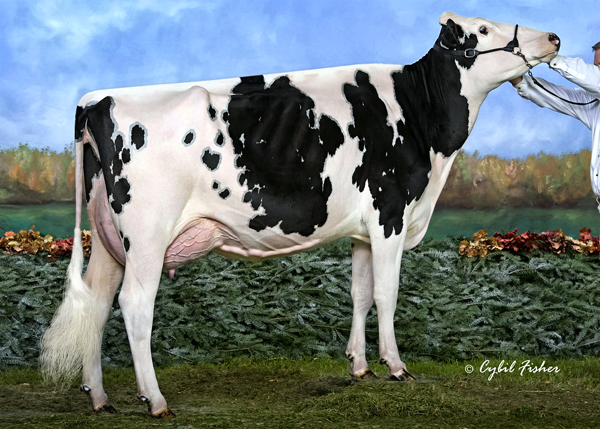
BROEKS MBM ELSA – 2012 Golden Dam Finalist

It’s a Cinder-ELSA Story! Of course, she has royal bloodlines.  Her grand-dam was EVER-GREEN-VIEW ELSIE EX-92-2E-USA GMD DOM the “Queen of Ever-Green” or aka Ever-Green-View dairy farm in Waldo, Wisconsin.  So “once upon a time” Harry Broekhuis from the Netherlands felt his dreams would come true with Elsie’s American-born daughter, Aaron Elsie. He made an offer but returned home empty handed.  But like many persistent cattlemen – and princes too – he did not give up.  He asked again, this time for embryos.  Too late.  The only ones they had were from BW Marshall and had been sold to Czechoslovakia.  Still not defeated, Broekhuis goes to Czechoslovakia and chooses the best calf from the two females that were born. Purchased for 6000 euros she is taken back to the Netherlands. And that of course is our heroine, BROEKS MBM ELSA EX-90-5YR-NLD, 2012 Golden Dam Finalist.

ELSA’s Intercontinental Rise

BROEKS MBM ELSA EX-90-5YR-NLD

BROEKS MBM ELSA EX-90-5YR-NLD

Success came early for Elsa.  She classified with the maximum score VG89 as a 2yr old and had high production too. She recorded 12,613 kg milk in 305 days with 4.1% Fat and 3.2% protein. An exceptional 47% above herd average!  In 2009 she was nominated for Global Cow of the Year and when she was nominated again the next year she was crowned, 2010 Global Cow of the Year!

ELSA Enchanted

EVER-GREEN-VIEW ELSA VG-89-3YR-USA GMD DOM 2* - Dam of Elsa

EVER-GREEN-VIEW ELSA VG-89-3YR-USA GMD DOM 2* – Dam of Elsa

It was enchantment with Elsa’s grand-dam that started this story.  But others have fallen under the Elsa spell too.  Elsa’s dam sold for $100,000.  After Harry Broekhuis secured his Elsa, other breeders grew interested.  Eventually Jacob Bearda, another Dutch breeder, became a partner in Elsa. Currently Elsa is owned by World Wide Sires Germany where Hubertus Diers proudly lists three more special attributes:  “a really good type cow, very tall, over 160 cm and scored EX-90 on her 2nd calf in Holland”. Throughout this fairy-tale like journey, Elsa has produced many daughters in many countries where her global influence continues to rise. For example, all her daughters that were tested for genomics in the Netherlands have become bull dams.

Elsa’s Royal Flush to Shottle

FG ELSA 12 VG88 2YR -Daughter of Elsa

FG ELSA 12 VG88 2YR -Daughter of Elsa

To this day Elsa continues to be a successful donor cow but, to date, her best flush was the one to Shottle. That flush produced seven daughters and all are VG with genomic proofs over 2200 TPI The show ring has also felt Elsa’s presence through one of her Shottle daughters.   FG ELSA 12, a VG88 2yr old  was Junior 2 Champion at both the Ambt-Delden Show and at Saasveld in 2010, and stood 5th at the Dutch National Show.  She is owned by Oelhorst Holsteins.

Elsa’s Son Snowman Also Reigns

FLEVO GENETICS SNOWMAN - Son of Elsa

FLEVO GENETICS SNOWMAN – Son of Elsa

In the Elsa`s story, Snowman, stands above the rest as the prince of her offspring.  FLEVO GENETICS SNOWMAN is an internationally popular O-Man son, with high breeding values in Germany, the Czech Republic and the Netherlands – the countries where he was sampled. Adding to the mystique of the story is the fact that, although Snowman had a very short lifetime and produced only a limited amount of semen, whenever he appeared on the Interbull lists in 2010 he held court in the top three. This happened in nine countries: the US, Scandinavia, Netherlands, Germany, Canada, France, Great Britain, the Czech Republic and Switzerland. Another crowning achievement when you consider that these are different indexes! One more command performance to be noted:  In Canada on the August 2012 young bull and heifer lists Snowman had five of the top 10 bulls and four of the top 10 heifers. Producing Snowman is definitely Elsa’s crowning achievement.  But even more interesting is the global recognition that has taken place since he joined the family!

ELSA’S Royal Family Looks Good and Gives Command Performances

Daughters:

  • BROEKS MADISON (Shottle) VG89 – 2yr (NLD)
    2-01  (305) 12,778 kg 4.3F 3.3P
  • RR ELISA (Shottle) VG87 – 4yr (DEU)
    3-10 (305) 17,604 kg 4.2F 3.6P
  • BROEKS ELFER (Jefferson) VG87 – 2yr (GBR)
    2-09  (305) 11,753 kg 3.1F 2.9P
  • BROEKS ELSIE 2 (Oman) VG86 – 2yr (GBR)
    2-01 (305) 12,198 kg 4.5F 3.4P
  • ESMERALDA (Shottle) VG86 – 2yr (DEU)
    2-04 (305) 12,507 kg 3.7F 3.3P
  • BROEKS ELSIE 3 (Oman) VG86 – 2yr (GBR)
    2-00 (305) 11,189 kg 4.1F 3.7P

In 2010 MBM Elsa had over 25 VG 2-year-olds in Europe and has added to that total since then! They impress on many levels from remarkable production to great show results.  They also excel on type scores and breeding values.

Sons:

  • FLEVO GENETICS SNOWMAN (Oman)
    MLPI +3110  Milk +3180 kg  (DVG LPI +3117)
    MTPI +2182 Milk +2147 lbs. PTAT +2.21
  • O-BOY (Oman)
    MLPI +1927  Milk +2364 kg  Fat +70 kg Protein +77 kg
    MTPI +1903 Milk +1730 lbs. PTAT +0.89
  • BROEKS MANTON (Bolton)
    MLPI +1814  Milk +2579 kg Fat +62 kg Protein +71 kg
    MTPI +1834 Milk +2141 lbs. PTAT +1.87
  • FLEVO GENETICS SANDMAN (Shottle)
    MLPI +1664   Milk +2554 kg Fat +52 kg Protein +59 kg
    MTPI +1771  Milk  +1245 lbs. PTAT +2.37
  • BROEKS ROUEL (Roumare)
    GLPI  + 1445  Milk +1313 kg Conf +7 F/L +9
    MTPI +1733  Milk +992 lbs. PTAT +2.16

Happily ELSA Ever After

Elsa is owned by World Wide Sires Germany and is currently being flushed. Now this princess is a queen on her own. Her legacy continues.  Happily-  ELSA – ever after!

Do you think Elsa deserves to win our 2012 Golden Dam Contest?  Let us know. Your vote counts.

[related-posts-thumbnails]
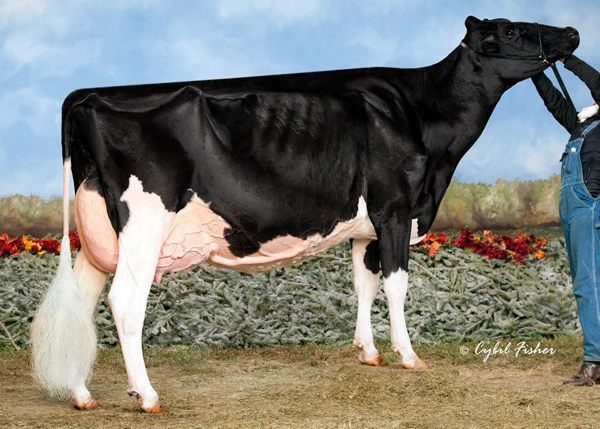
AMMON-PEACHEY SHAUNA – 2012 Golden Dam Finalist

Ammon-Peachey Shauna is an attention-getting star at Seagull Bay Dairy, and a finalist in our 2012 Golden Dam contest. Nevertheless, owner Greg Anderson happily shares the spotlight with others in Shauna’s past, “Congratulations to Shauna’s breeders Mike and Jill Ammon and G Sheldon Peachey for breeding such a fine cow.  The Steiner family of Pine-Tree Dairy also deserves credit for developing the cow family behind Shauna – the Rudy Missy family – into one of the most sought-after bloodlines in the Holstein breed.” That’s where Shauna’s bright story begins.

AMMON-PEACHEY SHAUNA VG-87-2YR-USA

AMMON-PEACHEY SHAUNA VG-87-2YR-USA

Shauna`s Got Pedigree Credentials

Shauna originates from the very well respected Wesswood-HC Rudy Missy family. Her excellent sire stack is Planet x Shottle x O Man x Rudolph x Elton x Mandingo. The potential for greatness was there.  On the female side, Shauna’s dam, Sheen, is both DOM and 1 Star, showing her appeal in both USA and Canada.  As well her full sister Shana is VG87 – 2 yr (CAN) and is the #5 GLPI cow at +3400. Her Million sister is VG85 – 2 yr (CAN) and her GLPI is +2022.

AMMON-PEACHEY SHANA VG-87-2YR-CAN VG-86-2YR-USA  DOM - Full sister to Shauna

AMMON-PEACHEY SHANA VG-87-2YR-CAN VG-86-2YR-USA DOM – Full sister to Shauna

PINE-TREE MARTHA SHEEN VG-86-3YR-USA    DOM   1* - Dam of Shauna

PINE-TREE MARTHA SHEEN VG-86-3YR-USA DOM 1* – Dam of Shauna

Shauna is Flushed with Success

Shauna also excelled as an IVF donor as a heifer.  With 16 sons and 10 daughters, she has shown that she is able to produce and reproduce simultaneously. While working on her first lactation, Shauna produced a very high number of embryos. A rare thing these days.

Shauna Transmits Son-Shine!

Proud owner, Seagull Bay Dairy, reports that “seven of her sons have already been used as contract mating sires, due to their elite TPI and LPI rankings and extreme milk, fat and protein.

Her top-6 sons average +3853 DGV LPI 2445 GTPI 2172 PTAM 72 PTAP .02% 87 PTAF .04%.

  • Supersire (Robust)      Leads the breed in Net Merit and is #2 for GTPI.
  • Headliner (Robust)      3.27 for PTAT and 96 lbs for PTA lbs Fat
  • Shaw (Freddie)            over +2907kg milk and #5 for GLPI
  • Sargeant (Freddie)       +92kg fat, +85kg protein and 2.62 SCS

It doesn’t stop there.  Both breeders and AI companies are putting great trust in Shauna’s ability to produce elite genetics. Greg informs us that “Her top eleven sons are all scheduled for A.I. sampling.” He notes that “Shauna’s Snowman sons will be available soon from Select Sires and Shauna’s Windbrook son Seagull Bay Phantom is currently being used as a mating sire for Semex.” It easy to see why, taking the average of Shauna’s top eleven sons by various sires -Robust; Snowman; Windbrook; Gerard; Pluto; Super- produces these exciting numbers:

  • PTAM 1950
  • PTAP 65
  • P% +.03
  • PTAF 78
  • F% +.03

Greg concludes that it will be very satisfying “to see Shauna sons used on many of the top females of the breed.”  Shauna`s daughters, full sisters to the high ranking sons, also have high numbers with the top two being:  Shauna Saturn (Saturn) +3689 DGV LPI and Miss America (Robust) +3655 DGV LPI.

Shauna Pays Back the Investment

Shauna’s glowing reputation also pays off on the bottom line.  Her progeny are becoming sought after and that’s good news for Seagull Bay Dairy.  Greg updates a couple of sale results. “Last fall we sold Shauna’s high GTPI daughters; one by Robust for $165,000 to Tranquility AG and TAG, and one by Man-O-Man for $87,000 to Elite Dairy Genomics.”

Shauna Generates Genomics

Those who are using genomic results for both selection and breeding will find Shauna is one of the premier genomic transmitters of elite production. Greg looks back. “Shauna was genomic tested as a calf along with her two full sisters, to aid us in making our choice from the pick of a flush at the 2008 Eastern Elite Sale.” Once again, Shauna produced shining results.”Shauna’s genomics were first released in August of 2009 and she ranked as the Number 4 heifer in the breed. She remained in the top 15 for most of 2010 as well.”

Shauna`s Got it All

Greg goes on to report “For us, Shauna is the total package. In addition to making a very impressive 2 yr old record and her VG classification – Shauna transmits her best qualities to her offspring. Not only does she have genomic superiority but she also has production and exceptional type.  News spread fast when she scored VG-87 with VG-88 mammary system when she was only 60 days fresh.  When she was only 100 days in milk she was producing 129 lb. That`s when Shauna’s star-power really started to light up. We had a lot of calls to seller her privately or publicly.”

Shauna Sets the Example

It is exciting for everyone around her to see Shauna’s legacy continue to build.  Her front-running genomic results are the engine that drives her powerful transmission but for Greg Anderson at Seagull Bay Dairy her attraction is much more focused, “Shauna exemplifies exactly the type of cow we strive to breed for.”

Do you think Shauna deserves to win our 2012 Golden Dam Contest?  Let us know. Your vote counts.

[related-posts-thumbnails]
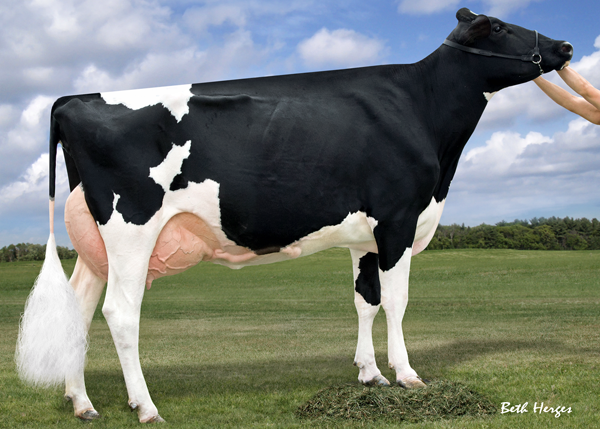
The Bloom Is On Oconnors Goldwyn Jasmine

There is always something worth celebrating on a dairy farm.  At Suntor Holsteins, owned by Fred and Ruth Sundborg and family located southwest of Montreal and 20 minutes north of the New York Border this is doubly true this August.  Although, we caught up to him just before a rehearsal for his brother’s wedding, Kevin (son of Fred and Ruth) was also happy to celebrate the blooming of OCONNORS GOLDWYN JASMINE EX-92-CAN.

OCONNORS GOLDWYN JASMINE EX-92-CAN

OCONNORS GOLDWYN JASMINE EX-92-CAN


We don’t know all the details of the happy wedding but we are getting up to date on Jasmine. Kevin wasn’t at the Royal the year his Dad purchased Jasmine at the 2007 Sale of Stars, who’s dam he had seen at Oconner’s and loved her massive frame. However since then, he has been right at her side over the five years that she has made her name OCONNORS GOLDWYN JASMINE EX-92 MS-95 one that is recognized. Let’s start by noting that she is the Goldwyn sister to Oconnors Jay who was the 2nd highest new release bull in August 2012 coming in at #6 GLPI.

Looking back at the purchase Kevin explains what attracted them to her. “That was before the ‘genomic-era’, but Jasmine was by the magic Goldwyn x Durham cross.  Her dam was a massive –framed Durham who my Dad saw before calving at O’Connor’s and Jasmine herself was a very correct-fancy heifer.”   Suntor Holsteins, who earned their Master Breeder Shield in 2000, are always looking to improve their herd. “We genomically tested Jasmine right away, as she had A.I. interest, and she came back very close to her actual PA LPI, and was very high for type.”


Jasmine continues to Bloom

“Since she calved as a 2yr old and is now fresh for the 3rd time, she has really performed.” Kevin reports enthusiastically. “She has grown, moved up in production, moved up in classification and has given us great offspring.” Is it any wonder that he says, “We are more than pleased by what she has done for us.”


SUNTOR MAN O MAN JELENA VG-85-2YR-CAN

DAUGHTER: SUNTOR MAN O MAN JELENA VG-85-2YR-CAN


Jasmine is Productive

As a heifer Jasmine was flushed to Onward and bred to Ashlar. “Two bulls went to Semex.”  And there were more good things to come. “Fresh as a 2yr old, I wanted to breed her to a high index bull. Man-O-Man was just released so we used him.” That done “We also flushed her to Shottle and Wildthing.” In the barn Kevin notes, “We are currently milking Man-O-Mans, a Shottle and an Onward from Jasmine. She is currently projected 5-03 14,513 kg BCA 291-392-276 SCC 8,000.”


Jasmine Attracts Attention

“Besides selling to A.I., we have sold Shottle embryos to Europe and Wildthing embryos to Australia, to breeders who enjoy working with strong cow families.”


Jasmine Crosses Well

There is much for this cattle breeder to be happy about when discussing Jasmine. “The safest cross was to Shottle, her daughter Josina VG 2 yr MS86, exemplifies the best of her sire and dam.” But there is another side to Kevin’s excitement regarding Jasmine. “The best cross in my opinion was to OMan OMan. Combining a high index bull to a high type female has resulted in Suntor Man O Man Jelena VG 2 yr MS86.” So what’s the big news? “Jelena is our highest genomic animal (Aug ’12 +2157 GTPI +3.13 PTAT, +2828 DGV LPI +16 Conf.) and has passed this to her offspring.”


Jasmine Breeds Amazing Results

As we venture down the path of genomic testing, it is exciting to learn of the success stories. “Jelena’s son by Willrock is going to Semex.” That’s good news but there’s more to come.” Jelena’s sons by Epic came back with amazing results. The highest was 4107 DGV LPI 20 Conf, 2488 GTPI 3.7 PTAT.”  Exciting indeed. Kevin continues to list the highlights, “Jelena herself (Jasmine’s daughter) is consigned to the Sale of Stars.”  She too has loads of marketing ability. “She has “sire stack and genomics (especially CONF +14) but most importantly is PROVEN to transmit high genomics.” He is referring to the Epic bull and the fact that the Willrock is the highest Semex has tested. It isn’t any wonder that Kevin sums everything up by saying, “Jelena is the type I have hoped to breed and we are excited to have her as a consignment to the Sale of Stars.


The Bullvine Bottom Line

Success in the dairy business is achieved in many different ways but, most often, it starts with a good family.  As Suntor Holsteins expands their dairy herd and, more importantly, their extended family we offer congratulations on their achievements and wish them “All the best as you keep on growing!”

[related-posts-thumbnails]
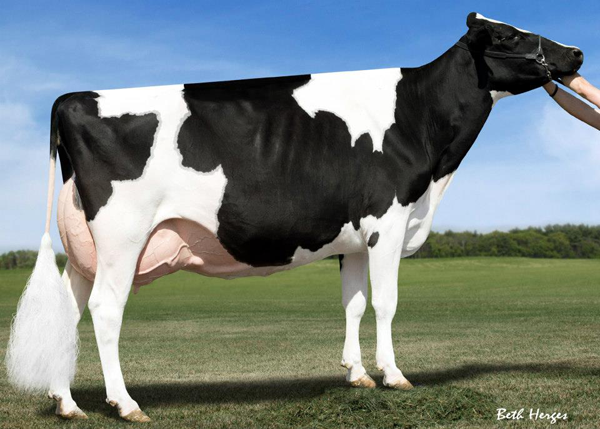
Managing to Make More Milk

Depending where you live, the last several years have put many pressures on dairy profitability.  Margins are becoming slim to non-existent for some farms in 2012. Previously, one of the positive aspects of dairy farming was that dairy cows are good converters of by-products and low-cost feedstuffs that would otherwise be discarded.  In today’s, challenged marketplace even these feeds are becoming more costly.


It’s Time to Look at Feed Conversion

Now the dairy industry must take a lesson from poultry, swine and beef who focus on feed efficiency in producing eggs, chicken, pork and beef.  It’s time for dairy to focus on the conversion of feed to edible products.


The FE (Feed Efficiency) Formula

FE = Milk or FCM or ECM / dry matter intake

Feed efficiency in the dairy industry has traditionally been measured as some measure of milk production (actual milk, fat-corrected milk (FCM) or energy-corrected milk (ECM) as a ratio to dry matter intake.


The FCR (Feed Conversion Formula)

FCR = dry matter intake / lbs. of milk fat + lbs. of milk protein

The above is a new measure for feed conversion ratio (FCR), which is a measure of the pounds of feed (DM) that it takes to produce 1 pound of milk components.


Feed Efficiency is Not ONLY about FEED!

It would seem obvious that feed related factors would be most important when you set out to increase feed efficiency.  Nutritionists and consultants draw our attention to forage digestibility, feed particle size, protein levels, fat levels, starch levels and certain feed additives that can affect feed efficiency. This is what they know.  This is what we can control.

However, there are factors beyond feed that we can look at such as environmental factors and our own management inputs. Some environmental factors can be more difficult to control than others.  It is difficult to be 100% in charge of the effects of heat stress, average days in milk, lactation number, acidosis and heat stress.  Each one of these will affect feed conversion. But there are other environmental and management factors that we can target in our effort to improve feed conversion.

MANAGING TO MAKE MORE MILK: Do you help or hinder your cows?

Variability in management practices can greatly affect production, components and dry matter intake and, thus, feed efficiency. Researchers point to a survey which was undertaken on 3000 cows in 47 herds that were fed the same diet.  Results show that there was a 27 pound difference in production (i.e. the difference between 47 pounds and 74 pounds of milk), even when fed the same ration.


Cow Comfort Should Not Be the Last Resort

A recent area under consideration for feed efficiency is cow comfort. Cow comfort issues can affect milk production and components, reproduction and general health. While most of the research has shown increases in production with improved cow comfort, generally production or component increases translate into improvements in feed efficiency. There are excellent studies on the effects of stall design on milk production and cow health.


Less Stocking density = More Milk

Too many cows in one area and the number of stalls per cow can have an effect on feed conversion. Cows in crowded conditions tend to eat faster and ruminate less. The larger numbers can directly relate to more pathogen load in the area. More pathogens can be as simple as more teat end exposure to pathogens. In the long term cows can share more serious illness and immune suppression. The previously mentioned Spanish study, attributed a 32 percent of the production variability to stocking density and determined that each 10 percent reduction in cows per stall equaled 1.7 lbs more milk per cow.


Less Lameness = More Milk

Lameness can dramatically affect production, health and reproduction. However, even cows that are mildly lame (cows that walk with shortened strides, an arched back and a slight limp) can have reduced production and feed efficiency.

Researchers have shown even cows with a lameness score of 3 (mildly lame, 1 to 5 scale with 5 being severely lame), can have 3 to 5 lbs less production (greater than 900 lbs per lactation) vs. sound cows (score 1). Key point – Even mild lameness can negatively impact production and feed efficiency.


More Lying time = More Milk

Cows need time to lie down. This priority can consume around 12 hours of a cow`s day and cows will sacrifice eating time for lying time.  The Miner Institute in New York conducted a series of studies that showed an increase of 2 to 3.5 lbs of additional milk for each additional hour of lying time. More rest = More dollars.


Less Time Away from the Pen = More Milk

Minimizing time outside the pen is important to maximize cows’ time for resting, eating and drinking. Time away from the pen for milking can have an effect on production. In an extreme example of this, a study from the University of Nebraska compared the effect of three versus six hours per day away from the pen for milking. When time away from the pen was reduced, second-plus lactation cows gained two additional hours of resting time and 5 lbs of milk and first-lactation heifers gained an additional four hours of rest and 8 lbs of milk.

The Bullvine Bottom Line

These are only a few of the factors that have an impact on our cattle and their production levels. Knowing how to balance the need for resting, drinking, exercise, feeding and general comfort can have as much or more impact on feed efficiency than feed related factors alone. It only makes sense to control what we have some control over.

[related-posts-thumbnails]
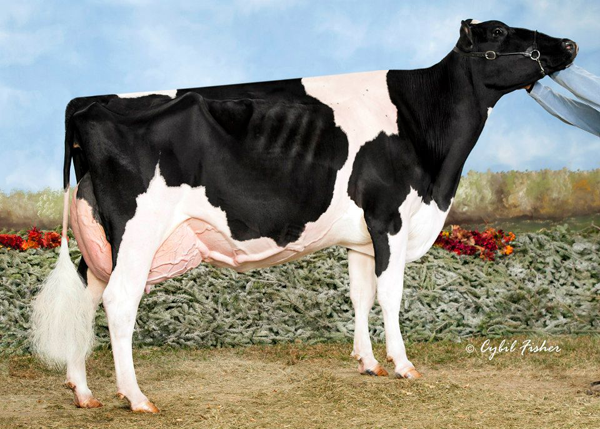
Heat Detection: An Exercise in Fertility

Milk is only Part of the Equation

When it comes to what we have learned about raising and managing dairy cows, you could make milk production a study all on its own.  In many ways we have done exactly that. We have spent so much of our focus on selecting genetics for improved milk production, that now we have fertility issues.  You don’t have a profitable dairy farm if you leave out that ability to cycle reproductively, breed successfully and put healthy calves safely on the ground. These are three vital components to a dairy cow’s productive performance.  Focusing on milk has, over time, disrupted the cow’s ability to do these foundation steps successfully. Today’s cow is out of balance.  We need to get back to the basics.  Which starts with getting pregnant. Which starts with detecting heats.

The Heat is On. We’re not making the grade.

Heat detection is the most important factor in determining the number of pregnancies a herd produces in any period of time. Anything, and everything, you put into being more effective in this area will result in your herd achieving higher fertility ratings. Herd statistics, farm profitability and reproductive efficiency are seriously affected by the level of effectiveness of estrus detection.  The report card from farm to farm varies widely and many are not achieving high marks here. You have to realize it’s still zero whether you miss the pregnancy through fertility or mismanagement.

Do your Homework.

Five ways to affect your heat detection are:

  • Watch their Behavior: Activity measures of estrus. Use observances, pedometers or accelerometers.
  • Measure their Hormones:  Hormone levels such as progesterone can be detected in blood and also in milk.
  • Take their Temperature: Changes temperature indicators can be measured in milk and vaginal mucous.
  • Veterinary Diagnosis: Go to the experts and use palpation or ultrasound scanning.
  • Synchronize Them:  Take out the variable of missed estrus by using a fixed time insemination.

Fertility 101.  Get it right every time.  Go to the head of the class.

Developing excellent visual heat detection technique can make your herd a lot of money – if you can correctly identify the signs of estrous.  If a cow shows three or more of the following signs, there is a good chance she could be in heat.

  1. Standing and mounting behavior
  2. Bawling
  3. Head butting
  4. Chin pressing
  5. Butt sniffing
  6. Bright, alert appearance
  7. Reduced appétit
  8. Lower milk yield
  9. Swollen vulva
  10. Mucus discharge

Early morning, noon and late evening observations for 20 minutes each are necessary to observe more than 90 percent of the heats in a herd. During hot weather, watch animals earlier and later each day. During cool weather, the middle of the day is generally the best time to watch. Grouping cows that are ready for breeding or recently bred is another way to make the best use of observation time.

Cows tend to be more active on dirt or pasture and should be watched for heat activity while off concrete surfaces.  Increased activity will not occur in cramped cubicles or on slippery surfaces. Also, carefully watch cows the first 30 minutes they are turned out to pasture or an exercise lot. Activity is low during feeding and milking times.

Report Card:  Don’t manage to “fail”

Use a test to diagnose pregnancy.  There are accuracy differences and challenges with each method.  Here are three:

  1. Ultrasound
  2. Palpation
  3. Blood based pregnancy test

Do you know the rate at which your heifers become pregnant? Under poor reproductive management the service rate is 40 percent and a conception rate of 50 percent.  By contrast, the rate at which heifers become pregnant under excellent reproductive management measures out at a service rate of 90 percent and conception rate of 70 percent. The 40 percent service rate means 20% are in calf. The 70 percent service rate means 63% are in calf. In any classroom, a difference of 43% is humongous or, as the teacher would say, huge!

Although the average age at first calving can be 25.4 months for the poor-management group of heifers, more than 25 percent of the heifers will not calve until after 26 months of age and 10 percent of the heifers will not calve until after 28 months of age. Clearly, the average age at calving is not truly reflecting an underlying reproductive problem. But, more important, 95 percent of heifers subjected to excellent reproductive management will calve before 25 months of age!

Economics also supports the fact that you must improve results in this area. If each day open costs around $3-$4, then each heat missed costs $63-$84. And, remember semen, drugs and extra labour costs are over and above that $3-$4 per day.  This can be very costly in a herd of dairy cows. Catching heats is the first step to getting animals bred.

The Bullvine Bottom Line

None of the preceding information is new to people who work with dairy cows but obviously we forget to put it into practice. Practice makes perfect.  Heat detection makes profit. Go to school on your herd.

[related-posts-thumbnails]
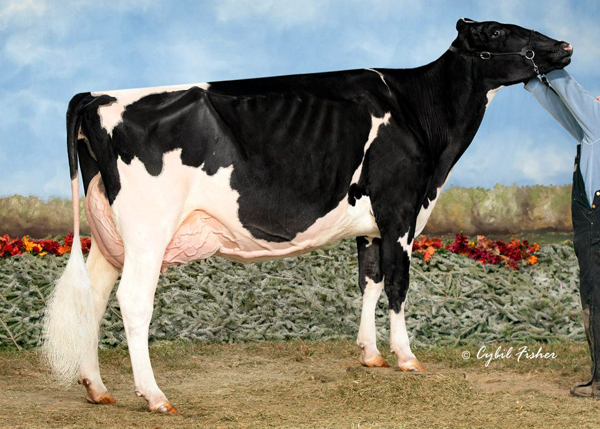
8 Ways to Ensure Calves Remain Alive and Thrive

We have all said at one time or another, “If only we took as good care of ourselves as we do of our cows!” However, we may be a little less precise in our care of newborn calves.  It might mean we need to change our protocols so that these newborns get the same attention to detail as our human babies. 

  1. Clear the airway: Remove mucous from around the mouth and nose, assisting the calf to breath.  Inserting a piece of straw into the nasal cavity or pouring some cold water on the calf’s head should initiate a gasping reflex to promote respiration.
  2. Dry off the calf:  The dam, if she is well and able, will dry the calf.  If she needs assistance, or if you are moving the calf immediately, you can handle the drying by using a clean, dry towel. The vigorous message provided while drying around the shoulders and neck encourages respiration and helps the calf to regulate its body temperature.  As water evaporates, heat is removed, which can lead the calf vulnerable to chilling. In cold weather provide blankets.
  3. Provide Calf Comfort:  Even more than with cows, calf bedding needs to be clean and thick. Thickness is important because the bedding must be thick enough that the newborn is not exposed to all the bacteria underneath.  Take a look at the calving area and you will see that newborn calves do not land in a sterile environment.  The entire area cradles bacteria as well as brand new calves.
  4. Feed adequate colostrum.  Once the calf is breathing well, colostrum should be administered. According to DCHA Gold Standards (Colostrum Management), colostrums equaling 10% of body weight should be fed in the first four hours of life.  It not only provides the calf with disease-fighting antibodies, but it also increases the calf’s blood volume and improves blood circulation.
  5. Use a colostrometer to evaluate quality.  Cattle managers are well aware of the benefits of good quality colostrum.  The question is, “How do you evaluate your colostrum?” Experience tells us that if it’s yellow and thick … it’s probably good.  But is that true? We can’t wait to see if the calf responds well and yet we may be saving poor quality colostrums based on visual assessment alone. Having a trusted and accurate source is well worth the investment in a colostrometer.
  6. Use a meat thermometer. Some sources advise using a meat thermometer to determine if the refrigerator where you store your colostrum is working properly and if your hot water heater is working properly. You can’t just assume because either of these feel cold or hot to the touch that they are working at the most effective temperature. The same attention to detail that you use in cleaning the milk pipelines in the milking parlour needs to be applied to the measureable temperatures that are used in care of your calves.
  7. Special Care: Calves from a difficult calving may need to be moved and handled with extra care. Surviving alive may not be enough to guarantee a healthy growing period for that newborn calf. Extra attention will save time, labour and medication if spent wisely in these early hours and days.
  8. Clean the calf cart!  Clean the calf pails!  Clean the calf bottle! Clean the esophageal tube!

The Bullvine Bottom Line:

When it comes to raising calves it’s the first little details that pay off in big returns later. See that your calves remain alive and thrive!

[related-posts-thumbnails]
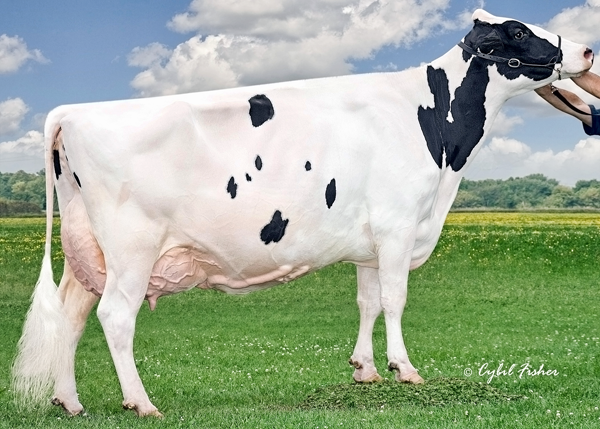
Have You Seen This Farm?

As you leave the city or the suburbs, many observers are, or soon will be, inspired to ask, “Where have all the farms gone?” Crops are not ripening in the fields.  What ones you can see, appear to be withering.  There are fewer grazing herds!  There are no busy harvest scenes.

The stories are different:

  • “We put our prize winning dairy herd up for auction”
  • “We had to sell out.”
  • “We are facing bankruptcy.”

The results are the same:

  • Farms are missing.

Some look at the recent weather change and indulge in “If only’s”.  If only the storm had come a few weeks earlier.  If only the drought had eased.  If only we could have saved the cows. Regardless of what might have happened, the stark reality is that, with pastures so dry that in some places cattle had nothing to eat, farmers were losing money just trying to feed them.

Did They Give Up Too Easily or Too Soon?

Giving up are two words that don’t come easily to dairy farmers.  They especially don’t come easily when three to five generations of one family have milked dairy cows on the same farm for several generations.  One farmer who reluctantly had to sell nearly all of his cows at a livestock auction reports that they hung on for as long as they could “hoping that things would change” Unfortunately, it just didn’t happen.

What did happen?

Well it started with days, and in some places, weeks at a time, where temperatures settled at 100 degrees or above.   There was no rain.  Some places that did get a few drops found it wasn’t enough to penetrate the baked earth.  These are only a few of the factors that created the most severe drought in fifty years. As a result, every single day, farms teeter on the brink of bankruptcy.  Some go over.  Each one of those farms was run by a real person with a name, a face, a family and a lifetime of memories. It’s easy to keep the disaster at arm’s length until you see the tears and hear the stories of broken dreams. This isn’t reality television which is absurd and easily forgotten or forgotten by simply changing the channel.  This is real life and, eventually, it will affect more than just the single farm family.

It could touch YOU

A statistic that isn’t often put at the lead of the daily news stories is the fact that (Statistics on how many jobs depend on agricultural industry). This means that a lot of people are going to feel the effects in a very real way.  It will start with the businesses in rural communities that depend on farmers to be their customers.  For them it’s more than a news item – they worry it could cause retailers to become the next level to lose their business.

It Exacts a Terrible Toll

Some are trying to survive. They pray for rain and try to stay afloat financially, but at what cost?  “It’s frightening” says one farmer. “I wake up many mornings and throw up. The drought has shot my nerves.” Even children are affected, “Are we going to have to sell all the animals?” There are tears and recriminations. “”We didn’t fail. We did everything right. It was the system that failed us.”

The Politics of Defeat

When your back is against the wall, it is human nature to look for help.  Desperate farmers are looking for government help.  This is not a natural source for people who are proud of their ability to survive come what may. The drought hasn’t changed that but with nowhere to turn, they are beginning to feel they are fighting a losing battle. They’re in the uncomfortable position of needing to ask for help. And they’re not necessarily getting it.

What’s Being Offered? 

  • Earlier this month, the Obama administration announced emergency drought assistance
    • Low-interest emergency loans
    • Federal buy-up of meat from livestock producers
    • Opening up of some protected lands for livestock grazing
    • None of those efforts are targeted at dairy farmers, however, dairy advocates say.
  • In Missouri,
    • the governor created a cost- share program to help farmers get access to water for their cattle
    • Some see this as only a partial answer and not a full solution.

What’s Missing?  

  • The under secretary of the U.S. Department of Agriculture, Michael Scuse, says that dairy farmers have not been offered enough of a safety net because Congress has not finalized an omnibus piece of legislation called the Farm Bill.
  • Several programs that deal with emergency assistance for livestock owners expired in September 2011;
  • An insurance program for livestock producers will be cut further in September and eliminated by October 1 unless new legislation is passed.
  • Earlier this summer, the U.S. Senate and the House’s agriculture committee passed versions of the five-year bill, which includes everything from food stamps to crop insurance.  The House returns from August recess on September 10. The bill in its current form would create an insurance program specifically for dairy farmers. Currently, most dairy farmers are uninsured, according to officials and policy experts; that makes them more vulnerable to the impacts of a drought or high feed prices, both of which have taken hold now.

The BULLVINE Bottom Line

And so we drive down the road and wonder what is happening, who’s responsible and if there is any possibility for a brighter future.  For the farm families who have lost everything, they cling to hope of some coordinated effort that will make a difference.  Will the well loved family farm disappear and be forgotten?  Another victim of the whims of weather and uncontrollable forces?  “Have YOU seen this farm?”

[related-posts-thumbnails]
[related-posts-thumbnails]
From Corn on the Cob to Corn in the Tank, Farmers are Consumers Too!

Sometimes I wonder if non-farming consumers ever ask themselves how farmers feel about the price of food.

Farmers have to eat too!

Even though I’m a farmer, I am also affected at the grocery store when events such as the largest drought in the last fifty years drives corn prices to record highs.  You don’t have to be much of a food label reader to know that corn finds its way into more than 2500 products on grocery store shelves. Having said that, food corn only represents 1% of the annual corn crop. The corn planted in 2012 represents the largest it’s been in the U.S. since 1937. One might assume that the one percent grown for human consumption may have benefited, depending on local water reserves, from irrigation and therefore will not see higher prices this year. According to industry experts, the value of the corn in both processed foods and non-food products is usually not large enough for the current corn price spike to have much impact on what the consumer pays at the checkout.

So, if the impact is small, why is the forecast for food prices to rise 4.5 per cent?

Regardless of individual items, the USDA projects overall food prices in the U.S. will rise three to four per cent in 2013. That’s more than the inflation rate but food prices have been running ahead of inflation for the last few years. The Wall Street Journal calculates that the impact of the drought will be “not that much,” or $32.76 for the year for the average U.S. consumer. Sylvain Charlebois, the project lead of the University of Guelph’s Food Retail Price Index, told CBC News that he does not expect the U.S. drought to have a significant impact on food prices in Canada. He forecasts food prices will increase by no more than 4.5 per cent in 2013, and only a fraction of that can be attributable to the drought.

Farmers Grow Corn.  Farmers Buy Corn.

Recently, Statistics Canada released its latest crop production forecast. In contrast to what’s happening in the U.S., corn production in Canada is expected to increase 9.5 per cent from 2011. Nevertheless, the U.S. situation will have quite an impact on Canadian agriculture. Because nearly 43 per cent of U.S. corn goes to feed cows, pigs, chickens and even farmed fish, that is where the price increase is likely to be felt most. In Ontario, which grows about three-quarters of Canada’s corn, 50-55 per cent of the crop is used as animal feed.

About 12 per cent of U.S. corn gets exported and Canada is a big buyer. Last year, another 10 per cent of U.S. corn went into “other products,” while the remaining seven per cent was surplus.

Data shows that “Canada is by far the top buyer” for the other-products category which includes corn flour, starch, malt and worked grains.

First Increases will be in dairy and eggs

Dairy and egg prices should be the first to see an increase from the higher input costs. Beef and pork prices are actually forecast to drop initially. That’s because producers are expected to send some animals to market earlier than they would have otherwise, to reduce costs. In the short term, the extra supply will put downward pressure on meat prices and then smaller herds will mean less supply.

Corn in the Tank

After animal feed, the next largest share of U.S. corn ends ups as ethanol, which gets blended into the gasoline sold at the pumps. To encourage energy efficiency and renewable fuels, governments have mandated a minimum amount of renewable fuels being blended with gasoline. These laws have led to a progressively larger share of the corn harvest ending up as fuel. In Canada the federal government has set the average minimum content for renewable fuels at 5 per cent. In Saskatchewan, the mandate is 7.5 per cent; it is 8.5 per cent in Manitoba. The U.S. now has a 10-per-cent mandate for the amount of ethanol that has to be added to gasoline.

In the U.S., the National Corn Growers Association says 38 per cent of the country’s corn crop is destined for ethanol. But since those same cobs get made into both ethanol and animal feed, in the form of distillers’ grains, they do the math to end up with 29 per cent of the corn crop getting used for ethanol, and add nine points to what’s used for animal feed. In Canada, about 30 per cent of the corn crop is grown for ethanol, or about 20 per cent, after accounting for distillers’ grains.

When it comes to the price of ethanol, government subsidies and other factors that mean the end cost is not a simple equation based on input costs. Ethanol futures prices are up about 19 per cent since the start of the year. Corn prices, on the other hand, fell through the first half of the year but have spiked sharply since then, resulting in a price increase for corn of about 35 per cent so far this year. It is nearly twice that for ethanol.  A surplus of ethanol has probably helped to keep its prices low and, with ethanol prices still below those of gasoline, analysts expect the increase in corn prices for consumers buying blended gas at the pump will be insignificant.

The Bullvine Bottom Line

When all is said and done, a bad crop year has wide-ranging ripples that can hit the farmer at multiple touch points.  The farmer feels the negative effects twice at the farm, as a corn producer and corn consumer, and again as the consumer at the checkout.  And so perhaps the original question needs to be changed, “Why don’t non-farming consumers recognize that farmers are consumers too?”

[related-posts-thumbnails]

World Records Are Not Only Set at the Olympics

She won’t bring home a gold medal from the 2012 Olympics but Gillette Emperor Smurf EX-91 like her human counterparts proudly represents the best in a record setting achievement.  She too has been globally recognized for surpassing all her peers.

She Stands Apart

Even though everyone at Ferme Gillette would gladly spoil this star who is recognized  by the dairy industry and The Guinness Book of Records as the most prolific milk producer in the history of dairy cows Eric Patanaude describes how she quietly sets herself apart in attitude as well. “Smurf is a trouble free cow who looks after herself. She has character.” The Patenaude’s really enjoy spending special time with their animals says Eric and learn their individual traits.  “Most of our show cows love to get petted.” He goes on to describe another unique characteristic of Smurf, “Even though she’s very approachable, she just shakes her head at you if you try to pet her.”

Training Program: Eat First. Milk Hard. Eat Again. Rest.

Nothing extraordinary is ever achieved accidentally or by doing what everyone else does.  This holds true with exceptional dairy cows as well. “Smurf loves to eat.” Big output requires big input and her energy consumption is one of the keys to her incredible story. “She’s always the first one at the manger during chores just waiting for us to give her TMR.” Another key is her ability to calmly manage the day-to-day schedule.  “When milking time comes she knows the routine. She gets up in her box stall and walks right over to where she has to get milked. We don’t even need to tie her up. She just stays there until she’s finished eats a bit more and then goes to lay down.”

Breaking Records.  Pushing New Limits.

The Motto of the Olympic Games is “citius, altius, fortius”, which translates to “faster, higher, stronger”.  We thrill to the stories behind Olympic athletes who strive to fulfill this dream, especially those who achieve success in more than one area, over more events than any others and throughout longer careers.  We all have our favourites. Clara Hughes is mine!  For Eric Patenaude, of course, it’s Smurf. “She’s unbelievable! At almost 16 years old and now fresh 2 and a half months she is milking more than ever!” Could he be biased and looking through rose coloured glasses? Not at all. “To be more precise she’s producing 70 kgs a day! She just keeps adding to her record” and becoming a legend.

Smurf’s Performance Advantage

If there’s anything that informed observers understand it is the basic truth that the greatest performers don’t achieve the pinnacle of success without the right support around them.  “Of course at this point, just like an Olympic athlete, she has everything she needs to perform.”  Years of working with dairy cattle at three generations of Ferme Gillette have produced many insights into the best treatment. “Smurf has a private box stall, her own fan, ample straw and TMR and just recently we’ve added peat moss to the bottom part of the box stall where she walks. This makes it a little softer and comfortable for her to walk on.” That’s the physical side but there is a human factor too. “It is not possible without the efforts of our 24 hour knowledgeable staff. “says Eric and then specifically adds more names that have had an impact on Smurf’s specific achievements “I would like to give a special thanks to Amanda Cowan, Christina Crowley and Crystal McKay for their support and advice.”

Gillette Emperor Smurf EX-91

Gillette Emperor Smurf EX-91

A Legacy of Champions

As so often happens when athletes, dairy farmers or cows excel in ways that seem almost impossible it often comes back to an entire family that have special attributes.  Eric feels that “Smurf’s longevity makes her special” and then goes on to give what he thinks are the reasons this has been possible. “She is a 6th generation VG or EX. Her dam, 2nd, 3rd and 4th dam all lived to be at least 10 years old. Her only daughter at the farm an EX Champion, Gillette Champion Sally, is now fresh at 9 years old and she looks like she will reach the 10 yr milestone as well. Sally has been in a freestall pretty much her whole life.” Exceptional history. Exceptional care.  Exceptional results for Ferme Gillette. “Smurf traces back to Maeford Starbuck Chrissy EX 17*, who has played a big part in us getting our Master Breeder Shield back in 2005.” And nothing stops at the podium. “Since getting this recognition, we have brought Sally over to our tie stall barn where we do our flushes and she has been in demand constantly.” But decisions are made on an individual basis, “Smurf is not a cow that we intend to flush at this point.”

Attention from Both Sides Now

The story of Smurf has reach out to people outside the dairy industry. Media attention has been both positive and negative.  Eric is philosophical. “That’s ok. Everyone is entitled to their opinion.” Statistics show that a very small percentage of the population works to provide food and that means there can be a disconnect between producers and consumers. “I don’t expect everyone to understand or like what we do. I mean how can you? Some of these people who criticize may have never stepped out of their downtown apartment or office to visit a farm or take the scenic route outside the city.” Farming can fall into a storybook world populated by villains. Eric admits, “To certain people we are obviously the bad guys and the only ones that don’t see it is us!” He doesn’t expect to change the world but he knows the facts. “I can probably name you at least 20 farms right off the top of my head, including ours, where the cows are better treated than some humans!”

Shared Enthusiasm Builds Success

The story of Gillette Emperor Smurf EX-91 is far from reaching the final chapter.  Eric enthuses, “I am happy about all the positive feedback that we have received from our community and surrounding region.” Like Smurf’s achievements, it continues to grow. Eric acknowledges that the support is amazing “Including some from Ottawa, our nation’s capital.” Canadians supporting Canadians.  “People in our amazing dairy industry truly understand what we do and how hard we work for our cows.”

The Bullvine Bottom Line

Even though she won’t bring home a gold medal from the Summer Olympics, Smurf has definitely earned her special place in the sun.  Loved and admired, she is simply, “The World’s Best!” Incredible!

[related-posts-thumbnails]
Why Dairy Farmers Need To Know Their Key Performance Indicators

Having a successful dairy farm enterprise can be achieved in a multitude of ways.  Even though no two farms are exactly alike, where there is success there is a business person with dreams, goals and plans that get put into action.  Invariably there are five key factors that the business manager monitors closely on a continual basis.  These factors are often referred to as Key Performance Indicators.

Choose YOUR Key Indicators

Each farm and farm manager has individual needs and factors that need attention at any given time.  One way to get started on knowing your KPIs is to consider six main areas.

  1. Daily output
  2. Nutrition program
  3. Animal reproduction
  4. Heifer rearing
  5. Animal health and disease
  6. Genetics and Marketing

A good recommendation is to focus on one performance indicator from each of the six areas:

Daily Output

  • Milk yield per cow per dairy
  • Fat plus Protein yield per cow per day
  • Milk revenue per cow per day
  • Daily revenue less feed cost per cow per day
  • Milk sold per worker per year

Nutrition

  • Dry matter intake per cow per day
  • Feed cost per cow per day
  • Cost per ton for feed consumed by the milking herd

Reproduction  

  • AI services per conception
  • Percent of cows detected in heat by 90 days in milk
  • Pregnancy rate
  • Days Open
  • Calving Interval

Heifer Rearing

  • Live heifer calves per hundred milking cows per year
  • Percent of heifer calves ,born live, that enter the milking herd
  • Rearing cost per heifer
  • Age at first calving

Animal Health and Disease

  • Cull rate from the milking herd
  • Average weighted SCC per cow
  • Days between mastitis onsets
  • Vet and medicine costs per cow per year
  • Number of lame cow incidents per 100 cows per year

Genetics, Sales and Marketing

  • Breeding stock revenue per cow per year
  • Average TPI or LPI or Net Merit per pregnancy
  • Average classification score for first calvers
  • Number of farm website hits per month
  • Total annual revenue per worker per year

How To Get Started:

The task of developing a KPI program for a herd can be daunting. Suggestions on getting started include:

  • While relaxing in the evening for a week jot down some areas you feel could be improved on your farm
  • Give your list to your vet, your accountant and your feed advisor and ask them to comment
  • Narrowing the list down to five making sure they are numbers easily obtained from your DHI records, your herd management software or your farm financial software.
  • Start by getting the historical numbers for the past year
  • Set goals you wish to achieve in one year`s time
  • Keep the process dynamic including changing the list annually, if necessary
  • Do not make the list too long.  Five is a good number.

PROFIT is a GOOD WORD:

Dairy cattle breeders tend not to speak in terms of profit per cow per year.  More often their bragging points are in terms of animal records or enterprise performance.  Yet it is profit per cow that covers living costs, provides return on investment, pays for kids’ college educations and keeps the banker happy.  It is strongly recommended that at least one of the five KPIs should be a measure of dollar revenue, feed costs or net returns.

BULLVINE BOTTOM LINE:

Relating genetics to farm management and farm profit is not always an easy twosome to bring together.  However, for success there must be measures that can be continually monitored so that farm managers can make informed decisions or take corrective actions.  Find your key performance indicators and grow your profits.

[related-posts-thumbnails]
KIDS, CALVES and COMPETITION: Safety in the Dairy Ring

dairy cattle showing youthOne of the outstanding benefits of living on a dairy farm is that it provides the opportunity to learn how to compete in the dairy ring. Working with dairy animals improves physical fitness, coordination, self-discipline and teamwork, but these beneficial activities can also put participants at risk for injury.

Show-related injuries are preventable.  It is a matter of protecting bodies, while they are still growing and just beginning to understand the skills involved in working with animals. Unlike sports such as baseball or hockey where flying objects can cause injuries to the face, the danger in the show ring  most often lies in the child’s awareness of the living, and sometimes unpredictable, animal at the end of the lead.

Training of both the child and the animal is the key to avoiding injuries to both participants.  Of course, it is up to the adults in charge to make sure that youth participating in the events are safe from foreseeable harm.

Dairy Show Injury Prevention Tips

  • Dress participants in appropriate protective equipment. Most sports teams require participants to have specific equipment that is the proper size and adjusted to each athlete. We should do the same for young cattle show persons. Footwear that can withstand tromping on and that is safe from slipping in wet, muddy or messy conditions. Steel toed work boots are the safest choice. Flip flops, clogs and bare feet are strictly unacceptable when working with cattle.  If proper protective equipment isn’t available, it is NOT alright to go ahead.  It teaches two incorrect things: a- the rules don`t count  b- rules can be broken.
  • Proper halter size. A halter that is too big is dangerous as it can be easily pulled off. The halter should not cause discomfort to the calf. As well, make sure the lead shank is neither too long nor too short. This is where experience will be the best teacher but don`t let the handling of the halter or lead become a bigger job than moving easily with the calf.
  • Maintain safe show ring conditions. Wherever, cattle are being shown, basic safety precautions should be in place. Clear the area of debris. Beware of broken glass, rusty nails, used syringes, rocks and other items that would increase injury if a child fell or slid on them. If this will be an outdoor event, watch weather forecasts; have a set of guidelines for postponing the event, if necessary.
  • Have an emergency plan for injuries during shows. If at all possible have an adult trained in first aid techniques on hand. At least have an adult with a charged mobile phone. Provide the adult supervisor with a notebook of emergency phone numbers for parents or guardians of all participants. Carry a well-stocked first aid kit.
  • Enforce basic sportsmanship rules. This is the beginning of learning how to care for animals, prepare them for showing and putting forth their best feet forward in the ring. By all means, prevent bullying of competitors by adults or children. Young show persons need to focus on showing, not on their shame, embarrassment or humiliation.
  • Ensure children drink plenty of liquids. In the excitement of participating in this highlight of dairy cattle this may be overlooked and could result in dehydration. This is especially important in high heat, high humidity or high altitudes or with children who are novices and may not have experience in maintaining control of their animal for an extended time.
  • Provide proper training and skills building for young show people. Select a calf that will be a suitable size for the child to work with and show. Begin training as soon as possible. Training is not something that can be done in a couple of days! As the child builds fundamental skills, they will gain confidence in handling the calf and in presenting it for the judge`s consideration.
  • NEVER wrap the lead rope around the hand, arm, wrist or any body part. If they are bound like this and the heifer moves away quickly, the child could be seriously hurt.

THE BULLVINE BOTTOM LINE

When children are properly prepared to show dairy cattle, the skills they learn and mentors they meet will last them a lifetime. Safety first.  Memories forever.

[related-posts-thumbnails]
When You’re Trying To Get Ahead … Try Feet First!!

When it comes to managing a profitable dairy herd, you have to place a high priority on mobility. If your cows are suffering from pain and discomfort when they try to walk, every other area from reproduction, to nutrition and milk production will be negatively affected.  Unfortunately, we often don’t identify the problem until it is so far along that treatment costs are high and recovery rates are low.

Step by Step: There are three main areas to address

  1. Observation and Detection
  2. Environment and Genetics
  3. Treatment and Medication


OBSERVATION AND DETECTION:

Of course, the goal is to reduce lameness to a zero percent occurrence.  Even if everyone observing the herd strives for this objective, it is a difficult job, especially if the animal to observer ratio is high.

  • Numerical Rating Scores (NRS) Work
    Studies on gait scoring or locomotion scoring are available to make assessment easier. Some research studies have gone a step further incorporating weight displacement analysis.  The use of a weight scale to read the weight displacement from one leg to another supports the observation that lame cows in standing position will remove weight on their injured leg by transferring body weight to the opposite (contralateral) leg.  These studies are scored from video recordings, some of which are available on the Internet and are quite helpful in identifying and understanding observable characteristics of lameness. Researchers recorded gait scores and weight transfer before and after they injected a local anaesthetic (lidocaine) to healthy and lame lactating dairy cows. Results showed that 92% of cows with sole ulcers were correctly identified. For the day-to-day dairy operator, it will still come down to personal observation which is not perfectly accurate.  In the always evolving age of technology, it probably won’t be long until an automated system is available to measure the weight distribution on each hoof, while cattle are in a holding area or milking stall.
  • Administering anesthetic
    Lame cows treated with anesthetic demonstrated less weight transfer to healthy limbs, as indicated by both gait scoring and a scale that measured weight borne by each limb. It was found that, before injection of the anaesthetic, lame cows were transferring more weight from the injured leg to the contralateral leg, and they also had a higher gait score than healthy cows. After injection of the anaesthetic, the gait score of lame cows decreased and the animals reduced the weight transfer from the injured leg to the contralateral leg. The study concludes that the two methods of detecting lameness have some degree of validity.
  • Lame Cows Stand Apart in Other Ways Too
    When an animal has sore feet, it affects other areas of their movement and how they move through their environment.  One study noted four non-foot areas that were present when there was lameness or other foot problem: 3.8% had neck lesions, 3% had broken tails, 23% had dirty hind limbs and 4.6% had dirty udders.
  • Future studies
    Work is being done with infrared thermography and visual examination of dairy cows in different stages of lactation to see the effects of lameness on milk production.

CAUSES: ENVIRONMENT AND GENETICS: 

Once, the lameness problem has been identified, we start looking to discover what has caused it.  It comes down to two choices, environment and genetics.

Environment
Research points to three helpful conclusions:

  1. Cows housed in tie stalls on rubber mats spend more time lying down and have fewer hock injuries than those housed on concrete.
  2. Softer, higher-friction flooring improves the gait of cows with and without sole ulcers.
  3. Wet conditions.  Exposure to moist surfaces results in softer claws and cows with softer claws are at greater risk for lameness.
  4. By far the area with the most environmental impact is tie-stall design. Some dairy cows spend most of their days confined in tie-stalls. Tie stall design can, therefore, affect animal health, welfare, productivity and longevity. Studies are available that can provide the pros and cons of stall length, width, tie-chain length and tie rail height.

Genetics of Locomotion

We have all heard cattle classifiers and show judges point out that locomotion is a key point in identifying exceptional animals. “Moving on a great set of feet and legs” is highly desirable. Cows with a higher feet and legs score, steeper foot angle and somewhat straighter legs have genetically better locomotion. We all think we know what great legs look like, but the inheritance and genetics of proper foot structure is an area that requires scientific research.

TREATMENT AND MEDICATION

Treatment

At the simplest level, although not always achievable, lame cows benefit from spending even short periods of time on pasture.  Relative to the cows housed indoors, cows on pasture improved by a full gait score (i.e. from 3 to 2) over the 5 week treatment period. Two specific elements of gait, tracking up and reluctance to bear weight evenly on all 4 hooves, also improved. There was no change in two other specific gait elements (head bob, back arch). Cows on pasture also spent less time lying down than did cows kept indoors. The study concluded that lame cows benefit from spending even less than 3 weeks on pasture.

Medication     

Cows were scored after administered pain relief medication (ketoprofen) to cows exhibiting gait impairment. Saline was administered to lame control cows. Cows were scored before, during and after treatment. Numerical Rating Scores improved in response to ketoprofen dose, with the greatest improvement occurring at the highest dose (3 mg per kg of body weight). However, even NRS improved by only 0.25 suggesting that more potent drugs are required to treat this pain or that much variation in cow gait is due to factors other than pain.

THE BULLVINE BOTTOM LINE

You can`t fix what you don`t see. Use your eyes. It is crucial that you use every observable technique at your disposal to identify animals that are having foot problems and, it is even more crucial that you do it sooner rather than later.  Keep records. This is one area that sets apart the winners from those who also-ran, or more correctly, those who also-limp.

[related-posts-thumbnails]
GLOBAL INVESTMENT: Milk is a BIG Growth Industry!

Movie fans will remember the movie “BIG” where a young boy makes a wish at a fairground machine to be big. He wakes up the following morning to find that his wish has been granted and his body has grown older over night. But he is still the same 12 year old kid on the inside with a whole lot of strange new people and experiences to deal with! Some, including Canada, are finding themselves in a grown up world trying to catch up.

The Cream Rises to the Top of the Milk Maker List?

Globally, dairy farming, along with agriculture in general, is experiencing the “BIG” phenomenon. Milk production is expected to grow an average 2% per year for the next decade. Asia will account for most of it. Now that`s a lot of milk and BIG indeed!

Today we are looking at the list of Top 10 Countries By Milk Production as per US Department of Agriculture, 2011:

Top 10 Countries By Milk Production

Everyone feels patriotic when their country does well on ranked lists. Did you look to see where your country stood in the Top 10? How did it make you feel? Where you even on the list? If you’re like me, you probably thought (because of numerous publication writers telling you so) that Canada is a major milk producer. Ooops! We better make that major milk consumer. We are higher on the milk consumer list than we are on the milk producer list. We’re approximately 12th for per capita consumption, according to the United States Department of Agriculture and we’re 19th for production. Sounds a little far back even for a die-hard Blue Jays and Maple Leafs fan.

Where’s the Wiggle Room?

There’s lots of room for everybody to take advantage of the opportunities. If you’re at the top of the list, like the U.S. you can take heart from the fact that food production will be challenged to increase 70 percent over the next 30 years. The scary part is the fluctuating nature of consumer demand. An editorial in Hoard’s Dairyman, 8/25/10 made these points, “Of the countless wildcards in the dairy business, the future role of dairy exports is, perhaps, the wildest. That is why it is vital that our industry leaders and policymakers keep export potential in perspective. What our industry must have is a system that enables us all to expand production when domestic and foreign demand calls for it and to cut back on production when the market signals tell us to.” The comments are definitely something to think about. On the other hand, there are dangers in holding back as well. The truth is there is a huge gap between growing global demand and global supply. You might rewrite the axiom to say, “Nature abhors a gap!”You can be 100% sure of one thing. Somebody will move to fill it. The earliest ones into the game with vision and dollars will be able to profit from providing the milk, even it has to be accessed outside their own borders. It has been suggested that New Zealand could accomplish this. Or perhaps one of the mega-food companies who see the opportunity and are ready to take it. There is huge potential for countries or companies who have a low cost of production to move to the forefront of milk production.

But what if you`re further down the production side of the list? You may decide that it’s time to start movin’ on up! Hang on! It could be a bumpy ride. Consumer demands, trade regulations and national food policies are just three of the variables that are going to present ongoing challenges. even though many forecasters see agriculture as the greatest growth industry of our time. Super! All we have to do is increase the production of animals and plants. But then there is the increasing squeeze from land use, sustainable agriculture and available water. It’s ironic that at the very time when markets are growing and science and technology are making great strides, land and water use from growing urbanization are providing counter pressure.

Although we are learning to accept and adapt to the speed of new technology, it is probably true, that what we are familiar with today may not be the breakthrough that will take us into the future. For example, new technologies, such as nutrigenomics, will become increasingly important. With nutrigenomics, it will be possible to influence or control genetic expression in animals. Certain feed ingredients will be able to switch on genes in the animals, leading to improved production. It will revolutionize nutrition, said Karl Dawson, chief scientific officer at Alltech, when speaking at the Alltech International Symposium held in May in Lexington, Kentucky. He added. “You’re going to see more changes in nutrition in the next 10 years than you have seen in the last century.”

Thus far we see that there is growing demand and improved methods of delivering milk and milk products. Another key factor is the initiatives throughout the world to train farmers in the business of dairy farming. Rural development and sustainable agriculture projects are seeing successes that will affect milk production worldwide, while sourcing information and mentors in the areas of animal genetics, product development and dairy cattle management.

THE BULLVINE BOTTOM LINE:

So far, everyone agrees that it will be possible, somehow, to keep up with the food demands of a growing world population. What we may not be so sure of is the exactly how it will happen. Nevertheless, milk will be an important product in feeding world populations. If you`re already in the dairy industry, you have an advantage that not all of the companies who aspire to global trade can claim and that is that the market is far from saturated and demand is continually growing. No wonder the stock market is recognizing that you can put your money where the milk is.

[related-posts-thumbnails]
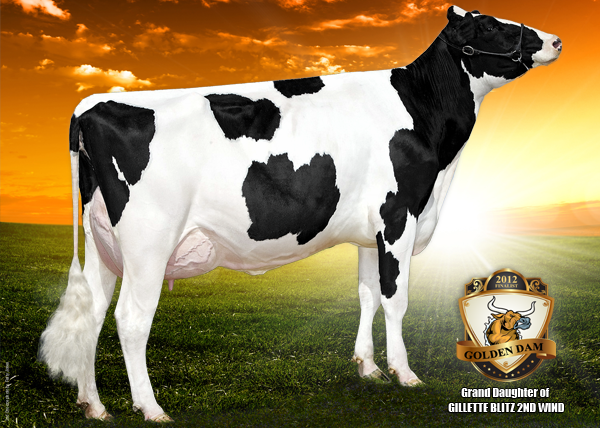
Are You Feeling the Heat?

There is no question your cattle are feeling the heat and, as a result, so is your pocket book. One of the greatest challenges facing many dairy farmers, especially those in the southeastern United States is the effects of heat-stress on their cattle.  The loss in production during the hot summer months can have a huge effect on profitability.  The following are some ways you can improve the performance of your herd, during the hot summer months.

Environment

Three things send your profits spiraling down: increasing air temperature, temperature-humidity index and rising rectal temperature above critical thresholds.  These three can cause decreased dry matter intake (DMI) and milk yield and reduce efficiency of milk yield.  In other words, as temperatures go up your profits go down.  Fortunately, modifications including shade, barns which enhance passive ventilation and the addition of fans and sprinklers help to increase body heat loss, lower body temperature and, thus, increase DMI.

  • Shading
    One of the first steps that should be taken to moderate the stressful effects of a hot climate is to protect the cow from direct and indirect solar radiation.  Get them out of direct sun!  It was estimated that total heat load could be reduced from 30 to 50% with a well-designed shade. Shading is one of the more easily implemented and economical methods to minimize heat from solar radiation.  Cows in a shaded versus no shade environment had lower rectal temperatures (38.9 and 39.4°C) and reduced respiratory rate (54 and 82 breaths/min), and yielded 10% more milk when shaded. Numerous types of shading are available, from trees (which are easily killed by high cow density), to metal and synthetic materials (shade cloth).
  • Cooling for Dairy Cows
    Although shade reduces heat accumulation from solar radiation there is no effect on air temperature or relative humidity and additional cooling is necessary for lactating dairy cows in a hot, humid climate. A number of cooling options exist for lactating dairy cows based on combinations of convection, conduction, radiation, and evaporation. Air movement (fans), wetting the cow, evaporation to cool the air, and shade to minimize transfer of solar radiation are used to enhance heat dissipation. Any cooling system that is to be effective must take into consideration the intense solar radiation, high ambient temperature, and the typically high daytime relative humidity, which increases to almost saturation at night. These challenging conditions tax the ability of any cooling system to maintain a normal body temperature for the cow.  Most air conditioning systems tend to be cost prohibitive and most misting systems tend to increase (not decrease) the relative humidity and can cause large amounts of wasted water that must be dealt with.  Now you’ve got heat and water, two things pathogens love.
  • Cooling Dry Cows
    While many producers tend to focus on lactating cows, it is important not to forget about your dry cows as well.  In a research study, when cows shaded during the dry period were compared with unshaded control animals.  The shaded cows delivered calves that were 3.1 kg heavier and yielded 13.6% more milk for a 305 d lactation, even though all cows were handled similarly following calving.  The shaded cows had lower rectal temperature, respiratory rate, and heart rate and altered hormone patterns during the dry period. Similarly, cows that were cooled using sprinklers and fans during the dry period maintained lower body temperatures and delivered calves that were 2.6 kg heavier and cows averaged 3.5 kg more milk daily for the first 150 d of lactation than shade only controls.
  • Heat Stress Effects On Heifers
    Heifers generate far less metabolic heat than cows, have greater surface area relative to internal body mass and would be expected to suffer less from heat stress. However, research from the southern United States and Caribbean regions indicates that Holstein females raised at latitudes less than 34°N weighed 6 to 10% less at birth and average approximately 16% lower BW at maturity than those in more northern latitudes, even when sired by the same bulls. Immunity may also be compromised in newborns during hot weather, and calves born in February and March. Calves born to heat-stressed dams were less vigorous, less likely to nurse immediately after birth, and consequently the colostrum from the first milking was of higher quality due to little or no nursing. Hot conditions may also compromise the ability of the calf to absorb immunoglobulins. (For more on this check out 10 Ways Cool Calves Beat the Heat)

Genetic Selection

There are many aspects of genetics that influence the response to heat stress, and variation among breeds is large. One of the challenges associated with managing high producing cattle in a hot environment is that selection for increased performance is often in conflict with maintaining homeothermy. The maintenance of body temperature is heritable through characteristics including sweating competence, low tissue resistance, coat structure and color.  Selection for heat tolerance without selection for an accompanied greater productivity would likely result in lower overall performance by the animal. Sweating response was found to be negatively correlated with metabolic rate, suggesting the difficulty in combining desirable traits of heat adaptation and metabolic potential in cattle.

Because genetic variation exists for traits important to thermoregulation, the potential to select sires that can transmit important traits must be considered. Genetic selection for heat tolerance may be possible, but continued selection for greater performance in the absence of consideration for heat tolerance will result in greater susceptibility to heat stress.

Nutritional Management

There is no question that during the hot summer months you need to change what you are feeding your cattle. With reduced dry matter intake you must reformulate your rations to account for the greater nutrient requirements during the hot weather.

Intake of DM usually declines with hot weather and nutrient density of the diet must increase. The tendency is to increase dietary protein concentration above requirements, but there is an energetic cost associated with feeding excess protein. The most limiting nutrient for lactating dairy cows during summer is usually energy intake and a common approach to increase energy density is to reduce forage and increase concentrate content of the ration. The logic is that less fiber (less bulk) will encourage intake, while more concentrates increase the energy density of the diet. High fiber diets may indeed increase heat production, demonstrated by work showing that for diets containing 100, 75, or 50% of alfalfa, with the remainder being corn and soybean meal, efficiency of conversion of ME to milk was 54, 61, and 65%, respectively. While heat increment is a consideration for high fiber diets, total intake has a much greater impact on metabolic heat production by the animal. During hot weather, declining DMI and high lactation demand requires increased dietary mineral concentration. However, alterations in mineral metabolism also affect the electrolyte status of the cow during hot weather.

Water is arguably the most important nutrient for the dairy cow. Water intake is closely related to DMI and milk yield, but minimum temperature was the second variable to enter a stepwise regression equation (after DMI), indicating the influence that ambient temperature exerts on water consumption.  Clean ambient water must be easily available to animals at all times.

The nutritional needs of the cow change during heat stress, and ration reformulation to account for decreased DMI, the need to increase nutrient density, changing nutrient requirements, avoiding nutrient excesses and maintenance of normal rumen function is necessary.

The Bullvine Bottom Line

Extended periods of high ambient temperature coupled with high relative humidity compromise the ability of the lactating dairy cow to dissipate excess body heat. Cows with elevated body temperature exhibit lower DMI and milk yield and produce milk with lower efficiency, reducing profitability for dairy farms in hot, humid climates. Maintaining cow performance in hot, humid climatic conditions in the future will likely require improved cooling capability, continued advances in nutritional formulation, and the need for genetic advancement which includes selection for heat tolerance or the identification of genetic traits which enhance heat tolerance. If producers must focus their efforts, during times of heat stress, then they should focus on those cows that are three weeks before and six weeks after calving.

For more on this check out “Effects of Heat-Stress on Production in Dairy Cattle” from the Journal of Dairy Science

[related-posts-thumbnails]
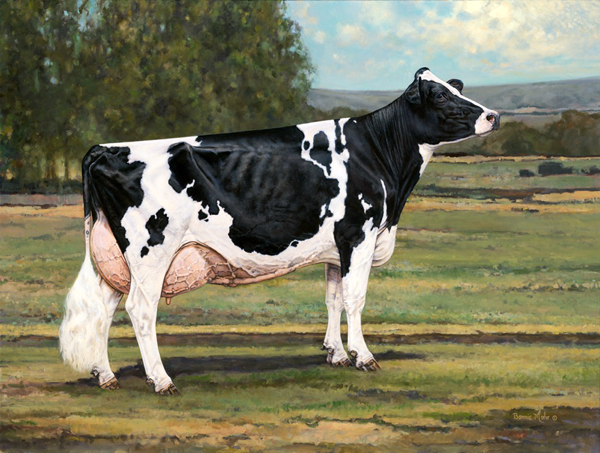
Murray Hunt: Perspective from Both Sides of the Fence

It’s our pleasure to welcome Murray Hunt to the Bullvine Team. Murray brings a wealth of experience from both the dairy industry side as well as the breeder sides of the fence. Ask Murray what success is in the dairy industry and he will instantly flash a smile because he has seen it up close and from both sides of the fence. The family farm, which is approaching its 100th Anniversary, is where he first fell in love with dairying, first at the heels of his grandfather Allen Humphrey and then working with his parents Sterling and Irene Hunt.  Almost three decades with Holstein Canada and the Canadian Association of animal breeders never separated him from his hands on appreciation of cattle at Huntsdale Holsteins.

He Loves Those Cows

“There’s an advantage to spending your working career doing what is closest to your heart.” Murray reports.  As he warms to the topic he enthuses that “Look at the major advancements we have seen in milk production and conformation, especially udders in Holstein cattle.  They were known for deep udders and low butterfat. They’ve certainly come a long way.” Years of working with the Holstein Canada Classification program support his conclusions. “And there is still great potential in working on feet.”  Justifiably proud of the Master Breeder shield earned by Huntsdale, Murray continues to breed to send sires into A.I. both in Canada and one in abroad. “Developing a member of the Gypsy Grand cow family has been good for Huntsdale.”

Cow Sense Meets Cow Science

Murray earned both his B.Sc. and M.Sc. at Guelph University.  His Master’s thesis was entitled, “An A.I. Breeding Schemes” and included the “Dollar Difference Guide” which was the precursor to the Canadian LPI system.  Hunt’s Masters was implemented by A.I. organizations that went from sampling less than 50 bulls per year to over 400.

(Not) The Same Old Story

Despite his long history with farming and farmer organizations, he is not reluctant to move forward.  “Success can be directly linked to your willingness to change.” Says Murray even though he adds, “All change is not good but we have to research the possibilities and then select what appears to be the best move in a forward direction.” If he himself was stuck in the past, he might be unwilling to see genomics moving the industry away from a purely pedigree analysis of animals.  “On the contrary!” he exclaims, “It’s wonderful to move to the next stage where we don’t have the cost and delays of proving sires that don’t have a chance of coming through as plus sires!” This leads to the topic of organizations and Hunt firmly believes that the future of the cattle breeding industry will see fewer producer organizations. “This is predictable from a purely financial point of view and will evolve with the breeder priorities, provided we can move beyond the past, be objective and expand our vision for the future.”

Look to the Horizon

“We need to forge our path to the horizon and not just to the end of our own laneway!” insists Murray who notes that “The ones who move forward with change are the ones who stay with the (cattle) industry and those who don’t will exit the industry.” He is not upset about this but does add, “Every generation that survives on the farm moves ahead with technology. It could be in your fully equipped office or the method you use for milking. For some it’s new ways to grow crops and mechanized ways to feed them.”  He strongly feels that it is “up to dairy breeders and industry leaders to trust the system, improve the system and use the system to produce a continually better product.”

The Bullvine Bottom Line

For Murray Hunt there is no final one-size-fits-all answer.  “If it was that easy, there would be no challenge and no opportunity. We all want to use what we know to prove our faith in the potential of Holstein cattle.  These are exciting times for genetics, technology and the future of the dairy business. It’s no time to find yourself sitting on the fence!”

Join us in welcoming Murray to the Bullvine team and we are excited about the great insights he will bring to the Bullvine.

[related-posts-thumbnails]
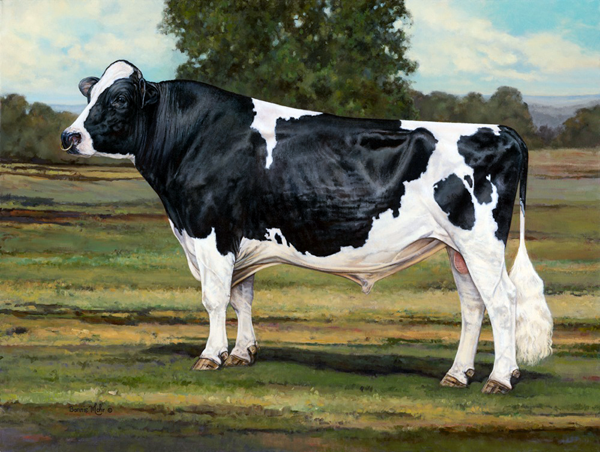
Early to Bed, Early to Rise, Work like Mad and Advertise!

Summer is not the time to skimp on promoting your herd for potential income. If anything, you should advertise even more now. Start with free and easy sources and build awareness of what you have to offer. The following are 11 tips to help you.

  • Word-of-Mouth Turns up the Volume
    Experts say that word-of-mouth is 10 times more effective than other marketing tools such as advertising, special events, and direct mail. Always, always, always keep friends, family, neighbors, and others up to speed on what you have to offer in the marketplace. Are you putting up new facilities? Are family members winning on the show circuit? Have you raised your production levels? Is your farm winning production awards? Are you promoting bio-security or green protocols? Give people something to talk about. Better yet share it on Facebook and let it go viral.
  • Signs
    Every person who sets foot on your property as friend, acquaintance, business supplier or animal handler, should be able to see a sign with each animal letting them know who it is and why they are special. Think about it. If you are starting into genomics, polled cattle or red genetics, make sure that you have a sign saying so. Everyone associated with you should be able to answer the question, “Who’s selling polled Holsteins these days?” or whatever variation of the market you are targeting. Set up the appropriate signs and update frequently.
  • Go Beyond Magazine Ads
    There’s a very true saying that goes something like this, “If you can afford to advertise, you don’t need to.” Old fashioned ads in breed magazines can set you back $1000 to $3000 for each package. They reach a specific demographic and, not necessarily, the buyers the movers and shakers who are out there moving cattle around. Furthermore, although a picture is worth a thousand words, today`s big spenders want to get up-close and personal when evaluating their next purchase. Don’t rely on this resource exclusively.
  • Digital Marketing
    The opportunity to grow your business with digital marketing services has never been greater. What is digital marketing? Defined, it is promoting your company or brand by using all forms of digital advertising channels to reach new customers. Remember it’s the new customers that you want to connect with. It can be as simple as email, Facebook, or twitter. Every time your prefix is printed make sure your sales niche is there too! “Huntsdale Farms – Your source for Top Genomic Heifers” for example.
  • Sponsorships
    Increase attention and increase traffic to your dairy business through your association with 4-H, Holstein clubs and other agricultural and conservation groups. This next decade will see huge changes in consumer awareness and demands relating to food production and animal treatment. Reputation starts at home. Make sure that yours is associated with the good animal husbandry and quality products. These are the cornerstones of why you are in dairying in the first place.
  • Be Political
    It`s too late when you read the 2012 Farm Bill or the CDCB proposal after they have been passed and you see that it negatively affects your cattle business. It’s unreasonable to expect any political representative to be 100% aware or even 50% knowledgeable of what our industry is all about. When was the last time this person had any experience directly relating to agriculture? It is time for the farmers to take responsibility for keeping the communication going both ways. An informed government decision (that you have put input into) is better than one that is based on hearsay, pressure groups or political positioning.
  • In the News
    Agricultural is on radio, TV and in news headlines these days. It isn’t always cast in the best light. Make friends with the reporters who cover these topics in your area. If you have expertise in something that is getting headlines don’t keep a low profile and then become frustrated when your side of the story is misrepresented or worse completely inaccurate. Make yourself known to the local, provincial and federal politicians who speak for or against agriculture. It doesn’t cost anything to invite local media or agricultural representatives to your events but how often do farmers assume that they will just show up at that sale, cattle show or open house? And once you’ve extended the invitation, provide a two to six hundred word report on what happened and why it is not only great for agriculture or cattle breeders but for the community as well.
  • An Effective Website
    Nearly 55% of all small businesses have a website, but yet less than 2% of dairy breeders do. Believe it or not, it works for farm businesses too! You don’t need to be fancy with it or pay a lot of money. For a minor investment your website becomes your hardest-working employee, working around the clock daily to promote your farm, cattle and embryos. Your site can work as a super sales tool. 24-7 is the new advertising success code.
  • Be an Expert
    Are you an expert at some aspect of the dairy industry (i.e. polled, genomics, health traits. etc)? Write articles about your expertise with a small link to your website or Facebook page at the end. Are you a cattle judge? Show fitter? Do you provide sale services or buy and sell cattle or embryos globally. Be the media source for your market segment. As a professional service, you can position yourself as the go-to authority. It is all about positioning your prefix, your products and yourself for success.
  • Networking
    Online or offline, networking groups abound. Online, I would suggest joining effective sites like Twitter, Facebook, MySpace, and LinkedIn. Most consumers search the web before making a purchase. Phone books are nearly obsolete. Magazines and newspapers are not 24-7 accessible at the touch of your fingertips. The world is now your marketplace, so you can sell your cattle or their genetics anywhere. This means more money, opportunity, and a more professional image for your farm.
  • Video Marketing
    There is a tremendous opportunity here. Thanks to modern technology, it’s never been easier to make your own video. You probably own several devices which are capable of capturing high quality videos that you can then edit and burn onto DVD or upload to the Internet. This is a very simple process that doesn’t take long to learn. You can highlight cows, heifers, show cattle or embryos. These videos can then be used on the web, at shows and sales.

The Bullvine Bottom Line

These days, dairy producers need to have as much confidence in handling their advertising as they do when handling their high-producing cows.


To learn how to get your farm on Facebook download this free guide.


[related-posts-thumbnails]
You Can Bank On Amaze To Pump Up The Volume

She`s Set to AMAZE in 400 Ways. Lewisdale Eastside Gold Amaze VG 87 2YR, with BCA’s of 236-253-240, leads the field by a huge margin when it comes to producing embryos. On June 23rd, 2012 she produced her 400th embryo! These numbers are even more amazing when you consider she did it in a mere three years!

This Embryo Machine is a Bank Machine

There are a number of ways to make or save money by raising high quality Holsteins. It could be production of fat and protein. It could be milk with low somatic cells scores. It could be progeny that sell well in sales. Each of these is effective but Amaze shows the way to do it by producing embryos that convert to cash.

Eastside Lewisdale Gold Missy - Grand Champion WDE and Royal '11

Eastside Lewisdale Gold Missy – Grand Champion WDE and Royal ’11

Amaze is Surrounded by Success

Amaze is not only a prolific producer of embryos, she comes with a great pedigree and that makes the embryos very marketable. Her full sister is none other than Lewisdale Eastside Gold Missy, the Madison and Royal Supreme Champion and title holder All American and All Canadian. Her dam is Stadacona Outside Abel 26 Stars and nominated for Canadian Holstein Cow of the Year.

Amaze is Reaching for the Top

Amaze`s genetic indexes place her in the top 20% of the breed for production, top 2% for SCC and top 1% for conformation. Her Direct Genomic Values reflect her own performance with high values for conformation, feet and legs, SCC and Herd Life.

Around the World with AMAZE

Amaze embryos have been used extensively in North America and in more than 10 countries around the world including: Australia, Brazil, Denmark, Finland, France, Holland, Japan, New Zealand, South Korea and UK.

Great Cows. Great Breeders. Great Future.

Great cows are bred by great cattle breeders. In Amaze`s case, she was bred by two PEI Holstein breeders, Lewisdale and Eastside. At less than four months of age she was sold to Abelaine and Sudview for whom she had a Baxter daughter that is now VG 88. Her original breeders bought her back during her first lactation. And thus began the record-breaking flushing program. The 400 embryos are from 24 flushes by 17 different sires, all of whom are high genomic bulls or bulls with high genetic conformation indexes.

Don`t Miss the AMAZE Take Home Message

Of course elite Holstein dairy cattle can enhance your farm profit margins. Using all the available tools and technology, these rewards can come by extra milk in the pail, trouble –free cows that require less labour or genetic sales around the world.

The Bullvine Bottom Line

Success in the Holstein business comes in many different ways but Lewisdale Eastside Gold Amaze gives a whole new meaning to the term cash cow. There`s no business like embryo business! You can bank on it!


Not sure how much to spend on that great 2 year old?
Want to make sure you are investing your money wisely?
Download our Dairy Cow Investment Calculator.


[related-posts-thumbnails]
 

You Can’t Drive To The Future Using Rear View Mirrors!

By definition, being strategic requires that you look forward — identifying trends, opportunities, and threats. That’s how good drivers drive on super highways and it’s how good breeders keep moving forward too. You can choose the less risky route of staying in the parking lot but you won’t get anywhere. Here are a few ways to keep your herd moving toward the future.

Check out your blind spot

By the end of next year, even the skeptics will have to admit that genomics, smart phones and tablets are here to stay. The early adopters and best-practice breeders are using these devices. They love being able to see all incoming e-mail, social messaging, text messaging, and voice and video messaging in a single place. They`re using them as the new resource to learn about and manage almost every aspect of cattle breeding.

Traditional Marketing will Decrease.  New Marketing will skyrocket.

As dairy breeders zero in on genomics, finding the leaders, at the right price in the right location and instantly … will change the face of dairy cattle marketing.  The twice a year showcase or the every three to five years  reduction sale will gradually give way to a marketplace that is in “sell” mode 24-7 and 365 days of the year.  Sellers will move beyond single page ads, special events and the cattle ring for promotion as a whole new breed (pun intended) of niche players will be born with the intention of providing the best results from your advertising dollars.  The days of a few key players topping the markets with their well orchestrated, for-your-eyes only live marketing events will gradually give way to on line live video interviews, marketing and promotion one-on-one. Rather than the traditional “one-size-fits-all” advertising strategy, a targeted personalized approach will be required if you expect to have a reasonable chance to sell in the new marketplace.

Genomics will increase its impact by becoming more focused and data driven

Most dairy breeders recognize that genomics is a tool to improve selection. As results become more refined and defined the potential impact will have even more converts.  Global economic issues will be with us for years to come and that too will drive genomics development to target more and better ways to breed great cattle to their highest potentially in the fastest, healthiest and most economical way possible.

The Global Marketplace has attracted the Big Players

The continued growth of technology, social media, and easy communications now makes it possible a dairy breeder in China to come to your barn, see your cows and complete a sale with no middle men, expensive “tire-kicking” trips or costly international time zone, travel and financial issues.  Today it’s take-a-look and complete-the-deal. With the whole world able to look over your shoulder in your barn, big business definitely sees the potential and is ready to grab a piece of the pie.

Dairy cattle research is picking up speed

Remember the good old days (that would be 10 years ago) when we had to sit through breeder meetings and association animal meetings and hear about the difficulties of getting the right research done at the right time and at a reasonable cost?  Industry and government were supposed to be pulling together to fund research that would have an impact on more than the scientific community. Sometimes breeders were skeptical, or unaware, of the practical applications.  Remember CAAB?  Genomics has changed all that.  Now not only are the money streams more accessible and flowing, the really big players with the really big bucks are ready and willing to become the new best friends of the cattle breeding industry.

Farm Branding is the Express Lane to Success

You can no longer hope that a few expensive colour layouts in a magazine will give you the profile you’re looking for to sell those also expensive genetics that you’re investing in. Having good genetics, a great work ethic and savvy cow sense, is no longer enough to have you speeding through the rapidly expanding crowd where everybody says, “Been there. Bred that!”  The increased use of social media and digital marketing will be the new way for the cream to rise to the top.

The Buyer Experience

In the past, you knew who the “players” were and the rest didn’t blip on your radar.   Today, you’ve got one chance to make a good first impression.  You never know when someone’s phone will capture a video and or audio of your inventory (is that what she “really” looks like?) and share it around the world. You could try keeping your doors selectively  closed but that will send a message too and it could be a negative one!  You are caught between the camera and a hot place!

The Bullvine Bottom Line

Forward-looking decision-making: Although hindsight is 20/20, if you’re moving ahead you cannot spend your time looking backward at what happened in the past. The dairy business of the future is following the growth signs:  market supply and demand; new dairying technologies and genomics to name a few. This forward-looking focus will not only improve decision-making but will lead the way to a future that is built on the past but moving way faster than we ever though possible.  Keep moving on the dairy industry express lane or you could be stuck on the off-road ramp or, even worse, left in the parking lot!

[related-posts-thumbnails]
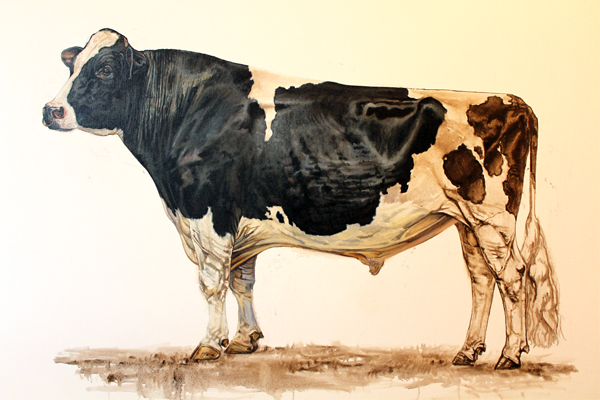
10 Ways Cool Calves Beat the Heat

Suddenly it is summer.  Where did all this suffocating heat come from? Of course, if people are feeling soggy, you can be sure calves are feeling it too! Short of inviting them in to share the air-conditioning there are several effective ways we can keep calves cool and stress free.

SIMPLE HEAT STRATEGIES

  1. Shady Ladies.
    Make sure to provide your calves with plenty of shade whether it is from trees, the hutch itself or supplemental shade.  Hutches that faced south in the winter can be re-aligned to capture shade and prevailing breezes. If necessary, construct a temporary shade canopy over their tops (14 feet or higher to allow for good airflow).
  2. Timely Care.
    Consider changing the time of day when handling calves is done.   Perform stressful activities (such as moving, grouping, handling, vaccinating, dehorning) early in the morning. Feed animals several hours before or after peak temperature and humidity times. Early morning and late afternoon feeding can avoid calves experiencing peak temperatures at the same time as their digestion peaks, which often occurs about four hours after feeding.
  3. Always Fresh ‘Cause You Keep Feeding it.
    Keep your calf starter fresh at all times and free of any moisture. Start your calves with a handful of feed and change it every day until they are eating their full allotment.
  4. How’s the Water?
    Provide cool  (50°F /10°C) drinking water (cows drink 50% more water at temperatures of 80°F/26.7°C and above compared to 40°F/4.4°C). It should not be a surprise for calves to double their water intake. Switching to five-gallon pails may also be helpful.  When heat stressed a calf can consume 3 to 6 gallons of water per day. To keep it fresh, empty and refill water pails several times throughout the day. More water changes (say every three hours) the more they will eat. The more they eat the more nutrients they consume and then they are better able to withstand heat stress.
  5. There’s Strength in Numbers so Increase Feeding Frequency.
    Research has also shown that calves fed three times a day have shown optimal growth, better feed efficiency, consume more starter prior to weaning and have greater chance of survival to lactation than calves fed twice daily. You should also research commercial products that target heat stress in their formulations.
  6. Make Your Bed …again and again.
    Changing bedding frequently to control fly populations. Use sand bedding to keep calves cooler.  Clean, dry sand also helps control fly populations, compared with straw or sawdust. Sawdust is better than straw for summer bedding.
  7. Keep it Clean.
    Cleaning and sanitizing water buckets regularly Warm weather promotes algae, mold and bacteria growth. Keeping water and milk pails clean and sanitized will help keep these populations down, as well as help with the fly population.
  8. Replenish Electrolytes.
    Consider more liberal use of electrolyte solutions, advises J.W. Schroeder, Dairy Specialist with North Dakota State University. In warm weather, calves are more prone to dehydration. Scouring calves should receive oral electrolyte solutions liberally, particularly during midday. Administer electrolytes by bottle early in the course of diarrhea because solution absorption likely will be better than if it’s given by a tube or free choice.
  9. No Flies on Us! 
    Unfortunately calves are a hot spot for flies. Using a milk replacer and a calf starter that includes a feed through larvicide can help to keep the fly population down. A reduced fly population may also reduce stress to the calf and the spread of diseases by flies. As mentioned previously, clean, dry sand bedding also helps control fly populations, compared with straw or sawdust. Implement good fly control practices that break up the life cycle to prevent build-up. Know that molasses, a common calf starter ingredient to aid in palatability, can be a tasty attractant for fly populations. Calf starters that utilize alternative natural palatability enhancers along with feed-through fly control technology are available.
  10. A Breath of Fresh Air
    Increase Air Flow and air exchange:  Hutches need good air flow in and around them.  In enclosed facilities natural cross ventilation is not possible, than a total air exchange every two minutes through a mechanized system of fans is a must.

 ….. this brings us to the best TIP of the summer!

Catch the Breeze: Elevate one side of the hutch. That’s right.  A slight “tip” will make a big difference.  In 2011, a Washington State University trial showed that elevating one side of the hutch de­creased internal hutch temperature and increased ventila­tion in warm weather.  We all want results and here’s some that they reported:

  • At the hottest times of the day, internal hutch temperatures were higher than outside temperatures when the hutch was on the ground. Internal hutch temperatures were lower than outside when the hutch was elevated.
  • Elevating the hutch improved air movement within the hutch.
  • Hutch elevation lowered afternoon respi­ratory rates in the calves — 58 versus 44 breaths per minute.
  • Hutch carbon dioxide levels were lower when the hutch was elevated.

Note to readers:  We tried this simple solution at Huntsdale and saw – and felt – immediate results.

YOU’RE SWEATING DOLLARS AWAY

When we think of heat stress our thoughts often go to the milking herd first, as heat and humidity can have a dramatic impact on milk production and therefore have a potential impact on our pocket books. We need to think outside the cow pen. The numbers are rising as fast as the thermometer. For example: In a 100 cow herd with 30% cull rate, 25% of the calves in the herd are exposed to heat stress, having been born at that time of the year. Heat stressed open heifers may calve at 26 months instead of 24. Basic additional costs are obvious: extra days raising; more replacements costs; less production in the future. Not so obvious are extra housing, extra feed; extra labour and medication costs. Hopefully, you are still on the positive profit side with these numbers, however, there is a strong chance that these heifers will not produce to their potential. Add in those losses in less milk production and you have probably wiped out your small margin of success. Multiply this result over a 100-cow herd and you could see your positive bottom line melt away in the heat as you lose between $5,000-$7,000!!!

THE BULLVINE BOTTOM LINE

Extreme heat does hurt your calves.  Heat stress also hurts you …. in your pocket! Make sure you cash in on cool calves!!

[related-posts-thumbnails]
Plugin by Social Author Bio

Send this to a friend