








Archive for Swiss ISET rankings

Switzerland’s August 2026 Proof Run: DG Eliandro Debuts at #2 as Progenesis Timeout Vanishes From the Top 100

Timeout sat #7 on Switzerland’s April ISET Genomic list at 1476. By August, he’s off the top 100 entirely — two more former top-10 sires went with him.

Executive Summary: The August 2026 Swiss ISET genomic rankings reveal significant volatility in the dairy industry, highlighted by the dramatic disappearance of former top-tier bulls like Progenesis Timeout from the top 100 list. While Progenesis Torchlight maintained his leading position, the emergence of DG Eliandro at the number two spot underscores a period of rapid turnover driven by fresh genetic data. This shift emphasizes the inherent risk of genomic sires, which offer high theoretical upside but lack the statistical stability of daughter-proven bulls like Progenesis Topstory. The data also warns of pedigree concentration, noting that several elite bulls share the same maternal grandsire, creating potential genetic vulnerability for herds. Ultimately, these updates serve as a critical guide for breeders balancing the pursuit of unverified genetic progress against the reliability of proven performance.
Switzerland ISET genomic

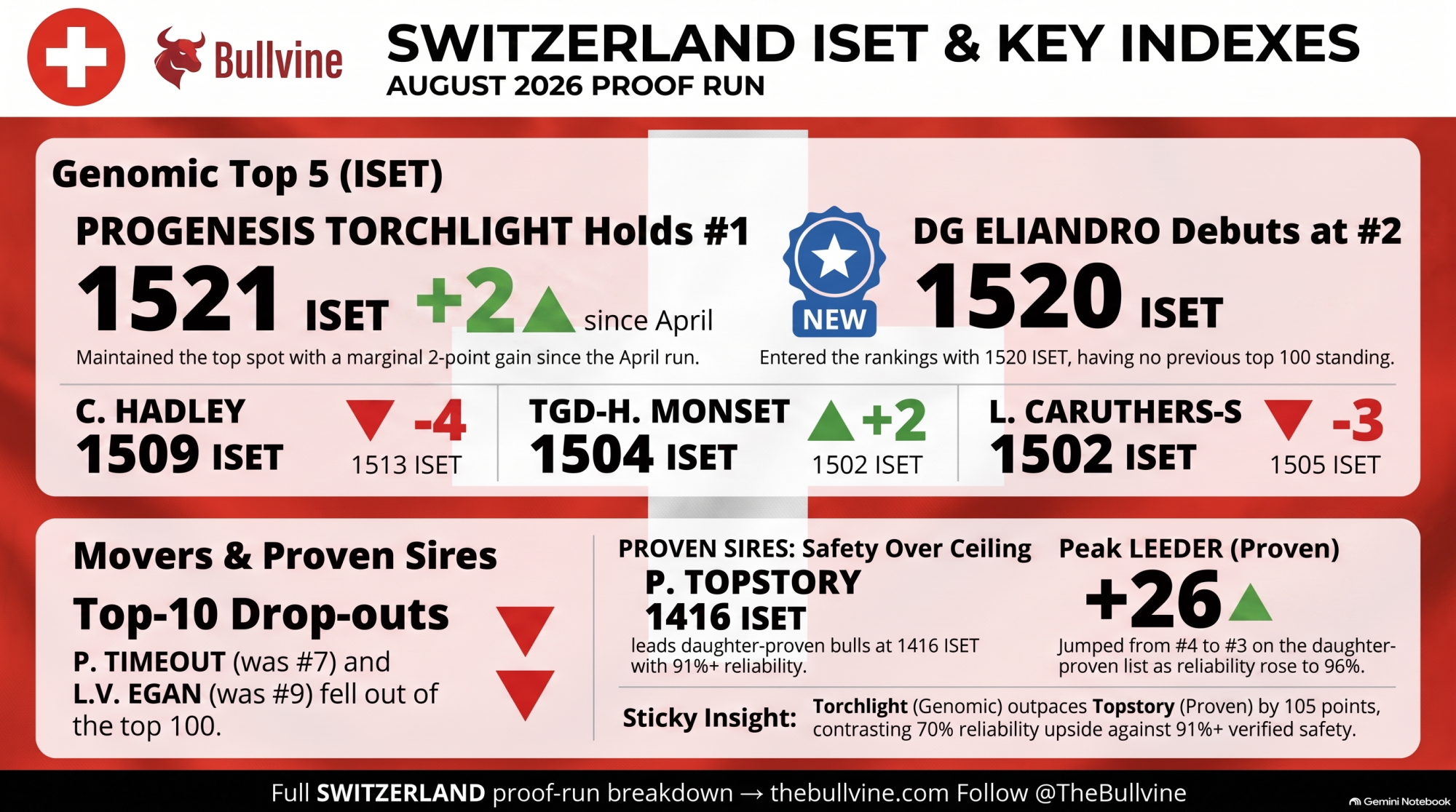
Switzerland’s ISET Genomic ranking — issued by Qualitas AG on behalf of Holstein Switzerland and swissherdbook — moved more in the August 2026 run than any other Swiss bull ranking this cycle. Progenesis TORCHLIGHT held #1 at 1521 ISET, up only marginally from the 1519 he posted when he first took the genomic crown in April 2026, but the real story sits right behind him: DG ELIANDRO debuted at #2 with 1520 ISET, a bull with no prior ranking in the previous top 100. It’s worth reading even if you’ll never buy a straw of Swiss semen — Switzerland is one of the few systems that publishes genomic and daughter-proven sires as fully separate rankings, and that split is the actual story here. 

The bigger shock is who’s gone. Progenesis TIMEOUT, April’s #7 at 1476 ISET, didn’t just slide out of the top 10 — he disappeared from the entire genomic top 100 in one run, alongside two other former top-10 names. That kind of churn doesn’t show up on Switzerland’s other major bull ranking, the ISET Domestic Daughter-Proven list, where the ceiling sits over 100 points lower: Progenesis TOPSTORY leads that list at just 1416 ISET. Same index, same country, two very different worlds.

August 2026 ISET Genomic: Top 10 Sires

RankBullISET (Aug 2026)ISET (Apr 2026)Change
1Progenesis TORCHLIGHT15211519 (rank 1)+2
2DG ELIANDRO1520new in top 10
3Cookiecutter HADLEY15091513 (rank 2)−4
4TGD-Holstein MONSET15041502 (rank 4)+2
5Lars-Acres CARUTHERS-S15021505 (rank 3)−3
6“Race”*14881489 (rank 5)−1
7Bianfrie ALABAMA-ET1486new in top 10
8DG CAARMA14811482 (rank 6)−1
93Star PATSER1480new in top 10
10Eichhof DOVER14681472 (rank 10)−4

All milk figures throughout this piece are reported in kilograms, per the Swiss source data; lb conversions are added where useful below.

  • Torchlight leads both runs, but his +2 gain (1519→1521) is essentially flat — the movement in this run is entirely about who’s in the room, not who’s getting stronger.
  • Seven bulls carried over from April; three (Eliandro, Bianfrie ALABAMA-ET, 3Star PATSER) are brand-new to the top 100, let alone the top 10.
  • Three April top-10 bulls — Progenesis TIMEOUT (was #7, 1476), Les Verdaux EGAN (was #9, 1474), and Sous-Moron BOSTON (was #8, 1475) — fell out of the top 100 entirely, not just the top 10.
  • The index band widened slightly: April’s top 10 spanned 1472–1519 (47 points); August’s spans 1468–1521 (53 points), even though the #1 value barely moved.

Big Risers

There isn’t much of a “riser” story in this run’s returning anchors — Torchlight (+2) and TGD-Holstein MONSET (1502→1504, +2, held rank 4) are the only bulls with positive movement among the seven carryovers, and both gains are marginal. The real upward movement in this run came from new entrants displacing incumbents outright, not from existing bulls posting bigger numbers.

Big Fallers and Drop-Outs

  • Lars-Acres CARUTHERS-S slipped from #3 (1505, Apr 2026) to #5 (1502, Aug 2026) — still top 5, but a two-rank retreat.
  • DG CAARMA fell from #6 (1482, Apr 2026) to #8 (1481, Aug 2026) on a nearly flat ISET score — rank slippage from new competition, not a real decline.
  • Progenesis TIMEOUT dropped out of the top 100 entirely — was #7 at 1476 ISET in April 2026, absent altogether in August.
  • Les Verdaux EGAN and Sous-Moron BOSTON also fell out of the top 100 completely — EGAN was #9 at 1474 ISET in April, BOSTON was #8 at 1475. All three former top-10 names vanishing in one run underlines how much a 70–74%-reliability genomic proof can move.

What This Index Is Rewarding

  • Volume vs. components: DG ELIANDRO cracked #2 on raw volume (2,063 kg milk, roughly 4,550 lb) with modest components (+0.28% fat, +0.09% protein), while Eichhof DOVER holds #10 on the opposite profile — components-heavy (+0.56% fat, +0.30% protein) on far less volume (1,416 kg, roughly 3,120 lb). Same index, opposite paths to a top-10 slot.
  • Type vs. output: TGD-Holstein MONSET posts the table’s strongest conformation (ITP 129, udder 129) on comparatively modest volume (1,251 kg milk, roughly 2,760 lb), while Lars-Acres CARUTHERS-S carries the table’s highest milk volume (2,180 kg, roughly 4,800 lb) at a noticeably lower ITP (110). No single trait dominates the ranking outright.

Pedigree Concentration

  • GAMEDAY-ET sits as maternal grandsire behind three of the ten current leaders — Torchlight, Cookiecutter HADLEY, and MONSET — a real concentration on one grand-maternal line, and not a new phenomenon: this same Gameday line was already reshuffling Switzerland’s rankings back in December 2025, when Sous-Moron BOSTON’s fall from #1 to outside the top 20 first put it on our radar. thebullvine
  • For herds wanting to diversify away from that Gameday line, DG ELIANDRO (MGS ALTAALANZO-E) and Lars-Acres CARUTHERS-S (MGS VAN GOGH-ET) sit outside it.

Volatility and Reliability

  • The newest, least-tested names are Bianfrie ALABAMA-ET (70% reliability, brand-new) and 3Star PATSER (71%, brand-new) — the two furthest from any daughter confirmation.

ISET Domestic Daughter-Proven — A Different Top Five

RankBullISET (Aug 2026)ISET (Apr 2026)
1Progenesis TOPSTORY14161420 (rank 1)
2Cal-Roy-Al JAZZ14131415 (rank 2)
3Peak LEEDER14091383 (rank 4)
43Star Oh RANGER13971398 (rank 3)
5Leaninghouse TAOS13811358 (rank 7)
  • TOPSTORY leads both runs (1420→1416) 
  • The two real movers: Peak LEEDER jumped rank 4→3 (+26 points, 1383→1409, reliability rising 94%→96% alongside it — a genuine daughter-driven gain), and Leaninghouse TAOS jumped rank 7→5 (+23 points, 1358→1381, on a 206 kg milk-volume increase at flat 96% reliability).
  • Progenesis INSPIRE (April’s #5 at 1369) fell out of this top 10, replaced by a new entrant at #9.

Where the Indexes Agree — and Where They Don’t

Core tension: The August 2026 run shows a 105-point gap between the hottest genomic prospect (Torchlight, 1521) and the top daughter-proven sire (Topstory, 1416) — not because Torchlight is a verified superior animal, but because a 70–72%-reliability genomic proof carries less statistical caution than a 90%+-reliability daughter-proven one. Breeders backing Torchlight or Eliandro are buying unverified upside; breeders backing Topstory or Ranger are buying confirmed safety at a lower ceiling. With three genomic bulls, including Progenesis TIMEOUT, vanishing from the top 100 in a single run, that upside comes with a real re-ranking risk, not just a statistical footnote.

How to Use These Sires This Season

Genomic-upside anchor. For herds comfortable riding out re-ranking risk in exchange for the newest genetics, Progenesis TORCHLIGHT is the safest bet among the hot names — he’s held #1 across both runs (1519→1521) rather than showing up fresh this cycle.

Daughter-proven anchor. For herds prioritizing predictability over ceiling, 3Star Oh RANGER’s 99% reliability on the Domestic Daughter-Proven list makes him the closest thing to a guaranteed outcome in this dataset, even at a lower 1397 ISET.

Type and udder specialists. For herds prioritizing conformation and mammary system over raw output, TGD-Holstein MONSET’s ITP 129 and udder score of 129 stand out in the genomic top 10, at the cost of milk volume (1,251 kg).

Volume and outcross options. For herds wanting fluid-milk volume and a pedigree outside the Gameday-ET cluster, DG ELIANDRO (2,063 kg milk, MGS ALTAALANZO-E) fits both criteria in one animal.

30-day action: Pull your current AI inventory and check exposure on two fronts — first, how much of your Gameday-ET maternal-grandsire line runs through Torchlight, Hadley, or Monset, since three of ten current genomic leaders trace to that one line; second, whether you’re still committed to straws on Progenesis TIMEOUT, Les Verdaux EGAN, or Sous-Moron BOSTON, all three of which fell out of the Swiss ISET Genomic top 100 entirely between the April and August 2026 runs.

The Sunday Read Dairy Professionals Don’t Skip.

Every week, thousands of producers, breeders, and industry insiders open Bullvine Weekly for genetics insights, market shifts, and profit strategies they won’t find anywhere else. One email. Five minutes. Smarter decisions all week.


NewsSubscribe
First
Last
Consent

Swiss Shakeup: Monset (+1603) Claims ISET Crown as Boston Plummets 52 Points

Boston was untouchable at +1645 ISET. Four months later, he’s lost 52 points and his crown. The new Swiss #1? Hadley son Monset at +1603.

Executive Summary: Switzerland’s December 2025 ISET rankings delivered a stunning reversal: TGD-Holstein Monset (+1603), a Hadley x Gameday cross, seized the genomic throne after Sous-Moron Boston plummeted 52 points—from +1645 to +1593—in just four months. This collapse, among the sharpest ever recorded for a reigning Swiss #1, starkly illustrates the volatility risk of concentrating matings on young genomic sires. The Gameday maternal line now underpins three of five top bulls, creating genetic concentration that demands careful inbreeding management in progressive herds. Breeders seeking production alternatives should consider Progenesis Timeout (+141 kg fat, +0.83%) and Torchlight (+92 kg protein, +1584 ISET)—elite components outside the Hadley stack. For conformation priority, DG Blackburn leads genomic type at +136 ITP, while daughter-proven NH DG Arrow (+128 ITP) offers proven reliability over genomic projection. The December lesson is unambiguous: rankings reward diversified mating strategies, and any sire—regardless of peak index—can lose 50+ points before his first daughters calve.

Swiss ISET Genomic Rankings

A New Name at the Top

The December 2025 Swiss genetic evaluations have reshuffled the genomic leaderboard in ways that should give every breeder pause. TGD-Holstein Monset, a Hadley son bred from a Gameday dam, now sits atop the ISET (Total Index) rankings with a score of +1603. That’s not a typo—the new #1 actually posts a lower index than the old #1 held just four months ago.

What’s interesting here is how this leadership change happened. Monset didn’t surge past Boston through some spectacular gain. Rather, Sous-Moron Boston—the bull who looked bulletproof in August at +1645 ISET—experienced a 52-point correction that dropped him to +1593. In genomic evaluation terms, that’s a significant recalibration. Boston, a Casting son also out of a Gameday dam, now sits in second place behind a bull he would have comfortably outranked just one evaluation cycle ago.

Rounding out the top three is TGD-Holstein Beautyman, a Globed x Astral cross holding steady at +1586 ISET. Beautyman has proven remarkably consistent across evaluations—he sat at +1590 in August—which is exactly the kind of stability progressive breeders should value.

December 2025 Genomic ISET Top Performers

Here is a look at the top rankings in the genomic list for December 2025:

Rank (Dec ’25)NameSire x Dam’s SireISET ScoreFat kg / %Protein kg / %
1TGD-Holstein MONSETHADLEY x GAMEDAY160397 kg / 0.51%68 kg / 0.30%
2Sous-Moron BOSTONCASTING x GAMEDAY159387 kg / 0.38%65 kg / 0.25%
3TGD-Holstein BEAUTYMANGLOBED x ASTRAL158649 kg / -0.02%57 kg / 0.17%
4Progenesis TIMEOUTPEREGRINE x DZUNDA1584141 kg / 0.83%78 kg / 0.29%
5Progenesis TORCHLIGHTSHEEPSTER x GAMEDAY1584133 kg / 0.48%92 kg / 0.23%

August 2025 Genomic ISET Top Performers

For comparison, here’s where things stood in August—note how dramatically the picture has shifted:

Rank (Aug ’25)NameSire x Dam’s SireISET ScoreFat kg / %Protein kg / %
1Sous-Moron BOSTONCASTING x GAMEDAY164598 kg / 0.44%68 kg / 0.24%
2Cookiecutter HADLEYPATTERN x GAMEDAY1592140 kg / 0.56%93 kg / 0.24%
3TGD-Holstein BEAUTYMANGLOBED x ASTRAL159050 kg / 0.00%54 kg / 0.14%
4Progenesis TORCHLIGHTSHEEPSTER x GAMEDAY1583128 kg / 0.45%90 kg / 0.23%
5Swissgen EMPIREBLAKELY x CAPTIVATING157374 kg / 0.45%48 kg / 0.22%

Understanding Boston’s 52-Point Correction

So what happened to Boston? This is where the mechanics of genomic evaluation matter for practical breeding decisions.

Young genomic sires carry what geneticists call “reliability risk.” When a bull has no milking daughters—or very few—his genomic prediction is essentially a statistical estimate based on DNA marker associations with the reference population. Research from the Council on Dairy Cattle Breeding shows that genomic evaluations for young bulls typically carry reliabilities around 70-75%, compared to 90%+ for daughter-proven sires. That 25-30% uncertainty has to go somewhere, and sometimes it goes against you.

As more data accumulates—whether from the bull’s own daughters entering production, updates to the reference population, or methodology refinements—those predictions get recalibrated. The dramatic swings we’re seeing in genomic rankings aren’t bugs in the system; they’re features. They reflect the reality that early genomic predictions are educated estimates, not guarantees.

I’ve noticed that bulls gaining or losing 50+ points in a single evaluation cycle aren’t unusual in genomic rankings, though it’s certainly jarring when it happens to the reigning #1. What’s worth noting is that Boston’s component predictions also shifted—his fat yield estimate dropped from 98 kg to 87 kg, while his fat percentage moved from 0.44% to 0.38%. These aren’t minor adjustments.

The practical takeaway? Any breeding program built heavily around a single young genomic sire carries a concentration risk that can materialize faster than most producers expect.

The Gameday Question: Maternal Dominance and Inbreeding Pressure

Looking at the December rankings, something jumps out immediately: three of the top five ISET sires trace to Gameday dams. Monset, Boston, and Torchlight all carry Gameday on their maternal side. That’s a lot of genetic eggs in one basket.

Gameday (RMD-Dotterer SSI Gameday-ET) earned his reputation honestly—he was the breed’s #1 sire for Net Merit and GTPI when he debuted, combining high production with solid health and type traits. His influence through both sons and daughters has been enormous. But when a single bull’s genetics dominate multiple pathways to the top of the rankings, inbreeding management becomes a real operational concern.

For herds that have used Gameday-sired bulls heavily over the past few years—and many have—the December rankings present a practical challenge. Using Monset or Boston on Gameday granddaughters pushes inbreeding coefficients into territory that can affect fertility, calf vigor, and lifetime productivity. What farmers are finding is that mating software becomes essential, not optional, when the top of the rankings shares this much common ancestry. The alternative—breeding for maximum ISET without inbreeding checks—is a strategy that works until it doesn’t.

Component Alternatives Worth Considering

Not every herd needs to chase the top ISET number. For operations focused on butterfat performance or protein premiums, the December rankings offer some compelling alternatives that fly a bit under the radar.

Progenesis Timeout (+1584 ISET) posts remarkable component numbers: +141 kg fat with a +0.83% butterfat deviation. That’s elite fat production with the percentage improvement that component-focused markets reward. His Peregrine x Dzunda pedigree also sits outside the Hadley/Gameday concentration, offering some genetic diversity for herds looking to manage inbreeding pressure.

Progenesis Torchlight (+1584 ISET) takes a different angle—he’s the protein king of this group at +92 kg protein with a +0.23% deviation. For cheese-market producers or those selling into protein-premium contracts, Torchlight’s profile makes a lot of sense. He does carry Gameday on his dam’s side, though, so inbreeding checks remain important.

What’s interesting here is the production gap between these component specialists and the ISET leaders. Beautyman, sitting at #3 ISET, posts just +49 kg fat and +57 kg protein—strong index, but not the component punch that Timeout and Torchlight deliver. Different bulls for different breeding objectives.

Type Index (ITP): Balancing Genomic Promise and Proven Reliability

For breeders who prioritize conformation alongside production, the type rankings tell their own story.

DG Blackburn leads the genomic ITP category with a +136 type index, a genuinely impressive type index. He’s a Davinci son tracing to the Regancrest-PR Barbie EX-92-USA cow family—genetics that have consistently produced style and dairy strength. For herds targeting show-ring success or breeding-stock sales, Blackburn’s genomic type profile is hard to ignore.

But here’s where the discussion of genomic volatility becomes relevant again. Blackburn’s +136 ITP is a genomic prediction with the same reliability considerations we discussed with ISET rankings. Bulls can and do move significantly on type evaluations as daughter information accumulates.

That’s why NH DG Arrow deserves attention as the #3 daughter-proven ITP sire at +128 ITP. Arrow, bred by Nosbisch Holsteins and Diamond Genetics, offers something Blackburn can’t yet provide: actual daughter performance data backing up his type prediction. The 8-point gap between Blackburn’s genomic +136 and Arrow’s proven +128 represents the premium breeders pay for certainty versus projection.

Strategic Breeding Takeaways

December’s Swiss rankings offer several clear signals for breeding program planning:

  • For high-index programs: Monset’s rise to #1 makes him an obvious choice for herds chasing maximum ISET. But his Hadley x Gameday pedigree demands careful inbreeding management. Consider pairing Monset matings with outcross alternatives, such as Timeout or Beautyman, to maintain genetic diversity across the herd.
  • For component-focused operations: Timeout (+141 kg fat, +0.83%) and Torchlight (+92 kg protein) offer elite production traits that may actually deliver more economic value than top ISET bulls in premium-market situations. Don’t let index rankings blind you to component opportunities.
  • For type-priority breeders, the genomic-versus-proven trade-off between Blackburn (+136 ITP genomic) and Arrow (+128 ITP proven) is a fundamental risk-management decision. Using both strategically—Arrow on your best cows where you can’t afford a miss, Blackburn on animals where you can accept more variance—often makes more sense than choosing one approach exclusively.
  • For everyone: Boston’s 52-point correction is a reminder that genomic rankings are probability distributions, not certainties. The generation interval advantages of young genomic sires are real—research shows the sire-of-bulls pathway has compressed from nearly 7.5 years to under 2.5 years since genomic selection began. But those advantages come with volatility that daughter-proven sires don’t carry.

The Bigger Picture

What December’s Swiss evaluations really demonstrate is something geneticists have been saying since genomic selection launched: these tools work best when used thoughtfully, not blindly.

The dramatic swings we see in genomic rankings aren’t evidence that the system is broken. They’re evidence that early predictions carry meaningful uncertainty—uncertainty that resolves as more data accumulates. Bulls like Beautyman, who hold relatively steady across evaluations, may ultimately prove more valuable than higher-indexed bulls who experience significant corrections.

For breeders, the lesson isn’t to abandon genomic sires—their contribution to genetic progress has been profound. The lesson is to build breeding programs around diversification rather than concentration. Use multiple sire lines. Balance genomic potential with proven reliability. Run inbreeding checks before every mating decision, not just occasionally. The bull who sits at #1 today may not be there in April. But a breeding program built on sound genetic principles will perform regardless of which individual bull wears the crown.

Complete Lists:

The Sunday Read Dairy Professionals Don’t Skip.

Every week, thousands of producers, breeders, and industry insiders open Bullvine Weekly for genetics insights, market shifts, and profit strategies they won’t find anywhere else. One email. Five minutes. Smarter decisions all week.

NewsSubscribe
First
Last
Consent
Send this to a friend


