





657 producers, one survey, and a comment window that shuts October 2. The data you hand over every year is priced in Europe. Here, it isn’t priced at all.
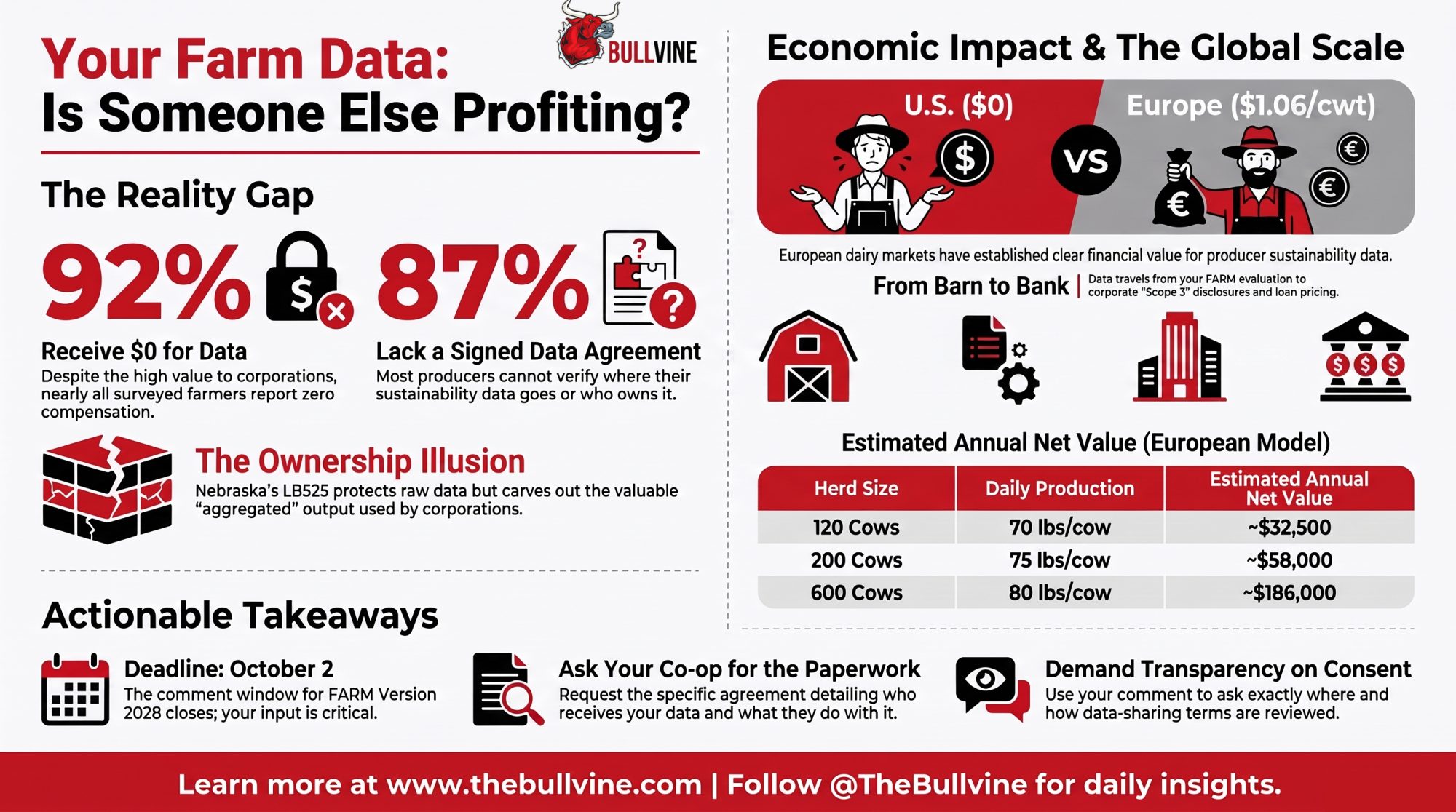
EXECUTIVE SUMMARY: Eighty-seven percent of 657 dairy producers surveyed by the American Dairy Coalition couldn’t say they’d signed a data-sharing agreement covering the sustainability information they hand over every year — and 92% have never been paid a cent for it. That data doesn’t sit in a filing cabinet. Feed rations, manure management, energy use and herd numbers move from your FARM Environmental Stewardship evaluation through co-op aggregation into corporate Scope 3 disclosures and, from there, into loan pricing. In the Netherlands, that same information is worth roughly $1.06/cwt net through FrieslandCampina’s Foqus planet program — about $58,000 a year on a 200-cow herd shipping 75 pounds. In the U.S., there’s no index, no exchange, and no rate at all, and Nebraska’s LB525 — the only state law making producers the default owner of farm data — specifically carves out the aggregated form your numbers take by the time anyone monetizes them. The FARM Version 2028 comment window closes October 2, and while Environmental Stewardship runs on the same cycle as Animal Care, the publicized proposed changes and review bodies are animal-care governance, so where consent terms actually get reviewed is an open question. Two things worth doing before the window shuts: ask your co-op in writing for the agreement, and if it doesn’t exist, put that in your comment.

Sit through a FARM Environmental Stewardship evaluation, and you’ll hand over some version of the same inventory: feed rations, manure management, energy use, herd numbers. You know where it comes from. The question is whether you know where it goes — and whether you ever signed anything saying it could.
The American Dairy Coalition put that question to 657 dairy producers between February 24 and March 14, 2026. Eighty-seven percent said they did not believe they’d signed a data-sharing agreement. The other 13% weren’t sure one existed. In the end, the survey turned up: “Farm data has value, and that value is being captured.”
Whether that’s true isn’t really the argument. The question is who’s holding the pen when the value gets assigned — and whether you can put your hands on your own agreement before October 2, when the National Dairy FARM Program’s Version 2028 comment window closes. James “Cricket” Jacquier, an Agri-Mark member involved in the program’s committee process, made the case for using it when the window opened July 8: “Farmer involvement is critical to ensuring program standards are practical and achievable.” He’s right. It’s a fair standard to hold the program to.
What the Survey Actually Found
Three numbers came back stacked. Seventy-seven percent said the data request felt more forced than voluntary. Ninety-two percent reported no compensation for providing it. And 100% said producers should own the data they generate.
Read those carefully, because they’re three different kinds of claim. The 77% is a perception of pressure. The 92% is a factual report about payment. And the 100% is a preference — what farmers think should be true, not a description of what their contracts currently say. Blur those together, and you’ll lose the argument with your co-op in about ninety seconds.
One caution on scope. This was a self-selected, voluntary-response sample, not a randomized national census, and ADC hasn’t published a methodology summary. It tells you something real about what the producers who answered are experiencing. It doesn’t license projecting a precise farm count across the 26,000-plus operations enrolled in FARM.
Where Your Data Goes After It Leaves the Barn
The chain isn’t secret, and nobody’s breaking a rule. It’s contractual, and it runs one direction.
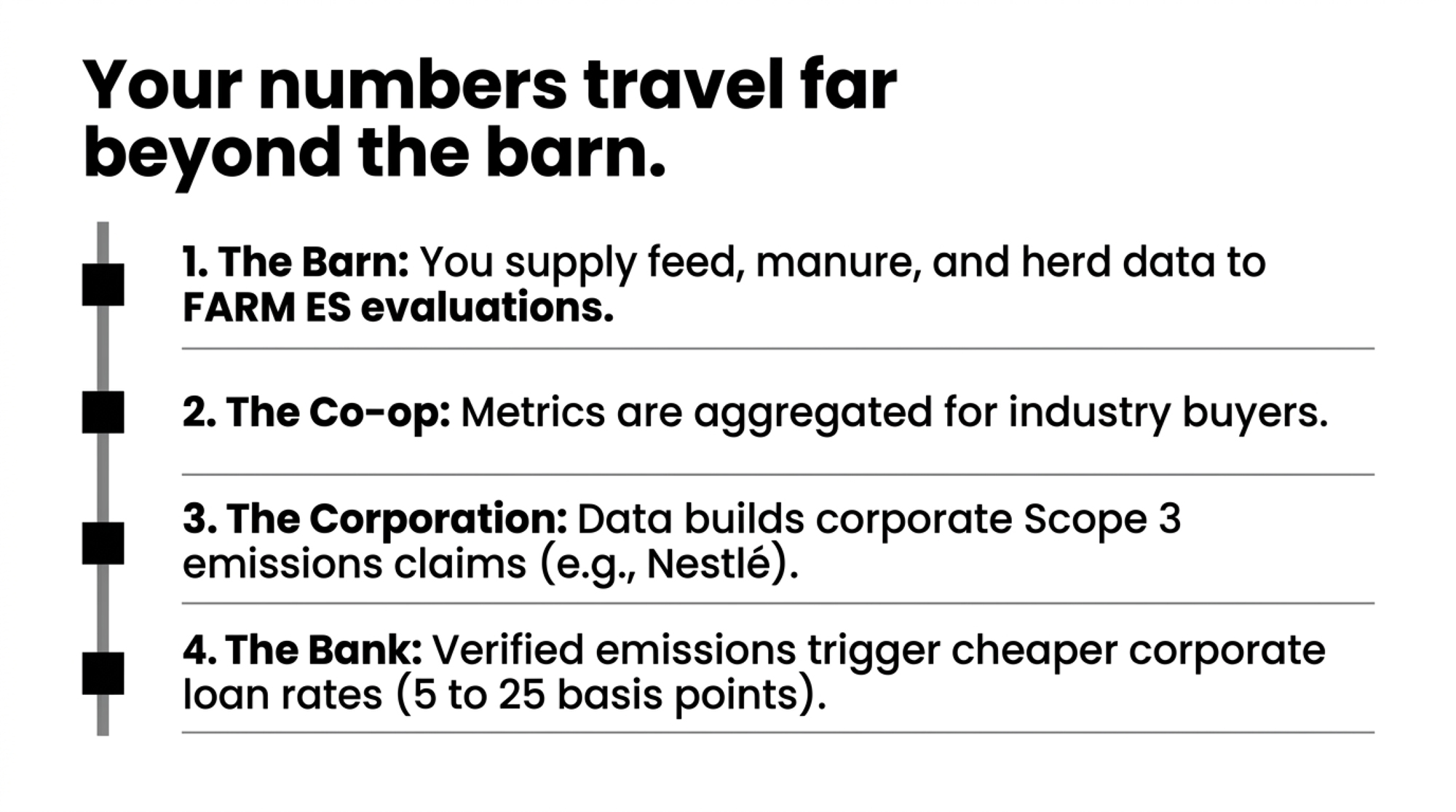
Step 1 — Your barn. Feed rations, manure management, energy use, and herd inventory are collected through a FARM ES evaluation, a co-op sustainability program, or a buyer questionnaire. The FARM Program reports more than 6,000 ES evaluations completed since 2017.
Step 2 — Co-op or processor aggregation. The FARM Program’s own materials describe Environmental Stewardship as unifying “industry response to customer requests for sustainability data,” with data aggregated by cooperatives and processors. That’s not a hidden purpose. It’s the stated design.
Step 3 — Corporate Scope 3 accounting. Processors use those aggregated metrics to calculate supply-chain emissions. Nestlé reports that dairy and livestock ingredients represent roughly 30% of the company’s total greenhouse gas footprint.
Step 4 — The public climate claim. Nestlé’s first dairy-specific disclosure, published in 2026, reports a 26% net emissions reduction since 2018, built substantially on farm-level intervention data gathered through supplier programs. Trade coverage in DairyReporter called it strong on headline disclosure but light on the farm-level breakdown that would let outside readers trace how the figure was built.
Step 5 — Financing terms. Sustainability-linked loans typically adjust a borrower’s interest margin by roughly 5 to 25 basis points depending on whether emissions targets get hit, according to sustainable-finance analyses from Inrate and law firm Cassels. That range is cross-sector, not dairy-specific. But the mechanism is real: data you supply for free becomes an input into somebody’s cost of capital.
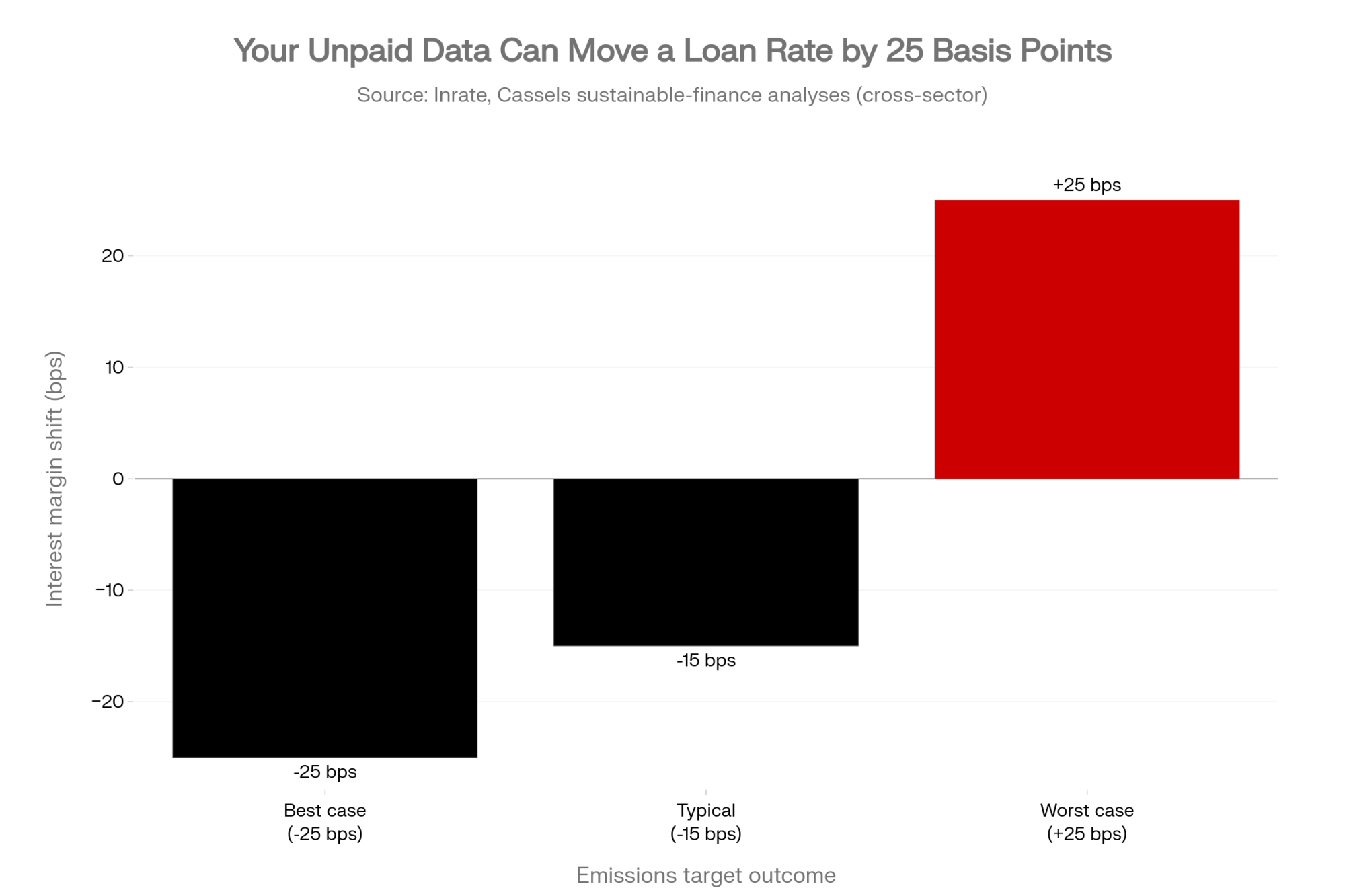
Five steps. Your name is on step one. Scale changes what that’s worth to you, and not in the direction most people assume — we broke that down in why carbon credit payouts vary so widely by herd size.
What Is Sustainability Data Worth — and Who’s Setting That Price?
In the U.S., honest answer: nobody knows, because no market prices it. There’s no index, no exchange, no third-party valuation methodology for farm-level sustainability data the way there is for milk or cheese. That’s a genuine structural barrier, not a dodge.
| Metric | United States | Netherlands (FrieslandCampina) |
|---|---|---|
| Pricing mechanism | None — no index, exchange, or rate | Foqus planet program, published annually |
| Gross rate per cwt | Not applicable | $1.37/cwt (€2.63/100kg, 2023 payout) |
| Net rate per cwt (after member deposit) | Not applicable | $1.06/cwt |
| Producer default ownership law | Nebraska LB525 only, excludes aggregated data | Not a separate legal category — priced contractually |
| Annual value, 200-cow herd at 75 lbs/day | $0 | $58,000 net |
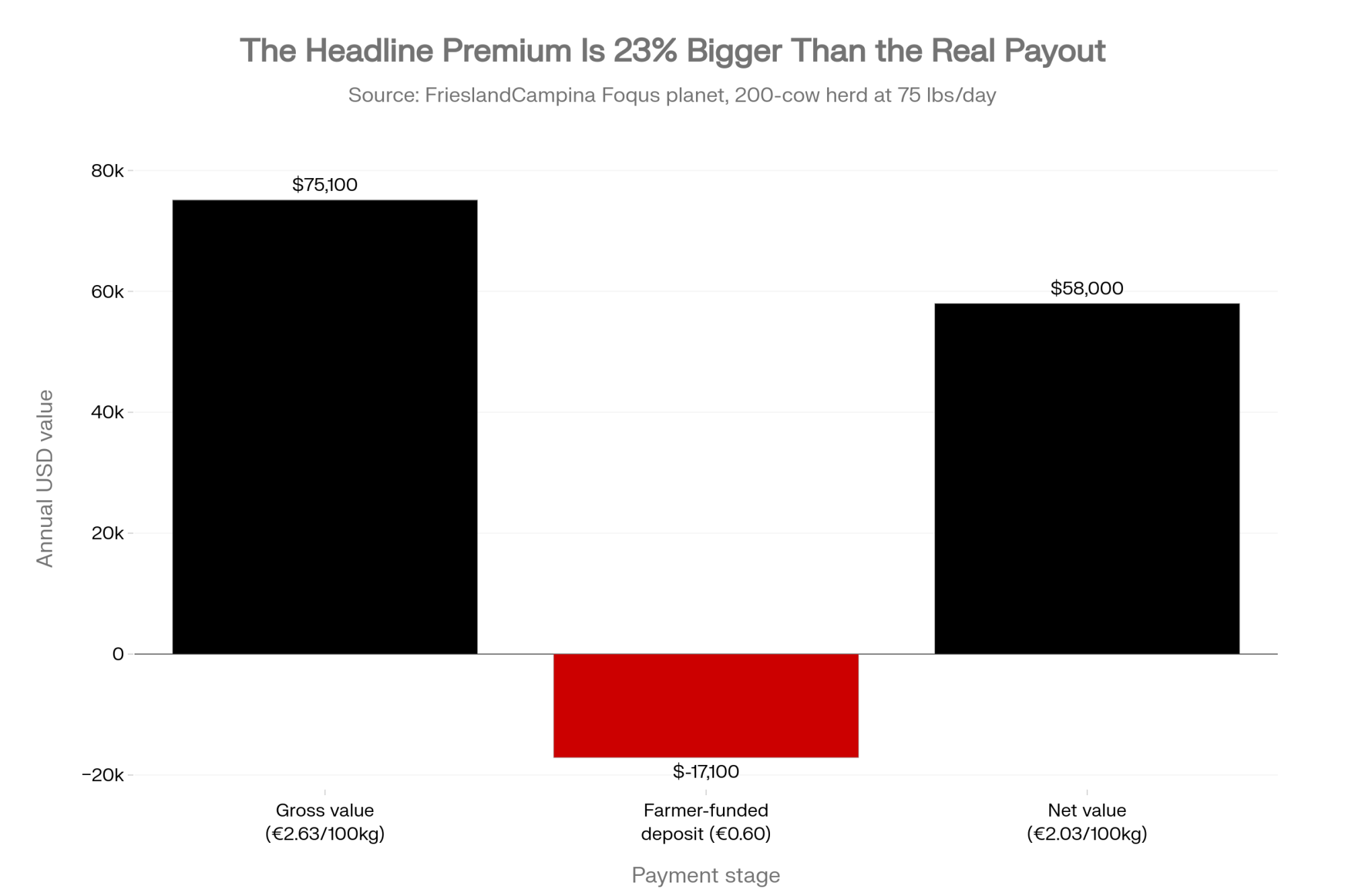
One place a real number exists is Europe. FrieslandCampina, the Dutch cooperative, paid member farms an average of €2.63 per 100 kg in sustainability premiums for the 2023 performance year under its Foqus planet program — €245 million total, published June 2024. Convert it, and that’s €1.19 per hundredweight, about $1.37/cwt at the August 10, 2026 rate of 1.15. On a 200-cow herd shipping 75 lbs per cow per day — 150 cwt daily, 54,750 cwt over twelve months — the gross lands near $75,100.
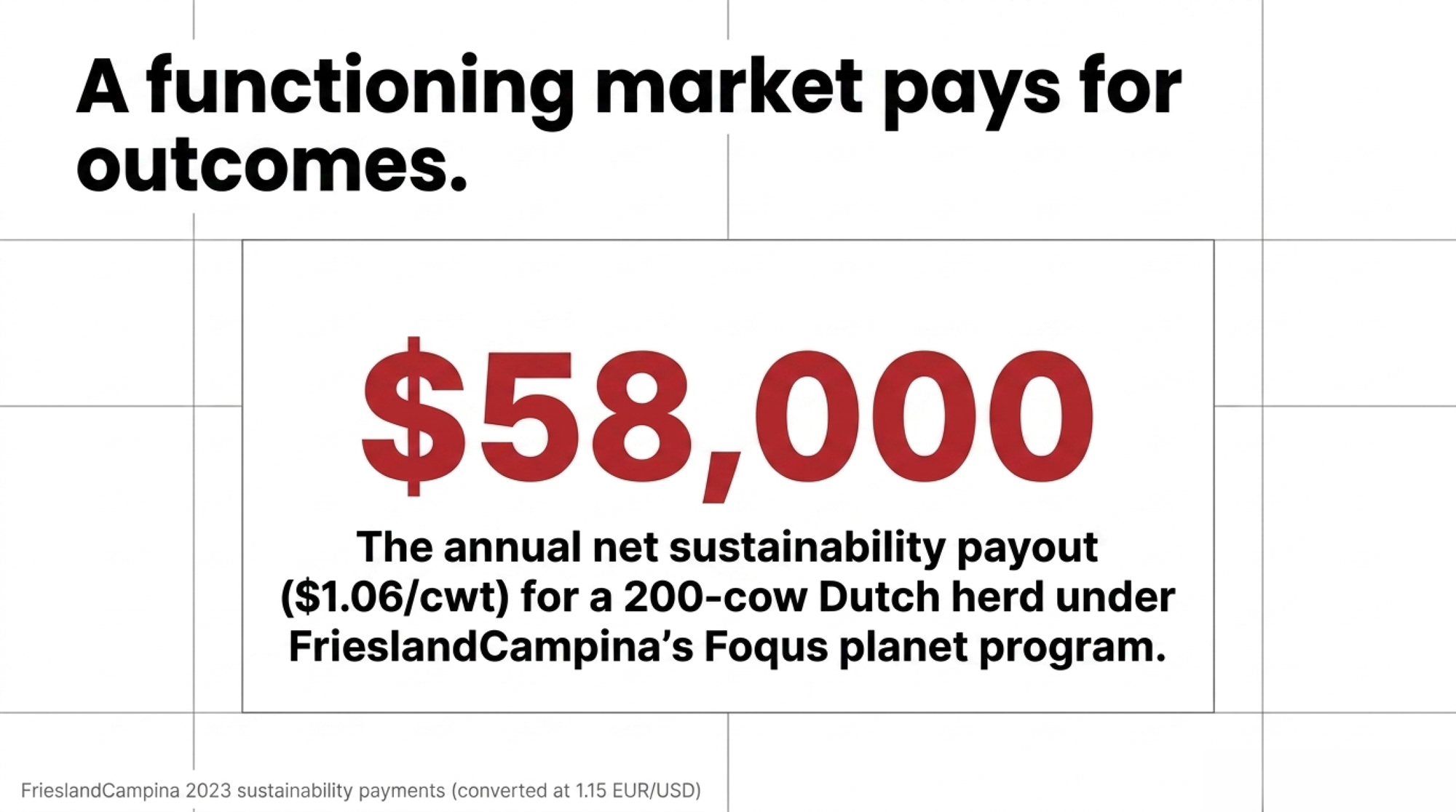
Now subtract the part the farmers fund themselves. Foqus planet is paid for by the company, by customers, and by members through a cooperative deposit of €0.60 per 100 kg. Net that out and you’re at €2.03 per 100 kg, roughly $1.06/cwt — closer to $58,000 on the same herd. Still real money. Just not a gift, and about 23% below the headline figure. The euro’s moved since we covered this premium last year at roughly $1.25/cwt — which tells you something about building a farm plan around a foreign-currency benchmark.
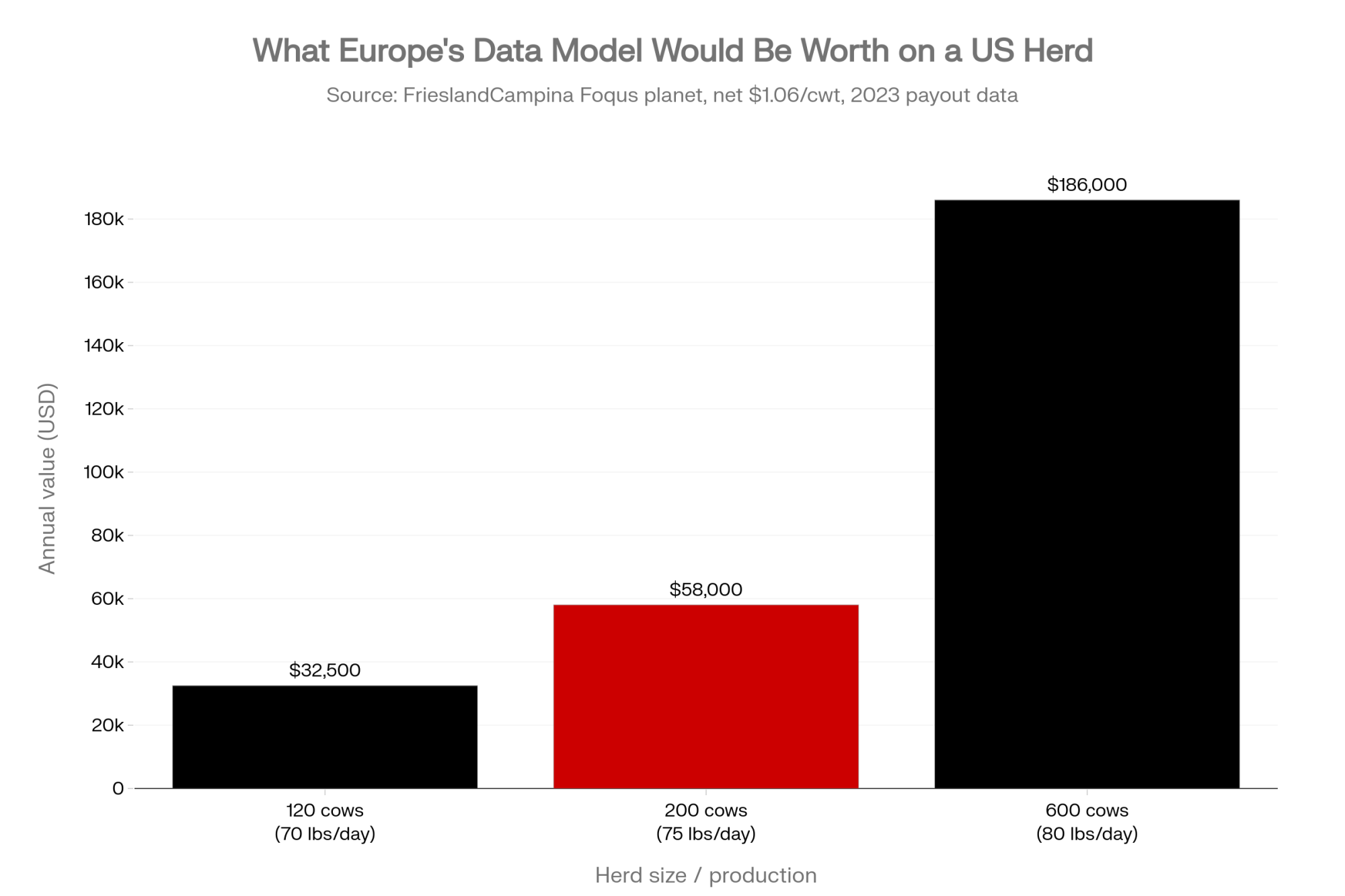
Run it against your own bulk tank for a second. At $1.06/cwt net, a 120-cow herd shipping 70 lbs would see somewhere near $32,500 a year; a 600-cow operation at 80 lbs, closer to $186,000. Nobody in the U.S. is offering you that. It’s a scale marker for what a functioning mechanism looks like elsewhere, not a number to take to your field rep.
Here’s the part that matters most. Foqus planet pays for outcomes across nine sustainability indicators, with the GHG indicator alone worth up to €1.50 per 100 kg and the whole program capped near €3.50. It is not a payment for data submission. That’s a different ask than compensation for the data itself — and you’ll need to decide which one you’re actually arguing for before you file anything.
The Ownership Stack: Four Questions, Four Different Answers
Here’s where the conversation usually goes sideways. “Ownership” gets used as though it’s one thing. It’s four, and they resolve differently.
| Layer | The Question | Where It Stands Today |
| Title | Who legally owns the raw data? | Unsettled in most states. No federal ag-data ownership law exists. Nebraska’s LB525 — signed April 14, 2026, effective July 17 — is the first state statute making the producer the default owner of farm-originated data, including a defined “Sustainability Data” category covering GHG emissions and water-quality impact. |
| Access | Who can see and pull it? | Co-ops, processors, and FARM evaluators, through program participation and milk supply contracts. |
| Use rights | Who can process, aggregate, and republish it? | Already granted, mostly implicitly, through co-op membership terms and milk contracts most producers never reviewed for a data clause. |
| Value capture | Who monetizes the downstream output? | Processors and CPG buyers, via Scope 3 disclosures, financing terms, and net-zero marketing. |
Nebraska’s law looks like a win, and in the title layer it is. But LB525 explicitly excludes aggregated and derived data from producer ownership and grants technology providers a nonexclusive right of control for service delivery — legal analyses from the National Agricultural Law Center and the firm ArentFox Schiff both confirm the carve-out. Aggregated and derived data is exactly what your numbers become by the time they reach a Scope 3 report. The statute protects the input and carves out the output.
That’s not a Nebraska drafting quirk. Ag Data Transparent — founded in 2014 after the American Farm Bureau Federation started hearing the same complaints from members — reviews company contracts against eleven published questions, with a third-party administrator checking whether the answers match the contract language. Two of those eleven go straight at aggregation: whether a user can opt out of anonymized and aggregated datasets, and whether signing up gives the company the right to sell aggregated data to third parties without further consent. Useful questions. But ADT can only report what a contract says — it can’t reach the value created after the data is pooled.
Can You Put Your Hands on Your Agreement Today?
Try it this week. Call your co-op or field rep and ask for the signed document specifying what sustainability data gets collected, who receives it, and what they’re permitted to do with it.
Based on the survey, there’s a strong chance no such document is on file for your operation. That’s not somebody hiding the ball. It’s just how membership agreements tend to get written — broad language, signed once, filed away, and most of them signed well before Scope 3 reporting was anyone’s concern. But the practical result is that a decision about your data got made on your behalf, possibly years ago, for reasons that had nothing to do with sustainability reporting.
If you want the wider context on how these questions have been landing across the industry, our ongoing coverage of farm data ownership tracks it.
The Case for Doing It This Way
FARM and NMPF have a real argument, and it deserves airing before anyone answers it. A single standardized metric lets the industry make one credible claim to retailers and CPG buyers instead of a patchwork of unverifiable farm-by-farm assertions. That protects market access for operations that will never have their own sustainability staff. Dr. Meggan Hain, speaking to Brownfield Ag News about the Version 2028 updates, named the design tradeoff directly: the program has to find “that best fit for our farmers, which is not going to be perfect for every farm, but it’s the best fit for the overall industry.”
Give them this too. FARM opened Version 2028 development in July with a stakeholder survey that drew more than 800 responses. NMPF says results go to the Animal Health & Wellbeing Committee, the Animal Care Task Force, and the Farmer Advisory Council this fall, with a summary report to be published on the FARM website. That’s a more open process than the program has run before, and the published-report commitment is the part worth holding them to.
Where the argument runs short is compensation. Collective bargaining power over a resource has never required paying the people who generate it nothing. But FARM is a standards and evaluation body — its task forces report to NMPF’s Executive Committee and Board — not a negotiating one with any mandate over milk pricing. On our read, there’s no obvious place in the current structure to put a compensation mechanism.
What’s Under Comment — and What Isn’t
Version 2028 launches January 2028, and the name itself signals a change: FARM now identifies cycles by launch year instead of successive version numbers, on a three-year rhythm. Environmental Stewardship and Workforce Development run on the same cycle as Animal Care. So ES isn’t excluded from the version process.
What’s less clear is the comment mechanics. The proposed-changes documents FARM has publicized for this window cover Animal Care and Workforce Development. The named review bodies — Animal Health & Wellbeing Committee, Animal Care Task Force, Farmer Advisory Council — are animal-care governance. Whether ES data-sharing consent language is itself under revision in this cycle, and through which body, isn’t something the public materials answer.
That’s the gap worth writing into your comment. Not “you left ES out” — that isn’t accurate. Rather: if ES is on this cycle, where do consent and data-use terms get reviewed, and will that review be published the way the Animal Care survey summary will be?
Four Paths, and What Each One Costs You
▸ Request your agreement in writing — do this within 30 days. Costs a phone call and creates a record either way. If the document exists, you finally know your terms. If it doesn’t, that absence is worth documenting before October 2. Limit: your co-op isn’t obligated to produce anything on your schedule, and pushing hard can strain a relationship you need.
▸ File a Version 2028 comment before October 2. Jacquier’s point about farmer involvement cuts both ways — a process only reflects what gets submitted to it. Ask specifically where ES data-sharing consent terms get reviewed in this cycle and whether that review will be published. It’s a governance question, not an accusation, and it’s answerable. Limit: the publicized task forces are animal-care bodies, so say plainly in your submission that the comment concerns ES.
▸ Push your co-op toward Ag Data Transparent certification. The eleven-question review forces contract-level disclosure of what a company does with farm data, checked by a third-party administrator and renewed annually. Cooperatives are already an eligible membership category. Limit: you can’t self-certify — your co-op has to agree to submit its contracts, which makes it a member-meeting ask.
▸ Watch your statehouse. If your state drafts ag-data legislation modeled on Nebraska, the aggregated-and-derived carve-out is the clause to flag early, before it gets copied forward by default. Limit: multi-year path, no near-term return, worth your energy only if you’re already engaged with your Farm Bureau chapter.
Key Takeaways
▸ If you can’t produce a signed agreement within 30 days of asking — treat that absence as the finding, and reference it directly in your Version 2028 comment.
▸ If you’re enrolled in FARM ES through a co-op requirement rather than a direct choice — “voluntary” may describe your co-op’s enrollment decision rather than your consent to specific data uses.
▸ If you’re arguing for compensation — decide first whether you want payment for outcomes, the FrieslandCampina model where the GHG indicator alone runs up to €1.50 per 100 kg, or payment for the data itself. Different asks, different mechanisms.
▸ If your co-op hasn’t pursued Ag Data Transparent certification — raise it at your next member meeting, and point at the two aggregation questions specifically. Those are the ones that reach your problem.
▸ If your state introduces ag-data legislation this session — check whether it copies Nebraska’s aggregated-data exclusion before your organization endorses it.
▸ If someone quotes you a per-cwt value for sustainability data in the U.S. — ask what market set that price. As of now, none has.
Before October 2
Put the question to your neighbors at the next co-op meeting: how many of them can produce their agreement? If the answer around that table looks anything like the survey — and there’s no particular reason it wouldn’t — then the useful conversation isn’t whether FARM should change. It’s how many of you file something before the window closes, and whether the consent question ends up in that published summary report or gets left out of it.
Which leaves the harder question underneath all of this. Nebraska drew its line at the farm gate and left everything past it alone, and no U.S. market prices the aggregated layer at all. Somebody has to build that mechanism before anyone can argue about the rate — and we’re working through who that would actually be, what the legal machinery looks like, and why the valuation problem has stalled every attempt so far. That’s next in Bullvine Weekly.
Survey figures come from the American Dairy Coalition’s producer poll conducted February 24–March 14, 2026. ADC has not published a methodology summary or sample breakdown. FrieslandCampina premium figures are from the company’s June 11, 2024 announcement of 2023 sustainability payments. Currency conversion at the August 10, 2026 EUR/USD rate of 1.15.
Learn More
- Price-Fixing Payout: What DFA & Select Milk’s $34.4 Million Settlement Really Means for Dairy — Arms you with concrete legal lessons from recent anti-trust settlements, demonstrating why bulletproof farm records and backup marketing agreements protect your milk cheque when co-op governance fails.
- The State of the Dairy Industry 2026: Policy, Markets & Change — Reveals how corporate Scope 3 targets, FMMO make allowance adjustments, and automated component tracking are fundamentally shifting processor supply contracts over the next three to five years.
- Carbon Credits: $150000 for Large Dairies, $3000 for Family Farms – Here’s Why — Exposes the harsh financial threshold behind environmental monetization, breaking down why high upfront technology costs and working capital demands exclude 80% of family operations from carbon credit payouts.
 The Sunday Read Dairy Professionals Don’t Skip.
 The Sunday Read Dairy Professionals Don’t Skip.
Every week, thousands of producers, breeders, and industry insiders open Bullvine Weekly for genetics insights, market shifts, and profit strategies they won’t find anywhere else. One email. Five minutes. Smarter decisions all week.




