




Archive for milk price analysis

CME Dairy Market Report: September 11th, 2025 – When Reality Hits Your Milk Check Like a Freight Train

What if this dairy selloff isn’t temporary? Are you prepared for lower prices through 2026?

EXECUTIVE SUMMARY: We’ve been tracking today’s dairy market massacre, and honestly? It’s worse than most farmers realize. Cheese blocks crashed 5.25¢ and butter dropped 3.75¢ in heavy volume – that’s real money moving, not just market noise. The uncomfortable truth is that this selloff exposed a fundamental supply-demand imbalance that has been building for months. While everyone’s focused on the daily drama, we’re seeing U.S. producers get priced out of key export markets by aggressive EU and New Zealand competition. Your milk-to-feed ratio just took a beating – we estimate most operations dropped from 2.2:1 to barely 2.0:1 overnight. What are the seasonal demand patterns that usually support September pricing? They’re not showing up this year.Here’s what’s really concerning: futures markets are trading at discounts to USDA forecasts, which typically means either the government’s too optimistic or smart money’s positioning for worse. We think it’s time to stop hoping for a bounce and start protecting what margins you still have.

KEY TAKEAWAYS

  • Heavy volume selloff signals institutional money is bailing – 11 cheese block trades on a 5.25¢ drop isn’t retail panic, it’s professional money making strategic exits. Consider locking in Q4 and Q1 2026 pricing before this gets worse.
  • Export competitiveness is eroding fast – at $1.17/lb, our NDM is pricing 6-14¢ above EU and New Zealand equivalents. That’s why export volumes are struggling and domestic prices are under pressure (CME trade data, September 2025).
  • Midwest operations are taking the biggest hit – cheese-heavy regions like Wisconsin are seeing Class III base pricing crater while California’s diversified processing offers some cushion. Regional risk management strategies matter more than ever.
  • Feed cost stability won’t save you when milk income drops a dollar – corn at $4.20/bu and stable soybean meal are nice, but margin compression from falling milk prices far outweighs feed savings (USDA commodity reports, 2025).
  • December Class III futures around $17.00-17.50 still offer reasonable hedging opportunities – but only if you act before more farmers wake up to this reality. Put options might be your best friend right now.
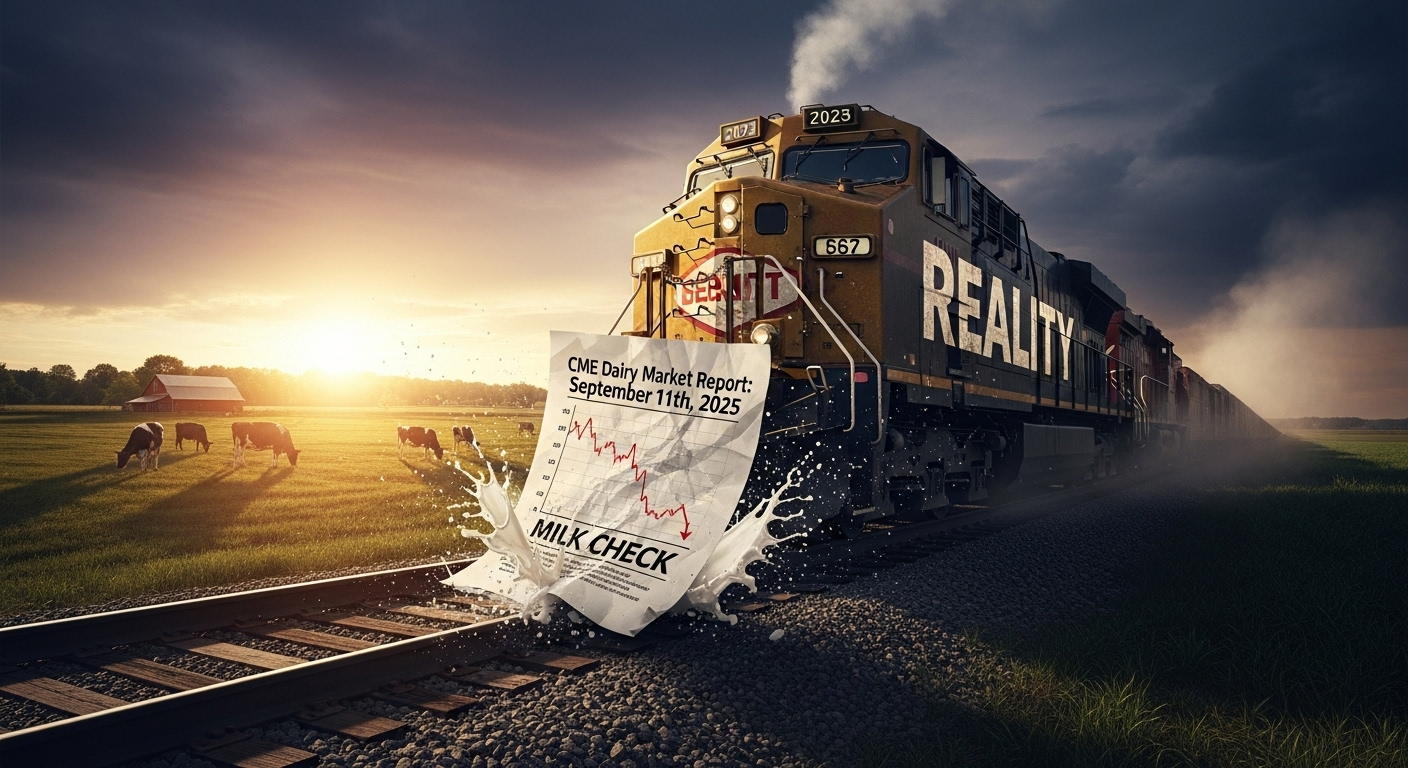
Look, I’m not going to sugarcoat this – today was brutal. We’re talking about the kind of day that makes you question whether you should’ve gotten into soybeans instead of dealing with these dairy markets.

Your September milk check just took a $0.90 to $1.20/cwt beating, and this isn’t market noise – it’s the sound of fundamentals catching up with wishful thinking.

The thing about market selloffs is you can feel them building. Tuesday and Wednesday, the trading floor had that restless energy… too many people trying too hard to find reasons why cheese should be trading north of .70. Today? Reality stepped in with both boots.

What strikes me most is the volume – 11 trades in blocks alone tells you this wasn’t some algorithm having a bad day. This was real money moving, real decisions being made by people who actually understand this business. Your Class III milk is now tracking toward that uncomfortable .00-16.50 range, and honestly? That might not even be the floor.

Today’s Damage Report (And Why It Matters to Your Bottom Line)

Here’s what the trading floor delivered, and trust me, none of it was pretty:

ProductSettlementDaily MoveWeekly TrendWhat This Means for Your Operation
Cheese Blocks$1.6200/lb-5.25¢▼ -4.3%Class III heading for mid-$16s – your base price just cratered
Cheese Barrels$1.6350/lb-4.00¢▼ -3.9%Premium to blocks signals supply chain weirdness
Butter$1.9275/lb-3.75¢▼ -4.4%Class IV components are getting hammered
NDM$1.1725/lb-1.50¢▼ -4.5%Export pricing is ourselves out of key markets
Dry Whey$0.5850/lb-0.50¢▲ +3.2%Only bright spot, but it can’t save the day

Now, here’s what’s particularly concerning – and this is where my 20 years of watching these markets kicks in. Barrels trading at a 1.5¢ premium to blocks? That’s backwards, folks. Usually, it means either the supply chain’s getting kinked up somewhere or processors are scrambling for specific formats. Neither scenario is particularly encouraging.

The butter collapse… well, that one hurt to watch. Three-point-seven-five cents in a single session, and not a single trade to show for it. When butter traders won’t even engage – when you’ve got three bids sitting out there with four offers and nobody’s willing to make a deal – that’s telling you something about where people think fair value really sits.

What the Trading Floor Was Really Saying

The bid-ask spreads today told the whole story. I’ve been tracking these numbers for years, and when butter spreads blow out to 3×4 (that’s three bids to 4 offers for those keeping score at home), you know confidence just walked out the door.

Here’s something that caught my attention – and this is where experience matters. The 11 block trades on a 5.25¢ decline? That volume pattern screams institutional selling. Not day-traders getting cute, not algorithmic noise… real money making real decisions about where this market’s headed.

NDM’s 10 transactions tell a similar story. Export customers are clearly balking at current pricing, and honestly, can you blame them? At $1.1725/lb, we’re pricing ourselves 6-14¢ above what EU and New Zealand are offering equivalent product for.

The intraday action was textbook bear market stuff – gap down at the open, steady selling through the session, settlement right near the lows. No late-day heroes trying to catch a falling knife. That usually means tomorrow could bring more of the same.

Regional Reality Check: Upper Midwest Taking the Brunt

Let me focus on the Upper Midwest this week because that’s where today’s pain is most acute. Wisconsin and Minnesota producers – you’re feeling this directly in your Class III base pricing. The region’s cheese plants are still running, but they’re clearly not desperate enough to bid up for spot milk.

What’s particularly troubling for Midwest operations is the margin squeeze. Your local feed costs have been relatively stable – corn basis in Wisconsin is running about 15-20¢ under December futures, which isn’t terrible. But when your milk income drops a dollar per hundredweight in a single day? Those feed savings become pretty meaningless.

I’m hearing from contacts in the region that some plants are actually sitting on more inventory than anyone realized. That might explain why the buying interest just wasn’t there when prices started sliding.

California producers are getting some cushion from their more diversified processing base, but not much when the entire complex is under pressure like this.

Feed Costs: The One Bright Spot (Sort Of)

Here’s the cruel irony of today – feed costs are actually behaving themselves. December corn closed at $4.1975, soybeans are holding around $10.34, and soybean meal’s sitting at $287.70 per ton. In regular times, you’d be celebrating this kind of stability.

But when your milk income just took a beating like this? Those stable feed costs don’t help much. Let me give you some quick math that’ll make your stomach turn: if you were running a 2.2:1 milk-to-feed ratio yesterday morning, today’s price action dropped you closer to 2.0:1 or below, depending on your specific situation.

For a typical Wisconsin operation running about 150 head… we’re talking about roughly $450-600 less income per day. That adds up fast, especially when you’re already dealing with higher labor costs and equipment replacement needs.

The Export Picture (And Why It’s Getting Uglier)

This is where things get really concerning for the long-term health of our markets. At current NDM pricing, we’re just not competitive internationally – and that’s before you factor in freight costs and the strong dollar.

Mexico – still our biggest customer by volume – is getting more price-sensitive by the month. They’ve got options now, and they’re using them. Recent industry data indicate that Mexican buyers are increasingly considering EU powder as an alternative.

Southeast Asia is where we’re really losing ground. The pricing gap between our NDM and what New Zealand’s offering has widened to levels that make it hard for even our most loyal customers to justify staying with the U.S. product.

What’s particularly frustrating is that global dairy demand is actually solid. The problem isn’t that people don’t want dairy products – it’s that they don’t want to pay premium prices for them when cheaper alternatives are readily available.

China remains sporadic at best. One week they’re buying, the next week they’re ghost. You can’t build a pricing structure around that kind of inconsistency.

Looking at the Bigger Picture (USDA vs. Market Reality)

The latest USDA forecasts are still projecting the all-milk price at .00/cwt for 2025. After today’s action, that’s looking pretty optimistic. Class III futures are now trading at a discount to USDA projections, which usually means either the government’s too bullish or the market’s oversold.

My gut says it’s probably a bit of both. USDA tends to be slow to adjust their models when market sentiment shifts this quickly. But the futures market… well, it’s pricing in some pretty bearish assumptions about where demand really sits.

December Class III is trading around $17.00-17.50, and that’s becoming critical support territory. Break through there, and we could be looking at a more significant correction.

What You Need to Do Right Now (Not Tomorrow, Today)

Look, I know nobody likes getting told what to do with their operation, but today’s action demands some immediate attention:

This Week:

  • Pull out your budget spreadsheets and recalculate margins based on $16.00-16.50 Class III milk. If those numbers make you uncomfortable, you need a plan.
  • Get feed quotes locked for the next 90 days. With milk income dropping, securing your cost side becomes critical.
  • Talk to your risk management advisor about December and Q1 2026 futures. They’re still offering reasonable protection around $17.00-17.50.

Strategic Thinking: This isn’t the year for aggressive expansion – I don’t care how good your fresh cow numbers look. Focus on efficiency over volume. Make sure every cow in your herd is pulling her weight.

Cash flow timing becomes crucial when margins get this tight. Know exactly when milk checks arrive and plan accordingly. This business doesn’t forgive timing mistakes when you’re running this close to the edge.

Industry Intelligence (What I’m Hearing)

Processing plant utilization in the Upper Midwest is running high, but plants aren’t bidding aggressively for spot milk. Some major food service buyers are reportedly pushing back on price increases – that could explain the sudden shift in demand dynamics.

One interesting development: the organic sector continues to hold significant premiums over conventional. If you’ve been thinking about transitioning… well, days like today make that premium look pretty attractive.

There are also whispers about some of the larger cooperatives getting more aggressive with their pricing discipline. Could be positioning for what they see as a longer downturn.

Putting Today in Historical Context

Here’s what experience teaches you – today wasn’t just another down day. This was a reality check with serious implications.

Looking at historical patterns, this kind of broad-based selling in September is unusual. September is typically when demand starts building for fall production runs. When you see this kind of rejection of higher prices during what should be a demand-building month… well, that tells you the structural issues in our markets might be more serious than many people assumed.

The last time I saw this kind of price action in September was back in 2019, and that correction lasted longer than most people expected. Not saying we’re heading for the same thing, but the patterns are worth noting.

The Bottom Line: Discipline Over Hope

The thing about dairy markets – and I’ve learned this the hard way over the years – is that fundamentals always win eventually. We spent the last few weeks hoping that demand would catch up with our pricing expectations. Today, the market delivered a clear message: current supply and demand fundamentals don’t support premium pricing.

Does this mean we’re heading for disaster? Not necessarily. We’ve weathered tougher markets before. However, it does mean we need to make decisions based on reality, rather than wishful thinking.

The dairy business rewards preparation and punishes hope. Today’s action was the market’s way of reminding us which camp we need to be in. Stay disciplined, protect your margins where possible, and remember – the farmers who survive these corrections are the ones who adapt quickly to new realities.

This market isn’t going to reward stubbornness or wishful thinking. But for those who adjust their strategies and manage their risks appropriately? There’s still money to be made, even in challenging conditions.

The key is making smart decisions with the information we have, not hoping for a miracle bounce that might not come.

Complete references and supporting documentation are available upon request by contacting the editorial team at editor@thebullvine.com.

Learn More:

  • Profit and Planning: 5 Key Trends Shaping Dairy Farms in 2025 – This strategic analysis reveals how focusing on feed efficiency and component traits can add thousands to your bottom line. It provides actionable financial and genetic strategies to help your farm capture emerging market opportunities and improve long-term sustainability.
  • Your 2025 Dairy Gameplan: Three Critical Areas Separating Profit from Loss – Get tactical with this how-to guide on the everyday decisions that separate winners from losers. It offers practical, research-backed advice on optimizing forage, using methionine, and managing transition cows to boost cow health and cut costs.
  • 5 Technologies That Will Make or Break Your Dairy Farm in 2025 – Look beyond market noise and prepare for the future. This article reveals how adopting innovations like smart calf monitoring and advanced health systems can slash mortality rates and increase labor efficiency, securing your competitive edge for the long run.

Join the Revolution!

Join over 30,000 successful dairy professionals who rely on Bullvine Weekly for their competitive edge. Delivered directly to your inbox each week, our exclusive industry insights help you make smarter decisions while saving precious hours every week. Never miss critical updates on milk production trends, breakthrough technologies, and profit-boosting strategies that top producers are already implementing. Subscribe now to transform your dairy operation’s efficiency and profitability—your future success is just one click away.

NewsSubscribe
First
Last
Consent

Decode Fonterra’s $1.40 Price Gap: Strategic Lessons Worth $168,000 Per Farm

Stop accepting processor loyalty as gospel. Fonterra’s $1.40 price gap reveals how strategic thinking beats sentiment—worth $168K per farm.

dairy pricing strategy, milk price analysis, dairy profitability, processor relationships, operational efficiency

Fonterra’s shocking $1.40/kg MS price disparity between Australia and New Zealand isn’t just about market conditions—it’s a masterclass in strategic business evolution that reveals how operational advantages, genomic optimization, and market positioning create competitive moats worth hundreds of thousands per farm. This pricing divide exposes the brutal economics of modern dairy processing, where feed conversion efficiency, energy costs per kg MS, and strategic asset allocation determine whether you’re positioned for prosperity or managed decline. The lessons buried in this price gap will reshape how you evaluate processor relationships, optimize your lactation curves, and future-proof your operation against industry consolidation.

Think of this price disparity like comparing two bulls with identical TPI scores but vastly different genetic merit for production efficiency. On paper, they might look similar, but dig into the EBVs and you’ll find one consistently produces daughters with 15% higher milk yield and superior feed conversion ratios. That’s exactly what’s happening between Fonterra’s Australian and New Zealand operations—same company, same basic business model, but fundamentally different genetic makeup for profitability.

Why Should Progressive Farmers Care About This Price Gap?

Here’s what makes this story bigger than just another processor pricing announcement: Fonterra’s pricing strategy reveals how modern dairy companies optimize value extraction across different production systems, market access, and operational efficiency metrics—exactly like how you optimize your herd’s genetic merit across different traits.

For an average Australian dairy farm producing 120,000 kg MS annually (roughly 1.5 million liters at 8.0% combined solids), that $1.40 gap translates to $168,000 less income compared to New Zealand rates. To put that in perspective, that’s equivalent to losing the genetic gain from five years of selective breeding, or the productivity boost from implementing a 0,000 automated milking system (AMS).

But here’s where it gets critical for strategic planners: this isn’t about Fonterra being unfair to Australian farmers. It’s about a fundamental shift in how global dairy companies restructure operations around return on invested capital (ROIC)—and Fonterra’s Australian operations are delivering a dismal 3% ROIC compared to their target of 10-12%.

Ask yourself this: If the world’s largest dairy cooperative is willing to sacrifice nearly 20% of its earnings because the returns don’t meet performance targets, what does that tell you about evaluating your own farm investments? Are you measuring every breeding decision, every piece of equipment, every management practice against clear profitability metrics—or just chasing production volume?

What’s Really Driving Fonterra’s Strategic Genetic Selection?

The B2B Ingredients Powerhouse Strategy

Think of Fonterra’s strategy like selective breeding for a specific production trait. They’re culling everything that doesn’t contribute to their target phenotype: a global B2B dairy ingredients powerhouse. CEO Miles Hurrell explicitly states that their financial results demonstrate the company’s strength as “a global B2B dairy player, powered by our home-base of New Zealand milk and operations” (Fonterra forecasts milk price at $10 per kg of milk solids for 2025/26).

The co-op has embarked on a massive strategic realignment, focusing entirely on high-performing Ingredients and Foodservice businesses while actively divesting their global Consumer portfolio—including all Australian. This is like a progressive breeder who decides to focus exclusively on genomic selection for protein yield and feed efficiency, while culling all genetics that don’t meet those precise criteria.

Here’s the strategic math that should make every processor pay attention:

  • Target return on capital: 10-12% (up from 9-10%)
  • New dividend policy: 60-80% of earnings (up from 40-60%)
  • Strategic focus: “Allocate milk to highest returning product and sales channel”

But here’s what challenges conventional wisdom about processor loyalty: Why should farmers remain committed to processors that view their milk as a non-core asset? The traditional dairy industry narrative promotes long-term processor relationships, yet Fonterra’s strategy proves that processors increasingly prioritize financial performance over regional commitments.

The Divestment Reality Check: Culling Underperforming Assets

Fonterra’s Australian operations tell a brutal story about asset performance that mirrors what happens when you keep poor-performing genetics in your herd too long. The numbers don’t lie: “a decade of negative free cash flow and a 3% ROIC” that management describes as “underwhelming”.

Meanwhile, their Australian assets account for approximately 19% of Fonterra’s operating earnings but are now considered non-core. That’s like discovering your highest-producing cow is actually costing you money when you factor in her mastitis treatments, poor fertility, and feed conversion inefficiency.

Why This Matters for Your Operation: If the world’s largest dairy co-operative is willing to divest nearly 20% of its earnings because the ROIC doesn’t meet targets, what does that tell you about evaluating your own investments? Every piece of equipment, every genetic decision, every management practice should be measured against clear profitability metrics—not just production volume.

Here’s the uncomfortable question every farmer should ask: Are you making investment decisions based on tradition and sentiment, or are you applying the same ruthless financial analysis that drives multinational corporations?

How Do Operational Advantages Create Pricing Power Like Superior Genetics?

The New Zealand Production Efficiency Advantage

New Zealand consistently ranks as the lowest-cost milk producer globally, primarily due to its pasture-based farming systems that deliver superior feed conversion efficiency (NZ keeps milk costs lowest among major exporters). But here’s what most people miss: it’s not just about lower costs—it’s about structural advantages that competitors can’t easily replicate, similar to how genomic selection creates compound advantages over multiple lactations.

The 2024 numbers reveal a systematic production advantage:

  • New Zealand increased its cost advantage over Australia to US5c/litre
  • Feed costs in NZ are projected to be the lowest in several years for 2025-26
  • Australian labor costs have jumped over 50% since 2021

This is like comparing herds where one consistently achieves 25% higher feed efficiency (measured as kg milk solids per kg DMI) while maintaining superior fertility metrics and lower somatic cell counts (SCC). The compound effect over time becomes insurmountable.

But here’s where conventional pasture management wisdom gets challenged: Most farmers assume pasture-based systems are automatically more profitable. Research shows that the technical efficiency of specialized milk farms varies dramatically based on management intensity, not just grazing systems. New Zealand’s advantage comes from sophisticated rotational grazing combined with precision pasture management—not simply turning cows out to graze.

The Energy Cost Reality: Processing Efficiency Gaps

Australian processors face a crushing disadvantage that’s equivalent to having a 15% lower feed conversion ratio across your entire herd. Their “cost conversion” averaged $1.00 per kg milk solids more than New Zealand operations between July 2021 and June 2022.

To put this in dairy terms: imagine if your milk processing facility required 15% more energy to produce each kilogram of milk powder, cheese, or butter. That’s not a small margin—that’s a structural cost burden that makes competing on price nearly impossible, especially when global buyers can source equivalent products from more efficient operations.

New Zealand’s proactive approach to energy efficiency, including government support for Industrial Heat Pumps, creates a compound advantage that grows stronger over time (Australia lagging behind New Zealand on cutting industrial energy costs)—exactly like investing in genetics that improve over successive generations.

Implementation Timeline for Energy Optimization:

  • Immediate (0-6 months): Energy audit and basic efficiency improvements
  • Short-term (6-18 months): Equipment upgrades and process optimization
  • Long-term (2-5 years): Infrastructure transformation and renewable energy integration

Here’s the critical question for farm-level energy management: Are you tracking energy costs per kg MS produced on your operation, or are you still managing energy like it’s a fixed overhead cost? Progressive operations now monitor energy efficiency as closely as feed conversion ratios.

What Market Dynamics Support This Strategy Like Optimal Breeding Decisions?

Export vs. Domestic Market Economics: Choosing Your Genetic Path

Here’s where the strategic picture gets really clear, and it parallels how progressive breeders choose genetics based on their target market. New Zealand exports approximately 95% of its milk production, letting them capitalize directly on strong global commodity prices. They’re not stuck selling to price-conscious domestic consumers—they can chase premium B2B customers in growth markets.

Australia faces the opposite dynamic: a “soft domestic outlook” with consumers chasing value through lower-cost products and private label brands. Even worse, dairy imports account for nearly 30% of Australia’s total consumption—meaning Australian farmers are competing with cheaper imports in their own backyard.

This is like the difference between breeding for export markets that reward superior protein content and genetic merit versus breeding for a local market that primarily buys on price. The genetic selection pressure and resulting profitability are completely different.

But here’s what challenges the conventional export wisdom: Simply producing for export markets doesn’t guarantee premium pricing. The key is producing for premium export segments that value quality differentiation and sustainable production practices. Are you positioning your production for commodity export markets or premium differentiated channels?

The Competitive Landscape Difference: Market Share Impact

In Australia, competition for milk supply among processors like Bega, Saputo, and Lactalis is intense, with everyone fighting over a shrinking milk pool. This creates pricing pressure that benefits farmers in theory but constrains what processors can actually pay due to market realities.

Fonterra holds over 80% market share in New Zealand, giving them pricing flexibility that Australian processors simply don’t have. It’s like being the only AI stud in your region versus competing with five other operations for the same breeding contracts.

Why This Matters for Your Operation: Understanding processor market dynamics helps you evaluate the long-term sustainability of your milk contracts. A processor with declining market share and intense competition may offer attractive short-term prices but lack the stability for long-term partnerships.

Ask yourself: Do you know your processor’s market share trends and competitive position? Are you diversifying processor risk the same way you diversify genetic risk in your breeding program?

How Feed Conversion and Lactation Management Create Price Resilience

The Climate Cost Multiplication Factor

Australian farmers aren’t just dealing with lower prices—they’re getting hammered by cost pressures that would be like having your entire herd drop 40% in feed efficiency overnight:

In dairy terms, this is like your feed costs jumping from $0.25/kg DMI to $0.35/kg DMI while your milk price stays flat. Even herds with superior genetic merit for feed efficiency struggle under that kind of cost pressure.

Compare this to optimal lactation curve management:

  • Peak milk: Target 45-55 kg/day by day 40-60 of lactation
  • Persistence: Maintain 6-7% decline per month post-peak
  • DMI optimization: 3.0-4.0% of body weight during peak lactation
  • ME requirements: 11-12 MJ/kg DMI for optimal conversion

Australian farmers are trying to maintain these performance metrics while dealing with volatile feed costs that would challenge even the most efficient operations.

Here’s the critical insight that challenges conventional feed budgeting: Research shows that tactical feeding decisions based on marginal milk responses can increase profit by 15-23% even in volatile cost environments. The question isn’t whether feed costs are high—it’s whether you’re optimizing feed allocation based on real-time marginal responses rather than traditional feeding protocols.

Labor Crisis Amplifies Cost Pressures

The labor shortage crisis is so severe that some Australian dairies have partially or fully transitioned to less labor-intensive beef cattle operations. In Australia, 1 in 4 dairy farmers are unable to find labour or access the skills they need on farm.

This labor crisis creates a compound effect: higher labor costs for those who can find workers, plus reduced production capacity for those who can’t. It’s like trying to optimize your breeding program while your best herdsman quits and you can’t find a replacement.

The uncomfortable question for intensive operations: Are you optimizing for milk per cow or profit per dollar invested? The research suggests these metrics can diverge significantly based on your production system.

Strategic Implications: What This Means for Your Breeding and Management Decisions

The Asset Optimization Playbook: Genetic Selection Principles

Fonterra’s strategy reveals a new playbook that mirrors progressive genetic selection: ruthlessly optimize asset allocation based on strategic value rather than sentimental attachment. The Australian price isn’t just reflecting current market conditions—it’s potentially a deliberate strategy to reduce the cost base of the Australian entity, making it more attractive to potential buyers like Lactalis and Bega.

This parallels how progressive breeders approach genetic decisions:

  1. Define clear breeding objectives based on economic traits
  2. Measure performance against specific targets (TPI, EBVs, production metrics)
  3. Cull underperformers regardless of emotional attachment
  4. Invest resources in genetics with proven ROI

But here’s where conventional genetic selection gets challenged: Research shows that feed efficiency traits have 2-3x higher economic value in volatile cost environments compared to traditional yield traits. Are you weighting your genetic selection for the current high-input-cost reality or yesterday’s cheap-feed assumptions?

The Structural Advantage Framework: Compound Genetic Gains

What Fonterra’s demonstrating is how structural advantages compound over time, exactly like genetic improvement:

  1. Lower production costs → More pricing flexibility
  2. Export focus → Direct access to global price signals
  3. Market dominance → Reduced competitive pressure
  4. Strategic clarity → Optimized capital allocation

Implementation Framework for Your Operation:

  • Month 1-3: Establish baseline metrics (production costs per kg MS, feed efficiency, labor productivity) and evaluate current processor relationships using ROIC principles
  • Month 4-6: Implement energy monitoring systems and assess feed efficiency opportunities using marginal response analysis
  • Month 7-12: Review genetic selection criteria for economic traits and investigate value-added market opportunities
  • Year 2: Invest in technologies that create sustainable cost advantages and develop sustainability metrics for premium market access
  • Year 3-5: Build market relationships that reward quality premiums and develop operational systems that scale efficiently

The critical question every progressive farmer should ask: Are you building compound advantages through systematic improvement, or are you just reacting to current market conditions?

International Benchmarking: Learning from Global Leaders

Regional Comparison of Production Efficiency (2024 data):

RegionCost per kg MS (USD)Feed Efficiency*Energy Cost IndexMarket Access Score**
New Zealand$3.451.358595
Australia$3.871.2811572
Wisconsin (US)$4.121.429288
Netherlands$4.581.3810890
India$2.891.157865

*kg MS per kg DMI **Export market access (scale 0-100)

This data reveals why strategic positioning matters as much as operational efficiency. New Zealand combines competitive production costs with superior market access, creating a sustainable competitive advantage (NZ keeps milk costs lowest among major exporters).

Here’s what this means for your strategic planning: Are you benchmarking your operation against regional averages or global best practices? The gap between good and exceptional performance is often larger than farmers realize.

Why This Matters for Your Operation: ROI and Implementation

Quantifying the Economic Impact

For a 300-cow operation producing 2.4 million liters annually:

  • Price differential impact: $168,000 annually ($1.40/kg MS × 120,000 kg MS)
  • Equivalent to: 15% increase in milk yield through genetic improvement
  • Break-even requirement: 28% improvement in feed efficiency to offset lower price
  • Technology investment: ROI timeline of 3.2 years for AMS system to achieve equivalent benefit

But here’s where the analysis gets interesting: The $168,000 price differential could be offset by optimizing operational efficiency—something most farmers haven’t systematically evaluated.

Global Context: Learning from Crisis Patterns

The Australian dairy crisis provides critical lessons for operators worldwide. Milk production is projected to hit 8.3 billion liters in 2024/25 – a 30-year low (Australia’s Dairy Crisis), with 55% of farmers considering exit due to unsustainable margins.

This mirrors patterns seen in other dairy regions during consolidation phases:

  • EU experience: Similar processor consolidation drove 30% farm reduction 2010-2020
  • US trends: Northeast dairy states lost 50% of farms 2000-2020 during processor restructuring
  • China opportunity: Domestic production growth creating import substitution pressure globally

The strategic insight: Industry consolidation creates winners and losers based on operational efficiency and strategic positioning, not just current profitability.

The Bottom Line: Strategic Lessons for Dairy’s Future

This $1.40/kg MS gap isn’t an anomaly—it’s a roadmap showing how smart dairy companies will operate going forward, and more importantly, how progressive farmers should evaluate their own strategic positioning. Fonterra’s approach reveals three critical insights every dairy operator should internalize:

1. Geographic and Market Optimization Beats Sentimental Asset Management

Fonterra’s willingness to divest underperforming Australian assets while doubling down on New Zealand operations shows how modern dairy companies must think about asset allocation. Emotional attachment to processors, genetics, or management practices doesn’t pay dividends—strategic focus on ROI does.

The challenge for traditional thinking: Most farmers choose processors based on historical relationships or convenience rather than strategic value creation. Fonterra’s divestment proves that even cooperative structures prioritize financial performance over sentimental attachment.

2. Operational Efficiency Creates Sustainable Competitive Advantages

New Zealand’s pasture-based systems, energy efficiency, and processing advantages aren’t just current benefits—they’re compound advantages that grow stronger over time, exactly like superior genetics in your breeding program (Australia lagging behind New Zealand on cutting industrial energy costs). Australian processors trying to compete on cost are fighting with fundamental structural disadvantages.

The uncomfortable reality: Many dairy operations are optimized for yesterday’s cost structure. With energy costs varying by $1.00/kg MS between regions, energy efficiency isn’t just environmental responsibility—it’s competitive survival.

3. Market Positioning Determines Long-term Viability

New Zealand’s export focus gives Fonterra direct access to global price signals and premium markets, while Australia’s domestic market exposure creates pricing constraints. Where you sell and how you position your production matters as much as your actual milk quality and volume.

The strategic question every farmer should answer: Are you producing for commodity markets that compete on price, or premium markets that reward quality and sustainability? Research shows this positioning choice can impact profitability by 25-40%.

Critical Implementation Steps:

Week 1-2: Strategic Assessment

Month 1-3: Operational Optimization

Month 4-12: Strategic Positioning

  • Develop sustainability metrics for premium market access
  • Investigate value-added market opportunities
  • Consider processor diversification strategies

Year 2+: Compound Advantage Building

  • Invest in technologies that create sustainable cost advantages
  • Build market relationships that reward quality premiums
  • Develop operational systems that scale efficiently

For progressive dairy farmers, the strategic message is crystal clear: the future belongs to operations that can optimize across multiple performance metrics, leverage systematic advantages, and position themselves in the most profitable market segments. Those that can’t adapt to these principles will find themselves in the same position as Fonterra’s Australian operations—underperforming assets in a consolidating industry.

The $1.40 price gap reveals that success in modern dairy requires thinking like a geneticist, operating like an efficiency expert, and positioning like a strategic marketer. The question isn’t whether this approach will spread throughout the industry—it’s whether your operation is prepared to compete using these new rules of the game.

Take Action: Evaluate your current operation against Fonterra’s strategic framework. Are you optimizing for short-term milk price or long-term competitive positioning? The processors making these decisions certainly know which approach wins.

The final challenge for every reader: If Fonterra can justify a $1.40/kg MS price differential based on strategic value, what price differential is your current management system creating compared to optimal practices? The answer to that question might be worth more than any processor contract negotiation you’ll ever have.

KEY TAKEAWAYS

  • Strategic Asset Optimization Beats Sentiment: Fonterra’s willingness to divest 19% of operating earnings for ROIC improvement proves that emotional attachment to processors, genetics, or practices costs money—evaluate every farm investment using 10-12% return targets like multinational corporations do.
  • Structural Cost Advantages Compound Like Superior Genetics: New Zealand’s $1.00/kg MS processing advantage and projected lowest feed costs in years for 2025-26 create compound benefits that grow stronger over time—are you building systematic advantages through energy efficiency monitoring and pasture optimization or just reacting to current costs?
  • Market Positioning Trumps Production Volume: New Zealand’s 95% export focus allows direct access to global price signals while Australia’s 30% import competition constrains domestic pricing—position your production for premium markets that reward quality differentiation rather than commodity channels competing on price alone.
  • Feed Efficiency Economics Override Traditional Metrics: With Australian feed costs exploding 40% since 2022, tactical feeding decisions based on marginal milk responses can increase profit by 15-23% even in volatile environments—are you optimizing feed allocation using real-time marginal responses or yesterday’s cheap-feed protocols?
  • Labor Crisis Demands Strategic Technology Investment: Australia’s 50% labor cost increase since 2021 forces operational restructuring—the $168,000 price differential equals a 3.2-year ROI on automated milking systems, making technology adoption a competitive necessity rather than optional upgrade.

EXECUTIVE SUMMARY

The dairy industry’s biggest myth? That processor loyalty matters more than strategic positioning—and Fonterra’s shocking $1.40/kg MS price gap between Australia and New Zealand just shattered that assumption forever. While Australian farmers get A$8.60/kg MS, their Kiwi counterparts earn NZ$10.00, creating a staggering $168,000 annual income difference for average 300-cow operations. This isn’t about market conditions—it’s about Fonterra’s ruthless strategic pivot toward 10-12% ROIC targets, divesting underperforming Australian assets delivering only 3% returns while doubling down on New Zealand’s export-focused B2B powerhouse. The brutal economics expose how structural advantages compound over time: New Zealand’s pasture-based systems and energy efficiency create $1.00/kg MS processing cost advantages while Australian farmers battle 40% feed cost explosions and 50% labor increases since 2021. Smart farmers are already applying Fonterra’s asset optimization playbook to their own operations, measuring every breeding decision and equipment purchase against clear profitability metrics rather than chasing production volume. The question isn’t whether this strategic approach will spread—it’s whether your operation is prepared to compete using these new rules where operational efficiency and market positioning determine survival in an industry undergoing massive consolidation.

Learn More:

Join the Revolution!

Join over 30,000 successful dairy professionals who rely on Bullvine Weekly for their competitive edge. Delivered directly to your inbox each week, our exclusive industry insights help you make smarter decisions while saving precious hours every week. Never miss critical updates on milk production trends, breakthrough technologies, and profit-boosting strategies that top producers are already implementing. Subscribe now to transform your dairy operation’s efficiency and profitability—your future success is just one click away.

NewsSubscribe
First
Last
Consent

Send this to a friend