Archive for milk composition

From -43% to +0.8%: The Genetic Shift Powering Dairy’s First Fluid Milk Growth Since 2009

How Net Merit changes, fairlife’s $7.4 billion success, and the premium pivot are reshaping what your genetics are worth.
Dairy Genetic Shift

Executive Summary:  For the first time since 2009, fluid milk sales grew in 2024—up 0.8%, ending a 14-year decline. The turnaround didn’t come from better marketing of commodity milk; it came from building what consumers actually wanted: lactose-free, high-protein, premium products that command real price premiums. fairlife proved the model works spectacularly, generating $7.4 billion in total value for Coca-Cola and reshaping the value of dairy genetics. The April 2025 Net Merit revision tells the story: butterfat emphasis jumps to 31.8% while protein drops to 13.0%—volume-only genetics are losing economic ground. But here’s the hard truth: 40% of U.S. dairy farms exited between 2017 and 2022, and premium market access isn’t equally distributed. The strategic question for every producer is no longer whether this shift is real—it clearly is—but whether your operation’s genetics, scale, and processor relationships position you to capture value from it.

After decades of falling fluid milk sales, the industry posted growth in 2024 for the first time since 2009. The story behind that turnaround holds lessons for every farmer making decisions today.

By the Numbers: Dairy’s Turnaround at a Glance
MetricThenNow
Per capita fluid milk consumption247 lbs (1975)141 lbs (2020)
2024 fluid milk sales vs. 202314-year decline+0.8% growth
U.S. dairy farms39,303 (2017)24,082 (2022)
Milk from farms with 1,000+ cows60% (2017)68% (2022)
Holstein butterfat average3.9% (2019)4.23% (2024)
fairlife annual retail sales$90M (2015)$1B+ (2022)
Net Merit protein emphasis19.6% (2021)13.0% (April 2025)
Net Merit butterfat emphasis28.6% (2021)31.8% (April 2025)

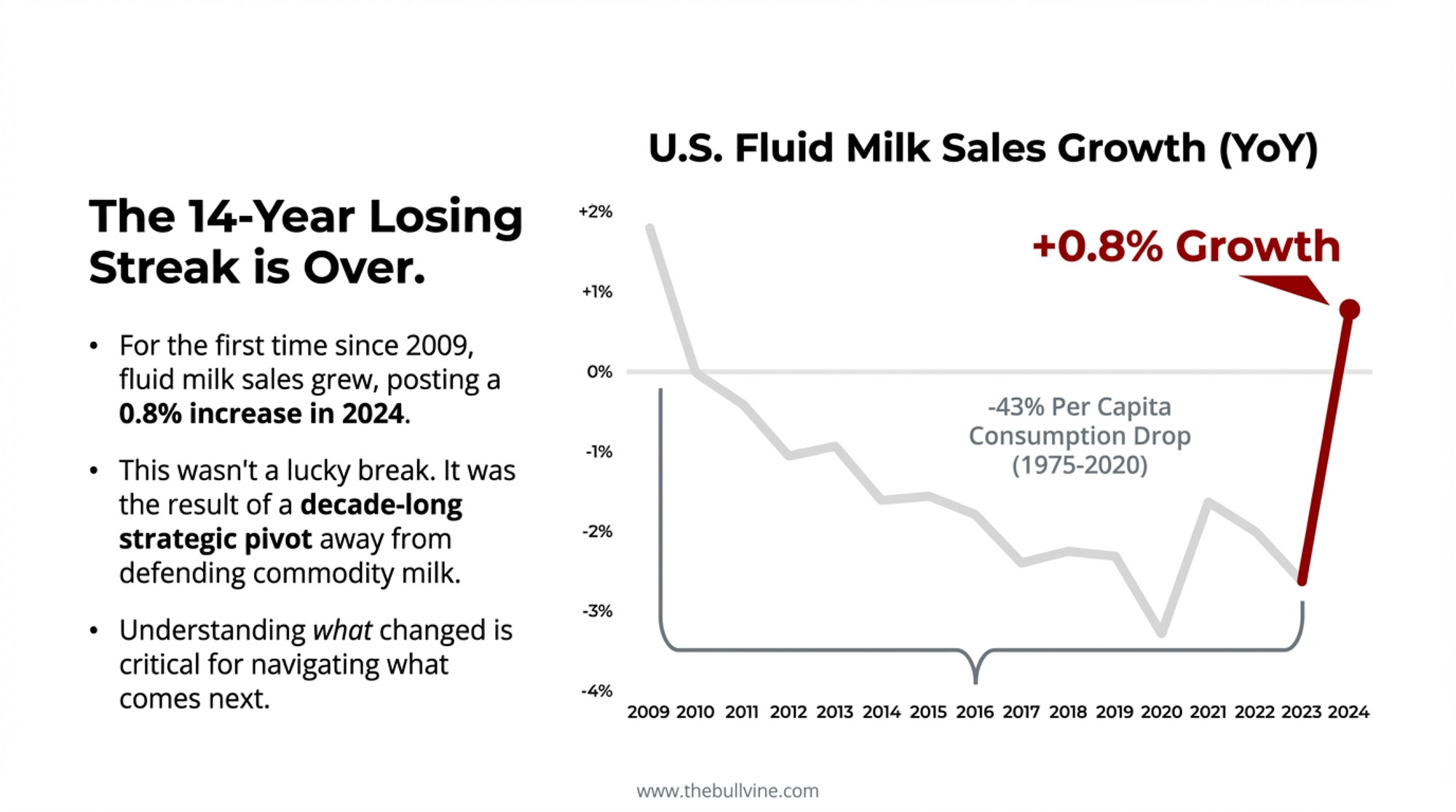
Here’s something that caught a lot of people off guard last year. Fluid milk sales actually grew in 2024—not just stabilized, but genuinely increased. USDA data show total U.S. fluid milk sales were up about 0.8% from 2023, ending a 14-year streak of annual declines. The National Milk Producers Federation called it the first year-over-year gain since 2009.
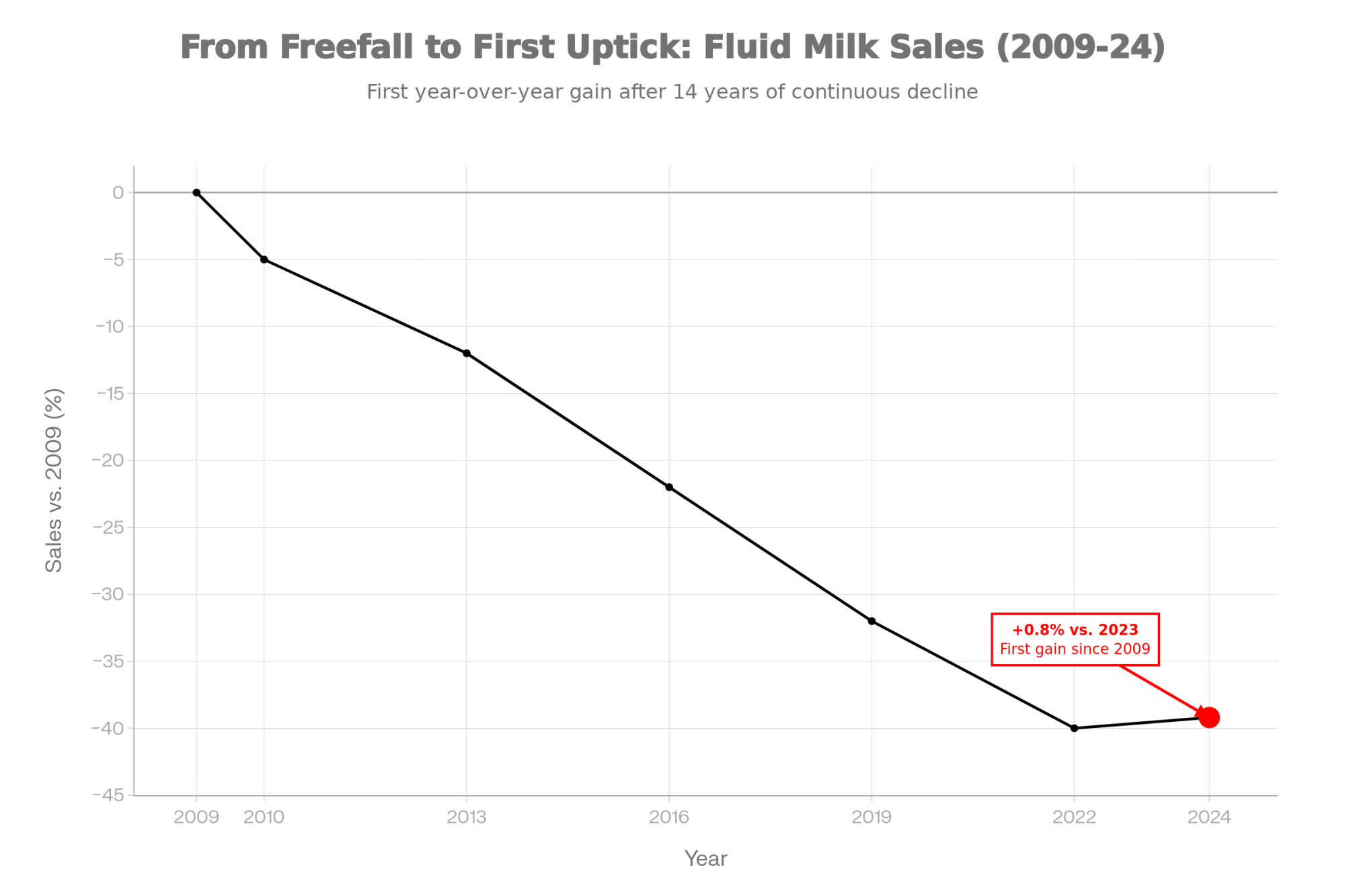
That’s worth sitting with for a moment.

What’s interesting here isn’t just the number itself. It’s what had to happen to get there. This wasn’t a lucky break or some temporary consumer fad. The growth came after roughly a decade of strategic decisions that ran counter to almost everything the dairy industry had believed about competition and survival.

I’ve been watching this unfold for years now. The more you dig into what actually changed, the more you realize there’s a playbook here that matters to producers navigating what comes next.

Understanding How Deep the Decline Really Was

To make sense of the comeback, you need to understand how challenging things had gotten. Not just the headlines—the structural shift that was reshaping the entire category.

Between 1975 and 2020, per capita fluid milk consumption in the United States dropped by nearly 43%, according to Federal Milk Market Administrator data. We went from around 247 pounds annually down to about 141 pounds per person. Penn State Extension’s dairy trends research shows similar figures—they tracked a decline from 247 pounds in 1975 to 134 pounds by 2021. That’s not a temporary dip. That’s a generational shift away from a product that used to be on every breakfast table in America.

The reasons were accumulating, as many of us observed firsthand. Beverage options multiplied—sports drinks, bottled water, energy drinks, and the expanding coffee culture. Plant-based alternatives began to claim serious shelf space in the mid-2010s. Younger consumers, especially, seemed to be reconsidering whether dairy belonged in their daily routine.

And the financial pressure kept building. Class III prices dropped below $14 per hundredweight multiple times during 2018 and 2019. The Class III average for 2018 was just $14.61, the lowest in years. If you were shipping milk during those months, you remember.

Then came Dean Foods. The largest fluid milk processor in the country filed for Chapter 11 bankruptcy on November 12, 2019, in the Southern District of Texas—USDA’s Agricultural Marketing Service confirmed the filing date in subsequent proceedings. When a company of that size goes down, it sends a signal about industry direction. Or at least, that’s what everyone assumed at the time.

The Strategic Pivot: Asking a Different Question

The turning point, looking back, came when industry leadership started asking a fundamentally different question.

Instead of “How do we convince people to drink more regular milk?”—which promotion campaigns had been attempting for years—they asked: “What do modern consumers actually want that dairy could provide better than alternatives?”

Why does that distinction matter? Because it shifts the entire strategic framework.

Dairy Management Inc., the organization that manages the national dairy checkoff, commissioned extensive consumer research starting around 2014-2015. According to DMI’s published partnership reports, what they found reshaped the entire strategic approach.

Here’s what the research revealed: consumers weren’t rejecting dairy’s core benefits—protein, nutrition, taste. They were rejecting the format and the limitations. The National Institutes of Health estimates that somewhere between 30 and 50 million American adults are lactose intolerant—MedlinePlus and federal health resources have consistently cited this range. Many of those people wanted dairy’s nutritional benefits but couldn’t tolerate conventional milk. Others wanted higher protein for fitness goals, lower sugar for health reasons, or longer shelf life for convenience.

This consumer insight work became the foundation for everything that followed. DMI announced more than $500 million in fluid milk partnerships with seven major companies—Dairy Herd and other industry publications covered the announcement extensively. What’s particularly noteworthy is the leverage structure: most of that investment came from partners putting money into processing plants and infrastructure, while the checkoff’s direct commitment was about $30 million. That ratio—partners investing roughly $15 for every checkoff dollar—represents a fundamental strategic pivot from defending commodity milk to building new categories where dairy had natural advantages.

The fairlife Case Study

No single product illustrates the transformation better than fairlife, which has become Coca-Cola’s fastest-growing brand acquisition. The timeline is worth examining because it shows what patient long-term investment actually looks like in practice.

fairlife launched as a joint venture in 2012 between Select Milk Producers—a Texas-based dairy cooperative with just 99 member farms, as confirmed by multiple industry sources, including the Texas Agricultural Council and the University of Guelph—and Coca-Cola, which took an initial 42.5% ownership stake. The product uses ultrafiltration technology (not new technology exactly, but newly commercialized at scale) to concentrate protein, remove lactose, and reduce sugar while maintaining dairy’s nutritional profile.

National rollout came in late 2014, after test markets in Denver showed something remarkable. Coca-Cola’s Mike Saint John, speaking to industry groups, noted that the Denver test showed fairlife driving a 4% increase in fluid milk sales—not just capturing share from other brands, but actually growing the category. That distinction matters considerably when you’re trying to reverse a multi-decade decline.

The growth trajectory tells the story. By the mid-2010s, fairlife had reached about $90 million in annual sales. Industry estimates put 2019 sales at around $500 million. In January 2020, Coca-Cola acquired the remaining 57.5% stake for $979 million, according to SEC filings.

Here’s where the economics get striking. fairlife surpassed $1 billion in annual retail sales by 2021-2022, as Dairy Reporter and Coca-Cola’s earnings communications confirmed. The company’s SEC filings now show that total payments for fairlife—including the original acquisition plus performance-based earnouts—have reached approximately $7.4 billion. That earnout structure meant Coca-Cola paid more because fairlife exceeded financial targets.

YearRetail sales (USD billions)Cumulative value/investment (USD billions)
20150.090.50
20190.501.50
20221.005.00
20241.207.40

Today, fairlife sells at a clear premium to conventional milk in most retailers. High Ground Dairy’s analysis highlights these strong price premiums, while USDA retail price tracking shows conventional milk averaging about $4.39 per gallon in 2024. Consumers are paying meaningful premiums for a product delivering 50% more protein, 50% less sugar, no lactose, and a longer shelf life.

But Can Other Cooperatives Replicate This?

Here’s the question many producers are asking: Is the fairlife playbook actually replicable, or do you need Coca-Cola’s balance sheet to make it work?

The honest answer is complicated.
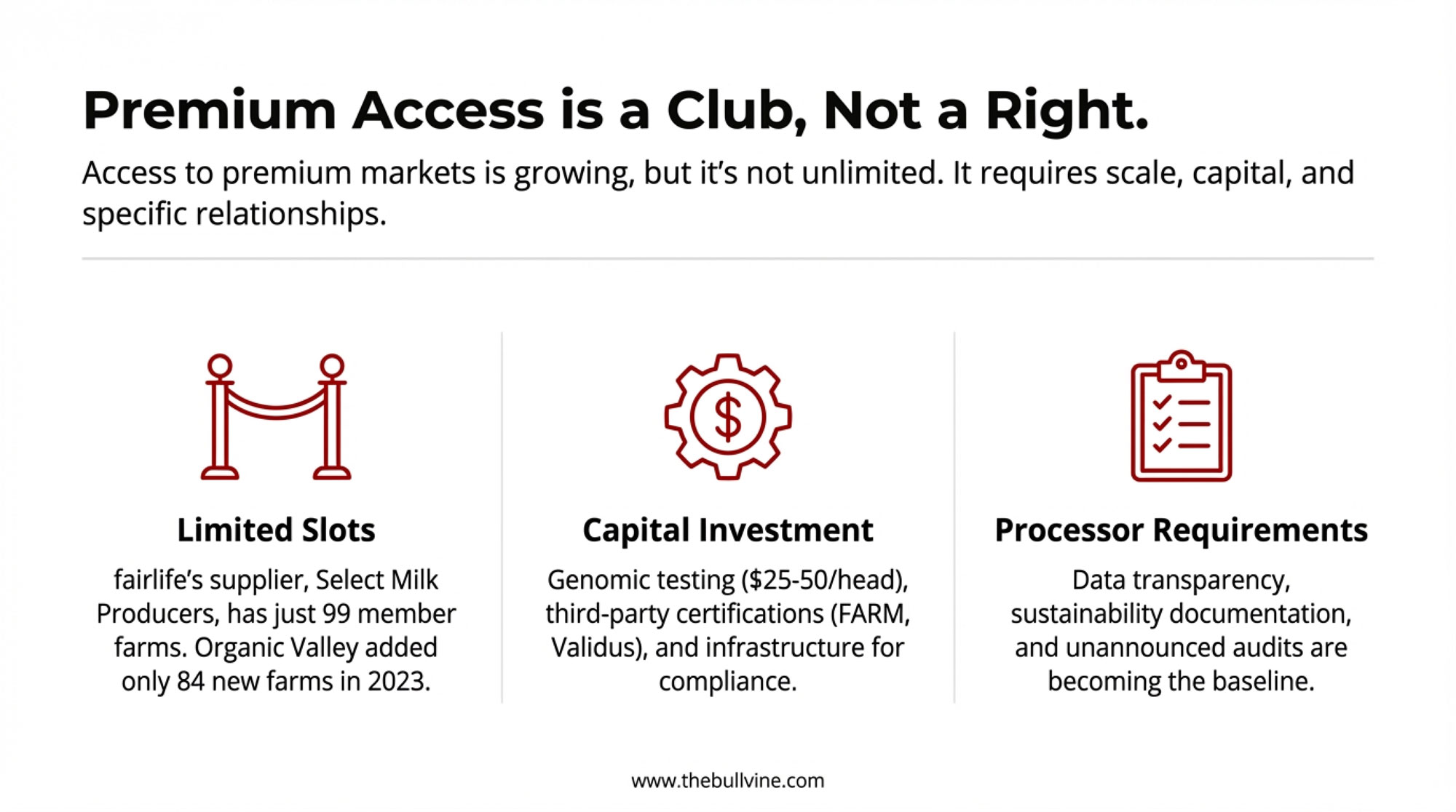
fairlife didn’t just have good milk—it had a partner with essentially unlimited capital, global distribution networks, and decades of beverage marketing expertise. Select Milk Producers brought the supply chain and dairy knowledge; Coca-Cola brought everything else. That’s not a model most regional cooperatives can simply copy.

fairlife’s own FAQ clarifies the supply structure: “As a milk processor, fairlife does not own farms or cows. We partner with dairy co-ops in geographies where we have plant locations to source milk.” All supplying farms must meet fairlife’s specific animal care requirements and maintain both FARM and Validus third-party certifications. That creates a meaningful barrier for farms not already connected to fairlife’s supply network.

Consider this: Select Milk Producers has just 99 member farms. That’s a deliberately small, carefully managed supplier base—not an open door for any operation wanting premium market access. And when Organic Valley, the largest organic dairy cooperative in the country, added new farms in 2023, they brought on just 84 operations, according to Dairy Herd reporting. Premium market access is growing, but it’s not unlimited.

For mid-sized cooperatives exploring this space, the entry barriers are substantial: processing infrastructure for ultrafiltration runs into the tens of millions; third-party certification programs require ongoing investment; and finding a retail or foodservice partner willing to commit long-term distribution adds another layer of complexity.

That said, some regional cooperatives are finding their own paths. Cobblestone Milk Cooperative in Virginia built its model around exceptionally high-quality standards—bacteria and somatic cell counts far below industry norms, as Dairy Herd has documented—creating differentiation without the use of ultrafiltration technology. The approach requires different capabilities than the fairlife model, but it shows there’s more than one route to premium positioning.

The key insight: fairlife’s success proves the premium fluid milk market exists and can grow. Replicating it requires either a massive corporate partnership or finding alternative differentiation strategies appropriate to your cooperative’s scale and capabilities.

The Genetics Angle: Why “Volume-Only” Selection Is Losing Ground

For Bullvine readers, here’s where the story gets especially relevant. The shift toward premium, composition-focused products isn’t just changing processor strategies—it’s fundamentally reshaping what genetics are worth money.

The April 2025 Net Merit revision from CDCB clearly tells the story. According to the official USDA-AGIL research document “Net merit as a measure of lifetime profit: 2025 revision,” the updated NM$ formula shifts emphasis significantly:

Trait2021 NM$ WeightApril 2025 NM$ WeightDirection
Protein19.6%13.0%↓ Decreased
Fat28.6%31.8%↑ Increased
Feed Saved12.0%17.8%↑ Increased
Productive Life11.0%8.0%↓ Decreased

Why the shift? Dr. Paul VanRaden, Research Geneticist at USDA and lead author of the Net Merit revision, describes NM$ 2025 as “a strategic response to the evolving dairy industry,” integrating recent economic data and market signals. Butterfat emphasis increased because consumer demand for butter and high-fat dairy products has strengthened. Protein emphasis decreased partly because the cheese market has matured, and premium fluid products like fairlife actually remove some protein during ultrafiltration.

The real-world expression of these genetic shifts is already visible. Corey Geiger with CoBank told Brownfield Ag News that Holstein butterfat levels reached a record 4.23% in 2024, while protein levels were 3.29%. The April 2025 genetic base change reflects this: Holsteins saw a 45-pound rollback on butterfat—that’s 87.5% higher than the 24-pound adjustment in 2020, and the largest base change in the breed’s genetic history. Protein rolled back 30 pounds.

Geiger’s projection is striking: he told Brownfield he believes butterfat levels “could pass five percent in the next decade” based on current consumer demand and genetic momentum.

What this means practically: bulls selected purely for milk volume without strong component percentages are becoming less valuable relative to high-component, high-health-trait sires. TPI formula adjustments reflect similar trends—Holstein Association USA has been increasing emphasis on fat and protein pounds while rebalancing type traits.

For breeding decisions today, the implications are clear:

  • Component percentages matter more than ever. A sire with +0.10% Protein and +0.35% Fat commands attention in ways volume-only genetics don’t.
  • Feed efficiency is gaining weight. The Feed Saved emphasis increase from 12% to 17.8% in NM$ reflects tighter margins and environmental pressure.
  • Health and longevity traits remain important but are being rebalanced against productivity gains.

The premium pivot isn’t just about finding a processor who’ll pay more for your milk. It’s about recognizing that the entire genetic selection framework is shifting toward what those premium products require.

The Two-Tiered Reality: Who Actually Benefits?

This brings us to what might be the most uncomfortable part of the story. The premium pivot and genetic evolution I’ve been describing don’t affect all operations equally. In fact, there’s a reasonable argument that these trends are accelerating the exit of smaller producers who can’t afford the entry costs.

The numbers are sobering. The 2022 USDA Census of Agriculture found just 24,082 U.S. dairy farms—down from 39,303 in 2017. That’s nearly a 40% decline in five years, as Brownfield Ag News and Dairy Reporter both reported. Lucas Fuess, senior dairy analyst at Rabobank, points out that 68% of U.S. milk now comes from farms with 1,000 or more cows—operations that represent only 8% of total farms.

Category20172022
Number of U.S. dairy farms39,30324,082
Share of milk from farms with 1,000+ cows60%68%
Estimated share of farms with 1,000+ cows6%8%
Cost advantage of >2,000-cow farms vs. 100–199$8/cwt cheaper$10/cwt cheaper

The cost dynamics are stark. USDA data show farms milking more than 2,000 cows can operate roughly $10 per hundredweight cheaper than farms with 100-199 cows. That’s not a small gap—it’s the difference between profitability and struggling to break even.

Meanwhile, the 50-99 cow category—traditionally the heart of family dairy—has seen dramatic declines according to USDA census data, with the segment nearly halving between 2017 and 2022. Dr. Frank Mitloehner at UC Davis has noted that one of the main reasons smaller dairy farms are disappearing is “ever-tightening profit margins,”—and larger farms’ cost advantages enable them to “achieve much higher net returns,” as Dairy Global reported.

Peter Vitaliano, economist for the National Milk Producers Federation, told Brownfield that 2023 saw nearly 6% of licensed dairy farms exit, and he expected “an even higher rate of dairy farm closures” in 2024. Industry analysts project that this consolidation trend will continue, with production increasingly concentrated on the largest operations.

So when we talk about genomic testing at $25-50 per head, third-party certification programs, and processor relationships that require data transparency and infrastructure investment—who can actually afford that?

For a 2,000-cow California operation, genomic testing the replacement heifer crop might run $50,000-100,000 annually—a meaningful but manageable investment against a multi-million dollar revenue base. The same testing for a 150-cow Vermont farm costs $3,750-7,500—proportionally similar, but coming out of a much tighter margin with far less negotiating leverage on the premium side.

The infrastructure requirements for premium programs add another layer. FARM certification, video monitoring at handling points, sustainability documentation, and unannounced audit preparation—these require administrative capacity that larger operations can absorb more easily than smaller ones running lean.

Does “Collaborative Competition” Help the Small Producer?

The DMI partnership model—where checkoff dollars leverage private investment—has clearly grown the premium category. But does that growth help the 150-cow operation, or does it primarily benefit the large farms and cooperatives already positioned to capture that value?

The evidence is mixed.

On one hand, composition-based pricing tiers are expanding across cooperatives of various sizes. FarmFirst, Foremost Farms, and DFA all have programs that, in theory, reward any member farm that ships high-component milk. Genetic improvement is available to everyone who chooses to pursue it.

On the other hand, premium market access often requires scale. fairlife’s supplier base is deliberately limited to 99 member farms in Select Milk Producers. Organic Valley added just 84 farms in 2023 despite significant producer interest. The infrastructure investments driving premium product growth—like fairlife’s $650 million Webster, New York facility—create jobs and markets, but they don’t automatically open doors for every nearby farm.

The most honest assessment: the premium pivot has created new opportunities, but those opportunities aren’t equally accessible. Farms with existing cooperative relationships, geographic proximity to premium processors, capital for certification and genetic investment, and administrative capacity for compliance requirements are better positioned than those without. The “collaborative competition” model has grown the pie, but the slices aren’t being distributed equally.

For smaller operations, the strategic question becomes: what premium pathways are actually accessible given your scale, location, and cooperative membership? Direct-to-consumer sales, farmstead processing, local food networks, and quality-differentiated regional cooperatives like Cobblestone may offer more realistic paths than trying to break into fairlife’s supply chain.

Navigating the Fair Oaks Crisis

Every turnaround has a moment where the whole thing nearly falls apart. For dairy’s innovation strategy, that moment came in June 2019.

The Animal Recovery Mission, an animal welfare organization, released undercover footage from Fair Oaks Farms—one of fairlife’s primary milk suppliers in Indiana. The footage showed systematic mistreatment of calves, and Dairy Reporter, along with other trade publications, covered the story extensively.

The response from retailers was immediate. Industry reporting confirmed that major chains, including Jewel-Osco, Tony’s Fresh Market, and several others, pulled fairlife from shelves within days. Consumer boycotts gained momentum. Class action lawsuits were filed alleging deceptive marketing around animal welfare claims.

What happened next offers lessons for crisis management across the industry.

Rather than minimize the situation or deflect blame, fairlife and Coca-Cola chose transparency. They immediately suspended all milk deliveries from Fair Oaks Farms. Dairy Reporter confirmed they increased unannounced audits at supplier farms from once annually to 24 times per year—a dramatic escalation in oversight. They installed video monitoring systems at animal handling points and commissioned independent investigations of all supplying farms.

fairlife’s 2024 Animal Stewardship Report, as covered by Food Dive, notes the company has invested, along with its suppliers, nearly $30 million in its animal welfare program since the crisis. The company eventually paid $21 million to settle related litigation—Food Dive called it one of the largest settlements ever in an animal welfare labeling case.

It was expensive. It was risky—admitting failure often accelerates brand damage in the short term. But the approach preserved something more valuable: trust in the brand and in the category. By 2020-2021, fairlife had returned to most retail shelves. By 2022, it reached $1 billion in sales.

Practical Implications for Producers

So that’s the industry-level narrative. But what does it mean for someone actually running a dairy operation? That’s the question that matters most.

The shift affecting producers most directly is the changing economics around milk composition. The traditional model rewarded volume—more pounds shipped meant more revenue. The emerging model increasingly rewards components and quality characteristics that premium products require.

I’ve talked with several Upper Midwest producers who are seeing this play out in real time. Farms focusing on protein percentage and butterfat rather than volume alone are reporting meaningful improvements in their milk checks—even when shipping slightly less total volume. It requires a different way of thinking about what you’re actually producing.

Here’s the practical reality. Current Class III prices have been running in the mid-to-upper teens per hundredweight according to USDA milk pricing data, with month-to-month variation. Farms meeting premium composition targets through preferred supplier programs can access additional premiums, though specific rates vary considerably by processor and region.

MetricHerd A – Volume FocusHerd B – Premium Components
Avg. milk shipped/cow/day90 lb82 lb
Butterfat / Protein test3.7% F / 3.05% P4.2% F / 3.25% P
Base milk price$18.00/cwt$18.00/cwt
Component & quality premiums$0.40/cwt$1.30/cwt
Net mailbox price$18.40/cwt$19.30/cwt

Regional dynamics matter here. Upper Midwest cooperatives like FarmFirst and Foremost Farms have been building out composition-based pricing tiers, according to their published producer communications. California’s larger operations often negotiate directly with processors. Southeastern producers working through DFA have seen new preferred supplier programs emerge over the past couple of years. Pacific Northwest operations shipping to Darigold have their own regional dynamics. The opportunity exists, but access varies.

What many producers are discovering is that capturing these premiums requires intentional decisions rather than hoping the bulk tank tests well:

Genomic testing is typically the starting point. Testing replacement heifers for protein traits, A2 beta-casein status, and kappa-casein genotype generally runs in the $25-50 range per animal through commercial services, though prices vary by service level and volume. University extension dairy genetics research confirms these trait associations translate to real composition differences in the bulk tank over time. For a 100-heifer crop, you’re looking at a few thousand dollars—an investment that can return value within the first year of improved milk checks if you’re making culling and breeding decisions based on the results.

Sire selection follows from testing—and this is where the Net Merit shifts become directly actionable. Bulls ranking high on protein percentage, fat percentage, A2A2 genetics, and kappa-casein BB genotypes are increasingly valuable. A2A2 milk commands premiums in some markets because consumers perceive it as easier to digest. Research published in the Journal of Dairy Science confirms that kappa-casein BB genetics improve the processing characteristics of milk for ultra-filtered products.

Given the April 2025 NM$ revision, which emphasizes butterfat (+31.8% weight) and feed efficiency (+17.8% weight) while de-emphasizing protein pounds, sire selection strategies should reflect these economic realities. Volume-only genetics—high milk pounds without strong component percentages—are losing ground in the index and in the marketplace.

It’s worth noting that these genetic shifts take time. We’re talking about a 3-5 year timeline before you see the full expression in your herd. Decisions made today won’t show up meaningfully in bulk tank averages until 2028-2030. That’s the reality of cattle genetics—no shortcuts available.

Processor relationships are becoming strategic rather than purely transactional. I’d encourage any producer reading this to contact your processor’s sourcing or sustainability department and ask directly: What composition targets are you looking for? What premiums do you offer for hitting them? Do you have a preferred supplier program?

Some processors—DFA, Darigold, Land O’Lakes, and others—have formal programs that offer price premiums, contract stability, and technical support to farms that commit to composition targets and data transparency. These programs aren’t always well-publicized, but they exist.

Certification requirements are expanding as well. fairlife, Horizon Organic, and other premium brands increasingly require third-party sustainability verification from their suppliers. FARM certification, DHI participation, and documented environmental practices are becoming baseline expectations rather than differentiators.

Challenges and Uncertainties Ahead

It would be incomplete to discuss this turnaround without acknowledging the challenges that remain. Success creates its own vulnerabilities.

  • Capacity constraints are affecting the market right now. fairlife is production-limited, according to Coca-Cola’s Q3 2024 earnings commentary. CEO James Quincey explicitly stated they couldn’t meet demand until new capacity comes online. Cowsmo reported on a 745,000-square-foot, $650 million facility under construction in Webster, New York, that should help, but it’s been a bottleneck.
  • Policy changes create uncertainty. The Federal Milk Marketing Order reform, taking effect in 2025, is expected to affect milk pricing in various ways. The exact impact depends on your region and class utilization, so it’s worth checking with your cooperative or university extension for current projections specific to your situation.
  • Plant-based competition continues. The category keeps growing, with various market research firms projecting continued expansion through the early 2030s. Growth has moderated from the rapid 2018-2020 period, but oat milk in particular continues gaining ground with younger consumers.
  • Consolidation pressure isn’t easing. The trajectory from the 2022 census—40% fewer farms in five years—continues to pressure mid-size operations caught between the flexibility of small farms and the cost advantages of large ones.
  • Complacency may be the biggest risk. The discipline that built the turnaround—long-term research investment, consumer-centric product development, collaborative strategy—is exactly what successful industries tend to abandon once growth returns. If checkoff boards redirect funding from innovation to short-term promotion, or if processors reduce R&D as margins improve, the momentum could stall.

The Underlying Lesson

Looking at this entire arc, there’s a counterintuitive insight that applies beyond dairy.

The instinct when an industry faces decline is to work harder at the existing business. Cut costs. Improve efficiency. Fight for market share. Promote more aggressively.

Dairy tried all of that for years. It wasn’t sufficient—because when the market itself is shifting away from your core product, being better at the old thing only delays the inevitable.

What changed around 2014-2015 was a fundamental acceptance that commodity fluid milk, as traditionally sold, was unlikely to return to growth. Instead of fighting that reality, industry leaders asked what they could build that consumers actually wanted, using the infrastructure and supply chain already in place.

Same farms. Same cows. Same processing facilities. But instead of trying to sell more commodity milk at mid-teens per hundredweight, the focus shifted to creating categories where dairy had genuine advantages: ultra-filtered, lactose-free, high-protein, composition-specific products commanding meaningful premiums.

Volume is flat or slightly declining. Revenue per farm is higher. Margin per cow improved. Farm sustainability is better—for those who can access the premium markets.

That last qualifier matters. The turnaround is real, but its benefits aren’t flowing equally to all producers. The strategic question for any individual operation isn’t whether the premium pivot worked at the industry level—it clearly did—but whether and how you can position to capture some of that value given your specific scale, location, genetics, and cooperative relationships.

The Bottom Line

The dairy industry in late 2025 sits at an interesting inflection point. The turnaround appears real—2024’s growth wasn’t an anomaly, and analysis suggests the trajectory is continuing. Premium categories are expanding. Consumer perceptions of dairy are improving among key demographics. Genetic selection is evolving to support composition-focused production.

But the foundational work isn’t complete. New processing capacity is still coming online. Composition-focused genetics will take another 3-5 years to express in herds that are now fully selecting. Policy and trade uncertainty could affect even well-planned operations. And the consolidation pressure that’s eliminated 40% of U.S. dairy farms since 2017 shows no sign of reversing.

For producers, the practical implications come down to several key considerations:

  • Assess your herd’s genetic profile if you haven’t already. The information shapes every breeding decision going forward. With NM$ now emphasizing butterfat and feed efficiency more heavily, your selection criteria may need updating.
  • Initiate conversations with your processor about composition premiums. Programs exist but aren’t always well-publicized. Ask specifically what they’re seeking and what they offer for hitting targets.
  • Be realistic about premium market access. Not every farm can break into fairlife’s supply chain or join Organic Valley. Understand which premium pathways are actually accessible given your scale and cooperative membership—and consider alternatives, such as quality-focused regional cooperatives or direct marketing—if the major premium programs aren’t realistic options.
  • Plan for the 2028-2030 timeframe, not just next year’s milk check. Genetic decisions compound over time. Processor relationships require time to develop. The farms positioned well three years from now are making those decisions today.
  • Watch the consolidation dynamics. If you’re a mid-size operation, clearly understand whether your cost structure and market access can remain competitive as larger operations continue to gain share.

The turnaround didn’t happen because someone discovered a compelling marketing message that made consumers embrace commodity milk again. It happened because the industry stopped trying to preserve something consumers had moved past and started building what they actually wanted.

That’s perhaps the most transferable insight here. Not the specific technology or product. The willingness to accept that what worked for 50 years may not work for the next 20—and to build something new while there’s still time.

Key Takeaways

  • The 15-year decline is over. Fluid milk sales grew 0.8% in 2024—driven by premium products like fairlife, not commodity milk marketing.
  • Your genetics are being repriced. April 2025 Net Merit boosts butterfat to 31.8% and cuts protein to 13.0%. Volume-only bulls are losing economic ground.
  • $7.4 billion proves the premium model. Coca-Cola’s total fairlife investment shows the upside is real—but capturing it requires scale, certifications, and cooperative positioning most farms don’t have.
  • 40% of U.S. dairy farms are already gone. Operations dropped from 39,303 (2017) to 24,082 (2022). Premium market benefits are concentrating in larger herds.
  • The question has changed. It’s no longer whether this shift is real—it’s whether your operation’s genetics, processor relationships, and market access position you to benefit from it. The farms winning in 2028 are making those decisions now.

Complete references and supporting documentation are available upon request by contacting the editorial team at editor@thebullvine.com.

Learn More:

Join the Revolution!

Join over 30,000 successful dairy professionals who rely on Bullvine Weekly for their competitive edge. Delivered directly to your inbox each week, our exclusive industry insights help you make smarter decisions while saving precious hours every week. Never miss critical updates on milk production trends, breakthrough technologies, and profit-boosting strategies that top producers are already implementing. Subscribe now to transform your dairy operation’s efficiency and profitability—your future success is just one click away.
NewsSubscribe
First
Last
Consent

Unlocking the Potential of Tailored Nutrition with Automated Milking Systems

Boost your dairy farm’s efficiency with nutritional strategies for automated milking systems. Discover how diet impacts milk production and milking behavior.

Imagine a system that not only milks your cows precisely but also provides them with specialized feed, all while freeing up your time. This is the reality of Automated Milking Systems (AMS), a disruptive technology transforming the dairy sector. As more farms use these technologies, improving their efficiency has become critical. AMS simplifies milking and delivers valuable data for better herd management and production. The efficiency of AMS is highly related to the farm’s nutritional strategy. Nutritional techniques are the foundation of productivity. When used with AMS, the proper feed formulations can significantly increase milk output and enhance quality, making it a powerful tool for dairy farmers. Join us as we investigate nutritional practices on AMS-equipped dairy farms, emphasizing critical food components and their influence on milk production and milking habits, allowing you to maximize your AMS.

Automated Milking Systems: Revolutionizing Dairy Farming for Better Productivity and Welfare 

AMS has changed dairy production, providing enormous advantages to farmers. It increases flexibility, reduces the need for a set milking schedule, and enhances work-life balance. However, it’s important to note that AMS presents challenges, such as the initial installation cost and potential technical issues. AMS also collects information on each cow’s milk output, composition, and health, which aids in improved herd management. Furthermore, AMS may boost milk production by allowing more frequent milking and decreasing the stress associated with conventional milking regimens.

AMS aids dairy producers by allowing them to manage their time and eliminate the requirement for a set milking schedule. This promotes work-life balance and collects data on each cow’s milk output, composition, and health, allowing for improved herd management. For instance, AMS can provide real-time data on milk yield, fat, and protein content and even detect early signs of health issues in cows.

There are two kinds of AMS systems: free-flow and guided-flow. Cows may visit the milking units anytime using free-flow systems, which generally leads to improved milking frequency and milk output. However, careful management is essential to prevent congestion. Guided-flow systems employ lanes and gates to steer cows, improve milking unit utilization, and shorten wait times. They may reach different voluntary milking levels than free-flow systems.

Milking behavior varies per system. Free-flow systems promote more frequent milking, which may increase milk output but result in more milking refusals if not adequately controlled. On the other hand, guided-flow systems provide a regulated environment, minimizing refusals and giving you a sense of control over the milking process.

As a dairy producer, understanding the specifics of each AMS type and how it affects cow behavior and milking performance is crucial. This knowledge empowers you to choose the optimal strategy, leading to increased production, animal care, and sustainability in dairy farming. It’s about being in the know and making informed decisions.

Optimizing Dairy Cow Nutrition with Partial Mixed Rations (PMR) and Automated Milking Systems (AMS) 

Partial Mixed Rations (PMR) are essential for dairy cow nutrition, particularly on farms equipped with Automated Milking Systems (AMS). PMR gives cows a semi-complete diet at the feed bunk, supplemented with concentrated feeds at the AMS. This dual technique promotes cow health and production by providing a balanced intake of vital nutrients.

A PMR contains forages, cereals, proteins, vitamins, and minerals. Critical nutrients like corn and barley silage provide fermentable carbohydrates for increased milk output. Higher ether extract (EE) levels in PMR have been related to higher milk production because they provide the energy required for lactation.

The PMR’s constituents significantly impact the composition of milk. Forage varieties such as haylage and corn silage influence milk protein percentages, while the PMR to AMS concentrate ratio influences milk fat levels. A higher PMR-to-AMS concentrate ratio increases milk fat content, ensuring dairy products satisfy quality criteria.

Overall, well-formulated PMR improves dairy herd nutrition and directly influences milk production efficiency and composition. This approach is critical for AMS-equipped farms, where precision nutrition control improves production and herd welfare.

The Role of Concentrate Feed in Enhancing Automated Milking System Efficiency

The concentrate feed provided to the cows is crucial to any automated milking system (AMS). This concentrate is a strategic tool for influencing cow behavior, increasing milking efficiency, and providing nutrients. The precisely balanced nutritional content of the AMS concentrate is critical in motivating cows to attend milking stations more often, resulting in increased milk output.

Importance of Concentrate in AMS 

The concentration given by the AMS motivates cows to enter the milking unit. This continual intake guarantees that milking sessions are evenly distributed throughout the day, considerably increasing milk output and consistency. Customizing the time and amount of concentrate for each cow, depending on their demands and lactation stage, improves feeding efficiency and responsiveness.

Impact on Milking Frequency 

The nutrient-rich concentrate in the AMS is intended to be very tasty, causing cows to seek it out many times daily. According to research, farms using free-flow cow traffic systems often see higher milking rates, partly influenced by the appeal of the AMS concentrate. Farmers may take advantage of the cows’ natural eating behavior by providing a balanced and delicious combination, which leads to more frequent trips to the milking station and, as a result, increased output.

Influence on Milk Yield and Components 

The nutritious composition of AMS concentrate is strongly related to milk production and significant components such as fat and protein levels. Concentrates high in starch and energy may increase milk output by supplying necessary nutrients for cows to maintain high production levels. Specific elements, such as barley fodder, have been shown to contribute more favorably to milk output than other fodder.

Furthermore, the balance of nutrients might influence milk composition. A more excellent PMR-to-AMS concentrate ratio is generally associated with higher milk fat levels. Simultaneously, the whole diet’s net energy for lactation may increase both fat and protein levels in milk. In contrast, an imbalance, such as excessive non-fiber carbohydrate (NFC) content in the partially mixed diet, might harm milking behavior and milk composition.

The strategic formulation of the concentrates available at the AMS is crucial to attaining peak dairy output. Understanding and utilizing its nutritional effect may help farmers improve milking efficiency and quality.

Navigating Nutritional Complexity: Key Dietary Factors That Influence Milk Yield and Milking Behavior in Automated Milking Systems

Research published in the Journal of Dairy Science underlines the importance of food on milk production and milking behavior in dairy farms that use Automated Milking Systems (AMS). Ether extract (EE) in the Partial Mixed Ratio (PMR) had a favorable connection with milk production. A one-percentage-point increase in EE increased milk production by 0.97 kg/day, demonstrating the importance of including fat in the diet to promote milk supply.

Key Nutritional FactorImpact on Milk Production/Milking BehaviorSpecific Findings
PMR Ether Extract (EE) ConcentrationPositive on Milk Yield+0.97 kg/day per percentage point increase
Barley Silage as Major Forage SourcePositive on Milk Yield+2.18 kg/day compared to haylage
Corn Silage as Major Forage SourceTendency to Increase Milk Yield+1.23 kg/day compared to haylage
PMR-to-AMS Concentrate RatioPositive on Milk Fat Content+0.02 percentage points per unit increase
Total Diet Net Energy for LactationPositive on Milk Fat Content+0.046 percentage points per 0.1 Mcal/kg increase
Forage Percentage of PMRPositive on Milk Protein Content+0.003 percentage points per percentage point increase
Total Diet Starch PercentagePositive on Milk Protein Content+0.009 percentage points per percentage point increase
Free-Flow Cow Traffic SystemPositive on Milking Frequency+0.62 milkings/day
Feed Push-Up FrequencyPositive on Milking Frequency+0.013 milkings/day per additional feed push-up
Barley Silage as Major Forage SourcePositive on Milking Refusal Frequency+0.58 refusals/day compared to haylage or corn silage

Non-fiber carbohydrates have a dual function. While higher NFC concentration increased milk supply, it decreased milk fat and milking frequency. Each percentage point increase in NFC lowered the milk fat % and the frequency of daily milking. This highlights the necessity for a careful balance of NFC to minimize deleterious effects on milk composition and milking frequency.

The choice of feed (barley hay, maize silage, or haylage) was equally important. Farms that used barley silage had a much higher milk output (+2.18 kg/day) than haylage. Corn silage increased milk production (+1.23 kg/day), although it was related to reduced milk protein levels. This shows a trade-off between increased milk volume and protein content.

These data emphasize the complexities of diet design in dairy farming with AMS. Each component—ether extract, NFC, and forage type—uniquely impacts milk production and quality, necessitating a comprehensive nutrition management strategy.

Understanding the Multifaceted Nutritional Dynamics on Farms with Automated Milking Systems (AMS) 

Understanding the diverse nutritional dynamics of AMS farms is critical to optimizing milk yield and quality. Here’s what our study found: 

Milk Yield: Higher milk yields were linked to increased ether extract (EE) in the PMR, boosting yield by 0.97 kg/day per percentage point. Barley silage increased yield by 2.18 kg/day compared to haylage, with corn silage also adding 1.23 kg/day. 

Milk Fat Content: Milk fat rose with a higher PMR-to-AMS concentrate ratio and total diet energy but decreased with more non-fiber carbohydrates (NFC) in the PMR. 

Milk Protein Content: More forage in the PMR and higher starch levels improved protein content. However, corn silage slightly reduced protein compared to haylage. 

Practical Recommendations: 

  • Enhance Ether Extract: Boost EE in PMR to increase milk yield while ensuring cow health.
  • Optimize Forage Choices: Use barley or corn silage over haylage for higher yields.
  • Adjust PMR-to-AMS Ratio: Increase this ratio to enhance milk fat content.
  • Manage Non-Fiber Carbohydrates: Control NFC in PMR to maintain milk fat content.
  • Prioritize Forage Content: Increase forage in PMR to boost milk protein and starch levels.

By refining diets and monitoring essential nutrients, AMS farms can maximize milk production, fat, and protein content, enhancing overall productivity and dairy quality.

Decoding Milking Behavior: A Window into Herd Management Efficiency in AMS-Equipped Farms 

Milking behavior in dairy cows is a crucial indicator of herd management efficacy, particularly on automated milking systems (AMS) farms. The research found that the average milking frequency was 2.77 times per day, significantly impacted by the cow traffic system. Farms using free-flow systems produced 0.62 more milk per day. This implies that allowing cows to walk freely increases milking frequency and productivity.

Feed push-ups were also important, with each extra push-up resulting in 0.013 more milking each day. Dr. Trevor DeVries found that frequent feed push-ups lead to increased milk output, highlighting the need to provide regular availability of fresh feed to encourage cows to visit the AMS more often.

However, greater non-fiber carbohydrate (NFC) content in the partial mixed ration (PMR) and a higher forage proportion in the total diet reduced milking frequency. Each percentage point increase in forage corresponded with a 0.017 reduction in daily milking, indicating that high-fiber diets may delay digestion and minimize AMS visits.

The research indicated an average of 1.49 refusals per day regarding refusal frequency. Higher refusal rates were associated with free-flow systems and barley silage diets, with increases of 0.84 and 0.58 refusals per day, respectively, compared to corn silage or haylage. This shows a possible disadvantage of specific traffic patterns and feed kinds, which may result in more cows not being milked.

These findings emphasize the need for deliberate feeding control in AMS situations. Frequent feed push-ups and proper fodder selection are critical for improving milking behavior and farm output.

Actionable Nutritional Strategies for Enhancing Milk Production and Welfare in AMS-Equipped Dairy Farms 

For dairy farmers using Automated Milking Systems (AMS), fine-tuning nutrition is crucial for boosting milk production and improving cow welfare. Here are some practical tips: 

  • Balanced Diets: Ensure your Partial Mixed Ration (PMR) is balanced with proper energy, fiber, and protein. Use a mix of forages like corn or barley silage, which can boost milk yield.
  • Quality Concentrate Feed: The concentrate feed at the AMS should complement the PMR. High-quality concentrate with suitable starch and energy levels promotes efficient milk production.
  • Regular Feed Push-Ups: Increase feed push-ups to encourage higher milking frequency and feed intake and ensure cows always have access to fresh feed.
  • Monitor Milking Behavior: Use AMS data to track milking frequency, refusals, and patterns. Adjust cow traffic setups for optimal results.
  • Seasonal Adjustments: Adjust feed formulations for seasonal forage quality changes and regularly test forage and PMR to ensure consistency.
  • Expert Insights: Consult dairy nutritionists and stay updated with the latest research to refine your nutritional strategies.
  • Data-Driven Decisions: Use AMS data to inform diet formulation and feeding management, leveraging correlations to improve milking behavior.

Implementing these strategies can enhance AMS efficiency and farm productivity. Continuous monitoring and expert advice will ensure optimal nutrition and milking performance.

The Bottom Line

The research on nutritional strategies in dairy farms using Automated Milking Systems (AMS) emphasizes the importance of personalized meals in improving production and milking behavior. Key results show that Partial Mixed Ration (PMR) ether extract, forage sources such as barley and maize silage, and dietary ratios contribute to higher milk output and quality. Furthermore, nutritional parameters considerably impact milking frequency and behavior, emphasizing the need for accurate feeding procedures.

Adopting evidence-based methods is critical for dairy producers. Customized diets, optimized PMR-to-AMS concentrate ratios, and careful pasture selection may improve milk output and herd management considerably. Optimizing feeding procedures to fulfill cow nutritional demands may result in cost-effective and successful dairy farms. The results support rigorous feed management, urging farmers to use suggested methods to fully benefit from AMS technology for increased farm output and animal comfort.

Key Insights:

  • Positive Impact of Ether Extract (EE): Higher concentrations of EE in Partial Mixed Rations (PMR) significantly boost milk production by approximately 0.97 kg per day for each percentage point increase in EE.
  • Forage Type Matters: Dairy farms utilizing barley silage as the major forage source produce about 2.18 kg more milk per day compared to those using haylage, while corn silage also shows a significant positive impact with an increase of 1.23 kg per day.
  • Optimizing Milk Fat Content: Greater milk fat content is linked with a higher PMR-to-AMS concentrate ratio and higher total diet net energy for lactation, albeit with a lower percentage of Non-Fiber Carbohydrates (NFC) in the PMR.
  • Influence on Milk Protein Content: Higher forage percentage and starch content in the PMR are positively associated with milk protein content, while the use of corn silage as a major forage source has a negative impact.
  • Milking Frequency Enhancement: Free-flow cow traffic systems and increased feed push-up frequency enhance milking frequency, although higher forage percentages and NFC content in PMR can reduce it.
  • Milking Refusal Factors: Farms with free-flow cow traffic and those feeding barley silage experience higher rates of milking refusals compared to guided flow systems and farms feeding corn silage or haylage.

Summary:

The study provides valuable insights into the nutritional strategies and dietary factors that significantly impact milk production and milking behavior on dairy farms equipped with Automated Milking Systems (AMS). By analyzing data and employing multivariable regression models, the research highlights the importance of precise nutrient formulations and feeding management practices. Key findings demonstrate that milk yield and quality are positively influenced by specific dietary components such as barley silage and partial mixed ration ether extract concentration, while factors like free-flow cow traffic systems and frequent feed push-ups enhance milking frequency, albeit with some trade-offs in milking refusals. These insights equip dairy farmers with actionable strategies to optimize both productivity and animal welfare on their AMS-equipped farms.

Learn more:

Join the Revolution!

Bullvine Daily is your essential e-zine for staying ahead in the dairy industry. With over 30,000 subscribers, we bring you the week’s top news, helping you manage tasks efficiently. Stay informed about milk production, tech adoption, and more, so you can concentrate on your dairy operations. 

NewsSubscribe
First
Last
Consent

How Calving Ease and Age at First Calving Drive Milk Production

Boost milk production with calving ease and age at first calving. Are you maximizing these factors?

Summary: Calving ease and age at first calving (AFC) significantly influence dairy cow productivity and health. Research on over a million calving events across 687 farms reveals that higher calving ease (CE) scores negatively impact milk production and components like fat and protein. The study also shows a relationship between AFC and CE, with optimal ages varying by breed. Proactive management, including diligent data recording, genetic selection, and proper nutrition, can mitigate CE issues and enhance milk yield. These findings underscore the importance of strategic breeding and management practices for dairy success.

  • Higher calving ease (CE) scores can negatively impact milk production, fat, and protein components.
  • There is a significant relationship between age at first calving (AFC) and CE, with optimal ages depending on breed.
  • Proactive calving management can help reduce CE issues and improve milk yield.
  • Diligent data recording is essential for managing CE and AFC effectively.
  • Genetic selection plays a crucial role in enhancing calving ease and productivity.
  • Proper nutrition is foundational for successful calving and increased milk production.
  • Strategic breeding and management practices are key to dairy farm success.
calving ease, age at first calving, dairy farm output, operation success, CE scores, complex deliveries, cow and calf issues, herd health, milk production, fat composition, protein composition, difficult deliveries, calf growth, first few days of life, increased productivity, healthier animals, AFC, young female cow, milk output, farm profitability, optimal AFC, Holsteins, Jerseys, overall herd health, smoother calvings, milk yield, milk composition, negative consequences, high CE scores, proactive approach, managing CE, managing AFC, diligent monitoring, recording data, genetic selection, nutrition, calving management, regular health checks, peer networking, continuing education, favorable genetics, optimum feed, watchful care, milk production improvement, herd health improvement, productivity improvement

Have you ever wondered why some cows produce more milk than others? Surprisingly, the solution often rests in events before the milking process starts. Calving ease and age are crucial but usually ignored elements influencing dairy farm output. Understanding these critical variables may mean the difference between standard and exceptional milk output.

In this post, we’ll look at the subtleties of calving ease and age at first calving, using data from an extensive survey of 687 dairy farms in the United States. We’ll look at how these variables affect your cows’ milk output, energy-corrected milk, and the fat and protein composition of the milk. What’s the goal? To provide you with practical information that will help you maximize your herd’s performance and, eventually, your bottom line.

The Importance of Calving Ease 

Have you ever considered how calving ease (CE) impacts the success of your dairy operation? As stated, CE describes how cleanly a cow gives delivery. Higher ratings suggest more complex deliveries, which may lead to issues for the cow and the calves.

CE scores vary from 1 to 5, with one indicating ease and 5 indicating great difficulty. These values are essential because difficult calvings may influence overall herd health and production. For example, calvings with a CE score of more than two considerably impact milk production (MP) and the fat and protein composition of the milk. Cows earning a 4 in CE showed a significant drop in milk production, with the lowest lactation peaks among the tested breeds: Holstein (43.1 kg/d), Jersey (35.8 kg/d), and dairy hybrids.

But it isn’t just about the milk. Complications associated with difficult deliveries can affect calf growth. Poor CE scores may slow calf development, making the first few days of life especially more essential. The research, which comprised over 1 million CE observations from 687 dairy farms in the United States, offers critical insights into these effects.[[Source

Understanding and increasing CE may help your dairy farm achieve increased productivity and healthier animals. So, the next time you analyze herd performance, consider how CE ratings may impact your bottom line.

Understanding Age at First Calving (AFC)

The age at first calving (AFC) is when a young female cow (a heifer) gives birth for the first time. This milestone is essential in dairy production for a variety of reasons. Proper AFC may significantly improve milk output, herd health, and farm profitability.

Why AFC Matters 

Your cows’ AFC has an impact on their long-term production and health. For example, optimum AFC may result in higher milk production and more efficient reproductive function. Conversely, premature or severely delayed calving might have unfavorable consequences. So, what is the ideal AFC for various breeds?

Optimal AFC for Different Breeds 

According to research, the ideal AFC differs by breed. For Holsteins, the optimal AFC is about 27 months, whereas for Jerseys, it is around 22 months. This is based on thorough research that included 794,870 calving ease (CE) observations from many breeds.

The AFC-Milk Production Connection 

Your cows’ milk output is strongly linked to their AFC. Cows who calve at the appropriate age produce more milk, peak sooner, and have superior overall health. Cows having a CE score of more than 2 demonstrated a decrease in milk output and components. A CE score of 4 indicated the lowest milk output, with Holsteins, Jerseys, and crossbreeds producing 43.1, 35.8, and 39.2 kg/d of milk at peak lactation, respectively.

AFC and Herd Health 

In addition to milk production, AFC influences overall herd health. Cows who calve at the right age have fewer difficulties and higher fertility and survival rates. Breeding at the correct time helps avoid the hazards of early or late births, lowering veterinary expenditures and boosting the herd’s overall health.

Connecting Calving Ease (CE) and Age at First Calving (AFC): Impacts on Milk Production 

Connecting calving ease (CE) with age at first calving (AFC) provides insights for dairy producers. The research demonstrates that both variables have a considerable impact on milk output. Let’s see how.

First, calving ease is critical. When the CE score exceeds 2, the milk supply diminishes. Cows with a CE score of 4 produce much less milk, with Holsteins averaging 43.1 kg/d, Jerseys 35.8 kg/d, and dairy crosses 39.2 kg/d. Difficult calvings might reduce a cow’s capacity to produce milk efficiently. These limitations apply to raw milk output, energy-corrected milk (ECM), and fat and protein content.

Age at first calving (AFC) is equally important. According to the research, AFC has a quadratic effect on CE. Holsteins calving at 27 months and Jerseys at 22 months had the lowest CE values. Younger cows—those calving for the first time—tended to have smoother calvings, maximizing milk yield and composition.

The age at first calving also impacts CE’s effect. When AFC is included as a covariate, previously observed CE interactions with covariates, such as calf sex and breed, become less significant. The ideal AFC mitigates the negative consequences of high CE scores, resulting in increased milk output and healthier cows.

So, what is the takeaway? Careful management of both CE and AFC may dramatically increase your herd’s output. Ensure your cows calve easily and at the appropriate age to optimize their milk production potential. Your efforts may increase milk production, better energy-corrected milk, and more significant fat and protein content, providing more value and efficiency in your dairy business.

Boosting Milk Production: The Impact of Calving Ease and Age at First Calving

According to a survey of 687 dairy farms, cows with a calving ease score of more than 2 had lower milk output and components, with the lowest values recorded in cows with CE = 4 (source). For example, Holstein, Jersey, and dairy crosses (XD) with CE = 4 showed the lowest milk lactation peak (MLP), averaging 43.1, 35.8, and 39.2 kg/d, respectively. The study found that the linear and quadratic components of Age at First Calving (AFC) were significant, emphasizing the need to regulate CE and AFC to achieve optimum output results.

The research found that cows birthing males had higher CE scores, with Holsteins having the lowest CE at 27 months and Jerseys at 22 months AFC. Addressing these factors may increase production and improve overall dairy farm performance (source).

A Proactive Approach to Managing CE and AFC Here are some actionable tips:

To boost milk production, a proactive approach is essential when managing Calving Ease (CE) and Age at First Calving (AFC). Here are some actionable tips: 

Monitor and Record Data Diligently 

Accurate data collection is critical. Record each cow’s CE and AFC scores regularly. Technology, such as herd management software, can be used to arrange this data. Having more data helps you better analyze patterns and make educated choices.

Genetic Selection is Key 

Choose breeding bulls with a verified low CE score. According to studies, the lowest CE is often found in certain breeds at ideal AFCs—27 months for Holsteins and 22 months for Jerseys. (https://www.thebullvine.com/news/impact-of-accelerated-age-at-first-calving-on-dairy-productivity-and-fertility-a-comprehensive-study/). Investing in sound genetics is the first line of defense.

Nutrition: The Foundation of Success 

Ensure that your cows get an adequate diet according to their life stage. Proper feeding may significantly decrease calving problems. Consult a nutritionist to develop a food plan for the dam and calf.

Utilize Proper Calving Management 

Please keep a watchful eye on cows approaching their calving season. Provide a clean and pleasant birthing environment, and be prepared to help if issues develop. Early management may reduce severe CE scores and protect the health of both the cow and the calf.

Optimal Age at First Calving 

Choosing the optimal AFC requires examining both breed and individual cow circumstances. While 22-27 months is typically considered optimum, it altered according to herd statistics. First, heifers should be well-developed but not too conditioned.

Regular Health Checks 

Schedule regular veterinarian appointments to detect any health problems early. Healthier cows often produce easier calves and perform better overall.

Peer Networking and Continuing Education 

Connect with other dairy farmers and industry professionals. Join forums, attend seminars, and get industry publications. Sharing experiences and keeping current on new research may help you implement best practices.

You may improve milk production and the health and productivity of your herd by closely monitoring CE and AFC, selecting for favorable genetics, maintaining optimum feed, and giving watchful care.

The Bottom Line

We’ve examined how Calving Ease (CE) and Age at First Calving (AFC) might improve your herd’s output and overall performance. According to the study, decreased CE scores and appropriate AFC are necessary for increased milk output and healthy cows. By regularly monitoring these indicators, making educated genetic decisions, and concentrating on better nutrition and calving management, you may significantly increase the performance of your dairy farm.

So, here’s a question: Are you ready to take the next step and use these tactics to maximize your dairy farm’s potential?

Implement these tips immediately to see your herd and bottom line grow!

Learn more: 

How Heat Stress Disrupts Milk Quality: Groundbreaking Study Reveals Differences in Holsteins and Brown Swiss

Uncover the influence of heat stress on milk quality in Holstein and Brown Swiss cows. Delve into the pioneering research that highlights the variations in milk microbiota between these breeds.

Have you ever considered the impact of heat stress on dairy cows and their milk? Our groundbreaking studies offer new insights, revealing distinct responses to heat stress between Holsteins and Brown Swiss cows. This research, the first of its kind, is crucial for both dairy producers and consumers, as it sheds light on how high temperatures can affect milk bacteria, thereby influencing milk quality.

The scientists behind this study underscore the practical implications of their findings. They reveal distinct responses to heat stress between Holstein and Brown Swiss cows, particularly in relation to the bacteria in their milk. They stress that improving animal welfare and milk quality in the face of climate change hinges on understanding these variations.

Linking these variations to the bacterial communities in milk, the research investigates how high temperatures impact milk output, fat, protein, and casein content. This paves the path for focused techniques for controlling heat stress and guaranteeing premium milk output.

Beyond Animal Welfare: The Economic and Quality Toll of Heat Stress on Dairy Farming

Dairy cow heat stress affects milk quality and farmers’ way of life. High temperatures decrease milk quality and lower feed intake and output, posing major financial problems. Its impact on milk bacteria is an often disregarded factor that might aggravate milk deterioration and mastitis, an expensive mammary gland illness.

Though it’s crucial, little study has been done on how heat stress changes the bacteria population in milk. Shelf life, safety, and nutritional quality depend on milk bacteria. Changes in these bacteria may cause mastitis and more spoiling, influencing animal health and farm economics.

Little was known historically about the variations in milk microbiota across dairy cow breeds in response to heat stress. This information vacuum has hampered efforts to create plans of action to counteract the negative consequences of heat stress.

The research findings have the potential to revolutionize dairy farming. By enabling farmers to use breed-specific techniques, they could maximize milk output during heat waves. Moreover, this research could guide breeding initiatives to enhance cows’ thermal stress tolerance, leading to more sustainable and profitable dairy production.

Controlled Thermal Trials: A Methodical Approach to Investigate Heat Stress Impact

The research strategy was meticulously designed to probe the complex impacts of heat stress on the milk microbiota of Holsteins and Brown Swiss cows. This innovative study was conducted in cooperation with the University of Milan, the University of Bari, and the Institute of Agricultural Biology and Biotechnology housed at the National Study Council of Italy in summer 2022.

Set in a Southern Italian commercial dairy farm, the experiment controlled heat conditions by turning off the barn’s cooling system for four days and then reactivating it. Data loggers placed at the cows’ head height correctly tracked temperature and humidity, thereby nearly replacing their natural surroundings.

Reared under the same conditions, forty cows—equally split between 20 Holsteins and 20 Brown Swiss—were Along with a thorough investigation of the milk bacteria under both heat stress and standard settings, researchers gathered milk samples during morning and afternoon milking sessions to examine the effect of heat stress on production metrics including milk output, fat, protein, and casein content.

Heat Stress Divergently Influences Milk Composition in Holsteins and Brown Swiss Cows 

However, heat stress affected milk composition in Holsteins and Brown Swiss cows in various ways. Protein, casein, milk output, fat-corrected milk, and energy-corrected milk all dropped more noticeably in Holsteins. While Holsteins’ lactose content was constant, brown Swiss cows showed a slight rise in lactose levels. During the heatwave, both breeds had lowered saturated fatty acids; monosaturated and unsaturated fatty acids were somewhat constant. These findings underline the different degrees of heat stress sensitivity across the breeds; changes in milk content more impact Holsteins.

The Intricate Interplay Between Heat Stress and Milk Microbiota 

The milk microbiota of dairy cows is substantially affected by heat stress; Brown Swiss milk shows more richness under heat than Holstein milk. In both types, bacterial species, including Streptococcus, Enterococcus, Chryseobacterium, and Lactococcus, flourish during heat waves. However, Brown Swiss cows show an increase, suggesting a more flexible microbiota; Holsteins show decreased OTU abundance, indicating less bacterial diversity.

Prevotella 9 also behaves differently; it reduces in Holsteins but increases in Brown Swiss, therefore underlining the different microbial resistance of the breeds to heat stress. Reflecting on their physiological and genetic responses to environmental stresses, this study emphasizes how Holsteins and Brown Swiss produce milk differently under heat stress and harbor distinct microbial communities. This innovative research clarifies the intricate biology behind dairy production and its sensitivity to environmental problems.

Heat Stress Alters Milk Microbiota with Far-reaching Consequences for Dairy Quality and Herd Health

The research shows that heat stress affects the milk microbiome of Holstein and Brown Swiss cows differently, elevating certain bacteria like Streptococcus and Lactococcus. For dairy farming, these developments are vital. While rising Lactococcus levels might cause greater milk fermentation and spoiling, therefore influencing milk quality and shelf-life, certain Streptococcus species are associated with a higher risk of mastitis.

The Bottom Line

The results of our innovative study underscore the urgent need for breed-specific heat stress research. The maintenance of milk quality and herd health is contingent on understanding how different cow breeds respond, particularly as climate change leads to more frequent heat waves. This study calls for management techniques tailored to each breed’s physiological and microbiological characteristics, emphasizing the need for immediate action.

The study also highlights fresh research prospects on how mammary glands respond to heat stress, influencing milk output and quality. Constant research might result in creative ideas to reduce heat stress effects and, hence, support the sustainability and production of the dairy sector.

Key Takeaways:

  • Heat stress affects Holsteins and Brown Swiss dairy cows differently, influencing their milk microbiota and production parameters.
  • Holstein cows show a more pronounced decline in protein, casein, milk yield, fat-corrected milk, and energy-corrected milk under heat stress compared to Brown Swiss cows.
  • Brown Swiss cows exhibit a richer milk microbiota during heat stress, while Holsteins have a richer microbiota under normal thermal conditions.
  • Heat stress alters the abundance of over 100 types of bacteria, including Enterococcus, Lactococcus, and Streptococcus, which can impact milk spoilage and mastitis risk.
  • The study underscores the better thermal regulation capabilities of Brown Swiss cows, with less degradation in milk quality metrics.
  • Future research aims to delve deeper into how mammary glands adapt to heat stress and the subsequent effects on milk production and quality.

Summary: 

A 2022 study in Italy found that heat stress significantly affects milk composition in Holsteins and Brown Swiss cows, affecting animal welfare, shelf life, and farm economics. The study revealed that heat stress changes the bacteria population in milk, potentially leading to mastitis and spoilage. The research could revolutionize dairy farming by enabling farmers to use breed-specific techniques to maximize milk output during heat waves and guide breeding initiatives to enhance cows’ thermal stress tolerance. The controlled thermal trials involved turning off the barn’s cooling system for four days and then reactivating it. The results showed that Brown Swiss milk showed more richness under heat, while Holsteins showed decreased OTU abundance, indicating less bacterial diversity. Prevotella 9 behaved differently in Holsteins but increased in Brown Swiss, underlining the different microbial resistance of the breeds to heat stress.

Learn more:

How Heat and Humidity Impact Milk Production in Holstein Cows: Insights from a 10-Year Study

Explore the impact of heat and humidity on Holstein cow milk production. What insights can a decade-long study provide on adapting dairy farming practices to an evolving climate? Learn more.

Picture this: rolling pastures with black and white Holstein cows under a clear, azure sky. While it may seem idyllic, beneath this serene landscape lies a pressing challenge for dairy farmers—how to safeguard milk production in the face of shifting environmental conditions. Increasing temperatures and fluctuating humidity rates are more than just atmospheric trivia; they are impactful variables affecting the very livelihood of dairy farming. Understanding how these climatic factors influence milk traits is not simply academic but indispensable for those tasked with the stewardship of these productive animals. 

In the quest for better insights, a decade-long retrospective study has analyzed the effects of heat and humidity on Holstein cows’ milk production and composition. Covering data from 723,091 test-day records collected between 2012 and 2021 across 157 farms in northern Italy, this extensive research delves into the intricate relationship between temperature-humidity indexes (THI) and various milk characteristics. The study’s goals are clear: 

“By meticulously associating historical environmental data with milk yield and composition, this research aims to offer dairy farmers actionable insights. Identifying critical thresholds at which milk production begins to wane can inform strategies to mitigate the detrimental impacts of heat stress.”

The study’s findings are not just academic, but they hold significant implications for the dairy industry. They provide a scientifically backed basis for developing both immediate and long-term strategies to sustain dairy farming amid climatic changes. This knowledge empowers dairy farmers and industry stakeholders to make informed decisions and take proactive measures to ensure the productivity and well-being of their herds.

Understanding the Temperature-Humidity Index (THI)

The Temperature-Humidity Index (THI) measures the combined effects of temperature and humidity on Holstein cows. By factoring in both elements, THI offers a better gauge of environmental heat load than just temperature or moisture. This is vital in dairy farming as high THI levels impact cow comfort, milk yield, and overall herd health

The Temperature-Humidity Index (THI) is a crucial tool for dairy farmers to understand the thermal conditions their cows face. It’s calculated with a simple formula: THI = (1.8 * T + 32) – (0.55 – 0.0055 * RH), where T is the temperature in Celsius, and RH is the relative humidity in percentage. This index provides a comprehensive view of the heat load on dairy cows , helping farmers make informed decisions about their herd management. 

This study used various THI indices to evaluate their effect on milk traits. Test-day records paired with historical weather data allowed for calculating yearly and seasonal THI indices. The annual index, like the average daily THI (adTHI) and maximum daily THI (mdTHI), offered a comprehensive view of the annual heat load. The seasonal index focused on the hottest months (June to August), using measures like average daily summer THI (adTHIs) and maximum daily summer THI (mdTHIs). 

THI significantly affects not only milk quantity but also its composition. Higher THI values correlate with reduced milk yield, altered fat and protein content, and changes in somatic cell counts, an indicator of udder health. These findings underscore the need for dairy farmers to monitor THI and adopt strategies to mitigate heat stress, ensuring sustainable milk production amid rising temperatures.

How Heat and Humidity Impact Holstein Cows’ Milk Yield

The study’s findings on the sensitivity of milk yield to temperature-humidity indexes (THI) are of utmost importance for dairy farmers. The data revealed a significant decline in milk production as THI levels increased, highlighting the vulnerability of Holstein cows to heat stress. This underscores the need for dairy farmers to monitor THI and adopt strategies to mitigate heat stress, ensuring sustainable milk production amid rising temperatures. 

During the summer months, the situation worsened. The average daily summer THI (adTHIs), maximum daily summer THI (mdTHIs), and the average daily THI of the hottest four hours (adTHI4h) significantly impacted milk yield. In contrast to milk fat, which plateaued under extreme conditions, milk yield declined, reflecting prolonged heat stress’s broader effects. 

This decline is primarily due to cows’ physiological responses to heat stress, such as increased core body temperatures, heightened respiratory rates, and reduced feed intake, diminishing nutrients available for milk synthesis. Maintaining optimal milk yield under rising temperatures is challenging without effective interventions. 

Elevated THI was linked to higher milk β-hydroxybutyrate (BHB) concentration, indicating a greater risk of negative energy balance. This metabolic shift suggests cows rely on body reserves, exacerbating milk production declines. High THI also correlated with increased somatic cell scores (SCS), stressing cow health and potentially leading to compromised milk quality and higher mastitis susceptibility. 

Given these insights, it’s crucial for dairy farmers and industry stakeholders to recognize the profound impact of THI on milk yield and composition. This understanding should motivate them to take proactive measures like improved ventilation, shading, and optimized feeding. As global temperatures rise, it’s our collective responsibility to safeguard dairy herds’ productivity and well-being.

Changes in Milk Composition Due to Heat Stress

The connection between elevated temperature-humidity index (THI) and milk composition in Holstein cows is not just a statistic but a sign of the physiological stress these animals face. Notably, as THI exceeds certain thresholds, we see a decline in milk’s fat and protein content, with milk yield dropping at an even higher THI. These changes highlight a complex bio-response to heat stress, impacting the milk’s yield and nutritional quality. 

Moreover, the study reveals a significant rise in milk β-hydroxybutyrate (BHB) levels with higher THI, indicating a negative energy balance as cows struggle to cope with heat. Elevated BHB levels hint at metabolic shifts that could affect dairy herds’ overall health and productivity

The somatic cell score (SCS) increases with higher THI, indicating inflammation or potential infection within the mammary gland, such as mastitis. A climb in SCS complicates milk quality and cow health, presenting further challenges for dairy farms

De novo fatty acids like C14:0 and C16:0 also decrease as temperature and humidity rise, suggesting impaired mammary gland function under heat stress. This reduction affects the milk’s taste and nutritional value, indicating broader physiological disruptions within the cows. 

Given these findings, yearly THI indexes are recommended for studying heat load effects on milk composition over time. However, for traits susceptible to extreme conditions—such as somatic cell count and milk yield—seasonal indexes for the hottest months offer more detailed insights. As global temperatures rise, the dairy industry must prioritize early identification and managing heat stress to protect milk quality and ensure animal welfare. This requires integrating adaptive measures and technological advances to mitigate the adverse impacts of elevated THI on dairy herds.

Seasonal Variations in Milk Production: Summer vs. Year-Round Analysis

The study highlights a substantial contrast between summer-specific and year-round temperature-humidity indexes (THIs) concerning their impact on milk production and composition. During summer, milk yield notably declined with high THIs, which is linked to increased cow stress and physiological adjustments to reduce heat stress. 

Summer-specific indexes like the average daily summer THI (adTHIs), maximum daily summer THI (mdTHIs), and the hottest four hours THI (adTHI4h) effectively showcased these stress responses. They revealed significant changes, such as increased β-hydroxybutyrate (BHB), indicating a likely negative energy balance during hot periods. 

In contrast, yearly indexes—average daily THI (adTHI) and maximum daily THI (mdTHI)—offered a broader view of how ongoing heat affects milk composition. These indexes are essential for continuous monitoring and developing strategies to counteract heat stress over time, helping dairy managers adapt to various climatic conditions throughout the year. 

The study advises using yearly THIs to examine milk composition changes due to heat load. Summer-specific THIs are recommended for acute heat effects and immediate drops in yield or somatic cell counts. As global temperatures rise, detecting and addressing heat stress with these indexes will be crucial for the sustainability of dairy farming operations.

Identifying Heat-Stressed Herds: Key Indicators

Recognizing heat-stressed herds involves identifying key indicators in milk composition and cow health. A primary sign is the decline in milk yield, which starts at higher THI levels than protein and fat content changes. This yield reduction results from the physiological stress heat imposes on cows, impacting their milk production capability. 

Alterations in milk composition, particularly in somatic cell scores (SCS) and milk β-hydroxybutyrate (BHB), also signal heat stress. Increased SCS, linked to udder health and infection, is a typical response to elevated THI, suggesting heightened stress and vulnerability to health issues. Similarly, elevated BHB levels indicate a higher risk of negative energy balance, as heat stress affects cows’ metabolic rates and energy needs. 

Changes in milk fatty acid composition, like reduced de novo fatty acids C14:0 and C16:0 at higher THI levels, point to compromised mammary gland activity. Monitoring these changes is crucial for dairy producers, as they affect milk’s nutritional quality. 

Using different THI indexes, such as yearly average daily THI (adTHI) and maximum daily THI (mdTHI), helps provide a detailed understanding of heat load impacts on milk traits over time. These indexes are adequate for studying chronic heat stress. In contrast, summer-specific indexes like the average daily summer THI (adTHIs) and the average daily THI of the hottest 4 hours (adTHI4h) target acute heat stress during peak summer months. 

Early identification of heat-stressed cows or herds through these milk composition indicators is vital for timely action. As global temperatures rise, the dairy industry must adopt adaptive measures to mitigate elevated THI’s effects on milk yield and composition. Enhancing cooling systems, adjusting feeding strategies, and employing selective breeding are essential actions to ensure the sustainability and productivity of dairy farms.

Adapting to Rising Temperatures: Strategies for the Dairy Industry

The dairy industry must take action to counteract the adverse effects of rising temperatures on milk yield and composition. Implementing cooling systems such as fans, sprinklers, and air conditioning in barns can help reduce heat stress on cows. Shade structures and better ventilation also play critical roles in lowering ambient temperatures. 

Dietary adjustments are another strategy to manage heat stress. Adding antioxidants, electrolytes, and buffers to feed can stabilize cows’ internal physiological processes, often disrupted by high heat and humidity. 

Early identification of heat-stressed herds through regular monitoring of milk composition is crucial for timely intervention. Precision dairy farming technologies, like automated milking systems with sensors, allow for real-time milk yield and quality tracking. These tools enable farmers to detect issues and address heat stress effects promptly. 

Genetic advancements provide a promising avenue for breeding more heat-tolerant Holstein cows. Selecting traits associated with heat resistance can gradually build more resilient herds. Continued research and collaboration with geneticists are essential for accelerating these developments. 

Continuous education and training for dairy farmers are paramount. Workshops, seminars, and extension services can offer valuable insights into the latest heat stress management strategies. Community knowledge sharing can lead to widespread adoption of best practices, ensuring the industry is better prepared for climate challenges

With global temperatures expected to rise further, the importance of these adaptive measures cannot be overstated. The dairy industry’s resilience will depend on its ability to innovate and implement effective strategies to protect milk production and composition from elevated temperature-humidity indexes.

The Bottom Line

The 10-year retrospective study demonstrates that increased temperature-humidity index (THI) detrimentally impacts milk yield and composition in Holstein cows. As THI rises, milk production declines, with protein and fat content being particularly vulnerable. Higher THI also corresponds with increased β-hydroxybutyrate (BHB) levels, indicating a risk of negative energy balance, alongside elevated somatic cell counts, which signal stress and potential mastitis. Changes in de novo fatty acids C14:0 and C16:0 further reveal impaired mammary gland function under heat stress. 

These findings emphasize the need for dairy farmers to adopt proactive management practices. Early detection systems to monitor milk composition changes can help identify heat-stressed herds. Implementing cooling systems and nutritional adjustments is critical to maintain milk productivity and ensure animal welfare as global temperatures rise. Preparing for the challenges of elevated THI will enable dairy producers to protect their livestock and livelihoods.

Key Takeaways:

  • Temperature-Humidity Index (THI) Importance: Elevated THI values are significantly associated with changes in milk yield and composition.
  • Milk Yield Reduction: Milk yield starts to decline at higher THI values, with protein and fat content decreasing even earlier.
  • Altered Milk Composition: Elevated THI impacts somatic cell scores (SCS), milk β-hydroxybutyrate (BHB) concentration, and milk fatty acid profiles, indicating stress and potential health risks for cows.
  • Seasonal Differences: Yearly and summer-specific THI indexes both influence milk traits, but summer indexes are crucial for examining extreme conditions.
  • Negative Energy Balance: Increased BHB concentration under high THI suggests cows face a greater risk of negative energy balance during heat stress.
  • Mammary Gland Activity: Higher THI results in reduced de novo fatty acids, impacting milk fat synthesis and overall milk quality.
  • Strategic Monitoring: Continuous monitoring of THI can help in early identification and timely intervention for heat-stressed herds.
  • Adaptation Strategies: Implementing measures to mitigate heat stress effects is essential for protecting milk yield and composition in the face of rising global temperatures.

Summary: A decade-long study in northern Italy has found that the Temperature-Humidity Index (THI) significantly impacts Holstein cows’ milk production and composition. High THI values correlate with reduced milk yield, altered fat and protein content, and changes in somatic cell counts, an indicator of udder health. The study highlights the need for dairy farmers to monitor THI and adopt strategies to mitigate heat stress, ensuring sustainable milk production amid rising temperatures. During summer months, increased THI levels significantly impact milk yield due to cows’ physiological responses to heat stress. High THI was linked to higher milk β-hydroxybutyrate (BHB) concentration, indicating a greater risk of negative energy balance, and increased somatic cell scores (SCS), stressing cow health and potentially leading to compromised milk quality and higher mastitis susceptibility. The study reveals a significant difference between summer-specific and year-round THIs in their impact on milk production and composition. Yearly THIs offer a broader view of how ongoing heat affects milk composition, essential for continuous monitoring and developing strategies to counteract heat stress over time.

Send this to a friend