Archive for herd efficiency

The December Genetic Reckoning: Former Champions Fall, New Kings Rise – and Your 2026 Strategy Just Changed

December didn’t just reshuffle the rankings—it exposed who was betting on hype. Top bulls cratered overnight. New kings emerged. Your 2026 matings need a rewrite.

The December 2025 genetic evaluations weren’t just another routine update. They were a full-scale reset of global Holstein rankings—the kind that happens once every decade or so. From the powerhouses of North America to the diverse breeding programs of Europe and Scandinavia, the genetic pecking order has been violently reshuffled. Former leaders have been dethroned. Unexpected champions have been crowned. And for dairy breeders planning their 2026 mating programs, the message is stark: the genetic playbook from August is now obsolete.

This isn’t hyperbole. It’s a hard reality backed by the data. And if you’re still making breeding decisions based on last summer’s rankings, you’re leaving money on the table.

Three Seismic Shifts Defining the New Genetic Reality

The December evaluations revealed three interconnected forces reshaping global Holstein genetics:

  1. Unprecedented Volatility in Genomic Rankings
    Several high-profile sires—bulls that were industry darlings just weeks ago—have experienced dramatic, overnight index drops. In Switzerland, the former #1 sire, Sous-Moron Boston, suffered a stunning 52-point ISET collapse. In Italy, the polled star KNO Ecuador P plummeted an incredible 98 gPFT points. These aren’t statistical blips; they’re textbook examples of genomic risk materializing in real time.
  2. Genetic Concentration Consolidating Around Specific Bloodlines
    Genosource now controls 22 of the top 30 Net Merit positions in the US—a remarkable 73% market share. The Gameday maternal line underpins three of Switzerland’s top five ISET sires. The Altazazzle bloodline claims four of the top ten proven sire positions in the Netherlands. This concentration delivers elite, consistent results—but it also creates a ticking time bomb for inbreeding and genetic diversity.
  3. Components Are No Longer Optional
    From Canada’s BEYOND HI-LEVEL-ET (165 kg Fat) to Germany’s Saturn RDC (+0.88% Fat), the message is universal: with processor payments increasingly tied to milk solids, selecting for high fat and protein is now a direct path to a higher milk check. The days of overlooking component specialists are over.

North America: Where Profit and Components Rule
The North American market continues to set the global pace for Holstein genetics. But the December evaluations revealed two distinct narratives unfolding on opposite sides of the border.

Canada: The Component King Has Arrived
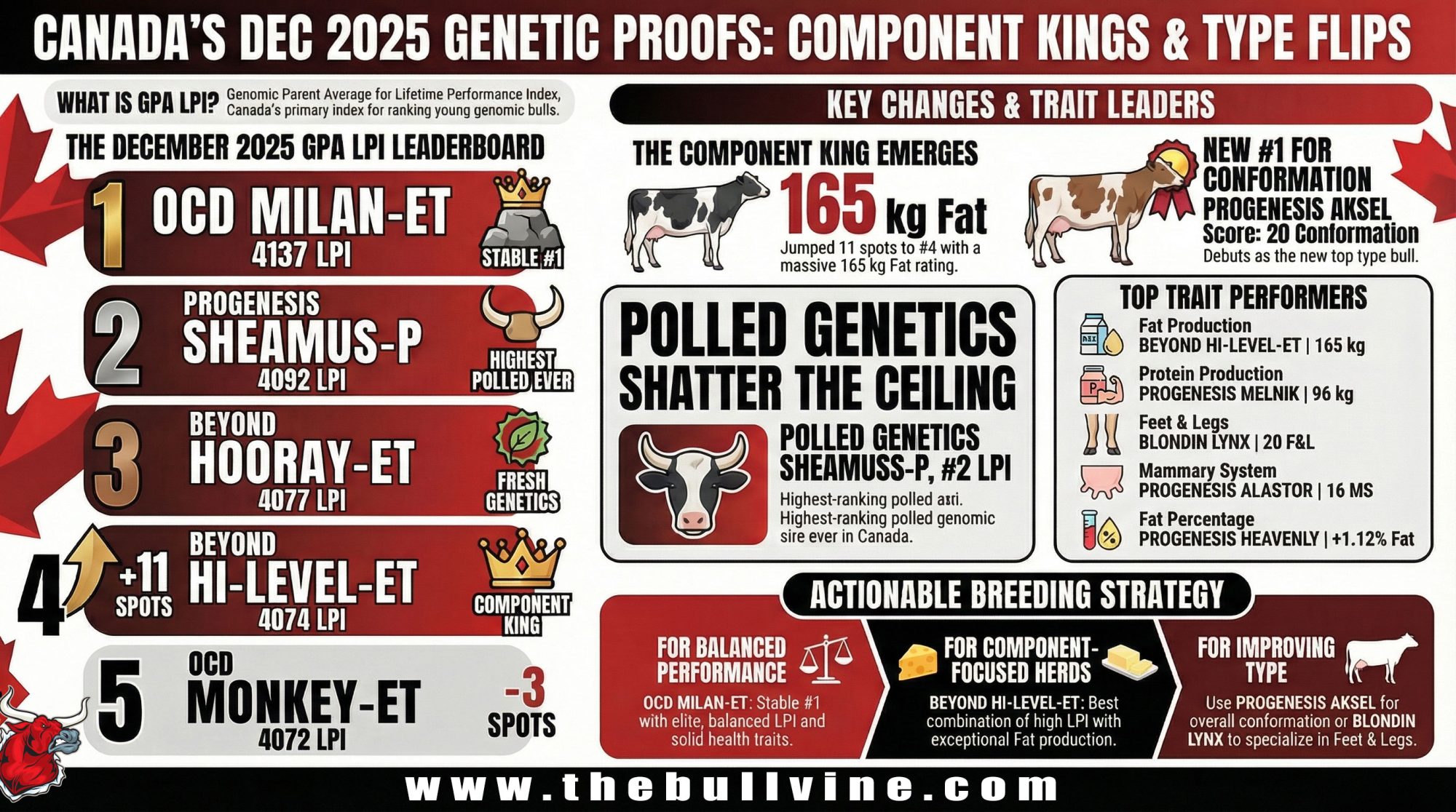
OCD MILAN-ET held his ground as the #1 LPI sire with a solid 19-point gain to 4137 LPI, but the real story belongs to his challengers—three newcomers who have rewritten the options for breeders.

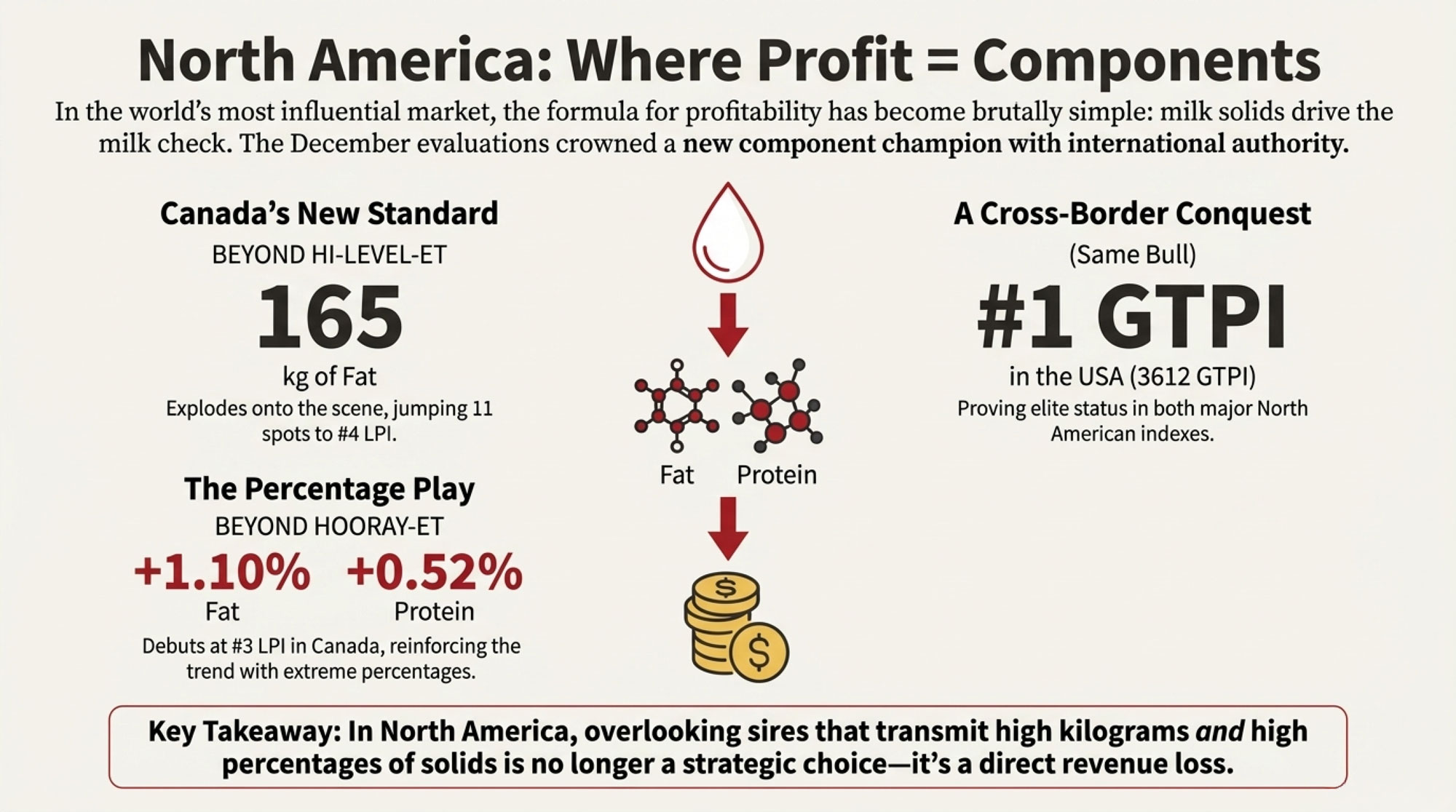
BEYOND HI-LEVEL-ET made the most explosive leap, jumping 11 spots to #4 LPI. His profile reads like a case study in modern profitability: 165 kg Fat on a high-volume base that proves elite milk volume and exceptional component density aren’t mutually exclusive. For breeders paid on component density, he’s become the gold standard.

Then there’s BEYOND HOORAY-ET, who debuted at #3 LPI and immediately established himself as the “percentage specialist.” With +1.10% Fat and +0.52% Protein, his profile is tailor-made for herds targeting premium milk quality.

Perhaps most significant: PROGENESIS SHEAMUS-P shattered the ceiling for polled genetics, debuting at #2 LPI. He’s the highest-ranking polled genomic sire in Canadian history—proof that breeders no longer have to sacrifice elite index performance to access the valuable polled trait.

Read more: 165 kg Fat, 11-Spot Jump, New #1 Type Bull: December 2025’s Canadian Proof Run Rewrites Your Breeding Plan

USA: The Genosource Era Begins

If Canada’s story is about newcomer diversity, the US narrative is about unprecedented consolidation.

Genosource has achieved a historic sweep, capturing 22 of the top 30 Net Merit positions. For context: this represents a 73% market share in the industry’s primary profitability index. That level of concentration is a double-edged sword. On one hand, it offers a clear path to proven, high-profit genetics backed by a program that has cracked the code on profitability. On the other hand, it severely narrows the available gene pool—and that’s a serious concern for long-term herd resilience.

GENOSOURCE RETROSPECT-ET continues his reign as the #1 NM bull at 1296, demonstrating the program’s mastery of the total economic merit formula. But the most explosive newcomer was SAN-DAN ON CALL-ET, who debuted at #3 GTPI with a production profile that demands attention: 1845 Milk and 151 Fat. The fact that he also earned a #9 NM ranking tells you his balanced genetics appeal across multiple profit drivers.

And confirming the component trend: BEYOND HI-LEVEL-ET claimed the #1 GTPI position in the US at 3612, underscoring his international elite status.

Read more: 22 of 30: Genosource’s Historic Sweep of the December 2025 US Holstein Genetic Evaluations

Europe: Bloodlines, Balance, and the Rise of Functional Genetics
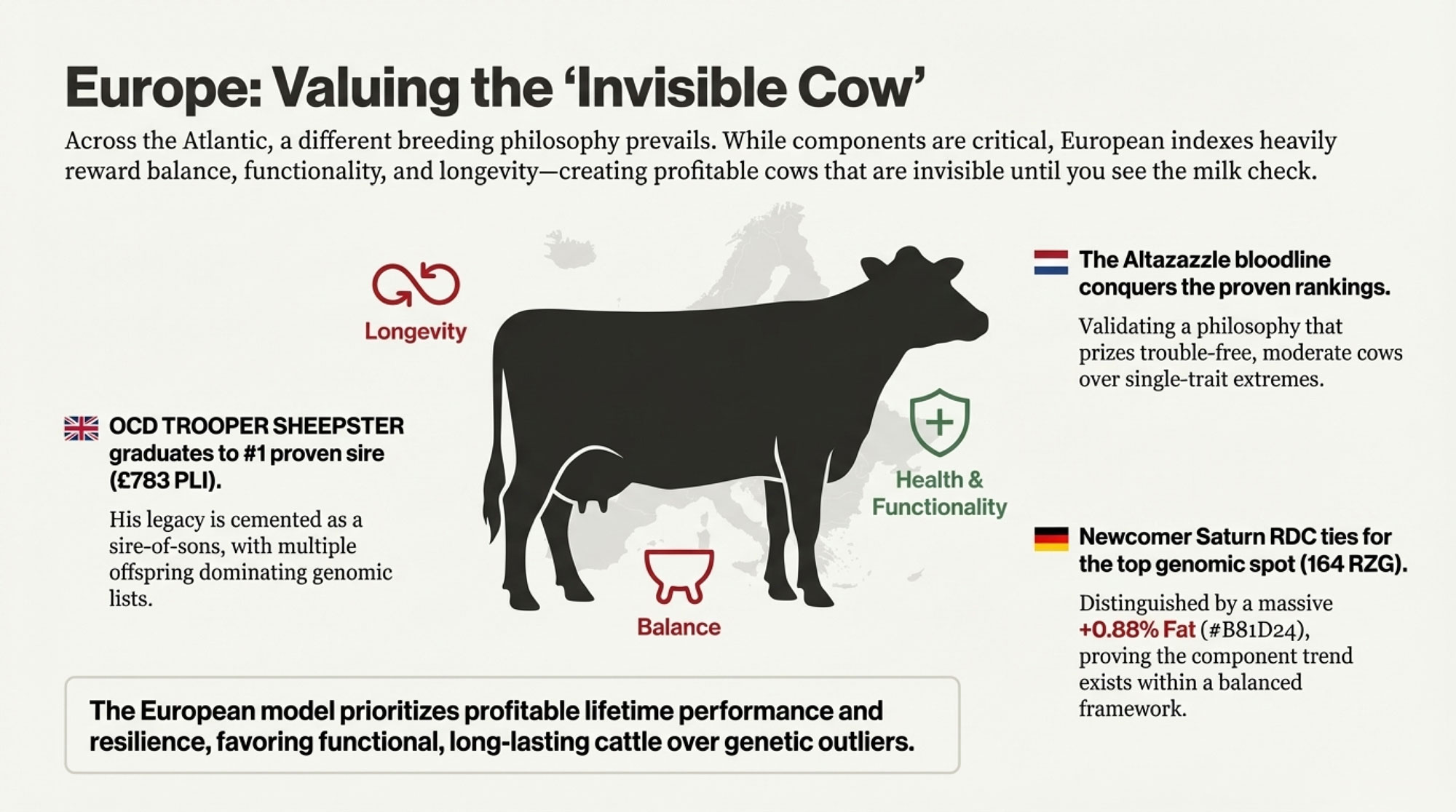
Europe’s evaluations revealed a shared philosophy: rewarding balanced, functional cattle designed to thrive in real-world commercial systems. While each country maintains its own index, a common theme emerged in the dominance of bloodlines that consistently deliver both profitability and longevity.

United Kingdom: Sheepster’s Legacy Reshapes the Breed

The new #1 genomic sire is DENOVO COYOTE P, with a PLI of £871. His profile is textbook modern British dairy: exceptional +0.30% fat, commercially valuable A2A2 status, and polled genetics.

But the more significant story belongs to OCD TROOPER SHEEPSTER, who graduated to #1 on the daughter-proven side with a £783 PLI. His true significance extends far beyond his own rank—he’s become a breed-shaping sire of sons. Multiple Sheepster offspring, including BADGER SIEMERS DAY TRIP (#2 genomic) and PROGENESIS PRESTON (#3 genomic), now dominate the young sire lists. This is the kind of bloodline dominance that builds lasting competitive advantage.

Read more: December 2025 UK Holstein Genetic Evaluations: Sheepster Claims Proven Crown, Homegrown Coyote P Debuts at Genomic #1

Netherlands: Shattering the +400 Barrier
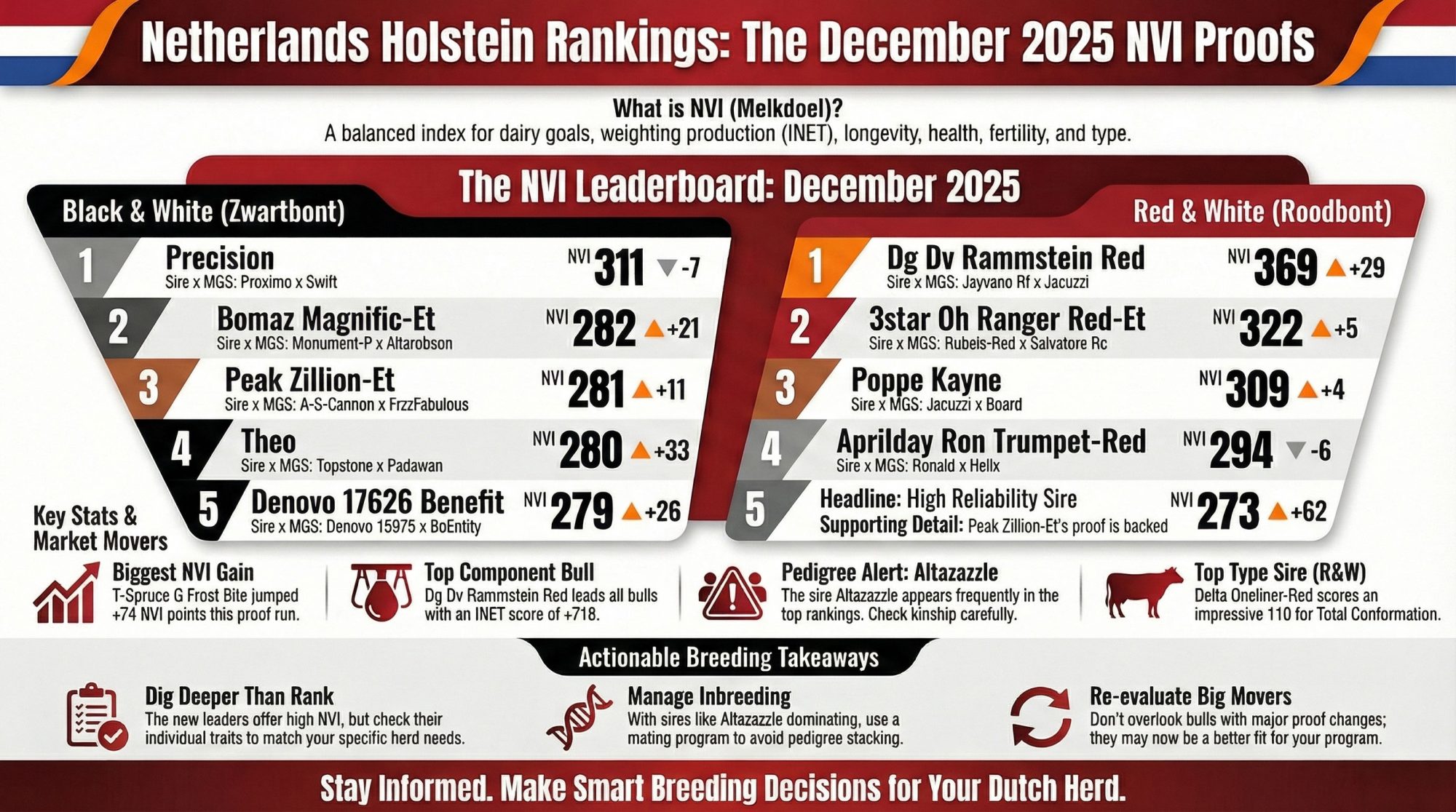
Genosource Moti rewrote the Dutch record books, becoming the first sire to lead the genomic rankings at a remarkable +420 NVI. This isn’t just a personal achievement—it signals that the ceiling for genetic progress continues to rise.

What’s truly revealing, however, is the absolute conquest of the Altazazzle bloodline in the proven rankings. This line claims four of the top ten positions—a clear market vote for what commercial dairies crave: the “invisible cow.” Moderate. Functional. Invisible until you look at the milk check. Their dominance validates a breeding philosophy that prioritizes trouble-free performance over extreme individual traits.

Read more: Genosource Moti Cracks +420 NVI: Inside the December 2025 Dutch Sire Shakeup

Germany: New Champions in Both Populations

For Black & White genomic sires, newcomer Saturn RDC tied for the top with the former leader, Veterano, at 164 RZG. Saturn RDC immediately distinguished himself with a massive +0.88% Fat—the component specialist phenotype that the market is rewarding globally.

The new Red & White genomic leader is Bueno Red at 161 RZG. He offers a rare combination: extreme milk production (+2,159 kg) paired with excellent type (121 RZE). This kind of balanced profile is increasingly valuable as European breeders recognize that extremes in single traits often create hidden costs elsewhere.

Read more: New King of NTM: VH Sheriff Debuts at +51 as Top Genomic Bulls Reshuffle -November 2025 German Sire Proof Central

The Volatility Report: When Genomic Promise Meets Reality

While some markets celebrated steady progress, Switzerland, Italy, and Scandinavia delivered a masterclass in genomic risk. In these countries, several reigning #1 sires experienced dramatic overnight index drops—a powerful reminder of why risk management matters in breeding programs.

Switzerland & Italy: The Reckoning for Unproven Genetics

In Switzerland, Sous-Moron Boston’s 52-point ISET drop (from +1645 to +1593) wasn’t an anomaly—it was the statistical consequence of reliability risk. Here’s the hard truth: a 75% reliable genomic proof means there’s a 25% chance the bull’s true genetic merit will differ significantly from his initial ranking. For Boston, that risk materialized in index drops that erased millions in projected genetic value overnight.

Read more: Swiss Shakeup: Monset (+1603) Claims ISET Crown as Boston Plummets 52 Points

Italy’s story was even more dramatic. The high-profile polled star KNO Ecuador P plummeted 98 gPFT points as more daughter data recalibrated his initial genomic promise. This is what happens when market enthusiasm outpaces actual proof of reliability.

With the deck reshuffled, Italy’s new international genomic leader is DENOVO LOCUST-ET, with a formidable gPFT of 5450.

Read more: Genosource Moti Cracks +420 NVI: Inside the December 2025 Dutch Sire Shakeup

Scandinavia: The Nordic Shakeup
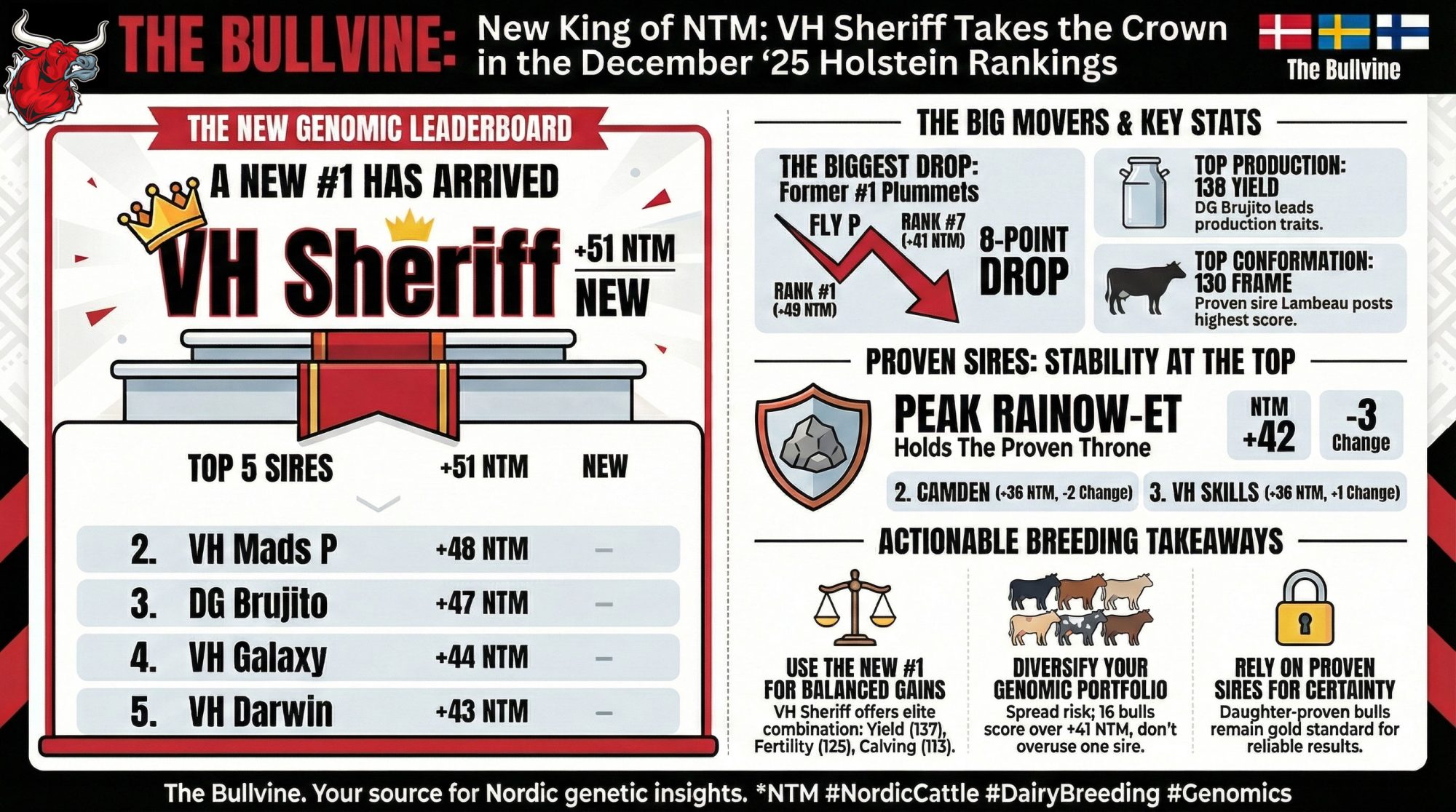
The Nordic Total Merit (NTM) index experienced its own dramatic power struggle. The former genomic leader, Fly P, experienced a precipitous 8-point drop from +49 NTM to +41 NTM—one of the sharpest single-round declines on record for a top bull.

His fall coincided with the spectacular debut of VH Sheriff, who entered the rankings at an exceptional +51 NTM. This contrast illustrates a critical principle: high-potential genomic projections and high-certainty proven results often tell different stories. On the proven sire list, PEAK RAINOW-ET held his position as the reliable leader at +42 NTM, providing a crucial stability anchor.

Read more: New King of NTM: VH Sheriff Debuts at +51 as Top Genomic Bulls Reshuffle -November 2025 German Sire Proof Central

Four Strategic Imperatives for Your 2026 Breeding Program

The December 2025 proofs delivered clear signals. Here’s how to act on them:

1. Embrace Volatility—and Manage It

The dramatic index drops of bulls like Boston, Ecuador P, and Fly P are the most important risk management lesson of this evaluation cycle. A chart-topping genomic proof is a powerful indicator of potential, but it’s not a guarantee of performance.

Action: Diversify your sire portfolio ruthlessly. Don’t concentrate more than 15-20% of your herd’s matings on any single unproven genomic bull, no matter how impressive his initial ranking. A team of high-quality young sires will always outperform a single superstar who fails to deliver.

2. Follow the Money: Components Drive the Milk Check

From Canada’s component specialists to Germany’s fat-specialists and Switzerland’s balanced bulls, the message is universal. Processor payments increasingly tie to milk solids. Component selection isn’t a nice-to-have anymore—it’s the direct path to higher revenue.

Action: Prioritize sires transmitting high kilograms AND high percentages of fat and protein. These specialists are your best tool for maximizing revenue per hundredweight.

3. Mind the Inbreeding Gap

The genetic concentration around Genosource in the US, the Gameday line in Switzerland, and the Altazazzle line in the Netherlands is a double-edged sword. Yes, these lines deliver elite results. But their dominance increases inbreeding risk in the broader population.

Action: Use mating programs to monitor and manage inbreeding coefficients. Protecting genetic diversity isn’t peripheral—it’s foundational for maintaining fertility, calf vigor, and long-term herd resilience. Be aware of the popular bloodlines and actively seek outcross options to balance your portfolio.

4. Proven Sires Remain Your Foundation

In an era of genomic volatility, the stability of high-reliability, daughter-proven sires is more valuable than ever. Leaders like OCD TROOPER SHEEPSTER in the UK and PEAK RAINOW-ET in Scandinavia provide the kind of anchor every breeding program needs.

Action: Allocate a meaningful portion of your matings to elite proven sires. Use them as a dependable risk-management tool to balance the high potential—but higher risk—of your genomic sire team. They’re not old news; they’re insurance against genomic volatility.

The Bottom Line

The December 2025 evaluations proved that Holstein genetics continues to evolve at a breathtaking pace. The ceiling for genetic progress keeps rising. New champions emerge. Old certainties crumble.

But here’s what shouldn’t change in your breeding strategy: disciplined risk management, relentless focus on the traits that drive profitability, and a balanced portfolio that combines proven reliability with genomic potential. The breeders who master this balance in 2026 will be the ones posting the highest milk checks and building the most resilient herds.

The genetic landscape has been reset. Now it’s time to update your playbook.

KEY TAKEAWAYS: 

  • Genomic promises just met reality: Switzerland’s #1 cratered 52 points. Italy’s polled star dropped 98. December proved that a 75% reliable proof carries 25% real risk—and millions in value can vanish overnight.
  • Components drive the milk check now: Fat and protein specialists dominated from Canada to Germany. Breeders ignoring solids aren’t just behind—they’re bleeding revenue.
  • Genosource owns 73% of America’s profit elite: Unprecedented consolidation delivers proven results, but shrinks the gene pool. Opportunity and inbreeding risk now travel together.
  • Diversify or pay the price: Cap any unproven genomic sire at 15-20% of matings. A balanced sire team always beats a single superstar who crashes.
  • Proven sires are your volatility hedge: Daughter-proven leaders like Sheepster and Peak Rainow deliver what genomic projections can’t—certainty.

EXECUTIVE SUMMARY: 

December’s reckoning separated the breeders who understand genomic risk from those who were chasing leaderboard hype. The bulls that cratered aren’t coming back. The bloodlines consolidating power aren’t slowing down. And the component premiums reshaping milk checks aren’t temporary. The question isn’t whether the genetic landscape has changed—it’s whether your breeding program has changed with it. August’s playbook is dead. What’s your 2026 strategy?

Join the Revolution!

Join over 30,000 successful dairy professionals who rely on Bullvine Weekly for their competitive edge. Delivered directly to your inbox each week, our exclusive industry insights help you make smarter decisions while saving precious hours every week. Never miss critical updates on milk production trends, breakthrough technologies, and profit-boosting strategies that top producers are already implementing. Subscribe now to transform your dairy operation’s efficiency and profitability—your future success is just one click away.

NewsSubscribe
First
Last
Consent

World Dairy Expo Day 4: 10-Year-Old Cow Stuns Industry with Second Grand Championship

What if your ‘old’ cows are actually your best cows? Yesterday’s WDE champion was 10 years old.

The colored shavings were still settling in the Coliseum when lightning struck twice yesterday afternoon. Not the kind that sends you running for cover, but the kind that makes 3,000 dairy farmers jump to their feet in disbelief.

Iroquois Acres Jong Cali
Grand Champion
International Brown Swiss Show 2025 World Dairy Expo
Brian Pacheco Kerman, CA

Iroquois Acres Jong Cali, a 10-year-old Brown Swiss in her seventh lactation, just claimed her second Grand Championship at World Dairy Expo. While most cows of her age are long retired, Cali’s still pumping out 60 kilos of milk daily and moving “like a three-year-old,” according to judge Allyn “Spud” Paulson.

The Partnership That Defied Geography

Here’s where yesterday’s story gets remarkable. Owner Brian Pacheco watched from the same spot where he stood during Cali’s first championship years ago—except he lives in California while Cali thrives 2,000 miles away in Canada.

“I knew early on if I’m going to hitch my saddle with somebody, he was the one,” Pacheco said of Callum, Cali’s caretaker. Their decade-long partnership, built on what Pacheco calls “honesty and integrity,” demonstrates that trust always prevails over proximity.

Callum’s hands shook slightly as he recalled the championship moment. “When I got pulled second, I’m like, I got to work extra hard here to try to get into first”. The traditional yodelers were singing, the pressure mounting. When judge Paulson finally shook his hand for the Grand Championship, Callum admitted: “I was pretty emotional, actually. It’s hard to explain the feeling”.

Wednesday’s Championship Roll Call

While Cali’s triumph dominated conversations, championships were decided across multiple rings yesterday :

International Brown Swiss Show (380+ head)

The morning started with cow classes that showcased unprecedented depth. Judge Paulson, mentored decades ago by Marty Simple when “Jades and Jetways were popular,” called it “truly amazing”. The four-year-old class alone had him and Associate Judge Brian experiencing “goosebumps.”

  • Grand Champion: Iroquois Acres Jong Cali (Brian Pacheco, Kerman, CA)
  • Reserve Grand: Robland Norwin Bermuda-ET (Tony Kohls/Goldfawn Farm)
  • Premier Sire: Hilltop Acres Daredevil (5th consecutive year for New Generation)
  • Premier Breeder: Jenlar Farm

International Red & White Show Heifer Classes

Wednesday afternoon saw the start of the International Red & White Show, with judge Adam Hodgins from Ontario placing the heifer classes. The quality was exceptional, with spring yearling Milksource Shay-Red-ET standing out from the crowd.

  • Junior Champion (Open Show): Milksource Shay-Red-ET (Architect), owned by Milk Source LLC & Jeremy Holthaus
  • Reserve Junior Champion: Ms Believe In Faith-Red-ET, owned by T & S Krohlow, William Schultz III, & Yvonne Preder

The Red & White cow classes continue this morning at 7:00 AM, with expectations running high after the quality displayed in yesterday’s heifer show. Several exhibitors mentioned the depth has never been stronger, with animals that would have won championships in previous years placing well down the line.

International Milking Shorthorn Show Heifer Classes

Lazy M Money Laundering-ET P
Junior Champion
International Milking Short Horn Show 2025 World Dairy Expo
Elizabeth Gunst & Jamie Gibbs Hartford, WI

Mike Maier and associate Josh Fairbanks spent Wednesday morning sorting through an impressive lineup of Milking Shorthorn heifers. The breed, experiencing a renaissance of sorts, showcased genetics that blend traditional characteristics with modern production demands.

  • Junior Champion (Open & Junior Show): Lazy M Money Laundering-ET P (Money), owned by Elizabeth Gunst & Jamie Gibbs
  • Reserve Junior Champion: Wincrest P Spring Special-EXP-ET, owned by Dylan & Cameron Ryan and Charlotte Wingert

The Milking Shorthorn cow classes resume this morning at 7:00 AM alongside the Red & Whites. Several longtime breeders noted yesterday that the heifer quality signals a bright future for the breed, with Money daughters, in particular, catching the judges’ eyes.

The Comeback Nobody Expected

Cali’s path to yesterday’s championship reads like dairy fiction. After being dry for an entire year while undergoing IVF treatments, she produced 58 quality embryos across three sessions.

“She got a little heavy because she was dry a long time,” Callum admitted. His worry peaked when she started bagging up this summer. Then came the miracle: “She didn’t have an issue. She didn’t even require a bottle of calcium”.

Now she’s bred back, potentially carrying her next generation while still dominating show rings. “It’s nothing fizzes her,” Callum said, describing how she transitions seamlessly from Canadian pastures to Madison’s spotlight.

The Genetics Revolution Nobody Saw Coming

Jake Hushen of New Generation Genetics couldn’t contain his excitement watching the winter calf class. “Seriously, Casey, like this is not when I was a kid. I mean, 30 was big. Now we’re at 60”.

New Generation dominated with 14 class winners from 10 different sires. But the real story was standing quietly beside them—Callise, a full-blooded embryo imported directly from Switzerland.

“Our goal is to expand the bloodlines by branching out with Europe,” Hushen explained. While genomics accelerates genetic progress, it can dangerously narrow the gene pool. This Swiss import program is their answer—bringing original genetics straight from the breed’s homeland.

The Quality Revolution

Brian Pacheco, wearing his hat as president of the Brown Swiss association, overheard the chatter that mattered. “In the past, there was five or six good cows. Now there’s 15 to 25 really good cows”.

This isn’t propaganda—it’s evolution. The breed has transformed from “more of just a show breed” to “an actual production breed,” Pacheco observed. Yesterday’s show proved it with Cali leading the charge—a cow that combines championship looks with 60-kilo daily production.

Judge Paulson faced the brutal side of this quality surge. “One of the toughest things,” he reflected, “looking somebody in the eye to put them 51st”. When state fair champions are placing in the twenties and thirties, excellence becomes relative.

The Human Moments That Mattered

Yesterday wasn’t just about genetics and milk production. It was about Spud Paulson honoring his mentor’s legacy while judging alongside his best friend, Brian, with whom he talks “almost every day” after midnight while hauling cattle.

It was about Callum taking that photo of Cali fresh after calving and watching people’s excitement build. About Brian Pacheco standing in his lucky spot, letting Callum’s expertise shine while his cow made history.

“You never know, maybe if things go right… we may be back next year,” Pacheco said with a grin. Someone mentioned another cow had just completed a three-peat. The possibility hung in the air like morning mist over Wisconsin pastures.

What Yesterday Means for Tomorrow

As crowds dispersed and exhibitors returned to evening chores, Wednesday’s lessons crystallized :

Age is an asset, not a liability, when genetics meet exceptional management. With replacement costs soaring and quality genetics scarce, Cali’s decade of productivity rewrites the culling playbook.

Distance dissolves with trust. The California-Canada partnership proves that in our connected world, expertise matters more than proximity.

Breed evolution accelerates. From 30 winter calves to 60, from show ring beauty to production powerhouse—the Brown Swiss transformation is real and remarkable. The Red & White and Milking Shorthorn shows demonstrated similar quality surges, with junior champions setting new standards.

Global genetics are local necessities. Importing Swiss embryos isn’t exotic—it’s essential for maintaining the genetic diversity that genomic threats pose.

The Bottom Line from the Colored Shavings

Yesterday at World Dairy Expo wasn’t just another Wednesday in October. It was the day a 10-year-old cow proved that longevity beats youth, trust beats contracts, and sometimes—just sometimes—lightning really does strike twice.

“It’s a feeling you just don’t soon forget,” Brian Pacheco said, and he’s right. Not because of the banner or trophy, but because yesterday reminded everyone why they fell in love with dairy cattle in the first place.

The champions have been crowned, the partnerships celebrated, and the genetics evaluated. But Cali’s story—backed by 60 kilos of daily milk and seven lactations of excellence—proves that in dairy’s modern era, the old rules no longer apply.

With Red & White and Milking Shorthorn cow classes continuing this morning, yesterday’s heifer champions have set the bar impossibly high. But if Wednesday taught us anything, it’s that impossible is just tomorrow’s baseline at World Dairy Expo.

Yesterday wasn’t just history. It was a prophecy.

Join the Revolution!

Join over 30,000 successful dairy professionals who rely on Bullvine Weekly for their competitive edge. Delivered directly to your inbox each week, our exclusive industry insights help you make smarter decisions while saving precious hours every week. Never miss critical updates on milk production trends, breakthrough technologies, and profit-boosting strategies that top producers are already implementing. Subscribe now to transform your dairy operation’s efficiency and profitability—your future success is just one click away.

NewsSubscribe
First
Last
Consent

When Less Becomes More: The Market Window Making Stocking Density Optimization Profitable

What if the best way to increase profits isn’t adding more cows, but giving the ones you have room to be comfortable?

EXECUTIVE SUMMARY: What farmers are discovering across dairy regions is that optimal stocking density often means fewer cows, not more. University of Florida research shows that a 120% stocking density maximizes profit per stall, yet many operations run at 140% or higher, resulting in a daily loss of 3.7 pounds of milk per cow for each hour of lying time. With current market conditions creating the perfect window—USDA cull cow prices at $311.16/hundredweight and replacement costs jumping 73% to $2,850 per heifer—strategic density reduction makes financial sense like never before. Operations were reduced from 140% to 115% stocking, resulting in a 3.5-pound increase in milk per cow daily, 40% fewer lameness treatments, and improved feed efficiency within 60 days. Research from institutions like UBC, Wisconsin, and the Miner Institute consistently shows that cow comfort drives profitability more than maximizing headcount. For producers willing to challenge conventional thinking, current market dynamics offer an unprecedented opportunity to optimize both animal welfare and bottom-line performance.

dairy profit per stall

You know what’s interesting? Last month, I was talking with a producer in Ohio who mentioned something that really got me thinking. He’d increased his milk checks by reducing his herd by 120 cows. Sounds backward, right? However, as I’ve been traveling to different operations lately—from the robot barns I’ve visited in the Netherlands to traditional parlor operations across the upper Midwest—I keep hearing variations of the same story.

The old “more cows equals more profit” thinking might be costing us money. Especially right now, with market conditions creating what could be the perfect window to test some assumptions we’ve held for years. Between high cull cow prices, expensive replacement heifers, and relatively steady milk prices, it’s worth asking whether we’re actually maximizing what our barns can do.

What the Research Actually Shows About Overcrowding

The university data on this subject has been accumulating for years, and it’s quite eye-opening when you put it all together. Dr. Julie Fregonesi’s groundbreaking work at the University of British Columbia—published in the Journal of Dairy Science back in 2007—showed that cows at 100% stocking density were getting about 13 hours of lying time per day. Push that to 150%? They lose nearly two full hours of rest.

Find Your Herd’s Sweet Spot – Yield per cow is highest at 120% density. This chart proves why optimizing—not maximizing—stocking is the smart play in 2025. Are you in the profit zone, or running on lost potential?

That lost lying time translates directly to lost milk because cows can’t “catch up” on rest later—something we’ve learned the hard way in other contexts, too. The follow-up research has been consistent: farms operating above 100% density consistently struggle to hit the 12-hour lying time benchmark, while about 22% of farms at or below 100% achieve it.

You know what’s interesting? when I first heard about it from Dr. Rick Grant’s research team at the William H. Miner Agricultural Research Institute in New York was that Overcrowding can actually trigger more subacute ruminal acidosis than dietary changes alone. Cows at 142% density were spending over four hours per day below pH 5.8—nearly double the time compared to cows at 100% density, eating the exact same diet.

We are creating metabolic problems through poor space management. That’s something to consider, especially when we’re already pushing ration formulations to their limits in many operations.

Albert De Vries at the University of Florida has conducted some excellent work in quantifying the relationship between lying time and milk production. His research, presented at the Western Canadian Dairy Seminar, shows that for each hour of reduced lying time, approximately 3.7 pounds of milk are lost daily. When he runs those numbers through profit calculators, optimal stocking densities consistently fall between 100% and 120%, with returns dropping off sharply when pushed higher.

Examining this trend across various systems, the Dairyland Initiative in Wisconsin has documented similar lying time losses in both sand-bedded and mattress systems when stocking density exceeds 120%. Even with the newer precision monitoring technologies—such as rumination sensors, activity monitors, and automated health tracking—the fundamental relationship between space and comfort remains true.

Understanding Why Good Producers Still Overstock

Now, if the research is this clear, why are so many well-managed operations still running at 140% or higher utilization rates? It’s not just about missing the data—the reasons go much deeper.

First, there’s the infrastructure reality that many of us face. Most barns were designed for maximum capacity, and when you’ve invested heavily in facilities designed to house a certain number of cows, suggesting that “too many” might be counterproductive feels like questioning fundamental business decisions. That’s psychologically difficult territory.

Then there’s cash flow, which is where theory meets reality pretty quickly. Even when long-term modeling shows better returns at optimal density, culling excess cows creates an immediate revenue drop that many operations cannot absorb, regardless of the projections.

I’ve also noticed there’s peer pressure to consider. When neighboring operations are running at 140-150% density, stepping back feels risky from a community perspective. Nobody wants to appear unsuccessful or overly conservative—especially in regions where dairy farming is highly visible and competitive.

And here’s something that often comes up in many conversations: many excellent producers believe they can “manage out” the downsides of overcrowding. They believe that enhanced feeding programs, improved ventilation, or facility modifications can help overcome space constraints. This confidence in solving problems through superior management encourages them to push more animals into available stalls.

This mindset is particularly strong in high land-cost areas. Whether you’re in California’s Central Valley, Pennsylvania’s Lancaster County, or parts of the Northeast, producers feel tremendous pressure to maximize every square foot. The economics of land acquisition make expansion seem impossible, so intensification appears to be the only path forward.

Current Market Dynamics Create an Unusual Opportunity

What makes this discussion particularly timely is how market conditions have aligned to make density optimization more financially attractive than it’s been in recent memory.

Cull cow values are at levels that would have seemed impossible just a few years ago. The USDA’s September 19th Direct Cow Report showed average negotiated prices for Cutter cows at $311.16 per hundredweight dressed weight—that translates to about $1,830 per 1,200-pound cow. Compared to recent years, that’s a substantial improvement, creating a meaningful buffer for strategic culling decisions.

2025: The Year Everything Changed for Density Decisions – When cull values, heifer costs, and milk prices all peak together, old paradigms don’t work. Are you seizing this market window or letting inertia win?

Meanwhile, replacement heifer costs have reached a territory that’s frankly shocking to those of us who remember more moderate pricing. Wisconsin data from the USDA show that replacement dairy animal costs increased by 73% between October 2023 and October 2024, rising from approximately $1,990 to $ 2,850 per head. That’s an $860 increase in a single year.

Mike North from Ever.ag captured the reality pretty bluntly back in January when replacement prices were spiking: “Some animals moving in the northwest last week were north of $4,000 an animal. That’s a pretty tall price.” When replacement costs jump that dramatically, the economics of keeping marginal performers shift significantly.

As for milk prices, they’ve held their ground better than many expected despite production increases. While Class III futures remain volatile, current market stability means each additional pound of milk from enhanced cow comfort has meaningful value.

And there’s this whole beef-on-dairy opportunity that’s really taken off in recent years. Those crossbred calves are now fetching $800 to $ 1,000 per head at auction, creating revenue streams that weren’t widely available even five years ago.

This creates an interesting situation where the financial risks of density optimization are probably lower than they’ve been in years, while the potential benefits remain substantial.

Learning From Real Transitions: A Composite Example

Let me share a situation that really opened my eyes to how this plays out in practice. I’ve been following several operations through density transitions, and while I need to keep specific details confidential, the patterns are worth discussing as a composite example.

There’s a 1,200-cow freestall setup—representative of what I’ve seen in similar Wisconsin operations—that had been running at 140% stocking density. The management team spent two full seasons trying to work around the resulting problems. These weren’t inexperienced managers—they doubled feed push-ups, added extra fans, switched to higher-fiber rations. All the sophisticated approaches you’d expect from people who know what they’re doing.

Despite these efforts, their key performance indicators remained problematic. Lying time stayed stuck around 10 hours per day, well below that critical 12-hour target. Monthly lameness treatments were affecting 18% of the herd. Per-cow milk production had plateaued at 85 pounds, and mastitis cases weren’t responding to improved protocols.

In fall 2024, they made what felt like a risky decision: cull 10% of their herd—120 animals—bringing stocking density down to 115%. The selection process was entirely data-driven, utilizing their DairyComp 305 system to target animals with below-average performance, elevated somatic cell counts, poor reproductive efficiency, high lameness scores, and older cows with declining feed conversion efficiency.

The timeline of results was fascinating to watch. Lying time started improving within three weeks, initially increasing from 10 to 11.2 hours, and then reaching 12.4 hours by the end of week six. Milk yield improvements followed a similar gradual pattern, resulting in a 3.5-pound daily increase by the 60-day mark. Monthly lameness treatments fell by 40% over the same period, and bulk tank somatic cell count dropped by 50,000 cells per milliliter.

“We kept waiting for the negative impact on our milk check,” the farm manager told me during a follow-up conversation. “Instead, we were hitting volume records with 120 fewer cows. Feed efficiency improved, vet bills dropped, and the cows just looked more comfortable walking through the barn.”

What’s particularly noteworthy is that this wasn’t a high-tech operation with comprehensive monitoring systems. They were using basic activity monitors and visual assessments twice daily. The improvements were obvious to anyone walking through the facility.

Navigating the Transition Successfully

From what I’ve learned, talking with farms going through this type of transition, timing and approach matter more than most of us initially think. The biggest challenge isn’t the concept—it’s the execution.

Treating density optimization as a one-time event creates chaos. Removing 25% of your herd at once disrupts everything: you get downstream overcrowding in other groups, disrupted milking schedules, labor cost spikes, and often a panic response that undoes potential gains.

The farms that seem to navigate this transition smoothest tend to reduce density in 5% monthly increments. For a 1,200-cow operation, that means about 60 animals per month—manageable from both a systems and cash flow perspective.

The Bullvine Blueprint: From Chaos to Cash – Transform guesswork into precise, profitable action with this evidence-based process. See how incremental steps and real-time monitoring drive lasting success for modern dairies.

Start by mapping every group with your herd management software. Look at actual stocking percentages across lactating, fresh, transition, dry, and heifer pens. Target the most overcrowded groups first—usually fresh pens or peak-milk groups where stress costs are highest and most measurable.

As you cull from lactating pens, coordination becomes critical. You need to coordinate movements between groups to maintain optimal density across all pens simultaneously. I’ve seen farms reduce lactating cow density only to create problems in their dry cow areas because they forgot to rebalance the entire system.

Monitor weekly metrics religiously during transition periods. Track lying time, per-cow milk yield, somatic cell counts, and lameness treatments. If any metric stalls or reverses, pause further culling and investigate what’s happening before proceeding.

Timing considerations vary significantly by operation type. If you’re dealing with seasonal calving patterns—something we see more often now as farms explore different breeding strategies—major culling decisions might need to wait until after the fresh cow rush subsides. Summer heat stress can also complicate density assessment, since cows naturally spend less time lying during peak heat periods.

Recognizing System Differences and Global Approaches

What works for freestall operations doesn’t necessarily translate to other housing systems, and that’s worth acknowledging upfront. Tie-stall operations—still common in parts of Vermont, eastern Canada, and much of Europe—face entirely different challenges. You can’t really overstock individual stalls, but you can overstock feed alleys, holding areas, and exercise lots.

Robotic milking systems create entirely different dynamics. Since cows aren’t competing for parlor access at specific times, some operations successfully maintain higher densities. However, even in robotic systems, access to lying space and feed bunk remains a fundamental factor affecting cow comfort and production. The precision feeding capabilities of some newer robotic systems may provide more flexibility to compensate for tighter spaces, although the fundamental physiology of rest requirements remains unchanged.

What farmers are finding in grazing operations is their own set of variables to consider. Pasture-based systems can use rotational patterns to manage effective stocking density, moving cattle more frequently to maintain grass quality while providing adequate space. Some progressive grazing operations in New Zealand and Ireland have found that slightly understocking paddocks during peak growing season actually improves both grass utilization and animal performance.

Dry lot systems in the Southwest present yet another scenario. Heat stress management becomes the primary concern, and shade space often becomes the limiting factor rather than lying area. The stocking density calculations that work in climate-controlled barns need significant modification for these environments, where heat abatement infrastructure becomes as critical as resting space.

Developing Better Measurement Systems

Changing organizational thinking from headcount to performance requires different metrics and consistent communication approaches. The most successful operations I’ve worked with develop comprehensive tracking systems that focus on dollars per stall rather than just cows per stall.

This involves tracking milk revenue per stall (price × average yield), feed cost per stall (total feed expense ÷ number of stalls in use), health expense per stall (vet and treatment costs ÷ number of stalls), and comprehensive profit per stall calculations.

Weekly reporting on comfort and health indicators provides tangible evidence of improvement during transitions. Monitor average daily lying time (activity monitors make this much easier now), monthly lameness treatments per 100 cows, bulk tank somatic cell count trends, and feed conversion efficiency measures.

When you can demonstrate incremental profit from each 5% density reduction through projected milk revenue, cull cow returns, and saved health costs, the business case becomes much clearer. Most existing farm management software packages can model different scenarios before implementation. The University of Wisconsin Extension has developed some particularly useful spreadsheet tools for economic modeling of stocking density decisions. Their publication, “Getting Stocking Density Right for Your Cows,” walks through the calculations step by step.

Your extension dairy specialist or consultant can often help with this type of analysis if you’re not comfortable with the modeling yourself. Some farms have found it helpful to create visual representations showing relationships between stocking density and key performance indicators.

Industry Evolution or Competitive Advantage?

While research clearly supports optimal stocking strategies, widespread adoption remains limited. From an industry perspective, this creates interesting questions about where we’re headed.

Change happens slowly because success metrics still emphasize headcount and growth in herd size. Infrastructure designed for maximum capacity represents a 15-20 year commitment that is difficult to modify. Information transfer from research institutions to practical application takes time, and risk perception generally favors known approaches over projected improvements.

But this also means density optimization currently represents a potential competitive advantage for operations willing to challenge conventional approaches. Early adopters are achieving measurable improvements in per-animal productivity, health cost management, feed conversion efficiency, and overall profitability per unit of facility investment.

As Albert De Vries found in his economic analysis published in Dairy Herd Management, “120% was the optimal stocking rate in terms of maximum profit per stall.” The research consistently supports this, yet many well-managed operations continue to push well beyond this threshold.

I suspect we’ll see this transition happen at different rates regionally. High-cost areas with environmental restrictions on expansion will likely lead to adoption, simply because maximizing efficiency per animal becomes more critical when growth options are limited. Traditional dairy regions with more flexibility might take longer to embrace these approaches.

What’s particularly interesting is how this parallels broader trends we’re seeing in precision agriculture—such as variable-rate fertilizer application in crops, GPS-guided field operations, and sensor-based irrigation management. Whether you’re talking about optimizing inputs per unit in crops or strategic stocking density in dairy, the underlying principle is similar: better often beats bigger.

When Higher Density Makes Sense

Now, I’m not suggesting this approach works for everyone—dairy operations are too diverse for one-size-fits-all solutions. Some operations successfully maintain higher densities because of superior facility design, exceptional management systems, or specific operational circumstances.

Newer facilities with excellent stall design, generous bunk space, and comprehensive ventilation systems often handle stocking levels of 130-140% without major performance compromises. I’ve visited operations with 4-inch sand beds, 30-inch feed alleys per cow, and extensive cooling systems that maintain good lying times even at elevated densities.

Operations with exceptional feed management—precise timing, frequent push-ups, consistently well-mixed rations—can often compensate for tighter bunk space per cow. Some farms employ specialized feeding strategies or additives that enable animals to consume an adequate amount of dry matter despite reduced bunk access time.

Your nutritionist and veterinarian know your operation better than anyone, so their input on facility capabilities and management systems becomes crucial in these decisions. They can help you evaluate whether your specific situation might allow for higher stocking rates while maintaining performance.

The key is an honest assessment of your specific situation. Suppose you’re consistently achieving 12+ hours of lying time, maintaining low lameness rates, and seeing strong per-cow production at higher densities. In that case, you might have the management systems and facilities to make elevated stocking rates work profitably.

However, if you’re seeing stress indicators—such as elevated somatic cell counts, lameness problems, poor body condition scores, and reproductive challenges—it’s worth questioning whether current stocking rates are actually maximizing long-term profitability.

Practical Next Steps and Available Resources

Current market conditions create what might be an unprecedented opportunity to test density optimization approaches with relatively limited downside risk. High cull cow prices provide attractive exit values, expensive replacements make retention of marginal performers costly, and stable milk prices support per-cow productivity investments.

Start with a comprehensive assessment. Calculate current stocking density across all cow groups—your milking system software probably tracks this, but if not, it’s simply the number of cows divided by available stalls or resting spaces. Evaluate lying time through visual observation or activity monitors if available. Review health costs and per-cow performance metrics over the past 12 months.

Model financial scenarios for various density targets. Most farm management software packages include modules for this type of analysis. The University of Wisconsin Extension publication “Crowding Your Cows Too Much Costs You Cash” provides detailed economic frameworks for these decisions. Cornell’s PRO-DAIRY program offers similar resources through its extension publications.

For implementation, begin with the most overcrowded groups showing the clearest stress indicators. Plan gradual reductions rather than dramatic changes. Coordinate closely with your nutritionist and veterinarian to maximize benefits from improved cow comfort.

Some operations are finding that investing in improved stall design, enhanced bedding systems, or better ventilation provides better returns than simply adding more cows. The question becomes: what’s the best use of your next capital investment?

Consider seasonal timing as well. Spring transitions might align well with natural culling cycles, while summer heat stress periods might not be ideal for major management changes that could temporarily disrupt routine.

Questions to Ask Your Team

Before making any major changes to stocking density, it’s worth having some honest conversations with your management team:

  • Are we consistently achieving target lying times across all groups?
  • What’s our current lameness rate, and how does it compare to industry benchmarks?
  • How do our per-cow productivity metrics compare to similar operations?
  • What would happen to our cash flow if we reduced cow numbers by 10% over six months?
  • Do we have the feed management and facility infrastructure to support current density levels?
  • What are our biggest bottlenecks during peak times (breeding, fresh cow management, transition periods)?

These conversations often reveal insights that pure data analysis might miss. Your team members—whether that’s family, employees, or advisors—see things from different perspectives that can help inform these decisions.

The Broader Industry Context

Between what the research tells us and current market conditions, it’s an interesting time to be asking these fundamental questions about dairy operation design. The farms willing to question conventional assumptions about stocking density may find themselves with sustainable competitive advantages in an increasingly challenging industry environment.

From conversations with farmers and their advisors across different regions—from progressive operations in the Netherlands to family farms in Wisconsin to large-scale Western dairies—it appears that we’re gradually shifting our perspective on dairy productivity. Instead of focusing solely on total milk shipped, the most profitable operations are optimizing milk per stall, margin per cow, and return on facility investment.

The research is compelling, market conditions are supportive, and implementation tools are available. The question becomes whether individual operations are ready to challenge the “more is always better” mindset that’s influenced dairy management thinking for the past generation.

It’ll be interesting to see how this trend develops—whether it accelerates as more farms demonstrate results, or whether we see regional variations based on land costs, environmental regulations, and local farming cultures. International perspectives add another layer of complexity, as European tie-stall systems, New Zealand grazing operations, and North American confinement facilities all face different constraints and opportunities.

Either way, it’s a conversation worth having with your team, your advisors, and, honestly, with your cows. Because at the end of the day, comfortable cows are profitable cows—and sometimes that means giving them a little more room to be comfortable.

KEY TAKEAWAYS

  • Quantified comfort pays: Reducing stocking density from 140% to 115% typically increases milk production by 3.5 pounds per cow daily while cutting lameness treatments by 40% within two months—improvements that translate to measurable profit gains per stall.
  • Market timing creates opportunity: With cull cow values at historic highs ($1,830 per head) and replacement costs at $2,850, strategic culling in 5% monthly increments allows cash flow-positive transitions to optimal density levels.
  • Research-backed sweet spot: University studies consistently show 120% stocking density maximizes profit per stall, as cows lose 3.7 pounds of daily milk production for each hour of lying time below the critical 12-hour threshold.
  • System flexibility matters: While freestall operations benefit most from density optimization, robotic milking systems, grazing operations, and tie-stall facilities each require tailored approaches based on facility design and management capabilities.
  • Implementation success depends on a gradual transition: farms achieving the best results reduce density in manageable increments while rebalancing all cow groups simultaneously, using weekly metrics to track lying time, milk yield, and health indicators throughout the process.

Complete references and supporting documentation are available upon request by contacting the editorial team at editor@thebullvine.com.

Learn More:

Join the Revolution!

Join over 30,000 successful dairy professionals who rely on Bullvine Weekly for their competitive edge. Delivered directly to your inbox each week, our exclusive industry insights help you make smarter decisions while saving precious hours every week. Never miss critical updates on milk production trends, breakthrough technologies, and profit-boosting strategies that top producers are already implementing. Subscribe now to transform your dairy operation’s efficiency and profitability—your future success is just one click away.
NewsSubscribe
First
Last
Consent

How Health, Product Science, and Technology Will Drive the Future of Dairy Farming and Boost Your Profits

Learn how health trends, product science, and technology can transform dairy farming and increase your profits. Ready to innovate and grow?

Staying ahead in a continuously changing sector is not only desirable; it is also necessary for existence. Today’s keywords include health, product science, and technology. These aspects are more than just trends; they represent the foundation of future dairy innovation and sales success. Innovation is critical to being relevant and thriving in the ever-changing dairy farming industry. Let’s explore how prioritizing health and well-being, using advanced product science, and implementing cutting-edge technology may transform your operations. More importantly, we’ll share honest insights and concrete suggestions to help you keep up with the market and lead the way, increasing your sales and market competitiveness.

The Health and Wellness Revolution 

It is no surprise that today’s customers are more health-conscious than ever. As people become more aware of the advantages of healthy eating, the demand for nutritious dairy products is increasing significantly. People want palatable milk with nutrients, probiotics, and organic certificates. In fact, according to a recent market research analysis, the health-focused dairy industry is expected to increase at an impressive 6.5% per year over the next five years.

So, how can dairy producers capitalize on the current surge in consumer demand? The answer lies in adopting creative approaches that enhance the nutritional profile of their products. For instance, some farmers incorporate specific probiotic strains into their milk production process, such as Lactobacillus acidophilus or Bifidobacterium lactis, known for improving consumers’ gut health. Others invest in specific organic farming practices, like rotational grazing or composting, to ensure their milk is free from industrial chemicals and antibiotics. These specific innovative approaches meet consumer demands and inspire a new wave of dairy production.

Clement Gervais, a forward-thinking DFA farmer-owner from Vermont, is taking part in an experiment with Agolin to minimize carbon emissions from cows using an essential oil feed additive. “We’re seeing healthier cows with better feed efficiency,” Gervais joyfully states. This benefits both sustainability and the production of better milk.

Furthermore, industry leaders such as Scott Vieth, a renowned dairy farmer from Texas with over 20 years of experience, are making progress with sustainable solutions. Vieth developed a dung scraper and separator system to repurpose composted manure as bedding for cows, resulting in better living conditions and healthier animals. When implemented by experienced and respected figures like Vieth, these techniques improve both animal welfare and dairy quality, setting a benchmark for the industry.

As more consumers show interest in the origins of their food, farmer-led storytelling is emerging as a powerful tool. By sharing their success stories and the visible benefits of their innovative techniques, farmers can strengthen their relationships with clients and increase sales. It’s not just about making money; it’s about building a sustainable future where health and well-being drive the business forward. This approach empowers farmers and fosters a sense of connection with their customers.

Product Science: The Backbone of Innovation 

Product science is critical in the continually expanding dairy farming industry. But what precisely does the term “product science” entail in this context? It means using scientific concepts and procedures to create and enhance dairy products. This includes nutritional profiling, taste improvement, texture alteration, and shelf life extension.

Recent advances in dairy product creation are nothing short of revolutionary. Consider the advent of lactose-free milk and dairy substitutes to meet the increased demand from lactose-intolerant customers. And then there’s precision fermentation technology, a game-changer that allows for producing high-quality dairy proteins without the need for conventional cattle rearing. This technology opens up a world of possibilities. It underscores the potential for a more sustainable and forward-thinking dairy industry.

Investing in product science provides various advantages to dairy producers. Increased product quality and diversity match customer needs, increasing market pricing. Farmers may improve productivity and sustainability by incorporating scientific knowledge into their agricultural methods. This, in turn, may lead to less waste and fewer environmental consequences, benefiting producers and consumers. This potential for increased market pricing and improved productivity should inspire hope and motivation in dairy farmers.

Consider the popularity of Greek yogurt, which has surged due to technological advances in fermenting techniques. Another prominent example is the introduction of high-protein dairy products targeted at fitness enthusiasts, which has established a new market niche and fueled sales growth. This potential for increased sales growth should motivate and inspire dairy farmers to embrace product science and technology. 

Adopting product science enables dairy farmers to continually innovate, adapt to changing customer demands, and maintain their enterprises in a competitive market. The future of dairy farming depends on efficiently leveraging these scientific advances.

Tech-Driven Dairy: The Future is Now! 

Consider a future in which every component of dairy production is optimized for optimum efficiency and profitability. Thanks to cutting-edge technology, this is not a faraway fantasy; it is occurring now.

Automation, artificial intelligence, and data analytics are changing dairy production. Automated milking systems, for example, minimize labor expenses while improving cow health by maintaining constant milking schedules. This technology allows farmers to concentrate on more important responsibilities, such as animal care and business management.

Artificial intelligence (AI) is another major changer. AI systems can anticipate anything from milk yields to disease outbreaks, allowing farmers to make more educated choices. For example, sensors installed on cows can check their health in real-time. These sensors gather information on characteristics such as heart rate, temperature, and activity levels. These are then evaluated to identify early indications of sickness. This preventive technique may help farmers save money on veterinary fees while increasing overall herd production.

Data analytics takes it one step further. Comprehensive data systems enable farmers to monitor every aspect of their operations, from feed efficiency to water use. Farmers may use this data to detect patterns and trends, allowing them to make better business choices. According to research published in the Journal of Dairy Science, farms that used predictive data analytics increased milk output by up to 20% [Journal of Dairy Science].

So, what is preventing you from embracing these disruptive technologies? The future of dairy farming is here, and it is more efficient, lucrative, and sustainable than ever before.

Drive Your Dairy Farm Forward: Embrace Health, Science, and Technology for Success 

The dairy sector is undergoing a paradigm transformation driven by health and wellness trends, scientific advances, and ground-breaking innovations. Did you know that customer demand for health-conscious dairy products is increasing? Organic milk sales and other organic dairy products have increased by more than 6% yearly [Statista]. This increase mirrors a more significant consumer trend toward healthier lives, emphasizing the potential benefits for dairy producers who can accommodate these changing demands.

The advantages of technology are just as compelling. Consider automated milking systems as one example. Farmers using modern milking methods may increase production by up to 30%. Furthermore, feed optimization software may improve feed efficiency, increasing net earnings by up to 15%. These numbers demonstrate the significant economic advantages of technological breakthroughs beyond improving milk supply.

Farmers like AJ De Jager in Colorado have already taken advantage of these changes. He promotes sustainability by feeding his herd recycled food like carrots and sugar beets and using low-cost nutrition alternatives. Other farmers like Scott Vieth in Texas have reaped economic gains from technology, such as dung scrapers and separators. These methods enable the recycling of composted manure, which may be used as cow bedding or sold as fertilizer, resulting in extra income streams.

The message is clear:

  • Aligning with health and wellness trends.
  • Utilizing product research.
  • Implementing new technologies fulfills customer wants while driving significant economic rewards.

Are you prepared to innovate and take your dairy farm into the future?

Optimize Every Facet: Beyond Just Producing More Milk 

Increasing dairy income involves producing more milk and maximizing every aspect of your farm. Combining health, product science, and cutting-edge technology can improve your cows’ health while reaping considerable financial benefits.

  • A Holistic Approach to Health.
    Consider this: healthy cows are more productive cows. Improving the living conditions of your herd might result in better milk output. Clement Gervais, a DFA farmer in Vermont, has seen results from employing Agolin’s feed additive to lower his cows’ carbon emissions. Healthier cows result in lower vet expenditures and more milk output, paving the way for enhanced income.
  • Leveraging Product Science
    Product science is the foundation of dairy innovation. For example, Scott Vieth in Texas set up a manure scraper and separator to recycle composted manure. This resulted in lower bedding costs and an extra income stream from selling compost as fertilizer. These product science-based innovations enhance efficiency and provide new revenue streams.
  • Accepting Technology
    We have reached an age in which technology has the potential to revolutionize dairy production fundamentally. AJ De Jager in Colorado has embraced recycled food as cow fodder, lowering feed costs while maintaining high output levels. Advanced technology, such as water recycling systems, saves resources and reduces operating costs, enabling farmers to reinvest the savings in other farm innovations.
  • Financial Benefits
    Integrating health, science, and technology into your dairy business provides significant financial benefits. Healthier cows result in more output and lower medical expenditures. Science-based innovations increase efficiency and provide new income streams, while technology lowers operating costs and resource usage.
  • Real-world examples of Increased Profit
    A lack of connectivity between these components might restrict your farm’s potential. However, following the example of farmers such as Gervais, Vieth, and De Jager demonstrates the concrete advantages. Gervais’ approach to essential oils in feed has decreased emissions and increased cow health, Vieth’s manure recycling system has lowered expenses and generated new income, and De Jager’s sustainable feeding methods have kept feed prices low while increasing output.

Integrating these ideas significantly improves your farm’s profitability and sustainability. Are you prepared to transform your dairy farm?

Challenges on the Path to Innovation: Overcoming Hurdles in the Dairy Industry 

Embracing innovative health practices, cutting-edge technology, and unique product science is unquestionably exciting but also presents obstacles. So, what are the probable obstacles, and how can you overcome them?

Initial Costs and Investment: One of the most pressing problems for dairy producers is the initial expense of implementing new technology and procedures. The cost impact may be significant, from acquiring new equipment to altering old infrastructure.

Solution: Consider making minor, gradual modifications instead of beginning from scratch. Seek government grants, subsidies, or financial aid programs to encourage sustainable agricultural techniques. For example, platforms such as the USDA’s Environmental Quality Incentives Program (EQIP) provide financial assistance to promote the implementation of improved management techniques.

Learning Curve: New technologies and scientific advances sometimes include a steep learning curve. The time and effort necessary to acquaint yourself and your employees with these new technologies might be overwhelming.

Solution: Invest in training courses and seminars, whether online or in person. Many technology suppliers incorporate thorough training courses into their service offerings. Furthermore, connecting with other farmers who have successfully adopted comparable technologies may provide vital peer support and personal knowledge.

Human nature often resists change, mainly when long-held traditions are firmly established. Your team may be concerned about changing long-standing routines and rituals.

Solution: Involve your employees in the decision-making process from the outset. Educate stakeholders on the advantages of these advances for profitability, animal welfare, and environmental sustainability. Transparency and inclusion may greatly minimize opposition.

Infrastructure compatibility is a typical concern when implementing new developments on farms. Retrofits may be complex, and in some instances, activities must be temporarily halted, which can affect production.

Solution: Before deploying any new facility, do a complete feasibility analysis. Many organizations provide scalable solutions, allowing you to adjust the technology to your needs and progressively grow as necessary. Consultation with industry professionals may give tailored suggestions to help reduce interruptions.

Addressing these issues and planning ahead of time will help reduce possible bottlenecks and promote a more adaptable and forward-thinking agricultural environment. Every obstacle is a chance for progress, and adopting these ideas may eventually lead to a more sustainable and lucrative dairy enterprise.

Thinking Ahead: The Future of Dairy Farming 

Looking forward, it’s evident that dairy farming is poised to undergo significant changes. So, what upcoming trends and technologies should you watch to remain ahead of the curve?

First and foremost, artificial intelligence (AI) and machine learning are expected to play critical roles. Consider using predictive algorithms to identify ideal feeding periods or early indicators of sickness in your herd. These technologies have the potential to significantly increase animal production and health.

But it does not end there. The Internet of Things (IoT) enables real-time monitoring systems that provide detailed information on anything from milk output to cow behavior. You may soon operate your whole business from your smartphone, making changes on the fly based on data analytics.

Sustainable methods should be seen as becoming more integrated. Water recycling and manure management methods are essential for addressing climate change. Farmers in Texas, for example, are ahead of the game by reusing composted manure for various purposes.

Precision agriculture has the potential to make a significant impact. GIS mapping and soil sensors may provide exact information to improve crop yields and benefit your herd’s nutrition.

Another intriguing trend is the development of lab-grown milk products. Consider supplementing your standard offers with laboratory-derived alternatives. This might provide new cash sources while appealing to environmentally concerned customers.

Finally, improving animal welfare will remain a priority. After all, healthier cows provide more productive results. Look for novel feed additives or wearable technology for cows, such as activity trackers, to keep them in peak health.

Staying ahead of the curve requires dairy farmers to be ready to embrace the future and adopt this innovative technology and methods. This ensures survival and success in an ever-changing sector.

The Bottom Line

As we look forward to the future of dairy farming, the intersection of health and wellness, product science, and cutting-edge technology will serve as the foundation for industry transformation. Improving cow welfare, harnessing scientific developments, and incorporating technological solutions are no longer optional; they are required for success in a more competitive and environmentally sensitive market.

Consider this: Are you ready to embrace these advancements and propel your dairy business to unparalleled levels of development and efficiency? The future of dairy farming depends on our capacity to remain knowledgeable, adaptive, and aggressive in implementing new methods. This ensures revenue while contributing to a more sustainable and responsible food production system.

Keeping ahead requires keeping interested and devoted. Let us all work together to innovate for a successful future.

Key Takeaways:

  • Dairy farmers should leverage health and wellness trends to drive growth.
  • Innovations in product science are crucial for industry advancement.
  • Embracing technology can significantly enhance dairy farming efficiency.
  • Overcoming industry challenges requires strategic planning and adaptability.
  • Environmental sustainability is a growing concern among consumers and must be prioritized.
  • Effective storytelling can bridge the gap between farmers and consumers.

Summary:

As the dairy industry evolves, combining health and wellness trends, cutting-edge product science, and advanced technology sets the stage for significant innovation and sales growth. Are you keeping up with these transformative changes, or are you at risk of being left behind? This article explores how these three pivotal forces reshape dairy farming, offering insights to help you adapt and thrive in this dynamic landscape. There’s much to cover, from wellness-driven product development to tech advancements improving dairy farm operations. Stay with us as we dive into the future of dairy farming.

Learn more: 

Join the Revolution!

Bullvine Daily is your essential e-zine for staying ahead in the dairy industry. With over 30,000 subscribers, we bring you the week’s top news, helping you manage tasks efficiently. Stay informed about milk production, tech adoption, and more, so you can concentrate on your dairy operations. 

NewsSubscribe
First
Last
Consent

Boosting Dairy Cattle Fertility: The Future of Genetic Selection for Modern Farmers

Boost your dairy herd’s fertility with cutting-edge genetic selection. Discover how modern techniques can enhance pregnancy rates and streamline your farm’s operations.

Consider a dairy farm where cows get pregnant shortly after calving with minimum manipulations. This is not a pipe dream; deliberate fertility selection may make it a reality. High fertility in dairy farming leads to shorter calving intervals, improved milk production cycles, and increased profitability.

Rapid pregnancy following calving is critical for a robust herd and sustainable operations. Pregnancy consists of various stages: the uterus returns to normal after birth, estrous cycles resume, and estrus is recognized. Sperm is subsequently placed and capacitated, ovulation and fertilization occur, and the corpus luteum generates progesterone to keep the pregnancy going. Each phase is heritable and necessary for a successful pregnancy after insemination.

Prioritizing fertility benefits dairy producers by reducing inseminations, lowering veterinary expenses, and increasing herd output. The potential for profitability via genetic selection for features that ensure fast pregnancy after insemination has the potential to change dairy production. This realistic method may improve dairy operations, offering farmers hope and motivation.

Overcoming Fertility Challenges in Modern Dairy Farming: A Path to Sustainability and Profitability 

Modern dairy producers have substantial reproductive issues critical for profitability and sustainability. Reducing the number of inseminations required for pregnancy is vital since each additional effort increases expenses and extends the calving interval, affecting milk output and herd efficiency. ‘Days open,’ or the time from calving to successful insemination is essential in fertility control. Quick pregnancy establishment after calving is critical; delays in uterine involution and estrous cycle re-establishment might impair fertility.

Accurate estrus identification is crucial for maximizing breeding chances and reducing days open. Reproductive management approaches vary in efficacy and depend on cow circumstances and farm management practices. Some systems utilize natural estrus detection, while others use hormonal therapies such as PGF2α and GnRH with timed AI.

Genetics has a significant impact on fertility. While selection tries to minimize the number of days open, the diversity of dairy systems implies that favorable features in one system may not transfer well into another. Understanding reproductive genetics and their interaction with various management approaches is essential for making educated breeding choices. This information gives dairy producers greater confidence and control over their operations.

Achieving high fertility in dairy cows requires careful reproductive management, precise estrus detection, and a thorough grasp of genetics. This knowledge includes identifying heritable features and considering their interactions and possible trade-offs when making breeding choices. Addressing these factors may improve herd reproductive performance, resulting in more sustainable and profitable farming.

The Journey from Uterine Involution to Progesterone Production: A Symphony of Reproductive Success 

The first phase following calving is uterine involution, which restores the uterus to its pre-pregnancy condition and lays the groundwork for future reproductive cycles. After involution, the cow’s reproductive system returns to regular menstrual cycles, preparing for future pregnancies.

The next step involves detecting and expressing estrus. Estrus, sometimes known as ‘heat,’ occurs when a cow is sexually receptive and pregnant. Properly detecting this phase is critical for effective insemination. During estrus, sperm enter the cow’s reproductive canal and undergo capacitation. This process allows the sperm to penetrate and fertilize the egg.

Following capacitation, ovulation occurs when an egg from the ovary enters the oviduct and meets the capacitated sperm. Fertilization is the process of combining sperm and egg to form an embryo. After fertilization, the corpus luteum develops on the ovary and produces progesterone, essential for pregnancy and embryonic development.

Each process, from uterine involution to progesterone production, is critical for obtaining and maintaining pregnancy in dairy cows. Understanding and improving biological processes may boost fertility rates, increasing production and profitability in dairy farming.

Delving into the Heritability of Fertility Traits: From Uterine Involution to Embryo Development 

Exploring the heritability of fertility characteristics requires understanding how each event in the reproductive sequence contributes to the overall fertility phenotype in dairy cows. This process, which begins with uterine involution, characterizes the early postpartum period and is crucial for restoring normal reproductive function. Genetic variables impacting the rate and effectiveness of uterine involution may be heritable, possibly decreasing the time between calving and the following successful pregnancy.

Another critical event is the restoration of estrous cycles. The capacity to resume regular estrous cycles promptly significantly impacts conception rates. Genetic variation affecting the timing and regularity of these cycles is most certainly heritable, influencing how easily and quickly cows may be inseminated again.

The next step is estrus expression and detection. Cows with apparent indications of estrus are more likely to be effectively inseminated. Traits related to estrus expression, such as the strength and length of behavioral indicators, may be handed down across generations, influencing fertility.

Sperm deposition and capacitation in the reproductive tract are equally important. Efficient sperm capacitation for conception requires both male and female genetic contributions. Genes that affect the uterine environment and sperm cell function may increase the chances of successful sperm capacitation and subsequent conception.

Ovulation, an important occurrence, is governed by hormone cycles and is genetically controlled. The time and predictability of ovulation may be chosen, resulting in more effective inseminations. Following ovulation, the creation and function of the corpus luteum (CL), which generates progesterone, is crucial for pregnancy maintenance. Heritable features that promote robust CL development and sufficient progesterone production are critical for establishing and maintaining pregnancy.

Beyond these phases, the oviduct’s involvement in promoting embryonic cleavage and the uterus’ formation of a receptive environment is potentially heritable. Genetic predispositions that favor specific settings may increase embryo survival and development, eventually enhancing fertility rates.

The phenotypic manifestation of fertility in dairy cows comprises many heritable variables, each influencing a particular event in the reproductive process. Selection for these qualities may increase total fertility, making genetic knowledge and selection an essential component of sustainable and lucrative dairy production.

Optimizing “Days Open”: The Pinnacle of Genetic Selection for Enhanced Dairy Cow Fertility

Genetic selection for fertility in dairy cows primarily focuses on minimizing the number of days between calving and pregnancy, sometimes known as “days open.” This statistic is important because it captures the overall influence of several specific fertility components. Each stage of the reproductive process—from uterine involution, re-establishment of estrous cycles, and successful ovulation to efficient sperm capacitation, fertilization, and the creation of a functioning corpus luteum—is critical in determining whether a cow gets pregnant following insemination. By concentrating on lowering the number of days open, dairy producers and geneticists select cows more efficiently, restarting reproductive cycles and effectively conceiving after calving. This complete method guarantees that selection pressures are equally dispersed, resulting in improved reproductive features for sustainable and prosperous dairy production.

Customizing Reproductive Strategies: Navigating Between Minimal Intervention and Intensive Management Systems 

In dairy farming, reproductive management is vital in determining fertility and total herd output. Different approaches improve breeding efficiency, each with unique benefits and uses. Minimal intervention approaches, for example, depend heavily on recognizing natural estrus. Cows in such systems are watched for indicators of estrus, such as mounting behavior or increased activity, and insemination occurs once estrus is recognized. This strategy may improve breeding accuracy by inseminating cows when they are most fertile, perhaps lowering the number of inseminations necessary for pregnancy. However, detecting modest estrus symptoms requires tremendous effort and experience.

On the other side, more extensive reproductive management approaches include hormone therapies and scheduled artificial insemination (AI). To synchronize a group of cows’ reproductive cycles, procedures may consist of giving PGF2α to induce luteolysis and GnRH to trigger ovulation. This synchronization enables timed AI, where insemination happens at a particular time regardless of obvious estrus signals. This strategy has the benefit of being consistent and predictable, which might lead to increased conception rates and more efficient herd management. Nonetheless, this strategy requires exact timing, extra hormone expenses, and strict protocol adherence.

The dairy operation’s unique demands and capacity determine the decision between minimum intervention and extensive reproductive management methods. Minimal intervention techniques may be more practical for smaller herds with enough manpower. At the same time, larger operations may benefit from the efficiency and consistency of timed AI protocols. Understanding each system’s strengths and limitations is critical for improving reproductive results and unlocking the genetic potential of contemporary dairy cows.

Different Management Systems, Different Genetic Pressures: Strategizing ‘Days Open’ for Optimal Fertility 

Different reproductive management systems provide different stresses to the specific fertility components, impacting the selection process for days. Cows are inseminated mainly after estrus is identified in minimum intervention systems, stressing the cow’s inherent ability to have regular cycles and evident symptoms of estrus. Days open to become a composite metric representing several distinct fertility qualities, including estrus detection, sperm capacitation, and ovulation time. Genetic selection in these systems promotes features associated with high natural reproductive success and low human intervention.

In contrast, rigorous management methods that include hormonal therapies like PGF2α and GnRH, followed by scheduled artificial insemination (AI), shift the relevance of reproductive features. In this context, characteristics such as responsiveness to hormone therapies and scheduled AI cycle success rates are relevant. Days open remain crucial, but the various fertility components contributing to it may be weighted differently. For example, the precision and timing of ovulation caused by hormonal treatments may become more important than natural estrus-detecting skills.

Such variances demand a detailed knowledge of fertility genetics to choose cows that perform consistently well across various reproductive management measures. Adaptive genetic selection may retain fertility features across farm operations, leading to better reproductive success and profitability for dairy herds.

Genetic Insights: Paving the Way for Uniform Fertility Performance in Diverse Dairy Management 

Obtaining consistent fertility performance across diverse reproductive management systems will demand a more in-depth knowledge of the genetics of each fertility component. This involves more than simply examining surface-level features; it also necessitates looking into the genetic markers and pathways that regulate each stage of the reproduction process. By identifying and comprehending these genetic characteristics, dairy producers may choose cows that perform well under minimum intervention systems while excelling under more extensive, hormone-based management schemes. Such insights might lead to the establishment of customized breeding plans adapted to the individual needs of various dairy farming operations, improving the herd’s sustainability and profitability. Advanced genomic techniques and technology will be critical in this effort, providing unparalleled accuracy in selecting and breeding tactics. This integrated strategy may improve the reproductive efficiency of dairy cows, leading to a more resilient and productive dairy sector.

Key Takeaways:

  • The primary definition of fertility in dairy systems is the establishment of pregnancy post-insemination.
  • Highly fertile cows establish pregnancy sooner after calving, requiring fewer inseminations.
  • Fertility involves several sequential events: uterine involution, re-establishment of estrous cycles, expression and detection of estrus, sperm capacitation, ovulation, fertilization, and corpus luteum progesterone production.
  • Each fertility event is potentially heritable, collectively contributing to the pregnancy phenotype after insemination.
  • Genetic selection for fertility often focuses on reducing the “days open” period.
  • Dairy systems use varied reproductive management strategies, from minimal intervention to intensive hormonal treatments.
  • Selection pressures on fertility components may differ across systems, impacting overall fertility outcomes.
  • Uniform performance of cows in diverse management systems requires a deeper understanding of the genetic underpinnings of fertility traits.

Summary:

High fertility in dairy farming can lead to shorter calving intervals, improved milk production cycles, and increased profitability. Pregnancy involves various stages, including uterine involution, estrous cycle restoration, estrus recognition, sperm placement, ovulation and fertilization, and progesterone production. Prioritizing fertility benefits dairy producers by reducing inseminations, lowering veterinary expenses, and increasing herd output. Genetic selection for fast pregnancy after insemination can change dairy production, providing farmers with hope and motivation. Reproductive issues are critical for profitability and sustainability, with reducing inseminations increasing costs and affecting milk output and herd efficiency. Understanding reproductive genetics and their interaction with management approaches is essential for making educated breeding choices and improving herd reproductive performance, resulting in more sustainable and profitable farming.

Learn more:

Great Britain World Leaders in Adoption of Sexed Dairy Semen

Explore the transformative impact of sexed semen on Great Britain’s dairy industry, driving remarkable genetic advancements and enhancing beef output. Learn how this strategic shift is revolutionizing farming practices and benefitting dairy farmers.

Great Britain is setting the standard in dairy production by employing sexed dairy semen and thereby creating new international guidelines. Not just a trend, but also a major development with significant consequences for the industry. Farmers may now selectively breed their best females with modern breeding methods, quickening genetic development.

“UK dairy farmers should be congratulated on their progressive attitude to adopting modern technologies to improve their herd efficiencies; they are leading the world in accepting sexed semen.” Head of Animal Genetics, AHDB Marco Winters

Discover how this innovative strategy is reshaping the dairy and beef supply chains, thereby fostering a brighter future for both consumers and farmers.

Transformative Breeding: The Rise of Sexed Dairy Semen and Its Impact on the Dairy Sector

AHDB, a key player in the industry, has been instrumental in promoting the acceptability of sexed dairy semen. Their most recent survey indicates a notable increase in its usage, underlining the dairy sector’s progressive attitude to reproductive technologies. Sales of sexed semen rose from 76% in 2023 to 84% in 2024. This trend reveals the sector’s ambition to increase herd efficiency and hasten genetic progress. The increased use of sexed semen is changing breeding strategies by selecting top females and modifying the genetic geography of British dairy farms.

The Unrivaled Reign of Holsteins: Leading the Charge in Genetic Advancement

Leading the dairy industry with 88% of all Holstein semen sold today sexed, the breed is ahead of the average of 84%. This highlights its main contribution to advancing efficient and genetically altered farming techniques.

Driving Forces Behind the Surge in Beef Semen Sales 

Increasing beef semen sales result from many significant developments altering the dairy industry. Farmers have been able to focus their breeding on outstanding females for dairy replacements using sexed dairy semen. This exact husbandry produces a surplus of genetic potential in the rest of the herd, enabling further use of beef semen.

Now, considering 52% of all semen sent to dairy farms, sales of beef semen surpass those of dairy goods for the first time. This shift alludes to a trend wherein dairy farmers generate highly sought-after beef crosses, increasing the economic value of non-replacement animals. This economic advantage, coupled with the genetic benefits, makes the use of sexed semen a compelling choice for dairy farmers.

Technologies like SexedULTRA4M accelerate these advances by consistently producing female dairy calves and steering other breeding projects toward beef crosses. This approach enhances dairy herd genetics and significantly boosts the beef supply chain, stressing the innovative synergy between dairy and beef production. This forward-looking breeding method increases profitability and output for farmers across the agricultural land.

The Strategic Application of Selective Breeding Through Sexed Semen Technology

Dairy farmers stand to gain significantly from the strategic use of sexed semen technology. By enabling the deliberate selection of superior females for reproduction, farmers can ensure that only the best genetic traits are passed on to future dairy replacements. This focused breeding accelerates genetic development, bolstering milk supply, lifetime, and overall herd health. 

Moreover, sexed semen significantly increases the likelihood of female calves, which are naturally more lucrative for dairy companies. Farmers may focus their efforts on raising females predisposed to superior performance requirements through this optimization. This approach not only guarantees long-term sustainability and profitability but also genetic development through a more efficient and productive herd with every generation. The use of sexed semen is not just a short-term solution but a strategic investment in the future of the dairy industry.

The proper use of sexed semen in breeding efforts allows dairy farmers to promptly and effectively maximize genetic advantages. This forward-looking attitude highlights how dedicated the dairy industry is to using innovative technologies for exceptional herd performance and creative expression.

The Bottom Line

Great Britain’s strength in agricultural innovation is shown in its use of sexed dairy semen. Especially among Holsteins, a jump to 84% in sexed semen usage reveals a deliberate focus on genetic quality. More beef crosses enhance dairy genetics and the beef market, ensuring farmers remain competitive and efficient.

Dairy producers should use genomic studies and the Herd Genetic Report published by the AHDB to maximize breeding initiatives. The adoption of these cutting-edge technologies will constantly propel genetic development, increase herd efficiency, and maintain the dairy industry’s worldwide leadership.

Key Takeaways:

  • Sales of sexed dairy semen reached 84% of all dairy semen sold over the 12 months leading up to April 2024, up from 76% in 2023.
  • The Holstein breed stands out, with sexed semen accounting for 88% of all their semen sales.
  • The use of sexed dairy semen has facilitated an increase in the adoption of beef semen, which now constitutes 52% of all semen sold to dairy farms.
  • This trend empowers dairy farmers to selectively breed their elite females for dairy replacements, enhancing genetic progress within the herd.
  • Dairy farmers are encouraged to leverage genomic evaluations and the AHDB’s Herd Genetic Report to identify top females for breeding decisions.
  • The growing production of beef crosses in the dairy sector has positive implications for the beef supply chain and the overall efficiency of dairy herd genetics.

Summary: Great Britain is utilizing sexed dairy semen to boost dairy production, resulting in a significant increase in sales from 76% in 2023 to 84% in 2024. This innovative approach allows farmers to selectively breed their best females, accelerating genetic development. The Holstein breed is leading the charge in genetic advancement, with 88% of all Holstein semen sold sexed. This shift in the dairy industry also leads to a rise in beef semen sales, as farmers can focus on outstanding females for dairy replacements using sexed dairy semen, resulting in a surplus of genetic potential in the rest of the herd.

Preventing Rumen Upsets: How to Keep Your Dairy Cows Healthy and Ruminating Efficiently

Prevent rumen upsets in dairy cows by understanding cud chewing and rumen function. Learn how to keep cows healthy and efficient with early warning systems and proper care.

Rumen modifiers can improve feed efficiency and reduce rumen methane production with less risk of decreased milk or milk fat production.

Imagine standing in your barn, observing your dairy herd, when an unseen crisis unfolds within your cows’ rumens. Unlike a child’s cry of ‘I think I’m going to get sick!’, these rumen upsets offer no audible warning, silently progressing into severe health issues. Rumen upsets, marked by reduced rumination and disrupted digestion, can significantly impact herd health and productivity, often before visible symptoms appear. Understanding these mechanisms and their effects is not just crucial, it’s the key to proactive rumen health management, and ultimately, to the long-term success of your herd. 

“A drop in daily rumination time can serve as an early alarm, allowing us to intervene before minor issues escalate into significant health crises.” 

In dairy farming, preventing rumen upsets is critical for individual cow well-being and overall herd efficiency. A stable rumen function is essential for optimizing milk production and maintaining ideal body condition. This article provides:

  • Insights into normal rumen function.
  • Signs of disturbances.
  • The role of advanced monitoring technologies in anticipating and addressing potential issues.

Dive into the intricacies of rumen health to keep your cows ruminating effectively.

Recognizing the Early Warning Signs of Rumen Dysfunction

Visual observation of rumen fluid plays a crucial role in assessing ruminal health.  Dairy producers gain valuable insights into the rumen environment by examining its consistency and protozoa population. Consistencies and disruptions in rumination often align with observable characteristics. 

The dynamics of pH fluctuations within the rumen are particularly informative. An optimal pH supports healthy microbial activity and efficient digestion. At the same time, deviations and significant drops indicate sub-acute ruminal acidosis (SARA) and signal rumen dysfunction. These shifts often reflect feeding behaviors and dietary management, emphasizing the need for careful feed monitoring and adjustments. 

Advanced livestock health monitoring systems provide real-time tracking and analysis of cow rumination. Detecting abnormalities early on allows for timely intervention and effective treatment. Sensors for continuous in situ monitoring of rumen parameters deliver data that highlights both standard patterns and concerning trends. 

By adopting a holistic approach to cow nutrition and health management, dairy producers can take control of their herd’s health. Identifying early warning signs and diagnosing issues like SARA based on rumen pH depression can avert severe health problems. Proactively adjusting feed management and ensuring adequate prolonged fiber intake to maintain optimal rumen function not only enhances dairy cow productivity and well-being but also gives you the power to prevent potential issues.

The Importance of Cud Chewing for Dairy Cow Health

Optimal cud chewing is essential for the health and efficiency of dairy cows. Cows chewing cud break down fibrous material and stimulate saliva production. This saliva contains sodium bicarbonate, which helps maintain the rumen’s ideal pH. The rumen can become too acidic without this natural buffer, leading to digestive inefficiencies. 

Cud chewing also promotes ruminal motility. Regular rumen contractions mix its contents, ensuring microbes consistently access nutrients. A balanced microbial flora boosts volatile fatty acid (VFA) production, which is crucial for energy metabolism and overall cow health. Therefore, the link between cud chewing and a stable ruminal environment is vital. 

Reduced cud chewing can signal health issues. A drop in cud chewing time, often detected via monitoring systems like rumination ear tags or collars, may indicate stressors like heat stress, dietary issues, or impending metabolic disorders. Early detection through these signs allows for proactive management, preventing severe health problems. 

Understanding and monitoring cud chewing patterns are essential to proactive herd management. Analyzing these patterns can reveal health issues before clinical symptoms appear, maintaining individual cow health and optimizing overall herd productivity. Consistent monitoring and maintaining optimal rumination levels significantly boost dairy operations’ productivity and profitability.

Understanding Normal Rumen Function and Its Importance

Whether grazing or eating at the feed bunk, cows consume their food quickly with minimal initial chewing. Afterward, they lie down and ruminate by regurgitating and re-chewing their cud. This process reduces the particle size of the forage, enabling rumen microbes to digest the fiber and produce volatile fatty acids (VFAs), vital energy sources. Ruminal contractions during regurgitation also mix rumen contents, promoting uniform microbial activity

Chewing and swallowing during rumination generate saliva rich in sodium bicarbonate, which is crucial for maintaining optimal rumen pH by neutralizing fermentation acids. Diets high in long fiber lengthen the rumination period, increasing saliva production and buffering capacity and stabilizing the rumen environment for efficient digestion. 

Disruptions such as insufficient long fiber, heat stress, or metabolic issues reduce rumination time and saliva production, leading to lower rumen pH and potential health problems. Native rumen bacteria help regulate acid levels by promoting absorptive capacity and consuming lactic acid, which is more potent than VFAs. 

Megasphaera elsdenii, a key bacterium, converts lactic acid into butyrate, enhancing rumen health and absorptive capacity. Practical rumen function involves balanced diets, consistent rumination, and a robust microbial population. Monitoring these factors enables early detection and intervention of potential health issues, keeping cows ruminating efficiently and healthily.

Strategies to Prevent Rumen Upsets in Dairy Cows

Preemptive measures are essential in safeguarding dairy cows against rumen upsets. Maintaining a consistent and balanced diet rich in long fiber and roughage is paramount. This promotes extended cud chewing, increases saliva production, and regulates rumen pH. High-quality forages prevent declines in rumination times, ensuring digestive efficiency. 

Another practical approach involves using feed additives, such as buffering agents and live yeast cultures, which stabilize rumen pH and enhance beneficial microbial activity. Rumen modifiers like Megasphaera elsdeniimetabolize lactic acid, mitigating its buildup and associated risks. 

Environmental management is crucial. Ensuring cows have ample space to lie down and ruminate prevents stress and competition at the feed bunk. Providing adequate shading and cooling systems during warmer climates alleviates heat stress, significantly reducing rumination time. 

Real-time rumination monitoring technologies serve as early warning systems, enabling prompt intervention before issues escalate. Regular monitoring allows timely adjustments in feeding and environmental conditions, reducing the risk of severe metabolic disorders like ketosis or displaced abomasum. 

Regular veterinary check-ups and collaborations with animal nutritionists offer tailored recommendations for each dairy herd. These experts review dietary regimens, rumination data, and overall health status, providing targeted solutions to enhance rumen function and prevent digestive disorders. 

The synergy of balanced nutrition, optimal living conditions, strategic feed additives, and advanced monitoring technologies forms a robust framework for preventing rumen upsets. By leveraging these strategies, dairy producers can maintain healthy, productive cows, leading to a more profitable and sustainable dairy operation.

How Modern Technology Can Help Monitor Cow Health

Modern technology has transformed dairy herd management. Tools like ear-mounted sensors, collars, and implantable microsensors offer real-time data on cows’ rumination patterns and overall health. By tracking rumination duration, frequency, and intensity, these devices help farmers detect health issues early before clinical symptoms appear. 

Continuous monitoring is a crucial advantage. Sensors capture data 24/7, tracking activity levels, feed intake, and milking visits. This comprehensive dataset provides a holistic view of each cow’s health, enabling informed decisions and timely interventions. 

Implantable microsensors take this a step further. Developed through leading research collaborations, these sensors highly precisely monitor the biochemical environment within the rumen. They offer early warnings for conditions like ketosis, acidosis, or displaced abomasum, allowing farmers to address issues before they escalate, safeguarding both cow health and farm economics. 

Integrating these monitoring systems with data analytics platforms enhances data interpretation. Advanced algorithms analyze patterns, alerting farmers to any deviations. This improves health assessments and identifies long-term trends, helping producers implement better herd management practices. 

Modern technology enables a proactive, preventative approach to dairy herd management. By leveraging real-time data and analytics, producers can keep their cows healthy and productive, achieving better business outcomes and higher levels of animal welfare.

The Bottom Line

Ensuring optimal rumen health in dairy cows is crucial for preventing metabolic disorders affecting overall herd performance. Key strategies include monitoring rumination levels using advanced technologies like ear tags and sensors, maintaining adequate long fiber in the diet, and leveraging beneficial bacteria to regulate rumen acid levels. 

Good rumen health enhances milk production, improves fertility, and reduces healthcare costs. Efficient rumen function ensures proper nutrient absorption, boosting cows’ energy and productivity. By mitigating risks like low rumen pH and lactic acid buildup, farmers can maintain a healthier, more productive herd. 

Prioritizing rumen health fosters long-term herd success. To sustain rumen efficiency, dairy producers should integrate modern monitoring practices and balanced nutritional regimens. This proactive approach safeguards cow well-being and supports the economic vitality of dairy operations, leading to a more profitable and sustainable business.

Key Takeaways:

  • Monitoring tools like rumen sensor boluses and eartags can detect early signs of rumen dysfunction.
  • Significant drops in rumination time often precede clinical symptoms of metabolic disorders.
  • Understanding normal rumen activities, such as cud chewing, is crucial for maintaining cow health.
  • Effective rumen management involves ensuring proper fiber intake and addressing factors like heat stress.
  • Specific bacteria help regulate rumen pH and prevent acid buildup.
  • Technological interventions allow for real-time monitoring and timely responses to potential issues.

Summary: Rumen upsets, characterized by reduced rumination and disrupted digestion, can significantly impact dairy farming’s health and productivity. Understanding these mechanisms is crucial for proactive rumen health management and the long-term success of the dairy herd. Early alarms can be used to prevent minor issues from escalating into significant health crises. Preventing rumen upsets is essential for individual cow well-being and overall herd efficiency. Visual observation of rumen fluid is crucial for assessing ruminal health, with pH fluctuations being particularly informative. Deviations and significant drops indicate sub-acute ruminal acidosis (SARA) and signal rumen dysfunction. Advanced livestock health monitoring systems provide real-time tracking and analysis of cow rumination, allowing for timely intervention and effective treatment. A holistic approach to cow nutrition and health management allows dairy producers to control their herd’s health, identifying early warning signs and diagnosing issues like SARA based on rumen pH depression. Preemptive measures, environmental management, real-time rumination monitoring technologies, and regular veterinary check-ups are also essential.

Send this to a friend