



One crowded close-up pen, 40 heifers, and you’re leaking roughly 192 lb of milk a day before a single vet bill — and the DA that lands 40 days later clears $500 a cow. Count yours this afternoon.
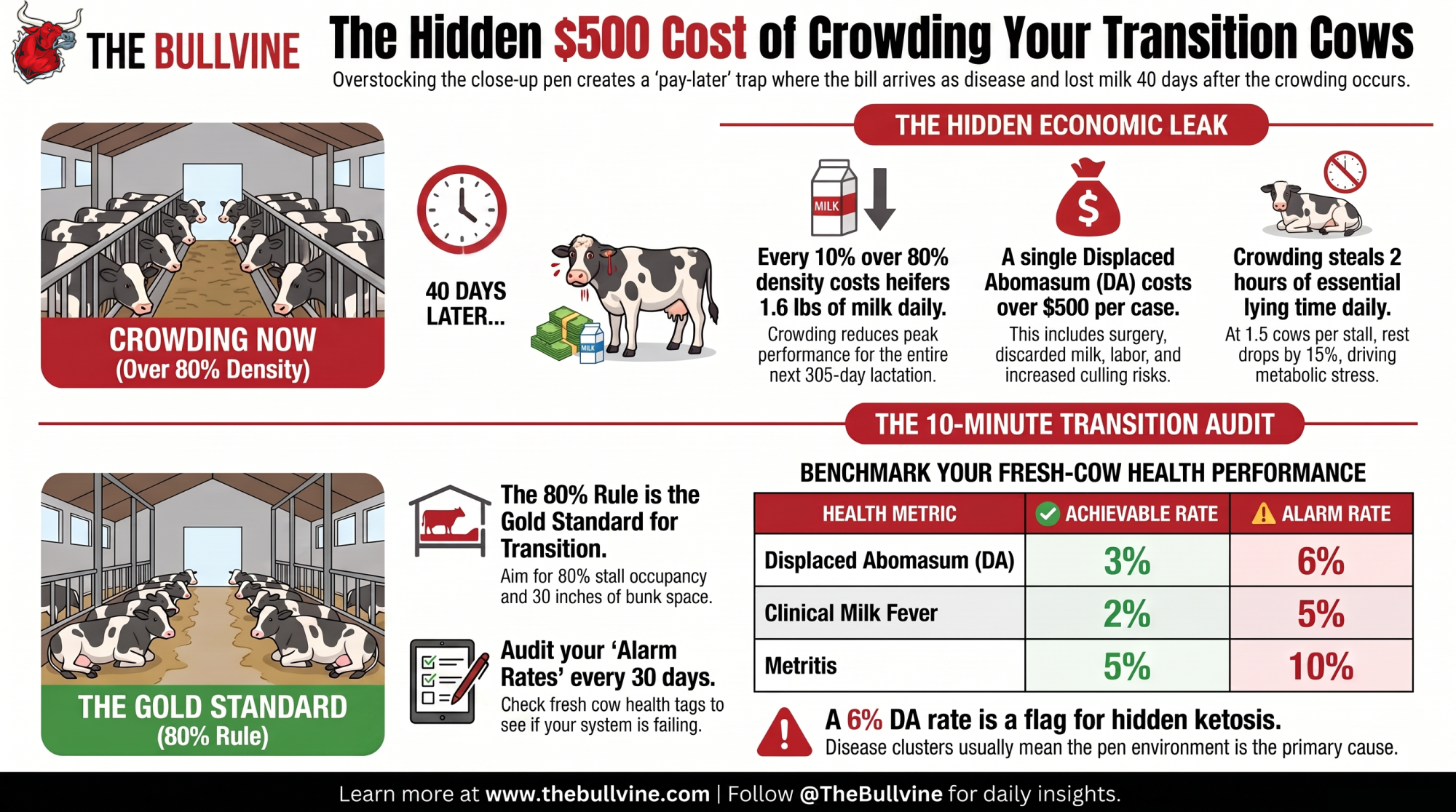
Executive Summary: Overstock your close-up pen at 110%, and you’re not saving a stall — you’re booking a $500-a-cow bill that lands 30 to 40 days later in the fresh pen as a DA, a retained placenta, or a heifer who never hits her peak. The damage hides because the decision and the consequence are five weeks apart, so good operators end up blaming the cow while the pen stays exactly the way it was. The barn math is brutal: every 10% over the 80% target costs first-lactation heifers about 1.6 lb/day in the next lactation, so 40 crowded heifers leak roughly 192 lb/day — call it $32 to $40 a day before a single vet bill, depending on whether you run Class III or the all-milk forecast. Crowding pulls nearly two hours of lying time at 1.5 cows per stall, drives pre-fresh NEFA and post-calving BHB the wrong way, and stacks the whole disease cluster at once — which is why a DA rate over the 6% alarm line is really a flag for the metritis and ketosis riding behind it. The fix costs zero capital and ten minutes: count your last 30 days of fresh cows against the achievable-versus-alarm benchmarks, then pull your actual close-up density against both the stall ratio and the 30-inch bunk-space target, not the barn average. If they’re clustering, the pen made that call — and you can take it back this week.
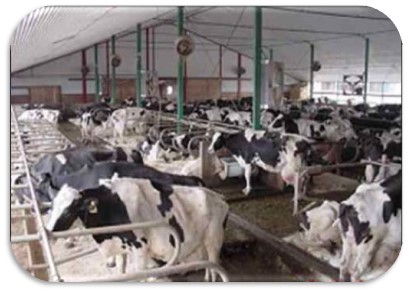
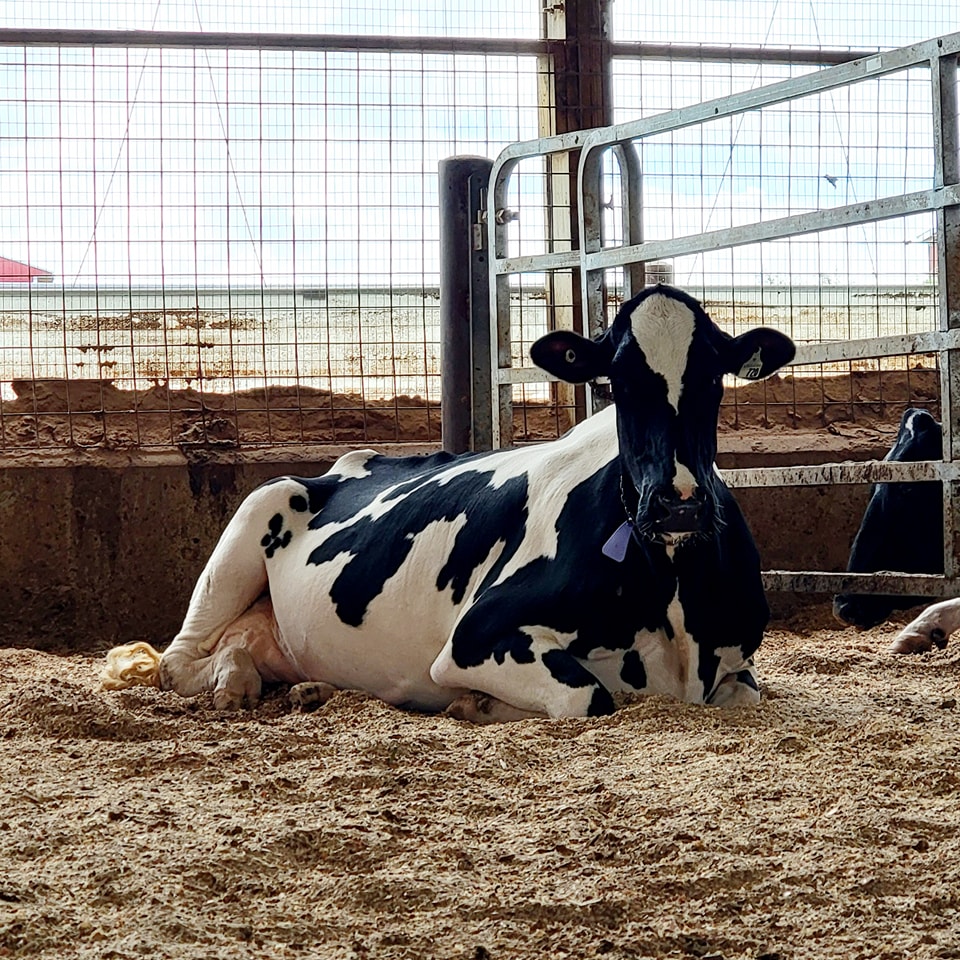
The close-up pen fills up. Nobody pulls cows out. The transition group runs at 110% because that’s just what the barn does when calvings bunch up — and three weeks later, a fresh cow flips a displaced abomasum, and everybody chalks it up to bad luck.
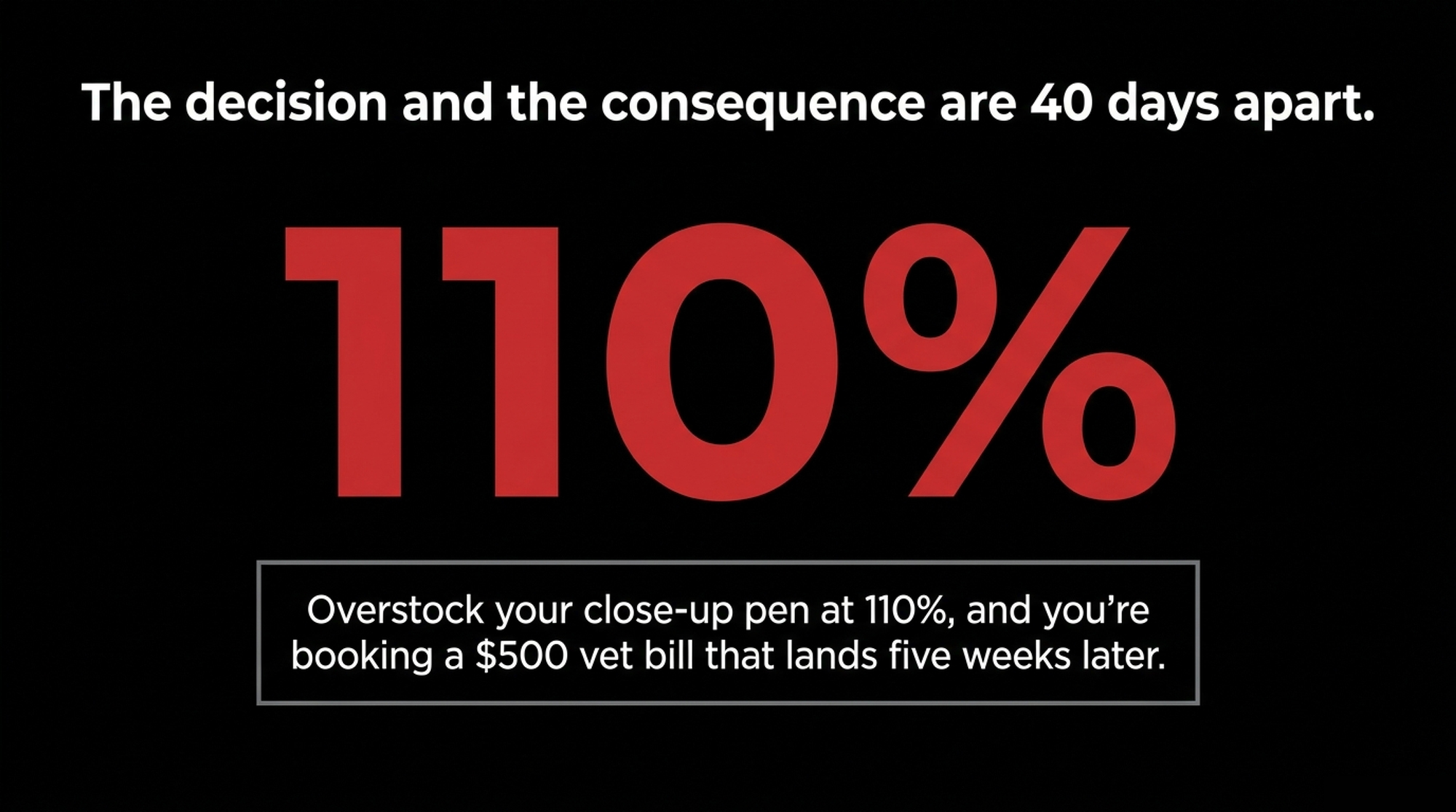
That’s the trap. Transition cow stocking density is a textbook pay-now, pay-later decision: cheap today, brutal in 40 days. The empty stall you avoid is real money saved right now. The DA, the retained placenta, the heifer who never quite peaks — those show up a month later, and not one of them arrives with a note saying where it came from. So they get written off as one of those things. The market won’t show you the second price until it’s too late to change your mind. But the research will, and once you see the mechanism, you can’t unsee it: a default nobody consciously chose is one of the most expensive line items on the farm — and the fix doesn’t cost a dime of capital. It costs something harder. Admitting the pen was a choice all along.
The Decision That Doesn’t Feel Like a Decision
Overstocking a transition pen rarely feels like a call you made. It feels like the weather. The barn’s tight; the calvings stacked up. You’ll sort it out next month. Except next month looks the same, and so does the one after.
The cows don’t help you catch it. They look fine. Up at the bunk, cudding, the pen busy and functional. That’s the whole problem. The University of Wisconsin’s Dairyland Initiative puts it flatly in its stocking-density guidance: the negative effects of overstocking “creep up over months to years,” which is exactly why nobody connects the cause to the effect.
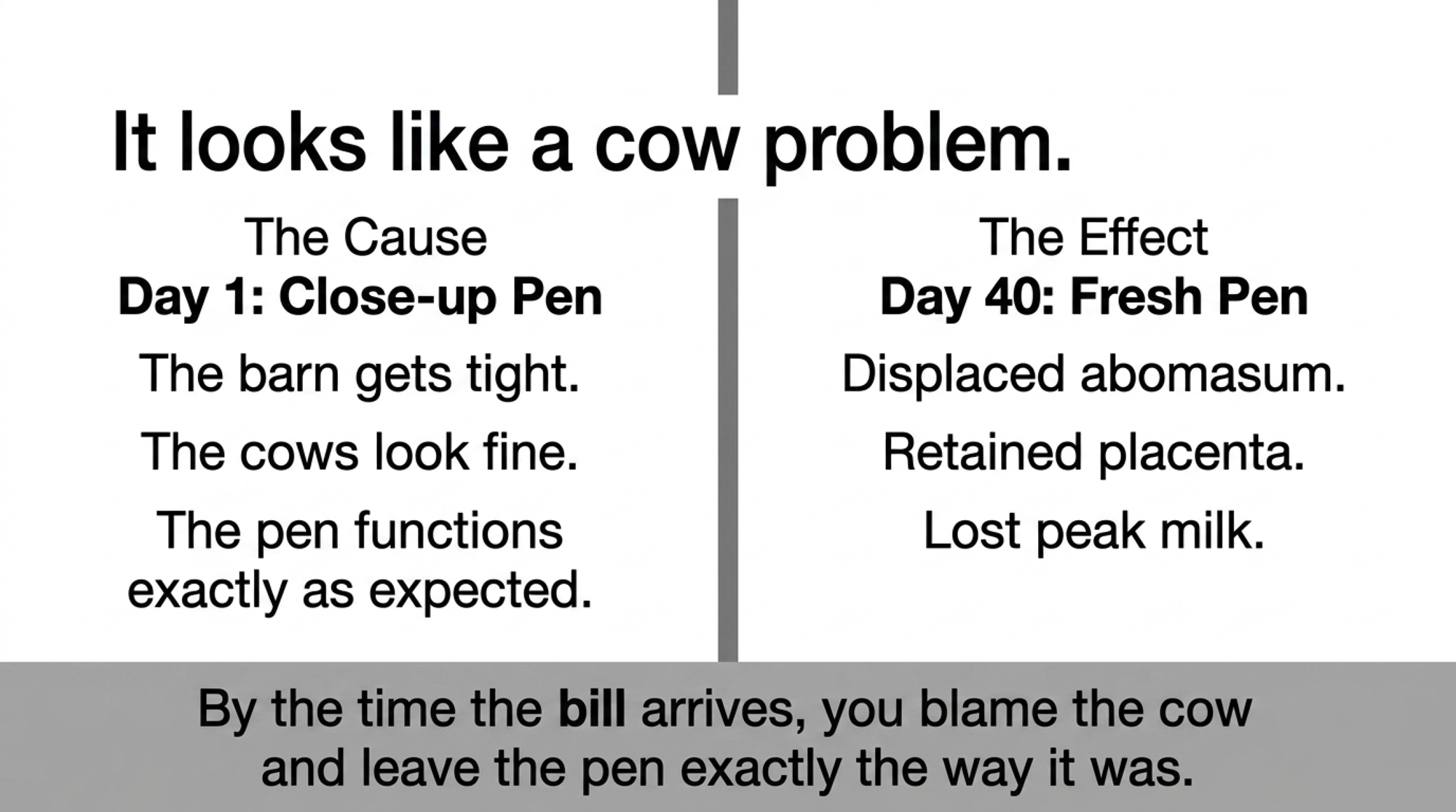
Read that twice, because it’s the entire game. The decision happens in the close-up pen. The bill lands in the fresh pen 30 to 40 days later. By the time it shows up, it no longer looks like a stocking problem. It looks like a cow problem. So you treat the cow, cull the cow, blame the cow — and leave the pen exactly the way it was.
Be precise about which pen we mean, because “stocking density” gets thrown around loosely. The lactating barn has its own arguments. The close-up and fresh groups are a different animal. These are cows whose intake is already declining in the final days before calving and whose immune systems are running at a discount throughout the periparturient window. Crowd that pen, and you’re not shaving comfort off a healthy cow. You’re pulling rest and feed away from the one animal in the barn that can least afford the loss.
Here’s the part that makes this pen worth obsessing over. A cow spends maybe three weeks in the close-up group. Three weeks. But the decisions her body makes in that window — how much she eats, how much she lies down, how hard her immune system is working when the calf hits the straw — set the ceiling on a 305-day lactation. You’re not managing three weeks of comfort. You’re managing the down payment on ten months of milk.
What Actually Happens to a Cow in That Pen
Walk it forward, step by step. In an overstocked close-up pen, the losers are predictable: the timid cows and the first-lactation heifers. They get crowded off the bunk. They eat fewer, bigger meals at the wrong times of day. They stand more and lie less. Fregonesi and the UBC team showed back in 2007 that as freestall access tightened, cows didn’t loiter in the stalls — they got displaced into the alley, and total lying time fell as stocking density climbed. The subordinate cows took the worst of it. In a close-up pen, the subordinate cows are your heifers.
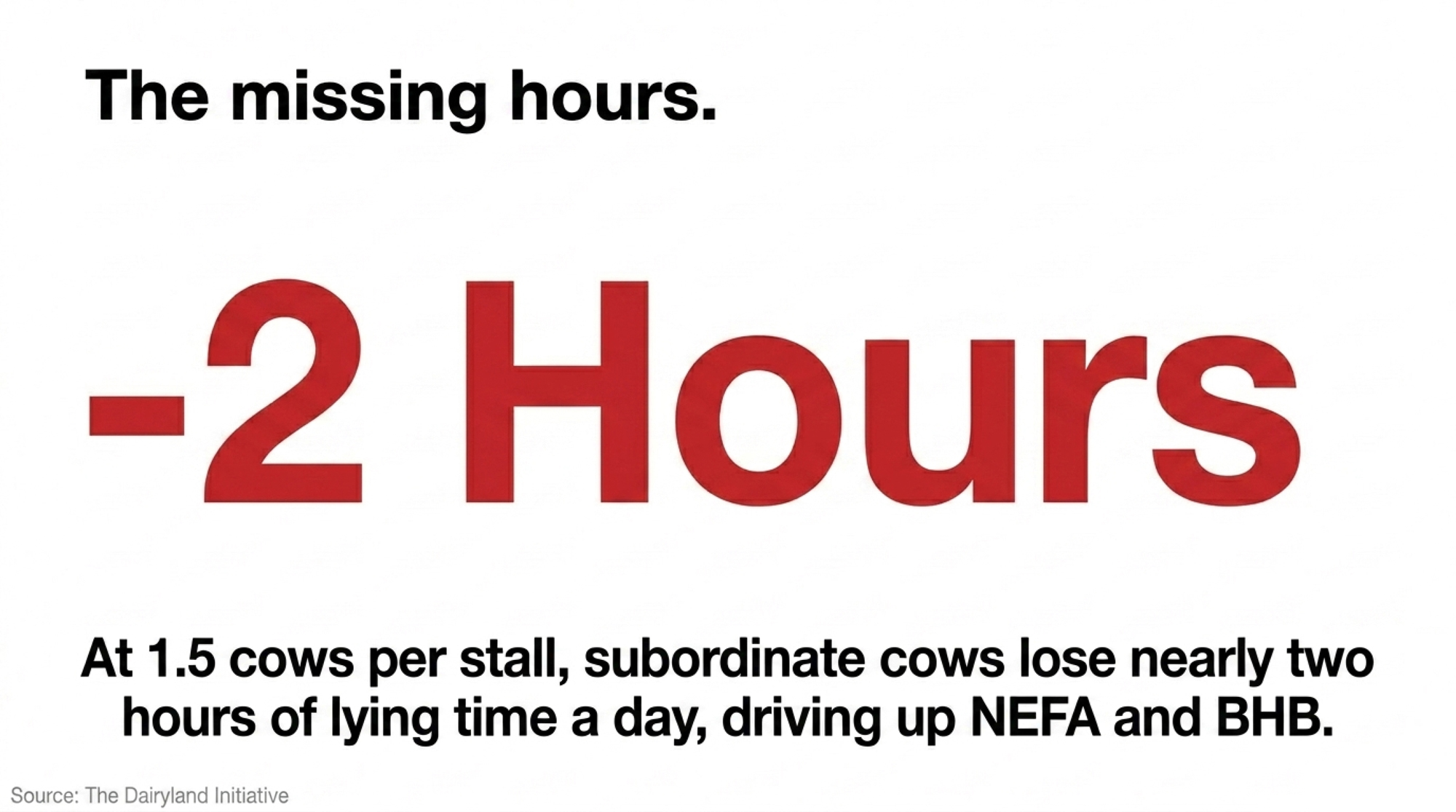
How much rest disappears? The Dairyland Initiative’s figure is blunt: at 1.5 cows per stall, cows lose roughly 15% of their lying time, dropping from an optimal 12 hours toward the low end of what they need. For a dry cow whose whole job in those three weeks is to eat and rest, nearly two hours off her feet is not a rounding error.
Here’s the part you can’t read from the alley. The metabolic damage doesn’t require the cow to eat dramatically less. It just requires her to work harder and rest less for the same feed.
Lost lying time and disrupted intake push cows deeper into negative energy balance. As intake slides in the last days before calving, she mobilizes body fat to cover the gap, and blood NEFA — the marker of fat breakdown — climbs. After calving, the liver turns some of that fat into BHB, the ketone that defines subclinical ketosis. These aren’t abstractions. Pre-fresh NEFA above 0.4 mmol/L in the final 7 to 10 days predicts poor performance — doubling the risk of retained placenta and culling in the first 60 days in milk. A crowded pen pushes that number the wrong way before the cow ever calves.
| Biomarker | Normal / Target | Alarm Cut-Point | What It Means | Pen-Level Cause | Downstream Risk |
|---|---|---|---|---|---|
| Pre-fresh NEFA | <0.3 mmol/L | ≥0.4 mmol/L(7–10 days pre-calving) | Excessive fat mobilization before calving | Reduced DMI from crowding, slug feeding, social stress | 2× retained placenta risk; 2× cull risk in first 60 DIM |
| Post-calving BHB | <1.0 mmol/L | ≥1.2 mmol/L(subclinical ketosis) | Liver overloaded converting NEFA to ketones | Negative energy balance compounded by pre-fresh crowding | 3–8× DA risk; 3× metritis risk |
| Clinical ketosis (BHB) | <1.2 mmol/L | ≥2.9 mmol/L(clinical threshold) | Overt ketosis — productivity loss guaranteed | Same root causes; represents a more severe NEB spiral | Reproductive failure, peak suppression, early cull |
| Milk fever risk (Ca) | Serum Ca ≥2.0 mmol/L | <1.75 mmol/L at calving | Hypocalcemia — muscle/nerve function impaired | DCAD failure + overcrowding stress compounding Ca metabolism | Cascades into DA, metritis, downer cow |
| DA alarm (herd rate) | <3% incidence | >6% incidence | Systemic transition failure signal | Crowded close-up pen is primary upstream driver | Metritis and ketosis almost certainly co-occurring |
Then the immune hit, which the barn-level conversation usually underrates. Subclinical ketosis — blood BHB above 1.2 mmol/L — carries a 3-to-8-times higher risk of a displaced abomasum and triples the risk of metritis. The same cortisol response that accompanies crowding and competition blunts the cow’s ability to clear the bacteria behind metritis and mastitis, right when her uterus is open and her udder is filling. Work summarized at the Western Canadian Dairy Seminar (King, 2023) notes drops in milk yield and rumination showing up one to ten days before a cow is ever diagnosed. She’s telling you she’s in trouble before the clinical sign lands. An overstocked pen guarantees more cows reach that point at once.
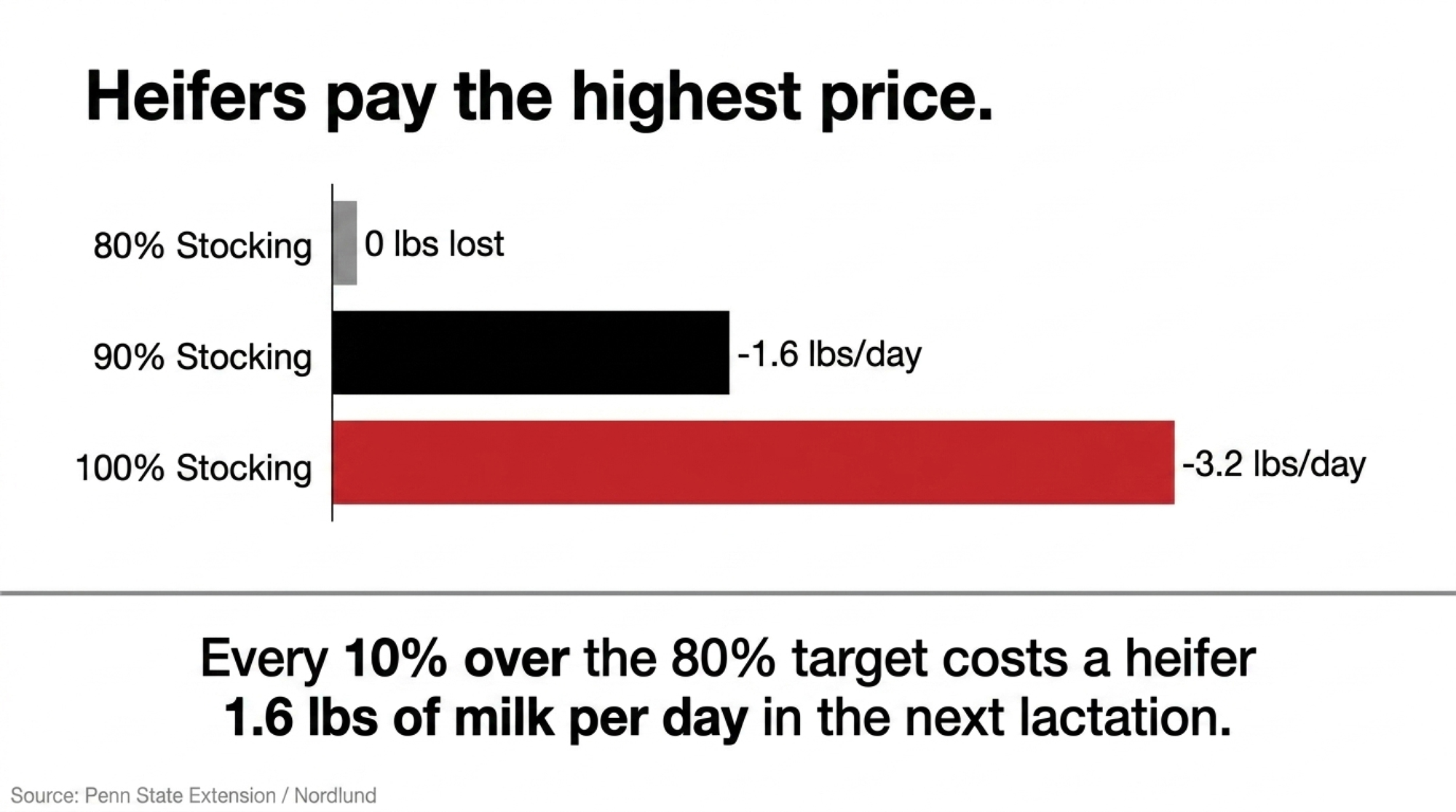
Then she calves, and the receipt comes due — as a DA, a retained placenta, a case of metritis, or a peak that never shows up. Drawing on Ken Nordlund’s University of Wisconsin work, Penn State Extension puts a hard number on the heifer side: first-lactation cows housed with mature cows in an overstocked close-up pen produce 1.6 lb/day less milk for every 10% increase in stocking density above the recommended 80% during the next lactation (Penn State Extension, 2023). In transition work comparing 80% versus 120% stocking, the crowded heifers gave roughly 6.5 lb/day less early in lactation — a cumulative deficit near 548 lb over the first 85 days in milk, gone, before you’d ever trace it back to the pen.
Read more: Unlocking Cow Comfort
Why “80 Percent” Isn’t a Nice-to-Have
Plenty of producers hear “stock the transition pen at 80%” and file it under research-station advice — the kind that works when you’ve got empty stalls to burn. It isn’t that.
Michigan State University Extension is direct about why this one pen is different: the transition cow pen should be only 80% stocked, because close-up dry and fresh cows are “already predisposed to have decreased dry matter intake and decreased rest” (MSU Extension, 2022). Penn State pairs the stall number with the half of the rule most barns forget — 30 inches of bunk space per cow, because subordinate cows get displaced at the feed face long before they get displaced from a stall. You can hit your stall ratio and still starve your heifers at the bunk.
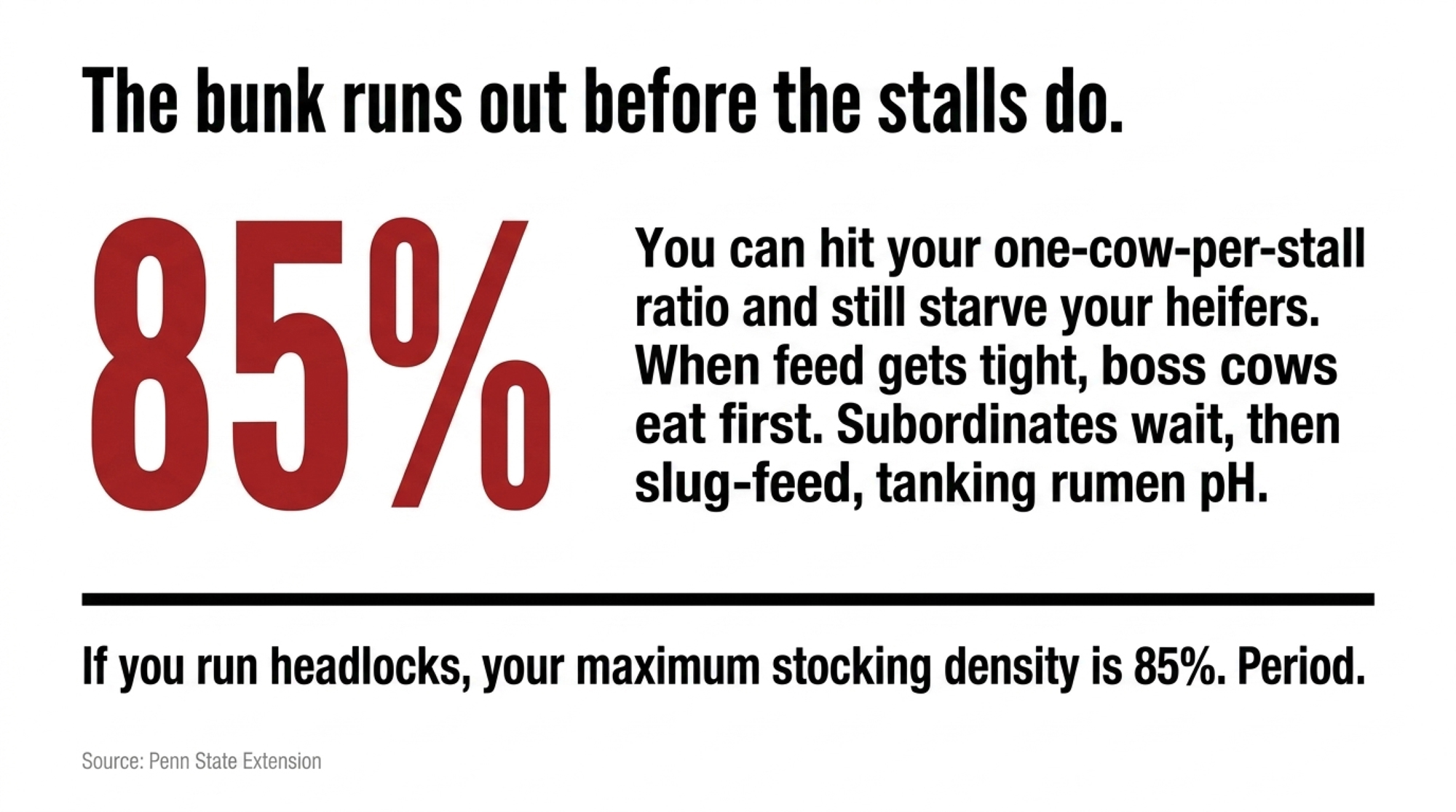
That bunk-space number deserves a second look, because it’s where a lot of “we’re not overstocked” arguments fall apart. A barn can run one cow per stall and still be badly overstocked at the feed face if the headlocks were spaced for 24-inch cows. When the bunk gets tight, the boss cows eat first and longest, and the timid cows and heifers wait — then bolt their feed in fewer, larger meals once a spot opens. Slug-feeding like that drops rumen pH and feeds the exact metabolic mess the close-up pen is supposed to prevent. Penn State’s more recent guidance is tighter for headlocks: with a headlock feed barrier, stocking should be at 85% or less so every cow can eat at once (Penn State Extension, 2025).
Canada’s Lactanet lands in the same place from a different angle. Its housing guidance for dry and transition cows recommends 120 to 160 square feet of resting area per Holstein, minimizing regrouping, and — where herd size allows — keeping heifers in a separate pen from mature cows to cut social-hierarchy stress (Lactanet, 2024). Same biology, two countries, one conclusion: this is the pen where you give cows room, not where you hunt for efficiencies.
The regrouping point hides a cost most barns never count. Every time you move a cow into a new pen, she spends days re-fighting the pecking order instead of eating and resting — and in a transition group, those are the exact days she can’t spare. Mix fresh heifers into an established mature-cow group, and you stack two stressors at once: a strange social order and a size mismatch she loses every time. That’s why Lactanet’s “separate the heifers where you can” isn’t soft advice. It’s a direct shot at the cows paying the highest price for the crowding.
Be honest about the gray zone, though. Not every study shows a cliff at 80% — at least one freestall trial found varying stocking density had no measurable effect on lying time or milk yield (Krawczel et al., 2012), which is exactly why bunk space and pen design matter as much as the stall ratio itself. Krawczel’s later work points at the real culprit: the most consistent response to bunk overstocking isn’t fewer stalls used — it’s more aggression at the feed face. The clear, repeatable damage shows up when herds push past 100% on both stalls and bunk space, and when first-calf heifers get mixed in with mature cows and lose every standoff. That’s the danger combination. That’s the one worth hunting for in your own barn.
The Diagnostic You Can Run This Week — No Vet, No Lab
You don’t need a consultant or a blood machine to find out whether you have a transition problem hiding in plain sight. You need a clipboard and ten minutes in the fresh pen.
Count the cows that calved in the last 30 days. Then count how many carry a tag for any of the big ones: DA, retained placenta, metritis, milk fever, clinical ketosis. One or two is noise. When they start clustering, you’re not looking at bad luck. You’re looking at a system.
The transition benchmarks below are the standard achievable-versus-alarm rates used in North American transition-cow monitoring, with per-case costs to match:
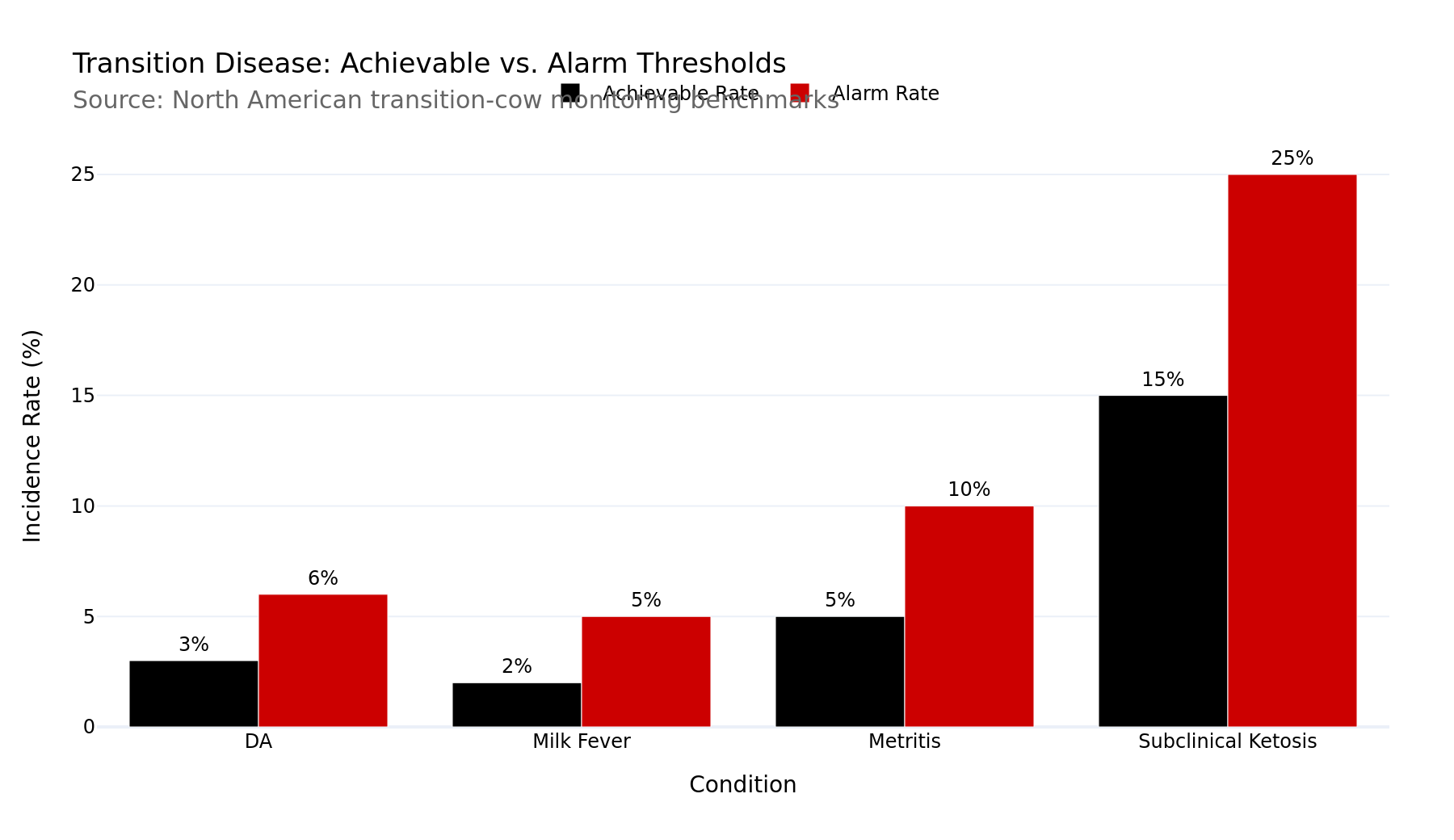
| Health Metric | Achievable Rate | Alarm Rate | Cost / Indirect Driver |
| Displaced Abomasum (DA) | 3% | 6% | Often exceeds $500 per case |
| Clinical Milk Fever | 2% | 5% | ~$334 in direct + indirect losses |
| Metritis | 5% | 10% | Drives downstream DA + culling risk |
| Subclinical Ketosis (BHB ≥1.2 mmol/L) | 15% | 25% | 3–8× DA risk, 3× metritis risk |
| Pre-fresh NEFA (≥0.4 mmol/L) | herd-level audit | — | 2× retained placenta + cull risk |
Achievable and alarm rates reflect standard North American transition-cow monitoring thresholds; subclinical ketosis and NEFA cut points follow widely used blood-BHB (≥1.2 mmol/L) and pre-fresh NEFA (≥0.4 mmol/L) benchmarks. Per-case cost figures are industry estimates combining treatment, discarded and lost milk, labor, and culling or death risk; individual-farm costs vary with milk price and culling decisions. Canadian (Lactanet) housing figures cited elsewhere in this article are kept separate from these benchmarks.
The logic worth stealing is the read-across: a DA rate over 6% is the flag that metritis and ketosis are almost certainly riding along behind it. The DA isn’t the only problem. It’s just the one wearing a surgical scar — the visible tip of a list you can finally measure.
Want the next level up from a clipboard? The tool already exists. The University of Wisconsin’s Transition Cow Index (TCI) pulls 14 factors from each cow’s DHIA history to project her expected first-test milk, then measures how far she actually landed from it. A herd-wide negative TCI is the statistical fingerprint of a transition program leaking milk — and a crowded close-up pen is one of the first places to look when the number turns red.
The Barn Math: What One Crowded Pen Is Really Worth
Show the math, because a number nobody can see is a number nobody fixes. Put a pencil to a single overstocked close-up group. Say you cycle 40 first-calf heifers through that pen at 110% instead of 80%. Penn State’s figure pegs that at roughly 4.8 lb/day less milk per heifer in the next lactation — 1.6 lb for every 10 points above 80%. Across 40 head, that’s 192 lb/day. At the May 2026 Class III price of $16.92/cwt (USDA AMS, announced June 3, 2026), that’s about $32 a day walking out the door before a single vet bill — and closer to $40 a day against USDA’s June 2026 all-milk forecast of $20.70/cwt (WASDE, June 11, 2026). Use whichever number matches your mailbox check. Either way, it’s real money leaving on milk you never see.
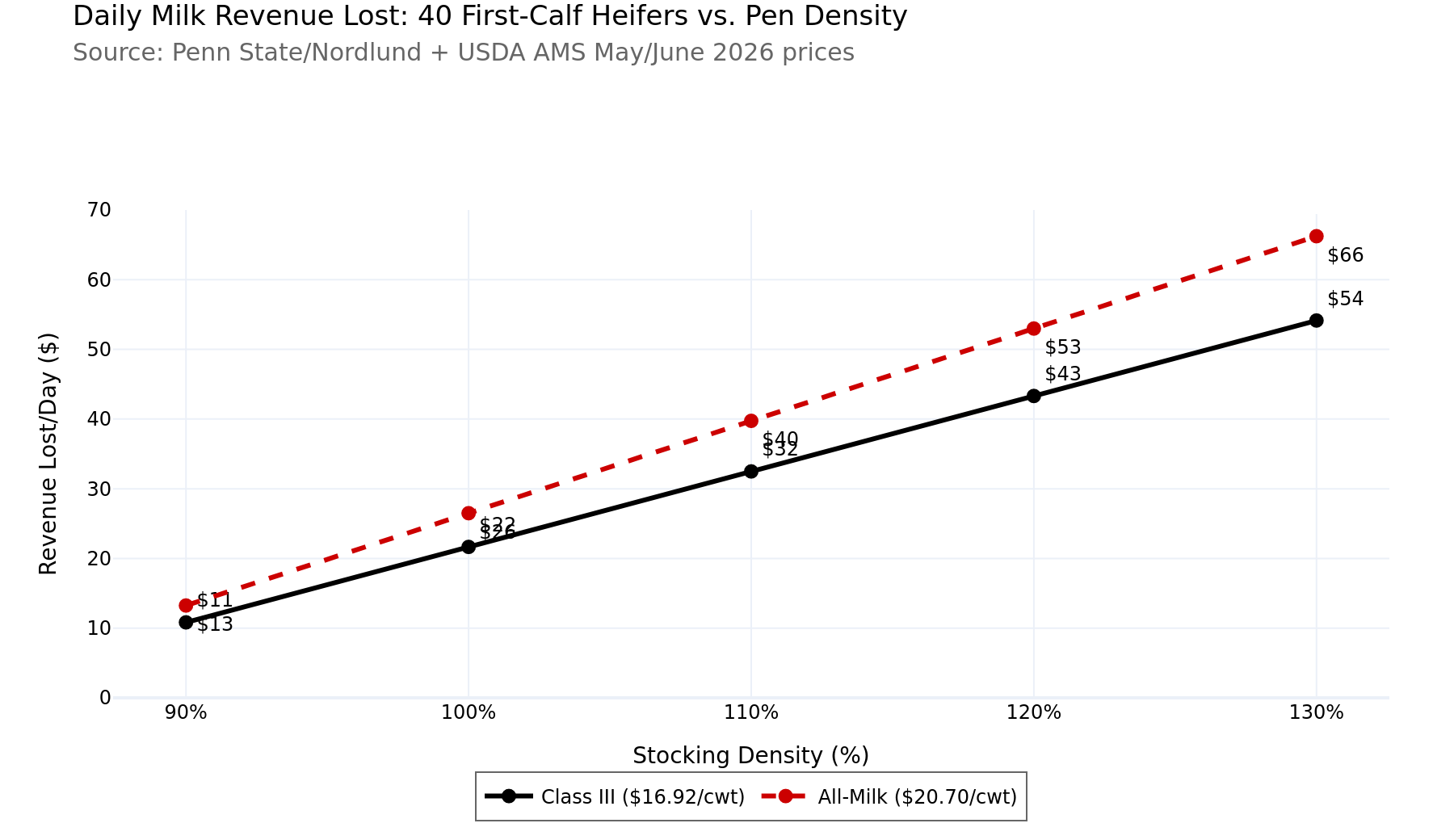
Then layer in the disease, because the lost milk and the health bill ride together. A DA often exceeds $500 per case once surgery, lost milk, and culling risk are factored in, and a clinical milk fever case incurs an estimated $334 in direct and indirect losses. None of those are one-and-done bills — they’re the disorders most likely to drag a cow into a second problem.
And these don’t occur in isolation. They breed each other. A ketotic cow is more likely to flip a DA. A cow that retains her placenta is more likely to develop metritis. The displaced abomasum traces straight back to negative energy balance, stress, and concurrent disease — the exact conditions a crowded pre-fresh pen manufactures. So the crowded pen doesn’t raise just one disease rate. It raises the whole interlocking cluster at once, which is precisely why a high DA number is a flag to look for metritis and ketosis hiding behind it.
Stack one hard-hit heifer’s lost milk on top of her share of a DA, and the all-in cost on a single affected cow clears $500 a cow. A herd sitting above the 6% DA alarm line with a chronically full close-up pen pays a slice of that every freshening — and never sees the line item, because it never had a name.
That’s the uncomfortable arithmetic, and it’s the same shape as every pay-now, pay-later trap in this business. The empty stall you’re avoiding is visible today. The milk and the health you’d recover are delayed and invisible. Human nature picks the visible loss every single time, which is exactly why this keeps happening on good farms run by careful, hardworking people.
Read more: The $500 Transition Gap
What This Means for Your Operation
No single right answer, but a few honest paths depending on where your barn actually sits. Before you pick one, run two free checks this week: walk the fresh pen and count the last 30 days of disease cases against the table above, and pull your actual close-up density — cows divided by usable stalls and against the 30-inch, 80% bunk-space target, not the barn average.
| Barn Situation | Best Move | What It Takes | Where It Backfires | Expected Payback Window |
|---|---|---|---|---|
| Chronically >100%, nowhere to put cows | Cull/ship 5–10 lower-priority cows now | Identify late-lact. or problem cows to move | Pushes crowding to adjacent pen | Immediate; 30-day disease rate improvement |
| Running 100–110%, flexible pen layout | Drop one notch (→85–95%) for 60-day trial | Discipline on cow movement; log every DA/metritis | None if tracked properly | 60–90 days; compare disease cluster |
| Mixing heifers with mature cows | Separate heifer close-up pen | Enough heifers to justify a pen (≥8–10) | Impractical for small herds or low heifer numbers | 1–2 lactations; peak improvement |
| Stall ratio “fine” but feed face crowded | Count headlocks — enforce 85% headlock rule | Walk the pen at fresh feed push; count cows at bunk | None — lowest-cost fix on this list | Immediate rumen pH and intake improvement |
| Seasonal overstocking (e.g., Feb. slam) | Smooth breeding calendar 12 months upstream | Breeding record review + synchronization timing | Takes a full year to show; pair with short-term fix | 12–18 months for calving distribution |
| DA rate >6%, everything else “looks fine” | Pull TCI from DHIA; map disease cluster backward | DHIA enrollment + records provider query | None | Identifies hidden pen problem within 1 report |
- Pull cows out of the close-up pen this month. When it fits: you’re chronically over 100%, and you’ve got somewhere to put lower-priority animals. What it takes: finding 5–10 cows you can move or ship — late-lactation cows you can dry off into a separate group, or problem cows already on the cull list. Where it backfires: shove the crowding into the next pen over, and you’ve relocated the problem, not fixed it.
- Run the 30-day experiment. Drop that pen one full notch — 110% toward 95%, or 100% toward 85% — and hold it 60 to 90 days. Log every fresh-cow disease event by calving date and parity, then compare the next quarter against the last. You’re not rebuilding the barn. You’re choosing who gets the transition real estate and finding out what it’s worth.
- Protect the heifers specifically. When it fits: you’re mixing first-calvers with mature cows in the close-up group. The Nordlund and Penn State data are sharpest here — heifers are the ones bullied off the bunk, paying for it at peak. What it takes: a separate heifer group, which Lactanet flags as the cleanest fix where herd size allows. Where it backfires: thin heifer numbers can make a separate pen impractical, so weigh it against your calving pattern.
- Fix the bunk before you fix the stalls. When it fits: you’ve got headlocks and a density argument running in your head. Penn State’s 85%-or-less headlock rule means the feed face, not the stall count, may be your binding constraint. What it takes: counting headlocks against cows, not just stalls against cows. Where it backfires: nowhere — the cheapest check on the list, and the one most barns skip.
- Smooth the calving curve, not just the pen. When it fits: your overstocking is seasonal — the pen’s fine in summer and jammed every February. What it takes: looking upstream at the breeding calendar so calvings don’t all stack into one window. Where it backfires: it’s a 12-month fix, so pair it with one of the moves above for the cows already in the pen.
- Map your DA rate, then watch for the cluster. Over the 6% alarm line? Assume metritis and ketosis are riding behind it. On DHIA? Ask your records provider whether you can pull a Transition Cow Index — a negative TCI is the cleanest single signal that the pen is leaking milk.
Key Takeaways
- If your fresh-cow cases are clustering toward the alarm rates — DA at 6%, metritis at 10%, milk fever at 5% — stop blaming individual cows and start auditing the close-up pen. The cluster is the diagnosis, not the coincidence.
- If you’re mixing heifers with mature cows at stocking levels above 100%, expect to pay at peak — roughly 1.6 lb/day per heifer for every 10 points over 80%, per Penn State’s read of the Nordlund data.
- If you run headlocks, your binding number is 85%, not 100% — count headlocks against cows before you argue you’re not overstocked.
- If your DA rate is climbing, assume ketosis and negative energy balance are in the room, too. The fix is upstream — in the pen, the ration, and your DCAD/anionic-salt program — not on the surgery table.
- If you can only move from 130% to 105% this season, do it anyway. One notch closer to 80% is a real gain, not an all-or-nothing purity test.
- If the pen looks fine but your DA rate is over 6%, trust the number over the eye test — a high DA number is itself the warning that fresh-cow trouble runs deeper than what you’ve tagged.

The hardest thing to change here was never the barn. It’s the belief that the barn is just the way it is. So the real question isn’t whether you care about your cows — you clearly do, or you’d have quit reading paragraphs ago. It’s whether you’re willing to find out what one under-stocked pen is actually worth to you, before another lactation slips quietly through it. What would your last 90 days of fresh cows look like on that clipboard right now?
Run Your Numbers
Herd Health ROI Calculator — Plug in your culling rate, mastitis incidence, replacement cost, and milk price to put a real dollar figure on what fresh-cow disease is costing you now. The “Cost of Inaction” view turns that crowded close-up pen into the number you’ve been missing.
Complete references and supporting documentation are available upon request by contacting the editorial team at editor@thebullvine.com.
Learn More
- Is Your Fresh Pen Costing You $90,000? The 90-Day Transition Fix for Pregnancy Rate — Arms you with a diagnostic tracking framework to link early-lactation metabolic triggers directly to reproductive failure, preventing your next breeding cycle from paying for close-up crowding mistakes.
- The 3.5-Hour Cow Rule: How Time Out of the Pen Quietly Erases Over $300,000 from Some Milk Cheques — Exposes the massive financial damage that occurs when overstocking forces lactating cows to sacrifice crucial resting time, stripping up to 7.5 pounds of milk per day from your bulk tank.
- The 15:1 ROI Protocol: How Anti-Inflammatory Treatment is Cutting Transition Disease in Half — Delivers an unconventional, targeted $10 therapeutic solution to combat the underlying inflammation that triggers fresh-pen disorders up to 21 days before calving, slashing corporate health losses by half.
The Sunday Read Dairy Professionals Don’t Skip.

Every week, thousands of producers, breeders, and industry insiders open Bullvine Weekly for genetics insights, market shifts, and profit strategies they won’t find anywhere else. One email. Five minutes. Smarter decisions all week.