




From Wicklow’s deer to Michigan’s whitetail, New Zealand’s possums, and England’s badgers — when TB lives in the wildlife, flat compensation caps quietly transfer the cost of a breakdown from the State onto your balance sheet. Here’s the real number, and three things to do about it this month.
Executive Summary: West Wicklow just posted 16.4% TB herd incidence — nearly triple the national 5.34% — and it’s exposing a trap that hits every farmer living over a wildlife reservoir, from Irish deer to Michigan whitetail to Kiwi possums. Here’s the gut-punch: Ireland’s OFMV compensation has been frozen at €3,000 per commercial reactor and €5,000 per pedigree cow since February 2023, while cattle prices ran away underneath it. The average top-up is just €1,540.61, so when a 12-reactor breakdown lands — like the Roundwood herd that got hammered this spring — you eat the gap. ifac pegged farmers’ total 2024 TB bill at €151.6 million, more than the State spent on the whole programme, and that’s before the ~30% odds you break down again. The cap punishes your best breeders hardest: the EBI valuation top-up got cut from €1.35 to €0.50 per unit, so the more genetic merit you’ve stacked into a cow, the bigger the share of her real worth the ceiling quietly erases. And it all lands in a year Teagasc expects average dairy income to drop toward €80,000 from €137,000. Run your own breakdown number before you need it — the full article’s calculator and the three things to do in the next 30 days will tell you exactly how exposed your herd is.

If you farm anywhere TB hides in the local wildlife, the valley of West Wicklow is your early-warning system. In June 2026, Wicklow County Council passed a unanimous motion demanding that the Department of Agriculture explain how it plans to tackle bovine TB, after councillor Gerry O’Neill warned that the disease is wiping out family farms across the county. Strip away the Irish politics and the lesson is universal: where a wildlife reservoir keeps reseeding the disease, breakdowns stop being rare accidents — and the compensation math was never built to cover what they actually cost you.
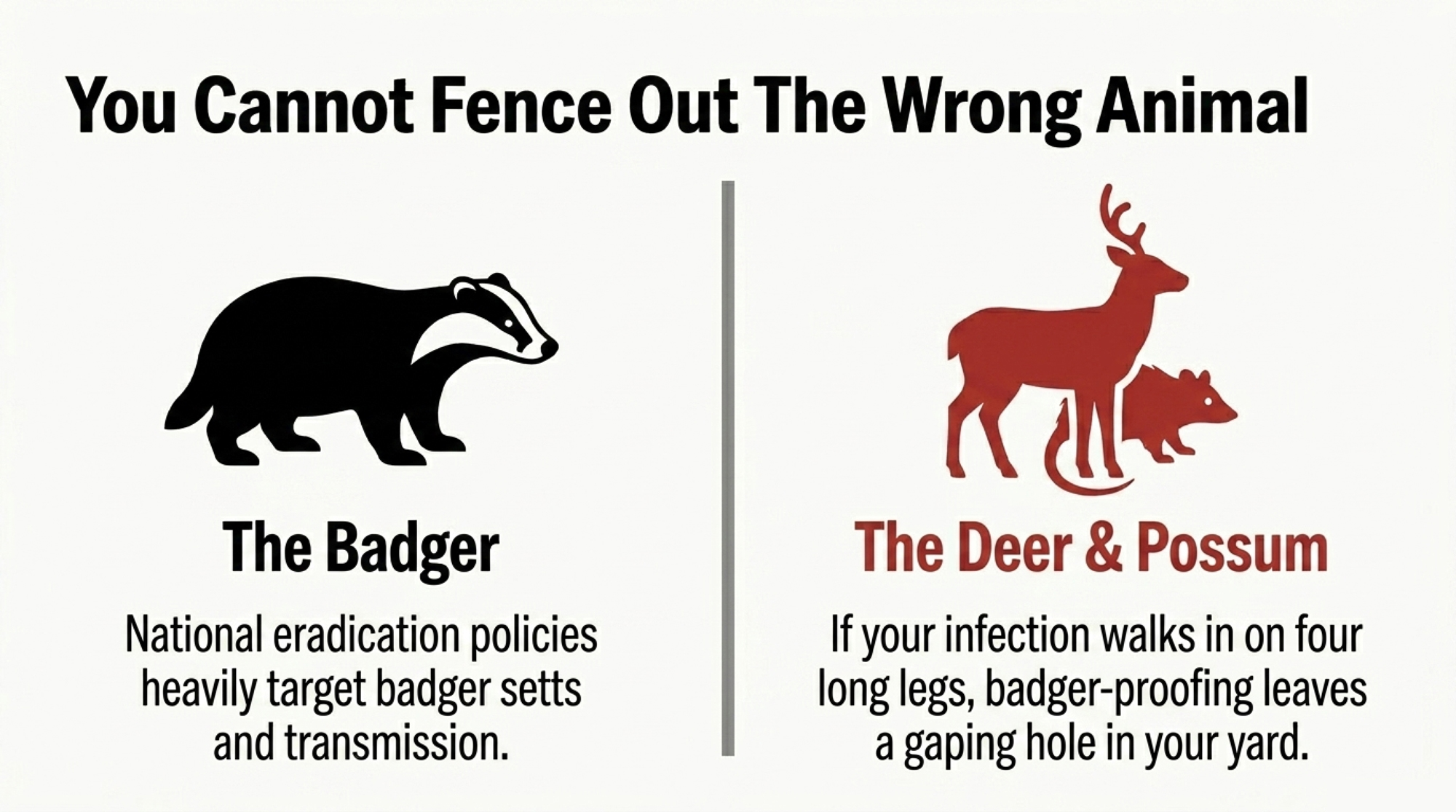
That’s not an Irish problem. It’s a Michigan problem, a New Zealand problem, a UK problem. New Zealand spends heavily through its OSPRI/TBfree programme chasing possums; England’s entire control framework revolves around the badger; Michigan’s lower peninsula has fought bovine TB in white-tailed deer for decades. Different animal, same trap. Wicklow happens to be where the numbers are loudest right now — so it’s the cleanest case study going.
| Region | Primary wildlife reservoir | Control framework focus | Reader takeaway |
| West Wicklow, Ireland | Sika deer + badgers | Badger-led, deer underweighted | 16.4% herd incidence — the blind spot has antlers Analytics-to-Action-Cheat-Grid-v1.2.md |
| Michigan, USA | White-tailed deer | Decades-long deer-focused fight | Lower peninsula reservoir never cleared Analytics-to-Action-Cheat-Grid-v1.2.md |
| New Zealand | Brushtail possums | OSPRI/TBfree possum control | Heavy spend chasing the reservoir Analytics-to-Action-Cheat-Grid-v1.2.md |
| England | Badgers | Entire framework built on badger | Single-species model leaves gaps Analytics-to-Action-Cheat-Grid-v1.2.md |
Run Your Own Number First
| Cost component | Capped by OFMV? | Figure (2024) | Who eats it |
| Commercial reactor value | Yes — €3,000 ceiling | Avg top-up €1,540.61 | Farmer eats the gap Analytics-to-Action-Cheat-Grid-v1.2.md |
| Pedigree reactor value | Yes — €5,000 ceiling | Push to lift to €7,000 | Best breeders hit hardest Analytics-to-Action-Cheat-Grid-v1.2.md |
| Testing labour & disruption | No | €55m+ across farms | Farmer Analytics-to-Action-Cheat-Grid-v1.2.md |
| Total farmer TB bill | N/A | €151.6m | Farmers (exceeded State spend) Analytics-to-Action-Cheat-Grid-v1.2.md |
| Repeat breakdown risk | No | ~30% chance | Farmer, repeatedly Analytics-to-Action-Cheat-Grid-v1.2.md |
Before the policy and the wildlife, start with your own balance sheet. The calculator below lets you toggle reactors, milk lost per cow, milk price, and your real cull-and-replace value, then shows the gap between your loss and the capped cheque. Tick the “pedigree” box and watch what the ceiling does to a high-merit cow.
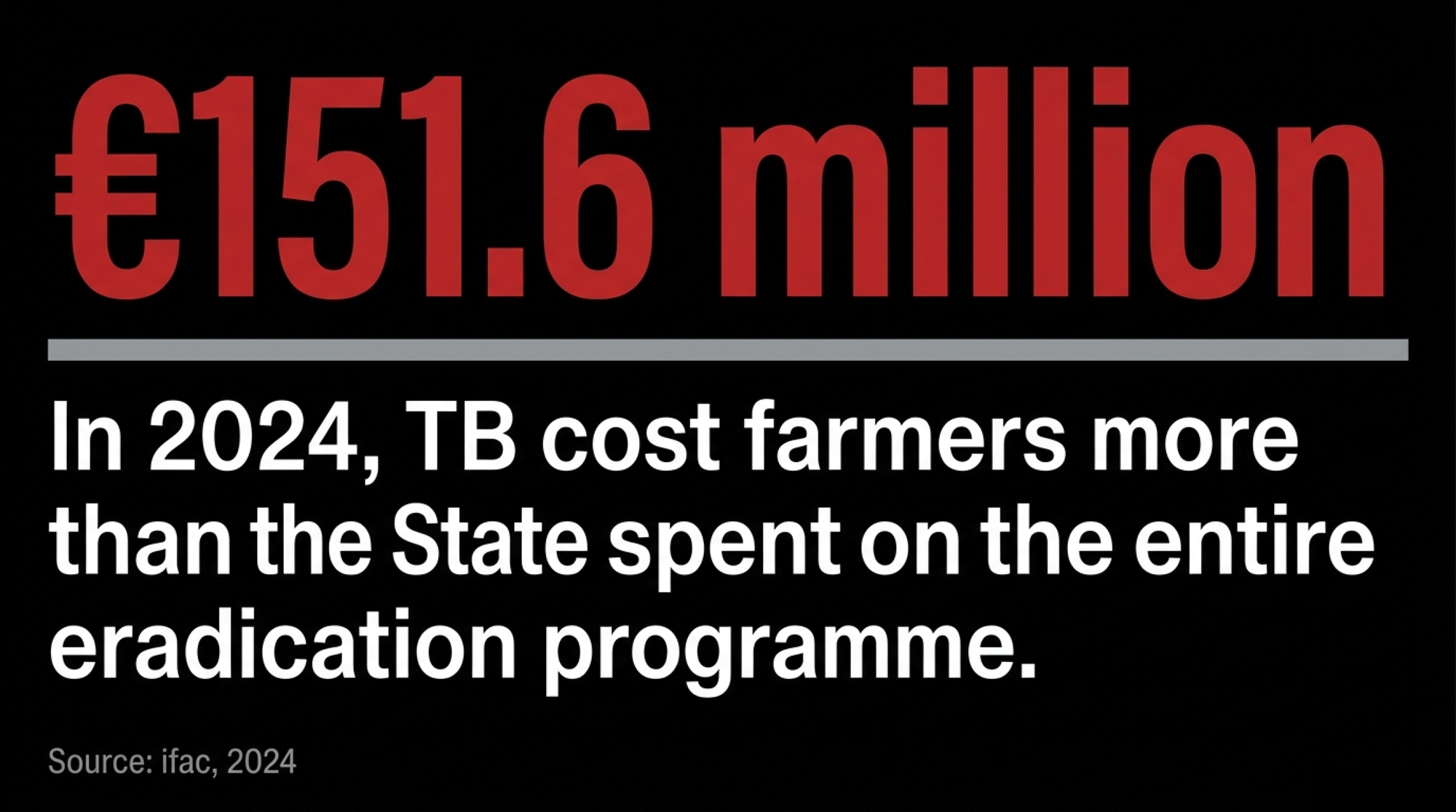
Read it as a floor, not a ceiling. The tool counts only direct reactor losses — it leaves out the whole-herd output drag during a lock-up, disinfection, and the testing labour that ifac valued at over €55 million across Irish farms in 2024 alone. The per-cow milk-loss range it uses — 120 to 573 kg per lactation, per published Irish reactor-productivity data — comes from peer-reviewed work, not a round guess. Nationally, ifac put farmers’ total TB-related costs at €151.6 million in 2024 — more than the State spent on the entire programme that year.
What Wicklow Tells Every Reservoir Farmer
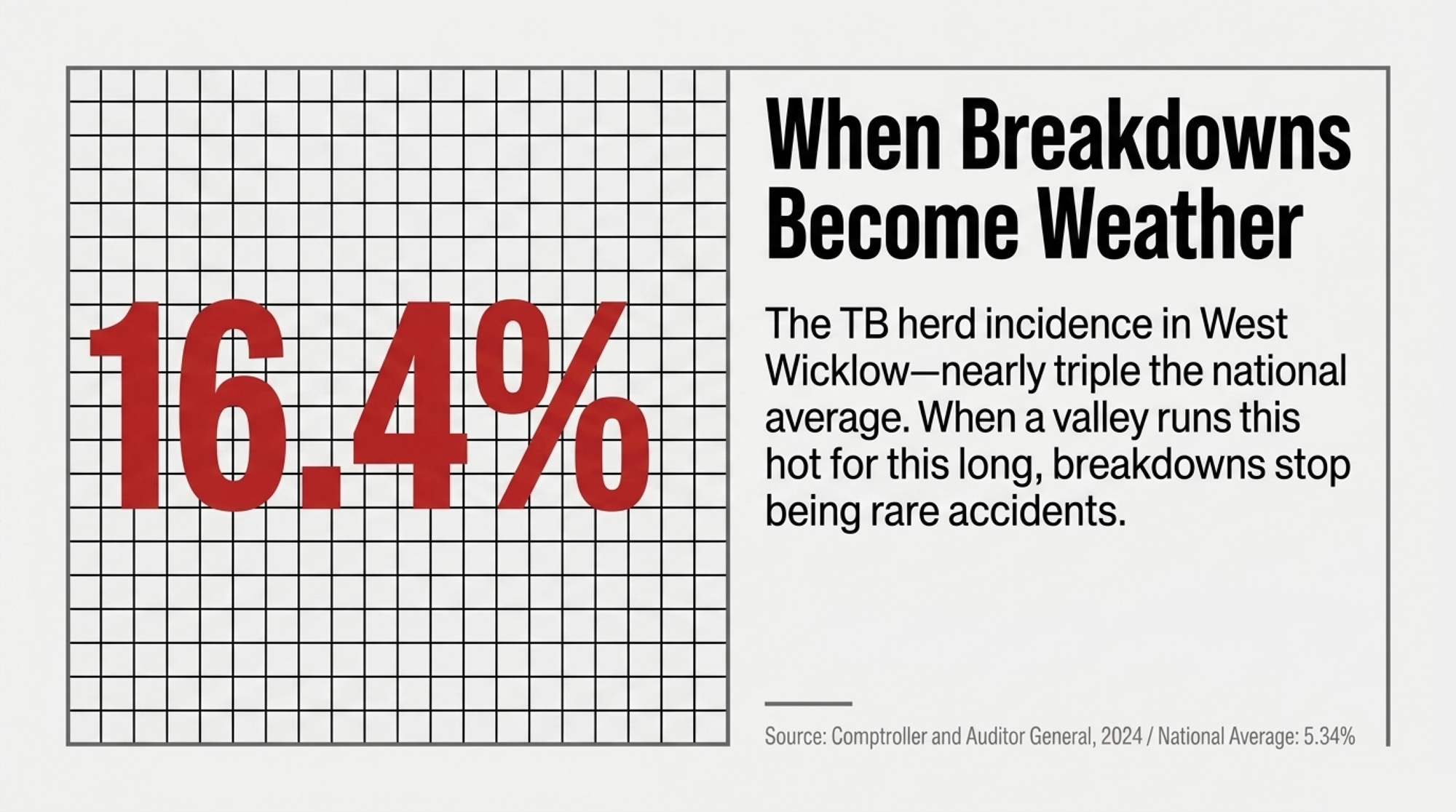
Here’s the blunt version. West Wicklow isn’t having a bad year. It’s living in a permanent TB landscape. According to the Comptroller and Auditor General’s 2024 audit, herd incidence ranged from just 2.4% of herds in Mayo to 16.4% in Wicklow West — among the highest county-level figures in the country, which the audit ties straight to high wild deer densities. The Irish Farmers Journal reported that nearly 20% of west Wicklow herds were locked up with TB in 2023, compared with a national rate near 6%.

That’s well over twice the national average. Year after year. When the same valley runs that hot for that long, breakdowns stop being lightning strikes and start being weather.
What makes a reservoir county different is the wildlife mix, and Wicklow’s is a textbook case. Most of Ireland’s control is built around badgers. But Teagasc’s own wildlife briefing specifically names Wicklow as a place where high densities of deer, cattle, and badgers overlap, allowing the same strains to circulate among all three. A Department survey back in 2015 found 16% of culled deer in the Calary area of Wicklow carried evidence of M. bovis, and Trinity College Dublin research has since flagged Sika deer as the chief wildlife concern in the county. A plan aimed mainly at badgers solves maybe two-thirds of the equation here — and the missing third has antlers. If your reservoir is possums or whitetail, the same blind spot applies.
The national picture, for context, has been moving the other way. Minister Martin Heydon says rolling 12-month herd incidence eased to 5.34% by May 31, 2026, and the Department points to that fall and its 2026 Action Plan as evidence that its approach is working. That’s the trouble with averages. They hide the valleys where the disease never left — and in 2024, Wicklow West was one of the deepest.
How This Plays Out on Real Farms
When a reactor turns up, the herd locks; no cattle move off-farm except to slaughter. You’re looking at a minimum 60-day restriction and two consecutive clear tests before you’re free — and under the 2026 rules, high-risk “relapse” herds can land on six-monthly testing for up to three years post-derestriction. The Department compensates you. Here’s where the math quietly stops working.
It’s not abstract in Wicklow. When a wave of previously clear herds went down in the county, one Roundwood farmer was reported among the hardest hit, with 12 reactors pulled in a single test. Twelve animals. One test. That’s the shape of a breakdown when you live in a blackspot — and the cheque that follows is capped before it ever reaches what those cows were worth.
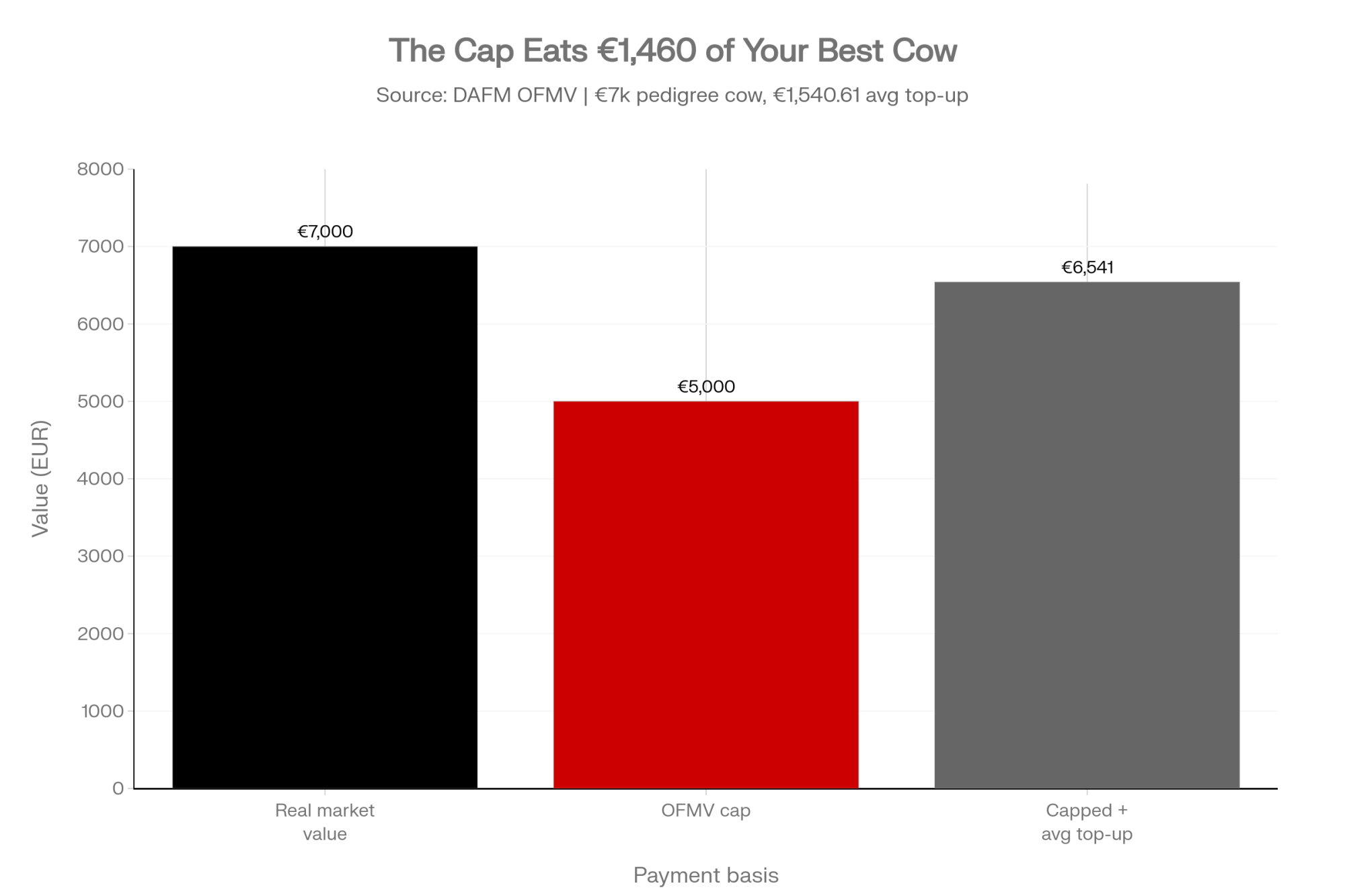
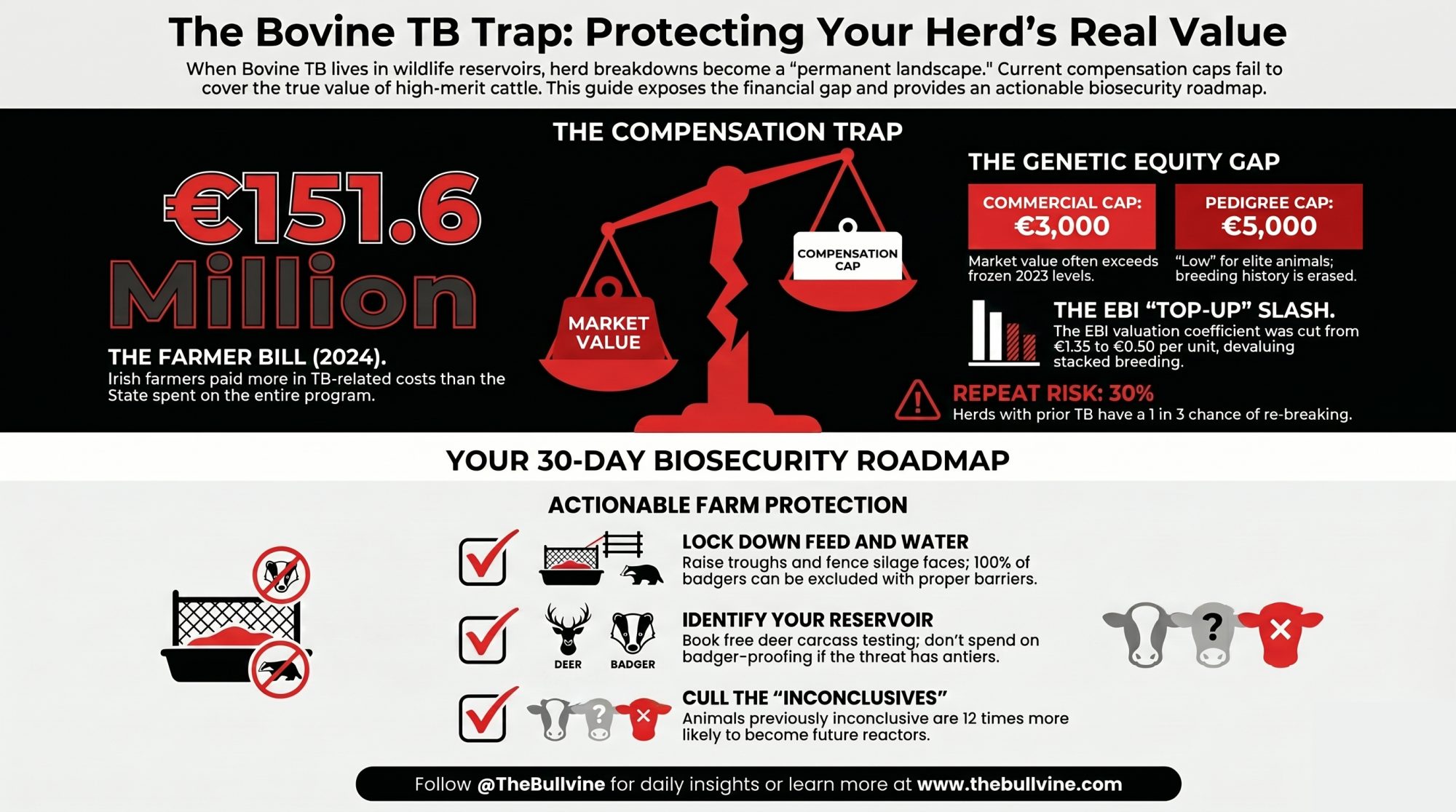
The On-Farm Market Valuation scheme caps compensation at €3,000 per commercial reactor and €5,000 per pedigree cow, with stock bulls at €4,000 — ceilings set back in February 2023 and frozen since, even as cattle prices have climbed sharply beneath them. IFA animal-health chair TJ Maher calls the caps “unfair, arbitrary and out of date”. The DAFM-reported average top-up on the base payment is just €1,540.61. You lose your best cow, you eat the difference. The scheme doesn’t.
And the cash-flow timing couldn’t be worse. Teagasc forecasts average dairy farm income will fall to around €80,000 in 2026, down from an estimated €137,000 in 2025, with a milk price near 42.4 c/L. A breakdown lands hardest in exactly the year you can least absorb it.
Why the Cap Punishes Your Best Breeders Hardest
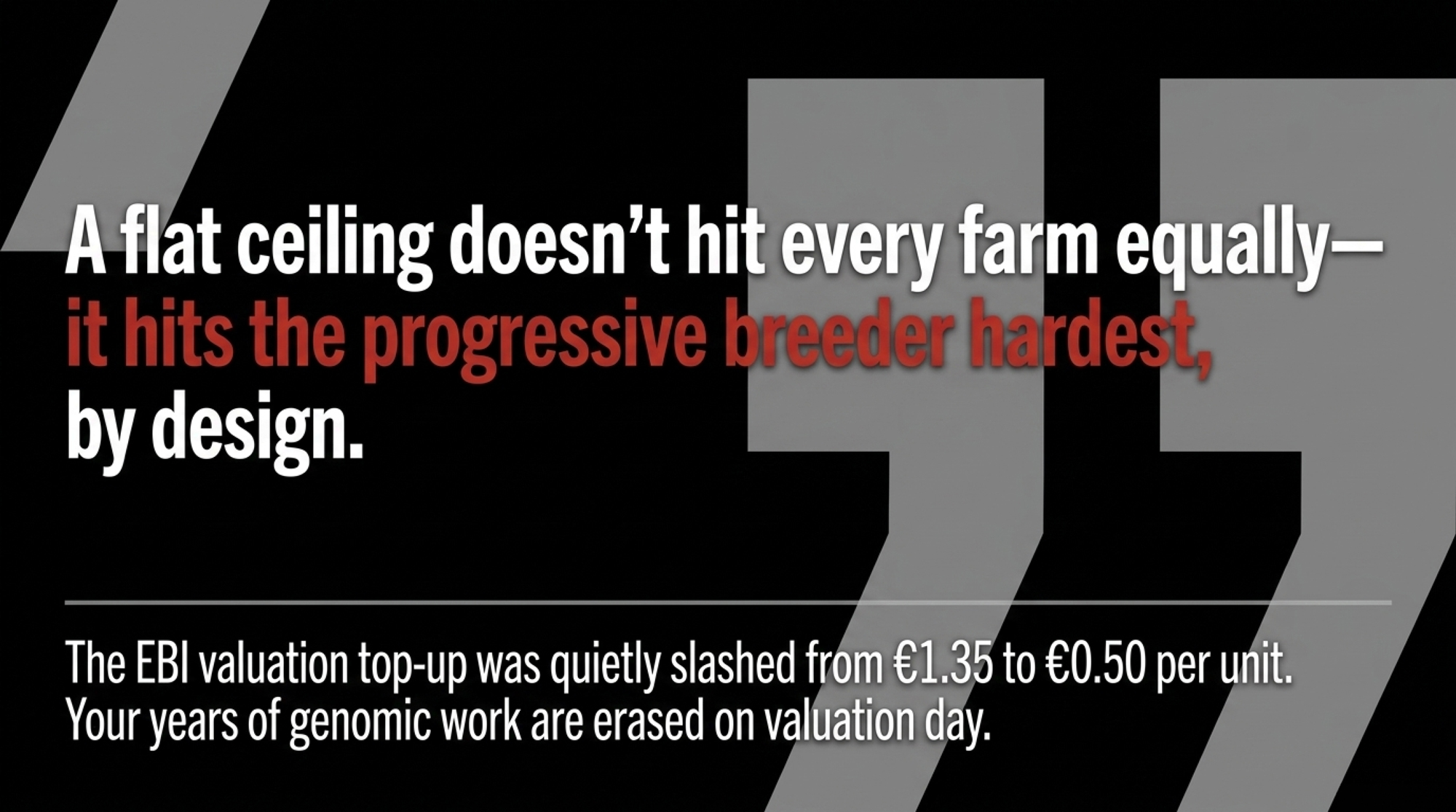
Here’s the part commodity coverage misses entirely. A flat ceiling doesn’t hit every farm equally — it hits the progressive breeder hardest, by design.
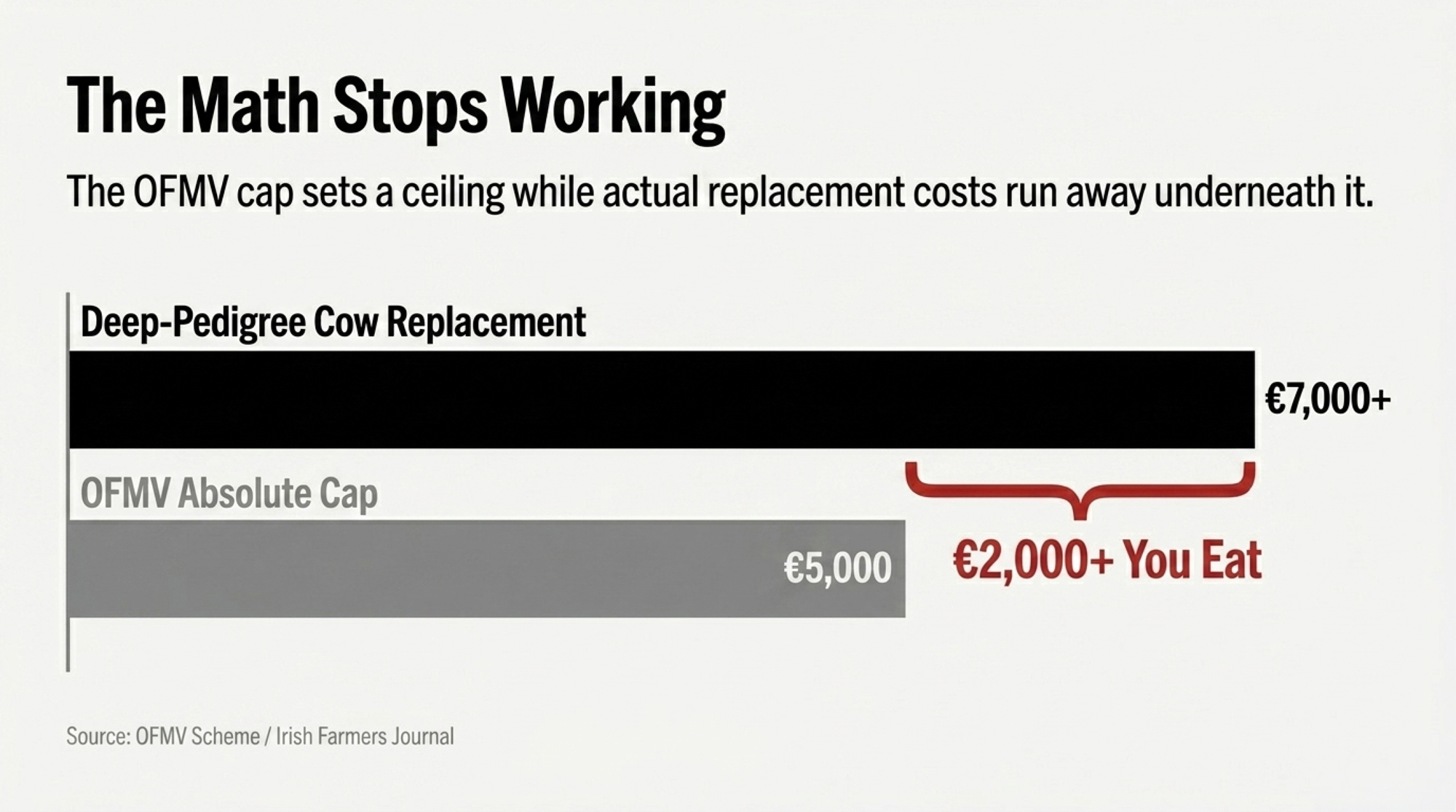
When the OFMV scheme values a €7,000 deep-pedigree cow at a €5,000 cap, the State isn’t compensating a loss. It’s balancing its own budget with your genetic equity — the flush histories, the high-conformation cow families, the years of genomic and sexed-semen work baked into that animal.
This isn’t a vibe; it’s in the scheme’s own machinery. The valuation formula carries an EBI “top-up” that’s meant to reward genetic merit — but that coefficient was cut from €1.35 to just €0.50 per unit of EBI. IFA says it secured a Department commitment to lift the coefficient again to offset a separate rescaling of the EBI index. Fair enough. But on valuation day, the practical effect is a formula that pays far more thinly for stacked breeding value than it once did — so the more merit you’ve built into a cow, the bigger the share of her real worth the cap quietly leaves on the table.
The €5,000 pedigree ceiling drives the point home. The Irish Farmers Journal flatly notes that the ceiling “would be considered low for some pedigree animals” in today’s market, which is why farm organisations are pushing to lift it to €7,000. If your breeding programme is the asset you’ve spent a decade building, the current cap treats your best work as average. That’s the genetic erasure nobody puts on the compensation form.
The Mechanics Behind the Outcomes
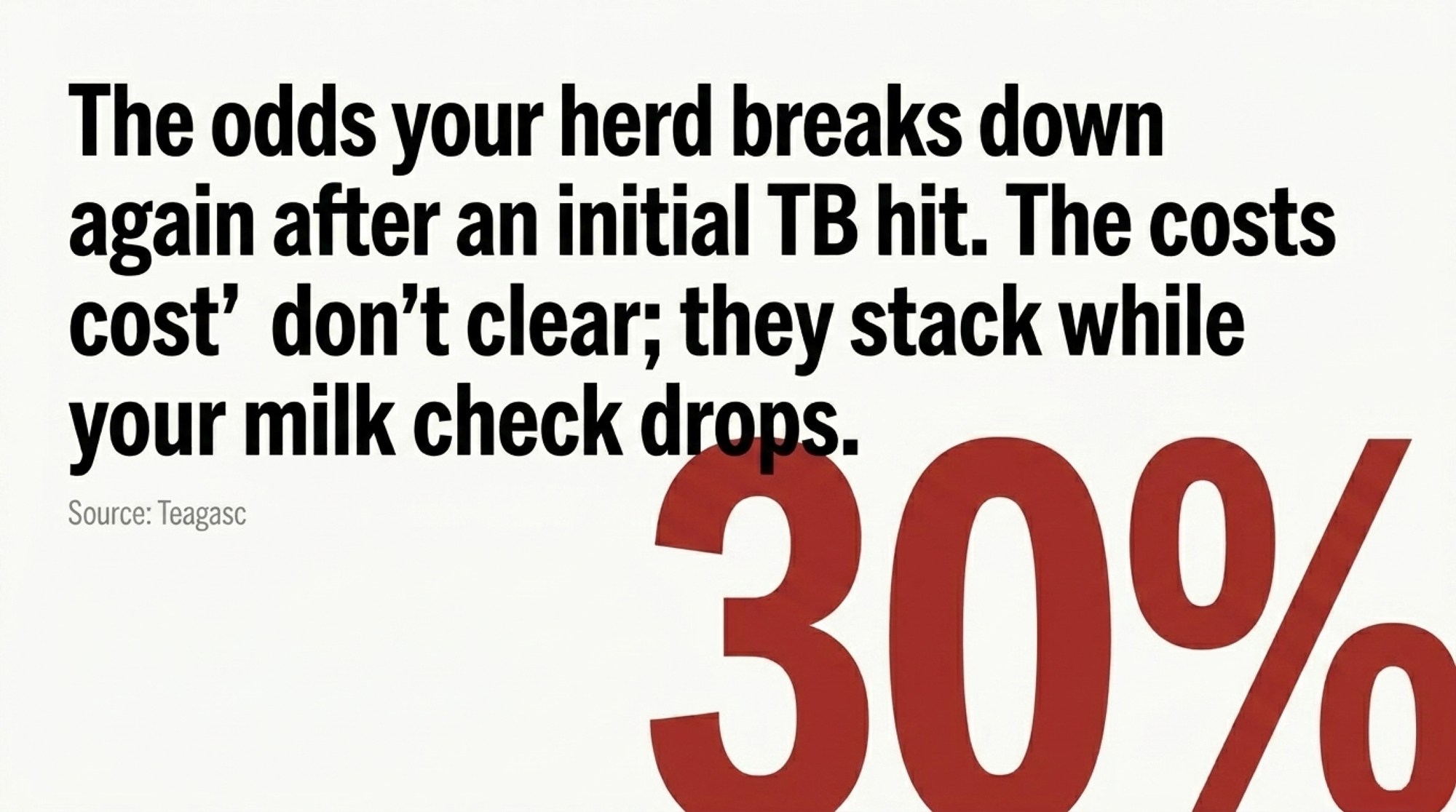
The cap isn’t the only mechanic. Repeat risk is the one that turns a single bad year into a structural drag. Teagasc data show herds that have had TB carry roughly a 30% chance of breaking down again. So, in a hotspot, the costs don’t land once and then clear. They stack — restriction after restriction, each one draining cash flow while the bank repayments and the tax bill keep their own calendar, indifferent to whether your gate is open.
And then there’s the part no spreadsheet tracks. A 2025 Farming Community Network report covering more than 450 TB-affected farmers found the dread of the next test letter often weighed heavier than the disease itself, driving anxiety, sleeplessness, and isolation. An NFU Cymru survey in Wales was blunter still: of 462 members who answered, 85% said bTB had hurt their own and their family’s mental health. That’s UK evidence, not Irish data — but the machinery is identical. The paperwork is mandatory. The support isn’t. If this is hitting close to home, the IFA points farmers to the Pieta 24-hour freephone crisis line, 1800 247 247.
Is Your Wildlife Risk a Badger Problem or a Deer Problem?
This is the question Wicklow forces on everyone, and most farms outside a hotspot never stop to ask it. If you’re in deer country — or possum or whitetail country — a badger-only mindset leaves a hole you can drive a jeep through. Teagasc and TCD both say plainly that deer have to be managed alongside badgers in places like Wicklow, not instead of them.
The practical lever is sitting right there and going underused. The Department offers free TB testing of deer carcasses culled through voluntary farmer-and-hunter groups in high-prevalence areas, which is how you actually find out whether the local herd is carrying it. Knowing which reservoir is driving your risk changes where you spend your money — there’s no sense pouring capital into badger-proofing if the infection’s walking in on four legs through your back fence.
How Do You Actually Harden the Yard? (A Step-by-Step)
Biosecurity against a wildlife reservoir isn’t one big project. It’s a sequence, cheapest and highest-impact first.
- Lock down feed and water. Raise troughs above badger reach, fence stored feed and silage faces, and don’t feed concentrates on the ground where badger saliva can contaminate leftovers — Teagasc flags all three as direct contact points. A PLoS ONE study found simple badger-exclusion measures were 100% effective at keeping badgers out of farm buildings when properly built and maintained.
- Seal the buildings. Sheet the bottoms of gates and doors so wildlife can’t slip into sheds and parlours overnight.
- Fence the setts and known crossings. Locate and notify the Department of badger setts, fence them and their latrines, and block the deer trails crossing your grazing ground.
- Find your reservoir. Book free deer carcass testing through your RVO or local hunter group so you’re spending on the right threat.
- Apply for the cost-share. Ireland’s 2026 Action Plan funds physical exclusion measures, backed by a TB budget of over €157 million for 2026 — ring your co-op or RVO before the window narrows.
Options and Trade-Offs for Farmers
No single move fixes TB. But producers in risk zones are choosing among a few clear paths, and the differences matter for your balance sheet.
- Harden biosecurity now — the 30-day move. Run the sequence above. When it makes sense: always, especially in deer-and-badger country. What it costs: labour and modest capital. Where it falls short: it cuts yard contact but won’t stop exposure out on open grazing.
- Tap the 2026 Action Plan cost-share. When it makes sense: if you’ve been putting off the capital spend anyway. What it requires: calling your co-op or RVO now. The risk: uptake depends on rollout — don’t assume it’s open next season.
- Tighten buy-in toward a closed herd. New 2026 rules already require a 30-day pre-movement test for dairy cows entering breeding herds. Source only from low-incidence herds and cull previously inconclusive animals — Teagasc notes they’re 12 times more likely to become reactors, and prior bovine reactions are four times more likely. The trade-off: less flexibility when you suddenly need replacements.
- Breed for resistance and protect your genetics on paper. There’s real genetic variation in TB susceptibility; Teagasc points farmers to bulls with a high health-traits sub-index EBI for TB resistance. Keep current pedigree, classification, and genomic documentation on every high-merit cow, so your OFMV valuation argument is airtight against the cap. The risk: none — it’s the difference between an arguable valuation and an automatic ceiling.
Key Takeaways
- If your average productive cow is worth more than €3,000 — or your best ones top €5,000 — run them through the calculator and write that shortfall into your TB contingency plan before you ever need it.
- If you breed pedigree or high-genomic stock, treat the thinned EBI top-up and the €5,000 ceiling as a constant drag on your best work, and keep valuation documentation up to date to fight for every euro.
- If you’ve never had a breakdown, treat the ~30% repeat-risk figure as your reason to harden biosecurity this season, not after the first reactor.
- If you farm in deer, possum, or whitetail country, identify your reservoir first — book free carcass testing before you spend a cent on the wrong fence.
- If you’re carrying any animal that was inconclusive on a previous test, cull it by the end of this production cycle — it’s 12 times more likely to become a reactor.
- If your cash flow can’t absorb a multi-month restriction in a year Teagasc already expects income to fall toward €80,000, that’s a conversation to have with your adviser now — not the week the gate locks.
So here’s the question worth sitting with this week. If a breakdown walked through your gate next month, do you actually know your number — the full cost, not just the cheque the Department would post you, and not just the milk but the breeding value the cap won’t touch?
West Wicklow is the warning, not the exception. Wherever TB lives in the wildlife — Irish deer, Kiwi possums, Michigan whitetail — the math runs the same way, just louder in some valleys than others. We’re building the full per-breakdown cost model, with the genetic-equity loss broken out by merit level, in a deeper Bullvine piece. That’s where the real numbers live.
Complete references and supporting documentation are available upon request by contacting the editorial team at editor@thebullvine.com.
Learn More
- How does a dairy farm survive a TB outbreak? — Arms you with a first-person survival strategy from a commercial dairy operation that navigated an immediate lock-up, detailing the rapid operational protocols needed to stabilize cash flow when environmental vectors breach your perimeter.
- Revolutionizing Dairy Farming: Effective Strategies to Curb TB Spread in Dairy Cattle by 89% — Delivers critical herd-management insights by analyzing new transmission mitigation pathways, mapping out how targeted inoculation and modern surveillance can halt disease replication before it strips the genetic equity out of your herd.
- From Saving a Baby’s Life to Transforming Your Dairy Herd: The Gene Editing Revolution Is Here — Exposes how advanced CRISPR technology is transitioning from laboratory trials to commercial application, paving the way to dismantle disease vulnerabilities permanently by breeding stock inherently resistant to tuberculosis and mastitis.
The Sunday Read Dairy Professionals Don’t Skip.

Every week, thousands of producers, breeders, and industry insiders open Bullvine Weekly for genetics insights, market shifts, and profit strategies they won’t find anywhere else. One email. Five minutes. Smarter decisions all week.




