






When major retailers and processors agree to share the cost burden instead of just making demands, you know something big is happening
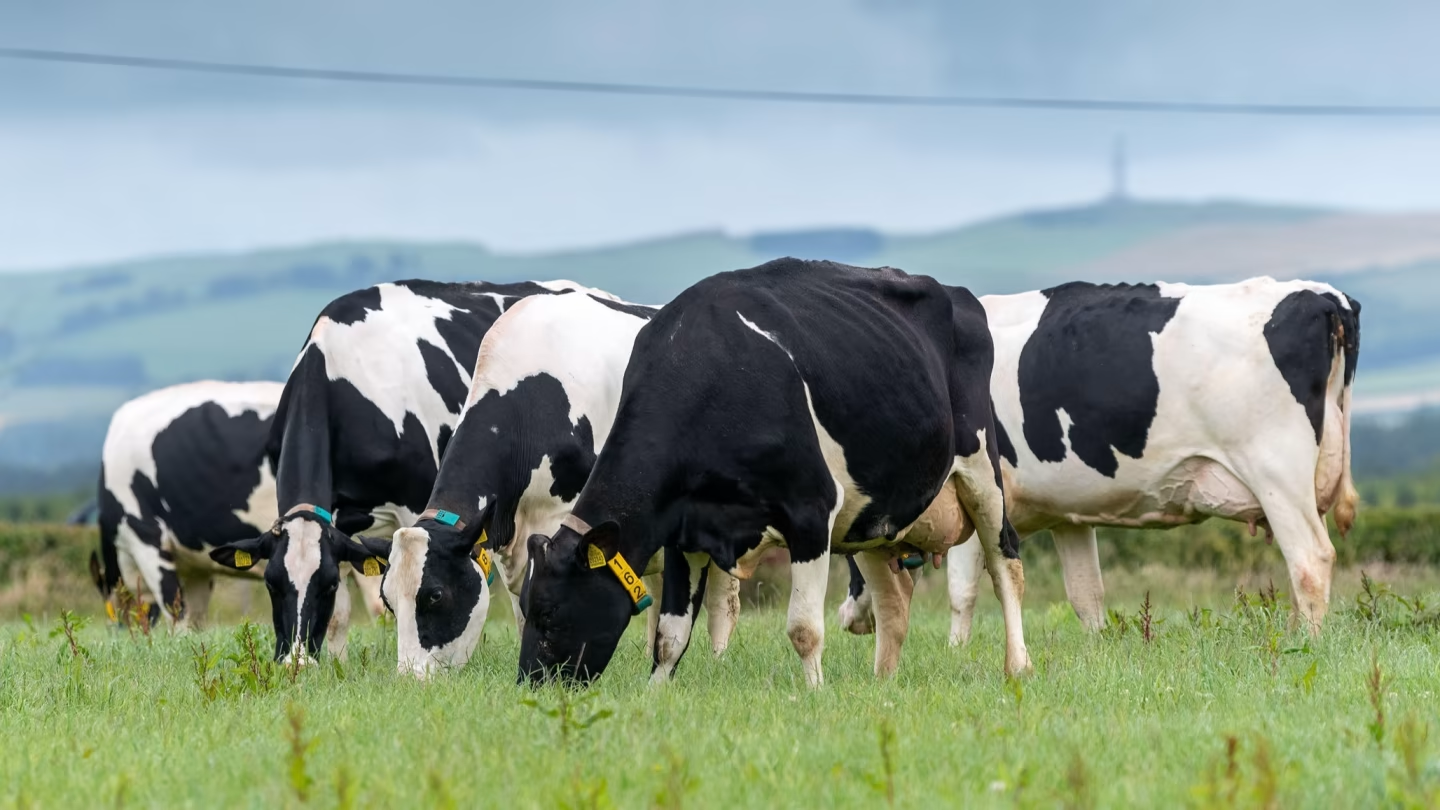
You know what caught my attention this week? British dairy farmers just did something most of us thought was impossible. They got their entire supply chain—from the corner store to the golden arches—to actually help pay for going green.
I’m not talking about another feel-good press release here. This is real money changing hands, binding commitments on paper, and a completely different way of doing business that’s got folks from Wisconsin to Alberta asking, “How’d they pull that off?”
The UK dairy industry has just launched what it’s calling a “landmark alliance.” But here’s what makes this different: for the first time ever, the big retailers and processors are sitting down at the same table, making formal commitments to share the cost of environmental improvements instead of just handing down demands from corporate headquarters.
The Numbers Tell the Real Story
Let’s cut through the corporate speak and talk about what’s actually happening on British farms right now:
Eighty percent of UK dairy farmers are calculating their carbon footprint. Not planning to do so, not thinking about it, doing it.
Approximately 65% of dairy farmland is enrolled in environmental stewardship programs. That’s two-thirds of the entire sector getting paid for conservation work.
Approximately 40% of on-farm energy comes from renewable sources. Compare that to lower adoption rates in North America, and you start to see why people are paying attention.
These aren’t pie-in-the-sky targets for 2030. They’re happening right now, on working farms, with real farmers managing real cows and real bottom lines.
The alliance bringing this together reads like a who’s who of the dairy world: AHDB, Dairy UK, NFU, Arla Foods UK, Dale Farm, First Milk, Lactalis UK & Ireland, Müller UK & Ireland, Tesco, Sainsbury’s, Morrisons, McDonald’s and Sysco GB all sitting in the same steering group. When was the last time you saw that kind of lineup agreeing on anything?
Bas Padberg from Arla Foods UK, who’s chairing this whole thing, put it pretty simply: “We have to find ways of feeding a growing population and providing nutrient-dense foods that nourish people. Dairy has a key role to play in this, but we know that as an industry, we also need to ensure that we limit our impact on the environment and bring down emissions”. What’s different this time? The retailers aren’t just nodding along—they’re actually writing checks.
Why This Should Matter to Your Bottom Line
Here’s the thing about sustainability requirements: they’re not going away. If anything, they’re getting tougher every year. But until now, who has been expected to absorb all those costs? That’s right—us farmers.
Paul Tompkins from the NFU National Dairy Board said what we’ve all been thinking: “The costs and complexities of compliance are significant, and dairy farmers cannot meet them alone”. Finally, someone in a position to do something about it is actually saying it out loud.
And here’s what really gets me excited: the UK sector isn’t just talking a good game. They’ve already achieved a 24% drop in greenhouse gas emissions since 2015. Their carbon footprint per liter is 1.25 kg CO2e—that’s only 43% of the global average and significantly below benchmarks in other major dairy regions.
These aren’t theoretical numbers dreamed up in some university lab. British dairy farmers are operating at world-leading efficiency levels, and they’re doing it profitably.
How They’re Actually Making It Work
Now, here’s where it gets interesting. The secret isn’t just everyone holding hands and singing about teamwork. It’s the structure they’ve built.
This alliance operates on what they call “shared responsibility,” meaning the costs and benefits of sustainability are distributed across the entire supply chain, not just dumped at the farm gate. Think about it like this: if your local co-op benefits from marketing “sustainable” milk, shouldn’t they help pay for what makes it sustainable?
They’ve a Sustainable Dairy Pathways Report scheduled for 2026 that’ll outline exactly who pays for what. Smart move? A dairy farmer is leading it, so real-world economics don’t get lost in corporate translation.
The targets are ambitious but achievable: Net Zero by 2050, with every farmer calculating their carbon footprint every three years. They aim to achieve 100% renewable electricity on-farm by 2030 and eliminate all serious water pollution incidents by the same date.
The Science Behind What’s Actually Working
Most of us have heard the sales pitches about automated systems and renewable energy. But let’s talk about what’s really happening on farms based on current research:
Carbon footprint reduction through practical measures is where the real progress is happening. Dr. Tianhai Yan from the Agri-Food Bioscience Institute (AFBI) has demonstrated that high-yielding herds can reduce their carbon footprint by 31.5% through practical nutrition and management-based practices, while spring-calving herds can achieve 16.9% reductions. A range of practical mitigation measures can be implemented on dairy farms to help reduce emissions from agriculture. This includes practical nutrition and management-based practices designed to lower emissions of ammonia and methane,” Yan explains.
Renewable energy adoption is where the UK really stands out. The 40% figure for on-farm renewable energy usage reflects substantial investment in technologies such as anaerobic digestion. As Arla’s VP of Production, Fran Bal,l notes, “AD has the potential to play a very valuable role in terms of waste disposal, improving the management of slurry, and providing access to clean biogas””.
Standardized measurement is crucial to this success. The UK’s approach aligns with the International Dairy Federation’s revised Carbon Footprint methodology, developed by 50 experts from 17 countries who reviewed the latest science and best practices. As IDF Director General Caroline Emond puts it, “We can’t reduce what we cannot measure”.
But let’s be honest about the investment. The UK Dairy Carbon Network, led by AFBI, is establishing 56 demonstration farms across four major dairying regions to test real-world solutions. These aren’t just theoretical studies—they’re testing everything from animal management innovations to nutrient management approaches on actual commercial operations.
Let’s Talk Real Money
Sounds too good to be true? Here’s where the rubber meets the road in terms of farm economics that can be appreciated:
The UK’s support through the Sustainable Farming Incentive has been substantial. As of January 2025, there were 32,200 active agreements covering significant portions of England’s agricultural land. The government has committed £5 billion over 2 years to sustainable farming and nature recovery, with over 37,000 agreements in place.
These programs are delivering measurable results. Through SFI, 800,000 hectares of arable land are now farmed without insecticides, while 280,000 hectares of low-input grassland are being managed more sustainably. Additionally, 75,000 km of hedgerows are being actively maintained.
The UK’s success stems from aligning policy support with market incentives. As research shows, “the increasingly pressing challenges and high competition in the dairy industry, particularly in saturated markets, emphasize the importance for farms to undertake a comprehensive economic sustainability analysis”.
However, here’s the catch: these programs rely on meeting specific sustainability targets and navigating complex bureaucratic requirements. Most participating farmers report the paperwork is worth it for the financial support, but it’s not a free ride.
What This Means for North American Farms
For those of us watching from across the pond, this could signal a whole new approach to negotiating with processors and cooperatives. While UK farms are seeing these collaborative results, North American approaches remain more fragmented.
The US dairy industry operates through voluntary initiatives led by organizations like the Innovation Center for US Dairy’s Sustainability Alliance, relying on what they call “braided funding” from public grants and corporate partnerships. Canada’s proAction® program provides more regulatory structure but hasn’t achieved the same level of coordinated industry response we’re seeing in the UK.
Climate and scale matter, too. What works in the UK’s relatively concentrated dairy regions might need adaptation for the vast geographic spread of North American operations. And a 100-cow family operation faces different realities than a 2,000-cow setup with automated systems.
The Technical Foundation That Makes It Work
What really strikes me about this UK approach is how they’ve standardized the technical foundation. The alliance utilizes consistent carbon footprinting tools aligned with the International Dairy Federation methodology, which means farmers can’t be penalized for using the “wrong” calculator. Everyone plays by the same rules.
The UK Dairy Carbon Network is providing the research backbone, with Dr. Steven Morrison from AFBI leading work across 56 farms in four major dairy regions. “Our goal within the project is to drive meaningful change in the dairy sector by applying research findings directly to real-world farming conditions,” Morrison explains.
This isn’t just about measuring emissions—it’s about proving what actually works in commercial farming conditions. The network will assess innovations in animal management, land use, nutrient management, and technology, while supporting farmers in achieving more efficient use of nitrogen and phosphorus.
What You Can Take Away from This
Three things really stand out:
First, collective action works. When the entire industry, including the buyers, commits to sharing responsibility, the economics finally start making sense. Individual farms trying to meet sustainability requirements alone are fighting an uphill battle.
Second, standardized measurement matters. The UK’s emphasis on consistent, credible data using the IDF methodology means everyone is held to the same standards. No more moving goalposts or arbitrary requirements.
Third, timing is everything. The UK moved when market conditions, policy support, and consumer demand aligned. That window exists for North American producers, but it won’t stay open forever.
The Bottom Line
This isn’t about being green for the sake of it. UK dairy has positioned itself as a global leader in low-carbon production by focusing on efficiency and innovation. Now they’re making sure the entire supply chain shares both the costs and the benefits of that leadership.
For North American producers watching this unfold, the lesson is crystal clear: the future belongs to those who can organize collectively and negotiate from a position of strength. The UK dairy industry just showed us exactly how it’s done.
And you know what? It’s about time someone figured out how to make sustainability profitable, rather than just another cost of doing business.
The real question isn’t whether this model will spread—it’s how quickly other regions will adapt it to their own markets. Because one thing’s certain: farmers who wait for perfect conditions usually miss the best opportunities.
Regional Performance Comparison
| Region | Carbon Footprint (kg CO2e/L) | Progress Since 2015 | Renewable Energy Use | Environmental Scheme Participation |
| UK | 1.25 | 24% GHG reduction | 40% | 65% |
| Global Average | 2.9 | Variable | Variable | Variable |
Sources: UK Dairy Roadmap Climate Ambition, Official Alliance Announcements, AFBI Research, International Dairy Federation
Key Takeaways
- Collective Bargaining Power Delivers Real ROI: UK farmers negotiating as a unified bloc with retailers achieved 65% participation in environmental schemes with guaranteed cost-sharing, proving that organized producers can shift sustainability expenses from farm balance sheets to supply chain partners who benefit from “sustainable” marketing claims.
- Standardized Carbon Measurement Cuts Compliance Costs: Using the International Dairy Federation methodology eliminated “wrong calculator” penalties and reduced the administrative burden, while AFBI research shows that practical nutrition and management changes can deliver 31.5% carbon footprint reductions without major capital investments.
- Policy-Market Alignment Maximizes Feed Efficiency Returns: The UK’s £5 billion Sustainable Farming Incentive, supporting 37,000+ agreements, demonstrates how coordinated government programs and retailer commitments create multiple revenue streams that improve feed conversion ratios while reducing environmental impact.
- First-Mover Advantage in Low-Carbon Positioning: The UK dairy industry’s 1.25 kg CO2e/L footprint (versus a global average of 2.9 kg) positions producers for premium markets and regulatory compliance, while North American operations risk being left behind as sustainability requirements tighten in 2025-2026.
- Supply Chain Integration Beats Individual Action: The alliance model proves that shared responsibility frameworks deliver measurable results (40% renewable energy adoption, 24% GHG reduction) that individual farm sustainability efforts can’t match, challenging the conventional wisdom that environmental compliance is a solo farm responsibility.
Executive Summary:
Forget the myth that dairy farmers must shoulder environmental costs solo—the UK just shattered that outdated thinking with a game-changing alliance model. British producers achieved 80% participation in carbon footprinting and 40% adoption of renewable energy by making retailers and processors share the financial burden, rather than just making demands. The results? A 1.25 kg CO2e/L carbon footprint that’s 43% of the global average, 24% GHG reduction since 2015, and measurable profit improvements for participating farms. This shared responsibility approach challenges North America’s fragmented sustainability efforts, where individual operations struggle with compliance costs while processors capture marketing benefits. Research from AFBI demonstrates that high-yielding herds can reduce their carbon footprints by 31.5% through practical nutrition and management changes when properly supported across the supply chain. The UK’s £5 billion government commitment and retailer cost-sharing prove that collective action transforms sustainability from a farm expense into a profitable industry strategy. It’s time to evaluate whether your current sustainability approach is leaving money on the table while your supply chain partners profit from your environmental investments.
Complete references and supporting documentation are available upon request by contacting the editorial team at editor@thebullvine.com.
Learn More:
- Sustainable Dairy Farming: Revolutionizing Practices for a Greener, Profitable Future – Reveals practical strategies for implementing water recycling, anaerobic digestion, and rotational grazing that can reduce emissions by 10% while maintaining profitability on your operation.
- Corporate Giants Are Hijacking Dairy Sustainability—And Your Farm’s Future Depends on Getting Aboard – Demonstrates how Mars & Nestlé’s sustainability initiatives prove environmental programs can generate $142K annually, showing the economic opportunity behind corporate sustainability partnerships.
- 5 Technologies That Will Make or Break Your Dairy Farm in 2025 – Explores cutting-edge innovations like smart calf sensors and AI analytics that can slash mortality 40% and boost yields 20%, complementing the UK’s technology-driven sustainability approach.
 The Sunday Read Dairy Professionals Don’t Skip.
 The Sunday Read Dairy Professionals Don’t Skip.
Every week, thousands of producers, breeders, and industry insiders open Bullvine Weekly for genetics insights, market shifts, and profit strategies they won’t find anywhere else. One email. Five minutes. Smarter decisions all week.




