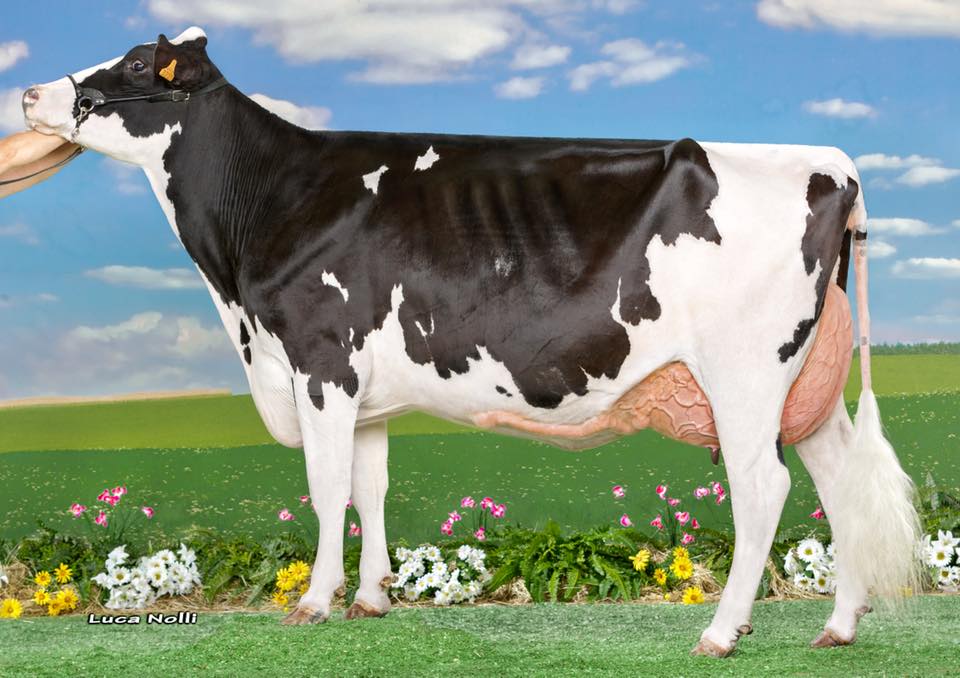
Archive for dairy breeding strategy

The December Genetic Reckoning: Former Champions Fall, New Kings Rise – and Your 2026 Strategy Just Changed

December didn’t just reshuffle the rankings—it exposed who was betting on hype. Top bulls cratered overnight. New kings emerged. Your 2026 matings need a rewrite.

The December 2025 genetic evaluations weren’t just another routine update. They were a full-scale reset of global Holstein rankings—the kind that happens once every decade or so. From the powerhouses of North America to the diverse breeding programs of Europe and Scandinavia, the genetic pecking order has been violently reshuffled. Former leaders have been dethroned. Unexpected champions have been crowned. And for dairy breeders planning their 2026 mating programs, the message is stark: the genetic playbook from August is now obsolete.

This isn’t hyperbole. It’s a hard reality backed by the data. And if you’re still making breeding decisions based on last summer’s rankings, you’re leaving money on the table.

Three Seismic Shifts Defining the New Genetic Reality

The December evaluations revealed three interconnected forces reshaping global Holstein genetics:

  1. Unprecedented Volatility in Genomic Rankings
    Several high-profile sires—bulls that were industry darlings just weeks ago—have experienced dramatic, overnight index drops. In Switzerland, the former #1 sire, Sous-Moron Boston, suffered a stunning 52-point ISET collapse. In Italy, the polled star KNO Ecuador P plummeted an incredible 98 gPFT points. These aren’t statistical blips; they’re textbook examples of genomic risk materializing in real time.
  2. Genetic Concentration Consolidating Around Specific Bloodlines
    Genosource now controls 22 of the top 30 Net Merit positions in the US—a remarkable 73% market share. The Gameday maternal line underpins three of Switzerland’s top five ISET sires. The Altazazzle bloodline claims four of the top ten proven sire positions in the Netherlands. This concentration delivers elite, consistent results—but it also creates a ticking time bomb for inbreeding and genetic diversity.
  3. Components Are No Longer Optional
    From Canada’s BEYOND HI-LEVEL-ET (165 kg Fat) to Germany’s Saturn RDC (+0.88% Fat), the message is universal: with processor payments increasingly tied to milk solids, selecting for high fat and protein is now a direct path to a higher milk check. The days of overlooking component specialists are over.

North America: Where Profit and Components Rule
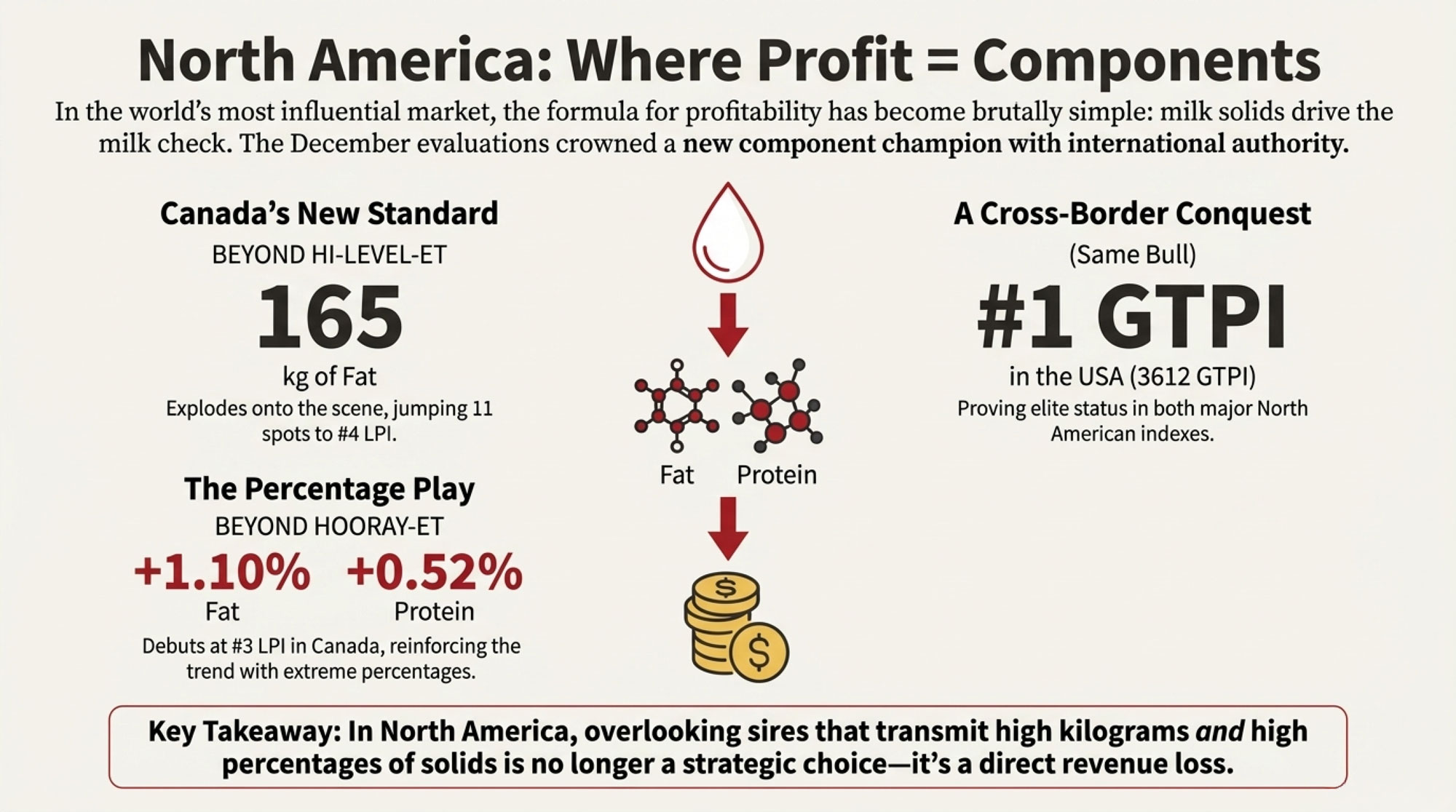
The North American market continues to set the global pace for Holstein genetics. But the December evaluations revealed two distinct narratives unfolding on opposite sides of the border.

Canada: The Component King Has Arrived
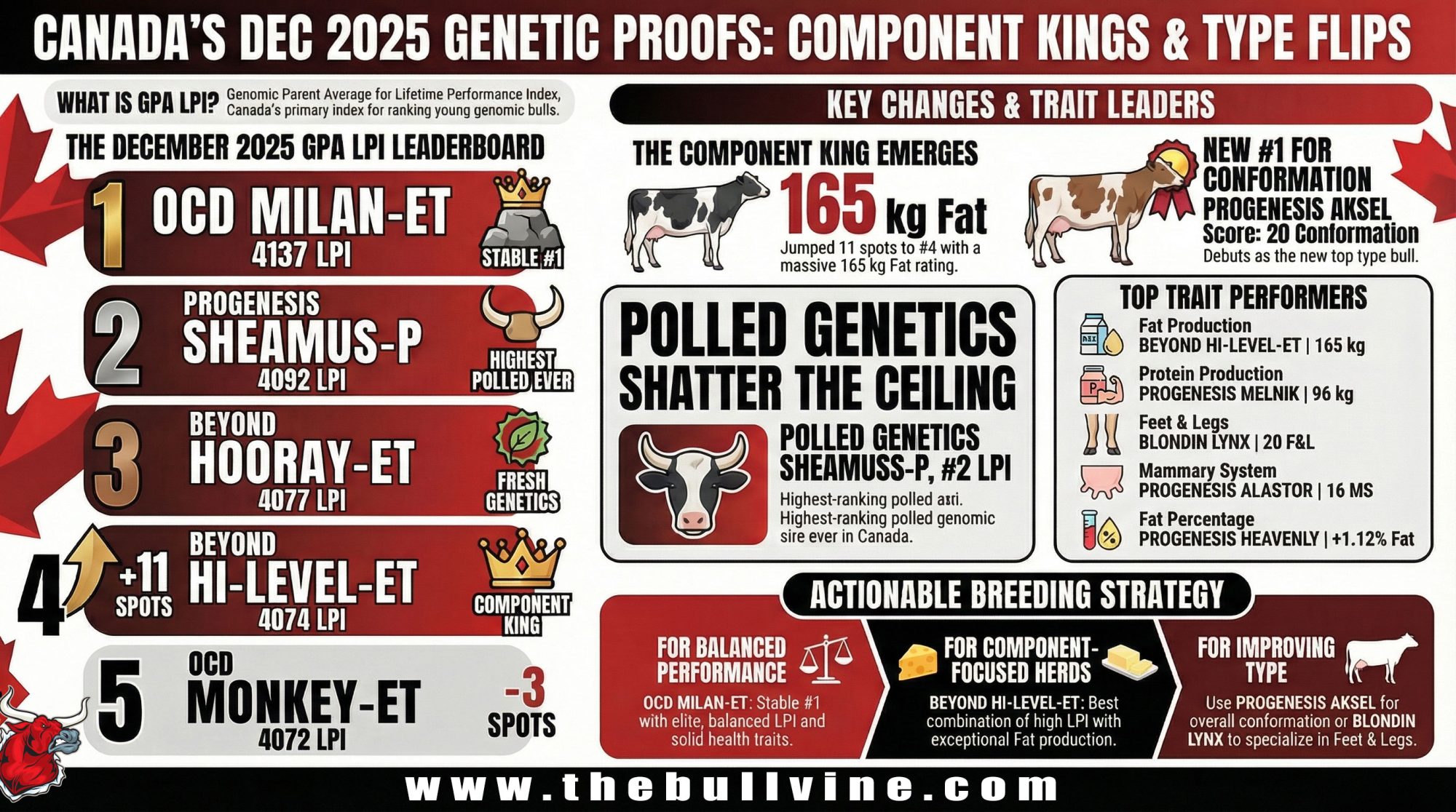
OCD MILAN-ET held his ground as the #1 LPI sire with a solid 19-point gain to 4137 LPI, but the real story belongs to his challengers—three newcomers who have rewritten the options for breeders.

BEYOND HI-LEVEL-ET made the most explosive leap, jumping 11 spots to #4 LPI. His profile reads like a case study in modern profitability: 165 kg Fat on a high-volume base that proves elite milk volume and exceptional component density aren’t mutually exclusive. For breeders paid on component density, he’s become the gold standard.

Then there’s BEYOND HOORAY-ET, who debuted at #3 LPI and immediately established himself as the “percentage specialist.” With +1.10% Fat and +0.52% Protein, his profile is tailor-made for herds targeting premium milk quality.

Perhaps most significant: PROGENESIS SHEAMUS-P shattered the ceiling for polled genetics, debuting at #2 LPI. He’s the highest-ranking polled genomic sire in Canadian history—proof that breeders no longer have to sacrifice elite index performance to access the valuable polled trait.

Read more: 165 kg Fat, 11-Spot Jump, New #1 Type Bull: December 2025’s Canadian Proof Run Rewrites Your Breeding Plan

USA: The Genosource Era Begins

If Canada’s story is about newcomer diversity, the US narrative is about unprecedented consolidation.

Genosource has achieved a historic sweep, capturing 22 of the top 30 Net Merit positions. For context: this represents a 73% market share in the industry’s primary profitability index. That level of concentration is a double-edged sword. On one hand, it offers a clear path to proven, high-profit genetics backed by a program that has cracked the code on profitability. On the other hand, it severely narrows the available gene pool—and that’s a serious concern for long-term herd resilience.

GENOSOURCE RETROSPECT-ET continues his reign as the #1 NM bull at 1296, demonstrating the program’s mastery of the total economic merit formula. But the most explosive newcomer was SAN-DAN ON CALL-ET, who debuted at #3 GTPI with a production profile that demands attention: 1845 Milk and 151 Fat. The fact that he also earned a #9 NM ranking tells you his balanced genetics appeal across multiple profit drivers.

And confirming the component trend: BEYOND HI-LEVEL-ET claimed the #1 GTPI position in the US at 3612, underscoring his international elite status.

Read more: 22 of 30: Genosource’s Historic Sweep of the December 2025 US Holstein Genetic Evaluations

Europe: Bloodlines, Balance, and the Rise of Functional Genetics
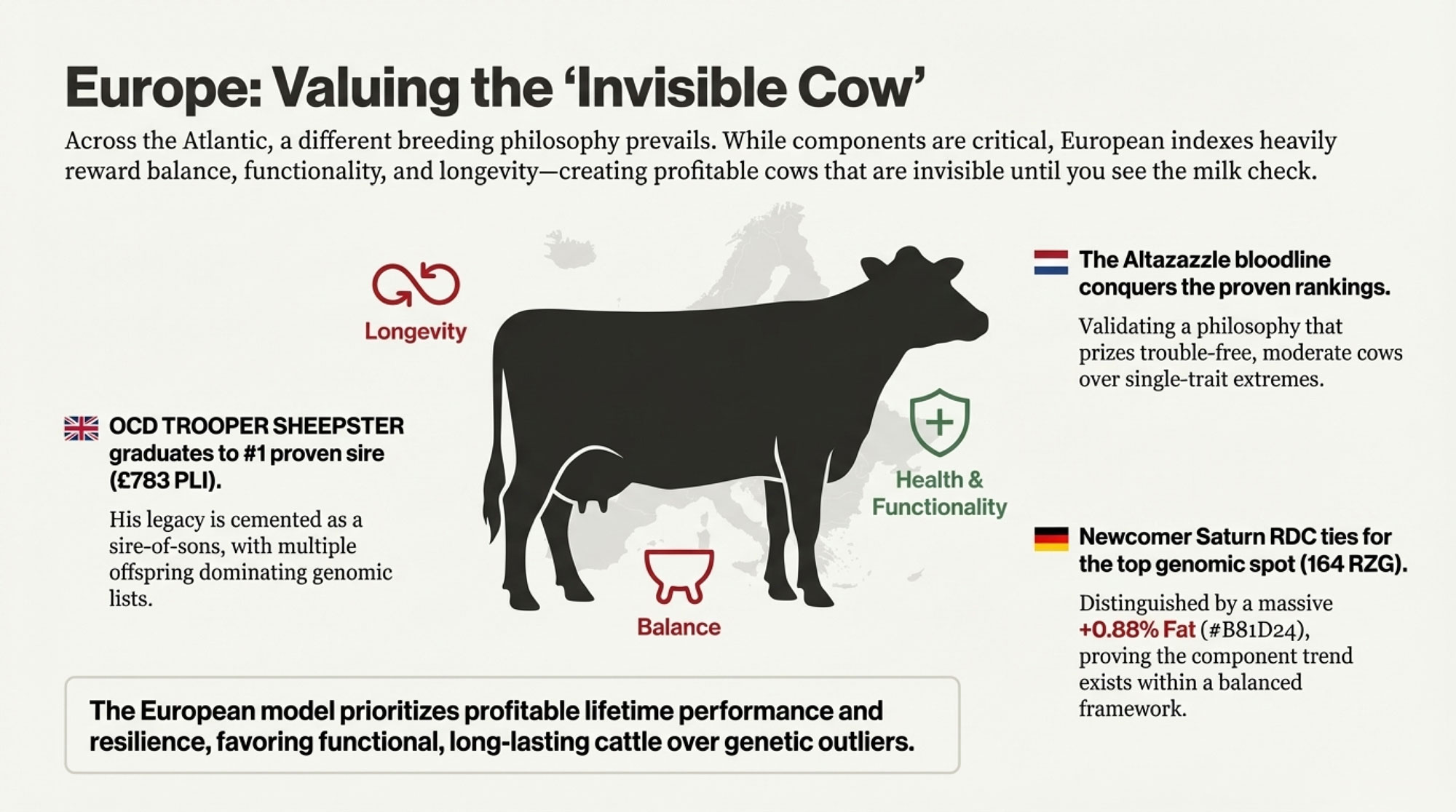
Europe’s evaluations revealed a shared philosophy: rewarding balanced, functional cattle designed to thrive in real-world commercial systems. While each country maintains its own index, a common theme emerged in the dominance of bloodlines that consistently deliver both profitability and longevity.

United Kingdom: Sheepster’s Legacy Reshapes the Breed

The new #1 genomic sire is DENOVO COYOTE P, with a PLI of £871. His profile is textbook modern British dairy: exceptional +0.30% fat, commercially valuable A2A2 status, and polled genetics.

But the more significant story belongs to OCD TROOPER SHEEPSTER, who graduated to #1 on the daughter-proven side with a £783 PLI. His true significance extends far beyond his own rank—he’s become a breed-shaping sire of sons. Multiple Sheepster offspring, including BADGER SIEMERS DAY TRIP (#2 genomic) and PROGENESIS PRESTON (#3 genomic), now dominate the young sire lists. This is the kind of bloodline dominance that builds lasting competitive advantage.

Read more: December 2025 UK Holstein Genetic Evaluations: Sheepster Claims Proven Crown, Homegrown Coyote P Debuts at Genomic #1

Netherlands: Shattering the +400 Barrier
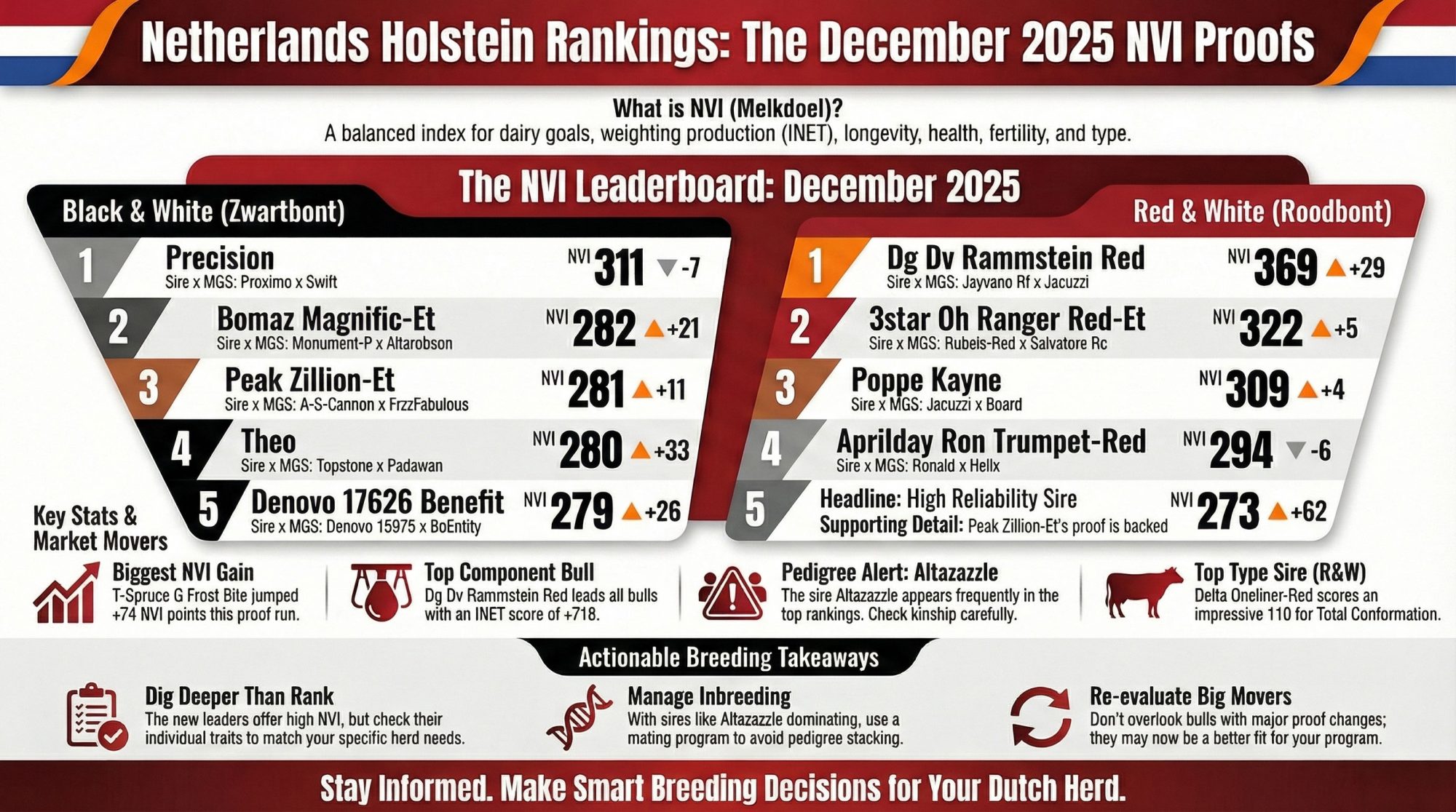
Genosource Moti rewrote the Dutch record books, becoming the first sire to lead the genomic rankings at a remarkable +420 NVI. This isn’t just a personal achievement—it signals that the ceiling for genetic progress continues to rise.

What’s truly revealing, however, is the absolute conquest of the Altazazzle bloodline in the proven rankings. This line claims four of the top ten positions—a clear market vote for what commercial dairies crave: the “invisible cow.” Moderate. Functional. Invisible until you look at the milk check. Their dominance validates a breeding philosophy that prioritizes trouble-free performance over extreme individual traits.

Read more: Genosource Moti Cracks +420 NVI: Inside the December 2025 Dutch Sire Shakeup

Germany: New Champions in Both Populations

For Black & White genomic sires, newcomer Saturn RDC tied for the top with the former leader, Veterano, at 164 RZG. Saturn RDC immediately distinguished himself with a massive +0.88% Fat—the component specialist phenotype that the market is rewarding globally.

The new Red & White genomic leader is Bueno Red at 161 RZG. He offers a rare combination: extreme milk production (+2,159 kg) paired with excellent type (121 RZE). This kind of balanced profile is increasingly valuable as European breeders recognize that extremes in single traits often create hidden costs elsewhere.

Read more: New King of NTM: VH Sheriff Debuts at +51 as Top Genomic Bulls Reshuffle -November 2025 German Sire Proof Central

The Volatility Report: When Genomic Promise Meets Reality

While some markets celebrated steady progress, Switzerland, Italy, and Scandinavia delivered a masterclass in genomic risk. In these countries, several reigning #1 sires experienced dramatic overnight index drops—a powerful reminder of why risk management matters in breeding programs.

Switzerland & Italy: The Reckoning for Unproven Genetics

In Switzerland, Sous-Moron Boston’s 52-point ISET drop (from +1645 to +1593) wasn’t an anomaly—it was the statistical consequence of reliability risk. Here’s the hard truth: a 75% reliable genomic proof means there’s a 25% chance the bull’s true genetic merit will differ significantly from his initial ranking. For Boston, that risk materialized in index drops that erased millions in projected genetic value overnight.

Read more: Swiss Shakeup: Monset (+1603) Claims ISET Crown as Boston Plummets 52 Points

Italy’s story was even more dramatic. The high-profile polled star KNO Ecuador P plummeted 98 gPFT points as more daughter data recalibrated his initial genomic promise. This is what happens when market enthusiasm outpaces actual proof of reliability.

With the deck reshuffled, Italy’s new international genomic leader is DENOVO LOCUST-ET, with a formidable gPFT of 5450.

Read more: Genosource Moti Cracks +420 NVI: Inside the December 2025 Dutch Sire Shakeup

Scandinavia: The Nordic Shakeup
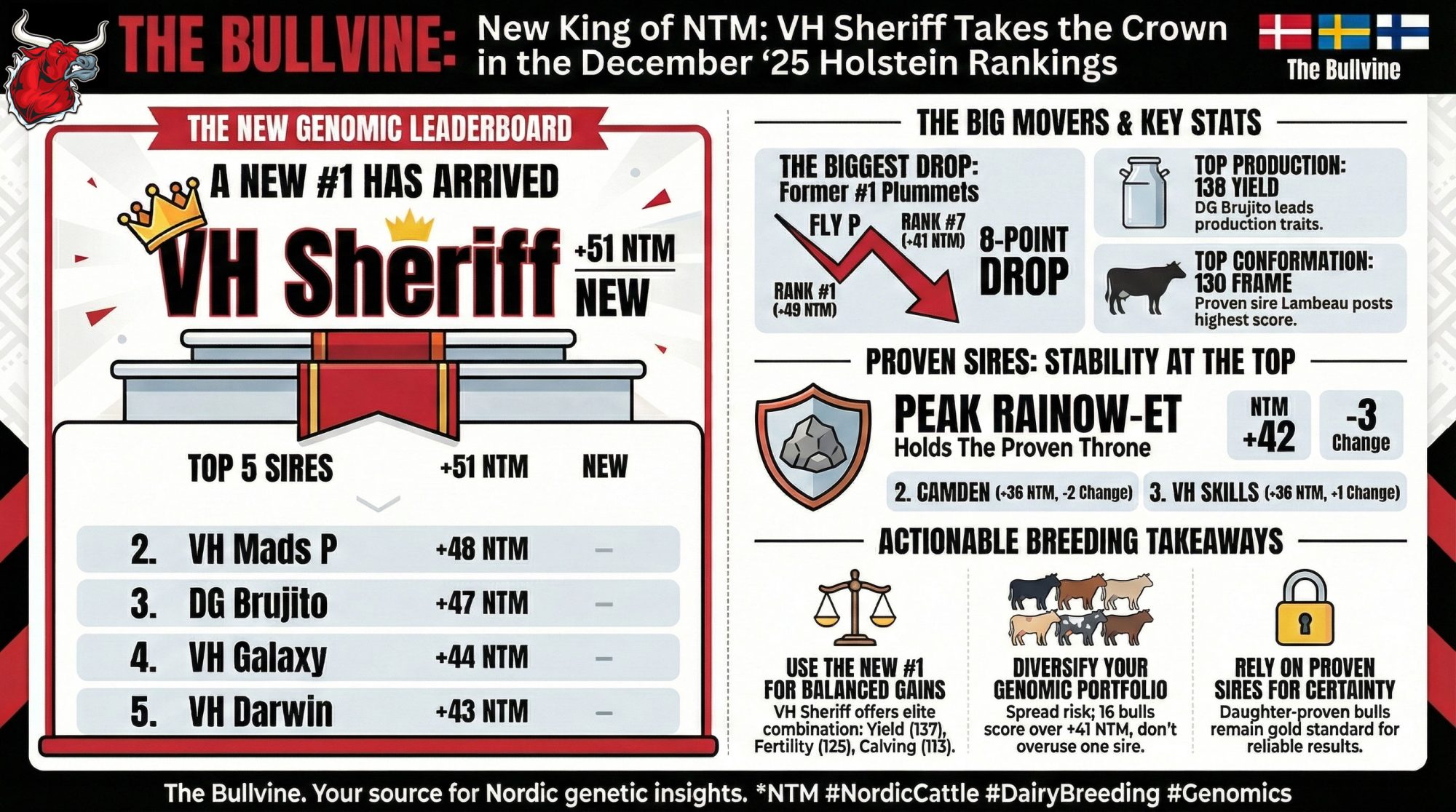
The Nordic Total Merit (NTM) index experienced its own dramatic power struggle. The former genomic leader, Fly P, experienced a precipitous 8-point drop from +49 NTM to +41 NTM—one of the sharpest single-round declines on record for a top bull.

His fall coincided with the spectacular debut of VH Sheriff, who entered the rankings at an exceptional +51 NTM. This contrast illustrates a critical principle: high-potential genomic projections and high-certainty proven results often tell different stories. On the proven sire list, PEAK RAINOW-ET held his position as the reliable leader at +42 NTM, providing a crucial stability anchor.

Read more: New King of NTM: VH Sheriff Debuts at +51 as Top Genomic Bulls Reshuffle -November 2025 German Sire Proof Central

Four Strategic Imperatives for Your 2026 Breeding Program

The December 2025 proofs delivered clear signals. Here’s how to act on them:

1. Embrace Volatility—and Manage It

The dramatic index drops of bulls like Boston, Ecuador P, and Fly P are the most important risk management lesson of this evaluation cycle. A chart-topping genomic proof is a powerful indicator of potential, but it’s not a guarantee of performance.

Action: Diversify your sire portfolio ruthlessly. Don’t concentrate more than 15-20% of your herd’s matings on any single unproven genomic bull, no matter how impressive his initial ranking. A team of high-quality young sires will always outperform a single superstar who fails to deliver.

2. Follow the Money: Components Drive the Milk Check

From Canada’s component specialists to Germany’s fat-specialists and Switzerland’s balanced bulls, the message is universal. Processor payments increasingly tie to milk solids. Component selection isn’t a nice-to-have anymore—it’s the direct path to higher revenue.

Action: Prioritize sires transmitting high kilograms AND high percentages of fat and protein. These specialists are your best tool for maximizing revenue per hundredweight.

3. Mind the Inbreeding Gap

The genetic concentration around Genosource in the US, the Gameday line in Switzerland, and the Altazazzle line in the Netherlands is a double-edged sword. Yes, these lines deliver elite results. But their dominance increases inbreeding risk in the broader population.

Action: Use mating programs to monitor and manage inbreeding coefficients. Protecting genetic diversity isn’t peripheral—it’s foundational for maintaining fertility, calf vigor, and long-term herd resilience. Be aware of the popular bloodlines and actively seek outcross options to balance your portfolio.

4. Proven Sires Remain Your Foundation

In an era of genomic volatility, the stability of high-reliability, daughter-proven sires is more valuable than ever. Leaders like OCD TROOPER SHEEPSTER in the UK and PEAK RAINOW-ET in Scandinavia provide the kind of anchor every breeding program needs.

Action: Allocate a meaningful portion of your matings to elite proven sires. Use them as a dependable risk-management tool to balance the high potential—but higher risk—of your genomic sire team. They’re not old news; they’re insurance against genomic volatility.

The Bottom Line

The December 2025 evaluations proved that Holstein genetics continues to evolve at a breathtaking pace. The ceiling for genetic progress keeps rising. New champions emerge. Old certainties crumble.

But here’s what shouldn’t change in your breeding strategy: disciplined risk management, relentless focus on the traits that drive profitability, and a balanced portfolio that combines proven reliability with genomic potential. The breeders who master this balance in 2026 will be the ones posting the highest milk checks and building the most resilient herds.

The genetic landscape has been reset. Now it’s time to update your playbook.

KEY TAKEAWAYS: 

  • Genomic promises just met reality: Switzerland’s #1 cratered 52 points. Italy’s polled star dropped 98. December proved that a 75% reliable proof carries 25% real risk—and millions in value can vanish overnight.
  • Components drive the milk check now: Fat and protein specialists dominated from Canada to Germany. Breeders ignoring solids aren’t just behind—they’re bleeding revenue.
  • Genosource owns 73% of America’s profit elite: Unprecedented consolidation delivers proven results, but shrinks the gene pool. Opportunity and inbreeding risk now travel together.
  • Diversify or pay the price: Cap any unproven genomic sire at 15-20% of matings. A balanced sire team always beats a single superstar who crashes.
  • Proven sires are your volatility hedge: Daughter-proven leaders like Sheepster and Peak Rainow deliver what genomic projections can’t—certainty.

EXECUTIVE SUMMARY: 

December’s reckoning separated the breeders who understand genomic risk from those who were chasing leaderboard hype. The bulls that cratered aren’t coming back. The bloodlines consolidating power aren’t slowing down. And the component premiums reshaping milk checks aren’t temporary. The question isn’t whether the genetic landscape has changed—it’s whether your breeding program has changed with it. August’s playbook is dead. What’s your 2026 strategy?

Join the Revolution!

Join over 30,000 successful dairy professionals who rely on Bullvine Weekly for their competitive edge. Delivered directly to your inbox each week, our exclusive industry insights help you make smarter decisions while saving precious hours every week. Never miss critical updates on milk production trends, breakthrough technologies, and profit-boosting strategies that top producers are already implementing. Subscribe now to transform your dairy operation’s efficiency and profitability—your future success is just one click away.
NewsSubscribe
First
Last
Consent

When Red × Red = Black: A Holstein Breeder’s Guide to Variant Red (COPA Gene)

Red × Red should equal Red. But half your calves came out black. The COPA gene is the override switch you didn’t know existed.

For decades, Holstein breeders operated on a simple truth: Black dominates Red. It was a comfortable, binary rule—and one that served us well for generations. But here’s the thing: it was incomplete as well.

The emergence of Variant Red (COPA) hasn’t just added a new color pattern to our toolbox; it’s also changed the way we think about color. It’s exposed a blind spot in how we think about genetic pathways. And if you’re making mating decisions without accounting for this “override” switch, you’re working with incomplete information. That costs money.

The Mechanic: Two Systems, One Outcome

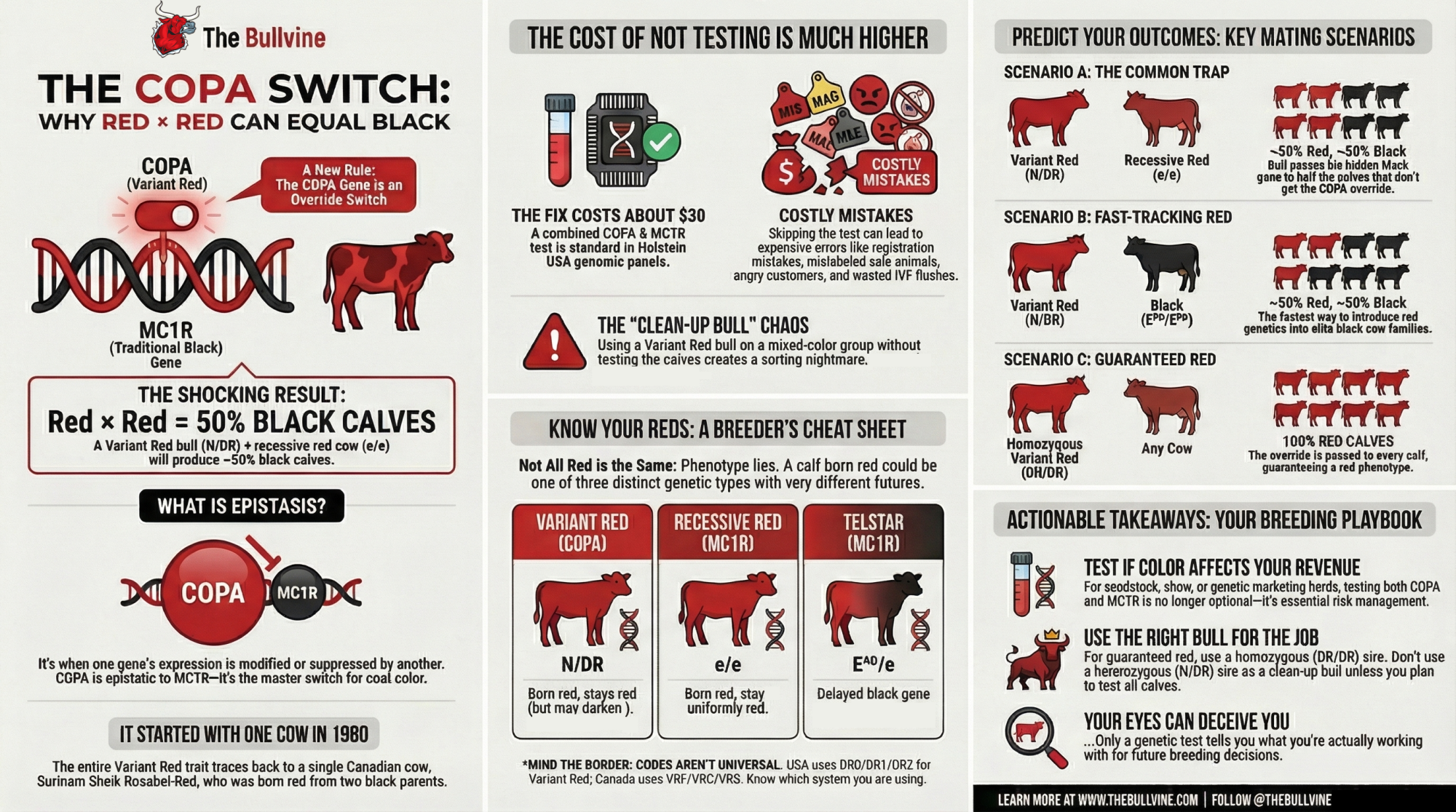
You probably already know the old model. The MC1R gene—what geneticists call the Extension locus—controls coat color through a clear dominance hierarchy: E^D (dominant black) > E^BR (Telstar) > E^+ (wild-type) > e (recessive red). Two copies of e gives you a red calf. Simple enough.

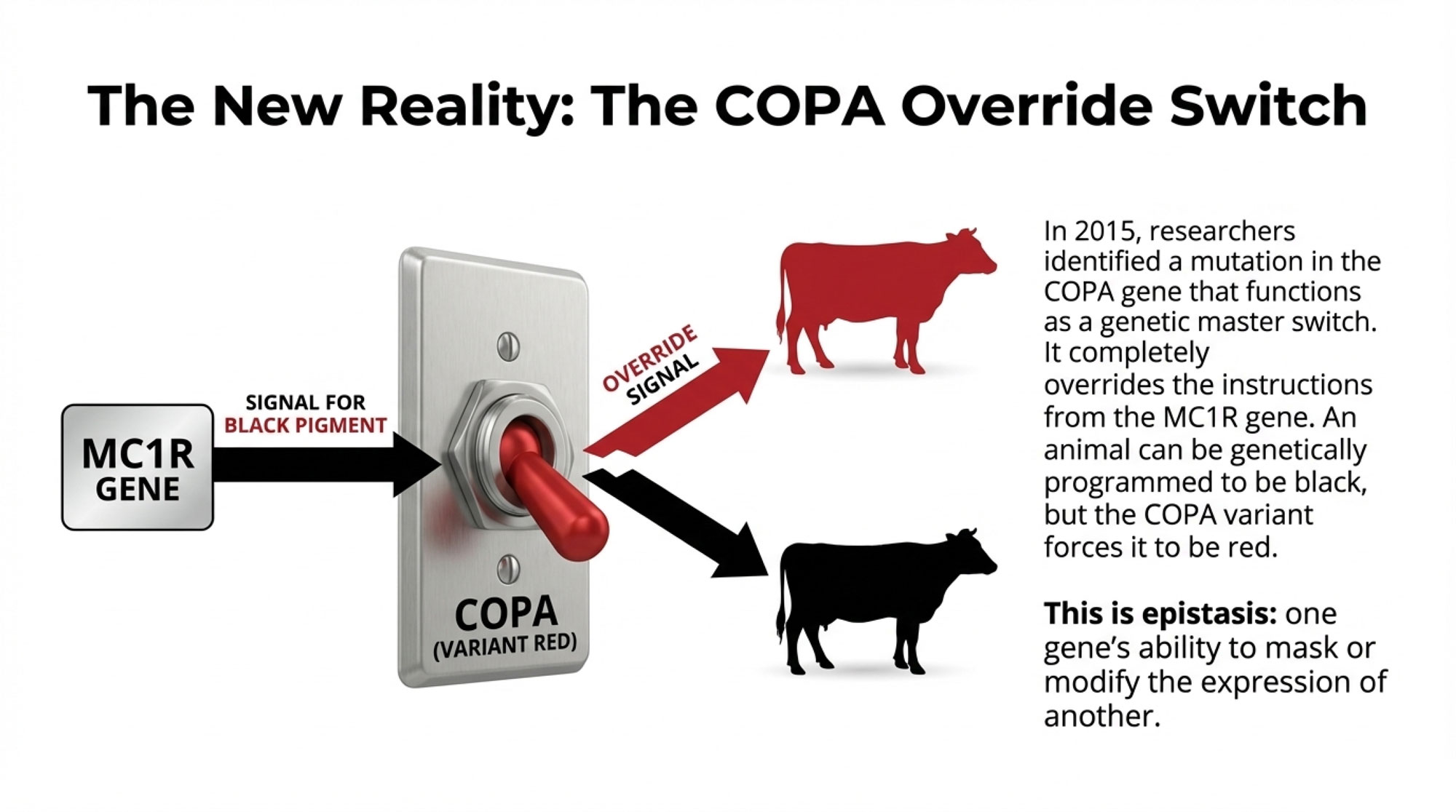
Then in 2015, researcher Ben Dorshorst and an international team published findings in PLOS ONE that changed everything. They identified a second switch: a mutation in the COPA gene that produces what we now call Variant Red. The critical discovery? COPA overrides MC1R entirely. An animal can be genetically programmed to be black at MC1R, but if it carries the COPA variant, it still expresses red. A decade of breeding experience and subsequent genetic research has validated this finding—the mechanism holds up.

This is epistasis in action—one genetic pathway superseding another. Practically, it means that phenotype alone tells you nothing about what’s actually happening under the hood.

The good news? We now have reliable tests for both systems. UC Davis Veterinary Genetics Laboratory offers both COPA and MC1R panels, and Holstein Association USA includes both in their standard genomic testing. Once you know both pieces, you can actually plan your color outcomes instead of guessing.

The Cheat Sheet: Mating Outcomes at a Glance

Let me walk you through the scenarios breeders ask about most. This is the section you’ll probably want to bookmark.

Scenario A: Variant Red Sire (N/DR) × Black Dam (E^D/E^D)

  • Outcome: ~50% Red / ~50% Black
  • What’s happening: Red calves inherit the dominant DR allele, which overrides their black MC1R genetics. Black calves inherit the N allele and express normally.

Scenario B: Variant Red Sire (N/DR) × Recessive Red Dam (e/e)

  • Outcome: ~50% Red / ~50% Black (if sire carries E^D at MC1R)
  • What’s happening: This scenario assumes your Variant Red bull is carrying the Dominant Black gene (E^D) “underneath” his red coat—which many do, since the COPA mutation originated in black Holsteins. Red calves inherit DR (Variant Red) and express red regardless of MC1R. But calves inheriting N from the sire are now N/N at the COPA locus (no override present). If they also inherit E^D from the sire and e from the dam, they genotype as E^D/e at MC1R—which results in a black phenotype. Important note: If your Variant Red bull happens to be e/e (recessive red) at MC1R, he won’t throw black calves even when passing N—but this is less common.

Scenario C: Homozygous Variant Red Sire (DR/DR) × Any Dam

  • Outcome: 100% Red
  • What’s happening: Every calf inherits at least one DR allele. The override is guaranteed. This is your cleanest path to predictable red outcomes.

Scenario D: Telstar (E^BR) Animals

  • Outcome: Born red, turn black within 2-6 months
  • What’s happening: Completely different mechanism—MC1R timing, not COPA override. Don’t confuse these in your records.

The Trap: When Red × Red = Black

This scenario deserves special attention because it’s the one that burns breeders most often.

You have a nice Variant Red bull (N/DR). You breed him to your recessive red cows (e/e). You’re expecting all-red calves—makes sense, right? Red bull, red cow, red calves.

Except that about half those calves come out black. What gives?

Here’s what’s happening genetically: Your N/DR bull passes either N or DR to each calf (50/50 chance). The calves that get DR are red—the override kicks in, and they express Variant Red. But the calves that get N are now N/N at the COPA locus (no override present), assuming your dam is N/N like most Holsteins. If those calves also inherit E^D from the sire and e from the dam, they genotype as E^D/e at MC1R—and since Dominant Black is dominant over recessive red, you get a black calf.

The key detail here: this trap only springs if your Variant Red bull carries E^D at MC1R. Many do—the COPA mutation originated in black Holstein lines, so most Variant Red animals are “hiding” black genetics underneath that red coat. But if your bull happens to be e/e at MC1R (homozygous recessive red), he can’t pass E^D, and you won’t see black calves even when he passes the N allele.

This is exactly why UC Davis VGL’s documentation is explicit: phenotype cannot distinguish between color mechanisms. You need to test both COPA and MC1R to know what you’re actually working with.

Select Sires addresses this directly in their bull catalogs. Their DR1 code indicates heterozygous Variant Red status, and their technical materials—using LUCKY SEVEN-RED as an example—walk through exactly these scenarios. That’s the kind of transparency the whole industry should be moving toward.

The Money: Testing Costs vs. Breeding Errors

Let’s talk economics, because this is where the rubber meets the road.

Testing costs are pretty reasonable. UC Davis VGL lists coat color testing at $30 for the first test and $10 for each additional test on the same animal (pricing as of October 2023—worth verifying current rates at vgl.ucdavis.edu/pricing/cattle before you budget).

The cost of NOT testing? That’s where it gets expensive.

The Telstar Trap: You sell a red heifer as breeding stock. Buyer’s excited, pays a premium for red genetics. Six months later, she’s turned black. Now you’ve got an angry customer and reputation damage that’s hard to quantify but very real.

The Registration Error: You register a Variant Red calf as recessive red because it looks the same as a red calf at birth. Now every mating decision based on that animal’s record is built on false assumptions. Future buyers make breeding plans expecting recessive red transmission—and get results that don’t make sense. These errors compound across generations.

The Donor Disaster: You flush a valuable cow expecting specific color outcomes based on her phenotype. Wrong assumptions about her COPA/MC1R status mean the resulting embryos don’t deliver what you promised buyers. Cost: the flush investment, recipient management, and potentially refunds or re-dos.

The Clean-Up Bull Chaos: You turn a Variant Red bull out with a mixed color group during summer breeding. Come calving season, you can’t tell by looking which calves are carrying what. Now you need to genomically test the whole crop to sort replacements from sale animals—that’s $30-40 per head across your calf crop.

A $30 test looks pretty reasonable compared to any of those scenarios.

Where the Industry Is Heading

Here’s my read on where this is going: mandatory COPA/MC1R testing at registration isn’t a question of “if” for the elite tier—it’s a question of “when.” The economics and technology make it inevitable.

The AI studs are already there. Select Sires publishes DR codes in their catalogs and provides detailed mating guidance. Other major organizations are following suit with color genetics in their genomic offerings. The competitive pressure is real—if one stud provides complete color transparency and another doesn’t, breeders making premium decisions will choose clarity every time.

A note on codes: If you’re working across borders, be aware that the US and Canada use different labeling systems. In the US, Holstein Association USA and CDCB use DR0 (tested free), DR1 (heterozygous carrier), and DR2(homozygous Dominant Red). Holstein Canada uses VRF (free of Variant Red), VRC (carrier of Variant Red), and VRS (homozygous Variant Red). Same genetics, different shorthand—just make sure you’re reading the codes correctly for whichever system you’re working in.

The breed associations have built the infrastructure. WHFF registration guidelines already require member organizations to record coat color transmission and carrier status using standardized codes. Holstein Canada’s genetic trait coding system is in place. Holstein USA includes both recessive red and Dominant Red in their genomic panels. The recording framework exists—it’s just not universally enforced yet.

The holdouts make sense. For a 500-cow commercial dairy, shipping bull calves at a week old and selecting replacements purely on production and health? Color genetics are irrelevant. That’s a perfectly rational business decision, and mandatory testing across all registrations would be unnecessary friction for these operations.

But for seedstock operations, show herds, and anyone marketing genetics where color affects value? Testing both COPA and MC1R isn’t optional anymore. It’s table stakes.

The Verdict: Manage the Complexity You Create

So where does this leave you? Here’s my thinking:

If color affects your revenue, test every animal you plan to market as breeding stock. Document the COPA and MC1R status in your sale materials. Use breed-standard codes so the information travels cleanly when animals change hands.

If you’re breeding for red: Understand that N/DR sires will throw ~50% black calves even on red cows—provided the sire carries E^D at MC1R. If you need guaranteed red outcomes, use DR/DR sires. Plan accordingly.

If you’re managing clean-up bulls: Don’t use Variant Red bulls on mixed-color groups unless you’re prepared to test the resulting calves. The sorting headache isn’t worth it.

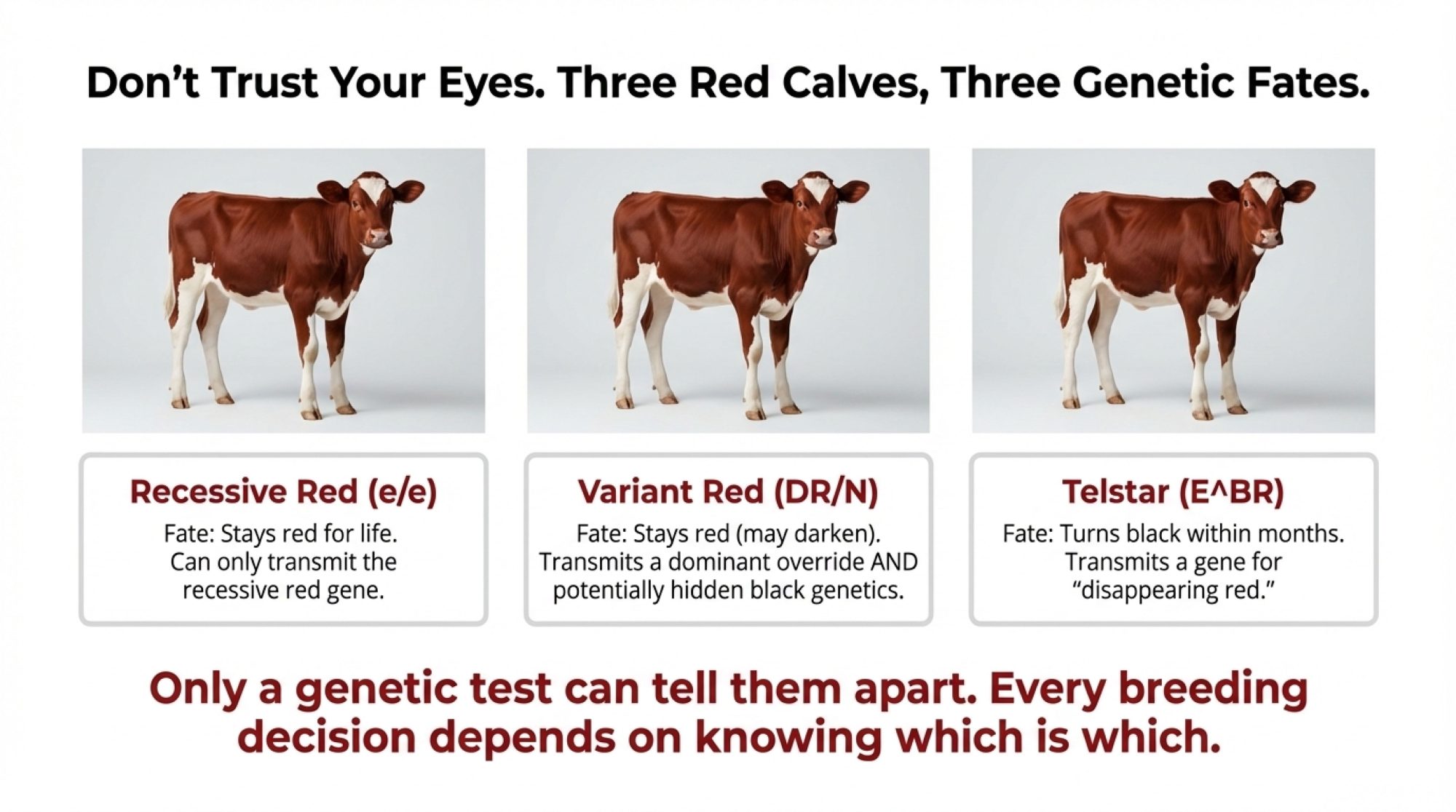
If you’re registering animals: Get the mechanism right. Variant Red, recessive red, and Telstar are three different things with different inheritance patterns. Mislabeling creates downstream problems for everyone.

If you think phenotype tells you enough: It doesn’t. A red calf at birth could be Variant Red (stays red, might darken slightly), recessive red (stays red), or Telstar (turns black in months). Only testing tells you which—and that distinction matters for every breeding decision that follows.

“Understand the genetics, test what matters for your operation, communicate clearly with buyers, and manage the complexity you’re creating.”

The COPA discovery didn’t complicate Holstein color genetics—it revealed the complexity that had always been there. We just couldn’t see it before. The breeders who adapt their programs to account for genetic networks, not just single-gene thinking, are the ones who’ll avoid expensive surprises.

And honestly, color is just the beginning. The same epistatic interactions—one pathway overriding another—show up in fertility, health, and efficiency traits. The mental model you build managing Variant Red is the same model you’ll need for the next layer of genetic complexity headed for your breeding program.

Test what matters. Document what you find. Plan accordingly. That approach will serve you well regardless of what genetic curveball comes next. 

Key Takeaways

  • COPA is the override switch. An animal can carry black genetics at MC1R but still express red if COPA is present—traditional color rules don’t apply.
  • Red × Red can equal Black. Variant Red bulls throw ~50% black calves on red cows if they carry hidden black genetics underneath their red coat.
  • A $30 test prevents expensive mistakes. UC Davis VGL tests both COPA and MC1R; Holstein USA includes both in standard genomic panels.
  • Codes vary by country. The US uses DR0/DR1/DR2; Canada uses VRF/VRC/VRS. Same genetics, different shorthand—read them correctly.
  • Skip the test, accept the gamble. Registration errors, mislabeled sale animals, and buyer disputes cost far more than $30.

Executive Summary: 

Red bull × red cow should equal red calf—except when it doesn’t. The COPA gene, discovered in 2015, acts as a genetic ‘override switch’ that supersedes traditional color inheritance. A Variant Red bull can throw 50% black calves even on red cows if he carries hidden black genetics underneath his red coat. That surprise leads to angry buyers, botched registrations, and breeding decisions built on wrong assumptions. The fix is simple: test both COPA and MC1R status. It runs about $30 through UC Davis VGL and comes standard with Holstein USA genomic panels. For seedstock operations and anyone marketing genetics where color affects value, skipping this test is a gamble you don’t need to take.

Complete references and supporting documentation are available upon request by contacting the editorial team at editor@thebullvine.com.

Learn More:

Join the Revolution!

Join over 30,000 successful dairy professionals who rely on Bullvine Weekly for their competitive edge. Delivered directly to your inbox each week, our exclusive industry insights help you make smarter decisions while saving precious hours every week. Never miss critical updates on milk production trends, breakthrough technologies, and profit-boosting strategies that top producers are already implementing. Subscribe now to transform your dairy operation’s efficiency and profitability—your future success is just one click away.
NewsSubscribe
First
Last
Consent

The $3,800 Heifer Problem: How Smart Dairies Are Adapting When Beef Premiums Don’t Cover Replacement Costs

What if the beef-on-dairy strategy that made sense at $2,200 heifers is now costing you $280K yearly?

EXECUTIVE SUMMARY: What farmers are discovering about today’s replacement market fundamentally challenges the beef-on-dairy strategies that seemed bulletproof just two years ago. With springer heifers commanding $3,800 to $4,000 across most regions — a 73% jump from 2023’s $2,200 average — while actual beef-cross premiums hover around $20-30 after all costs, the economics have completely inverted. Research from Penn State’s dairy team and Wisconsin’s Center for Dairy Profitability confirms what producers are experiencing firsthand: operations that shifted to aggressive 65% beef breeding are now facing an additional $200,000 to $280,000 annually in replacement costs. Here’s what this means for your operation — the traditional 70/30 dairy-to-beef ratio is making a comeback, but with strategic twists like genomic testing every animal and tiered breeding programs that maximize both genetic progress and cash flow. Forward-thinking producers are already locking in 2026-2027 heifer contracts at today’s prices, essentially buying insurance against further market volatility. The path forward isn’t about abandoning beef-on-dairy entirely… it’s about finding the sweet spot where replacement security meets revenue opportunity, and that calculation looks different for every farm.

 dairy breeding strategy

Let me share what’s been on my mind lately. You know something’s fundamentally different when processing plants appear to have capacity while replacement heifers are commanding historically high prices across the country. It’s not following the patterns we’ve come to expect, is it? And if you’re trying to figure out when to ship cull cows or whether that beef-on-dairy program is actually paying for itself… well, these dynamics matter more than most of us initially realized.

What’s particularly noteworthy is how these patterns are playing out differently across regions. Industry reports suggest California’s vertically integrated systems are seeing different market signals than what’s emerging in Wisconsin’s co-op model or the grazing-based operations down South. This builds on what we’ve been observing since spring 2024 — a fundamental shift in how breeding strategies and replacement economics interact.

As we head into winter feeding season, these decisions become even more critical.

What Current Market Observations Are Telling Us

So here’s what’s interesting about the conditions we’re seeing. The beef processing industry generally runs facilities at high utilization rates when everything’s functioning properly — that’s basic industrial economics. In normal times, we’d expect to see something around 95% capacity utilization. But recent industry observations suggest we’re nowhere near that level.

Kevin Grier, that Canadian economist who’s been tracking North American beef markets for decades through his Market Analysis and Consulting firm, has been documenting this fascinating disconnect between available processing capacity and actual cattle throughput. Why is this significant? The economics suggest patterns that go beyond simple supply and demand.

Producers across Wisconsin and other dairy states are reporting similar experiences — cattle ready to ship, processing capacity theoretically available, yet prices that don’t reflect what we’d expect from those conditions. The math doesn’t seem to add up.

This pattern — and this is what’s really caught the attention of many observers — isn’t isolated to one region. Whether you’re looking at traditional dairy states like Wisconsin and New York with their smaller family operations, the larger feedlot-integrated systems in Texas and New Mexico, or even California with its unique market dynamics… similar patterns keep emerging. Dr. Derrell Peel from Oklahoma State’s agricultural economics department, one of the respected voices in livestock market analysis, suggests in his recent Extension publications that these patterns indicate something beyond typical market cycles.

The Beef-on-Dairy Reality Check

Geography determines survival: Minnesota premiums hit $3,850 while Texas stays ‘only’ $2,900 – but even the cheapest market doubled in two years, proving Andrew’s point that this is a structural, not cyclical, shift.

Remember those genetic company presentations from 2022 and 2023? The promise of significant premiums for beef-cross calves seemed like a genuine opportunity to diversify revenue streams. And conceptually, it made perfect sense — capture premium markets, reduce exposure to volatile dairy calf prices, improve cash flow.

But here’s where reality has diverged from projection. Industry reports and producer feedback across multiple states suggest that actual returns often fall significantly short of initial projections. After accounting for transportation costs (and with diesel prices where they’ve been), shrink at sale barns, and various marketing fees, many operations are finding net premiums considerably lower than anticipated.

What Extension services across Pennsylvania, Wisconsin, Minnesota and other states have been observing reveals that real-world returns can differ dramatically from those PowerPoint projections we all saw. Penn State’s dairy team, Wisconsin’s Center for Dairy Profitability, and Minnesota’s Extension dairy program all report similar findings — the gap between projected and actual returns is substantial.

I’ve noticed operations that are making beef-on-dairy work really well tend to have specific advantages — direct marketing relationships with particular buyers, consistent quality that commands loyalty, or local markets that value certain attributes. Success often comes down to matching your operation’s strengths with specific market opportunities.

And then there’s the replacement heifer situation…

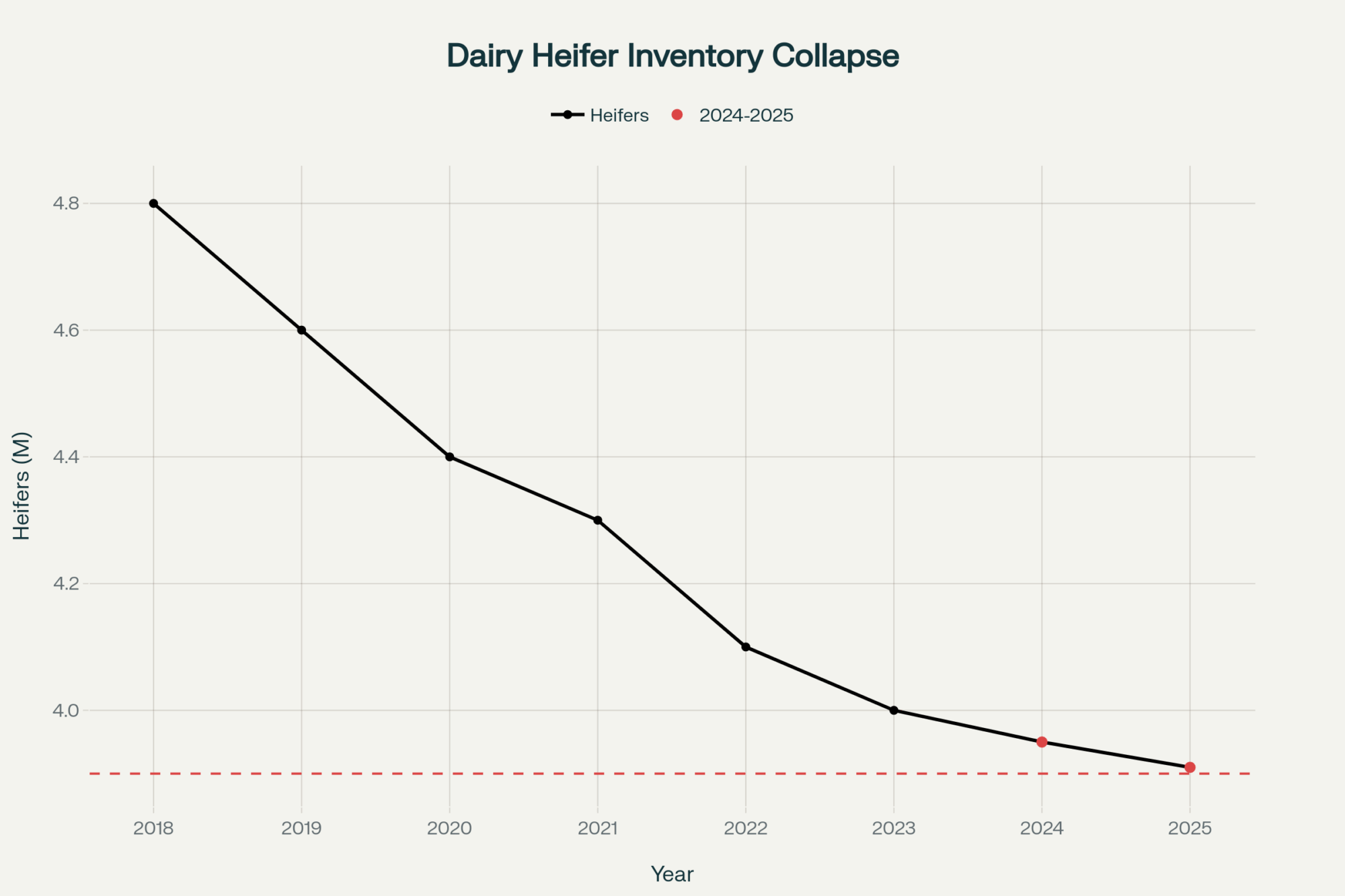
Multiple market sources, including reports from the National Association of Animal Breeders and various regional heifer grower associations, confirm what producers across the country are experiencing — springer heifer prices have reached levels that fundamentally alter breeding economics. Custom heifer growers in traditional dairy regions report being booked solid through mid-2026, with waiting lists growing.

Consider what this means for a typical 500-cow operation that shifted from a traditional 70-30 breeding strategy (70% dairy, 30% beef) to a more aggressive 35-65 approach. You’re potentially purchasing significantly more replacements at these elevated prices. The financial implications can run into hundreds of thousands of dollars annually in additional replacement costs. One Wisconsin producer recently calculated his operation’s additional replacement cost at nearly $280,000 annually — enough to make anyone reconsider their breeding strategy.

Understanding the Replacement Market Dynamics

So what’s driving these unprecedented heifer prices? It’s really a convergence of factors, and while market data is still developing on some aspects, the pattern is becoming clearer.

There’s the supply situation — when the industry collectively shifted breeding strategies over a relatively short period, it created replacement availability challenges. Dr. Jeffrey Bewley at Holstein Association USA, who analyzes breeding data extensively, points out in his industry presentations that different breeding strategies have compounding effects over time. Research published in the Journal of Dairy Science consistently shows beef semen generally has lower conception rates than conventional dairy semen — often running 8-12 percentage points lower depending on management and season — and those differences accumulate in ways that weren’t immediately obvious.

Then consider milk price dynamics. When Class III futures trade at relatively attractive levels, as they have periodically through 2025, producers naturally want to maintain or expand cow numbers. But when replacement availability is constrained… well, basic economics takes over.

What’s particularly interesting is the regional variation we’re observing. Larger operations in the West sometimes have different market dynamics than smaller farms in traditional dairy areas. California’s integrated systems might negotiate directly with heifer growers, while Midwest operations often compete on the open market. They might have scale advantages in negotiating, but they’re also competing with each other for limited replacements.

Industry economists, including those at agricultural lenders like CoBank and Farm Credit who track these markets closely in their quarterly dairy outlooks, suggest these inventory dynamics aren’t likely to shift dramatically in the near term. This appears to be more structural than cyclical — a distinction that matters for long-term planning.

Strategies Emerging Across the Industry

What’s encouraging is observing how different operations are adapting. There are some genuinely innovative approaches emerging across various regions.

Many operations are restructuring their breeding programs entirely. Some are using genomic testing more strategically — and the economics are interesting here. With genomic tests running around $35-45 per animal through major breed associations, operations are testing their entire herd to make targeted breeding decisions. Bottom-tier genetics might receive beef semen, solid performers get conventional dairy semen, and top genetics receive sexed semen (which typically runs $15-30 premium per unit over conventional). Yes, it costs more upfront, but it helps maintain that replacement pipeline while still capturing some beef revenue.

This development suggests producers are thinking more strategically about genetic progress and cash flow simultaneously. It’s not just about maximizing one or the other anymore.

What’s also emerging is renewed interest in contract heifer growing arrangements. Some operations are securing replacements eighteen to twenty-four months in advance. The prices might include a premium for certainty — think of it like buying insurance — but as many producers note, you can plan around known costs. It’s the unknowns that create problems.

The Contract Market Many Don’t Consider

Here’s something worth noting — custom heifer growers, particularly in traditional dairy regions like eastern Wisconsin, Minnesota, and upstate New York, are often interested in longer-term commitments. These arrangements typically involve predetermined pricing and delivery schedules over multiple years.

Both parties can benefit from these arrangements. Growers get predictable cash flow (which lenders appreciate when it comes to operating loans), and dairy operations get cost certainty. The challenge, naturally, is that many producers hope for price improvements. But what if prices don’t drop? Or what if they actually increase? That’s the risk-reward calculation each operation needs to make.

New Processing Capacity — Context Matters

The vanishing herd: 900,000 heifers disappeared as the industry chased short-term beef profits and ignored long-term replacement needs.

You’ve probably heard about new processing facilities being developed. Recent industry reports, including those from Rabobank’s North American beef quarterly and CattleFax market updates, indicate several major projects underway, each with different capacity targets and business models.

What distinguishes many of these new operations is their structure. Unlike traditional commodity plants that buy on the spot market, many feature integrated supply chains or specific retail partnerships. Their procurement models often involve contracting cattle well in advance with specific quality parameters — think Certified Angus Beef specifications or natural program requirements.

The question worth considering is why new capacity is being built when existing facilities aren’t maximizing utilization. Various theories exist among market analysts, but it suggests these new plants might be operating under fundamentally different business assumptions than traditional facilities. Are they positioning for future supply? Creating regional competition? Building branded programs? The answer probably varies by project.

Global Factors Adding Complexity

International beef markets increasingly influence our domestic situation. USDA’s Foreign Agricultural Service October 2025 Livestock and Poultry report tracks significant production shifts in countries like Brazil and Australia. When Brazilian exports increase substantially (up 15% year-over-year according to their latest data) or Australia recovers from drought-induced liquidation, it affects global beef flows.

Major processors operate internationally, and their strategies reflect global opportunities. Companies like JBS, Tyson, and Cargill balance operations across continents. When operations in different regions show varying profitability patterns, it influences domestic investment and operational decisions.

For U.S. dairy producers, these international factors contribute to price volatility in ways that weren’t as pronounced even five years ago. Global beef trade essentially influences domestic price ceilings — when imported product can fill demand at certain price points, our cull cow values face pressure.

Canadian producers, despite their different regulatory framework providing some buffer through supply management, are experiencing similar dynamics with beef-on-dairy economics. The fundamentals transcend borders, as recent reports from the Canadian Cattlemen’s Association indicate.

Practical Considerations for Current Conditions

After observing various operational approaches this season, here are some considerations worth discussing:

It’s crucial to track actual returns versus projections. Many land-grant universities have developed tools for this purpose — Wisconsin’s Center for Dairy Profitability has spreadsheets, Penn State offers decision tools, Cornell’s PRO-DAIRY program provides calculators. These resources can reveal important gaps between expectations and reality. Success metrics vary, but operations reporting improved cash flow often see 15-20% better performance when they track actual versus projected returns closely.

When calculating replacement costs, remember it extends beyond purchase price. There’s financing (and with interest rates where they are, that matters), transportation (fuel costs add up quickly), and that transition period when fresh heifers adjust to your system — different water, new TMR, group dynamics. University research, including work from Michigan State and Cornell, suggests these additional costs can add 10-15% to the sticker price.

If you’re committed to a particular breeding strategy, explore risk management tools. The Livestock Risk Protection for Dairy (LRP-Dairy) program offers price floor protection. Forward contracting through organizations like DFA or your local co-op might provide stability. Various hedging products exist through the CME — they all have costs, certainly, but weigh those against the risks you’re managing.

The optimal breeding strategy varies by operation. Your conception rates (which vary seasonally and by management), voluntary culling patterns, facilities (tie-stall versus freestall versus robotic), available labor — they all factor in. What works for a 2,000-cow operation with its own feed mill won’t necessarily translate to a 200-cow grazing operation. And that’s okay — diversity has always been one of dairy’s strengths.

Market timing has become increasingly complex. Those traditional seasonal patterns we relied on for decades — shipping cull cows before grass cattle hit the market, buying replacements in spring — they’re less predictable now. Price swings within monthly periods can be substantial. Local and regional market intelligence has become more valuable than ever.

Maintaining Perspective in Uncertain Times

Markets evolve — sometimes gradually, sometimes surprisingly quickly. What functions in one region might not translate to another. What makes sense for a large, integrated operation might not pencil out for a traditional family farm. And that’s the diversity that’s always characterized our industry.

Before implementing significant changes, consultation with your advisory team becomes crucial. Your nutritionist sees things from the feed efficiency and production angle. Your veterinarian considers herd health and reproduction implications. Your lender evaluates cash flow and debt service coverage. Each perspective contributes to better decision-making.

And let’s acknowledge — some operations are finding genuine success with various strategies. Direct marketing relationships with specific buyers who value consistency. Genetic programs that command buyer loyalty. Local markets that pay premiums for specific attributes. These successes remind us that opportunities exist even in challenging markets. Success often comes down to matching your operation’s strengths with market opportunities.

Looking Forward Together

This market environment certainly isn’t what any of us anticipated back in 2023 when beef-on-dairy really took off. The interaction between processing capacity, replacement availability, and breeding economics has created unprecedented challenges.

But what’s encouraging is how producers are adapting. Whether through adjusted breeding strategies, innovative contracting arrangements, or collaborative marketing efforts (like the producer groups forming in several states to pool beef-cross calves for better marketing leverage), paths forward exist. The dairy industry has weathered significant challenges over the decades — the 1980s farm crisis, the 2009 collapse, the 2020 pandemic disruptions. This situation, while unique in certain aspects, represents another test of our collective resilience.

The fundamentals remain constant: understand your actual costs (not what you hope they are or what someone projected they’d be), know your markets (both what you’re selling into and buying from), and base decisions on real data rather than projections. Every farm faces unique circumstances — facilities, labor availability, local markets, financial position. But understanding broader patterns helps inform better individual decisions.

We really are navigating this together. The conversations at co-op meetings, information shared at winter dairy conferences, neighbor-to-neighbor discussions over fence lines or at the feed store — that’s how our industry has always moved forward. Whether you’re milking 50 cows or 5,000, whether you’re in Vermont or California, we all face these markets together.

These are certainly interesting times. But with solid information, realistic planning, and thoughtful adaptation, operations will find their way through. That’s what we do, isn’t it? We observe, we adapt, we support each other, and we keep moving forward.

Always have. Always will.

KEY TAKEAWAYS:

  • Contract heifer growing arrangements can reduce replacement uncertainty by 100% while typically costing 20-25% less than panic buying on spot markets — Wisconsin and Minnesota growers report strong interest in 18-24 month contracts at $2,800-$3,200 delivered, providing both parties predictable cash flow
  • Strategic genomic testing at $35-45 per animal enables precision breeding that maintains genetic progress while capturing beef revenue — bottom 20% get beef semen, middle 50% conventional dairy, top 30% sexed semen, optimizing both cash flow and herd improvement
  • Regional market variations create opportunities smart operators are exploiting — California’s integrated systems negotiate direct contracts while Midwest co-ops pool beef-cross calves for 15-20% better premiums than individual marketing
  • Risk management tools like LRP-Dairy provide price floor protection that costs $15-25 per head but prevents catastrophic losses when replacement markets spike or cull values crash — essentially disaster insurance for volatile times
  • The optimal breeding ratio depends on your conception rates, culling patterns, and local markets — 60/40 might work with excellent reproduction, but operations with challenges find 70/30 provides essential cushion against today’s $3,800 replacement reality

Complete references and supporting documentation are available upon request by contacting the editorial team at editor@thebullvine.com.

Learn More:

Join the Revolution!

Join over 30,000 successful dairy professionals who rely on Bullvine Weekly for their competitive edge. Delivered directly to your inbox each week, our exclusive industry insights help you make smarter decisions while saving precious hours every week. Never miss critical updates on milk production trends, breakthrough technologies, and profit-boosting strategies that top producers are already implementing. Subscribe now to transform your dairy operation’s efficiency and profitability—your future success is just one click away.

NewsSubscribe
First
Last
Consent

DOC Just Made History: The First Showcase Bull to Hit a Million Units

Everyone said you can’t breed for both the show ring AND the milk tank. DOC just proved them all wrong.

EXECUTIVE SUMMARY: We’ve been tracking DOC for years, but what he just accomplished changes everything we thought we knew about elite genetics. This Showcase™ bull proved that exceptional type and massive commercial success aren’t mutually exclusive – something most of us figured was impossible. Here’s what matters to your operation: DOC’s daughters delivered +982 lbs Milk with 99% reliability across 54,563 daughters in 10,067 herds worldwide, while simultaneously dominating major shows from Japan to Denmark. One daughter sold for $1.925 million, validating that crossover genetics aren’t just marketing hype—they’re profit drivers. The global trend we’re seeing suggests that farmers won’t accept the old trade-offs anymore; they want cattle that perform well in both the parlor and the show ring. DOC’s million-unit milestone as the first Showcase sire to reach this level tells us the market is ready for genetics that deliver comprehensive excellence, not just single-trait optimization.

KEY TAKEAWAYS

  • Market Validation at Scale: DOC’s million-unit sales prove that elite type genetics can drive massive commercial demand – his sustained popularity across 10+ years shows these genetics work in real farming conditions, not just perfect environments
  • Crossover Economics Work: When daughters consistently deliver both production (+982 lbs Milk) and type excellence (purple banners globally), you’re looking at cattle that maximize both milk checks and genetic value – start evaluating bulls for comprehensive performance, not either/or scenarios
  • Global Adaptability Matters: DOC’s success from Japan to Denmark to progressive U.S. dairies demonstrates that truly elite genetics translate across diverse management systems – look for sires with proven international performance when making breeding decisions
  • Health Traits Drive Longevity: DOC’s genetics included improved mastitis resistance and productive life, contributing to his sustained demand – prioritize bulls offering robust health packages alongside production and type in your 2025 breeding program
  • Strategic Breeding Investment: With daughter S-S-I Doc Have Not 8784-ET selling for $1.925 million, DOC proved that superior genetics create exponential value – focus on sires with proven transmission ability rather than chasing the latest genomic predictions
 elite dairy genetics, dairy breeding strategy, increasing milk yield, sire selection criteria, crossover genetics profit

Look, we’ve seen some incredible bulls over the years, but what DOC just pulled off? This changes everything about how we think about elite genetics.

So here’s what happened. Woodcrest King DOC (EX-90) just became the first Select Sires Showcase™ sire to sell over 1,000,000 units of semen. Yeah, you read that right – a million units. And he did it while carrying that Showcase designation, which, honestly, most of us thought would never happen.

The thing about DOC is… well, he broke all the rules we thought existed in this business.

From Day One, This Bull Was Different

DOC came from solid genetics – 7HO12198 KINGBOY out of WCD-ZBW Mack Daddy (VG-88-VG-MS) at Woodcrest Dairy up in Lisbon, New York. The Cruikshank family knew they had something special when his dam was putting up impressive milk numbers and became a barn favorite. But honestly? Nobody predicted this level of success.

What made DOC stand out wasn’t just one trait – it was everything. Most bulls offer either production or type. You pick your lane and live with it. DOC said “forget that” and delivered both. We’re talking +982 lbs Milk with 99% reliability from 54,563 daughters across 10,067 herds. Those aren’t theoretical numbers from a computer model… that’s real milk in real tanks from real farms.

The Crossover Revolution

Here’s where it gets interesting. DOC’s daughters became the poster children for what we call “crossover cows” – cattle that absolutely crush it in progressive dairies while also claiming purple banners at major shows. This used to be impossible. You either bred for the parlor or the show ring, never both.

DOC’s daughters didn’t just participate in shows; they dominated them. From Japan and Korea to Spain, Italy, Great Britain, Belgium, the Netherlands, Germany, Denmark, Australia, Canada, and across the U.S., his genetics proved they could adapt to any system. That’s the mark of truly elite genetics – when they work everywhere, not just in perfect conditions.

What’s fascinating is how Select Sires positioned him as a patriarch of their Showcase™ program. This wasn’t honorary… DOC earned it by consistently delivering daughters that mattered to real dairy operations.

The $1.925 Million Proof

Nothing validates genetics quite like someone writing a massive check. DOC’s daughter S-S-I Doc Have Not 8784-ET (EX-96-EX-MS-DOM) sold for $1.925 million. That’s not just expensive – that’s the market screaming “these genetics matter.”

This cow exemplified everything DOC transmitted: elite type, impressive genomics with a +2742 GTPI, and proven transmission ability with three offspring already exceeding +3035 GTPI. She traced back 10 generations to Snow-N Denises Dellia EX-95, connecting modern genetics to historical greatness. When you see lineage like that performing at this level, you know it’s not luck.

Breaking the Showcase Barrier

The Showcase™ program recognizes sires with outstanding breed-leading type or show-winning pedigrees. It represents decades of strategic matings to create influential, breed-altering sires from impressive maternal lines. DOC becoming the first bull in this category to reach millionaire status? That’s huge.

Previous Select Sires millionaires typically achieved their status through broad commercial appeal – think workhorse bulls that every farm could use. DOC proved that elite-type transmission could drive equivalent demand. That changes how we evaluate genetics going forward.

The Million-Unit Club Context

Since Fisher-Place Mandingo first hit a million units back in 1994, only 42 other Holstein bulls had joined this club by 2010. The U.S. leads with 20 millionaire bulls, Canada has 12. Select Sires has consistently contributed to this group with bulls like PLANET-ET, MILLION-ET, and SHOT Laser-ET.

But DOC’s achievement stands apart. He reached millionaire status while maintaining his Showcase™ designation, proving that exceptional type and massive commercial success aren’t mutually exclusive.

Global Impact That Actually Matters

The numbers tell DOC’s story better than any marketing campaign. Over 673,000 doses sold globally, ranking among Select Sires’ bestsellers throughout his career. Scott Ruby from World Wide Sires noted that “Doc is a bull that has expanded his popularity every year of his life,” – which is unusual since most sires peak early and then fade.

What’s particularly noteworthy is DOC’s sustained demand. His genetics addressed the complex needs of modern dairy operations, including elite production, superior type, and robust health traits such as improved mastitis resistance and a productive life. That’s what keeps the bulls relevant year after year.

What This Means for Breeding Decisions

DOC’s success offers a blueprint for evaluating future elite sires. The most valuable genetics aren’t always the most extreme – they’re the ones delivering consistent, profitable performance across diverse environments and management systems.

Here’s the thing, though… DOC proved that show ring champions and commercial superstars can come from the same genetic foundation. His daughters dominated major shows while driving profits in progressive dairies, shattering the false choice between type and production that had limited breeding decisions for decades.

The Legacy Continues

DOC passed away in June 2025, just months before reaching his millionaire milestone. But his influence on Holstein genetics keeps expanding. His daughters worldwide prove his genetic worth daily, each lactation adding evidence that comprehensive excellence is achievable in dairy breeding.

Rick VerBeek, senior Holstein sire analyst at Select Sires, captured DOC’s significance: “Today’s A.I. industry is fast-paced. The speed of genetic advancement is unprecedented. Much of this advancement is driven by young sires, and while our GForce™ program continues to grow, influential daughter-proven genetics will always be our goal. It’s both exciting and gratifying to see DOC achieve this monumental milestone”.

Kevin Jorgensen, senior Holstein sire analyst, emphasized DOC’s unique contribution: “Within the Showcase program, DOC defined crossover for the past decade. He expertly transmits yield, components, type, and udder conformation to his offspring. His daughters continue to top the charts, and they’re extremely competitive in the show ring”.

Where We Go from Here

DOC’s millionaire achievement signals a shift in the industry. His ability to generate massive commercial demand while maintaining elite-type credentials proves that modern dairy breeding can deliver both profitability and phenotypic excellence simultaneously.

The success of DOC’s genetics validates Select Sires’ Showcase™ program approach and suggests that future breeding strategies should focus on comprehensive genetic packages rather than single-trait optimization. His legacy demonstrates that elite genetics can achieve both immediate commercial success and long-term breed improvement.

What strikes me about this whole story is how DOC changed the conversation. We’re not debating type versus production anymore – we’re looking for genetics that deliver both. That’s a fundamental shift in how we approach breeding decisions.

As the dairy industry continues evolving, DOC’s achievement stands as proof that exceptional genetics, strategic marketing, and consistent performance can create breeding legends that influence the industry for generations. The King’s millionaire status isn’t just a sales milestone – it’s validation that excellence in dairy breeding truly knows no limits.

Learn More:

  • The Ultimate Guide to Sire Selection – This guide offers a tactical framework for applying the lessons from DOC’s success. It provides practical strategies for balancing production, type, and health traits in your own herd to maximize genetic gain and long-term profitability.
  • Does Type Still Pay? The Financial Realities of Breeding for the Show Ring – This article dives into the market economics behind DOC’s crossover appeal. It analyzes the financial ROI of elite type, helping you understand how to leverage show-winning genetics to drive higher returns from both milk sales and genetic marketing.
  • Genomics: The Great Promoter or the Great Pretender? – DOC’s story champions daughter-proven reliability. This piece explores how to strategically use genomic data without getting lost in the hype, revealing methods for blending the best of proven sires with the potential of high-genomic young stock.

Join the Revolution!

Join over 30,000 successful dairy professionals who rely on Bullvine Weekly for their competitive edge. Delivered directly to your inbox each week, our exclusive industry insights help you make smarter decisions while saving precious hours every week. Never miss critical updates on milk production trends, breakthrough technologies, and profit-boosting strategies that top producers are already implementing. Subscribe now to transform your dairy operation’s efficiency and profitability—your future success is just one click away.

NewsSubscribe
First
Last
Consent

The UK’s Sexed Semen Playbook: How UK Dairies Hit 84% While You’re Still Stuck at 50/50

UK dairies hit 84% sexed semen adoption—while most of us are still playing 50/50 roulette with calf gender.

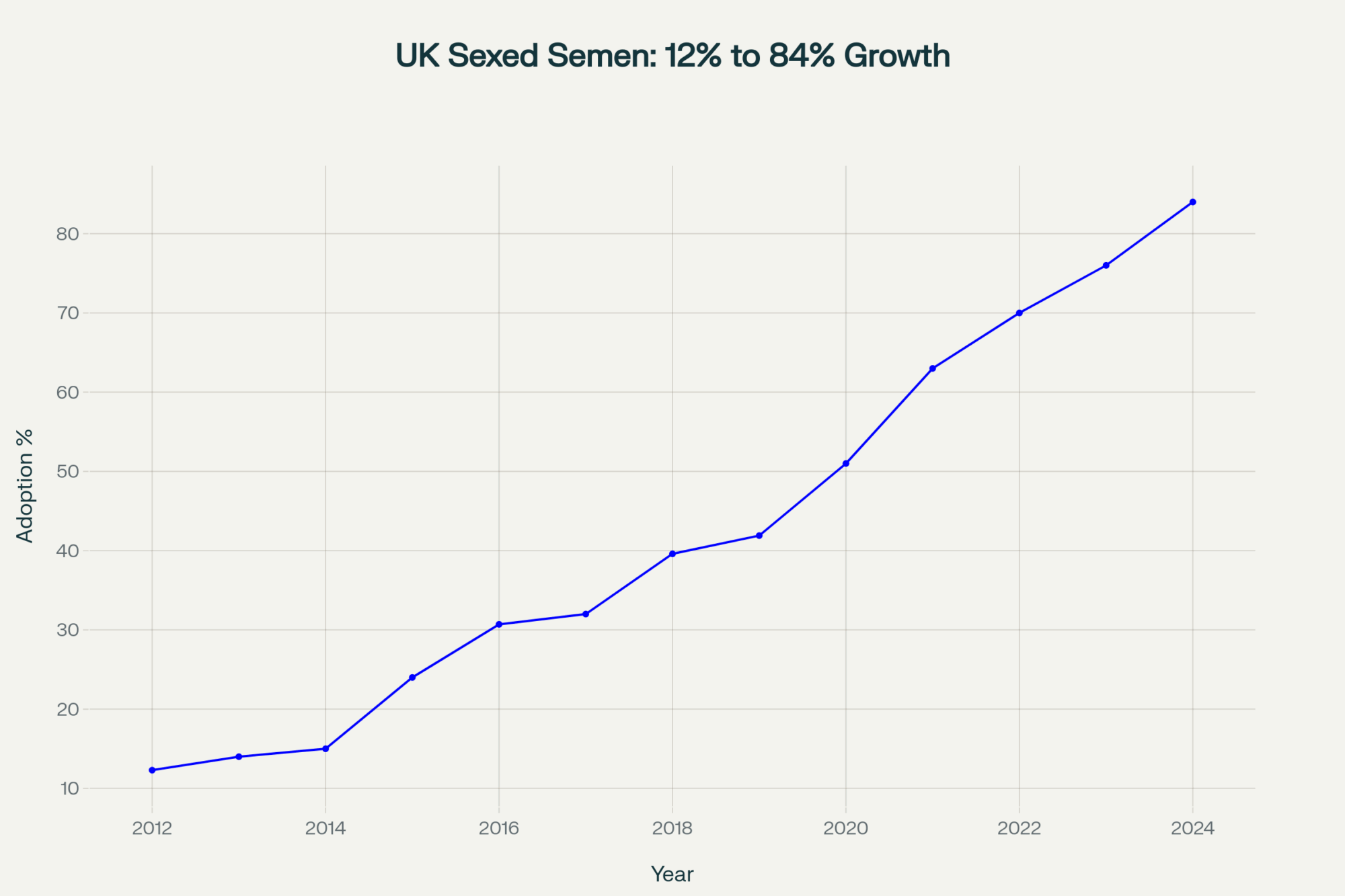
UK sexed semen adoption has grown dramatically from 12.3% in 2012 to 84% in 2024, with accelerated growth particularly notable after 2018

I’ve been watching this trend for three years now, and what the Brits pulled off isn’t just impressive tech adoption—it’s a complete system overhaul that makes other leading dairy nations look years behind.

You know what hits you when you walk through a modern UK dairy operation? It’s not the robotic milkers or fancy feed systems. It’s the breeding charts. Where most of us around the world still play 50/50 roulette on calf gender, these operations consistently show 89-91% female calves.

That’s not luck. That’s 84% sexed semen adoption across UK dairy herds in 2024, and honestly, it makes the rest of us look like we’re still figuring out the basics. The Americans? Sitting at 61%. New Zealand? About 47%. Most of Europe? Still having meetings about it.

So what did the Brits crack that everyone else missed?

When Carbon Talk Started Writing Real Checks

Here’s what really shifted everything—carbon footprint moved from environmental reports straight into milk pricing contracts. I was chatting with a producer near Exeter last month—he runs 380 Holsteins on grass—and he nailed it: “Five years back, methane was something we discussed at NFU meetings. Now it’s affecting my milk price every month.”

Processors like Arla aren’t messing around. They’re paying actual premiums—2 to 4p per liter depending on targets—for farms hitting verified emission reductions. Tesco’s writing carbon requirements directly into supply contracts.

Here’s the brilliant part: those bull calves that used just to eat feed and take up space? Now they’re actively costing you money twice—feed costs and lost carbon premiums. Using sexed semen to cut those numbers while boosting heifer replacement efficiency suddenly makes perfect economic sense.

The Export Ban Nobody Saw Coming

Then came the policy curveball. The 2023 Animal Welfare Act shut down live calf exports completely. Overnight, farms lost their traditional outlet for surplus dairy bulls.

The University College Dublin research laid it out starkly. Operations that previously exported 200+ male calves annually now had to make them work economically at home, or reduce numbers strategically.

What’s interesting is how quickly processors caught on to the welfare angle. Major food companies started writing surplus calf reduction requirements into procurement standards. Suddenly, using sexed semen wasn’t just about genetics—it was about maintaining market access.

Technology That Finally Stopped Letting Us Down

Let me be honest—early sexed semen was notoriously frustrating. You’d pay double for straws that gave you conception rates 15-20% worse than conventional. Not exactly a winning proposition.

But the breakthrough with SexedULTRA 4M technology changed everything. Double the sperm concentration per straw, 90%+ gender accuracy, and—this is crucial—conception rates now achieving about 82-84% of what you’d get with conventional semen.

Laboratory semen sexing machine with multiple monitors displaying flow cytometry data used to separate sperm cells by sex chromosome in dairy breeding

That’s close enough to make the economics work for most well-managed herds. When fertility penalties basically disappeared, everyone’s math changed.

Looking ahead, CRISPR research is making real progress on 100% female offspring, but that’s still years from commercial reality.

Regional Realities Make All the Difference

What strikes me about UK success is how different regions adapted the technology to their specific challenges.

  • Southwest England’s advantage: Devon and Cornwall operations have something intensive guys don’t—cheap milk from pasture. Lower feed costs create a financial cushion for premium breeding investments.
  • Yorkshire’s scale challenge: Bigger northern dairies manage heat detection across 800+ cow herds differently. Many invested heavily in automated monitoring specifically to make sexed semen profitable.
  • Welsh seasonal pressure: Pembrokeshire operations breed entire herds in 6-8 weeks during optimal grass conditions. Miss heat cycles, and you’re looking at empty cows and lost revenue.
  • Scottish highland reality: Hill farmers deal with hardier breeds that don’t respond to sexed semen quite the same way. Some of the most innovative adaptation work involves extensive systems.

The Economics Work (When You’re Realistic)

Look, you’ll hear people claiming “$200 per cow advantages,” but let’s be realistic. What’s consistently documented is beef-cross calves selling for significantly higher prices than dairy bulls at market—often two to three times more, though this varies by market conditions and management.

Strategic breeding efficiency matters too. Using sexed semen on genetically superior animals while putting beef bulls on culling candidates essentially pays you to improve your herd while reducing replacement costs.

For more insights on how beef-on-dairy crossbreeding delivers ROI, the economics are compelling when done strategically.

Bisterne Farm—they won the 2023 RABDF Gold Cup¹¹—demonstrates excellent management. But let’s keep expectations realistic about those “91% conception rates” you sometimes hear. That typically refers to high-performing subgroups under optimal conditions, not herd-wide averages across all seasons.

The Genetic Diversity Reality Check

Here’s where things get serious. Dr. Donagh Berry from Ireland’s Teagasc raises legitimate concerns: “When 80%+ of inseminations use sexed semen from elite bulls, you’re creating genetic bottlenecks that could bite back hard.”

But AHDB’s genetics team isn’t ignoring this. They promote balanced approaches—beef sires on middle-tier cows, continuous genomic diversity monitoring, and thoughtful elite genetics distribution.

Smart operations find that sweet spot: maybe 40% sexed semen on top of genetics, 30% beef bulls on culling candidates, 30% conventional semen from diverse bloodlines. Genetic progress with built-in safety nets.

Are You Actually Ready for This?

Before calling your AI stud tomorrow, let’s have an honest conversation. I’ve seen too many operations waste money trying to make sexed semen work without proper fundamentals.

CriteriaReadyProceed With CautionNot Ready
Conception Rate≥ 65%55-64%< 55%
Heat Detection≥ 85%70-84%< 70%
Herd Size≥ 200 cows50-199 cows< 50 cows
Financial CapacityCan absorb premium costsMargins are tight; plan carefullyOperating at a loss
Management ExpertiseExperienced AI protocolsLimited experience; needs trainingNew to breeding

If you can’t tick most boxes, tighten up basics first. Sexed semen won’t magically fix fertility problems—it’ll make them more expensive.

And please—don’t rush the process. Operations that succeeded took 12-18 months, focusing on getting systems right before scaling up.

Global Context: Everyone’s Playing Catch-Up

The UK leads global sexed semen adoption at 84%, significantly ahead of the US (61%), Ireland (55%), New Zealand (47%).

The Americans are making progress—61% adoption—but it’s fragmented across regions and systems. Cultural resistance, combined with fragmented breeding services, makes coordinated adoption more challenging than the UK’s integrated approach.

Ireland pushes hard despite seasonal constraints, driven by regulations and export pressures. New Zealand innovates around unique challenges—breeding 900 cows in six weeks creates pressure most can’t imagine.

Europe’s adoption is mixed, ranging from 20% to 60%, depending on regulatory pressure and market incentives. However, the trend is clear: this technology will become standard for competitive operations.

The Bottom Line: Revolution, Not Evolution

The UK didn’t just adopt new technology. They engineered complete systems that generate measurable profits through genetic precision, while meeting regulatory and market demands.

Three things made this work:

  • Policy alignment: Environmental regulations and profit incentives are pointing in the same direction
  • Technology readiness: 4M sexed semen, finally delivering competitive performance
  • Market rewards: Processors putting real money behind measurable improvements

For producers in other markets, lessons are clear. This isn’t about copying UK techniques—it’s understanding how they aligned policy, technology, and economics into coherent strategy.

The competitive window’s narrowing. As other regions catch up, the UK’s first-mover advantage will diminish. But right now, they’ve written the playbook for profitable genetic precision.

The question isn’t whether sexed semen works—the UK proved that. It’s whether you can build the management systems, market relationships, and strategic thinking necessary to make it work profitably in your specific situation.

Because this isn’t about adopting new technology. It’s about evolving your entire approach to dairy genetics for an industry where precision, sustainability, and profitability must align.

The UK figured that out first. Everyone else gets to decide how fast they want to learn.

KEY TAKEAWAYS:

  • Lock in 84%+ female calves like UK leaders by strategically deploying sexed semen on your top genetics—every extra heifer cuts replacement costs and boosts your genetic progress simultaneously.
  • Capture the 82-84% conception advantage with 4M technology that’s finally eliminated the old fertility penalties—your AI success rates can now compete directly with conventional semen.
  • Bank 2-3x higher calf values by mixing beef bulls on culling candidates while reserving sexed semen for elite genetics—smart operations are seeing immediate ROI on this strategy.
  • Meet the 85% heat detection benchmark before scaling up (anything below 70% and you’re burning money)—plus ensure you’ve got 200+ cows to make the economics work in today’s tight margins.
  • Balance genetic diversity risks by rotating elite sires and incorporating beef genetics strategically—AHDB research shows this prevents the bottlenecks that could bite back in 3-5 years.

EXECUTIVE SUMMARY:

Listen, I get it. Sexed semen always felt like expensive gambling. However, what changed was that UK dairies didn’t just adopt the technology; they built entire systems around it, achieving 84% adoption compared to our 61% in the States. We’re talking real money here: beef crosses are fetching 2-3x what dairy bulls bring at market, plus processors are paying carbon bonuses up to 4p per liter for farms cutting methane. The 4M technology breakthrough means conception rates now hit 82-84% of conventional—that fertility penalty that scared everyone off? Pretty much gone. Sure, you need your ducks in a row first… solid heat detection, decent herd size, financial cushion. However, the Brits took 12-18 months to dial it in before scaling, and now they’re reaping the rewards, laughing all the way to the bank. The question isn’t whether this works anymore—it’s whether you’re going to learn from their playbook or watch your competitors pull ahead.

Complete references and supporting documentation are available upon request by contacting the editorial team at editor@thebullvine.com.

Join the Revolution!

Join over 30,000 successful dairy professionals who rely on Bullvine Weekly for their competitive edge. Delivered directly to your inbox each week, our exclusive industry insights help you make smarter decisions while saving precious hours every week. Never miss critical updates on milk production trends, breakthrough technologies, and profit-boosting strategies that top producers are already implementing. Subscribe now to transform your dairy operation’s efficiency and profitability—your future success is just one click away.
NewsSubscribe
First
Last
Consent

The “No-Holes Sire” Approach Makes Perfect Sense: A Scientific Validation

Everyone brags about mega-genomic sires, but what if the real profit is bulls without a single ‘hole’ on their proof sheet?

A “No-Holes Sire” breeding philosophy, based on Lactanet’s six subindexes and 50% RK thresholds, represents a scientifically sound approach to optimizing future dairy herd performance. The data strongly support this framework over traditional single-trait and total merit index maximization strategies.

The Problems with Single-Trait or Only Total Merit Selection

Research consistently demonstrates that, over time, chasing individual high-ranking traits or a single value index often creates genetic imbalances that undermine long-term herd productivity.

When producers focus exclusively on maximizing metrics like lactation yields, TPI/LPI, NM$/Pro$, or PTAT/CONF without considering trait balance, they often create “genetic holes” that manifest as:

  • Reduced fertility performance – despite high production potential
  • Increased health issues – particularly mastitis, lameness, and metabolic disorders
  • Shortened productive lifespans – undermining lifetime profitability
  • Management and labor challenges – from extreme trait combinations

As one industry analysis noted, “Strong selection focus on production traits challenges the homeostatic balance of animals, leading to diseases and compromising welfare.”

Lactanet’s Six Subindex Framework Validation

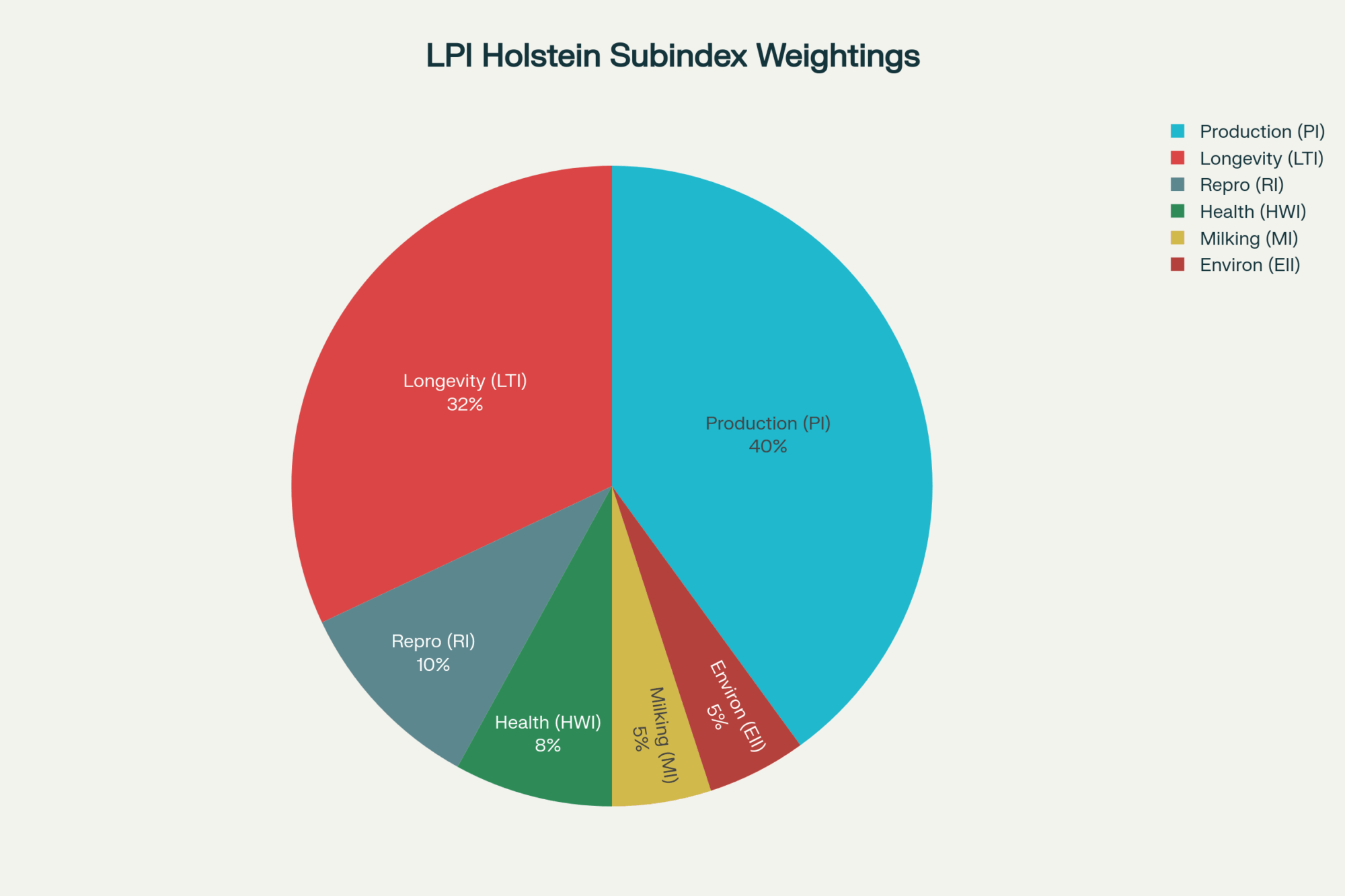
The modernized LPI system launched in April 2025 directly addresses these concerns by creating balanced selection tools. The six subindexes for Holstein cattle are:

SubindexWeightPrimary Focus
Production Index (PI)40%Fat and protein yields
Longevity & Type Index (LTI)32%Herd life, functional conformation
Health & Welfare Index (HWI)8%Disease resistance, metabolic, and hoof health
Reproduction Index (RI)10%Female fertility, calving performance
Milkability Index (MI)5%Milking efficiency, temperament, and udder form
Environmental Impact Index (EII)5%Feed efficiency, methane reduction, and body maintenance requirement

Each subindex is standardized with a mean of 500 and a standard deviation of 100, and percentile ranks are assigned, providing clear comparative metrics.

The 50%RK Threshold Strategy

The Bullvine recommends a “no-holes sires” selection approach with at least five of six subindexes above 50%RK, creating a balanced genetic foundation. This approach aligns with established breeding principles:

Scientific Basis: Using multi-subindex selection indices consistently outperforms single-trait or one-total-merit index approaches for optimal overall genetic progress. Research shows that “multi-subindex genomic prediction can be more beneficial than a single total merit genomic prediction”.

Percentile Interpretation: The 50% RK threshold ensures that sires perform above average across multiple genetic evaluation categories. As Lactanet documentation explains, percentile ranks allow producers to “compare values for each subindex and identify the elite sires”.

Risk Management: Sires weak in multiple areas (less than four subindexes above 50%RK) create genetic vulnerabilities that compound over generations.

Evidence Supporting Balanced Selection

Multiple studies validate this “no-holes sires” approach:

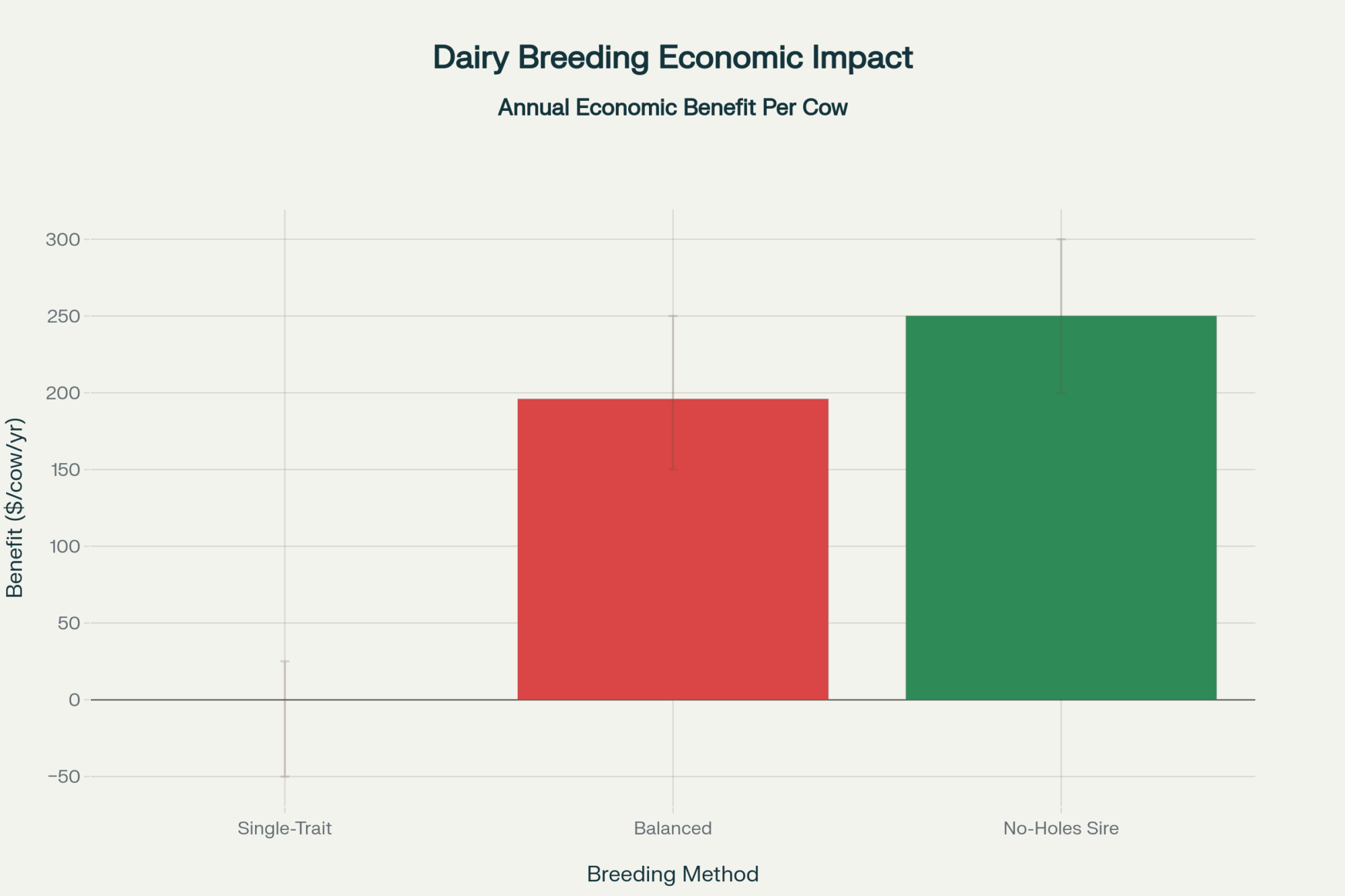
  • Economic Impact: Research on Irish dairy farms found “every €1 increase in herd EBI was associated with €1.96 net profit per cow” when using balanced selection indices rather than a single-trait focus.
  • Genetic Progress: Studies demonstrate that “reallocating a part of phenotyping resources to genotyping increases genetic gain regardless of the cost and amount of genotyping” – but only when selection remains balanced across economically important traits.
  • Long-term Sustainability: Analysis of breeding programs shows that “breeding programmes should optimize investment into phenotyping and genotyping to maximise return on investment” through multi-focus approaches.

Your Canadian Focus Advantage

Lactanet’s comprehensive genetic evaluations provide unique advantages for implementing this truly balanced breeding strategy:

  • Universal Coverage: All sires receive evaluation across the six subindexes regardless of origin.
  • Standardized Metrics: Consistent 500-point scale with percentile rankings
  • Regular Updates: Three annual evaluations ensure ongoing genetic assessments.
  • Integration Tools: Mating programs can be optimized for balanced trait improvement.

Validation from Industry Leaders

Leading breeding organizations increasingly recognize that “the goal is to identify a complete package of top genetics, one that balances improved production along with an outstanding blend of efficiency, reproduction, functional conformation and health characteristics”.

The shift toward balanced breeding reflects broader industry recognition that “genomic selection has revolutionized breeding by reducing generation intervals…while simultaneously democratizing access to elite genetics”.

Practical Implementation

For producers implementing this 50% and higher %RK strategy:

  1. Evaluate Current Sires: Review existing genetics against the six subindex criteria.
  2. Set Selection Standards: Require a minimum of five of six subindexes above 50%RK
  3. Monitor Genetic Progress: Track herd improvement across all trait categories to identify areas for improvement.
  4. Adapt Over Time: Adjust emphasis based on herd-specific needs while maintaining a balanced approach.

Table 1 features eight elite (99% RK) LPI sires and their corresponding subindexes, which dairy farmers can use to add total trait coverage, genetic uniformity, and superior performance to optimize sustainable herd performance.

TABLE 1: Eight 99%RK LPI “No-Holes Sires” Being Marketed in 2025

Bull NAAB Code LPI (% REL) PI (%RK) LTI (%RK) HWI (%RK) RI (%RK) MI (%RK) EII (%RK) Casein’s Other Sire Stack
Impulse 200HO13363 4067 (77%) 99 98 97 54 65 96 A2A2/BB #3 gLPI Sundance x Fellowship x Altazazzle
Cobot 014HO17486 3925 (76%) 99 87 99 78 82 72 A2A2/BB #2 gPro$ Rimbot x Monteverdi x Envoy
Apollo-PP* 724HO02040 3924 (79%) 95 99 70 41 85 58 A2A2/BB Logic-PP x Allday-P x Hotspot-P
Sheepster 007HO16276 3903 (78%) 99 88 56 71 59 51 A1A2/AB #2 TPI Trooper x Acura x Resolve
Brigade 551HO05964 3877 (76%) 99 92 67 66 62 85 A2A2/BB Gordon x Captain x Nightcap
Validated 200HO12169 3746 (90%) 96 89 91 94 61 86 A1A2/AB #16 LPI Altazazzle x Altahotjob x Achiever
Altazazzle** 011HO15036 3716 (96%) 98 90 90 67 85 50 A1A2/BB #21 LPI Marius x Altatopshot x Silver
Lightyear 029HO19205 3623 (89%) 93 87 97 95 59 61 A1A2/BE #4 Pro$ Yoda x Delta x Supersire

* Apollo-PP is the highest ranking PP sire with five of six subindexes over 50%RK
** Altazazzle has one son and one great-grandson on this “No-Holes Sire” list, plus five daughter proven sons in the top sixteen LPI listing, averaging 3808 LPI and 2818 Pro$

The Bottom Line

This “no-holes sire” philosophy represents a sophisticated understanding of modern dairy genetics. The scientific evidence overwhelmingly supports balanced multi-trait selection over single-trait maximization. Lactanet’s subindex system provides the tools to implement this approach systematically, potentially delivering superior long-term genetic progress and herd sustainability.

This strategy acknowledges that “breeding a super performing herd is not a one-trait/one total merit index/one subindex solution” – exactly the insight driving modern genetic evaluation systems toward more comprehensive, balanced, optimized approaches.

KEY TAKEAWAYS

  • Balanced genetics = real dollars: Herds using sires with at least 5/6 subindexes above 50th percentile see up to 15% longer herd life (Journal of Dairy Science, 2025). Step: Check the subindex spread of your current lineup.
  • Better fertility = less downtime: In 2025, farms adopting the balanced rule cut open days by up to 22%, boosting cash flow on every fresh cow. Step: Set 50%RK threshold on new bull choices right now.
  • Global proof, local impact: Irish data linked €1 index improvement to €2 profit per cow; Canadian and US extension data show the same.
  • Reduces costly disease calls: Balanced selection is linked to fewer mastitis/lameness cases—save on vet bills and keep cows milking. Step: Sort sires for health/welfare index, not just fat and PTAT.
  • Works for today’s market: With replacement costs up 18% and feed still volatile, building cows that last and breed back is pure survival. Step: Prioritize no-holes bulls on your next semen order—your future margin might depend on it.

EXECUTIVE SUMMARY:

You know what most folks miss? Chasing big production or conformation numbers alone is a one-way trip to more trouble and less profit. This piece lays it out plain: those ‘no-holes’ sires with five or six subindexes over 50th percentile aren’t just geek numbers—they’re putting real dollars in the bank. Irish research showed that every €1 increase in balanced genetic index delivered approximately €2 net per cow, and Canadian data now supports this finding with improved reproductive rates and fewer health setbacks. Herds adopting this approach are seeing more cows in milk by the third lactation, rather than in the cull pen. With global feed costs sky-high and replacement rates squeezing margins, this is more than a trend—it’s a way to get ahead finally. The article explains the farm-tested steps, not just theory, and ties it back to what’s working from Europe to Manitoba. If you haven’t tried “no-holes” yet, you might be paying for holes you can’t see—give it a real look.

Complete references and supporting documentation are available upon request by contacting the editorial team at editor@thebullvine.com.

Learn More:

  • Rethinking Balanced Breeding for 2028 and Beyond – This article provides a strategic framework for applying the “No-Holes” philosophy over the long term. It reveals how to adapt your breeding goals to anticipate future market demands, ensuring your herd remains profitable and genetically competitive for years to come.
  • The 6 Financial KPIs Every Dairy Farmer Should Be Tracking – Connect your genetic strategy to your bottom line. This piece demonstrates how balanced breeding directly impacts the most critical financial metrics, like herd equity and profitability, proving that a “no-holes” approach is a powerful driver of business success.
  • Is It Time to Start Breeding for Feed Efficiency? – Go deeper on one of the most innovative and economically important frontiers in genetics. This article explores practical strategies for leveraging feed efficiency—a key part of the EII subindex—to cut input costs and boost your herd’s sustainability dramatically.

Join the Revolution!

Join over 30,000 successful dairy professionals who rely on Bullvine Weekly for their competitive edge. Delivered directly to your inbox each week, our exclusive industry insights help you make smarter decisions while saving precious hours every week. Never miss critical updates on milk production trends, breakthrough technologies, and profit-boosting strategies that top producers are already implementing. Subscribe now to transform your dairy operation’s efficiency and profitability—your future success is just one click away.

NewsSubscribe
First
Last
Consent

The Breeder Who Refused to Quit: How Japan’s Most Stubborn Farmer Created Japan’s Only EX-96 Holstein

Japan’s most stubborn farmer created history with one perfect Holstein cow.

The call came from Hokkaido on a cold March morning. Nobuo Sato had passed—and honestly? The dairy world felt a little emptier that day. Most folks outside serious dairy circles won’t recognize the name, but here’s what you need to know: Sato did something no one else in Japan has ever pulled off. He bred a cow that scored EX-96. In Japan’s dairy history, this event occurred exactly once. And it sure wasn’t luck.

When Rejection Becomes Rocket Fuel

Picture this: you’re 16 years old in 1965, engineering textbooks spread across your desk, when your older brother decides farming isn’t for him. Suddenly, you’re staring at a barn full of Holstein cows in Hokkaido—a place so dairy-focused the cattle outnumber humans four to one in towns like Toyotomi.

“I wanted to become an engineer,” Sato would tell people decades later. But duty called louder than dreams.

What happened next? The kid threw himself into learning everything about cattle with the kind of intensity that only comes from equal parts determination and… well, call it stubborn pride. Friends pushed him toward showing, which is where he discovered just how brutal that world could be.

“You’re not ready. Give your place to someone else.”

Can you imagine? He’d legitimately earned his spot at the Hokkaido state show, but the old guard wasn’t exactly rolling out welcome mats. Same story with the 4-H Club—flat rejection.

Here’s what separated Sato from every other wannabe, though: instead of packing it in, every “no” just fed this fire that would burn for five decades.

“I’ll prove myself one day.”

And boy, did he ever.

What Makes EX-96 So Special? Holstein classification scores five key areas: Udder (40%), Dairy Strength (20%), Feet & Legs (20%), Front End & Capacity (15%), and Rump (5%). The Excellent range runs 90-97 points, but EX-96 demands near-perfection across every category simultaneously. According to Holstein USA, approximately five cows are awarded EX-96 status annually across the entire United States. In Japan’s history? Just one.

The Philosophy That Changed Everything (And Why It Still Matters)

Early on, Sato developed what became his guiding principle—one simple question that shaped every decision: “How can cows live happily for their entire lives?”

Sounds sentimental? It wasn’t. It was a revolutionary business strategy disguised as common sense.

“My father used to say cows may seem dull, but they are in fact very sensitive,” his son Michihiro recalls in an interview for this article. “Feeding, milking, resting—always at the same times every day. He understood their nature deeply.”

Walk onto the L’Espoir farm in its heyday and you’d witness this approach in action. Barns immaculate, pastures pristine, feeding protocols followed with Swiss watch precision.

Here’s a scene that captures it: Sato would grab a handful of stemmy hay, shake it at visiting nutritionists, and challenge them: “You tell me—can you really make milk with this?” He understood the chain reaction—superior cows required superior nutrition, which in turn demanded superior forage, which necessitated superior soil management. No weak links allowed.

The genius was how he taught that successful showing was simply “an extension of everyday care.” While other farms singled out potential champions for special treatment, the L’Espoir approach maintained the entire herd at show condition daily.

That philosophy resonates differently in 2025, with replacement costs at $2,660 per head, according to USDA data, and longevity becoming increasingly valuable economically.

The Foundation Investment That Started It All

Foundation of Excellence: Tyro Hagen, the exceptional cow whose purchase marked a turning point for L’Espoir Holsteins and whose lineage significantly impacted dairy breeding across Japan.

Here’s where Sato’s story becomes familiar to anyone who has ever chased the perfect female. He earned a reputation as someone who’d “buy anything”—sound familiar? Most investments produced modest returns, but one purchase changed everything.

The cow that became the foundation of his Hagen line was the only animal he ever borrowed money to buy. That detail tells you everything about his confidence in her potential and the financial risk he was willing to take.

What happened next is every breeder’s dream. The Hagen bloodline didn’t just improve L’Espoir Holsteins—it influenced breeding programs across Japan. Informal networks of Hagen line breeders developed nationwide, gatherings that continued until Sato’s final meeting in November 2022.

The L’Espoir herd eventually became 100% Hagen. Now, conventional wisdom says that’s risky—where’s your genetic diversity? But Sato understood something we’re rediscovering: great bulls only produce transcendent daughters when matched with truly exceptional maternal lines.

The Heartbreak That Led to History

Perfection Realized: L’Espoir ReganStar Hagen EX-96, the only Holstein in Japan to achieve this prestigious score, pictured showcasing the exceptional traits that defined Nobuo Sato’s breeding philosophy.

This is where the story takes a dramatic turn—akin to something Hollywood would script.

L’Espoir Reganster Hagen’s show career started blazing: Reserve Intermediate Champion at the 2004 Hokkaido National Show, followed by Grand Champion titles in 2006 and 2007. Everything was clicking.

Then came the setback that tested everything Sato believed. After calving at nine, she failed to conceive for four years. Four years! Remaining dry while her contemporaries continued productive careers.

Most breeders would’ve culled her. Who keeps a dry cow for four years? Feed costs and opportunity costs—the economics don’t add up on paper.

But not Sato. He maintained her in pristine condition throughout those barren years, believing in her genetic value and trusting his management system.

“We longed to show her again,” Michihiro remembers. “When she finally qualified for the state show at age 14, we cried tears of joy—our first time ever crying at a regional win.”

The emotion wasn’t just about victory. It was a vindication of a philosophy that valued individual excellence over expedient replacements.

Her Grand Champion victory that year set the stage for history. The morning after, father and son shook hands silently in the barn—”That handshake remains one of my greatest memories,” Michihiro says.

At the National Show, she placed second only to the Honor Prize winner. Remarkable for a 14-year-old competing against animals in their prime. But the greatest honor was yet to come.

Picture the scene: the classifier’s pen moving across the scorecard, numbers adding up to something unprecedented in Japan. When those scores totaled 96, a new milestone was reached. The celebration at that Wakkanai hotel became the stuff of legend.

Swimming Against the Genomic Tide

Here’s what makes Sato’s achievement even more significant—how it runs counter to trends reshaping our industry right now.

Since 2009, the genomic revolution has transformed dairy genetics. DNA analysis and algorithms predicting merit at young ages, accelerating improvement for production traits. Incredibly powerful stuff, but here’s what’s concerning: this has led to alarming genetic concentration.

Research by Penn State geneticists reveals that the vast majority of Holstein males in North America can be traced back to just a few foundation sires from the 1960s. We’re talking extreme genetic bottleneck, increased inbreeding risks, and potentially compromised fertility and health.

This isn’t just academic theory—it’s happening in your herd whether you realize it or not.

Sato’s approach represents a deliberate counter-narrative. It prioritized functional type, longevity, and structural correctness—exactly the traits that can be compromised when chasing production numbers above all else.

The evidence keeps proving his approach. Recent Hokkaido show results still feature L’Espoir animals bearing the Hagen name winning major classes, demonstrating the power of masterful maternal line development decades later.

The Peaceful End of Perfection

A Father’s Love: Nobuo Sato holding his granddaughter. His dedication to his family was as profound as his passion for dairy farming.

Sato’s final months reflected the same thoughtfulness that characterized his entire career. Diagnosed with pancreatic cancer, he refused to let his condition disrupt his grandchildren’s school entrance exams—crucial in Japanese education.

“I can’t be a burden to them now,” he declared. After witnessing all three pass, he allowed himself to rest. On March 28, 2023, at the age of 74, he passed away peacefully at Toyotomi Hospital, surrounded by his family.

“He left with nothing undone,” Michihiro reflected. “He had accomplished everything he set out to do.”

That’s quite a statement about a man who achieved measurable perfection in an industry that rarely sees it.

Carrying the Torch: Michihiro Sato continues his father’s legacy at L’Espoir Holsteins, adapting to modern dairy practices while honoring a commitment to cow care and genetic excellence.

Today, L’Espoir Holsteins continues under Michihiro’s leadership, honoring his father’s legacy while adapting to modern realities. But the real legacy lives in every dairy producer who prioritizes cow comfort over convenience, chooses longevity over short-term gains, and approaches breeding as stewardship rather than just genetic manipulation.

Whether you’re milking 50 cows in Vermont or 5,000 in California, the fundamentals don’t change. Take care of your cows with Sato’s attention to detail. Maintain consistent routines. Invest in structural soundness alongside production. Keep your breeding vision longer than your loan terms.

Because at the end of the day, the happiest cow usually turns out to be the most profitable one, too. Sato proved that’s not just feel-good philosophy—it’s a measurable business strategy that creates lasting success.

Key Takeaways:

  • Persistence pays off in breeding excellence: Nobuo Sato’s relentless dedication led to breeding Japan’s only Holstein scored EX-96, proving that patience and precision can achieve legendary results even when facing early rejection and setbacks.
  • “Cow happiness” drives measurable success: Sato’s philosophy of prioritizing animal comfort, consistent routines, and superior care wasn’t sentiment—it was smart business strategy that created the foundation for achieving perfect classification scores.
  • Faith in genetics during adversity creates champions: L’Espoir Hagen’s story exemplifies the power of perseverance—despite a brutal four-year dry spell, Sato’s unwavering belief in her potential led to her triumphant return and historic EX-96 achievement.
  • Balanced breeding offers sustainable advantages: While modern genomic selection accelerates gains, Sato’s patient approach to developing exceptional maternal lines provides a blueprint for maintaining genetic diversity and long-term herd resilience.
  • Practical longevity strategies boost profitability: Today’s dairy producers can apply Sato’s methods through consistent nutrition protocols, systematic hoof care, genetic diversity monitoring, and targeting 2.8+ lactations per cow—all proven strategies for improving bottom-line results.

Executive Summary

This article tells the inspiring story of Nobuo Sato, a Japanese dairy breeder who achieved the unprecedented feat of breeding the only Holstein cow in Japan to receive an EX-96 classification—a score signifying near-perfect conformation and function. Despite early skepticism and setbacks, Sato’s unwavering dedication and philosophy centered on “cow happiness” reshaped Japanese dairy breeding standards. His approach emphasized meticulous care, sustainable practices, and a balanced genetic strategy prioritizing longevity over mere production numbers. The journey of his champion cow, L’Espoir Hagen, highlights her resilience as she overcomes a prolonged dry period to reclaim her top status. In the context of rising concerns about genomic bottlenecks, Sato’s legacy offers a blueprint for preserving genetic diversity and fostering sustainable herd management. The article connects these insights to current industry challenges, offering practical recommendations for improving profitability and resilience in modern dairy operations.

Learn More:

Join the Revolution!

Join over 30,000 successful dairy professionals who rely on Bullvine Weekly for their competitive edge. Delivered directly to your inbox each week, our exclusive industry insights help you make smarter decisions while saving precious hours every week. Never miss critical updates on milk production trends, breakthrough technologies, and profit-boosting strategies that top producers are already implementing. Subscribe now to transform your dairy operation’s efficiency and profitability—your future success is just one click away.

NewsSubscribe
First
Last
Consent

When Good Neighbors Make Great Genetics: The Ricecrest Southwind Kaye’s Genetic Revolution

How a Pennsylvania neighbor’s favor sparked the most influential Holstein breeding story of our time

The cow that defined an era. Ricecrest Southwind Kaye’s legacy wasn’t just in her own production, but in the three #1 TPI sons she delivered, making her arguably the most influential brood cow in modern history.

Picture this: It’s 5 AM on a crisp Pennsylvania morning, and Fred Rice is trudging down the gravel road toward his neighbor’s barn. Jay Knepper’s laid up after surgery, and Fred’s just being neighborly—helping with the morning milking at Terracelane Farm while Jay recovers. The familiar rhythm of the vacuum pumps fills the air, mixed with the sweet smell of fresh silage and that distinctive sound of cows settling into their routine.

But something catches Fred’s eye. Actually, five somethings.

“One bunch of cows, about five of them, seemed to milk way better than the others,” Fred would tell people later. Now, any producer worth their salt notices these things, but Fred really noticed. While the rest of the herd was doing their usual 50-60 pounds, this group was absolutely crushing it—we’re talking numbers that made you stop and look twice.

Fred, being Fred, had to know why. It turns out they were all related. Every single one of them.

What’s happening across the industry today with genomics and genetic selection… well, Fred Rice was watching it unfold in real time in his neighbor’s barn, decades before we had the tools to understand what we were looking at. He was witnessing the power of a great cow family, and he had the wisdom to act on it.

When Opportunity Knocks Down the Road

Later that year, when Knepper decided to thin his herd—you know how it goes, sometimes you need to raise cash or make room for the next generation—Fred and his brother Dale saw their chance. They didn’t go crazy. They bought just one heifer from that exceptional group.

Her name was Terracelane Ideal Star, and on paper, she looked decent enough. Sired by Harrisburg Gay Ideal with some solid Atlantic Breeders’ Cooperative genetics behind her. But here’s where it gets interesting… Star wasn’t much to look at as a fresh heifer. Scored 76 points as a two-year-old—respectable, but nothing that would make you remortgage the farm.

The thing is, though, Fred understood something that a lot of us miss in this business. Genetic excellence doesn’t always announce itself with fireworks and fanfare. Sometimes it whispers for years before it starts shouting. Star climbed to VG-88 by the time she was eight, stacking up 207,000 pounds of milk over her lifetime. But more importantly, she was building something deeper in her daughters and granddaughters.

Most producers would have looked at those early 76 points and moved on to the next shiny bloodline. Fred Rice saw potential where others saw ordinary. That’s what separates the dynasty builders from the trend chasers.

Three Generations Building Something Special

Here’s what strikes me about the Rice family story—it wasn’t about overnight success or lucky breaks. Fred Rice wasn’t even born into the dairy industry. Town kid who caught the farming bug hard enough to make it his life’s work. After years of renting and working other people’s operations, he and Dorothy scraped together enough to buy their own 85 acres in Chambersburg back in 1962.

By 1981, if you’d walked through Ricecrest, you’d have seen the vision coming together. The hum of a double-six herringbone parlor, 150 cows averaging 17,900 pounds—solid numbers for that era. They were grouping cows by production and feeding TMR to their top producers. Basic stuff now, but cutting-edge thinking back then.

What really made the difference was when the next generation came home. Fred E. Rice partnered with his father in 1976, after spending time with the USDA. Dale Rice joined them in 1980, fresh out of Penn State with a degree in Animal Science. You had three generations around the same kitchen table every morning—practical experience, government perspective, and formal education all working together.

I can picture those breakfast conversations… Dale brings the latest research from Penn State, Fred E. shares what he learned in Washington, and the old man listens, then says, “That’s fine, boys, but let’s see what the cows tell us.”

Their approach wasn’t flashy. They weren’t trying to impress visitors or win county fair banners. They were building cows that could pay the bills month after month, lactation after lactation. The Holstein Association noticed—by 1996, they’d earned the Progressive Breeder Registry Award for eight consecutive years, eventually extending to 21 years of recognition. That’s not luck. That’s a system that works through both good and bad markets, through feed price spikes and labor shortages.

The Cow That Defined an Era

When Ricecrest Southwind Kaye hit the ground on December 10, 1990, she came with serious credentials. Southwind Bell Of Bar-Lee on top—a son of the legendary Carlin-M Ivanhoe Bell—with proven Ricecrest maternal strength building underneath. Her dam was Ricecrest Ned Boy Noreen, an Excellent-91 cow, and you could trace the production potential back through generations of Gold Medal Dams and Dams of Merit.

Ricecrest Ned Boy Noreen-ET (EX-91), the dam of Southwind Kaye. Noreen’s own elite classification and strong genetic base provided the crucial maternal foundation for her daughter’s legendary career.

Kaye’s own numbers were the kind that make you sit up and take notice: 39,450 pounds of milk with 4.1% fat (1,633 pounds) and 3.4% protein (1,333 pounds) in her peak lactation. Her Very Good-87 classification, including a Very Good Mammary System score, told you this was a cow built for the long haul. Not show ring pretty, but the kind of structural correctness that lets a cow produce at high levels throughout a profitable life.

But what really set her apart… well, you couldn’t measure it in the milk house. It was her ability to consistently pass on her genetics to her offspring, regardless of which bull was used on her. The Holstein Association’s Gold Medal Dam and Dam of Merit designations confirmed what breeders around the world would soon discover.

Remarkably, Kaye’s genetics in this era aligned perfectly with what the market wanted. The Total Performance Index was becoming the driving force behind breeding decisions, and TPI in those days heavily rewarded production traits. Protein premiums were becoming serious money—we’re talking $2-3 per hundredweight differences on your milk check. Kaye’s genetics were exactly what producers needed to boost their bottom line.

The Impossible Becomes Reality

What happened next… honestly, I don’t think we’ll ever see anything like it again. Kaye produced three sons—three different sons by three different sires—who each claimed the #1 spot on the TPI rankings. Think about that for a minute. In an industry where thousands of bulls compete for genetic supremacy, and AI companies spend millions trying to find the next breakthrough sire, one cow has produced three different #1 bulls.

The other half of a golden cross: Ricecrest Luke Lauren (EX-91). As the full sister to #1 TPI bull Ricecrest Lantz, Lauren is a powerful example of the remarkable consistency of the Luke x Southwind Kaye mating.
  • Ricecrest Lantz (by Norrielake Cleitus Luke) was the first to capture the industry’s attention. Picture the buzz when he hit #1 TPI in September 1999. Phone calls flooding into Ricecrest, AI companies scrambling to secure breeding rights, and suddenly everyone wanted to know more about this Pennsylvania cow family.
  • Ricecrest Marshall (by Lutz-Meadows E Mandel) followed his half-brother to the top, proving this wasn’t a one-time genetic accident.
  • Ricecrest Brett (by Maizefield Bellwood) completed the trilogy, bumping Marshall out of first place in August 2000.

The protein transmission on these bulls was absolutely off the charts. Industry publications called Kaye “the greatest protein transmitter the breed has ever seen”. When you’re dealing with protein premiums that can make or break your operation, those genetics represent liquid gold flowing through breeding programs worldwide.

But what’s fascinating — the critics’ response. The elite sale consigners walked right past Ricecrest cattle. “Just good milk bulls, that’s all,” some of them said (though they wouldn’t go on record). Their type scores were modest—the kind of functional cattle that might not win the county fair but would definitely keep the operation profitable.

Pennsylvania Genetics Go Global

The thing about great genetics is they don’t stay put. When Ricecrest Bwood Brianne (Brett’s full sister) was sold as a calf to Bauer Bros. in Wisconsin, she began attracting bull contracts worth significant sums. We’re talking multiple contracts, including several to Japan.

And here’s where it gets really interesting… Brianne became the maternal granddam of Sandy-Valley Bolton, who would dominate the 2000s as one of the most popular bulls in breed history. Bolton was a breed-defining bull who ranked with Shottle and Goldwyn in popular favor as the twenty-first century began.

From what I’m seeing on farms today—whether it’s Wisconsin’s rolling hills, California’s Central Valley, or up in Vermont—genetics tracing back to this Pennsylvania program are still everywhere. Walk into any modern dairy barn, and you’ll find these bloodlines woven through countless pedigrees. That genetic thread connects directly back to Fred Rice’s decision to buy one heifer from his neighbor’s dispersal sale.

That’s the power of a great cow family. It ripples out through generations, often showing up in places you’d never expect.

The Double-Edged Sword

Here’s where this story gets complicated, and it’s something we’re still grappling with today. The same selection pressure that created Kaye’s incredible success also contributed to some serious challenges we’re facing across the industry.

Recent research indicates that over 99% of Holstein Y-chromosomes can be traced back to just two bulls from the 1960s: Pawnee Farm Arlinda Chief and Round Oak Rag Apple Elevation. That’s a level of genetic uniformity that would concern wildlife biologists if they saw it in wild populations. The same market forces that rewarded Kaye’s exceptional genetics were simultaneously driving the breed toward greater uniformity.

The industry is now seeing the trade-offs from that intense selection. The very traits that made bulls like Lantz, Marshall, and Brett so valuable came with consequences that are still playing out in herds today. But here’s the thing—you can’t blame the Rice family for this. They were responding to market signals, which were based on the economic formulas that indicated what would be profitable.

The Rice family didn’t create the system; they simply became the best in the world at succeeding within it. The TPI formula rewarded production, and they delivered it in spades.

The Ricecrest Legacy: Lessons for a Modern Herd

So what can we learn from all this? Well, for starters, the genomic tools we have today would have amazed Fred Rice, but I suspect he would have used them the same way he used his own eyes and instincts—to build cow families that could thrive in real-world conditions.

The challenge for today’s producers is balancing the economic pressure to maximize short-term production gains with the long-term health of our herds. Feed costs are squeezing margins like never before. Labor challenges are prompting us to reconsider our approach to cow flow and facility design. Consumer demands around sustainability and animal welfare are changing how we market our products.

In this environment, the Rice family’s approach offers some timeless lessons:

Focus on functional type over show ring beauty. In today’s market, with labor costs what they are, cows that can maintain themselves and produce efficiently are worth their weight in gold.

Great genetics often come from unexpected places—not always from the most expensive bulls or the flashiest sale catalogs. How often do we overlook opportunities in our own neighborhoods while chasing expensive genetics from across the country?

Play the long game. Multi-generational thinking in an industry that often operates on quarterly profit margins. Great cow families don’t just happen. They’re built through consistent selection over multiple generations, and that takes patience in a business that often rewards quick fixes.

Here’s what I’m seeing on farms that are succeeding in today’s environment… they’re taking the Rice family’s approach and applying it to modern challenges. They’re using genomics to identify animals with the right balance of production, health, and longevity. They’re paying attention to traits like feed efficiency and environmental impact that will matter in tomorrow’s market.

The challenge is learning to balance the tools we have today with the wisdom of the past. We can now predict genetic merit from a hair sample, targeting specific traits with precision that would have amazed Fred Rice. But we still need that farmer’s eye for recognizing excellence and the patience to develop it over generations.

Critically, we’re starting to see the industry respond to these challenges. Modern breeding indices are putting more emphasis on health and fertility traits. There’s growing interest in crossbreeding and outcrossing to broaden the genetic base. The genomic revolution that started in the 2000s is now being used to address some of the problems created by the intense selection of the 1990s.

The Neighbor’s Enduring Legacy

The Enduring Legacy: Royal Idevra Titanic Estate, a modern descendant of Southwind Kaye. Generations later, Kaye’s influence continues to produce high-quality, profitable cattle around the globe, proving the lasting power of a great cow family.

The Holstein breed is fundamentally different today because Fred Rice chose to help a neighbor and had the wisdom to recognize excellence when he saw it. That simple act of walking down a gravel road to help with morning milking triggered a chain of events that shaped global genetics for decades.

What strikes me most about this story is how it started. Not with a million-dollar investment or a breeding contract worth a small fortune. It started with a farmer helping his neighbor and having the eye to recognize genetic potential in a group of cows that were doing their job exceptionally well.

The legacy of Ricecrest Southwind Kaye isn’t just about the records she set or the sons she produced. It’s about the fundamental truth that transformative genetics often comes from the most unexpected places… and that sometimes the best investment you can make is helping your neighbor when he needs it most.

Eight generations of excellence: CIOLIFARM INTENSITY CONCI ET. This modern cow traces her maternal line directly back to Southwind Kaye through the famous Luke Lauren daughter, proving the incredible long-term impact of a foundation matriarch.

As we navigate whatever challenges lie ahead—whether it’s climate change, new regulations, or shifting consumer demands—that lesson is worth remembering. The future of our industry might not come from the latest genomic breakthrough or the most expensive bull. It might come from a producer who’s observant enough to recognize excellence, patient enough to develop it, and generous enough to share it with the world.

In our industry, the community has always been our strength. The Rice family’s story demonstrates that great things happen when neighbors help one another, when experience meets innovation, and when patience meets opportunity. The Holstein breed is better today because Fred Rice chose to be a good neighbor.

That’s a lesson worth carrying forward, especially in an industry that has always been built on the foundation of people helping one another. The next genetic revolution might be just down the road, waiting for someone with the wisdom to recognize it and the dedication to develop it.

KEY TAKEAWAYS

  • Unprecedented Genetic Impact: Ricecrest Southwind Kaye achieved what no other Holstein cow has accomplished—producing three different #1 TPI sons (Lantz, Marshall, and Brett), demonstrating unmatched genetic transmitting ability
  • Strategic Breeding Philosophy: The Rice family’s approach combined practical observation with progressive genetics, focusing on functional traits and production over show ring appeal, proving that sustainable success comes from patience and systematic selection
  • Genetic Diversity Warning: While Kaye’s genetics drove remarkable production gains, the story highlights the industry’s challenge with genetic bottlenecking—over 99% of Holstein genetics now trace to just two bulls from the 1960s
  • Modern Breeding Balance: Today’s producers must balance production gains with health, fertility, and longevity traits to ensure sustainable genetic progress in an era of genomic selection
  • Community-Driven Innovation: The story demonstrates that revolutionary genetics often emerge from neighborly relationships and local observations rather than expensive investments, emphasizing the continued value of farmer-to-farmer knowledge sharing

EXECUTIVE SUMMARY:

Ricecrest Southwind Kaye stands as the most influential Holstein brood cow in modern history, achieving the unprecedented feat of producing three sons who each reached the #1 spot on the Total Performance Index (TPI) rankings. Born from a multi-generational breeding program at Ricecrest Farms in Pennsylvania, Kaye embodied the perfect alignment of genetics with the 1990s market demands, which heavily prioritized milk, fat, and protein production. Her legacy reshaped global Holstein genetics during an era of intense selection pressure, with her sons’ genetics disseminated worldwide through artificial insemination programs. However, Kaye’s story also serves as a cautionary tale about the double-edged nature of genetic progress—while her family achieved remarkable commercial success, the widespread use of their Holstein cattle contributed to the dramatic narrowing of Holstein genetic diversity that concerns breeders today. The Rice family’s patient, observation-based breeding philosophy exemplifies the balance needed between short-term genetic gains and long-term breed sustainability. Their story reminds the industry that transformative genetics often emerge from unexpected places through neighborly kindness, careful observation, and multi-generational vision rather than expensive purchases at elite sales.

Learn More

  • The Ultimate Guide to Sire Selection: Beyond the Numbers – This guide provides a modern framework for applying the “farmer’s eye” wisdom from the Ricecrest story. It reveals practical strategies for balancing high-impact genomic data with the critical visual assessments needed to build a resilient, functional herd.
  • Dairy Genetics: Are You Breeding for the Market or for Your Barn? – This strategic analysis dissects the economic drivers behind breeding decisions. It demonstrates how to align your genetic program with current market signals—like component pricing and sustainability demands—to maximize profitability, much like Ricecrest capitalized on the protein market.
  • The Next Genetic Frontier: Breeding for Feed Efficiency and Climate Resilience – Looking beyond production, this article explores the innovative traits defining future success. It outlines how to leverage new genetic indexes for feed efficiency and heat tolerance, offering a forward-thinking approach to building a herd that thrives in tomorrow’s environment.

Join the Revolution!

Join over 30,000 successful dairy professionals who rely on Bullvine Weekly for their competitive edge. Delivered directly to your inbox each week, our exclusive industry insights help you make smarter decisions while saving precious hours every week. Never miss critical updates on milk production trends, breakthrough technologies, and profit-boosting strategies that top producers are already implementing. Subscribe now to transform your dairy operation’s efficiency and profitability—your future success is just one click away.
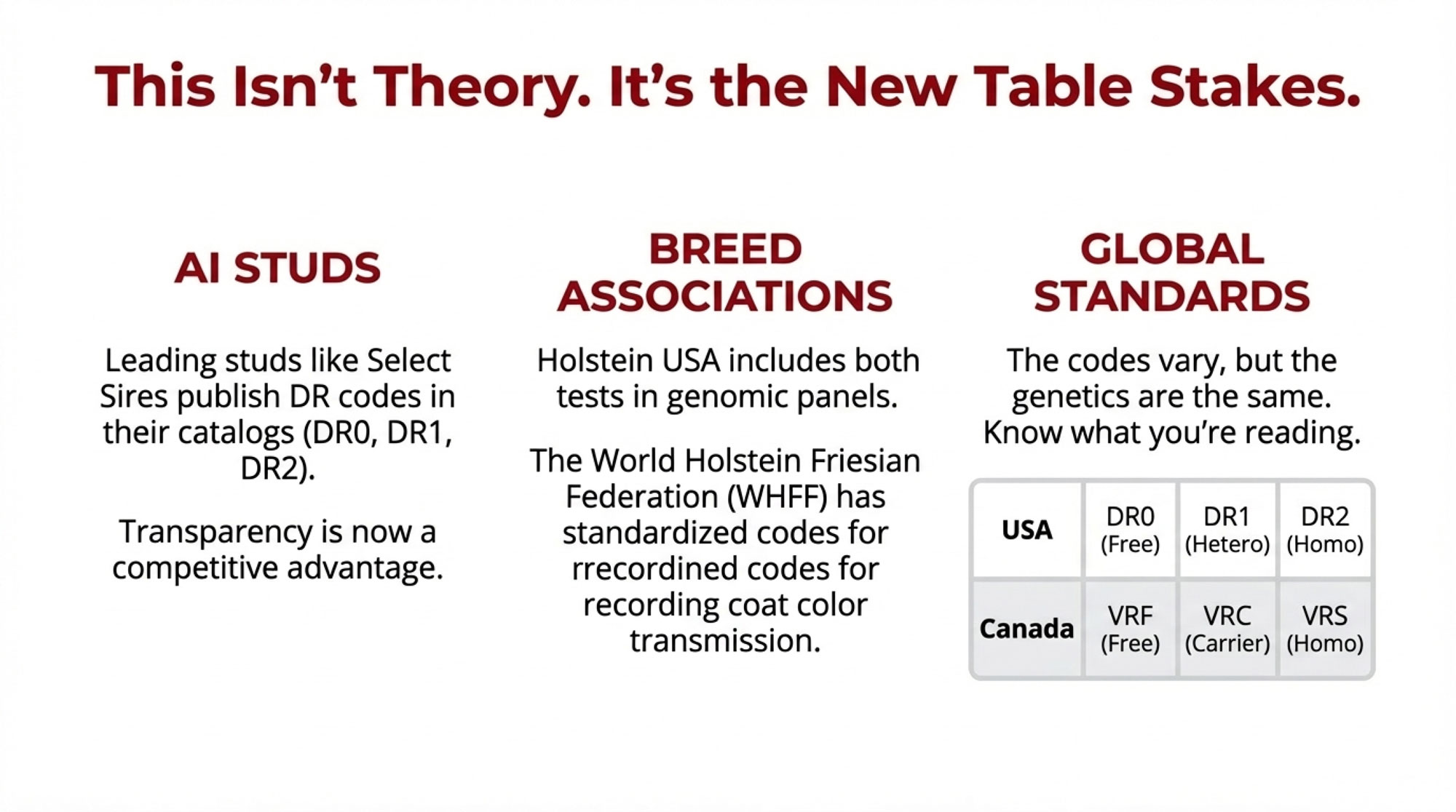
NewsSubscribe
First
Last
Consent

The A2 Advantage: A Producer’s Guide to Premiums, Genetics, and the Carbon Connection

Everyone says A2’s just hype. Tell that to farmers banking 100% premiums on milk yield.

EXECUTIVE SUMMARY: Look, I’ve been watching this A2 thing for years, and here’s what changed my mind – the premium isn’t going anywhere, and the science finally backs it up. We’re talking 50-100% premiums that are holding steady even with everything else falling apart in commodity markets. China’s A2 segment jumped 14% just in the first half of 2025, now claiming 20% of their infant formula market value… that’s real structural demand, not some health fad.The kicker? Most Holstein herds are already testing 50-60% A2 genetics – you might be sitting on premium milk and selling it commodity. At $25-40 per head for genomic testing, you’re looking at potentially discovering a revenue stream that California producers are already riding to $8-9 per gallon. With USDA operating loans at 5.000% and consumer premiums this strong, this isn’t about chasing trends anymore – it’s about capturing value that’s already there.

KEY TAKEAWAYS

  • Test your genetics first – Most Holstein herds hit 50-60% A2 genetics naturally; at $25-40/head testing costs versus 50-100% milk premiums, your ROI calculation is simple math that works in today’s tight margin environment.
  • Start with segregation strategy – Wisconsin’s MilkHaus Dairy is processing just 100 of their 360 cows separately for A2 cheese production, proving you don’t need full herd conversion to tap premium markets in 2025.
  • Stack the sustainability angle – Traditional A2 breeds like Jerseys show better feed efficiency, positioning farms for both A2 premiums and emerging carbon credit programs as USDA pilots recognize breed efficiency metrics.
  • Build direct-to-consumer channels – Vermont Jersey operations are pulling premium pricing on A2 raw milk and aged cheeses to Boston markets, while California organic A2 hits $8-9/gallon – direct sales bypass commodity pricing entirely.
  • Time your conversion with financing – At current 5.000% USDA operating rates, conversion financing is more accessible than it’s been in years, but processing capacity for segregated A2 milk is tightening across regions.
 A2 milk, genomic testing, dairy profitability, premium milk markets, dairy breeding strategy

You know what caught my attention at the last World Dairy Expo? Three different producers – completely unrelated, from Wisconsin to New Zealand – all mentioned they’re testing their herds for A2 genetics. That’s when you know something has shifted from a trend to a serious business opportunity.

If there’s one topic dominating dairy discussions lately, it’s A2 milk. What started as a niche health trend has evolved into something that’s genuinely transforming our perspective on premium positioning. With conventional milk struggling in commodity markets and consumers willing to pay 50-100% premiums for A2 products, this is no longer just marketing hype.

A2 milk is projected to become a $7.62 billion global market by 2034. That’s not wishful thinking from market researchers – that’s real money flowing through real supply chains, and it’s becoming clear that dismissing this as just another fad would be a serious mistake.

Your A2 Quick Reference Guide

Market Reality Check: Global A2 market projected to exceed $7.6B by 2034, with consumer premiums holding steady at 50-100% over conventional milk

Science Getting Clearer: While cognitive claims remain weak, peer-reviewed studies now confirm digestive benefits linked to gut microbiota changes

Strategy is Everything: Success depends on genetic testing, long-term breeding strategy, and – this is crucial – securing access to segregated processing

Start Local First: Evaluate your regional processors and direct-to-consumer opportunities before making major investments

The Numbers That Actually Matter

What strikes me about these market projections is how they’re playing out in real time. China’s A2 market tells the story perfectly:

China’s A2 protein segment grew 14% in just the first half of 2025 and now accounts for 20% of their total infant formula market value. When discussing a competitive market, capturing one-fifth of the total value isn’t just a matter of consumer preference – that’s structural demand.

The premium positioning is holding too. Even with all the economic uncertainty we’ve been dealing with, consumers are still paying premiums of 50-100% over conventional milk. That’s exactly the kind of value-added positioning we’ve been discussing as needed in this industry for years.

Here’s what’s fascinating, though – many A2 buyers don’t even have digestive issues with regular milk. They’re paying more because they believe it’s better milk. This represents exactly the kind of premium positioning that can actually stick.

What’s Actually Happening in Science

The biochemistry behind A2 milk is legitimate, even if some of the health claims can be somewhat exaggerated. When you’re dealing with conventional milk – the A1 beta-casein variety that most of our Holsteins produce – digestion releases this peptide called beta-casomorphin-7 (BCM-7).

Here’s where it gets interesting: research shows this peptide can actually cross the blood-brain barrier and interact with opioid receptors in our central nervous system. While this biochemical interaction is confirmed, it’s crucial to note that large-scale human studies haven’t substantiated the marketing claims linking it to conditions like autism or cognitive decline.

That’s not small stuff when you think about it. We’re talking about a food component that can literally reach the brain.

Now, before anyone gets carried away, most of the cognitive claims you see splashed across A2 marketing materials are still pretty thin on human clinical trials. But the digestive benefits? Those are starting to look solid.

What strikes me about recent work published in PLOS ONE is how concrete the results were. Two weeks of A2 milk consumption led to significant changes in gut microbiota – we’re talking about increases in beneficial bacteria like Bifidobacterium longum and Blautia wexlerae. These aren’t just random microbes; they’re directly linked to better nutrient processing and reduced gut inflammation.

Participants who typically experienced digestive discomfort with regular milk showed notable improvements with A2 milk consumption. From a market positioning standpoint, this is compelling stuff – actual functional benefits you can point to.

The Genetic Reality Check

Here’s where breed choice really matters in this whole A2 conversation. Most producers I talk to are surprised when they learn where their herds actually stand genetically.

According to recent work from Dr. John Lucey at the University of Wisconsin’s Center for Dairy Research, “Most U.S. Holsteins produce a mixture of the two, often a 50-50 or 60-40 split, depending on where the genetic lines came from. Guernsey, Jersey, and Brown Swiss tend to produce mostly A2.”

That breed difference alone changes your whole timeline and strategy. If you’re running Holsteins, you’re starting from a different place than someone with a Jersey herd. It’s not just about the genetics – it’s about understanding what you’re working with.

The testing itself costs around $25-40 per animal to determine your current status. That’s not nothing when you’re talking about a 300-cow herd, but it’s the kind of investment that makes sense when you’re looking at those premium opportunities.

What’s particularly noteworthy is how this plays out across different regions. In the Upper Midwest, I’m seeing Holstein herds that test surprisingly high for A2 genetics – sometimes 60-70% – likely due to specific breeding lines that came through certain AI companies. Meanwhile, down in the Southeast, some Jersey herds are testing lower than expected, which suggests there’s more A1 genetics circulating in those bloodlines than people realize.

The Next Frontier: Connecting A2 to Carbon and Policy

Here’s something that’s flying under the radar but shouldn’t be – the intersection of A2 genetics and sustainability is creating a potential triple-win scenario that smart producers are already positioning for.

Traditional A2 breeds, such as Jerseys and Guernseys, often have better feed conversion rates, which translates to lower methane production per pound of milk. With carbon pricing becoming a reality through programs like California’s LCFS expansion and the EU’s Green Deal, which is pushing sustainability metrics, a double premium opportunity may be emerging.

The new USDA carbon credit pilot programs are starting to recognize these breed efficiencies. Operations that can document both A2 genetics and improved feed efficiency might qualify for additional incentives by 2026. Initial word from extension specialists suggests that farms documenting both A2 genetics and carbon efficiency could receive stacked premiums.

I’ve been hearing from processors in the Northeast who are starting to ask about both A2 genetics and carbon footprint data. That’s a trend that’s expected to accelerate, especially as more retailers make sustainability commitments. With the EU’s Green Deal pushing sustainability metrics and New Zealand implementing their emissions pricing scheme, there’s a real question about positioning A2 milk within these new frameworks.

The methane credit angle is particularly interesting. Some of the same breeds that naturally produce more A2 milk also tend to be more efficient feed converters, lower methane per pound of milk. As carbon pricing becomes more of a reality (and it’s coming, whether we like it or not), we’re looking at a potential convergence where A2 genetics, carbon efficiency, and premium positioning all align.

The Conversion Challenge – What It Actually Takes

Converting to A2 production is a significant operational commitment, not as simple as flipping a switch. Here’s what you’re really looking at:

Investment Reality: The real cost is time and a multi-generational breeding strategy. From industry observations, you’re looking at several generations to achieve high A2A2 frequencies – the exact timeline depends heavily on your starting genetics and breed composition.

Processing Bottleneck: Access to segregated processing facilities is, in fact, the biggest challenge. I’ve talked to producers with beautiful A2 herds who ended up stuck selling into commodity markets because they couldn’t secure premium outlets.

Financing Actually Looks Good: Current USDA Farm Service Agency operating loans are running at 5.000% as of July 2025, which makes conversion financing accessible for qualified operations. That’s more reasonable than the higher rates we saw a couple of years back.

Here’s the thing, though – and this is where I see producers getting tripped up – you can’t just think about the genetics. The infrastructure piece is massive. You need separate tanks, separate trucks, and separate processing lines… or, at the very least, processing partners who can handle the segregation requirements.

Real Operations Making It Work

What’s working? Direct-to-consumer operations are absolutely crushing it. Let me tell you about operations that are getting it right across different regions:

MilkHaus Dairy in Fennimore, Wisconsin, is testing about 100 of their 360-head Holstein herd for A2 genetics. They’re housing those A2 cows separately, keeping the milk completely segregated, and processing it into cheese at local plants. Now they’re selling 12 different cheese flavors nationwide through their online store. The genius part? They’re not trying to convert their whole herd – they’re just maximizing the value of what they’ve got.

Two Guernsey Girls Creamery in Freedom, Wisconsin, took a different approach. They broke ground on a small bottling and cheese-making facility in late 2020, opened it in summer 2021, and now process all their milk on-site. Pasteurized white milk, chocolate milk, cheese curds – all A2, all local, all profitable. What started as a 4-H project has grown into a thriving farmstead operation.

But it’s not just Wisconsin. In California, I’ve been hearing from producers in the Central Valley who are pairing A2 genetics with organic certification – apparently, this combination is hitting a sweet spot with Bay Area consumers, who are willing to pay serious premiums. “We’re seeing $8-9 per gallon for A2 organic,” one Fresno County producer told me last month. “That’s game-changing money.”

Meanwhile, in Vermont, there’s a Jersey operation that has gone full A2 and direct-to-consumer. They’re selling A2 raw milk permits and A2 aged cheeses to the Boston market – completely different approach than what we’re seeing in the Midwest, but it’s working for their customer base.

The key here – and this is what I keep telling producers – is understanding that success often depends more on market positioning and consumer education than just having the genetics. These operations work directly with consumers, educating them about the differences and building brand loyalty.

Regional Patterns That Are Actually Emerging

The A2 opportunity isn’t uniform across regions, and that’s something you really need to factor into your planning. What works in Wisconsin might not work in California, and what sells in Australia definitely won’t automatically work in Iowa.

Here’s what I’m seeing in different regions: Upper Midwest operations with established local markets are doing well with direct sales. The cheese culture up there really helps – consumers understand premium dairy products. West Coast producers are finding success pairing A2 with organic certification to tap into that California wellness market.

However, what’s interesting is that I’m hearing from Northeast producers who are struggling with the infrastructure piece more than expected. Processing capacity for segregated A2 milk is tighter than anticipated, especially in Vermont and New York. One producer in the Hudson Valley told me they’re trucking A2 milk three hours to find a processor who can handle the segregation requirements.

Southeast operations? They’re dealing with entirely different challenges. The consumer demand is there, but the genetic starting point is often lower than expected. Heat stress is also affecting A2 conversion timelines in ways that Northern operations don’t have to consider.

What’s fascinating is how weather patterns are also affecting this. The drought conditions we’ve been seeing in parts of the West are actually pushing some producers toward A2 conversion because they’re already having to make genetic decisions about their herds – might as well optimize for premiums while you’re at it.

What This Means for Your Operation

The cognitive benefits everyone’s talking about? The science isn’t there yet. However, the market opportunity is real, and consumer willingness to pay premiums remains strong, even amid the ongoing economic challenges.

If you’re considering A2 conversion, start with genetic testing to understand your baseline. Don’t rush into wholesale changes – gradual conversion through selective breeding spreads your investment while you build market relationships. The sweet spot seems to be operations over 200 cows, where you can absorb conversion costs across larger production volumes.

Here’s what I’d recommend: evaluate your local market access first. Do you have processing facilities that can maintain A2 segregation? Are there premium retailers interested in carrying your product? Can you build direct-to-consumer channels?

But honestly? The most important thing is to be realistic about timelines. This isn’t a quick pivot. If you’re serious about A2, you’re looking at a long-term strategy – breeding decisions today based on where you think the market will be in 2030.

And here’s something else to consider… the regulatory landscape is shifting. With sustainability requirements tightening and carbon accounting becoming more standard, A2 genetics might end up being just one piece of a broader premium positioning strategy. The producers who are thinking ahead are already connecting A2 to metrics for feed efficiency, methane reduction, and soil health.

The Bottom Line

The combination of documented gut health benefits, resilient premium pricing, and developing infrastructure creates a compelling and tangible opportunity. What’s particularly exciting is how this aligns with the broader sustainability conversation. We’re potentially looking at a convergence where A2 genetics, carbon efficiency, and premium positioning all intersect.

This isn’t about jumping on the latest trend – it’s about positioning your operation for long-term success in an evolving premium dairy market. The question isn’t whether A2 milk will succeed – it’s whether you’re positioned to capture your share of this expanding opportunity.

The producers who are succeeding aren’t just chasing the A2 premium – they’re building integrated strategies that position them for whatever comes next. That’s the real lesson here.

Complete references and supporting documentation are available upon request by contacting the editorial team at editor@thebullvine.com.

Learn More:

Join the Revolution!

Join over 30,000 successful dairy professionals who rely on Bullvine Weekly for their competitive edge. Delivered directly to your inbox each week, our exclusive industry insights help you make smarter decisions while saving precious hours every week. Never miss critical updates on milk production trends, breakthrough technologies, and profit-boosting strategies that top producers are already implementing. Subscribe now to transform your dairy operation’s efficiency and profitability—your future success is just one click away.
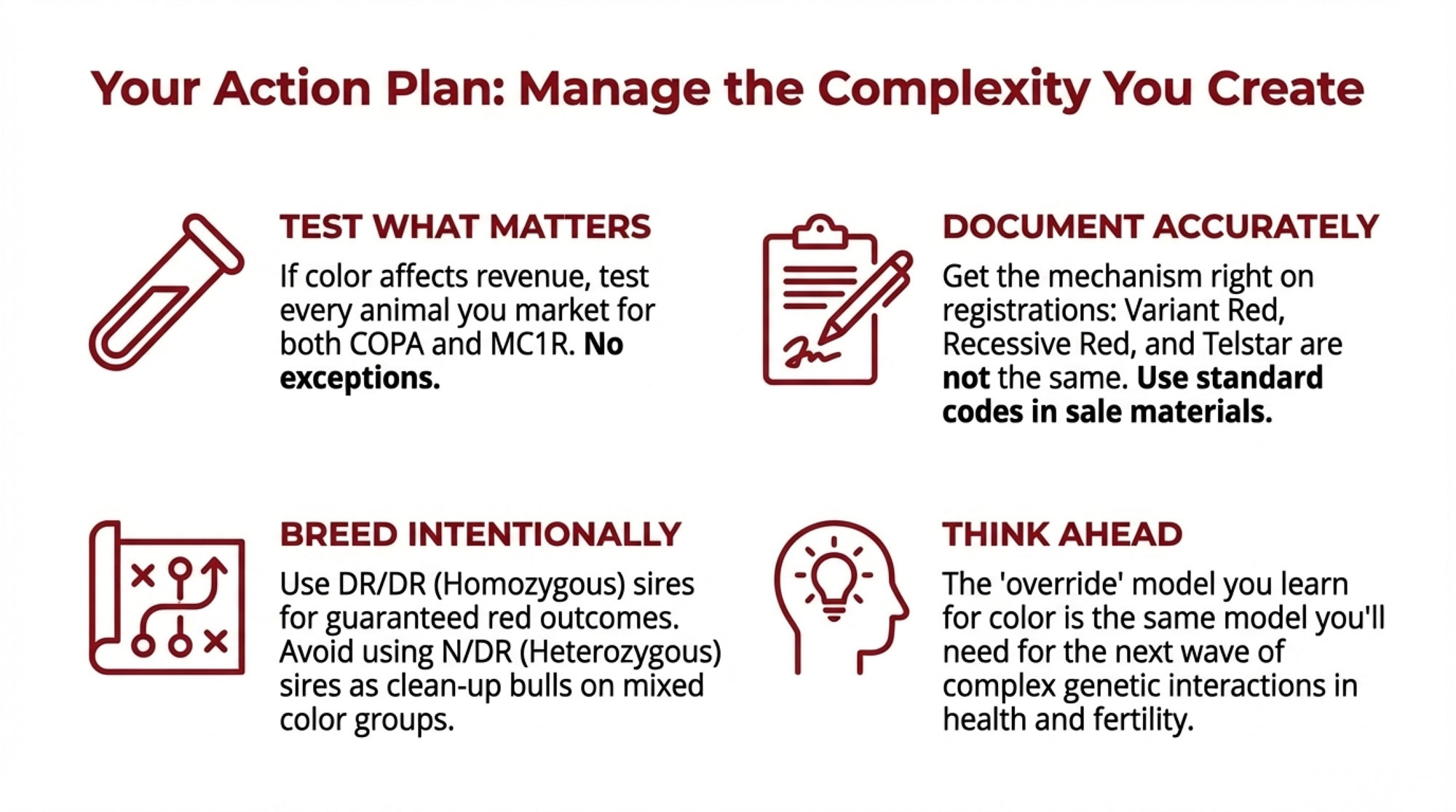
NewsSubscribe
First
Last
Consent
Send this to a friend