







Three of four DFO exchanges have been cancelled since May. In May, 1,978 producers bid; eighteen had quota to sell. The tariff fight can’t reach your cheque. That can.
Executive Summary: Dairy Farmers of Ontario cancelled the May, July and August 2026 quota exchanges for insufficient quota offered — in May, 1,978 producers bid on 26,153.61 kg of butterfat while eighteen offered 138.39 kg, roughly $628 million in bids against $3.3 million of supply at the $24,000 cap. March cleared 190.60 kg against 25,628 kg bid, a 0.744% buyer success rate, which works out to about a tenth of a kilogram per bidder if it had spread evenly. Meanwhile Canada’s USMCA all-cheeses tariff-rate quota filled to 99% in 2024, so the 50% Section 338 tariff that landed Aug. 22 can’t push more cheese north — the fight is over who holds the import permits, not how much crosses. For P5 quota holders, that permit fight has no documented path to your milk cheque: the National Pricing Formula runs on cost of production and CPI, and cheese import rent isn’t an input, which means the $22.4–$34.4 million in duty that allocation holders skip accrues to processors and distributors, not producers. If expansion quota sits in your 2027 capital plan, that’s a financing-timing conversation with your lender now, not a spring problem. Watch Oct. 1, when Global Affairs Canada publishes the Notice to Importers for the 2027 cheese year — if eligibility still reads processor, further processor, distributor with retailers excluded, the rule rolls forward another year, and U.S. pressure hasn’t moved Ottawa.

If you’re adjusting your 2027 expansion plans around U.S. cheese tariff headlines, you’re watching the wrong border.
Canada’s USMCA all-cheeses tariff-rate quota was filled to 99% in 2024, per Global Affairs Canada data published in USDA Foreign Agricultural Service’s Canada Dairy and Products Annual (Report CA2025-0038, Nov. 21, 2025). The 50% Section 338 tariff that hit Canadian goods at 12:01 a.m. on Aug. 22, 2026 won’t move more cheese north. There’s no room left.
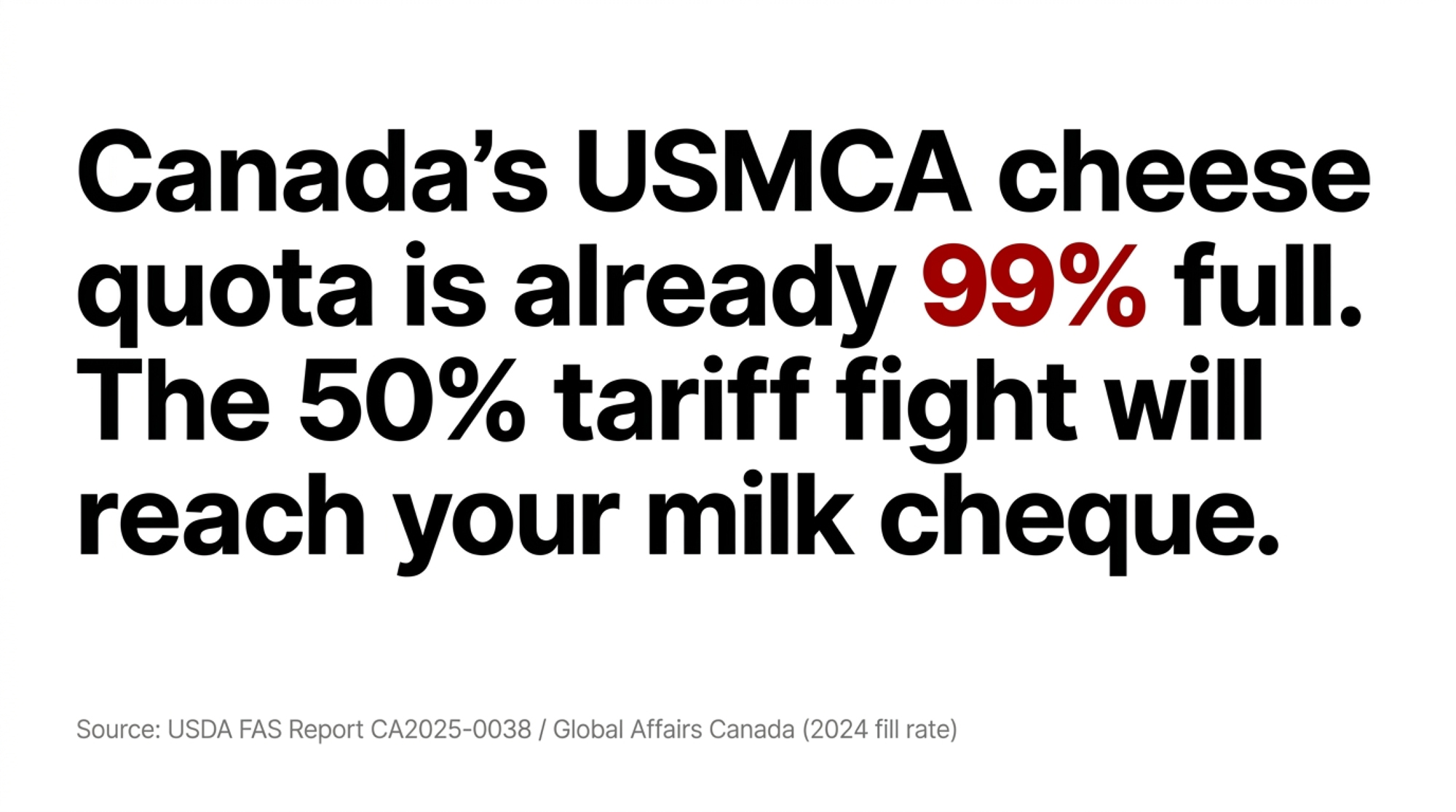
This USMCA cheese quota dispute in dairy 2026 is a fight over import permits, not milk supply. For a P5 quota holder, that means it doesn’t reach your cheque — and it won’t soon.
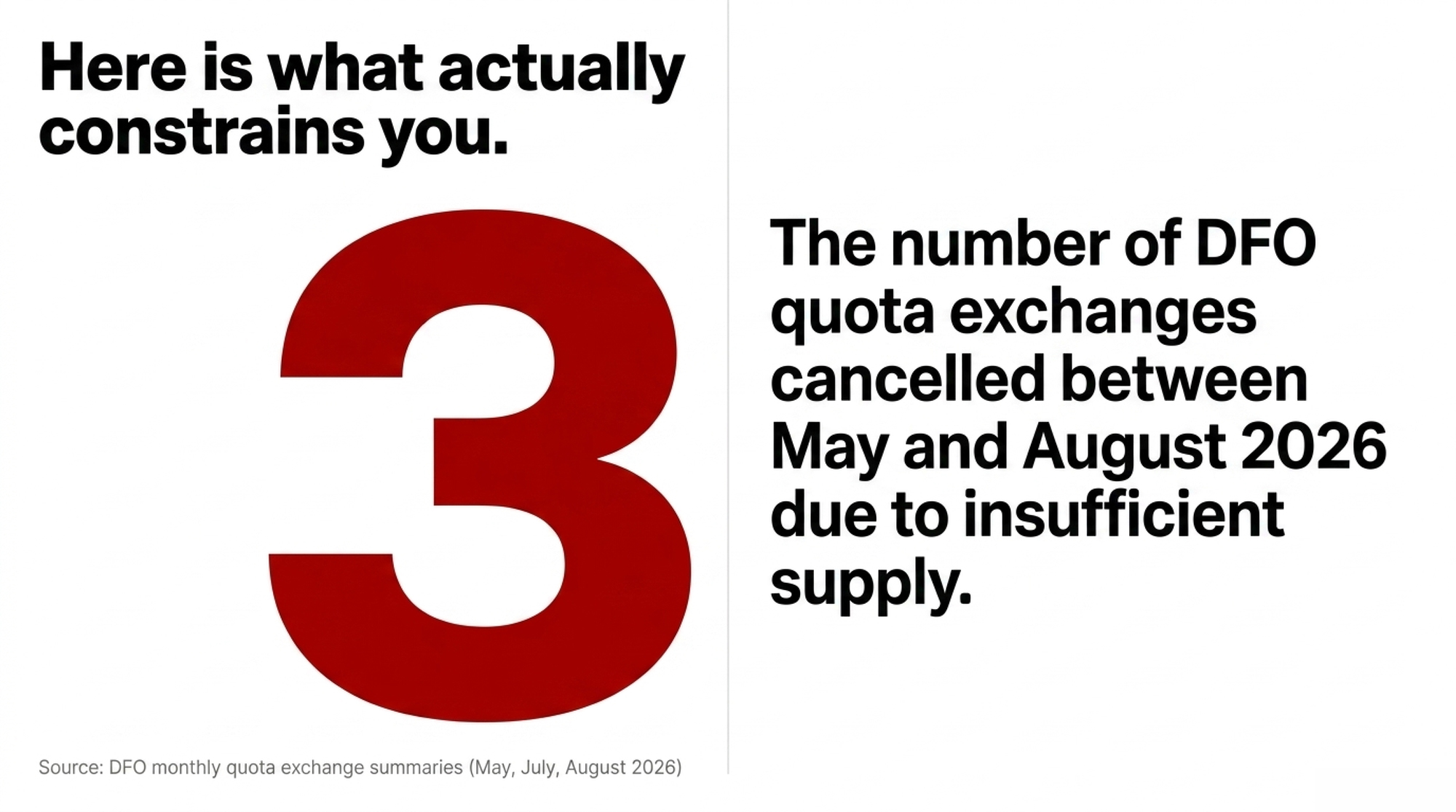
Here’s what does reach you. Across the four monthly quota exchanges from May through August 2026, Dairy Farmers of Ontario cancelled three for insufficient quota offered for sale. In May, 1,978 producers placed bids on 26,153.61 kg of butterfat per day. Eighteen producers offered 138.39 kg. At the $24,000 cap, that’s roughly $628 million in bids against $3.3 million in available supply.
Three cancellations in four months. That’s your constraint. Not Washington.
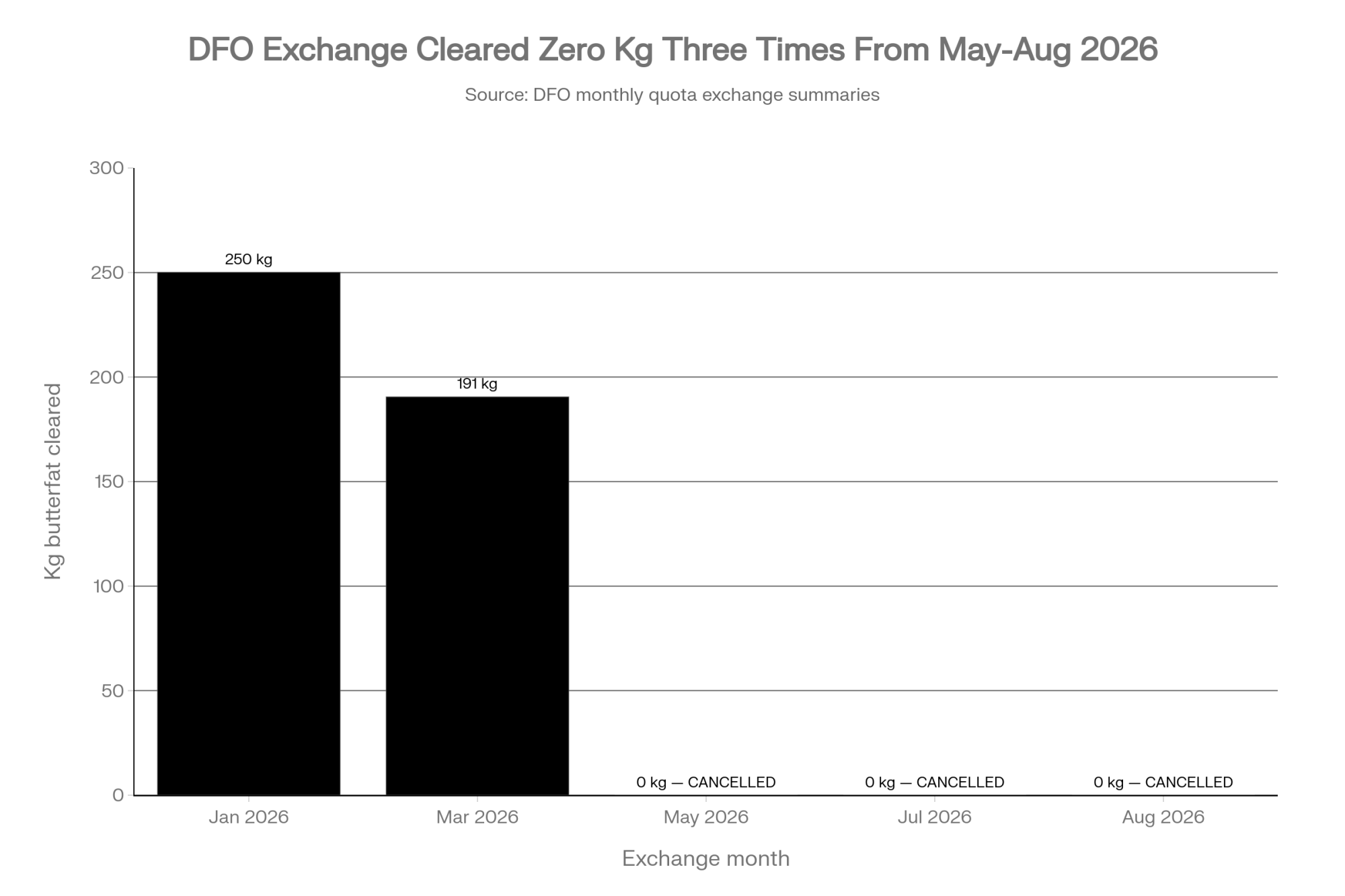
What Three Cancelled DFO Exchanges Cost an Expanding Ontario Herd
Ontario and the other P5 provinces — Quebec, New Brunswick, Nova Scotia, PEI — cap quota at CA$24,000 per kilogram of butterfat per day. It is a provincial policy ceiling, not a market-clearing price, and not driven by import competition.
That cap has a history worth knowing. The P5 provinces built a quota pricing mechanism in December 2008 as values climbed. Ontario and Quebec capped at $25,000/kg in 2010, and Quebec cut its ceiling to $24,000 in February 2016 (Library of Parliament, Canada’s Supply Management System). The $24,000 figure now applies across all five P5 provinces, confirmed as current in DFO’s August 2025 markets report and again in Dairynomics, milkproducer.ca, Apr. 27, 2026. British Columbia sits outside the pool at $35,500 — proof the number is a policy choice, not market physics.
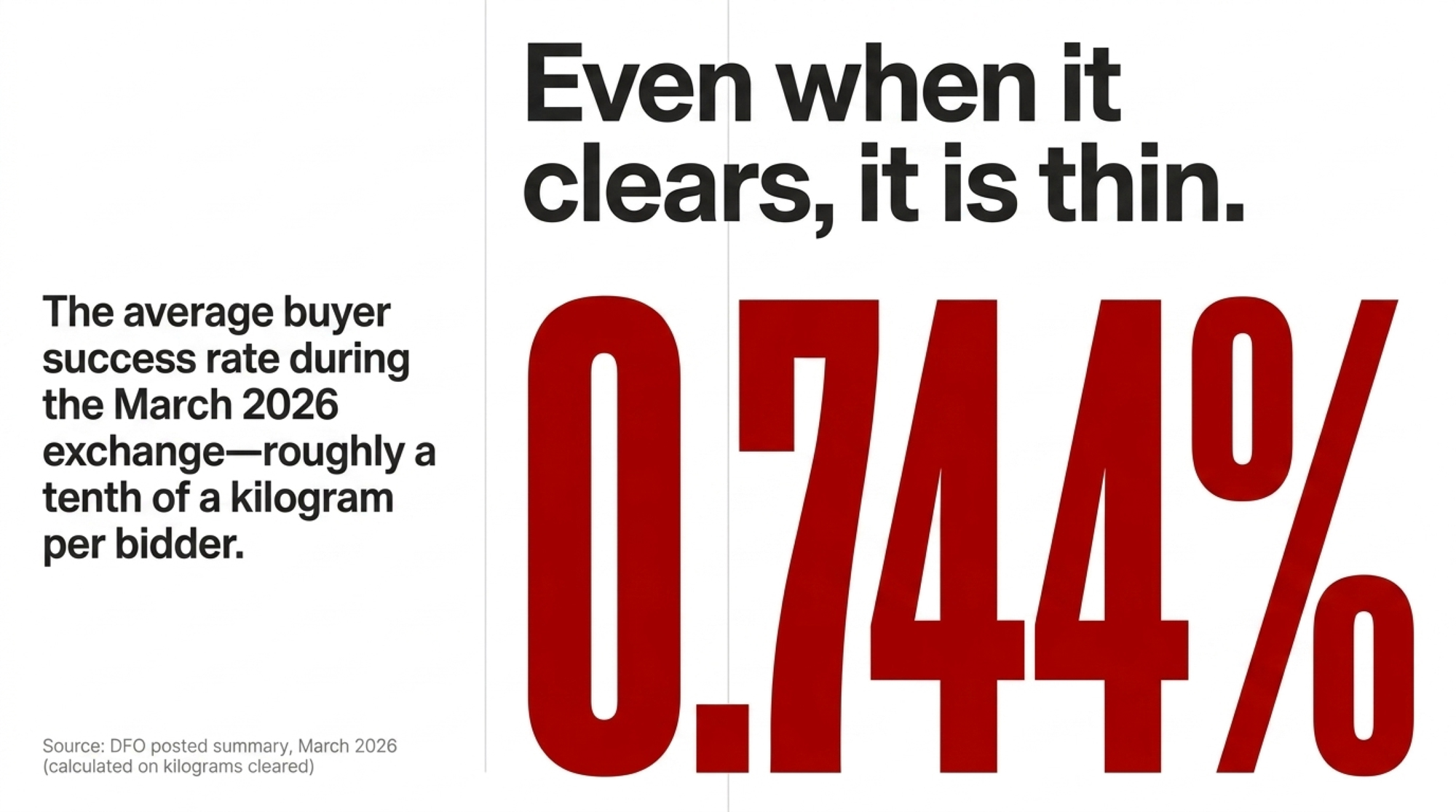
The March 19, 2026 exchange cleared, barely. DFO reported 1,908 producers bidding to buy against 18 offering to sell. Of 25,628 kg bid, 190.60 kg actually traded — a 0.744% average buyer success rate, DFO’s own figure, calculated on kilograms cleared rather than producers served. Everything traded at the cap.
Then May was cancelled under policy. June ran. July cancelled. August cancelled.
Running the Numbers
Start with what DFO published across three exchanges and work it two ways.
| Exchange | Producers Bidding | Kg Bid | Kg Cleared | Buyer Success Rate |
|---|---|---|---|---|
| January 2026 | 1,828 | 25,266.37 | 250.10 | 0.734% |
| March 2026 | 1,908 | 25,628.00 | 190.60 | 0.744% |
| May 2026 | 1,978 | 26,153.61 | 0 — Cancelled | — |
| July 2026 | — | — | 0 — Cancelled | — |
| August 2026 | — | — | 0 — Cancelled | — |
DFO monthly quota exchange summaries. January figures from DFO’s posted summary dated Jan. 2, 2026; that exchange settled in phases, with 182.60 kg moving through allotment rounds and 2.50 kg through proration at 0.021%.
Run the arithmetic. March: 25,628 kg × $24,000 = $615.1 million in bids, chasing 190.60 kg × $24,000 = $4.57 million in quota. Divide cleared volume by bidders — 190.60 ÷ 1,908 = 0.0999 kg per bidder, if it had spread evenly. It didn’t; DFO allocates by allotment rounds first, then proration.
January was marginally better and still thin: 250.10 ÷ 1,828 = 0.137 kg per bidder.
Scale it to a herd. Ontario’s provincial average butterfat composition ran 4.4655 kg/hL in February 2026 (Dairynomics, Apr. 27, 2026). A herd needing one additional kilogram of butterfat per day faces $24,000 of capital at the cap, before financing. Two consecutive cleared exchanges would have delivered roughly a quarter of that kilogram to the average bidder.
Then May, July, and August delivered nothing at all.
So the practical math for an expanding Ontario operation isn’t a price question. It’s an availability question, and the answer was “no market” in three of those four months. Whatever your 2027 plan assumes about buying quota on the exchange, test it against a market that cleared 250 kg in January, 190 kg in March, and was cancelled three times between May and August.
[VISUAL: bar chart of cleared kilograms by month, January through August 2026, with cancelled months shown as zero bars against a flat line for total kilograms bid.]
Related reading: why new Ontario quota at 6% bleeds cash
Why the 42% Fill Rate Everyone’s Citing Describes the Wrong Quota
Now the trade fight, and why it’s the wrong thing to watch.
The number running through trade press — including The Bullvine’s own earlier coverage — is that Canada’s dairy TRQs sit badly underfilled. Roughly 42% across 14 categories. Something like $200 million in blocked access.
Real number. Also an aggregate, and aggregates bury things.
| Trade Agreement | All Cheeses (2024 Fill) | Industrial Cheese (2024 Fill) |
| USMCA (U.S.) | 99% | 59% |
| WTO | 95% | — |
| CETA (EU) | 95% | 79% |
| CPTPP | 98% | 1% |
Global Affairs Canada data via USDA FAS Report CA2025-0038, Nov. 21, 2025. CPTPP mozzarella and prepared cheese filled 46% in the same year. Al Mussell at the C.D. Howe Institute found roughly 97–99% across all four systems for 2025 in an Aug. 18, 2026 working paper, drawing on the same GAC source.
Industrial cheese feeds further processing. It never hits a retail cooler. The Globe and Mail flagged the pattern on July 14, 2025, reporting 83% of the cheese-of-all-types allotment filled in 2024 — highest of any category.
Two things keep the correction honest. Fill rates were genuinely low in earlier periods — Dairy Farmers of Canada’s own Quarterly Skim put CETA cheese at 43% as of July 31, 2022. And the composite spans categories that behave nothing alike, from CPTPP industrial cheese at 1% to USMCA all-cheeses at 99%. The aggregate measured something true in its year, then traveled into a conversation about retail cheese where it doesn’t apply.
Related reading: the $200M access gap is worth a nickel
What Is the U.S. Actually Asking For in the CUSMA Cheese Quota Dispute?
Eligibility. Not volume.
USMCA allocations go to Canadian processors, further processors, and distributors, awarded on historical market share from the prior Oct. 1–Sept. 30 reference period. The Notice to Importers puts it plainly, as reproduced in the panel record: “Retailers are not eligible for an allocation.”
CETA runs differently. USDA FAS documents a 50/50 split — dairy processors, about 45 companies, on one side; distributors and retailers, about 175 companies, on the other. Within each class, 30% of volume goes to small and medium companies, 20% to large ones.
Read that second class carefully. Distributors and retailers together hold half the CETA all-cheeses quota, and FAS doesn’t separate the two. So the defensible framing is that CETA admits retailers to a class worth half the quota while USMCA bars them outright. How much of that half lands with grocers rather than distributors isn’t in the public data, and the proclamation’s discrimination argument is only as strong as that unpublished number.
That asymmetry is what the July 20, 2026 proclamation is built on.
The most useful voice here belongs to someone already inside the system. Joe Dal Ferro runs Finica Food Specialties in Mississauga and chairs the International Cheese Council of Canada. Finica appears on Global Affairs Canada’s 2026 CETA Cheese of All Types quota holders list, published Jan. 26, 2026 — so he holds quota under a system he’s arguing should admit more competitors. He’s given his reasons publicly and consistently: fairness, consumer variety, and free-market principle.
“This is unfair and goes against the spirit of the trade agreement and free market economics,” Dal Ferro told the Globe and Mail on July 14, 2025, speaking as ICCC chair. Processors holding quota, he said in that same reporting, “are not interested in providing variety to the Canadian consumer.”
Dairy Farmers of Canada reads it differently. As the tariff deadline approached, DFC warned publicly against further concessions on dairy market access, arguing food sovereignty shouldn’t be traded away — reported by CityNews Edmonton on Aug. 6, 2026. Two Canadian industry bodies, opposite conclusions, both on the record.
Dal Ferro walked through the mechanics for Grocery Business on Mar. 20, 2025. “The Canadian government allocates quotas for importers to bring in American cheese. So if an importer is a holder of quotas, there is zero duty on the cheese. It’s only when an importer goes over the quota access or if an importer is not a holder of a quota for cheeses from the US that you then pay the 245% tariff.”
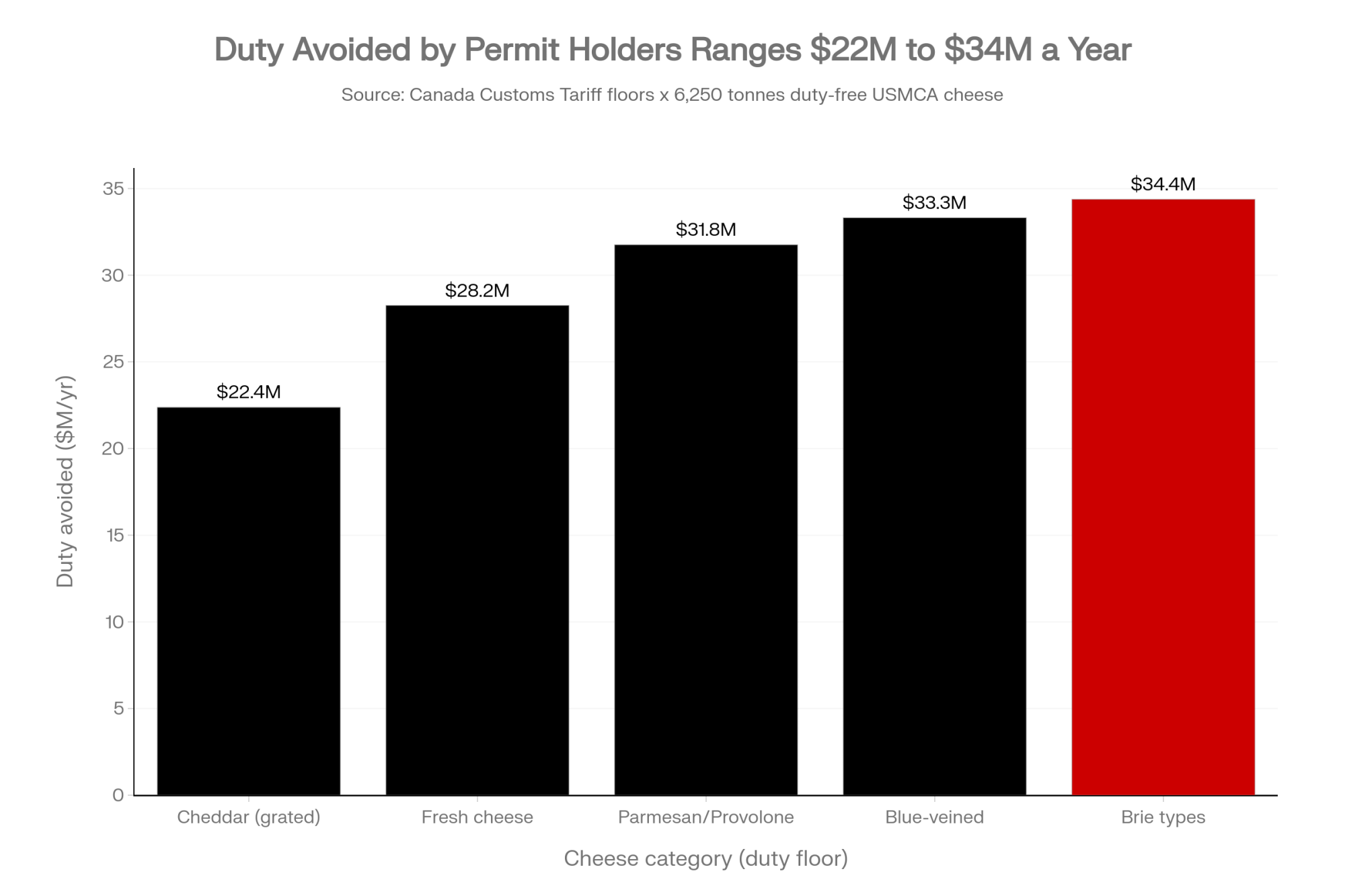
His number checks out, and the schedule is harsher than a single percentage suggests. Canada’s Customs Tariff sets the over-access rate for heading 04.06 at 245.5%, with a per-kilogram floor varying by cheese type — not less than $3.58/kg on grated cheddar, $4.52/kg on fresh cheese, $5.08/kg on Parmesan and Provolone types, $5.33/kg on blue-veined, $5.50/kg on Brie types. Global Affairs Canada’s WTO cheese notice confirms it: ship without a specific import permit, and you’re classified at 245.5% plus the floor.
That floor is why Dal Ferro called over-quota transactions “nearly impossible.” On premium product, the minimum duty alone can run past the cheese’s landed value.
State his position plainly. Dal Ferro chairs an importers’ association. The ICCC filed its submission in the CPTPP cheese TRQ dispute on May 19, 2023, under his name as chair. His members gain from broader access. That doesn’t make him wrong — it makes him a party with an interest, which isn’t the same as a neutral analyst.
Who Actually Has Skin in This Game, If Not the Farm
Exposure sits one layer above the barn, and it’s quantifiable.
Holding a permit is worth money because it lets you skip costs. Import cheese with an allocation and you pay nothing. Import the same cheese without one and you pay 245.5% plus the floor. That gap, multiplied by volume, is the import rent — and it lands on whoever holds the paper.
Two of three inputs are solid. Volume: USMCA all-cheeses access for 2026 is 6,313 tonnes, rising to 7,113 by 2038 (USDA FAS, CA2025-0038). At the 99% fill recorded in 2024, roughly 6,250 tonnes enter duty-free. Rate: 245.5% with those per-kilogram floors.
Landed cost per tonne is the missing term — Statistics Canada and GAC report volume and value at aggregate levels that don’t isolate USMCA-permit cheese.
Bracket it with the floors instead. Grated cheddar carries a minimum over-access duty of $3.58/kg, or $3,580 per tonne before the ad valorem calculation applies at all. Across 6,250 tonnes, that’s about $22.4 million in duty avoided at the low end. On Brie types at $5.50/kg, roughly $34.4 million. Product mix decides where inside that band the real number sits, and the 245.5% component pushes it higher wherever landed value clears the floor.
Floor estimate, not the rent. True rent is larger and unknowable from public sources.
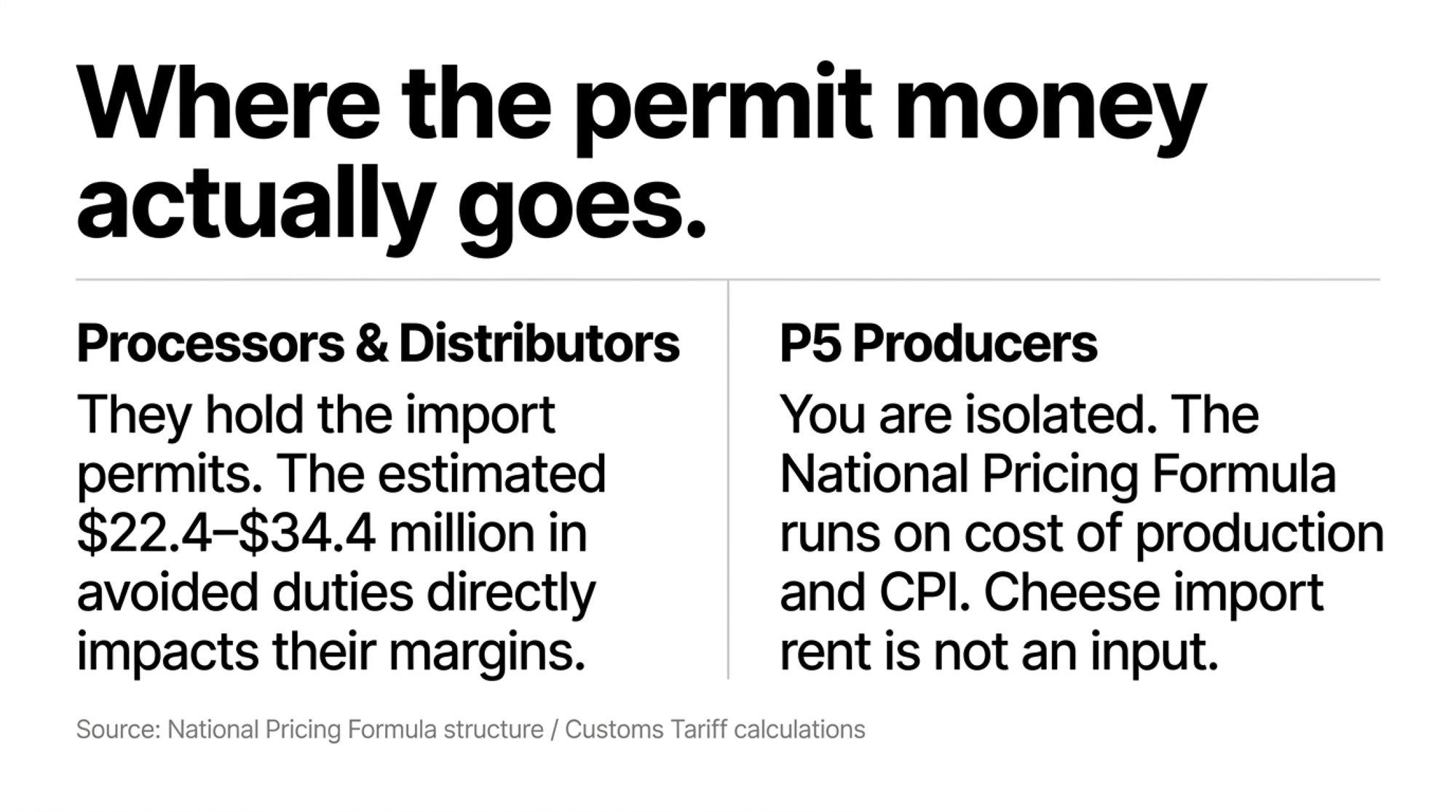
That $22.4–$34.4 million band is what allocation holders collectively don’t pay. It accrues to processors and distributors. Not to producers.
The wider trade at stake is modest. Canadian cheese exports to the U.S. run around US$80 million, Canadian imports of U.S. dairy products around US$400 million, per Mussell’s Aug. 18, 2026 analysis — recent annual figures, no single year specified, and the US$400 million covers dairy broadly rather than cheese alone. The Section 338 dairy proclamation covers 52 HTSUS subheadings representing US$97.2 million of 2024 imports, per White & Case analysis dated July 24, 2026, cited by Peacock Tariff Consulting on Aug. 5, 2026.
The U.S. is already Canada’s second-largest cheese supplier by volume. January through August 2025: 14,196 tonnes, 36.3% of total Canadian cheese imports, up 6.8% year over year. EU-27 held 49.7% at 19,392 tonnes. Total imports: 39,055 tonnes, up 8.7% — Trade Data Monitor figures via USDA FAS.
And the roster of permit holders is about to shift. Lactalis Canada announced a definitive agreement on July 15, 2026, to acquire Agropur Cooperative’s fine cheese division — the OKA, Monsieur Gustav and L’Extra brands, two production facilities at Oka and Saint-Hyacinthe, roughly 400 workers, and Agropur’s fine cheese import activities. CBC reported the division generates roughly $200 million annually. Financial terms weren’t disclosed.
The deal hasn’t closed. Both companies confirmed the transaction remains subject to customary closing conditions and approval by Competition Bureau Canada. Lactalis described it as adding to a portfolio that already includes Galbani, Président, Cracker Barrel, Black Diamond and P’tit Québec, and nothing in the public record links it to the trade action.
What matters either way: if it clears, the companies holding cheese import rights change — and 2027 allocations get calculated on market share from a reference period that includes this transition.
Why the Trade Fight Can’t Reach Your Milk Cheque
Mussell’s answer is no, and the reasoning runs through the pricing formula.
He concludes there’s no direct mechanism for reduced processor margins to lower raw milk prices. USDA FAS documents why the structure blocks it: Canadian milk component prices are set by the National Pricing Formula — “50 percent based on changes in the cost of production and 50 percent on changes in the Consumer Price Index” — determined at year-end and effective Feb. 1.
Cost of production and CPI. Cheese import rent isn’t an input. A processor losing import margin has no channel to push it down.
Not everyone frames access that way. The Canadian Centre for Policy Alternatives estimated on May 25, 2026, that CUSMA represents an annual loss to domestic producers equivalent to 8.4% of milk production — an argument that market access carries real producer cost even where no line-item mechanism exists. Mussell’s point is narrower and mechanical: this particular permit fight has no documented path to your cheque.
Three scenarios, one outcome where it counts:
| Variable | Retailer Access Shift | Status Quo Holds | DFO Exchange Freeze |
| Permit rent ($22.4–$34.4M band) | Shifts toward grocers | Accrues to processors and distributors | Irrelevant to trade file |
| Processor margin | Compression, unquantified | Stable | No effect |
| Farm-gate milk price | Zero documented mechanism | Zero documented mechanism | Zero documented mechanism |
| P5 quota value | Zero documented mechanism | Zero documented mechanism | Capped at $24,000/kg, unmoved |
| Exchange quota availability | Unaffected | Unaffected | None — 3 of 4 months, May–Aug 2026 |
Read the bottom two rows. Both trade columns are empty where it matters to you, and the third column is the only one with a number attached. Note what that last row does and doesn’t say: the exchange quota was unavailable. Incentive days, component strategy, and productivity gains per cow stayed open the whole time.
Here’s the farm-side calculation, in words, because one input is structurally absent:
(processor margin change from an eligibility shift) × (pass-through rate to the National Pricing Formula) × (quota capitalization multiple) = quota value effect per kg BF
The middle term breaks the chain. The NPF runs on cost of production and CPI, so the pass-through rate is zero and zeroes the product. Any other figure needs an assumption that no published source supports.
There’s no herd-scoped version of this particular calculation, and that absence is the finding rather than a gap in the reporting. Anyone publishing a per-cwt or per-kilogram farm impact from the trade dispute is filling that hole with a guess. The DFO exchange math earlier in this piece is different — that’s real, published, and it’s the number that touches your balance sheet.
Where the permit actually travels
| Stage | Under USMCA | Under CETA |
| Import right issued | Global Affairs Canada | Global Affairs Canada |
| Allocation basis | Historical market share, Oct. 1–Sept. 30 | 50/50 processor vs. distributor-retailer class |
| Processor | Eligible | Eligible (~45 companies) |
| Further processor | Eligible | Eligible |
| Distributor | Eligible | Eligible (~175 companies with retailers) |
| Retailer | Blocked | Eligible |
| Retail shelf | Reached via processor or distributor | Reached directly or via distributor |
That single blocked row is the entire basis of the July 20 proclamation.
The Statutory Problem Two Georgetown Scholars Raised
Section 338 of the Tariff Act of 1930, at 19 U.S.C. § 1338, permits duties up to 50% where the President finds a country “discriminates in fact against the commerce of the United States… in such manner as to place the commerce of the United States at a disadvantage compared with the commerce of any foreign country.”
July 20, 2026 was the first invocation in 96 years, per White & Case’s July 24, 2026 analysis.
Why this matters for the Oct. 1 notice: two tribunals have already ruled, and neither left Ottawa under any treaty obligation to change eligibility.
The treaty record
- December 2021, USMCA panel — found Canada’s practice of reserving 85–100% of dairy TRQ pools for processors inconsistent with CUSMA. Canada revised.
- Nov. 10, 2023, second USMCA panel — report issued, public Nov. 24. Split 2-1 on the retailer question specifically.
- Per USTR’s own release: “Two of the three panelists found that Canada’s measures do not breach any of the USMCA commitments that the United States cited. One panelist, however, agreed with a principal U.S. claim challenging Canada’s narrow definition of eligible applicants.” The dissenter “agreed with the United States that by excluding retailers and others, Canada was breaching its commitment to make its dairy TRQs available to all applicants active in the Canadian food or agriculture sector.”
- Global Affairs Canada’s record: the panel “ruled in Canada’s favour on all claims,” and Canada “is not required to make any changes.” CUSMA provides no appeal.
- New Zealand’s CPTPP challenge — per Agriculture and Agri-Food Canada’s question-period note, the panel found against Canada on 2 of 6 claims: Canada violated its obligation to let importers “utilize TRQ quantities fully,” and processor-reserved pools violated the obligation not to “limit access to an allocation to processors.” On retailers, the majority held that “Canada’s exclusion of retailers from TRQ eligibility falls within Canada’s discretion.”
- Canada’s response to that ruling: it was “very pleased” the panel “recognized that Canada has a margin of discretion in setting its TRQ allocation policies, including determining who is eligible.”
Washington’s claim against that record
One arbitrator of three agreed with the U.S. core complaint. A one-vote margin on the retailer question — and that’s the foundation for invoking a statute untouched since 1930.
The legal vulnerability
Georgetown scholars Peter Harrell and Jennifer Hillman published a critique on Aug. 3, 2026 via the Volokh Conspiracy at Reason. Three arguments, each narrow:
- The comparative-language problem. Canada applies the processor-and-distributor restriction to every trading partner except the EU. Treatment identical to nearly every other country isn’t discrimination against the United States under the statute’s own wording. “Canada’s dairy practices do not treat American goods differently than those from ‘every foreign country,'” they wrote.
- The self-negotiation problem. “It is incongruous, to say the least, for the United States to denounce as discriminatory the very terms it agreed to.” The U.S. negotiated those terms. Congress approved them.
- The procedural gap. No evidence shows the International Trade Commission conducted fact-finding before the proclamations, despite Section 338(g) assigning that duty to the ITC’s predecessor. Peacock Tariff Consulting reported on Aug. 5, 2026, that the Congressional Research Service raised the same point independently.
What it means for your October read
Ottawa won twice, faces no appeal, and holds a documented margin of discretion on eligibility. Nothing in the treaty record compels a change.
Negotiation is the other channel, and it’s live. Talks collapsed Aug. 21, tariffs took effect Aug. 22, and Canadian counter-tariffs land Sept. 8. Eligibility could still move as a bargaining concession regardless of what two tribunals held — so the question isn’t whether litigation forced Ottawa’s hand. It’s whether pressure does what litigation couldn’t. No legal outcome is asserted here; the litigation is live.
The 30/90/365-Day Playbook for P5 Quota Holders
Every outlet will run the retaliation countdown. Canada’s counter-tariffs take effect Sept. 8, 2026, per CBC and ABC7 News reporting from Aug. 21. Real event. Doesn’t touch quota eligibility, and doesn’t touch your exchange.
Cheese TRQs run on the calendar year, separate from the August-start dairy year governing butter and milk powders. Per Global Affairs Canada’s “Key dates and access quantities 2026-2027”:
- 2027 cheese TRQ application window opens Oct. 1, 2026
- Application deadline: Nov. 15, 2026
- Market-share reference period: Oct. 1, 2025 to Sept. 30, 2026 — closes Sept. 30
- USMCA all-cheeses 2026 access: 6,313 tonnes
- Unused USMCA cheese quota return deadline: Sept. 1
30-Day Actions
- Pull the last four DFO exchange summaries and count cleared kilograms, not bids. Requires ten minutes in DFO’s quota exchange archive.
- Red-flag trigger: if expansion quota sits in your 2027 capital plan and three of the last four exchanges cleared nothing, that’s a financing-timing decision now, not a spring problem. Talk to your lender before the next exchange, not after.
- Read the Notice to Importers published with the Oct. 1 window. One thing to check: whether eligibility still reads processor, further processor, distributor, retailers excluded.
- Where it backfires: treating the trade file as a milk-price signal. The National Pricing Formula has no input for it. Don’t reprice your risk off a document that can’t reach your cheque.
90-Day Actions
- Re-run your expansion model against quota availability rather than quota price. Requires your production data, your lender’s amortization assumptions, and DFO’s cleared-volume history. The $24,000 cap has held since Quebec’s 2016 reduction and applies across all five P5 provinces; the supply behind it doesn’t hold.
- If you ship to a processor holding USMCA or CETA cheese allocations, ask at the next producer meeting whether import activity is material to plant margin. Requires a direct question and a processor willing to answer.
- Threshold: if your plant supplies or competes with Agropur’s fine cheese lines, watch the Competition Bureau file. That review determines whether those import activities move to Lactalis and when.
- Where it backfires: consolidation moves faster than producer meetings, and a pending deal isn’t closed. Don’t restructure anything on an announcement.
365-Day Moves
- Decide whether your growth plan depends on exchange quota at all. Requires an honest look at incentive days, component strategy, and whether added butterfat per cow beats added kilograms you can’t buy. The P5 boards approved payment policy changes effective April 1, 2026, to increase protein production — that’s a lever that doesn’t require an exchange.
- Opportunity signal: if DFO exchanges resume clearing volume for three consecutive months while your margin over feed holds, that’s the window to move on quota you’ve been unable to source.
- Watch whether Canada touches eligibility or only mechanics. Following the July 2025 New Zealand settlement, GAC moved the CPTPP calendar-year return date to May 1, added a chronic-return penalty at returns above 30% of allocation for two consecutive years, and introduced an underfill mechanism switching TRQs below 60% utilization for three straight years from market share to on-demand allocation. Every one of those hit administration. None hit eligibility.
Related reading: nickel versus $3M risk on both sides of the border
Key Takeaways
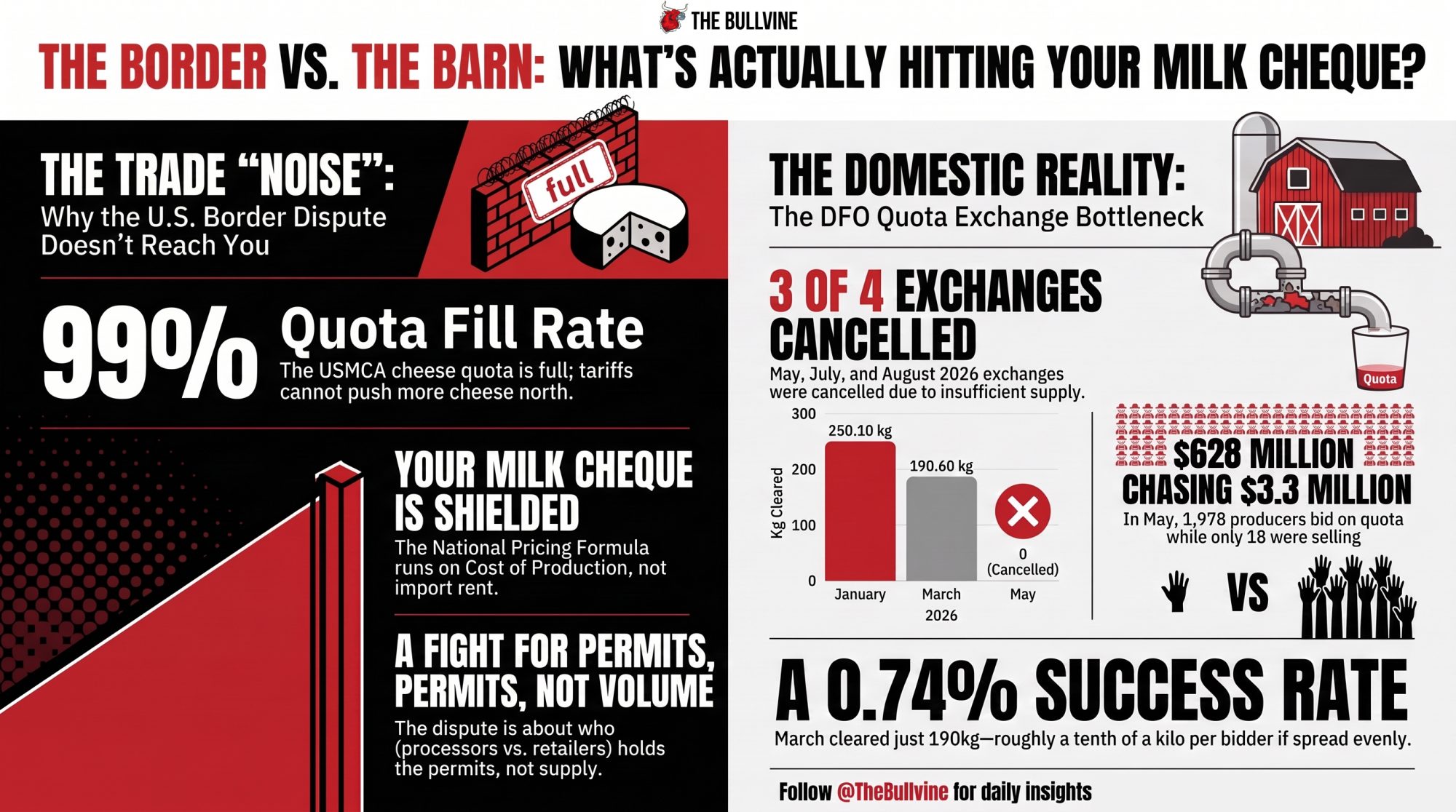
- Canada’s USMCA cheese quota filled 99% in 2024, so the 50% tariff can’t push more product north. The fight is over who holds the permits, and under the National Pricing Formula, that fight has no documented path to your milk cheque.
- Your real constraint is the DFO exchange. May, July, and August 2026 were all cancelled for insufficient quota offered — in May, 1,978 producers bid against 18 sellers, $628 million chasing $3.3 million at the $24,000 cap.
- March cleared 190.60 kg out of 25,628 kg bid, a 0.744% buyer success rate. If expansion quota sits in your 2027 plan, that’s a lender conversation now, not a spring problem.
- Watch Oct. 1, when Global Affairs Canada posts the Notice to Importers for the 2027 cheese year. If eligibility still reads processor, further processor, distributor, with retailers excluded, nothing moves, and the rule rolls forward another year.
What’s Actually Constraining Your 2027 Plan
Dal Ferro has made the same argument in a parliamentary committee appearance in March 2023, the ICCC’s CPTPP filing in May 2023, a trade-press interview in March 2025, and the Globe and Mail in July 2025. Four appearances, one position. Dairy Farmers of Canada has spent the same period arguing the opposite. The eligibility rule either changes in the Oct. 1 notice or it doesn’t — and the reference period that decides who gets what closes Sept. 30.
The insulation cuts both ways. Canada’s pricing formula keeps a trade fight from reaching your cheque, which is protection. It also means no upside flows to you if U.S. access tightens and domestic processors capture more of the market. Shielded from the loss, cut out of the gain.
Meanwhile, 1,978 producers bid on quota in May and got a cancellation notice. Same in July. Same in August.
So run the check that matters. Pull your last four DFO exchange summaries and add up the kilograms that actually cleared — not the kilograms bid. If your 2027 expansion plan assumes you can buy quota on that exchange, what does the cleared-volume history say about when, and how much?
Complete references and supporting documentation are available upon request by contacting the editorial team at editor@thebullvine.com.
Learn More
- The $586‑Per‑Kilo Dairy Quota Trap: Why New Ontario Quota at 6% Bleeds Cash Every Year — Exposes the negative-carry arithmetic draining cash flow on debt-financed kilograms at the $24,000 cap, arming you with DSCR formulas and debt-paydown thresholds to fix your balance sheet before expansion stalls.
- Dairy Farm Economics 2026: Milk Pricing, Margins & Risk Playbook — Maps the multi-year macro pressures hitting milk checks across North America, delivering concrete strategies to offset tightening margins by leveraging new P5/WMP protein payment formulas and beef-on-dairy premiums.
- Robot ROI Reality Check – Free Dairy Robot Calculator — Dismantles polished dealer pro formas by pitting a 1.4× real installation multiplier and $11,500 annual maintenance against parlor labor, proving whether automation pays or bleeds equity before you sign a contract.
 The Sunday Read Dairy Professionals Don’t Skip.
 The Sunday Read Dairy Professionals Don’t Skip.
Every week, thousands of producers, breeders, and industry insiders open Bullvine Weekly for genetics insights, market shifts, and profit strategies they won’t find anywhere else. One email. Five minutes. Smarter decisions all week.




