





A vendor’s AI balanced a ration in 30 seconds flat. The nutritionist said no. Six weeks later, SARA was quietly costing a 500-cow herd $38,340 a year — and nobody traced it back.
Executive Summary: An AI can balance a dairy ration in 30 seconds — and dairy’s leading nutritionists just drew a hard line: not for the biology, not yet. The split matters because “AI” is being sold as one thing when it’s really two — large language models that pattern-match on text and mechanistic models like NASEM 2021 and CNCPS that actually calculate rumen function. Get that distinction wrong, and an LLM can hand you a ration that lowballs peNDF and walks cows into subacute ruminal acidosis, which shows up as sliding butterfat and mystery lameness three to six months later, long after anyone would blame the ration. Run the barn math: push 20% of a 500-cow herd into SARA at a 5-lb daily milk loss, and at a US all-milk price of $21.30/cwt (USDA NASS, May 2026), that’s $106.50 a day — $38,340 a year gone before you count a single cull or open cow. The fix isn’t shutting AI out; it’s putting it in the analysis layer, where AI heat and health detection have posted real wins (~20% better heat detection, ~10% fewer days open in reported industry research), and keeping it off the formulation math until the vendor can name the biological engine underneath. Before you sign anything, three questions sort a real ration tool from a language model in a lab coat — which model runs the nutrition math, how it calculates peNDF, and what its error range is on metabolizable protein. If your butterfat’s already soft, that’s the number any AI tool will be measured against six weeks from now.
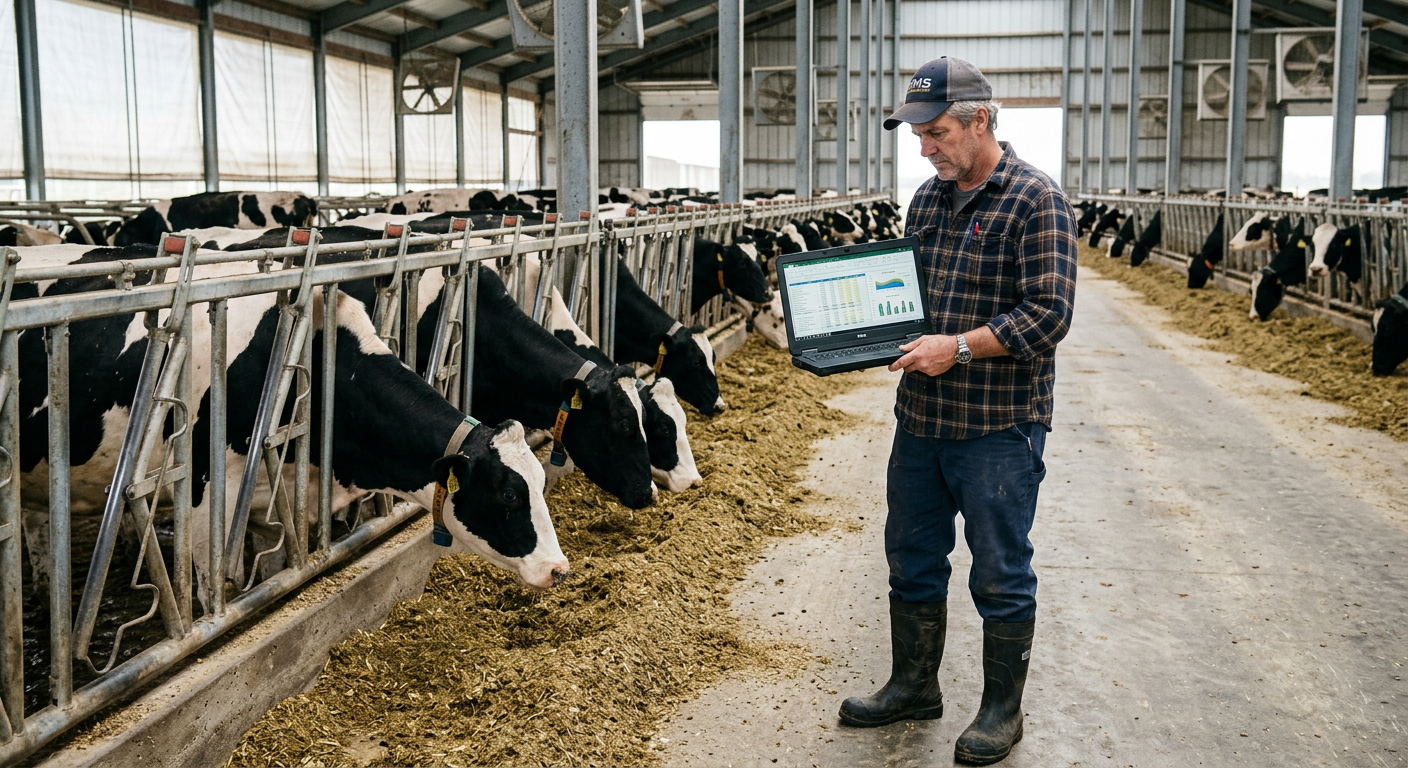
Picture the kitchen table. A vendor flips open a laptop, types in your herd size, your milk price, your forage tests — and 30 seconds later the screen hands back a finished ration. Ingredient weights. Nutrient projections. Income over feed cost, right down to the penny. It looks clean. It looks smart. And a seasoned nutritionist — the kind who’s balanced rations for decades — is exactly the person telling producers to slow down.
It’s not fear of the technology. It’s about protecting the biology. That’s the tension playing out on farms right now, because AI in dairy nutrition has split into two camps moving at very different speeds. The AgTech companies are selling ration tools hard. The people who actually understand rumen function are saying: not for the biology, not yet. And the gap between those two positions is exactly where your feed dollars — and your cows’ rumen health — are sitting this month.
What’s Actually Being Sold to You
Here’s the confusion the sales pitch runs on. “AI” gets slapped on two completely different things, and only one of them belongs anywhere near your feed bunk.
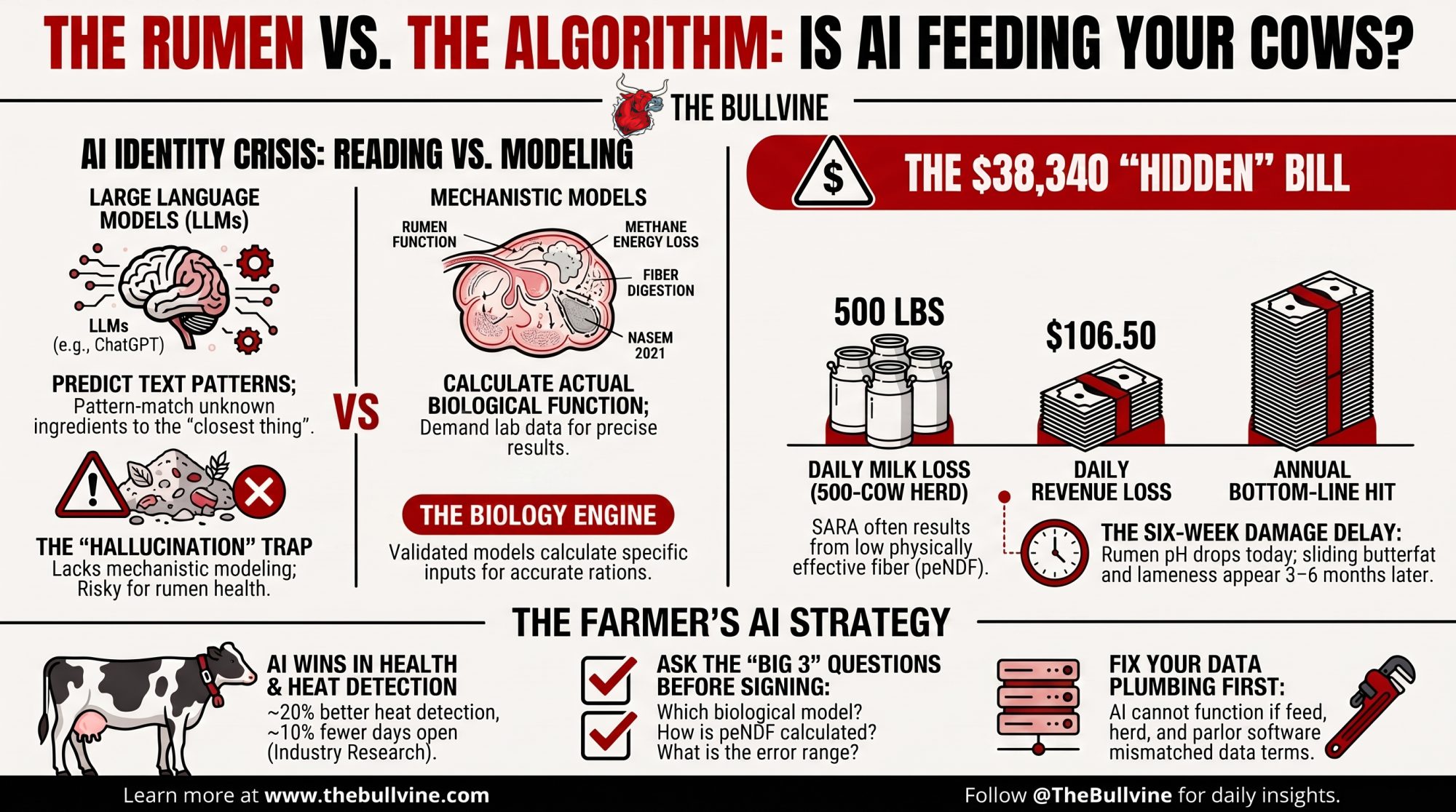
The first is a large language model — think ChatGPT. It’s a pattern engine trained on mountains of text, and its whole job is predicting the next word in a sentence. It’s genuinely good at summarizing research, explaining a concept, drafting a report. What it does not do is simulate a rumen.
The second is a mechanistic model — NASEM 2021, CNCPS, NDS Professional. These don’t look up an answer. They calculate one. NASEM 2021 works out methane energy loss from the actual fatty acid content and digestible fiber in that specific diet, and the whole energy cascade recalculates the moment you swap an ingredient (National Academies of Sciences, Engineering, and Medicine, Nutrient Requirements of Dairy Cattle, 8th ed., 2021). Change the canola for soy hulls, and the math moves.
The core difference: A language model has read about how fiber holds up rumen pH. A mechanistic model actually models it. Reading and modeling aren’t the same job — and your cows only care about the second one.
Dr. Alex Bach, writing in Animal Frontiers (Vol. 16, 2026), makes the point cleanly: machine learning can predict outcomes well, but the mechanistic models are far better at explaining why performance changed. When milk fat drops in your tank, “why” is the only thing that helps you.
How the Damage Hides for Six Weeks
This isn’t a theory problem. It’s a disorder called subacute ruminal acidosis (SARA), and it’s the cleanest example of how a wrong ration buries its damage where nobody thinks to look.
SARA sets in when rumen pH drops below roughly 5.6 for three to five hours a day (Plaizier et al. threshold, cited in Journal of Dairy Science, 2021). There’s no dead cow the next morning. No alarm. The pH dips, the fiber-digesting bugs slow down, and butterfat starts sliding. Ontario’s OMAFRA notes the real fallout — laminitis, weight loss on cows that should be gaining, mystery abscesses — shows up three to six months after the episode (OMAFRA, “Sub-acute Ruminal Acidosis in Dairy Cows,” 2020). By then the ration that caused it is ancient history.
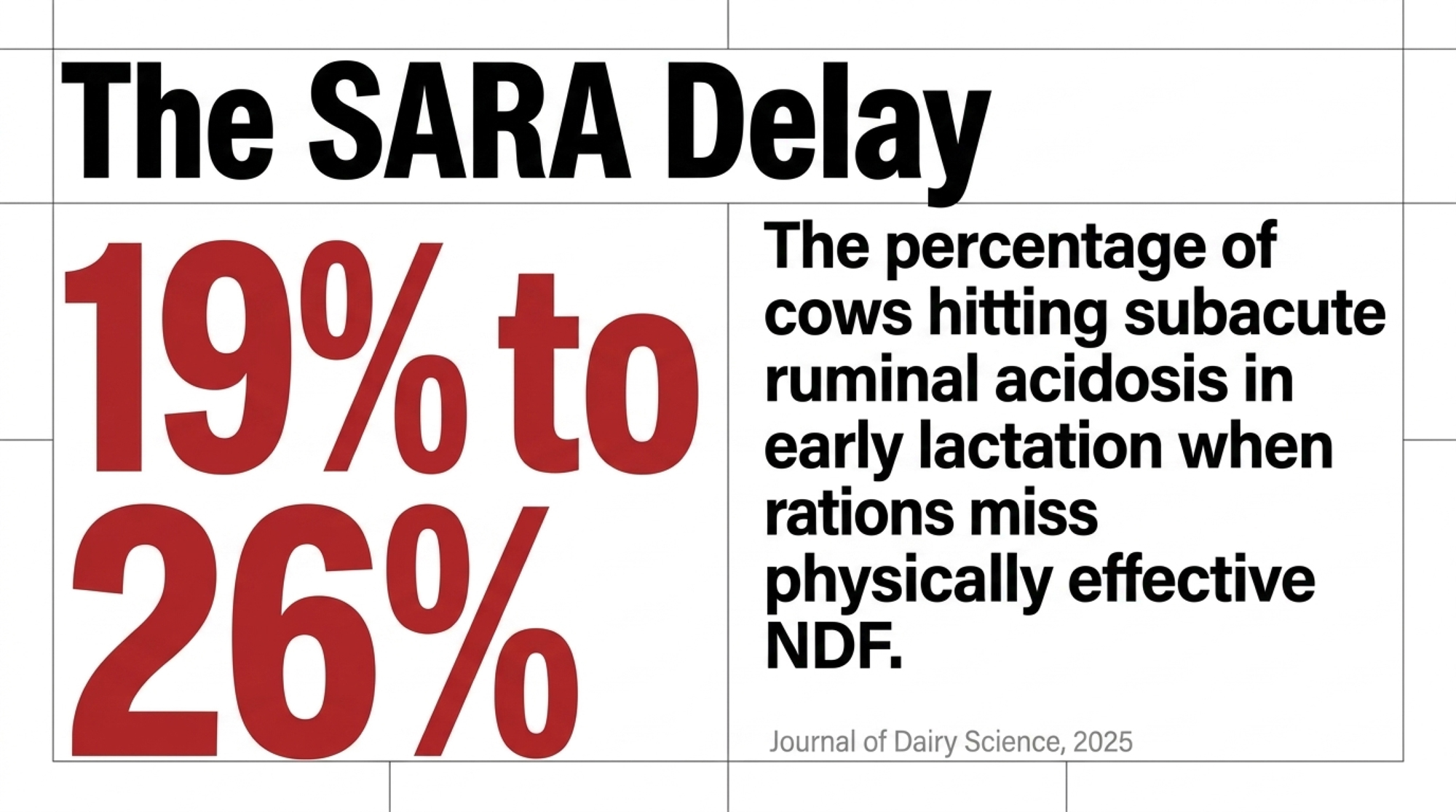
And this isn’t rare. Field studies put SARA at 19% to 26% of cows in early and peak lactation (University of Manitoba diagnosis study, citing multiple field trials), with some individual farms running as high as 40% (Journal of Dairy Science critical review, 2025). Affected cows give roughly 5 to 6 pounds less milk a day than their healthy penmates (Progressive Dairy, “From the lab to the barn,” 2022).
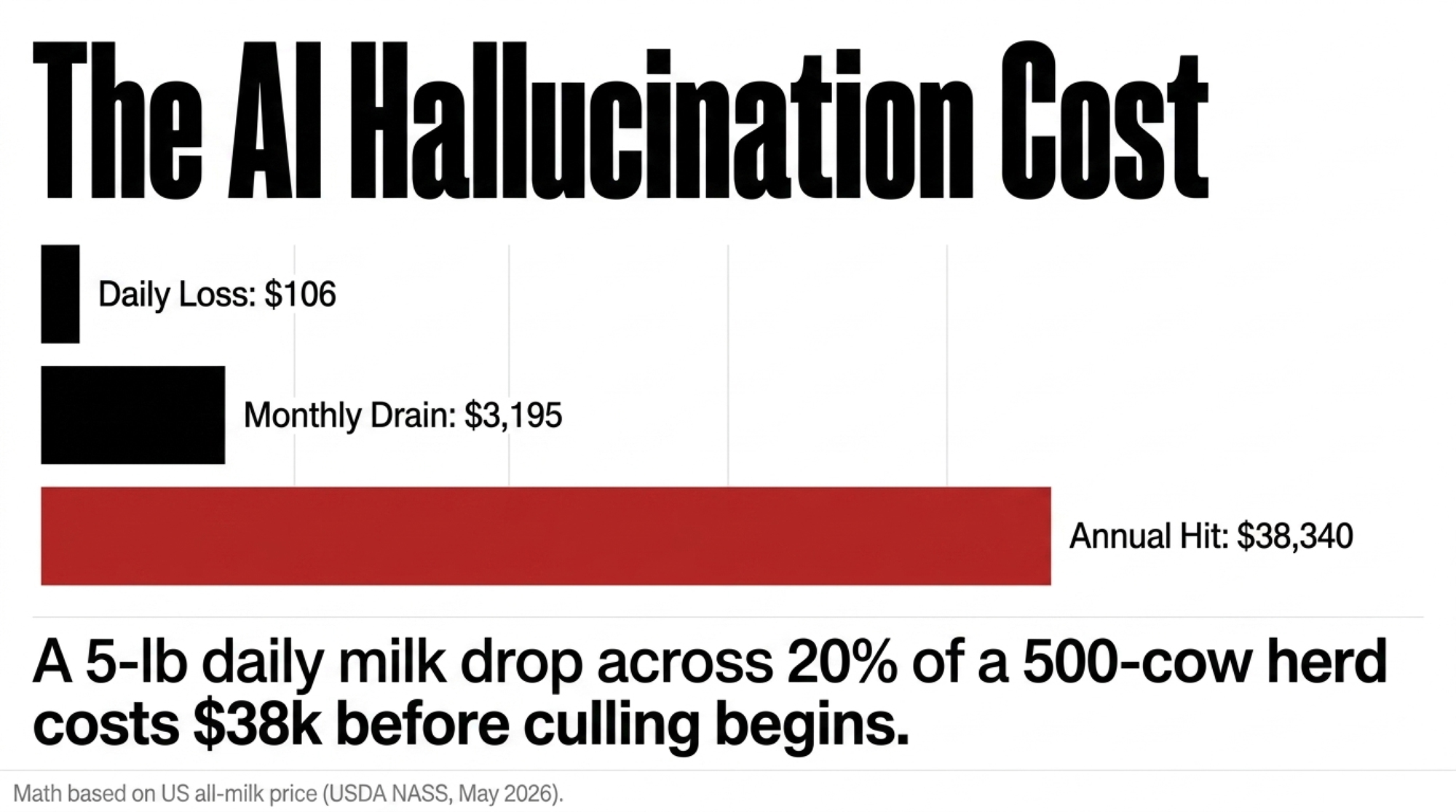
So run the math on your own barn. Say a tool lowballs physically effective fiber and quietly pushes 20% of a 500-cow herd into SARA. Here’s what that costs, step by step:
| Metric (500-cow herd example) | Impact / Cost |
| SARA prevalence (20% of herd) | 100 affected cows |
| Daily milk loss per cow | 5 lbs (0.05 cwt) |
| Total daily milk loss | 500 lbs (5 cwt) |
| Financial loss at $21.30/cwt (US all-milk, USDA NASS, May 2026) | $106.50 / day |
| Monthly drain | $3,195 / month |
| Annual bottom-line hit | $38,340 / year |
Annualized on 360 milking days, with SARA held at 20% prevalence. Milk value uses the US all-milk price — run your own pool or blend price here, since a Canadian, EU, or NZ check will land somewhere different.
And that’s before you count a single lame cow, open cow, or early cull. Scale the same 20% hit to a 2,000-cow operation and you’re into four figures a day. The bigger the herd, the less you can afford to guess on fiber.
The tool saved you a consulting fee on Wednesday. The bill shows up in week six, and it doesn’t come with a label that says “wrong ration tool.”
Why Can’t the AI Catch This Itself?
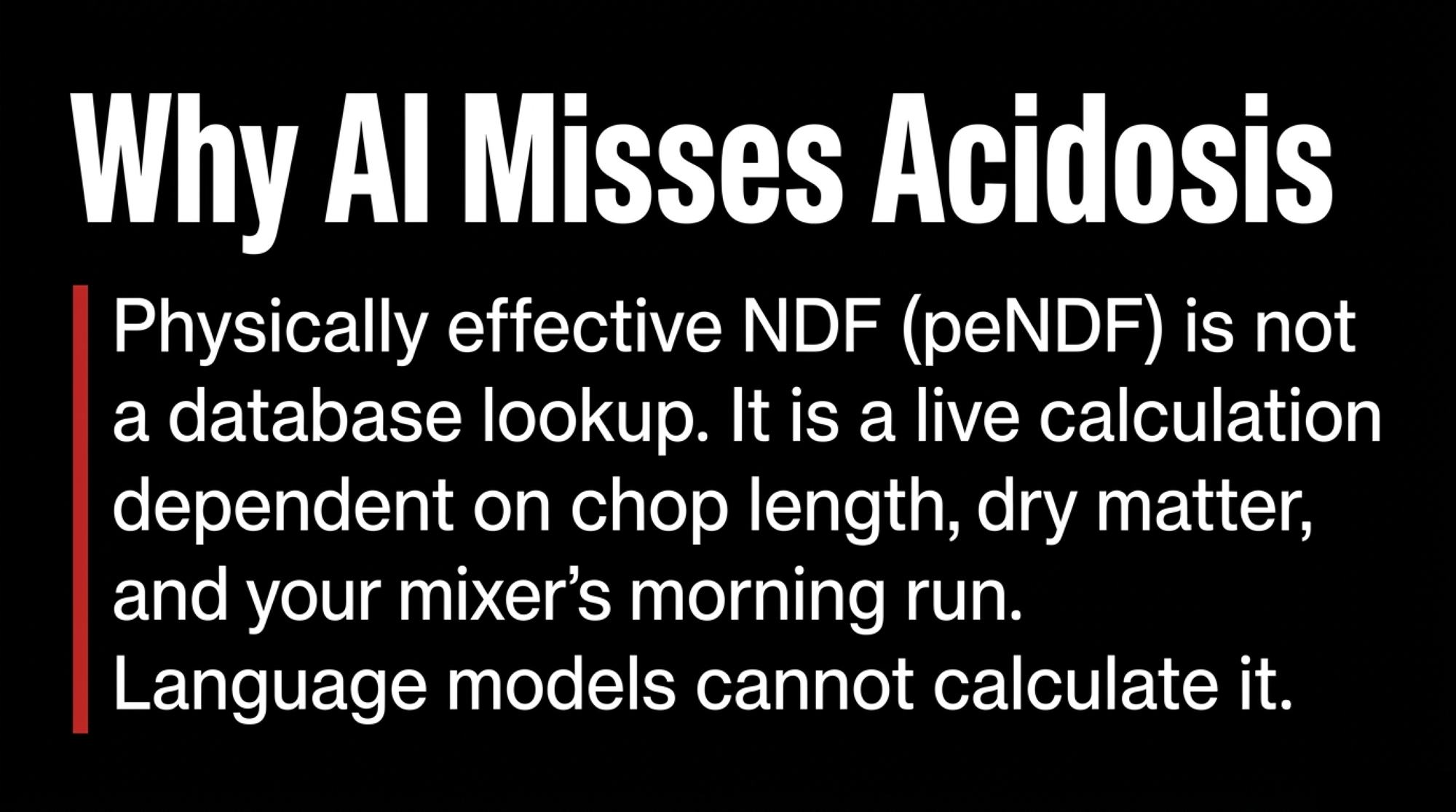
Because the number that predicts SARA — physically effective NDF, or peNDF — isn’t sitting in a database somewhere. It depends on your chop length, your forage dry matter, and how your mixer ran that morning. It’s a live calculation, not a lookup.
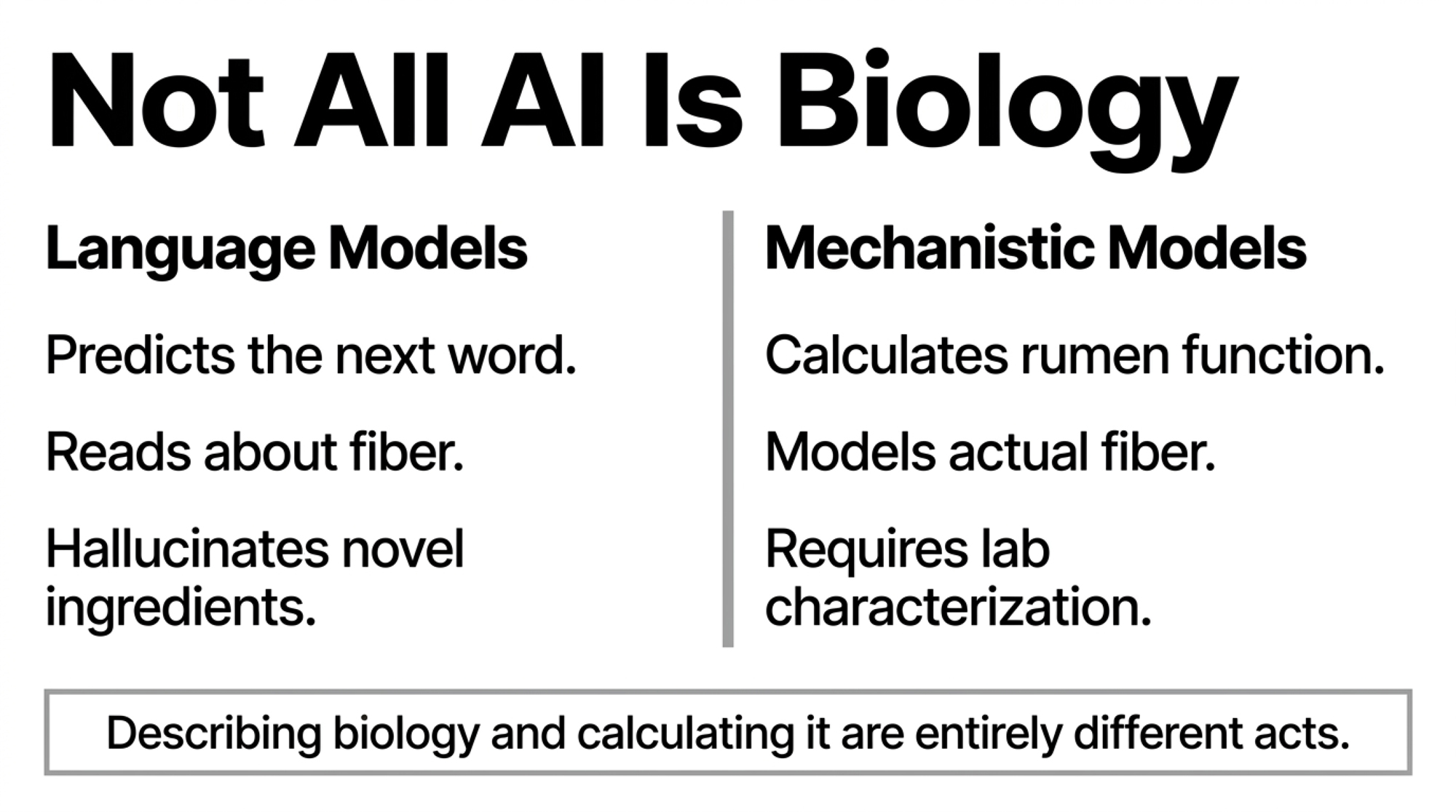
Mechanistic models handle that. They model the tug-of-war between fermentable starch and effective fiber to predict daily rumen pH (Journal of Dairy Science, “Models to predict the risk of subacute ruminal acidosis,” 2021). A language model can describe that tug-of-war beautifully and still spit out a ration that walks your cows straight into acidosis. Describing a thing and calculating it are entirely different acts.
Then there’s the novel-ingredient trap. Feed a mechanistic model a new byproduct — some off-spec bakery meal, a distiller’s product you got a deal on — and it demands lab characterization before it’ll use it. Feed the same ingredient to a language model and it quietly pattern-matches to the closest thing it saw in training. No warning. No flag. That’s the hallucination problem, except it’s in your feed bunk now. Not a wild, obvious error. A confident, reasonable-looking wrong answer — which is the more dangerous kind.
What Three Questions Should You Ask Before You Sign Anything?
There’s no certification standard here. No disclosure requirement. The FDA regulates AI mainly as software in medical and veterinary device contexts, and the USDA runs its own internal AI strategy, but neither one is vetting the ration platform a rep sets on your table (FDA AI regulatory guidance, 2026; USDA FY2025–2026 AI Strategy). Your own questions are the only guardrail you’ve got. Three of them do the sorting:
- “Which biological model runs the nutrition math — and can you show me the validation data?” A real answer names NASEM or CNCPS and points to published validation. The red flag sounds like “our AI learned from thousands of rations.” That’s pattern-matching describing itself. It isn’t biology.
- “How does the system calculate peNDF, and where’s that input coming from?” You want particle-size data feeding a real rumen-pH equation. If all they can tell you is total NDF percentage, the tool will miss acidosis risk in finely chopped or over-processed forage — exactly where it bites.
- “What’s your error range on metabolizable protein, and what happens when I feed an ingredient it’s never seen?” Every honest model has a known error range. A vendor who can’t give you one doesn’t know theirs — and neither will you until the tank tells you.
Plenty of vendors are upfront about which engine sits underneath. The ones that won’t tell you are the problem. Ask all three questions, then watch whether the rep answers with a named model and a number, or slides back to the demo. The pivot tells you everything.
Is Your Farm’s Data Even Ready for This?
Short answer: probably not. And the people building these tools say so out loud, which is the part the sales deck skips.
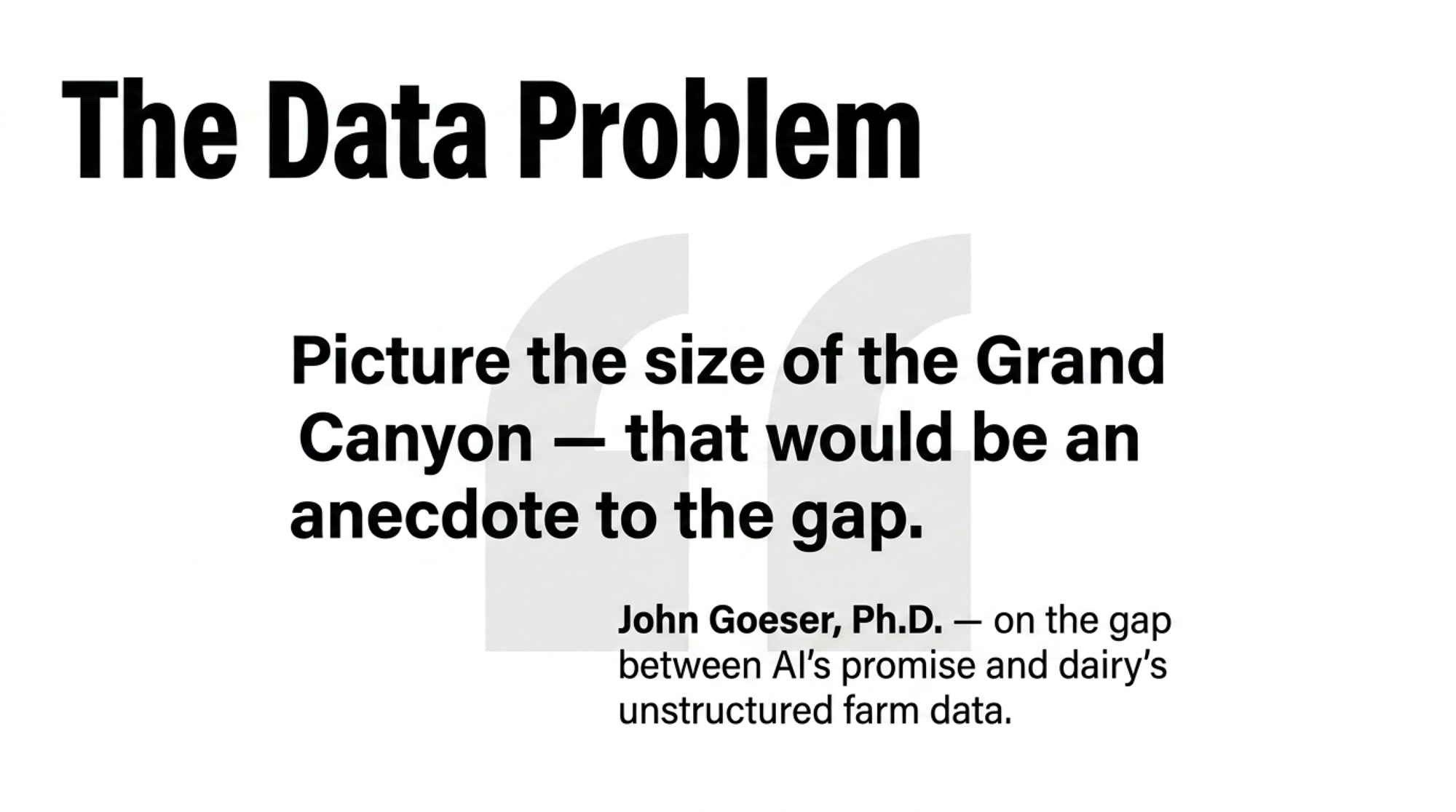
John Goeser, Ph.D. — director of nutritional research at Rock River Laboratory and an adjunct at the University of Wisconsin–Madison — put the gap between AI’s promise and dairy’s actual data this way:
“Picture the size of the Grand Canyon — that would be an anecdote to the gap.” — John Goeser, Rock River Laboratory (Progressive Dairy, Nov. 2024)
His example is almost boring, and that’s the point. One dairy logs a metabolic event as “ketosis.” The next logs the same thing as “BHBA.” Same disease, two labels — and no model can learn from that mess.
Goeser has argued the industry needs to aggregate and structure its data before AI can deliver on its potential (Progressive Dairy, Nov. 2024). The vendor pitch assumes your feed software, herd software, parlor data, and forage labs all talk to each other in clean, matched terms. On most farms, they don’t. Dr. Victor Cabrera’s Dairy Brain project at UW–Madison is building exactly that plumbing — pulling genetics, milking, feed, and DHI records into one real-time stream — but it’s still largely a university research effort, not something you can buy off a shelf. The infrastructure has to come first. It mostly hasn’t.
Options and Trade-Offs for Your Operation
None of this means you shut the barn door on AI. It means you put it in the layer where it earns its keep, and keep it out of the one where it doesn’t. Here’s what producers are actually doing.
Option 1: Keep the biology mechanistic, let AI handle detection.
- The Play: Run NASEM or CNCPS — through a real platform like AMTS (Agricultural Modeling & Training Systems) or NDS Professional — as your formulation engine, and let AI-driven sensors do the watching.
- The Payback: The validated stack. Works almost always, as long as a nutritionist who knows the model’s limits stays in the loop.
- The Risk: Very little. This is the safe default, not a gamble. If you want the deeper version of this, our rumen-health and SARA coverage walks through the warning signs before the milk check shows them.
Option 2: Put AI health and heat detection to work this month.
- The Play: Your 30-day move. Pilot AI heat and health detection on your fresh pen and measure it against your current program.
- The Payback: Farms running AI heat-detection systems have reported roughly a 20% jump in heat detection and about a 10% cut in days open — figures circulated in industry research rather than a single named peer-reviewed trial, so treat them as directional. Every open day you claw back is money that stops leaking from your repro program.
- The Risk: Payback runs longer on smaller herds, and activity monitors still miss a meaningful share of cows in heat — depending on system and management, missed-heat rates commonly land in the 20–30% range (Farm Progress, 2024) — so you need a timed-AI backup plan.
Option 3: Use precision feeding to fine-tune income over feed cost.
- The Play: Optimization after formulation. It dials in delivery rather than rewriting the biology.
- The Payback: Idaho producers have reported 15% to 25% feed-efficiency gains (The Bullvine feed analysis, Sept. 2025 — producer-reported, not trial data). Eliminating just a 0.5% protein overfeed has been reported to save $15 to $25 per cow/month — $3,000 to $5,000 a month on a 200-cow herd (The Bullvine, “Lifetime Efficiency,” July 2025).
- The Risk: It’s an optimizer, not a formulator. It sharpens a good ration; it won’t build one. The full precision-feeding margin breakdown is worth a read before you price a system.
Option 4: Watch LLM-only ration formulation, but keep your checkbook closed.
- The Play: The direction worth betting on long-term — a language model as a front end that routes your question to a mechanistic model and explains the answer back in plain English, not as the thing generating the diet. The first published prototype of exactly this appeared in the Journal of Dairy Science in September 2025 (“Agents are all you need: Pioneering the use of agentic artificial intelligence to embrace large language models into dairy science”).
- The Payback: Worth a look when the vendor can name the biological engine underneath the interface.
- The Risk: If there’s no engine under the interface, you’re paying for a confidence machine.
Key Takeaways
- Treat any tool that can’t name its biological model as analysis-only. If it won’t tell you whether NASEM or CNCPS runs the math, it doesn’t formulate rations — it describes them.
- Check for SARA before you blame the weather. If your Holsteins’ butterfat is sliding below 3.0% — a practical field trigger, not a hard clinical cutoff — run a rumen-health check first.
- Separate “formulate” from “optimize” before you buy. Those are two different products carrying two completely different levels of risk.
- Demand an error range on metabolizable protein. If a vendor can’t give you one, assume they don’t have it — and price that uncertainty into your decision.
- Make health and heat detection your first AI purchase, not ration balancing. It’s the fastest, lowest-risk win — with a timed-AI plan for the cows the monitors miss. Pilot it on one pen this month.
- Fix your data plumbing before you buy the AI. If your feed, herd, and forage-lab software still can’t share data in matched terms, that’s your real bottleneck.
So What Happens the Next Time a Rep Opens a Laptop at Your Table?
The better question isn’t whether AI belongs in your nutrition program. It clearly does — in the analysis layer, where it’s already paying for itself. It’s whether the specific tool in front of you knows the difference between reading about a rumen and modeling one. Ask the three questions. Watch for the pivot. And before you let anything touch your ration, ask yourself where your butterfat and your fresh-cow health actually sit right now — because that’s the number any tool will be measured against six weeks from now.
The pushback from experienced nutritionists isn’t a rejection of the future. It’s about guarding the biology while the tools catch up to it. We’re breaking down the full SARA cost model by herd size — and the sensor-ROI math by operation scale — in next week’s Bullvine Weekly. That’s where the real numbers live.
Run Your Numbers
Dairy Profit Projector — That $38,340 SARA hit is really an IOFC problem. Drop in your herd size, milk, and ration assumptions, and the Projector shows what a lost 5 lbs per cow does to your IOFC per cow per day, breakeven milk price, and 12-month margin — before you let any AI tool touch the ration.
Complete references and supporting documentation are available upon request by contacting the editorial team at editor@thebullvine.com.
Learn More
- Precision Feeding Strategies Every Dairy Farmer Needs to Know — Arms you with actionable benchmarking steps, forage sampling protocols, and feeding group methods to execute precision nutrition at the bunk. Master the execution math to eliminate costly overfeeding while securing homegrown forage quality.
- AI Slashes Feed Costs $31 Per Cow While Your Competitors Pull Further Ahead: The Data-Driven Revolution Reshaping Dairy’s Future — Exposes the infrastructure gap separating successful tech adopters from frustrated producers. Learn why system calibration requires a four-to-six-week buffer and how building a robust data governance framework protects your operational ownership.
- Dairy Technology 2026: Robotics, Sensors, AI and Real-World ROI — Delivers direct capital cost baselines, daily operating efficiencies, and real-time integration benchmarks across the leading hardware systems. Explores the transition from isolated tracking gadgets to fully connected automation networks.
 The Sunday Read Dairy Professionals Don’t Skip.
 The Sunday Read Dairy Professionals Don’t Skip.
Every week, thousands of producers, breeders, and industry insiders open Bullvine Weekly for genetics insights, market shifts, and profit strategies they won’t find anywhere else. One email. Five minutes. Smarter decisions all week.




