








Farms with 15-20% non-federal income sailed through the 35-day 2019 shutdown while neighbors sold out
EXECUTIVE SUMMARY: What farmers are discovering through hard experience is that government shutdowns create a predictable 4-week cascade of financial pressure that separates prepared operations from vulnerable ones. Extension specialists have documented how farms with just 15-20% of revenue from non-federal sources maintain stability while others face asset liquidation by week three—when feed dealers tighten terms, banks question operating notes, and processors delay payments. The 2018-2019 shutdown, lasting 35 days, demonstrated that forced sales recover only 50-67% of asset value, while planned transitions preserve 80-90%, a difference that represents decades of equity. Here’s what this means for your operation: building resilience isn’t about size or efficiency anymore… it’s about creating multiple pathways to cash flow before you need them. The good news is that farms implementing basic diversification strategies—whether through beef-on-dairy programs, custom work, or value-added processing—are finding they can weather these disruptions while maintaining control of their future.

A Wisconsin dairyman told me something last month that captures what’s happening across the industry: “The first time we went through a government shutdown, we thought it was just about waiting it out. By the third one, we realized waiting wasn’t a strategy—preparation was.”
That shift in thinking—from reactive to proactive—is becoming essential as political disruptions move from rare exceptions to recurring business risks. And whether we like it or not, we need to plan for them.
What’s interesting here is how differently these events hit different operations. Many of us have seen some farms barely skip a beat while their neighbors down the road are making decisions that’ll affect them for years. After speaking with dozens of producers who’ve navigated these situations, as well as reviewing what extension specialists have documented about past disruptions, the difference usually comes down to understanding how these things unfold and having some systems in place before you need them.
How the Money Problems Actually Cascade
So let me paint you a picture that’s becoming way too familiar. Take your typical 500-cow operation in the Midwest—and there are thousands of these across Wisconsin, Michigan, Iowa, you name it. These farms run on pretty tight cash flow cycles, right? Money comes in from milk sales, money goes out for feed and expenses, and if you’re lucky, there’s a little cushion left over.
But here’s what happens when the government shuts down. It’s not just one thing that goes wrong—everything starts tightening up at once. Farm financial advisors often observe this pattern repeating itself, creating compound pressure that individual farms can’t control.
Extension specialists have noted similar patterns from producers who’ve been through this, and it tends to go something like this: That first week, everyone’s thinking it’ll blow over quickly. Business as usual. Milk is shipped, feed is delivered, and cows are milked. But by the second week? That’s when things start getting interesting—and not in a good way.
Your feed dealer, who’s been giving you terms forever, suddenly mentions he needs to tighten things up. The banker starts asking more questions about your operating note. The milk processor mentions they might need to delay payments a bit due to “administrative complications.”
Many producers describe it this way: “In normal times, if one thing goes wrong, you adjust. During a shutdown, everything tightens at once. Your flexibility just… disappears.”
And that’s really what catches people off guard. By week three, you’re having conversations you never wanted to have. By week four? Some folks are making decisions that can’t be undone. This pattern closely matches what researchers documented during the 2013 and 2018-2019 disruptions—the 2018-2019 shutdown lasted 35 days and particularly affected dairy operations due to frozen Dairy Margin Coverage payments and halted export certifications.
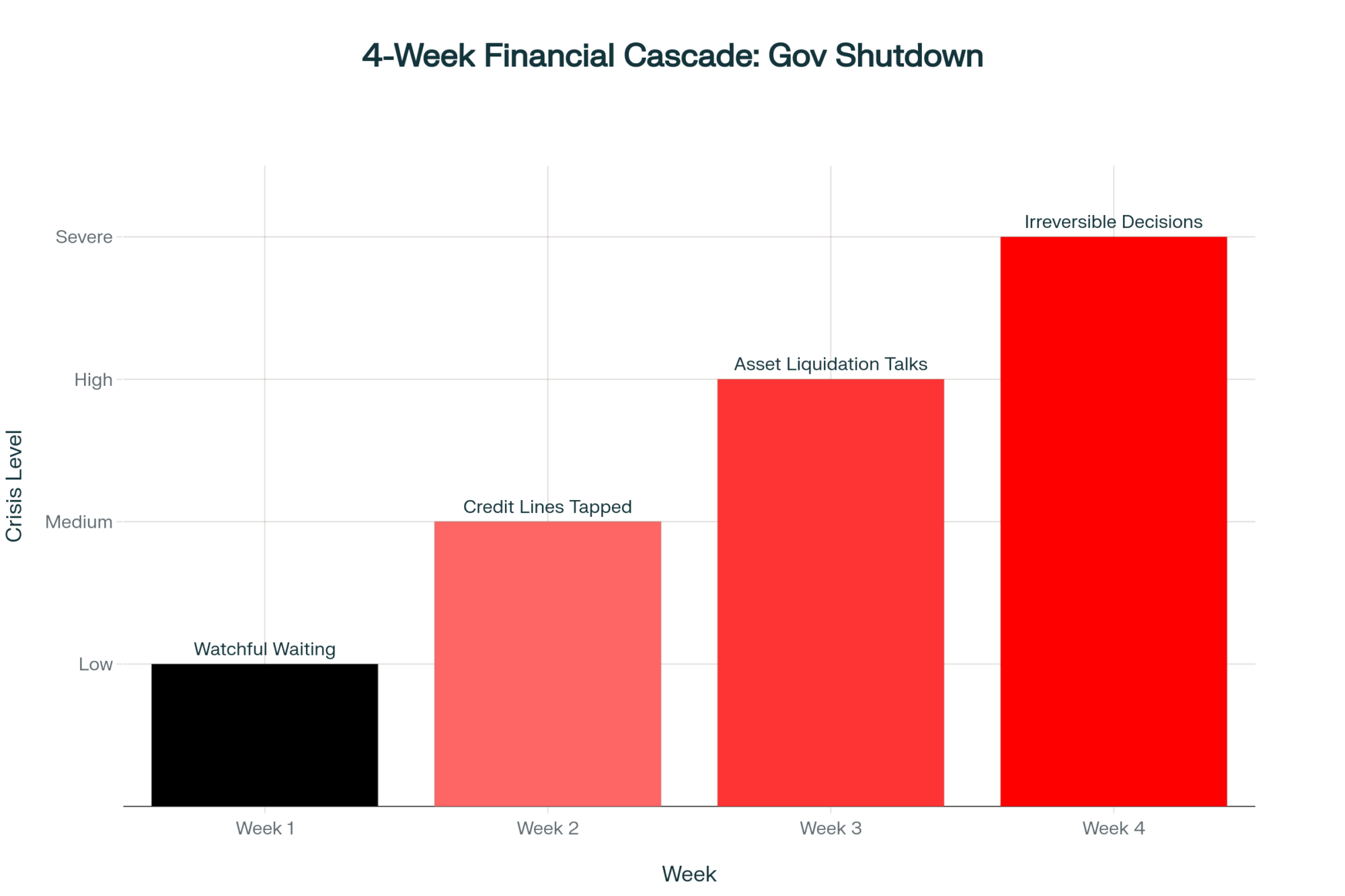
THE 4-WEEK SHUTDOWN TIMELINE
Week 1: Watchful waiting, minimal changes, optimism prevails
Week 2: Credit lines tapped, supplier terms tighten, concern grows
Week 3: Asset liquidation discussions, hard conversations begin
Week 4: Irreversible decisions—sell, partner, or restructure
When Genetics Become Your Emergency Fund
Here’s something that really bothers me about these crisis situations, and it’s worth thinking through carefully. When cash gets tight, selling animals becomes the obvious move, right? But which animals? And what’s that really costing you down the road?
I’ve heard similar stories from multiple producers who’ve faced this exact situation. They needed substantial cash quickly. Selling cull cows wasn’t going to cut it. But those top heifers? They’d bring real money. Problem was, those heifers represented years of careful breeding decisions.
Extension dairy specialists consistently emphasize that every generation of genetics you build represents accumulated progress. Better production, improved health traits, higher components… all that work your family might’ve been doing for decades. When you’re forced to sell those top-tier animals for quick cash, you’re not just losing individual cows. You’re potentially setting your herd back years.
And here’s what makes it worse—the market dynamics during these disruptions are typically brutal. Buyers know you need cash, so prices often drop right when you need maximum value. Then, when things stabilize and you want to rebuild? Those same genetics cost way more than you sold them for, if you can even find comparable quality.
As one producer explained it: “Selling those heifers felt like cashing in your retirement account at age 40. Sure, you solve today’s problem, but what about tomorrow?”
Why Your Zip Code Matters More Than Ever
Out West: Big Scale, Big Challenges
Those huge operations in California and Idaho—they’ve got some advantages during disruptions, but don’t think they’ve got it easy. Indeed, larger herd sizes typically mean better banking relationships and access to more financial tools. However, they also have massive daily cash requirements.
What’s particularly interesting about Western operations is how many are integrated with processing. Direct relationships with cheese plants or powder facilities can provide some payment stability. But when export markets get disrupted? Those advantages can disappear pretty quickly.
Producers with several thousand cows often mention that size gives them options, sure. But the daily burn rate is enormous. They might survive longer than smaller farms, but if they fall? They fall hard.
The Midwest’s Tough Middle
The heart of American dairying—Wisconsin, Minnesota, Michigan—these folks face their own unique challenges. Those 400 to 800 cow operations? They’re often multi-generational family businesses with deep roots but limited financial flexibility.
What many of us have noticed is that these farms have all the knowledge and capability to weather disruptions. What they sometimes lack is the capital reserves of bigger operations or the nimbleness of smaller ones. Producers in this situation often refer to it as the “efficiency trap”—they’re perfectly optimized for normal times but vulnerable when normal times are no longer the norm.
However, what’s encouraging is that this region has an incredible cooperative spirit. Equipment sharing, feed buying groups, and neighbors helping neighbors… that social capital becomes real financial value during tough times.
Northeast Innovation
Now, Northeast operations have developed some really interesting approaches. Perhaps it’s because they’ve always faced challenges related to distance from markets and inadequate infrastructure, but many of these farms maintain surprisingly diverse revenue streams.
Direct marketing, agritourism, value-added processing—it’s way more common up there. Yes, it makes things more complex to manage, but it also provides cash flow when commodity markets or federal programs encounter issues.
Extension programs in states like Vermont and Pennsylvania have documented how this diversification helps during disruptions. Programs like Penn State Extension and UVM Extension have case studies showing farms with diversified income weathering shutdowns better. One Pennsylvania producer, who runs 300 cows and operates a farmstead cheese business, told me that cheese-making started as a hobby. Now? “It’s our shutdown insurance policy,” she says.
The Competition That Never Stops
While we’re dealing with domestic political drama, the rest of the dairy world continues to move forward. And that has consequences we really need to think about.
During recent disruptions, processors have mentioned losing long-standing export relationships. Why’s this such a big deal? When international buyers are unable to obtain a reliable supply from us, they often seek alternatives. New Zealand steps in. The EU fills the gap. Even countries like Argentina are becoming players.
What really concerns many industry observers is how quickly these relationships solidify. Reacquiring an export customer after a disruption? It typically takes much longer than building the original relationship. Trust is hard to rebuild in international business.
And look, this isn’t about foreign competitors being predatory or anything. They’re just doing business. International buyers have their own obligations. When American political issues threaten their supply chains, they make rational decisions to diversify their supply chains. Can’t really blame them.
What Actually Works: Lessons from Survivors
So while external pressures mount—from tightening cash flow to lost export markets—the operations that survive these disruptions aren’t just lucky. They’ve built specific strategies that work regardless of what’s happening in Washington or world markets.
Examining farms that have successfully navigated multiple disruptions, extension specialists and farm management consultants have identified several patterns. And interestingly, size isn’t the determining factor. Small operations can sail through storms that sink farms five times their size.
First, income diversification really matters. Now, I’m not saying every farm needs to open a corn maze and petting zoo. But having even 15 or 20% of revenue from sources that don’t depend on federal programs? That provides crucial breathing room. It could be custom heifer raising, beef-on-dairy programs, or contract cropping… many options fit different operations.
Second, relationship banking consistently outperforms transactional banking. Producers who’ve worked with the same lender for years, who’ve been transparent about their operations, who built trust before they needed credit—these folks have options during crises that others just don’t have. Agricultural lenders tell me they’re more likely to work with farms they know well during disruptions.
Third—and this surprised me when I first learned about it—state and local connections often matter more than federal ones. While everyone focuses on Washington, state agriculture departments and local development authorities often have resources that continue to operate regardless of the circumstances. Many states have documented these programs continuing to operate during federal shutdowns, including Wisconsin’s Buy Local Buy Wisconsin program and Minnesota’s livestock investment grants.
Having the Hard Conversation
Okay, this is tough to talk about, but sometimes the smartest business decision isn’t about surviving at any cost. Sometimes it’s about maintaining control while you still have options.
Farm transition specialists have observed three basic approaches, each with distinct outcomes.
Some folks plan succession gradually, bringing in the next generation or capable employees over time. This preserves all that accumulated knowledge and keeps the farm in the community while providing security for retiring owners.
Others explore partnerships—perhaps management agreements where experienced operators continue to run farms under new ownership structures. Several documented cases demonstrate that this approach is effective for all parties involved.
And then there’s recognizing that a dairy farm is really a collection of multiple valuable assets. Sometimes separating those assets—land, facilities, equipment, expertise—creates more value than keeping them bundled.
What troubles many of us is when producers wait until a crisis removes all their options. Industry data suggest that forced liquidation might recover half to two-thirds of the potential value. Planned transitions? Often 80 to 90%.That difference represents decades of hard work.
However, there’s another side to this—not everyone needs to consider transition. Many operations have successfully maintained their independence despite multiple disruptions. These farms typically share some characteristics: minimal debt, diverse income streams, and adequate reserves. They might not be the biggest or most “efficient” by conventional standards, but they’re still milking profitably years later.
Learning from Patterns
We’ve experienced several significant federal disruptions over the past decade, and each one has taught us something. The Congressional Research Service has documented how short disruptions—a couple of weeks or less—create headaches but rarely cause permanent change. Extended disruptions lasting a month or more? Those can fundamentally alter farm operations and whole communities.
What concerns many industry observers is that recovery periods appear to be lengthening. Yes, operations may resume normal activities fairly quickly after services restart. However, the full effects—lost export markets, disrupted breeding programs, and damaged relationships—can persist for years, according to research on farm management.
This suggests that we need to reconsider our approach to planning. Rather than treating disruptions as rare emergencies, maybe we should consider them recurring business challenges that need systematic preparation.
Building Your Own Resilience Plan
Based on what extension specialists and successful producers have shared about navigating multiple disruptions, here’s a framework that seems to work:
Getting Your Financial House in Order
Start by really understanding your daily cash needs—not just the obvious stuff, but everything. Those small expenses add up quickly when cash is tight. And keep detailed records, not just for tax purposes, but also so you can make quick decisions when needed.
Build banking relationships before you need them. Regular communication with lenders, transparent reporting, and establishing credit during good times, rather than waiting for a crisis—agricultural lenders consistently emphasize the importance of this approach.
Creating Operational Flexibility
Examine your operation and determine what’s truly fixed versus what can be adjusted if needed. Could you temporarily change milking frequency? Adjust rations? Defer purchases? Having these contingency plans thought through makes implementation way less stressful.
Consider structural changes that offer flexibility. Maybe separate land ownership from operating assets. Create distinct entities for different business lines. Set up equipment partnerships. Farm business advisors often recommend these strategies for building resilience during uncertain times.
Positioning for the Future
Develop income streams that work independently of federal programs. Even modest diversification—10 to 15% of revenue—can provide crucial breathing room when you need it most. Extension programs in multiple states have documented this pattern, showing farms with diversified income sources maintain better cash flow during disruptions.
And build networks before you need them. Strong relationships with neighbors, suppliers, processors, and advisors—these become invaluable during disruptions. Not just for practical support, but for information flow when normal channels fail.
The New Reality We’re Facing
The dairy industry has always dealt with cycles—milk prices, feed costs, and weather. What’s different now is adding political uncertainty as a significant operational risk. And this isn’t about taking sides on politics—it’s simply recognizing business reality.
The most successful operations many of us observe aren’t necessarily the biggest or most efficient by traditional measures. They’re the ones that have accepted uncertainty as a baseline and built accordingly. They maintain reserves even when expansion looks attractive. They keep flexibility even when specialization might be more profitable. They invest in relationships even when transactions might be more efficient.
As one thoughtful Minnesota producer put it, “We used to farm like optimists and market like pessimists. Now we do both like realists.”
Where We Go from Here
Government shutdowns are just one of the many challenges facing dairy operations today. However, they offer important lessons about resilience, preparation, and adaptability that apply to a wide range of situations.
The farms that’ll thrive in the coming decades won’t necessarily be those with the highest production or lowest costs. They’ll be the ones that can maintain stability through instability. That can adapt quickly. Those who have built systems and relationships that function regardless of external circumstances.
For producers currently operating, the message seems pretty clear: Hope for stability but prepare for disruption. Build multiple pathways to success. Most importantly, maintain control of your destiny by making strategic decisions when you have options, not reactive decisions under pressure.
The dairy industry has survived and evolved through numerous challenges. This current era of political uncertainty? It’s just another test of our adaptability. And those who recognize the pattern, prepare accordingly, and support each other through disruptions—they’ll emerge stronger.
That’s not just optimism talking. That’s what history keeps teaching us, again and again. We’re a resilient bunch, us dairy folks. Always have been. And with the right preparation and mindset, we always will be.
For specific state program information, contact your local extension dairy specialist or the state department of agriculture—such as Penn State Extension, the University of Wisconsin-Madison Division of Extension, or Cornell Cooperative Extension. They can provide details on resources that operate independently of federal systems.
KEY TAKEAWAYS
- Build 15-20% non-federal income streams through custom heifer raising ($800-1,200/head profit), beef-on-dairy programs (adding $150-300/calf value), or direct marketing that keeps cash flowing when DMC payments freeze
- Understand the 4-week timeline: Week 1 brings watchful waiting, Week 2 taps credit lines, Week 3 forces asset discussions, Week 4 demands irreversible decisions—knowing this pattern helps you prepare contingencies before pressure mounts
- Protect genetic investments by identifying the bottom 20% producers for emergency sales rather than top heifers—selling quality genetics during a crisis means losing 30-40% of value plus years of breeding progress you can’t easily recover
- Strengthen state and local connections since programs like Wisconsin’s Buy Local initiatives and Pennsylvania extension services keep operating during federal shutdowns, providing resources when you need them most
- Plan transitions strategically because industry data shows forced liquidation recovers half to two-thirds of value, while planned transitions preserve 80-90%—that 25-30% difference on a million-dollar operation means $250,000-300,000 in preserved equity
Complete references and supporting documentation are available upon request by contacting the editorial team at editor@thebullvine.com.
Learn More:
- Navigating the Double-Edged Sword of Borrowing: Debt Management for Dairy Farmers – Reveals strategic approaches to refinancing, debt consolidation, and working capital management that help farms maintain financial stability during economic fluctuations and market volatility.
- How Beef-On-Dairy Is Shaping the Future of Beef Production – Demonstrates how beef-on-dairy programs generate $100-300 premiums per calf while creating annual benefits of $300,000 for a 1,500-cow operation through strategic crossbreeding decisions.
- Protecting Your Dairy’s Bottom Line: Essential Risk Management Approaches for 2025 – Provides comprehensive strategies for layering financial protections through DMC and DRP programs while leveraging automation to cut labor costs by 60% and improve operational resilience.
 The Sunday Read Dairy Professionals Don’t Skip.
 The Sunday Read Dairy Professionals Don’t Skip.
Every week, thousands of producers, breeders, and industry insiders open Bullvine Weekly for genetics insights, market shifts, and profit strategies they won’t find anywhere else. One email. Five minutes. Smarter decisions all week.




