Archive for Dairy Markets – Page 39

Milk Futures Lower to Start the Week in Chicago

On the Chicago Mercantile Exchange milk futures were mostly lower to start the week while cash trade was mixed. Class III milk futures traded mostly lower.  November milk declined 13 cents to $23.77/cwt.  December suffered a 45 cent loss to $20.00/cwt.  January milk fell 23 to $17.84.  February through December 2021 milk is trading a range of $16.30-$16.72/cwt.  Class IV continues its low liquidity as butter continues moving lower with poor restaurant demand.

Cash Dairy Product Trade saw Dry whey up $0.01 at $0.41.  One sale was made at that price.  Blocks down $0.0025 at $2.78.  One sale was made at that price.  Barrels unchanged at $2.53.  Butter up $0.02 at $1.41.  Ten trades were made ranging from $1.38 to $1.41.  Nonfat dry milk down $0.0125 at $1.0950.  Five trades were made ranging from $1.09 to $1.0975.

Wheat climbed higher today after starting out the session lower.  December Chicago Wheat gained 9 cents to $6.0750/bushel.  December corn finished strong against session highs at $3.9750/bushel.  The market will be watching closely to see if we can trade through and close above $4.00/bushel tomorrow.  November soybeans decreased 5.75 cents to $10.5075/bushel.  December soybean meal pulled back $3.50 to $375.10/ton.

Milk Futures Drive Higher in Chicago Thursday

On the Chicago Mercantile Exchange, milk futures were mostly higher Thursday while cash markets were higher with a large movement for butter and nonfat dry milk. CME milk prices were led by November which jumped to $23.30 and December rose 20 cents to $20.35/cwt.  2021 Class III prices ranged from 8 cents lower to thirteen higher.  Class IV markets failed to trade on Thursday but ended with many month’s bids/offers higher than Wednesday’s settlements.

October Class III milk down six cents at $21.59.  November 35 cents higher at $23.28.  December up 23 cents at $20.38.  January 11 cents higher at $18.02.  February through April contracts one to 13 cents higher.

The CME spot dairy product session was highlighted by  Butter up $0.0475 at $1.43.  Eighteen trades were made ranging from $1.40 to $1.4375.  Nonfat dry milk up to $0.0175 at $1.0975.  Eighteen trades were made ranging from $1.09 to $1.0975. Dry whey up $0.0050 at $0.40.  Blocks unchanged at $2.7725.  Barrels unchanged at $2.47. 

Grain prices overnight were whacked as better weather has shown up in South America for planting.  Fund profit-taking had prices on the run but solid export sales limited the damage in corn, soybeans, and wheat.  In the end, corn lost 3 cents and ducked its head back beneath $4/bu while soybeans lost 5.5 cents/bu.  November soybeans settled at $10.52/bu.  The wheat complex lost 1-5 cents as well.


Milk Futures and Cash Dairy Mixed in Chicago Wednesday

At the Chicago Mercantile Exchange  Milk futures and cash dairy prices were mixed Wednesday.  November milk was the biggest mover in class III milk futures, adding 51 cents to $22.88/cwt as we are midway though the second week of November pricing.  December lost 4 cents to $20.19/cwt.  First half 2021 also saw weakness, dropping 20-24 cents across the curve.  Class IV also traded 9-16 cents lower in the remainder of 2020 and out into 2021.  

Butter continues its break lower in the CME Cash Dairy Trade.  Barrels were up $.0175 at $2.47 per pound.  Three sales were recorded from $2.4575 to $2.47. Grade AA Butter was down $.0025 at $1.3825 per pound.  Three sales were recorded from $1.3825 to $1.40. Dry whey was unchanged at $.3950 cents per pound.  No sales were recorded. Forty-pound blocks were unchanged at $2.7725 per pound. No sales were recorded. Nonfat dry milk was up $.0025 at $1.08 per pound.  Three sales were recorded from $1.0750 to $1.08.

The grain complex sold off hard with soybeans leading the charge.  November soybeans fell 25 cents to $10.5725/bushel.  December corn tumbled 14.50 cents to $4.0150/bushel. December soybean meal retreated $7.30 to $376.70/ton.  December Chicago Wheat settled 7 cents lower to $6.0875/bushel.  

Markets Corrections Drive Futures Lower in Chicago Tuesday

 On the Chicago Mercantile Exchange milk futures reversed lower Tuesday as traders corrected overbought positions and cash markets were mixed. October Class III milk down a penny at $21.62.  November 39 cents lower at $22.37.  December down 76 cents at $20.23.  January 44 cents lower at $18.15.  February through April contracts 11 to 16 cents lower.

On the spot market dry whey up $0.0050 at $0.3950.  Blocks unchanged at $2.7725.  Barrels down $0.0025 at $2.4525.  Butter up $0.0325 at $1.4075.  Six trades were made ranging from $1.4075 to $1.4375.  Nonfat dry milk down $0.0150 at $1.0775.  Six trades were made ranging from $1.0725 to $1.0825.

October Dairy Situation & Outlook

Dairy Situation and Outlook, October 20, 2020

By Bob Cropp, Professor Emeritus

University of Wisconsin Division of Extension

University of Wisconsin-Madison

Somewhat surprising we will see considerable strength in October milk prices. Class III was $24.54 back in July but had fallen to $16.43 by September. It looks like Class III for October will increase to about $21.40 reaching or surpassing the previous record for the month of October set in 2014 at $21.35. Cheese prices have increased as well as dry whey prices pushing Class III prices higher. On the CME 40-pound cheddar blocks have been above $2 per pound since early September and as of today it is $2.74. Cheddar barrels also hit $2 per pound on October 6th and is now $2.30. Dry whey had been holding around $0.33 per pound but is now $0.3875 adding more than $0.30 to the Class III price.

Factors contributing to higher cheese prices include cheese production, retail sales, government purchases and exports. The latest dairy product production report was for August showing American cheese production 1.3% lower than a year ago with total cheese production 2.1% lower. As consumers continue to eat more meals at home retail cheese sales have been relatively strong. The government is purchasing cheese under the third round of the Farm to Families Food Box program which ends on October 31st. With cheese prices above world prices it was surprising that August cheese exports were 17% higher than a year ago. Dry whey exports were 54% high than a year ago with almost all the increase contributed to China as they attempt to build back their swine herd.

Butter prices have been rather weak all year. A year ago at this time butter was over $2 per pound. Butter has been below $2 per pound all year being as low as $1.15 in April and only as high as $1.90 in June. It is now $1.4975. But nonfat dry milk prices have improved with very strong exports. August exports were 35% higher than a year ago. Nonfat dry milk was $1.03 per pound early September and is now $1.1275. This will push the Class IV price from $12.75 in September to about $13.55 in October but still leaving more than a $7 spread between Class III and Class IV prices.

Class III dairy futures remain strong for the remainder of the year with November at $21.44 and December at $19.38. Whether Class III will hold at this level is not certain, but it looks like Class III for the year will average over $18 compared to the 2019 average of $16.96. As we look into next year there remains a lot of uncertainty about milk prices. The level of milk production, domestic sales and exports are crucial. But so important will be how soon the COVID-19 virus slows down. Until it does restaurants will not be fully open, schools and colleges will be virtual learning rather than in person instruction. Major sports will not have audiences in the stands and major events and conferences will not be held or if they are, they maybe virtual. The COVID-19 virus is hurting not only the U.S. economy but the world economy which impacts domestic sales and exports.

Milk production continues to run at a relatively high level putting downward pressure on milk prices. USDA’s report on September milk production showed milk production 2.3% higher than a year ago, the result of 0.4% more cows and 2.0% increase in milk production per cow. Milk cow numbers have been increasing since July with July up 7,000 head, August 4,000 and September 5,000. Of the 24 reporting states 16 had more milk. All the five leading dairy states that produce over half of the nation’s milk production had higher milk production. Compared to last year production was up 3.2% in California, 0.7% in Wisconsin, 2.9% in Idaho, 1.4% in New York and 6.5% in Texas. Of all the states South Dakota had the largest increase at 12.3%. Other strong increases were Indiana at 9.0%, Colorado at 7.8%, and Kansas at 6.8%. There were decreases in milk production of 2.2% in Arizona, 3.7% in Florida, 5.5% in Vermont and 0.9% in New Mexico. USDA is forecasting 2021 milk production to be 1.4% higher than this year with just a 5,000 head increase in the average herd size and a 1.4% increase in milk per cow. At this level of milk production, it will take good domestic sales and exports to provide good milk prices.

As of now it seems reasonable to assume 2021 milk prices could be less volatile. Class III could be in the $16’s first half of the year, reach the $17’s in the second a half and averaging in the high $16’s or low $17’s for the year. If the COVID-19 is under control, there could be a good rally in milk prices for the second half of the year. But, this far from certain. Dairy farmers should seriously consider signing up for the Dairy Margin Coverage program for 2021.

Robert Cropp

racropp@wisc.edu

University of Wisconsin-Madison

Milk Futures Continue Higher Monday in Chicago

On the Chicago Mercantile Exchange milk futures continue higher Monday with optimism for another food box program purchase while cash trade remained quietly higher. Class III milk futures surged higher to follow up Friday’s limit move.  October remains at $21.63/cwt.  November milk climbed 50 cents to $22.69/cwt.  December milk skyrocketed 87 cents to $21.03/cwt.  January milk increased 49 cents.  Class IV futures continue to trade in the $13-$14 range.  

Blocks and barrels remained steady in the CME Cash Dairy Product Trade.   Blocks unchanged at $2.7725.  Barrels unchanged at $2.4550.  Butter up $0.0050 at $1.44.  Nonfat dry milk down $0.0050 at $1.0975.  Two trades were at that price. Dry whey up $0.0050 at $0.39.  One trade was made at that price. 

The grain complex was a mixed bag.  December corn lost 1.50 cents to $4.1775/bushel. November soybeans gained 4 cents to $10.8775/bushel.  December soybean meal is now over a $100/ton off its low, now sitting at $389.60/ton.  December Chicago Wheat decreased 12.75 cents to $6.20/bushel.  


Fonterra increases farmgate milk price as Chinese demand ramps up

Fonterra Co-operative Group Ltd raised the price range it pays farmers for milk on 15 October as demand from China, its top market, picks up.

Reuters reports that the world’s biggest dairy exporter lifted its farmgate milk price range to between NZ$6.3 and NZ$7.3 per kilogram of milk solids (kgMS), from NZ$5.9-NZ$6.9 per kgMS, implying a midpoint around 6 percent higher than before.

“Despite the initial impact of COVID-19, we have seen demand for dairy in China recover quickly,” Chief Executive Officer Miles Hurrell said in a statement.

“In particular, demand for Whole Milk Powder, which is a big driver of milk price, has been stronger than expected.”

Recovering demand for dairy and the company’s success in refocusing business back to New Zealand has helped Fonterra return to profit and resume paying dividends to farmers, who make up the majority of its shareholders.

At a midpoint of NZ$6.8 per kgMS, Hurrell said, “more than NZ$10 billion ($6.66 billion) would flow into regional New Zealand.”

However, Fonterra said it was “keeping a close eye” on how the global economic recovery could be affected by new waves of COVID-19 infections and restrictions across Europe.

“With increasing demand and supply, we see the dairy outlook as more balanced, but given there are still a number of risks, we are still recommending our farmers be cautious with their decision making,” Hurrell added.

($1 = 1.5020 New Zealand dollars)

Read more about this story here.

Source: Reuters

Futures Drop While Products Push Higher in Chicago Wednesday

On the Chicago Mercantile Exchange milk futures dropped off at midweek as traders corrected overbought positions, cash markets were also mixed.  Class III milk prices traded 13 cents higher to $21.30/cwt.  November lost 14 while December ended unchanged.  2021 prices ranged from 10 cents lower to 2 cents higher.  First half 2021 Class III average is now offering dairy producers a price of $16.58/cwt.  Class IV prices settled 20 cents higher on Wednesday as well.

CME product values proceeded higher once again on Wednesday.  Blocks up $0.0025 at $2.72.  Three trades were made at $2.72 and $2.7225.  Barrels up $0.0650 at $2.2050.  Butter up $0.0250 at $1.50.  One trade was made at that price. Dry whey down $0.0050 at $0.3875.  One trade was made at that price. Nonfat dry milk down $0.0025 at $1.1350.  Eleven trades were made ranging from $1.1350 to $1.14.

Grain prices caught some strength following further dryness in South America.  December corn traded 5 cents higher and ended at $3.965/bu.  Soybeans moved 12 cents in the positive direction to $10.56.  Soybean meal gained $7/ton in December.  The wheat complex was up 1-4 cents as well.

Dairy Markets Climb Higher Tuesday in Chicago

On the Chicago Mercantile Exchange milk futures were again higher Tuesday on spillover optimism from traders. Class III futures sold off as the day went on.  October milk gained 2 cents to $21.19/cwt.  November was able to post a 13 cent gain to $20.61 after trading as high as $20.89.  December milk turned 6 cents lower to $18.09/cwt.  January through June saw +1 to -8 cents on the day.  First half 2021 average is $16.62/cwt.  Class IV moved higher with November climbing 26 cents to $14.19.  January also saw strength, settling 32 cents higher to $14.72/cwt.

Blocks and barrels added to their Monday gains in the CME Cash Dairy Product Trade.   Blocks up $0.0250 at $2.7175.  One trade was made at that price.  Barrels up $0.03 at $2.14.  One trade was made at that price.  Dry whey down $0.0025 at $0.3925.  One trade was made at that price. Butter up $0.06 at $1.4750.  Seven trades were made ranging from $1.4350 to $1.4750.     Nonfat dry milk up $0.0075 at $1.1375.  Two trades were made at $1.13 and $1.1375.

The grain complex was a mixed bag today.  December corn finished 2 cents higher to $3.9125/bushel.  November soybeans rebounded after yesterday’s loss, gaining 10.25 cents to $10.44/bushel.  October soybean meal was up $1.80 to $358.50/ton.  December Chicago Wheat fell ¼ of a penny to $5.94/bushel.

Milk markets show optimism to start week in Chicago

On the Chicago Mercantile Exchange milk futures continued their optimism into Monday’s trade as did cash markets.  Class III milk surged higher along with Cheese – October gained 26 cents to 21.17, November gained 75 cents to 20.48 and December gained 22 to 18.15. 2021 was more mixed, moving 3 lower to 2 higher.  Class IV milk failed to trade outside of November that gained 5 to 13.93. October held at 13.45, and December at 14.13/cwt. 

Monday had all our CME spot products jump higher on light volumes.  Blocks up $0.0450 at $2.6925.  Barrels up $0.0550 at $2.11.  One sale was made at $2.0850.  Butter up $0.0025 at $1.4150.  Six trades were made ranging from $1.4150 to $1.4350.     Nonfat dry milk up $0.0050 at $1.13.  One trade was made at that price. Dry whey unchanged at $0.3950. 

The grain complex followed up a  surge higher Friday with a correction back on Monday. Corn fell 6 to 3.89, Chicago wheat actually moved half a penny higher to 5.94 ¼, Soybeans dropped 31 ¾ cents to 10.33 ¾, and soybean meal gave back $6.40 to 356.70/ton. 


Global dairy prices up again but weak $US hitting values

Global commodity dairy prices rose again on Tuesday night, consolidating gains from the previous auction in September.

Global commodity dairy prices rose again on Tuesday night, consolidating gains from the previous auction in September.

But a weaker US dollar is undermining some of the gains.

The Global Dairy Trade price index was up 2.2 per cent on Tuesday, led by big gains in butter milk powder (up 9.1pc) and butter (up 8.4pc).

Westpac NZ senior agri economist Nathan Penny said the overall GDT result pointed to global dairy demand remaining relatively firm despite the impact of COVID-19.

“Importantly, whole milk powder prices topped the key psychological barrier of $US3000/tonne overnight for the first time since August, indicating a degree of confidence in the market,” he said.

The rise was also encouraging as NZ production was hitting its seasonal peak, which recent data was suggesting had started strongly.

NZ bank ABS economist Nathaniel Keall said the GDT gains increased confidence in its forecast NZ farmgate milk price of $NZ6.75 a kilogram milk solids.

He said although volumes were picking up – as they normally did at this time of year – they were still not as high as a year ago.

Fonterra had reduced the amount of butter sold at auction as it increased sales through other channels.

But the bank’s commodity price index has been weaker because of changes in the NZ dollar.

“With the US election a matter of weeks away (and plunged into disarray after the news President Trump has contracted the virus), we can probably expect our index to bounce around a bit over the following month off the back of some likely volatility,” he said.

Australian analyst Freshagenda’s dairy export index also decreased this week on the back of the stronger Australian dollar.

Freshagenda said spot quotes from Australasian exporters showed a lift in butter prices and skim milk powder, but cheddar was weaker, while whole milk powder was unchanged.

The Australian dollar rose against the US dollar, with the increased political uncertainty in the US, it said.

The combined impact of these factors pruned 4.4 points from Freshagenda’s index, which now stood at 201.5.

Its weekly spot commodity milk value (CMV) for southern Australian dairy manufacturers fell 20 cents to $5.26/kg MS.

Source: farmonline.com.au

August Data on U.S. Dairy Exports Shows Sustained Growth to Top Global Markets

Michael Dykes, D.V.M., President and CEO of the International Dairy Foods Association, issued the following statement today on the August 2020 agricultural export data released by the USDA Foreign Agricultural Service’s Global Agricultural Trade System:

“U.S. dairy exports are posting positive gains in value and volume to markets around the world and are keeping pace with other animal product exports. U.S. dairy exports are up in 8 of our top 10 export markets by both value and volume over the same period in 2019. In August, U.S. dairy exports resumed their strong pace from earlier this year, increasing 14% by value since January over the same period last year. This sustained growth puts U.S. dairy exports this year more than $600 million ahead of the same period last year, with primary gains by value appearing in China, Canada, Vietnam, and Australia.

“Meanwhile, volume is 12% higher over the same period last year with four of the top five markets showing growth over 2019, led by increased sales to China, Canada, Australia, and New Zealand.

“IDFA and its members continue to see the value of new trade agreements. In markets where an agreement was recently completed, U.S. dairy exports have generally increased over the same period in 2019. For instance, exports of milk powder, whey, and natural milk proteins to China have all increased in August, pointing to accelerating purchases of U.S. agricultural goods by China under the Phase One trade agreement. Overall, U.S. dairy exports to China by volume have already exceeded the entirety of our dairy exports to China in 2019, while the value of U.S. dairy exports to China should soon surpass 2019 levels.

“Similar to the growth we saw earlier in the summer, we also continue to see sustained expansion of U.S. dairy exports to Southeast Asia. While milk powders, lactose, and whey maintain their strong presence, cheeses are showing marked growth to Southeast Asia in the August data, in some cases growing twice as much or more as previous months.

“Year to date, we are on track to break $6 billion in U.S. dairy exports this year. Volatility and uncertainty remain a factor in the dairy market and trade, but IDFA remains optimistic that with continued demand for dairy around the world, especially in Southeast Asia and China, this year will end on a high note. It’s an exciting time to be part of the U.S. dairy industry and IDFA and its members are ready to take advantage of these global opportunities.”

Milk Futures Move Lower in Chicago Thursday

On the Chicago Mercantile Exchange milk futures closed lower at midweek with little direction from cash markets. October milk was the only month in class III to print green, adding 3 cents to $20.57/cwt.   November milk suffered a 19 cent loss to $19.40/cwt.  December milk fell 19 cents as well to $17.72/cwt.  2021 milk fell 3-10 cents.  First half 2021 average sits at $16.63/cwt.  Class IV milk futures dropped 5-17 cents in the first half of 2021. 

Butter was the only product to see its price move in the CME Cash Dairy Product Trade.   Butter down $0.0225 at $1.45.  Three trades were made at $1.45 and $1.4525.     Dry whey unchanged at $0.3950.  Blocks unchanged at $2.65.  Three sales were made at that price. Barrels unchanged at $2.00.  Nonfat dry milk unchanged at $1.13.  Five sales were made at $1.1275 and $1.13. 

The grain complex was able to continue its trend higher on 2020 crop.  December corn increased 3.75 cents to $3.8875/bushel.  November soybeans set a new contact high, settling at $10.51/bushel.  October soymeal meal increased $6.30 to $361/ton. December Chicago Wheat surged 14.75 cents to $6.0750/bushel.  Fats ands feeders also posted gains today.  October live cattle climbed 97 cents to $110.17/cwt.  October feeder cattle gained 37 cents to $138.50/lb.  November crude oil declined 67 cents to $40.00/barrel   

The FAO Dairy Price Index – September 2020

The FAO Dairy Price Index – September 2020

The FAO Dairy Price Index averaged 102.2 points in September, almost unchanged from August and up 2.5 points (2.5 percent) from the corresponding month last year. Moderate increases in price quotations for butter, cheese and skim milk powder (SMP) were offset by a fall in those of whole milk powder (WMP), resulting in a nearly stable index in September. Butter prices increased due to high demand for near-term deliveries and reduced processing in Europe, while cheese quotations rose slightly, reflecting a rise in import demand, coupled with an expanded internal demand in Europe despite continued weakness in food services sales. Quotations for SMP rose too, resulting from somewhat tight supplies in Europe, where milk production is seasonally declining. By contrast, WMP prices fell, as import demand eased, especially from the Middle East, amid near-peak seasonal production in Oceania.

Source: fao.org

Price paid to Brazilian dairy farmers hits 2.13 BRL/liter, a new record

The price of the milk produced in August and paid to dairy farmers in September rose by 9.7% (18 cents) compared to that in the previous month, hitting 2.1319 BRL/liter on the net “Brazil average”, a new real record in the series of Cepea. Thus, the average milk price in September was 51.4% higher than that in September/2019, in real terms (data were deflated by the IPCA from August/20).

According to Cepea surveys, milk prices have increased by 56.4% this year. This sharp valuation reflects the higher competition between dairy plants for milk, since production has been low. Although quotes have been at high levels, milk production is not increasing as much as the demand for the product, and the Cepea Index for Milk Production (ICAP-L) rose by 3.9% between July and August.

The increase in the price paid to dairy farmers between March and August is seasonal, since milk production decreases in that period because of the lower availability of pastures, due to lower rains in southeastern and central-western Brazil. But, this year, this scenario has been worse.

As regards production, there have been more weather issues this year, such as the drought in southern Brazil, which affected the activity. It is also worth to mention that higher production costs compared to that last year is hampering investments in milk production. Added to that, the unusual decrease in the prices paid to dairy farmers in May (because of the uncertainties caused by the covid-19 pandemic) concerned dairy farmers – many of them reduced investments in the activity. These past actions hampered production, since dairy farming is a daily activity and planning has effects both immediate and in the following months.

Another reason is the significant reduction in the inventories of dairy products, which is linked to the increase in consumption. It is also necessary to highlight that, in the first semester of 2020, the volume of dairy products imported was low, due to the depreciation of Real against other currencies – which contributed to make demand higher than supply and increased the competition between dairy plants for milk.

EXPECTATIONS – According to agents from the market, the upward trend of milk prices should weaken in the coming months – the end of the offseason is near, and weather conditions will become more favorable to milk production. Besides, the industry has been importing higher volumes of dairy products, aiming to reduce the competition for milk in the Brazilian market. As a consequence of the higher availability of milk and by-products, Cepea surveys show that the average milk price in the spot market of Minas Gerais rose by a slight 0.2% in the first fortnight of September, dropping by 5.5% in the second half of the month, closing at 2.61 BRL/liter.

Cepea daily surveys in the first fortnight of September indicated that prices may drop, due to pressure from distributors and purchasers’ firmer stance. In September (until Sept. 29), the prices for mozzarella cheese and UHT milk decreased by 1.5% and 3.3% in São Paulo State. Thus, the price for the milk produced in September and to be paid in October tends to remain stable or drop.

Source: cepea.esalq.usp.br

Dairy Markets Start the Week Higher in Chicago

On the Chicago Mercantile Exchange milk futures started the week off higher following last week’s optimism and positive cash trade movement. Class III milk prices jumped 46 cents/cwt in October while November was up 36 and December added 12 cents.  New contract highs were put in on all three 4th quarter months today.  The 4th quarter average now stands near $19.45/cwt.  Futures were also up across all months in 2021 as months ranged from 4-11 cents/cwt stronger.  Volume in 2021 has also begun to pick up.  Class IV futures had limited trade once again.

On the CME spot dairy auction dry whey up $0.0075 at $0.3975.  Two sales were made at $0.3950. Blocks up $0.0275 at $2.6375.  Barrels up $0.0350 at $1.99.  Two sales were made at $1.9550 and $1.99. Butter down $0.03 at $1.48.  Twelve trades were made ranging from $1.48 to $1.5025.     Nonfat dry milk up $0.0075 at $1.13.  Nine sales were made ranging from $1.1225 to $1.13. 

Global Dairy Commodity Update October 2020

Global dairy markets remained relatively stable through the September quarter – with the obvious exception of cheese prices in the US.

Sustained retail sales, refilling foodservice channels, the cushion of government aid and slow milk supply growth have combined to keep prices steady and firming in many cases. This has been aided by strong trade volumes as buyers took advantage of the dip in prices in Q2-2020.

While it feels like there is denial in dairy markets about the seriousness of the economic impact of COVID, experience to date shows the resilience of demand for dairy products. This will be tested in coming months with large 2nd wave infections reprising movement restrictions in many major economies.

While milk supplies will continue growing in H2-2020 – albeit slower than in the first half. The US cheddar market will weaken as block cheese supply improves with rising milk supply and additional capacity. Butterfat markets are exposed in all regions to weaker food service demand, which in the US and EU will force higher cream volumes into the butter churn.

The changes in mobility and shopping habits will continue to alter the composition of demand for dairy products and ingredients. A deep recession is unfolding as the effects of early stimulus measures wear off and governments brace for the impact of employment losses and business closures on household spending.

While developing world markets tend to respond to product prices rather than GDP changes, the uncertainty ahead will keep buyers cautious, and any outlook must consider risks of slower demand, as described herein.

While experience suggests a recession might help everyday cheese demand in the US, the outlook will see consumers trade down to cheaper grocery lines, reduce spending on high-value specialty cheeses, snacks and entertainment lines, and (where it is possible) avoid dining out.

Skim Milk Powder
SMP and NFDM prices have continued to steadily build. The earlier fears of stock build did not eventuate – milk supply slowed, and cheese demand has been resilient with the swing to retail sales.

Whole Milk Powder
The WMP market has stabilised despite increased output from the EU and South America and the prospect of stronger peak milk production in New Zealand. Persistent demand from China (despite heavy internal stocks) and MENA have kept the market balanced.

Cheese
Cheese markets have – like butter – shown divergent trends but the stability of domestic demand in the EU and US has soaked up enough milk solids to keep the entire dairy complex in stable condition.

Butter
Global butterfat prices have diverged in recent months as different influences impact the fundamentals in each of the major producers.

Whey
Whey product prices remain under the complex influences of COVID-19 on milk supplies, cheese output, relative SMP prices and weak demand for high-concentrate products. The outlook for the commodity whey market in China remains positive with the ongoing rebuilding of their pig herd numbers.

Source Maxum Foods

Global Dairy Commodity Update October 2020

Global dairy markets remained relatively stable through the September quarter – with the obvious exception of cheese prices in the US.

Sustained retail sales, refilling foodservice channels, the cushion of government aid and slow milk supply growth have combined to keep prices steady and firming in many cases. This has been aided by strong trade volumes as buyers took advantage of the dip in prices in Q2-2020.

While it feels like there is denial in dairy markets about the seriousness of the economic impact of COVID, experience to date shows the resilience of demand for dairy products. This will be tested in coming months with large 2nd wave infections reprising movement restrictions in many major economies.

While milk supplies will continue growing in H2-2020 – albeit slower than in the first half. The US cheddar market will weaken as block cheese supply improves with rising milk supply and additional capacity. Butterfat markets are exposed in all regions to weaker food service demand, which in the US and EU will force higher cream volumes into the butter churn.

The changes in mobility and shopping habits will continue to alter the composition of demand for dairy products and ingredients. A deep recession is unfolding as the effects of early stimulus measures wear off and governments brace for the impact of employment losses and business closures on household spending.

While developing world markets tend to respond to product prices rather than GDP changes, the uncertainty ahead will keep buyers cautious, and any outlook must consider risks of slower demand, as described herein.

While experience suggests a recession might help everyday cheese demand in the US, the outlook will see consumers trade down to cheaper grocery lines, reduce spending on high-value specialty cheeses, snacks and entertainment lines, and (where it is possible) avoid dining out.

Skim Milk Powder
SMP and NFDM prices have continued to steadily build. The earlier fears of stock build did not eventuate – milk supply slowed, and cheese demand has been resilient with the swing to retail sales.

Whole Milk Powder
The WMP market has stabilised despite increased output from the EU and South America and the prospect of stronger peak milk production in New Zealand. Persistent demand from China (despite heavy internal stocks) and MENA have kept the market balanced.

Cheese
Cheese markets have – like butter – shown divergent trends but the stability of domestic demand in the EU and US has soaked up enough milk solids to keep the entire dairy complex in stable condition.

Butter
Global butterfat prices have diverged in recent months as different influences impact the fundamentals in each of the major producers.

Whey
Whey product prices remain under the complex influences of COVID-19 on milk supplies, cheese output, relative SMP prices and weak demand for high-concentrate products. The outlook for the commodity whey market in China remains positive with the ongoing rebuilding of their pig herd numbers.

Source Maxum Foods

Dairy Markets Continue to Show Strength in Chicago Thursday

On the Chicago Mercantile Exchange Milk futures were higher again Thursday with continued strength from the cash markets. Class III milk futures reacted favorably to the strength in barrel cheese today.  October milk settled just under $20.00 at $19.98/cwt.  November finished 48 cents higher to $19.11/cwt.  December rallied 30 cents to $17.83.  First half 2021 gained 2-14 cents for an average of $16.55/cwt.  Class IV milk futures saw little movement today.  

On the spot trade , dry whey up $0.0050 at $0.39.  Blocks up $0.0050 at $2.5775.  One sale was made at that price. Barrels up $0.10 at $1.90.  Five sales were made ranging from $1.8625 to $1.90.  Butter unchanged at $1.51.     Nonfat dry milk down $0.0050 at $1.1350.  Twelve sales were made ranging from $1.1225 to $1.14. 

The grain complex was far less exciting today.  December corn extended yesterday’s gains, climbing 3.75 cents to $3.8275/bushel.  November soybeans settled unchanged at $10.2350/bushel.  October soybean meal rallied $5.30 to $345.00/ton.  December Chicago Wheat fell 7.75 cents to $5.7025/bushel.  Fats and feeders finished slightly lower.  October Live Cattle lost 2 cents to $108.52/cwt.  October feeder cattle decreased 42 cents to $140.92/cwt.  November Crude Oil tumbled $1.51 to $38.71/barrel.

Milk Futures Push Higher in Chicago Wednesday

On the Chicago Mercantile Exchange,  milk futures were higher Wednesday supported by again by strong cash markets. Class III milk futures saw strength today.  October milk rallied 29 cents to $19.56/cwt.  November and December added 4 cents to $18.62 and $17.52/cwt.  First half 2021 average is $16.50/cwt.  Class IV futures saw very little movement today.  

On the spot trade, dry whey unchanged at $0.3850.  Blocks up $0.0075 at $2.5725.  Two trades were made at that price. Barrels up $0.07 at $1.80.  Butter unchanged at $1.51.  Five trades were made at $1.5075 and $1.51.  Nonfat dry milk up $0.01 at $1.14.  Two sales were made at $1.14 and $1.1425. 

The USDA has adjusted August Class and Component prices mostly lower.  The Class II milk price was set at $13.16 per hundredweight, down $0.11 from August, the Class III price was $16.43, $3.34 lower, and Class IV was $12.75, up $0.22.

Dairy Markets Higher in Chicago Tuesday

On the Chicago Mercantile Exchange milk futures were mostly higher Tuesday supported by cash markets. Class III futures prices pushed higher in Q4 while 2021 was mixed.  October milk finished 38 cents higher to $19.23/cwt.  November milk climbed 18 cents to $18.57/cwt.  December gained 3 to $17.45/cwt.  Class IV futures increased today with January and February surging 20-26 cents.  

On the spot market dry whey unchanged at $0.3850.  Blocks up $0.0025 at $2.5650.  Two trades were made at that price. Barrels up $0.0550 at $1.73.  Five sales were made ranging from $1.6750 to $1.72.  Butter up $0.0075 at $1.51.  Five trades were made ranging from $1.51 to $1.54.  Nonfat dry milk up $0.02 at $1.13.  Four sales were made at $1.1250 and $1.13. 

The grain complex ended lower.  December corn lost 2 cents to $3.6475/bushel.   November soybeans declined 3.25 cents to $9.93/bushel.  December Chicago Wheat fell ¾ of a cent to $5.4950/bushel.  Fats and feeders traded higher today.  October live cattle increased 95 cents to $108.90/cwt.  October feeders surged $2.00 to $142.95/cwt.  November crude oil tumbled $1.60 to $39.00/barrel.   

Covid-19 to add extra $1.6bn to milk sales in China in 2020

This translates to an increase on expected volumes from 9.6bn kg to 10bn kg in 2020 alone, primarily due to health concerns relating to Covid-19, according to data and analytics company GlobalData.

GlobalData said annual milk sales in China, which were valued at $24.2bn in 2019, would increase gradually to $29bn in 2023. However, following disruptions due to the pandemic, the projected figure is now closer to $31bn, with the largest jump in sales occurring in 2020.

GlobalData’s most recent consumer survey in September 2020 found 47% of Chinese consumers consider themselves ‘extremely concerned’ about their health, whilst a further 52% said that they were ‘quite’ or ‘slightly concerned.’ Only 2% of respondents said that they were ‘not concerned’ about their health at all.

Ryan Whittaker, consumer analyst at GlobalData, said, “China invested heavily in modernizing its dairy industry for the past several years and officially promotes milk consumption on the basis of its health benefits. Refrigeration has become increasingly ubiquitous in China, meaning that modern consumers have the space to store milk and other dairy products for longer. Milk is often positioned as a means to get more protein into the diet, and to help build and maintain the body’s immune system. Of course, the Covid-19 pandemic has forced Chinese consumers to focus on their health, prompting a surge in demand.​

“The impact of COVID-19 on cooking at home should not be overlooked. During China’s lockdown, consumers were forced to remain at home and cook for themselves far more than before, and in doing so, ate out and on-the-go much less than before. ​

“Clearly, the milk category will do well during the pandemic, and attitudes towards health, supported by the government’s pro-dairy campaigns, are likely behind it.”​

Source: dairyreporter.com

Milk Futures Start Week Lower as Traders Correct Positions

On the Chicago Mercantile Exchange  milk futures were lower Monday as traders took back some overbought positions, cash markets were higher. September Class III milk unchanged at $16.35.  October three cents lower at $18.85.  November 14 cents lower at $18.39.  December 13 cents lower at $17.42.  January through March contracts nine to 14 cents lower. Class IV milk was unchanged and only saw loads trade in September holding at 12.71, October at 13.76, and November at 14.35. 

The CME spot trade had dry whey up $0.0075 at $0.3850.  Blocks up $0.0075 at $2.5625.  Two trades were made at $2.56 and $2.5625.  Barrels up $0.0150 at $1.6750.  One sale was made at $1.66.  Butter unchanged at $1.5025.  Nonfat dry milk up $0.01 at $1.11.  One sale was made at that price. 

The grain and feed complex was mixed. Corn gained 1 ½ cents to 3.66 ¾, Chicago wheat gained 6 cents to 5.50 ¼, Soybeans fell 6 ¼ cents to 9.96 ¼ and soybean meal followed, falling $4.30 to $332.60/ton

CME Markets Turn Red in Chicago Thursday

On the Chicago Mercantile Exchange milk futures were mostly lower Thursday while cash markets were mixed.  Class III milk saw September gain 6 cents to 16.31, but October struggled all day and gave back 30 cents to 18.15/cwt. November fell 8 to 18.09/cwt. 2021 was quieter with moves unchanged to 16 cents lower. Class IV milk was unchanged in Sep to 12.72, Oct fell 24 to 13.66, and Nov fell 16 to 14.20/cwt. 

This followed another CME spot trade with a lack of loads showing up.   Dry whey unchanged at $0.3850.  Blocks unchanged at $2.54.  Barrels up $0.0025 at $1.6325.  One sale was made at that price.  Butter down $0.0175 at $1.5025.  Four trades were made at $1.49 to $1.5050.  Nonfat dry milk down $0.0050 at $1.08.  One sale was made at that price. 

Soybeans led the grain complex lower, falling 14 ½ cents to $10 even, corn followed moving 5 cents lower to 3.63 ½, and SOybean meal gave back $8.30 to $333.80/ton

Milk Futures Gain Slightly in Chicago Wednesday

On the Chicago Mercantile Exchange, milk futures were slightly higher Wednesday while cash markets were mixed following the cold storage report.  Milk prices for Class III did end up higher on the day as futures rose 9-19 cents/cwt in fourth quarter 2020.  First half 2021 ranged from three cents higher to five lower. First half 2021 is now offering dairies a price of $16.50/cwt.  Class IV took it on the chin as months declined 15-23 cents in Q4 but was also down double digits in first half 2021.  

CME spot dairy product trade saw dry whey up $0.0150 at $0.3850.  Two trades were made at $0.3775 and $0.3850.  Blocks down $0.06 at $2.54.  One trade was made at that price.  Barrels down $0.0050 at $1.63.  Butter down $0.10 at $1.52.  Six trades were made at $1.52 to $1.5375. Nonfat dry milk up $0.0125 at $1.0850.  Two trades were made at $1.0750 and $1.0850.

Grain prices suffered losses across the board as farmer selling and profit taking out of managed money took place.  Corn softened a penny and sits at $3.685/bu.  Soybeans slid five cents to $10.145/bu while soybean meal added $4/ton.  The wheat complex dropped 6-9 cents as well.

Milk Market Swing Lower Midweek in Chicago

On the Chicago Mercantile Exchange milk futures took a strong swing to the lower side Wednesday as cheese markets descended, and traders took back overbought positions. Class III milk futures traded significantly lower today.  October milk fared the worst, falling $1.24 to $18.41/cwt.  November settled 86 cents lower to $18.12/cwt.  December suffered a 46 cent loss to $17.21/cwt.  First half 2021 average is $16.51/cwt.  Class IV milk prices declined 5-14 cents.

In the CME Cash Dairy Product Trade, dry whey up $0.0075 at $0.37.  Two trades were made at $0.3675 and $0.37.  Blocks down $0.0475 at $2.60.  Two trades were made at $2.60 and $2.6475.  Barrels unchanged at $1.6350.  Butter up $0.0075 at $1.62.  One trade was made at that price.  Nonfat dry milk down $0.0075 at $1.0725.  One trade was made at that price. 

December corn lost half a penny to $3.6925/bushel.  November soybeans decreased 2.75 cents to $10.1975/bushel.  October soybean meal increased $3.90 to $337.30/ton.

Milk Markets Start Week Higher In Chicago

On the Chicago Mercantile Exchange milk futures closed mostly higher Monday as optimism from additional COVID relief and food box program buying carries markets.  Class III Milk fell 3 in September to 16.26, but October gained 6 to 19.65, November gained 28 to 18.98. 2021 was unchanged to 3 higher.  Class IV milk saw some nice movement and finished higher across the board. September gained 3 to 12.75, October gained 27 to 14.20, and Nov gained 31 cents to 14.67. 2021 was 1-15 cents higher. 

On the product trade Dry whey up $0.0075 at $0.3625.  One trade was made at $0.3575.  Blocks up $0.02 at $2.6475.  Barrels unchanged at $1.6350.  Butter up $0.0150 at $1.6125.  Nonfat dry milk up $0.01 at $1.08.  Three trades were made at $1.0750 to $1.08.

The grain and feed complex was lower. Corn fell 8 ¾ cents to 3.69 ¾, Soybeans fell 21 cents to 10.22 ½, Chicago wheat fell 20 ¼ to 5.54 ¾, and Soybean meal gave back $4 to $333.40/ton.

Milk Markets Close Mostly Higher in Chicago Thursday

On the Chicago Mercantile Exchange milk futures closed mostly higher Thursday aligning with the direction of cash trade and boosted by additional food box program purchases. September Class III milk down five cents at $16.25.  October 15 cents higher at $19.04.  November up 35 cents at $17.95.  December 31 cents higher at $16.99.  January through March contracts five to 22 cents higher.

Moving along to the CME Cash Dairy Product Trade, dry whey up $0.0150 at $0.3550.  Three sales were made at $0.3450 and $0.3525.   Blocks up $0.0725 at $2.40.  One trade was made at that price.  Barrels up $0.0250 at $1.6350.  Four trades were made ranging from $1.63 to $1.64. Butter up $0.02 at $1.53.  Four trades were made ranging from $1.52 to $1.53. Nonfat dry milk down $0.0075 at $1.06.  Four trades were made at $1.0575 and $1.06.

The grain complex rallied higher on the day.  December corn settled 3.50 cents higher to $3.7525/bushel, which is the highest close in just over 6 months.  November soybeans continued its tear higher, surging 17.25 cents to $10.2850/bushel.  December Chicago Wheat increased 14.25 cents to $5.5625.  

Latest Global Dairy Trade Show Consistent Milk Price

Latest global dairy auction results give cause for cautious optimism about the milk price for farmers in the current season, Westpac senior agri economist Nathan Penny says.

Penny is forecasting a price of $6.50 per kilogram of milk solids for the 2020/21 season currently under way.

And he said the results in the latest GlobalDairyTrade auction early on Wednesday morning are “consistent” with Westpac’s $6.50/ kg milk price forecast.

“Note in the short term, we have allowed for prices to fall as New Zealand production rises towards its peak, before prices firm again later in the season,” he says.

Fonterra’s current forecast for the 2020/21 season is in a wide range of $5.90-$6.90. The co-operative is set to announce its full-year results on Friday (September 18) at which time it will confirm what the final price is for the season recently concluded. The most recent update Fonterra gave on that was to narrow the range for the 2019/20 price to $7.10-$7.20.

Westpac’s Penny says it’s still early days in the current production season, and the uncertainties around the Covid impact through the full dairy season remain large.

“On this basis, we recommend that farmers approach the season with ‘eyes wide open’ and continue to closely follow dairy market developments,” he says.  

Commenting on the latest auction results, Penny said the result reversed some of the “cumulative fall” over the August and the first September auction. He noted that Whole Milk Powder (WMP) prices now sit 8.5% below their recent peak in July, while overall prices are around 4% below.

“Looking back to the pre-Covid levels, WMP and overall prices are 6.8% and 10.4% lower, respectively.”

He said a pattern of price falls followed by prices rises “is in line with what we have been expecting”.

“Covid outbreaks over August and early September put pressure on market confidence and in turn on prices. But as Covid case numbers settle again, confidence has returned to dairy markets, and prices have stabilised once again.

“From here, we expect this pattern to continue. By and large most key dairy markets (notably China) continue to manage Covid well, but outbreaks are likely to occur from time to time. On the flipside, if the virus surges in key markets, then prices are likely to fall below recent ranges.”

See here for the full dairy industry payout history and for economists’ forecasts.

Milk Futures Close Lower as Cash Trades are Higher in Chicago Wednesday

On the Chicago Mercantile Exchange milk futures closed mostly lower Wednesday and cash trades were mostly higher. Class III Milk fell 3 in Sept to 16.30, but gained 22 in October back to 18.89, and November gained 24 cents to 17.60. 2021 was 1-14 cents higher. Class IV milk also jumped – September gained 1 to 12..65, Oct gained 16 to 13.67 and November gained 15 to 14.23/cwt. 2021 moved even to 11 cents higher

The CME spot Trade had dry whey down $0.0075 at $0.34.  Two sales were made at that price.   Blocks up $0.1125 at $2.3275.  One trade was made at that price.  Barrels up $0.01 at $1.61.  Two trades were made at $1.60 and $1.61.  Butter up $0.0050 at $1.51. Nonfat dry milk up $0.0075 at $1.0675 One trade was made at that price. 

Grain markets jumped higher – Soybeans continue to lead the march – gaining 19 ¾ cents to $10.11 ¼, Corn gained 5 ¾ cents to 3.71 ¾, and soybean meal gained $6.50 to 320.80/ton.

Global Dairy Trade Sees First Positive Trading Event Since July

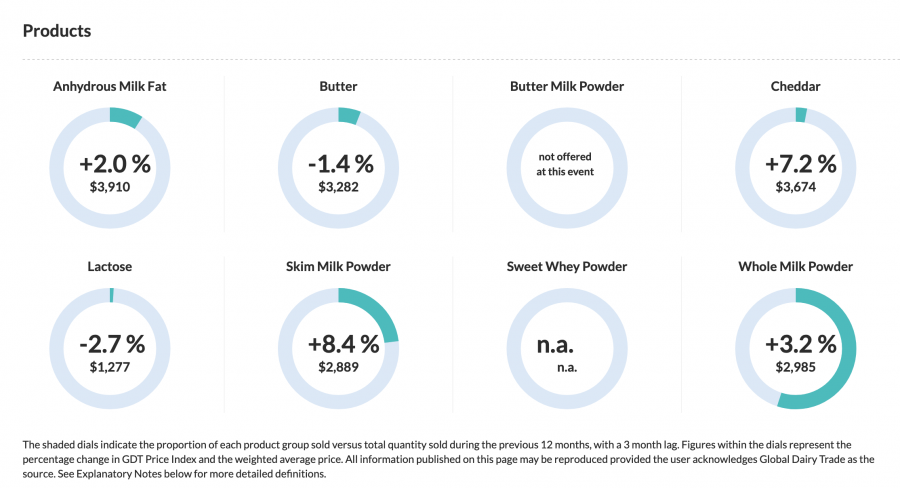
Global Dairy Trade Event 268 concluded with the GDT Price Index up 3.6%, its first positive trading event since the beginning of July. Losses in lactose, -2.7%, and butter, -1.4%, were offset by gains in skim milk powder, +8.4%, cheddar, +7.2%, whole milk powder, +3.2%, and anhydrous milk fat, +2.0%.  Click here to see more

Milk Futures Move Lower While Spot Trade Close Higher

On the Chicago Mercantile Exchange, milk futures closed lower Tuesday while global markets and cash trades were higher.  Class III milk futures tumbled lower.  September milk lost 8 cents to $16.33/lb.  October milk descended 53 cents to $18.70/cwt.  November fell 28 cents to $17.37.  December finished 22 cents lower to $16.50/cwt.   Class IV futures were mixed.  September lost 5 cents to $12.63/cwt.  October was up 2 cents to $13.51.  November added 15 to $14.08/cwt.  

On spot market dry whey unchanged at $0.3475.  Blocks unchanged at $2.2150.  Barrels unchanged at $1.60.  Butter up $0.0150 at $1.5050.  Forty-seven trades were made ranging from $1.4925 to $1.5125.  Nonfat dry milk up $0.02 at $1.06.  Nine trades were made ranging from $1.05 to $1.06.

The grain complex finished the day lower.  December corn declined 3.50 cents to $3.66/bushel.  November soybeans drifted 8 cents lower to $9.9150/bushel.  October soybean meal fell $2.70 to $314.30/ton.  December Chicago Wheat settled 7.50 cents lower to $5.3825/bushel.  October live cattle gained 22 cents to $107.10/cwt.  October feeders increased $1.10 to $143.70/cwt.  October crude oil improved $1.06 to $38.32/barrel.    

Mixed Activity in Chicago to Start the Week

On the Chicago Mercantile Exchange  Milk futures and cash trade started the week with mixed activity.  Class III milk started the day strong and was up early in the day but failed to hold on as sellers showed up to the party. September fell 7 cents to 16.71, October gained 2 to 19.23, and November fell 4 cents to 17.65/cwt.  Class IV was mostly unchanged. September held at 12.68, October fell 1 to 13.49, and November fell 2 cents to 13.93/cwt. 

The CME spot trade had Blocks up $0.05 at $2.2150.  Six trades were made ranging from $2.20 to $2.2050. Barrels up $0.0050 at $1.60.  Four trades were made ranging from $1.5875 to $1.60.  Butter up $0.01 at $1.49.  Seven trades were made ranging from $1.49 to $1.50.  Nonfat dry milk unchanged at $1.04. Dry whey down $0.0075 at $0.3475.  

The grain and feed markets was quieter – Soybeans touched over 10.00 in November to retreat back to $9.99 ½, December corn gained a penny to 3.69 ½, and Soybean meal fell $2.20 to 316.20/ton.

Negative Producer Price Differentials in Milk Pricing Going Down

A University of Wisconsin-Madison economist says those negative Producer Price Differentials that have been pulling down the prices farmers are paid for their Class III milk may finally be under control. Dr. Mark Stephenson, who serves as the director of the Wisconsin Center for Dairy Profitability, said on Tuesday’s episode of the Dairy Signal that the negative PPDs will be around 40-cents in the next month. That’s opposed to the $3 to $4 levels seen during the past summer.

“We should see less negative PPDs going into the fall,” Dr. Stephenson told viewers of the Professional Dairy Producers of Wisconsin’s online forum. “The good news is the negative PPDs should be in the rearview mirror as we enter into 2021; but the bad news is we’re seeing this happen because the Class III milk price will be lower. In the long-run, it could mean that milk checks will be similar to what they are now.”

Stephenson’s presentation went into detail on how the PPDs are determined based on the spread of the various milk class prices in a given month. In summary, he said when milk is pooled, the PPD becomes negative during scenarios where the Class III price rises too fast (as it did in June and July of 2020) or when the spread between Classes I, III and IV prices gets wider.

However, he points out that there’s no rule book for price forecasting during a year that has seen a pandemic, a controversial presidential election and swinging markets.

“Volatility is going to be the name of the game,” he said. “Although we are seeing lower prices, I’m hopeful that the outcome won’t drag on for years to come like it did after the recession of 2008 and 2009.

And he adds that one of the greatest lessons learned in 2020 is that risk management is important.

“Last December, most producers saw 2020 as the year where everything was going to be better. As a result, not as many took advantage of tools like the Dairy Margin Protection program… which would have been cheap insurance coverage.”

Dr. Stephenson said fortunately, a lot of farmers are going to have more high-quality feed available going into the winter, which will help reduce input costs.

Source: Wisconsin Ag Connection 

Milk Futures Mixed Thursday in Chicago

On the Chicago Mercantile Exchange, milk futures were mixed Thursday while cash trade was mostly lower.  Class III milk futures printed both red and green today.  September declined 16 cents to $16.46/cwt.  October pushed 25 cents higher to $18.73/cwt.  November rose 2 cents to $17.27/cwt.  December milk lost 3 to $16.45/cwt.  First half 2021 resides at $16.29/cwt.   Class IV milk was also mixed.  October gained 3 cents to $13.67.  November milk decreased 18 to $14.07.  December milk dropped 17 to $14.37/cwt.  

Blocks and barrels both turned lower today with the spread widening to 52 cents in the CME Cash Dairy Product Trade. Blocks down $0.0075 at $2.15.  Two trades were made $2.15 to $2.1575. Barrels down $0.0450 at $1.63.  Two trades were made at $1.63 to $1.6775. Dry whey up $0.0075 at $0.3450.  One trade was made at that price. Butter down $0.0175 at $1.4825.  Sixteen trades were made ranging from $1.48 to $1.50.  Nonfat dry milk down $0.0025 at $1.04.  Two trades were made at $1.04 and $1.0425. 

The grain complex was mixed ahead of tomorrow’s USDA supply and demand report.  December corn surged 4.75 cents to $3.65/bushel.  November soybeans bounced off $9.80, finishing at $9.7750/bushel.  October soybean meal lost 20 cents to $312.70/ton.  September Chicago Wheat added 6 cents to $5.40/bushel.  

Milk Futures Continue to Slide in Chicago Wednesday

On the Chicago Mercantile Exchange, milk futures continued to slide Wednesday while cash markets were mixed.  Class III milk saw September slide 23 to 16.62, Oct fell 33 cents to 18.48, and November fell 14 to 17.25. 2021 varied from 3 higher to 7 cents lower.  Class IV milk was unchanged in Sept at 12.83, Oct fell 21 to 13.64, and November fell 2 to 14.25.  2021 was unchanged across the board in quiet trading. 

Cheddar Barrels drove the futures trade today as our other products mostly traded higher. The CME spot trade had Dry whey up $0.0050 at $0.3375.  Two trades were made at $0.3350 and $0.3375. Blocks up $0.0050 at $2.1575.  One trade was made at that price. Barrels down $0.04 at $1.6750.  Butter unchanged at $1.50.  Thirteen trades were made ranging from $1.50 to $1.51.  Nonfat dry milk up $0.0125 at $1.0425.  Three trades were made at $1.04 and $1.0425. 

Soybeans continue their drive higher in the grain complex. November gained 5 ¾ to 9.78 ¾. December corn fell 1 ½ cents to 3.60 ¼, and Soyean meal gained back $3.70 to 310.90/ton. 

Futures Markets Lower while Spot Market is Up in Chicago Tuesday

Another round of higher cheese trade ended with the Class III price faltering on Monday on the Chicago Mercantile Exchange.  Milk futures closed mostly lower Monday while cash markets were quietly higher. Class III milk declined $0.22/cwt in September on Monday to $16.84.  October lost $0.06, November dropped $0.15, and December was down $0.13/cwt.  The fourth quarter 2020 average sits at $17.58/cwt.  2021 prices were a mixed bag closing anywhere from $0.08/cwt lower to $0.02/cwt higher.  Class IV had little trade with results in 2020 mainly unchanged.

In spot trade dry whey unchanged at $0.3325.  One trade was made at that price. Blocks up $0.0275 at $2.1525.  Four trades were made ranging from $2.1450 to $2.1525.  Barrels up $0.0150 at $1.7150.  Three trades were made ranging from $1.7150 to $1.7425. Butter up $0.0075 at $1.50.  Nonfat dry milk unchanged at $1.03. 

Corn and soybean prices were all over the place on Monday.  Corn traded 3.75 cents higher and closed at $3.6175/bu despite trading lower to begin the session.  Soybeans acted similar settling 5 cents higher to $9.73/bu.  This is the highest close since January 14th with the one year high of $9.8275 in its sights.  Soybean meal lost $2.5/ton and the wheat complex fell 3-8 cents/bu

Milk Futures Move Lower in Chicago Thursday

On the Chicago Mercantile Exchange milk futures closed mostly lower Thursday ahead of the monthly dairy product report while cash markets were mixed. September Class III milk up 19 cents at $16.82.  October six cents lower at $18.96.  November 34 cents lower at $17.73.  December down 36 cents at $16.84.  January through March contracts three to 20 cents lower.

Small volumes on the CME spot market drive prices higher.  Dry whey down $0.0025 at $0.3325.  One sale was made at that price. Blocks up $0.1425 at $2.0525.  One trade was made at $2.05. Barrels up $0.0650 at $1.6350.  Two trades were made at that price. Butter down $0.01 at $1.50.  Twenty-two trades were made ranging from $1.50 to $1.53. Nonfat dry milk down $0.0050 at $1.03.  Three trades were made at $1.0275 and $1.03. 

The grain and feed complex was mixed. December corn finishing ¾ cent higher to 3.58 ¾, Chicago wheat fell 5 ¾ cents to 5.58 ¼,  Soybeans gained 7 ¼ to 9.62 even, and soybean meal fell 50 cents to $302.30/ton.

Global Dairy Commodity Update September 2020

While dairy commodity markets remained relatively steady (except for US cheddar), dairy market fundamentals are mixed across major producing regions and local factors continue to influence prices, creating some diverging trends.

Global trade rebounded strongly in June, with healthy rises across most major product categories as buyers took advantage of low prices in April and May. The trade in the month took overall trade for the first half of 2020 to just 0.7% behind the 2019 comparative, despite COVID-19 disruptions.

COVID-19 restrictions will continue to ease but “second wave” surges in infections will cause reversals of reopenings in many regions. This will ensure retail demand remains a stable platform alongside a slow and bumpy recovery in food service channels while business and tourism travel and events will be limited through much of 2021.

Milk production trends are varied. While the EU-27’s growth may slow a little and changing climate may stem Latin America’s surge, output in most other regions is improving – strongest in the US, while weather is still a lottery in NZ.

Domestic demand for cheese and butterfat – sustained by strong grocery sales – may be vulnerable to the impacts of recession on household food spending.  Shoppers will probably trade down to cheaper products, do less entertaining and opt for low-cost eating out or takeout options. This may weaken overall demand and increase price sensitivity – but this hasn’t shown up just yet.

This risk of stock-build in butterfat remains a moderate risk but is dependent on the sustainability of cheese demand in Europe and the prospects for increased exports, while improved US cheese supplies will weaken prices.

Oceania markets are mixed. While WMP fundamentals appear balanced, weak butterfat demand due to the impacts of food service closures is weighing on prices, while the durability of premiums over US and EU SMP will be tested.

Skim Milk Powder  
Global SMP trade jumped 21% YOY in June, 43% of which came from SE Asia. The rolling annual total of SMP trade has recovered to within 2.6% of peak tonnage (achieved last September).

Whole Milk Powder
Global WMP trade rebounded 23% in June (with exports to Nth Africa making up half the gains in the month with the rolling annual total of WMP trade remaining 5.8% behind its peak 6 years earlier.

Cheese
Global cheese trade increased 14.4% YOY in June, with gains in most regions – strongest being UK, China and Mexico. Once the lure of low prices washed through the trade data, weak food service demand and uncertainty about the ongoing effects of COVID-19 will hang over cheese markets in coming months.

Butter
Global butterfat prices continue to converge, with Oceania values weakening further through August. EU butter prices improved, while US values softened through the month. Butterfat trade lifted 13.1% YOY in June in overall terms, this time aided by a 19% jump in butter trade, half of which came from MENA.

Whey
Whey powder prices continue to steady in the EU, while US prices have firmed in August after dipping in July. WPC prices for higher concentrated products remain weak with the lack of demand from the fitness market and weak growth in infant formula trade. The lack of demand for WPCs is pushing more whey solids into commodity powder production, as cheese output improves – especially in the US. Global trade in whey products lifted 8.5% YOY in August with strong trade into China.

Source: maxumfoods.com

Milk Futures Trade Higher in Chicago Wednesday

On the Chicago Mercantile Exchange milk futures closed higher at midweek supported by large moves on the cash market.  Class III milk saw limit lock moves in September and October, gaining 75 cents. September at 16.63, October at 19.02, and November gained 66 cents to 18.07. 2021 moved 2-30 cents higher.  Class iV milk gained 8 cents in 12.98 in September, October gained 7 to 14.04, and November gained 18 to 14.53. 2021 was unchanged to 3 higher in mostly quiet trading.

Small volumes on the CME spot market drive prices higher.  Dry whey unchanged at $0.3350.  Two sales were made at that price. Blocks up $0.1075 at $1.91.  One trade was made at that price. Barrels up $0.1250 at $1.57.  One trade was made at that price. Butter up $0.0450 at $1.51.  One trade was made at that price. Nonfat dry milk up $0.0050 at $1.0350. 

The grain and feed complex was mixed. December corn finishing ¾ cent higher to 3.58 ¾, Chicago wheat fell 5 ¾ cents to 5.58 ¼,  Soybeans gained 7 ¼ to 9.62 even, and soybean meal fell 50 cents to $302.30/ton.

Send this to a friend