On the Chicago Mercantile Exchange milk futures closed higher Tuesday finding strength from the cash market while prices on at the Global Dairy Trade were lower. Class III milk futures traded $0.17 higher in September and $0.36 in October. November 2020 through the end of 2021 closed in a range of $0.05 higher to $0.05 lower. Class IV months settled with September down $0.08 while October traded 132 times with its price up $0.10 to $13.97/cwt. November was also up slightly.
CME Spot Dairy Auction followed GDT with Blocks up $0.0050 at $1.8025. Six trades were made ranging from $1.7750 to $1.8025. Barrels up $0.0075 at $1.4450. Three trades were made ranging from $1.4450 to $1.4575. Butter down $0.0225 at $1.4650. Nineteen trades were made ranging from $1.4525 to $1.48. Nonfat dry milk up $0.0050 at $1.03. Two sales were made at $1.0250 and $1.03. Dry whey unchanged at $0.3350.
The Global Dairy Trade auction index in New Zealand posted another negative sales event. The index dropped one percent to $2,955 per ton. Gains in butter milk powder, +3.9%, skim milk powder, +1.8%, and lactose, +0.8%, were offset by losses in whole milk powder, -2%, butter, -1.2%, anhydrous milk fat, -0.5%, and cheddar, -0.4%.
Grains saw a lot of volatility in the overnight session but turned in a calm day session of trade. After USDA released the crop conditions report on Monday afternoon, the market fell $0.07/bu in corn and $0.11 in soybeans on the overnight. Crop conditions were reported where the trade expected them to be following a big surprise the week prior. Corn and soybeans battled back and posted stronger settlements to $3.58/bu and $9.55/bu, respectively. The wheat complex ran $0.06 – $0.115/bu higher as well.
Amul, Gujarat Cooperative Milk Marketing Federation (GCMMF), has become the first Indian dairy firm to make a place in the global top 20 list released by Rabobank, a Dutch multinational banking and financial services company. According to the list, Switzerland’s Nestle topped the list with a turnover of US $22.1 billion, followed by France’s Lactalis with US $ 21 billion turnover. Amul has achieved an annual turnover of $5.5 billion. “GCMMF (Amul) enters the Rabobank’s Global Top 20 Dairy Companies list for the first time at No.16,” Amul said in its tweet. It further added that this is a matter of pride for 36 lakh milk producers of Gujarat.
On this achievement, RS Sodhi, Managing Director, Gujarat Cooperative Milk Marketing Federation Limited (Amul), thanked the Gujarat government. “For all this tremendous growth credit also goes to Govt of Gujarat, CM Vijay Rupani for supporting 36 lacs farmers during difficult times by giving timely export incentives and Infrastructure funding,” Sodhi said in a tweet. He also said that this has been achieved due to the efforts of 3.6 million milk producers especially women.
US’ Dairy Farmers of America which was ranked 6th in the 2019 list, has been positioned third this year with a turnover of US $20.1 billion. Among others are France’s Danone at fourth, China’s Yili at fifth, New Zealand’s Fonterra at sixth, Netherlands’ FrieslandCampina at seventh, China’s Mengniu at eighth, Denmark/Sweden’s Arla Foods at ninth and Canada’s Saputo at tenth position.
Earlier this week, speaking at an online dialogue organized by All India Management Association (AIMA), RS Sodhi said that the dairy sector can give a significant boost to the employment generation in the country. This sector would alone create 1.2 crore new jobs over the next 10 years. Sodhi added saying that India produces 21 per cent of the milk in the world and India’s milk market was growing at 5 per cent, compared to the 1.8 per cent growth in the global milk market.
In the wake of the coronavirus pandemic, Amul has increased its focus on immunity-boosting products and launched Haldi Ice Cream. The company plans to roll out two more products i.e. Immuno Chakra Ice Cream, the Health trinity of Haldi-Ginger-Tulsi in tri-colour Ice Cream stick of 60 ml and Star Anise Doodh in the 200 ml can. In July, Amul launched Panchamrit, a mix of five ingredients which is usually offered in temples as ‘prasad’. It also launched Janmay range of edible oils, to reduce India’s edible oil dependency and help local farmers.
On the Chicago Mercantile Exchange milk futures closed mixed Monday following mixed cash activity. Class III futures were a mixed bag. August gained 1 penny to $19.77/cwt. September added 4 cents to $15.73/cwt. October climbed 20 cents to $17.84/cwt. First half 2021 average settled at $16.34/cwt. September class IV milk increased 8 cents to $13.04/cwt. Quarter 4 2020 is averaging $14.25/cwt.
Blocks and barrels continue to see steady volume in the CME Cash Dairy Product Trade. Blocks down $0.03 at $1.7975. Nine trades were made ranging from $1.7975 to $1.8275. Barrels up $0.0075 at $1.4375. Seven trades were made ranging from $1.4325 to $1.4425. Dry whey down $0.0050 at $0.3350. One sale was made at that price. Butter up $0.04 at $1.4875. Four trades were made ranging from $1.4825 to $1.4925. Nonfat dry milk up $0.0050 at $1.0250. Two sales were made at $1.02 and $1.0250.
The grain market saw fireworks on the overnight Sunday trading session before selling off some of the gains midday. December corn traded as high as $3.6425 before settling lower to $3.5775/bushel. November soybeans were up 3 cents to $9.5350/bushel. September soybean meal finished $3 higher to $304.60/ton. September Chicago Wheat climbed 5 cents to $5.4425/bushel. Fats and feeders started the week on a higher note. October Live Cattle rose 40 cents to $105.30/cwt. October feeders ended 45 cents higher to $140.62/cwt. October crude oil fell 15 cents to $42.82/barrel.
U.S. milk production figures provided by the USDA were recently updated with values spanning through Jul ’20. Highlights from the updated report include:
U.S. milk production increased on a YOY basis for the 12th time in the past 13 months, finishing 1.5% above the previous year and reaching a record high seasonal level.
The Jul ’20 U.S. milk cow herd rebounded 2,000 head from the six month low level experienced throughout the previous month. Milk cow herd figures finished 37,000 head above the previous year but remained 86,000 head below the 23 year high level experienced during Jan ’18.
U.S. milk per cow yields increased 1.1% on a YOY basis throughout Jul ’20, despite Western U.S. yields finishing lower YOY for the second time in the past three months.
Additional Report DetailsAccording to the USDA, Jul ’20 U.S. milk production declined 1.8% on a daily average basis but remained 1.5% higher on a YOY basis, reaching a record high seasonal level. The month-over-month decline in production volumes was smaller than the ten year average June – July seasonal decline in production of 2.9%. The smaller than normal seasonal decline in milk production volumes occurred despite previous month production volumes being revised 0.3% above levels previously stated.U.S. milk production volumes had finished higher on a YOY basis over 61 consecutive months from Jan ’14 – Jan ‘19, reaching the longest period of consecutive growth on record, prior to declining by a total of 0.3% from Jul ’19 – Jul ’19. Milk production volumes rebounded throughout more recent months, however, finishing higher over 12 of the past 13 months through Jul ’20. The 12-month rolling average milk production growth rate reached a two year high throughout Jul ’20.YOY increases in production on a percentage basis were led by South Dakota (+11.5%), followed by Indiana (+6.0%) and Colorado (+5.8%), while production volumes finished most significantly lower YOY on a percentage basis within Florida (-5.7%), New Mexico (-5.3%) and Vermont (-5.3%). Overall, 17 of the 24 states milk production figures are provided for experienced YOY increases in production throughout the month.California milk production volumes increased on a YOY basis for the seventh consecutive month throughout Jul ’20, finishing up 0.5%. California accounted for 18.3% of total U.S. milk production volumes throughout the month, leading all states.Eight of the top ten largest milk producing states experienced YOY increases in production throughout Jul ’20, as milk production within the top ten milk producing states increased by a weighted average of 1.2% throughout the month. The aforementioned states accounted for nearly three quarters of the total U.S. milk production experienced during Jul ’20. Production volumes outside of the top ten largest milk producing states increased 2.3% on a YOY basis throughout the month.Jul ’20 YOY increases in milk production on an absolute basis were led by Texas, followed by Pennsylvania and Idaho, while YOY declines in production on an absolute basis were most significant throughout New Mexico.The Jul ’20 U.S. milk cow herd rebounded 2,000 head from the six month low level experienced throughout the previous month. The U.S. milk cow herd currently stands at 9.352 million head, finishing 37,000 head above the previous year but remaining 86,000 head below the 23 year high level experienced during Jan ’18.U.S. milk per cow yields finished 1.1% above previous year levels, rebounding to a four month high growth rate. The YOY increase in milk per cow yields was the 56th experienced throughout the past 57 months. Yields experienced throughout the Midwestern states of Wisconsin, Minnesota, Iowa and Illinois finished 2.4% higher on a YOY basis however yields experienced throughout the Western states of California, Idaho, Washington and Oregon declined 0.2% YOY, finishing lower for the second time in the past three months.Month-over-month increases in milk cow herds experienced throughout Indiana, Michigan, Washington, Ohio and Utah more than offset MOM declines in the New Mexico, Oregon, Vermont and Florida milk cow herds during Jul ’20.YOY increases in milk cow herds continued to be led by Texas, followed by Idaho and South Dakota, while Wisconsin experienced the largest YOY decline in their milk cow herds throughout the month.
In the first half of 2020, export value is up 13%, volume up 14%.
U.S. dairy exports in June were up 28% by volume and 22% by value, capping a first half of double-digit growth. This year’s gains have been all the more impressive in that they were achieved during one of the most disrupted dairy trade environments in history.
In June, U.S. suppliers shipped 206,411 tons of milk powders, cheese, whey products, lactose and butterfat, the most (on a daily-average basis) since April 2018. The value of all exports was $583.7 million.
On a total milk solids basis, U.S. exports were equivalent to 17.7% of U.S. milk solids production in June, the highest rate since April 2018. In the first half of the year, exports were 15.8% of production, up from 14.1% in the first half of 2019.
Headline highlights in June included record cheese exports, continued robust sales of nonfat dry milk/skim milk powder (NDM/SMP), ongoing recovery of whey sales, and record shipments of fluid milk/cream. Overall volume gains vs. a year ago came from Southeast Asia, China and the Middle East/North Africa (MENA) region, plus a welcome improvement in sales to Mexico.
Cheese exports in June were 38,427 tons, 29% more than last year and the most ever. Much of this volume represents deals booked in April and May when U.S. cheese prices were at historic lows. The unit value of shipments was just $3900/ton, the second lowest over the last nine years.
Mexico came back to buy the most cheese in two years, posting a 62% gain compared with a year ago. Sales to South Korea also were strong, up 56%, and shipments to China more than doubled.
Exports of NDM/SMP topped 75,000 tons for the second straight month, coming in at 75,831 tons in June, up 77% from a year ago. Sales to Southeast Asia were lower than the previous two months, but still more than double the June 2019 volume. Growth came from Malaysia, the Philippines, Indonesia and Vietnam. Meanwhile, Mexico made its largest purchases in eight months, posting a 13% gain vs. a year ago. Mexico buying was encouraging, on the heels of a 21% decline in the first five months of 2020.
U.S. suppliers also sold nearly 10,000 tons combined to China and the MENA region (mostly Egypt); a year ago they sold less than 800 tons to the two markets. In the first half of the year, exports to the MENA region were up more than five-fold.
U.S. whey exports continued to trend higher on the strength of recovering sales to China, the top market for U.S. whey. Total whey shipments were 44,794 tons, up 8% from last year and the most since August 2018. Dry whey exports were up 42%. Sales of whey protein isolate (WPI), though less than the November-April levels, were still 30% more than last year. With strong global demand for protein, U.S. WPI exports were up 27% in the first half of the year.
China’s whey needs are expanding, largely due to swine herd restocking following last year’s African Swine Fever outbreak. June volume was the most since May 2018, and up 79% from last year. This offset a continued slump in whey sales to Mexico (-52%).
U.S. suppliers exported 13.4 million liters of fluid milk/cream in June, up 17% from last year and the most ever. Sales to Taiwan were a record high, while shipments to Canada doubled.
Lactose exports in June were 33,184 tons, on par with prior months but down 4% from last year. Shipments to China continued to improve (+19%), while sales to Southeast Asia were up 10%. In both markets, demand for use in infant formula was strong.
Among other products, shipments of milk protein concentrate (+28%), butterfat (+15%) and food preps/blends (+17%) were higher. Volume of whole milk powder (-2%) continued to lag.
On the Chicago Mercantile Exchange milk futures were mostly lower Thursday while cash markets were mixed. Selling pressure entered the Class III space following spot cheese trade. It seems as if the market is looking for further verification of dairy finding favour following the announcement of an additional $1 billion going into the Farmer to Family Food Box program. Ultimately, details beyond the announcement remain vague. Cash settled cheese futures have also built carry into the fourth quarter of 2020. Some of that carry premium was removed today as October declined 2.25 cents/lb and November/December dropped 3.50 cents/lb, respectively. Class III weakened 27 cents in September, 16 in October, 27 in November, and 33 in December. January also lost 26 cents while the remaining months in 2021 were down single digits. Class IV markets were mainly unchanged.
In spot trade, dry whey up $0.0050 at $0.3350. Three sales were made at $0.33 and $0.3325. Blocks down $0.0075 at $1.8650. Six trades were made ranging from $1.8650 to $1.89. Barrels up $0.0025 at $1.44. Nine trades were made ranging from $1.4325 to $1.4525. Butter down $0.0325 at $1.4675. Seventeen trades were made ranging from $1.4650 to $1.4850. Nonfat dry milk down $0.0050 at $1.0150. Three sales were made at $1.0125 and $1.0150.
Grain prices rose once again as weather, exports, and managed money continues to drive the market. Hot and dry weather throughout August has caused concern regarding the 2020 crop. The U.S. drought monitor shows the entire state of Iowa as at a minimum of “abnormally dry” or worse. Northern Illinois/Indiana also shows dry spots with southern Michigan showing up this week too. Exports were either within expectations or exceeded them this morning. Flash sales of corn to China helped run December corn 4.25 cents/bu higher on the day to $3.585/bu. Soybeans took out resistance and ended 17.75 cents higher at $9.42/bu. The wheat complex gained 7-11 cents/cwt as well.
On the Chicago Mercantile Exchange milk futures made a reversal Wednesday after being limit up the day before as traders correct overbought positions. Commodity markets across the board were stronger. Class III futures saw significant strength today. August lost 1 penny to $19.60/cwt. September to December milk settled limit up. Quarter 4 average is $17.66/cwt. First half 2021 gained 8-40 cents for an average price of $16.45/cwt. Class IV futures also printed green. September milk climbed 12 cents to $13.28/cwt. November finished 19 cents higher to $14.46/cwt. December saw the most strength, adding 40 cents to $14.76/cwt.
In the CME Cash Dairy Product trade, Dry whey up $0.0050 at $0.33. Five sales were made ranging from $0.3250 to $0.33. Blocks up $0.0425 at $1.8725. Three trades were made at $1.8375 to $1.87 Barrels up $0.0325 at $1.4475. Four trades were made ranging from $1.4275 to $1.4425. Butter down $0.02 at $1.50. Eight trades were made ranging from $1.49 to $1.5125. Nonfat dry milk up $0.0075 at $1.02. Five sales were made at $1.0175 and $1.02.
The grain market joined in on the higher price movement. December corn launched a 9.50 cent gain to $3.5450/bushel. November soybeans broke through $9.20 resistance, adding 14.50 cents to settle at $9.2025/bushel. September soybean meal gained $2.50 to $291.60/ton. September Chicago Wheat climbed 6.50 cents to $5.2725/bushel. October live cattle was up 85 cents to $108.77/cwt. September feeder cattle settled 22 cents higher to $143.07/cwt. October crude oil gained 75 cents to $43.37/barrel.
The spot Cheddar markets retreated once again. They lost a lot of ground, but they at least tried to put up a fight. Barrels regained some territory late in the week, signaling that the market is fumbling about for fair value. Blocks lost ground every day, but they still finished higher than last week’s lows. Both blocks and barrels closed 17ȼ in the red, preserving the wide spread between the two commodity cheeses. Blocks settled at $1.65 per pound, while barrels floundered to $1.33.
There is plenty of milk in the Midwest, thanks to unusually mild late-summer weather in the Great Lakes states and a lackluster start for back-to-school milk bottling. Spot loads continue to move at a discount, prompting cheesemakers to top up their vats. In a few months, a new facility in Michigan will open its doors, and regional cheese supplies will climb further. Demand is mixed. Foodservice continues to struggle, with the notable exception of pizzerias, while sales at retail remain brisk. After recent declines in the cheese markets and the dollar index, U.S. cheese is starting to look more competitive in the export arena.
CME spot whey added a penny this week and closed at 33.5ȼ. But the Class III markets focused on the more significant drop in cheese values, causing a rout in the futures. September Class III plunged $1.75 to $15.13 per cwt. Fourth quarter futures lost 70ȼ on average.
Spot Class IV products rallied this week. CME spot butter advanced 3ȼ to $1.515. Cream demand has perked up a bit, which is slowing churn rates. Extremely hot weather in some of the most populated parts of the country has likely boosted ice cream demand. Print butter continues to move through retail quickly, and grocers anticipate a strong baking season ahead. But home cooks may do less entertaining for the holidays this year.
Skim milk powder (SMP) values climbed 1.1% at Tuesday’s Global Dairy Trade (GDT) auction, while whole milk powder – and all other dairy products – fell flat. After adjusting for protein, GDT SMP is equivalent to nonfat dry milk (NDM) at roughly $1.29 per pound. Stronger SMP markets in both Oceania and Europe helped to lift U.S. milk powder. CME spot NDM gained 3.25ȼ this week to 99.75ȼ. U.S. milk powder is priced to move abroad. Domestic demand is steady. Cheesemakers continue to buy milk powder to fortify their vats.
Although butter and powder values moved higher at the spot market, the futures held back. Traders are clearly wary about long-term demand prospects. Class IV futures settled a little lower today than they did last Friday. The September contract fell 9ȼ to $13.26.
Enticed by the promise of $20+ milk – in the futures, although not in reality, for most – U.S. dairy producers did their best to top up their bulk tanks in July. National milk output reached 18.6 billion pounds, up 1.5% from the prior year. USDA also revised upward its estimate of June milk production. Dairy producers don’t typically add cows in July, when springers are in relatively short supply, but this year low slaughter rates translated into a slightly larger milk-cow herd. There were 9.352 million cows in milk parlors last month, up 2,000 head from June and the first month-to-month increase since March. The dairy herd was 37,000 head larger than in July 2019.
Milk output topped the prior year in most of the major dairy states. Better milk yields drove the bulk of the increase. Dairy producers managed to improve milk production per cow in most regions. However, in the Pacific Northwest and Idaho, supply management programs and steep discounts on excess milk kept output per cow in check. In the Southeast, sweltering temperatures dampened milk yields. In the Southwest, both factors were in play.
This month, the weather is having an even bigger impact on milk output. A heat wave is scorching California and the Southwest. In California’s Central Valley, home to the nation’s greatest concentration of dairy cows, record-breaking temperatures are stressing the herd. The heat has been sufficiently severe and prolonged that it is raising death tolls and likely stymieing conception, which could trim springer supplies at the margins next year.
Once cooler autumn weather arrives, milk output is likely to bounce back. Going forward, gains in U.S. milk production will depend primarily on milk yields, as there are very few places with room for a lot more cows. Limitations on expansion are likely a blessing in disguise, as the industry probably won’t need a more milk until the pandemic is contained and the economy is on firmer footing.
It was a dry week in the Corn Belt, and the crops are starting to look parched. Soil moisture reserves are largely depleted, and there isn’t much rain in the forecast until late next week. In many areas, yields are still likely to be above average, but hopes for a record-breaking corn crop are slowly evaporating. The recent dry spell may be particularly hard on the soybean crop as it transitions from the pod-setting to the important pod-filling stage. Estimates of corn and soybean yields are starting to slip from the recent, nearly euphoric highs. The Pro Farmer crop tour called for a national average corn yield of 177.5 bushels per acre, well short of USDA’s latest forecast at 181.8. For soybeans, Pro Farmer called for a 52.5 bushel per acre yield. USDA stands at 53.3.
USDA reported another big week for new crop soybean exports, further lifting bean values. There is potential for large U.S. corn exports as well, but there is still plenty of grain in South America, so significant rallies on LaSalle Street will make U.S. corn less competitive. December corn settled today at $3.405 per bushel, up 2.5ȼ for the week. At $9.0475, November beans are 6ȼ higher than they were last Friday.
Commodity markets across the board were stronger at the Chicago Mercantile Exchange. Yesterday afternoon, President Trump announced the USDA will spend $1 billion in the Farmers to Families Food Box program under the Coronavirus Food Assistance Program.
Class III futures saw significant strength today. August lost 1 penny to $19.60/cwt. September to December milk settled limit up. Quarter 4 average is $17.66/cwt. First half 2021 gained 8-40 cents for an average price of $16.45/cwt.
In the CME Cash Dairy Product trade, Dry whey down $0.0050 at $0.3250. One sale was made at that price. Blocks up $0.10 at $1.83. Barrels up $0.0450 at $1.4050. Five trades were made ranging from $1.4050 to $1.4150. Butter up $0.0050 at $1.52. Four trades were made ranging from $1.52 to $1.54. Nonfat dry milk up $0.0175 at $1.0125. Two sales were made at $1.0125 and $1.0150.
On the Chicago Mercantile Exchange milk futures found strength Monday supported by strong cash cheese movement. Class III milk quietly followed cheese. Aug gained 1 to 19.61, September gained 67 tp 15.80, and Oct gained 58 to 16.91/cwt. Balance of 2020 and 2021 markets saw gains of 5-47 cents Class IV milk failed to follow along. Aug fell 5 cents to 12.80, Sept fell10 to 13.16 and Oct was unchaged at 13.89/cwt.
Cheese jumps higher in a quiet dairy trade. Blocks up $0.08 at $1.73. Barrels up $0.03 at $1.36. Five trades were made ranging from $1.36 to $1.37. Butter unchanged at $1.5150. Nine trades were made ranging from $1.5075 to $1.53. Nonfat dry milk down $0.0025 at $0.9950. Two sales were made at $0.9850 and $0.9975. Dry whey down $0.0050 at $0.33. Two sales were made at $0.33 and $0.3325.
Feed and Grain markets moved higher with Dec corn up 4 ½ cents to 3.45 even, November soybeans gained a penny to 9.05 ¾, and Soybeanmeal fell 1.10 to $289.10/ton
The USDA released the July cold Storage information. Butter inventories came in at 373 Million lbs, up 10 Million lbs since June compared with the 5 year average of a 3 million lb drop. Total cheese stocks came in at 1.393 billion lbs, up 32 million lbs from July 2019.
Milk futures closed lower again Wednesday pressured by declining global prices and cash cheese markets. Class III futures saw further weakness today. August milk declined 33 cents to $19.51/lb. September fell 58 cents to $15.42/cwt. October tumbled 35 cents to $16.57/cwt. Class IV futures were mixed, ranging from positive 3 to negative 15.
Sellers have continued to push spot cheese lower in the CME Cash Dairy Product Trade. Blocks down $0.0875 at $1.71. One trade was made at that price. Barrels down $0.0825 at $1.3175. One trade was made at that price. Butter up $0.0025 at $1.5225. Twenty-two trades were made ranging from $1.51 to $1.5350. Nonfat dry milk up $0.0025 at $1.0150. Three sales were made at $1.0125 and $1.0150. Dry whey unchanged at $0.34.
December corn lost 2 cents to $3.3975/bushel. November soybeans added ¼ of a penny to $9.14/bushel. September Chicago Wheat increased 4.50 cents to $5.12/bushel. Fats and Feeders both saw strength. August live cattle gained 75 cents to $107.47/cwt. August feeders climbed 32 cents to $143.55/cwt. September crude oil finished 7 cents lower to $42.82/barrel.
What goes up, must come down. Red moved into our markets on Tuesday, with Class IV showing some strength on the Chicago Mercantile Exchange. Milk futures closed lower Tuesday pressured by mostly lower cash trade and declining global markets. Class III Milk fell 1 in Aug to 19.84, Sept fell 40 to 16.00, and October gave back 25 cents to 16.92/cwt. 2021 was quieter with prices varying from 8 lower to 4 cents higher. Class IV Milk gained 1 in Aug to 13.15, Sept was unchanged at 13.51, and Oct gained 13 to 14.32/cwt. 2021 saw gains of 5-21 cents
The CME spot trade saw similar declines. Dry whey down $0.0025 at $0.34. Three sales were made at $0.3375 and $0.34. Blocks down $0.0175 at $1.7975. Barrels down $0.06 at $1.40. One trade was made at that price. Butter down $0.02 at $1.52. Eighteen trades were made ranging from $1.5250 to $1.5450. Nonfat dry milk up $0.0325 at $1.0125. Six sales were made ranging from $1.00 to $1.0225.
The Global Dairy Trade event started out day with the index of Oceana dairy products down 1.7% from the previous event 2 weeks ago. Skim milk powder was the only category to trade higher, up 1.1 percent. Cheddar, -3.6 percent, lactose, -3.3 percent, and anhydrous milk fat, -2.9 percent, were the loss leaders at the biweekly event.
Class III milk rolled in this week looking to continue its momentum higher that ended last week with on the Chicago Mercantile Exchange. Milk futures started the week in lower trade pressured by declining cash cheese markets. Class III milk couldn’t sustain its rally following spot as futures dropped 44 cents in September to $16.44. Fourth quarter prices fell 15-23 cents while 2021 was up slightly. Class IV prices traded around 15 cents higher.
Futures traded as high as 30 cents stronger before the CME spot dairy auction where bids found initially but not for long. Dry whey up $0.0175 at $0.3425. Three sales were made ranging from $0.3350 to $0.3425. Blocks down $0.0050 at $1.8150. Four trades were made at $1.8225. Barrels down $0.04 at $1.46. Three trades were made ranging from $1.4550 to $1.5025. Butter up $0.0550 at $1.54. Six trades were made ranging from $1.5357 to $1.5575. Nonfat dry milk up $0.0150 at $0.98. Three sales were made at that price.
Grains continued its rally following last week’s USDA report and Iowa storm damage. Corn rose 6 and three-quarter cents to $3.44 and three-quarters. Soybeans jumped 16 and a half cents to $9.15 per bushel.
On the Chicago Mercantile Exchange Milk futures were again higher Thursday supported by strengthening cash cheese prices. Class III milk futures rose 30 cents in August following the National Dairy Product sales report on a strong basis number in the cash market. Fourth quarter 2020 rose 10-20 cents per cwt. to an average of $16.70 per cwt. First half 2021 struggled, losing 5-10 cents per cwt.
After a month of consistently lower prices in both the cheddar blocks and barrel market, cheese finally found some support. Blocks up $0.0950 at $1.70. Three trades were made ranging from $1.6750 to $1.70. Barrels up $0.0350 at $1.50. Eight trades were made ranging from $1.47 to $1.50. Butter down $0.0250 at $1.45. Twenty-six trades were made ranging from $1.45 to $1.4725. Nonfat dry milk up $0.0275 at $0.97. Four trades were made ranging from $0.96 to $0.97. Dry whey unchanged at $0.31.
On the Chicago Mercantile Exchange, Milk futures were mostly higher Wednesday supported by a return in positive cash cheese prices. Class III milk futures rose 30 cents in August following the National Dairy Product sales report on a strong basis number in the cash market. Fourth-quarter 2020 rose 10-20 cents per cwt. to an average of $16.70 per cwt. First half 2021 struggled, losing 5-10 cents per cwt.
After a month of consistently lower prices in both the cheddar blocks and barrel market, cheese finally found some support. Blocks up $0.0250 at $1.6050. Four trades were made ranging from $1.60 to $1.6050. Barrels up $0.02 at $1.4650. Thirteen trades were made ranging from $1.4450 to $1.48. Butter down $0.0475 at $1.4750. Nine trades were made ranging from $1.47 to $1.4850. Nonfat dry milk up $0.0025 at $0.9425. Fourteen trades were made at $0.94 and $0.9425. Dry whey unchanged at $0.31.
On the Chicago Mercantile Exchange milk futures were mostly higher while cash trade was mostly lower Tuesday.
Class III milk futures were mixed today. August milk lost 4 cents to $19.39/cwt. September gained 7 cents to $16.31. October added 15 cents to $16.69/cwt. November milk climbed 9 cents to $16.60/cwt. December milk increased 5 cents to $16.27/cwt. 1st half 2021 settled 5-21 cents higher at an average of $16.38/cwt. Class IV milk futures increased slightly. August milk remains at $13.16/cwt. September ascended 12 cents to $13.20/cwt. October surged 17 cents higher to $13.68/cwt. First half 2021 average is $14.98/cwt.
Butter was the lone product to post a gain in the CME Cash Dairy Product Trade. Butter up $0.0450 at $1.5225. Two trades were made at $1.5225 and $1.5250. Dry whey down $0.0050 at $0.31. Two trades were made at that price. Blocks down $0.05 at $1.58. Three trades were made ranging from $1.58 to $1.6075. Barrels down $0.03 at $1.4450. Three trades were made ranging from $1.4450 to $1.48. Nonfat dry milk down $0.0025 at $0.94. Six trades were made at $0.9375 and $0.94.
The grain complex saw modest gains today. December corn added ½ a penny to $3.2350/bushel. November soybeans inched a ¼ cent higher to $8.7350/bushel. September Chicago Wheat climbed 2.75 cents to $4.95/bushel. August Live Cattle rallied $1.05 to $104.65/cwt. August feeders gained 92 cents to $144.40/cwt. September Crude Oil declined 39 cents to $41.55/barrel.
Mixed day in the dairy markets on the Chicago Mercantile Exchange. Milk futures started the week to the higher side as traders correct oversold positions while cash markets were lower. Class III milk quietly traded in the green. August gained 7 cents to $19.43, September gained 1 to $16.24, and Oct gained 2 to $16.54 per cwt. Class IV milk was mostly unchanged. August at $13.16, September fell 8 cents to $13.08, and October held at $13.51 per
The CME spot trade saw all of our products slide lower on good volumes. Dry whey down $0.0050 at $0.3150. Two trades were made at that price. Blocks down $0.0750 at $1.63. Three trades were made at $1.6275 and $1.63. Barrels down $0.0375 at $1.48. Ten trades were made ranging from $1.48 to $1.5325. Butter down $0.0525 at $1.4775. Eleven trades were made ranging from $1.45 to $1.5225. Nonfat dry milk down $0.0125 at $0.9425. One trade was made at that price.
Grain markets saw some movement higher. December corn gained to 2 ¼ to $3.23 even, November soybeans gained 5 ¾ to $8.73 ¼, and soybean meal gained $2.20 to $282.20 per ton.
Cooperatives Working Together (CWT) member cooperatives accepted 16 offers of export assistance from CWT that helped them capture sales contracts for 94,799 pounds (43 metric tons) of Cheddar cheese, 41,888 pounds (19 metric tons) of butter, 597,453 pounds (271 metric tons) of cream cheese, 1.157 million pounds (525 metric tons) of anhydrous milkfat, and 1.874 million pounds (850 metric tons) of whole milk powder. The product is going to customers in Asia, Central and South America, the Middle East and Oceania. It will be delivered from August through November 2020.
CWT-assisted member cooperative export sales contracts for 2020 total 22.203 million pounds of American-type cheeses, 6.288 million pounds of butter (82% milkfat), 3.117 million pounds of anhydrous milkfat, 4.382 million pounds of cream cheese and 31.345 million pounds of whole milk powder. The product is going to 28 countries in seven regions. These sales are the equivalent of 694.6 million pounds of milk on a milkfat basis.
Assisting CWT members in moving dairy products overseas through the Export Assistance program is critical during the challenging times U.S. dairy farmers and cooperatives are facing. The Export Assistance program helps in strengthening and maintaining the value of dairy products that directly impact producers’ milk price. The program is helping member cooperatives grow and maintain world market share for U.S dairy products and is a significant factor in maintaining the total demand for U.S. dairy products and the demand for U.S. farm milk.
Dairy product and related milk volume amounts reflect current contracts for delivery, not completed export volumes. CWT pays export assistance to bidders only when export and delivery of the product is verified by required documentation.
On the Chicago Mercantile Exchange, milk futures turned mostly lower Thursday with cash trade providing very little market direction. August was the only month able to post a gain in Class III. August milk climbed 29 cents to $19.84/cwt. September milk fell 9 cents to $16.91. October declined 20 cents to $17.14. November milk tumbled 31 cents to $16.91. First half 2021 is averaging $16.33/cwt.
It was a quiet day in the CME Cash Dairy Product Trade. Dry whey unchanged at $0.32. Blocks unchanged at $1.8150. Barrels unchanged at $1.6425. Butter up $0.0175 at $1.5575. Nine trades were made ranging from $1.54 to $1.57. Nonfat dry milk down $0.0175 at $0.9550. Five trades were made ranging from $0.95 to $0. 9550.
The grain complex was mixed. December corn inched ½ of a penny higher to $3.2375/bushel. November beans fell ¾ of a penny to $8.78. August soybean meal declined $1.60 to $280.70/ton. September Chicago Wheat decreased 9.50 cents to $5.0125. October Live Cattle lost 47 cents to $106.97/cwt. September feeders dropped 60 cents to $145.87. September crude oil fell 18 to $42.01/barrel.
The FAO Dairy Price Index averaged 101.8 points in July, up 3.5 points (3.5 percent) from June. In July, quotations for all the dairy products represented in the index rose, moving the overall value 0.7 points (0.7 percent) above the corresponding month last year and for the first time above pre-pandemic level. Quotations for milk powders, especially whole milk powder (WMP), rose on account of strong import demand by Asian buyers with some concerns over the eventual size of export availabilities in Oceania in the 2020/21 production season. Meanwhile, although they remained below the pre-pandemic levels, quotations for butter and cheese continued to increase, buoyed by robust import demand amid seasonally declining export supplies and steadily rising internal demand in Europe.
Volatility continues as Class III bounces back Wednesday, on the Chicago Mercantile Exchange. Milk futures turned higher as traders worked to correct oversold positions, cash markets were mostly lower. September Class III traded almost a $1.30 range higher and lower to settle the day in the green. August finished the day 27 higher to $19.55, September up 33 to $17.00 and October finished 53 higher to $17.34/cwt. Fourth quarter of 2020 is averaging at $17.09/cwt as November finished 76 higher and December gained a whopping 60 cents back. Class IV milk also surged higher. August up 23 to $13.08, Sept up 8 at $13.02, and Oct up 35 cents to $13.50/cwt. July Class III price was announced at $24.54/cwt, Class IV at $13.76.
This all came after a giant volume trade in the CME spot market. Dry whey down $0.01 at $0.32. Eight sales were made ranging from $0.3250 to $0.3325. Blocks down $0.1150 at $1.8150. Nine sales were made ranging from $1.8025 to $1.82. Barrels down $0.1725 at $1.6425. Nine trades were made at $1.62 to $1.6425. Butter down $0.1150 at $1.54. Three trades were made ranging from $1.5225 to $1.54. Nonfat dry milk up $0.0275 at $0.9725. One trade was made at that price.
Dairy product prices plummeted at this morning’s Global Dairy Trade (GDT) auction, the main price index falling by 5.1 per cent as demand from North Asia slackened. The decline follows a smaller dip of 0.7 per cent a fortnight ago and a big jump in early July.
Whole milk powder prices dropped 7.5% overall. Regular grade WMP to ship in October fell 7.6%.
“This was a greater decline than the NZX Dairy Derivatives market had anticipated ahead of the event,” NZX dairy analyst Amy Castleton said.
“WMP prices fell 8.2% for product for next month shipping (shipping in September), indicating that buyers have filled their urgent needs for WMP. Buying from North Asia was up against the July 21 event, and up slightly against the equivalent event last year.
“There was also a slight increase in volume purchased by Africa compared to the last event, but less than the equivalent event last year. The Middle East bought less at this event than the equivalent event last year and both South/Central America and South East Asia/Oceania bought twice as much WMP than they had at the July 21 event, suggesting there is still some demand for WMP at this price point.”
Skim milk powder (SMP) fell 4.6% while butter prices dropped 2.8%, further losing gains made in early July.
Anhydrous milkfat (AMF) gained 3% while lactose saw a price rise of 5.7%, moving the average price to $1349/t. Cheddar prices dropped 5.3% with Africa buying the most.
On the Chicago Mercantile Exchange a vast swath of red filled the markets on Tuesday as traders hit the sell button. Milk futures were again limit down Wednesday pressured by declining global markets and significant declines in cash trade ahead of a bearish dairy product report. Class III milk markets were beaten up hard following product trade. August collapsed $1.10, September lost the limit of $1.50 per cwt, and October was down 90 cents per cwt. Unfortunately, the pain inflicted didn’t stop there with November off 50 cents and December through most of 2021 10-30 cents lower. Class IV markets were down 40-60 cents in 2020.
Dry whey unchanged at $0.33. Blocks down $0.1475 at $1.93. Thirteen sales were made ranging from $1.93 to $2.05. Barrels down $0.2050 at $1.8150. Five trades were made at $1.8150 and $1.87. Butter down $0.1550 at $1.4250. Twenty-five trades were made ranging from $1.4250 to $1.50. Nonfat dry milk down $0.02 at $0.9450.
Grains watched corn fall 8 cents to a new contract low of $3.20 per bu. Soybeans lost 14.5 to $8.81 ¾ while the wheat complex ranged from 4-12 cents in the red.
While dairy commodity markets in major producing regions have generally weakened, specific factors continue to influence prices, creating diverging trends.
Fundamentals are likely to steadily worsen in the coming months as milk supply expands faster year-on-year and demand slows as recession takes hold.
The YOY declines in trade are getting smaller, aided by lower prices for fats and milk powders. The coming months will likely see a continuation of major trends seen here recently – weaker cheese and butter trade due to COVID-19 exposures, alongside improved powder demand at attractive prices.
The “staggered reactivation” of food service sales is playing out. COVID-19 restrictions will continue to ease but the re-opening of foodservice outlets (seen in the US, Australia, and parts of EU) will be disrupted by “second wave” outbreaks. As was the case on the way into dealing with this pandemic, Government approaches will vary as they navigate choices between health and economic impact. This will ensure a slow and bumpy recovery in food service channels while business and tourism travel will remain limited until well into 2021.
Milk production growth in the EU and US is increasing, while domestic demand – sustained by strong grocery channel sales for cheese and butter – will be increasingly vulnerable to the effects of recession. The ongoing impacts of “trading down” by shoppers and reduced discretionary spending will weaken overall demand and increase price sensitivity.
Global protein and fat prices will generally be driven by the risk of stock-build in SMP and butter as milk supplies expand and cheese producers try to match demand. This risk is highly contingent on the sustainability of growth in cheese demand in Europe as well as prospects for increased exports, while acute tightness in the US cheese situation will gradually alleviate.
Oceania markets have been buoyed by sustained demand for WMP from China. But in this and other developing regions, butterfat and cheese demand are highly exposed to restricted food service demand, while buyers make hand-to-mouth commitments for ingredients.
Skim Milk Powder
SMP and NFDM spot values were steady through July as recovery from the COVID-19 continues.
Whole Milk Powder
Spot values have improved through July with NZ prices lifting through the month as GDT prices jumped, now selling at premium to EU product. Stronger Chinese demand at GDT events in July saw values jump significantly.
Cheese
In the US, overall cheese demand will remain under pressure. There will be a slow recovery in foodservice trade with the dire COVID-19 situation likely to extend mobility restrictions. Government purchases are likely to continue but at much smaller volumes and income subsidies are expected to taper in Q4, affecting household incomes.
Butter
Global butterfat prices continue to converge, as Oceania markets weakened due to poor demand. EU and US butter and cream prices were steady with improved retail butter demand.
Whey Whey product prices have steadied in both the EU and US after falling in June, as COVID-19 shifted production from cheese.
The whey complex generally remains in oversupply with weak demand for higher concentrate products and expanding cheese output in the US. Dry whey prices weakened recently despite the improved trade volumes.
By Dustin Boughton, Procurement Director, Maxum Foods – Your partner in dairy Graph Reference: Fresh Agenda
Maxum Foods is one of Australia and New Zealand’s principal suppliers of dairy ingredients to the Human Health and Nutrition, as well as the Animal Nutrition industries. Maxum Foods specialises in supplying medium to large-scale food manufacturers with high-quality dairy ingredients such as milk powders, cheese and butter. Backed by top-level technical support and a huge dairy ingredient range, Maxum Foods have open global supply channels to source exactly what our customers need.
On the Chicago Mercantile Exchange milk futures closed lower Monday ahead of a potentially negative Global Dairy Trade report and following big slides on the cash market. Class III milk futures fell brutally today on the heels of the spot cheese trade. August had 72 cents squeezed out to $20.31. September milk stumbled 68 cents lower to $18.24. October milk declined 32 cents to $17.67/cwt. Q4 2020 average settled at $16.99/cwt. Class IV futures also saw weakness today. August milk fell 6 cents to $13.27/cwt. September milk descended 20 cents to $13.45. October milk tumbled 34 cents to $13.68.
Spot cheese prices fell drastically in the CME cash dairy product trade. Blocks down $0.1750 at $2.0775. Five sales were made ranging from $2.0750 to $2.08. Barrels down $0.2150 at $2.02. One trade was made at that price. Dry whey down $0.0125 at $0.33. Two sales were made at $0.33 and $0.3325. Butter down $0.0275 at $1.58. Twenty-five trades were made ranging from $1.56 to $1.58. Nonfat dry milk down $0.0125 at $0.9650. Six sales were made ranging from $0.9625 to $0.97.
Corn and soybeans finished slightly higher. December corn added 1.50 cents to $3.2850/bushel. November soybeans gained 3.75 cents to $8.9625. August soybean meal moved $2.20 cents lower to $287.10/ton. September Chicago wheat fell 10.25 cents to $5.21.
On the Chicago Mercantile Exchange, milk futures slid again Thursday promoted by continually declining cash trade. Class III prices fell as much as $1 per cwt during Thursday’s session but closed 27 lower in August, 62 in September, while 4th quarter prices were mainly unchanged. Class IV markets struggled as well, falling double digits.
Cheese and milk prices experienced another rough session on Thursday after a limit move lower on Wednesday. Blocks down $0.0250 at $2.2950. Four sales were made at $2.28 and $2.2850. Barrels down $0.08 at $2.36. Four trades were made at $2.3575 and $2.36. Butter up $0.0525 at $1.6075. Three trades were made at $1.6050 and $1.6075. Nonfat dry milk down $0.0025 at $0.99. One sale was made at $0.9950. Dry whey down $0.0025 at $0.34.
Improving crop condition reports put pressure on corn and soybeans Monday through Wednesday but rose a half cent in corn today and three cents in soybeans. Wheat weakened 3 in Chicago, 5 in Kansas City, but gained 2 cents in Minneapolis.
Whole milk powder (WMP) prices are now sitting above pre-Covid-19 levels and New Zealand farmers can thank a resurging Chinese economy for that.
Last week’s Global Dairy Trade (GDT) auction consolidated big gains from the previous auction. WMP price rose 0.6% to US$3,218/metric tonne on the back of a whopping 14% rise in the previous auction.
Westpac senior agri economist Nathan Penny says WMP prices are now 1.8% ahead of where they sat at the end of January.
“In other words, prices have comfortably wiped out the earlier Covid-related price falls,” Penny says.
Penny says unlike other countries dealing with Covid-19, China’s economy has bounced back.
“China’s economy is back above where it was pre-Covid,” he told Rural News.
“Compare that with NZ….our economy will take years to get back to 2019 level.”
Penny says while there is a little bit of hangover from NZ’s drought last season, it’s mostly the resurgent Chinese economy that is driving dairy prices.
“There is also a strong demand from the rest of Asia but China is the key one.”
RaboResearch dairy analyst Thomas Bailey agrees that dairy price stability was been driven by strong North Asian (primarily Chinese) demand.
China’s economy is recovering quickly, evidenced by the year on year second quarter GDP growth of 3.2%.
However, Bailey notes there is still some concern regarding China’s domestic milk powder inventories. Local milk supply in China lifted 10% in the second quarter of 2020 over last year.
Bailey says given this exceptionally strong domestic milk supply growth, it appears demand is stronger than expected and helping drive prices up.
Manufacturers are also struggling to substitute New Zealand WMP with domestic stocks due to differences in taste and colour profiles.
“This is a dynamic we will be watching carefully as we make our way through the second half of 2020.”
$6.50 payout reaffirmed
Westpac has reaffirmed its forecast payout of $6.50/kgMS for the 2020-21 season.
Nathan Penny expects dairy auction prices to remain firm through the New Zealand winter. Prices may weaken later in the season – the peak New Zealand production months.
Upcoming auctions will see more volumes of dairy products on offer as NZ production ramps up in the coming months.
Penny says if prices hold up in the coming auctions, the bank will reassess its forecast milk price.
Fonterra this month narrowed its forecast range to $5.90/kg to $6.90/kg, lifting the bottom-end of the range by 50c.
The co-op said the lift was predominantly driven by improved market conditions in China.
For farmers, the lift in the bottom of the range has allowed Fonterra to increase its advance payments.
Penny says the 25c lift in the forecast midpoint, $6.15/kgMS to $6.40/kg equates to $450 million of additional farm income.
On the Chicago Mercantile Exchange milk futures continued to tumble midweek as cash trade saw some rather steep declines in prices. Class III milk fell apart. July held at $24.42 as we enter the final days of the month, but Aug moved limit lower to 21.16, September also moved 75 lower to 19.34, and Oct – December fell 19-75 cents lower to average at $16.89/cwt. Class IV also moved lower. July holding at 13.65, Aug fell 24 to 13.39, and Sept moved 26 lower to 13.77/cwt.
On the spot trade dry whey unchanged at $0.3425. Blocks down $0.12 at $2.32. One sale was made at that price. Barrels down $0.01 at $2.44. Butter down 0.1550 at $1.5550. Twenty trades were made ranging from $1.5550 to $1.66. Nonfat dry milk up $0.0025 at $0.9925. One sale was made at that price.
Grain and feed continue to slide, corn fell 4 ½ cents to 3.15 ½, November soybeans fell 2 ¼ cents to 8.85 ¼, and soybean meal lost $2 to $286.90/ton.
On the Chicago Mercantile Exchange, milk futures ended Tuesday lower as did most cash markets. July was the only month in Class III to post a gain today. July added 1 to $24.42/cwt. August dropped 27 cents to $21.84/cwt. September suffered a 42 cent move lower to $20.01/cwt. October tumbled 32 cents to $18.58. Class III Q4 average is $17.38/cwt. Class IV prices remained relatively unchanged.
In the CME cash dairy product trade, Dry whey unchanged at $0.3425. Blocks down $0.04 at $2.44. Two trades were made at $2.4475 and $2.45. Barrels down $0.01 at $2.44. Butter down 0.0175 at $1.71. Two trades were made at $1.71 and $1.7250. Nonfat dry milk unchanged at $0.99. Three trades were made ranging from $0.9875 to $9950.
The grain complex ended lower today. December corn fell 4.50 cents to $3.30/bushel. November soybeans declined 12.25 cents to $8.8750. August soybean meal lost $3.60 to $288.90/ton. September Chicago wheat was down 4.25 cents to $5.2350/bushel.
Growing demand for dairy in China has resulted in higher global dairy prices. There were significant price increases in July. The Global Dairy Trade (GDT) price index jumped early in the month by 8.3%, the biggest jump since November 2016.
There was strong demand for whole milk powder (WMP), with an increase of 14% to US$3208 a tonne at the GDT auction on 7 July. New Zealand’s Fonterra said that it had raised the lower end of its farmgate milk price forecast range for the forthcoming season as the demand went up in China, its top export market.
Local acceptance of milk and dairy products in China has grown strongly over the past year. According to the 2020 China Milk Quotient Report the growth is driven by 96% of the population believing that dairy consumption can help improve immunity. This year’s dairy product sales in China are expected to rise 6.4% to US $56.9 billion, is the forecast of market research provider Euromonitor International.
Fonterra, the world’s largest dairy exporter, recently lifted the lower end of its farmgate milk price forecast range for the current season. The 2020-2021 forecast farmgate milk price range has narrowed from US $3.59 – US $4.59 per kg milk solids to US $3.92 – US $4.59 per kg. The mid-point, off which farmers are paid, has increased to US $4.25 per kg, up from US $4.09 per kg.
Fonterra Chairman John Monaghan said the lift to the bottom end of the range was being predominantly driven by improved market conditions in China. “After an initial shock due to COVID-19, dairy consumption in China is recovering with more people spending on food,” he said. “We’re seeing customers ramp up promotional activity as they look to catch up on the sales losses incurred over lockdown.”
Monaghan pointed out that the EU and US Governments’ support measures for farmers are holding up milk production and dairy commodity prices despite the disruption they have experienced so far from COVID-19.
“While we expect these support measures to end at some point, it is likely they will continue through the peak of the New Zealand season,” Monaghan said. “While there is still a high level of uncertainty in our global markets, we do see a lowering level of risk and this supports a decision to lift the bottom end of the price range.”
According to Monaghan milk supply from the EU, US and Latin America is increasing despite the impact of COVID-19. “And there continues to be uncertainty around how the global recession and the potential for a second wave of COVID-19 globally could impact demand.” Fonterra is advising its farmers to continue budgeting with caution.
Most farmers across the southern export regions have started the season with some of the best seasonal conditions they have had for years. The climate outlook remains broadly favourable and trading conditions are also attractive, senior analyst Michael Harvey of Rabobank says. Dairy farmers in Australia will likely see, lower purchased feed bills and affordable fertiliser pricing. Rabobank’s revised farmgate milk price in Australia stands at US $4.51 per kg milk solids for 2020-2021.
According to Harvey the recovery in Australian milk production is gathering pace. National milk production was 6% higher for the month of May. Rabobank expects milk production in Australia to expand by 3.4% in the current 2020-2021 season.
The demand for milk and dairy products in the US improved recently with restaurants reopening, needing to restock cheese and butter. Store purchases of milk and dairy products have significantly increased as well. The US government purchased many dairy products, mainly cheese from May 15 to June 30, under the so called Farm to Family Food Box program. With the US dairy product prices below world prices, dairy exports increased as well.
Despite a softer cheese market during Monday’s CME spot dairy auction, futures ended higher on the day, on the Chicago Mercantile Exchange Monday. Milk futures were mostly up in the near term, and cash dairy prices were mostly down. Class III milk futures jumped 35 cents in August, 22 in September, and 12 in October. November gained 4 cents while December was down 15. 2021 suffered minor losses as well. Class IV saw just August trade, losing 4 cents to $13.72.
Dry whey was up $.0025 at $.3425 cents per pound. One sale was recorded at that price. Forty-pound blocks were down $.06 at $2.48 per pound. There were five sales at that price. Barrels were unchanged at $2.45 per pound. Two sales were recorded at that price. Grade AA Butter was down $.0025 at $1.7275 per pound. One sale was recorded at that price. Nonfat dry milk was unchanged at $.99 per pound. No sales were recorded.
Grain markets watched the wheat complex fall 11 cents in Chicago, 10 in Kansas City and 6 in Minneapolis. Corn declined a half cent while beans added a half cent. Fat cattle dropped $1 per cwt while feeders weakened $3 per cwt.
On the Chicago Mercantile Exchange milk futures were mostly down, and cash dairy prices were mixed Thursday. July Class III milk was up $.10 at $24.42. August was down $.26 at $22.50. September was down $.07 at $20.86 October was down $.13 at $19.12 The milk futures from November through next June ranged from five cents higher to nineteen cents lower.
In commodity prices Dry whey was unchanged at $.34 cents per pound. No sales were recorded. Forty-pound blocks were down $.0375 at $2.5850 per pound. There were two sales at $2.5850 and $2.5875. Barrels were unchanged at $2.45 per pound. Two sales were recorded at that price. Grade AA Butter was up $.0400 at $1.7075 per pound. Four sales were recorded from $1.6675 to $1.70. Nonfat dry milk was down $.0050 at $.9925 per pound. Seven sales were recorded from $.99 to $1.00.
Cooperatives Working Together (CWT) member cooperatives accepted fifteen offers of export assistance from CWT that helped them capture sales contracts for 557,770 pounds (253 metric tons) of Cheddar and Monterey Jack cheese, and 7.3 million pounds (3,300 metric tons) of whole milk powder.The product is going to customers in Asia, Central and South America, and will be delivered from July through November 2020.
CWT-assisted member cooperative export sales contracts for 2020 total 21.246 million pounds of American-type cheeses, 6.246 million pounds of butter (82% milkfat), 1.960 million pounds of anhydrous milkfat, 3.784 million pounds of cream cheese and 26.387 million pounds of whole milk powder. The product is going to 28 countries in seven regions. These sales are the equivalent of 612 million pounds of milk on a milkfat basis.
Assisting CWT members in moving dairy products overseas through the Export Assistance program is critical during the challenging times U.S. dairy farmers and cooperatives are facing. The Export Assistance program helps in strengthening and maintaining the value of dairy products that directly impact producers’ milk price. The program is helping member cooperatives grow and maintain world market share for U.S dairy products and is a significant factor in maintaining the total demand for U.S. dairy products and the demand for U.S. farm milk.
Dairy product and related milk volume amounts reflect current contracts for delivery, not completed export volumes. CWT pays export assistance to bidders only when export and delivery of the product is verified by required documentation.
All dairy farmers and dairy cooperatives should invest in CWT. Membership information is available on theCWT website.
Class III milk futures fell sharply as spot cheese was slightly lower on the Chicago Mercantile Exchange Wednesday. July Class III milk was unchanged at $24.32 and August was down $.54 at $22.76, while September was down $.43 at $20.93 and October was down $.20 at $19.25. The milk futures from November through next June ranged from unchanged to twelve cents lower. Class IV milk also saw red today. July remains at $13.80/cwt. August descended 17 cents to $13.78. September dropped 13 to $14.32.
In the CME Cash Product Trade, Dry whey was down $.0050 at $.34 cents per pound. One sale was recorded at that price. Forty-pound blocks of cheese were down $.0375 at $2.6225 per pound. There were four sales recorded from $2.62 to $2.63. Barrels were down $.0150 at $2.45 per pound. Eight sales were recorded from $2.44 to $2.46. Grade AA Butter was up $.0050 at $1.6675 per pound. No sales were recorded. Nonfat dry milk was up $.0050 at $.9975 per pound. Two sales were recorded at $.9975 and $1.00.
December corn gained 4 cents to $3.3475/bushel. November soybeans improved 2.75 cents to $8.9550/bushel. August soybean meal gained $1.00 to $286.60/ton. September Chicago wheat added 6.75 cents to $5.3475/bushel. Fats and feeders were mixed. August live cattle lost 35 cents to $101.50/cwt. August feeders gained 20 cents to $141.52/cwt. September crude oil fell 8 cents to $41.84.
Class III milk continues to march higher on the Chicago Mercantile Exchange Tuesday. Class III milk was unchanged in July at $24.32, but August gained 15 to $23.30, and September gained 63 to $21.36 per cwt. Class IV was unchanged in July at $13.80, August gained 5 to $13.95, and September gained 6 cents to 14.45/cwt.
The CME spot trade was similarly mixed. Dry whey was up $.01 at $.3450 cents per pound. No sales were recorded. Forty-pound blocks were down $.0025 at $2.66 per pound. There were five sales recorded from $2.66 to $2.67. Barrels were up $.0150 at $2.4650 per pound. Six sales were recorded from $2.45 to $2.4650. Grade AA Butter was down $.0175 at $1.6625 per pound. No sales were recorded. Nonfat dry milk was up $.0025 at $.9925 per pound. Two sales were recorded at $.99.
Class III milk prices roared back higher after some softness early in Monday’s session on the Chicago Mercantile Exchange. July Class III milk was up $.06 at $24.32 and August was up $.76 at $23.24, while September was up $.75 at $20.73 and October was up $.75 at $19.09 The milk futures from November through next June ranged from zero to sixty-four cents higher. Class IV markets ended the day mixed.
Product values ended with fairly modest changes. Dry whey was unchanged at $.3350 cents per pound. No sales were recorded. Forty-pound cash cheese blocks were up $.0025 at $2.6625 per pound. There were three sales recorded from $2.66 to $2.6625. Barrels were up $.02 at $2.45 per pound. Four sales were recorded from $2.43 to $2.45. Grade AA Butter was down a penny at $1.68 per pound. Eleven sales were recorded from $1.6750 to $1.71. Nonfat dry milk was down $.01 at $.99 per pound. One sale was recorded at that price.
In other markets wheat weakened 12 cents in Chicago and 13 in Kansas City, respectively. Minneapolis declined 6. Wheat put pressure on corn as corn lost 4 cents in December and moved to $3.35 ¾. Cattle dropped $1 in both the fats and feeder markets while hogs doubled that, falling $2 per cwt.
While there is still a high level of uncertainty in our global markets, we do see a lowering level of risk and this supports a decision to lift the bottom end of the price range.
Fonterra Co-operative Group Limited today revised both its 2019/20 and 2020/21 forecast Farmgate Milk Price ranges.
The 2019/20 forecast Farmgate Milk Price range has narrowed from $7.10 – $7.30 per kgMS to $7.10 – $7.20 per kgMS.
The mid-point, off which farmers are paid, has reduced to $7.15 per kgMS, down from $7.20 per kgMS
The 2020/21 forecast Farmgate Milk Price range has narrowed from $5.40 – $6.90 per kgMS to $5.90 – $6.90 per kgMS. The mid-point, off which farmers are paid, has increased to $6.40 per kgMS, up from $6.15 per kgMS
Fonterra Chairman John Monaghan says the narrowing of the 2019/20 milk price toward the lower end of the previous range is the result of a strengthening New Zealand dollar versus the US dollar over the past two months.
The Co-operative will announce the final 2019/20 Farmgate Milk Price as part of its Annual Result in September.
Commenting on the 2020/21 forecast Farmgate Milk Price range, Mr Monaghan says the lift to the bottom end of the range was being predominantly driven by improved market conditions in China.
“After an initial shock due to Covid-19, dairy consumption in China is recovering with more people spending on food. We’re seeing customers ramp up promotional activity as they look to catch up on the sales losses incurred over lockdown.
“Elsewhere, the EU and US Governments’ support measures for farmers are holding up milk production and dairy commodity prices despite the disruption they have experienced so far from COVID-19. While we expect these support measures to end at some point, it is likely they will continue through the peak of the New Zealand season.
“While there is still a high level of uncertainty in our global markets, we do see a lowering level of risk and this supports a decision to lift the bottom end of the price range.
“It’s very early in the new season and we are keeping a close eye on consumer demand and production from the key milk producing regions. Milk supply from the EU, US and Latin America is increasing despite the impact of Covid-19, and there continues to be uncertainty around how the global recession and the potential for a second wave of Covid-19 globally could impact demand.”
The Co-operative is advising its farmers to continue budgeting with caution.
Legal notice on Intellectual Property in digital content
All information contained in these pages that is NOT the property of eDairy News and is NOT considered “in the public domain” by legal regulations, are trademarks of their respective owners and recognized by our company as such. The publication on the eDairy News website is made for the purpose of gathering information, respecting the norms contained in the Berne Convention for the Protection of Literary and Artistic Works; in Law 11.723 and other applicable norms.
Any claim arising from the information contained on the eDairy News website will be submitted to the jurisdiction of the Ordinary Courts of the First Judicial District of the Province of Córdoba, Argentine Republic, with a seat in the City of Córdoba, to the exclusion of any another jurisdiction, including the Federal.
On the Chicago Mercantile Exchange, milk futures were mixed, mostly higher as markets work to find a new trading range. Thursday brings a move back higher in Class III milk after the mid-week correction on Wednesday. Class III started the day down significantly after the limit moves Wednesday, but bounced back strongly. July fell 8 cents to 24.23, but August surged 35 higher to 22.69, and September was up 55 to 20.03. The balance of 2020 was 22-47 higher. Class IV couldn’t follow suit. July fell 17 to 13.82, Aug fell 19 to 14.23, and September fell 6 to 14.62.
Though Cheddar blocks still fell 9 cents in the CME spot trade, we found 2 buyers willing to spend $2.71 on blocks. Barrels down $0.0025 at $2.4175. Butter down $0.0025 at $1.69. One trade was made at $1.6675. Nonfat dry milk down $0.01 at $1.00. Ten trades were made ranging from $1.00 to $1.01. Dry whey up $0.0125 at $0.3325.
Grains saw a bounce higher as well on Chinese buying. December corn gained 3 ½ to 3.37 ½, November Soybeans gained 8 ¼ to 8.91 even, and Soybean meal moved $1.20 higher to 287/ton.
On the Chicago Mercantile Exchange milk future tumbled Wednesday as cash cheese fell from its record high along with most other cash markets. Class III milk futures reacted negatively today as cheddar blocks were down lower. July remained even at $24.34/cwt. August milk dropped 44 cents lower to $22.96/cwt. September milk declined 62 cents to $20.09/cwt. Quarter 4 2020 descended 27-45 cents for an average of $17.43/cwt. Class IV milk futures settled even to higher today. July milk remains at $14.03/cwt. August gained 16 cents to $14.51/cwt. The second half of 2020 is averaging $14.86.
In the CME Cash Dairy Product Trade, dry whey unchanged at $0.32. Blocks down $0.19 at $2.80. Barrels unchanged at $2.42. Five trades were made at that price. Butter down $0.0525 at $1.6925. Three trades were made ranging from $1.6925 to $1.72. Nonfat dry milk down $0.0050 at $1.01. Five trades were made at $1.01 and $1.0125.
The grain complex ended up mixed today. December corn fell 2.75 cents to $3.3375/bushel. November soybeans added 2.25 cents to $8.7750/bushel. July soybean meal climbed 60 cents to $283.70/ton. September Chicago Wheat improved 2 cents to $5.2675/bushel.
The T.C. Jacoby Weekly Market Report Week Ending July 10, 2020
In an environment as fickle as the Chicago Mercantile Exchange, bulls are not typically bred for their stamina. But in the Cheddar block market there is a bull of a different breed.
In an environment as fickle as the Chicago Mercantile Exchange, bulls are not typically bred for their stamina. They tend to charge and then pause to catch their breath before attempting another run, and they are not ashamed to retreat to the shade from time to time. But in the Cheddar block market – currently the greenest pasture in the commodity world – there is a bull of a different breed. He is relentless, charging straight uphill with no signs of fatigue. This week the block market leapt from one record to the next, finally resting at an alltime high of $2.915 per pound, up 24ȼ from last week’s already lofty value. The barrels were less energetic. They fell 7.5ȼ this week to a still-lofty $2.34.
Near-term demand for blocks remains formidable. USDA’s Dairy Market News reports, “With government buying programs in place, along with steadfast retail demand during grilling season, [Midwestern] buyers are still active and willing to pay prices very few contacts would have expected when markets were near $1 in April.” However, in the Northeast and the West, some cheese buyers question the staying power of such unprecedented prices. Grocers and the food box program are moving a lot of cheese, but orders are starting to slow from restaurants, hotels, and caterers, especially in areas where coronavirus counts are climbing. Meanwhile, cheesemakers are running hard. Despite the heat, there is plenty of milk in the Upper Midwest, and cheesemakers are able to secure spot loads at a discount.
Butter production has slowed as cream heads to other uses, particularly ice cream. Butter demand continues to suffer from the pronounced slowdown in the restaurant and foodservice industry. This week, CME spot butter fell 4.75ȼ to $1.69.
The milk powder market perked up a bit. CME spot nonfat dry milk (NDM) advanced 0.75ȼ to $1.0175. Milk powders made big strides at the Global Dairy Trade (GDT) auction on Tuesday, boosting the GDT index to its largest gain since November 2016, up 8.3% from the previous event. Skim milk powder rallied 3.5% to the equivalent of NDM at $1.30 per pound, after adjusting for protein. Whole milk powder vaulted 14%. Global demand for milk powder has proven surprisingly strong despite the woes of the pandemic, and higher SMP prices are making U.S. milk powder increasingly competitive. On the domestic front, NDM is moving out of warehouses and into cheese vats.
CME spot whey slipped 4.25ȼ this week to 28.75ȼ, the lowest value since last November. Robust cheese production is generating a steady stream of whey, and manufacturers’ are largely eschewing value-added whey products, so whey powder is piling up. With gyms around the country sitting empty, sales of highprotein whey products have slowed. Those who exercise regularly may find ways to incorporate dairy protein into their at-home regimens, but they likely won’t try new products or make an impulse purchase until they’re back in the gym. Dry whey has gotten plentiful and cheap enough to attract a bit more foreign business, but stocks continue to grow. Whey is likely to remain a drag on Class III values.
Class III futures followed Cheddar blocks higher. The July contract rallied $1.23 to $24.20, within shouting distance of the alltime high of $24.40, set in October 2014. August Class III soared $2.09 to $23.04. Over the past month, the August contract has added more than $6 per cwt., a staggering increase. Deferred Class III futures posted double-digit gains. Class IV futures settled in the red, with 30ȼ to 40ȼ losses on the front of the board. Sky-high Class III values are likely encouraging dairy producers to add as much milk as they can, but the heat may stymie their efforts.
The grain markets rallied early in the week, as a hot, dry forecast raised concerns about yields. The markets got a mid-week boost after USDA reported a sizable sale of U.S. corn to China, and China’s ag ministry projected continued imports. For years, China has relied on its massive corn reserves and done its best to keep out foreign grain. Now the Chinese reserve is dwindling, and China’s rapidly modernizing hog industry requires more feed than its backyard herd did in the past.
USDA published its monthly update to crop balance sheets today, but they held no surprises. The market shrugged and turned its attention to the forecast. Better-than-expected rains dampened the bulls’ earlier enthusiasm. The corn crop will still have to pollinate in the middle of a heat wave, and there are plenty of dry spots. But there is an abundance of grain in the world, and supplies will be ample even if this year’s corn crop falls a little short of its full potential. September corn settled at $3.3625 per bushel, down 7.25ȼ from last Thursday. August soybeans closed at $8.87, down 4.25ȼ.
To provide the best experiences, we use technologies like cookies to store and/or access device information. Consenting to these technologies will allow us to process data such as browsing behavior or unique IDs on this site. Not consenting or withdrawing consent, may adversely affect certain features and functions.
Functional
Always active
The technical storage or access is strictly necessary for the legitimate purpose of enabling the use of a specific service explicitly requested by the subscriber or user, or for the sole purpose of carrying out the transmission of a communication over an electronic communications network.
Preferences
The technical storage or access is necessary for the legitimate purpose of storing preferences that are not requested by the subscriber or user.
Statistics
The technical storage or access that is used exclusively for statistical purposes.The technical storage or access that is used exclusively for anonymous statistical purposes. Without a subpoena, voluntary compliance on the part of your Internet Service Provider, or additional records from a third party, information stored or retrieved for this purpose alone cannot usually be used to identify you.
Marketing
The technical storage or access is required to create user profiles to send advertising, or to track the user on a website or across several websites for similar marketing purposes.
To provide the best experiences, we and our partners use technologies like cookies to store and/or access device information. Consenting to these technologies will allow us and our partners to process personal data such as browsing behavior or unique IDs on this site and show (non-) personalized ads. Not consenting or withdrawing consent, may adversely affect certain features and functions.
Click below to consent to the above or make granular choices. Your choices will be applied to this site only. You can change your settings at any time, including withdrawing your consent, by using the toggles on the Cookie Policy, or by clicking on the manage consent button at the bottom of the screen.
Functional
Always active
The technical storage or access is strictly necessary for the legitimate purpose of enabling the use of a specific service explicitly requested by the subscriber or user, or for the sole purpose of carrying out the transmission of a communication over an electronic communications network.
Preferences
The technical storage or access is necessary for the legitimate purpose of storing preferences that are not requested by the subscriber or user.
Statistics
The technical storage or access that is used exclusively for statistical purposes.The technical storage or access that is used exclusively for anonymous statistical purposes. Without a subpoena, voluntary compliance on the part of your Internet Service Provider, or additional records from a third party, information stored or retrieved for this purpose alone cannot usually be used to identify you.
Marketing
The technical storage or access is required to create user profiles to send advertising, or to track the user on a website or across several websites for similar marketing purposes.











 Amul, Gujarat Cooperative Milk Marketing Federation (GCMMF), has become the first Indian dairy firm to make a place in the global top 20 list released by Rabobank, a Dutch multinational banking and financial services company. According to the list, Switzerland’s Nestle topped the list with a turnover of US $22.1 billion, followed by France’s Lactalis with US $ 21 billion turnover. Amul has achieved an annual turnover of $5.5 billion. “GCMMF (Amul) enters the Rabobank’s Global Top 20 Dairy Companies list for the first time at No.16,” Amul said in its tweet. It further added that this is a matter of pride for 36 lakh milk producers of Gujarat.
  U.S. milk production volumes had finished higher on a YOY basis over 61 consecutive months from Jan ’14 – Jan ‘19, reaching the longest period of consecutive growth on record, prior to declining by a total of 0.3% from Jul ’19 – Jul ’19. Milk production volumes rebounded throughout more recent months, however, finishing higher over 12 of the past 13 months through Jul ’20. The 12-month rolling average milk production growth rate reached a two year high throughout Jul ’20.
 YOY increases in production on a percentage basis were led by South Dakota (+11.5%), followed by Indiana (+6.0%) and Colorado (+5.8%), while production volumes finished most significantly lower YOY on a percentage basis within Florida (-5.7%), New Mexico (-5.3%) and Vermont (-5.3%). Overall, 17 of the 24 states milk production figures are provided for experienced YOY increases in production throughout the month.
 California milk production volumes increased on a YOY basis for the seventh consecutive month throughout Jul ’20, finishing up 0.5%. California accounted for 18.3% of total U.S. milk production volumes throughout the month, leading all states.
 Eight of the top ten largest milk producing states experienced YOY increases in production throughout Jul ’20, as milk production within the top ten milk producing states increased by a weighted average of 1.2% throughout the month. The aforementioned states accounted for nearly three quarters of the total U.S. milk production experienced during Jul ’20. Production volumes outside of the top ten largest milk producing states increased 2.3% on a YOY basis throughout the month.
 Jul ’20 YOY increases in milk production on an absolute basis were led by Texas, followed by Pennsylvania and Idaho, while YOY declines in production on an absolute basis were most significant throughout New Mexico.
 The Jul ’20 U.S. milk cow herd rebounded 2,000 head from the six month low level experienced throughout the previous month. The U.S. milk cow herd currently stands at 9.352 million head, finishing 37,000 head above the previous year but remaining 86,000 head below the 23 year high level experienced during Jan ’18.
 U.S. milk per cow yields finished 1.1% above previous year levels, rebounding to a four month high growth rate. The YOY increase in milk per cow yields was the 56th experienced throughout the past 57 months. Yields experienced throughout the Midwestern states of Wisconsin, Minnesota, Iowa and Illinois finished 2.4% higher on a YOY basis however yields experienced throughout the Western states of California, Idaho, Washington and Oregon declined 0.2% YOY, finishing lower for the second time in the past three months.
 Month-over-month increases in milk cow herds experienced throughout Indiana, Michigan, Washington, Ohio and Utah more than offset MOM declines in the New Mexico, Oregon, Vermont and Florida milk cow herds during Jul ’20.
 YOY increases in milk cow herds continued to be led by Texas, followed by Idaho and South Dakota, while Wisconsin experienced the largest YOY decline in their milk cow herds throughout the month.
.jpg?width=554&name=chart70%20(3).jpg)
.jpg?width=554&name=chart72%20(3).jpg)
.jpg?width=554&name=chart71%20(3).jpg)

 Growing demand for dairy in China has resulted in higher global dairy prices. There were significant price increases in July. The Global Dairy Trade (GDT) price index jumped early in the month by 8.3%, the biggest jump since November 2016.
 While there is still a high level of uncertainty in our global markets, we do see a lowering level of risk and this supports a decision to lift the bottom end of the price range.
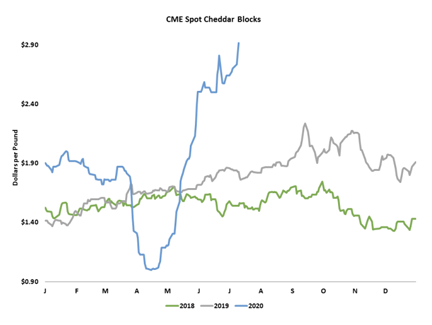 In an environment as fickle as the Chicago Mercantile Exchange, bulls are not typically bred for their stamina. They tend to charge and then pause to catch their breath before attempting another run, and they are not ashamed to retreat to the shade from time to time. But in the Cheddar block market – currently the greenest pasture in the commodity world – there is a bull of a different breed. He is relentless, charging straight uphill with no signs of fatigue. This week the block market leapt from one record to the next, finally resting at an alltime high of $2.915 per pound, up 24ȼ from last week’s already lofty value. The barrels were less energetic. They fell 7.5ȼ this week to a still-lofty $2.34.
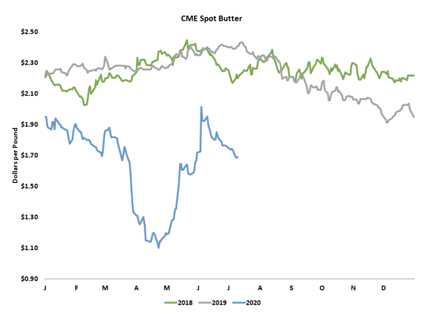 Butter production has slowed as cream heads to other uses, particularly ice cream. Butter demand continues to suffer from the pronounced slowdown in the restaurant and foodservice industry. This week, CME spot butter fell 4.75ȼ to $1.69.
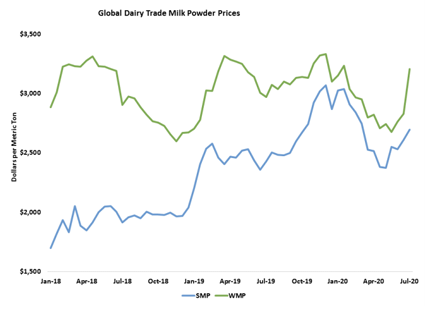 Class III futures followed Cheddar blocks higher. The July contract rallied $1.23 to $24.20, within shouting distance of the alltime high of $24.40, set in October 2014. August Class III soared $2.09 to $23.04. Over the past month, the August contract has added more than $6 per cwt., a staggering increase. Deferred Class III futures posted double-digit gains. Class IV futures settled in the red, with 30ȼ to 40ȼ losses on the front of the board. Sky-high Class III values are likely encouraging dairy producers to add as much milk as they can, but the heat may stymie their efforts.



