Archive – Page 7

TRIANGLE HOLSTEINS – Three Part Harmony

qs[1]There are many facets to the dairy breeding industry that readers of the Bullvine find themselves attracted to.  Whether its milk records, breeding awards or showring victories, there is something for everyone to get passionate about.  Quim Serrabassa, from Spain, was introduced to cattle early in his life and didn`t ever narrow the field.  For him three dairy passions are better than one.

Beginning in Barcelona

Quim and his brother Jaume were raised on the family farm Mas Comas Novas, La Guixa in Barcelona. Their father, Ramon, was a cattle dealer who enjoyed the buying and selling but wasn’t interested in breeding animals.   When the boys were only 12 and 14 they made a decision that would eventually bring them to where they are today says Quim. “In 1984 Jaume and I decided to keep the best cows and breed our own herd.” They give credit to their mom and dad. “From our parents we learned the love of farming, good cows and cow competitions.  This was a tremendous opportunity and we owe a lot to them for allowing us to take this responsibility at such an early age.”

Trying a New Angle

Twenty years later it was time for another new beginning. “In 2004 I started my own company Triangle Holstein.” Quim highlights how the name corresponds to the business. “There are three different business areas: the livestock business, the semen business and the show business.”  For each specialty area Triangle Holsteins provides customized service.  Like other visionary business men he feels that one-sided expectations of yourself and others could hold them back from reaching their individual breeding goals. “We work closely with the farmer to give professional and personal service tailored to their specific needs.” Quim values his early business experiences. “Many years ago, I had the opportunity to work for a big company and it was great.  I always had the goal of forming my own company.” He points out how it has been. “Working for myself gives me a lot of freedom and satisfaction.  I am responsible for my own decisions.  Sometimes good.  Sometimes wrong.” But undoubtedly, he has learned from all sides of the story.

IMG_5518 web2

A Three-Way Perspective

The Triangle Holstein breeding philosophy is one that starts with genetics but is carried out through careful management. “Triangle Holsteins is focused on the best North American cow families and conformation traits are the number one priority.  Nevertheless, I never forget production and health. The management of these key priorities is the key to making an animal be successful.” Quim knows that in cow terms there are three important areas. “Nutrition, exercise and comfort make all the difference.”  These three combined with kindness are what he calls his “silent” partners.  If those are the three main steps to caring for the animals there are also three characteristics that Quim feels all breeders must have in their personality. “This process requires breeders to be  stubborn, patient and enthusiastic all at the same time.”

IMG_2385

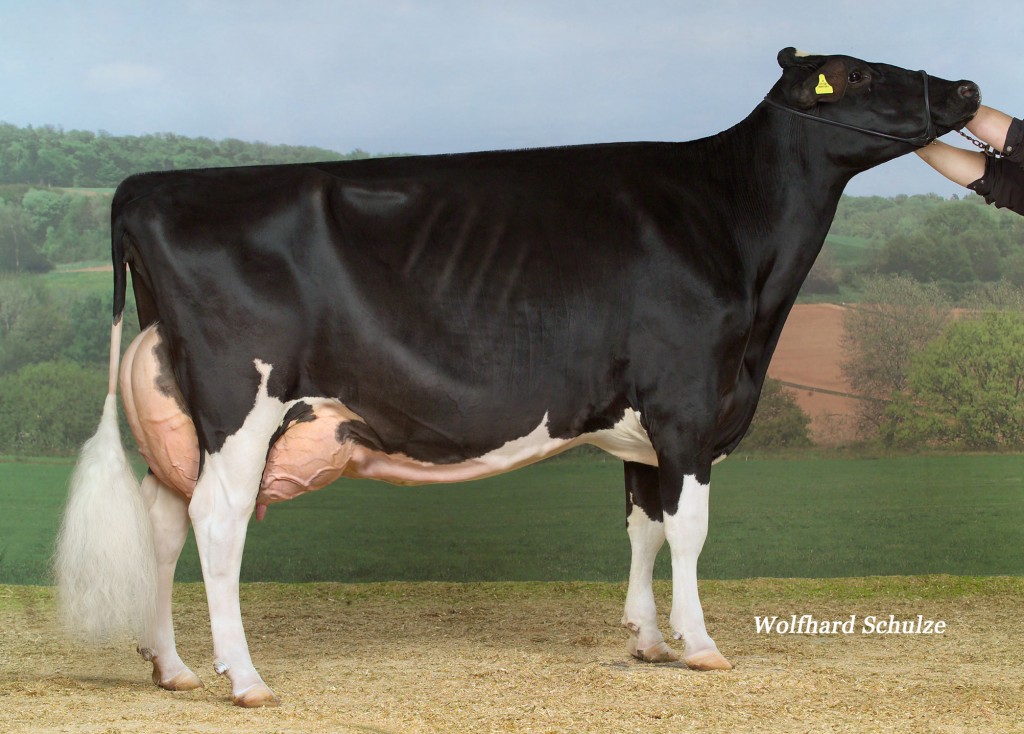
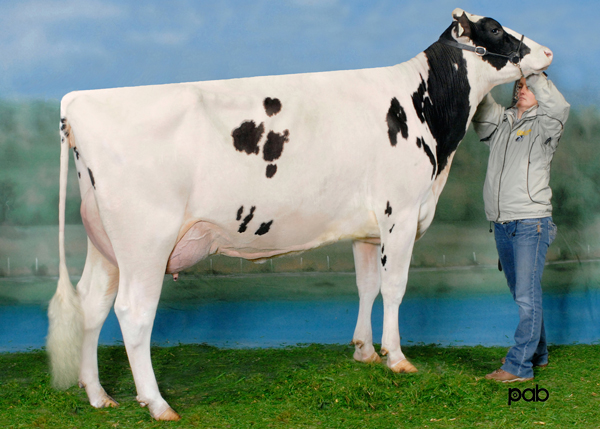
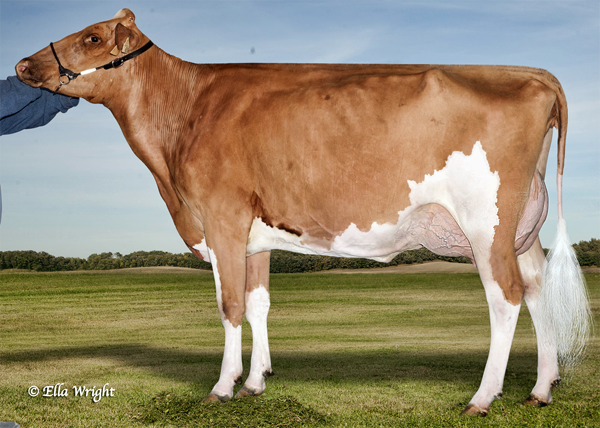
Pachecas James Gretta
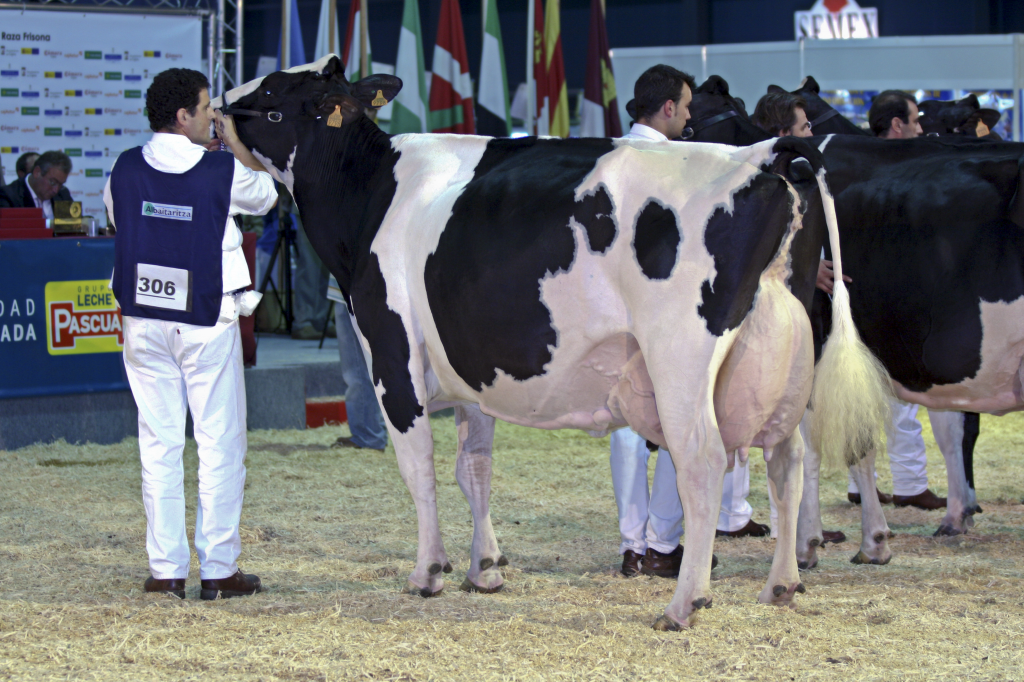
3 time Spanish National Champion

 Three Triangle Love Stories

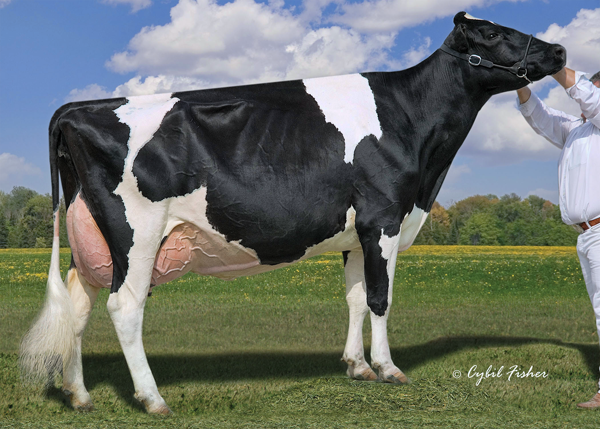
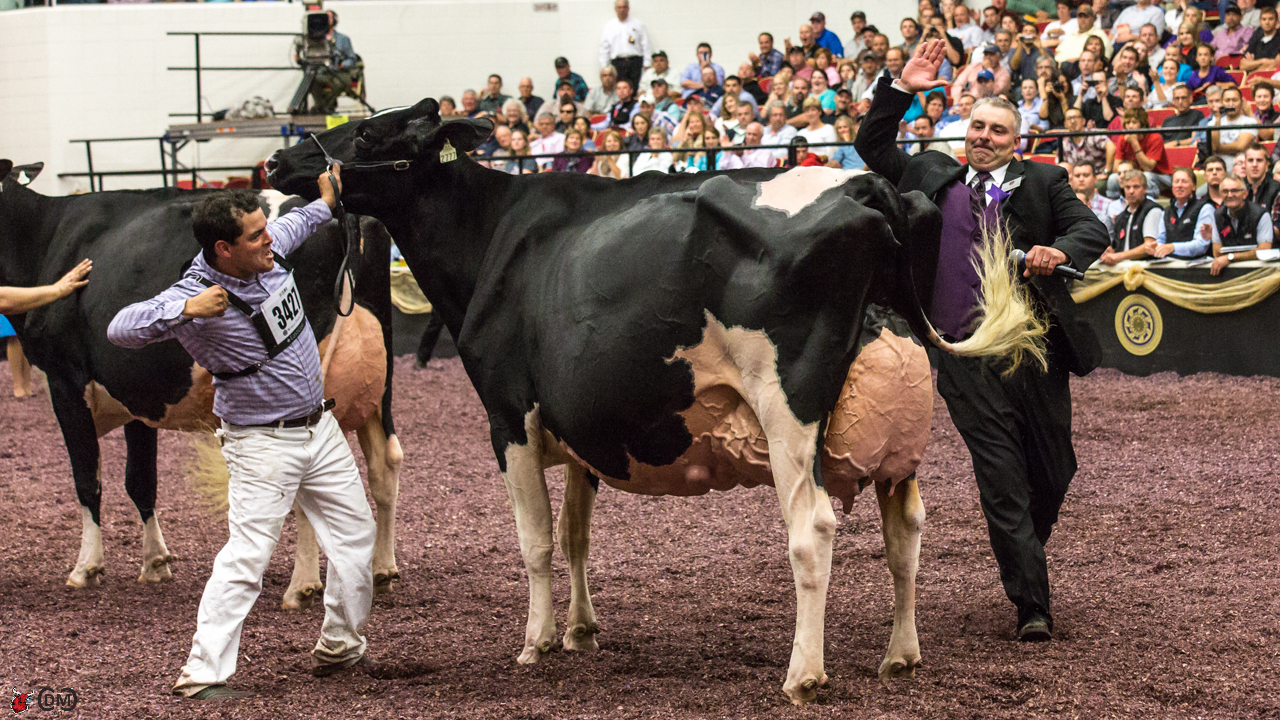
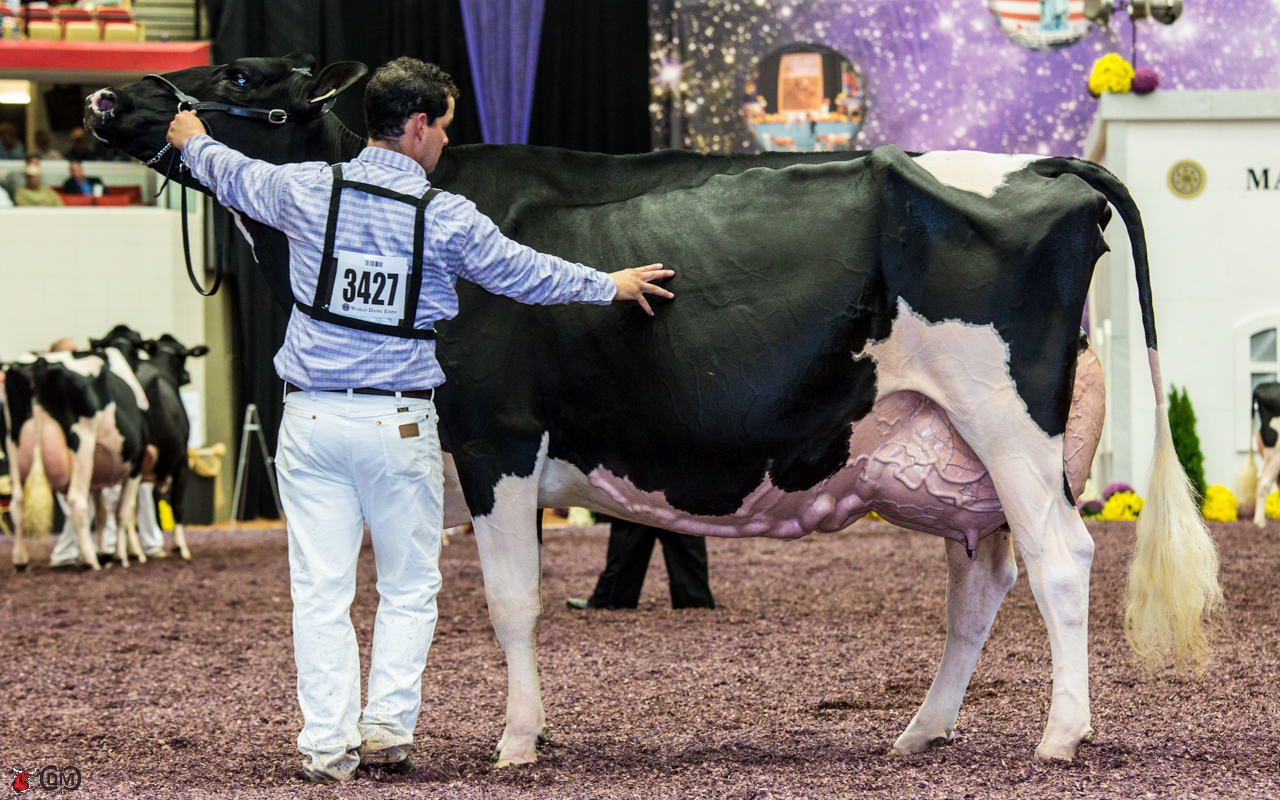
It isn`t surprising to learn how many animals this Triangle Holstein breeder singles out. “There have been three special animals in  Quim’s life.”  He starts of with one from his youth.Comas Novas Dibbs Inspiration  was our first Champion cow when I was a teenager. She was a white dairy character cow, all quality from the head to the tail.”  The next one stands out for special reasons too. “My second favorite cow is Pachecas James Greta. She was strong, with a big frame and a fantastic udder. Greta was my longest project working with a show cow and she is the one that won many shows in Spain.” The third memory maker for Quim holds a unique space for Quim.” Regiment Apple will always stand out for me.  We came together many years ago, during the first time I was working in Madison for Mike Deaver who is one of the best cow men that I know. At that time Apple was 2 year old.”

31578_1422821484608182_1599892698_n[1]

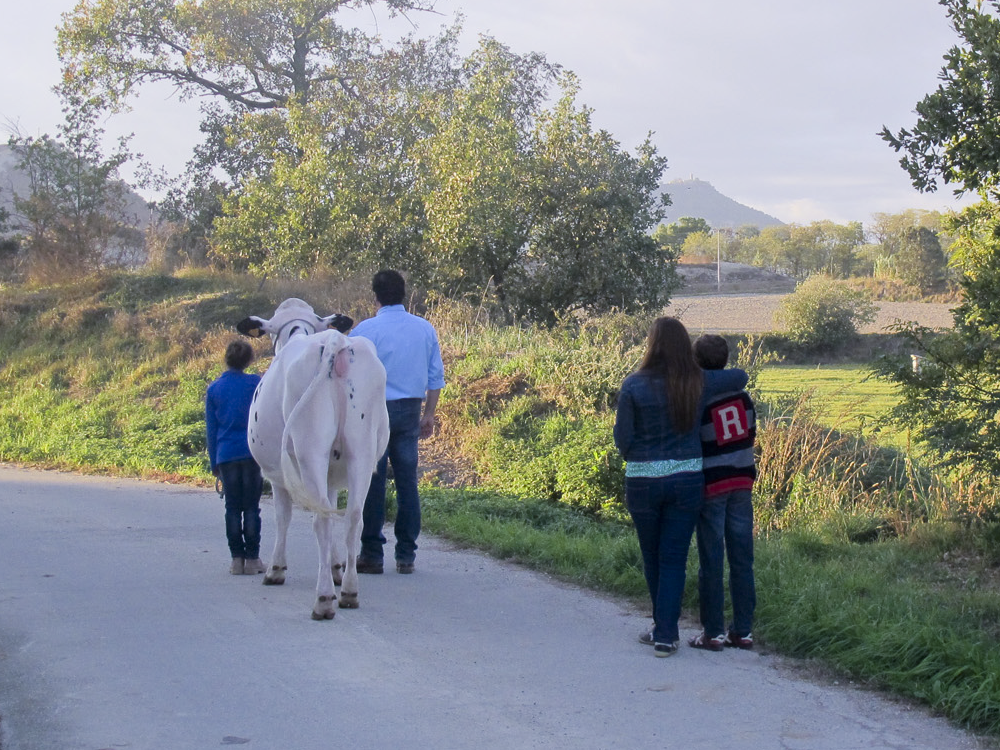
Regiment Apple will always stand out for Quim. They came together many years ago, during the first time Quim was working in Madison for Mike Deaver, at that time Apple was 2 year old.”

Three Part Marketing Vision:  Farms, Shows and Facebook

No matter where you are in the global dairy industry, you are marketing your herd with each contact you make, whether it`s face to face, in cyberspace, hard copy or in the show ring.  Quim Serrabassa once again uses a multi-pronged approach. He outlines his methods. “On one hand I go every two weeks to France to select and buy commercial animals for my customers. My customers are breeders like I used to be, so I always feel very responsible for the cows I pick.” Quim never tires of searching out these animals. “I select them one by one, and this is one of the things I like the most. I walk to the field or to the barn with the intention of finding that special one. Sometimes they don’t start out looking that way. I will find one, usually dirty, with no foot trimming, never clipped … but finding her is a magic moment.” He especially likes it when a selection he makes goes on to do well. “Sometimes you can take her to the show ring. Another time you recognize her doing fine in her new home.”

The second point of Quim’s marketing is very much based on shows. “I like going to shows because it is the place where I meet my customers and I can feel the pulse of the market and hear about their needs.” Quim enjoys breeding for show cows. “My favorite sires for show cows are: Absolute-Red, Delta & Atwood.” But he doesn’t over look dairy cow sires. “For dairy cows I use Explode, Cashcoin, Carson and Deman.” His understanding of the show ring has been well developed over the years and he has gained recognition as a cattle judge. “Judging is one accomplishment I am very proud of.  I never expected to have the opportunity to be an Associate Judge in Madison beside Brian Carsacadden and then later in Laussane beside Mike Deaver.”  Both of these judges rank high for Quim. “In my opinion they are the best.”  (Read more: CARSCADDEN: The Royal Footsteps)

Word of mouth has always been a great way for the dairy industry to market itself.  Today dairy friends, peerwebsites and coworkers take that friendly promotion and sharing to new levels. “To keep my customers updated, we use our web site, Facebook and profiles.” says Quim. This enhances the friendships already made in the worldwide industry. “I share my passion for show cows with Roger Turner and Brian Carscadden who have been my mentors in the USA and Canada. Again Mike Deaver has taught me a lot and is a very special person for me.  Early on, one of my greatest influences was Alfonso Ahedo from Semex Spain. He is a great business man with a huge understanding of the Holstein industry.”  It’s all about sharing the passion says Quim. “I keep the passion for shows going with some members of the original farm. As well there is one nice heifer that I bought with friends Erica Rijneveld, Eric Dougoud, and Pat Conroy. (Read more: Erica Rijneveld – Takes Her Show… And Yours…On The Road! and DECRAUSAZ IRON O’KALIBRA: Simply the Best) These are people that love good cows and with whom I share good times too.”

Marketing and Genomics

In today’s marketplace rapidly changing tools are having a tremendous effect.  Quim looks at Genomics and how it has affected his operations. “Genomics has changed the semen market a lot.  For our company it was a great opportunity to start with.  Genomics provides opportunities for everyone.  The market is now global no matter where the bull comes from or who the owner is.”  Of course having the tool and knowing how to use it is the challenge. Quim seeks balance. “Now we have some genomic information that we can combine with cow family and traditional knowledge.  It is the mix and the balance between the new information and the traditional knowledge that will move us forward in the right direction.” If there is a downside to genomics for Quim, it is related to the speed of change. “Today the genetic market moves too fast.  We hardly have time to appreciate and enjoy the cow family as a group.

Work, Work, Work

Quim points out that there is a lot of hard work to make your dairy business. “You have to be satisfied about the things you do every day and try to keep yourself surround by the people that challenge you to grow.” He knows that everything isn’t always perfect. “This is a job that you have to believe in.  Do not expect big things and always enjoy the small details that life gives to you.” As happy as he is with Triangle Holstein, Quim sums up his accomplishments from his own unique angle. “My biggest success is my family.” Very eloquently he points out that this is where he finds his strength. “Especially when show time is over and the bright lights are off.”


Get original “Bullvine” content sent straight to your email inbox for free.


[related-posts-thumbnails]
Foresight and Hindsight. Don’t Blindside Your Fresh Cow Focus

Foresight and hindsight are terms that are most often applied to strategic planning. When it comes to post calving transition, let’s consider them in the absolute sense meaning the “sight” your cows present post calving.

In this third part of our series on Transition Management, we are looking at the final stage. You are to be commended if you are already thinking, “The most important decisions I make for my fresh cows happen long before she calves out” or even before that when we set up our transition management program.” (Read more: Are Your Cows Ready For Their Close Up? and Dairy Cattle Management: LOST in Transition) That is so true but there are critical steps that must be acted upon to fulfil the post calving needs of your fresh cow too. Until cows and walls and stalls talk, your information must come from observation.  

Observation doesn’t simply mean a quick check from across the barn, pen or pasture.  What is needed is a full 360 degree close-up otherwise something important may be overlooked.  Whatever you miss at this time could make the crucial difference between a successful lactation or it could mean culling the cow or, in the worst case scenario, death. The goal is to take what you see and apply it to a transition program that will make sure that fresh cows eat well and enter their lactation without health or metabolic issues such as metritis, mastitis, milk fever, ketosis or fatty liver. This is a situation where you can be assured that what you don’t see will definitely hurt you.

Setting Your Sightlines

Because the calving pen is an area of elevated stress and high turnover, it is important to set goals and corresponding benchmarks, in order to achieve the best outcomes.  If benchmarks do not exist, set reasonable goals.

  • The first goal is to have nothing in the calving pen for longer than 24 hours. Longer stays result in dramatic increases in problems.
  • Milk Fever: 1%. Mature cows 2%. Seek help if over 3%.
  • Displaced abomasums. Less than 1% of all calvings.  Seek help if 12%.
  • Retained placenta.  Less than 8% of all calvings. Seek help if 10% or more.
  • Body Condition. During the first 30 days in milk, cows should not lose more than ¼ point body condition (120 lbs. body weight). This can have a huge effect on first service conception rate (50%).
  • Culling:  Aim for less than 5% culling during the first 60 days in milk (DIM).

Improving your herd results on even one of these areas, could have a positive impact on the health of your cattle and your bottom line, while improving the day to day effectiveness of our cow care.

Fresh Cow Protocols Need the Right People and Protocols

Everyone who assists with calving should have training and possess the confidence to handle all pre and post calving protocols.  Differences in how these protocols are carried out may cause problems.  Even small details can have a positive or negative effect on your fresh cow program. Make sure that none of the following are overlooked:  access to fresh water; immediate and plentiful access to high quality forage;  attention to calving hygiene; follow-up if there has been calving trauma; consistently calm handling and dry, clean bedding at all times.

CSI: Cow Scene Investigations

You can’t fix what you don’t know is wrong. Every single dairy worker that interacts with the cattle must be trained to identify potentially sick cows. However, identifying them is only the beginning. The observations must be recorded. This enables a list of cows to examine or a system that flags which cows need an action.  Recording of calving date, difficulties, disease findings and other relevant information needs to be maintained and accessible for decision making.  Early identification and prompt treatment has a positive impact on the health and welfare of the fresh cow and also on culling and loss of production.

Note the Obvious First

There are obvious events in fresh cow transition management that must trigger immediate action.

  1. Down cow
  2. Difficult calving
  3. Twins
  4. Extremely fat cows at calving
  5. Obvious discomfort of difficulty moving.

Foresight: It’s What’s Up Front that Counts

Having dealt with the obvious or emergency symptoms it’s time to look closer at the following areas:

  • Appetite:  Note if cows are not eating, sorting or are not interested in feed at all. Check for undisturbed feed remaining in front of the cow at lock up.  Before releasing cows from lockups, check for cows that have eaten less than their neighbors.
  • Attitude: Healthy animals are aware of their surroundings.  Their ears are moving and they show curiosity.  Sick animals tend to have their heads down, droopy ears, dull eyes and are too tired to groom their noses. Cows that are depressed react slowly to stimulus.
  • Eyes:  Cows whose eyes appear sunken, dull or crusty may be dehydrated, or in pain, or both.  Note if there are visible eye lesions, pink eye or trauma.
  • Ears: Sick animals have ears that are droopy.  This could indicate that she is depressed, in pain or has a fever. Cold ears indicate decreased blood flow to the periphery which could be related to milk fever, acidosis or sever toxicity.
  • Nose: Abnormal discharge (white, green, yellow or bloody)may indicate pneumonia or acidosis. When sick cows don’t clean their noses and will have feed particles and nasal discharge sticking to their noses. It is also important to check if the nostrils appear dry, as this may indicate fever.
  • Cough ; Cows who are coughing repeatedly should be noted for observation.

Hindsight:  Don’t Be Blindsided by the Backside

  • Abnormal Udder: Excessive udder swelling strongly suggests the need for revision of the dry cow feed program and perhaps that cows are not getting enough exercise.
  • Diarrhea: Diarrhea can be a symptom of improperly balanced dry cow ration or moldy feed.
  • Lameness: Lameness usually indicates that feet need cared for or that cows are having to walk and stand in wet manure.
  • Manure: Check the floor, vulva and tail for abnormal manure: too loose to form a pile; almost black in color and or foul smelling.  These indicate cows may be suffering from acidosis, digestive upsets, toxic disease or enteritis.
  • Retained Fetal membranes: Retained fetal membranes are not a health problem per se, but increase the risk for metritis.  If you find retained fetal membranes, you should also look for abnormal vaginal discharge.
  • Vaginal discharge: It is normal to find vaginal discharge for up to two weeks after calving.  However, dark red and foul smelling vaginal discharges are found in cases of uterine infection.
  • Abnormal abdomen: Cows with their left flank tucked in have poor rumen fill because of anorexia.  If the abdomen is distended, cows may be bloated due to rumen gas accumulation.
  • Breathing rate: The basal respiration rate is 12 to 36 breaths per minute.  Note if the animal has abnormal respiration rate or if inspiration and/or expiration require additional efforts, pneumonia, bloat and toxic diseases may be causing the difficulty breathing.

Take ACTION.  Fix the PROBLEM. Avoid causing New Ones.

After thorough observation, all is lost if the appropriate action is not taken.  Quiet handling of fresh cows is the first step in moving them into a healthy lactation. If a fresh cow is on the identified list, the appropriate action must be taken. For those without specific health needs, all quarters should be milk out using good technique and consistent protocols. Poor methods here could cause problems.  Here too is the place to make sure that correct diet has been formulated post calving.  The grain feeding rate of each freshly calved cow is ramped up gradually over the first 5-7 days post calving.  Many dairy operations are considering or have installed individual cow ID feeding systems.  A fresh cow requires many nutritional components.  Consulting with veterinary or nutritional consultants can take into consideration many variables including fresh feed availability, facilities, stocking density and handling expertise to name a few.

The Benefits of a Well-Conceived Transition Program.

There are two main facts to keep in mind.  Fresh cows have the greatest production potential in a dairy. Having said that, fresh cows are very susceptible to diseases. Therefore, losses associated with illness, lameness or injuries are expensive.  It is worth noting that 15% to 25% of all cullings take place during the first 60 DIM. If these losses can be reduced or eliminated, there are distinct financial rewards.  Every step in transition is important but don’t let down at the end.

The Bullvine Bottom Line

By applying foresight, hindsight and attention to detail regarding all aspects of fresh cow management, the dairy manger will, at worst, end up with a list of shortcomings  or, at best, find an incisive way of making proactive decisions.  Either way the new insights are well worth it.  Foresight? Hindsight?  It’s time you looked at cows from all sides now! Set your sights on success!

Get original “Bullvine” content sent straight to your email inbox for free.

[related-posts-thumbnails]

CHRISTINE MASSFELLER “Once Upon A Time Calendar Girl”

For cattle photographer Christine Massfeller timing is everything.  As a young child, the timing was right for visits with her mother to a nearby dairy farm.  Next good timing provided her with the perfect mentor.  The timing was also right when a creative idea blossomed and the right subjects and the right team came together at the right time. It shouldn’t be surprising then to learn that Christine Massfeller is the photographer behind the 2014 Masterrind Calendar.  Any way you look at it that photo shoot has timeliness written all over it. (To view this keep sake Calendar click here)

calori_d_jasper_maribold_120607_0041 Kopie

Christine Massfeller holding Calori D Jasper Maribold

“From Behind the Scenes, Christine Moved to Behind the Camera.”

Many will tell you that the greatest thing about finding your true calling is the way it expands your talents and abilities.  Christine Massfeller found this to be true when she was working in the Public Relations department of the German AI Rinder-Union West.  For her what came next was a logical progression. “At RUW I was responsible for the magazine they produce for their local members. So I also started taking pictures for that magazine just learning by doing because I was not educated in photography at all. But at this time my interest grew and I bought my first semi professional camera, organized some photo shoots and bought and read literature about basic technical things.” A simple beginning that for Christine soon progressed to an important next step. “A few months later I was introduced to Han Hopman by my German colleague Steve Schneider and I started my career with Holstein International.”

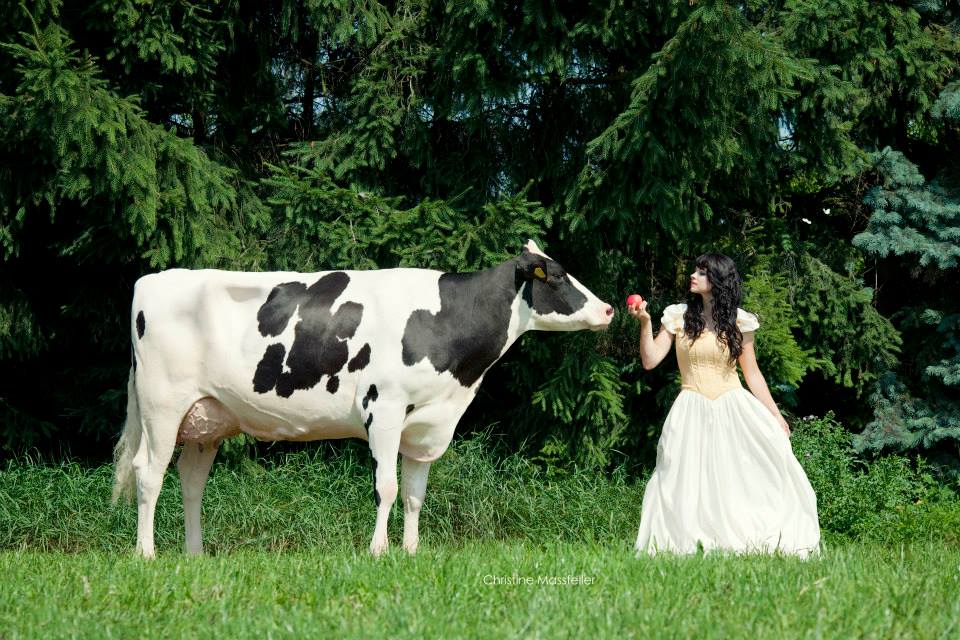
Calendar Cover - Schneewittchen - Snow White Cow: Girl (Graceland), Owner: Agrargenossenschaft Eibau Model: Constance Nagler.

Calendar Cover – Schneewittchen – Snow White
Cow: Girl (Graceland), Owner: Agrargenossenschaft Eibau
Model: Constance Nagler.

January

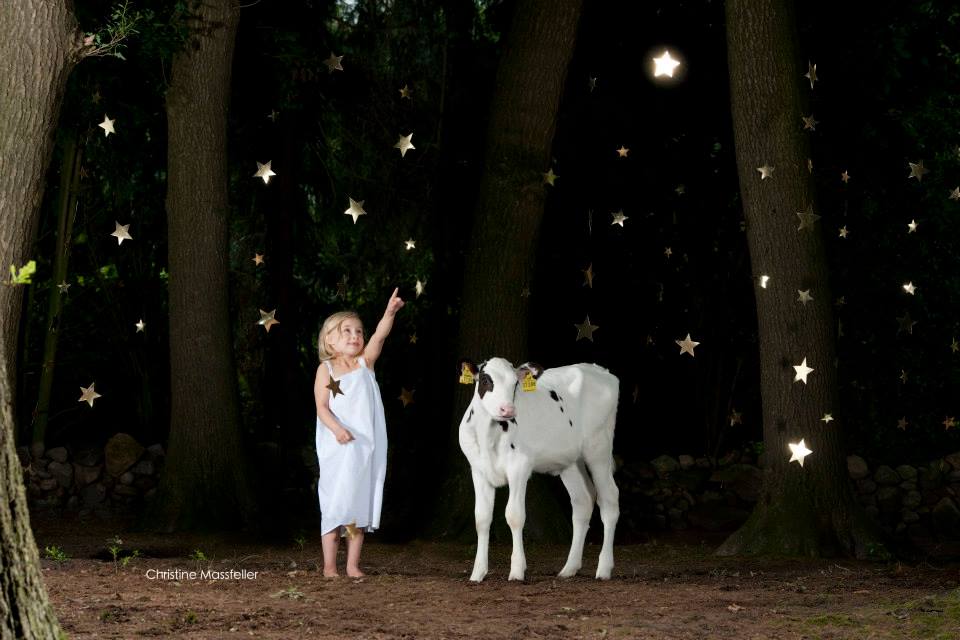
JANUARY Sterntaler – The Star Talers
Calf: WEU Pamela (Fanatic),
Owner: Perk, Spanharrenstaette

“Looking Back it was Early Exposure that Inspired the Times of her Life”

Let’s rewind the story a bit to discover where a passion for cows started for a girl who wasn’t raised on a farm but learned to love cows anyway. Christine recalls the beginning. “I grew up in a small town and fell in love with cows when I was a child, when my mom and I picked up milk from a very small dairy farm close by. It was always difficult for my mom to get me out of the barn again. I could watch cows and spend time with them for hours.” Surprisingly, or maybe not, Christine made this the inspiration for her education. “After school I went to university and studied Agricultural Science with the focus on Animal Nutrition, Genetics and Breeding.”  This was no passing fancy and it is a daily party of her life. “I love everything that has to do with cows. My boyfriend’s cows realize that every day. I absolutely love spoiling them.”

February

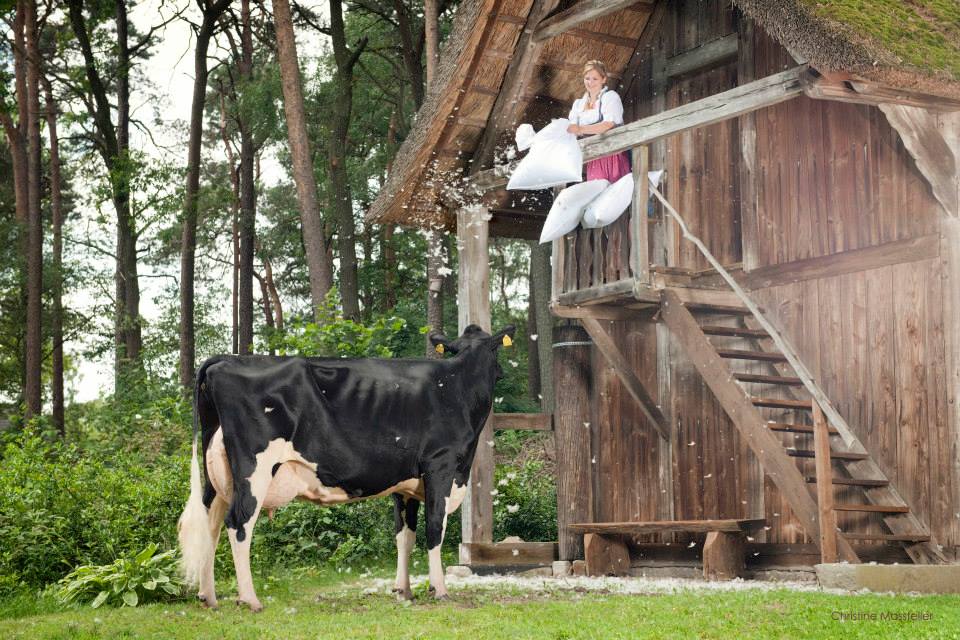
FEBRUARY Frau Holle
Cow: WHC Schira (Golden Eye),
Owner: Weseloh, Schneverdingen
Model: Marion

“It is Invaluable to Have Timely Mentoring.”

The next timely occurrence for this budding photographer was getting employed by Holstein International.  Christine describes it as, “The best thing that could ever happen to me.  The people are wonderful and I had a perfect start there.” This also marked the timely entry of a very important mentor. “I got the best teacher you can imagine in Han Hopman.”  Here was an opportunity that would make a big difference to Christine. “Han Hopman developed creative and natural cow photography. (Read more about Hans Hopman in Han Hopman: Shooting Straight at Holstein International) In the beginning of my HI career he spent a lot of time with me, teaching and showing me everything he knew: technical aspects, how to work with cows behavior, putting legs, composing images, communication with people and animals etc.”  No doubt this input inspired Christine to delve deeper into photography and, with the generous support of Holstein International, Christine furthered her studies.  “I did an official photography education at a renowned Dutch school.” And she continued to learn from her mentor. “The most important thing was that Han is such a good teacher and great and loyal boss. That saved so much time in making progress.” Indeed people are the main success factor for Christine. “Being a member of the editorial team of HI gives me the chance to learn so much about the dairy and breeding business from my colleagues and of course from the business itself and all the people I meet and work with.”  (To see more great work from Holstein International photography team click here)

March Cover

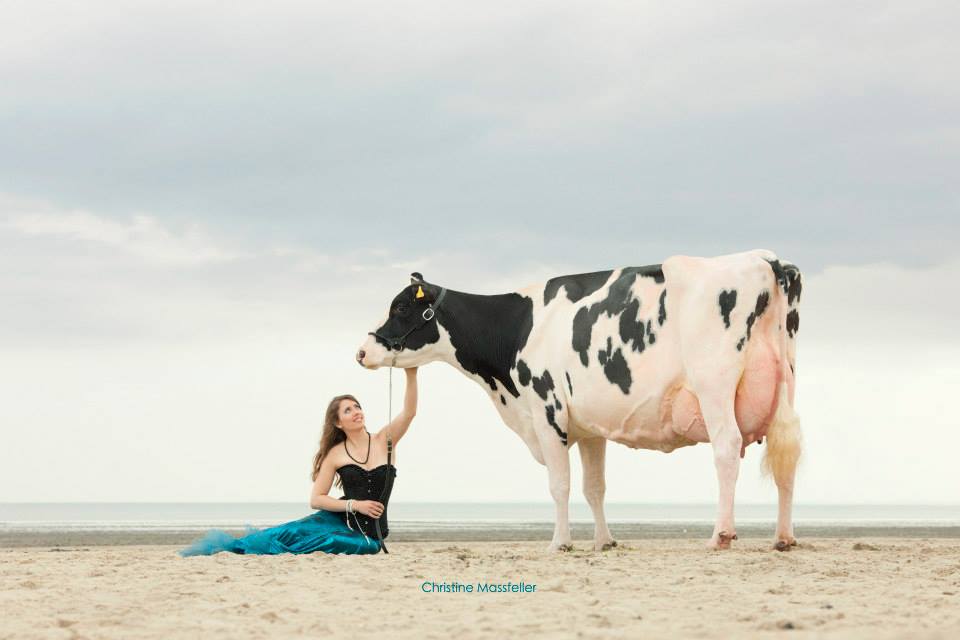
MARCH Kleine Meerjungfrau – Little Mermaid
Cow: BcH Caroli (Stylist),
Owner: Luenschen
Model: Rabea

“It should be possible to take ordinary cows and make them Extraordinary”

It is obvious that Christine Massfeller is a true cow passionista.  Who else would come up with an idea that basically meant sending out a casting call for cows? But that is just one part of the challenges that she enjoys when doing cattle photography which has so many facets to get right.  She numbers them.  “Bringing a cow into balance and getting out the best of every animal, scene and model. Making the best of every situation. Working with light.”  Cows constantly influence Christine’s imagination and her work. “For my photography education exam, I developed my series “Cows Surreal”. The idea was to put cows in scenes they naturally never would appear. The idea behind that was that almost every human in our modern world has contact with dairy animals, but not in a direct way. People buy milk and milk products in supermarkets but almost never see a cow in real. So I tried bringing cows back to people in an abstract way. This series is not yet finished. I will continue working on it soon. But with starting this series I got some worthwhile experiences with real complicated and difficult photo shoots.”

April Cover

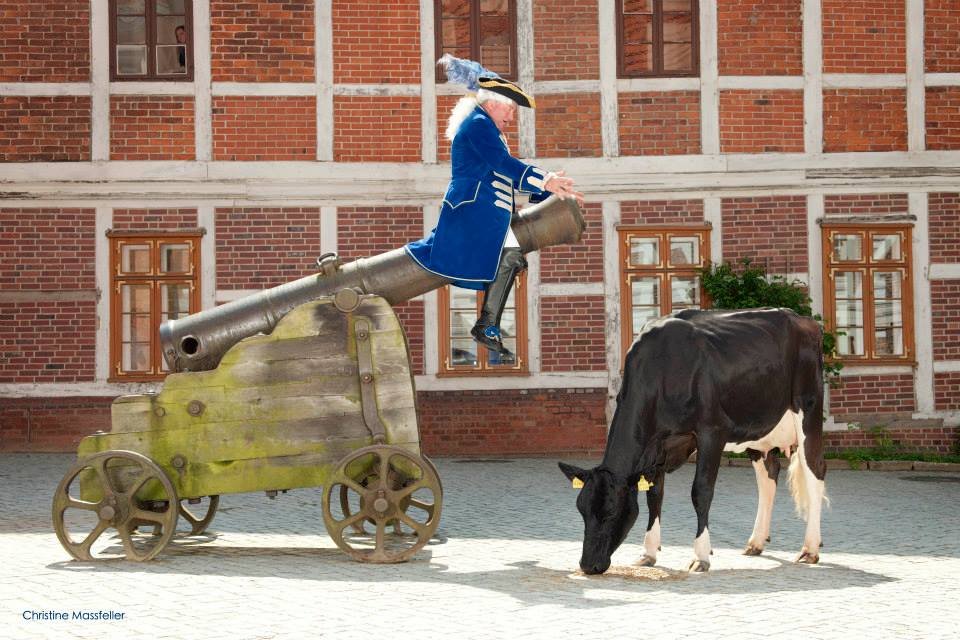
APRIL Baron von Muenchhausen
Cow: Kleopatra (Stempler),
Owner: Bertram, Hunden
Model: Gerhard

“They said ‘It Couldn’t Be Done!’”

Quite often it turns out that the best impetus for doing something exceptional happens when you’re told that it can’t be done.  Cow art, cow science and cow photography are not immune to naysayers.  In Christine Massfeller’s case she wanted to show the world a different perspective on cows. Not for her is the idea of “same old, same old.” She wants to take the whole experience for herself, her viewers … and even the settings the cattle are placed in to a whole new level.  “I had the idea to go a step further and I developed that fairytale idea. That would involve even more story telling. In the beginning it was very difficult to convince people that this could work. Too much effort.  Too expensive. Too Crazy.  Too Kitschy.”  So, of course, Christine didn’t give up. “The images were already finished in my head but most people I talked with first could not imagine how it would look like.” And then good timing entered the picture once again.  I got support from Han and he promised me we would do it together and publish it with HI.”

May Cover

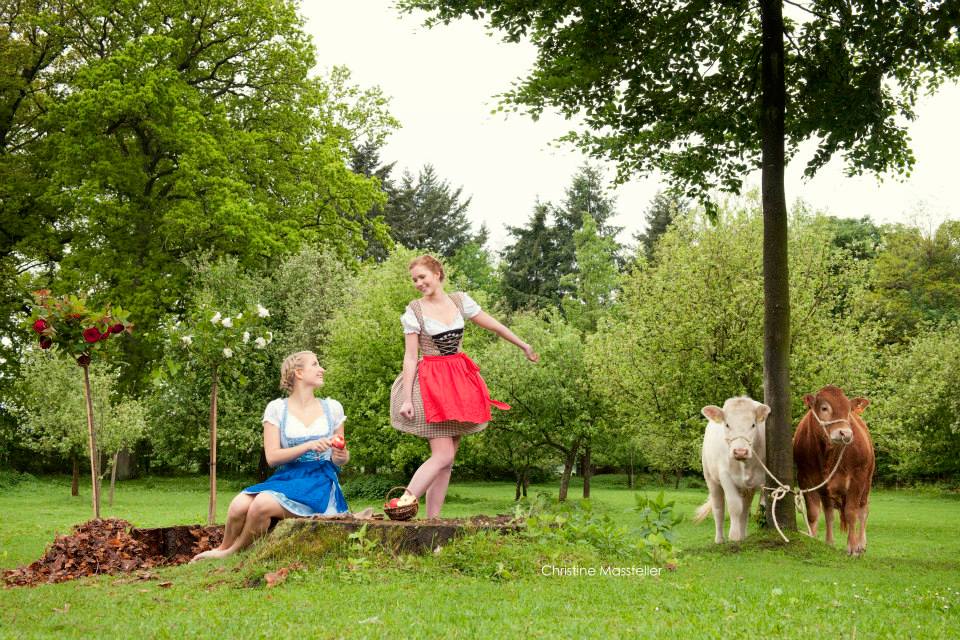
MAY Schneeweisschen & Rosenrot
Limousin bull and Charolais heifer owned by Ahrens GbR, Hespe
Models: Sophia Sparkles and Eva Wermert.

“It was a BIG idea for BIG Calendar that had found it’s Time!”

When all the necessary parts of a project come together — you just know that something big is going to happen. “Han has done a calendar for Masterrind almost every year for the last 10 years. Their calendars always have a special theme. We brought the fairytale idea to the table and immediately got some supporters, who were very enthusiastic about the idea. Then we worked out a plan and Masterrind decided to do it with us. It was a win win situation. Masterrind was a great partner and they organized everything perfectly.”

June Cover

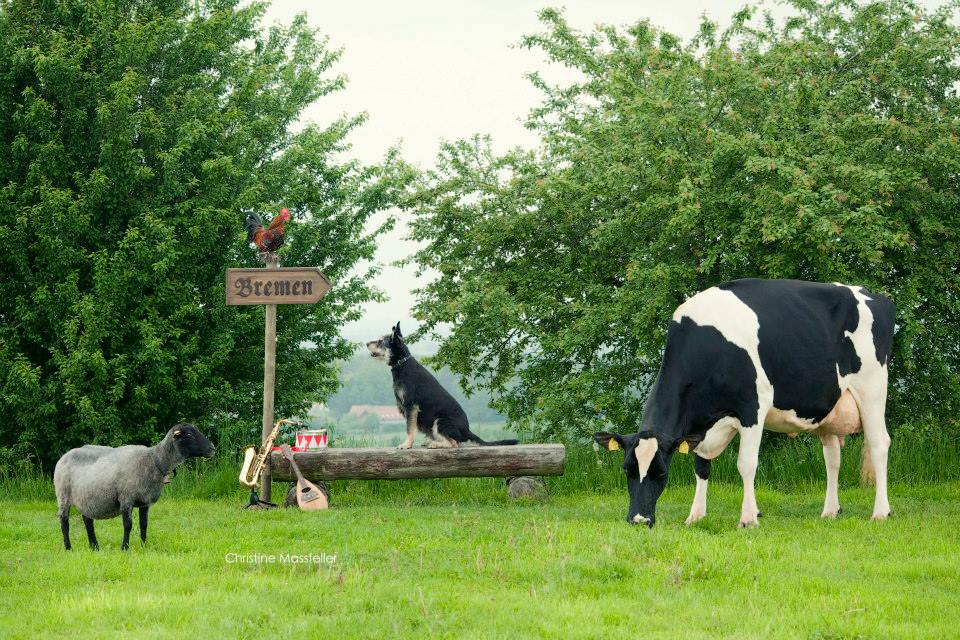
JUNE Bremer Stadtmusikanten – The Bremen Town Musicians
Cow: Schnicka (Donley), Owner: Hoeft, Bramstedt
sheep (14 year old Erna) and cock (still alive!!) owned by Evers family, Syke; dog Winnie owned by Hermann Bischoff

“Making it Look Simple Requires A Lot of Work”

With approval for the project, it was time to put in the hard work. “We had quite a few meetings and developed everything, the scenes, how the cows should look like, the human models, the costumes and everything else.” Although cows were the stars, it took a lot of people to pull it off. |Christine gives credit to the large behind-the-scenes-team. “It took everyone pulling together. There was the Masterrind organization, their PR department, some of their classifiers who selected the cows (and also helped washing & clipping them, organized the transportation to the scenes), the human models (some of them Masterrind employees or their kids, some of them from my soccer team), the cow models, the breeders of the cows who prepared their animals, professional hairdressers and makeup artists.”  Christine feels that having such an enthusiastic team was a key ingredient of the project’s success. “It was really wonderful to work with such great people (and cows) who did such a good job, even though they had no experience with such a project (me either)!”

July Cover

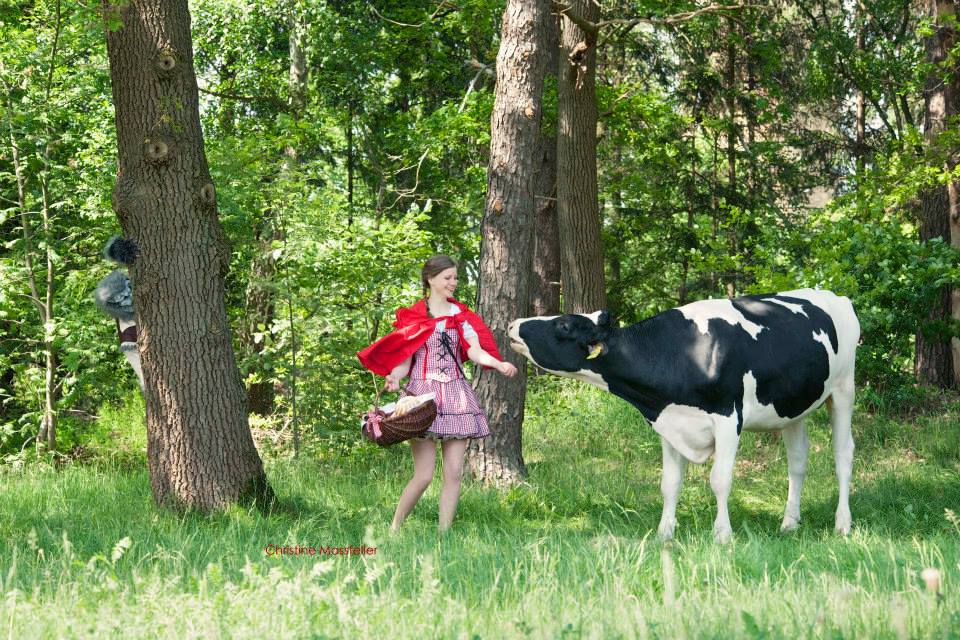
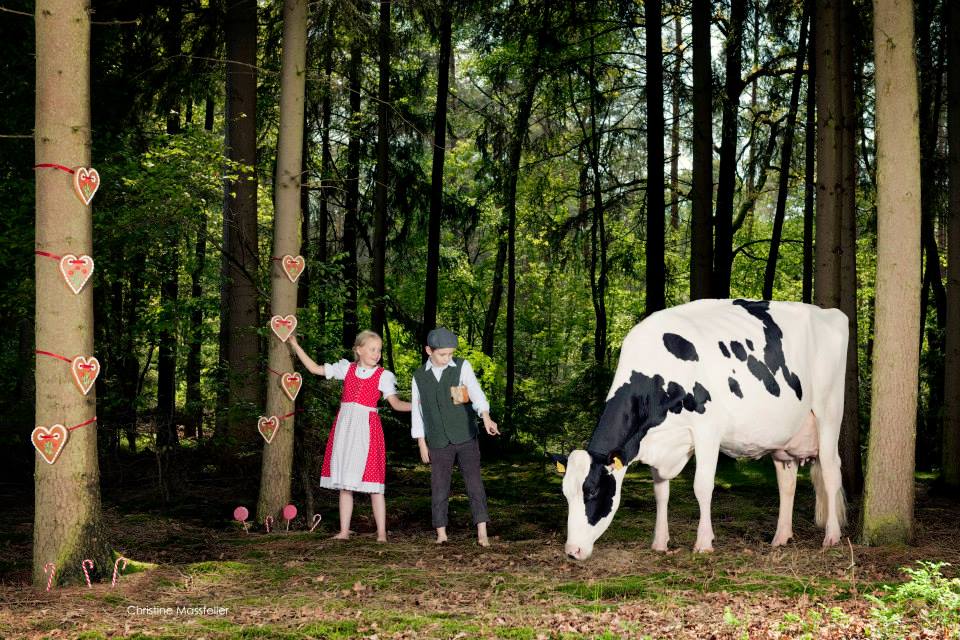
JULY Rotkaeppchen – Little Red Riding Hood
Bull: Smokin Joe (Observer), MASTERRIND
Model: Carolin
Wolf: Hermann Bischoff

August Cover

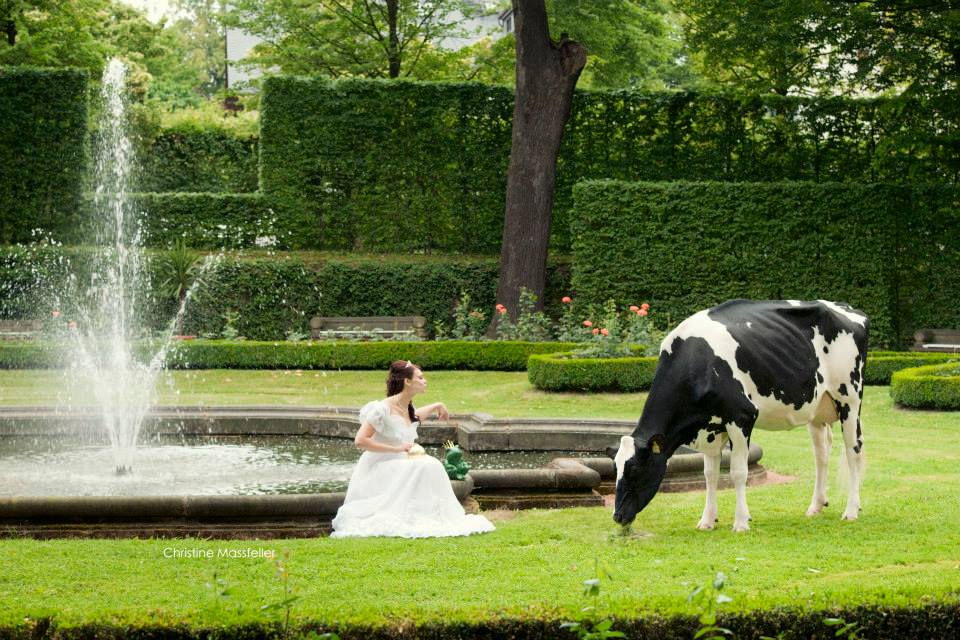
AUGUST Froschkoenig – The Princess & the Frog
Cow: FUX Sia (Alexander), owner: Hahn/Radtke GbR
Model: Teresa Kempe.

“The Fairy Tale Ending is A Pleasant Surprise”

When you plan a fairytale photo shoot, it would be nice to assume that it would end happily ever after.  Even with her passion for dairy cows, Christine has been pleasantly surprised at how the project has been received. “Honestly I did not expect such a big response. Masterrind gave the calendar to their members (in Germany the AIs are owned by their local breeders) and clients. It was out before 2014 started. We got many emails from people who wanted to buy one, also from people who are not in our business.”  (To order your copy of the keep sake Calendar click here)

September Cover

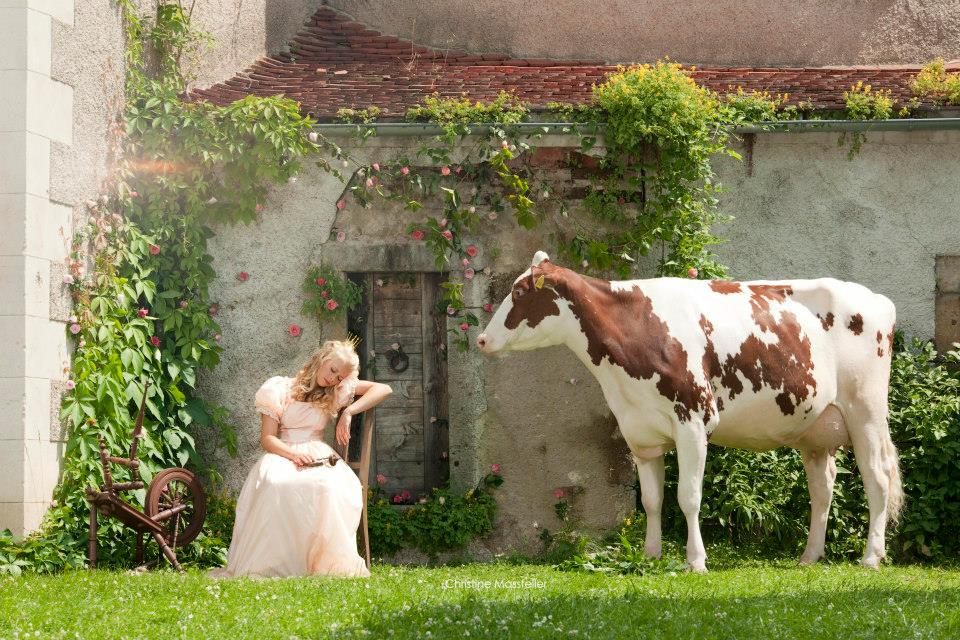
SEPTEMBER Dornroeschen – Sleeping Beauty
Cow: Jolli (Jotan), owner: Agrargenossenschaft Bockendorf eG
Model: Lori

October Cover

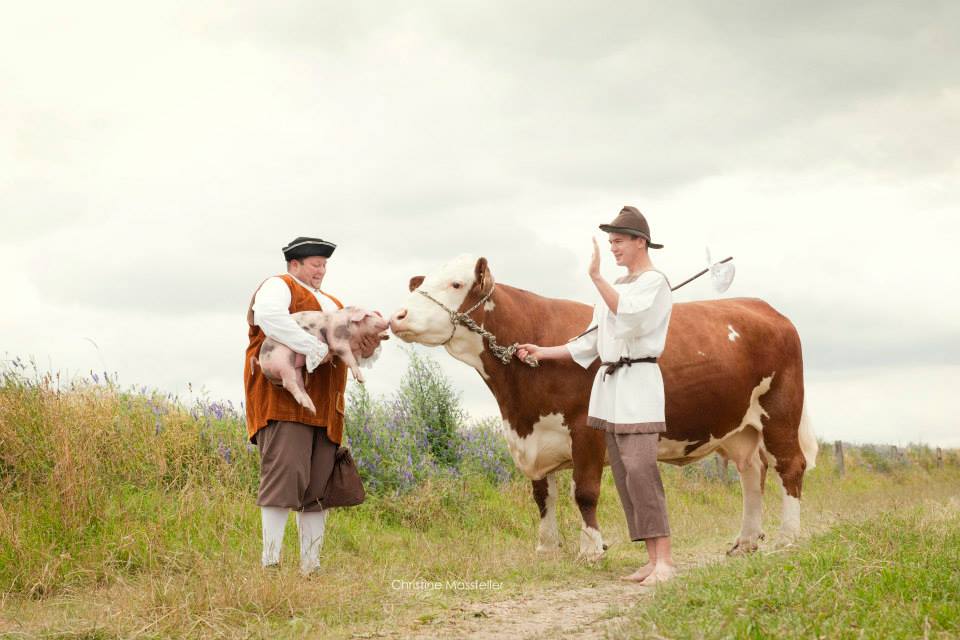
OCTOBER Hans im Glueck – Lucky Hans
Cow: Silva, owner: KÖG Kleinbardau
Models: Thomas & Thomas

“Dreamscapes Inspire a Dream Job”

Loving what you do every day is a dream that many wish they could fulfill.  Christine makes it look easy and inspiring, but she has eight steps that comprise her best advice to someone who would like to follow their photography dream: Work hard. Find a good teacher. Listen at the right moment. Don’t listen at the right moment. Be a better photographer then Photoshopper. Develop your own thing. Be open. Be always respectful to people and cows you are working with.” Christine is more than willing to take her own advice and adds a couple more action steps. “Staying healthy and open minded. Keep on working for HI. Keeping learning, because photography gets more and more difficult the deeper you get into it. It’s a big process.” Her dearest dream is to keep developing new ideas and producing the ideas that come up.” She sums it up enthusiastically. “There are so many pictures in my head that need to be taken!”

November Cover

NOVEMBER Haensel & Gretel
Cow: Litt Leo (Radenko), owner: Wortmann GbR, Morsum

december

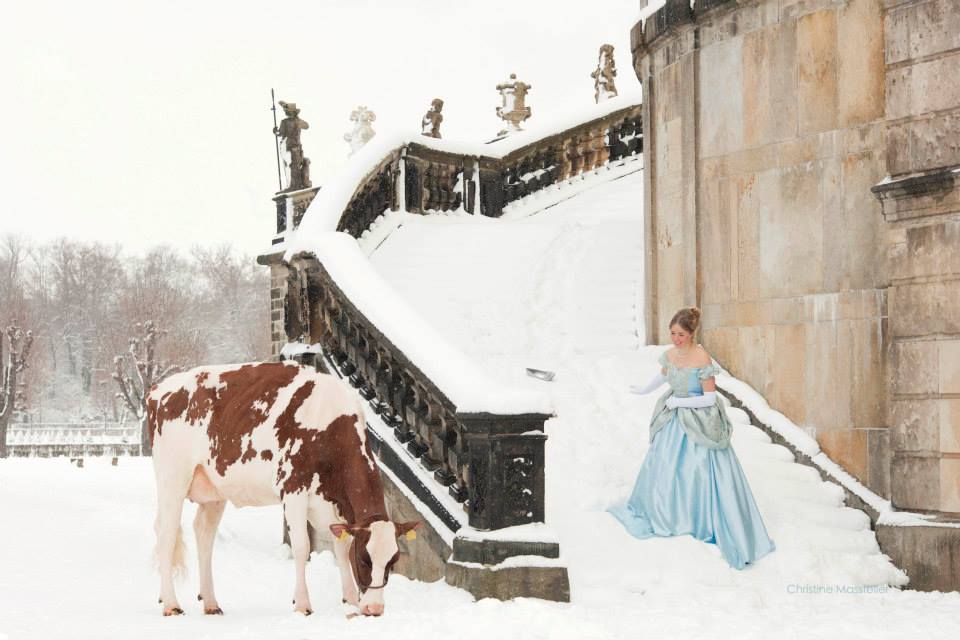
DECEMBER Aschenputtel – Cinderella
Cow: Jess (Starfire), owner: Pfaff, Gahlenz
Model: Nicole
Castle: Schloss Moritzburg, Sachsen

The Bullvine Bottom Line

Not only have dairy calendars been taken in a totally unprecedented direction but so have the cows that are our daily inspiration.  With the turning of every page, there is a new dairy dimension to be celebrated.  Congratulations to you Christine Massfeller for sharing your wonderful images and giving us insight and inspiration for every dairy day of the calendar year. (To order your copy of the keep sake Calendar click here)


Get original “Bullvine” content sent straight to your email inbox for free.


[related-posts-thumbnails]


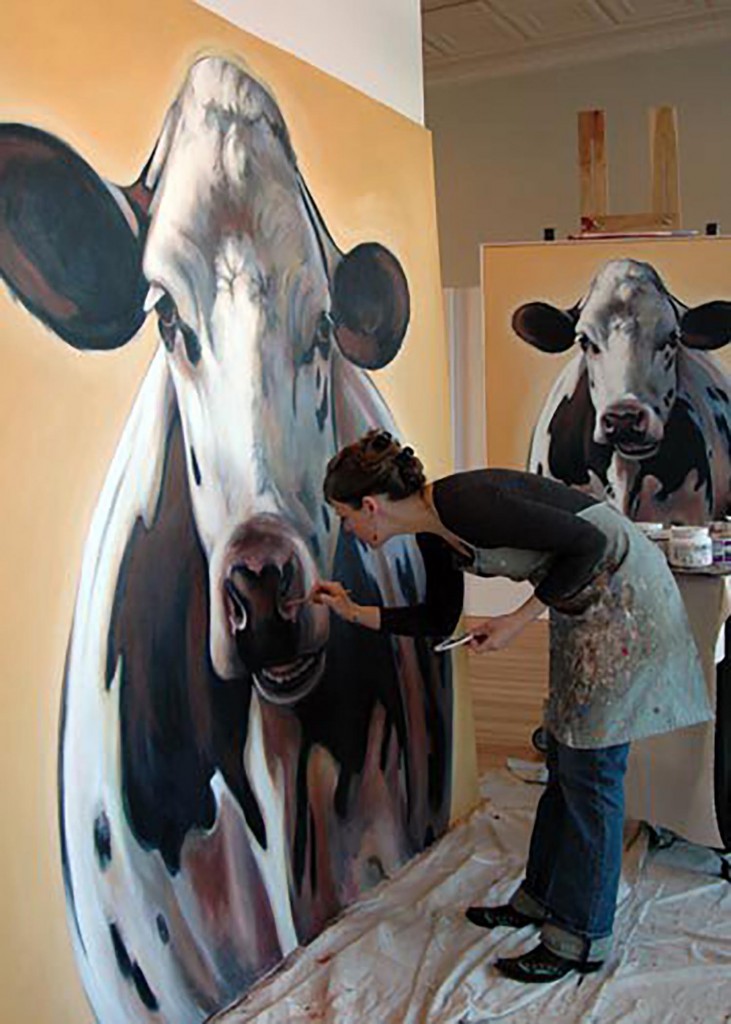
Steel Cow’s Valerie Miller: Larger than Life with Her Cow Girls

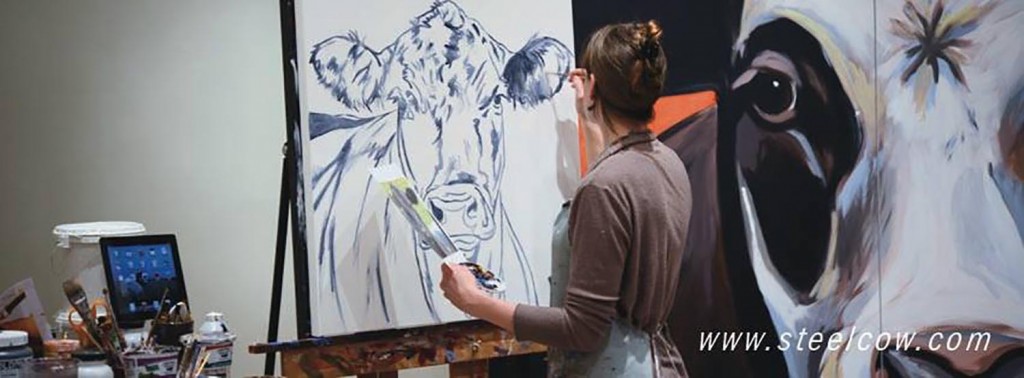
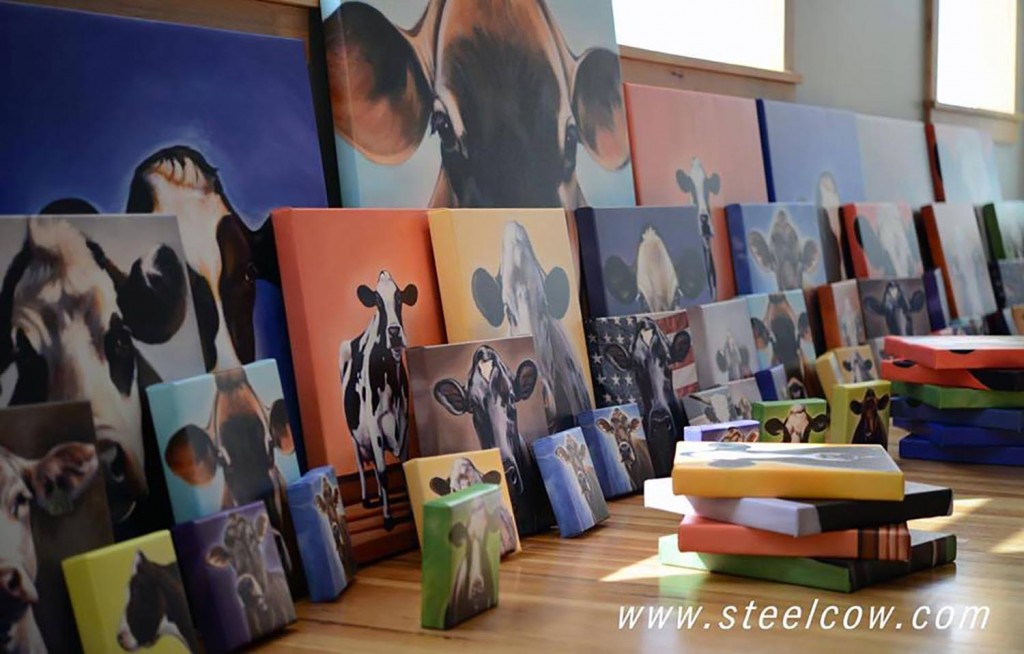
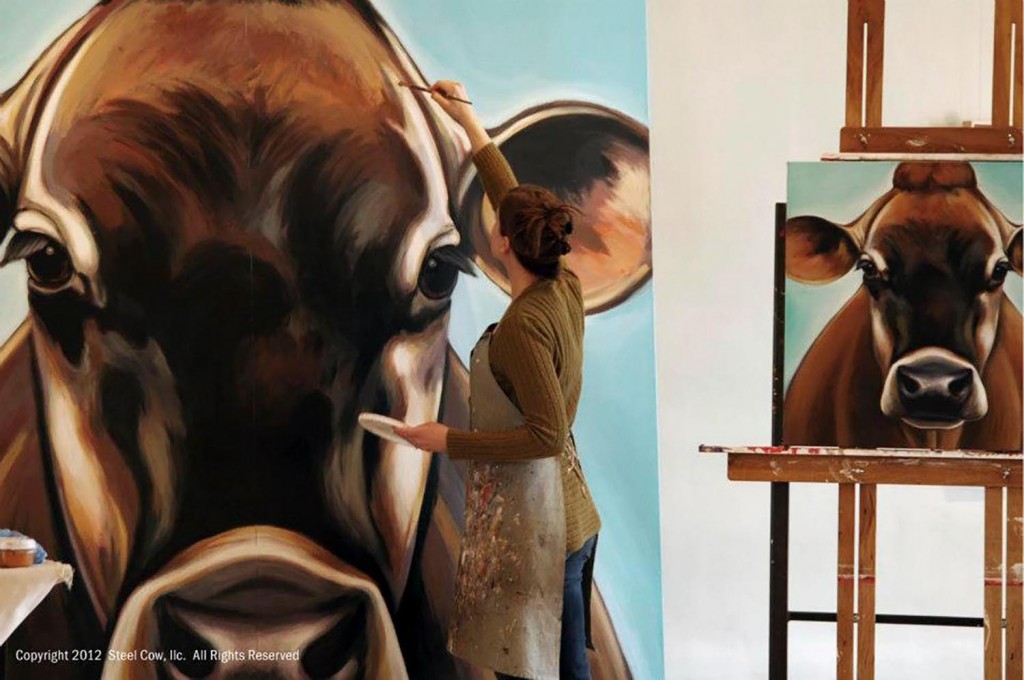
Although she is neither a dairy breeder nor a show ring competitor, artist Valerie Miller nevertheless is completely hands on in her relationship with cows. This passionate painter not only paints her girls larger than life but she also aligns their bovine characteristics with dear family members and friends.

Valerie and Norma

Creating from Nature and Nurture with Help from Cousins and Cows

It’s quite true that not all dairy lovers are born and raised on a dairy farm.  Valerie explains her country connection and how it has been multi-faceted and rewarding over several generations. “I have a long history in my family of people making a living through working with animals. My mom’s side of my family founded (and still run) Impro Products, a leader in natural solutions to livestock production and dairying for over 50 years. I have uncles and cousins who are dairy farmers and two of my uncles and their families have W.W. Homestead Dairy – a local dairy in Waukon, Iowa (where we live) that locally produces and processes a full dairy product line. I also have an aunt, uncle, and first cousin who are Veterinarians. We live in Northeast Iowa, a rural area of the Midwest that has beautiful gently rolling hills, and we have quite a few dairy farms around here.  Growing up I loved visiting and spending time on my uncles’ farms, as well as the farms of my friends – actually I still love spending time on their farms!”

Valerie and Paula

Encouraged by Mom, Masters and Mentors

Valerie was creatively inspired by her rural heritage and happily points out how fortunate she was in the mentors in her life. “Growing up my mom was a huge influence on me and encouraged me artistically as much as she could. She would always buy me art supplies for my birthday and Christmas, and would help me learn how to use the art supplies together. She would frequently say that she wanted to be an artist but her parents wouldn’t let her, so I could be anything I wanted. She also loves telling people she taught me everything I know.” With that supportive start, Valerie was eager to meet other creative role models and she was fortunate there too. “Larsh Bristol was a professional photographer and a friend of my dad’s. After high school Larsh and I would have art shows together, and he would teach me things about making a living through art, among other things. Larsh was a big influence on me, and still is even though he passed on after a terrible car crash several years ago.” She is also an eager and avid student of famous painters. “From a historical painting perspective, I love the works of Mark Rothco, Winslow Homer, Andrew Wyeth, Georgia O’Keefe and Edward Hopper. I used to spend hours poring over their paintings in books that I had either checked out from the library or bought with birthday money. Their paintings were so beautiful to me and I hoped one day I would be able to create something as beautiful as their paintings.”

Valerie and Virginia

Valerie Adapts to Cows, Canvas and a Career

Homing in on a fulfilling career is something everyone strives for and Valerie reports that she got off to a quick start. “I knew from an early age that I wanted to be a painter. (I think in kindergarten I was telling people I was going to grow up to be an artist.) So, even though I have an art degree in studio art with a concentration in painting from Bradley University and a marketing degree from the University of Iowa, I was painting as much as I could from about 8th grade. I painted from photos I took myself, ones I found in books, and read and followed along to every type of painting book I could.” She looks back on how she started amassing her photo inspirations. “I first started messing around with my dad’s old SLR camera when I was in high school. I would take a lot of photos of friends, animals, and of course cows. As I went into college, I took some photography classes to learn more about cameras and how to use them to achieve what I wanted them to do.”

1658533_10152093951009232_1349053411_o[1]

“Valerie, Valerie, How Does Your Gallery Grow?”

My husband and I met the first week in college, and about a week later we were pretty much inseparable. He was majoring in sculpture and I was majoring in painting. We used to talk about opening up a gallery/store together somewhere and so we came upon the name of Steel Cow as it was a combination of both of us – he was using a lot of steel in his sculptures and I was painting cows. After we got married in 2003, we spent a few months deciding where to locate. After countless hours on the internet looking at places and traveling around a bit, we couldn’t find “the perfect place,” so we decided to open a store in a family building in Waukon on a temporary basis.” For Valerie and Josh temporary is enjoying an extended stay in this rural town.

The Girls

The Artists’ Journey Travels Down the Waukon Road

It might not be the first place to come to mind for establishing an arts based lifestyle but this town in rural Iowa is working well for Valerie and Josh. “Waukon is a great place to live and raise a family, but there are not a lot of stores around here, and there are quite a few empty buildings in our small rural town. Steel Cow opened our doors 10 years ago this month. I hung up my cow paintings (at the time I was also painting dog portraits), and Josh is a cabinetmaker, and he displayed his very cool handmade furniture and cabinets. As time went on, we adjusted and tweaked our businesses to make them work for where we were living.” It becomes apparent that, in a similar way to the multiple skills that dairy farmers must call on every day, Josh and Valerie have dug deeply to enhance and grow skills beyond their chosen arts. “The building we are in was built by my grandfather’s grandfather in the ’20’s as a furniture store, so it was really neat to have the building being used for something in the family again. About 5 years into it, we bought the building from my parents and completely renovated the whole space ourselves. Talk about exhausting! Josh wouldn’t say so, because he comes from a line of contractors and work to them is like food. But, I thought I was going to die when I had to sand the floors. Luckily I survived and have a much greater appreciation for what it takes to renovate an old building. I just wish the elevator still worked! I spent an entire winter one year cleaning and painting the third floor ceiling. The building is three floors plus a basement and has tin ceilings and original floors, so it has quite a bit of character.”

1962846_10152118235424232_1347842388_n[1]Out of the Barn and Into the Gallery

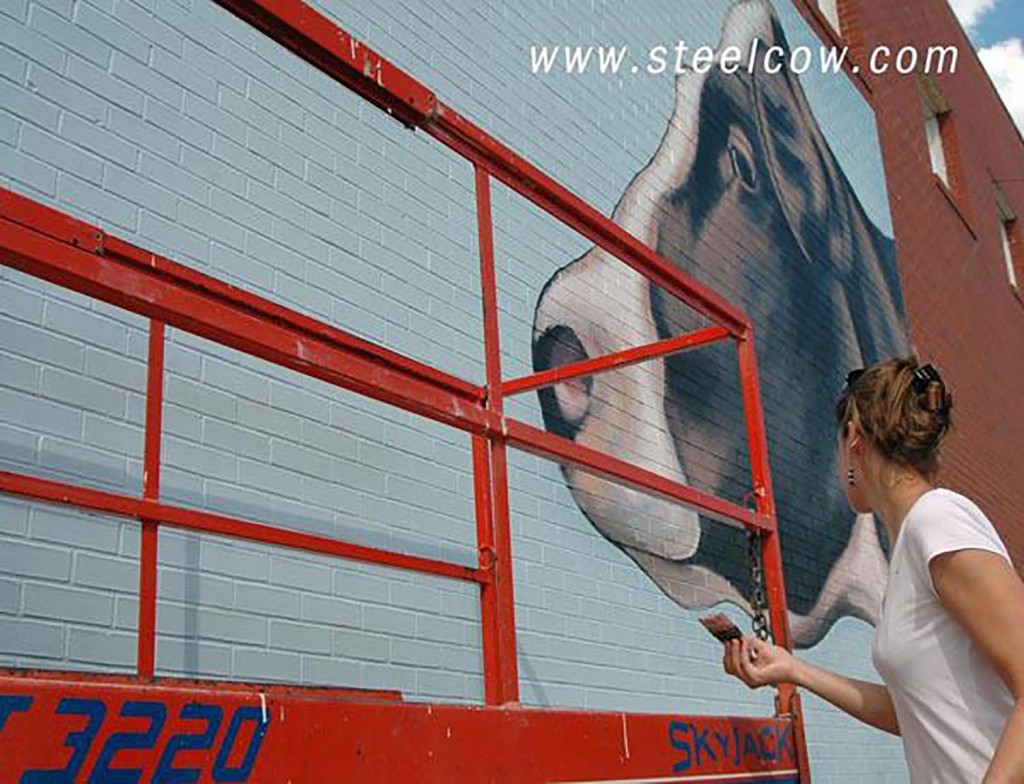
The young couple has really paid their dues to create the space that is just right for them to grow their family and their business says Valerie. “We live on the third floor, Josh and I have studios on the second floor, we have a retail space on first floor, and we have a bit of a catch all in the basement. A couple of years ago we were able to purchase a shed behind our store and we took the parking space in front of it and turned it into a garden complete with an 8 foot outdoor mural of Greta. We love it, and are so happy we stayed in Waukon and are continuing to grow Steel Cow.”

When Cows on Canvas Connect with Admirers

It is easy to imagine how surprised visitors are to see the Steel Cow gallery upon their first visit.  It isn’t every day that dairy cows go from milking parlor moos to artist’s muse (Sorry! Couldn’t resist).   Valerie too recognizes how unusual some might think that her career has been. “ I think my greatest accomplishment has been simply making a living at painting cows from a small town in Northeast Iowa. Although there are a lot of dairy cows around here, there are not a lot of people, so my husband and I have had to learn a lot of things along the way (and we are still learning!).” It takes persistence and dedication admits this entrepreneur. “So far, so good! Cow paintings aren’t everyone’s cup of tea, so I don’t think they are as popular as landscape paintings, or flower paintings, but it’s fun to hear people tell me why they like my paintings, or that one of my paintings reminds them of their cow, the cow they had as a kid, or simply reminds them of when they visited their grandparents farm as a kid.” Obviously connecting people, cows and memories are important to this artist who hopes that her future will include her husband Josh, their one and a half year old son Eddie, her sister and brother-in-law and their one and a half year old daughter because whatever the adventures ahead she say “I would want them with to join me because I would not want to live without them, and if we were together, it could be fun.”

1797347_10152101531354232_270432191_n[1]

“I Love All of My Gallery Girls”

Every painter feels a connection to the painted subject matter.  Valerie is emphatic. “One thing I will always do is paint cows. As long as I am creating art in a way that is enjoyable, challenging, and rewarding and am able to share that with others …… I will be happy.” That happiness has brought her close to all of her cow girls.  So much so, that choosing a favorite is difficult.

“Oh, that’s a tough one!” she admits. “It depends on the day. I like each painting to be better than the last, but that doesn’t always happen. As a cow, I like Queenie the best as she was the perfect matriarch of a local herd of dairy cows. I really like Virginia (she is chewing) and she reminds me of my great aunt who was always eating. I kept the original painting of Virginia and have her hanging in my kitchen. I am also fond of Dorothy as I first fell in love with cows when I met some Brown Swiss. Since I call the cow paintings “The Girls” and name most of them after family and friends it’s kind of like trying to pick my favorite relative (in which case I should say Greta because she is my sister.)” It’s obvious that Valerie’s heart is a large part of her artistry.

Valerie and Greta

There’s A Cow in Waukon Library

“In my immediate future I am finishing a mural of Tippie the Cow at our local library.”  Those who know Valerie are probably well aware of her project to raise funds for the Tippie Business School at the University of Iowa. “I owe so much to what they gave me, I simply want to give back something.” Expanding her artistic vision also includes another project. “I have been working on an A-Z kids book with the letters of the alphabet being the first name of “The Girls” and I hope to have it complete later this year.  Hopefully my future holds lots of murals, new paintings, and more trips to meet cows across the globe. I also have plans on adding other farm animals including pigs, goats, sheep, donkeys, chickens, horses and, of course, “The Boys.”  Oh to be that cow on the library wall and listen in to Valerie’s plans for the future.  However, she is shy about sharing. “ I have a lot of goals for the future, but I don’t really like to share them as the details are always changing.”  She also feels her art is evolving. “I would say my style is a contemporary representational depiction of cows. I like to strip the background away, take the cow out of context, and paint a solid color in the background. This way the painting focuses on the cow herself, and hopefully allows the viewer to connect with the animal up close and personal. I paint the cow representationally, but I do take “artistic license” and sometimes paint them a bit more whimsical. As I am going along in my artistic career, I am painting “The girls” more and more realistically and closer to how they actually look.”

1014793_10151559776059232_1406254681_o[1]

The Bullvine Bottom Line

When you admire Valerie’s paintings it’s not about dairy conformation or bovine genetics.  Valerie paints to capture the story.  The story of the cow.  The strength resulting from that connection is a celebration of hands on artistry.  Steel Cows. The connection between cows and the people who love them.

Be sure to check out the Steel Cow Facebook page as well.


Get original “Bullvine” content sent straight to your email inbox for free.


[related-posts-thumbnails]

Hellender Holsteins: From Hell and Back

56250[1]It’s hard to imagine what path you would take as a dairy breeder if you were facing the loss of your entire herd. Anton Ender faced that decision in 1981 when his whole herd of elite Brown Swiss cows had to be slaughtered due to disease. For him the next step was to move forward with Holstein cows. Anton’s son Thomas Ender explains the decision simply. “He chose Holsteins because of their willingness to produce.” Today Hellender Holsteins, which is located just 30 minutes from downtown Zurich, is comprised of 23 hectares, 25 milking cows and about 40 heifers and calves. The free stall housing was built in 1991. Anton’s sons Thomas and Andreas are involved in the operation but both of them have full time jobs off the farm.  Thomas is the Head Classifier in Switzerland and responsible for all the breeding and marketing of the Hellender herd. Andreas works as a nutritionist and is on the farm on a daily basis and will take over in the near future.
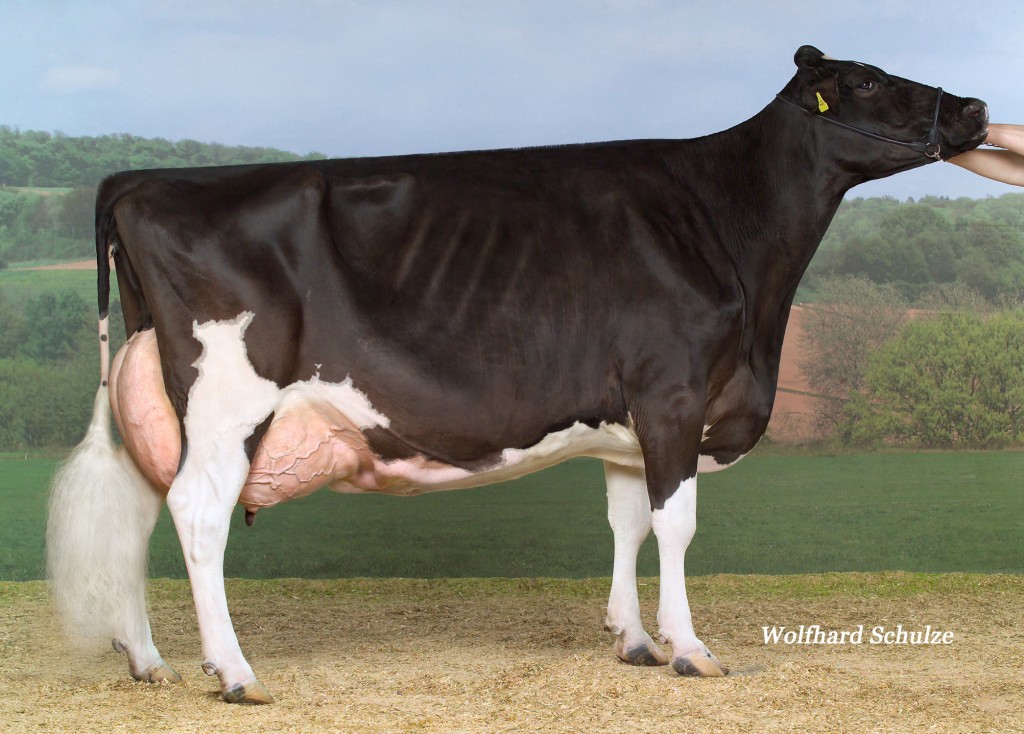
“Targeted Milk Production.  Exceptional Show Performance”

Production attracted Anton Ender to Holsteins and it remains the highest priority. “At the outset they have to be productive.” says Thomas who outlines the Ender breeding philosophy. “We always select for productive cows that last. They don’t have to be the big time producers in their first lactation, but they do need to get better every year.” He zeroes in on how this is done. “The key to achieving this goal begins with great conformation and especially well attached udders.” Of course this has produced great looking animals and a very successful side effect in the success that they have had in the show ring. “We really like to show cows, but never bred for it. Production is the first priority.” Having said that, Thomas acknowledges that the show ring is important to the dairy operation. “The biggest part of our marketing is the participation on the Shows. With this success behind us, it is a great opening for marketing your genetics through the Internet, sales or on a private basis, because the link to the buyer has been created.”

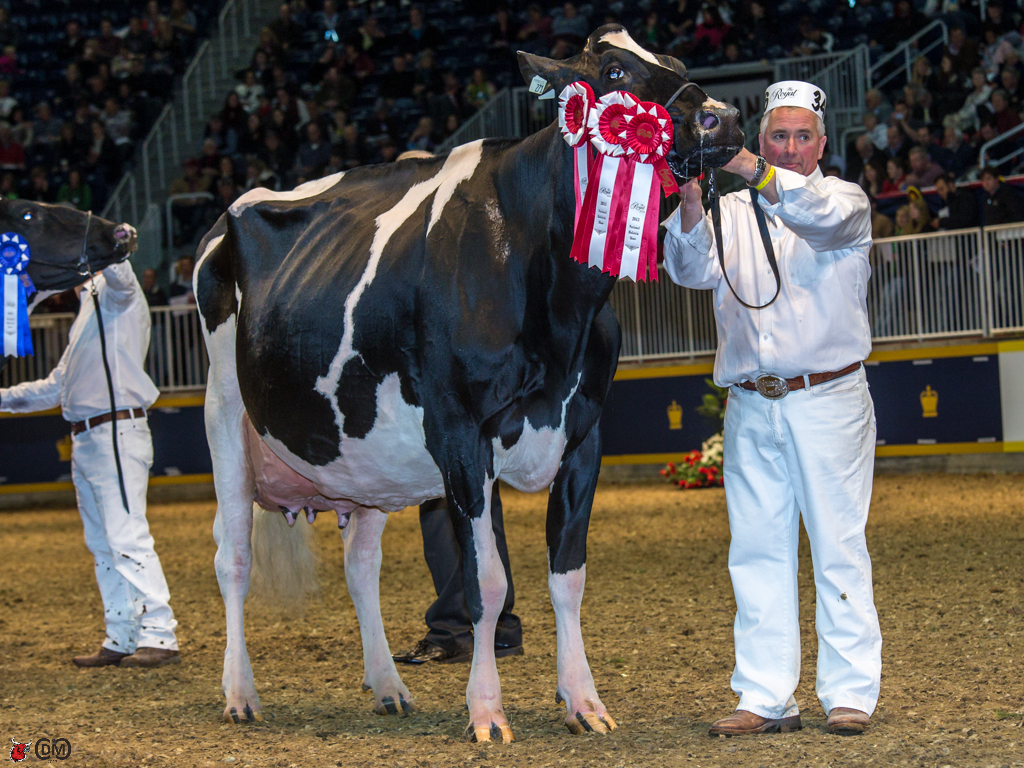
Hellender Juror Jurgolin EX-92-CH 6E 11*     Supreme Champion & Hon Ment Best Udder Brunegg '11     1st at the Swiss Expo in '08 and '09 & 3rd in '11     Dam to COLIN (s. Champion) @ Swiss Genetics! #4 Swiss ISEL Bull (12/12)     Dam to the Hon. Mention Gr. Champion Swiss Expo '11: CALANDA     Jurgolin is in 8th lactation and already over 110.000 kg milk lifetime production!     She has 1 EX-94-2E dtr, 1 EX-94-3E dtr and 1 EX-95-3E daughter! Picture in 7th lactation

Hellender Juror Jurgolin EX-92-CH 6E 11*
Supreme Champion & Hon Ment Best Udder Brunegg ’11
1st at the Swiss Expo in ’08 and ’09 & 3rd in ’11
Dam to COLIN (s. Champion) @ Swiss Genetics! #4 Swiss ISEL Bull (12/12)
Dam to the Hon. Mention Gr. Champion Swiss Expo ’11: CALANDA
Jurgolin is in 8th lactation and already over 110.000 kg milk lifetime production!
She has 1 EX-94-2E dtr, 1 EX-94-3E dtr and 1 EX-95-3E daughter!
Picture in 7th lactation

Small Steps.  Big Success Now and in the Future.

There are always special animals that rise to the top of individual breeding programs and for Hellender Holsteins it was the Jurgolin Juror cow family. “Without any doubt the greatest cow we ever had and still have the pleasure to work with is Hellender Juror Jurgolin EX-92 6E GM 13*. She keeps impressing us with her own performance as she has already produced 125000kg of milk with really high components. Furthermore she twice topped the production cow class at the renowned Swiss’Expo.” Such achievements would make any breeder proud but Jurgolin is leaving a legacy as well. “The best thing about this hard working, zero problem cow is her progeny. Already 3 of Jurgolin’s daughters are classified EX-94 and EX-95 and there will be more great young cows to come.” Adding strength on the sire side is another achievement for Jurgolin. “Her son is the former N°1 bull in Switzerland and was sold out in a record time period.” Thomas explains the decision process that led to this success. “The mating was chosen to increase the production of her dam by Dixellen Design, which had really high components. Also could she have had a tighter attached udder but had excellent feet and legs, which made Juror a great mating sire for her.”

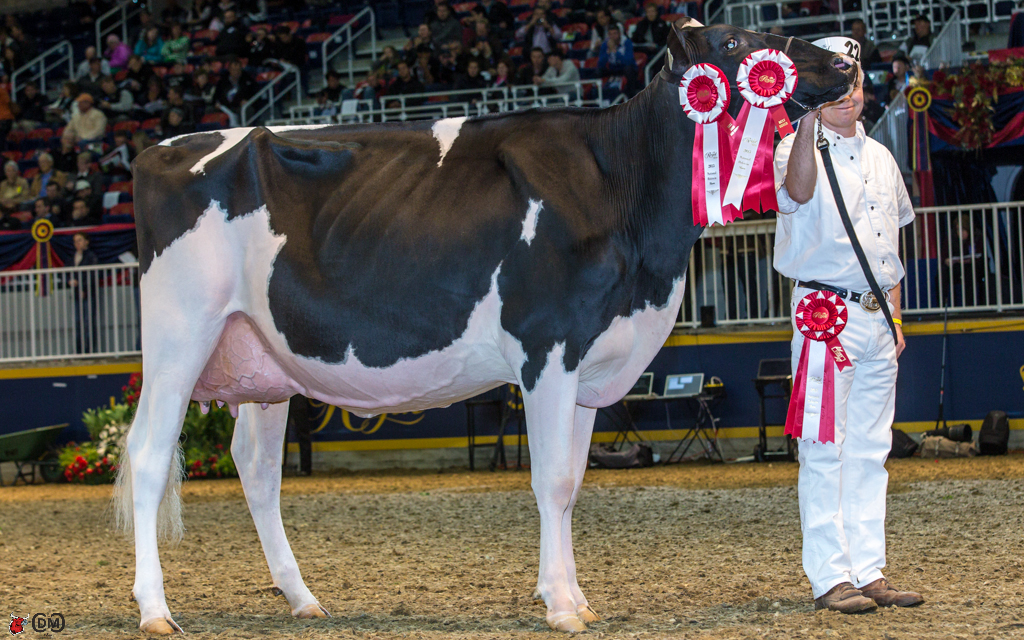
Hellender Champion Calanda EX-95-SW 3E      1st & Hon. Mention Champion Swiss Expo 2010     1st Swiss Expo Lausanne 2013     Supreme Champion Elite Show Brunegg 2010     1st National Expo Bulle 2010     Full sister to Hellender COLIN @ Swiss Genetics     She has a Windbrook son with skyhigh Genomics @ Swiss Genetics     Combined owned by: J. & C. Rey, P. Deru & Hellender Holsteins

Hellender Champion Calanda EX-95-SW 3E
1st & Hon. Mention Champion Swiss Expo 2010
1st Swiss Expo Lausanne 2013
Supreme Champion Elite Show Brunegg 2010
1st National Expo Bulle 2010
Champion x Hellender Juror Jurgolin EX-92-SW 6E
Combined owned by: J. & C. Rey, P. Deru & Hellender Holsteins

From a Small Start to Grand Successes

It is quite clear to see that, despite the traumatic cause of their start into Holsteins, Hellender building an outstanding herd.  Thomas outlines current breeding lines. “Right now we are still working with the foundation cow of the family, Juror Jurgolin. But we also are building through her daughters by Champion and Goldwyn. The next generation of great ones will come up through the Dempseys and a Knowledge out of the Champions and a Hvezda with RC as well as a Windbrook straight out of Jurgolin.” The shine on the future is also being fulfilled in the show ring. “We own two milking Goldwyns out of Vangoh Durham Treasure EX-96 3E that have been really successful in the showring and that are fresh with their second calves and ready to be flushed. Treasure caught my eye being late maturing and showing a perfect udder already as a young cow.” New purchases are showing possibilities too. “We just purchased the Top Seller of the Riedmuellers Holstein Complete Dispersal, Bolton Chantal VG 2y, a show winning daughter out of Champion Cresta then Durham, Encore, Cinder and Tony Rae EX-96. This bull dam has a very high production in a great mammary system and shows us lots of potential in the show ring as well. Thomas modestly identifies the Ender family’s blossoming success. “I think we consider our greatest accomplishment is that we started with a herd of 25 cows and have been able to develop a successful cow family whose progeny is doing well in France, Germany, Austria, Italy, Denmark and Belgium.”

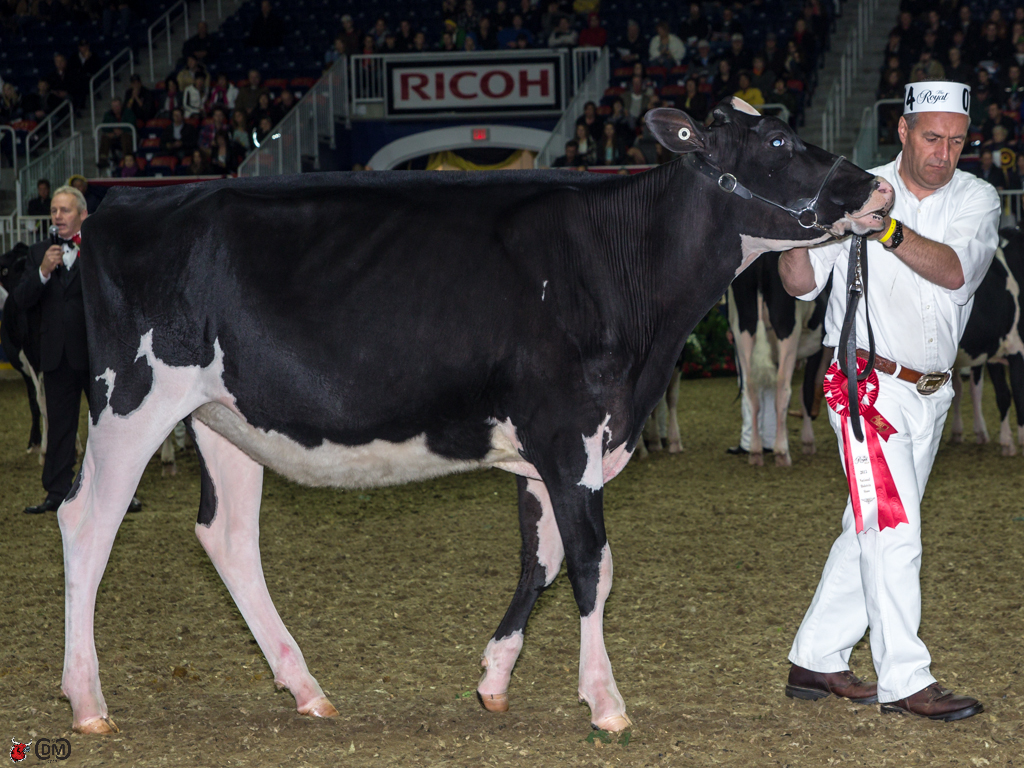
Hellender Champion Corina EX-94-SW 3E      Supreme Champion Argovie-Expo 2013     1st & Res. Champion & Best Udder Brunegg '11     1st Expo Bulle '09 and 3rd Expo Bulle '11     3rd Swiss Expo Lausanne '09 and 3rd Swiss Expo Lausanne '13     Supreme Champoin & Best Udder Elite Show Brunegg '09     Supreme Champion Luga Luzern '09     1st & Res. Jr. Champion Elite Show '08     Swiss Holsteins Cow of the Year '14 Champion x Hellender Juror Jurgolin EX-92-SW 6E

Hellender Champion Corina EX-94-SW 3E
Supreme Champion Argovie-Expo 2013
1st & Res. Champion & Best Udder Brunegg ’11
1st Expo Bulle ’09 and 3rd Expo Bulle ’11
3rd Swiss Expo Lausanne ’09 and 3rd Swiss Expo Lausanne ’13
Supreme Champoin & Best Udder Elite Show Brunegg ’09
Supreme Champion Luga Luzern ’09
1st & Res. Jr. Champion Elite Show ’08
Swiss Holsteins Cow of the Year ’14
Champion x Hellender Juror Jurgolin EX-92-SW 6E

Sire Selection

“We like security in our breeding program, so for the breeding part genomics hasn’t affected us as much.” Having said that he adds this caveat. “It is harder to sell a bull out of a great cow family if you’re not in the race.” He therefore outlines the Hellender sire selection philosophy.” The majority of the bulls we used are daughter proven because with a small herd we prefer a proof with more security and prefer not to experiment with young genomic bulls. At the moment we are using Atwood, Aftershock, Seaver, Sid, Observer, Dorcy and still Champion. On the genomic side we’ve been using Destined, Airintake and Lingo. All of these bulls transmit good milk production in great udders.”

Hellender Champion Cortina EX-94-CH 2E  4th Swiss Expo '09 & 3rd Swiss Expo '10 4th National Expo Bulle '10 2nd & Hon. Mention Champion & Res. Best Udder Brunegg '09 Champion x  Hellender Champion Cortina EX-94-SW 2E

Hellender Champion Cortina EX-94-CH 2E
4th Swiss Expo ’09 & 3rd Swiss Expo ’10
4th National Expo Bulle ’10
2nd & Hon. Mention Champion & Res. Best Udder Brunegg ’09
Champion x Hellender Champion Cortina EX-94-SW 2E

 “Little Things Make a Big Difference”

Perhaps the easiest way to understand the Hellender breeding philosophy is to look at in the context of their home country. Thomas agrees pointing out, “I think the biggest difference is size. Everything is smaller in Switzerland: the farms the machinery and the herds. This opens the opportunity to do a more individual mating for each animal. At the end this helps to increase the level of the average. We are really happy about the fact that size doesn’t matter as much as it used to in the past. A middle sized, well balanced cow with a great udder often gets a preference towards the big framey cow. For us this is the key to longevity.  Do some wise investments in great cow families that reflect your breeding goal right at the beginning and go from there. Embryos I think are a good opportunity to acquire top genetics at reasonable prices. And be hard on the selection of your own animals, this makes you move forward with the right genetics over the years.”

Calanda and Corina are 1st and 3rd in the production cow class at the recent Swiss Expo

Calanda and Corina are 3rd and 4th in the production cow class at the recent Swiss Expo

“No Matter How Small You Start Out, You Should Always Dream Big”

The Enders are reaping the success of staying true to their vision. The history of this small herd attests to the success that a focused breeding philosophy can generate. In 2014 Hellender Champion Corina EX-94 was named Swiss Holstein Cow of the Year.  (Read more: Hellender Champion Corina – Swiss Holstein cow of the Year!) This daughter of Hellender Juror Jurgolin has several show ring victories and has been 3 time Supreme Champion in Switzerland with multiple outings at the Swiss Expo in Lausanne. Another Jurgolin daughter, probably the most famous of them all is, Hellender Champion Calanda EX-95 3E. She was Honorable Mention Grand Champion of the 2010 Swiss ‘Expo. Of interest also, is that several sons of the Jurgolin daughters are in AI. With all this success, there are many who admire the achievements of Hellender Holsteins. In advising other breeders how to follow in their footsteps, the Enders encourage dairy breeders to stick to their goals and learn from the best. “It is important to have an open mind and always be willing to listen and learn from good cowmen.” The Hellender Herd has benefited from that mentoring and Thomas gives a personal example, “For me the person I look up to is Callum McKinven. I admire him not only as a breeder full of passion but because he made it possible for me to see new opportunities. I learned much during my stay at his place and in times with him after.”

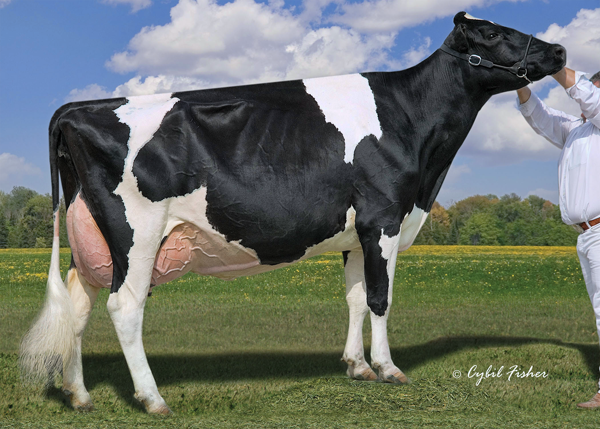
Hellender Goldwyn Griffen NC Goldwyn x Hellender Juror Jurgolin EX-92 6E GM 13* 3rd place Swiss'Expo Lausanne 2014 4th place Swiss'Expo Lausanne 2013 2nd place and finalist Junior Expo Bulle 2012

Hellender Goldwyn Griffen NC
Goldwyn x Hellender Juror Jurgolin EX-92 6E GM 13*
3rd place Swiss’Expo Lausanne 2014
4th place Swiss’Expo Lausanne 2013
2nd place and finalist Junior Expo Bulle 2012

The Bullvine Bottom Line

There are many great examples to use as role models and it isn’t surprising that many of them have gone the route of big herds, big facilities and big investments.  For the Hellender herd the focus wasn’t on size and numbers.  It started with strong emphasis on milk and built from there. With scrupulous selection they have certainly achieved quality in both milk production and in the show ring.  Congratulations to Hellender Holsteins for being an example of how a small herd can be managed to achieve remarkable success.


Get original “Bullvine” content sent straight to your email inbox for free.


[related-posts-thumbnails]


12 Things You Need to Know About A2 Milk

When a new food trend presents itself a considerable amount of the success or failure in consumer uptake relates back to the way the product was introduced to the marketplace.  Drinking milk is by no means a “new” marketing trend but with the acknowledged trend toward healthier eating and better diet choices, the entry into the marketplace of a “new and better” milk drink is making ripples in milk glasses around the world. Milk has certainly seen its share of positive and negative marketing.  Everyone relates to and has positive feelings about the “milk moustache” campaign.  But mothers worldwide deal with the issues of “lactose intolerance” and “mother’s milk versus cow’s milk”. Every dairy producer faces the arguments of natural, unnatural or pasteurized.  And even with the acceptance or more flavored milks, the health issues have not been truly answered. What does this “new” milk mean to dairy producers?

Something Exceptional? Or Exceptional Marketing?

An Australia based firm – A2 Corp. – has been selling a brand of A2 milk in New Zealand and Australia for the past 10 years and is poised to launch into the North American market. Their growing body of research suggests that A2 milk may provide the answer for the 1 in 4 Americans who suffer from lactose intolerance.  The A2 Company hypothesizes that the problem is that they are unable to digest A1, a protein most often found in milk from high producing Holstein Cows. They propose that the A2 protein which predominates in milk from Jersey, Guernsey and most Asian and African cow breeds is more easily digested.

It’s about Leaky Gut Syndrome.

As with many health food trends, evidence shows they often get the first foot hold in the alternative medicine field.  From that perspective, the leading explanation for why some people can’t tolerate A1 milk is attributed to leaky gut syndrome. The idea that loose connections in the gut, “like tears in a coffee filter, allows proteins to enter the body and run wild.  In response the body sends immune cells to fight the autoimmune invaders and the result is swelling and pain from the resulting inflammation.  These symptoms are associated with arthritis, diabetes and autism.

What’s wrong with A1?

The real fiend in A1 milk according to A2 proponents is that, when digested, A1 beta-casein releases beta-casomorphin7 (BCM7), an oploid with a morphine-like structure.  Numerous recent tests report higher-than-average levels of BCM7 in blood from people with autism and schizophrenia. Furthermore, a recent study that is currently under review in the Journal of Nutritional Biochemistry reports on cell cultures research by Richard Deth and Malav Trivedi, both in the Pharmacology Department at  Northeastern University in Boston, that shows similar high amounts of BCM7 in gut cells causes a chain reaction that creates a shortage of antioxidants in neural cells.  This is a condition that other research has tied to autism.

Where’s the SCIENCE?

As for leaky gut, this is a condition that many adults may suffer from.  However, the condition is normal in babies under a year of age, who naturally have semi-permeable intestines.  Therefore, when they’re fed typical cow-milk formula, problems arise with digestion.  “A 2009 study documented that formula-fed infants developed muscle tone and psychomotor skills more slowly than infants that were fed A2-only breast milk.  Researchers in Russia, Poland and the Czech Republic have suggested links between BCM7 in cow milk and childhood health issues.  Another more recent study implicates BCM7 in sudden infant death syndrome, reporting that some “near-miss SIDS” infants had blood serum containing more BCM7 than the blood of healthy infants of the same age.” Research is ongoing to support these claims.

Partners on the Frontier

Bob Elliott, Professor of Child Health Research at the University of Auckland opened up discussions about A1 milk and diabetes in Samoan Children.  In a 1997 study published by the International Dairy Federation, Elliott showed A1 beta-casein caused mice to develop diabetes. In 2000 he partnered with entrepreneur Howard Paterson, then regarded as the wealthiest man on New Zealand’s South Island, to found the A2 Corporation.

False and Misleading?

Those charged with responsibility for public health and safety are feeling the pressure from this new product. In 2009 the European Food Safety Authority reported that they found no link between consumption of A1 milk and health and digestive problems.  To date, much of the supporting research has come from the A2 Corp., which holds a patent for the only genetic test that can separate A1 from A2 cows. Some fear a conflict of interest arises here.  In 2004, the same year that A2 Corp. went public on the New Zealand Stock Exchange, Australia’s Queensland Health Department fined A2 marketers $15,000 for making false and misleading claims about the health benefits of its milk and, at least for New Zealand’s Food Safety Minister, the debate was resolved.

The Door is Open to Welcome New Milk

Debate over or not, the A2 Corporation moved forward to market its a2 brand milk in New Zealand and Australia, where its currently accounts for about 8 percent of dairy product sales Down Under. In 2012, A2 expanded distribution through the Tesco chain into Great Britain. Currently a two-liter bottle sells at an 18 percent premium over conventional milk. Building on consumer acceptance in these locations, A2 is poised to re-launch into the U.S. market where they feel, unlike on their previous entry, there are now enough American consumers willing to pay a premium for A2 milk. The good news appears to be that A1 is not the causative agent for diabetes, heart disease and cancer.

Ready for Research

In building the A2 hypothesis, it becomes necessary to compare its benefits to the problems of A1 milk. In 1993 Elliott proposed that consumption of A1 milk could account for the unusually high incidence of type-1 diabetes among Samoan children growing up in New Zealand.  A colleague, Corran McLaclan, later found strong correlations between per capita consumption of A2 milk and the prevalence of diabetes and heart disease in 20 countries.  Critics explain the relationships away by other  factors such as diet, lifestyle and exposure to Vitamin D as suggested by research published by  Elliott  and  in the book written by Keith Woodford,(Devil in the Milk: Illness, Health and the Politics of A1 and A2 Milk.). The time is ripe for responsible research to resolve these issues.

Coming to A Grocery Store Near You

A2 Corporation is understandably cautious about suggesting that consuming its products is a solution to preventing serious diseases.  Their marketing emphasizes instead the digestive benefits of its fluid milk, fresh cream and infant formula products. Regardless of your current position in this “Battle of the Milks”, when it comes to the health of the next generation, we all need to take a stand. Worldwide A2 Corporation is into several years of expansion into the UK, Ireland and China.

A2 From the Farm to the Table

Along with being exposed to new dairy products, today’s consumer wants verification for what they are being sold. A2 Corp. explains that the company’s farmer-suppliers use DNA analysis of tail hair from each cow to certify she is producing A2 milk, which is kept segregated through processing.  They also report that it is now possible to convert a herd of A1-producing cows to A2- producing cows. They are working with selected dairies that are making this conversion and test-marketing A2 milk in a number of U.S. states.

A1, A2 and AI

AI companies are well aware of the A1/A2 debate and are taking steps to stay up on new developments.  Many US and Canadian AI companies keep records of the A1/A2 genetics of their genetic offerings. The development of A2 producing Holsteins is gaining momentum and breeders with long term vision are phasing out A1 cows and are confident they can maintain high production throughout the transition. At the leading edge are those who seek niche markets using the A2 dominant breeds such as Jersey, Guernsey and Normande.

The Bullvine Bottom Line

As with any other health claim, there will be early adopters and those who wait until the facts are all in.  I can’t help but ask, “When was the last time, you were absolutely certain of the nutritional science behind all the food you eat?”  Having said that, it isn’t difficult to accept the proposition that there are certain people in the population, particularly babies, who react severely to the A1 protein.  Four fifths of our family can dine delightfully on shellfish without incident.  Our baby risks anaphylactic shock from merely sniffing some on a buffet. So back to A1 and A2.  Is the market big enough for both?  Is one right?  The other one wrong?  The spotlight is on milk in a positive way. Sometimes we spend so much time defending the tradition that we miss the opportunity of bringing a whole new consumer into the dairy aisle.


Get original “Bullvine” content sent straight to your email inbox for free.


[related-posts-thumbnails]

Are Your Cows Ready For Their Close Up?

The dairy business isn’t as glamorous as Hollywood, but every cow deserves star treatment for the three weeks before and three weeks after calving. In particular, there is a turning point just before she calves that can make a tremendous difference to the success or failure of her maternal story. At the simplest level how you manage the feeding and housing of close up cows will impact their future health and milk production.  And that affects your profitability. The big picture for your herd and your dairy depends on how you handle getting your cows close up ready.

All the Right Moves!

Ideally cows should remain in the same group throughout the close up period and that group should be established early in the far-off dry cow period.  Although research has suggested that 12 to 24 hours is the perfect time to move cows prior to calving, putting this into actual practice may be easier said than done.  Every operation will look at crowding stressors of up close cows differently based on size, facilities, expense and staff.  Nevertheless the goal of the transition program should be to minimize the number of pen moves or addition of cows to the group. This is based on the reality that the social hierarchy within the group is changed and must be re-established each time new cows are added to the group. Regardless of how you decide to sub-divide your groups, overcrowding should be avoided at all costs.

Cows UN-Interrupted

Research has shown that if social interactions result in excessive-boss cow fighting, milk production could decrease by 3 to 8 lbs milk daily which may not be recovered. When possible, multiple cows, rather than single cows, should be introduced into a group together.  Aim to add new cows only once or twice a week to reduce the social conflict which occurs when cows are establishing the pecking order in a new group.

She Needs a Calving Pen of Her Own

Close-up dry cows and heifers need a clean, dry, and comfortable place to rest.  Each cow should be provided with a minimum of 1 well-bedded freestall (sand is the preferred bedding) or 100 square feet of bedded pack space. Providing adequate resting space is important. Limiting the resting space increases the time cows spend standing and predisposes them to hoof issues and increased incidence of lameness after calving.

Up Close Might Mean Too Close to Diseases

Along with high comfort and the seclusion or isolation that cows seek at calving, the area should also provide the least possible health risk for the dam and her calf.  Especially, avoid manure-borne pathogens from other cows.  Certainly being exposed to longer stays with continual disruptions of newly added herd-mates is less than desirable and appears to increase risks for ketosis and DA. Risk of removal from the herd in early lactation appears to be elevated three-fold. Subclinical milk fever and lower blood calcium content without clinical signs have been associated with higher risks of mastitis, retained placenta, metritis, and displaced abomasums. Thus, providing a clean, dry environment is critical.

Many diseases go undiagnosed at this stage.  These sub-clinical diseases negatively affect the entire upcoming lactation and cause losses in reproductive performance as well as added feed and fixed costs.

Use Your Cow-Sense

Obviously there will be different limitations with every set up.  The skill is to look at things and determine what actions should you take to encourage feed intakes by each close up animal? The ultimate goal is to ensure that all cows have access to enough feed. Avoid overcrowding, aim for enough square feet per cow to enable cows to move around freely and come and go to the feed area confidently.

STOP Over-Conditioning Up-Close Cows

Transition cows that are overconditioned (body condition scores greater than 4.0) eat less before and after calving, with feed intake dropping sooner and to a greater extent before calving than optimally body conditioned pre-fresh cows (BCS 3.5). As a result, these cows mobilize body fat to a greater extent compared to cows where feed intake is not compromised as greatly before calving. This greater mobilization of body fat causes excessive fat to accumulate in the liver of these cows, which further compromises the liver’s ability to make glucose to support milk production. Thus, these cows have a higher likelihood of developing fatty liver and then subclinical or clinical ketosis in addition to other metabolic disorders.

Feed the “Less” Plus “More” Performance Diet

Regardless of where they are once sorted out, it is important that close up cows are within easy monitoring sight of caretakers and with access to fresh feed and water 24/7. About three weeks before their calving date, they should be receiving a transition diet.  The skill is in matching diet to the nutrient needs of the particular close up cow.

Diets for heifers should reflect lower intakes (approximately 23 versus 26 lb/day dry matter intake for mature cows) and the need for additional protein (15% crude protein or 1,200 g/day of metabolizable protein for springing heifers) during the close-up period.

Close-up dry cow diets should contain slightly more energy and metabolizable protein than far-off dry cow diets, but energy density still should be controlled to optimize intake after calving. Mineral balance of dry cow diets is critical to prevent problems after calving. Diets for dry cows 3 weeks before calving often contain lower potassium forages and grain products to allow for formulation of diets that prevent subclinical and clinical milk fever.

Reduce Stresses Pre-Calving

Recognizing that cows are social animals, providing a stress free environment for the actual calving is one of the most strategic things you can do.  There (Rick Grant) are Benefits of separating first calf heifers from mature cows.  Heifers compete better with other heifers and have higher dry matter intakes (10-15% improvement) and longer resting times (20% more) when housed separately from mature cows. When feedbunk space is limited, close-up dry cows may spend more time standing and eat less dry matter or eat larger and fewer meals. To prevent potential problems with lameness and other metabolic disorders after calving, close-up dry cows should be provided with 36 inches/cow of feedbunk space.  Don’t forget how weather impacts cow comfort.  Heat, much more than cold, is a stressor that has negative impact on close up cows.  Again, facilities and handling should reflect the needs of the close up cow. Moving cows once calving has commenced is shown to delay calving.

Is Close-Up Management Worth It?

We have considered the perils of not having a transition plan. (Read more: Dairy Cattle Management: LOST in Transition) By the time the actual calving date arrives, cows are half way through Transition.  There are two steps to success in this Close up stage: 1. Recognize problems early. 2. Take corrective action.  We have merely touched a few of the observation and care taking steps that could be on a checklist for close up transition management. There is always room for improvement and problems big and small that need attention and action.  The question might arise whether or not all this transition effort it is worth it.  Research indicates that there could be five pounds less milk per cow per day as a result of stress, diet, or increased instances of disease.  This equates to milking 92 instead of 100 cows. But that is not all.  Add in extra labor, extra drug costs ,added vet expenses and the losses incurred by early removal of cows from the herd, not to mention unsuccessful future AI breedings and the aggregate losses can soar to $300 less revenue and $200 to $300 additional costs per cow per year.

The Bullvine Bottom Line

Regardless of the size of the particular operation, every breeder can use $500 to $600 more profit per cow per year.   Taking corrective action on your Close up Transition cows could be the best investment you ever made.  Are your cows ready for their close up?


Get original “Bullvine” content sent straight to your email inbox for free.


[related-posts-thumbnails]

Farm Tractors Are Not Theme Park Toys!

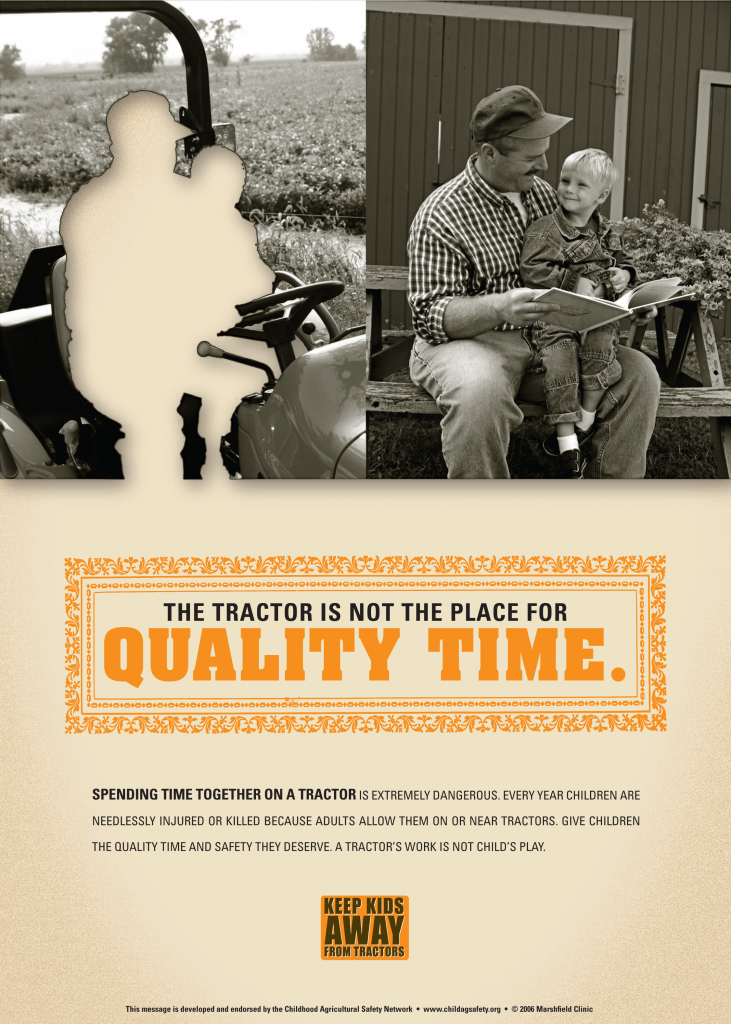
keep_kids_away_warning[1]When we go to amusement parks, we expect to be scared out of our minds as we screw up our courage to ride on the roller coasters.  The blood curdling screams stick with us long after we return with our little ones to the safety of the family farm.  However, those very children are statistically more likely to be killed on the farm than at the amusement park. The worst part of this statistic is that we seem to be oblivious to the very real danger presented by the equipment we have driven and shared rides on for generations.
Troubling Tradition

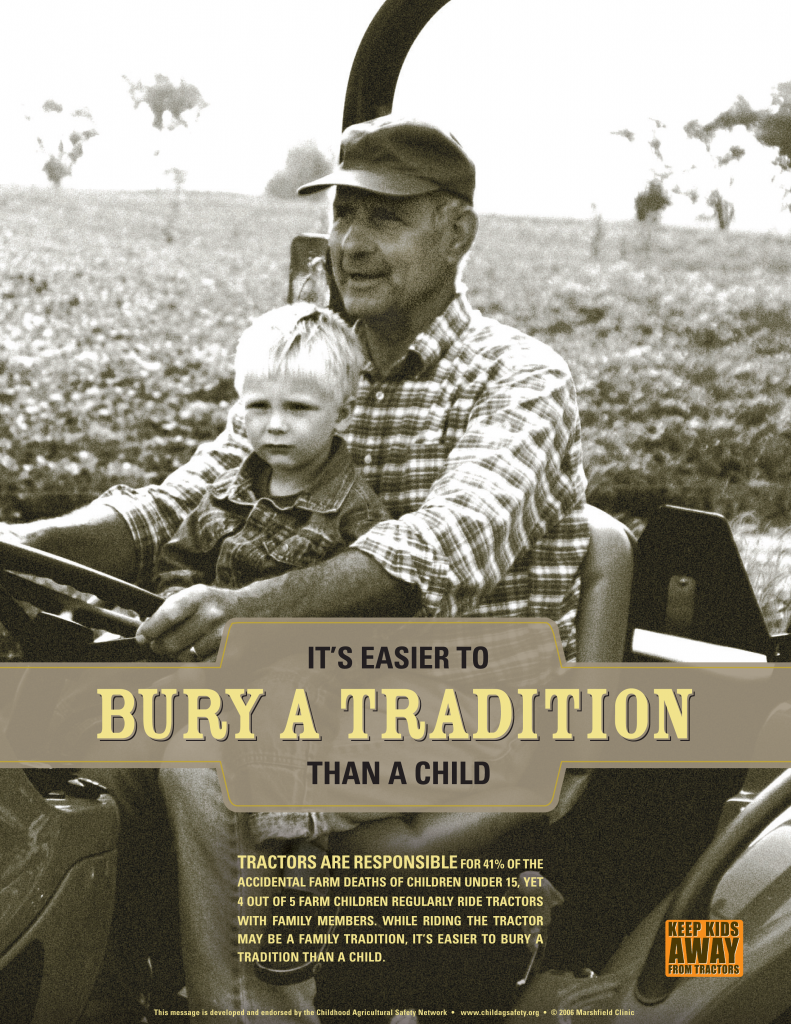
Farm machinery and particularly tractors fascinate children. They are giant replicas of the little toy ones they play with every day on the living room carpet. The desire to imitate Mom and Dad means that at very early ages children learn to drive tractors. Until that day the lure of being where the tractor action is can be lethal.  When you factor in the number of large pieces of equipment moving around the farm during busy seasons their small but precious bodies are not only hard to see but too often in the wrong place at the wrong time.

Bury a Tradition Ad (English)

Turning a Blind Eye to Tractor Danger

We wouldn`t think about not buckling children into seatbelts in the car. We insist that they wear helmets when they ride bikes or protective padding for sports. We have childproof medicine caps, safety gates and bed rails but, when it comes to tractors, we let tradition and those old memories of bouncing through the fields in the cab of the tractor with grandpa impair our judgement.  We need to decide whether we want to preserve unsafe memories or our children.

March Gets In Step With Tractor Safety

The month of March is popular for week-long Ag safety observances by several national organizations. One of those is the “Keep Kids Away from Tractors,” campaign. This is the unified message of the Childhood Agricultural Safety Network (CASN) which is a coalition of 38 health, safety and youth organizations in the U.S. and Canada. The coalition’s campaign urges adults to think twice before allowing children 12 and under to operate tractors or ride on them. The “Keep Kids Away from Tractors” will be featured in a webinar at noon (CT), Wednesday, March 12. Presenting on behalf of the National Children’s Center for Rural and Agricultural Health and Safety will be Director Barbara Lee, Ph.D., and Marsha Salzwedel, M.S. The webinar is sponsored by the Childhood Agricultural Safety Network and AgriSafe Network. Register at http://www.agrisafe.org.

The coalition urges individuals and groups to incorporate CASN resources in their safety initiatives. Posters, radio ads and more information can be found at http://www.childagsafety.org/TractorCampaign.htm.

Quality Time Ad

Perils that could Have Been Prevented

We need hyper-vigilance around tractors.  The first step is giving our children a healthy respect for the fact that tractors are machines not toys and that there are dangers represented by this piece of working (not playing) equipment. Consider these incidents from the past year:

  • A 1-year-old North Dakota boy died after falling from a tractor driven by his father. His 4-year-old brother survived.
  • A 6-year-old Minnesota boy died with his grandfather when the tractor they were riding rolled over.
  • A 5-year-old Kansas girl died when she fell through the windshield of a combine driven by her father.
  • The biggest tragedy of all? These deaths were 100 percent preventable.

Teach By Example

Before we teach them to drive, let’s teach them to be safe. As much as rural kids like the exceptional skills that being farm born and raised gives them compared to their town friends, they need to also learn the unique farm safety rules that can save their own (or their visiting friends) lives.  Everyone — driving or on foot – near farm equipment needs a healthy respect for how easy it is to miss a little head running by when the focus is on moving feed, harvesting or hooking up to another piece of equipment.  Of course, all of this assumes that the adults working on the farm are alert to the dangers and accept their responsibility for child safety.  There is no shame in being over-protective.   A little healthy fear of tractor danger is healthy for everyone.  The goal isn’t to be fearless.  The goal is to be safe.

Start Talking and Take Action

A child dies from injuries on a farm an average of once every 3.5 days. The most common situation involves a tractor. When kids and tractors get together the outcome can be tragic.

CAIR (Canadian Agricultural Injury Reporting) reports that at least 45 per cent of accidents on farms occurred close to the farmhouse, such as in the farmyard, driveway, barn or shed.  About 63 per cent were machine related, including runovers, rollovers and entanglements, mostly involving tractors (47 per cent).

“Stop the Denial. Start Talking”

Discuss tractor designs with your child. While some newer tractors have cabs and roll-over bars for added protection from accidents, tractors continue to be inherently unsafe for drivers and riders because of the risk of roll-over accidents.

“Build on Safety Rules they Already Know”

Talk about seat belts with your child. In a car, everyone has a place to sit and a seat belt to provide a safety restraint. Most tractors have only one seat and one seat belt to keep the driver safe, meaning that tractors are safe for only one person driving or riding on it, advises the North Dakota Farm Bureau. Kids know about looking both ways when on the street.  They need to respect the “street smart” rules of farm lanes, barnyards and fields.  The right of way always goes to the equipment.

“Say ‘No!” to Tractor Rides”

Caution your child to never accept a ride on a tractor, warns the KidsHealth website. Riding anywhere on a tractor but in the seat with a seat belt is unsafe, including on a fender or on an attachment. A tractor can flip over in as little as 1 1/2 seconds, according to the North Dakota Farm Bureau. Tractors can also hit bumps or uneven surfaces and someone not secured with a seat belt could fall off the tractor.

“Safety is all About Location, Location, Location”

Warn your child about the threat of being run over by a tractor. Falling off the tractor could lead to being run over by the vehicle. In addition, it can be difficult for a tractor driver to see people near a moving tractor — especially children. Teach your child to stay away from work areas and moving tractors because she might not be able to make her presence known to the driver.

Healthy Respect Prevents Heartbreak

The slogans are hard hitting.  They are not meant to make us feel comfortable and reassure us that, of course, our children’s safety comes first.  If discomfort makes us take responsible action, then the discomfort is well worth it.

“It’s easier to bury a tradition than a child.”

“Your 75 lb child has no chance against your 10,000 pound tractor”

“The tractor is not the place for quality time.”

As much as we want our children to grow up in the traditional farming lifestyle that we cherish the key is that they “grow up”.  Farm safety isn`t about instilling fear.  It`s about being safe not sorry.  Nothing can heal the heartbreak of losing a child to a preventable accident.

The Bullvine Bottom Line

The best way to instill our love of farming in our children is to also instil in them our respect for dangers that must be dealt with every day. The best way to say “yes” to farming traditions is to say “No!” when it comes to tractors.  “One seat. One rider. A rule to LIVE by!”

 Please like and share this post to help spread this valuable message.


Get original “Bullvine” content sent straight to your email inbox for free.


[related-posts-thumbnails]

Dairy Cattle Management: LOST in Transition

If you were going on a driving holiday … It’s unlikely that you would wait to see your aunt’s holiday album or your sibling’s gas receipts at the end of the trip, before planning your best route.  Trying to plan by waiting for information that hasn`t yet happened or that isn’t yet available to you, is ineffective to say the least.  And yet when we’re trying to get cows from A-Z on the dairy journey, we use information like peak milk and butter fat tests that have little or no value for immediate decision making. Even worse – we let culling rates be the measure of our success.  In our travel analogy, that would be like using number of speeding tickets to determine your destination. While the information is related to the issue and cautionary, it does little to help determine the details of where you are going.

The Transition Cow Journey Needs Clear Signposts

We all know what a transition cow is but do we know what to provide her with in that pre- and post- calving period that is so crucial to her productive and reproductive success?  A survey by Dairy Australia provides thought-provoking statistics.  The survey found that only 65% of farmers use transition cow management and, of those ones using it, only 50% have a management plan in place that meets the cow’s nutritional needs. In other words, only 1/3 of the cows are getting the right treatment.  Furthermore, it means that staff is spending too much time and energy dealing with sick cows.  Not only is this a negative situation from the cow health viewpoint, but it also means that attention is being sidetracked from the needs of the whole herd.

The Transition Journey Needs A Planned Road Trip

There are important questions that must be answered:  

  • Do you know where you`re going?
  • Do you have the information to get there?
  • Are you willing to follow directions?

Five mis-used and over-rated sources of Transition Management:

Check off the ones you are using on your herd as action items.

  • Peak Milk Yield
  • Herd Production Level
  • First Test Day Percent Butter Fat
  • First Test Day Linear SCC
  • Calving Interval

If you’re using any of these you are definitely driving in the wrong direction.  Yes you have information.  But it cannot be used in a timely and effective way!

Are You Ready to Put the Pedal to the Transition Metal?

On the one hand, using the wrong tools is a problem.  On the other hand, not taking action is an even bigger problem. The above tests cannot be used to initiate actions.  The solution of using information for culling purposes does not solve problems such as milk fever, displaced abomasums and low dry matter intake or raise the level of health.  The other problem is timing.   Identifying a problem is great but getting it solved quickly is the priority.

Too Little. Too Late.

The lag time of most of the previously listed monitors is far too long and late. If you don`t take the proper early steps to get your cows through the transition period, you may not have the chance later.  Rather than getting rid of cows, get rid of transition monitors that aren`t working.  By the time you`ve decided to cull a cow, the outcome has been decided.  What is needed are tools that give you the chance to take action, before you have lost time, money and milk production.

Peak Milk has Shortcomings

As a monitor of fresh cow performance, peak milk has at least 5 shortcomings.

  1. It is not the true peak milk.  The reported number is the highest milk produced on any given test day so far during the current lactation. The odds that the test day will coincide with the actual peak milk day for a particular cow are slim. Furthermore Age at freshening, Lactation number, Calving season, Breed of cow, area of country and herd production level all have impact on peak milk. It is impossible to make these adjustments mentally.
  2. It`s too slow. Can you really afford to wait somewhere between 50-90 DIM to learn what a particular cow’s peak milk is?  This lag between the information and the time to take action is far too long. Prompt decisions are needed from all perspectives: cow health; production management and profitability.
  3. It`s simply an average. Averages are often considered useful as benchmarks to measure progress.  However an average that does not indicate the range of values has little of no use in managing the transition of individual animals.  You want to be able to take action regarding the cows that are at the low end.  The high end has particular needs as well that an average doesn`t identify.
  4. It includes more than recently fresh animals. Again it is the breadth of the information that limits its effectiveness in transition cow management. Peak milk measurements often include more than the recently fresh animals thus clouding the information for use in actionable decision making.
  5. It is biased because of cows that have been culled. To earn a peak milk record, a cow must survive in the herd past a second or third test.  Thus cows that left the herd prior to peak milk or ones that are currently in first test are excluded and thus the results are biased.

First Test-Day Percent Butter Fat has Limited Value

Whether higher or lower than normal butterfat tests do not accurately identify the state of the cow’s health.  Butter fat tests can be a moving and therefore a single test day doesn`t identify the direction of the trend.

  1. Higher than “normal” butterfats in individual cows is often a sign of metabolic difficulties. These cows usually are in a state of extremely rapid weight loss. They often have a history of metabolic problems such as ketosis, fatty liver, and/or displaced abomasum.
  2. Lower than “normal” butterfats in individual cows is often a sign of past metabolic difficulties, low body condition score, acidosis, or some combination of the three. These cows usually are very thin. In many cases, these cows are 20-30 days in milk at first test. It is possible that many of these cows would have been quite high if tested at day 8-15, but now are low since essentially no more body fat is available to be lost into the milk.

This likely under-reports problems in cows that are dropping from a “high” to a “low” test as they would not be distinguishable from “normal” cows.

First Test-Day Linear SCC May be Too Late

Unpublished data currently being evaluated suggest animals starting with a higher linear SCC (>4.0) produce 1,000-1,500 pounds less in the coming lactation when compared to cows freshening with lower linear SCC. In addition, recent reports suggest that cows with mastitis in early lactation have lower reproductive performance.  A cow culled in the first month of lactation is a far more expensive economic event than a cow that is replaced at the end of lactation.

Some estimate that the cow value drops about $3 per day after freshening for cows that do not become pregnant. Waiting for a year to see how many cows died from mastitis is a poor way to monitor either clinical or sub-clinical mastitis. Relevant action to take regarding high SCC starts at the drying off period of a previous lactation or at calving for heifers.

So, if those DON’T work, what OPTION is left??

It is easy to find numerous superior tools for monitoring a problem on a dairy.  The first test of the monitor should be that it either highlights another question or leads directly to a required management action.  The herd manager’s interest isn’t in the animals already identified for culling but rather to find those animals where some positive steps can be taken to achieve a positive outcome.  The goal is to move from useless information to useful actions.  Once you have identified the problem you can find the solution.

First Test-Day Mature Equivalent 305-day Projected Milk

Using the first Test Day Mature Equivalent is much faster than the limited monitoring methods previously discussed. The first projection is possible after 8 days in milk. Typically, cows are around 15-20 days in milk at first test. Admittedly, this projection is not 100% accurate in predicting the final 305 completed lactation total milk, but it is a good tool nevertheless. A cow starting with a low projection at first test is not likely to finish with an excellent total at the end of 305 days and is much more likely to be culled.

All DHIs and most on-farm herd management software offers projections of the expected lactation total 305 day milk production. A mature equivalent (ME) projection or Breed Class Average (BCA) further refines this prediction by adjusting all cows to the same age to allow comparison between cows in different lactations.

The ADVANTAGES of 305 day ME Projections

Compared to peak milk, the first test-day 305 day ME projection offers these advantages:

  • Measurement can be made starting at day 8, gaining 45-60 days on lag time.
  • Bias due to culled cow exclusion, although still present, is less.
  • Effect of different test-day days-in-milk is removed.
  • Cows freshening at different ages can be compared one to another.
  • Cows in different lactation numbers can be compared.
  • Cows freshening in different seasons can be compared.
  • Cows freshening in different areas of the country can be compared.
  • Different breeds can be compared.
  • Adjustment is made for herd productivity.

The Bullvine Bottom Line

Getting the right information is the absolute first step if you’re going to properly manage your cattle through the pre-transition and post-transition periods.  It’s crucial for cow health and dairy profitability to be proactive.  If you are not using information that can clearly define what actions to take, you’re program and your profits and your cows will be lost in transition.  It’s time to take a YOU-TURN and map out where you are and where you’re going.  Don’t let stop signs determine your destination.


Get original “Bullvine” content sent straight to your email inbox for free.


[related-posts-thumbnails]

DANAE BAUER: Capturing the Passion

We meet many who feel that dairy farming not only gave them skills for working, problem-solving and responsibility , but also the added courage and example to become self employed. Danae Bauer is from Scandinavia Wisconsin where she was raised on the home farm operated by her father and uncles. (Read more: Pine-Tree Monica Planeta Is the New Genomic Super Star Maker) “I have had a very active role in the farm ever since I was a child. I now work full time with the calves, embryos transfer, and marketing.

20131026_web_Gunst_14

From Shovel Speed to Shutter Speed

Many farm offspring feel they have had a picture perfect upbringing.  For Danae it was picture inspiring. “ I have had an interest in photography from a young age. In the past several years that interest has grown into a passion, leading up to a year ago when I began my photography business.”  Again she credits her family and agricultural background. “3. My family has influenced me greatly and has helped instill a work ethic, a desire to learn, and drive to achieve excellence which has valuable to me in honing my creativity through patience and practice.”

20131221_web_Gloria_calf_santa hat

Never Ending Learning Process

Like the true creative that she is, Danae is always looking for new opportunities to learn and grow her photography skills. “I completed a course in professional photography from the New York Institute of Photography, from which I was also given a merit award for a photography essay assignment.  I believe that while I gained knowledge from the schooling, I learned probably just as much from trial and error, practice, reading photography books, learning from articles and videos on the internet, and studying other’s work. It’s a good thing my cousins Katie and Emily are such good and willing models…I got a lot more practice in with them then I would have with my three brothers !”

2013921_web_calf_catnis

Capturing a Story – Creating a Feeling

When you look at pictures created by Danae, you often feel an instantaneous emotional connection, which isn’t surprising since that is what powers her own enthusiasm. “I would describe my style as creative, classic, clean, and country. My images are abundant in natural light, they are bright with vivid but true to life color. I strive to capture genuine emotion and interaction when I photograph people and animals.”  For Danae the people are just as important as the subject matter. “I love images that “grab and pull the viewer in” and allow them to experience or see the subject in a new way, the photos that capture the essence or heart of the subject, the photos that are genuine, but beautiful and unique.”

20131026_web_Gunst_13

An Eye for Agriculture. A Fusion of Farm, Family and Photography

I think my greatest accomplishment is creating a photo that strikes a chord with its viewer, especially if it makes them think positively about agriculture and farm life. I have had comments that my photos have been a blessing to those who see them, and if that is true, I count that as a success! “ Danae looks forward to a future that includes her two passions.  She quotes the familiar “A picture is worth a thousand words” and adds “I would love to continue to photograph farm families and help them tell their stories through photos.”

2014222_web_clover_red calf_2

The Bullvine Bottom Line

We totally agree with Danae that, as great as it is to do what you love, the human experience is what makes it worthwhile. She is already taking her photography to the next level and has a growing audience who responds to her efforts. “I hope that by sharing meaningful photos I will be furthering a favorable impression of the dairy lifestyle.”  All the best to Danae from the Bullvine readers and everyone who enjoy cows, people and country living. It’s a huge story ready to be captured by the Bauer lens one moment at a time.

2013229_nose_vintage_web

Be sure to check out Dana’s Farmgirl Photography Facebook page as well as her website for more great photos.


Get original “Bullvine” content sent straight to your email inbox for free.


[related-posts-thumbnails]


10 RETIREMENT OPTIONS: Are you “IN”? Or Are you “OUT”?

When it comes to retirement from your current way of dairy farming, it is all about asking yourself what you want your life to be like. Do you want the next 30 years to go by, only to feel used up? If you’re over 50, you may be facing a new viewpoint on the dairying business that has provided your income, lifestyle, highs and lows for a few decades.  There are always choices.  Before you decide to simply do the obvious and retire, you might want to consider these 10 options when deciding if you’re “IN” or if you’re “OUT”.

1.     ARE YOU OUT?  No Dairy Heirs. or ARE YOU IN? Look to Science, Technology and Robots!

When there isn`t a family member willing to take over the dairy operation, many farmers decide it`s time to retire. But rather than jump too quickly, it is time to think realistically about some 21st Century options.  Moving forward in dairying means more targeted use of genetics, genomics, sexed semen and the scientific tools available to dairy breeders. Fewer cattle producing more milk gives you more of what you’re looking for. If you have simply accepted that you have non-family succession, broaden your thinking and consider robotics.  For less than the price of two new staff you can have robotic expertise … you may even get more production … faster payoff … and more time to broaden your non-farm lifestyle.  Have your farm and social life too! It’s never too soon to plan for farm succession. (Read more: Farm Succession: Which Exit Is Yours? And Farm Succession: Kicking the Hornet’s Nest?)

2.     ARE YOU OUT? Too much money to ignore.  or ARE YOU IN?  Nowhere to grow.

Referring back to number one, it’s like the three rules of successful real estate sales: Location. Location. Location.  As some farm areas are being swallowed up by cities, the potential to sell for development is a payday that’s simply too big to ignore. The same growth situation in other areas, results in rezoning and suddenly farms are locked in to current size and declining real estate value. If moving away from city proximity isn’t feasible at this time, perhaps you can turn your population access into a niche market.  Downsize to an agricultural tour farm, perhaps with a specialty farm store.  Target a demographic market in your area that is particularly happy to have specialized dairy products:  organic, ethnic, religious or philosophic. Becoming an agricultural Agvocacy farm might keep you with access to all the parts you like without the physical, mental or financial stresses that are so trying at this time of life. There are many examples of farms offering special dairy products and agro-tourism. Some such farmsteads offer wedding receptions or events such as farm fresh dairy breakfasts, a fall harvest festival or special school tours or popular children’s camps.

3.     ARE YOU OUT? Not profitable or ARE YOU IN? New potential profits.

Businesses that don’t produce profits don’t succeed. However, some dairy operations fail because they continue to operate too long without putting the brakes on rising expenses or too long without developing new revenue streams.  Where farms are susceptible to low milk prices or high feed prices, it may become impossible to repay financing.  In the end, that means no option but to get out.  If one spouse has been working off the farm, now there may be an opportunity to work together focusing on an alternative revenue stream. Perhaps now is the time to reel in those off-farm working costs and apply them to a niche revenue stream such as raising heifers, producing forages, managing dry cows or concentrating on grain production.

4.     ARE YOU OUT?  Too many restrictions. or ARE YOU IN?  Environmental Compliance.

How are modern environmental and food production regulations going to affect your operation in the future? And a long list of rules may also indicate a high level of politics. This is not the time to have to lead a crusade or fend off animal rights groups.  Compliance could be simple and profitable. Some operations have installed a state-of-the-art nutrient management plan. A machine separates solid and liquid cow manure. The solid non-smelly manure is used for cow bedding. The liquid is spread on the fields and used as an all-natural fertilizer. Bottom line, nothing goes to waste. Farms with this system have zero percent manure runoff and 100 percent of the manure is recycled.  Other innovations such as a solar energy system could increase energy efficiency while decreasing a farm’s carbon footprint and utility costs with the potential to provide power for other homes.

5.     ARE YOU OUT?  Inadequate feed. or ARE YOU IN? New supply options.

Climate changes also affect feed production and sourcing. Feeds, especially forages, may be in short supply and expensive for long periods of time.  As in 2002 and 2003, if forage supplies are scarce and expensive and milk prices are low, it might not be possible to access loans to purchase additional feed inventories to keep dairy cows in production.  In areas where “green belt” designations have been put into place, expansion of herd numbers—if at all possible with the current facilities – may still fall short in having access to hay, corn, grain etc. Simply taking on more debt or throwing money at the situation may not be the best alternative.

6.     ARE YOU OUT? Rising Input Costs or ARE YOU IN? Back end monetizing

It takes a lot of infrastructure to keep a sustainable dairy operation operating at the optimum level.  The days of doing it all are over.  Pick what you’re best at and then find the support team that makes continued dairy farming a realistic, sustainable and profitable decision. You may not be ready for the bridge party and bocce ball circuit. Therefore, at this point making changes that also positively impact your daily lifestyle is a good option to consider.  Are you located where large animal vets; nutrition support and equipment and machinery repair are accessible.  If the needed support structure is accessible and functioning perhaps it’s time to go for the dream.  Rather than wait for something beyond your control like politics , economics or even weather and Mother Nature to change for the better, this may be the opportunity to take on another piece of the supply chain such as processing your own specialty dairy products. Perhaps your expertise provides you with a special edge in sales (animals, products, supplies) and an on-farm store or auction is feasible.   For financing consider sources specializing in opportunities for agriculture. (Read more: Money Loves Agriculture. This Relationship is Brought to You By AgFunder.)

7.     ARE YOU OUT?  Too much work for one  or ARE YOU IN? Find a Golden Partnership

Is there someone out there, neighbour, friend or fellow farmer, who is happy doing the field and crop work? Are you happy in the barn?  Could you combine forces for a 20 year plan that fits both work strengths? A shared working relationship could provide lifestyle enhancements for both parties too? Do you know of someone else at the age of considering whether they need more or less quota or more or less cattle? These investments may run into the hundreds of thousands of dollars, yet the appreciation and resale value can be uncertain.  If quota isn’t the issue how big is the herd you can manage?

8.     ARE YOU OUT? Can’t wait to move on.  or ARE YOU IN? Become a Start-Up Mentor:

Who’s going to take care of your farm while you’re downsizing. What about finding a young family whose timeline could fit with yours?  While you downsize they have the opportunity to upsize. Make your years of experience available to those who are just starting out. You could enjoy helping young dairy farmers move their business forward. Here is an area where age need not hinder performance — age-related shortcomings are often outweighed by reliability, commitment and accumulated knowledge.

9.     ARE YOU OUT?  Not for your family.  Or ARE YOU IN?  Family loves dairying.

When labor is scarce and there is no time for the holidays and adventures that other people seem to enjoy frequently, the 24/7 dairy operator may decide it just isn’t worth it.  On the other hand, having the family all involved in the cycle of life benefits of dairy farming — being your own boss — the outdoors  — the physical  — may seem like the exact things that everyone else had to quit working a 9-5 job to enjoy. Remember a lot of the people who can’t wait for the retirement chair and the TV, spent much of their work lives complaining about the work, the people, the commute, the pay.  For most dairy farmers every day has been bracketed by the view of the horizon and in between each sunrise and sunset dairy folk felt passion for the hard work and the cows that provided their living.

10. ARE YOU OUT? Take the Cash and Run Or ARE YOU IN?  Keep the Farm. Cash in on the lifestyle

Selling out is not all cash in the bank from selling cattle, machinery and equipment. There are sale costs, including auction management and advertising. Vet costs for making sure that animals are healthy for sale time can have strong impact and add to those exit costs which can bring your hoped for margins down to break even.  Add in tax implications and you could find 20-40% of your “profits” eroded away. Supposing you are able to leave the farm with your nest egg intact, be sure you know what you’re going to do. If you’ve never enjoyed sitting on a beach, golfing or playing cards, then what makes you think that 20 years of retirement will win you over to these activities?  The sheer shock of spending close to 50% of your time doing something that you don’t really care about seems a pale way to end a career that has been built on daily interaction with family, friends and animals.

Bullvine Bottom Line:

Start having this conversation with yourself today.  It’s one of the most important things you can do. You owe it to yourself to live the life you know deep down you were meant to fulfill. Whether it’s out to pasture or greener pastures that are calling, there comes a time when you are looking over the gate to something new. Are you in? Or Are you out?


Get original “Bullvine” content sent straight to your email inbox for free.


[related-posts-thumbnails]


Barn Roofs: The Bigger the snow… the Harder the fall

Barns are collapsing like houses of cards when stressed by the triple threats of frozen snow load, wet snow load and water build up. Since early December more than a dozen barns have collapsed in central Alberta. All the way east to Maine and Massachusetts reports of collapsed roofs are resulting from record snowfalls.

You may feel secure because of your well-designed barn that has engineered support structures. But even these buildings can buckle under snow loads that exceed 4 to 6 feet. When researching what the “danger” level is for extended snow loads, we found a general guide for areas where typical snow loads are 20 pounds per square foot to be 4 feet of dry snow or 2 feet of wet heavy snow. These heavy loads are the usual cause of snow-related building collapses. This winter has had many episodes of extreme weather.  One would think that the recent slight rise in temperature and change to rain and sleet has helped.  However, now that extra rainwater has been soaked up by the snow.  The end result is even more weight added to roofs. There is a tremendous difference between dry and wet snow.  A cubic foot of dry snow weights 6 to 8 pounds. The same volume of ice weighs three times that amount.


Snow Blows Before a Fall

Checking structures after every snowfall is a must-do, every time priority.  Conditions change quickly.  It isn’t simply the snowfall that is to be blame.  It’s continuing or shifting snow load. When heavy snow meets fierce winds even the best engineered buildings can collapse. An imbalance of drifting snow can cause one part of a roof to give way causing a domino effect that affects the rest of the structure. Other times, a wet snowfall which freezes the snow on the roof can mean that future snow is unable to slide off. According to the Massachusetts Emergency Management Agency (MEMA), in the first 48 hours after the Groundhog Day snowstorm, there were more than 80 collapses and building with structural weaknesses reported to MEMA.

12 Ways to Pinpoint Potential Problems

When you see any of the following problems, call your local building or fire official immediately.

  • Sagging roofs
  • Severe roof leaks
  • Doors that pop open
  • Cracks in walls or masonry
  • Bends or ripples in supports
  • Visible bowing of rafters
  • Cracked or split wood members
  • Sheared off screws from steel frames
  • Creaking, cracking or popping sounds
  • Doors or windows that stick or won’t open
  • Bowed utility pipes or conduit at ceiling
  • Sprinkler heads that have dropped down below ceiling tiles

Note:Metal structures unfortunately often don’t exhibit signs of stress before failure.

How Much Snow is Too Much?

Calculating the snow load on your barn takes more than an educated guess.  The University of Wisconsin Cooperative Extension Service says that a ballpark estimate of snow load can be made with the following formula:

Calculated Roof Loading (lb/ft2) = Depth (ft) x Density (lb/ft2 /ft depth). The approximate density (lb/ft2 /ft depth) for light snow is 5-20, packed snow 20-40, packed snow with ice 40-58, and ice 58.

For example, a roof with 3 feet of light snow has an estimated roof load of 60 pounds per square foot (3 ft depth X 20 lb/ft2/ft depth density = 60 lb/ft2). You should know the roof weight limits for your barns and outbuildings, and rebuild or fortify them to withstand worst-case scenario snow loads and meet local building standards.

snow on roofs

Consultation and Calculation

Consult your local permit issuing authority to find the recorded snow load (the maximum snow expected to fall) in your region.

Calculate your roof pitch: Divide the “rise” (vertical distance between the peak of the roof and the edge) by the “run” (distance from the peak of your roof to the edge) and convert the fraction to a ratio of 12. (For example, if the rise of your roof is 15 feet, the run is 36 feet, then the pitch = 15 feet / 36 feet = 5:12. Use a calculation like this one. Enter values of your roof and follow the instructions to get your roof snow load.

Long Term Improvements

If you are able to renovate or are building new buildings there are snow load factors to consider. Snow does not slide easily off flatter roofs with a pitch of 3/12 or less. In locating new buildings be aware that wind blowing around trees and building can cause mega drifting and uneven and shifting snow loads. Be aware that closely spaced buildings can be affected by snow and ice sliding off taller buildings. As well valleys or changing elevations in the roof can collect snow. The material used for roofing should shed snow and ice easily. Metal is better than shingles.

Be Safe NOT Sorry.

What should be done if your building exceeds the “safe” snow depths? The simple answer is to get it off as soon as possible. Generally, there is some time between a large snowfall event and possible structural failure. Some failures can be prevented with careful snow removal. Consider hiring a professional.

Safety First

There obviously is a human safety concern of falling off the roof when working on a snow covered and icy roof. Use extreme caution when working near overhead electrical power lines.

Use caution if standing on the roof. Make sure to wear a safety harness and use securing ropes or cables. Don’t add your weight or the weight of equipment to the roof. Always be aware that, if you use a ladder, ice tends to build up on both the rungs and your shoes. Wear headgear and goggles and non-slip footwear. Have someone outside to team with. As a precaution, if the situation seems tenuous, remove animals from the building.

Don`t Add to the Problem

Don’t use electric heating devices like heat guns to remove snow and ice. Don’t use open-flame devices to remove snow and ice. Trying to hose down the snow is a mistake as the added water seriously increases the weight pushing down on the already straining supports. Use a snow rake for pitched roofs and avoid chipping or picking away at ice as that may damage the roof and lead to leaks. Plastic shovels are better than metal ones (metal tools conduct electricity and damage roofs).

Just Enough.  Not too much.

Start from the edge to the peak of the roof. Shave the snow down to 2-3 inches instead of scraping the roof clean; don’t damage the shingles. Remove snow in narrow strips to keep the load somewhat even. Remove large icicles carefully. Not all snow needs to be removed. A thin layer of snow can protect the roof from damage while snow is being removed.

Other Options

Until or unless you are already dealing with a collapsed roof, there are other last minute (and therefore less reliable) options depending on specific situations.  Sometimes you may be able to warm the inside of the building enough to melt the ice layer and wait for the ice and snow to slide off. There are obvious dangers of fire when adding heat and also limitations to how much you can raise the temperature depending on building size and structure (no flat ceilings). Beware of large chunks of sliding ice and snow falling onto people, animals or equipment. Safety is always, always, always priority number ONE!

The Bullvine Bottom Line

Farmers need to keep a close watch on structures with heavy loads and be prepared to move livestock and equipment to safer quarters. A few minutes of consultation can give you reassurance during a heavy-snow winter. Check with your insurance agent to confirm that your property insurance covers roof or building failure due to snow load. Make sure the policy pays for actual replacement costs, so you’re not out in the cold if you have to rebuild. Verify that valuable equipment stored in a barn or outbuilding is covered under your policy.


Get original “Bullvine” content sent straight to your email inbox for free.


[related-posts-thumbnails]


ARE YOU FOR THE BIRDS? The European Starling Problem

We all seek a break from frozen pipes, impassable roads and the added work that snow and colds adds to an already full dairy farming schedule. However, now is not the time to long for spring and the return of birdsong.  Unfortunately, the increasing nuisance of European Starlings is reversing our fondness for birds.

The New Math of Starling Multiplication

European starlings were first introduced to the United States in 1890 with the romantic notion of populating New York’s Central Park with all the species of birds mentioned in Shakespeare’s works (Chapman 1925, Bent 1950). In 1992 it was estimated that the population of starlings has grown to 140-200 million birds. During the winter in Ohio, it is common to observe flocks of 500 to over 2,000 birds with some large winter roosts containing 400,000-600,000 birds.

The First Sign that You’re Losing It!

When was the last time you were amazed at the sight of several hundred (or even a thousand birds) swooping into the trees and fields around your farm?  I’m guessing it was a long time ago. Now instead of counting birds when we see them swoop in, we start adding up the less picturesque effects of these frequent flyers.

Birds of a Feather are Flying Off with Your Profits!

Because of their foreign origin and aggressive behavior, European Starlings are considered an invasive species. These starlings are listed on the World Conservation Union list of the World’s 100 Worst Invasive Species. They are found year round in the continental United States, northern Mexico and southern Canada, expanding further north during summers.  It is estimated that overall bird populations cause an annual loss of $100 million to U.S. agriculture. Cattle feedlots suffer most from wintertime flocks which can reach as high as 100,000 or more per day. These huge flocks of starlings can have a negative impact on the profitability of a dairy farm. They consume huge amounts of livestock feed they spoil what is left with their droppings. Starling droppings may also cause components of steel buildings to degrade. Research in the U.S. by Pimentel in 1999 estimated that these birds cause $800 million dollars of damage to agriculture annually. The average cost of E. coli O157 alone to the cattle industry exceeds $267 million annually (NCBA 2004).

Unfortunately Starlings do NOT eat like birds!!!

Starlings can eat up to 50% of their weight daily. For 5000 birds this results in 250 lbs of feed consumed daily.  If you don’t feel you’re looking at such big numbers, consider that 16 birds eat one pound of feed daily. With the rising price of feed this equals hundreds of dollars in revenue lost in a single day just from lost feed. Birds often consume the more expensive components in the ration such as protein pellets or grain and seldom consume the roughage. That is not the final problem. Starlings poop an ounce out.  Every ounce expelled is filled with e coli, salmonella and other diseases thus contaminating the remaining feed.  Also be aware for every one you see in the spring, there will be 10 more in the fall.  Starlings adapt easily to multiple habitats and may fly between 15 to 30 miles to feed. They will increase their flying distance from roosting sites to feeding areas farther away, if a desirable source of food is plentiful at a more distant location. Individual birds return frequently to the same farm on a daily basis for feeding. They swoop in to get feed put outside for cattle. They damage plastic wrap on bales and leave excrement on everything. They also will sit on overhead rafters in barns and consequently leave manure along the backs of feeding cows as well as leave manure in the feed itself.

Starlings Spread Disease

Another concern is the potential for disease transmission. Since birds often travel from one farm to the next, they pose a threat to farm biosecurity. At livestock operations, starlings may preferentially select high-protein components of cattle rations, leaving the ration protein deficient and resulting in sub-optimal growth and milk production (Johnson and Glahn 1992). Studies have identified that farms on which birds have access to livestock feeds were more likely to have cattle positive for Campylobacter spp. and Mycobacterium avium subsp. paratuberculosis than farms that had stricter feed hygiene protocols (Wesley et al. 2000, Fredriksen et al. 2004). As many as 65 different diseases transmittable to humans or domestic animals have been associated with pigeons, European starlings, and house sparrows.

Don`t Wing It

Once you have acknowledged that European Starlings are a problem for which solutions must be found, you will be able to stop money from flying off your bottom line.  The first thought might be to put up fake owls but like some other traditional fixes this one only proves that first you have to be smarter than the birds. European starlings know a fake owl from a real owl just the same as you do. Right?  These birds are so adaptable they quickly learn to ignore noise and visual scare tactics.

Practice Bird Control

Possible methods of controlling the European Starling population follow:

  • Sharpshooting with a pellet gun
  • Plastic mesh netting
  • Approved baits
  • Commercial equipment
  • Strips along roof or wherever you see them
  • Spike deterrents
  • $1 store or car dealership flashy fringes on doors, calf hutches etc.
  • Fishing lines strung slightly above beams so birds can`t perch
  • Hire commercial falconers
  • Thorough removal of nesting sites or design modifications of buildings
  • Check government programs that may be available in your area

The Bullvine Bottom Line

Unless you`re being paid as a site for a movie remake of Hitchcock’s  “The Birds”, dealing with European Starlings needs your attention.  Birds have their place but not in your barns and not stealing your feed.  These birds mean business. Lost dairy business. If you are not doing anything, you could be losing a lot.


Get original “Bullvine” content sent straight to your email inbox for free.


[related-posts-thumbnails]

Money Loves Agriculture. This Relationship is Brought to You By AgFunder.

483489_373221862768803_451092309_n[1]We know there are people and companies with money to invest.  We know there are people with passion for agricultural business that are seeking funding. Bringing the two groups together is the challenge.


AgFunder:  Where the Money Grows

AgFunder CEO Rob Leclerc

AgFunder CEO Rob Leclerc

By bringing investment opportunities to the investment community we’re really helping to create a new asset class for many investors who did not have access to these types of opportunities before.” Explains AgFunder CEO Rob Leclerc.

From Challenges to Opportunity

“AgFunder was born out of challenges I had raising capital for my first startup, Babbleflix, and then for SeedRock Africa Agriculture. At the time we discussed how an online investment platform could more efficiently bring together ag investors with ag opportunities, but we soon discovered that the regulations outlined by the Securities and Exchange Committee prohibited the formation of such marketplaces.” In the spring of 2012 everything changed when congress passed the JOBS Act to make it easier for small and emerging growth companies to access capital.

The Evolution of AgFunder

AgFunder was born out of the new JOBS Act legislation which started to go into effect on September 23rd, 2013. Prior to the JOBS Act issuers (the company) were required to have a substantial pre-existing relationship with the purchaser (the investor); or another way of saying this is that the Securities and Exchange Commission banned the use of general advertising or solicitation to attract investors. The consequence of this was that it limited the creation of marketplaces that could efficiently bring together buyers and seller to once place.

Beyond the Conventional

There are conventional ways to get money and for some undertakings this works. “However, it is not enough for AgFunder to serve as a marketplace.” explains AgFunder CEO Rob Leclerc who looks at finding multiple investors.  “Unlike situations such as Amazon.com where a single customer might buy a single item, in the investment world you typically have a number of investors coming together to invest in a single company and so AgFunder also needs to efficiently syndicate investors.”

Welcome to the Digital Roadshow

Having found potential investors, the next step is preparing the company sourcing money for the process ahead. “For a company listed on AgFunder we will have them go through a digital roadshow.”  He explains the progression. “First the company must begin by soliciting initial interest, then moving to a series of online webinars where investors can have a Q&A with the management team. This is followed by a closing period where investors must decide if they’re in or they’re out. For the closing period, all proceeds are held in escrow. If the company reaches its pre-established capital target, then the investment is executed and the investors become shareholders in the company. However, in the event that the company fails to reach its capital target, all capital is returned to the investor.”

The AgFunder Dream Team: Expertise, Credibility and Commitment

Michael Dean

Michael Dean (COO)

In preparing for the 2014 Olympic Games, many sports enthusiasts debate for hours on how to put together a dream team to stand on the podium for their favorite team sport.  For many businesses it is a goal to cover all the major skills when talents are pooled.  The team that has pulled together for AgFunder is a dream team that is ready to go for the gold at every level led by Rob Leclerc (CEO), Michael Dean (COO) and Justin Bruch (Technical Director).  But even more remarkable for this team is that individually they also have exceptional experience, training and expertise.  Their wide-ranging talent is the supporting wall that investors and companies can rely on. Michael Dean COO and co-founder of AgFunder has led the development of the company from its inception and is responsible for executing the business model and the development of all assets in West Africa. CEO Rob Leclerc is recognized internationally and often speaks at global conferences on agriculture, technology and capital raising. Justin Bruch is Technical Director for AgFunder. Justin is an Iowa native and 5th generation farmer with over 16 years of experience in large-scale farming in excess of 10,000 hectares. Justin has set up and managed farms on four continents, including a $30m farm for Morgan Stanley in the Ukraine. Iowa, Brazil, Africa, and the Ukraine. There are two senior advisors on the team.  Adam Oliver is an equity partner at Brown & Co. and was a former Director at Black Earth Farming.  He helped lead them to the largest farming IPO in history.  John Simon is a former Executive VP at the Private Overseas Investment Corporation and the Former US Ambassador to the African Union. And this is merely the tip of the giant skills list this “dream team” possesses.

AgFunder Finds the Money

When the rubber hits the road, you want to be working with a company that achieves success.  From small startups to mega-business AgFunder targets that success. “AgFunder was in its beta mode until early 2013 and so we’ve been showcasing some smaller opportunities in the agtech space. One of the companies we’re featuring is called TerViva, and they’re building a great platform around an alternative biofuels crop called pongamia which could be a great drop in replacement for citrus orchards which have been devastated by citrus greening disease. TerViva’s been featured in CNN Money and they have a very bright and talented team driving this forward.” The future looks bright for the company and is moving rapidly ahead. “AgFunder is currently processing nearly $1 billion in deal flow opportunities on the platform, with the largest being $100m.”

Dairy AgFunder

Rob highlights some dairy projects that AgFunder is working on. “We’re in advanced discussions with one group that is in the early stages of developing the largest dairy operation on Hawaii. As you may know, most dairy products in Hawaii are imported and the local food movement is really driving demand for local sourcing. We think this could be a perfect project for AgFunder because we think that local investors will really embrace this opportunity to invest something that they consume every day, but which is currently imported.”

agfunder-screen shotAgFunder Builds Positive Connections between Entrepreneurs and Investors

AgFunder is making positive strides in the marketplace report the founders. “We’ve been really overwhelmed by the reception and we’re seeing a real need for this on both sides of the table. On the one side, the inherently local and rural nature of agriculture means that it is typically far removed from the centers of finance, which makes it extra difficult for Ag entrepreneurs to raise capital. On the flip side, we’ve been talking to a lot of institutional and individual investors who are interested in investing in agriculture-related opportunities but don’t know where to start and may need to be educated about the opportunities.”

Building a community of Entrepreneurs and Investors

AgFunder provides an opportunity for entrepreneurs to reach thousands of investors. However, if you think you can just list your company and come back 2 months later you are sorely mistaken. Raising capital is hard work and entrepreneurs need to leverage the marketing component of the platform to drive the message to investors.

Growing Business not Growing Frustrated

Our goal is to bring ag investors and every investable agriculture opportunity to the AgFunder platform and so that we can quickly match investors with opportunities. In doing so, we want to cut the sales process down from 12-18 months to 2 months, thereby letting companies work on their business rather than focusing their energy on resources on raising capital. We think we can become the John Deere for Agrifinance.

The Bullvine Bottom Line

When defining success, we must consistently think of agriculture in all of its aspects and especially in terms of sustainability and profitability.  Bringing the right people together at the right time is what AgFunder is committed to says Rob Leclerc. “We think AgFunder can be a real game changer for wealthy farmers who want to invest in an area that they trust and understand, rather than putting their money into some hot internet stock recommended to them by their broker. In fact, we think farmers could generate great returns and embarrass some of those high paid Wall Street portfolio managers!”


Get original “Bullvine” content sent straight to your email inbox for free.


[related-posts-thumbnails]


Agriculture and Video are Growing Together at Farm Boy Productions

_MG_0239webJust recently I was reading an article that made this point about videos. “Video is becoming a powerful part of modern business—if you’re not using it, you’re missing out on endless opportunities.”  A few years ago this statement might have been considered a far out concept, especially for the agricultural industry, but today companies like Farm Boy Productions, owned and operated by Bruce Sargent, are proving that this is indeed the leading edge of modern marketing.
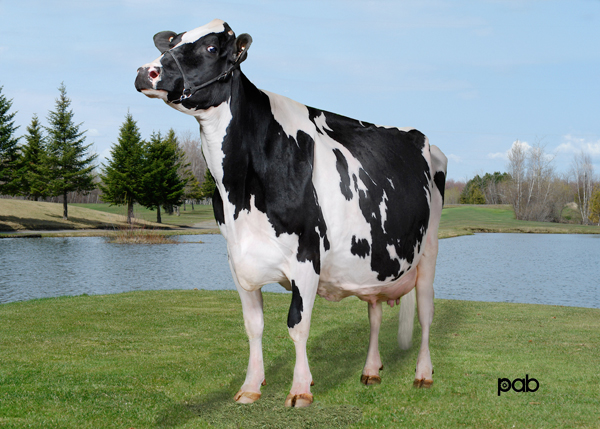
Ready to Go with Video

For Bruce Sargent using video was a natural progression of communication throughout High School. “When I started grade 9, the school was brand new and had video announcements. In grade 11, I was student council president and we made videos to advertise all of our events. In grade 12, I was asked to be the director of the program for the year and I produced all new intro segments for the broadcast.” We often ask ourselves if what we learned in High School applies in the real world but Bruce looks back on his accumulated video learning and firmly states. “Video started there and, since then, I haven’t really stopped.”

Farm Boy Starts with a Farm Boy

The agricultural background for Farm Boy Productions started at the Enniskillen Jersey farm where the Sargent family milked 50 head of home bred Jerseys.  Born and raised on the farm Bruce had hands on experience there too. “Most of high school I was the primary milker and worked full time on the farm in the summers. Our barn is tie-stall and is built for feeding small square bales, though we have been feeding wet wrap bales for about 10 years now. We grow corn for silage, oats and barley, and then the rest of our acres are for hay.”

From Documents to Documentaries

With his love of cows and farming combined with his growing video experience, it wasn’t long until these dual motivations inspired him to launch his own business. “Farm Boy Productions started as a project in Grade 12 in my communications technology course. We were told to design a logo at the beginning of the year that could brand all our work. I designed my cowboy boot logo as part of the class. A few months later, as part of a community business, my teacher paired me with a specialty chicken farm. She gave me the assignment because I was the only farm kid in the class and she felt the other students would not be comfortable working on the farm.”  After that, it seemed inevitable that he would continue with video. The rest, as they say, was not only history, it was now documentary.

Granted … It only Takes a Spark!

With positive experiences building, Bruce was ready to take it up a level. “After my first year in marketing management at the University of Guelph, I was making plans for the summer. I wanted to go home to the farm, but I wanted to put my schooling to work too, so I applied for a summer company grant from the government. They gave me $1500 for start up costs and gave me mentoring to get started. “Education, enthusiasm and the drive to put them together with an action plan moved Bruce further forward on his journey to develop his video business!

Well Mannered.  Well Mentored.

This forward looking young business man has his eye and his camera firmly focused on the present, however, he looks back and is sincerely grateful for the mentors that inspired him to get to where he is today. “My biggest influences have been my Grandparents and my father.  Grandfathers Frank Barkey (Altona Lea Holsteins) and Carl Sargent along with my father, Tim Sargent, have always pushed me to do more. All three are amazing men with great character and morals. Since I was very young, all of them have pushed me to do more in 4-H and life, and from the beginning they have believed in my business. I conduct myself and my business in their image and my biggest motivation is to make them proud. They taught me that the means define the end and I don’t do anything unless I feel it is the right thing to do.”

Another Turning Point for Farm Boy Productions

From the outset Bruce was eager to build on his commitment to both agriculture and video and, therefore, recognized an opportunity when it presented itself in the form of a partnership. “My biggest accomplishment has been entering a partnership with Glacier Farm Media. I was approached in December 2012 by Glacier to enter a partnership. Glacier wanted more video experience and I wanted opportunity for growth. We came to a deal in July of 2013 and I am very excited to be doing video work for them.” Well aware of how crucial these early steps can be for a startup company he enthusiastically categorizes his experience. “It is an entrepreneur’s dream to get a chance like this and I didn’t have to go on Dragons Den or Shark Tank to get it!”

It`s Lights, Camera, Action at Farm Boy Productions

That first year (2010) would see a growing network of clients, projects and new mentors for the fledgling partner.” That year I created videos for a Horse Day Camp. The kids at the camp wrote a story and I was hired to make the story into a video. At the time, Amber Marshall of the CBC show Heartland was the spokesperson of the camp and she acted in my videos.” Off to a great start, there were more yet to come. “For the past two summers (2012) I have been shooting video interviews of farmers for a Calendar promoting agriculture. The project is called the Faces of Farming Calendar, and for the past two years we have included QR codes on the pages so people can scan them and watch the videos. The calendars go to politicians and journalists to teach them about farmers.” This was definitely a win-win situation for everyone involved.

Shoot!  It`s Time to Grow Your Business!

Of course Bruce feels quite strongly about video and its uses. “I think dairy farmers and markets could use video more effectively.”  With his trademark enthusiasm for the benefits of video marketing he offers this advice. “When shooting video on your own keep in mind your audience and your visuals. Make sure you consider your audience and what they want to see, this sounds really obvious BUT it’s easy to do something you think is “COOL” and your audience will disagree. The best way to avoid this is run it past friends and family first. Your visuals need to be relevant, engaging and steady! There is no quicker way to lose your audience than unsteady footage. You want them to watch the whole video.” Bruce takes his own advice and emphasizes the value he places on consistently learning more about his chosen field.  “I am always learning about new techniques, cameras, computers and software.”  Not daunted by the speed of change, Sargent is excited about the growth of technology and new applications for video. “As video becomes more accessible through smart phones, more people will use it. The power of video, if used in the right way can do a lot of good for the industry. I am a big advocate for using video to promote how awesome the agriculture industry is. It’s great to see more cameras than mine out there promoting the industry and I am always excited to hear from clients who want to take their video production up a notch.” (Read more: Nothing Sells Like Video)

The Bullvine Bottom Line

Helping clients grow, market and develop solutions for their business through video is what Farm Boy Productions is all about.  This young entrepreneur not only records the reality of agriculture he is committed to making steady progress toward his own big picture vision of his role in the industry.  The Bullvine congratulates Bruce Sargent’s dedication and passion for those two ingredients that farm folk everywhere recognize as the key to dairy success. See you in the movies Farm Boy Productions!


Get original “Bullvine” content sent straight to your email inbox for free.


[related-posts-thumbnails]

VIEUX SAULE ALLEN DRAGONFLY: 2013 Canadian Cow of the Year Nominee

Vieux Saule checks off many points on what could be described as a pre-flight checklist for an excellent Cow of the Year Nominee.  It all started eleven years ago. Her birth in March of 2002 put her at an ideal age for a 4-H calf in 2003 and, in that year, she took her caretaker Jimmy Perreault all the way to second place in the National 4-H show and 5th at The Royal Agricultural Winter Fair.  That was just the beginning.  Vieux Saule Allen Dragonfly and her progeny propelled Vieux Saule Holsteins to Master Breeder Status in 2009 and lifted them to recognition as a world supplier of elite genetics. (Read more: Vieux Saule Holstein: Rooted In Family Values)

VIEUXSAULE ALLEN DRAGONFLY EX-94-2E-CAN      14* NOM. ALL-CANADIAN 4-H JR.1-YR 2003 2 Superior Lactations

VIEUXSAULE ALLEN DRAGONFLY EX-94-2E-CAN 14*
NOM. ALL-CANADIAN 4-H JR.1-YR 2003
2 Superior Lactations

Dragonfly’s Pedigree Gives Her Wings

Great cows like Dragonfly come from careful constructive breeding by dedicated breeders. Not only is Dragonfly’s dam Excellent, but so too were her fifth, sixth and seventh dams. These were the bookends and in between were high-classifying two year olds by Charles, Astre and Tab. A close look at Dragonfly’s dam, Vieux Saule Outside Mary Sol EX95-3E 4* reveals great performance. She classified EX95 3E and completed 4 Superior Lactations, one of which was a Super 3 Lactation. Mary Sol has a 4* Brood Cow rating. In the show ring, she was 1st Mature Cow at the 2012 Rive Nord Exposition, after having been 1st Senior Two Year old ten years earlier at Beauce.  Here Dragonfly’s pedigree brings persistence and performance together. It is repeated on the sire stack side as well where Dragonfly’s sire stack is loaded with bulls that Canadian breeders hold in high regard.  These bulls are Allen, Outside, Charles, Astre, Tab, Elevation and Arlinda Chief.

VIEUXSAULE OUTSIDE MARY SOL  EX-95-3E-CAN      4* 1ST MATURE COW RIVE-NORD EXPOSITION 2012 1ST SR.2-YR BEAUCE 2002 2ND MATURE COW RIVE-NORD EXPOSITION 2007,2009 1 Super 3, 4 Superior Lactations  Dam of Dragonfly

VIEUXSAULE OUTSIDE MARY SOL EX-95-3E-CAN 4*
1ST MATURE COW RIVE-NORD EXPOSITION 2012
1ST SR.2-YR BEAUCE 2002
2ND MATURE COW RIVE-NORD EXPOSITION 2007,2009
1 Super 3, 4 Superior Lactations
Dam of Dragonfly

Dragonfly’s Performance in the Barn Also Soars

As mentioned earlier, Dragonfly was a 4-H calf in 2003 and went all the way to becoming Junior Yearling.  That was only the start of her high performing career.

Her classification scores are a steady progression from high to outstanding.

  • July 2004 VG86-2yr
  • February 2005 VG87-2yr
  • October 2005 VG88-3yr
  • September 2007 EX91-5yr
  • January 2008 EX93-5yr
  • August 2008 EX94-6yr
  • August 2009 EX-2E

Dragonfly was also filling the milk pail at the same time as she was being extensively flushed.

dfchart

Dragonfly’s Progeny are Flying High

Vieux Saule Allan Dragonfly has earned a 14 Star Brood Cow rating. She has 93 progeny.  The majority are in Canada, with some in the US, Czechoslovakia and Germany.  Dragonfly had two Excellent, three Very Good and two Good Plus Sons that have been used as private herd sires.

Thirty of her Canadian daughters, by eleven different sires, are an impressive group: 1 Excellent, 21 Very Good, 6 Good Plus and 2 Good.  Their average BCAs are high and stand at 245-266-248.  Five daughters have at least 1 Superior Lactation.  Eighteen of Dragonfly’s daughters were Very Good as two year olds. No matter which sire Dragonfly was mated to, she produced quality daughters.

Dragonfly’s highest classifying daughter is Vieux Saule Modest Cleopatra EX90, with one Superior Lactation.  Cleopatra herself as one daughter who has also earned one Superior Lactation.

VIEUXSAULE FREDDIE FELICIA VG-2YR GPA LPI 2973 DGV 2991 GTPI 2286

VIEUXSAULE FREDDIE FELICIA VG-2YR
GPA LPI 2973 DGV 2991 GTPI 2286
Her son Vieuxsaule Flame is the #1 GTPI Genomic Young Sire at + 2561

Dragonfly’s highest gLPI daughter is Vieux Saule Bolton Halia VG87-2yr 2*. Bolton Halia’s production record at 1-11 (305D) was 11,912 kilos of milk, 4.7% fat, 3.5% protein, with BCAs of 317-399-348.  That also makes Halia Dragonfly’s highest production daughter.  Halia has six very high gLPI Freddie daughters. The top Freddie is Felicia VG85 gLPI 3166.  Felician has a UNO son, Vieux Saule Flame who, at one time, was the #1 gTPI genomic sire.

VIEUXSAULE BOLTON HALIA VG-87-2YR-CAN 2* Bolton X Dragonfly

VIEUXSAULE BOLTON HALIA VG-87-2YR-CAN 2*
Bolton X Dragonfly

Another superior Dragonfly daughter is Vieux Saule Toystory Haley, a VG85 2yr 2*.  Haley has a VG85 2yr Man O Man daughter Haydie with a gLPI 3061. Haydie’s outstanding production record is 2-03 (305D) 17,341kilos of milk, 4.5% fat and 3.3% protein with BCAs of 437-523-451 and almost unheard of BCA deviations of +202 +275 +215. These are seldom seen records.

VIEUXSAULE TOYSTORY HALEY  VG-87-5YR-CAN      2* Toystory x Dragonfly

VIEUXSAULE TOYSTORY HALEY VG-87-5YR-CAN 2*
Toystory x Dragonfly

Vieux Saule Dragonfly was on an extensive flushing program and has many daughters born in 2012 and 2013 by bulls such as Goldwyn, Aftershock, Goldchip, Sid and Dempsey.  She provided the takeoff for a cow family that will continue to soar high on the wings of her high achieving progeny. 

The Bullvine Bottom Line

Although the Cow of the Year competition shines the spotlight on one individual, we are inspired by all of them. Each of the nominees is a winner in her own right simply for rising to this level. Over the past few days we have had the opportunity to get to know the nominees better. Obviously they are all worthy of cheering on to the finish line. Who is your pick for 2013 Cow of the Year?


Please like and share if you think Dragonfly should be the 2013 Canadian Cow of the Year!

The Cow of the Year nominee booklet which includes a resume on each finalist and a voting card will be mailed to Holstein Canada members in the February-March 2014 Info Holstein. Voting options include mailing the postage-paid, tear-off voting ballot; faxing your ballot; emailing your vote to cowoftheyear@holstein.ca; or voting online from a confidential Holstein Canada online account.


Get original “Bullvine” content sent straight to your email inbox for free.


[related-posts-thumbnails]

RAINYRIDGE TALENT BARBARA: 2013 Canadian Cow of the Year Nominee

The journey of Rainyridge Talent Barbara EX95 3* to the 2013 Cow of the Year nomination is one where genetics, breeder passion and marketing potential all came together in one cow. Barbara is a 4th Generation Excellent Red Carrier recognized and admired worldwide for her exploits as a show cow. Her impact on the Rainyridge herd is the stuff that cattle breeding dreams are made of.  The next chapter of Barbara’s intriguing story will no doubt be defined by her growing influence as a brood cow.   (Read more: LASTING LEGACY: A Tribute to Rainyridge Talent Barbara and RAINYRIDGE HOLSTEINS: A Turn in the Road)

RAINYRIDGE TALENT BARBARA EX-94-CAN EX-95-5YR-USA

RAINYRIDGE TALENT BARBARA EX-94-CAN EX-95-5YR-USA

A Winning Pedigree

Rainyridge Talent Barbara EX95 3* comes from the Rainyridge Tony Beauty EX-5E 9* cow family.  Tony Beauty goes down in history as the oldest Grand Champion that has ever won World Dairy Expo. This occurred in 1999.  Beauty was a well respected show cow by all standards, having achieved All Canadian and All American Mature Cow status multiple times.  Barbara`s own dam is RF Outside Breeze EX94 2*, with show winnings and two Superior Lactations. Behind Breeze is the EX 2E 6* Rainyridge Briana Milan. Then comes Barbara’s 4th dam Tony Beauty. On the sire side, Talent Barbara comes from a solid sire stack including Talent, Outside, Milan, and Tony. Superior Type and Extra and Gold Medal sires fill her pedigree.

RAINYRIDGE TONY BEAUTY EX-5E-CAN 9* - 3rd dam of Barbara

RAINYRIDGE TONY BEAUTY EX-5E-CAN 9* – 3rd dam of Barbara

Barbara, Breeze, Briana and Beauty all have low inbreeding percentages.  In today`s day and age that is looked for.

The Spotlight Shines on Barbara`s Performance and Production Awards

In both production and classification, Talent Barbara was just like all the others in the Tony Beauty family. She kept improving with age. Talent Barbara first gained recognition early in her productive life when, at 26 days fresh as a two year old, she was made VG86. She continued to go 87 and 88 as a two year old in subsequent classifications.  As a three year old, during her second lactation, she went VG89 (maximum score). In her third lactation she earned EX92. While in Canada she was raised to EX94 and in the US she scored EX95 in 2010.

Her production records also set her apart. Talent Barbara earned 1 Superior Lactation at three years four months. She has completed three lactations totalling 45,920kg.of milk, 3.9% fat and 3.2 protein. Rounding out her excellent career to date is her exceptional conformation index (CONF) which stands at +15, putting her in the top 1% of the breed in Canada.

Talent Barbara Has Got Talent!

Talent Barbara started her show career as a Junior three year old in 2008, when she placed first at the Manitoba Spring Show, first 3 year old at the Westerner Championship and Intermediate Champion and Reserve Grand there as well. Quite a start. She was 1st 4 yr old and Grand Champion at both the 2009 Manitoba Spring Show and the Morris Exhibition.  She was Honorable Mention Grand at the Calgary Spring Show in 2009.

As a show cow, she really came to the forefront as a five year old with these outstanding results:

  • All Canadian and All American 5 Yr Old 2010
  • 1st 5-YR Royal 2010
  • 1st 5-YR Madison 2010
  •  Grand Champion Morris 2010

Celebrity Barbara has Star Power Progeny

Talent Barbara was well travelled among elite breeders in both Canada and the US including Kueffner-St. Jacobs where emphasis was placed on producing show type progeny from this Bull Dam.  Barbara currently has 38 progeny and in 2013 they shone. (Read more: KUEFFNER DAIRY TEAMWORK “2 Dream the Impossible Dream!” and The Judge’s Choice – Investment advice from Tim Abbott)

Her best mate was Charlesdale Superstition. She has three VG high indexing daughters from that mating. In June of 2013 her daughter Rainyridge Super Beauty classified VG87 as a two year old and topped the Rainyridge dispersal at $48,000. At that same sale in June 2013 she had six daughters sell for $97,200. Cornerstead bought many of those six daughters and already owned Rainyridge Super Belinda VG85 2yr old.

Rainyridge Super Beth VG-86-CAN 2yr.

Rainyridge Super Beth VG-86-CAN 2yr.
Dam to the #1 GPA-LPI Red Carrier Heifer, Calbrett Supersire Barb *RC
Calbrett Supersire Barb *RC is the top seller of the Cormdale Summer Sale for $265.000
Daughter of Rainyridge Talent Barbara

In July of 2013 Talent Barbara`s daughter, Rainyridge Super Beth VG86 sold for $75,000 in the Cormdale Summer Sale and Beth`s daughter, Calbrett Supersire Barb, topped the sale at $265,000.  Barb, Barbara`s grand-daughter, was the number one gLPI and gTPI RDC heifer. Her DGV is very high at +3600 gLPI.

Talent Barbara`s first proven son came out in 2013, Rainyridge Perseus, sired by Jasper with +12 for CONF, +0.46% F and +0.11P. Barbara will have more proven sons because she was on the St. Jacob`s bull dam program.

RAINYRIDGE RAMPAGE BARB RED VG-86-3YR-CAN - daughter of Barbara

RAINYRIDGE RAMPAGE BARB RED VG-86-3YR-CAN – daughter of Barbara

To end off 2013 she had her first Excellent daughter, Rainyridge Rampage Barb RED EX92 as a third calver. Talent Barbara’s 10 daughters are 1EX, 8VG, 1 GP and their average BCAs are 221-230-217.

Many more progeny can be expected to make their mark. Talent Barbara has several Goldwyn daughters born in 2013 at River Valley Farm in Ohio.  Furthermore she has young sons and daughters by Lauthority, Destry, Secure and Ladd P at EK-St.Jacobs.

As a Cow of the Year, Talent Barbara represents herself very well as a show cow and as the dam of elite progeny

The Bullvine Bottom Line

Each of the nominees is a winner in her own right simply for getting this far. Over the next few days we will get to know all of the nominees better.  Some are already household names.  Others are less familiar.  Obviously they are all worthy of cheering on to the finish line. Who is your pick for 2013 Cow of the Year?

Please like and share if you think Barbara should be the 2013 Canadian Cow of the Year!

The Cow of the Year nominee booklet which includes a resume on each finalist and a voting card will be mailed to Holstein Canada members in the February-March 2014 Info Holstein. Voting options include mailing the postage-paid, tear-off voting ballot; faxing your ballot; emailing your vote to cowoftheyear@holstein.ca; or voting online from a confidential Holstein Canada online account.


Get original “Bullvine” content sent straight to your email inbox for free.


[related-posts-thumbnails]

GEN-I-BEQ SHOTTLE BOMBI: 2013 Canadian Cow of the Year Nominee

Gen-I-Beq Shottle Bombi EX92 6* is the result of many generations of well thought out breeding. Although Bombi’s third dam, Braedale Gypsy Grand VG88 37*, is the famous bull dam that most Holstein breeders are familiar with, there were generations before her that contributed to the making of this 2013 Cow of the Year Nominee, Gen-I-Beq Shottle Bombi.

Gen-I-Beq Shottle Bombi(s)

GEN-I-BEQ SHOTTLE BOMBI (EX-92 94-MS USA 4*)
Dam of twelve VG daughters!

Bombi Has Pedigree Power that Pops

Bombi’s sire stack is loaded with top proven Extra sires. Shottle, Champion, Storm, Grand, Aerostar, Chief Mark and Elevation are a stellar group well able to contribute correct conformation and high production with show appeal to light up the mix.

On her dam’s side, the pedigree is even more outstanding. Here we have Bombi’s dam, EX90 4*. Bombi is the highest LPI indexing daughter of Champion Bambi and is full sister to Gen-I-Beq Shottle Barbi who was a Cow of the Year nominee last year. (Read more: GEN-I-BEQ SHOTTLE BARBI: 2012 Canadian Cow of the Year Nominee)

Braedale Baler Twine VG-86-2Y-CAN 33*

Braedale Baler Twine VG-86-2Y-CAN 33*
Dam to GOLDWYN!
Full sister is dam to Final Cut & Gillette 2nd Wind VG-88-CAN 3yr.
Canadian Cow of the Year 2007
2008 Global Cow of the Year
2nd dam of Bombi

Bombi’s second dam is none other than Braedale Baler Twine VG86-2yr 33* the dam of many great animals including Braedale Goldwyn, the Extra sire of many great show winners. (Read more: Durham vs. Goldwyn: A Clash of Two Titans)

Braedale Gypsy Grand VG-88-5YR-CAN 37* 3rd dam of Bombi

Braedale Gypsy Grand VG-88-5YR-CAN 37*
2003 Canadian Cow of the Year
3rd dam of Bombi

And then we find Bombi’s third dam, Braedale Gypsy Grand VG88 37*, the dam of six Extra sires and other ones as well that are Superior Type or Superior Production.

With this stellar pedigree power there was no hesitation when Mapel Wood Farms took the opportunity to invest in her at a 2006 sale. (Read more: Mapel Wood Farms – Invest in the Best! Forget the Rest!)

Bombi Has High Flying Performance

Bombi was flushed to a limited extent as a heifer but, since there were three sisters, she was not considered totally unique.  However, once she calved in early 2008, she quickly began to attract attention.  First by classifying VG87.  She followed that up with a Superior Lactation of 2-01 (305D) 12,378 kg of Milk, 4.9% Fat and 3.4% Protein. Her BCAs were 311-413-331, with BCA deviations of +75 +153 +88.  That butterfat at 4.9% caught everyone’s attention! From there she never looked back.  Gen-I-Beq Shottle Bombi was destined on her way. Her true value was about to be confirmed as she became the mother of elite progeny.

Bombi calved again in the fall of 2011, classified VG89 (maximum score for a second calver) and started off on an outstanding record at Mapel Wood. In early 2012 the Siemers Family of Wisconsin where looking for a top cow. Soon Bombi was off to Wisconsin.  She classified EX92 and produced 25,027 kilos of milk (55,176 pounds), 3.5% Fat, and 3.3% Protein. That record would have been a Superior Lactation, if it had been completed in Canada. From then on, Bombi’s sole purpose was to produce quantities of fertilized embryos.

It’s worthy of note that Bombi was the #38 gLPI cow in January 2009.  She had Milk +2271kg., Fat +123kg. (+0.37%), Protein +76kg. (0.00%), CONF. +15 and SCS 2.85.  This is very high for fat and conformation.

Bombi Has Progeny That Soar

Bombi has 163 registered progeny, 82 born in Canada and 81 born in the USA. She is continuing to add to her US total as Siemers Holsteins flush her using the very best genomically evaluated sires.  Bombi has 16 daughters and five sons that are 3000 gLPI or higher. An outstanding achievement.  Fourteen of her daughters scored Very Good, twelve of them as two year olds. The average BCA for this group stands at an impressive 253-284-256. Four of her twelve VG two year olds made Superior Lactations.

Mapel Wood Baxter Bethany VG-85-2YR-CAN  Maternal sister to Boulder & Brewmaster Bombi Baxter daughter

Mapel Wood Baxter Bethany VG-85-2YR-CAN
Maternal sister to Boulder & Brewmaster
Bombi Baxter daughter

Bombi’s first daughter to rise to prominence was Mapel Wood Baxter Bethany VG85 2yr 1*. Bethany made a first lactation record of 2-03 (305D) 15,785 kilos of milk, 4.5% Fat and 3.5% Protein. A Superior Lactation.  Bethany was the #2 gLPI cow in August of 2011. She now has 13 daughters over 300 gLPI. The top one, sired by Mogul, stands at DGV gLPI 3506.

Mapel Wood Man O Man Brooke VG-86

Mapel Wood Man O Man Brooke VG-86
Bombi’s highest indexing daughter

Bombi’s highest gLPI daughter 3274, Mapel Wood Man O Man Brooke, is VG86 2yr and sold in October 2013 to join her dam at Siemers Holsteins, where she is completing a high record. Brooke has 16 daughters over 3000 gLPI. Brooke’s top daughter, sired by Epic, has a DGV LPI that stands at 3294.

 Mapel Wood Man O Man Bombi VG-85-2YR-CAN

Mapel Wood Man O Man Bombi VG-85-2YR-CAN
Bombi’s 2nd highest indexing daughter

Bombi’s second highest Canadian gLPI daughter is Mapel Wood Man O Man Bombi VG85 2yr who herself has six daughters over 3000 gLPI.  Man O Man Bombi’s top daughter, sired by Liquid Gold, has a DGV LPI of 3252.

Bombi has had many high gLPI daughters born at Siemer Holsteins in 2013. They include Bombi’s number two to number five gLPI daughters:  (#2) Siemers S-Sire Bombi –ET gLPI 3151; (#3) Siemers Shan Bombi gLPI 3143; (#4) Siemers Shan Bombianna gLPI 3141 and (#5) Siemers Uno Bombi gLPI 3119.

Sons

Bombi has 3 Excellent and 9 Very Good sons that have all been sampled in AI. The highest son is Mapel Wood Boulder (Man O Man) whose daughters will be calving in 2014. Boulder had two daughters that were top selling animals in the Genetics by Design Sale in 2012.

Other high gLPI sons of Bombi include Barometer (Gerritt), Brewmaster (Gerritt), Bandana (Man O Man) and Balsam (Snowman). In Wisconsin, Siemers Holsteins have three high gLPI sons by Genervation Luxor.

Bombi is definitely a superstar when it comes to consistently producing progeny that rank high on the LPI formula.

The Bullvine Bottom Line

Each of the nominees is a winner in her own right simply for getting this far. Over the next few days we will get to know all of the nominees better.  Some are already household names.  Others are less familiar.  Obviously they are all worthy of cheering on to the finish line. Who is your pick for 2013 Cow of the Year?

Please like and share if you think Bombi should be the 2013 Canadian Cow of the Year!

The Cow of the Year nominee booklet which includes a resume on each finalist and a voting card will be mailed to Holstein Canada members in the February-March 2014 Info Holstein. Voting options include mailing the postage-paid, tear-off voting ballot; faxing your ballot; emailing your vote to cowoftheyear@holstein.ca; or voting online from a confidential Holstein Canada online account.


Get original “Bullvine” content sent straight to your email inbox for free.


[related-posts-thumbnails]

COMESTAR GOLDWYN LILAC: 2013 Canadian Cow of The Year Nominee

As second time nominee for cow of the year Comestar Goldwyn Lilac VG89 6*successfully ticks all four boxes:  classification, production, the show ring and genomics. In 2013 Lilac not only had daughters and granddaughters continue to hold high rankings on elite lists but she built on her famed Lila Z foundation. (Read more: COMESTAR GOLDWYN LILAC: 2012 Canadian Cow of the Year Nominee)

COMESTAR GOLDWYN LILAC VG-89-5YR-CAN      3* ALL-ONTARIO SR.2-YR 2008 NOM. ALL-CANADIAN SR.2-YR 2008 2ND SR.2-YR ON SUMMER 2008 1ST SR.2-YR AUTUMN OPP. 2008

COMESTAR GOLDWYN LILAC VG-89-5YR-CAN 3*
ALL-ONTARIO SR.2-YR 2008
NOM. ALL-CANADIAN SR.2-YR 2008
2ND SR.2-YR ON SUMMER 2008
1ST SR.2-YR AUTUMN OPP. 2008

Lilac`s Pedigree Shines from A to Lila Z

The sires behind Lilac are Goldwyn, Durham, Formation, Starbuck and Astro Jet. These five are some of the greatest sires in North America and have made a significant contribution to Lilac’s success story.  Goldwyn especially, who is known as an impact sire, certainly did that for Lilac.

Lilac`s dam, Lila Z EX94 17* is already hailed as a legend in her time.  Lila Z was preceded by two generations of EX 94 cows with high production.  The Million Dollar Cow was living at Comestar, when she was flushed to Goldwyn to produce several full Goldwyn sisters, including Lilac. (Read more: Lylehaven Lila Z : Was She Really Worth $1.15 Million?LYLEHAVEN: Developing the DreamLYLEHAVEN LILA Z – 2012 Golden Dam Finalist, and The Legend – Lylehaven Lila Z Passes) They all carry high type, high production and high index. Like Lilac the other daughters have also placed bulls in A.I. and inspired global demand for their embryos. Many breeders are confidently using Lilac to reap the rewards of owning a Lila Z.

LYLEHAVEN LILA Z EX-94-CAN 14* Dam of Lilac ALL-CANADIAN JR.2-YR,JR.1-YR HM. ALL-CANADIAN 5-YR,4-YR HM.INT. ROYAL 2004 1ST JR.2-YR ROYAL 2004

LYLEHAVEN LILA Z EX-94-CAN 14*
Dam of Lilac
ALL-CANADIAN JR.2-YR,JR.1-YR
HM. ALL-CANADIAN 5-YR,4-YR
HM.INT. ROYAL 2004
1ST JR.2-YR ROYAL 2004

Lilac Produces Outstanding Progeny

It is obvious that Lilac carries on the strong transmitting potential of her pedigree. Many of her high indexing sons and daughters are setting outstanding benchmarks. Originally in the spotlight as a descendant of the Lila Z family, Lilac is establishing herself as a matriarch in her own right. Currently Lilac has 141 progeny: 74 daughters and 67 sons.  Offspring born in 2013 added polled and red to the family. And, once again, the numbers are excellent. The daughters of Goldwyn Lilac now claim star power that stands at 6 stars for Lilac, having added 3 in 2013. Lilac currently has 26 classified daughters: 19 Very Good and 7 Good Plus. Nothing lower than Good Plus is a remarkable record. That is also the case with the standard being set by Lilac’s top daughter Lucy. Lucy is Lilac’s top gLPI daughter, with Lucia in second and rising close behind are other daughters yet to calve by Uno, Brewmaster, Snowman and Epic.

MAPEL WOOD M O M LUCY GP-84-2YR-CAN Lilac's highest DGV daughter by Man-O-Man

MAPEL WOOD M O M LUCY
Lilac’s highest DGV daughter by Man-O-Man

Lilac Loves Lucy … and Lucia!

Mapel Wood Man O Man Lucy is Lilac’s top gLPI daughter at 3363.  Lucy herself has seven daughters that are all over 3000 gLPI.  Lucy’s top daughter is Sudan Licorice who was a sale topper at $200,000 at the 2012 International Intrigue Sale. (Read more: International Intrigue – The Secret Is Exposed!) Lucy’s top son is Genervations Morley (Mogul) has a very high gLPI of 3326 and will be available to breeders in 2014. Lucy classified VG86 and made a superior production lactation in 2013.

OCONNORS PLANET LUCIA VG-86-2YR-CAN Daughter of Lilac #1 LPI Cow in Canada

OCONNORS PLANET LUCIA VG-86-2YR-CAN
Daughter of Lilac
Former #1 LPI Cow in Canada

Lilac’s Planet daughter Lucia was the #1 LPI Cow in August and December 2012.  She classified VG86 and completed a superior production lactation. In 365 days, at two years of age Lucia produced 15,287kg of milk at 4.5% fat and 3.6% protein. Lucia has 21 daughters that are 3000 gLPI or higher. For a year now, breeders have been using three of Lucia’s popular Boulder sons: Liquid Gold, Fuzion and Gizmo. Her highest gLPI indexing son by Enforcer at +3347 was born in October 2013. (Read more: $750 Dollar Semen! Are You Crazy?)

The Sharing of the Great Lilac Genes

Obviously, Lilacs great genes are being passed on to the next generation. Daughters beyond Lucy and Lucia are rapidly adding to those 28 high achieving grand-daughters as they too produce daughters that score at 3000 gLPI or higher. As the Lilac crop is scored it is clear that Lilac’s daughters classify high early in their lifetimes with 16 being VG in their first lactation of which 4 also had superior production lactations. It is also interesting to note that, early on, one of Lilac’s popular mates was Shottle. Her combination with him has produced two VG88 Shottle daughters who have superior production lactations. (Read more: LESSONS LEARNED: 6 Dairy Cattle Investment Secrets Revealed)

MAPEL WOOD SHOTTLE LILI VG-88-2YR-CAN

MAPEL WOOD SHOTTLE LILI VG-88-2YR-CAN

The Lilac Family has Son Shine Too!

Lilac’s son Leading Edge (BWM Leader) received his first daughter proof in December 2013. That proof came in at 2684 gLPI with high ratings for component percentages and feet & legs.  Other high genomic Lilac sons that are yet to be proven include Luxor (+3293 gLPI), Lanyard (+3164 gLPI) and Lingo (+3103 gLPI) all sired by Man O Man and Latimer (+3023 gLPI) who is sired by Freddie.

Sensational Lilac Performance Where it Counts!

Lilac is owned by Genervations Inc., Mapel Wood Farms and O’Connor Land & Cattle Co., of Jerseyville, Ontario. Over two lactations Lilac produced 53,569 kgs at 4.6% Fat and 3.6% protein.  Her component percentages are outstanding. She has garnered two Superior Lactation Awards: 2-03  (305D)   14,556 kgs  4.6%F   3.7%P and 4-06  (305D)    19,612 kgs  4.6%F   3.4%P.

Not only did Lilac perform in the barn, she also did so in the show ring where she was All –Ontario Sr. 2-Yr 2008 and was Nominated All-Canadian Sr. 2-Yr 2008. At 183 days in milk, in her second lactation, she was raised to VG89  – the maximum possible classification score.

Lilac has been competitive on the index list as well.  She has placed as high as #6 LPI cow but, even more amazing, is that she has placed in the top 16 on the LPI list no less than 9 consecutive times.  That’s blooming great no matter how you look at it.

Goldwyn Lilac`s record of success is also rounded out by records made in the auction ring. Lilac’s family accounted for approximately 66% of the 2012 Genetics By Design Sale’s total! As well, son Lexor had many high selling daughters in sales over the past two years. (Read more: Genetics by Design – Crosses the $4,000,000 Mark)

With all these achievements it is quite easy to forecast that the impact of the Comestar Goldwyn Lilac family will continue to positively build Holstein genetics around the world.

The Bullvine Bottom Line

Each of the nominees is a winner in her own right simply for getting this far. Over the next few days we will get to know all of the nominees better.  Some are already household names.  Others are less familiar.  Obviously they are all worthy of cheering on to the finish line. Who is your pick for 2013 Cow of the Year?

Please like and share if you think Lilac should be the 2013 Canadian Cow of the Year!

The Cow of the Year nominee booklet which includes a resume on each finalist and a voting card will be mailed to Holstein Canada members in the February-March 2014 Info Holstein. Voting options include mailing the postage-paid, tear-off voting ballot; faxing your ballot; emailing your vote to cowoftheyear@holstein.ca; or voting online from a confidential Holstein Canada online account.


Get original “Bullvine” content sent straight to your email inbox for free.


[related-posts-thumbnails]


Bram Prins – The Global Dairy Business Mentality

Bram Prins picEvery dairy family builds their agricultural legacy over time.  For Bram Prins it started in the Netherlands over forty years ago. “In 1968 our family decided to move to county Groningen. As the oldest of seven children I worked with my father to start farming 54 ha of arable land where we had 100 cows. “  
This is the early motivation that first inspired Bram Prins to look to agriculture as a career.  However, three decades later he is still passionate about dairy farming and more importantly how it can continue to grow and be profitable.  On February 5th he will share his enthusiasm, experience and insights as a keynote speaker at the 2nd Annual Canadian Dairy Xpo in Stratford Ontario.  If you’re looking for a “day off” this is the exact place to get recharged and revitalized for the year ahead. Building on the resounding success of last year’s inaugural event, Canadian Dairy Xpo 2014 organizers have put together a tremendous diversity of products, experts and entertainment in one place at one time (Check out the full Canadian Dairy Expo program).

Bram Prins: Lifelong Learning and Worldwide Classroom

Despite his early involvement on the Groningen farm, Prins, now sixty-two, doesn’t consider himself to have an agricultural background.  However he provides further explanation. “I do not have an agricultural background, but as farmer I do have a wide scope of interests.” This compelled him to lifelong formal and informal expansion of his studies.  “Until last year I undertook training every year and earned minors and training at Nyenrode Businesss School.” A further source of agricultural edification came through many years of involvement with agricultural interest groups. “From 1985 till 2002 I was member of different boards, mainly feed and milk, in the agricultural sector.”

Prins Consulting

From this growing background Bram was prepared to set up a business group. “In 1990 I was the founder of European Dairy Farmers and in this position I travelled a lot around Europe and collected different data, information and knowledge.”

Twelve years later, Bram decided to leave as President of EDF and started working for Wageningen University.  “I began by developing and giving training in a team of Entrepreneurship.” Since that time, he has given trainings in more than 6 different European countries in Interactive Strategic Management.” His interest in problem solving kept him busy too. “I worked also as advisor for individual farms in special topics including mediation, succession and financial management.” His growing expertise became sought out and he has expanded outside the private sector.  “More and more my work includes governments in supporting or coaching farmers in special situations such as outplacement, solving difficult situations etcetera.”

Global Dairy Farmers

In 2005, this intense building of expertise was the foundation for Bram to start Global Dairy Farmers http://www.globaldairyfarmers.com. In 2004 he was joined by another colleague and started one year later GDF  In 2009 Elise Bregman started working for Bram and  became Manager of GDF. Prins is financially responsible for 100% of the company.” Bram is enthusiastic about the need for a business such as the one in inaugurated with Global Dairy Farmers.  Here is someone who is unique in being eager to work on the problems faced by the dairy industry. “I am always looking for solutions to impossible situations and building relationships based on trust.” Bram outlines the core values of GBF. “We are focused on Global Dairy Farmers, rural development and entrepreneurship.” He points out the international growth that has taken place. “This has led to coaching farmers both inside and outside the Netherlands.”

Facing Challenges. Feeding the World.

The challenges faced by dairy producers have a special place in the heart of the President of GDF. Bram sees feeding the world as the number one challenge facing the dairy industry. At the same time, the industry itself is facing globalization. This raises the reality that today milk prices are becoming more equal worldwide. Dairy producers need to become excellent managers. After that, the biggest challenge facing the industry is the one of fulfilling the wishes of the consumer. The producers must accept and deliver what the consumer values.

Think Like An Entrepreneur

As Prins watches the changes that take place internationally, he is especially convinced that dairy producers must think more like entrepreneurs.  Worldwide the influence of farmers as a political group is declining.  The industry must face the reality that there is much less financial support from governments. Having said that he recognizes that farm business operation is evolving. “In some places dairy farming is just like normal business already. Especially in the new upcoming milk regions where backward integration is usual already.”  Prins sees further globalization of milk production including, “in the long run in Canada.”

Bram Prins has 3 children and 14 grand children

Bram Prins has 3 children and 14 grand children

The Future Marketplace

Bram’s global perspective sees new ways that will differentiate dairy producers since eventually it will no longer be by price only.  He sees that culture, climate and growing conditions will have an impact on competitiveness in the dairy marketplace.  Infrastructure will be of prime importance to the sustainability of the dairy industry of the future.

Best Advice for 21st Century Dairy Producer

Prins encourages dairy producers to think big and see the total picture.  “You must look beyond the farm gate and be aware of what is happening worldwide in dairying and in other agricultural sectors too.”  Bram has personally observed, trained and advised dairy stakeholders on the necessity of being market oriented, thinking value-added and dealing with price fluctuations. “If you look at the increasing influence of the market, I believe the next major challenge will be the creation of added value; in my eyes, the step towards sub-flows within dairy production is a logical next step.”

Always Pro-Actively Moving with the Changing Times

When confronted with the issue of globalization, many of us sit back and stress out asking “How bad are things going to be?” Bram Prins urges the dairy sector to pay attention to three evolving areas. “Dairy producers must address the issues relating to sustainability, animal welfare and pro-active communication. “The latter issue especially causes Prins to urge “It is a necessity to build bridges between producers and consumers.” Unfortunately, another of the trends of the industry one that Bram points out.”There is a lack of farmers and qualified labor.”  While this is a reality, he also sees the potential solution. “We will see growth of the size of our farms with the help of automation.”  Expanding further on this side Prins also sees it applied directly to cow management. “We are coming to a cow approach based on ICT in the growing herds.”

The Bullvine Bottom Line

Bram Prins is a dairy industry futurist and is dedicated to serving the dairy sector and looking for innovations, trends and new farm systems. Global Dairy Farmers is committed to identifying problems and finding solutions through discussion, research, projects and strategic studies. Bram Prins recognizes that “Developing future scenarios is one thing: implementing them is another matter.”  Bram hopes to share and inspire a value-added vision of the dairy industry on Thursday, February 6th at Canadian Dairy Xpo 2014 where he will speak on the creation of Global Dairy Farmers and the top 4 insider global dairy trends that every producer needs to know. “It’s the perfect place to get leading edge feedback and encouragement about dairy perspective in the 21st Century and the challenges and opportunities that await us. Be inspired by Bram Prins at the Maizex Dairy Classroom and you could go home from your “day off” with a solution that’s “right on!”

Want to learn more about the top 5 insider global dairy trends? Bram will be presenting at Canadian Dairy Expo on February 6th.

[related-posts-thumbnails]

TOM HOOGENDOORN- Family man, Farmer & Our Face to the Consumer!

Valedoorn Farm in British Columbia’s Fraser Valley is a family farm.  Tom Hoogendoorn is proud of that designation and how it motivates their family’s business philosophy. We put a great deal of effort into quality of life for our families and employees.”   

This passionate dairy ambassador is set to share his enthusiasm and expertise as a panelist at the 2nd annual Canadian Dairy Xpo in Stratford, Ontario on Thursday, February 6th.  If you’re looking for a “day off” this is the exact place to get recharged and revitalized for the year ahead.  Building on the resounding success of last year’s inaugural event, Canadian Dairy Xpo 2014 organizers have put together a tremendous diversity of products, experts and entertainment in one place at one time (Check out the full Canadian Dairy Expo program).

This Family is Positive about Moving Forward

Tom and Gail Hoogendoorn own Valedoorn Farm with Tom’s brother John and his wife Lan. For the Hoogendoorn brothers it was a logical progression. “My brother and I were born into the dairy industry. Our father died while we were still in high school. At that time I was 17 and John 15 and we worked on the farm with our mother from 1979 till 1987 when we purchased it. We have slowly expanded our land base from 47 to 200 acres and rent another 110 acres making corn and grass silage and currently have 260 cows and 260 young stock.  We employ 3 fulltime staff including my nephew Alex. We also have several part time staff.” The sadness that touched their family in the end has had a positive effect on how they live their dairy lifestyle. “Having our father die early made us realize that every day should be meaningful and enjoyable if possible.”

Optimal Care. Optimal Efficiency. Open Doors.

High standards are also applied to every area of the dairy operation. All of the Valedoorn cattle are registered and classified. “We optimize efficiency in every area of our farm whether it is getting heifers pregnant or getting the most out of our crops.” The benchmarks they have reached record their success at targeting measureable goals.  “Currently  BCA’s run between 245 to 255.  Pregnancy rate runs around 30 percent year over year. We ask our cows to milk a lot of milk but try not to push the grain too hard relying on our forages to do the job.”  There are many fine details of cow management that must be optimized and when it comes to herd health, they can truly be said to be aiming to put their best foot forward.  “Hoof care is a huge part of our management practice. We want our cows walking comfortably and happily to the feed bunk! This is huge!”They also ask a high level of commitment from themselves and staff. The doors are open to everyone. “We have a modern dairy setup that is camera or visitor ready every day or night.  This “open door” policy is opening minds too as people come to Valedoorn. “People are always very surprised on how well the animals get treated.”¦It’s a real eye opener, when they come to the farm, to see how clean it is. We’re really proud of that fact and that’s why we never turn tours away.”

Both Cows and Bulls Must Meet Strategic Performance Parameters

The philosophy of consistent improvement also applies to the dairy genetics of the Valedoorn herd. “Our breeding goals are to have every cow classify 80 pts or higher. We want average sized cows with a will to work standing on great feet and legs with pleasing udders. This has resulted in 75 percent GP or better with us having bred 5 Excellent cows in the last number of years including a Throne who just calved for the 8th time who is 5E 92 Pts. We love good cows who give us no trouble. We work with Alta and Derek Flaman who picks the parameters and chooses the bulls. All breeding is done with their breeding guide. We do use some sexed on heifers and choose bulls for health traits udders and legs. We also like dairy strength.”

The view from Tom's kitchen window

The view from Tom’s kitchen window

Canadian Dairy Farming from the Global and Local Perspectives

Tom`s interest in dairy farming spans local, national and international issues. Locally Valedoorn must always be alert to changing pressures. ““Challenges currently facing me are getting enough land in our area to farm and the start of succession planning.  In Canadian terms he recognizes the unique challenges. “Dairy farming in Canada is different than other parts because of quotas. We are well organized as an industry and can affect change for our own well being. That is a two edged sword as it sometimes breeds complacency and an attitude of entitlement. We have to work hard to keep our system and be responsive to consumer demands. In the industry it’s trying to keep our Supply Management system whole and working for every farmer large and small in every region.

RELATIONSHIPS: Run the Business.  Grow the Business. Transform the Business.

The first priority and one that’s harder and harder to meet is a personal one, “For me it’s getting enough time to spend with the family.” Having said that Tom acknowledges that all the time spent is a main reason that the family farm has been in the family for 34 years. “That’s a great accomplishment arising from constantly expanding our land, cows, quota, and barns.” The family, the farm and the business is constantly changing with three main priorities. “The family working together. We are always meeting the goals we set. We continually set new goals to move us forward.”

Tom has seen many changes in the dairy industry and it has affected his approach to dairying. “Over the years the biggest change has been the size and efficiency of the farms. All our practices and methods are improving at least in the Fraser Valley where I live.” Looking back he is amazed at the progress. “There is a huge change in the quality of our cattle and the efficiency of our farms. It would have been unthinkable 30 years ago.” Once change that Valedoorn farms embraces is genomics. “Genomics for us mean better faster genetic improvement. Simple story. We are getting more info on cattle sooner and can use that for faster improvement. “

The proAction Initiative

Tom doesn’t shy away from the issues impacting the dairy industry. “We must acknowledge that the consumer and government are trying to get more involved with how we produce food in this country. We can’t ignore their questions and expect support from the broad public. People are curious about food since they are getting more and more removed from rural and farm life.” This has led to Tom becoming a spokesperson for exactly those concerns.  The proAction Initiative is a way of showing our customers and consumers that we have improved the management of our farms over time. That we take responsibility for our on farm food safety, quality of milk, care of our animals, and care of the environment. We are doing things to enhance biosecurity to limit or prevent diseases from coming onto our farms. It’s going to be a way of not only telling our consumers that we are doing a good job but we will have a way of measuring and proving that claim. It will be a way of defending our best practices that we are implementing on our farms. Showing is better than just telling all the great things we as Canadian dairy farmers are doing in the area of sustainability.”

Classical music being played for the cows at Tom's farm for the  website musicmakesmoremilk.com

Classical music being played for the cows at Tom’s farm for the website musicmakesmoremilk.com

Opportunities Ahead. Raise Awareness. Hold office.

Tom encourages and in fact urges all farmers to get more personally involved and suggests that communication is the first step. “Farmers should be involved in social media just as they should be involved in their communities. It raises awareness and profile of our industry and hopefully creates a positive link to our consumers. Farmers can no longer sit at home thinking a few select people will move them forward. I always urge frustrated young farmers to organize and get involved and take a run at leadership in whatever form they think they may be effective or like.”

Tom endorses all forms of communication, including digital and once again doesn’t expect others to do something he doesn’t do himself. “Social media for me started as a way to connect with the running world. I run marathons and so on for a hobby and it was a good way to learn and interact. Soon I learned that it is a good tool for farmers to tell our story as long as it is done properly. While I was a Dairy Farmers of Canada board member, I started concentrating on that side of it. Social media for me has been a fun positive experience. You get out what you put in as most things in life.”

The Bullvine Bottom Line

Tom Hoogendoorn is fully aware that there are many different ways for farmers to set and meet goals whether it’s running a dairy operation or running a marathon.  However, there is one characteristic that he urges everyone to embrace. “Never stop changing.” For Valedoorn Farm and the Hoogendoorn family that means working to move forward.  Tom hopes your forward looking plans include Canadian Dairy Xpo.  If you do nothing more than find an answer to a problem you’re working on or a make a new contact or get an onsite review of a piece of equipment,  Canadian Dairy Xpo might  solve or begin to solve your biggest dairy challenge and that means you will be move forward in 2014.  Catch Tom Hoogendoorn`s enthusiasm and you could go home from your “day off” with a solution that`s “right on!”

Want to learn more about Toma nd the proAction Initiative? Tom will be presenting at Canadian Dairy Expo on February 6th.

[related-posts-thumbnails]

Let’s Examine Calf Health, Technology and Feeding at XPO 2014 with Markus Straub

Markus Straub was born and raised on a dairy farm in south Germany. Looking back he sees this as of key importance to his chosen career path. “That is a basic experience and very helpful for me to understand the needs of dairy farmers and their way of thinking.”

This is the background Markus brings when sharing his expertise on the high interest topic of automatic calf feeders.  Markus will share his presentation at the 2nd annual Canadian Dairy Xpo in Stratford, Ontario on Wednesday, February 5th.  If you’re looking for a “day off” this is the exact place to get recharged and revitalized for the year ahead.  Building on the resounding success of last year’s inaugural event, Canadian Dairy Xpo 2014 organizers have put together a tremendous diversity of products, experts and entertainment in one place at one time (Check out the full Canadian Dairy Expo program).

Förster-Technik – Products, Performance and Support.

Markus studied agriculture at the University of Nürtingen, Germany, and graduated in 1995. After his first work experience at an agricultural machinery department of a cooperative, he joined Förster-Technik in 1997 as a product and key account manager. In 2011 he became head of product management and sales at Förster-Technik which he explains is “the world market leader for automated calf feeding systems based in Engen, Germany.  Our sales span the globe, with sales of our products touching more than 40 countries. Förster-Technik products are sold in North America by Delaval, Lely and GEA. Moreover, we have a technical partnership with Grober Nutrition to support our sales partners and customers.” He outlines the products provided to dairy clients worldwide. “We are the developer and manufacturer of first-class, innovative automatic calf feeding systems and a wide range of accessories with which you can feed and monitor individually penned and group-housed calves from their first day of life.”

calf techChanging The Calf-Raising Mindset

With more North American dairy farms using automatic calf feeders, the interest has grown considerably and forward planning breeders will be at Xpo to share experiences, questions and concerns. “When Förster-Technik first started its business in North America in the 1990s, group housing and automatic calf feeding was fairly unknown and therefore farmers, veterinarians and researchers were very skeptical that this way of housing and feeding calves could work successfully. At that time bucket feeding in single hutches was the only way of feeding calves. The challenge was not just to place new equipment into a market place but also to convince the professionals that this new calf rearing concept based on group housing would also work under North American conditions. A great partner to promote this new concept has been and still is Grober Nutrition. As a team Förster-Technik and Grober Nutrition managed to introduce group housing systems with Förster-Technik calf feeders in North America and to make a success story out of them.”

calf techAdvantages of Automatic Calf Feeders

Markus is enthusiastic about ways that this technology can be an asset to modern dairy calf raising. “Our automatic calf feeders are equipped with animal identification and integrated management software to accurately and reliably control crucial parameters, such as e.g. drinking speed, feed intake, number of visits to the station etc. Our calf feeder in combination with the unique extension CalfRail, allows you to combine the feeding of calves in groups and single hutches. Due to the great flexibility of the system and the high performing components, our calf feeders are suitable for small, medium and large-size dairy farms.” No doubt experienced dairy men will seek input on how and why to incorporate this technology.

Global Demand Drives Growth. 40FIT Meets Needs.

Modern dairy operations are under constant pressure to be profitable in a changing marketplace.  On the bright side Markus points out that the consumer market is going to grow considerably. “The international demand for milk will grow, mainly driven by China.” That good news has to be looked at objectively from the North American perspective. “Farmers will more and more fight with the availability of resources like land and water. Therefore high production costs (including labor) will force the farmers in the future to achieve high labor productivity and to have efficient management tools available to make good and fast decisions. This will only be possible by introducing further automation as well as reliable and innovative concepts for production.” This is exactly the situation Förster-Technik is prepared to meet. “Our 40FIT concept perfectly fits to these needs. It offers a solution for rearing calves the most intensively. It combines the know-how of nutritionists, technical solutions from Förster-Technik like the special “40FIT-plan”, automatic calibration or temperature-controlled feeding. In addition, the 40FIT-concept offers tools for better monitoring and management of calves.  The aim of 40FIT is to assist the farmers to achieve optimum growth of their calves and to create a healthier and more efficient dairy cow.”

Healthy Calves Using Automatic Feeders and Group Housing

The main aim is to raise a healthier and stronger calf by using the automatic calf feeder in combination with group housing. Five areas that he will expand upon at Canadian Dairy Xpo are highlighted as follows.

  1. Get off to the Optimum start
    “Make sure that your calves have been optimally provided with colostrum during the first few hours in life!”
  2. Establish Good Management Feeding Practices
    Straub suggest that these five areas must be carefully considered and implemented.
    a-      Feed the calf intensively, i.e. more often a day with physiologically appropriate portions (e.g.  4 to 6 feedings a day). The 40FIT feeding plan gives the young calf the possibility to drink more often a day the amount of milk it needs.
    b-      Establish management routines for the daily work (check calves using the control unit and do not over babysit calves when getting them accustomed the calf feeder.
    c-      Spend part of your saved time just to observe your calves. Also check calves yourself because you need to know what is going on in the barn
    d-     Use the offered information of the management software of the calf feeder handheld terminal or CalfManager, like e.g. control tables showing the feed intake and drinking speed of the calf.
    e-      Drinking speed is a good indicator for health.
  3. Modern Dairy Calves Must Perform to Modern Dairy Requirements
    The decision to work with a new system always boils down to how it provides benefits over the system currently in place. Markus points out five potential advantages of automated feeding.
    1. Smooth controlled weaning supports the development into a ruminant.
    2. It is a safe process, always providing the right temperature, amount, mix and volume, according to an established feeding schedule.
    3. Labor saving (bucket feeding about 10 min / calf; Automatic feeder about 1 min / calf).
    4. Traceability. Supported by the management software the farmer has data available for any individual animal throughout the total rearing period.
    5. Informed decision making now and in the future (e.g. for breeding) because of data collected.
  4. Making Group Housing Work
    For many the change from individual hutches to group housing will be the most challenging transition.  Some studies have shown that group housing, as expected, works best, if you start out with healthy calves.  Markus points out that, although it is group housing, individual feeding, treatment and management must still be provided.  There are other important considerations.
    1. The calf group is established as a group from the outset. This supports the grouping process after weaning and reduces after-weaning stress.
    2. Future expansion is easily possible therefore making automated feeders suitable for different farm sizes
    3. The calves should be housed by age (group calves 0-4 weeks and 4-8 weeks) to reduce competition in the group. If you have enough calves to fill one group within one week you can use the all-in/all-out principle for this group.
    4. The housing in general must have a good ventilation, enough space (25-30 SQ/F), fresh water always available in addition to the feed.

The Bullvine Bottom Line

Markus Straub is a keen observer of how change is affecting the dairy industry. “Just a few years ago the main opinion was to raise calves with as little milk as possible and to gain body weight later via compensatory growth with concentrate feed. The latest research shows that intensive feeding in the first weeks after birth has a positive effect on the entire lifetime output.” Markus hopes you will bring your new ideas, visions and insight to Canadian Dairy Xpo 2014 and join the presentations on “heifer creation, health and development.”  It’s the perfect place to get leading edge feedback and encouragement about 21st Century tools that allow your calves to perform up to their potential. After checking in with Markus Straub at the Maizex Dairy Classroom, you could go home from your “day off” with a solution that`s “right on!”

Want to learn more about his? Markus Straub will be presenting at Canadian Dairy Expo on February 5th.

[related-posts-thumbnails]

Erica Rijneveld – Takes Her Show… And Yours…On The Road!

29f3b7f[1]For those outside the agricultural industry, it might be hard to visualize how a passion for dairy cattle could grow into a career that involves international travel. For Erica Rijneveld of Rotterdam Area, Netherlands it is one of the perks of the multi-faceted career that she has chosen and designed to her very own specifications.
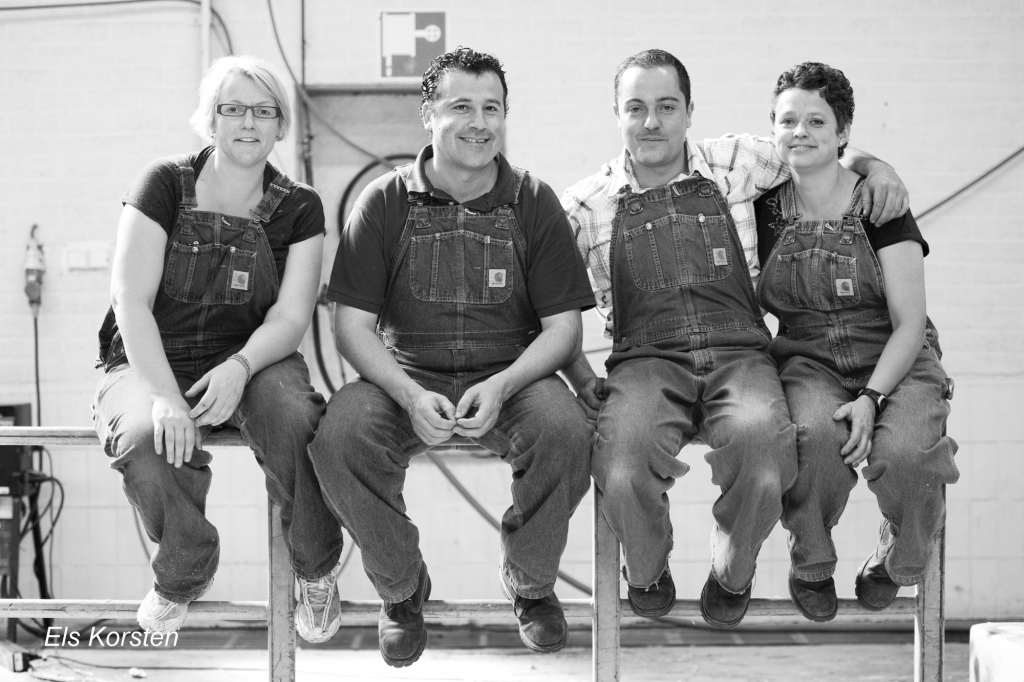
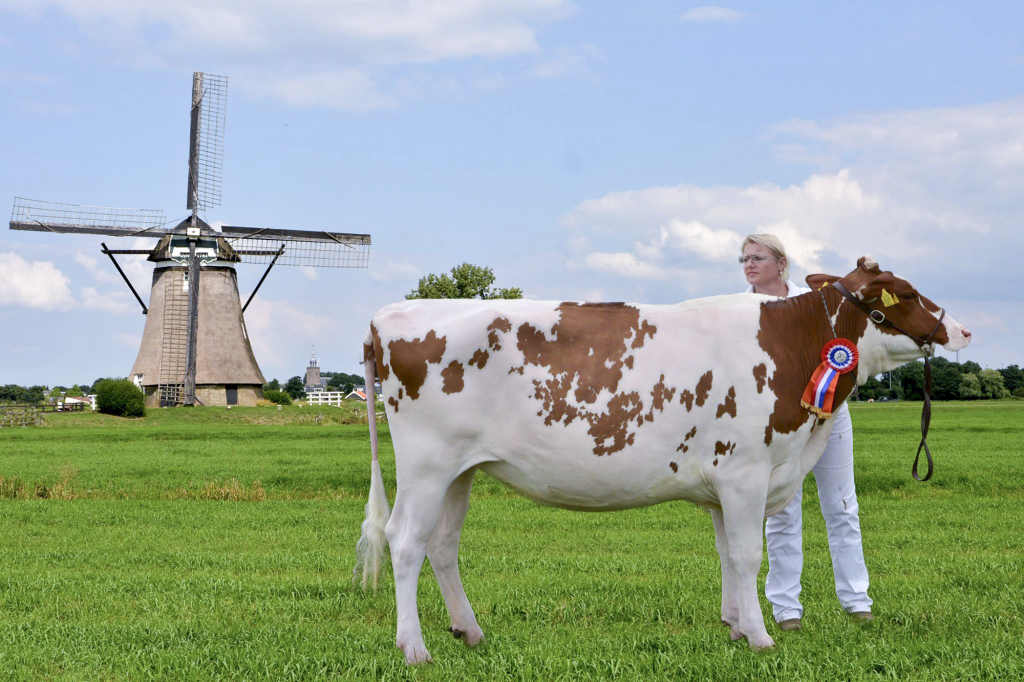
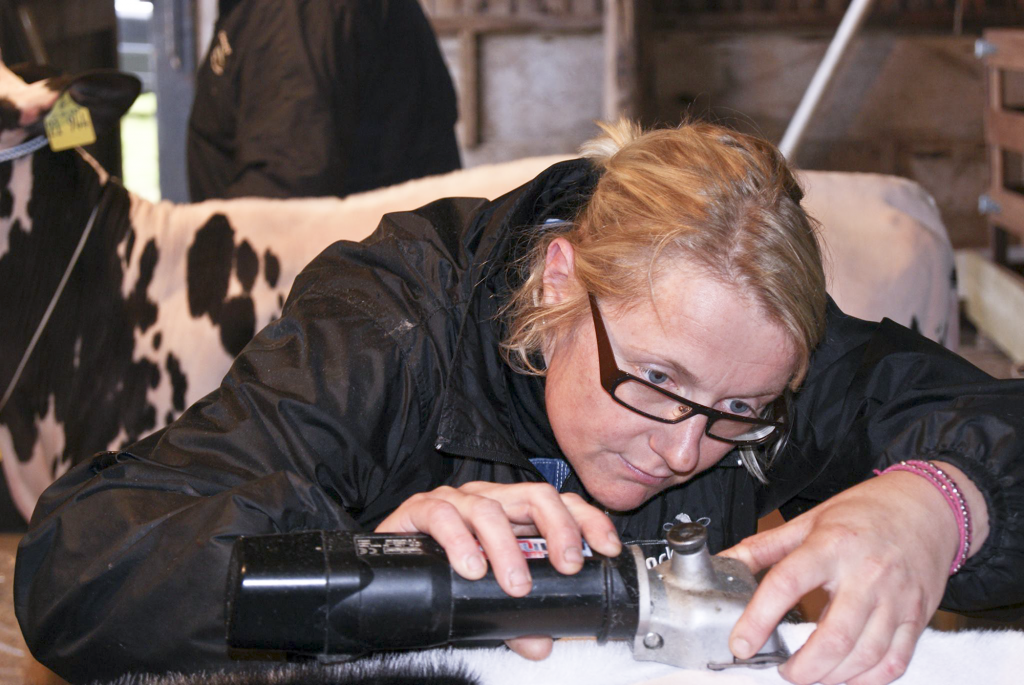
Beauty and the Boss

Erica knows the value of setting early and focused career goals. “When I was 14 I started helping on my uncle’s commercial dairy farm.” That early experience inspired her educational choices. “I got really into it when I did my training in Italy at Castelverde Holstein for the Agriculture University at 18. With that foundation Erica risked an important new beginning in 1998, while still at University. “I started my company Livestock Show Equipment for importing show supplies. I wanted to use the products I had used in Italy and, at that time, it was hard to get these items.” Having identified the need and taking action, her future began to unfold.

Have “LIVESTOCK SHOW EQUIPMENT”.  Will Travel.

Currently, Livestock Show Equipmenthas two complementary divisions.  On the one hand, Erica sells show supplies throughout all of Europe and, on the other hand, she serves and inspires her business clients with clipping, showing and taking care of cattle for shows and sales. This enthusiastic, go-getter has a unique approach for aligning her goals and the marketplace.  First of all, when it comes to performance she feels it’s important to have the passion to do things perfectly.  “As hard as that may seem you have to be willing to work exceptionally hard.”  Erica has never waited for the world to change for her. “You have to work on what you need yourself.” She gives an example of how she has taken the less chosen path and learned to accommodate to the workplace and marketplace. There are some who, when facing working in Spain and unable to speak Spanish, while co-workers and customers do not speak English, would choose an obvious solution. “They should learn to speak English.”  But for Erica her reasoning was “If I want to continue working here, I should start to learn Spanish.” The second choice of taking responsibility for change has served her well.

er and friends

Erica Falls on the Daring End of the Spectrum

Erica has found and encourages others to see the dairy industry as a classroom. “All the people I have worked with have had an influence on the way I am working now.  From some of them I learned clipping skills.  From others I learned how to pull your show team together and work things out. For my online web-shop, I have learned a lot from knowledgeable in that area.” She sums up her lifetime learning program in two sentences. “Surround yourself with people who know better than you. That is the way you grow yourself.”

There are signposts along the path of every career that mark the twists and turns of the journey and some of Erica`s are particularly memorable. “The Queen of Holland presented me with the Grand Champion Banner at the National Show in 2006.” Her journey picked up speed with “the start of clipping internationally.” As her skills took her worldwide she recalls one turning point in particular. “I remember the first time I was invited to work at World Dairy Expo.”

erica holland

Plane Tickets, High Heels and Rubber Boots

Of course, the logistics of having one woman company that serves clients from around the world means that Erica has added time management to the list of her evolving skills. “I do around 40 shows and sales a year.” Having her own home to recharge from is important to this on-the-fly career woman. “I try to be home 2 days a week to organize the things for the online shop and rest of the time I am travelling around, clipping, teaching etcetera.” Erica constantly seeks to grow herself and her business and is pleased that the biggest change she has experienced is her access to rich variety of people. “It is important to work with knowledgeable people in the business. You learn from them.  Again, I must emphasize that without people around you, you can’t learn and you can’t work.” Erica continuously aims to learn more about her chosen field and fearlessly sets ever higher, ever wider goals to achieve. Having said that, Erica emphasizes that others who would follow this career path must be ready to learn by actually doing the work. “Watch a lot and don’t ask too much! Use your hands to work and brain to think!” With that as a basis, Erica loves to take the responsibility of a team and see that everything from start to finish has the attention and preparation that yield exceptional results.

er clipping

Erica Excels From Polished Prepping to Final Placing!

Sometimes it takes a new perspective to see and build on something that we may have overlooked before.  Every fitter that prepares a cow for competition must be able to see both the flaws and the good points of the animal being worked with.  When you think, about it what better training ground could there be for developing skills for judging dairy cattle? Furthermore, if you seriously consider what it takes to be a Show Judge, you can’t underestimate the value of experience on the show ring halter. Erica is fearlessly building reference points from all these perspectives.  Her resume as a judge is growing. In 2011 she judged the National Showmanship and Clipping Finals in France. In March 2012 she judged the clipping section of the International Dairy Youth Championships at UK Dairy Expo. She has also officiated in Denmark, Spain, Slovenia, Germany, Holland and Ireland.

er judging

Erica Sees More Than One Ladder to Success

There is no rest stop on Erica’s career-life journey and she isn’t held back by what would be considered the normal limitations of gender, age, background or any other parameters than those she sets herself. “I hope to continue to grow my show supply sales.” and she enthusiastically looks forward to even more opportunities for showing cattle and judging them as well. Having learned so much from her mentors, Erica is focused on sharing her experiences with others. “I would like to stimulate the younger generation to start clipping and I look forward to helping them and teaching them the skills of clipping, taking care of cows and being good cowmen and women.”

The Bullvine Bottom Line

Erica’s awareness of what is important to her is the formula that has kept her engaged and productive in the dairy business as she fulfils her personal model of success. Way to go Erica and please accept the best wishes of the Bullvine and our readers for continued success on your exciting journey.


Get original “Bullvine” content sent straight to your email inbox for free.


[related-posts-thumbnails]

Save Frank & Marjorie Meyers Farm – The Army Is At The Gate & This Farmers Number Is Up!

top read 14 icon1609833_1448336345382033_233600523_n[1]2014 editors choice graphicHow would you react if you woke up tomorrow morning to find that an eviction sign had been posted on your farm and you and your family had a deadline to remove yourselves and your goods? What if the expropriation was being carried out by no less than the army and your legal rights amount to absolute zero?

Bad for anyone right? Well it gets worse.

For the Meyers family they have lived, loved and worked on this property since 1798 when the Crown land patent assigned the property to them “forever.” Ironically it was awarded for exemplary military service? But that’s not what counts here in the 21st Century. What the government wants the government gets.

That’s the situation facing octogenarian Frank Meyers and his wife Marjorie.

The simple facts are that the federal government has pushed them off their historic property near Canadian Forces base Trenton to construct a new headquarters for Joint Task Force 2, the Canadian military’s elite Special Forces squad. Frank Meyers did not ask for the fight. Neither did the armed forces. Traditionally farmers and forces have served in different ways but with the same end in sight. It appears that the only end in sight for this conflict is an embarrassing example of how immovable positions can hurt everyone.

It has been more than seven years since the feds first offered to buy Frank’s Ontario his farm.

Eighteen months ago it was expropriated despite his objections. After all if the state wants your land (for a highway, a hospital or a top-secret training facility), you can either sell now or be expropriated later. However, the law isn’t always just and Meyers’s lopsided battle with forces beyond his control has captured the attention and hearts of fellow Canadians and farmers around the world. As is often the case, the story was supposed to go away before attracting too much attention. But now complete strangers are spreading the word, phoning the farm and writing letters and blogs of support. An online petition is collecting signatures (18,833 at last check). And a Facebook campaign (“Save Frank & Marjorie Meyers Farm”) has amassed 42,895 supporters in a little more than a week.

1530541_1449740325241635_1272927374_n[1]

Why didn’t this happen sooner?

Was there a chance this kind of outpouring could have made a difference, if it happened earlier in the confrontation? The cynic in me says no because whenever the government promises the juicy carrot of money at the end of the tunnel friends, neighbours and community leaders lose sight of any other reasonable alternative. How easily we forget that the money rarely pays for what is lost. Oh. Some will see the money. Perhaps the local Mayor with his lands and three local hotels will make a generous offer to one side or the other. Or perhaps the local Member of Parliament who is so accountable to his election promises will cease to insist on demonstrating that you have to be on his good “number” side to have his support …. After all, he is seeking re-election. He is counting real votes. History. Humanitarianism. Will they help him at the polls? If not, then he can’t really fight for you. A few barbecues, some photo-ops with the animals and a few smile-and-nod-off-and-run-off handshakes at farmer days – and his agricultural action list is complete.

The main players insist they are looking at the “big” picture. Unfortunately these artists have really only mastered paint-by-numbers and those will only hang in a hall of shame not fame.

Frank and Marjorie, like many of us, fall into the small rural citizenship demographic. They aren’t the first and won’t be the last to be rolled under by bigger interests.
Wait until the numbers suggest that there is a need for big box stores, superhighways and sprawling subdivisions to house the big city commuters. Hopefully, your personal pockets will have been lined by the “millions” accrued from this “absolutely necessary” expansion. We are all proud of the men and women who fight to defend our country. Sometimes we are not so proud of the decision-making that goes on behind the scenes. Every action is not noble. Sometimes the ones who are defeated are those who for generations have supported our fighting forces. I fear that this isn’t the only battle the JF2 will face. And lose!

1275394_1421536954728639_1814875178_o[1]

Where is the “win” in this lost situation?

I personally think it would be a symbolic show of support, not only for this farmer and his family history, but for all the rural farms and families who are seen as expendable to government progress. The fact is you never know what unforeseen event could have a tremendous impact on your planning – five years .. ten years … tomorrow. Farming is not short term. You don’t start in with the plan that, at the first bump, you will move out. Farmers endure generations on the home farm and sometimes the enduring is the hardest fought battle. And it affects all of us who are in agriculture.

Is it a hard decision?

Yes! Is either side absolutely right? No! Is there no alternative but the “done deal”? We will never know. Is it necessary? Perhaps. However , it is hard not to be amazed that a group that can manage the defence of an entire country … cannot imagine, propose and carry out a plan that will leave one man and his family with their dignity and family history in tact?

We all know that life goes on and the Meyer’s family – has no choice but to take the next step.

Having said that, Frank stayed true to his vision. He has even complimented those he has dealt with “The military guys have been very nice and supportive,” says John Meyers, who understands that his family’s spat is with the government, not the members of JTF 2. “The bureaucrats are the ones running this show.”

1472796_1434781500070851_31146810_n[1]

“Fighting to keep his family farm, Frank Meyers has enjoyed precious little public support.”

That is the phrase that stood out for me and no doubt for many others when they first heard about the Meyer’s plight. Here at the Bullvine we know firsthand the passion of the agricultural community. As the momentum grows, Tom and Marjorie are learning that real support comes from unexpected places and in unexpected ways. If you have the time to encourage Frank Meyers and add to the “numbers” he couldn’t rally before he was turfed out, add your “like” to Facebook Page. Eighty-five year old Meyers does not have Internet but he is aware of the support and feels gratified by the response. “I can’t stop people from fighting for me. They’ll never know how much I appreciate what they’re doing. I could never repay them.”

1557395_10153734600580521_478603382_o[1]

The Bullvine Bottom Line

Frank doesn’t have the Internet but you can be absolutely assured that the number crunchers do. Will it make a difference? Yes. To Frank Meyers it will. And that’s the only number that counts! .

Please help spread the word by liking and sharing this article on Facebook and other social platforms


Get original “Bullvine” content sent straight to your email inbox for free.


[related-posts-thumbnails]


..with Gene “Bambi” Henderson on the Halter

If you’re passionate about dairy cattle, you will have seen many winning cattle pictures that record show ring success followed by the phrase, “…with Gene ‘Bambi’ Henderson on the halter.” Gene Henderson of Manchester, Iowa is a showman whose career has spanned four decades. Countless highlights from that time have been recorded for posterity with this outstanding showman standing beside outstanding animals. Sometimes Bambi is requested to take the halter on other special occasions too. Everyone enjoyed such a moment last year. Gene was requested to take the halter and it was duly recorded beneath the picture taken at The Franchise Kind Jersey Sale. “Karlie, a Jersey cow that sold for a world-record $170,000 on Monday, March 25, 2013, at an auction on Onondaga Hill, is led around the auction ring by Gene Henderson.” (Read more: Jersey cow sold in Syracuse for a record $170,000)

Gene Henderson lead the world record selling Page-Crest Excitation Karlie

Gene Henderson leading the world record selling Page-Crest Excitation Karlie

….Four Decades and Five Different Breeds

Standing first in line is the most obvious measure of dairy cattle show ring success. Repeatedly achieving that position, over a period spanning forty years and five different cattle breeds is exceptional. For Bambi this is what makes his showring experiences special and, although not the entire story of his passion for dairy cattle, it is what makes his memories one-of-a-kind.

The following list, although not all-inclusive, provides a few of the highlights:

  • Brown Swiss 1988 Bambis Jade Fantasy – 1st Winter Calf & Res. JC WDE and All-American Winter Calf
  • Holstein 1996 Buggs Blackstar Buffy – WDE Champion (Carrousel)
  • Brown Swiss 1996 Arnola Possibly Pricilla – Intermediate Champion WDE
  • Holstein Show 1998 Mt.Glen Broker Lucy – Intermediate Champion
  • R&W Holstein 1998 Stelbro Renita Ranger-Red – WDE Champion (Carrousel)
  • Jersey 2005 Llolyn Jude Griffen – Louisville Grand Champion (Vail & Budjon)
  • Milking Shorthorn 2013 Lands-Brook Christina – WDE Champion (Lands Brook)
Gene Henderson leading the 2013 Milking Shorthorn  Grand Champion - Lands-Brook Christina

Gene Henderson leading the 2013 Milking Shorthorn Grand Champion – Lands-Brook Christina

Of course, when it gets down to true passion for dairy cattle, there are many times when the day ranks high in your memories for reasons other than winning. Bambi has enjoyed his wide-ranging showring career and points to highlights such as being the first person to show Taraley Astro Sherry as a Sr. 3 Yr. Old for Pamton and showing Sample Patrice to her first blue and Bambi’s first blue at Madison in 1981. A review of Bambi`s successes would not be complete without considering that he has successfully led his own breeding into the winners circle, including several All American winning Jerseys either bred alone or in partnership.

1398731_439003446210533_116605505_o[1]

…..4-H marked Gene`s start in cattle showmanship

Gene Henderson and his brothers shared show ring experiences at the Iowa farm of their parents Verla and Merle Henderson. “4-H was my first start in showing dairy cattle. A grade Holstein was my first show calf at Linn County Fair. My family had a herd of Holsteins, Quality Ridge. That’s where “Hazel” was bred. So we had cattle my entire life. There are still cattle at the home farm.” Home was where Gene first felt his multi-breed passion for cattle. “Originally we had Guernseys, then Grade Holsteins and then registered.” As Gene grew up with the dairy industry his passion was further ignited. “At Iowa State University, Intercollegiate Judging, I met Norm Nabholz. I started at shows with Nabholz Farm the first summer of my Junior year. After college I got more involved with some high profile farms.” He makes it sound simple as he modestly downplays his talents. During the early years Bambi became acquainted with lifelong friend Perry Phend who also appreciated his talent and when given the opportunity Bambi was tagged to lead some of the best under Perry’s care at Lylehaven and in later years Carousel Farm. Bambi is quick to credit Perry and Bob Fitzsimmons with giving him a leg up in showing several All Americans.

Waterloo 09 061

…Not Simply “Chosen” but “The Best of the Best”

Over the years, Bambi has been the showman that is not simply the one that is chosen but the one who is sought out! Gene Henderson is recognized by many other exceptional showmen for his skill in this area. Norm Nabholz is emphatic about Gene’s expertise. “There is NOBODY better on the Halter than Bambi.” Norm recognizes that there is ongoing debate whenever the question of listing who is the best comes up. “You know you can argue about best judge, best cow, best bull (Before Goldwyn) best fitter, etcetera but, in this case, this gentleman is the BEST.” Nabholz closes the argument with a humble but vigorous disclaimer. “This is my opinion. But I have seen more than my share of great showmen and ladies in my lifetime. Bambi is the Best.”

….The Story Behind the Story

Sheer volume of experience in the show ring, means that Gene Henderson has a storehouse of memories to draw on. Although he’s recognized for making it look easy, sometimes this was more of a challenge then anyone could have foreseen. The story is told of the time that he was leading a cow who had been operated on for a displaced abomasums. The catheter was removed just ahead of show time. Then Gene went to work and history records that “Bambi” led Griffin to the title of Reserve Grand Champion of the Show. “Bambi has this amazing style about his showmanship. That’s why he was the logical choice to show Llolyn Jude Griffen- Ex-95 both at Madison and Louisville.”

Gene Henderson leading  LLOLYN JUDE GRIFFEN to 1st 4-Year-Old, Senior & Grand Champion of 2005 NORTH AMERICAN INTERNATIONAL LIVESTOCK EXPOSITION Jersey Show

Gene Henderson leading LLOLYN JUDE GRIFFEN to 1st 4-Year-Old, Senior & Grand Champion of 2005 NORTH AMERICAN INTERNATIONAL LIVESTOCK EXPOSITION Jersey Show

Sometimes the things you learn about people are un-expected

For instance, do you know why Gene Henderson is widely known as “Bambi”? According to impeccable sources (the man himself) it is because, “In high school a coach said I ran like a deer, Thus Bambi”. Who would have foretold the eventual success of this speedy athlete? For many of his mentors, it probably hasn’t been unexpected. (Editor’s note: while this story started during Bambi’s college days it was never documented and knowing how tight Bambi is there are those that believe that a shirt was purchased at a thrift store that had the name “Bambi” on the back and the story was invented to justify the shirt). Gene credits his success, first of all to the influence of his family. He then turns to two admired gentlemen namely, Milford Nabholz and Bob Massee and, in recent years, to the Reibe Family from Wisconsin “a very humble and down to earth family” for whom Bambi has led several All Americans and in partnership bred several as well. However, it isn’t surprising that Nabholz Family holds a revered position at the top of the list of Gene’s mentors. “If I had not met Norm and his family I would never have gone on to the bigger shows.” (Read more about Norm – HALTER, PEN and GAVEL. That’s Just the Norm)

Bambi and Bernice

…there was one time when Gene’s greatest success was outside the showring

The showring circuit provides great memories and beyond that Gene is grateful for the whole experience. “Beyond the winning, I have enjoyed meeting remarkable people, showing some of the finest cattle and traveling throughout North America. Being a member of the Winning Intercollegiate Judging team while at also Iowa State stands out as an achievement.” However, Gene feels strongly about what has been most meaningful to him. “Personally, the biggest accomplishment for me would be my recovery from a stroke, January 18, 1999.”

…. a Gentleman who is Recognized by his Peers.

The dairy industry values those who make a difference. Sometimes that affects the way we perceive our industry and quite often those people become role models for others to follow. In 2001 Gene won the Robert Massee Sportsmanship Award given to the individual who exemplifies good sportsmanship in the show ring as well as in the cattle barn. And recently he was announced as the winner of The Max Gordon Recognition Award. This award is given annually to an exhibitor who possesses the five key elements for which the award’s namesake stood: sportsmanship, ethics, professionalism, ability and promotion of the Jersey cow. Gene Henderson is a deserving recipient of this award but no doubt feels more comfortable downplaying his own abilities. Bambi has spent many years perfecting how to put the most complimentary spotlight on the animal at the end of the halter. And that`s where he prefers the attention to be. When huge crowds are focused on the animal he is leading, that is good. When the Judge is focused there too, then he is getting the job done correctly. That is why friends, family and peers recognize him as “the Best”.

998801_10101543580120068_487672137_n[1]

Gene Henderson was announced as the winner of The Max Gordon Recognition Award

The Bullvine Bottom Line

And so, Gene ‘Bambi’ Henderson reiterates his personal priorities. “You can be competitive in the ring and still be humble after the show. Showing cattle should be about the care of the cows 365 days a year. Not just the time in the showring.” And he concludes with advice that is not to be overlooked when developing a successful lifetime career, “Enjoy every day and laugh a lot.” Congratulations Gene Henderson, we admire you …..on the halter …. and in life.


Get original “Bullvine” content sent straight to your email inbox for free.


[related-posts-thumbnails]

COMMON SENSE, COWS and the UN-COMMON COLD of 2014!

“Everyone knows when it’s time to come in from the cold!”  That’s what I would have said until this past week when I heard that a neighbour had suffered frostbite while skiing in temperatures below -29 degrees Celsius or -20.2 Fahrenheit. The exceptionally low temperatures have proven to be a challenge.  At Huntsdale, we were six days and five nights without electricity after an ice storm tore through Ontario the week before Christmas. Thanks to the generator our small operation was able to cope, although we had to make dramatic adjustments to keep warm and some Christmas celebrations were put on hold.  As recently as this morning, we were carefully monitoring barn pipes as Round Two of this un-commonly cold winter tried to deliver another knock-out punch.

SHELTER IS THE #1 PRIORITY

Although our human situation never reached the critical stage, it did emphasize for us that managing shelter is the number one priority when cold strikes. This is especially true for cattle. With our thoughts focused on the cattle in our plus seventy-five year old barn, I rapidly found myself reviewing a checklist to make sure we were providing the best housing management for our animals.  Here is what I found.

  1. Both outside hutches and barn stables must have steady air exchange and provide protection from wind and drafts.
  2. Prolonged exposure to air contamination can be a dangerous side effect of battening down the hatches during a storm. Now the usual dust, manure, pathogens and gases such as ammonia can build up and have a negative effect on the respiration.
  3. For calves less than a month old, calf blankets are absolutely necessary at these extreme temperatures as an added protection from drafts.
  4. Because wetness exacerbates the effect of the cold, bedding must be clean and dry to reduce heat loss. Increased humidity and the resulting wet hair also decrease animal’s ability to maintain a healthy body temperature.
  5. Be constantly aware of wind chill.  Try to keep animals that are outdoors protected from exposure to strong winds, either through natural topography such as a valley or tree windbreak or by building either permanent or portable wind fences.
  6. If you do not have time to build windbreaks, it is possible to achieve an improved protective effect by using stacked bales, snow piles or even parked farm equipment.
  7. As we discovered, it is never too soon to make sure that you have the required fuel to generate emergency backup equipment.  Christmas Eve is a difficult time to count on the goodwill of your diesel fuel supplier. (Not mentioning any names but we are blessed by great service suppliers!)

PRIORITY #2 — IT TAKES ENERGY (aka FOOD) TO KEEP WARM

Personal experience proves that being cold is energy draining.  The fewer calories we have to burn the more we feel the effects of cold.  From chills to shivering to poor nervous responses, we start into an endless cycle of decline. People prefer warm comfort food when challenged by weather conditions and the same is true for cattle.  Documented research confirms that calf growth can be negatively affected when young animals receive inadequate nutrition during cold snaps. As temperatures decrease there is a corresponding increase in diet requirements simply to maintain a calf`s needs for basic health and growth. Here are six relatively easy ways to increase caloric energy for calves are:

  1. More frequent feedings (3x) will benefit calves up to a month of age.
  2. Increased starter gives energy to generate body warmth.  Calves need assistance to eat grain.
  3. Higher milk or milk replacer amounts will be needed.
  4. Increased fat intakes are needed by animals whose systems must fight falling temperatures.
  5. Warming the milk replacer or whole milk to 105 degrees means that the calf doesn`t have to expend energy to bring the milk up to body temperature after ingestion.
  6. Offering warm drinking water two to three times a day encourages feed consumption and further assists in counteracting the effects of cold stress.

COWS NEED ENERGY REGULATION TOO!

When cows’ ability to regulate their body temperature is challenged by extreme cold, it affects both milk production and rate of growth. Severe cases could result in illness or even death. Here are five tips to help your hard working animals meet the challenges of extreme cold.

  1. As with calves, warm water to drink can assist by not forcing the cow`s body to bring it up to her normal body temperature. Keep in mind that snow is not an alternative to water.  This also means that caretakers have the added challenge of keeping water thawed. A lactating cow needs to drink at least 15 gallons of water a day and a heifer needs at least 5 gallons.
  2. Provide extra access to feed. If animals eat more often, they will have the calories to meet the higher energy requirements needed for keeping warm.
  3. Feeding mid afternoon could help by putting the cow in a ruminating stage – where she is thus generating heat— during those evening hours, when temperatures are most likely dropping.
  4. Keep cows from fighting the cold unnecessarily. Provide clean dry bedding.  Whether it’s straw, hay, woodchips, shavings or sand, a good depth of dry material provides protection against cold weather and weather related injuries, such as frostbitten teats, cold extremities
  5. High producing cows need a dense diet when challenged by the weather.  Less filler and more high quality forage and grains will keep the milk pail full.

IT’S UP TO YOU

While the previous points can be effective in overcoming the downside of extreme weather, there are two more that cannot be ignored in our top 20 list of responses to extreme weather.

  1. Take care of your own weather needs. Dress warmly.  Eat well.  If your immune system fails, you will not be available to guard the well-being of your herd.
  2. Be safe.  Extreme weather can provide those one-of-a-kind situations that quickly become dangerous.  Southern Ontario will take a long time to clean up from the masses of fallen trees and limbs and phone and electrical wires that are strewn up and down road sides and around most houses, sheds and barns. Although we want to get back to normal as quickly as possible, speed kills when recklessly applied while operating chainsaws, large removal equipment and as one volunteer put it, “you have to be sure that you’re not about to meet up with ‘live’ wires!”  

THE BULLVINE BOTTOM LINE

The day will come when we look back on the winter of 2014 and remember that wind chills neared -60 degrees Fahrenheit in Chicago and temperatures in some parts of Canada “colder than Mars”. It’s only January and it’s not yet time to become nostalgic about this winter’s challenges. We must continue to mount a focused response.  Know your cows.  Know the effects of wind chill, ice, snow and power outages.  It will take cow sense and common sense to survive the UN-common cold of 2014!


Get original “Bullvine” content sent straight to your email inbox for free.


[related-posts-thumbnails]

Arethusa: A Winning Focus

As we enjoy the NHL, football bowl championship and World Junior hockey season, it isn’t any surprise that these trained athletes can put a puck in the net or through the uprights far more often than the rest of us. For one thing, from the earliest hockey drills hand-eye coordination has been a big part of their training to score goals. Dairy breeders must likewise keep their focus on the goal. Arethusa Farm Dairy has achieved notable successes in the showring and in milk production by tightly fixing their vision on what is most important to their enterprise in Litchfield, Connecticut.  Matt Senecal, Farm Manager began his employment as an intern six years ago and knows what they are aiming for. “Currently we are breeding for high type and show ring appeal but cannot lose sight of our obligation to provide milk to the processing plant.” To achieve this three-pronged success, quality must be the single over-riding focus at Arethusa.

Anthony Yurgaitis, left, and George Malkemus, both Manolo Blahnik. owners of Arethusa Farm Dairy (Photo by Christopher Capozziello for The New York Times)

The Focus on Quality is Shared by Owners and Employees

Arethusa Farm houses close to 350 head of Holsteins, Jerseys and Brown Swiss and is owned by George Malkemus and Anthony Yurgaitis. Two successful business executives who took the world by storm when their shoes, Manolo Blahniks were catapulted into the urban consciousness through the television show “Sex and the City”. Who got the passion for cows when they originally purchased the farm opposite their home to protect their view from developers.  (Read more: The Dairy Built on Stiletto Heels) Just like their signature stiletto heels, the focus is always on top quality in all that they do.  After successes at the 2004 World Dairy Expo, Arethusa began milking 80+ cattle out of a brand new state-of-the-art facility located just north of the original farm. Today 100% of this milk is being shipped to their processing facility, located just a few miles away in the borough of Bantam.  George and Tony set high standards and the demands for excellence are even higher. This attitude also filters down to each employee and instills a work ethic like no other.” Quality cattle need quality care and Matt feels strongly about the great work done by the Arethusa staff. “Heather Lord works with the milking herd along with Joe Knapp, Shelby Crawford and Chris Cole.  Heather recently joined the team and does a great job overseeing the main milking facility and making sure we are providing the plant with exactly what it needs for production.” Excellence is the priority at all times.

Arethusa Farm Crew Shot

The Team at Arethusa Farm Dairy

“We Strive for Excellence 365 Days a Year”

You know a strategy works when results are achieved. In 2004 at World Dairy Expo Arethusa owned both the Supreme Champion Cow (Hillcroft Leader Melanie – Holstein) and Reserve Supreme Champion (Huronia Centurion Veronica – Jersey). Matt lists other successes. “We have been awarded numerous breeder and exhibitor banners at national shows, and have bred both Holstein and Jersey futurity winners at the World Dairy Expo.” This started with clearly defining the Arethusa goal. “We need our cattle to be true functional dairy cows so that we can then develop them into great show cows.”  You can’t have one without the other.

Veronica Laying in Field

Huronia Centurion Veronica 20J EX-97-USA
Supreme Champion – World Dairy Expo 2006
Grand Champion World Dairy Expo 2004, 2005, 2006

New Benchmarks.  Continued Success.

More recently Arethusa Farm Dairy entered products for the first time ever into the American Cheese Society competition held this year in Madison, Wisconsin. They were awarded second place for their Camembert in the Farmstead Cheeses-Soft-All Milks; Aged up to 60 Days-Over 50% Moisture Category. In the Cultured Milk Products made from cow’s milk category they received 3rd place for their sour cream.

Camembert

Arethusa Farm Dairy were awarded second place at the recent American Cheese Society competition held this year in Madison, Wisconsin for their Camembert in the Farmstead Cheeses-Soft-All Milks; Aged up to 60 Days-Over 50% Moisture Category.

One-on-One Attention

The milking equipment was recently updated and Arethusa Farm milks almost 20 cows out of the original tie stall barn that also features a five bay pack barn.  Any cattle that are potential show prospects are housed there as well.  Arethusa Farm Manager Matt Senecal expands on this aspect of their strategy. “This allows us to work much closer in a one-on-one environment individualizing for each cow’s needs.”  Dan Ceresna and Katie Deslippe are a key part of the success and work mostly with the show cows. Rod Rankin is the Herdsman and has been with Arethusa for almost four years now.  Rod has tremendous ability and spends a great deal of time fine tuning the show cow program.  He also oversees all other areas and communicates extremely close with all employees.

Picturesque show barn facilities at Arethusa Farm Dairy

Picturesque show barn facilities at Arethusa Farm Dairy

Communication is crucial.

Producing quality products requires focus on even the smallest details. Matt explains. “There are protocols in place to keep a constant check on the quality of the milk being produced. We then meet with the products’ manager to make sure we are supplying him with a superior raw product for him to then create into outstanding Arethusa Farm fresh products.   We do not have room for errors. It does not work for us to lose a tank of milk.  If we don’t have milk to ship, the dairy plant is not able to make products to distribute to the numerous stores and consumers. Our brand is marketed as a single source herd…all products are produced only from milk here at Arethusa Farm.  This is a huge selling point to our customers.  They are able to visit the farm and see just how we take care of the cattle and facilities.  When they walk into the barn and see this environment they are sold right away.”

Heifer facilities at Arethusa Farm Dairy

Heifer facilities at Arethusa Farm Dairy

The Arethusa Team

To achieve the level of quality they are targeting requires that the entire team achieves excellence in their assigned areas.  Matt recognizes the importance of teamwork at Arethusa. “We greatly appreciate the passion each individual has for what he or she does.” He goes on to outline specific contributions. “Tom Breakell acts as the General Manager.  His time is split between the farm, dairy, and many other projects that may be going on.” Regardless of the responsibility everyone targets quality. “Linda Rankin and Kazmeira Nero work closely together to raise calves in a meticulous calf program. Taylar Sherman is responsible for the heifer program. The focus is on quality for all animals including 40+ recipients that are used in our extensive ET and IVF program.”

Arethusa show team at the recent Royal Winter Fair.

Arethusa show team at the recent Royal Winter Fair.

The Team Pulls Together Wherever They Are Needed

It is always nice to have a trophy room and to have your name in the record books for achieving results in dairy production.  Behind the scenes it takes a lot of people who can step up as needed explains Matt. “Dana Chase and Bryan Colbert fill many different positions whether they are needed at the calf barn, heifer barn or cow barn.  Bill Pulver spends his time at the farm when things are much quieter.  He has been with us for almost two year now working the night shift making sure everyone is safe and sound.  Bud Dore and Jeff Jarl are important to the farm, and they will do anything you ask. Bud is currently the longest running employee to date. Jeff runs a top notch chicken house and will paint anything and everything that may need painting.” Arethusa recognizes that there is a role for mentoring dairy industry personnel and they actively support that outreach. “Sammi Wilson is currently working with us for a year through a program called AgriVentures.  She is here from the UK to learn about the many different aspects of dairy farming.  We have designed a program for her to become familiar with all areas of Arethusa Farm.” Regardless of the individual tasks, Matt emphasizes how important the whole team is. “EVERYONE is important to the farm.  Without one of these people, Arethusa would not operate as smoothly or be as productive as it currently is.”

Arethusa Response Vivid EX 93 World Dairy Expo Reserve Supreme Champion Royal Winter Fair: 1st 4-yr old; Sr. Champion; Grand Champion ABA Unanimous All-American 4-yr old Member ABA All-American Sr. Best 3 Females Member ABA All-American Produce of Dam All-Canadian; Champion All-Canadian Cow

Arethusa Response Vivid EX 93
World Dairy Expo Reserve Supreme Champion 2011
Royal Winter Fair: 1st 4-yr old 2011
Sr. Champion; Grand Champion 2011
ABA Unanimous All-American 4-yr old 2011
Member ABA All-American Sr. Best 3 Females 2011
Member ABA All-American Produce of Dam 2011
All-Canadian; Champion All-Canadian Cow 2011

Arethusa and Quality Cows

Matt looks back on Arethusa’s cow story. “Arethusa has been extremely fortunate to have worked with and bred many great show cows since its inception. Of course, Huronia Centurion Veronica 20J takes the ribbon for a cow that has proven that she can show, put sons into stud, and breed the kind of cows that win (Read more: The 12 Greatest North American Colored Breed Show Cattle of All-Time). She is a remarkable cow with a personality like no other. Her daughter Arethusa Response Vivid went on to prove Veronica is not just a show cow but a brood cow, too.  With all of her mother’s personality and more, Vivid gained lots of attention when she was crowned 3x Grand Champion in 2012 and Reserve Supreme Champion at the World Dairy Expo.” At Arethusa they are currently working with Crovalley Knowledge Akika VG 89, Roquet Jasmine Sanchez EX 91 and Ernest-Anthony Allure EX 92. All three have been nominated for All Canadian and /or All American in 2013.  It isn’t surprising that Arethusa’s focus on excellence would earn them success in the Jersey show ring as well.

Roquet Jasmine Sanchez was Grand Champion at Expo Quebec where she was the only cow to defeat the great RF Goldwyn Hailey in over a year.

Page-Crest Excitation Karlie was purchased by Arethusa for a world record $170,000 at last springs The Franchise Kind Sale.

Arethusa and Karlie, “The True Type Jersey Cow!”

One of the interesting parts of the dairy breeding industry is learning how owners, breeders and great cows came together to build success. Matt enthusiastically recalls. “Karlie came to our attention first in 2012 when she was named Reserve Intermediate Champion at the World Dairy Expo. A month later at the Royal Winter Fair, Page-Crest Excitation Karlie went on to become the Reserve Grand Champion.  Upon return from the shows, George and Tony had expressed interest in purchasing another great young jersey cow.  As winter went on and many changes took place here at Arethusa, spring sale time quickly approached.  Ads began to run and people began to talk about the Franchise Kind Sale, a sale that is known for quality and show ring success. I had seen Karlie was being offered as Lot 1.  Not only were the owners going to offer Karlie for sale, but also a package of IVF pregnancies too.  The chance presented itself to purchase not only a young show ring star but the potential for nine immediate heifer calves to begin to develop in the herd. After much discussion George and Tony expressed their interest in the purchase of Karlie.  The stress built in the days to come, and when the gavel dropped, it was announced Karlie would be heading to Arethusa Farm in Litchfield, Connecticut. At that instant we knew the pressure was on.  It was now in our hands to bring Karlie back to the ring just the way she left.” (Read more: Jersey cow sold in Syracuse for a record $170,000) And the rest, as they say, is history. Matt happily reports. “It was said at different times this fall during the judge’s reasons… ‘This is the true type Jersey cow!’ She is complete, she is balanced and when she is ready to work… she just gives you chills. Karlie has gained many fans this year not only in the Jersey breed, but from those that love great show cows. She has been a pleasure to work with as she too just loves every part of the competition.” (Read more: ARETHUSA FARMS TRIUMPHS IN THE 2013 INTERNATIONAL JERSEY SHOW and Royal Winter Fair Jersey Show 2013 Results)

Page-Crest Excitation Karlie, owned by Arethusa Farm of Litchfield, Conn., was awarded Grand Champion honors at the 2013 International Jersey Show at World Dairy Expo

Page-Crest Excitation Karlie was also named Senior and Grand and Supreme Champion at the 2013 Royal Winter Fair

Arethusa Attracts Attention

Whether it’s sports or dairy breeding, when you achieve exceptional results, you will achieve exceptional attention.  Arethusa Gold Valencia became the first home bred EX95 Holstein this year gracing the cover of the Holstein World Ring Side edition at World Dairy Expo. Matt lists other attention getting opportunities. “Arethusa has also been featured in The New York times, The Wall Street Journal, on the CBS Early Show, and many other well-known publications.

The Bullvine Bottom Line

Wayne Gretzky says it best. “You miss 100% of the shots you don’t take!” And every aspiring baseball player has been told. “If you want to hit a home run, don’t take your eye off the ball!”

While hockey and baseball analogies are perhaps overused, the lessons they provide are useful.  When it comes to focus, Arethusa farm isn’t playing games but they are winning.  The reason? They are maintaining laser like focus and advise others to do the same. “Make a plan that is practical for your goals.  It takes a lot of hard work, dedication, and passion. Focus on what you love, and be confident in the choices you make.” At Arethusa this focus is a winning strategy!


Get original “Bullvine” content sent straight to your email inbox for free.


[related-posts-thumbnails]

EDITOR`S CHOICE 2013 – The Top 12 Picks from The Bullvine

As we close the year, we invite you to look back with us at the highlights from articles published in 2013. With almost two years logged in, we at The Bullvine are more enthusiastic than ever about the dairy industry people we meet. It is a privilege to share their enthusiasm and insights with our readers. With more than 250 articles to choose from, choosing the best is like trying to choose a favorite from the lineup in the milking parlor. There is something special about each one.  The twelve articles that follow are the ones that we found the most timely, useful or relevant. Many of them struck an emotional chord as well in the areas of cows, people, cattle breeding and the dairy industry. These are the 12 that kept us clicking away day and night so that our readers can catch the enthusiasm.  We hope you enjoyed them!  We certainly did!

12. 30 Sires That Will Produce Feed Efficient Cows

You can’t come to the end of one year and the beginning of the next without making a list.  Dairy breeders love lists. One of the most popular was “30 sires that will produce feed efficient cows.”  With feed the biggest cost on farm, it stands to reason that even minor genetic gains in feed efficiency would resonate with dairy breeders. We couldn’t leave the list dealing with inbreeding out of our choices because with genomics there are rising concerns about inbreeding. So let’s make it a “Baker’s Dozen” and include the popular list “12 Sires to Reduce Inbreeding”.

11. Halter, Pen and Gavel.  That’s Just the Norm

While keeping Bullvine readers updated on the industry events, marketing and science of the dairy industry, one of the highlights for us is getting to know the people working in each of these areas. Whether it’s behind the scenes, in the show ring or in a laboratory there are many fine people dedicated to improving our industry. We treasure the opportunity to share dialogue with the likes of  Richard Caverly (Richard Caverly A Passion for Perfection) and Paul Ekstein (PAUL EKSTEIN – 2013 Recipient of the Prestigious McKown Master Breeder Award). It is one of the special perks of editing The Bullvine that our day to day experiences are touched people such as Norm Nabholz (HALTER, PEN and GAVEL. That’s Just the Norm)

10. Lies, Miss-Truths and False Publication

A true top 12 list from The Bullvine has to recognize that not everything or everyone we deal with in the dairy industry will come up smelling like roses. That’s why we have inaugurated “The Marketing Code of Conduct” and it was certainly the case when we reviewed concerns over accuracy of genomic indexes. “Lies, Miss-Truths and False Publications!”. The Bullvine doesn’t back away from the touchy subjects. These are but two examples of our desire to source, write and share facts that are honest, accurate and a reliable basis for breeder decision making.

9. Lessons from Andrea Crowe. What You Do Every Day Defines Your Life.

Sometimes sunshine and shadow come simultaneously into the human stories that weave their way into our hearts.  Andrea Crowe is one of those stories that both lift our hearts up and breaks them.  Here was a young woman who embodied the real meaning of dairy breeding passion. While her time here was far too short, her enthusiasm for dairying and focus on breeding the Canadian Kind set a shining example for all of us what can be achieved through day to day joyful dedication. (Lessons From Andrea Crowe: What You Do Every Day Defines Your Life!)

8. How Got Milk Became Got Lost

As much as it’s a lot more fun to share only the good news, sometimes at the Bullvine we are required to take the iconic image of milk the perfect food and provide a more realistic view of how the marketplace is evolving.  We have to listen to the end user. We can’t continue to let narrow focus override finding the consumer and serving them the milk products they want. Laying blame won’t stem the downward trend of the dairy industry.  At the end of the day, we are only sustainable if we have consumers who like — and consume — the product we produce. If we fail to meet their needs we might indeed find a reason to cry over spilled milk.  (MILK MARKETING: How “Got Milk?” BECAME “Got Lost” and Got Milk” is becoming “Got More”)

7. Australia: Is Down Under Going Under?

A lot of news is channelled through The Bullvine.  Sometimes as many as 12 articles and news items a day. At one point we picked up on news out of Australia and wrote “Is Down Under Going Under?”  You might say this focus was more provoking than provocative for Australian dairy breeders  Di and Dean Malcolm who took the time to provide their viewpoint on the situation. The bright side is that the resulting dialogue produced two articles “Gobsmacked in Australia” and “Forward in Five Gears”. The continuing correspondence between The Bullvine and the editor of Crazy Cow Magazine has been mutually enjoyable and a fine example of the international connections dairying opens up for us.

6. North Florida Holsteins. Aggressive, Progressive and Profitable

There are many different ways to find success in the dairy business and Don Bennink is clearly forging new paths at North Florida Holsteins. (NORTH FLORIDA HOLSTEINS. Aggressive, Progressive and Profitable!!)  North Florida Holsteins is the single largest dairy in Florida and is home to roughly 4800 cows and 4400 heifers.  Don is passionate about both the possibilities and the problems facing the dairy industry today. “We have tools available to fix the problem within our breed. The future is to be had by those that please the commercial producer and the consumer.”  Bennink`s views on cattle longevity are a wake-up call to all dairy producers.

5. Dairy Farm Moms Are Unstoppable

It’s not every day that the dairy industry makes national headlines or is featured on “Live with Kelly and Michael”. When the popular television show featured Mary Lou King “Dairy Farm Moms are Unstoppable” and it was positive for everyone. Mary Lou was cast into the national spotlight and like “The Farmer” Super Bowl commercial her story has done wonders to portray the dairy industry in a positive light. The past year saw many shining moments for agriculture (Farming with the Stars) and Mary Lou King is a shining example of what makes Dairy Farm Moms are Unstoppable.

4. This Bullvine Son is Unstoppable Too

Speaking of unstoppable, there just had to be a place in my 2013 Editor’s Choice listing for our “unstoppable” son, Andrew. Little did we know twenty-two months ago that the Bullvine would become such a driving force in our day to day lives. Husband Murray and I love agriculture and our careers and home have revolved around dairying.  When Andrew came up with the novel idea of an online magazine, we were excited to join in. The great ideas have kept on coming from contests, to controversy, including this year’s fabulously successful Fantasy Exhibitor Contests at World Dairy Expo and the Royal Winter Fair.

3. KHW Regiment Apple-Red:  Beauty, Performance and Record Accomplishments

No matter how you slice it, dairy history was made in Madison Wisconsin in October 2013. Side by side – three Apples — had their shining moment in the spotlight at World Dairy Expo and set new benchmarks at the top of the ladder of show ring success. (KHW Regiment Apple-Red – Beauty, performance, and even more record accomplishments) Never before was the red carpet so gloriously Red and dominated by a single family!  While the crowd roared their approval of the final placings assigned “Bing, Bang, Boom!” by Judge Michael Heath, the record books took note that for the first time ever one special cow not only earned Reserve Grand Champion but was flanked on each side by the Grand Champion, her clone, and, on the other side by her daughter, the Honorable Mention Grand Champion. Many people are putting the genes of this cherry red Apple into their herds and for good reason. The Apple family are an investor’s dream and – already proving that they are capable of bushels of success.

2. Cassy Krull – Success Without A Stopwatch

At the Bullvine, we are provided with a front row seat from some of the most special moments in the dairy industry.  Being at ringside when Cassy Krull won the Merle Howard Award easily rises to the top of those experiences!  We have shared the successes of many dairy industry icons and two things always stand out when we interview these award winners.  They work hard and they are humble. We were inundated with people who wanted to know more about Cassy Krull and her journey to the winner’s circle. She found it exciting too! “Winning the Merle Howard Award is by far the most humbling achievement I have received. To receive such an honorable award helps put all the hard work into perspective. I like to watch the presentation every year to see who they recognize. Little did I know I would ever be able to stand next to the other amazing recipients of the Merle Howard Award. I am truly honored and blessed to have been selected for this milestone achievement in my life.” A shining example for all to emulate. (Cassy Krull – Success Without a Stopwatch)

1. World dairy Expo Proposal! First Comes Cows Than Comes Vows!

And so we come to the Editor’s Choice that stands out in a year of outstanding experiences. When it comes to connecting with people – and especially in the dairy industry – it is always comes down to the love story! This was never truer than in October 2013 when the cameras flashed capturing Mark Hornbostel’s proposal to Bryn Quick in the timeless dairy setting of World Dairy Expo.  “First Come Cows.  Then Comes Vows!” rocked the romantics, not only of the dairy world, but from coast to coast.  For us, this story represents how dairy dreams can grow into personal fulfillment.  It wasn’t the first time that we spoke to dairy breeders who along with their spouses put dairy cattle first on their list.  For the Bullvine, it is completely natural that the #1 Editor’s Choice would be a heartfelt proposal based on lifelong dairy devotion.  We wish all the best to Mark and Bryn and all the dairy romantics who love dairying with all their hearts.

THE BULLVINE BOTTOM LINE

And so, as 2013 rolls to a close, we thank you our readers for giving us the opportunity to do what we love.  We are constantly inspired by your passion and commitment.   We are grateful to each one of you who took the time from your very busy lives to interview with us. Your insight on the widely ranging facets of our industry inspires everyone! We thank our readers too! It is thrilling to hear your responses that encourage us to constantly strive to push the envelope in the hope of making a difference in dairying. Every day it is our fervent wish that you will pick “the best story ever!”  off of The Bullvine.


Get original “Bullvine” content sent straight to your email inbox for free.


[related-posts-thumbnails]


LYLEHAVEN: Developing the Dream

Sue Brown, Farm Manager of Lylehaven

Sue Brown, Farm Manager of Lylehaven

Sometimes we laugh.  Sometimes we cry.  Both emotions rise easily to the surface when Sue Brown, Farm Manager of Lylehaven, looks ahead to May 23, 2014 and the “Celebration of Lylehaven” final sale. Her ready laughter punctuates the stories and at times her memories bring a tear to your eye and put a lump in your throat.

Surrounded by Positive Mentors

Sue has been at Lylehaven almost twenty years.  Previously she worked for ten years for the Briggs family (Brigeen Farms Inc.) “They taught me a lot about cow families”. Her friends and mentors had an impact on her career. “I was good friends with Mike Wilson (Wilsondale Holsteins, Maine).  Basketball and his daughters drew us together and at times I helped the girls do chores. Mike instilled lessons that had a big impact.  “Mike felt that ‘Timing is everything.’  And we were taught a good work ethic which is more important than anybody ever realizes.  He would say, ‘Do a job and do it well!’” These were lessons well learned by a multi-tasking farm manager who, after getting soaking wet on a rainy day while feeding seventeen calves nonchalantly provides insights and stories about Lylehaven.  “I always knew that I wanted to work with animals. After I graduated from University of Maine in Dairy Science, Bob Fitzimmons hired me.”  Sue succeeded Bob when the day came that Bob went on to focus on being General Manager of Carousel Holsteins.

Lylehaven Loyalty

The Lylehaven farm is located in East Montpelier, Vermont and has inspired years of loyalty from those who work there.  Susan points out the commitment of the staff.” There are six staff in total and together they represent 125 years of dedication to Lylehaven. “Three others have worked more than 20 years each.” Sue has high praise for this loyal team. “They treat Lylehaven like their own.  Any time day or night!”  Sue herself is a 24/7 365 day a year manager and is always connected in some way to Lylehaven and cows. “Facebook is a great source of information. I really like it!”  She points out and notes that it is a great way for her and Jerry Rappaport, the owner of Lylehaven, to keep in touch. “Jerry spends the majority of his time in Florida so we communicate by cell phone, emails and Facebook.  He “follows” me. It’s a good way for him to keep in touch with grand kids and great grandkids too.”

Cattle Breeding is About Developing Full Potential

Conversations with Sue easily move between cattle breeding and the showring however she quickly points out. “Cattle showing is not the be-all-and-end-all of my life! There is a lot of stress.  It is not an easy job! ” Indeed Sue Brown’s dedication has all the passion of the show ring enthusiast but is focused in a slightly different direction. “I really enjoy developing cows.  For me that is a bigger thrill than buying a show cow and winning with it.”  Having said that, Sue has developed her cattle searching techniques along with the Lylehaven herd. “Today I go to dairybulls.com and search for bulls to use. I used to go to shows and sales in Quebec and around the US.  I would study the show book and see what was winning. That was how I used to breed the cattle here at Lylehaven.”  Sue once told a reporter that she had one goal when breeding cattle,

“I want to hear the vet say, ‘She’s pregnant!’”

She points out that at the end of the day “Even if they’re showing they’ve got to breed back for the next year!”  This focused attitude covers all areas of Sue’s cattle breeding philosophy. “I have never really been interested in getting bulls into studs.  I want a barn full of great cows.  We work at that every day and I wouldn’t trade any part of this work.  You take what you can use and walk away from the rest.” She applies that measurement to new technologies such as genomics too which she feels complement her strategy for building cow families. “Albert Cormier four or five years ago told me that when you have a cow family, you have genomics.  It’s there.  A cow family that transmits is going to have genomics.”  Susan has the optimism and persistence it takes to make the plans and wait for the results.

Finding Lili Foretells the Lila Z Future

Enthusiasm followed by patience is the story of Sue’s favorite cow Thiersant Lili Starbuck-ET 5E 94. “I bought Lili.  It was Jerry’s 70th birthday. Julian Chabot called from a show in Quebec about a just fresh two year old that I needed to see. We went up and I bought her that day.  I grew up in an era when Starbuck was very popular.  She was not a hard sell and I liked the pedigree behind her. I don’t know if she had ever won at a show. Then she was just a fresh junior two year old.” The compelling story continues. “After 30 or 40 days she had not bred back so in December I decided to flush her.  That’s what prompted the Formation flush. Julian made the mating. The credit goes to him.” She sums it up with the give and take dynamic that had been established. “Julian knew we were looking.  We trusted Julian. There was a big trust factor”.

thiersant-lili-starbuck[1]

THIERSANT LILI STARBUCK EX-94-5E-USA 3*

Starbuck Lili “This is a Great Brood Cow!”

Once at Lylehaven, Lili’s story was about to unfold. “Lili was only flushed twice as a two year old and we didn’t flush again till she was four or five. She has had several matings and we never really had a bad one.” Looking back at 18 years with Lili, Sue knows what the development process takes. “It’s called patience. I’m not sure with today’s fast pace that we have it any more!” Lili’s story certainly needed patience before seeing the momentum build. “Lili was six or seven when the Formations started to calve in and we said, ‘Hey! This is a great brood cow!” Not only did she breed well but her offspring show well too!

CALBRETT GOLDWYN LAYLA EX-95-CAN EX-92-5YR-USA
NOM. ALL-CANADIAN 4-YR 2011
1ST MATURE COW ROYAL 2013
GRAND ON SUMMER 2013

“No other cow family has had three first place winners at the Royal in one year.”

In 2013 there were three Lili family members in first place! Sue enjoyed the excitement of all three winners having Lili as their third dam. “When I saw the Lili’s winning at the Royal, I knew the families and how they got the daughters.  First came the Senior Calf winner, Comestar Larion Goldwyn and then the 2 year old, Belfast Goldwyn Lasenza.  Then Calbrett Goldwyn Layla won Mature Cow!”  No other cow family has had three first place winners at the Royal in one year!

BELFAST GOLDWYN LASENZA VG-89-2YR-CAN
RES. ALL-CANADIAN SUM.1-YR 2012
RES. ALL-ONTARIO SUM.1-YR 2012
1ST JR.2-YR ROYAL 2013
1ST JR.2-YR MADISON 2013

Love for a Cow Family

With all those years together and the growing list of successful offspring, it isn’t surprising that the greatest love of all for Sue Brown was for Lili. Unfortunately, all those years came to a sudden heart-wrenching end.  Sue recalls her day-to-day admiration for Lili. ”I could place four hands in between her eyes!” The relationship with Lili had been more than just manager for one of the cows in her care. ”She was in the same stall her whole life. Never ever was Lili in a different pen.  The day she went down I was at a football game.” Not being able to see her on her last day was hard to say the least. That empty space when I got home at 11 o’clock was a shock. “When I got back to Lylehaven Hal said. ‘Sue, it’s better that you weren’t here. She went down and you always told us not to let her suffer.’”  Sue speaks from the heart. “That was the hardest thing I’ve had to go through in a long time.”  And so that space will always echo the one in Sue’s heart as Lylehaven and Lili’s legacy continue. But her love for the process lifts her up. “We must have six Lili’s milking right now. ” After Lili’s passing each new Lili calving took on a new feeling. “When they were born and Lili wasn’t here it was bittersweet!” The past and the future… not quite together.

COMESTAR LARION GOLDWYN
RES.JR. ROYAL 2013
RES.JR. QC INTERNATIONAL 2013
1ST SR.CALF ROYAL 2013
1ST SR.CALF QC INTERNATIONAL 2013

Families Who Love Cow Families

As with cow families, Sue feels dairy breeding families are extra special as well and puts one family very high on the list. “It would have to be the Chabot family. They each have their strengths.  They are always willing to help and promote the breed. They’ve always been by my side.” Sue knew Julian Chabot as a sire analyst before she went to Lylehaven. “We are only an hour from Quebec. I have such admiration for this family. They are still real breeders. They still have the passion.” It is this passion that brings people together in the extended dairy family.  Sue has many there as well. ““I like talking to real dairymen.  It gives you back your perspective. “She appreciates Don Bennink of North Florida Holsteins and includes him in the ‘real breeder’ category. They shared their Raidar stories, “Loved them but couldn’t get her bred back!”

Of course her years at Lylehaven have been touched by another gentleman who loves cattle, cow families and people. “Jerry Rappaport is a great family man.  That is one of the reasons he still has this farm. It’s part of his family.  Jerry never saw it as a burden but as a passion. What first started as a retreat from Boston … and then discovered to be fun.  He absorbs a lot and he is really smart.”  You really never know when dairy cattle breeding fever will hit and there is irony in Sue Brown’s own dairy history.  Although she doesn’t herself come from a dairy breeder family, her twin sister is a Holstein Consultant for Holstein USA in Pennsylvania and Maryland. With her trademark laugh in full swing, Sue reports that her Mother who lives in Massachusetts thinks it’s interesting. “Although Mother grew up on a dairy farm, she wonders how the oldest two got the cow bug.” Maybe Mom always knew that dairy-love requires 365 days of taking care of the cows and probably wishes her girls had more time for visiting!

At Lylehaven the Price is Always Right!

For Sue Brown time for visiting usually has a lot to do with buying and selling and then developing great cows. Believing that every cow should be priced Sue says, “We will always sell one!”  She has always held true to this philosophy.  It led to the selling of Lila Z. “When asked for a price on Lila Z she priced her at $20,000.  She was a baby March calf and I probably though it might have kept her at the farm. But you never back away from a cheque.  You do what you say you’re going to do and live with it.”  And sometimes everything works out perfectly. “Steve Briggs phoned after the 2013 Royal and said Lylehaven didn’t even have to spend one dime on advertising.  Three family members won at the Royal! It was the right place at the right time.”   (Read more: Lylehaven Lila Z : Was She Really Worth $1.15 Million?)

LYLEHAVEN LILA Z

LYLEHAVEN LILA Z EX-94-CAN 16*
ALL-CANADIAN JR.2-YR,JR.1-YR
HM. ALL-CANADIAN 5-YR,4-YR
HM.INT. ROYAL 2004
1ST JR.2-YR ROYAL 2004

The Celebration of Lylehaven Sale

And now the sale becomes the right next step. “And so it is good to have a sale.” says Sue. “It is the final accomplishment for Jerry.”  Looking ahead to May 23 Sue sees the numbers shaping up.  “We will be selling about 120.  There will be closer to 140 in sale. There will be some guest consignments out of the Lili family. People have been great to us.” We’ve flushed an Atwood (two Jr 3 91) to Bradnick and Numero Uno.  We will have nine or ten of her daughters in the sale.”

The Dream of Lili Continues

The legacy of Lili’s descendants will keep rising as her offspring continue to take centre stage. “I think the best Lili is still here.  The Atwood – junior three year old scored 91 points.  She was just fresh three and a half weeks.” Julian Chabot saw her and exclaimed. “Formation Laura with a chine!”  As a dairy industry supporter Sue sees the importance of the next generation being as important as the next cattle generation. “There will always be young people. When I think of the people who cultivated me, I wonder if I’ve given back enough so that young people see the passion and dedication this calling inspires.  That is part of the excitement.  Young people are the future of the dairy industry. We must give them a chance.”

The Bullvine Bottom Line

Sue sums it up. “Everything changes. That’s the beauty of our industry.”

While in some ways the dream is departing for Jerry Rappaport, Lylehaven and Sue Brown, the legacy of cows, cow families and great dairy memories will carry the legacy they have developed far into the future.

Thank you for showing us that to achieve your goals you have to develop your dreams. 


Get original “Bullvine” content sent straight to your email inbox for free.


[related-posts-thumbnails]

Tidings of Cow Comfort and Joy

As the Christmas season gets into full swing it`s time to share the spirit of the season with the hard-working cows in the barn. Very soon we will look back on all the numbers that brought the dairy operation success in the past year.  Genetics, feed, health and environment all contribute to the bottom line.  Cow comfort can represent up to 30%.  Sometimes it receives the least attention.  We can`t afford to throw away $3 of every $10 on an average $4500 annual revenue per cow. In a 100 cow herd that is disregarding $135,000.  That doesn`t work at Christmas time or any other time of the year.

COW COMFORT is the GIFT that JUST KEEPS ON GIVING

When dairymen invest in something that improves the comfort of their cows, it pays itself back. The cows are the one line item that cannot be dispensed with.  Anything done to improve the working environment and how the cows operate in it is a win-win.   It is impossible to send your herd on a vacation to a warmer climate. Even if you could, they probably wouldn’t perform well in the hotter conditions.  Nevertheless there are ways to give them a holiday from the stresses of their living current living quarters.  You have to start by considering everything — from bedding surface and stall size to ventilation and lighting.  New products and technologies are continually being introduced and developed. It is up to each breeder to find innovative solutions to get the most out of the dairy operation.  In this win-win situation your bottom line will celebrate too!

MAKING A COMFORT LIST AND CHECKING IT TWICE

Cow comfort is one area of dairy operation management where it pays to go to great lengths to provide optimal cow comfort since it affects not only herd health, but their production and, most importantly, their reproduction!  Here are some comforting  Christmas season reminders:

  • The weather outside is frightful. But the barn is so delightful. A combination of fans and mechanical curtain walls play a critical role in ventilating some barns. The fans and curtain walls are engaged by a thermostat, which ensures the barn is kept at a constant temperature. There are many possible systems but the final result is fresh, moving air.
  • Let there be Light. Automatic controls to regulate the lighting system will ensure that cattle receive 16-18 hours of full light per day.
  • Lying All Snug in Their Beds: There are many options – sand, waterbeds, and straw packs etcetera. The goal is to provide a clean, dry surface for the cows to lie on.
  • Walking in a Winter Wonderland:  While it’s unlikely that your herd is walking through snowdrifts, it is important that the surface they walk on is clean, slip-free and not so hard that it causes leg injuries.
  • Everything is Shining and Bright:  In free stall barns the brushes clean the cow, remove old hair, and studies have shown they increase blood flow. We also think the brushes provide a bit of fun for the cows.
  • It’s Christmas Cow Party Time: Dairy nutrition is a separate discussion on its own but cow comfort is impacted by hygiene and the design of access to clean feed and water 24/7.  If you want your party eggnog you may want to provide ceramic tile feeding areas and always, always make sure that head gates or feed access don’t result in injury.

HOW ARE YOUR MAIDS A-MILKING?

Of course milking is the key activity that takes place on a dairy farm. We know how that effects that milking.  How does it affect the milk-producing team? When you look over your herd from their viewpoint, would you be on the naughty or nice list?

Let’s take that a step further and look at milking systems such as the move to robotic milkers.  Here is another new technology that also pays big dividends in the area of cow comfort.  Promoted as “letting cows be cows” robots don’t drive the milking schedule, the cows do.  They eat when they want. They milk when they’re ready.  They drink and sleep as they need to. The robotic system makes sure that milking is done as needed. Cows enter the robotic system where their identification is scanned and it is confirmed whether she needs to be milked or not.  If she doesn’t need milked, a gate opens and the cow leaves the area. If she is ready to be milked, the milking cups are automatically attached. The entire process takes approximately 8 minutes, and the cow is fed food pellets while she’s waiting.  All pluses from the comfort side of the pipeline.

COUNTDOWN TO CHRISTMAS COW COMFORT

Before you make the decision to invest significant dollars in increasing cow comfort you need to know exactly what you need.  It is ironic, that we all look at our cows every day but are we really seeing them in terms of how comfortable they are in the environment we are providing for them? There are several checkpoints that should be on your comfort checklist. Once you have checked them often enough that they become second nature, you will have an idea of what issues might need resolving. You need to be like Santa and make a list and check it much more often than twice.  Here are some things to start with:

  • Locomotion.  An unbalanced walk or a curved back could indicate lameness or digestion problems.
  • Body Temperature. A cow should have a temperature of 38 to 39 °C. Cold ears might indicate milk fever or blood circulation problems.
  • Foot or leg injuries. Heel erosion or skinned hocks are mainly caused by problems with bedding or bedding materials, incorrectly adjusted barn equipment and/or hoof infection.
  • Cud chewing: A cow should ruminate for seven to 10 hours per day, ruminating 40 to 70 times on a cud. Taking less time indicates inadequate rations.
  • Contented: A contented cow looks alert and powerful, with a glossy skin and a full stomach.
  • Neck injuries: A swollen neck is mainly caused by a feed fence being too low or incorrectly adjusted barn equipment.
  • Hoof health:  Healthy cows stand straight and still while eating. Tipping or walking with a lame gait are signs of discomfort. This can be caused by bad rations, poor floors or lack of hoof treatment. Always look underneath hoofs during hoof trimming for extra signs and judge hoof health with locomotion scoring.
  • Respiration:  Normal breathing ranges from 10 to 30 breaths a minute for a cow. Faster breathing indicates heat stress or pain and fever.

SO WE ASK, “WHO IS ASLEEP ON THE HAY?”

One of the best indicators that you are providing your herd with optimum cow comfort can be seen by observing how often they are lying down. It takes high levels of endurance to meet the stresses of high performance dairy production. As cattle caregivers it is our job to provide the highest level of comfort for them to perform.  What does comfort have to do with performance?  The real question is “How much does discomfort affect results?” If your herd could talk to you about their comfort levels, what would they say? Would they compliment the soft, bedded freestalls, the wide alley ways, and the roominess of the feedbunk? Or would they be more likely to mention that they spend more time competing for feed than they do eating it and resting afterward? Are they interacting with their own age group or are they being edged out by older cows? Don’t be caught under the haystack fast asleep when it’s your cows that should be resting.

THE BEST STOCKING IS NEVER OVER-STUFFED!

In a study that was done in Sweden several years ago, herds that had more free stalls than cows got as much as 5 lbs more milk per cow per day.  Other studies have reported similar results of increased milk production when stocking density is decreased and the cows have more time to rest.  Generally speaking, herds that have less stocking density in relations to stalls will have more available feed bunk space. We measure the milk they produce, we classify the conformation they achieve and we use Genomics to plan their breeding. We say, “We do just as well as everybody else.”  AH! There’s the rub! Is that good enough or even true? Studies were done in Spain of several herds that were of the same genetic merit that were fed the exact same ration. The only factor that was variable was the management and housing of the cows. There was a 29-pound milk production difference when comparing the farms. How the cows were handled and housed accounted for the 29 pound difference! Multiply that by herd size and you understand how cow comfort really impacts your herd profitability.

THE BULLVINE BOTTOM LINE

While it is fun to prepare for the holiday season, our real dairy work must go on and taking cow comfort into consideration can bring our passion for cows and constantly improving dairy management onto the calendar. The Bullvine joins cow lovers everywhere in looking forward to a happy holiday barn and home season this December and, even more importantly, “A HAPPY MOO YEAR!


Get original “Bullvine” content sent straight to your email inbox for free.


[related-posts-thumbnails]

Ferme Jacobs 2013: A Journey of Magic, Maya and Mastery!

Have you ever heard someone describing something that they thought was truly magical?  For Ysabel Jacobs the description sounds like this: “You dream about it all your life.  You work for it. And then it happens. It’s like the world has stopped turning just to see one cow.” Such was a magical experience for Ferme Jacobs Inc. of CapSanté Quebec when Bonnaccueil Maya Goldwyn EX-95-2E was named Supreme Champion of World Dairy Expo. (Read more: World Dairy Expo 2013 Holstein Show Results and World Dairy Expo 2013 – Memories to last a Lifetime) Standing in the spotlight, she had fulfilled Ysabel and Yan Jacobs’ vision. “We bought Maya with Tyler Doiron and Ferme Drolie as a 2 year old because we thought she had the potential to one day to be a great cow. After working with her for many years it was an amazing accomplishment to see her make it all the way to World Dairy Expo Supreme Champion!” For us to achieve this goal was especially exciting. From the beginning we knew what we were looking for. We love a good balanced cow with a tremendous udder. To develop a cow to this level and see one of ours in the middle of the Supreme Champion Parade was a proud moment for us!”

Bonnaccueil Maya Goldwyn EX-95-2E
Supreme Champion of World Dairy Expo

“Magic Can’t Be a One Time Thing”

You might be tempted to say that Christmas came early for these Canadian breeders.  However this outstanding success in 2013 wasn’t confined only to October. Or only to the showring. In March Ferme Jacobs received their third Master Breeder Shield.  This represents three shields in three generations and, according to the Jacobs, teamwork earns the credit. “We are very proud to be on a team that goes on from generation to generation. Now we are looking forward and striving to have our 4th one someday. As long as the passion for good cows is there, the success will follow.” Ysabel & Yan have the experience to admit. “There is no such thing as overnight success when you are developing cattle from the time they are born to the time they show.” Obviously, there are a lot of years of work behind the success and this year set two new benchmarks. “This was the first time Ferme Jacobs won Premier Breeder and Best 3 females at the 6 major shows we went to. This also was the year we had 3 cows out of 4 in the Bred and Owned Championship at World Dairy Expo and won the Exhibitor award at the Royal with bred cows and heifers!”   In somewhat of an understatement they sum it up modestly. “All together these wins made it a big year for us. The best we have ever had!”

IMG_8555

“It takes Working Together and It Takes Focus”

Ysabel describes what is needed. “It takes lots of people around us to make this happen but mainly, Dad, Mom, Yan and Veronic and Tyler and I. Dad is a “perfectionist”. Everything has to get done on time and in a perfect way whether it’s in the barn or in the field. Mom is the greatest mom you can have. She is a hard worker that supports her kids and grand kids all the time.”Ysabel feels strongly about her brother’s impact on Ferme Jacobs. “Yan has a grand passion for true type Holstein cattle. He is always in the barn working with cows to have them look the best they can.” The dialogue between Ysabel and Yan is frequent and that’s why it works.  “One of our keys to success is that we must call and text each other 25 times a day. All this even though we live right next to each other and work together!!!” We also have the support of our sister Laurie, who attends university and Kevin who has started a new farm with his wife Stephanie.

IMG_8732

“There is a Secret Formula that Always Works for Ferme Jacobs!”

It is human nature to want to know the “secret” behind the magic that inspires us. For Ysabel and her husband Tyler Dorion it always comes down to “family” (Read more: Success is All in the Family at Ferme Jacobs). With such a big show season the family support is vital to their success says Ysabel. “At home, Dad and Mom are there full time when we are at the show. They will arrive at the show half way after the heifer show starts. Usually they arrive with all the kids and Yan’s wife Veronic. They always do chores and make sure everything is fine at home. Brother Yan will be there the night before or early that morning. Tyler usually comes the night before too! That’s the way that works best and is the way we’ve done it for a long time.”

IMG_8682

“The Show Magic Depends on Hard Working Teams!”

When you’re on the outside looking in, it often appears that showring success comes easily. We forget that, in reality, there is a tremendous amount that goes on behind the scenes and it requires teamwork both on the farm and at the shows. Ysabel & Yan outline what is involved. “When Ysabel leaves for the shows, she often goes with her sister Laurie, her cousin Sam Drolet and her cousin Sonia Laganiere. The night man has an important job on the show crew. It takes somebody reliable and dedicated to do this job like Jason Agnew. We also have two clippers that work together. This year they were Pier-Olivier Lehoux and Mathieu Jalbert who has joined our team lately. We also work on show day with our past fitters for many years, Jonathan Lemay and Grabriel Richard (Cachou). On show day many other people like Kevin Jacobs, Xavier Lemay, Sylvain Cabonneau and Joelle Saucier who help make this team stronger year after year. As well we have a trainee every year who helps at the show and looks after the show cattle at the farm. This year Phillipps Whatman from Australia worked with us for nine months and went with us to almost every show.  Of course, what makes it work so well is that we have a team at the farm that also believes in what we do at shows. The secret of the team is they all want to win, so everyone will have done their part to make the animals look their best on the show day.” She sums up the results realistically, “After that it’s the judge’s opinion.”

IMG_9388

“There Must be a Method to Mastering Seven Shows On the Road”

The logistics of Ferme Jacobs show season are huge. “We go to 7 shows a year. Quebec Spring Show (17 head), Trois-Rivieres (18), Portneuf (8) (Local show), Quebec Provincial Show (22), WDE (18), EIHQ (20) and the Royal (15).” Ysabel feels that decision-making is working well. “To know who is going to the shows is simple. We bring out the one we like. Sometimes we try a new one or we hope for one, but as the show day comes, we know if we were right or wrong. We always have a few heifers on the show program and before the show we look at them on the walk and if we like them we take them. They usually skip a milking in the morning and around 1pm we look at them full of milk, and once again we bring out the one we like or we try a new one and see.

IMG_9850

The Most Important Achievement for Ferme Jacobs is Always “The Next One!”

For breeders who have tasted showring success there never comes a time when they feel they have done it all and that it’s time to stop!   “When you have a good year, the market is really good. So far we have had good year every year since 2008. Marketing embryos is there for those cow families. We flush for what we believe can be good for us and we always keep a few for export at the same time. This year, we feel that we needed extra help for marketing embryos and so we had Frederic Fillion join our team. On the cow side we have had a good market for good pedigree cows for a few years. We have a lot of cows that are good enough for breeding from and to start a good flush program for a new farm.” For Ferme Jacobs there are some that they are watching to produce some more magic. “Jacobs Goldwyn Valana will be calving out as a 5 Year-Old. We also have two 4 Yr Olds calving, Blondin Alexander Armana  and Jacobs Atwood Melody, that look really good.” With modest understatement, she sums up the future. “We are hoping that we can find some more heifers to show and that we can calve new cows to show to everyone one more time!” Voila!

Jacobs Goldwyn Valana

Jacobs Goldwyn Valana

“Ferme Jacobs Stays Connected and Shares Their Passion”

“Winning the breeder banner for the first time at WDE in 2011 opened the market up for us! World Dairy Expo is the best marketing show that you can have. You have the time, the place and enthusiastic people from all around the world looking at your cattle.” Ferme Jacobs also uses technology to keep in touch with the dairy marketplace worldwide. “We use Facebook and the Internet.  You can reach so many people.  Quite often it is simple news bits that raise the interest of other breeders who are as passionate as we are about cattle. It’s fast news and it’s quick and easy. All you have to do is “LIKE” Jacobs Facebook page if you haven’t done it already!” She says laughing before getting more serious about the effectiveness of the internet. “Our small videos that we’ve done on different ideas are followed by a lot of people. Some of our videos have been seen more than 10 000 times.” She enthuses about why this method is good for everybody. “Those videos give everybody the chance to see great images of the cattle, of the farm, from shows… etc and by using FACEBOOK to promote them, it’s perfect. Fast news once more.  Remember people are busy. Especially farmers.  So we have to provide small news. Videos are perfect when you are tired and you just want to look without reading.” Magical!

“They Stand Out Because They Never Give Up!”

Ysabel is quite realistic about show results.  “There is little difference between a 1st to a 5th place and it’s usually decided in the first six seconds that the judge looks at you.” She does not find this discouraging. “To be between 2nd and 5th just gives you more reason to come back stronger next show or next year… We are hard workers and never give up when we believe in something… We will do the extra hour of work 365 days a year to make those cows look better on one day. That’s why our kids know all the show cows and they’ve been heard yelling their names at the show! For them they are cheering on the best of the best!

The Bullvine Bottom Line

Not everyone can have the kind of year that Ferme Jacobs has experienced in 2013 but many can appreciate the passion it takes to aim for it. Ysabel sums up what reaching the pinnacle of success at World Dairy Expo meant to Ferme Jacobs “There is a magic energy around that show ring that you cannot find anywhere else.”

The Bullvine congratulates Ferme Jacobs on capturing both the magic and the mastery in 2013! That’s SUPREME!


Get original “Bullvine” content sent straight to your email inbox for free.


[related-posts-thumbnails]

FERME BLONDIN “Passion with a Purpose Builds Success”

The story of Ferme Blondin is partly the history of a family farm and partly the story of dedication to a dream of showing and selling exceptional dairy cattle. Simon Lalande speaks of how both have had an impact on him and the St. Placide Quebec dairy operation. “I am the 7th generation on the farm and when I was young, the herd was entirely grade cows. I always enjoyed looking in the magazines and, seeing all those great cows, I hoped to have those same kind of cows in our barn one day!” That day has come for Simon and his partner Kim Côté.

IMG_9475

Shared Passion Inspires New Directions at Blondin

Successful dairy operations always tell you that they have invested in the cattle and people they feel most passionate about. Many times that passion is caught from other people in the dairy industry, as Simon Lalande confirms. “When I was a teenager, I had couple friends that were passionate about cows.  My parents were sending me to some sales in Western Ontario with my good friend François Paiement (Ferme Mystique) where I had a specific amount I was allowed to spend on one or two cows, depending on how much I was spending on the first cow.” Simon appreciates his parents for opportunities such as that one. “I am very thankful to my parents for the trust they put in me since from a very young age.”  From that first responsibility Simon continued to travel to learn about, talk about and buy cattle. “I always enjoyed going on the road and meet with other breeders and that’s what brought me into the cattle sales business.” Because Simon loved to get together at auctions, in barns and in the show ring, it was a natural next step to develop Ferme Blondin into an elite cattle sales and show operation.  “Today Ferme Blondin has 90 cows milking and the herd has a total of 550 head including dry cows, replacement heifers, recips and baby calves.” The new direction has impacted the financial picture as well says Simon. “More than 75% of our income comes from cattle and embryo sales and the rest from our 118 kg of quota and cash crop.”

IMG_9742

Simon Lalande’s passion and excitement for great dairy cattle is 2nd to none.

Great Blondin Teamwork in the Show Ring and Behind the Scenes

With such an evolving business, the team members at Blondin also have a variety of skills that keep the multi-faceted business running smoothly. “I am in charge of all the management decisions, cattle sales and purchases.” says Simon as he outlines how everyone pulls together. “Kim does all the paperwork which involves not only accounting but also registering calves, import & exports, genomics and bull sales.” Simon emphasizes what a challenging job this is.

Kim Côté is a big part of the success.  She and Simon make the perfect team.  They are extremely passionate, hard working and committed to achieving success.

Kim Côté is a big part of the success. She and Simon make the perfect team. They are extremely passionate, hard working and committed to achieving success.

IMG_9845

Dann T. Brady is the Sales and Marketing Manager for Ferme Blondin

“Accounting is a big challenge at the farm as we have more than 225 animals owned in partnership!” He goes on. “Dann Brady is in charge of all the marketing and embryo sales and we also have Jenny Henchoz part time that updates the website and assists Kim & Dann when necessary. “ On a day to day basis there is a lot of work to do acknowledges Simon. “I have very good help with Richard Villeneuve (our herdsman for 10 years) that manages all the barn crew and the herd, and Marc Ringuette (that works with us for over 20 years) who manages the field work and keeps the machineries and buildings in good shape.  We also have Chris (from Belgium) that assists Richard and Marc, Tommy (from Japan) and Jonatan & Moris (from Guatemala) that are helping with chores and cattle care.  My father (Louis), Kim’s father (Guy) and my uncle Rosaire are helping part time with fixing the machineries and for the crops.” Blondin family rounds out the team. “My sons, Olivier & Nicolas, are also working with us.  Nicolas is working part time at the farm and is studying at the college and Olivier is finishing his third year at McDonald College and will be with us full time early this summer!” Five year old twins, Thomas and Anthony are the youngest team members and no doubt represent a lively part of the Blondin’s love for cows, farm and family!!

Blondin Skychief Supra EX-93 3E 24*

Cattle Families are Important to Ferme Blondin as Well

A dairy operation such as Ferme Blondin is built on the ability to breed cows that milk, reproduce and show. Simon talks about one particular favorite. “The greatest cow I ever bred is Blondin Skychief Supra EX-93 3E 24*.  She comes from one of the first purebred heifer that my father purchased as a gift for me at the 100th Anniversary of Holstein Canada Sale in 1984.  Her dam is a Starbuck and for me at that time, Starbuck daughters had very good legs but average udders and Skychief had average legs with awesome udders. Ten years after this mating, Supra became the foundation cow of the Blondin herd.” Blondin success has also been impacted by cows that have been purchased “The greatest cow I ever owned is Rockymountain Talent Licorice EX-95.  I bought her at the WDE in 2010 as a fresh Sr 3Y Old.  I fell in love with that cow at first sight.  For me, she was a total package: Red carrier from a world famous cow family (same as Lotto, Lynley and Lustre), amazing sire stack and one of the best cows I had ever seen (tremendous udder, good legs and impressing dairy strength)!!!”

Aingers Advent Bambi *RDC EX-91
Intermediate Champion Royal Winter Fair 2013,and EIHQ 2013

Best Barbie Forward

Every passionate dairyman loves to talk about cow families and the difference developing a strong female line can make to developing a strong herd that is attractive to buyers and herd builders.  “I always have been a big fan of the Barbie family, that’s why I bought with François Paiement a full sister to Chassity: Regancrest S Celebrity EX-94-9.  She is one of the most popular cows in the barn when we have international visitors as she catches the eye with her impressive dairy strength and udder.  We are also working with Blondin Talent Salena-Red EX-93, which is a maternal sister of the famous Blondin Redman Seisme EX-96 and her Destry daughter, Blondin Destry Sally TB-87 2Y Old (owned with Dupasquier).  She was 2nd Sr 2Y Old at the Royal and 4th at WDE in the R&W.  We have a lot of expectations for this young cow in the future!  One of our best cows right now is Aingers Advent Bambi *RDC EX-91 3rd calf, 3Y Old (one of the youngest cow to classify EX in Canada).  She was Intermediate Champion at the Qc Fall show and the Royal!  She will be flushed this winter and already has many embryos sold but we are also excited to make some calves out of her!”

Blondin Redman Seisme EX-96 Grand Champion R&W Royal 2012 Res. Supreme Champion Royal 2011 Grand Champion R&W WDE, Madison 2010 & 2012 Supreme Champion Royal 2010

Blondin Redman Seisme EX-96
Grand Champion R&W Royal 2012
Res. Supreme Champion Royal 2011
Grand Champion R&W WDE, Madison 2010 & 2012
Supreme Champion Royal 2010

Going Once … Going Twice … Going for Many Years

We all love the excitement of the auction ring and the show ring but having success in the spotlight must be built on breeding success in the barn.  “We want to breed good balanced type cows that can produce a lot of milk for many years because we think this is what every dairy producer wants to have in their barn every day.” Simon talks about his philosophy on sire selection. “When possible, we are still using Goldwyn a much as we can.  He is the best bull that the breed ever had and we still can see it in the show ring and everyone barns…  The only problem we have is that we already have a lot of Goldwyn daughters or granddaughters!!!  We are also using Windbrook, Aftershock, Sid and Cancun as proven sires and some of the best genomic bulls available (different ones every month) on our genomic cattle. “

20131018_160709

Blondin Marketing Stands Out Inside the Show Ring

One of the unique strategies used by Ferme Blondin is that they see the showring as a marketing tool.  “For us, one of the best ways to market our herd is the shows.  This is the best way to show everyone what you have special in your herd type wise.  We like to consign some high caliber animals in some sales (which gives a lot of visibility to the farm).  We are also very active on Facebook and it is important for us to keep our website updated weekly.  We advertise in the most popular magazines in Canada and United States but also like to advertise in other countries.”   Regardless of the method, Blondin wants their customers to get lasting value.

20130404_165710

Expert Advisors for Everyday Challenges

It’s hard to point to a single person or event that has had the most impact on growing this great dairy or sales operation. Simon feels fortunate to have several role models that have influenced him. “François Paiement, my brother-in-law (Ferme Mystique) was AI technician and was coming at the farm when I was a young teenager.  He transmitted his passion every time he was coming to breed a cow by talking to me about the bulls and cow families.  Charles Ménard (Ferme Rubis) taught me what a good young cow was and how the udder and dairyness were the most important parts of the cows.  When I was 17 years old, I went to learn my English at Don Johnston (Cherry Crest Holsteins).  He taught me a lot on cow families, how to keep your cows and how important it is to enjoy what you do every day.  These three good friends are still very close to me and if I need any advice, I still contact them to have their opinions.”

Blondin Lyster Beauty EX-93 Intermediate Champion The Royal Winter Fair 2007

Blondin Lyster Beauty EX-93
Intermediate Champion The Royal Winter Fair 2007

Success is Golden for Blondin

Many of us in the Canadian dairy industry are familiar with the growing achievements of Ferme Blondin.  Kim and Simon are justifiably proud of their progress toward the goals. “Two of the best successes are the Master Breeder Shield we won in 2002 and Canada’s cow of the year in 2009 with Blondin Skychief Supra because this is a breeder’s dream. I am also very proud of the 6 Premier Exhibitor title won at the Royal and/or the WDE and the three Intermediate Champions at the Royal in the last 7 years with Blondin Lyster Beauty EX-93 in 2007 (as a Jr 2Y Old), Rockymountain Talent Licorice EX-95 in 2010 and Aingers Advent Bambi EX-91-3Y in 2013.”

Rockymountain Talent Licorice EX-95 Intermediate Champion The Royal in 2010

Rockymountain Talent Licorice EX-95
Intermediate Champion The Royal in 2010

Growing with Goldwyn and Genomics

Of course as the years add up, so do the changes that affect the dairy industry. “The biggest change I have seen since the last 10 years is the dairyness and the udder qualities of the cows.  For sure, a bull like Goldwyn helped a lot for that!” Change has also been affected by technology such as genomics and Ferme Blondin has moved quickly with those changes too! “We have decided to invest in the genomic cattle because we think this will help us to breed better cows for the dairy producers to work with every day (lower ccs, temperament, fertility, calving ease…).  This is also a good marketing tool for us as there is a good market for these animals and their embryos but cow families have to be there first.”

KimRichardBambiFar

Facing Future Challenges

Today Ferme Blondin is comfortable at the leading edge and always seeks to share that passion with others who dream the dairy dream.  It isn’t without its challenges admits Simon.  With herds that are getting bigger and bigger, we will have to breed cows that will be able to live in big groups. That’s why we think health traits will be more and more important in the next few years.  Although, we think there will still be a market for exceptional individuals (genomics, show or cow families).”

IMG_9760-2

The Bullvine Bottom Line

Simon is proud of previous generations and he and Kim are working hard to shape how the future will unfold at Blondin. At the Bullvine we wish Ferme Blondin all the best as they continue to leave their legacy on the dairy industry by using the philosophy that Simon and Kim share. “Success is built on three simple things: passion, hard work and perseverance!!”

Check out the details of their upcoming Vente Blondin-Sicard sale on February 20th.

Get original “Bullvine” content sent straight to your email inbox for free.

[related-posts-thumbnails]

It’s All Greek to Me! Yogurt Popularity Booms

Culture wars are being waged at a supermarket near you.  Traditional yogurt is under attack from upstart Greek-style brands. For a dairy industry that is starved for product innovation, this could be a great thing. Greek yogurt is leading the charge and winning by far the largest share of the marketplace. When was the last time you talked about your new “healthy snack”?  Greek yogurt which is creamy, thick and slightly tangy is a tasty subject not only in North America but around the world as well.  New brands continue to strive for marketplace position as they try to meet the insatiable appetite for this dairy product.

It could mean the challenge is now to other dairy products.

Over a third of the yogurt in a typical grocery store is now Greek, in varieties from low-fat to fruit-on-the-bottom to tubes for kids.  Because shelf space is limited, the Greek squeeze means consumers have had to say goodbye to some varieties of traditional-style yogurt and more obscure flavors.  In addition pudding cups, margarine and other products with the misfortune of usually sitting near yogurt also are harder to find. This could turn into a civil war where there are losses in other parts of the dairy marketplace.

Global Yogurt Products Set a Good Example

Looking globally Europe has much more choice to entice consumers.  With the North American focus on eating yogurt primarily for breakfast there are still opportunities to expand into the lunch and dinner specific markets.  Marketing that emphasizes the health benefits are also realizing expanded sales. Yogurt is a great addition to the diet to help meet the recommended three servings of low fat and fat free dairy. The reality is that most North Americans are currently consuming only about half of the recommended servings. Here is a ‘better for you’ dairy industry opportunity waiting to happen. If you’re still not convinced, look at the lineup outside the next Yogurt Bar that you pass.

Yogurt consumption around the world, and especially in the U.S., has boomed.

We are decades past the yogurt reputation as an odd hippie concoction.  Today yogurt sits at a North American eating-trend sweet spot.  Today many people are eating fewer sit-down meals and favor hearty snacks on the go. Yogurt provides many options and may come as a drink, frozen product or dessert. Some brands are also fortified with extra vitamins, minerals and fiber. Yogurt is portable, high in protein and consumers often perceive it as healthier than other sweet snacks (though many varieties are high in sugar). On the bright side, this rapidly growing market has room to continue to evolve as emphasis on kid friendly lower sugar snacks are sought out.  (Read more: MILK MARKETING: How “Got Milk?” BECAME “Got Lost” and “Got Milk” is becoming “Got More”)

Riding that healthy wave, Greek products have shown phenomenal growth.

Most yogurt with Greek on the label is strained, making even low-fat varieties dense and creamy.  The process leaves more protein and fewer carbohydrates, making it a hit with the health-conscious crowd. In 2012, Greek yogurt sales were 34 percent of total yogurt dollars and 22.5 percent of total yogurt volume sales. From 2011 to 2012, non-Greek yogurt fell 10 percent by volume while Greek volume rose 71 percent in the same time period. Market analysis indicates that sales were primarily from two types of consumers: women who were already yogurt eaters and men who saw Greek yogurt as a new sports nutrition product. These men were new consumers who were substituting Greek yogurt for other protein supplements. Over half of U.S. households bought Greek over the last 12 months, according to data from retail research firm IRI.

Yogurt Could be Cannibalizing Other Dairy Product Sales

Greek varieties are bringing new customers to the yogurt aisle and driving overall sales.

But what is the cost of this Greek yogurt trend?  It is likely that newer Greek products increased the overall usage of milk. But the product is often touted as a substitute for sour cream, buttermilk, cream or other cooking uses and thus has cannibalized other dairy product sales. Then there is also Greek yogurts dirty little secret.  The production of Greek yogurt creates a nasty byproduct called “acid whey.”

Working on the Downside of Yogurt

Of course, every upside usually is accompanied by a corresponding downside.  In the case of yogurt that downside is the liquid waste by product that can’t be dumped, because it would prove too toxic.  Now yogurt companies and scientists are trying to find some productive — and preferably profitable — use for acid whey.  One scientist wants to extract the small amount of protein to use in infant formula. Other scientists believe they can extract the sugar to be used in other foodstuffs. And one farmer is converting the lactose into electricity generating methane.  One thing for sure is that with the Greek yogurt market now worth $2 billion and still growing, it’s a problem that’s only going to get larger.

The Bullvine Bottom Line

One way to keep both our industry and ourselves healthy and growing is to keep producing new innovative dairy products like Greek Yogurt that taste good and meet healthier diet initiatives at the same time.  There is no question that as an industry we need to get our heads around new product innovation.  From targeting youth in North America with exciting new healthy treats, to getting milk products into the diets of regions around the world that are experiencing massive population growth, milk needs to be the product that is literally on the tip of everyone’s tongue.


Get original “Bullvine” content sent straight to your email inbox for free.


[related-posts-thumbnails]

Jeff Nurse: This Dairy Gentleman Walks the Talk

Sometimes when a person is presented with an award in the name of an industry icon, your mind just goes “click” with the realization that he is the perfect fit for what was intended. Such was the case when Alberta Holstein Director, Orville Schmidt, announced the 2013 winner of the Curtis Clarke Achievement Award. “Jeff Nurse of Monteith Holsteins.”  (Read more: Jeff Nurse named 2013 Curtis Clark Achievement Winner) As this quiet dairyman from Georgetown, Ontario took his place as the 27th recipient of the award, the crowd roared their approval.

Jeff Nurse receiving the 2013 Curtis Clark Achievement Award from 2012 Winner Don Schwartz and Orville Schmidt.

Jeff is A Man of Few Words and Many Talents

Although Curtis Clarke was an entertaining story teller, like Jeff Nurse, he preferred to talk about cows, friends and family much more than updated the list of awards and achievements that hard work has earned him.  The Curtis Clarke Achievement Award seeks out those dairymen who possess “the ability, sportsmanship and character necessary to be respected by fellow breeders and showmen.” It was pretty emotional at The Royal. I really didn’t expect to be considered so I was kind of in shock. I had a world of respect for Curtis Clark and for the group of men who made the selection so it made the Award really special.”  In addition to having his name added to the distinctive Clark trophy which bears a bronzed version of one of Curtis Clark’s hats, Nurse also received a gold belt buckle as a personal keepsake of the honour.

Nurse Appreciates a Great Lineup

Whether it’s Holsteins, Ayrshires, Brown Swiss or Jerseys, Jeff has enthusiastically milked, shown and judged them. In fact, his interest in the Royal Brown Swiss Show on November 8th definitely increased the difficulty his family had in getting him to Holstein ringside for the award presentation. Once focused on where he was expected to be, Jeff probably saw moments of his Holstein history playing in his memory. “I grew up with Jerseys and was reluctant to get into Holsteins at first. There were a lot of really great Jersey people in our county at that time. When Kenda and I married, she brought a few Ayrshires with her but I always admired things about Brown Swiss so was interested in working with them too.” Having said that, Jeff saves a special place for the black and white breed. “I’ve never found anything to outshine the Holstein Breed.”

Jeff and wife Kenda and son Lee accepting the 1985 Premier Breeder and Exhibitor award at the Canadian National Exhibition.

Jeff and wife Kenda and son Lee accepting the 1985 Premier Exhibitor award at the Canadian National Exhibition from Joe Snyder. Peter Christie won the Premier Breeder Banner.

Nurse Family Legacy from Rural Roots to Urban Setting

My father gave me the pick of a pen of Nurseland heifer calves when I was 16 to start my own herd and prefix.  Five decades later he milks 40 Holsteins and 4 Brown Swiss and is farming with his own son, Lee. Monteith owns 150 acres and rents another 150 to grow corn, soybeans and wheat. The circle of farm life may see further turns in the future. The time is coming when they hope to relocate to another farm further from urbanization where they can expand and grow their herd and land holdings. Nurse has bred many Excellent and Very Good cows and in 1994 was recognized with a Master Breeder Award from Holstein Canada.

IMG_2872

Jeff Nurse and his son Lee farm on 300 acres south of Georgetown Ontario.

 “They Have a Good Mother”

Jeff and Kenda have also grown their family.  “We have four great kids that I`m really proud of.” says Jeff, who can talk much more comfortably about the achievements of Lee, Jodey, Cristy and Troy and two granddaughters then he can about himself.  Of course he credits each one with exceptional talents individually but also knows it takes more than that. In fact he points out, “Number one! They have a good mother.” From the outside looking it is also fairly obvious that both parents encourage and empowerment and utilized their unique talents to achieve their own goals. (Read more: Cristy Nurse: From Show Ring Beauty to World Class Rower and Cristy Nurse – Standing Tall) In talking together after Jeff achieved the Curtis Clarke Award, Kenda reports that some of Jeff’s reminiscences were somewhat unexpected. “He surprised even me and we have been married 33 years!” Together they make a great team with a shared philosophy on child-rearing. “We have tried to give them all a chance to try a lot of different things and support them but not do it for them.”

Jeff is a Man of Many Hats

The iconic Curtis Clarke was recognized everywhere for his hat.  Jeff Nurse also stands above the crowd with his quiet presence.  However, he prefers to wear many hats figuratively speaking. “I enjoy a variety of jobs – not in the barn all the time and not in the field for days on end.” He has seen many changes over the years and sees many of them as good. “Round up ready soybeans have been great! We can have a totally clean crop with just one spraying. We used to plow everything – now minimum tillage on some land works well. On the dairy Theracalcium treatment for fresh cows has worked miracles!!” Jeff knows that each generation faces challenges and knows that the future will have them too. “I hope the next dairy generation can enjoy working with cattle as much as I have – only in a more efficient way.  It may not be efficient but the way Jeff supports and gives back to dairy youth is definitely encouraging. Gives 110% of time effort and farm and calf resources to assist 4-Hers both farm and nonfarm as a leader and role model.  This puts him at ringside at numerous fairs which he professes to be “my idea of a great holiday!

Monteith Shows Their True Colors

Jeff Nurse clipping Nurseland Texal Rose Marie at The CNE 1971

Jeff Nurse clipping Nurseland Texal Rose Marie
at The CNE 1971

Nurse, 67, has shown cattle locally, regionally and at the Royal Winter Fair and World Dairy Expo. My mother and father were great help in getting started. My father would borrow my Uncle’s truck to get our cows to the local fairs before I started hiring a commercial trucker, goose necks were not invented at that time. Monteith Model Lana was a favorite for a lot of reasons. Shown in 71-72, she was a big bodied cow with a great udder, terrific temperament and could really milk with a high test. She was second at The Royal and Reserve All Canadian. I sold a Rowntree Northern Prince daughter to England for $10,000 (a lot of money at the time) that bred really well for David Alford; leaving one of the top bulls in England in Whipton Landlord. Unfortunately, Lana developed a problem in her reproductive tract that prevented a third calf.  Nurse was an Official Judge for many years and in 1987 judged the Royal Winter Fair Holstein Show. In addition to judging many shows across Canada, he has judged internationally in Mexico, the United States, Scotland, Brazil, Colombia and Argentina.  Many things – the level of professional preparation at the cattle shows and the quality of cattle right down to the bottom of the classes…the mixing of the different breeds within the rows….the greater expense of showing cows at the major shows. In 1983, he and his family showed the Grand Champion Ayrshire at the Canadian National Exhibition and today they have a few Brown Swiss animals in the herd, one of which was exhibited at the recent Royal.

Nurses are Always Ready with a Warm Welcome

Whether it’s the cattle business, 4-H, Christmas trees or heavy horses, there are always numerous activities taking place at Monteith and you can always be sure of a warm welcome. This generous spirit was also a character trait of Curtis Clarke who lived large, laughed often and opened his heart and his home without reservation.  If there was any chance you had not yet been bitten by a passion for dairy cattle and Holsteins, Curtis made certain that the oversight was corrected before your visit ended. Jeff Nurse is also obliging and generous with his time, feeling that he benefits the most. “It is really enjoyable because we get to work with a great group of young people. Unlike school, 4-H members are in clubs because they want to be. Their interest and enthusiasm make it fun.” No doubt the interest and enthusiasm that is reflected back from this caring and extremely hard working leader is an inspiration as well. Jeff happily shares advice learned over his career. “Try to find a good balance between getting away and seeing new systems, management styles and different philosophies; and getting things done at home! Some people are on the road too much and others don’t “get away enough”. Jeff is an observer and urges others to keep an open-mind and “Try to reference successful operations whether for nutrition, breeding philosophy or whatever management you need to improve.”

Exhibiting livestock has certainly been a big part of Jeff Nurses life, and he passed that passion on to his children.  Daughters Christi and Jodie (seen here) and son Lee showed their animals at many local and national shows.

Exhibiting livestock has certainly been a big part of Jeff Nurses life, and he passed that passion on to his children. Daughters Cristy and Jodey (seen here) and son Lee showed their animals at many local and national shows.

Great Role Models inspired Jeff’s Enthusiasm for Cattle

Of course every excellent role model will tell you that they had excellent people to learn from as well. “Joe Snyder and Henry Stanley were probably the biggest influence on my ideas about cattle. Joe Snyder was an outstanding fieldman for Holstein Canada and I was fortunate to spend quite a bit of time with him on herd visits in our county, then Judging schools, and later Holstein shows. Joe was a terrific person and a wonderful role model in many ways. Henry Stanley was an exceptional Agricultural Representative in Halton County for many years. He came from Eastern Ontario and had a dairy background but was interested and knowledgeable in all types of livestock. Henry coached The Halton Judging Team when we won at The Royal and I was High Individual. Many other individuals come to mind including staff with The Holstein Association, many Holstein Directors and former Canadian President, Ross Segsworth. I was fortunate to be a neighbor of Claude Picket’s and Claude gave me a chance to show some outstanding cattle and meet a lot of Holstein people.”

Jeff Nurse winning High Individual at The Royal Judging Contest in 1967

Jeff Nurse winning High Individual at The Royal Judging Contest in 1967

Family Man – Gentleman – Man of the World

Forty years ago Curtis Clarke welcomed Murray and I to his farm and home in Carstairs Alberta.  To say he left an impression on both of us would be an understatement. Like Jeff Nurse, if you meet him once, you feel you have known him all your life. The Nurse family shares this hospitable nature with many tours for schools and other groups at their farm and have willingly participated in agricultural education days, loaning animals for displays. “It’s been a lot of fun!” acknowledges Jeff who neatly sidesteps all the hard work that makes such fun possible. The Christmas tree operation is another connection point with dairy and non-dairy friends and neighbors. “People enjoy the animals we have on display- the wagon rides to the field- the bon fires.” It isn’t the least bit surprising that his well mannered gentleman is happy with the response he and his family earn. “We get a lot of ‘Thank yous’. Sharing his passion for dairying is something that comes easily to Jeff whether at home working on numerous dairy committees or visiting or judging in other countries.  It is only slightly surprising that this quiet but respected man has a somewhat unspoken goal.” I would like to learn to speak Spanish. I often wished I could speak to all the breeders when traveling in Mexico and South America judging shows and visiting farms. It’s a beautiful language.” Jeff has happily fulfilled many roles in the dairy industry and sees the future in a positive light. “I hope our family can stay healthy – be more progressive; but most of all I hope they enjoy what they do.”

Jeff and his amazing family at son Lee's wedding.

Jeff and his amazing family at son Lee’s wedding.

The Bullvine Bottom Line

Men like Curtis Clarke or Jeff Nurse are men whose actions as they say “speak louder than words”. They are positive ambassadors wherever they go. Congratulations Jeff Nurse on becoming the 2013 Curtis Clarke Award Achievement winner.  Thank you for walking the talk and leaving a country gentleman’s trail for others to follow.  

Get original “Bullvine” content sent straight to your email inbox for free.


[related-posts-thumbnails]

MURRAY REISSNER: The Right Place at the Right Time!

For exhibitors, spectators, photographers and judges — a ring full of dairy cattle can be both exhilarating and exhausting at the same time.  Regardless of where you view each class from it is a demanding process. But imagine if you had to be at the show from the time the first exhibitor walks into the ring until the last exhibitor heads back to the barn.  Murray Reissner knows exactly how that feels because he has done it at the Royal every year for the last 20 years!

October 2013 marked the 20th year that Murray Reissner of Woodstock, Ontario expertly discharged his responsibilities as ringmaster at the Royal. (Read more: Canadian National Holstein Show Results and The Royal Flu – Did you catch it?  ) “The exhibitors know I am there to make each and every one of them look good at all times.” Of course, Murray and his show ring peers cannot correct conformation of the animals in the ring. However they can and do make a tremendous difference by making sure they are seen from the best vantage point – whether you’re viewing the spectacle from ringside, on the halter or as the Judge of the show.

IMG_1647

The Royal Coliseum: A Fine Place to Start

From the viewpoint of 20 years, Murray recalls how it all got started. “Way back in 1992, I received a call from Jane Whaley from Holstein Canada. As it turned out, the Quebec Holstein Rep who had been the ringman at the Royal for years, had suffered a heart attack in mid October and as such, would not be available for the Royal.” Murray was asked to be a one-time Royal Ringman and, amazed at the opportunity and vowing to do his best, he nervously answered. “Yes!”  Needless to say, Murray survived and learned a lot. “My one time shot was over!”

Reissner’s Place is in the Ring

However as luck and history very rarely come into our lives exactly as we expect them to, Murray’s ring experience was about to change. The next year, Murray was invited to “share the duties”.  The team got along quite well so it wasn’t surprising that Murray received another call the next spring when the ring steward position was open. “The Royal was mine if I wanted it.” Murray recalls. “What an opportunity to be up close and personal with so many great Holstein cows!” Of course the rest, as they say, is history.

IMG_0219

Murray Reissner goes that extra mile to make sure every animal looks her best in the ring.

A Place for Everyone.  Everyone in their Place.

Murray has many memories highlighting the special years at the Royal. “Perhaps the greatest memories though are the people in the ring. Just to watch them is a great pleasure. The euphoria of winning, the fist pumps, the hugs and tears. I think of Tom & Kelli Krull this year, that shot of Rob & Brian Eby last year or the tears streaming down Mario Comtois’ cheeks as he leads the Supreme Champion in Madison.”  His enthusiasm for the great moments in the ring is built upon the responsibility he feels when doing his job. “First of all, I have a responsibility to the exhibitors to make their journey into the ring as easy and comfortable as possible. Each and every exhibitor should have the same opportunity to exhibit their animal to the best possible placing.” Undoubtedly this has earned him some respect as well. “Over the years even our seasoned veteran show people are always asking me if they are in the right position or if their cow “looks good back there”.  For the spectators it is obvious to see that Murray’s military-style gets the job done. This friendly drill sergeant has his own way of doing things. “I like strict routine, straight lines, no cutting corners and no stampedes out of the ring. You need to be firm but courteous as well as everyone is under a lot of “stress” on the day”.

IMG_0995

Rob & Brian Eby after winning Reserve Grand Champion at the 2012 Royal Winter Fair.

Judges look forward to the Reissner Routine

Murray Reissner has worked with 18 different judges over his 20 years of experience and is emphatic about one thing. “My utmost responsibility is to the Judge.” In addition, his experience as an official judge himself has proven to be an asset in his role as ring steward.  “When I judge, I like to stand well back and get that first panoramic view of the entire class. This can only happen if we get the entire class into the ring quickly. It also serves to help our judges from judging in the corners. We have lots of room so let’s use it to our best advantage.” Obviously seeing the class through the eyes of the judge is a great help. “We like to keep the individuals fairly close together so it cuts down the “steps” for the judge and fills in the gaps. More decisions are made from 30 feet away than from 3 feet. Getting that first panoramic view is a great first look. The other is having all those animals lined up neat and tidy again for that first view from behind. I’m there to look after all the little details like getting the class into the ring quickly, giving them the best possible view of the animals and moving the animals into a line that is easily viewed and ready for their final assessment.” Having said that he knows he has a balancing act to perform. “My other responsibility is to the spectators who travel long miles, spend excessive amount of money (especially in Toronto) and come to the show wanting to see or have the best view possible. The line up needs to give everyone a great view regardless of where they are seated or standing.” A caring drill sergeant indeed!

IMG_1423

When Murray Reissner is on the job you can be assured that all the cows will be lined up straight and the judge will get optimal views on all animals.

With Teamwork in Place — Everything Works!

Murray clearly understands that it takes everyone working together to make the National Holstein Show run smoothly. “I am just part of a great team.  Jane Whaley was Team Leader for many years.  Now Christa Crowley is the Team Leader and did a great job her first year on her own.” He gives credit for the work it takes. “Christa is the quarterback who calls the plays and gives us the ball. Our job is to run with it. Whether it’s the guys behind the scene, checking the cows in, Valerie translating or Norm announcing.” Like Murray they care about putting on the best show possible. “I am the ‘fortunate one’ who gets to share centre stage under the bright lights.  For that I am eternally grateful and that’s what gives me the adrenaline rush!”

IMG_1520

As the ring steward Murray Reissner knows the importance of working with all the team members to make sure the show goes smoothly and all the cows look their best.

It`s A Multi-Media Show Place

Despite his well-recognized ability to do his job without interfering with the cattle, exhibitors or judge, Murray acknowledges that “You are constantly in the spotlight.” Modern social media has affected his celebrity status in his family as well. “Even my 4 little grandkids who range in age from 3 to 5 were watching “Papa” on the “puter” while he was at the Royal.” Murray enjoys the heartfelt recognition he feels that the focus is best when it’s directed to the cattle. “At the Royal we are showcasing Canada’s best and I want to give every media source the best possibility to get those great shots that go viral in minutes. I want to give every media person the opportunity to get just what they want regardless if its Bullvine, Cowsmopolitan, Holstein World, Holstein International, Holstein Canada or even the fans in the stands who capture some great and unique shots (Carl Saucier – check out some of Carl’s great shots).” For Murray this often means going above and beyond normal ring steward parameters. “I have become more conscience of straight lines, tails set, clean cows, and movement that allows the media to capture this part of history. I guess I’m the only ring steward that makes noise to gets those ears up for those memories in line or the final parade. It’s just my way of making your job easier as a media person covering the National show.” Thanks Murray.

Murray Reissner does not only do a great job assisting the Judge, but he also does amazing work helping the media covering the show get those pictures that breeders around the world love to see.

Murray Reissner does not only do a great job assisting the Judge, but he also does amazing work helping the media covering the show get those pictures that breeders around the world love to see.

The Right Place to Get it in Writing

The ringside is a wonderful place to come up with new and exciting ideas.  Such was the case for Murray Reissner and National and Provincial Holstein association peers, Jane Whaley and Bill Dobbin. At one point the suggestion was made that Murray should compile his experiences into a book. The next thing he knew, he was informed that the two associations were going to split the cost of making this publication so they encouraged him to “get at it”. “After giving it some thought while touring around the countryside in my bull buying capacity, I decided to sequester myself in my office one day and just put down anything that came to mind right from schooling as a judge etc. I started right from the beginning just like I was the judge except that I was the ring steward. I tried to cover everything. If it came to mind, it went on paper. Once I got in the mode, I was full bore until it was done………………22 pages of notes double spaced.” This time he wasn’t only in the right place, he found the write time.  Of course then came the big job. “We had to tear it apart bit by bit, paragraph by paragraph, page by page. Jane and Bill had no idea what I had accumulated in my experiences over the years. “And so “The Dairy Show Ring Steward” became reality. “Little did we know what a “success” this little booklet would be. (Get your copy of The Dairy Show Ring Steward)

The content for this publication was drafted by Murray Reissner,

The content for this publication was drafted by Murray Reissner,

We’ve had a second printing and just may have to print a few more. I receive a lot of nice compliments on the book from right across Canada and some have even been sent around the world or picked up at the Holstein Canada booth the Royal!” Well earned praise for something Murray originally thought was just idle chatter. He has also been on the committee that formulated the publication “You Be The Judge” and the “Leading to Win” video. “What a lot of work that was especially trying to coordinate a book and a video at the same time. I spent hours in Cambridge editing video and sound. All worth it though.”

A Place to Stand A Place to Grow

It’s hard to imagine where Murray finds the time for all the extra-curricular show ring interests he has. He has been on the organizing committee for the 4-H Classic Show at the Royal for over 30 years where he declares. “Over the years we’ve seen it all.” This is Canada’s largest 4-H show and Murray feels it is a great committee that all have the passion and commitment to our youth. “I’m a Gold Sponsor of this event and volunteer my time every year just because it’s so much fun and our kids are just a pleasure to be around.” But there are other youth groups that he finds close to his heart such as the Ontario Inter-Country 4-H judging competition. He points out. “It is so much fun to watch kids succeed.” He outlines the history. “This program has been going for 24 years now with a team going to Madison every year. In the earlier years, we also used to take a team to the North American International Livestock Show in Louisville Kentucky. I had the chance to take every team to Louisville before we discontinued this adventure. Three years ago, I was asked by Jason French to accompany Bertram Stewart with the Ontario Team going to Madison”   While he could never replace the late Hazel Stewart as “4-H Mom” Murray treasures the team experience. “Bertram is a wealth of knowledge and, even at my age, there are still things to be learned from him.”

World Dairy Expo:  A Place Like No Other

Murray is emphatic about what he likes best about World Dairy Expo. “Definitely the best part of being with the Madison team is getting to know the kids. You learn a lot in 10 days on the road. In the few short years, I seen these young people grow and mature and come out of their shell. For many, it’s their first time to World Dairy Expo. I’ve often said that “Madison may not be a life changing experience but, it certainly is life altering” I’m so proud of the young adults that we have sent to Madison. Just to watch them as they step onto the colored shaving is a great feeling.”

The Bottom Line

At the end of every show day, ring stewards are at the hub of the whole experience.  They see what judges, audience and exhibitors see.  They anticipate what is needed before it happens.  When to walk. When to stop.  Where to lineup. They work with recalcitrant calves.  Nervous exhibitors.  They rescue runaways. They build rapport with everybody.

Congratulations to Murray on 20 exemplary years focused on making sure that cattle are seen in the right place at the right time.  For all his family, friends, fans, peers and judges he fulfils the responsible role of Ring Steward to a T…… That’s Reissner Royal-T!!

Get original “Bullvine” content sent straight to your email inbox for free.


[related-posts-thumbnails]

Dairymen Are Tough But So Is Cancer

There is no question that dairymen are some of the toughest in the world.  Like many tough men, they can often overlook their own health.  Cancer is not something you can afford to overlook.  This November many men a growing mustaches in support of cancer research.  The best time to have started to grow a Movember moustache was at the beginning of the month.  The second best time is right now!  There is no such thing as a bad hair day when it comes to spreading the word about preventing prostate cancer.

Buford, the mascot at Jaylor, even grew a mustache for Movember Dairy. They Jaylor team writes: "Buford is proud to be a part of Dairy Farmer's Cancer network for this year's Movember. The team is ready to grow their 'staches for November 1st."

Buford, the mascot at Jaylor, even grew a mustache for Movember Dairy.

Changing the Face of Dairy Men’s Health

With the high potential of all men being challenged with prostate cancer, the North American dairy farmer is not spared from these statistics.  Perhaps because of the 24/7 nature of dairying, dairy farmers tend to be less aware of the signs and symptoms.  Added to that they may have less frequent medical examinations and are often more focused on the care of their cows and crops than they are on their own health. The good news is that, if prostate cancer is detected early, the cure rate nears 100%.

Movember Dairy

To encourage routine health exams for men in the dairy industry, a small-but-dedicated coalition within the dairy industry developed Movember Dairy, a subset of the national organization called Movember.  With a campaign centered on the mustache, the coalition is joining forces to start the conversation on men’s health through: industry mustache parties, a Facebook page, radio public service announcements – and much more.

A time for Hair Raising Togetherness

Would you be willing to dedicate a blog post to an important dairy industry initiative this month?  The initiative is called “Movember Dairy” and the goal of the movement is to raise awareness of men’s health in the dairy industry. Movember Dairy builds on the tradition of November being recognized as the men’s health awareness month, specifically focused on health challenges facing a high proportion of males – including cancer, and specifically prostate cancer. It is a statistical fact that one in six men will be diagnosed with prostate cancer in their lifetime.

996615_576162402449211_1417130011_n[1]

From Grass Roots Idea to Global Campaign

Movember founder Garone urges those who may feel that the effort may not be significant enough to “never underestimate a room full of people.  That is how Movember started, there were four of us and we inspired 30 people in 2003. That 30 people grew to 450 and then 10,000 the next year.  We created this movement from a very very grassroots level and grew to the state, then Australia and now it is a global campaign”.  Globally, three million participants have raised more than $446 million to date. You may have missed your moustache growing opportunity but you can donate to the Movember campaign which funds prostate cancer research by visiting the online chapter near you such as http://us.movember.com/donate/  or ca.movember.com.

This is Where You Blog In!

The Movember Dairy group is asking bloggers in the agricultural community to dedicate at least one blog post to Movember Dairy in November to help raise awareness within the agriculture industry.  There are many ways to show your interest in caring for the health to dairymen, starting with social media.

  • Share how cancer has impacted a family member and your farm Post photos of your family and farm team with fake mustaches – either homemade or digitally added.
  • Find photos of your favorite celebrity mustaches online and create a Pinterest board to share them.
  • Take a picture of your mustache (fake or real) and post it to the Movember Dairy Facebook page.  As part of the Movember Dairy photo contest, you could win a Bonnie Mohr print!

1383407_576751399056978_247407767_n[1]Notes to the Topline Challenged and Moustache Fitters

With less than a month remaining you may not challenge Tom Selleck but, with patience, you can raise awareness and money for dairymen’s health causes.  You won’t need major equipment or “black” but a moustache comb may encourage both you and your new ‘stache.  Back away from the cow clippers or any other electric razor.  They could cause a slip above the lip that might leave you with no growing time at all in November!  Better to be untamed than skinned off!

What if You Have BULD – Bare Upper Lip Disorder?

Not everyone can be successful at growing a moustache and for the female side of the farm they probably would prefer not to.  Having said that, everyone loves a party and where two or three gather together to celebrate Movember there is the possibility of improving the negative statistics that prostate cancer is stacking up.

You may not be able to grow a moustache but you can definitely bake one.

You could offer tasteful support to the cause with November moustache cookies on sticks.  One online blogger provides a recipe, pictures and comments. “These moustache cookies are a lot easier to make than they look, and just take a batch of sugar cookie dough and some chocolate. You can have a fully grown and groomed ‘stache in an hour – way, way less time than it takes to grow one. And you can actually eat these ones.” There are other options as well.  You can always wear a fake moustache, pin, hair ornament or t-shirt. After all, the goal is to start a conversation.  The end result is to have all those men we love and cherish, fully informed and ready to take care of their health. Whichever option you choose, you will be helping our dairy industry raise awareness of men’s health and the importance of early detection of prostate cancer. With your help, we can build support throughout the agriculture industry to help dairy farmers protect themselves against health risks.

The Bullvine Bottom Line

Take action.  Contact your local doctor for an annual health screening for yourself or a loved one! Also please like and share this article on Facebook to help get the word out. This cause is worthy of your support.  Be a survivor not a statistic!

Get original “Bullvine” content sent straight to your email inbox for free.


[related-posts-thumbnails]

HELLO! This Is Your Herd Calling. We’re Sick Today!

We are so used to leaving voice messages it can only be a matter of time until you hear.

 “Good morning Boss. I will be away from the milking line today.  If this is an emergency, please check with the veterinarian or better yet – find out why more than eight diseases are going through the barn? Have a great day. Cownt Me Out!

“It’s a Wake-Up Call for the Dairy Industry”

Regardless of how you receive the message about dairy health issues, there is no question that we have already received the wake-up call.  Whenever CowntMEout and her peers are fighting health issues, they are still in the lineup and could be having a negative ripple effect because they are contagious, costing money for treatment and losing money because of lowered production. You may laugh off the “cow calling” app on your smart phone, but disease is no laughing matter.  The incidence of disease in dairy cattle is increasing. So far the only way to tackle it has been through management practices and veterinary inputs. At least that’s where our thinking has been.  It’s time to pick up the phone!

Disease has your barn number. It’s going to call back often!

There is no acceptable level of poor health and, like telemarketing calls, you will receive many visits, at inconvenient times and with increasing frustration.  The higher incidence of health problems has risen side by side with the increase in milk yield, which has been sought after and achieved over several decades. However, along with poor health, increased lactation progress has been accompanied by reproduction problems and declining longevity. As if that wasn’t a big enough hurdle, there is also a genetic one. There is clear evidence that negative genetic correlations exist between milk yield and fertility and between milk yield and production diseases.  In other words, if selection for production continues unchanged, fertility, health and profitability are going to be put “on hold” permanently.

The Health Games.  Sick is costly. Health isn’t free.

As long as our cows continue to function by producing milk, we may be willing to live in denial of health issues.  Unfortunately, the list is growing well beyond the number one which is mastitis and includes: displaced abomasums; ketosis; milk fever; retained placenta; metritis; cystic ovaries; and lameness.  What is the incidence of each of these in your herd?  Do you keep records on all of them? We know from our personal health that you can’t fix what you don’t admit is a problem.  Those tiny signs add up until “out of nowhere” there is a health crisis.  That doesn’t work for people and it doesn’t work for bovines either.

Bad Prescription. “Take 2 Bales of Hay and Call Me in the Morning!!”

Don’t you just hate it when your doctor takes a laid back approach to your serious medical concerns?  Or does that feel like a reprieve?  You don’t have to fix what you don’t acknowledge.  Or does it boil down to who has the best answer?  The vet. The nutritionist.  Your neighbour.  It probably takes all three but we really need to pull back and start answering the questions about improved health even before mating decisions are made. Huge strides have been made in dairy breeding with the implementation of genomics. DNA analysis has only touched the tip of the iceberg for what is possible in analyzing dairy genetics.  This brings your genetics provider (A.I.) onto the health team. All that is needed is the will to change.

What can we do about it? Monitoring. Managing. Action.

You can hire someone to take care of sick animals.  You can pay for medication and extra care. Or you can decide to start with genetics and try to raise the genetic health level of your herd. All of these approaches start with the same first step.  You must monitor your animals and have detailed data on where, what, when and how health issues are affecting your dairy operation.

The hardest concept when dealing with health is that preventive measures are far better and less costly in the long run than the prescription, medicine and professional caregiver route. There needs to be more preventive action taken at the breeding stage.  Here is the first line of defence to reduce the diseases that lurk within genetic code and impact profitability now and for future generations of your herd.

The most crucial first step is to have accurate data. Good complete data that accurately identifies what is happening in the herd.  The information needs to be recorded and accurate before the cow is culled from the herd.  Dr. Kent Weigel, Extension Genetics Specialist, University of Wisconsin notes. “Current reports often don’t provide enough details to identify exact reasons why cows are culled. Animals can be recorded as ‘died,’ ‘sold for dairy,’ or ‘sold for beef,’ because of low production, mastitis infertility and so on. From that data, you might conclude that mastitis and infertility are the most common causes of culling on dairy farms. However, reported reasons for disposal can be misleading when one attempts to compare the management level of various dairy farms or to draw conclusions about the genetic merit of certain animals or sire families. Furthermore, once culled, that animal will no longer contribute information to genetic evaluations.  In effect, by culling time the most important source of health data has been eliminated.”

An ounce of Genetics is Worth Pounds of Cure?

As a result of research he has taken part in, Weigel says producers should not just consider the pounds of milk a cow produces as they weigh their decision about genetic traits.
You want cows that produce a live calf without assistance, cycle normally, show visible heat and conceive when they’re inseminated. Many cows fail to complete these and other important tasks because they have left the herd prematurely.” Weigel went on to say that some animals are culled for “multiple offenses,” such as difficult calving followed by ketosis and a displaced abomasum.  “She may then fail to breed back in a timely manner and be culled when her daily milk production falls below a profitable level,” Weigel says. “The farmer might code here as ‘sold for low production’ or infertility or disease. The reported reason for disposal is often a vague indicator of the actual problem.”

Get the Code – Fill the Prescription

Given the unfavorable genetic relationships between milk production and welfare indicators, the most effective route to stop the decline or even improve dairy cows’ welfare is by developing and adopting a selection index in which welfare related traits are included and appropriately weighted.

At a recent CDN (Canadian Dairy Network) open industry meeting, more than one presenter spoke on the genetics of disease and health. The proposed response to this complex topic is to develop one index that incorporates targeted health indicators.  We see the logic that cattle who have less mastitis or and lower somatic cell scores represent healthier animals in the herd. Until actual DNA snips are identified for specific health issues and diseases, an index that combines  SCC (somatic cell score) with fore udder attachment, udder depth and body condition score to produce the newly developed MRI (Mastitis Resistance Index) will take selection for healthier animals to a higher level.  The quantity and quality of the data contributing to these indices is key to how effectively they will identify sires with the healthiest genetics.  Isn`t it great that breeders, researchers and genetics providers are working together to move beyond the obvious.

Predict the Disease Proof by Building on What We Know Already

DNA markers for economically important traits could quantify the differences and be used to justify selection decisions on young animals with reasonable accuracy.

Short term, breeding organizations are urged to use available records to include fertility, health and longevity in a selection index in which greater emphasis should be placed on all fitness related traits relative to production traits. Genetic evaluations for health should complement and not replace genetic evaluations for yield.

“The udder is always the place to start evaluating a cow,” Weigel says. “Poor udder traits are the biggest problem, followed by poor feet and leg traits. Naturally, cows that avoid mastitis or injury to their udder are going to be in the dairy herd longer.” The major advantages of the genetic improvement for any trait are that changes are cumulative, permanent and cost-effective.

Who Will Answer the Call First?

Ultimately, the successful dairy industry of the future will maintain the gains made in milk production and make equal strides in the identification of healthy cattle. Whether it’s by choice or necessity remains to be seen. It will take everyone contributing accurate data.  The breakthroughs in production were made possible by tremendous amount of supporting data. To make similar progress in fighting dairy diseases, the same cooperation in building a database will be needed. Currently in Canada only 4 in 10 herds are participating in the capture of data on the 8 production limiting diseases.  In some European countries there is a database of mandatory disease recording that spans more than 30 years.

The Bottom Line

Some will write off the concerns raised here as over dramatic.  After all, personifying your cows as phoning in sick is beyond belief.  We all know that 21st Century contented healthy cows won`t phone in. They’ll text: “Guess what Boss? I’m healthy and I’m pregnant!”

The ones who are prepared for that call will be laughing all the way to the bank.


Get original “Bullvine” content sent straight to your email inbox for free.


[related-posts-thumbnails]

CASSY KRULL – Success without a Stopwatch.

2013ectHave you ever suddenly realized that your name is being called over a public address system?  Isn’t that the most amazing heart pounding…adrenalin rushing experience? Well, that is exactly what happened to Cassy Krull of Lake Mills Wisconsin at World Dairy Expo when she heard these words.

IMG_8408-2

“The 2013 winner of the Merle Howard Award is Cassy Krull”

Like others in the large crowd, Cassy was trying to figure out whose biography was being read as the 10th winner of the Merle Howard Award. (Read more: Wisconsin’s Cassy Krull Wins 2013 Merle Howard Award)  “I had NO idea I was going to receive this award. My boyfriend Bradley and I went to sit in the top part of the coliseum to be able to view the show ring. Not knowing why he wanted to sit in the lower sections, I insisted on sitting higher. He had gotten a phone call the night before to make sure I would be there for the Four-Year Old class at the International Holstein Show. As they began reading the background, my eyes welled up with tears after realizing it was me that they had selected. I ran down the stairs of the coliseum crying and trying to breathe and get there before they finished the biography. I remember looking into the crowd and hearing the applause and getting goose bumps all over. It was the most amazing feeling ever!”

IMG_8392-2

“I still cannot even believe I was chosen”

Everyone asks Cassy what it feels like and she answers with endearing honesty. ”Winning the Merle Howard Award is by far the most humbling achievement I have received. To receive such an honorable award helps put all the hard work into perspective. I like to watch the presentation every year to see who they recognize. Little did I know I would ever be able to stand next to the other amazing recipients of the Merle Howard Award. I am truly honored and blessed to have been selected for this milestone achievement in my life.”

Special Thanks. Appreciation to Cassy’s Crew.

Cassy feels quite strongly that she has been blessed by the encouragement she is surrounded by.  “I would like to thank my family first for all the support they have given me, and constructive criticism to help push me further.” Breed associations have earned her thanks as well. “The Wisconsin Holstein Association, American Jersey Cattle Association and the Red and White Dairy Cattle Association are important to me for giving me all the opportunities I have had in my time of being a junior member.” There is another group who also rates special Cassy consideration.  “I want to thank my boyfriend Bradley Griswold and his family for supporting me and being there for me through many of my life changing events.” Cassy generously recognizes the importance of others in her life.  “A big thank you to all my friends, supporters, believers, and the people who have told me I couldn’t.  They all helped me push through and succeed. I am truly thankful for everyone who has been there for me and gotten me to where I am today. THANK YOU!”

The Krull Family Circle of Influence

More than most of us realize we are influenced by those around us.  For Cassy Krull those positive experiences in her life started right at home.  “My parents have been the ones who I have looked up to my whole life. My dad, being active in the state and national Holstein Associations, showed me that being involved and good leadership is something that helps you build your time management skills, public speaking, responsibility, and leadership.  Also he showed me how to work hard, as he had an amazing work ethic. We would work hard to make sure we got everything done and would end our days racing back to the house, playing basketball or softball, racing four wheelers, or throwing someone in the pool. My dad showed me the way with a lot of things in life but my mom has been along side helping me as well.”  Cassy explains what her Mom means to her.  “She was the one helping me be on time to events, getting me more involved in 4-H and FFA, and teaching me to never give up on what I want. She has stood by me with my decisions and pushed me to be successful.”

Many Awards. Full Calendar.

cassy krull - jersey queenWe sometimes ask ourselves what is most special about receiving an award.  Is it the award itself… or the recognition for the hard work that earned it? Cassy is no stranger to receiving awards and declares, “This award is definitely a highlight of my career!” for recognizing her abilities in fitting and showing.  Her dairy passion has also led her to success as the 2011-2012 National Jersey Queen, as well as a being a member of the Wisconsin Junior Activities Committee, and being the Junior Chair for the National Red and White Convention in 2014. For Cassy the process is part of what makes the accomplishments so special.  “The National Jersey Queen title was one of my biggest life goals. I ran for the National Jersey Queen title the year before I received it and was not selected, but I wanted it and hoped I could get it if I tried again. I was determined that I was going to represent the breed I fell in love with at age two. The American Jersey Cattle Association has given me numerous opportunities that I have been fortunate to take advantage of.”

Working hard Works for Cassy!

It seems that when “working” is involved in the goal then it’s almost guaranteed that Cassy will be enthusiastic.  She was part of the Wisconsin Holstein Association Junior Activities Committee and explains what it meant to her. “I love working with young people and this title allows me to do just that. I am responsible for the Southeast region of the state, where I travel to shows and other events bringing all Wisconsin Holstein Juniors together.”  Cassy doesn’t set limits on age or organization and gives her best wherever she gets the opportunity.  “I am proud of being the Junior Chair of the National Red and White Cattle Convention in 2014. I am excited to work with the board members and create an amazing convention right in Wisconsin. I enjoyed my time working with the Red and White Association this last summer as the intern and continue to move forward with helping with the convention this coming summer.”

Cassy’s Keys to Success – Do not stop.  Push on.  Keep Trying.

Although her calendar is full, there is no end date determining when Cassy Krull must reach all her goals.  She advises others. “Stay true to what you believe in. If you have a goal in life, go for it and do not stop until you achieve the goal. Push yourself to be what you want to be. Think of my example in wanting to be National Jersey Queen, I did not get it the first time I tried, but I did not give up and I tried again. I have always been told, “If you do something you love, you will never work a day in your life.” To me that is not far from the truth. I love working with good cattle and good people so it is easy to go and do it.”  For the near future, Cassy hopes to find an internship for the summer of 2014.  “I would like to gain more life skills by working away from the farm. Understanding different aspects of agriculture can only provide benefits to my knowledge when farming in the future.”

The Bullvine Bottom Line

Hard work earned Cassy Krull the opportunity to win the Merle Howard Award.  Hearing her name announced was a thrill but long before her name was inscribed on the trophy, she put her own name on the work lists for dairy fitting, showing and passion. The Bullvine and all your friends urge you to keep going and growing and one day you will be the only one surprised – again — to learn that you have arrived at that special dairy place where  “Everybody knows your name” … Cassy Krull!”  Congratulations!


Get original “Bullvine” content sent straight to your email inbox for free.


[related-posts-thumbnails]

BUTLERVIEW: The Goals are Simple. The Genetics are Exceptional.

It is absolutely necessary to remain competitive and relevant. That is a business truth, regardless of what part of the dairy industry you operate in today. However, that can be hard to do in a constantly changing marketplace. For Jeff Butler, owner operator of Butlerview Farms, having a steady vision even in turbulent times is important.  To put it simply “At Butlerview our goals are still the same.”

A Worldwide Welcome Awaits at Butlerview

IMG_9238

Although the goals may stay the same, they are certainly not insignificant ones.  Jeff describes how success is envisioned at Butlerview. “On a global basis, we want to be a premier stopping place for people who are interested in the top genetics possible, no matter if it is show, type, pedigree or genomics.” In October it was a distinct pleasure for the Bullvine team to be numbered among the many international visitors who have visited Butlerview Farms in Chebanse, Illinois.  We learned from Declan Patten, Sales and Marketing Manager that, during the past two years, over 300 visitors from all over the world have been welcomed to Butlerview around the time of World Dairy Expo. It was easy to share the enthusiasm of the large number of visitors from Japan who were also touring the exceptional facility that sunny afternoon.

Top Show Genetics

Having just left the 2013 World Dairy Expo, the Bullvine team had witnessed firsthand Butlerview’s success in breeding and buying for the show ring. The list of Butlerview success stories was impressive. The winners list included:

Cookview Goldwyn Monique Reserve Grand Champion World Dairy Expo 2013

Cookview Goldwyn Monique
Reserve Grand Champion
World Dairy Expo 2013

Butz-Butler Gold Barbara Intermediate Champion  World Dairy Expo 2013

Butz-Butler Gold Barbara
Intermediate Champion
World Dairy Expo 2013

BVK Goldwyn Amenda Reserve Intermediate Champion World Dairy Expo 2013

BVK Goldwyn Amenda
Reserve Intermediate Champion
World Dairy Expo 2013

BVK Atwood Abrianna 2nd Junior 3 yr old World Dairy Expo 2013

BVK Atwood Abrianna
2nd Junior 3 yr old
World Dairy Expo 2013

BVK Atwood Andrea 3rd Junior 3 yr old World Dairy Expo 2013

BVK Atwood Andrea
3rd Junior 3 yr old
World Dairy Expo 2013

MS Goldwyn Alana 2nd 5 yr old World Dairy Expo 2013

MS Goldwyn Alana
2nd 5 yr old
World Dairy Expo 2013

At the 2013 Royal Holstein Show, Butlerview added more wins to the breeding or buying columns.

Cookview Goldwyn Monique Reserve Grand Champion Royal Winter Fair 2013

Cookview Goldwyn Monique
Reserve Grand Champion
Royal Winter Fair 2013

MS Goldwyn Alana Honorable Mention Grand Champion Royal Winter Fair 2013

MS Goldwyn Alana
Honorable Mention Grand Champion
Royal Winter Fair 2013

MS Atwood Adrenaline 2nd Milking Yearling Royal Winter Fair 2013

MS Atwood Adrenaline
2nd Milking Yearling
Royal Winter Fair 2013

Butz-Butler Gold Barbara 3rd Senior Three Year Old Royal Winter Fair 2013

Butz-Butler Gold Barbara
3rd Senior Three Year Old
Royal Winter Fair 2013

Vedderlea Goldwyn Esther 4th Senior Three Year Old Royal Winter Fair 2013

Vedderlea Goldwyn Esther
4th Senior Three Year Old
Royal Winter Fair 2013

Top Genomic Genetics

The Genomic side of Butlerview’s unchanging goals has also developed an impressive list of achievements. With justifiable pride Jeff makes reference to a published report he received. “At one point in the summer, we had bred 12 of the top 32 gTPI bulls in the world.”

Teamwork is Tops Too

It takes hard work to ring up such remarkable breeding achievements.  To make them continue and prosper into the future is the goal of the Butlerview team. Jeff gives credit to the support group at Butlerview Farms. “Todd Widholm is the business manager and he does an outstanding job of handling that role.” Jeff knows that it takes exceptional staff to get exceptional results. “Joe and Amber Price are the farm managers and they are extremely talented, dedicated and loyal. I have known Joe and his family for over 30 years.” Declan Patten exhibits the same enthusiasm. Originally from Australia he has earned warm praise as well. “Declan is a tremendous communicator and does an outstanding job with sales and marketing.” Of course handling the animals is a number one priority and the staff meets those challenges too. “Martin Moreno is a terrific calf and heifer manager and Kerry Eiler does a superb job on the reproductive side. Josh Fairbanks is in charge of the show barn and he does a tremendous job.” The immaculate, show ring quality presentation throughout the facility fully supports Jeff’s high praise of the staff.

IMG_9208

IMG_9232

IMG_9236

Monique minutes after getting off the truck from World Dairy Expo

Monique minutes after getting off the truck from World Dairy Expo

Knowing Where You’re Going

Wouldn’t it be wonderful if success just fell into our laps and buying and breeding choices could be a ‘sure thing’ every time?  Of course, that isn’t the way of any business and especially isn’t so in the world of dairy genetics.  It takes a lot of planning, follow-through, adjusting and analysis to keep moving forward. Jeff offers well-considered advice to those contemplating ways to improve their cattle genetics. “I would look to buy the top end and then look closely at things like reproductive or flush history of the individual or family members, maternal line and how widely renowned they are because it is easier to market if the family already has international appeal and acceptance. Make sure to have access to a lot of recipients at the cheapest cost possible to get offspring on the ground.”

Adeen Comes on Strong in the Barn, in the Show Ring and as a Bull Dam

MS Kingstead Chief Adeen

Sometimes the road to success has a few surprises and that keeps the journey from being boring.  Butler recalls the case of Cookview Goldwyn Monique. “When I bought Monique as a Sr 2Yr. Old, I liked her but didn’t imagine she would develop into what she has become today.”  And then he turns the spotlight on Adeen. “Without question the greatest success story of Butlerview breeding would be MS Kingstead Chief Adeen.” Her resume is earning renown and still growing says Jeff. “Of course on the male side she is the 3rd dam of Atwood and Aftershock.  She has had two daughters who have been named All American in milking form.  This year her daughters were 2nd and 3rd Jr 3 Yr olds at World Dairy Expo.  Her full sister Shoremar S Alicia had a daughter that was 2nd Sr 3 Yr old and Reserve Intermediate Champion at World Dairy Expo and Alicia’s clone had a daughter that was 2nd 4 yr old at World Dairy Expo.” Jeff has very definite opinions on what Adeen brings to the genetics table. “I think her tremendous dairy strength combined with a sensational udder provides a perfect foundation to cross with several of the bulls in the breed today.  Overall the breed lacks dairy strength and she has provided some cures for that.”

Butlerview 2 Step Mating Strategy:  Pinpoint the Present.  Predict the Possibilities.

When it comes to mating to produce show cows, the decisions you make are crucial to the success or lack of it that animals will have in the show ring.  Jeff has a system he relies on. “I analyze the strengths and weaknesses of both sides.” says Butler before continuing to explain his protocol. “I then try to come up with a mating that will improve the weaknesses and complement the strengths.” He takes a somewhat unique approach. “I am not afraid of inbreeding and use Atwood on Goldwyns a lot for example because I think it is a good mating.  I think the strength and width of Atwood is a great cross on a lot of the Goldwyns even though Atwood is a Goldwyn son.”

Where Do You Start Building Breeding Success with High Index Cows?

Like many of the elite breeders who generously share their insights, Jeff again emphasizes that the first step in making the right matings for high index cows is always the one of identifying the problem and then choosing the right solution. “I look at what needs to be improved upon and what the strengths are and try to find a good complementary mating.  I do pay much closer attention to inbreeding on the genomic animals however. I always look at type very closely as well as proven established maternal lines, which make me more comfortable to use a bull from since I haven’t seen daughters most of the time.

The Market Likes Butlerview Bulls

MR ATWOOD BROKAW-E

MR ATWOOD BROKAW-E

Butlerview has had success at breeding bulls for many market needs.  Brokaw (Atwood x Mac) is outstanding at PTAT 4.76 for type.  For breeders wanting polled there is Colt 45 (ColtP x Shottle) and those wanting show type there is Gold Chip (Goldwyn x Shottle).  And recently released is an outstanding all around production, durability and health and fertility sire that has a gTPI of 2505 – his name is Mardi Gras (Mogul x Planet).  This wide range of success stories will remain high on the Butlerview breeding strategy.  “We want to continue breeding males and females that are industry leaders from both a type show side as well as from a genomic side.”  Jeff urges those that might be concerned about the ups and downs of the market to remain calm and focused.  “Have a solid marketing plan and don’t let emotion get in the way of sticking to the plan.” He is very specific.  “Pencil out where you are going to make money or returns on your investment.  It needs to be a detailed forecast and it needs to be followed as closely as possible.” Good advice regardless of what part of the dairy business you are operating in.

MR CHASSITY COLT 45 RC PO

The Bullvine Bottom Line

As they consider both sides of each mating and strive to correct the problems, it is obvious that at Butlerview there is tremendous passion for dairy breeding.  Jeff invites those who share that passion for genetic improvement to drop in to the farm in Chebanse. “We have a great team where everyone understands their role and is very committed and dedicated to excellence.”  We wish Butlerview all the best as they face the excitement, challenges and opportunities of holding true to their vision.  Simple goals.  Exceptional genetics.


Get original “Bullvine” content sent straight to your email inbox for free.


[related-posts-thumbnails]

The TAG GAME PLAN – 5 Years from “Startup” to “Game ON!”

There are very few who have looked at dairying in the first decades of the 21st century and then decided that it was a good time to start something new.  Few or not, that was the decision arrived at by Patrice Simard and Alan Bryson because as they saw it. “Industry priorities seemed outdated for the direction that the international marketplace was heading.”

One Size Didn’t Fit All. For Bryson and Simard It Also Didn’t Fit the Future!

In 2008 Bryson and Simard had the courage of their convictions to make the next move. They formed Trans-America Genetics or TAG as it is widely known five years later.  This new kid on the AI block was different from the others.  “Here was group of forward thinking breeders who were united to become the TAG Partners.  It was formed from an “unusual partnership” rather than the more common coop setup. We would win or lose together.” It was a bold no guts… no glory move but already the founders felt empowered. “Forming the partnership was a big challenge but it also represented the first success for TAG.” Founded on partnership, it isn’t at all surprising that Patrice’s life partner, Natalia Rodrigues, is also a business partner. Indeed the teamwork of the TAG President, Patrice, and Vice-President, Natalia, is the ultimate real-life example that shows how sharing the burdens of business and supporting each other are at the very heart of this new undertaking.

Ready! Set! Start UP!  TAG is into Game Changing!

“TAG was created to provide options that weren’t available in the market”   asserts Patrice who envisioned a framework that would provide realistic opportunities for breeders to make new choices. Today, with five years under its belt, TAG has the perspective to look back and gauge how well that vision has been implemented. “TAG has devoted our attention to helping dairy enterprises become more profitable through genetic selection and focus on quality products.” That attention has been successful for TAG. “Our unique philosophy of partnering for success is the “raison d’être” or reason for being that provides the foundation that Trans-America Genetics is building upon.”

“Success is a Whole Team Relationship”

TAG had a special vision in assembling an exceptional team as well. “It was imperative right from the early stages for the company to surround itself with quality people.” From the outside looking in, the uniqueness of the TAG team is readily apparent. First there are their varied backgrounds including American, Brazilian, French, French Canadian, English Canadian, and Cuban. Then there are the qualities they all possess: energy, passion, enthusiasm and commitment.” The entire team loves to demonstrate those qualities that have grown the vision and makes TAG partnership a reality for each partner, client and staff person!!”  Patrice sums up the learning curve of the first 5 years. “The most important lesson has been the value of relationships. Every success at TAG has been the result of relationships earned throughout life and treating those people with honesty and integrity.”

Seagull-Bay Miss America
One of the early stars of the TAG embryo and female program

The Global Game Starts “Now!”

Whether you’re looking at five years or fifty years, it’s easy to see that progress is not a straight road from start to finish.  When you throw genetics into the mix, you can be sure that there will be ups and down and sometimes even high speed. Patrice confirms how this impacted TAG. “The situation in the international marketplace demonstrated a need for a company with a focus on different priorities.” Having said that and recognizing that profitability is the ultimate goal for everyone regardless of their place in the dairy industry TAG was prepared to evolve into a more fluid business that could include multiple and varied options.  Simard is happy for the success of that model. “The international market ratified the ideals of TAG and demonstrated their support by the speed in which the markets developed and multiplied.”

Moving At the Speed of the Marketplace

The speed of change is the new reality of the dairy industry regardless of what country you are in and it can be a factor affecting everything says Patrice. “Speed has definitely been the biggest surprise!  If we look at the original business plan things have been bigger, better and faster than we ever imagined. The number of bulls we have marketed, the number of distributors in place and international influence achieved, five years in business we are at a very different place than what the original business model projected.”  Being able to evolve was important. “Our growth in developing business plans and financial models has increased exponentially.”  There are new questions and the need for new and better answers on a daily basis! For this young company change is no longer on the horizon it is here!

Putting the Genomics Pedal to the Metal

Nowhere is speed more apparent in the dairy world than in new technologies such as genomics.  TAG feels their growth has been similar. “We have exceeded our goals in every way.  We can look at TAG as the marketing parallel to how genomics has impacted the industry.” Nevertheless he remains clear sighted in his assessment of this new tool. “Genomics has brought many benefits. However, it also brought a current period of instability, due to the speed with which it impacted dairy breeding.” While technology can pave the way, it is not without its speed bumps.

RONELEE TOYSTORY DOMAIN-ET

TAG Success Growing by Leaps and Bounds

It is always reassuring when a new company successfully reaches five years. Patrice reports that there are many great successes stories that started right from the beginning. “One big success came with the August ’09 proof round. It was an incredible round for TAG and a turning point for the young company.” If TAG was writing a book about success the title would be “Domain, Domain, and Domain!” Simard explains, “Domain received his first genomic profile and ranked 3rd in the population for GTPI!” From there success continued on the sales front. “Sales have doubled every year for the past three years.  The company has had to expand the management team to respond to the every-increasing interest!” Looking back at goals set by the partnership the glow continues as Patrice points out an exceptional exploit for the young company. “In 2012 the milestone of one million doses of semen produced was reached.”

TAG is All About “Now You See Us!”

In a hugely competitive marketplace, where the danger can be that everyone looks like everyone else, TAG has had success in creating innovative marketing platforms. “TAG has managed or co-managed 4 sales to date for combined gross revenues of over $10 million dollars.” Those were profile raising opportunities to follow Domain’s success.  “The great success with Domain permitted TAG to contract a few more important sires and start moving ahead exploring possibilities abroad.” Of course, whether it’s sales, semen or sires you’ve got to have visibility to the consumer and part of that is in how you brand yourself. Patrice is proud of this growth area as well. “TAG’s distinctive marketing style became quickly recognized. Whether it was modern ideas for ads, clothing or new views for photos, breeders are vocal in their appreciation of TAG’s marketing products.”

TAG Game Plan = Continuous Transparent Collaboration

It doesn’t matter what stage your company is at there is never a time to say, “There! We have done enough!”  For TAG who began with the goal of impacting their partners’ success by providing something different, the challenge is ongoing. “The TAG philosophy means working with farmers to develop profitable genetic strategies for their herds.” In these first years market reaction has been favorable but there is always work to do. “TAG feels that as a company which from the start believed in genomics, they have a responsibility towards dairymen to help them understand the developments and possibilities that genomics bring to them.”  There are always new concerns. “Fertility has become one of the greatest impediments to commercial farm profitability and TAG’s objective is to put the focal point on fertility and health traits.

Wrong Way. Right Turns.  Quick Response

Of course, with growth come both challenges and opportunities.  Looking back is always easier than looking forward. “The original TAG model was based on having products to distribute which never materialized.” This could have meant game over but the TAG partnership is always prepared to respond to new issues. “We had to accelerate the search and development of our own products” Having the flexibility to change proved to be a key. “Change was quickly implemented. The original business model was to grow from a domestic oriented company towards international distribution.”  The speedy success in the international marketplace inspired a new direction.  By continually building on their goal of meeting the needs of particular breeding operations, TAG is confident that they will gain in the Canadian marketplace too. “The domestic market hasn’t been as receptive to the TAG philosophy probably due to the difference in the commercial dairy industry here in Canada.” TAG continues to be unique even when facing challenges. Many start-ups focus intensely on growth, sometimes to a business-ending fault.  “For TAG the focus now and in the future is based on the needs of the customer and then on follow-through. The only thing that will never change at TAG is the core belief of integrity and transparency towards partners and clients.”

The Bullvine Bottom Line

As TAG continues to innovate and make their mark in the dairy genetics industry, they have encouragement for others. “Ideas are important but TAG has learned that courage is the main ingredient for success. The courage to go forward with your ideas, the courage to face adversity, the courage to admit that you need to modify the plan and the courage to launch the next idea.”  Congratulations and High 5s all around. When it comes to dairy passion, enthusiasm and commitment “TAG You’re It!”


Get original “Bullvine” content sent straight to your email inbox for free.


[related-posts-thumbnails]

Plugin by Social Author Bio

Send this to a friend