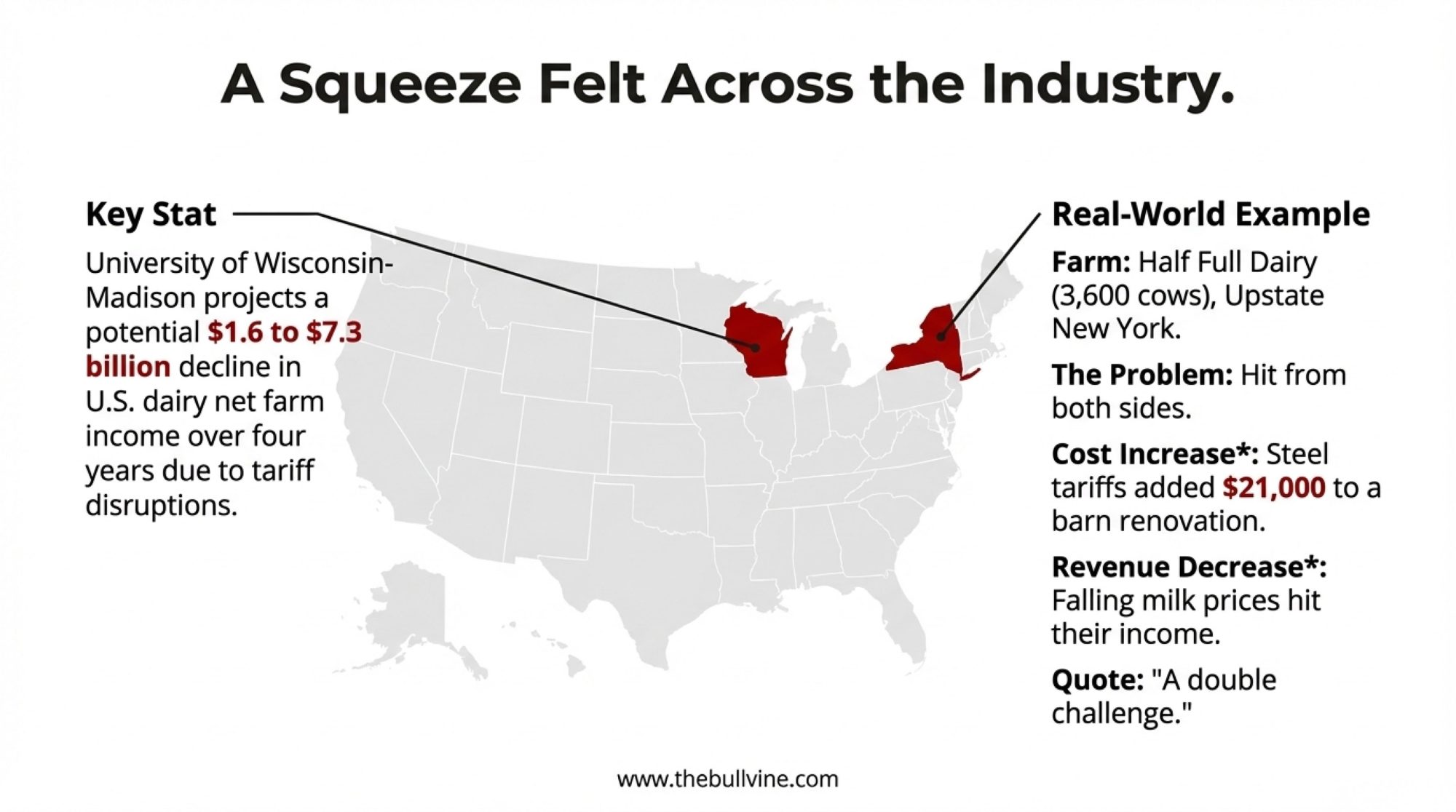

Archive for US dairy exports

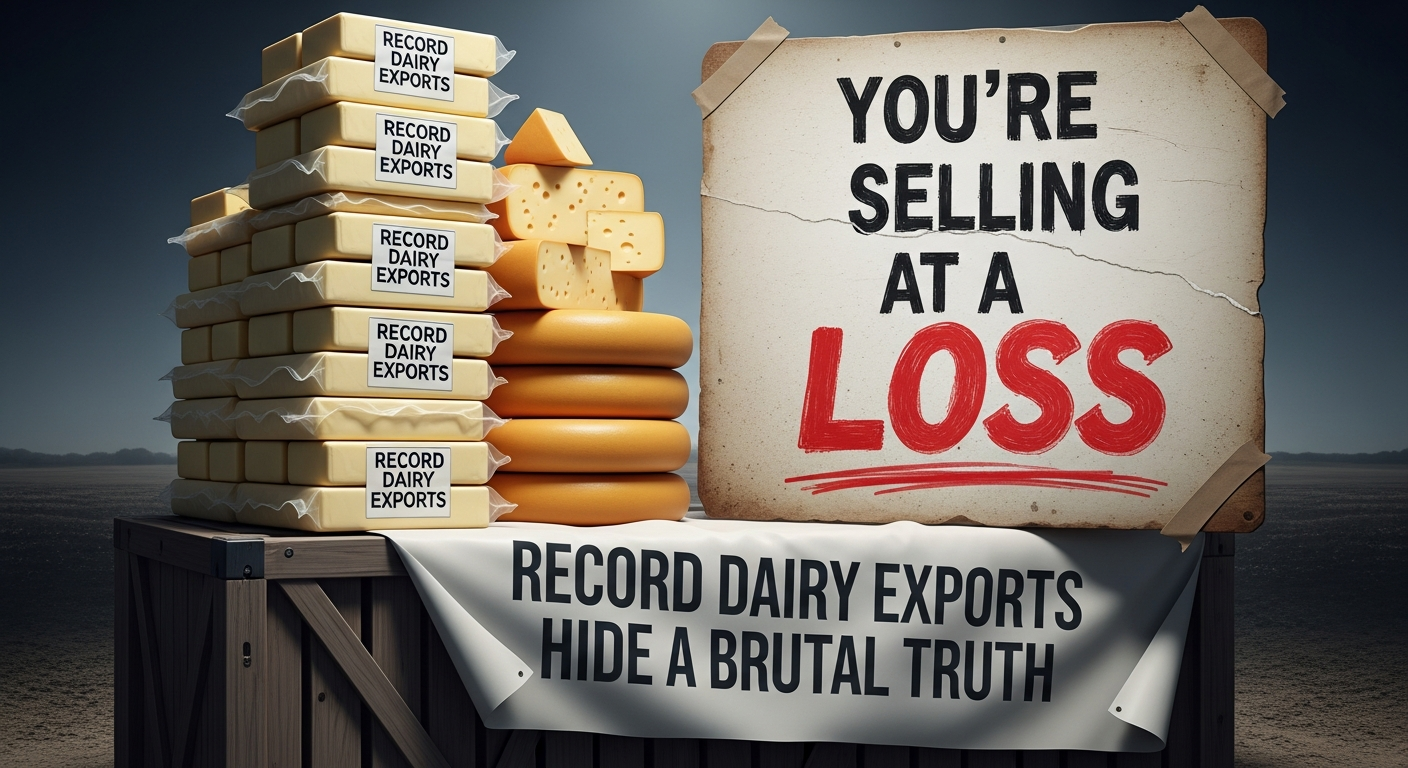
Record Dairy Exports Hide a Brutal Truth: You’re Selling at a Loss

Your co-op newsletter: ‘RECORD EXPORTS!’ Your milk check: -$2/cwt. Your banker: ‘We need to talk.’ The disconnect has never been wider.

EXECUTIVE SUMMARY: The U.S. dairy industry’s record cheese exports are actually distress sales, with producers losing $2/cwt as milk prices sit at $16.91 against $19 production costs. Mexico—buying 29% of our exports—is spending $4.1 billion to become self-sufficient, while China’s 125% tariffs have already destroyed our powder markets. The Class III-IV price spread has exploded to $4.06/cwt, the widest since 2011, forcing all production toward cheese that’s selling below profitability. Mid-size farms (500-1,500 cows) face extinction-level losses of $400,000+ annually, with survival limited to mega-dairies with 50% or less debt or premium operations near cities. Producers have 90 days to make irreversible decisions: scale massively, find niche markets, or exit before equity evaporates. The 800,000-head heifer shortage guarantees milk production will contract 3-5% through forced exits, but recovery won’t arrive until mid-2027—and only for the operations structured to survive.

dairy farm profitability 2025

On the surface, the numbers look fantastic. We exported 119.3 million pounds of cheese in August 2025—up 28% from last year, according to the Dairy Export Council. Butter exports nearly tripled. Processing plants are announcing $11 billion in new investments.

But check your bank account. The milk checks aren’t matching the celebration. The headlines say “Record Exports,” but the market reality says “Distress Sale.”

I’ve been talking with producers from Wisconsin down to Texas, and what I’m hearing doesn’t line up with these export headlines. Understanding this disconnect could be the difference between successfully navigating the next 18 months or becoming another casualty of industry restructuring.

The “record export” headlines your co-op newsletter celebrates tell only half the story. Yes, August 2025 cheese exports jumped 28% to 119.3 million pounds—but prices collapsed 13% to $1.82/lb. This is classic distress sale economics: moving volume at any price to avoid even bigger losses. When production costs sit at $18-19/cwt and you’re selling below $2/lb equivalent, every shipment deepens the red ink.

When Being the Cheapest Isn’t Actually Winning

The US dairy industry’s “record exports” mask a brutal reality: American cheese trades at $1.82/lb while European producers command $2.35/lb—a 45-60 cent disadvantage that signals desperation rather than competitive strength. When you’re underselling New Zealand butter by a full dollar per pound, you’re not winning global markets; you’re liquidating inventory below cost.

Here’s what’s bothering me about these export records. Global Dairy Trade auction results from November show American butter trading at $1.57 a pound. New Zealand? They’re getting $2.57. Our cheese is moving at $1.82 while Europeans fetch $2.27 to $2.42.

That 45 to 60 cent spread on cheese isn’t a competitive advantage. It’s desperation.

Penn State Extension’s 2025 dairy outlook shows that a typical 500-cow operation in Wisconsin or Minnesota has production costs running $18 to $19 per hundredweight. But milk prices? We’re at $16.91 for Class III according to CME October data. That’s annual losses of $32,000 to $62,000 for operations that size.

These record exports everyone’s celebrating are happening because we’re willing to sell at prices that don’t cover our costs. South Korean and Japanese buyers see cheap American dairy, and they’re stocking up. Can’t blame them. But volume at a loss isn’t success.

The Time Lag Trap We’re All Stuck In

The breeding decisions you made two years ago—when milk was over $20 per hundredweight—those heifers are just entering the milking herd now.

According to USDA’s latest milk production reports, we’ve added 200,000 cows to U.S. herds over the past 18 months. Every one of those additions made sense when the decision was made. But September production jumped 4.2% year-over-year, and we’re producing 18.3 billion pounds of milk at exactly the moment when global markets are saturated.

Your operation has maybe $300,000 to $500,000 in annual fixed costs—infrastructure doesn’t get cheaper just because milk prices drop. Equipment auction data from Machinery Pete shows you’re looking at 30 to 50% discounts from what things were worth two years ago if you try to sell now.

So we keep producing. We try to spread those fixed costs over more volume. It’s rational for each of us individually, but when everyone does it, oversupply drives prices even lower.

The Mexico Situation Nobody Wants to Talk About

While you’re focused on tariff headlines, Mexico is spending $4.1 billion to eliminate $1+ billion in US dairy imports by 2030. They’re not negotiating—they’re building processing plants in Campeche and Michoacán with 600,000-liter daily capacity and importing Holstein heifers from Australia. Mexico takes 29% of US dairy exports; losing even half that market erases profits for thousands of farms overnight.

While we’re celebrating that Mexico takes 29% of our dairy exports according to USDA Foreign Ag Service data, they announced last July that they’re spending $4.1 billion to become 80% self-sufficient in dairy by 2030.

They’re building processing facilities in Campeche and Michoacán that’ll handle 600,000 liters a day. They’ve imported 8,000 Holstein heifers from Australia—Dairy Australia confirmed that shipment. The Mexican government is guaranteeing their producers 12 pesos per liter.

Mexico buys 51.5% of all our nonfat dry milk exports, according to Export Council trade data. If they achieve even half their plan, we’re talking about losing a billion dollars or more in annual exports. This isn’t a trade dispute that’ll blow over. They’re building the infrastructure right now.

Why Powder Is Collapsing While Cheese Keeps Moving

Class III-IV pricing spread explodes to $4.06/cwt—matching 2011’s record gap and exposing dairy’s new geography of pain. Same cows, same work, but if your milk goes to butter and powder plants instead of cheese, you’re losing $15,000 monthly on a 500-cow operation. This isn’t market volatility; it’s structural divergence that’s rewriting the profitability map.

August export data shows cheese exports up 28%, but powder exports down 17.6%—the lowest August volume since 2019.

The October CME Spread tells the story:

  • Class III (Cheese): $17.81/cwt
  • Class IV (Powder/Butter): $13.75/cwt
  • Spread: $4.06/cwt—widest since 2011

For a 500-cow dairy, that’s a $50,000 swing in annual income depending purely on which plant takes your milk.

China put 125% tariffs on our dairy products back in March. We used to send them 70-85% of our whey exports. That market disappeared overnight. Processors are pushing every pound they can toward cheese because at least there’s still some margin there. Powder production? They’re running the minimum.

Different Operations, Different Realities

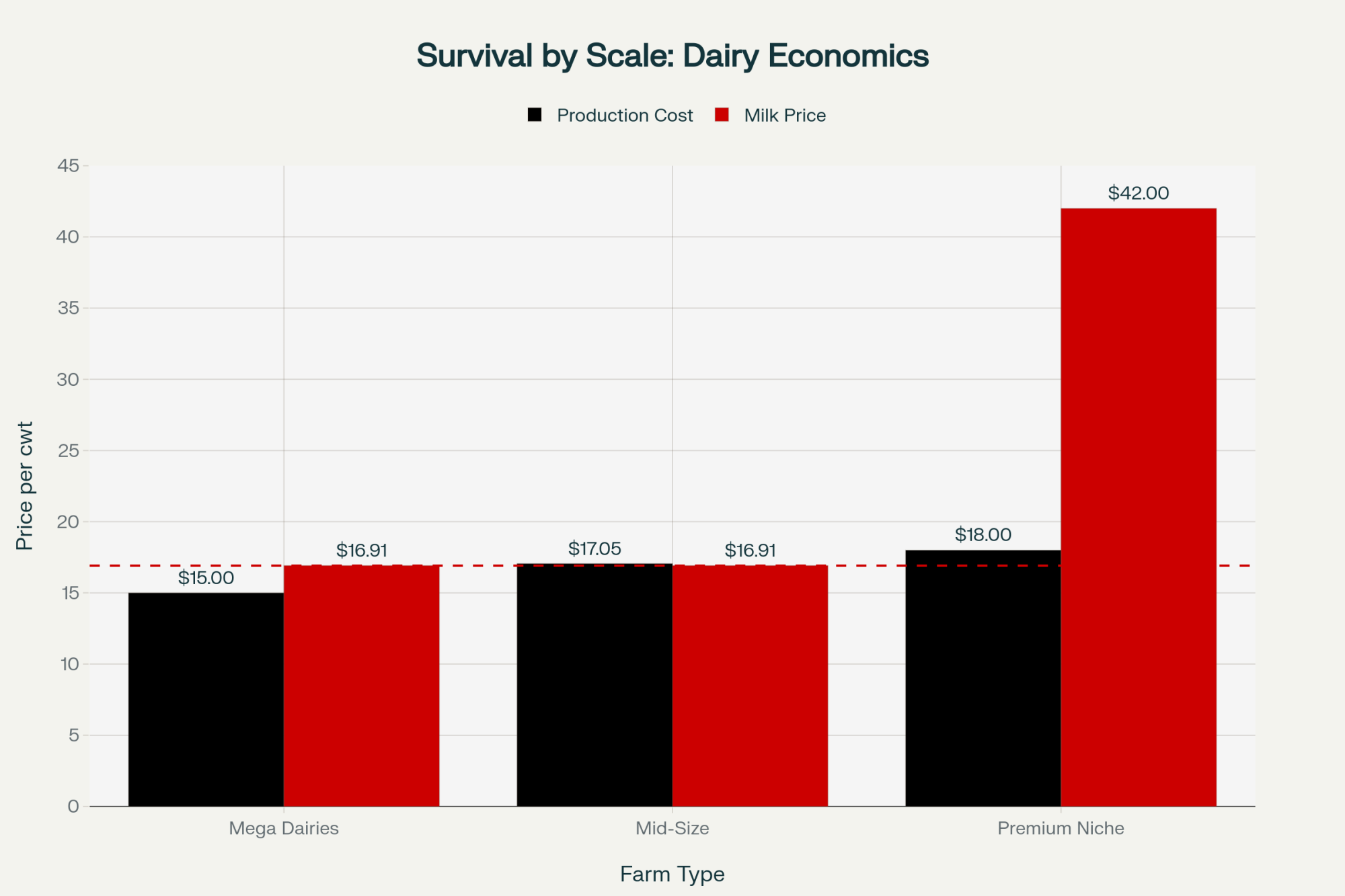
The dairy industry’s brutal bifurcation in one chart: mega-dairies break even at scale, mid-size operations hemorrhage $62K annually, while premium niche players bank $120K. If you’re running 500-1,500 conventional cows, you’re in the kill zone—producing milk at $17.05/cwt and selling it at $16.91. The math doesn’t work, and hoping for better prices won’t save you.

Based on the Center for Dairy Profitability at Madison and the Farm Credit System data:

Mega-dairies (3,500+ cows): Costs around $14.20 to $15.80/cwt thanks to automation and efficiency, according to Michigan State’s benchmarking study. If debt’s under 50% of equity, they can weather this storm. Some are buying out struggling neighbors at 30 to 50 cents on the dollar.

Mid-size operations (500-1,500 cows): The toughest spot. Production costs $16.30 to $17.80 based on Kansas State farm management data. With current milk prices, annual losses could exceed $400,000. Without a path to massive scale or premium markets, options are limited.

Premium niche (organic/grass-fed): Capturing $36 to $50/cwt through outfits like CROPP Cooperative are doing okay. But you need established customers near a city. Operations that went organic without premium market access are worse off than conventional farms due to higher feed costs.

Decision Time: The Next 90 Days Matter


Decision Path
Capital RequiredTimelineEquity RetainedSuccess RateKey Requirements
Exit Now (Controlled)$090-120 days85-95%95% (preserve wealth)Act before March 2026
Scale to Mega (3500+ cows)$8-15 million18-36 months20-40% (high debt)60% (if debt <50%)Low debt + expansion capital
Pivot to Premium Niche$500K-1.2M36 months (organic)70-85%70% (w/ city proximity)Within 50-100mi of major city
Status Quo / Wait & Hope$0Indefinite bleeding0-50% (forced exit by 2027)15-20% (statistically)Hope for market recovery

Based on Purdue’s Commercial Ag projections and USDA’s long-term outlook, you’ve got critical decisions to make in the next three to six months.

Considering expansion? Interest rates are 7.5 to 9% according to the Fed, ag credit conditions. Kansas State data shows that expanding when prices are falling rarely works. Maybe pay down debt instead.

Considering exit? Asset values today versus 18 months from now could be the difference between keeping most of your equity or losing it all. Equipment markets have declined for 25 straight months, according to Equipment Manufacturers data.

Considering organic/grass-fed? It’s a three-year conversion with negative cash flow. You need to be within 50 to 100 miles of a major city, based on consumer research. Penn State Extension says you need off-farm income during transition.

The Heifer Shortage Silver Lining

Here’s your silver lining in a crisis: an 800,000-head heifer shortage over two years mathematically guarantees milk production will contract 3-5% by 2027. Replacement inventory sits at 20-year lows while heifer prices exploded from $1,140 to $3,010—a 164% jump that makes expansion impossible. This forced contraction is exactly what balances supply-demand and triggers recovery. The question: will you survive to see it?

CoBank’s latest report shows we’re at 20-year lows for dairy replacement heifers. We’re short about 800,000 replacements over the next two years.

When you can get $3,500 to $4,500 for a beef-cross calf versus keeping a dairy heifer worth $800 to $1,200 in this market, the math is obvious. Progressive Dairy’s breeding survey shows most producers are making that same decision.

The dairy herd has to shrink—probably 3 to 5% by 2027, according to USDA projections. That might balance supply and demand. Rabobank and CoBank project stabilization by mid-2027, with gradual improvement into 2028.

How Geography Changes Everything

California’s Central Valley faces water costs up 40% according to UC Davis Cost Studies. Meanwhile, South Dakota State University Extension’s 2025 Feed Cost Analysis shows operations there seeing feed costs $1.50 to $2.00/cwtbelow the national average.

Texas added 50,000 cows while Wisconsin stayed flat. That’s economics playing out in real time.

What This All Means for You

Those record export numbers? They don’t mean what the headlines suggest. Moving volume at a loss is a distress sale on a national scale.

The decisions you make in the next 90 days are more important than what you do over the next year. By March 2026, many options available today won’t exist.

Mexico’s self-sufficiency plan is real. We need to plan for our biggest customer becoming a competitor. The Export Council knows it, but I’m not seeing contingency planning at the farm level.

Scale alone won’t save anyone. I’ve seen big operations with too much debt go under, and small operations with good positioning thrive. It’s about your total situation—debt levels, geographic location, market access.

The bifurcation—where you’re either huge or niche—is accelerating. If you’re in that middle range, especially 200 to 1,000 conventional cows, you need to decide which direction you’re heading.

Recovery is coming through contraction. The heifer shortage guarantees that. The question is whether you’ll be around to see it.

Looking Down the Road

By 2028, based on projections from Texas A&M and Cornell, we’ll have fewer, larger operations handling commodity production and smaller, specialized operations serving premium markets. That middle ground where many of us operated for generations is disappearing.

This isn’t random volatility. It’s industry restructuring in response to global competition, changing consumer preferences, as the Innovation Center for U.S. Dairy has tracked, and the reality of 2025 production costs.

When you see export headlines in your co-op newsletter and wonder why your milk check keeps shrinking, remember—it’s not about volume. It’s about margins. The difference between acting strategically now versus hoping things improve could be the difference between preserving or losing your family’s equity.

The herd is heading off a cliff. The record exports are just the dust they’re kicking up. Don’t follow the volume—follow the margin. The next 90 days will decide if you’re a casualty of the restructuring or one of the few left standing to see the recovery.

KEY TAKEAWAYS

  • Your daily reality: At current prices, a 500-cow dairy loses $175/day ($62,000/year). The Class III-IV spread of $4.06/cwt means the same milk yields $50,000 in different income based purely on plant destination.
  • The export trap: Record volumes are happening BECAUSE we’re desperate—selling cheese at $1.82/lb while New Zealand gets $2.42/lb isn’t winning, it’s liquidation.
  • 90-day decision window: By March 2026, you must choose—scale to 3,500+ cows, secure premium markets at $36+/cwt, or exit, preserving 85% equity (vs 0-40% if forced out later).
  • Geographic survival map: Texas/South Dakota operations save $1.50-2.00/cwt on feed. California faces +40% water costs. Location now determines viability as much as management.
  • The guarantee: 800,000-heifer shortage forces 3-5% production cut by 2027, ensuring recovery for survivors—but 40-50% of current operations won’t make it.

Complete references and supporting documentation are available upon request by contacting the editorial team at editor@thebullvine.com.

Learn More:

Join the Revolution!

Join over 30,000 successful dairy professionals who rely on Bullvine Weekly for their competitive edge. Delivered directly to your inbox each week, our exclusive industry insights help you make smarter decisions while saving precious hours every week. Never miss critical updates on milk production trends, breakthrough technologies, and profit-boosting strategies that top producers are already implementing. Subscribe now to transform your dairy operation’s efficiency and profitability—your future success is just one click away.
NewsSubscribe
First
Last
Consent

Mexico’s Gone, Cheese Hit $1.67, DMC’s Broken – Here’s Your Playbook

When your best customer starts making their own milk, it’s time to rethink everything about your business model

EXECUTIVE SUMMARY: What farmers are discovering right now is that October 2025’s cheese price drop to $1.67 isn’t just another market dip—it’s the canary in the coal mine for structural changes reshaping dairy economics. Mexico’s commitment of 83.76 billion pesos toward dairy self-sufficiency through 2030 effectively removes our largest export customer, who bought $2.47 billion worth of U.S. dairy products last year and absorbed over half our nonfat dry milk exports. Meanwhile, the disconnect between DMC’s calculated $11.66/cwt margin and actual farm economics—where labor costs alone have increased by 30% since 2021, while machinery expenses have risen by 32%—reveals a safety net that no longer accurately reflects operational reality. Recent FMMO data shows protein climbing to 3.38% while butterfat hits 4.36%, creating component pricing opportunities for farms that can quickly adjust rations to capture premiums before the December 1st formula changes. With our national herd at 9.52 million head (the highest in 30 years), producing into weakening demand, and processing plants built on export assumptions that won’t materialize, the next 18 months will determine which operations successfully pivot toward margin management over volume growth. The good news? Producers layering risk management tools, optimizing beef-on-dairy programs, and adding $0.50-0.75/cwt are already demonstrating that adaptation—while challenging—remains entirely achievable, targeting protein-to-fat ratios of 0.80+ and beyond.

Dairy Profitability Strategy

You know that feeling when you check the CME spot market and something just feels… off? That’s what hit most of us Monday when block cheese broke through $1.70 to trade at $1.67 on October 13, 2025. After tracking these markets for years, I’ve learned that when those established price floors start giving way, there’s usually something bigger happening beneath the surface.

Here’s the Bottom Line this week:

  • Mexico’s push toward dairy self-sufficiency is reshaping export dynamics
  • DMC margins no longer reflect true on-farm costs, especially labor and machinery [USDA Farm Labor Survey; U of I]
  • Component pricing has flipped: protein premiums are now outpacing butterfat [FMMO data]

Mexico’s Strategic Shift: What It Really Means for U.S. Producers

Looking at this trend, Mexico bought $2.47 billion of U.S. dairy in 2024—more than Canada and China combined. They’ve taken over half our nonfat dry milk exports and imported 314 million pounds of cheese through September 2025.

In April, President Sheinbaum announced the “Milk Self-Sufficiency Plan,” committing 83.76 billion pesos (~$4.1 billion USD) through 2030 to boost production to 15 billion liters annually and reach 80% self-sufficiency by 2030. They guarantee producers 11.50 pesos per liter while selling at 7.50 pesos—absorb­ing that 4-peso difference, roughly $0.22 USD per liter. What farmers are finding is that policy talk is turning into infrastructure: production ran 3.3% ahead of last year through May 2025.

Mexico’s 83.76 billion peso commitment through 2030 isn’t just policy talk—production already runs 3.3% ahead, and your $2.47 billion customer is building capacity to replace U.S. imports within five years

The DMC Disconnect: When the Safety Net Doesn’t Match Reality

I recently had coffee with a 600-cow producer in central Wisconsin who said, “DMC shows an $11.66 margin, but I’m burning through equity just keeping the lights on”. This disconnect deserves a closer look.

The DMC Disconnect reveals a $9.75/cwt gap between calculated margins and on-farm reality—labor and machinery costs that jumped 30%+ since 2021 don’t factor into the safety net formula

The DMC formula originated when feed costs represented half of all expenses. University budget analyses now show feed often runs only 35–45% of costs—not because feed got cheaper, but because labor and machinery soared. USDA’s Farm Labor Survey documents a 30% increase in wages since 2021. A 500-cow operation can spend $300,000–400,000 annually on labor alone—about $1.50–2.00 per cwt that DMC ignores [USDA Farm Labor Survey].

Equipment costs tell a similar story. University of Illinois data shows machinery expenses jumped 32% from 2021 to 2023 and have continued upward through 2025. A 310-HP tractor at $189.20/hour in 2021 now runs $255.80/hour—financing at 7–8% adds another $0.80–1.00 per cwt [U of I].

“The DMC formula often shows acceptable margins while extension economists note significant divergence from on-farm cash flow when non-feed costs rise.”
—Dr. Mark Stephenson, Director of Dairy Policy Analysis, UW-Madison, Distinguished Service to Wisconsin Agriculture Award [UW News]

Component Pricing: Why Protein’s Suddenly the Star

ScenarioProtein %Butterfat %Protein-to-Fat RatioPremium Before Dec 1Premium After Dec 1Monthly Gain (500 cows)
Current Average U.S.3.384.360.77BaselineBaseline$0
Target Optimized3.454.300.80+$0.25/cwt+$0.38/cwt$1,900
Wisconsin Case Study3.38 (from 3.12)4.280.79+$0.42/cwt+$0.58/cwt$2,900

What’s interesting here is that component pricing has flipped. Butterfat averaged 4.36% through September, up from 3.95% five years ago [FMMO data]. Protein climbed from 3.181% to 3.38% but still lags butterfat gains. Cheesemakers generally target a 0.80 protein-to-fat ratio; U.S. milk sits around 0.77, forcing processors to add nonfat dry milk powder [FMMO data].

The FMMO changes effective December 1—boosting protein factors to 3.3 lbs and other solids to 6.0 lbs per cwt—will amplify premiums for higher-protein milk [USDA AMS]. A Sheboygan herd I spoke with pushed protein from 3.12% to 3.38% in eight weeks through amino acid balancing and bypass protein, adding $0.42 per cwt, roughly $3,200 per month on 450 cows.

Herd Dynamics: When Culling Economics Don’t Make Sense

The August USDA report shows 9.52 million head—the highest in 30 years. Why keep expanding herds when margins are tight? Auction data puts replacement heifers at $3,500–4,000, and CDCB research shows cows average 2.8 lactations before exit. When cows leave before paying back replacements, the usual 35% turnover target collapses [CDCB data].

Despite record $157/cwt cull cow prices in July 2025 [USDA AMS], many producers hold onto older cows because replacing them costs more. Beef-on-dairy adds complexity: cross-bred calves fetch $1,370–1,400 at auction, so breeding for beef income often outweighs dairy replacement logic [Auction reports].

Key Takeaways for Action This Week

  1. Review risk coverage
    – Enroll DMC at $9.50 coverage ($0.15/cwt for first 5 M lbs)
    – Layer in Dairy Revenue Protection at 60–70% quarterly coverage
  2. Optimize components
    – If protein-to-fat <0.77, schedule a nutrition consult
    – December 1 FMMO changes make ratios more lucrative
  3. Assess finances
    – Maintain debt service coverage >1.25
    – Keep working capital >15% of gross revenue
  4. Consider beef-on-dairy
    – At $0.50–0.75/cwt extra revenue, review breeding strategy
  5. Lean on the community
    – Share experiences at coffee shops and meetings

Regional Adaptation: Different Strategies for Different Situations

RegionCurrent ChallengeWinning StrategyPremium OpportunityRisk LevelTimeline
WisconsinMid-size squeeze (500-1,500 cows)Scale to 2,500+ OR pivot to specialty (300-400)Specialty: $8-10/cwtHIGH – Middle vanishingDecide by Q2 2026
Texas/New MexicoScale competition intensifyingMega-scale expansion (10,000+ cows, +20% growth)Efficiency: $0.30-0.50/cwtMEDIUM – Capital intensiveExpand through 2027
SoutheastFluid premiums fadingGrass-fed organic + agritourism pivotOrganic: $12-15/cwtMEDIUM – Market transitionTransition 2025-2026
CaliforniaTwo-tier system emergingCentral Valley scale OR North Coast farmstead cheeseFarmstead: $15-20/cwtHIGH – Two extremesOngoing divergence
Pacific NorthwestCapacity limits + basis discountsRegional cooperative consolidationLimited due to isolationVERY HIGH – Exit risk 2026Some exits planned 2026
NortheastHigh costs vs legacy marketsLocal glass-bottle programs + direct salesDirect sales: $10-12/cwtMEDIUM – Niche viableBuilding programs now

Wisconsin’s mid-size producers face tough choices: scale up to 2,500+ cows for efficiency or shrink to 300–400 and chase specialty markets. That middle ground is disappearing.

Down in Texas and New Mexico, mega-dairies double down on scale. A 10,000-cow manager plans 20% expansion by 2027, betting automation offsets price pressures. “Every penny of efficiency multiplies,” he said.

The Southeast leans on fluid milk premiums, though processors warn they’ll fade. Several Georgia farms are shifting to grass-fed organic, accepting lower volumes for higher margins.

California’s dairy scene splits into two worlds: Central Valley mega-dairies expanding, North Coast farmstead cheesemakers thriving on agritourism and direct sales.

The Pacific Northwest battles capacity limits and isolation. Basis discounts bite, and some producers plan 2026 exits if conditions don’t improve.

The Northeast juggles legacy fluid markets with new ventures like local glass-bottle programs to offset high costs.

Global Competition: Learning from Other Exporters

The EU’s production is essentially flat (+0.15% in 2025), despite a 1% decline in herd size, with raw milk at EUR 53.3/100 kg (28% above the five-year average) [EU Commission]. They’re pivoting to value-added and sustainability premiums.

New Zealand’s Fonterra posted 103% profit growth in Q3 2025 but is divesting consumer brands to focus on B2B ingredients. Their NZ$10.00/kgMS forecast suggests confidence in fundamentals but a shift away from commodity volume.

The U.S. stands out for its $11+ billion capacity build-out on export assumptions now under pressure [IDFA]. Few competitors committed similar investment levels.

Risk Indicators: Recognizing Warning Signs Early

Financial MetricHealthy RangeWarning ZoneCritical RiskWhy It Matters
Debt Service Coverage≥1.251.10-1.24<1.10Cash flow to cover debt payments + cushion
Working Capital≥15% of revenue10-14% of revenue<10% of revenueOperating funds to handle market swings
Variable Rate Debt≤50% of total51-60% of total>60% of totalExposure to rate increases (7-8% currently)
Culling Rate≥30%25-29%<25%Herd turnover and productivity indicator
Somatic Cell Count≤250,000250,000-300,000>300,000Milk quality affects premiums/penalties
Feed Efficiency≥1.4 lbs milk/lb DMI1.3-1.39 lbs/lb<1.3 lbs/lbFeed cost management and profitability

Extension economists highlight key stress markers:

Financial

  • Debt service coverage <1.25
  • Working capital <15% of revenue
  • Variable rate debt >50%

Operational

  • Culling <30%
  • Somatic cell count >250,000
  • Feed efficiency <1.4 lbs milk/lb DMI

Behavioral

  • Withdrawing from the community
  • Deferred maintenance
  • Increased accidents
  • Family health issues

Spotting these early lets you adjust course before crises develop.

Strategic Positioning: What’s Working for Successful Operations

Conversations with top-performers reveal common themes:

  • Layered risk management: DMC + DRP for comprehensive coverage
  • Feed cost hedging: Options on corn/soymeal 6–12 months out protect margins
  • Component focus: Hitting 0.80–0.85 protein-to-fat captures premiums
  • Beef-on-dairy: Crossbred calves add $0.50–0.75/cwt; LRP support starts 2026

Looking Ahead: Probable Scenarios Through 2028

The next 18 months separate survivors from exits—Class III tests mid-$14s through 2027 as the herd contracts by 600,000+ head, then stabilizes at $16-17 once supply finally matches reduced export demand

Based on talks with lenders, processors, and economists:

  • Mid-2026: Zombie phase persists. Credit tightens; bankruptcies climb 55% in some regions [USDA, AFBF, UArk].
  • Late 2026: More plant closures follow Saputo and Upstate Niagara moves, stranding some producers.
  • 2027: Mexico’s self-sufficiency hits export volumes; global production pressures domestic prices; Class III may test mid-$14.
  • 2028: Herd contracts by several hundred thousand head; Class III stabilizes around $16–17; significant exits reshape the industry.

The Human Element: Supporting Each Other

These challenges take a human toll. Farmer suicide rates run 3.5× higher than the general population, and rural rates climbed 46% between 2000 and 2020 [CDC; NRHA]. These aren’t just numbers—they’re neighbors and friends under immense pressure.

Research from land-grant universities identifies several early warning signs, including routine changes, declining animal care, family health issues, and farmstead neglect. Recognizing these patterns lets communities step in before crises deepen. For those struggling, the National Suicide Prevention Lifeline (988) and National Farmer Crisis Line (1 866 327 6701) offer confidential support from counselors who understand farm life.

The Bottom Line

Even now, opportunities exist. Producers pivoting to specialty markets report net incomes rising despite lower volumes. Beef-on-dairy revenue can offset labor cost hikes. Component optimization often pays for its cost within weeks when executed well.

The next 24–36 months will test us like never before, but this is a structural change, not a cyclical downturn. Government programs can’t restore lost export markets or close idle capacity built for vanished demand. Success will go to those who recognize new fundamentals early and adapt strategically: focus on margins over prices, relationships over volume, and long-term sustainability over endless growth.

Coffee-shop conversations may feel quieter these days, but they matter more than ever. Sharing success stories and stumbling blocks—our collective resilience and adaptability—will guide us through to a sustainable, though different, future. 

KEY TAKEAWAYS:

  • Capture immediate protein premiums worth $0.42/cwt by adjusting rations to hit 0.80-0.85 protein-to-fat ratios before December 1st FMMO changes—Wisconsin herds report $3,200 monthly gains on 450 cows through amino acid balancing and bypass protein strategies
  • Layer risk protection starting at $0.15/cwt with DMC at $9.50 coverage for your first 5 million pounds, then add Dairy Revenue Protection at 60-70% quarterly coverage to protect margins as Mexico’s production ramps up and displaces exports
  • Maximize beef-on-dairy revenue, adding $0.50-0.75/cwt to current milk checks—with crossbred calves fetching $1,370-1,400 at auction and Livestock Risk Protection coverage starting in 2026, this strategy offsets rising labor costs that DMC ignores
  • Monitor three critical financial ratios weekly: debt service coverage above 1.25, working capital exceeding 15% of gross revenue, and variable rate debt below 50% of total borrowing—extension economists identify these as early warning indicators before operational stress becomes a crisis
  • Choose your strategic path by Q2 2026: Wisconsin’s mid-size operations show the middle ground between 500-1,500 cows is vanishing—either scale toward 2,500+ head for efficiency, pivot to specialty markets (grass-fed, organic, local) capturing $8-10/cwt premiums, or plan an orderly exit while equity remains

Complete references and supporting documentation are available upon request by contacting the editorial team at editor@thebullvine.com.

Learn More:

Join the Revolution!

Join over 30,000 successful dairy professionals who rely on Bullvine Weekly for their competitive edge. Delivered directly to your inbox each week, our exclusive industry insights help you make smarter decisions while saving precious hours every week. Never miss critical updates on milk production trends, breakthrough technologies, and profit-boosting strategies that top producers are already implementing. Subscribe now to transform your dairy operation’s efficiency and profitability—your future success is just one click away.

NewsSubscribe
First
Last
Consent

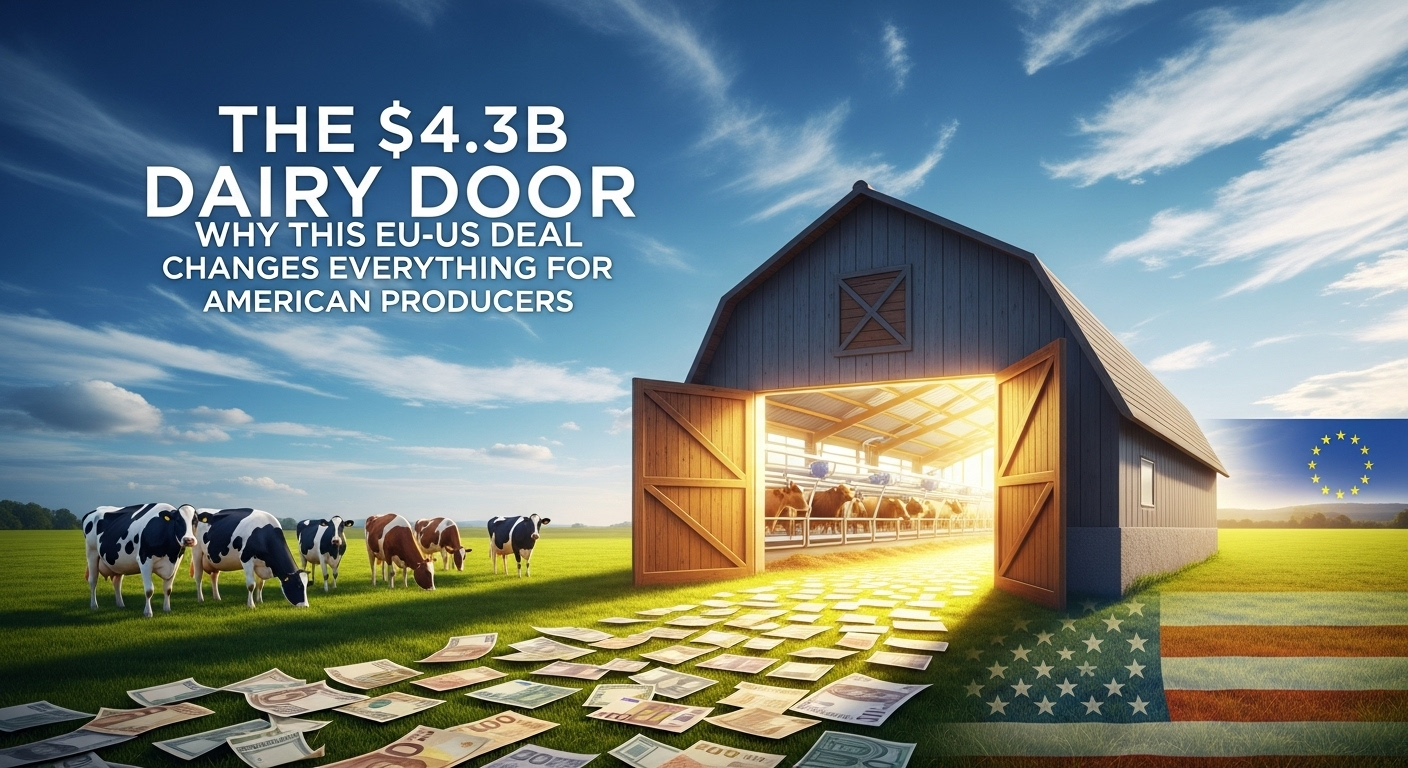
The $4.3B Dairy Door: Why This EU-US Deal Changes Everything for American Producers

Ever wonder why European cheese floods our stores but we can’t crack theirs?

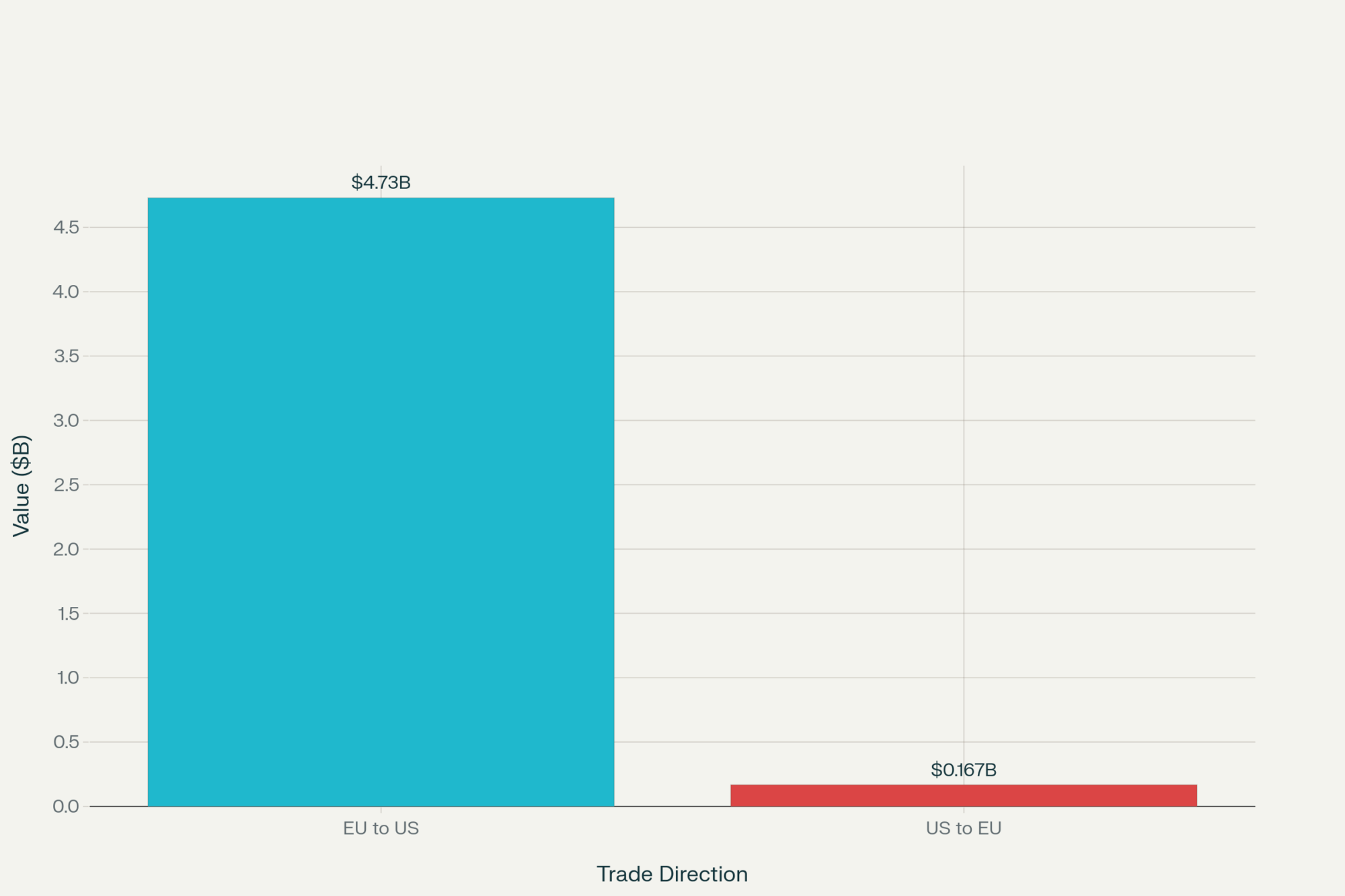
EXECUTIVE SUMMARY: Here’s the deal — the EU-US dairy trade gap is absolutely massive, and it just cracked wide open. European dairy exports to America topped €4.3 billion in 2024, while we barely scraped together $167 million going the other way. That’s a 25-to-1 beating we’ve been taking for years. But this new framework changes everything. We’re getting a 20,000-tonne tariff-free quota — that’s like giving 400 family farms direct access to premium European pricing. Sure, certification’s still gonna cost you anywhere from $650K to $2.5 million depending on your setup, but here’s the kicker… Europe’s Green Deal is jacking up their production costs by 15-20% while our herds keep growing. With Texas and Idaho leading the charge on expansion, this isn’t just about exports anymore — it’s about positioning yourself before everyone else catches on. Don’t sit this one out.

KEY TAKEAWAYS:

  • Get in on that 20,000-tonne quota — equals roughly 400 mid-sized operations’ worth of access. Join or start a certification cooperative to split those million-dollar compliance costs.
  • USDA’s promising 60% faster certification times — call (202) 720-3423 now because even “faster” still means months of prep work ahead of you.
  • Europe’s sustainability mandates are pricing them out — their Green Deal adds 15-20% to production costs, giving you a competitive edge if you stay efficient.
  • The US herd just hit 9.45 million head with 20,000 added this year — growth means opportunity, but also stiffer competition at home.
  • Smart compliance investments pay off double — meet export standards while boosting domestic margins as regulations tighten everywhere.
US dairy exports, EU trade deal, dairy market access, global dairy trade, farm profitability

You know that feeling when you’ve been banging your head against a wall for decades, and suddenly—crack—it gives way? That’s exactly what hit me reading about the August 2025 EU-US Framework Agreement. After watching European cheese and butter flood our supermarkets while American producers got tangled in regulatory nightmares, Brussels finally had to face reality.

Here’s the numbers that forced their hand: European Commission data shows agricultural exports to the US hit €4.3 billion in 2024, with dairy products playing a major role. Meanwhile, US dairy exports to Europe barely scraped $167 million last year, according to USDA figures. That’s a 25-to-1 imbalance that became politically and economically impossible to ignore.

A Trade Gap So Big It Finally Forced Action

Walk through any processing plant from Wisconsin’s 150-cow family operations to California’s 4,000-head mega-dairies, and you’ll hear the same frustration. European products flow freely while our exports crawl through years of certification hell.

But here’s the breakthrough that’s got everyone talking: the framework opens a 20,000-tonne tariff-free quota for US dairy into Europe. Now, before you roll your eyes at what sounds modest, think about this—that’s roughly the combined output of 400 family farms running 500 cows each. Suddenly, we’re not just cracking the door; we’re pushing it wide open.

New Zealand’s been working this playbook for years. Their 15,000-tonne butter quota into Europe acts like a pricing anchor for their entire domestic market. When Kiwi producers can command EU premium prices for even a portion of their production, it lifts profitability across the board. That’s the kind of leverage American dairy hasn’t had in European markets… well, ever.

Industry feedback from recent dairy association meetings reflects deep skepticism: “These European market promises have been floating around forever. I need to see actual trucks rolling through German warehouses without regulatory delays before I change my expansion plans.” That wariness comes from years of watching certification processes drag on for three years or more.

The Real Investment (And It’s Serious Money)

Here’s where rubber meets road. USDA analysts project certification times could drop by up to 60%—which represents massive progress. But the upfront costs? Industry estimates suggest you’re looking at:

  • Small cheese plants (under 50,000 lbs/day): $650,000-$850,000
  • Mid-size operations (50-200,000 lbs/day): $1.2M-$1.8M
  • Large processors (200,000+ lbs/day): $1.8M-$2.5M

Then add ongoing expenses—lab testing, staff training, compliance monitoring—running tens of thousands annually.

One Pennsylvania processor I know described the reality: “We essentially built a whole new operation inside our existing plant just to meet EU standards. Every piece of equipment, every surface had to be recertified. It’s like building a plant within a plant.”

Production Dynamics Flip: EU Shrinks While US Grows

What’s fascinating about this framework’s timing—it hits just as fundamental production dynamics between the US and EU are completely flipping.

In the Netherlands, environmental regulations are leading to a reduction of around 15% in herd sizes. Industry reports from Dutch producers paint a grim picture: “These nitrogen limits keep squeezing us tighter—every new regulation costs money we don’t have.”

Back home, it’s in growth mode. The US dairy herd reached 9.45 million head with approximately 20,000 added year-over-year through May 2025. Texas keeps booming with double-digit production increases, Idaho’s building processing capacity for mega-dairies, and even Wisconsin family farms are exploring cooperative export strategies.

Smaller producers are getting smart about this—forming cooperative export groups to pool resources, share certification costs, and navigate the regulatory maze together. Wisconsin, Pennsylvania, and New York already have groups in development stages.

Europe’s Cost Burden Becomes Our Competitive Edge

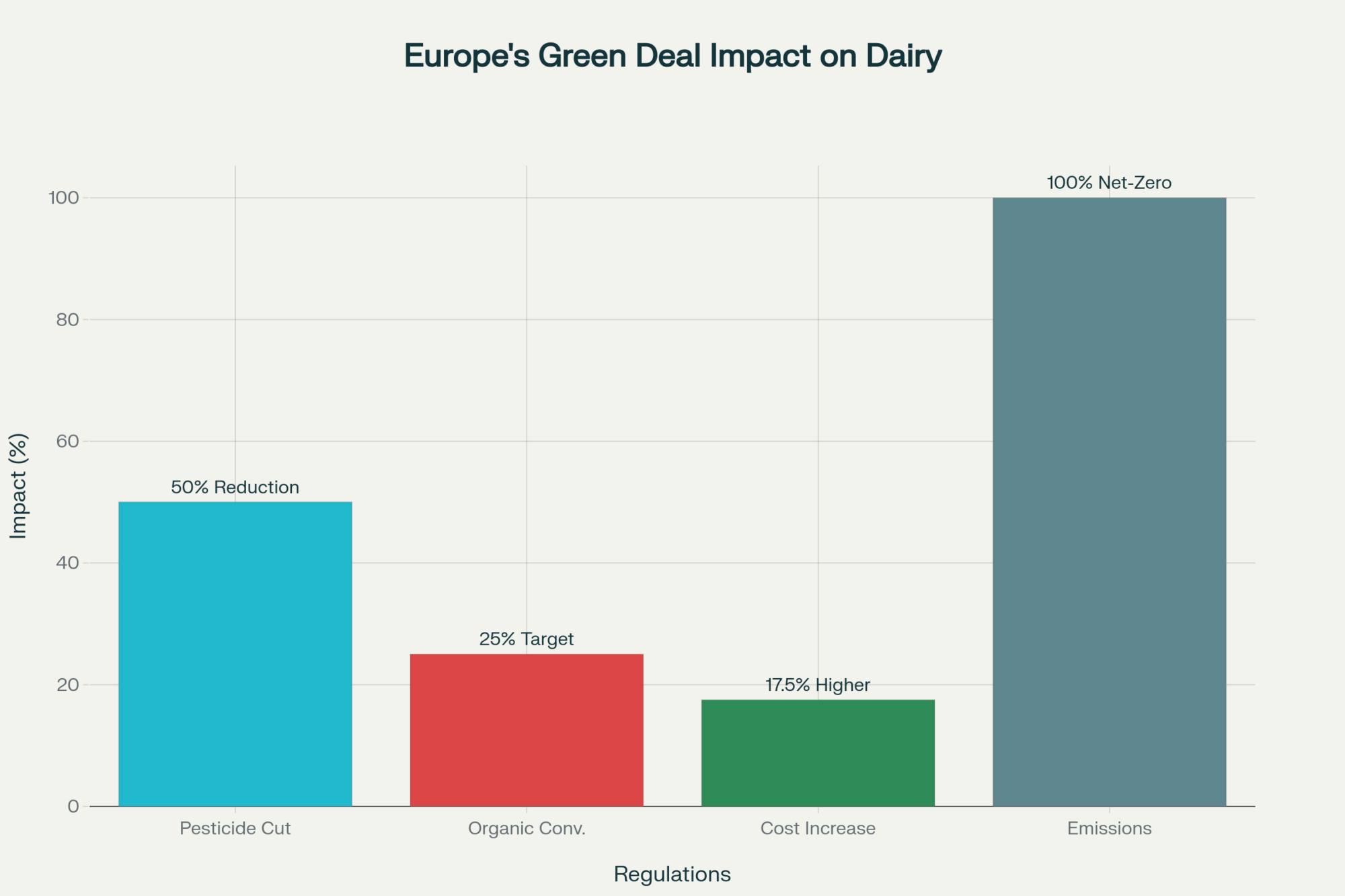
Here’s the underlying story: Europe’s Green Deal mandates are creating permanent cost disadvantages. The requirements—50% pesticide reduction, 25% organic conversion, net-zero emissions by 2050—add an estimated 15-20% to European production costs compared to US operations.

That’s not a temporary market cycle. That’s structural competitive advantage shifting permanently toward American producers just as market access barriers start coming down.

“America’s dairy farmers are done playing second fiddle in Europe’s rigged system,” declared Krysta Harden, USDEC president and CEO. “For too long, the EU has wielded tariffs and red tape as weapons to shut US products out while European exporters enjoyed extensive access to our shelves. That imbalance has saddled us with a staggering $3 billion dairy trade deficit in 2024 alone.”

Your Next Moves (Real Steps, Real Contacts)

If you’re serious about European markets, here’s where to start:

  • Contact USDA Export Assistance at (202) 720-3423 for pre-certification assessment. The process can take months, so early engagement matters.
  • Connect with your state dairy association about cooperative export groups. Multiple states already have formation meetings scheduled.
  • Check out NMPF’s market access resources for industry-specific guidance on EU requirements.
  • Explore Farm Credit export financing for facility investments—they understand dairy operations and have specialized programs.

Not ready for exports? Prepare for increased competition at home. European specialty products will keep flowing in, so focus on efficiency, differentiation, and operational excellence.

The Global Ripple Effect

This bilateral agreement is creating waves throughout global dairy markets. New Zealand’s accelerating US market expansion is aimed at maintaining its competitive positioning. Australia’s preparing similar market access demands for EU negotiations. Canada’s monitoring third-party impacts carefully.

“U.S. farmers win when competition is fair, but there’s nothing fair about Europe’s system,” said Gregg Doud, NMPF president and CEO. “An agreement with the EU has the potential to unlock billions in new opportunities for American dairy.”

Bottom Line: The Industry Just Shifted into High Gear

What strikes me most about this framework is how it proves even Europe’s most entrenched dairy protections eventually crack under sustained economic pressure. That €4.3 billion trade imbalance became politically unsustainable, and Brussels had to respond.

The walls protecting European dairy are cracking. European producers who think regulatory barriers alone will protect their turf are living in the past. American producers who assume this automatically opens up European gold mines without serious investment are dreaming.

The winning strategy? Know exactly where your operation stands competitively. If you’re serious about European markets, start building capabilities now—certification takes years even with streamlined procedures. If you’re focusing domestically, prepare for intensified competition by doubling down on efficiency and quality.

The dairy industry just shifted into high gear. Will you be accelerating with it, or watching from the sidelines?

Essential Contacts:

Ready to stop watching from the sidelines? This door won’t stay cracked forever.

Complete references and supporting documentation are available upon request by contacting the editorial team at editor@thebullvine.com.

Learn More:

Join the Revolution!

Join over 30,000 successful dairy professionals who rely on Bullvine Weekly for their competitive edge. Delivered directly to your inbox each week, our exclusive industry insights help you make smarter decisions while saving precious hours every week. Never miss critical updates on milk production trends, breakthrough technologies, and profit-boosting strategies that top producers are already implementing. Subscribe now to transform your dairy operation’s efficiency and profitability—your future success is just one click away.

NewsSubscribe
First
Last
Consent

Your Biggest Dairy Customer is About to Ditch You – And Most Producers Have No Clue What’s Coming

Mexico buys 51.5% of our milk powder exports—and they’re about to cut us off. Your feed efficiency won’t matter if you can’t sell the milk.

EXECUTIVE SUMMARY: Look, I’ve been watching this Mexico situation unfold, and it’s got me more concerned than I thought it would. We’ve gotten way too comfortable treating Mexico like a guaranteed customer when they’re actually planning to replace us completely. They’re throwing $4.1 billion at becoming self-sufficient by 2030, targeting the exact products we’ve been shipping south—especially that skim milk powder where they buy over half of everything we export. The math is brutal: we’ve got $8 billion in new processing capacity coming online while potentially losing our $2.47 billion lifeline. But here’s what most producers are missing—this isn’t just a threat, it’s the biggest partnership opportunity we’ve seen in decades if you know how to position yourself. Mexico’s got productivity gaps you could drive a milk truck through, and they’re willing to pay for the genetics and technology to close them.

KEY TAKEAWAYS

  • Export diversification pays off fast – Southeast Asia and Middle East markets are growing 15-20% annually, but they take 3-5 years to develop properly. Start building those relationships in the next 12 months, or you’ll be scrambling when Mexico’s plants come online.
  • Partnership beats competition every time – Mexico’s productivity gap (37 vs 9 liters per cow per day) creates immediate demand for genetics, equipment, and consulting services. Position yourself as an essential partner, not just a commodity supplier.
  • Margin preparation is non-negotiable – If we lose even 25% of Mexican demand, domestic supply increases could drop milk prices 10-15%. Audit your cost structure now and make sure you can handle that scenario.
  • Technology transfer opportunities are huge right now – With 97% of Mexico’s operations being small-scale, there’s massive demand for efficiency improvements. The smart money is already moving into genetics partnerships and technical services.
  • Timeline matters more than you think – Mexico’s infrastructure comes online 2025-2026, same time as our $8 billion in new processing capacity. That’s not coincidence—that’s strategic planning we need to match.
dairy market trends, US dairy exports, milk price risk, farm profitability, market diversification strategy

You know that sinking feeling when your best customer starts talking about “going independent”? Well, that’s exactly what’s happening with Mexico right now, and honestly… most of us in the industry are sleepwalking into what could be the biggest trade disruption in decades.

Here’s what strikes me about this whole situation: Mexico isn’t just our neighbor anymore; they’re our $2.47 billion annual lifeline based on recent CoBank analysis of 2024 data. That’s not some abstract export number; that’s real money keeping operations profitable from Wisconsin to California. But now they’re saying “thanks, but we’ll handle this ourselves” with their $4.1 billion self-sufficiency campaign.

And here’s the question that keeps me awake at night: Are we so comfortable with this relationship that we’ve forgotten how quickly export markets can disappear?

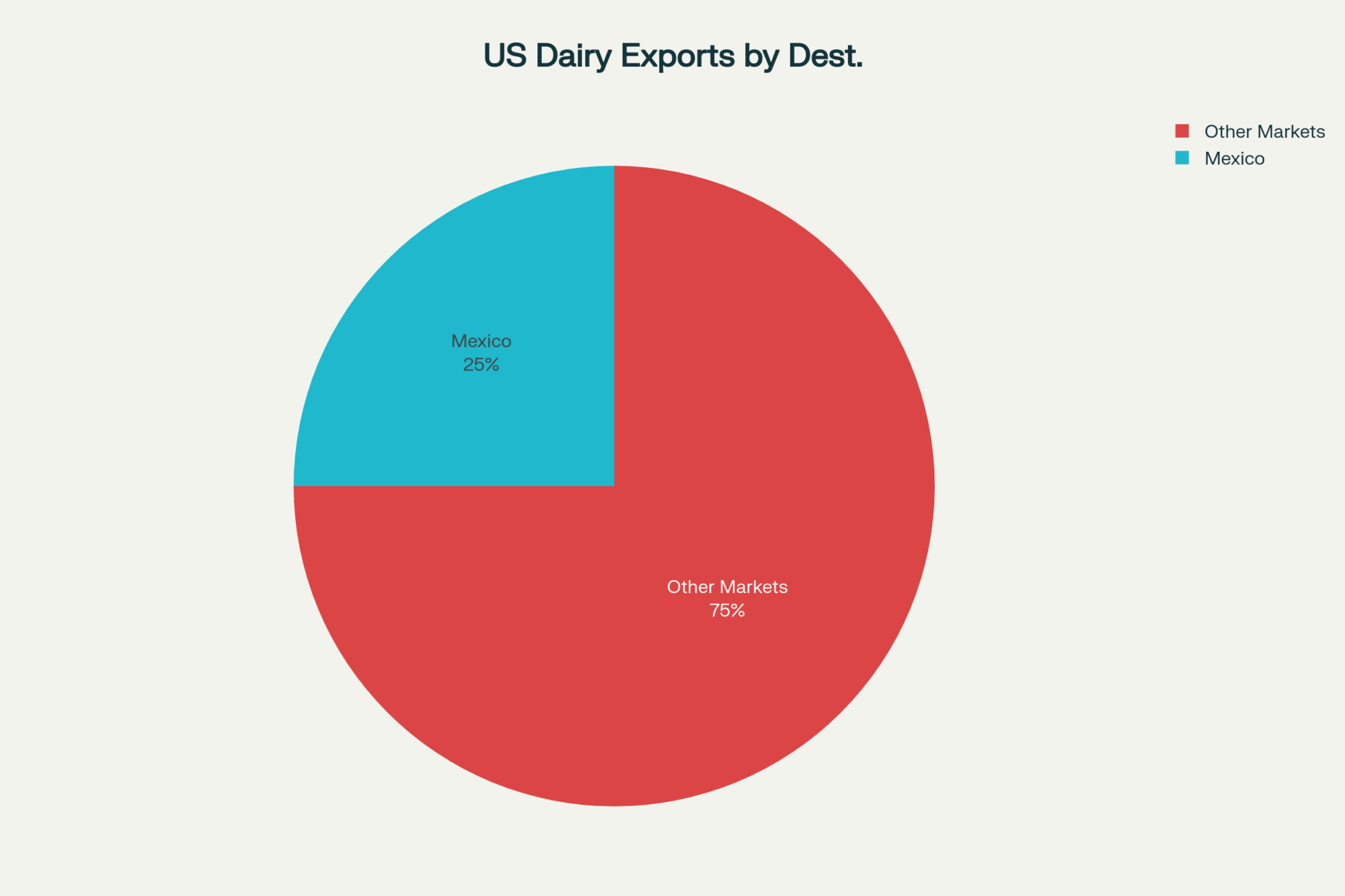
US Dairy Exports: Mexico’s Dominant Market Share (25%) vs Other Markets

What’s Happening South of the Border—And Why You Should Care

The thing about Mexico’s strategy is how systematic they’re being about it. This isn’t some politician’s campaign promise that’ll get forgotten after the election cycle. They aim to increase their production from 13.3 billion to 15 billion liters by 2030, specifically targeting the products we’ve been shipping south for years.

According to recent USDA data, Mexico purchases approximately 25% of all US dairy exports—making them not just our biggest customer, but our most critical one. A critical question for the industry is how we’ve allowed ourselves to become so dependent on a single market, especially when they buy more than half of all the skim milk powder we export (51.5% to be exact).

Think about that concentration risk for a minute. It’s like having one customer buy half your butterfat production… and then watching them build their own creamery.

But here’s where it gets interesting—Mexico’s offering their producers guaranteed pricing through state-owned Segalmex. The current guaranteed price is 10.60 pesos per liter, with targets moving toward 11.50 pesos per liter. That’s a significant premium over what their producers were getting just a few years back when prices averaged around 8.20 pesos.

While US producers navigate the complexities of Federal Milk Marketing Orders and risk management tools, Mexican producers are being handed pricing certainty. When was the last time our producers had that kind of guarantee?

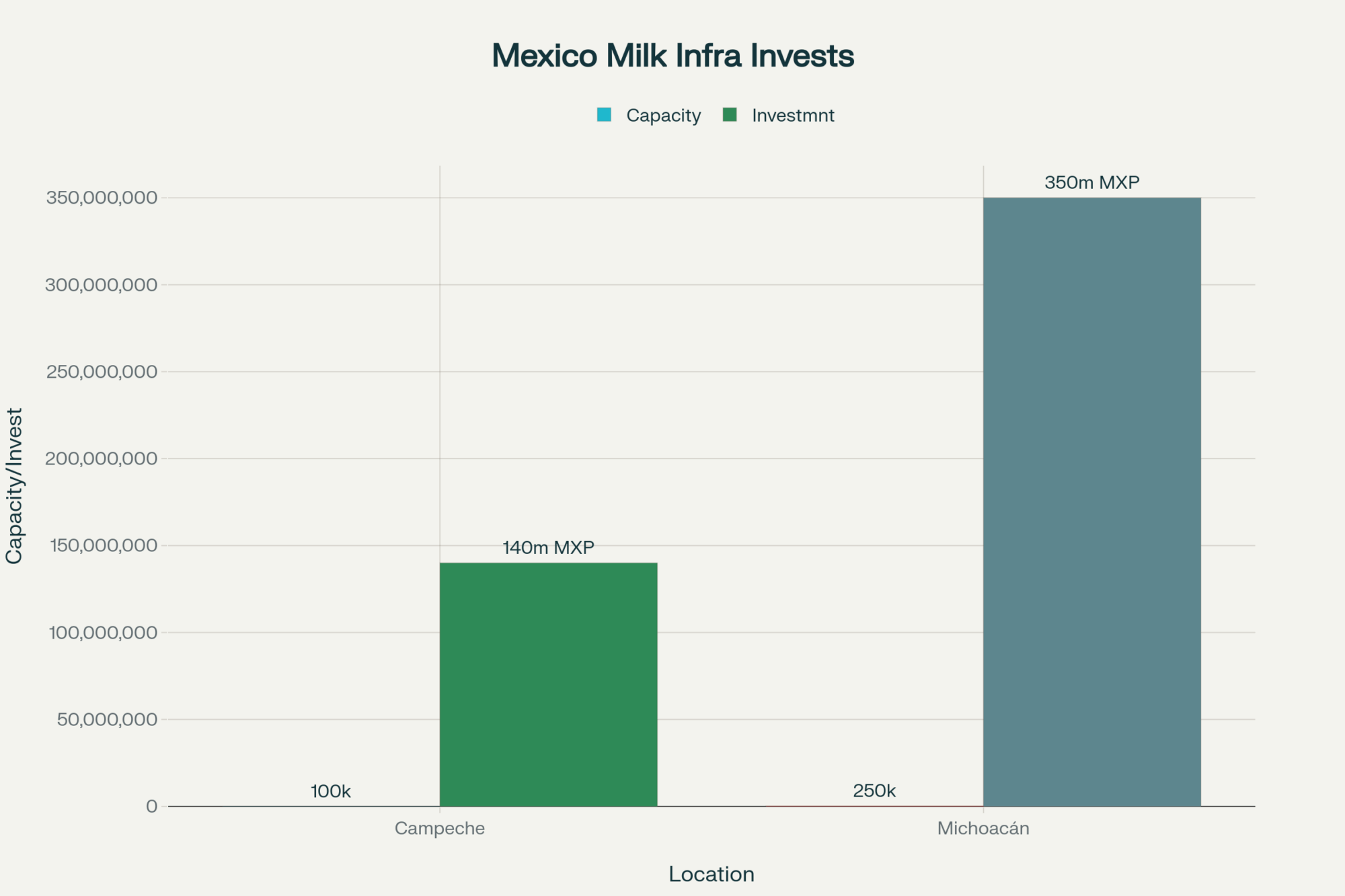
Mexico’s Key Dairy Infrastructure Investments

Meanwhile, they’re investing substantial funds in infrastructure. We’re discussing major investments as part of the broader $4.1 billion program, with planned processing facilities set to come online throughout 2025 and 2026. The crown jewel? A massive milk drying plant in Michoacán is explicitly designed to produce the powder they’ve been buying from us.

It’s like watching your neighbor build their own grain elevator after years of using yours.

Mexico’s Strategic and Viable Plan for Self-Sufficiency

What’s fascinating—and a bit concerning—is how well-planned and achievable this whole thing appears. They’re building infrastructure that’s calculated, not random:

The 100,000-liter daily capacity pasteurization plant in Campeche is scheduled to start operations, serving regional markets that currently rely on imports. In Michoacán, a drying facility is planned to handle 250,000 liters of water daily—that’s significant processing power aimed directly at reducing powder imports.

However, what really catches my attention is that they’re expanding milk collection infrastructure nationwide to capture previously unprocessed milk. Think about it—when you have small-scale operations scattered across a diverse geography, collection and cooling become your biggest bottlenecks.

This is where Mexico’s productivity gaps actually work in their favor, and it’s something we need to understand if we’re going to respond intelligently.

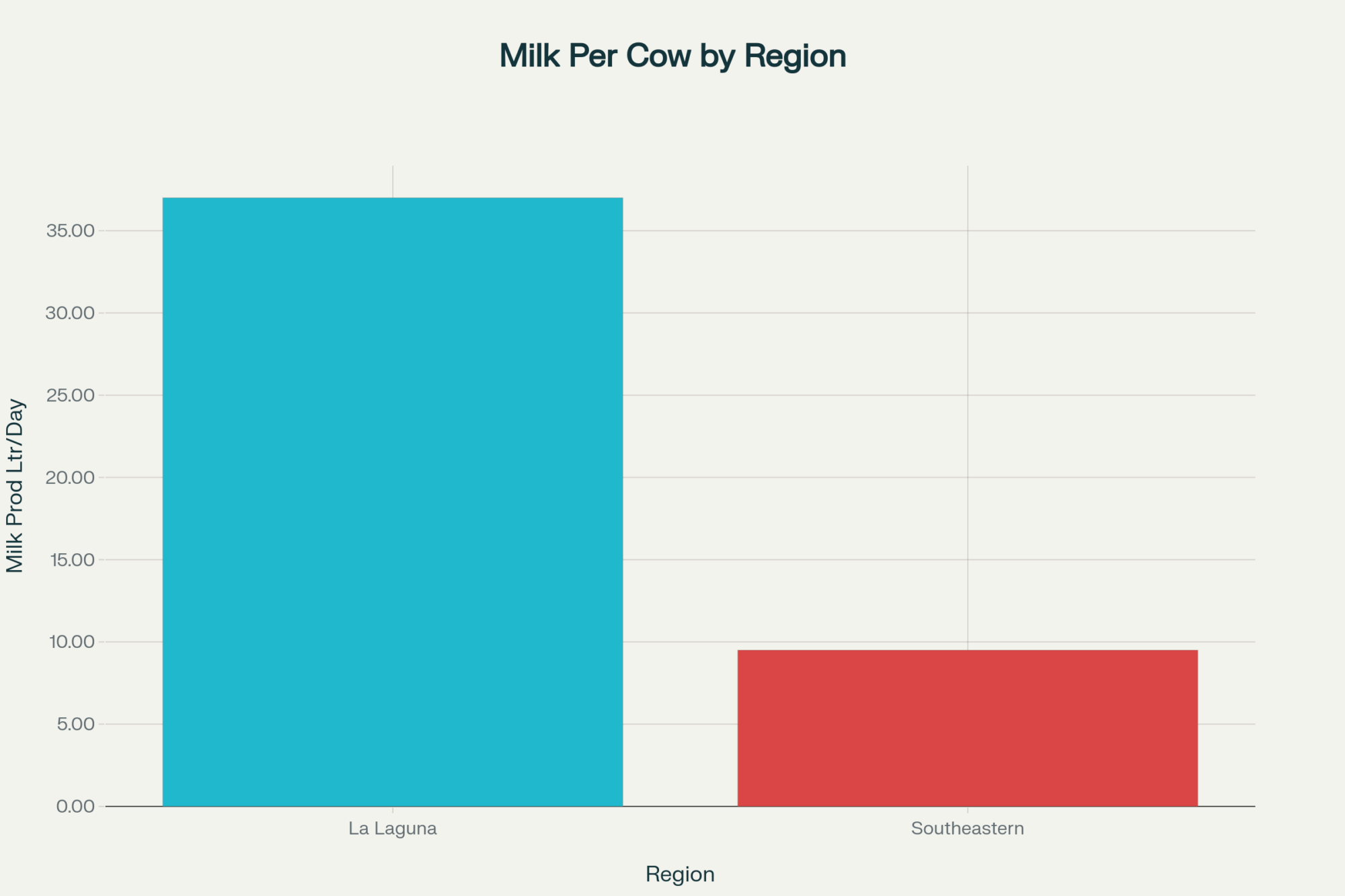
Milk Production Productivity Gap between Mexican Dairy Regions

Up north in regions like La Laguna—which any of you who’ve worked in Mexican genetics know well—their modern dairies are hitting 37 liters per cow per day. Down in the southeastern states? They’re struggling to get 9-10 liters per cow. That’s not a small gap; that’s an opportunity you could drive a milk truck through.

What’s particularly noteworthy is that 97% of their dairy operations are small-scale with fewer than 100 cows each. However, when you have that much room for improvement, even modest gains can support significant production increases without proportionate cost increases.

And here’s the uncomfortable truth we need to face: If we can clearly see these productivity gaps, why haven’t we been positioning ourselves as essential partners in closing them rather than just commodity suppliers to be replaced?

Have we been so focused on shipping powder that we missed the bigger opportunity?

Why This Should Keep Every Producer Up at Night

Look, I get it. Mexico has been such a reliable market that the industry may have grown somewhat complacent. However, when you consider the level of export concentration to a single country and that country decides to erect barriers around its dairy market, the concentration risk becomes undeniable.

A recent CoBank analysis reveals that the dependency extends beyond the headline export number—Mexico doesn’t just buy our surplus; they’ve become integral to our pricing structure. Agricultural economists are projecting that if Mexican demand were to disappear, we could see milk prices drop significantly. Do you recall the China trade disputes that occurred a few years ago? This could be worse because of the volume concentration.

What’s particularly concerning is that the US has nearly $8 billion in new processing capacity coming online by 2026. Those plants were designed with export growth in mind, particularly for the Mexican market. We’re adding capacity while potentially losing our largest customer.

US Dairy Dependence on MexicoCurrent Reality
Total Annual Exports to Mexico$2.47 billion (2024)
Share of Total US Dairy Exports~25%
Mexico’s Share of US SMP51.5%
New US Processing Capacity (by 2026)$8 billion

The math here is troubling. Are we building processing capacity faster than we’re securing the markets to absorb that production?

I was talking to a producer in Ohio last week who’s planning a major expansion based on projected export growth. When I asked about backup markets in case Mexico goes away, well, let’s just say that conversation got uncomfortable quickly.

Where Mexico Might Stumble (And Where We Might Find Breathing Room)

Before we panic completely, let’s discuss where Mexico’s plan could encounter some speed bumps. Those productivity gaps I mentioned? They exist for real reasons.

From what I’ve observed in similar programs in other countries, achieving meaningful productivity improvements among smallholder farmers typically takes a minimum of 5-7 years. Mexico may be optimistic about its timeline, especially when considering the potential impact of political cycles that could alter policy support. We’ve seen this movie before in other regions—Brazil attempted something similar in the early 2000s and encountered significant implementation delays.

Then there’s the water situation—and anyone who has spent time in northern Mexico knows this is a real concern. The productive regions are facing ongoing drought conditions that could limit their expansion potential. When you’re talking about expanding dairy operations in areas already stressed for water resources… that’s a genuine constraint that money alone can’t fix quickly.

Could US producers pivot to exporting high-value specialty cheeses that Mexico cannot easily replicate? Possibly, but the volume economics don’t work the same way. Specialty products command higher prices but represent a fraction of the volume that keeps our processing plants running efficiently. You can’t replace 51.5% of your powder exports with artisanal cheese sales.

However, here’s the thing that worries me—even if they don’t hit their targets perfectly, any movement toward self-sufficiency will still affect our export volumes. And we can’t afford to ignore that reality.

Are we betting our export strategy on Mexico’s plan failing, or are we preparing for the possibility that they might actually succeed?

The Hidden Opportunity in This Challenge

What’s particularly noteworthy about this whole situation is that while Mexico’s building walls around commodity products, they’re creating huge opportunities for the right kind of American companies.

Think about those productivity gaps I mentioned. Mexico has been importing high-quality dairy genetics to improve their herd performance—this tells me they’re willing to pay for superior genetics and technology, even while pushing for self-sufficiency in commodities.

Your genetic companies, equipment manufacturers, and technical service providers should view this as a massive opportunity. The infrastructure investment creates immediate demand for processing equipment, automation systems, and technical expertise, where we still hold competitive advantages.

Here’s what I’m seeing from producers who get it: they’re not just trying to maintain market share, they’re figuring out how to profit from the transformation. Because that transformation is happening whether we participate or not.

A senior executive at a leading US genetics firm recently confirmed to me that they’ve already started positioning themselves as “essential partners” in Mexico’s productivity improvements rather than just semen suppliers. Smart move.

And honestly? Diversification should’ve been happening anyway. Regional markets are showing strong growth in dairy demand, and companies that establish positions in emerging markets before they become critical will outperform those scrambling for alternatives after losing established relationships.

Here’s the question that should be driving strategy meetings: Are we going to stop thinking about this as losing a customer and start seeing it as gaining a technology partner?

What This Means for Your Operation Right Now

Look, Mexico’s dairy independence campaign isn’t just policy rhetoric—it’s economic nationalism targeting our most reliable agricultural export relationship. They’re not playing games with systematic infrastructure investment totaling billions over the next five years.

The question isn’t whether Mexico will succeed in reducing import dependence… It’s a question of whether American dairy companies will adapt quickly enough to profit from the transformation or watch it happen from the sidelines.

Here’s what you need to be thinking about—and I mean seriously considering, not just adding to your someday list:

Start diversifying your export exposure within the next 12 to 18 months. Don’t wait until Mexican demand actually disappears. Southeast Asia, the Middle East, and parts of Africa are experiencing strong growth in dairy demand. However, here’s the catch—these markets typically take 3-5 years to develop properly, which means starting from scratch.

Look for partnership opportunities before your competitors do. The infrastructure Mexico’s building creates demand for exactly what we do best—genetics, equipment, and technical services. Find ways to profit from their growth rather than just defending against their independence. Target timeline? Over the next 6-12 months, while opportunities are still available.

Get serious about margin preparation. If we lose even part of the Mexican relationship, domestic supply could increase, putting pressure on milk prices. Ensure your cost structure can withstand a 10-15% milk price decline (a worst-case scenario, but plan for it). This isn’t fear-mongering; it’s basic supply and demand mathematics.

“Are you positioning your operation to profit from change, or just hoping things stay the same?”

A veteran producer I spoke with at a recent industry meeting in Wisconsin put it perfectly: “The operations that were already thinking strategically weren’t panicked by this news. The ones that hadn’t considered export diversification? Well… they left with a lot of homework.”

The Bottom Line

The era of taking Mexican demand for granted is over. Full stop.

Mexico’s systematic approach to dairy independence—from guaranteed pricing to strategic infrastructure investment—shows they’re serious about reshaping this relationship. The successful operations will be those that can pivot from just shipping commodities to building value-added partnerships that transcend political boundaries and policy changes.

This transformation is happening whether we like it or not. The only choice is whether we profit from the change or become its casualties. And based on what I’m seeing from Mexico’s commitment and systematic approach… I’d say the window for adaptation is narrower than most people think.

What separates the operations that thrive during industry transitions from those that merely survive? The thrivers stopped defending the old model and started building the new one. They recognized that when your biggest customer starts talking about independence, that’s not a threat—it’s a wake-up call.

I’ve been watching dairy markets for over two decades, and I’ve seen this pattern before. The producers and processors who come out ahead will be those who saw this coming, adapted early, and positioned themselves to benefit from the change rather than just react to it.

Because ready or not, that change is coming faster than most of us anticipated.

The question is: will you lead that transformation, or watch it from the sidelines?

And if you’re still not convinced this is urgent… remember that $8 billion in new processing capacity is coming online. That milk has to go somewhere. Better make sure you know where that somewhere is going to be.

Complete references and supporting documentation are available upon request by contacting the editorial team at editor@thebullvine.com.

Learn More:

Join the Revolution!

Join over 30,000 successful dairy professionals who rely on Bullvine Weekly for their competitive edge. Delivered directly to your inbox each week, our exclusive industry insights help you make smarter decisions while saving precious hours every week. Never miss critical updates on milk production trends, breakthrough technologies, and profit-boosting strategies that top producers are already implementing. Subscribe now to transform your dairy operation’s efficiency and profitability—your future success is just one click away.

NewsSubscribe
First
Last
Consent

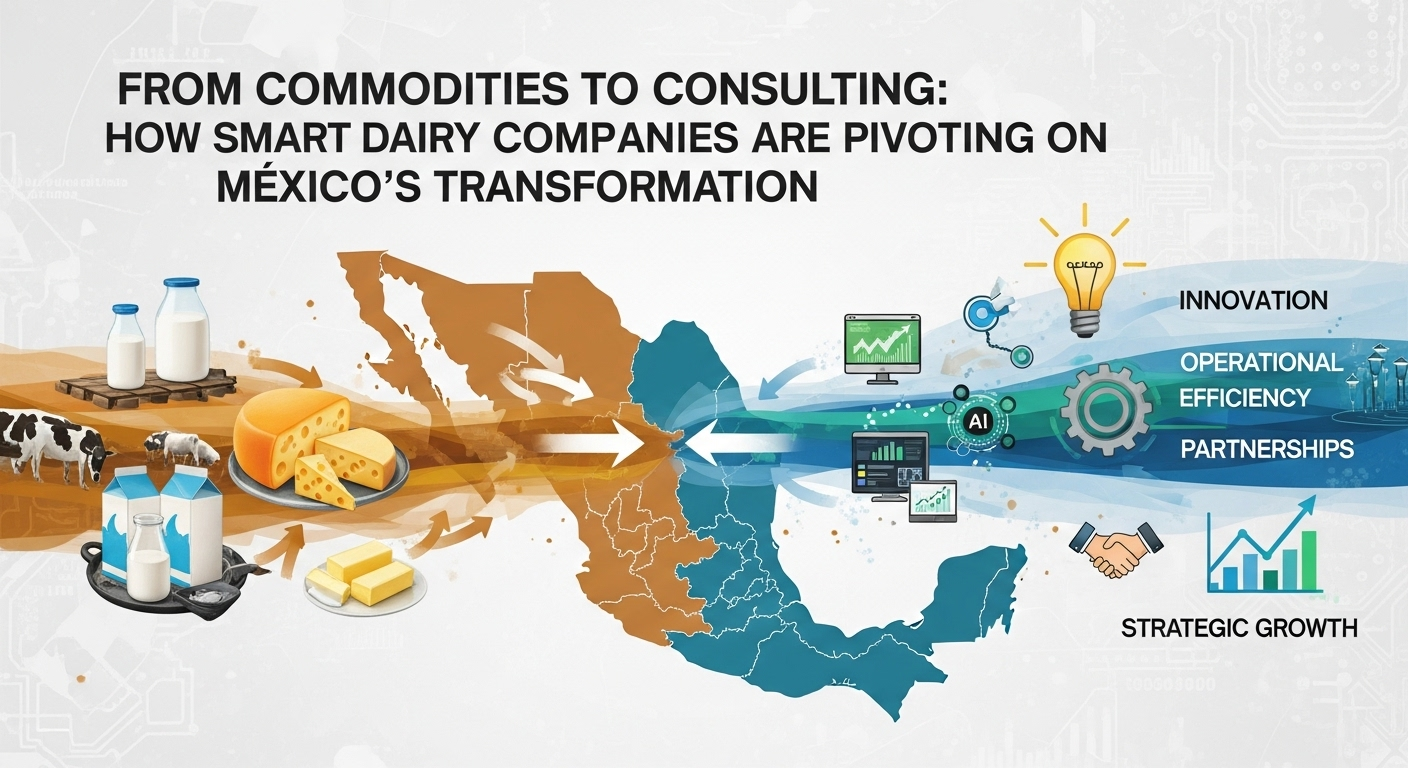
From Commodities to Consulting: How Smart Dairy Companies Are Pivoting on Mexico’s Transformation

Mexico’s buying $2B of our dairy products… but that’s about to change in ways that could make you money.

EXECUTIVE SUMMARY: You know, everyone’s freaking out about Mexico trying to cut dairy imports, but they’re missing the bigger picture here. The real story isn’t about losing commodity sales – it’s about Mexico creating a massive new market for exactly the kind of high-value genetics and technology we do best. Think about it… they’ve got northern dairies hitting 37 liters per cow while southern operations struggle with 9-10 liters. That’s not a trade problem, that’s a $500 million genetics opportunity right there. Their feed conversion ratio is 1.4:1, compared to our efficient herds at 1.2:1 – imagine the consulting fees required to close that gap. Mexico’s investing billions in processing infrastructure, but it can’t boost productivity with concrete and steel. They need our genomics, our automation systems, our expertise. Companies like Semex and ABS are already positioning themselves for this shift, and the processing equipment market alone is growing at a rate of 6% annually.

Here’s what I keep telling producers… while everyone else is worried about defending milk powder exports, smart operations are figuring out how to sell solutions instead. That’s where the real money is.

KEY TAKEAWAYS:

  • Genetics goldmine: Mexico’s 300% productivity gap between regions creates immediate demand for superior genetics – genomic testing programs showing 10% accuracy improvements with 18-24 month paybacks are suddenly very attractive to Mexican producers getting guaranteed milk prices
  • Technology export boom: Processing equipment market growing 6% annually to $517M by 2030, while automated milking systems delivering 25-30% labor savings make perfect sense for operations dealing with rising labor costs and government price supports
  • Consulting opportunity explosion: Programs like the Margarita Project tripled small producer incomes through technical assistance – Mexico has 250,000+ small dairies that need exactly this kind of expertise, creating massive demand for North American dairy consultants
  • Trade relationship evolution: Instead of defending commodity exports, position your genetics/technology business for Mexico’s transformation – they’re not ending trade, they’re upgrading it from bulk products to high-value solutions
  • Environmental tech demand: Heat stress causing 15% production drops in key regions while water constraints limit expansion – creates premium market for cooling systems, water recycling, and climate management technologies with 3-5 year payback periods
US dairy exports, dairy profitability, dairy genetics, feed efficiency, dairy market trends

I’ve been watching the Mexican dairy situation evolve for a while now, and it’s becoming clear that something fundamental is shifting there. Mexico’s making a massive push toward dairy self-sufficiency – we’re talking billions in government investment over the next several years. But here’s the thing… this isn’t about cutting off trade with North America. It’s about changing what kind of trade we’re doing.

What strikes me most about this entire development is that while Mexico aims to reduce commodity imports, it is actually creating a huge market for the kind of high-value genetics, technology, and expertise that progressive dairy operations excel at providing.

The Trade Relationship That Everyone’s Watching

US-Mexico Dairy Trade Snapshot (2023)

Trade MetricValueSignificance
Total US Dairy Exports to Mexico$2.0+ billion25% of all US dairy exports
Mexico’s Share of US SMP Exports51.5%Largest single market
Mexico’s Import Dependency50%+ of deficit from USCritical relationship
Per Capita Consumption Gap45% below US levelsGrowth potential

Look, the numbers tell you everything you need to know about why this matters. The US ships over $2 billion worth of dairy products to Mexico annually, making it our largest dairy customer by far. We’re talking about roughly a quarter of all US dairy exports flowing south of the border.

And here’s what’s particularly interesting… Mexico buys more than half of all the skim milk powder we export. That’s a massive concentration in one market, which explains why Mexico’s push for self-sufficiency has garnered so much attention in the industry.

However, industry economists continue to point out something that I think gets lost in all the trade war rhetoric – Mexico’s per capita dairy consumption remains significantly below US levels. Even as they boost domestic production, there is still room for the market to grow. It’s not necessarily a zero-sum game.

Why Mexico Can’t Get There Alone (The Gaps Are Real)

Mexico Dairy Technology Investment Opportunities

Technology SectorMarket SizeGrowth RatePayback PeriodImplementation Cost
Processing Equipment$517M by 20306% annually3-5 years$500K-2M+
Genomic Selection$500M potential10% accuracy gain18-24 months$35-50/animal
Automated MilkingRegional adoption25-30% labor savings5-7 years$150K-200K
Environmental TechPremium pricingWater/heat stress focus3-5 years$50K-500K
Consulting Services250K+ operationsTriple income potential12-18 months$50-200/cow

The Genetics Reality Check

The productivity differences within Mexico’s dairy sector are honestly pretty staggering. You’ve got northern operations – think Chihuahua, Durango – where modern dairies are hitting production levels that would make any Wisconsin producer proud. But then you move south, and you’re looking at mixed-breed herds struggling to hit ten liters per cow per day.

That’s not a small gap. That’s the difference between a profitable operation and one that’s barely breaking even.

What really caught my attention recently was Mexico’s decision to import thousands of Australian Holstein heifers. Think about that for a second – they’re trying to achieve self-sufficiency, but they can’t get there without superior genetics. The Australians were reportedly producing double what the average Mexican cow delivers.

The Feed Efficiency Challenge

Here’s where things get really interesting from a nutrition standpoint. Mexican operations are averaging feed conversion ratios that would make most US nutritionists wince. We’re seeing 1.4 to 1.5 pounds of feed per pound of milk in many operations, while efficient US herds are running closer to 1.2 to 1.

That efficiency gap represents enormous potential for improvement through better nutrition programs and management practices. And the Mexican government knows it – they’ve created price supports that guarantee producers profitable milk prices, specifically to encourage these kinds of productivity investments.

The Water Reality (This Is Getting Serious)

Environmental constraints are becoming the real limiting factor, especially in Mexico’s prime dairy regions. Industrial agriculture already consumes the vast majority of available freshwater in many areas, and climate change isn’t making things easier.

I’ve been hearing from consultants working down there about significant production drops during heat stress periods – we’re talking 15% decreases in some regions during the worst weather. That’s not sustainable if you’re trying to boost national production by 20% or more.

Investment ROI Analysis for Mexico Market Entry

Investment TypeInitial CostAnnual ReturnBreak-evenRisk Level
Genetics Program$100K-500K15-25%2-3 yearsLow
Processing Equipment$1M-5M12-18%4-6 yearsMedium
Consulting Services$50K-200K25-40%1-2 yearsLow
Technology Licensing$250K-1M20-30%2-4 yearsMedium
Environmental Systems$500K-2M15-20%3-5 yearsMedium-High

The Real Opportunity: Selling Solutions Instead of Powder

What’s fascinating about Mexico’s strategy is that while it targets commodity imports, it also creates massive opportunities for technology providers and genetic companies.

The processing equipment market is growing at a rate of approximately 6% annually, driven by significant investments in infrastructure. But more importantly, you’ve got producers who suddenly have economic incentives to invest in productivity improvements.

Genomic selection tools are generating serious interest because they can accelerate breeding progress by 10% or more compared to traditional methods. For Mexican producers dealing with significant genetic performance gaps, such acceleration could be transformative. The economics work too – implementation costs around $40-50 per animal with payback periods under two years.

Automated milking systems are becoming increasingly viable in regions where labor costs are rising and labor availability is becoming a concern. Sure, the upfront investment is substantial – you’re looking at $150,000 to $200,000 for a decent installation – but 25-30% labor savings can quickly justify that in the right situation.

What really excites me, though, is the consulting opportunity… programs like the Margarita Project have shown that you can triple the incomes of small producers through proper technical assistance and market integration. Mexico has hundreds of thousands of small dairy operations that could benefit from this kind of support. That’s a massive market for the right kind of expertise.

What About USMCA? (2026 Is Coming Fast)

The trade agreement framework actually works in favor of this transformation. USMCA preserves duty-free access for most dairy products and protects things like common cheese names. Still, Mexico’s self-sufficiency efforts are primarily focused on basic commodities, such as skim milk powder.

What’s interesting is that cheese imports are still growing – food service demand is driving increased imports of specialty products that Mexico doesn’t produce efficiently. You’re seeing a market bifurcation where basic commodities face pressure, but high-value products continue to grow.

Trade experts continually remind us that Mexico and Canada, combined, represent nearly half of the total US dairy export value, making the 2026 USMCA review absolutely critical for the industry’s future. However, I believe the companies that are positioning themselves for this new reality – focusing on genetics, technology, and expertise rather than just commodity volume – will be fine regardless of what happens in those negotiations.

The Bottom Line: Evolution, Not Elimination

Here’s what I keep telling people who ask about this… Mexico isn’t ending its relationship with North American dairy. They’re transforming it.

The winners are going to be the companies that can pivot from shipping bulk commodities to delivering high-value genetics, cutting-edge technology, and world-class expertise. There’s a clear market bifurcation happening – traditional commodity flows might face pressure, but the demand for solutions is exploding.

You’re looking at producers who need to close massive productivity gaps, adopt new technologies to deal with environmental constraints, and integrate hundreds of thousands of small operations into modern supply chains. That’s not something you solve by building more processing plants… that requires the kind of advanced genetics, sophisticated technology, and deep industry expertise that North American companies do better than anyone.

The question isn’t whether Mexico will achieve their production targets – they probably will, eventually. The question is whether we can adapt our business models quickly enough to profit from that transformation, rather than just watching traditional market shares disappear.

Are you thinking defensively about protecting existing commodity sales, or are you positioning your company to lead in this new market for solutions? Because that choice is going to determine who thrives in the next decade of the North American dairy trade.

Complete references and supporting documentation are available upon request by contacting the editorial team at editor@thebullvine.com.

Learn More:

  • The 7-Day Plan For Fixing Your Herd’s Feed Efficiency – This article moves from strategy to action, delivering a tactical checklist for closing the feed efficiency gap mentioned in the main piece. It outlines practical steps you can take over seven days to immediately impact your herd’s profitability and reduce waste.
  • The Great Dairy Bifurcation: Why The Global Market is Splitting in Two – For a deeper look at the global market dynamics driving Mexico’s strategy, this piece provides the strategic framework. It helps you understand the larger economic forces splitting the dairy world into commodity and high-value markets, sharpening your long-term planning.
  • Beyond The Hype: How Top Herds Are Actually Making Money with Genomics – This article breaks down the real-world ROI of the genomic tools mentioned as a key opportunity in Mexico. It reveals methods for selecting traits that deliver tangible financial returns and helps you avoid common, costly mistakes in genetic investment strategies.

Join the Revolution!

Join over 30,000 successful dairy professionals who rely on Bullvine Weekly for their competitive edge. Delivered directly to your inbox each week, our exclusive industry insights help you make smarter decisions while saving precious hours every week. Never miss critical updates on milk production trends, breakthrough technologies, and profit-boosting strategies that top producers are already implementing. Subscribe now to transform your dairy operation’s efficiency and profitability—your future success is just one click away.
NewsSubscribe
First
Last
Consent

Weekly US Dairy Market Report: May 9, 2025 – Export Boom, Tariff Risks, and Market Volatility

U.S. dairy exports boom as global prices hit 3-year highs, but tariffs and domestic inventory risks threaten the rally. Can the surge last?

EXECUTIVE SUMMARY: The U.S. dairy market saw explosive growth in exports and global price rallies during the week ending May 9, 2025, fueled by record-breaking Global Dairy Trade (GDT) auction results and a weak dollar. Butter and cheese exports hit multi-year highs, while whey and lactose faced headwinds from Chinese tariffs. Domestically, strong spring milk production boosted butter and cheese output but raised inventory concerns as foodservice demand lagged. CME markets surged, with cheese prices hitting $1.84/lb, though USDA forecasts warn of softer annual averages. Producers must balance short-term gains against tariff risks, shifting global demand, and potential oversupply as milk production peaks.

KEY TAKEAWAYS:

  • Global prices soar: GDT auction hits 3-year highs (butter +3.8%, cheddar +12%), widening U.S. export advantages.
  • Export split: Cheese/butter thrive; whey/lactose struggle under Chinese tariffs (-23% prices since February).
  • Domestic tension: Spring flush boosts production but risks inventory gluts as foodservice demand slows.
  • Risk management critical: Feed costs drop temporarily, but USDA warns of softer 2025 averages ($17.60/cwt Class III).
  • Diversify or die: New U.S.-Indonesia deal highlights shift from China-reliant markets amid trade volatility.
US dairy exports, global dairy prices, dairy market report, butter and cheese exports, dairy tariffs

The bulls had plenty to feast on this week in dairy markets and didn’t waste the opportunity. US dairy exports are booming, and foreign buyers can’t get enough of our comparatively inexpensive dairy products. It’s a fascinating market right now – one of those periods where global factors drive our domestic prices more than usual.

Tuesday’s Global Dairy Trade auction kicked things off with a bang. Almost everything went up, and not by small margins either. Whole milk powder jumped 6.2% from the late-April auction, while Cheddar prices shot up an eye-popping 12%. Both hit their highest levels in three years. Butter somehow managed to outdo itself, climbing 3.8% to reach its highest price EVER at the GDT. And lactose? A stunning 16.8% leap as buyers scrambled to secure European products to avoid American tariffs.

The gap between US and international prices keeps widening, which explains why our exports are selling like crazy. I’ve never seen such a price advantage for American products – it’s almost guaranteed to keep export volumes strong in the months ahead.

Export Surge Continues

The good news kept coming on Tuesday when March trade data confirmed what many of us suspected – American dairy products are flying off the shelves overseas. Both value and volume reached two-year highs.

Cheese exports nearly matched their record-breaking performance from March 2024, with Japan taking an all-time high volume. Our butter and milkfat exports hit 53 million pounds for Q1, making it the strongest first quarter since 2014. Whey product exports easily beat last year’s volumes, though they still haven’t quite caught up to 2023’s pace in some categories. And milk powder exports? After a slow January and February, they rebounded nicely in March, slightly exceeding the same month last year.

The outlook for cheese, butter, and milk powder exports remains promising. The dollar is weak, and our prices are still much lower than international benchmarks – a perfect recipe for continued strong overseas sales. If these conditions hold, we’ll see more records broken before the year’s end.

Whey and lactose exports face a rockier road, though. Their dependence on Chinese buyers makes them vulnerable under the new tariff situation. Chinese buyers are already shifting purchases to Oceania and European suppliers, who are happy to fill the void we’re leaving. The premium for European lactose and high-protein whey over US prices has never been higher. This situation is causing some real headaches for US processors who’ve invested heavily in whey processing capacity.

Meanwhile, the strong sales and rising values are prompting dairy processors in Australia, New Zealand, and Europe to raise their farmgate milk prices. Nice to see producers getting some benefit from these improved market conditions.

Production Data Causes Indigestion

The dairy bulls gorged on good news early in the week, but perhaps they overate. Tuesday afternoon brought USDA’s monthly Dairy Products report, which showed that growing milk output and excellent component levels gave processors plenty of raw material to work with.

US manufacturers churned out 1.4% more cheese, including a substantial 5.4% more Cheddar and 8.6% more butter than they did in March 2024. All those exports have helped manage inventories but haven’t completely prevented stocks from growing. This could become problematic if exports slow down for any reason.

Domestic consumption seems… well, lackluster is probably the kindest way to put it. Several pizza and burger chains reported disappointing sales in Q1 and expressed worry about continued slow traffic in April and May. That’s especially concerning for cheese demand.

There’s an interesting shift happening in manufacturing priorities, though. Producers focus more on whey protein isolates, leaving less whey available for dryers. Whey powder production fell 11.7% below March 2024 levels. However, stocks still inched upward, not exactly what producers wanted to see.

Similarly, increased cheese production pulled milk solids away from dryers. Combined production of nonfat dry milk and skim milk powder dropped 9.6% year-over-year, hitting the lowest March output since 2013. Milk powder stocks did grow a bit from February to March, with manufacturers’ NDM stocks 12.8% higher on March 31 than a year earlier. But here’s where it gets interesting – the stockpile isn’t nearly as large as USDA initially thought.

The government found February’s stock at just 250 million pounds in its annual inventory survey, which was way below their initial estimate of 329 million pounds. USDA officials told Daily Dairy Report analysts that other months’ inventories were also overstated, but government rules prevent them from publishing those revisions until next April’s annual survey. The takeaway? Milk powder supplies have been tighter, and domestic demand has been better than we thought. That explains a few things about price behavior that had me scratching my head earlier this year.

Markets End Week Higher Despite Late Selloff

The markets closed out the week substantially higher than they started, even with some selling pressure on Thursday and Friday. CME spot Cheddar blocks rose 5.75¢ to finish at $1.8175 per pound, while barrels added 1.5¢ to reach $1.77. That widening block-barrel spread tells me retail demand is outpacing food service needs.

Spot NDM climbed 1.25¢ to $1.2075, and whey powder gained 2.25¢ to close at 54.25¢. Butter, meanwhile, held steady at $2.33 – not bad considering how much production has increased.

Most Class III and IV milk contracts added between 30 and 40¢, settling in the $18s and $19s. With all the market uncertainty these days, these prices offer an excellent chance for producers to lock in some protection using Dairy Revenue Protection or similar hedging tools. I’d look seriously at those opportunities if I were still milking cows.

Beef revenues continue to provide another bright spot for dairy producers. Live and feeder cattle futures hit new all-time highs this week, boosting the value of cull cows, beef calves, and other on-farm livestock. Every little bit helps when it comes to income diversification.

Meanwhile, feed costs dropped – always welcome news. Spring weather has been nearly ideal, with a good balance of sunshine and rainfall. Farmers in the Northern Plains and western Corn Belt could use more showers, but overall conditions look promising. The favorable weather in the US and South America pushed corn futures to five-month lows on Thursday before rebounding slightly on Friday. July corn finished at $4.4975 per bushel, down nearly 20¢ for the week. July soybeans settled at $10.52, 6¢ lower than last Friday. July soybean meal dropped $2.90 to $294 per ton.

When you put it all together – strong exports, decent milk prices, lower feed costs, and high beef values – the overall financial picture for dairy farms looks more positive than it has in quite a while. But this business has taught me never to get too comfortable. Markets can turn quickly, and the current export advantage won’t last forever if international prices fall, or the dollar strengthens. As my grandfather always said, “Make hay while the sun shines” – literally and figuratively.

Learn more:

Join the Revolution!

Join over 30,000 successful dairy professionals who rely on Bullvine Weekly for their competitive edge. Delivered directly to your inbox each week, our exclusive industry insights help you make smarter decisions while saving precious hours every week. Never miss critical updates on milk production trends, breakthrough technologies, and profit-boosting strategies that top producers are already implementing. Subscribe now to transform your dairy operation’s efficiency and profitability—your future success is just one click away.
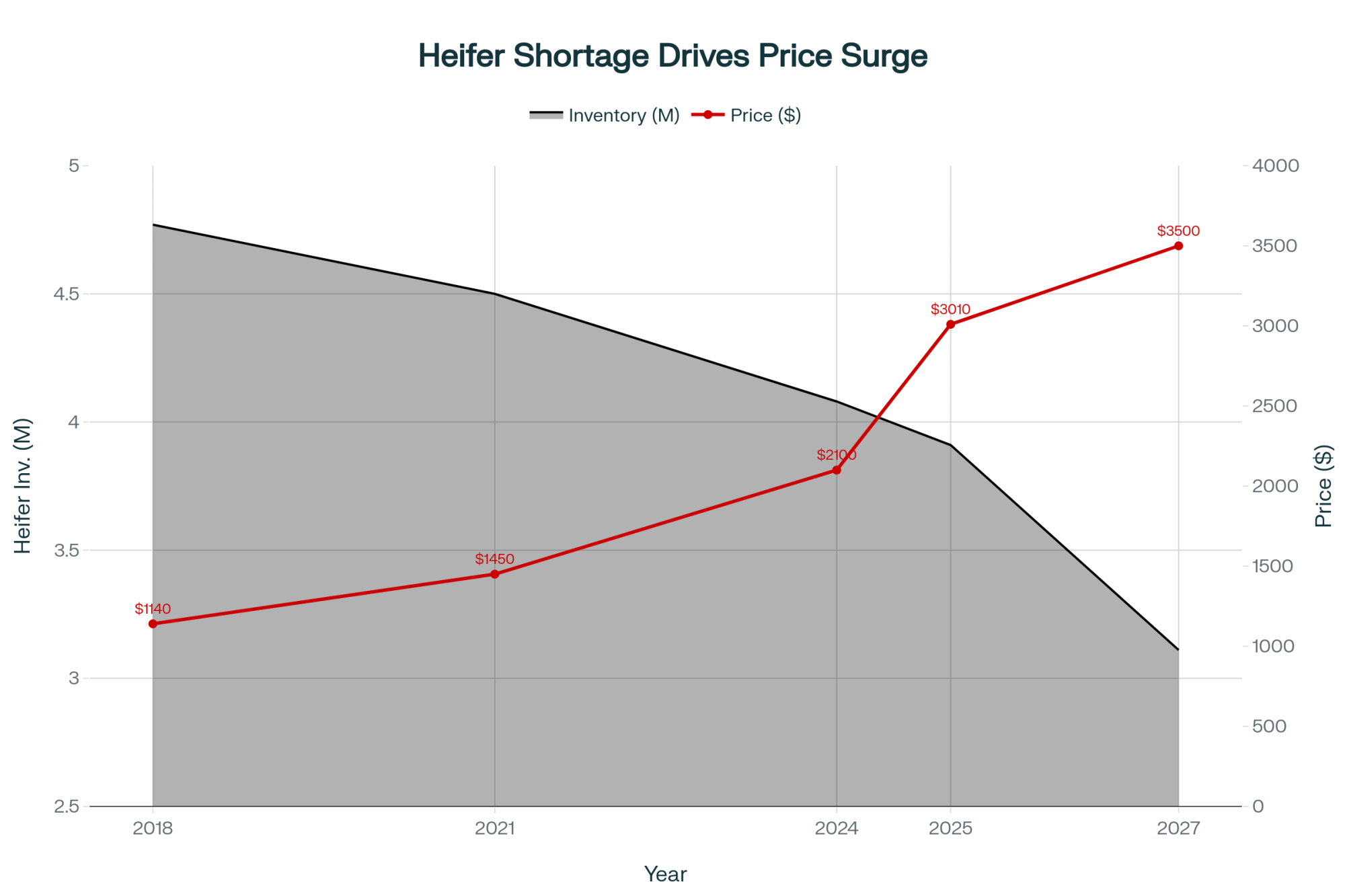
NewsSubscribe
First
Last
Consent

Dairy Trade Crisis: U.S. Exports Face 125% China Tariffs Amid “Difficult Trifecta” of Challenges

U.S. Dairy Under Siege: 125% China Tariffs, Bird Flu & Labor Crunch Threaten $76B Industry’s Survival.

EXECUTIVE SUMMARY: The U.S. dairy industry faces a perfect storm of 125% Chinese tariffs, avian flu outbreaks in 18 states, and labor shortages, jeopardizing its $76B domestic market and 17% export dependency. While record consumer demand (661 lbs/person) and competitive cheese/butter pricing offer temporary relief, China’s trade blockade has crushed whey exports, risking a $0.90/cwt milk price collapse. With Mexico and Canada absorbing 50% of exports and $8.5B in processing upgrades underway, survival hinges on market diversification, biosecurity overhauls, and aggressive risk management.

KEY TAKEAWAYS

  • China’s 125% tariffs shut down the #1 global dairy importer, crushing $584M in annual whey exports overnight.
  • Domestic demand hits 66-year highs (661 lbs/person) but can’t absorb 17% of milk production if exports stall.
  • HPAI outbreaks in 1,021 herds add production risks and could trigger non-tariff trade barriers.
  • U.S. cheese/butter prices undercut global rivals by 21-33%, but extreme tariffs negate this advantage.
  • Strategic lifelines: Diversify to Southeast Asia/MENA, lock in $18/cwt futures, and convert lactose to ethanol.

China slapped a whopping 125% tariff on all American dairy products, slamming the door on the world’s largest import market. This trade crisis couldn’t come at a worse time as the industry battles widespread avian influenza across 18 states and persistent labor shortages, creating dairy’s difficult trifecta.

The tariff war exploded in early April 2025, with the U.S. imposing 145% duties on Chinese goods while China hit back with 125% tariffs on everything American. Despite strong domestic consumption and $8.5 billion in processing investments, our industry’s 16-17% export dependency leaves us dangerously exposed when markets suddenly close.

If dairy trade stalls, U.S. consumers simply can’t absorb all the milk component production and resulting dairy products, highlighting the potential price collapse if export channels remain blocked.

CHINA TARIFFS CRUSH WHEY EXPORTS

Let’s face it – the China market closure delivers a particularly devastating blow to U.S. whey exports. About 40% of American whey production previously went to China for hog feed, a market now effectively padlocked by prohibitive tariffs.

Processors are already dumping surplus whey into domestic feed channels, driving prices down to $0.38/lb – a steep drop from $0.46/lb in mid-April. Industry analysts project dry whey prices could crash into the high $0.30s by year-end if Chinese access remains blocked.

This collapse threatens to slash Class III milk prices by $0.60-$0.90 per hundredweight, directly hitting your bottom line regardless of whether your milk goes into cheese or other products. How long can producers absorb these price shocks before making tough herd decisions?

PRICE ADVANTAGE PROVIDES PARTIAL BUFFER

Despite the tariff nightmare, U.S. dairy maintains significant price advantages in key export categories that might help cushion some impacts in markets outside China.

As of April 21, 2025, U.S. cheddar sells for approximately $1.77/lb compared to global benchmark prices of $2.23/lb – a 21% advantage. The gap is even wider for butter, with American products at $2.34/lb versus $3.48/lb internationally – a 33% discount that makes U.S. butter highly competitive despite moderate tariffs.

Given the lower price points, the U.S. dairy trade should continue despite the tariffs. Should that happen, domestic inventories should remain in balance, supporting dairy product prices.

But here’s the million-dollar question: Can price advantages overcome geopolitical tensions that worsen daily?

MEXICO AND CANADA RELATIONSHIPS CRITICAL

Maintaining strong trade relationships with Mexico and Canada becomes crucial, as China is effectively closed. Together with China, these markets account for over 50% of all U.S. dairy exports.

Mexico remains America’s largest dairy customer, purchasing over 25% of total exports worth approximately $2.47 billion in 2024. Recent data shows cheese exports to Mexico hit record levels in early 2025, with 18% month-over-month growth in February as buyers stockpiled ahead of potential tariffs.

Trade with Canada continues under USMCA tariff-rate quotas, though disputes persist over Canada’s allocation methods. The U.S. argues Canada unfairly reserves 85% of cheese quotas for domestic processors, violating trade agreements.

INDUSTRY FACES MULTIPLE HEADWINDS

Beyond tariffs, the industry continues battling a severe HPAI outbreak affecting over 1,021 herds across 18 states. The virus spreads through contaminated equipment and raw milk, though pasteurization effectively neutralizes it in commercial products.

The USDA covers 75% of biosecurity upgrade costs through the Emergency Assistance for Livestock program, but implementation remains inconsistent across affected regions.

Labor shortages continue plaguing operations, though technology offers partial solutions. We’re seeing 42% of large U.S. dairies now using automated milking systems, reducing labor needs by 30% while increasing yield per cow.

Isn’t it time we seriously addressed these structural labor issues instead of applying band-aid solutions every few years?

STRATEGIC RESPONSES EMERGING

Forward-thinking producers are implementing several strategies to weather the trade storm:

Lactose Diversification: Converting surplus lactose to ethanol, leveraging USDA’s Bioenergy Program subsidies (up to $0.45/gallon)

Butterfat Arbitrage: Exploiting the $1.14/lb price gap versus EU butter through targeted exports to Middle East and North African markets

Risk Management: Locking in Class III futures above $18/cwt through Q3 2025, using CME options to hedge against feed cost spikes

The following 90 days will test our agility, but history shows dairy adapts faster than any sector in agriculture.

DOMESTIC CONSUMPTION PROVIDES FOUNDATION

Despite export challenges, the U.S. dairy industry stands on solid domestic ground. We achieved record retail sales exceeding $76 billion last year, with per capita consumption reaching 661 pounds – the highest level since 1959.

This strong domestic foundation provides critical stability as we navigate international turbulence. Consumer price increases remain moderate across major dairy categories – fluid milk (+3.2%), cheese (+4.7%), butter (+5.8%), ice cream (+3.5%), and yogurt (+2.8%) – suggesting demand remains firm.

However, let’s not kid ourselves – domestic consumption alone can’t absorb the 16-17% of production currently exported. Without a resolution to trade disputes, particularly with China, a significant price depression remains likely through 2025.

THE BOTTOM LINE

The U.S. dairy sector stands at a critical inflection point. We’re walking a “tariff tightrope” while trying to leverage inherent strengths like price competitiveness and processing investments.

Success will depend on diversifying export destinations beyond China, optimizing component production, and accelerating automation to offset labor challenges. Those implementing strategic risk management and remaining nimble in product allocation will weather this storm better than those clinging to pre-crisis business models.

As one industry veteran said, “We’ve survived price crashes, pandemics, and policy upheavals. This tariff war is another challenge that will ultimately make American dairy more resilient, innovative, and competitive on the global stage.”

What’s your operation doing to prepare for these turbulent times? The producers who act now rather than react later will still stand when the dust settles.

Learn more:

Join the Revolution!

Join over 30,000 successful dairy professionals who rely on Bullvine Daily for their competitive edge. Delivered directly to your inbox each week, our exclusive industry insights help you make smarter decisions while saving precious hours every week. Never miss critical updates on milk production trends, breakthrough technologies, and profit-boosting strategies that top producers are already implementing. Subscribe now to transform your dairy operation’s efficiency and profitability—your future success is just one click away.
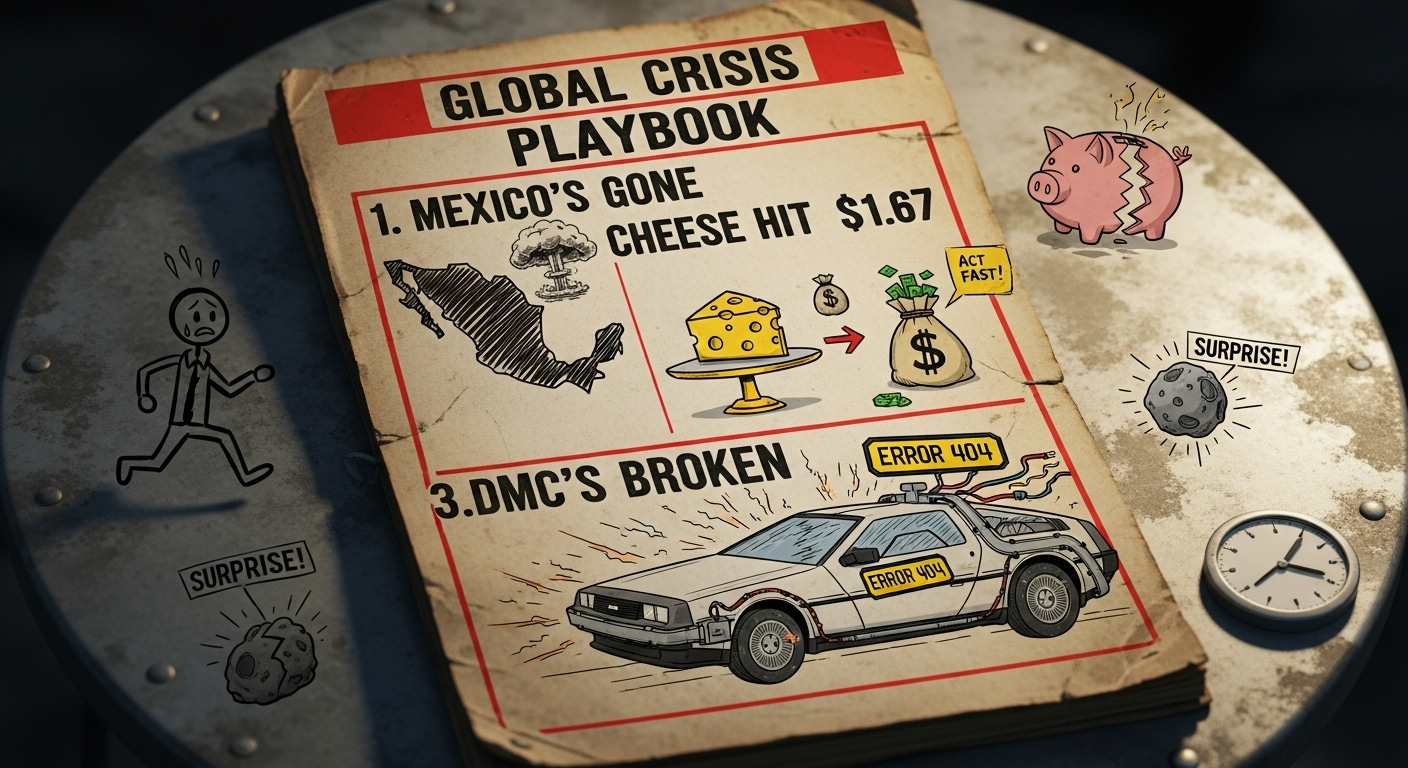
NewsSubscribe
First
Last
Consent

DOLLAR DIVE: How Currency Chaos Could Save US Dairy Exports (But Don’t Celebrate Yet)

Dollar dive vs. tariff wars: Can currency chaos save US dairy exports? The Bullvine breaks down the high-stakes game.

EXECUTIVE SUMMARY: The US dairy industry faces a paradox: a weakening dollar boosts export competitiveness, but retaliatory tariffs threaten profitability. A 5.7% dollar drop since January 2025 has made American dairy cheaper globally, offsetting some tariff impacts. However, tariffs on key markets like Mexico (25%) and China (10-15%) risk eroding gains, with Cornell University projecting a $6 billion loss over four years. While cheese and milk powder exports surged in 2024, domestic demand remains critical, as 84% of US milk stays at home. Farmers must navigate volatility by diversifying markets, focusing on premium products, and hedging against currency swings. The dollar’s decline is no silver bullet – it’s a temporary reprieve demanding strategic action.

KEY TAKEAWAYS:

  1. Currency advantage vs. tariff pain: A weaker dollar offsets tariff hikes, but margins remain fragile.
  2. Premium products win: High-quality dairy (e.g., cheese, butterfat) outperforms in tariff-hit markets.
  3. Diversify or die: Shift focus to Southeast Asia, Africa, and Middle East to reduce reliance on Mexico/China.
  4. Domestic risks linger: A weak dollar could trigger recession, threatening 84% of US milk consumption.
  5. Hedge aggressively: Financial tools are essential to survive currency/tariff volatility.
US dairy exports, currency fluctuations, tariff impacts, global dairy trade, dairy market volatility

Uncle Sam’s wallet is getting lighter by the day, and for once, that might not be terrible news for America’s dairy farmers. The almighty dollar has taken a nosedive, shedding a whopping 5.7% of its value since January – the kind of freefall we haven’t seen since the 2008 financial crisis.

But here’s where it gets interesting: while politicians play chicken with tariffs, this currency slide is quietly reshaping the global dairy chessboard. Every cent the dollar drops makes American dairy more appetizing to foreign buyers. It’s like a sale at the global dairy store, and Uncle Sam’s cheese is suddenly the bargain of the century.

Key Data:

Metric2024 ValueChange
Total US Dairy Exports$8.2B+2% YoY
Cheese Exports to Mexico+30% (Dec 2024)Record high
Butterfat Exports+28% (2024)Driven by Canada

Tariff Wars: The $6 Billion Migraine

Let’s not sugarcoat it – the tariff situation is a Grade A disaster for US dairy. President Trump’s recent temper tantrum slapped a 25% tax on most goods from Mexico and Canada, with China getting hit with a 10% surcharge. These aren’t just any markets – they’re the holy trinity of US dairy exports, gobbling up over half of what we ship overseas.

Cornell University’s Charles Nicholson puts it bluntly: “If you pick a trade fight with our major export destinations, the retaliation will cost dairy farmers $6 billion over four years.”

Farmer Reality Check
“The dollar drop saved my cheese exports to Japan, but tariffs erased those gains. We’re stuck in a never-ending cycle of policy whiplash.”Sarah Miller, Wisconsin Cheese Exporter (USDA Farm Report, 2025)

But here’s the twist: even with these tariffs, certain American dairy products could stay in the game, especially in the premium market where quality trumps price sensitivity.

The Great Currency Offset: Can Math Save the Day?

Here’s where things get interesting – and where The Bullvine’s going to do some math that’ll make your head spin. We’ve got tariffs pushing prices up 10-25%, but a dollar drop giving us a 5-6% discount. Sounds like we’re still underwater, right?

Mike North, president of Ever.Ag, throws a wrench in the works: “Only small changes can have large impacts on price.”

Tariff vs. Currency: The Breakdown

FactorImpactOutcome
25% Tariff+25% Price IncreaseOffset by 5-6% Currency Discount
10% Tariff+10% Price IncreasePartially Offset by Currency
5.7% Dollar Decline-5.7% Price DropBoosts Competitiveness

Take cheese exports, for example. Despite the tariff tempest, they jumped 12% in August compared to last year. Japan, South Korea, and Mexico couldn’t get enough of our cheddar. Milk powder? Up a whopping 15%, with Southeast Asia and Africa suddenly treating American powder like it’s going out of style.

The Risks No One’s Talking About

While the dollar’s decline offers relief, economists warn of volatility. Dr. Ben Brown, University of Missouri, cautions: “Currency fluctuations are unpredictable – farmers shouldn’t rely solely on exchange rates. A sudden dollar rebound could erase export gains overnight.”

Key Vulnerabilities

  1. Dollar Rebound Risk: A Fed rate hike could reverse currency trends.
  2. Trade Policy Uncertainty: Retaliatory tariffs may escalate beyond current levels.
  3. Domestic Demand: A weaker dollar risks recession-driven demand drops at home.

The Mexico Paradox: When Weak Meets Weaker

Now, let’s talk Mexico – our dairy industry’s favorite customer and current political punching bag. Here’s where currency chaos gets really interesting. The peso’s taking a beating too, which means Mexican buyers have less purchasing power for our dollar-priced dairy.

Krysta Harden, CEO of the US Dairy Export Council, cuts through the noise: “Mexico imported .47 billion in US dairy in 2024 – a record high. But with tariffs looming, we need to focus on essentials, not luxury items.”

Farmer Perspective
“We’re shifting to bulk milk powder and butter, but tariffs are still eating into margins. The dollar drop helps, but it’s not enough.”Juan Perez, California Dairy Exporter (USDEC Trade Report, 2025)

The China Syndrome: Trade War Redux

Just when you thought US-China trade relations couldn’t get more complicated, here we go again. Beijing’s slapping 10-15% tariffs on US agricultural products, including dairy, starting March 10, 2025. It’s like watching a bad movie sequel – same plot, higher stakes.

But here’s the twist: that weakening dollar might just be the secret weapon US dairy never knew it needed. Even with the tariff handicap, certain American dairy products could stay in the game, especially in the premium market where quality trumps price sensitivity.

The Home Front: America’s Dairy Dilemma

While we’re busy counting our export pennies, let’s not forget where most of our milk actually goes – right here at home. A staggering 84% of US milk production never leaves American soil. That means domestic market health isn’t just important – it’s everything.

Here’s the rub: that weak dollar that’s helping exports is also making imports more expensive, potentially pushing America towards a recession if consumers tighten their belts. Recent retail data shows Americans are already watching their wallets, with sales barely inching up 0.2% in February after a 1.2% nosedive in January.

But there’s a silver lining for domestic dairy producers. As foreign dairy products become pricier, local options start looking a lot more attractive. It’s like a “Buy American” campaign, courtesy of the currency markets.

The Bullvine’s Bottom Line: Adapt or Get Milked Dry

So, what’s a savvy dairy farmer to do in this economic maelstrom? The Bullvine’s got your back with some hard-hitting strategies:

First, look beyond the usual suspects. While Mexico and China play tariff tug-of-war, markets in Southeast Asia, Africa, and the Middle East are hungry for quality dairy. Time to redraw your export map.

Second, premium is the new normal. In a world where currency advantages can evaporate overnight, quality is your best defense. Invest in products that command loyalty beyond price.

Third, hedge like your farm depends on it – because it does. With volatility the only constant, smart financial instruments are no longer optional. They’re survival tools.

Fourth, keep your ear to the ground and your eyes on Washington. In this climate, today’s policy tweet could be tomorrow’s market earthquake. Stay informed, stay ahead.

Finally, diversify or die. If this currency-tariff rollercoaster has taught us anything, it’s that putting all your milk in one market is a recipe for disaster. Spread those risks like you spread your fertilizer – liberally and strategically.

Learn more:

  1. TRUMP’S 250% DAIRY TARIFF THREAT: What’s Really at Stake for Your Farm
    Breaks down the complexities of U.S.-Canada dairy tariffs, quota utilization, and the hidden realities behind political rhetoric threatening farm profitability.
  2. U.S. Dairy Exports Shatter Billion-Pound Barrier
    Explores record-breaking 2024 export volumes, Mexico’s dominance as a buyer, and how cheese exports now drive global market expansion.
  3. How the Dollar’s Fall Boosts U.S. Dairy Exports and Challenges Trade with Mexico
    Analyzes currency-driven export advantages, peso volatility, and strategies to leverage dollar depreciation while navigating Mexican market risks.

Join the Revolution!

Join over 30,000 successful dairy professionals who rely on Bullvine Daily for their competitive edge. Delivered directly to your inbox each week, our exclusive industry insights help you make smarter decisions while saving precious hours every week. Never miss critical updates on milk production trends, breakthrough technologies, and profit-boosting strategies that top producers are already implementing. Subscribe now to transform your dairy operation’s efficiency and profitability—your future success is just one click away.
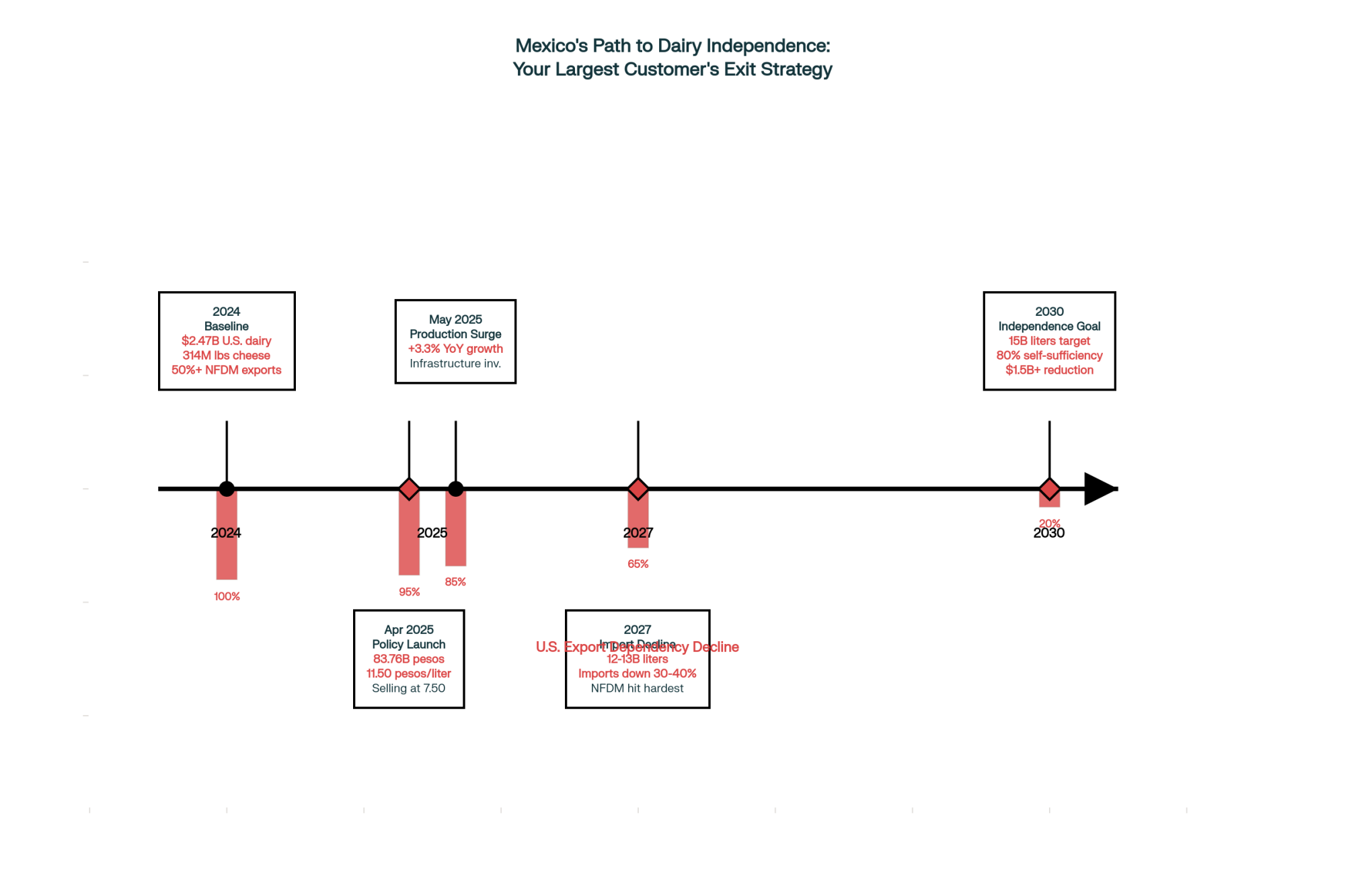
NewsSubscribe
First
Last
Consent

Trade War Escalates: EU Announces $28 Billion In Tariffs Hitting US Dairy

EU slaps $28B in tariffs on US goods, including dairy. But is this trade war a blessing in disguise for American dairy farmers? The answer may surprise you.

EXECUTIVE SUMMARY: The EU’s announcement of $28 billion in counter tariffs on US goods, including dairy products, adds another layer of complexity to an already turbulent global trade landscape for American dairy producers. While these tariffs threaten established trade flows, USDA data shows US dairy exports remain strong, with projections reaching $8.5 billion for fiscal 2025. The article reveals a nuanced picture of US-Canada dairy trade, highlighting underutilized quotas and complex market access issues. Despite challenges, some industry leaders see the current trade tensions as an opportunity to address longstanding imbalances, particularly with the EU. The piece offers practical strategies for dairy producers to navigate this volatile environment, emphasizing the importance of understanding regional impacts, implementing layered risk management, and maintaining production flexibility.

KEY TAKEAWAYS:

  • EU announces $28B in counter tariffs on US goods, including dairy, amid ongoing global trade tensions
  • USDA projects strong US dairy exports for 2025 despite trade challenges, forecasting $8.5 billion
  • US dairy exporters currently utilize only 42% of their available tariff-free quota to Canada, revealing complex market access issues beyond headline tariff rates
  • Industry experts recommend tailored risk management strategies and production flexibility to navigate trade volatility
  • Some US dairy leaders view trade tensions as an opportunity to address longstanding market access imbalances, particularly with the EU
dairy tariffs, US dairy exports, trade tensions, global dairy market, dairy industry challenges

The European Union has announced sweeping counter-tariffs targeting $28 billion worth of American goods, including dairy products. This latest development adds to mounting trade pressures facing US dairy producers, who are already navigating trade tensions with Canada and China. With multiple trading partners implementing restrictions simultaneously, US dairy exports face unprecedented challenges in global markets.

DAIRY INDUSTRY CAUGHT IN CROSSFIRE OF GLOBAL TRADE TENSIONS

The global dairy trade landscape is experiencing unprecedented turbulence as the European Union becomes the latest trading partner to announce retaliatory measures against the United States. This EU announcement creates a complex trade environment where multiple major US dairy export markets implement trade barriers simultaneously.

European Commission President Ursula von der Leyen announced the EU will impose tariffs on 26 billion euros ($28 billion) worth of US goods – with dairy products specifically named alongside soybeans, almonds, distilled spirits, and other items.

“We deeply regret this measure. Tariffs are taxes. They are bad for business, and even worse for consumers,” von der Leyen stated during the announcement. “These tariffs are disrupting supply chains. They bring uncertainty to the economy. Jobs are at stake. Prices will go up. In Europe and the United States.”

The timing couldn’t be more challenging for American dairy producers, who shipped $8.02 billion in dairy exports globally in fiscal 2024 and are projected to reach $8.5 billion in fiscal 2025, according to USDA data released in February 2025. This projection was raised by $100 million from earlier forecasts “on increased price competitiveness for US exports of cheese and butter, with robust demand for those products in North America, South America, and the Middle East/North Africa.”

US-CANADA DAIRY RELATIONSHIP: A COMPLEX REALITY

While much political rhetoric has focused on Canadian dairy barriers, official data reveals a more nuanced picture. According to the International Dairy Foods Association, the US exported more than $1 billion of dairy products to Canada in 2022, making it the second-largest market for US dairy exports.

However, US dairy exporters face a complex system of Tariff Rate Quotas (TRQs) when selling to Canada. Under the USMCA agreement negotiated during the Trump administration, Canada agreed to eliminate tariffs on specific quantities of US dairy imports across 14 categories. However, official data shows that US exporters utilize only 42% of their available tariff-free quotas, with 9 of the 14 TRQs falling below half the negotiated value.

This limited utilization suggests the primary challenges for US dairy exports to Canada may lie beyond the headline-grabbing 200%+ tariff rates, which only apply after these quota limits are reached. As Becky Randall, senior vice president of trade and workforce policy at the International Dairy Foods Association, explained: “We don’t love the tariffs, but the main issue is that we can never fill the quota, to begin with,” due to what she describes as Canada’s administrative strategies that limit US market access.

EU-US DAIRY TRADE IMBALANCE

DirectionAnnual Value (USD)
EU to US$3 billion
US to EU$115 million

The table above illustrates the significant trade imbalance in dairy products between the European Union and the United States, which has persisted despite the US generating billions in global dairy exports. This disparity helps explain why some US dairy officials see the current trade tensions as an opportunity to address longstanding market access issues.

PRACTICAL STRATEGIES FOR DAIRY PRODUCERS AMID TRADE TURMOIL

For American dairy producers navigating this volatile trade environment, University of Wisconsin dairy economists have been modeling impacts and identifying practical approaches:

First, assess your operation’s specific exposure to export markets. With nearly one-fifth of US dairy components exported (mostly nonfat solids), understanding how your milk utilization might be affected by shifting trade flows is critical. Operations selling to processors heavily involved in export markets face risks different from those supplying primarily domestic channels.

Second, implement a layered risk management approach. Leonard Polzin from the University of Wisconsin suggests dairy producers consider the combined impacts of changing trade conditions, labor costs, and domestic consumption patterns. Their economic models show program cuts to nutrition programs like SNAP could reduce domestic dairy demand by approximately 4%, creating additional pressure beyond export challenges.

Third, analyze regional production economics carefully. Dr. Charles Nicholson’s modeling at the University of Wisconsin has identified significant differences in how trade disruptions affect different dairy production regions, with some areas maintaining more substantial margins despite trade challenges.

Fourth, maintain flexibility in production planning. USDA projects increased US dairy exports for 2025 despite trade challenges, and the fundamental global demand for dairy remains strong. Producers who can navigate the near-term market volatility while maintaining production capacity will be positioned to benefit when trade conditions normalize.

THE PATH FORWARD: NAVIGATING DAIRY’S NEW NORMAL

For forward-thinking dairy producers, this period of trade disruption demands both defensive positioning and strategic vision. Jim Mulhern, former president of the National Milk Producers Federation, emphasized the importance of enforcing trade agreements: “We must utilize USMCA’s enforcement mechanisms to bring home its hard-fought wins for America’s dairy farmers.”

According to the International Trade Commission, proper implementation of USMCA provisions could increase US dairy exports by more than $314 million annually – but realizing this potential requires vigilant enforcement of market access provisions.

As this situation unfolds, The Bullvine will continue monitoring developments and providing actionable intelligence for dairy producers navigating these turbulent trade waters. The dairy industry has weathered numerous challenges throughout its history – from regulatory changes to shifting consumer preferences – and has consistently emerged stronger through adaptation and innovation. This trade confrontation represents another challenge to test the industry’s resilience and creativity.

LEARN MORE:

Join the Revolution!

Join over 30,000 successful dairy professionals who rely on Bullvine Daily for their competitive edge. Delivered directly to your inbox each week, our exclusive industry insights help you make smarter decisions while saving precious hours every week. Never miss critical updates on milk production trends, breakthrough technologies, and profit-boosting strategies that top producers are already implementing. Subscribe now to transform your dairy operation’s efficiency and profitability—your future success is just one click away.

NewsSubscribe
First
Last
Consent

GLOBAL DAIRY MARKETS ROCKED: US-China-Canada Tariff War Sends Shockwaves Worldwide

Global dairy markets in turmoil as US-China-Canada tariff war erupts. Find out how this trade clash impacts milk prices and farm incomes worldwide.

EXECUTIVE SUMMARY: A sudden escalation in trade tensions has rocked the global dairy industry, with Canada and China imposing retaliatory tariffs on US dairy products and Mexico expected to follow suit. These measures target over 40% of US dairy exports, threatening to disrupt international trade flows and pressure milk prices worldwide. The situation creates both challenges and opportunities for dairy producers globally, potentially reshaping market dynamics and competitive landscapes. While US farmers face immediate export barriers, European and Oceania producers may find new market openings. However, the long-term consequences could lead to a fundamental restructuring of global dairy trade patterns, affecting producers across all major exporting regions.

KEY TAKEAWAYS:

  • Retaliatory tariffs from Canada (25%) and China (10-15%) now target US dairy exports, with Mexico likely to announce similar measures soon.
  • Over $4 billion in annual US dairy exports are at risk, potentially flooding domestic markets and pressuring global milk prices.
  • European and Oceania dairy exporters may find short-term opportunities to gain market share, particularly in China.
  • The crisis highlights the risks of export dependency and may accelerate industry consolidation and market diversification efforts.
  • Global dairy trade flows could see significant long-term restructuring as markets adjust to new competitive realities.
global dairy trade, tariff war, US dairy exports, agricultural trade dispute, international dairy markets

The global dairy landscape shifted dramatically overnight as Canada and China announced substantial retaliatory tariffs on US dairy products, with Mexico poised to follow suit by Sunday. This rapidly escalating trade conflict threatens to disrupt international dairy flows, potentially creating ripple effects for producers worldwide—from European exporters eyeing new opportunities to New Zealand farmers watching for price impacts across Asian markets.

THE HARD TRUTH: MAJOR TRADE ROUTES BLOCKED

Here’s the unvarnished truth about yesterday: The Trump administration implemented sweeping 25% tariffs on goods from Canada and Mexico and increased levies on Chinese imports to 20%. The response was swift and targeted, and trade partners knew precisely where to hit back.

Canada didn’t waste a minute announcing that CA$30 billion (US$20.7 billion) worth of US goods would face reciprocal 25% tariffs. Dairy products were prominently featured on their hit list. Everything from yogurt to buttermilk faces barriers that make US products significantly less competitive north of the border.

China followed suit with its punch to the global dairy markets, declaring that US agricultural products would face 10-15% tariffs beginning March 10, with dairy explicitly targeted at 10%. Beijing allows a brief grace period for shipments already en route—cargoes shipped before March 10 and arriving before April 12 won’t incur the additional tariffs. That window gives exporters weeks, not months, to adjust to a dramatically altered market landscape.

Suppose Mexico, Canada, and China represent more than 40% of all US dairy exports. That’s one day’s weekly worth of milk on America’s dairy farms. Milk will soon need to find alternative destinations or flood domestic markets, creating potential competitive pressure for dairy producers worldwide.

“This doesn’t look like a full-scale trade war just yet, but it could be heading that way,” warns Kang Wei Cheang, an agriculture broker at StoneX in Singapore. “China’s actions suggest they want to keep things from spiraling out of control, but the real question is whether the US is willing to negotiate.”

CountryAnnual Export Value (2024)Key Product Dependence% of Total U.S. Exports
Mexico$2.47 billionLeading destination for US skim and non-fat powderTop market for U.S. dairy overall
Canada$1.14 billionRecord imports from US in 2024Second largest dairy trade partner
China$500-800 million (recent years)Major market despite 2024 declineStrategic growth market
Combined TotalOver $4 billion More than 40% of all U.S. dairy exports

MARKET IMPACT: GLOBAL DAIRY PRICES FACE PRESSURE

When approximately 18% of America’s milk production suddenly faces significant barriers to leaving the country, the implications extend beyond US borders. The American dairy industry has invested over $8 billion in new processing capacity that will come online in the next few years—a capacity that depends on continued export growth. With three significant markets simultaneously imposing tariffs, export growth is seriously jeopardized.

The timing couldn’t be worse for international dairy markets. In 2024, the US dairy industry celebrated its second-highest export year, with foreign trade reaching .2 billion—a 3 million increase over 2023. However, those gains now face significant erosion as tariffs make US dairy products less competitive in key markets.

The situation creates opportunities for European and Oceania dairy exporters to capture market share, particularly in China, where demand growth remains strong despite recent volatility. However, increased competition in third-country markets could emerge if US exporters attempt to redirect volumes previously destined for Canada, Mexico, and China.

ScenarioGlobal Market ImpactUS Farm-Level ConsequenceInternational Effect
Short-term tariffsTemporary price volatilityCash flow challengesOpportunity for competing exporters
Medium-term tariffsReshuffling of global trade flowsSignificant margin pressurePrice pressure in alternative markets
Long-term tariffsPermanent shifts in market accessAccelerated farm consolidationRestructured global dairy trade patterns

HISTORICAL CONTEXT: LESSONS FROM PREVIOUS TRADE DISPUTES

Similar scenarios have had far-reaching consequences. During the previous US-China trade war during President Trump’s first term, Beijing imposed tariffs as high as 25% on American farm products, including soybeans. As a result, American soybean shipments fell almost 80% over two years, creating opportunities for Brazilian exporters while restructuring global oilseed trade patterns.

The current situation’s comprehensive scope, with simultaneous retaliatory actions from multiple major trading partners, makes it potentially more severe. During previous disputes, dairy exporters could pivot to alternative markets when one destination implemented tariffs. Today’s scenario offers few escape routes, with key markets all imposing barriers simultaneously.

The hard-won market positions developed by US exporters will be difficult to reclaim once European and New Zealand competitors strengthen their relationships with buyers. This situation creates opportunities and challenges for dairy producers worldwide as traditional trade flows are disrupted and new patterns emerge.

COMPETING PERSPECTIVES: LEGITIMATE GRIEVANCES OR SELF-INFLICTED WOUNDS?

Let’s be clear – there are legitimate grievances with trading partners. According to Michael Dykes, president and CEO of IDFA, “For too long, our exports to Canada have yet to fulfill the promises of the U.S.-Mexico-Canada Agreement (USMCA) because Canadian policies continue to prevent American exporters from filling their tariff-rate quotas.”

However, the International Dairy Foods Association has urged the Trump administration to “quickly resolve the ongoing tariff concerns with Canada, Mexico, and China,” emphasizing these countries’ status as America’s top agricultural trading partners. Their statement acknowledges the existing barriers but warns that “prolonged tariffs will further diminish market access” rather than solving the underlying problems.

On Monday, Canada’s finance minister, Dominic LeBlanc, said that imposing tariffs would be “a mistake” and that his country “is ready to respond to any of these scenarios.” Meanwhile, Mexico’s president, Claudia Sheinbaum, suggested that “another tariff would follow one tariff in response.” However, she indicated that Mexico was prepared to cooperate on migration and drug trafficking issues.

STRATEGIC CONSIDERATIONS FOR DAIRY PRODUCERS WORLDWIDE

For dairy producers and processors globally, this trade disruption necessitates strategic reconsideration:

  1. Assess market exposure. Understand precisely how dependent your business is on markets affected by these tariffs, either directly or through secondary effects.
  2. Identify emerging opportunities. As traditional trade flows face disruption, new openings may emerge for suppliers positioned to fill gaps.
  3. Monitor price signals carefully. Global commodity prices will likely reflect shifting trade patterns, potentially creating risks and opportunities.
  4. Watch for policy responses. Before China’s tariffs were announced, US Agriculture Secretary Brooke Rollins said earlier this week that American farmers would soon start receiving an initial tranche of $30 billion in funding approved by Congress to fight a market downturn. Other nations may implement similar support measures.
  5. Consider market diversification. The current situation highlights the risk of overreliance on specific export destinations, emphasizing the value of a diversified market approach.

THE BIGGER PICTURE: STRUCTURAL CHANGES IN GLOBAL DAIRY TRADE

This crisis forces a fundamental reassessment of global dairy trade patterns. For decades, the US dairy industry has transitioned from a domestic focus to an export orientation. Since the early 2000s, its exports have nearly tripled, making it the world’s third-largest dairy exporter, behind New Zealand and the European Union.

Despite recent volatility, Chinese demand remains a critical piece of the long-term export puzzle. US dairy exports to China fell in 2024, marking the lowest year since 2020. Demand also remains soft in key Southeast Asian markets, including the Philippines, Vietnam, and Malaysia – illustrating the challenges facing all global exporters.

The tariff situation occurred when global dairy markets were already experiencing significant uncertainty. Recent Fonterra Global Dairy Trade (GDT) auctions have shown strengthening prices, but potential disruptions to US export flows could create additional volatility as markets adjust to new trade patterns.

THE BOTTOM LINE: GLOBAL MARKETS SEEK NEW EQUILIBRIUM

The coming days will be critical. Mexico is expected to announce its retaliatory measures by Sunday, potentially targeting dairy exports as part of its response. Meanwhile, the administration could still announce exemptions that might spare dairy from the worst impacts.

One thing’s specific: Global dairy has recently entered one of its most challenging market environments. The US dairy industry, which supports over 3.2 million jobs and pumps almost $800 billion into the US economy, faces significant headwinds from these tariff measures. The implications will extend to dairy producers worldwide as markets adjust to new trade realities.

The situation may create opportunities for European dairy exporters, particularly from Ireland, France, and the Netherlands, to strengthen their positions in the Chinese market. New Zealand and Australian producers may similarly find openings in markets historically dominated by US suppliers. However, increased competition in third-country markets remains risky as US exporters seek alternative destinations for products previously bound for Canada, Mexico, and China.

The industry’s recent export success – with US dairy reaching $8.2 billion in 2024 – demonstrates the tremendous global demand for dairy products. As Michael Dykes noted, “Our industry is poised to become the world’s leading supplier of dairy products thanks to the resilience and innovation of the American dairy industry.” Navigating through this tariff storm will require all that resilience and innovation – but the underlying strength of global dairy demand remains unchanged.

LEARN MORE

Join the Revolution!

Join over 30,000 successful dairy professionals who rely on Bullvine Daily for their competitive edge. Delivered directly to your inbox each week, our exclusive industry insights help you make smarter decisions while saving precious hours every week. Never miss critical updates on milk production trends, breakthrough technologies, and profit-boosting strategies that top producers are already implementing. Subscribe now to transform your dairy operation’s efficiency and profitability—your future success is just one click away.

NewsSubscribe
First
Last
Consent

China Slaps 10% Tariff on US Dairy: Exporters Face New Market Challenges as Trade War Heats Up.

China will impose a 10% tariff on US dairy products starting March 10 as the trade war intensifies, but it will offer a temporary exemption for shipments already en route. American dairy farmers face immediate market challenges as their export competitiveness suffers in the crucial Chinese market. At the same time, feed crop tariffs could create complex ripple effects through the dairy supply chain.

EXECUTIVE SUMMARY: China’s Customs Tariff Commission has announced a 10% additional tariff on US dairy products effective March 10, creating significant challenges for American dairy exporters. The measures, part of broader agricultural retaliation against recent US tariff increases, include a critical exemption for shipments already in transit before the implementation date. Beyond agriculture, China has also placed defense companies on its unreliable entity list, including Lockheed Martin divisions, demonstrating a multi-pronged response to US trade actions that threaten hard-won market access for American dairy producers.

KEY TAKEAWAYS:

  • China will implement a 10% additional tariff on US dairy products beginning March 10, 2025
  • Shipments already en route before March 10 and arriving by April 12 are exempt from the new tariffs
  • The new tariffs will be added to existing rates rather than replacing them
  • Feed ingredients, including corn and soybeans, also face tariffs, potentially affecting dairy input costs
  • China has also restricted the activities of 10 US defense companies in a parallel non-agricultural action
  • The Chinese Commerce Ministry cited damage to “the fundamental basis of economic and trade cooperation” in its announcement.
China tariffs, US dairy exports, trade war, agricultural retaliation, dairy industry impact

In a direct response to President Trump’s tariff increases, China’s Customs Tariff Commission announced Tuesday it would implement a 10% additional levy on American dairy products beginning March 10, creating immediate challenges for US dairy exporters attempting to maintain their foothold in this crucial Asian market. The announcement explicitly identifies dairy among several agricultural categories facing new trade barriers, with the Commerce Ministry confirming these measures come in retaliation for the US raising tariffs on Chinese imports to 20% on March 4.

China’s Targeted Agricultural Tariffs Take Aim at US Farmers

China’s Commerce Ministry officially declared that American chicken, wheat, corn, and cotton imports will face an additional 15% tariff. Sorghum, soybeans, pork, beef, seafood, fruits, vegetables, and dairy products will face a 10% increase. These tariffs will be added to existing rates rather than replaced, potentially creating cumulative duties that significantly disadvantage US products compared to international competitors.

The announcement includes one critical provision that may provide temporary relief: shipments already en route won’t face the additional duties. Specifically, “For imports that have been shipped from the port of origin before March 10, 2025, and are imported into China between March 10 and April 12, the additional tariffs imposed as specified by this announcement shall not be levied,” according to the Customs Tariff Commission’s official statement.

Immediate Market Implications for Dairy Exporters

The timing of these tariffs creates immediate complications for dairy processors and cooperatives with shipments already in transit or contracts recently signed. While the transit exemption provides some breathing room, dairy exporters still face difficult decisions about pricing strategies and customer communications for shipments scheduled after the grace period ends in mid-April.

China has been a growing destination for US dairy exports in recent years, with particular strength in specialized ingredients, whey products, and cheese. These products now face significant price disadvantages compared to competitors from countries like New Zealand, Australia, and the European Union, which aren’t subject to the same additional tariffs. The pricing disparity creates immediate competitive challenges for US dairy products in a market where price sensitivity remains high and alternative suppliers stand ready to fill any void.

Beyond Agriculture: China Expands Trade Restrictions

In a parallel move, Beijing has added 10 US companies to its “unreliable entity list,” which prohibits these firms from participating in China-related import or export activities and restricts them from making new investments. The targeted companies include defense firms such as Lockheed Missiles Fire Control, Lockheed Martin Aeronautics, and Lockheed Martin Missile System Integration Lab. According to the Commerce Ministry, senior executives from these companies will also face entry bans to China, and their work permits and residency permissions will be revoked.

This multi-pronged approach demonstrates China’s strategic targeting of agricultural communities and defense industries in its response to US tariff actions, continuing a pattern established during previous trade disputes.

Historical Context and Market Trends

The additional tariffs come against a backdrop of declining agricultural exports to China. US agricultural shipments to China fell for the second consecutive year in 2024, continuing a downward trend that began with the initial trade disputes during President Trump’s first term.

Since these disputes began, China has systematically worked to reduce its dependence on US agricultural imports. Beijing has pursued a dual strategy of diversifying its agricultural supply sources while boosting domestic production to achieve greater food security. For dairy, this has meant increased investment in domestic dairy operations while strengthening trade relationships with alternative suppliers like New Zealand, which enjoys preferential access under existing trade agreements.

Potential Feed Cost Implications

For dairy farmers, the impact of these tariffs extends beyond direct export opportunities. The Chinese measures also target key feed ingredients, including corn and soybeans, potentially creating complex ripple effects throughout agricultural supply chains. Should these tariffs significantly reduce US exports of these commodities, domestic prices could face downward pressure, potentially providing some relief on input costs for dairy operations during a period of export challenges.

The Chinese Commerce Ministry characterized the US tariff increases as “undermining the multilateral trading system, exacerbating the burden on American businesses and consumers, and damaging the fundamental basis of economic and trade cooperation between China and the US.” This official position suggests continued friction rather than a quick resolution to the trade dispute.

Industry Response and Strategic Considerations

Industry organizations are already mobilizing to assess the full implications of these new tariffs and advocate for government support measures to offset potential market losses. Previous rounds of agricultural tariffs have typically triggered federal assistance programs, though the specific nature and timing of any potential support remain uncertain at this early stage.

The tariffs arrive at a challenging time for many dairy operations, which are already navigating volatile input costs and evolving consumer preferences. Processors with diversified export portfolios may be better positioned to weather this disruption by redirecting products to alternative markets, though such pivots typically involve price concessions and additional logistical complexities.

These tariffs underscore the importance of individual dairy farmers working closely with their cooperatives or processors to understand how market access changes might affect milk pricing and volume commitments in the coming months. Operations with high debt loads or tight margins may face particular challenges if the tariffs trigger broader milk price adjustments throughout the domestic market.

Conclusion: Navigating Uncertain Trade Waters

The imposition of 10% additional tariffs on US dairy exports to China represents a significant market disruption that will require careful navigation by all segments of the dairy value chain. While the immediate effects will be most directly felt by exporters and processors with active Chinese business, the potential for broader market adjustments means all dairy producers should monitor developments closely and maintain open communication with their milk buyers about potential implications.

As the dairy industry adapts to this latest market challenge, collaboration between producers, processors, and industry organizations will be essential to developing coordinated responses that protect the long-term competitiveness of US dairy in global markets. The resilience demonstrated by the sector during previous trade disruptions suggests the industry has developed valuable experience in navigating such challenges. However, each new round of tariffs brings unique complexities requiring fresh strategic approaches.

LEARN MORE:

Join the Revolution!

Bullvine Daily is your essential e-zine for staying ahead in the dairy industry. With over 30,000 subscribers, we bring you the week’s top news, helping you manage tasks efficiently. Stay informed about milk production, tech adoption, and more, so you can concentrate on your dairy operations.

NewsSubscribe
First
Last
Consent

How U.S. Dairy Exports to Southeast Asia Dropped 20%: Challenges and Opportunities

Find out why U.S. dairy exports to Southeast Asia fell 20% in November. What challenges and opportunities await? Dive into the insights.

Summary:

In November, US dairy exports to Southeast Asia took a surprising dive, dropping 20% compared to last year, mainly due to a 43% decrease in nonfat dry milk sales—the lowest since mid-2019. Despite this, exports of other products like milk, cream, and cheese grew, showing both challenge and potential. As Southeast Asia made up about 20% of US dairy exports in 2023, maintaining this market is essential. US producers face tough competition, especially in pricing. Meanwhile, the growing middle class in the region offers a chance for specialized products. New Zealand has seized opportunities in this shifting market by keeping prices competitive. For US dairy to succeed, there’s a need for trade deals and products that fit local tastes, such as lactose-free and organic options. Freedom in trade could also help reduce tariffs.

Key Takeaways:

  • U.S. dairy exports to Southeast Asia decreased by 20% in November, indicating a need for competitive strategy adjustments.
  • The significant 43% drop in nonfat dry milk sales was a major factor in the overall decline of exports.
  • New Zealand has capitalized on the U.S. market gap, increasing their nonfat dry milk exports to the region.
  • Positive trends noted in other dairy products like fluid milk, cream, and cheese, showcasing potential growth areas.
  • Southeast Asia remains a critical market for U.S. dairy, with its growing middle class potentially boosting demand for value-added products.
  • Adaptation and innovation are crucial for U.S. dairy producers to regain and expand their market share in Southeast Asia.
US dairy exports, Southeast Asia dairy market, New Zealand dairy competition, NDM export decline, dairy industry strategies, premium dairy products, trade agreements dairy, competitive pricing dairy, milk cream cheese exports, lactose-free organic dairy.

A few short years ago, US dairy farms were doing very well. They were sending everything from cheese to butter to Southeast Asian markets, which would make up almost 20% of their exports in 2023. But by November 2024, things had changed. Exports dropped by 20%, surprising industry professionals. This isn’t just a number; it’s a significant change that makes us wonder what the future holds for American dairy farmers.

ProductNovember 2023 (Million Pounds)November 2024 (Million Pounds)Change (%)
Total Dairy Exports84.2567.40-20%
Nonfat Dry Milk (NDM)47.9027.30-43%
Fluid Milk and Cream13.0013.917%
Cheese23.3524.987%

Southeast Asia: A Crucial Market Battleground for US Dairy Producers 

Several years ago, the U.S. was a major player in the world dairy market, with Southeast Asia being a key area. Because of its changing diets and growing population, the area is a great place for American dairy farmers to sell their products. There are many chances to make money in places like Vietnam, the Philippines, Indonesia, Thailand, and Malaysia. Many people are now middle-class thanks to economic growth, which has raised the demand for healthy foods like dairy. As the economy improves, people are more interested in Western food styles. US dairy farmers have taken advantage of this trend.

However, the United States has recently sent less dairy to Southeast Asia. As of November, all exports were down 20%, and sales of nonfat dry milk were down an impressive 43%. New Zealand and other countries with low prices have taken market share from the United States. The lower prices of European and Oceanian nonfat dry milk than those in the US suggest a shift in regional preferences or economic considerations.

The significant drop in US dairy exports to Southeast Asia is not just a short-term problem; it could potentially jeopardize the US’s ability to sell goods in this crucial market. Maintaining a strong presence is paramount because this region accounts for almost 20% of US dairy exports. If the downward trend continues, it could severely hamper the growth of the US dairy industry. Understanding the implications of these more significant changes is crucial for devising effective strategies for production and pricing. Dairy farmers and industry stakeholders must adapt to these changes and develop new strategies to capitalize on the vast market potential of Southeast Asia.

Nonfat Dry Milk (NDM) Faces a Significant Setback: Navigating Challenges in Fierce Global Competition 

Nonfat dry milk (NDM) exports to Southeast Asia dropped by 43%, which has caused the US dairy industry to be nervous. This is primarily due to prices and tough competition. Since July, the price of NDM in the US has been higher than in Europe and Oceania. Due to this price gap, consumers seeking products will seek better bargains elsewhere.

So, why are prices going up in the US? The costs of making things like feed and energy have increased. In contrast, costs have stayed low in other places, allowing companies to offer lower prices and gain a larger market share.

Europe and Oceania have used this to their advantage. They’ve sold more NDM because the prices are better, making up ground where the US is losing it. Losing market share is not fun, but it sends a strong message about changing global trade.

The good thing is that it’s an opportunity to change. “How can we cut production costs without losing quality?” is a question that US producers might ask. The US could get ahead of the competition if it faced these problems instead of trying to avoid them. The drop in NDM exports is a significant setback. Still, it also allows the company to rethink its plans and remain a significant global dairy market player.

New Zealand’s Strategic Moves: Lessons from the Kiwi Dairy Playbook

The case of New Zealand’s successful exploitation of the drop in US NDM exports to Southeast Asia underscores the changing dynamics of the global dairy market. New Zealand swiftly capitalized on the US’s NDM issues, offering lower prices to attract Southeast Asian buyers. This is a crucial lesson for American dairy farmers, highlighting the need to monitor global price trends and adjust prices to remain competitive, particularly in sensitive markets like Southeast Asia.

New Zealand has maintained competitive prices to attract Southeast Asian buyers. European and Australasian NDM prices are lower than US prices. Still, New Zealand has used its lower prices to attract Southeast Asian buyers. That’s why it’s essential to monitor price trends worldwide. The US might have to change its prices to stay competitive, especially in Southeast Asia and other sensitive markets.

Another reason is New Zealand’s strong trade ties in the area. Even though there is competition, these long-lasting ties help the country maintain and grow its market share. Building more substantial trade agreements to ensure reliable market access would suit the US dairy industry.

New Zealand has also made products that meet the market’s needs well. They’ve changed what they sell to suit Southeast Asian tastes, ensuring their exports do well. US dairy farmers could make more money if they knew about and catered to people’s tastes in different areas.

New Zealand’s well-run supply chain and logistics also play a big part. To stay competitive, you must deliver fresh products on time and reasonably priced. The United States can use what it has learned to improve its supply chains. This could be done with technology or by working with logistics companies.

In Southeast Asia, the business world is challenging but full of opportunities. Opportunities are enormous because the middle class is growing, and people’s diets are changing. New Zealand’s success shows how important it is to be flexible, offer competitive prices, build relationships, and know what the market wants. The US must use these plans to regain its position in this critical area.

Uplifting Market Dynamics: Fluid Milk, Cream, and Cheese Showcase Promising Growth for US Dairy Farmers

It’s good news for US dairy farmers and exporters that more milk, cream, and cheese are being sent abroad. Nonfat dry milk (NDM) exports are going down, but these goods are going up, which can help make up for it. Fluid milk and cream exports increased by 7% in November, which is in line with rising demand in the area. Thailand and the Philippines are becoming more interested in buying US goods, which shows that consumer tastes are changing and could lead to long-term partnerships.

Cheese exports also increased by 7%, a testament to the adaptability of the US dairy industry. This progress shows how flexible and competitive the industry is. As more cheese-making facilities open, the focus must shift to these products to keep exports to Southeast Asia high and compensate for losses caused by lower NDM sales.

Targeting areas with growing demand for premium dairy products can help compensate for revenue drops in the NDM segment, ready to capitalize on these changes by offering products like fortified drinks, lactose-free milk, and organic options that suit Southeast Asian tastes and health trends.

Freedom of trade agreements could also lower tariffs and make it easier for US dairy farmers to sell their products in other countries. If American dairy farmers use these chances wisely, they can meet and even exceed the needs of Southeast Asian consumers. To predict and prepare for future growth in the dairy trade, it’s essential to be aware of these economic changes. This will lead to shared success.

Global Dairy Game: Navigating the Competitive Landscape of Southeast Asia

The dairy market worldwide is busy and competitive. New Zealand and the EU are two big players changing the rules, especially in Southeast Asia.

  • New Zealand’s Plan: New Zealand is close to Southeast Asia, which helps its exports. It has a strong dairy industry and has done a good job of marketing its nonfat dry milk (NDM) and setting its prices to be competitive with US products. Thus, it has increased the amount of NDM it exports, which means it is taking market share away from the US.
  • Strategy of the European Union: The European Union uses trade agreements to lower tariffs and make it easier for people to access its markets. The EU is more common in Southeast Asia because it knows what consumers want and builds long-term relationships. However, this has decreased its share of the US market.

New Zealand and the EU focus on quality, price, and competitive partnerships. These changes the market and put US producers to the test. These countries are doing more, which shows that the US needs to develop new ideas and change its strategies to strengthen its position in these critical markets.

Navigating Headwinds: The Multifaceted Challenges Facing US Dairy Exports to Southeast Asia

High prices, trade barriers, and logistics problems make it hard for the US to send dairy to Southeast Asia:

  • US goods usually cost more than cheaper ones from Europe and Oceania because they have to be made more expensively. New Zealand and Europe often have the upper hand because Southeast Asian buyers care a lot about price. 
  • The rules regarding trade in Southeast Asia can be complex to understand. It may be challenging for US goods to enter these markets because of tariffs, quotas, and standards.  The lack of trade agreements can also affect this entry. Getting from the United States to Southeast Asia is a long trip that can be hard to track. 
  • Delays, problems at the port, and traffic jams can make delivery times and costs longer and more expensive.
  • In addition, keeping food fresh on such long trips can be challenging.

US exporters must revamp their strategies to overcome these challenges and protect their market position in Southeast Asia.

Navigating Opportunities: Harnessing Growth Within Southeast Asia’s Dynamic Dairy Market

There is a lot of competition in the US dairy industry worldwide, but Southeast Asia is a place where it could grow. Increasing exports requires the development of new strategies and partnerships. Here are some ways the US can be more present in this exciting area. Making New Products: The evolving preferences in Southeast Asia present an opportunity for the creation of novel products to cater to the changing tastes in the region. US dairy companies can leverage this trend to introduce innovative products such as exotic cheeses, flavored beverages, or lactose-free options tailored to health-conscious consumers. Better advertising: It’s essential to understand Southeast Asian customers. By tailoring their ads, US dairy brands can connect with local customers better. To achieve this, US dairy brands can leverage digital platforms, targeted campaigns focusing on price and quality, and collaborate with local influencers to expand their reach. Building Trade Bonds: To get better market access, you must have strong relationships with local stores and distributors. Collaborating with trade groups in Vietnam, the Philippines, Indonesia, Thailand, and Malaysia can facilitate smoother trade agreements, reduce export barriers, and establish enduring connections.

The US dairy industry can turn problems into opportunities to profit by using new ideas, innovative marketing, and tact. These plans can help Southeast Asia’s economies grow and give businesses better market access.

Strategic Innovation: Reclaiming Market Presence in Southeast Asia

Southeast Asia is having a hard time with US dairy exports. So, dairy farmers and exporters need to think of new ways to get back on track and strengthen their position in this critical market. They can do it this way:

  • Better Pricing Strategies: Dr. Sarah Campbell recommends that US dairy companies price their products the same as or less than those in New Zealand. Regaining market share could mean carefully considering prices and costs. According to data, competitive pricing has worked in the past.
  • Focus on High-Quality Products: As the middle class in the region grows, so does the demand for high-quality goods. According to the International Dairy Foods Association, US companies could prioritize producing organic, fortified, or flavored products due to consumer willingness to pay higher prices.
  • Getting more known in the market: Marketing with local partners or influencers can help spread the word about your brand. Market Intelligence Analytics says digital marketing is critical because, in 2024, more than 30% of dairy purchases were made online.
  • Building Alliances: According to a report from Global Trade Partners, collaborating with local businesses can improve distribution efficiency and reduce expenses. This collaboration could also help US companies reach more people.
  • Changing Products: US dairy could be more appealing if products were changed to fit local tastes. To be successful in a niche, you need to know about cultural preferences and consumer trends.
  • Putting money into research and development (R&D): R&D can lead to new ideas that meet local and government needs. A way to get ahead might be to learn from the best players, focusing on research and development.
  • Looking at New Markets: Vietnam, Indonesia, and the Philippines are essential, but new markets like Myanmar could open up new sales opportunities for US dairy products.

Through these strategies, US dairy exporters can reclaim lost market share and explore new avenues for Southeast Asian growth. Success requires smart pricing, new products, innovative marketing, strong partnerships, customized offerings, and constant innovation. Expertise and adaptability are crucial for US dairy exporters to regain their leadership position in this ever-changing market.

The Bottom Line

To sum up, recent Southeast Asian events that affected the US dairy industry remind us of the difficulties and opportunities in today’s global market. While the decrease in nonfat dry milk sales is concerning, the increase in milk, cream, and cheese exports indicates growth potential. We must develop innovative new ideas and solid market plans to compete with New Zealand. When you adapt, you don’t just fix problems; you also take advantage of new opportunities for long-term growth. To succeed, you must know how to work with new partners in growing economies like Southeast Asia and understand how consumer tastes change. The expanding middle class presents an excellent opportunity for US dairy farmers to thrive.

Learn more:

Join the Revolution!

Bullvine Daily is your essential e-zine for staying ahead in the dairy industry. With over 30,000 subscribers, we bring you the week’s top news, helping you manage tasks efficiently. Stay informed about milk production, tech adoption, and more, so you can concentrate on your dairy operations. 

NewsSubscribe
First
Last
Consent

Weekly Dairy Market Recap: Global Trends and Key Insights – Monday, 16 September 2024

Stay ahead in the dairy market with our weekly recap. Check out key trends and stats from global markets. Ready to optimize your dairy strategy?

Summary:

Welcome to your one-stop source for global dairy market insights for the week of Monday, 16 September 2024. We’ve seen dynamic trading activity on EEX and SGX futures, notable gains in European quotations, and significant movements in cheese markets. The GDT Pulse Auction reflected modest gains, while GDT TE364 auction previews suggest stability. Danish dairy sectors are navigating production declines in national trends, and the USDA’s September WASDE report indicates tightening milk supplies ahead. Plus, US and Australian dairy exports are surging well above expectations, showcasing international solid demand. Stay tuned as we delve deeper into these trends, offering actionable insights and expert analysis.

Key Takeaways:

  • EEX futures saw a mixed performance with slight gains in butter but declines in SMP and whey.
  • SGX futures showed strength in WMP and SMP despite a minor dip in butter.
  • European quotations continued to rise, marking the sixth consecutive week of gains across all dairy products.
  • Cheese indices showed strong performance, with Cheddar and Gouda leading the increases.
  • GDT Pulse Auction reported modest gains, reflecting the dynamic nature of market activities.
  • GDT TE364 auction preview indicated stability in WMP and SMP volumes, showing no changes in total forecasted volumes.
  • The Danish dairy sector faced production declines but maintained quality metrics in milk composition.
  • USDA revised its September WASDE report, indicating a tightening milk supply due to lower cow inventory and slower milk production per cow.
  • US dairy exports surged 9.5% in July, driven by strong international demand.
  • Australian dairy exports outpaced expectations, with a significant increase of 23.0% from last year.
dairy market trends, dairy price volatility, European dairy exchange, butter price increase, skimmed milk powder trends, cheese market improvements, global dairy trade auction, US dairy exports, Australian dairy industry performance, dairy supply chain challenges

Have you ever wondered how the global dairy market volatility affects your bottom line? Staying current with these changes is crucial for dairy farmers and industry experts. Today is Monday, September 16, 2024, and in this weekly overview, we’ll look at the latest happenings in global dairy markets. Understanding market trends may help you make better manufacturing, marketing, and pricing choices. By staying on top of global dairy circumstances, you may better handle problems and exploit opportunities as they occur. In the volatile world of dairy, being proactive rather than reactive can make all the difference in your profitability and long-term sustainability. Your role in the industry is crucial, and strategic decision-making is more critical than ever.

MarketProductVolume Traded (Tonnes)Average PricePrice Change (%)
EEXButter1,320€7,687+0.3%
EEXSMP1,505€2,725-1.1%
SGXWMP11,795$3,458+0.6%
SGXSMP4,535$2,903+0.9%
EUButterVarious€7,950+0.3%
EUSMPVarious€2,588+2.2%
EUWheyVarious€812+1.5%
EUWMPVarious€4,268+2.5%

EEX Week in Review: Dynamic Trading and Mixed Market Signals

Last week, the European Energy Exchange (EEX) witnessed significant trading, with 2,825 tonnes of dairy goods changing hands. Wednesday emerged as the most considerable trade day, with activity peaking at 1,125 tons. This surge in trading volumes underscores the dynamic nature of the market, a factor that can directly influence your business decisions and strategies.

The performance of essential dairy products on the EEX was varied. Butter futures prices diverged among contracts, with the average cost of the Sep24-Apr25 strip rising 0.3% to €7,687. Skimmed Milk Powder (SMP) saw a negative trend, with the average price falling by 1.1% to €2,725 throughout the same time. Similarly, Whey fell 0.4%, ending the week with an average price of €959.

A variety of market conditions influences these price changes. The minor increase in butter prices might reflect strong demand or tighter supply. Still, the softening in SMP and whey prices could indicate plentiful supply or weak demand. Market players should pay particular attention to these patterns, which may indicate more significant alterations in dairy market dynamics.

SGX Futures Activity: Gauging Global Dairy Market Trends 

The SGX Futures activity is a crucial indicator for the global dairy industry, particularly for items such as whole milk powder (WMP), skim milk powder (SMP), anhydrous milk fat (AMF), and butter. Last week, the total volume traded on the Singapore Exchange was 16,930 tonnes, providing a comprehensive snapshot of the market’s health and potential trends. Here’s a closer look at the specifics: 

  • WMP: The standout performer on SGX, with 11,795 tonnes traded. WMP showed a slight firmness over the Sep 24-Apr25 curve, up 0.6% to an average price of $3,458.
  • SMP: Not far behind, with 4,535 tonnes traded. SMP displayed a stronger upward trend, up 0.9% over the Sep24-Apr25 contracts to settle at $2,903.
  • AMF: Traded volumes were smaller but still noteworthy, with a 0.7% rise over its Sep 24-Apr25 contracts, reaching an average price of $7,028.
  • Butter: Although a smaller volume of 600 tonnes traded, Butter was down by 0.3% over the same period, landing at an average price of $6,611.

We see some significant variances when comparing these patterns to those of the European Energy Exchange (EEX). EEX Butter futures had variable outcomes across contracts but ended with a modest gain (+0.3%) to an average price of €7,687. Meanwhile, EEX SMP fell 1.1% to €2,725. The Whey market fell 0.4% on the EEX, finishing at €959.

The SGX market demonstrated an overall increase trend for most dairy products, with a strong interest in WMP and SMP. In contrast, the EEX market had varied results, showing the nuances of the global dairy trade. These disparities illustrate the significance of regional and market-specific factors in determining price trends and trading volumes.

European Quotations on the Rise: A Detailed Analysis 

Let’s examine the current European quotes. This is the sixth week of solid momentum, with price hikes for all significant dairy products.

  • Butter
    The butter index increased by €27 (+0.3%) to €7,950, setting a new 5-year high. Dutch butter increased by €100 (1.3%) to €8,050. French butter likewise increased by €80 (+1.0%), reaching €7,850, while German butter fell by €100 (-1.2%) to €7,950. Over the previous seven weeks, the average butter price has risen by €1,285 and is currently up €3,547 (+80.6%) year on year. This substantial increase points to a robust demand rebound and a tight supply situation in the butter market.
  • SMP (Skim Milk Powder)
    Skim Milk Powder (SMP) had its sixth consecutive comeback, with the average price rising by €56 (+2.2%) to €2,588. The Dutch SMP increased by €40 (+1.6%) to €2,570, the German SMP followed suit at €2,625, and the French SMP increased by €90 (+3.6%) to €2,570. The average SMP price has increased yearly by €373(+16.8%). These improvements suggest a strong demand rebound and perhaps constraining supply in the SMP market.
  • Whey
    The whey index rose by €12 (1.5%), raising the average price to €812. Dutch whey climbed by €20 (2.3%) to €880, German whey by €10 (1.3%) to €785, and French whey by €5 (0.7%) to €770. Year on year, whey prices have risen by €174 (+27.3%). This higher trend reflects solid market fundamentals and increased demand for whey products.
  • WMP (Whole Milk Powder)
    The WMP index rose by €103 (2.5%) to €4,268. German WMP climbed by €140 (+3.3%) to €4,425, while the French index rose by €100 (+2.5%) to €4,030, and Dutch WMP gained by €70 (+1.6%) to €4,350. Year on year, the average WMP price has risen by €1,020 (+31.4%). This demonstrates a tighter worldwide market for whole milk powder, fueled by strong international demand.

The rise in these dairy product indicators indicates intense market circumstances defined by high demand and limited supply. This trend is encouraging for European dairy producers and processors but also suggests that downstream markets may face increased costs. Monitoring these pricing changes will be critical for industry stakeholders navigating this volatile market climate.

Cheese Markets Surge: Cheddar and Gouda Lead the Pack 

This week, European cheese indicators improved across the board. Cheddar Curd saw an outstanding gain of €116, or 2.5%, to €4,845. Over the last year, this index has risen by €1,144, or 30.9%. Mild Cheddar also performed well, increasing by €172, or 3.6%, to €4,893. This increases its annual gain to €1,117, representing an astounding 29.6% increase.

The Young Gouda index climbed by €78, or 1.7%, to €4,666. Young Gouda’s sales are up €1,213, or 35.1%, yearly. Similarly, the Mozzarella index rose €61, or 1.3%, to €4,653. This equates to an annual rise of €1,286, a staggering 38.2%.

What’s driving these tremendous gains? Several variables are in play. The European market has benefitted from consistent strong demand for native and imported cheese products. Strong export markets have increased prices, particularly in Asia and North America. Production expenses, including feed and labor, have increased, increasing prices. The combination of solid demand and higher production costs supports the rising trend of cheese indices.

GDT Pulse Auction: Modest Gains Reflect Market Dynamics 

The recent Global Dairy Trade (GDT) Pulse Auction PA060 witnessed moderate increases in essential items. The average winning price for Fonterra Regular C2 Whole Milk Powder (WMP) was $3,430, up $25 (+0.7%) from the previous GDT auction but $130 lower (-3.7%) than the prior pulse sale. Skim Milk Powder (SMP) achieved an average winning price of $2,800, up $70 (+2.6%) from the previous GDT auction and $120 (+4.9%) from the prior pulse event. A total of 2,209 tonnes were sold across all items, with 47 bids taking part, compared to the preceding pulse, which sold 1,972 tonnes with 51 bidders. The importance of these recent findings underscores SMP’s sustained good trajectory, with GDT and GDT pulse auctions increasing for the sixth time in a row. This trend may indicate a boost in market confidence and demand for SMP.

WMP, on the other hand, has increased somewhat, indicating a more conservative bounce, which might reflect a cautious buyer mood in the larger dairy market. The aggregate amount of items sold and the number of bids imply a constant market involvement. Still, the subtle price variations hint at divergent market dynamics for distinct dairy products. This information is critical for dairy professionals making sound judgments in a volatile market.

GDT TE364 Auction Preview: Stability in WMP and SMP Volumes Amid Market Dynamics 

Looking forward to the GDT TE364 auction, the amounts of essential items such as WMP, SMP, and cream are being closely monitored. Fonterra will offer 21,145 tonnes of WMP at this auction, matching the level of the last auction and corresponding with the most recent projection. WMP volumes will increase slightly to 22,232 tonnes for the two October auctions but will fall to 20,910 and 20,907 for the November events. This steadiness may limit any considerable price fluctuations in the near run. However, the November cut may put upward pressure on prices as Christmas demand picks up.

SMP quantities are consistent with the forecast, with no changes to TE364, keeping the market quiet and predictable. Cream group quantities are stable, with a high of 5,935 tonnes available and an annual projection of 99,895. The consistent supply of cream may avoid significant price increases, albeit this is strongly dependent on demand changes.

The overall picture indicates that the market will likely remain balanced shortly, barring any unforeseen swings in global demand or supply chain disruptions. With primary volumes staying consistent, we may not see significant price swings, creating a reasonably predictable market scenario for dairy professionals.

Danish Dairy Sector: Navigating Production Declines and Quality Metrics

According to the most recent estimates, Danish milk output in July 2024 was 493,000 tons, a 1.0% decrease from the previous year. While overall collections number 3.37 million tons, indicating a flat trend, the decrease in July is noteworthy. Milkfat content was 4.21%, with a protein level of 3.55%. This provides the month’s total milk. Solid collections fell to 38,000 tons, a 0.3% decrease from the previous year. Year-to-date, cumulative milk solid collections are 270,000 tons, a 0.2% decline from a year earlier.

Reducing milk output and solid collections might indicate a more significant problem for the Danish dairy industry. Lower production rates impact the supply chain, increasing costs for local and foreign customers. Furthermore, if these trends persist, dairy producers may need to apply efficiency measures or change herd management procedures to maintain output levels. The steady amounts of milk fat and protein signal that quality is stable, which is good news for dairy farmers concentrating on high-value products. One thing is sure: the Danish dairy business must actively watch these changes to strategically adapt to the changing production situation and prevent any market effects.

USDA’s September WASDE Report: Revised Forecasts Indicate Tightening Milk Supply Ahead

The USDA’s September WASDE report lowered its expectations for US milk output. Two thousand twenty-four projections are now at 102.5 million tonnes, down 0.2% from 2023. Production predictions for 2025 were also reduced to 103.4 million tonnes, indicating a 0.9% rise above 2024 levels. These reductions result from decreased expected cow inventory and a slow increase in milk output per cow. This slower rise in milk per cow is predicted to continue until 2025.

The revised production projection has increased cheese, butter, NDM, and whey prices, driven by recent price gains and the expectation of restricted milk supplies. Furthermore, export forecasts for fat and skim are rising owing to projected increases in dairy product exports.

US Dairy Exports Surge in July: Strong International Demand and Market Dynamics 

US dairy exports increased significantly in July, with milk equivalent exports up 9.5% over the previous year. This growth exceeds the +2.2% estimate, demonstrating worldwide solid demand for US dairy goods. Examining the various items, albeit somewhat lower than predicted, cheese exports increased by 10.1% over the previous year. However, the true standout was NFDM/SMP exports, which increased by 10.8% yearly, above expectations.

What do these numbers show? The higher-than-expected rise in exports indicates that US dairy products have a solid competitive position worldwide. Considering the present market circumstances, this development is exceptionally positive, indicating strong demand from overseas customers. The increase in NFDM/SMP exports suggests a growing dependence on these items, which might indicate a change in customer preferences or new market possibilities.

The consequences for the United States dairy business are enormous. For starters, continuous export growth may reduce local market constraints and boost milk prices, helping dairy producers throughout the country. Second, the success across product categories, such as cheese and NFDM/SMP, emphasizes the need for a diversified product range to suit changing global demands. Finally, these patterns encourage hope for the future, indicating that the US dairy sector can capitalize on its strengths in a developing international market.

Australian Dairy Exports Outpace Expectations: A Closer Look at Market Dynamics 

Australia’s dairy industry has had a strong export performance. Milk equivalent exports increased by 23.0% year on year in July, beating expectations of a -11.4% fall. This substantial export increase suggests possible changes in local demand and inventory levels.

Interestingly, although exports to China dropped by 61%, other top ten destinations showed a double-digit increase. This broad export landscape demonstrates strong demand from overseas markets despite a significant reduction in one of Australia’s top dairy customers.

Looking more closely, China’s mixed performance showed dropping data for WMP, SMP, and fluid milk but an unexpected increase in cheese, butter, and whey protein isolate imports. This slight fluctuation reflects changes in these groups’ consumption habits or stock modifications.

Domestically, flat to declining consumption rates indicate that dairy products are being reallocated to fulfill foreign demand, which may influence local market dynamics. If the current export pattern continues, domestic stockpiles may be further strained, necessitating prudent resource management.

The Bottom Line

Many vital insights emerge as we negotiate the ever-changing global dairy market scenario. The intense trading activity on the EEX and SGX reflects a lively market with minor price changes for dairy products. European quotations continue to rise, reaching new records and demonstrating solid demand. Furthermore, the cheese industry is expanding rapidly, especially for Cheddar and Gouda, which may indicate altering customer tastes. Meanwhile, the GDT Pulse Auction reveals a market battling with moderate increases and consistent volume.

The USDA’s updated predictions in the September WASDE Report indicate a tighter milk supply ahead, prompting us to oversee production and export patterns. The solid gain in US dairy exports and the unexpected spike in Australian dairy exports demonstrate the markets’ durability and flexibility. However, changeable domestic consumption patterns and complicated export dynamics, particularly with large importers like China, complicate the overall picture.

So, what does all of this imply for your business? These patterns provide valuable information that may help you make strategic choices about production planning, market positioning, and investment in new technologies. As the global dairy industry presents possibilities and difficulties, being aware and flexible will be critical for navigating this complicated environment.

How will you use market dynamics to improve your operations and remain ahead of the curve? Please share your ideas and tactics with us on the Bullvine community platform.

Learn more:

Join the Revolution!

Bullvine Daily is your essential e-zine for staying ahead in the dairy industry. With over 30,000 subscribers, we bring you the week’s top news, helping you manage tasks efficiently. Stay informed about milk production, tech adoption, and more, so you can concentrate on your dairy operations. 

NewsSubscribe
First
Last
Consent
Send this to a friend