







A Delta-Lambda daughter just brought $900,000 at Butlerview Farm, and that number is going to get quoted in every coffee-shop conversation in the show world for the next six months. Fair enough — it’s a stunning result. But if you breed pedigree cattle for a living, the $900,000 isn’t the interesting part. The interesting part is everything that happened underneath it.
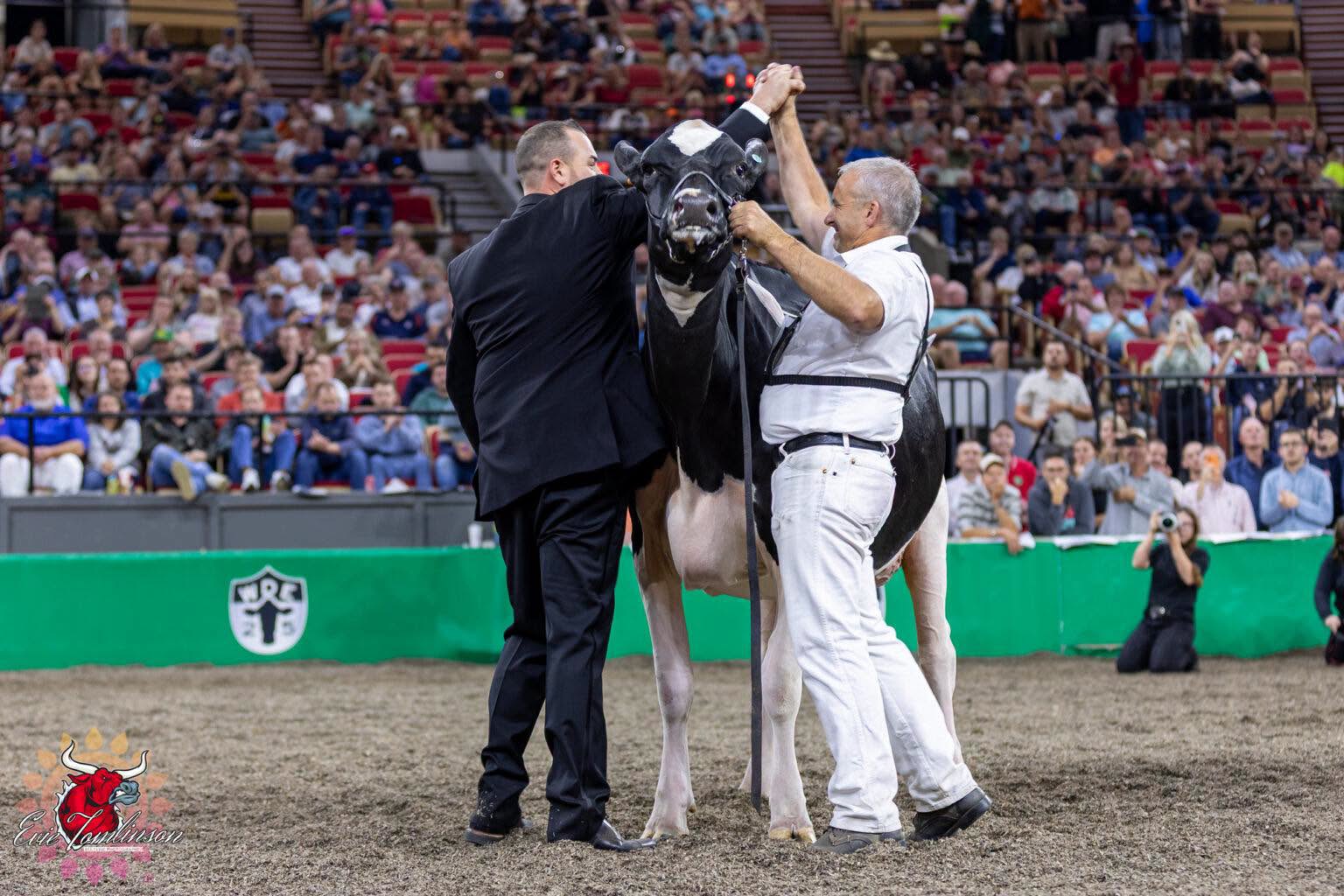
The Parade of Perfection closed at a $3,915,650 gross, with 169 live lots averaging $21,526 and a 26-cow Elite Embryo Sale averaging $3,402 per embryo to open the day. Strong numbers, smoothly run, deep type throughout. Jeff Butler hosting, Brian Carscadden and Kathleen O’Keef on the mic for the parade, Ryan Krohlow and Tim Abbott calling the embryo sale, pedigrees by Roger Turner and Tim Abbott — this was a polished, top-of-the-market event. But “strong average” and “healthy market” are not the same sentence, and the gap between them is where the real read on this sale lives.
The headline: West-Adub Lambda Sadie, $900,000
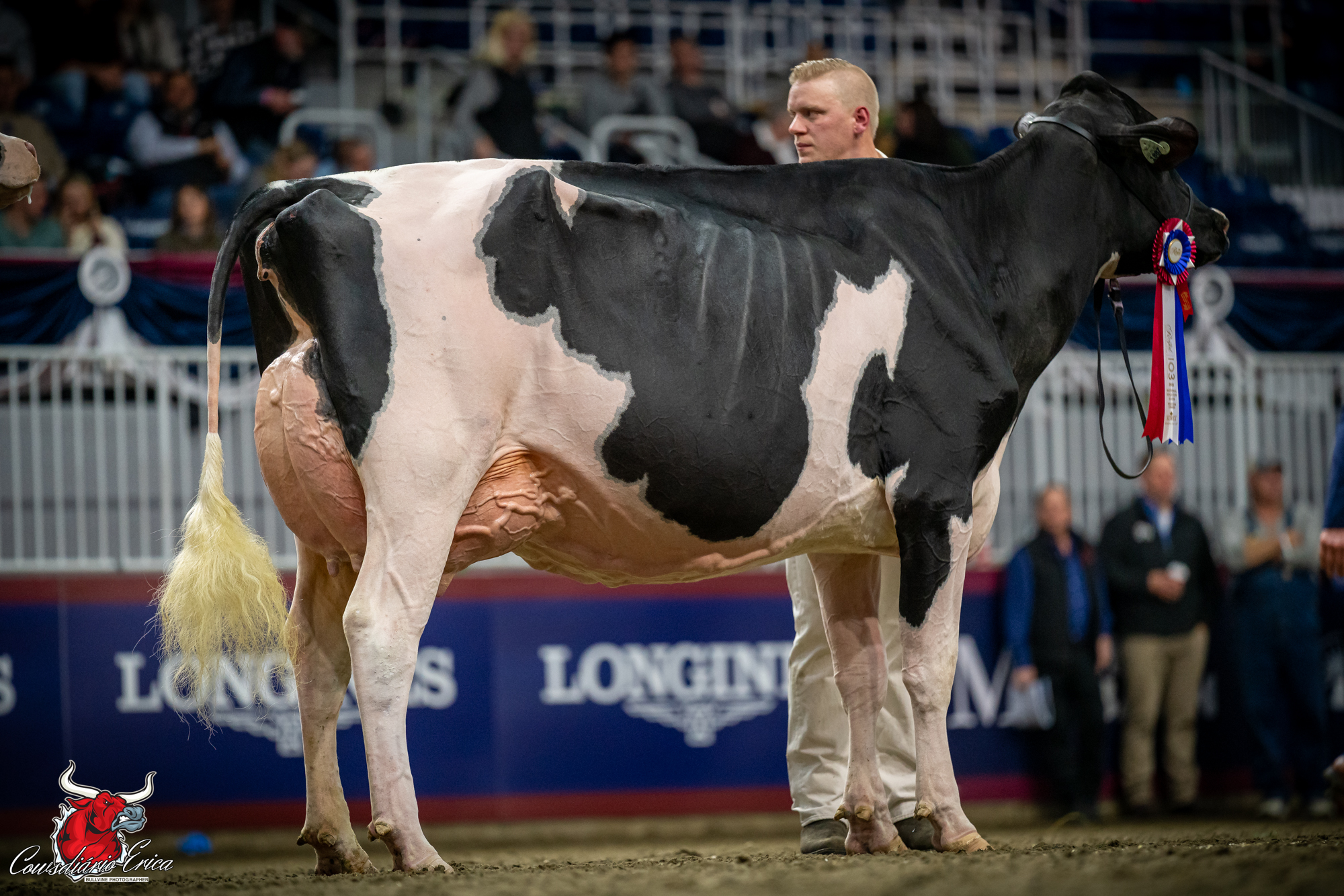
Lot 1 was West-Adub Lambda Sadie VG-89-CAN — though as O’Keef noted in the parade, she’s actually scored 89-3-yr-old, a max score for her age in Canada. She’s the All-American and All-Canadian Junior 3-Year-Old of 2025, and she sold to Butlerview Farm with consignor Westcoast Holsteins of Chilliwack, BC retaining half-interest.
You already know her show résumé, so let’s talk about why she’s worth three-quarters of a million more than any other cow in the barn. Sadie is a Delta-Lambda out of Winright Sidekick Salsa, whose maternal line runs through Budjon-JK Gold Chip Ellen EX-91 and on back through Budjon-JK Linjet Eileen EX-96 to Krull-Broker Elegance EX-96-USA 3E — and that Elegance tap root is the engine here. As they put it on the block, “there’s nothing you’d change about the pedigree.” Elegance isn’t a pedigree line, she’s a franchise — a documented producing matriarch with a proven track record of throwing salable daughters generation after generation. The Amplify Sale already showed the family’s commercial depth this spring, when a junior 2-year-old Architect daughter out of Sadie topped that event at $63,000.
The buyer isn’t paying for a trophy — Butler called her “one of the most accomplished, greatest individuals to probably ever sell at public auction,” and the cattle people in the tent know exactly what that pedigree throws. What makes the math work is the producing side. She’s due in roughly 60 days in terrific shape, and Lot 1A — first-choice female by Salute out of Sadie — already sold separately for $27,000 before she’d produced a thing under new ownership. At $900,000 you are not buying a cow; you’re buying a flush schedule. Whether the number pencils depends entirely on how many $25,000-to-$60,000 daughters and how many five-figure embryo packages come out the back end over the next decade. The cow is the asset; the genetics are the cash flow. Anyone evaluating this purchase as “what’s a show cow worth” is asking the wrong question.
Worth naming the structure, too, because Butler spelled it out from the block: Westcoast offered to retain 50%, but the buyer could take 50% or 100% — “buyer’s call.” Westcoast didn’t have to sell Sadie outright — they recapitalized her and kept the option to hold half the upside. That’s the smart-money play at this level. You pull cash off the table, de-risk the single-animal exposure, and still own half of every flush. It’s the same logic a founder uses taking secondary while keeping equity. The breeders treating these elite donors purely as trophies are the ones who get hurt; the ones treating them as a balance-sheet position are the ones writing the half-interest deals. And note Carscadden’s tell on where she goes next: “We can’t wait to see her on the colored shavings again this fall.” At $900,000, she still has to go win — the asset and the show string are the same animal.
The second tier told the real story
Here’s where it gets honest. After Sadie, the air gets thin in a hurry at the top — and the buyers who knew what they were doing went and got the cows that were actually ready to win now.
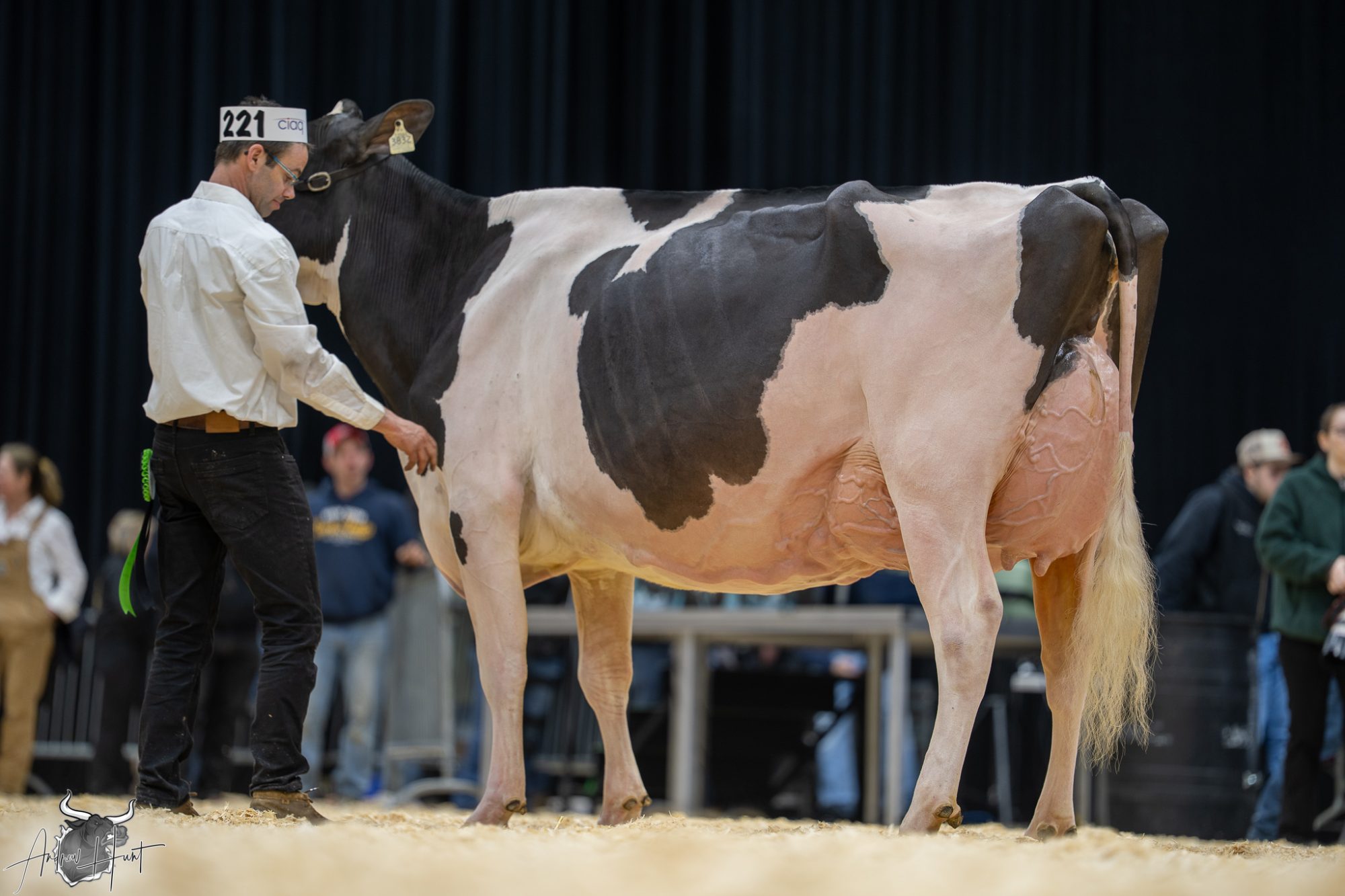
Lot 3 — JM Valley Sidekick Jacuzzi EX-95 — $195,000 — Elmvue Farm, Johnstown, NY. This is arguably the sharpest buy in the barn. Grand Champion of the 2026 Quebec Spring Show in April, scored EX-95 in May, sold in June — that’s a finished, scored, freight-train of a show cow with no projection required. Carscadden’s read says it all: “Anyone that judges a show anywhere in the world, you see this cow coming at you, she commands your attention.” Butler called her “one of the best cows we’ve ever had the privilege of selling at any of our auctions.” Elmvue didn’t pay for potential; they paid for a banner-ready aged cow they can lead into colored shavings this fall and breed afterward. The reliability is already on the page.
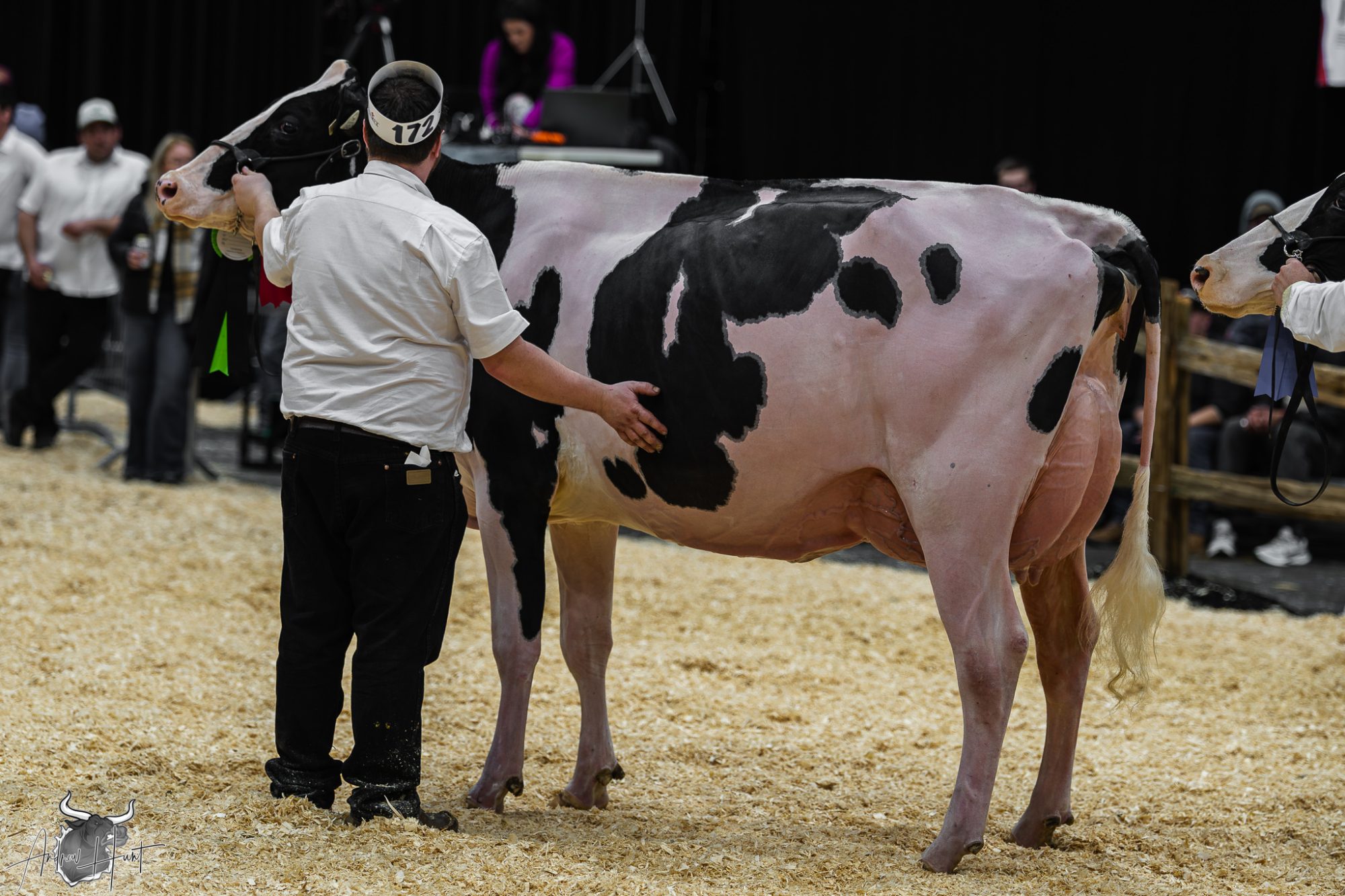
Lot 5 — Millen Lambda Amelia VG-88-CAN — $150,000 — also Elmvue Farm. Elmvue went $345,000 deep across two lots and built a genuine show string in an afternoon — and notice they did it with another Delta-Lambda daughter. The intermediate champion to Jacuzzi’s grand at Quebec, Amelia drew the strongest call of the day: Butler flatly named her “a leading contender to win the junior three-year-old class at World Dairy Expo… the strongest of contenders,” and Carscadden backed him — “I sure hate to try and find one to beat her right now.” Two of the top three live lots, Sadie and Amelia, are Lambda daughters. That’s not a coincidence; that’s the sire writing the type model for this generation of show Holsteins.
Then the next rung, all of which a serious pedigree buyer should have in their notebook:
- Lots 8 & 8A — Fleury Lambda Beast / Eastdale Lambda Beast — $135,000 each (Lambda again). Beast won the spring two-year-old at both the Quebec Spring Show and Madison’s Midwest Spring National. Carscadden called her “arguably one of my favorite young cows that Simone and I have ever sold,” and Butler said outright, “She reminds me of Sadie. She keeps getting better every day.” 8A (East-River Lambda Briefless, the reserve intermediate at the Atlantic show) was an added lot sold on choice — and out of the Goldwyn Brittany / High Octane Babe family, the same tap root feeding much of this sale.
- Lot 29 — GenoSource Double Dice-ET — $85,000. Hold this one — it’s the whole thesis in a single lot, below.
- Lot 6 — Sandpiper Sidekick Disco VG-89 — $74,000. The 2025 All-American Winter 2-Year-Old, third at Madison. Butler: “I think she’s a cow that can be grand champion at Madison one day.”
- Lots 9 & 10 — Ms Milksource Sincerly / Signature, full ET sisters — $73,000 each. Tattoo daughters of the late Glenirvine Unix Sally EX-96, an All-American and All-Canadian who also milked over 50,000 lbs. Carscadden called Sincerly “a franchise young cow” off a “tremendous, famous dam.” That word again.
Lot 29 is the entire sale in one cow
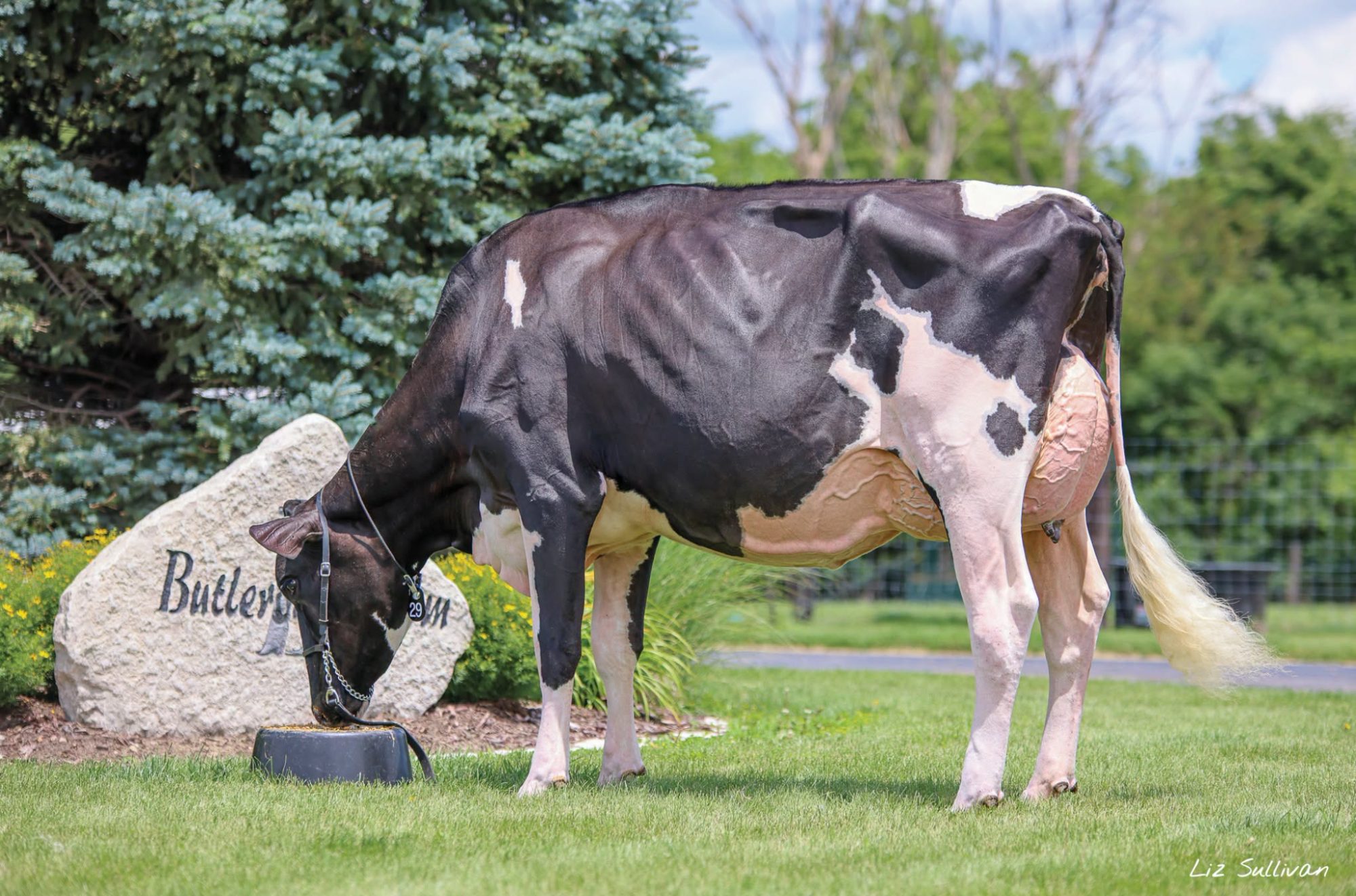
If you want to understand why a show sale grosses $3.9 million in 2026, study GenoSource Double Dice-ET (Lot 29, $85,000) — not Sadie. Butler said it without flinching: “She’s the biggest money maker in the sale today… the earning potential is in the hundreds of thousands — that’s no BS, hundreds of thousands in the next 12 to 15 months.”
Here’s why. A Drop-Docs daughter of Lady-Rose Caught-Your-Eye (three-time All-American, out of the Lexington/Black-Rose family), Double Dice sold with 26 embryos included — 16 Salute, 7 Image, 3 Detective — off two flushes that each pulled 50+ oocytes. She scored 87 in Canada, carries +3.25 type, has a full sister whose son was just released into AI, and “flushes like a chicken,” in Butler’s words. Carscadden’s summary is the line that should frame how you read this entire sale: “You throw the word franchise around a lot. This is a franchise kind of cow.”
That’s the model in miniature. The show banner is the marketing; the embryo contract is the business. A cow with a 92-point udder and a banner gets you to the ring — but a cow that flushes 26 viable embryos by elite sires is the one with “hundreds of thousands” of earning potential stapled to her halter. The buyers paying up at this sale weren’t chasing rosettes. They were buying production capacity with a show résumé attached.
Run the numbers on that $21,526 average
A $21,526 live average reads like a hot market. It mostly isn’t — it’s a top-heavy one, and the distinction matters if you’re consigning to or buying from the next one of these.
Watch what one cow does to the headline. Pull Sadie out and the remaining 168 lots average $16,297 — Sadie alone accounts for nearly a quarter of the entire live gross. Pull the top nine lots (everything from $73,000 up) and the other 160 head average roughly $11,400. Those nine animals — about five percent of the catalog — carried half the live gross. (Figures based on the 169 published live lots and their recorded sale prices; the official tally is the sale company’s.)
That’s the shape these elite type sales increasingly take in 2026 — the spring Amplify Sale ran the same way, topping at $63,000 on a single Sadie daughter — and it’s worth saying plainly because the press release never will: the money concentrates hard at the very top of the type market. The consignment lesson is still blunt, though: the premium dollars chase reliability. A banner already won, a score already assigned, a family already producing — that’s what drove the top of this sale. Projection gets bid more cautiously. Listen to how Butler and Carscadden talked about the unfinished young cows: “wrong in all the right places,” “all she needs is time,” “you won’t recognize her in October.” That’s honest cattle talk, and it’s also the profile that clears at solid-but-not-spectacular money while the finished cattle command the headlines. “Should be good” sells fine. “Is good, here’s the proof” is what writes the six-figure tickets.
The Elite Embryo Sale: a $3,402 tell
The day opened with three #1 IVF embryos from each of 26 elite donor cows, averaging $3,402 per embryo. Don’t skip past this as a warm-up act. It’s a clean read on where breeders think type is heading, because an embryo is a pure genetic bet — no show-ready cow, no banner, just the mating.
Butler said the quiet part out loud right after: “This morning at the embryo sale, we hopefully improved everybody’s value of their cows — when their embryos are worth that much, it justifies cattle prices being higher.” That’s a sale host openly framing the embryo average as price support for the live lots that follow. Read it for what it is — the embryo block and the Double Dice lot and the Sadie price are not three stories. They’re the same story told at three price points: in 2026, an elite show cow is valued as a production asset, and the embryo market is the clearest, cleanest quote on what that production is worth.
The Butlerview factor — worth flagging plainly
One structural note an honest report shouldn’t bury. The high seller stays anchored at Butlerview, the host. Strong host participation is normal and legitimate at a flagship event — nobody believes in the cattle more than the people who assembled them, and Butler was candid that several cows he “absolutely hated to sell” were consigned specifically “to support the sale.” That’s worth keeping in frame when you read the top line. The outside-demand signal — what disinterested third parties paid for the cattle they actively chased — is the cleaner read on real market depth, and it showed up strong: the Elmvue double-strike, the embryo-laden Double Dice, the Maritime and Quebec show winners, and a full catalog that moved through the ring to live bidders on sale day.
What this means for your operation
Three things to carry out of Chebanse:
- One — Delta-Lambda is the type sire of this moment. He bred the high seller, the third-high seller, and the $135,000 pair, and the commentary kept circling back to Lambda daughters as the cows that “keep getting better every day.” He was also Premier Sire of the 2025 International Holstein Show. If you’re building a show string for the next two years and you don’t have Lambda daughters in the tank, the market just told you where it’s looking.
- Two — proven commands the premium; projection clears at steady money. EX-95 Jacuzzi at $195,000 and a finished franchise like Sadie set the headlines, while the “wrong in all the right places” young cows moved through in person at sensible figures. Price reliability accordingly, on both sides of the block — and don’t read an online no-bid as a passed lot.
- Three — the elite donor is a business, not a trophy. This is the one to internalize, because the men selling the cattle said it themselves. Carscadden, twice, unprompted: “a franchise kind of cow.” Butler on Double Dice: “hundreds of thousands in the next 12 to 15 months.” The retained-half-interest “buyer’s call” on Sadie, the $27,000 first-choice female sold before she’s flushed under new ownership, the 26 embryos riding on Lot 29, the $3,402 embryo average — every one of those is a breeder treating genetics as cash flow with a multi-year amortization, not a banner to hang. At these numbers, that’s the only framework that survives contact with the balance sheet.
A $3.9 million day with deep type and a smooth ring is a genuinely good result, and Butlerview, Westcoast, and the consignors earned it. Just don’t let the $21,526 fool you into thinking every lot was on fire. The top of it was white-hot; the rest of the catalog moved steadily, much of it to in-person bidders the online board never recorded. And the breeders who read the difference correctly — the ones buying production, not just placings — are the ones who’ll still be writing the big checks, and cashing them, at the next one.
Key Takeaways
- The $21,526 average is top-heavy, not broad. Nine cows carried half the gross and pulling Sadie alone drops it to $16,297 — read the distribution, not the headline, before you price your own consignment.
- Proven pays the premium; projection clears at steady money. A won banner, an assigned score, or a documented embryo package is what writes six-figure tickets — “should be good” sells fine but won’t top the sale.
- Treat the elite donor as cash flow, not a trophy. Butler called an $85K cow with 26 embryos the real money-maker — the flush schedule and embryo contract, not the rosette, are where the hundreds of thousands live.
- If you’re building a show string, Delta-Lambda is where the market’s looking. He bred the high seller, the third-high seller, and the $135K pair.
 The Sunday Read Dairy Professionals Don’t Skip.
 The Sunday Read Dairy Professionals Don’t Skip.
Every week, thousands of producers, breeders, and industry insiders open Bullvine Weekly for genetics insights, market shifts, and profit strategies they won’t find anywhere else. One email. Five minutes. Smarter decisions all week.
Learn More
- Genomic Testing: Whos Winning and Whos Losing? — Arms your operation with the concrete return-on-investment math behind advanced genetic screening, revealing exactly how to stop bleeding cash on bottom-tier heifers while identifying high-velocity flush candidates early.
- The Consolidation of the Dairy Industry: What Does the Future Hold? — Exposes the long-term structural shifts reshaping North American seedstock margins, delivering a critical three-to-five-year positioning playbook for operations looking to survive rapid breeder and processor integration.
- Is Type Dead? — Dismantles the conventional wisdom surrounding traditional show ring scores, proving how modern index frameworks and intensive embryo production lines have permanently transformed the true commercial market value of elite cattle.




