










Cornell pinned the gut leak at three days. Fans recover about 60% of your summer milk — the other 40% is leaking from the inside out, and no single additive closes it.
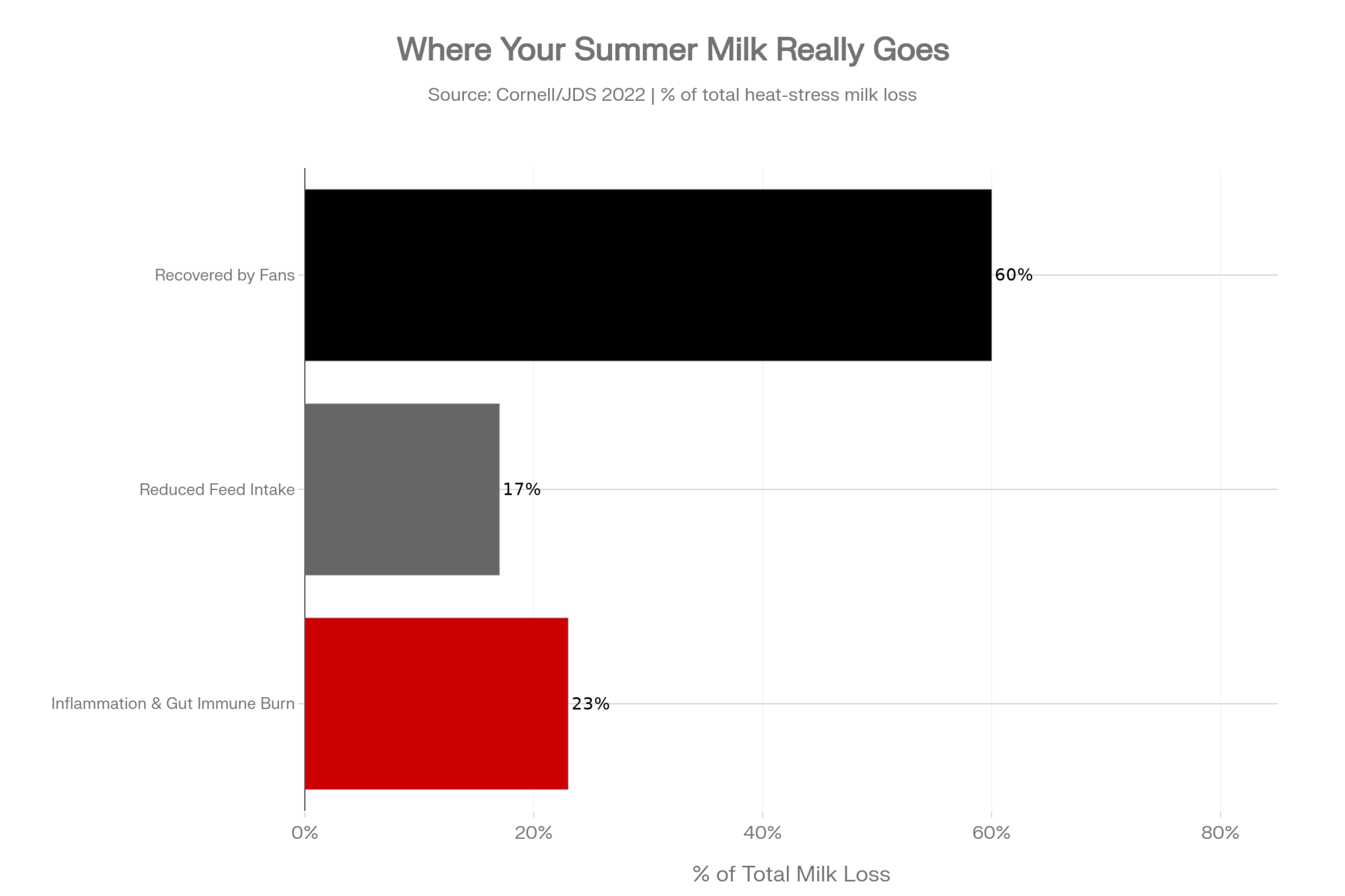
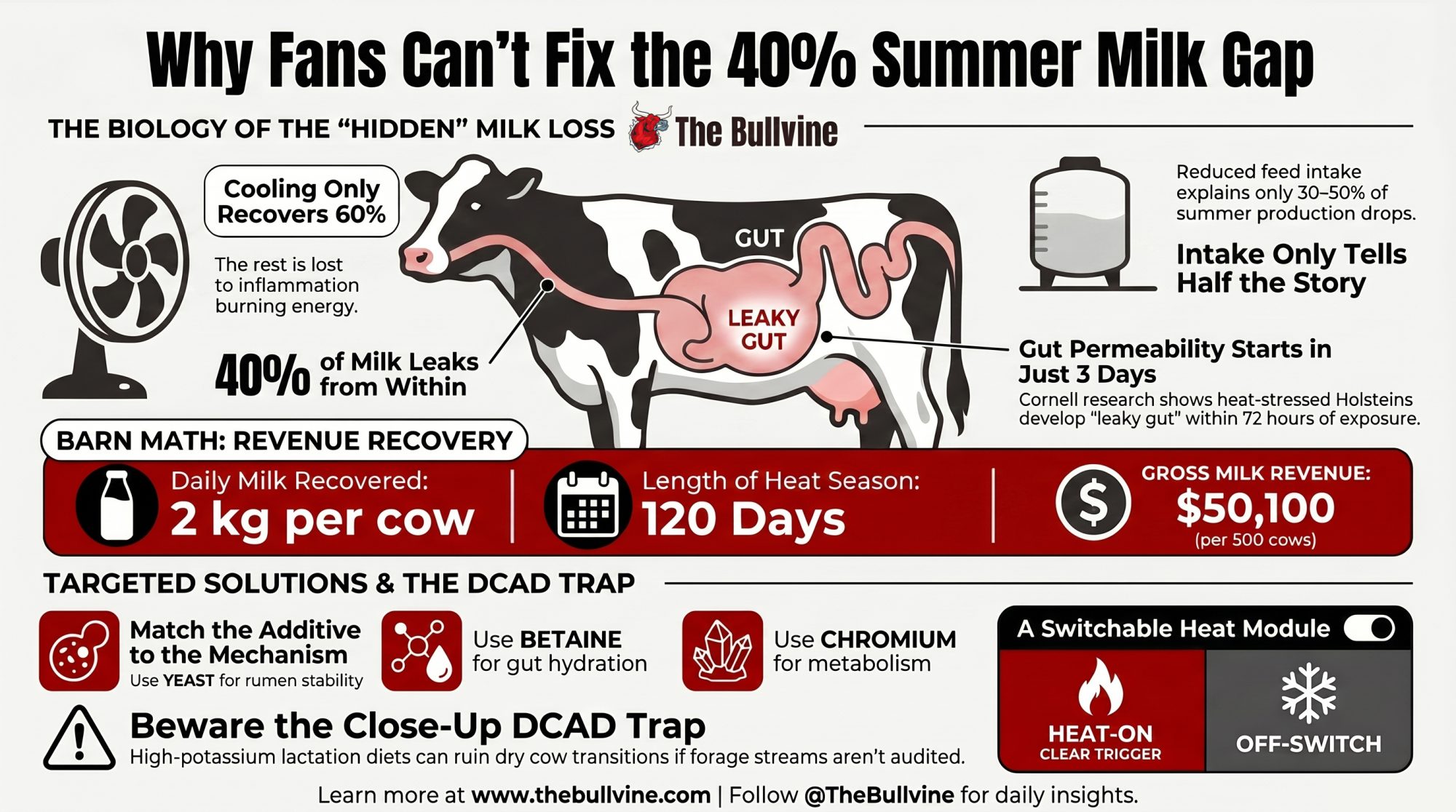
Executive Summary: Cooling gets you back only about 60% of the milk heat stress steals — the other 40% leaks out through a gut that goes permeable inside three days, per a 2022 Cornell study in the Journal of Dairy Science, and reduced intake explains just 30–50% of the loss. The rest is inflammation burning energy that should’ve gone in the tank, which is why fans and soakers alone never close the gap. That’s why one more additive usually isn’t the fix: a 2003 University of Manitoba trial found Aspergillus oryzae did nothing for milk under heat, while yeast, betaine, and chromium each buy a different piece of the biology — rumen, gut hydration, energy metabolism — and don’t substitute for each other. There’s real money in it, too: recover even 2 kg/cow/day across 120 heat days on 500 cows and you’re looking at roughly $50,100 in gross milk, about $100 a head. The quiet trap is DCAD — push it positive for your milk cows in June and the same high-K forage drifts into the close-up pen, blunting calcium mobilization and setting up August’s retained placentas, metritis, and DAs. If you run one forage stream across pens, audit your close-up DCAD before you touch anything else. Read the full piece for the four-path self-audit that tells you which system’s actually failing before you spend a dollar.
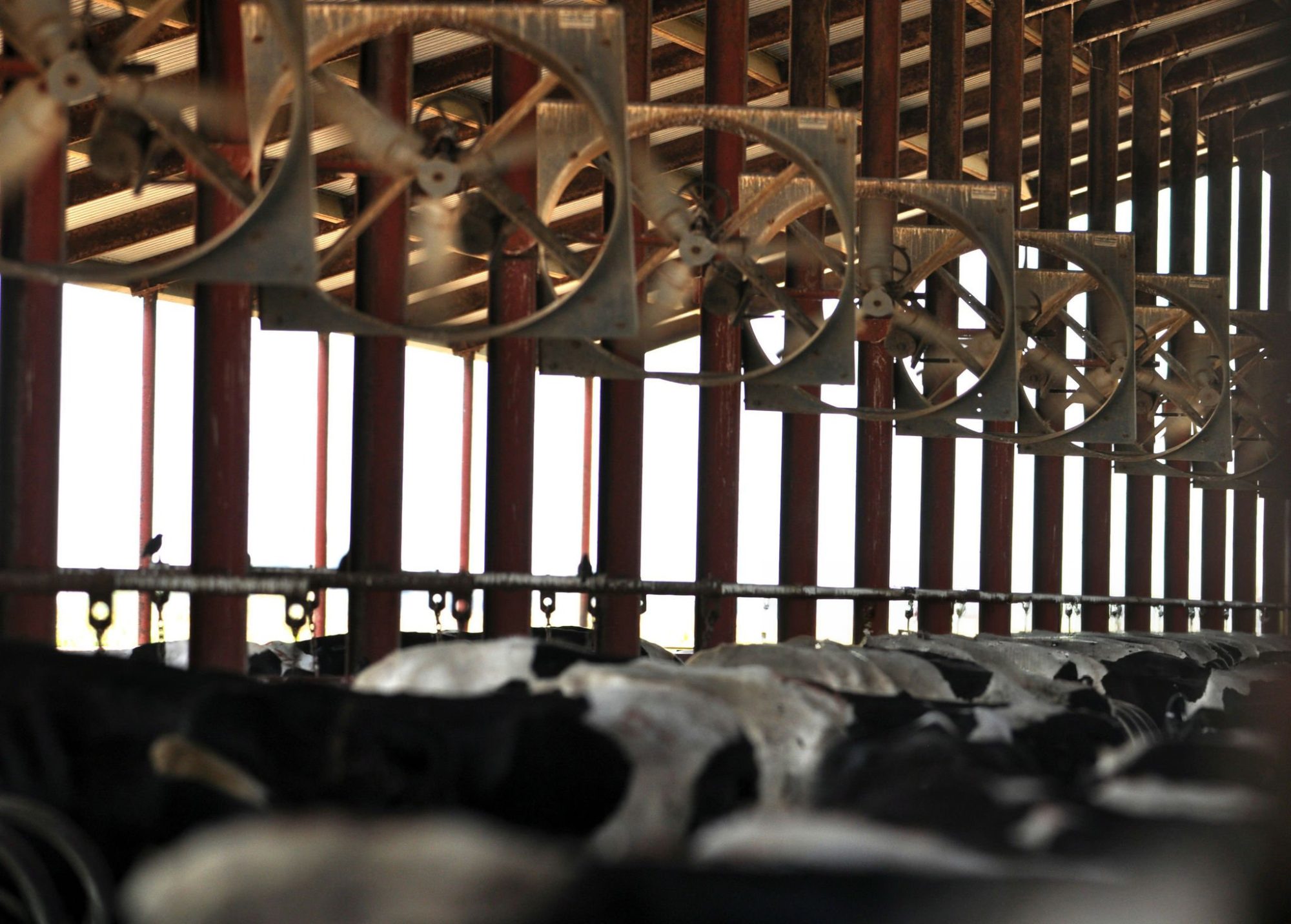
It’s mid-July, and somewhere in the Midwest a producer is standing in the parlor running the same heat stress math he’s run for twenty summers. Fans going. Soakers firing. A ration he tweaked three weeks before the heat rolled in. And the tank still sliding.
He’s blaming himself again. He shouldn’t be. Heat stress is a multi-system failure, and the playbook he was handed only ever explained half of it.
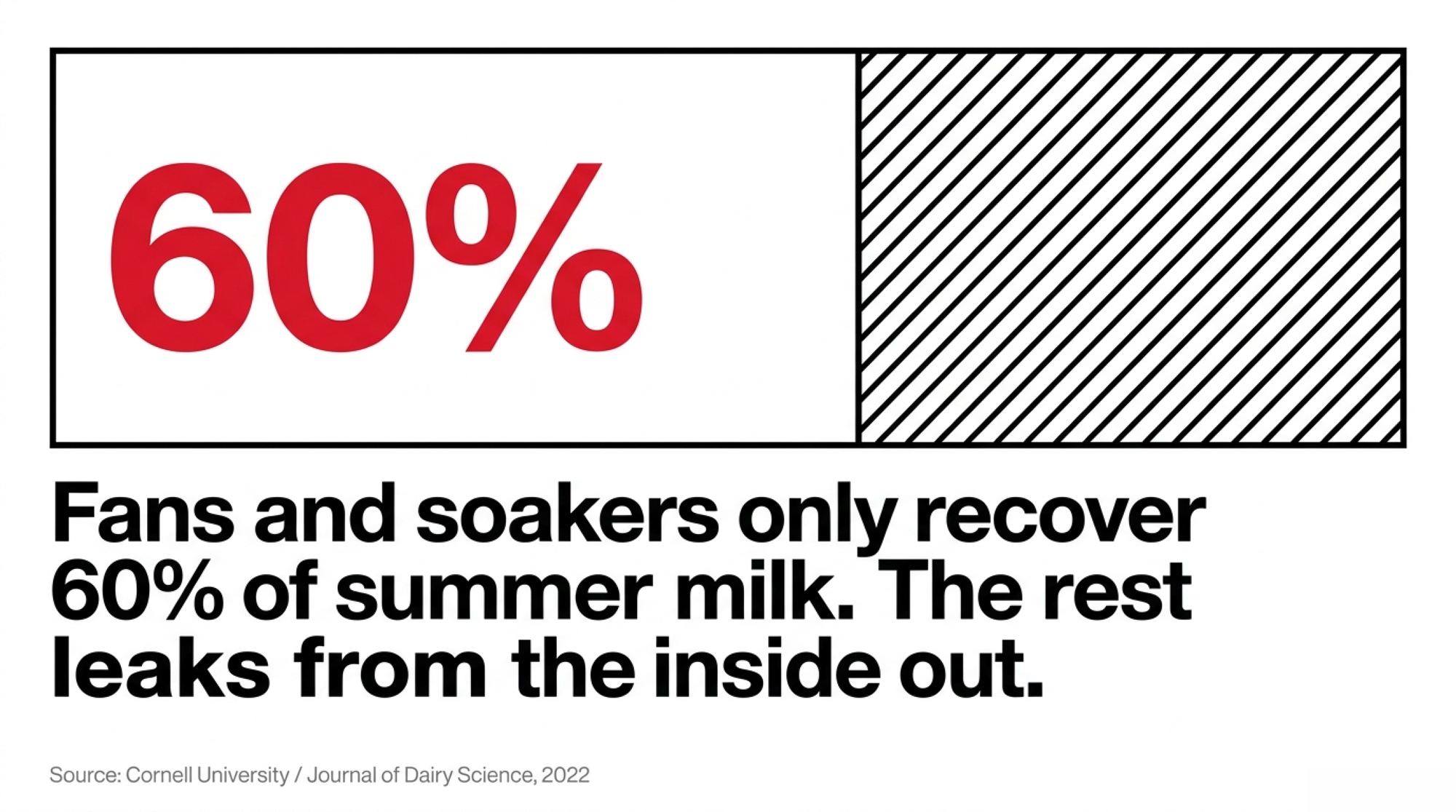
What’s Really at Stake
For two decades, the message from extension and industry was clean and mostly true: heat makes cows eat less, so add energy density and hang more fans. Manitoba Agriculture’s guidance puts the intake drop at 10–12% or more in hot weather, with milk losses running 15–40%. That advice wasn’t wrong. It just wasn’t finished.
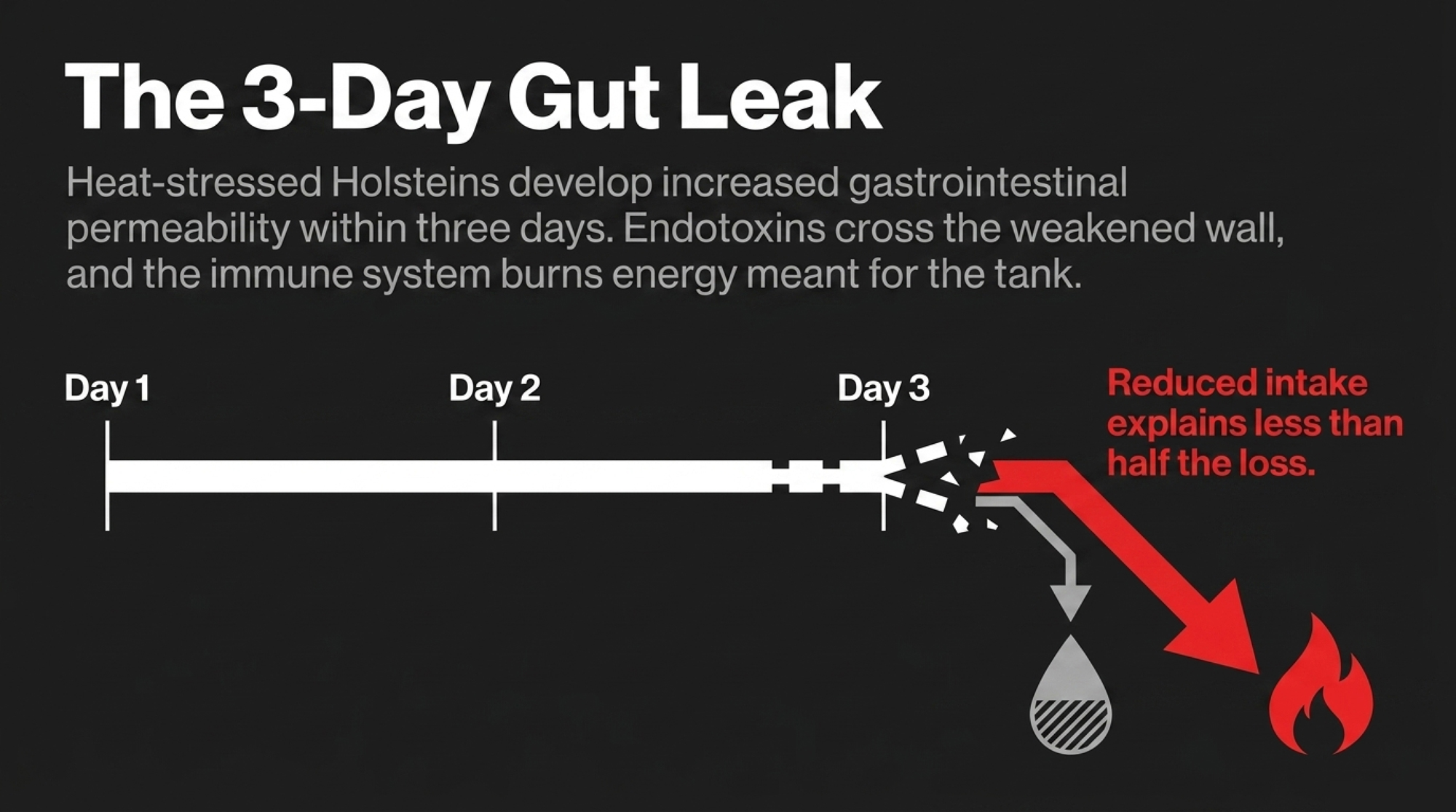
The cow this producer is fighting isn’t just eating less. A 2022 Cornell-led study in the Journal of Dairy Science found heat-stressed Holsteins develop “leaky gut” — increased gastrointestinal permeability — within three days of heat exposure. The kicker: lower feed intake explained only 30–50% of the milk loss. The rest came from inflammation, as bacterial endotoxin slipped across the weakened gut wall and the immune system started burning energy that should have gone into the tank.
Picture what’s actually happening inside her. Blood that should be feeding the udder gets shunted to the skin to dump heat. The gut lining — already running on less blood and less feed — loosens at the tight junctions between cells. Endotoxin crosses into circulation, the liver and immune system mount a response, and the cow starts spending energy on an inflammatory fire instead of milk. That’s why the loss outruns the lower feed bunk: she’s not just under-fueled, she’s under attack.
That same Cornell line of work found a combination of organic acids and botanicals helped restore milk under heat stress — not by cooling the cow, but by shoring up the gut barrier the heat had broken. Which tells you something the fans can’t: a lot of your summer milk leaks from the inside out.
This is the producer who’ll see himself here. The one who’s done everything the old way told him to and still can’t explain the gap between how hard he tries and what the milk check says. That gap is real, it’s measurable, and the research now maps it system by system — which is exactly where the fixable part starts.
The Additive That Looked Right — and Still Didn’t Work
To understand how to fix this biological breakdown, you first have to see how easy it is to spend money on the wrong fix — because the most expensive mistakes in heat stress aren’t reckless. They’re logical. Here’s a cautionary tale of how sound reasoning can still lead you off a cliff.
In a controlled study published in Animal Science in December 2003 (Vol. 77, pp. 485–490), researchers at the University of Manitoba fed the fungal culture Aspergillus oryzae to lactating cows under short-term heat stress. The reasoning was reasonable. It sat next to live yeast on the shelf, and rumen health helps cows cope with stress, so producers and nutritionists folded it into the same bucket.
The result? Nothing. After the five-day heat phase, milk yield still fell, and supplementation had “no effect on vaginal temperature, dry-matter intake, water intake, milk yield or milk components.” The authors concluded the fungal culture “did not ameliorate production losses associated with this type of heat stress.” Manitoba Agriculture’s own extension guidance still flags yeast and Aspergillus oryzae as having “variable results.”
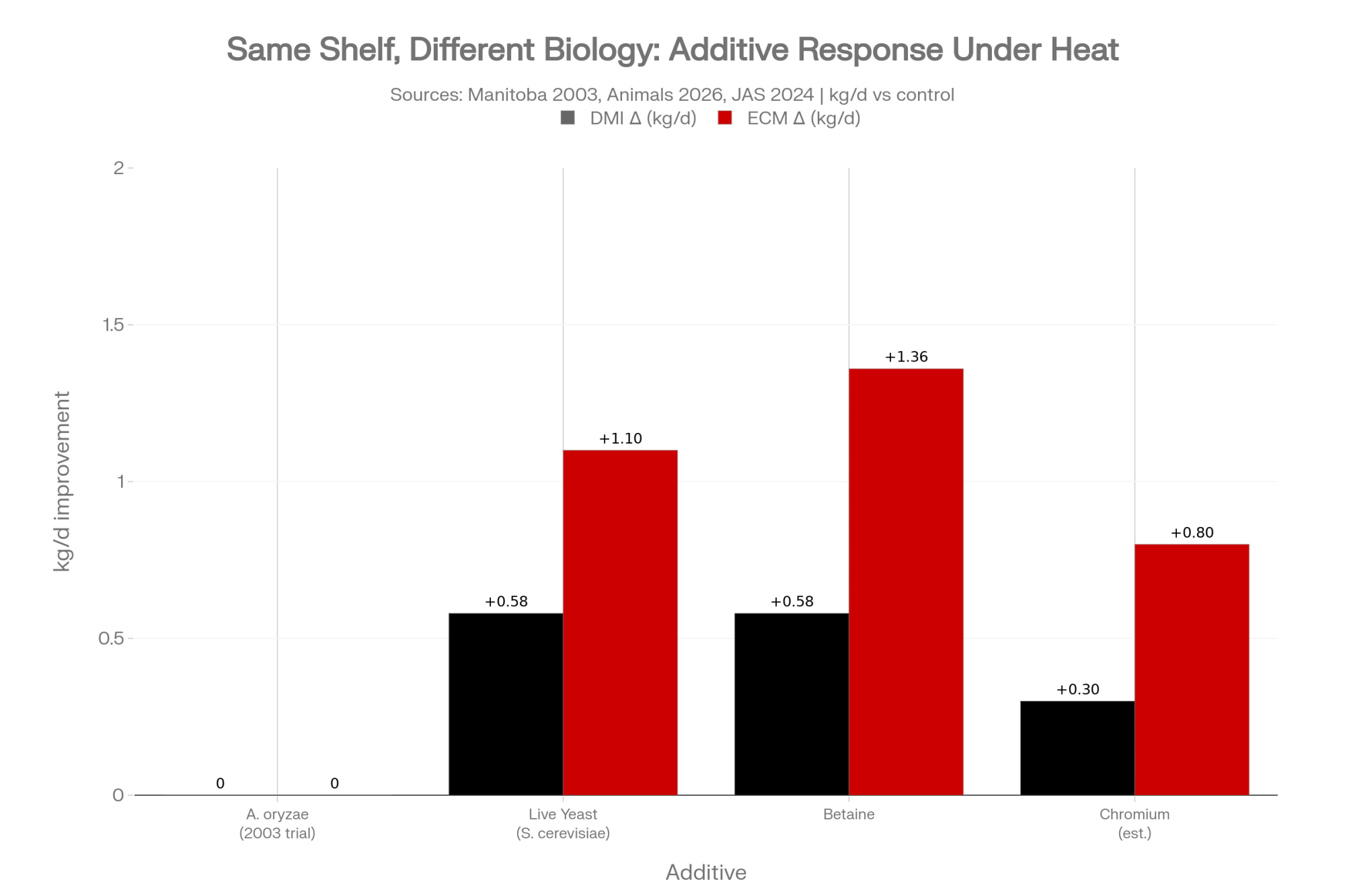
Here’s the twist that makes it useful instead of just a dead end. A 2021 study found that a postbiotic derived from the same organism improved energy-corrected milk and lowered inflammatory markers under heat stress — by tamping down inflammation. Same organism. Different preparation. Opposite outcome. A 2026 meta-analysis in Animals later confirmed that live yeast (Saccharomyces cerevisiae) significantly raised both dry matter intake and milk yield in heat-stressed cows (P < 0.001), while the older fungal-culture trials never delivered that production response.
So the lesson isn’t “additives are snake oil.” It’s that the mechanism has to match what the cow is actually fighting. Bet on the shelf category instead of the biology, and the production response may just not show up — the way it didn’t in that Animal Science trial.
Same Cow, Three Different Heats
Here’s where the smart heat stress programs split from the copied ones. The biology is identical in Georgia, Arizona, and Wisconsin — gut still leaks at three days, immune system still overspends. What changes is the shape of the heat. And the program can’t be the same program.
| Factor | Hot-Humid Southeast | Arid Southwest | Temperate Midwest/Ontario |
|---|---|---|---|
| THI Pattern | Chronic — above threshold for weeks | Extreme peaks, big day-night swing | Episodic “ambush” spikes, 4–7 days |
| Night Recovery Window | ❌ None — stays sticky overnight | ✅ Strong — cool nights are a tool | ⚠️ Variable — sometimes yes, sometimes no |
| Primary Cooling Tool | High-capacity ventilation + soakers (24/7) | Evaporative cooling + shade geometry | Switchable fans/soakers with THI trigger |
| Forage Strategy | Maximize energy density, limit fermentable starch | Time high-DMI feeding to cool nights | Pre-positioned “heat ration” variant ready to flip |
| Additive Timing | Always on — no off season in summer | On during peak months; use nights for intake recovery | Defined on/off trigger; OFF switch mandatory in fall |
| Biggest Hidden Risk | Dry cow heat stress → next-lactation loss ~1,000 lb | Solar load on dry cows and bred heifers | Feeding summer logic into October — stacking costs |
| Evaporative Cooling Efficacy | 🔴 Low — humid air can’t absorb moisture | 🟢 High — low humidity makes it the best tool | 🟡 Moderate — depends on humidity at event time |
- The Hot-Humid Southeast: The enemy is chronic. THI sits above the stress threshold for weeks, nights stay sticky, and cows never dump the load they built during the day. The biology here is unforgiving: with no overnight recovery window, body temperature ratchets up day over day, and a cow that can’t shed yesterday’s heat starts today already behind. You design for around-the-clock cooling and gut protection, and you treat dry cows and bred heifers as heat-stress animals too. The additive support is essentially always on.
- The Arid Southwest: A different animal. Brutal afternoon peaks, fierce solar load, but low humidity and big day-night swings. That dryness is a tool — evaporative cooling actually works there, because the air can take the moisture, which is exactly why soakers and high-pressure misting earn their keep in the desert and disappoint in the swamp. In one Arizona study, shade over the feed bunk alone improved milk production by 7.5%. So you build like an engineer — shade geometry, airflow, evaporative cooling that exploits the dry air — and you use the genuinely cool nights to claw intake back.
- The Temperate Midwest & Ontario: The trickiest version: ambush heat. Fewer brutal weeks, more surprise events, and a creeping climate trend toward more days over threshold each decade. The danger isn’t the severity, it’s the surprise — a barn built and managed for a temperate average gets caught flat by a four-day spike, and the cows pay before the ration ever catches up. The move that separates a nutritionist who understands the biology from one copying a Florida playbook is building a switchable program — one with a clear trigger and, just as important, an off switch. Because the costliest mistake here isn’t failing to turn it on. It’s forgetting to turn it off.
The Trap Hiding Inside the Switch
Can a smart heat program for your milk cows quietly wreck your dry cows? Yes — and it’s quiet enough that most farms don’t connect the dots until calvings go sideways in August.
| Parameter | Lactating Cow (Heat Ration) | Close-Up Dry Cow (Target) | What Happens If Close-Up Gets the Heat Ration |
|---|---|---|---|
| DCAD Target | +35 to +40 mEq/100g DM | −23 to −68 mEq/lb DM | DCAD pushed sharply positive — wrong direction |
| Potassium Level | 1.5% DM (Manitoba guidance) | As low as possible | Blunts PTH response; impairs Ca mobilization |
| Sodium Level | 0.5% DM | Minimal | Adds to positive DCAD, worsening the problem |
| Blood pH Effect | Slightly alkaline — desired under heat | Mildly acidic — required for Ca priming | Subclinical alkalosis; Ca mobilization impaired |
| Calving Outcome Risk | N/A | Smooth Ca transition | Subclinical hypocalcemia → milk fever risk ↑ |
| 3-Week Post-Calving Risk | N/A | Clean transition | Retained placentas, metritis, DAs elevated |
| Next-Lactation Impact | Maintained | Full potential | ~1,000 lb milk loss from heat-stressed dry cows |
| Audit Action | Confirm K% in each forage, by pen | Test close-up DCAD before touching lactation ration | Pull August fresh-cow disease logs — the damage is already there |
In June, the nutritionist does the right thing for the high group: pushes dietary cation-anion difference (DCAD) up with extra potassium and sodium to replace what cows lose through sweat and panting. Manitoba Agriculture recommends heat-stress diets carry 1.5% potassium, 0.5% sodium and 0.35% magnesium; many heat rations push DCAD up toward +35 to +40 mEq/100g of dry matter. Research backs it — higher DCAD under heat stress improves blood acid-base balance and can lift milk fat. Good call for milk cows.
Then logistics take over. The same high-potassium forages feeding the milk cows are sitting in the bunkers the whole farm pulls from. Out of convenience, those forages keep flowing to the close-up pen. And now the dry cows are eating a near-lactation DCAD.
But the dry cow needs the exact opposite. In her last three weeks she needs a negative DCAD — standard close-up guidance puts the target in the range of roughly −23 to −68 mEq/lb of dry matter — to set up the mild metabolic acidosis that primes her to mobilize calcium at calving. The mechanism is straightforward once you see it: a slightly acidic blood pH makes her tissues more responsive to parathyroid hormone, so when calcium demand spikes at calving she pulls it from bone and gut on cue. Push DCAD positive and you blunt that response. She calves into subclinical hypocalcemia, and three weeks later you’ve got the retained placentas, the metritis, the DAs. Stack that on heat-stressed dry cows — which research links to roughly 1,000 lb less milk in the next lactation — and it’s a double hit. Nobody writes “we wrecked our close-ups with a lactation DCAD decision” on the whiteboard. It just feels like a rough summer.
Go deeper: Your Fans Can’t Fix Half of Heat Stress. Your Ration Can.
The Three-Line-Item Question
So a producer looks at stacking yeast, betaine, and chromium and sees three line items where he wants one. The skeptic’s version, and it’s a fair one: “Why pay for three when I could just pick the best one?”
The honest answer isn’t “more is better.” It’s that each tool buys a different piece of the biology. Take them one at a time, because the mechanisms don’t overlap the way the shelf placement suggests.
| Additive | Primary Mechanism | System Targeted | Key Evidence | DMI Δ | ECM Δ | Use If… |
|---|---|---|---|---|---|---|
| A. oryzae (fungal culture) | Rumen fermentation modulation | Rumen | Manitoba 2003: zero effect on milk, DMI, temp under heat | 0 kg/d | 0 kg/d | ⚠️ Evaluate postbiotic form only (2021 data) |
| Live Yeast (S. cerevisiae) | O₂ scavenging; stabilizes rumen pH | Rumen | Animals 2026 meta-analysis; P < 0.001 | +0.58 kg/d | +1.10 kg/d | Slug-feeding patterns; SARA risk elevated |
| Betaine | Osmolyte — cellular water retention | Gut barrier / hydration | JAS 2024 meta-analysis | +0.58 kg/d | +1.36 kg/d | Gut permeability is the primary failure mode |
| Chromium | Insulin sensitizer; glucose partitioning | Energy metabolism | Multiple trials; est. effect | +0.30 kg/d | ~+0.80 kg/d | High-genetic cows burning glucose on heat maintenance |
| Combination Stack | All three mechanisms simultaneously | Rumen + Gut + Metabolism | Additive (mechanisms don’t overlap) | ~+1.46 kg/d | ~+3.26 kg/d | Cooling & DCAD already handled; high-value herd |
Yeast stabilizes the rumen. When a heat-stressed cow slug-feeds at night and the bunk pH crashes, live yeast helps scavenge oxygen and feed the bugs that keep fermentation steady — the front-line defense against the sub-acute ruminal acidosis that heat-driven feeding patterns invite. The 2026 Animals meta-analysis confirms it lifts both intake and yield specifically in heat-stressed cows.
Betaine works somewhere else entirely — as an osmolyte. It lets cells hold water under heat and osmotic stress, which supports gut-barrier integrity exactly where the three-day leak starts. A 2024 meta-analysis in the Journal of Animal Science found betaine raised dry matter intake by +0.58 kg/d and energy-corrected milk by +1.36 kg/d, with the effect on intake stronger in heat-stressed cows.
Chromium plays a third position. It improves insulin sensitivity and glucose uptake, so more of the energy you feed actually reaches the udder instead of getting burned just keeping the cow standing through the heat of the day. Pick one, and you’re really choosing which system failure to ignore: rumen, gut hydration, or energy metabolism. They overlap at the edges. They don’t substitute.
What’s Two Kilos of Milk Actually Worth?
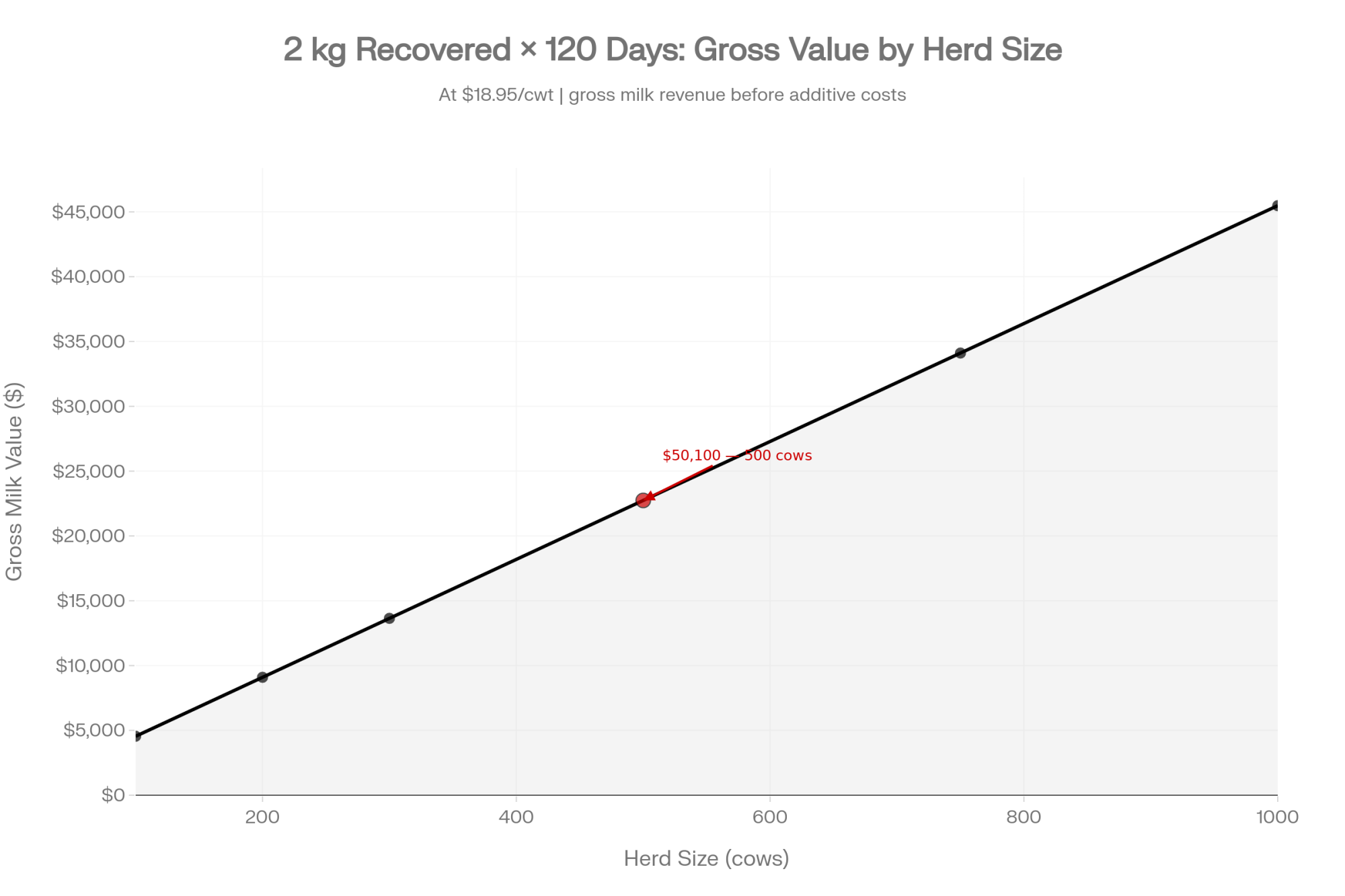
Run the barn math, conservatively. Recovering even 2 kg of milk per cow per day across roughly 120 heat-stress days adds up faster than most producers expect.
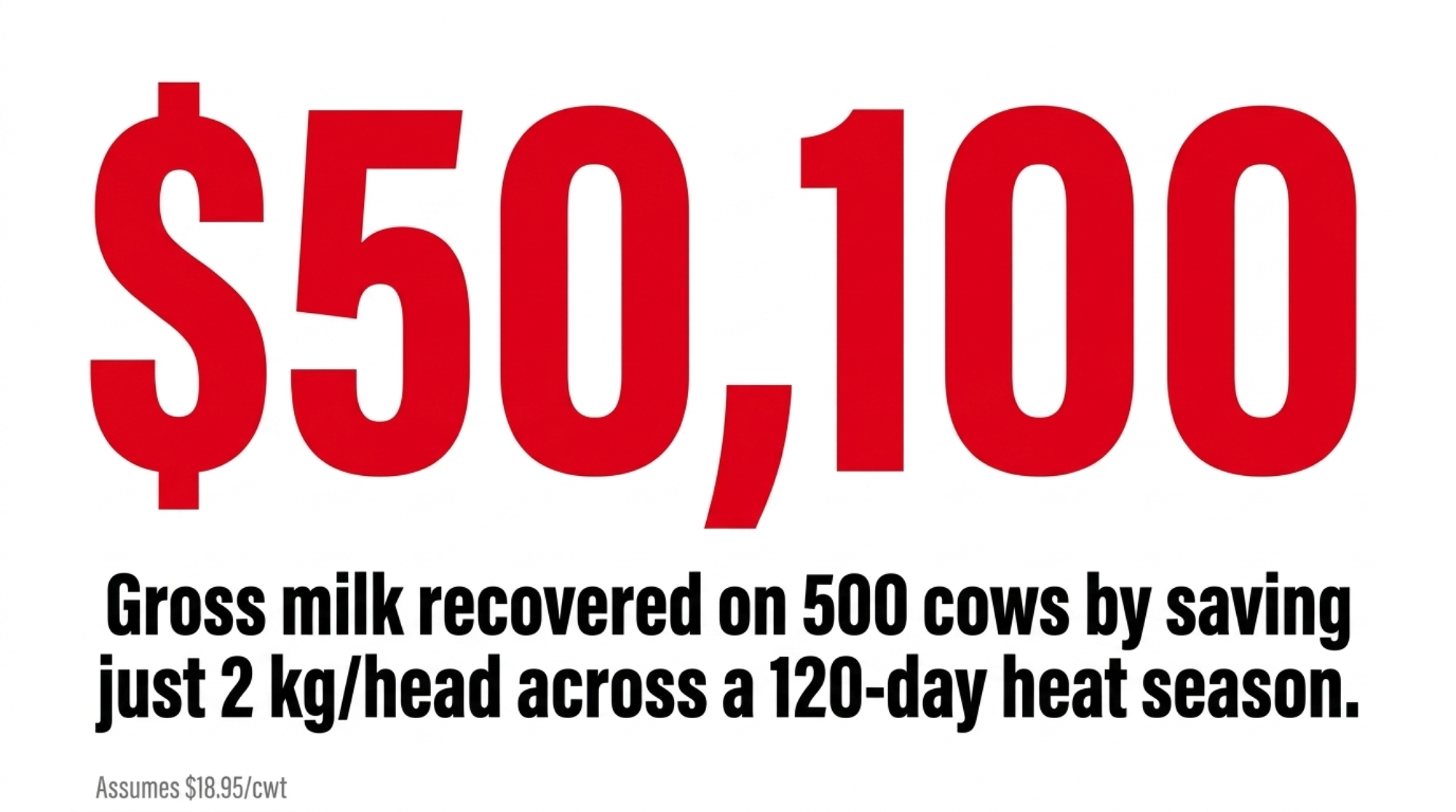
THE BARN MATH 2 kg/cow/day × 120 heat-stress days × 500 cows = ~$50,100 in gross milk (at an assumed $18.95/cwt — about $100/cow over the heat season)
That’s the bucket you’re arguing inside. And it’s gross milk, before you net out additive cost — so the real decision is whether the stack captures enough of that to clear what it costs. The debate was never whether betaine runs you seven cents a cow or nine. It’s whether you want to leave most of that fifty grand sitting on the table to save a few pennies a day.
Your Heat-Stress Self-Audit: Four Paths, Four Questions
The lessons sort into four real paths, depending on where your operation sits today. Each one comes with a question to ask yourself before you spend a dollar.
- Path 1 — Fix the free leaks first (any herd, this month). When it makes sense: Before a single additive, walk your water troughs, air speeds, shade lines, and stocking density. The audit question: Are your dry cows and bred heifers getting cooled like the high-value assets they are — or are they sweating out next lactation’s potential? And have you measured what heat costs your herd, or are you running on a national average? 30-day action: Pull last July and August milk curves, repro records, and fresh-cow disease logs. See what heat actually cost your herd, not a national average. If cows are at 130% stocking with only 18 inches of bunk space, moving cows beats any supplement you can buy.
- Path 2 — Audit dry-cow DCAD before you touch the lactation ration (mixed-forage herds). When it makes sense:Any farm running one forage stream across pens. The audit question: Is your close-up DCAD actually negative right now — or is high-potassium forage quietly pushing it positive while you fix the milk cows? What it demands: A forage test and the discipline to keep high-potassium feed out of the close-up diet. Skip it, and you hand back your summer milk gains as August transition wrecks.
- Path 3 — Build a switchable heat module (Midwest, Ontario, temperate herds). When it makes sense: Episodic, ambush heat. The audit question: Does your heat program have an off switch — or are you still feeding summer logic in October? What it demands: A defined “heat-on” ration variant and a trigger tied to forecast or THI. Leave it running into the fall and you’re feeding a summer ration in November.
- Path 4 — Layer additives by mechanism, not by brochure (high-genetic, tight-ration herds). When it makes sense:Once cooling and DCAD are already handled. The audit question: When you weigh an additive, can you name the mechanism it’s buying — rumen, gut, or metabolism — or just the brand on the bag? And did you set the success metric before the trial started? What it demands: A structured 60-day trial with the success metric set before you start, plus the nerve to walk away if the response doesn’t show. Stack everything on day one with no benchmark group, and you’ll never know what paid and what didn’t.
One signal worth watching as you plan: combined-mode ingredients are arriving — chromium-yeast products that bundle rumen and metabolic pathways into a single bag. Call it version one of where this is heading, not the finished article.
Key Takeaways
- If feed intake only explains a third to half of your summer milk loss, then fans alone were never going to get the rest — the gut and the immune system are.
- If one forage stream feeds every pen, then a positive-DCAD heat move for your milk cows is probably leaking into your close-ups; audit it before you adjust anything else.
- If you can’t name the mechanism an additive targets, you’re buying a category, not a result — and the Aspergillus oryzae story is what that costs.
- If you’re going to stack, decide what success looks like in writing before the trial starts, or you’ll never know which line item earned its keep.
The producer in that July parlor isn’t failing. He’s been working off half a map. The other half — the three-day gut leak, the immune bill, the DCAD trap, the mechanism behind each additive — is now sitting on the table, measurable and fixable. So here’s the question worth carrying into the barn this week: before you reach for a product, can you point to the system that’s actually failing your cows when the THI sits over 70 for a week straight? Get that right, and everything after it is just the math you were always willing to do.
Run Your Numbers
Forage Quality Value Calculator — Punch in your lab numbers and milk price to see what each forage is worth per cow per day and exactly where it belongs — high group, heifers, or dry/far-off. The fastest way to catch high-K forage drifting into your close-up pen before it costs you next lactation.
Complete references and supporting documentation are available upon request by contacting the editorial team at editor@thebullvine.com.
Learn More
- Your Fans Can’t Fix Half of Heat Stress. Your Ration Can. — Arms you with a pre-summer nutrition blueprint to optimize blood acid-base balance, combining a wet-chemistry forage protocol with strategic potassium and sodium blending to protect milk fat before June heat arrives.
- Nigel Cook’s $74 Heat Stress Number Was Never Wrong. It Was Never Finished. — Follows the money on high-DCAD formulations, exposing why cheap potassium chloride fails to buffer the rumen and revealing how driving targets toward +400 mEq/kg recaptures severe summer component losses.
- Heat stress fertility: why cows quit breeding at THI 60 — Delivers a contrarian genetic strategy to dismantle summer breeding slumps by screening replacement heifers for weather resilience and shifting the bottom 15% of heat-vulnerable cow families to beef semen.
 The Sunday Read Dairy Professionals Don’t Skip.
 The Sunday Read Dairy Professionals Don’t Skip.
Every week, thousands of producers, breeders, and industry insiders open Bullvine Weekly for genetics insights, market shifts, and profit strategies they won’t find anywhere else. One email. Five minutes. Smarter decisions all week.




