








A full point off his DPR on August 11, same daughters, same bull. Before you swap him out: that’s CDCB rescaling the fertility stack, not a genetic verdict. Here’s how to tell — and what to do.
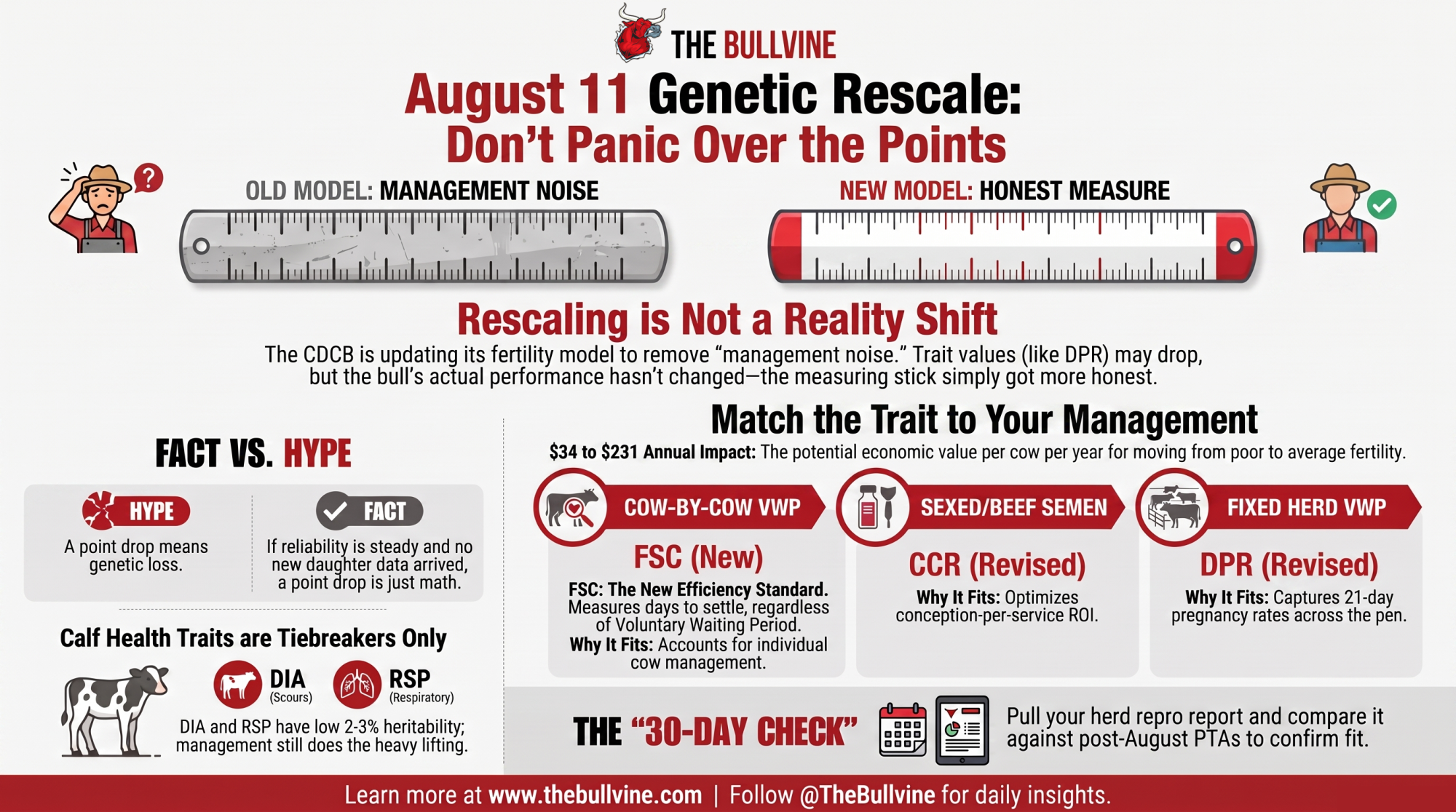
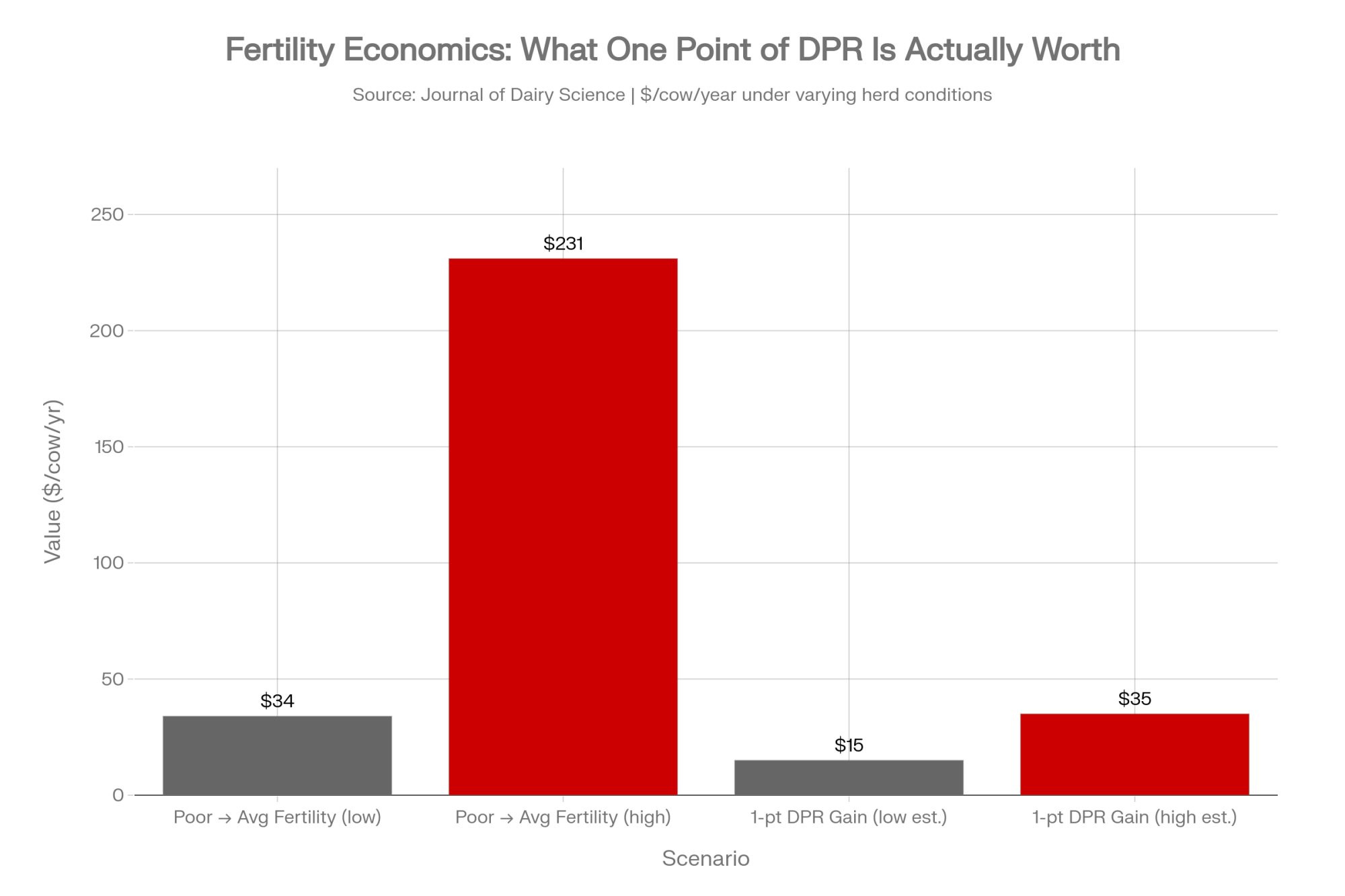
Executive Summary: On August 11, 2026, CDCB rescales its entire fertility stack — DPR, CCR, HCR, EFC — adds a new trait called First Service to Conception (FSC), and launches the first U.S. calf-health traits, DIA and RSP, for Holsteins and Jerseys. The catch: when your favorite bull drops a point on DPR that morning, the cows didn’t change, the measuring stick did — CDCB calls it a rescale, not a real genetic loss, so panic-culling or panic-buying off the move is a mistake. The revision finally strips management noise from the math (DPR heritability roughly doubles, from 1.4% to 2.9%), which means your fall sire list can be reshuffled even with zero new daughter data. Which fertility trait you lead on now depends on how you actually breed: revised DPR for herd-level VWP, FSC for cow-by-cow herds, CCR for the conception-per-service crowd running sexed and beef semen. The two calf-health traits are built on serious data — 260,000-plus scours records and 768,000-plus respiratory records — but at roughly 2–3% heritability and launch reliabilities in the 43–53% range, they’re tiebreakers between close bulls, not a fix for a barn that fights scours. With fertility worth somewhere around $34 to $231 per cow per year, the play before you lock fall matings is simple: pull your herd repro report against your post-August PTAs, sort your list three ways, and decide which column is yours.
When CDCB runs the August 11, 2026, evaluation, the first thing many breeders will see is that their favorite bull has moved. A full point off his Daughter Pregnancy Rate, maybe. Same bull, same daughters, lower number.
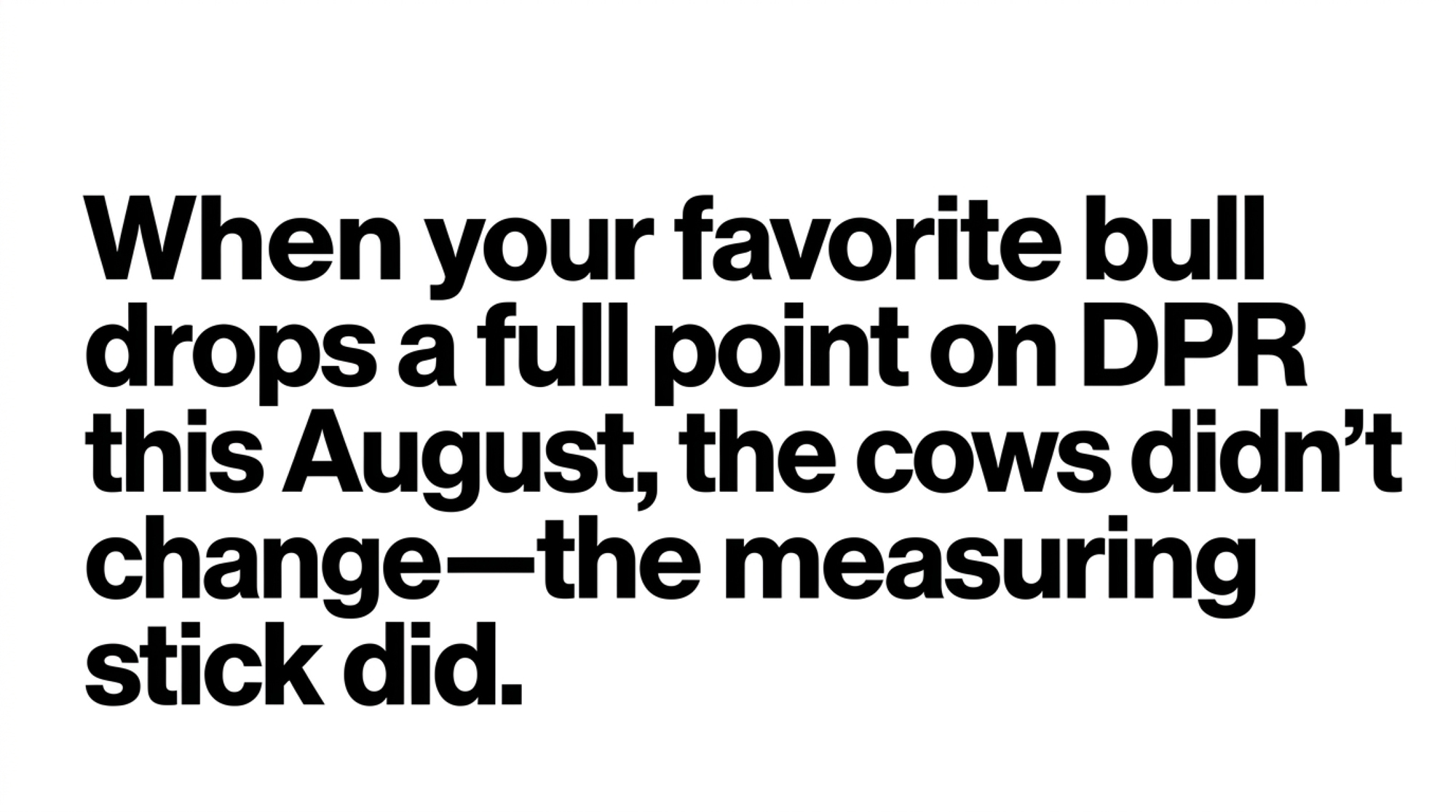
Here’s the thing to hang onto before you touch a single straw: the cows didn’t change. The measuring stick did. CDCB is revising its four reproductive traits, adding a fifth, and rolling out two calf-health traits in the same run — and if you read it wrong, you’ll either bench a bull that’s still doing the job or chase a new trait that can’t carry the weight you’re about to put on it.
What Actually Lands in August
Three new traits show up in the August 2026 evaluation: Resistance to Diarrhea (DIA), Resistance to Respiratory Problems (RSP), and First Service to Conception (FSC). At launch, the new traits are available for Holsteins and Jerseys. At the same time, CDCB revises the four female reproductive traits breeders already lean on — DPR, Cow Conception Rate (CCR), Heifer Conception Rate (HCR), and Early First Calving (EFC). CDCB via LinkedIn
The revision came out of a two-year foundational review that CDCB and USDA’s Animal Genomics and Improvement Laboratory began in 2024, after seasonal swings between evaluations, a steady downward drift in young-bull PTAs, and genetic trends moving in unexpected directions all pointed to a model that wasn’t keeping up with how herds actually breed. The old model assumed a fixed voluntary waiting period (VWP) for every herd and allowed management decisions to bleed into the genetic estimate. Estrus synchronization, heat-detection tech, sexed and beef semen, shifting wait periods — none of it was fully accounted for, so fertility PTAs drifted. CDCB
So when your numbers move in August, read the cause before you react. CDCB puts it plainly: the shifts in PTA ranges and averages “represent a rescaling of each trait rather than a true increase or decrease in underlying genetic variation.” Rescaling. Not your cows going backward overnight. CDCB
What Changed in Each of the Four Revised Traits
The four reproductive traits you already use didn’t just get nudged — each one was rebuilt to strip out management noise that the old model was crediting to genetics. Here’s what moved, and why:
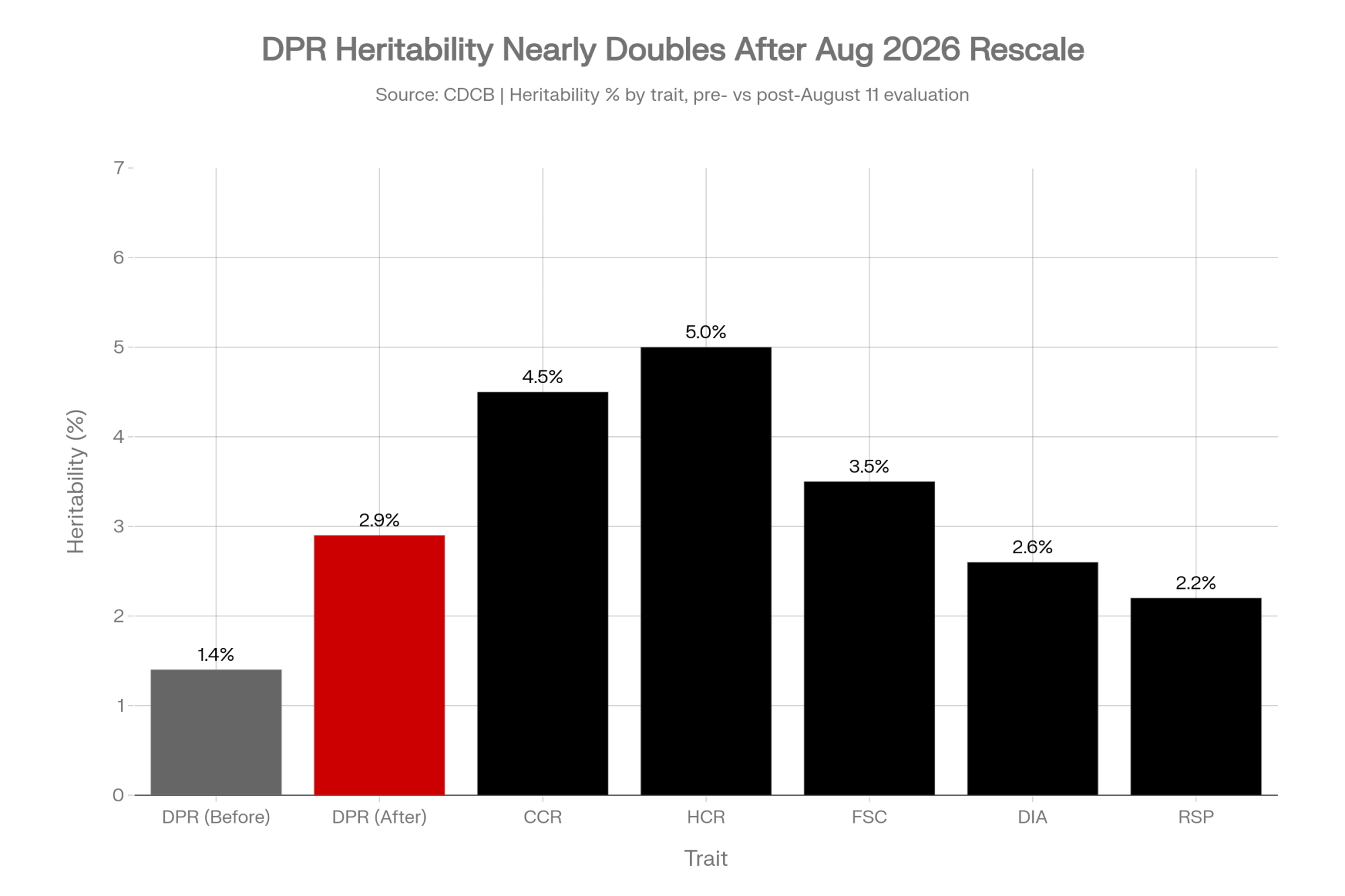
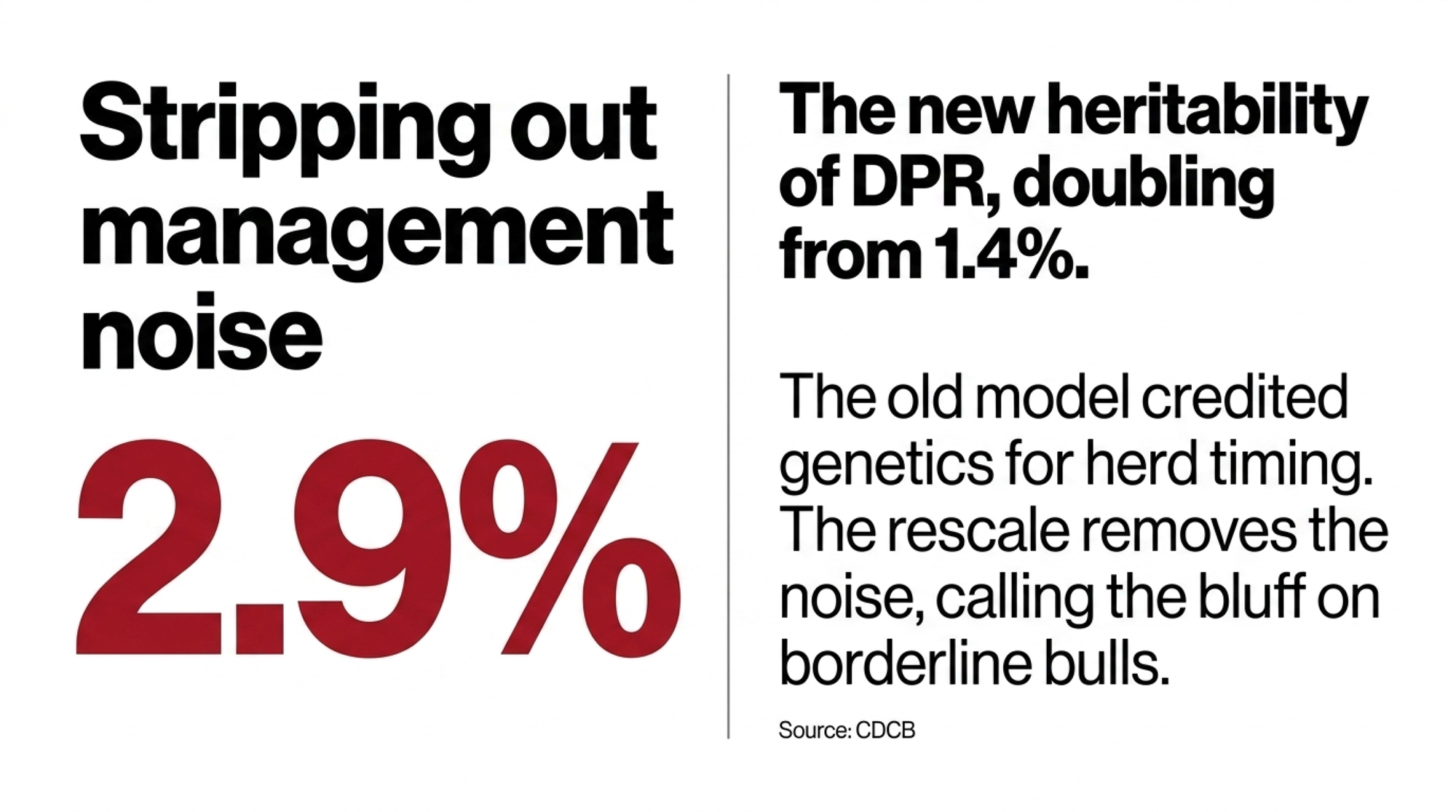
- DPR (Daughter Pregnancy Rate): Rebuilt to remove the fixed VWP assumption that made later-breeding herds look genetically worse. Heritability roughly doubled, from 1.4% to 2.9%, because it now captures the true genetic signal rather than herd timing. CDCB
- CCR (Cow Conception Rate): Now built from up to the first seven inseminations in a lactation, scored 0 for a miss and 1 for a settle. Adjusted for days in milk, mating type, service-sire breed, and short cycling before becoming a conception rate. CDCB
- HCR (Heifer Conception Rate): Revised to account for service-sire breed, mating type, and short cycling — a re-insemination 10 to 17 days after the previous breeding, which usually signals a recording artifact, not a true open heifer. For scale: the average U.S. Holstein heifer that calved in 2024 was bred 1.77 times per conception; Jerseys averaged 1.85. CDCB HCR trait sheet
- EFC (Early First Calving): Rounds out the revised reproductive set. CDCB
The takeaway across all four: the numbers will move, but the movement is the model getting more honest about what’s genetic and what’s management — not your animals changing.
“My Best Bull Just Dropped a Point. Now What?”
Picture the morning after the run. You pull up your fall sire list, and the bull you’ve been hammering on your best cows sits a full point lower on DPR than he did in April. The urge to swap him out is real. Don’t — not yet.
Pull his April and August proofs side by side first. Check two things: did his reliability move, and is there a big new group of daughters behind the change? If reliability held steady and no major daughter data came in, that drop is almost certainly the new model recalibrating — not a verdict on his daughters. CDCB says it directly: under the old system, “some of the effects of management choices could be incorrectly attributed to genetics, which made trends for traits like DPR and CCR appear flat or even declining.” The new model strips that noise out. CDCB
The honest way to frame it — with yourself, or with a client if you’re the A.I. rep fielding the calls — is this: you weren’t wrong to trust that bull. The ground under the number moved. Your job now is to protect the matings you already planned from a knee-jerk reaction to a model update. The barn-math rule is simple. Don’t make any breeding move you wouldn’t make if the traits hadn’t changed names.
| Signal | Likely Cause | Reliability Changed? | New Daughters Added? | Right Call |
|---|---|---|---|---|
| DPR drops < 1 pt; reliability flat; no new daughters | Rescaling — model correction, not genetics | No | No | Leave fall matings alone |
| DPR drops > 1 pt; reliability flat; no new daughters | Rescaling + borderline bull losing management-propped PTA | No | No | Re-sort list; check CCR and FSC rank |
| DPR drops; reliability rises; large new daughter group | Real genetic update — new data changed the verdict | Yes ↑ | Yes | Investigate daughters; consider list revision |
| CCR or HCR moves sharply; mating type mix changed | Model now adjusts for sexed/beef semen use | Slightly | Possible | Confirm your semen mix; re-weight CCR if sexed-heavy |
| FSC appears for first time on a bull | Brand-new trait — no prior baseline | New trait | New trait | Set your own threshold; use positive = fewer days |
| DIA or RSP moves a sire up/down significantly | Low-reliability new trait with wide confidence interval | Low (43–53%) | N/A | Keep in tiebreaker lane only; don’t reshuffle fertility rank |
Walk Through It: How a Top-10 Sire List Reshuffles
Here’s where it gets practical. Say you’ve got a fall lineup of ten bulls you’ve already ranked on fertility, and you’re sorting them on DPR the way you always have. What does the August run do to that list? Let’s reason it through — with the assumptions stated up front, because the exact reshuffle depends on your herd’s data, not a universal answer.
The assumptions: a U.S. Holstein herd; you’ve been ranking on old-model DPR; your bulls are a mix of genomic young sires and progeny-tested bulls; and no major new daughter groups landed between April and August, so any movement is rescaling, not new information. Under those conditions, three things happen to that list.
First, the absolute DPR values compress or shift across all ten bulls at once, because the whole trait was rescaled. Your number-one bull might drop from, say, a strong positive to a slightly lower positive — but so does much of the list, so his rank may barely move. That’s the trap: a scary-looking drop in the number that doesn’t actually change his standing against his peers.
Second, the bulls whose old DPR was propped up by favorable management assumptions — daughters that happened to sit in herds breeding on a tight clock — give back more than the bulls whose fertility was a real genetic signal. Those are the ones that can slide a true rank position or two. The revised model is, in effect, calling the bluff on borderline bulls.
Third, if you re-sort that same list on the revised CCR or the new FSC instead of DPR, the order changes again — because you’re now ranking on a different question (conception per service, or days to conception) than DPR’s cycle-by-cycle pregnancy rate. A bull who looked middling on DPR can rise on FSC if his daughters settle fast once bred.
So the walkthrough lesson isn’t “your list is wrong.” It’s that you now have three legitimate ways to sort the same ten bulls, and the right one depends on how your herd actually breeds — which brings us to the decision table. If you’re still getting comfortable reading these numbers, our guide to understanding bull proofs walks through the basics first.
DPR vs. CCR vs. FSC: Which Fertility Trait Fits Your Herd
Three fertility traits, three different questions. Picking the wrong one means buying semen ranked on a question your herd doesn’t ask.
| Trait | What It Measures | Best Herd Fit | Data Backbone | August Move | Lead or Backup? |
|---|---|---|---|---|---|
| Revised DPR | Pregnancy rate per 21-day cycle; herd-level VWP assumed | Single VWP across entire pen | Long-standing CDCB daughter records | Rescale — read shift as model correction, not genetic news | Lead for herd-VWP operations |
| Revised CCR | Conception per service; up to 7 inseminations scored | Sexed and beef semen herds where conception/service drives ROI | Up to 7 inseminations per lactation; adjusts for mating type, service-sire breed, short cycling | Weight up if conception per service is your economic lever | Lead for sexed/beef semen programs |
| New FSC | Days from first service to conception; VWP-independent | Cow-by-cow programs where vet/team decides per animal | Built independently of VWP; conception capped at 200 days, non-pregnant set to 230 | Move to front of sort; positive PTA = fewer days — rank high-to-low⚠️ | Lead for individual-cow management |
| EFC | Age at first calving, heifer reproductive readiness | Heifer development programs tracking calving timing | CDCB female reproductive database | Revised alongside DPR/CCR/HCR; read shift as rescaling | Supportingtrait alongside heifer conception |
The rule underneath the table: cow-by-cow VWP herds lead on FSC; herd-level VWP herds stay on the revised DPR; and herds optimizing conception per service lean on CCR. Same ten bulls, sorted three ways, and your breeding system tells you which column is yours.
FSC: A Fertility Trait Built for How You Actually Breed
For breeders who’ve run on DPR for decades, First Service to Conception is a different way of thinking about fertility. DPR predicts the share of non-pregnant cows that become pregnant in each 21-day cycle under a herd-level wait period. FSC asks something more direct: once you start breeding her, how many days does it take her to conceive?
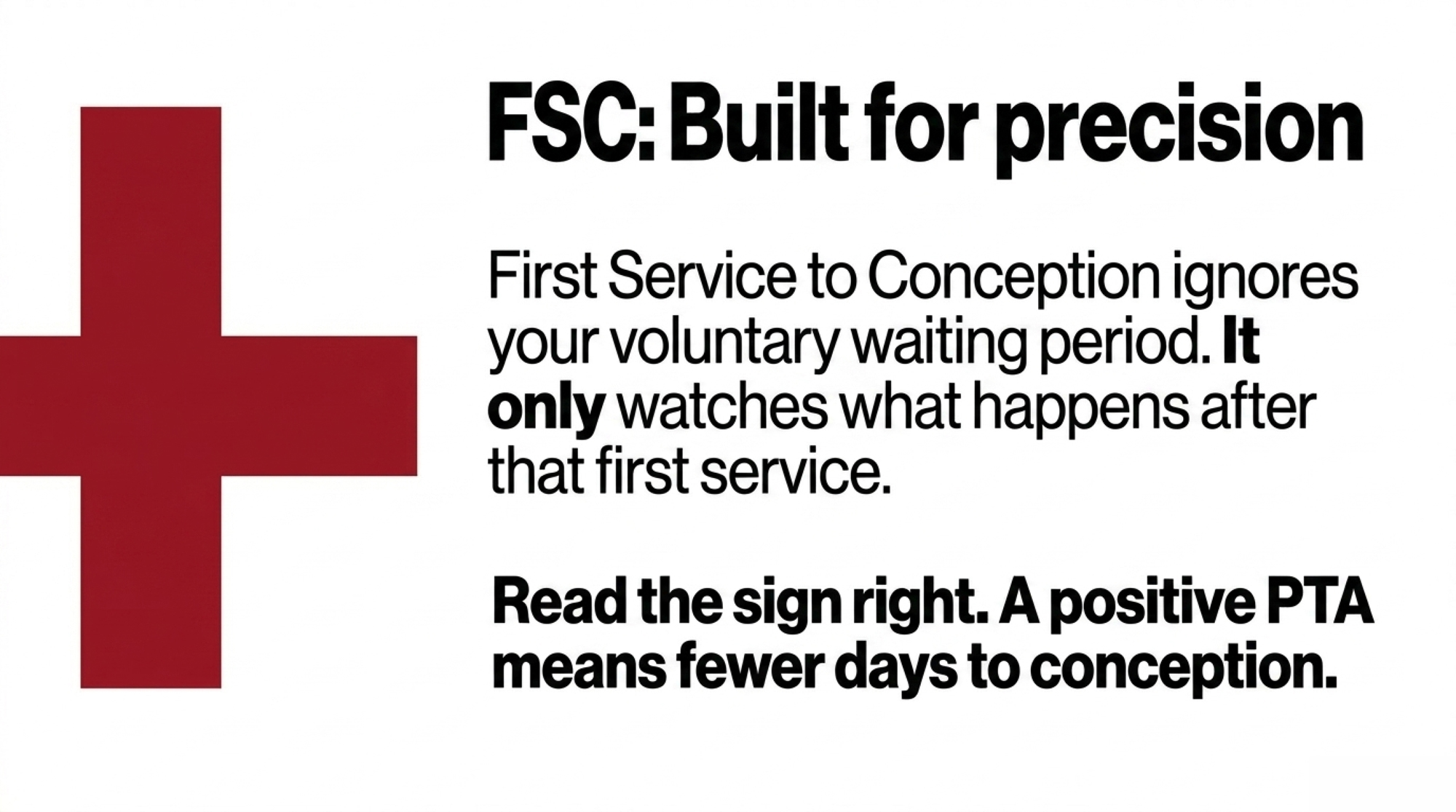
The design feature is what makes it matter. CDCB built FSC to work independently of the wait period — it “is not a function of the VWP, which allows it to account for individual cow management independently of VWP changes.” It doesn’t care whether you breed at 50, 65, or 80 days. It watches what happens after that first service. CDCB FSC trait page
The mechanics are worth knowing before you rank bulls on it. FSC is the number of days from a cow’s first breeding to confirmed conception within a lactation. If she conceives after 200 days, her record is capped at 200; if she never conceives, it’s set to 230 days. CDCB then multiplies the day count by −1, so a positive PTA means fewer days to conception, which is the desirable direction. Read it backward, and you’ll rank your bulls upside down, so that sign convention is the one detail not to fumble. CDCB FSC trait sheet
Where does FSC earn its spot? In herds that breed cow by cow. If your vet and breeding team decide when each cow is ready — on body condition, calving history, disease, behavior — rather than running the whole pen on one clock, DPR’s herd-level assumptions never fit you cleanly.
So Should a Twenty-Year Cow-by-Cow Breeder Even Care?
Fair question. If you’ve run a tight individual-cow program for two decades with solid conception and good days-open numbers, you might look at FSC and think: I’ve done this without a trait. Why now?
Here’s the straight answer. You don’t need FSC to make your program work. You need it if you want your genetics to match the precision of your management. FSC is a filter, not a rescue. It lets you stop buying semen off numbers built for herds that breed on a herd clock, and start asking which bulls sire daughters that conceive fast in your system.
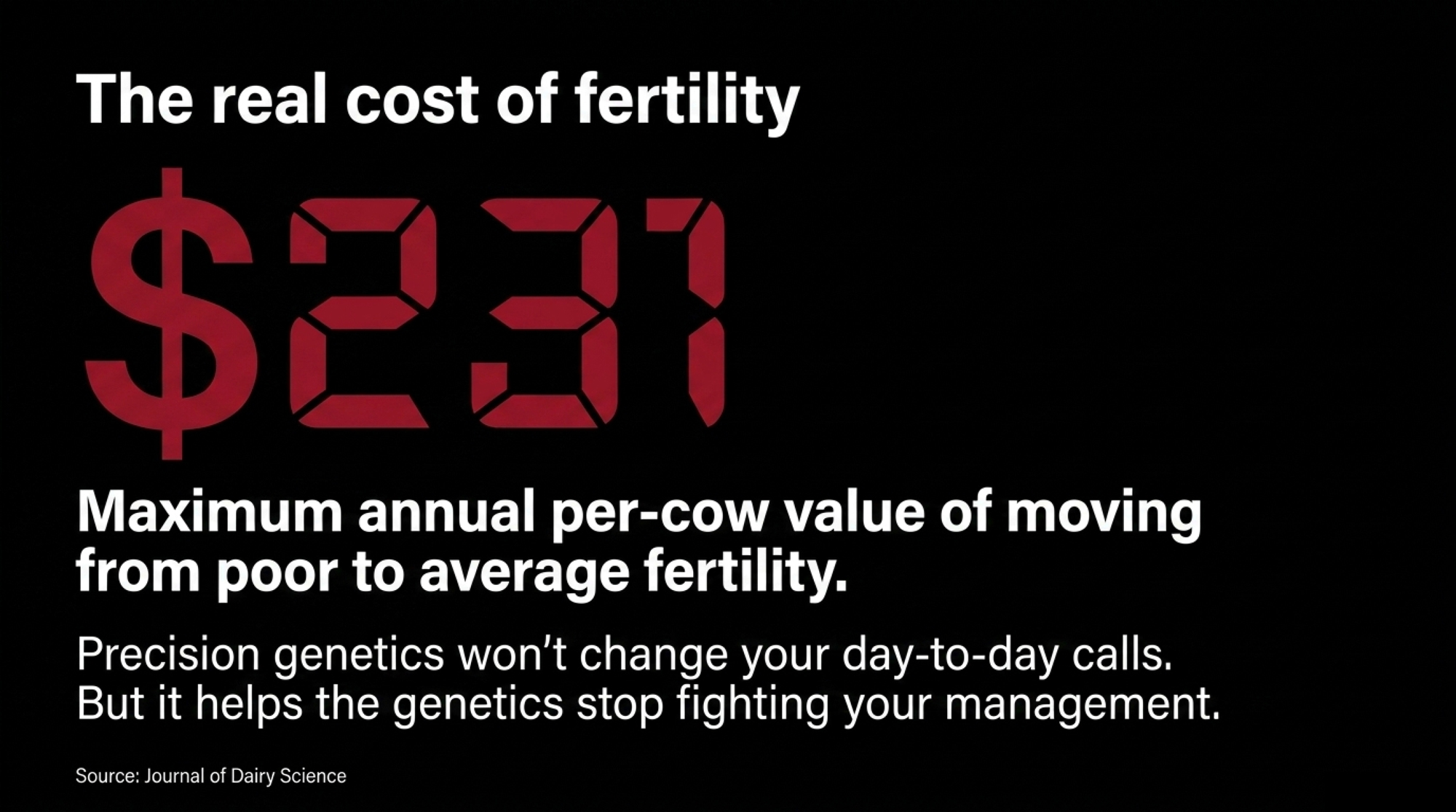
And the economics still bite, even in a well-run herd. One widely cited fertility analysis pegged the move from poor to average fertility — mostly through shorter days open — at roughly $34 to $231 per cow per year, depending on conditions, with a one-point pregnancy-rate gain worth about $15 to $35 per cow per year, much of it from fewer open days. FSC won’t change your day-to-day calls. It helps the genetics stop fighting them. Journal of Dairy Science (PubMed)
DIA and RSP: Real Data, Honest Limits
The calf-health traits are the ones most likely to get oversold, so it’s worth being precise about what they are. DIA predicts a calf’s genetic resistance to scours; RSP predicts resistance to respiratory illness. Both are built from producer-recorded health events in CDCB’s National Cooperator Database — more than 260,000 diarrhea records in calves 3 to 60 days old, and more than 768,000 respiratory disease records in animals 3 to 365 days old, across all breeds. CDCB
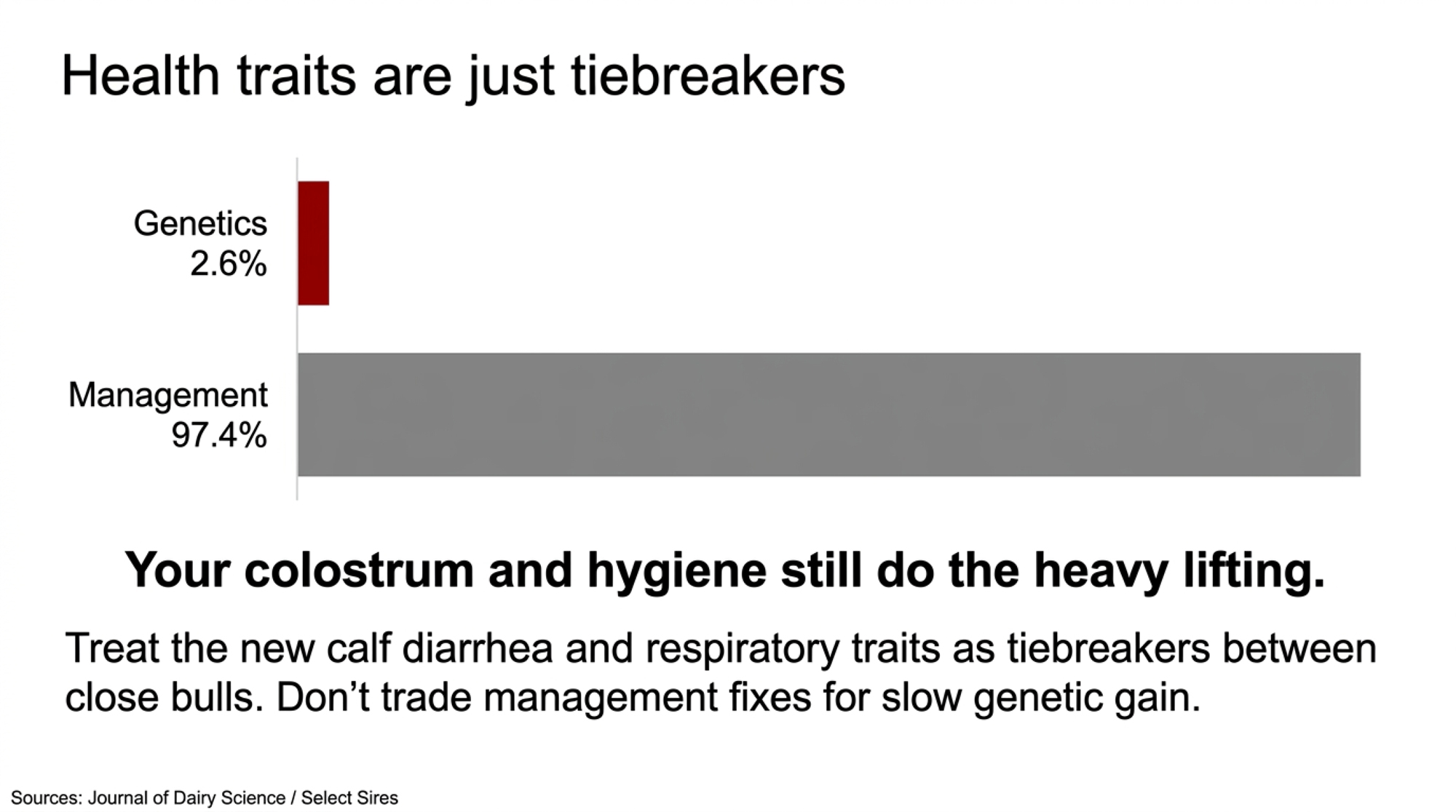
The honest pitch for a producer who fights scours every winter: DIA can tilt the odds, but it won’t fix a bad barn. The peer-reviewed work behind these traits, led by CDCB Senior Research Geneticist Kristen Parker Gaddis, Ph.D., put heritability around 0.026 for diarrhea and 0.022 for respiratory disease. With heritability that low, the overwhelming majority of the outcome still comes down to colostrum, bedding, ventilation, and hygiene — genetics is the thin slice, not the bulk. It moves the odds slowly, stacked on top of a management foundation, never instead of one. Journal of Dairy Science (PubMed)
| Metric | DIA (Resistance to Diarrhea) | RSP (Resistance to Respiratory) |
|---|---|---|
| What It Predicts | Calf genetic resistance to scours | Calf genetic resistance to pneumonia/BRD |
| Age Window | 3–60 days old | 3–365 days old |
| Records in Database | 260,000+ diarrhea events | 768,000+ respiratory events |
| Heritability | 2.6% | 2.2% |
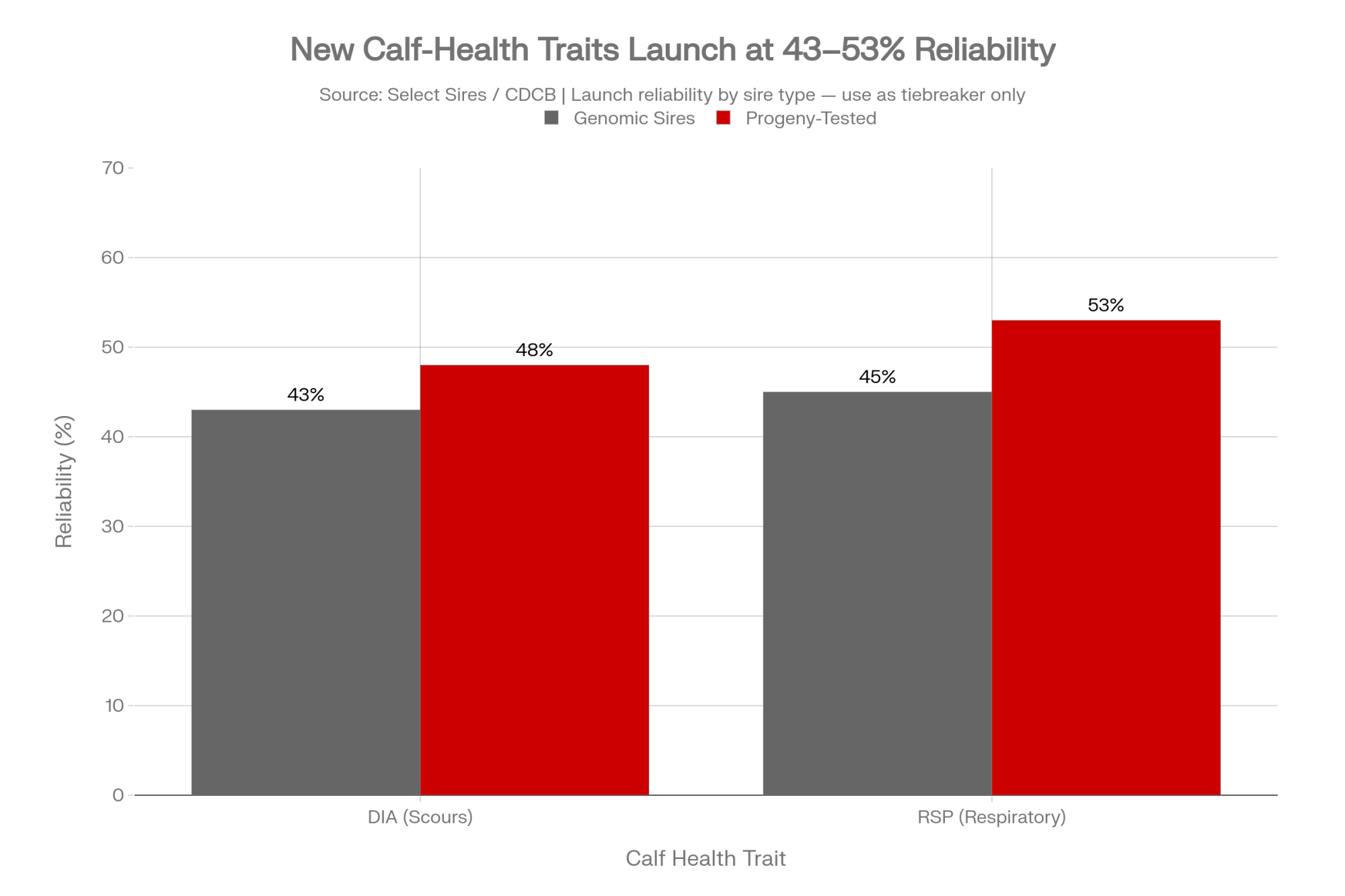
| Launch Reliability — Genomic Sires | 43% | 45% |
| Launch Reliability — Progeny-Tested | 48% | 53% |
| Breeds Available at Launch | Holsteins and Jerseys | Holsteins and Jerseys |
| Favorable Correlations | Heifer livability, productive life | Mastitis resistance, productive life |
| Management Share of Outcome | ~97% (colostrum, bedding, hygiene) | ~98% (ventilation, biosecurity, hygiene) |
| Right Role at the Breeding Desk | Tiebreaker between close bulls ✓ | Tiebreaker between close bulls ✓ |
| Wrong Role at the Breeding Desk |
Reliability at launch is moderate, right where you’d expect a brand-new health trait to land. Speaking on the Select Sires podcast, Gaddis reported Holstein DIA reliabilities of 43% for genomic sires and 48% for progeny-tested bulls, with RSP at 45% and 53% — comparable, she noted, to where the cow-health traits sat when they were first introduced. The same conversation pointed to favorable correlations with heifer livability, productive life, and mastitis resistance. The takeaway holds either way. Treat DIA and RSP as tiebreakers between otherwise similar bulls, not as the reason you buy one.
Where the Oversell Goes Wrong
New traits are exciting, and exciting sells semen. The way this costs producers money is by treating a high-DIA bull as a fix for scours, or by reading a single dollar-index as a guarantee when a 2.6%-heritability trait sits within it.
The producer who buys that story pays twice. First, he eases off on colostrum and bedding because he figures the genes have it covered. Then, two or three winters later, his scours rate has barely moved — but his replacements are weaker on fertility or production because he traded a bigger, faster gain for a slow one. Extension guidance is consistent here: for low-heritability traits, lead with economic importance rather than novelty. The real cost of the hype isn’t the semen bill. It’s three winters of thinking the calf-health bulls will fix it while your colostrum program stays exactly where it was.
If you’ve watched a single number quietly reshape a sire list before, this is the same trap that played out when the 2025 Net Merit cull-gate moved and when one TPI point reshuffled the polled rankings.
Your August Action Checklist
Don’t react to the run — work it. Here’s the order of operations before you lock fall matings:
- Match the fertility trait to your breeding method. Herd-level VWP herds stay on revised DPR. Sexed- or beef-semen herds weight CCR, now adjusted for mating type, service-sire breed, and short cycling across up to seven inseminations. Cow-by-cow herds move FSC to the front of the sort.
- Read a big PTA move before reacting. If a bull’s DPR or CCR shifted more than a point but his reliability and daughter count barely changed, that’s rescaling — not a reason to cull or panic-buy.
- Re-sort, don’t rebuild. Run your existing fall list through DPR, CCR, and FSC. The bulls that slid on the revised model were likely propped up by management assumptions rather than genetics.
- Get the FSC sign right. Positive PTA means fewer days to conception. Rank high-to-low on positive FSC, not the reverse.
- Keep DIA and RSP in the tiebreaker lane. When two bulls are close on fertility, production, and type, let the calf-health PTAs decide — especially if you fight scours or pneumonia. Don’t let a 2–3% heritability trait push fertility and production down your list.
- Don’t ease off management because you bought “health bulls.” With modest launch reliabilities and low heritability, your colostrum, ventilation, and hygiene still do the heavy lifting.
- Do this within 30 days: pull your herd repro report and line it up against your fall sires’ post-August fertility PTAs. Confirm the bulls you’ve leaned on actually fit the fertility profile your herd shows on the ground. Costs you an hour. Saves you a season of guessing.
What This Means for Your Operation
This run isn’t a reason to redo your breeding program. It’s a reason to re-read it. The decisions below are the ones worth making in the days around August 11:
- Decide which fertility trait is yours before you open the run. If you breed the entire pen on a single VWP, you’re a DPR herd. If you breed cow by cow, FSC is your lead. If conception per service drives your sexed- and beef-semen ROI, CCR moves up. Pick the column first, then look at the bulls.
- Set a personal “don’t panic” threshold. Decide now that a sub-one-point fertility move with steady reliability and no new daughters is rescaling, and you won’t act on it. Write the rule down before the emotion of seeing a favorite bull slide.
- Treat the calf-health traits as a tiebreaker, not a purchase reason. If two bulls are even on what already drives your check, let DIA or RSP break the tie — especially in a barn that fights scours or pneumonia.
- Protect the matings you already planned. The bulls you chose in April were chosen based on real daughter performance. A renamed, rescaled number is not new information about them.
- Ask your stud rep one question: “Did this bull move on rescaling, or on new daughters?” The answer tells you whether to care.
Key Takeaways
- If a bull drops less than a point on DPR with flat reliability and no new daughters, then it’s rescaling — leave your matings alone.
- If you breed cow by cow, then rank fall sires on FSC and keep DPR as your backup, not the other way around.
- If you run sexed or beef semen, then weight the revised CCR, which now adjusts for mating type, service-sire breed, and short cycling.
- If a high-DIA or high-RSP bull is being pitched as a scours or pneumonia fix, then push back — at 2–3% heritability, your colostrum and ventilation still do the heavy lifting.
- If you only do one thing in the next month, pull your herd repro report and compare it against your fall sires’ post-August fertility PTAs to confirm the fit.
So before the August run, here’s the question worth sitting with: when your numbers move, will you know whether the model changed on you, or whether you actually bred a better herd? One of those is worth reacting to. The other will cost you if you treat it like news. Pull your list, sort it three ways, and decide which column is yours — because the bulls won’t have changed, but the smart way to rank them just did.
Run Your Numbers
Pregnancy Rate Economics Calculator — Before you re-rank a single sire on DPR, CCR, or FSC, run the Pregnancy Rate Economics Calculator to put a dollar value on one point of pregnancy rate in your own herd. It turns days open, extra pregnancies, and program cost into a net annual number — and flags whether your real bottleneck is heat detection or conception.
Complete references and supporting documentation are available upon request by contacting the editorial team at editor@thebullvine.com.
Learn More
- Genetics Influence Calf Health — Arms you with statistical clarity on how genomic selection alters disease susceptibility. Reveals how managing early-life immunity via specific sire traits directly caps veterinary overhead, helping you protect calf crop viability before clinical scours outpaces your treatment protocols.
- The GLP-1 Gold Rush: Why Dairy Protein is Pharma’s New Best Friend — Exposes the shifting consumer baseline as weight-loss pharmaceutical trends skyrocket component demand. Explains how prioritizing protein-dense milk genetics positions your herd for maximum component pricing premiums over the next three to five years as component markets completely transform.
 The Sunday Read Dairy Professionals Don’t Skip.
 The Sunday Read Dairy Professionals Don’t Skip.
Every week, thousands of producers, breeders, and industry insiders open Bullvine Weekly for genetics insights, market shifts, and profit strategies they won’t find anywhere else. One email. Five minutes. Smarter decisions all week.




