








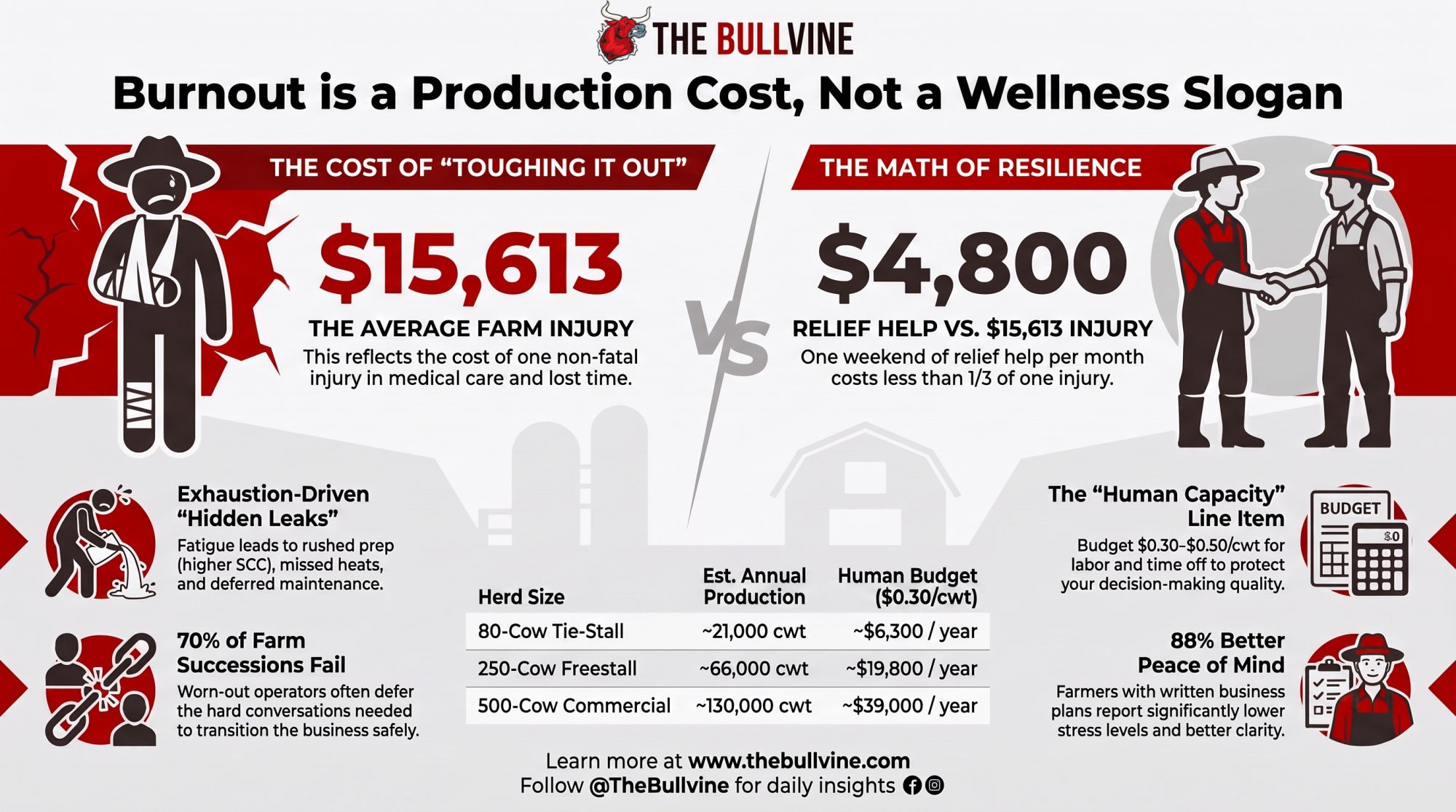
$15,613 is the average non-fatal farm injury. Relief help runs $4,800 a year. The tired 10:30 call to run the failing pump one more week is exactly how you buy the first.
Executive Summary: The average non-fatal farm injury runs $15,613 — and the tired 10:30 PM call to run the failing pump one more week is exactly how you buy one. That makes farmer burnout an unbudgeted line item sitting right next to feed and bedding, not a wellness slogan. It hits small and mid-size operations hardest: U.S. licensed herds are down 63% since 2004, and with November 2025 all-milk at $19.70/cwt, there’s no margin left to absorb an exhaustion-driven mistake — the skipped cull, the rushed prep that lifts your SCC, the contract nobody had capacity to read. The fix is a “human capacity” line at $0.30–$0.50/cwt; on a 250-cow herd that’s $20,000–$33,000 a year, and one weekend a month of relief help runs just $4,800–$5,800 — less than a third of one injury. The deeper bill is succession: only about 16.5% of family businesses reach a third generation, and a worn-out operator is the one who never has the hard conversation in time. If you can’t name the last full day off your primary operator took, that’s your signal to run these numbers against your own RHA — and read the full piece.
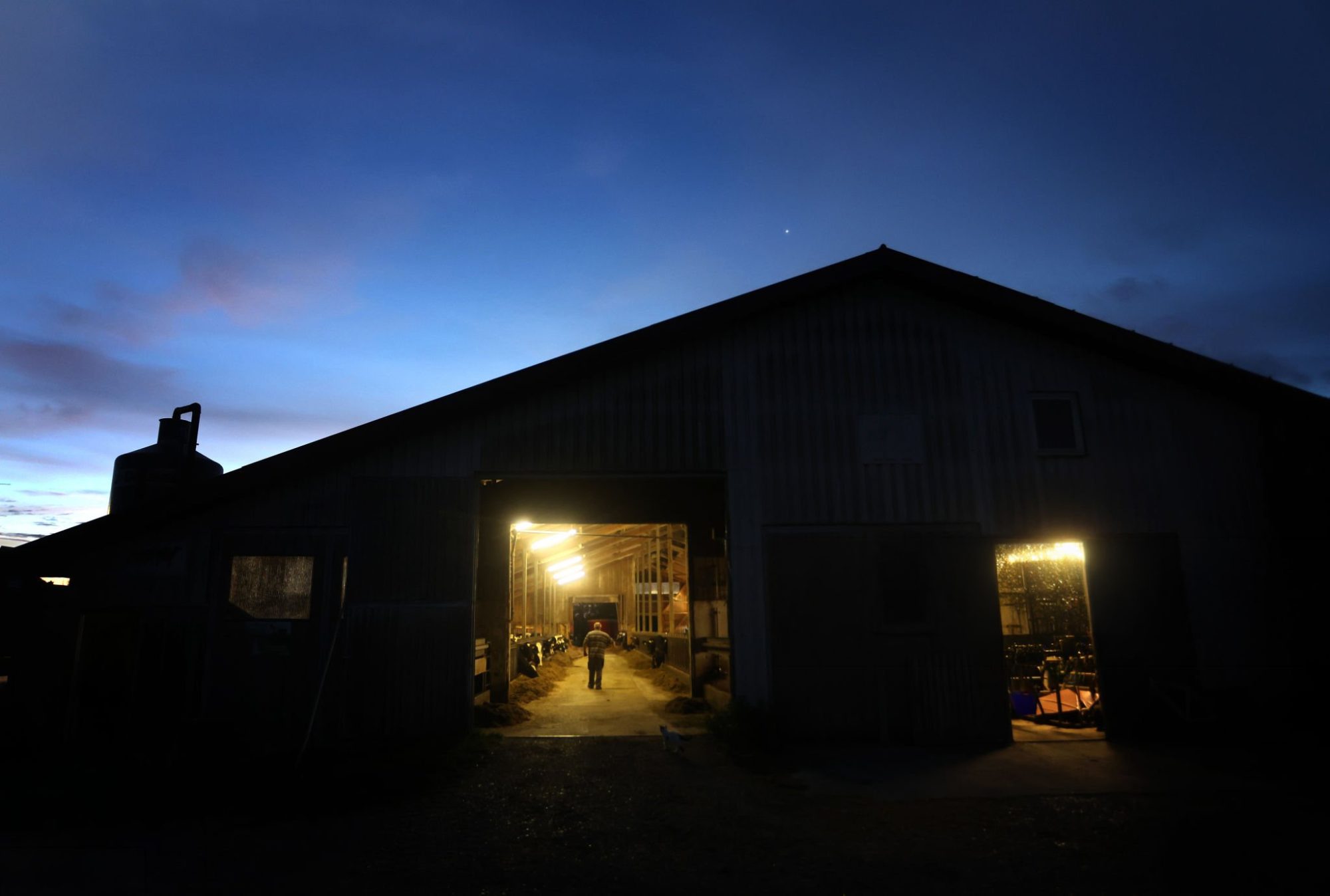
Editor’s note: The opening scene is a composite, modeled from documented patterns of stress and deferred maintenance on dairy farms, not a single real operation. Every figure and named source that follows is real and verified.
It’s 10:30 at night. The vacuum pump’s been whining for two weeks, the dealer quoted four to six grand to rebuild it, and you’re three weeks into 18-hour days because you’re a milker short. You look at the quote. You look at the calendar. You make the call: “We’ll run it one more week.” Three days later it fails mid-milking on a Saturday — you’re dumping milk, paying weekend call-out rates, and your hired hand nearly goes down in the heat trying to keep cows moving.
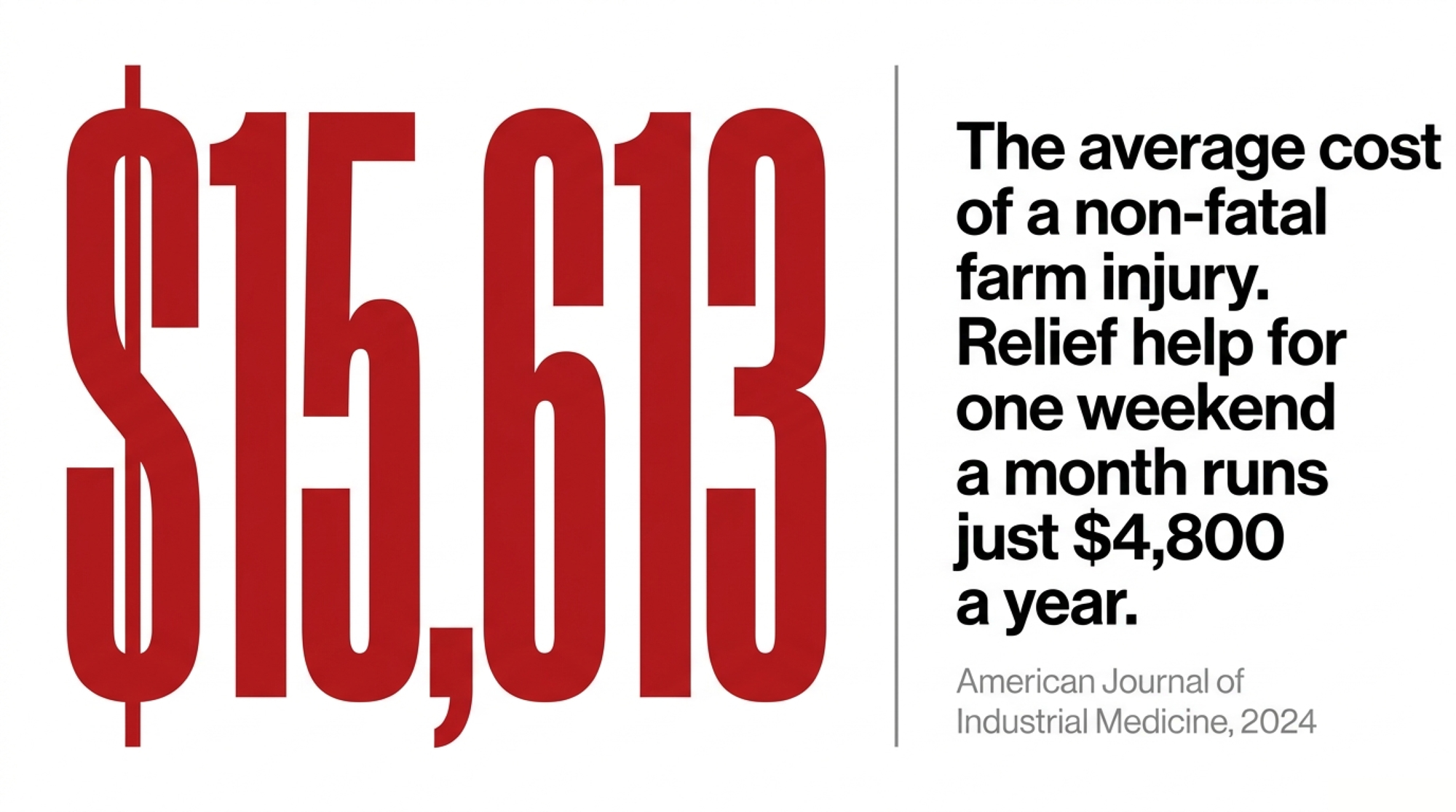
That wasn’t a strategy. That was exhaustion making the call. And it’s the clearest reason farmer mental health belongs on your cost-of-production sheet — not as a feel-good wellness slogan, but as a hard line item sitting next to feed, bedding, and power. Whether you’re shipping to a co-op in Wisconsin or operating under supply management in Ontario, the economic math of exhaustion is identical. The average non-fatal farm injury in the U.S. runs $15,613, and male farmers, ranchers, and ag managers carry a suicide rate of 43.2 per 100,000 (National Rural Health Association; CDC) — roughly two to three-and-a-half times the general population, depending on the study. Burnout isn’t soft spending. It’s expensive, and right now most operations price it at zero.
Why Farmer Mental Health Is a Cost of Production, Not a Wellness Slogan
For years the message was “it’s okay to not be okay.” True. But it bounces off a culture built on toughing it out. The sharper argument treats stress and exhaustion as production costs with dollar figures attached — the same way you’d treat a rising cell count or a feed-efficiency slip.
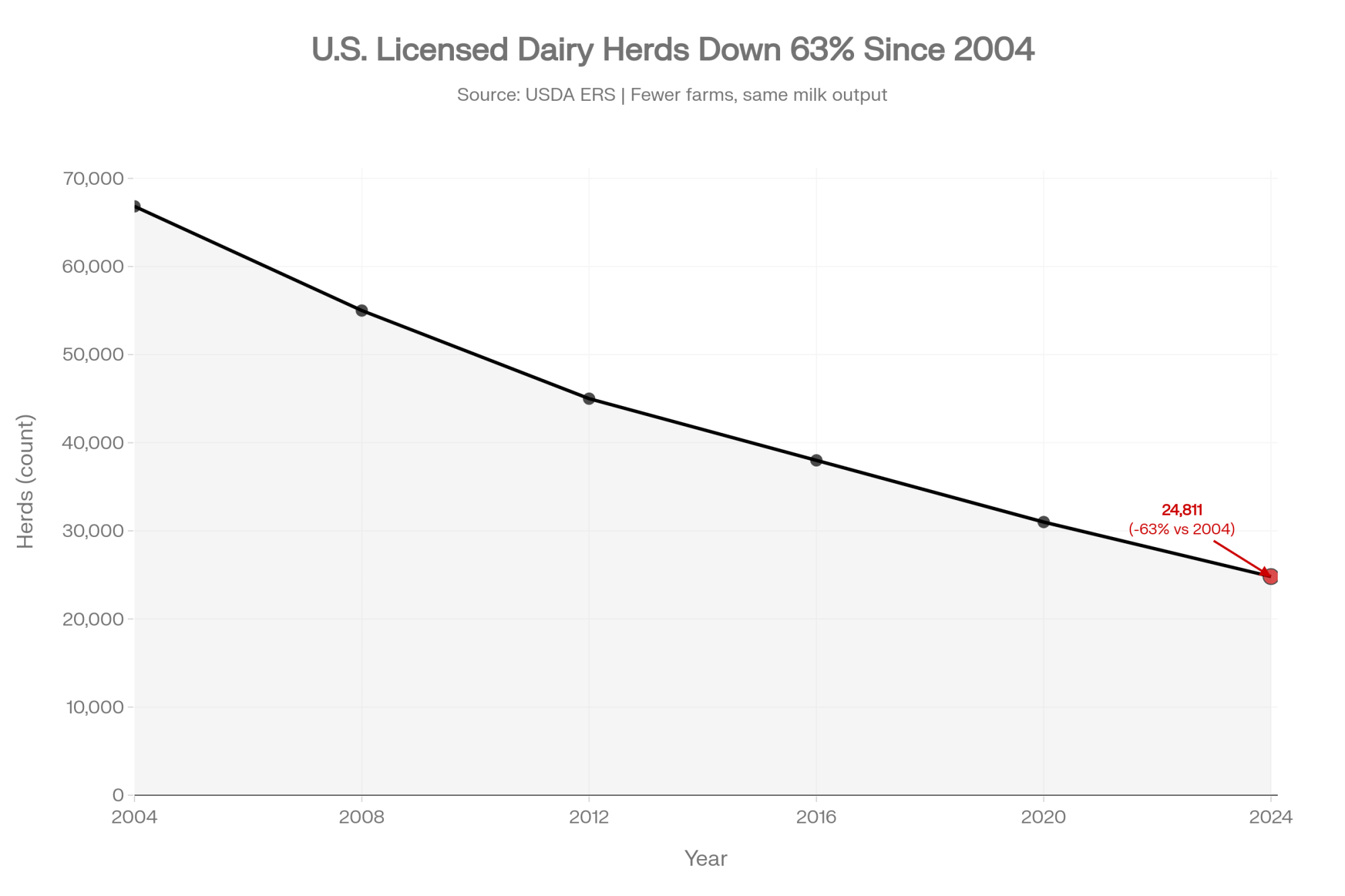
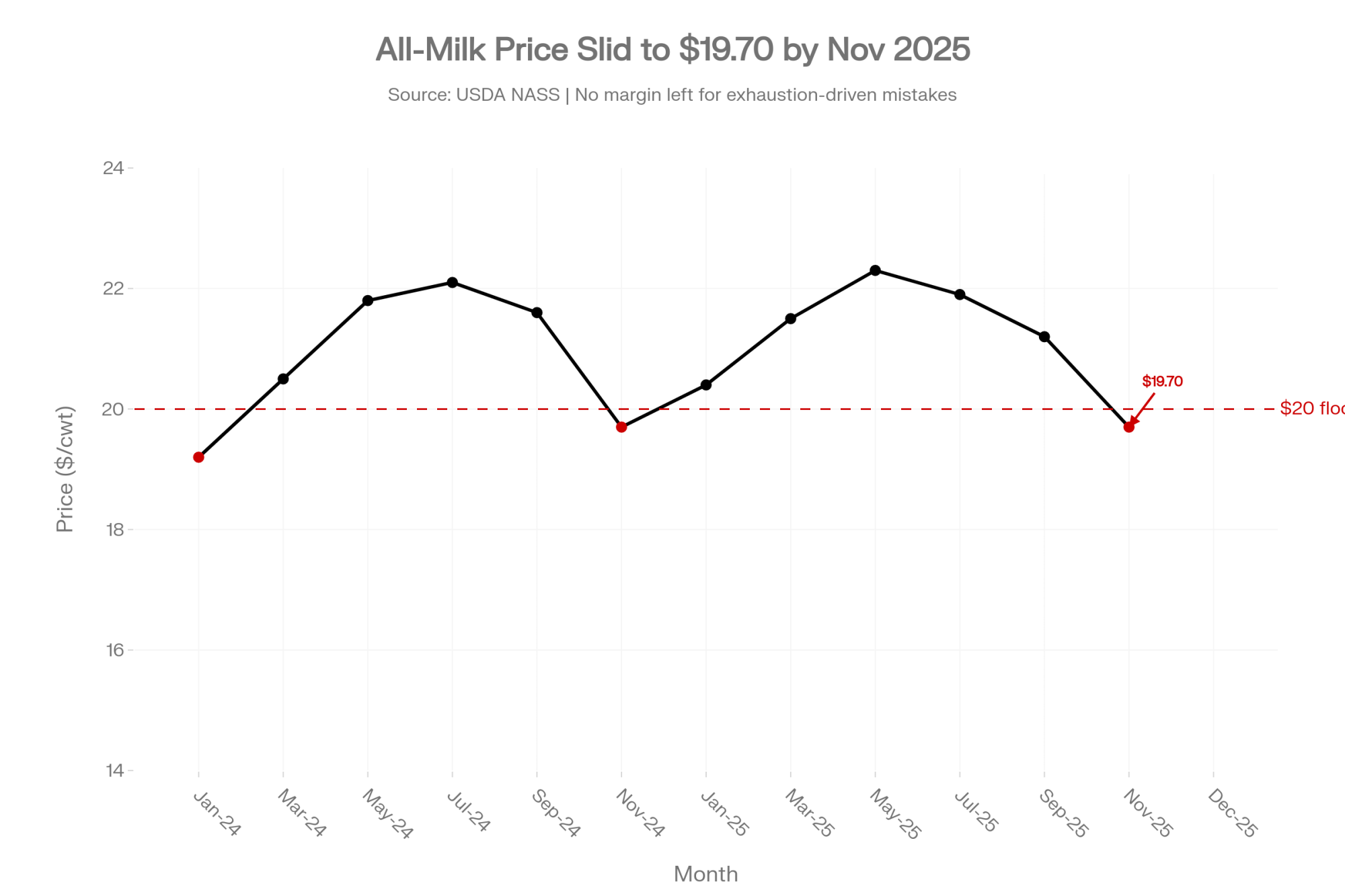
The pressure behind it is structural, not personal. U.S. licensed dairy herds fell 63% — from 66,825 in 2004 to 24,811 in 2024 — even as total milk output kept climbing (USDA ERS, “Fewer Farms, More Milk,” February 2026). And the cushion is gone. The all-milk price slid to $19.70/cwt in November 2025 — the lowest of the year and the first time under $20 since January 2024 — before Class III collapsed to $15.86 in December, down from $18.89 a year earlier (USDA NASS; Dairy Star, January 2026). The 2025 all-milk average landed near $21.00/cwt, but the back-half slide is what operators actually lived through. Fewer families are carrying more cows, more debt, and more fixed cost per person — the same grind we dug into in the real cost of 70-hour weeks.
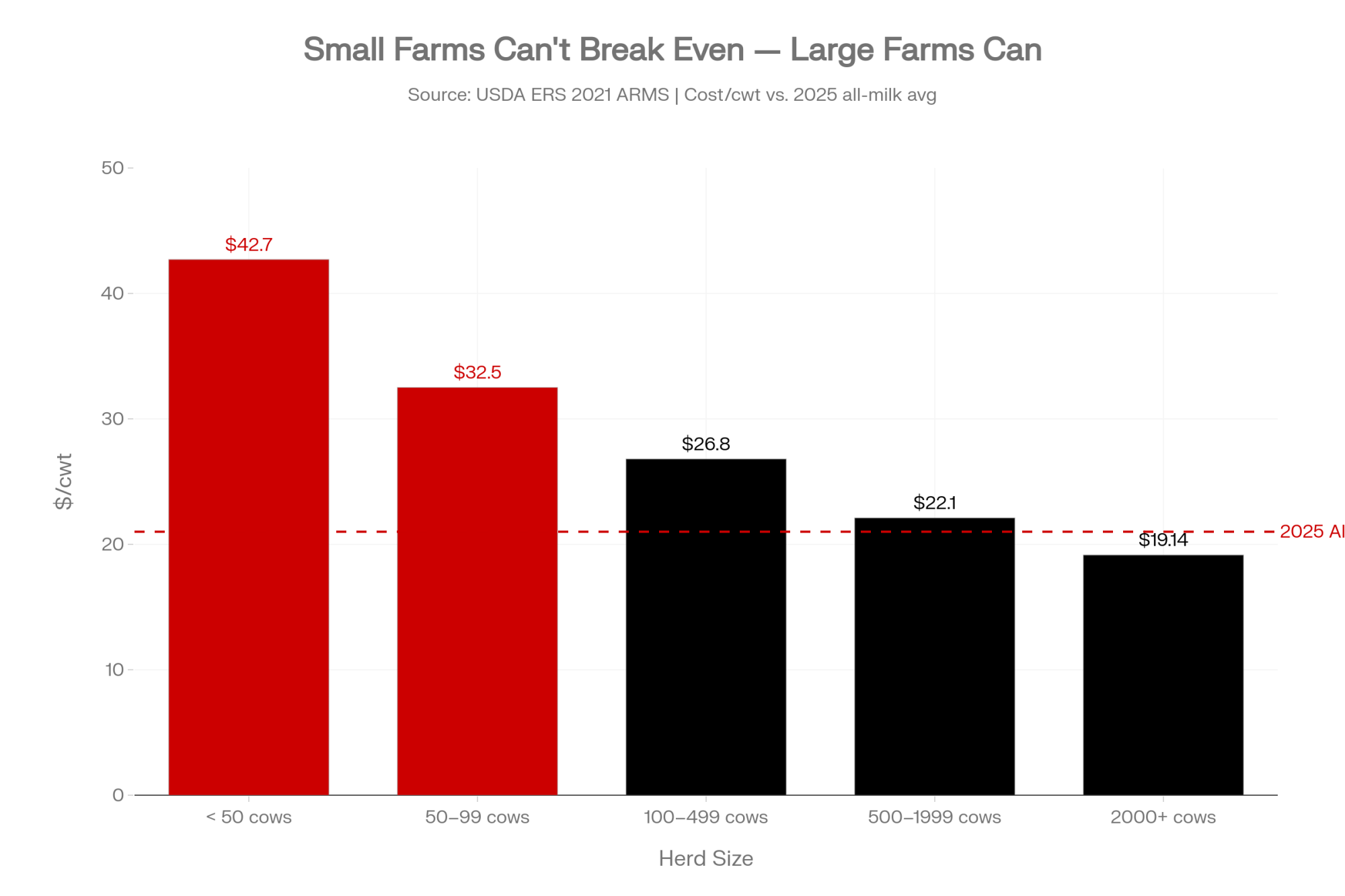
The Canadian data tells the same story from the human side. A 2020 national study from Farm Management Canada, Healthy Minds, Healthy Farms, found 75% of Canadian farmers reported being moderately to highly stressed, with the top drivers being the sector’s unpredictability, workload, and financial pressure (Heather Watson, executive director, Farm Management Canada). Who’s most exposed on either side of the border? Small and mid-size operations. USDA ERS data (2021 ARMS) put total U.S. cost per hundredweight near $42.70 for herds under 50 cows, against $19.14 for operations of 2,000-plus cows — small farms pull more revenue per cwt but can’t out-earn that gap. When your margin is that thin, one exhaustion-driven mistake — or a forced exit — becomes the most expensive thing on the place.
How This Plays Out on Real Farms
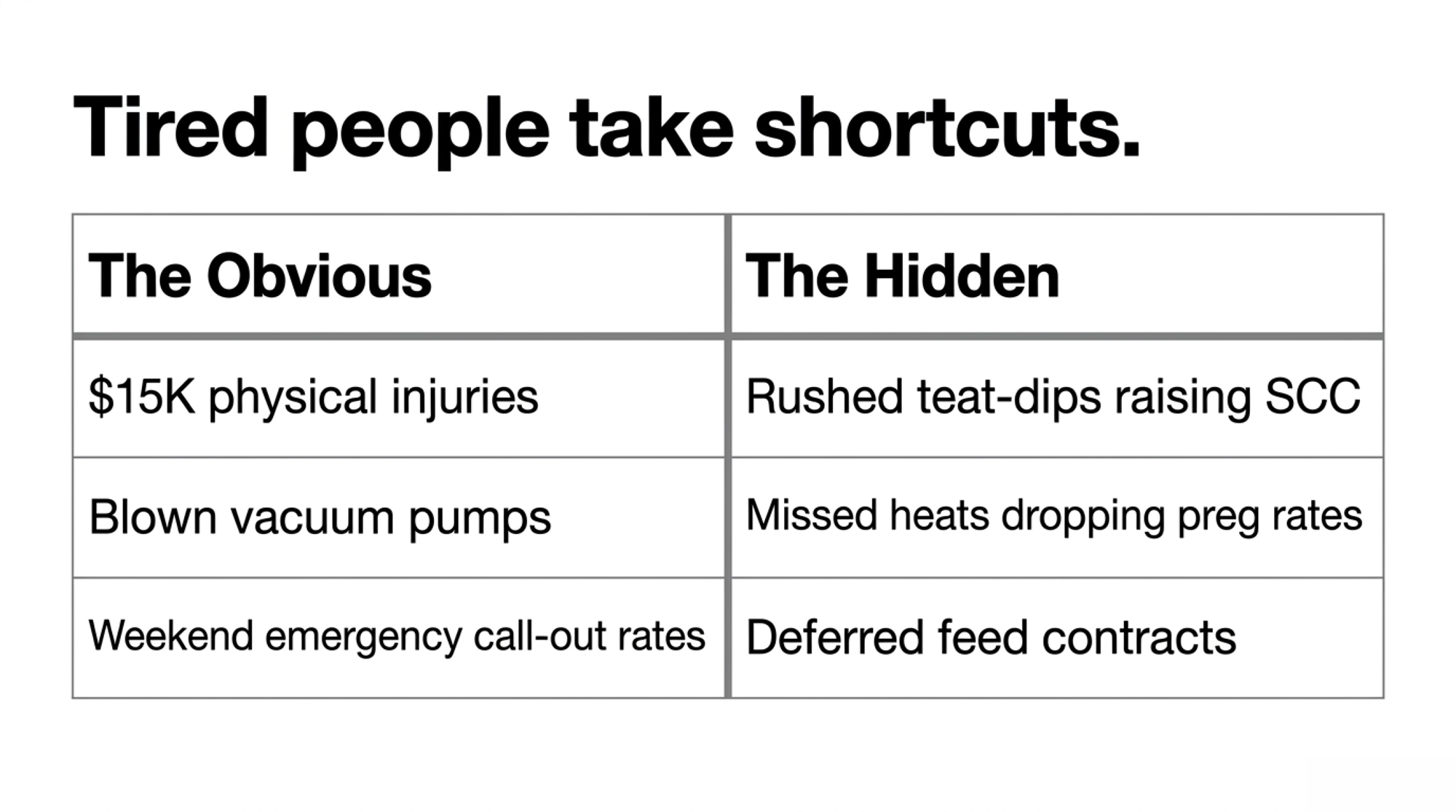
The pump scene is a composite, but the mechanism behind it is well documented. University of Wisconsin Extension’s farm-stress guidance is direct: heavy, sustained stress narrows your ability to weigh alternatives and work through complex problems — exactly the judgment a tired operator needs most. A 2024 study in Safety and Health at Workfound that farmers under high stress reported trouble making decisions and a tendency to make poor ones — rushing jobs, deferring maintenance, skipping the safety step. Tired people take shortcuts. Shortcuts cost money, and sometimes a lot more than money.
Here’s the barn math, laid out so you can find your own row:
| Herd Size | Est. Annual Production | Human Budget @ $0.30/cwt | Human Budget @ $0.50/cwt | Risk It Offsets |
|---|---|---|---|---|
| 80-cow tie-stall | ~21,000 cwt | $6,300/yr | $10,500/yr | ≈ 1 minor injury |
| 250-cow freestall | ~66,000 cwt | $19,800/yr | $33,000/yr | 1 serious injury + relief year |
| 500-cow commercial | ~130,000 cwt | $39,000/yr | $65,000/yr | Fraction of 1 blown succession |
| 1,000-cow operation | ~260,000 cwt | $78,000/yr | $130,000/yr | 2–3 average injuries + overhead |
| 2,000+ cow large | ~520,000 cwt | $156,000/yr | $260,000/yr | Full labor redundancy budget |
Table assumes a rolling herd average near 26,000 lbs per cow; lower output shifts the dollars down proportionally — run it on your own RHA.
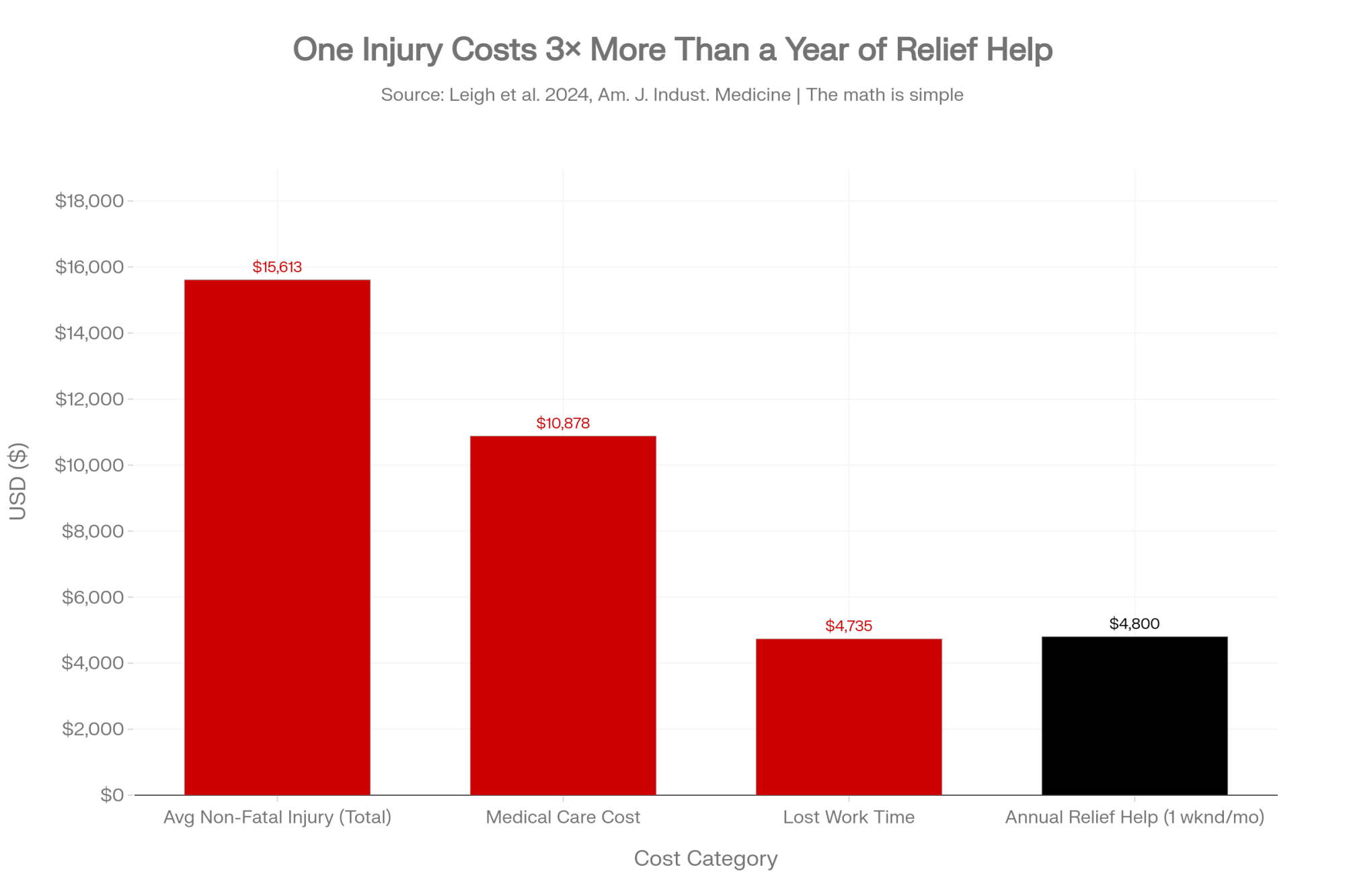
Set those numbers against the hard figure: the $15,613 average non-fatal injury cost from Leigh et al.’s 2024 estimate in the American Journal of Industrial Medicine — $10,878 in medical care and $4,735 in lost work time. Relief help for one weekend a month runs roughly $4,800 to $5,800 a year on its own (two 8-hour shifts a month at $25–30/hour, before payroll). Nationally, the same study pegs total U.S. agricultural injury cost at $11.31 billion a year — 2.1% of gross farm income and 13.4% of net farm income in 2019. You won’t see that as a tidy line on your books. But one bad day already outruns the relief help you told yourself you couldn’t afford.
Where Else the Money Leaks Out
The accident is the obvious cost. The quieter ones do just as much damage. When you’re running on fumes, the routines slip first — and the bills show up later, scattered across the operation where they’re harder to trace back to the cause.
Think about where a tired operator actually cuts corners. You shave the prep routine — less wipe time, a rushed teat-dip — and your SCC creeps up two weeks later; we broke down exactly how a rushed prep routine shows up in your tank. You’re too fried to watch the activity monitors, so heat windows slide by and pregnancy rate softens. You mix the TMR in a hurry to be done before 9:00 PM, and the ration that leaves the mixer isn’t the one you formulated. None of these show up as a “burnout” line. They show up as a higher cell count, a longer calving interval, and a feed-efficiency number you can’t quite explain.
| Burnout Behavior | What It Triggers | Measurable Indicator | Estimated Cost Impact |
|---|---|---|---|
| Rushed milking prep | Elevated SCC, mastitis | Bulk tank SCC >200,000 | $0.50–$1.50/cwt penalty |
| Skipped heat detection | Missed cycles, lower pregnancy rate | Calving interval >13.5 months | $150–$250/cow/yr |
| Hurried TMR mixing | Ration inconsistency, sorting | Feed efficiency > 1.55 lb ECM/lb DM | $75–$150/cow/yr |
| Deferred cull decisions | Carrying non-productive cows | Cull rate below optimum 25–35% | $200–$500/cow kept too long |
| Skipped vet/hoof checks | Lameness, mastitis spikes | Lameness prevalence >15% | $300–$500/lame cow event |
| No succession planning | Farm sale or forced exit | 70% fail at 1st transition | Entire asset base at risk |
Vet and cull costs creep up as routine care gets skipped, too. Business management thins out — the Farm Management Canada study (2020) found that following a written business plan improved peace of mind for 88% of farmers, yet stressed producers are the least likely to keep those plans current. And the market doesn’t wait: a contract decision deferred because nobody had the capacity to look at it is a margin you don’t get back. Succession is the biggest leak of all, because the hard conversations need an operator who isn’t worn to the nub.
The cow connection. A University of Guelph exploratory study on robotic-milking farms found associations between better farmer well-being and better herd-health numbers like lameness and mastitis. It’s an association, not proof of cause — but it runs in a direction every herd manager recognizes. Your headspace shows up in your cows, and your cows show up in your milk cheque.
How Much Does Saying “I’m Fine” Actually Cost You?
This is where the economics get personal. Stigma is still real — a 2022 American Farm Bureau Federation poll found 63% of U.S. farmers still perceived stigma around mental health in the ag community. That silence carries a price tag.
When you minimize the warning signs — “I’m just tired” — you defer the same way you defer that pump repair. The deferral feels free. It isn’t. Dr. Andria Jones-Bitton’s University of Guelph national survey (released 2021–2022) found suicidal ideation was twice as high among farmers as in the general population, and that one in four farmers surveyed reported, in the past year, that their life wasn’t worth living or that they’d thought about death or self-harm. That’s not an industry statistic. That’s a number that lives at kitchen tables — the strongest argument going that “toughing it out” is a costly habit the whole industry rewarded, not a virtue, and not something any one operator should carry alone.
If you or someone on your operation is struggling, you don’t have to wait for a crisis to reach out. In the U.S., call or text 988 (Suicide & Crisis Lifeline) or Farm Aid at 1-800-FARM-AID. In Canada, the Do More Ag Foundation lists provincial crisis lines and farmer-specific supports, and Crisis Services Canada is at 1-833-456-4566.
Would Your Kids Actually Sign Up for the Life You’re Modeling?
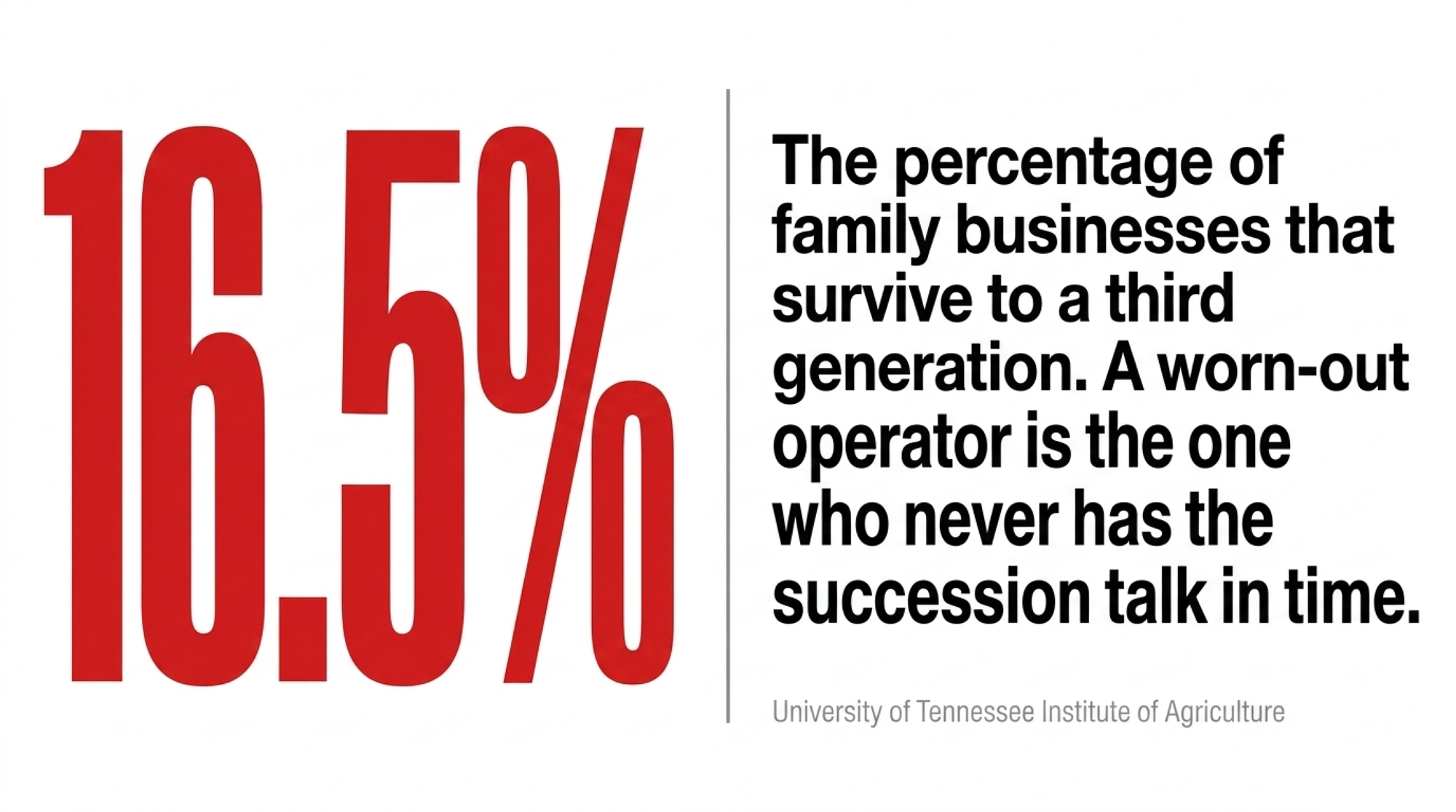
The succession math is sobering. Only about 16.5% of family businesses survive to a third generation of ownership — a general business statistic widely cited in farm-transition extension materials, including from the University of Tennessee Institute of Agriculture. Roughly 70% fail at the first transition, driven mostly by poor communication, family conflict, and inadequate successor development, not just economics. And an Iowa State University study found 71% of retiring farmers had not identified a successor at all — meaning the most common “plan” is no plan. It’s the same wall we walk through in why most dairy farms never make it past Dad.
Farm family coach Elaine Froese has made the point in her writing and talks that the next generation won’t put in the hours their parents and grandparents did — they want a real life beyond the farm by 30, not an open-ended grind. So if your kids only ever see you exhausted, your spouse resentful, and every decision a crisis, they’re not rejecting agriculture. They’re rejecting the only business model you’ve shown them. A farm worth inheriting needs sane-ish hours, a visible path to ownership, and a family culture where the hard talks happen before the auction signs go up.
Options and Trade-Offs for Farmers
No single fix here. But producers are already using a handful of practical paths — and the honest part is the catch on each one.
- Budget a “human capacity” line at $0.30–$0.50/cwt. On a 250-cow herd, that’s $20,000–$33,000 a year for relief labor, time off, or coaching. The catch: it’s a management benchmark, not a rigid standard. If $0.50 makes you choke, start at $0.15 and buy six weekends off instead of twelve. Run your own number tonight — multiply $0.30 by your annual cwt, then ask whether one injury, breakdown, or bad call in the last five years cost more than that.
- Schedule guaranteed time off — and do this within 30 days. Block one weekend a month where the primary decision-maker is genuinely off chores, and line up the relief person now, not in July. That coverage runs roughly $4,800–$5,800 a year — less than a third of one average injury. The catch: finding and trusting relief labor is the real barrier, not the cost. The going rate and the training lead time both run ahead of what most operators budget, so start the search this week.
- Automate or cut in your highest-stress zone. A feed pusher, an alley scraper, hired bookkeeping — pull load off the operator where it bites hardest. The catch: capital cost and payback swing widely by herd size and barn layout, so run your own numbers before you sign anything — the kind of math we lay out for the mid-size dairy squeeze.
- Formalize roles and start succession early. Put a wage on invisible spousal work and map a real ownership path for the next generation. The catch: these talks are emotionally loaded, and most families stall until a crisis forces the issue — the worst possible time to have them. If a successor is even a possibility, start the conversation now, and ask honestly whether the daily life on your farm is something a sane 25-year-old would choose.
One more read on your own numbers. If your SCC, pregnancy rate, or feed efficiency has drifted with no obvious barn-level cause, ask whether the operator running on empty is the variable you haven’t measured. And if you’ve deferred a maintenance, cull, or vet decision because you were “too slammed to deal with it,” treat that as a stress signal, not just a scheduling one — because margin pressure pushing you toward longer hours is exactly when decision quality matters most and is most at risk.
So sit with this one. If you traced every “we’ll deal with it later” call you made last year back to how tired you were when you made it, what would that column add up to? Not in feelings — in dollars, dumped milk, deferred culls, and the conversations you never got around to having. Pretending your brain is a free, bottomless input is the most expensive false economy on the farm. We kept the math simple here on purpose — but if you want the full cost-per-cwt model, broken down by herd-size scenarios you can run against your own numbers, it’s in next week’s Bullvine Weekly. That’s where we go straight into the ledgers.
Run Your Numbers
Farm Benchmark Snap Check — Before you decide that relief help “doesn’t pencil,” plug in three numbers and see whether your margin, debt, and feed share leave any room to absorb one $15,613 mistake — or whether you’re already in the risk band, one tired call from trouble.
Complete references and supporting documentation are available upon request by contacting the editorial team at editor@thebullvine.com.
Learn More
- Why 70‑Hour Weeks Are Killing Your Dairy Profits — Captures up to $67,500 in avoidable fatigue-driven losses by applying a strict 51-hour weekly cap. This breakdown delivers clear operational tactics to eliminate silent leaks from missed heats, ration drift, and elevated employee turnover.
- Robots Won’t Save Your Dairy If You’re Alone: 5 Hard Truths About Labor and Robotic Milking ROI Under 500 Cows — Dismantles the fantasy that automated milking systems solve labor isolation independently. Learn the five structural benchmarks mid-size operations must hit before signing a contract, balancing capital debt service against a realistic $28 per hour labor threshold.
- Who Really Owns Your Dairy? Three Ways to Stop Divorce and Succession Turning Unpaid Spousal Work into a Land Sale — Exposes the hidden corporate liabilities threatening generational equity when co-management roles remain informal. Protect your farm from forced liquidations and catastrophic asset division by formalizing partnership shares, wages, and clear kitchen-table business structures.
The Sunday Read Dairy Professionals Don’t Skip.

Every week, thousands of producers, breeders, and industry insiders open Bullvine Weekly for genetics insights, market shifts, and profit strategies they won’t find anywhere else. One email. Five minutes. Smarter decisions all week.




