








Storm Éowyn ripped 200 kg DM/ha off John Casey’s spring grass. He still milked 540 kg solids off 136 Kerry cows — because the resilience was bred and built in years earlier.
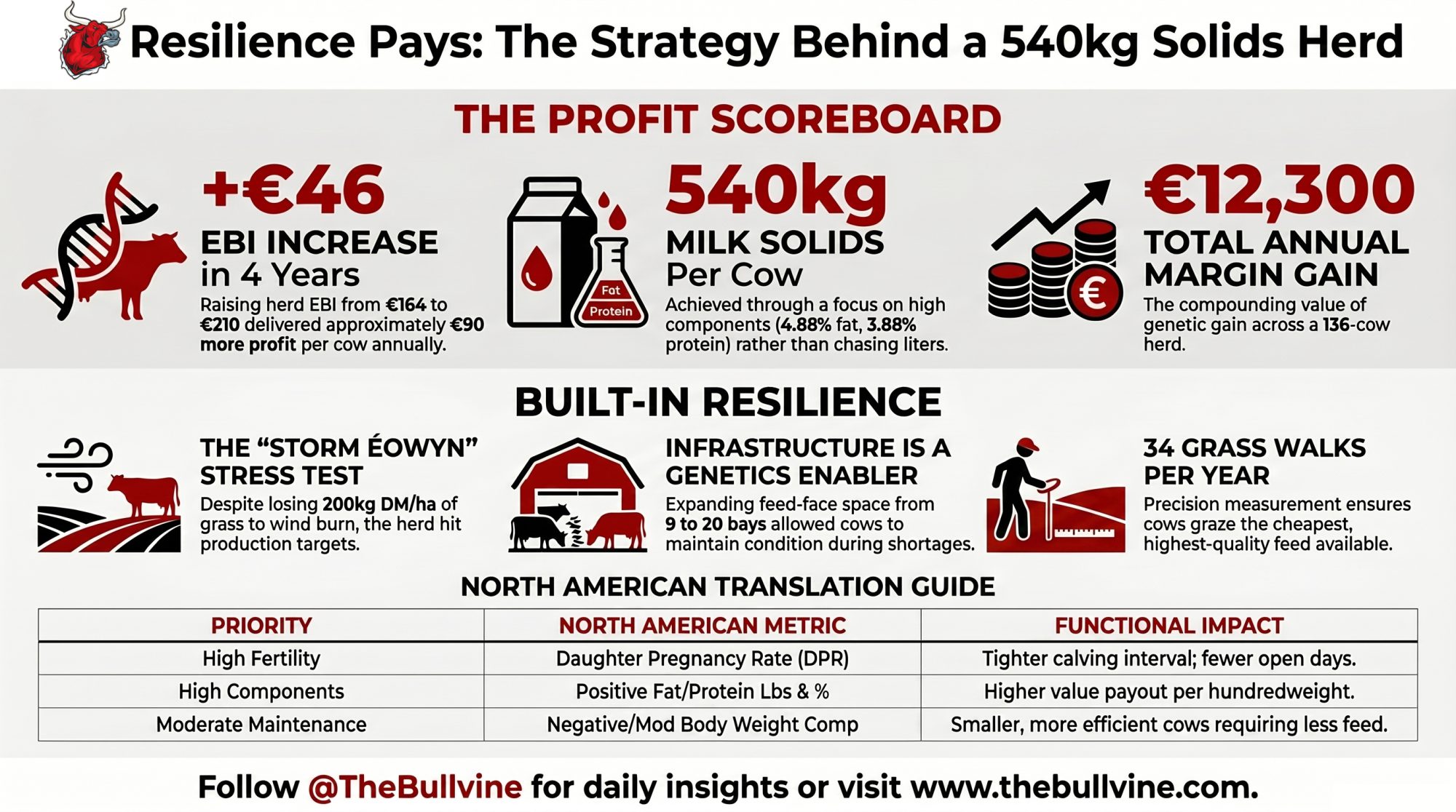
Executive Summary: Over four years, John Casey and his father Michael lifted their Causeway, Co. Kerry herd from €164 to €210 EBI while pushing milk solids from 477 to 540 kg/cow off 136 cows — enough to win Kerry Dairy Ireland’s 2025 Milk Quality and Sustainability Award against 3,000-plus suppliers. They bred for fertility and components first, litres second: 4.88% fat, 3.88% protein, SCC of 108,000, and a 90% three-week submission rate this spring. Run Teagasc’s €1.96-per-EBI-point multiplier on that €46 gain and you’re looking at roughly €90/cow/year, near €12,300 across the herd, compounding into every replacement heifer they keep. The proof it’s real resilience and not a fluke: storm Éowyn cut their spring grass cover from 850 to 650 kg DM/ha in early 2025, and they still hit 540 kg solids because the genetics, the grass discipline, and a feed face rebuilt from 9 to 20 bays gave them room to absorb the hit. None of it was dramatic — just ordinary decisions stacked for a decade. If your check pays on solids but you’re still chasing volume, this is the herd that shows what the other strategy’s worth. The euro figures are Irish and grass-based, but the logic maps straight onto NM$ / CM$ selection in any component market.
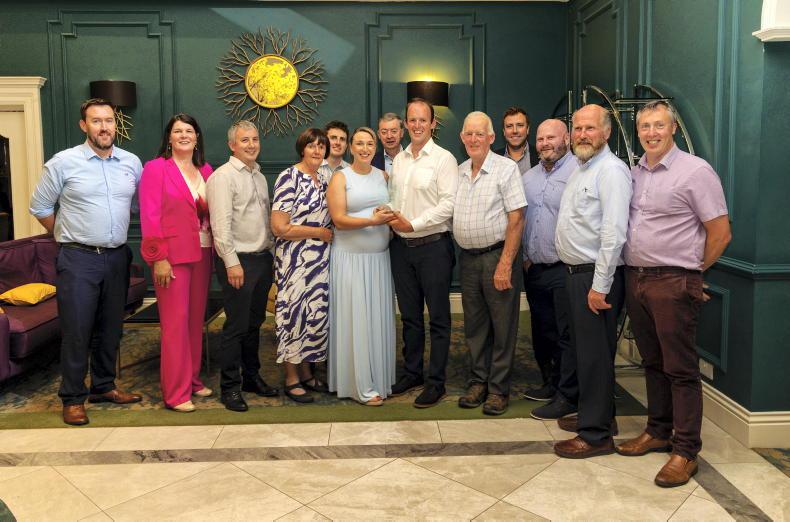
John Casey spent the last decade putting his money into the unglamorous stuff. Soil fertility. Drainage. Reseeding. Breeding. None of it turns heads at the mart. But in August 2025, that decade of quiet spending put the Casey family of Causeway, Co. Kerry, at the top of Kerry Dairy Ireland’s supplier base of more than 3,000 farmers — winners of the 2025 Kerry Dairy Ireland Milk Quality and Sustainability Award.
Here’s what should land for you, wherever you milk cows. Nothing they did was dramatic. No genomic moonshot, no overnight overhaul. Just a string of ordinary decisions, each one easy to put off — and each one compounding until the milk check told a different story than it had four years earlier.
That’s the part worth your time. Not the trophy. The decisions behind it — and what each one was actually worth.
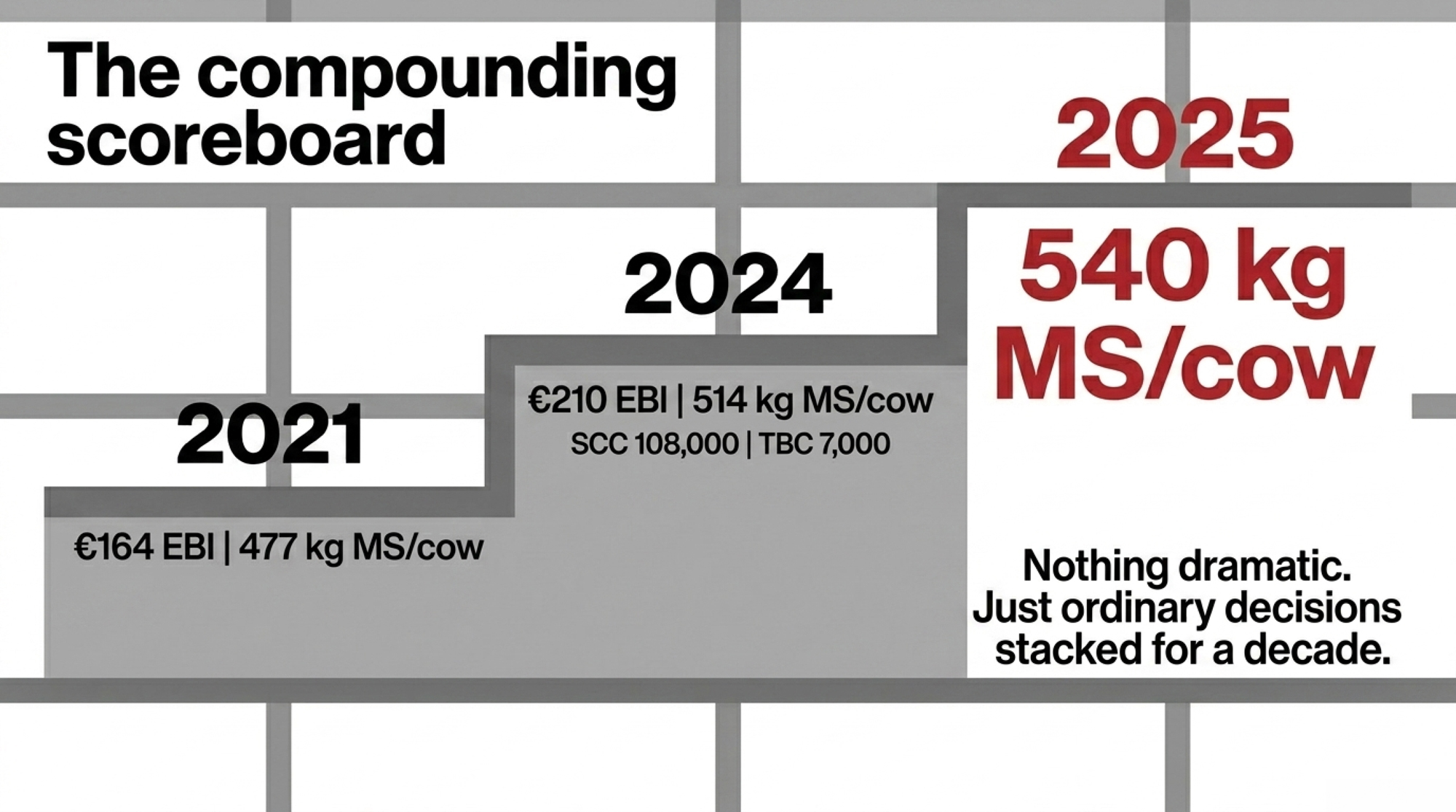
The Casey scoreboard, four years apart 2021: €164 herd EBI · 477 kg MS/cow 2024: ~€210 herd EBI · 514 kg MS/cow · 4.88% fat · 3.88% protein · SCC 108,000 · TBC 7,000 2025: 540 kg MS/cow off 136 cows
A Farm Two Generations Built
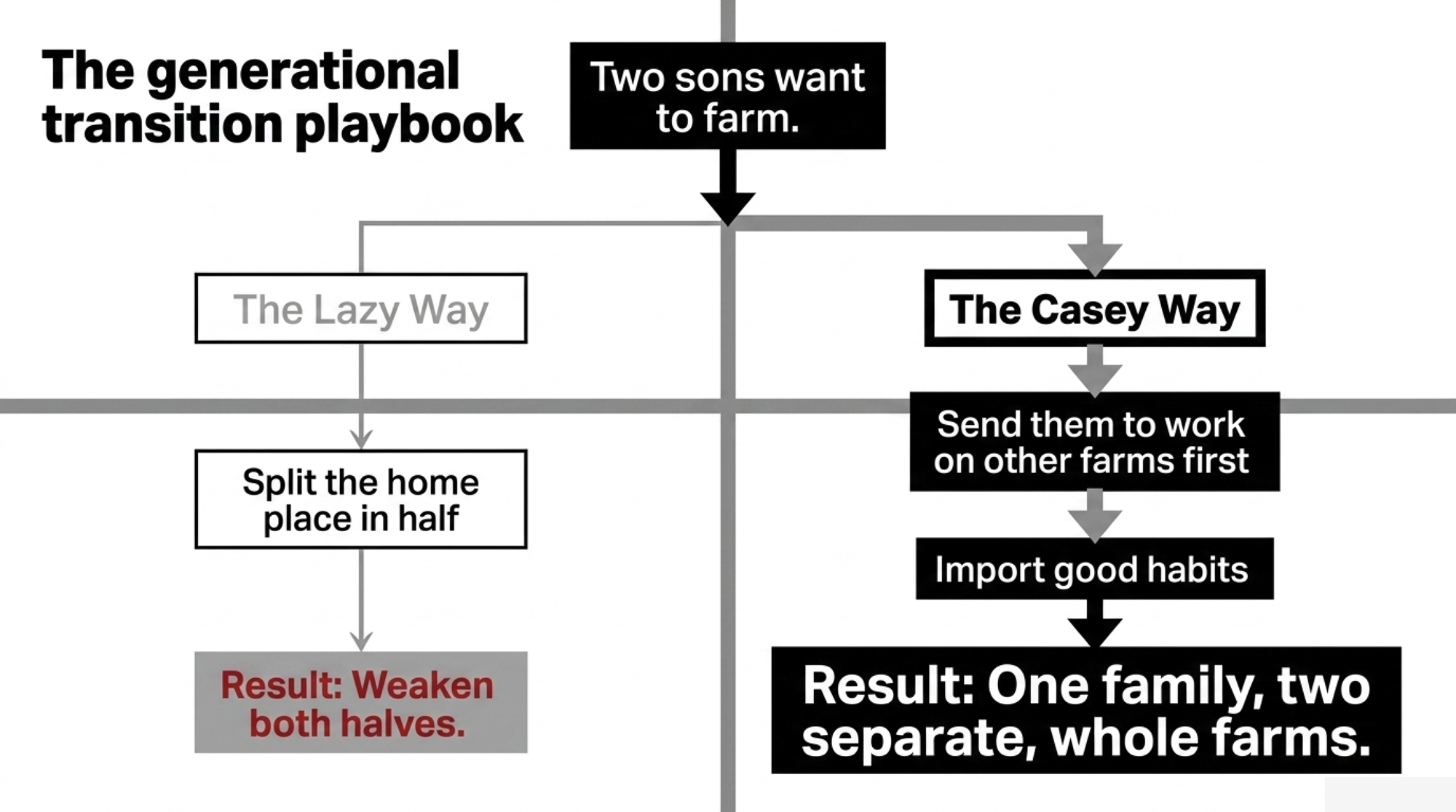
John came home for good at the end of 2014, to a farm his father, Michael, had already spent years shaping. He didn’t walk in and tear it up. He worked other farms first, learned what good looked like somewhere else, then brought it back to Causeway.
That sequencing is the family’s actual headline advice to young farmers, delivered straight to the crowd that showed up to their farm walk: build up as much experience as possible by working on other farms and businesses before you start on your own. It sounds soft until you watch how it plays out. The habits John picked up elsewhere — labour efficiency, good genetics, measuring grass, breeding a cow that fits the system — are exactly the habits that built the award herd. He didn’t invent them at home. He imported them.
It’s a working partnership now, not a clean handover. John farms the home place alongside his father, Michael, and the operation still runs under both their names on the Teagasc–Kerry Agribusiness joint demonstration programme. Michael built the base this whole story stands on — the land, the early herd, the standing that lets a young farmer borrow against a plan instead of a hope.
Then there’s the brother. Micheál Casey took a 15-year lease on a farm at nearby Ballyheigue at the end of 2023 and now farms in his own right. That’s the part most families get wrong. Faced with two sons who both want to farm, the lazy answer is to split the home place in half and weaken both halves. The Caseys didn’t. One family, two farms, the same playbook running on separate ground.
What Did the Award-Winning Numbers Actually Look Like?
Start with the scoreboard. In 2024, the herd produced 514 kg of milk solids per cow — then John pushed that to 540 kg MS/cow in 2025, off 136 cows. The milk quality behind the award was just as sharp: a somatic cell count of 108,000 cells/mL and an average TBC of 7,000 cfu/mL. Fat at 4.88% and protein at 3.88% place them in the top tier among Kerry Dairy Ireland suppliers for both components.
Those aren’t one-good-year numbers. They’re the kind you build toward, season after season, where each year’s gain sits atop the last instead of replacing it. (The award coverage in August 2025 cited 517 kg MS for the same 2024 year; the June 2026 farm-walk figure of 514 kg is the later restatement and the one used here.)
Four years before the award, the herd EBI sat at €164, and the cows produced 477 kg MS. By 2025, the herd EBI stood at €210 — €83 in the fertility sub-index and €71 in the milk sub-index. Steady, deliberate progress. Not a leap.
Look at where the EBI weight sits, and you can read the family’s whole philosophy off it. The fertility sub-index outweighs the milk sub-index. They bred first for a cow that goes back in calf on time and holds her condition on grass, and second for the litres. In a spring-calving, grass-based system, that ordering isn’t sentiment — it’s survival. A cow that misses her breeding window in that system isn’t a slightly less profitable cow. She’s a passenger.
How Do You Lift Herd EBI by €46 — and What’s It Worth in Your Tank?
This is the decision that pays the rent, and it’s the one most worth copying.
The Caseys leaned into good genetics over the years, breeding for components and the kind of moderate, hard-wearing cow that holds condition on a grass platform. The goal was never to fill more litres in the bulk tank. It was more solids per cow and tighter fertility. That €83 fertility sub-index tells you exactly where the weighting sat, and the discipline shows up at breeding: in a June 2026 video from the farm, three weeks into the season, John reported a 90% submission rate in the first three weeks — hitting the target the best grass herds chase every year.
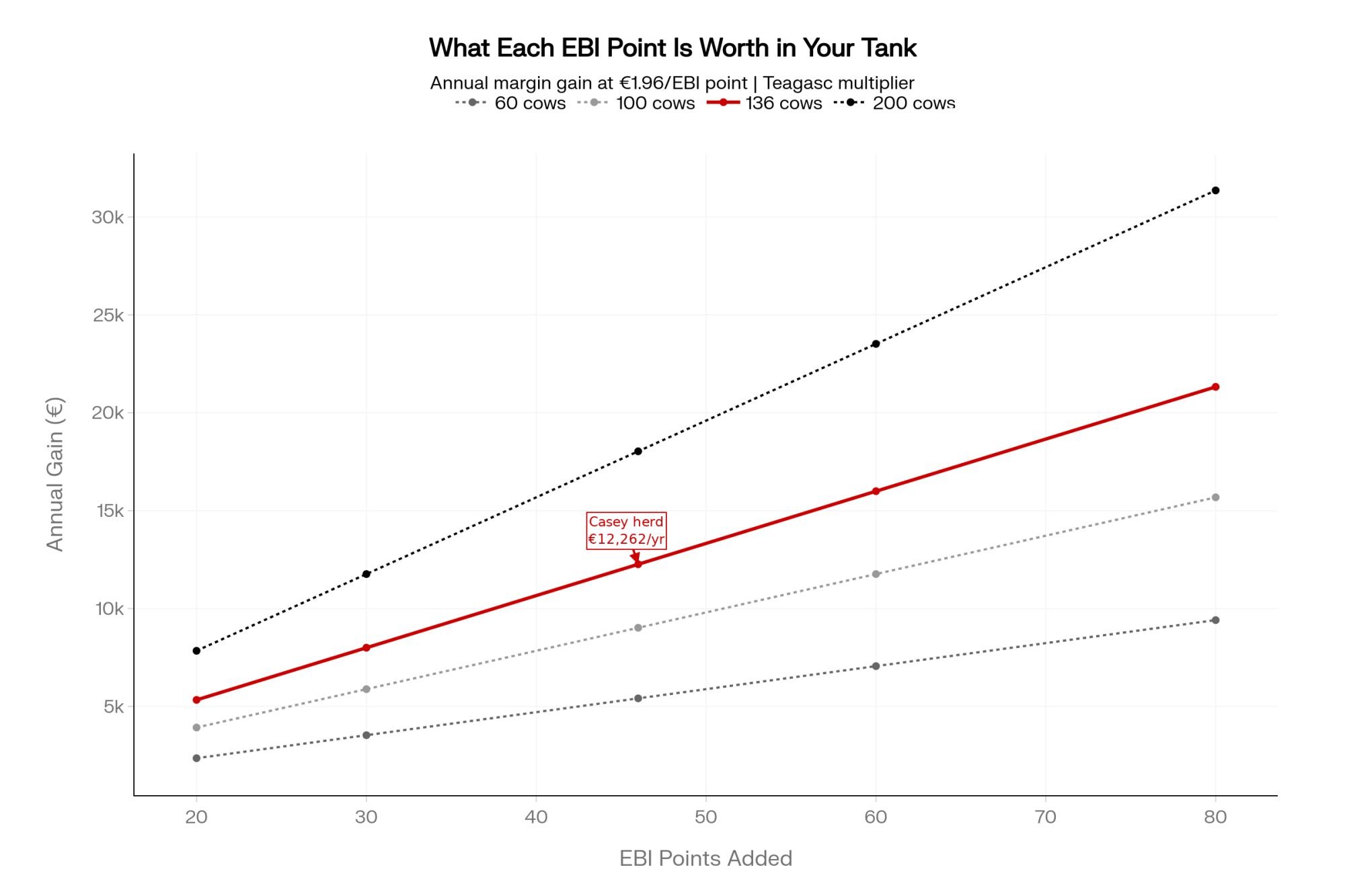
Now run the barn math, because this is where it gets real. Teagasc research, confirmed again by ICBF in late 2024, puts every €1 of herd EBI gain at about €1.96 in extra net profit per cow per year. The Caseys added €46 of EBI in four years. At €1.96 per euro, that’s roughly €90 per cow per year in additional margin from the genetics alone.
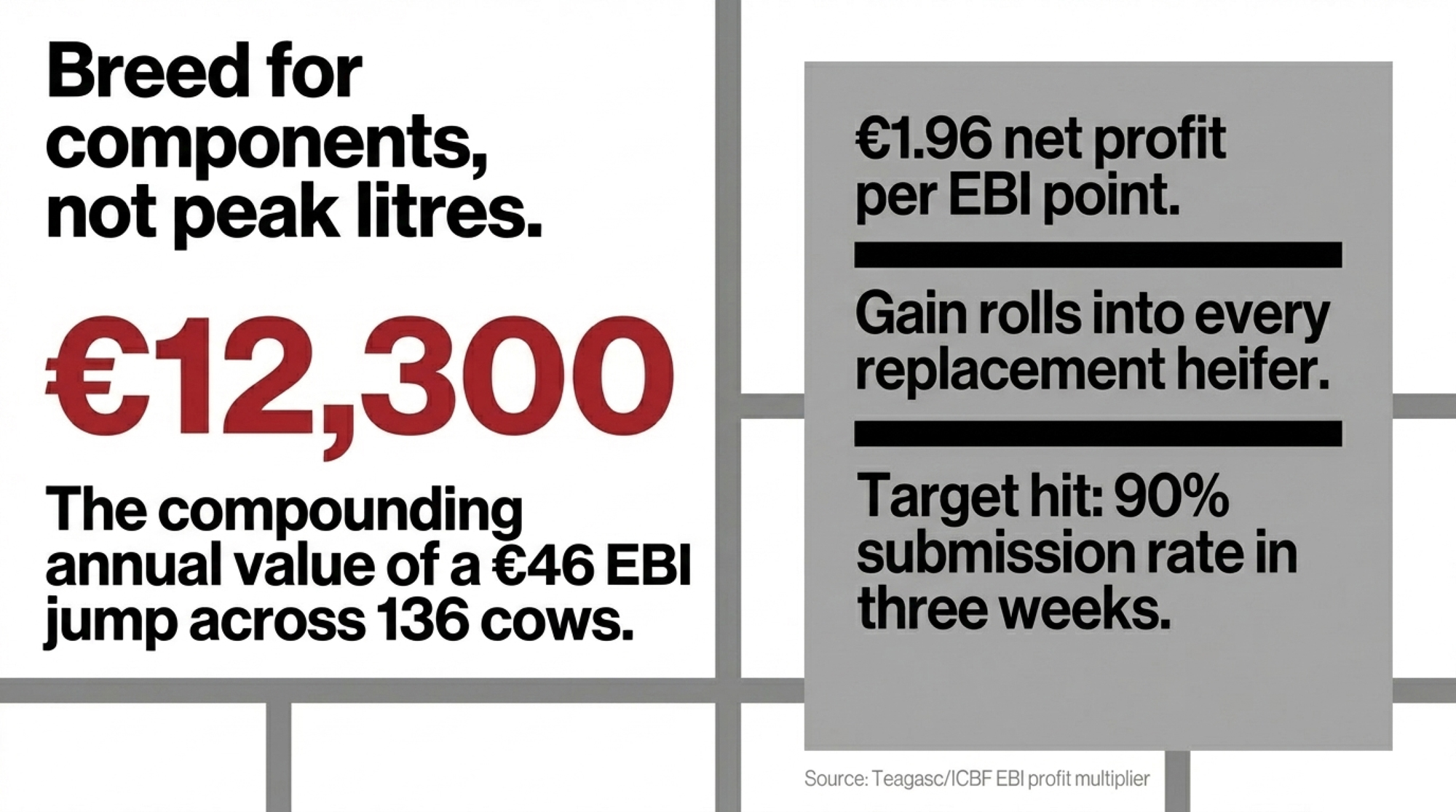
Run that across John’s 136-cow herd — €90 × 136 — and you’re looking at roughly €12,300 a year, compounding, as a directional figure built on Teagasc’s per-cow multiplier, not a line pulled from the Caseys’ accounts. And the word “compounding” is doing real work there. That €46 of EBI doesn’t evaporate at year-end. It’s baked into every replacement heifer the herd breeds from here forward, so the gain rolls into next year’s calf crop and the one after that.
One honest caveat: that €1.96 multiplier is an Irish EBI figure tied to a grass system. The principle travels straight to NM$ and CM$ selection in North American herds, but the exact euro value doesn’t — so model your own index, on your own ration, not theirs.
That’s the whole point. Genetics isn’t a trade you win in one breeding season. It’s compound interest. The cost of waiting stays invisible right up until you total it.
What Do the Components Mean if You’re Paid in Dollars Rather Than Euros?
Fair question, and it matters more than most North American producers give it credit for. The Caseys are paid for fat and protein. So are you — if you ship into a Class III or Class IV pool — butterfat has carried an outsized share of the U.S. milk check in recent years, and protein isn’t far behind.
So translate their 4.88% fat, 3.88% protein into your world. A cow built for components on a grass platform is the same animal a butterfat-driven check rewards in Wisconsin or Ontario — moderate frame, high solids, good feet, breeds back. The trait stack the Caseys chased through EBI is the same one NM$ leans on through its fat- and protein-dollar spend. Here’s the index map:
| Irish EBI Priority | North American Counterpart (NM$ / CM$) | Visual / Functional Impact in the Herd |
| High Fertility Sub-Index | High Daughter Pregnancy Rate (DPR) / Cow Conception Rate (CCR) | Calving interval tightens; fewer open days; cow stays in the optimal milk-curve window. |
| High Fat & Protein % | Positive Fat Lbs / Protein Lbs & % traits | Smaller volume of fluid milk to haul, but a higher-value payout per hundredweight (cwt). |
| Moderate Maintenance | Negative/Moderate Body Weight Composite (BWC) | A smaller, more efficient cow requiring less feed intake just to maintain her frame. |
Mapping is directional — EBI and NM$ / CM$ weight traits differently, so treat this as a translation guide rather than a one-to-one conversion.
Different index, same cow. Where it stops translating is the feed system. The Caseys get those components from grazed grass at a low meal input — feeding around 4 kg of meal a day in early 2026, well under herd-mate farms that are pushing 6 kg or more. Pull that same genetic cow into a high-input confinement TMR and the economics shift — you’ll likely get more litres and a different cost structure. The cow travels. The system doesn’t. Know which part you’re copying.
Does the Grass and the Concrete Really Move the Needle?
Genetics sets the ceiling. Management decides whether you ever reach it.
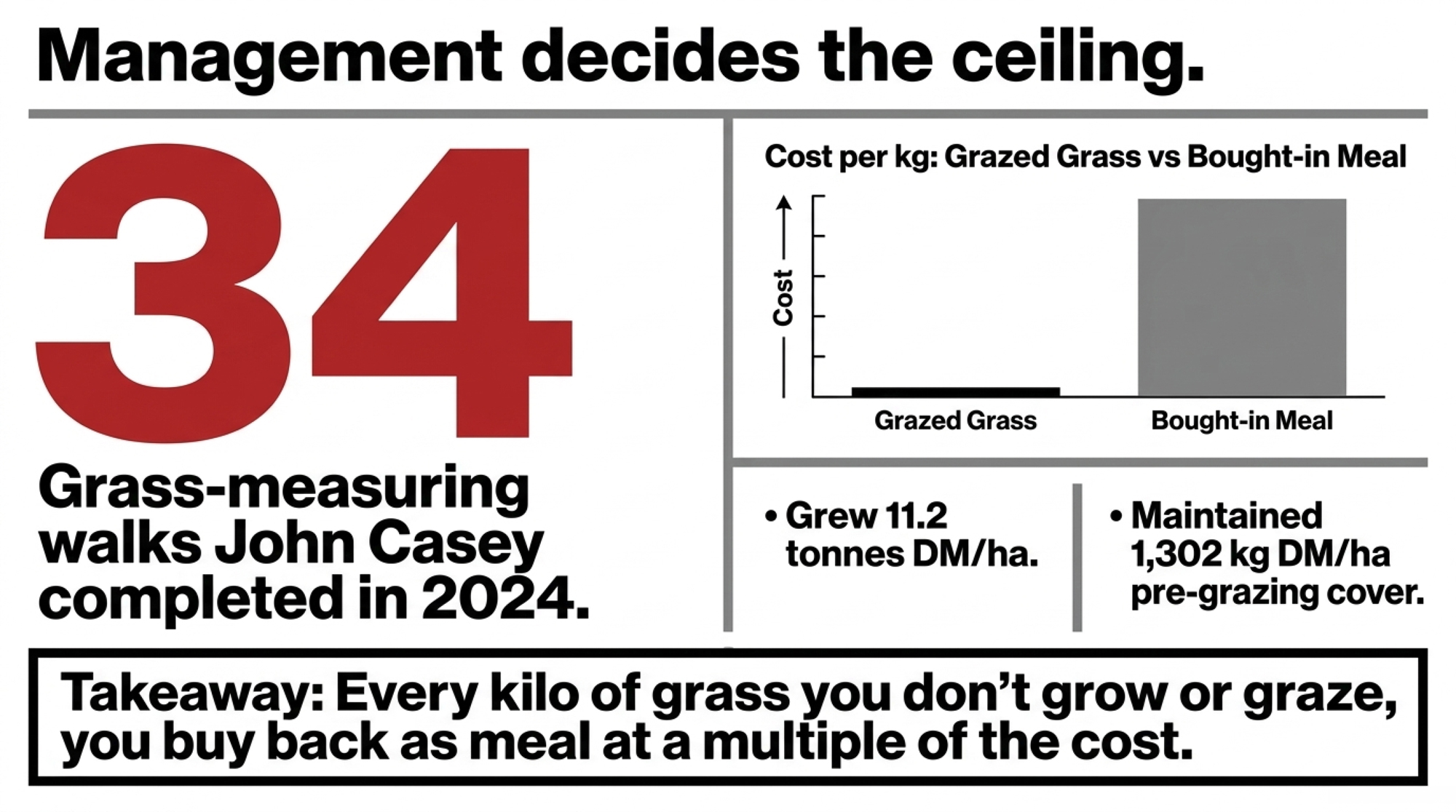
First, grass. John did 34 grass-measuring walks in 2024, grew 11.2 tonnes of dry matter per hectare, and maintained an average pre-grazing cover of 1,302 kg DM/ha. He pushes to get grass into cows early in the year, when cheap grazed grass does the most work for solids and costs a fraction of bought-in feed. That’s not a hobby. It’s the cheapest feed on the place, measured and managed like the asset it is.
Thirty-four walks a year sounds like a lot until you price the alternative. Every kilo of grass you don’t grow or don’t graze, you buy back as meal or silage at a multiple of the cost. The walking isn’t busywork. It’s how you find the free feed before it goes to waste in a paddock heading out.
Then concrete. The Caseys reworked the yard to add feeding space, taking the number of feeding bays from nine to 20so every cow could eat at once. John tied that change straight to keeping cows adequately fed through a tough grass year. Slower bottlenecks at the feed face, better-fed cows holding condition, more solids in the tank — that was the return he was after, and it’s a return you can’t breed for. You have to build it.
When the Atlantic Sends a Bill
The Casey farm sits within 500 metres of the sea, tucked into the north Kerry coastline, looking across at Loop Head, with some paddocks running right out to the cliff top. There are advantages and disadvantages to that. Storm Éowyn, in January 2025, was firmly in the disadvantage column.
John put the cost in plain numbers: “In autumn 2024, we closed up with an average farm cover of 850kg DM/ha, and we opened up in spring 2025 with a cover of 650kg DM/ha. That was due to storm Éowyn in January 2025.” That’s a 200 kg DM/ha hole in his spring grass wedge — the difference between turning cows out onto a full plate and onto a thin one. He’s clear it was wind burn rather than salt burn: “It’s not that we’d get salt burn as such, but it’s more wind burn,” he said, with a couple of exposed paddocks getting a bit of extra fertiliser to help them recover.
To cover the lost grass, he fed a bit more meal and leaned on the extra feed-face space he’d just built.
The Strategy Lesson: A severe storm erased 200 kg DM/ha of spring grass cover. In a fragile system, that’s a financial emergency. In a resilient system backed by concrete and genetics, it’s a minor speedbump.
That’s the quiet lesson in it. The infrastructure decision, the genetics decision, and the grass discipline all bought him room to absorb a hit that would’ve knocked a thinner operation sideways. He still hit 540 kg MS/cow that year. A storm took 200 kg of cover off his spring, and the system barely flinched. That’s what the compounding actually buys you — not just more milk in a good year, but resilience in a bad one.
Options and Trade-Offs for Your Breeding Program
The Casey playbook isn’t Irish-only. The system runs on grass, EBI, and spring calving, but the underlying logic is the same as that driving NM$ and CM$ selection in North American herds. Here’s how their decisions become paths you can actually choose.
Breed for components and fertility, not peak litres. This works if your milk check pays on fat and protein — Kerry Dairy Ireland does, and so does the U.S. Class IV structure. The trade-off is real: you give up some bulk-tank volume for a cow that holds condition and breeds back on time. If you’re paid on solids but still chasing litres, you’re optimizing for the wrong number, and your breeding decisions are quietly working against your milk check.
Treat infrastructure as a genetics enabler, not overhead. Adequate feed-face space and cow comfort are what let a high-EBI cow actually express what she’s bred for — John’s nine-to-20 feed-bay change is the cheap version of that lesson. Skip it, and your best-bred cows go short at the feed face in a tight year and never pay back what you spent on the straws. The semen invoice and the concrete invoice are part of the same decision.
The 30-Day Move: Pull up your processor’s sustainability scheme this week, read the measures line by line, and enroll in every one you already qualify for before the next deadline closes. The money is sitting there for the farms disciplined enough to claim it.
Get into your processor’s sustainability program now — this month. Kerry Dairy Ireland — rebranded as Kinisla in May 2026 — runs its Evolve RegenDairy programme, which pays farmers for measures such as grass management, protected urea, low-protein feed, and lime; at launch in 2022 the scheme was worth up to about €2,000 for an average herd, and the payment band has since been revised. Whatever scheme your processor runs, the move is the same. The farms banking these payments now tend to be the same ones that moved early on EBI and grass measurement. The discipline travels — and so does the habit of acting before you’re forced to.
Key Takeaways
- If your herd EBI has been flat for three years, your trajectory is the problem — not today’s number. The Caseys added €46 of EBI in four years. Where will yours sit in 2029 if you do nothing different?
- If you’re paid on components, stop selecting for peak milk. A modeled €90/cow/year swing came from breeding for solids and fertility, not volume — and across 136 cows, that’s roughly €12,000 a year that compounds into every replacement heifer you keep.
- If cows are going short at the feed face in a tight grass year, the fix may be concrete rather than semen.John’s jump from nine to 20 feed bays is what let his cows hold condition when storm Éowyn cut his spring cover by 200 kg DM/ha.
- If you’ve got two kids who both want to farm, don’t split the home place in half. The Caseys put John on the home farm and Micheál on a separate 15-year lease at Ballyheigue — two whole operations instead of two half ones.
- If you’re handing a farm to the next generation, send them away first. The family’s own best advice wasn’t about cows. It was to build experience elsewhere before coming home to run the place.
Where Does Your Herd Sit?
The thing about the Casey story is how unspectacular it is up close. No single decision would’ve made a headline the day it was made. The headline only shows up when you stack a decade of them together — a father who built the base, a son who came home and kept compounding, and a brother now running the same playbook on his own ground at Ballyheigue.
So here’s the honest question to sit with tonight: which of these moves — the EBI push, the grass discipline, the feed-face rebuild — have you been putting off because it didn’t feel urgent this week? Urgent and important aren’t the same thing, and the Caseys spent ten years betting on important. If you want to run the per-cow math behind a 40-to-50 point index jump on your own herd — mapping your specific milk check structure against your actual feed costs — that’s the kind of modeling we break down in The Bullvine Weekly. Bring your own herd sheets. That’s where this story stops being about Kerry and starts being about your bottom line.
Run Your Numbers
Component Value Tracker — The Caseys bred for 4.88% fat and 3.88% protein because their check pays on solids. Run the Component Value Tracker to see what one-tenth of a point of fat or protein is actually worth in your herd, and price PTA Fat and Protein on your next bull list.
Complete references and supporting documentation are available upon request by contacting the editorial team at editor@thebullvine.com.
Learn More
- Dairy Cattle Genetics 2026: TPI, NM$ and Genomics — Arms you with an operational roadmap to capture an $869 lifetime profit gap between top and bottom genetic quartiles by auditing sire selection models and locking in high-return heifer culling strategies.
- Net Merit: The $100000 Cull Gate Your Index Misses — Explains how commercial producers can curb catastrophic involuntary culling losses by adjusting standard formulas around farm-specific fertility pressures rather than relying blindly on static, backward-looking national trait indexes.
- FrieslandCampina Pays €2.63/100kg Sustainability Bonus – Why Your Milk Check Stays Blank. — Delivers the exact financial template of a functional global carbon payout to help you demand direct, per-hundredweight sustainability premiums from your processor instead of allowing your farm’s digital data to be captured for free.
 The Sunday Read Dairy Professionals Don’t Skip.
 The Sunday Read Dairy Professionals Don’t Skip.
Every week, thousands of producers, breeders, and industry insiders open Bullvine Weekly for genetics insights, market shifts, and profit strategies they won’t find anywhere else. One email. Five minutes. Smarter decisions all week.




