Not yet.” Two words. $600,000–$700,000 in damage on a $4 million dairy. Here’s exactly where the money goes.
Executive Summary: Most dairy families know they need a succession plan, but “not yet” wins until something breaks. In 2025, an Ontario court took six years of work on a 152‑acre family dairy and valued it at $31,700 because there was no signed agreement, while an Ohio family that wrote its plan with an ag attorney back in 2002 kept a 650‑cow herd in the family through two sudden deaths, following the buy‑sell terms instead of fighting in court. Using 2024 Wisconsin land values and current estate tax rules, this piece runs barn‑math on a 300‑cow, 400‑acre, $4 million dairy and shows how delaying the conversation can quietly burn $600,000–$700,000 in probate costs, forced‑sale discounts, and extra legal fees when an owner dies without a real transition plan. It then tackles the “fair vs equal” problem when one child farms and others don’t, laying out practical ways to give the on‑farm heir voting control and core assets while paying off‑farm kids through cash, insurance, or non‑voting shares. The payoff is a concrete 30‑day, 90‑day, and 365‑day playbook — starting with one phone call to ask your accountant, “If I died tomorrow, who’s legally in charge here, what hits probate, and what would have to be sold?” — and a launchpad for The Transition Files, Bullvine’s new series on real‑world dairy transitions gone right and wrong.
Tim and Amanda Metske spent six years working on their parents’ 152-acre Ontario dairy — an arrangement that, according to the Ontario Court of Appeal, was never formalized in a binding agreement.
Per a published case analysis by Lerners LLP, the couple ran daily operations and invested in quota and cows based on their understanding that they’d eventually buy the farm on favourable terms. Martin Metske had twice mentioned a combined price of roughly $2 million for the land and quota. But no purchase price, payment terms, or financing was ever committed to writing.
When the relationship broke down, the arrangement ended. A trial judge had awarded roughly $405,000 in damages. The Court of Appeal, in Metske v. Metske, 2025 ONCA 418, reduced that to $31,700 — the documented value of a furnace and specific property improvements. The Court found the family understanding was an “agreement to agree”: too vague to create ownership rights. It also found no unconscionable conduct by the parents — just an informal arrangement that never became a contract.
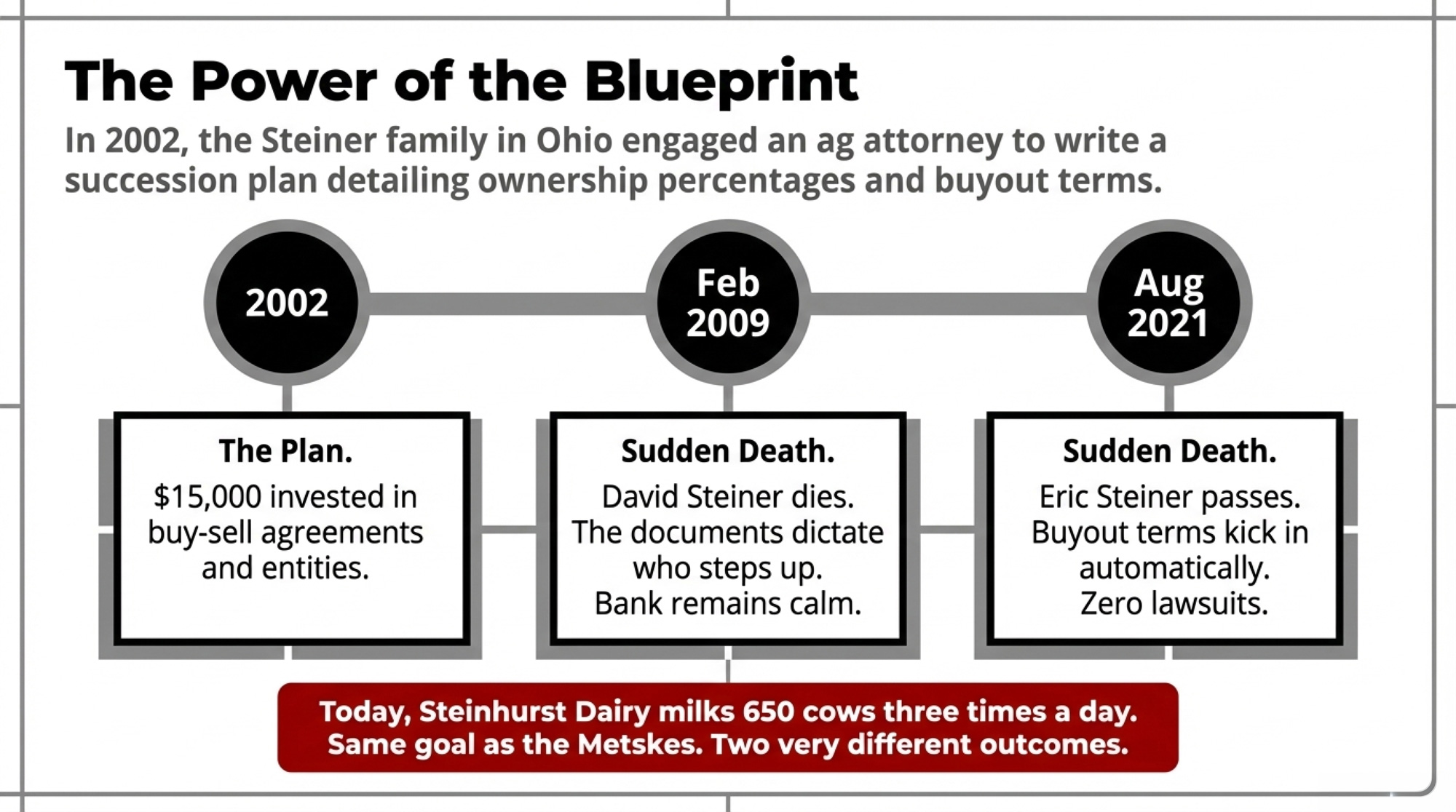
Two states south, a different family had a different piece of paper. In 2002, the Steiners in Creston, Ohio, engaged an attorney and a financial planner to put their dairy farm succession plan in writing. As Kurt Steiner later told a World Dairy Expo virtual farm tour audience, “It’s tough to plod through — it’s not fun. But you’re not going to be here forever, and you’d better have it together when it comes to succession planning.”
When David Steiner died of a sudden heart attack on February 1, 2009, that plan said who stepped up. When Eric Steiner died of prostate cancer in August 2021, the buyout terms kicked in instead of a lawsuit. Same goal — keep the dairy in the family. Two very different outcomes.
| Dimension | 🔴 Metske Family (Ontario) | ✅ Steiner Family (Ohio) |
|---|---|---|
| Plan formalized | Never — “agreement to agree” only | Written buy-sell and partnership structure, 2002 |
| Attorney engaged | No documented ag attorney involvement | Yes — attorney + financial planner retained |
| Years of informal labor invested | 6 years running daily operations | Multi-generational; roles defined from start |
| First major death/crisis | Relationship breakdown → litigation | David Steiner dies 2009 → documents dictated next steps |
| Second major crisis | N/A — no plan to apply | Eric Steiner dies 2021 → buyout terms activated |
| Legal outcome | Court of Appeal: $31,700 award (from $405K trial award) | No litigation — buy-sell terms followed |
| Farm continuity | Arrangement ended; no documented transfer | Steinhurst Dairy continues; 650 cows, 3rd generation entering |
| Estimated plan cost | $0 documented | ~$15,000 (2002); ~$25,000 in 2026 equivalent |
| Total value protected | ~$2M (discussed verbally; never executed) | Multi-million-dollar operation across two transitions |
At that point, dairy farm succession planning and a real farm transition plan stop being someday conversations. They become math you can’t afford to ignore.
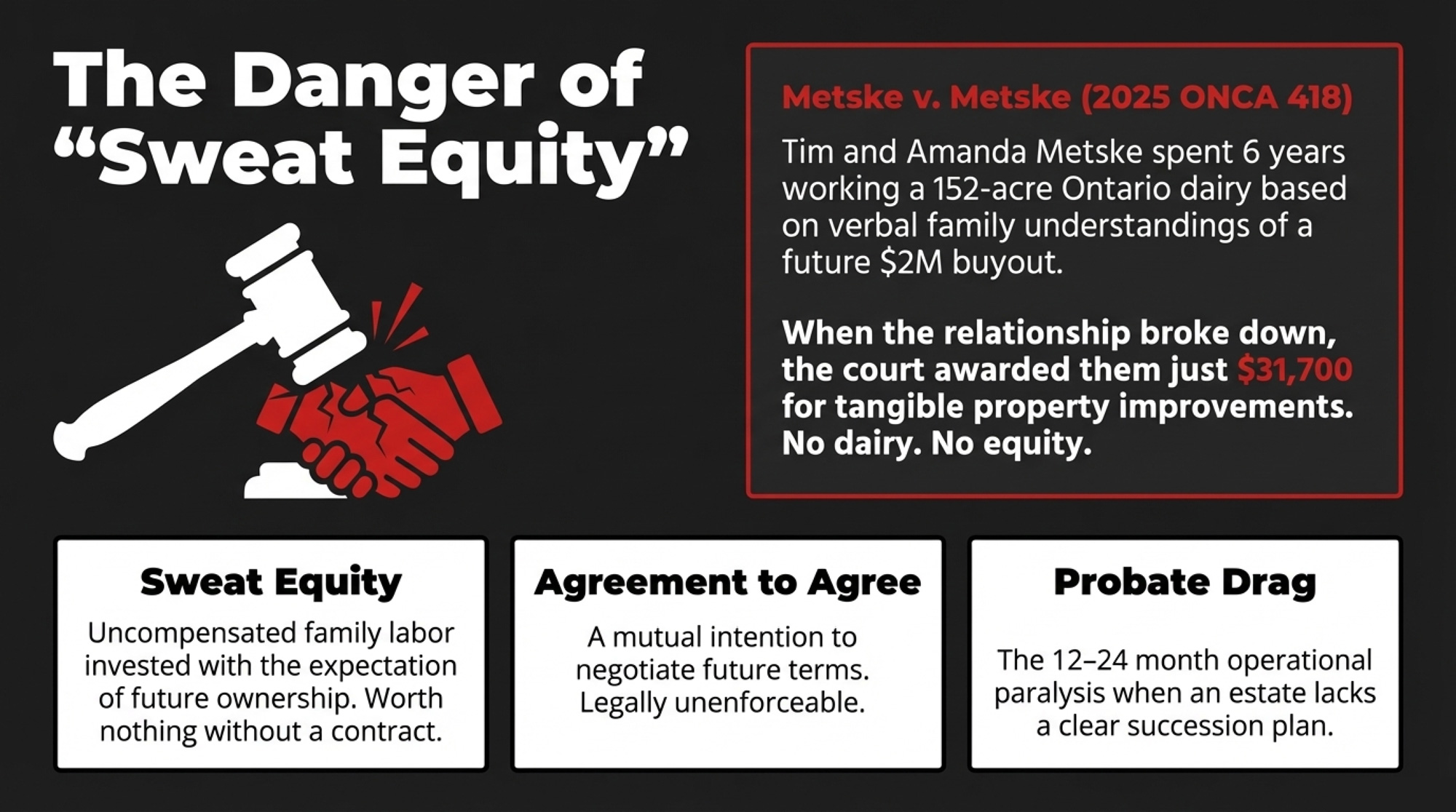
Glossary of Risk: Three Terms From the Metske Decision
Agreement to Agree — A mutual intention to negotiate future terms, without a binding commitment to specific price, timing, or conditions. In Metske v. Metske (2025 ONCA 418), the Court of Appeal found the family’s discussions about a future sale were exactly this — and therefore unenforceable.
Sweat Equity — The uncompensated or under‑compensated labor a family member invests in an operation, often expecting future ownership. The trial court valued Tim and Amanda’s tangible improvements at $33,700. The Court of Appeal upheld that figure for documented improvements but declined to award broader damages.
Probate Drag — The time, cost, and operational paralysis that hits a farm when an estate goes through probate without a clear succession plan. Professional fees can run into six figures on a complex farm estate, and the process can freeze decision‑making for 12–24 months, while the herd still needs feeding, breeding, and milking every day.
What’s Actually Changing for Family Dairies?
Start with the age math. The 2022 Census of Agriculture pegs the average U.S. principal producer at 58.1 years old. Not old — but it’s the front edge of the window where health or burnout can change the story in one season.
UW‑Madison’s Joy Kirkpatrick, who leads Wisconsin’s Cultivating Your Farm’s Future program, points out that a real farm transition — family meetings, entity changes, lender sign‑off, tax planning — takes 3–5 years to execute properly. That means many operators in their early 60s are already in the risk window.
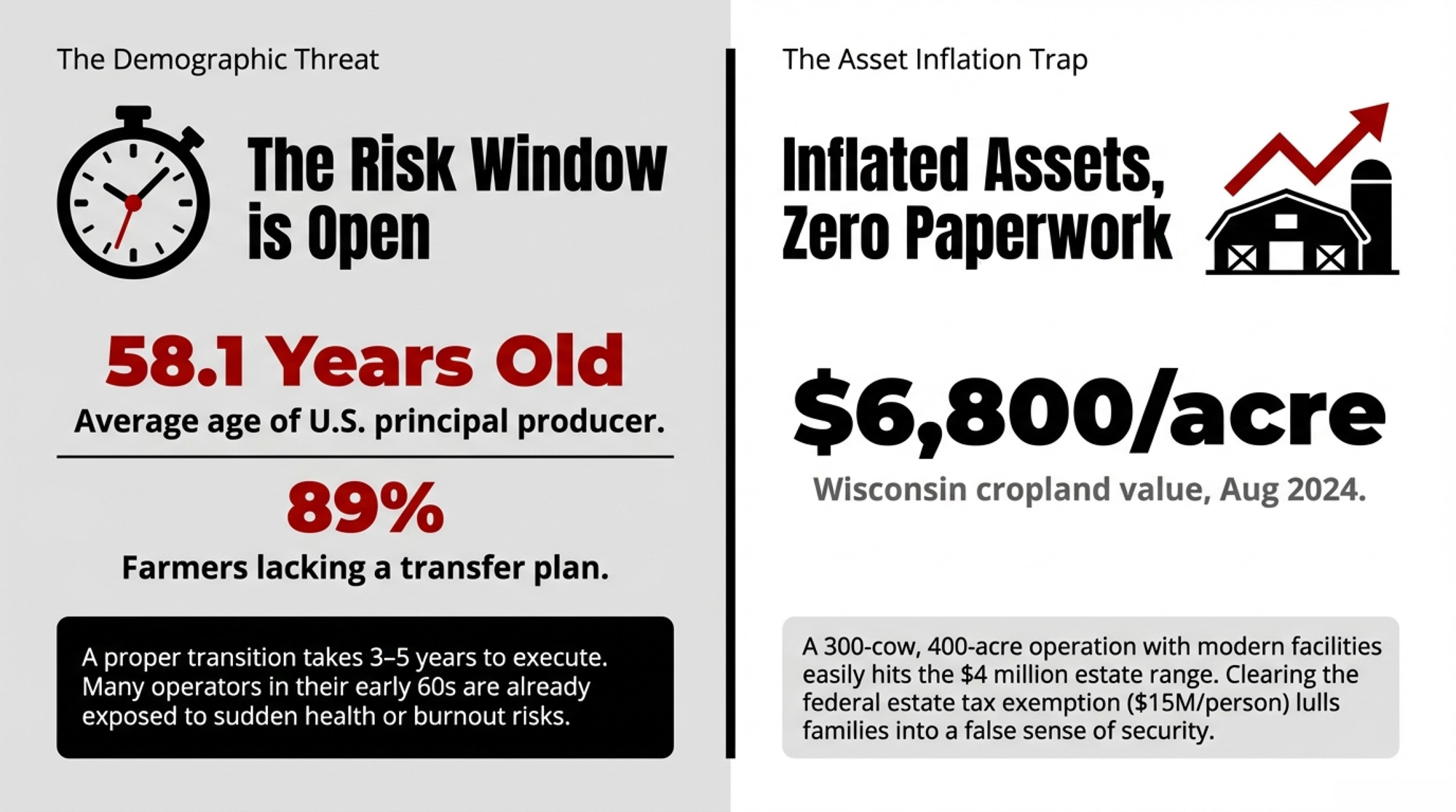
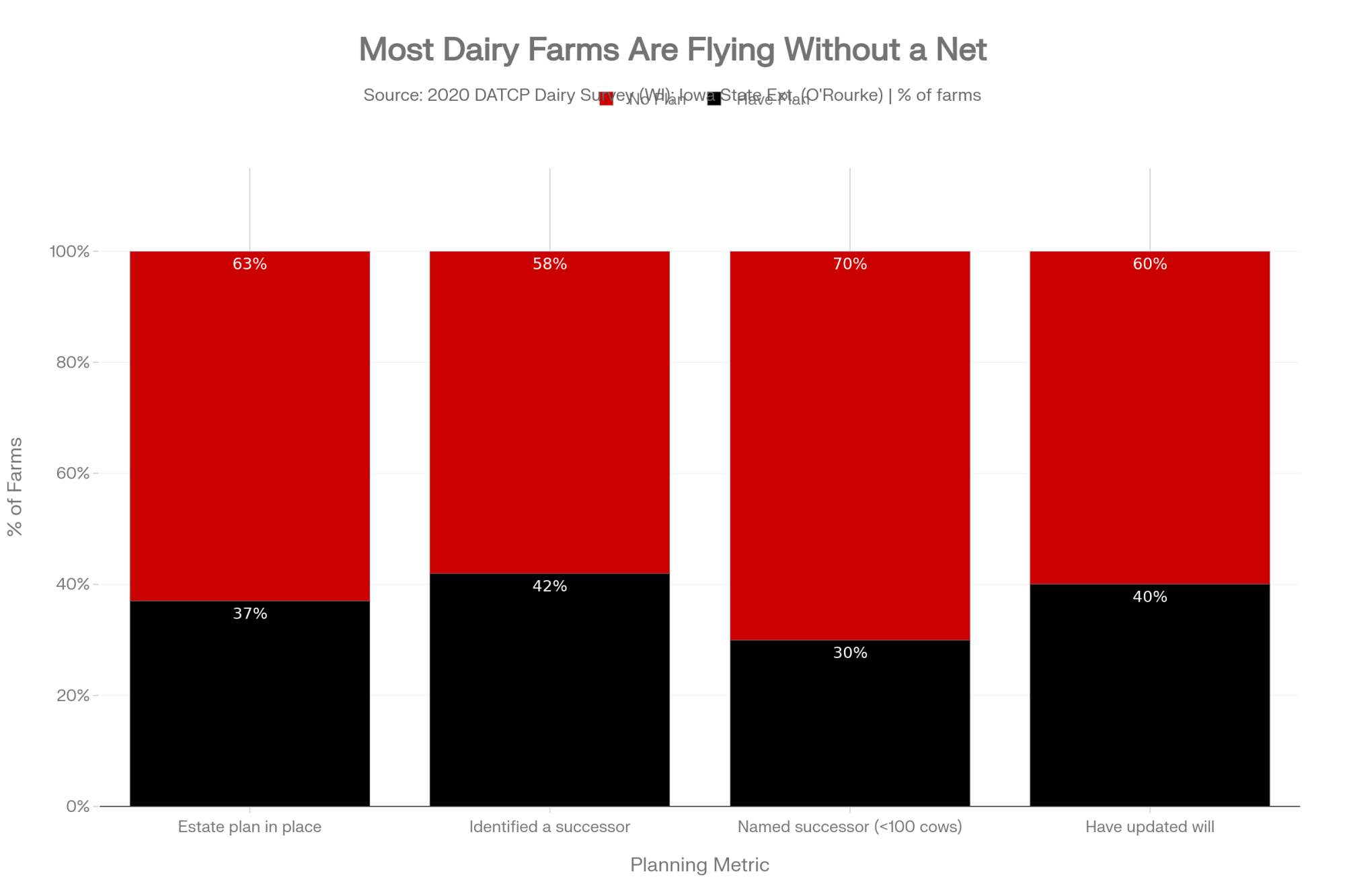
How few have anything in writing? Melissa O’Rourke, an attorney and farm management specialist at Iowa State University Extension, estimates 89% of farmers lack any farm transfer plan, and about 60% don’t even have an updated will. In Wisconsin specifically, the 2020 DATCP Dairy Producer Survey found just 37% of dairy farms had an estate plan and only 42% had identified a successor; among herds under 100 cows, only 30% had named one.
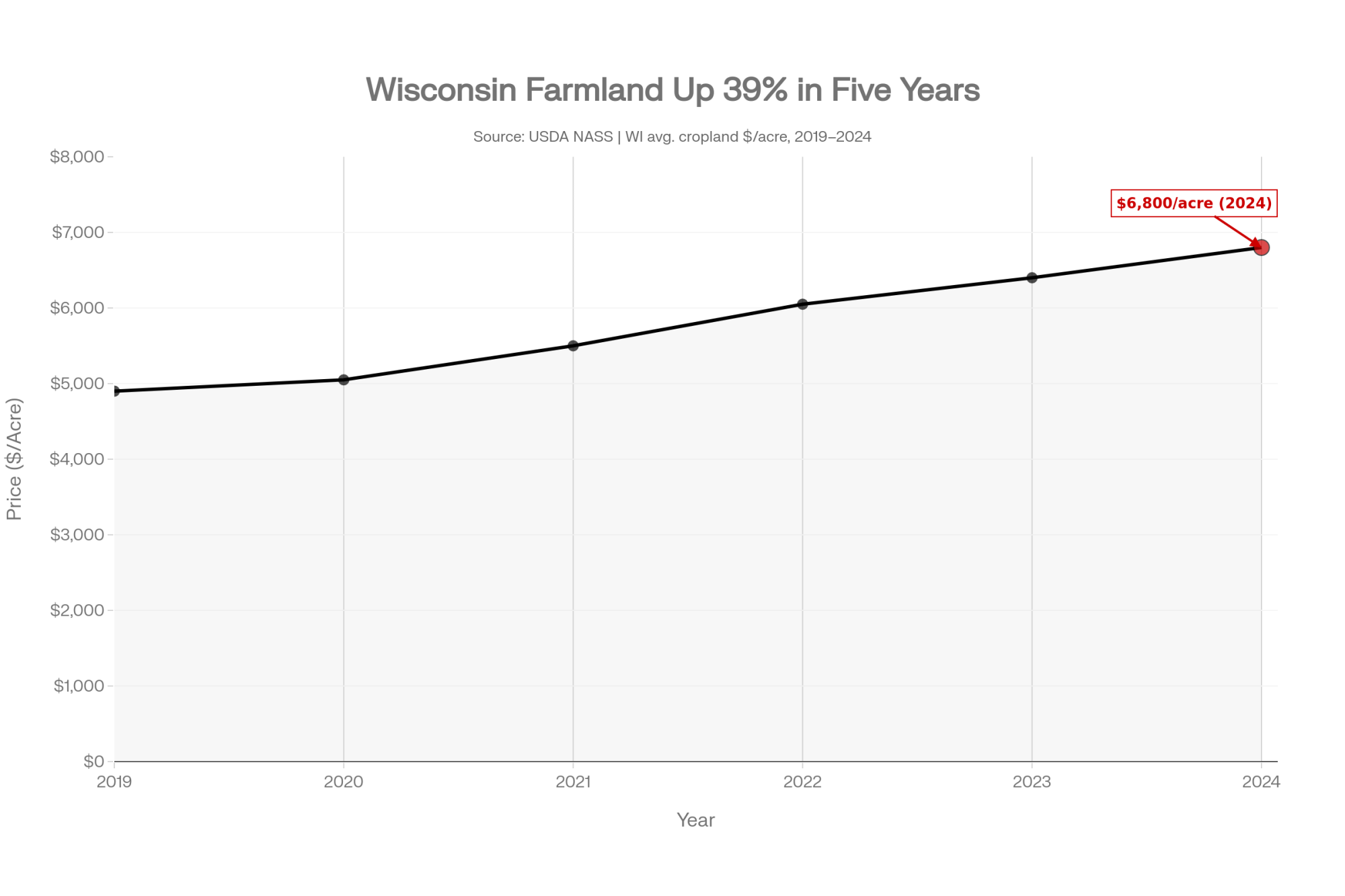
The asset side has quietly inflated. USDA NASS reported Wisconsin cropland at $6,800 per acre in August 2024. Take 400 acres, and you’re at about $2.72 million in land alone. Add a modern 300‑cow facility — freestall barn, parlor, manure system, equipment — and you’re in the $4 million estate range.
The current federal estate tax exemption sits at $15,000,000 per person for 2026, as adjusted under the One Big Beautiful Bill Act. Married, that’s up to $30 million. Most family dairies clear that bar, which can make families assume there’s nothing urgent left to fix.
That assumption is the trap. The big financial leak for a $4M dairy isn’t the IRS. It’s what happens when “we’ll deal with it later” meets a hospital visit, a divorce, or a fight nobody saw coming.
The Steiner Plan: What “Having It Together” Looks Like
According to a Farm Progress profile, the Steiners’ 2002 plan spelled out how many years a family member had to work before becoming a partner, exact ownership percentages between David, sons Kurt and Eric, and uncle John, and what happened to an owner’s interest at death — including buyout terms.
When David died in 2009, the documents said who stepped up. Kurt and Eric became majority owners, uncle John shifted to a smaller role, and the dairy kept running. When Eric died in 2021, the buyout terms kicked in without a fight. Today, Steinhurst Dairy milks about 650 cows three times a day on 700 owned acres and 400 rented acres, and Kurt’s son Christian is moving into what the family describes as the next generation.
If that 2002 plan cost roughly $15,000 in professional fees — realistic for multi‑meeting work on entities and buy‑sell agreements — it protected a business now worth several million dollars. In 2026 dollars, adjusted for the complexity of a 650‑cow operation, a comparable engagement might run around $25,000. That’s roughly eight quality replacement heifers at the $3,010 per head U.S. average as of mid‑2025, with top springers clearing $4,000 in Minnesota and California auctions. You’ll lose a lot more than eight head in a bad transition.
And Bullvine’s own audit of five recent dairy dispersals measured [the gap between a planned exit and a forced one at $400,000–$680,000 on real auction results]. Run the barn math on a $4M estate, and the exposure looks even steeper.
How Much Does “Not Yet” Actually Cost on Your Farm?
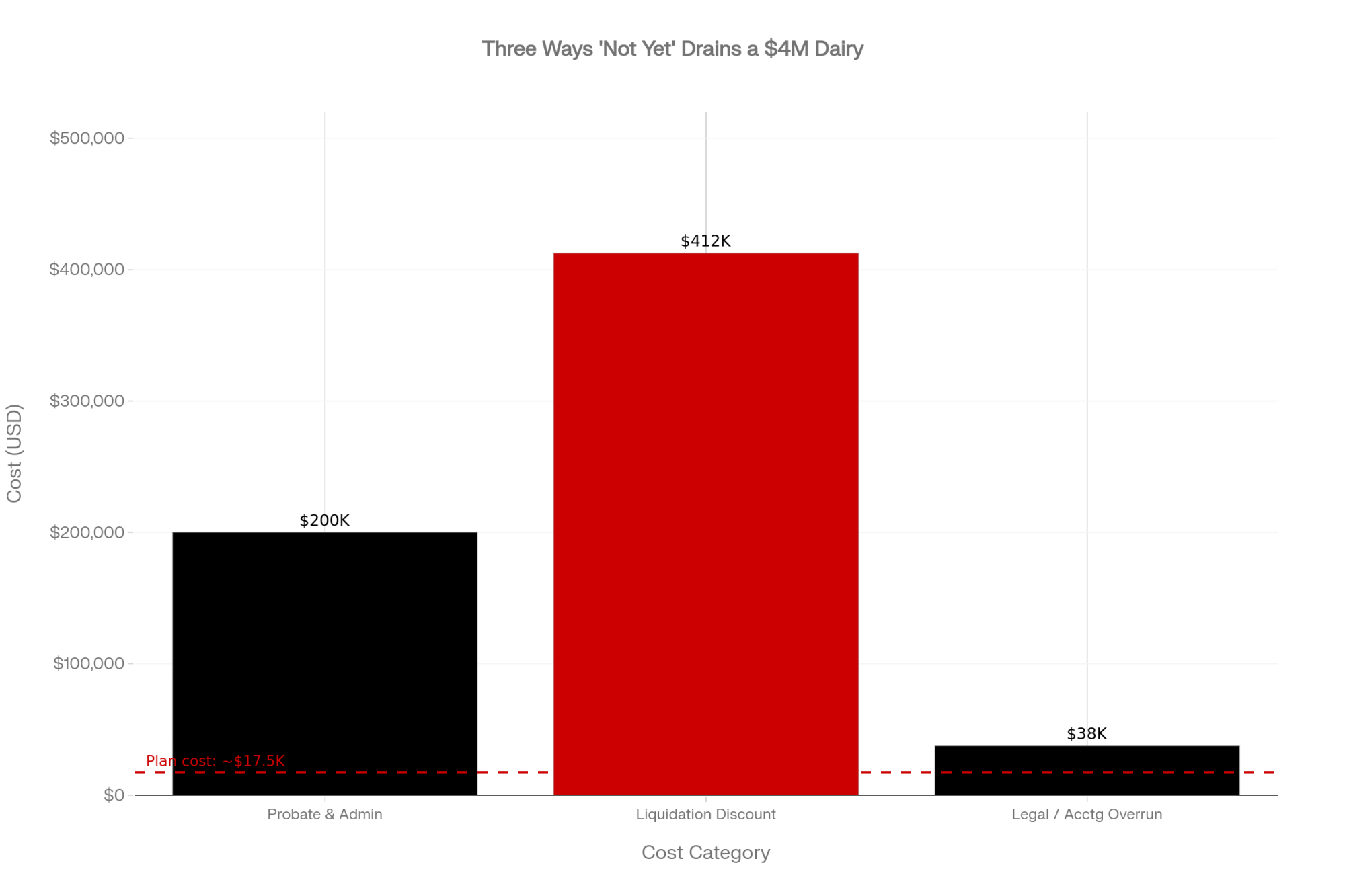
Here’s the side‑by‑side on a realistic Wisconsin‑style 300‑cow, 400‑acre dairy with a $4 million total estate, using current land values and conservative discounts:
| Cost Category | Path A: “Not Yet” (No Plan) | Path B: Plan in Place |
| Professional fees | $0 upfront | $10,000–$25,000 (entities, buy‑sell, trusts, insurance coordination over 1–2 years) |
| Probate & administration | ≈$200,000 (attorney, court, executor, appraisal, and accounting fees on a complex ag estate) | Minimal or avoided entirely (assets titled into entities/trusts) |
| Liquidation loss | $375,000–$450,000 (15% forced‑sale discount on $2.5–$3M in marketable assets) | $0 (controlled transfer, no fire sale) |
| Legal conflict risk | High — in Metske v. Metske (2025 ONCA 418), a six‑year informal arrangement with no written agreement resulted in years of litigation and a final award of $31,700 | Mitigated by buy‑sell agreement with clear terms and funding |
| Extra legal/accounting/operating mess | $25,000–$50,000 (extra professional time, interim operational chaos) | Negligible |
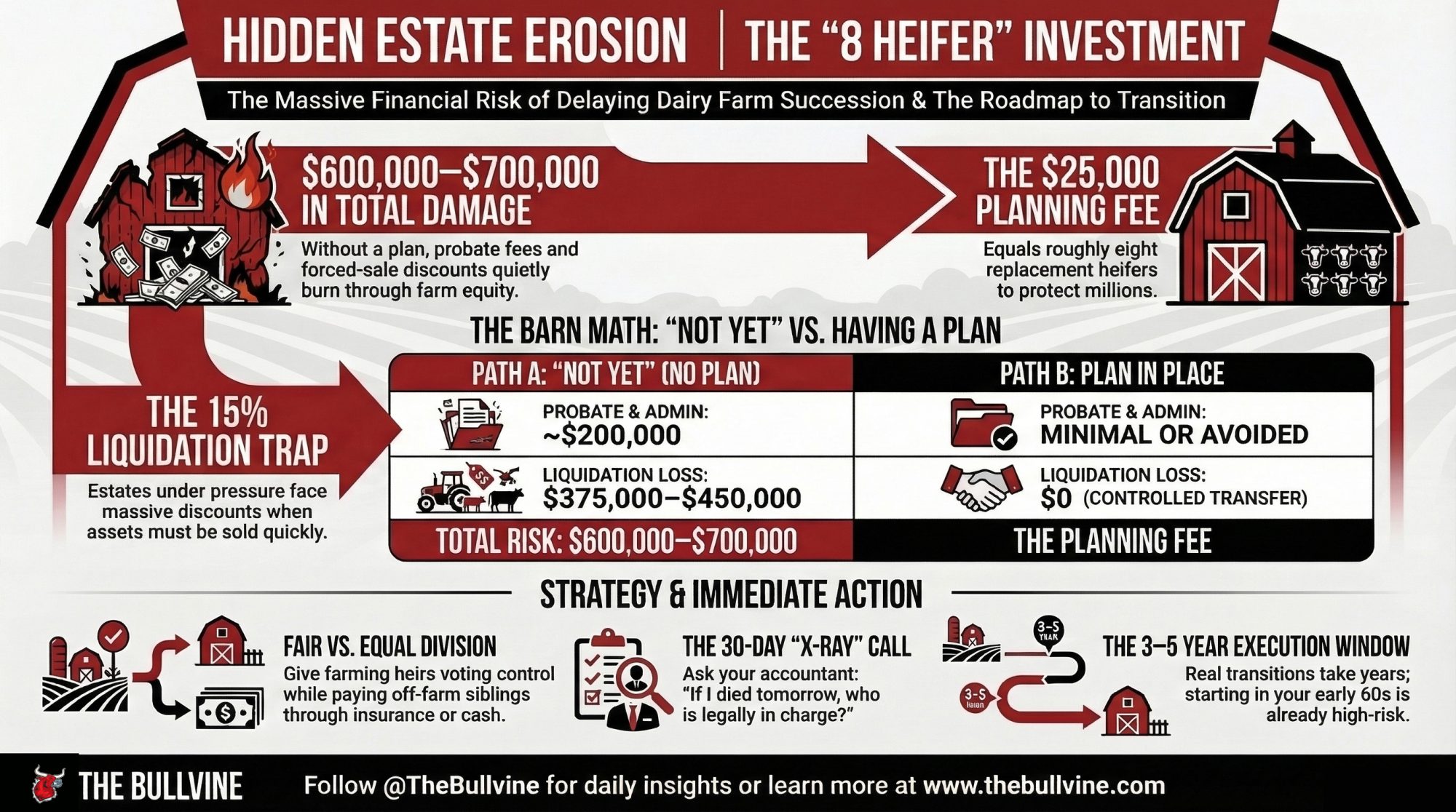
| Total damage | $600,000–$700,000 | The planning fee |
At $6,800/acre in Wisconsin, 400 acres run $2.72 million in land. The whole operation comes to around $4 millionwhen you add up cows, facilities, and equipment.
Path A — you keep saying “we’ll get to it.”
The estate goes through full probate. Attorney fees, court costs, executor compensation, appraisals, and accounting stack up. Research on estate sales triggered by sudden death, published by Andersen, Meisner Nielsen, and Stefansson in the Journal of Financial Economics, found that financially constrained estates face liquidation discounts of 15–25%when assets must be sold under deadline pressure. That’s consistent with Bullvine’s own dispersal analysis.
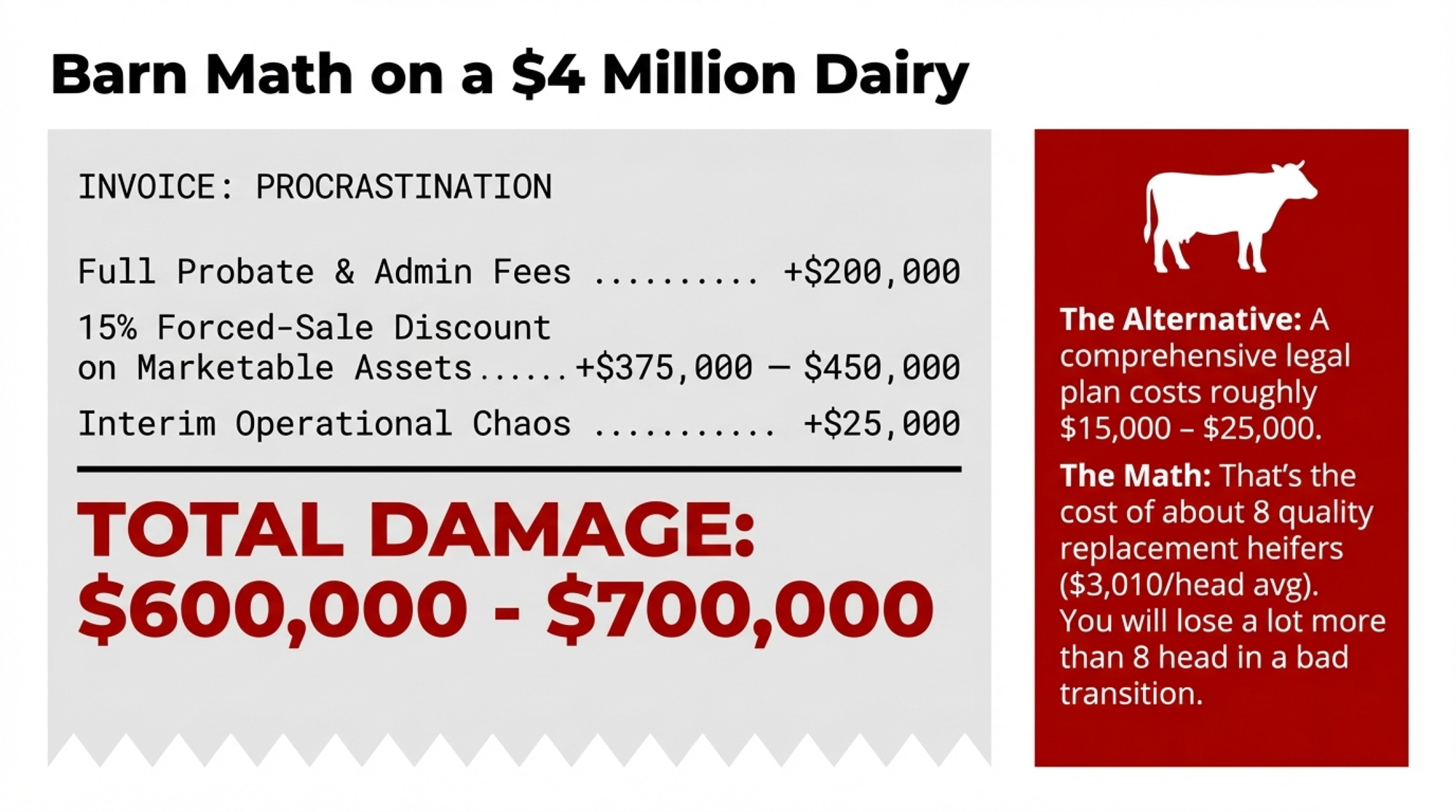
Apply a conservative 15% to $2.5–$3 million in marketable assets: $375,000–$450,000 gone. Add probate fees and the operational mess of running a farm through 12–18 months of legal process, and you’re $600,000–$700,000 lighter. A brand‑new parlor. A heifer facility. Your kids’ down payments.
Path B — you bite the bullet and plan.
A comprehensive succession engagement — entities, buy‑sell agreements, trusts, coordinated insurance — typically runs $10,000–$25,000 depending on herd size and entity complexity. The Steiners did this kind of work in 2002 for about $15,000. When something happens, the documents say who’s in charge. The bank doesn’t panic. Your kids don’t start with a court date.
Your numbers will be different. The pattern holds: low‑five‑figure planning costs for six‑figure‑plus protection.
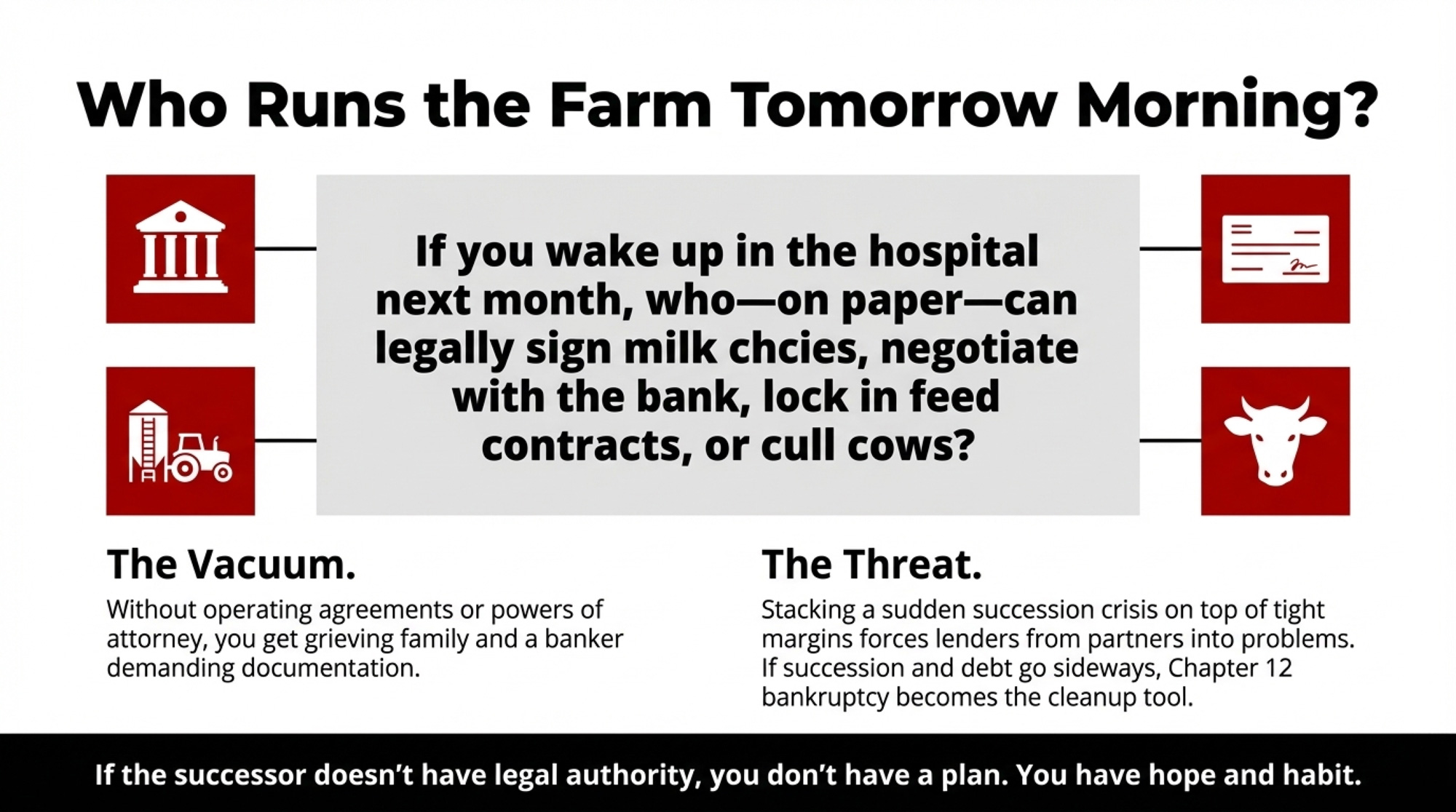
Who Actually Runs the Farm Tomorrow Morning?
If you wake up in the hospital next month, who — on paper — can sign milk cheques and payroll, negotiate with the bank, lock in feed contracts, cull cows, or decide whether land gets sold?
On well‑planned farms like Steinhurst, that answer is boring. The successor’s authority is spelled out in operating agreements, buy‑sell documents, and powers of attorney. Kurt Steiner told the WDE audience that after Eric’s death, “there’s hope for our dairy. We don’t know exactly how, but we’re going to get it done.” He could say that because the paperwork was already in place.
On farms without written agreements, you get a vacuum. Grieving family, a banker who suddenly wants everything documented, and a stack of half‑organized files nobody has touched since the last refinance. When succession and debt go sideways at the same time, Chapter 12 becomes the cleanup tool — Bullvine’s Kooser coverage followed one family through filing twice, and the three numbers that told them they were out of runway.
If the person you assume would take over doesn’t have legal authority or a funded plan, you don’t have a transition. You have hope and habit.
Is “Fair” the Same as “Equal” When One Kid Farms and Three Don’t?
Equal division — “everyone gets a quarter of everything” — is how a lot of dairies accidentally end up in a capital structure their lender isn’t comfortable with.
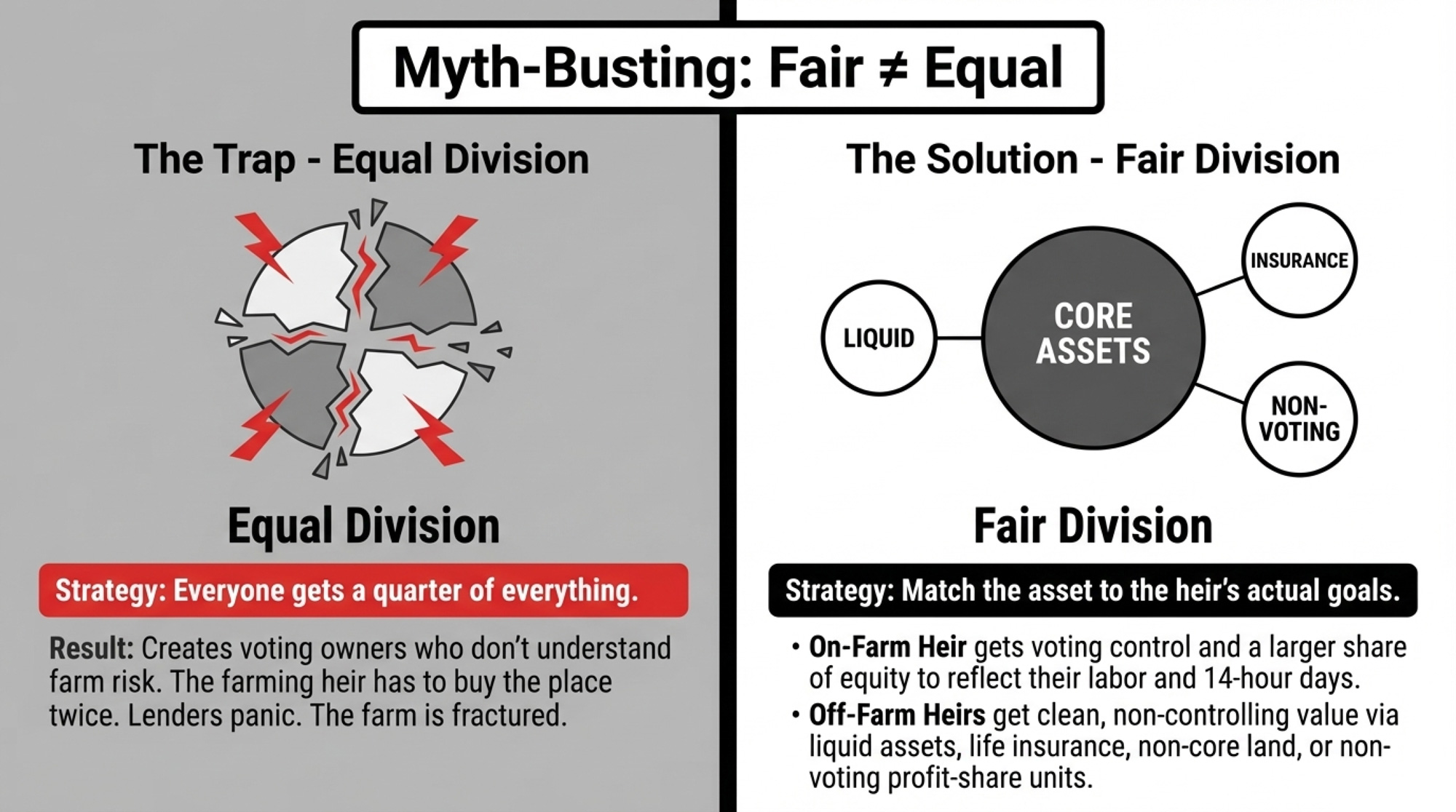
Give on‑farm and off‑farm heirs identical ownership slices, and you create voting owners who don’t understand farm risk, an on‑farm heir who feels like they’re buying the place twice, and off‑farm siblings who want cash — not more money tied up in silage.
“Fair but not equal” structures turn that into something functional:
- The farming heir gains voting control and a larger share of the farm’s equity, reflecting labor and risk.
- Off‑farm kids get value through liquid assets, life insurance, non‑core land, or non‑voting units that pay when there’s profit but don’t control decisions.
You’re not playing favorites. You’re matching what each kid actually wants — a living running the place vs. a clean investment return — with the kind of asset that fits.
What to Tell the Off‑Farm Kids
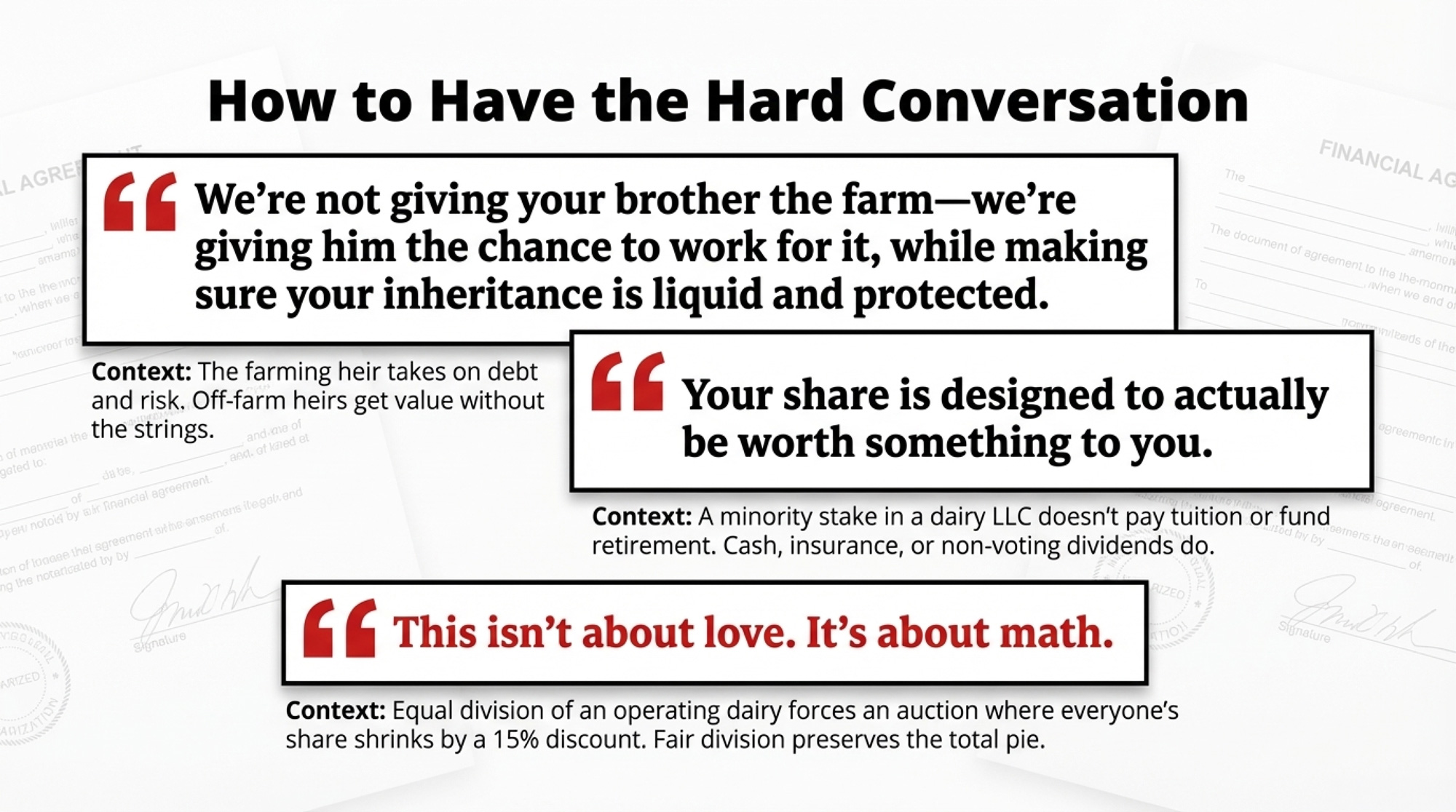
This is the conversation that chokes people up. Ag succession planners, including Kirkpatrick at UW‑Extension, often coach families to reframe it.
- “We’re not giving your brother the farm — we’re giving him the chance to work for it, while making sure your inheritance is liquid and protected.” The farming heir takes on debt, risk, and 14‑hour days. Off‑farm heirs get value without those strings.
- “Your share is designed to actually be worth something to you.” A quarter‑ownership stake in a dairy LLC isn’t liquid. It doesn’t pay tuition or fund a retirement. Cash, insurance proceeds, or non‑voting units that pay dividends do.
Nobody loves hearing this at first. But the alternative is worse.
- “If the farm goes under because we split it four ways, nobody gets anything.” An operation that can’t cash‑flow a four‑way buyout ends up at auction — and everyone’s share shrinks by that forced‑sale discount.
- “This isn’t about love. It’s about math.” Equal division of an operating dairy can destroy the business and everyone’s inheritance. Fair division preserves the operation and the value that off‑farm heirs actually receive.
Kirkpatrick frames these as the core “tensions” of farm succession: fairness vs. equality, business vs. family, control vs. inclusion. Ignoring them doesn’t avoid conflict. You hand it to the next generation.
Options and Trade‑Offs for Farmers
| Timeline | Action | Who to Call | What It Costs | Risk If Skipped |
|---|---|---|---|---|
| 30 Days | Ask accountant: “Who’s in charge day one if I die tomorrow?” | CPA / farm accountant | $0 — one conversation | You assume there’s a plan; there isn’t |
| 30 Days | Confirm signing authority, probate exposure, assets that must be sold | CPA / ag attorney | $0–$500 consultation | Farm paralysis for 12–24 months during probate |
| 90 Days | Draft buy-sell agreement with defined triggers (death, disability, divorce, retirement) | Ag-focused attorney (via Farm Credit / Compeer referral) | $5,000–$15,000 | Metske scenario: informal arrangement + litigation |
| 90 Days | Review entity structure (LLC, partnership) for ownership clarity | Attorney + CPA | Included above | Forced equal splits across farming and non-farming heirs |
| 365 Days | Fund buy-sell with life insurance; establish trust if needed | Insurance advisor + estate attorney | $10,000–$25,000 total | $375K–$450K liquidation discount on forced sale |
| 365 Days | Update operating agreements; name successor formally with legal authority | Ag attorney | Part of above | Lender panic, operational vacuum, off-farm sibling conflict |
| Annual | Review plan, update valuations, revisit heir structures | CPA + attorney | $1,000–$3,000/yr | Plan drifts out of alignment with actual asset values |
1. Order the “x‑ray” (next 30 days)
This is your 30‑day action. Call your accountant or ag attorney and ask one question:
“If I died tomorrow, what happens to this farm on paper — who’s in charge day one, what goes through probate, and what would likely have to be sold?”
If they can’t answer clearly within 48 hours, you don’t have a transition plan. You have tax compliance and exposure.
2. Put a buy‑sell in writing
This is how you formalize what the Metskes’ arrangement lacked. Good farm buy‑sells spell out who can buy an ownership interest, when that right kicks in (death, disability, retirement, divorce), how the price is set, and how the buyout is funded. That’s what the Steiners had when two deaths hit in twelve years. The paper said what happened. The bank knew the plan. The family followed it.
3. Use insurance and leases as pressure valves
Life insurance can retire farm debt so the farming heir services a buyout, and provide cash for non‑farming heirs so the operating unit doesn’t get chopped up. Long‑term leases turn off‑farm heirs into landlords — not surprise co‑operators. You give up flexibility. You pick up stability.
4. Engage an ag‑focused attorney (90 days)
Not your cousin’s real estate lawyer. Ask Farm Credit or Compeer Financial for referrals — most have succession planning programs, and many coordinate with your CPA and lender. Bullvine’s “Top Dairy Farm Transition Planning Traps to Avoid” breaks down entity structures, cash access traps, and retirement timing.
If debt‑service coverage is already tight, stacking a sibling buyout on top can tip your lender from partner to problem. Bullvine’s coverage of tight margins at $18.95 milk and $19.14 costs showed how fast DSCR pressure compounds — and a forced succession layered on top makes it worse.
5. Have the legal structure in place (365 days)
Trusts, buy‑sell, insurance, and updated operating agreements. Review annually. The farms that survive generational transitions aren’t the ones with the best cows. They’re the ones with the best paperwork.
Key Takeaways
- If your accountant can’t explain “what happens if I die tomorrow” in 48 hours, assume you have exposure, not a plan. Push for a written outline of who’s in charge, what hits probate, and what has to be sold.
- If one child farms and others don’t, “equal shares of the land” is a red flag, not a plan. Look at structures where the farm kid has voting control and core assets, while others get value through cash, insurance, or non‑voting interests.
- A real transition plan runs low‑five figures — about eight replacement heifers at today’s prices to protect a multi‑million‑dollar operation. Budget for it the way you’d budget for a bulk tank or a new loader: it’s infrastructure, not overhead.
- The person you expect to take over needs legal authority to act — now, not after probate. Signing authority, powers of attorney, and a funded buyout path aren’t luxuries. They’re what keep the farm running when you can’t.

The Bottom Line
Five or ten years from now, the farms that start on this will look…steady. Off‑farm kids still come home for Christmas without arguing about who “really” owns the parlor.
On the other side, you’ll see places where the sign out front has changed. Where siblings drive past the old yard and don’t turn up the lane.
The question isn’t whether succession is coming to your dairy. It’s whether it arrives as paperwork you control — or as a court file somebody else manages. The deeper barn math on how that penalty scales at different herd sizes and debt loads is coming in the Tier 2 and Tier 3 follow‑ups for The Transition Files, where we’ll profile a dairy mid‑transition and walk through a post‑mortem on one that went wrong.
Complete references and supporting documentation are available upon request by contacting the editorial team at editor@thebullvine.com.
Learn More
- Only 12% of Dairy Farms Reach Generation Three – A 2025 Court Ruling Exposes Why Succession Fails and How to Fix It – Arms you with a 90-day triage plan to turn “handshake” expectations into bank-vetted agreements. It reveals why separating land from operations is the only way to make 2026 debt-to-EBITDA ratios actually work for the next generation.
- More Milk, Fewer Farms, $250K at Risk: The 2026 Numbers Every Dairy Needs to Run – Delivers the brutal 2026 market math your transition plan must survive. It exposes the quarter-million-dollar margin gap facing mid-sized herds and breaks down five specific ways to close that equity leak without expensive expansion.
- Dairy Tech ROI: The Questions That Separate $50K Wins from $200K Mistakes – Reveals the true “automation sweet spot” where technology preserves family equity instead of draining it. It provides the hard ROI benchmarks needed to decide if robots or AI-monitoring fit your 10-year transition timeline or just add unmanageable debt.
 The Sunday Read Dairy Professionals Don’t Skip.
 The Sunday Read Dairy Professionals Don’t Skip.
Every week, thousands of producers, breeders, and industry insiders open Bullvine Weekly for genetics insights, market shifts, and profit strategies they won’t find anywhere else. One email. Five minutes. Smarter decisions all week.