








Stop panic-selling assets during margin compression. Smart producers are positioning for the $2.69/cwt IOFC surge that’s already starting.
EXECUTIVE SUMMARY: The dairy industry’s Q1 2025 margin bloodbath wasn’t a crisis—it was a strategic opportunity that most producers completely missed. While margins plummeted to $10.31 per cwt in April, triggering widespread panic, the smart money was quietly positioning for the most predictable rebound in recent memory. USDA Economic Research Service data shows all-milk prices revised upward to .60/cwt for 2025, Federal Milk Marketing Order reforms worth over billion to producers are taking effect, and feed cost dynamics are creating unexpected tailwinds through China’s dairy sector struggles. The Income Over Feed Cost recovery from April’s low to projected year-end levels above /cwt represents a .69 improvement that transforms farm economics from survival mode to strategic investment opportunity. With the Dairy Margin Coverage program’s 66.67% historical payout frequency providing validated downside protection, producers who understand this cyclical pattern are capturing competitive advantages while others remain paralyzed by short-term volatility. Stop treating margin compression as catastrophe and start leveraging it as competitive intelligence—your operation’s next five years depend on how you position during this recovery window.
KEY TAKEAWAYS
- Margin Recovery Mathematics: IOFC projected to surge $2.69/cwt from April’s $10.31 low to $13+ by December 2025—for a 1,000-cow operation producing 25,000 lbs per cow annually, this represents $672,500 in improved annual income potential during the recovery phase.
- Policy-Driven Revenue Boost: Federal Milk Marketing Order reforms reverting to “higher of” Class III/Class IV pricing for Class I milk provides structural income increases worth over $1 billion industry-wide, delivering measurable blend price improvements regardless of underlying market conditions.
- Strategic Feed Cost Advantage: China’s 44% drop in alfalfa imports (from $596.1 to $400 per metric ton) creates domestic hay cost reductions while corn futures stabilize at $4.51/bushel—smart producers are locking favorable feed contracts during this global demand destruction phase.
- DMC Program Optimization: With 66.67% historical payout frequency averaging $1.49/cwt in net indemnities, comprehensive Dairy Margin Coverage isn’t insurance—it’s a profit center that pays for aggressive positioning during volatile cycles like the projected H2 2025 rebound.
- Competitive Positioning Window: The 2026 all-milk price forecast drop to $21.15/cwt ($0.45 below 2025 projections) confirms this rebound is cyclical—successful operations will reinvest margin improvements in efficiency upgrades and technology adoption rather than treating recovery as permanent cash flow enhancement.
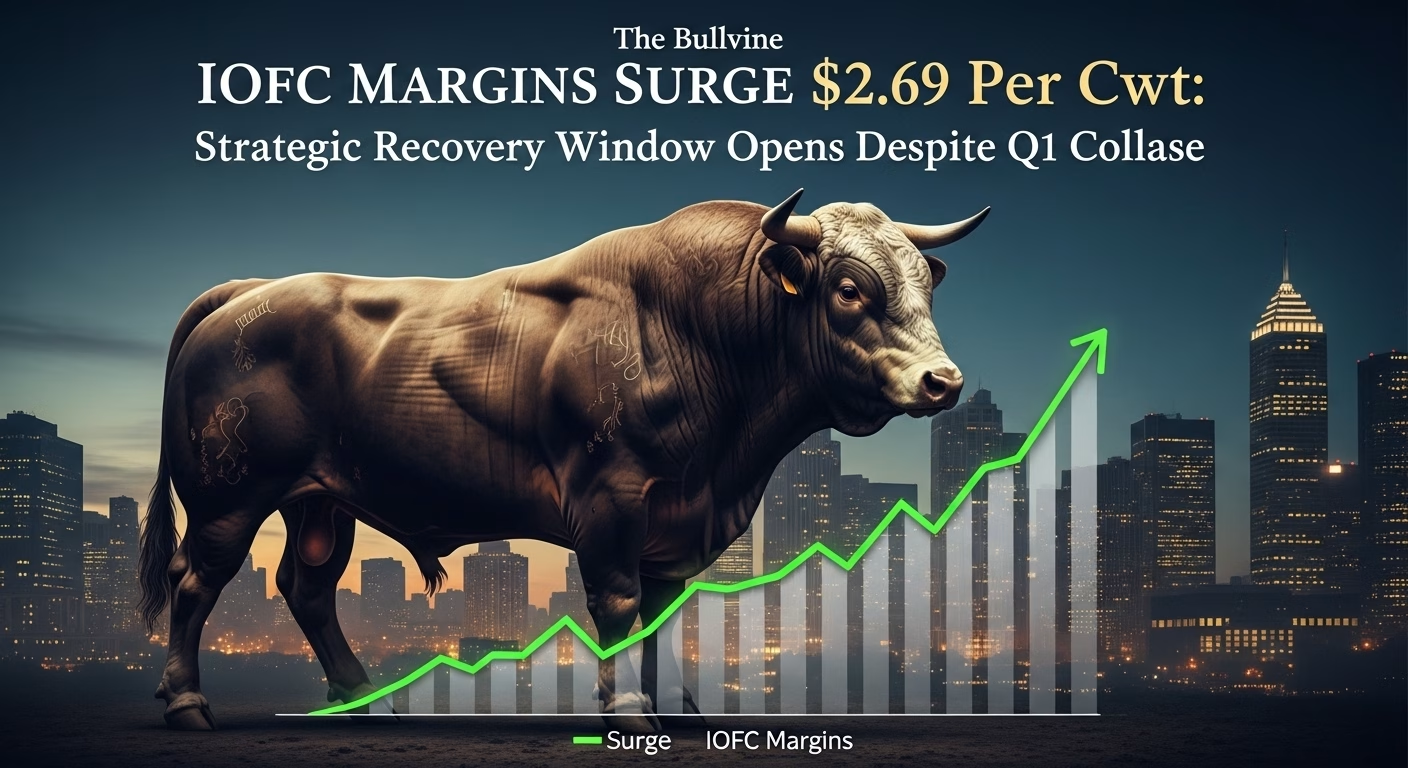
U.S. dairy producers face a dramatic margin turnaround in the second half of 2025, with Income Over Feed Cost projected to climb from April’s devastating $10.31 per cwt low back above $13 per cwt by December—a $2.69 improvement that transforms farm economics from survival mode to strategic investment opportunity. This recovery follows a brutal first quarter driven by falling milk prices and creeping feed costs but is now supported by USDA Economic Research Service upward price revisions, and Federal Milk Marketing Order reforms worth over one billion dollars to producers.
The fundamentals driving this rebound aren’t wishful thinking—they’re grounded in policy changes and market dynamics that smart producers are already positioning to capture.
The Perfect Storm That Created Q1’s Margin Massacre
According to USDA Agricultural Research Service data, the numbers tell a brutal story. In March 2025, producers faced an all-milk price of per hundredweight against combined feed costs of .45 per cwt, yielding margins of .55 per cwt. While that might sound reasonable to outsiders, it represented steady erosion from peaks with many operations planning capital investments.
But April delivered the knockout punch. The IOFC margin is forecasted at just $10.31 per cwt—less than a dollar from the $9.50 threshold that triggers Dairy Margin Coverage indemnity payments. For perspective, a 500-cow operation producing 25,000 pounds per cow annually would see this margin compression translate to significant cash flow pressure during the critical spring season.
Here’s what made this particularly painful: corn held relatively steady at $4.57 per bushel, premium alfalfa hay stood at $242 per ton, and soybean meal was $303.80 per ton. The real culprit? Milk prices in free fall while feed costs crept upward—the classic margin squeeze that veteran producers know transforms profitable operations into survival exercises overnight.
Why This Recovery Isn’t Just Market Wishful Thinking
The USDA Economic Research Service has revised its 2025 all-milk price forecast upward to $21.60 per cwt, representing a $0.50 increase from previous projections. When the USDA moves prices up mid-year, they see demand signals and supply dynamics that support higher prices—not making optimistic guesses.
But here’s where it gets really interesting. Federal Milk Marketing Order reforms create structural tailwinds worth over one billion dollars to producers. The USDA’s recommendation to revert to the “higher of” Class III or Class IV skim milk price for Class I represents money in your pocket, not policy tweaking. Due to Class III price spikes, the “average of” method used during the pandemic cost dairy producers over one billion dollars.
Getting back to the “higher of” system provides measurable upward pressure on blend prices that operate independently of underlying supply and demand dynamics—it’s essentially a guaranteed income boost for operations with significant Class I utilization.
The Feed Cost Three-Way Split: Winners and Losers
Understanding this rebound requires dissecting feed costs component by component because they tell three stories directly impacting your IOFC calculations.
Corn futures have stabilized around $4.51 per bushel—down 1.69% since the beginning of 2025. The USDA ERS Marketing Year Average price forecast of $4.57 per bushel appears achievable, with U.S. corn stocks at 8.15 billion bushels as of March 2025. For most operations, this represents the largest feed expense component, which is holding steady.
Soybean meal tells a more complex story. Current July 2025 futures at 6.20 per short ton are positioned below the projected 0 per short ton for marketing year 2025/26. Global oilseed production forecasted at a record 692 million metric tons provides a supply cushion, but China’s projected 112 million metric ton soybean imports are creating upward pressure.
But here’s the wildcard that could significantly benefit your bottom line: alfalfa hay costs are getting an unexpected assist from China’s dairy sector struggles. Chinese alfalfa imports dropped 44% in 2023, with prices falling from $596.1 per ton in January to $400 per ton by December. Since the U.S. supplies 89.9% of China’s alfalfa imports, this demand destruction creates lower domestic hay prices for American dairy producers.
DMC Program: Your 66.67% Success Rate Insurance Policy
While everyone obsesses over milk prices and feed costs, the Dairy Margin Coverage program has issued payments in 48 out of 72 months from 2018 to 2024—that’s a 66.67% payout frequency that most insurance products would envy. The average payment of .49 per cwt, with peaks reaching .58 per cwt, demonstrates the program’s responsiveness to exactly the kind of margin compression we witnessed in Q1 2025.
After accounting for average premium costs of $0.142 per cwt, the net indemnity averaged $1.35 per cwt over the historical period. For a 1,000-cow operation, that’s ,500 in net protection during tough periods—money that keeps operations viable during downturns and positioned to benefit from rebounds.
DMC forecasts an 85% probability that no indemnity payments will be needed for the remainder of 2025, thanks to the projected margin recovery. That’s not just confidence in the rebound—it’s validation that the safety net works exactly as designed.
What This Means for Your Operation: Actionable Intelligence
The projected H2 2025 rebound creates a strategic window, not just a profit opportunity. Here’s how to position for maximum benefit:
Optimize Your IOFC Monitoring System: The University of Wisconsin dairy extension recommends calculating IOFC weekly during volatile periods rather than monthly. The calculation is straightforward: multiply your milk price by the average pounds produced per cow per day and subtract the total feed cost per cow per day. Monitor threshold levels—when IOFC drops below $8 per cwt, evaluate feed efficiency improvements and consider culling underperforming animals.
Strategic DMC Participation: Given the program’s 66.67% historical payout frequency and customizable coverage from $4.00 to $9.50 per cwt, comprehensive coverage isn’t just insurance—it’s a profit center. Selecting $8.50 per cwt coverage protects tight-margin operations while allowing upside capture during rebounds.
Component Optimization Strategy: With Federal Milk Marketing Order reforms adjusting standard milk composition (protein increasing from 3.1% to 3.3%, nonfat solids rising from 9% to 9.3%), align your production strategy with these new standards. Focus on butterfat optimization for Class IV-heavy operations protein enhancement for Class III-focused farms.
Class III vs. Class IV: The Price Dance Impacting Your Blend
Throughout most of 2024 and early 2025, Class IV held the “higher of” position over Class III. But February and March saw Class III futures move into pole position, averaging $19.40 per cwt compared to $19.06 per cwt for Class IV.
By September, futures expect another flip, with Class IV leading at $19.37 per cwt versus Class III at $18.91 per cwt through December. For operations shipping to plants with significant Class I utilization, the “higher of” system ensures you capture the benefit regardless of which class leads.
Table: Projected Quarterly Margin Recovery Timeline
| Quarter | IOFC Projection | Key Drivers | Strategic Focus |
| Q2 2025 | $10.31/cwt (April low) | Feed cost pressures, milk price softness | Risk management, efficiency optimization |
| Q3 2025 | $11.50-12.00/cwt | FMMO reforms begin, corn stability | Component optimization, DMC evaluation |
| Q4 2025 | $13.00+/cwt | Full policy impact, seasonal demand | Strategic investments, expansion planning |
Global Market Intelligence: Why China’s Problems Are Your Opportunity
The China alfalfa connection demonstrates how international dairy market health directly impacts your feed costs. China’s dairy sector struggles created a 44% drop in alfalfa imports, pushing prices from $596.1 per metric ton in January to $400 per metric ton by December 2023. Since the U.S. supplies 89.9% of China’s alfalfa imports, this demand destruction creates beneficial feedback for American producers through lower domestic hay prices.
Monitor these global indicators for feed cost intelligence: Chinese dairy consumption trends, Brazilian soybean production forecasts, and European energy costs affecting processing demand. Events far from home directly impact your local profitability.
The Bottom Line: Recovery Window Demands Strategic Action
The projected margin rebound is real, supported by USDA Economic Research Service data showing all-milk price forecasts revised upward to $21.60 per cwt for 2025, FMMO reforms worth over one billion dollars to producers, and feed cost dynamics creating opportunities for significant margin improvement.
But here’s the reality—this represents a cyclical recovery significantly bolstered by policy interventions, not a fundamental shift in long-term structural challenges. The USDA’s 2026 all-milk price forecast of $21.15 per cwt—down $0.45 from 2025 projections—suggests the industry expects price softening as the recovery matures.
Use this recovery window strategically. Calculate your IOFC weekly during this volatile period. Evaluate DMC coverage levels for maximum protection. Focus on component optimization aligned with new FMMO standards. Monitor global market dynamics for feed cost intelligence.
The producers who treat this rebound as breathing room to strengthen operations—rather than just improved cash flow—will be positioned to thrive when the next challenging cycle inevitably arrives. With Income Over Feed Cost experiencing a potential $2.69 per cwt improvement from April lows to year-end highs, the recovery mathematics are compelling for those positioned to capture it.
The interconnectedness of global agricultural markets means your profitability increasingly depends on economic health far from home. China’s dairy struggles directly benefit your feed costs. That’s the new reality of dairy economics—and the smart money is paying attention to signals worldwide.
Learn More:
- Dairy Profit Squeeze 2025: Why Your Margins Are About to Collapse and What to Do About It – Reveals five tactical survival strategies for navigating margin compression, including aggressive cost control methods and strategic culling plans that complement the recovery positioning outlined in our main analysis.
- USDA’s 2025 Dairy Outlook: Market Shifts and Strategic Opportunities for Producers – Demonstrates how USDA’s production forecasts and component optimization strategies align with margin recovery trends, providing deeper market intelligence for strategic positioning during the H2 2025 rebound.
- 5 Technologies That Will Make or Break Your Dairy Farm in 2025 – Uncovers game-changing innovations like AI analytics and precision feeding systems that slash costs by 18% and boost efficiency, essential tools for maximizing profitability during the projected margin recovery window.
The Sunday Read Dairy Professionals Don’t Skip.

Every week, thousands of producers, breeders, and industry insiders open Bullvine Weekly for genetics insights, market shifts, and profit strategies they won’t find anywhere else. One email. Five minutes. Smarter decisions all week.




