At the Chicago Mercantile Exchange Tuesday, milk futures fell while some cash dairy prices went up. July Class Three milk was unchanged at $14.12. Class III milk prices were 18 cents lower in August and 6 cents lower in September, respectively. Fourth quarter 2018 ranged from 2 cents lower to 3 cents higher. 2019 saw very little change. Class IV milk results had September through December up 11 to 16 cents. March added 4 cents, April 8 cents, while August through December 2019 dropped 2-14 cents per cwt.
Dry whey was unchanged at $.4250 cents per pound. No sales were recorded. Barrels were up $.0025 at $1.4075 per pound. Seven carloads sold at $1.41. Forty-pound blocks were down $.02 at $1.50 per pound. One carload sold at that price. Grade AA Butter was up $.0450 at $2.31 per pound. Ten carloads sold from $2.30 to $2.3175. Nonfat dry milk was up $.0225 at $.8375 per pound. Seven carloads sold from $.8150 to $.8375.
USDA’s June Milk Production report was released on Friday, July 20, and again showed an increase in milk production at 1.2% larger than a year ago. The cow herd remained unchanged at 9.404 million head. The dairy industry is producing more with less, as technology and more efficient practices continue to evolve.
Unfortunately for the dairy industry and especially the milk producers, prices are likely to remain range-bound in the short term, which we would define as the next 3 to 6 months. The dairy industry continues to struggle financially. Yet, with production continuing to show higher figures relative to the previous year, it becomes more challenging to argue that demand will increase enough to make up the difference to support higher prices.World demand continues to rise, and that could be the differential. However, with tariff concerns hanging over the market, expect more of the same, and that is range-bound price activity. A lack of processing capacity may act as a price flooring mechanism. From a long-term perspective until demand catches up to supply, rallies will likely be few and far between.
Unfortunately, what the market probably needs is more pain. Pain comes in the form of enough losses in the producers’ pocketbooks to suggest liquidation. Beef prices, while somewhat attractive, are not where they were just a few short years ago, and are not creating an environment where producers are quick to cull the herd. It is human nature to want to increase your production. From a micro-level this may work. From a macro-level, it produces more inventory that the marketplace has to absorb, usually through lower prices.
The good news is that, with prices languishing at current price levels (near $14.00 to $16.00), demand should continue to gradually grow both domestically and worldwide. When there is a strong demand base, it is just a matter of time before prices gravitate higher. Good demand can also lead to a scenario where something may come along to disrupt supply. Consequently, prices can rise quickly. Adverse weather can be an impactful event for dairy producers. However, this summer’s weather has been generally conducive to milk production, and likely not a factor in the near-term forecasts.
Producers should watch for rallies and then defend the higher prices. There was a point in the year when milk prices on most futures contracts were trading close to or above $17.00. That quickly fell apart. The market is well aware that feed grains have ample inventories and are relatively cheap and available. Use milk rallies as opportunities to shift risk through forward contracting, hedging, or purchasing puts. More advanced traders may consider purchasing a put and selling an out-of-the money call in what is known as a fence strategy.
At the Chicago Mercantile Exchange Monday dairy prices were mixed. July Class Three milk was down $.02 at $14.12. August was down $.08 at $14.94. September was down $.02 to $15.62. October was up $.07 to $16.20. The milk futures from November through next June ranged from one cent lower to thirteen cents higher. In the end, the average price for the period of August through December finished at$15.80, up 4 cents the average was able to add another penny to its price it now stands at $16.06. Class IV markets saw little activity they finished on change with the balance of the year averaging $14.96 and the 2019 average still holding $16.19 per cwt.
Grade AA Butter was up $.0025 at $2.2650 per pound. Three carloads sold from $2.2525 to $2.2625. After one day of barrels and blocks selling for the same price, barrels were down $.1150 at $1.4050 per pound. Five carloads sold from $1.42 to $1.49. Forty-pound blocks were unchanged at $1.52 per pound. No sales were recorded. Nonfat dry milk was down $.0025 at $.8150 per pound. One carload sold at that price. Dry whey was unchanged at $.4250 cents per pound. No sales were recorded.
At the Chicago Mercantile Exchange, Thursday milk futures were down and cash dairy prices were up. The final average price for the period of August through December finished at $15.73, down 9 cents from Wednesday’s finish.July Class Three milk was down $.04 at $14.14. August was down $.07 at $14.85. September was down $.13 to $15.55. October was down $.07 to $16.14. The 2019 average slipped 2 cents to $16.03. Class IV markets continued their upward stride on the heels of a stronger butter trade. The average price from now through the end of the year is $14.92, up a penny. However, the strongest performance took place in the 2019 calendar with the first half of the year rising 6 cents to $15.61.
The CME spot trade logged yet again another positive performance. Barrels rising ¾ cents to $1.48 and ¾ cents. The price of barrels have now risen 19 and ¾ cents from Monday’s finish. Block cheese remained unchanged to finish once more at $1.51. Two loads did trade on Thursday, however. Grade AA Butter was up $.0450 at $2.27 per pound. Ten carloads sold from $1.2450 to $2.27. Nonfat dry milk was up $.0125 to $.8175 per pound. Two carloads sold at $.8150 and $.82. Dry whey was up $.0025 at $.4125 cents per pound. No sales were recorded.
At the Chicago Mercantile Exchange Wednesday milk futures and cash dairy prices were mixed. July Class Three milk was down $.02 at $14.18. August was unchanged at $14.92. September was up $.05 to $15.68. October was up $.09 to $16.21. The milk futures from November through next June ranged from six cents lower to five cents higher. The average price for now through the end of the year finished 3 cents higher at $14.91
On Wednesday, blocks and barrels came to within 3 cents of each other, a feat that has only been done on six other days this year. Barrels led the charge in the CME spot trade by rising 8 cents after 19 loads traded hands to finish at $1.48. Conversely, blocks fell 2 cents to finish at $1.51 with just 3 loads trading.
At the Chicago Mercantile Exchange Tuesday, milk futures were up sharply and cash dairy prices were mixed. Class III milk futures traded a penny higher in July, 20-3o cents higher between August and November, and up 12 cents in December. The August through December 2018 average finished at $15.80 per cwt. First half 2019 jumped 5-15 cents and closed with an average price of $15.75 cents per cwt. Class IV milk saw just August trade as it fell 5 cents to $14.55 per cwt.
Cheddar barrels continued its high-velocity trade as 11 cents were added to its price which closed at $1.40 per lb. Six trades took place along with 6 uncovered bids and 3 offers. Cheddar blocks also traded 6 times as it gained a penny to $1.53 per lb. Butter dropped 6 and ½ cents led by 5 open offers and settled at $2/22 and ½ cents per lb. Grade A nonfat dry milk finished unchanged at 79 and ¾ cents while dry whey lost a penny following two trades and closed at 41 cents per lb.
Grade AA Butter was down $.0650 at $2.2250 per pound. No sales were recorded. Barrels were up $.11 at $1.40 per pound. Six carloads traded from $1.34 to $1.4025. Nonfat dry milk was unchanged at $.7975 per pound. No sales were recorded. Dry whey was down $.01 at $.41 cents per pound. No sales were recorded.
Dairy prices were mostly up on the Chicago Mercantile Exchange Monday. July Class Three milk was unchanged at $14.19. Class III markets spanning the month of August through December average $15.57, 3 cents over Friday’s finish. The 2019 average for Class III milk advanced 2 cents higher to finish at a final average price for the day of $16.02 per cwt. The milk futures from November through next June ranged from zero to nine cents higher.
The CME spot trade held some positive news. Butter price rose 4 cents on six loads to finish at $2.29. That was the single largest update that butter has seen since mid-May. Cheddar barrels rose 2 cents to move back to $1.29 while blocks remained unchanged, finishing again at $1.52. Grade A nonfat dry milk rose another 1 and ¼ cents, continuing to build on the leap that was made last Friday. Dry whey remained unchanged at 42 cents.
As a result of commercial spread activity, Class III milk futures were firm to higher on Wednesday at the Chicago Mercantile Exchange. July was up $.01 at $14.25 and most active August was $.09 higher at $15.09, while September gained $.17 at $15.62 and October jumped $.27 to $15.94.
In Wednesday’s spot product market, butter, Grade A nonfat dry milk and dry whey all closed unchanged. Cheddar blocks added 1 and ¼ cents to $1.54 even. Cheddar barrels dropped 6 and ½ cents to $1.31 per lb. with 5 loads trading hands. Futures markets on dairy products far outpaced cash sessions as futures traded 1-3 cents higher in cheese and nonfat dry milk was up ½ cents to 1 penny.
Class III milk markets began Thursday’s session on a higher note but eventually dropped 4 cents in July, 10-25 August through November, and 6 cents in December as a result of the pressure from lower global markets.
CME spot product markets had mixed results. Block cheese lost ¾ cents to $1.53 and ½ cents. Barrel cheese traded 8 loads and ½ cent higher to $1/31 and ½ cents per lb. Butter saw 2 trades but fell ¼ cents $2.25 per lb. Grade A nonfat dry milk closed unchanged at 76 and ¾ cents following 4 trades while dry whey added ½ cents on 1 uncovered bid and offer and settled at 42 cents per lb.
The USDA reports bi-weekly whole and skim milk powder, cheddar cheese and butter are declining in both Western Europe and Oceania regions. Skim milk powder in Oceania is the only market that increased from the previous week, up 2.5 percent.
At Chicago Mercantile Exchange Tuesday Dairy prices were mixed. July Class Three milk was down $.02 at $14.24. August was down $.18 to $15.00. September was down $.06 to $15.45. October was up $.04 to $15.67. The milk futures from November through next June ranged from six cents lower to three cents higher.
Grade AA Butter was up $.0125 to $2.2525 per pound. Three carloads sold from $2.2450 to $2.25. Barrels were down $.0475 at $1.3750 per pound. Nineteen carloads of barrels sold from $1.38 to $1.4250. Forty-pound blocks were down $.0375 to $1.5275 per pound. No sales were recorded.
The Chicago Mercantile Exchange Monday, Dairy futures were mostly up. July Class Three milk was down $.01 at $14.26. August was up $.34 to $15.18. September was down $.25 to $15.51. October was up $.22 to $15.71. The milk futures from November through next June ranged from one to eighteen cents higher.
Grade AA Butter was up $.0150 to $2.24 per pound. One carload sold at $2.2350. Barrels were unchanged at $1.4225 per pound. Nine carloads of barrels sold from $1.4225 to $1.4250. Forty-pound blocks were up $.0050 to $1.5650 per pound. Five carloads sold from $1.5475 to $1.5650. Nonfat dry milk was unchanged at $.7550 per pound. Three carloads sold at $.7550 and $.7575. Dry whey was down $.0025 at $.4150 cents per pound. No sales were recorded.
At the Chicago Mercantile Exchange Thursday, milk futures and cash dairy prices were up.
July Class Three milk was up $.09 at $14.30. August was up $.35 to $15.00. September was up $.28 to $15.39. October was up $.20 to $15.57. The milk futures from November through next June ranged from four to seventeen cents higher.
Grade AA Butter was up $.0125 to $2.2125 per pound. Six carloads sold between $2.2050 and $2.2175. Barrels were up $.0625 at $1.4125 per pound. Ten carloads of barrels sold from $1.36 to $1.41. Forty-pound blocks were up $.0225 to $1.5650 per pound. No sales were recorded. Nonfat dry milk was down $.0050 to $.7625 per pound. Eight carloads sold from $.7550 to $.7625. Dry whey was up $.0075 to $.4175 cents per pound. No sales were recorded.
At the Chicago Mercantile Exchange on Wednesday milk futures made small gains and most cash dairy prices were down.
July Class Three milk was up $.03 at $14.21. August was up $.05 to $14.65. September was up $.06 to $15.11. October was up $.04 to $15.37. The milk futures from November through next June ranged from zero to four cents higher.
Grade AA Butter was down $.0250 to $2.20 per pound. Three carloads sold between $2.19 and $2.20. Barrels were up $.0125 at $1.35 per pound. Twelve carloads of barrels sold from $1.3375 to $1.35. Forty-pound blocks were unchanged at $1.5425 per pound. No sales were recorded. Nonfat dry milk was down $.0150 to $.7575 per pound. Two carloads sold at $.7575 and $.76. Dry whey was up $.0050 to $.41 cents per pound. Two carloads sold at that price.
At the Chicago Mercantile Exchange, Class III milk futures closed mostly lower Tuesday as trade uncertainties continue to weigh on the market.
July milk closed up two cents at $14.18. August milk was eight cents higher at $14.60. September milk down a penny at $15.05. October closed down two cents at $15.33. November through next June contracts closed a nickel lower to a penny higher.
Grade AA Butter closed up $0.0250 at $2.2250. Three loads sold ranging from $2.2125 to $2.2250. Blocks were unchanged at $1.5425. Barrels closed up $0.0750 at $1.3375. Eight trades were made ranging from $1.2825 to $1.3370. Nonfat dry milk was unchanged at $0.7725. Dry whey closed $0.0075 higher at $0.4050.
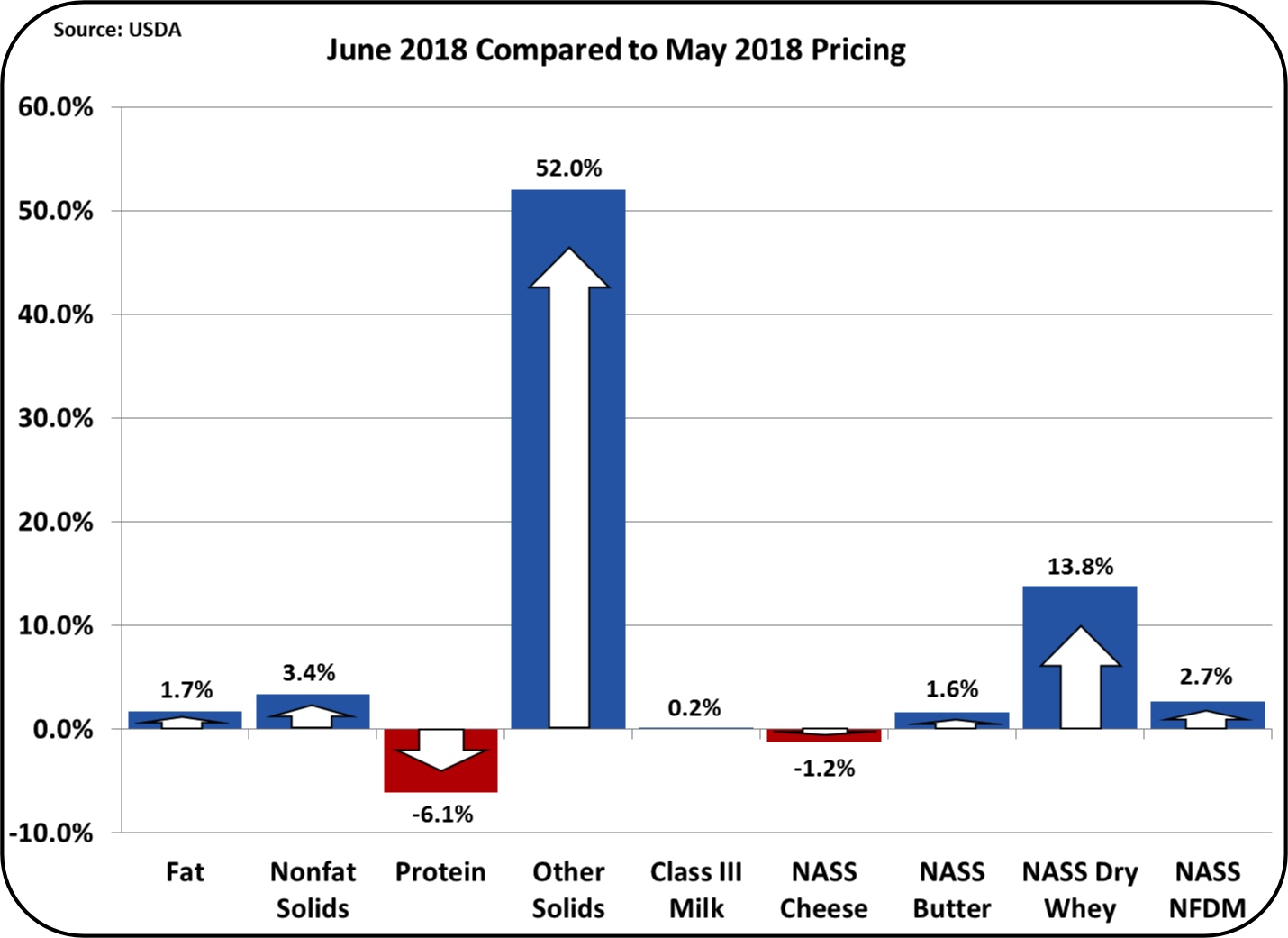
June Class and Component prices were announced on July 5. With one exception, prices saw very little change from the prior month. The 52% increase in the price of other solids dominates Chart I. Other changes were minimal with the Class III price increasing by .2%. Cheese prices were down slightly, which reduced the milk protein price by $.08/lb. A drop in the cheese price usually causes a drop in the Class III price, however the increase in the price of other solids offset the loss to make the Class III price slightly positive.
Chart I – Dashboard of Dairy Price Changes
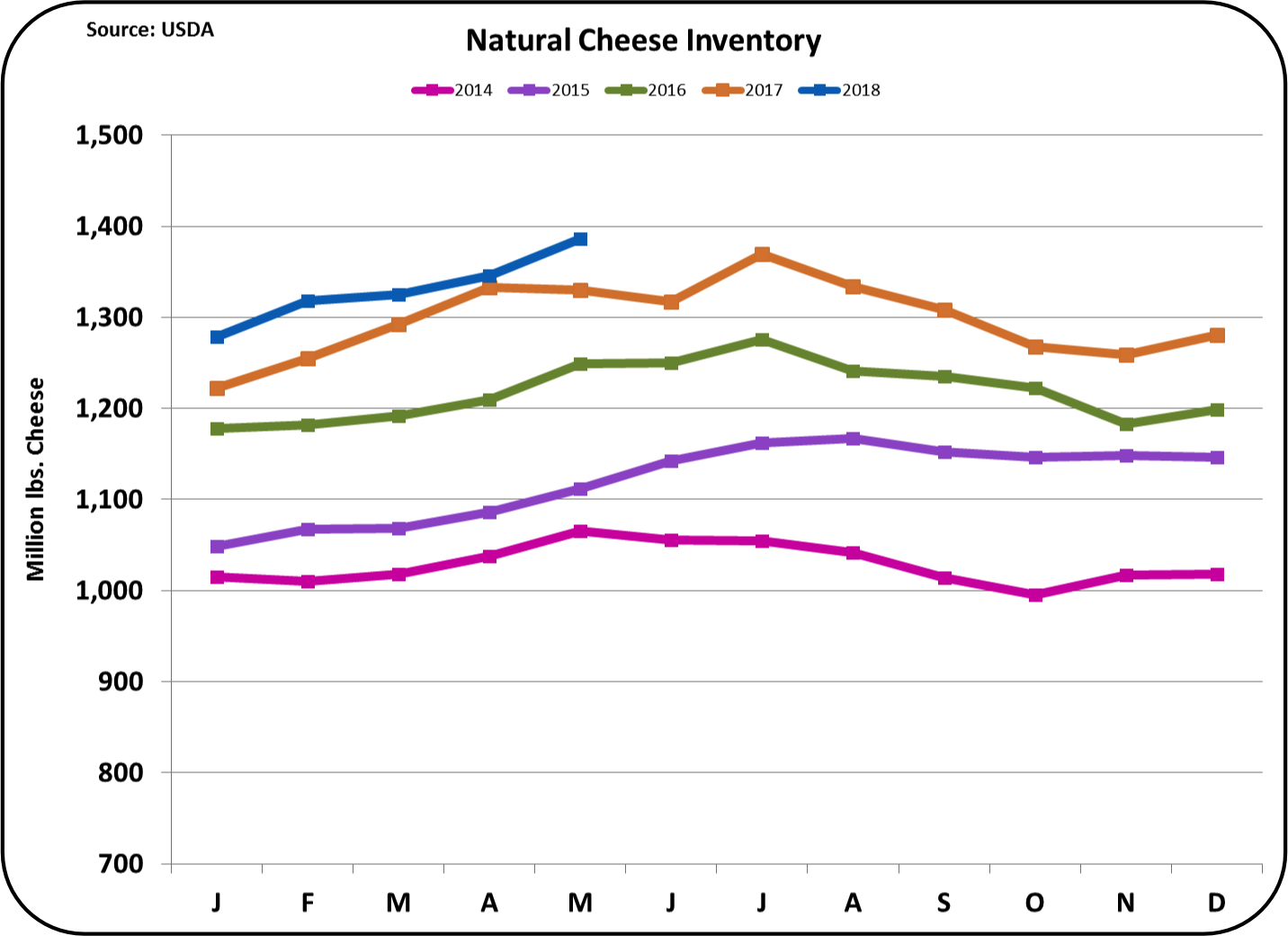
Why did cheese prices drop? Cheese inventories (Chart II below) were again up substantially. Before any meaningful increase in the Class III price can be attained, cheese inventories must come down. A lower inventory will force an increase in the price of cheese and an increase in the Class III price.How high was the cheese inventory increase? It was roughly twice the 2% growth rate of domestic cheese consumption compared to the prior year. Compared to two years ago the growth in inventories is roughly five times the growth in domestic cheese consumption. The growth in cheese exports can only absorb a small part of this increase.
Chart II – Cheese Inventory
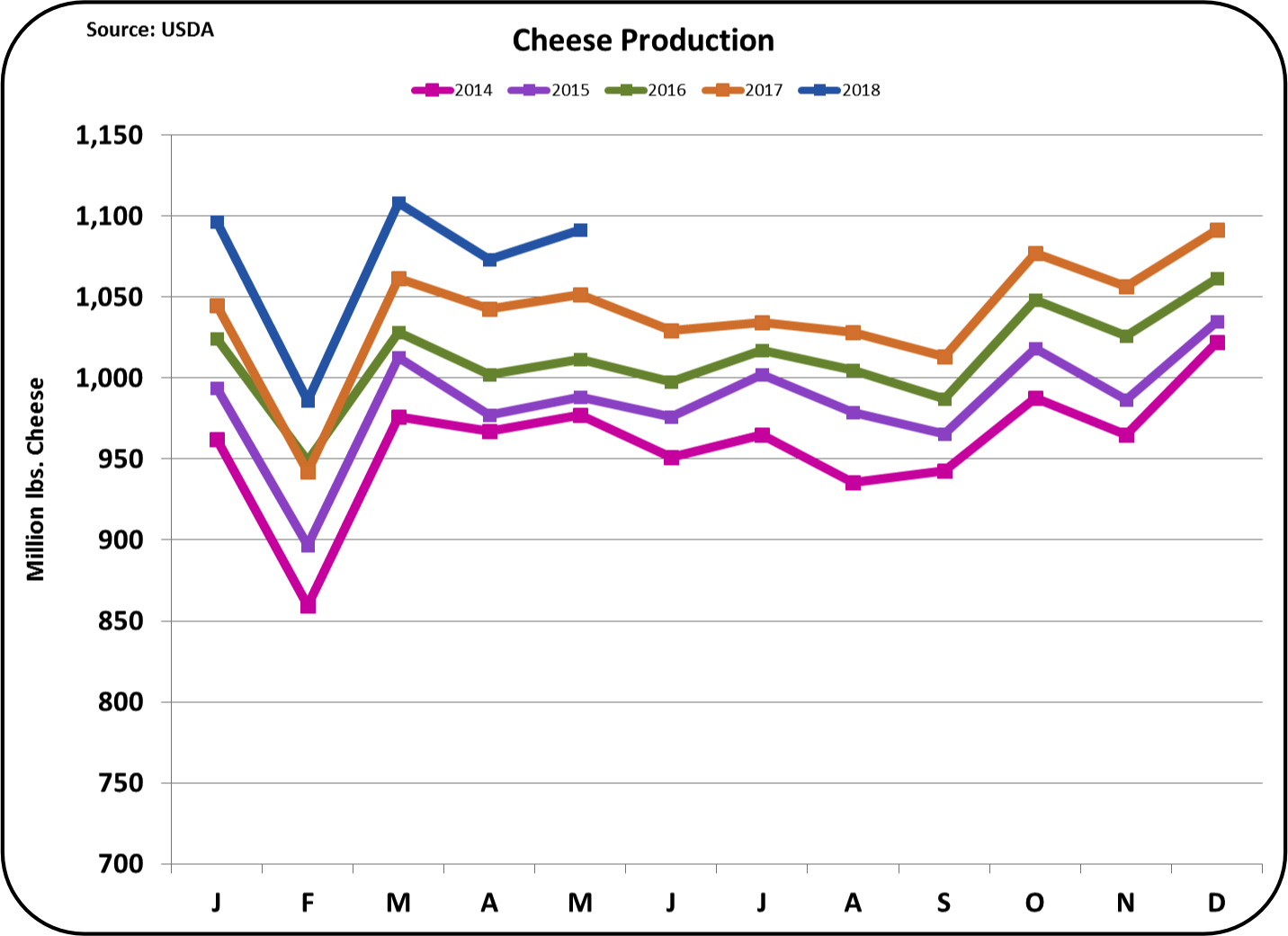
What is behind the growth in inventories? Over production of cheese caused by over production of milk is clearly the culprit. While there are lots of news headlines about new tariffs on cheese exports, the problem is really right in the U.S. With the drop in fluid milk consumption the increases in U.S. milk production cannot be sustained. Parking the excess milk in cheese inventories buys time, but it is not a solution.
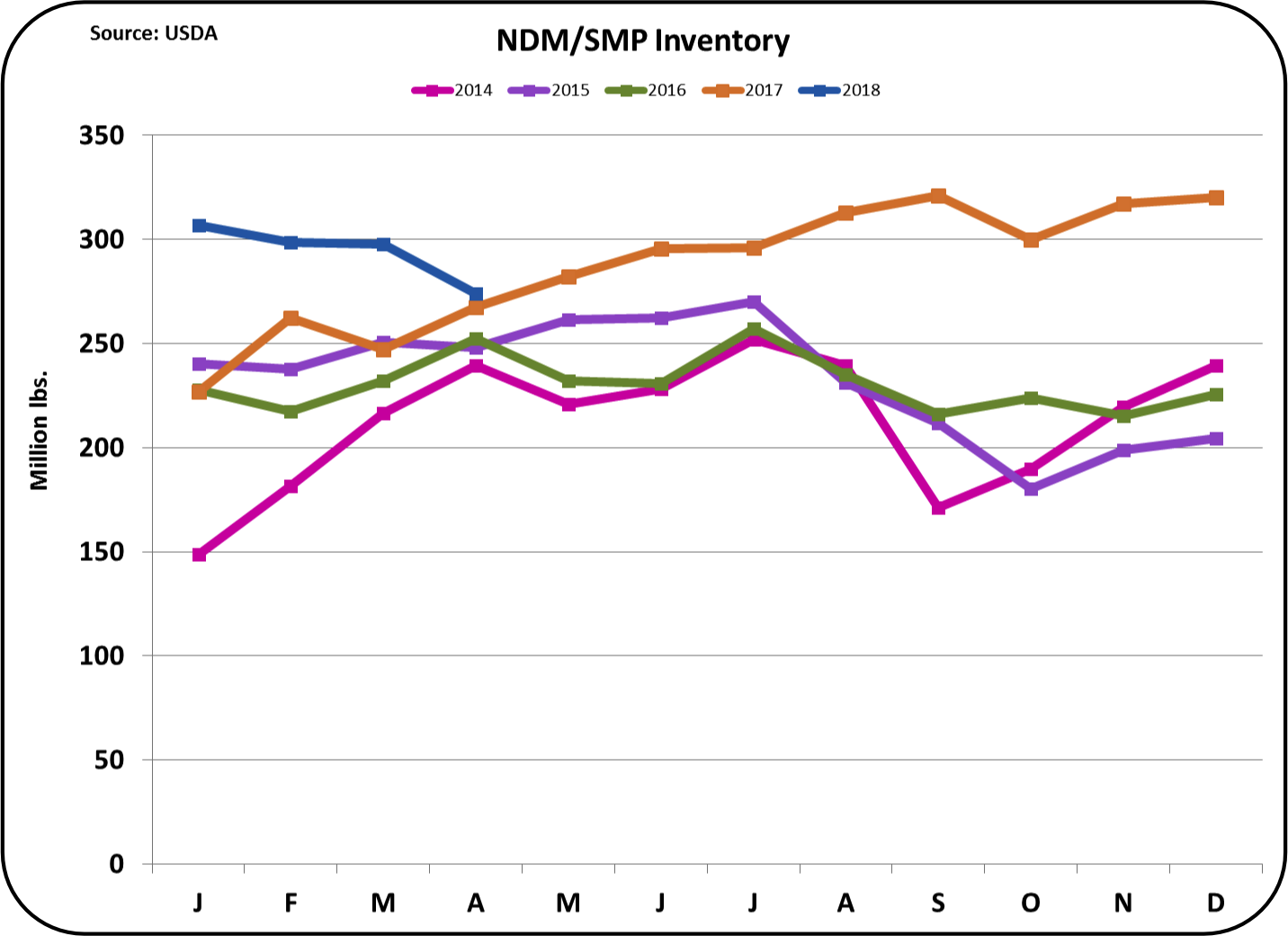
to this blog, the huge increase in Nonfat Dry Milk (NDM) exports was covered. It was impactful in reducing the inventories of NDM (Chart IV below).
Chart IV – NDM/SMP Inventory
While the price of NDM is primarily dictated by international prices, there was a slight upward tick in the price of NDM, which in-turn gave a slight upward tick to the Class IV skim price. While any increase is helpful, the price of NDM is still in low range of under $1/lb. where it has been for the last three years. The excess global supply of NDM and Skimmed Milk Powder is keeping these prices low.
Chart V – NDM Wholesale Prices
The big increase in the value of other solids is linked to the increase in dry whey prices. Because the drying price of dry whey comes close to the total value of dry whey, relatively small changes in the price of dry whey can have a big change on the price of other solids. The cost to dry whey is $.1991/lb. and the value of dry whey has ranged in 2018 from $.25/lb. to the current price of $.31/lb. That is why a 13.8% increase in the price of dry whey can calculate to a 52% increase in the value of other solids.
Other Solids Price = (Dry Whey Price − 0.1991) x 1.03
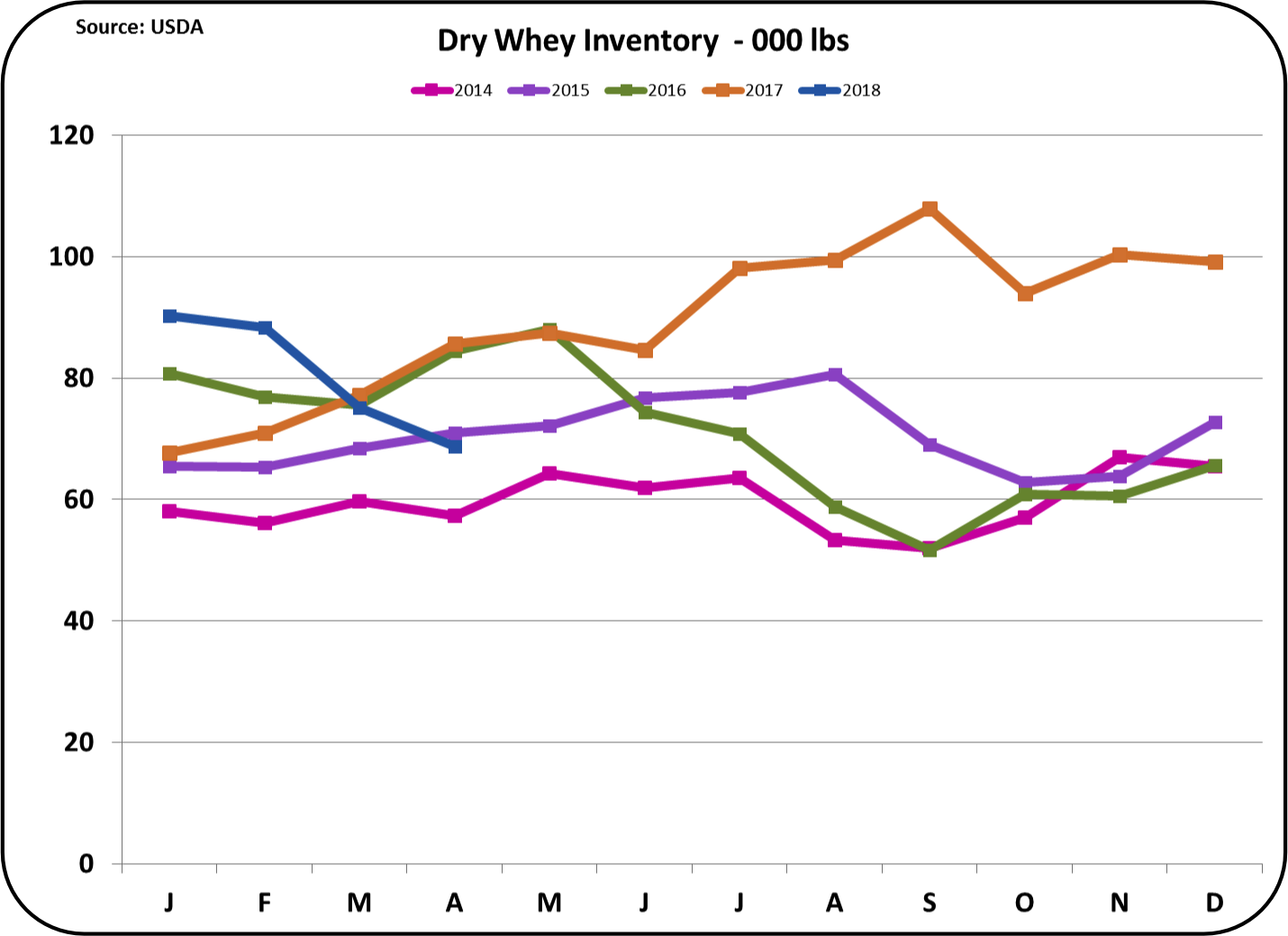
What caused the huge increase in dry whey prices? Chart VI below shows the huge drop in inventories in 2018.
Chart VI – Dry Whey Inventory
U.S. dairy values remain stuck at moderate prices with a number of shifting parameters like domestic consumption, milk supply, and international events that impact exports and imports. Posts to this blog will continue to provide accurate and unbiased insights. As California moves closer to becoming an FMMO, more posts will provide information on what is happening in California and how it may impact the total U.S. dairy industry.
At the Chicago Board of Trade Monday, milk futures continued to dive and the cash dairy prices were mixed. July Class Three milk was down $.04 at $14.16. August was down $.17 to $14.52. September was down $.16 to $15.06. October was down $.08 to $15.35. The milk futures from November through next June ranged from five to ten cents lower.
Grade AA Butter was up $.03 to $2.20 per pound. Eight carloads sold between $2.19 and $2.2050. Barrels were up $.0175 at $1.2625 per pound. Six carloads of barrels sold from $1.2450 to $1.2625. Forty-pound blocks were unchanged at $1.5425 per pound. No sales were recorded. Nonfat dry milk was unchanged at $.7725 per pound. No sales were recorded. Dry whey was up $.0075 to $.3975 cents per pound. Two carloads sold at $.39 and $.3950.
At the Chicago Mercantile Exchange Thursday, milk futures and cash dairy prices continued to fall. July Class Three milk was down $.13 at $14.36. August was down $.15 to $14.86. September was down $.13 to $15.38. October was down $.13 to $15.57. The milk futures from November through next June ranged from zero to 11-cents lower.
Grade AA Butter was down $.02 to $2.18 per pound. Three carloads sold with prices from $2.18 to $2.19. Barrels were down $.0825 at $1.28 per pound. Three carloads sold from $1.28 to $1.32. Forty-pound blocks were down $.0075 to $1.5425 per pound. One carload sold at $1.5075. Nonfat dry milk was up $.0025 to $.7425 per pound. No sales were recorded. Dry whey was down $.0075 to $.3925 cents per pound. One carload sold at that price.
Unexpectedly weak prices for whole and skim milk powder at this week’s Global Dairy Trade auction have seen market participants pile into a record volume of dairy derivatives on the NZX, with most of the jump in options to buy or sell the products.
The record volume was 6,415 lots on July 3, according to NZX Dairy Derivatives data. That beat the previous record set in 2015 of 5,994. At the Global Dairy Trade auction overnight last Tuesday, prices fell, led by an unexpectedly big decline in whole milk powder. The auction was held after Fonterra Cooperative Group, one of the biggest market participants, released production figures showing its New Zealand milk collection for May was up 7 percent from a year earlier to 71 million kilograms and it forecast a 1.3 percent increase for the 2018/19 season.
Whole milk powder sank 7.3 percent to US$2,905 a tonne and skim milk powder shed 4.6 percent to US$1,913 a tonne, prompting AgriHQ dairy analyst Amy Castleton to say it looked like the market “had the jitters, especially for whole milk powder”.
“Yesterday the market had a record day. People wanted to jump in and manage their risk,” said Nigel Brunel, director of institutional commodities at OMF. “GDT went down and that made the market more volatile. It was more than I expected but there seems to be a lot of milk out there globally and New Zealand is setting itself up for a good season.”
Some 4,000 contracts were in options, the biggest volume in at least three months, based on NZX data. A similar volume of futures contracts traded a week earlier, also a three-month high. It was the busiest day for options trading since May 2015. The contracts are for one metric tonne for GDT-based contracts and 6,000 kgMS for NZ milk price contracts.
Nick Morris, NZX head of derivatives, said it was “pleasing to see record levels of activity” in dairy derivatives. “Higher volatility at the recent GDT auction is driving large volumes of trade.”
NZX said its data showed the majority of options traded yesterday were at strikes of $2,900 and $3,000. Call options, which give the owner the right to buy the underlying commodities at an agreed price, were traded at $3,000 and puts, an option to sell at a specified rate and time, at $2,900. It added that some options “appear to be trading as structures”. It said participants typically use options as insurance should the price move against them, without having to be committed to such a position.
Traders use contract structures to suit their needs including a collar, where the holder seeks to put a cap and a floor on the price. Within that, there’s a ‘long collar’, where the trader buys a call option and sells a put option, and a ‘short collar’, where they take the opposite position.
NZX’s June metrics show that the notional value of dairy derivatives traded rose 16 percent from June 2017 to $132 million. There were 26,417 futures lots traded, up 10 percent, and 7,332 options lots, up almost 30 percent. The ‘options to futures ratio’ rose 18 percent to about 28 percent.
According to Brunel, the participants in the market are also participants in the dairy sector and are hedging their actual risks and potentially offsetting positions elsewhere, such as being long in the futures market or to offset risks in the actual cash market. OMF’s clients do seek structured positions and Brunel declined to comment on actual trading.
Market participants range from producers and sellers of milk to distributors and buyers of dairy products. Up until this latest week, volatility in the market had actually reduced, Brunel said.
Dairy prices have taken their biggest hit of the year.
The ASB says trade tensions between the United States and China are behind the plunge in prices at the latest global dairy auction.
Average prices tumbled by 5 per cent per cent to reach US$3232 (NZ$4778), the most dramatic decrease seen in the index this year.
The price for New Zealand’s key export whole milk powder (WMP) was US$2905, a fall of 7.3 per cent. Futures markets had suggested WMP might fall by 1 per cent.
ASB rural economist Nathan Penny is still confident about dairy prospects despite speed wobbles caused by trade tensions.
ASB rural analyst Nathan Penny said dairy markets were nervous and last night’s fall in dairy auction prices reflected the nervousness.
“We stick to our positive dairy market view, but note the increasing potential for further dairy market fallout.”
The fall in the price of milk power could be expected to reduce the cost of producing a litre of Anchor Blue milk – on sale for $2.87 at Countdown – by about 2.5c.
Chinese tariff increases on US exports, scheduled for July 7, include dairy and other agricultural products.
Penny said New Zealand would ironically stand to benefit from increased Chinese tariffs on US dairy products.
“These tariffs will make NZ dairy products cheap relative to US equivalents. In turn, Chinese are likely to increase their demand for NZ dairy products , boosting NZ dairy prices.”
“For now though, dairy buyers are more nervous about the fallout from the increasing trade tensions and the potential impact this could have on dairy demand. Already, currencies for key dairy buyers have fallen, with the Chinese yuan down around 3 per cent since the last auction. Meanwhile, Chinese stockmarkets have also taken a hit with the Shanghai Composite Index down nearly 10 per cent over the same period,” Penny said.
The NZ dollar had also fallen about 3 per cent against the US over the past fortnight, but the spot milk price was still sitting at a “healthy” $7.00 per kilogram of milksolids.
AgriHQ said Fonterra’s latest Global Dairy Update appeared to have given the market the jitters, especially for WMP.
It showed its May production was up 6.6 per cent and that it expected to collect 1.3 per cent more milk in the 2018-19 season. There was 20 per cent more WMP sold than at the last auction but buyers were not willing to pay more for it.
All products except butter milk powder and rennet casein fell. Skim milk powder (SMP) was down 4.6 per cent to US$1913, and butter slipped 4 per cent to US$5390.
Anhydrous milkfat (AMF) was down 1.7 per cent, and cheddar prices also fell 4.3 per cent. But buttermilk powder lifted 6.4 per cent, as did rennet casein (3.6 per cent).
Fonterra said production over the past 12 months had been up in many major dairy countries. The European Union and Australia both recorded 3 per cent rises, and the United States 2 per cent. New Zealand on the other hand had flatlined with a zero per cent growth rate.
Meanwhile this week the Global Dairy Trade marked 10 years of auctions with more than US$22 billion cumulative value of dairy products to buyers from over 80 countries.
GDT director Eric Hansen said the auctions re-wrote the rules of engagement for buying and selling dairy commodities.
“In the era before Global Dairy Trade existed, buyers and sellers were struggling to understand what constituted a current market price in the midst of unprecedented volatility. Dairy farmers had limited access to information about what the milk in their vats was worth in international markets.
“By applying advanced auction methods to create a new sales channel for globally-traded commodity dairy products, Global Dairy Trade’s auctions provided assurance to buyers that they were paying a fair market price. Buyers and sellers were able to better manage price risk. And farmers had a regular market-based price signal around which they could plan their farming businesses,” Hansen said.
The platform launched at the height of the global financial crisis and dairy prices initially crashed but eventually recovered.
At the Chicago Mercantile Exchange Tuesday, milk futures and cash dairy prices tumbled ahead of the holiday. July Class Three milk was down $.19 at $14.49. August was down $.32 to $15.01. September was down $.36 to $15.51. October was down $.27 to $15.70. The milk futures from September through next June ranged from zero to 36-cents lower.
Grade AA Butter was down $.0525 to $2.20 per pound. Three carloads sold with prices from $2.20 to $2.21. Barrels were down $.0675 at $1.3625 per pound. Sixteen carloads sold from $1.37 to $1.42. Forty-pound blocks were down $.0325 to $1.55 per pound. Two carloads sold at $1.55 and $1.5650. Nonfat dry milk was unchanged at $.74 per pound. Two carloads sold at $.74 and $.7450. Dry whey was down $.01 to $.40 cents per pound. One carload sold at that price.
Last week Federal Member for Wide Bay Llew O’Brien and former Deputy Prime Minister Barnaby Joyce made a public declaration against Coles and Woolworths, with O’Brien stating, “Look after our dairy farmers, and if you don’t we’re coming after you.”
The statement was made to put consumer outrage at Woolworths and Coles charging shoppers 15 cents for reusable shopping bags into perspective by comparing it to $1 milk. While it does seem ridiculous to pay 15c for a bit of plastic compared to $1/litre for a natural product such as milk, we need to ask what real meaningful plans are being pulled together by the parties to save our dairy industry.
Queensland Dairyfarmers’ Organisation has been pushing both state and federal governments to take a stand against the duopoly since they first introduced $1/litre pricing in 2011.
While we held out some hope when the ACCC inquiry into the dairy industry was first announced, we have found neither side of the political fence making a concerted effort to affect the situation since the final ACCC report claimed that farmers were in such a weak bargaining position in the supply chain, forcing the supermarkets to increase the price of their private label product would not necessarily see that flow back to farm gate.
So while we are right behind the sentiment in Llew O’Brian’s recent speech, what we need is for both sides of politics to work together on a real and tangible plan to make the domestic milk market function properly and get a real outcome for the dairy industry.
As one QDO member pointed out on Facebook when the story ran, it was a nice to see that consumers want to support our farmers, but they don’t know how. This is a sentiment that we’ve seen in recent secret shopper research that QDO has been conducting.
So, QDO is also looking at ways that bypass the supply chain politics and use the might of the consumer to influence change. We have several campaigns in the pipeline to do this.
We are aware that no one tactic is going to be the silver bullet, but we are hopeful that consumers will tell our politicians and the supermarkets through their purchases that they truly support the local Queensland dairy industry and want to see it survive for future generations.
At the Chicago Mercantile Exchange Monday, Milk futures were mostly down and cash dairy prices mixed. July Class Three July milk was up $.08 at $14.68. August was down $.01 to $15.33. September was down $.08 to $15.87. October was down $.09 to $15.97. The milk futures from September through next June ranged from zero to eight cents lower.
Grade AA Butter was down $.0150 to $2.225 per pound. Fourteen carloads sold with prices from $2.2450 to $2.26. Barrels were up $.04 at $1.43 per pound. Eight carloads sold from $1.39 to $1.43. Forty-pound blocks were up $.0275 to $1.5825 per pound. No sales were recorded. Nonfat dry milk was down $.0075 at $.74 per pound. Three carloads sold at $.74 and $.7450. Dry whey was up $.0025 to $.41 cents per pound. No sales were recorded.
At the Chicago Mercantile Exchange Thursday, milk futures were mostly up and cash dairy prices mixed. Class Three June milk was up $.01 at $15.24. July was up $.05 at $14.34. August was down $.06 to $15.21. September was up $.03 to $15.92. The milk futures from October through next May ranged from zero to five cents higher.
Grade AA Butter was down $.0025 to $2.25 per pound. Five carloads sold with prices from $2.24 to $2.2525. Barrels were up $.08 at $1.3350 per pound. Thirteen carloads sold from $1.2650 to $1.3350. Forty-pound blocks were up $.0275 to $1.5125 per pound. Three carloads sold from $1.49 to $1.5125. Nonfat dry milk was down $.0050 at $.7475 per pound. Two carloads sold at that price. Dry whey was up $.01 to $.4125 cents per pound. No sales were recorded.
At the Chicago Mercantile Exchange Wednesday, milk futures were up sharply, but not enough to make up for huge Monday losses. Cash dairy prices also made small gains. Class Three June milk was up $.01 at $15.23. July was up $.23 at $14.29. August was up $.39 to $15.27. September was up $.32 to $15.89. The milk futures from October through next May ranged from zero to twenty-six cents higher.
Grade AA Butter was up $.0075 to $2.2525 per pound. Ten carloads sold with prices from $2.2525 to $2.2750. Barrels were up $.05 at $1.2550 per pound. Twenty-five carloads sold from $1.25 to $1.2975. Forty-pound blocks were down $.04 to $1.45 per pound. Two carloads sold at that price. Nonfat dry milk was up $.0050 at $.7525 per pound. Four carloads sold from $.7475 to $.7525. Dry whey was up $.0125 to $.4025 cents per pound. One carload sold at $.39.
The new appetite to negotiate with different milk companies comes as most processors have confirmed opening prices for the new season, which begins on Sunday.
Some processors have superseded previous opening prices as the race to secure milk heats up. Colac’s Bulla Dairy Foods has gone as far as venturing into Gippsland for the first time to shore up supplies.
But many farmers are not happy with current offerings.
Katamatite dairy farmer Erwin Van Den Berg said processors had been phoning him regularly wanting milk.
He said he had been negotiating with a few and knew many farmers in the same situation. He was also critical of “games played” by processors, such as sign-up bonuses and said he envisaged farmers swapping processors annually.
Mr Van Den Berg, who supplies Parmalat, which unveiled an opening price of $5.90/kg of milk solids last week, said the price determined where he sent milk. He said he needed “mid sixes-plus (/kg of MS)”.
Former Murray Goulburn supplier Barry Bruce, of Kongorong in South Australia, said he was furious with the $5.75/kg of MS opening price from new owner Saputo last week.
United Dairyfarmers of Victoria president Adam Jenkins said he did not necessarily believe there would be an exodus of farmers to different processors, but that many were looking at their options.
Australian Consolidated Milk lifted its opening by 1.7 per cent to $6/kg on Monday. This comes after Bulla Dairy Foods lifted its opening by 20c/kg earlier this month. Bulla general manager Rohan Davies said its recruitment had gone well with some “opportunity left in southwest Victoria”.
Thanks in part to record exports most Class III milk futures contracts at the Chicago Mercantile Exchange Monday finished with gains, June milk closed up a penny at $15.22. July was down four cents, settling at $14.06. August milk finished two cents higher at $14.88. The September contract closed three cents higher at $15.57. The October through January contracts were up $0.02 to down $0.03 Tuesday.
Grade AA butter was down a cent at $2.2450. Five loads sold, ranging from $2.24 to $2.2475. Blocks were a penny higher at $1.46. Barrels steady at $1.2050. Six loads sold, ranging from $1.2050 to $1.2075. Nonfat dry milk closed one cent higher at $0.7475. Six loads sold, ranging from $0.7375 to $0.7475. Dry weigh was down one cent at $0.39.
At the Chicago Mercantile Exchange Monday, dairy prices were down and milk futures were sharply down. Class Three June milk was down $.04 at $15.21. July was down $.56 at $14.10. August was down $.50 to $14.86. September was down $.39 to $15.54. The milk futures from October through next May ranged from three to twenty-seven cents lower.
Grade AA Butter was down $.0350 to $2.2550 per pound. No sales were recorded. Barrels were down $.08 at $1.2050 per pound. Twenty-three carloads sold from $1.2850 to $1.3125. Forty-pound blocks were down $.04 to $1.45 per pound. Two carloads sold at that price. Nonfat dry milk was down $.0250 at $.7375 per pound. Six carloads sold from $.7375 to $.7475. Dry whey was up $.0025 to $.40 cents per pound. No sales were recorded.
At the Chicago Mercantile Exchange Thursday, dairy prices continued to fall. Class Three June milk was down $.06 at $15.26. July was down $.14 at $14.86. August was down $.07 to $15.49. September was down $.02 to $16.07. The milk futures from October through next May ranged from ten cents lower to one cent higher.
Grade AA Butter was up $.0025 at $2.29 per pound. No sales were recorded. Barrels were up $.0175 at $1.31 per pound. Thirty-four carloads sold from $1.2825 to $1.3275. There were also 22 carloads sold Wednesday. Forty-pound blocks were down $.01 to $1.4950 per pound. Three carloads sold from $1.4950 to $1.5050. Nonfat dry milk was up $.0025 at $.77 per pound. Eight carloads sold from $.76 to $.77. Dry whey was unchanged at $.39 cents per pound. No sales were recorded.
At the Chicago Mercantile Exchange Wednesday, milk futures dropped again, after a one-day break from sliding prices. Class Three June milk was unchanged at $15.32. July was down $.12 at $15.00. August was down $.06 to $15.56. September was down $.03 to $16.09. The milk futures from October through next May ranged from one two cents lower to two cents higher.
Grade AA Butter was down $.0225 at $2.2875 per pound. One carload sold at that price. Barrels were down $.0325 at $1.2925 per pound. Twenty-Two carloads sold from $1.2875 to $1.33. Forty-pound blocks were down $.0625 to $1.5050 per pound. One carload sold at that price. Nonfat dry milk was up $.0150 at $.7675 per pound. Nine carloads sold from $.7550 to $.7675. Dry whey was down $.0050 at $.39 cents per pound. No sales were recorded.
At the Chicago Mercantile Exchange Tuesday, cash dairy prices fell and most milk futures stopped their downward slide.
Class Three June milk was down $.01 to $15.32. July was down $.07 at $15.12. August was up $.06 to $15.62. September was up $.09 to $16.12. The milk futures from October through next May ranged from one cent lower to five cents higher.
Grade AA Butter was down $.0125 at $2.31 per pound. Six carloads sold from $2.3075 to $2.32. Barrels were down $.07 at $1.3250 per pound. Ten carloads sold from $1.33 to $1.38. Forty-pound blocks were down $.0275 to $1.5675 per pound. No sales were recorded. Nonfat dry milk was down $$.0075 at $.7525 per pound. One carload sold at that price. Dry whey was down $.0050 at $.3950 cents per pound. No sales were recorded.
At the Chicago Mercantile Exchange Monday, cash dairy prices were mixed and milk futures were sharply down again. Class Three June milk was down $.04 to $15.33. July was down $.24 at $15.19. August was down $.36 to $15.56. September was down $.36 to $16.03. The milk futures from October through next May ranged from nineteen to twenty-six cents lower.
Grade AA Butter was down $.03 at $2.3225 per pound. No sales were recorded. Barrels were down $.0550 at $1.3950 per pound. Eight carloads sold from $1.3975 to $1.42. Forty-pound blocks were unchanged at $1.5950 per pound. No sales were recorded. Nonfat dry milk was down $$.0275 at $.76 per pound. One carload sold at $.7650. Dry whey was down $.01 at $.40 cents per pound. No sales were recorded.
At the Chicago Mercantile Exchange Wednesday, Class III milk futures closed down three to eight cents while cash dairy finished steady to lower. June milk closed down three cents at $15.37. July fell $0.08 to $15.75. August milk weakened six cents to $16.35. And September futures were down a nickel at $16.71. The October through January contracts were three to four cents lower at the close.
Grade AA butter down $0.0125 at $2.3575 Wednesday. Blocks unchanged Wednesday at $1.64. Barrels steady at $1.54. Nonfat dry milk down $0.0075 at $0.78. Dry weigh down $0.0075 at $0.41. One trade at $0.41.
At the Chicago Mercantile Exchange Tuesday, dairy markets were mostly down. Class Three June milk was down $.03 to $15.40. July was down $.07 at $15.93. August was down $.11 to $16.41. September was down $.05 to $16.76. The milk futures from October through next May ranged from zero to three cents lower.
Grade AA Butter was down $.02 at $2.37 per pound. Four carloads sold from $1.37 to $1.3750. Barrels were down $.0250 at $1.54 per pound. Fifteen carloads sold from $1.54 to $1.5450. Forty-pound blocks were up $.0050 to $1.64 per pound. Two carloads sold at $1.6375 and $1.64. Nonfat dry milk was down $.0050 at $.7875 per pound. Four carloads sold from $.7875 to $.7925. Dry whey was unchanged at $.4175 cents per pound. Two carloads sold at $.4150 and $.4175.
At the Chicago Mercantile Exchange Monday, milk futures were down and cash cheese flat. Class Three June milk was down $.04 to $15.43. July was down $.14 at $15.90. August was down $.10 to $16.52. September was down $.10 to $16.81. The milk futures from October through next May ranged from seven to twelve cents lower.
Grade AA Butter was unchanged at $2.39 per pound. No sales were recorded. Barrels were unchanged at $1.5650 per pound. No sales were recorded. Forty-pound blocks were unchanged at $1.6350 per pound. No sales were recorded. Nonfat dry milk was down $.0125 at $.7925 per pound. Four carloads sold from $.7925 to $.80. Dry whey was up $.0050 at $.4175 cents per pound. One sale was made at that price.
At the Chicago Mercantile Exchange Thursday, dairy markets were up for a second day following a four-day downturn. Class Three June milk was up $.11 to $15.42. July was up $.15 to $16.04. August was up $.20 to $16.61. September was up $.19 to $16.87. The milk futures from October through next May ranged from twelve to twenty-one cents higher.
Grade AA Butter was up $.01 to $2.39 per pound. Three carloads sold from $2.38 to $2.39. Barrels were up $.0125 to $1.5175 per pound. Two carloads were sold from $1.5050 to $1.51. Forty-pound blocks were up $.02 at $1.60 per pound. Ten carloads sold from $1.5825 to $1.6050. Nonfat dry milk was unchanged at $.8125 per pound. No sales were recorded. Dry whey was up $.0025 at $.4075 cents per pound. No sales were recorded.
Global dairy prices at the latest Global Dairy Trade (GDT) auction fell 1.3 per cent to US$3487 in a discouraging start to the new season.
Whole milk powder (WMP) prices were down 1.1 per cent to US$3205, though regular grade WMP to ship in August was practically unchanged.
Analysts had been picking either flat or slightly declining prices because of higher volumes being offered, and because premiums of futures over previous GDT have shrunk.
Favourable weather saw a rise in Fonterra’s milk collection by 3 per cent during April, but for the 2017-18 season from June to April, New Zealand farmers produced 2 per cent less milk than the year before.
The latest result contrasted with the final auction for the season last month when prices lifted1.9 per cent overall to reach US$3637.
Federated Farmers dairy chairman Chris Lewis said the rise in the value of the New Zealand dollar would contribute to even lower returns, but such factors were sometimes out of the country’s control.
Some analysts have been picking the dollar to fall to 65c against the US, but in fact it has recently lifted to just over the 70c mark.
“What with GDT falling slightly and the dollar going up, some accountants will be looking at their balance sheets,” Lewis said.
Farmers were used to spikes and dips in prices, but as long as the overall value remained at the $3300 level, they would be happy.
Most processors had delivered positive farmgate forecasts in recent weeks in the region of $7 per kilogram of milksolids. Lewis sounded a note of caution, saying it was better to under promise and then over deliver.
The most dramatic change in the overnight auction was seen in butter milk powder, which jumped by 17.7 per cent.
AgriHQ pointed out there was a greater volume of WMP on offer than had been forecast. WMP volumes for the auction were lifted 7.6 per cent from forecasts. Buyers bought more WMP than they did at the May 15 event, but they were unwilling to pay more for it.
Butter prices fell 3.5 per cent, anhydrous milkfat was down 1.7 per cent. Skim milk powder prices were up marginally, lifting 0.3 per cent.
Cheddar prices were down 3.6 per cent, lactose lifted 3.9 per cent and rennet casein prices rose 2.7 per cent.
At the Chicago Mercantile Exchange Wednesday, the markets took a slight turn higher after four straight days of diving dairy prices. Class Three June milk was up $.05 to $15.31. July was up $.16 to $15.89. August was up $.13 to $16.41. September was up $.15 to $16.68. The milk futures from October through next May ranged from zero to fourteen cents higher.
Grade AA Butter was up $.0175 to $2.38 per pound. Four carloads sold from $2.37 to $2.38. Barrels were unchanged at $1.5050 per pound. Eighteen carloads were sold from $1.4850 to $1.5050. Forty-pound blocks were up $.0050 at $1.58 per pound. Ten carloads sold from $1.5725 to $1.58. Nonfat dry milk was up $.0025 at $.8125 per pound. Three carloads sold at that price. Dry whey was up $.0025 at $.4050 cents per pound. One carload sold at that price.
At the Chicago Mercantile Exchange Tuesday, cash dairy markets were lower and milk futures sharply lower as prices fell for a fourth straight trading session. Class Three June milk was down $.12 to $15.26. July was down $.29 to $15.73. August was down $.37 to $16.28. September was down $.33 to $16.53. The milk futures from October through next May ranged from two to twenty-eight cents lower.
Grade AA Butter was down $.0150 to $2.3625 per pound. Six carloads sold from $2.36 to $2.3625. Barrels were down $.0150 to $1.5050 per pound. Four carloads were sold from $1.50 to $1.5050. Forty-pound blocks were down $.0175 at $1.5750 per pound. Thirteen carloads sold from $1.5725 to $1.5750. Nonfat dry milk was down $.0050 at $.81 per pound. Three carloads sold at that price. Dry whey was up $.0025 at $.4025 cents per pound. One carload sold at that price.
At the Chicago Mercantile Exchange, dairy markets were lower for a third straight trading session Monday. Class Three June milk was down $.11 to $15.38. July was down $.21 to $16.02. August was down $.14 to $16.65. September was down $.10 to $16.86. The milk futures from October through next May ranged from three to nine cents lower.
Grade AA Butter was unchanged at $2.3775 per pound. Unlike Friday’s Thirty-two carloads, no trades were made Monday. Barrels were unchanged at $1.52 per pound. No barrels were sold Monday. Forty-pound blocks were down $.0050 at $1.5925 per pound. Two carloads sold at $1.5925 and $1.5950. Nonfat dry milk was down $.01 at $.8150 per pound. Three carloads sold from $.8150 to $.82. Dry whey was up $.0150 at $.40 cents per pound. Two carloads sold at $.3925 and $.40.
Fonterra Australia has today advised farmers its forecast closing farmgate milk price for the 2018/19 season is in the range of $5.50 to $6.20 per kilogram of milk solids (kgMS).
The range is based on market indications which show a continued positive global supply and demand picture. Demand is expected to remain strong – especially from China and for butter and AMF – and the global dairy market’s current prices are expected to continue throughout the new season.
Fonterra Australia Managing Director René Dedoncker said Fonterra remains committed to paying its farmers a price that is market-based, competitive, and sustainable.
“We are keeping to our promise to provide farmers with clear market-based signals in advance of the new season to allow them budget and plan.
“Earlier this year we launched Farm Source in Australia – a comprehensive package of tools and services to assist farmers with farm business management – which is changing the way we work with our farmers. The Farm Source online income estimator will be available in the coming weeks to provide our farmers with the ability to scenario plan for next season.
“Our business is in good shape as we continue to focus on driving sustainable performance.
“We’re building long-term relationships with strategic partners, and with cheese markets like China and Japan, to tap into growing domestic and global demand which is providing more opportunities to grow the value of our farmers’ milk. At the same time, we continue to make efficiency improvements which means we have the right asset base to play to our strengths in cheese, whey and nutritionals.
“We are confident that our strategy and the strength of our three business channels – Consumer, Foodservice and Ingredients – will enable us to continue to pay a competitive price next season. We expect seasonal growth from our existing farmers to continue next season which will meet our customer demand.
“We will announce our opening price in the coming weeks,” concluded Mr Dedoncker.
To provide the best experiences, we use technologies like cookies to store and/or access device information. Consenting to these technologies will allow us to process data such as browsing behavior or unique IDs on this site. Not consenting or withdrawing consent, may adversely affect certain features and functions.
Functional
Always active
The technical storage or access is strictly necessary for the legitimate purpose of enabling the use of a specific service explicitly requested by the subscriber or user, or for the sole purpose of carrying out the transmission of a communication over an electronic communications network.
Preferences
The technical storage or access is necessary for the legitimate purpose of storing preferences that are not requested by the subscriber or user.
Statistics
The technical storage or access that is used exclusively for statistical purposes.The technical storage or access that is used exclusively for anonymous statistical purposes. Without a subpoena, voluntary compliance on the part of your Internet Service Provider, or additional records from a third party, information stored or retrieved for this purpose alone cannot usually be used to identify you.
Marketing
The technical storage or access is required to create user profiles to send advertising, or to track the user on a website or across several websites for similar marketing purposes.
To provide the best experiences, we and our partners use technologies like cookies to store and/or access device information. Consenting to these technologies will allow us and our partners to process personal data such as browsing behavior or unique IDs on this site and show (non-) personalized ads. Not consenting or withdrawing consent, may adversely affect certain features and functions.
Click below to consent to the above or make granular choices. Your choices will be applied to this site only. You can change your settings at any time, including withdrawing your consent, by using the toggles on the Cookie Policy, or by clicking on the manage consent button at the bottom of the screen.
Functional
Always active
The technical storage or access is strictly necessary for the legitimate purpose of enabling the use of a specific service explicitly requested by the subscriber or user, or for the sole purpose of carrying out the transmission of a communication over an electronic communications network.
Preferences
The technical storage or access is necessary for the legitimate purpose of storing preferences that are not requested by the subscriber or user.
Statistics
The technical storage or access that is used exclusively for statistical purposes.The technical storage or access that is used exclusively for anonymous statistical purposes. Without a subpoena, voluntary compliance on the part of your Internet Service Provider, or additional records from a third party, information stored or retrieved for this purpose alone cannot usually be used to identify you.
Marketing
The technical storage or access is required to create user profiles to send advertising, or to track the user on a website or across several websites for similar marketing purposes.












 Unexpectedly weak prices for whole and skim milk powder at this week’s Global Dairy Trade auction have seen market participants pile into a record volume of dairy derivatives on the NZX, with most of the jump in options to buy or sell the products.
 ASB rural economist Nathan Penny is still confident about dairy prospects despite speed wobbles caused by trade tensions.
 Last week Federal Member for Wide Bay Llew O’Brien and former Deputy Prime Minister Barnaby Joyce made a public declaration against Coles and Woolworths, with O’Brien stating, “Look after our dairy farmers, and if you don’t we’re coming after you.”
 Global dairy prices at the latest Global Dairy Trade (GDT) auction fell 1.3 per cent to US$3487 in a discouraging start to the new season.
 Fonterra Australia has today advised farmers its forecast closing farmgate milk price for the 2018/19 season is in the range of $5.50 to $6.20 per kilogram of milk solids (kgMS).



