Cooperatives Working Together (CWT) member cooperatives accepted five offers of export assistance from CWT that helped them capture contracts to sell 850,984 pounds (386 metric tons) of Cheddar cheese, and 440,925 pounds (200 metric tons) of whole milk powder. The product has been contracted for delivery in Asia and Oceania for the period from October 2018 through March 2019.
CWT-assisted member cooperative 2018 export sales total 51.952 million pounds of American-type cheeses, 12.962 million pounds of butter (82% milkfat) and 52.298 million pounds of whole milk powder to 35 countries on five continents. These sales are the equivalent of 1.153 billion pounds of milk on a milkfat basis. Totals have been adjusted to reflect bid cancellations.
Assisting CWT members through the Export Assistance program in the long term helps member cooperatives gain and maintain market share, thus expanding the demand for U.S. dairy products and the U.S. farm milk that produces them. This, in turn, positively affects all U.S. dairy farmers by strengthening and maintaining the value of dairy products that directly impact their milk price.
The amounts of dairy products and related milk volumes reflect current contracts for delivery, not completed export volumes. CWT will pay export assistance to the bidders only when export and delivery of the product is verified by the submission of the required documentation.
At the Chicago Mercantile Exchange, class III milk futures closed mixed Monday as dairy products in cold storage showed inventories are moving while cash prices were limited. The market was able to move from low single digit losses early in the session to low single-digit gains later after product traded. By the end of trade, the average price from now through the end of the year finished unchanged at $16.20. September milk closed a penny lower at $16.13. October down a nickel at $15.99. November two cents higher at $16.39. December up three cents at $16.27. January through next August contracts closed unchanged to six cents higher. Class IV markets followed suit with the average from now through the end of the year rising 4 cents to $15.09.
While the price of cheese and butter was on the rise and Monday session, their inventories were not, and so we enter the seasonal drop down for product. In Monday’s cold storage report butter dropped 9% from July’s inventories to 290.8 million pounds, however, that number is still 4% greater than August 2017. Total natural cheese in inventory dropped as well falling 4% from last, however the 1.36 billion pounds that’s still in storage is 2% larger than last August. Barrels were up $0.02 at $1.38. Twelve trades were made ranging from $1.32 to $1.38. Blocks were unchanged at $1.6350. Dry whey closed up $0.0075 at $0.5225. Nonfat dry milk remained unchanged at $0.8725
With favorable domestic sales, slower growth in milk production and higher dairy exports September milk prices will be higher than August. Higher cheese and dry whey prices will push the September Class III price to around $16.00 compared to $14.95 in August and a low of $13.40 back in February. While the price of butter will average lower this will be more than offset by high nonfat dry milk prices pushing the September Class IV price to around $14.70 compared to $14.63 in August and a low of 12.87 back in February.
Fluid (beverage) milk sales continue to trend lower. Fluid milk sales January through July were 2.2% lower than a year ago. But, with butter and cheese sales running higher total domestic sales of milk and dairy products for September will be higher than a year ago and positive for milk prices. July milk production was up just 0.5% from a year ago which was also positive for milk prices. But a little surprising August milk production improved to 1.4% higher than a year ago. Milk cow numbers fell by 9,000 head June to July but regained 5,000 head in August. August Cow numbers were down slightly from a year ago but an improvement in milk per cow of 1.4% higher than a year ago resulted in the 1.4% increase in total milk production. This higher than expected increase in August milk production could dampen milk prices some. But, schools are now in session moving more milk to fluid use and less for cheese production, and the fact that the sales of butter and cheese improve seasonally during the thanksgiving to Christmas period is still positive for milk prices.
Contributing to the higher August milk production were increases in California milk production of 1.2%, Wisconsin and Minnesota by 1.4%, South Dakota by 2.7%, Texas by 9.5%, New York by 1.7% and Idaho by 0.9%. Both Kansas and Colorado had increases of 8.6%. Dairy expansions were still evident in Texas, Kansas and Colorado by the fact that these states had 20,000, 8,000 and 14,000 more cows respectively than a year ago. In contrast Michigan had 5,000 fewer cows reducing their milk production by 0.6%, Pennsylvania had 6,000 fewer cows reducing milk production by 2.6% and Florida had 5,000 fewer cows reducing milk production by 7.3%. While California had 12,000 fewer cows, milk per cow had improved to 1.9% higher than a year ago. Wisconsin had 4,000 fewer cows but milk per cow was 1.7% higher.
Retaliatory tariffs imposed by Mexico and China beginning in July is having some impact on dairy exports. It appears that Mexico in anticipation of their 25% tariff on U.S. cheese increased cheese imports from U.S. by 43% in June compared to a year ago because July imports were 1% lower than a year ago. July cheese exports to China dropped 56% from a year ago with whey exports down 26%. With China being the largest U.S. market for whey products July whey exports were 8% lower than a year ago, the lowest whey exports in more than two years. While the volume of dairy exports in July were the lowest since January they remained above a year ago due to continued strong exports of nonfat dry milk to Mexico and higher exports of dairy products to other U.S. international customers. Compared to a year ago, July exports of nonfat dry milk/skim milk powder were 30% higher, cheese just 1% higher, butterfat 84% higher and lactose 15% higher. On a total milk solids basis July exports were equivalent to 15.0% of U.S. milk production bringing the year-to-date to 16.6% of U.S. milk production.
While stocks of dairy products remain more than adequate to meet demand they did tighten some in July. Compared to a year ago, July 31st stocks of butter were just 3.5% higher, American cheese stocks 0.8% lower, stocks of cheese varieties other than American 9.1% higher bringing total cheese stocks to 3.3% higher. Nonfat dry milk stocks were 21.3% lower and dry whey stocks 21.7% lower.
How retaliatory tariffs impact U.S. dairy exports in the months ahead continues to bring uncertainty to future milk prices. But, for the last quarter of the year domestic demand should continue to run above a year ago and the growth in milk production may increase by no more than 1%. Even if U.S. dairy exports show some more weakness the Class III price could stay in the low $16’s and the Class IV price in the low $15’s. Looking into 2019 a continued relatively strong economy will be positive for domestic sales. The growth in milk production is likely to stay well below 2%. Milk cow numbers may show little or no increase. With anticipated somewhat lower feed prices milk per cow may improve some. USDA is forecasting just a 0.1% increase in cow numbers and a 1.4% increase in milk per cow bringing the increase in total milk production to 1.5%. If retaliatory tariffs remain, USDA is forecasting lower dairy exports but not falling to a level that will lower milk prices compared to 2018. In fact, USDA’s is forecasting that 2019 milk prices could average higher than 2018. I think it is reasonable to assume milk prices will average higher in 2019. The level of milk production and dairy exports will be major factors in how much higher.
At the Chicago Mercantile Exchange class III milk futures closed mixed Thursday with a stagnant cash trade and slightly larger milk supply weighing on the market. The average from now through December finished unchanged at $16.13 while the first half average of rose 3 cents to $15.91. September milk closed unchanged at $16.14. October was down nine cents at $16.02. November up three cents at $16.27. December up seven cents at $16.10. January through next August contracts closed a penny lower to three cents higher. Class IV markets soften with the average from now through the end of the year dropping 6 cents to $15.04.
Butter closed unchanged at $2.3050. Nine trades were made ranging from $2.30 to $2.3125. Barrels unchanged at $1.39. Two trades were made at that price. Blocks remained unchanged $1.6150. Nonfat dry milk closed down $0.01 at $0.8725. Three trades were made ranging from $0.85 to $0.8725. Dry whey remained unchanged at $0.5250.
At the Chicago Mercantile Exchange class III milk futures closed mixed Wednesday ahead of a slightly bearish milk production report. Class III prices rose across the board with the average from now through the end of the year, rising a nickel to $16.13. September milk closed up a penny at $16.14. October down a nickel at $16.11. November up six cents at $16.24. December up nine cents at $16.03. January through next August contracts closed a penny lower to six cents higher. Class IV markets saw trading in nearby contracts elevating the average price from now through the end of the year to $15.10, up 13 cents from Tuesday’s finish.
A quick glance at the CME spot trade revealed very similar results to Tuesday. Butter rose another 3 cents to move to $2.30 in the half cents a pound. Grade A nonfat dry milk rose a penny and a half to finish at 88 and a quarter. Barrel cheddar dropped a penny and three quarters to finish at $1.39 while blocks remained unchanged at $1.61 and a half. Dry whey remained unchanged as well and finishes once more at 52 and a half cents.
For October, the USDA has set the base Class I milk price at $16.33 per hundredweight, up $1.48 from September, with the base Class I skim price at $7.71, up $1.79.
The USDA says cash dairy had another strong week of modest gains. The USDA reports cash butter for the week ending September 8th averaged $2.30 per pound, $0.2 higher than the previous week. Blocks of cheddar were pegged at $1.68, $0.02 higher. Barrels averaged $1.64, up $0.033. Dry whey prices averaged $0.397, up $.018. Nonfat dry milk averaged $0.845, up $.018.
New production, inventory, and export data is now available. Warning – some of these charts may be offensive!
As covered in prior posts, the linkage between the cheese price and the Class III milk price is firm. As goes cheese, so goes Class III milk. If the price of butter goes up, that can be good for producers only if they can produce more butterfat than they used to. The price of butter has very little influence on the Class III price, which uses standardized component levels.
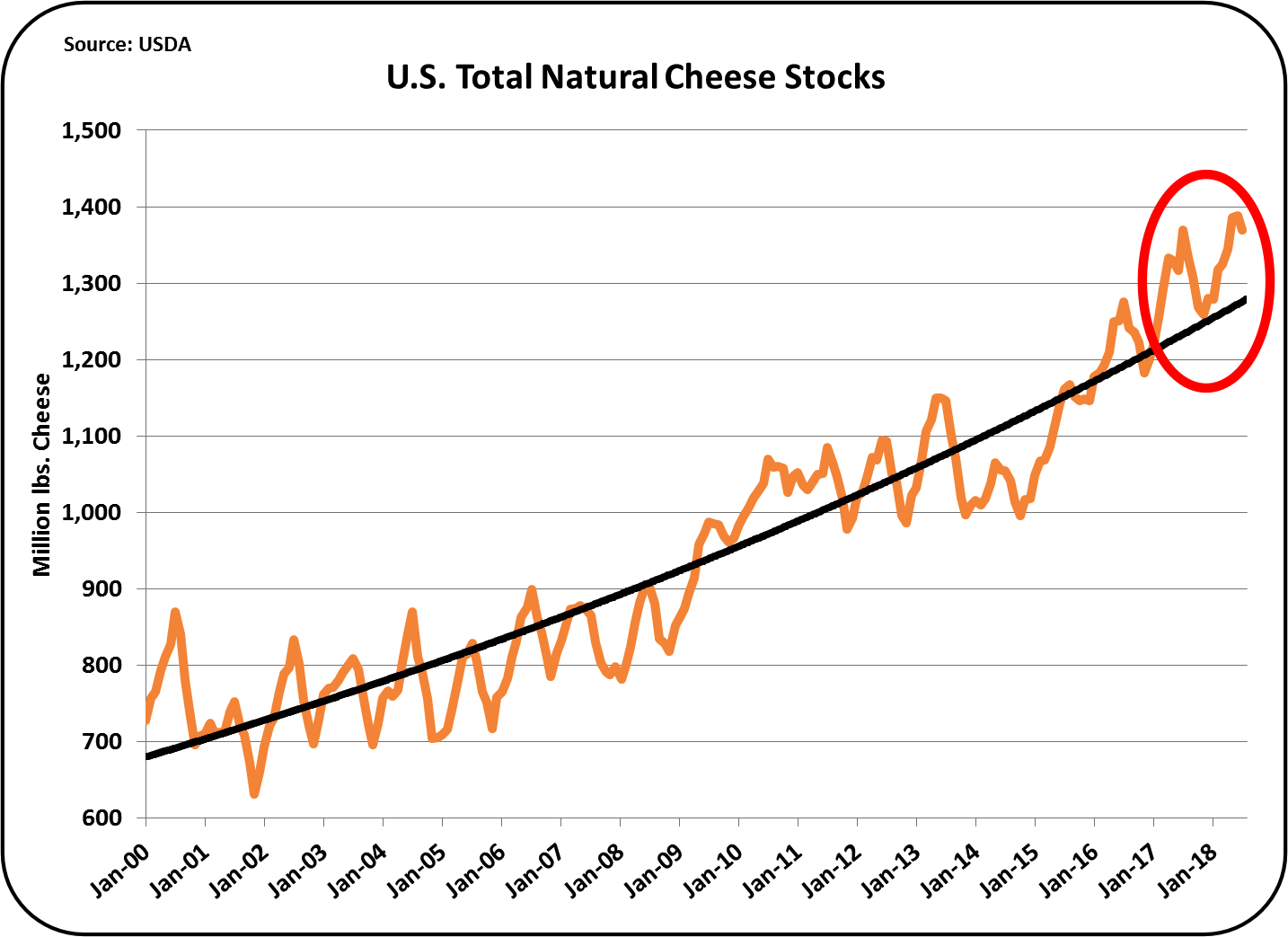
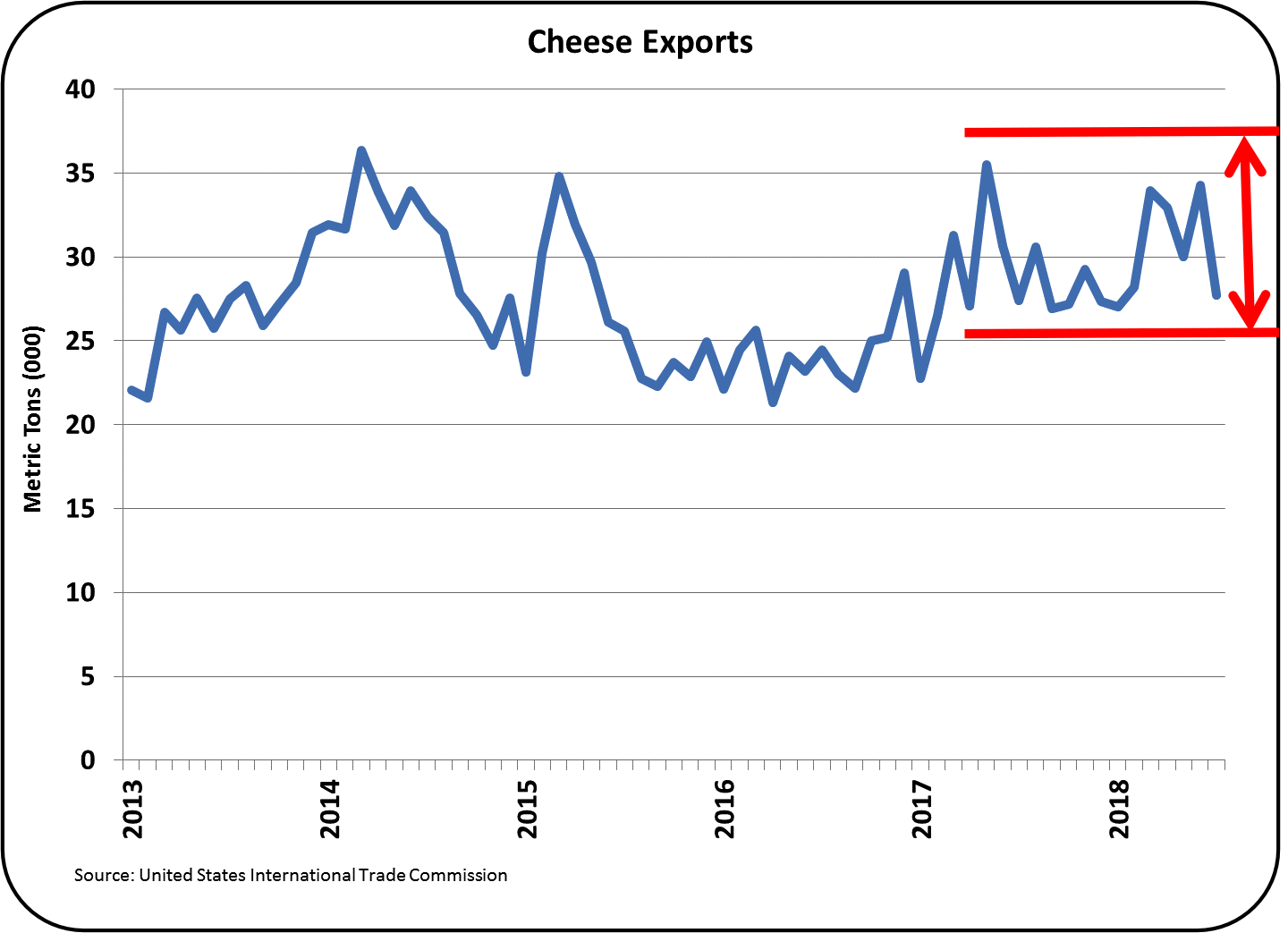
The charts below show how out-of-balance production, inventories, exports are for cheese, butter, and nonfat dry milk.
Cheese production is way above any normal growth pattern for consumer and export demand (Chart I).
Chart I – Cheese Production
Cheese inventories are running extremely high (Chart II). The very high inventories have been building for almost two years. The inventories are well above what is needed for the normal demand growth, which is shown via the chart trend line.
Chart II – Cheese Inventory
Exports of cheese (Chart III) are not showing any growth at all. While there is lots of hype about increasing exports, when it comes to cheese, there is no growth in exports.
Chart III – Cheese Exports
Is cheese a good place to hide excess milk production? It can be held for a while, but the end result is high inventories and low prices. While there is news in the press about the impact of Mexican tariffs on cheese, what we are looking at is a long-term issue, not something that just happened in the last few months.
Predictably, the price of cheese is low and getting lower.
Chart IV – Cheese Prices
When we look at nonfat dry milk/skimmed milk powder (NDM/SMP), the pictures are a little different, but show some of the same patterns. The charts again show production well above the normal growth line. This is probably caused by the demand for butter. Excess NDM/SMP is more of a by-product than a co-product.
Chart V – NDM/SMP Production
When we look at stocks of NDM/SMP, it is very easy to see levels well above the norms.
Chart VI – NDM/SMP Inventory
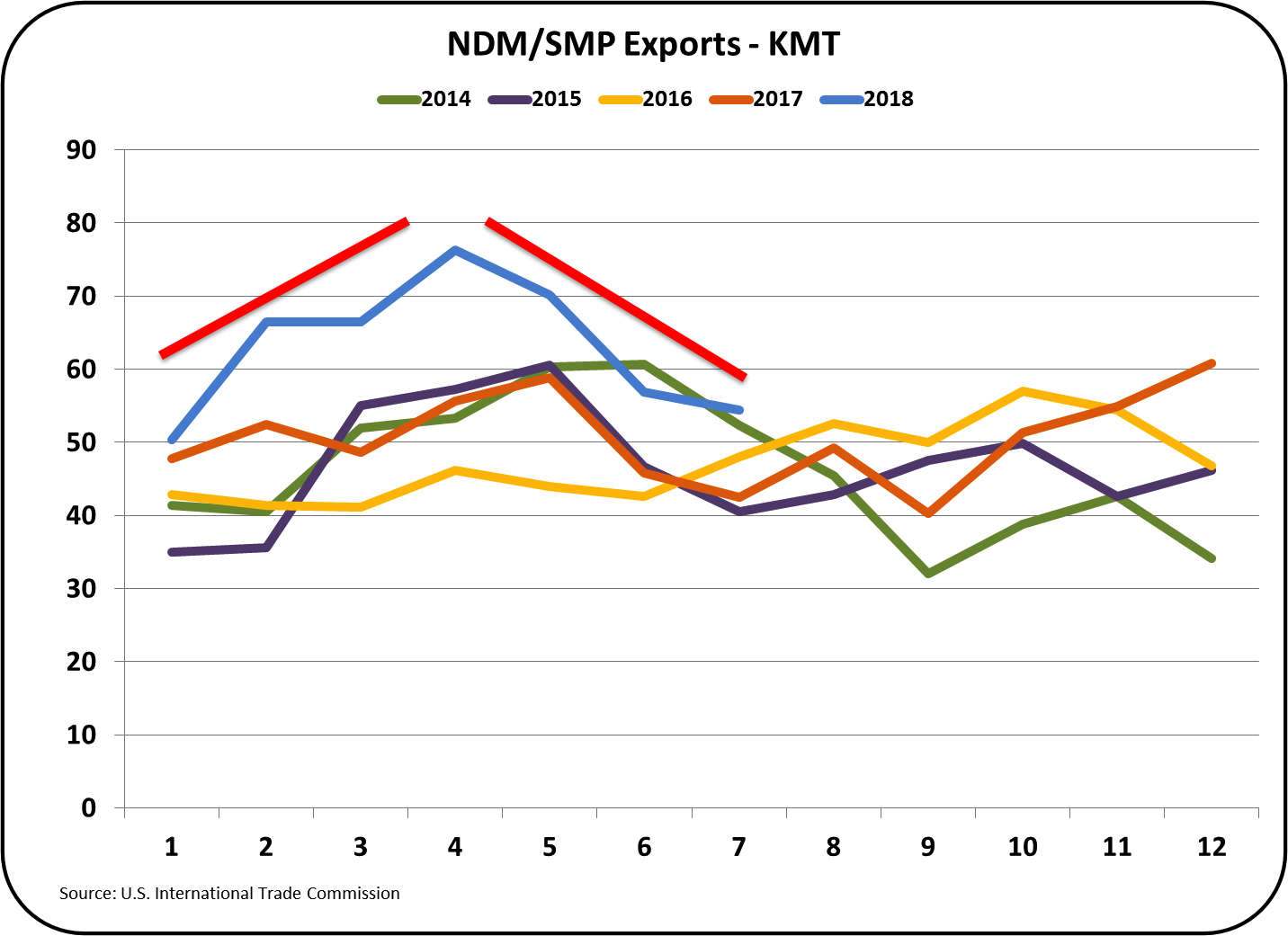
The export chart for NDM/SMP showed great growth for three months, but since April 2018, the exports levels have fallen. Did the earlier 2018 exports just shift the excess stocks to another country and now those must be reduced? If so, we may see a leveling of the year over year exports of NDM/SMP.
Chart VII – NDM/SMP Exports
Putting the NDM/SMP pieces together, results in the very predictable pattern of low prices. The current prices are the lowest in the 19 years shown in Chart VIII.
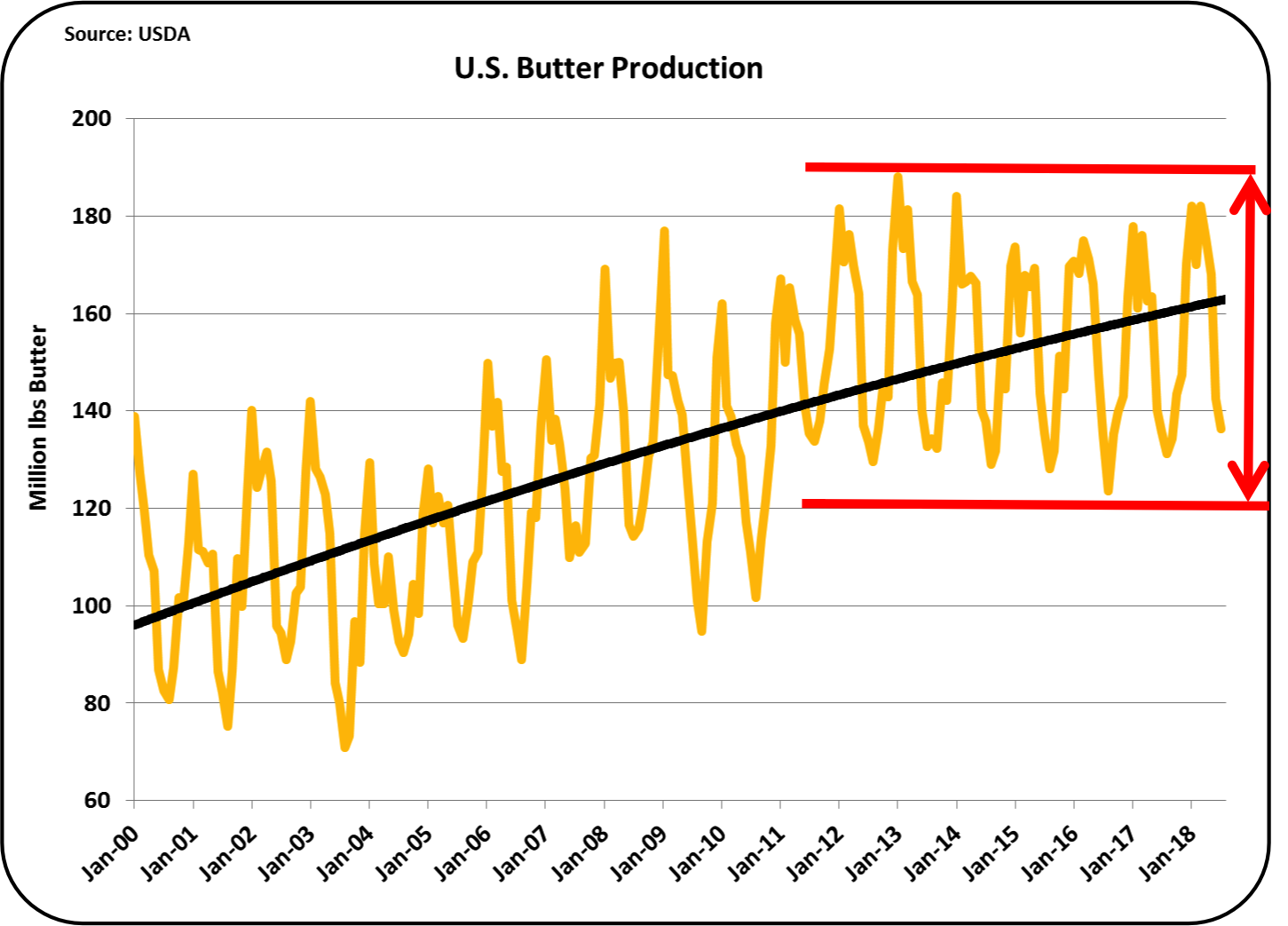
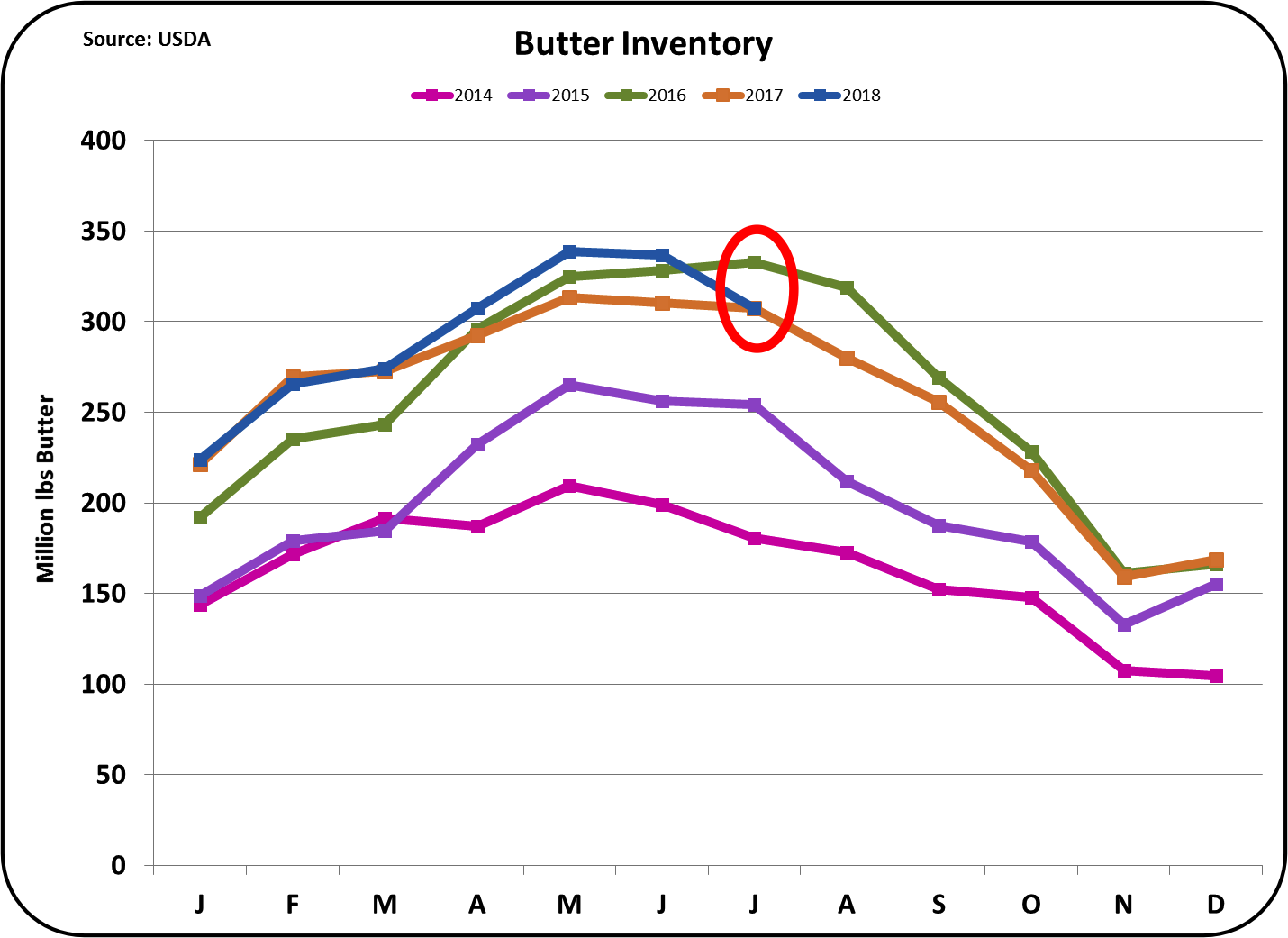
In spite of consumer growth in butter consumption, inventories are currently at or below the levels of the prior two years.
Chart X – Butter Inventory
Exports of butter are growing. YTD in the first half of 2017, 2.7% of butter production was exported. That has risen to 4.5% in 2018, a dramatic increase. But at 4.5% butter exports have the lowest export rate of any major dairy export item. What is being exported is going mostly to Canada with a significant volume also being exported to Mexico.
Chart XI – Butter Exports
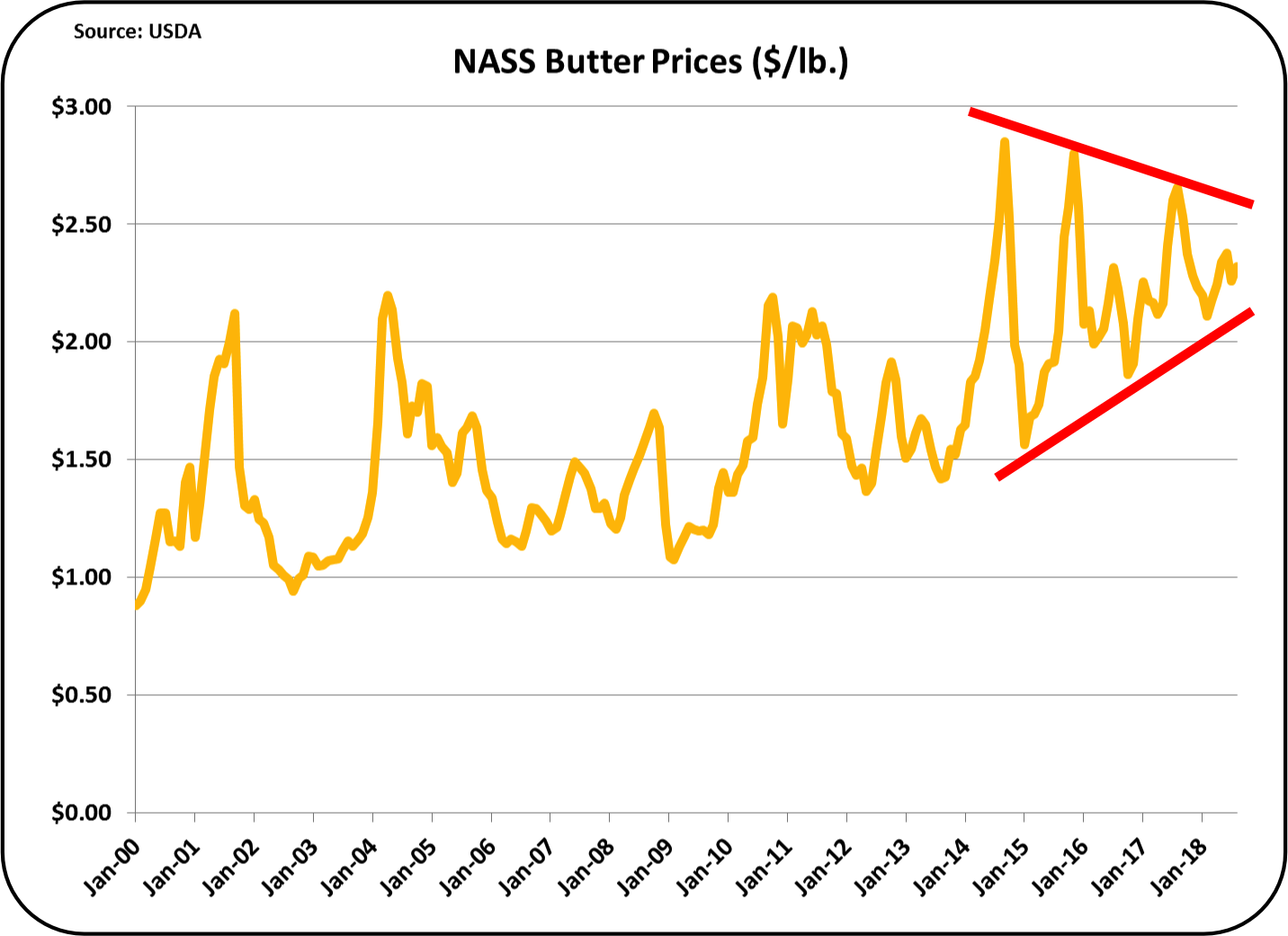
The range of prices for butter has narrowed, but they have stayed above $2/lb. which is the average for the last four years. Tight inventories always result in high prices.
Chart XII – Butter Prices
In summary, we have too much cheese, too much NDM/SMP, and not enough butter. These inventories in turn result in low Class III milk prices, low milk protein prices, and high butterfat prices.
The mix of too much NDM/SMP and too little butter is certainly a contrarian problem that will continue. Both products come from the same Class IV milk and you can’t have one without the other. That may currently be limiting butter churning.
The over supply of cheese is probably being forced by the oversupply of milk. The supply of milk is not dropping, but sooner or later, it will have to drop. Once it drops, inventories will begin to drop and only then will the Class III milk price improve.
At the Chicago Mercantile Exchange, milk futures were mostly down and cash dairy prices were mixed Tuesday, in light of the announcement by the Chinese to retaliate against the most recent round of U.S. tariffs. Class III finishing a nickel lower in its average from now through the end of the year at $16.08. September Class Three milk was up $.01 to $16.13. October was down $.05 to $16.06. November was down $.07 at $16.18. December was down $.10 to $15.94. The milk futures from January through next August ranged from one to six cents lower.
The Global Dairy Trade index fell 1.3% during Tuesday’s trading event (Event #220) with the average price at $2,934 per ton. Cheddar led the charge in its decline lower falling 3.5% to $1.59 a pound while from a volume-weighted standpoint, whole milk and skim milk powder where the real detractors in the declining index. Whole milk powder fell 1.8% to $1.26 a pound while skim milk powder fell 1.1% to 96 cents a pound. Those two products account for more than 75% of the volume in the GDT auction.
Later that would translate into a lower Grade A nonfat dry milk price were in the CME spot trade. The price fell a quarter sent to 86 and three quarters. Barrels were down $.0125 at $1.4075 per pound in line with the GDT trade dropping a penny and a quarter to $1.40 and three quarters. Blocks took the opposite direction rising a penny to $1.61 and a half. Butter followed suit in that regard moving another penny and half higher to $2.27 and a half while whey set another record at 52 and a half cents, up another quarter cent.
At the Chicago Mercantile Exchange, Class III milk futures closed mostly lower Monday, pressured by a mostly inactive cash session. Over the weekend, the Trump administration announced another 10% tariff on another 200 billion of imported Chinese goods. That adds to the 50 billion that are already being tariffs and deepens concerns over trade negotiations going forward. That together with a soft product trade lead to softer Class III markets are the average from now through the end of the year drop 7 cents to finish at $16.13. September milk closed up a penny at $16.12. October down 15 cents at $16.11. November down six cents at $16.25. December down eight cents at $16.04. January through next August contracts closed four cents lower to a penny higher. The 2019 calendar average dropped another penny to $16.10. Class IV market saw support from the higher butter trade that led the average from now through the end of the year four cents higher to $14.98.
It was a quiet day in the CME spot trade where collectively only six loads moved between seller and buyer across all five products combined. Butter was half of that volume rising 2 and a half cents to finish at $2.26. Grade A nonfat accounted for two loads, dropping a half a cent and finishing at 87 cents. Barrels claimed the final load, it finished unchanged at $1.42 while blocks were also unchanged at $1.60 and a half. Although they did not trade. That was true also of whey, it remained unchanged as well and finishes at 52 and a quarter.
At the Chicago Mercantile Exchange class III milk futures closed lower Thursday with strong international production and weaker cash prices weighing on the market. Class III milk markets were even in the September contract, down 18 cents in October and 8 cents lower in November and December, respectively. The 2019 prices were 5-7 cents softer in most months. Class IV milk markets had September even on the day while the 4thquarter settled even to down 10 cents. The 2019 prices fell as well.
CME spot product markets had butter 3 and three-quarter cents higher at $2.23 and a half cents per lb. Five trades were made along with 8 bids. Cheddar blocks fell a penny to $1.62 per lb. while barrels softened 1 and a half cents to $1.47 per lb. Grade A nonfat dry milk declined a half cent to 87 and a quarter per lb. and dry whey was unchanged at 52 and a quarter following 1 trade and 1 uncovered bid.
At the Chicago Mercantile Exchange, class III milk futures closed Wednesday relatively flat range despite a positive supply and demand forecast for milk prices. The average of Class III milk from now through the end of the year fell a penny to $16.21 while the average for Class IV for the balance of 2018 fell 26 cents to finish at $14.90. Grade A nonfat dry milk did the same falling 2 and a quarter-cent to finish at 87 and three-quarter cents.
Turning our attention back to the dairy product trade, block cheese rose a half a cent to finish at $1.63 while barrels rose 3 cents to return to $1.48 and a half. Whey prices rose another quarter-cent to set a new record at 52 and a quarter-cent while butter fell 2 and three-quarters to complete the trade at $2.19 and three-quarters.
At the Chicago Mercantile Exchange Tuesday, milk futures were down sharply and cash dairy prices were mostly down. Class III prices now average $16.23 for the balance of the year, 26 cents lower than the Monday finish. The first half of 2019 dropped 13 cents to an average price of $15.99 while the whole calendar year of 2019 fell 9 cents to $16.18 cents per cwt. Lower butter prices pressured Class IV as well it’s average for the balance of the year fell 14 cents to $15.08. While the 2019 calendar fell 3 cents to match the Class III average of $16.18 per cwt.
Butter caught up in the spirit of the cheese action, it felt three and a quarter-cent to $2.22 and a half after three trades took place. Yet again, the strength in the product trade was found in whey which moved another half-cent higher. It did not trade but now finishes at 52 cents a pound right next to it. Grade A nonfat dry milk held its ground at 90 cents. It did not trade either. Blocks fell 4 and a half cents, without a single load trading. It moves back to $1.62 and a half, a price not witnessed since the 22nd of August. Barrels traded a single load and fell 6 and a half cents. It too returns to a price not seen since early last month.
At the Chicago Mercantile Exchange, class III milk futures closed mostly higher Monday following Friday’s optimism. Fourth quarter prices, we’re up double digits while 2019 was up 2-8 cents. Class IV markets were up slightly as well.
Spot product markets on Monday had butter up to 2 ¾ cents to $2. 2575 following six trades and four bids. Cheddar barrels moved 2 cents higher to $1. 52 per pound, while blocks added another ¾ of a cent to $1. 67 per pound. Dry whey was unchanged at 51.5 cents. Grade A nonfat dry milk lost a penny and closed at 90 cents per pound.
At the Chicago Mercantile Exchange class III milk futures closed sharply lower Thursday pressured by technical selling, increased cheese production and a lack of progress on changes to Canada’s supply management system. Class III markets bled hard as September declined 26 cents to $16.29 per cwt. while the fourth quarter was down 23-39 cents per cwt. The 2019 prices dropped 2-13 cents as well. Class IV milk fared a little better as prices fell 5-12 cents September through November 2018. Both May and November 2019 softened 7 cents while December was down 9 cents.
Barrels moved 10 loads and fell 8 and ¼ cents despite only 1 trade. Cheddar blocks settled at $1.64 per lb. The remaining products held themselves together much better. Butter add ¼ cent after 9 trades and 8 unfilled bids. Butter ended up at $2.19 per lb. Grade A nonfat dry milk closed unchanged at 92 cents per lb. while dry whey gained a half cent following a single bid. Cheese markets on Thursday found a wall of selling that pushed both cheese and milk prices much lower.
Dairy prices at the Global Dairy Trade (GDT) auction dipped 0.7pc overall this week.
Overall prices have now fallen in six out of the last seven auctions, and now are at their lowest since October 2016.
Whole milk powder (WMP) and butter prices led the decline, dipping 2.2pc and 2.8pc, respectively. The WMP price fall was also a touch weaker than the fall signalled by the futures market ahead of the auction.
However, other products fared better. Cheddar and casein led the gains, lifting 4.2pc and 3.7pc, respectively.
Skim milk powder also posted a 2.2pc rise, while anhydrous milk fat and butter milk powder were largely unchanged.
Accoording to Nathan Penny Rural Economist with New Zealand bank ASB the modest overall decline fits with the price weakness normally seen at this time of the year.
“NZ production will peak next month, and the extra availability of NZ product usually dampens prices through the spring.
Looking beyond seasonal factors, he said global dairy markets appear largely balanced.
“NZ production is set to lift this season, albeit moderately – we expect a 2pc lift this season compared to last.
“However, dry weather offshore means exports from other producers are likely to be more scarce than usual over coming months.
“Meanwhile, global demand is mixed, but overall remains relatively positive,” he said.
IFA National Dairy Committee Chairman Tom Phelan said co-ops had taken fright earlier this summer and been overly conservative in just holding base prices, some making do with temporary “support” payments which could readily be whipped out.
Kerry’s Eamonn Scanlon and Glanbia’s Siobhan Talbot have recently expressed confidence in the market place, borne out by the latest European quotes, despite recent negative GDT auctions .
This must lead to higher milk prices from August supplies, he said.
“I think it is important to put GDT auctions in context. The USDA predicts that over 7.5m tonnes of dairy products will be traded globally in the year ending December 2018. The quantities traded through GDT in 2017 were less than 10% of that,” Mr Phelan said.
“Latest European market trends show drought has moderated volumes from June and helped the prices of most commodities rally this month. All co-ops, especially those whose base prices have been allowed fall behind, must increase their August base price and be ready to increase it further before year-end as markets allow,” he said.
At the Chicago Mercantile Exchange Wednesday milk futures were mostly up and the cash dairy markets were flat. September gained 3 cents to $16.55 per cwt. October Class III milk average stands at $16.65 per cwt. The 2019 prices traded even to 10 cents higher depending on the month. The first half of 2019 is offering $16.22 per cwt. Class IV markets saw September lose 11 cents, October 9 and November was down a penny. December 2018 through February 2019 closed even while March to December 2019 jumped 8-28 cents per cwt.
Not much product changed hands on the cash dairy market. CME spot product markets resulted in butter losing 1 and ¾ cents per lb. to $2.18 and ¾ cents. Grade A nonfat dry milk gained 2 and ¾ cents Wednesday to 92 cents per lb. while dry whey added a half cent to 50 and ½ cents per lb. No changes in blocks or barrels were seen. Blocks ended at $1.70 and ½ cents while barrels closed at $1.64, respectively. Nonfat dry milk was up $.0275 at $.92 per pound. Six carloads sold from $.91 to $.92.
Cooperatives Working Together (CWT) member cooperatives accepted 15 offers of export assistance from CWT that helped them capture contracts to sell 1.98 million pounds (896 metric tons) of Cheddar cheese, 317,466 pounds (144 metric tons) of butter and 8.10 million pounds (3,670 metric tons) of whole milk powder. The product has been contracted for delivery in Asia, the Middle East and Oceania for the period from September 2018 through March 2019.
CWT-assisted export sales for 2018 total 48.68 million pounds of American-type cheeses, 12.96 million pounds of butter (82% milkfat) and 41.44 million pounds of whole milk powder to 34 countries on five continents. These sales are the equivalent of 1.04 billion pounds of milk on a milkfat basis. Totals have been adjusted to reflect bid cancellations.
This activity reflects CWT management implementing the strategic plan approved by the CWT Committee in March. These changes enhance the effectiveness of the program and member export opportunities.
Assisting CWT members through this export assistance program in the long term helps member cooperatives gain and maintain market share, thus expanding the demand for U.S. dairy products and the U.S. farm milk that produces them. This, in turn, positively affects all U.S. dairy farmers by strengthening and maintaining the value of dairy products that directly impact their milk price.
The amounts of dairy products and related milk volumes reflect current contracts for delivery, not completed export volumes. CWT will pay export assistance to the bidders only when export and delivery of the product is verified by the submission of the required documentation.
Dairy product prices fell at the Global Dairy Trade auction, led by unexpected slides in whole milk powder and butter.
The GDT price index slipped 0.7 percent from the previous auction two weeks ago. The average price was US$2,980 a tonne, compared with US$3,044 a tonne two weeks ago.
Some 38,811 tonnes of product was sold, up from 32,041 tonnes two weeks ago.
Whole milk powder fell 2.2 percent to US$2,821 a tonne.
“There was a greater volume of whole milk powder sold at this event,” AgriHQ dairy analyst Amy Castleton said in a note, adding that it marked a 33 percent increase from the August 21 event and 29 percent climb from the year-earlier event on September 5, 2017.
At the latest GDT auction, butter dropped 2.8 percent to US$4,271 a tonne.
“Butter prices again saw the largest fall,” according to Castleton. “Oceania butter prices are currently the lowest globally, so the market had been anticipating that they would find some support.”
Lactose slipped 0.5 percent to US$917 a tonne.
Meanwhile, butter milk powder rose 0.1 percent to US$2,474 a tonne, while anhydrous milk fat rose 0.2 percent to US$5,316 a tonne.
Skim milk powder rose 2.2 percent to US$2,005 a tonne, while rennet casein rose 3.7 percent to US$5,326 a tonne, and cheddar climbed 4.2 percent to US$3,631 a tonne.
For sweet whey powder, neither an index nor price was available.
The New Zealand dollar last traded at 65.53 US cents as of 2.54pm in New York, compared with 66.01 US cents at the previous close in Wellington.
There were 126 winning bidders out of 178 participating at the 19-round auction. The number of registered bidders was 541, up from 534 at the previous auction.
“There were the same number of winning bidders at this event as at the previous event, though the auction did stretch out to 2 hours and 43 minutes,” Castleton noted, adding that the previous event took one hour and 57 minutes. “There was likely some increased competition for some commodities.”
At the Chicago Mercantile Exchange class III milk futures closed mostly higher Tuesday supported by an active cash session. The Class III price average for the balance of the year advanced another 3 cents to $16.63.
The global dairy trade did its best to derail the positive tone that has defined markets in the past couple of weeks. The index of products covering the GDT auction fell seven-tenths of a percent but this did little to sway the CME spot trade where blocks rose a penny to $1.70 and a half. That stands as the single highest price witnessed since November 2017. Barrel cheese fell half a cent to $1.64 but in robust volume, 23 loads moved from seller to buyer.
At the Chicago Mercantile Exchange Class III milk futures closed lower Thursday as traders eroded away gains made earlier in the week. Class III markets slid 4 cents in their average for 2019 to settle at $16.16 cents, while the balance of this year slid 5 cents to finish at an average price of $16.45 cents per cwt. Class IV markets were only slightly stronger, rising a penny to an average price for 2019 of $16.6 per cwt.
A closer look at the CME spot trade had butter prices unchanged, with no trades tendered it again finishes at $2.27 and a quarter. Blocks and barrels, each grew a penny. Blocks did not trade, however they finish at $1.67 and three quarters while barrels did in fact trade eight loads and they finish at $1.62. Dry whey was up $0.0025 at $0.4925. Nonfat dry milk was $0.0075 higher at $0.8825. One trade was made at that price.
For August 2018, the USDA says the Class II milk price was $15.07 per hundredweight, down $0.16 from July, the Class III price was $14.95, $0.85 higher, and Class IV was $14.63, an increase of $0.49.
Cooperatives Working Together (CWT) member cooperatives accepted nine offers of export assistance from CWT that helped them capture contracts to sell 557,770 pounds (253 metric tons) of Cheddar and Monterey Jack cheese, 119,050 pounds (54 metric tons) of butter, and 1.819 million pounds (825 metric tons) of whole milk powder. The product has been contracted for delivery in Asia, the Middle East, and Oceania for the period from August through February 2019.
CWT-assisted member cooperative 2018 export sales total 46.701 million pounds of American-type cheeses, 12.645 million pounds of butter (82% milkfat) and 33.349 million pounds of whole milk powder to 31 countries on five continents. These sales are the equivalent of 959.000 million pounds of milk on a milkfat basis. Totals have been adjusted to reflect bid cancellations.
This activity reflects CWT management implementing the strategic plan approved by the CWT Committee in March. The changes are enhancing the effectiveness of the program and member export opportunities.
Assisting CWT members through the Export Assistance program in the long term helps member cooperatives gain and maintain market share, thus expanding the demand for U.S. dairy products and the U.S. farm milk that produces them. This, in turn, positively affects all U.S. dairy farmers by strengthening and maintaining the value of dairy products that directly impact their milk price.
The amounts of dairy products and related milk volumes reflect current contracts for delivery, not completed export volumes. CWT will pay export assistance to the bidders only when export and delivery of the product is verified by the submission of the required documentation.
At the Chicago Mercantile Exchange Class III milk futures closed mixed after USDA confirmed a case of atypical BSE in a cow in Florida and lowered the all milk price for July. The Class II price was announced for the month of August at $15.07, while the Class III announcement came out at $14.95 and Class IV prices were announced at $14.63. On the board, futures prices for Class III milk rose another penny in the 2019 average to finish at $16.21 while Class IV stayed unchanged at $16.05.
A look at product in the CME spot saw butter drop 2 and three-quarter cents on two trades to finish at $2.27 and a quarter. Blocks and barrels both remained unchanged after no trades were tendered. They finish out at $1.66 and three-quarters and $1.61 respectively. Grade A nonfat dry milk dropped a quarter cent on seven loads while whey moved another half cent higher to another new record of 49 cents but without trading and load.
At the Chicago Mercantile Exchange class III milk futures closed mostly higher Tuesday supported by continued optimism following the U.S. and Mexico trade deal and strong cash markets. In the last four trading sessions the month of October, for example, has risen 66 cents. The average for the last four months of the year now stands at $16.51 cents, 15 cents higher than Monday. Despite the positive tone in nearby contracts, the calendar has taken an opposite direction. That price now sits at $16.20, just a penny shy of Monday’s finish. The average for Class IV milk now stands at $16.03 for the 2019 calendar, up just a penny from Monday.
A look at the CME spot trade revealed some optimism as well. Block cheese rose a penny and a half, however, it did not trade. It settles at $1.66 and three-quarters. Barrels remained unchanged but had the highest volume of the spot session with seven loads moving from seller to buyer. It again finishes at $1.61. Butter rose a half a cent after four loads traded hands. Its final price was $2.30 cents. Grade A nonfat dry milk traded a handful of loads, rose three quarters of a cent and finishes at 87 and three-quarters. Dry way rose to yet again another record final prices 48 and a half cents after a half cent climb. It did not trade.
On Monday, the White House announced a preliminary deal between Mexico and the United States. Despite very little released on dairy, Class III milk futures at the Chicago Mercantile Exchange closed higher Monday. Class III 2019 prices ranged anywhere from even to 8 cents higher. Class IV milk markets gained 3-7 cents September through December. CME spot product markets had butter 3 and ½ cents higher at $2.29 and ½ cents following 6 trades and 2 bids. Cheddar barrels moved a penny higher to $1.61 per lb. with 4 loads moving. Blocks also traded 4 times but declined 1 and ¾ cents to $1.65 and ¼ cents. Both Grade A nonfat dry milk and dry whey settled unchanged Monday. Nonfat dry milk closed at 87 cents and dry whey at 48 cents per lb.
At the Chicago Mercantile Exchange, Class III milk futures closed higher Thursday supported by bullish market expectations the dairy herd is shrinking. Class III milk futures bounced 22-30 cents per cwt. higher on Thursday September through December. The average on the last 4 months now stands at $16.16 per cwt. First quarter 2019 traded 17-19 cents higher while the 2ndhalf of 2019 ascended 1-5 cents as well. The 1sthalf of 2019 closed Thursday at $15.93 per cwt. while the full year is at $16.15 per cwt. Class IV markets had small volume and finished mainly unchanged.
Cheddar blocks added 1 and ¼ cents to $1.65 after 2 trades. Barrels gained a penny to $1.57 and ½ cents. Grade A nonfat dry milk declined 1 and ¼ cents to 86 and ¼ cents per lb. Butter closed down $0.0025 at $2.2475. Five trades were made ranging from $2.2325 to $2.25. Dry whey was up two cents at $0.47.
At the Chicago Mercantile Exchange Class III milk futures closed mixed Wednesday. Class III milk futures were a penny lower in August at $15.00 even. September moved 4 cents higher while the 4thquarter weakened 3-9 cents. The price for 2019 had February down a penny and the last half up 2-7 cents per cwt. The Class IV market was 2 cents lower in August at $14.68 per cwt. and down 14-16 cent in September through December. January fell 3 cents and August 2019 through December 2019 declined 4-15 cents per cwt.
Butter came in at 318 million pounds. Beef supplies were 485 million, up 12% year over year at 8% ahead of the prior month. CME spot product markets on Wednesday had blocks up 2 cents following 3 trades to $1.63 and ¾ cents per lb. Barrels softened a half cent to $1.56 and ½ cents after 1 trade. Butter markets added 1 and ¼ cents and settled at $2.25 per lb.
Member cooperatives with Cooperatives Working Together (CWT) accepted five offers of export assistance from the program that helped capture contracts to sell 101,413 pounds (46 metric tons) of Cheddar and Monterey Jack cheeses, 220,462 pounds (100 metric tons) of butter, and 211,644 pounds (96 metric tons) of whole milk powder. The product has been contracted for delivery in Asia, South America and the Middle East from August-December 2018.
CWT-assisted 2018 export sales total 46.14 million pounds of American-type cheeses, 12.53 million pounds of butter (82% milkfat) and 31.96 million pounds of whole milk powder to 29 countries on five continents. These sales are the equivalent of 941 million pounds of milk on a milkfat basis.
This activity reflects CWT management implementing the strategic plan approved by the CWT Committee in March. The changes will enhance the effectiveness of the program and facilitate member export opportunities.
Assisting CWT members through the Export Assistance program in the long term helps member cooperatives gain and maintain market share, thus expanding the demand for U.S. dairy products and the U.S. farm milk that produces them. This, in turn, positively affects all U.S. dairy farmers by strengthening and maintaining the value of dairy products that directly impact their milk price.
The amounts of dairy products and related milk volumes reflect current contracts for delivery, not completed export volumes. CWT will pay export assistance to the bidders only when export and delivery of the product is verified by the submission of the required documentation.
At the Chicago Mercantile Exchange class III milk futures closed mixed Tuesday, somewhat supported by declining global prices. Class III milk markets lost a penny in August while September through December was 1-4 cents higher. First half 2019 markets fell 1-3 cents per cwt. Class IV milk ranged from 2 cents lower to 5 cents higher.
CME spot product markets on Tuesday had mixed results. Cheddar barrels were much softer as 12 loads moved hands and the market set back 7 and ¼ cents to $1.57 cents per lb. Blocks added ¾ cents settling out at $1.61 and ¾ cents following three trades, three uncovered bids and three offers. Butter lost the most as it declined 8.5% to 1.94 and ¼ cents per lb. Cheddar fell 4.9% to $1.58. Skim milk powder was down 1.3% to 88 and ½ cents per lb. while whole milk powder softened 2.1% to $1.30 and ¾ cents.
At the Chicago Mercantile Exchange class III milk futures closed mostly lower ahead of a bearish milk production report Monday. Milk markets changed very little despite all of this news the average from now through the end of the year finishes at $15.78 in Class III milk up 2 cents from Friday while the average for 2019 was unchanged at $16.08.
22 loads of barrels moved from seller to buyer leading prices 2 and three-quarter cents lower to $1.64 and a quarter. They still maintained a 3 and a quarter-cent premium over blocks which finished at $1.61 after falling 4 and a half cents on just two loads. Butter was down 5 and a half cents after a single trade to finish at $2.25 on Monday, while powder rose a half-cent on a handful of loads to 86 and three quarters. Dry whey finished a quarter-cent higher at 44 and three quarters but did not trade.
AUSTRALIAN Fonterra suppliers should not be worried about a recent price drop in New Zealand, according to the milk processor.
But analysts describe the current global market as a “watching brief”, with one NZ analyst predicting a farmgate price cut this season.
Last week Fonterra requested a temporary trading halt in New Zealand and Australia before announcing it would cut last season’s milk price in New Zealand from $NZ6.75 a kilogram of milk solids to $NZ6.70 (a A4c drop).
It said it would hold its previously announced normalised earnings per share guidance range of NZ25-30c (A23-27c), but indicated it would be at or slightly below this. The full year dividend would be just the NZ10 cents paid in April. It said this move ensured a strong balance sheet.
New Zealand dairy farmers get paid for the previous seasons’ production until October. This price revision means an anticipated payment would be less.
ASB senior rural economist Nathan Penny said it was nothing for Australian Fonterra suppliers to worry about.
“It is a Fonterra balance sheet problem, it is not a market price issue,” he said. “Fonterra has its competitive position to consider in Australia, independent of the Fonterra balance sheet effectively.
“NZ farmers are taking the hit on the balance sheet, (Australian suppliers) are not shareholders in Fonterra and the market-based price hasn’t done anything.”
A Fonterra spokeswoman said there would not be “any flow-on effects for the Australia business and we will not adjust our price down as a result of the New Zealand price revision”.
She said Fonterra’s Australian opening price of $5.85/kgMS was a “responsible price based on our product mix”.
Mr Penny predicted the Fonterra New Zealand price of $NZ7/kgMS would be revised later this month. He said a 9 per cent drop on the Global Dairy Trade since May came as Chinese demand decreased due to a weaker Yuan.
ASB has predicted a $NZ6.50/kgMS ($A5.88/kgMS) for this season, which is under review.
Rabobank Australian dairy analyst Michael Harvey said there was no expectation that the Australian farmgate milk price would be revised as Australian processors were not as “aggressive” with pricing as their Kiwi counterparts.
At the Chicago Mercantile Exchange, milk futures were down again and cash dairy prices were mixed Thursday. August declined a penny to $14.99 per cwt. September through December ranged from 7 to 13 cents lower. The last four months of 2018 now carries an average of $15.97 per cwt. 2019 Class III prices were even to slightly negative. Class IV milk had September 2018 down 4 cents while March 2019 lost 6 cents and April 2, respectively.
CME spot product markets saw butter drop 2 cents to $2.33 per pound. Cheddar barrels traded 10 loads but closed unchanged at $1.675 per pound. Blocks fell a half cent to $1.655. The barrel to block spread is now inverted with barrels leading the way by 2 cents. Grade A nonfat dry milk added a penny and settled at 83 cents per pound following 4 trades and 7 uncovered bids. Dry whey finished unchanged at 44.5 cents.
Dairy product prices on the international markets are up in Western Europe and mixed in Oceania. The USDA’s bi-weekly price report shows whole milk powder is up more than 3% in Oceania, but steady in Europe at $1.41 and $1.48 respectively. Skim milk powder is up in the EU to $.82 a pound, while Oceania is at $.92 after falling six-tenths of a percent.
Grain markets caught some excitement Wednesday when China announced that they were sending a delegation to Washington later this month. Soybeans rose 28 cents to $8.97 per bushel. Soybean meal was up $5.50 per ton to $335 per ton. Corn followed suit as it traded 3 ¾ cents higher while the wheat complex was 10-13 cents stronger. Hogs also had a nice day as they closed limit up.
At the Chicago Mercantile Exchange Wednesday, milk futures were down and cash dairy prices were mostly steady to up. August lost 2 cents and closed at $15. September through December was down 7 to 15 cents per cwt. January through July 2019 prices fell 1 to 7 cents per cwt. Class IV milk had weakness as well. As September through December 2018 prices were down 2 to 9 cents. No changes were seen in 2019 for Class IV.
CME spot product markets on Wednesday closed with little change outside of the butter market. Grade AA Butter was down $.0375 at $2.35 per pound. No sales were recorded. Dry whey was unchanged at $.4450 cents per pound. No sales were recorded. Barrels were up $.0050 at $1.6750 per pound. Six carloads sold from $1.67 to $1.6750. Forty-pound blocks were up $.0050 at $1.66 per pound. One carload sold at that price.
At the Chicago Mercantile Exchange, Class III milk futures closed mixed Tuesday, where prices in nearby contracts held a premium over those in deferred. The September contract alone rose 11 cents while the balance of the year was largely unchanged. The average from now through December stands at $15.94, up 2 cents from Monday. Class IV markets remained unchanged.
Barrel cheddar has now taken its turn leading the cheese complex higher in the CME spot session. Barrels rose 2 and ¼ cents eclipsing their may high of $1.65 and ¼ cents to finish at $1.67, the highest price witnessed since November 2017. Block cheddar took the day off falling 1/2 cents finishing at $1.65 and ½ cents after just three loads traded hands. Butter closed up $0.02 at $2.3875. Seven trades were made ranging from $2.37 to $2.3925. Nonfat dry milk closed down a penny at $0.82. Dry whey closed up $0.0025 at $0.4450.
Cooperatives Working Together (CWT) member cooperatives accepted six offers of export assistance from CWT that helped them capture contracts to sell 341,717 pounds (155 metric tons) of Cheddar cheese, and 2.097 million pounds (951 metric tons) of whole milk powder. The product has been contracted for delivery in Asia, Central and South America for the period from August through December 2018.
CWT-assisted member cooperative 2018 export sales total of 46 million pounds of American-type cheeses, 12.305 million pounds of butter (82% milkfat) and 31.744 million pounds of whole milk powder to 29 countries on five continents. These sales are the equivalent of 933.560 million pounds of milk on a milkfat basis.
This activity reflects CWT management beginning the process of implementing the strategic plan approved by the CWT Committee in March. The changes will enhance the effectiveness of the program and facilitate member export opportunities.
Assisting CWT members through the Export Assistance program in the long term helps member cooperatives gain and maintain market share, thus expanding the demand for U.S. dairy products and the U.S. farm milk that produces them. This, in turn, positively affects all U.S. dairy farmers by strengthening and maintaining the value of dairy products that directly impact their milk price.
The amounts of dairy products and related milk volumes reflect current contracts for delivery, not completed export volumes. CWT will pay export assistance to the bidders only when export and delivery of the product is verified by the submission of the required documentation.
At the Chicago Mercantile Exchange Monday, Class III milk futures closed lower to take back Friday’s gains. August milk fell 2 cents to $15. 02 per cwt. while September through December dropped 11-17 cents. The September through December average now stands at $16.14. per cwt.
Product markets during the CME’s spot session had a positive outcome. Barrels traded 17 loads and 2 and ¾ cents higher to $1.64 and ¾ cents per lb. The block price grew by ¼ cent despite just one trade to $1.66 per lb. The block to barrel spread now stands at 1 and ¼ cents.
At the Chicago Mercantile Exchange Thursday cash dairy prices were mostly higher and milk futures were sharply higher. Class III market jumped 18 cents for an average from now through the end of the year to finish at $15.98. All contracts in the fourth quarter added to their $16 plus prices while the September contract alone rose 29 cents to finish just under $16 at $15.99.
Thursday’s trade was all about cheese. Blocks advanced another 4 cents higher without a trade taking place but moving the final price to $1.64 and ½ cents. That is the highest price that’s been witnessed since May 10, and is only 5 and ¾ cents from the highest price paid for block cheddar all year. Barrels followed suit trading five loads moving 5 and ¼ cents higher and finishing at $1.56 and ¾ cents. Whey was more neutral finishing unchanged at 44 cents. However, that still maintains its highest price since whey entered the spot trade back in March. Butter rose 2 cents to finish at $2.34. Seven loads traded hands there. Grade A nonfat dry milk moved in the opposite direction, falling ½ cents on three loads to finish at 81 and ½ cents.
At the Chicago Mercantile Exchange Wednesday, Class III milk futures were firm to higher on follow through buying and weather concerns in some areas. Class III markets prices were elevated 14 cents in the average from now through the end of the year to return back to $15.83. The 2019 average picked up 3 cents over Tuesday’s finish to settle at $16.01. Class IV markets remained quiet but also gained some ground in 2019 rising just a penny to $16.04 in its average for the coming calendar year.
Butter prices rose another ½ cents finishing at $2.32 cents per lb. with just a couple of loads trading. Block cheese also traded a pair of loads to rise 2 and 3/4 cents finishing at $1.60 and ½ cents. This is the first time that blocks have traded north of $1.60 since the announcement of tariffs hit in mid-June. Barrel cheese rose 3 cents on seven loads to finish at $1.51 and ½ cents while whey prices rose ¼ cents to finish at 44 cents per lb. Yet again, another record. Grade A nonfat dry milk fell to its lowest price yet this month, dropping a penny and ¾ cents on four loads to finish at 82 cents per lb.
At the Chicago Mercantile Exchange Milk futures and cash dairy prices were slightly higher Tuesday. By the end of trade Class III milk was largely higher with the average price from now through the end of the year rising to $15.67, up 4 cents over Monday’s close. Class IV markets remained unchanged.
Elsewhere, butter dropped 3.2%. to finish at an 80% butterfat equivalent of $2.13 cents per lb., while cheddar cheese rose 1.3% to finish at $1.67 per lb. The biggest price mover was rennet casing, which rose 8%.
Global Dairy Trade event number 217 led the conversation in Tuesday mornings trade. The index of products finished unchanged with lackluster performances in nearly every category. Skim milk powder was down three-tenths of a percent to 90 cents per lb., while whole milk powder was up one-tenth of a percent to $1.34 per lb.
At the Chicago Mercantile Exchange Milk futures were sharply lower and cash dairy prices were mixed on trading Monday. By the sessions close, the average price from now through the end of the year fell 16 cents per cwt. to finish at $15.64. The 2019 average dropped to below $16 for the first time since July 20. That average now stands at $15.99, 3 cents below Friday’s finish. Class IV markets remained unchanged.
Butter slipped a penny and ½ cents without trading, either. It finishes at $2.30 and ½ cents while dry whey remained unchanged. Nothing traded there either, 43 and ½ cents is it’s finish once more. Dry whey was unchanged at $.4350 cents per pound. No sales were recorded. Barrels were up $.01 at $1.4850 per pound. Four carloads sold from $1.4850 to $1.49. Forty-pound blocks were down $.0175 at $1.57 per pound. No sales were recorded. Nonfat dry milk was up $.0025 at $.83 per pound. Three carloads sold from $.8250 to $.83.
At the Chicago Mercantile Exchange Class III milk futures closed mostly lower Thursday for the third straight day pressured by negative international prices. The average price from now through the end of the year finishes at $15.82 per cwt, down a nickel from Wednesday, the 2019 average, however, move the penny higher to $16.10. Class IV markets were mostly neutral with the average from now through the end of the year finishing unchanged at $15.28 while the average rose a penny as well to $16.17.
Blocks were up $0.0325 at $1.5725. Barrels closed up $0.0275 at $1.4575. Ten trades were made ranging from $1.44 to $1.46. Nonfat dry milk closed down $0.0075 at $0.8325. One trade was made at $0.83. Butter closed unchanged at $2.32. Dry whey also closed unchanged at $0.4325.
On Wednesday, USDA announced the federal order prices for July. Milk markets have been feeling the impact of tariffs as evidenced by the steep decline in Class III prices in July. In a rare occurrence, the federal order price for Class IV exceeded the Class III price. At the Chicago Mercantile Exchange Wednesday milk futures and cash dairy prices all went up. August Class Three milk was up $.10 at $14.86. September was up $.09 to $15.65. October was up $.15 to $16.33. November was up $.16 at $16.37. The milk futures from December through next July ranged from zero to ten cents higher.
Dry whey was up $..75 at $.4325 cents per pound. No sales were recorded. Barrels were up $.0225 at $1.43 per pound. Fifteen carloads sold from $1.42 to $1.46. Forty-pound blocks were up $.04 at $1.54 per pound. Two carloads sold at $1.5350 and $1.54. Grade AA Butter was up $.01 at $2.32 per pound. Twelve carloads sold from $2.30 to $2.32. Nonfat dry milk was up $.0025 at $.84 per pound. Four carloads sold from $.84 to $.8425.
To provide the best experiences, we use technologies like cookies to store and/or access device information. Consenting to these technologies will allow us to process data such as browsing behavior or unique IDs on this site. Not consenting or withdrawing consent, may adversely affect certain features and functions.
Functional
Always active
The technical storage or access is strictly necessary for the legitimate purpose of enabling the use of a specific service explicitly requested by the subscriber or user, or for the sole purpose of carrying out the transmission of a communication over an electronic communications network.
Preferences
The technical storage or access is necessary for the legitimate purpose of storing preferences that are not requested by the subscriber or user.
Statistics
The technical storage or access that is used exclusively for statistical purposes.The technical storage or access that is used exclusively for anonymous statistical purposes. Without a subpoena, voluntary compliance on the part of your Internet Service Provider, or additional records from a third party, information stored or retrieved for this purpose alone cannot usually be used to identify you.
Marketing
The technical storage or access is required to create user profiles to send advertising, or to track the user on a website or across several websites for similar marketing purposes.
To provide the best experiences, we and our partners use technologies like cookies to store and/or access device information. Consenting to these technologies will allow us and our partners to process personal data such as browsing behavior or unique IDs on this site and show (non-) personalized ads. Not consenting or withdrawing consent, may adversely affect certain features and functions.
Click below to consent to the above or make granular choices. Your choices will be applied to this site only. You can change your settings at any time, including withdrawing your consent, by using the toggles on the Cookie Policy, or by clicking on the manage consent button at the bottom of the screen.
Functional
Always active
The technical storage or access is strictly necessary for the legitimate purpose of enabling the use of a specific service explicitly requested by the subscriber or user, or for the sole purpose of carrying out the transmission of a communication over an electronic communications network.
Preferences
The technical storage or access is necessary for the legitimate purpose of storing preferences that are not requested by the subscriber or user.
Statistics
The technical storage or access that is used exclusively for statistical purposes.The technical storage or access that is used exclusively for anonymous statistical purposes. Without a subpoena, voluntary compliance on the part of your Internet Service Provider, or additional records from a third party, information stored or retrieved for this purpose alone cannot usually be used to identify you.
Marketing
The technical storage or access is required to create user profiles to send advertising, or to track the user on a website or across several websites for similar marketing purposes.











 With favorable domestic sales, slower growth in milk production and higher dairy exports September milk prices will be higher than August. Higher cheese and dry whey prices will push the September Class III price to around $16.00 compared to $14.95 in August and a low of $13.40 back in February. While the price of butter will average lower this will be more than offset by high nonfat dry milk prices pushing the September Class IV price to around $14.70 compared to $14.63 in August and a low of 12.87 back in February.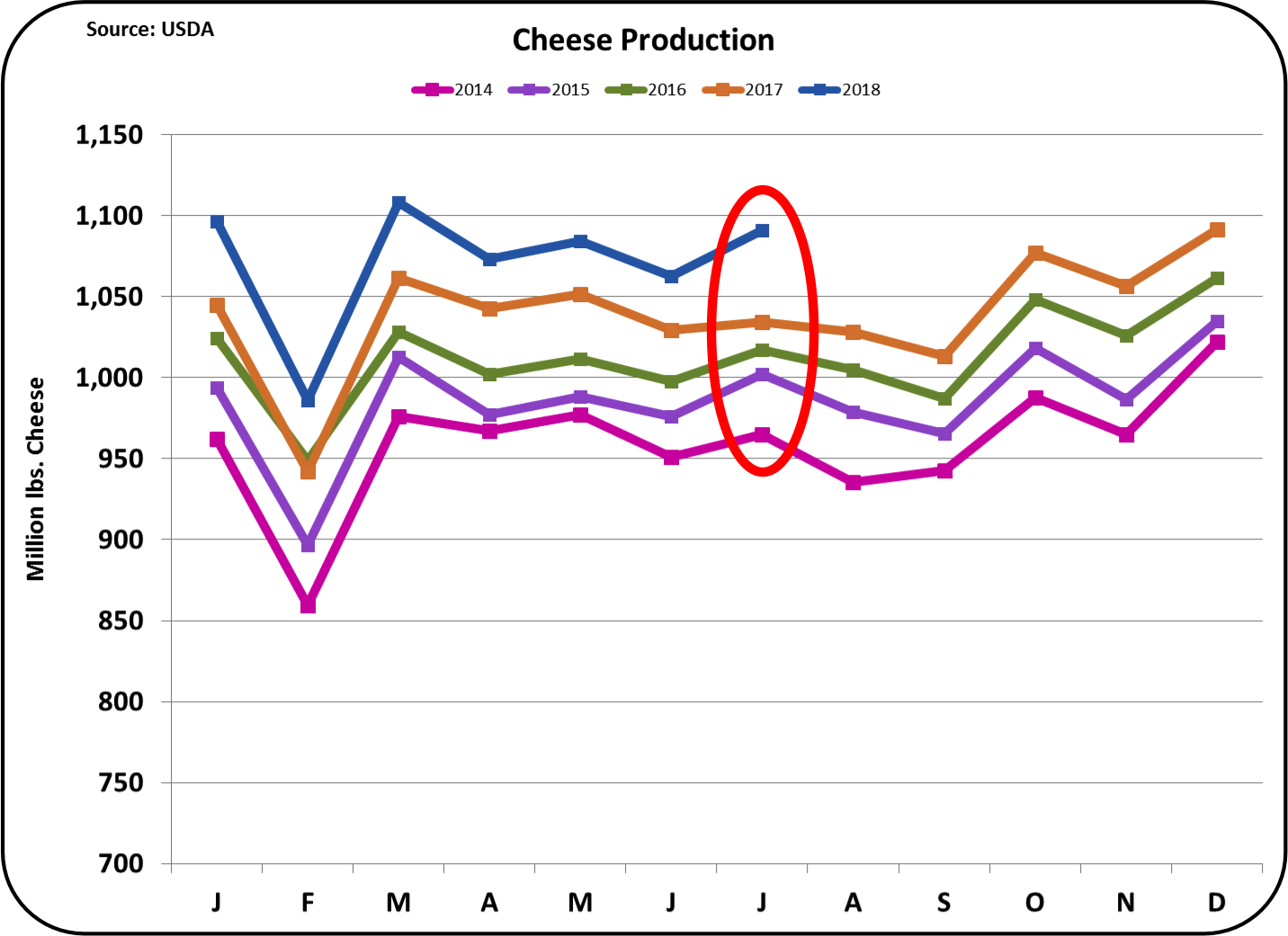




 Dairy prices at the Global Dairy Trade (GDT) auction dipped 0.7pc overall this week.
 Dairy product prices fell at the Global Dairy Trade auction, led by unexpected slides in whole milk powder and butter.
 AUSTRALIAN Fonterra suppliers should not be worried about a recent price drop in New Zealand, according to the milk processor.



