Archive for Dairy Markets – Page 51

Mixed Markets Tuesday in Chicago

At the Chicago Mercantile Exchange Class III milk futures closed mixed Tuesday. Class III milk saw little change as results ranged from 4 cents higher to 4 cents lower.  January milk down two cents at $14.05. February four higher at $14.34. March unchanged at $14.93. April milk steady at $15.40. May through August contracts a penny lower to two cents higher Tuesday. Class IV was also mixed as months finished as high as 7 cents and as low as 7. CME product markets watched cheese prices dropped 2 cents in the barrel and a half cent in the block market, respectively. Grade A nonfat dry milk added a quarter cent a dry whey was up a half cent. Butter closed unchanged. 

CME product markets watched cheese prices dropped 2 cents in the barrel and a half cent in the block market, respectively. Grade A nonfat dry milk added a quarter cent a dry whey was up a half cent. Butter closed unchanged. 

Event 228 of the Global Dairy Trade took place Tuesday as the overall index jumped 4.2%. Products to note moving higher included butter up 4.6%, cheddar 4.2%, skim milk powder strengthening 10.3% and whole milk power jumping 3%. Butter ended up at $1.88 and a half, cheddar at $1.59, skim milk powder at $1.09 and whole milk at $1.26, respectively. 

Global dairy prices continue recovery at auction

International milk prices rose again on Wednesday, marking a two-month winning streak at the Global Dairy Trade auction after falling throughout most of last year.

The GDT Price Index climbed 4.2 percent, with an average selling price of $3,057 per tonne, in the auction held on Tuesday by GDT Events.

The index rose 2.8 pct at the previous sale, and has now gained for four consecutive auctions, after declining for months last year as higher-than-expected supply in New Zealand, the world’s biggest dairy exporter, dampened prices.

Volumes tightened at the latest auction with a total of 27,909 tonnes sold, falling 2.6 percent from the previous one, the auction platform said on its website(www.globaldairytrade.info).

Prices for skim milk powder jumped 10.3 percent, while prices for whole milk powder, the most widely traded item, gained 3 percent.

The auction results can affect the New Zealand dollar as the dairy sector generates more than 7 percent of the nation’s gross domestic product. The currency advanced slightly overnight on the outcome of the dairy auction but declined later on concerns over Brexit to a two-week low of $0.6815.

The auctions are held twice a month, with the next one scheduled for February 6.

The New Zealand milk co-operative, which is owned by about 10,500 farmers, controls nearly a third of the world dairy trade.

GDT Events is owned by New Zealand’s Fonterra Co-operative Group Ltd, but operates independently from the dairy giant.

U.S.-listed CRA International Inc is the trading manager for the twice-monthly Global Dairy Trade auction.

A number of companies, including Dairy America and Murray Goulburn, use the platform to sell milk powder and other dairy products.

Source: reuters.com

Milk Markets Mixed Monday at Mercantile Exchange

At the Chicago Mercantile Exchange Monday Milk futures were sharply down and cash dairy prices were mixed.  2019 Class III markets showed losses on Monday anywhere from two to 18 cents, with the most losses in February to April. January Class Three milk was unchanged at $14.07. February was down $.19 at $14.30. March was down $.13 at $14.93. April was down $.11 to $15.40. The milk futures from May through next December ranged from eight cents lower to seven cents higher. The first and second half averages are now $15.09 and $16.55. 

Dry whey was up $.01 at $.5050 cents per pound. Two sales were recorded at $.50 and $.5050. Forty-pound blocks were up $.0125 at $1.4225 per pound. No sales were recorded. Barrels were down $.0150 at $1.23 per pound. One sale was recorded at that price. Grade AA Butter was unchanged at $2.2575 per pound. No sales were recorded. Nonfat dry milk was up $.0125 at $1.0425 per pound. One sale was recorded at that price.

CWT Assists with 6 million Pounds of Dairy Product Export Sales

Cooperatives Working Together (CWT) member cooperatives accepted 28 offers of export assistance from CWT that helped them capture sales contracts for 4.453 million pounds (2,020 metric tons) of Cheddar, Monterey Jack and Gouda cheeses; 454,152 pounds (206 metric tons) of butter and 1.124 million pounds (510 metric tons) of whole milk powder. The product will be delivered during the period from January through June 2019 and is the equivalent of 59.531 million pounds of milk on a milkfat basis.

Assisting CWT members through the Export Assistance program positively affects all U.S. dairy farmers and all dairy cooperatives by strengthening and maintaining the value of dairy products that directly impact their milk price. It does this by helping member cooperatives gain and maintain world market share for U.S dairy products. As a result, the program has significantly expanded the total demand for U.S. dairy products and the demand for U.S. farm milk that produces those products.

The amounts of dairy products and related milk volumes reflect current contracts for delivery, not completed export volumes. CWT pays export assistance to the bidders only when export and delivery of the product is verified by required documentation.

All dairy farmers and all dairy cooperatives should invest in CWT. Membership information is available on the CWT website.

Milk Markets Move Upward in Chicago Thursday

At the Chicago Mercantile Exchange Milk futures on worked their way higher Thursday supported by an improving cash market.  Class III markets were green across the board today gaining anywhere from two to 13 cents.  January class III milk futures closed up three cents at $14.08. February up 13 cents at $14.45. March unchanged at $14.88. April up a dime at $15.42. May through September contracts were two to nine cents higher. The first and second half averages are now at $15.12 and $16.52.

Dry whey unchanged at $0.4875 cents. Blocks up $0.02 at $1.39. Two trades were made at $1.38 and $1.39. Barrels up $0.0025 at $1.2475. Butter unchanged at $2.2350. Two trades were made at $2.2275 and $2.2350. Nonfat dry milk up $0.0225 at $1.0250. Two trades were made at $1.02 to $1.0250.

Milk Markets Mixed Wednesday in Chicago

At the Chicago Mercantile Exchange Milk futures on were mixed at midweek with European dairy prices improving while the shutdown weighs on the market. Class III milk ranged from five cents lower to seven cents higher.  January class III milk futures closed down three cents at $14.05. February down nine cents at $14.32. March unchanged at $14.88. April up a penny at $15.32. May through September contracts were two to four cents higher. Class IV milk was mixed as well. February added three cents, March was up 13 and April lost three cents.  

Dry whey up $0.0050 at $0.4875 cents. Blocks down $0.01 at $1.37. Barrels down $0.0325 at $1.2450. Eight trades were made ranging from $1.2550 to $1.2675. Butter up $0.0050 at $2.2350. Three trades were made ranging from $2.2275 to $2.2350. Nonfat dry milk up $0.0125 at $1.0025. Four trades were made ranging from $1.00 to $1.0050.

US milk price drops 66 cents, averages $14.61 for year

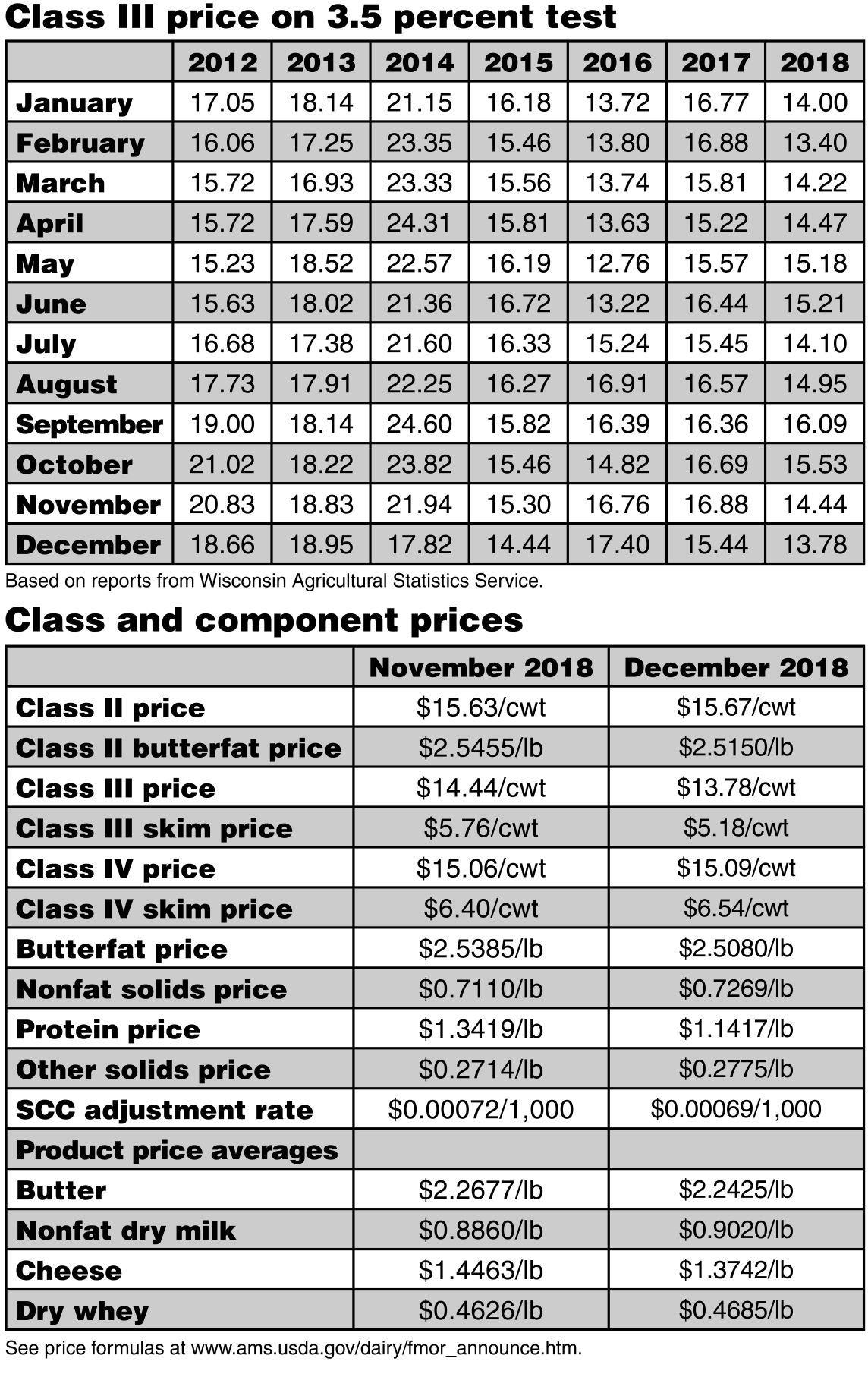
The base price paid to dairy producers for Class III milk in December took a tumble, ending the year on a low note at $13.78 per hundredweight. This is the lowest Class III price since last February, when it sunk to $13.40.

The Class III price finished 2018 with an average of $14.61 — the lowest average level since 2010. The December price is down 66 cents from November and $1.66 lower than December 2017.

While milk prices were bleak to end the year, UW-Madison dairy analysts Bob Cropp and Mark Stephenson are optimistic that 2019 will be better, with only weak increases in milk production forecast and, hopefully, a resolution to trade issues with Mexico and China, which both are big buyers of U.S. dairy products.

In their late-December dairy market podcast, Stephenson said butter and cheese stocks ended 2018 at a relatively high level, keeping a lid on prices.

“Normally, we don’t see cheese inventories growing this time of year,” he said.

Where milk prices go from here hinges a lot on U.S. milk production, which the U.S. Department of Agriculture expects to grow by just 1.3 percent this year. Most of the recent growth has taken place in the western U.S.

“I could see it less than that, even,” Cropp said of growth predictions.

Domestic dairy sales are expected to continue to be positive, except for fluid milk, he and Stephenson said, so a lot depends on the export side of the equation. World milk production has slowed and the dollar is a little stronger, but unless the U.S. resolves lingering trade concerns with China and Mexico, particularly, exports will be down, weighing heavily on farm-level milk prices.

While some market analysts had called for Class III to be near $16 by the end of 2018, that didn’t pan out, Cropp said. He expects prices to move higher in 2019, starting just under $15 in January, moving into the $15s by the second quarter and averaging close to $16 for the year.

But “farmers need more than a dollar improvement,” he said.

After getting off to a slow start due to the holidays, Class III milk finished strong the last week in December, according to the weekly Stewart-Peterson commodity report.

“We saw volume re-enter the market as trading volume in the January 2019 contract surpassed all of 2019 contract volume,” the report stated. “The majority of the volume … came after the spot cheese session that pushed the block/barrel average 3.25 cents higher on the day. This move was driven by Cheddar blocks in a 6-cent up day on one load traded. … The move in the spot market spurred the January and February Class III contracts higher. January gained 18 cents to finish the week at $14.41 and February gained 22 cents to finish the week at $14.67.”


Source: Leader Telegram

Government Shutdown Drives Dairy Markets Lower in Chicago Tuesday

At the Chicago Mercantile Exchange milk futures continued lower as the government shutdown weighs on the market. Class III markets were down on the day with all months showing losses except for November which did not trade. Class III markets fell anywhere from four to 13 cents leaving the first and second half averages at $15.06 and $16.45. January class III milk futures closed down six cents at $14.14. February down 16 cents at $14.41. March down a dime at $14.88. April down a dime at $15.31. May through September contracts were four to nine cents lower. Class IV markets also showed losses from seven to 23 cents in the front months while the rest was unchanged. 

Dry whey unchanged at $0.4825 cents. Blocks down $0.02 at $1.38. Barrels down $0.0150 at $1.2775. Four trades were made ranging from $1.2775 to $1.2925. Butter unchanged at $2.23. Nonfat dry milk up $0.0150 at $0.99. Three trades were made ranging from $0.9775 to $0.99.

Government Shutdown Drive Milk Futures and Cash Dairy Lower in Chicago

In Chicago, Milk futures started the week lower pressured in part by negative cash markets. Prices fell on average 10 to 15 cents out through the third quarter of 2019’s calendar. The first half of the year averages $15.15, down 12 cents from Friday’s finish.  January class III milk futures closed down 11 cents at $14.14. February down 17 cents at $14.57. March down 17 cents at $14.98. April down 11 cents at $15.41. May through September contracts were a nickel to 11 cents lower. Class IV markets saw more weakness in the second half of the year and some strength in the first half of the year. The average for the first half finishes at $16.11 cents, up four cents, while the second half of the year averages $16.86, down five cents from Friday’s close.

Dry whey down $0.0075 at $0.4825 cents. Three trades were made at that price. Blocks down $0.0177 at $1.40. Barrels down $0.01 at $1.2925. Five trades were made ranging from $1.2950 to $1.3075. Butter down $0.02 at $2.23. One trade was made at that price. Nonfat dry milk unchanged at $0.9750.

Milk Futures Continue Positive 2019 Momentum in Chicago

At the Chicago Mercantile Exchange Milk futures continued their positive momentum Thursday supported in part by increasing global prices. Class III milk ranged from three cents lower to seven cents higher in 2019.  January class III milk futures closed up two cents at $14.32. February up two cents at $14.77. March up seven cents at $15.14. April up three cents at $15.51. May through September contracts were a penny to four cents higher. Class IV milk harnessed the strength seen in butter and nonfat dry milk, pushing 14-23 cents higher in January-October 2019.

Dry whey up $0.01 at $0.49 cents. One trade was made at that price. Blocks unchanged at $1.4175. Barrels unchanged at $1.3025. Butter up $0.0325 at $2.25. One trade was made at $2.2425. Nonfat dry milk up $0.0150 at $0.9650. Two trades were made at that price.

Dairy prices start 2019 with 2.8 pct gain at GDT auction

Dairy prices are off to a strong start for 2019, with gains registered for all the products on offer at the first Global Dairy Trade auction of the year.

Ths morning’s gain was the third consecutive increase since prices started their decline in May last year.

Prices increased across the board, which was partially due to a decline in offer volumes for all commodities at this event, NZX dairy analyst Robert Gibson said.

Whole milk powder prices, which have the greatest bearing on Fonterra’s farmgate milk price, firmed by 1.2 per cent to US$2705 a tonne from the previous event late last year, while the GDT price index gained by 2.8 per cent.

Skim milk powder prices firmed by 7.9 per cent to US$2201 a tonne, rennet casein by 1.3 per cent US$5123/tonne, lactose by 1.6 per cent to US$948/tonne, butter by 3.9 per cent/$4076/tonne, butter milk powder by 9.3 per cent to US$3252/tonne, cheddar by 3.2 per cent to $3371/tonne and anhydrous milk fat by 3.9 per cent to US$5137/tonne.

The gains were despite a big pickup in domestic production, which was cited as a factor for price weakness last year.

According to the latest available data, New Zealand milk production rose by 2.3 per cent on a milksolids basis in November against November 2017.

Season-to-date production was up 4.9 per cent and by 0.8 per cent for the 12-months to November, also on a milksolids basis.

Dairy co-op Fonterra last month revised down its to a range from $6.00 to $6.30 per kg of milk solids from a previous forecast of $6.25-$6.50 per kg.

The revision was due to the global milk supply remaining stronger relative to demand, which has driven a downward trend on the GlobalDairyTrade index since May, Fonterra said then.

The co-op has maintained its collections forecast at 1,550 million kgMS for 2018/19 and has said an abnormal El Nino weather pattern over summer this could still impact on production.

 
Source: NZ Herald

Dairy prices off to strong start in 2019

Dairy prices are off to a strong start for 2019, with gains registered for all the products on offer at the first Global Dairy Trade auction of the year.

Ths morning’s gain was the third consecutive increase since prices started their decline in May last year.

Prices increased across the board, which was partially due to a decline in offer volumes for all commodities at this event, NZX dairy analyst Robert Gibson said.

Whole milk powder prices, which have the greatest bearing on Fonterra’s farmgate milk price, firmed by 1.2 per cent to US$2705 a tonne from the previous event late last year, while the GDT price index gained by 2.8 per cent.

Skim milk powder prices firmed by 7.9 per cent to US$2201 a tonne, rennet casein by 1.3 per cent US$5123/tonne, lactose by 1.6 per cent to US$948/tonne, butter by 3.9 per cent/$4076/tonne, butter milk powder by 9.3 per cent to US$3252/tonne, cheddar by 3.2 per cent to $3371/tonne and anhydrous milk fat by 3.9 per cent to US$5137/tonne.

The gains were despite a big pickup in domestic production, which was cited as a factor for price weakness last year.

According to the latest available data, New Zealand milk production rose by 2.3 per cent on a milksolids basis in November against November 2017.

Season-to-date production was up 4.9 per cent and by 0.8 per cent for the 12-months to November, also on a milksolids basis.

Dairy co-op Fonterra last month revised down its to a range from $6.00 to $6.30 per kg of milk solids from a previous forecast of $6.25-$6.50 per kg.

The revision was due to the global milk supply remaining stronger relative to demand, which has driven a downward trend on the GlobalDairyTrade index since May, Fonterra said then.

The co-op has maintained its collections forecast at 1,550 million kgMS for 2018/19 and has said an abnormal El Nino weather pattern over summer this could still impact on production.


Source: Otago Daily Times

CME: Futures Market Points to Optimism in Feeder Cattle Demand in Q1

Feeder cattle cash prices have been falling for the last several weeks in major feeder cattle markets for 700 to 800-pound steers, reports Steiner Consulting Group, DLR Division, Inc.

In the month of December, most markets have lost ground, continuing a longer term slide that started near the end of October.

In the last month, Washington prices have slipped $5.55 per cwt, one of the largest losses noted from various markets.

Nebraska 700 to 800- pound feeders fared only slightly better and have dropped $4.87 per cwt this month since the first week.

Montana auction prices are down $2.69 per cwt, while Georgia feeders are $1.19 lower.

South Dakota saw a boost mid-month but in the latest week of data were closer with the first week of December, down $0.43 per cwt.

Feeders in the same weight group declined $1.44 in the combined Southern Plains auction this month.

Quite the opposite has been true for the feeder cattle futures market in the month of December.

January, March, and April’s feeder cattle contracts closed last week on a high note, ending the week with the highest daily close values seen in the month of December.

Since the Cattle on Feed report was released on 20 December, the nearby feeder futures contract has climbed $2.88 per cwt.

Similarly, March and April contracts closed Friday $2.60 and $2.40 per cwt higher than the 19 December close values.

The futures market points to optimism in the demand for feeder cattle in the first quarter.

However, feedlots placed fewer cattle in the last three months than compared to a year earlier, and larger calf crops in 2017 and 2018 suggest there should be plenty of cattle available for placement in the first quarter.

Feedlots had a tough year in 2018, which could also limit willingness to pay in 2019 for feeders.


Source: The Cattle Site

Strong Global Trade Starts New Year in Positive Note in Chicago

At the CME, Milk futures started the new year in positive territory supported by increasing global markets. Class III markets were mixed in their performance with the average price covering the first half of the year finishing at $15,24.  January class III milk futures closed down a penny at $14.30. February up three cents at $14.75. March up four cents at $15.07. April unchanged at $15.48. May through September ranged from a nickel lower to unchanged. Class IV markets saw stronger performance with the average for the first six months of the year coming in at up 7 cents over Monday.

Dry whey unchanged at $0.48 cents. Blocks down $0.0125 at $1.4175. Two trades were made at $1.41 and $1.4175. Barrels up $0.0125 at $1.3025. Four trades were made ranging from $1.2850 to $1.3025. Butter unchanged at $2.2175. Nonfat dry milk up $0.0125 at $0.95. Two trades were made at $0.95 and $0.9550.

Milk Futures Mixed on Last Day of 2018 in Chicago

Milk futures lightly traded in Chicago on the last day of the year while cash markets saw minimal activity. December Class III milk futures were unchanged at $13.83. January down nine cents at $14.32. February up a nickel at $14.72. March up two cents at $15.03. The milk futures from April through next July ranged from a penny lower to three cents higher.

Dry whey unchanged at $0.48 cents. Blocks unchanged at $1.43. Barrels unchanged at $1.29. Butter unchanged at $2.2175. Three trades were made ranging from $2.2025 to $2.2150. Nonfat dry milk unchanged at $0.9375.

Milk Markets Climb Higher in Chicago Thursday

At the Chicago Mercantile Exchange Class III milk futures closed higher Thursday with traders optimistic about the farm bill and stronger global prices for skim milk powder and butter.  After products finished their trade, Class III markets climbed to higher ground with the average for the first half of 2019 rising 11 cents to $15.14 per cwt. December closed unchanged at $13.84. January 12 cents higher at $14.30. February up eight cents at $14.52. March up nine cents at $14.87. April through November contracts were four to 14 cents higher. The Class IV market saw similar activity rising a dime in its average for the first six months of 2019. It stands at $15.71 per cwt.

Barrels were unchanged at $1.3150. Blocks remained unchanged at $1.41. Dry whey was up $0.0175 at $0.49. One trade was made at that price. Butter was up $0.02 at $2.20. Four sales were made ranging from $2.1925 to $2.20. Nonfat dry milk was up $0.0025 at $0.9375.

As Milk Production Rises Milk Futures and Dairy Markets Lower in Chicago Wednesday

At the Chicago Mercantile class III milk futures closed lower at midweek as the milk supply continues to grow and cash markets remain weak. December down a penny at $13.84. January through June 2019 dropped 10-21 cents per cwt. while the second half softened 1-6 cents.  January 13 cents lower at $14.18. February down 15 cents at $14.44. March down 19 cents at $14.83. April through November contracts were a penny to 21 cents lower. Class IV was mixed with January through December 2019 results ranging from 7 cents lower to 3 cents higher. 

Barrels were down $0.0050 at $1.3150. Blocks were unchanged at $1.41. Dry whey was unchanged at $0.4725. Butter was down $0.02 at $2.18. Three sales were made ranging from $2.18 to $2.1825. Nonfat dry milk was down $0.0075 at $0.9350. Two trades were made at $0.9325 and $0.9350.

The November Milk Production report was released on Wednesday by the USDA and resulted in year over year growth of 0.6%.   The October cow numbers were adjusted 3,000 head higher to 9.368 million while November cow numbers were published at 9.36 million. Compared to last November, the U.S. milking herd is now 38,000 head smaller. Milk per cow in the month of November grew 19 pounds year over year, or 1%. In the end, 17,370,000 pounds of milk were produced during November 2018. 

Global dairy prices rise for second auction in a row

  • Global dairy prices rise 1.7 percent
  • Second lift in a row
  • Prices have been falling since May amidst higher global supply (Recasts, adds analyst comment, market reaction)

Global dairy prices rose for just the second time in six months in a fortnightly auction held early on Wednesday.

The GDT Price Index climbed 1.7 percent, with an average selling price of $2,844 per tonne, in the auction.

The index rose 2.2 percent at the previous sale, according to GDT Events, after falling since May.

Butter prices surged 4.9 percent while skim milk powder prices rose 3.4 percent.

“This is likely due to tighter availability of stocks on offer compared with the previous event,” said Robert Gibson, dairy analyst at NZX.

Prices for whole milk powder, the most heavily traded item, were up just a touch at 0.3 percent, in contrast with futures market expectations of 3 percent lift.

“This result was likely due to higher volumes … on offer compared with the previous event, preventing any further increase in price,” Gibson said.

The auction results can affect the New Zealand dollar as the dairy sector generates more than 7 percent of the nation’s gross domestic product.

The kiwi currency had surged almost 0.7 percent $0.6879, but that was largely due to strong business confidence data released on Tuesday afternoon.

A total of 36,181 tonnes was sold at the latest auction, falling 0.7 percent from the previous one, the auction platform said on its website.

GDT Events is owned by New Zealand’s Fonterra Co-operative Group Ltd, but operates independently from the dairy giant.

The New Zealand milk co-operative, which is owned by about 10,500 farmers, controls nearly a third of the world dairy trade.

U.S.-listed CRA International Inc is the trading manager for the twice-monthly Global Dairy Trade auction.

A number of companies, including Dairy America and Murray Goulburn, use the platform to sell milk powder and other dairy products.

The auctions are held twice a month, with the next one scheduled for Jan. 2. (Reporting by Charlotte Greenfield; Editing by Alison Williams)

Source: uk.reuters.com

Milk Futures Higher Tuesday in Chicago

At the Chicago Mercantile Exchange Tuesday milk futures were higher and cash dairy markets were higher except for cheese. By the afternoon Class III prices were all in positive territory with the average for the first six months of 2019 rising six cents to $15.17. December Class Three milk was up $.05 at $13.85.  January was up $.11 to $14.31. February was up $.05 at $14.59.  March was up $.04 at $14.97. The milk futures from April through next November ranged from zero to nine cents higher. The Class IV market saw similar activity with their average in the first half of the next calendar year rising three cents to $15.62.

Dry whey was up $.0225 at  $.4725 cents per pound. No sales were recorded. Forty-pound blocks were unchanged at $1.41 per pound.  No sales were recorded. Barrels were unchanged at $1.32 per pound.  No sales were recorded. Grade AA Butter was up $.0150 at $2.20 per pound.  Seven sales were recorded from $2.18 to $2.20. Nonfat dry milk was up $.0075 at $.9425 per pound.  No sales were recorded.

Futures Lower and Dairy Markets Mixed in Chicago Monday

In Chicago Mercantile Exchange Monday Milk futures were lower and cash dairy markets were mixed. December Class Three milk was unchanged at $13.80.  January was down $.02 to $14.20. February was down $.11 at $14.54.  March was down $.13 at $14.93. The milk futures from April through next November ranged from zero to 11 cents lower.

Dry whey was unchanged at  $.45 cents per pound. No sales were recorded. Forty-pound blocks were up $.0025 at $1.41 per pound.  No sales were recorded. Barrels were up $.01 at $1.32 per pound.  Four sales were made at that price. Grade AA Butter was down $.0050 at $2.1850 per pound.  No sales were recorded. Nonfat dry milk was down $.0050 at $.9350 per pound.  One trade was made at $.9275.

Milk futures closed higher for the 3rd day in a row Thursday

At the Chicago Mercantile Exchange Class III milk futures closed higher Thursday for the 3rd day in a row. December milk up six cents at $13.77. January up four to $14.19. February seven cents higher at $14.65. March up six, closing at $15.09. April through July contracts three to eight cents higher Thursday. Class IV marked had very similar results. 

Barrels up $0.0175 at $1.2950. Two trades were made ranging from $1.2875 to $1.2950. Blocks were up $0.0475 at $1.3950. Butter closed down $0.001 at $2.1750. Dry whey up $0.0175 at $0.45. Nonfat dry milk $0.01 higher at $0.93.

Markets Erratic After News From China

At the Chicago Mercantile Exchange, Class III milk futures were mostly higher Wednesday, cash dairy closed mixed. Class III markets were higher as 1sthalf 2019 ranged from 7-14 cents higher. The 1sthalf 2019 average closed at $15.14 cents per cwt. December milk was unchanged at $13.71. The 2ndhalf ended at $16.39.  January 12 cents higher at $14.15. February up 16 at $14.58. March milk up 12 at $15.03. April through July settled 6 to 12 cents higher. The Class IV full year average settled at $15.89 per cwt. 

Barrels closed $0.0225 higher at $1.2775. Five trades were made, ranging from $1.26 to $1.2775. Blocks were up $0.0175 at $1.3475. Butter closed down $0.0125 at $2.1850. Dry whey unchanged Wednesday at $0.4325. Two trades were made. Nonfat dry milk was down $0.0050 at $0.92. Six trades made, ranging from $0.91 to $0.92.

Milk Price Increase in California as a Result of New Federal Order

This past week  California’s Federal Order No. 51 with the Class III price coming in at $14.44/cwt and Class IV at $15.06/cwt. Under the old system, the California 4b cheese milk prices for November would have been $13.55/cwt.  The Class I price for Los Angeles was announced at $17.82, which includes a $2.10 Class I Differential and a 20¢ processor assessment. The new Federal Milk Marketing Order in California appears to be doing what proponents hoped it would do: Bump milk prices. How much more California dairy farmers will see in their milk check remains to be seen. That final blend price depends on the utilization percentage of each of the four classes of milk, among other factors.


Australia’s $2 million milk price index ‘useless’

AUSTRALIA’S $2 million milk price index is a flop, with just 38 farmers lodging their details on the site since it was launched in July.

The index has been plagued with problems since the federal Coalition Government promised to deliver it as part of a $579 million dairy support package in May 2016.

At the time, Prime Minister Malcolm Turnbull said the Coalition would “consult with the industry on the design of the index that would provide dairy farmers with valuable information for use in supply negotiations with processors and to assist in following international price trends”.

It took 18 months for the federal Department of Agriculture to award a cut-down $1.19 million contract to the highly qualified Webber Quantitative Consulting team to develop the index.

But the Webber team was then dumped within 24 hours of presenting their index proposal to industry stakeholders on December 14 last year.

One member of the Webber team told The Weekly Times the proposal would have “exposed just how inefficient Australian processors were compared to the rest of the world.”

Webber Consulting members were then gagged from talking publicly on the project, but The Weekly Times understands the industry stakeholders Australian Dairy Farmers and Australian Dairy Products Federation lobbied the Federal Government to dump Webber and its index.

The department then took over the development of the index, which was finally launched by Agriculture Minister David Littleproud in July this year, based on a voluntary survey of farmers’ milk prices and a copy of other global dairy commodity price indices.

The farmer survey was to form the basis of what Mr Littleproud called a Retrospective Farmgate Milk Price Index.

But six months on, the department has revealed the index of farmgate prices has been a flop. A spokesman said data submissions had been received from only 38 farmers — “not enough to publish a farmgate figure for any region”.

Dairy Connect president Graham Forbes said it was a tragedy Webber was not able to develop the index.

“What we’ve got now is useless,” Mr Forbes said.

The Regional, Retrospective Farmgate Milk Price Index relies on farmers providing price data via an online form to give a picture of actual prices received in each of Australia’s eight dairy regions.


Source: The Weekly Times

Progress in the Discussions with China Drive Milk Markets Higher In Chicago Tuesday

A series of tweets early in the day by President Trump announcing progress in the discussion with China. Later an announcement came out that China would reduce the tariff on automobiles imported to China from the United States from 40%, as it stands now, back to 15%. And while nothing was said about agricultural products the hope of progress helped milk prices climb.

At the Chicago Mercantile Exchange Tuesday Class III milk futures turned higher partly because of optimism for 2018 Farm Bill dairy policy.   December up seven cents at $13.72.  Class III futures rose more than 20 cents in the first quarter with the first half average rising 19 cents to $15.04.  January 24 cents higher at $14.05. February up 20 cents at $14.42. March up 22 cents at $14.96. Class IV markets saw similar activity, rising six cents in its average for the first half of 2019 to finish at $15.37.

Barrels were up $0.0450 at $1.2525. Fourteen trades were made ranging from $1.2150 and $1.2225. Blocks were unchanged at $1.33. One trade was made at that price. Dry whey was down $0.0050 at $0.4325. Two trades were made at $0.4375 and $0.4325. Butter was down $0.0025 at $2.1975. Nonfat dry milk was up $0.0275 at $0.9250. Four trades were made ranging from $0.90 to $0.9250.

Milk Futures Continue Downward Spiral in Chicago Monday

At the Chicago Mercantile Exchange Monday milk futures took another dive.  Class III milk futures began this week in the same fashion as they ended the last. December lost another 11 cents to $13.65 per cwt. January 17 cents lower at $13.81. February down 19 cents at $14.22. March down seven cents at $14.74. April through next November contracts closed two cents lower to three cents higher.

Barrels were down $0.0150 at $1.2075. Five trades were made ranging from $1.2075 and $1.2150. Blocks were down $0.02 at $1.33. Two trades were made at $1.33 and $1.3375. Dry whey remained unchanged at $0.4375. Butter was down $0.0075 at $2.20. One trade was made at that price. Nonfat dry milk was up $0.0125 at $0.8975. Four trades were made ranging from $0.8950 to $0.8975.

Fonterra slashes milk price forecast

Fonterra cut its earnings forecast to 25 cents-30 cents a share and its dividend to 15c-20c in...Fonterra has cut its farmgate milk price forecast for 2018/19 to $6.00 to 6.30 kg of milk solids from a previous range of $6.25 to $6.50/kg, and has confirmed that its Tip Top ice cream business is up for sale.

The co-op, which is part-way through a stock take of its operations and assets, said in a market update for the first quarter of its financial year that it planned to go to full ownership of its Darnum, Victoria, milk powder facility and that its Tip Top icecream was up for sale.

Fonterra forecast earnings per share of 25 to 35 cents a share for the full year.

The co-op’s first-quarter revenue came to $3.8 billion, down 4 per cent.

Fonterra chairman John Monaghan says the revision in the milk price was due to the global milk supply remaining stronger relative to demand, which has driven a downward trend on the GlobalDairyTrade (GDT) index since May.

“Since our October milk price update, production from Europe has flattened off the back of dry weather and rising feed costs. US milk volumes are still forecast to be up one per cent for the year,” Monaghan said in a statement.

Fonterra said it was maintaining our forecast collections at 1,550 million kgMS.

Weather agency Niwa is saying its likely we will see an abnormal El Nino weather pattern over summer and this could impact our farmers’ milk production, he said.

“Demand from China and Asia remains strong. However, we are seeing geopolitical disruption impacting demand from countries that traditionally buy a lot of fat products from us,” he said.

Fonterra’s first quarter gross margin of $646 million was down $14 million compared to the same period last year and up slightly on a percentage basis from 16.6 per cent to 17 per cent.

The Co-op’s Ingredients business, despite lower sales volumes, performed solidly during the quarter with a gross margin of $273 million, up $28 million on last year.

The Consumer business also performed well with a gross margin of $310 million, up $10 million on last year, and volumes were up five per cent.

Chief executive Miles Hurrell says the Co-op generally makes a smaller proportion of its total annual sales in the first quarter due to the seasonal nature of our milk supply.

“This means the results from Q1 do not give much insight into the Co-op’s expected earnings performance for the full year. It does, however, put the spotlight on where we have challenges that we need to address,” Hurrell said.

Commenting on the board led portfolio review, Monaghan said there had been but that it would take time to flow through into financial results.

“We have reached an agreement in principle with Beingmate that will see us return to full ownership of the Darnum plant by 31 December 2018 and enter into a multi-year agreement for Beingmate to purchase ingredients from us,” he said.

“We are also looking at our ongoing ownership of Tip Top and have appointed FNZC as our external advisor to work with us as we consider a range of options,” he said.

“We want to see Tip Top remain a New Zealand based business and this is being factored into our options.”

“While performing well, Tip Top is our only ice cream business and has reached maturity as an investment for us.

“To take it to its next phase successfully will require a level of investment beyond what we are willing to make,” he said.

Fonterra said it was moving quickly to meet our commitment to reducing our debt levels by $800 million by the end of the financial year.

“This requires both improved performance from last year and the divestment of assets,” Fonterra said.

Source: odt.co.nz

Dairy markets continue to drop in Chicago Thursday

At the Chicago Mercantile Exchange Class III milk futures closed lower Thursday somewhat pressed by a lack of movement on the USMCA and mixed tone of international markets. December down a dime at $13.78.  Class III markets moved lower with the first half of 2019’s average slipping below $15 to a price of $14.95 down 13 cents from Wednesday.  January 19 cents lower at $14.01. February down 14 cents at $14.47. March down 12 cents at $14.85. April through next November contracts closed five to 12 cents lower. Class IV markets in that same period dropped eight cents to $15.31.

Growing weakness in barrel cheddar translated to a four cent loss in Thursday’s CME spot session where two loads traded hands and the final price stopped at $1.2425. Blocks were unchanged at $1.35. Two trades were made at $1.2650 and $1.28. Dry whey closed down $0.0075 at $0.4375. Five trades were made ranging from $0.4375 to $4425. Butter was up $0.0225 at $2.25. Four trades were made ranging from $2.2275 to $2.25. Weakness was observed elsewhere. In Grade A nonfat dry milk prices dropped 1.75 cents after two loads moved from seller to buyer, it’s final price 89.25 cent.

Dairy prices up for the first time since May

Dairy prices have risen for the first time in six months in the overnight global dairy trade auction.

The average price was up 2.2 percent to $US2819 a tonne.

It was the first rise since May and lifts prices off two-year lows.

The price for whole milk powder, which has a key influence on local farmer payouts, rose 2.5 percent to $US2667 a tonne.

Prices for all other products offered rose except for cheese.

The amount sold was sharply lower which may have helped to lift prices.

“There was likely increased demand for WMP (whole milk powder) given the lower volumes on offer compared with the previous event,” NZX dairy analyst Amy Castleton said.

Fonterra is due to release a first quarter trading update on Thursday with the prospect that it will lower its farmgate milk payout forecast from the current range of $6.25 to $6.50 a kilo of milk solids.

The dairy co-operative is reviewing its entire business and has said no options are off the table including the sale of assets, which has led to speculation about the future of its investment in the troubled Chinese firm Beingmate, as well as assets in Chile, Brazil, local ice-cream maker, Tip Top.


Source: Radio NZ

Dairy Markets Fall Again in Chicago Wednesday

At the Chicago Mercantile Exchange dairy markets were mostly lower again on  Wednesday. Class IIII markets were also lower on Wednesday showing losses of 3 cents in December at $13.86 per cwt and losses of anywhere from 4 to 14 cents from January to May in 2019. January was down $.11 to $14.20. February was down $.12 to $14.61.  March was down $.08 at $14.97. The milk futures from April through next November ranged from zero to eight cents lower. Class IV markets were mainly unchanged on the day with a few months in 2019 showing minimal losses.

Dry whey was up $.0125 at  $.4450 cents per pound. No sales were recorded. Forty-pound blocks were down $.0100 at $1.35 per pound.  No sales were recorded. Two trades were made at that price. Barrels were up $.0025 at $1.2825 per pound.  One trade was made at $1.2850. Grade AA Butter was down $.0050 at $2.2275 per pound.  No sales were recorded. Nonfat dry milk was down $.0050 at $.91 per pound.  One trade was made at that price.

Markets React Negatively in Chicago Tuesday To Higher GDT Auction

At the Chicago Mercantile Exchange, the dairy markets were mostly lower on Tuesday, but the Global Dairy Trade index went up. GDT event 225 was released on Tuesday and was mainly higher. The leader of the index, butter milk powder, rose 16.9% to $1.34 per pound. Anhydrous milk fat rose 3.9% to $2.15 per pound. Butter rose 2.7% to $1.65 per pound. Whole milk powder followed as it rose 2.5% to $1.20 per pound. Cheddar was the only product with losses as it fell 2.2% to $1.44 per pound. The index as a whole was increased by 2.2%. In Chicago, theClass III markets were mainly lower on Tuesday with the November contract expiring at $14.47 per cwt. December fell 11 cents to $13.89 per cwt. 2019 Class III markets were mainly lower showing losses from 3 to 27 cents with most action in the front months. The first and second half averages are at $15.15 and $16. January was down $.27 to $14.31. February was down $.15 to $14.73.  March was down $.10 at $15.05. The milk futures from April through next November ranged from five cents lower to two cents higher. 

Dry whey was up $.0025 at  $.4325 cents per pound. Three trades were recorded at $.43. Forty-pound blocks were unchanged at $1.36 per pound.  One trade was recorded at that price. Barrels were unchanged at $1.28 per pound.  Two sales were recorded at $1.28 and $1.29. Grade AA Butter was down $.0100 at $2.2325 per pound.  No sales were recorded. Nonfat dry milk was unchanged at $.9150 per pound.  No sales were recorded.

Milk Futures Higher On China News Monday in Chicago

At the Chicago Mercantile Exchange class III milk futures closed higher Monday supported by trade optimism. December up two cents at $14.  By the end of the session, Class III milk was up 14 cents in the average for the first half of 2019, it finds itself now at $15.27 per cwt. January 18 cents higher at $14.58. February up 16 cents at $14.88. March up 16 cents at $15.15. The second half of the year, very close to where it has been in recent weeks, up just three cents at $16.34 per cwt.  

Blocks remained unchanged at $1.36. Barrels were down $0.0350 at $1.28. One trade was made at that price. Dry whey closed down $0.0050 at $0.43. Five trades were made ranging from $0.43 to $4350. Butter was unchanged at $2.2425. Nonfat dry milk was up $0.01 at $0.9150. Two trades were made at $0.9125 and $0.9250.

Class III Futures Mostly Higher on Thursday in Chicago

At the Chicago Mercantile Exchange class III milk futures closed higher Thursday as traders buy back oversold positions. 2018 Class III markets lost two cents in November to $14.47 while December rose 11 cents to $14.17. 2019 Class III markets were green across the board showing gains from 1 to 12 cents depending on the month. The 2019 first half and second half average are now at $15.12 and $16.28, respectively. January 12 cents higher at $14.43. February up three cents at $14.71. March through next October contracts closed two to six cents higher.

Blocks closed unchanged at $1.36. Seven trades were made ranging from $1.35 to 41.36. Barrels were up $0.07 at $1.31. Two trades were made at that price. Dry whey closed down $0.0025 at $0.4250. One trade was made at $0.4275. Butter was up $0.0225 at $2.2225. Nonfat dry milk was down $0.0075 at $0.9025. Two trades were made at $0.9025 and $0.9050.

Milk Futures Higher, Cash and Dairy Mixed in Chicago Wednesday

At the Chicago Mercantile Exchange milk futures were higher and the cash dairy markets were mixed Wednesday. December traded 2 cents higher to $14.06 per cwt. January through December 2019 ranged from a penny higher to 10 cents stronger. The first half 2019 average now stands at $15.06 per cwt while the full year is offering $15.66. Class IV markets were unchanged to 9 cents higher.

Dry whey was unchanged at  $.4275 cents per pound. No sales were recorded. Forty-pound blocks were up $.0500 at $1.36 per pound.  No sales were recorded. Barrels were down $.0100 at $1.24 per pound.  One carload sold at that price. Grade AA Butter was down $.0150 at $2.20 per pound.  One carload sold at that price. Nonfat dry milk was unchanged at $.91 per pound.  No sales were recorded.

Dairy Markets Mixed Tuesday in Chicago

At the Chicago Mercantile Exchange the dairy markets were mixed Tuesday.  November Class Three milk was up $.01 at $14.49.   December was down $.05 at $14.04. Class III markets held mostly to Monday’s values with the first half of 2019 calendar average rising a penny to $15 per cwt. January was up $.02 to $14.24.  February was up $.01 to $14.58. The milk futures from March through next October ranged from two cents higher to six cents lower.  Class IV markets remained unchanged in the first half of 2019’s average, while the second half of 2019 rose 2 cents to $16.24.

Dry whey was up $.0075 at  $.4275 cents per pound. Seven  sales were made from $.4275 to $.43 Forty-pound blocks were up $.0050 at $1.3550 per pound.  No sales were recorded. Barrels were up $.0100 at $1.25 per pound.  One carload sold at that price. Grade AA Butter was down $.0150 at $2.2150 per pound.  No sales were recorded. Nonfat dry milk was up $.0050 at $.91 per pound.  Three carloads sold at that price.

US farmers benefit from Asia dairy demand

Retail milk prices are on the rise, as dairy farmers around the world try to meet Asia’s ever increasing demand for dairy.

US milk farmers have benefited as one their main competitors across the other side of the world, New Zealand, is still recovering from a drought which happened a year ago.

The BBC’s Mauricio Olmedo-Perez reports on New Zealand’s efforts to catch up.


Source: BBC

Milk futures continue to take hits and drop lower in Chicago

At the Chicago Mercantile Exchange class III milk futures closed mostly lower Monday. November closed unchanged at $14.48. December down 23 cents at $14.09.  2018 class III markets were down as well with losses anywhere from 2 to 24 cents from January to August.  January 24 cents lower at $14.22. February down 13 cents at $14.57. March through next October contracts closed seven cents lower to four cents higher. 2018 Class IV markets didn’t see much action as November was unchanged at $15.07 and December fell 2 cents to $14.48.

Blocks closed $0.0050 higher at $1.35. Barrels were unchanged at $1.24. Dry whey closed down $0.0050 at $0.42. Three trades were made ranging from $0.4150 to $0.42. Butter was down $0.05 at $2.23. Five trades were made ranging from $2.2075 to $2.23. Nonfat dry milk was up $0.0075 at $0.9050. Eleven trades were made ranging from $0.9050 to $0.9075.

Milk Futures and Cash Dairy Mostly Lower In Chicago Before Thanksgiving Holiday

At the Chicago Mercantile Exchange Class III milk futures closed to the lower side Wednesday ahead of the Thanksgiving Holiday and pressured somewhat by improving international prices.   November closed a penny higher at $14.48. December down 14 cents at $14.32. The average price of the first half of 2019 dropped 6 cents to $15.09 per cwt while the second half of next year’s calendar dropped 3 cents to $16.26.  January a dime lower at $14.46. February down six cents at $14.70. March through next October contracts closed two to seven cents lower.  Class IV followed a similar pattern with the first half dropping 6 cents as well to $15.27 per cwt while the second half of the year move a penny higher to close at $16.24.

Block cheese was 1/2 cent higher after three loads moved from seller to buyer to finish at $1.34 1/2 while barrels were down a penny closing at $1.24 after just a pair of loads were traded. Butter dropped 2 1/4 cents after four loads moved from seller to buyer. It finishes at $2.28 a pound while grade A nonfat dry milk rose a penny on 11 loads to finish at 89 cents. Dried whey saw seven loads trade hands, prices moved 1/2 cent higher and now finish at 42 1/2 cents.

Dairy markets will be closed Thursday and Friday for the Thanksgiving holiday.

Cropp’s Dairy Situation and Outlook, November 19, 2018

It looks like farm milk prices will end the year at a low level. The Class III price had peaked for the year at $16.09 in September, fell to $15.53 in October and will be around $14.55 for November with December about $14.70. The Class IV price peaked at $15.01 in October, will be around $15.10 for November and December. Class III will average about $14.70 for the year compared to $16.16 in 2017. This would be the lowest average Class III price for the past four years. Class IV will average about $14.20 compared to $15.16 last year. This would be the second lowest for the past four years with $13.17 the lowest for 2016.

The lower Class III and Class IV prices is the result of dairy product prices moving lower than was expected for this time of the year. Cheddar barrels were $1.42 per pound the start of October but declined ever since only being as high as $1.36 in November and is currently $1.2975. The 40-pound cheddar block price was $1.7475 per pound the beginning of October and has declined since only being as high as $1.4575 in November and currently is $1.41. The lower Class III price is also being driven by declining dry whey prices. Dry whey was $0.5750 per pound the beginning of October and has declined steadily since. The current price is $0.43 per pound. Butter averaged $2.26 per pound in October. For November butter has been as low as $2.1925 per pound and as has high as $2.33 per pound which is also the current price. Nonfat dry milk averaged $0.8691 in October, was $0.90 early November and is currently $0.8850. Hopefully, strong holiday sales of butter and cheese will push prices up some resulting in some improvement in both the projected December Class III and Class IV prices.

Butter and cheese prices normally don’t weaken like this as we approach the holiday season. So why the decline in prices? It is somewhat puzzling. Sales of fluid (beverage) milk continue its downward trend being 2.5% lower January through September. Butter and cheese are somewhat mixed but still are higher. Perhaps as prices fall buyers take a wait and see attitude to see how low prices may fall before increasing purchases for the upcoming holidays knowing that stocks are more than adequate to meet their needs. Latest stock data is for September 30th. Butter stocks were 10.6% higher than a year ago with American cheese stocks just 1.5% higher but total cheese stocks 4.5% higher. Also while September butter production was 0.1% lower than a year ago American cheese production was 3.9% higher with total cheese production 3.1% higher.

Dairy exports explain some of the weakness in dairy product prices except for butter. While September butterfat exports were 168% higher than a year ago cheese exports were down 9%, a 20 month low. Exports of cheese to U.S. largest market Mexico was down 10% and down 63% to China reflecting the effect of retaliatory tariffs by these two countries. Dry whey exports were down 6% mainly due to a 38% decline to China, U.S. largest market. Nonfat dry milk/skim milk powder exports remain strong being 30% higher than a year ago due to a 40% increase to Mexico. Mexico did not place retaliatory tariffs on nonfat dry milk.

The forecast is for higher milk prices in 2019, but not to the level dairy producers are hoping for. If current Class III futures hold the Class III price would average about a $1.20 higher than this year at $15.85. USDA is forecasting the Class III price to average $15.15 to $16.05. Current Class IV futures average $15.80 for the year about $1.60 higher than this year. USDA’s forecasts the Class IV price to average a little lower than this for the year at $14.35 to $15.35. There is a good probability that Class III prices could average higher starting in the low $15’s the start of the year, improving to the higher $15’s by the end of the second quarter and then moving into the $16’s reaching the higher $16’s for the last quarter. But, the level of milk production and dairy exports will be determining factors. 

USDA shows October milk production slowing which is good news for milk prices. October milk production was just 0.8% higher than a year ago compared to a 1.3% increase for September. Milk per cow as up 1.1% but milk cow numbers were down 43,000 head since January and 30,000 from a year ago. Unfortunately cow numbers are down from more than a more normal number of dairy producers exiting the industry, the result of four consecutive years of low milk prices. Compared to a year ago milk cow numbers were down 10,000 in California, 3,000 in New York, 9,000 in Pennsylvania, 6,000 in Michigan, 6,000 in Minnesota, 4,000 in Wisconsin, 3,000 in Illinois, 5,000 in Indiana, 10,000 in Ohio, 7,000 in Virginia and 6,000 in Florida. Yet there was herd expansions with cow numbers up 24,000 in Texas, 16,000 in Colorado, 9,000 in Kansas and 4,000 in South Dakota, all states with expanded milk plant capacity. 

Despite California’s fewer cows a strong increase in milk per cow of 3.7% netted 3.2% more milk. Increases in milk production some other key states were: Idaho 2.1%, Texas 7.5%, South Dakota +4.1%, Colorado 10.1%, Kansas 6.1%, and New York 1.0%. States with decreases in milk production were: Pennsylvania 3.8%, Michigan 1.0%, Minnesota 0.5%, Ohio 4.1%, Wisconsin 0.3%, Illinois 4.5%, Indiana 4.8%, Iowa 1.1%, Virginia 10.6% and Florida 5.5%. In summary there is relatively strong milk production growth in some Western states with little growth in the Northeast and Midwest and decreases in the Southeast.

USDA is forecasting a 1.4% increase in milk production next year from an average of 10,000 fewer milk cows being more than offset by 1.5% more milk per cow. The 1.5% more per cow maybe on the high side considering a projected 1.2% increase this year and the possible forage quality issues in the Northeast and Midwest this winter. 

USDA is forecasting a 6.7% decrease in dairy exports on a milkfat basis and a 2.2% decrease on a skim solids basis. While a decrease in dairy exports is not positive for milk prices a growth in milk production of less than 1.5% should still strengthen milk prices in 2019. Any improvement in exports and/or less milk production than now forecasted would push milk prices even higher.

Robert Cropp
racropp@wisc.edu
University of Wisconsin-Madison


Source: UW Extension

GDT sees 7th consecutive downward event

There’s more bad news for dairy farmers, with international dairy commodity prices dropping again. The latest Global Dairy Trade (GDT) index  saw continued downward trends during event 224 – which concluded with the GDT Price Index down 3.5%. This marks the seventh consecutive fall in index for the milk price indicator. 

Key Results:

  • AMF index down 9.4%, average price US$4,577/MT;
  • Butter index down 9.6%, average price US$3,637/MT;
  • BMP not offered;
  • Ched index up 0.2%, average price US$3,252/MT;
  • LAC index up 1.1%, average price US$920/MT;
  • RenCas index down 4.5%, average price US$5,067/MT;
  • SMP index down 1.6%, average price US$1,965/MT;
  • SWP index not available, average price not available;
  • WMP index down 1.8%, average price US$2,599/MT.

While whole milk powder (WMP) prices fell slightly, the drop was driven more by significant falls in anhydrous milkfat (AMF) and butter.

NZX Dairy Data and Insights Anaylst, Amy Castleton, said the 1.8 percent fall in the WMP price index was a surprisingly resilient result.

“WMP offer volumes were at their highest for the season at the November 20 event,” she said.

“In addition, just released New Zealand milk production figures showed October production was up 6.5 percent on a milksolids basis.”

Most of the whole milk powder sold went to North Asia, which includes China.

The price indices for AMF and butter dropped 9.4 percent and 9.6 percent respectively.

Regular grade AMF and unsalted butter for January shipping decreased 9.9 percent and 10.3 percent respectively.

Ahead of the event, the derivatives market had expected lifts for the grades and contracts of each of these products.

“There was significantly less volume of AMF sold compared with the previous event, but there was more butter sold,” said Ms Castleton.

“There hasn’t been such a big percentage change in prices for either AMF and butter since late 2016,” she said.

The skim milk powder (SMP) price index decreased 1.6 percent overall. Medium heat SMP for shipping in January decreased 1.8 percent on the previous event.

Click here for more results

Send this to a friend