Archive – Page 12

Cristy Nurse: From Show Ring Beauty to World Class Rower

Whether it`s at the Royal Winter Fair or The World Rowing Championships Cristy Nurse aims high! In September 2011 she was part of Canada’s women’s eight team and brought home the silver medal from the World Rowing Championships in Bled, Slovenia. Today she is giving everything she’s got to earn a spot on the team that will compete in the 2012 Olympics in London, England. Focused, excited and committed to standing on the podium, she modestly gives a lot of credit to her farm background for the opportunities that have opened up for her.

“THE FARM HAS PLAYED A HUGE ROLE IN HELPING ME TO COMPETE”
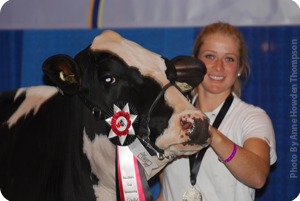
Cristy Nurse ShowingTwenty-five year old Cristy grew up on her parent’s dairy farm, Monteith Holsteins, in Georgetown, Ontario. “My parents exhibit both dairy cattle and Clydesdale horses, so I became involved with competing at an early age. I also began competing in hunter/jumper competitions when I was young and continued to keep a horse and compete until late in high school. Through 4-H my sister and I also acquired and began breeding and showing sheep, so we truly had a well-rounded experience in terms of animal care and competition.”

FAMILY SUPPORT

Cristy is well aware that many kids from farms don’t get to compete in a lot of sports or activities because of their responsibilities at home and then she adds, “For me, it was the exact opposite. My dad would always say ‘You can milk cows for the rest of your life if you want to, but you only get a chance to do these things once. He often stayed home and would do chores alone so my mom could take my siblings and me to our practices and games. I really could not have achieved much in sport without that kind of support from both my parents.”

FROM THE SHOW RING TO THE WORLD

Jeff and Kenda Nurse deflect praise saying, that “From the time she was a little girl, Cristy always gave 110%.” Both parents are qualified judges but they are quick to note. “Cristy started showing young but we never pushed her into it. She started showing at several small fairs, where it was fun and she was successful. She would get nervous but not frightened. We always had Cristy show her own calves at all the major open shows we went to as well.” Jeff feels strongly, “I think it is a mistake to bring in a ‘ringer’ to show a 4-H member’s calf. This gave her confidence that we believed in her ability.”

OPPORTUNITY KNOCKS – ROW CANADA ROW!

Beyond their obvious family fondness for livestock, the Nurse family enjoys watching and participating in sports and have always been big fans of the Olympic Games. Cristy recalls that “Rowing was a sport we watched together and I always found it exciting to see how much the country gets behind its athletes during those big Olympic moments but I never had access to a club.” Fortunately, as Cristy proceeded toward her career goal of becoming a lawyer she was able to give rowing a try. “In 2006, I got a summer job interning at a Mississauga law firm that was reasonably close to the Don Rowing Club, so it seemed like a perfect opportunity.”

As Cristy Nurse prepares for the Olympics she shares three medal winning success secrets:

“CHASE NEW GOALS AND CHALLENGES”
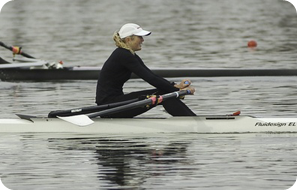
After playing a year of varsity basketball at the University of Guelph, I was looking for a new sport and a new challenge. At the Don Rowing Club Cristy recalls, “I took to the sport very quickly and began to have race and physiological testing results that caught the attention of the national team coaches. By 2010 I was invited to move to the National Training Centre in London, Ontario.” This has meant raising the bar on her goals. “Right now, I am in Olympic Selection Camp, which is essentially a narrowed-down group of athletes who are still in contention for spots on the Olympic team. I won’t know until the end of May if I will be on the Olympic team, so my biggest goal right now is to be re-selected to the women’s 8. And, of course, to stand on the podium at the London games if I do so.”

“ACCEPT CRITICISM AND TAKE RESPONSIBILITY”

Cristy points to her farming background as the place she first learned her work ethic. “Work ethic is engrained pretty early on. Few things can harden your resolve to improve like being left on the outside of the ring in a showmanship class or not making the cut at a major show.” Far from being discouraged by these experiences, Cristy is grateful. “My parents were always very big on sportsmanship and they definitely would not indulge us if we wanted to pout after getting beat, whether it was at a cattle show or in athletics. “ She advises those who are following their dream: “Learn to take criticism from a coach or teammates and use it to improve rather than get upset about it. This has been crucial in my development, and that’s something that a childhood of competition prepared me for.”

“COMPETE EVERY DAY and AIM HIGH”

Everything is a competition. You are constantly being watched and compared to your peers. I try to remember that – every workout is its own “race”, and I just keep trying to be the best competitor I can be. One of Cristy’s early coaches, Paul Westbury, told her “You are only limited by what you are willing to put into the sport. To which this rising medalist adds, “He taught me to never settle for small results – to believe that I could wear the maple leaf one day and always keep striving for that.”
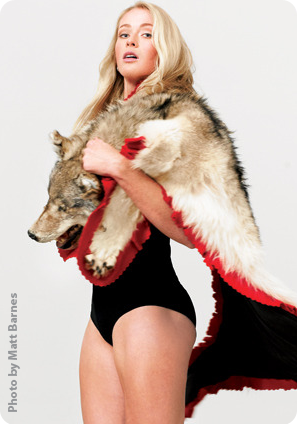
Cristy Nurse : Sportsnet magazine - The Beauty Issue

Cristy Nurse : Sportsnet magazine - The Beauty Issue

THE FINAL WEEKS OF PREPARATION MEAN INTENSE FOCUS and COMMITMENT

Cristy’s focus at present is totally on intense training. “The summer is closing in so fast. I train 5-6 hours a day, eat and try to rest as much as possible so I can perform my next workout.” She admits that this schedule doesn’t leave a lot of time for fun, in the usual sense, but says she feels fortunate that several of her close friends from undergrad, who are also the girls she grew up showing cattle with, live and work relatively close by. As her focus narrows to Olympic tunnel vision, the media focus is shifting to Cristy herself and she was included in Sportnet Magazine’s “30 Most Beautiful Athletes on the Planet” in its March 12 issue. “I hope the photo helps bring some attention to rowing leading into the summer Games, because we have a very strong team on both the men and women’s sides, who deserve the coverage.” Having said that, she immediately restates where her full focus is at the present: Training for the Olympics!

BULLVINE BOTTOM LINE

“I try to make sure every decision I make at this stage puts rowing first so that when I’m sitting in the start gate of the Olympic final: I will have absolutely no regrets” – Cristy Nurse

Want to support Cristy and the Woman of Canadian Rowing as the drive to bring home gold in 2012?
Visit http://www.werow.ca/

[related-posts-thumbnails]
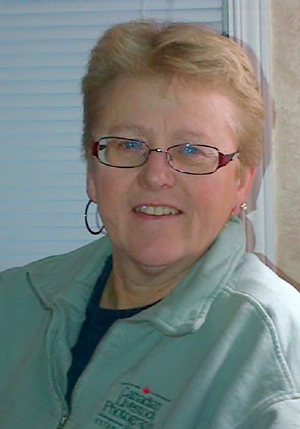
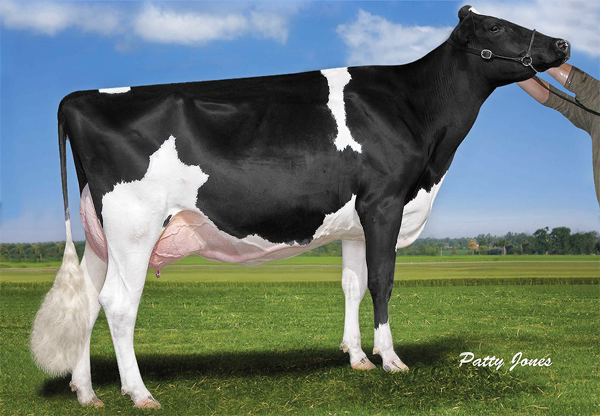
PATTY JONES: Picture Perfect!

Patty JonesPatty Jones has a passion for cows and for people who share that passion.  “I work with a lot of new young farmers.  I tell them off the bat what they need to do.”  And she says they listen and pay attention. No doubt they recognize that with nearly forty years of experience photographing between 60 and 65000 cows, she knows what she’s talking about. Even longtime clients of Canadian Livestock Photography occasionally forget details.  Patty says the young guys know this is important. “I wouldn’t be working if I didn’t help my clients make money.  They’re not just taking pictures for the hell of it”! She is sincere about what everyone is aiming for. “If I can help farmers, especially the younger guys, to get going and make a little bit more out of their investment.  What the heck?  That’s what I do it for.”
ARE YOU READY FOR YOUR CLOSEUP?

Once the preparation details have been discussed Patty hopes to arrive and find the heads have been tied up they are all cleaned and everything goes ahead on schedule. If picture taking is new to the breeder Patty has a couple of suggestions: “Pick out the top mother cows.” Looking at the changing industry she adds” Nowadays, of course, pick the genomic heifers.” What a change this has made in the industry and for Patty. “My business has really increased in photographing heifers because of genomics.”

PATIENCE IS A NECESSARY VIRTUE

The secret to great pictures according to Patty comes down to “Patience”. Patty is emphatic about this and gives an example. “Daughters of Goldwyn have taught a lot of people patience.” This is a lesson learned over time. “Twenty years ago we wouldn’t have known what to do with them. Today we know the secret. Patience!” She says she even practices this while waiting at stop lights. “Waiting for five minutes … Patience is a virtue.”

GET THE PICTURE

Good photography is taking the same old picture, cow, situation … and looking at it from a different angle. “Good pictures have always been the key to cattle marketing.” Wherever breeders talk marketing they are told a picture is worth a thousand words.  “A lot of farms like Roybrook and Glenafton knew the importance of pictures and made good use of them.” She feels the industry knows it isn’t a choice.  Just do it.

A NEW PERSPECTIVE

Stepping back from the camera lens Patty points out that there are some changes in the perspective of the modern dairy farmer that she thinks are good for the longevity of the cattle breeders themselves, “The biggest change that I see with the young guys is that I would call them smart farmers.  This is not to say that previous generations were not smart.  But these new guys are not focused on fourteen hour days of manual labour.  We will have a lot healthier and older farmers. As it has with cameras, mechanization has come into play. Modern farm families see that it is very important to be able to get away.  Kids, wives and husbands need that time away to get renewed.” She supports this by quoting advice she gave a young farmer who complained that relief milkers can be awfully expensive. She pointed out, “So can losing half the farm!”  “Stop and smell the flowers” is something that she preaches and tries to practise.

CALL PATTY.  PATTY’S CALLING

A world traveller who gets to know new countries from the very best location – people’s barns and kitchens.” How did she get these opportunities? “I never had specific goals but as I look back on my career, I can see that everything built on ability and passion. Everything has led me to where I am today.  I live for this.  Every morning I wake up and wonder what I’ll see today.”  She recalls doing a picture for the Pope at his summer residence. She explains, “Special arrangements had to be made.  After the third time that I crossed the helicopter pad I asked myself, “How many Popes have stood on this same spot.” Awesome she admits but not the most memorable ever because she says, “Hopefully I haven’t had it yet!|

BULLVINE BOTTOM LINE:

Patty points to a career that is still evolving and teaching her new things about people, places and cows:

“SHOOT!  THIS IS WHAT I WAS MEANT TO DO!” Patty Jones

Want to take your marketing to the next level, download our free guide “The Dairy Breeders Guide to Facebook“.

[related-posts-thumbnails]

CARSCADDEN: The Royal Footsteps

Brian Carscadden grew up on a dairy farm in eastern Ontario. Between the ages of nine and eleven he started down the path that would eventually lead him to a dream come true – Judging the Holstein Show at the Royal Winter Fair.  He recalls. “I was nine or ten and I remember distinctly going with our neighbour Jack James, a sheep farmer, to Ormstown Fair.  I watched the cattle show for a while and I was mesmerized by the judging process.”

STEP BY STEP

Brian defines the three steps that it takes to fulfill a dream such as his.  “You start out with a dream about going to the Royal.  Then comes the dream about showing at the Royal. Then you dream of owning an animal that show at the Royal.  The next step is the dream to be the judge at the Royal.  That is the hardest to acquire.”

For Brian the dream started young.  “When I was eleven I had never been to the Royal.  My dad and grandfather came back that year and talked about it and I said to myself, ‘You know what? I want to go that show!’ The third step was the real beginning. “The next year I went to the Royal and I’ve been there every year since!”  And so it is that Brian fulfilled his childhood dream. “Every young Canadian Holstein enthusiast dreams of that. I started at lower level shows and worked my way up to the big shows to where the Royal was the only big show I hadn’t judged.” In 2011 he was the Royal Holstein Judge. “There’s very few that actually get the opportunity to follow through! The whole experience was very emotional for me.”

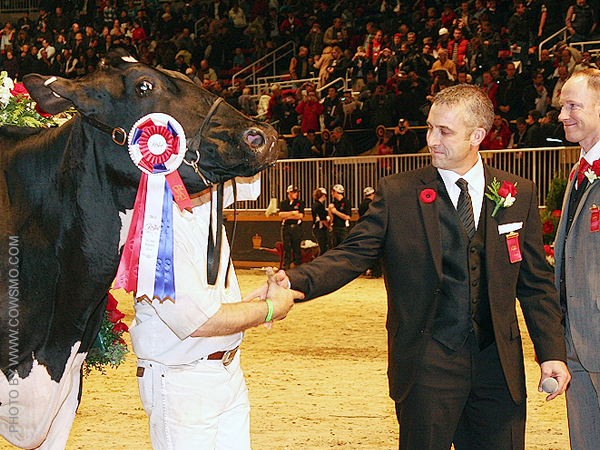
Brian congratulating 2012 Grand Champion Eastside Lewisdale Goldwyn Missy

Brian congratulating 2011 Grand Champion Eastside Lewisdale Goldwyn Missy

FIT TO JUDGE

You know that a lifelong dream doesn’t happen just by luck.  Brian was focused on the goal and had a plan for how to make it come true. He advises judges who aspire to the Royal or Madison to be prepared. In Brian’s case, “Prior to Madison I watched videos from the past twenty years to give myself familiarity with the Show.  I saw different ways of doing things because I felt I needed to be aware of them.  Even terminologies that other judges used were an interesting part of the learning process.”  Carscadden then goes on to the physical side of things.  “A lot of the judges are farmers and are busy and in good shape. Callum McKinven is one of the toughest guys I know.  But I’m from the city.” Brian had a plan and he took his fitness to the next level. “Before Madison I started running and got up to ten to twelve miles a day.  At the show, I wore a pedometer.  I walked fourteen miles in two days of judging.” You might ask why Brian felt this was necessary.  He is emphatic. “You can’t judge well if you’re physically exhausted.  This is such an important show to the industry; you must do the best job you can!” Brian epitomizes the reason that Canada sets the benchmark for cattle judging worldwide!

FOR ALL THE RIGHT REASONS

We all wonder what the Judge in the middle of the show ring is thinking as he places the cows we are so passionate about. We want to know what he was thinking. Brian says, “Reasons are pretty important. I’m fortunate that, since the age of ten, I have had microphones in my hand. It is important to justify what you have just done.  If you can tell the crowd and satisfy them as to why their animal didn’t win, they may not agree but they can’t argue with you.” Brian says that his experience as a sire analyst and judge is the foundation that he has built on.”

HONESTY, INTEGRITY and AN OPEN MIND

Brian has always held himself to a high standard in all areas of his work. “I’ve learned the value of being professional.” He is aware that all eyes are on him, both in and out of the ring. “The biggest thing is to give an honest opinion.  Judge each cow on the day: not six months ago or three years ago.” For Brian, this kind of integrity applies outside the ring too.”Before the show, it is important to keep your nose clean.  I do not visit a farm within a month of the show. I don’t go to other shows. You must go into the ring with an open mind.”

At the Royal this year I topped the four year old class with a black cow from Jacobs.  Afterwards, Dave Crack came to me and said, ‘Jacob’s will be happy. That was the cow that was grand last week.’ I didn’t even know who she was.”

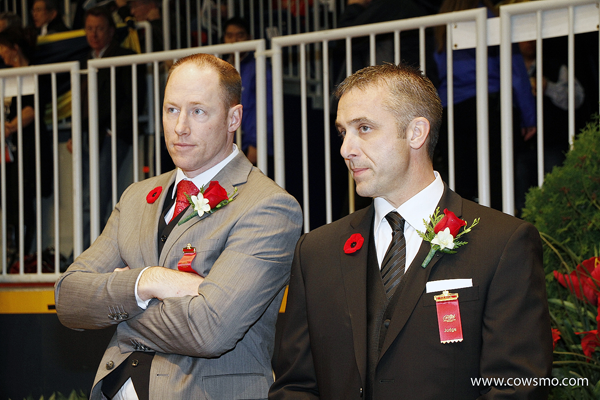
Brian Carscadden and Assoicate Judge Dave Crack

Brian Carscadden and Associate Judge Dave Crack

THE BULLVINE BOTTOM LINE

Brian Carscadden knows why he has the energy, enthusiasm and commitment to be a tireless cattle judge in Canada and around the world: “For me it’s a passion.  To be in the middle of the ring and see these great cows coming at you. It makes the hair stand up on the back of my neck —IT’S A RUSH” Brian Carscadden

[related-posts-thumbnails]

Ocean View Genetics: The Fine Art of Marketing Great Breeding

When it comes to marketing dairy cattle, Pam Nunes leads the way.  Pam became the driving force behind this part of the business at Ocean View Genetics because of her background as owner and designer of Westwynde Communications.  “Since my company is an advertising firm, the marketing aspects for Ocean View pretty much became my job over the years. Marvin and Daryl always advertised in the World and believed in marketing, but as time and my company evolved I took on a larger role in the different aspects from advertising, showing and even sales.”  They were happy to make, milk and take care of the cows and let me handle the marketing.” For the last sixteen years, Pam and husband Daryl worked together to take strings out to the shows, put on the Harvest sales and helped evolve the marketing into what many people think of today as Ocean View.”

THE WOW FACTOR

The impact of great advertising has had a very positive effect on Ocean View. “I’m always amazed at the number of people who comment on our advertising. It’s good to know it gets noticed.” Getting noticed is the bottom line in the cattle business. “I remember the year Lindy Sheen went to Expo, and it was interesting how many people knew the cow at a glance. These were people not from our area who could have only ever seen her in print ads. That’s when you know advertising can be powerful.”

A HORSE OF A DIFFERENT COLOUR

Powerful advertising is everyone’s goal.  We put a lot of worry, time, consultations, proofing and reviewing into ad creation.  Pam says there can be a lighter side too.  “The funny thing is that so often our own ads are thrown together. Kind of like the shoe makers kids with holes in their shoes. There have been some instances where our ads actually started as horse ads and I needed an idea quick because our ad was due. So voila – out goes the horse and in goes the cow!”

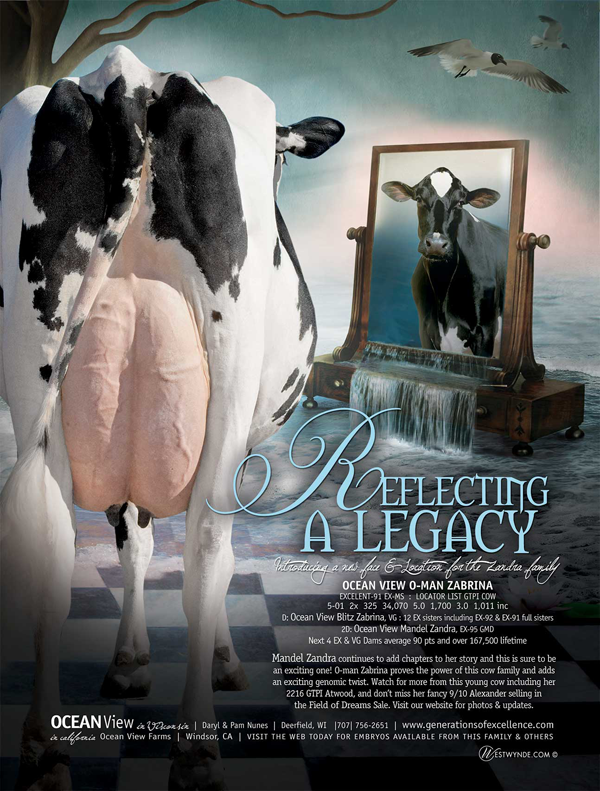
Oceanview Mandel Zhandra EX-95-2E

Oceanview Mandel Zhandra EX-95-2E EEEEE Gold Medal Dam, Dam Of Merit

WHEN IT WORKS EVERYONE CAN NAME THAT COW!

You always want to attract attention with your marketing. Pam’s ads are good at that and she points to Mandel Zandra to illustrate. “She has been the easiest cow to ever work with over the years. She captured a lot of attention in the show ring with her style and it transmitted not only to her photos but also her offspring. She has 12 Excellent daughters so far. She lives in Wisconsin now and will turn 16 in March. She was the subject of many photos this fall during Expo. We had her in a pasture with 10 of her grand-daughters. It never failed that when people drove in they asked if that was her. We even had a gentleman from Japan show us the screen saver on his phone…it was Zandra.  If she had never been shown or advertised I doubt anyone would know the name today.

YOU’VE GOT TO STAND OUT FROM THE CROWD

Having said that, Pam knows the time it takes to stand out. In the cattle business most ads are done by the publications still. They can usually spend about an hour on an ad with all they do. “Our ads usually average three to five hours.  A magazine can’t spend that amount of time on each page they have. I am happy to say that I am really seeing more effort put into ads these days on the cattle side and there are some magazines now that do a great job with their ads.

Pam’s years of experience have added up to some clear ideas about what works.

  1. Ocean View Genetics adYOU CAN’T HAVE A GOOD AD WITHOUT A GOOD PHOTO
    “I also think you can’t have a successful ad without a great image. Making sure you have the cow looking the part and lots of help and a great photographer will make all the difference in successful photos. You can’t have a good ad without a good photo!”
  2. MAKE THEM WANT MORE
    Once you`ve got good photos! Make sure you get an eye-catching ad developed to go with them. Remember…the purpose of an ad is to attract the reader’s eye enough to get them to read it…and want more.
  3. REMEMBER. THE COW IS THE STORY 
    “A pet peeve of mine is if it’s unreadable. You can have the greatest looking ad but if you can’t READ it – it’s a failure. Too often you see design overwhelming the subject.  That’s always a recipe for disaster. It’s not a showcase for Photoshop effects or crazy backgrounds or fonts etc – it’s about the cows!
  4. K.I.S.S. and TELL
    Modern cattle advertising now needs to go one step further. It’s time to kiss and tell. K.I.S.S. Keep it simple stupid.  Pam feels strongly about this. “Keep your ad simple and put the detailed information on your website. Don’t try to tell them the entire history of your animal in the ad. It defeats its purpose.” The telling part happens on the internet. These days websites are essential to selling. For effective advertising, remember K.I.S.S. and TELL.
  5. IT ALL COMES DOWN TO DOLLARS AND COW SENSE!
    Use what you know to decide where your advertising dollar is best spent. Just like you shop around for the best corn or hay prices – do your homework on your advertising dollars too. Don’t be afraid to try different advertising venues and find out what ones work. Ask people where they saw your ad when you get calls or emails.” Use what you know to decide where your advertising dollar is best spent. With websites these days you can track where your traffic comes from. With print ads there is no way to easily measure your return, but if you do your homework you can get a feel for where you get the most response.

SUCCESS SELLS!

You know when your advertising is working because the success is right there in the sales’ figures.  Pam reports. “Our last two Harvest sales were exciting events to plan and execute. We did all the marketing and event planning for them, as well as lining up the fitting crew and deciding what the farm would consign. We’re super pleased with the number of success stories that have come from these sales with Reserve All-Americans and even 94-pt cows having gone through the ring.”

ON THE MOVE

Today Pam and Daryl have started “OCEAN VIEW GENETICS”. “We look forward to continuing the same path we have been on, only in Wisconsin.” And what a path that has been!

The accomplishments the Ocean View herd has made over the years are huge with over 330 Excellent cows that carry the prefix, 90 Gold Medal Dams and 11 cows over 300,000 lifetime. Pam sees more tributes in the future. “I think you’ll hear stories for years to come about success with animals purchased in Marvin’s dispersal on May 2nd. It’s going to be an opportunity to buy foundations.” Looking ahead she adds, “Although we’re not involved in the sale, we plan to attend and possibly add a few more cows that we weren’t able to buy before our move to Wisconsin.”

DOWNSIZING for A BIG MOVE

Going from 350 free stalls to 38 tie stalls has been the biggest challenge for “Ocean View Genetics”. Recalling the process, Pam says, “It really makes us focus on what animals we add to the milking herd. Our focus will be a little different from in the past.” Of course, each decision is already providing results to look back on. “What really shocked us was that we brought an old Outside that was dry with over 250,000 and figured we’d get the calf out of her and have to sell her. She actually had the first heifer on the farm for us and is now over 290,000 and just went Excellent. She just KNEW what her job was and took right to everything without a second look.”

SELLING IS AN ESSENTIAL PART OF OUR BUSINESS

The Nunes’ are excited about their plans for the future. “We figure we need to sell twenty head a year to keep at our size. We also have both said we don’t want more than either of us can milk by themselves. When the milker did not show up in California, it was a lot cows to milk, but we did it. Now it’s much less daunting if someone oversleeps! Actually our cows surprised us with how easily they adapted to the change.” Obviously, adapting is good for cows and good for people too!

THE BULLVINE BOTTOM LINE:  KEEP ON SELLING

“As we move forward, we are not going to be afraid to sell the good ones. Our plan is to keep the factories and sell the offspring that we need to allow us to stay in business.”
Pam Nunes, Ocean View Genetics


Want to take your marketing to the next level, download our free guide “The Dairy Breeders Guide to Facebook“.

[related-posts-thumbnails]

Mapel Wood Farms – Invest in the Best! Forget the Rest!

WHAT’S YOUR MOTTO?

Len Vis, owner of Mapel Wood Farms, says his motto has always been:  “Invest in the best and forget the rest”. It was the driving force behind his first investment in 1991 in Mark Diamonds who became the brood mare of Mapel Wood Farms and it is what led him and his partners to invest in Bombi and Lilac.  “Investing in top cow families never lets you down.  You may not get it this generation or the next generation but those genetics always breed through eventually.” On any measurement scale, records, show ring, progeny or the bottom line these two families represent where Len sees his farm going in the future!

TO THE TOP BABY!

Len points to the dramatic changes happening in the dairy industry not only in the past five years, but in the last year.  He says, “The biggest change is that 90% of people coming to Mapel Wood are interested in heifers.” This was not previously the case when people wanted to look at cows. “I have never flushed so many virgin heifers as I have in the last year and we are getting big money for their embryo’s.”  Knowing what the market wants and providing it for them is another part of aiming for the best!

COMESTAR GOLDWYN LILAC - VG 89

COMESTAR GOLDWYN LILAC - VG 89, Goldwyn x Lila Z GLPI 2753 ALL-ONTARIO SR.2-YR 2008 NOM. ALL-CANADIAN SR.2-YR 2008

YOU’VE GOT TO “DO YOUR HOMEWORK”

In every area of running the Mapel Wood operation, Len relies on getting his homework done right.  This means investing in the right people to work with. He speaks with pride about his full-time employees, Chris Naves and brother Harold Vis and that he can rely on them 100% to keep things running smoothly and sale or show ready every day. Choosing the right investing partners is more homework done right that pays off.  Len says it is important for partners “to have the same philosophy, goals and commitment.” For him it has been a great experience.  “My two best partners have been GenerVations, Dave Eastman, and the O’Connor Brothers, Sean and Kelly.”

DON’T DO ANYTHING ON A WHIM

When you get to the real homework behind success in the cattle business Len is emphatic. “I never go to a sale on a whim.  If I’m in the market I have animals that I’ve got premarked in my catalogue.”  This is only the start of the decision-making process. For him the next thing is conformation. “I look at the ones I’m interested in.  If they don’t make it on conformation, they’re scratched!”  He has the steps clearly prioritized. “Cow families first.  Then sire stack. Then I start doing history on flush history.” Vis says there is nothing worse than buying something that doesn’t flush. You can be sure he always asks the seller about the flush history of the family. He looks at records. He thinks Holstein Canada’s free service is great. “A lot of times you just go on Holstein Canada. If you see 10 daughters from one mating, you know the family flushes.” Homework isn’t finished until he has checked out pictures. “For marketability, I like to see the dam and granddam all pictured.” Having said all that, the real test of getting your homework right is that final decision, to buy or not to buy. Len cautions, “Remember the Calf in the sales ring has to look the part. Conformation is still the most important thing when it comes down to the final bid. If she’s in the ring and you gut says something isn’t exactly right. Pull back. You’ve got to love that calf 100%!”

GEN-I-BEQ SHOTTLE BOMBI VG-89-6YR-CAN 2*, Shottle x Champion x Baler Twine, GLPI +2750

MAPEL WOOD MATH

Success for Len Vis and Mapel Wood Farms means making sure that all the numbers add up! Years of experience have given him some benchmarks for investing.  Investment benchmarks have changed pretty dramatically. “It used to take 1 kilo of quota to buy a good animal.  Today it takes 3 or 4 kilos of quota.” He feels the right animal will pay for your quota.  “When I started out in the business, if the right animal came across I would be willing to sell a kilo of quota to buy her.” He explains, “Your investment can triple in one year. A lot of guys don’t know that. Quota takes forever to pay off but buy into the right cow family you can have it paid off in no time.” That’s MapelWood math.

GENOMICS!  THE NEW MATH!

For better or worse, Genomics is on everybody’s page these days.  “You can’t be in the dairy business without genomics affecting you.” Regardless of all the controversy Len hears and wonders about he says, “Genomics have helped every farmer because hopefully Semex or your semen company is not buying those bulls that don’t have a chance ever to make it.” That’s the good news. He goes on, “Five years ago I did not sense Genomics was going to be this big. I don’t think anybody did.  What studs thought they would be selling young sire semen for $100?”  He knows it is the ongoing debate.  “There are so many different army camps of people… some are all for it …. Some are sitting on the fence waiting to see.” Waiting is not a key part of Len’s goal setting.

ONE STOP TO SHOP

Len’s goal is that people will come to Mapel Wood Farms as the “one stop to shop”.  He aims to be the “Wal-Mart of the cattle investing world.” The aim is to offer the best in several areas. “We want to have high genomic cows and heifers, show cows, red and white genetics, and polled genetics.” Aiming to have the best he is very enthusiastic.  ”Currently we’re buying embryos from Europe and still buying heifers and cows. Just recently we just sold a six year old cow for big money.” It pays to do your homework!

STICK TO THE GAME PLAN

Len is looking forward but he points to his own history. “Diamonds was a good investment but it was three generations later that I realized what a great investment that was. Sometimes when you invest you don’t reap the benefits the next day. That doesn’t mean you just sit and wait.” Obviously Len feels you must have a timeline like he and his partners did with Bombi and Lilac. “Five years ago we had a game plan. Today we are up to 300 head. We have been buying recipients.  We’re constantly flushing.”  From the beginning there was a target. “We are gearing up for a sale in November 2012.  Nothing has been done on a whim. We are going to see the results of our five-year game plan.” 

BOTTOM LINE:  Aim to be the Best!

“When you invest in the best – cow families, embryos, and heifers – your farm will rise to the top.” Len Vis, Mapel Wood Farms. 


Not sure how much to spend on that great 2 year old?

Want to make sure you are investing your money wisely?

Download our Dairy Cow Investment Calculator.

[related-posts-thumbnails]

The Judge’s Choice – Investment advice from Tim Abbott

“What’s the plan?” We hear or refer to that question several times every day.  It’s the driving force when growing a business, or when you’re a resolving problem in the board room or, for those of us in the cattle industry, when you’re in the barn.  People like Tim Abbott thrive on finding the answer. The owner of St. Jacobs ABC knows that having a good plan, from the barn to the board room, is the cornerstone of success in the dairy cattle business today. Whether you are starting out or have more than twenty years in the business like he does, Tim says the first step must be, “Chart a plan”. That comes first. Then, you have to “know how your investment can accomplish your goals.” He sums it up clearly, “I think you need a plan for any investment in our business.”

“One size does not fit all!”  When it comes to investing in the dairy cattle business this can be modified to,” One plan does not fit all!”  You have to have a plan and it has to be a focused plan. That’s where the critical differences come in for someone like Tim Abbott.  “Whether it is show cattle or genomics or great maternal lines” he insists “You must have a plan for what you want to achieve”.

“Know what cattle you are focused on.” “For us we really prefer to buy cows.” He recognizes “There certainly is good money in buying the right heifer.” But he returns to his point, “At St. Jacobs ABC have focused on show animals, so milking cows are our preference.”

 “Investment cows need star power.” Here Abbot continues to fine tune what St. Jacob’s is looking for. We want “a cow that can become iconic as an individual”.  You might be wondering how they find that winner.  Tim explains, “The cows must have a sire stack that tells us they can be great and a maternal line that has proven to be successful.” You can never have too much information.  It is the basis of decision-making and good planning. “We always try to figure out how many daughters it will take to pay off our initial investment. We like to stay in the range of 10 or less daughters to get the purchase price back.”

Which brings Abbott to how important budgeting is to the planning process?  “Be sure you can afford to pay for what you buy.”

“Is that in the budget?” It seems a no brainer but the devil is in the details and in the budget too! Tim cautions” You need to budget for the expenses after your purchase.  IVF, flushing recips, advertising – these will add up no matter what your investment level is. Be sure you have the money for all of this.”  The money and what you spend it on is the key to success. “Over the years we have spent too much on average ones.” Although hindsight is 20/20, when looking at some past decisions he says he wishes “we had stayed with the great ones.”

“Stick with the great ones!” Tim feels that in today’s market, “There is very little middle ground.  Cows are commercial or very valuable.” In the last five years genomics has had a huge impact on the cattle business. “The genomic business is fantastic right now and the upper end has great value for the next generation and embryos.”

“Weigh In on the Genomics Debate” Tim’s view on this phenomenon is “Good breeder, type cows and heifers don’t have enough value in my mind but that is reality. IVF has had a huge impact because you can make daughters so efficiently and I think that is why the middle ground cattle have lost some value.

“Where’s the focus for St. Jacobs ABC?” Abbott summarizes the key issues. “We have chosen to stay out of the genomics game and focus on cows that are like our bulls … high type, great sire stacks and good female lines.”

 “Stay positive. Be careful.” “I think the good ones, whatever your focus, will continue to have tremendous value.  I think people will have to be careful with IVF not to make too many daughters of certain cows and watch the market very closely”. He sees three possibilities:

  • Big herds that have great access to recipients will have some success for sure.
  • Show cows will remain very valuable
  • Top genomic animals will be great property

THE BULLVINE BOTTOM LINE

FOCUS ON TOP GENETICS.  PLAN ON TOP DOLLARS.

As things change with testing bulls, the value of top genetics could keep going because of the potential for breeders to have very valuable bulls.  I think we will see some similarities to when there were many breeder proven bulls….the VERY top will make top dollars.” Tim Abbott, St. Jacobs ABC.


Not sure how much to spend on that great 2 year old?
Want to make sure you are investing your money wisely?
Download our Dairy Cow Investment Calculator.

[related-posts-thumbnails]

Morsan Farms – Money Well Spent

Imagine someone comes up to you and says, “Make a huge commitment of your family, your money and your time.  Put it all into the Holstein dairy business. In less than ten years you will have one of the country’s largest dairy herds and your farm prefix will be recognized around the world.” It’s quite probable that you would assess that person as a few sandwiches short of a picnic.

Is it hard to believe? Yes!

Could it happen? Also, “Yes”.

The proof of this success story is Morsan Farms Ltd. owned and operated by Morris and Sandra Thalen.  They are living the dream.  When they moved their dairy operation to Ponoka, Alberta in 1996, they milked 200 commercial grade cows. Today 80% of the herd is purebred. They milk between 1600 and 1800 cows and own about 250 dry cows, as well as 3500 head of young stock. They have genetics from 300 cow families and provide breeding stock to dairy farms in 21 countries. While it may sound like an “as seen on TV sales pitch”, their success is actually based on their skills as producers and business managers.

Eastside Lewisdale Gold Missy - Grand Champion WDE and Royal '11

Eastside Lewisdale Gold Missy - Grand Champion WDE and Royal '11

Don’t Waste Time Looking in the Rear-view Mirror

The minute we are faced with outstanding success, human nature makes us ask, “Yeah but.  What mistakes did you make along the way?” It could also be human nature that successful businesses don’t spend a lot of time on their mistakes or the would’a, could’a, shoulda’s.  Chris Parry, who manages the genetics and marketing side of the business at Morsan Farms Ltd, points out, “there is something to be learned even with those few purchases that could have worked out better”.  He recommends that you “Do your homework. Make the decisions.”  That is probably what led to one of their biggest successes. Chris points to Eastside Lewisdale Gold Missy. “She has to be the biggest name so far.”

Teamwork is Your Best Investment

With obvious pride Morris and Sandra say, “It’s been a great privilege to work with our children and see their interests in Morsan Farms develop.” The Thalen’s know that this family teamwork is mirrored by their eighteen full time staff and is the foundation for their continued success. The dairy business is all about relationships – cattle and people – on the farm and off.   Morris says, “Our philosophy is complete customer satisfaction. I can tell you that for every 1000 animals we sell, 950 of them are sold over the phone.  That has everything to do with trust.”

With their rapid growth, exacting attention to detail and over-riding goal of delivering the very best, it isn’t surprising that Morsan Farms Ltd. has attracted many partners. In the business world, volumes have been written on the pluses and minuses of business partnerships. Chris Parry has a positive outlook on this part of the business. “Investing with partners can be extremely beneficial to long-term business as long as all management matters are clearly defined ahead of entering into any investment agreement. There are many examples of successful partnerships and a few examples of unsuccessful partnerships”. He considers and then adds, “I think partnerships that don’t work are the ones where partners receive unexpected surprises which cause friction.  In most cases our experience with partners has been exceptional.” He sums up the partnership discussion by saying, “We have a lot partners who have now become great friends of the business.”

It is an exciting time to be in the dairy cattle business and Chris was emphatic that the first step in investing in dairy cattle is to know your own goals first.  He offered many possibilities. “I think if you are looking to invest in genetics the key is to decide what your expectations are? To improve your herd? To market genetics? To market the business? To bring in a direct or indirect return on the investment? To put bulls in AI and work in the genomics market? When these questions are answered then it’s time to do your homework”. Doing the homework is what Morsan Farms Ltd. is obsessive about.  The “first step is to identify the consistent cow family and the best member of that family you can find. Then it is simply down to the investment level you are comfortable with and your expectations on the return on that investment”.

Where is the Excitement in Cattle Investing Today?

MS Chassity Goldwyn Cash

MS Chassity Goldwyn Cash

Everyone is talking about Genomics.  Morsan Farms Ltd. has a plan.  Chris Parry’s personal view is “I look at this as a positive not a negative. Lots of investment has been made in this new area of the industry which would not have been made before. A good percentage of this investment has come from outside of the industry and this is a good thing”. He cautions, “The danger here is again down to expectations. Know the science and know this part of the industry and your investment will be justified” He throws in a word to the wise, “Make sure you invest in genomics backed by a good sound cow family so if you don’t get the number you still have something to work with.” When pressed for examples Chris pointed out, “Over the past two years or more the majority of the purchases have been based on genomics most notably in cows like MS Chassity Goldwyn Cash, MS Atlees Shottle Aubry, MS Atlees Goldwyn Ariel just to name a few”. Chris summed up this discussion by looking to the future. “I would say the genomic investment will continue to be the driving force in the industry but I see the investments made will have a higher degree of calculation and understanding.”

THE BOTTOM LINE: From Day One, Set Yourself Up for Success!

Everyone involved with Morsan Farms Ltd. shares real enthusiasm for their work.  They see breeders as dedicated people, like themselves, who are passionate about the industry. “We have to be. To work the long hours we all put in 365 days a year in all-weather conditions takes a unique breed of people. This is normally the same drive that makes your business investments succeed”.  It all comes down to teamwork.  Good information.  Trust you’re your first impression when looking at a potential investment is normally the correct one. Talk to people in the industry whom you respect.  Get good information.  Don’t fall for the hype.”

Morsan Farms is an example of exactly that path. Relatively unknown just six years ago and now a well-respected brand name in the industry backed by an extremely dedicated family and motivated professional staff.  


Not sure how much to spend on that great 2 year old?
Want to make sure you are investing your money wisely?
Download our Dairy Cow Investment Calculator.

[related-posts-thumbnails]

Send this to a friend