Archive for herd health management

Carol Prelude Mtoto: The £40 ‘Failure’ That Saved the Holstein Breed

How an Overpriced Italian Specialist Became Worth Billions (And Why His Story Could Save Your Herd from What’s Coming Next)

Carol Prelude Mtoto didn’t look like a production superstar, but his deep rib and rugged constitution provided the essential strength the breed had lost. While neighbors chased high-index frailty, this bull was quietly engineering the modern survivor.

You know that moment when you realize you’ve been doing everything wrong?

Farmers across Yorkshire had it in 2008, standing in empty barns, watching auctioneers sell off what was left. The high-producing daughters of those “bargain” bulls they’d bought five years earlier? They’d crashed and burned when feed costs doubled and milk prices tanked. Spectacular production for two lactations, then… nothing. Metabolic disasters. Fertility nightmares. Udders that looked like they’d been through hell.

Meanwhile, their neighbors—the ones who’d invested a premium £40 per straw in that expensive Italian specialist back in ‘98—were still milking. Still profitable. Fourth and fifth lactation cows just quietly doing their job while everyone else’s genetics fell apart.

The difference between those farms came down to one decision in October 1998. Whether to spend a painful £40 on Carol Prelude Mtoto—a massive premium when neighbors were buying “bargain” bulls for a tenner—or take the easy route and buy the cheaper, high-production sensations everyone else was using. At £40 per straw when standard proven bulls cost £10-15, Mtoto was a contrarian investment most farmers couldn’t justify.

Here’s the thing… the spreadsheets were dead wrong.

What happened with Mtoto isn’t just breeding history. It’s playing out again right now, except this time we’re using genomics to make the same mistakes at digital speed. And if you’re not seeing it in your barn yet, trust me—you will. We all will.

When Production Became a Disease

Let’s talk about what the industry looked like when Mtoto showed up. Picture walking into any tie-stall operation in the mid-’80s. You know that smell, right? Silage, manure, and something else that hits you wrong. Then you see them—Bell daughters everywhere.

Christ, those cows could milk. Carlin-M Ivanhoe Bell was putting 1,700 pounds above average into bulk tanks across North America. By the late ’80s, his genetics appeared in the pedigrees of nearly 30% of the Holstein population. Every AI stud was pushing his genetics hard. Every producer wanted them.

Producers who managed operations during that era tell the same story. “Those first two years were like Christmas morning every day,” they remember. “You’re watching the tank fill up, doing the math in your head, thinking you’ve figured out this whole dairy thing.”

But here’s what nobody wanted to admit—Bell daughters were frail. Narrow through the chest. Fragile, really. Their udders? By the second lactation, they were hanging so low you worried they’d drag on concrete. And third lactation… if they made it that far.

“It was like a battlefield,” producers from that era still say. “Cows down with milk fever everywhere. Others were standing with their legs all splayed out, trying to hold up udders that had completely broken down. We were getting maybe two, two and a half lactations before they were done.”

The math was brutal once university researchers ran the numbers. Cornell and others documented that Bell daughters lived significantly shorter, productive lives. In some cases, 2-3 years less than balanced genetics. All that spectacular production didn’t mean squat when you’re constantly buying replacements.

Farmers still shake their heads when they talk about it: “The production was so incredible those first couple years, we kept telling ourselves it was worth it. By the time we figured out what we’d done to our herds, Bell genetics were everywhere. There was no going back.”

The industry had created production monsters wrapped in tissue paper. And almost nobody saw the correction coming from, of all places, Italy.

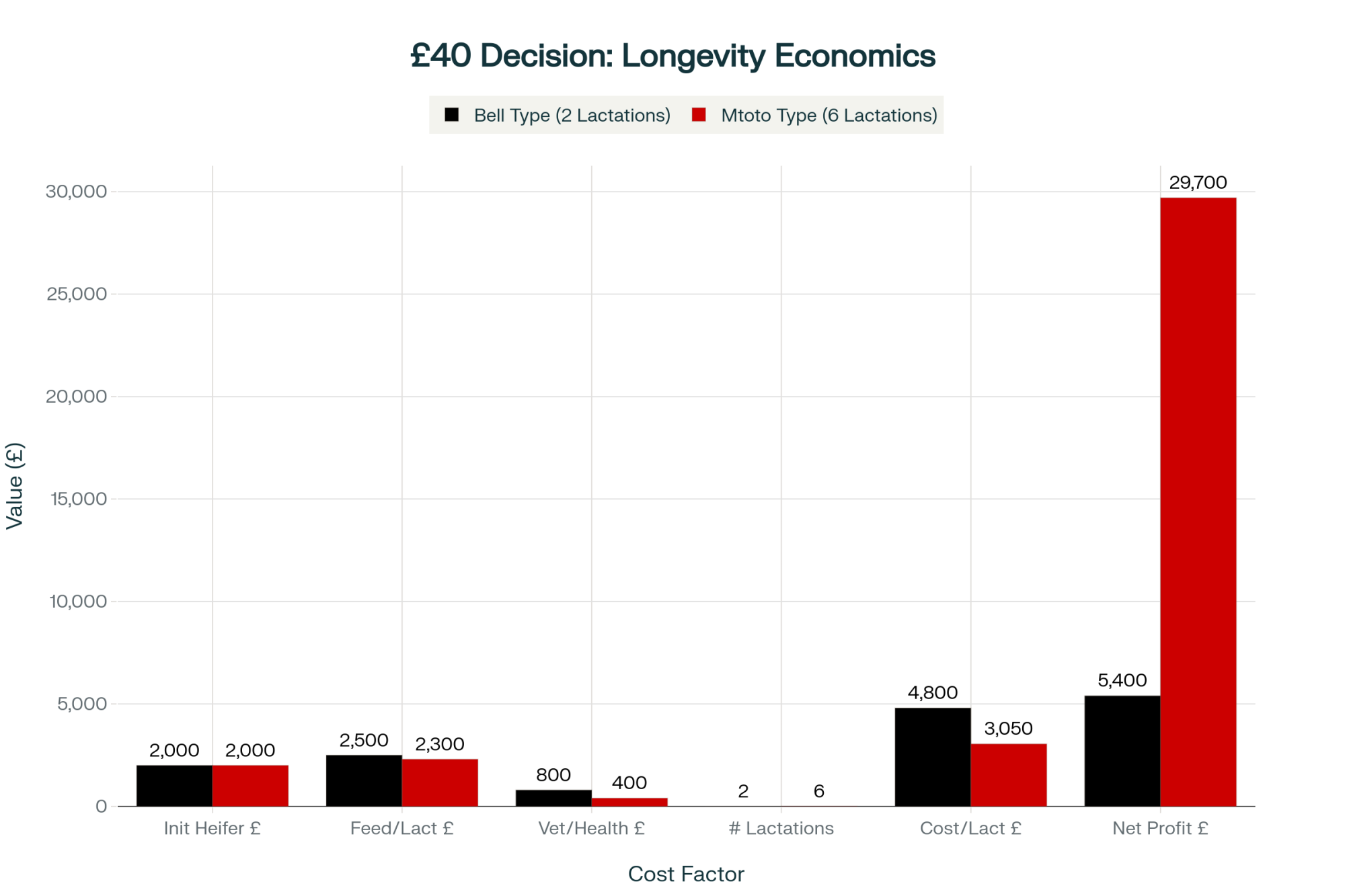
The £40 ‘waste’ becomes the £24,000 advantage. Mtoto-type genetics deliver 450% higher net profit (,700 vs ,400 per cow) despite identical initial costs, proving longevity genetics transform farm economics through 4 additional lactations and 40% lower costs per lactation. This is the spreadsheet that saved Yorkshire farms in 2008

The Italian Accident That Changed Everything

July 13, 1993—a bull calf gets born in Italy, in that region where they make real Parmigiano. Nothing special about him. Average size. Production genetics that were, let’s be honest, pretty mediocre.

But Carol Prelude Mtoto had something hidden that you couldn’t see at birth—and I know this sounds weird—but it was all about how tight the teat ends would close after milking.

Stay with me here because this matters…

You know how after you pull the milkers off, there’s that window—maybe an hour, an hour and a half—where the streak canal’s still open? That’s when bacteria can cruise right up into the udder, especially when the post-milking spray misses the target. It’s like leaving your barn door open in a thunderstorm while the cows are lying in wet bedding.

Now, some bulls transmit daughters with loose, relaxed teat ends. Great for parlor throughput—those cows milk out fast. But they’re mastitis magnets. Others, like Mtoto? His daughters had tight teat closure. Annoyingly tight. Slow milkers that drove parlor managers crazy.

Producers in the Parma region called them ‘hard milkers’ and constantly complained about them. But this was the biological trade-off for survival. While neighbors were burning through antibiotics, treating mastitis every damn day, those Mtoto daughters just kept producing clean milk. Year after year. No treatments. No culled quarters. No cell count problems.”

The economics were invisible until you actually sat down and did the math. That extra couple of minutes of milking time? Maybe €30 a year in labor. But the vet bills you didn’t have, the cows you didn’t cull, the extra lactations you got? That was €2,000-3,000 in additional profit per cow. Per cow!

Breeding for Survival, Not Show Scores

But here’s what really made Italian breeding different…

Over 80% of Italian milk wasn’t going into retail jugs—it was becoming Parmigiano Reggiano, Grana Padano. Those Protected Designation of Origin cheeses with regulations so strict they make your bank’s lending standards look relaxed. And those cheese factories? They’d reject your milk flat-out if the cells were too high. When you’re aging cheese for two, three years, protein content matters way more than volume.

Italian dairy leaders from that era explained it simply: “We weren’t breeding for those production records Americans chase. We were breeding for cows that could deliver consistent, quality milk for cheesemaking while lasting long enough, actually, to turn a profit.”

Think about it. A cow pumping out 30,000 pounds for two years means absolutely nothing if the cheese factory won’t take her milk.

The Italian approach seemed backwards to those of us chasing TPI—that’s Total Performance Index, basically the dairy world’s report card for Holstein genetics. But when you can’t just throw corn silage at everything, when cheese factories set your market standards, when your family farm has to last another generation… mastitis resistance becomes survival, not luxury.

Mtoto was engineered to fix what Bell broke. His sire, Ronnybrook Prelude—himself a Starbuck son—brought good frame and dairy character. His dam, a Blackstar daughter, brought constitution. And there was Chief Mark back there for udder perfection. It was like someone designed the exact correction the industry needed but didn’t know it wanted.

By ’98, when Avoncroft brought him to Britain, Mtoto had proven himself across Italian herds. His daughters weren’t production champions. They were survivors—lasting when others broke down, staying healthy when others needed constant treatment.

According to UK dairy records from August 2025, his mature proof shows somatic cell scores of -13, a HealthyCow index of +17, and a lameness advantage of +0.7.

The £40 price tag wasn’t cheap. At nearly four times the cost of standard proven bulls, it was basically saying: “This bull solves expensive problems—if you’re willing to pay upfront to avoid them.”

Most farmers weren’t. Who could blame them? Why pay £40 for mediocre production when £10 bought you bulls with spectacular numbers on paper?

The Eight-Year-Old Cow That Changed Everything

Now here’s where it gets interesting…

The Pickford family from Staffordshire had purchased a Canadian heifer, Condon Aero Sharon, recognizing something in her genetics worth investing in. By ’99, Sharon was eight years old, still going strong. The AI companies? They literally laughed at the Pickfords wanting to flush her. “Too old,” they said. “Obsolete genetics.”

Helen Pickford still remembers the conversation: “The reps kept showing us data on first-lactation heifers. Dad just kept saying, ‘But Sharon’s still here, still producing well. These heifers you’re pushing—will their daughters still be milking in eight years?'”

The Pickfords, working with ABS’s St. Jacob’s program, made a decision that defied conventional wisdom. They bred their mature cow to Mtoto—that expensive Italian specialist with mediocre production proofs. They were essentially doubling down on contrarian genetics.

July 23, 1999. Morning mist at Spot Acre Grange in Staffordshire. Sharon drops a speckled bull calf. They named him Picston Shottle. Nothing special happened that day. The industry had moved on to newer, more “cutting edge” genetics. (Read more: From Depression-Era Auction to Global Dominance: The Picston Shottle Legacy)

What came next rewrote everything.

The “Obsolete” Matriarch: At eight years old, Condon Aero Sharon (pictured) was dismissed by genetic experts as having outdated bloodlines. The Pickford family ignored the data, seeing a rugged survivor instead. By breeding this “obsolete” cow to the overlooked Mtoto, they produced Picston Shottle—proving that actual longevity on concrete beats theoretical potential on a spreadsheet.

When Customer Satisfaction Beats Computer Models

Shottle goes into progeny testing—five years before you know anything, right? By 2006-2007, when his daughters start milking, the numbers look solid but not earth-shattering. Nothing that screams “generational breakthrough.”

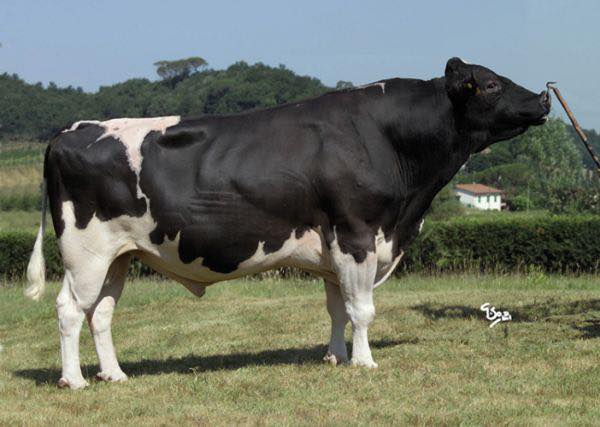
The Ultimate “Customer Satisfaction” Bull: While experts critiqued his “obsolete” pedigree, farmers couldn’t get enough of him. Picston Shottle (pictured) didn’t just top the charts; he produced the kind of “invisible,” trouble-free cows that paid off mortgages, proving that real-world profitability always beats a spreadsheet prediction.

But something weird starts happening across the herds using him…

“Farmers would try ten straws, then call wanting hundreds more,” producers involved in that era recall. “The reorder rate was unlike anything we’d seen.”

Why? Shottle daughters were invisible cows. The ones that never show up on your treatment sheets. They’d milk out at a reasonable speed—faster than pure Mtoto daughters but still measured. Breed back first or second service. Just quietly produce for five, six, or seven lactations.

Wisconsin dairy consultants from that period report visiting herds where farmers had named multiple cows after Shottle—Shottle’s Pride, Shottle’s Dream, you name it. “These cows paid for my kids’ college,” one producer explained. “They’re family.”

Then, in January 2008. USDA CDCB records confirm Shottle achieved the #1 TPI ranking in the United States. A British bull from a mature dam and an expensive, slow-milking Italian sire. He maintained top rankings for multiple consecutive sire summaries. Something that almost never happens.

By retirement? ABS documentation confirms the sale of 1.17 million doses. Industry records indicate over 100,000 daughters across multiple countries. Breed classification data showing 9,674 Excellent daughters through 2014.

The estimated economic impact? Based on daughters’ combined milk production, improved longevity, and reduced health costs across multiple decades, industry analysts calculate the value in the billions globally.

Helen Pickford remembers when Shottle hit #1: “Dad didn’t say much. But that evening, he walked out to Sharon’s stall—she was still with us then, twelve years old—and just stood there with her for a while. She’d lived to see her son become one of the most influential bulls of his generation. You could see it in his eyes… all those experts who said she was too old, that we were wasting money on obsolete genetics? They’d been looking at the wrong numbers all along. Sharon knew. She always knew.”

But here’s what really matters—Shottle proved the industry’s obsession with production indexes was completely backwards. The most profitable bull of his generation came from genetics that everyone said were overpriced and underperforming.

Why His “Failure” Actually Proves His Success

Okay, so here’s the part that’ll mess with your head…

Look up Mtoto’s current proofs in 2025 relative to the modern base. The production numbers have fallen off a cliff due to thirty years of genetic progress. On paper, with negative kilos of milk and fat compared to today’s heifers, he looks like a statistical ghost.

But here’s what you need to understand—the breed average resets every five years. What was “high production” in 1998 is now below average. A bull from 1993 should have negative production numbers in 2025. If he didn’t, it would mean the breed hadn’t improved in thirty years!

Look closer at the health traits. Despite thirty years of genetic progress, his influence on somatic cell count and lifespan remains positive. His SCC score still sits at -13. HealthyCow index at +17. These health advantages haven’t eroded—they’ve become foundational.

It’s actually pretty simple when you think about it. Mtoto’s daughters had such good udders and lasted so long that they became the new normal. What was exceptional in ’98 is now just average—because his genetics lifted the entire breed’s baseline.

University genetics researchers explain it this way: “When we look at current genomic data, genetics from bulls like Mtoto consistently show up in regions associated with udder health and longevity. These aren’t random leftovers. They’re functional genes that survived thirty years of intense selection because they actually work.”

The negative production numbers don’t mean he failed. They mean he succeeded so completely that exceptional became ordinary.

It’s like… you know how milk cost roughly 40-50 cents per gallon in the mid-1960s, while the minimum wage was around $1.25 per hour? Same milk costs $4 now. The baseline shifted. The world moved on. But the foundation—Mtoto’s genetics—stayed put, supporting everything built on top of it.

The Disaster We’re Speed-Running Right Now

And this is what’s keeping me up at night…

We’re doing Bell all over again, except genomics makes it happen at warp speed. No five-year wait to see if daughters work. We’re marketing bulls from birth based on DNA predictions. If those predictions miss something—and they always do—we saturate the breed with problems before anyone notices.

I was at a large operation in the Midwest last month. Beautiful first-calf heifers, genomic tested at birth, bred to the highest TPI bulls available. The herd manager knows that half won’t make it to third lactation. I know it. But those numbers look so good on paper…

The Numbers Game Nobody Wins

Here’s the pattern that’s killing us…

You walk through any modern freestall now—especially these new robotic barns with all the technology—and you see it. Cows with spectacular genomic indexes are struggling through their second lactation. Metabolic disasters, even though we know more about nutrition than ever. Conception rates that require a reproductive specialist just to maintain.

A young producer in central Wisconsin told me last week: “I spent $50,000 on genomic testing and top-ranked semen last year. Half those first-calf heifers are already gone. My neighbor is using bulls ranking #350 with good health proofs? His cows are entering their fourth lactation. I feel like an idiot.”

That’s the reality nobody talks about at the sales meetings.

Producers managing operations across major dairy regions report similar patterns. “Herds using top-10 TPI bulls exclusively are seeing the same thing,” one Wisconsin consultant shared. “Great first lactation, problems by second, gone by third. Meanwhile, daughters from bulls ranking #300-400 with elite health traits? They’re still here after five years.”

Dairy genetics researchers at major universities have been warning about this. They note we’re selecting hard for traits we can measure genomically—production, type—while underweighting survival traits that are harder to predict. It’s Bell 2.0, except faster. More thorough. More dangerous.

Research on Holstein genetic diversity shows concerning patterns. Studies indicate the breed’s effective population size has collapsed to approximately 50-100 animals. We’re one disease outbreak from disaster, still chasing TPI like it’s gospel.

And here’s what really kills me—we know better. We’ve seen this movie before.

The 2025 Mtoto Is Already in Your Catalog

Here’s what keeps me up: the bull we need right now? He’s probably already out there. Ranking #300-something on TPI with elite fertility, great health traits, exceptional longevity, and yeah, moderate production.

Nobody’s using him because we all filter for top-50 and never see him. Plus, he probably costs more per straw than the “bargain” high-TPI bulls that’ll crash in two lactations.

Think what that bull would need today. Daughter pregnancy rates at +3.0 or better. Real metabolic resilience—cows that don’t crash during early lactation. Right teat structure for robots (because let’s face it, that’s where we’re headed). Some heat tolerance for what’s coming climate-wise. Feed efficiency for when corn hits $8 again.

That bull exists. I’d bet the farm on it. But he’s not sexy. He’s not topping lists. He’s probably priced at a premium because the breeding company knows his value. Just like Mtoto was.

As recent industry analysis of the Florida herds after the 2024 hurricane season showed, it wasn’t the highest-producing herds that made it through the storms. It was the ones with resilient genetics that could handle stress. The same will be true for whatever 2026 throws at us.

The Bottom Line

When you drive past what used to be productive dairy land in Yorkshire, It’s all housing development now—”Dairy Farm Estates” or whatever they call it. Makes you want to laugh and cry simultaneously.

Farmers still operating in those areas tell the same story over coffee: “Neighbors laughed at us for paying four times the price for those overpriced Mtoto straws back in ’98. Called it a waste. But when 2008 hit, our Mtoto descendants were still making a profit. Their high-production cows were bleeding money despite putting more in the tank.”

And that’s what this comes down to. The genetics that look expensive today look cheap in retrospect. The “bargains”? They become the mistakes that kill operations.

Standing in barns today where sixth-generation descendants of those Mtoto crosses are still working—no drama, no issues, just consistent production year after year—you realize what actually matters.

It’s not the cow producing 40,000 pounds before crashing. It’s the one nobody notices. Shows up every day for seven years. Breeds back without fuss. Never needs treating. Quietly pays the bills through every crisis.

“Shottle daughters saved farms,” producers who lived through 2008 will tell you flat out. “When feed doubled and milk crashed, operations with higher-producing herds went under. Those moderate-production cows that lasted six lactations? They kept us alive.”

Look, I’m not saying abandon genomics. Production still matters. Innovation matters. We’re not going backwards.

But somewhere in that catalog is a bull that costs more than you want to pay. Doesn’t top any lists. Most of us will skip him for cheaper bulls with better numbers.

The operations that recognize him—that understand survival beats spreadsheets and that premium genetics are worth premium prices—they’ll still be farming in 2050. The ones chasing cheap, high-index perfection? They’ll be case studies in what went wrong.

We’re at the same crossroads as ’98. Climate change is accelerating. Input costs are volatile. Consumer demands are shifting. Regulations tightening. Perfect conditions? They’re ending. Fast.

The question isn’t whether your cattle can hit 40,000 pounds under ideal management.

The question is whether they’ll still be alive and profitable when everything goes sideways. Because—and trust me on this—everything’s about to go sideways.

Your breeding decisions today determine whether your operation survives or becomes suburban development. Whether you’re still milking in 2050 or just a memory.

Carol Prelude Mtoto died peacefully in 2003, never famous outside breeding circles. Shottle passed away in 2014 after a distinguished career. But tonight, across six continents, their descendants are quietly milking. Invisible cows generating visible profits. Proving real genetic worth isn’t measured in show ribbons or rankings.

It’s measured in survival.

The £40 question remains: What are you willing to pay for genetics that last?

The catalog’s open. Your neighbors are ordering those cheap bulls with spectacular numbers. History says that won’t end well for them.

Your move.

KEY TAKEAWAYS:

  • Four times the price, ten times the return: Mtoto’s £40 “waste” became billions in value through daughters that lasted six lactations vs. 2
  • The best cows are invisible: They never need treatment, breed back first service, and quietly profit for 7 years—all from “inferior” genetics
  • Today’s #1 genomic bull = Tomorrow’s Bell disaster: Half your genomic heifers won’t see third lactation (sound familiar?)
  • Your 2026 savior is hiding at #300-400 TPI: Look for DPR +3.0, SCS <2.7, exceptional health traits—yes, he costs triple
  • History’s lesson: Farms that bought cheap in ’98 don’t exist; farms that paid a premium are still profitable

EXECUTIVE SUMMARY:

When Carol Prelude Mtoto arrived in Britain at £40 per straw—four times the normal price—farmers called it highway robbery for a slow-milking Italian bull. Ten years later, only farms that paid for that ‘robbery’ survived the 2008 crisis. The secret: Mtoto daughters lasted six profitable lactations while cheap, high-production genetics crashed after two. His son, Shottle, became the #1 bull globally, generating billions in value from genetics that everyone said were worthless. Today’s genomic selection is making the identical mistake—chasing cheap indexes while premium-priced health genetics get ignored. The bull that saves your farm in 2026 is in your catalog now, overpriced and overlooked, just like Mtoto was.

Learn More:

Join the Revolution!

Join over 30,000 successful dairy professionals who rely on Bullvine Weekly for their competitive edge. Delivered directly to your inbox each week, our exclusive industry insights help you make smarter decisions while saving precious hours every week. Never miss critical updates on milk production trends, breakthrough technologies, and profit-boosting strategies that top producers are already implementing. Subscribe now to transform your dairy operation’s efficiency and profitability—your future success is just one click away.

NewsSubscribe
First
Last
Consent

Is Stray Voltage Stealing 20 Pounds Per Cow from Your Dairy?

Cows avoiding water? Nervous in the parlor? Production dropping? You’re not imagining it—20% of dairies have stray voltage that utilities can’t detect.

You know, I spoke with a producer from Minnesota who shared something that many of us might recognize: her best cow had died unexpectedly after a completely normal 70-pound milking. Every consultant she’d brought in confirmed her management was exemplary. Yet cows kept declining, and nobody could explain why.

This was Jill Nelson from Olmar Farms in Sleepy Eye, and her eight-year journey to discover what was affecting her elite registered Holstein herd reveals an issue that—honestly—deserves more attention than it gets. After installing an isolated transformer to separate her farm from utility electrical infrastructure (we’re talking about an investment approaching $100,000 here), production increased by nearly 20 pounds per cow per day. And this happened during summer 2017, when most of us are just trying to maintain production through heat stress.

What’s particularly noteworthy is that Nelson’s experience aligns with estimates from that old USDA Agriculture Handbook 696—you might have seen it referenced—suggesting that up to 20% of dairy operations may encounter some level of stray voltage issues. While the data is still developing on the exact prevalence, this potential scope… well, it merits serious consideration as we evaluate those unexplained herd health and production challenges we all see from time to time.

Here’s what’s interesting from an economics standpoint: With a 20-pound daily increase on 150 cows at current milk prices, Nelson’s investment paid for itself in approximately six months. Not many farm improvements deliver that kind of return, right?

Understanding the Technical Challenge

So here’s where things get a bit complicated—but stick with me because this matters.

The complexity of stray-voltage diagnosis begins with how we measure it. Standard utility testing protocols use a 500-ohm resistor to simulate your cow’s electrical resistance. This standard, believe it or not, was established in that 1991 USDA handbook I mentioned. And it’s still what utilities use when they come out to test your farm today.

The Testing Gap reveals why 20% of dairies struggle with hidden electrical issues—utilities test at 500 ohms, but real cows measure 109-400 ohms, experiencing double to quadruple the current that standard tests report as “safe.”

What makes this significant? Well, field research from agricultural electrical consultants has documented dairy cattle with actual body resistance ranging from approximately 100 to 400 ohms—substantially lower than what the testing standard assumes. Dr. Richard Norell, who’s the Extension dairy specialist up at the University of Idaho, has examined electrical resistance in dairy cattle as part of broader agricultural electrical research, and his work contributes to our understanding of this variation.

The practical implications… they deserve consideration. You probably remember Ohm’s Law from somewhere—current equals voltage divided by resistance, right? Well, if the testing equipment assumes 500 ohms but the actual cow resistance is closer to 200 ohms, the measured current significantly underestimates what your animals actually experience. It’s somewhat like calibrating feed measurements with equipment that doesn’t account for actual dry matter intake—the numbers look fine, but reality’s telling a different story.

When utilities measure, say, 1.0 volts using standard protocols, they calculate approximately two milliamperes of current flow—within accepted guidelines, according to veterinary references such as the Merck Manual. But here’s the thing: cattle with lower resistance are experiencing higher current levels proportionally. Norell’s research and data collected at UW–Madison showed cows reacted to current at the lowest tested levels—just 0.25 milliAmps, which is eight times lower than the standard utilities use to define possible harm to cattle. In fact, 25% of cows in those studies showed behavioral responses at only 0.25 mA, much lower than the traditional 2 mA threshold long reported in the industry.You can see the problem here.

Learning from Progressive Operations

What I find valuable about the Olmar Farms case is that they followed best management practices—and still got hammered.

Their operation, which received Holstein Association USA’s Elite Breeder Award in 2017, maintained a rolling herd average of 26,192 pounds before encountering these challenges. They’d invested in modern facilities, including equipotential planes (you know, those conductive grid systems designed to prevent electrical differentials), tunnel ventilation, sand-bedded freestalls—basically everything we’re told makes a difference.

Nelson brought in respected consultants. Dr. Tom Oldberg analyzed nutrition. Dr. Reid evaluated the milking systems. Dr. Gary Neubauer, a well-known dairy veterinarian, was also part of the diagnostic team. Each one confirmed management met or exceeded industry standards. As many of us have experienced, sometimes you can do everything right and still have problems.

Yet the herd exhibited concerning behavioral changes. Previously calm animals became difficult to handle during milking. Some cows required leg restraints for safe milking—and that’s unusual for well-managed herds, wouldn’t you say? Mastitis incidence increased despite proper protocols. Water consumption patterns changed dramatically, with cows hesitating at troughs or displaying unusual lapping behaviors rather than normal drinking.

⚠️ Warning Signs We Should All Watch For:

  • Cows hesitating or “dancing” at water troughs
  • Unusual lapping instead of normal drinking
  • Parlor nervousness is developing in previously calm animals
  • Drinking from puddles while avoiding standard waterers
  • Multiple health issues appearing simultaneously without a clear cause
  • High producers are dying unexpectedly without an obvious illness

Standard utility testing repeatedly showed “acceptable” voltage levels. The graphs looked normal, measurements within guidelines. This continued for eight years—eight years!—until 2016, when Nelson connected with an electrical specialist with specific experience in agricultural applications. Using equipment capable of millisecond-resolution recording (typically from manufacturers such as Fluke or Dranetz) and testing with more representative resistance values, this specialist documented electrical issues throughout the facility, including outdoor water systems.

Olmar Farms’ dramatic recovery after resolving stray voltage—production crashed 978 pounds during their 8-year battle, then surged 3,295 pounds above baseline after a $100,000 isolated transformer installation that paid for itself in just six months

Court records from July 2019 confirm the operation converted to three-phase power with an isolated transformer installation on May 1, 2017. There was a reported an 18-pound increase in production during the subsequent summer months, with current production exceeding 30,318 pounds rolling herd average as of March 2025. That’s quite a turnaround.

The Biological Response to Chronic Electrical Exposure

Here’s something that really fascinates me about this whole issue—the biology behind it.

Research from institutions like the University of Wisconsin-Madison helps explain what’s happening at the biological level. Doug Reinemann and co-researcher Dr. Louis Sheffield, both with Wisconsin’s biological systems engineering department, have published on how electrical stress affects dairy cattle biology. And what he’s found… it’s eye-opening.

This research shows that repeated low-level electrical exposure triggers cortisol release—the primary stress hormone. While acute stress responses serve important biological functions (we’ve all seen how a fresh cow reacts to a single stressor during transition), chronic exposure can maintain elevated baseline cortisol levels, which can affect multiple body systems. This builds on what we’ve learned about other chronic stressors in dairy production.

The cascade effects are fascinating… and concerning. We’re talking suppressed immune function, with reduced T-cell production and weakened antibody responses. This explains the varied symptoms Nelson observed: treatment-resistant mastitis in some cows, reproductive failures in others, sudden production crashes or unexpected mortality in high producers.

As Nelson put it—and I think this really captures the frustration—”It looked like we were failing at everything simultaneously. Nutrition problems AND health problems AND reproduction problems AND behavior problems all at once.” Makes perfect sense when you understand it’s all coming from the same electrical source, doesn’t it?

Research in veterinary literature also documents transgenerational effects, with calves from electrically stressed dams showing reduced immune competence, impaired vaccine responses, and various developmental issues. Nelson reported observing congenital disabilities and cardiac abnormalities during the most challenging period. That’s something that really makes you think about the long-term implications for your replacement program.

Distinguishing Source and Responsibility

Alright, so here’s where things get complicated—and expensive. The source of electrical issues fundamentally determines resolution approaches and costs.

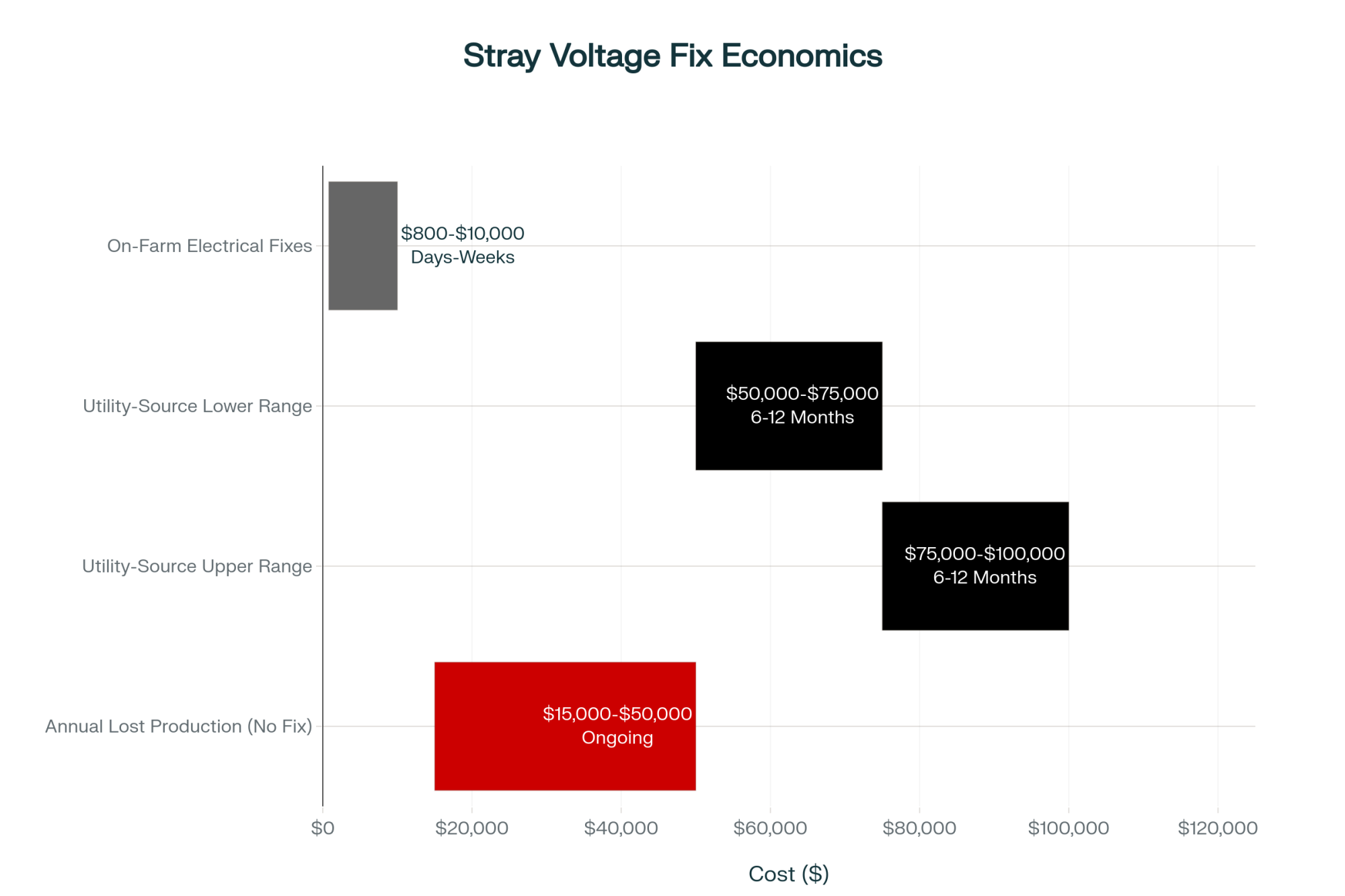
On-farm sources (damaged motor insulation, corroded connections, inadequate grounding) typically cost between $800 and $10,000 to address, depending on scope. Any qualified agricultural electrician can handle these repairs. That’s manageable for most operations.

But utility-source issues? That’s a different story altogether.

Every North American farm connects to multi-grounded neutral systems—the National Electrical Safety Code requires it. The utility-neutral conductor is repeatedly grounded between the substation and your farm, with your farm’s electrical systems bonded to this neutral at the transformer. You probably know this already, but it’s worth reviewing.

Under ideal conditions, this system works well. But when utility neutrals can’t adequately carry return current—maybe due to undersized conductors for modern loads, deteriorated connections from age, or phase imbalances—that current seeks alternate paths through earth ground. And since your farm’s grounding system is bonded to theirs… well, that current can flow right through your agricultural facilities.

The primary solution is to install isolated transformers to create electrical separation between the farm and utility systems. Based on documented cases, these installations can cost $50,000 to $100,000 or more. The Nelson operation’s investment approached $100,000, including a three-phase power installation located more than 100 yards from the buildings. And despite the problem originating from utility infrastructure, farms often bear these costs themselves. That still frustrates me when I think about it.

The financial fork in the road—on-farm electrical issues cost under $10K and resolve quickly, while utility-source stray voltage demands $50-100K investments that take months but pay back in 6-12 months through production recovery

What about insurance? Most standard farm policies generally don’t specifically address stray voltage losses, though some carriers now offer specialized riders. I always tell producers: verify coverage with your agent rather than assuming protection exists. Better to know before you need it.

Best Practices from Affected Operations

Looking at successful resolutions, I’m seeing consistent patterns that are worth sharing.

Documentation proves crucial. Producers who achieve resolution create comprehensive evidence before engaging utilities or consultants. This includes video documentation of behavioral changes—hesitation at water sources, unusual drinking patterns, and parlor nervousness. They maintain detailed production records showing systematic changes despite consistent management. Health events, treatments, mortality patterns—it all merits careful tracking.

Paul Halderson’s Wisconsin operation, which prevailed in litigation against Xcel Energy, maintained decades of documentation. This record proved invaluable when addressing utility claims about management deficiencies. The lesson here is clear: document everything, even if it seems minor at the time.

Independent testing before utility engagement often proves worthwhile. Specialists familiar with agricultural electrical systems, using appropriate protocols and resistance values, typically charge $3,000 to $5,000 for a comprehensive assessment. While that’s significant, this investment can prove valuable if negotiation or—God forbid—litigation becomes necessary.

Understanding state-specific standards helps producers navigate the system. Wisconsin and Minnesota use 1-volt or 2-milliamp action thresholds. Knowing these standards—and their basis in that 500-ohm testing protocol we discussed—helps you advocate for appropriate testing when utilities respond.

Regional Variations and Current Context

The 2025 dairy economy makes hidden production losses particularly challenging, doesn’t it? While feed costs have moderated from recent peaks (thankfully), maintaining production efficiency remains crucial for profitability. A 15% production loss from undiagnosed electrical issues—not uncommon based on documented cases—that can determine operational viability.

I’ve noticed regional patterns emerging from infrastructure age and agricultural practices. Wisconsin and Minnesota operations, particularly those served by infrastructure dating back 40-50 years, report more utility-source issues as equipment struggles with modern electrical loads. Similar patterns appear in Vermont and upstate New York, especially where utility consolidation has deferred infrastructure updates.

Newer dairy regions present different challenges. Texas and Idaho operations may have more modern infrastructure, but they face issues stemming from shared distribution lines used by center pivot irrigation systems. Seasonal voltage fluctuations during peak irrigation can affect nearby dairy facilities. And Southeastern operations? They contend with how seasonal variations in ground moisture affect current flow through the soil—I heard about this recently from a Georgia producer dealing with mysterious summer production drops.

California’s large-scale operations, with their substantial electrical loads for cooling and milk processing, sometimes encounter unique challenges when utility infrastructure hasn’t kept pace with dairy consolidation and expansion. It’s a different set of problems, but the underlying issue remains the same.

Recognition and Response Strategies

Based on documented cases and producer experiences, if you’re seeing behavioral changes at water sources—hesitation, unusual lapping behaviors, complete avoidance despite obvious thirst—that’s particularly telling. Same with parlor nervousness that develops in previously calm animals, especially during milking preparation.

For producers observing these patterns, here’s what works: Begin with thorough documentation using available technology—smartphones can capture behavioral evidence effectively these days. Engage independent testing through specialists who understand agricultural applications. Eliminate on-farm sources by systematically evaluating motors, connections, and grounding systems. Only then engage utilities, preferably in writing, with documentation already assembled.

Budget considerations should include $3,000-$5,000 for comprehensive independent testing. If utility infrastructure proves problematic, resolution costs can reach $50,000 to $100,000 or more for isolated transformer installation. Yes, that’s significant. But remember Nelson’s six-month payback period. Sometimes the investment, painful as it is, makes sense.

Industry Evolution and Future Considerations

Recent legal precedents suggest evolving recognition of these challenges. The Iowa Supreme Court’s June 2024 decision upholding Vagts Dairy’s verdict against Northern Natural Gas for pipeline-related electrical issues establishes important precedent for infrastructure liability. That’s encouraging, at least.

Most producers won’t pursue lengthy litigation—and shouldn’t have to. Practical solutions matter more than legal victories. That’s why farmers like Jill Nelson are developing resources to share knowledge. Her website, strayvoltagefacts.com, provides research and guidance based on her direct experience. It’s worth checking out if you’re dealing with unexplained issues.

What’s encouraging is how the industry conversation has evolved. A decade ago, debates centered on whether stray voltage even existed. Today’s discussions focus on identification and mitigation strategies. This represents meaningful progress, even if implementation remains inconsistent.

Nelson’s operation now maintains a rolling herd average of over 30,318 pounds on twice-daily milking, according to March 2025 data. While genetics were damaged during the affected period, the operation survived and recovered. As Nelson has shared in various forums, early recognition of testing limitations and documentation requirements might have shortened their eight-year challenge considerably.

Given the substantial number of operations potentially experiencing some level of electrical issues, it is important to acknowledge that “acceptable” testing results may not ensure the safety of sensitive animals. Just as we’ve embraced precision management for nutrition and reproduction, electrical safety may require similar individualized approaches.

Dairy farmers are winning big in court—$32+ million awarded across four major cases from 2010-2024, with the June 2024 Iowa Supreme Court ruling establishing critical precedent that negligence isn’t required to prove nuisance from stray voltage

This builds on what we’ve learned about variation in biological systems—what works for the average may not protect the sensitive. Until testing protocols better reflect this reality, those of us who combine careful observation with independent verification will be best positioned to protect our herds.

The Bottom Line

You know, the difference between management challenges and electrical issues can be subtle but significant. Understanding this distinction—and knowing how to investigate it properly—that’s valuable knowledge for any operation experiencing unexplained herd challenges.

Sometimes what appears to be a management problem stems from infrastructure issues that standard testing protocols weren’t designed to detect. And that’s not a failure of management—it’s a limitation of how we’ve been measuring things.

What’s your experience been with unexplained herd health or production challenges? Have you noticed behavioral changes that didn’t quite fit typical patterns? The conversation continues as we work together to understand and address the complex interactions between modern dairy operations and aging electrical infrastructure.

For more resources and to share experiences, visit strayvoltagefacts.com or reach out through The Bullvine’s producer network. Because sometimes the best solutions come from farmers sharing what they’ve learned the hard way. And that’s how we all get better at this business we’re in.

KEY TAKEAWAYS:

  • If cows are hesitating at water or dying unexpectedly, it’s likely stray voltage—affecting 1 in 5 dairy farms, not management failure
  • Standard utility testing misses the problem: They test at 500 ohms resistance when actual cow resistance is 200-400 ohms, underreporting exposure by half
  • Your documentation strategy determines your outcome: Video behavior changes, track production/health data, get independent testing ($3-5K) BEFORE calling utilities
  • Resolution costs vary wildly: On-farm electrical fixes are manageable (under $10K), but utility-source problems requiring isolated transformers can hit $100K—though payback can be swift (20 lbs/cow/day gains)
  • You’re not imagining it: Courts are awarding millions in stray voltage cases, proving this hidden problem is real and fixable when properly diagnosed

EXECUTIVE SUMMARY: 

Your cows avoiding water troughs and dying after perfect production days might not be a management problem—it’s likely stray voltage, a hidden electrical issue affecting up to 20% of dairy operations nationwide. The crisis stems from a fundamental testing flaw: utilities measure using 500-ohm resistance standards established in 1991, but research shows dairy cattle actually average 200-400 ohms, meaning your animals experience double the electrical current that standard tests report as “safe.” Jill Nelson’s award-winning Minnesota Holstein operation suffered eight years of mysterious losses before discovering this truth—her $100,000 investment in an isolated transformer delivered 20 pounds of milk per cow per day, paying for itself in six months. The difference between financial recovery and bankruptcy often comes down to recognizing symptoms early (behavioral changes at water sources, parlor nervousness, unexplained deaths) and getting independent testing with proper equipment. While on-farm electrical fixes typically cost under $10,000, utility-source problems can exceed $100,000, making documentation and proper diagnosis critical before accepting utility test results that miss what’s really happening to your herd.

Complete references and supporting documentation are available upon request by contacting the editorial team at editor@thebullvine.com.

Learn More:

Join the Revolution!

Join over 30,000 successful dairy professionals who rely on Bullvine Weekly for their competitive edge. Delivered directly to your inbox each week, our exclusive industry insights help you make smarter decisions while saving precious hours every week. Never miss critical updates on milk production trends, breakthrough technologies, and profit-boosting strategies that top producers are already implementing. Subscribe now to transform your dairy operation’s efficiency and profitability—your future success is just one click away.

NewsSubscribe
First
Last
Consent

Your Herd Tests Negative. 79% of Infections Hide. Now What?

Cornell: 90% of herds are exposed, only 20% show symptoms. The invisible 70%? Costing you $434,683/year. Time to rethink everything

EXECUTIVE SUMMARY: A Minnesota dairy farmer’s third H5N1 outbreak in 14 months—despite perfect biosecurity—isn’t an anomaly anymore. It’s the new normal. Cornell research shows that 90% of herds carry the virus, but only 20% show symptoms, meaning traditional surveillance captures just 21% of the actual disease while farms hemorrhage $434,683 annually. The break-even point sits at 2.38 outbreaks per year, but farms in wildlife corridors now face perpetual reinfection cycles that make profitability mathematically impossible. This isn’t just about H5N1—Spain’s current battle with lumpy skin disease, which jumped containment zones overnight, proves wildlife disease has fundamentally changed the game globally. With U.S. dairy farms projected to plummet from 35,000 to as few as 12,000 by 2035, producers face a stark choice: absorb six-figure annual disease costs through scale or premium markets, or make the rational but painful decision to exit while equity remains. The old paradigm of “prevent and recover” is dead; the new reality demands either expensive adaptation or strategic retreat.

Endemic Disease Management

I was talking with a producer from Minnesota the other day, and what he told me really stuck with me. His operation tested positive for H5N1 in July 2024, worked through it, and got cleared by September. Then March 2025 comes around—positive again. They clear that one too, thinking they’re in the clear. September 2025? Third positive in just 14 months. And here’s what gets me—this guy does everything right. Every protocol, every biosecurity measure the vets recommend. Still keeps happening.

You know what’s interesting? Minnesota actually achieved that official “unaffected” status on August 22nd this year. Four consecutive months of negative bulk tank tests across all 1,600 dairies in the state, according to the Board of Animal Health’s surveillance program. So naturally, they reduced testing from monthly to bi-monthly—that’s the standard procedure when you’re disease-free. But within weeks, about two dozen operations were reporting new infections. Makes you think…

And it’s not just us dealing with this. Over in Spain right now, they’re trying to vaccinate 600,000 head of cattle against lumpy skin disease. The Catalan agriculture folks reported the virus jumped 40 kilometers overnight, despite what they called comprehensive containment measures. These aren’t isolated problems anymore—they’re showing us something fundamental about how diseases work when wildlife’s involved.

Here’s what the numbers are telling us:

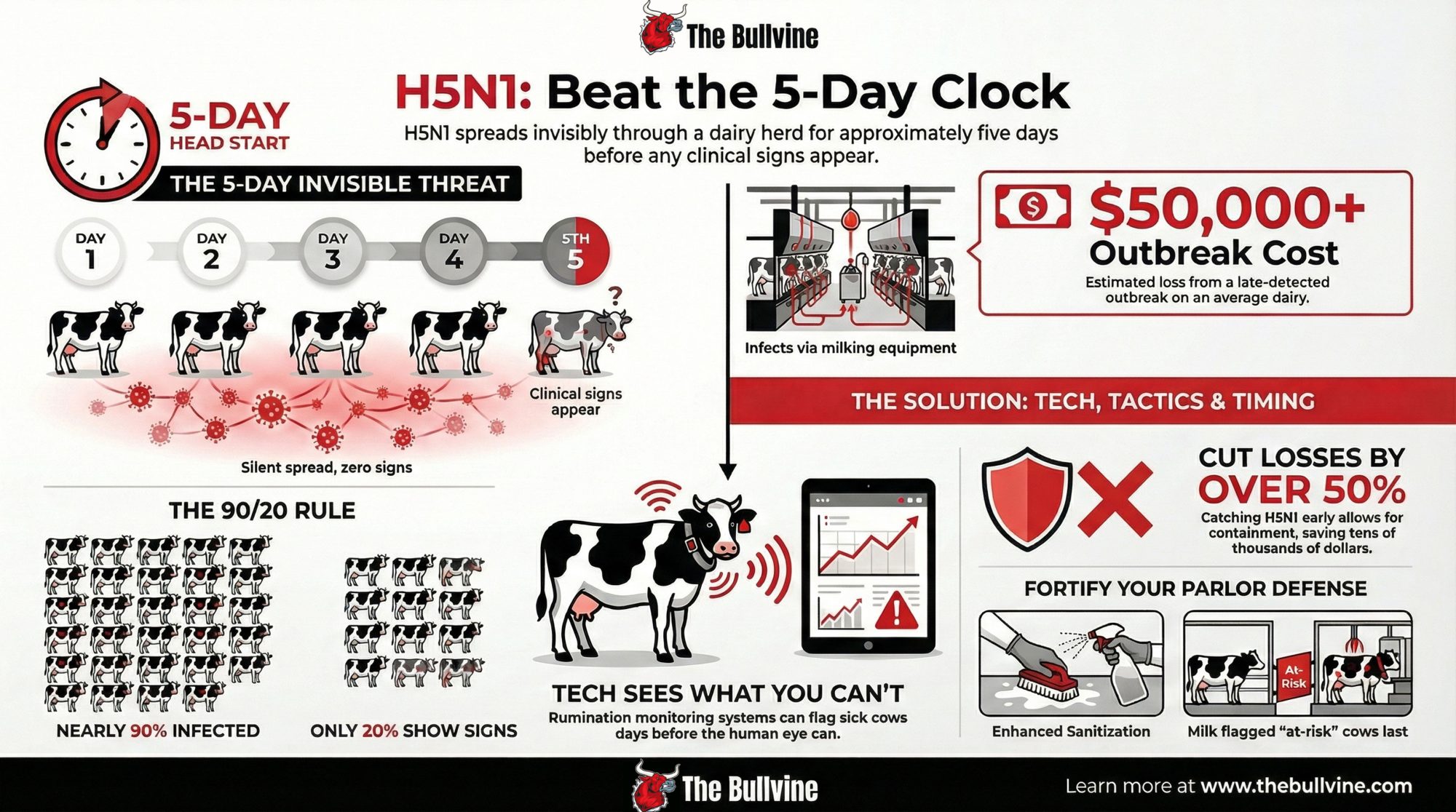
  • 90% of dairy cattle show H5N1 antibody exposure, but only 20% develop symptoms you can actually see
  • $434,683 – That’s the annual disease cost for a 500-cow operation with 20% clinical rates
  • 2.38 – The magic number of outbreaks per year before you’re losing money
  • 21% – What traditional barn walks actually detect of what’s really circulating

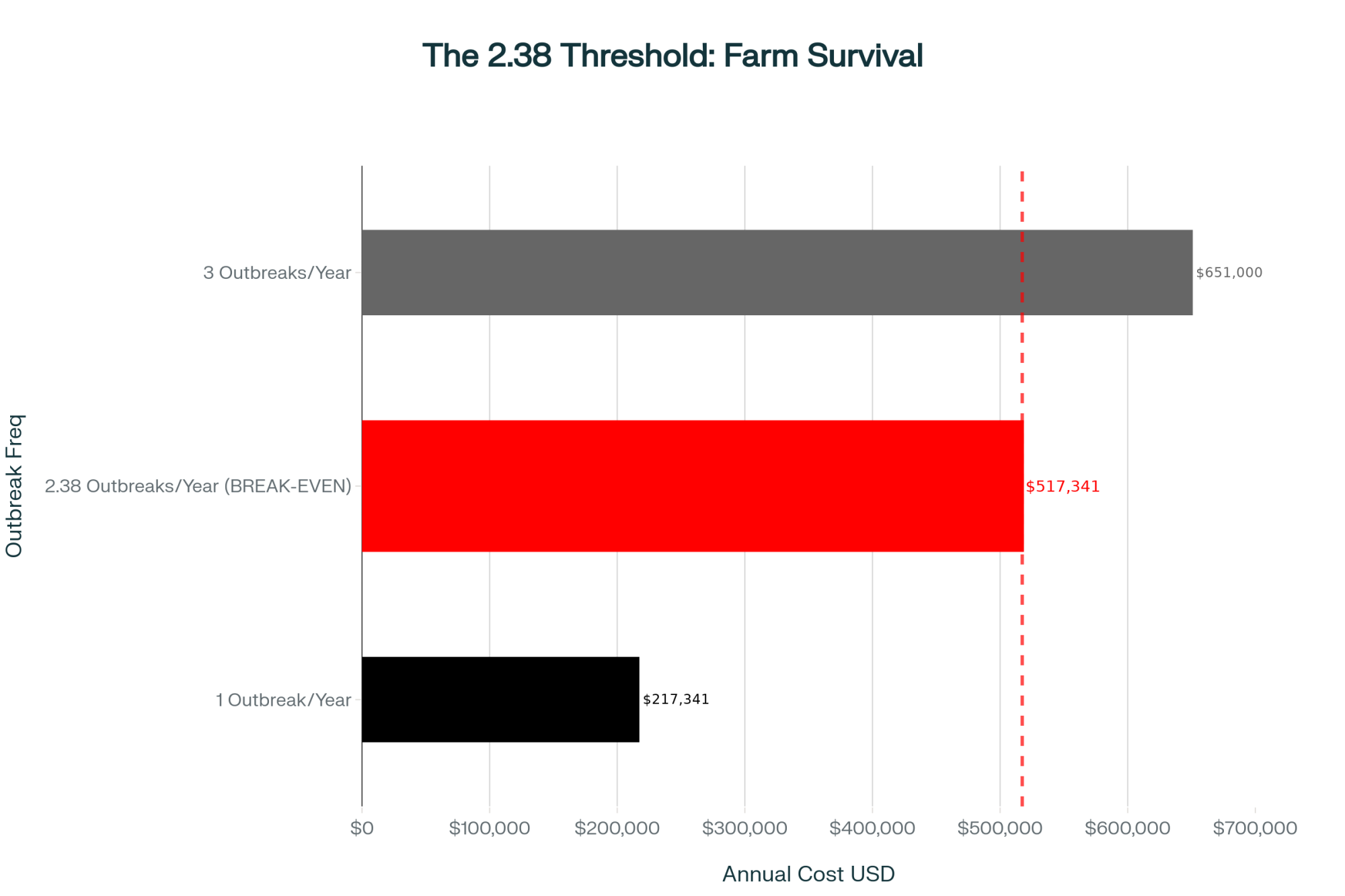
Quick Break-Even Calculator: Take your annual profit (before disease) and divide it by $217,341 (the estimated cost for a single outbreak in a 500-cow operation—that’s half the annual cost if you get hit twice). That tells you how many outbreaks you can handle per year. Less than 2? You’re in trouble with annual reinfection.

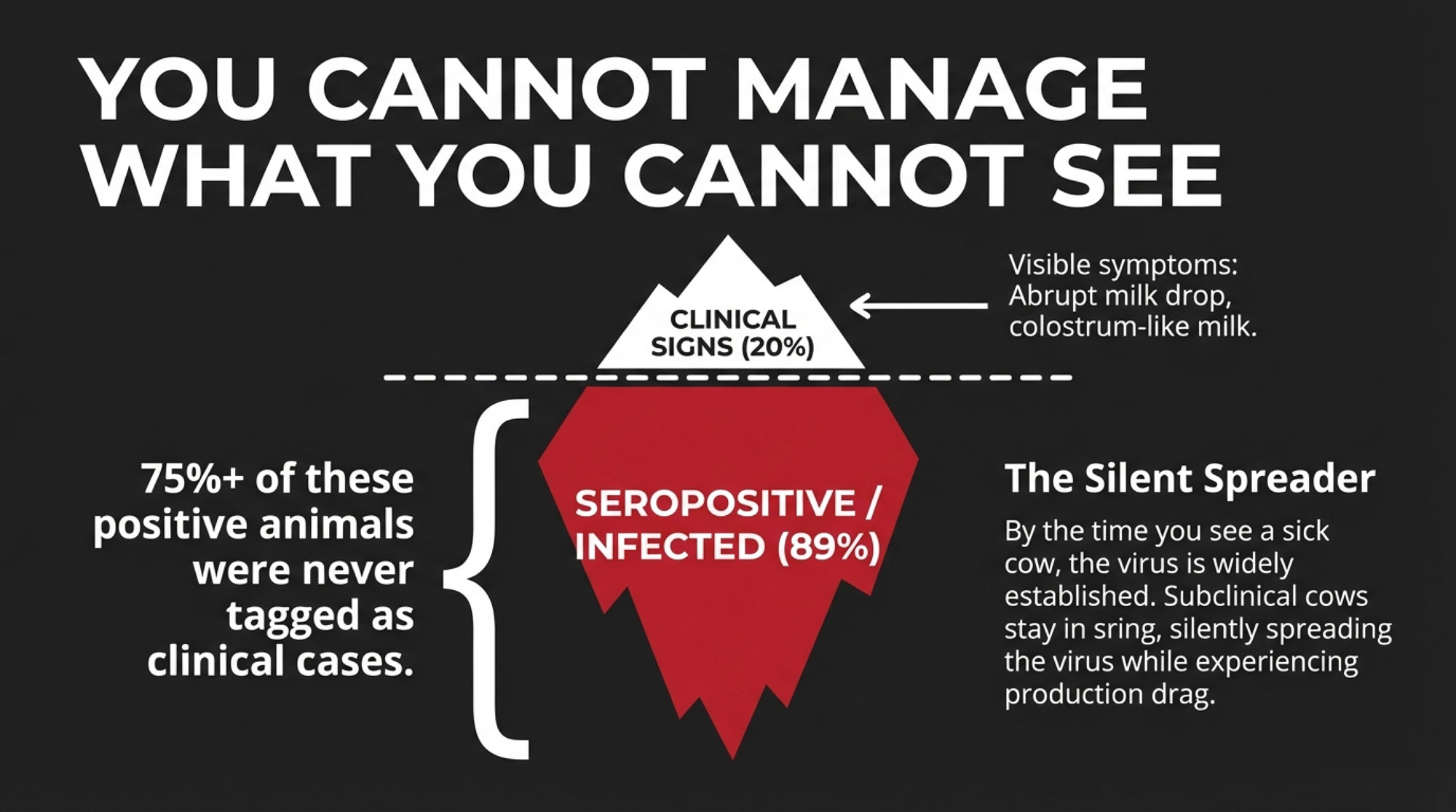
The surveillance blindspot: 90% of dairy cattle in affected herds show antibody evidence of H5N1 exposure, but only 20% develop visible symptoms—and traditional barn-walk surveillance catches just 21% of actual infections. You’re operating blind 79% of the time

The Real Financial Picture We’re Looking At

Research from Cornell’s College of Veterinary Medicine, published in September 2025, analyzing H5N1-affected dairy operations, found something that kind of changes everything. Turns out 90% of animals in affected herds show antibody evidence of exposure to H5N1, but only 20% actually look sick. Think about that. For every cow showing symptoms in your barn, there are probably four more carrying the virus that look perfectly fine.

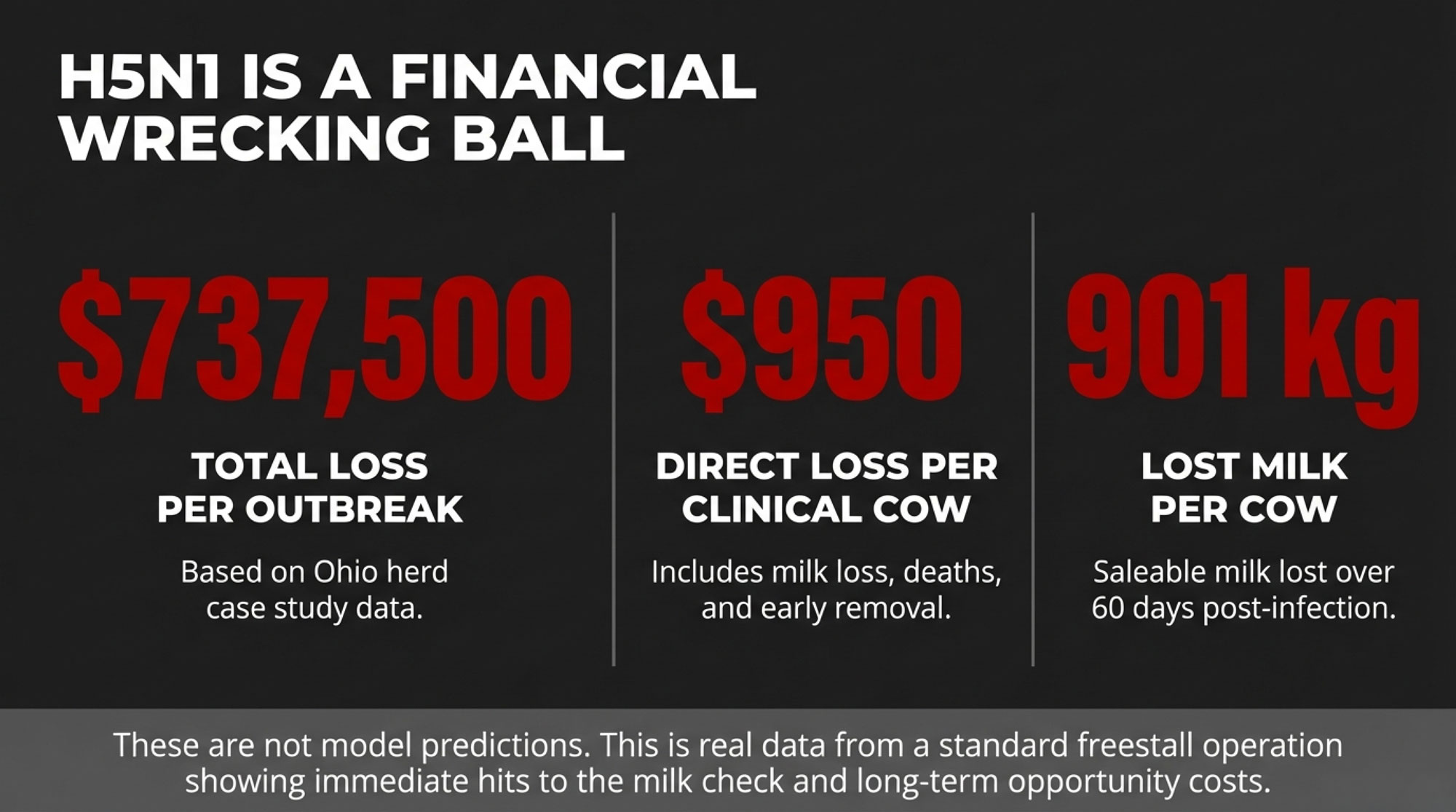
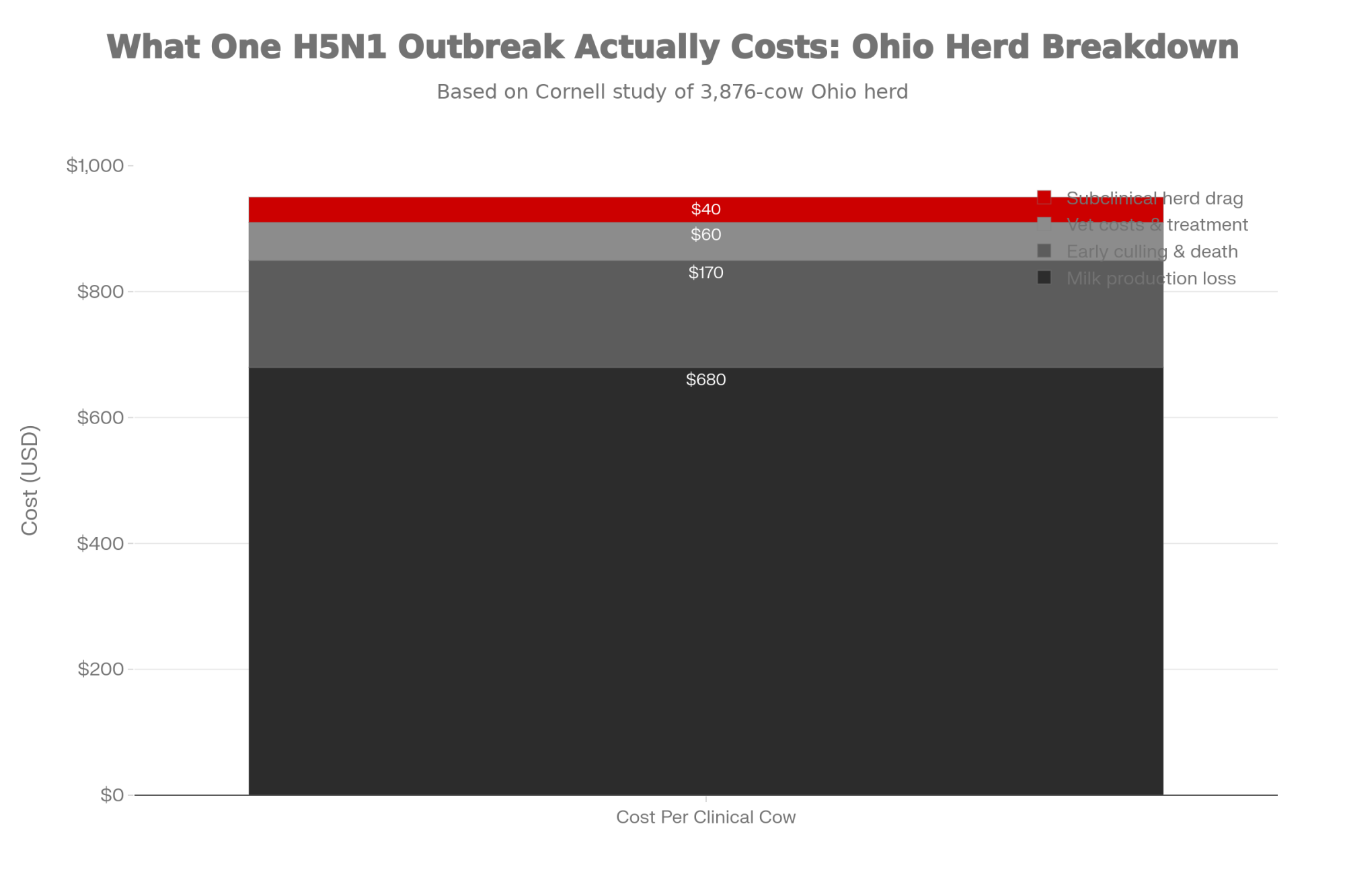
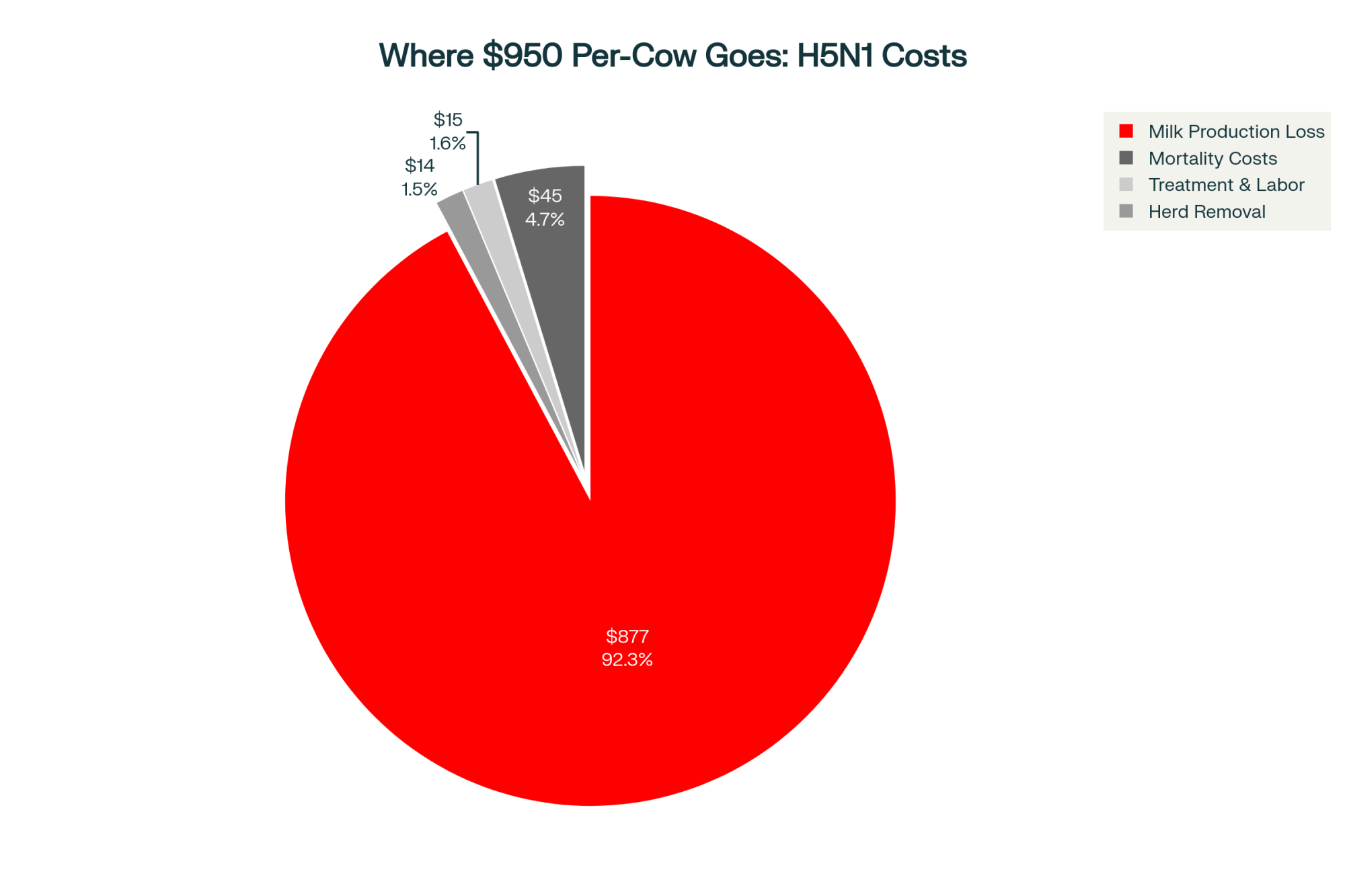
The real cost breakdown: Of the $950 lost per clinically affected cow, milk production losses account for 92.3%—$877 per animal. For a 500-cow operation with 20% clinical rate, that’s $737,500 in just 60 days. And most operations are underestimating the full impact

What I’ve found is that traditional surveillance—you know, when the vet walks through looking for sick animals—catches maybe 21% of what’s actually going on. We’re basically operating blind most of the time.

That same Cornell research, along with economic modeling from dairy extension programs at Wisconsin and Minnesota, quantified what this really costs a typical 500-cow Midwest operation:

  • You’re looking at about $950 per clinically affected cow over that 60-day acute phase
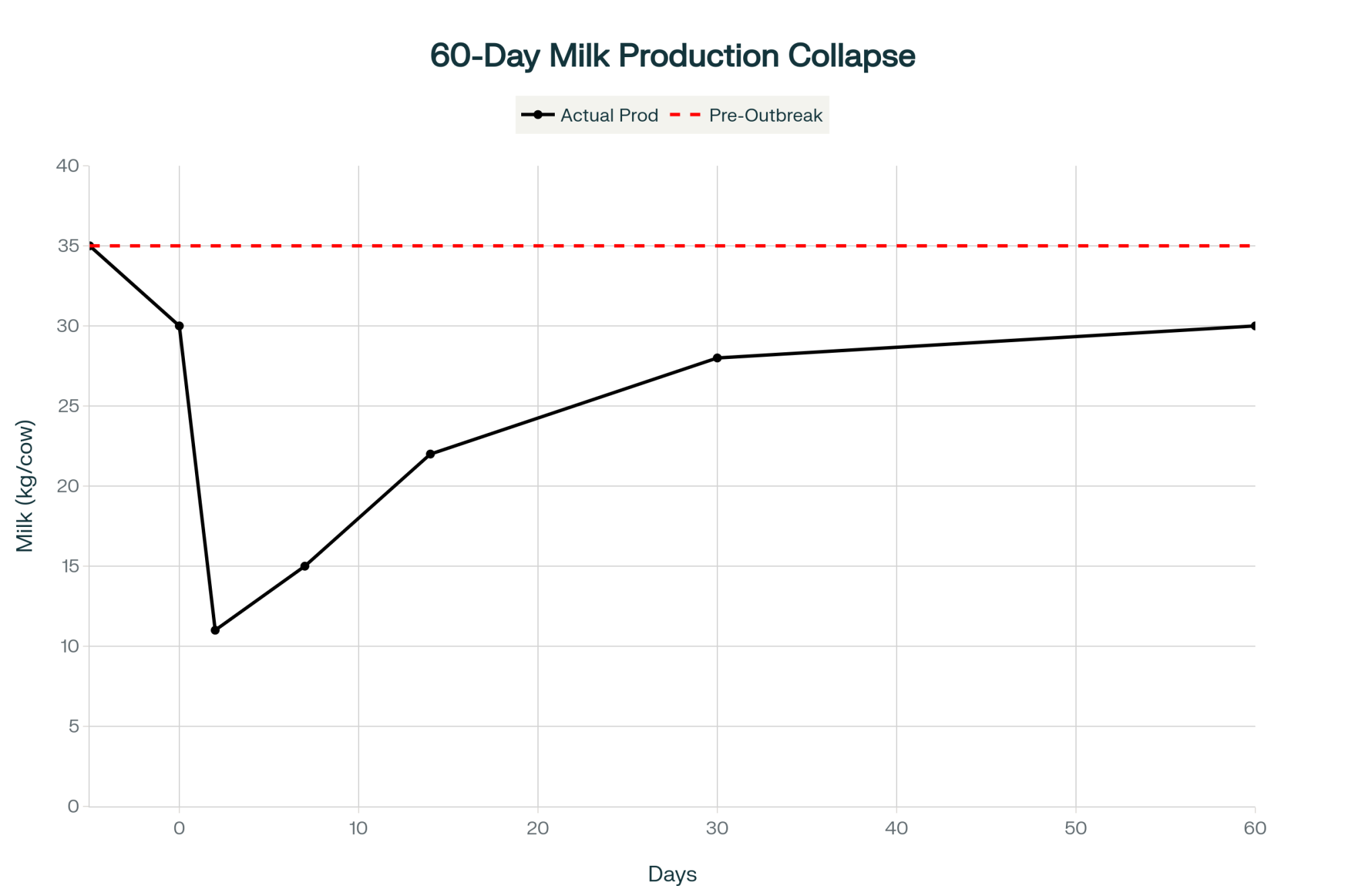
  • Each sick cow drops about 900 kilograms in milk production
  • Here’s the kicker—the whole herd typically drops 15% in production for six months after an outbreak
  • Add it all up? $434,683 per year with a 20% clinical rate

And you know what? Even if you spend that $40,000 on early-detection systems and rapid-response setups—the kind extension’s been recommending—you might drop your clinical rate from 20% to 15%. Sounds good until you do the math. Your annual cost only drops to $401,012. That’s still an $89,012 loss every year, even after making smart investments.

The break-even math keeps me up at night sometimes. Most operations can handle about 2.38 outbreaks per yearbefore they’re underwater. But if you’re in one of those waterfowl migration corridors—and let’s be honest, many of us in Minnesota and Wisconsin are—you’re probably looking at annual reinfection as the new normal.

The long shadow of H5N1: Milk production plummets 73% within days of diagnosis (35kg to 11kg per day), and even 60 days later, affected cows still produce 5kg less than pre-outbreak levels. That 900kg total loss per cow is what’s actually destroying farm economics—not the acute phase everyone focuses on

What Spain’s Teaching Us Right Now

What’s happening in Spain offers a different perspective on all this. They detected their first lumpy skin disease case on October 1st, did everything by the book—20-kilometer protection zones, 50-kilometer surveillance areas, and immediate culling of infected herds. Standard EU protocols.

By late October, the Spanish agriculture ministry reported they’d culled over 1,500 cattle. But here’s the thing—the virus had already jumped about 40 kilometers, way beyond those protection zones. So, on November 3rd, the European Commission authorized emergency vaccination for 22 Catalan counties. We’re talking 600,000 animals.

What’s telling is how their language has been changing. Early October, Agriculture Minister Òscar Ordeig was saying “emergency measures implemented” and “situation under control.” By mid-October, after six new outbreaks, it shifted to “securing additional vaccine supplies.” Late October? They’re calling for “all Catalan veterinarians to assist.” When government officials say that, you know they’re stretched thin.

Notice what’s missing lately? No timeline for when this ends. No mention of eradication. The word “temporary” has disappeared. Catalonia’s veterinary services say they’ve administered about 100,000 vaccine doses so far, with 250,000 more to come. That’s maybe 58% coverage. But European Food Safety Authority research has shown that you actually need 80-90% coverage to stop the transmission of lumpy skin disease. At 90 animals per day—their current pace—well, do the math.

Understanding Different Perspectives Here

You know, it’s easy to get frustrated with how different groups respond to these challenges, but when you think about it, everyone’s dealing with their own pressures.

Processors need a consistent milk supply to keep plants running. The National Milk Producers Federation’s data shows we’re losing 7-8% of farms each year. Those of us still operating might have more negotiating power, but only if enough farms survive to keep the infrastructure going.

The biosecurity companies? Grand View Research valued that global market at $3.4 billion in 2024, projecting it’ll hit $7.1 billion by 2033. Endemic diseases that require constant management rather than one-time fixes create steady customers. It’s a business reality—can’t really blame them for that.

Government’s in a tough spot, too. Congress approved $31 billion in agricultural aid late last year, which sounds like a lot until you realize USDA’s own assessments show it covers maybe 10% of actual disease losses. State ag departments have to maintain market confidence while dealing with the reality on the ground. That’s a hard balance.

And our rural communities—man, this hits them hard. The Center for Rural Affairs documented last year how each farm closure triggers these cascading effects. School enrollment drops, Main Street businesses close, and property values decline. My kids’ school lost two teachers after three local dairies closed. These communities need us to survive, even when we’re struggling.

What I’ve come to realize is that everyone’s responding to their own situation. The challenge is that what’s best for the industry as a whole might not line up with what’s best for individual families facing their third outbreak in 14 months.

Success Despite the Odds—It’s Possible

Now, I don’t want to paint this as all doom and gloom. Met a producer from South Dakota last month who’s actually making this work. They’ve got about 3,500 cows, have invested heavily in automated monitoring systems, and treat endemic disease like any other operating cost. “We budget $125,000 annually for disease management now,” he told me. “It’s just part of doing business, like feed costs or equipment maintenance.”

On the other end of the spectrum, there’s this 180-cow organic operation in Vermont that’s stayed completely clear. Geographic isolation helps, but they’ve also got premium contracts paying $45 per hundredweight—nearly double conventional prices. Different model, but it works for them.

Practical Approaches That Actually Help

Run the math on YOUR operation: Most 500-cow farms can absorb 2.38 outbreaks per year before going underwater. But if you’re in a waterfowl migration corridor? You’re looking at reinfection every 6-8 months—that’s 1.5 to 2 outbreaks annually, already eating 70% of your survival buffer. Three outbreaks and you’re done

So if you’re dealing with repeated infections, here’s a framework that’s been helpful for some folks I know.

Getting a Handle on Your Real Costs

First thing—and I can’t stress this enough—document what outbreaks actually cost you. Not just the milk dump and vet bills, but also the extended impacts. Track your production for at least six months after. The University of Minnesota Extension has some really good resources for outbreak cost analysis that capture all these hidden costs.

Compare those numbers against your baseline profitability. If reinfection frequency means you’re losing money even in good milk price years, that’s information you need for planning. What I keep hearing from financial advisors is that most of us underestimate those extended impacts—that 15% herd-wide deficit for six months really adds up.

Focusing Where You Have Control

Research from veterinary colleges at Iowa State, Wisconsin, and Minnesota has helped us understand the difference between what we can control and what we can’t.

Worth your investment:

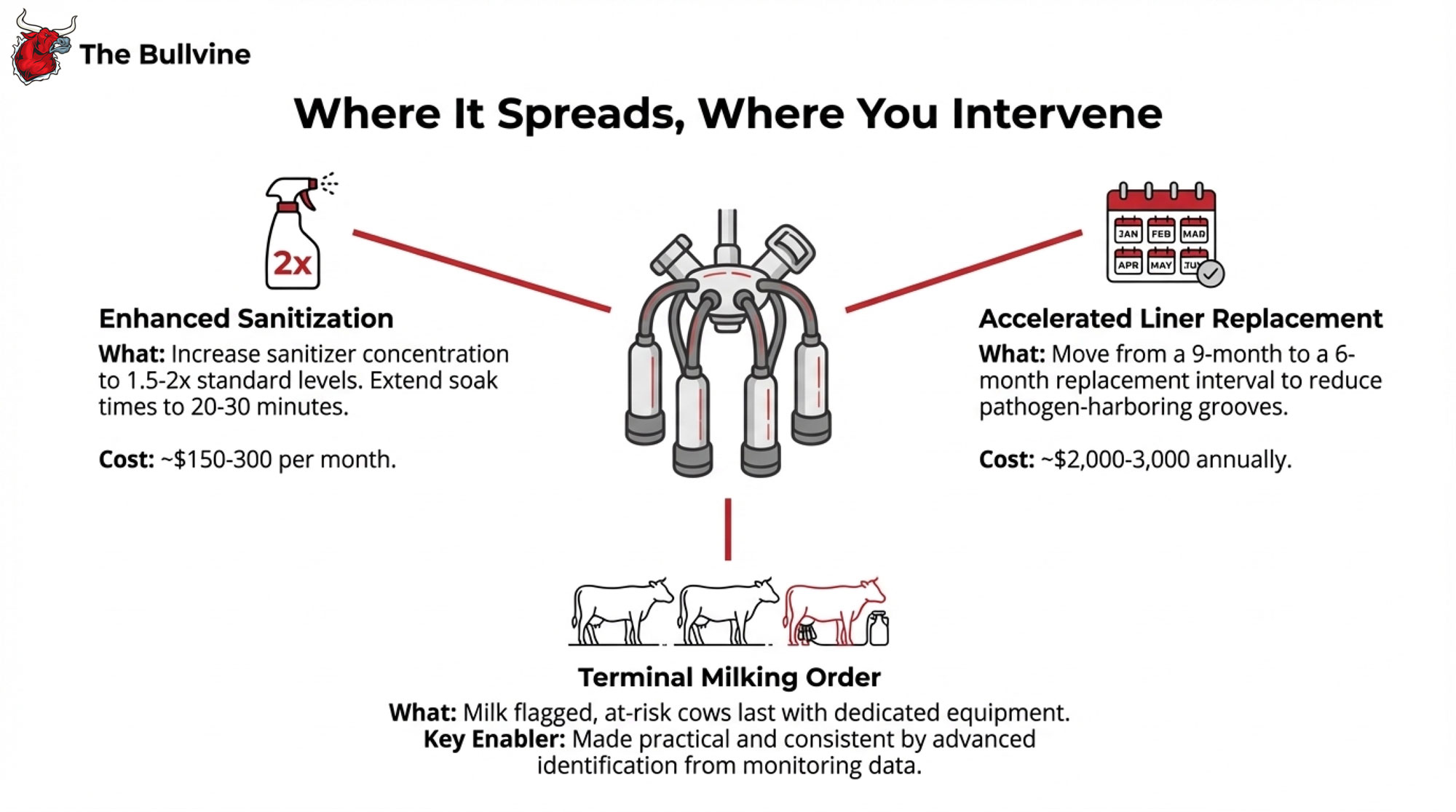
  • Equipment sanitation—it’s 70-90% effective against farm-to-farm transmission
  • Good visitor protocols with dedicated boots and coveralls
  • Vehicle wash stations at your entrance
  • Regular bulk tank testing for early detection

Probably not worth it in wildlife areas:

  • Trying to keep birds away from water sources (impossible)
  • Eliminating every insect (also impossible)
  • Keeping wildlife from anywhere near your operation (you see where this is going)

As one Wisconsin producer told me: “I stopped trying to bird-proof everything and started testing my bulk tank twice a week. Can’t stop the birds, but I can catch outbreaks faster.” That’s the shift we’re all making—from prevention to rapid detection and response.

I’ve also noticed that operations with good fresh cow management tend to weather these outbreaks better. Makes sense when you think about it—cows in that transition period are already stressed, and disease hits them harder. Same goes for operations that are really dialed in on their dry cow programs. A strong immune system at calving makes a difference.

Regional Differences Matter

Now, what we’re dealing with in the upper Midwest isn’t the same everywhere. California operations face the double whammy of water restrictions and disease pressure. Texas and Arizona? Managing sick cows when it’s 110°F is a whole different challenge.

A California producer shared something interesting at a conference last month: “We’re dealing with drought, disease, and regulations all at once. Sometimes I wonder if we’re fighting too many battles.” That really resonated with folks from different regions facing their own unique combinations of challenges.

Canadian producers benefit from supply management, which provides some market stability, but they’re still facing the same wildlife disease pressures. Maritime provinces might have some geographic isolation working for them. Ontario’s concentrated dairy regions look a lot like what we deal with here.

Northeast operations often have smaller herds, older facilities—biosecurity upgrades might be tougher. But they sometimes have better access to diverse markets, established processor relationships that value consistency over volume.

Those Tough Succession Conversations

This is probably the hardest part. If you’re thinking about succession, the next generation deserves to see real numbers, not wishful thinking. Show them what the 10-year outlook really looks like with realistic disease pressure based on your location and migration patterns.

One approach that’s helping some families: run three scenarios. Best, probable, and worst cases over ten years. It helps everyone understand whether continuing makes sense or if there might be better ways to preserve what you’ve built.

A financial advisor who works with several operations dealing with this put it well: “Families are having conversations they never imagined—whether strategic exit while equity remains might serve the family better than fighting diseases you can’t prevent.” That’s not giving up. It’s being realistic about uncontrollable variables.

Where This Is All Heading

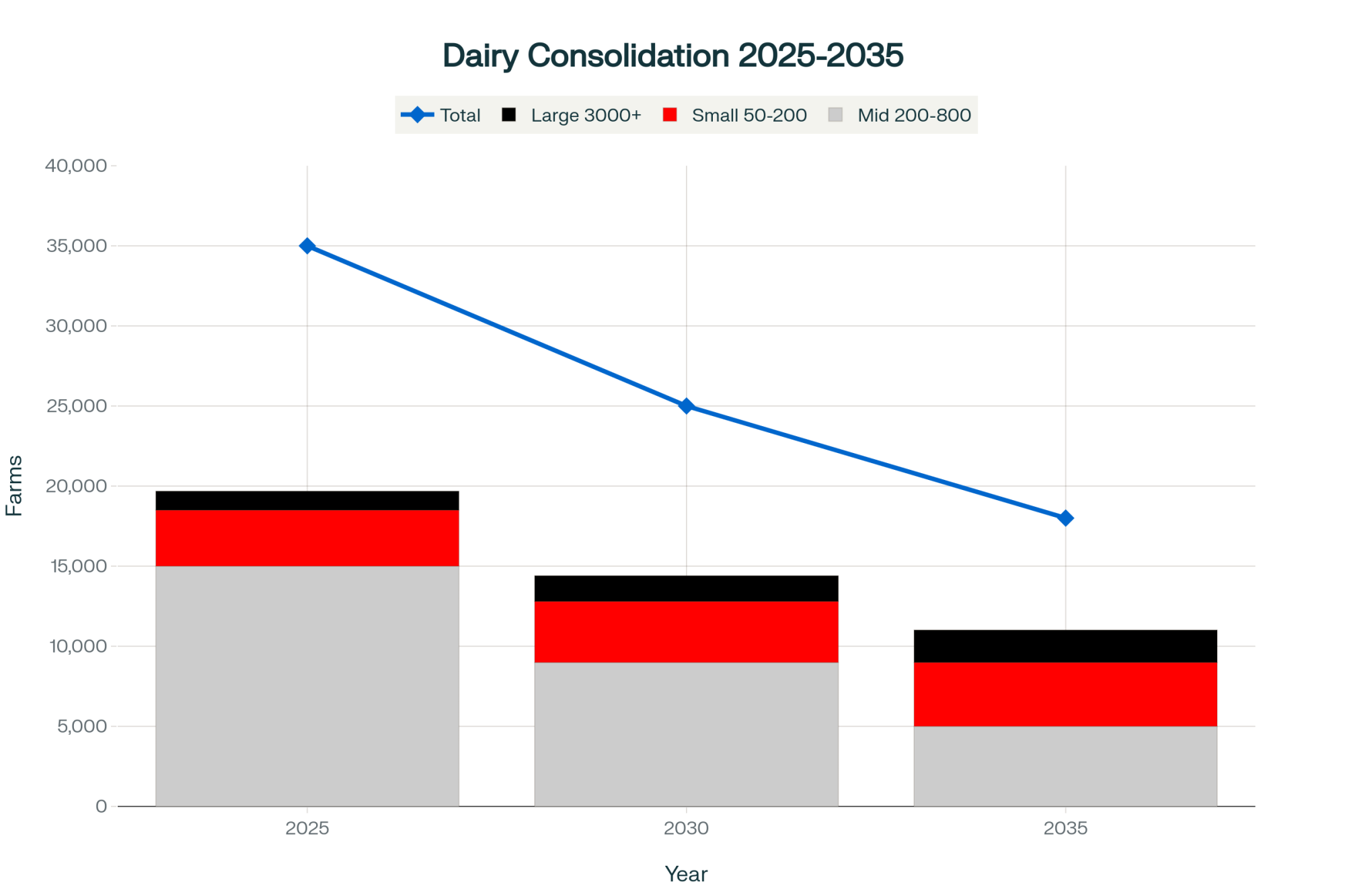
Looking at projections from CoBank’s 2025 dairy outlook and research from the University of Wisconsin’s Center for Dairy Profitability, we’re probably going from about 35,000 U.S. dairy farms today to somewhere between 12,000 and 24,000 by 2035. That’s a lot of change coming.

The operations that’ll likely make it fall into two camps. Big operations with 3,000-plus cows can absorb disease costs through efficiency and scale—they’ll probably produce 70-80% of our milk by 2035. On the other end, small niche operations—50 to 200 cows selling organic, grass-fed, local branded products—might survive through premium pricing.

It’s that middle group—200 to 800 cows, the backbone of our communities—that faces the toughest road. Not enough scale to absorb six-figure annual disease costs, not positioned for premium markets. A lot of really good farms fall in that range.

Geographically, USDA’s 2025 long-range projections suggest Wisconsin, South Dakota, and Michigan will probably add capacity—water availability, and favorable regulations. California and the Southwest are scaling back, though that’s as much about water as disease.

What nobody’s saying out loud yet—though you hear it at conferences—is that “disease-free” status as we’ve known it is probably done for certain diseases. We’re moving toward something more like “controlled endemic” status. Success gets redefined as keeping clinical disease low rather than eliminating viruses. Vaccination becomes as routine as checking butterfat levels.

Finding Your Own Path Forward

The controversial truth nobody’s saying out loud: By 2035, we’re projecting 15,000 middle-sized operations (200-800 cows) will collapse to just 5,000—a 67% wipeout. Large operations will grow 67%, niche farms hold steady with premium pricing, but if you’re in that middle? You’re in the death zone. Too small for scale economies, too big for premium markets, and endemic disease costs will finish what low milk prices started

Here’s what keeps coming back to me: where your farm sits geographically might matter more than how good a manager you are when it comes to endemic disease. If you’re in a high-risk wildlife corridor, repeated reinfection might be your reality no matter what you do. That’s not your fault—it’s just biology.

The financial math is different for everyone, but the framework’s the same. Annual losses north of $114,000 from repeated infections with 20% clinical rates—that challenges most operations long-term. For some, continuing preserves tradition but destroys wealth. For others, scale or niche positioning makes adaptation work.

One thing’s crystal clear from both research and what we’re seeing in the field: when 79% of infections don’t show symptoms, negative bulk tank tests don’t mean you’re disease-free. They mean you don’t have detectable clinical disease right now. A big difference that planning needs to account for.

Every stakeholder—processors, input suppliers, government, communities—benefits from farms staying operational. That’s natural. But it means the advice you’re getting might be influenced by what others need from you, not necessarily what’s best for your family.

Moving Forward with Open Eyes

What we’re seeing isn’t a temporary problem that’ll get fixed with better biosecurity or new vaccines. It’s a big change in how disease pressure affects dairy farming. Some operations will adapt successfully—through efficiency, scale, or finding the right markets. Others will recognize that their location and economics make continuing difficult despite doing everything right.

Both paths are valid. I really mean that. A multi-generational farm choosing strategic exit while equity remains isn’t failing—they’re making a rational business decision facing uncontrollable biological variables. An operation finding ways to absorb endemic disease costs and keep producing isn’t naive—they’re adapting with full awareness of the new reality.

The next generation deserves honesty about what they’re inheriting. Managing perpetual disease pressure from wildlife is fundamentally different from what their grandparents dealt with. Some will embrace it. Others will choose different paths. Both deserve respect.

What matters now is making decisions based on what endemic disease management actually means—not what we wish it meant. Start by documenting the true costs of your next outbreak using your state extension’s templates. Schedule that financial review using these break-even frameworks. Have those succession conversations while you still have options.

Understanding the difference between the old way and this new reality—that might determine whether you preserve family wealth or watch it disappear, waiting for solutions that probably aren’t coming.

The industry will survive this transition, though it’ll look different. The question for each of us is whether weathering that transition makes sense for our specific situation, or if protecting what we’ve built means making tough choices while we still can.

And you know what? Whatever you decide, if it’s based on real information and protects your family’s future, that’s the right choice. We’re all just trying to do the best we can with a situation nobody asked for.

KEY TAKEAWAYS

  • Your surveillance is 79% blind: Cornell found that negative bulk-tank tests miss 4 out of 5 infected animals. Start testing twice weekly and document the true 6-month cost of every outbreak—you’re probably underestimating losses by 40%.
  • Run this calculation TODAY: Divide your annual profit by $217,341 (single outbreak cost). If the answer is less than 2, your farm can’t survive endemic disease at the current scale. Period.
  • Location now trumps management: Perfect biosecurity can’t stop migratory birds. If you’re in a waterfowl corridor, you’ll face reinfection every 6-8 months regardless of protocols. Focus resources on rapid detection, not prevention.
  • The conversation that matters: Show your family three scenarios—best case, probable, worst case—with real disease costs over 10 years. If strategic exit preserves more wealth than fighting biology you can’t control, that’s not giving up—it’s protecting what you’ve built.

Complete references and supporting documentation are available upon request by contacting the editorial team at editor@thebullvine.com.

Learn More:

Join the Revolution!

Join over 30,000 successful dairy professionals who rely on Bullvine Weekly for their competitive edge. Delivered directly to your inbox each week, our exclusive industry insights help you make smarter decisions while saving precious hours every week. Never miss critical updates on milk production trends, breakthrough technologies, and profit-boosting strategies that top producers are already implementing. Subscribe now to transform your dairy operation’s efficiency and profitability—your future success is just one click away.
NewsSubscribe
First
Last
Consent

USDA Drops $25 Million on Vet Crisis — Can Your Top Cow Get Care When It Counts?

Just 5.3% of US vets handle livestock—but that shortage could cost you $300+ per sick cow!

EXECUTIVE SUMMARY: Look, here’s what’s really happening out there—only 5.3% of all US veterinarians actually work with livestock, which explains why you’re driving 45 minutes just hoping someone can squeeze you in. USDA finally woke up and dropped $25 million into fixing this mess through their loan forgiveness programs, and they’ve already placed 883 vets in shortage zones since 2010. But here’s the kicker… every delayed mastitis treatment is costing you $300+ per case, and that’s before you factor in missed breedings and those brutal emergency call fees. Countries like New Zealand are crushing this problem with serious incentives—804 farm vets serving 72 million animals—and now America’s playing catch-up. Smart producers are already getting ahead of this with telemedicine and rock-solid prevention programs. Bottom line? You need to solidify those veterinary relationships and start leveraging these new programs before your neighbors beat you to it.

KEY TAKEAWAYS

  • Save $300+ per cow on mastitis delays by building stronger vet relationships and investing in prevention—when margins are this tight, every case counts.
  • Leverage the loan forgiveness boom: VMLRP now offers up to $40k annually to vets working in rural areas, which means better coverage coming to your region.
  • Get on the telemedicine train for routine consultations—this $2 billion market is cutting wait times and emergency costs for smart operators.
  • Team up with neighbors for group vet visits and shared emergency coverage—pooling resources saves everyone money and gets better service.
  • Study what works globally: New Zealand’s model, with 804 farm vets serving massive livestock populations, shows what’s possible with the right incentives.
rural vet shortage, herd health management, dairy farm profitability, veterinary telemedicine, USDA VMLRP

Early morning on a Wisconsin dairy: that top fresh heifer worth maybe $4,500 is acting up. You ring your usual vet, but they’re booked for days. The emergency clinic? A two-hour drive and a hefty bill.

This kind of struggle is all too familiar. Secretary Brooke Rollins has just unveiled the USDA’s Rural Veterinary Action Plan to implement changes.

A $25 Million Plan to Put Vets in Barns

At Mississippi State last month, Rollins announced a significant $25 million initiative to put Veterinarians back in rural boots and barns.

The centerpiece is beefed-up support for the Veterinary Medicine Loan Repayment Program (VMLRP). New vets buried under nearly $180,000 in student loans get help paying down those debts if they commit to work in rural areas where large animal vets are critically short.

But will it help your farm?

The Facts That Hit Home

Only 5.3% of US veterinarians handle livestock, while nearly 70% treat pets, such as dogs and cats.

That means your high-dollar Holstein is competing for vet time with Fluffy’s nail trim.

The USDA reports 243 shortage spots in 46 states, including major dairy regions such as Wisconsin and Pennsylvania.

Debt levels prompt many Veterinarians to take on city pet work.
Voices In the Field

Sometimes I’m driving 45 minutes, hoping the vet can squeeze me in before things go south. Time is money, and delays cost both,” shares one Wisconsin dairy producer in a recent survey.

Montana vet Dr. Jesse Olsen credits this program: “This program is a big reason I can do what I want to be doing.” Many vets don’t just show up — they stick around.

How the Vet Loan Repayment Program (VMLRP) Works

VMLRP offers up to $40,000 annually for Veterinarians who work in shortage areas, with a maximum of $120,000 over three years.

Since 2010, 883 vets qualified out of 2,197 applicants — a 40% approval rate.

Online apps, better pay, and sign-on bonuses aim to lure more vets than ever.

Just last month, grants were rolled out in Mississippi counties to bring reproductive and diagnostic services directly to over 200 farms.

What Delay Really Costs

When your vet covers several counties, delays aren’t minor headaches — they hit your wallet.

Mastitis treatments can easily cost $200-$ 400 per case, including milk loss and veterinary fees. Calls outside office hours incur surcharges, and missing breedings result in lost future calves and culls.

Telemedicine: An Emerging Lifeline

The veterinary telehealth market reached $2 billion in 2025 and is projected to grow at a rate of about 20% annually.

Industry experts explain that video consults for lameness, udder checks, and nutrition planning can save rural producers days of waiting.

Ontario’s recent telehealth policy changes are expanding access to rural areas.

Still, when a cow needs emergency surgery, there’s no substitute for a vet in the barn.

What Others Have Figured Out

New Zealand runs 804 farm animal vets for 72 million animals. Australia faces similar rural vet gaps.

Norway pays for rural vets’ education. Australia offers hefty relocation and startup bonuses. The US is playing catch-up.

What You Can Do Now

No quick fixes — this problem’s been decades in the making.

  • Stay close to your vet. Good relationships mean quick responses.
  • Prevention pays. Vaccines, nutrition, and herd health protect your bottom line.
  • Have an emergency plan. Know what you can handle, keep medicines handy, and train your team.
  • Use tech where you can. Video consults and on-farm diagnostics speed care.
  • Lean on your neighbors. Schedule vet visits together to save time and money.

Looking Ahead

More funding and faster processes should send vets to shortage areas. Technology will let them help more farms. New recruits coming in means better coverage.

But city clinics still pay better, so patience is key.

Bottom Line

The USDA has made a strong commitment to helping Veterinarians return to farming.

It won’t fix every vet problem tomorrow, but it lays the foundation for steady progress over the next five years.

Those who build strong vet ties, invest in prevention, and embrace technology will come out ahead when these changes take hold.

The groundwork is being laid for relief, but the proactive farmer will always have the advantage.

Complete references and supporting documentation are available upon request by contacting the editorial team at editor@thebullvine.com.

Learn More:

  • The Dairy Manager’s Guide to Proactive Herd Health – This guide provides a step-by-step framework for designing preventative care protocols. It reveals practical strategies to reduce emergency vet calls, cut treatment costs, and improve your herd’s overall resilience in the face of veterinary shortages.
  • The 7 Financial Metrics Every Dairy Producer Must Track – Go beyond vet bills to understand the total economic impact on your operation. This article demonstrates how to track the financial metrics that matter, helping you accurately calculate the ROI on prevention and make smarter, data-driven business decisions.
  • Beyond Telemedicine: The Rise of AI in Dairy Health Monitoring – Explore the next wave of on-farm technology that identifies sick cows before you can. This piece showcases how AI-powered sensors automate health monitoring, providing early warnings to slash treatment costs and prevent herd health crises before they start.

Join the Revolution!

Join over 30,000 successful dairy professionals who rely on Bullvine Weekly for their competitive edge. Delivered directly to your inbox each week, our exclusive industry insights help you make smarter decisions while saving precious hours every week. Never miss critical updates on milk production trends, breakthrough technologies, and profit-boosting strategies that top producers are already implementing. Subscribe now to transform your dairy operation’s efficiency and profitability—your future success is just one click away.

NewsSubscribe
First
Last
Consent

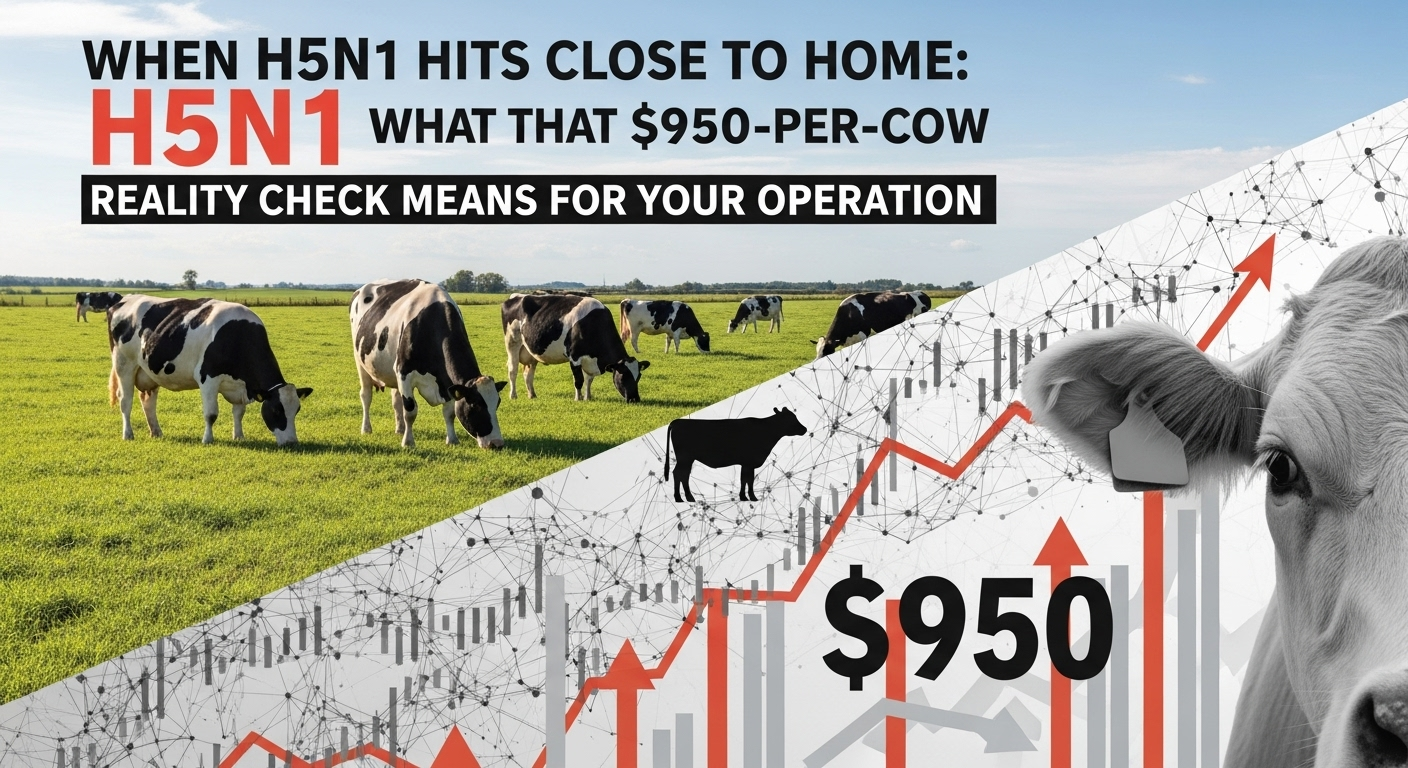
When H5N1 Hits Close to Home: What That $950-Per-Cow Reality Check Means for Your Operation

Cornell just dropped a bombshell: $950 lost per sick cow from H5N1—and 75% show zero symptoms.

EXECUTIVE SUMMARY: Look, I’ve been digging into this H5N1 mess, and honestly… it’s worse than most of us thought. Cornell’s latest research shows we’re losing nearly $950 per clinically sick cow, but here’s the kicker—that Ohio operation had 89.4% of their herd test positive while three-quarters never looked sick. Do the math on a 500-cow dairy: if 20% get clinical symptoms, you’re staring at $40,000 in lost milk revenue alone at today’s $19.75/cwt prices. Those sick cows? Six times more likely to die early. Meanwhile, European dairies are playing prevention while we’re playing catch-up—and guess who’s winning? Time to get serious about tightening up your biosecurity game before fall migration kicks into high gear.

KEY TAKEAWAYS:

  • Save $40K per outbreak by upgrading quarantine facilities now—subclinical spread is your biggest blind spot this season
  • Pasteurize all waste milk immediately or drop pH below 5.0 to protect calves—it’s the cheapest insurance policy you’ll buy
  • Lock down wildlife access points before September migration peaks—models show Arizona and Wisconsin farms at highest risk
  • Train staff on H5N1-specific PPE protocols today—multiple worker infections prove this isn’t just a cow problem anymore
  • Track your bulk tank SCC trends weekly as an early warning system—viral RNA shows up before clinical signs do

Look, I’ve been following this H5N1 situation closely, and the latest numbers from Cornell are a gut punch. A July 2025 study published in Nature pegs direct losses at $950 for every clinically sick cow, and that’s before you consider all the other ways this virus hits your bottom line.

This isn’t happening to someone else anymore. As of mid-August, USDA APHIS data shows over 1,000 confirmed cases across 17 states, including Texas, Michigan, and Wisconsin. With Class III futures bouncing around $19.75/cwt, none of us can afford to ignore the risk.

What’s Really Happening in the Field

I spoke with a producer in Ohio whose experience mirrors what the Cornell study found. He asked to remain anonymous—and you can understand why. Out of his 850-cow herd, 759 tested positive for H5N1. That’s 89.4% if you’re counting. But here’s the kicker: three-quarters of those positive cows never showed clinical signs.

The H5N1 Snapshot: By the Numbers

  • 89.4% of the herd tested positive.
  • 75% of positive cows were asymptomatic.
  • Milk production in sick cows dropped from 35 kg/day to 10 kg/day.
  • Clinically ill cows face a 6x higher risk of death.

Think about that: animals looking perfectly normal, silently spreading this virus through your entire operation.

The sick cows’ drop was brutal to watch. High-producing animals lost roughly 900 kilograms of milk over the outbreak.

For a typical 500-cow Midwestern operation, 20% showing clinical signs means losing 90,000 kilograms of milk, which at a Class III milk price of $19.75/cwt, equates to over $39,000 in lost revenue alone. We haven’t even touched on fertility setbacks, extra veterinary bills, or early culling.

Those sick cows face six times the risk of dying and 3.6 times the chance of premature culling compared to healthy herdmates.

Why Everything We’re Doing Feels Like Playing Catch-Up

Despite federal mandates and surveillance efforts, a 2025 Cornell study modeling outbreak control indicates that we’ve only prevented approximately 175 outbreaks nationwide. That isn’t containment—it’s barely a speed bump.

The same biosecurity gaps continue to appear. A 2025 survey by the University of Vermont Extension found 14% of farms introduce unquarantined heifers, 76% lack adequate quarantine facilities, and 86% keep barn cats—major pathways for virus spread.

The USDA’s National Milk Testing Strategy has helped detect cases before symptoms appear; however, it remains fundamentally reactive because viral RNA often appears in bulk tanks after internal spread has begun.

Models flag Arizona and Wisconsin as high-risk states, underscoring the urgency for biosecurity upgrades if you’re farming there.

What Europe’s Doing Right (And We’re Not)

Across the Atlantic, the European Food Safety Authority has identified migratory birds as the primary threat and is focusing on prevention, rather than reaction.

The European Commission’s June guidelines establish clear triggers for escalating measures—like mandatory quarantines, intensified surveillance during bird migrations, and preemptive culls near vulnerable zones—well before positive cases appear.

It’s proactive thinking that begs the question: What might have been different if U.S. regulators focused on prevention instead of reaction?

The Real Costs Run Well Beyond $950

That Cornell figure only covers immediate losses; total impacts include reproductive problems, labor spikes, veterinary care, and infrastructure changes.

A 500-cow dairy experiencing a 20% clinical infection rate may incur total costs of approximately $190,000. And with feed running between $9.50 and $10.80/cwt, the pressure’s only building.

What Actually Works (Based on Real Experience)

Good news: pasteurization kills H5N1, making it essential for all waste milk fed to calves.

If pasteurization isn’t an option, acidifying milk to a pH of 5.0 or below is also effective. Producers who’ve tried it say consistency is key.

Wildlife management requires more than bird-scaring tape. This virus lingers in contaminated water and feed areas, so you need proper fencing and habitat control.

Multiple farm worker infections underscore the importance of not overlooking PPE, health checks, and staff training.

Costing Out Biosecurity: What Producers Are Spending

Farm SizeNumber of CowsTypical Upgrade Cost (USD)Key Biosecurity Measures
Small< 300$18,000 – $28,000Visitor controls, milk pasteurization, basic quarantine facilities
Medium300 – 1,000$45,000 – $80,000Dedicated quarantine, ventilation upgrades, wildlife fencing, staff protocols
Large> 1,000> $125,000Surveillance systems, multiple quarantine zones, professional disinfection

Small dairies with fewer than 300 cows typically spend $18,000–$28,000 upgrading basics like visitor controls, pasteurization, and quarantine areas.

Mid-sized farms (300–1,000 cows) may spend $45,000–$80,000 on dedicated quarantine spaces, ventilation, wildlife fencing, and staff protocols.

Large operations often budget $125K+ for surveillance, multiple quarantine zones, and thorough disinfection systems.

Investments certainly appear reasonable when weighed against the six-figure losses from outbreaks.

What’s Next?

The CDC ended its emergency response in July, but USDA testing will continue through September.

With fall migration about to ramp up, the risk window opens again for new outbreaks in areas that thought they’d dodged it.

Your Monday Morning Reality Check

This disease isn’t theoretical. The $950-per-cow loss is a documented fact. Here’s your immediate action plan before fall migration kicks into gear:

REVIEW: Your quarantine protocols against USDA guidelines.

AUDIT: Your bulk tank somatic cell trends for early detection.

TRAIN: Staff on proper PPE use and biosecurity.

VALIDATE: Waste milk treatment (pasteurization or acidification).

SCHEDULE: A vet consultation for an H5N1-specific herd plan.

It’s not a question of if H5N1 comes to your farm. It’s whether you’ll be ready when it does.

Complete references and supporting documentation are available upon request by contacting the editorial team at editor@thebullvine.com.

Learn More:

  • Biosecurity on Dairy Farms: The Ultimate Guide – This guide provides a comprehensive, farm-wide biosecurity checklist. It reveals practical strategies for controlling traffic, managing new arrivals, and protecting your herd from more than just H5N1, reducing overall disease risk and future treatment costs.
  • Navigating the Twists and Turns of the 2024-2025 Dairy Markets – This analysis breaks down the key economic drivers impacting your milk check. It offers strategic insights into managing risk and navigating market volatility, helping you protect your operation’s financial health during uncertain times like the H5N1 outbreak.
  • The Genomic Revolution: Breeding for Health, Not Just Production – Explore how to leverage genomic data to build a more resilient herd. This article demonstrates methods for selecting health and immunity traits, creating a long-term strategy to reduce disease incidence, lower vet costs, and improve your farm’s future profitability.

Join the Revolution!

Join over 30,000 successful dairy professionals who rely on Bullvine Weekly for their competitive edge. Delivered directly to your inbox each week, our exclusive industry insights help you make smarter decisions while saving precious hours every week. Never miss critical updates on milk production trends, breakthrough technologies, and profit-boosting strategies that top producers are already implementing. Subscribe now to transform your dairy operation’s efficiency and profitability—your future success is just one click away.

NewsSubscribe
First
Last
Consent

What European Dairy Producers Know About Disease Management That’s Saving Them Hundreds of Thousands

$950 lost per infected cow?  Europeans are cutting disease losses 80% with biosecurity. Time to catch up, don’t you think?

Executive Summary: Look, I’ve been diving deep into this H5N1 mess, and here’s what’s keeping me up at night. European dairy producers are making us look like amateurs when it comes to disease management—they’re bouncing back from outbreaks in 60 days while we’re still scrambling. California alone lost $400 million in 2024 from a 9.2% production drop, and that’s just the beginning. What really gets me is that farms investing just 2-3% of their production value in proper biosecurity are seeing 60-80% fewer outbreak costs when disease hits. The Europeans figured this out decades ago with foot-and-mouth and bluetongue—they treat biosecurity like they treat feed costs, as essential business expenses. With milk sitting around $21.30 per hundredweight and operating loans costing 5.6%, every cow matters more than ever. You can’t afford to wait until H5N1 shows up at your gate—you need to start thinking like a European dairy producer today.

Key Takeaways

  • Cut potential losses by $950 per cow with proactive biosecurity audits—start by mapping your current weak spots and comparing against European protocols, especially with today’s tight margins on milk checks.
  • Deploy IoT rumination sensors immediately to catch production drops 3-5 days before clinical symptoms—that early warning system could save 80% of your herd like it did for that Green Bay operation.
  • Invest 2-3% of production value in integrated disease monitoring—with feed costs crushing everyone, this ROI of 60-80% cost reduction during outbreaks is money in the bank.
  • Build rapid response agreements with neighboring farms—coordinate movement controls now before disease pressure hits, protecting both your genetic program and butterfat production.
  • Follow Canada’s playbook with systematic milk surveillance—they’ve tested 4,500+ samples with zero H5N1 cases while maintaining strong genomic testing protocols throughout 2025.

A persistent challenge with the H5N1 outbreak in U.S. dairy herds is the reactive nature of the response, leaving producers playing catch-up as losses stack up nationwide. Recent work from Cornell University examined a 3,900-cow Ohio operation, finding economic losses of approximately $950 per infected cow, totaling nearly $ 3.7 million. These numbers reflect the reality faced by large-scale commercial operations, not just smaller farms.

In stark contrast, European dairy producers have spent decades preparing for these scenarios. Their experience in managing foot-and-mouth disease, bluetongue, and African swine fever has led to the development of well-established biosecurity protocols that consistently reduce outbreak costs. Notably, Germany’s rapid recovery from foot-and-mouth disease in early 2025 saw the country go from outbreak to disease-free status in just sixty days—a level of swift recovery that materially benefits export negotiations and market stability.

The Financial Stakes Keep Rising

Financial context matters significantly. Milk prices reached $21.30 per hundredweight in May 2025, while operating and ownership loan rates stand between 5.1% and 5.6% according to the USDA’s recent data. Every day lost to disease equates to real revenue losses.

California exemplifies these challenges, experiencing a 9.2% reduction in milk production in 2024, equivalent to approximately $400 million in lost revenue amid rising feed and labor costs. The virus’s insidious impact stems from its direct targeting of the mammary gland, causing prolonged mastitis and viral shedding in milk—even among asymptomatic cows, as documented in EFSA’s comprehensive 2025 review.

Average daily milk production of infected versus non-infected cows over 60 days post H5N1 infection

The data reveal a stark reality: modeling shows that current U.S. intervention strategies have prevented only an estimated 175 additional outbreaks. By comparison, European emergency response teams deploy within hours and implement cross-border movement restrictions seamlessly. This seamless, cross-border approach is a key differentiator, while coordination between U.S. states is still in development.

Europe’s Systematic Advantage

Europe’s systematic approach features 3-kilometer protection zones and 10-kilometer surveillance zones, with government co-financing covering substantial response costs—facilitating rapid containment while allowing operational continuity beyond outbreak zones. Conversely, fragmented U.S. federal and state responses contribute to delayed containment and complicated ELAP compensation eligibility, limiting producer recovery.

Forward-looking U.S. operations in Michigan and Wisconsin have begun adopting IoT monitoring technologies that can detect production declines days ahead of clinical symptoms. For example, an 850-cow dairy near Green Bay identified decreased rumination before symptomatic onset, enabling early intervention that likely prevented wider exposure.

The USDA’s commitment of over $1 billion in biosecurity and response funding for 2025 underlines official support for these measures. The challenge, however, is that these funds are only effective when paired with the right on-farm technology, rigorous protocols, and regional cooperation.

The Investment Decision Every Producer Faces

Producers face a fundamental choice: treat biosecurity as an essential investment or accept the escalating cost of disease-related disruption. The European experience demonstrates that budgeting 2–3% of production value toward integrated biosecurity protocols can reduce outbreak costs by 60–80%, a compelling view supported by industry insights compiled by The Bullvine.

The challenges are real: rising input costs, labor shortages, and the initial capital required for advanced monitoring systems. Regulatory complexity, which varies by state, presents additional obstacles.

Your Actionable 30-60-90 Day Gameplan

Based on what’s working for progressive operations, here is a practical timeline for implementation:

First 30 Days: Conduct a Comprehensive Audit Start with a peer-reviewed biosecurity audit modeled on successful European frameworks. Simultaneously, open discussions are being held with neighboring farms about regional movement controls, an approach gaining traction in Wisconsin and Pennsylvania.

Next 60 Days: Implement Basic Monitoring You don’t need the most advanced system overnight. Begin by installing foundational tools, such as rumination sensors or milk yield meters, to establish a baseline and detect early deviations.

By 90 Days: Solidify Your Response Plan Formalize a rapid response agreement with your herd veterinarian and at least one neighboring operation. Ensure everyone understands their role before an emergency occurs.

Proof That Prevention Works

Canada, for instance, provides a compelling case study. The country’s dairy industry maintains an H5N1-free status, as evidenced by over 4,500 negative milk samples from surveillance testing, which illustrates the efficacy of rigorous surveillance and integrated biosecurity.

The Bottom Line

Ultimately, successful disease management is defined by proactive investment and systematic preparation, which consistently outperform reactive responses. As climate patterns potentially extend disease pressures and mathematical models show current responses need improvement, the competitive advantage clearly belongs to operations that adapt proven strategies now.

The European playbook provides a proven path forward. The choice is no longer whether to invest in strategic biosecurity, but how quickly it can be made the centerpiece of your operation.

Complete references and supporting documentation are available upon request by contacting the editorial team at editor@thebullvine.com.

Learn More:

  • Biosecurity – Your first line of defense – This article provides a tactical checklist for on-farm biosecurity implementation. It details practical strategies for managing visitors, controlling animal movement, and sanitizing equipment to create a robust, cost-effective barrier against disease transmission on your operation.
  • The Dairy Industry’s Top 5 Trends for 2024 That Will Redefine The Future – For a strategic view, this piece connects biosecurity to larger market forces like sustainability and consumer transparency. It reveals how proactive health management is essential for building brand trust and meeting the evolving demands of the global marketplace.
  • Precision Dairy Farming – The next generation of dairy farm management – Dive deeper into the innovative technology discussed in our feature. This article demonstrates how to harness data from automated sensors and monitoring systems to preemptively manage herd health, optimize labor, and drive profitability through data-driven decisions.

Join the Revolution!

Join over 30,000 successful dairy professionals who rely on Bullvine Weekly for their competitive edge. Delivered directly to your inbox each week, our exclusive industry insights help you make smarter decisions while saving precious hours every week. Never miss critical updates on milk production trends, breakthrough technologies, and profit-boosting strategies that top producers are already implementing. Subscribe now to transform your dairy operation’s efficiency and profitability—your future success is just one click away.

NewsSubscribe
First
Last
Consent

Silent Losses, Loud Profits: How Smart Sensors Are Saving Producers $200+ Per Cow Annually

Visual observation misses 40% of sick cows—smart sensors detect mastitis 4 days early, delivering $210/cow returns. Time to ditch the guesswork.

Here’s a number that’ll make you question everything you thought you knew about herd health: Michigan State University research tracking 20,625 mastitis cases across 37 Wisconsin dairy farms reveals the average cost per case ranges from $118 to $337, with milk discard accounting for 87% of total costs when using intramammary treatments only. But here’s the part that should keep you awake at night—31% of these cases received no antimicrobial treatment at all, yet still cost farmers an average of $192 per case.

Mastitis costs breakdown showing milk discard accounts for 87% of total treatment expenses

What if I told you the entire foundation of dairy health management is built on a lie? What if the future isn’t about getting better at treating sick cows, but about seeing inside healthy ones before they get sick?

Projected 29.5% increase in global livestock antibiotic use by 2040, with cattle representing the largest share

Whether you want to admit it or not, you’re living in the last days of reactive cattle management. With global antibiotic use in livestock projected to reach 143,481 tons by 2040—a staggering 29.5% increase—the regulatory noose is tightening around traditional health protocols. Meanwhile, producers using internal monitoring technology are documenting returns that should make every traditionalist in the industry deeply uncomfortable.

Here’s what the industry establishment doesn’t want you to know: An independent 2024 study by the International Farm Comparison Network (IFCN) documented a $210 per cow increase in returns and an additional $190 per cow in income from farms using smart bolus technology. Wisconsin producer Amber Horn-Leiterman calculated a 7.8x return on investment based solely on improvements in her cull rate, saving over $500,000 in 2023. These aren’t feel-good technology stories—they’re economic game-changers threatening the entire reactive medicine industry.

Think about this: you wouldn’t manage your breeding program by hoping cows get pregnant without tracking heat cycles or using genomic testing. Yet that’s exactly what you’re doing with health management—playing catch-up while early adopters capture massive competitive advantages.

Why Everything the Industry Taught You About Herd Health Is Wrong

Let’s challenge the most sacred cow in dairy management: the belief that visual observation and clinical examination represent the gold standard for animal health assessment. This assumption has cost the industry billions and will cost unprepared producers their competitive position.

Research from the comprehensive industry analysis “Beyond the Bolus” reveals that cattle identified as sick through visual appraisal already show clear clinical symptoms and may have been sick for extended periods. For example, clinical signs of bovine respiratory disease might occur later than the onset of fever, or even without the occurrence. Clinical signs of neonatal calf diarrhea are visible only when much of the associated tissue damage to the intestinal submucosa has already occurred.

Here’s the uncomfortable truth the equipment dealers won’t tell you: By the time you see symptoms, you’ve already lost the profitable intervention window. You’re not managing herd health—you’re managing herd damage control.

Whether you acknowledge it or not, the regulatory landscape is shifting beneath your feet. Since the EU banned antibiotic growth promoters in 1999, followed by the FDA’s restrictions on medically important antibiotics in 2017, the writing has been on the wall. Nature Communications research projects that under business-as-usual scenarios, global antibiotic use in livestock could reach 143,481 tons by 2040, representing a 29.5% increase. Cattle farming currently accounts for the largest portion, at 53.5% of global livestock antimicrobial usage.

But here’s what separates industry leaders from followers: While everyone else scrambles to maintain failing protocols with fewer tools, forward-thinking operations have discovered that proactive health management isn’t just better for regulatory compliance—it’s dramatically more profitable. The data proves that farms using continuous monitoring systems reduce disease incidence by up to 30% and veterinary costs by 25%.

Diagram illustrating the data flow from smart bolus sensors in dairy cows to a cloud-based monitoring system and user interfaces

Why This Revolution Matters for Your Bottom Line: Consumer demand for antibiotic-free products is creating premium market opportunities, but it’s also creating existential pressure on producers who haven’t developed alternative strategies. The global economic impact of dairy cattle diseases is estimated at $65 billion annually, with subclinical ketosis alone accounting for $18 billion in losses.

Inside Your Cow: The Austrian Technology That’s Disrupting North American Dairy

Here’s where we challenge another industry assumption: that external monitoring is “good enough” for modern dairy operations. SmaXtec, an Austrian company that’s been quietly revolutionizing European dairy management since 2009, has cracked the code on something that seemed impossible just a decade ago—turning every cow into her own personal health monitor through internal sensing technology.

A person wearing a SmaXtec branded shirt reviews health data on a smartphone in a dairy cow barn

Their bolus technology—a battery-powered sensor that lives in the cow’s reticulum for five years—measures what truly matters for dairy profitability: core body temperature with clinical-grade accuracy of ±0.018°F, individual water intake patterns through their patented TruDrinking™ technology, rumination activity via TruRumi™ sensors, and optional rumen pH monitoring.

Why does this matter more than your current protocols? Because research demonstrates that internal body temperature changes occur up to four days before visual symptoms appear for conditions like mastitis. That’s not just early detection—that’s economic time travel for your treatment protocols.

The technology’s artificial intelligence analyzes multiple data streams simultaneously, much like how modern genetic evaluations combine production, health, and fertility traits into comprehensive indices. A temperature spike with stable rumination but dropped water intake suggests a different problem than one with crashed rumination and low rumen pH. You’re not just getting alerts—you’re getting qualified diagnostic leads.

The Economics That Should Terrify Your Competition

The independent 2024 IFCN study found that SmaXtec enabled a $210 per cow increase in returns and an additional $190 per cow in income, with milk yield increases of 330 kg of solids-corrected milk annually. The study concluded that the technology resulted in “a positive effect on the most important indicators like milk yield, labor, returns, income, and carbon footprint.”

Let’s consider this, which should make every traditional producer uncomfortable. On a 500-cow dairy, that’s $105,000 in additional returns and $95,000 in extra income annually. Even accounting for technology costs, early adopters are capturing massive competitive advantages while their neighbors are still walking pens with thermometers.

The Producer Testimonials That Challenge Everything

Amber Horn-Leiterman, who milks over 2,100 cows in Brillion, Wisconsin, states: “We recently analyzed our cull rates for our dairy, comparing our last year before investing in smaXtec in 2021 with this past year (2023). With smaXtec, we see a 7.8 ROI just from the improvements on cull rates.” Her operation calculated total savings within its replacement program of over $500,000 in 2023.

Think about that for a moment: $500,000 in savings from just one aspect of the technology’s capabilities. Horn-Leiterman adds: “The inner body temperature monitoring that smaXtec provides has been a game changer for us. The inner temperature allows us to provide preventative and supportive care to our cows and helps catch inflammation and metabolic issues in transition cows before these issues get out of hand.”

Beyond Antibiotics: The Singapore Startup That’s Engineering Your Future

While smart boluses are revolutionizing detection, companies like Peptobiotics are engineering the future of treatment using synthetic biology to create antimicrobial peptides (AMPs)—nature’s own antibiotics that promise efficacy without resistance risk.

Research published in PMC demonstrates that AMPs are “ubiquitous in living organisms, spanning from bacteria to humans” and work by physically disrupting bacterial cell membranes rather than targeting specific metabolic pathways. This direct, physical attack is much more difficult for bacteria to develop resistance against, meaning AMPs don’t create the same selective pressure that drives the evolution of drug-resistant superbugs.

Recent studies have shown that AMPs are effective against important livestock pathogens, including Staphylococcus aureus-associated mastitis, with significant antibacterial effects in both in vitro and in vivo experiments.

The Reality Check on Timeline: Peptobiotics is currently focused on aquaculture and poultry, with no announced timeline for cattle applications in North America. But their $6.2 million Series A funding in April 2024 signals serious investor confidence in post-antibiotic agriculture. This represents what industry experts call a “beachhead strategy”—prove the technology in markets with acute disease problems, then expand to larger opportunities like cattle.

The Veterinarian Relationship Revolution: Disrupting Decades of Tradition

Perhaps the most profound disruption isn’t technological—it’s relational. Smart monitoring is fundamentally challenging the decades-old business model of veterinary services, transforming veterinarians from emergency responders into strategic health advisors.

Dr. Rachel Budd with Metzger Veterinary Services represents this transformation: “There are actually a lot of things that we get called on farm to do as dairy vets that the farmer is more than capable of handling themselves. We’re trying to provide training and tools, number one, but also some new technologies that’ll help people be more self-sufficient.”

Here’s what challenges the traditional vet-client relationship: Instead of reactive farm calls, technology enables vets to review continuous data streams and provide proactive consultation remotely. This shift allows veterinarians to become strategic advisors who help interpret complex data patterns, recommend preventative strategies, and evaluate treatment effectiveness with objective evidence.

But this evolution threatens traditional veterinary business models built on billable hours for on-farm visits. Progressive practices are developing subscription-based remote monitoring services—think of it as a health insurance plan for your herd that actually prevents claims rather than just paying them.

The Economic Reality That Should Change Your Strategy

ROI analysis showing how smart sensor benefits increase dramatically with farm size

Here’s what the verified numbers actually look like when you implement comprehensive monitoring:

Economic DriverQuantified ImpactVerified Source
Mastitis Cost Range$118-$337 per caseMSU study of 20,625 cases across 37 farms
Treatment Duration Cost$65 per additional dayMSU research on dairy treatment economics
Milk Discard Impact87% of total treatment costsMSU analysis of intramammary treatments
Production Gains+330 kg SCM per cow annuallyIndependent IFCN study on US dairies
Overall Return Increase+$210 per cowIFCN study documentation
Additional Income+$190 per cowIFCN study results
Documented ROI7.8x return on investmentWisconsin dairy: $500,000 savings in 2023

Think about this: MSU research shows that reducing treatment duration by just one day saves approximately $65 per case. When you can detect problems four days earlier than visual observation, you’re not just saving money—you’re capturing competitive advantages that compound across your entire operation.

Implementation Strategy: Your Evidence-Based Disruption Roadmap

Month 1: Reality Assessment

  • Calculate your current mastitis costs using the verified $118-$337 per case range from MSU research
  • Evaluate your existing herd management software for integration compatibility with proven monitoring systems
  • Schedule a veterinary consultation to discuss moving beyond reactive protocols

Month 2: Technology Evaluation

  • Request demonstrations from monitoring system providers with published research validation
  • Review independent case studies from operations similar to your size and management approach
  • Develop an implementation timeline that positions you ahead of industry adoption curves

Month 3: Competitive Advantage Implementation

  • Start with a subset of cows to validate system performance in your specific environment
  • Establish baseline metrics for health costs, treatment protocols, and production outcomes
  • Train staff on data interpretation protocols that move beyond traditional observation methods

What Industry Leaders Don’t Want You to Know

The controversial truth threatens established industry power structures: The dairy industry’s addiction to reactive medicine is subsidizing inefficiency and undermining long-term competitiveness. We’ve been conditioned to accept that visual observation and clinical examination represent the pinnacle of animal health management, when research proves this approach captures less than half of actual health events.

Technology adoption rates in dairy farming showing accelerated growth, with smart sensors projected to reach 55% adoption by 2030

The industry’s resistance to change isn’t just about technology adoption—it’s about protecting revenue streams built on treating problems rather than preventing them. While you’re debating the value of monitoring technology, early adopters capture documented returns of $210 per cow and 7.8x ROI.

Meanwhile, research from Nature Communications shows that under business-as-usual scenarios, global antibiotic use in livestock could reach 143,481 tons by 2040. The regulatory environment is shifting, whether you participate or not. Consumer demand for antibiotic-free products creates market premiums that early adopters capture while traditionalists pay catch-up costs.

The Bottom Line: Your Competitive Window Is Closing

Remember that MSU statistic we opened with—mastitis costs ranging from $118-$337 per case, with 87% of costs coming from milk discard in traditional treatment protocols? That’s not just industry data anymore. It’s your specific benchmark for measuring the cost of continuing reactive management versus investing in predictive technology.

The economic case is overwhelming when viewed through current market realities. With documented benefits of $210 per cow in additional returns, $190 per cow in additional income, and milk yield increases of 330 kg SCM annually, these technologies represent the largest operational advantage opportunity the industry has seen in decades.

Here’s what separates industry leaders from followers: While traditionalists debate the value of technology, early adopters like Amber Horn-Leiterman are documenting $500,000 in annual savings from just one aspect of comprehensive monitoring. They’re not just improving animal welfare but capturing competitive advantages that compound annually.

The convergence of internal monitoring and antibiotic alternatives represents the biggest disruption in livestock health management since the development of modern veterinary medicine. With global antimicrobial use projected to reach 143,481 tons by 2040 and regulatory pressure intensifying, the question isn’t whether this transformation will occur—it’s whether you’ll lead it or be forced to follow.

Your next strategic decision is critical: At your next herd health evaluation, calculate the total cost of your last three mastitis cases using the MSU framework of $118-$337 per case, factoring in the $65 daily cost of extended treatment duration. That number represents your ROI benchmark for investing in predictive health technology. In an industry where early adopters document 7.8x returns while competitors struggle with reactive protocols, waiting isn’t just expensive—it’s strategically devastating.

KEY TAKEAWAYS

  • Replace Reactive Guesswork with Predictive Intelligence: Traditional visual observation misses 40% of sick animals, while internal sensors detect temperature spikes up to 4 days before clinical mastitis symptoms appear—transforming your morning pen walks from damage control into strategic data review.
  • Capture Documented $400+ Annual Returns Per Cow: Independent IFCN research proves $210 increased returns + $190 additional income per cow annually, with milk yield gains of 330 kg SCM—meaning a 500-cow dairy can generate $200,000 in additional revenue while reducing herd health costs by 40%.
  • Eliminate 70% of Reproductive Hormone Usage: Wisconsin producers using smart bolus technology achieved precise heat detection and pregnancy rates approaching 30%, while reducing days open and eliminating costly missed breeding opportunities that traditionally cost $30 per 10-day extension.
  • Future-Proof Against Antibiotic Restrictions: With global livestock antimicrobial use projected to hit 143,481 tons by 2040 and consumer demand driving antibiotic-free premiums, early monitoring adoption positions your operation ahead of regulatory pressure and captures premium market access.
  • Disrupt the $65-Per-Day Treatment Extension Model: MSU data shows each additional day of mastitis treatment costs $65—when you can intervene 4 days earlier with internal sensor alerts, you’re not just saving treatment costs, you’re capturing competitive advantages that compound across your entire operation.

EXECUTIVE SUMMARY:

The $662 annual mastitis cost you’re accepting per cow isn’t inevitable—it’s evidence that reactive health management is bleeding your operation dry. Michigan State University research tracking 20,625 mastitis cases proves that 87% of treatment costs come from milk discard, yet producers using internal bolus sensors are detecting infections four days before clinical symptoms appear. Independent IFCN studies document $210 per cow increased returns and $190 additional income annually from farms implementing smart monitoring technology. While global antibiotic use is projected to reach 143,481 tons by 2040, early adopters like Wisconsin’s Amber Horn-Leiterman are capturing 7.8x ROI and $500,000 annual savings by replacing visual observation with AI-driven diagnostics. Austrian company SmaXtec’s internal sensors measure core body temperature with ±0.018°F accuracy, rumination patterns, and individual water intake—revolutionizing herd health from inside the reticulum. With traditional visual assessment showing only 61.8% sensitivity for disease detection, the question isn’t whether this technology will become standard practice—it’s whether you’ll capture early adopter advantages or pay catch-up costs. Calculate your current mastitis expenses using MSU’s $118-$337 per case framework and discover why proactive monitoring isn’t just better animal welfare—it’s your competitive survival strategy.

Complete references and supporting documentation are available upon request by contacting the editorial team at editor@thebullvine.com.

Learn More:

Join the Revolution!

Join over 30,000 successful dairy professionals who rely on Bullvine Weekly for their competitive edge. Delivered directly to your inbox each week, our exclusive industry insights help you make smarter decisions while saving precious hours every week. Never miss critical updates on milk production trends, breakthrough technologies, and profit-boosting strategies that top producers are already implementing. Subscribe now to transform your dairy operation’s efficiency and profitability—your future success is just one click away.

NewsSubscribe
First
Last
Consent

Digital Dairy Detective: How AI-Powered Health Monitoring is Preventing $2,000 Losses Per Cow

AI detects sick cows 5 days before your best cowman notices—while you’re still using 1950s flashlight checks. Cornell proves 95.6% accuracy saves $2,000/cow.

EXECUTIVE SUMMARY: Your twice-daily visual health checks—unchanged since the 1950s—cost you thousands per cow while forward-thinking farms let AI watch 24/7. Cornell University research shatters conventional wisdom, demonstrating that automated health monitoring systems identify metabolic and digestive disorders with 95.6% accuracy and 97.6% specificity, compared to human observation that consistently misses problems until financial damage is done. Farms implementing AI-powered precision livestock farming are achieving 40-70% reductions in treatment costs and 40% labor savings through early disease detection that spots at-risk cows up to five days before clinical signs appear. The industry doesn’t want you to know that only 5% of commercial monitoring tools have undergone external validation, yet the global precision livestock farming market exploded 11.1% to $5.59 billion in 2025 as smart operators abandoned reactive crisis management. With sick cows ruminating 17% less than healthy herd mates—signaling 3-4% milk yield decreases, you’re missing—the question isn’t whether this technology works, it’s whether you can afford to keep managing health problems after they’ve already devastated your bottom line. Stop managing by crisis and start managing by data—calculate your current health management costs and discover how preventing 70% of disease cases before they become expensive could transform your operation’s profitability.

KEY TAKEAWAYS

  • Disease Detection Revolution: Cornell-validated AI systems identify health issues 5 days before clinical symptoms appear with 95.6% accuracy, preventing single disease cases that can cost $2,000+ per cow and increase 305-day milk yield by 3.5% through early intervention
  • Labor Efficiency Breakthrough: Precision monitoring enables farmers to focus on only 15% of cows requiring intervention, delivering 40% labor reduction, while automated systems consistently outperform human observation in detecting subclinical ketosis affecting 40% of fresh cows
  • Implementation Reality Check: Despite $5.59 billion global market growth and proven ROI, only 5% of commercial PLF tools have external validation—demanding rigorous vendor scrutiny and independent performance data before investment in systems requiring reliable internet infrastructure
  • Financial Impact Validation: Farms report 40-70% treatment cost savings and up to 70% antibiotic reduction through early disease detection, with prevented clinical diseases increasing milk yield by 3.5% and poor transition management costing 10-20 pounds of peak production per cow
  • Strategic Adoption Framework: Three-phase implementation starting with foundation assessment and infrastructure audit, followed by single-application pilot testing, then scaling smart with 12-18 month payback periods for technologies addressing specific operational pain points rather than comprehensive system deployment
 AI dairy monitoring, precision livestock farming, dairy farm ROI, herd health management, automated disease detection

What if your cows could tell you they’re getting sick three days before you notice? While most dairy operations still rely on twice-daily visual checks—a practice virtually unchanged since the 1950s—forward-thinking farms are letting artificial intelligence watch. And they’re preventing massive financial losses that traditional management consistently misses.

Here’s what the industry doesn’t want you to know: Cornell University research demonstrates that automated health monitoring systems identify metabolic and digestive disorders with 95.6% accuracy and 97.6% specificity—compared to human observation that consistently misses problems until they’ve already devastated your bottom line.

The precision livestock farming market exploded from $5.04 billion in 2024 to $5.59 billion in 2025, demonstrating an 11.1% compound annual growth rate. The question isn’t whether this technology works—it’s whether you can afford to manage health problems after they already cost you money.

Why Smart Farmers Are Ditching the Flashlight

Think of traditional dairy health monitoring, like checking your bulk tank temperature once a day and hoping your cooling system works perfectly the other 23 hours. You’re gambling that nothing goes wrong when you’re not looking—and you’re losing that bet more often than you realize.

Here’s the Shocking Validation Crisis

Only 5% (4 out of 83 identified commercial tools) for livestock monitoring had undergone external validation, with the majority relying on calibration by their manufacturers. Yet equipment dealers keep pushing unproven systems while vendors make promises they can’t verify.

Continuous monitoring systems detect at-risk cows up to five days before clinical signs become apparent, based on subtle changes in rumination time, eating time, and activity levels. Instead of trying to monitor every cow constantly, precision monitoring enables you to concentrate attention on only about 15% of cows that genuinely require intervention, leading to a 40% reduction in labor.

Detection MethodAccuracy RateDetection TimingLabor ImpactValidation Status
Human Visual Observation77%After clinical signs appearHigh manual effortTraditional practice
AI-Powered Monitoring95.6%Up to 5 days before clinical signs40% labor reductionCornell University verified
Automated Heat Detection90% with 100% accuracyReal-time detectionMinimal interventionIndependent study confirmed

What’s Really Costing You Money Right Now

Let’s confront the hidden financial hemorrhaging happening in your operation—losses that make volatile milk prices look manageable. Clinical ketosis alone costs up to $289 per case, but subclinical ketosis affects up to 40% of fresh cows, making them three times more likely to be culled within the first 30 days.

The Math That Changes Everything

Sick cows consistently ruminate approximately 17% less than their healthy herd mates, and a 10% decrease in rumination time signals a 3-4% decrease in milk yield. Preventing a single clinical disease during the transition period can increase a cow’s 305-day milk yield by 3.5%.

Financial Reality Check

  • Disease Prevention ROI: 40-70% reduction in treatment costs
  • Labor Savings: 40% reduction in monitoring time
  • Antibiotic Usage: Up to 70% reduction possible

Global Technology Revolution While You’re Still Debating

International Adoption Patterns Reveal the Truth

While North American farmers debate implementation, international markets are embracing PLF aggressively. The global precision livestock farming market is projected to reach $7.93 billion by 2029, with a compound annual growth rate of 9.1%.

Wearable collar technologies are revolutionizing dairy farming by providing real-time insights into cow health, behavior, and productivity. Advanced technologies are being progressively adopted in the dairy sector, from farm to table, with robotics, Artificial Intelligence, the Internet of Things, Big Data, and Blockchain as the main enabling technologies.

Case Study: The Validation Success

A visual-based precision livestock technology (NUtrack) demonstrated superior capability in identifying sick nursery pigs compared to trained human observers, achieving Area Under Curve values exceeding 0.970 for early detection. For dairy applications, automated activity monitoring systems achieved 90% detection rates with 100% accuracy (confirmed by blood tests), substantially outperforming traditional visual observation methods, which achieved only 77% detection with 89% accuracy.

Why Most Vendors Are Overselling You

The Uncomfortable Truth About Commercial Tools

Here’s what equipment dealers won’t tell you: the majority of commercial PLF tools rely on calibration by their manufacturers rather than independent validation. This validation deficit creates farmer skepticism and explains why many operations hesitate to invest.

Implementation Barriers Nobody Discusses

Reliable internet connectivity remains a critical prerequisite and significant barrier, directly shaping producers’ perceptions and adoption decisions. PLF implementation requires substantial investment in human capital development, with farmers needing specialist knowledge and skills to operate systems and interpret data.

Your Implementation Action Plan

Phase 1: Foundation Assessment

  • Calculate current annual treatment costs per cow
  • Audit internet connectivity and electrical infrastructure
  • Identify your biggest pain point (health, reproduction, or labor)

Phase 2: Technology Selection

  • Demand independent validation data from vendors
  • Start with single-application systems before expanding
  • Focus on technologies with proven 12-18 month payback periods

Phase 3: Implementation Strategy

  • Invest in staff training and data interpretation skills
  • Plan for a 3-6 month learning curve before full benefits
  • Establish baseline metrics to measure ROI

Action Checklist
☐ Review the last 12 months of veterinary bills
☐ Calculate average monthly vet costs per cow
☐ Test internet speed and reliability in barns
☐ Research 3 vendors with independent validation data
☐ Budget for staff training and ongoing support

The Bottom Line

Remember that 3 AM barn check with a flashlight? That represents everything wrong with traditional dairy health management—reactive, inconsistent, and expensive. While farms implementing precision livestock farming technologies achieve 40-70% reductions in treatment costs through early disease detection, traditional operations continue fighting expensive fires.

The Financial Reality:

  • Early disease detection saves 40-70% in treatment costs
  • Automated monitoring reduces labor by 40%
  • For a 200-cow operation, these improvements translate to $50,000-100,000 in annual benefits

The question isn’t whether AI monitoring works—Cornell’s 95.6% accuracy rate proves it does. The question is whether you can afford to manage health problems after they cost you money.

Your Next Move: Calculate your current health management costs, then imagine preventing 70% of those problems before they become expensive. Stop managing by crisis. Start managing by data. Every day you delay is another day of preventable losses.

The farmers making the most money aren’t working the hardest—they’re letting technology do the watching while they focus on strategic decisions. The choice is yours.

Complete references and supporting documentation are available upon request by contacting the editorial team at editor@thebullvine.com.

Learn More:

Join the Revolution!

Join over 30,000 successful dairy professionals who rely on Bullvine Weekly for their competitive edge. Delivered directly to your inbox each week, our exclusive industry insights help you make smarter decisions while saving precious hours every week. Never miss critical updates on milk production trends, breakthrough technologies, and profit-boosting strategies that top producers are already implementing. Subscribe now to transform your dairy operation’s efficiency and profitability—your future success is just one click away.

NewsSubscribe
First
Last
Consent

Weathering the Storm: A Dairy Farmer’s Guide to Blizzard Survival

Winter’s wrath is upon us, and dairy farmers are bracing for impact. From feed stockpiles to power backups, this guide covers essential strategies to keep your herd healthy and milk flowing when blizzards hit. Learn how to weather the storm and emerge stronger on the other side. Your farm’s survival guide is here.

As winter tightens its grip on the Northeast US and Canada, dairy farmers face another challenging season. During a significant snowstorm in the region, you might seek a brief break from facing the elements as you read this, possibly under generator light with a much-needed cup of coffee. If you are enduring the storm, you are well acquainted with howling winds, plummeting temperatures, and snowdrifts that appear to increase rapidly. Farmers are heavily bundled, trudging through deep snow to check on their herds, hoping the milking equipment holds up, and wondering when the next feed delivery will arrive. Others may be anxiously watching the forecast, mentally reviewing preparations, and hoping these measures are sufficient for when the storm arrives. All individuals face similar challenges irrespective of where they are located during this weather event. Let’s discuss strategies to keep our herds healthy, maintain milk production, and preserve our operations when Mother Nature is fiercest. 

Preparation: The Key to Weathering the Storm 

Feed and Bedding Stockpiles 

Ensure you have 8-12 tons of silage or haylage per week for a 100-cow herd, depending on cow size and production level. For a 100-cow herd, that’s approximately 8-12 tons of silage or haylage per week, depending on cow size and production level. Dr. Sarah Johnson, Extension Dairy Specialist at Cornell University, advises: 

“During severe weather, cows may need up to 10% more feed to maintain their body temperature. Plan your stockpile accordingly.”

Water System Integrity 

Insulate pipes and consider installing heat tape to prevent freezing. The University of Nebraska-Lincoln Extension emphasizes the critical necessity of a backup water tank, as each lactating cow requires 30-40 gallons daily. 

Structural Integrity 

Snow accumulation on a barn roof - know when to clear it for safety
Snow accumulation on a barn roof – know when to clear it for safety

Inspect your barns thoroughly. The exact safe snow load can vary by building structure, but as a general guideline, consider removing snow from roofs if accumulation exceeds 4 inches of wet snow or 10 inches of dry snow to prevent collapse. Always consult a structural engineer for specific recommendations for your buildings. 

Power Backup 

 “A properly sized generator is crucial for maintaining operations during power outages
A properly sized generator is crucial for maintaining operations during power outages

Having a reliable generator is crucial during severe weather conditions. Ensure it can manage essential systems like milking equipment, water pumps, and minimal heating. The Penn State Extension recommends sizing your generator to hold 20-25% more than your estimated wattage needs. 

Staff Preparedness 

Develop a clear plan with your team for managing shifts during severe weather conditions. If necessary, include arrangements for on-farm accommodation to ensure staff readiness. 

Managing During the Storm 

Herd Comfort and Health 

Provide ample dry bedding and shelter for animals. Monitor for signs of cold stress, such as shivering, huddling, or reduced activity. The University of Wisconsin-Madison Extension provides a comprehensive guide on recognizing and managing cold stress in cattle. 

Maintain Routines 

Stick to regular feeding and milking schedules as much as possible. Consistency is crucial for maintaining production. 

Vigilant Monitoring 

Keep a close eye on your herd’s health. If concerns arise, don’t hesitate to contact your veterinarian, even for a video consultation. 

Access Management 

Regularly clear critical pathways, including walkways, feeding areas, and access routes for emergency vehicles, to maintain operational efficiency. 

Stay Informed 

Keep communication devices charged and monitor local updates on road closures, power outages, and emergency services. 

Feed Adjustments During Extreme Cold 

Temperature (°F)Increase in Energy Requirements
320%
2210%
1220%
230%
-840%

Source: National Research Council, Nutrient Requirements of Dairy Cattle, 2001.

Research from the University of Minnesota Extension indicates that cows require about 1% more energy in their feed for every degree Fahrenheit below 32°F (0°C). Key adjustments to consider: 

  1. Increase the energy content of your Total Mixed Ration (TMR) to meet the cows’ energy requirements during extreme cold. Think about adding extra corn silage or incorporating bypass fat.
  2. Ensure cows have constant access to clean water to maintain dry matter intake. Research published in the Journal of Dairy Science shows that even a 10% drop in water consumption can lead to a 3% decrease in milk production.
  3. Monitor body condition scores closely and adjust rations to maintain optimal health and production.

Financial Management During Extended Storm Periods 

  1. Emergency Fund: The USDA recommends having 3-6 months of operating expenses saved for emergencies.
  2. Insurance Review: Ensure your farm insurance covers damages caused by winter conditions. The USDA Risk Management Agency offers various insurance options for dairy operations.
  3. Government Assistance: Familiarize yourself with USDA disaster assistance programs, such as the Livestock Indemnity Program (LIP) and Emergency Assistance for Livestock, Honeybees, and Farm-Raised Fish Program (ELAP).
  4. Negotiate with Suppliers: While not guaranteed, some suppliers may be willing to discuss payment terms during challenging times. Always have these discussions well in advance of emergencies.

Managing Milk Storage During Road Closures 

Storage Temperature (°F)Maximum Storage Time
4524 hours
4048 hours
3572 hours
  1. Temperature Control: It is crucial to comply with FDA regulations, which require milk to be cooled to 45°F (7.2°C) or below within two hours after milking and kept at that temperature.
  2. Power Backup: Ensure your generator can run the cooling system continuously.
  3. Coordinate with Processors: Maintain close communication with your milk hauler and processor. Many milk haulers and processors have emergency plans for severe weather events.
  4. Last-Resort Options: If pickup is impossible, refer to the EPA guidelines for correct milk disposal. Always check with your local extension office for specific regulations in your area.

Leveraging Technology for Storm Management 

  1. Automated Monitoring Systems: Research published in the Journal of Dairy Science in 2019 demonstrated that automated health monitoring systems can identify health issues up to four days earlier than traditional methods, highlighting their effectiveness.
  2. Remote Viewing: The University of Wisconsin-Madison Extension recommends installing cameras in key areas to reduce the need for physical checks in dangerous conditions.
  3. Smart Feeding Systems: A 2020 study in the Journal of Dairy Science found that automated feeding systems can improve feed efficiency by up to 6% and milk yield by up to 2%, though results may vary by farm.
  4. Weather Stations: On-farm weather stations can provide crucial data for decision-making. The National Weather Service, a reputable source, offers guidelines for setting up personal weather stations.

While technology can aid in farm management, it should complement rather than replace critical thinking and hands-on supervision for effective decision-making. Always have a low-tech backup plan. 

Regional Considerations 

Northern New England and Eastern Canada 

According to Dr. Emily White, a meteorologist at the National Weather Service, farmers in this region should prepare for increased frequency and intensity of nor’easters. Investing in robust snow removal equipment and wind-blocking structures around barns is recommended. 

Mid-Atlantic Region 

Tom Brown, Emergency Management Coordinator for Lancaster County, PA, highlights this area’s significant threat of ice storms. Prepare by stocking up on sand or sawdust for traction, and be ready for quick freeze-thaw cycles that may harm structures. 

Great Lakes Area 

Dr. White warns that lake effect snow can rapidly deposit feet of snow within hours. Farmers in this area should establish a strategy for swift snow removal and reinforce barn roofs to manage heavy loads effectively. 

Post-Storm Recovery 

  1. Assess damage systematically: Check structures, equipment, and livestock for any issues.
  2. Document everything: Take photos and keep detailed records for insurance.
  3. Contact your local farm service agency for potential disaster assistance programs.
  4. Review and revise: Use the experience to improve your emergency plan for future events.

In conclusion, weathering winter storms requires preparation, adaptability, and resilience—qualities that dairy farmers have in abundance. Implementing these strategies will enhance your ability to safeguard your herd, sustain production, and strengthen your operations for future success. Stay safe out there, and may your barns stand firm and your milk tanks stay full! 

Key Takeaways:

  • Stockpile at least two weeks’ worth of feed and bedding to ensure adequate supply during snowstorms.
  • Insulate water pipes and consider heat tapes or backup water tanks to maintain consistent water access.
  • Regularly inspect barn roofs for snow accumulation and ensure structural integrity to prevent collapse.
  • Invest in generators to sustain critical operations during power outages.
  • Develop a storm management plan with staff to maintain operations and safety during severe weather.
  • Provide adequate shelter and bedding for cows, maintaining regular feeding and milking routines.
  • Constantly monitor herd health for signs of cold stress and act promptly to mitigate risks.
  • Clear essential pathways and access points on the farm promptly to ensure operational efficiency.
  • Encourage communication and real-time updates on weather conditions and farm operations.
  • Plan feed adjustments to meet increased energy needs of livestock during periods of extreme cold.
  • Evaluate farm financial strategies, including insurance and emergency funds, to manage financial impacts of prolonged storms.
  • Enhance milk storage capacity and develop contingency plans for milk transportation during road blockages.
  • Use technology and online networks to share information and manage resources effectively during storms.
  • Understand regional-specific weather impacts and prepare accordingly to mitigate localized risks.
  • Implement post-storm recovery plans to quickly restore normal farm operations and assess potential damage.

Summary:

This guide gives dairy farmers in the Northeast US and Canada tips to handle blizzards. It shares steps to prepare for storms, like stocking up on feed and checking water systems and buildings. It also talks about keeping cows healthy and managing the farm during a storm, such as adjusting feed and watching finances. The guide covers milk storage problems if roads are closed and suggests using technology and regional advice to handle storms better. After the storm, it gives recovery tips and highlights the importance of preparation and teamwork to stay strong through winter’s toughest weather. 

Learn more:

Join the Revolution!

Bullvine Daily is your essential e-zine for staying ahead in the dairy industry. With over 30,000 subscribers, we bring you the week’s top news, helping you manage tasks efficiently. Stay informed about milk production, tech adoption, and more, so you can concentrate on your dairy operations. 

NewsSubscribe
First
Last
Consent

The Future of Dairy Farming: How Veterinarians Are Key to Sustainable Success

Uncover the ways veterinarians are revolutionizing dairy farming for enhanced sustainability and profitability. Could their specialized knowledge be the cornerstone of your farm’s future achievements?

Summary:

Veterinarians play a crucial role in dairy farming by identifying areas for development and integrating technology into operations. Their knowledge of data interpretation promotes sustainability and profitability as technology permeates agricultural activities. They are actively engaged in advanced herd health management, dietary planning, and preventative medicine techniques. Veterinarians help in incorporating cutting-edge technology into dairy farming methods by examining complex data from health monitoring systems to identify inefficiencies and suggest doable changes. By assessing health criteria and environmental circumstances, they may propose changes that improve animal welfare and production, enabling farmers to make wise choices that enhance the sustainability of their operations and financial results. A striking case demonstrates the profound impact veterinarians have on dairy production, where a rise in mastitis cases compromised cow health and milk output at a Midwest mid-sized dairy farm. Veterinarians use their knowledge to assess data, provide practical solutions, and ensure technology improves animal health and farm management, instilling confidence in the face of technological challenges.

Key Takeaways:

  • Veterinarians are crucial to dairy farm success, transitioning from emergency interventions to essential roles in farm management.
  • Modern veterinarians help identify operational opportunities, leading to more efficient and sustainable dairy farming practices.
  • Technological advancements, such as health monitoring systems, are increasingly being adopted by dairy farms, necessitating veterinary assistance to manage and interpret the data.
  • Veterinary expertise adds significant value by analyzing data and pinpointing areas for improvement, ensuring better health outcomes for livestock.
  • In challenging economic times, the dairy community needs to rely on collaborative partnerships with veterinarians to maintain profitability and ensure future stability.
veterinarians in dairy farming, technology in agriculture, herd health management, dietary planning for dairy cows, preventative medicine in farming, data interpretation in agriculture, animal welfare in dairy farming, sustainable dairy practices, improving milk production, veterinary solutions for dairy farms

Veterinarians are no longer just about regular inspections and emergencies in successful dairy farms. Their role has evolved to include integrating technology developments and creative ideas, which are essential for the farm’s financial success and well-being. The sustainability of modern dairy farms now depends on veterinary medicine evolving with an eye on preventive care and data-driven choices. Veterinarians are becoming key partners, helping to create more lucrative, robust, and efficient organizations.

The Traditional Pillars of Veterinary Practice in Dairy Farming 

Veterinarians have long been indispensable for pregnancy tests, guarantees of practical breeding, and control of herd reproductive cycles. They also cure ill cows, therefore treating health problems that can compromise their welfare. A pillar of good dairy operations, this knowledge guarantees healthy, profitable cows.

The Modern Veterinarian: A Multifaceted Partner in Dairy Farm Success 

Veterinarians’ involvement in dairy production has changed over the past years to become complex and goes far beyond simple emergency treatments. Modern veterinarians are increasingly considered essential allies in seeking agricultural profitability and sustainability. Veterinarians are now actively engaged in advanced herd health management, dietary planning, and the use of preventative medicine techniques by using their excellent skills and experience. Their ability to spot and handle complex problems, including poor cow comfort or insufficient feed formulas, is vital. These measures improve dairy operations’ effectiveness and productivity and help solve current health issues.

Additionally, veterinarians are very helpful in incorporating cutting-edge technology into dairy farming methods. This involves examining complex data from health monitoring systems to identify inefficiencies and suggest doable changes. By assessing health criteria and environmental circumstances, they may propose changes that improve animal welfare and production, for example. Through such initiatives, veterinarians enable farmers to make wise choices that will enhance the sustainability of their operations and, thus, the financial results, guaranteeing a bright future for the dairy sector.

The Profound Impact of Veterinary Expertise on Farm Operations 

One striking case demonstrates how much vets may influence agricultural operations. A rise in mastitis cases compromised cow health and milk output at a Midwest mid-sized dairy farm. The farmer first attributed environmental variables and seasonal fluctuations. However, the farm’s veterinarian found the leading cause to be too moist sand bedding, which attracted bacteria for reproduction.

The doctor recommended numerous doable adjustments, including enhanced drainage systems, better bedding management to guarantee dryness, frequent visits, and a cleanliness schedule to help reduce germs. These changes considerably lowered mastitis cases, improved herd health, and increased milk output and profitability.

This situation underscores the profound impact veterinarians have on dairy production. Their invaluable contribution to the profitability and sustainability of modern dairy farms highlights their ability to identify underlying problems and provide practical solutions. They transform obstacles into opportunities for growth and efficiency, inspiring a bright future for the dairy sector.

Navigating Dairy Farming’s Digital Transformation: The Indispensable Role of Veterinarians

Technology is increasingly indispensable in the constantly changing field of dairy production. Almost half of farmers use or intend to employ sophisticated instruments that monitor health factors like rumination and exercise levels. These instruments provide valuable real-time data that enables farmers to operate more effectively and make educated choices. Managing this information, however, may be taxing. Veterinarians here use their knowledge to assess the data, provide practical solutions, and ensure technology improves animal health and farm management, instilling confidence in the face of technological challenges.

Navigating the Data Deluge: How Veterinarians Transform Information Into Insight 

Many farmers find the amount and complexity of data created by new technology complex, even if it provides priceless insights. Although data may be a blessing, comprehending and using it wisely can be difficult among their many daily responsibilities. Measures of rumination, activity, and health need specific information to decipher. Veterinarians help farms succeed by bridging the gap between raw data and practical solutions.

Veterinarians have the analytical abilities to translate complex information into practical plans for dairy producers. Their deep knowledge of animal health and farm operations helps them notice trends and point out areas needing work. For instance, they may identify early indicators of disease by examining activity logs and rumination records, enabling quick interventions to improve herd production.

Veterinarians may create performance criteria and spot tendencies farmers might overlook by controlling and analyzing vast volumes of data. This promotes operational efficiency, improves management techniques, and guides choices. This strategy guarantees long-term sustainability and profitability and solves current issues, safeguarding the farm’s future for the next generation.

Building Resilience Through Collaborative Partnerships in Dairy Farming 

Today’s dairy business has complex problems, so strong connections between dairy producers and veterinarians become more critical than ever. Cooperation with these experts results in well-informed decisions, increasing sustainability and profitability.

Veterinarians contribute priceless knowledge beyond just animal welfare. Their observations may foretell difficulties, preventing little ones from becoming significant disruptions. Dairy producers may improve output and maintain high animal welfare standards by including veterinarians’ unique knowledge and viewpoints.

Creating a professional network of technology consultants and dietitians goes beyond short-term financial gain. This group strategy helps one be resilient against market changes and laws. Through their synergy, these alliances enable farms to stay competitive in a quickly changing sector.

The dairy sector can ensure a bright future through a unified community effort based on respect and common aims. Accepting cooperation helps individual farms and the whole industry, opening the path for the next generation.

The Bottom Line

The success of dairy farming heavily depends on veterinarians. They assist in finding areas for development by stepping outside crises into strategic analysis and data management. Their knowledge of data interpretation promotes sustainability and profitability as technology permeates agricultural activities. Completely integrating veterinary knowledge is essential in a time of growing expenses and fixed milk prices. Including veterinarians as key collaborators improves operations and guarantees the future of dairy production.

Learn more:

Join the Revolution!

Bullvine Daily is your essential e-zine for staying ahead in the dairy industry. With over 30,000 subscribers, we bring you the week’s top news, helping you manage tasks efficiently. Stay informed about milk production, tech adoption, and more, so you can concentrate on your dairy operations. 

NewsSubscribe
First
Last
Consent

Why Dairy Farmers Are Turning to Beef-on-Dairy: A Game-Changer in Beef Production?

Curious about beef-on-dairy? Many dairy farmers are, and for good reason. Is this the future of American beef? Read on to find out.

Summary: Picture this: you’re sipping your morning coffee, contemplating the rising costs and market pressures of dairy farming. What if there was a way to not only sustain your dairy operation but also elevate it to a new level of profitability? Enter Beef-on-Dairy. This isn’t just a trend; it’s a game-changer in American agriculture. By combining dairy and beef production, farmers are unlocking new revenue streams and promoting sustainability. Integrating beef production into dairy operations boosts economic resilience and environmental stewardship. Beef-on-dairy crossbreeding offers benefits such as higher-quality meat, better resource utilization, and improved herd health. Despite challenges like high costs and market saturation, mastering beef-on-dairy involves consulting experts, choosing the right genetics, analyzing market demand, implementing sustainable practices, investing in training, monitoring finances, and staying updated on research and technology. Are you ready to explore this dual-purpose goldmine?

  • Beef-on-Dairy integrates dairy and beef production, elevating profitability for farmers.
  • Combining dairy and beef can open new revenue streams and promote sustainability.
  • Crossbreeding dairy cows with beef sires improves meat quality, resource efficiency, and herd health.
  • Overcoming challenges like high costs and market saturation requires expert consultation and strategic planning.
  • Key steps include choosing appropriate genetics, analyzing market demand, and implementing sustainable practices.
  • Investing in training, monitoring finances, and staying updated on research and technology are crucial for success.
beef-on-dairy crossbreeding, dairy producers, American cattle industry, higher-quality meat, resource utilization, improved herd health, milk production, meat production, manufacturing costs, market saturation, wasted goods, lost money, market pricing, marbling, softness, Holstein cattle, diversify revenue streams, cattle market, efficient feed, land utilization, disease resistance, death rates, herd health management, beef-on-dairy cross animals, initial investment expenditures, expertise, market demand, effective marketing, consulting, genetic options, sustainable practices, training, financial performance, research, technology breakthroughs.

Did you know dairy farming has the potential to revolutionize the American cattle industry? Imagine a scenario where your dairy cows play an important role in meat production. Intrigued? You should be. The beef-on-dairy movement offers significant opportunities for dairy producers. Why is this significant to you? Because branching into cattle production might dramatically increase your profits while maximizing your current resources. Let’s look further into why this trend might be the future of agriculture.

The Unpredictable Reality of Dairy Farming Today

High manufacturing costs exacerbate this problem. Feed, labor, and equipment maintenance costs are constantly increasing. Keeping the lights on and the machines running might deplete your savings quicker than you’d like to admit. The cost of feed alone has risen by more than 20% over the last five years.

Then there’s market saturation. With more companies joining the market each year, distinguishing becomes more difficult. Many farms produce more milk than the market requires, resulting in wasted goods and lost money. The law of supply and demand seldom benefits farmers. In 2022, abundant milk production led to additional price decreases.

These difficulties provide a dismal picture for dairy producers. It’s an industry full of enthusiasm but riddled with challenges, making innovation a luxury and a need.

Have You Ever Heard of Beef-on-Dairy? 

If you need more time, prepare for an informative adventure. Beef-on-dairy is the practice of breeding dairy cows with beef bulls. This produces calves that are suitable for both milk and meat production. Consider it the best of both worlds.

Why bother with this? Well, there are several perks. For starters, hybrid calves produce higher-quality meat. Holsteins, noted for their marbling, provide softness to the meat, which every steak lover values. This strategy also allows dairy producers to diversify their revenue streams by tapping into the cattle market.

But the practice does not end there. It also offers sustainability benefits. Offspring raised for meat production grow more efficiently and robustly. Producers may adapt to market demands, making their herds more efficient and adaptable to adversities like droughts.

Imagine Turning Your Dairy Operation into a Dual-Purpose Goldmine 

Doesn’t this seem too incredible to be true? Welcome to the world of beef-on-dairy, where the potential advantages for dairy producers are not just promising but revolutionary.

  • Increased Revenue: First and foremost, one of the most notable benefits of incorporating beef genetics into dairy herds is more significant earnings potential. Beef-on-dairy crosses have higher market pricing because of their better marbling and softness. Jake Thompson, a successful dairy farmer from Wisconsin, says that switching to beef-on-dairy crossbreeding increased his beef sales by 20%. The marbling we get from Holstein crossings is unsurpassed [Unlock Beef-on-Dairy Secrets That Could Skyrocket Your Profits].
  • Better Utilization of Resources: Furthermore, beef-on-dairy provides a more efficient use of existing resources. Dairy farms are traditionally focused entirely on milk production; however, including beef production results in more efficient feed and land utilization. Crossbred cattle are often more robust, needing less veterinary intervention and exhibiting faster growth rates. Essentially, you’re getting more for your money. According to Dr. Sarah Conway, a specialist in animal genetics, “Crossbreeding allows for a synergy that leverages both dairy and beef worlds, creating an optimally resource-efficient operation” [The Impact of Beef-on-Dairy on the Comprehensive Dairy Heifer Debate]. 
  • Improved Herd Health: Finally, beef-on-dairy solutions may have a significant positive impact on herd health. Crossbred animals often exhibit increased disease resistance, lowering death rates and the total cost of herd health management. Recent research found that crossbred cattle had an intermediate fat thickness at the 12th rib, making them less susceptible to metabolic problems [Mastering Beef on Dairy Programs: Strategies for Thriving in an Uncertain Future]. Veteran farmer Bill Harrison said, “Our crossbred cows are heartier and healthier, and we’ve seen a noticeable drop in vet bills since adopting this practice.”

So, dairy producers are strong reasons to use beef-on-dairy solutions. Increased income, more significant resource usage, and enhanced herd health might transform your business. Isn’t it time to test it?

Let’s Talk Dollars and Cents 

Let’s discuss money. When it comes to economic effects, the data speaks for itself. Traditional dairy farming has long been a mainstay, but integrating beef-on-dairy crossbreeding might significantly boost your profits. For example, studies have shown that beef-on-dairy crossbred calves may command much higher prices than pure dairy calves, frequently bringing in an extra $150 to $200 per head.

Holstein cattle crossed with Angus beef traits yield calves with more excellent marbling and feed efficiency, resulting in cheaper costs and more significant income streams. In 2022, it was estimated that around 23% of fed steers and heifers in the United States, or 3.25 to 3.5 million head, were beef-on-dairy cross animals [source]. Drought has pushed many farmers to aggressively cut their herds, making beef-on-dairy crossbreeding a profitable choice.

In a word, transitioning to or adopting beef-on-dairy into your business is more than simply a fad; it is an intelligent step toward increased profitability. With higher per-calf revenues and reduced total production costs, beef-on-dairy might be the game changer for your dairy farm. So, why settle with conventional when you can increase earnings and satisfy market needs more effectively?

Sustainability and Profit: How Beef-on-Dairy Is Saving Both Farms and the Planet 

So, how does beef-on-dairy come into the discussion of sustainability and environmental impact? It seems more promising than you may expect. Merging cattle and dairy operations allows farmers to cut waste and enhance resource efficiency drastically. It benefits the environment as well as your bottom line. Consider this: Traditionally, dairy cows are culled when their milk output drops, resulting in significant waste. However, introducing beef traits into dairy herds allows these animals to be nurtured for high-quality meat rather than being slaughtered prematurely. This extends their productive life and better uses resources like feed and land.

One compelling fact is that roughly 3.25 to 3.5 million head of beef-on-dairy cross animals are in the United States alone. Millions of animals contribute multiple contributions to our food chain, improving sustainability results by eliminating the need for separate beef-only herds. Expert perspectives support these assertions. Crossbred cattle have intermediate fat thickness and marbling quality, allowing for competitiveness in the beef market while maintaining excellent dairy production requirements. Another study discovered that full-blood Holsteins were the most tender compared to crossbreds and conventional beef, demonstrating that beef-on-dairy is both sustainable and high-quality.

Additionally, methane generation is an essential environmental element to consider. While methane is a potent greenhouse gas, dairy cows generate it across a more significant amount of human-edible protein, resulting in a lower overall carbon footprint than beef cows. Farmers may reduce greenhouse gas emissions by integrating cattle and dairy operations. With the globe seeking more sustainable farming techniques, beef-on-dairy is possible. It is more than a fad; it is a move toward ethical farming that can alter the future of animal agriculture.

Beef-on-Dairy: Are You Ready for the Challenges? 

As appealing as beef-on-dairy may seem, it is critical to approach this business with a thorough grasp of the possible problems. The initial investment expenditures might be high, including procuring superior beef genetics, updating facilities, and recruiting more employees. Then, there’s the particular expertise needed. Transitioning from conventional dairy farming to beef-on-dairy requires familiarity with new breeding methods, nutritional needs, and animal husbandry procedures.

Market demand is another important aspect. While there is rising demand for high-quality beef from dairy crossbreeds, it is critical to build strong connections with buyers and processors ahead of time. Effective marketing is essential for ensuring your product sells at a price that makes the investment worthwhile.

So, how can you overcome these obstacles? Consider grants, loans, or partnerships to ease financial stress for early fees. Invest in training or speak with cattle production professionals to get ahead of the learning curve. Finally, undertake extensive market research and establish strong industry ties to secure your sales channels.

Mastering Beef-on-Dairy: Expert Advice, Genetic Selection, and Market Alignment 

  1. Consult with Experts: Discuss your ideas with veterinarians and agricultural economists. These individuals may assist you in determining the feasibility and possible effect of incorporating beef-on-dairy methods into your business.
  2. Evaluate Genetic Options: Investigate several beef breeds and their compatibility with your existing dairy herd. Consult a breeding professional to determine the finest genetic matches for producing high-quality beef-dairy crosses.
  3. Analyze Market Demand: Learn about market trends and customer preferences for beef-dairy crossbreeds. Recognize how Holsteins’ marbling and softness may be helpful in the marketplace.
  4. Implement Sustainable Practices: Integrate sustainability into your beef and dairy program. This might involve improving feed efficiency and implementing eco-friendly methods. Use initiatives like the Dairy Beef Accelerator to get insights.
  5. Invest in Training: Ensure you and your staff understand the specialized care and management tactics necessary for beef-dairy crossbred animals. This will require continual training and recruiting new employees with appropriate experience.
  6. Monitor Financial Performance: Closely monitor your company’s financial condition. To determine the ROI of your beef-on-dairy effort, keep track of parameters like feed costs, growth rates, and market prices.
  7. Stay Informed: Keep up with the most recent research and technology breakthroughs. Being at the forefront of innovation may help you continuously improve your operations and remain competitive.

What’s Next for Beef-on-Dairy? Innovations That Could Shape the Future 

So, what’s the future of beef-on-dairy? Are there any new technologies or techniques that might increase efficiency or profitability

Absolutely! With advances in genetic testing and breeding technology, the future of beef-on-dairy appears bright. Imagine being able to forecast the most significant potential results for your crossbreeding efforts before the calves are born. You might choose not just for characteristics such as marbling, tenderness, health, and efficiency. Consider the possibility of precision cattle farming. Sophisticated sensors and data analytics can monitor your dairy-beef cattle’s health and growth rates in real-time. This includes faster interventions when anything goes wrong and better feeding practices to guarantee that each animal realizes its maximum potential. Companies already use artificial intelligence to improve these systems, making them more sophisticated and intuitive.

On the sustainability front, advances in feed additives and environmental management systems make it simpler to maintain environmentally friendly operations. Consider combining beef-on-dairy with sustainable energy sources such as biogas from manure or solar panels on your barns. Not only does this minimize your carbon footprint, but it also strengthens your operation’s resilience and self-reliance. Furthermore, collaborative projects like the Dairy Beef Accelerator program are pioneering new approaches to understanding the more significant implications of beef-on-dairy crossbreeding. These programs seek to assist farmers, packers, customers, and the environment using more sustainable and efficient processes. What’s the bottom line? The beef-on-dairy revolution is just beginning. As these technologies and techniques become more available, there is excellent potential for forward-thinking dairy producers to lead the way. Are you ready to become one of them?

The Bottom Line

In this quickly changing context, dairy production confronts several issues, ranging from shifting market prices to unknown environmental consequences. However, introducing beef-on-dairy is an innovative solution with economic and ecological benefits. Recent studies have shown that higher-quality beef products, greater feed efficiency, and a lower environmental impact are just a few of the advantages. This dual-purpose method has the potential to transform your dairy farm into a successful and sustainable business, effectively satisfying steady customer demand for beef. As you evaluate the future of your dairy enterprise, why not look into the exciting confluence of meat and dairy? Could this be the secret to improving your farm’s financial stability and environmental stewardship?


Download “The Ultimate Dairy Breeders Guide to Beef on Dairy Integration” Now!

Are you eager to discover the benefits of integrating beef genetics into your dairy herd? “The Ultimate Dairy Breeders Guide to Beef on Dairy Integration” is your key to enhancing productivity and profitability.  This guide is explicitly designed for progressive dairy breeders, from choosing the best beef breeds for dairy integration to advanced genetic selection tips. Get practical management practices to elevate your breeding program.  Understand the use of proven beef sires, from selection to offspring performance. Gain actionable insights through expert advice and real-world case studies. Learn about marketing, financial planning, and market assessment to maximize profitability.  Dive into the world of beef-on-dairy integration. Leverage the latest genetic tools and technologies to enhance your livestock quality. By the end of this guide, you’ll make informed decisions, boost farm efficiency, and effectively diversify your business.  Embark on this journey with us and unlock the full potential of your dairy herd with beef-on-dairy integration. Get Started!

Learn more:

National DHI Test-Day Data Shows 2023 Somatic Cell Count Average Drops to 181,000

Find out how U.S. dairy farmers lowered the average somatic cell count to 181,000 in 2023. What drove this enhancement in milk quality?

The 2023 Dairy Herd Improvement (DHI) test-day data, a significant milestone in the dairy industry, reveals that U.S. milk producers have successfully reduced their herds’ average somatic cell counts (SCC). With a drop of 1,000 cells from last year, the new average SCC stands at 181,000 per milliliter, indicating a significant improvement in milk quality. This is the first drop since 2020, marking a positive trend in the industry.

The average of 181,000 cells per mL for 2023 is a testament to the continuous advancements in mastitis control policies and herd health management across American dairy farmers. This deliberate effort, which is the backbone of the industry, significantly improves cow health and milk quality, leading to better financial returns for dairy farmers.

Milestone in Milk Quality: U.S. Dairy Farms See First Dip in Somatic Cell Counts Since 2020

YearAverage SCC (cells per mL)Change from Previous Year
2020178,000-9,000
2021180,000+2,000
2022182,000+2,000
2023181,000-1,000

The national Dairy Herd Improvement (DHI) test-day average somatic cell count (SCC) for 2023 was 181,000 cells per milliliter (cells per mL). From 2022, this marks a slight decline of 1,000 cells per mL, the first year-to-year decline since 2020. Source from the USDA’s Animal Improvement Programs Laboratory and the Council of Dairy Cattle Breeding (CDCB), this data shows a continuous trend toward better milk quality throughout U.S. dairy farms. The DHI test-day findings show the constant efforts of dairy farmers to reduce somatic cell counts, a main gauge of milk quality and udder health.

Comprehensive Data Collection Offers a Clear Snapshot of Dairy Health 

The somatic cell count (SCC) test-day data provides key new information on milk quality and herd health. This information originates from many Dairy Herd Improvement (DHI) test programs involving owner-sampler tracking. These plans span herds of various sizes and management styles, reflecting the health of the dairy sector. With 8,947 herds and almost 3.8 million cows among the 2023 figures, the data is strong and representative of national trends.

Diving into State-by-State Dairy Health Metrics 

StateHerd Test DaysAvg. Cows per HerdAvg. Daily Milk Yield (lbs)Avg. SCC (cells/mL)% Test Days > 750,000 cells/mL% Test Days > 400,000 cells/mL
California36,1121,26380172,0001.8%6.1%
Wisconsin15,87416784172,0001.5%5.8%
New York10,48931484177,0002.1%7.4%
Idaho6,1221,59486165,0000.9%2.9%
Pennsylvania8,26312573190,0002.5%8.8%
Texas4,1121,32087170,0001.0%4.2%
Michigan6,47934685178,0002.3%7.0%
Minnesota7,32619082175,0001.7%6.2%
Washington3,78178984160,0000.8%3.0%
Ohio4,61211279185,0002.4%8.0%

The specific state data we provide is a valuable tool for you to understand your herd’s test days, average cow count per herd, daily milk supply, butterfat and protein percentages, and their average SCC. This information empowers you to make informed decisions and take necessary actions to improve your herd’s health and milk quality.

Because of production conditions and management variations, herd test days range significantly among states. Higher herd test days for Minnesota and Michigan represent specific information on their dairy businesses.

The average herd numbers also vary. While Maine and West Virginia have relatively modest numbers, states like California often have more than 1,000 cows per herd. These differences may affect SCC control.

Still, another important statistic is daily milk yield. States like Washington and Oregon record yields around the national average of 83 pounds per cow daily; Kansas and Montana might exhibit minor differences depending on regional feed and climatic variables.

Butterfat and protein ratios strongly influence milk price and profitability. Higher averages in leading states like Vermont and Wisconsin help dairy producers.

Somatic cell count (SCC) shows notable variations among states. There are two critical SCC threshold categories: 

  • Over 750,000 cells per mL: This flags test days exceeding the federal limit for Grade A producers. States like Alabama and Oklahoma report higher percentages in this category, indicating mastitis challenges.
  • Over 400,000 cells per mL: This aligns with the maximum SCC level for export milk. States like Idaho and California focus on keeping SCC below this limit for export markets.

High Standards, High Rewards: The Impact of Stricter State Somatic Cell Count Limits

Federal rules provide a broad maximum for bulk tank somatic cell counts (SCC) at 750,000 cells per milliliter (cells per mL) for Grade A milk producers. Other states have tougher criteria, though: California (600,000 cells per mL), Oregon (500,000 cells per mL), and both Idaho and Washington (400,000 cells per mL).

These tighter restrictions concentrate on milk quality and marketability, as lower SCC milk suggests better cows and quality. Producers may develop a competitive advantage in these states and demand more money.

Under Federal Milk Marketing Orders (FMMOs), which vary compensation depending on SCC levels, SCC limitations also affect payments, rewarding lower counts and punishing higher ones. This system is designed to encourage manufacturers like you to maintain low SCC levels, thereby raising general dairy quality and health standards. This not only benefits the industry but also holds the promise of improved profitability for you.

Federal Milk Marketing Orders: Incentivizing Quality for Fair Pricing

Federal milk marketing orders (FMMOs) guarantee equitable pricing by varying compensation depending on somatic cell counts (SCC) in raw milk. Every 1,000 cells per mL variance from the 350,000 cells per mL baseline is adjusted every hundredweight (cwt). Higher SCC leads to negative adjustments; lower SCC results in positive payment adjustments.

The monthly variations depend on the wholesale cheese price. These promote methods to reduce SCC levels, therefore improving milk quality for consumers and the dairy sector. Four areas—Central, Mideast, Southwest, and Upper Midwest—among the eleven existing FMMOs change payouts, according to SCC. This advances better milk quality and general industry health.

Climatic Conditions Drive Diverse Somatic Cell Count Averages Across States 

Variation in SCC across states is still quite different, partly shaped by factors like temperature and humidity. With Vermont and North Dakota topping the field with the lowest counts, the yearly average SCC for sixteen states falls below or below the national average. By contrast, Alabama, Arkansas, Oklahoma, and Tennessee have the highest average SCC—more than 300,000 cells per mL.

Eleven of the 22 states that exhibited improvement in their yearly average SCC in 2023 had reductions of 10,000 cells per mL or more. Notable gains were seen in New Jersey, North Dakota, and Rhode Island. Conversely, 22 states had annual SCC increases year over year. In particular, Alabama, Oklahoma, and Colorado had their SCC values grow by 30,000 cells per mL or more, highlighting the variances across several areas.

Herd Size Matters: Analyzing the Impact on Somatic Cell Count Levels

Herd SizeSCC (cells per mL)
< 50 cows175,000
50-99 cows182,000
100-299 cows179,000
300-499 cows187,000
500-999 cows189,000
1,000-3,999 cows176,000
> 4,000 cows190,000

Changes in cow numbers affect SCC levels by herd size. Up by 18 cows from the previous year, DHI herds in 2023 averaged 288 cows per herd, and this increase had varied SCC effects.

Herds with more than 4,000 cows saw the most SCC increase; those with 500– 999 cows also somewhat increased. On the other hand, herds with 50–299 cows and those with 1,000–3,999 cows could reduce their SCC levels.

These differences highlight how milk quality is influenced by herd management and possibly hereditary elements. For the dairy business, smaller to mid-sized herds lowering SCC show an encouraging trend.

Monthly Trends Unveiled: Fluctuations in Somatic Cell Counts Throughout the Year 

MonthAverage SCC (cells per mL)Change from Previous Year
January178,000-2,000
February176,000-4,000
March182,000+1,000
April186,000+3,000
May179,000-1,000
June177,000-2,000
July189,000+5,000
August190,000+6,000
September180,000-1,000
October184,000+2,000
November181,0000
December178,000-2,000

SCC levels vary monthly according to trends. March and April saw increases from last year. Jan-Feb and May-Sep experienced substantial declines. October slightly rose; November stayed the same; December finished with a drop.

Seasonal Peaks and Valleys: How Monthly Variations Shape Milk Quality

The test-day average milk output marginally changed this year, increasing almost half a pound to reach 83 pounds. The protein content climbed to 3.26%; the fat percentage grew by 0.07% to 4.15%.

Ideal for creating rich dairy products, milk produced in November and December had the most significant fat and protein levels. By comparison, July and August had the lowest component percentages.

These seasonal variations highlight how herd management and climate circumstances affect milk composition—more significant fat and protein levels in colder months point to improved management methods throughout these seasons.

The Bottom Line

The findings of the 2023 DHI test day for milk quality reveal an excellent trend; national SCC averages are lowering for the first time since 2020. Though state-specific, this improvement is seen all over due to climate and laws. Additionally, pushing this good shift are tighter state regulations and financial incentives from Federal Milk Marketing Orders.

For a dairy farmer, these realizations underline the need to follow rules and maintain herd health. Reduced SCC levels improve milk quality and increase financial returns. Look for practical ideas from states with lower SCC averages that could apply to your farm. With these steps, the good trend will be maintained, and the dairy sector will generally be supported.

Act in response. Examine the SCC statistics for your farm, identify areas needing work, and use local DHI resources to reach and maintain reduced SCC levels. Your dedication to excellence helps the whole dairy community and your herd.

Key Takeaways:

  • National average somatic cell count (SCC) dropped to 181,000 cells per milliliter, marking the first decrease since 2020.
  • The 2023 results included data from 8,947 herds and approximately 3.8 million cows.
  • 22 states improved their annual average SCC in 2023, with significant gains in Rhode Island, North Dakota, and New Jersey.
  • States with stricter SCC limits include California (600,000 cells per mL), Oregon (500,000 cells per mL), and Idaho and Washington (400,000 cells per mL).
  • Four Federal Milk Marketing Orders (FMMOs) adjust payments based on SCC, promoting higher milk quality.
  • Average herd size in DHI programs increased to 288 cows in 2023.
  • Seasonal variation in SCC was observed, with fluctuations throughout the year.

Summary: The 2023 Dairy Herd Improvement (DHI) test-day data shows that U.S. milk producers have reduced their herds’ average somatic cell counts (SCC), marking a significant improvement in milk quality. This is the first drop since 2020, a positive trend in the industry. The average of 181,000 cells per milliliter for 2023 is a testament to continuous advancements in mastitis control policies and herd health management across American dairy farmers. This deliberate effort significantly improves cow health and milk quality, leading to better financial returns for dairy farmers. State-by-state data is available, providing valuable tools for understanding herd test days, average cow count per herd, daily milk supply, butterfat and protein percentages, and SCC. Federal milk marketing orders (FMMOs) ensure fair pricing by varying compensation based on SCC in raw milk.

Learn More:

Stay updated with the latest trends and analysis in the dairy industry by exploring more of our expert articles: 

Send this to a friend