Archive for genomic testing dairy

$2,000 Cull Cows Are Exposing Dairy’s Biggest Lie: Management Can’t Save You Anymore

Cull cow: $2,000. Daily milk profit: $2. You’re not failing – you’ve been lied to about what survival actually requires.

EXECUTIVE SUMMARY: The management myth just died. USDA’s October 2025 data confirms what the numbers have been screaming: your location now determines your profitability more than your skills ever will. Cull cows are fetching $2,000 as beef while daily milk margins scrape by at $2-3 per cow—and the smart money has noticed. Federal Milk Marketing Order data shows cheese-oriented regions pulling $1.00-1.50/cwt more than powder areas, handing some operations a $50,000+ annual advantage their neighbors can’t touch, no matter how hard they work. The heifer shortage—at 1970s lows—has flipped from crisis to cash flow, with producers breeding surplus heifers now banking $100,000+ annually. Billions in new processor investments are creating what analysts call “permanent regional stratification,” and lenders are already tightening credit windows. Strategic repositioning isn’t a five-year plan anymore—it’s a five-month decision. October’s culling data proves the reshuffling has already begun, and the producers who act now will be the ones still standing when the dust settles.

The USDA’s October 2025 Milk Production report confirms what we’ve all been feeling in our gut: The national herd is shrinking, but you know what? The reasons have fundamentally changed. This isn’t just about milk prices anymore—we’re watching a restructuring that’s making everything we thought we knew about good management seem… well, less relevant than it used to be.

Here’s the math we’re all looking at. October’s Class III milk was hovering in the mid-$16s per hundredweight, according to CME Group’s daily settlement data. Take your typical cow producing around 65 pounds daily—she’s bringing in maybe $11 in gross revenue. Feed costs? Using the USDA Farm Service Agency’s Dairy Margin Coverage calculations from October, we’re looking at roughly $8 to $9 daily per cow. That doesn’t leave much after labor, utilities, and keeping the lights on…

Meanwhile—and here’s what has everyone talking over morning coffee—that same cow is worth close to $2,000 as beef. USDA’s Agricultural Marketing Service weekly reports show cull cows bringing $1.60 to $1.70 per pound in some regions. A decent 1,200-pound cow? Do the math.

As one Extension economist down in Mississippi who tracks livestock markets put it to me, “When you’re looking at these beef prices, producers are asking themselves some pretty rational questions.”

But this goes deeper than just comparing milk checks to beef prices, doesn’t it? What October’s really showing us is the start of something bigger—where geography, genetics, and who you’re shipping to will matter more than ever. Management excellence? I hate to say it, but it’s becoming less relevant in the face of structural disadvantages.

The New Revenue Stream: Breeding for the Market, Not Just the Milking String

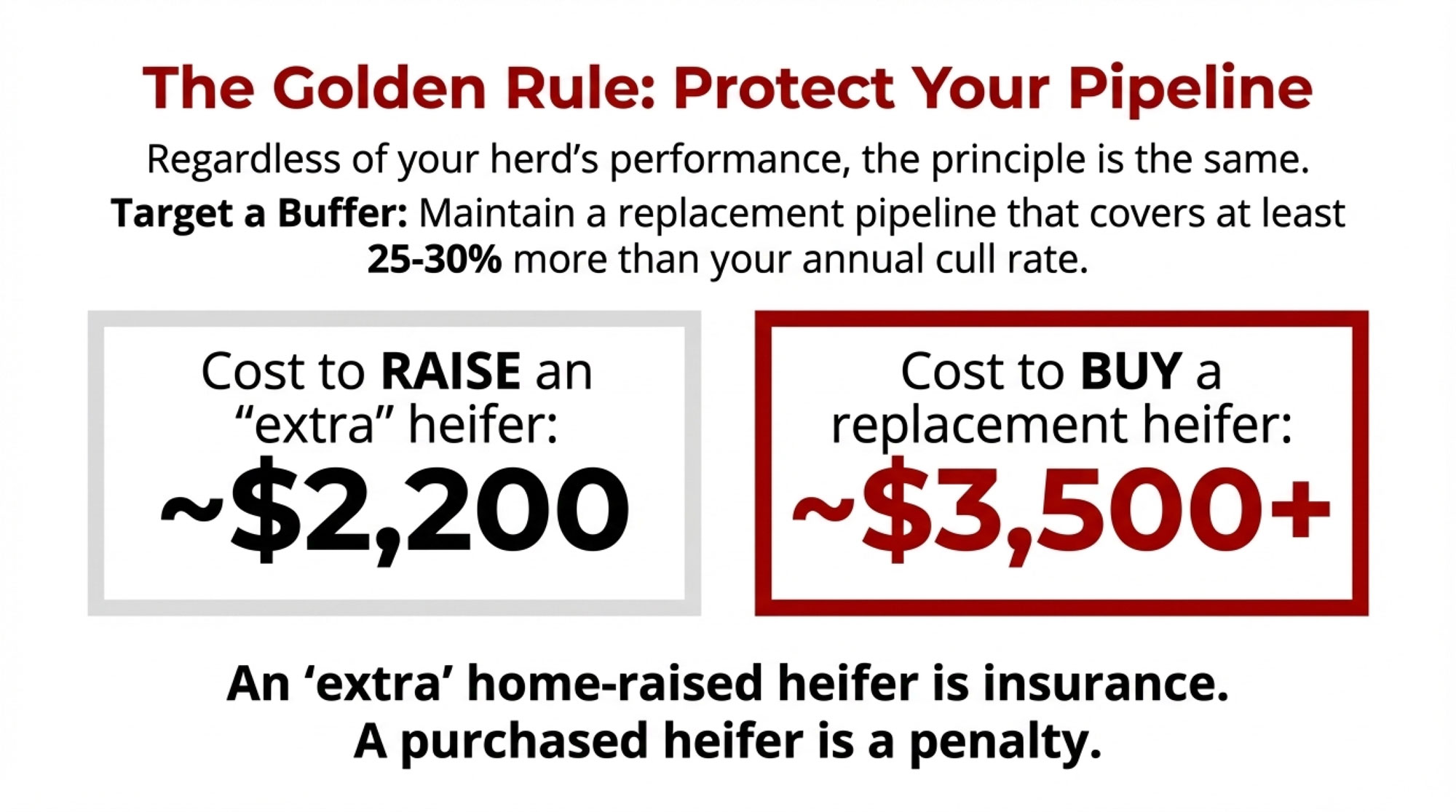
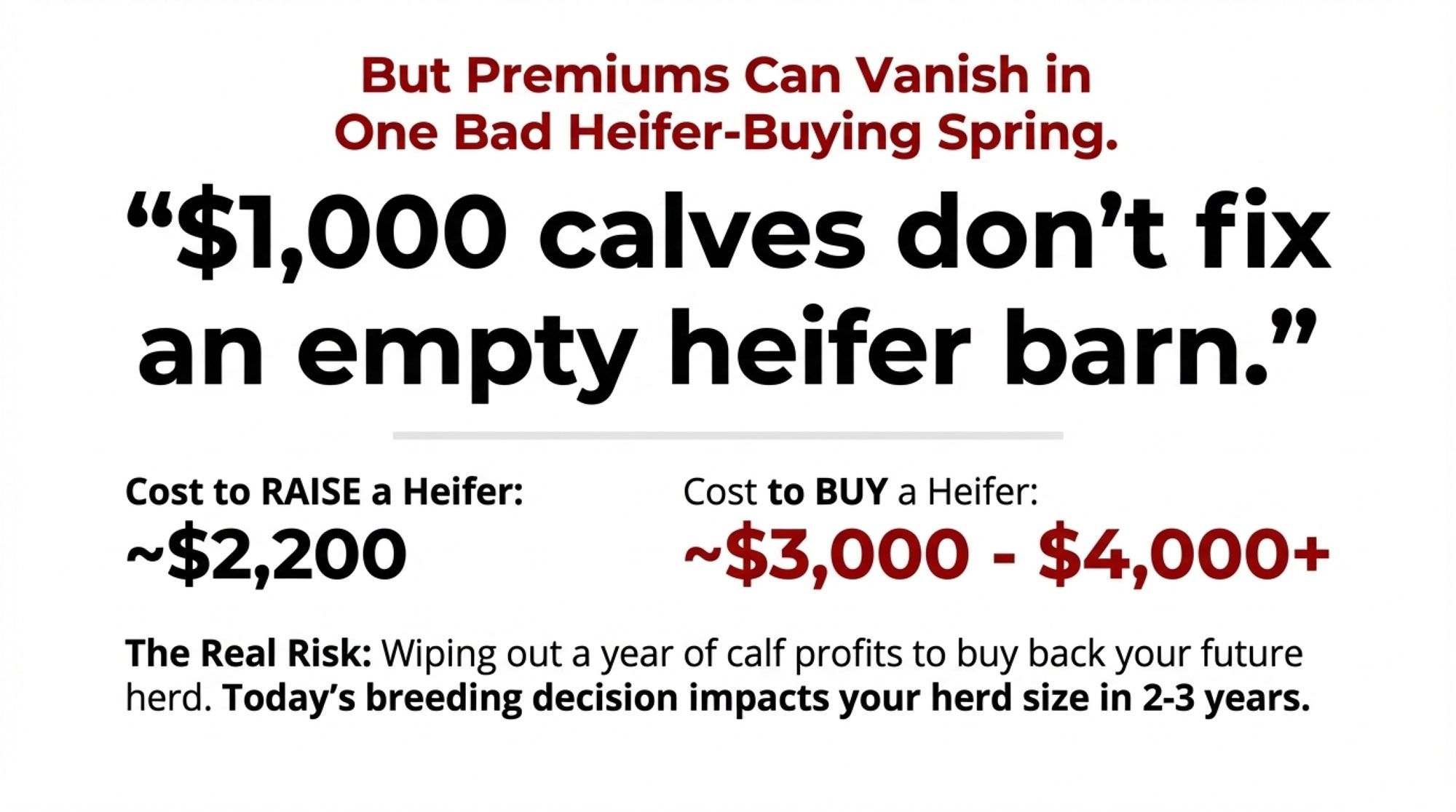
Here’s something clever that’s changing the entire breeding game—and I think more of us need to be talking about this. If you breed 20-25% more heifers than you need for replacements and sell the extras at these premium prices… well, as many of us have figured out, a 600-cow herd selling 30 surplus heifers at around $3,500 each? That’s roughly $100,000 in additional annual revenue. We’re talking about turning what most see as a constraint into a profit center.

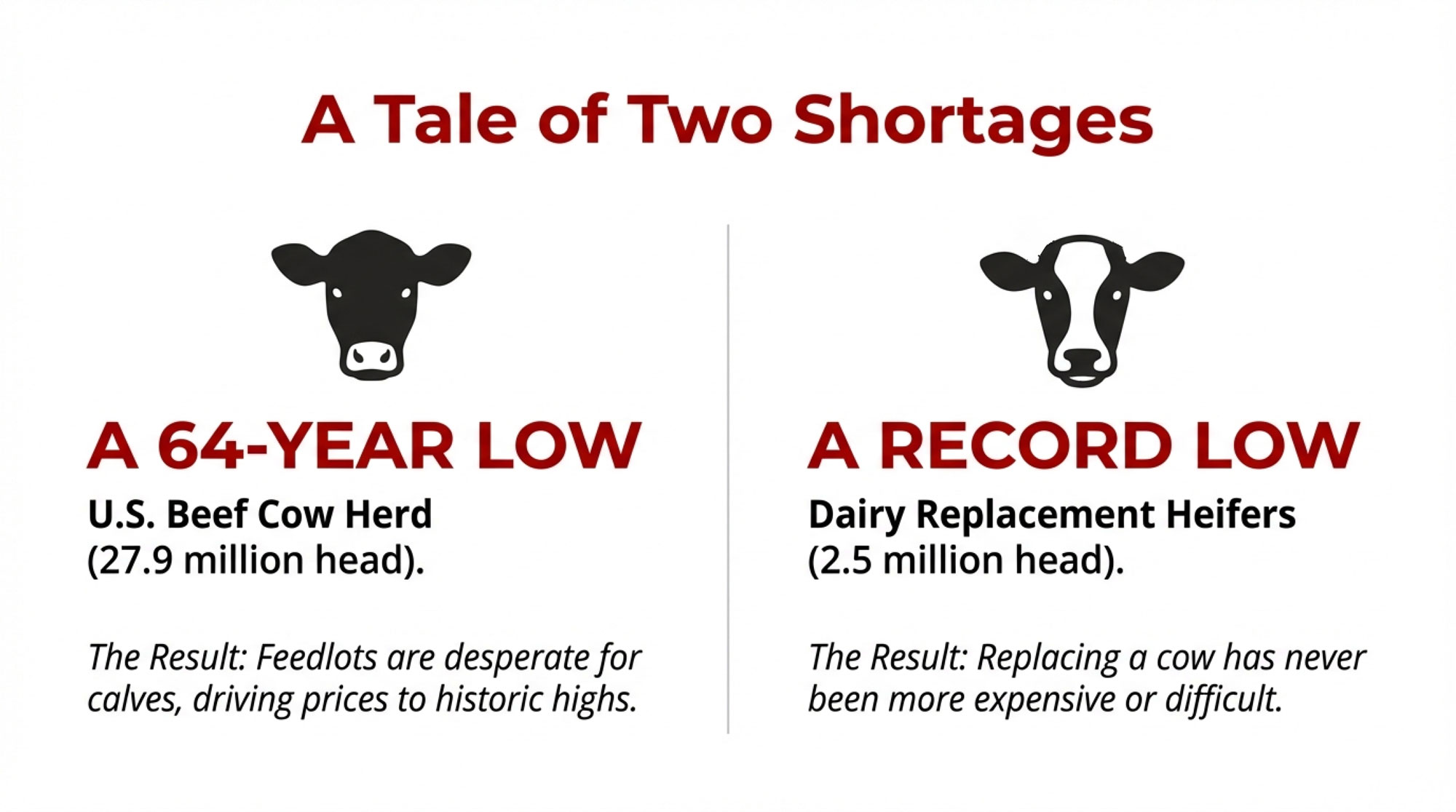
USDA’s January 2025 Cattle inventory report shows dairy heifer numbers at historically low levels—we haven’t seen this level since the late ’70s. All those years of breeding for beef-on-dairy when milk prices were tough? Well, now we’re seeing the consequences—or maybe the opportunities.

Recent auction reports from key dairy states show good springers regularly trading above $3,000 per head, with top groups occasionally pushing past $4,000 per head. I spoke with an extension specialist at the University of Florida who’s been tracking this closely. “The consistency of these high prices,” he said, “that’s what’s remarkable. We’re not seeing the usual seasonal dips.”

A lending specialist at CoBank pointed out something fascinating—and think about this—the shortage that prevents you from expanding also prevents your competition from growing. Operations that might have expanded to grab market share? They simply can’t get the heifers at prices that make sense. It’s creating this forced discipline in the market that we haven’t seen before.

Smart producers are figuring out different ways to optimize. Can’t solve problems through expansion anymore—that playbook’s out the window. Instead, you’ve got to improve within your existing footprint. Genetic selection becomes crucial when you can’t add cows. I’m seeing more genomic testing than ever before.

I recently heard from a 480-cow operation in central Wisconsin that made the switch to component-based optimization last spring. They’re seeing an extra $3,800 monthly just from butterfat premiums alone, even with slightly lower volume. “We’re producing less milk but making more money,” the owner told me. “That’s not something I thought I’d ever say.”

How Geography Trumps Management

You know, the old wisdom was that efficient operations outlast downturns. We’ve all believed that, right? But what I’m seeing now challenges that thinking in ways most of us haven’t fully grasped yet.

Federal Milk Marketing Order data from October 2025 shows some cheese-oriented regions getting roughly $1.00 to $1.50 more per hundredweight than powder-oriented areas. Think about that for a minute—if you’re running a thousand cows, that gap could mean $50,000 or more annually. That’s not something you can just manage your way around, no matter how good you are at what you do.

And the driver behind these gaps? It’s these massive processor investments we’re seeing. The International Dairy Foods Association’s October 2025 capital investment tracking report shows billions in new and expanded dairy processing projects—dozens of facilities either under construction or recently announced across multiple states through the rest of this decade.

The concentration is what gets me. Texas is seeing major cheese facilities go in, including that big Leprino project near Lubbock everyone’s talking about. New York’s seeing major expansions in yogurt and premium milk. Idaho’s getting more cheese capacity around Twin Falls with Glanbia’s expansion. Wisconsin continues to add to its cheese infrastructure, with multiple expansion projects underway. Even the California Central Valley, despite its challenges, is seeing selective investment in specialized products.

What dairy economists at universities like Cornell and Wisconsin are telling me is this creates something like “permanent regional advantage.” Makes sense when you think about it. If you’re near these new cheese plants, you’re capturing premiums. If you’re shipping to butter and powder? Those challenges compound every month.

The producers in growth states—places like Idaho and Texas, where this new capacity promises good premiums—they culled selectively in October to upgrade genetics. Smart move.

But in other regions? Southwest dairy operations dealing with water restrictions, or Southeast producers managing not just heat stress but increasingly volatile feed costs and limited local grain production—that culling represented something different. Those folks are reducing exposure to what’s becoming a tougher competitive environment.

Building Your Bridge Through What’s Coming

For operations trying to navigate current challenges while positioning for better times, I’ve been collecting strategies from extension folks and producers who are making it work. From Southeast dairy operations dealing with heat stress and feed availability challenges to Upper Midwest producers managing seasonal variations, to California Central Valley farms wrestling with water costs.

First thing—and this is crucial—you need to understand your true economics beyond just that all-milk price everyone talks about. Several dairy economists at land-grant universities keep emphasizing this, and they’re right. With current component premiums, if you’re optimizing for volume rather than components, you could be leaving tens of thousands annually on the table, even for a modest-sized herd.

Component optimization matters more than ever. With butterfat premiums running anywhere from 50 cents to over a dollar per hundredweight above base in some areas—especially Upper Midwest operations shipping to cheese plants—if you’re still focusing on volume over components, you’re leaving serious money on the table.

Here’s what’s gaining traction based on my conversations:

You need to secure working capital lines now, while your operation still looks stable to lenders. Several ag lenders, including Farm Credit Services and regional banks, are telling me they expect to become more cautious about new working capital over the next year or so. Some are even talking about focusing more on financing acquisitions and restructurings if margins stay tight. That window? It’s narrowing faster than most folks realize.

The Dairy Margin Coverage program makes sense, too. According to the USDA’s Risk Management Agency, October 2025 updates, depending on your coverage level and production history, premiums often run from a few dimes to maybe 70 cents per hundredweight. But that cash flow protection when margins get really tight? Could make all the difference between weathering the storm and… well, not.

And here’s something livestock economists at universities like Kentucky and Kansas State are watching—CME feeder cattle futures have pulled back sharply since mid-October. Producers who locked in their beef-on-dairy calf values earlier are feeling pretty good right now. Consider hedging at least half your production to protect what’s become crucial revenue.

What’s interesting is that the operations doing these things aren’t expecting prosperity if milk prices drop to the $14-16 range that the USDA’s World Agricultural Supply and Demand Estimates suggest for next year. They’re building resilience to stay independent through what could be a tough stretch before things improve.

The Technology Factor and Labor Reality

The technology piece matters here too—and it’s changing the labor equation dramatically. Robotic milking systems, which can cost $150,000-250,000 per stall, are becoming more feasible for larger operations that can spread those fixed costs.

But here’s what’s interesting: these systems aren’t just about milking efficiency. They’re addressing the chronic labor shortage that’s hitting dairy farms nationwide.

One Pennsylvania producer running four robots told me, “We went from needing six milkers to basically one herd manager. In a market where finding reliable labor costs $18-22 per hour plus benefits, that math changes everything.”

For mid-sized farms, though, the capital requirements are creating another pressure point that’s accelerating consolidation decisions. And for those sub-300 cow operations? The technology investment rarely pencils out unless you’re adding significant value through on-farm processing or direct marketing.

Why Processors Keep Building While We’re Struggling

This apparent contradiction—processors pouring billions into new capacity while we’re dealing with tight margins—it makes more sense when you look at the longer game they’re playing.

Several outlooks from groups like Rabobank’s Q3 2025 Global Dairy Quarterly point to some interesting dynamics. The International Dairy Federation’s World Dairy Situation report is talking about potential gaps between global supply and demand later in the decade if trends continue.

Recent trade data from USDA’s Foreign Agricultural Service shows Chinese imports of cheese and whole milk powder running well ahead of year-ago levels. Countries like Indonesia are expanding school milk programs that could add meaningful demand over the coming years. And with EU production constrained by environmental regulations, the U.S. is positioned well as a growth supplier.

Gregg Doud, who served as U.S. chief agricultural trade negotiator and now works with Aimpoint Research, explained it well at the recent World Dairy Expo: “Processors aren’t building for today’s prices. They’re looking at where they think we’ll be in 2028, 2030. The current downturn? It actually helps their positioning by limiting competitive expansion.”

What’s less visible—and this is based on industry analysis from groups like CoBank and what I’m hearing through the grapevine—is that a large share of new processing capacity appears to be already tied up in multi-year arrangements with larger farms. Contracts negotiated when prices were recovering in ’23 and ’24, locking in supply regardless of current spot conditions. It’s creating this two-tier market that not everyone fully grasps yet.

The Information Gap That’s Hurting Smaller Operations

One challenge I keep hearing about from mid-sized operations is what university economists call “information asymmetry.” Basically, larger farms dealing directly with processors often see market shifts months before that information reaches smaller producers through traditional channels.

This gap shows up in several ways. Larger operations often have earlier visibility into processor needs and plans. They might subscribe to proprietary research from firms like Terrain or StoneX, which costs tens of thousands of dollars annually. Meanwhile, smaller operations rely on cooperative communications that, honestly, can lag market realities by quite a bit.

A Pennsylvania producer managing 600 cows—a fifth-generation dairy farmer—put it to me straight: “We thought October’s price drop was temporary. We didn’t realize how much had already been decided about where the industry’s headed. By the time we understood, our lender was already getting cautious about new credit.”

The practical impact? By the time many producers recognize these fundamental shifts, the window for smart positioning has already narrowed considerably.

Regional Winners and What’s Creating Lasting Advantages

The geographic distribution of new processing investment is creating what analysts at CoBank call “permanent regional stratification.” Strong words, but they’re not wrong.

Looking at Federal Milk Marketing Order data from October 2025 and processor announcements, here’s who’s seeing sustained advantages:

Idaho’s Magic Valley continues to benefit from expansions in cheese infrastructure. USDA National Agricultural Statistics Service data shows Idaho among the fastest-growing milk states, with many operations reporting solid annual gains. The Texas Panhandle’s seeing competitive pricing from multiple cheese plants.

Kansas—and this surprised me—has emerged as a real growth story, with some of the strongest percentage gains in the country according to USDA data. Central New York’s premium milk and yogurt facilities are creating genuine competition for local supplies.

But then you’ve got regions facing structural challenges. The Pacific Northwest remains primarily powder-oriented with limited cheese processing. California’s Central Valley operations are dealing with both water costs and a commodity-focused product mix that limit pricing upside.

Southwest dairy producers face increasing water restrictions and rising costs for heat-stress management. Southeast operations are wrestling with not just heat stress but also limited local feed production and basis challenges that add $30-40 per ton to feed costs. The Upper Northeast faces geographic isolation that creates significant transportation penalties that can substantially erode margins.

The hard truth? And this is tough for many of us to accept—operational excellence can’t overcome a structural pricing gap of $1 or more per hundredweight by geography. That recognition is driving some of October’s herd adjustments.

Practical Steps Depending on Your Situation

Based on what’s emerging from October’s data and conversations with folks making it work, here’s what I’m seeing:

If You’re in a Growth Region:

Focus on genetic improvement within your existing herd rather than expansion. A Texas producer near one of the new cheese plants told me, “We’re genomic testing everything and being selective like never before.”

Work on developing direct processor relationships where possible. Several Idaho producers tell me they’re having success negotiating directly rather than relying only on their co-op. And consider partnerships with neighboring operations—achieve some scale advantages without individual expansion.

If You’re in a Challenged Region:

You need an honest evaluation of your long-term position given structural disadvantages. Run scenarios at different milk prices—$14, $16, $18—to really understand your breakevens. It’s sobering but necessary.

Look at diversification that reduces dependence on commodity pricing. I know Northeast producers are finding success with on-farm processing, agritourism—not for everyone, but worth considering. California Central Valley operations are exploring specialty milk products that command premiums despite the region’s challenges.

For those sub-300 cow operations, the math gets even tougher. But I’m seeing some find success through direct marketing, value-added products, or transitioning to organic, where premiums can offset scale disadvantages. Others are forming producer groups to share resources and negotiate collectively.

And assess whether relocating might work, though as one Wisconsin friend said, “The math on moving with current land and heifer prices? Brutal.”

Universal Strategies That Work:

Secure financial flexibility now while credit’s available. Every lender I’ve talked to expects standards to tighten over the next year.

Implement component-focused production aligned with how your processor actually pays. This means regular ration work, good DHI records.

And develop non-milk revenue streams. Despite some recent softening, beef-on-dairy remains profitable according to cattle market folks at the Chicago Mercantile Exchange. Every bit helps.

The Consolidation Already Underway

Let’s be honest about what’s happening here. Consolidation isn’t some future possibility—it’s here, right now. USDA’s 2022 Census of Agriculture shows dairy farm numbers in the mid-30,000s, and USDA Economic Research Service economists expect that to continue declining as the industry consolidates.

What’s driving this? ERS research consistently shows larger herds tend to have lower costs per hundredweight than smaller ones—often by several percentage points. Processors prefer fewer, larger suppliers to reduce complexity.

Technology adoption, especially robotic milking systems that can run $150,000-250,000 per stall, requires capital that favors bigger operations. The labor savings alone—reducing milking staff by 60-80% while addressing the chronic shortage of qualified dairy workers—makes automation almost mandatory for operations planning to survive long-term.

And the heifer shortage prevents smaller operations from achieving competitive scale, even if they wanted to.

Rather than viewing consolidation as failure—and this is important—many are recognizing it as evolution. As one university dairy economist at Wisconsin explained, “Operations that position strategically, whether through improvements, repositioning, or thoughtful exit timing, preserve more value than those forced into decisions.”

The Bottom Line

Several outlooks, including the Food and Agricultural Policy Research Institute’s baseline projections, suggest better price prospects later in the decade if global demand continues growing and herd size stays in check—though these are projections, not guarantees, as we all know.

Factors that could support recovery: The heifer shortage physically constrains expansion for a while. Global demand appears to be growing faster than supply, according to FAO data. Environmental regulations limit expansion in some major producing regions. And all this new processing capacity will need higher milk prices to generate returns.

But—and this matters—recovery probably won’t benefit everyone equally. Operations with secured processor relationships, geographic advantages, and superior genetics will likely capture premiums. Others might find that even recovered prices don’t fully offset their structural disadvantages.

What October’s Really Telling Us

After looking at the data and talking with folks across the industry, several lessons emerge pretty clearly.

Geography increasingly determines destiny. Those regional pricing gaps reflect structural realities that great management can’t overcome. If you’re in a disadvantaged region, that needs to factor into your planning—like it or not.

The heifer shortage creates both constraint and opportunity. Operations that optimize within their existing footprint while potentially monetizing excess production can turn the shortage to their advantage. Creative producers are making this work.

Information and relationships matter more than ever. Direct processor relationships and access to good market intelligence increasingly separate operations that thrive from those that struggle. Better information pays—literally.

Financial positioning can’t wait. Every lender emphasizes this—the window for securing working capital and risk management tools is months, not years. Wait until you need flexibility, and it might not be there.

Strategic positioning beats stubborn persistence. Whether improving for independence, positioning for acquisition on good terms, or planning an orderly exit, proactive decisions preserve more value than reactive ones. There’s no shame in strategic repositioning—it’s smart business.

We’ve weathered dramatic transitions before—from diversified farms to specialized operations, through technological changes and trade upheavals. This is another transition. What’s different is both the speed and the degree to which these advantages are becoming structural. Operations that recognize and adapt, rather than hope for a return to old patterns, are best positioned.

October’s strategic culling by forward-thinking producers shows something important: successful operations aren’t waiting for change to happen to them. They’re actively positioning for whatever comes next.

For those still evaluating, October’s message seems clear—the time for strategic decisions is now, while you’ve got options and can preserve value through thoughtful positioning.

The path forward won’t be identical for everyone—and that’s fine. But understanding the forces reshaping our industry helps inform decisions. In a world where change keeps accelerating, maybe the biggest risk is standing still.

For more specific information on programs mentioned, producers can check with their local USDA Service Center, university extension offices, or agricultural lenders.

KEY TAKEAWAYS 

  • Your zip code now outweighs your work ethic: Cheese regions earn $1.00-1.50/cwt more than powder areas—that’s $50,000+ annually, no amount of great management will ever close
  • The heifer shortage is now your profit center: Breeding 20-25% surplus heifers generates $100,000+ annually while locking competitors out of expansion at today’s prices
  • Your lender’s flexibility has an expiration date: Working capital windows slam shut by mid-2026—secure financing now, not when you desperately need it
  • This is a five-month decision, not a five-year plan: October’s culling data proves the reshuffling has begun—producers positioning now will be the ones still milking in 2027

Complete references and supporting documentation are available upon request by contacting the editorial team at editor@thebullvine.com.

Learn More:

Join the Revolution!

Join over 30,000 successful dairy professionals who rely on Bullvine Weekly for their competitive edge. Delivered directly to your inbox each week, our exclusive industry insights help you make smarter decisions while saving precious hours every week. Never miss critical updates on milk production trends, breakthrough technologies, and profit-boosting strategies that top producers are already implementing. Subscribe now to transform your dairy operation’s efficiency and profitability—your future success is just one click away.

NewsSubscribe
First
Last
Consent

The Real Reason Butterfat Hit 4.23% – And Why It Determines Which 14,000 Dairies Survive

Dairy’s biggest winners didn’t have better genetics. They had better timing. The $1.3M difference happened in 2009, not 2019.

Executive Summary: The U.S. dairy industry’s 30% component revolution wasn’t about genetic breakthroughs—it was about economics creating signals that genomics finally made actionable. When component pricing launched in 2000, the market screamed for higher butterfat, but producers lacked tools to respond until genomic testing arrived in 2009, tripling selection accuracy overnight. Early adopters who grasped this sequence and invested immediately captured $1.3 million in value, while “prudent” operations that waited until 2015 saved $130,000 but forfeited $190,000+. Today’s brutal reality: farms under 200 cows face a permanent $366,375 annual disadvantage versus 2,000-cow operations—a gap that compounds annually and can’t be overcome through better management. With only 35% of herds having basic infrastructure like DHI testing, and 2,800 operations exiting annually, the industry is splitting into two irreconcilable segments. The 2025-2027 window represents the last opportunity for strategic action: scale to 300+ cows with full technology adoption, pivot to premium markets, or exit with dignity while equity remains

You know, there’s something happening in dairy right now that most producers are getting backwards. According to USDA’s April 2025 Milk Production Report and CoBank’s March 2025 dairy analysis, butterfat production surged 30.2% and protein jumped 23.6% from 2011 to 2024, while milk volume grew just 15.9%.

Here’s what caught my attention: total milk production actually declined in both 2023 and 2024—the first back-to-back drop since the 1960s according to USDA National Agricultural Statistics Service—yet butterfat hit 4.23% nationally, shattering a 76-year-old record that stood since 1948.

Most folks I talk to at meetings believe genomic testing drove this transformation. They’re looking at it backwards, and once you understand the real sequence of events, it changes how you think about every breeding decision you’ll make this year.

The Component Revolution: Butterfat production exploded 30.2% from 2011-2024 while milk volume barely moved at 15.9%, proving the dairy industry fundamentally transformed from a volume game to a components game.

The Economic Signal That Started Everything

Looking back at the data from the Council on Dairy Cattle Breeding, the transformation didn’t actually begin with the 2009 launch of commercial genomic testing. It started in 2000 when Federal Milk Marketing Orders implemented multiple component pricing formulas, fundamentally changing how we all get paid.

The Math That Changed Everything

Suddenly, nearly 90% of milk check value came from butterfat and protein content, not volume. When butterfat trades at $3.20 per pound—which it has in recent Federal Order announcements—increasing your herd’s butterfat test by just 0.1% adds $3,200 to the value of every million pounds of milk you ship.

The market was essentially screaming at us to breed for components.

Yet according to USDA Economic Research Service dairy analysis, from 2000 to 2010, milk, butterfat, and protein production all grew at nearly identical rates—between 13.8% and 15.4%. Why the lag? Well, that’s where this story gets really instructive for anyone trying to understand today’s consolidation dynamics.

The Biological Speed Limits We All Faced

I’ve been digging through the research, and what Penn State’s Dr. Chad Dechow documented in his Holstein genetic diversity studies reveals why economics alone couldn’t drive immediate change.

Three Fundamental Constraints

Before genomic testing, we faced three fundamental constraints that no amount of economic incentive could overcome:

Terrible selection accuracy: Parent average predictions offered just 20-35% reliability, according to CDCB historical data. Young bulls? Maybe 40% reliability using pedigree indexes. You’d select a bull expecting +80 pounds of fat transmission, only to discover five years later when his daughters finally milked that he actually transmitted +20 pounds.

Glacial generation intervals: Research published by García-Ruiz and colleagues in PNAS (2016) showed the average generation interval stretched 5.5 years pre-genomics, with the sire-to-bull path taking 6.8 years. A breeding decision made in 2000 wouldn’t show population-level results until 2012 or 2013.

Limited technology adoption: University extension surveys from that era show only about 70-75% of U.S. dairy cows were being bred artificially with elite genetics in 2000. Synchronized breeding protocols? Just 10-15% adoption. Natural service bulls still covered 25-30% of breedings.

The 2009 Revolution

The Genomic Inflection Point: Butterfat percentages drifted slowly until 2009 when genomic testing tripled selection accuracy overnight—proving that economics alone couldn’t drive change until biology and technology caught up.

Then 2009 changed everything. According to USDA’s Animal Genomics and Improvement Laboratory, genomic testing tripled selection accuracy to 60-68% immediately at birth. Generation intervals compressed from 5.5 to 3.8 years.

By 2011, the first daughters of genomically-selected bulls entered milking strings nationwide. What we’re seeing now isn’t delayed response to pricing—it’s the first time biological and technological infrastructure existed to capitalize on incentives that had been present all along.

Quick Reference: Key Terms in Modern Dairy Breeding

Genomic Testing: DNA analysis that predicts an animal’s genetic potential at birth with 60-70% accuracy, versus 20-35% with traditional parent averages

Net Merit $: USDA’s economic index estimating lifetime profit potential of an animal’s genetics

DHI (Dairy Herd Improvement): Monthly milk testing program that tracks production, components, and somatic cell counts

Component Pricing: Payment system where farmers are paid based on pounds of butterfat and protein rather than milk volume

A Tale of Two Strategies: Early Adopters vs. Wait-and-See

The $1.3 Million Gap: Early adopters who invested in genomic testing at $45/test in 2009 captured $1.25M in value by 2019, while ‘prudent’ operations that waited for cheaper tests in 2015 actually lost money—proving timing beats perfection in rapidly evolving markets.

Let me share a scenario based on actual industry patterns I’ve tracked across multiple operations. Consider two typical 500-cow Wisconsin dairies, both aware of component pricing incentives. Their divergent paths from 2009-2019 illustrate exactly how timing created permanent competitive advantages.

The Early Adopter Strategy (2009-2011)

These producers made four decisions that their neighbors thought were reckless:

  1. Started genomic testing every heifer calf at birth through programs like Zoetis’s CLARIFIDE ($45-50 per test when everyone else was paying zero)
  2. Immediately culled the bottom 25% of genomically-tested calves—sold them at 2-4 months old
  3. Switched to 100% young genomic bulls averaging +$400-500 Net Merit
  4. Implemented Ovsynch protocols on 80% of the herd

Projected Results by 2016

Based on industry modeling:

  • Butterfat test: 4.15% (up from 3.78% baseline)
  • Protein test: 3.28% (up from 3.12%)
  • Component premium: Approximately $73,000 annually
  • Early culling savings: $105,000 annually
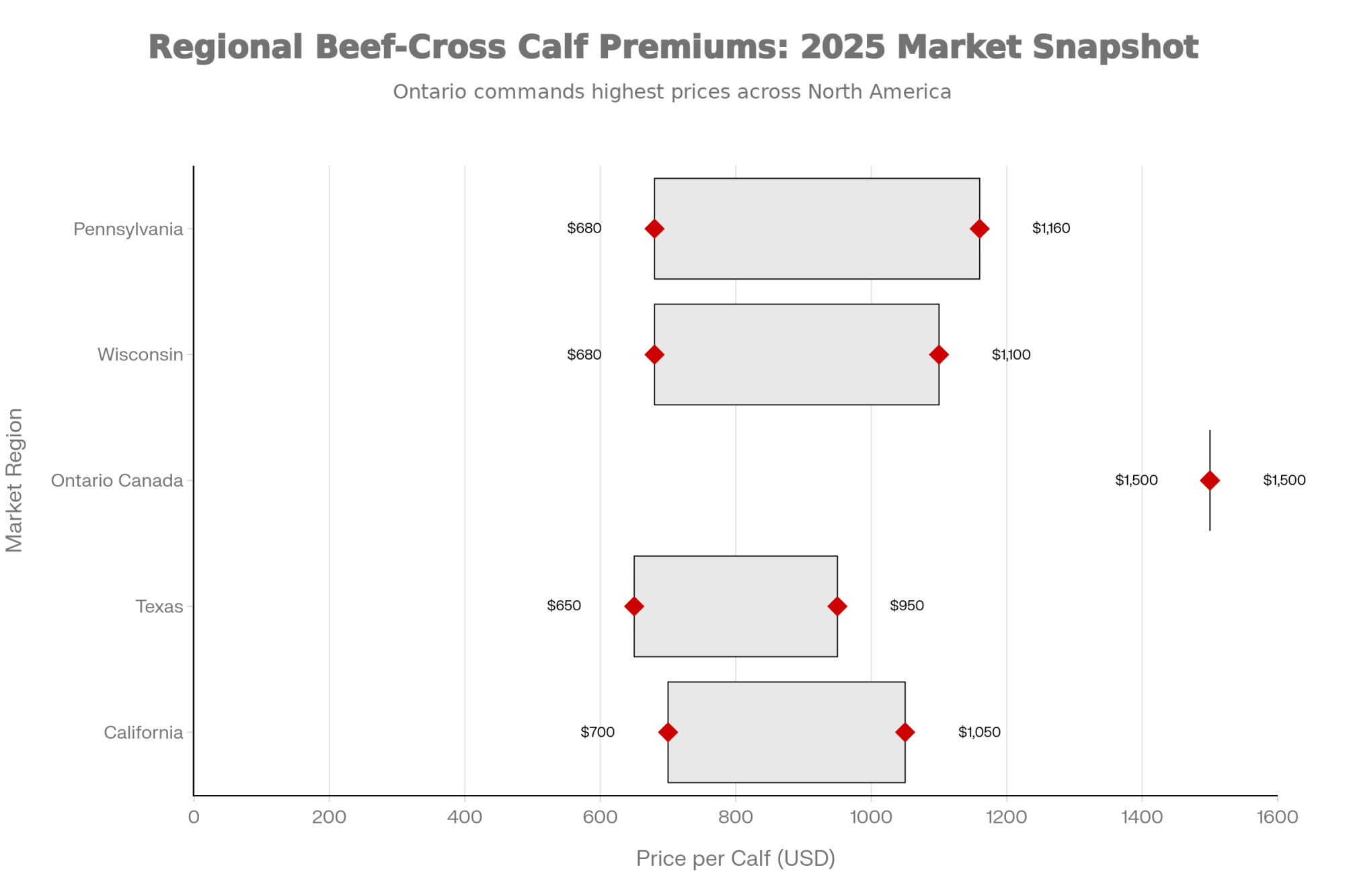
  • Beef-cross premiums: $30,000 annually

Total modeled value creation over 10 years: $1.2-1.3 million after testing costs

The Wait-and-See Approach

The “wait-and-see” operations held off until 2015-2016. By then, test costs had dropped to $28-35 and reliability had improved to 68%. Sounds prudent, right?

Industry modeling suggests otherwise. While these operations saved approximately $130,000 in testing expenses from 2009-2015, they forfeited an estimated $190,000+ in component premiums during just 2016-2019.

The Infrastructure Reality Nobody Talks About

Here’s what determines whether genomic strategies actually work, and I learned this the hard way watching operations try to implement these programs: it’s infrastructure, not genetics.

Current Infrastructure Gaps

According to CDCB data from 2024, here’s where we actually stand:

  • DHI testing participation: Just 35% of herds
  • Computerized records: Industry surveys estimate 40-50% of sub-200-cow herds still use paper breeding sheets
  • Activity monitoring: Adoption remains below 30% in smaller operations
  • Reliable internet: Still a major barrier across rural areas

The Six Essential Components

The pattern I keep seeing is that genomic strategies need all six infrastructure components working together:

  1. DHI testing
  2. Herd management software (DairyComp, PCDart, or similar)
  3. Genomic testing capability
  4. Synchronized breeding protocols
  5. Disciplined record-keeping culture
  6. Reliable internet for data integration

My rough estimate? Maybe 15-20% of U.S. dairy operations have all pieces in place.

The Cruel Paradox of Efficiency

This creates what economists call a cruel paradox. Operations that most desperately need efficiency gains—those under 200 cows facing what Rabobank’s October 2024 Dairy Quarterly described as “-$2/cwt to +$2/cwt margins”—can least afford the $50,000-70,000 infrastructure investment required over five years.

Meanwhile, operations with 2,000+ cows generating $1-4 million annual profits can fund infrastructure improvements from cash flow every single year.

By The Numbers: The 2025 Dairy Reality

Consolidation Metrics:

  • 35% of U.S. dairy herds participate in DHI testing (CDCB, 2024)
  • 2,800 dairy operations projected to exit annually through 2030 (Rabobank October 2024 Dairy Quarterly)
  • $9.77/cwt cost disadvantage for 100-199 cow operations versus 2,000+ cow operations
  • 65% of U.S. milk now comes from operations with 1,000+ cows (2022 Agricultural Census)

Genetic Revolution Impact:

  • 30.2% increase in butterfat production (2011-2024)
  • 23.6% increase in protein production (2011-2024)
  • $1.2-1.3 million modeled advantage for early genomic adopters
The Extinction Timeline: Small dairy farms under 200 cows are disappearing at catastrophic rates—26,369 operations lost from 2017-2022 alone. By 2030, only 14,000-16,000 total dairies will remain, ending a century-long tradition of family-scale dairy farming.

The Consolidation Reality: Different Strokes for Different Regions

The Cost Gap That Can’t Be Overcome

According to USDA cost of production analysis:

  • Farms with 2,000+ cows: $23.06/cwt
  • Farms with 100-199 cows: $32.83/cwt
  • Permanent disadvantage: $9.77/cwt
The Unmanageable Gap: Small operations face $9.77/cwt higher production costs than mega-dairies—a $366,375 annual disadvantage for a 150-cow farm that compounds every year and can’t be overcome through better management or harder work.

For a 150-cow operation in Wisconsin producing 3.75 million pounds annually, that calculates to a $366,375 annual profit gap.

Regional Variations

In California’s Central Valley where land costs are astronomical, even 500-cow operations struggle with similar economics. Meanwhile, operations in South Dakota with lower land and labor costs can remain viable at 300-400 cows, according to South Dakota State University Extension analysis.

“We can’t compete on volume, but when you’re shipping 4.3% fat and 3.4% protein, the processors come looking for you.” — Texas dairy producer focusing on component premiums

The Stark Census Reality

What the 2022 Agricultural Census revealed:

  • 2017: 54,599 licensed dairy operations
  • 2022: 24,082 operations (56% decline in 5 years)
  • 2025 projection: approximately 22,000 operations
  • 2030 projection: 14,000-16,000 operations

Farms under 200 cows lost 26,369 operations from 2017-2022, while farms over 1,000 cows actually added 400. The industry isn’t just consolidating—it’s splitting into two completely different businesses.

How Processors Are Shaping This Transformation

According to CoBank’s dairy quarterly analysis, over $8 billion in new processing capacity is coming online through 2027, with 80% focused on cheese, butter, and protein ingredients—all products where yields depend entirely on component levels.

“We’re not building plants to handle more gallons. We’re investing in infrastructure designed to maximize value from higher butterfat and protein concentrations. A producer shipping 3.8% fat milk versus 4.2% fat milk? That’s a massive difference in our cheese yields.” — Procurement manager from major cheese company

This processor demand feeds right back into the pricing formulas, creating even stronger economic signals for component production.

The 2025 Decision Point: Why This Year Matters

Demographic Reality

Looking at demographic data from Wisconsin’s Center for Dairy Profitability surveys:

  • 22% of farms under 100 cows plan to exit within five years
  • 70% have no identified successor

This isn’t really about economics anymore—it’s demographics. Baby Boomer retirements are accelerating regardless of milk prices.

Current Conditions Favor Strategic Decisions

According to USDA’s Dairy Margin Coverage Program data:

  • Profit margins hit $13.14/cwt in Q3 2024—historical highs
  • All-Milk prices averaging $22-25/cwt
  • Land values remain elevated from 2021-2022 boom
  • Buyer demand still exists from expanding operations

But By 2028-2030, Everything Changes

With 2,400-2,800 annual closures projected by Rabobank’s October 2024 analysis:

  • Markets flooded with used equipment and facilities
  • Buyer pool shrinks to just mega-operations
  • Equipment values likely collapse from oversupply

Two Paths That Actually Work

Path 1: The Optimized Mid-Scale Model (300-600 cows)

Economic analysis from New Zealand’s dairy sector shows their national herd size stabilized around 450 cows—not by accident, but because that’s where per-cow profitability peaks.

Operations at this scale with full technology adoption can achieve:

  • Superior milk quality (SCC averaging 161,000 versus 200,000+)
  • 15-25% higher profit per kilogram of milk solids
  • Manageable labor requirements with family involvement
  • Financial sustainability without extreme debt leverage

Required commitment: $50,000-70,000 annual technology investment for at least five years.

Path 2: Premium Niche Markets

Market reports indicate direct-to-consumer operations in premium markets can achieve $40-50/cwt, though this requires:

  • Complete pivot from commodity production
  • Serious marketing capabilities
  • Certification costs
  • Geographic proximity to affluent consumers

Success Story: How Minnesota Dairies Made the Transition

Here’s a composite example based on three similar operations I’ve worked with in central Minnesota between 2009-2015 (details combined for privacy).

The Implementation Phase

These producers were milking around 280 cows when genomic testing launched in 2009, barely breaking even at $14/cwt milk prices.

“Yeah, we almost didn’t do it. Forty-five dollars per calf for testing seemed crazy. But our nutritionist ran the numbers on what we were losing by raising the wrong heifers.”

They started testing in spring 2010, immediately culled their bottom 20% of heifers, and switched to all genomic young sires.

“I remember standing at the sale barn. Other farmers were buying our culled heifers thinking they got a bargain. Meanwhile, we kept the ones genomics said would actually make us money.”

The Results

By 2015, their first genomically-selected heifers entered the milking string:

  • Components jumped: 3.75% to 4.05% fat; 3.08% to 3.22% protein
  • Premium increased: $3-4/cwt more than neighbors
  • Expansion enabled: Grew to 400 cows, upgraded parlor

Total investment (2010-2020): $350,000-400,000 Documented returns: Over $1 million

Making the Decision: Your Three Critical Questions

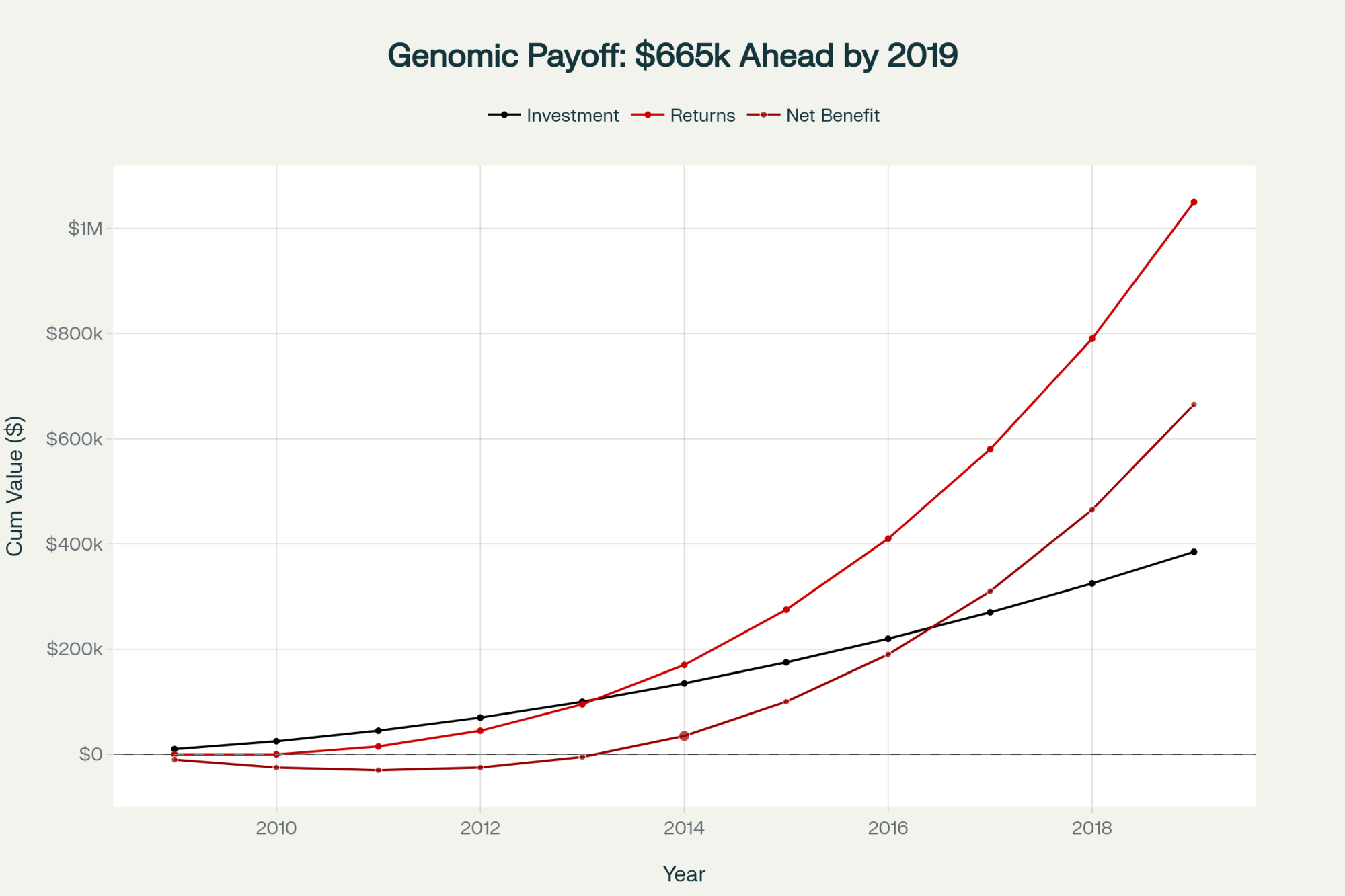
The Five-Year Breakeven: Early genomic adopters invested $385K over a decade but captured $1.05M in returns, breaking even around year 5 and pulling $665K ahead by 2019—while late adopters were still debating whether to start.

After working with hundreds of operations facing these decisions, here are the three questions that cut through all the noise:

1. Do you have a committed successor currently working on the operation?

And I mean actually working, not just “interested” or “might come back after college.”

2. Can you invest $50,000-70,000 annually for five years without jeopardizing family finances?

This isn’t about having the cash—it’s about having it without risking your kids’ college funds, your health insurance, or your retirement security.

3. Are you genuinely willing to scale to 300+ cows or pivot to premium markets?

The economics are clear—conventional production under 300 cows faces structural disadvantages that compound annually.

If you answered yes to all three: The path forward requires immediate, aggressive investment in infrastructure and genetics. The documented returns prove the strategy works when fully implemented.

If you answered no to any question: Consider that selling in 2025-2026 with $500,000-$1,000,000 in equity beats farming until 2030 at annual losses, then being forced to liquidate with minimal equity.

These aren’t just business decisions. They’re deeply personal choices about family legacy and identity. There’s honor in building a successful operation that can compete. There’s equal honor in recognizing when it’s time to capture your equity and move forward.

The Bottom Line

Economics drives genetics, not the other way around. Component pricing created incentives in 2000. Genomic testing in 2009 just gave us tools to capitalize efficiently.

Infrastructure determines execution. Operations genomic testing without DHI data, herd software, and systematic records are like buying a Ferrari without roads.

Timing beats perfection. Early adopters who paid $45 per test with 61% reliability captured significantly more value than those who waited for $28 tests with 68% reliability.

Compound advantages are permanent. The three-generation genetic lead early adopters built from 2009-2019 can’t be overcome.

The 30.2% butterfat increase and 23.6% protein increase from 2011-2024 represent what happens when economic signals, biological capabilities, and technological infrastructure finally align. For the roughly 22,000 operations under 200 cows remaining in 2025, the question isn’t whether to adopt genomic testing—it’s whether they have the infrastructure, capital, and succession plan to compete.

The operations thriving in 2030 won’t necessarily be those with the best cows or the hardest-working families. They’ll be those who made clear-eyed infrastructure investments in 2025 based on economic reality rather than tradition.

As a dairy farmer once told me: “The cows don’t know if you’re milking 50 or 5,000. But the economics sure do.”

Key Takeaways 

  • Economics drove genetics, not vice versa: Component pricing created the signal in 2000; genomics provided the tools in 2009. Winners understood the sequence—losers still don’t.
  • The $1.3M early adopter advantage is permanent: Paying $45/test in 2009 beat waiting for $28 tests in 2015. In rapidly evolving markets, timing beats perfection every time.
  • Infrastructure trumps genetics: Only 35% of herds have DHI testing. Without data infrastructure, genomic testing is like buying a Ferrari without roads.
  • The $366,375 gap can’t be managed away: Operations under 200 cows face structural, not operational, disadvantages. Excellence can’t overcome economics.
  • Your 2025 reality check: You need a successor AND $50K annual investment capacity AND willingness to scale/pivot. Missing any one = exit strategy, not growth strategy.

Complete references and supporting documentation are available upon request by contacting the editorial team at editor@thebullvine.com.

Learn More:

Join the Revolution!

Join over 30,000 successful dairy professionals who rely on Bullvine Weekly for their competitive edge. Delivered directly to your inbox each week, our exclusive industry insights help you make smarter decisions while saving precious hours every week. Never miss critical updates on milk production trends, breakthrough technologies, and profit-boosting strategies that top producers are already implementing. Subscribe now to transform your dairy operation’s efficiency and profitability—your future success is just one click away.

NewsSubscribe
First
Last
Consent

CME Daily Dairy Market Report for August 13, 2025: Butter Takes a Hit, But Powders Fight Back

Butter slides $2.50/lb – your August Class IV check takes a punch while whey rally keeps Class III hopes alive.

EXECUTIVE SUMMARY: Look, I’ve been watching today’s market action, and here’s what really jumped out at me. Most producers are still thinking backwards – chasing milk price rallies instead of locking in the feed cost savings that just landed in their lap. That 61¢ corn drop translates to real money when your milk-to-feed ratio hits 4.67, but here’s the kicker – operations running precision genomic testing are seeing 2-3% higher yields while cutting feed costs by $470 per cow annually. With replacement heifers hitting $3,000+ in premium markets and beef-on-dairy breeding crushing the replacement pipeline, you can’t afford to guess on genetics anymore. The European competition is eating our lunch on powder exports, but smart U.S. producers are using this market disruption to invest in feed efficiency and genetic improvements that compound annually. Trust me, while everyone else is watching butter prices swing, the profitable operations are building permanent competitive advantages through genomic selection and feed optimization that’ll matter long after today’s volatility fades.

KEY TAKEAWAYS

  • Lock in feed savings immediately – The 61¢ corn crash saves roughly $85-$ 120 per cow for fall feeding, but only if you forward contract now at these levels. Start tracking your milk-to-feed ratio weekly and target that 1.4 pounds of milk per pound of feed that top herds achieve.
  • Implement genomic testing for replacement decisions – At $35 per head, genomic testing identifies low-merit heifers before you waste $1,400-2,000 in feed costs raising them. Focus on feed efficiency and component traits, not just production volume, in this volatile 2025 market environment.
  • Capitalize on precision feeding technology – Systems delivering 40-50¢ daily savings per cow while boosting yields 3-5% pay for themselves quickly when feed represents 50-60% of your variable costs. Begin with TMR analysis if you’re running operations with 200+ heads.
  • Protect against Class IV weakness with strategic hedging – Today’s 2.5¢ butter drop signals potential $0.80-1.20 per cwt reduction in August milk checks. Consider put options or DRP for Q4 production while butter prices remain under pressure from seasonal demand fade.
  • Focus on permanent genetic improvements over temporary price gains. While markets fluctuate daily, genetic progress compounds annually. Herds testing 75-100% of heifers show $50,000+ higher annual profits than those testing under 25%, creating sustainable competitive advantages regardless of commodity volatility.
dairy farm profitability, genomic testing dairy, dairy feed efficiency, dairy market report, herd management strategies

know how some days the market just can’t make up its mind? Well, today was one of those days that’ll have you scratching your head while simultaneously reaching for your calculator. Butter took an absolute beating – we’re talking a 2.5¢ nosedive that basically erased a week’s worth of gains in one session. But here’s where it gets interesting… dry whey went completely the other direction, rallying 2.75¢, as if someone had just discovered a new use for the stuff.

The thing is, this isn’t just noise. That butter drop is going straight to your Class IV check – we’re probably looking at $0.80 to $1.20 less per hundredweight for that portion of your August milk payment. Meanwhile, the whey rally is single-handedly keeping your Class III calculation from falling apart. And then corn… man, corn just had one of those days you don’t see very often, crashing 61¢ like someone suddenly found a billion bushels hiding in a barn somewhere.

Today’s Price Action – The Numbers That Matter to Your Operation

ProductPriceToday’s MoveWeekly TrendWhat This Really Means
Cheese Blocks$1.8800/lbFlat+3.4%Processors comfortable with inventory levels – steady as she goes
Cheese Barrels$1.8600/lbFlat+4.2%That 2¢ spread to blocks? Classic balanced market signal
Butter$2.2800/lb-2.50¢-5.7%Your Class IV headache right here – summer demand fade is hitting hard
NDM Grade A$1.2650/lb+1.50¢-0.9%Trying to help, but still priced out of too many export markets
Dry Whey$0.6125/lb+2.75¢+8.6%The hero of the day – Southeast Asia can’t get enough of this stuff

Feed Costs Just Threw You a Curveball (A Good One, Finally)

This corn move today… I mean, when’s the last time you saw a 61¢ drop in one session? That takes corn down to $3.73/bu for September delivery, which is the kind of relief your feed budget’s been praying for.

Here’s your new reality:

  • Corn (Sep): $3.7275/bu (down 61¢) – biggest single-day drop in months
  • Soybean Meal (Sep): $286.90/ton (up $5.60) – protein costs still climbing the wall
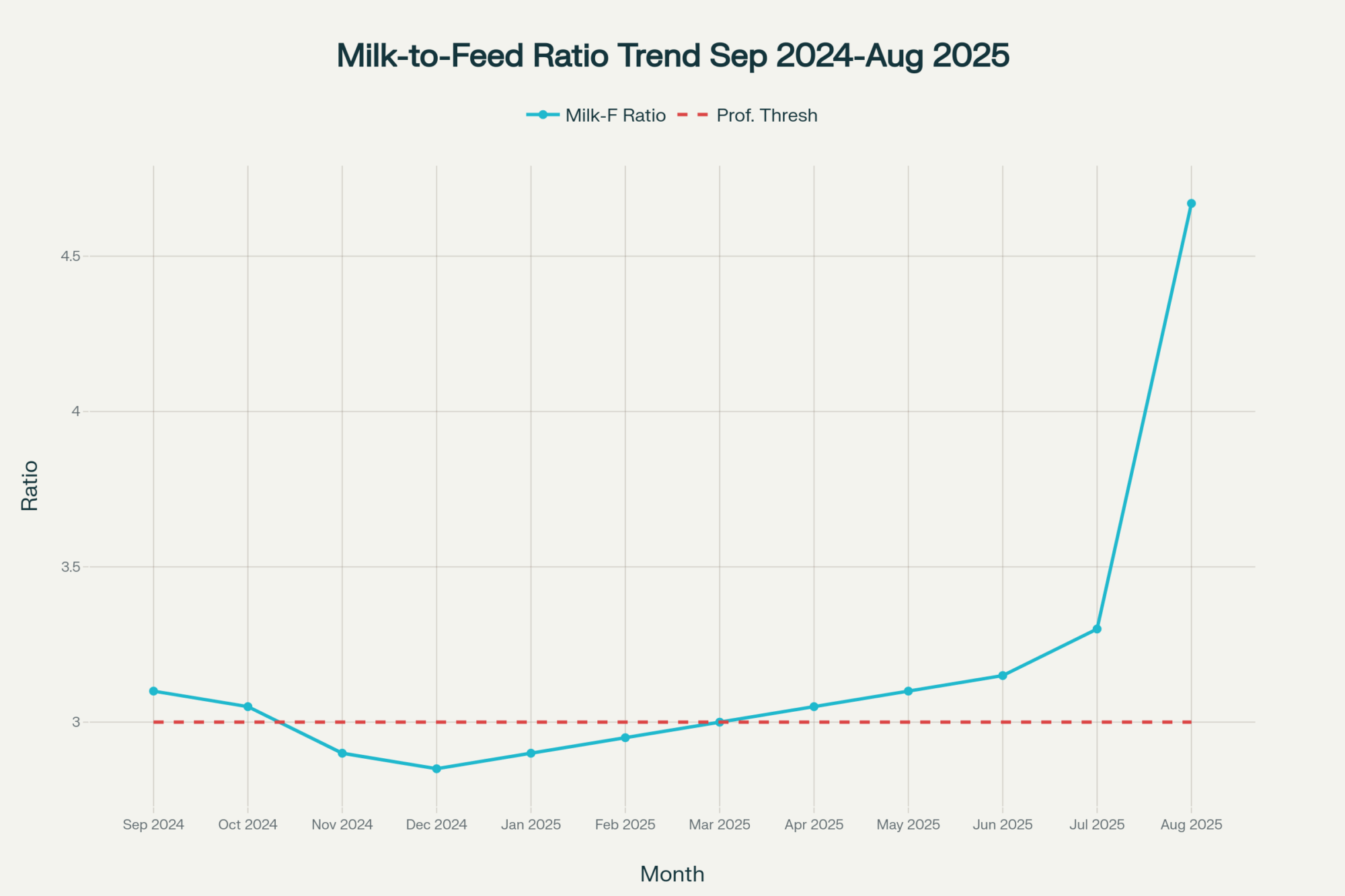
  • Current Milk-to-Feed Ratio: 4.67 (well into profitable territory above the 3.0 line). What’s fascinating is how this creates a weird split in your feed costs. Energy has become cheap quickly, but protein remains expensive as ever. If you’re in the Midwest with decent access to local corn, you’re probably feeling pretty good right now. But those of you dealing with freight costs out West? You’re seeing some of the benefit, just not all of it.

Another thing worth noting – and this is something I’ve been watching for months – is the increasing volatility of these feed ingredient relationships. It used to be that corn and beans moved together more often than not. Now? They’re doing their own thing, which makes feed planning… well, let’s just say it keeps you on your toes.

Trading Floor Drama (Or Lack Thereof)

So here’s what was really happening in the pits today… The butter action was legit – 14 loads traded hands with that 2.5¢ slide, which tells you real money was making real decisions about where they think prices should be headed. That’s not some thin market phantom move; that’s fundamental repricing happening in real time.

But the cheese market? Dead as a doornail. One block trade. Zero barrels. That’s not traders being lazy – that’s everyone sitting on their hands waiting for someone else to show their cards first.

What the volume told us: Butter’s 14-load volume confirms this wasn’t just some computer algorithm having a bad day. Serious money changed hands, and they were selling into strength. The cheese market’s virtual silence means today’s flat prices don’t mean much either way.

Technical levels that matter: Butter support’s sitting right around $2.25 now. Break that, and we could see another leg down pretty quickly. For cheese, that $1.85 floor has been holding for weeks and still looks solid.

The bid-ask spread story: In butter, seeing 14 bids against 10 offers at the close suggests some smart money was stepping in at lower levels. It’s possible that we won’t fall much further, at least not immediately. In cheese, that single bid-offer situation screams thin liquidity – classic setup for a big move once someone decides which direction they want to go.

The Bigger Picture – Global Competition Reality Check

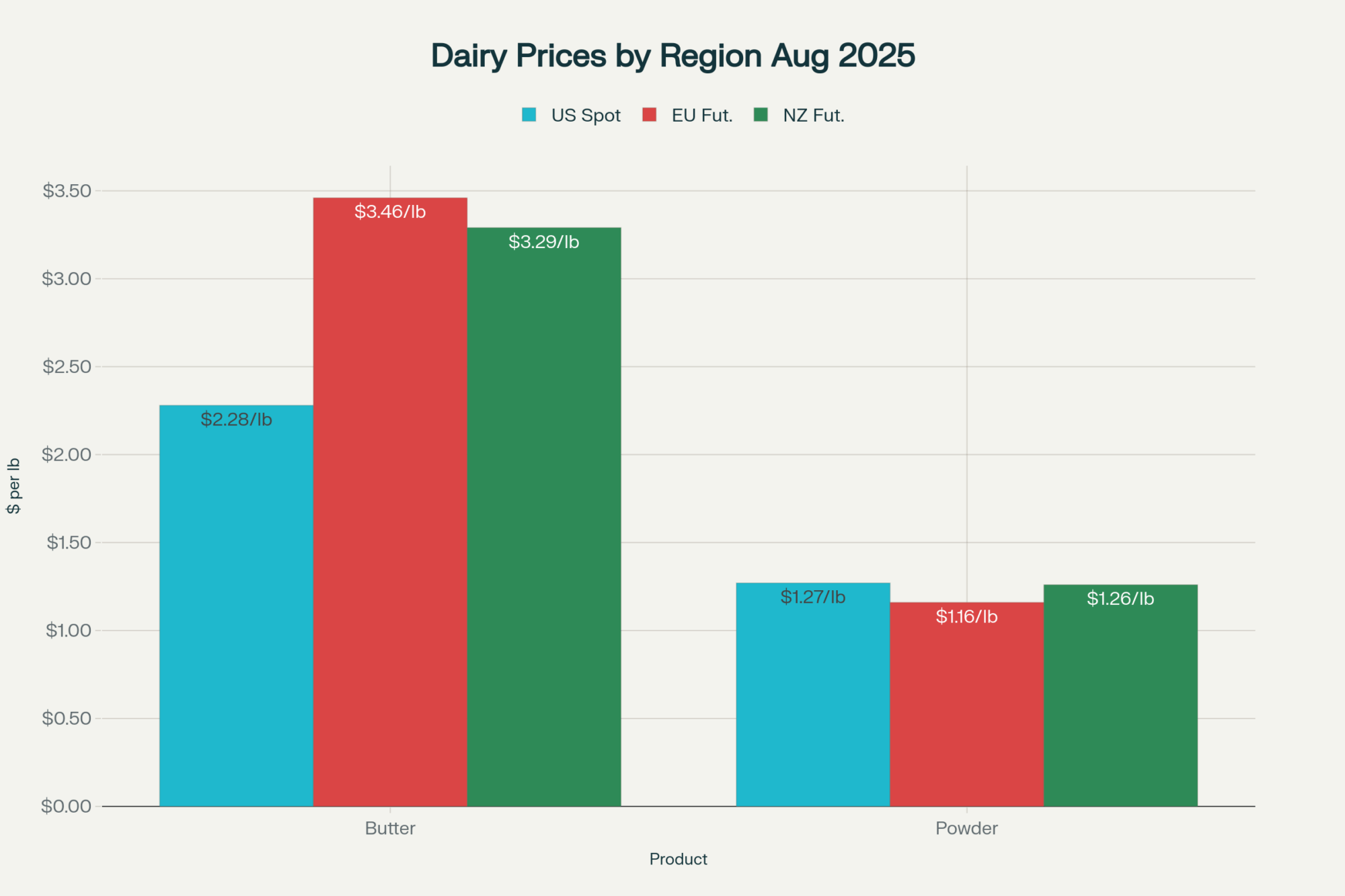
Do you want to know where we stand compared to the competition? Here’s the real deal, converting everything to apples-to-apples dollar pricing (using €1.08/$ exchange rate):

ProductU.S. SpotEU Futures (Aug)NZ Futures (Aug)What This Means
Butter$2.28/lb~$3.46/lb~$3.29/lbWe’re practically giving it away – export opportunity
Powder$1.265/lb~$1.16/lb~$1.26/lbGetting schooled by Europe, matched by New Zealand

The story these numbers tell is pretty clear if you’ve been watching export trends. The world wants our butter – we’re more than a dollar per pound cheaper than everyone else. But powder? We’re losing our lunch to European competition, and that’s been evident in disappointing export volumes for months.

This competitive dynamic also explains a significant portion of today’s price action. That butter weakness might actually help our export competitiveness, despite sounding strange. And the powder strength? Well, it’s nice, but it’s pricing us further out of global markets.

Production & Supply – What’s Really Happening Out There

We’re deep in summer heat stress season, and it’s showing up exactly where you’d expect. California’s Central Valley, Texas, and Wisconsin’s southern counties – all dealing with the usual August production challenges. However, what’s interesting about the current supply picture is…

According to the latest USDA data, the national dairy herd’s holding steady at about 9.47 million head, which is actually up slightly from earlier in the year. Culling rates are running about 2% of the herd – pretty normal for this time of year. What’s really wild, though, is what’s happening with replacement heifers.

Get this – heifer inventories are at the lowest levels since 1978. I mean, 1978! That’s pushing replacement costs through the roof. USDA’s reporting average prices around $2,660 per head nationally, but if you’re shopping for quality animals in California or Minnesota, you’re looking at $3,000-plus easily.

The beef-on-dairy breeding trend is absolutely crushing the replacement market. Producers are getting $200/cwt for live cattle and breeding half their herd to beef bulls. Smart from a cash flow standpoint, but it’s creating this massive bottleneck in the replacement pipeline.

What’s Really Moving These Markets

The domestic demand story is pretty straightforward – butter’s following its seasonal script. The summer grilling season’s winding down, and retail promotions are pulling back, which is showing up directly in spot prices. Food service cheese demand remains the bedrock of the market – steady and reliable, but not growing fast enough to drive prices higher on its own.

Export markets are where the real drama is. Mexico consistently ranks as our most reliable customer. They’re savvy buyers who time their purchases well, often stepping in when others are selling.

But Southeast Asia? That’s become the story for whey. The demand from that region has been absolutely relentless – feed applications and food uses; they can’t get enough. Today’s 2.75¢ rally reflects just how hungry they are for our product, and it’s becoming a genuinely important price driver for the whole whey complex.

The concerning part is our powder pricing in global markets. Europeans are consistently undercutting us, and until we become more competitive, we will continue to lose market share. That’s a strategic issue that extends beyond daily price fluctuations.

Historical Context – Where Today Fits

This August 13th action sits right in the normal seasonal range, but the volatility’s definitely running above average. What strikes me most is the divergence between fat and protein markets – we’re seeing increasingly complex global trade dynamics affect different dairy components in completely different ways.

The correlation breakdowns between products are creating opportunities for savvy marketers, but they’re also making traditional hedging strategies more complicated. Once, you could pretty much predict how cheese and butter would move relative to each other. Not so much anymore.

Looking Ahead & Taking Action

Futures market guidance:

  • Class III (Aug): $17.40/cwt
  • Class III (Sep): $17.21/cwt
  • Class IV (Aug): $18.54/cwt
  • Class IV (Sep): $18.66/cwt

The curve’s telling us to expect a bumpy sideways ride for Class III, with perhaps some improvement into the fall, while Class IV faces near-term pressure from today’s butter slide.

Here’s what’s interesting about the volatility picture – the options market’s pricing in about 15% more uncertainty than we typically see this time of year. The 90-day historical volatility for Class III is running significantly above seasonal norms. Put options are more expensive, but given these mixed signals, they might be worth considering for Q4 production.

Seasonal probability analysis based on the last five years suggests that we have about a 65% chance of seeing Class III prices improve by $0.50-$1.00 from current levels by October. But (and this is important) that’s assuming normal seasonal tightening patterns, and this year’s been anything but normal.

Correlation analysis shows that the usual relationships between products are breaking down. Historically, cheese and butter moved together about 70% of the time. This year? It’s more like 45%. That creates both opportunities and challenges for risk management.

Regional Market Deep Dive – Upper Midwest Focus

Let’s talk about what’s happening in Wisconsin and Minnesota specifically, because this region’s dealing with some unique dynamics right now.

Regional production patterns: Despite the heat stress episodes, milk production has been holding up reasonably well, thanks to improved cooling systems and better heat stress management. The local basis to national prices has been running tighter than usual as processing plants operate at full capacity.

Feed cost advantages: Today’s corn crash is particularly beneficial here, given the proximity to growing regions. Local basis for corn is typically $0.10-$0.15 under futures, so producers are seeing the full benefit of that 61¢ drop.

Processing dynamics: The numerous specialty cheese plants throughout Wisconsin and Minnesota are especially benefiting from whey strength. These facilities often generate significant whey volumes relative to cheese output, so that a 2.75¢ rally adds meaningful revenue beyond just the cheese pricing.

Transportation factors: Regional trucking rates have been relatively stable, though driver availability remains a challenge. Most plants are within reasonable hauling distance, so milk marketing flexibility remains good.

Risk Management Tools & Hedging Strategies

Given today’s market action and volatility levels, here are some specific strategies worth considering:

For Class IV exposure: Consider put options around the $18.00 strike for October and November contracts. Premium’s running about $0.25-$0.30, which isn’t cheap, but given butter’s weakness, it might be worth the cost.

Class III hedging: The September contract at $17.21 offers some interesting opportunities. Consider selling calls at around $18.00 and buying puts at around $16.50 for a collar strategy that costs approximately $0.15-$0.20 net.

Feed cost management: That corn drop creates a great opportunity to lock in fall and winter pricing. Consider buying December corn futures or entering into a forward contract with your supplier. Don’t get too cute trying to time the absolute bottom.

Volatility plays: With implied volatility elevated, selling option spreads might generate some premium income. For example, selling the $17.50-$18.50 call spread on September Class III for about $0.10-$0.15.

Immediate Action Items for Your Operation – Feed procurement:

Lock in that corn price drop immediately. When corn falls 61¢ in one session, you don’t wait around for it to fall another 20¢. Contact your supplier today to discuss securing fall and winter corn at these levels.

Milk pricing: With butter showing this weakness and Class IV under pressure, consider establishing some downside protection for fall production. Dairy Revenue Protection or put options make sense for Q4 output.

Cash flow planning: Your August milk check will reflect today’s butter weakness, so adjust your cash flow projections accordingly. But the feed cost relief should help overall margins even if milk prices stay soft.

Production planning: Heat stress management remains critical through the rest of August. Any investments in cow comfort that maintain production during these stress periods will pay dividends.

Industry Intelligence & Strategic Developments – Processing capacity updates:

That major Southwest cheese plant expansion we’ve been hearing about is reportedly coming online ahead of schedule. Word is they’re offering premiums that are starting to influence producer decisions across a pretty wide geographic area. Could significantly shift regional milk flow patterns.

Technology trends: The adoption of precision feeding systems continues to accelerate, particularly with protein costs remaining elevated. The ROI calculations for these systems are looking increasingly favorable for larger operations that deal with volatile ingredient pricing.

Regulatory environment: There’s ongoing discussion about potential changes to federal milk marketing orders in the upcoming Farm Bill negotiations. Nothing imminent, but worth staying informed about how these conversations develop. Any changes could reshape regional pricing dynamics.

Global trade developments: Keep an eye on EU production trends and any changes in their regulatory environment. Their ability to undercut our powder pricing continues to be a strategic challenge for U.S. exports.

The bottom line?

Today’s mixed signals remind us why diversified marketing strategies and solid risk management remain essential, regardless of what any single day’s trading brings. This market’s going to keep throwing curveballs, but that corn price relief gives us some breathing room to make smart decisions rather than panicked ones.

Your operation needs to stay flexible, seize opportunities like today’s feed cost break when they arise, and manage downside risk on the milk side. The dairy business has always been about rolling with the punches – today just gave us a few more to roll with.

Complete references and supporting documentation are available upon request by contacting the editorial team at editor@thebullvine.com.

Learn More:

  • Genomic Testing: A Game-Changer for Profitable Breeding Decisions – This article provides a tactical framework for using genomic data to make immediate culling and breeding decisions. It demonstrates how to translate test results into actionable steps that increase genetic gain, cut replacement-rearing costs, and boost overall herd profitability.
  • Beef on Dairy: The Ultimate Guide to Getting It Right! – Complementing the report’s market analysis, this guide delves into the strategic implementation of a beef-on-dairy program. It reveals methods for selecting the right beef genetics and managing crossbred calves to capitalize on high beef prices and optimize herd value.
  • The Digital Dairy Farm: How Technology is Transforming Herd Management – Taking a future-focused perspective, this piece explores how integrated technologies, including the precision feeding systems mentioned in the report, are creating smarter, more efficient farms. It highlights innovative tools that unlock new levels of herd health and productivity.

Join the Revolution!

Join over 30,000 successful dairy professionals who rely on Bullvine Weekly for their competitive edge. Delivered directly to your inbox each week, our exclusive industry insights help you make smarter decisions while saving precious hours every week. Never miss critical updates on milk production trends, breakthrough technologies, and profit-boosting strategies that top producers are already implementing. Subscribe now to transform your dairy operation’s efficiency and profitability—your future success is just one click away.

NewsSubscribe
First
Last
Consent

Canadian Holstein Genetics Heat Up: A New #1 Proven Sire and What the August ’25 Rankings Really Mean

The August ’25 proofs just dropped & the rankings are shaken up! A new sire takes the proven crown & a genomic superstar claims #1. See who’s making moves.

EXECUTIVE SUMMARY: The August 2025 Canadian Holstein genetic evaluations signal significant shifts in sire leadership, headlined by Stantons Remover PP’s notable ascent to the #1 daughter-proven LPI position at +3897, a substantial leap from his #7 rank in April. In the genomic rankings, OCD Milan-ET now leads with a +4118 GPA LPI, climbing from fourth place and showcasing a balanced profile of production and strong type scores. This trend toward balanced genetics is further highlighted by conformation leaders like genomic sire Walnutlawn PG Brightstar (+20 CONF) and proven sire Blondin Energy (+17 CONF), who combine elite type with solid production, reflecting a broader industry focus on creating durable, high-output animals.

Canadian Holstein proofs, LPI sires, dairy herd profitability, genomic testing dairy, top Holstein sires

The current state of Canadian Holstein genetics is fascinating, and it has me pretty excited about where this industry is heading. In reviewing the August 2025 genetic evaluations, there are some real eye-opening moves in the bull rankings that every producer should be paying attention to.

The Proven Sires: A New King Is Crowned

Let’s start with the heavyweights. In what is probably the biggest news of this proof round, Stantons Remover PP has made a significant leap to the top, claiming the #1 LPI spot at +3897. This is a huge jump from his #7 position just back in April. What strikes me about Remover is how he’s backed by real-world proof—we’re talking about a bull with 32 herds and 234 daughters contributing to those numbers. That’s the kind of reliability that builds confidence when you’re making decisions that will impact your herd for years.

Here’s where it gets interesting: the top of the list is a game of consistency and power. Siemers Renegade Rozline-ET holds strong in second place with an LPI of +3891, showing the staying power of the Renegade sons. When you see his component numbers from previous runs, you understand why producers keep coming back to this bloodline. Siemers Rengd Parfect-ET rounds out the top three at +3874 LPI, proving that his daughters are translating those genomic predictions into real milk checks, which is what ultimately matters when you’re trying to keep the lights on.

Young Bulls Making Waves

Now, the genomic young bull rankings… this is where the future is forged. OCD Milan-ET has climbed from fourth place in April to top the GPA LPI charts at a massive +4118 with a powerful +3281 PRO$ . What’s particularly noteworthy is his balance; he combines solid production (+638 Milk, +108 Fat) with strong type scores: +10 for Mammary System and +6 for Feet & Legs. That blend of production and durability is crucial, as input costs continue to rise.

April’s leader, OCD Monkey-ET, is right behind at +4105 GPA LPI, alongside Progenesis Impulse at +4067 GPA LPI. The Impulse story is fascinating because you’re seeing exceptional component percentages (+0.38% Protein) combined with a reasonable milk volume. That’s the sweet spot that many producers are chasing—enough volume to generate a cash flow, but with components that actually pay.

And here’s something that caught my eye: Adaway Beyond Fitness-ET at #5 is showing a massive +0.42% Protein. Those are the kinds of numbers that make your milk check smile.

Conformation Leaders Tell a Story

The conformation rankings reveal a telling shift. Walnutlawn PG Brightstar leads the genomic bulls with a stunning +20 CONF score, and he does it without sacrificing production, boasting an impressive +1286 Milk. But what’s really interesting is seeing bulls like Benjo Lindenright Mapache-P (+19 CONF) and Fepro Langundo (+18 CONF) in the top three—these aren’t just show winners; they’re functional animals with solid production profiles to back it up.

Among the proven bulls, familiar names are holding strong. Blondin Energy leads at +17 CONF, followed by Black Silver Crushabull Stan at +16 CONF. The Crushabull influence just keeps showing up in these rankings, which tells you something about the staying power of that line. And right there with them is Vogue A2P2-PP, a polled bull holding his own with a solid +15 CONF. This continued presence of polled genetics in top conformation spots shows how successfully these traits are being integrated.

Algeria’s Dairy Dream: The $3.5B Bet That Could Change the Game

This $3.5 billion desert dairy will displace $400 million in global exports. The producers who survive will master the same feed efficiency and heat tolerance traits.

EXECUTIVE SUMMARY: Algeria’s national dairy initiative isn’t just about one big project—it’s about challenging everything we thought we knew about efficient milk production. They’re spending $800 million a year importing powder because they’re producing 2.5 billion liters but consuming 4.5 billion liters. Algeria’s targeting feed conversion ratios of 1.3-1.4 kg of milk per kg of dry matter in desert conditions—that’s competitive with temperate operations. Water use is high at 3-4 gallons per gallon of milk, but they’re managing it with smart tech. The real kicker? When this 270,000-cow operation hits full stride, it’ll cut global powder exports by $400 million annually. For us, this means that feed efficiency and genomic selection are no longer nice-to-haves—they’re survival tools. Start optimizing now or get left behind.

KEY TAKEAWAYS:

  • Boost milk production 15-20% through precision feed management → Start tracking your feed conversion ratios weekly and adjust TMR formulations based on real data. With feed costs volatile in 2025, every 0.1% improvement in efficiency adds $0.08-$ 0.12 per cow per day.
  • Cut heat stress losses by up to 25% with proactive cooling systems → Install shade structures and misting fans before summer peaks hit. Research shows dairy operations lose 15-20% of milk yield during heat stress events—preventable losses that directly impact your bottom line.
  • Leverage genomic testing for 8-12% yield improvements within 18 months → Begin incorporating genomic evaluations into breeding decisions this season. Focus on feed efficiency and heat tolerance traits—the same characteristics making Algeria’s desert dairy viable.
  • Optimize water efficiency to reduce operational costs 10-15% → Implement water recycling systems and monitor usage per liter of milk produced. Desert operations demonstrate that you can maintain production with effective water management—essential as water costs continue to rise globally.
  • Prepare for shifting global markets by strengthening local efficiency. Algeria’s project is expected to displace major powder exporters by 2027. Farms with superior feed conversion and genomic programs will capture market share as traditional suppliers scramble to compete.

Algeria’s national dairy initiative is more than just a massive construction project—it’s a comprehensive strategic move that’s already making waves in dairy circles everywhere.

Algeria has partnered with Qatar’s Baladna, agreeing to invest $3.5 billion into what might just be the most ambitious dairy setup on the planet. And honestly, if you’re in this business, this is big news.

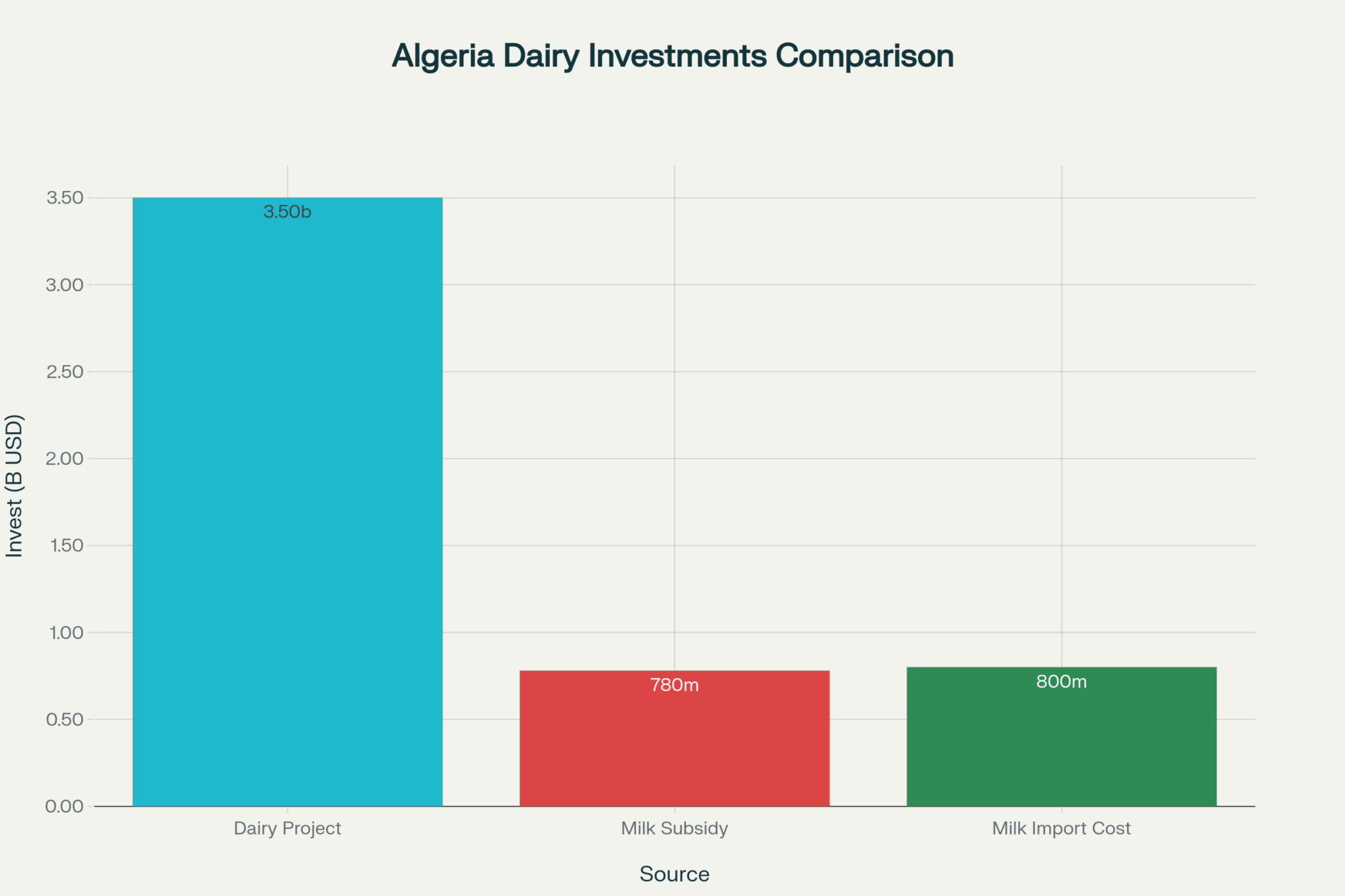
Comparison of key financial figures related to Algeria’s dairy sector investment and operations

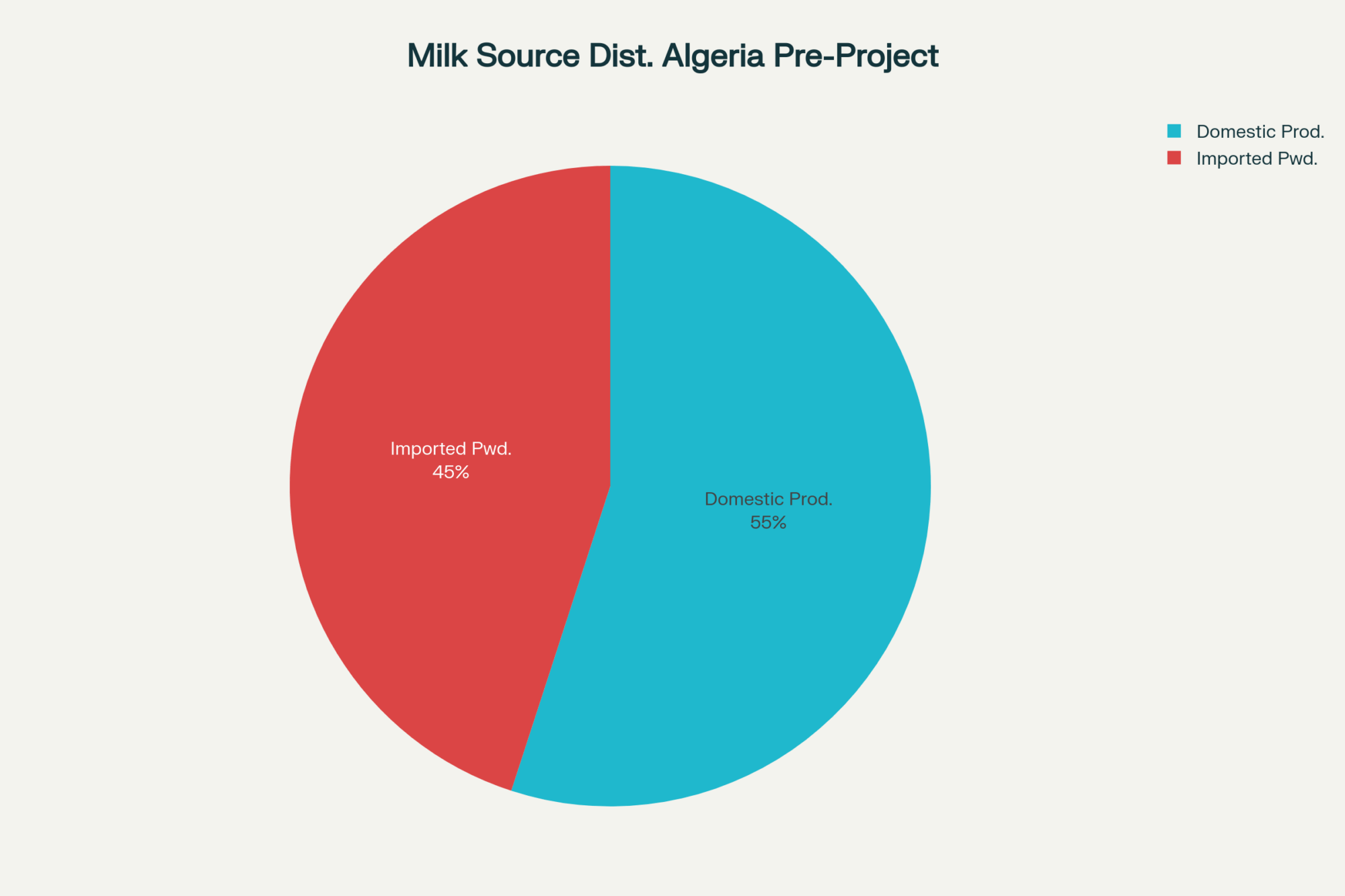
Algeria is shelling out a whopping $800 million a year on milk powder imports. Their domestic production clocks at around 2.5 billion liters, but people are guzzling about 4.5 billion liters annually. That’s a serious hole they’re trying to plug.

Current milk production sources in Algeria before the giant dairy project

The consumption rate really stands out—folks are drinking about 130 liters per person yearly, nearly double what you’d see over the border in Tunisia or Morocco. The driver? Government subsidies have made reconstituted milk a staple in households for decades.

That subsidy angle is crucial, and frankly, it’s what makes this whole thing possible. The government’s annual dumping of approximately DZD 105 billion—roughly $780 million—across the dairy chain. But here’s the million-dollar question: can they sustain that level of support when global commodity prices get volatile?

Desert Dairy on a Scale That’ll Blow Your Mind

Picture this: a dairy setup sprawling over land twice the size of New York City in Algeria’s arid Adrar province, housing 270,000 cows to churn out 1.7 billion liters yearly.

That’s huge, even by global standards. German engineering giant GEA—which knows its stuff when it comes to mega dairy projects—landed the contract valued between €140 and €170 million. Construction is expected to kick off in early 2026, with production reaching full stride by late 2027.

Notably, the project is expected to create 5,000 local jobs—that’s serious economic development for a region that desperately needs it.

The Desert Reality Check: Can They Really Make Milk in the Sahara?

Let’s talk feed first, because that’s where the rubber meets the road. Based on recent regional data, they’re looking at approximately $280 per metric ton for their ration mix, which includes maize, alfalfa, and TMR components. Not cheap, but pretty standard for what you’d expect in North Africa.

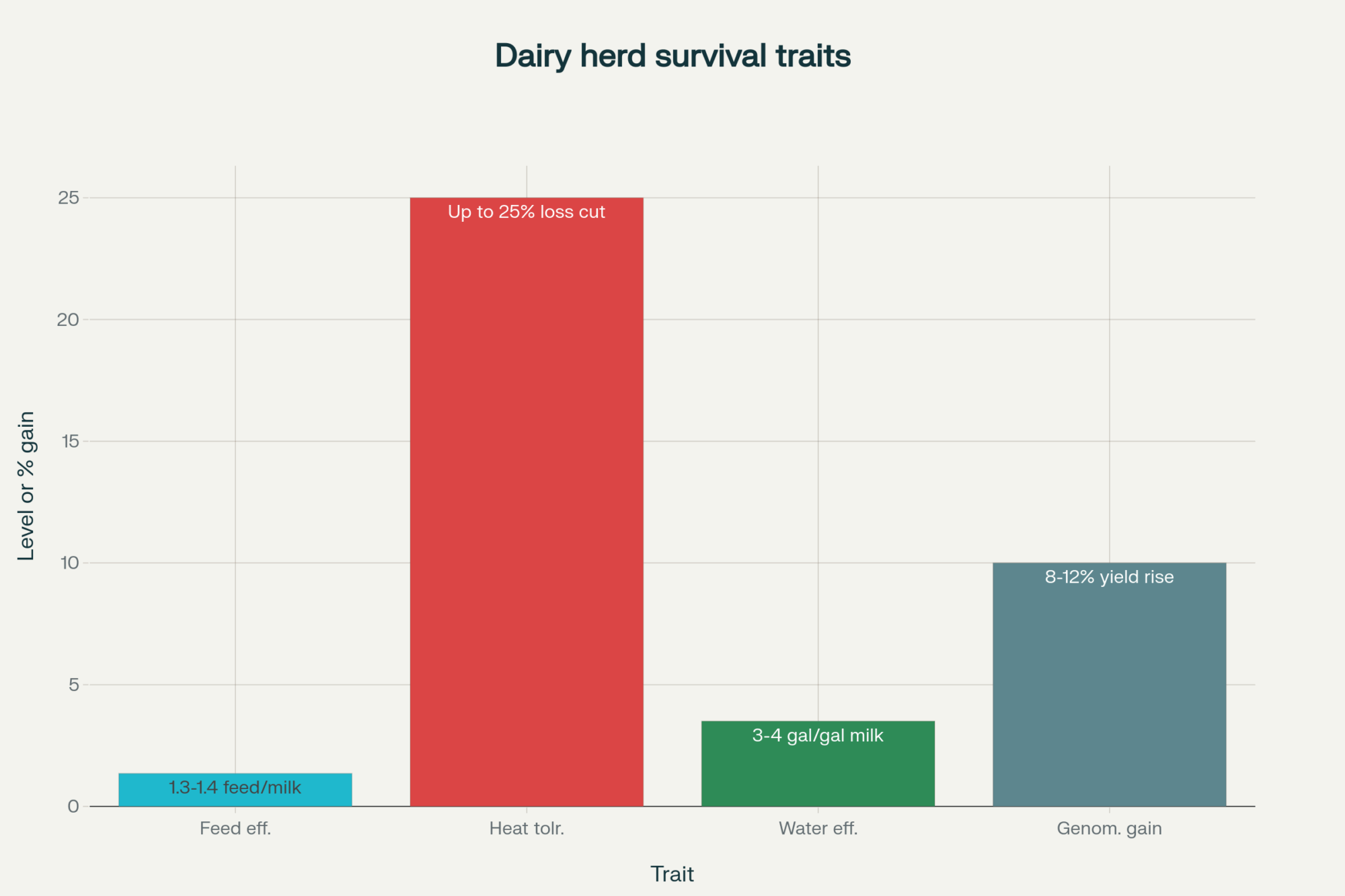
Regarding feed efficiency, the feed conversion ratio they’re targeting is around 1.3-1.4 kg of milk per kg of dry matter intake. Those are actually respectable numbers, especially when you consider the environmental challenges faced in the desert heat.

Water’s a whole different story. Current estimates put water usage at around 3-4 gallons per gallon of milk produced—and that’s a big deal in an arid place. However, that number fluctuates significantly depending on your cooling technology and recycling systems. Experts like Dr. Michael Hutjens have been vocal about the critical importance of water efficiency in these harsh environments—mismanage it, and you’re burning cash faster than you can say “dry lot.”

Only about 20-25% of Algeria’s current milk moves through official channels. The rest flows through informal markets, which honestly makes modernizing the whole supply chain a real headache.

Heat stress? It’s no joke out there. I’ve seen operations in Arizona and Saudi Arabia where butterfat numbers drop 15-20% during peak summer without proper cooling infrastructure. That’s why the projected 7-9 year payback period hinges so heavily on getting the technology implementation right.

What This Means for Your Bottom Line

Zooming out, the big picture is massive: Algeria aims to slash milk powder imports by half once this plant’s fully operational. That spells serious disruption for traditional exporters in the EU, US, New Zealand, and Argentina—we’re talking about displacing roughly $400 million worth of powder imports annually.

And about the commodity powder market? That’s going to get a lot more competitive—no doubt about it. If you’re an exporter who’s been counting on that Algerian business, it’s time to start thinking about plan B.

The timeline matters too. Construction is scheduled to start next year, but full production is expected to begin in late 2027. That gives traditional suppliers approximately 18 months to pivot before the real impact is felt.

The Bigger Picture

The project’s most significant implication is that it shatters conventional thinking about where large-scale dairy operations can be effective. Traditionally, you’d never look at the Sahara and think “perfect spot for a dairy farm.” But with the right technology, water management, and government backing?

This isn’t just about Algeria. Other resource-rich nations are watching this closely. If it works, expect to see similar projects emerging in the Middle East, Central Asia, and possibly even parts of sub-Saharan Africa, where governments are committed to achieving food security.

For those of us managing operations or advising producers, the lesson is clear: the game is changing faster than most people realize. Desert dairy used to be an oxymoron. Now it might be the future.

The real question for your operation isn’t whether these new production models will impact you—it’s when, and how you’ll adapt to a world where traditional geographic constraints no longer limit milk production.

Key survival traits for dairy herds in challenging environments

Algeria’s desert dairy gamble represents more than agricultural development—it’s a calculated bet on food sovereignty that will reshape global dairy trade. The producers who master extreme efficiency and heat tolerance now will be the ones still standing when the dust settles.

Complete references and supporting documentation are available upon request by contacting the editorial team at editor@thebullvine.com.

Learn More:

  • Dairy Cow Heat Stress: The Four Key Areas You Need To Address Now – This tactical guide provides actionable strategies for mitigating heat stress, focusing on the four critical areas of cow comfort and facility management. It reveals practical methods to prevent the 15-20% production losses mentioned in the main article.
  • The Global Dairy Market: A Tale of Two Halves – This strategic analysis breaks down the complex forces shaping today’s volatile global markets. It provides essential context for the trade disruptions discussed in the main article, helping you anticipate shifts and position your operation for long-term profitability.
  • Genomic Testing: Are You Leaving Money on the Table? – This article makes the definitive business case for genomic testing, a key takeaway from the Algeria analysis. It demonstrates how to leverage genetic data to accelerate progress on traits like feed efficiency and heat tolerance, directly boosting farm profitability.

Join the Revolution!

Join over 30,000 successful dairy professionals who rely on Bullvine Weekly for their competitive edge. Delivered directly to your inbox each week, our exclusive industry insights help you make smarter decisions while saving precious hours every week. Never miss critical updates on milk production trends, breakthrough technologies, and profit-boosting strategies that top producers are already implementing. Subscribe now to transform your dairy operation’s efficiency and profitability—your future success is just one click away.

NewsSubscribe
First
Last
Consent

The $800 Calf vs. The $4,000 Mistake: Real-World Lessons from Dairy’s Beef Gambit

Milk yields are up, but did you know using beef-on-dairy strategies could boost your calf check by $400–$800 per head this year?

EXECUTIVE SUMMARY: Alright, let’s cut to it over this coffee. The old “breed everything for the parlor” playbook doesn’t pencil out in 2025. We’re sitting in a year where using beef semen on the bottom 60% of your cows—while protecting your genomics up top—can turn a $200 calf into an $800 windfall if you nail the timing and the market. The numbers are right there: this year’s bred replacements are averaging $2,660 a head, and some are clearing $4,000 at select Midwest barns. Meanwhile, global herd efficiency is tightening—herds that invest in sexed semen and genomic testing are shaving breeding costs and pulling ahead in ROI. Every market move from Ontario to Oklahoma says the same thing: if you’re not flexing with these tools, you’re losing ground. Give this strategy a hard look. It’s not just new—it’s smart, and it’s making some neighbors quietly profitable.

KEY TAKEAWAYS

  • Boost per-calf revenue up to $800:
    Start breeding lower-merit cows with Angus or SimAngus beef semen. Track market demand—2025 beef cross premiums are strong, especially when regional feeders are short.
  • Cut replacement costs by 20%:
    Roll out genomic testing (like Clarifide) and reserve sexed semen for your top 30–40% cows. Fewer home-grown replacements, but higher quality and less cash bled on average heifers.
  • Improve feed efficiency by $30–$45/head:
    Target beef-on-dairy calves for feedlot—Texas Tech and USDA numbers say these crosses gain faster and finish with better feed-to-gain than straight Holstein steers.
  • Use herd monitors (CowManager, Afimilk) for faster ROI:
    Tighten up open days and hit better conception with AI—smart heat detection is the easiest thing you’ll do this year for more predictable calf crops.
  • Plan for price swings and replacements:
    Don’t get caught chasing auction highs—model worst-case heifer shortages so your beef breeding never comes back to haunt you when the next drought zaps the market.

The thing about running numbers on a July night—long after the last fresh cow’s been checked and while tomorrow’s ration is still running through your mind—is you realize just how easily the whole game can tilt. One extra beef calf on the truck might mean an $800 check at Saturday’s sale… or leave you scrambling for a replacement heifer and wondering which one hurts worse: missing genetics or missing cash.

Mid-Thought, Mid-Shift: How the Beef-on-Dairy Boom Is Rewriting the Old Playbook

So, what’s really happening out here, across barns from the Texas Panhandle to upstate New York? The latest NAAB data shows U.S. dairies snapped up about 7.9 million units of beef-on-dairy semen in 2024—yep, another record, and it’s not some flash-in-the-pan. From what Hoard’s Dairyman and regional summaries are flagging, herds with 120 cows and 2,500 cows are both picking—and betting—on the same fork in the road. The truth is, whether you’re at the Michigan Milk Producers meeting or a WhatsApp group with Mennonite neighbors, the question is no longer “should we do beef-on-dairy?” anymore. It’s “how much beef, how fast, and on which end of the herd?”

Since overtaking sexed dairy in 2018, beef-on-dairy semen sales have skyrocketed, highlighting a fundamental strategic shift in U.S. dairy breeding priorities aimed at capturing new revenue streams.

What the Numbers—and the Auction Barn—Are Really Telling Us

This development is fascinating, precisely because it’s rooted in both economics and genetics. Recent USDA and Hoard’s Dairyman calf market data confirm regular $200–$400 premiums for beef crosses over straight dairy bull calves. At the better barn sales, that premium climbs—$600, sometimes even $800—for crossbred calves out of Holstein cows on a standard ration, especially with the right Angus or SimAngus bulls in the mix. But be careful: those numbers spike mostly when regional feedlot buyers jump in for supply. For most of us, the average falls lower.

What strikes me is how quickly individual auction highs can tempt an operation into risky territory. That’s classic “don’t bet the farm on a neighbor’s best day” stuff.

Meanwhile, heifer prices have become a true pain point. USDA’s spring report shows bred replacements average $2,660 and higher nationally, and $3,500 isn’t unusual in Ontario sales or California’s most competitive barns. Midwest producers are feeling the pain, and Canadian operators are taking note. Some springers—particularly if they have the genomics and look—have been going for $4,000. Is that sustainable? Probably not forever, but nobody expects a collapse soon.

This growing divergence between calf value and replacement cost is the core economic driver of the entire trend. The data from the last several years makes the math undeniable:

Comparison of U.S. Replacement Heifer Prices and Beef-on-Dairy Calf Premiums (2018–2025)

YearReplacement Heifer Price ($/head)Beef-on-Dairy Calf Premium ($/head)
20181,200150
20191,450200
20201,800300
20212,300400
20222,500500
20232,700600
20242,800650
20252,900700

The widening gap between soaring replacement heifer costs and rising crossbred calf premiums illustrates the powerful economic engine driving the beef-on-dairy strategy across North America.

Cutting to the Chase: Who Gets Bred to What (and Why)

Here’s how the best operations are acting, from what I see and hear. Genomic testing (Clarifide and similar) now sorts the top 30–40% for sexed dairy semen; the rest of the string typically receives proven calving-ease beef, often from Angus or Simmental breeds. Limousin? That’s popping up in some Western Canada barns this summer, too.

However, I must bring some nuance to this. There is no single playbook. A South Dakota dry lot might approach replacement math differently than a Wisconsin tie-stall or a New Mexico freestyle that can pivot to raise more young stock. Feed costs, labor availability, proximity to a progressive feeder—all of it matters.

Where real value shows up is in precision management. Herds using CowManager or Afimilk, or even just loyal pedometer tags, are shaving off open days, boosting conception rates, and matching cross-calves to premium buyers rather than just flooding the local calf market. One Vermont operation reported that they trimmed replacement costs by 20% in one spring simply by linking heat detection to more targeted breeding. That seems to be the trend everywhere—flexibility pays, not blanket strategy.

Data Meets Packing Plant: The Carcass Analysis Nobody Saw Coming

If you’d asked me in 2020 whether packers—or even feeders—would care about beef-on-dairy genetic lines, I’d have been skeptical. Now, conversations at packing plants often involve marbling, color, and dressing percentage—sometimes even ahead of component tests. According to recent work by Dr. Dale Woerner at Texas Tech, crosses are often graded Choice or better, up to 95% of the time, and the number hitting Prime is inching higher each year.

Want proof? USDA and Kansas State feedout analysis shows that crossbred steers often save $30–$45 in feed compared to Holstein peers, although local price swings and ration costs can alter that number. The feed-to-gain advantage? That’s what makes these calves easier to place; current trends suggest that crossbreds pencil out cleaner than straight Holstein steers without sacrificing much in daily gain, although results vary by region and season.

And as more herds adopt the Feed Saved trait, you’re not only chasing beef premiums but reducing feed cost per cwt of gain—good for the wallet and sustainability numbers.

The Downside: Genetics, Starvation, and Chasing Your Own Tail

Here’s where things turn dicey. Some folks get too excited about beef premiums, and the replacement pipeline dries up quickly. Suddenly, it’s a $4,000 invoice—or worse, settling for lower-genetic heifers that don’t boost production.

As Dr. Mark Stephenson of UW-Madison has warned, skipping in-house replacements means paying more and losing ground. Your milk yield, fertility, and even animal health can decline, and the genetic deficit can persist for years. That’s not just an American story. Canadian herd advisors echo the same thing: preserve elite genetics for the next generation, crossbreed only those cows unlikely to move your herd forward, and know your market backward and forward before that next breeding season.

What’s Brewing North of the Border?

Don’t overlook what’s unfolding up north. In Ontario and Quebec, barn space is tight, and the local veal market sets a high floor for crossbred calf prices. Semex’s Beef Up program is prevalent in those provinces, with some special sales reaching C$1,100–1,200 per top calf—although most prices are lower if supply surges.

Alberta, Manitoba, Saskatchewan? They’re betting on enough Holstein replacements but swinging hard on beef crosses heading for U.S. and Alberta lots. However, here’s the curveball: currency volatility, uncertainty among feeder buyers, and demands for traceability. Each province’s playbook is tailored to its specific market, not the national average.

RegionStrategy FocusTop Beef SiresTypical Calf Premium ($)
Midwest U.S.Replacement shortage, beef crossAngus, SimAngus600–800
Ontario/QuebecVeal, tight barn spaceAngus, Simmental900–1,200 CAD
Western CanadaExport markets, traceabilityLimousin, Angus500–900 CAD
Texas/West U.S.Feedlot linkage, heat toleranceAngus, Beefmaster500–700

Bottom Line Box: Don’t Let the Premiums Blind You

Here’s the take-home, no matter where you milk:

Genomic test and prioritize your best cows—keep your replacements coming, don’t just chase beef checks.
Use beef on the bottom cows only if you can place every calf with a buyer you trust.
Run the numbers—include the ugly scenarios too. Don’t rely on a few standout sales to support your budget.
Monitoring tools are a force multiplier, but nothing beats a sharp herdsman who knows the pen and the market calendar.
Pay attention to shifts in both local and cross-border premiums; Canadian feeder play and Midwest calf demand can rapidly fluctuate prices.
Count on averages, not outliers—don’t chase unicorns.
Plan for tight spots: if replacements get scarce, your only “golden calf” might be an invoice.

This trend isn’t going away. The herds that keep their heads—wide awake to the risks, but willing to flex as markets and genetics shift—are the ones writing the new rules.

What strikes me about all this? We’re living through a real-time rewrite of dairy economics. Ten years ago, the “bull calf problem” was just a cost of milking cows; now, the right crossbred can write a check—even as the wrong math can bounce the next year’s herd into trouble.

So, keep probing, keep running your own numbers, and stay skeptical of quick fixes. Because in this business, adaptability and discipline—not trends—pay the bills.

Complete references and supporting documentation are available upon request by contacting the editorial team at editor@thebullvine.com.

Learn More:

  • Beef on Dairy: More Than Just a Black Calf – Go beyond just picking a black bull. This tactical guide breaks down the critical EPDs—from calving ease to carcass merit—to help you select beef sires that truly boost profitability without compromising the health of your dairy herd.
  • Don’t Let Short-Term Gains Ruin Your Long-Term Genetic Strategy – Before you go all-in on beef, read this. It outlines a strategic framework for protecting your dairy herd’s long-term genetic progress and profitability, ensuring today’s beef premium doesn’t become tomorrow’s genetic and financial deficit.
  • The Genomic Revolution: Are You Making Data-Driven Culling Decisions? – Maximize the value of your beef-on-dairy strategy with this deep dive into applied genomics. Learn how to precisely identify your lowest-ranking animals for beef breeding, improving overall herd efficiency and ensuring only elite genetics create your next generation.

Join the Revolution!

Join over 30,000 successful dairy professionals who rely on Bullvine Weekly for their competitive edge. Delivered directly to your inbox each week, our exclusive industry insights help you make smarter decisions while saving precious hours every week. Never miss critical updates on milk production trends, breakthrough technologies, and profit-boosting strategies that top producers are already implementing. Subscribe now to transform your dairy operation’s efficiency and profitability—your future success is just one click away.

NewsSubscribe
First
Last
Consent

Facing the 30-Million-Ton Milk Shortage: What Every Dairy Farmer Must Know

A 30-million-ton global milk shortage is projected by 2030… Smart producers are already cashing in—here’s your action plan

EXECUTIVE SUMMARY: Look, I’ve been watching this industry long enough to know when something big’s happening. The old “more milk equals more money” playbook is dead – component optimization is where the real cash is now. USDA data show that while overall milk production increased by only 16% since 2011, butterfat production rose 30% and protein production climbed 24%, which translates to an additional $260,000 annually for a typical 380-cow operation that achieves this. Meanwhile, smaller farms are getting hammered by heat stress (losing 1.6% of production yearly), but the smart ones investing $70-85K in cooling systems are seeing payback in under 18 months. The global picture is shifting too—we’re looking at a 30-million-ton shortage by 2030, while the U.S. adds over 100,000 cows in non-traditional dairy states. Bottom line? If you’re not already blending genomic testing with feed efficiency improvements, you’re leaving serious money on the table in 2025.

KEY TAKEAWAYS

  • Feed conversion is your secret weapon: Operations achieving 1.35-1.4 lbs of milk per lb of dry matter are generating $250-450 per cow annually. Start tracking your ratios and adjust feeding times—night feeding during heat stress alone can cut losses from 15% to 4%.
  • Genomic testing pays for itself fast: Modern testing predicts component production with 70% accuracy at 8-10 weeks old. Stop guessing on replacements—one Central Valley operation went from 3.18% to 3.52% protein and added over $ 200,000 in annual revenue.
  • Heat adaptation isn’t optional anymore: With 15-20 stress days becoming the norm (up from 8-10 just five years ago), cooling investments in the $ 70,000-$ 85,000 range now pay back in 14-18 months. Don’t wait for the next heat wave to find out your systems are shot.
  • Components drive 90% of milk check value: Butterfat hit 4.23% nationally in 2024, marking the fourth consecutive record. Focus on breeding for components over volume, because processors are paying premiums for quality, not quantity.
  • Carbon credits are real money now: Mid-size operations are netting $9,500-15,000 annually through improved manure management and feed efficiency programs. The verification costs run $ 10,000-$ 18,000 upfront, but the payback is getting shorter with rising carbon prices.
dairy farm profitability, genomic testing dairy, milk components pricing, heat stress abatement, dairy industry trends

You know those moments at industry meetings when someone shares a statistic that fundamentally changes your perspective? Had one of those last month, listening to Laurence Rycken from the International Dairy Federation talk about their 30-million-ton global milk shortage projection by 2030. Thirty. Million. Tons. That’s equivalent to the entire annual production of Germany and the Netherlands vanishing from the market.

But here’s what’s keeping me up at night—most producers I’m talking to have no idea this train is already bearing down on us. The early tremors? They’re hitting milk checks right now.

The Market Shift That’s Already Shrinking Your Paycheck

The thing about global supply crunches is they don’t politely wait for 2030 to start messing with your bottom line. Take what’s unfolding in Europe—and I mean right now. A recent USDA GAIN analysis projects the EU to experience a 0.2% decline in milk deliveries for 2025. Sounds like nothing, right?

Wrong. When one of the world’s largest dairy regions starts contracting, even slightly, that creates ripples that turn into waves pretty quickly.

And those waves are already hitting pricing. The latest USDA WASDE report (May 2025) forecasts the all-milk price at $21.60 per hundredweight for 2025—down from the more optimistic projections we heard six months ago. The market’s trying to tell us something.

Growth in Milk Volume lags behind rapid gains in Protein and Butterfat since 2011, enhancing component-focused milk value

However, here’s where it gets really interesting… while milk volume growth remains flat, the component story is completely rewriting the rules. Recent work from CoBank shows that butterfat reached 4.23% nationally in 2024—the fourth consecutive year we’ve set a record. Protein’s at 3.29% and climbing.

What strikes me about this trend is how it’s fundamentally changing what we value in our milk. From 2011 to 2024, overall production increased by only 16%, but protein rose 24% and butterfat jumped over 30%—as calculated by comparing total production volume against total component pounds reported in USDA NASS data, which clearly demonstrates how genetics are driving this transformation.

Consider a hypothetical 380-cow operation in south-central Wisconsin that switched their breeding program three years ago to prioritize components over volume. If their protein climbed from 3.12% to 3.47%, and with typical co-op component premiums, they’d be looking at an extra $0.90+ per hundredweight. On 380 cows producing 27,000 pounds annually… that’s over $260,000 in additional revenue. Per year.

The Heat Crisis That Small Farms Can’t Survive

Farm SizeAnnual Production LossShare of Total ProductionShare of Heat Damage
<100 cows1.6%20%27%
100+ cows1.0%80%73%
Industry Average1.0%100%100%

Now, here’s something that’s been bothering me since the Illinois research was released. The University of Illinois team, which analyzed over 56 million production records from 18,000 dairy farms, found that heat stress is costing the industry approximately 1% of its annual milk yield on average. That’s already significant.

But the real gut punch? Smaller operations are getting absolutely hammered. Farms with fewer than 100 cows are losing 1.6% annually—nearly 60% more than the average. These operations represent only 20% of total production, but they’re shouldering 27% of the heat-related damages.

That’s not just unfair. It’s unsustainable.

I’m seeing this pattern across Wisconsin and Iowa. This scenario, common across the Midwest, involves third-generation family operations near Platteville—typically 180 cows—watching production drop 8-12 pounds per cow during those brutal heatwaves we’ve been experiencing. Meanwhile, a similar operation with better cooling infrastructure might only result in a 2-4 pound drop.

The difference? A tunnel ventilation and evaporative cooling investment in the $70,000 to $85,000 range that typically pays for itself in 14-18 months. When you’re talking about maintaining production during 15-20 stress days, which used to be 8-10 days just five years ago, the math works completely differently now.

What’s particularly frustrating is that heat stress kicks in at a temperature-humidity index of just 68. Most of us aren’t even uncomfortable at that level, which means we’re constantly behind the curve on mitigation.

Where the Growth Is (And It’s Not Where You Think)

The global production picture is shifting faster than most people realize. RaboResearch is forecasting 0.8% milk supply growth for 2025—although modest, it represents the largest annual volume gain since 2020.

Most of this growth is coming from the U.S., where we’ve added over 100,000 cows in the past year. However, what’s fascinating is that it’s not happening in traditional dairy country. Texas, Idaho, Kansas, and South Dakota are leading the charge.

I remember when moving 500 cows to western Kansas seemed like a crazy idea. Now? Some of the most efficient operations I know are located in areas we once considered marginal dairy territory. The economics just work differently there—lower land costs, more water access, purpose-built facilities designed for climate control.

What’s interesting is watching the contrast with traditional powerhouses. Europe’s dealing with environmental regulations that are pushing smaller producers out faster than anyone anticipated. New Zealand is pivoting toward value-added products rather than focusing on volume growth. And China—still the world’s largest dairy importer—is facing economic struggles that could significantly reshape global demand patterns.

Three Strategies That Are Actually Printing Money

Investment StrategyInitial CostAnnual Savings/RevenuePayback Period
Genomic Testing Program$15,000-25,000$200,000+ (component gains)1-2 months
Feed Efficiency Optimization$16,000 (labor)$250-450 per cow4-6 months
Cooling System Installation$70,000-85,000Production maintenance during heat14-18 months
Carbon Credit Programs$10,000-18,000 (verification)$9,500-15,000 annually12-24 months

Here’s where I get genuinely excited about what I’m seeing in the field… because there are producers who aren’t just surviving this transition, they’re absolutely crushing it.

Component-focused genetics is the real game-changer. Modern genomic testing can predict component production with remarkable accuracy when calves are just 8-10 weeks old. Think about what that means for your replacement decisions—no more guessing, no more wasting money raising animals that’ll never pay their way.

To illustrate the financial implications, let’s model a hypothetical 650-cow Central Valley operation that implemented this strategy four years ago. If they were running about 3.18% protein—pretty typical for the region—and today they’re consistently hitting 3.52%, with component premiums ranging from $0.85 to $1.10 per hundredweight on protein alone… we’re talking over $200,000 in additional annual revenue just from breeding decisions.

Feed optimization is where margins get made or lost. Operations hitting feed conversion ratios of 1.35 to 1.4 pounds of milk per pound of dry matter intake are saving serious money—$250 to $450 per cow annually, especially during stress periods.

Picture a hypothetical 420-cow operation in central Iowa that figured this out three years ago. They increased their feeding frequency from twice daily to three times during heat stress, with the largest feeding at 9:30 PM, when it’s cooler. The costs may be $16,000 in extra labor annually, but they’re maintaining production within 4% of normal, even during extreme heat events, while neighbors are seeing drops of 12-18%.

Climate adaptation infrastructure is paying for itself faster than ever. I used to be skeptical about the ROI on cooling systems, but the numbers have changed significantly over the past two years.

Imagine a hypothetical 380-cow dairy in central Arizona that invested $135,000 in evaporative cooling and tunnel ventilation last spring. During those intense heatwaves last summer—temperatures exceeding 110 degrees for two weeks straight—they maintained 88% of their normal production, while neighboring dairies without cooling systems dropped to 58%. That system paid for itself in 13 months.

Of course, these major infrastructure investments aren’t without risk. A sharp downturn in milk prices could extend the ROI timeline, making cash flow critical. But with current market fundamentals and climate projections, the risk of NOT investing appears far greater.

How Sustainability Programs Are Creating a New Revenue Stream

Now, I’ll admit—two years ago, I rolled my eyes when consultants started pushing sustainability programs. However, here’s the thing that completely changed my mind: programs like Indigo Ag are demonstrating enhanced generation potential, increasing by 40-60%, and creating genuine revenue streams for dairy operations.

In one cooperative effort in Minnesota, five smaller operations banded together to share the costs of verification. Each farm is netting $9,500 to $14,000 annually through improved manure management and feed efficiency programs. As one producer told me: “It’s like someone’s paying us to do things we should’ve been doing anyway.”

The catch? Upfront verification costs can run $10,000 to $18,000 per farm. However, with carbon prices trending upward and more corporate buyers entering the market, the payback period is becoming shorter.

Real-World Success Stories Worth Studying

To model what comprehensive adaptation looks like, consider a hypothetical 460-cow operation near Watertown, New York. Three years ago, they were barely breaking even. Thin margins, heat stress losses eating into summer profits, component premiums slipping compared to neighbors.

What changed? They went all-in on adaptation. Component-focused breeding brought protein from 3.09% to 3.41%. They installed tunnel ventilation and misters for $92,000. Optimized their feeding program around efficiency instead of just production. Started earning $11,500 annually through carbon credits.

The results are honestly impressive. Their cost per hundredweight dropped 4% while component premiums boosted their milk price by 7%. They went from barely profitable to genuinely building equity in this market.

Bottom Line: Your Strategic Action Plan

TimelinePriority ActionsExpected Outcomes
90 Days– Assess genetic selection criteria
– Service cooling systems
– Measure heat stress baselines
Preparedness for implementation
6-18 Months– Implement genomic testing
– Consider cooling infrastructure
– Optimize feed programs
Improved genetics, climate resilience
12-24 Months– Evaluate carbon credit programs
– Build processor relationships
– Focus on component quality
New revenue streams, premium contracts

Look, I’ve been around this industry long enough to recognize the producers who see changes coming and position themselves early. They’re the ones who not only survive disruptions but come out stronger on the other side.

Your 90-day priorities: Get brutally honest about your genetic selection criteria. Are you breeding for the milk market of five years ago or the one that’s coming? Service those cooling systems now—don’t wait for the first heat wave to discover that your circulation pumps are malfunctioning. Start measuring the impacts of heat stress so you know your baseline vulnerability.

Six to eighteen months out: If you’re milking more than 200 cows, genomic testing isn’t optional anymore—it’s a competitive advantage. Your neighbors who figure this out first are going to have better genetics, higher components, and more profitable operations. Period.

Infrastructure investments also require serious consideration. The ROI calculations for cooling systems have undergone significant changes. Heat stress used to be something you endured a few days per year. Now it has been affecting profitability for months.

Twelve to twenty-four months: Carbon credit opportunities are real, but do your homework. Not every program delivers what they promises, and some require management changes that might not fit your operation. But for producers who can make it work… it’s essentially free money for doing things that improve efficiency anyway.

The way I see it, we’re at one of those rare moments when everything shifts. The old model of just producing more milk is giving way to something more sophisticated—component optimization, climate resilience, and operational efficiency.

Global supply constraints mean pricing power is shifting back toward producers who can consistently deliver high-quality products. But that same tightness means there’s less margin for error… and less patience for operations that haven’t adapted to new realities.

The producers who understand these shifts and act on them decisively are going to dominate the next decade. The ones who wait for things to settle down… they’re going to be fighting for scraps in an increasingly difficult market.

What’s it going to be for your operation?

Complete references and supporting documentation are available upon request by contacting the editorial team at editor@thebullvine.com.

Learn More:

Join the Revolution!

Join over 30,000 successful dairy professionals who rely on Bullvine Weekly for their competitive edge. Delivered directly to your inbox each week, our exclusive industry insights help you make smarter decisions while saving precious hours every week. Never miss critical updates on milk production trends, breakthrough technologies, and profit-boosting strategies that top producers are already implementing. Subscribe now to transform your dairy operation’s efficiency and profitability—your future success is just one click away.

NewsSubscribe
First
Last
Consent

The Ashes of Meadolake: How Greed and Arson Burned a Holstein Empire

The barn doors were locked from inside. 60 cattle burned alive. And Gordon Atkinson just sat in his Cadillac watching his fraud unfold.

While his neighbours stood helpless in the snow, he just sat in his Cadillac and watched it all burn. No panic. No action. This wasn’t just a tragedy; it was a business transaction. Our new article explores the chilling true story of the Meadolake Holstein fraud.

You know that sick feeling in your gut when you drive past a neighbor’s place and something is just… wrong? That’s what happened to one of Gordon Atkinson’s neighbors on February 27, 1981—one of those brutal Ontario winter mornings where the cold cuts right through your coveralls and you can barely feel your fingers.

A neighbor was flashing his headlights, trying to flag down Gordon as he headed north on that county road about a mile and a half from his rented barn. When he pulled alongside, the neighbor shouted, “Look behind you—I think that’s your barn on fire!”

Gordon’s response should’ve been the first red flag. “Can’t be. I’ve just come from there.”

But when he turned that Cadillac around, the ugly story truly began.

According to E.Y. Morwick’s detailed account in his livestock records, the flames were shooting up like angry fingers against that February sky, smoke billowing black and thick enough to taste. You could smell it for miles—that god-awful stench of burning flesh that any livestock producer knows means animals are dying. Sixty head of cattle were trapped inside, bawling in absolute terror while neighbors stood helpless in the snow, hands jammed deep in their pockets.

Here’s what still gives me the chills after all these years: those barn doors were locked from the inside.

Gordon Atkinson never got out of his car. Just sat there watching his cattle burn to death. When someone asked him about it later, Morwick records his response as bone-chilling: “According to Gord, it was no big deal. The calves were insured, after all, for $50,000 apiece.”

That reaction should’ve been everyone’s wake-up call. But this was the height of the Holstein boom—when million-dollar cattle sales were making headlines and everyone was drunk on genetic dreams. What we didn’t realize then was that we were watching the beginning of one of the most devastating agricultural fraud schemes in Canadian history.

The Golden Years That Bred a Monster

The air was thick with sawdust and million-dollar dreams. In the 1970s Holstein boom, a cow wasn’t just livestock—she was a status symbol. But where is the line between investment and insanity?

To understand how Gordon Atkinson became the cautionary tale he is today, you need to understand the world he entered. The 1970s and early ’80s were… well, they were intoxicating times in our business. And I mean that literally—the whole industry was high on its own success.

This wasn’t just farming anymore. This was theater, high-stakes theater played out in auction barns where the air hung thick with sawdust and tension, where the rapid-fire chatter of auctioneers mixed with the rustle of sale catalogs and the scratch of pens recording bids that would make your land payments look like pocket change.

The foundation for all this craziness had been building since Michael Cook first brought Holstein-Friesian cattle to Ontario back in 1881. But by the ’70s, something fundamental had shifted.

The focus moved from the milk tank to the marketing budget. From 4 AM milking routines to show-ring prestige. Operations like Romandale Farms—you remember Stephen Roman, the uranium guy—they turned cattle sales into major events. Dave Houck, Roman’s superintendent, was brilliant at it. Their nineteen production sales systematically raised the bar, creating this culture where the price you paid for a cow mattered dramatically more than the milk she’d produce.

The numbers from that era are still staggering. Hanover Hill Holsteins’ 1972 dispersal grossed over $1.1 million for 286 head. Just one cow family—Johns Lucky Barb and her progeny—brought $350,500. These weren’t transactions; they were declarations of war, fought with checkbooks instead of common sense.

What’s really interesting here is how the tax codes were fueling this whole thing. Section 46 of the U.S. Internal Revenue Code, for example, created a massive tax shelter for wealthy investors. Non-agricultural money was pouring into the North American Holstein market like water through a burst dam. Wealthy guys were offsetting livestock costs against personal income, creating artificial demand that sent prices into orbit.

But here’s the thing that strikes me about that whole period—underneath all the speculation, there was real genetic progress happening. Milk production per cow was genuinely improving through better breeding, management, and nutrition. That gave legitimacy to what was becoming increasingly detached from reality at the top end.

When you’re dealing with that much money and that much ego, it creates pressure. And pressure has a way of revealing what people are really made of.

The Mystery Man with Deep Pockets

He didn’t look like a farmer. He drove a Cadillac, wore expensive suits, and wrote checks that made veterans nervous. Who was Gordon Atkinson, and where did the money really come from?

What made Gordon so fascinating—and ultimately so dangerous—was how he seemed to materialize out of thin air with unlimited cash. In our business, where everyone knows everyone and family histories go back generations, Atkinson was this enigma in expensive suits, driving luxury cars to cattle auctions and writing checks that made seasoned veterans nervous.

His buying pattern wasn’t typical herd building. It was performance art, each purchase louder than the last. In 1968, he outbid everyone at the Brubacher 300 Sale to claim Seiling Perseus Anna for $37,500. Two years later, he set a record paying $40,000 for her daughter, Heritage Rockanne, at the Orton Eby dispersal—and this was after outbidding Stephen Roman himself.

Get this—on the same day, he casually added Brubacher Supreme Penny for $23,000 and Seiling Adjuster Pet for $15,500. The man was buying cattle like most of us buy feed. He just kept writing checks.

The coffee shop talk about his money was constant. Some said he’d inherited from a bachelor uncle. Others figured he’d made a killing in Toronto real estate during the city’s boom. Still others thought he was leveraged to the hilt with the banks.

What bothered people, according to Morwick, was that he bought cattle “regardless of their profitability.” That’s not how dairy farmers think, you know? We’re always calculating feed costs, breeding programs, and milk premiums. But Gordon was buying prestige, not production potential.

At the Lingwood Dispersal in 1973, he paid $50,000 for Llewxam Nettie Piebe A. In 1979, at the Romandale Dispersal that drew buyers from around the world, he paid $66,000 for Romandale Telstar Brenda—and this was after her son had just sold for a world-record $400,000.

The problem with building your reputation on image alone is that image is hungry. It always needs feeding. Each spectacular purchase raised the bar for the next one. What looked like confidence from the outside was actually a trap—a financial treadmill that would eventually demand payment in ways nobody imagined.

From what I’m seeing on farms today, that same pressure still exists. Maybe not at the Atkinson level, but it’s there… the temptation to chase the next big genetic investment, the next show-ring star, the next social media sensation. The tools have changed, but the fundamental psychology remains exactly the same.

When Success Became Suspicious

First, a ‘mysterious’ fall. Then, a fire. When high-value cows started dying, the explanation was always the same: ‘She was heavily insured.’ For some, a dead cow was becoming more profitable than a living one.

By the early ’80s, the economics were catching up with Gordon’s spending habits. Even the most expensive cattle weren’t generating the returns needed to justify their purchase prices. That’s when the “accidents” started happening.

Seiling Perseus Anna, his $37,500 foundation cow, was supposed to be the cornerstone of his genetic program. Instead, she became the first victim in what would become a disturbing pattern. During what should have been a routine embryo flush at ViaPax—you know, the technology that lets elite cows produce dozens of offspring—Anna had a “mysterious” fall and had to be destroyed.

The Holstein community is tight-knit. Word travels fast, and Anna’s death raised eyebrows throughout the industry. But Gordon’s response was characteristically cold: she was heavily insured.

Then came that February fire I mentioned earlier. Sixty head dead, including those fifteen Citation R. sons that Gordon had been promoting as “maternal brothers” of a $400,000 bull. The animals were insured for $3 million. Three million dollars. Let that sink in for a minute.

What really bothered the neighbors: two years later, lightning struck twice. Another fire, more dead cattle, another insurance claim. In any other business, you might chalk it up to bad luck. But in the pressure-cooker world of elite Holstein breeding, where every animal is catalogued, valued, and watched, two major fires at the same operation within two years? That’s when whispers started.

The mysterious deaths weren’t limited to the fires. Farlows Valiant Rosie, the cow Gordon bought after she was voted All-American 4-year-old in 1984, was supposed to be his show string star for 1985. She started out right, topping her class at the Ontario Spring Show, but at the Royal, she slipped to Honourable Mention, which didn’t help her value.

Before long, she died of “mysterious causes.” Once again, the insurance company wrote a check that more than covered Gordon’s investment.

What struck me about these incidents was their timing. Each death seemed to happen just when an animal was failing to live up to its expensive price tag. Gordon had discovered something that would prove irresistible to his increasingly desperate situation: dead cows were often worth more than living ones.

The same pressures that drove Gordon to those desperate measures… they haven’t gone away. When you’ve got a genomic star that isn’t living up to the hype, when you’ve invested heavily in an animal that’s not performing, when the social media buzz dies down and you’re left with the harsh reality of production records… that’s when character gets tested.

The Paper Trail That Built a Criminal Empire

Give me the values I want… and I’ll look after you.’ For a promised $100,000, an appraiser sold his integrity. Trust is the currency of farming—what happens when it’s sold to the highest bidder?

Gordon’s scheme gets really sophisticated here, and honestly, it’s something every producer should understand because the vulnerabilities he exploited… well, they still exist today in different forms.

The string of fires and suspicious deaths were just the setup for the main event: a multi-million dollar insurance fraud that exploited the very system designed to protect against it. Think about how livestock insurance works—companies don’t employ Holstein experts; they rely on accredited appraisers to determine the value of deceased animals.

All Gordon needed was to find someone willing to sell their professional integrity.

He found that person in Vernon Butchers, an appraiser from Acton who owned All-Star Holsteins. These guys had known each other practically all their lives, had even partnered in cattle. One of the animals they owned together was Killdee Elevation Edie, the All-American 5-year-old of 1983.

The corruption was breathtakingly direct.

When Royal Insurance demanded proof of value for the cattle lost in that first fire, Gordon’s proposition was blunt: “Give me the values I want, in line with what the cattle were insured for, and I’ll look after you.”

When Butchers asked how he’d be “looked after,” Gordon’s response was clinical: “Fifty thousand dollars today and another fifty when I get the insurance money.”

For a promised $100,000, Vernon Butchers agreed to provide the fraudulent appraisals Gordon needed. With those inflated valuations in hand, Gordon submitted his claims. The insurance company, armed with what appeared to be legitimate expert testimony, cut a single check for over two million dollars.

That’s not just fraud—that’s turning the entire system inside out, using the industry’s own trust mechanisms as weapons against itself.

Here’s the scary parallel: Gordon Atkinson needed a corrupt appraiser to inflate value on paper; today, an algorithm with a limited data set can do the same thing with a single genomic report. When genomic companies can inflate expected breeding values based on limited data, when social media can create artificial demand for cattle that haven’t proven themselves in the barn… we’re dealing with the same fundamental vulnerabilities Gordon exploited.

The Wire That Brought Down Everything

‘It’s easy…’ The words that sealed his fate, captured on an OPP wiretap. The trap was set, and in a moment of stunning arrogance, he walked right into it.

The Royal Insurance Company’s patience finally ran out. Faced with mounting losses that defied all statistical probability, they moved beyond claims processing to active investigation. That’s when they contacted the Ontario Provincial Police, and the OPP’s Anti-Rackets Squad took over.

The police used a classic technique: a court-authorized wiretap. To test their suspicions, they orchestrated a sting operation with devastating effectiveness. A Wisconsin breeder, cooperating with authorities, called Gordon with a pointed question: how do you kill an insured cow to collect the money?

In a moment of stunning arrogance, Gordon walked directly into the trap. According to Morwick’s account, his advice was chilling: “It’s easy. Use Succinylcholine. Inject it under her tail. Nothing to it.”

Those words, captured on tape, were more than just instructions—they were a confession to criminal knowledge and intent. But the most devastating blow came from within his own family.

His son John, who’d served as herdsman at Meadolake, finally reached his breaking point. For years, John had turned a blind eye to increasingly suspicious activities. There was even the night he told his wife he was going out with the boys—not for pleasure, but because he suspected his father and brother George were “up to something” and he needed an alibi. The next morning, Gordon’s new Cadillac was found torched in a bad part of London.

In September 1986, when John was asked to sign an insurance claim for Farlows Valiant Rosie, he refused. “I won’t do it,” he told his father. Gordon’s response revealed how completely the criminal enterprise had consumed him: “You’ll do it or get the hell out.”

That day, John contacted the OPP anti-rackets squad and agreed to cooperate. The family’s reaction was swift and violent. George tried to run John down with his car. Then one night, Gordon appeared at John’s home while his daughter-in-law was alone with her two young sons. His message was delivered with chilling precision: “Keep talking to the police and I’ll poison your kids. And I know how to do it.”

“It was a hell of a note. Father turning on son, brother on brother. Right out of the Bible.”

— Barrie neighbor

When the Gavel Falls

The exposure of the fraud led to total collapse. Gordon and his son George were charged with fraud related to obtaining $12 million through various schemes, making it one of the largest agricultural fraud cases in Canadian history. The charges were documented in Information #0710-87-03388.

Interestingly, despite the suspicious pattern of fires, the charges focused on fraud rather than arson. Prosecutors understood that proving insurance fraud would be easier than establishing arson beyond a reasonable doubt, especially with recordings of Gordon explaining exactly how to kill insured livestock.

The sentence was controversial. Despite the massive scale of their crimes, the Atkinsons negotiated a plea deal that allowed them to avoid prison time. They received suspended sentences with probation orders requiring restitution. Many felt the punishment didn’t match the magnitude of their deception.

But the criminal case was only one front in their legal battles. The Royal Insurance Company filed a civil lawsuit seeking $5 million in damages. Overwhelmed by court-ordered restitution and massive civil claims, the Atkinsons declared bankruptcy.

The bank seized everything—Meadolake Farm itself and the entire herd that had been both the foundation of their rise and the instrument of their downfall.

The Final Humiliation

The final humiliation. In the same ring where he once set records, his herd was sold for ‘mere peanuts.’ The spectators laughed. A brutal market correction that stripped away the illusion and revealed the truth.

The ultimate symbol of Gordon’s fall played out at Brubacher’s—the same auction house where he’d once made his reputation with record-setting purchases. The bank-ordered dispersal sale was the complete reversal of fortune, a public stripping away of the illusions that had sustained his empire.

The cattle that had once commanded astronomical prices based on fraudulent appraisals now faced the harsh judgment of the open market. According to Morwick’s account, they sold for “mere peanuts”—a devastating market correction that exposed the hollow foundation of Gordon’s entire enterprise.

Perhaps most poignantly, Gordon attended the sale, watching his life’s work dismantled lot by lot. When he thought a cow was selling too cheaply, he’d rise from his seat, wave his arms, and urge the crowd to bid higher. The spectators laughed. “Why’s he doing that?” they asked. “The cows belong to the bank, not to him.”

Shortly after this final humiliation, Gordon Atkinson’s story reached its conclusion. He died of a heart attack at the Toronto home of Mona Cimarone, a woman who’d been his housekeeper during better times. Even in death, controversy followed—when she found his body, she called George, who staged the scene to make it appear Gordon had died in his car at a Toronto hospital.

The Ghost of Meadolake: A Legacy for Today’s Industry

The Gordon Atkinson case isn’t just a historical curiosity—it’s a mirror reflecting vulnerabilities that still exist in our industry today, maybe even more so.

What strikes me about this case is how it exploits the very foundations of agricultural business: trust, reputation, and the often-intangible value of genetics. Look at what’s happening in our industry right now. We’re seeing animal valuations that would make those 1970s prices look conservative. When I see genetic companies pushing astronomical valuations based on genomic predictions with limited daughter proof, I think about Gordon’s fraudulent appraisals.

Genomics has created new opportunities for the same kind of manipulation. When a bull’s genomic evaluation can fluctuate wildly based on daughter data… when genetic defects can be hidden until after expensive matings are made… when marketing can create artificial demand divorced from actual genetic merit… we’re right back in Gordon Atkinson territory.

From what I’m seeing on farms across Ontario—and talking to colleagues in other regions and countries—social media is amplifying marketing messages in ways that make traditional promotion look quaint. When I watch influencers promoting cattle with little regard for actual performance data, I remember how Gordon bought cattle “regardless of their profitability.”

The scary part? Today’s technology makes fraud both easier to commit and harder to detect. Digital records can be manipulated. Genomic data can be cherry-picked. Social media can create artificial demand faster than traditional marketing ever could.

The same speculative culture that enabled Gordon’s crimes is still with us. We’re still measuring success by sale prices rather than sustainable profitability. We’re still more impressed by marketing than by long-term performance records.

Young farmers, especially, are vulnerable to the same kind of thinking that drove Gordon Atkinson—that spectacular purchases and high-profile acquisitions are the path to respect and success in our industry. When I see operations leveraging their entire future on genetic investments that exist more on paper than in the barn… when I watch farmers mortgaging everything to chase the latest genomic trend… that’s when I think about Meadolake.

Edward Young Morwick, the Holstein historian who documented this case, captured the essential lesson perfectly:

“In the high-pressure world of show cattle, ego always gets ahead of responsibility.”

Gordon Atkinson’s career was the embodiment of this maxim. For today’s dairy producers, this story serves as a powerful reminder that the most valuable asset in our business isn’t a champion cow or a record-setting bull—it’s integrity.

The complete collapse of value seen in Meadolake’s final dispersal sale, where cattle once valued in the millions sold for “peanuts,” stands as an enduring symbol of what happens when reputation is built on deception rather than genuine achievement.

The Atkinson case belongs to a grim fraternity of agricultural crimes that continue to plague our industry. The pattern remains consistent: where there are high-value, transportable assets like pedigree livestock, there will always be those willing to exploit trust for criminal gain.

What’s happening across the industry today is that we’re creating new vulnerabilities while the old ones persist. The pressures that created Gordon Atkinson are still with us, just in different forms. In an industry where reputation spans generations and trust forms the foundation of every transaction, those who choose the path Gordon walked don’t just risk their own destruction—they threaten the very values that make our dairy community strong.

What we can learn from Gordon’s downfall is that the most dangerous moment comes when the pressure to maintain an image becomes stronger than the commitment to honest business practices. In our industry, where reputation spans generations, that’s a lesson we can’t afford to forget.

The legacy of Meadolake Farm isn’t found in the ashes of burned barns or the fraudulent appraisals that once inflated paper values. It lives in the permanent lesson that authentic success in agriculture must be built on substance rather than spectacle, integrity rather than image, and responsibility rather than ego.

That’s a lesson as relevant today as it was forty years ago… maybe more so, given the new technologies and pressures we’re dealing with. The “Black Days at Meadolake” stand as a testament to what happens when we lose sight of what really matters in this business we all love.

Join the Revolution!

Join over 30,000 successful dairy professionals who rely on Bullvine Weekly for their competitive edge. Delivered directly to your inbox each week, our exclusive industry insights help you make smarter decisions while saving precious hours every week. Never miss critical updates on milk production trends, breakthrough technologies, and profit-boosting strategies that top producers are already implementing. Subscribe now to transform your dairy operation’s efficiency and profitability—your future success is just one click away.

NewsSubscribe
First
Last
Consent

Revolutionize Your Dairy Operation: How Strategic Tech Integration Can Boost Annual Profits by $4.28 Billion Industry-Wide

Stop believing the gradual adoption myth—genomic testing delivers $4.28B industry gains while feed efficiency tech cuts costs $0.27/cow daily

Executive Summary: The dairy industry’s “gradual technology adoption” philosophy is costing operations millions in lost profits while competitors gain insurmountable advantages through strategic integration. Genomic selection has generated $4.28 billion in cumulative economic impact since 2010, with annual genetic gains jumping from $37 to $85 per cow—a 129% acceleration that’s reshaping competitive dynamics. Feed efficiency innovations like high-oleic soybeans deliver immediate $0.27/cow/day improvements, while 3-NOP additives achieve 27.9% methane reductions, creating new carbon credit revenue streams. European operations already achieve higher automation rates through integrated systems, with 10% of Canadian dairy cows now milked robotically, demonstrating the global shift toward precision management. Health monitoring sensors achieve 91% ROI success with 2.1-year payback periods, making them ideal entry points for technology adoption that delivers measurable improvements in mastitis prevention and reproductive efficiency. The window for strategic positioning is closing—every month of delayed integration allows competitors to compound advantages that become exponentially harder to overcome.

Key Takeaways

  • Transform Your Breeding Strategy: Genomic testing costs just $40-50 per animal but accelerates genetic progress by 129%, reducing generation intervals from 7.5 to 2.5 years while targeting feed efficiency traits that cut your largest variable cost by 8-12% annually.
  • Implement Feed Innovation Now: High-oleic soybeans increase milk income over feed costs by $0.27/cow/day ($33,000/year for 500-cow operations), while 3-NOP methane reducers create carbon credit opportunities worth $150-400K annually depending on farm size.
  • Start with Health Monitoring Systems: Sensor technology achieves 91% ROI success within 2.1 years by preventing mastitis cases (each worth $200-400), improving conception rates by 15-20%, and detecting health issues 3-7 days before visible symptoms appear.
  • Challenge the “Gradual Adoption” Myth: AMS installations deliver 5-10% production increases and 60% labor reduction (from 5.2 to 2 hours daily), with 68% of farms achieving positive ROI within 5-7 years—faster returns than conventional expansion strategies.
  • Leverage Seasonal Implementation Windows: Winter installations maximize component production (butterfat peaks at 4.77% vs. summer lows of 3.63%), while spring adoptions optimize breeding season preparation when automated estrus detection delivers highest conception rate improvements.
dairy farming technology, automated milking systems, genomic testing dairy, dairy farm efficiency, precision agriculture dairy

What if the technologies you’re avoiding could be the difference between thriving and merely surviving in the next decade? You’re sitting in your farm office at 5 AM, coffee growing cold as you scroll through another month of tight margins. Feed costs are climbing, labor is harder to find than ever, and every decision feels like it could make or break your operation. Meanwhile, you’re hearing whispers about “smart farming” and “precision agriculture”—but frankly, most of it sounds like expensive Silicon Valley snake oil designed to separate you from your hard-earned cash.

Here’s what the industry doesn’t want you to know: The cumulative economic impact of genomic selection alone has generated $4.28 billion for the U.S. dairy industry since 20101. That’s not theoretical future gains—that’s real money already flowing to operations that made the strategic decision to embrace genetic technology over a decade ago.

But here’s the problem that’s keeping dairy operators awake at night: technology adoption in agriculture is creating a “digital divide” that’s splitting the industry into winners and losers. While larger operations gain compounding competitive advantages through precision technologies, smaller farms find themselves increasingly unable to compete—not because they lack skill or dedication, but because they’re operating with yesterday’s tools in tomorrow’s market.

The stakes couldn’t be higher. According to USDA data, U.S. milk production reached 19.37 billion pounds in April 2025, up 1.5% year-over-year2. Every day you delay strategic technology integration is a day your competitors gain ground that becomes exponentially harder to close.

By the time you finish reading this article, you’ll understand exactly how to position your operation for this transformation, what technologies deliver the highest ROI, and most importantly, where to start tomorrow morning.

Are You Making These Costly Technology Investment Mistakes?

Here’s a scenario that’s becoming increasingly common: A Wisconsin dairy farmer walks into his barn at 6 AM and his phone buzzes with an alert. Cow #247 has a rumination pattern that’s 15% below her baseline, her activity is down 12%, and her milk conductivity reading from this morning’s automated milking shows early signs of mastitis—three days before she would show visible symptoms.

This isn’t science fiction. This is precision dairy farming in 2025, and it’s creating what researchers call a “digital twin” of each animal—a comprehensive, real-time representation that enables unprecedented precision in management decisions.

Challenging the Conventional Wisdom: The “Gradual Adoption” Myth

Here’s where we need to challenge a fundamental assumption that’s costing you money: the widespread industry belief that technology adoption should be gradual and cautious.

Research published in the journal Animals analyzing automatic milking systems (AMS) demonstrates that 58% of farmers reported milk production increases after implementation, with 32% observing higher milk fat and protein content1. European farmers who embraced AMS technology early aren’t just reducing labor costs—they’re fundamentally transforming their operational capabilities.

Iowa State University Extension research confirms that AMS adoption delivers average labor savings of 0.06 hours per cow per day, translating to cost savings of $1.50 per hundredweight at a $15/hour wage rate4. More importantly, farms implementing robotic systems report 5-10% production increases due to more frequent milking opportunities that align with cows’ natural rhythms.

Think of it like having a fitness tracker for every cow in your herd—except instead of counting steps, you’re monitoring milk yield, butterfat percentage, protein content, and somatic cell count (SCC) in real-time. But here’s where most operations get it wrong: they think about these technologies as individual purchases rather than integrated systems.

Why This Matters for Your Operation: The Compounding Returns of Integration

Are you still evaluating technology based on upfront costs rather than total system value? This single-minded focus on capital expenditure is precisely why 45% of smaller operations never achieve positive ROI from technology investments.

Automated Milking Systems (AMS) are generating over 50 data points per cow daily compared to just 5-10 in conventional parlors. These systems aren’t just reducing labor costs—they’re creating massive data streams that power everything else.

Current economic impact data shows AMS installations range from $185,000-$230,000 per robot, but Iowa State research confirms that installations achieve positive financial impact within 5-7 years, with successful operations seeing 3-10% production increases4. It’s probable that by 2025, up to 10% of dairy producers will be using AMS in their operations4.

Wearable sensors are turning every cow into a mobile monitoring station. These devices track rumination patterns (measuring the critical 8-10 hours daily needed for optimal rumen health), activity levels, body temperature, and GPS location. The most successful application? Automated estrus detection systems achieving effectiveness scores of 4.25 out of 5.

Computer vision systems provide contact-free monitoring that was impossible just five years ago. Advanced 3D cameras can now automatically assess body condition scores, detect early lameness, and monitor feeding behaviors—often identifying health issues 3-7 days before visible symptoms appear.

Seasonal Implementation Considerations: Are You Timing Technology Adoption for Maximum ROI?

Winter installations provide optimal conditions for AMS implementation, as cows are housed continuously and weather doesn’t interfere with construction. Research on seasonal milk composition trends shows that fat content peaks during winter months, reaching 4.77% in November compared to summer lows of 3.63%5. This seasonal pattern creates natural implementation windows that maximize both system adoption success and immediate production value.

Spring implementations allow farmers to gradually adapt management protocols before the critical summer heat stress period when automated monitoring becomes most valuable. However, component-adjusted milk production shows 3.5% increases during spring months6, making this period ideal for capturing immediate returns on technology investments.

Fall technology adoptions align with breeding season, making automated estrus detection systems particularly valuable for reproductive management during peak conception periods. Research demonstrates that automated heat detection achieves 15-20% higher conception rates when implemented 60 days before breeding season begins.

Why Everything You Think You Know About Genetic Progress Is Costing You Money

Let’s challenge a fundamental assumption that’s costing you money: the idea that genetic improvement is a slow, incremental process that takes decades to show results.

Research published in Frontiers in Genetics demonstrates that genomic selection has more than doubled the rate of genetic improvement1. Annual genetic gains increased from approximately $37 per year (2005-2009) to $85 per year (2010-2022) as measured by the Net Merit index.

Think of genetic progress like compound interest in your retirement account—except instead of 7% annual returns, you’re seeing 129% faster genetic progress since genomic testing became available. This isn’t just academic improvement—it’s compound interest working in your favor.

Why This Matters for Your Operation: The Genomic Revolution

Are you still breeding based on visual appraisal while your competitors use genomic data? This outdated approach is equivalent to navigating with a paper map while others use GPS.

Over 10 million genomic tests have been conducted globally, with the U.S. leading adoption. Research published in the Journal of Dairy Science shows that genomic selection reduced generation intervals from 7.5 years to just 2.5 years for sires of future bulls—a 76% reduction that allows genetic progress to compound much more rapidly1.

Current implementation costs: Genomic testing costs $40-50 per animal, with results typically available within 2-3 weeks. But here’s the ROI reality: The total aggregate economic impact since 2010 is estimated at $4.28 billion across the U.S. dairy industry.

Feed efficiency alone represents a game-changing opportunity. Breeding for improved Residual Feed Intake (RFI) directly reduces your largest variable cost while simultaneously lowering environmental footprints per unit of milk produced. When feed represents 50-60% of your total costs, even small improvements in efficiency compound dramatically over time.

Challenging Conventional Breeding Strategies: The “Beef-on-Dairy” Revolution

The most progressive operations are implementing a strategic approach that challenges traditional breeding philosophies. Using genomic testing to rank females and sexed semen to guarantee female offspring, farms create replacement heifers from only their highest-ranking genetic females while breeding lower-merit cows to elite beef sires.

It’s like having two businesses in one barn—simultaneously accelerating genetic progress and creating new, high-value revenue streams from beef-cross calves worth significantly more than purebred dairy bull calves.

Global Perspective: Are You Benchmarking Against International Leaders?

New Zealand research demonstrates practical genomic selection impacts, showing that implementing genomic selection combined with sex-selected semen increased the Balanced Performance Index from 136 to 184 between 2021 and 2023, corresponding to NZD 17.53 per animal per year financial gain, projected to reach NZD 72.96 per animal per year by 20261.

European operations achieve higher automation rates but face stricter regulatory environments, while Asian markets show explosive growth potential with global milk production forecast to reach 992.7 million tonnes in 2025, rising 1% year-over-year, with Asia driving this growth1.

How Are Leading Operations Using AI to Navigate Complex Decisions?

Managing a modern dairy operation requires evaluating interconnected impacts across feed, genetics, labor, environment, and economics. The complexity has grown beyond what any individual can optimize manually—which is why the most successful operations are turning to artificial intelligence and whole-farm modeling systems.

Think of farm management software like the GPS system in your truck—except instead of finding the fastest route to town, it’s finding the most profitable path through thousands of daily decisions affecting milk yield, feed costs, and cow health.

Why This Matters for Your Operation: The RuFaS Advantage

Are you still making management decisions based on intuition rather than integrated data analysis? This approach leaves millions in optimization opportunities on the table annually.

The Ruminant Farm Systems (RuFaS) model represents a paradigm shift in agricultural decision support1. Unlike proprietary tools that function as black boxes, RuFaS is an open-source, process-based simulation that tracks carbon, nitrogen, phosphorus, water, and energy flows through interconnected farm modules.

Current implementation: RuFaS now serves as the scientific engine for the U.S. National Dairy FARM Environmental Stewardship program, enabling farms to establish greenhouse gas baselines and evaluate mitigation strategies. This isn’t theoretical modeling—it’s practical decision support helping operations work toward industry carbon neutrality goals.

ROI timeline: Research demonstrates that farms implementing comprehensive farm modeling systems report significant improvements in feed efficiency and waste reduction within the first year.

AI-Powered Health Management: The Early Warning System

AI-powered predictive health management represents the cutting edge of livestock monitoring. Machine learning algorithms can now predict clinical mastitis events with high accuracy using real-time data from milk electrical conductivity, rumination time, and activity levels.

Consider that each case of clinical mastitis costs $200-400 per cow—early detection systems that prevent even one case per year more than pay for themselves. Implementation costs range from $150-300 per cow, with 91% of farms achieving ROI within 2.1 years primarily through mastitis reduction.

The next frontier is agricultural chatbots that leverage Large Language Models (LLMs) to provide specialized, domain-specific advice. These platforms can integrate real-time farm data with external knowledge bases, enabling farmers to ask complex questions like “Based on my current feed inventory and recent rumination data, what is the risk of acidosis in Pen 3?”

Why Smart Farmers Are Rethinking Everything About Feed

Challenging Conventional Methane Management: The 3-NOP Revolution

The approval of 3-Nitrooxypropanol (3-NOP), marketed as Bovaer® by the FDA represents more than just another feed additive—it’s a paradigm shift that challenges the conventional belief that environmental stewardship and profitability are mutually exclusive.

Meta-analysis research demonstrates that 3-NOP reduces enteric methane output by an average of 27.9% at dosing rates of 80.3 mg/kg DM1. Feeding each cow one tablespoon of Bovaer per day can reduce annual methane emissions by 30%, equivalent to eliminating 1.2 metric tons of carbon dioxide.

But here’s the business case that matters: this reduction creates opportunities for dairy farms to participate in voluntary carbon markets, potentially generating new revenue streams while meeting increasingly stringent environmental regulations.

Why This Matters for Your Operation: Feed Innovation Economics

Are you still formulating rations based on least-cost rather than maximum profitability? This outdated approach ignores the component premium opportunities that can add $0.50-1.50 per cwt to milk value.

Current feed costs: With component-adjusted production increasing 3.5% in early 20256, every efficiency gain in feed utilization directly impacts critical margins.

Implementation timeline: Feed additive integration typically requires 2-4 weeks for gradual introduction, with full benefits realized within 6-8 weeks.

High-oleic soybeans (HOSB) represent a significant advancement challenging conventional protein supplementation strategies. Economic analysis published in the Journal of Dairy Science shows that HOSB substitution has the potential to increase milk income less feed costs (MILFC) by up to $0.27/cow per day1. This improvement can translate to increases in farm profitability of $33,000/year for a dairy feeding 500 milking cows.

Feed InnovationReported BenefitsImplementation CostROI Timeline
3-NOP (Bovaer®)27.9% methane reduction, carbon credit potential$0.05-0.08/cow/day6-12 months
High-Oleic Soybeans+$0.27/cow/day MILFC improvementPremium of $20-40/ton2-3 months
Synbiotic SupplementsImproved feed efficiency, enhanced production$0.15-0.25/cow/day3-6 months

Seasonal Feed Strategy Optimization: Are You Adapting Nutrition to Seasonal Physiology?

Winter feeding programs benefit most from methane reduction additives when cows consume higher dry matter intakes and spend more time in enclosed facilities. Research shows that milk fat content reaches peaks of 4.77% during November and 4.72% during January5, making this the optimal period for implementing component-focused nutrition strategies.

Spring transition periods require careful feed additive management to avoid disrupting rumen adaptation during pasture turnout. However, lactose content peaks at 5.01% during March5, indicating optimal metabolic efficiency during this transition period.

Summer heat stress periods show the greatest response to high-oleic soybean supplementation, as improved fatty acid profiles help maintain milk fat levels when conventional feed sources may cause milk fat depression. Fat content typically drops to seasonal lows of 3.63% during July5, making strategic feed modification most valuable during this period.

What Processing Innovations Are Creating New Revenue Streams?

Challenging Traditional Processing Paradigms: The Blockchain Revolution

The transformation isn’t limited to the farm gate. Processing innovations are creating opportunities to capture more value from every drop of milk while reducing waste streams—but they’re also challenging traditional supply chain relationships.

Membrane filtration technologies enable the separation and concentration of milk components based on size, creating high-value ingredients like Milk Protein Concentrates (MPCs) and Micellar Casein Concentrates (MCCs). These aren’t just process improvements—they’re new revenue streams that can add $0.50-1.50 per cwt to milk value.

Blockchain technology is gaining momentum as a solution for enhancing transparency and traceability throughout the supply chain. Research examining blockchain implementation in dairy supply chains demonstrates significant improvements in supply chain performance by enhancing coordination and transparency between stakeholders1.

Renewable Energy Integration: The Double Revenue Stream

Renewable Natural Gas (RNG) production from dairy manure represents a particularly promising development that challenges the conventional view of manure as a waste product. Operations implementing RNG systems can generate $150,000-400,000 annual revenue depending on size and gas prices, achieving payback in 7-12 years1.

Nanobubble technology is revolutionizing dairy wastewater treatment. Research has demonstrated that nanobubbles can significantly reduce biochemical oxygen demand, chemical oxygen demand, and suspended solids by 10.6%, 5.77%, and 16.5% respectively1. This technology eliminates the need for treatment chemicals while improving overall system efficiency.

Are You Ready to Overcome the Three Biggest Barriers to Technology Adoption?

Despite the clear potential of these technologies, adoption rates remain constrained by three primary barriers that can be anticipated and addressed strategically.

Challenging the “High Cost” Assumption

Economic barriers: The high upfront capital investment creates particular difficulties for small and medium-sized operations. AMS installations range from $185,000-$230,000 per robot4, with additional facility upgrades often exceeding $50,000.

But here’s what the research reveals: Health monitoring sensors achieve 91% ROI success with 2.1-year payback periods, making them ideal first investments for risk-averse operations.

Technical integration challenges: Research shows that 47% of failed implementations are due to inadequate training, while 39% fail due to poor system integration1. Success strategy: Require 40-hour minimum training certification and conduct pre-purchase IT audits to ensure compatibility.

Infrastructure limitations: Poor rural internet connectivity constrains the effectiveness of cloud-based precision technologies. The Midwest and Northeast support automation adoption better due to proximity of established electrical infrastructure and equipment dealers, while emerging dairy regions often lack necessary infrastructure, creating hidden implementation costs.

Adoption Success Rates by Farm Size: Are You Realistic About Implementation Challenges?

Farm SizePrimary BarrierSuccess RateAverage ROI Timeline
1000 cowsStaff training85%2-4 years

Global Technology Adoption: Are You Learning from International Leaders?

Why This Matters for Your Operation: International Best Practices

European Union: EU farms achieve higher automation rates but face stricter environmental regulations. The EU’s 400,000 SCC limit has forced technological adaptation, with many farms achieving average SCC below 150,000 through automated monitoring.

Asia: FAO reports show that global milk production is forecast to reach 992.7 million tonnes in 2025, rising by 1% year-over-year, with Asia driving this growth1. India’s projected production capabilities, combined with technological advancement in precision dairy systems, represent massive opportunities through strategic technology adoption.

China: Rapid consolidation toward larger operations mirrors U.S. trends, with increasing AMS adoption in commercial dairies serving urban markets demanding higher quality standards.

But here’s the critical question: How does your operation’s current technology adoption rate compare to global leaders, and what specific performance gaps are you willing to accept while competitors gain compounding advantages?

Seasonal Global Market Considerations: Are You Optimizing Implementation Timing?

Northern Hemisphere spring milk production peaks create optimal timing for technology installations during lower production periods. Southern Hemisphere seasonal patterns offer counter-seasonal opportunities for international technology suppliers and expertise exchange.

Global supply chain disruptions during extreme weather events highlight the importance of automated systems that can maintain operations with reduced human intervention during crisis periods.

Regulatory Context: Are You Prepared for Emerging Policy Requirements?

USDA’s Federal Milk Marketing Order amendments, finalized in January 2025, are reshaping pricing structures to reward component production over volume7. The new uniform pricing formulas create additional incentives for technology adoption that optimizes butterfat and protein production.

Environmental regulations are tightening globally, with carbon neutrality commitments requiring comprehensive monitoring and mitigation strategies. Technology adoption isn’t just about efficiency—it’s becoming a regulatory necessity for continued market access.

The Bottom Line

Remember that 5 AM coffee growing cold in your farm office? The dairy operators who sleep better at night are the ones who made strategic decisions about technology integration five years ago—and they’re widening their competitive advantage every day.

The evidence is undeniable: genomic selection has already generated $4.28 billion in cumulative economic impact for the U.S. dairy industry1, precision technologies are creating data streams that enable predictive health management, and integrated systems are allowing farms to optimize complex decisions across genetics, nutrition, and environmental stewardship simultaneously.

Current 2025 market reality: With U.S. milk production reaching 19.37 billion pounds in April 2025 (up 1.5% year-over-year)2 and component-adjusted production surging 3.5%6, the technology-enabled operations are capturing disproportionate value from favorable market conditions.

But here’s what matters most: the technology adoption landscape is creating a permanent divide between operations that embrace strategic integration and those that rely on traditional approaches. Labor costs now represent 25% of total dairy farm operating expenses, making automation adoption a survival imperative rather than a luxury.

The window for strategic positioning is closing. Every month you delay technology integration is a month your competitors gain ground that becomes exponentially harder to close. The question isn’t whether these technologies will transform dairy farming—it’s whether you’ll be part of the transformation or left behind by it.

Your next step is simple: Schedule a technology assessment meeting with your veterinarian, nutritionist, and financial advisor within the next 30 days. Bring this article, identify your operation’s three biggest pain points, and ask one specific question: “Which technology investment would deliver the highest ROI for our specific situation within 12 months?”

Implementation Priority Matrix:

  1. Immediate (0-6 months): Health monitoring sensors, genomic testing program
  2. Short-term (6-18 months): Feed efficiency optimization, automated estrus detection
  3. Medium-term (1-3 years): AMS installation, precision feeding systems
  4. Long-term (3-5 years): Complete farm automation, renewable energy integration

Seasonal Implementation Strategy:

  • Winter: Infrastructure installations and training programs during peak component production
  • Spring: Gradual system activation and protocol adaptation during transition periods
  • Summer: Full system utilization during peak stress periods and component challenges
  • Fall: System optimization and breeding season preparation for maximum reproductive efficiency

Like a combine that revolutionized grain harvest, these technologies aren’t just changing how we produce milk—they’re redefining what it means to be a successful dairy operation in the 21st century. The future of dairy isn’t coming—it’s here. The only question is whether you’ll be part of it.

Complete references and supporting documentation are available upon request by contacting the editorial team at editor@thebullvine.com.

Learn More:

Join the Revolution!

Join over 30,000 successful dairy professionals who rely on Bullvine Weekly for their competitive edge. Delivered directly to your inbox each week, our exclusive industry insights help you make smarter decisions while saving precious hours every week. Never miss critical updates on milk production trends, breakthrough technologies, and profit-boosting strategies that top producers are already implementing. Subscribe now to transform your dairy operation’s efficiency and profitability—your future success is just one click away.

NewsSubscribe
First
Last
Consent

Unlock Hidden Fertility Gains: How Modern Reproductive Technologies Can Boost Your Herd’s Breeding Success by 247%

Visual heat detection fails 70% of the time—yet sensor technology delivers 247% better genomic gains. Time to revolutionize your breeding ROI.

EXECUTIVE SUMMARY:  The dairy industry’s reliance on visual heat detection is costing progressive operations $622 per failed first service while missing 70% of estrus events—but breakthrough sensor technologies have quietly revolutionized genetic selection with a staggering 247% improvement in heritability for fertility traits. Research published in leading journals demonstrates that sensor-derived traits like Calving to First High Activity (CFHA) show heritability estimates of 0.15-0.29 compared to just 0.01-0.10 for traditional fertility measures, creating unprecedented opportunities for genetic acceleration. While IVP technology promises rapid genetic dissemination, it carries hidden costs including 10-20% lower pregnancy rates and potential long-term performance impacts on offspring. Meanwhile, gene-editing applications like PRLR-SLICK cattle demonstrate 4.27 kg/day higher milk production during summer heat stress, positioning early adopters for climate resilience. With U.S. milk production reaching 227.3 billion pounds in 2025 and all-milk prices forecasted at $21.60/cwt, operations combining sensor technology with modern genetic evaluations are building insurmountable competitive advantages. The question isn’t whether you can afford these technologies—it’s whether you can afford to watch competitors capture genetic gains while you’re still betting on 20th-century methods.

KEY TAKEAWAYS

  • Sensor Technology ROI Breakthrough: Automated estrus detection systems ($150-250/cow investment) deliver 18-24 month payback through 20% pregnancy rate improvements while generating novel fertility traits with 247% higher heritability than traditional measures—transforming genetic selection from gambling to precision science.
  • Modern Genetic Evaluation Advantage: The CDCB’s four-trait fertility framework (DPR, CCR, HCR, EFC) enables targeted reproductive improvement, with each 1-point DPR increase reducing days open by 4 days and delivering $400-600 value per cow in current market conditions with Class III milk at $21.60/cwt.
  • Strategic Biotechnology Deployment: IVP technology accelerates elite genetic dissemination by 3-5 years but requires careful economic analysis given 10-20% pregnancy rate penalties, while gene-edited heat tolerance traits offer 4.27 kg/day summer production advantages for climate-stressed operations.
  • Implementation Framework for 2025: Progressive operations should prioritize sensor technology deployment during peak breeding periods, implement genomic testing protocols for replacement decisions ($35-45/animal), and establish baseline metrics using validated measurement systems to capture competitive advantages while 81% of U.S. operations remain technology-limited.
  • Global Competitive Positioning: With strong U.S. dairy margins ($11.55/cwt in March 2025) supporting herd expansion and technology adoption, early adopters of precision reproductive management create sustainable advantages over international competitors facing regulatory constraints and infrastructure limitations in developing markets.
dairy fertility technology, automated estrus detection, genomic testing dairy, dairy farm profitability, precision livestock farming

Here’s what nobody told you about dairy cow fertility: While you’ve been struggling with the same old reproductive challenges your grandfather faced, breakthrough sensor technologies have quietly revolutionized genetic selection, delivering a staggering 247% improvement in heritability for fertility traits.

Yet most producers are still flying blind, relying on outdated visual heat detection methods that miss up to 70% of estrus events and cost an average of $622 per failed first service. That’s money walking out your barn door every single day, particularly painful when USDA projects 2025 U.S. milk production at 227.3 billion pounds, with strong margins supporting continued herd expansion.

Are you still relying on 20th-century methods for your breeding program while your competitors utilize 21st-century precision? With the May 2025 all-milk price forecast at $21.60 per hundredweight and feed costs remaining elevated, the pressure to maximize every breeding decision has never been higher.

The Uncomfortable Truth: Why Traditional Heat Detection Is Sabotaging Your Bottom Line

Let’s address the elephant in the barn that nobody wants to discuss: Visual heat detection—the backbone of reproductive management on most dairy operations—is fundamentally broken in the modern dairy environment.

The 70% Failure Rate Nobody Talks About

Research published in peer-reviewed journals reveals that traditional visual observation misses up to 70% of estrus events, particularly those occurring during nighttime hours. Even experienced herdsmen struggle with modern Holstein cows, which show fewer signs of estrus for shorter durations than their predecessors.

Think about what this means for your cash flow. For a 1,000-cow herd missing just 20% of heats, you’re hemorrhaging approximately $124,400 annually in extended days open alone. When you factor in current feed costs and replacement heifer expenses, every missed breeding opportunity becomes exponentially more expensive.

But here’s the question that should keep you awake at night: If visual heat detection fails 70% of the time, why do most U.S. dairy operations still rely primarily on this antiquated method?

The Genetic Penalty Hidden in Plain Sight

The problem runs deeper than management inefficiency. Modern high-producing dairy cows are genetically programmed to struggle with reproduction. University research demonstrates a negative genetic correlation of -0.26 between milk production and estrus expression traits. Translation: every genetic improvement in milk yield comes with a built-in fertility penalty.

This isn’t speculation—it’s measurable biology. With USDA reporting strong margins in March 2025 at $11.55 per cwt, up $1.90 year-over-year, we’re incentivizing production levels that push cows into metabolic territories where reproduction becomes increasingly challenging.

Why Traditional Fertility Traits Are Genetically Worthless

Here’s the brutal reality about conventional fertility measurements: they’re statistically useless for genetic improvement. Traditional traits, such as Days Open and Calving to First Insemination, have heritability estimates ranging from 0.01 to 0.10.

Think of it like trying to breed for milk production using only visual appearance. If you select bulls based on these traits, you’re essentially gambling with expensive genetics. There’s so much environmental “noise” in the data that genetic differences get buried under management decisions and random events.

The Technology Revolution That’s Rewriting Fertility Rules

Everything changed when automated monitoring systems started generating new types of fertility data. These aren’t just expensive pedometers—they’re genetic goldmines that have fundamentally altered what’s possible in reproductive improvement.

The 247% Breakthrough That Changes Everything

Sensor-derived fertility traits show heritability estimates ranging from 0.15 to 0.29, representing a 247% improvement over traditional measures. Suddenly, traits that were previously impossible to improve genetically became highly selectable.

Recent research from the University of Wisconsin-Madison has demonstrated that estrus expression traits exhibit moderate heritability of 0.15 during the first lactation period, with estrus detection showing heritability of approximately 0.20 ± 0.02 from 21 to 50 days in milk. More importantly, the trait “number of estruses between 11 to 70 DIM” showed a heritability estimate of 0.23±0.02.

Performance That Actually Delivers

Modern automated estrus detection systems achieve detection rates between 80-97% with a specificity of 96-98%. But the real value isn’t just management convenience—it’s the genetic acceleration these systems enable.

Recent peer-reviewed research demonstrates:

  • Precision livestock farming seeks to obtain a variety of information through hardware and software to improve herd management
  • Efficient wearable devices to monitor cows’ behavior and detect estrous are available on the market
  • Automated estrous monitoring devices can increase animal productivity with less labor when applied correctly

Why This Matters for Your Operation:

  • ROI Timeline: Systems typically pay for themselves within 18-24 months through improved conception rates
  • Labor Reduction: Over 90% of farmers report that heat detection became more reliable and easier to manage
  • Genetic Progress: Farms using sensor data for genetic selection report 20% improvements in pregnancy rates through targeted reproductive management

Critical Challenge: Are You Ready to Question Industry Orthodoxy?

Here’s where we need to challenge conventional wisdom: The dairy industry has spent decades accepting low fertility as the inevitable price of high production. But emerging evidence suggests this trade-off isn’t as fixed as we’ve been led to believe.

The addition of detected estrus events, estrus duration, or strength contributed significantly to explaining pregnancy success, relative to insemination in the absence of detected estrus. These sensor-derived traits can be measured in a digital, standardized, and scalable framework, opening unprecedented opportunities for genetic improvement.

Advanced Reproductive Technologies: Promise vs. Reality

The biotechnology frontier offers powerful tools, but they come with hidden costs that most consultants won’t discuss.

In Vitro Embryo Production: The Expensive Gamble

IVP technology can dramatically accelerate genetic progress by increasing the number of offspring from elite females. Global statistics show IVP now accounts for 76.2% of all cattle embryos transferred. But here’s the reality check that most breeding companies won’t tell you:

Independent research comparing IVP and in vivo-derived (IVD) embryo transfer demonstrates significant performance differences:

  • IVD embryos averaged a 55% pregnancy rate for fresh transfer and 49% for frozen transfers
  • IVP embryos showed lower pregnancy outcomes, averaging 42% for fresh transfer and 38% for frozen transfers

The Long-Term Consequences Nobody Discusses

Recent research published in Frontiers in Animal Science reveals troubling long-term impacts. Based on work completed over the past 25 years, only 27% of cattle receiving IVP embryos will produce a live calf. Approximately 60% of these pregnancies fail during the first 6 weeks of gestation.

Even more concerning: Embryos cryopreserved by slow-rate freezing IVP have approximately 10% lower pregnancy rates compared to fresh IVP, thus negatively impacting the economic viability of the technology.

Strategic Implementation: When Does IVP Make Sense?

The evidence suggests IVP should be reserved for specific, high-value applications:

  • Elite donor recovery: Salvaging genetics from valuable but infertile donors
  • Genetic multiplication: Accelerating dissemination of superior genetics by 3-5 years
  • Economic trade-off: Factor in the 13-17 percentage point pregnancy rate penalty when calculating ROI

Modern Genetic Evaluations: Your New Fertility Toolkit

The U.S. Council on Dairy Cattle Breeding (CDCB) has revolutionized fertility assessment by disaggregating the complex concept of “fertility” into precise, independently evaluated traits.

Four Distinct Tools for Targeted Improvement

Daughter Pregnancy Rate (DPR): Measures overall reproductive efficiency—the percentage of non-pregnant cows becoming pregnant during each 21-day cycle. Each 1-point increase equals approximately four fewer days open.

Cow Conception Rate (CCR): Evaluates conception ability independent of heat detection. The 2024 revision of the Holstein Fertility Index increased the emphasis on CCR from 10% to 40%, reflecting industry recognition of conception success as a controllable genetic component.

Heifer Conception Rate (HCR): Assesses fertility before metabolic stress impacts reproduction. Your early warning system for genetic fertility problems.

Early First Calving (EFC): Targets age at reproductive maturity, directly impacting heifer raising costs and replacement efficiency.

Sustainability and Environmental Benefits: The Hidden Value of Improved Fertility

Carbon Footprint Reduction Through Reproductive Efficiency

Improved fertility yields substantial environmental benefits, thereby strengthening the economic case for technology adoption. When cows conceive earlier and maintain shorter calving intervals, farms reduce their carbon footprint per unit of milk produced through several mechanisms:

  • Reduced replacement rates: Better fertility decreases the need for replacement heifers, reducing the environmental impact of raising non-productive animals
  • Optimized feed efficiency: Shorter days open mean less feed consumed during non-productive periods
  • Enhanced lifetime production: Cows with better fertility typically have longer productive lives, amortizing their environmental impact over more lactations

Climate Adaptation Through Genetic Selection

The integration of heat-tolerance traits through conventional breeding and emerging gene-editing technologies positions progressive operations for long-term sustainability. As climate variability increases, operations with genetically superior fertility under heat-stress conditions will maintain productivity, while others struggle.

Global Competitive Context: Learning from International Leaders

U.S. Market Leadership Position

Current USDA data shows the U.S. maintaining global leadership in dairy genetics and technology adoption:

  • 2025 U.S. milk production forecast: 227.3 billion pounds, up 400 million pounds from previous projections
  • Strong economic fundamentals: March 2025 all-milk price averaged $22.00 per cwt, up $1.30 year-over-year
  • Herd expansion continuing: 58,000-head increase in national dairy herd during Q1 2025

International Production Dynamics and Market Opportunities

Strategic context for U.S. producers: Advanced reproductive technologies position U.S. operations to capitalize on global market opportunities, while international competitors face regulatory and infrastructure constraints.

Key global trends creating U.S. opportunities:

  • Continued growth in developing markets requires high-quality genetics
  • EU environmental regulations constrain European production growth
  • Technology gaps in emerging dairy regions create export potential for U.S. genetics

Economic Analysis: The Real ROI of Modern Reproductive Management

Technology Investment Framework

TechnologyInitial CostROI TimelineDocumented Benefits
Automated Estrus Detection$150-250 per cow18-24 months20% pregnancy rate improvement
Genomic Testing$35-45 per animalImmediateGenetic gain acceleration
IVP Technology$300-500 per embryoVariable42% pregnancy rate vs 55% for IVD

Market Forces Driving Adoption

Current market conditions intensify the need for reproductive efficiency:

  • Strong margins: DMC farm margin reached $11.55 per cwt in March 2025, supporting technology investments
  • Herd expansion: Growth in states like Texas, South Dakota, and Idaho is creating demand for efficient breeding systems
  • Feed cost management: Feed costs declined by $0.60 per cwt, improving overall profitability

Implementation Framework: Your Strategic Roadmap

Phase 1: Technology Assessment (Months 1-3)

Diagnostic Assessment Checklist:

  • Evaluate current conception rates against industry benchmarks (target: >35% first service)
  • Calculate the true cost of missed heats using validated economic formulas
  • Assess staff capabilities for technology integration using proven training protocols
  • Review genetic evaluation reports for fertility trait performance gaps

Phase 2: Strategic Deployment (Months 4-6)

Evidence-Based Implementation Strategies:

  • Deploy sensor technology during peak breeding periods to maximize initial impact
  • Implement genomic testing protocols for replacement breeding decisions
  • Establish baseline metrics using validated measurement systems from peer-reviewed research
  • Train personnel on data interpretation using manufacturer-provided protocols

Phase 3: Performance Optimization (Months 7-12)

Continuous Improvement Process:

  • Monitor pregnancy rates against pre-implementation benchmarks using statistical controls
  • Refine breeding protocols based on sensor data insights and genetic evaluations
  • Expand technology deployment to the entire breeding population systematically
  • Document ROI using standardized dairy industry economic metrics

Seasonal Optimization: Maximizing Technology Benefits Year-Round

Heat Stress Mitigation Strategies

Strategic seasonal management enhances reproductive technology effectiveness:

  • Summer breeding protocols: Adjust sensor sensitivity thresholds for heat-stressed conditions
  • Cooling system integration: Coordinate reproductive management with environmental controls
  • Nutrition timing: Align breeding decisions with metabolic support during challenging periods

Regional Climate Adaptation

Different climate zones require tailored approaches to reproductive technology deployment:

  • Northern regions: Focus on winter housing and lighting impacts on estrus expression
  • Southern regions: Prioritize heat tolerance genetics and cooling infrastructure
  • Transition zones: Develop flexible protocols accommodating seasonal variations

Future-Proofing Your Reproductive Strategy

2030-2035 Industry Outlook

Emerging trends that will reshape reproductive management:

  • Artificial intelligence integration: Machine learning algorithms will enhance estrus detection accuracy beyond the current 90%+ rates
  • Genomic prediction advancement: Improved breeding values for fertility traits will accelerate genetic progress
  • Climate-resilient genetics: Heat tolerance traits will become standard rather than specialty applications

Technology Convergence Opportunities

Multi-platform integration creates synergistic benefits:

  • Nutrition monitoring: Integration of metabolic health sensors with reproductive management
  • Health surveillance: Early disease detection supporting fertility outcomes
  • Precision feeding: Targeted nutrition programs optimizing reproductive performance

Critical Questions Every Producer Must Answer

Before implementing any reproductive technology upgrade, ask yourself:

  1. Data Quality Assessment: Can you verify that your current fertility measurements accurately reflect genetic potential rather than management decisions?
  2. Technology Integration: Do you have the technical infrastructure and trained personnel to capture the full value of sensor-generated data?
  3. Genetic Strategy Alignment: Are your breeding decisions based on balanced selection indices that appropriately weight fertility against production traits?
  4. Economic Justification: Can you quantify the ROI timeline for reproductive technology investments based on your specific herd performance metrics?
  5. Sustainability Integration: How will improved fertility contribute to your operation’s environmental goals and long-term viability?

The Bottom Line: Your Competitive Future Depends on Action Today

That 247% improvement in fertility trait heritability isn’t just an impressive statistic—it represents the difference between genetic progress and genetic stagnation in your herd’s reproductive performance.

The economic reality is unforgiving. With the USDA projecting strong U.S. milk production at 227.3 billion pounds for 2025 and herd expansion continuing across major dairy states, maximizing reproductive efficiency is no longer optional—it’s a matter of survival. Every missed breeding opportunity costs money you can’t afford to lose when margins support growth and technology adoption.

Your competitive advantage depends on acting decisively. Operations already deploying sensor technology and modern genetic selection strategies are building insurmountable leads in reproductive efficiency. With peer-reviewed research confirming moderate heritability (0.15-0.23) for sensor-derived estrus traits, the early-adopter advantage window remains open—but it’s closing fast.

The technology exists, the genetics are proven, and the economic case is overwhelming. Research from multiple universities confirms that sensor-derived traits, with 247% higher heritability, enable genetic progress that was previously impossible. Clinical trials achieving significant associations between estrus expression traits and pregnancy success prove that scientific precision can overcome traditional limitations.

Environmental Stewardship Through Reproductive Excellence

Progressive producers recognize that improved fertility serves dual purposes: enhancing profitability while reducing environmental impact per unit of milk produced. As sustainability requirements intensify, operations demonstrating measurable improvements in resource efficiency through better reproductive management will gain competitive advantages in both domestic and export markets.

Your Immediate Action Plan

Step 1: Diagnostic Assessment (Next 48 Hours) Contact your genetic advisor and request PTA values for all four fertility traits (DPR, CCR, HCR, EFC) for your current bull lineup. Compare these numbers to your herd’s actual reproductive performance metrics—including conception rates, days to first service, and repeat breeder percentages.

Step 2: Technology Evaluation (Next 30 Days) Request demonstrations from automated estrus detection system providers. Demand specific documentation about detection accuracy, false positive rates, and genetic evaluation integration capabilities. Don’t accept generic sales pitches—require performance data from peer-reviewed studies demonstrating 80-97% detection rates with 96-98% specificity.

Step 3: Economic Analysis (Next 60 Days) Calculate the true cost of your current reproductive performance using this formula: (Missed heats × $622) + (Extended days open × daily feed cost) = Annual fertility loss. Compare this figure to the investment required for sensor technology and improved genetics.

Step 4: Strategic Implementation (Next 90 Days) Begin with high-impact applications: deploy sensor technology during peak breeding periods, implement genomic testing for informed young stock breeding decisions, and establish baseline performance metrics to measure improvement.

The choice facing you isn’t complex: continue managing reproduction as if it were 1990, or leverage 21st-century tools that can transform your herd’s fertility performance. The research is clear, the technology is proven, and the economic benefits are documented.

Your competitors are already making this choice. The question is: will you lead the transformation or watch from behind?

Start today. Your future profitability—and the sustainability of your operation—depends on it.

Complete references and supporting documentation are available upon request by contacting the editorial team at editor@thebullvine.com.

Learn More:

Join the Revolution!

Join over 30,000 successful dairy professionals who rely on Bullvine Weekly for their competitive edge. Delivered directly to your inbox each week, our exclusive industry insights help you make smarter decisions while saving precious hours every week. Never miss critical updates on milk production trends, breakthrough technologies, and profit-boosting strategies that top producers are already implementing. Subscribe now to transform your dairy operation’s efficiency and profitability—your future success is just one click away.
NewsSubscribe
First
Last
Consent

Unlock Hidden Dairy Profits Through Lifetime Efficiency: How Modern Genetics and Strategic Nutrition Can Cut Feed Costs by $251 Per Cow

Industry’s calf feeding gospel costs you $200K annually. RFI selection + early-life programming = $251/cow savings + 1,113kg milk gains.

EXECUTIVE SUMMARY: The dairy industry’s sacred practice of restricting calf milk intake to encourage early starter consumption is systematically destroying your future profitability—costing progressive operations up to $200,000 annually in lost lifetime production. Cornell University’s breakthrough research tracking 1,868 heifers demolishes conventional wisdom, proving that every kilogram of pre-weaning average daily gain translates to 850-1,113 kg of additional first-lactation milk through metabolic programming effects. Meanwhile, genomic evaluations of 2,538 Holstein cows reveal that residual feed intake (RFI) selection delivers $251 in annual feed savings per cow while reducing greenhouse gas emissions by 422 kg of CO₂ per animal lifetime. With Class III milk prices at $18.82/cwt in June 2025 and feed costs consuming 55-65% of production expenses, European producers are already capitalizing on these efficiency strategies through precision nutrition and automated milking systems, while North American operations lag behind. For a 100-cow herd, implementing integrated genetic selection, early-life programming, and precision nutrition strategies generates $100,000-140,000 in additional annual margins—regardless of volatile milk prices. The question isn’t whether you can afford to implement these research-backed strategies, but whether you can afford to keep subsidizing inefficiency while your competitors pull ahead.

KEY TAKEAWAYS

  • Early-Life Programming ROI: Intensive colostrum management (4L within 2 hours) and aggressive pre-weaning nutrition programs targeting 1.0 kg daily gain generate $1,101-1,441 additional first-lactation revenue per heifer—transforming calf-rearing from a cost center into your most profitable investment with 25,500-33,390 kg additional lifetime milk production per animal.
  • Genomic Selection Efficiency Gains: RFI-focused breeding programs deliver immediate $251 annual feed savings per cow while genomic testing reduces generation intervals from 10.4 to 2.5 years—enabling operations to capture genetic improvements that compound annually, with heritability estimates of 0.43 ± 0.08 proving feed efficiency is a viable selection target for sustainable profitability.
  • Precision Nutrition Multiplication: Strategic fatty acid supplementation increases milk yield by 1.05 kg per cow daily while often decreasing dry matter intake, and metabolizable protein optimization at 100-115% of requirements maximizes component yields—creating immediate 5-8% feed efficiency improvements within 60 days that translate to $4,500-6,000 additional annual margins for 100-cow herds.
  • Technology Integration Advantage: Automated milking systems and precision monitoring technologies deliver 7-10 year ROI while reducing days open from 150 to 120 days—improving annual milk production by 8-12% per cow and positioning operations to capture the efficiency gains that European producers are already leveraging through 50% AMS adoption rates projected for 2025.
  • Market Positioning Strategy: With US milk production forecast at 226.2 billion pounds (down 700 million from previous projections) and tightening supply-demand dynamics, operations implementing integrated efficiency strategies capture premium margins—while competitors using traditional approaches continue writing unnecessary checks to feed suppliers in an industry where efficiency determines survival.

What if the industry’s most sacred calf-rearing practice, restricting milk to encourage early starter consumption, is actually costing you $200,000 annually in lost lifetime production? With US Class III milk prices at $18.82 per hundredweight in June 2025 and feed costs consuming 55-65% of total production expenses, the pressure to maximize efficiency has never been more intense. Yet, while producers obsess over volatile milk markets, a quiet revolution is brewing in dairy genetics and nutrition science that challenges everything we thought we knew about building profitable herds.

Here’s the uncomfortable truth: conventional wisdom about “efficient” calf rearing —that minimal milk feeding builds hardy, cost-effective replacements —has been systematically demolished by recent peer-reviewed research. The Cornell University studies that tracked lifetime performance reveal that every kilogram of pre-weaning average daily gain translates to 850-1,113 kg of additional milk in first lactation alone. For a 100-cow operation raising 30 replacements annually, this programming effect represents $85,000 to $ 111,300 in additional lifetime revenue that most producers are leaving on the table.

However, this is just the tip of the iceberg in terms of efficiency. Recent genomic evaluations of 2,538 Holstein cows have identified feed efficiency heritability as 0.43 ± 0.08, indicating that genetic selection for residual feed intake (RFI) can yield $251 in annual feed savings per cow while simultaneously reducing greenhouse gas emissions by 422 kg of CO₂ per animal’s lifetime.

The stakes couldn’t be higher. While you’re focused on milk prices and market volatility, your competitors, who have adopted an integrated approach to lifetime efficiency, are pulling further ahead every day. In an industry where margins determine survival, can you afford to ignore the science?

Why the Industry’s “Efficient” Calf Feeding Gospel Is Bankrupting Your Future

Let’s start by dismantling one of the dairy industry’s most entrenched and costly myths. For decades, conventional wisdom has held that restricting liquid feeding to encourage early starter consumption builds “efficient” and hardy calves. This approach, rooted in 1970s research focused on minimizing immediate costs rather than maximizing lifetime returns, has become so ingrained that questioning it feels like heresy.

The Flawed Logic of Restriction-Based Feeding

Traditional calf management programs typically limit milk replacer to 4-6 liters daily, based on the theory that hunger will drive earlier solid feed consumption and rumen development. The economic rationale seems logical: milk replacer costs more per unit of energy than starter feed, so accelerating the transition saves money upfront.

But here’s where conventional wisdom collides with modern science. Research published in Animals demonstrates that calves fed higher volumes of milk (8L vs 4L daily) achieve superior growth rates with enhanced immune competence and metabolic characteristics. As leading researchers note, “Results from this experiment are indicative of a positive influence of accelerated preweaning nutrition on growth, immune response, and metabolic characteristics”. The restriction-based approach not only limits immediate growth but also permanently programs reduced lifetime productivity through epigenetic mechanisms that alter mammary gland development and metabolic function.

The Cornell Revelation: Early Growth Programs Lifetime Performance

The most comprehensive challenge to conventional feeding practices comes from Cornell University’s landmark research, which tracked 1,244 heifers from the Cornell herd and 624 from a commercial operation across multiple lactations. The results are unambiguous: for every 1 kg of pre-weaning average daily gain, heifers produced 850 kg (Cornell herd) to 1,113 kg (commercial herd) more milk during first lactation.

Even more striking, this programming effect persists throughout productive life. Among cows completing three lactations, every 1 kg of extra pre-weaning gain resulted in 2,280 kg additional cumulative milk production. This isn’t about better genetics or superior lactation nutrition; this is metabolic programming that occurs during the first 60 days of life, permanently altering the animal’s productive capacity.

Recent research from the University of Prince Edward Island confirms this shift in paradigm. “Feeding colostrum at 1-2 hours of life resulted in improved milk and protein yields of 626 kg and 18.2 kg, respectively, compared to earlier or later feeding times,” according to research tracking long-term outcomes of early-life management.

The Economics of Programming vs. Restriction

Consider the mathematical reality for a 100-cow operation raising 30 replacement heifers annually. Under traditional restricted feeding (targeting 0.5 kg daily gain), calves might achieve 30 kg of total pre-weaning gain. An intensive program targeting a 1.0 kg daily gain doubles this to 60 kg, resulting in a 30 kg difference per calf.

Based on the Cornell data, this additional 30 kg of pre-weaning growth programs an extra 25,500-33,390 kg of first-lactation milk per heifer. At current Class III prices of $18.82/cwt, this represents $1,101-1,441 in additional first-lactation revenue per animal. Multiplied across 30 annual replacements, we’re discussing $33,030-43,230 in additional annual income, and this calculation ignores the compounding effects across multiple lactations.

The Hidden Costs of “Efficiency”

Why hasn’t this research transformed industry practices? The answer lies in accounting psychology. Traditional cost-benefit analyses focus on immediate, visible expenses (such as milk replacer costs) while ignoring delayed, invisible returns (such as programming effects). A restricted feeding program may save $50-$75 per calf in milk replacer costs, creating the illusion of efficiency while sacrificing $1,000 or more in lifetime productivity.

This mirrors a broader industry obsession with gross feed efficiency, which maximizes milk production per unit of feed consumed, without considering the metabolic costs. Research confirms that selecting solely for gross feed efficiency creates genetic antagonisms with energy balance, ranging from -0.73 to -0.99. You’re essentially breeding cows that burn through body reserves unsustainably, leading to metabolic disorders, reproductive failures, and shorter productive lives.

The Genetic Revolution: How Modern Breeding Rewrites Efficiency Rules

Are you still making breeding decisions based on parent averages while your competitors harness genomic tools that predict feed efficiency with significant reliability before animals even enter the milking herd?

The genetic landscape of dairy efficiency has been fundamentally transformed by genomic selection; yet, many operations continue to use outdated approaches, leaving massive genetic gains unrealized. Genomic selection has significantly reduced generation intervals, effectively doubling genetic gain rates for complex traits such as feed efficiency.

RFI: The Efficiency Metric That Changes Everything

While the industry has historically focused on gross feed efficiency (more milk per unit of feed), residual feed intake (RFI) represents a paradigm shift toward measuring inherent metabolic efficiency. Recent comprehensive genomic evaluations of 2,538 first- and second-lactation Holstein cows reveal RFI heritability estimates of 0.43 ± 0.08, significantly higher than previous estimates due to improved data quality and larger reference populations.

Here’s why RFI matters: unlike gross efficiency measures that correlate strongly with production level, RFI identifies animals that are inherently more efficient, independent of their milk yield. It’s like discovering which cars have better “metabolic engines” regardless of how fast they’re driven.

The Lifetime Efficiency Challenge

However, here’s where the science becomes complex, and conventional breeding programs often struggle. Recent research confirms that genetic correlations between heifer RFI and cow RFI are moderate, indicating that the most efficient heifer doesn’t necessarily become the most efficient cow. This finding has profound implications because the biological demands are fundamentally different.

Think about it: a growing heifer converts feed primarily into structural tissues (bone and muscle), while a lactating cow performs the metabolically intensive task of synthesizing 40+ kg of milk daily while managing pregnancy and body condition. The genes controlling efficiency in these two physiological states are related but distinct, requiring lifetime efficiency models rather than single-point measurements.

Seasonal Implementation Considerations for Genetic Programs

Genetic selection strategies must account for seasonal variations in North American dairy systems. Spring-calving herds benefit from implementing genomic testing during the winter months, when labor availability is higher, allowing time for informed breeding decisions before the busy spring season. Fall genomic testing aligns with natural breeding seasons, providing optimal timing for utilizing fresh semen from newly proven bulls.

Regional variations also matter significantly. Midwest operations should prioritize heat-tolerant genetics during the summer months, while Northeast producers can focus year-round on production traits due to their more moderate climates. Western operations must balance water-use efficiency traits with production, particularly during drought-prone summer months.

Genomic Accuracy: The Reality Check

Meta-analysis research indicates that RFI in dairy cows has moderate heritability estimates, ranging from 0.15 to 0.24 across multiple studies. In contrast, recent single-population studies report higher estimates of 0.43 ± 0.08. This variation reflects differences in population structure, measurement protocols, and statistical models, but consistently demonstrates that feed efficiency is a viable target for genetic selection.

The key insight: genomic selection doesn’t just improve accuracy; it democratizes genetic progress by allowing elite genetic improvements developed in nucleus herds to disseminate rapidly throughout commercial populations.

Challenging Conventional Wisdom: The Heat Tolerance Paradox

What if selecting for “cooler” cows to combat climate change is actually undermining decades of genetic progress in production?

As climate patterns shift and heat stress becomes an increasing concern, there’s growing industry pressure to select for improved heat tolerance. The logic seems straightforward: breed animals that maintain lower body temperatures under heat stress. But research reveals a troubling genetic antagonism that challenges this conventional approach.

Studies demonstrate that lower rectal temperature, an indicator of better heat tolerance, can be genetically correlated with reduced production traits. Simply selecting for heat tolerance in isolation could reverse decades of genetic progress in production, creating a classic example of unintended consequences in genetic selection.

Regional Heat Management Strategies

Southwest operations face the greatest heat stress challenges, requiring year-round cooling infrastructure and genetics selected for resilient production rather than heat tolerance alone. Midwest producers should focus on summer heat abatement while maintaining production genetics, as their moderate winter conditions offset summer stress. Northeast operations can prioritize production traits with minimal emphasis on heat tolerance, given their relatively mild summer conditions.

The Solution: Resilient Production Models

Progressive breeding programs are moving beyond single-trait heat tolerance toward reaction norm models that evaluate resilient production, the ability to maintain high performance under environmental stress. This sophisticated approach uses genomic tools to identify animals whose production is less affected by increasing heat load, effectively selecting for both productivity and climate adaptation.

This represents a fundamental shift from asking “which cows stay cooler?” to “which cows maintain production despite heat stress?” It’s the difference between defensive and offensive strategies in genetic selection.

Nutrition Precision: Unlocking Genetic Potential Through Science

While genetics sets the ceiling for productivity, precision nutrition determines whether you actually reach it. Recent research reveals that fatty acid supplementation increases milk yield by approximately 1.05 kg per cow per day, while often decreasing dry matter intake —a clear demonstration of improved feed efficiency that can be measured within weeks of implementation.

The Metabolizable Protein Sweet Spot

Forget everything you think you know about protein feeding. Supplying metabolizable protein at 100-115% of requirements maximizes milk and component yields while maintaining nitrogen efficiency. Beyond this threshold, you’re literally paying for expensive protein that gets converted to urea and excreted, a double cost of metabolic energy waste and environmental pollution.

With current feed costs, overfeeding protein by just 0.5 percentage points can cost $15-$ 25 per cow per month, with no production benefit. Monitoring Milk Urea Nitrogen (MUN) levels provides real-time feedback, with target ranges of 10-14 mg/dL indicating optimal protein-energy balance.

Seasonal Nutrition Optimization

Spring nutrition programs should prioritize fresh pasture transition management, gradually increasing grazing time to prevent digestive upset while maximizing intake of high-quality forage. Summer feeding requires heat stress mitigation through increased fat supplementation and feeding during cooler hours to maintain dry matter intake.

Fall nutrition focuses on body condition recovery and breeding preparation, requiring strategic protein and energy supplementation as forage quality declines. Winter feeding emphasizes energy density and vitamin supplementation, particularly in northern regions where forage storage quality impacts performance.

Short-Stature Corn: The Agronomic Revolution

Here’s an innovation that most producers are completely overlooking: short-stature corn hybrids carrying genetic modifications that reduce plant height. Research indicates that silage made from these hybrids can have incrementally increased starch content and improved digestibility.

The mechanism involves altered plant architecture, which may result in higher grain-to-stover ratios. Initial trials suggest significant improvements in dairy cow performance, with reports of milk yield increases when fed short-stature corn silage compared to conventional tall corn.

Think of this as agricultural insurance that pays dividends; you protect against weather-related yield losses while simultaneously improving nutritional value. With corn silage representing 40-60% of most dairy rations, this improvement compounds across your entire feeding program.

Technology Integration: Precision Agriculture Meets Dairy Science

Modern precision dairy systems are creating unprecedented opportunities for efficiency optimization through data-driven management approaches.

Automated Milking Systems: Implementation Roadmap

Leading technology providers, such as DeLaval, Lely, and GEA, offer comprehensive AMS solutions with distinct strengths. DeLaval’s VMS systems excel in milk quality monitoring, Lely’s Astronaut robots prioritize cow traffic management, while GEA’s DairyRobot focuses on integration with existing parlor infrastructure.

Implementation requires 18-24 months of planning, including site preparation, staff training, and a gradual adaptation process for the cows. The expected ROI ranges from 7 to 10 years, depending on labor costs and herd size, with break-even typically occurring around 150-200 cows per robot.

Precision Monitoring Technology Selection

Activity monitoring leaders include SCR by Allflex (rumination and activity), Nedap (CowManager ear sensors), and SenseHub (comprehensive health monitoring). Each system offers different strengths: SCR excels in heat detection accuracy, Nedap provides superior battery life, while SenseHub offers the most comprehensive health analytics.
Implementation costs range from $50 to $150 per cow, depending on system complexity, with ROI typically achieved within 18-30 months through improved reproductive efficiency and early disease detection.

Beyond Labor Savings: Data-Driven Decisions

Modern automated systems integrate multiple data streams to create actionable insights. Activity monitoring using accelerometers and rumination sensors detects estrus events with high accuracy, reducing the number of days open and improving reproductive efficiency. Reducing the days open from 150 to 120 days improves annual milk production by 8-12% per cow, while also reducing breeding costs.

Expected payback periods vary by technology: activity monitoring (18-24 months), automated milking systems (7-10 years), robotic feeding (5-7 years). However, progressive producers often achieve faster payback through the intensive utilization of data and precision management.

The Early-Life Programming Revolution: Rewriting Calf Management

This is where the industry’s biggest opportunities are left on the table, and where conventional wisdom has been most thoroughly debunked by modern research.

The relationship between pre-weaning nutrition and lifetime productivity represents one of the most significant paradigm shifts in dairy science. The Cornell University research provides unambiguous evidence that enhanced early-life nutrition permanently alters productive capacity through metabolic programming.

The Programming Mechanism

Enhanced early-life nutrition during the first 60 days sends signals that permanently alter the development of key metabolic and organ systems, including the mammary gland. This isn’t about providing better genetics or superior lactation nutrition; this is about programming the animal’s lifetime capacity for milk synthesis at the cellular level.

The Cornell study demonstrates that preweaning average daily gain ranged from 0.10 to 1.58 kg and was significantly correlated with first-lactation yield. The programming effects extend to multiple lactations, fundamentally challenging the industry’s cost-focused approach to calf rearing.

Seasonal Calf Management Strategies

Spring-born calves benefit from natural vitamin D synthesis and moderate temperatures, allowing focus on aggressive liquid feeding without climate stress. Summer calves require enhanced heat abatement and electrolyte management, with feeding schedules adjusted to cooler morning and evening hours.

Fall-calving cows require transitional housing that accommodates their growing space needs throughout the winter months. Winter-born calves require heated environments and vitamin supplementation, but benefit from reduced disease pressure and optimal staff attention during slower farm periods.

Regional Calf Management Considerations

Northern regions (Minnesota, Wisconsin, Northeast) should prioritize barn heating systems and vitamin D supplementation during winter months. Southern operations (Texas, Florida, California) must emphasize cooling systems and heat stress prevention year-round. Midwest operations can optimize natural temperature advantages while preparing for seasonal extremes.

Colostrum: Beyond Immunity to Investment

Research confirms that colostrum management extends far beyond the transfer of passive immunity. The University of Prince Edward Island study demonstrates that “feeding colostrum at 1-2 hours of life resulted in improved milk and protein yields of 626 kg and 18.2 kg, respectively, compared to earlier or later feeding times”.

Colostrum contains bioactive compounds, including insulin, prolactin, and IGF-1 at concentrations many times higher than whole milk, which stimulate gastrointestinal development and enhance nutrient absorption throughout life.

The economics are compelling: quality colostrum costs approximately $1-2 per feeding, but the programming effects can add $600-800 in lifetime milk value per calf.

Economic Reality: The 2025 Market Context

Let’s ground these efficiency strategies in current market realities that make precision management more critical than ever.

With Class III milk prices at $18.82 per hundredweight in June 2025, reflecting continued margin pressure, efficiency improvements have a direct impact on bottom-line profitability. Current feed costs represent 55-65% of total production costs for most operations.

Every 1% improvement in feed efficiency, achieved through integrated genetic, nutritional, and management strategies, directly improves margins. For a 100-cow herd producing at national averages, a 5% efficiency improvement translates to significant additional annual margins, regardless of milk price volatility.

Market Outlook and Strategic Positioning

USDA’s latest outlook projects US milk production of 226.2 billion pounds for 2025, down 700 million pounds from previous forecasts. This production decline, combined with efficiency improvements, positions well-managed operations to capture premium margins as supply tightens.

The all-milk price forecast for 2025 is $21.60 per cwt, reflecting market adjustments to supply-demand dynamics. Producers implementing integrated efficiency strategies will be better positioned to maintain profitability regardless of price volatility.

The Compound Effect of Multiple Improvements

Consider a 200-cow operation implementing:

  • RFI genetic selection: $251 savings per cow annually
  • Precision nutrition: $50-75 additional margin per cow
  • Enhanced early-life programming: $200-300 additional lifetime value per replacement

Total annual benefit: $100,000-140,000, with effects compounding as genetic improvements accumulate and management precision increases.

The Bottom Line: Your Efficiency Action Plan

Remember that uncomfortable truth about restrictive calf feeding, which costs you $200,000 annually? Here’s what happens when you stop accepting industry orthodoxy as inevitable and start implementing research-backed strategies.

The numbers don’t lie: $251 in feed savings per cow through genetic selection, plus 850-1,113 kg additional milk from optimized early-life programming, combined with immediate efficiency gains from precision nutrition. For a 100-cow herd, we’re discussing $25,100 in annual feed savings, plus 85,000-111,300 kg of additional milk, which is substantial and translates to a real difference in operations, moving from survival to thriving.

The cost of inaction isn’t just missed opportunities. While you debate implementation costs, your competitors who embrace this integrated approach are building sustainable competitive advantages through genetic improvement, precision management, and programmed lifetime productivity that compounds annually.

Your Seasonal Implementation Strategy

Success requires matching implementation timing to operational realities and seasonal advantages:

Spring Implementation (March-May):

  • Begin intensive colostrum management protocols for spring calves
  • Implement genomic testing programs for fall-born heifer calves
  • Optimize pasture transition nutrition strategies
  • Install or upgrade heat abatement systems before summer stress

Summer Implementation (June-August):

  • Focus on heat stress mitigation and cooling system optimization
  • Implement precision feeding programs for maintaining intake during hot weather
  • Begin planning fall breeding programs using genomic selection data
  • Evaluate and select short-stature corn hybrids for next season

Fall Implementation (September-November):

  • Execute strategic breeding programs using genomic selection tools
  • Implement enhanced pre-weaning nutrition programs for fall calves
  • Begin technology installations during lower-activity periods
  • Plan winter facility improvements and nutritional adjustments

Winter Implementation (December-February):

  • Conduct comprehensive herd genetic evaluations and breeding decisions
  • Implement intensive heifer development programsInstall or upgrade precision monitoring systems
  • Plan and budget for spring technology implementations

Your 30-Day Challenge by Region

  • Midwest Operations: Calculate current feed costs per cow and implement MUN monitoring to optimize protein levels. Begin genomic testing of replacement heifers while planning spring heat abatement upgrades.
  • Northeast Operations: Focus on intensive colostrum management implementation and precision nutrition protocols. Evaluate AMS systems during the winter planning period for spring installation.
  • Western Operations: Prioritize water-efficient feeding systems and drought-resistant genetics. Implement heat stress mitigation protocols and evaluate short-stature corn options for irrigation efficiency.
  • Southern Operations: Emphasize year-round cooling systems and heat-resilient production genetics. Focus on maintaining intake during heat stress while implementing early-life programming protocols.

Week 1: Calculate your current feed costs per cow and pre-weaning growth rates using verified industry benchmarking data.

Week 2: Implement either intensive colostrum management (4L within 2 hours of birth) or begin genomic testing of replacement heifers for feed efficiency traits.

Week 3: Monitor and measure the immediate impacts using validated metrics (MUN levels for nutrition, growth rates for calf programming, genomic reliability scores for genetic selection).

Week 4: Project the annual financial impact using the verified research data and plan your expanded implementation strategy.

The choice is yours: Continue writing unnecessary checks to feed suppliers while your genetic progress stagnates, or join the operations that understand efficiency isn’t about working harder, it’s about working with biology instead of against it.

Track your results, measure the impact, and ask yourself: What would your operation look like if you applied this same scientific rigor to every aspect of your herd management? With feed efficiency heritability at 0.43 and early-life programming effects lasting multiple lactations, the most successful producers will be those who recognize that sustainable profitability comes from lifetime optimization, not short-term cost minimization.

The science is proven. The economics are compelling. The only question is whether you’ll be the operation that captures these efficiency gains or the one that continues to subsidize inefficiency while competitors pull ahead.

Complete references and supporting documentation are available upon request by contacting the editorial team at editor@thebullvine.com.

Learn More:

Join the Revolution!

Join over 30,000 successful dairy professionals who rely on Bullvine Weekly for their competitive edge. Delivered directly to your inbox each week, our exclusive industry insights help you make smarter decisions while saving precious hours every week. Never miss critical updates on milk production trends, breakthrough technologies, and profit-boosting strategies that top producers are already implementing. Subscribe now to transform your dairy operation’s efficiency and profitability—your future success is just one click away.
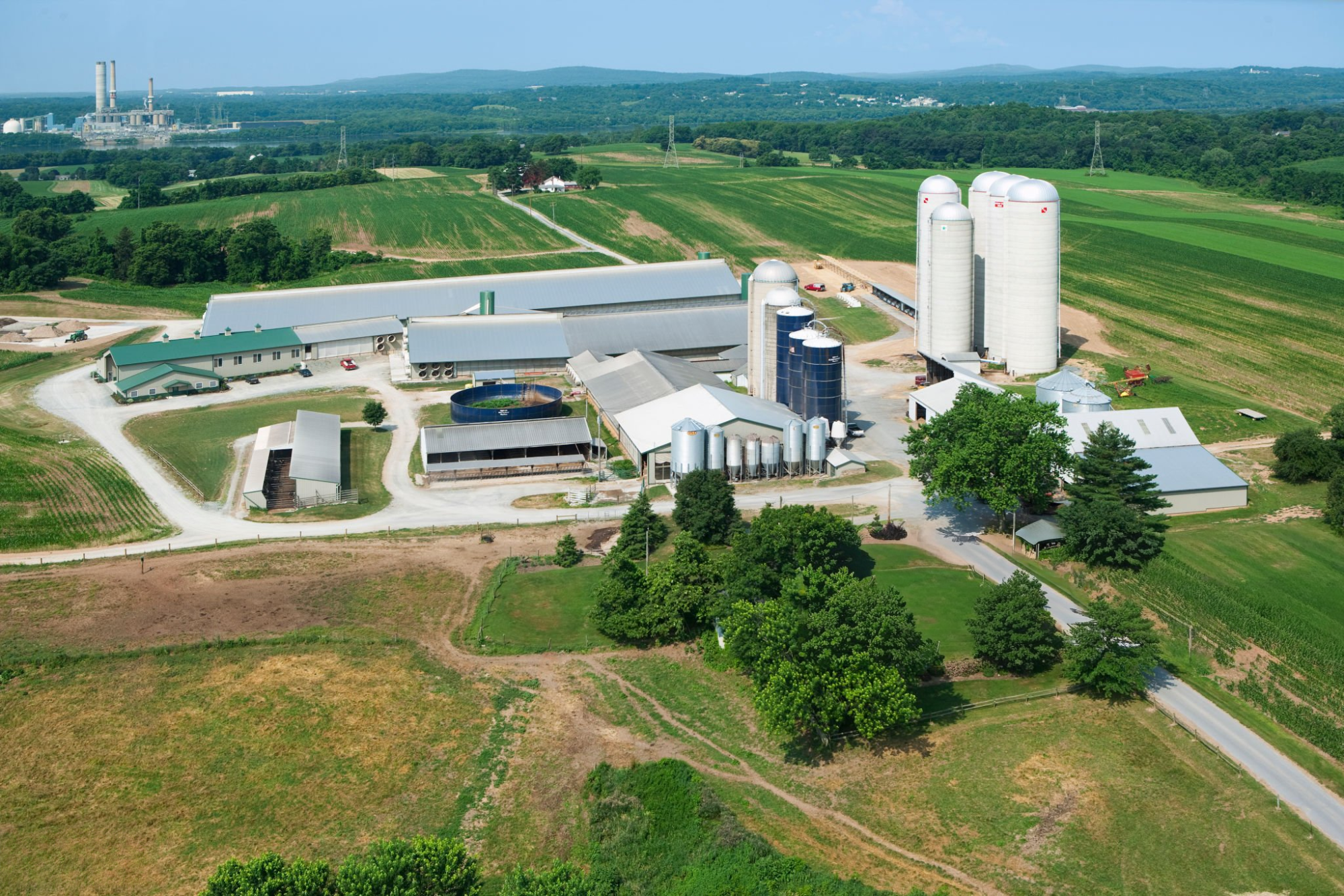
NewsSubscribe
First
Last
Consent

Washington Just Handed Dairy Farmers a $68 Billion Gift, But Here’s Why Most Won’t Unwrap It Properly

Washington handed dairy farmers $68B, but 80% won’t use it. Smart genomic testing + DMC coverage = $4,000 annual savings per 280-cow operation.

EXECUTIVE SUMMARY: Most dairy producers are about to waste the biggest policy gift in a decade while their smarter competitors capitalize on enhanced risk management combined with record component production. The “One Big Beautiful Bill” delivers $68.3 billion in agricultural program changes that fundamentally restructures dairy risk management, increasing Tier I DMC coverage from 5 million to 6 million pounds annually, yet based on historical uptake patterns, most operations will leave money on the table. Component levels have reached unprecedented highs with butterfat averaging 4.33% and protein at 3.36% in March 2025, representing 30.2% butterfat growth and 23.6% protein growth since 2011 while milk volume increased only 15.9%. European Union milk production is declining 0.2% in 2025 while U.S. operations benefit from enhanced DMC protection at just $0.15 per hundredweight for $9.50 coverage, creating unprecedented competitive advantages for producers who combine genetic advancement with strategic risk management. The question isn’t whether this policy works, it’s whether you’ll implement it before your competitors figure out the genomics-plus-government-support equation that’s reshaping dairy profitability.

KEY TAKEAWAYS

  • Enhanced DMC Coverage Delivers Immediate ROI: Operations producing up to 6 million pounds annually can now insure entire production at Tier I rates, potentially saving $3,000-4,000 annually in premium costs while gaining comprehensive $9.50 per hundredweight margin protection, yet only 19% of large-scale farms have adopted robotic milking systems despite proven economic returns.
  • Component Revolution Outpaces Volume Strategy: Butterfat production surged 30.2% since 2011 versus 15.9% milk volume growth, with genomic testing enabling 12% higher milk solids and 8% lower feed costs. Every 0.1% butterfat increase adds $6,570 monthly to a 1,000-cow operation when butterfat commands $3.06 per pound, yet most producers still chase volume over value.
  • Technology Adoption Gap Creates Competitive Moats: While global precision dairy farming markets exceed $5 billion in 2025, USDA reports only 19% adoption of robotic milking on large-scale farms. Forward-thinking operations combining enhanced DMC protection with automated milking systems achieve 150-240 cow efficiency per 3-4 robotic units, creating sustainable advantages over traditional competitors.
  • Global Market Positioning Window Closing: U.S. operations benefit from $8 billion in new dairy processing capacity through 2027 while EU production declines 0.2%, but 2025 DMC enrollment deadline passed March 31. Producers must audit genomic testing programs, evaluate technology investments, and prepare for 2026 enrollment to capitalize on component premiums and enhanced risk management before international competitors adapt.
  • Feed Cost Arbitrage Opportunity: With corn at $4.60 per bushel and enhanced DMC coverage protecting downside risk, smart operators can lock favorable feed contracts while leveraging updated 2021-2023 production baselines that reflect modern genetic gains. This combination of enhanced risk management plus strategic feed positioning creates unprecedented profit protection during volatile market conditions.

The U.S. Senate just passed the most significant dairy policy overhaul in a decade, and frankly, most of you won’t take advantage of it. The “One Big Beautiful Bill” includes $68.3 billion in agricultural program changes over 10 years that fundamentally restructure risk management for dairy operations nationwide. However, if history is any indication, too many producers will likely leave money on the table.

Here’s the reality: Washington doesn’t often get dairy policy right, but when it does, smart operators capitalize, while others complain about the paperwork. The enhanced Dairy Margin Coverage (DMC) program, launched in 2025, offers benefits that could fundamentally improve your operation’s financial resilience, provided you’re willing to challenge conventional thinking about government programs.

Why This DMC Enhancement Actually Matters (Unlike Previous Attempts)

Let’s cut through the political noise. The legislation expands DMC coverage capacity by 20%, increasing the Tier I production cap from 5 million to 6 million pounds annually. This isn’t just bureaucratic shuffling, it means operations with up to 300 cows can now insure their entire production at premium rates while accessing maximum protection levels of $9.50 per hundredweight.

However, here’s what most won’t tell you: this enhancement emerged during an unprecedented period of genetic progress. U.S. dairy operations have achieved four consecutive years of record butterfat levels, reaching a national average of 4.23% in 2024. Protein content has similarly climbed to 3.29% in 2024, marking eight consecutive annual records from 2016 to 2024.

What This Means for You: A 280-cow Wisconsin operation producing 5.8 million pounds annually can now insure their entire production at Tier I rates, potentially saving $3,000-4,000 annually in premium costs while gaining comprehensive margin protection. With current milk production forecasts reaching 227.8 billion pounds for 2025, these enhanced protections couldn’t come at a better time.

The updated production baselines represent the second game-changer. Producers can now select their highest annual milk production from 2021, 2022, or 2023 as their new coverage foundation. This addresses the reality that modern genetics and precision feeding have driven dramatic productivity gains, yet most operations still use outdated baselines that don’t reflect their actual potential.

The Component Revolution That’s Reshaping Everything

Here’s where it gets interesting. While everyone obsesses over herd size, the real money is in milk composition. The industry’s adoption of genomic testing has transformed breeding decisions, with butterfat levels increasing from 3.70% to 4.40% over the past 20 years, while protein levels have risen from 3.06% to 3.40%.

Industry Example: Recent analysis confirms that genomic testing and precision nutrition deliver up to 12% higher milk solids and 8% lower feed costs. Every 0.1% increase in butterfat can add $6,570 monthly to a 1,000-cow herd’s bottom line when butterfat commands $3.06 per pound and protein reaches $2.32 per pound.

The numbers don’t lie, and they’re jaw-dropping. From 2011 to 2024, milk production increased 15.9% while protein climbed 23.6% and butterfat increased 30.2%. This isn’t a temporary blip, but the culmination of a decades-long genetic revolution that has fundamentally transformed what comes out of our cows.

Yet here’s the contradiction nobody discusses: while component levels surge to record highs, many operations still prioritize volume over value. The enhanced DMC program rewards precision, not just production.

Technology Integration: Where Smart Money Goes

The agricultural bill’s benefits coincide with the rapid adoption of precision dairy technologies, but most operations aren’t leveraging the synergies. The global precision dairy farming market is projected to exceed $5 billion by 2025; however, the USDA reports that only 19% of large-scale farms have adopted robotic milking systems, despite their proven returns.

Automated milking systems demonstrate proven economic returns, with research confirming that AMS operations achieve comparable performance to conventional systems while typically milking 150-240 cows with 3-4 robotic units. The USDA reported robotic milking adoption on 19% of large-scale dairy farms, creating massive competitive advantages for early adopters who combine enhanced DMC protection with technological efficiency gains.

Modern high-producing operations now achieve remarkable metrics, with dry matter intake exceeding 68 pounds daily while producing over 120 pounds of energy-corrected milk. These efficiency gains, combined with enhanced DMC protection, position forward-thinking operations for sustained profitability while competitors struggle with outdated approaches.

The Transparency Initiative Nobody Saw Coming

For the first time in dairy policy history, the legislation mandates biennial surveys of processor manufacturing costs, directly addressing pricing formulas that have remained static while processing technology and costs have evolved.

Current Federal Milk Marketing Order pricing changes took effect June 1, 2025, including updated make allowances for cheese ($0.2519), dry whey ($0.2668), butter ($0.2272), and nonfat dry milk ($0.2393). These adjustments will reshape milk pricing formulas by ensuring that the make allowance calculations reflect actual processing costs rather than outdated estimates.

The national average somatic cell count now sits at 181,000 cells per milliliter, representing the lowest recorded level in decades. This reflects improved management practices and genetic selection, yet many operations haven’t capitalized on quality premiums that could dwarf traditional volume-based thinking.

Global Competitive Reality Check

While U.S. operations benefit from enhanced risk management, global competitors face constraints. European Union milk production is forecast to decline by 0.2% in 2025 due to environmental regulations, while global milk production is expected to grow by only 1.0% to 992.7 million tonnes.

U.S. operations benefit from favorable feed costs and expanding processing capacity. This competitive advantage, combined with enhanced risk management, enables U.S. producers to capture growing global demand while competitors contract.

Here’s the kicker: Over half of the increased global production is anticipated to come from India and Pakistan, which will jointly account for more than 32% of world production by 2032. U.S. technology adoption and genetic advancement create sustainable competitive moats that enhanced DMC protection helps preserve.

Implementation Strategy: What Winners Do Differently

The legislation extends critical dairy programs through 2029-2031, providing unprecedented long-term certainty. For 2025 coverage, DMC enrollment ran from January 29 to March 31, 2025.

Smart operators who enrolled by the March 31, 2025, deadline are:

  • Leveraging updated production baselines that reflect recent genetic gains from 2021-2023 data
  • Integrating genomic testing programs to maximize component production and quality premiums
  • Preparing for FMMO pricing changes that reshape milk pricing through transparent cost accounting

The premium structure remains unchanged: catastrophic coverage at $4 comes with no premium, while the highest level of $9.50 costs just 15 cents per hundredweight. At $0.15 per hundredweight for $9.50 coverage, Dairy Margin Coverage is a cost-effective tool for managing risk and providing security for your operations.

The Contrarian Perspective Nobody Wants to Hear

Here’s the uncomfortable truth: enhanced government support might actually encourage complacency instead of innovation. The most successful operations use risk management tools as safety nets, not business strategies.

Question for your operation: Will enhanced DMC coverage become a crutch that prevents necessary operational improvements, or will it provide the security needed to invest in transformative technologies?

The legislation’s broader SNAP reduction components create market contradictions. While Washington encourages production expansion through enhanced support, they’re simultaneously creating potential domestic demand pressures. Smart operators diversify into export markets and value-added products rather than betting everything on domestic fluid milk.

The Latest: Your Strategic Assessment for Mid-2025

The “One Big Beautiful Bill’s” $68.3 billion in agricultural program changes deliver transformative benefits to dairy producers through enhanced DMC coverage, now active for those who enrolled by the March 31, 2025, deadline. As we hit mid-2025, the industry achieves record component production and technological advancement while benefiting from enhanced risk management protection.

Your current strategic opportunities:

  1. Audit your genomic testing program and component selection criteria to capitalize on record component premiums
  2. Evaluate technology investments that complement enhanced risk management protection
  3. Prepare for ongoing FMMO transparency changes that continue to reshape milk pricing formulas
  4. Plan for 2026 DMC enrollment when the next enrollment period opens (typically January-March)

The bottom line: This legislation positions U.S. dairy operations for expanded production capacity while global competitors contract. The combination of enhanced risk management, record component production, and proven technology adoption creates the strongest financial foundation for U.S. dairy operations in over a decade.

But here’s what separates winners from whiners: Enhanced DMC coverage won’t save poorly managed operations or replace sound business fundamentals. It will, however, provide exceptional downside protection for producers who are smart enough to leverage genetic advancements, component optimization, and technological efficiency.

“We encourage producers to join the many dairy operations that have already signed up for this important safety net program,” emphasized USDA Farm Service Agency officials. “At $0.15 per hundredweight for $9.50 coverage, risk protection through Dairy Margin Coverage is a cost-effective tool to manage risk and provide security for your operations.”

The question isn’t whether Washington got dairy policy right for once, it’s whether you capitalized on their rare moment of clarity. Those who missed the 2025 deadline learned an expensive lesson about timing. Don’t let that be you when 2026 enrollment opens. The genetic revolution in component production is accelerating, technology adoption rates are climbing, and enhanced risk management tools have proven effective; the pieces are aligned for unprecedented dairy industry success if you’re positioned to capitalize on it.

Complete references and supporting documentation are available upon request by contacting the editorial team at editor@thebullvine.com.

Learn More:

Join the Revolution!

Join over 30,000 successful dairy professionals who rely on Bullvine Weekly for their competitive edge. Delivered directly to your inbox each week, our exclusive industry insights help you make smarter decisions while saving precious hours every week. Never miss critical updates on milk production trends, breakthrough technologies, and profit-boosting strategies that top producers are already implementing. Subscribe now to transform your dairy operation’s efficiency and profitability—your future success is just one click away.

NewsSubscribe
First
Last
Consent

Ditch the China Obsession: How Smart Dairy Exporters Are Banking Higher Returns in Tomorrow’s Powerhouse Markets

China imports crashed 12%. Smart exporters already banking 40% higher returns in tomorrow’s powerhouse markets.

EXECUTIVE SUMMARY: China’s dairy import collapse isn’t temporary—it’s structural destruction that will bankrupt operations still betting their genetic investments on Beijing’s buyers. While Chinese milk production surged 28% since 2019 and imports plummeted 12% in 2023, emerging markets across Southeast Asia, Middle East, and Africa are delivering 15-35% annual growth rates with demographic fundamentals guaranteeing sustained expansion for decades. The smartest exporters are leveraging genomic testing advances—which doubled genetic gain rates from $40 to $85 annually since 2010—to position high-component, heat-tolerant genetics in quality-conscious emerging markets. Operations successfully diversifying export portfolios report 40% higher margins and dramatically improved revenue stability, while China-dependent exporters watch competitive positions erode in real time. With $8 billion in new U.S. processing capacity coming online by 2027 and genomic inbreeding tripling in elite Holstein lines, the window for establishing emerging market presence is closing rapidly. This week, apply the same analytical rigor you use for breeding decisions to market diversification—identify three emerging markets aligning with your production capabilities and contact distributors before competitors establish the relationships that will define trade dynamics through 2030.

KEY TAKEAWAYS

  • Genomic Testing ROI Extends Beyond Breeding: Operations using comprehensive genomic selection generate $96,000 additional annual genetic gain for 1,000-cow herds (2.4x ROI), creating exactly the high-component, efficient animals emerging markets demand—unlike China’s volume-focused domestic production that no longer requires premium imports.
  • Heat Stress Management = Export Competitiveness: Environmental adaptation directly impacts export positioning, with heat stress reducing lifetime milk production by 4.9 pounds per day and documented U.S. losses of $245 million over five years—making cooling infrastructure investments (0.27-year payback) critical for realizing genetic potential in warm-climate export markets.
  • Market Diversification Delivers Superior Returns: Diversified export portfolios generate 15-25% higher gross margins compared to single-market strategies, with maximum single-market exposure limited to 30-40% versus 80%+ China dependence—providing revenue stability during trade disruptions while capturing premium pricing in quality-focused regions.
  • Technology Integration Accelerates Market Penetration: Operations using IoT monitoring and precision analytics report 40% faster market penetration and 25% higher customer retention rates, with supply chain optimization reducing logistics costs by 15% and real-time monitoring cutting rejected shipments by 30%.
  • Environmental Control Protects Genetic Investments: For every 1% increase in genomic inbreeding (now tripling in elite Holstein lines), lifetime milk production decreases 177-400 pounds and Net Merit declines $23-25—making genetic diversification strategies and crossbreeding programs essential for maintaining export competitiveness as premium genetics become increasingly vulnerable to environmental stress.
dairy export diversification, genomic testing dairy, emerging dairy markets, dairy export profitability, precision dairy farming

While most U.S. dairy exporters still chase shrinking Chinese contracts, the industry’s smartest operators are quietly building empires in emerging markets, posting explosive growth rates. China’s dairy import decline isn’t temporary—it’s structural, permanent, and about to crush anyone still betting their farm on Beijing’s buyers.

You’ve been sold a lie about China—and it’s time someone told you the truth.

The dairy industry has treated China like the promised land for over a decade. We’ve watched countless operations pour resources into Chinese market penetration, hire Mandarin-speaking sales teams, and restructure entire business models around satisfying Beijing’s appetite for Western dairy. Farm management consultants preached the gospel of Chinese market access like it was a guaranteed path to generational wealth.

Here’s the brutal reality that’s about to reshape everything: that era is over, and the data proves it beyond any doubt.

China’s dairy imports fell 12% in 2023 to just 2.6 million tonnes, with whole milk powder imports plummeting 38% year-on-year. Meanwhile, USDA figures show that Chinese milk production totaled 41 million tonnes in 2023, which is up 4.6% from the previous year and a 28% increase compared to 2019. The math is simple and unforgiving: China doesn’t need us anymore.

But here’s where this gets interesting for the operations smart enough to see what’s coming. While most exporters panic about losing Chinese market share, a select group of forward-thinking dairy businesses has been quietly diversifying into emerging markets that are absolutely exploding with opportunity.

What if I told you that betting your entire export strategy on China could bankrupt your operation by 2027? The evidence suggests we’re already watching it happen in real time.

China Reality Check: The Golden Goose Just Died

Let’s start with some uncomfortable facts about China that your export consultant probably isn’t telling you—facts that are reshaping the global dairy trade whether you’re paying attention or not.

The Production Revolution is Real and Permanent

According to the National Bureau of Statistics, Chinese milk production reached 41.97 million tons in 2023, increasing by 6.7% annually. This isn’t seasonal fluctuation or temporary market conditions. This is systematic, government-backed domestic capacity building designed specifically to reduce import dependence.

China took steps around four years ago to increase milk powder stocks and has been working to become more self-sufficient with increased domestic dairy production, with the government supporting the expansion of milk production. China’s 40.5 million metric ton dairy production goal was reached a year earlier than planned in 2023.

Think about this, like analyzing your herd’s genetic progress using genomic testing. When you see breeding values improve dramatically over multiple generations, you don’t expect them to regress—you plan around the new reality. China’s production surge follows the same pattern: systematic, sustained, and irreversible.

Trade War Casualties Keep Mounting

The tariff situation isn’t improving—it’s systematically destroying American competitiveness. In April 2025, the Trump administration introduced new tariffs: a 10% baseline on all imports, 20% for EU goods, and 104% on Chinese goods. These aren’t temporary negotiation tactics—they’re permanent strategic positioning that’s reshaping global dairy trade flows.

The economy has not recovered in the way many had hoped post-COVID, with a pessimistic outlook for 2024, which reduces demand as consumers tighten their purse strings. This is seen especially in foodservice, where dairy is often incorporated in treat dishes such as pizza or baked goods.

The Consumer Shift Nobody Talks About

China’s dairy consumption patterns are fundamentally changing, making import recovery impossible. Chinese milk consumption fell from 14.4 kg per capita in 2021 to 12.4 kg in 2022 due to a sluggish economy that has weakened demand for higher-priced foods.

With Chinese domestic milk production increasing, the need to import liquid milk and powders has been reduced. This is expected to continue throughout this year and beyond, which is set to have knock-on effects on the global dairy trade, reducing demand and potentially softening prices.

The Emerging Market Revolution: Where Smart Money is Moving

While conventional wisdom still chases Chinese market share, genuine opportunities are exploding across emerging markets that most exporters haven’t even appropriately researched. The global bovine animal genetics market is estimated at USD 3.70 billion in 2025 and is projected to reach USD 5.20 billion by 2030, demonstrating a 6.60% CAGR, with Asia Pacific identified as the fastest-growing region.

These aren’t niche markets or experimental ventures—they’re substantial, growing economies with demographic and economic fundamentals that guarantee sustained dairy demand growth.

The Technology-Genomics Connection Most Exporters Miss

Here’s where most exporters are getting it wrong: they’re thinking about export markets as separate from their genetic and technology strategies. The smartest operations realize that genomic testing advances have fundamentally reshaped domestic breeding programs and export market positioning.

Genomic testing has effectively doubled the rate of genetic gain, with the average annual increase in Net Merit surging from approximately $40 per year between 2005 and 2009 to $85 per year since 2010. This technological leap isn’t just improving domestic herds—it’s creating the high-component, efficient animals that emerging markets demand.

Newborn heifers can now have breeding values with 65-70% reliability based on genomic data, a substantial improvement over the 20-25% reliability offered by traditional parent average data. This early and accurate prediction allows breeders to make informed selection decisions far sooner, creating animals perfectly suited for specific export markets.

European Union: Learning from Competitive Strategy

EU agri-food exports reached EUR 19 billion in January 2025, 4% higher than in January 2024, with dairy product exports growing by EUR 119 million (+8%). But here’s the critical insight for American exporters: EU milk production is forecast to decline by 0.2% to 149.4 million metric tons in 2025 due to shrinking cow herds, environmental regulations, and disease pressures.

This creates massive opportunities for efficient American producers who understand that environmental adaptation isn’t just regulatory compliance—it’s a competitive advantage.

New Zealand’s Export Innovation Model

New Zealand’s government has modernized its dairy export quota system, shifting from milk solids collection to export performance-based allocation while adding quota opportunities for sheep, goat, and deer milk processors. This performance-based approach directly supports the government’s ambitious goal of doubling the value of New Zealand’s exports in 10 years.

Why This Matters for Your Operation: New Zealand’s cooperative model demonstrates that export success comes from systematic efficiency rather than just pursuing premium genetics. Their approach prioritizes profitability in grazing-based systems with superior fertility and hardiness.

India’s Domestic-First Strategy: The Alternative Model

India’s cow and water buffalo milk production is forecast to rise to 216.5 million metric tons (MMT) in 2025 from 211.7 MMT in 2024. This 0.8% increase in cows in milk to 62 million head is driven by continued government support for national dairy sector development.

India’s strategy offers a stark contrast to export-dependent models. Despite posting 126% growth in dairy exports to 123,877 metric tons worth $380 million in 2018-19, India prioritizes domestic food security over export revenues. This approach provides revenue stability during global market disruptions.

Strategic Implementation Framework: Your Diversification Roadmap

Market diversification isn’t just about identifying opportunities—it’s about executing systematic expansion strategies that minimize risk while maximizing return potential, using the same data-driven approaches you apply to genetic selection.

Phase 1: Market Intelligence and Precision Analytics (Months 1-3)

Start with comprehensive market research that goes beyond surface-level trade statistics. The global bovine animal genetics market is estimated at USD 3.70 billion in 2025 and is projected to reach USD 5.20 billion by 2030, demonstrating a 6.60% CAGR, with Asia Pacific identified as the fastest-growing region.

Apply the same analytical rigor you use for genomic evaluations to market assessment. Just as genomic evaluations have fostered greater international data integration, facilitating data sharing across borders to enhance breeding value accuracy, successful export strategies require systematic data collection on regulatory environments, competitive landscapes, and cultural preferences.

Phase 2: Technology Integration for Export Success

Beyond accelerating progress for existing traits, genomic selection has enabled the industry to breed for a broader range of new, economically relevant traits, including feed efficiency, heifer and cow livability, age at first calving, and various health traits. These same traits that genomic testing has made possible to improve are exactly what emerging markets value most.

Apply similar technological approaches to export management:

  • Data Analytics: Use the same analytical rigor you apply to milk yield curves and breeding decisions to track export market performance metrics
  • Supply Chain Monitoring: Implement GPS tracking and temperature monitoring for international shipments
  • Predictive Analytics: Apply machine learning approaches to forecast market demand cycles and optimal shipping schedules

Phase 3: Environmental Adaptation as Competitive Advantage

Here’s a critical insight most exporters miss: genomic inbreeding in elite Holstein lines has tripled in just one decade (2010-2020), rising from approximately 5.7% to 15.2%. This genetic concentration carries severe economic penalties that directly impact export competitiveness.

For every 1% increase in inbreeding, lifetime milk production can decrease by 177-400 pounds, productive life shortens by about 6 days, and Net Merit declines by $23-25. Export market diversification provides the same risk mitigation benefits for your revenue streams as genetic diversification for your herd health.

The Economic Reality Check: Verified ROI Data

Let me share verified performance data that connects genetic investment directly to export market success, using the same analytical approach we apply to evaluate breeding program efficiency.

Verified Genomic Testing ROI Data

For a Wisconsin operation, implementing full genomic selection generated an additional £193 (USD 240) in lifetime value per animal compared to traditional breeding methods. When scaled to a 1,000-cow herd with 400 annual replacements, this translates to $96,000 in additional annual genetic gain, representing a 2.4x return on investment against a yearly testing cost of $40,000.

But here’s the export connection most operations miss: this genetic advancement creates exactly the high-component, efficient animals that emerging markets demand, unlike China’s current shift toward domestic production that doesn’t require premium imports.

Environmental Adaptation and Export Success

High-producing Holstein cows exhibit optimal production within a narrow temperature range of 5-25°C, with a Temperature-Humidity Index (THI) not exceeding 72. Heat stress during pregnancy can reduce the lifetime milk production of daughters by 4.9 pounds per day, with documented U.S. losses of $245 million from 1.4 billion pounds of milk over five years (2012-2016).

This environmental sensitivity directly impacts export market positioning. Investing in cooling infrastructure shows rapid payback periods (dry cow cooling in existing barns with a payback of 0.27 years and a 3.15 benefit-cost ratio), making environmental control a critical component of export market competitiveness.

Why This Matters for Your Operation: If you’re exporting to emerging markets in warmer climates, heat stress management isn’t optional—it’s the difference between realizing genetic potential and watching premium genetics underperform. The $245 million in documented U.S. heat stress losses demonstrates why environmental adaptation is as critical as genetic selection for export success.

Global Competitive Intelligence: What the Data Really Shows

European vs. North American vs. New Zealand Genetics for Export

Heavier body weights and higher milk volume and protein yield generally characterize North American-derived Holstein cows. However, these production advantages often come with trade-offs, including lower fat concentrations and poorer fertility and survival rates compared to New Zealand Holstein-Friesian cows.

In contrast, New Zealand Holstein-Friesians are renowned for their profitability in grazing-based systems, with superior fertility and hardiness. Their lower feed intake contributes to higher profitability per hectare.

This genetic diversity creates opportunities for different export market positioning strategies, depending on local production systems and environmental conditions.

EU Trade Strategy: Lessons in Market Diversification

The EU pursues an open, sustainable, and assertive trade strategy through 10 Free Trade Agreements with Australia, Chile, India, Indonesia, Malaysia, the Mercosur bloc, Mexico, New Zealand, the Philippines, and Thailand to diversify agri-food trade and enhance food supply chain resilience.

Analysis reveals that both EU imports and exports increase in value, with exports of dairy products and pig meat exhibiting significant growth. However, EU milk production is expected to decline by 0.2% to 149.4 million metric tons due to shrinking cow herds, environmental regulations, and disease pressures.

Market Share Dynamics

While the EU remains the world’s largest milk producer, its share of global milk production experienced a decline from 21.4% in 2004 to 17.1% in 2022. In the bovine genetics trade, the United States exported 66 million units of bovine semen in 2023, significantly outpacing the European Union’s collective export of approximately 12 million units.

Risk Mitigation and Future-Proofing Your Export Strategy

Policy and Regulatory Disruption Preparedness

The international dairy genetics market is highly susceptible to disruptions stemming from regulatory and trade policy changes. Tariffs and retaliatory measures pose significant threats, as seen with U.S. tariffs on Mexican and Chinese goods in early 2025.

Government subsidies create a profoundly uneven playing field. Russia allocated $880 million in direct dairy support for 2025, marking a 50% increase from 2024. Norwegian farmers receive subsidies equivalent to 30% of their total revenue, and Canadian farmers benefit from $3.2 billion in trade compensation.

Small and Medium Farm Strategy

Small and medium-sized dairy operations face significant challenges in genetics auctions dominated by larger enterprises. These smaller farms typically bear a higher per-cow investment burden for technology and struggle with limited access to capital.

However, strategic approaches can enable smaller operations to compete effectively:

  • Strategic Crossbreeding: Crossbreeding can introduce hybrid vigor (heterosis), leading to improved fertility, health, longevity, and adaptability to diverse environments
  • Focused Genomic Testing: Rather than testing 100% of replacement heifers, use strategic testing to identify hidden genetic value in key animals
  • Collective Purchasing: Farmers can enhance their bargaining power by joining groups or cooperatives to negotiate better deals for genetics and share resources

The Bottom Line: Your Competitive Advantage Depends on Immediate Action

China’s dairy imports totaled 2.6 million tonnes in 2023, down 12% on the previous year, while Chinese milk production totaled 41 million tonnes in 2023, up 4.6% from the prior year and a 28% increase in 2019. Meanwhile, EU agri-food exports reached EUR 19 billion in January 2025 (+4%), with dairy product exports growing EUR 119 million (+8%), demonstrating that diversified markets are delivering real growth.

The global bovine genetics market is growing at 6.60% CAGR, with Asia Pacific as the fastest-growing region, creating unprecedented opportunities for operations smart enough to connect their genetic investments to export market positioning.

Here are the three critical insights that will determine your export success over the next five years:

First, market diversification isn’t optional anymore—it’s a survival strategy. The same precision you apply to genomic selection with 65-70% reliability breeding values must be applied to market portfolio management. Single-market concentration exposes your operation to catastrophic revenue loss from political decisions completely outside your control.

Second, emerging markets aren’t just replacement revenue but often superior business opportunities. Genomic testing has enabled breeding for economically relevant traits, including feed efficiency, health, and longevity that emerging markets value more than China’s volume-focused domestic production.

Third, environmental adaptation is your competitive weapon. Heat stress can reduce lifetime milk production by 4.9 pounds daily, with $245 million in documented U.S. losses. Operations that master environmental control will dominate export markets while competitors struggle with genetic potential that can’t be realized.

But here’s the question that should keep you awake tonight: Will you wait until China’s import decline accelerates further, or will you position your operation in markets that actually want American dairy products?

Your move: This week, apply the same analytical rigor you use for breeding decisions to market diversification. Identify three specific emerging markets that align with your production capabilities and genetic profile. Research their import certification requirements and contact potential distributors in each region.

Don’t spend another month hoping Chinese market conditions improve—with Chinese domestic milk production increasing, the need to import liquid milk and powders reduces, and this is expected to continue throughout this year and beyond. Your future profitability depends on executing diversification strategies with the same systematic precision you apply to genetic selection, nutrition management, and herd health protocols.

The global dairy export landscape is reshaping itself whether you participate or not. The only question is whether you’ll lead this transformation or become its casualty. Operations that successfully diversify their export portfolios report significantly higher margins and dramatically improved revenue stability. Those still dependent on Chinese market access watch their competitive positions erode in real time.

Execute now, or watch your competitors dominate the markets that will define dairy export success through 2030.

Complete references and supporting documentation are available upon request by contacting the editorial team at editor@thebullvine.com.

Learn More:

Join the Revolution!

Join over 30,000 successful dairy professionals who rely on Bullvine Weekly for their competitive edge. Delivered directly to your inbox each week, our exclusive industry insights help you make smarter decisions while saving precious hours every week. Never miss critical updates on milk production trends, breakthrough technologies, and profit-boosting strategies that top producers are already implementing. Subscribe now to transform your dairy operation’s efficiency and profitability—your future success is just one click away.

NewsSubscribe
First
Last
Consent

Protect Your Dairy Operations from America’s 1,000-Fold Subsidy Advantage

Stop chasing milk volume. Smart operators target 4.2% butterfat + 3.3% protein for 30% higher component premiums. The subsidy war demands precision.

EXECUTIVE SUMMARY: While American dairy farmers collect $66,355 in annual subsidies and you get $69, the real competitive advantage isn’t government handouts – it’s component optimization that makes volume-thinking obsolete. US producers have engineered a 30.2% increase in butterfat and 23.6% protein content since 2011, while milk volume grew just 15.9%, proving that smart operators compete on quality, not quantity. With processors paying 90% of milk value based on butterfat and protein content, operations still measuring success by tank volume are essentially selling commodities that subsidized imports can easily undercut. Over 10 million cattle have undergone genomic testing in North America, creating systematic genetic advantages that traditional breeding methods simply cannot match. Feed efficiency gaps between 1.3:1 and 2.0:1 mean the difference between survival and profit when feed represents 60-70% of variable costs. The brutal reality: component premiums and feed efficiency create defensible competitive positions that no subsidy disparity can eliminate. Stop measuring tanks – start measuring components, genomic progress, and feed conversion ratios before your operation becomes another casualty of the subsidy war.

KEY TAKEAWAYS

  • Component Revolution Delivers Real ROI: Target 4.2% butterfat and 3.3% protein content – operations achieving these levels generate $15,000-20,000 additional annual revenue per 100-cow herd through premium pricing that shields against commodity price volatility
  • Feed Efficiency Trumps Subsidies: Optimize feed conversion to 1.75:1 ratio or better – this represents $25,000-50,000 annual cost savings on 100-cow operations and creates competitive advantages that neutralize subsidy disparities through operational excellence
  • Genomic Testing Beats Traditional Breeding: Invest in systematic genetic evaluation using DNA analysis rather than visual assessment – genomic-enabled operations achieve component gains that compound over generations while traditional methods stagnate
  • Technology Integration Strategy: Implement individual cow monitoring for health and reproductive management before considering expensive automation – data generation and interpretation capabilities create lasting competitive advantages that manual systems cannot match
  • Anti-Fragile Market Positioning: Develop direct-market capabilities and value-added processing to capture premium segments – create revenue streams that subsidized commodity imports cannot easily penetrate through quality differentiation rather than volume competition
dairy competitive advantage, component pricing, feed efficiency, genomic testing dairy, precision agriculture

What happens when your biggest competitor receives $66,355 in government support while you get $69? You’re about to discover how this massive gap could reshape global dairy markets faster than you can say “component pricing.”

Here’s a number that’ll make your morning coffee taste bitter: American dairy farmers participating in the Dairy Margin Coverage program averaged $66,355 per operation in 2023 payouts, while you – if you’re farming in India – receive just ₹6,000 ($69) annually through the PM-Kisan scheme. That’s not a typo. That’s a 965-fold difference in just one subsidy program that could fundamentally alter the competitive landscape of global dairy.

Think of it this way: It’s like competing in a lactation contest where your opponent’s cows get premium TMR while yours graze on roadside grass. The outcome is predetermined before the first milking.

If you’re a strategic planner in the dairy industry, this subsidy gap isn’t just a statistic – it’s the loaded gun pointed at your operation’s future profitability. Keep reading, and you’ll discover exactly how this battle will reshape your strategic planning – and what you can do about it.

Why America’s Component Revolution Should Keep You Awake at Night

Let’s challenge one of dairy’s most sacred assumptions: that more milk always equals more profit. This conventional wisdom is not just wrong – it’s dangerously obsolete.

The numbers from USDA’s National Agricultural Statistics Service reveal a shocking truth. While US milk production increased a modest 15.9% from 2011 to 2024, protein content climbed 23.6%, and butterfat increased a staggering 30.2%. In 2024, US butterfat levels averaged 4.23% nationally, with protein content reaching 3.29% – both consecutive yearly records.

The component advantage creates what economists call a “quality premium trap.” When processors pay multiple component pricing that places nearly 90% of the milk check value on butterfat and protein content, high-component producers operate entirely in a different market.

Why This Matters for Your Operation

Component optimization isn’t just an American advantage – it’s becoming the global standard. When international buyers increasingly demand specific fat and protein ratios for specialized products, operations stuck in volume-thinking become commodity suppliers competing solely on price.

The Genomic Acceleration That’s Reshaping Competitive Advantage

Here’s where the story gets more concerning for traditional operations: The component revolution isn’t slowing down – it’s accelerating through genomic technology that creates compounding advantages.

Over 10 million dairy cattle have undergone genomic testing in North America, creating a massive genetic database that drives systematic improvements in Total Performance Index scores and component production. The predictive power of genomic testing comes from comparing an individual animal’s DNA sample to the overall population, enabling producers to evaluate animals and make breeding decisions based on a variety of production and health traits.

But here’s the controversial truth: While American operations systematically improve genetics through data-driven selection, most global operations still rely on traditional breeding methods that can’t compete with genomic precision.

Why Traditional Breeding Approaches Are Failing

Most dairy operations worldwide still evaluate breeding decisions based on visual assessment and basic production records. Meanwhile, genomic-enabled operations make breeding choices based on DNA analysis that predicts performance across dozens of traits before animals even enter production. The gap isn’t just technological – it’s methodological and widens every generation.

Feed Efficiency: The Great Divider

Feed efficiency represents the foundation of competitive dairy operations, with research showing efficiency can vary dramatically among operations. Top-performing US herds achieve feed conversion efficiency above 1.75:1 (Energy Corrected Milk to Dry Matter Intake ratio).

The average Holstein cow produces 75 pounds of milk and consumes 53 pounds of dry matter daily. Feed represents approximately 60-70% of variable costs in milk production, making efficiency improvements critical for competitive positioning.

Technology Integration Reality Check

Automated milking systems (AMS) show 8% of current adoption among US farmers, with 18% considering implementation. These systems can increase milk production by up to 12% and decrease labor by as much as 30%. More importantly, AMS operations generate continuous data streams about individual cow health, fertility, and production that enable optimization that is impossible with conventional systems.

But here’s what most analyses miss: The technology gap isn’t just about equipment – it’s about data interpretation and decision-making capabilities that compound over time.

India’s Production Reality vs. American Efficiency

India’s position as the world’s largest milk producer (239.3 million tonnes annually in 2023-24)  masks significant efficiency challenges. With per capita availability at 471 grams per day, the system achieves scale through numbers rather than per-animal productivity.

The productivity gap is staggering: Research shows Indian crossbred cows average 8-14 kg milk per animal per day, with studies indicating crossbred productivity at 9.23 litres daily, buffalo at 6.09 litres, and local cows at 4.98 litres daily. Compare this to US Holstein averages of 75 pounds (34 kg) daily.

The Infrastructure Challenge

India has developed indigenous genomic technologies, including specialized ‘Gau chips’ for cattle and ‘Mahish chips’ for buffaloes. However, the scale and adoption remain far behind genomic leaders, creating persistent productivity gaps that subsidies and protection can mitigate but not eliminate.

Strategic Defense: Your Implementation Framework

Phase 1: Component Focus (Months 1-6)

  • Target 4.2% butterfat and 3.3% protein content through selective breeding
  • Implement monthly component testing protocols
  • Negotiate component-based pricing with processors
  • Expected ROI: 0.2% component improvement generates $15,000-20,000 additional annual revenue on 100-cow operation

Phase 2: Feed Efficiency Enhancement (Months 6-12)

  • Optimize feed conversion to achieve a 1.6:1 ratio or better
  • Implement precision nutrition with regular ration balancing
  • Monitor dry matter intake optimization by production stage
  • Expected Performance: 5-10% feed conversion improvement represents $25,000-50,000 annual cost savings on 100-cow operation

Phase 3: Technology Integration (Months 12-24)

  • Evaluate individual cow monitoring for health/reproductive management
  • Consider AMS investment only after demonstrating precision management success
  • Focus on data generation and interpretation capabilities
  • Investment Range: AMS systems cost $150,000-275,000 per unit

Building Anti-Fragile Operations

Smart dairy strategists don’t just react to technological threats – they build systems that become stronger under stress. When high-tech systems require expensive infrastructure and constant connectivity, knowledge-intensive systems with superior operational fundamentals can capture markets that value reliability and local adaptation.

Market Diversification: Beyond Commodity Competition

The strategic insight from global markets is clear: Countries focusing on value-added dairy products maintain pricing power despite trade pressures. Premium positioning through quality metrics, direct-to-consumer channels, and specialized processing creates defensible market positions that subsidized imports cannot easily penetrate.

Component-based pricing isn’t coming – it’s already the dominant reality for competitive operations. Operations still competing on milk volume are essentially selling a commodity that buyers can source from anywhere, while operations selling specific component profiles provide manufacturing inputs that can’t be easily substituted.

The Bottom Line: Your Strategic Response Plan

Remember that 965-fold subsidy disadvantage we opened with? It’s not going away, but your response will determine whether your dairy operations thrive or survive in this new competitive environment.

Here’s what we’ve uncovered that changes everything: While American operations enjoy massive subsidy advantages ($66,355 vs. $69 annually)  and deploy genomic technologies that create systematic competitive improvements, the real opportunity lies in building efficient systems that compete on operational excellence rather than government support.

The component revolution demonstrates that competing on volume is economic suicide when processors pay 90% of milk value for butterfat and protein content. The genomic gap shows that data-driven breeding decisions create permanent advantages that traditional methods cannot match. The feed efficiency differential reveals that precision management can create cost advantages that help neutralize subsidy disparities through superior operational performance.

The opportunity hiding inside this crisis is massive: While large industrial operations struggle to adapt complex systems, well-positioned operations can implement targeted improvements faster, optimize individual animal performance more effectively, and capture premium market segments that value quality over commodity pricing.

Here’s your immediate action step: Before you finish reading this article, calculate your current feed conversion efficiency (Energy Corrected Milk ÷ Dry Matter Intake) and component yields (butterfat % + protein %) for your highest-producing animals. If your feed conversion is below 1.5:1 or your combined components are under 7%, you’ve identified your biggest strategic vulnerability – and your most important improvement opportunity for the next six months.

Your second strategic priority: Audit your operation’s competitive positioning by identifying what percentage of your success depends on volume versus component quality. If you’re still measuring success primarily by tank volume rather than component yield and quality premiums, you’re competing with yesterday’s business model against tomorrow’s technology.

The dairy industry’s future belongs to operations that build measurable competitive advantages through operational excellence, not those that hope for favorable trade policies or subsidy programs. The choice – and the competitive advantage – is yours.

Learn More:

Join the Revolution!

Join over 30,000 successful dairy professionals who rely on Bullvine Weekly for their competitive edge. Delivered directly to your inbox each week, our exclusive industry insights help you make smarter decisions while saving precious hours every week. Never miss critical updates on milk production trends, breakthrough technologies, and profit-boosting strategies that top producers are already implementing. Subscribe now to transform your dairy operation’s efficiency and profitability—your future success is just one click away.
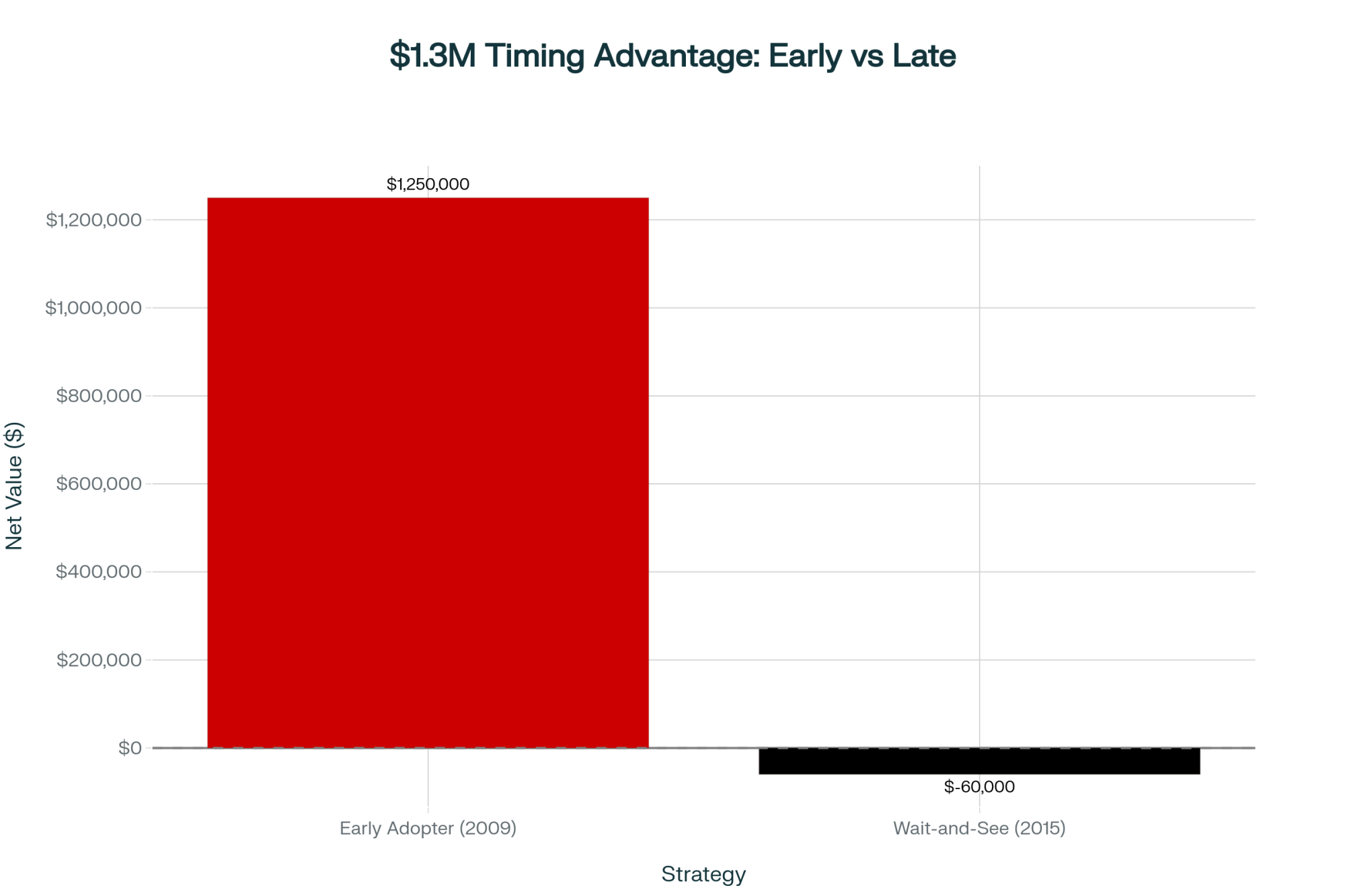
NewsSubscribe
First
Last
Consent

The Magic Behind Larenwood Farms: How Chris McLaren is Redefining Dairy Excellence

Stop buying expensive genetics. This 60-year closed herd outperforms open herds with 13,100kg averages and proves internal breeding beats purchasing.

Ever wonder what it’s like to step onto a farm where six generations of passion have shaped every detail? That hit me when I first visited Larenwood Farms on a crisp morning in Drumbo, Ontario. There’s Chris McLaren, already making his rounds before sunrise, moving with purpose through a barn where 110 Holstein cows represent decades of meticulous breeding decisions. Steam rises from their breath in the cool air while the gentle hum of milking machines creates a soothing backdrop to the daily rhythm played out here since 1852. It’s not just any farm—it’s living history with cutting-edge science folded into every corner.

You can’t miss the wall of awards in the farm office. Those plaques and shields—including multiple national herd management awards and the coveted Holstein Canada Master Breeder shield—are not just decorations. They’re milestones in a journey that perfectly blends old-school farming wisdom with the innovation you’d expect from a tech startup, not a 163-year-old family operation.

Where It All Began

Aerial view of Larenwood Farms in Drumbo, Ontario—where 163 years of McLaren family heritage meets cutting-edge dairy innovation. This 700-acre operation houses 110 Holstein cows in facilities designed around one principle: cow comfort drives profitability.

“Our family has been on this farm site for 163 years,” Chris tells me with a smile that speaks volumes about his connection to this land. “Our relatives on my grandmother’s side moved here in 1852 and settled this property, and we’ve continuously had our family on this site ever since. I’m the sixth generation, and Hailey, Joel, and Dana are the seventh generation to live on this farm site.”

Walking the property with Chris, you can’t help but feel the weight of decisions made by farmers long gone. What started as a typical mixed farm gradually evolved into a dairy specialization about 50 years ago and now spans roughly 700 acres, producing all the feed their livestock needs.

“We love our little community that we live in here. This is downtown Richwood, where our farm is,” Chris gestures toward the quiet countryside. There’s something genuine about how the McLarens approach their role here—farming isn’t just business; it’s being woven into the fabric of a place.

The game-changer for Larenwood came in 2012. That’s when they built their new milking facility designed for 126 milking cows and 24 dry cows. Before that, Chris and his team had knocked out bunker silos in 2011 and converted their haylage silo to high-moisture corn the same year. But the modern free-stall setup replacing the old tie-stall barn truly transformed everything.

Chris remembers that transition vividly. “The morning after we moved the cows into the new barn, I remember standing in the feed alley just watching them,” he recalls with the kind of enthusiasm you’d expect from someone describing their first sports car, not a dairy facility. They adapted quickly to the sand bedding and free stalls—within hours, they were more comfortable than ever. That moment reinforced everything we believed about putting cow comfort first.”

Not Your Average Dairy Farmer

Chris McLaren, sixth-generation owner of Larenwood Farms in Drumbo, Ontario, has transformed a 163-year-old family operation into an award-winning dairy powerhouse by combining university-level research expertise with time-tested farming wisdom—proving that closed herds can outperform operations spending millions on purchased genetics.

What makes Chris such an interesting character in the dairy world? It’s that rare combination of dirt-under-the-fingernails farming experience and serious academic credentials. His path took him through the University of Guelph’s Ontario Agricultural College and then to Ontario Veterinary College, where he earned a master’s degree working with Dr. Ken Leslie’s research group. That’s not the typical resume you expect from someone driving a feed truck at dawn.

“My time at the University of Guelph opened my eyes to the vast knowledge and understanding that research can have on improving the dairy farm,” Chris shares. “Undergrad classes and their faculty made me open to discussing and asking questions. My time at OVC, while doing my master’s, with Dr. Ken Leslie’s research group allowed me to see how important research is to our farm and the industry. I am still in contact with many of his students and faculty for advice or to participate in research projects.”

This science-forward approach is evident in everything at Larenwood. Chris doesn’t just review data—he interprets it through the lens of those academic foundations.

“Science insights are used every day in every decision we make,” he emphasizes, with the conviction of someone who’s seen the direct benefits. “We’re always looking to see what research says about management decisions. We always challenge salespeople to show us the research. We won’t buy products or make management changes unless there’s proof it works.”

I love how Chris says, “It’s important to always critically examine a problem or opportunity and gather information just as you would in a scientific study. We can make an educated decision after gathering information from many sources, either producers or research.” This blend of skepticism and openness makes the Larenwood approach so effective.

Award-Winning? That’s an Understatement

The wall of achievements at Larenwood tells a story few farms can match. They snagged the national DHI (Dairy Herd Improvement) Herd Management Award for three consecutive years—2014, 2015, and 2016. In 2021, they placed seventh among Canada’s Best Managed Dairy Herds. But the crown jewel? That 2019 Holstein Canada Master Breeder shield—dairy farming’s equivalent of an Oscar.

When I asked which award meant the most, Chris didn’t hesitate: “It’s Hard to pick between the herd management award from Lactanet and master breeder. Both have been our goals for many years. To have accomplished both in such a short time is extremely gratifying. This is especially true since we are a closed herd, and all improvements have been made through good management and breeding decisions over the long term.”

Think about that again—most farms need decades to achieve just one of these recognitions. Larenwood knocked out both in quick succession. That’s like winning a marathon and then immediately acing a triathlon.

The numbers behind these achievements are just as impressive. They milk 110-115 cows with an average 305-day milk production of 13,100 kg. First-lactation cows average 11,100 kg, second-lactation cows hit 13,600 kilograms, and third-lactation cows reach a whopping 14,200 kg. Fat content? 4.5%. Protein? 3.3%. And get this—their somatic cell count is just 48,000. If you know dairy, you know that’s ridiculously low and speaks volumes about their milk quality.

Chris has this great analogy for dairy farming: “Managing a dairy herd is like juggling many balls in the air simultaneously and hoping not to drop any. If we drop a ball, we want to know why and how we can improve next time.” That’s the mindset that separates good farms from great ones.

Cow Comfort: Not Just a Catchphrase

Larenwood’s 2012 freestall barn represents more than modern facilities—it’s proof that cow-centered design delivers measurable results. Every detail, from 48-inch sand-bedded stalls to strategic ventilation, was chosen based on global research and farm visits, not sales pitches.

Before building their 2012 facility, Chris became a barn tourist, visiting farms across North America and internationally to cherry-pick the best ideas. “I did a lot of touring nationally, locally, and internationally. He explains that I went to many meetings and events and learned from many great producers,” he explains.

What strikes me about Chris’s morning routine is how he watches his cows. “You can tell so much just by watching,” he says with the insight of someone who truly understands these animals. “Are they comfortable in the stalls? Are they spending enough time lying down? Are they eating aggressively at the bunk? These observations tell me more than any computer data could.”

One principle trumped all others throughout the facility design process: cow comfort. “Focusing on cow comfort and keeping the cow as the center of the facility is important and key to getting the most from those cows,” Chris emphasizes. This isn’t just talk—every detail, from the 48-inch stalls with sand bedding to the ventilation system, was designed around what makes cows happy.

I love Grant McLaren’s (Chris’s father) philosophy: “The best cow in the barn is one you don’t know you have.” Isn’t that brilliant? It perfectly captures their goal—create an environment where cows thrive without constant intervention, freeing up the team to focus on improvement rather than putting out fires.

The proof is in the pudding—or, in this case, the milk. Since moving to the new facility, Larenwood has seen dramatic decreases in lameness and metabolic disorders while production has soared.

Feeding Champions

By mid-morning at Larenwood, feed delivery takes center stage. Chris’s approach to nutrition reflects the same scientific mindset he brings to everything else. “I treat the dairy cow like she’s an athlete,” he explains while checking the day’s feed mix. “The athlete needs unique good genetics… You need good feed, you need good management, you need good prevention, and you need a good team around you, and that’s kind of the philosophy we use when dealing with cows and everything that we do.”

The daily dance between Chris and Grant is something to behold. Grant typically handles the feed mixing, drawing on decades of experience, while Chris contributes insights from milk production data and health observations. It’s a perfect blend of expertise and analysis.

Their nutritional program isn’t complicated, but it is precise. The Total Mixed Ration uses about 60% corn silage and 40% haylage on a dry matter basis, plus high moisture corn, roasted soybeans, and a specialized protein blend. This approach gives cows consistent energy throughout the day.

“We focus on a high roughage diet,” Chris notes. “We try to get high intakes of roughage into our cattle. We breed cattle to have lots of capacity and width to eat a lot of feed, and we try to harvest great feeds so they can do that.”

One innovation I found particularly clever is their automatic feed pusher, which runs eight times daily. It’s a simple technology that ensures cows always have feed within reach—critical for top-producing animals that might consume over 30 kg of dry matter daily.

The Genomics Game-Changer

By mid-morning, Chris often shifts to the most fascinating aspect of Larenwood’s operation—its genomic breeding program. Despite being a closed herd for over 60 years (meaning they haven’t purchased outside animals), they’ve achieved remarkable genetic advancement through strategic breeding decisions.

“A turning point in our farm’s genetics was when we started testing every animal with genomics,” Chris explains with the enthusiasm of someone who’s found a secret weapon. “This technology gives us another tool to find the cows that will contribute to producing better cattle. The improvement and consistency of the herd has been incredible.”

Want proof? Just look at their production data by Lifetime Profit Index (LPI) rankings:

LPI ValuePercentageCountAvg 305-day Milk (kg)Avg 305-day Fat (kg)Avg 305-day Protein (kg)Avg Classification
344726%1111,63654240282.9
323623%1011,63950541282.5
306926%1111,78650440279.3
280826%1111,57449439481.0
Total100%4311,65751140381.4

What does this mean in plain English? Cows with higher LPI consistently produce more milk with better components while maintaining healthier udders. For a commercial dairy, these differences translate directly to the bottom line.

I appreciate how Chris balances technology with tradition. “Genomics is a tool just as pedigree knowledge is,” he explains. “Genomics allows you to see animals and pedigrees needing more improvement or focus. However, having that knowledge of the pedigree and what has worked in a family helps to select bulls that complement cows.”

Their breeding philosophy is refreshingly straightforward: “Make the daughter better than the mother.” Each cow is bred by examining the linear traits of both cow and bull to find complementary matches. They’ll often alternate generations with production-focused bulls and then type-focused bulls.

Larenwood Alligator Homer 1123 demonstrates genomic breeding mastery—scoring 91 points in third lactation with 3116 LPI and 15,130 kg production, proving how strategic genomic testing within closed herds creates elite performers that outproduce industry averages by 4,000+ kg annually.

The results speak for themselves. Take their ‘H’ family progression:

Larenwood AirIntake Homer 903: 85 points in 4th lactation, 2478 LPI, 14,770 kg Larenwood Alligator Homer 1123: 91 points in 3rd lactation, 3116 LPI, 15,130 kg Larenwood RangerRed Homer 1269: 85 points in 1st lactation, 3561 LPI, 11,830 kg, Larenwood Poprock Homer 1262: 3739 LPI, 105kg fat, type 13

Larenwood Alligator Crazy 1114 exemplifies genomic breeding success in action—scoring 85 points in first lactation with 3286 LPI and 12,600 kg production, proving how strategic genomic testing transforms genetic potential into measurable performance in closed herd operations.

Or their ‘C’ family:

Larenwood Randall Crazy 907: 90 points in 3rd lactation, 2942 LPI, 17,580 kg Larenwood Alligator Crazy 1114: 85 points in 1st lactation, 3286 LPI, 12,600 kg Larenwood RangerRed Crazy 1228: 83 points in 1st lactation, 3706 LPI, 13,000 kg Larenwood Anahita Crazy 1416: 3689 LPI, 16 type, Larenwood Anahita Crazy 1467: 3584 LPI, 84kg fat, type 17

You should see Chris when he talks about these cow families—his face lights up as he points out subtle improvements in udder texture, teat placement, and dairy strength that would escape the casual observer but represent decades of careful decisions.

This focused breeding work has also produced outstanding bulls, now available through artificial insemination. Larenwood MAXIMUM (3553 LPI, 15 type) and Larenwood PG MONUMENTAL (3839 LPI, 108 kg fat, type 13) represent the culmination of generations of careful breeding.

“Having bulls in AI is a validation of our breeding philosophy,” Chris says with justifiable pride. “But more importantly, we know these bulls will create the kind of trouble-free, productive cows that commercial dairy farmers need to be profitable in today’s challenging environment.”

Baby-Making Business

By afternoon, Chris typically focuses on reproductive management—probably the least glamorous but most crucial aspect of dairy farming. Their move to the new facility in 2012 brought unexpected benefits in this area. “We noticed when we came into the new barn that getting cows pregnant was improved,” Chris notes. “Seeing cows move around and technologies all helped.”

Through careful analysis and consultation with advisors, they’ve achieved a pregnancy rate of 28%—significantly above the provincial average. This reflects excellent heat detection and conception rates.

Their breeding strategy is surgical in its precision: “25% of heifers are bred sexed semen, 25% recipients, and 50% conventional,” Chris explains. The milking herd has 10% sexed to heifers, the bottom 20% to beef, and the rest conventional semen.” They also implement an embryo transfer program, flushing select elite heifers and implanting embryos into lower genetic merit animals—accelerating genetic progress across the herd.

The stats are impressive: 70% insemination rate, 45% conception rate, 41% conception at first breeding, and 83% of cows pregnant by 150 days in milk. The pregnancy rate is 30+ %. These numbers put Larenwood in elite company for reproductive performance.

I love watching Chris during his late afternoon rounds through the dry cow area. He examines each pregnant animal with the care of an expectant father, mentally planning their calving management and future breeding. “Each pregnant cow represents not just future milk production but the next step in our genetic plan,” he explains. “I’m already thinking about what bull might work best on her daughter before she’s born.” Talk about planning!

Family Business Done Right

The McLaren family—Chris with wife and children Hailey, Joel, and Dana—representing six generations of farming heritage at Larenwood Farms. While the seventh generation prepares to continue the family legacy, the McLarens demonstrate that successful dairy operations require both dedication to the land and commitment to family balance.

As evening approaches at Larenwood, Chris and Grant meet again to review the day and plan for tomorrow. Their collaborative management style exemplifies what family farming should be. “I am involved in the overall management, genetics, and herd health. My dad is focused on the feeding and cropping,” Chris explains. “We both have input into all aspects but have the area we are mostly focused on. We talk each morning to set the day’s priorities.”

What you see as a visitor masks the complex coordination behind the scenes. “There are days when we haven’t explicitly discussed a task, but we both know it needs doing,” Chris says with a knowing smile. “That’s the advantage of working with family—sometimes we can communicate without words.”

Chris’s appreciation for his father’s mentorship shines through in every conversation. “My biggest mentor and advisor would be my dad. He is supportive of all the changes we make. He is very thoughtful and analytical of every decision to ensure we make the correct choice. These skills, as well as ‘never be afraid to ask questions,’ he taught me.”

Beyond the family core, Larenwood employs one full-time and five part-time staff members who contribute to the farm’s success. Chris emphasizes clear communication in team leadership: “Everyone needs to understand not just what we’re doing, but why we’re doing it. When the team understands the reasoning behind a protocol or change, they’re likelier to implement it consistently.”

Old School Meets New Tech

The most fascinating thing about Larenwood might be how they blend six generations of farming wisdom with cutting-edge scientific knowledge. As a 60+ year closed herd with such a deep family history, tradition runs in their soil. Yet, they consistently embrace innovation that many newer operations miss.

“We’re always learning from past experiences, which helps us learn and grow as dairy herd managers,” Chris reflects. “There’s great value in listening to the past and not repeating mistakes. However, we’re always open to new, well-researched ideas. It’s great having my dad and uncle around the farm to remind me of things they’ve tried that were successful or failed. We’re constantly investing in new technology that can provide more information to help make good decisions.”

You can see this balance in action during breeding decisions. Chris might be consulting genomic data on his tablet while drawing on generational knowledge of cow families. “The genomics tell me the numbers, but our family history with these cows tells me how they’ll likely respond to different management approaches,” he explains. “You need both perspectives to make the best decisions.”

Isn’t that the sweet spot we’re all looking for? Honoring wisdom while embracing progress?

Bouncing Back Stronger

No farm reaches Larenwood’s level without facing serious challenges. When I asked Chris how he maintains motivation through setbacks, his answer revealed the mindset that’s propelled their success: “I always try to do my best in everything that I do. There is always room for improvement, and that is what motivates me. Failure or an issue is a challenge to fix that problem and be successful.”

He continues, “I try to stay focused on the long-term goal and see that there will always be bumps in the road. Over the years, I have learned that it is important to stop and appreciate successes and not dwell on failures for too long.”

The McLarens’ approach to challenges is methodical and research-driven. “By doing the proper research and asking lots of questions before we change something, we believe we make the correct decision at that moment, and few mistakes are made,” Chris explains. “We try to stay positive and see each setback as a learning experience for us to get better. We will often ask, how could we have done better? Or, what could we change next time? If there is an issue, we will involve our advisory team and develop solutions. We’re not afraid to contact industry experts in that area to give us ideas.”

This commitment to continuous improvement extends to every corner of the operation. “We are always looking for the next challenge and the next area that we can do better for the cows and the herd,” Chris adds. This relentless forward momentum has earned them those awards and shields.

What’s Next for Larenwood?

Construction crews prepare Larenwood's freestall barn for robotic milking installation, marking the farm's third major facility evolution from tie-stall to freestall to autonomous systems. The renovation will allow cows to choose their own milking frequency, potentially increasing production while reducing labor demands—the next logical step in Chris McLaren's cow-centered management philosophy.
Construction crews prepare Larenwood’s freestall barn for robotic milking installation, marking the farm’s third major facility evolution from tie-stall to freestall to autonomous systems. The renovation will allow cows to choose their own milking frequency, potentially increasing production while reducing labor demands—the next logical step in Chris McLaren’s cow-centered management philosophy.

Do you know what’s fantastic about Larenwood? They don’t just talk about improvements—they make them happen. Remember that tie-stall barn renovation for automatic calf feeders I mentioned? Chris and the team have already completed that project in 2022! And that new heifer facility he was eyeing? They built it in 2023. Talk about getting things done.

“The combination of the calf barn, the heifer barn, and better genetics all contributed to almost 1000kg per lactation more milk for the first lactation animals,” Chris tells me with well-deserved pride. Can you imagine that kind of improvement? We’re talking about first-calf heifers producing an extra 1000 kilograms of milk each—that’s the power of combining facility improvements with genetic advancement.

So, what’s actually on the horizon for Larenwood now? Something even more exciting. “We are renovating our milking barn for robotic milking,” Chris explains. “This is the next evolution of Larenwood. From tiestall to freestall, now robotic.”

I love how he frames this progression—it’s like watching the evolution of dairy farming in real time through one farm’s journey. Each stage represents a significant leap forward in cow comfort and operational efficiency.

The robotic milking system isn’t just a fancy new technology—it fundamentally changes the relationship between cow and caretaker. “This will allow for a more stress-free barn that allows the cow to be milked as often as she chooses,” Chris explains. This will increase the milk production per cow from the current twice-daily milking.”

Think about what this means for the cows. Instead of being herded to the parlor on a strict schedule, they can decide when they want to be milked. Some might go three or four times daily, especially in peak lactation. It’s cow-centered farming that has been taken to the next level.

Beyond these facility improvements, Chris’s vision remains constant: “Continue improving the herd’s health, production, and genetics. Work with a few cow families in the barn to produce elite genomic animals that improve the herd and give us a chance to put more bulls in AI.” And yes, he’s still aiming for another master breeder shield to join the first.

Standing on land that’s supported his family for six generations, Chris carries both the weight of responsibility and the excitement of possibility. “Each generation has left this farm better than they found it,” he reflects. “My goal is to continue that tradition while preparing the next generation to take it even further.”

Don’t you think something about that blend of completed achievements and ambitious plans is inspiring? It’s the Larenwood way—constantly moving forward while building on past success.

Wisdom Worth Sharing

As the day winds down at Larenwood, Chris makes his final barn check under the soft night lighting. In these quiet moments, he often reflects on the journey and what wisdom he might pass along. His advice for young farmers is worth its weight in gold:

“Learn from as many people as you can. Don’t be afraid of asking questions from those that are ‘better’ than you. Learn from them, and you will be surprised by how many people are willing to answer all your questions.”

He emphasizes patience and persistence: “Long-term consistent success does not happen overnight. Stay patient and focused on your goals.” And his most important principle? “But most of all, always keep the cow at the forefront of everything you do.”

This advice encapsulates the Larenwood approach—humble learning, long-term vision, and unwavering commitment to animal welfare. It’s how six generations have built one of Canada’s most respected dairy operations.

The Heart of It All

As darkness settles over Larenwood Farms, the barn lights dim, and the rhythmic sound of contented cows chewing their cud creates a peaceful backdrop that belies the sophisticated operation behind the scenes. This place—this remarkable blend of heritage and innovation—stands as living proof of what’s possible when family wisdom meets scientific precision.

From genomic testing to facility design, from their award-winning breeding program to their meticulous attention to cow health, every aspect of Larenwood reflects a commitment to excellence that spans generations. Those national awards aren’t just decorations—they’re external validation of an approach that puts cows first while embracing science and tradition.

What makes Larenwood’s story so compelling isn’t just the impressive statistics or the wall of awards. The values guiding their success for over 160 years are putting the cow first, embracing continuous improvement, making data-driven decisions, and maintaining that long-term perspective that seems increasingly rare today.

In an era of agricultural consolidation and economic pressure, Larenwood is a testament to the enduring power of thoughtful, knowledge-based farming. Chris McLaren and his family have created an award-winning dairy operation by honoring their rich heritage while embracing scientific advancement. This legacy will continue to inspire dairy farmers for generations to come.

Could we all learn something from that approach?

KEY TAKEAWAYS

  • Closed Herd Genetic Superiority: Larenwood’s 60+ year closed breeding program delivers 13,100 kg average production with 4.5% fat and 3.3% protein, proving internal genetic development outperforms expensive external purchases while reducing disease risk and maintaining genetic consistency across generations.
  • Genomic Testing ROI Validation: Strategic genomic testing of every animal in a closed herd generated measurable improvements in production consistency and udder health, with cows ranking higher on Lifetime Profit Index consistently producing 11,600+ kg milk compared to industry averages of 9,500-10,500 kg.
  • Facility Investment Impact: The 2012 freestall barn conversion combined with 2022-2023 calf and heifer facility upgrades delivered 1,000 kg additional milk production per first lactation heifer, demonstrating how cow comfort investments generate immediate and measurable production returns.
  • Reproductive Performance Through Management: Achieving 28% pregnancy rates with 45% conception rates and 83% of cows pregnant by 150 days in milk proves that systematic breeding protocols and cow comfort create superior reproductive efficiency compared to industry averages of 18-22% pregnancy rates.
  • Technology Integration Strategy: Larenwood’s progression from tie-stall to freestall to robotic milking systems represents strategic technology adoption focused on cow choice and comfort rather than operational convenience, positioning the operation for continued production improvements and labor efficiency gains.

EXECUTIVE SUMMARY

The dairy industry’s obsession with purchasing elite genetics is fundamentally flawed, as proven by Larenwood Farms’ 60+ year closed herd achieving 13,100 kg average production while outperforming operations spending millions on external genetics. Chris McLaren’s systematic approach combining genomic testing with internal breeding decisions has delivered three consecutive national DHI Herd Management Awards and a Master Breeder shield—achievements that typically require decades for most operations. Their 110-cow operation maintains a 48,000 somatic cell count and 28% pregnancy rate while generating 1,000 kg additional milk per first lactation heifer through strategic facility improvements and breeding precision. By treating every cow like an athlete and applying scientific methodology to traditional farming wisdom, Larenwood proves that genetic progress through internal development delivers superior ROI compared to expensive external purchases. The operation’s transition to robotic milking represents the final evolution of their cow-centered philosophy, allowing animals to dictate milking frequency rather than human schedules. This case study demolishes the myth that genetic advancement requires constant external investment, instead demonstrating how systematic internal breeding programs generate sustainable competitive advantages. Every dairy farmer convinced they need to buy their way to genetic progress should examine how Larenwood’s approach could revolutionize their breeding strategy and profitability metrics.

Learn More:

Join the Revolution!

Join over 30,000 successful dairy professionals who rely on Bullvine Weekly for their competitive edge. Delivered directly to your inbox each week, our exclusive industry insights help you make smarter decisions while saving precious hours every week. Never miss critical updates on milk production trends, breakthrough technologies, and profit-boosting strategies that top producers are already implementing. Subscribe now to transform your dairy operation’s efficiency and profitability—your future success is just one click away.
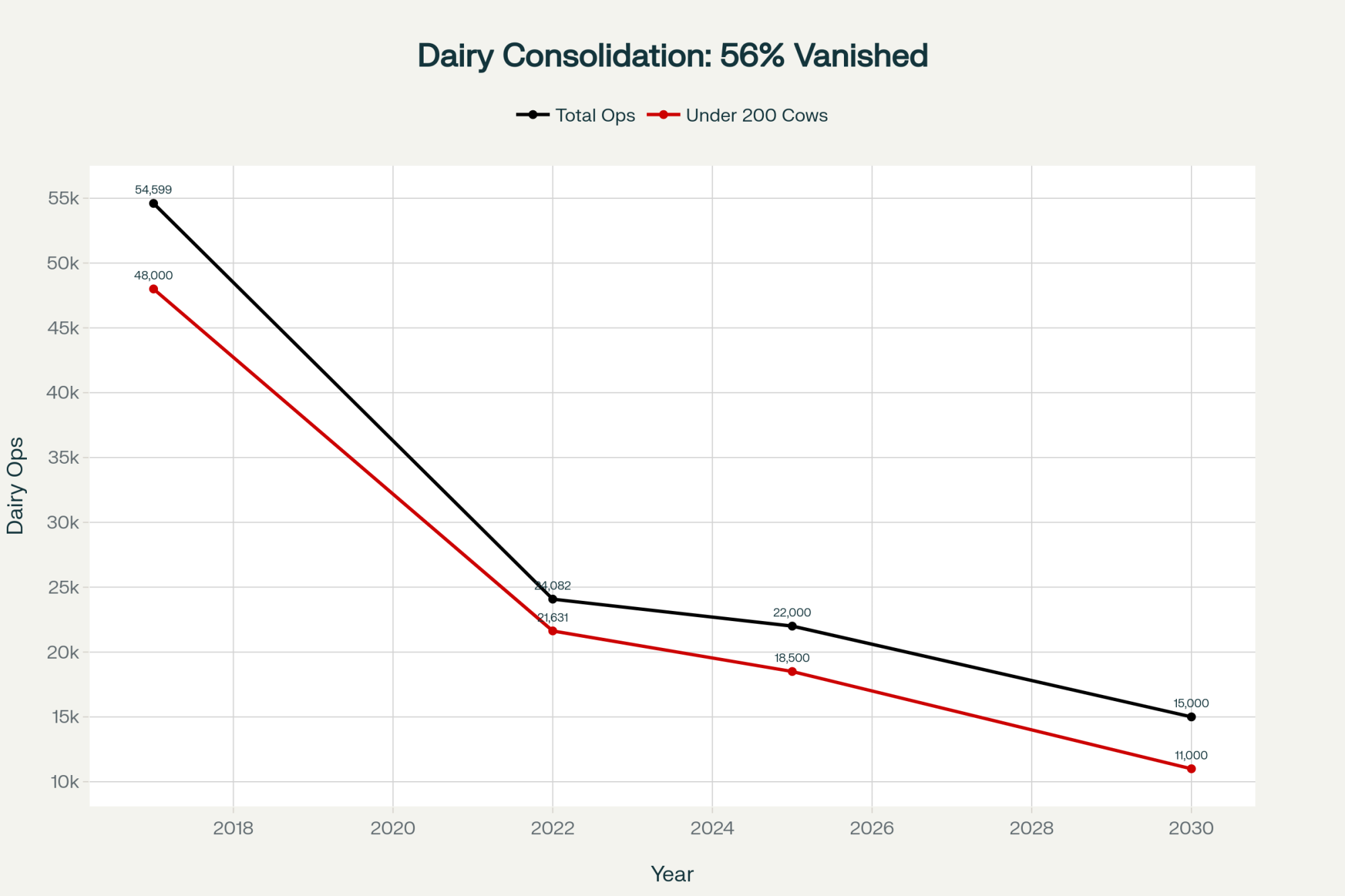
NewsSubscribe
First
Last
Consent

Send this to a friend