

Archive for farm transition planning

Only 12% of Dairy Farms Reach Generation Three – A 2025 Court Ruling Exposes Why Succession Fails and How to Fix It

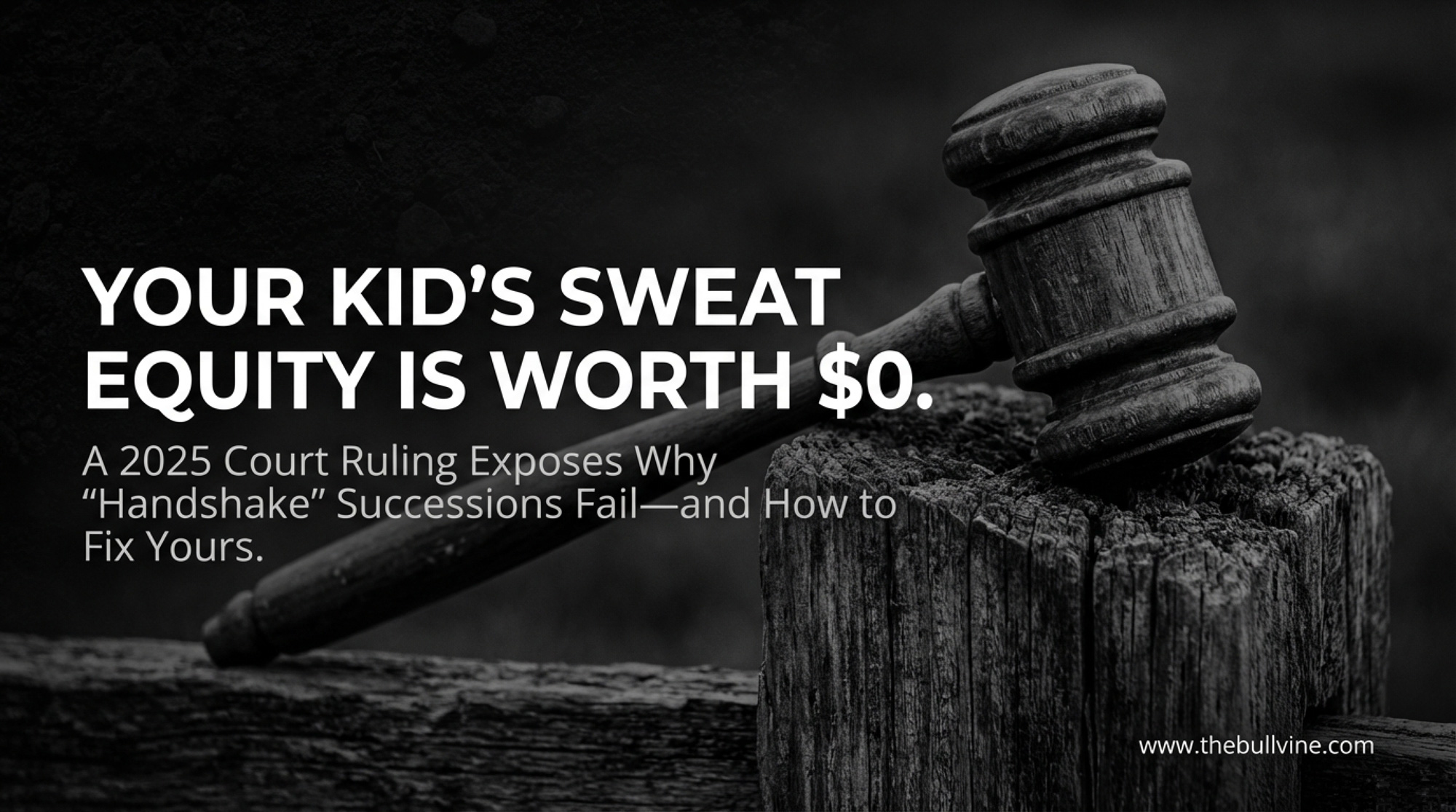
Your kid’s sweat equity is worth $0 without a signed agreement. A 2025 dairy farm court ruling just proved it the hard way.

Executive Summary: If your succession plan only lives in family conversations, this piece shows why that’s a bet you can’t afford to keep making. A 2025 Ontario court ruling in Metske v. Metske cut six years of a son’s sweat equity down to $31,700, because the family never put clear price, terms, or timelines on the transfer. At the same time, U.S. dairy farm numbers are down 39% in five years, farmland has more than doubled in value since 2010, and average net earnings sit around $592 per cow — a mismatch that makes “equal” inheritance almost impossible to cash‑flow. You see the flip side in Minnesota’s 150‑year Heusinkveld dairy, where education, scale, and structure give the next generation a real shot instead of just hopes and handshakes. The article walks you through why “equal” splits usually force a sale, while “equitable” transfers — separate entities for land and cows, earned buy‑ins, and written, bank‑vetted agreements — keep the doors open. You also get hard numbers to work with (4:1 max debt‑to‑EBITDA, 1.25+ term debt coverage, current FSA rates) and a 90‑day triage plan to start turning vague expectations into signed paper your lender and your kids can actually rely on.
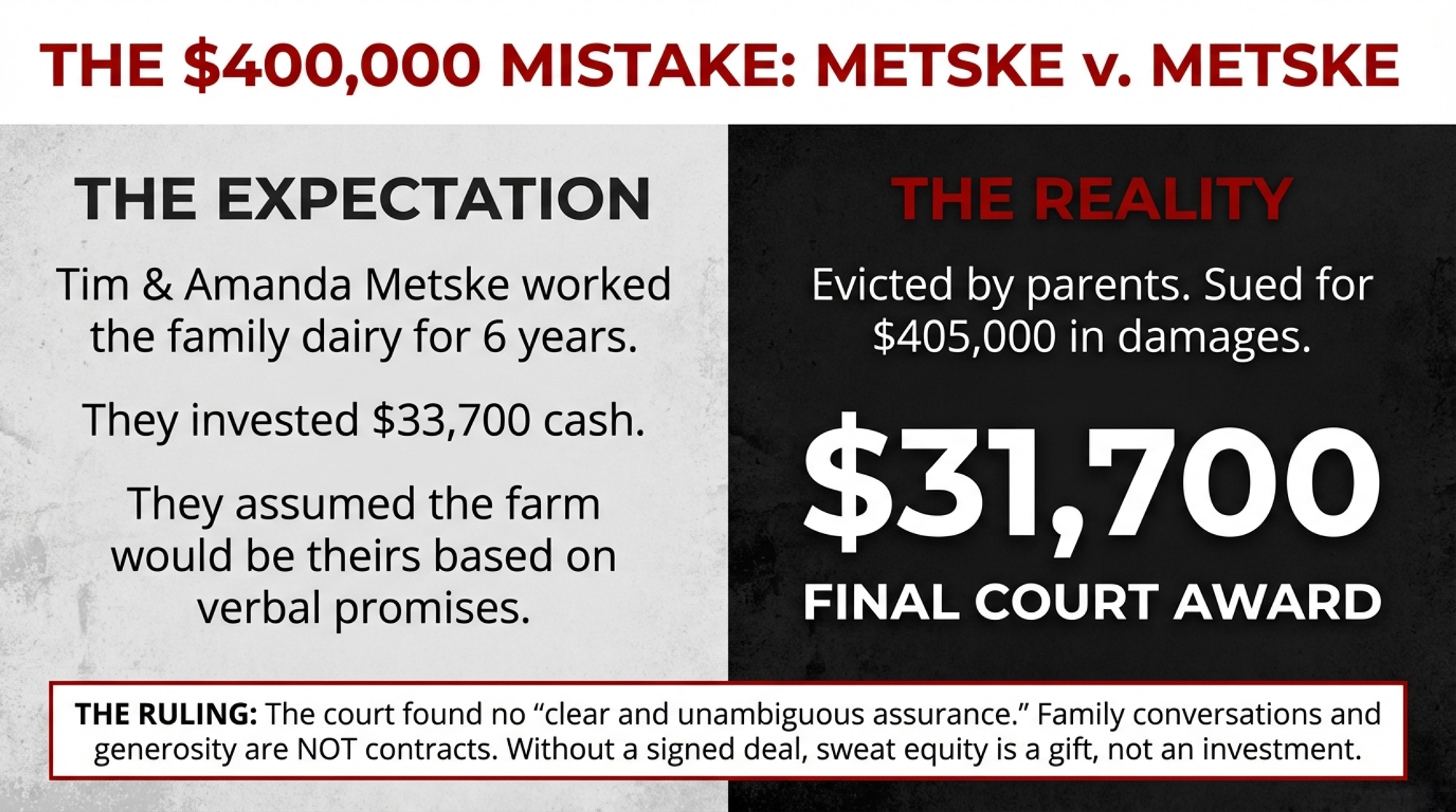
By every outward measure, Tim Metske was building his future. Starting around 2012, he and his wife, Amanda, ran his parents’ Ontario dairy — bought the herd from Martin and Roseanne Metske for approximately $90,000 (funded by a bank loan Martin co-signed), leased the quota, and drew up a business plan for the bank. They invested $33,700 of their own money in property improvements, including a furnace and repairs. The whole time, they operated under what the trial judge later described as “favourable but undefined” terms for eventually acquiring the land and buildings. 

Nobody wrote anything down.

In April 2018, Roseanne told them to leave by the end of May. Forced off the land and without the dairy quota attached to it, they disposed of the herd at a loss and sued. The trial judge awarded $405,000 in damages. Martin and Roseanne appealed. In 2025, the Ontario Court of Appeal — in Metske v. Metske, 2025 ONCA 418 — overturned the bulk of that award and reduced Tim and Amanda’s recovery to $31,700: the net value of tangible improvements minus $2,000 in damages to the farmhouse. 

Six years of sweat equity, reduced to a number smaller than the original investment. The court couldn’t build a structure that the family never built.
Why the Court Ruled the Way It Did

The Court of Appeal’s reasoning exposes exactly why informal dairy farm succession plans collapse. 

The court found no “clear and unambiguous assurance.” The Metskes’ family conversations never crystallized beyond a willingness to negotiate. Price, financing, timing, and even which properties were included — all remained undefined. An “agreement to agree,” the court held, isn’t enough to ground a legal claim. 

Here’s the part that should keep every dairy family up at night: Tim and Amanda’s own business plans worked against them. The documents they’d prepared for the bank showed acquisition at fair market value. The Court of Appeal said this contradicted any claim of a promised below-market deal. Martin’s past generosity, even Roseanne’s warm words at the wedding, weren’t enough to establish “donative intent”. 

And the financial reality sealed it. When Tim tried to secure financing for the dairy quota in 2013, the bank insisted on a 10-year amortization, which the projected cash flow couldn’t support. From that moment forward, the contemplated succession was financially dead — but nobody acknowledged it for another five years. 

As Lerners LLP noted in their analysis: proprietary estoppel “protects against the unfairness of a promisor resiling from a promise, not against the commercial risk of an aspirant purchaser who cannot perform”. 

The law can’t save you from a plan that was never a plan.

What Is Proprietary Estoppel — And Why Should You Care?

You’ve probably never heard this term. But if your succession “plan” is built on verbal promises, it’s the legal concept that will decide your family’s future.

Proprietary estoppel is a legal claim that arises when one person relies on another’s promise regarding property — and suffers a loss when that promise is broken. In farm succession disputes, the incoming generation typically argues: “You told me I’d get the farm, I worked for years based on that promise, and now you’ve pulled the rug out.”

The Metske ruling shows how hard it is to win this claim. Ontario’s Court of Appeal required a “clear and unambiguous assurance” — not vague encouragement, not general family goodwill, not a willingness to negotiate someday. The court also demanded proof that the promise was specifically intended as a commitment, not just an optimistic conversation. Tim and Amanda’s own bank documents — showing they expected to buy at fair market value — contradicted any claim of a guaranteed below-market deal. 

The bottom line: “My dad said I’d get the farm” is not a contract. It’s not even close. If the terms aren’t written, signed, and witnessed — with independent legal advice for both sides — they don’t exist in the eyes of the law. 

The Numbers Behind the Crisis

The Metskes aren’t an outlier. They’re a pattern.
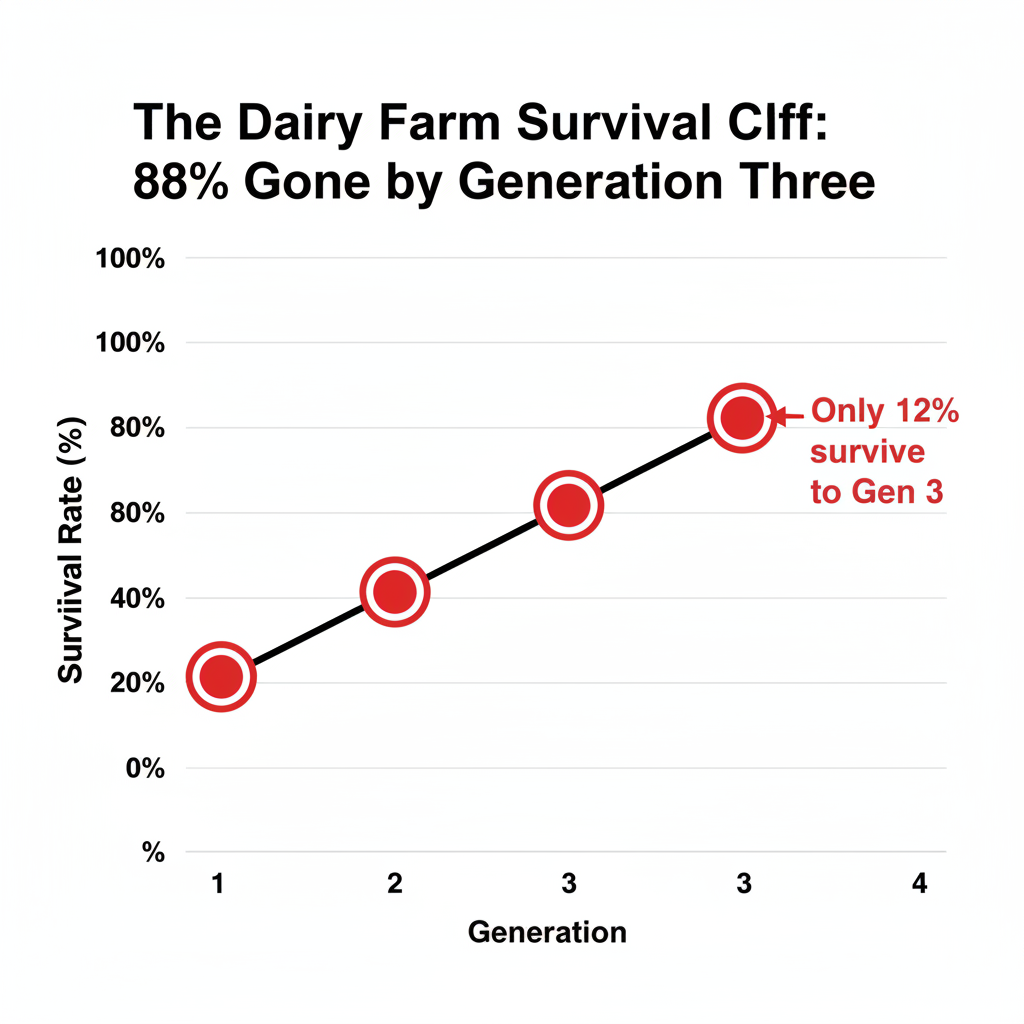
Ron Hanson, professor emeritus at the University of Nebraska, has spent his career studying farm succession. His numbers: 30% of family farms survive to the second generation. Just 12% make it to the third. Only 3% reach the fourth. John Ward’s foundational 1987 research at Northwestern’s Kellogg School of Management found similar results across all family businesses — roughly 30% to the second generation, 10–15% to the third. 

Nearly 9 in 10 family farms don’t survive to see a third generation at the helm. Not because the kids don’t want the farm. Because nobody built the structures to make the transfer work.
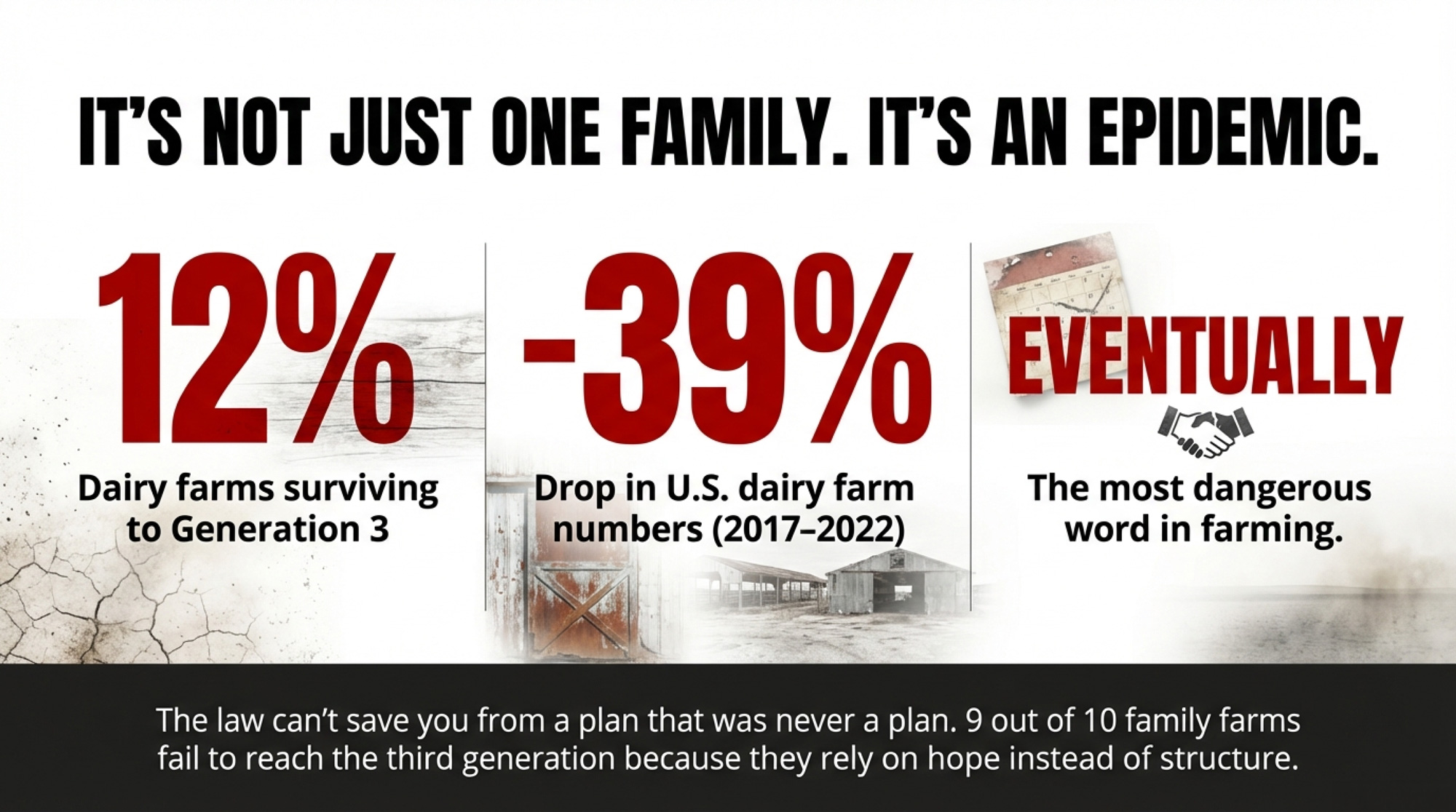
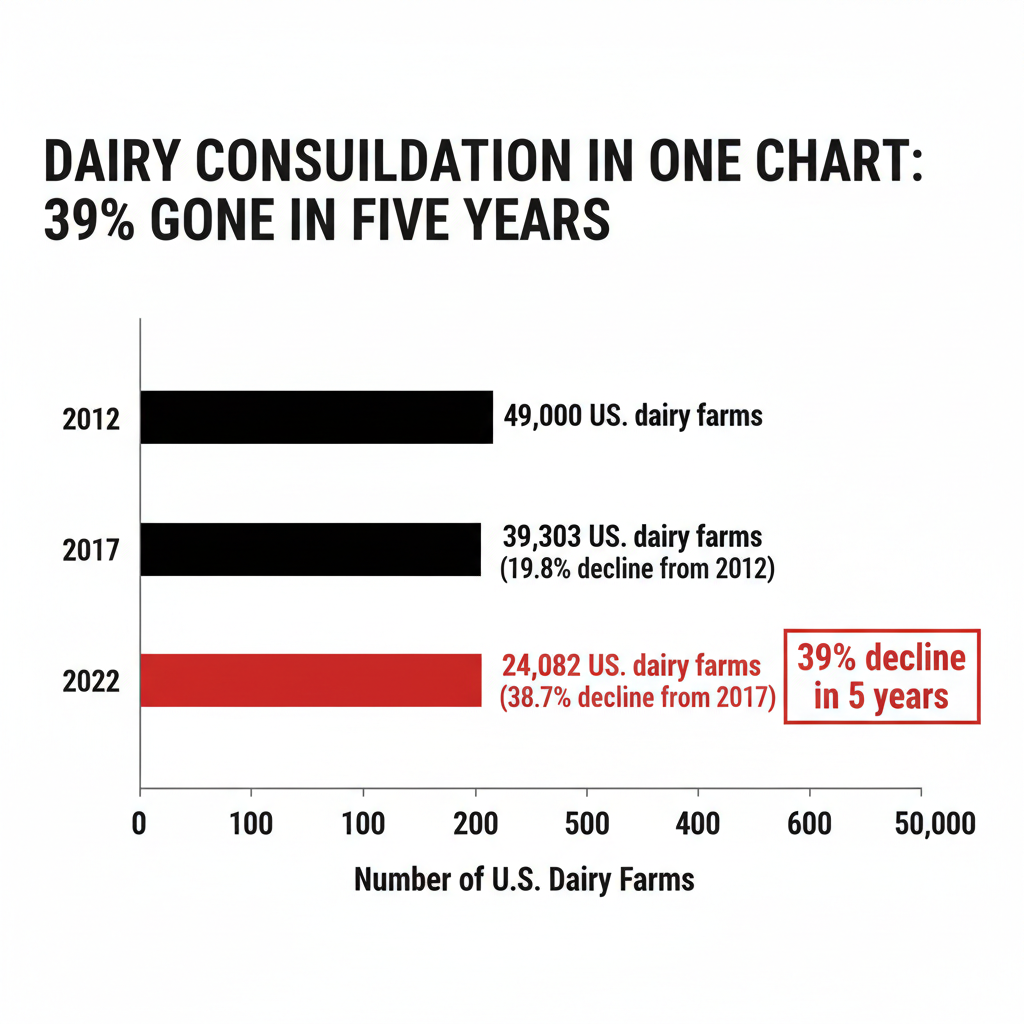
The consolidation data tells the same story from a different angle. The 2022 USDA Census of Agriculture shows U.S. dairy farms dropped from 39,303 operations in 2017 to 24,082 in 2022 — a 39% decline in five years, and 51% down from 2012. Canada tracks the same direction: the Canadian Dairy Information Centre reports 12,007 dairy farms in 2014, down to 9,256 by 2024 — a steady 2.6% annual decline. Wesley Tucker, MU Extension agriculture business specialist, puts the pipeline in even starker terms: 70% of farms are projected to trade hands in the next 20 years

Farms with 1,000 or more cows — roughly 2,013 operations, about 8% of all U.S. dairies — now produce approximately two-thirds of the country’s milk, according to Rabobank analysis. The mid-size family dairy is getting squeezed from both ends: too big to walk away from, too asset-heavy to hand off without a structure in place. 

This article draws on an Ontario court ruling, Canadian farmland data, U.S. census figures, and a Minnesota family operation. The legal frameworks differ at the border — Canadian supply management and quota add layers that the American system doesn’t have, and property law varies province to province and state to state. But the math and the human nature remain the same. Families that don’t formalize their plans lose the farm, whether it’s sitting on 500 acres outside Guelph or in Fillmore County, Minnesota.

Why the Math Keeps Getting Worse

The asset-value problem isn’t easing up. It’s accelerating.

U.S. farm real estate averaged $4,350 per acre in 2025, up 4.3% year-over-year and more than double the $2,150 average in 2010, according to the USDA’s August 2025 Land Values Summary. Cropland specifically hit $5,830 per acre — up 4.7% from the prior year, compared to $2,980 in 2011. In major dairy states, the numbers climb higher: Michigan farmland jumped 7.8%, and Iowa cropland averaged $10,300 per acre. 

North of the border, Farm Credit Canada’s mid-year 2025 review showed Canadian cultivated farmland values rose 6.0% in the first half of 2025 alone, a slight acceleration from the 5.5% growth in the same period of 2024. Over the 12 months from July 2024 to June 2025, Canadian farmland appreciated 10.4%. Manitoba led the nation at 11.2%, while Ontario farmland values held flat. 
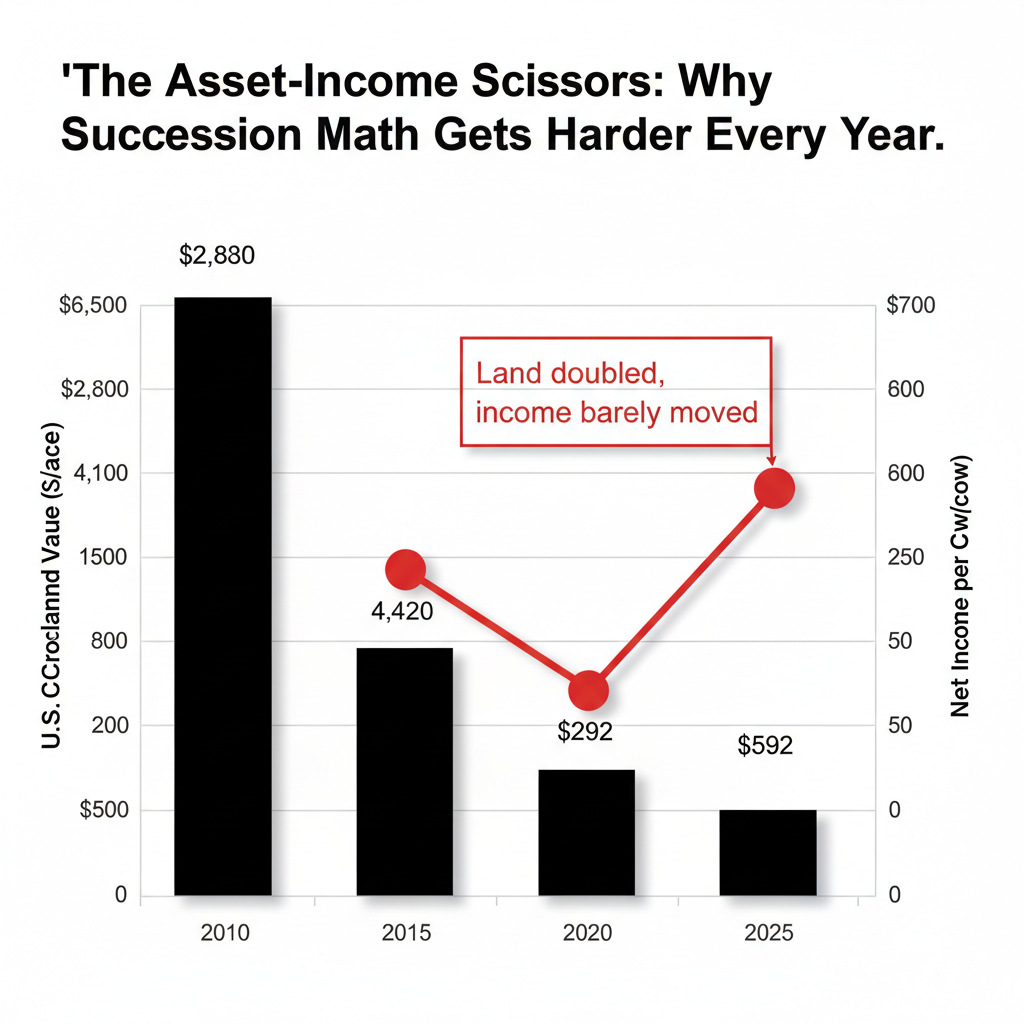
Now stack those asset values against what milk actually pays. Zisk projections for 2025 ranged from $531 to $1,640 per cow, depending on region and herd size. A  2024 Northeast Dairy Farm Summary pegged average net earnings at $592 per cow, up from $292 the year prior. Better than 2023, sure. But $592 per cow against land that doubled in 15 years — that’s the succession math in one sentence. 

What 150 Years of Continuity Looks Like

In Fillmore County, Minnesota, the Heusinkveld dairy tells a different kind of story.
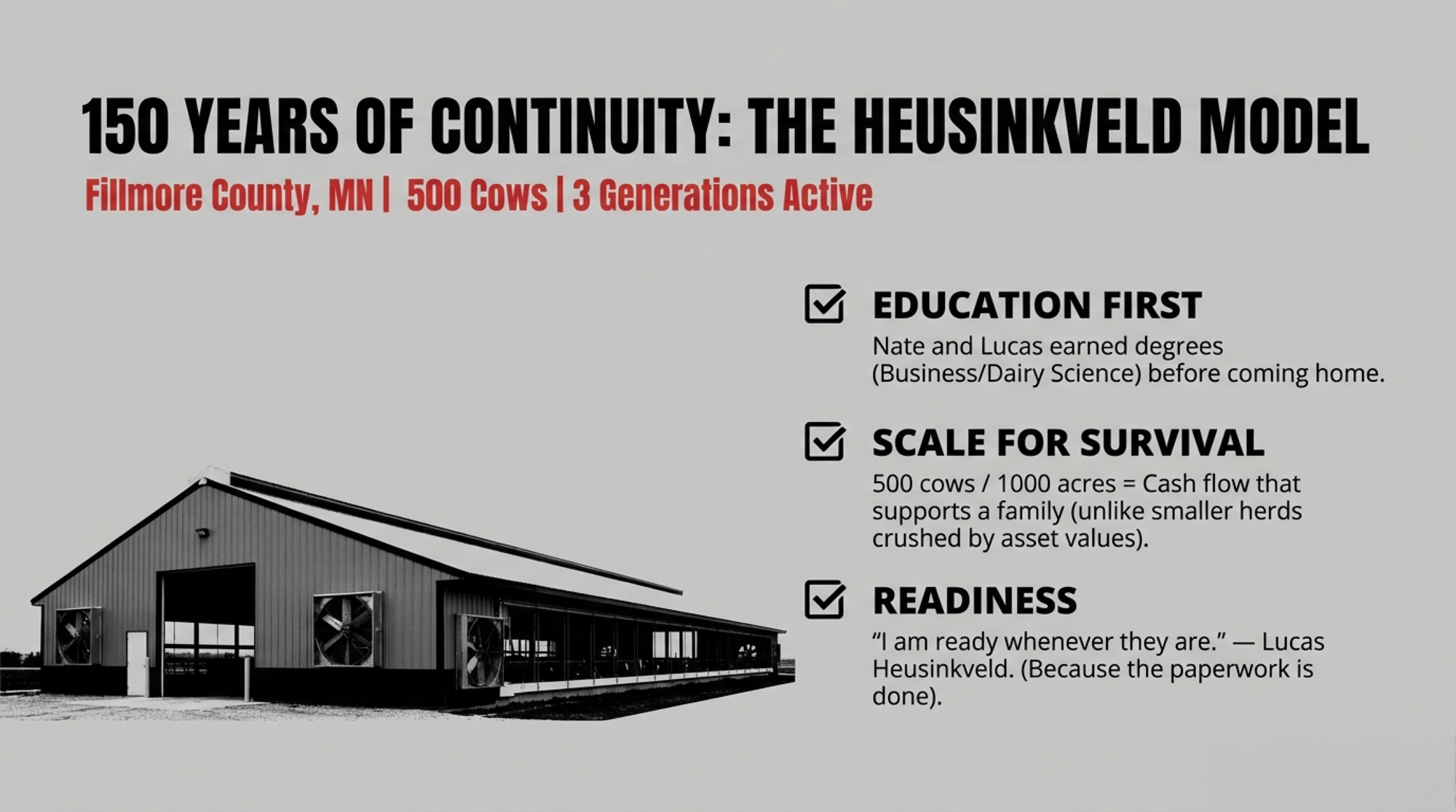
The operation has run continuously for about 150 years — a milestone the Fillmore County Journal covered in April 2024. Jeff and Steve Heusinkveld took their turn running the farm in 1970. Jeff’s son, Nate — an agri-business management degree from Mankato State — came back to take over. He married Misty in 2000 and moved onto the farm. 

Today, Nate runs the operation. Jeff has since passed away, but Nate’s mother, Darla, still lives on the farm and handles the calf chores. The dairy has grown to 500 cows — 450 milked three times daily through a double-12 parallel parlor — plus 85 beef cows. They crop 350 acres of hay and 550 acres of corn, and seven full-time employees round out the crew. 

The next generation is already in the barn. Nate’s son Lucas earned a dairy science degree from NICC Calmar, Iowa, and works alongside his dad every day. “I am ready whenever they are,” Lucas told the Fillmore County Journal — talking about the day Nate and Misty decide it’s his turn. 

What jumps out about this family: education before entry. Nate got his business degree, and Lucas got his dairy science degree, both before coming home. And 500 cows on nearly a thousand crop acres generates the kind of cash flow that can actually support a transition — unlike operations where asset values dwarf annual income by a factor of 10 or more. 

The Inheritance Math That Breaks Most Transitions

Farm Credit Canada’s transition resources put it bluntly: “unspoken expectations are the silent killers of transition plans.” Their guidance notes that agriculture has a deeply ingrained pattern of assumed succession — “Either the parent assumes a particular child will farm, or a child thinks they’ll get the farm — but they’ve never had a conversation about it”. 
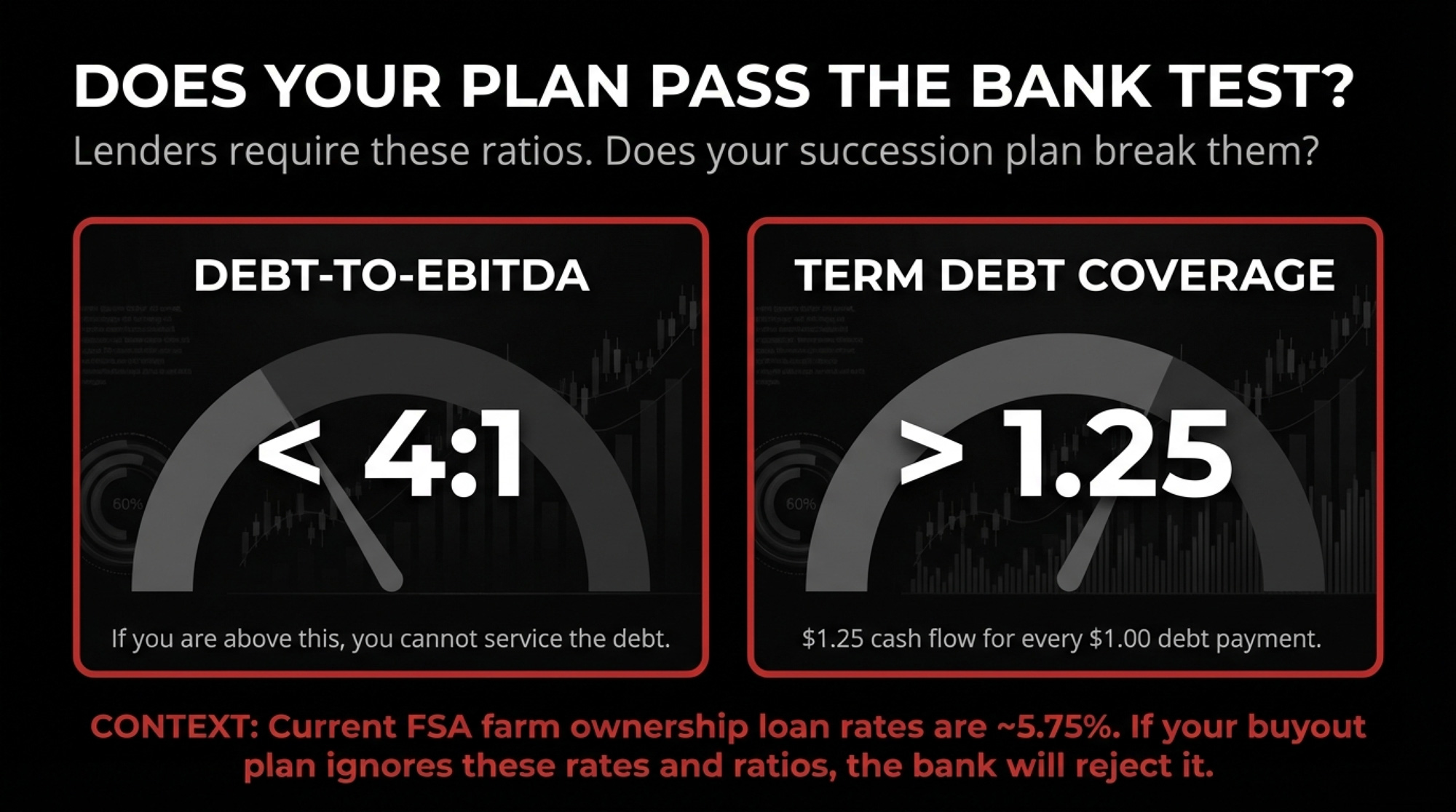
When parents want to treat all kids “equally,” the farming heir has to buy out siblings at asset-value prices, somehow using cash-flow-level income. At $5,830 per acre for U.S. cropland, a 500-acre operation’s land alone is worth $2.9 million before you count cattle, equipment, or buildings. Now run the debt math. Analysts recommend staying below a 4-to-1 debt-to-EBITDA ratio to cash flow expenses and meet scheduled debt payments. Penn State Extension notes that many lenders require a term debt coverage ratio of at least 1.25 — meaning the farm generates $1.25 in cash flow for every $1.00 in scheduled intermediate- and long-term debt payments — just to consider a plan viable. They flag 1.75 or better as the green zone. 

So ask yourself: if your successor takes on $2.9 million in land debt alone at current FSA rates of 5.750% for farm ownership loans, can that 500-cow herd, generating $592 per cow in net earnings, cover the payments and still operate? One tough milk year tips the balance. Two tough years and you’re looking at a forced sale. 

As agricultural attorney Trent Hilding told the Michigan State Dairy Extension podcast: “In a lot of cases, for the farms to be viable and successful, they do have to transfer in a fashion that’s not equal.” But he added, “it still could be considered equitable and fair.” 

Equal vs. Equitable: Why the Distinction Decides Your Farm’s Future
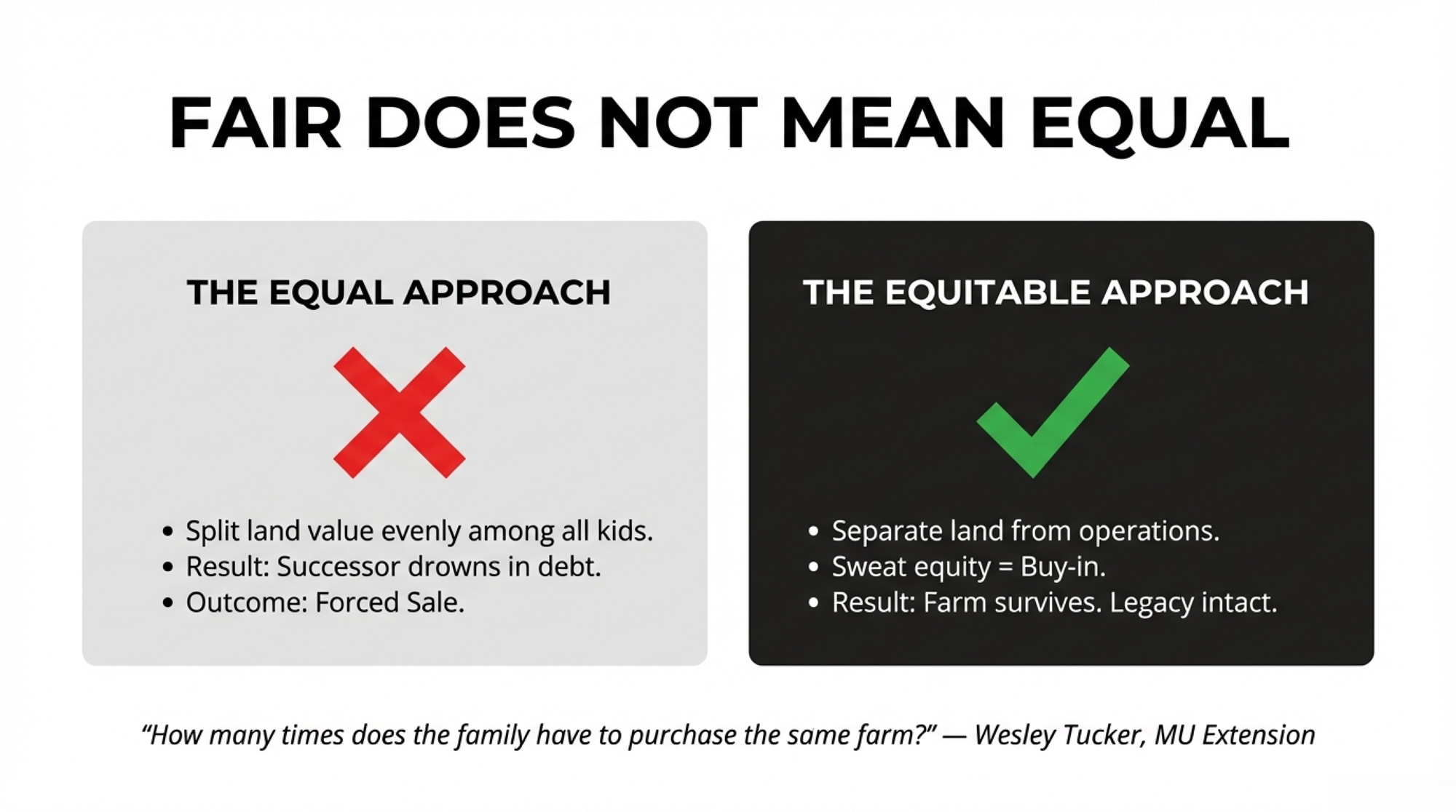
Most families default to “equal.” Split everything evenly among the kids. It feels right. It isn’t. Here’s how the two approaches play out:

 The “Equal” ApproachThe “Equitable” Approach
Land & AssetsDivide the total land value by the number of children. Each gets an equal dollar share  Separate operational assets from land ownership using distinct entities. Farming heir acquires the operation; land held separately  
Sibling BuyoutFarming heir must buy out siblings at full fair market value — $2.9M+ on a 500-acre operation at $5,830/acre  Use long-term leases, gradual equity earn-in, or infrastructure investment counted as buy-in. As Wesley Tucker asks: “How many times does the family have to purchase the same farm?”  
DocumentationReliance on handshake agreements and family goodwill — exactly the approach the Metske court rejected  Written, witnessed, and bank-vetted contracts with independent legal advice for both parties 
Debt LoadSuccessor likely exceeds the 4:1 debt-to-EBITDA threshold and fails the 1.25 term debt coverage minimum before day one  Debt sized to what milk actually generates — $592/cow — with payments structured to maintain viability  
Typical OutcomeForced sale or bankruptcy. The Metske family got $31,700 after six years.Multi-generational continuity. The Heusinkveld family just passed 150 years.

The families that survive figure out something the rest don’t: the “inheritance fairness” problem and the “business continuity” problem are two separate challenges that need two separate solutions. Blending them together is what kills the farm.

How to Structure It So the Farm Survives
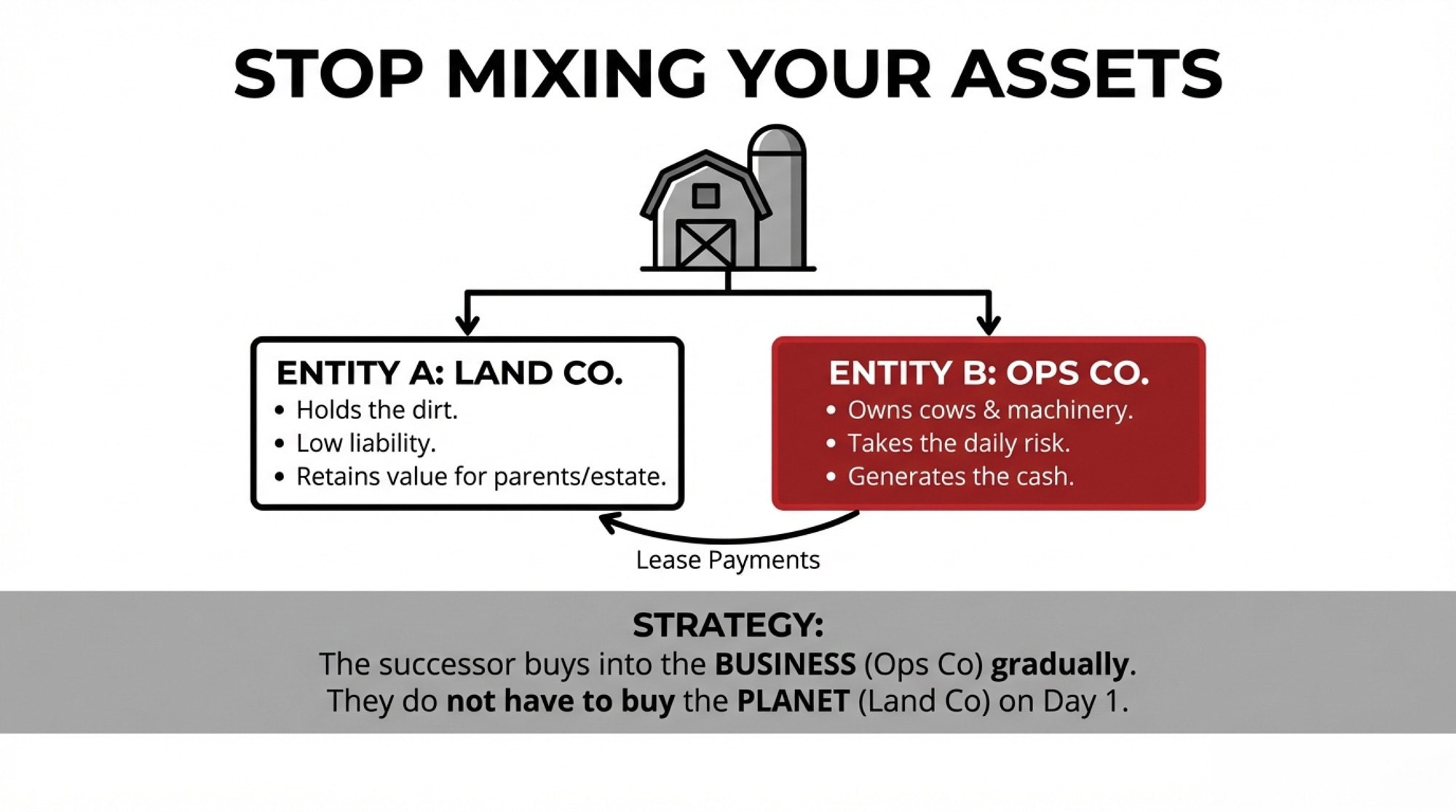
Hilding’s advice provides a practical starting framework: 

Separate operations from real estate. Establish one entity for the dairy operation and another to hold the real estate. “The real estate is a key investment you want to be separate from your liability, your employees, and the risk factors you have in your operation,” Hilding said. An incoming generation can’t afford to buy everything at once. Separating the assets gives everyone room to work. One trade-off to flag: entity separation adds legal and accounting overhead, and if structured carelessly, it can trigger tax consequences. Get advice specific to your province or state before you file anything. 

Get the base documents done. A will or trust is the foundation. “No matter your age or amount of assets, having who you want in charge in writing makes a big difference,” Hilding advised. 

Start the financial transparency early. The biggest misstep Hilding sees: the older generation withholding too much information, usually because they’re afraid of losing control. His advice — involve farming heirs in regular financial meetings and discussions with the lender. “Just because we do something on paper doesn’t mean you’re not showing up and aren’t part of the farm”. 

Reagan Bluel, MU Extension dairy specialist, wrote in August 2025 that there’s another angle worth considering: treat infrastructure reinvestment as “buy-in”. When the incoming generation invests in a new parlor or freestall expansion that improves net income for everyone, that investment should count toward their stake. “When you include the purchase of the land in addition to a major piece of infrastructure, such as a parlor, the cash flow rarely works,” Bluel wrote. 

Bluel sees this play out in real time across Missouri operations. “I recall hearing a prevailing statement by the older generation over and over when talking to farm families, ‘I didn’t have this farm given to me,'” she wrote. That pride is real — but so is the math. The assets needed for a dairy to succeed today are vastly different from 40 years ago, and Missouri land prices alone have increased an average of 6% annually over time. 

What the Metske Ruling Teaches About Documentation

The Lerners LLP analysis of the court decision reads like a checklist of what the Metske family should have done: 

Kill the “agreement to agree.” An outline without price, payment schedule, or valuation mechanism leaves your successor exposed. The court specifically rejected the idea that ongoing negotiations equal binding commitments.

Document the journey, not just the destination. Incremental steps — such as sales, quota leases, and vendor-takeback loans — need to be recorded and cross-referenced to a future transfer agreement. A memorandum of understanding, supported by independent legal advice for both parties, bridges the gap between kitchen-table discussions and enforceable agreements.

Align financing with the plan from day one. Tim and Amanda’s inability to secure lending doomed the succession before it started. Bring the lender in early. Confirm serviceability. Match payments to what the operation actually generates. 

Make any below-market terms explicit. If you genuinely intend to offer your kid favorable pricing, write it down. Promissory notes. Side agreements. Signed and witnessed. The court rejected the notion that general family generosity amounts to a binding commitment. 

Ontario producers have a free resource most haven’t opened: Publication 70, the Ministry of Agriculture’s Farm Succession Planning Guide — 120 pages covering business organization options, operating agreements, ownership transfer methods, and taxation implications. 

FactorDocumented Succession PlanUndocumented (Metske Case)
Written AgreementSigned purchase agreement with price, terms, timeline, and independent legal adviceNone—”agreement to agree” rejected by court
Equity RecognitionYears of sweat equity and capital improvements credited toward purchase price or ownership stake$33,700 in improvements reduced to $31,700 net after damages
Bank InvolvementLender pre-approves financing structure; cash-flow viability confirmed before transferBank refused 10-year quota financing in 2013—plan was already dead
Parental IntentDonative intent (below-market terms) explicitly documented and tax-structuredBusiness plans showed FMV purchase—no proof of gifting intent
Dispute ResolutionBinding arbitration or mediation clauses; clear exit terms if plan changesSix years of litigation; family relationships destroyed
Legal OutcomeEnforceable ownership transfer; successor builds generational wealthTrial award of $405,000 overturned to $31,700 on appeal
Multi-Gen ContinuityFarm survives to generation three (12% club)Farm lost; 88% attrition statistic

Why “Eventually” Is the Most Dangerous Word in Succession

Hanson told Brownfield Ag News that this is exactly what families avoid. “To someday admit that I may not be on my farm, or I may not be operating or managing my farm, is very hard for a lot of farm producers,” he said. FCC’s transition resources don’t sugarcoat it: “Farm transition planning that starts at a funeral is a worst-case scenario”. That’s why advisors recommend starting 10–15 years out — not because the paperwork takes that long, but because restructuring entities, transferring equity, and getting everyone comfortable with a plan that’s fair but not equal all take time you can’t manufacture in a crisis. 

The 90-Day Triage: When You’re Already Behind
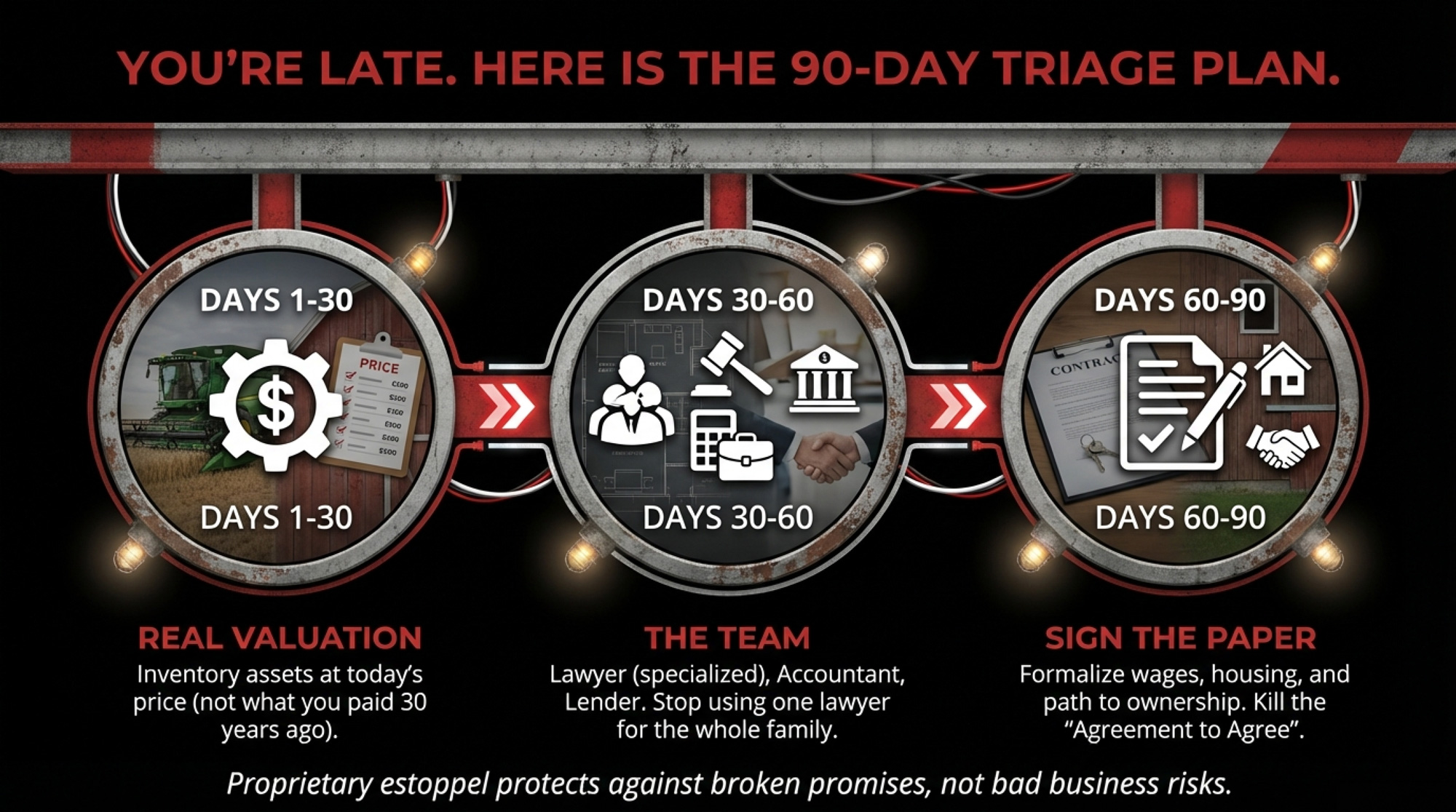
TimelineCore TaskKey DeliverablesRed Flags to Address
Days 1–30Asset inventory with real valuesLand, cattle, equipment, quota, buildings valued at current market (not what you paid). Calculate debt-to-EBITDA ratio.Debt-to-EBITDA above 4:1? Any succession plan that adds debt is dead.
Days 15–45Assemble advisory teamAttorney (farm succession specialist), accountant (ag tax treatment), lender (current FSA rates: 5.750% ownership, 4.625% operating). Get independent legal advice for all parties.Using one family lawyer for everyone? Lerners LLP says that’s insufficient—parties need independent counsel.
Days 30–60First real family conversationAll stakeholders in room (off-farm siblings included). Schedule quarterly strategic meetings focused solely on transition. Create accountability for agenda portions.FCC warns: unspoken expectations are “silent killers.” If you haven’t had this talk, you’re in the 88%.
Days 60–90Document current arrangementsFormalize terms TODAY: compensation, housing, vehicle use, decision authority, path to ownership. Write. Sign. Date. File with attorney.Working without a written agreement? Metske court says sweat equity = $0 without documentation.
Days 90+Bank viability reviewLender confirms: 1.25+ term debt coverage ratio? Payments sized to $592/cow income reality? If no, restructure before transfer.Penn State: below 1.25 coverage ratio, lenders won’t even look at your plan.

If you’re 5–7 years from transition with nothing documented, here’s how to stop the bleeding:

Days 1–30: Asset inventory with real values. Land, cattle, equipment, quota, buildings — what’s it worth today? Not what you paid. Not what you hope. What a buyer would actually pay. With U.S. cropland averaging $5,830 per acre and climbing 4.7% year-over-year, and Canadian farmland up 6.0% in just the first half of 2025, every month you wait makes the math harder for your successor. Then run your debt-to-EBITDA ratio. If you’re above 4-to-1, any succession plan that adds more debt is dead on arrival. 

Days 15–45: Assemble your advisory team. Attorney with farm succession experience. Accountant who understands agricultural tax treatment. Lender who knows your operation. Current USDA Farm Service Agency direct ownership loans sit at 5.750%, with operating loans at 4.625% as of February 2026, and the Federal Reserve Bank of Chicago reported that ag credit conditions weakened in Q2 2025, with loan repayment rates falling and banks demanding more collateral. Your successor needs to know what lending actually looks like right now, not what it looked like when you last borrowed. The Lerners analysis recommends independent legal advice for all parties, not having one family lawyer serve everyone. 

Days 30–60: First real family conversation. All stakeholders in the room — off-farm siblings included. FCC recommends scheduling quarterly strategic meetings focused solely on transition, with everyone accountable for a portion of the agenda. Day-to-day operations will overshadow long-term planning unless you carve out dedicated time. 

Days 60–90: Document current arrangements. If your kid is already working on the operation, formalize the terms today. Compensation, housing, vehicle use, decision authority, and path to ownership. Write it down. Sign it. Date it.

What This Means for Your Operation

  • Your farming heir already knows you haven’t planned this. Every year, without a formalized agreement, they’re calculating whether they’re building equity or providing cheap labor for a promise that might not survive a family disagreement. FCC calls unspoken expectations “the silent killers of transition plans”. They’re right.
  • The Metske ruling is a legal precedent, not just a cautionary tale. Ontario’s Court of Appeal stated explicitly that vague family assurances, parental generosity, and years of labor don’t create property rights. Your kid’s sweat equity is worth $0 without documentation. 
  • The asset gap is widening faster than earnings can close it. U.S. farmland doubled in value since 2010. Analysts reported an average net earnings per cow of $592 in 2024. Penn State Extension says you need at least a 1.25 term debt coverage ratio for a lender to even look at your plan. Does your succession math clear that bar? 
  • “Fair” and “equal” aren’t the same thing — and treating them as synonyms is what kills the farm. As Hilding puts it: farms have to transfer in a fashion that’s not equal” to survive. Separate the inheritance question from the business continuity question, and solve each one with the right tools. 

Key Takeaways

The 12% of family farms that reach generation three started earlier. They formalized arrangements when things were good, not when a crisis forced their hand. 

Size transition payments to what milk can actually carry. If your plan requires the successor to service debt, the operation can’t cash-flow — as Tim Metske discovered when the bank demanded a 10-year amortization on the quota — you don’t have a succession plan. You have a countdown. Stay below 4-to-1 debt-to-EBITDA. Insist on at least 1.25 term debt coverage. If you can’t hit those numbers, restructure before you transfer. 

Separate the land from the operation. Hilding’s advice to create distinct entities for real estate and operations isn’t just good lawyering — it’s the only way most families can make the math work for everyone. 

Document everything. Today. The distance between $31,700 and a successful transition isn’t luck or family harmony. It’s paper. Signed, dated, witnessed paper. 
The Bottom Line

In Fillmore County, Minnesota, Lucas Heusinkveld milks cows beside his dad, just like Nate once milked beside Jeff. “I am ready whenever they are,” Lucas says. He can say that because somebody — in every generation — made sure the next one was prepared before the crisis arrived. 

Don’t let your legacy be a court docket number. Pick up the phone tomorrow. Call the accountant first, then the lawyer. Your kids are waiting for a plan, not a promise. 

Complete references and supporting documentation are available upon request by contacting the editorial team at editor@thebullvine.com.

Learn More

The Sunday Read Dairy Professionals Don’t Skip.
Every week, thousands of producers, breeders, and industry insiders open Bullvine Weekly for genetics insights, market shifts, and profit strategies they won’t find anywhere else. One email. Five minutes. Smarter decisions all week.
NewsSubscribe
First
Last
Consent

Only 16.5% of Dairy Farms Make It to the Third Generation – The Succession Decisions That Stop a Buyout from Killing Your Herd

If your “fair” buyout loads $600+ of debt on every cow, you’re not doing succession—you’re planning a dispersal in slow motion.

You know how some topics just keep coming up over coffee at farm meetings? Succession is one of those.

Let’s walk through what the numbers and the real‑world experience are telling us about keeping dairy farms in the family—and how the roughly 16.5% who pull it off tend to do things differently.

The Odds Aren’t Great—but They’re Not Hopeless

Most family business owners have heard some version of the “three‑generation rule.” A lot of talks and articles still repeat the old line that about 30% of family businesses make it to the second generation, around 10–15% to the third, and only 3–5% to the fourth. You’ve probably heard that at a seminar at some point. 

A critical look in Family Business Magazine noted that those specific percentages aren’t a universal law, but they’re a decent rule of thumb: many family firms fall away at each transition, and only a minority make it to the third or fourth hand‑off. The Family Business Consulting Group goes a step further and says you should think of it as “about one‑third survive each generational transition,” not a guaranteed 30/13/3 every time. 

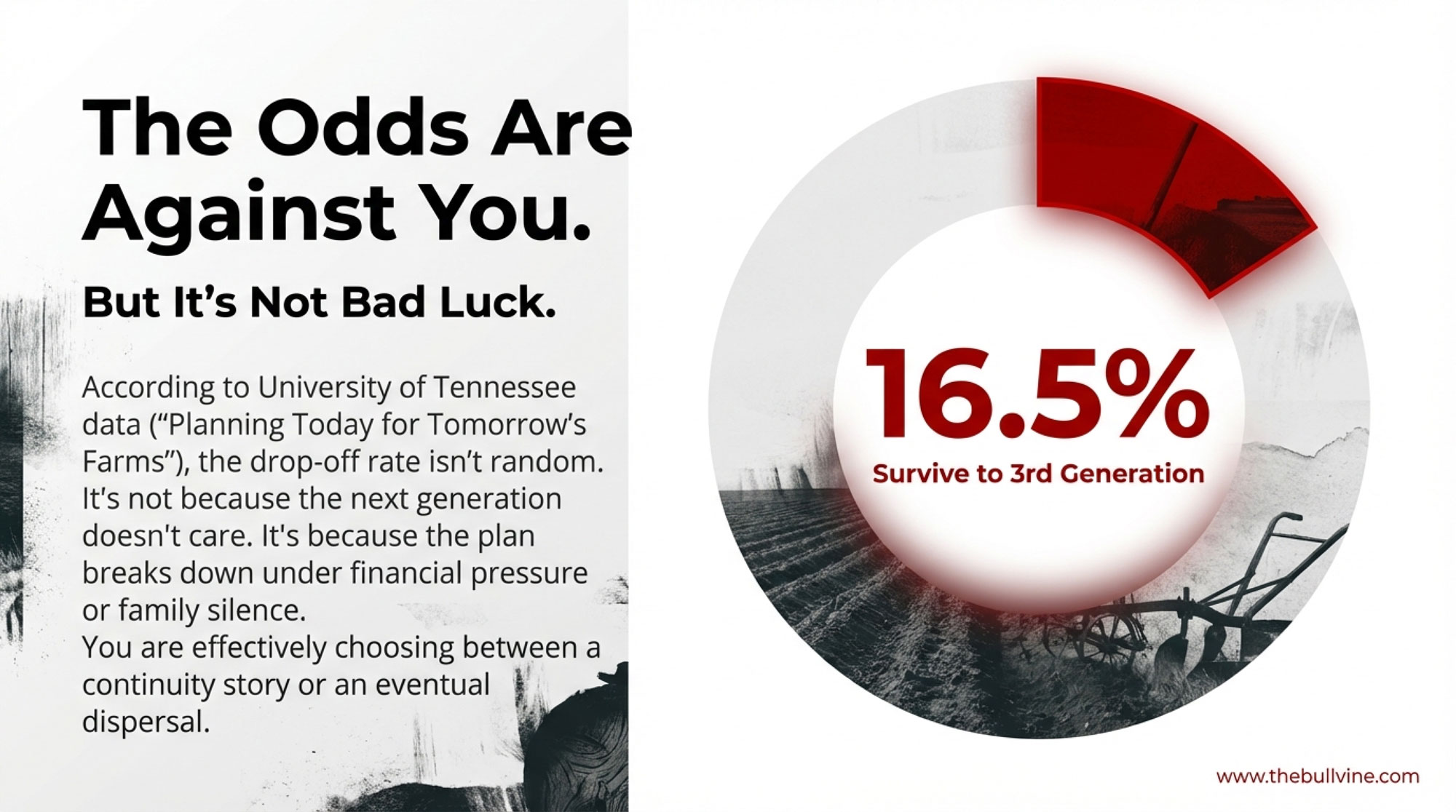
The University of Tennessee took that one‑third idea and did the farm math. Their Planning Today for Tomorrow’s Farms workbook walks through the logic: if roughly a third of family businesses survive the first transition, and about a third of those survive the second, then you’re looking at something like 16.5% of family farms reaching a third generation of ownership. And they’re very clear that weak or non‑existent succession planning is one of the big reasons many don’t get that far. 

Generation MilestonePercentage Surviving
1st Gen to 2nd Gen~100% (baseline)
2nd Gen to 3rd Gen~33% (of 2nd)
3rd Gen to 4th Gen~11% (of 3rd)
Farms Reaching 4th+ Gen~3.5% (of original)

So, yes, the odds are tough. But they’re not a death sentence. What I’ve found, looking at the research and listening to farmers in places like Wisconsin, Ontario, and the Atlantic provinces, is that the families who do land in that 16‑odd percent tend to make a set of very specific choices—on timing, money, fairness, and leadership.

Let’s talk about those, in plain dairy terms.

Why Dairy Succession Feels Heavier Than Most

You don’t need a journal article to tell you dairy is a 365‑day grind, but it’s worth seeing how the data lines up with what you’re living.

The 365‑Day Workload Your Kids Have Watched

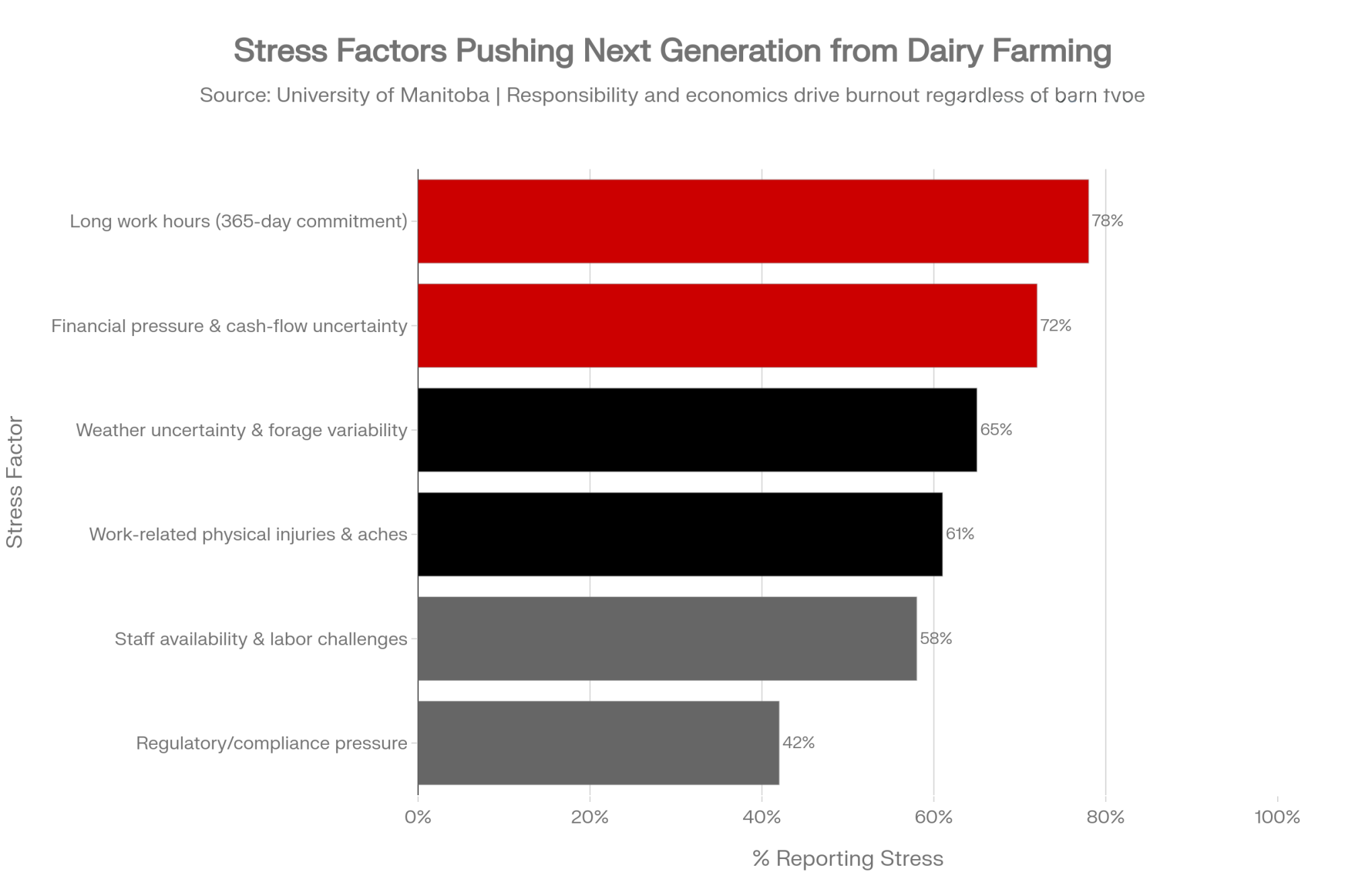
A 2024 doctoral thesis from the University of Manitoba interviewed dairy farmers in Western Canada and Ontario about health and workload. It found what most of us already know in our bones: a lot of producers reported work‑related injuries, aches, and pretty high stress levels. The main culprits were long hours, heavy workloads, financial pressure, and weather uncertainty. 

What’s interesting is that the study didn’t see big differences in health outcomes between tie‑stall and freestall, or between parlors and robots—once you controlled for other factors, the stress seemed to come from the responsibility and economics as much as from the barn layout. 

If your kids grew up watching you drag yourself in after dealing with fresh cow issues in the transition period, juggling butterfat levels for that component premium, and worrying about the line of numbers on the cash‑flow sheet, they absorbed all of that. In more than a few kitchen‑table meetings, I’ve heard young people say something along the lines of, “I love the cows and the genetics. I’m just not sure I want to live exactly like my parents did.”

That doesn’t mean they won’t come back. But it does mean we can’t pretend the lifestyle piece isn’t part of the succession puzzle.

Stress Factor% of Farmers Reporting High LevelsRelative Impact
Long work hours (365-day commitment)78%High
Financial pressure & cash-flow uncertainty72%High
Weather uncertainty & forage variability65%Medium-High
Work-related physical injuries & aches61%Medium-High
Staff availability & labor challenges58%Medium
Regulatory/compliance pressure42%Medium

The Capital Load Has Quietly Gotten Bigger

On the balance‑sheet side, dairy has become a very capital‑intensive business. A 2021 paper in the journal Agricultureexamined family farms in Catalonia and found that dairy farms in that region carry particularly high levels of fixed capital in land and buildings compared to other sectors. That’s not news to anyone who’s priced out a new freestall, manure system, or robotic milking setup lately.

In many North American dairy areas, USDA land value surveys and provincial numbers show land values have trended upward over the last decade, especially where urban growth or high‑value crops compete with dairy for acres. Add in barns, parlors or robot rooms, manure storage, feed storage, and in Canada, quota on top of it—and it’s easy to see how a “modest” family dairy can end up with several million dollars tied up in fixed assets. 

It’s worth noting what’s happened on the return side. The 2024 Minnesota FINBIN report showed that dairy farms had a much better year than 2023: median net farm income for dairies was up sharply, and milk price and production per cow both improved. High‑profit dairy farms in that dataset earned about 773 dollars per cow in net return. At the same time, the average Minnesota farm across all sectors posted about a 2% rate of return on assets in 2024. 

So you’ve got more capital tied up, a better 2024 than 2023, but still a business that, on average, is spinning out something like a 2% return on the total asset base. Many Midwest producers will tell you they feel that in their gut: it’s good enough to keep going and reinvest a bit, but there isn’t a lot of slack for big mistakes.

Decision #1: Start the Transition While You Still Have Time, Not When You’re Exhausted

One of the most encouraging things I’ve seen in the last few years is how much more open producers are to talking about timing. Instead of waiting until someone is 68 and worn out, more families are at least asking, “When should we start this?”

Extension folks in a lot of places are saying roughly the same thing. Guides from Michigan State University, OMAFRA in Ontario, and Alberta Agriculture all stress that transition is a multi‑year process and that it works best when you start while the senior generation still has a decade or more of working life ahead of them—often when parents are in their 50s, and a potential successor is in their 20s or 30s. Tennessee’s workbook makes the same point: succession is a process, not a single event. 

You probably know this already, but it’s worth saying out loud: “We’ll deal with that when I’m ready to quit” almost never leads to a calm, orderly hand‑off. What it usually leads to is rushed decisions under pressure—health issues, burnout, or a financial shock—and far fewer tools on the table.

Off‑Farm Experience Isn’t the Enemy

There was a time when a lot of us were terrified that if the kids left, they’d never come back. And sure, that still happens sometimes. But the research and real‑world examples suggest the picture is more nuanced.

A 2018 article in Rural Sociology followed young farmers in England and looked at how education and off‑farm work shaped their paths back to the farm. The authors found that time away often gave these successors a broader perspective and a more entrepreneurial mindset. They came back with different ideas about management, markets, and where the farm could go.

On the ground, in Wisconsin operations and across Western Canada, you see it play out like this:

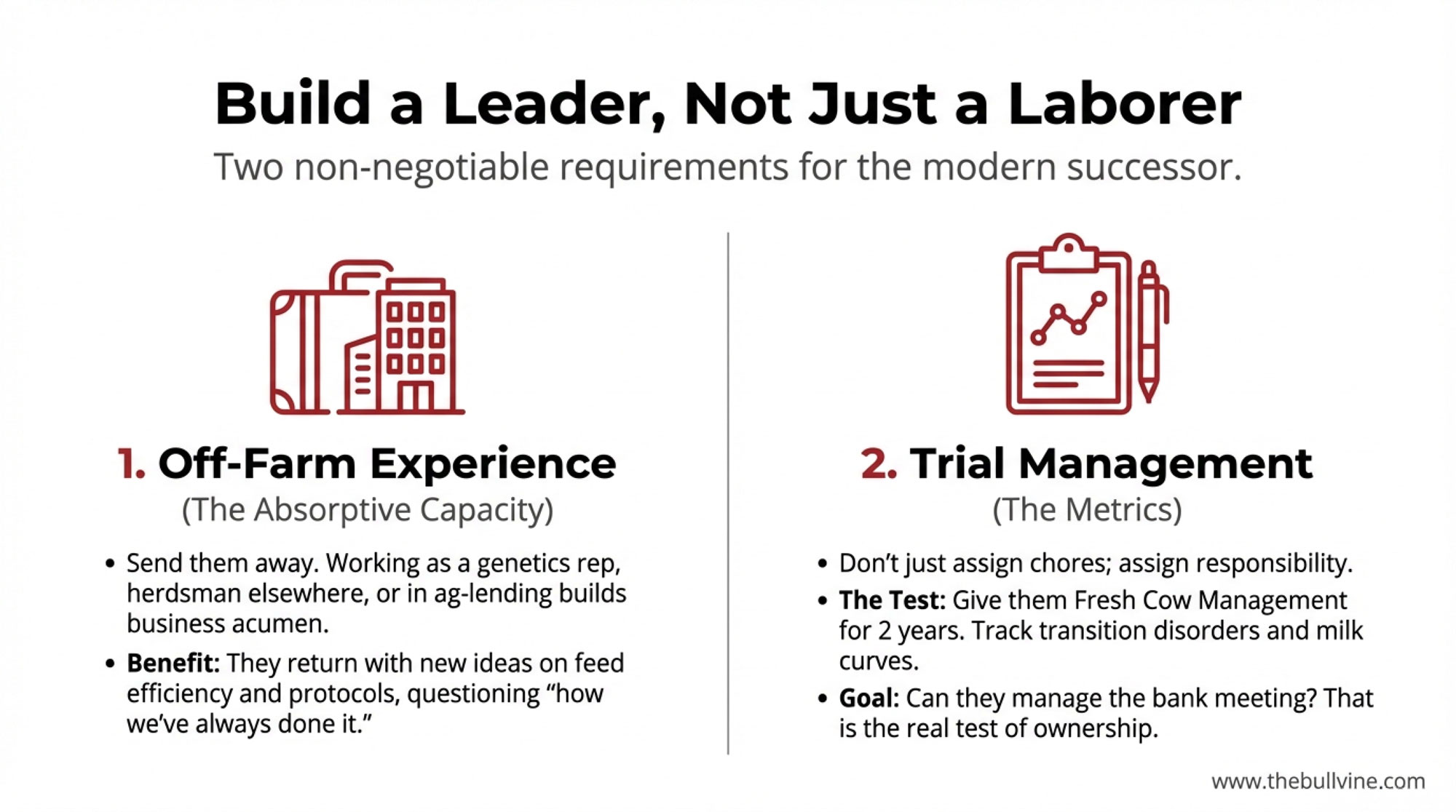
  • Someone spends a few years as a herdsman or assistant manager on a 1,000‑cow freestall or large dry‑lot, really owning fresh cow management and transition‑period decisions.
  • Another works as a nutrition or genetics rep, seeing how different herds manage feed costs per cwt, butterfat and protein, SCC, repro, and genomic selection.
  • Others spend time in lending, farm management consulting, or robotics, and start thinking more about ROI on capital, not just getting through chores.

When those people come back, what I’ve found is that they usually appreciate how hard the home farm has worked to stay afloat, but they’re also more comfortable questioning things that don’t pencil out. That’s exactly the kind of “absorptive capacity” the Brazilian succession study talked about—being able to bring in outside knowledge and actually use it on the farm.

Instead of seeing off‑farm work as “losing” a successor, you can look at it as sending them out for free training in someone else’s barn.

Competency AreaWith Off-Farm ExperienceHome-Farm-Only Experience
Fresh-cow / transition management8.25.8
Financial / ROI thinking7.94.1
Feed economics & forage management8.15.2
Staff leadership & HR7.64.3
Technology adoption & problem-solving8.45.5
Ability to question & improve existing systems8.34.9

Trial Management Back Home: Give Them the Keys, Watch the Numbers

Once they’re back home, the real test isn’t how many hours they work. It’s whether they can actually manage. Extension material from Missouri, Wisconsin, and groups like Land For Good all encourage farms to have a genuine trial‑management period before full partnership.

That might look like:

  • Turning fresh cow management over to them for two full years—rations, protocols, pen moves—and then sitting down together to look at transition disorders, early cull rates, and milk curves.
  • Letting them design and run the cropping plan, then tracking forage quality, yield, cost per ton of dry matter, and how that feeds into milk production and component levels.
  • Giving them responsibility for staff scheduling and day‑to‑day HR, then watching labor turnover, how often you’re short‑staffed, and how the culture feels.

In Minnesota FINBIN herds and in lender meetings I’ve sat in on, those kinds of documented responsibilities and results make it much easier for a bank to say, “Yes, we can finance a staged buy‑in here.” You’re not just asking them to trust a last name—you’re showing them a track record. 

Decision #2: Treat the Old “Equal at Full Value” Plan as a Red Flag, Not a Default

Here’s where the math and the emotions collide. A lot of us grew up with the idea that the “fair” plan was to figure out what the farm was worth, divide by the number of kids, and have the one who stays buy out the rest at that value. On paper, that sounds tidy. On a modern dairy balance sheet, it can quietly set the farm up for failure.

Let’s walk through an example—strictly as an example, not as a “this is what every 400‑cow herd looks like.”

An Illustrative 400‑Cow Scenario

Say you’ve got a 400‑cow herd with assets that look a lot like what FINBIN sees in Minnesota dairies:

  • Roughly 2 million dollars in land and buildings
  • Around 800,000 dollars in cows and replacements
  • Maybe 700,000 dollars in machinery and other assets

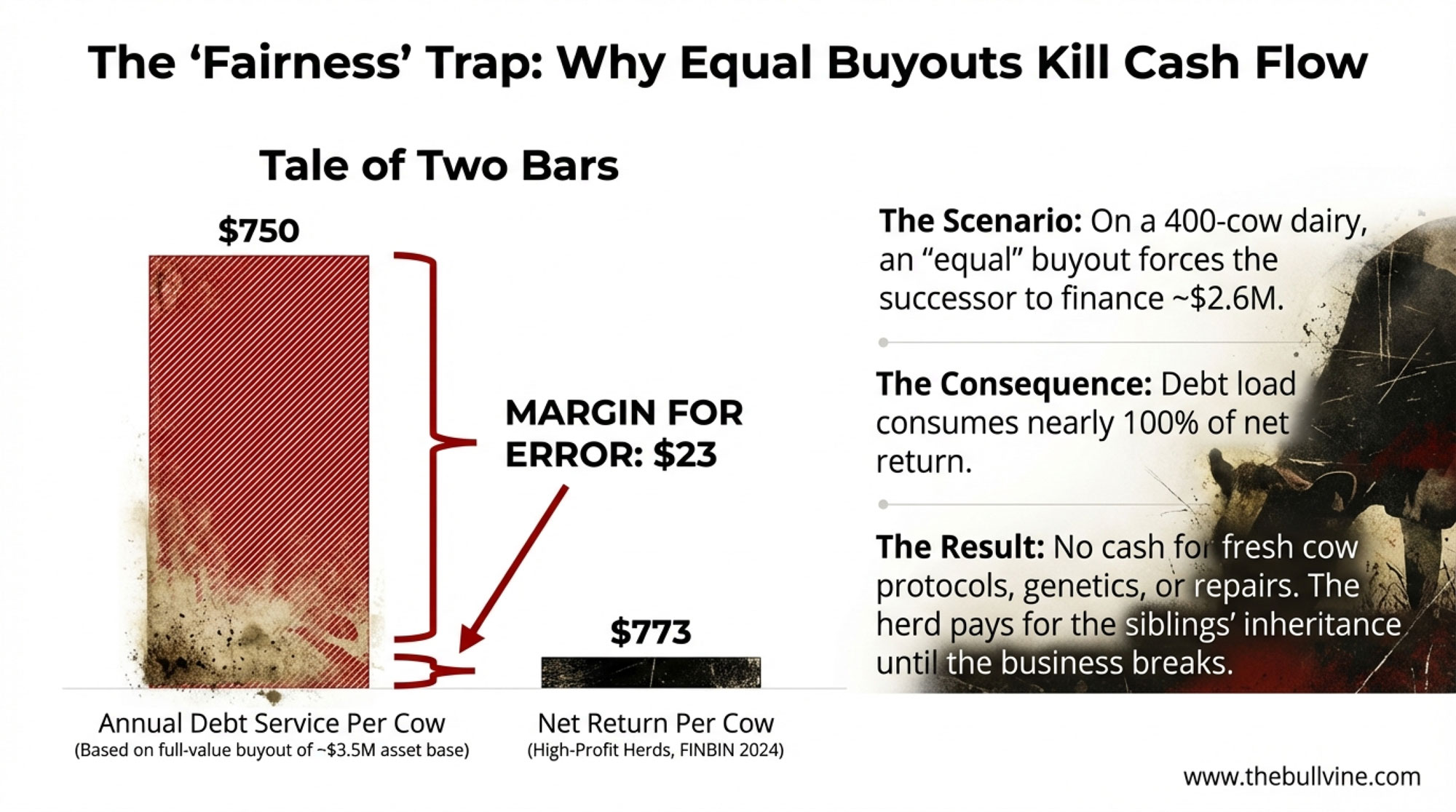
That’s about 3.5 million dollars in total assets. If you’ve got four kids and decide everybody’s share should be equal in dollar terms, each person’s “piece” is about 875,000 dollars. If only one child is farming, the on‑farm heir is on the hook to come up with something like 2.6 million dollars to buy out the other three.

Now bring in the income side. FINBIN’s 2024 report showed high‑profit Minnesota dairy farms earning about 773 dollars per cow in net return. Let’s say your 400‑cow herd is in that neighborhood. That’s just over 300,000 dollars in net return available. 

If you finance a 2.6‑million‑dollar buyout on typical terms, annual payments can easily land somewhere in the 250,000 to 300,000‑dollar range, depending on the interest rate and amortization. On a 400‑cow base, that works out to roughly 625 to 750 dollars per cow per year just to service buyout debt.

ItemAmountPer-Cow ImpactNotes
Total Farm Assets$3,500,000Land ($2M) + Cows/Replacements ($800K) + Machinery ($700K)
Equal Share per 4 Kids$875,000Farm divided equally; 1 child farming, 3 non-farming
Buyout Debt (Successor’s Share)$2,600,000$6,500/cowSuccessor buys out 3 siblings’ equity
Annual Debt Service$250–$300K$625–$750/cowTypical amortization at 5–6.5% over 15–20 years
Net Farm Income (400-cow herd)$309,200$773/cowBased on FINBIN 2024 high-profit dairy farms
% of Income Consumed by Debt81–97%$625–$750 of $773Leaves little room for reinvestment, feed spikes, or technology

Here’s what’s interesting: the same FINBIN report tells us the average Minnesota farm only earned about a 2% rate of return on assets in 2024. So you’re asking a business with a 2% return profile to finance a 100% buyout of all that equity and still have enough left over to invest in cows, barns, manure systems, maybe a robot or two, not to mention handle feed spikes and milk‑price dips. 

In a lot of cases, that math just doesn’t leave room for fresh cow improvements, better transition‑period facilities, or upgrading genetics and technology. Many of us have seen what happens next: land and cows get sold off piece by piece to relieve the pressure, and the farm slowly shrinks or disappears.

Why “Fair” Doesn’t Always Mean “Equal” in Dollars

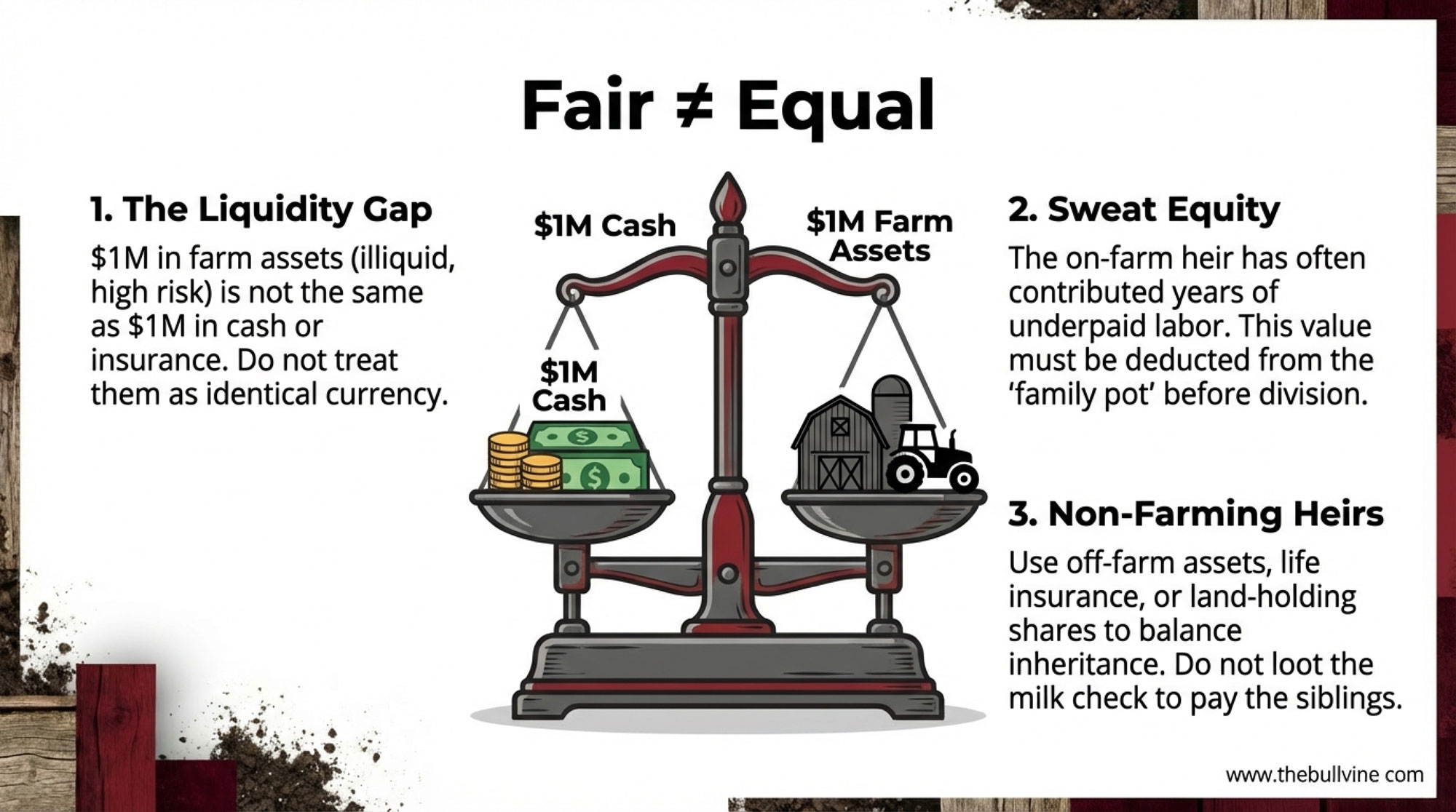
Farm Credit Canada has been very straightforward about this. In their article “Family farm transition – is fair always equal?”, transition specialist Rick Roozeboom uses that exact line: a million dollars in farm assets is not the same thing as a million dollars in cash. In their 2024 piece “What’s fair when everyone contributes differently?”, FCC digs into how different kids contribute to the farm—some with labor and management, others by simply being part of the family story—and why treating those contributions identically, in strict dollar terms, can create real problems. 

It’s worth noting that some parents still decide, after seeing the numbers, that equal division is the value they care about most—even if that ultimately means the farm will be sold. People like farm‑family coach Elaine Froese, who works full‑time on this, see that choice fairly often. That’s not “wrong.” It just needs to be honest: you’re choosing an exit strategy, not a continuity strategy.

Decision #3: Use Structure to Avoid a Capital Train Wreck

The good news is you’re not limited to the “equal shares at full appraised value” model. There are other ways to structure things so the farming child isn’t crushed and non‑farming children aren’t left feeling shut out.

One Yard, Two (or More) Businesses

In Canadian dairy, especially, you often see accountants and advisors using a holding‑company plus operating‑company model. Firms like MNP and Baker Tilly often discuss this in their farm‑succession resources.

The basic idea goes like this:

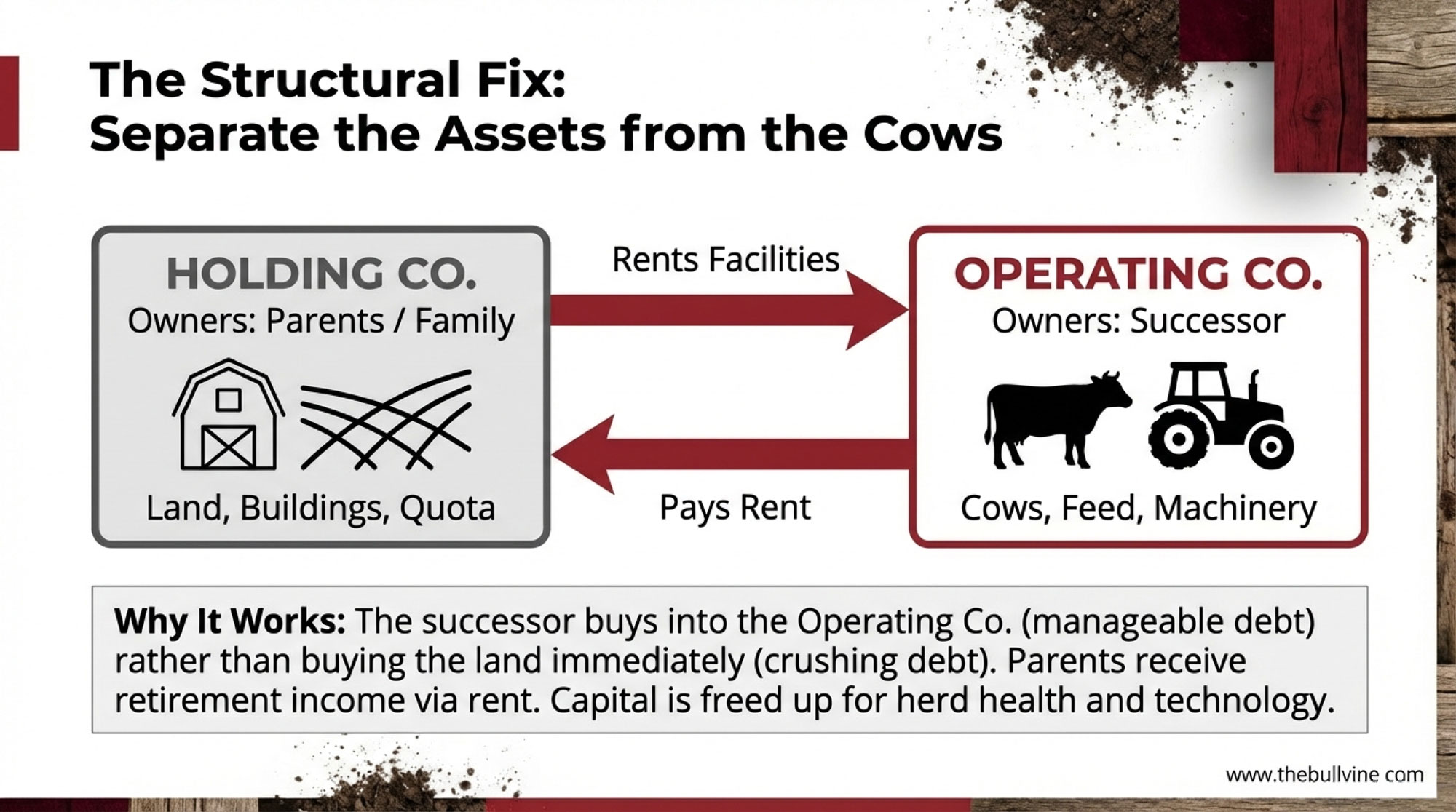
  • Land, buildings, and quota sit in a holding company or partnership, often owned primarily by the parents and, eventually, by a mix of family members.
  • The operating company holds the cows, replacements, feed, and machinery, and runs the day‑to‑day dairy.
  • Over time, the successor acquires the operating company through staged share purchases, profit‑sharing, or a combination.

This gives you a few levers to pull:

  • Parents can receive retirement income from rent or dividends paid by the holding entity.
  • The successor doesn’t have to debt‑load themselves all at once with land, barns, and quota; they can focus capital on keeping cows healthy, improving butterfat levels, managing SCC, and investing in genetics or automation.
  • With good advice, you can line this up with tools like the intergenerational rollover and the Lifetime Capital Gains Exemption.

In Ontario and Quebec quota herds, where the value of quota alone can be massive, this kind of structure can be the difference between having a path forward and quietly setting up a forced sale.

Other Tools That Often Get Overlooked

In U.S. herds without quota, you still see some of the same themes:

  • Partnerships or LLCs in which the successor buys units over a decade or more, funded partly with profits.
  • Land companies that hold farmland, sometimes with both farming and non‑farming siblings as owners, and long‑term leases to the operating dairy.
  • Planned growth or diversification—adding cows, custom heifer‑raising, beef‑on‑dairy programs, or on‑farm processing—to create enough cash flow to support a buy‑in and reinvestment.

A 2021 article in Sustainability looking at small U.S. farms (not just dairy) found that producers who combined enterprise decisions with financial risk‑management tools—like insurance, off‑farm income, and contracts—tended to have stronger economic sustainability. That lines up with what many of us see: the farms that think in terms of structure and risk management, not just “who works hardest,” usually have more options when it’s time to transition. 

Decision #4: Build a Successor as a Leader, Not Just the Go‑To Worker

Every dairy has someone who knows exactly which cows are in trouble in the transition period, who notices a butterfat dip before anyone else, and who can read a robot alarm in their sleep. They’re often the first person you call when something’s off.

It’s worth noting, though, that being the most reliable worker and being the person who carries the bank meeting, the staff reviews, and the five‑year capital plan are different skill sets.

That Brazilian study I mentioned earlier found that successors with higher absorptive capacity—basically, better at absorbing and using new information—and stronger social networks were more likely to be in place and engaged in management on family farms. Other work on family‑firm resilience suggests that leadership development and adaptability are key to who survives shocks like droughts, price crashes, or major policy changes.

So here’s the question I’d encourage you to ask: “Are we intentionally building a leader here, or are we just giving more jobs to the person who never says no?”

Trial Management with Real Metrics

We already talked about giving the next generation specific areas to run. The key is to pair that with clear metrics and then actually look at them together. In practice, that might be:

  • Fresh cow and transition management: track fresh cow health events, early culls, peak milk, and repro performance.
  • Cropping: track forage quality (protein, NDF digestibility), yield, and cost per ton of dry matter, then connect that to milk production and butterfat levels.
  • People: track turnover, missed shifts, and the consistency with which standard operating procedures are followed.

In many cases, lenders in Wisconsin and Minnesota have said, “Show me how they’ve done when they were responsible, not just when they were helping,” before they sign off on financing a buy‑in. It’s not about being harsh; it’s about giving everyone confidence that the next person can actually drive the ship. 

Shifting Real Authority, Step by Step

A lot of extension material, including from Wisconsin and Missouri, discusses moving successors through stages—from employee to enterprise manager to multiple‑enterprise manager to primary operator, and finally to lead owner. Groups like Land For Good emphasize writing down who makes what decisions at each stage.

What’s encouraging is that when families do this on purpose—rather than on the fly—you see the older generation relax a bit because they’re not handing over everything at once. And the younger generation builds confidence because they’re making meaningful decisions before the paperwork changes hands.

Key FactorFarms Making It to Gen 3 (16.5%)Farms at Risk of Dispersal (83.5%)
Succession TimingStart serious talks 10–15 years out; parents in 50s, successor in 20s–30sWait until burnout, health crisis, or parent age 65+; rushed decisions
Successor DevelopmentOff-farm experience + trial management in specific areas with measurable KPIsNo off-farm training; successor does many jobs but leads none; vague accountability
Capital StructureUse holding/operating split, staged buy-ins, or sweat-equity recognition to spread debt loadFull market-value buyout; successor inherits $600–$750 debt per cow
Real Authority TransferWritten plan: who owns what decisions at each stage; regular progress reviewsVague handoff; older gen still making calls behind the scenes; confusion and resentment
Fairness DiscussionExplicit conversations about “fair vs equal”; non-farm kids acknowledged; neutral facilitatorAssumptions left unspoken; non-farm kids blindsided; explodes in lawyers’ offices later
Advisory TeamLawyer, accountant, lender, family coach at same table; coordinated adviceEach advisor in silo; conflicting tax and legal advice; family navigates alone
Plan DocumentationWritten succession plan reviewed annually; timeline clear; metrics trackedVague intentions; no written plan; nobody knows what “done” looks like
Contingency for Non-Family SuccessionIf no family successor emerges, explored non-family paths early (leases, land-access programs)“We’ll sell when it’s time” or “Nobody wants this farm”; fire-sale dispersal

Decision #5: Tackle “Fair vs Equal” While Everyone’s Still Talking to Each Other

If there’s one topic that tends to tighten people’s shoulders around the table, it’s fairness. How do you treat non‑farming kids fairly without burying the one who stayed?

Research on family businesses and values makes it clear that “fair” means different things to different family members. The on‑farm child might look at years of lower wages, risk, and sacrifice. The off‑farm child might be thinking, “We grew up in the same house; why is my share smaller?”

FCC has tried to normalize that tension a bit. In their fairness articles, they break it down simply: equal is one version of fair, but not the only one. They highlight tools like: 

  • Using life insurance or off‑farm investments to help non‑farming kids while directing more farm assets toward the successor.
  • Separating land from operations so siblings can share in land ownership while the farming heir controls and builds the operating business.
  • Putting numbers on sweat equity—years of below‑market wages and capital contributions—so the successor’s extra skin in the game isn’t invisible.

As many of us have seen, families that talk through this with a neutral person—a mediator, coach, or extension specialist—tend to come out with solutions that everyone can live with. It doesn’t make every conversation easy, but it makes them a lot less explosive.

Decision #6: Bring a Real Advisory Team Around the Same Table

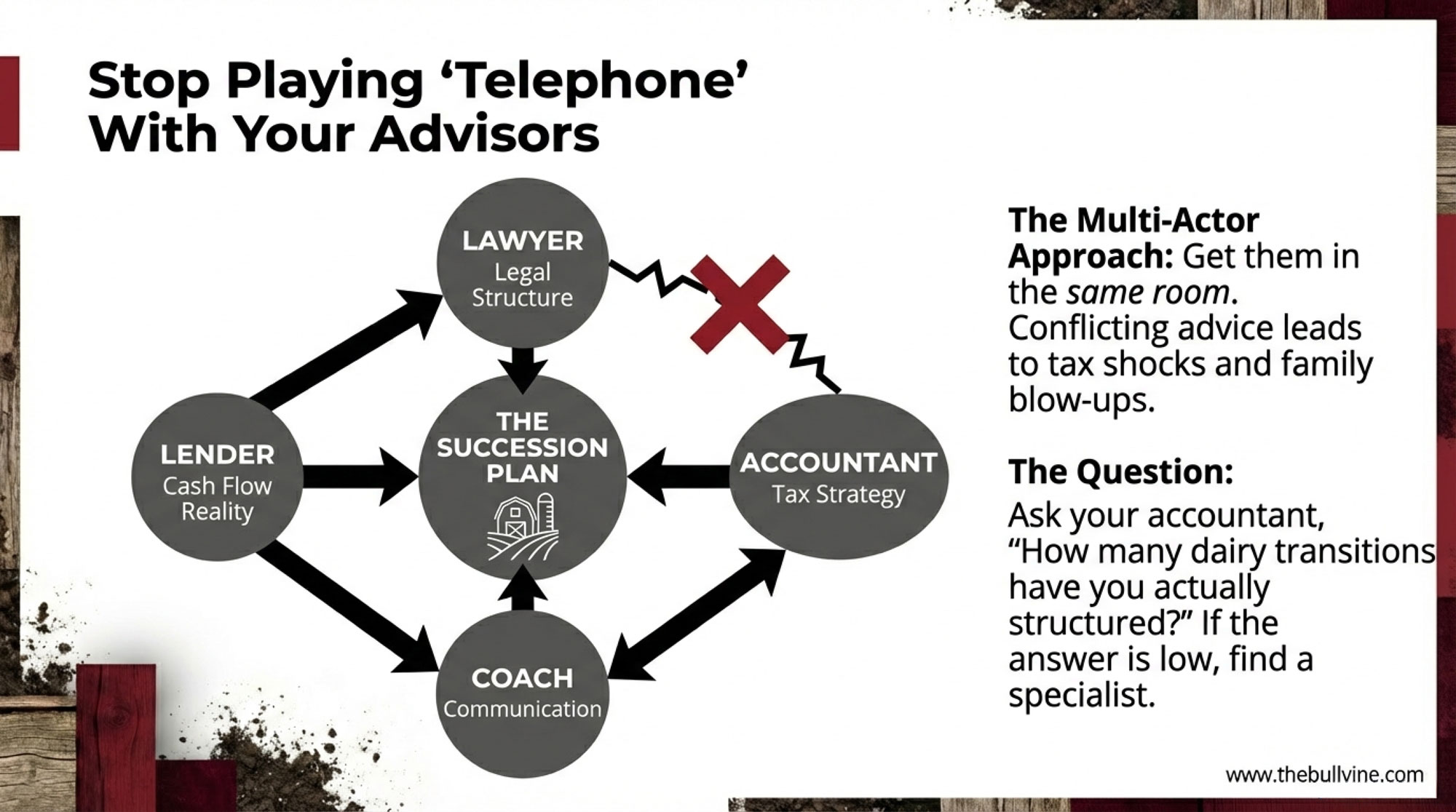
One thing Teagasc in Ireland has really leaned into—and I think it’s worth watching from this side of the ocean—is the idea of coordinated advisory teams. They call it the Multi‑Actor Succession Teams approach. 

Instead of the family bouncing between their Teagasc advisor, their accountant, and their solicitor, each giving advice in isolation, Teagasc arranges meetings where everyone sits together, looks at the same facts, and works toward a plan the family can actually implement. 

The Irish government even backs this up with the Succession Planning Advice Grant. That grant can contribute up to 1,500 euros toward eligible professional costs—lawyers, accountants, and so on—for families who go through a structured succession process. 

We don’t have that exact grant in Canada or the U.S., but the principle still applies. In FCC stories and in a lot of North American advisory work, the farms that make the cleanest transitions tend to have a team that looks something like:

  • A lawyer who does farm transfers regularly, not just basic wills.
  • An accountant who understands farm tax rules, intergenerational rollovers, and the quirks of quota or depreciation.
  • A lender who’s seen both good and bad transitions and can talk plainly about what the balance sheet can support.
  • A family‑business coach or mediator who keeps the conversation moving and honest.
  • A financial planner who helps the senior generation turn this plan into a retirement that doesn’t depend entirely on guilt or generosity.

What’s interesting is that when you get these folks in the same room—even just once or twice—you cut down a lot of the “he said / she said” between offices. You also tend to catch conflicts between tax ideas, legal structures, and bank policies before they become expensive mistakes. 

Decision #7: If There’s No Family Successor, Don’t Assume “Sell Next Month” Is the Only Path

We also have to be honest: sometimes, nobody in the next generation wants to run the dairy. Or they want to stay connected as owners, but not in the day‑to‑day.

In that situation, it’s easy to feel like the only choices are: run yourself into the ground or sell everything at once. But there’s some interesting work happening here, too.

The Journal of Agriculture, Food Systems, and Community Development has published several papers on land‑access and transition policies. One 2020 study examined “land access policy incentives”—such as state tax credits and USDA’s Conservation Reserve Program–Transition Incentives Program—and how they’re being used to transfer land to younger and beginning farmers through long‑term leases or sales. A 2024 evaluation of the Transition Incentives Program highlighted its role in helping older farmers transition CRP land to new operators in a more controlled way. 

And Tennessee’s succession workbook explicitly says that if there’s no interested or prepared family successor, it’s worth looking at non‑family options—long‑time employees, young neighbors, or other beginning farmers—through structured leases or phased sales. 

So in many cases, your choices might look more like:

  • Gradually leasing facilities and herd to a non‑family operator with a clear agreement.
  • Selling land but keeping some involvement in the herd or youngstock for a few years.
  • Working with a land‑link program or policy incentive to bring in a new operator under defined terms. 

That’s not going to fit every situation, but it’s better than assuming there are only two buttons to push: “ignore it” or “disperse immediately.”

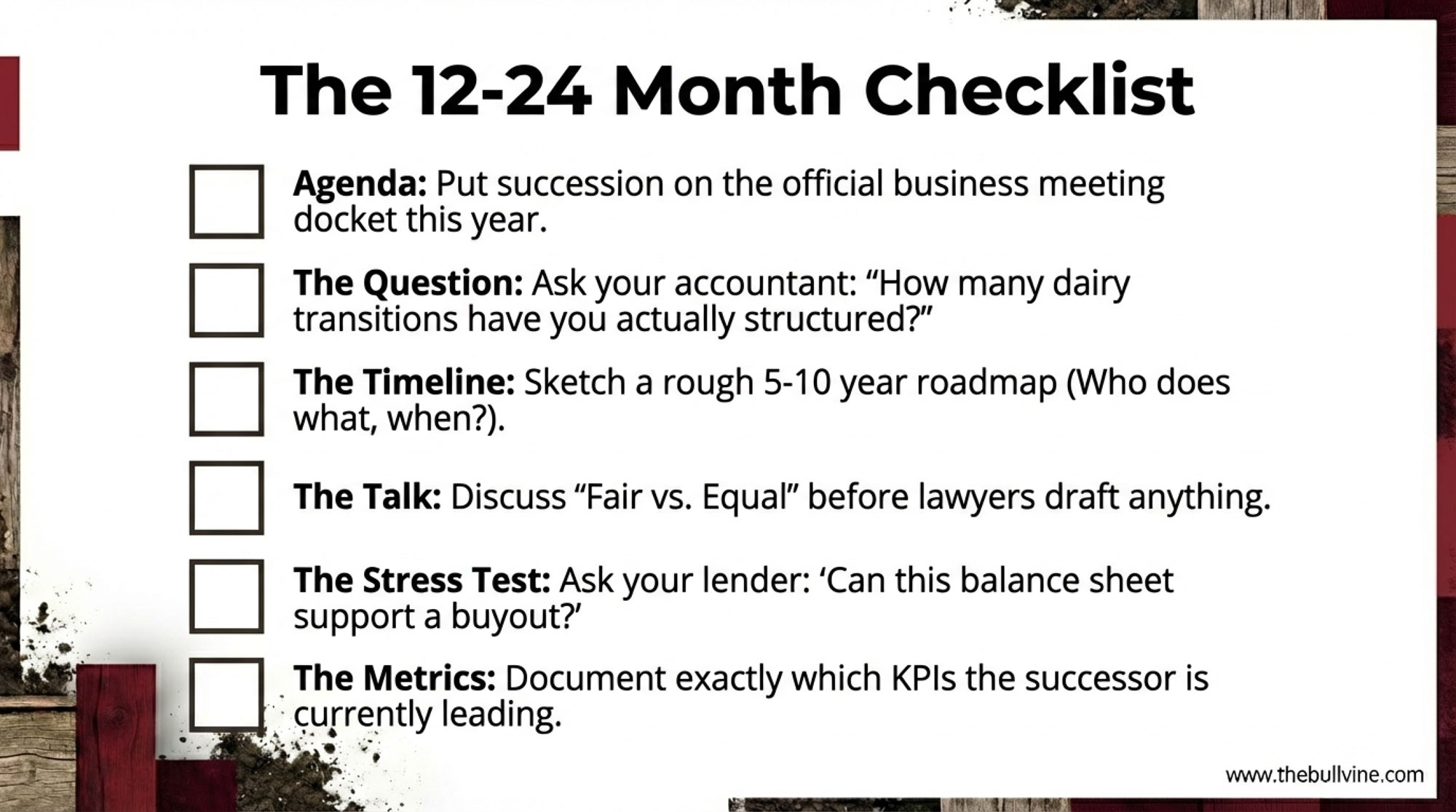
A Realistic 12–24‑Month Game Plan

If you’re thinking, “This is all fine, but we’re not a decade out, we’re three to five years out,” you’re not alone. A lot of families are in that position. The goal in that case isn’t to build the perfect binder. It’s to move from “vague intentions” to a written, realistic plan.

Here’s a simple roadmap that I’ve seen work on real farms:

1. Put Succession on the Farm Agenda This Year

It sounds almost too basic, but the first step is to stop treating succession as a late‑night worry and start treating it as business. Tools from OMAFRA, New Brunswick’s farm‑transition checklists, and Tennessee’s workbook all include question sets that ask, for example, “Who wants to be involved and in what way 10–15 years from now?” and “What do you want this farm to look like then?” 

In many cases, just getting those answers written down is a big step forward.

2. Ask Your Advisors a Very Direct Question

At your next accountant or lawyer visit, try this:

“How many farm successions have you helped structure in the last five years, and what kinds of structures did you use?”

If the answer is “not many,” that doesn’t mean they’re a bad fit for everything. But it’s a sign you may want to bring in someone who spends most of their time on farm transfers, even if it’s just for a few key meetings.

A lot of the train wrecks I’ve seen weren’t because the people involved were careless; they were simply working with advisors who didn’t specialize in the complexity of farm assets, quota, and family dynamics.

3. Sketch a Rough Timeline

You don’t have to frame this on the wall, but it helps to see it. Write down:

  • Your age
  • The age of any realistic successor

Then ask:

  • “When would I like to be mostly out of day‑to‑day decisions?”
  • “When does this person need to be fully in charge for this to feel responsible?”

Alberta’s transition planning guide and other resources offer examples of 10–15‑year transition timelines. Even if you only have five years, putting rough mileposts down—“by Year 2 they handle cropping decisions; by Year 4 they’re lead on fresh cows and people; by Year 5 we finalize ownership changes”—gives everyone something concrete to work toward.

4. Start the Fair vs Equal Talk Before Lawyers Draft Anything

If you can, bring in a neutral facilitator—an extension specialist, a mediator, or a farm‑family coach—and have a meeting with all children, farming and non‑farming.

Some good questions:

  • “What would feel fair to you if you’re the one farming here?”
  • “What would feel fair if you’re not farming but want to stay connected?”
  • “What worries you most about how this might be handled?”

Research on family climate and succession planning suggests that families who discuss expectations openly, rather than leaving them implied, tend to have smoother transitions and fewer broken relationships in the long run.

5. Document Where the Successor Already Leads

If someone’s already making key calls, get that down on paper.

Make a short list:

  • Decisions they currently own (transition‑period protocols, breeding program, staff scheduling, major purchases).
  • The numbers you’re using to judge success (milk per cow, butterfat and protein levels, SCC trends, repro KPIs, heifer inventory, feed cost per cwt).

That list isn’t just for the bank. It’s for you too. It shows you where you can start stepping back—and where you may need to push them to take more responsibility.

6. Sit Down with Your Team and Ask How to Avoid the Capital Crunch

When you’ve got your accountant, lawyer, lender, and maybe a coach at the table, put this question on the flip chart:

“If we don’t want to rely on a full market‑value buyout to be fair, what options do we have that you’ve seen work for dairies like ours?”

In many cases, that’s when ideas like holding/operating structures, land companies, staged share purchases, or long‑term leases with built‑in buyout formulas start to surface. The mix that makes sense for a 90‑cow tie‑stall in New Brunswick won’t be the same as for a 1,200‑cow freestall with robots in Wisconsin, but the goal is the same: keep capital demands aligned with what the business can support.

7. If There’s No Family Successor, Explore Non‑Family Paths on Purpose

If no family member wants to run the dairy, consider whether a longtime employee or a young neighboring producer could be part of a structured transition plan. Research on land‑access policy incentives and the Transition Incentives Program shows that staged sales and long‑term leases are already being used across North America to help older farmers exit without simply putting up a “For Sale” sign and walking away. 

TimelineStepOwnerKey OutputSuccess Looks Like
Year 1 (This Year)1. Put Succession on the Farm AgendaFamilyWritten answers to “Who wants in? What does the farm look like 10–15 years out?”Everyone has read the workbook questions; one family meeting completed
2. Ask Your Advisors a Direct QuestionParent + AdvisorList of advisors with farm-succession experienceYou have at least one advisor who’s structured 5+ farm transitions in the last 5 years
3. Sketch a Rough TimelineFamilyOne-page timeline with ages, transition milestones, key decision datesYou can see when the successor needs to be fully in charge; you know when you want to step back
Year 24. Start the Fair vs Equal TalkFamily + Facilitator (optional)Written record of what each child views as fair; areas of agreement & concernNon-farming kids feel acknowledged; farming successor feels supported; no surprises later
5. Document Where the Successor Already LeadsFamily + SuccessorList of current decisions owned by successor; KPIs used to measure successYou have 3–5 areas where the successor is fully responsible and hitting targets
6. Meet with Your Team & Address the Capital QuestionFamily + Lawyer + Accountant + LenderOutline of 2–3 structures that could work (holding/operating, staged buy-in, land lease, etc.)You understand which structure fits your farm; you know what equity needs to move and when
Year 2–37. If No Family Successor, Explore Non-Family PathsFamily + Land-Link or ExtensionPreliminary conversations with potential long-term employees or neighboring operatorsYou have a Plan B if the family route doesn’t work; you’re not forced into a fire-sale dispersal
Outcome by Month 24Written Succession PlanFamily + AdvisorsFinal plan document (2–5 pages); annual review schedule setYou have a one-page summary everyone agrees on; annual check-in on the calendar; confidence that this farm will be here in 20 years

The main thing is to look at this while you still have energy and flexibility—before age or burnout makes the decision for you.

Most of us have stood by the ring at a dispersal sale and felt that twist in our gut watching cow families, genetics, and years of work roll out the lane. Sometimes that’s the right choice—especially when it’s planned and keeps the family whole.

But if your hope is to see cows in those barns and milk leaving your lane under your family’s name into the next generation, the data and the lived experience line up on this: the families who make it into that 16‑odd percent don’t get there by luck. They start earlier than feels comfortable. They treat “equal at full value” as something to stress‑test, not a default. They build a successor who can actually lead, not just work. They use structures that reflect today’s capital load and margins. And they get a real team around the table instead of trying to carry it all alone.

You don’t have to overhaul everything by next spring. But if sometime this year you say, “Okay, who might realistically succeed us?”, sketch a rough timeline, and ask your advisors how to do this without crushing the farm, you’ll be ahead of where most families start.

And from what many of us have seen, that’s usually how good transitions begin—not with a perfect binder, but with one honest conversation, a few real numbers on the page, and a family deciding they’d rather write their own odds than live by someone else’s statistic.

Key Takeaways

  • The survival math is brutal: Only about 16.5% of dairy farms make it to a third generation—and weak or late succession planning is one of the biggest reasons why.
  • “Equal at full value” can quietly kill the farm: A traditional buyout can load $600–$750 of debt per cow onto the farming heir, leaving almost nothing for cows, barns, genetics, or the next bad year.
  • The 16.5% start earlier and build leaders: Families who beat the odds begin serious transition talks a decade out, give successors real management responsibility (with measurable outcomes), and use off‑farm experience as free training—not a threat.
  • Fair doesn’t have to mean equal in dollars: Sweat equity recognition, holding/operating structures, staged buy‑ins, and land‑lease arrangements can balance retirement, fairness, and herd survival without forcing a fire sale.
  • A real team beats a scattered one: Getting your accountant, lawyer, lender, and a family coach around the same table—like Teagasc’s Multi‑Actor Succession Teams—helps you dodge tax traps, catch conflicts early, and keep relationships intact.

Executive Summary: 

Only a small slice of dairy farms—roughly that 16.5%—make it to a third generation, and it’s not because the rest didn’t care enough about legacy. This article digs into what separates the survivors, combining family‑business research, FINBIN 2024 dairy numbers, and fresh work on farmer stress and leadership to show where most plans quietly break down. You’ll see how a “fair” full‑value buyout can stack $600–$750 of debt on every cow, why that’s so dangerous in a 2%‑ROA business, and how structures like holding/operating companies and staged buy‑ins can keep both retirement and reinvestment on the rails. We walk through the timing piece—starting conversations while parents still have a decade to work, using off‑farm experience as training, and giving successors real management oxygen instead of just more chores. There’s a straight‑talk section on “fair vs equal” for farming and non‑farming kids, and how coordinated advisory teams (the kind Teagasc and FCC are pushing) help you avoid tax shocks and family blow‑ups. The article also opens the door to non‑family succession routes and land‑access programs when there’s no heir in the barn. You’ll finish with a concrete 12–24‑month checklist to test your own plan and a clearer sense of whether you’re quietly planning a continuity story—or an eventual dispersal.

Complete references and supporting documentation are available upon request by contacting the editorial team at editor@thebullvine.com.

Learn More

The Sunday Read Dairy Professionals Don’t Skip.

Every week, thousands of producers, breeders, and industry insiders open Bullvine Weekly for genetics insights, market shifts, and profit strategies they won’t find anywhere else. One email. Five minutes. Smarter decisions all week.
NewsSubscribe
First
Last
Consent

Why 83% of Dairy Farms Will Disappear: How to Beat the Succession Odds Before It’s Too Late

83% of dairies vanish. Will yours? Beat succession odds before your legacy becomes a statistic. Bold moves. Real talk.

Staring down a cliff edge – that’s where the North American dairy industry finds itself. A quarter of operators are hanging up their boots within five years. According to Iowa State’s research, eight out of ten lack faith in their succession plans. And that gut-punch statistic? A staggering 83.5% of family dairies won’t survive to see a third generation running the parlor. Worse than even the dismal 16.5% survival rate plaguing family businesses generally. Make no mistake – what separates the operations still standing from those that vanish has nothing to do with luck. It’s about confronting the financial, familial, and operational barriers to transition with clear eyes and bold action.

Why Most Dairy Succession Plans Are Destined to Fail

Ready to join the statistical scrap heap? Despite family ownership dominating 97% of U.S. farms, the 2022 Ag Census paints a bleak picture – barely half have dipped their toes into succession planning. Worse still, only a pitiful 20% of those with plans actually believe they’ll work.

That financial mountain looms Everest-high. Converting your high-producing Holstein herd to A2A2 genetics overnight? Child’s play compared to today’s capital requirements. Land running $5,570 an acre. Parlor systems that’ll set you back north of $200k. TMR mixers costlier than luxury sedans. Breeding stock representing generations of genetic investment. No wonder the classic “buy-out” model crashes and burns. Expecting your successor to write that check while keeping the operation afloat? About as realistic as hitting a 30,000-pound RHA with second-cut hay and good intentions.

The real time-bombs never tick away in the freestall barn – they’re planted firmly around your kitchen table. Family conflicts have been smoldering for decades. Competing visions nobody dares discuss. Communication breakdowns that would make your cell service look reliable. Compeer Financial nailed it in their 2024 report: that deep-seated need to treat all children “equally” routinely shoots the farm’s survival right between the eyes. Sell those productive assets to square things up, and what’s left to transition?

Then come the emotional roadblocks no spreadsheet can navigate. Mom and Dad are clutching the checkbook like it’s the last life raft on the Titanic. Junior is desperate for enough authority actually to implement changes. This emotional standoff creates barriers taller than your corn in August – like trying to boost conception rates with premium semen when nobody’s bothering to check heats.

Hard truth time: Iowa State found 71% of farmers with retirement on the horizon haven’t even tagged a successor. Got a plan without addressing those human dynamics? Might as well install top-end milking equipment and let the neighbor kid run it – technical excellence means nothing without the human element.

Revolutionary Strategies That Transform Farm Transitions

What separates that elite 17% from the failed 83.5%? Not dumb luck or deep pockets, but a comprehensive blueprint that tackles every dimension of transition.

Early isn’t just better – it’s essential. Don’t wait till the rocking chair looks appealing. Successful transitions need a 5–10-year runway – roughly the time needed to grow those genomically-superior heifers into your mature herd backbone. Journal of Agribusiness research confirms wait too long, and you might as well be planting corn in November.

Family discussions going nowhere? Taken any deliberate steps, or just hoping uncomfortable topics disappear like mastitis without treatment? Progressive dairy families don’t leave communication to chance:

  • Monthly meetings with actual agendas – not just “whenever someone gets mad”
  • “Listening first” protocols, where everyone gets their say without interruption
  • Written records of agreements and sticking points – not memory-based revisionism
  • Professional facilitators, when needed, because family baggage dating to childhood rarely resolves itself

Has your financial structure already torpedoed your chances of a successful succession? Smart operations are dumping the “buy everything or nothing” model faster than you’d cull a three-quartered chronic. Think precision feeding versus one-size-fits-all TMR – the industry has evolved; shouldn’t your succession plan? Leading advisors increasingly recommend splitting operations into:

  • An asset-holding company (senior generation keeps the land/major equipment)
  • An operating company (the successor takes reins of production)

This structure slashes capital requirements while creating retirement income through lease payments. Canadian Bar Association case studies show it works – cleaner than separating dry cows from your milking string while efficiently serving both purposes.

Your advisory team makes or breaks the transition. Would you let some random vet who normally treats parakeets and poodles near your prize genetics? So why trust generic financial advisors with your farm‘s future? Find specialists who differentiate between a TMR mixer and a cement truck. You need agricultural estate planners who’ve seen more dairy transitions inside than most people have seen inside barns.

Never marry a successor without dating first. Forward-thinking farms now implement structured trial periods with clear metrics and escape hatches. Define specific responsibilities, set performance benchmarks, and create exit routes if the fit proves wrong – all before signatures hit paper. Makes more sense than dropping six figures on embryo work without genomic testing the bloodlines first.

Developing successors demands the same systematic approach you’d use to build your herd—formal education matters. Off-farm experience builds perspective. Gradual responsibility increases muscle without breaking bones. Regular feedback catches problems before they become disasters. Half-baked training produces half-capable successors.

When Expansion Powers Your Succession Plan

Nearly half of dairies view expansion as their succession ticket. But size for size’s sake? Pure folly. Does growth truly fit your transition story, or are you chasing industry trends like everyone chased those tall Holsteins in the 80s?

Economics must pencil at both scales and expansion becomes your anchor, not your engine. Leading operations analyze fixed cost dilution across larger herds, calculate capital efficiency metrics down to the penny, project cash flow through the capital-hungry growth phase, and structure financing to protect both generations from excessive risk.

Technology adoption doesn’t just change your operation – it transforms succession possibilities. Forward-thinking dairies leverage expansion to modernize, installing rotary parlors that slash labor needs, implementing herd management software that turns data into decisions, automating feed systems for TMR consistency your old mixer could never achieve, and deploying precision reproduction tech that makes your past breeding programs look like guesswork. Though initially painful to the pocketbook, Dairy Business Innovation documents how these investments often dramatically improve quality of life while boosting resilience.

Approaching expansion strategically or emotionally? That industry mantra “bigger is always better” deserves the same skepticism you’d give a feed salesman promising 10 pounds more milk. The USDA Economic Research Service confirms that economies of scale exist – larger herds generally show lower production costs. But focusing exclusively on land acquisition over productive assets? About as smart as fixating on milk volume while ignoring components. Michigan State’s research team found that investments in facility capacity and superior genetics often outperform land purchases, especially when the next generation starts with more ambition than capital.

Processor relationships? Overlooked by too many. Before breaking ground on those new barns, lock down whether your milk plant actually wants another tanker load daily. Secure those component premiums and transportation arrangements in writing. Nothing torpedoes expansion faster than surprise base-excess deductions slashing your milk check when those loan payments come due.

Next-generation input isn’t a nice-to-have – it’s do-or-die. Expansions that succeed involve successors from day one, collaborating on business plans, defining clear roles, openly discussing financial implications, and documenting transition timelines before the first shovelful of dirt moves.

The Strategic Power of Staying the Course

While expansion hogs the spotlight, maintaining current scale often makes brilliant strategic sense. Recognizing when “steady-state” fits your transition creates stability that many expanding farms would envy.

Component focus literally transforms your milk check. With butterfat driving 58% of revenue and protein adding 31% more, according to 2023 Multiple Component Pricing data, maximizing components frequently outperforms cow-number obsession. Smart operators targeting current-scale excellence prioritize component-focused genetics, dial in rumen fermentation for butterfat synthesis, eliminate acidosis and other component-killers, and master seasonal consistency. Ever calculated your operation’s true income per cow versus income per pound of components? That analysis often reveals more profit potential in your current herd than in expansion dreams.

Risk profiles rarely match between generations. Does your successor share your appetite for leverage and market exposure? Maintaining scale often creates a saner risk profile during transitions – lower fixed costs, reduced debt service, simplified management during leadership changes, and nimbleness when markets shift. Like balancing rations for optimal rumen function rather than maximum production, right-sizing creates stable platforms for transfer.

Resource optimization at the current scale drives profitability that expansion can’t always match. Leading steady-state operations obsess over return per unit – land, labor, or capital. They track production costs with near-religious devotion, strategically outsource non-core functions, mine DHIA data for hidden opportunities, and relentlessly pursue incremental efficiency gains that compound over time.

When lifestyle priorities align with business strategy, maintaining scale supports quality of life during transitions. Particularly valuable when young families need flexibility, multiple generations need income, senior members want continued involvement, or work-life balance trumps bragging rights at the coffee shop. Your best cows need dry periods for lifetime productivity – why shouldn’t your family business operate sustainably too?

How Your Decisions Are Reshaping Dairy’s Future

The collective impact of retirements, expansions, and steady-state operations is fundamentally redesigning North America’s dairy landscape. Understanding these shifts positions your operation advantageously, regardless of size or succession stage.

Consolidation isn’t coming – it’s already steamrolling through. USDA data tells the brutal story: U.S. dairy farm numbers in freefall from 648,000 in 1970 to barely 24,000 by 2022, with another 2,500 operations shuttering in 2020 alone. Yet milk production climbs as mega-dairies absorb that volume. Today, operations exceeding 2,500 cows produce over 60% of the nation’s milk, leveraging economies of scale that smaller farms can’t match.

But does bigger automatically mean better? Hardly. While the USDA Economic Research Service confirms that scale economies exist, innovation creates success stories across diverse sizes. What matters more than cow numbers? Strategic market alignment. Operational excellence at your chosen scale. Clear differentiation in cost structure or product attributes. Financial frameworks supporting generational transition. Just as selection indexes evolved from height-obsessed to lifetime-profit focused, successful dairies optimize their specific model rather than mindlessly chasing size.

Technology demolishes old limitations across farm scales. Robotic milkers, rumination monitors, and precision management tools create possibilities unimaginable a generation ago – slashing labor dependencies, improving work-life balance, enabling data-driven decisions, and attracting tech-savvy successors put off by traditional dairy drudgery. Like genomics democratizing elite genetics for farms of all sizes, technology levels key operational playing fields.

Component-focused strategies fundamentally reshape market dynamics. Multiple-Component Pricing systems drive evolution from volume obsession to composition focus. When did you last overhaul your genetic selection criteria and feeding programs to capture this shift? Progressive operations prioritize component-focused genetics, optimize production systems for butterfat and protein, and cultivate processor relationships rewarding composition excellence.

Environmental considerations increasingly impact succession planning. Forward-looking operations integrate sustainability through emission-reducing technologies, carbon sequestration practices, soil health, comprehensive nutrient management, preventing regulatory headaches, water conservation strategies, preserving vital resources, energy efficiency measures, slashing costs, and impacts.

Success Stories That Illuminate the Path Forward

Real-world examples cut through theoretical fog. Study these contrasts between successful transitions and train wrecks to map your own journey.

LLC formation turned transition dreams into reality for a 220-cow operation that looked hopelessly stuck. Rather than traditional asset transfer, owners formed a limited liability company housing all farm assets, structured incremental LLC interest sales to their 30-year-old successor, created a formal decade-long employment agreement for the senior operator, and established crystal-clear management divisions. This approach delivered liability protection, streamlined transfers, and generated tax advantages. It established operational guardrails – providing structure while preserving flexibility, much like a well-designed breeding program adapts to changing market signals.

Asset-operation splitting saved a Canadian dairy that seemed financially untransferable. The Canadian Bar Association highlighted how separating ownership from operations transformed succession possibilities. The senior generation formed a corporation holding land and major equipment, creating a second operating company that primarily sold to the successor. Leasing necessary assets slashed capital requirements while guaranteeing retirement income, functioning like separating mature cows from first-lactation heifers for optimized management of both groups.

Targeted expansion revitalized Ideal Dairy Farms’ multi-generational prospects. Their growth from 1,230 to 2,300 cows wasn’t expansion for ego’s sake – it centered on a state-of-the-art 72-cow carousel installation, energy-efficient technologies, strategic utilization of external audit programs and incentives, and laser-sharp focus on scale efficiencies. Their approach prioritized systems that optimized their specific scale targets, like selecting genetics that expressed their full potential under their unique management conditions.

Alternative models saved Challon’s Combe when conventional approaches failed. This UK operation’s shift to 100% pasture-based organic production slashed purchased feed costs, improved herd health metrics, enhanced environmental profile, and targeted premium markets for differentiated products. Their journey demanded fundamental reconceptualization, challenging conventional wisdom like crossbreeding programs, which questioned Holstein dominance but delivered through superior health traits and component production.

What kills transitions dead in their tracks? Waiting until retirement looms mean planning needs to start years earlier. Fuzzy math that ignores multiple household financial requirements. Sweeping “fair versus equal” discussions under the rug until they explode. Half-baked successor development is leaving critical skills gaps. Handshake agreements that evaporate when memories differ. Like ignoring transition cow needs, then wondering why metabolics run rampant, these fundamental mistakes guarantee failure.

The brutal truth? When 83.5% of operations fail to survive generationally, the culprits aren’t economic fundamentals but insufficient planning, poor communication, and inadequate successor development. Industry analyses consistently reveal these human factors, not market forces, doom most transitions.

The Bottom Line: Your Action Plan for Succession Success

Successful dairy transitions don’t happen by accident – they’re built deliberately, brick by difficult brick. Got the stomach for uncomfortable conversations? Ready to make tough decisions your operation’s survival demands? Follow this battle-tested roadmap:

  1. Start planning yesterday. Document your current operational reality – assets, liabilities, management systems. Establish baselines with the same methodical approach you’d apply to milk recording – you can’t measure progress without knowing your starting point.
  2. Talk. Then talk more. Schedule regular family meetings specifically for succession planning. Create safe spaces for honesty. Consider bringing in professional mediators when discussions hit landmines. Apply the same religious dedication to these conversations you give to your herd health protocols.
  3. Hire specialists, not generalists. Your operation deserves agricultural attorneys, farm-focused financial planners, and accountants who can tell a commodity from a cow. Would you trust your genetic program to someone who thinks a summary is a book report? Don’t saddle your farm’s future with advisors lacking agricultural expertise.
  4. Build successors systematically. Map out technical and management skill development. Create meaningful decision-making opportunities with increasing stakes. Provide honest feedback, both positive and corrective. Develop your next generation with the same attention you give your replacement heifers.
  5. Rethink financial structures from scratch. Entity splits, phased transfers, and strategic leases – succession demands creative approaches that balance opportunity with security. Like transitioning from conventional parlors to robotics, sometimes the winning path means fundamental restructuring, not minor tweaks.
  6. Put everything in writing. Document ownership transitions, management shifts, financial arrangements, and contingency plans. Your succession deserves the same detailed attention your breeding program receives – clear objectives, measurable outcomes, and regular evaluation.
  7. Review and revise relentlessly. Schedule annual progress assessments with your advisory team. Make necessary course corrections. Adapt to changing markets and family circumstances. Like monitoring feed efficiency and tweaking rations, this process keeps your succession on track despite changing conditions.

The dairy industry’s future belongs to those with enough guts to tackle succession head-on. Whether your strategy involves ambitious expansion, steady-state optimization, or creative alternative models, intentional planning remains non-negotiable.

Time for brutal honesty: Are you building something that outlasts you, or just maintaining an operation with an expiration date matching your own? This industry doesn’t need another sad statistic – it needs your farm as a lasting legacy. Unlike mastitis or repro problems that sometimes strike despite your best prevention, succession failures almost always trace back to things entirely within your control – inadequate planning and poor communication. Make your choice now: join the 17% success stories or the 83.5% failures? There’s no middle ground – today’s action or inaction is already writing your farm’s final chapter.

Key Takeaways:

  • Succession Failure is Epidemic: An alarming 83.5% of family dairy farms fail to transition to the third generation, primarily due to a lack of planning and poor communication.
  • Human Dynamics Over Economics: Unresolved family conflicts, reluctance to cede control, and inadequate successor development often derail transitions more than financial constraints.
  • Early, Comprehensive Planning is Non-Negotiable: Successful succession demands a 5-10 year runway, specialized advisors, and innovative financial structures, not last-minute fixes.
  • Strategic Alignment, Not Just Size, Drives Success: Whether expanding or maintaining scale, focusing on component value, technology, and clear successor roles is more critical than simply pursuing growth.
  • Intentional Action Separates Survivors from Statistics: Proactive, honest engagement with succession challenges is the single most important factor in determining a dairy farm’s legacy.

Executive Summary:

North American dairy faces a succession crisis with an 83.5% failure rate for multi-generational transfers, far exceeding general family business failures. This stems from financial hurdles, unresolved family conflicts, and a lack of proactive planning, with 71% of retiring farmers lacking identified successors. Successful transitions require early, comprehensive planning (5-10 years), open communication, specialized advisory teams, and innovative financial structures like asset-holding and operating company splits. Expansion or steady-state strategies both offer viable paths, but success hinges on aligning with market realities like component pricing, strategic technology adoption, and thorough successor development. Ultimately, intentional action and a willingness to confront difficult decisions are crucial to overcome these challenges and secure a farm’s future.

Learn more:

The Sunday Read Dairy Professionals Don’t Skip.

Every week, thousands of producers, breeders, and industry insiders open Bullvine Weekly for genetics insights, market shifts, and profit strategies they won’t find anywhere else. One email. Five minutes. Smarter decisions all week.
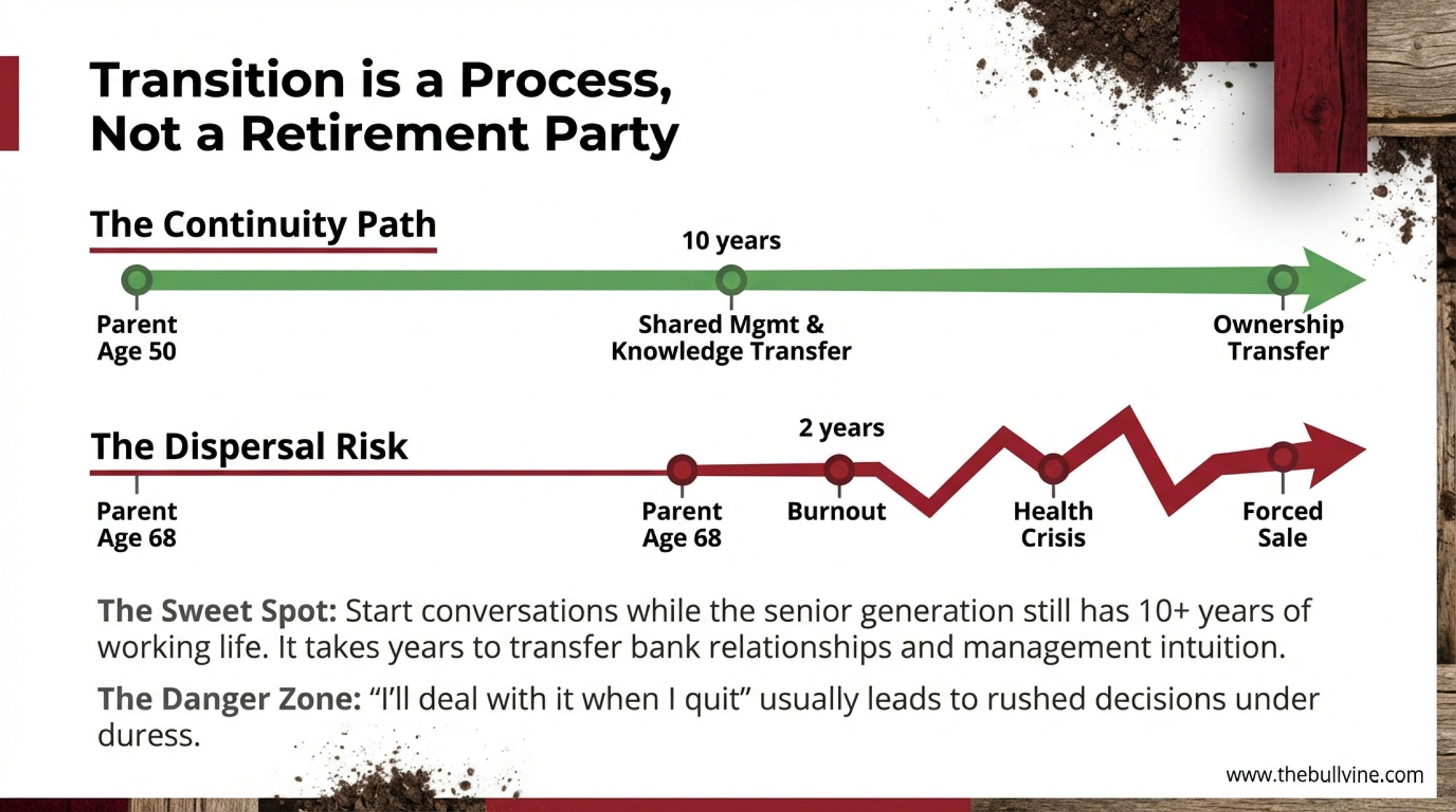
NewsSubscribe
First
Last
Consent
Send this to a friend