Archive for farm revenue

Forget Volume: China’s 18% Premium Surge Means $150,000+ More for Component-Focused Farms – But the Window Closes Fast

The surprising market shift that’s making component quality more valuable than volume—and what producers are learning about the 3-5 year window ahead

EXECUTIVE SUMMARY: China’s premium dairy surge is handing component-focused producers $150,000-$200,000 in extra annual revenue—no expansion required. While premium imports rocket up 18%, commodity imports are tanking 12%, creating a historic quality-over-quantity shift driven by 670 million Chinese middle-class consumers who prioritize safety and nutrition over price. Here’s the critical part: the 3-5 year window to lock in premium supplier status is already 40% gone, with October 2025 marking a crucial decision point. Producers implementing targeted nutrition changes see results in 12-18 months, while genomic improvements take 36-48 months—both achievable before the 2027 market saturation deadline. Right now, component-optimized milk commands $24/cwt versus $18 for commodity, a $6 gap that represents survival versus thriving. Bottom line: farms that pivot to components this winter will count premium checks in 2026, while volume-chasers will still be wondering what happened when the window slams shut.

You know, last week I was going through Chinese customs data, and something really caught my attention. China’s economy is slowing down to 4.6% GDP growth—we all know that story. But here’s what’s interesting… their dairy import patterns are telling a completely different tale, one that’s got progressive American producers rethinking how they value every pound of milk in the bulk tank.

So the USDA Foreign Agricultural Service released its May 2025 report, showing that China’s overall dairy imports grew by about 6% through September. Not bad, nothing spectacular. But when you dig into the specific categories—and this is where it gets really fascinating—premium dairy products are advancing nearly 18% year-over-year while commodity products are retreating around 12%, based on what we’re seeing in Chinese customs data and the latest Tridge market analysis. For those of us who’ve built our operations around maximizing volume for generations, well… this divergence is something we need to talk about.

Component-optimized milk commands $24/cwt versus $18 for commodity—a $6 gap that separates profitable farms from struggling ones. Right now, this premium represents the difference between counting checks in 2026 or wondering what happened.

What the latest customs reports are showing is cheese imports rising 13.5% and butter—get this—surging 72.6% year-over-year. Meanwhile, skim milk powder? That’s heading the other direction. I’ve been talking with dairy market analysts who’ve tracked this stuff for the past decade, and they’re telling me this isn’t just another market fluctuation. It looks like we’re seeing a fundamental shift in what the world’s largest dairy import market actually values.
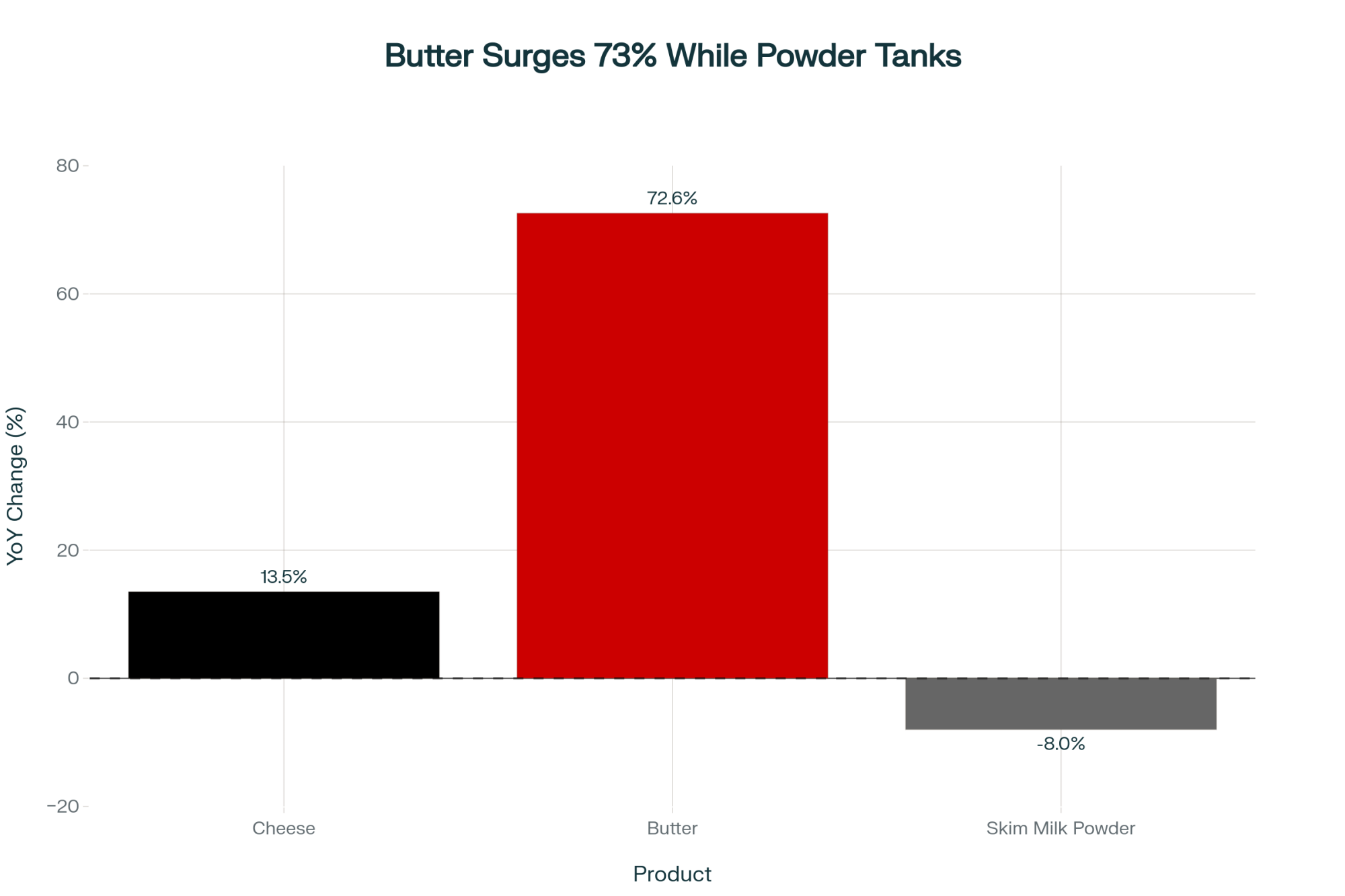
Butter imports to China exploded 73% while skim milk powder declined 8%—proof that premium components crush commodity volume. Chinese consumers are voting with their wallets for quality over quantity.

“The premium shift isn’t temporary—it’s structural. Producers who position themselves now will capture long-term value that commodity markets simply can’t match.”

And here’s what really makes you think… China’s middle class is continuing to expand—the USDA projects they’ll add 80 million people by 2030—and we’re observing similar patterns across Southeast Asia, India, and parts of Africa, according to Rabobank’s December 2024 analysis. What I’ve found is this could represent the most meaningful value shift in global dairy markets we’ve seen in decades.

China’s dairy market is splitting in two—premium products rocket up 18% while commodity imports crater 12%. This historic quality-over-quantity shift represents survival versus thriving for global dairy exporters.

Understanding What’s Really Driving This Premium Shift

When you look at the forces reshaping China’s dairy demand, they actually make a lot of sense—wealth creation, food safety consciousness, evolving consumer preferences. Understanding these drivers helps explain why this shift feels different from the usual market cycles we’ve all ridden out before.

The Food Safety Factor That Won’t Go Away

It’s been seventeen years since that 2008 melamine incident—the World Health Organization reports documented six infant deaths and 300,000 illnesses. Yet Chinese consumers still show a strong preference for imported dairy products, especially when it comes to their kids. The China Dairy Industry Association’s data shows imports of infant formula increased from 28% of dairy imports in 2008 to 45% by 2019.

What’s particularly telling—and this surprised me—is that premium infant formula now represents 37% of market share, up from 32.8% just a year ago, according to July 2025 market research from Innova. The Chinese Academy of Agricultural Sciences recently published consumer research showing Chinese consumers prioritize nutritional value at 59%, quality at 45%, and safety at 39%. Price? That ranks at just 6% when they’re selecting a formula. That preference hierarchy creates real pricing opportunities for suppliers who can demonstrate superior quality and traceability.

How Middle Class Growth Changes Everything

The scale here is… well, it’s something else. China’s middle class expanded from 3.1% of the population in 2000 to 50.8% in 2018, according to McKinsey Global Institute data. We’re talking about roughly 670 million people joining the ranks of consumers with discretionary income. The National Bureau of Statistics of China reports per capita income grew at a 6.1% compound annual rate from 2019 to 2024, reaching 41,300 RMB—that’s about $5,792 annually.

What I’m seeing in the consumption data is these folks aren’t looking for the cheapest option on the shelf. They want Western-style products with clear quality differentiation. USDA estimates show cheese consumption alone could hit 495,000 metric tons by 2030, growing at a 9.1% compound annual rate. And here’s the kicker—60 to 75% is being consumed in foodservice settings like Western restaurants and pizza chains.

Why China Can’t Make These Premium Products Themselves

This caught me off guard when I first looked into it. China aims to achieve 75% dairy self-sufficiency under its 14th Five-Year Plan, but its domestic production focuses mainly on fluid milk and basic dairy products. The USDA’s May 2025 China dairy report shows Chinese farms are actually reducing output—down 0.5% in 2024 with another 1.5% decline forecast for 2025—as farmgate prices hit decade lows around 3.20 RMB per kilogram.

But here’s the real issue… China lacks the processing infrastructure for specialty cheese production, premium protein concentrates, and other high-value categories. The USDA report notes that while “domestic cheese production will increase gradually, with growing investment in natural cheese capacity,” current production is just 30,000 MT, compared to 178,000 MT imported.

Dr. Leonard Polzin from the University of Wisconsin’s Center for Dairy Profitability calls this “structural import dependency” for premium products—and it’s likely to persist given the technical expertise and infrastructure requirements. Makes sense when you think about it.

How Payment Systems Shape Who Wins in Export Markets

What’s really revealing about the competition between major dairy exporters is how payment structures influence what farmers produce, which ultimately determines export success. New Zealand is capturing 46% of China’s dairy imports? That’s not luck—it’s directly tied to how they pay farmers.

The Fonterra Approach Makes You Think

So Fonterra pays farmers solely on the basis of kilograms of milk solids—butterfat plus protein. Water? Doesn’t matter. Lactose? Not counted. Their 2025/26 forecast, announced in May, stands at $10.00 NZD per kilogram of milk solids.

Research published this year by dairy economics specialists shows the New Zealand payment system essentially discourages chasing volume. When volume isn’t the main metric, farmers naturally optimize for component density instead of pushing cows for maximum daily production. It’s a different mindset entirely.

What I find interesting is how this payment structure aligns farmer incentives with premium market demand almost automatically. When Chinese buyers want high-protein cheese or concentrated dairy ingredients, New Zealand farmers are already producing that milk profile—not specifically for exports, but because that’s what their payment system rewards.

Where American Payment Systems Create Challenges

And this is where it gets tricky for us. Most American cooperatives still use volume-focused payment systems with base prices per hundredweight, treating component premiums as add-ons rather than the main event. This creates an interesting situation—we’re optimizing for volume because that’s what payment systems reward most directly, even as global markets increasingly value component density.

Cornell University’s 2020 research on payment structures, led by Dr. Chris Wolf, found something eye-opening: non-cooperative handlers allocated 37% of premiums to quality incentives, while cooperatives allocated just 18% to quality. As the research shows, some cooperatives reward production excellence while others… well, they basically reward showing up.

“We spent decades asking, ‘How much milk can we ship?’ Now we ask, ‘How much value can we create?’ That change in thinking transformed everything about our operation—and our future.”

Learning from European Approaches

What’s interesting is looking at how European producers handle this. In the Netherlands, FrieslandCampina’s payment system includes substantial sustainability and quality bonuses that can add up to 15% to the base price. German cooperatives like DMK have shifted toward value-based pricing models that reward both components and environmental metrics. These systems took years to implement, but they’re now seeing the payoff in premium export markets.

What Progressive Producers Are Learning

I’ve been talking with forward-thinking dairy operations across the country, and many aren’t waiting around for payment system reform. They’re discovering that transitioning from volume to value can happen faster than we’ve traditionally thought—often with pretty encouraging financial results.

The Nutrition Strategy That Works Right Now

A Wisconsin producer I spoke with recently—runs about 500 cows near Eau Claire—told me something interesting: “We figured component improvement would take years, but our nutritionist showed us we could see real changes within a single lactation cycle.”

Based on Penn State Extension research and field trials across the Midwest, here’s what’s delivering results:

  • Amino acid balancing targeting 6.5-7.2% lysine and 2.4-2.6% methionine in metabolizable protein: University of Wisconsin trials show 0.1-0.2% protein increases are worth approximately $71,000 annually for a 500-cow operation
  • Fatty acid supplementation using rumen-protected fats: Michigan State research demonstrates 0.2-0.3% butterfat increases valued at $98,000+ annually
  • Forage quality optimization, maintaining 26-32% neutral detergent fiber: Cornell studies confirm this supports efficient rumen fermentation for better component production

Dr. Mike Hutjens, Professor Emeritus of Animal Sciences at the University of Illinois—he’s worked with dozens of component-focused operations—tells me farms are capturing $150,000 to $200,000 in additional annual revenuethrough nutrition changes alone, before even touching genetics.

How Genomics Accelerates the Timeline

The genomic testing revolution has really changed the game here. Chad Ryan, genetic programs manager at Select Sires, puts it this way: “What used to take 6-7 years now happens in 36-48 months for herds committed to change.”

The Council on Dairy Cattle Breeding reports that as of April 2025, the average Holstein heifer calf produces 45 more pounds of butterfat and 30 more pounds of protein annually compared to one born in 2015—purely through genetic selection. That’s progress.

Strategic Approaches by Farm Size

Through conversations with producers nationwide, it’s becoming clear that farms of every size can access premium value—though the best strategies vary quite a bit based on scale, location, and market access. Now, not every region has equal access to premium processors—let’s be honest about that—but opportunities are expanding faster than many folks realize.

Mid-Size Operations (300-800 cows): Finding the Balance

These operations often have that nice combination of enough scale for efficiency while maintaining flexibility to adapt. A producer milking 550 cows near Green Bay shared this with me: “We’re big enough to matter to processors but small enough to pivot when we need to.”

Wisconsin’s Department of Agriculture reports that operations focusing on cheese-quality milk are seeing annual revenue increases of $150,000-$200,000 through component optimization. You know what’s interesting about this size operation? They can often implement changes faster than larger dairies while still having enough volume to negotiate favorable terms with processors.

Large Operations (1,500+ cows): Leveraging Scale

California’s larger dairies are taking a different approach. A manager running a 2,100-cow operation in Tulare County explained their strategy: “We provide consistent, high-volume premium supply for export contracts.”

What I’ve noticed with these larger operations is that they’re often dealing with tighter margins per cow, so even small percentage improvements in components can make a huge difference to the bottom line. And with California’s ongoing water challenges and environmental regulations, maximizing value per gallon of water used is becoming critical.

Small Family Farms (Under 200 cows): The Niche Advantage

What’s been really encouraging—and honestly, kind of surprising—is how smaller farms are finding lucrative opportunities in specialty markets. A Pennsylvania family running 165 cows who switched to A2 production three years ago now gets $24 per hundredweight. “Would’ve seemed impossible five years ago,” they told me.

Penn State Extension specialist Lisa Holden confirms what we’re seeing: “Small farms using modern management systems are proving that farmstead-scale operations can achieve competitive margins. The key is identifying and serving premium niches that value authenticity and story alongside quality.”

The Window of Opportunity—And Its Limits

Dr. Mary Ledman, global dairy strategist at Rabobank, sees a clear but limited window here. “Producers have about 3-5 years to establish themselves as premium suppliers before market saturation occurs,” she explained at a recent industry conference. “China’s premium import growth won’t stay at 18% forever.”

What makes this particularly compelling is that nine out of ten emerging markets—Southeast Asia, India, Africa—are reporting double-digit gains in premium dairy demand according to IFCN Dairy Research Network data. Southeast Asia’s dairy market alone is projected to grow at 7-8% annually through 2030, according to FAO projections.

But let’s be realistic here. Not every producer has convenient access to premium processors. Transition costs can be substantial upfront. And yeah, there’s risk in shifting away from what’s worked for generations. Plus, with the way weather patterns have been changing—we all saw what happened with the flooding in California’s Central Valley last spring—maintaining consistent component levels through environmental challenges adds another layer of complexity.

Practical First Steps You Can Take

Based on everything I’ve learned researching this shift, here’s what I’d suggest doing in the next 30 days:

Week 1: Figure Out Where You Stand

  • Calculate your average components from the past year (and compare them seasonally—summer depression is real)
  • Compare your payment structure to what others in your region are getting
  • Identify processors in your area who pay component premiums

Week 2: Look at Nutrition Options

  • Set up a meeting with your nutritionist about amino acid balancing
  • Get quotes for rumen-protected fat supplements
  • Test your current forage quality—NDF digestibility, particle size, the works

Week 3: Explore Your Market

  • Call three specialty processors or cheese makers within reasonable hauling distance
  • Research what certifications the premium markets in your area require
  • Talk with your cooperative about their export programs and premium opportunities

Week 4: Build Your Plan

  • Set component targets for the next 12 months
  • Budget for genomic testing of heifer calves
  • Pick your first step—nutrition usually offers the quickest payback

Where This All Leads—And Why Time Matters Now

Looking at everything together—the data, what producers are experiencing, where markets are heading—this shift from volume to value in global dairy markets isn’t just talk anymore. It’s happening right now, and we’re seeing clear differences between those adapting and those holding steady.

What really strikes me is how China’s market is basically showing us the future. That surge of nearly 18% in premium dairy imports, while commodity products decline around 12%? That’s not just noise. We’re seeing similar patterns across emerging markets—FAO, Rabobank, and IFCN are all documenting this—which creates multiple opportunities for well-positioned suppliers.

I’ll be straight with you—the window for action feels tighter than many producers might expect. Those who establish premium positioning in the next 3-5 years will likely lock in long-term contracts and relationships. If we look at historical patterns in agricultural markets, waiting for others to prove the model usually means competing for whatever’s left in increasingly crowded markets.

And here’s the thing that should really get your attention: we’re already ten months into 2025. If that 3-5 year window started when these trends became clear in early 2024, we’re already approaching the halfway point of year two. The producers making moves now—this fall, this winter—are the ones who’ll be established when the real competition for premium contracts heats up in 2026 and 2027.

What gives me hope is that farms of every size genuinely have pathways forward. From 150-cow family operations I’ve visited who’re targeting local specialty markets to 2,000-cow enterprises supplying export containers, there are viable strategies across the board.

The window’s open right now—but with 2025 nearly in the books and premium market competition accelerating, every month of hesitation means watching another competitor lock in the contracts and relationships that could’ve been yours. Based on everything I’m seeing and hearing, by the time the 2026 harvest rolls around, the early movers will already be counting their premium checks while others are still debating whether to make the shift.

The clock is ticking. The question isn’t whether this shift will happen—it’s whether you’ll be part of it.

Key Takeaways:

  • The Opportunity: Premium dairy imports to China up 18% while commodity down 12%—this isn’t temporary
  • The Timeline: 3-5 year window to establish premium positioning before market saturation
  • The Money: $150,000-$200,000 potential annual revenue increase for 500-cow operations through component optimization
  • The Path: Nutrition changes deliver results in 12-18 months; genetic improvements in 36-48 months
  • The Reality: Not every producer has equal access to premium markets, but opportunities are expanding rapidly

Complete references and supporting documentation are available upon request by contacting the editorial team at editor@thebullvine.com.

Learn More:

Join the Revolution!

Join over 30,000 successful dairy professionals who rely on Bullvine Weekly for their competitive edge. Delivered directly to your inbox each week, our exclusive industry insights help you make smarter decisions while saving precious hours every week. Never miss critical updates on milk production trends, breakthrough technologies, and profit-boosting strategies that top producers are already implementing. Subscribe now to transform your dairy operation’s efficiency and profitability—your future success is just one click away.

NewsSubscribe
First
Last
Consent

The Texas ESL Boom: How Smart Producers Are Turning Consistency into Contract Power

This fall, the leverage flips. Consistency and data—not herd size—are the new currency in Texas milk markets.

Executive Summary: Texas dairy is hitting reset—and this time, producers hold the leverage.” With over $700 million in new investments in ESL processing, the state’s milk market is being rebuilt around consistency, documentation, and proactive negotiation. ESL technologies from universities like Cornell and Cal Poly have proven that milk lasting up to 90 days demands unwavering quality. That’s creating new premiums for farms that deliver predictable performance backed by data. According to USDA and industry experts, the next generation of dairy success won’t be about herd size—it’ll be about reliability. And Texas producers who act now could lock in the best contracts of their careers.

Dairy producer contracts

If you’ve been in dairy for more than a decade, you know when the ground shifts. Well, it’s shifting again—this time deep in Texas. With Ninth Avenue Foods investing $200 million in a new extended shelf-life (ESL) facility in LongviewWalmart putting $350 million into its site in Robinson, and Select Milk Producers launching a partnership with Westrock Coffee in Littlefield, the state’s dairy landscape is being reshaped from the ground up.

That’s over $700 million in fresh processing investment. But here’s what’s interesting—it’s not just more capacity. It’s a fundamental redefinition of how milk gets valued, marketed, and negotiated.

Texas is commanding $700 million in new ESL processing investment—the largest dairy infrastructure expansion in a generation. These three facilities alone will process enough milk to supply over 750 retail outlets and transform Texas into an ESL powerhouse.

Understanding What’s Really Changing

Let’s start with the technology itself. ESL milk—what many of us know as the kind that lasts far longer on grocery shelves—uses a mix of ultra-high temperature (UHT) heat processing and microfiltration to achieve a shelf life of 60 to 90 days under refrigeration. Research from the Journal of Dairy Science and studies out of Cornell University’s Dairy Foods Research Lab confirm that this process sharply reduces spoilage bacteria without compromising flavor.

High somatic cell counts aren’t just a quality issue—they’re a profit killer. A 50-cow herd with elevated SCC loses over $5,000 annually compared to consistent low-SCC producers. That’s real money left on the table before premium payments even enter the equation

That longer shelf life opens new doors for processors. They can ship products farther, reach larger markets, and reduce waste. But there’s a tradeoff. Longer shelf life transfers more responsibility for milk quality back to the farm. Even small inconsistencies in bacterial counts or SCC can shorten shelf life by weeks.

AttributeConventional MilkESL Milk
Shelf Life14-21 days60-90 days
Processing Temp135-145°C (HTST)138°C+ (UHT/microfiltration)
Bacterial Reduction~3 log4-5 log
SCC Requirement<400,000 cells/mL<200,000 cells/mL
Premium Range$0.00-0.24/cwt$0.40-1.00/cwt
Contract DurationStandard poolMulti-year contracts
Quality MonitoringMonthly testingReal-time/weekly testing
Market AccessRegional marketsNational/export markets

Processors now value predictability every bit as much as butterfat performance. As Cornell’s team often notes, once you’re marketing a 90-day milk, the margin for error in supply quality nearly disappears.

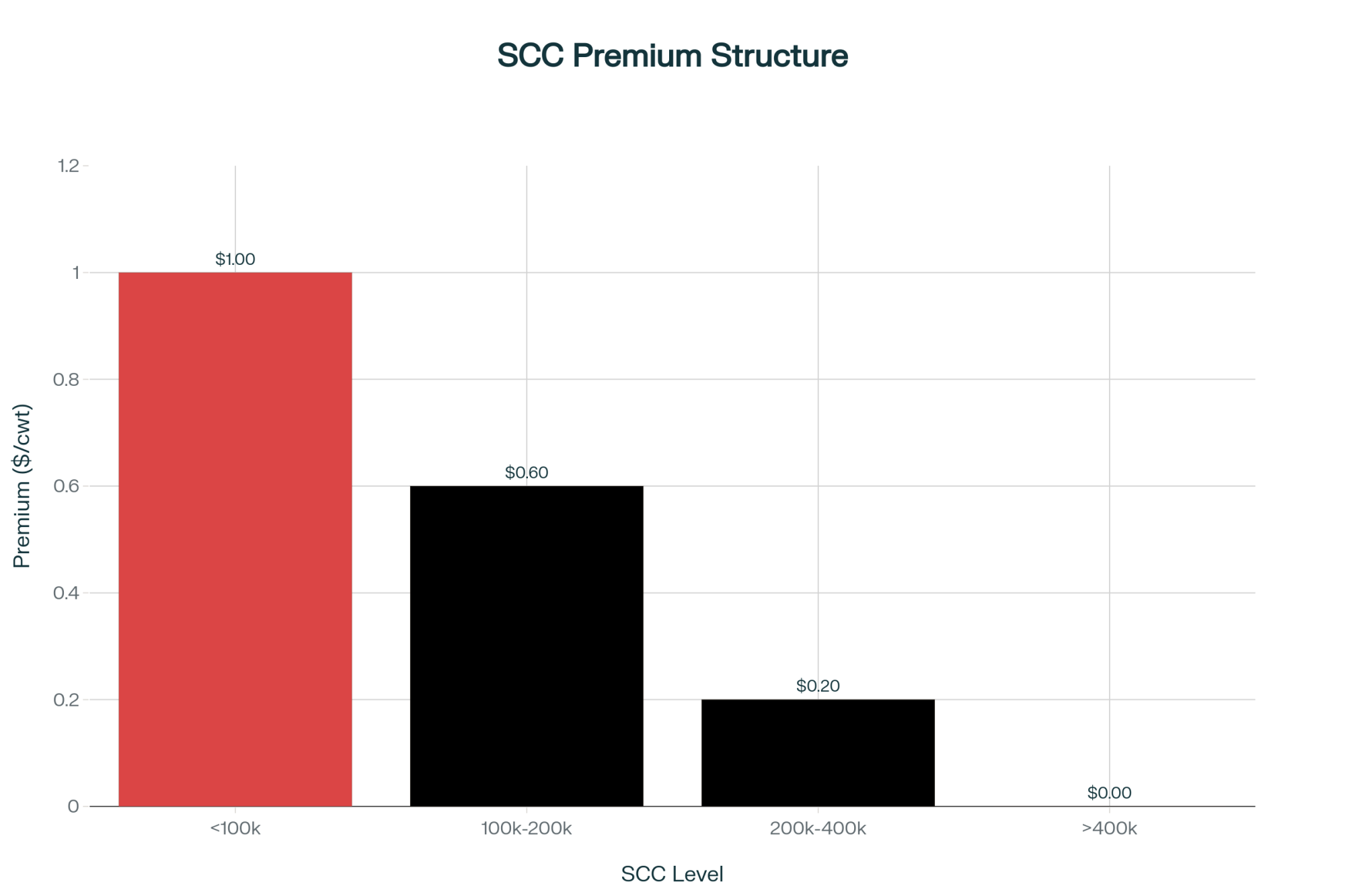
Premium payments for low somatic cell counts are rewriting milk economics. Producers maintaining SCC below 100,000 cells/mL can earn $1.00/cwt premiums—transforming milk quality from a baseline requirement into a profit center worth thousands annually.

Predictability and the Premium Shift

Here’s what that means practically. Producers delivering consistent milk quality—stable SCC below 200,000 and reliable components—are already seeing premiums of $0.40–$1.00 per hundredweight, based on documented supply data reported through USDA Dairy Market News and several processor programs in the Southwest.

And this focus on consistency doesn’t just reward the biggest herds. Medium and family-sized farms are excelling by proving reliability through recordkeeping and digital traceability. I’ve noticed that some of the most competitive contract negotiators aren’t the high-output herds—they’re the most organized.

One example is Doug Jensen, who milks about 600 Holsteins near Stephenville, Texas. Three years ago, he started keeping digital milk quality logs—SCC, bacterial counts, and butterfat trends—using reports from his cooperative testing system.

“When Ninth Avenue Foods began sourcing for their new plant,” Jensen recalled, “we already had the data. They could see we were steady. That’s what made us worth paying a little more for.”

Because of that agreement, most of his milk now supplies ESL beverage production. Jensen told me it helped finance an updated cooling system and a few automation upgrades. That data discipline effectively turned his milk from a commodity to a contract asset.

And that’s the bigger pattern emerging: consistency has become an independent profit driver.

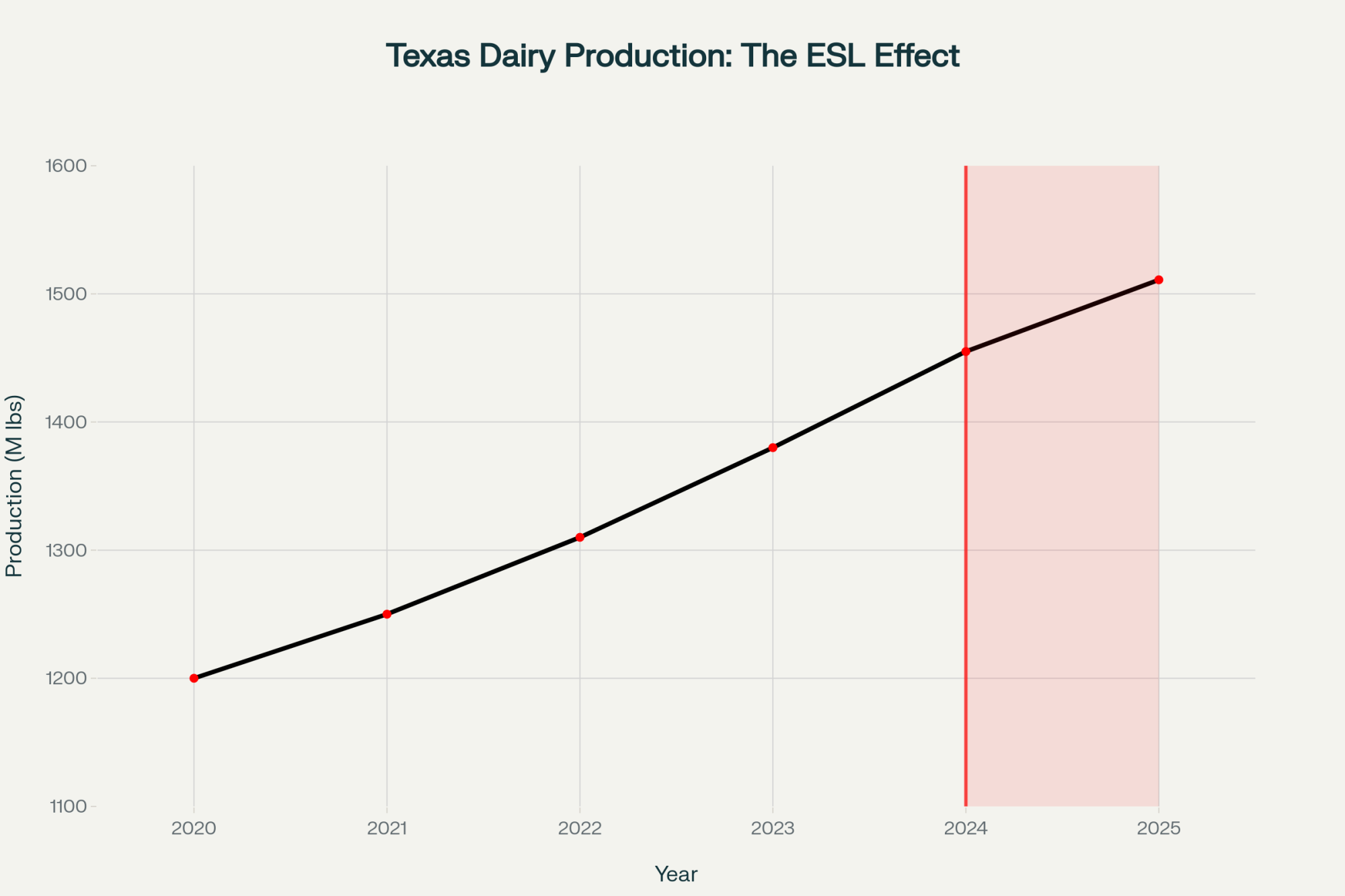
Texas milk production has climbed 26% since 2020, with a dramatic acceleration coinciding with ESL facility announcements. The state’s 10.6% year-over-year surge in 2025 positions it as America’s fastest-growing dairy region—and processors are scrambling to lock in supply.

The Financial Clock Is Ticking

What producers sometimes miss is how much these facilities depend on a quick, dependable supply. Each of these projects—funded in part through USDA Rural Development lending and private capital—operates under strict financial covenants. These typically require plants to operate at 65% utilization and maintain a 1.25 debt service coverage ratio during their first full fiscal year.

You don’t have to be a banker to see what that means. Processors can’t afford uncertainty. They’ll lock in dependable suppliers early, at attractive rates, to assure lenders they can operate efficiently.

Once those supply lists fill, the leverage that returning to farmers today may bring may not return for years.

It reminds me of the Midwest cheese expansions from 2017 to 2021. Early contract holders got consistent premiums. Those who waited ended up taking standard pool prices once the plants filled.

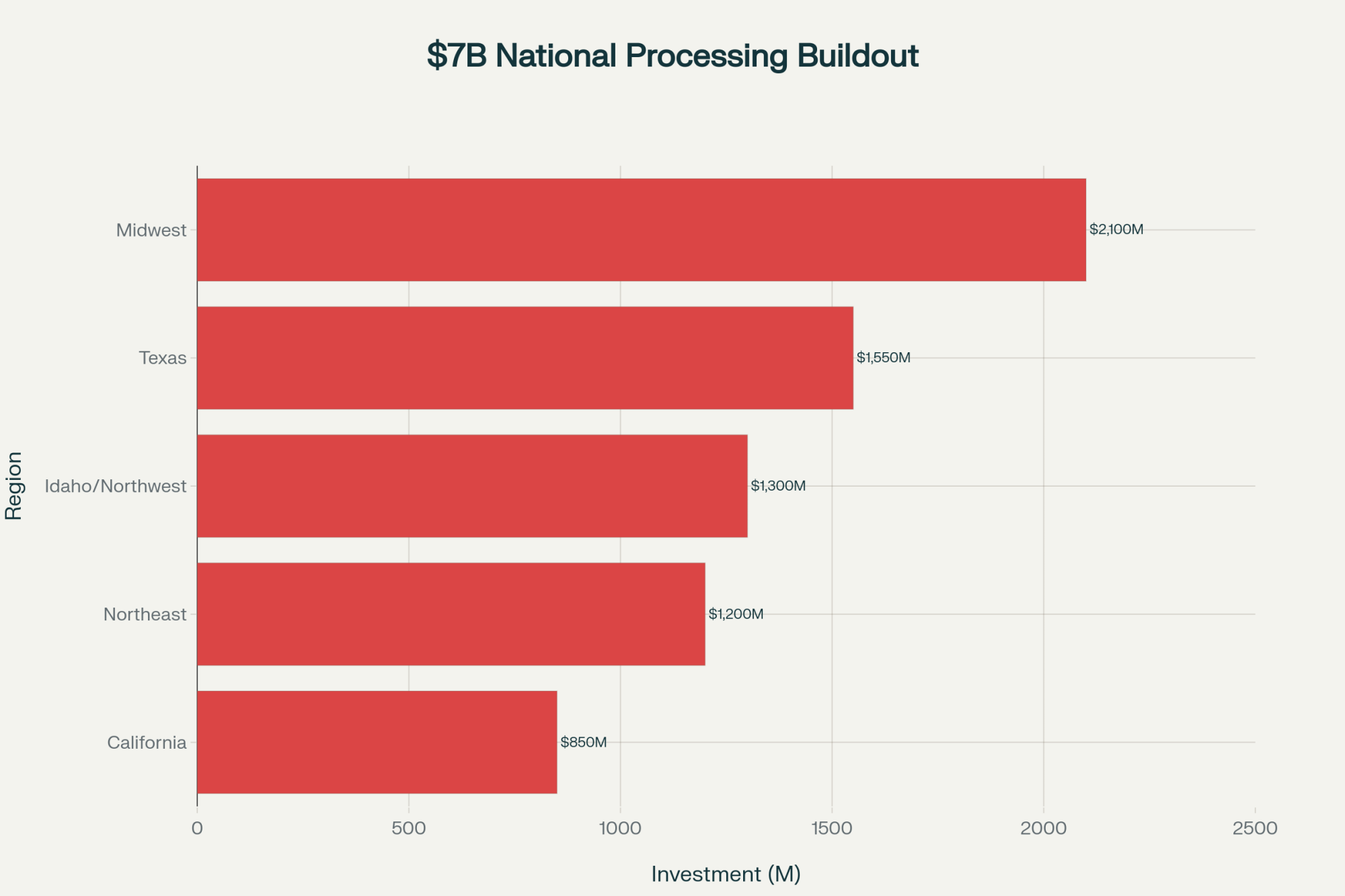
The dairy industry’s $7+ billion processing expansion isn’t evenly distributed—it’s clustering in states with production growth, regulatory flexibility, and feed access. The Midwest leads with $2.1B, but Texas’s $1.55B represents the fastest proportional growth in processing capacity nationwide.

So if you’ve been telling yourself, “I’ll see how the market shakes out first,” it’s worth remembering: by the time it “shakes out,” slots are usually filled.

Building in the Accountability

Extended shelf life might sound like a golden ticket, but it comes with strings. Contracts are only as strong as a herd’s ability to deliver steady quality.

Processors are upfront about this. Industry contracts reviewed by Cornell Dyson School researchers show that during non-compliance—often two consecutive months of missed quality benchmarks—milk can be reclassified into conventional markets without premium payment. Some newer contract models include step-down provisions that reduce premiums until levels recover.

The goal isn’t to penalize—it’s to protect consistency and consumer trust. Cornell’s extension specialists say most processors include remedial review periods and offer technical support if issues arise.

As one Kansas operator who recently entered an ESL supply program put it, “If you fail a bulk tank test or your cows spike from a transition problem, you don’t get dropped—you reset and prove you’re back in range. The discipline is good for everyone.”

Why Contracts Matter More Than Ever

If this all sounds complex, it is—but it’s also navigable. And it’s where producers can protect themselves or lose ground fast.

A review from Cornell’s Dyson School of Applied Economics found that “capital retain” and “market stabilization” deductions—when uncapped—reduced producer net returns by 5–8% over prior expansion cycles. Without proper language, those deductions can quietly undermine even premium agreements.

For producers considering ESL contracts, a few guidelines consistently stand out:

  1. Set Deduction Limits. Agree to annual caps around $0.40/cwt and written notice for changes.
  2. Include Flexibility Clauses. Seasonal swings—heat stress, fresh cow transition periods—happen. Negotiate at least 20% variance in language.
  3. Third-Party Verification. When quality scores are disputed, independent testing keeps relationships transparent and healthy.

According to Jennifer Zwagerman, director of the Drake University Agricultural Law Center, modern processors are typically amenable to these clauses. “Clarity cuts risk—for both sides,” she said. “It creates a proactive, trust-based partnership rather than an adversarial one.”

The processors prefer reliable partners. The producers prefer predictable revenue. The paperwork just needs to reflect that alignment.

Two Emerging Milk Markets

What this all signals is a permanent shift toward a two-tier milk economy.

Tier One: Documented, consistent suppliers on multi-year ESL contracts feeding high-value lines—branded milk, protein drinks, specialty ingredients.

Tier Two: Standard pooled supply and spot-market milk providing bulk volume but lacking a premium structure.

Cal Poly’s Dr. Phillip Tong, an authority on dairy processing innovation, says this stratification isn’t likely to reverse. “Once a processor calibrates for specific microbial and compositional norms, changing suppliers midstream creates significant product risk. Continuity is everything.”

From an operational point of view, this mirrors herd management: build routine, sustain consistency, and results compound over time.

Texas May Be First, But It’s Not Alone

While Texas stands in the spotlight right now, similar ESL rollouts are accelerating elsewhere.

  • Leprino Foods’ $870 million Lubbock facility is now a dual-purpose cheese and ESL ingredient plant—one of the largest in the U.S.
  • California Dairies Inc. expanded ESL lines through Valley Natural Beverages, reporting major shrink savings.
  • Walmart’s processing hubs in Texas and Georgia distribute 60-day milk to more than 700 outlets across the Southeast.

According to the U.S. Dairy Export Council, ESL and shelf-stable beverage exports have been growing by roughly 10% a year since 2023, led by demand from Mexico, the Caribbean, and South Asia. That diversification gives producers a buffer against domestic volatility—a long-awaited stabilizer in milk demand.

Where Producers Should Start

Thinking about joining the ESL supply chain? Here’s what’s working for farms that already have:

  • Leverage your data. Two years of consistent results are worth more than the cleanest parlor inspection.
  • Audit your cooling systems. ESL contracts typically require milk cooled to strict specifications—usually below 38°F.
  • Match your management to expectations. Pay extra attention to bacterial counts during the fresh cow period and late lactation, where fluctuations often spike.
  • Review your agreements annually. Contract stability depends on consistent review, not just signatures.

As USDA and state extension advisors have often observed, proactive transparency—not perfection—is what processors prize most.

The Bottom Line

What’s truly striking about this ESL wave is how it rewards fundamentals that producers have practiced for generations: discipline, attention to detail, and pride in steady, high-quality milk.

As Doug Jensen told me, “We’ve been doing the same job for years. The only difference is—now someone’s finally paying for doing it right.”

That’s a milestone worth celebrating—and proof that smarter, data-driven production can help producers regain leverage in a market that hasn’t favored them in a long time.

Key Takeaways:

  • ESL is the next defining wave in dairy. Texas’s $700 million processing boom proves long-life milk is transforming demand, contracts, and margins.
  • Your consistency is your competitive edge. Farms that are tracking steady SCC, butterfat, and bacterial counts are already earning premium status.
  • Contracts are your silent profit maker—or breaker. Demand capped deductions, flexibility protections, and third-party testing rights.
  • Leverage has a deadline. Secure your deals before processors hit full capacity and reset terms.
  • Data delivers opportunity. Even modest herds can compete head-to-head with big ones when their milk quality is proven, not promised.

Complete references and supporting documentation are available upon request by contacting the editorial team at editor@thebullvine.com.

Learn More:

  • Mastitis and Somatic Cell Counts: The True Cost to Your Dairy – This article provides tactical strategies for managing and lowering SCC, a critical quality metric for ESL contracts. It demonstrates how to reduce economic losses and deliver the consistent, high-quality milk that processors are actively rewarding with premiums.
  • Navigating the Tides: Key Trends Shaping the Future of the Dairy Industry – Gain a strategic, big-picture view of the market forces driving investments like the ESL boom. This piece explores consumer behavior, sustainability demands, and global trade, helping you position your operation for long-term profitability beyond a single contract.
  • The Data-Driven Dairy: How Technology is Reshaping Herd Management – The main article stresses proving consistency with data; this piece shows you how. It reveals the specific on-farm technologies—from sensors to software—that empower producers to track, document, and leverage their performance data for stronger contract negotiations.

Join the Revolution!

Join over 30,000 successful dairy professionals who rely on Bullvine Weekly for their competitive edge. Delivered directly to your inbox each week, our exclusive industry insights help you make smarter decisions while saving precious hours every week. Never miss critical updates on milk production trends, breakthrough technologies, and profit-boosting strategies that top producers are already implementing. Subscribe now to transform your dairy operation’s efficiency and profitability—your future success is just one click away.

NewsSubscribe
First
Last
Consent

Argentina Beef Imports: The Immediate Stakes for Your Dairy Operation

Imports are rising. Futures are falling. Here’s what every dairy herd should know before the market moves again.

Executive Summary: A plan to import more Argentine beef may seem distant, but it’s already reshaping U.S. agriculture. The proposal to quadruple import quotas to 80,000 metric tons has dropped cattle futures nearly $100 per head and sparked tough conversations for dairies that now rely on beef‑on‑dairy calves for revenue. With 70 percent of large herds breeding to beef, and an average $250,000 in annual calf income at stake, every shift in the beef market touches the milk check. Farmers remember 1986 and 2020—years when fast policy moves caused lasting pain. What’s interesting now is how calmly producers are responding: adjusting breeding ratios, locking in forward contracts, and fine‑tuning rations instead of panicking. The broader reminder? Real stability in both beef and milk still starts in the barn, not the import ledger.

Beef on Dairy

Every so often, a government policy hits the headlines and you can almost feel it ripple across the countryside. The latest is a proposed White House plan to quadruple Argentine beef imports—from about 20,000 to 80,000 metric tons.

At first, that might sound like a beef industry story, but it’s quickly becoming a dairy conversation. The reason is simple: our operations are tied together through the beef‑on‑dairy market more than ever before. And as many farmers are noticing, market decisions made in Washington—or Buenos Aires—have a way of showing up in the calf barn faster than you’d expect.

11,000% Growth Story Dairy Can’t Ignore — From backyard experiment to industry game-changer: beef-on-dairy exploded from 50,000 head to potentially 5.5 million by 2026, reshaping American beef production forever.

Looking at What’s Behind the Policy

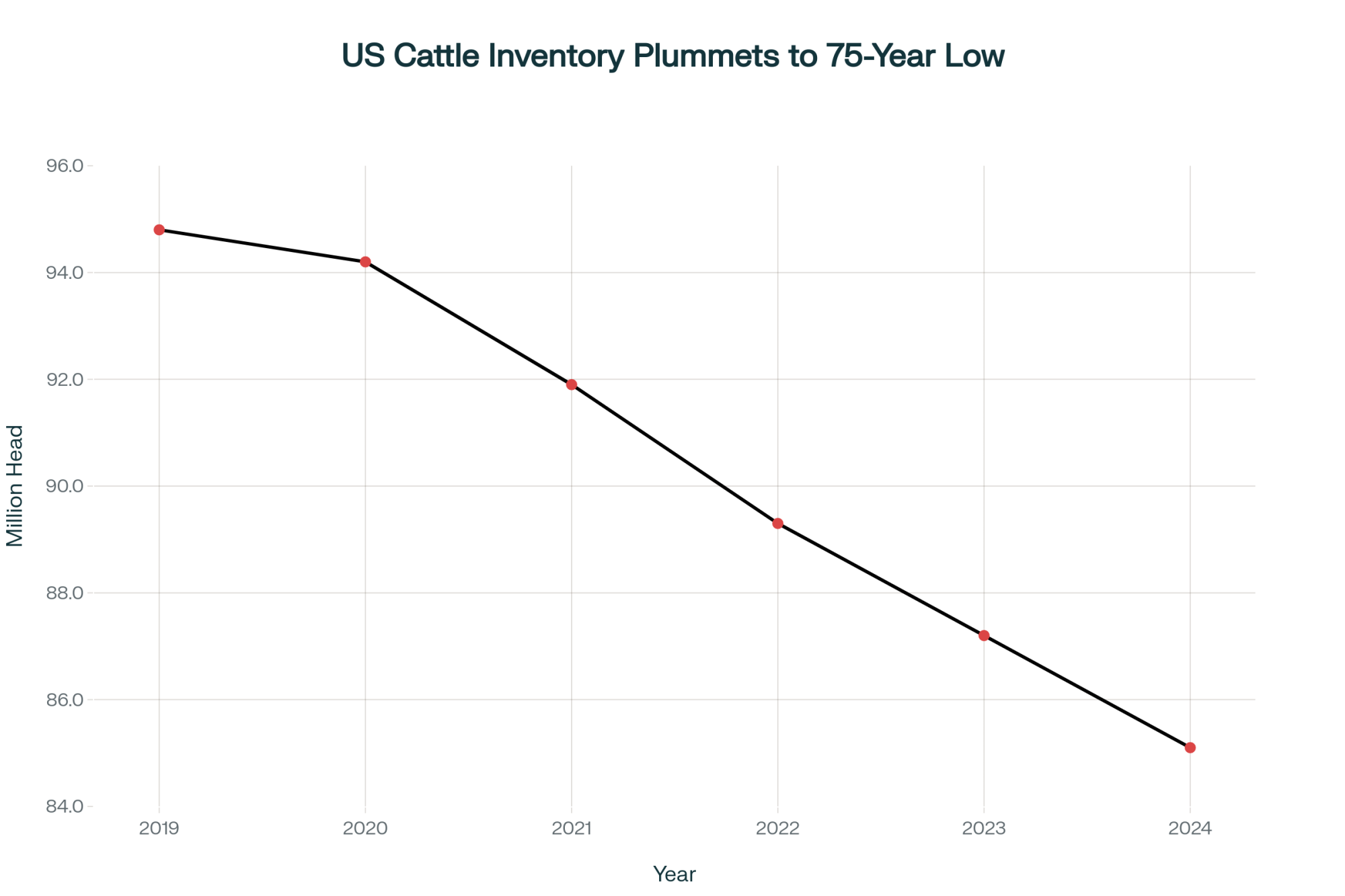
According to the USDA’s October Livestock, Dairy & Poultry Outlook, the U.S. cattle inventory now sits at its lowest level in 75 years. The causes aren’t new—multi‑year drought, high feed prices, and slower herd rebuilding across the Plains and West.

Crisis in Numbers: America’s Cattle Vanish — The steepest herd liquidation since World War II puts every dairy farm’s beef-on-dairy income at risk as supply fundamentals reshape decades of agricultural stability.

To ease those supply pressures, the administration is considering expanded beef imports to steady retail prices, which hit a record $6.30 per pound for ground beef this fall (Bureau of Labor Statistics).

On paper, that makes basic economic sense. But markets always react before the first kilogram of product moves. Just a week after the announcement, CME Group data showed futures prices down roughly $100 per head—or about 3 percent.

As Dr. Derrell Peel, livestock economist with Oklahoma State University Extension, put it: “You can’t rebuild a herd—or confidence—in a single policy cycle.”

And confidence is what sustains both cow‑calf ranches and dairies that depend on steady cross‑market signals.

The Beef‑on‑Dairy Link That’s Now Essential

Looking at this trend, it’s remarkable how fast beef‑on‑dairy has become a cornerstone of herd economics. In 2024, University of Wisconsin–Madison Extension researchers reported that nearly 70 percent of large dairies bred a portion of their cows to beef bulls.

The strategy significantly increased the average calf value. USDA AMS market data shows beef‑cross calves bringing $1,200 to $1,400 at birth, compared with $150 to $250 for pure Holstein bulls.

For a 1,500‑cow dairy breeding 40 percent to beef, that’s $240,000–260,000 in additional annual income. It’s the sort of capital that pays for genomic testing, sand bedding replacements, or that new holding pen upgrade.

A producer milking 1,200 cows in eastern Wisconsin told me recently, “Those beef calves have carried our barn loan for two years running. If prices fall much, we’ll need to rethink replacement plans.”

That’s real money—and real vulnerability—tied directly to policy decisions made thousands of miles from the farm.

What History Tells Us: The 1986 Buyout

What’s particularly interesting here is how this mirrors an earlier moment in ag policy—the 1986 Dairy Termination Program. Back then, USDA spent $1.8 billion to eliminate milk surpluses, buying out 14,000 farms and taking 1.5 million dairy cows off the grid.

It achieved its short‑term goal—but the cascade stunned markets. Surplus cows hit beef channels at once, and prices plunged 10–15 percent. Within two years, milk output had rebounded while much of the infrastructure serving small dairies had not.

The lesson still resonates today: market interventions can change prices quickly, but they rarely rebuild capacity at the same pace.

Psychology Trumps Physics in Cattle Markets — Import volumes climbed steadily while prices soared until policy psychology triggered the $7/cwt reality check, validating Andrew’s thesis about market sentiment over supply fundamentals

2020’s Big Reminder: When Efficiency Becomes Fragility

If 1986 was about overcorrection, then 2020 was about over‑efficiency. During the first months of COVID‑19, International Dairy Foods Association data showed 450–460 million pounds of milk dumped in April alone, while USDA ERS recorded beef and pork processing down more than 25 percent after plant shutdowns.

That period revealed how vulnerable “just‑in‑time” logistics can be. When processors or ports stall, milk and beef lose nearly all momentum.

Increasing reliance on imports—without parallel investment in domestic resilience—carries a similar risk. Once local capacity is allowed to wither, it’s slow and costly to bring back.

How Farmers Are Adjusting Already

Here’s what many Extension specialists and lenders are seeing so far:

  • Breeding Ratios Are Shifting. Herds that were 60 percent beef are easing down toward 35–40 percent to maintain heifer pipelines.
  • Feedlot Contracts Are Narrowing. Where buyers offered $1,300 per crossbred calf last spring, they’re now closer to $1,000 (USDA AMS Feeder Cattle Summary, October 2025). Forward contracting remains a critical stability tool.
  • Genomic Programs Are Staying Put.Dr. Heather Huson, associate professor of animal genomics at Cornell University, warns that cutting testing “saves pennies now but costs years of progress in herd performance and butterfat output.”
  • Ration Formulas Are Being Fine‑tuned. Nutritionists are rebalancing energy‑dense transition diets to maintain reproductive stability and milk components without increasing feed costs.

What’s encouraging is the tone—measured, thoughtful, and proactive. Dairies aren’t panicking; they’re preparing.

Regional Strategies, Shared Outlooks

Across the U.S., adaptation looks different but points to the same principle—resilience:

  • Western dry‑lot systems, stretched by feed and water constraints, are leaning back toward dairy genetics to maintain replacements.
  • Upper Midwest co‑ops, long integrated with beef‑on‑dairy programs, are renegotiating calf contracts to lock in 2026 pricing.
  • Northeast fluid dairies balancing organic quotas and beef‑cross sales are prioritizing efficiency rather than retreating from diversification.

Different regions, same balancing act—protect cash flow today while safeguarding production capacity tomorrow.

The Bigger Question: Can We Stay Self‑Sufficient?

The U.S. currently produces about 83 percent of its own beef supply, according to USDA ERS Trade Data (2025).Economists caution that, if herd recovery stays slow while imports increase, that number could slide toward 70 percent within ten years.

That’s not about politics—it’s about security. Kansas State University Extension specialists remind us that “food sovereignty” doesn’t mean cutting trade; it means keeping enough domestic capability to respond when global systems falter.

For dairy, the same applies. Once cull markets, local plants, or skilled herd labor disappear, rebuilding them isn’t a quick turnaround—it’s generational work.

Signs of Progress Worth Watching

The good news is, practical resilience efforts are underway. Wisconsin’s Dairy Innovation Hub and USDA’s Regional Food Business Centers are channeling new funding into herd research, small processor support, and cold‑chain infrastructure.

As Dr. Mark Stephenson, director of UW–Madison’s Center for Dairy Profitability, said during a recent producer panel, “Resilience isn’t about size—it’s about diversity. The more ways we move milk and beef through our systems, the better we weather volatility.”

The Bottom Line

What’s interesting here is that every generation faces its own version of policy shockwaves. This one just happens to merge global trade with a cow management strategy.

Markets shift overnight. Herds don’t. Successful farms are the ones that use these moments not to retreat, but to reinforce what already works.

If history has taught us anything—from 1986’s buyout to 2020’s pandemic fallout—it’s that capacity equals security.Protect the cows, the genetics, and the local systems, and the rest finds its balance.

Progress in agriculture has always moved at the cow’s pace—and that’s still the pace that feeds the world.

Key Takeaways:

  • A policy shift abroad can hit your milk check at home. Rising beef imports risk lowering calf values just as beef‑on‑dairy becomes vital to dairy income.
  • With 70% of dairies breeding to beef and nearly $250,000 a year on the line per farm, small price swings now carry outsized impact.
  • History is warning us: quick policy fixes in 1986 and 2020 show how capacity lost early takes decades to recover.
  • Smart dairies are preparing now—tweaking breeding ratios, securing forward contracts, and tightening transition nutrition to stay profitable.
  • Resilience beats reaction. Protect herd quality, diversify markets, and collaborate locally to keep your dairy strong through shifting trade winds.

Complete references and supporting documentation are available upon request by contacting the editorial team at editor@thebullvine.com.

Learn More:

Join the Revolution!

Join over 30,000 successful dairy professionals who rely on Bullvine Weekly for their competitive edge. Delivered directly to your inbox each week, our exclusive industry insights help you make smarter decisions while saving precious hours every week. Never miss critical updates on milk production trends, breakthrough technologies, and profit-boosting strategies that top producers are already implementing. Subscribe now to transform your dairy operation’s efficiency and profitability—your future success is just one click away.

NewsSubscribe
First
Last
Consent

NZ Dairy Farmers Brace for Unexpected Drop in Milk Production: Surprising Market Shifts Ahead

Learn why NZ dairy farmers are seeing a surprise drop in milk production. Are you ready for the market changes ahead? Discover the shifts.

Summary: The New Zealand dairy industry is grappling with a slight decline in fluid milk production, driven by high interest rates and rising input costs. Despite this, opportunities in the global market are emerging, particularly in dairy exports and cheese production. By adopting innovative strategies—diversification, cost management, and exploring new markets—farmers can navigate these challenges. The sector’s future hinges on balancing economic pressures with strategic growth. While fluid milk output declines, there is potential in the growing demand for cheese. Faced with global competition and shifting dietary trends, New Zealand dairy producers must adapt. High interest rates and input costs strain profitability, but innovative strategies can offer better margins and market distinctiveness.

  • The dairy industry is experiencing a slight downturn in fluid milk production due to economic challenges.
  • High interest rates and rising input costs are the primary factors contributing to reduced profitability.
  • Opportunities in the global market, especially in dairy exports and cheese production, could offset some of these economic pressures.
  • Innovative strategies, such as diversification, cost management, and exploring new markets, are essential for navigating current challenges.
  • Balancing economic pressures with strategic growth is crucial for the future of New Zealand’s dairy sector.
  • There is increasing potential in the demand for value-added dairy products like cheese amidst declining fluid milk output.
  • Adapting to global competition and changing dietary trends will be vital for maintaining market distinctiveness.

New Zealand’s fluid milk output is expected to fall somewhat, which is an unexpected development. While tiny, this slight alteration has enormous repercussions for the dairy sector, which is the backbone of New Zealand’s economy. Despite its small size, the expected fall in milk output might have far-reaching consequences, impacting everything from farm revenue to export potential. Understanding the underlying reasons and possible ramifications of this production decline is critical for dairy producers. This information enables them to make educated choices and react to changing market conditions, ensuring their businesses stay sustainable and competitive in the years ahead.

Will New Zealand’s Dairy Farmers Survive the Predicted Fluid Milk Production Drop?

Despite the modest but evident change in New Zealand’s dairy market, our dairy farmers have shown incredible resilience. Despite worldwide solid demand, local fluid milk output is expected to fall somewhat. Several indicators show the industry’s complicated state: high lending rates and rising input prices impose enormous strain on farmers, while export-focused efforts have had mixed outcomes.

While many dairy sectors face constraints, there is still tremendous room for expansion. Cheese consumption, for example, which was stable in 2023, is predicted to increase in 2024. This increase is due to increased earnings and the return of tourists eating out at pre-pandemic levels. Favorable weather conditions have increased pasture availability, which is somewhat countered by farmers’ financial demands.

Globally, New Zealand’s dairy business faces competitive challenges. Argentina is expected to modify its milk production dynamics in reaction to rising inflation via export methods such as a unique blended exchange rate for agricultural exports. Similarly, Australia’s fluid milk output is expected to expand to 8.8 million tons by 2024, owing to favorable weather circumstances. New Zealand’s dairy producers must be watchful and adaptable in this setting. This flexibility is critical because it allows them to balance local issues with global market possibilities, ensuring their operations stay competitive.

Adapting to Unpredictable Times: New Zealand’s Fluid Milk Production Faces Multifaceted Challenges

Several factors contribute to the predicted decrease in New Zealand’s fluid milk output. The most notable is the increasingly unpredictable environmental circumstances, which have presented significant problems to dairy producers. Weather patterns, ranging from droughts to heavy rains, affect pasture availability, milk supply, and quality. These harsh circumstances highlight the need for resilient and adaptive agricultural systems.

Another critical factor is the changing landscape of consumer demand. Traditional dairy products face fierce competition as global dietary trends move toward plant-based alternatives and a greater emphasis on sustainability. This shift is especially prominent in Western countries, where rising health and environmental concerns encourage reconsidering traditional dairy consumption.

The worldwide market dynamics cannot be neglected. New Zealand’s dairy business is inextricably related to the more significant economic climate, which is marked by high interest rates and growing input prices. Financial difficulties, worldwide rivalry, and shifting commodity prices lead to decreased profitability and output levels. Furthermore, the strategic shift to higher-value dairy products such as butter, cheese, and cream reallocates resources away from fluid milk production, indicating a purposeful effort to secure better margins and market distinctiveness.

The Harsh Economic Truths Facing Dairy Farmers: Navigating the Complexities of Declining Fluid Milk Production

The economic ramifications for dairy producers from the predicted fall in fluid milk output are complex and need a detailed understanding. Decreasing production might result in significant income shifts for small and large companies. Lower production volumes may result in higher unit costs since fixed expenditures such as facility upkeep and labor stay constant or rise due to increased input prices. As a result, profit margins may shrink, forcing farmers to look into other options for sustaining financial stability.

Revenue Shifts: Small-scale farmers may be disproportionately impacted since their small production capacity leaves less space to absorb increasing expenses. Larger enterprises, on the other hand, may benefit from economies of scale to alleviate some financial strain, but they are not immune to larger economic forces. Reduced fluid milk supply may force the sector to shift to more value-added goods, such as butter and cheese, which might somewhat offset revenue losses but need extra investment and skill.

Cost Implications: Rising input prices for feed, fertilizers, and electricity exacerbate the problem. As interest rates rise, debt service becomes more costly, reducing company margins. Small farmers, who often operate on short cash flows, may face increased risks of financial difficulty or even liquidation.

Profitability Concerns: To stay competitive and sustainable, small and big dairies would most likely need to simplify operations, use efficiency-enhancing technology, or diversify their product offers. Some may consider focusing on specialized markets or expanding into organic and specialty dairy areas. However, each strategy has its own set of hazards and investment needs.

Finally, despite the complexity of the difficulties, there are chances for adaptability and creativity. The capacity to negotiate these economic challenges will determine New Zealand’s dairy sector’s resilience and future viability.

Innovative Strategies for Navigating the Evolving Dairy Industry Landscape

Adapting to the changing needs of the dairy sector requires creative techniques and a proactive attitude. Here are some practical measures New Zealand dairy farmers can consider adopting:

Diversification: Spreading Risk and Increasing Income Streams

Diversifying product offers may provide new income streams while reducing reliance on fluid milk. Farmers might explore diversifying into cheese, yogurt, butter, or value-added goods such as specialty cheeses for specific markets. This protects against shifting milk costs and meets growing customer demand for diverse dairy products.

Cost Management: Streamlining Operations for Efficiency

Effective cost management is essential to preserving profitability despite variable production levels. This includes regularly assessing operating expenditures, optimizing feed and resource consumption, and investing in automation when possible. Precision farming equipment may assist in monitoring herd health and production, lowering waste, and increasing overall efficiency.

Exploring New Markets: Expanding Beyond Traditional Boundaries

Global dairy markets constantly change, and finding new export prospects may be a game changer. Building contacts with foreign customers, knowing regulatory needs in various locations, and leveraging trade agreements may lead to profitable markets in Asia, Europe, and beyond. Furthermore, selling organic or grass-fed dairy products might attract health-conscious customers all over the globe.

These techniques need meticulous preparation and an eagerness to experiment. Nonetheless, they provide a solid foundation for navigating the risks of fluid milk production and ensuring a sustainable future for New Zealand’s dairy producers.

The Future of New Zealand’s Dairy Sector Amid Market Dynamics: Challenges and Opportunities

The long-term forecast for New Zealand’s dairy sector in the face of current market upheavals provides a mix of difficulties and possibilities that can dramatically impact its future. The possible drop in fluid milk output must be balanced against the growing worldwide demand for diverse dairy products. An increased focus on sustainability and customers’ rising taste for value-added dairy products such as organic and specialty cheeses might accelerate sector reform.

One conceivable possibility is that the industry shifts its focus to increased production and efficiency to compensate for decreased milk quantities. Advancements in technology, such as precision farming and dairy management software, may lead farmers to adopt more sustainable data-based methods. Concurrently, the pressure to reduce greenhouse gas emissions is expected to increase, forcing farmers to incorporate environmentally friendly measures into their operating frameworks.

Another plausible outcome is intentional market growth and diversification. Exploring new overseas markets, particularly in Asia, might provide profitable opportunities for New Zealand’s dairy exports. Leveraging Free Trade Agreements (FTAs) and strengthening trade links will be crucial to this strategy. Creating non-dairy alternatives and leveraging the plant-based trend might provide further development opportunities.

While implementing these revolutionary techniques, the sector must avoid traps such as global economic changes, climatic variability, and competitive pressures from other dairy-producing countries. Australian fluid milk output, for example, is expected to grow, increasing competition. To survive and prosper in the changing global dairy scene, New Zealand’s dairy sector must maintain its resilience, implement adaptive tactics, and adopt a forward-thinking approach.

The Bottom Line

As we have navigated the complexity and uncertainties confronting New Zealand’s dairy producers, it is evident that both difficulties and possibilities exist. The minor drop in fluid milk output, caused by high interest rates and increased input prices, emphasizes the need for strategic adaptation. Diversification, cost control, and expansion into new markets are buzzwords and critical tactics for success in today’s unpredictable climate. While their efficiency varies, the government’s policies provide a framework for dairy farmers to maneuver to protect their livelihoods. To ensure the future of their business, dairy farmers must remain aware, adaptable, and aggressive in implementing new solutions. Adopting these strategies will assure survival while paving the road for long-term development and success in the ever-changing dairy business.

Learn more:

Precision Feeding Strategies Every Dairy Farmer Needs to Know

Unlock dairy profits with precision feeding strategies. Discover how dairy farmers can boost efficiency and sustainability. Ready to transform your dairy farm?

In the fast-paced world of dairy farming, increasing efficiency and profitability is more than a goal; it’s a need. Precision feeding is a novel idea for dairy producers looking to reduce expenses without losing quality or sustainability. Because feed is sometimes your most significant investment, maximizing how and what you feed your cows is critical. Precision feed management is the constant practice of giving appropriate but not excessive nutrients. It is about making the best use of domestic feeds while being environmentally and economically sustainable. This method elevates feeding from a regular chore to a strategic operation, optimizing every dollar spent on feed. So, how does Precision Feeding work? What standards should you strive for? Which approaches are most likely to provide the best results? Stay with us as we examine the fundamentals of precision feeding, providing you with practical insights that might boost your farm’s productivity and profitability.

Leveraging Precision Technologies for Optimal Feed Efficiency

Precision feeding, as defined by the New York group’s Precision Feed Management paper, is a comprehensive and dynamic method centered on the ongoing process of giving appropriate, but not excessive, nutrition to dairy cows. The notion is about creating a balance in which cows get the nutrients they need without overfeeding, which may result in waste and increased expenditures.

A critical part of precision feeding is sourcing these nutrients from homegrown foods. This gives farmers more control over feed quality and content, resulting in more consistent and predictable nutrition for their herds. This strategy not only improves the nutritional condition of the animals but also considerably decreases reliance on bought grains, which are sometimes one of the most costly costs for dairy operations.

Furthermore, precision feeding strives to ensure environmental and economic sustainability. Environmentally, the approach helps to limit nutrient runoff into rivers, lowers greenhouse gas emissions, and guarantees that the nitrogen load on farms is balanced and controllable. Economically, it leads to more effective resource utilization, which improves dairy farming profitability by lowering feed costs, boosting milk production efficiency, and increasing farm revenue.

Why Precision Feed Management (PFM) Is Essential

Precision feed management (PFM) is more than a plan; it’s necessary for contemporary dairy production. The purchase of grain is one of the most expensive items for dairy farms, both financially and ecologically. Imported grains and other feed sources provide a considerable nutritional burden. If these nutrients are not appropriately balanced, they may be overfed to cows, resulting in unforeseen effects.

Overfeeding of nutrients may lead to their buildup in the soil. This isn’t simply about wasting money; the environmental consequences are significant. Nutrients accumulated in rivers, such as nitrogen and phosphorus, may cause algal blooms, damaging aquatic ecosystems and endanger water quality. This nutrient runoff is a visible manifestation of underlying inefficiencies in nutrient management.

Continuous improvement is the foundation of PFM. This entails regularly reassessing nutrient efficiency and aiming for the best possible usage of homegrown feed. Homegrown feeds provide the potential for cost savings and increased self-sufficiency. Still, they must be carefully managed to ensure their nutritional profiles are well understood and routinely included in the feeding regimen.

Furthermore, maximizing milk income over feed costs (IOFC) is critical. This metric—the financial return on feed investment—is closely related to total farm profitability. By constantly improving your PFM methods, you feed cows and drive your operation’s sustainability and economic viability. Thus, PFM is a continuous refining and optimization process that aligns with financial objectives and environmental responsibility.

Benchmark Numbers for Precision Feed Management

Let’s delve into the benchmark numbers essential for precision feed management on dairy farms. These metrics provide a crucial standard for maintaining efficiency and profitability: 

  • NDF Intake as a Percent of Body Weight: Aim for ≥ 0.9%.
  • Forage as a Percent of Diet: Should be ≥ 60%.
  • Homegrown Feeds as a Percent of Diet: Target ≥ 60%.
  • Ration Phosphorus as a Percent of Requirement: Must be ≤ 105%.
  • Diet Crude Protein: Keep it < 16.5%.
  • MUN (Milk Urea Nitrogen): Maintain between 8-12 mg/dL.
  • Calving Interval: Keep it ≤ 13 months.
  • Cows Dead or Culled Less Than 60 Days in Milk Should be < 5% of the herd.

Expert Forage Harvest and Storage Practices 

Harvesting and storing high-quality fodder is the foundation of effective Precision Feed Management (PFM). Proper forage harvesting at the correct maturity level increases production and enhances nutritional value. This provides a solid basis for fermentation, a critical procedure that retains the feed’s nutritional content while reducing spoiling concerns. Joe Lawrence will discuss these topics more in the text, providing nuanced views and actionable advice.

Proper storage and feed carryover are critical components of a more basic PFM design. Effective storage procedures, such as maintaining sufficient packing density and employing oxygen barrier polymers, assist in preserving forage quality by avoiding exposure to air and moisture. A well-managed feed carryover entails regularly supplying high-quality nutrients to your herd, resulting in higher milk output and improved overall health. By combining these strategies, dairy producers may create a streamlined and successful PFM system that maximizes economic and environmental sustainability.

Mastering Diet Formulation, Mixing, Delivery, and Intake 

The journey to precision feeding winds through four pivotal areas: diet formulation, diet mixing, diet delivery, and diet intake. Together, they form the backbone of an efficient feeding program. 

  • Diet formulation requires an in-depth understanding of your animal’s nutritional requirements and the composition of your feeds. Without precise formulation, you risk either overfeeding or underfeeding, which can have costly repercussions. 
  • Diet mixing ensures that all the ingredients are combined uniformly. A well-mixed diet means that each bite your cows take is nutritionally consistent, reducing issues related to selective feeding. 
  • Diet delivery is about how the formulated and mixed diet is presented to the cows. This involves ensuring minimal losses from spoilage and shrinkage. The delivery method must also distribute the diet evenly across the feeding area so that every cow gets an equal opportunity to consume it. 
  • Diet intake focuses on the cows’ actual consumption. They know the dry matter intake—what the cows eat compared to what is offered. Monitor feed refusals and sorting behavior closely. These can indicate if cows are avoiding or preferring particular parts of the mix, which often signals formulation or mixing issues that need addressing. 

Accurate diet delivery, mixing, and formulation are non-negotiable. Errors in these areas can lead to inefficiencies, wasted feed, and lost profits. 

Boosting Efficiency with Precision Grouping Strategies

Grouping solutions for optimum accuracy center upon meeting the nutritional demands of different cow groups while maximizing feed efficiency and overall production. At its heart is the Total Mixed Ratio (TMR) principle, often used to offer a balanced meal with the same nutritional profile in each mouthful. While basic TMR is functional, it may be improved for greater accuracy.

Enter the TMR plus nutritional grouping. This strategy divides cows according to their dietary requirements, allowing for more customized diets. Such accuracy guarantees that cows do not get extra or insufficient nutrients, which benefits their health and the farm’s budget. Farmers may decrease feed wastage and expenses by grouping cows with similar nutritional requirements.

The partly Mixed Ratio (PMR) with nutritional categorization takes accuracy to new heights. In this innovative system, a base PMR feeds all cows, while unique concentrates tailor each cow’s diet to her needs. This method is wildly successful in robotic milking systems, where regulated amounts of concentrate are delivered depending on a cow’s lactation stage and production.

Grouping cows by lactation stage and parity provides additional benefits. Cows have various dietary requirements depending on their lactation stage or age. Still growing and developing, first-lactation heifers benefit significantly from being separated from adult cows. Multiple investigations have proven that this tailored grouping improves dry matter intake and production.

Furthermore, research has shown the economic advantages of such accurate nutritional categorization. A critical Jorge Santos Blanco (2020) study demonstrates how nutritional grouping may significantly boost revenue above feed expenditures. Blanco’s research showed that such tactics might increase income by more than $31 per cow yearly, highlighting the financial benefits of taking a more detailed approach to diet development.

Data-Driven Milk Production

Effective precision feed management hinges on meticulous data collection and analysis. Farmers must consistently monitor and track several critical metrics to fine-tune feeding strategies and ensure optimal dairy cow health and productivity. These include: 

  • Milk Production: Regularly measuring milk yield helps assess feed strategies’ effectiveness and determine necessary adjustments.
  • Milk Fat and Protein Contents: These components provide insights into the diet’s nutritional value and the cow’s metabolic efficiency.
  • Body Weight: Accurate body weight tracking is essential for proper feed planning and ensuring that each cow meets its nutritional needs without over- or underfeeding.
  • Body Condition Score (BCS): The BCS is a vital health indicator that helps gauge whether cows are in appropriate physical condition. Deviations can signal dietary imbalances.
  • Diet Components: Understanding the nutrient composition of forages and concentrates is paramount. Frequent analysis ensures the ratio remains balanced and Effective.

Frequent forage sampling and exact dry matter changes are essential for ensuring diet uniformity and cow health. Failure to address changes among forage crops might result in severe nutritional imbalances. The University of Wisconsin’s study emphasizes proper forage sample frequency. Forage sampling every month might be used to manage smaller herds of roughly 50 cows. In contrast, for herds bigger than 1000 cows, sampling every four days is advised. This regular sample helps prevent the hazards of over- or underfeeding, which protects the herd’s health and the farm’s revenue.

Precision feed management involves continuous data collection, analysis, and an adaptive action cycle. By following these guidelines and using data efficiently, dairy producers may promote a more sustainable and lucrative enterprise.

Unleashing the Power of Feed Additives 

When going into the realm of Precision Feed Management (PFM), it’s critical to understand feed additives’ impact. These feed additives are chemicals added to the diet to fulfill particular activities that improve cow health, productivity, and farm profitability. Feed additives are essential in reaching PFM objectives by balancing nutritional profiles and filling gaps in the animal diet. They guarantee that the cow’s dietary requirements are covered without surplus, directly contributing to enhanced feed efficiency and reduced environmental impact.

Introducing the 5R Concept for evaluating feed additives simplifies decision-making and ensures that every additive brings value: 

  • Response: Understand how the additive works and whether it will function as intended on your farm. Is it enhancing milk production, improving milk components like fat and protein, or boosting overall cow health? Each of these responses needs clear identification.
  • Return: The main criterion here is a benefit-to-cost ratio greater than 2:1. For every dollar spent on additives, at least two dollars must be returned, factoring in responsive and non-responsive cows to ensure total farm profitability.
  • Research: Reliable and unbiased research forms the backbone of any decision. Verify that the additive in question is supported by robust scientific evidence, ideally from multiple sources, to ensure comprehensive, unbiased results.
  • Results: This involves tracking the data on your farm. Implement the additive and monitor the outcomes rigorously. Efficient record-keeping lets you see whether the expected benefits materialize under your farm’s specific conditions.
  • Right Timing: Ensure the additive is relevant and implemented correctly. Timing the introduction of an additive can be crucial – whether it’s addressing a specific challenge or during particular periods in the animal’s production cycle.

Examples of Feed Additives in Action: 

  1. Correcting Ration Imbalances: Sometimes, the forage available might not meet your herd’s nutritional needs. In such cases, adding specific minerals or vitamins ensures that cows receive a balanced diet, optimizing their health and productivity.
  2. Mitigating Underperforming Management: When management practices fall short, perhaps due to labor shortages or unforeseen circumstances, additives like yeast cultures can help maintain rumen health and efficiency, thereby supporting milk production even during management hiccups.
  3. Enhancing Production Response: Adding products like rumen-protected amino acids can boost milk yield and quality, fine-tuning the animal’s performance to reach peak levels efficiently.

The Critical Role of Non-Dietary Factors in Precision Feed Management 

While dietary considerations are central to Precision Feed Management (PFM), non-dietary factors are equally pivotal in maximizing dairy cow performance. These parameters don’t directly alter the nutrient composition of the feed but profoundly influence how well those nutrients are utilized and the herd’s overall health. 

  • Social Grouping: Cows, like people, thrive in socially harmonious environments. Grouping cows based on parity (first lactation versus mature cows) ensures that social dynamics do not impede feed intake. Research indicates that first-lactation cows grouped with their peers show increased intake and productivity, with eating time rising by over 11% and dry matter intake by 11.4%. 
  • Stocking Density: Overstocking is a significant stressor that can drastically reduce nutrient utilization. When cows are overcrowded, they spend less time eating and more time standing, which reduces rumination and can lead to health issues like lameness. Ensuring optimal bunk space allows all cows, including submissive ones, equitable access to feed, preventing the dominant cows from monopolizing resources. This balance is critical to maintaining consistent nutrient intake across the herd. 
  • Stress: Stress, whether from overstocking, poor housing conditions, or social hierarchy issues, negatively affects digestive efficiency and immune function. High-stress levels can lead to decreased feeding times and increased aggression at the feed bunk, further compounded by suboptimal environmental conditions. 
  • Water Supply: Water is the most critical nutrient, yet its importance is often underestimated. Adequate water supply and strategically placing water troughs throughout the barn ensure that cows remain hydrated, essential for optimal feed digestion and nutrient absorption. Poor water availability can quickly diminish feed efficiency and overall cow health. 
  • Time Away From Pen: Another crucial factor is the time cows spend away from their home pen, particularly during milking. Ideally, cows should not be away from their pens for more than 3.7 hours a day. Prolonged absence reduces time allocated for eating, drinking, and resting, leading to lower milk production and compromised health. 

When managed effectively, these non-dietary factors enhance the cow’s environment, promoting better nutrient absorption and overall well-being. Each factor intertwines with dietary management to form an integrated approach to maximizing the efficiency and productivity of dairy operations.

How Precision Feeding Can Fuel Your Dairy Farm’s Profits

Implementing precision feeding strategies can significantly impact a dairy farm’s economic health, translating into substantial cost savings and potential profit increases. Feed costs are among the highest expenses in any dairy operation, often accounting for over half of the total production costs. By optimizing nutrient delivery and minimizing waste, farmers can achieve notable financial benefits. 

Consider the case of a study led by Cornell University, which demonstrated that farms adopting precision feeding techniques saw an increase in income over feed costs (IOFC) by over $31 per cow per year (Cornell University). This adjustment alone can lead to substantial revenue uplift, especially for larger herds. For instance, a farm with 300 lactating cows could translate to a profit increase of $9,300 annually. 

“Nutritional grouping can result in over $31 per cow per year higher income over feed costs when compared to a conventional grouping system,” notes Jorge B. Blanco, an expert from Cornell University.

Another real-world example comes from the University of Wisconsin’s findings, which showcased how frequent forage sampling and diet adjustments based on real-time data can prevent feed wastage. This practice alone could save farms with 600 dairy cows an estimated $81 per day, adding to nearly $30,000 annually (University of Wisconsin). 

  • Reduction in Feed Waste: Regular adjustments and precise feeding reduce the chances of overfeeding, saving substantial costs associated with excess nutrient supply.
  • Improved Milk Production: Precision feeding aligns closely with the cow’s nutritional needs, enhancing milk yield and quality, thus increasing revenue.
  • Environmental Benefits: Farmers can also minimize nutrient runoff by optimizing nutrient use, ensuring compliance with environmental regulations, and avoiding potential fines.

These economic impacts underscore the necessity and benefits of adopting precision feeding strategies in modern dairy farming. Such measures bolster the bottom line and promote sustainable and efficient farming practices. 

Implementing Precision Feeding: A Step-by-Step Practical Guide

Plan Your Strategy

  1. Benchmarking: Gather baseline data on your herd, including milk production, body condition scores, feed intake, and forage quality. Use this data to identify areas for improvement and set realistic goals. 
  2. Forage Analysis: Regularly sample your forage using NIR units. These handheld devices provide real-time insights into moisture and nutrient content, allowing immediate adjustments. Ensure the unit is calibrated correctly and periodically validated with lab tests to ensure accuracy. 
  3. Grouping Cows: Divide your herd into nutritional groups based on lactation stage, milk yield, and body weight. This allows for more targeted feeding strategies and better resource use. 

Monitor and Adjust

  1. Continuous Data Collection: Implement a system for regularly monitoring feed intake, milk production, and cow health. Use software tools to log and analyze this data, enabling you to make timely adjustments. Consider technologies like robotic milkers to get detailed production data. 
  2. Diet Formulation Software: Utilize advanced diet formulation software to create and adjust rations. Tools like the CNCPS model from Cornell allow for precise nutrient matching and optimizing economic and environmental sustainability
  3. Dry Matter Adjustments: Regularly check the dry matter content of forages and adjust rations accordingly. This ensures that cows are receiving the correct amount of nutrients without overfeeding. 

Implement and Validate

  1. Feeding Management: Ensure your TMR mixers are correctly calibrated and that all feed components are thoroughly mixed. Accurate weighing and mixing are crucial for delivering a consistent diet. 
  2. Storage and Handling: Store forages in a way that maintains their quality. Use proper packing and covering techniques to minimize spoilage and nutrient loss. 
  3. Regular Assessments: Evaluate the effectiveness of your feeding strategy regularly. Review milk production data, body condition scores, and overall herd health. Make adjustments as needed to stay aligned with your goals. 

Tips for Using Technology

  1. NIR Units: Invest in a high-quality NIR unit for on-the-spot forage analysis. Train your staff to use it correctly, and integrate the data it provides into your diet formulation process. 
  2. Software Integration: Choose diet formulation software that syncs with your farm management system. This will streamline data entry and make it easier to track changes and trends over time. 
  3. Robotics and Automation: If feasible, explore using robotic feeders and milkers. These technologies can provide precise feeding, reduce labor, and offer detailed data for continuous improvement

The Bottom Line

At its foundation, Precision Feed Management (PFM) is about striking a careful balance between addressing cow nutritional demands and increasing farm productivity. PFM, by combining improved feeding techniques and thorough monitoring, may significantly improve dairy farm sustainability and profitability. We investigated essential benchmarks such as NDF consumption and crude protein levels in rations, the significance of professional forage collection and storage techniques, and in-depth diet design insights. The essay discussed accurate cow grouping tactics, the importance of data in milk production, the benefits of feed additives, and essential non-dietary elements. PFM is a continuous process that requires planning, execution, monitoring, and evaluation to improve farm efficiency and production. Consider if your present feeding plan fully uses your farm’s potential, and take steps toward more creative dairy farming by combining nutrition, management, and technology. Martin Luther said, “The milkmaid and her pail of milk are the beginning of all wealth.” In today’s world, precise feed management is critical to success.

Summary:

Precision Feeding is essential for whole-farm efficiency in modern dairy operations. This article dives into feed costs, animal performance, and nutrient management. Dairy farmers will learn how precision feed management (PFM) can boost profitability and sustainability by integrating feed and forage practices. Implementing PFM can lead to $31 more per cow annually, reducing costs without compromising quality or sustainability, and involves providing adequate nutrition without overfeeding, reducing waste and costs. Sourcing nutrients from homegrown feed allows more control over quality and content. PFM improves animal health, reduces reliance on expensive grains, limits nutrient runoff, lowers greenhouse gas emissions, and balances nitrogen load. It also boosts profitability by lowering feed costs, increasing milk production efficiency, and raising revenue. Continuous improvement in PFM involves regular assessments and utilizing homegrown feed, relying on expert forage harvest and storage practices, and managing non-dietary factors like social grouping, stocking density, stress, water supply, and time away from the pen.

Key Takeaways

  • Precision Feeding integrates feed and forage practices to enhance profitability and sustainability.
  • Adopting PFM can result in a $31 per cow annual increase in profitability.
  • PFM minimizes overfeeding, reducing waste and lowering feed costs.
  • Sourcing nutrients from homegrown feed offers better control over quality and nutrient content.
  • Proper implementation of PFM improves animal health and reduces dependency on costly grains.
  • PFM practices limit nutrient runoff and reduce greenhouse gas emissions, promoting environmental sustainability.
  • Effective nutrient management within PFM balances nitrogen loads and prevents nutrient loss.
  • By optimizing feed costs and enhancing milk production efficiency, PFM boosts overall farm revenue.
  • Continuous improvement in PFM requires regular assessments and expert forage harvest and storage practices.
  • Managing non-dietary factors such as social grouping, stocking density, and water supply is vital for PFM’s success.

Learn more:

Send this to a friend