Archive for dairy consolidation

The 20-Million-Ton Question: Why 2026 Will Determine Whether Your Dairy Thrives, Scales, or Strategically Exits

Dean Foods: Gone. Borden: Gone. Your local processor: Probably next. What every dairy farmer needs to know about 2026

EXECUTIVE SUMMARY: While Santiago’s dairy leaders celebrate a coming 20-million-ton shortage, 83.5% of farm kids are walking away from free operations—and the math explains why. Operating costs rising 3% annually, sustainability compliance accelerating ensus of Agriculture came out in5% yearly, but milk prices growing just 1% means that a $900,000 net income becomes a $540,000 net income within a decade. Add $54,750 for methane additives, processor consolidation, and operations requiring 1,260 cows just to reach the median scale, and the structural disadvantages are clear. Dean Foods and Borden’s bankruptcies preview the consolidation ahead in the processor industry, leaving producers with fewer buyers and less negotiating power. The next 24 months will determine whether you scale big, pivot to premium, or preserve wealth through a strategic exit—because waiting costs thousands in annual retirement income.

Future of Dairy Farming

You know that feeling when milk prices hit $22.60 per hundredweight and everyone starts talking expansion?

Let’s talk about what really came out of Santiago this week.

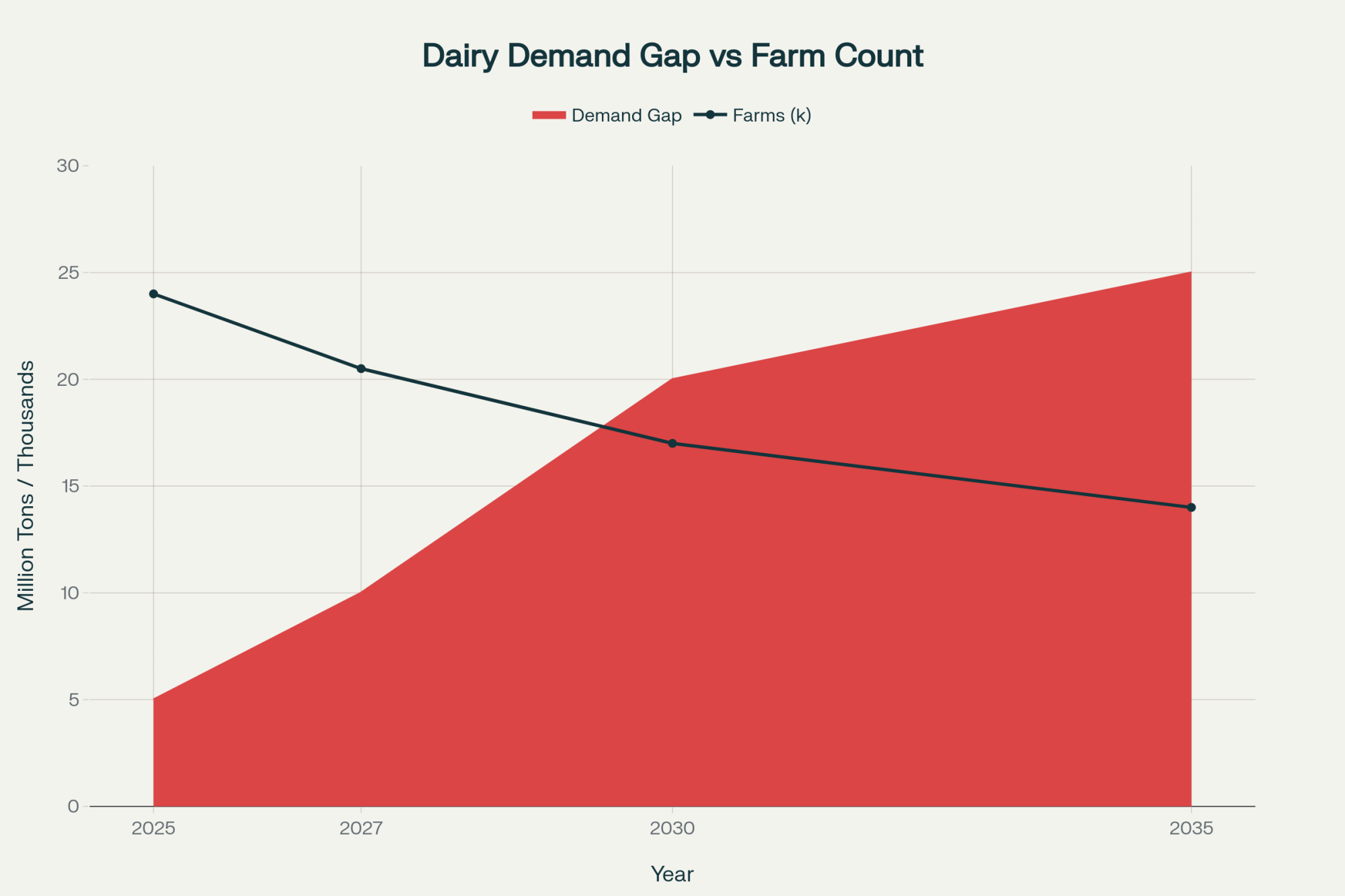
The International Dairy Federation is holding its World Dairy Summit this week—the first time in South America in 123 years—which is noteworthy, and the projections deserve a closer look. They’re talking about a 20-30 million ton global demand gap by 2035. IDF President Gilles Froment kept emphasizing “authentic collaboration” during his keynote, and that’s all well and good, but here’s what’s interesting…

When you examine these numbers alongside what’s actually happening on farms—I’ve been talking with producers from Vermont to California—some patterns emerge that suggest certain operations are going to capture value while others might struggle. These deserve a closer look.

And it’s not necessarily about who’s the better farmer.

Santiago’s celebrating a 25-million-ton shortage by 2035. But here’s what they’re not saying: only 14,000 U.S. farms will be left to capture that opportunity.

The Demand Gap: Real Opportunity or Something Else?

So this 20-30 million ton shortage everyone’s excited about—IDF’s analysis backs it up, USDA shows 11% consumption growth through 2030, and yeah, the demand’s real.

But here’s the thing: where’s the production going to come from?

Current production reality:

  • U.S. milk production: growing at just 0.9% annually (you’ve probably seen the NASS reports)
  • Europe: basically flat (Brussels keeps confirming this)
  • New Zealand: hitting environmental limits (their Ministry’s been pretty clear about that)

Even with the USDA predicting a milk price of $22.60, with room to grow, who actually benefits here isn’t as straightforward as you’d think.

Consider what DFA’s been doing. They marketed 65.5 billion pounds in 2021—that’s about 29% of all U.S. milk according to their annual reports. When you control processing, ingredients, export channels… you’re capturing value at every step.

Meanwhile, if you’re an independent producer shipping to whoever takes your milk that week, it’s a different game entirely.

And here’s something that really caught my attention: the Class III versus Class IV spread is $2.86 right now—widest we’ve seen since 2011 according to AMS data.

You know what that means? If you’re shipping to cheese plants in Wisconsin, you’re banking thousands more monthlythan your cousin in California selling to butter-powder operations. Same cows, same feed quality, same parlor management… but processor relationships determine who’s making money.

That’s not exactly what they teach in dairy science programs, is it?

Sustainability Costs: The Bill’s Coming Due

The Paris Declaration on Dairy Sustainability—signed by 53 countries, representing 46% of global production—changed the conversation from “wouldn’t it be nice” to “here’s your compliance timeline.”

And the costs… well, let me walk you through what producers are actually facing.

Bovaer methane additives: DSM’s been transparent about pricing at about $0.30 per cow per day. For 500 cows, that’s $54,750 annually. Just for the additive, nothing else.

Thinking about digesters? European Joint Research Centre research puts installation between €250,000-€275,000, and here’s what nobody mentions—you need about 35-40 kilowatt hours per kilogram of nitrogen for processing, which means solar panels or you’re burning through your savings on electricity.

Ben & Jerry’s ran this pilot with seven Vermont farms—the smallest had 60 cows, the biggest just under 1,000. They got 16% emissions reduction, which sounds great until you realize the company paid for everything. Staff time, equipment upgrades, robotic feed pushers… their published report basically says farmers can’t afford this without support.

At least they’re honest about it.

Now, California’s doing something interesting. Their dairy methane program—the Air Resources Board tracks this closely—has achieved impressive results:

  • 5 million tons of CO₂ equivalent are reduced annually
  • $522 million in private investment since 2022
  • $9 per ton cost-effectiveness (beats other climate tech by 10-60 times)

But here’s why it works: programs like the Low Carbon Fuel Standard create actual revenue from methane reduction. You’re not just spending money; you’re making it.

Most states? They don’t have anything close. I’ve been talking with producers in Ohio, Texas, Iowa, and even Wisconsin, outside the renewable natural gas corridor. They’re staring at these costs with no revenue offset.

And California’s got its own challenges—SGMA water compliance is brutal. Some producers I know are converting to solar at a rate of $800-$ 1,200 per acre annually. Beats volatile feed margins when water’s scarce, though.

Consolidation: The Numbers Tell the Story

USDA’s Census of Agriculture came out in February, and the numbers are sobering.

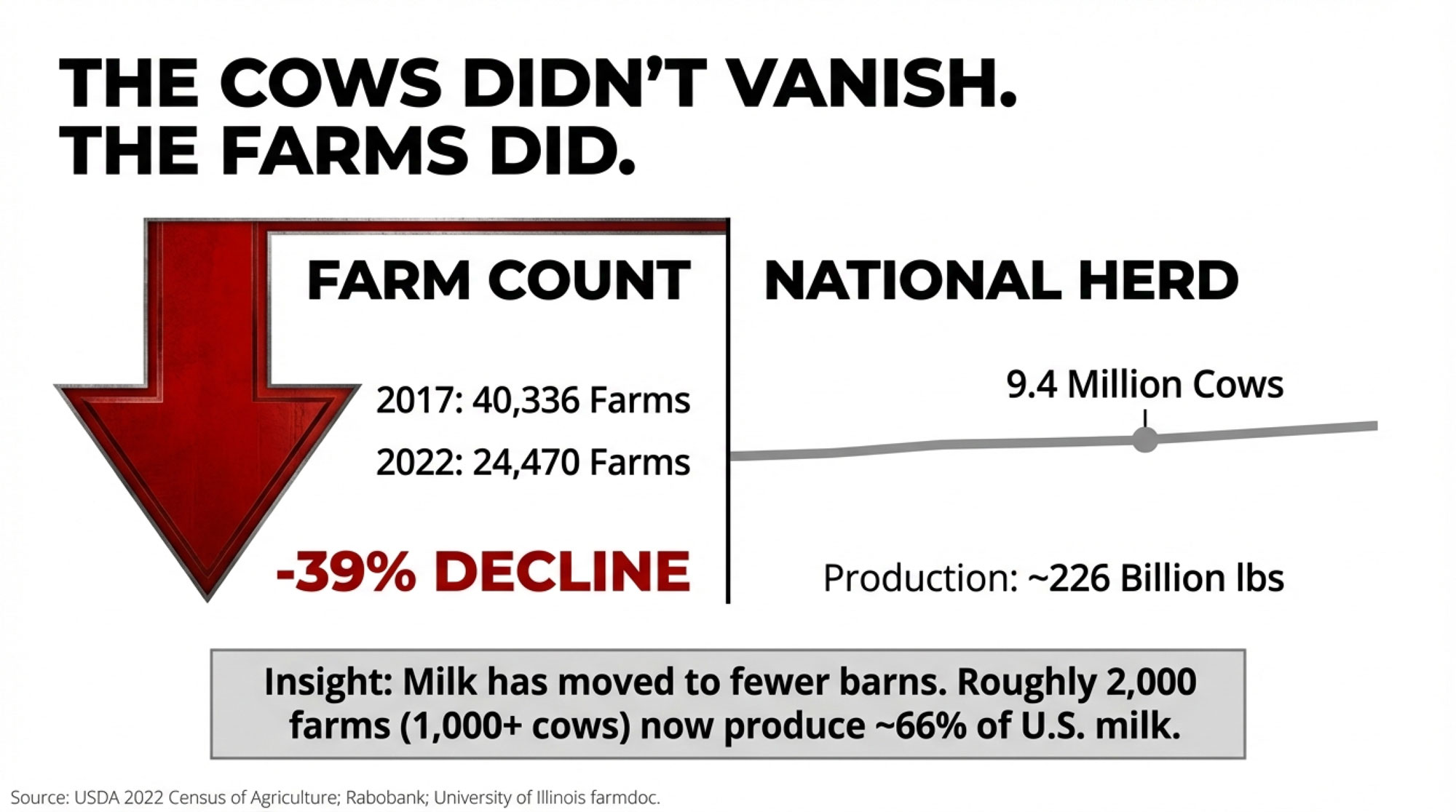
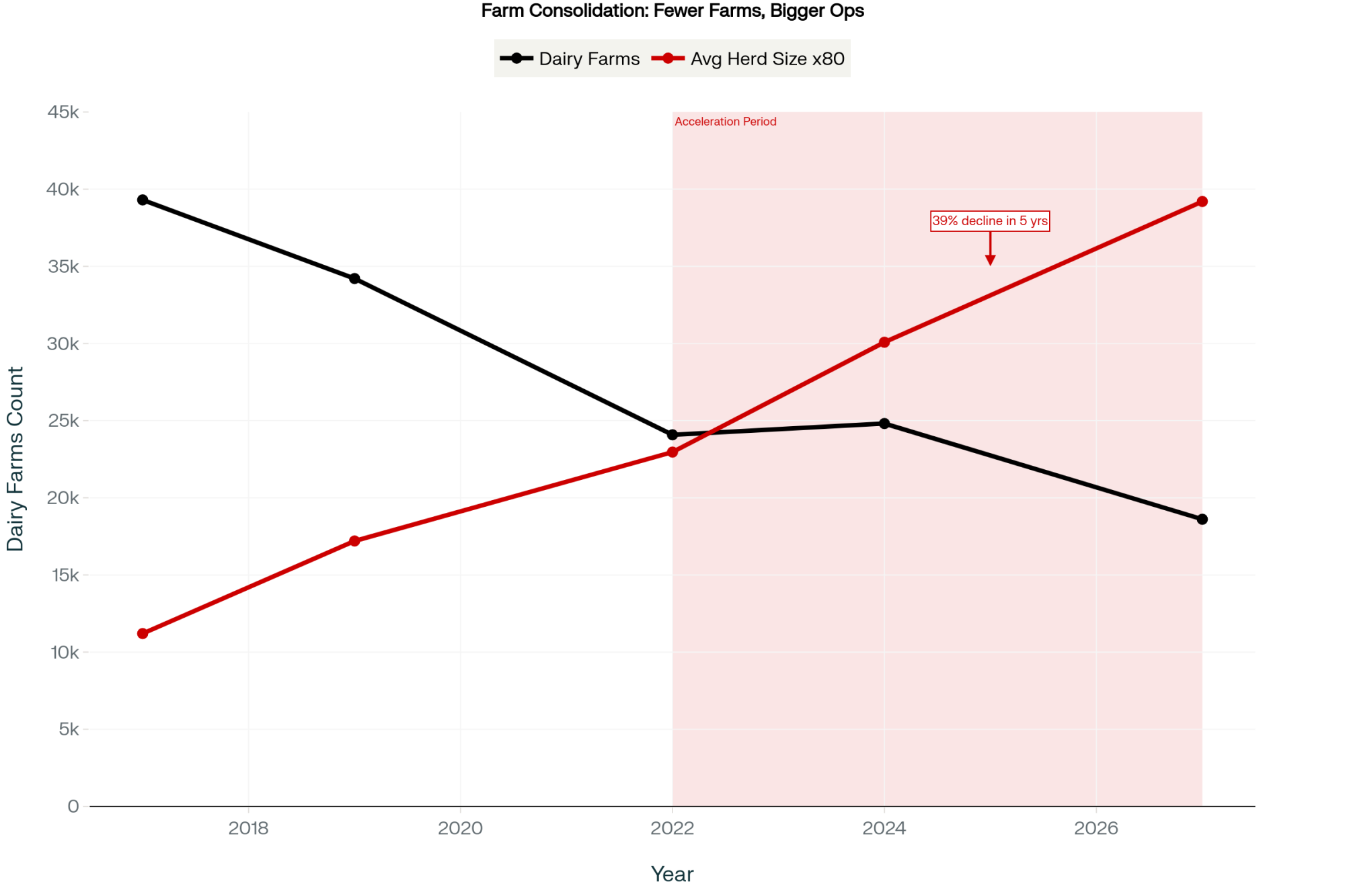
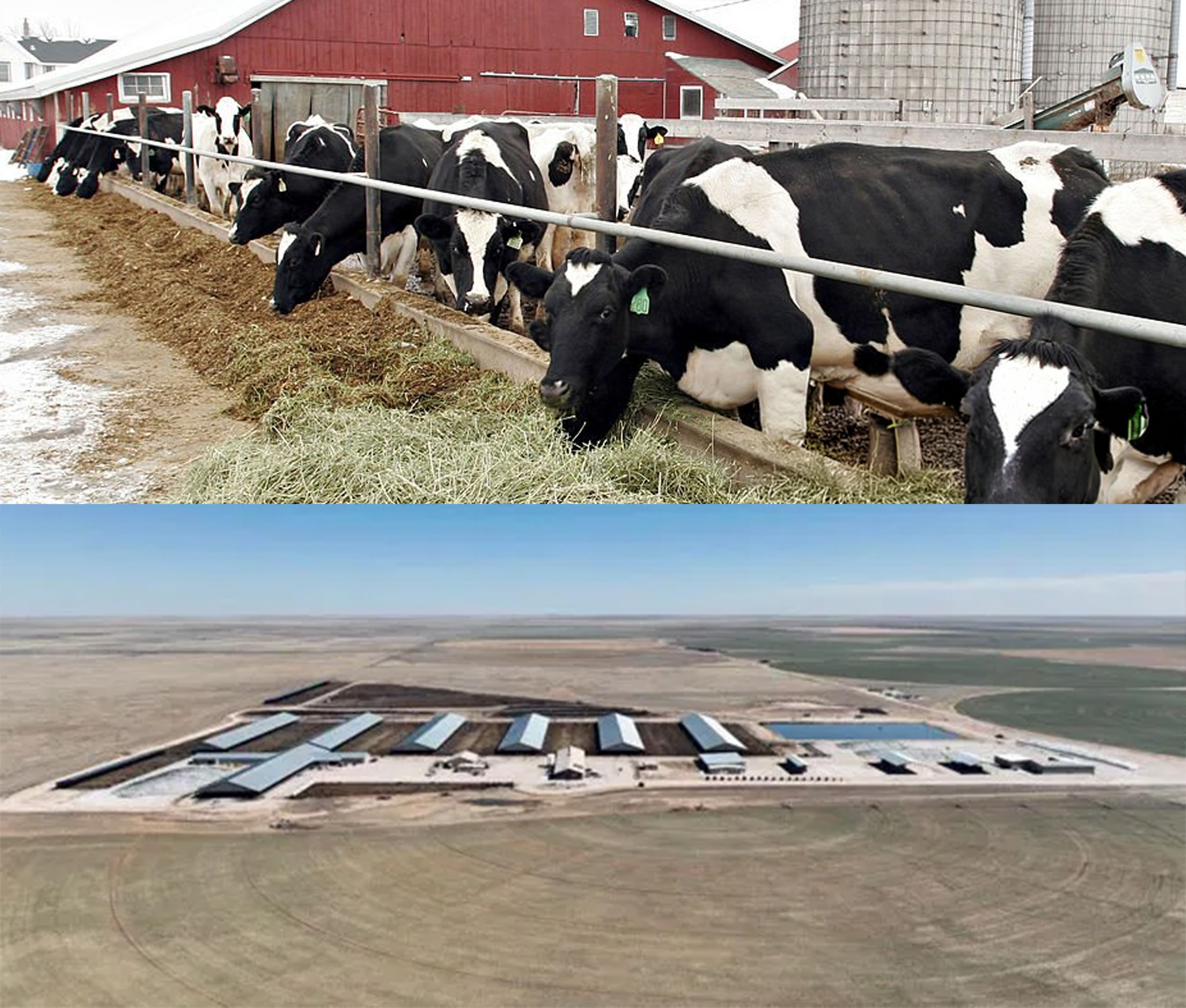
The brutal math of dairy consolidation: 39% of farms vanished between 2017-2022, while average herd sizes nearly tripled.

The stark reality:

  • 2022: 24,013 dairy operations (down 39% from 2017)
  • Since 2012: 50% of farms have gone in a decade
  • Rabobank projection: Another 20-25% decline by 2027

But here’s what really tells the story—look at where the milk’s coming from according to USDA’s Economic Research Service:

Operations over 1,000 cows:

  • Now: Control 65% of the herd
  • 1997: Just 17%

Farms under 100 cows:

  • Now: 7% of production
  • 1997: 39%

Midpoint herd size:

  • 2021: 1,260 cows
  • 2000: 180 cows
The math doesn’t care about your family legacy
Herd SizeCost/cwtProfit at $22.60
100-199$23.06-$0.46
500$20.25$2.35
1,000$18.50$4.10
2,500+$13.06$9.54

And it’s not just about bulk feed purchases or spreading fixed costs, as many of us have seen. What I’m finding—especially visiting Wisconsin operations lately—is revenue diversification that smaller farms struggle to match.

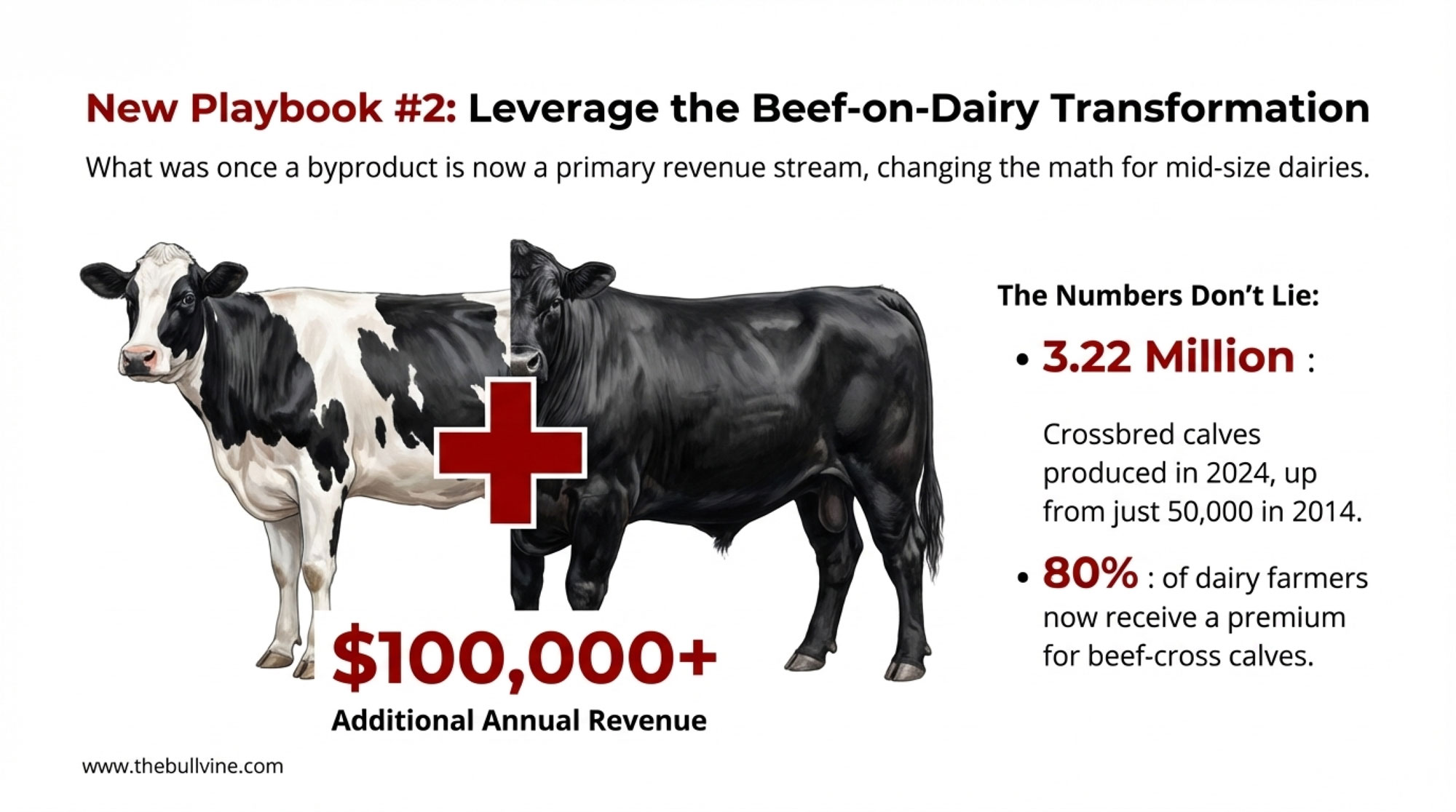
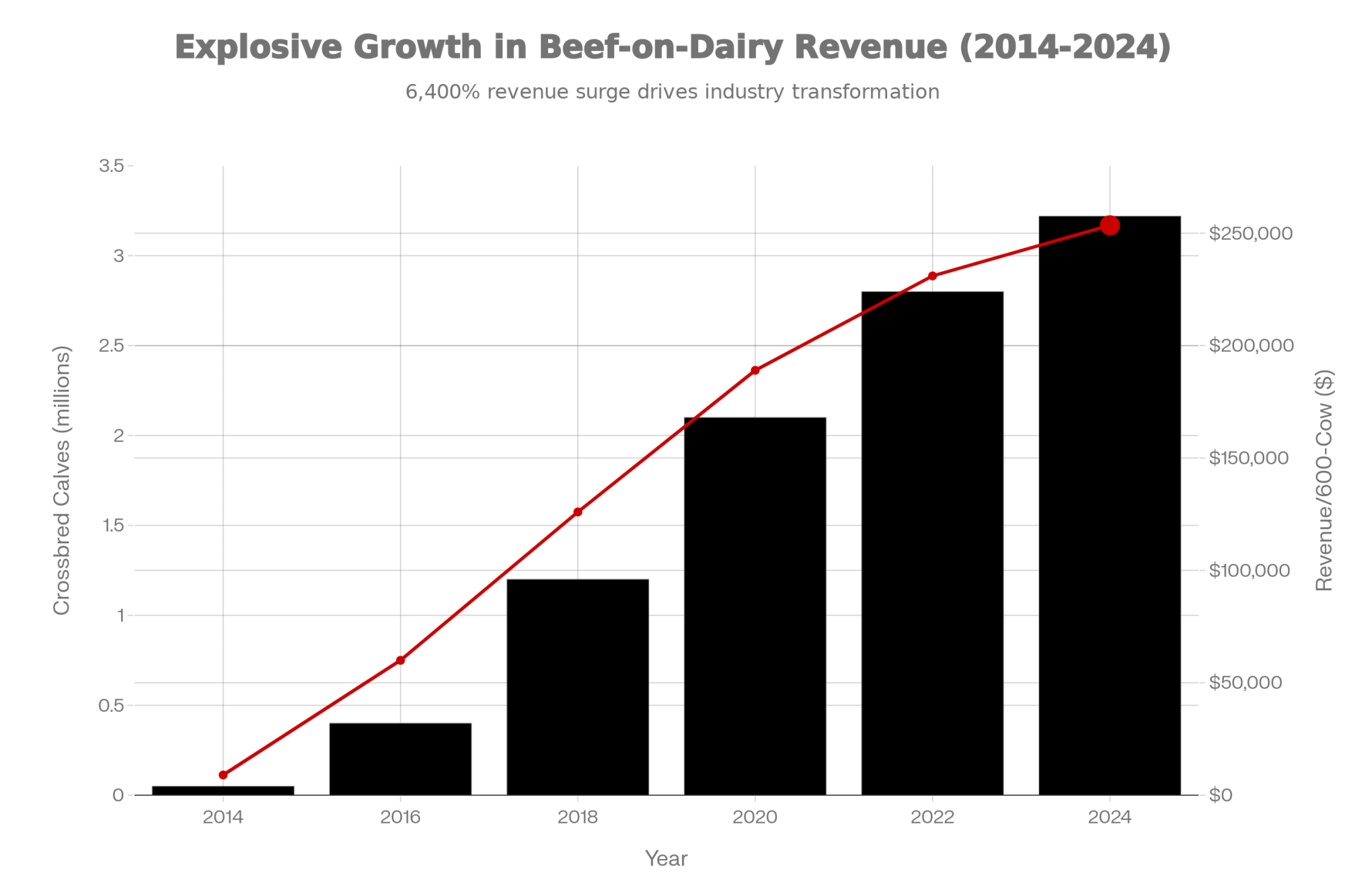
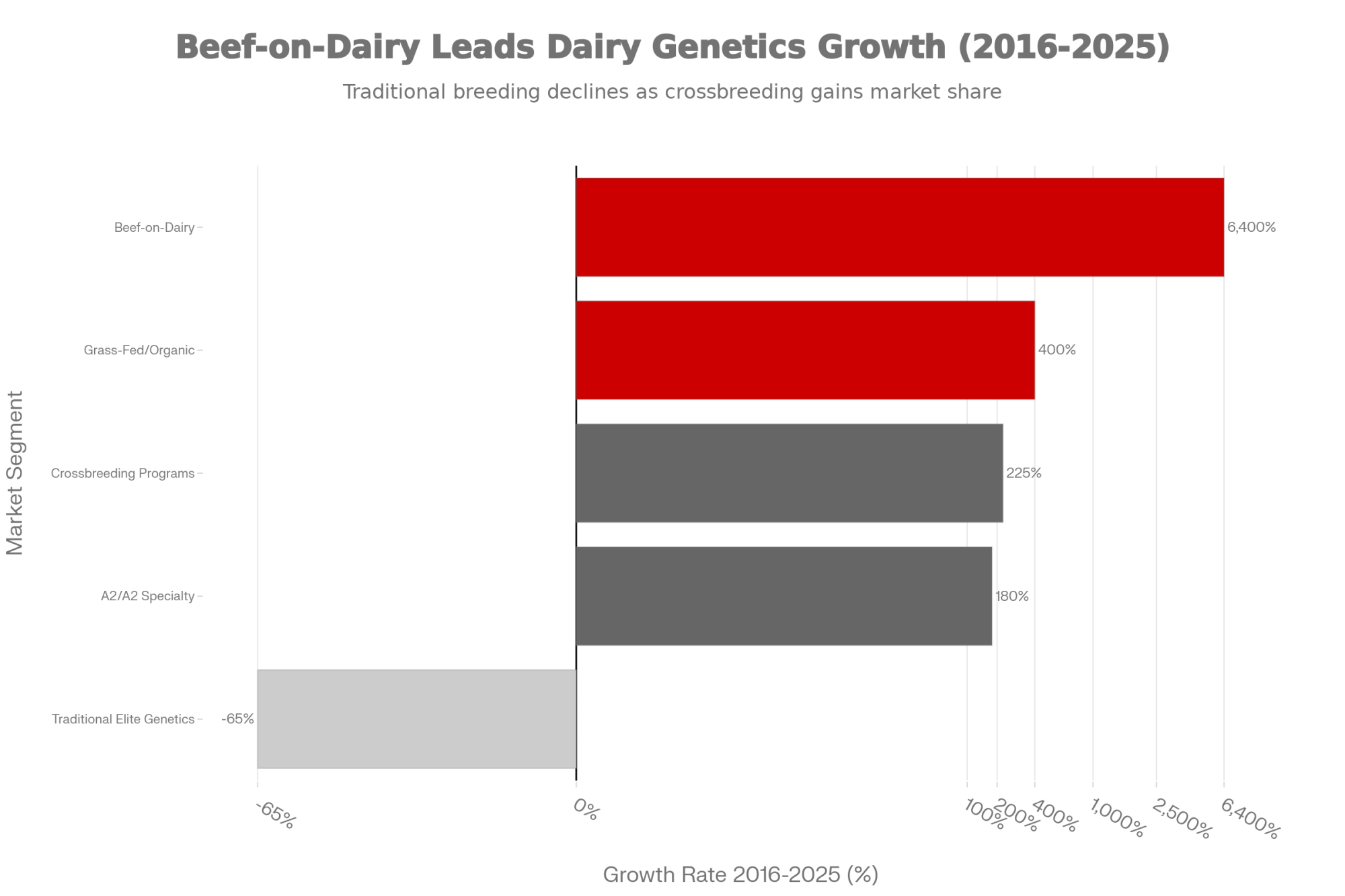
These bigger operations are breeding 60% or more of their herds to Angus bulls. With beef crosses bringing $800-1,200 versus maybe $150 for dairy bulls, a 2,900-cow operation can generate millions extra annually just from calves.

Add in what they’re doing with:

  • Genetics sales internationally
  • Digester partnerships (companies like Vanguard Renewables)
  • Commercial grain operations on thousands of acres

It’s a completely different business model, honestly.

A 600-cow operation—and I know plenty of excellent managers at that scale—generally can’t tap those revenue streams. You don’t have the volume for direct feedlot contracts, digesters don’t pencil out, and international genetics buyers aren’t calling.

It’s not about management quality; it’s structural advantages that kick in above certain thresholds.

Why the Next Generation’s Walking Away

While 69% of farmers expect their kids to take over, only 16.5% of transitions actually succeed—and 71% haven’t even identified a successor.

Here’s a statistic that keeps me up at night: University of Minnesota Extension found that while 69% of farmers expectto pass the farm to their children, actual succession success is only 16.5%.

That 83.5% failure rate? It’s not because kids are soft or don’t appreciate farming. It’s math.

I’ve been helping young couples run the numbers using Wisconsin’s Farm Financial Standards—proper analysis, not back-of-the-envelope stuff.

Take a typical scenario:

  • 25-year-old with an ag degree
  • Parents running 500 cows
  • Normal debt loads
  • Year one: Maybe $900,000 net with current prices

Sounds good, right?

But factor in reality based on historical trends:

  • Operating costs: Rising 3% annually (that’s the 10-year average)
  • Sustainability compliance: Accelerating 5% yearly (as regulations tighten)
  • Milk prices: Maybe 1% growth if you’re lucky (20-year data shows this)

By year 10, That net income could drop 40% or more.

And that’s while working 60-70 hour weeks—you know how it is during calving season—carrying complete liability for over a million in debt.

Their college friends?

  • Ag lenders: Starting $58,000, reaching $90,000 within a decade (Bureau of Labor Statistics data)
  • Herd managers: $80,000-120,000 (based on industry surveys)
  • Benefits: Home for dinner, actual vacation time, no debt liability

Student loans make it worse—National Young Farmers Coalition says 38% of young farmers carry an average debt of $35,660. As folks at USDA’s Beginning Farmer Program keep pointing out, you’re already in debt before you even think about taking over the farm.

The math often doesn’t work. And honestly? Can you blame them for choosing differently?

Your Four Critical Decisions—Quick Reference

Decision 1: Can premium markets work for you? (6 months to figure out)

  • Within 100 miles of metropolitan markets with strong demographics
  • Need 50%+ equity to weather transition losses
  • Someone who actually wants to do marketing, not just milk cows
  • Reality: Losses years 1-3, break even 4-6, profit after year 7 (every transition study shows this)

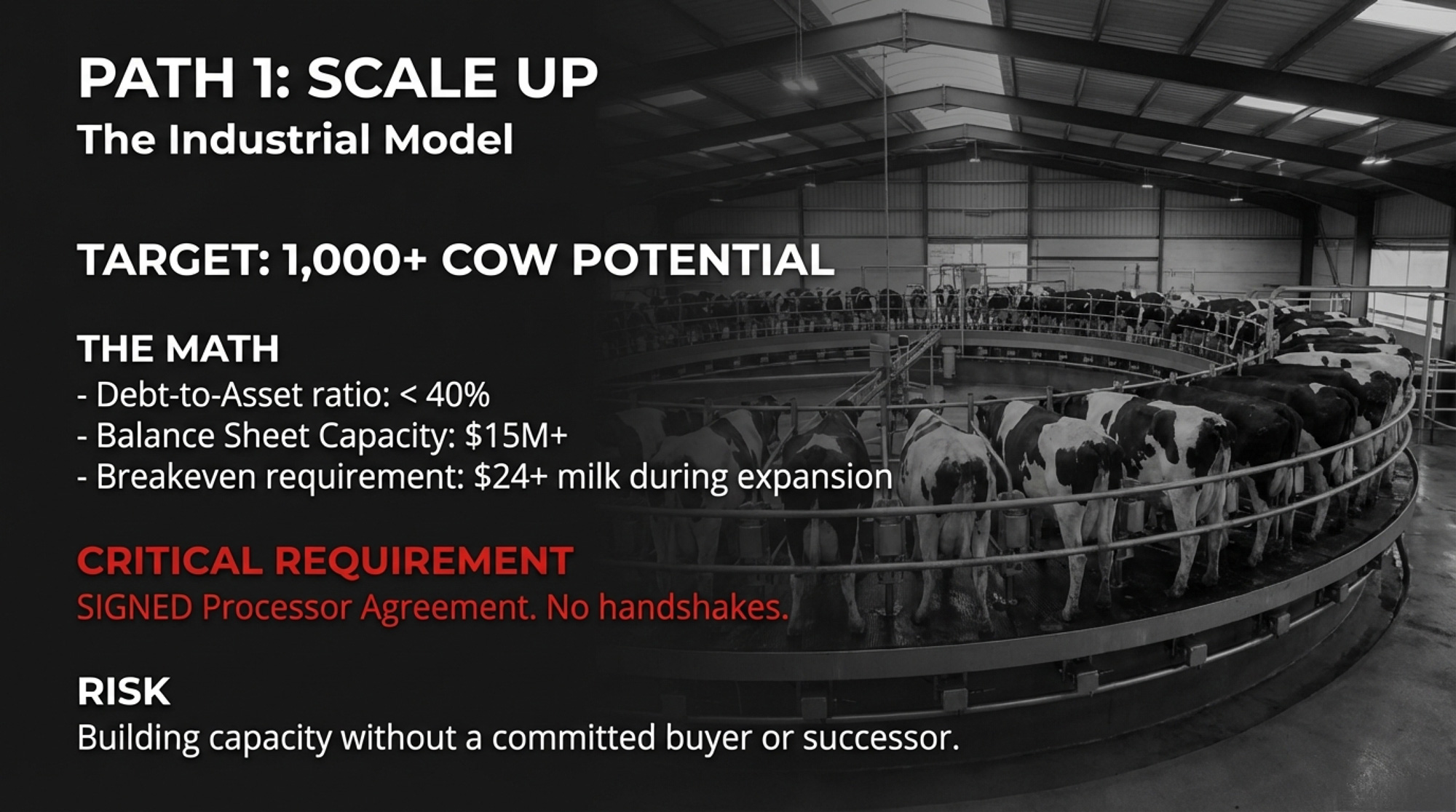
Decision 2: Can you scale to 1,500+ cows? (12 months to secure financing)

  • Need $3-4.5 million capital (that’s current construction costs)
  • Current profits should exceed $400/cow for lender confidence
  • Debt under 30% of assets for favorable terms
  • Reality: $175,000-292,000 annual debt service at current rates

Decision 3: Are You Preserving or Bleeding Equity? (3 months to assess honestly)

  • Delaying exit while losing money costs thousands in retirement income
  • Declining working capital = converting equity to expenses
  • Continue only if genuinely cash flow positive

Decision 4: If exiting, how do you maximize value? (12-18 months to execute)

  • Best: Sell to expanding neighbor (92-98% value recovery)
  • Good: Liquidate herd, keep land for rent (85-90%)
  • OK: Convert to heifer raising (40-50% income reduction)
  • Fast: Complete auction (60-80% recovery)

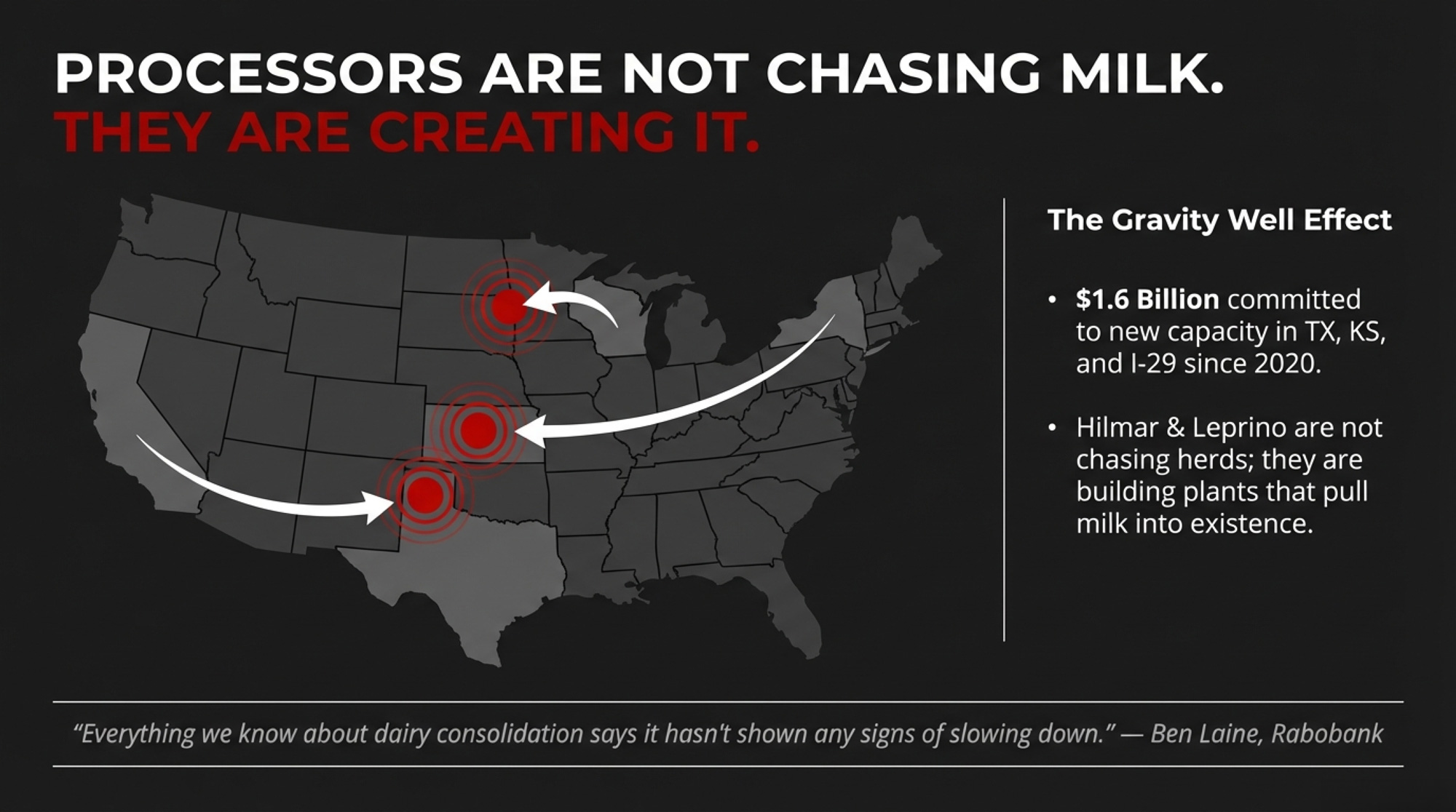
Processors: The Other Consolidation Story

Dean Foods collapsed. Borden’s bankrupt. In the Upper Midwest, 90% of your milk goes to just two buyers—DFA or Prairie Farms.

The processor landscape changed dramatically with recent bankruptcies, as you probably know:

Dean Foods (November 2019)

  • Over $1 billion in long-term debt, according to bankruptcy filings
  • Combined revenues over $12 billion—just gone

Borden Dairy (January 2020)

  • Followed Dean into bankruptcy
  • Couldn’t compete with integrated processors

When Walmart built their Fort Wayne plant in 2018 and Kroger expanded private label… that was game over for traditional processor margins, honestly.

After Dean collapsed, DFA bought 44 facilities for $433 million—the DOJ tracked all this. Now, many upper Midwest producers basically have two buyers: DFA and Prairie Farms.

That’s not exactly competitive price discovery, is it?

What Europe’s showing us about what’s next:

  • Arla-DMK merger: Creates €19 billion giant
  • FrieslandCampina-Milcobel: Combines €14 billion
  • DMK’s reality: €24.6 million profit but negative €54.8 million cash flow in their FY2024 report

They’re burning reserves despite making operational profit. Their CEO’s been blunt with members: milk production’s declining, and they need scale to survive.

What’s this mean for us? Fewer buyers, less negotiating leverage, more dependence on whoever’s left standing.

And if you think that leads to better milk prices… well, I’ve got a bridge to sell you.

The Talk Every Farm Family Needs to Have

Here’s the conversation I’ve been coaching families through—and it needs real numbers, not hopes:

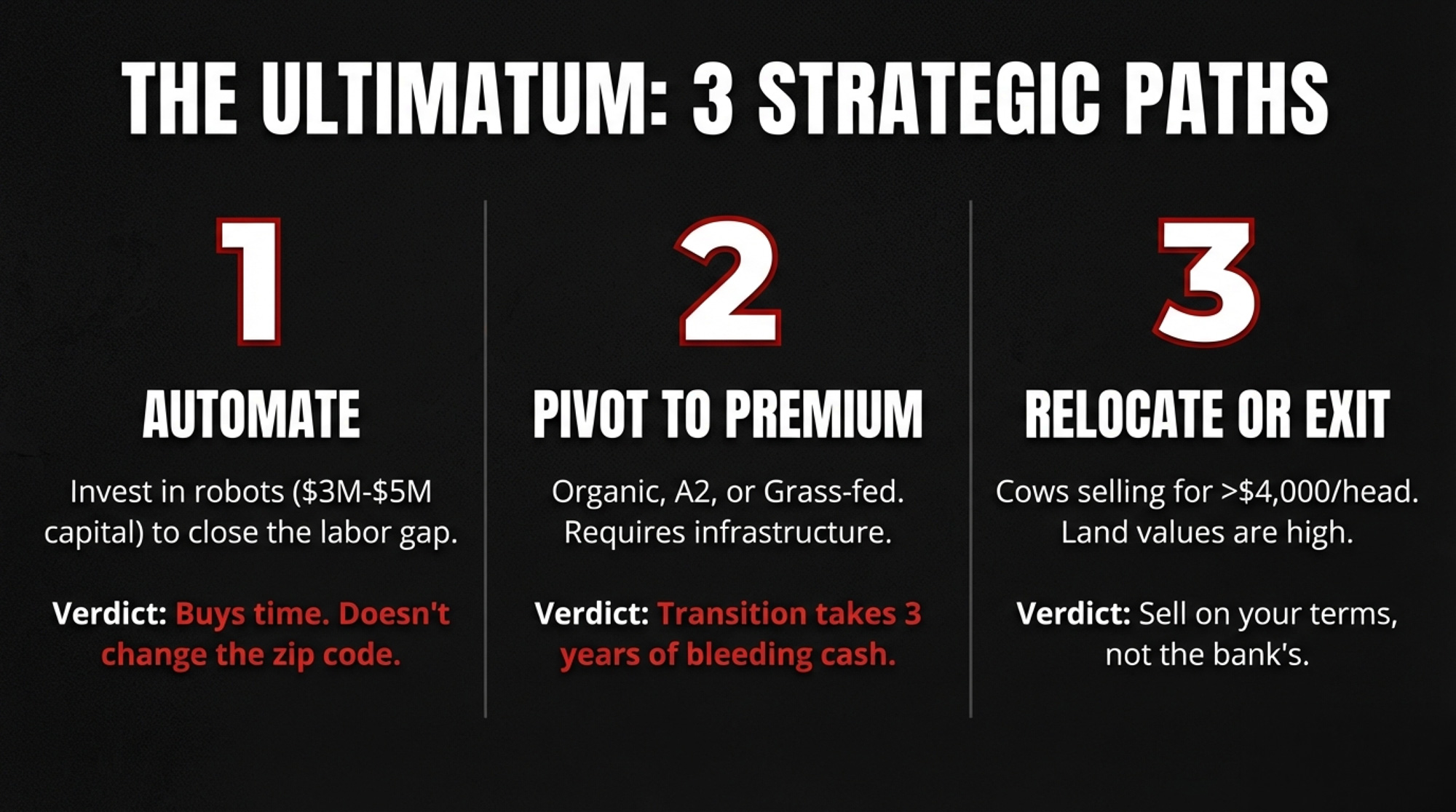
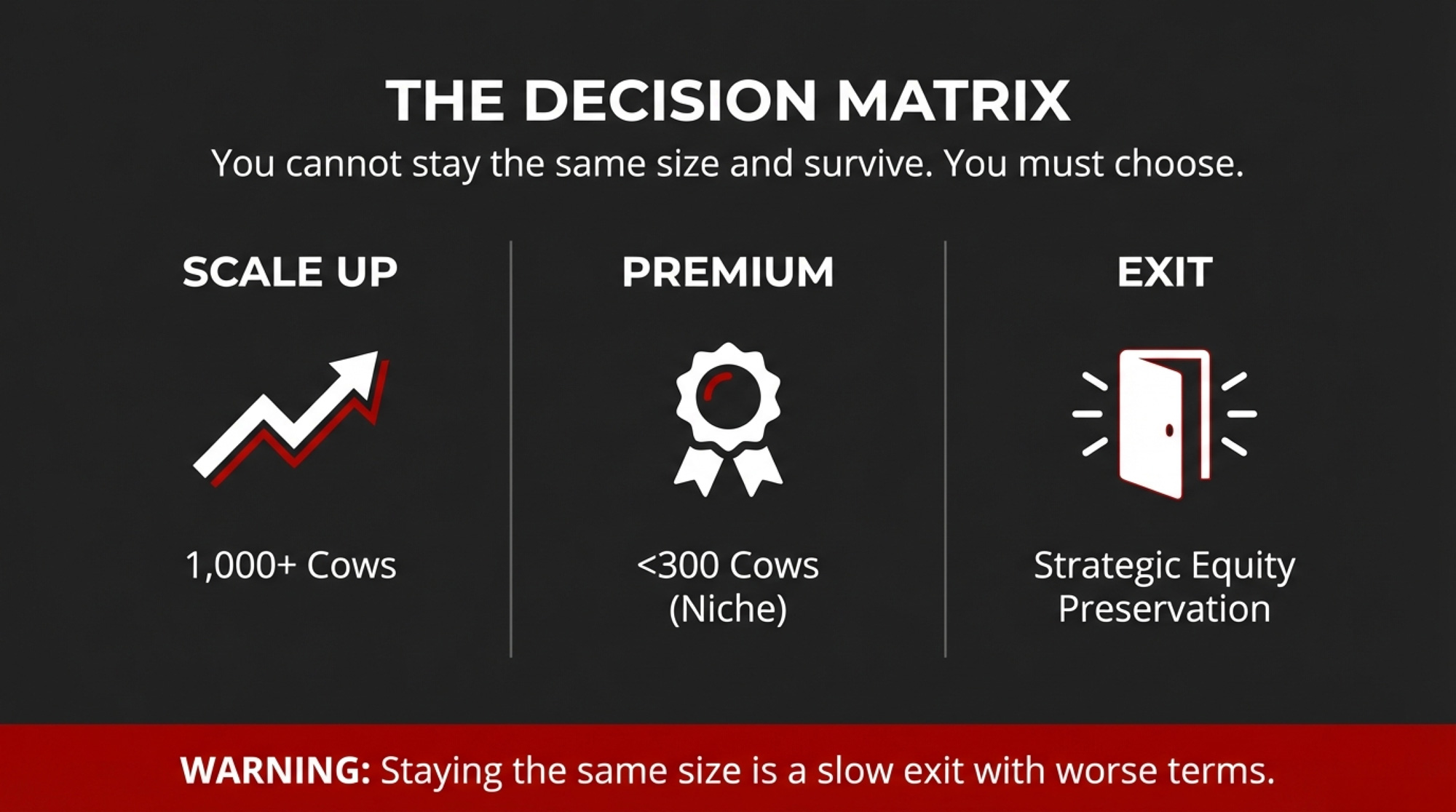
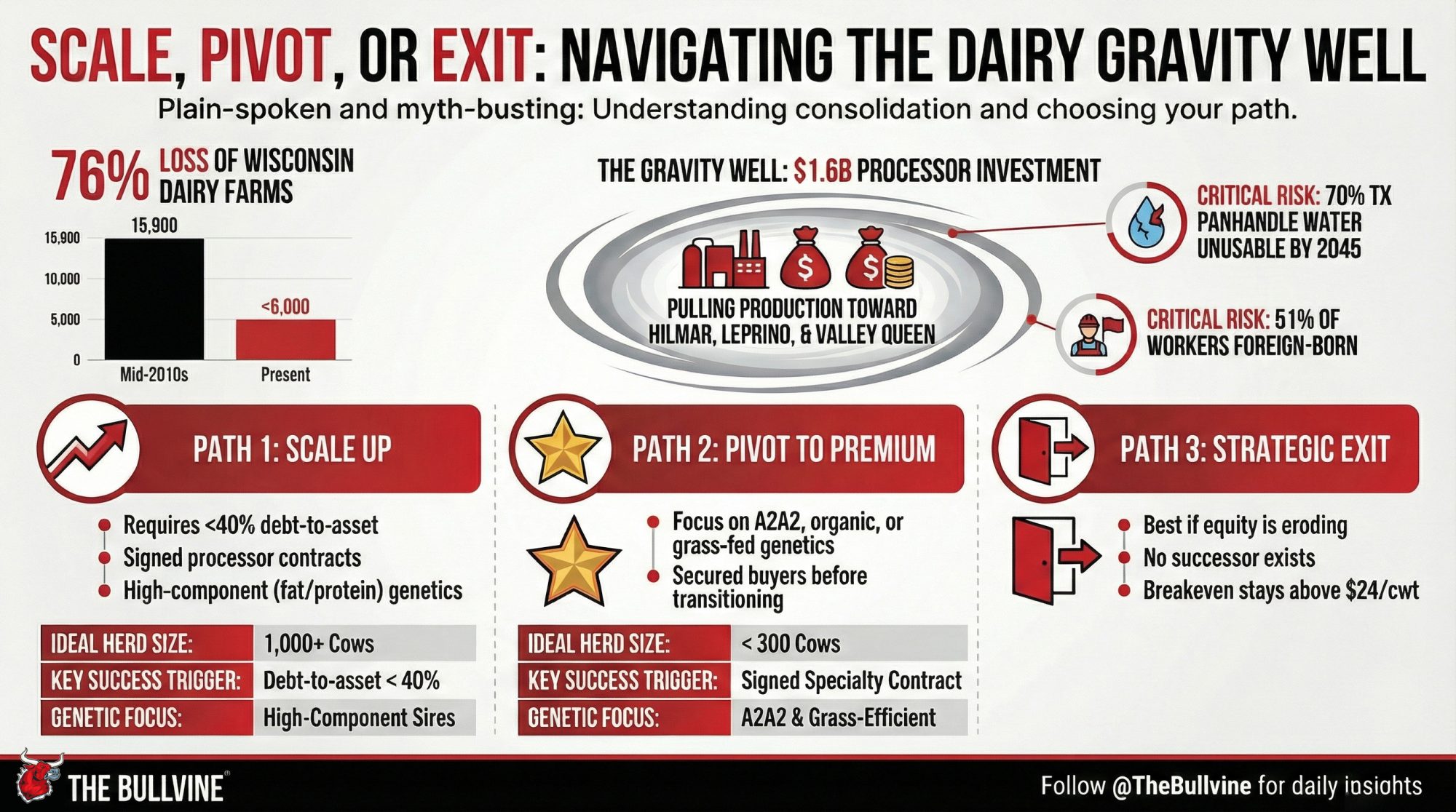
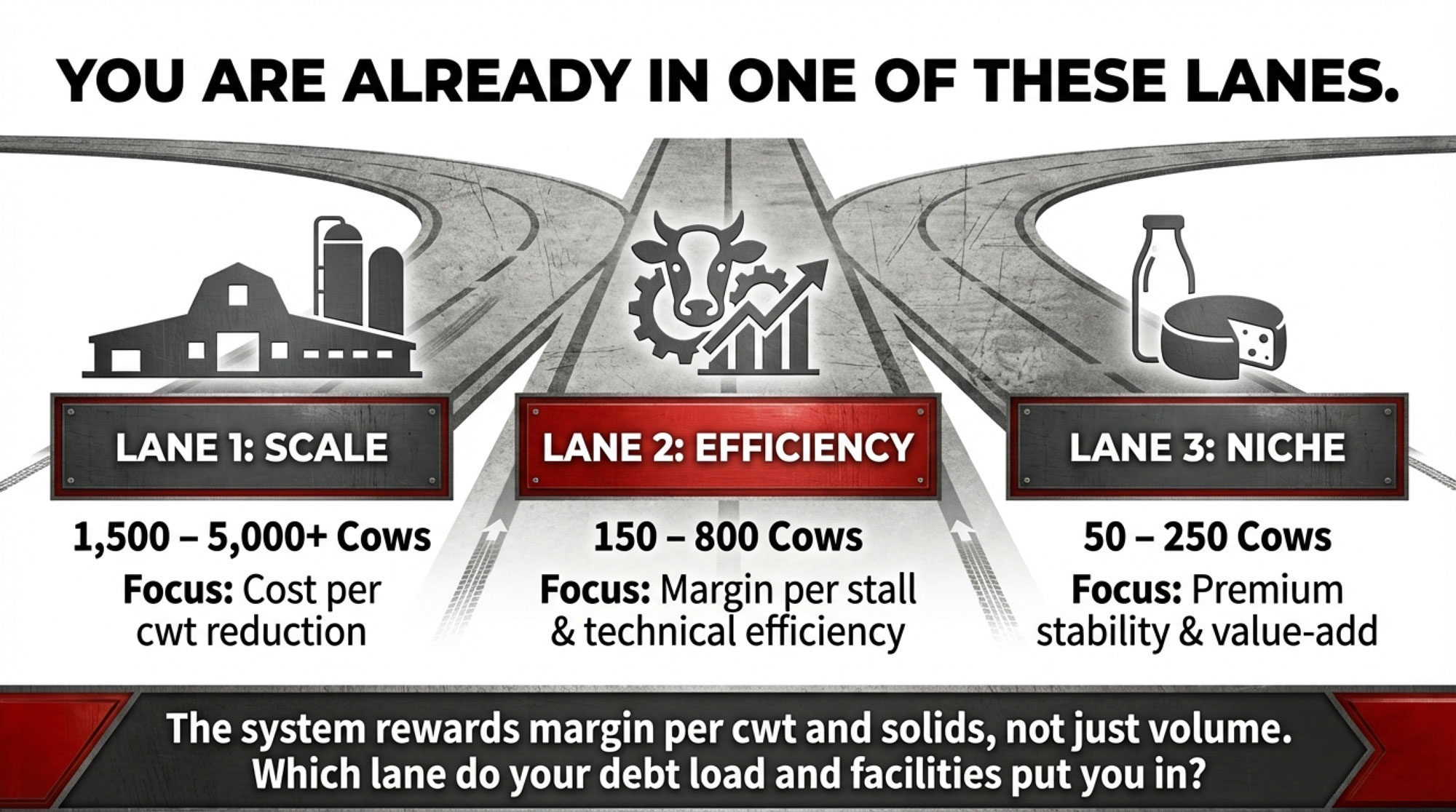
“Listen, we’ve got three realistic paths given where the industry’s heading.

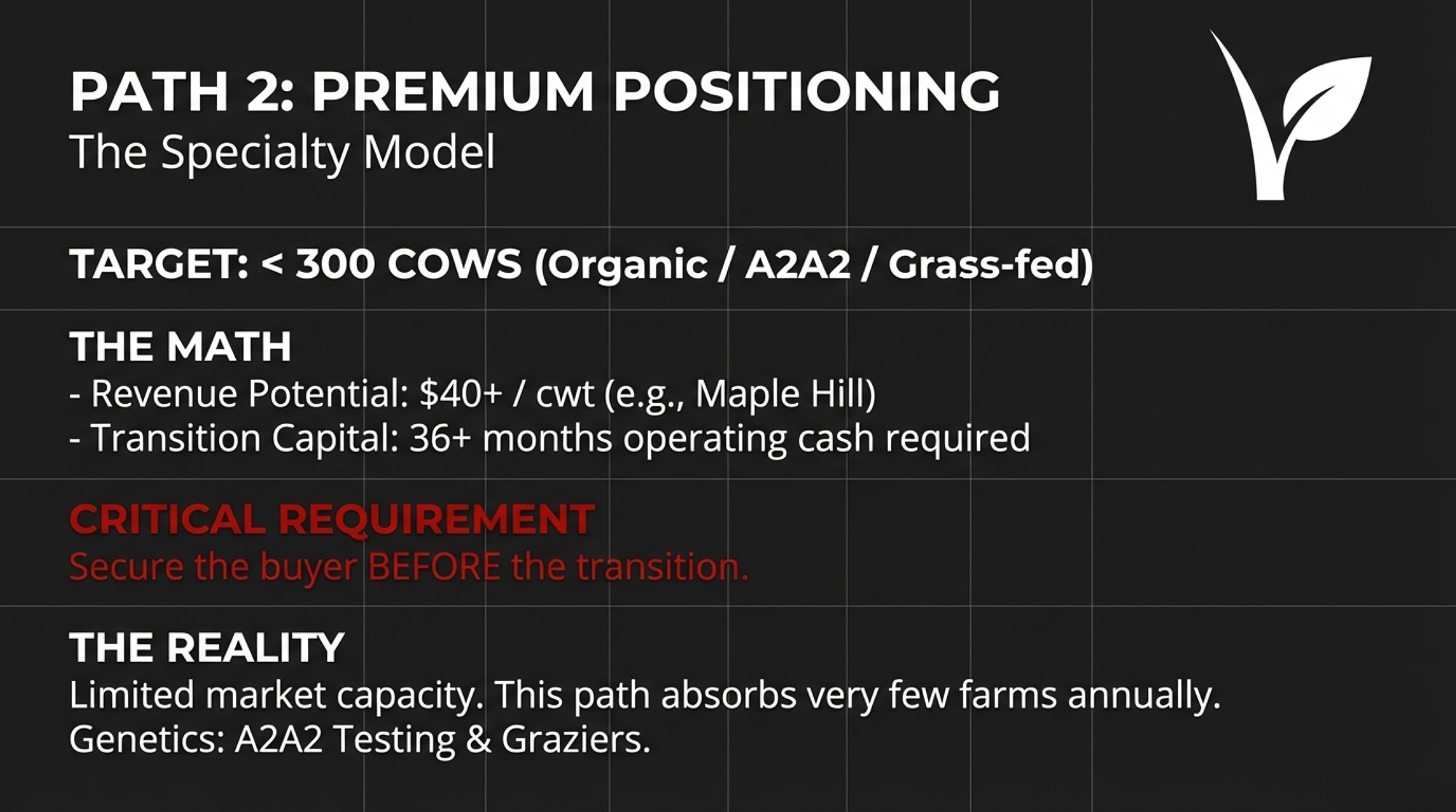
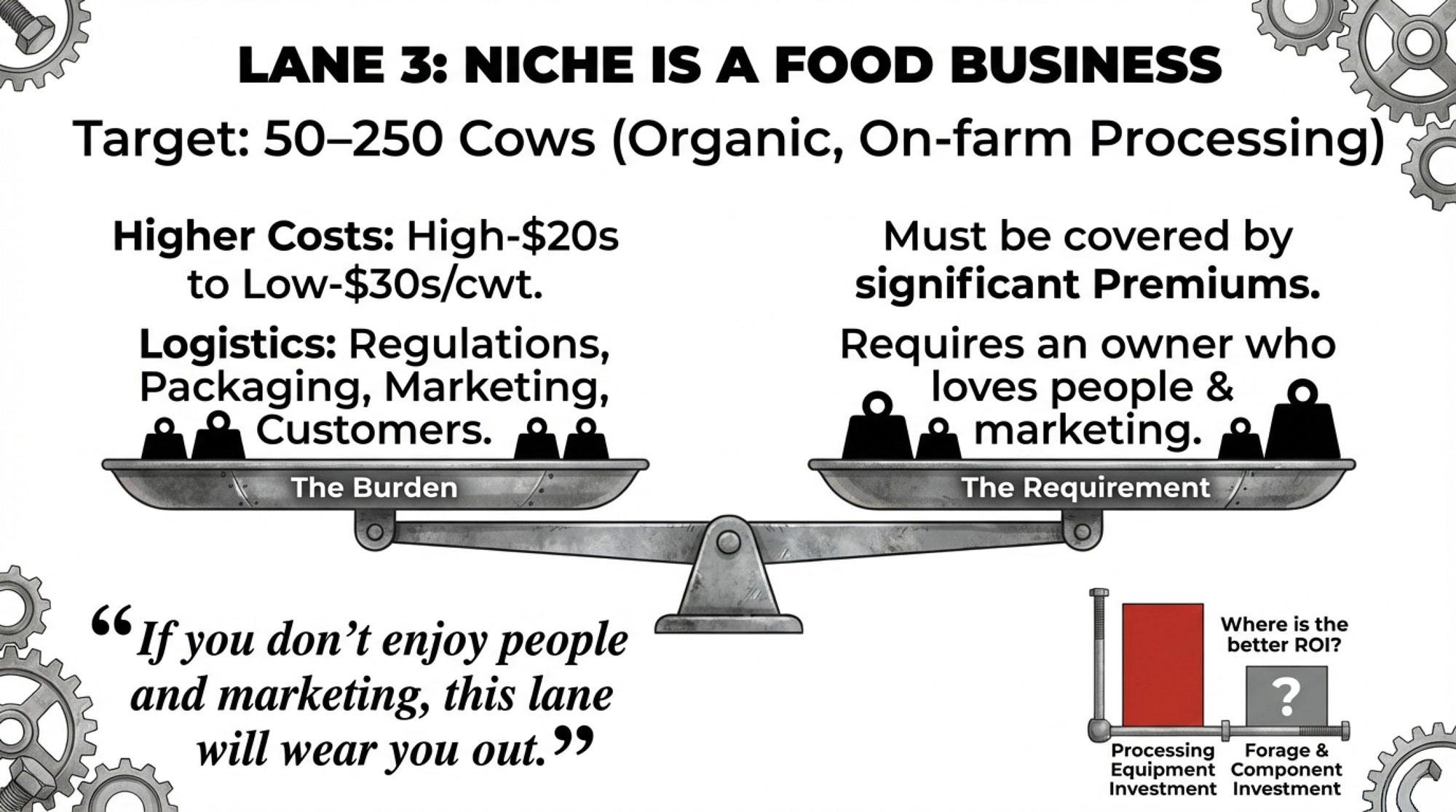
Path one—go premium. Organic, processing, direct sales. That’s serious money upfront, losses for years according to every university study, and you’d basically be running a food company. Farmers markets every Saturday, Instagram all the time, dealing with customer complaints. That sound like the life you want?

Path two—scale up big. We’re talking millions in debt, managing 20+ employees, becoming a CEO instead of a farmer. HR headaches, safety meetings, and managing managers instead of cows. You ready for that?

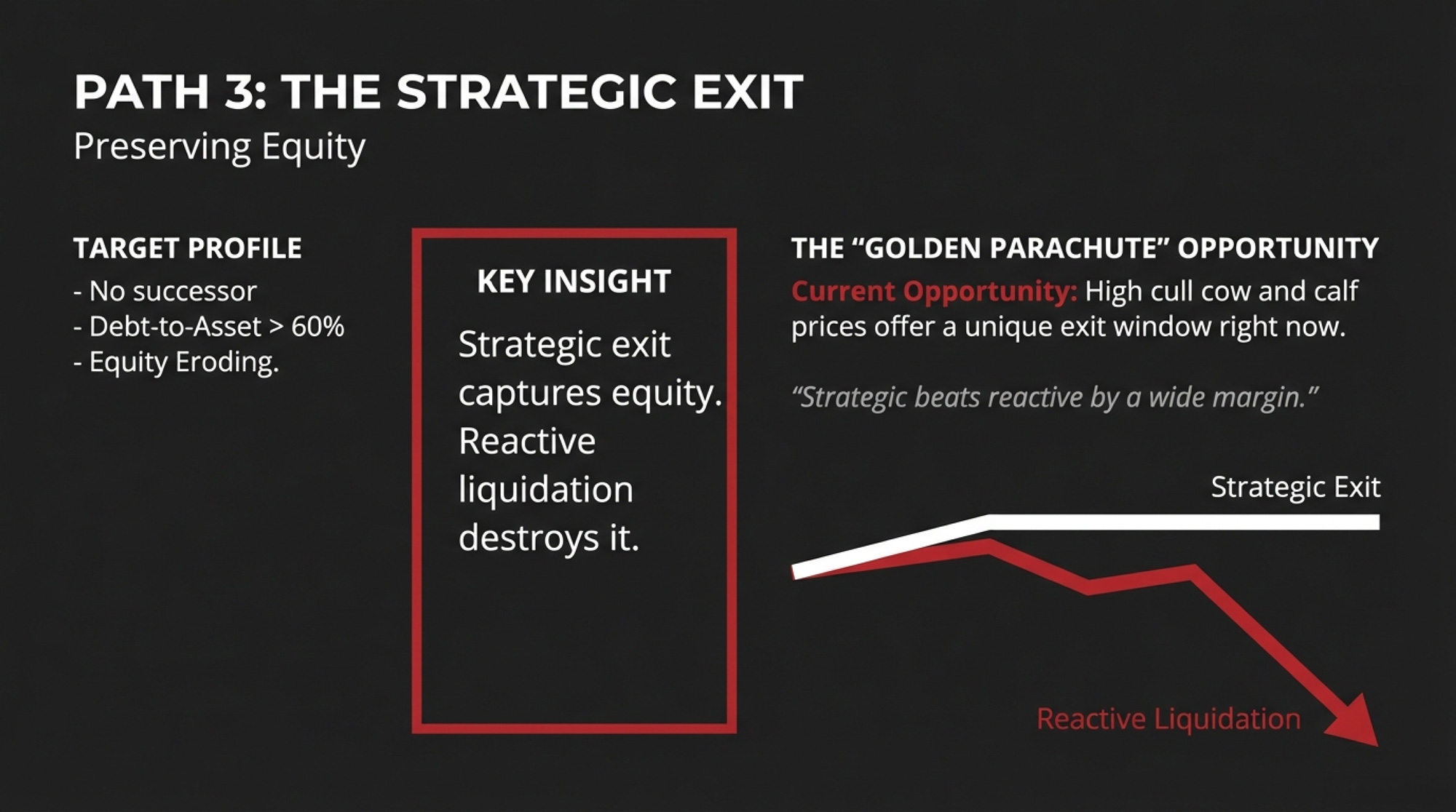
Path three—we sell while we’ve got equity. You pursue your career without our debt. We preserve retirement funds. You can still work in dairy—plenty of good jobs—just not owning the risk.

What actually fits your vision for the next 40 years?”

When kids see real numbers, Iowa State’s research suggests that about 75% choose path three. They become nutritionists, agronomists, equipment specialists. Good careers using farm knowledge without the burden of ownership.

And given the economics? It’s often the smart choice.

What’s Actually Working Out There

Now, it’s not all challenges—I’m seeing some operations successfully thread the needle.

New York producers integrating processing are doing something interesting. Making specialty cheese and butter for NYC markets—one operation I visited is selling butter for $12 per pound in Manhattan. That vertical integration changes everything.

California cooperatives where smaller farms banded together before consolidation forced them, are now receiving premiums. Clover Sonoma’s a good example—27 farms averaging 350 cows each, all within 100 miles of their plant. They control their story and receive premium prices.

Vermont innovation through programs like AgSpark, is worth noting. Individually, a 400-cow farm can’t justify a digester. But three farms together? Now you’re talking viable scale. That’s real collaboration, not the “take whatever price we offer” kind.

Plains states are finding niches too. Custom heifer operations serving multiple dairies, spreading costs. Grazing dairies in Missouri are finding grass-fed markets that actually pay premiums.

Mid-Atlantic producers are leveraging proximity. Pennsylvania’s farmstead cheese operations are growing—being close to Philadelphia and Pittsburgh matters. Maryland producers supplying Baltimore and D.C. with local milk get decent premiums despite high land costs.

Even in the Southeast, despite cooling costs running $180-$ 200 per cow annually, I know operations that maximize component premiums. When your butterfat’s at 4.2% and protein is at 3.4%, you’re getting paid. It’s about finding what works for your situation.

Looking Ahead: The Industry Will Survive, But Will You?

The industry will absolutely meet that 20-30 million ton demand gap. Sustainability goals will be achieved. Global production will modernize.

But the structure doing it? Nothing like today’s.

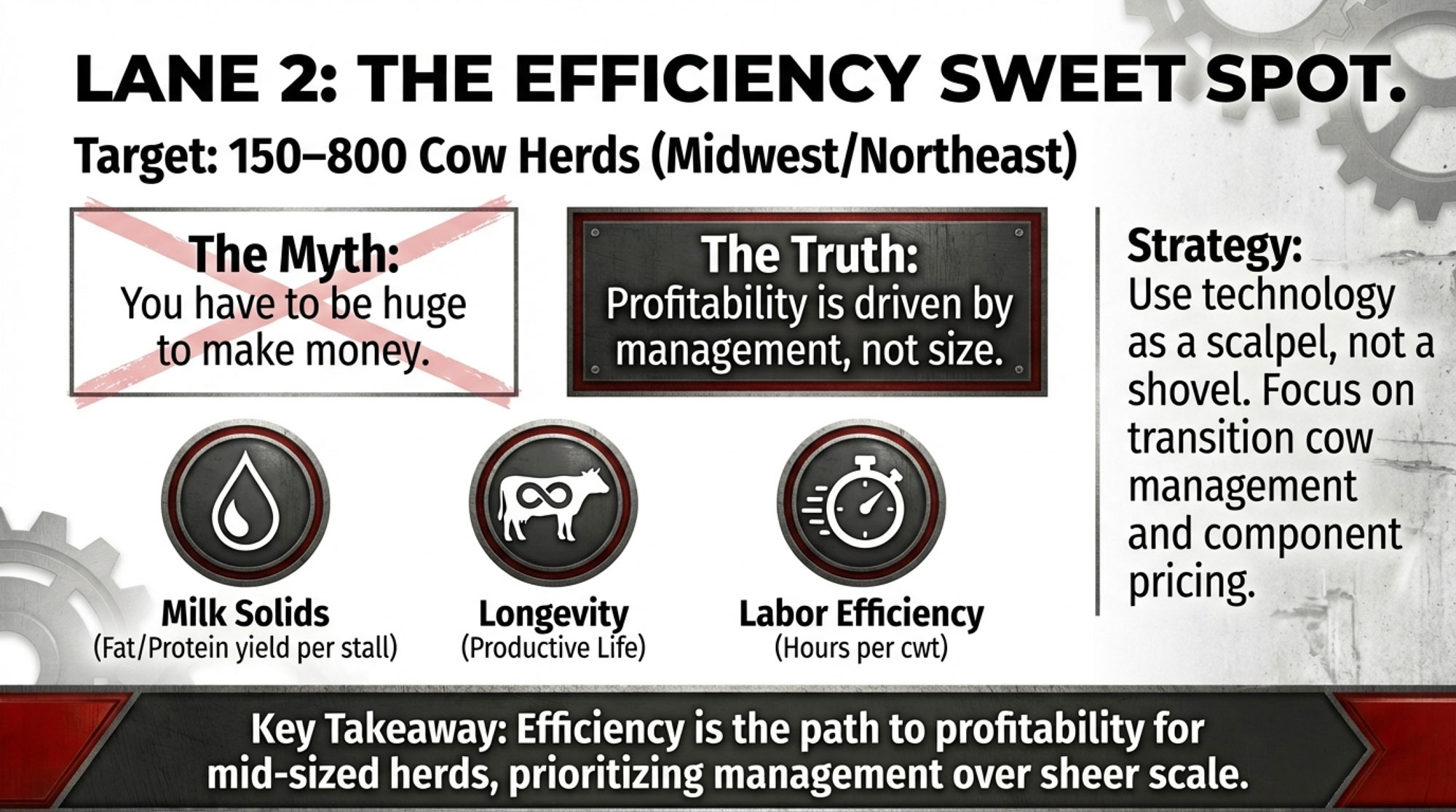
Operations under 1,000 cows without premium markets, face increasingly challenging economics. Sustainability costs are rising, processor options are shrinking, and the next generation is making rational career choices.

It’s not about farming quality—it’s about structural realities nobody wants to discuss at industry meetings.

Those positioned to scale or differentiate have real opportunities, but execution has to be nearly perfect. I’ve seen too many half-hearted organic transitions fail. Expansions without multiple revenue streams just create bigger debt.

You need a complete strategy, not just hope.

The next 24 months look critical based on what I’m seeing. Processor consolidation’s accelerating—Rabobank says 2026 could see major shifts. Asset values may decline as more operations exit. Waiting usually means fewer options at lower values.

The Bottom Line: Your Choice to Make

Santiago’s summit revealed an industry transforming whether we’re ready or not.

The question isn’t if you’ll be affected—it’s whether you’ll choose your position or let circumstances choose for you.

Understanding these dynamics isn’t pessimistic—it’s getting clear-eyed about making wealth-preserving decisions while you still have options. I’ve watched too many good operators wait too long, hoping for better prices or magical policy changes that never came.

What gets me is all the knowledge we’re losing. Generations of understanding specific fields, managing fresh cow transitions, getting the most from local forages… when a farm exits, that expertise often goes too.

But here’s what’s encouraging—that knowledge can transform into new roles. Some of the best herd managers I know are former owners who sold at the right time. They’re managing thousands of cows, earning well, and home for dinner.

The knowledge continues, just in different structures.

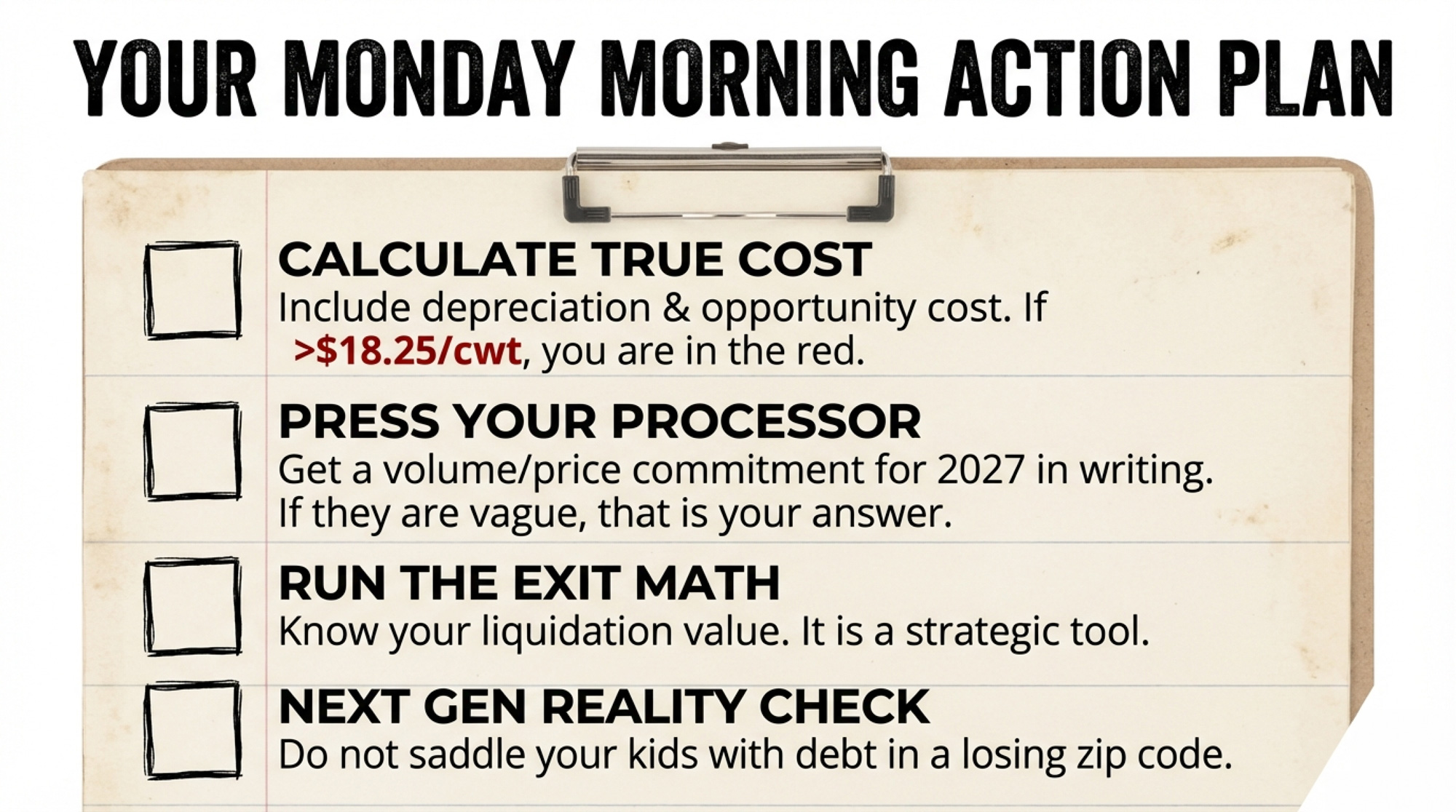
Your action steps:

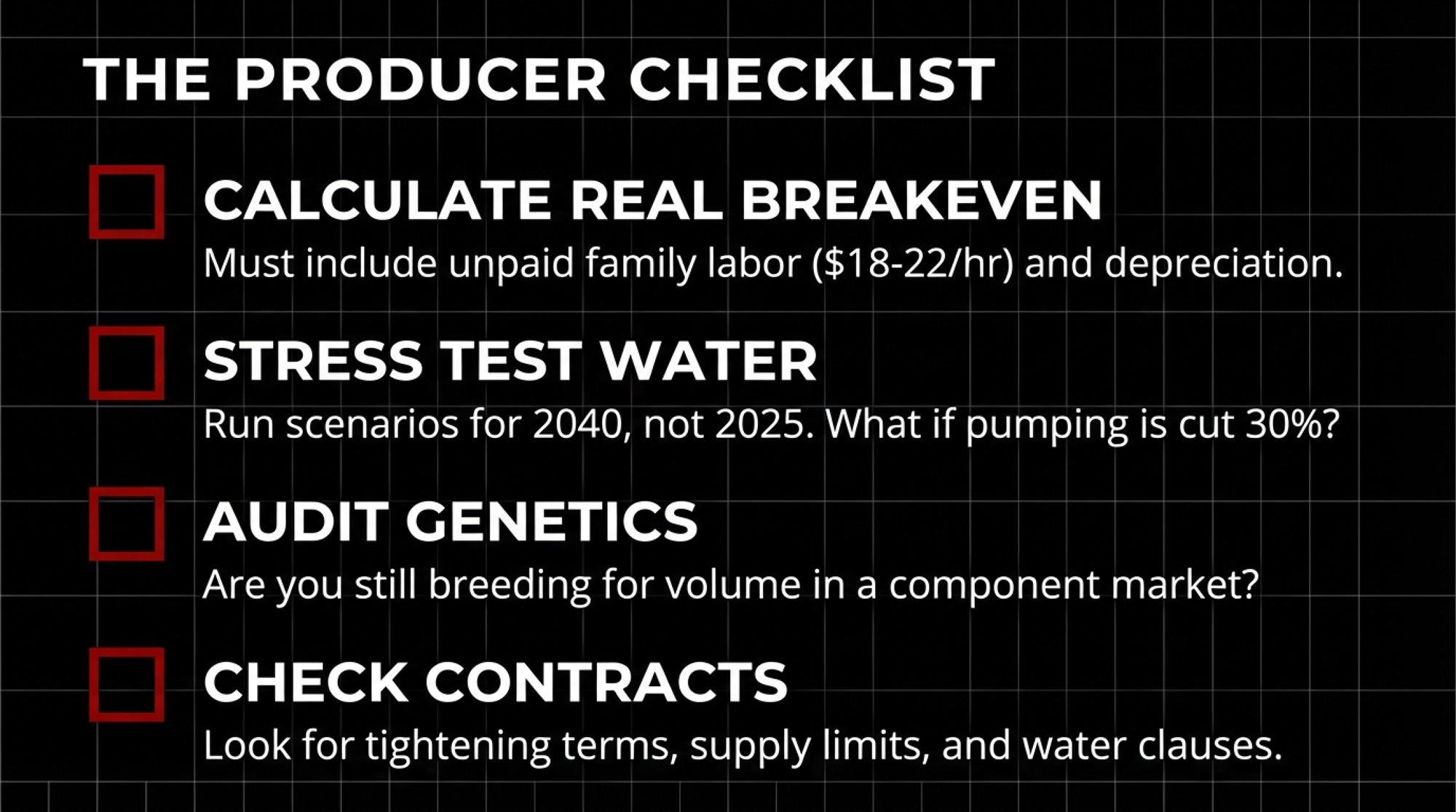
  • Talk with your lender—really talk, not just renew notes
  • Run honest numbers using proper methodology (Wisconsin’s Farm Financial Standards work well)
  • Visit operations succeeding in different models
  • Make decisions based on facts, not tradition or guilt

This transformation isn’t about good farms versus bad farms. It’s about structural changes favoring certain models over others.

Understanding that—and positioning accordingly—separates those who’ll thrive from those just trying to survive.

The next 24 months will likely determine the structure of American dairy for the next generation. Make sure you’re actively choosing your place, not just watching it happen.

We’ve been through big changes before, right? Hand milking to pipelines. Family labor to hired help. Local cream stations to global markets. This is another turn of that wheel—probably the biggest many of us have seen.

The question is: are you steering, or just hanging on?

Because at the end of the day, this industry needs people who understand cows, who know how to produce quality milk, who can manage the biology and complexity of dairy farming. That need won’t go away.

But how that knowledge gets applied, in what structures, at what scale—that’s what’s changing.

Your operation has value. Your knowledge has value. Your family’s future has value.

The key is making sure you’re the one determining how to best preserve and deploy that value, not having it determined for you by circumstances beyond your control.

That’s what Santiago really taught us—not that change is coming, but that we need to be intentional about our place in it.

Complete references and supporting documentation are available upon request by contacting the editorial team at editor@thebullvine.com.

Learn More:

Join the Revolution!

Join over 30,000 successful dairy professionals who rely on Bullvine Weekly for their competitive edge. Delivered directly to your inbox each week, our exclusive industry insights help you make smarter decisions while saving precious hours every week. Never miss critical updates on milk production trends, breakthrough technologies, and profit-boosting strategies that top producers are already implementing. Subscribe now to transform your dairy operation’s efficiency and profitability—your future success is just one click away.
NewsSubscribe
First
Last
Consent

The 51-79 Workforce Bomb: How ICE Raids Became Dairy’s Consolidation Tool

Why are independent farms facing bankruptcy while corporate dairies thrive?

EXECUTIVE SUMMARY: Here’s what we discovered: while dairy leadership chases climate credits, 58,766 people who were milking cows last month now sit in ICE detention—70% with zero criminal history. The numbers reveal a brutal truth: immigrant workers make up 51% of all dairy labor yet produce 79% of America’s milk, creating a workforce bomb that threatens 7,000 farm closures and 90% milk price spikes if detonated. But here’s the kicker—this vulnerability isn’t accidental. Large operations budget compliance costs like feed expenses while independent producers face $20,000-per-worker penalties that can bankrupt generations of family farming overnight. Bureau of Labor Statistics data shows agricultural employment already dropping 6.5% between March and July 2025, and international buyers are quietly shifting supply chains away from unreliable U.S. sources. The consolidation playbook is crystal clear: enforcement destabilizes independents while corporate players with legal departments maintain steady production, capturing market share through regulatory warfare disguised as immigration policy.

dairy workforce management

Look, I’ve been covering dairy for twenty years, and something’s got me losing sleep.

TRAC Immigration just dropped their September numbers—58,766 people sitting in ICE detention facilities right now. That’s not some abstract policy debate, you know? That’s actual people who were milking cows last month.

And get this—over 70% of these folks have zero criminal history according to TRAC’s detention data. Zero.

They’re not drug dealers or gang members. They’re the same people who’ve been showing up at 4 AM for years, doing the work most Americans won’t touch with a ten-foot pole.

Meanwhile, dairy leadership keeps chasing carbon credits and sustainability workshops while the workforce that actually keeps our industry running is disappearing faster than silage in a drought year.

Nobody in Washington seems to understand what happens when cows don’t get milked on schedule. Or maybe they understand perfectly.

The Numbers That Should Scare Every Producer

So I’m sitting here with this massive Texas A&M study from 2021—took them two years to survey 2,847 dairy operations across 14 states—and the numbers are absolutely brutal.

Immigrant workers make up 51% of all dairy labor. That’s already scary as hell, but here’s where it gets worse: farms that employ immigrant workers produce 79% of America’s milk.

The Dairy Backbone: Immigrant Workers Drive 79% of U.S. Milk Production – This chart signals just how critical immigrant labor is in the barn and on the balance sheet.

Half the workforce. Four-fifths of the milk.

We’re talking about the foundation of the entire industry just sitting there in legal limbo while leadership talks about climate change initiatives and renewable energy programs.

Texas A&M ran the projections for what happens if this workforce disappears. 2.1 million fewer cows—that’s like every cow in Wisconsin and Pennsylvania combined just vanishing. Milk production drops by 48.4 billion pounds annually. Over 7,000 dairy farms shut down. Milk prices spike over 90%.

Ninety percent. Let that sink in next time you’re at the grocery store.

Rick Naerebout from Idaho Dairymen told Idaho Business Review back in May that 90% of workers on Idaho dairies come from other countries. Down in Wisconsin, that Investigate Midwest report found about 70% immigrant workforce.

Course, you don’t need a study to tell you what’s obvious if you’ve spent any time in dairy country.

The Corporate Legal Shield Strategy

Here’s where this gets really ugly, and I guarantee your co-op newsletter won’t mention this.

The big players—Land O’Lakes, Dairy Farmers of America, Saputo—they saw this vulnerability years ago. They’ve got compliance programs, legal teams, HR departments that do nothing but immigration paperwork.

But the family farm milking 400 cows? Well, that’s a different story entirely.

Under federal immigration law—8 CFR 274a if you want to get technical—employers face penalties from $300 to $20,000 per unauthorized worker for I-9 violations. That’s just civil penalties. Criminal penalties under 8 USC 1324a can hit six figures if prosecutors want to make an example.

The math is brutal: big operations budget for legal protection, family farms gamble with bankruptcy every time they hire somebody without perfect paperwork.

Tell me that system wasn’t designed to favor certain players. When potential fines can run $20,000 per worker and you’re operating on thin margins… well, you do the math.

When Your Milking Crew Vanishes Overnight

You want to know what this actually looks like? Bureau of Labor Statistics tracked a 6.5% drop in agricultural employment between March and July this year. That’s not seasonal variation—corn harvest wasn’t even starting.

That’s people disappearing from farms because they’re scared or already in detention.

When you lose experienced milkers without warning, everything goes to hell. Fast.

Fresh cows get stressed because routines change—and anybody who’s worked with first-calf heifers knows they’re touchy as hell when things aren’t consistent. Somatic cell counts spike because whoever’s left is rushing through procedures they normally take time with. Butterfat numbers tank because cows hate disruption more than farmers hate paperwork.

Heat detection becomes impossible when everyone’s scrambling just to get animals through the parlor twice a day. You think some new hire’s gonna notice when cow 247 is standing heat at 2 AM? Not likely.

Production doesn’t just drop a little. It crashes. Hard.

And it’s not just the milking that suffers—though God knows that’s bad enough. Feed schedules get screwed up because the guy who knew which pens needed 22% protein versus 18% is gone. Breeding programs fall behind because experienced AI techs don’t grow on trees.

Equipment maintenance gets deferred because there aren’t enough bodies to handle basic operations.

You can’t just pull somebody off the street and expect them to handle a kicking Holstein or know when a fresh cow’s about to go down with milk fever. That kind of experience takes years to develop.

The Leadership Gap on What Actually Matters

Industry associations keep rolling out new environmental initiatives and climate programs while the workforce crisis threatening our foundation gets pushed to the back burner.

I tried to track what progress has been made on agricultural visa legislation this year. Best I can tell, it’s been crickets.

Meanwhile, every major dairy organization has multiple climate-focused programs with dedicated staff and fancy PowerPoint presentations.

Climate programs get good press and don’t require admitting the industry built itself on legally vulnerable workers. Workforce legalization? That’s messy politics that might upset somebody important.

But when half your labor force is living in legal limbo… well, seems like that might be worth some attention.

Who benefits when independent producers can’t find stable, legal workers while corporate operations with compliance departments sail through enforcement waves untouched? Just asking.

The Compliance Game Every Independent Must Master

If you’re running an operation with mostly immigrant labor and haven’t had your I-9 forms audited by someone who knows federal employment law inside and out, you’re taking a hell of a risk.

The operations that survive enforcement waves? They’ve got bulletproof paperwork. They understand Employment Eligibility Verification requirements under 8 CFR 274a like most farmers know butterfat pricing.

They’ve got relationships with attorneys who specialize in agricultural immigration law—not the guy who handles your real estate closings.

They budget for compliance like it’s a feed cost. Because it is.

The ones that get blindsided are hoping ICE doesn’t show up. Betting on staying under the radar. Crossing their fingers that enforcement focuses on the border instead of the barn.

That’s wishful thinking with potentially catastrophic consequences.

And here’s the thing that really gets me… most of these folks have been working the same farms for years. Their kids go to local schools. They coach Little League. They’re part of the community fabric.

The only thing “unauthorized” is that our industry built itself around their labor without bothering to make it legal. Now we’re all paying the price for that shortsightedness.

What You Can Actually Do Right Now

Alright, enough doom and gloom. What can you actually control in this mess?

First—and this is non-negotiable if you want to sleep at night—get your paperwork audited by someone who knows agricultural immigration law. Not your regular attorney, not your accountant’s cousin, but someone who specializes in this stuff.

Compliance audits typically run several thousand dollars. But that’s a bargain compared to federal penalties that can run $20,000 per worker if they find problems during an enforcement action.

Second, start building relationships with backup workers now. Local kids who need summer work and aren’t afraid of getting dirty. Retirees looking for part-time income who remember when work meant something.

Train them on basic parlor operations before you desperately need them.

Third, talk to other producers about pooling resources. Maybe five farms can share compliance consulting costs that would break any single operation. Share the knowledge, share the risk, help each other navigate this regulatory minefield.

And think hard about diversifying your marketing channels. Value-added products. Direct sales. Farm stores. Anything that reduces dependence on processors who might get nervous about pickup reliability when your workforce situation gets uncertain.

Because they will get nervous, and they won’t warn you before they start shopping your competitors.

The Market Reality Nobody Discusses

Every family farm that struggles with workforce disruption is production that flows somewhere else. Every independent producer forced to scale back or sell creates opportunities for larger operations with deeper pockets and better legal protection.

Market concentration doesn’t happen by accident. It happens because the rules favor certain players over others.

The big operations prepared for this vulnerability years ago. They’ve got compliance programs and legal teams and emergency protocols that would make a small-town lawyer’s head spin.

Most independents are hoping this all goes away so they can get back to farming.

But hoping doesn’t milk cows. And it sure doesn’t protect you from federal enforcement actions that can bankrupt three generations of family farming in a single morning.

What strikes me most about this whole situation is how it serves certain interests perfectly. Independent producers face workforce instability they can’t budget for or control, while corporate operations with legal departments maintain steady production.

Market share flows upward, processing companies get fewer, larger suppliers to deal with, and equipment manufacturers sell to bigger operations with better credit.

The Hard Truth About Where This Goes

Employment data shows structural changes are already happening. Market concentration keeps accelerating like a runaway feed wagon. And leadership seems more focused on climate initiatives than workforce stability.

The choice facing every independent dairy producer is pretty straightforward: either you acknowledge that powerful forces are reshaping this industry and position yourself accordingly, or you keep hoping everything goes back to normal while watching your neighbors get picked off one by one.

Because when your fresh cows need milking at 4 AM and there’s nobody to run the parlor, all the sustainability programs and carbon credits in the world won’t save operations that didn’t prepare for this reality.

Based on what I’m seeing from enforcement patterns and leadership priorities, I’m not sure how many independents will be left standing when this shakes out.

The 51-79 workforce crisis isn’t getting fixed anytime soon. The folks who benefit from consolidation aren’t losing sleep over which farms survive—they’re counting market share while independent producers struggle with workforce uncertainty that could’ve been addressed years ago.

Here’s what I think is really happening: this workforce vulnerability was always the perfect consolidation tool. No messy regulations. No obvious manipulation. Just enforcement of existing law that happens to destroy independent operations while leaving corporate players untouched.

And if that’s not the plan… it’s sure working out that way.

KEY TAKEAWAYS

  • Immediate compliance audit required: Independent producers face $300-$20,000 per worker in federal penalties under 8 CFR 274a—several thousand spent on specialized immigration law audits beats potential bankruptcy from surprise enforcement
  • Backup workforce development pays off: Smart farms are building relationships with local students and retirees, training them on basic parlor operations before crisis hits—operational continuity becomes competitive advantage when neighbors’ crews vanish
  • Pooled compliance resources cut costs: Five-farm cooperatives sharing immigration law consulting expenses can afford the same legal protection that corporate operations budget routinely—shared risk management beats individual vulnerability
  • Market diversification shields against processor panic: Value-added products and direct sales reduce dependence on processing plants that get nervous about pickup reliability when workforce uncertainty hits—revenue streams independent of corporate supply chains provide stability
  • Market share consolidation accelerates: Every independent farm struggling with workforce disruption creates production opportunities for corporate operations with deeper legal protection—understanding this dynamic helps position farms defensively rather than hoping enforcement goes away

Complete references and supporting documentation are available upon request by contacting the editorial team at editor@thebullvine.com.

Learn More:

Join the Revolution!

Join over 30,000 successful dairy professionals who rely on Bullvine Weekly for their competitive edge. Delivered directly to your inbox each week, our exclusive industry insights help you make smarter decisions while saving precious hours every week. Never miss critical updates on milk production trends, breakthrough technologies, and profit-boosting strategies that top producers are already implementing. Subscribe now to transform your dairy operation’s efficiency and profitability—your future success is just one click away.
NewsSubscribe
First
Last
Consent

The UK’s Dairy Sustainability Breakthrough: What It Means for You

UK’s €40K sustainability bribes are rigging dairy consolidation—and North America’s next

EXECUTIVE SUMMARY: Here’s what we discovered: sustainability programs aren’t saving small farms—they’re systematically eliminating them. UK data reveals 6% annual farm closures while average herd sizes jump to 219 cows, and that’s no accident. Corporate giants like Arla are dropping €40,000 payments per farm, but only large operations can afford the €200,000 infrastructure to qualify. Meanwhile, McDonald’s $200 million investment in “regenerative agriculture” signals the 2027 timeline when North American producers will face the same squeeze. The math is brutal: fixed compliance costs favor 800+ cow operations, leaving smaller farms with a stark choice—scale up, sell out, or get crushed. This isn’t environmental policy—it’s the most sophisticated industry consolidation scheme ever devised.

KEY TAKEAWAYS:

  • Start carbon tracking immediately—early adopters report 5% feed efficiency gains and access to premium contracts worth $0.50+ per hundredweight
  • Form strategic partnerships with 3-5 neighboring dairies to share $100K+ infrastructure costs for digesters, solar systems, and monitoring equipment
  • Watch California and New York regulations like a hawk—these states typically lead policy changes by 18-24 months, giving you advance warning
  • Invest in dual-purpose technology: methane sensors and precision feeding systems that boost both sustainability scores and milk production by 8-12%
  • Perfect your fresh cow management and butterfat protocols—these “small” details now directly impact your farm’s survival in sustainability scoring systems
dairy sustainability, farm profitability, dairy consolidation, UK dairy, regenerative agriculture

I was talking with a dairy farmer from Wisconsin the other day—runs about 600 head—and he’s feeling the heat like a lot of us. You know how it goes; the little guys around him are wondering how long they can stay afloat as these new sustainability demands start rolling in.

Now here’s what’s interesting… The UK, despite importing about a third of their milk, has quietly become the leader everyone’s watching when it comes to dairy sustainability standards. But what really caught my attention isn’t just their environmental targets—it’s how they’ve structured the whole thing actually to work for farmers instead of against them.

Take Arla, that Danish cooperative that’s gotten huge over there. They’re cutting checks for around €40,000 a year to farmers who hit their sustainability marks. That’s real money, not promises. And according to their latest corporate reports, they’re planning to pour over €2 billion into these incentive programs by 2030.

The UK government isn’t sitting on the sidelines either. They’ve committed £5 billion through their Sustainable Farming Incentive program, paying farmers between £100 and £300 per hectare annually. When you’re looking at a typical 200-hectare operation, that starts adding up to something you can actually bank on.

The Economics That Are Changing Everything

This chart reveals the engineered consolidation behind UK dairy sustainability programs. As closure rates doubled from 3% to 6% annually, average herd sizes jumped 18% to 219 cows—proving this isn’t market evolution, it’s systematic elimination of smaller operations.

But here’s the kicker—and this is where it gets tricky for smaller operations. The fixed costs of things like installing digesters or solar panels don’t get any cheaper just because you’re milking fewer cows. Farms running 800 head or more have a clear advantage here because they can spread those investments across more production volume.

The smoking gun: Compliance costs per cow are 3.4x higher for small farms (£1,200) versus large operations (£350). This isn’t accidental—it’s mathematical elimination of family dairies disguised as environmental progress.

That economic reality is driving real consolidation in the UK. The numbers from AHDB tell the story: dairy farm numbers dropped 5.8% just between April 2023 and 2024, while average herd size climbed to around 219 cows. We’ve seen this pattern before in other sectors, but what’s different here is that the sustainability angle is accelerating it.

What’s remarkable is their results. UK dairy operations have achieved a carbon footprint of about 1.25 kg CO2e per liter of milk—that’s roughly 43% of the global average, according to Dairy UK’s latest assessments. Some of that’s climate advantage, sure, but a lot comes from this systematic approach to measuring and managing efficiency.

When This Pressure Hits North America

Looking at corporate investment patterns, I’d say we’re looking at real pressure starting around 2027. McDonald’s just announced a $200 million regenerative agriculture commitment this past September, and if you know their playbook with supply chain initiatives, they typically move from pilot programs to requirements over about five years.

From there, expect formal contract requirements around 2029-2030, with serious market pressure building over the next few years after that. Based on how these things usually roll out, that’s when you see the most dramatic changes in farm structure.

You can bet companies will start ramping up demands for carbon data, rolling out incentive programs with real cash behind them, and regulations will tighten—especially in places like California and New York, where environmental policy tends to lead.

Regional differences are going to matter here. Wisconsin’s cooperative culture might actually provide some advantages—you’ve got the collaborative experience and often the scale to make these investments work. California operations are among the earliest to adopt pressure, but also have access to the most advanced technologies and financing programs.

The Technology That Actually Works

What really impresses me about the UK approach is how they’ve handled the measurement challenge. Instead of leaving farms to figure out monitoring on their own, they’ve invested in standardized systems.

Those GreenFeed units, for example—they measure methane emissions right at the cow level with remarkable precision. The UK government invested £364,000 just in monitoring equipment at Harper Adams University alone. When you compare that to the confusion most of us deal with trying to figure out which carbon calculator to use…

They’re using eight approved carbon footprinting systems that all work from the same methodology, so there’s no more wondering if you’re getting comparable results to your neighbors.

And their incentive structure is designed to prevent gaming. Arla’s program awards points across 19 different activities, but the highest point values go to the hardest changes to fake—feed efficiency improvements, fertilizer reduction, energy optimization, and animal health improvements. You can’t just check boxes and collect payments.

Strategic Paths Forward

Looking at this transition, I see three clear options for North American producers:

Scale Up: If expansion’s in your plans, now’s the time to run the numbers on sustainability infrastructure. You’re looking at needing 800-1,200 cows minimum to make the per-unit economics work on monitoring systems, renewable energy, and emissions reduction technology.

Partner Up: For operations that can’t or don’t want to scale individually, strategic partnerships with 3-5 similar farms can provide the volume needed for shared infrastructure. The UK cooperative models show how this works—shared monitoring costs, coordinated energy installations, group contracts with sustainability-focused buyers.

Strategic Exit: Let’s be honest about this third option. For some operations, particularly smaller farms without good partnership opportunities, strategic exit while asset values remain strong might be the smart financial move. UK data shows operations that exit proactively preserve more asset value than those forced out by market pressure later.

What This Means for Your Bottom Line

Here’s what I find encouraging about this whole development: when you look at UK operations that are thriving in this new system, they’re finding that the same changes that reduce emissions often improve operational efficiency too.

Better feed conversion reduces both costs and methane output. Improved cow health cuts both veterinary expenses and stress-related emissions. More efficient manure handling reduces both labor costs and environmental impact.

The latest UK Dairy Roadmap progress reports show that 80% of farmers are now calculating their carbon footprint, compared to less than 20% globally. When sustainability compliance starts generating revenue instead of just regulatory headaches, adoption rates follow pretty quickly.

Looking at Your Day-to-Day Operations

For those of us managing fresh cow transitions, monitoring butterfat performance, or optimizing dry lot systems, here’s something worth noting: these day-to-day management decisions are increasingly becoming part of your sustainability profile.

Feed efficiency during the transition period, reproductive performance metrics, even housing system choices—they all factor into carbon footprint calculations. The operations that are well-positioned for this transition aren’t necessarily the ones that love environmental regulations. They’re recognizing that fighting market forces costs more than adapting to them.

Your Action Plan

This shift creates real opportunities for operations willing to treat sustainability as a competitive advantage rather than a compliance burden. Early movers get better access to funding, premium contracts, and technical support.

What you should be doing:

  • Start carbon footprinting now, while tools and assistance are available—early movers will be ahead when requirements become mandatory
  • Watch for voluntary programs offering real financial incentives—these are stepping stones before requirements become firm
  • Consider partnerships with neighboring operations to share costs and expertise if scaling alone isn’t feasible
  • Monitor regional developments, especially in states with existing environmental regulations like California and New York
  • Invest strategically in technologies that improve both sustainability and operational efficiency—think feed management systems, renewable energy, and improved animal health protocols

The bottom line? This isn’t going away. But for operations willing to engage thoughtfully with these changes, there’s a real opportunity to build more profitable, resilient businesses.

The UK has demonstrated that sustainability initiatives can be structured in a way that does not harm farm economics. The question for North American producers is whether you’ll be positioned to benefit from similar programs when they arrive, or scrambling to catch up after the opportunity window closes.

Complete references and supporting documentation are available upon request by contacting the editorial team at editor@thebullvine.com.

Learn More:

  • How to Get Started with Carbon Footprinting on Your Dairy Farm – This article provides a practical, step-by-step guide to assessing your farm’s carbon balance. It offers actionable advice on immediate, low-cost strategies like optimizing manure use and reducing tillage, empowering you to begin your sustainability journey with clear, manageable steps that directly impact efficiency.
  • The Economics of Dairy Sustainability: From Compliance to Cash Flow – This piece shifts the focus from environmental policy to financial strategy. It reveals how forward-thinking dairy operations are generating revenue and improving their bottom line by implementing phased sustainability plans, demonstrating that these investments can offer real, measurable returns on investment.
  • Precision Fermentation: What Dairy Farmers Need to Know About the Next Food Disruption – This article prepares you for the future of the dairy market by analyzing the disruptive potential of new technology. It provides a strategic look at how precision fermentation is reshaping the protein market and offers insights on how to adapt your business model to remain competitive.

Join the Revolution!

Join over 30,000 successful dairy professionals who rely on Bullvine Weekly for their competitive edge. Delivered directly to your inbox each week, our exclusive industry insights help you make smarter decisions while saving precious hours every week. Never miss critical updates on milk production trends, breakthrough technologies, and profit-boosting strategies that top producers are already implementing. Subscribe now to transform your dairy operation’s efficiency and profitability—your future success is just one click away.
NewsSubscribe
First
Last
Consent

Analysis: A New Dairy World Order – How Europe’s €33 Billion Mega-Mergers Will Impact Your Farm

What happens when European giants start calling the shots on global milk pricing?

EXECUTIVE SUMMARY: Look, I’ve been tracking these European mergers for months, and here’s what’s really happening. The Arla-DMK deal, creating a €19 billion cooperative, isn’t just big business—it’s reshaping the way milk is priced worldwide. We’re talking about 13% of all EU milk production under one roof, with FrieslandCampina posting a €321 million turnaround by ruthlessly cutting costs. Meanwhile, feed volatility and environmental compliance are squeezing margins for operations that can’t scale up fast enough. California’s methane rules alone are pushing 15% of smaller dairies toward the exit. However, here’s the thing—smart producers are already adapting by diversifying breed choices, strategically locking feed contracts, and taking cooperative governance seriously. Don’t just watch this unfold… get ahead of it.

KEY TAKEAWAYS

  • Lock your feed contracts early — Price swings hit 40% in parts of the Midwest last year, and volatility isn’t going anywhere
  • Consider Jersey genetics for heat resilience — Holsteins drop 15-20% production in heat stress, while Jerseys maintain 85-90% of peak output
  • Engage in cooperative governance now — Environmental compliance costs favor mega-operations ($19-37 per cow vs. $63-105 for small farms), so pooling resources is survival
  • Diversify your processor relationships — With consolidation reducing options, putting all your milk in one buyer’s tank is getting riskier
  • Plan for regulatory pressure — What’s hitting California and Europe today is coming to your region tomorrow—prepare now or pay later
dairy consolidation, global dairy markets, milk price volatility, dairy farm profitability, farm management strategy

The thing is, when I first started tracking these European mergers months ago, they felt like distant headlines. But now? The Arla-DMK deal, creating a €19 billion cooperative controlling 13% of all EU milk production… that’s not just European news anymore. It’s reshaping how milk is priced from Wisconsin all the way through to Waikato.

What strikes me most is how quickly everything is unfolding. We’re not talking about the usual slow-burn industry changes here—we’re watching the entire global dairy landscape get redrawn in real time.

The Mega-Merger That Changes Everything

This isn’t just another cooperative deal. We’re talking about over 12,200 farms across seven countries, which process roughly 19 billion kilograms of milk annually. That’s massive scale—and massive influence over pricing.

Tom Brandt, who’s been milking 240 Holsteins outside Eau Claire for fifteen years, doesn’t mince words: “When there’s only one buyer within reasonable hauling distance, they pretty much set the price. I’ve seen this movie before with grain elevators—doesn’t usually end well for the little guy.”

But Chad Vincent, who keeps tabs on Wisconsin’s $52.8 billion dairy sector, sees the bigger picture: “European cooperatives this size change worldwide pricing dynamics. Every export market feels these moves,” he told me, referencing the latest data showing Wisconsin’s dairy industry up 16% in 2024.

Here’s what’s fascinating—recent research from the University of Wisconsin-Madison shows that when cooperative market share exceeds 15% regionally, price transmission effects become measurable in competing markets within 60 to 90 days. That timeline should have everyone’s attention.

Meanwhile, FrieslandCampina and Milcobel are eyeing their own €14 billion alliance. While that deal isn’t finalized, it signals where this industry is heading—toward massive consolidation that will touch every producer’s bottom line.

The Perfect Storm Driving This Consolidation Wave

If you’re wondering why now, it’s because producers are getting squeezed from every direction. Feed price volatility has been brutal—we’ve seen significant swings in key regions that strain margins to the breaking point. Jim Rodriguez, managing 180 cows in Minnesota, put it bluntly: “The volatility from last year’s weather patterns… we’re still recovering from those input cost spikes.”

Then you’ve got environmental regulations hitting hard. Take the Netherlands—farmers are facing mandatory herd cuts from 350 to 200 cows due to new nitrate rules. One Friesland producer told me: “You can’t just shrink a barn that size without hemorrhaging money—either you pay crushing fines or spend tens of thousands retrofitting for compliance.”

California’s methane regulations are creating similar pressures stateside. The regulatory requirements pose significant financial challenges for smaller operations, with industry analyses indicating substantial compliance burdens that many can’t shoulder. Data from the California Air Resources Board confirms these impacts are accelerating consolidation trends.

Dr. Michael Schmidt from the University of Kiel, who’s published extensively on cooperative economics, explains the regulatory reality: “Regulators aren’t just counting market share percentages anymore. They’re asking fundamental questions about farmer choice and market power concentration.”

The survival math is stark. USDA data indicate that dairy operations are being lost at a rate of 2-3% annually nationwide. Wisconsin alone lost over 500 farms last year. When regulatory compliance costs eat into already thin margins, scale becomes a lifeline, not a luxury.

Global Ripple Effects: The Arms Race for Scale

European consolidation has triggered a worldwide scramble. Lactalis moved aggressively, spending $2.1 billion for General Mills’ U.S. yogurt business, followed by another $2.2 billion targeting Fonterra’s Mainland assets. They clearly saw this consolidation wave coming and decided to get ahead of it.

Peter McBride from Fonterra was refreshingly direct when I spoke with him: “We maintain cost leadership through grass-fed efficiency, but European mega-cooperatives now compete on supply chain reliability and marketing muscle, not just price.”

Canada’s supply management system suddenly looks prescient in this context. Their sector contributed $18.9 billion to GDP and supported 215,000 jobs while completely insulating producers from global pricing volatility. Sometimes, the old ways prove to be quite smart.

The financial muscle behind these moves is impressive. FrieslandCampina flipped from a €149 million loss in 2023 to a €321 million profit in 2024—but only after cutting 1,800 jobs and targeting €500 million in cost reductions. Meanwhile, Arla posted €13.8 billion revenue with a 50.9 EUR-cent/kg performance price—their second-highest farmer payout in history.

When you can deliver those kinds of returns to farmers, the consolidation argument becomes a lot easier to make.

Heat Stress and Breed Choices: The Climate Reality Nobody Talks About

Here’s something that often gets overlooked in all the merger talk—breed choice is becoming a matter of survival. Heat stress isn’t just a summer nuisance anymore; it’s a bottom-line killer. Recent research indicates that Holsteins can lose 15-20% of their production during heat stress periods, whereas Jerseys maintain 85-90% of their peak output.

“Heat stress absolutely murders Holstein production here in Central Texas,” Maria Santos explained from her 300-head mixed-breed operation outside Austin. “Jerseys hold up better in summer, but the milk check math changes when you’re dealing with 40% lower volume per cow.”

Sarah Williams switched to 25% Jersey crosses on her 240-cow Wisconsin operation three years ago: “Lower volume per cow, but they handle hot summers better, and the butterfat premiums help offset the lost pounds.”

As climate pressure builds and mega-cooperatives begin to optimize for environmental resilience, this type of genetic diversity becomes increasingly valuable. Arla’s already investing in genomic selection programs that factor climate adaptability—they see where this is heading.

The Hidden Risk: When Integration Goes Wrong

Here’s a reality check about these mega-mergers that doesn’t make the press releases—integration is messy, expensive, and sometimes fails spectacularly. FrieslandCampina learned this when their 2024 IT system integration delayed milk payments to 400 farmers for three weeks.

“Thirty years of the same routine—milk the cows, get paid,” one affected producer told regional media. “Then suddenly our checks disappeared because computers in Amsterdam couldn’t talk to computers in Brussels.”

Now imagine scaling that challenge across 23,000 farmers speaking five different languages… that’s the mountain Arla-DMK faces. The membership churn is real—FrieslandCampina lost 4.4% of members and processed 3.4% less milk in 2024. When farmers lose confidence in their cooperative, they vote with their feet.

Aaron Lehman from Iowa Farmers Union cuts through the corporate speak: “Scale supposedly brings efficiency, but farmers often lose their voice when the boardroom table seats twenty thousand instead of two hundred.”

Your Regional Survival Playbook

Different regions face unique pressures, so your strategy has to fit your reality.

Upper Midwest producers, such as those in Wisconsin, are facing feed cost volatility as their biggest threat. The savvy operators are diversifying their supplier relationships and locking in seasonal contracts earlier than ever. Some are considering Jersey crossbreeding specifically for heat tolerance as climate pressure builds.

Western producers are grappling with environmental compliance as their make-or-break issue. Cooperative membership for regulatory cost-sharing is becoming essential, not optional. “The paperwork alone requires hiring someone part-time,” explained Jake Martinez, running 280 Holsteins near Modesto. “Then you add equipment costs, monitoring, reporting… it never ends. Cooperative membership at least spreads those consulting fees across more operations.”

Southeastern operations can turn heat stress management into a competitive advantage. Investment in cooling systems and climate-adapted genetics pays off when competitors struggle. Additionally, export opportunities are increasing as European production constraints tighten the supply.

Northeast producers benefit from local market premiums that protect against commodity volatility. The key is strengthening direct processor relationships and monitoring the impacts of Canadian supply management on border pricing.

Universal strategies for all regions:

Diversify your processor relationships where possible—don’t put all your milk in one buyer’s tank, especially if consolidation is reducing your options.

Engage actively in cooperative governance before major decisions get made for you. Producers who stay involved have more influence than those who simply complain after the fact.

Plan for environmental compliance costs that favor larger operations. Whether through cooperative membership or direct investment, prepare for regulations that are spreading from California and Europe.

Evaluate breed choices for climate resilience and regulatory compliance, not just production volume. Heat tolerance and environmental adaptability are creating competitive advantages.

Lock feed contracts strategically and diversify suppliers. Volatility isn’t going away, and input cost management separates survivors from statistics.

The Bullvine Bottom Line

Look, I can analyze these European mergers all day, but here’s what matters for your operation: this consolidation wave is changing the rules of the game whether you like it or not. The €33 billion in combined revenue we’re talking about will reshape global pricing dynamics, whether you’re selling to a local plant or shipping internationally.

The producers who adapt their strategies to this new reality—diversifying relationships, engaging in governance, planning for compliance, selecting climate-adapted genetics—those are the operations that’ll thrive over the next decade.

The ones hoping someone else figures it out? They will become statistics in the next wave of consolidation.

Because in this business, when European giants make their moves, the nimble producers survive and prosper. The slow ones… well, they get squeezed out by forces they should have seen coming.

The bottom line? This isn’t some distant corporate drama. It’s the new reality of dairy economics, and the producers who adapt fastest will be the ones still thriving when the dust settles.

What’s your next move going to be?

All data verified through authoritative industry sources as of September 1, 2025, including official cooperative reports, USDA agricultural statistics, and peer-reviewed dairy science research.

Complete references and supporting documentation are available upon request by contacting the editorial team at editor@thebullvine.com.

Learn More:

Join the Revolution!

Join over 30,000 successful dairy professionals who rely on Bullvine Weekly for their competitive edge. Delivered directly to your inbox each week, our exclusive industry insights help you make smarter decisions while saving precious hours every week. Never miss critical updates on milk production trends, breakthrough technologies, and profit-boosting strategies that top producers are already implementing. Subscribe now to transform your dairy operation’s efficiency and profitability—your future success is just one click away.
NewsSubscribe
First
Last
Consent

Lactalis Unleashes $2.1 Billion Dairy Domination Strategy: How Global Consolidation Reshapes Your Market Position

Stop accepting commodity milk pricing. Lactalis’ $2.1B yogurt play reveals how smart farmers capture $75K premiums through strategic positioning.

EXECUTIVE SUMMARY: The $2.1 billion Lactalis-General Mills yogurt deal isn’t just corporate news—it’s a wake-up call for dairy farmers still thinking like commodity producers instead of strategic suppliers. While General Mills walked away from 15-20% yogurt margins to chase 30% pet food returns, smart farmers are learning the same lesson: average performance in consolidating markets means shrinking opportunities. Our analysis reveals that a 500-cow operation optimizing protein content from 3.6% to 3.8% can capture $50,000-75,000 annually in premium pricing—but only if they’re positioned with processors who understand component value. With major consolidation accelerating (Lactalis now controls yogurt aisle architecture from farm gate to retail shelf), the gap between strategic and reactive farmers is widening rapidly. The uncomfortable truth: farms accepting commodity pricing while processors like Lactalis build global supply chain control are essentially subsidizing their competitors’ growth. International data shows European production constraints creating global opportunities, but only for operations positioned beyond local commodity markets. Every day you delay strategic positioning analysis is money left on the table—and market position you’ll never recover.

KEY TAKEAWAYS

  • Component Optimization ROI: Genomic testing investment of $25,000 to improve protein percentage by 0.1% across a 300-cow herd generates $15,000 annually in additional revenue—that’s a 60% annual return while competitors settle for commodity rates
  • Technology Scale Economics: Robotic milking systems cost $1,333-1,667 per cow on 150-cow operations versus $667-833 per cow on 300-cow operations—successful farms are thinking scale optimization, not just technology adoption
  • Market Intelligence Premium: Farms building relationships with globally-minded processors like Lactalis capture component premiums while local commodity suppliers face margin compression—the $2.1B deal proves scale and specialization drive future pricing power
  • Strategic Positioning Urgency: With feed costs projected to decrease 10.1% in 2025 while milk production grows 0.5% to 226.9 billion pounds, the window for optimizing processor relationships and capturing premiums is closing as consolidation accelerates
  • Global Market Leverage: EU production constraints due to environmental regulations create export opportunities worth tracking—farms positioned for international markets through strategic processor relationships access premium pricing unavailable to local commodity suppliers
dairy consolidation, processor relationships, component pricing, farm strategic planning, dairy market trends

The world’s largest dairy giant just executed the most strategic yogurt acquisition in industry history, and the ripple effects will transform how every dairy operation competes for the next decade. While General Mills walks away with $2+ billion to fuel pet food expansion, Lactalis now controls yogurt market architecture from farm gate to retail shelf, fundamentally altering milk pricing power and processor relationships across North America. This isn’t just another corporate deal for strategic dairy planners – it’s a blueprint for how scale, specialization, and supply chain control will determine winners and losers in the new dairy economy.

The dust has settled on what analysts call the “elephant deal” of 2025, and the implications stretch far beyond corporate boardrooms. When the U.S. Department of Justice gave final approval in early June for Lactalis to complete its acquisition of General Mills’ U.S. yogurt business (General Mills and Lactalis Receive Regulatory Clearance), they didn’t just greenlight a transaction – they validated a new paradigm for global dairy competition that every producer needs to understand.

Why Did America’s Food Giant Exit a $1.5 Billion Yogurt Empire?

What might surprise dairy producers is that General Mills wasn’t failing at yogurt. They were walking away from a business that contributed approximately $1.5 billion to their fiscal 2024 net sales and held respected brands like Yoplait, Go-Gurt, and Oui. So why would they exit a market where U.S. yogurt consumption hit record levels in 2024?

The margin mathematics tells the real story. General Mills’ yogurt division generated operating margins of 15-20% – respectable numbers until you compare them to their “gem brands” like Blue Buffalo pet food, which delivers approximately 30% EBIT margins. In today’s dairy landscape, this margin differential represents the difference between surviving and thriving.

Think of it like comparing a 20,000-pound lactation average to a 30,000-pound herd. Both are productive, but one creates dramatically more profit per unit of investment. But here’s where conventional wisdom gets challenged: Is chasing higher margins always the right strategy for dairy operations, or does it create dangerous vulnerabilities?

The secular headwinds facing traditional yogurt mirror challenges across dairy. Consumer preferences are fragmenting rapidly, while Hispanic-focused brands like LaLa, El Mexicano, and La Ricura collectively control 31% of total yogurt sales, demonstrating how quickly traditional market leaders can lose ground to specialized competitors.

General Mills’ CEO Jeff Harmening has been executing their “Accelerate” strategy since 2020, transforming nearly 30% of their net sales base through strategic acquisitions and divestitures. This isn’t incremental change – it’s complete portfolio reconstruction based on margin optimization and growth potential.

But here’s the critical question for dairy farmers: If a major food company with massive scale and marketing power can only generate 15-20% margins in yogurt, what does that tell you about the competitive intensity? More importantly, are you positioning your operation for the processors who understand margin optimization, or are you still thinking like it’s 2015?

The financial engineering behind this exit reveals sophisticated thinking. General Mills expects net proceeds exceeding $2 billion from U.S. transactions, primarily for share repurchases. This strategy has already reduced their shares outstanding by 9% since 2019 and boosted EPS by approximately 20%.

How Lactalis Plans to Cement North American Dairy Control

While General Mills retreats strategically, Lactalis advances with calculated aggression. This French family business isn’t just large – with €30 billion in revenue for 2024, up 2.8% over fiscal 2023, they’re demonstrating how global scale translates into market control. But their strategy goes far beyond size.

The brand consolidation creates unprecedented market architecture. Lactalis already owned Stonyfield Organic, siggi’s, Brown Cow, Lactaid, and Green Mountain Creamery in the U.S. Adding Yoplait, Go-Gurt, Oui, Mountain High, and :ratio doesn’t just expand their portfolio – it creates yogurt aisle domination that fundamentally shifts retailer relationships.

Consider the parallel in dairy farming: when a large operation controls multiple farms in a region, they gain negotiating leverage with feed suppliers, veterinarians, and milk buyers that smaller operations simply can’t match. Lactalis now wields similar power with grocery chains, creating efficiency synergies and cross-promotion opportunities that smaller yogurt brands cannot replicate.

But here’s where the conventional consolidation narrative gets complicated: While Lactalis reduced their debt load from €6.45 billion to €5.03 billion during 2024 and increased operating income by 4.3%, they’re also creating potential systemic risks. What happens when one player controls too much of the supply chain? Are we creating efficiency or fragility?

Lactalis’ global expansion continues beyond North America. They’re actively pursuing Fonterra’s NZ$4.9 billion consumer business to strengthen their presence in Asia and Oceania, having already applied for informal merger clearance from Australia’s competition regulator. Recent acquisitions of South African coffee creamer brand Cremora and Portuguese cheese maker Queijos Tavares demonstrate systematic global market building.

Here’s the critical insight most dairy producers are missing: This isn’t just about yogurt or even dairy – it’s about supply chain architecture. Are you building relationships with processors who think like Lactalis, or are you still dealing with companies that think small?

What This Means for Your Dairy Operation’s Strategic Position

The implications for dairy producers are multifaceted and immediate. When major processors consolidate and gain market power, individual farms face opportunities and risks requiring strategic responses.

Component optimization becomes even more critical in this environment. With Lactalis focusing on premium yogurt brands emphasizing protein content and functionality, producers who consistently deliver high-quality milk with optimal protein and butterfat levels will capture premium pricing. The concentration risk requires careful monitoring. When fewer, larger processors control more market share, individual farmers have reduced leverage in price negotiations.

Market intelligence becomes essential for strategic positioning. Understanding where your milk flows and what drives pricing in different market segments helps optimize production and investment decisions. The yogurt boom creates opportunities, but only for producers who understand how to position themselves for premium channels.

Here’s a scenario to consider: A 500-cow operation in Wisconsin produces 24,000 pounds per cow annually with 3.6% protein and 3.8% butterfat. Under traditional pricing, they’re receiving commodity rates. However, if they optimize genetics and nutrition to consistently achieve 3.8% protein and 4.0% butterfat, they could capture premiums worth $50,000-75,000 annually in the current market. Are you tracking these specific metrics, or still managing by gut feeling?

Technology Integration and Practical Implementation

The consolidation creates new imperatives for technology adoption and innovation. Large, globally connected processors like Lactalis demand consistency, quality, and data transparency that smaller operations may not require. This creates both challenges and opportunities for dairy producers.

Data management becomes table stakes for premium processor relationships. Modern dairy operations need systems that track component quality, animal health metrics, and production consistency with the precision that large processors require for their global supply chains.

Consider this technological reality check: A robotic milking system costs $200,000-250,000 per robot. On a 150-cow operation, that’s $1,333-1,667 per cow. On a 300-cow operation using two robots, it’s $667-833 per cow. Are you thinking about technology investment at a sufficient scale, or are you making decisions that doom you to higher per-unit costs?

Here’s the innovation challenge most producers miss: It’s not about adopting the latest technology – it’s about adopting the right technology at the right scale for your specific market position. What data are you collecting that processors like Lactalis actually value versus data you think they should want?

Financial Implications and Strategic Assessment Framework

The financial mathematics of this deal offer insights for dairy farm strategic planning. General Mills’ ability to generate $2+ billion from asset divestiture and redeploy that capital for higher returns demonstrates sophisticated portfolio management that dairy operations can adapt.

Here’s a financial reality most farmers don’t calculate: If you’re carrying debt at 7% interest while passing up investments that could return 15%, you’re actually losing 8% annually on every dollar that could be redeployed. When did you last conduct a comprehensive ROI analysis of your current asset allocation?

Practical example: A $25,000 investment in genomic testing and selective breeding to improve protein percentage by 0.1% across a 300-cow herd generates approximately $15,000 annually in additional revenue at current premiums. That’s a 60% annual return on investment. Are you making these calculations, or still managing by tradition?

The Bottom Line: Your Strategic Assessment Framework

This $2.1 billion transaction represents far more than corporate restructuring – it’s a master class in strategic portfolio optimization and global market positioning that every dairy operation should study. General Mills demonstrated that even successful businesses should be divested if they don’t align with your core competencies and margin requirements. Lactalis showed how systematic global expansion and market consolidation can justify premium acquisition prices when executed with financial discipline and strategic vision.

Here are the specific questions you need to answer about your operation:

  1. Component optimization: Are you consistently achieving protein and butterfat levels that qualify for premium pricing or accepting commodity rates for average performance?
  2. Technology integration: What data are you collecting that processors actually value, and how are you using it to optimize production decisions?
  3. Market positioning: Are you building relationships with processors who think globally and invest in growth or staying comfortable with local relationships that may not survive consolidation?
  4. Financial discipline: When did you last calculate the ROI of your current asset allocation versus alternative investments in genetics, technology, or market positioning?
  5. Scale optimization: Are you operating at a sufficient scale to justify technology investments and capture efficiency gains, or trapped in a sub-optimal size that limits your options?

The $2.1 billion question for every dairy operation: Are you positioning for the market that’s emerging or clinging to strategies designed for the market that’s disappearing? The companies that thrive in this new environment will be those who adapt quickly, execute consistently, and never stop learning about where their markets are heading.

Your next move: Conduct a comprehensive strategic assessment of your operation using this deal’s framework. Are you building a business that could attract a premium from acquirers like Lactalis or just maintaining a lifestyle that’s becoming less viable each year? The answer to that question will determine whether you thrive or merely survive in the new dairy economy.

The dairy industry just became significantly more interesting – and more competitive. The producers who study this transaction’s strategic lessons and apply them to their own operations will find opportunities that others miss. Those who don’t may find themselves competing for an increasingly smaller share of an increasingly consolidated market.

Learn More:

Join the Revolution!

Join over 30,000 successful dairy professionals who rely on Bullvine Weekly for their competitive edge. Delivered directly to your inbox each week, our exclusive industry insights help you make smarter decisions while saving precious hours every week. Never miss critical updates on milk production trends, breakthrough technologies, and profit-boosting strategies that top producers are already implementing. Subscribe now to transform your dairy operation’s efficiency and profitability—your future success is just one click away.
NewsSubscribe
First
Last
Consent
Send this to a friend